EP1484866B1 - Selective pre-authentication to anticipated primary wireless access points - Google Patents
Selective pre-authentication to anticipated primary wireless access points Download PDFInfo
- Publication number
- EP1484866B1 EP1484866B1 EP04102063A EP04102063A EP1484866B1 EP 1484866 B1 EP1484866 B1 EP 1484866B1 EP 04102063 A EP04102063 A EP 04102063A EP 04102063 A EP04102063 A EP 04102063A EP 1484866 B1 EP1484866 B1 EP 1484866B1
- Authority
- EP
- European Patent Office
- Prior art keywords
- wireless access
- access point
- act
- wireless
- wireless device
- Prior art date
- Legal status (The legal status is an assumption and is not a legal conclusion. Google has not performed a legal analysis and makes no representation as to the accuracy of the status listed.)
- Expired - Lifetime
Links
- 230000003466 anti-cipated effect Effects 0.000 title claims description 8
- 230000002452 interceptive effect Effects 0.000 claims abstract description 5
- 238000000034 method Methods 0.000 claims description 25
- 230000004044 response Effects 0.000 claims description 7
- 238000012546 transfer Methods 0.000 claims description 6
- 238000005516 engineering process Methods 0.000 claims description 5
- 238000004590 computer program Methods 0.000 claims 11
- 230000002688 persistence Effects 0.000 claims 1
- 238000012545 processing Methods 0.000 abstract description 6
- 238000004891 communication Methods 0.000 description 6
- 230000008901 benefit Effects 0.000 description 4
- 230000008569 process Effects 0.000 description 4
- 230000007246 mechanism Effects 0.000 description 3
- 238000013459 approach Methods 0.000 description 1
- 230000003139 buffering effect Effects 0.000 description 1
- 230000001419 dependent effect Effects 0.000 description 1
- 238000005259 measurement Methods 0.000 description 1
- 230000006855 networking Effects 0.000 description 1
- 230000003287 optical effect Effects 0.000 description 1
- 238000009877 rendering Methods 0.000 description 1
- 238000012552 review Methods 0.000 description 1
- 230000035945 sensitivity Effects 0.000 description 1
- 230000000007 visual effect Effects 0.000 description 1
Images


Classifications
-
- H—ELECTRICITY
- H04—ELECTRIC COMMUNICATION TECHNIQUE
- H04L—TRANSMISSION OF DIGITAL INFORMATION, e.g. TELEGRAPHIC COMMUNICATION
- H04L9/00—Cryptographic mechanisms or cryptographic arrangements for secret or secure communications; Network security protocols
- H04L9/32—Cryptographic mechanisms or cryptographic arrangements for secret or secure communications; Network security protocols including means for verifying the identity or authority of a user of the system or for message authentication, e.g. authorization, entity authentication, data integrity or data verification, non-repudiation, key authentication or verification of credentials
-
- H—ELECTRICITY
- H04—ELECTRIC COMMUNICATION TECHNIQUE
- H04L—TRANSMISSION OF DIGITAL INFORMATION, e.g. TELEGRAPHIC COMMUNICATION
- H04L63/00—Network architectures or network communication protocols for network security
- H04L63/08—Network architectures or network communication protocols for network security for authentication of entities
-
- H—ELECTRICITY
- H04—ELECTRIC COMMUNICATION TECHNIQUE
- H04L—TRANSMISSION OF DIGITAL INFORMATION, e.g. TELEGRAPHIC COMMUNICATION
- H04L12/00—Data switching networks
- H04L12/02—Details
- H04L12/06—Answer-back mechanisms or circuits
-
- H—ELECTRICITY
- H04—ELECTRIC COMMUNICATION TECHNIQUE
- H04L—TRANSMISSION OF DIGITAL INFORMATION, e.g. TELEGRAPHIC COMMUNICATION
- H04L12/00—Data switching networks
- H04L12/28—Data switching networks characterised by path configuration, e.g. LAN [Local Area Networks] or WAN [Wide Area Networks]
-
- H—ELECTRICITY
- H04—ELECTRIC COMMUNICATION TECHNIQUE
- H04W—WIRELESS COMMUNICATION NETWORKS
- H04W12/00—Security arrangements; Authentication; Protecting privacy or anonymity
- H04W12/06—Authentication
- H04W12/062—Pre-authentication
-
- H—ELECTRICITY
- H04—ELECTRIC COMMUNICATION TECHNIQUE
- H04L—TRANSMISSION OF DIGITAL INFORMATION, e.g. TELEGRAPHIC COMMUNICATION
- H04L65/00—Network arrangements, protocols or services for supporting real-time applications in data packet communication
- H04L65/40—Support for services or applications
-
- H—ELECTRICITY
- H04—ELECTRIC COMMUNICATION TECHNIQUE
- H04W—WIRELESS COMMUNICATION NETWORKS
- H04W36/00—Hand-off or reselection arrangements
- H04W36/0005—Control or signalling for completing the hand-off
- H04W36/0011—Control or signalling for completing the hand-off for data sessions of end-to-end connection
- H04W36/0016—Hand-off preparation specially adapted for end-to-end data sessions
-
- H—ELECTRICITY
- H04—ELECTRIC COMMUNICATION TECHNIQUE
- H04W—WIRELESS COMMUNICATION NETWORKS
- H04W36/00—Hand-off or reselection arrangements
- H04W36/08—Reselecting an access point
Definitions
- the present invention relates to wireless networking technology. More specifically, the present invention relates to mechanisms for selectively pre-authenticating to anticipated primary wireless access points even before an anticipated wireless access point becomes an actual primary wireless access point.
- a "wireless device” is any device that is capable of communicating over one or more wireless networks even if that device is also capable of communicating over a wired network.
- the ability to communicate over a wireless network has become a popular attribute of computers. Accordingly, wireless devices are now spread throughout the globe. The ability to connect to a wireless network is particularly useful for portable computing devices as wireless networks typically allow the portable computing devices to be moved greater distances and with far less restriction that it would if physically connected to a wired network.
- the wireless access point allows wireless devices that are within its range (and that are properly configured and authorized) to access a wired network connected to the wireless access point.
- the wired network may be a local area network, or even a wide area network such as the Internet. Wireless access points thus tend to be more fixed in space than are the portable wireless devices they support.
- the wireless device moves from an area supported by one wireless access point to an area supported by another wireless access point.
- the roaming wireless device In order to make the switch from one wireless access point to another, the roaming wireless device often waits until the association with the prior wireless access point is broken before associating with and authenticating to the new wireless access point. Accordingly, there is latency time between the time the wireless device disassociates with the prior wireless network and the time the wireless device successfully authenticates to the new wireless device.
- a wireless device pre-authenticates with a wireless access point that never actually becomes a primary wireless access point. After all, it is often difficult to predict when a wireless device will begin using a primary wireless access point since the movement of the wireless device is subject to unpredictability in the movement of its associated user. If the anticipated primary wireless access point does not actually become the primary wireless access point, the pre-authentication process represents wasted processor cycles, power and unnecessary load on authentication servers.
- Mobile wireless devices sometimes have limited processor and battery resources as compared to their larger counterparts. Accordingly, what would be advantageous are mechanisms that allow for pre-authentication before switching between wireless access points, while having reduced processor and power requirements.
- US 2003/0016655 A1 relates to fast dynamic route establishment in wireless, mobile-access data networks using mobility prediction.
- Wireless mobile nodes are free to move about within the network while remaining connected to the network and engaging in data communications with other fixed or mobile network nodes.
- one critical delay factor is the additional processing and overhead time required to "hand-off" data communications between a mobile node and one neighboring node to another neighboring node as the mobile node changes location within the network. Therefore, packet latency, packet loss, and packet jitter are reduced by pre-establishing a new route before hand-off occurs to provide fast, real time, dynamic route establishment between a mobile node and another fixed or mobile correspondent node of the network when actual hand-off occurs.
- a mobile node captures the layer 3 beacons and periodically carries out a mobility prediction analysis to determine when it is imminent that the mobile node must hand-off its network communications link from a current foreign agent to another foreign agent as it moves from one location to another.
- a forward-based scheme is used instead of a multicast-based scheme.
- a direction-based selective multicast scheme is used to reduce latency and packet loss due to hand-off procedures.
- the direction-based selective multicast is initiated by taking into account the measurements of signal strength and the mobility pattern such as the direction of mobile hosts moves and cell latency.
- the served base station would initiate multicast to candidate base stations that the mobile host is about to move to.
- Pack, S. et al "Pre-authenticated fast handoff in a public wireless LAN based on IEEE 802.1x model", School of Computer Science and Engineering, Seoul National University, Korea, 2002 , relates to a pre-authenticated fast hand-off in a public wireless network.
- a frequent hand-off region is set off adjacent access points, and the access point's locations and user's movement patterns are determined.
- FHR frequent hand-off region
- the user's service level as well as its mobility pattern should be considered.
- a one-time password scheme is used for the user authentication.
- the wireless device While communicating with a prior wireless access point, the wireless device determines that a next wireless access point is within range and may potentially be communicated with in the future. The wireless device determines that one or more applications running on the wireless device require low latency when switching from one wireless access point to another. In response, the wireless device indicates to the next wireless access point that the wireless device is to acquire an authenticated state with the next wireless access point even prior to making the second wireless access point a primary wireless access point. There may be multiple next wireless access points within range, in which case, the wireless device may acquire the authenticated state with these multiple next wireless access points.
- the wireless device adaptively makes the determination of whether or not to pre-authenticate. If the wireless device is running an application that is sensitive to latency (also referred to herein as a low latency application), then pre-authentication is performed and latency is reduced during the switch between wireless access points. Such low latency applications may include voice over IP, video, interactive whiteboard, or video teleconferencing. On the other hand, if the wireless device is not running a low latency application, the wireless device is less susceptible to latency when making the wireless access point switch. In that case, pre-authentication is not performed and processing and battery resources are preserved. Accordingly, pre-authentication is performed when it is important, and not performed thereby preserving processing and battery resources when pre-authentication is not important.
- the principles of the present invention relate to a wireless device that adaptively makes the determination of whether or not to pre-authenticate. If the wireless device is running an application that is sensitive to latency (also referred to herein as a low latency application), then pre-authentication is performed and latency is reduced during the switch between wireless access points. Such low latency applications may include voice over IP, video, interactive whiteboard, or video teleconferencing. On the other hand, if the wireless device is not running a low latency application, the wireless device is less susceptible to latency when making the wireless access point switch. In that case, pre-authentication is not performed and processing and battery resources are preserved.
- Embodiments of the present invention may include a special purpose or general purpose computing device including various computer hardware, as discussed in greater detail below.
- Embodiments within the scope of the present invention also include computer-readable media for carrying or having computer-executable instructions or data structures stored thereon.
- Such computer-readable media can be any available media which can be accessed by a general purpose or special purpose computer.
- Such computer-readable media can comprise physical storage media such as RAM, ROM, EEPROM, CD-ROM or other optical disk storage, magnetic disk storage or other magnetic storage devices, or any other medium which can be used to carry or store desired program code means in the form of computer-executable instructions or data structures and which can be accessed by a general purpose or special purpose computer.
- FIG. 1 and the following discussion are intended to provide a brief, general description of a suitable computing environment in which the invention may be implemented. Although not required, the invention will be described in the general context of computer-executable instructions, such as program modules, being executed by computing devices.
- program modules include routines, programs, objects, components, data structures, and the like that perform particular tasks or implement particular abstract data types.
- a suitable operating environment for the principles of the invention includes a general purpose computing device in the form of a wireless device 100.
- the wireless device 100 has the appearance of a mobile telephone, a wide-variety of devices are now capable of communicating over a wireless network and may benefit by employing the principles of the present invention.
- tablet PCs, Personal Digital Assistants (PDAs), laptops, and other wireless devices are now available.
- Other wireless device forms may be developed in the future.
- the principles of the present invention are not limited to the particular form of the wireless device.
- the wireless device 100 includes a user interface 101 for allowing a user to input information through an input user interface 103.
- the user reviews information presented via an output user interface 102.
- the user interface will vary widely depending on the form factor of the wireless device. In the illustrated embodiment, however, in which the wireless device 100 is a wireless telephone, the output user interface 102 includes a speaker 104 for presenting audio information to the user, as well as a display 105 for presenting visual information to the user.
- the input user interface 103 may include a microphone 106 for rendering audio information into electronic form.
- the input user interface 103 includes dialing controls 107 and navigations controls 108 that allow the user to input information into the wireless device 100.
- the speaker 104 and the microphone 106 are illustrated as external, the speaker and microphone would typically be integrated with and/or internal to the wireless device 100.
- Program code means comprising one or more program modules may be stored in a memory 112.
- the one of more program modules may include an operating system 113, one or more application programs 114, other program modules 115, and program data 116.
- the one or more program modules may be instantiated in the memory (if volatile), or loaded from memory (if non-volatile) and then further processed using a processor 111.
- the program code means may include non-volatile as well as volatile memory and its form may vary greatly depending on the type of wireless device.
- a bus 110 interconnects the user interface 101, the processor 111, and the memory 112.
- Figure 1 represents a suitable operating environment for the present invention
- the principles of the present invention may be employed in any wireless device that is capable of communicating over a wireless network.
- the wireless device illustrated in Figure 1 is illustrative only, and by no means represents even a small portion of the wide variety of wireless devices in which the principles of the present invention may be implemented.
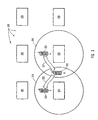
- FIG. 2 illustrates a wireless network environment 200 in which the principles of the present invention may operate.
- the network environment 200 includes a number of wireless access points 201 through 206.
- Each wireless access point will be able to serve suitably configured wireless devices within a certain range.
- the wireless access point may serve surrounding wireless devices using any wireless communication protocol such as, for example, IEEE 802.11, any successor 802.11 protocol, Bluetooth technology, Personal Area Networks (PAN) using Ultra Wide Band (UWB) technology, and even wireless Wide Area Networks such as GPRS technology.
- the range of wireless access point 204 is illustrated by circle 214, while the range of wireless access point 205 is illustrated by circle 215.
- the other wireless access points 201 through 203 and 206 will also have a range.
- a wireless device 220 roams within the wireless network 200 and may (but need not) have the structure described above for the wireless device 100 of Figure 1.
- ranges 214 and 215 are illustrated as being approximately circular and approximately centered at the associated wireless access point.
- wireless access points may have a variety of range shapes depending on the type and orientation of the antenna(s) of the wireless access point, and any physical obstacles within the range or otherwise confining the range.
- a wireless access point with an omnidirectional antenna will take the approximate form of a sphere.
- a wireless device is often mobile and thus may travel from and area served by one wireless access point to an area served by another wireless device.
- the wireless device often switches wireless access points.
- wireless device 220 is illustrated in Figure 2 as traveling from point A (which is clearly within the range of wireless access point 205) to point B (which is within the range of both wireless access points 204 and 205) as represented by arrow 221.
- the wireless device 220 may move even further from point B to point C (which is clearly within the range of wireless access point 204, but no longer within the range of wireless access point 205). Accordingly, at some point in this process while the wireless device is within the range of both the wireless access points 204 and 205, the wireless device 220 will switch wireless access points.
- Figure 3 illustrates a flowchart of a method 300 for a wireless device to transfer from one wireless access point to another wireless access point in accordance with the principles of the present invention.
- the method 300 may be implemented as the wireless device 220 travels from point A to point C illustrated in Figure 2, the method 300 will be described with frequent reference to the network environment 200 of Figure 2.
- the wireless device determines that an application that is currently running on the wireless device is to have low latency when transferring from one wireless access point to another (e.g., 301).
- the application need not have a user interface but may be any software component (e.g., a device driver, and operating system component or the like). Furthermore, this determination may be made internally by an application on the wireless device or in response to an indication from an independent agent internal or external to the wireless device.
- Some applications are more sensitive to latency requirements and will be referred to herein as low latency applications.
- Such low latency application include, for example, voice over IP, video, interactive whiteboard, video teleconferencing, or streaming applications (e.g., music streaming) especially if those streaming application have limited buffering capability.
- the wireless device 220 may make this determination in response to an express statement by the application, or may simply infer the same based on an identification of the application. For example, the wireless device may maintain a list of application identifiers associated with those applications that are (or are not) low latency applications.
- the method 300 also includes a functional, result-oriented step for preparing a second wireless access point (e.g., wireless access point 204) such that the wireless device (e.g., wireless device 220) has an authenticated state with the second wireless access point prior to disassociating with a first wireless access point (step 302).
- This step may be performed for each of multiple wireless access points if there are multiple access points available to the wireless device.
- This functional, result-oriented step may include any corresponding acts for accomplishing this result.
- the step 302 includes corresponding acts 303, 304 and 305.
- the wireless device 220 indicates to the second wireless access point 204 that the wireless device 220 is to acquire an authenticated state with the second wireless access point prior to making the second wireless access point 204 a primary wireless access point (act 303).
- the wireless device 220 may be pre-registered (act 306) with the wireless access points 201 through 206. Part of this pre-registration process may involve the wireless device 220 providing suitable credentials to each of the wireless access points and/or to an authentication service that the wireless access points trust. This option is hereinafter also referred to as the "pre-registration" option.
- the wireless device 220 could perform act 303 by issuing an authentication request to the new wireless access point 204 even while the wireless device continues to communicate with the prior wireless access point 205.
- the wireless device 220 authenticates with new wireless access points on the fly as it is being moved from one wireless access point to another. This option is hereinafter also referred to as the "pre-authentication" option.
- the wireless device 220 acquires the authenticated state with the second wireless access point 204 (act 306).
- the wireless device 220 may acquire the authenticated state (act 306) well before communicating over the first wireless access point (act 304) and well before the wireless device 220 detects that it is also within range of the second wireless access point (act 305).
- the pre-authentication option may be more often used when the wireless access points 201 through 206 do not share a common sphere of trust, or are not in an area frequently visited by the wireless device 220.
- the pre-registration option may be more often used when the wireless access points 201 through 206 do share a common sphere of trust or are in an area often visited by the wireless device 220.
- the step 302 also includes an act of the wireless device 220 communicating over a first wireless access point such as wireless access point 205 (act 304).
- the wireless device 220 may communicate over the first wireless access point (act 304) concurrently while indicating to the second wireless access point 204 that the wireless device 220 is to acquire an authenticate state with the second wireless access point 204 (act 303).
- the step 302 also includes an act of determining that the second wireless access point 205 is within range (act 305) and may potentially be communicated with in the future even though the wireless device is currently communicating with the first wireless access point.
- the wireless device 220 may have indicated to the second wireless access point 204 that that wireless device 220 is to acquire an authenticated state with the second wireless access point 204 (act 303) well in advance of when the wireless device 220 detects that the second wireless access point 204 is within range (act 305).
- the wireless access point 220 After the step for preparing a second wireless access point (step 302), the wireless access point 220 then associates with the second wireless access point 204.
- the wireless device 220 acquires the authenticated state with the second wireless access point 204 before the wireless device 220 is disassociated with the first wireless access point 205. Accordingly, after disassociating with the first wireless access point 205, the wireless device need only associate with the second wireless access point 204. There is no need to authenticate with the second wireless access point 204 after disassociating with the first wireless access point 205.
- the pre-authentication or pre-registration process may be selectively implemented as appropriate given the latency requirements of the then running applications on the wireless device. Accordingly, the battery power associated with pre-registration and pre-authentication need only be expended when an application needs that battery power.
Landscapes
- Engineering & Computer Science (AREA)
- Computer Networks & Wireless Communication (AREA)
- Signal Processing (AREA)
- Computer Security & Cryptography (AREA)
- Computer Hardware Design (AREA)
- Computing Systems (AREA)
- General Engineering & Computer Science (AREA)
- Mobile Radio Communication Systems (AREA)
- Small-Scale Networks (AREA)
Applications Claiming Priority (2)
| Application Number | Priority Date | Filing Date | Title |
|---|---|---|---|
| US10/453,762 US7460855B2 (en) | 2003-06-03 | 2003-06-03 | Selective pre-authentication to anticipated primary wireless access points |
| US453762 | 2003-06-03 |
Publications (2)
| Publication Number | Publication Date |
|---|---|
| EP1484866A1 EP1484866A1 (en) | 2004-12-08 |
| EP1484866B1 true EP1484866B1 (en) | 2007-10-24 |
Family
ID=33159526
Family Applications (1)
| Application Number | Title | Priority Date | Filing Date |
|---|---|---|---|
| EP04102063A Expired - Lifetime EP1484866B1 (en) | 2003-06-03 | 2004-05-12 | Selective pre-authentication to anticipated primary wireless access points |
Country Status (7)
| Country | Link |
|---|---|
| US (1) | US7460855B2 (enExample) |
| EP (1) | EP1484866B1 (enExample) |
| JP (1) | JP4503357B2 (enExample) |
| KR (1) | KR101086110B1 (enExample) |
| CN (1) | CN100454863C (enExample) |
| AT (1) | ATE376733T1 (enExample) |
| DE (1) | DE602004009637T2 (enExample) |
Families Citing this family (33)
| Publication number | Priority date | Publication date | Assignee | Title |
|---|---|---|---|---|
| US7477747B2 (en) * | 2005-02-04 | 2009-01-13 | Cisco Technology, Inc. | Method and system for inter-subnet pre-authentication |
| US7529925B2 (en) * | 2005-03-15 | 2009-05-05 | Trapeze Networks, Inc. | System and method for distributing keys in a wireless network |
| US20090304028A1 (en) * | 2005-06-06 | 2009-12-10 | Mobidia, Inc. | Data packet structure and protocol |
| US7738882B2 (en) * | 2005-06-13 | 2010-06-15 | Toshiba America Research, Inc. | Framework of media-independent pre-authentication improvements: including considerations for failed switching and switchback |
| US7660851B2 (en) * | 2005-07-06 | 2010-02-09 | Microsoft Corporation | Meetings near me |
| US20070054618A1 (en) * | 2005-09-08 | 2007-03-08 | Lewis Jonathan F | System and method for wireless access point with integrated emergency devices |
| WO2007044986A2 (en) | 2005-10-13 | 2007-04-19 | Trapeze Networks, Inc. | System and method for remote monitoring in a wireless network |
| US8638762B2 (en) | 2005-10-13 | 2014-01-28 | Trapeze Networks, Inc. | System and method for network integrity |
| US7724703B2 (en) | 2005-10-13 | 2010-05-25 | Belden, Inc. | System and method for wireless network monitoring |
| US7573859B2 (en) | 2005-10-13 | 2009-08-11 | Trapeze Networks, Inc. | System and method for remote monitoring in a wireless network |
| US7664500B2 (en) | 2005-12-02 | 2010-02-16 | Industrial Technology Research Institute | Network service control method and agent dispatching method used therein |
| US7558266B2 (en) * | 2006-05-03 | 2009-07-07 | Trapeze Networks, Inc. | System and method for restricting network access using forwarding databases |
| US8966018B2 (en) | 2006-05-19 | 2015-02-24 | Trapeze Networks, Inc. | Automated network device configuration and network deployment |
| US9191799B2 (en) | 2006-06-09 | 2015-11-17 | Juniper Networks, Inc. | Sharing data between wireless switches system and method |
| US8818322B2 (en) | 2006-06-09 | 2014-08-26 | Trapeze Networks, Inc. | Untethered access point mesh system and method |
| US9258702B2 (en) | 2006-06-09 | 2016-02-09 | Trapeze Networks, Inc. | AP-local dynamic switching |
| US8340110B2 (en) * | 2006-09-15 | 2012-12-25 | Trapeze Networks, Inc. | Quality of service provisioning for wireless networks |
| US20080095114A1 (en) | 2006-10-21 | 2008-04-24 | Toshiba America Research, Inc. | Key Caching, QoS and Multicast Extensions to Media-Independent Pre-Authentication |
| US7873061B2 (en) | 2006-12-28 | 2011-01-18 | Trapeze Networks, Inc. | System and method for aggregation and queuing in a wireless network |
| CA2671892A1 (en) * | 2006-12-31 | 2008-07-10 | Licania Gmbh | Method and apparatus for linking mobile communication devices to wireless networks in underground edifices |
| JP4892734B2 (ja) * | 2007-04-13 | 2012-03-07 | Necカシオモバイルコミュニケーションズ株式会社 | 携帯型電子装置、プログラム |
| US8695074B2 (en) | 2007-04-26 | 2014-04-08 | Microsoft Corporation | Pre-authenticated calling for voice applications |
| US20090037632A1 (en) * | 2007-07-30 | 2009-02-05 | Downing Bart M | Rechargeable wireless portable device |
| US8902904B2 (en) | 2007-09-07 | 2014-12-02 | Trapeze Networks, Inc. | Network assignment based on priority |
| US8238942B2 (en) | 2007-11-21 | 2012-08-07 | Trapeze Networks, Inc. | Wireless station location detection |
| US8150357B2 (en) | 2008-03-28 | 2012-04-03 | Trapeze Networks, Inc. | Smoothing filter for irregular update intervals |
| US8978105B2 (en) | 2008-07-25 | 2015-03-10 | Trapeze Networks, Inc. | Affirming network relationships and resource access via related networks |
| US8238298B2 (en) | 2008-08-29 | 2012-08-07 | Trapeze Networks, Inc. | Picking an optimal channel for an access point in a wireless network |
| US8515077B2 (en) * | 2010-05-12 | 2013-08-20 | Research In Motion Limited | Automatic application management in a short-range wireless system |
| US8787256B2 (en) | 2010-12-03 | 2014-07-22 | Motorola Solutions, Inc. | Method and apparatus for ensuring transmission of critical data through a wireless adapter |
| KR101504173B1 (ko) | 2011-09-16 | 2015-03-23 | 주식회사 케이티 | AC와 AP의 연동 기반의 WiFi 로밍에서의 과금 처리 방법 및 장치 |
| JP5870177B1 (ja) * | 2014-10-08 | 2016-02-24 | 西日本電信電話株式会社 | 無線通信システム、中継装置、無線通信方法及びコンピュータプログラム |
| EP3703338B1 (en) * | 2017-11-30 | 2024-05-22 | Huawei Technologies Co., Ltd. | Data message transmission method and apparatus |
Family Cites Families (12)
| Publication number | Priority date | Publication date | Assignee | Title |
|---|---|---|---|---|
| JP3251797B2 (ja) * | 1995-01-11 | 2002-01-28 | 富士通株式会社 | ワイヤレスlanシステム |
| FI106671B (fi) * | 1995-03-13 | 2001-03-15 | Nokia Mobile Phones Ltd | Matkaviestinkokonaisuus, matkaviestinpäätelaite ja menetelmä yhteyden muodostamiseksi matkaviestinpäätelaitteelta |
| US6125364A (en) * | 1997-11-06 | 2000-09-26 | International Business Machines Corporation | Flexible object persistence framework using data cursor objects loaded from superclasses |
| CA2329950C (en) * | 1998-04-30 | 2004-11-02 | Emulex Corporation | Loop network hub using loop initialization insertion |
| US6119179A (en) * | 1998-08-28 | 2000-09-12 | Pda Peripherals Inc. | Telecommunications adapter providing non-repudiable communications log and supplemental power for a portable programmable device |
| US6504828B1 (en) * | 1999-03-11 | 2003-01-07 | Telefonaktiebolaget Lm Ericsson (Publ) | Adaptive handoff algorithms for mobiles operating in CDMA systems |
| CN1173572C (zh) * | 1999-11-23 | 2004-10-27 | 皇家菲利浦电子有限公司 | Mpeg视频流的无缝切换 |
| US20030016655A1 (en) | 2001-01-29 | 2003-01-23 | Docomo Communications Laboratories Usa, Inc. | Fast dynamic route establishment in wireless, mobile access digital networks using mobility prediction |
| JP2002325275A (ja) * | 2001-01-26 | 2002-11-08 | Docomo Communications Laboratories Usa Inc | モビリティ予測を用いた無線の移動体アクセスのディジタルネットワークにおける高速動的ルート設定 |
| ATE405059T1 (de) | 2001-05-05 | 2008-08-15 | Ericsson Telefon Ab L M | Verfahren für das eintreten einer kommunikationseinheit in eine kommunikationszelle |
| US7339928B2 (en) | 2001-08-29 | 2008-03-04 | Alcatel Lucent | Micro-mobility network routing system and method |
| US7161914B2 (en) * | 2002-04-11 | 2007-01-09 | Ntt Docomo, Inc. | Context aware application level triggering mechanism for pre-authentication, service adaptation, pre-caching and handover in a heterogeneous network environment |
-
2003
- 2003-06-03 US US10/453,762 patent/US7460855B2/en not_active Expired - Fee Related
-
2004
- 2004-05-12 AT AT04102063T patent/ATE376733T1/de not_active IP Right Cessation
- 2004-05-12 EP EP04102063A patent/EP1484866B1/en not_active Expired - Lifetime
- 2004-05-12 DE DE602004009637T patent/DE602004009637T2/de not_active Expired - Lifetime
- 2004-06-02 KR KR1020040039917A patent/KR101086110B1/ko not_active Expired - Fee Related
- 2004-06-03 CN CNB2004100639115A patent/CN100454863C/zh not_active Expired - Fee Related
- 2004-06-03 JP JP2004166450A patent/JP4503357B2/ja not_active Expired - Fee Related
Non-Patent Citations (1)
| Title |
|---|
| None * |
Also Published As
| Publication number | Publication date |
|---|---|
| CN1574778A (zh) | 2005-02-02 |
| US20040248553A1 (en) | 2004-12-09 |
| JP2004364310A (ja) | 2004-12-24 |
| ATE376733T1 (de) | 2007-11-15 |
| KR20040104411A (ko) | 2004-12-10 |
| KR101086110B1 (ko) | 2011-11-25 |
| DE602004009637T2 (de) | 2008-02-07 |
| JP4503357B2 (ja) | 2010-07-14 |
| DE602004009637D1 (de) | 2007-12-06 |
| EP1484866A1 (en) | 2004-12-08 |
| CN100454863C (zh) | 2009-01-21 |
| US7460855B2 (en) | 2008-12-02 |
Similar Documents
| Publication | Publication Date | Title |
|---|---|---|
| US7460855B2 (en) | Selective pre-authentication to anticipated primary wireless access points | |
| US12445941B2 (en) | Processing method, terminal, and network element | |
| CN101406090B (zh) | 用于在3gpp lte网络与备选无线网络之间执行切换过程的方法和设备 | |
| CN1883225B (zh) | 切换装置、系统和方法 | |
| US20160165491A1 (en) | A Method and Apparatus for Proxy Algorithm Identity Selection | |
| CN111343699A (zh) | 图标显示方法、装置、存储介质及电子设备 | |
| WO2022063240A1 (zh) | 传输业务数据的方法、装置、终端设备和网络设备 | |
| EP2959727B1 (en) | Method and apparatus for distributing load | |
| CN112333762B (zh) | 网络注册方法及装置 | |
| Murtadha et al. | Survey and analysis of integrating PMIPv6 and MIH mobility management approaches for heterogeneous wireless networks | |
| WO2021197151A1 (zh) | 信息传输方法、用户终端和接入网网元 | |
| WO2022217552A1 (zh) | panel状态的处理方法、通信设备及存储介质 | |
| CN119629691A (zh) | 通信网络切换方法、装置、计算机设备和存储介质 | |
| WO2024022370A1 (zh) | 信息获取和发送方法、服务器访问和会话建立方法及设备 | |
| WO2024041422A1 (zh) | 通信方法、装置、终端及核心网节点 | |
| CN119183685A (zh) | 通信方法、电子设备及存储介质 | |
| WO2024020758A1 (zh) | 小区重选方法及装置、通信设备及存储介质 | |
| WO2023169398A1 (zh) | 网络确定方法、网络接入方法、数据传输方法及相关设备 | |
| CN120435882A (zh) | 简化不同g网络之间的移动性 | |
| Shet et al. | Implementation of Handoff through wireless access point Techniques | |
| CN116939738A (zh) | 会话保持方法、终端及网络侧设备 | |
| Saalasti et al. | Terminal bridge extension over distributed architecture |
Legal Events
| Date | Code | Title | Description |
|---|---|---|---|
| PUAI | Public reference made under article 153(3) epc to a published international application that has entered the european phase |
Free format text: ORIGINAL CODE: 0009012 |
|
| AK | Designated contracting states |
Kind code of ref document: A1 Designated state(s): AT BE BG CH CY CZ DE DK EE ES FI FR GB GR HU IE IT LI LU MC NL PL PT RO SE SI SK TR |
|
| AX | Request for extension of the european patent |
Extension state: AL HR LT LV MK |
|
| 17P | Request for examination filed |
Effective date: 20050301 |
|
| 17Q | First examination report despatched |
Effective date: 20050624 |
|
| AKX | Designation fees paid |
Designated state(s): AT BE BG CH CY CZ DE DK EE ES FI FR GB GR HU IE IT LI LU MC NL PL PT RO SE SI SK TR |
|
| 17Q | First examination report despatched |
Effective date: 20050624 |
|
| GRAP | Despatch of communication of intention to grant a patent |
Free format text: ORIGINAL CODE: EPIDOSNIGR1 |
|
| GRAS | Grant fee paid |
Free format text: ORIGINAL CODE: EPIDOSNIGR3 |
|
| GRAA | (expected) grant |
Free format text: ORIGINAL CODE: 0009210 |
|
| AK | Designated contracting states |
Kind code of ref document: B1 Designated state(s): AT BE BG CH CY CZ DE DK EE ES FI FR GB GR HU IE IT LI LU MC NL PL PT RO SE SI SK TR |
|
| REG | Reference to a national code |
Ref country code: GB Ref legal event code: FG4D |
|
| REG | Reference to a national code |
Ref country code: CH Ref legal event code: EP |
|
| REG | Reference to a national code |
Ref country code: IE Ref legal event code: FG4D |
|
| REF | Corresponds to: |
Ref document number: 602004009637 Country of ref document: DE Date of ref document: 20071206 Kind code of ref document: P |
|
| NLV1 | Nl: lapsed or annulled due to failure to fulfill the requirements of art. 29p and 29m of the patents act | ||
| PG25 | Lapsed in a contracting state [announced via postgrant information from national office to epo] |
Ref country code: ES Free format text: LAPSE BECAUSE OF FAILURE TO SUBMIT A TRANSLATION OF THE DESCRIPTION OR TO PAY THE FEE WITHIN THE PRESCRIBED TIME-LIMIT Effective date: 20080204 Ref country code: NL Free format text: LAPSE BECAUSE OF FAILURE TO SUBMIT A TRANSLATION OF THE DESCRIPTION OR TO PAY THE FEE WITHIN THE PRESCRIBED TIME-LIMIT Effective date: 20071024 Ref country code: CH Free format text: LAPSE BECAUSE OF FAILURE TO SUBMIT A TRANSLATION OF THE DESCRIPTION OR TO PAY THE FEE WITHIN THE PRESCRIBED TIME-LIMIT Effective date: 20071024 Ref country code: SE Free format text: LAPSE BECAUSE OF FAILURE TO SUBMIT A TRANSLATION OF THE DESCRIPTION OR TO PAY THE FEE WITHIN THE PRESCRIBED TIME-LIMIT Effective date: 20080124 Ref country code: LI Free format text: LAPSE BECAUSE OF FAILURE TO SUBMIT A TRANSLATION OF THE DESCRIPTION OR TO PAY THE FEE WITHIN THE PRESCRIBED TIME-LIMIT Effective date: 20071024 |
|
| REG | Reference to a national code |
Ref country code: CH Ref legal event code: PL |
|
| PG25 | Lapsed in a contracting state [announced via postgrant information from national office to epo] |
Ref country code: PT Free format text: LAPSE BECAUSE OF FAILURE TO SUBMIT A TRANSLATION OF THE DESCRIPTION OR TO PAY THE FEE WITHIN THE PRESCRIBED TIME-LIMIT Effective date: 20080324 Ref country code: PL Free format text: LAPSE BECAUSE OF FAILURE TO SUBMIT A TRANSLATION OF THE DESCRIPTION OR TO PAY THE FEE WITHIN THE PRESCRIBED TIME-LIMIT Effective date: 20071024 Ref country code: SI Free format text: LAPSE BECAUSE OF FAILURE TO SUBMIT A TRANSLATION OF THE DESCRIPTION OR TO PAY THE FEE WITHIN THE PRESCRIBED TIME-LIMIT Effective date: 20071024 Ref country code: BG Free format text: LAPSE BECAUSE OF FAILURE TO SUBMIT A TRANSLATION OF THE DESCRIPTION OR TO PAY THE FEE WITHIN THE PRESCRIBED TIME-LIMIT Effective date: 20080124 |
|
| PG25 | Lapsed in a contracting state [announced via postgrant information from national office to epo] |
Ref country code: AT Free format text: LAPSE BECAUSE OF FAILURE TO SUBMIT A TRANSLATION OF THE DESCRIPTION OR TO PAY THE FEE WITHIN THE PRESCRIBED TIME-LIMIT Effective date: 20071024 |
|
| ET | Fr: translation filed | ||
| PG25 | Lapsed in a contracting state [announced via postgrant information from national office to epo] |
Ref country code: DK Free format text: LAPSE BECAUSE OF FAILURE TO SUBMIT A TRANSLATION OF THE DESCRIPTION OR TO PAY THE FEE WITHIN THE PRESCRIBED TIME-LIMIT Effective date: 20071024 Ref country code: CZ Free format text: LAPSE BECAUSE OF FAILURE TO SUBMIT A TRANSLATION OF THE DESCRIPTION OR TO PAY THE FEE WITHIN THE PRESCRIBED TIME-LIMIT Effective date: 20071024 |
|
| PGFP | Annual fee paid to national office [announced via postgrant information from national office to epo] |
Ref country code: LU Payment date: 20080519 Year of fee payment: 5 |
|
| PG25 | Lapsed in a contracting state [announced via postgrant information from national office to epo] |
Ref country code: RO Free format text: LAPSE BECAUSE OF FAILURE TO SUBMIT A TRANSLATION OF THE DESCRIPTION OR TO PAY THE FEE WITHIN THE PRESCRIBED TIME-LIMIT Effective date: 20071024 Ref country code: BE Free format text: LAPSE BECAUSE OF FAILURE TO SUBMIT A TRANSLATION OF THE DESCRIPTION OR TO PAY THE FEE WITHIN THE PRESCRIBED TIME-LIMIT Effective date: 20071024 Ref country code: SK Free format text: LAPSE BECAUSE OF FAILURE TO SUBMIT A TRANSLATION OF THE DESCRIPTION OR TO PAY THE FEE WITHIN THE PRESCRIBED TIME-LIMIT Effective date: 20071024 |
|
| PLBE | No opposition filed within time limit |
Free format text: ORIGINAL CODE: 0009261 |
|
| STAA | Information on the status of an ep patent application or granted ep patent |
Free format text: STATUS: NO OPPOSITION FILED WITHIN TIME LIMIT |
|
| PGFP | Annual fee paid to national office [announced via postgrant information from national office to epo] |
Ref country code: MC Payment date: 20080429 Year of fee payment: 5 |
|
| 26N | No opposition filed |
Effective date: 20080725 |
|
| PGFP | Annual fee paid to national office [announced via postgrant information from national office to epo] |
Ref country code: IE Payment date: 20080515 Year of fee payment: 5 |
|
| PG25 | Lapsed in a contracting state [announced via postgrant information from national office to epo] |
Ref country code: EE Free format text: LAPSE BECAUSE OF FAILURE TO SUBMIT A TRANSLATION OF THE DESCRIPTION OR TO PAY THE FEE WITHIN THE PRESCRIBED TIME-LIMIT Effective date: 20071024 Ref country code: GR Free format text: LAPSE BECAUSE OF FAILURE TO SUBMIT A TRANSLATION OF THE DESCRIPTION OR TO PAY THE FEE WITHIN THE PRESCRIBED TIME-LIMIT Effective date: 20080125 |
|
| PG25 | Lapsed in a contracting state [announced via postgrant information from national office to epo] |
Ref country code: FI Free format text: LAPSE BECAUSE OF FAILURE TO SUBMIT A TRANSLATION OF THE DESCRIPTION OR TO PAY THE FEE WITHIN THE PRESCRIBED TIME-LIMIT Effective date: 20071024 |
|
| PG25 | Lapsed in a contracting state [announced via postgrant information from national office to epo] |
Ref country code: CY Free format text: LAPSE BECAUSE OF FAILURE TO SUBMIT A TRANSLATION OF THE DESCRIPTION OR TO PAY THE FEE WITHIN THE PRESCRIBED TIME-LIMIT Effective date: 20071024 |
|
| PG25 | Lapsed in a contracting state [announced via postgrant information from national office to epo] |
Ref country code: MC Free format text: LAPSE BECAUSE OF NON-PAYMENT OF DUE FEES Effective date: 20090531 |
|
| PG25 | Lapsed in a contracting state [announced via postgrant information from national office to epo] |
Ref country code: IE Free format text: LAPSE BECAUSE OF NON-PAYMENT OF DUE FEES Effective date: 20090512 |
|
| PG25 | Lapsed in a contracting state [announced via postgrant information from national office to epo] |
Ref country code: HU Free format text: LAPSE BECAUSE OF FAILURE TO SUBMIT A TRANSLATION OF THE DESCRIPTION OR TO PAY THE FEE WITHIN THE PRESCRIBED TIME-LIMIT Effective date: 20080425 |
|
| PG25 | Lapsed in a contracting state [announced via postgrant information from national office to epo] |
Ref country code: TR Free format text: LAPSE BECAUSE OF FAILURE TO SUBMIT A TRANSLATION OF THE DESCRIPTION OR TO PAY THE FEE WITHIN THE PRESCRIBED TIME-LIMIT Effective date: 20071024 |
|
| PG25 | Lapsed in a contracting state [announced via postgrant information from national office to epo] |
Ref country code: LU Free format text: LAPSE BECAUSE OF NON-PAYMENT OF DUE FEES Effective date: 20090512 |
|
| PGFP | Annual fee paid to national office [announced via postgrant information from national office to epo] |
Ref country code: DE Payment date: 20120510 Year of fee payment: 9 |
|
| PGFP | Annual fee paid to national office [announced via postgrant information from national office to epo] |
Ref country code: GB Payment date: 20120509 Year of fee payment: 9 Ref country code: FR Payment date: 20120608 Year of fee payment: 9 |
|
| PGFP | Annual fee paid to national office [announced via postgrant information from national office to epo] |
Ref country code: IT Payment date: 20120516 Year of fee payment: 9 |
|
| GBPC | Gb: european patent ceased through non-payment of renewal fee |
Effective date: 20130512 |
|
| PG25 | Lapsed in a contracting state [announced via postgrant information from national office to epo] |
Ref country code: DE Free format text: LAPSE BECAUSE OF NON-PAYMENT OF DUE FEES Effective date: 20131203 |
|
| PG25 | Lapsed in a contracting state [announced via postgrant information from national office to epo] |
Ref country code: IT Free format text: LAPSE BECAUSE OF NON-PAYMENT OF DUE FEES Effective date: 20130512 |
|
| REG | Reference to a national code |
Ref country code: FR Ref legal event code: ST Effective date: 20140131 |
|
| REG | Reference to a national code |
Ref country code: DE Ref legal event code: R119 Ref document number: 602004009637 Country of ref document: DE Effective date: 20131203 |
|
| PG25 | Lapsed in a contracting state [announced via postgrant information from national office to epo] |
Ref country code: GB Free format text: LAPSE BECAUSE OF NON-PAYMENT OF DUE FEES Effective date: 20130512 |
|
| PG25 | Lapsed in a contracting state [announced via postgrant information from national office to epo] |
Ref country code: FR Free format text: LAPSE BECAUSE OF NON-PAYMENT OF DUE FEES Effective date: 20130531 |
|
| REG | Reference to a national code |
Ref country code: GB Ref legal event code: 732E Free format text: REGISTERED BETWEEN 20150312 AND 20150318 |