EP1484645A1 - Composition for forming anti-reflection coating - Google Patents
Composition for forming anti-reflection coating Download PDFInfo
- Publication number
- EP1484645A1 EP1484645A1 EP03705153A EP03705153A EP1484645A1 EP 1484645 A1 EP1484645 A1 EP 1484645A1 EP 03705153 A EP03705153 A EP 03705153A EP 03705153 A EP03705153 A EP 03705153A EP 1484645 A1 EP1484645 A1 EP 1484645A1
- Authority
- EP
- European Patent Office
- Prior art keywords
- reflective coating
- composition
- forming
- halogen atom
- polymer compound
- Prior art date
- Legal status (The legal status is an assumption and is not a legal conclusion. Google has not performed a legal analysis and makes no representation as to the accuracy of the status listed.)
- Withdrawn
Links
Classifications
-
- G—PHYSICS
- G03—PHOTOGRAPHY; CINEMATOGRAPHY; ANALOGOUS TECHNIQUES USING WAVES OTHER THAN OPTICAL WAVES; ELECTROGRAPHY; HOLOGRAPHY
- G03F—PHOTOMECHANICAL PRODUCTION OF TEXTURED OR PATTERNED SURFACES, e.g. FOR PRINTING, FOR PROCESSING OF SEMICONDUCTOR DEVICES; MATERIALS THEREFOR; ORIGINALS THEREFOR; APPARATUS SPECIALLY ADAPTED THEREFOR
- G03F7/00—Photomechanical, e.g. photolithographic, production of textured or patterned surfaces, e.g. printing surfaces; Materials therefor, e.g. comprising photoresists; Apparatus specially adapted therefor
- G03F7/004—Photosensitive materials
- G03F7/09—Photosensitive materials characterised by structural details, e.g. supports, auxiliary layers
- G03F7/11—Photosensitive materials characterised by structural details, e.g. supports, auxiliary layers having cover layers or intermediate layers, e.g. subbing layers
-
- G—PHYSICS
- G03—PHOTOGRAPHY; CINEMATOGRAPHY; ANALOGOUS TECHNIQUES USING WAVES OTHER THAN OPTICAL WAVES; ELECTROGRAPHY; HOLOGRAPHY
- G03F—PHOTOMECHANICAL PRODUCTION OF TEXTURED OR PATTERNED SURFACES, e.g. FOR PRINTING, FOR PROCESSING OF SEMICONDUCTOR DEVICES; MATERIALS THEREFOR; ORIGINALS THEREFOR; APPARATUS SPECIALLY ADAPTED THEREFOR
- G03F7/00—Photomechanical, e.g. photolithographic, production of textured or patterned surfaces, e.g. printing surfaces; Materials therefor, e.g. comprising photoresists; Apparatus specially adapted therefor
- G03F7/004—Photosensitive materials
- G03F7/09—Photosensitive materials characterised by structural details, e.g. supports, auxiliary layers
- G03F7/091—Photosensitive materials characterised by structural details, e.g. supports, auxiliary layers characterised by antireflection means or light filtering or absorbing means, e.g. anti-halation, contrast enhancement
-
- Y—GENERAL TAGGING OF NEW TECHNOLOGICAL DEVELOPMENTS; GENERAL TAGGING OF CROSS-SECTIONAL TECHNOLOGIES SPANNING OVER SEVERAL SECTIONS OF THE IPC; TECHNICAL SUBJECTS COVERED BY FORMER USPC CROSS-REFERENCE ART COLLECTIONS [XRACs] AND DIGESTS
- Y10—TECHNICAL SUBJECTS COVERED BY FORMER USPC
- Y10S—TECHNICAL SUBJECTS COVERED BY FORMER USPC CROSS-REFERENCE ART COLLECTIONS [XRACs] AND DIGESTS
- Y10S430/00—Radiation imagery chemistry: process, composition, or product thereof
- Y10S430/1053—Imaging affecting physical property or radiation sensitive material, or producing nonplanar or printing surface - process, composition, or product: radiation sensitive composition or product or process of making binder containing
- Y10S430/1055—Radiation sensitive composition or product or process of making
- Y10S430/106—Binder containing
- Y10S430/108—Polyolefin or halogen containing
Definitions
- the present invention relates to a composition for forming anti-reflective coating, particularly to a composition for reducing a reflection ofirradiation light for exposing a photoresist applied on a substrate from the substrate in a lithography process for manufacturing a semiconductor device, and more particularly to a composition for forming anti-reflective coating comprising a polymer compound composition effectively absorbing reflection light from the substrate in a lithography process for manufacturing a semiconductor device by use of irradiation light for exposure with a wavelength of 157 nm.
- the micro-processing is a processing method including forming a thin film of a photoresist composition on a silicon wafer, irradiating actinic rays such as ultraviolet rays through a mask pattern depicting a pattern for a semiconductor device, developing it to obtain a resist pattern, and etching the silicon wafer using the resist pattern as a protective film.
- inorganic anti-reflective coatings made of titanium, titanium dioxide, titanium nitride, chromium oxide, carbon or ⁇ -silicon and organic anti-reflective coatings made of a light-absorbing substance and a polymer compound are known.
- the former requires an installation such as a vacuum deposition apparatus, a CVD (chemical vapor deposition) apparatus or a sputtering apparatus.
- CVD chemical vapor deposition
- sputtering apparatus a sputtering apparatus.
- the latter is considered advantageous in that it requires no special installation so that many studies have been made.
- the acrylic resin type anti-reflective coating having a hydroxyl group being a crosslinking reaction group and a light absorbing group in the same molecule mention may be made of the acrylic resin type anti-reflective coating having a hydroxyl group being a crosslinking reaction group and a light absorbing group in the same molecule and the novolak resin type anti-reflective coating having a hydroxyl group being a crosslinking reaction group and a light absorbing group in the same molecule (see, for example U. S. Patent Nos. 5,919,599 and 5,693,691).
- the physical properties desired for organic anti-reflective coating materials include high absorbance to light and radioactive rays, no intermixing with the photoresist layer (being insoluble in photoresist solvents), no diffusion of low molecular substances from the anti-reflective coating material into the topcoat resist upon coating or heat-drying, and a higher dry etching rate than the photoresist (see, for example, Tom Lynch et al., "Properties and Performance of Near UV Reflectivity Control Layers", US, in Advances in Resist Technology and Processing XI, Omkaram Nalamasu ed., Proceedings of SPIE, 1994, Vol. 2195, p. 225-229; G.
- a hitherto technique of anti-reflective 'coatings has been mainly considered on lithography process with irradiation light having a wavelength of 365 nm, 248 nm or 193 nm.
- light absorbing components and light absorbing groups effectively absorbing light of each wavelength are developed, and they come to be utilized as one component of an organic anti-reflective coating composition.
- chalcone dies prepared by condensation of 4-hydroxyacetophenone with 4-methoxybenzaldehyde are effective for irradiation light having a wavelength of 365 nm (see, for example Japanese Patent Laid-open No.
- naphthalene group-containing polymers having a specific structure have high absorbance for irradiation light having a wavelength of 248 nm (see, for example Japanese Patent Laid-open No. Hei 10-186671), and it is known that resin binder compositions containing phenyl unit are excellent for irradiation light having a wavelength of 193 nm (see, for example Japanese Patent Laid-open No. 2000-187331).
- a photoresist is used in a form of thin film having a thickness of 100 to 300 nm that is thinner compared with the prior one.
- Organic anti-reflective coatings used along with such a photoresist in a form of thin film require the followings: they can be used in a form of a thin film; and they have a high selectivity of dry etching for photoresist. And, it is considered that organic anti-reflective coatings are required to have a large attenuation coefficient k so that they could be used in a shape of thin film having a thickness of 30 to 80 nm. In a simulation with PROLITH ver.
- an anti-reflective coating having a base substrate made of silicon with a thickness of 30 to 80 nm can have second minimum thickness (about 70 nm), and in this case the coating has an attenuation coefficient k of 0.3 to 0.6 and a reflectance from substrate of 2% or less, thus has a sufficient anti-reflective effect.
- Attenuation coefficient k of 0.4 to 0.6 is required in order to exert a sufficient anti-reflective effect with an anti-reflective coating having a thickness of 70 nm.
- attenuation coefficient k is 0.2
- reflectance from substrate varies between 5% and 10%
- attenuation coefficient k is 0.4
- reflectance from substrate varies between 0% and 5%. Consequently, it is considered that in order to exert a sufficient anti-reflective effect, a high attenuation coefficient k, for example 0.3 or more is required.
- any material for organic anti-reflective coatings satisfying such an attenuation coefficient k have been little known.
- photoresists for lithography process for which irradiation light from F2 excimer laser are used are actively examined at present, and therefore it is considered that many kinds of photoresists will be developed in future. And, it is considered that a method of changing attenuation coefficient so as to suit required characteristics of each photoresist, for example a method of changing attenuation coefficient k comes to be important.
- anti-reflective coating compositions containing fluorine-containing polymer is applied to lithography technique with F2 excimer laser as light source (see, for example, Japanese Patent Laid-open Nos. 2002-236370 and 2002-198283).
- the present invention relates to a composition for forming anti-reflective coating, which has a strong absorption of light at a short wavelength, particularly light at wavelength of 157 nm.
- the present invention provides a composition for forming anti-reflective coating, which can be used in a lithography process for manufacturing a semiconductor device carried out by using irradiation light from F2 excimer laser (wavelength 157 nm).
- the present invention provides an anti-reflective coating for lithography which effectively absorbs reflection light from a substrate when irradiation light from F2 excimer laser (wavelength 157 nm) is used for micro-processing, and which causes no intermixing with photoresist layer, and a composition for forming the anti-reflective coating.
- the present invention provides a method of forming an anti-reflective coating for lithography by using the composition for forming anti-reflective coating, and a method of forming a photoresist pattern.
- the present invention provides a method of controlling attenuation coefficient k which is one of main characteristics of anti-reflective coating.
- the present invention relates to the following aspects:
- the present invention relates to a composition for forming anti-reflective coating consisting of a solid content containing a halogen atom-containing component and a solvent.
- the present invention relates to a composition for forming anti-reflective coating characterized by containing as halogen atom-containing component a polymer compound having a repeating structural unit containing a halogen atom.
- the present invention relates to a composition for forming anti-reflective coating, which can be used in lithography process for manufacturing a semiconductor device by use of irradiation light of a short wavelength, particularly irradiation light of F2 excimer laser (wavelength 157 nm).
- the composition for forming anti-reflective coating according to the present invention basically comprises a polymer compound having a repeating structural unit containing a halogen atom, and a solvent; a polymer compound having a repeating structural unit containing a halogen atom and a crosslink-forming substituent, and a solvent; or a polymer compound having a repeating structural unit containing a halogen atom and a repeating structural unit containing a crosslink-forming substituent, and a solvent, and as arbitrary component a catalyst for crosslinking, a surfactant and the like.
- the composition for forming anti-reflective coating according to the present invention contains 0.1 to 50 mass%, preferably 0.5 to 30 mass% of solid content.
- the solid content means components other than the solvent in the composition for forming anti-reflective coating.
- the molecular weight of the polymer compound containing a halogen atom ranges from 700 to 1,000,000, preferably from 700 to 500,000, and more preferably 900 to 300,000 in terms of weight average molecular weight although it may vary depending on the coating solvents used, the viscosity of the solution, the shape of the coating, etc.
- the polymer compound in the present invention is a compound containing at least one kind of halogen atom selected from chlorine atom, bromine atom and iodine atom in the main chain and/or side chain constituting it.
- the halogen atom to be contained may be one kind, two kinds or three kinds, and preferably is bromine atom or iodine atom.
- the polymer compound contains preferably at least 10 mass%, more preferably 10 to 80 mass%, further preferably 20 to 70 mass% of halogen atom.
- the content of the polymer compound in the composition for forming anti-reflective coating according to the present invention is 20 mass% or more in the solid content, for example 20 mass% to 100 mass%, or 30 mass% to 100 mass%, or 50 mass% to 90 mass%, or 60 mass% to 80 mass%.
- the polymer compound may contain a crosslink-forming substituent.
- the crosslink-forming substituent includes amino group, hydroxy group, carboxy group, thiol group, and the like, and these substituents are introduced in the main chain and/or side chain of the polymer compound.
- the crosslink-forming substituents to be introduced are the same or different.
- the crosslink-forming substituents can take place a crosslink-forming reaction with the crosslinking agent component on baking under heating.
- the crosslink formation exerts an effect of preventing any intermixing between an anti-reflective coating formed by baking and a photoresist applied thereon.
- the polymer compound containing halogen atom can be synthesized by a polymerization reaction of unit monomer containing halogen atom, or a polymerization reaction of unit monomer containing halogen atom with unit monomer containing no halogen atom, or by a reaction of a polymer obtained by a polymerization reaction of unit monomer containing no halogen atom with a compound containing halogen atom.
- the polymer compound can be synthesized by reacting a polymer obtained by a polymerization reaction of unit monomer containing halogen atom or a polymerization reaction of unit monomer containing halogen atom with unit monomer containing no halogen atom, with a compound containing halogen atom or a compound containing no halogen atom.
- the content (mass%) of halogen atom in the polymer compound can be controlled by reacting the polymer obtained by the polymerization reaction with a compound containing halogen atom or a compound containing no halogen atom.
- the unit monomers used for the polymerization reaction may be the same each other, and two kinds or more of the unit monomers may be used.
- the polymer compound formed from unit monomers can be synthesized by various methods such as radical polymerization, anionic polymerization, cationic polymerization or condensation polymeization.
- As the type of polymerization various methods such as solution polymerization, suspension polymerization, emulsion polymerization or bulk polymerization are possible.
- the unit monomers include for example compounds having addition polymerizable unsaturated bond, such as acrylic acids, acrylic esters, acrylic amides, methacrylic acids, methacrylic esters, methacrylic amides, vinyl ethers, vinyl alcohols, vinyl ketones, styrenes, vinyl phenols, maleic anhydrides or maleimides, each of which contains halogen atom.
- they include condensation polymerizable compounds such as dicarboxylic acid compounds, dihydroxy compounds, diamino compounds, diepoxy compounds, diisocyanate compounds, acid dianhydride compounds, dithiol compounds or phenol compounds, each of which contains halogen atom.
- the unit monomer containing no halogen atom include for example compounds having addition polymerizable unsaturated bond, such as acrylic acids, acrylic esters, acrylic amides, methacrylic acids, methacrylic esters, methacrylic amides, vinyl ethers, vinyl alcohols, vinyl ketones, styrenes, vinyl phenols, maleic anhydrides or maleimides, each of which contains no halogen atom.
- they include condensation polymerizable compounds such as dicarboxylic acid compounds, dihydroxy compounds, diamino compounds, diepoxy compounds, diisocyanate compounds, acid dianhydride compounds, dithiol compounds or phenol compounds, each of which contains no halogen atom.
- any compounds which can be reacted with the polymer can be used.
- the compounds include acid chlorides, epoxy compounds, isocyanate compounds and the like, each of which contains halogen atom.
- the compounds include hydroxy compounds, carboxylic acid compounds, thiol compounds and the like, each of which contains halogen atom.
- the compounds include hydroxy compounds, amino compounds, thiol compounds and the like, each of which contains halogen atom.
- the compounds include hydroxy compounds, amino compounds, thiol compounds, epoxy compounds and the like, each of which contains halogen atom.
- the above-mentioned polymer compounds include for example polyacrylate, polyacrylamide, polymethacrylate, polymethacrylamide, polyvinyl ester, polyvinyl ether, polyvinyl alcohol, polyvinyl ketone, polystyrene, polyvinyl phenol and the like, each of which contains halogen atom and which may be a homopolymer or copolymer.
- copolymers of acrylates with styrenes include copolymers of acrylates with styrenes, copolymers of acrylates with methacrylates, copolymers of acrylates with vinyl ethers, copolymers of acrylates with vinyl esters, copolymers of methacrylates with styrenes, copolymers of methacrylates with methacrylamides, copolymers of methacrylates with vinyl ethers, copolymers of methacrylates with vinyl alcohols, copolymers of methacrylates with vinyl esters, copolymers of methacrylates with vinyl phenols, copolymers of vinyl ethers with styrenes, copolymers of vinyl alcohols with styrenes, terpolymers of methacrylates, styrenes and vinyl alcohols, terpolymers of acrylates, styrenes and vinyl esters, terpolymers of acrylates, methacrylates
- polyurethane polyester, polyether, polyurea, polyimide, novolak resin and the like, each of which contains halogen atom.
- polymer compounds containing a halogen atom which contain a unit monomer such as maleic anhydride, maleimide or acrylonitrile.
- L is a bonding group constituting a main chain of the polymer compound
- X is bromine
- L is not specifically limited so long as it is a bonding group constituting a main chain of the polymer compound, and includes for example the bonding groups of formulae (a-1) to (a-6).
- benzene ring portion of formula (1) include for example the structures of formulae (c-1) to (c-5).
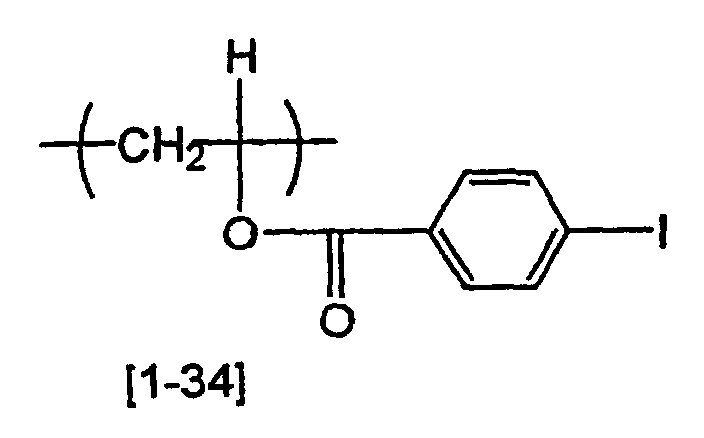
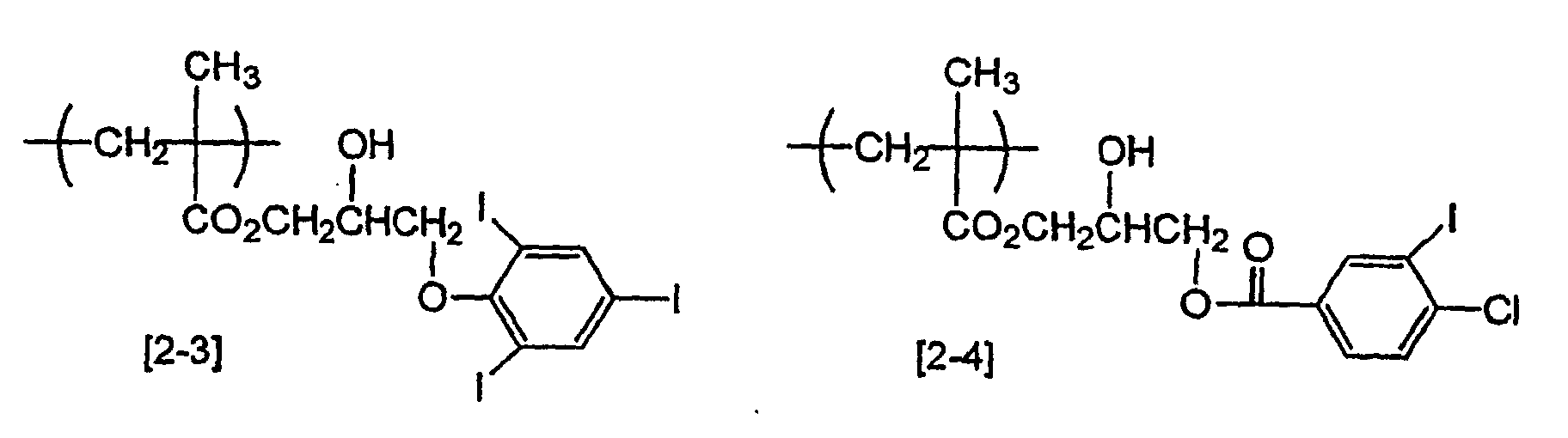
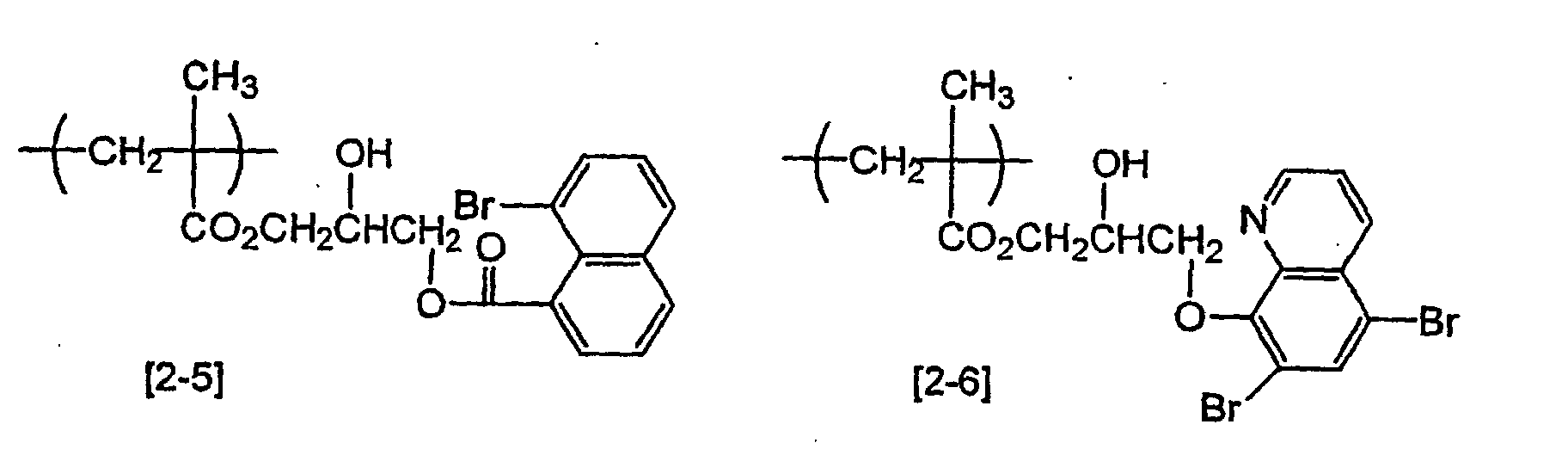
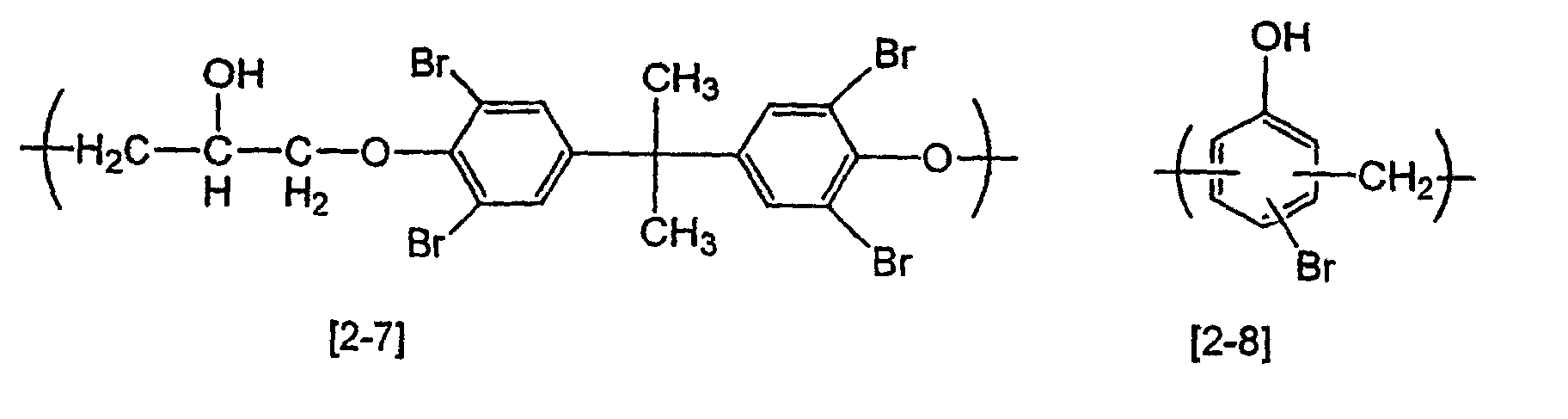
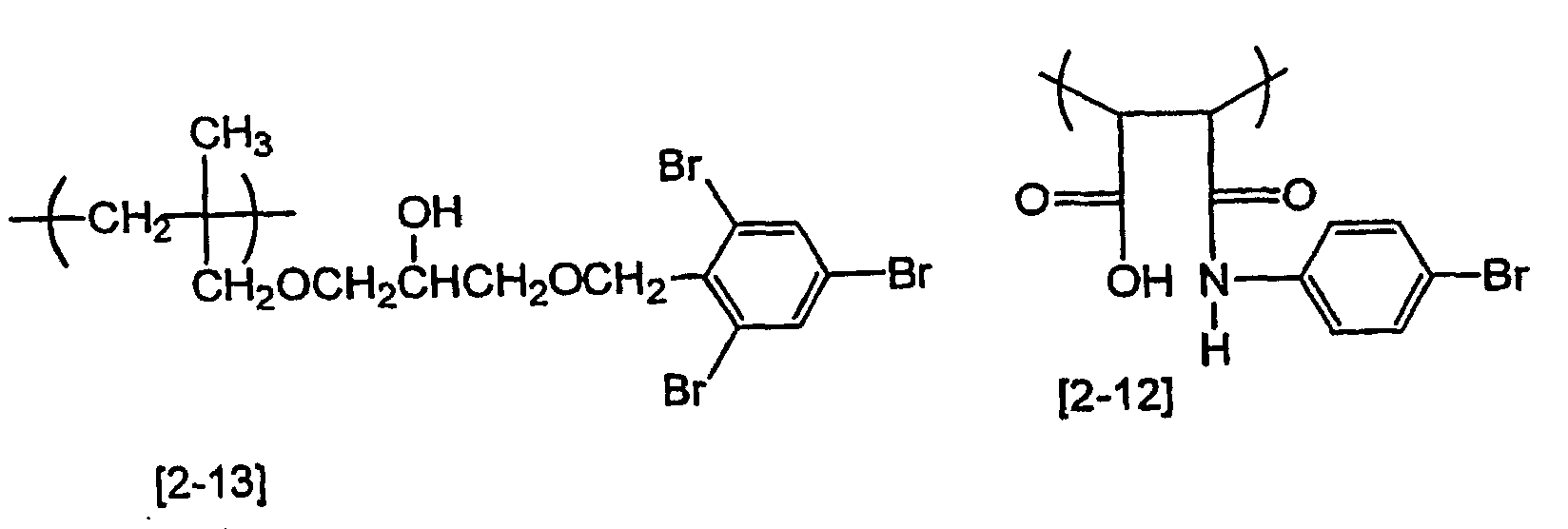
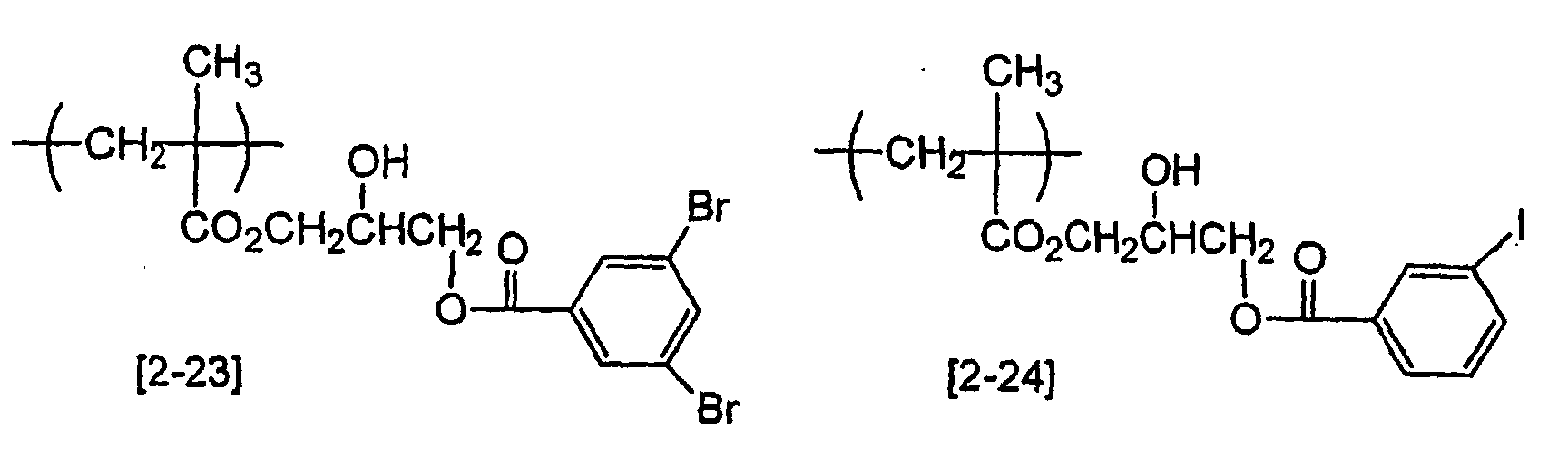
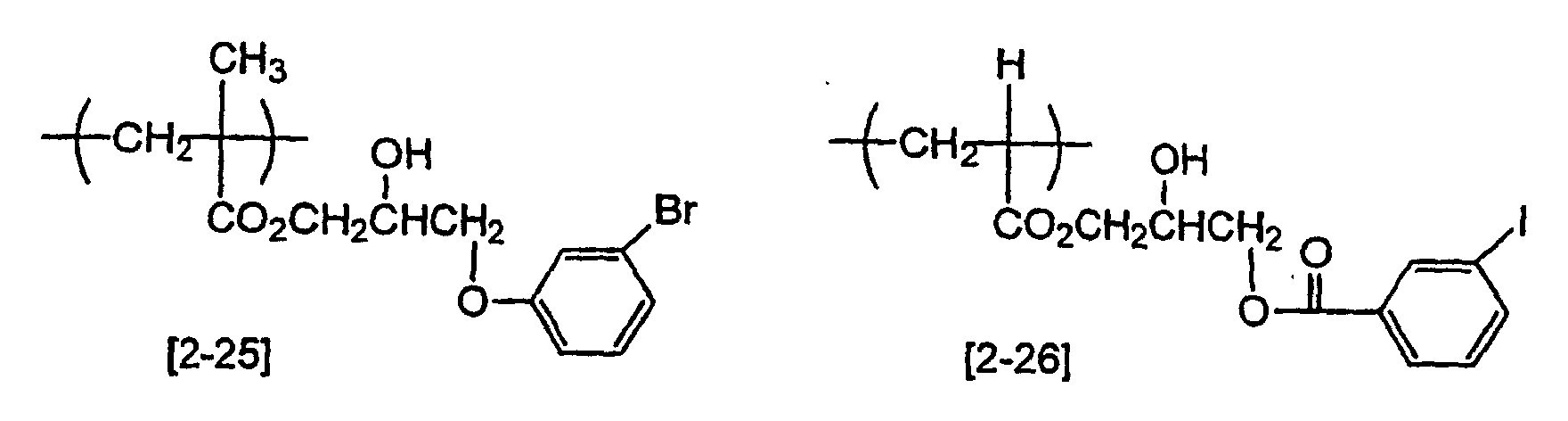
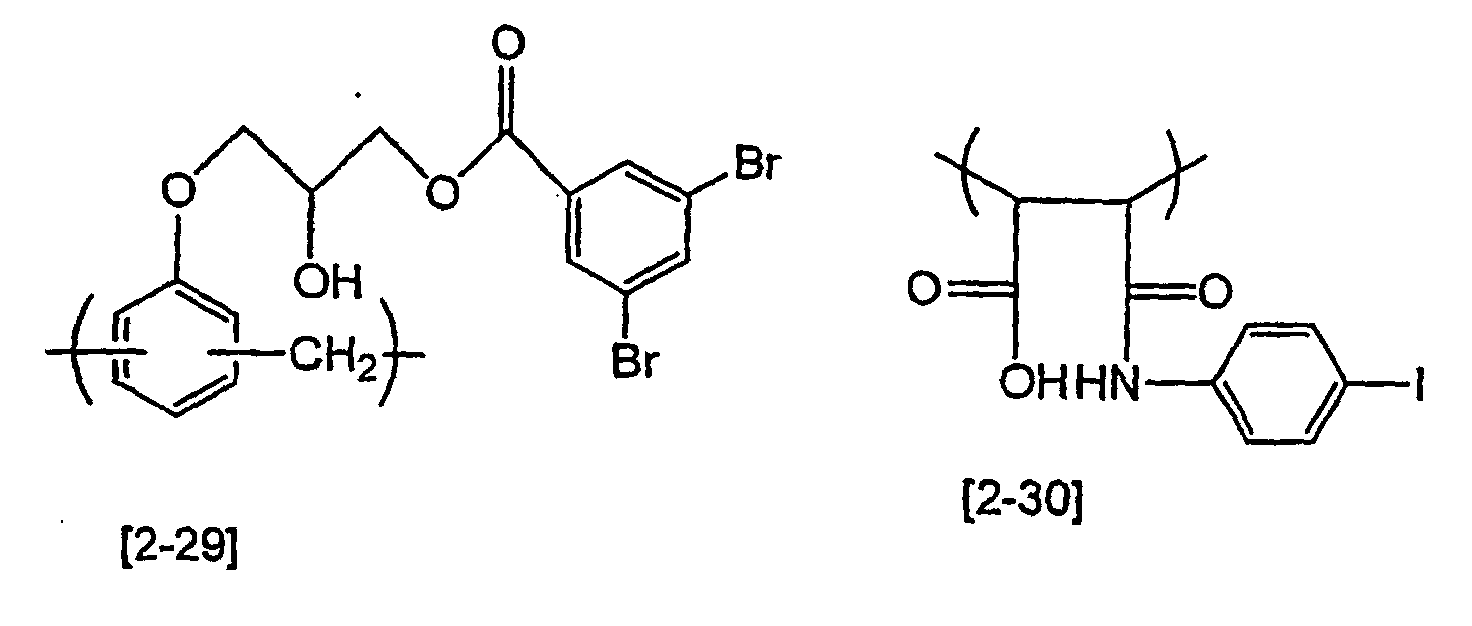
- the followings are concrete examples of the repeating structural unit containing a halogen atom which is contained in the polymer compound (formulae [1-1] to [1-34]), the repeating structural unit containing a halogen atom and a crosslink-forming substituent (formulae [2-1] to [2-33]), and the repeating structural unit containing a crosslink-forming substituent ([formulae [3-1] to [3-10]), to which the present invention is not limited.
- the composition for forming anti-reflective coating according to the present invention can alter the content (mass%) of halogen atom contained in the polymer compound in the composition. That is, the selection of main chain structure of polymer compound, the selection of kind of unit monomer used for the synthesis of polymer compound, the selection of kind of compound with which the polymer obtained by the polymerization reaction is reacted, the selection of number and kind of halogen atom contained in the polymer compound make possible to alter the content (mass%) of halogen atom contained in the polymer compound.
- polymer compound with different content (mass%) of halogen atom makes possible to alter the content (mass%) of halogen atom in the solid content of the anti-reflective coating, that is, the content (mass%) of halogen atom in the formed anti-reflective coating. And it is possible to control attenuation coefficient k of anti-reflective coating by altering the content (mass%) of halogen atom in the formed anti-reflective coating. In addition, it is also possible to alter the content (mass%) of halogen atom in the formed anti-reflective coating by changing the proportion in the solid content of polymer compound containing halogen atom in a constant content.
- the solid content means components other than the solvent in composition for forming anti-reflective coating
- the content (mass%) of halogen atom in the formed anti-reflective coating means the content (mass%) of halogen atom in the solid content of the composition for forming anti-reflective coating.
- the solid content in the composition for forming anti-reflective coating according to the present invention contains at least 10 mass% of halogen atom so that the anti-reflective coating formed from the composition for forming anti-reflective coating could sufficiently absorb a light from F2 excimer laser (wavelength 157 nm).
- the proportion of halogen atom in the solid content of the composition for forming anti-reflective coating according to the present invention is 10 mass% to 60 mass%, or 15 mass% to 55 mass%, or 20 mass% to 50 mass%.
- the halogen atom in the solid content of the composition for forming anti-reflective coating according to the present invention is chlorine atom, bromine atom or iodine atom, and preferably bromine atom or iodine atom.
- the halogen atom in the solid content of the composition for forming anti-reflective coating according to the present invention is contained in the polymer compound as mentioned above.
- a compound containing halogen atom may be added to the composition for forming anti-reflective coating.
- the compound containing halogen atom includes for example a compound having crosslink-forming substituent, such as 4-bromobenzoic acid, 3-iodobenzoic acid, 2,4,6-tribromophenol, 2,4,6-tribromoresorcinol, 2,4,6-triiodophenol, 4-iodo-2-methylphenol, 5-iodo methyl salicylate, 3,4,5-triiodobenzoic acid, 2,4,6-triiodo-3-aminobenzoic acid, 5-amino-2,4,6-triiodoisophthalic acid, 5-hydroxy-2,4,6-triiodoisophthalic acid, 2,4,6-tribromobenzoic acid, 2-amino-4,5-dibromo-3,6-dimethylbenzoic acid, 3,5-dibromo-4-hydroxybenzoic acid, 3,5-dibromo-2,4-dihydroxybenzoic acid, 3,5-diiodo-2-hydroxybenzoic acid, 2,
- the anti-reflective coating forming composition according to the present invention is preferably crosslinked after application by heating in order to prevent intermixing with a photoresist applied thereon.
- the anti-reflective coating forming composition according to the present invention may further contain a crosslinking agent component.
- the crosslinking agent includes melamines and substituted ureas having crosslink-forming substituents such as methylol or methoxymethyl groups, or polymer compounds having epoxy groups, and the like.
- Preferable crosslinking agents are ones having at least two crosslink-forming substituents, for example, compounds such as methoxymethylated glycoluril, methoxymethylated melamine, more preferably tetramethoxymethyl glycoluril or hexamethoxymethyl melamine. Further, the crosslinking agents include compounds such as tetramethoxymethyl urea or tetrabutoxymethyl urea.
- the addition amount of the crosslinking agent may vary depending on the coating solvents used, the underlying substrate used, the viscosity of the solution required, the shape of the coating required, etc., and usually 0.001 to 20 mass%, preferably 0.01 to 15 mass%, more preferably 0.05 to 10 mass% in the total composition. These crosslinking agents occasionally occur a crosslinking reaction due to self-condensation, but in case where a crosslink-forming substituent is present in the polymer compound in the present invention, the crosslinking agents can react with the crosslink-forming substituent.
- acid compounds such as p-toluenesulfonic acid, trifluoromethanesulfonic acid, pyridinium p-toluenesulfonate, salicylic acid, sulfosalicylic acid, citric acid, benzoic acid, hydroxybenzoic acid, etc. or/and thermal acid generators, such as 2,4,4,6-tetrabromocyclohexadienone, benzointosylate, 2-nitrobenzyltosylate, etc. may be added.
- the blending amount thereof is 0.02 to 10 mass%, preferably 0.04 to 5 mass% based on 100 mass% of the total solid content.
- the anti-reflective coating composition according to the present invention may contain photoacid generators in order to adjust the acidity to that of a photoresist applied thereon in the lithography process.
- photoacid generators include for example onium salt photoacid generators, such as bis(4-t-butylpheny)iodonium trifluoromethanesulfonate or triphenylsulfonium trifluoromethanesulfonate, halogen-containing photoacid generators, such as phenyl-bis(trichloromethyl)-s-triazine, sulfonate photoacid generators, such as benzoin tosylate or N-hydroxysuccinimide trifluoromethanesulfonate.
- the photoacid generators are added in an amount of 0.2 to 3 mass%, preferably 0.4 to 2 mass% based on 100 mass% of the total solid content.
- the anti-reflective coating forming composition according to the present invention may contain further light absorbing agents, rheology controlling agents, adhesion auxiliaries, surfactants, etc. in addition to the above described ones, if necessary.
- the further light absorbing agents the followings can be suitably used: for example commercially available light absorbing agents described in "Technique and Market of Industrial Pigments” (CMC Publishing Co., Ltd.) or "Dye Handbook” (edited by The Society of Synthetic Organic Chemistry, Japan), such as C. I. Disperse Yellow 1, 3, 4, 5, 7, 8, 13, 23, 31, 49, 50, 51, 54, 60, 64, 66, 68, 79, 82, 88, 90, 93, 102, 114 and 124; C. I. Disperse Orange 1, 5, 13, 25, 29, 30, 31, 44, 57, 72 and 73; C. I.
- the light absorbing agent is usually blended in an amount of 10 mass% or less, preferably 5 mass% or less based on 100 mass% of the total composition.
- the rheology controlling agents are added mainly aiming at increasing the flowability of the anti-reflective coating forming composition and in particular in the baking step, increasing filling property of the anti-reflective coating forming composition into the inside of holes.
- Specific examples thereof include phthalic acid derivatives such as dimethyl phthalate, diethyl phthalate, diisobutyl phthalate, dihexyl phthalate or butyl isodecyl phthalate; adipic acid derivatives such as di-n-butyl adipate, diisobutyl adipate, diisooctyl adipate or octyldecyl adipate; maleic acid derivatives such as di-n-butyl maleate, diethyl maleate or dinonyl maleate; oleic acid derivatives such as methyl oleate, butyl oleate or tetrahydrofurfuryl oleate; or stearic acid
- the adhesion auxiliaries are added mainly for the purpose of increasing the adhesion between the substrate or photoresist and the anti-reflective coating forming composition, in particular preventing the detachment of the photoresist in development.
- Specific examples thereof include chlorosilanes such as trimethylchlorosilane, dimethylvinylchlorosilane, methyldiphenylchlorosilane or chloromethyldimethyl-chlorosilane; alkoxysilanes such as trimethylmethoxysilane, dimethyldiethoxysilane, methyldimethoxysilane, dimethylvinylethoxysilane, diphenyldimethoxysilane or phenyltriethoxysilane; silazanes such as hexamethyldisilazane, N,N'-bis(trimethylsilyl)urea, dimethyltrimethylsilylamine or trimethylsilylimidazole; silanes such as vinyltrichlor
- the anti-reflective coating forming composition according to the present invention may contain surfactants with view to preventing the occurrence of pinholes or striations and further increasing coatability not to cause surface unevenness.
- surfactants such as polyoxyethylene alkyl ethers, e.g., polyoxyethylene lauryl ether, polyoxyethylene stearyl ether, polyoxyethylene cetyl ether, polyoxyethylene oleyl ether, etc., polyoxyethylene alkyl allyl ethers, e.g., polyoxyethylene octyl phenol ether, polyoxyethylene nonyl phenol ether; polyoxyethylene/polyoxypropylene block copolymers, sorbitan fatty acid esters, e.g., sorbitan monolaurate, sorbitan monopalmitate, sorbitan monostearate, sorbitan monooleate, sorbitan trioleate, sorbitan tristea
- the blending amount of the surfactants is usually 0.2 mass% or less, preferably 0.1 mass% or less, based on 100 mass% of the total composition of the anti-reflective coating for lithography according to the present invention.
- the surfactants may be added singly or two or more of them may be added in combination.
- ethylene glycol monomethyl ether ethylene glycol monoethyl ether, methyl cellosolve acetate, ethyl cellosolve acetate, diethylene glycol monomethyl ether, diethylene glycol monoethyl ether, propylene glycol, propylene glycol monomethyl ether, propylene glycol monomethyl ether acetate, propylene glycol propyl ether acetate, toluene, xylene, methyl ethyl ketone, cyclopentanone, cyclohexanone, ethyl 2-hydroxypropionate, ethyl 2-hydroxy-2-methylpropionate, ethyl ethoxyacetate, ethyl hydroxyacetate, methyl 2-hydroxy-3-methylbutanoate, methyl 3-methoxypropionate, ethyl 3-methoxypropionate, ethyl 3-methoxypropionate, ethyl 3-methoxypropionate, e
- high boiling solvents such as propylene glycol monobutyl ether or propylene glycol monobutyl ether acetate may be mixed.
- solvents propylene glycol monomethyl ether, propylene glycol monomethyl ether acetate, ethyl lactate, butyl lactate, and cyclohexanone are preferred for increasing the leveling property.
- the photoresist includes a chemically-amplified type resist which consists of a photoacid generator and a binder having a group which is decomposed with an acid and increases alkali dissolution rate, a chemically-amplified type resist consisting of an alkali-soluble binder, a photoacid generator, and a low molecular compound which is decomposed with an acid and increases the alkali dissolution rate of the resist, a chemically-amplified resist consisting of a photoacid generator, a binder having a group which is decomposed with an acid and increases the alkali dissolution rate, and a low molecular compound which is decomposed with an acid and increases the alkali dissolution rate of the resist.
- the photoresist includes also fluorine atom-containing polymer type photoresist as described in Proc. SPIE, Vol. 3999, 330-334 (2000), Proc. SPIE, Vol. 3999, 357-364 (2000) or Proc. SPIE, Vol. 3999, 365-374 (2000).
- aqueous solutions of alkalis e.g., inorganic alkalis such as sodium hydroxide, potassium hydroxide, sodium carbonate, sodium silicate, sodium metasilicate or aqueous ammonia, primary amines such as ethylamine or n-propylamine, secondary amines such as diethylamine or di-n-butylamine, tertiary amines such as triethylamine or methyldiethylamine, alcohol amines such as dimethylethanolamine or triethanolamine, quaternary ammonium salts such as tetramethylammonium hydroxide, tetraethylammonium hydroxide or choline, cyclic amines such as pyrrole or piperidine, etc.
- alkalis e.g., inorganic alkalis such as sodium hydroxide, potassium hydroxide, sodium carbonate, sodium silicate, sodium metasilicate or aqueous ammonia
- primary amines
- a suitable amount of alcohols such as isopropyl alcohol or surfactants such as nonionic surfactant can be added to the aqueous solution of above-described alkalis.
- a preferred developer includes quaternary ammonium salts, more preferably tetramethylammonium hydroxide and choline.
- an anti-reflective coating forming composition is coated by a suitable coating method, for example, with a spinner, a coater or the like, and thereafter the substrate is baked to cure the composition to fabricate an anti-reflective coating.
- the film thickness of the anti-reflective coating is preferably 0.01 to 3.0 ⁇ m.
- the conditions of baking after the coating are 80 to 250°C for 0.5 to 120 minutes.
- a photoresist is coated, it is exposed to light through a predetermined mask, developed, rinsed and dried to obtain a good photoresist pattern. If necessary, post exposure bake (PEB) may be performed. In addition, it is able to form a desired pattern on the substrate by removing by dry etching a part of the anti-reflective coating which a photoresist was removed by development in the previous step.
- PEB post exposure bake
- the anti-reflective coating produced from the composition for forming anti-reflective coating according to the present invention in which a polymer compound having repeating structural unit containing halogen atom is contained has a property of absorbing efficiently irradiation light with a wavelength of 157 nm. Therefore, the coating exerts an excellent effect of preventing reflection light from a substrate, and thus a photoresist pattern being an upper layer can be satisfactorily formed.
- the anti-reflective coating produced from the composition for forming anti-reflective coating according to the present invention in which a polymer compound having repeating structural unit containing halogen atom has a relatively high dry etching rate owing to inclusion of halogen atom, and can control dry etching rate by changing the content of halogen atom.
- the anti-reflective coating formed from the composition for forming anti-reflective coating according to the present invention can be used by selecting process condition as a coating having the following functions: a function of preventing reflection light, a function of preventing a mutual interaction between a substrate and a photoresist, a function of preventing an adverse effect to a substrate by a material used in the photoresist or a substance generated on exposure to the photoresist, or a function of preventing an adverse effect to a photoresist by a substance generated from the substrate on exposure to light or heating.
- brominated bisphenol A epoxy resin manufactured by Tohto Kasei Co., Ltd.; trade name: YDB-400; weight average molecular weight: 700
- YDB-400 weight average molecular weight: 700
- the resulting mixture was subjected to a reaction under nitrogen atmosphere at 130°C for 24 hours to obtain a solution of polymer compound of concrete example [4-7].
- the resulting polymer compound was subjected to GPC analysis and had a weight average molecular weight of 900 in terms of standard polystyrene.
- brominated bisphenol A epoxy resin manufactured by Tohto Kasei Co., Ltd.; trade name: YDB-400; weight average molecular weight: 700
- YDB-400 weight average molecular weight: 700
- the resulting mixture was subjected to a reaction under nitrogen atmosphere at 130°C for 24 hours to obtain a solution of polymer compound of concrete example [4-8].
- the resulting polymer compound was subjected to GPC analysis and had a weight average molecular weight of 1,000 in terms of standard polystyrene.
- brominated epoxy phenol novolak resin manufactured by Nippon Kayaku Co., Ltd.; trade name: BREN-304; content of bromine atom: 42 mass%; substituted with c.a. 1.5 bromine atom per benzene ring
- BREN-304 content of bromine atom: 42 mass%; substituted with c.a. 1.5 bromine atom per benzene ring
- the resulting polymer compound was subjected to GPC analysis and had a weight average molecular weight of 1,600 in terms of standard polystyrene.
- brominated epoxy phenol novolak resin manufactured by Nippon Kayaku Co., Ltd.; trade name: BREN-304; content of bromine atom: 42 mass%; substituted with c.a. 1.5 bromine atom per benzene ring
- BREN-304 content of bromine atom: 42 mass%; substituted with c.a. 1.5 bromine atom per benzene ring
- the resulting polymer compound was subjected to GPC analysis and had a weight average molecular weight of 2,000 in terms of standard polystyrene.
- brominated epoxy phenol novolak resin manufactured by Nippon Kayaku Co., Ltd.; trade name: BREN-304; content of bromine atom: 42 mass%; substituted with c.a. 1.5 bromine atom per benzene ring
- BREN-304 content of bromine atom: 42 mass%; substituted with c.a. 1.5 bromine atom per benzene ring
- the resulting polymer compound was subjected to GPC analysis and had a weight average molecular weight of 3,800 in terms of standard polystyrene.
- the solution was filtered through a micro filter made of polyethylene having a pore diameter of 0.10 ⁇ m, and then, the solution was filtered through a micro filter made of polyethylene having a pore diameter of 0.05 ⁇ m, to prepare a composition solution for forming anti-reflective coating.
- the solution was filtered through a micro filter made of polyethylene having a pore diameter of 0.10 ⁇ m, and then, the solution was filtered through a micro filter made of polyethylene having a pore diameter of 0.05 ⁇ m, to prepare a composition solution for forming anti-reflective coating.
- composition solutions for forming anti-reflective coating obtained in Examples 1 to 15 and Comparative Example 1 were coated on silicon wafers by means of a spinner.
- the coated silicon wafers were heated at 205°C for 1 minute on a hot plate to form anti-reflective coatings (film thickness 0.10 ⁇ m).
- the anti-reflective coatings were dipped in a solvent used for resists, that is ethyl lactate and propylene glycol monomethyl ether and as a result it was confirmed that the resulting coatings were insoluble in these solvents.
- composition solutions for forming anti-reflective coating obtained in Examples 1 to 15 and Comparative Example 1 were coated on silicon wafers by means of a spinner.
- the coated silicon wafers were heated at 205°C for 1 minute on a hot plate to form anti-reflective coatings (film thickness 0.10 ⁇ m).
- a commercially available photoresist solution manufactured by Shipley Company; trade name: APEX-E
- the coated wafers were heated at 90°C for 1 minute on a hot plate. After exposure of the resists to light, post exposure bake (PEB) was performed at 90°C for 1.5 minute.
- PEB post exposure bake
- the film thickness of the anti-reflective coatings was measured and no change was confirmed in the film thickness. Thus it was confirmed that no intermixing occurred between the anti-reflective coatings obtained from anti-reflective coating solutions prepared in Examples 1 to 15 and Comparative Example 1 and the photoresist layers.
- composition solutions for forming anti-reflective coating obtained in Examples 1 to 15 and Comparative Example 1 were coated on silicon wafers by means of a spinner.
- the coated silicon wafers were heated at 205°C for 1 minute on a hot plate to form anti-reflective coatings (film thickness 0.06 ⁇ m).
- refractive index (n) and attenuation coefficient (k) at a wavelength of 157 nm were measured with a spectroscopic ellipsometer (manufactured by J. A. Woollam Co., VUV-VASE VU-302). The results of the measurement are shown in Table 1.
- Table 2 shows the content (mass%) of halogen atom in the solid content in the composition of Examples together with attenuation coefficient (k).
- Refractive index (n) Attenuation coefficient (k) Example 1 1.79 0.31
- Example 2 1.79 0.40
- Example 3 1.78 0.48
- Example 4 1.68 0.30
- Example 5 1.73 0.36
- Example 6 1.64 0.29
- Example 7 1.80 0.39
- Example 8 1.82 0.25
- Example 9 1.72 0.25
- Example 10 1.69 0.32
- Example 11 1.70 0.46
- Example 12 1.74 0.39
- Example 13 1.81 0.30
- Example 15 1.65 0.36 Comparative Example 1 1.75 0.19 Content of halogen atom (mass%) Attenuation coefficient (k)
- Example 1 27 0.31
- Example 2 38 0.40
- Example 3 49 0.48
- Example 8 27 0.25
- Example 9 19 0.25
- Example 10 25 0.32
- the anti-reflective coating material of the present invention has a satisfactorily high attenuation coefficient k for a light of a wavelength of 157 nm, and can control the k value in a range of 0.2 to 0.48 by changing the kind or content of halogen atom, thereby providing excellent bottom type organic anti-reflective coatings.
- Examples 1 to 3, 9 and 10 in Table 2 shows that in case where the anti-reflective coatings contain the same kind of halogen atom, attenuation coefficient k increases with the increase of its content.
- bromine atom has a larger effect on the k value than chlorine atom, that is, bromine atom can afford a large attenuation coefficient k in a lower content compared with chlorine atom. From the comparison of Examples 1 and 10, it is understood that bromine atom has an effect on the k value comparable with iodine atom.
- the present invention provides a composition for forming anti-reflective coating having a strong absorption of light at a wavelength of 157 nm.
- the anti-reflective coating obtained from the composition efficiently absorbs reflection light from a substrate.
- the present invention provides a composition for forming anti-reflective coating for lithography which effectively absorbs reflection light from a substrate when irradiation light from F2 excimer laser (wavelength 157 nm) is used for micro-processing, and which causes no intermixing with photoresist layer
- the present invention provides a method of controlling attenuation coefficient k of anti-reflective coating.
- the control of attenuation coefficient k is carried out by changing the content of halogen atom in the solid content of the composition for forming anti-reflective coating.
- the control method enables modification in characteristics of anti-reflective coatings so as to suit the kind or required characteristics of photoresists.
Landscapes
- Engineering & Computer Science (AREA)
- Architecture (AREA)
- Structural Engineering (AREA)
- Physics & Mathematics (AREA)
- General Physics & Mathematics (AREA)
- Exposure Of Semiconductors, Excluding Electron Or Ion Beam Exposure (AREA)
- Materials For Photolithography (AREA)
- Paints Or Removers (AREA)
- Surface Treatment Of Optical Elements (AREA)
Abstract
There is provided a composition for forming anti-reflective coating for use in a
lithography process with irradiation light from F2 excimer laser (wavelength 157 nm)
which has a high effect of inhibiting reflected light and causes no intermixing with
resist layers, and an anti-reflective coating prepared from the composition, and a
method of controlling attenuation coefficient of the anti-reflective coating.
Concretely, the composition is one containing a polymer compound containing
halogen atom for forming anti-reflective coating for use in a lithographic process in
manufacture of a semiconductor device. The polymer compound is one which
halogen atom is introduced to a main chain thereof and/or a side chain bonded to the
main chain. The attenuation coefficient can be controlled by changing the content of
halogen atom in the solid content of the composition.
Description
The present invention relates to a composition for forming anti-reflective
coating, particularly to a composition for reducing a reflection ofirradiation light for
exposing a photoresist applied on a substrate from the substrate in a lithography
process for manufacturing a semiconductor device, and more particularly to a
composition for forming anti-reflective coating comprising a polymer compound
composition effectively absorbing reflection light from the substrate in a lithography
process for manufacturing a semiconductor device by use of irradiation light for
exposure with a wavelength of 157 nm.
Conventionally, in the manufacture of semiconductor devices, micro-processing
by lithography using a photoresist composition has been carried out. The
micro-processing is a processing method including forming a thin film of a photoresist
composition on a silicon wafer, irradiating actinic rays such as ultraviolet rays through
a mask pattern depicting a pattern for a semiconductor device, developing it to obtain
a resist pattern, and etching the silicon wafer using the resist pattern as a protective
film. However, in recent progress in high integration of semiconductor devices, there
has been a tendency that shorter wavelength actinic rays are being used, i.e., ArF
excimer laser beam (wavelength 193 nm) have been taking the place of i-line
(wavelength 365 nm) or KrF excimer laser beam (wavelength 248 nm). Along with
this change, influences of random reflection and standing wave off a substrate have
become serious problems. Accordingly, it has been widely studied to provide an
anti-reflective coating between the photoresist and the substrate (Bottom Anti-Reflective
Coating, BARC). In addition, it comes to be considered to utilize F2
excimer laser (wavelength 157 nm) being a light source with a shorter wavelength for
micro-processing by lithography.
As the anti-reflective coating, inorganic anti-reflective coatings made of
titanium, titanium dioxide, titanium nitride, chromium oxide, carbon or α-silicon and
organic anti-reflective coatings made of a light-absorbing substance and a polymer
compound are known. The former requires an installation such as a vacuum
deposition apparatus, a CVD (chemical vapor deposition) apparatus or a sputtering
apparatus. In contrast, the latter is considered advantageous in that it requires no
special installation so that many studies have been made. For example, mention
may be made of the acrylic resin type anti-reflective coating having a hydroxyl group
being a crosslinking reaction group and a light absorbing group in the same molecule
and the novolak resin type anti-reflective coating having a hydroxyl group being a
crosslinking reaction group and a light absorbing group in the same molecule (see, for
example U. S. Patent Nos. 5,919,599 and 5,693,691).
The physical properties desired for organic anti-reflective coating materials
include high absorbance to light and radioactive rays, no intermixing with the
photoresist layer (being insoluble in photoresist solvents), no diffusion of low
molecular substances from the anti-reflective coating material into the topcoat resist
upon coating or heat-drying, and a higher dry etching rate than the photoresist (see,
for example, Tom Lynch et al., "Properties and Performance of Near UV Reflectivity
Control Layers", US, in Advances in Resist Technology and Processing XI, Omkaram
Nalamasu ed., Proceedings of SPIE, 1994, Vol. 2195, p. 225-229; G. Taylor et al.,
"Methacrylate Resist and Antireflective Coatings for 193 nm Lithography", US, in
Microlithography 1999: in Advances in Resist Technology and Processing XVI, Will
Conley ed., Proceedings of SPIE, 1999, Vol. 3678, p. 174-185; and Jim D. Meador et
al., "Recent Progress in 193 nm Antireflective Coatings, US, in Microlithography 1999:
in Advances in Resist Technology and Processing XVI, Will Conley ed., Proceedings
of SPIE, 1999, Vol. 3678, p. 800-809).
By the way, a hitherto technique of anti-reflective 'coatings has been mainly
considered on lithography process with irradiation light having a wavelength of 365
nm, 248 nm or 193 nm. As a result of such consideration, light absorbing
components and light absorbing groups effectively absorbing light of each wavelength
are developed, and they come to be utilized as one component of an organic anti-reflective
coating composition. For example, it is known that chalcone dies prepared
by condensation of 4-hydroxyacetophenone with 4-methoxybenzaldehyde are
effective for irradiation light having a wavelength of 365 nm (see, for example
Japanese Patent Laid-open No. Hei 11-511194), it is known that naphthalene group-containing
polymers having a specific structure have high absorbance for irradiation
light having a wavelength of 248 nm (see, for example Japanese Patent Laid-open No.
Hei 10-186671), and it is known that resin binder compositions containing phenyl unit
are excellent for irradiation light having a wavelength of 193 nm (see, for example
Japanese Patent Laid-open No. 2000-187331).
In recent years, lithography process with F2 excimer laser (wavelength 157
nm) being a light source having a shorter wavelength comes to be regarded as next-generation
technology in place of that with ArF excimer laser (wavelength 193 nm).
It is considered that the former process permits micro-processing of process
dimension not more than 100 nm, and at present its development and research have
been actively carried out from the aspects of apparatus and material, etc. However,
most of the research on material relate to photoresist, and it is an actual condition that
the research on organic anti-reflective coatings is little known. This is because
components effectively absorbing light having a wavelength of 157 nm, that is light
absorbing components having a strong absorption band at 157 nm are little known.
It is considered that as irradiation light provides process dimension not more
than 100 nm. Therefore, it is also considered that a photoresist is used in a form of
thin film having a thickness of 100 to 300 nm that is thinner compared with the prior
one. Organic anti-reflective coatings used along with such a photoresist in a form of
thin film require the followings: they can be used in a form of a thin film; and they have
a high selectivity of dry etching for photoresist. And, it is considered that organic
anti-reflective coatings are required to have a large attenuation coefficient k so that
they could be used in a shape of thin film having a thickness of 30 to 80 nm. In a
simulation with PROLITH ver. 5 (manufactured by Litho Tech Japan; expected and
ideal values are used as optical constants (refractive index, attenuation coefficient) of
the photoresist), an anti-reflective coating having a base substrate made of silicon
with a thickness of 30 to 80 nm can have second minimum thickness (about 70 nm),
and in this case the coating has an attenuation coefficient k of 0.3 to 0.6 and a
reflectance from substrate of 2% or less, thus has a sufficient anti-reflective effect. In
addition, a similar simulation in which silicon oxide is used as base substance and a
thickness of silicon oxide varies between 100 nm and 200 nm results in that
attenuation coefficient k of 0.4 to 0.6 is required in order to exert a sufficient anti-reflective
effect with an anti-reflective coating having a thickness of 70 nm. For
example, in case where attenuation coefficient k is 0.2, reflectance from substrate
varies between 5% and 10%, and in case where attenuation coefficient k is 0.4,
reflectance from substrate varies between 0% and 5%. Consequently, it is
considered that in order to exert a sufficient anti-reflective effect, a high attenuation
coefficient k, for example 0.3 or more is required. However, any material for organic
anti-reflective coatings satisfying such an attenuation coefficient k have been little
known.
Under such circumstances, it is demanded to develop organic anti-reflective
coatings efficiently absorbing reflection light from base substrate and thereby having
an excellent anti-reflective effect.
Further, photoresists for lithography process for which irradiation light from F2
excimer laser are used are actively examined at present, and therefore it is
considered that many kinds of photoresists will be developed in future. And, it is
considered that a method of changing attenuation coefficient so as to suit required
characteristics of each photoresist, for example a method of changing attenuation
coefficient k comes to be important.
In the meanwhile, it is known that anti-reflective coating compositions
containing fluorine-containing polymer is applied to lithography technique with F2
excimer laser as light source (see, for example, Japanese Patent Laid-open Nos.
2002-236370 and 2002-198283).
The present invention relates to a composition for forming anti-reflective
coating, which has a strong absorption of light at a short wavelength, particularly light
at wavelength of 157 nm. In addition, the present invention provides a composition
for forming anti-reflective coating, which can be used in a lithography process for
manufacturing a semiconductor device carried out by using irradiation light from F2
excimer laser (wavelength 157 nm). Further, the present invention provides an anti-reflective
coating for lithography which effectively absorbs reflection light from a
substrate when irradiation light from F2 excimer laser (wavelength 157 nm) is used for
micro-processing, and which causes no intermixing with photoresist layer, and a
composition for forming the anti-reflective coating. In addition, the present invention
provides a method of forming an anti-reflective coating for lithography by using the
composition for forming anti-reflective coating, and a method of forming a photoresist
pattern. Further, the present invention provides a method of controlling attenuation
coefficient k which is one of main characteristics of anti-reflective coating.
The present invention relates to the following aspects:
- as a first aspect, a composition for forming anti-reflective coating characterized in that the composition comprises a solid content and a solvent, and a proportion of halogen atom in the solid content is 10 mass% to 60 mass%;
- as a second aspect, the composition for forming anti-reflective coating as described in the first aspect, wherein the solid content contains a polymer compound having a repeating structural unit containing a halogen atom;
- as a third aspect, the composition for forming anti-reflective coating as described in the first aspect, wherein the solid content contains a polymer compound having a repeating structural unit containing a halogen atom and a crosslink-forming substituent;
- as a fourth aspect, the composition for forming anti-reflective coating as described in the first aspect, wherein the solid content contains a polymer compound having a repeating structural unit containing a halogen atom and a repeating structural unit containing a crosslink-forming substituent;
- as a fifth aspect, a composition for forming anti-reflective coating characterized in that the composition contains a polymer compound having a repeating structural unit containing a halogen atom, and an attenuation coefficient k of a coating formed from the composition to light at a wavelength of 157 nm is 0.20 to 0.50;
- as a sixth aspect, a composition for forming anti-reflective coating characterized in that the composition contains a polymer compound having a repeating structural unit containing a halogen atom and a crosslink-forming substituent, and an attenuation coefficient k of a coating formed from the composition to light at a wavelength of 157 nm is 0.20 to 0.50;
- as a seventh aspect, a composition for forming anti-reflective coating characterized in that the composition contains a polymer compound having a repeating structural unit containing a halogen atom and a repeating structural unit containing a crosslink-forming substituent, and an attenuation coefficient k of a coating formed from the composition to light at a wavelength of 157 nm is 0.20 to 0.50;
- as an eighth aspect, the composition for forming anti-reflective coating as described in any one of the second to seventh aspects, wherein the polymer compound contains at least one halogen atom selected from chlorine atom, bromine atom and iodine atom;
- as a ninth aspect, the composition for forming anti-reflective coating as described in any one of the second to eighth aspects, wherein the polymer compound contains at least 10 mass% of a halogen atom;
- as a tenth aspect, the composition for forming anti-reflective coating as described in any one of the second to ninth aspects, wherein the polymer compound has a weight average molecular weight of 700 to 1,000,000;
- as an eleventh aspect, the composition for forming anti-reflective coating as
described in the third or sixth aspect, wherein the repeating structural unit containing a
halogen atom and a crosslink-forming substituent is represented by formula (1)
wherein L is a bonding group constituting a main chain of the polymer compound, M is a linking group containing at least one linking group selected from -C(=O)-, -CH2- or -O-, or a direct bond, X is bromine atom or iodine atom, t is a number of 1 or 2, u is a number of 2, 3 or 4, v is a number of the repeating structural units contained in the polymer compound and is a number of 1 to 3,000;
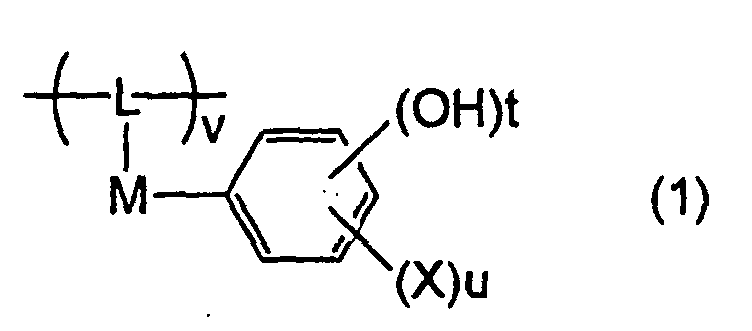
- as a twelfth aspect, the composition for forming anti-reflective coating as described in any one of the first to eleventh aspects, wherein the solid content further contains a crosslinking agent having at least two crosslink-forming substituents;
- as a thirteenth aspect, a method of forming an anti-reflective coating for use in a manufacture of a semiconductor device, comprising the steps of: coating the composition for forming anti-reflective coating as described in any one of the first to twelfth aspects on a substrate, and baking it;
- as a fourteenth aspect, a method of forming an anti-reflective coating for use in a manufacture of a semiconductor device by use of a light of wavelength 157 nm, comprising the steps of: coating the composition for forming anti-reflective coating as described in any one of the first to twelfth aspects on a substrate, and baking it;
- as a fifteenth aspect, an anti-reflective coating produced by coating the composition for forming anti-reflective coating as described in any one of the first to twelfth aspects on a semiconductor substrate, and baking it, wherein the anti-reflective coating has an attenuation coefficient k to a light at a wavelength of 157 nm ranging from 0.20 to 0.50;
- as a sixteenth aspect, a method of forming an anti-reflective coating for use in a manufacture of a semiconductor device, in which an attenuation coefficient k is altered by changing a content of a halogen atom in the anti-reflective coating;
- as a seventeenth aspect, a method of forming an anti-reflective coating for use in a manufacture of a semiconductor device, in which an attenuation coefficient k to a light at a wavelength of 157 nm is altered by changing a content of a halogen atom in the anti-reflective coating;
- as an eighteenth aspect, a method of forming a photoresist for use in a manufacture
of a semiconductor device comprising the steps of:
- coating the composition for forming anti-reflective coating according to any one of the first to twelfth aspects on a semiconductor substrate and baking it to form an anti-reflective coating,
- forming a photoresist layer on the anti-reflective coating,
- exposing the semiconductor substrate covered with the anti-reflective coating and the photoresist layer with F2 eximer laser (wavelength 157 nm), and
- developing the exposed photoresist layer.
The present invention relates to a composition for forming anti-reflective
coating consisting of a solid content containing a halogen atom-containing component
and a solvent. In addition, the present invention relates to a composition for forming
anti-reflective coating characterized by containing as halogen atom-containing
component a polymer compound having a repeating structural unit containing a
halogen atom. Further, the present invention relates to a composition for forming
anti-reflective coating, which can be used in lithography process for manufacturing a
semiconductor device by use of irradiation light of a short wavelength, particularly
irradiation light of F2 excimer laser (wavelength 157 nm).
The composition for forming anti-reflective coating according to the present
invention basically comprises a polymer compound having a repeating structural unit
containing a halogen atom, and a solvent; a polymer compound having a repeating
structural unit containing a halogen atom and a crosslink-forming substituent, and a
solvent; or a polymer compound having a repeating structural unit containing a
halogen atom and a repeating structural unit containing a crosslink-forming
substituent, and a solvent, and as arbitrary component a catalyst for crosslinking, a
surfactant and the like. The composition for forming anti-reflective coating according
to the present invention contains 0.1 to 50 mass%, preferably 0.5 to 30 mass% of
solid content. In this specification, the solid content means components other than
the solvent in the composition for forming anti-reflective coating.
The molecular weight of the polymer compound containing a halogen atom
ranges from 700 to 1,000,000, preferably from 700 to 500,000, and more preferably
900 to 300,000 in terms of weight average molecular weight although it may vary
depending on the coating solvents used, the viscosity of the solution, the shape of the
coating, etc.
The polymer compound in the present invention is a compound containing at
least one kind of halogen atom selected from chlorine atom, bromine atom and iodine
atom in the main chain and/or side chain constituting it. The halogen atom to be
contained may be one kind, two kinds or three kinds, and preferably is bromine atom
or iodine atom. The polymer compound contains preferably at least 10 mass%,
more preferably 10 to 80 mass%, further preferably 20 to 70 mass% of halogen atom.
The content of the polymer compound in the composition for forming anti-reflective
coating according to the present invention is 20 mass% or more in the solid content,
for example 20 mass% to 100 mass%, or 30 mass% to 100 mass%, or 50 mass% to
90 mass%, or 60 mass% to 80 mass%.
The polymer compound may contain a crosslink-forming substituent. The
crosslink-forming substituent includes amino group, hydroxy group, carboxy group,
thiol group, and the like, and these substituents are introduced in the main chain
and/or side chain of the polymer compound. The crosslink-forming substituents to
be introduced are the same or different. In case where the crosslinking agent
component is contained in the composition for forming anti-reflective coating
according to the present invention, the crosslink-forming substituents can take place a
crosslink-forming reaction with the crosslinking agent component on baking under
heating. The crosslink formation exerts an effect of preventing any intermixing
between an anti-reflective coating formed by baking and a photoresist applied
thereon.
The polymer compound containing halogen atom can be synthesized by a
polymerization reaction of unit monomer containing halogen atom, or a polymerization
reaction of unit monomer containing halogen atom with unit monomer containing no
halogen atom, or by a reaction of a polymer obtained by a polymerization reaction of
unit monomer containing no halogen atom with a compound containing halogen atom.
Further, the polymer compound can be synthesized by reacting a polymer obtained by
a polymerization reaction of unit monomer containing halogen atom or a
polymerization reaction of unit monomer containing halogen atom with unit monomer
containing no halogen atom, with a compound containing halogen atom or a
compound containing no halogen atom. The content (mass%) of halogen atom in
the polymer compound can be controlled by reacting the polymer obtained by the
polymerization reaction with a compound containing halogen atom or a compound
containing no halogen atom.
The unit monomers used for the polymerization reaction may be the same
each other, and two kinds or more of the unit monomers may be used. The polymer
compound formed from unit monomers can be synthesized by various methods such
as radical polymerization, anionic polymerization, cationic polymerization or
condensation polymeization. As the type of polymerization, various methods such
as solution polymerization, suspension polymerization, emulsion polymerization or
bulk polymerization are possible.
The unit monomers include for example compounds having addition
polymerizable unsaturated bond, such as acrylic acids, acrylic esters, acrylic amides,
methacrylic acids, methacrylic esters, methacrylic amides, vinyl ethers, vinyl alcohols,
vinyl ketones, styrenes, vinyl phenols, maleic anhydrides or maleimides, each of
which contains halogen atom. In addition, they include condensation polymerizable
compounds such as dicarboxylic acid compounds, dihydroxy compounds, diamino
compounds, diepoxy compounds, diisocyanate compounds, acid dianhydride
compounds, dithiol compounds or phenol compounds, each of which contains
halogen atom.
The unit monomer containing no halogen atom include for example
compounds having addition polymerizable unsaturated bond, such as acrylic acids,
acrylic esters, acrylic amides, methacrylic acids, methacrylic esters, methacrylic
amides, vinyl ethers, vinyl alcohols, vinyl ketones, styrenes, vinyl phenols, maleic
anhydrides or maleimides, each of which contains no halogen atom. In addition,
they include condensation polymerizable compounds such as dicarboxylic acid
compounds, dihydroxy compounds, diamino compounds, diepoxy compounds,
diisocyanate compounds, acid dianhydride compounds, dithiol compounds or phenol
compounds, each of which contains no halogen atom.
As compound containing halogen atom with which a polymer obtained by
polymerization reaction of the unit monomer containing no halogen atom is reacted,
any compounds which can be reacted with the polymer can be used. For example,
in case where there is a hydroxy group in the polymer, the compounds include acid
chlorides, epoxy compounds, isocyanate compounds and the like, each of which
contains halogen atom. In case where there is an epoxy group in the polymer, the
compounds include hydroxy compounds, carboxylic acid compounds, thiol
compounds and the like, each of which contains halogen atom. In case where there
is an acid anhydride moiety in the polymer, the compounds include hydroxy
compounds, amino compounds, thiol compounds and the like, each of which contains
halogen atom. In addition, in case where a carboxyl group in the polymer, the
compounds include hydroxy compounds, amino compounds, thiol compounds, epoxy
compounds and the like, each of which contains halogen atom.
The above-mentioned polymer compounds include for example polyacrylate,
polyacrylamide, polymethacrylate, polymethacrylamide, polyvinyl ester, polyvinyl
ether, polyvinyl alcohol, polyvinyl ketone, polystyrene, polyvinyl phenol and the like,
each of which contains halogen atom and which may be a homopolymer or copolymer.
In addition, they include copolymers of acrylates with styrenes, copolymers of
acrylates with methacrylates, copolymers of acrylates with vinyl ethers, copolymers of
acrylates with vinyl esters, copolymers of methacrylates with styrenes, copolymers of
methacrylates with methacrylamides, copolymers of methacrylates with vinyl ethers,
copolymers of methacrylates with vinyl alcohols, copolymers of methacrylates with
vinyl esters, copolymers of methacrylates with vinyl phenols, copolymers of vinyl
ethers with styrenes, copolymers of vinyl alcohols with styrenes, terpolymers of
methacrylates, styrenes and vinyl alcohols, terpolymers of acrylates, styrenes and
vinyl esters, terpolymers of acrylates, methacrylates and vinyl esters, terpolymers of
methacrylates, vinyl esters and vinyl alcohols, each of which contains halogen atom.
They include polyurethane, polyester, polyether, polyurea, polyimide, novolak resin
and the like, each of which contains halogen atom. Further, they include polymer
compounds containing a halogen atom which contain a unit monomer such as maleic
anhydride, maleimide or acrylonitrile.
The repeating structural unit containing a halogen atom and a crosslink-forming
substituent which is contained in the polymer compound in the composition
for forming anti-reflective coating according to the present invention includes
structural unit of formula (1)
 wherein L is a bonding group constituting a main chain of the polymer compound, M is
a linking group containing at least one linking group selected from -C(=O)-, -CH2- or
-O-, or a direct bond, X is bromine atom or iodine atom, t is a number of 1 or 2, u is a
number of 2, 3 or 4, v is a number of the repeating structural units contained in the
polymer compound and is a number of 1 to 3,000.
wherein L is a bonding group constituting a main chain of the polymer compound, M is
a linking group containing at least one linking group selected from -C(=O)-, -CH2- or
-O-, or a direct bond, X is bromine atom or iodine atom, t is a number of 1 or 2, u is a
number of 2, 3 or 4, v is a number of the repeating structural units contained in the
polymer compound and is a number of 1 to 3,000.
L is not specifically limited so long as it is a bonding group constituting a main
chain of the polymer compound, and includes for example the bonding groups of
formulae (a-1) to (a-6).


M is a direct bond, or a linking group such as -C(=O)-, -C(=O)O-, -CH2-, -O-,
-C(=O)O-CH2-, -C(=O)-NH-, -C(=O)-NH-CH2-, -OC(=O)- or -OC(=O)-CH2-, etc., and
further linking groups of formulae (b-1) to (b-8).
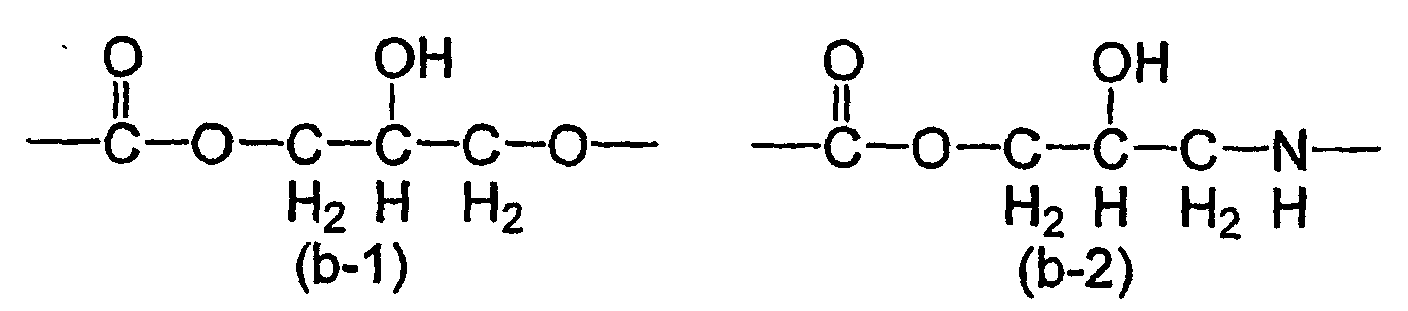
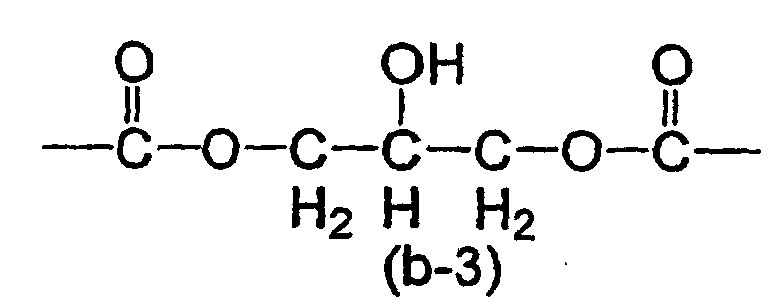


In addition, the benzene ring portion of formula (1) include for example the
structures of formulae (c-1) to (c-5).

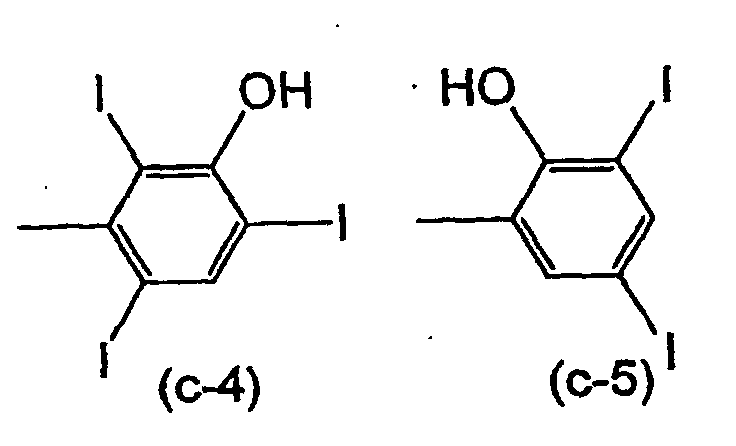
The followings are concrete examples of the repeating structural unit
containing a halogen atom which is contained in the polymer compound (formulae [1-1]
to [1-34]), the repeating structural unit containing a halogen atom and a crosslink-forming
substituent (formulae [2-1] to [2-33]), and the repeating structural unit
containing a crosslink-forming substituent ([formulae [3-1] to [3-10]), to which the
present invention is not limited.

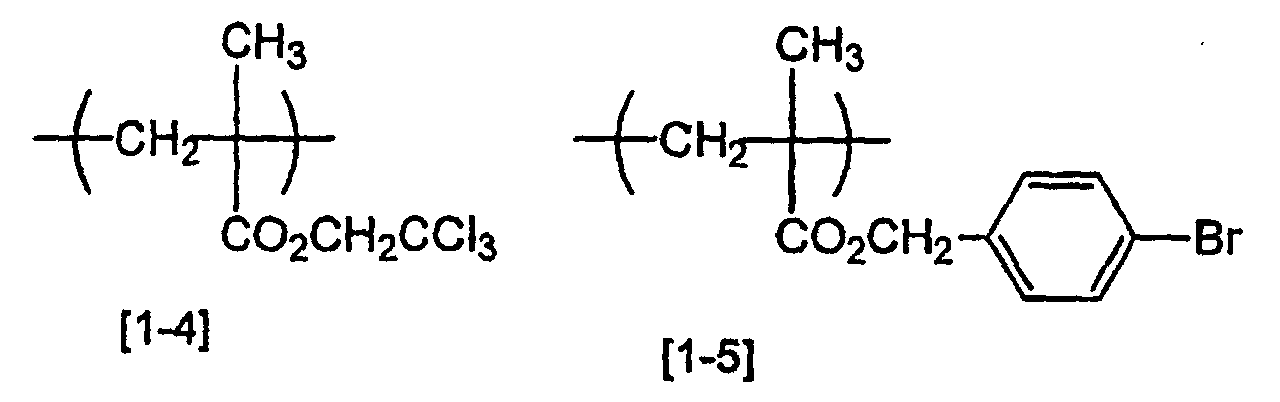
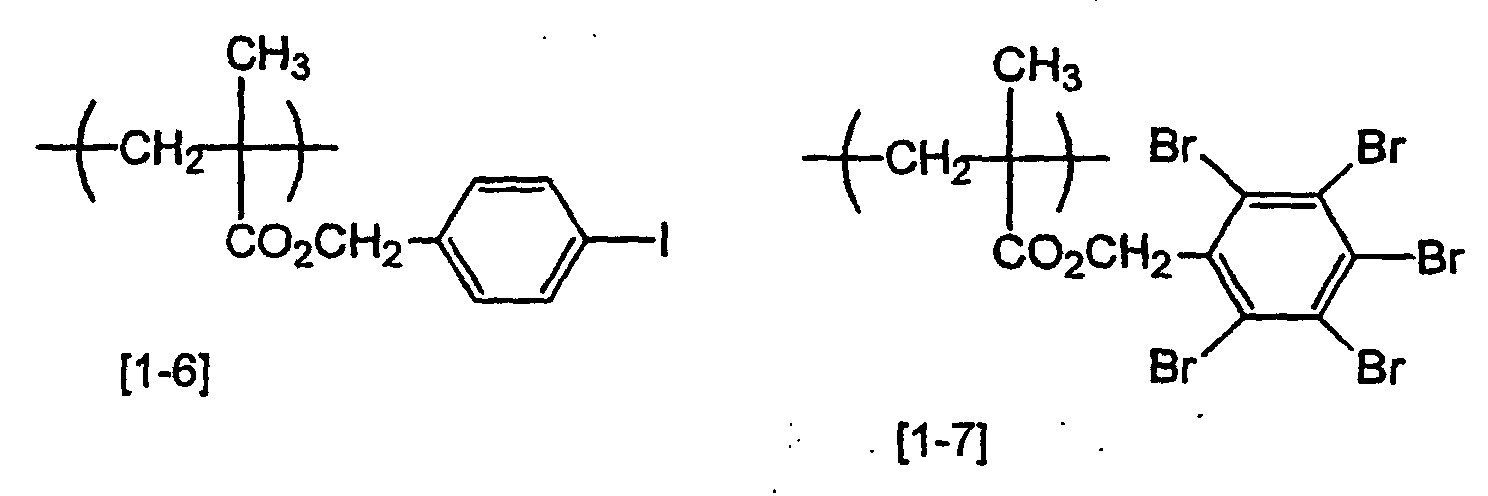
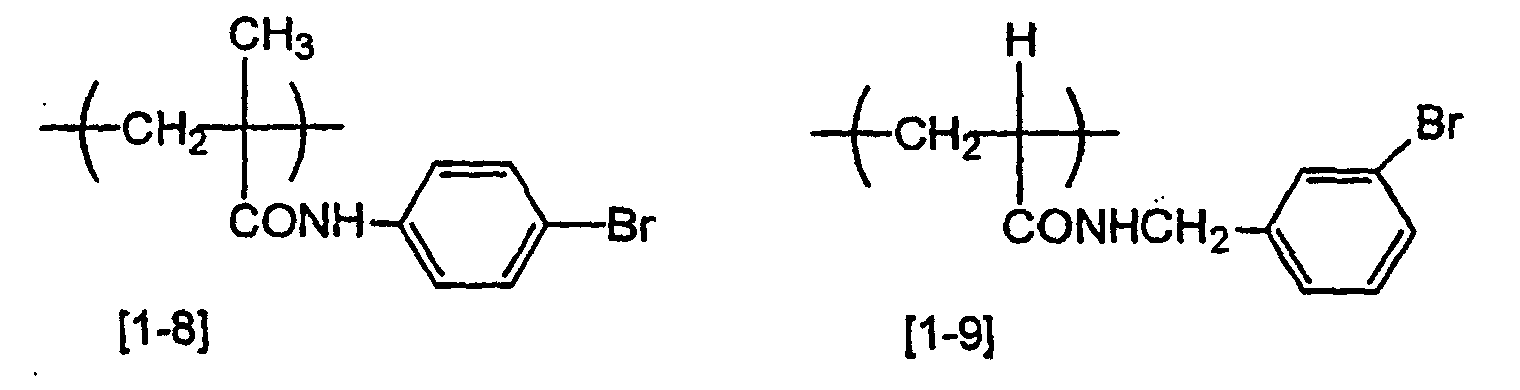
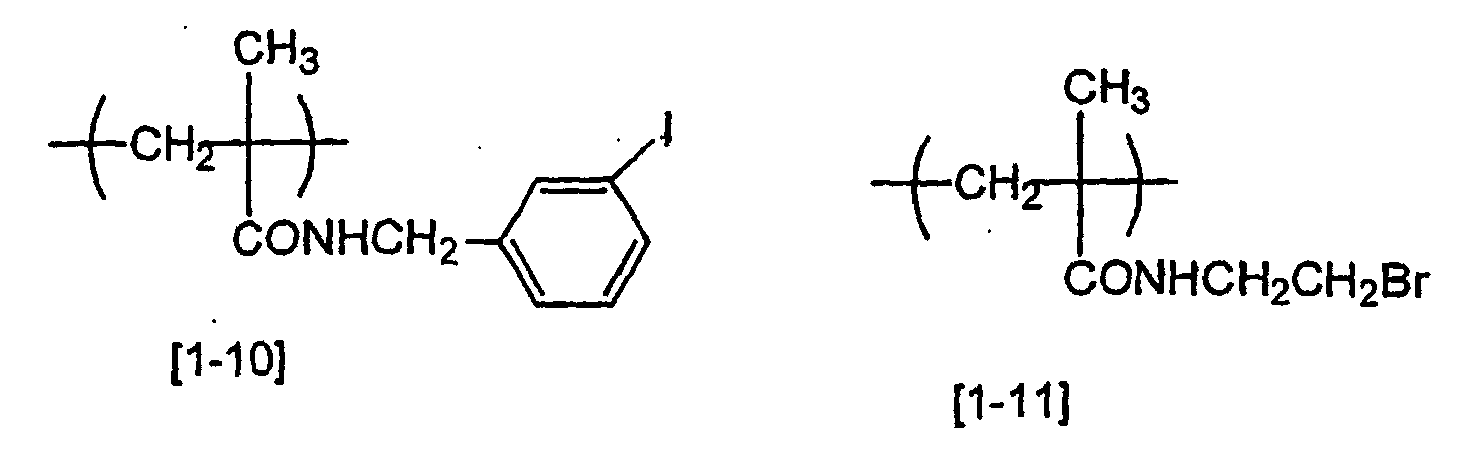


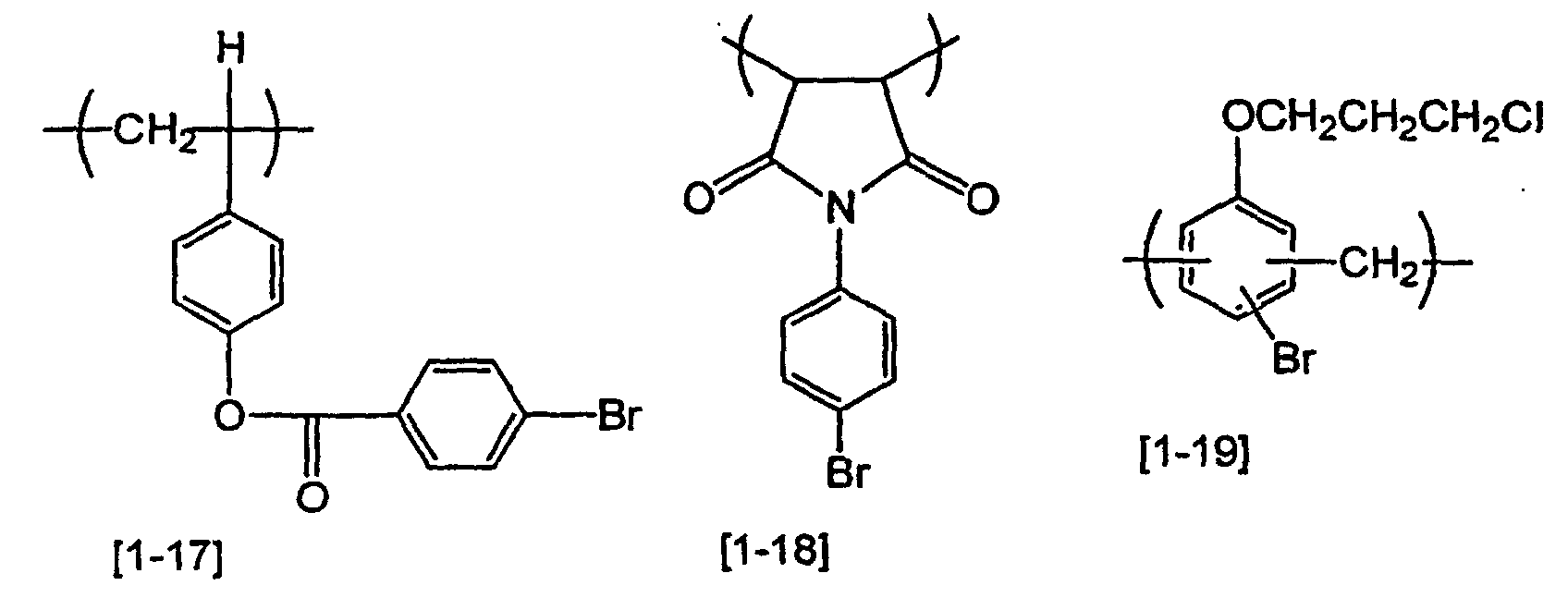
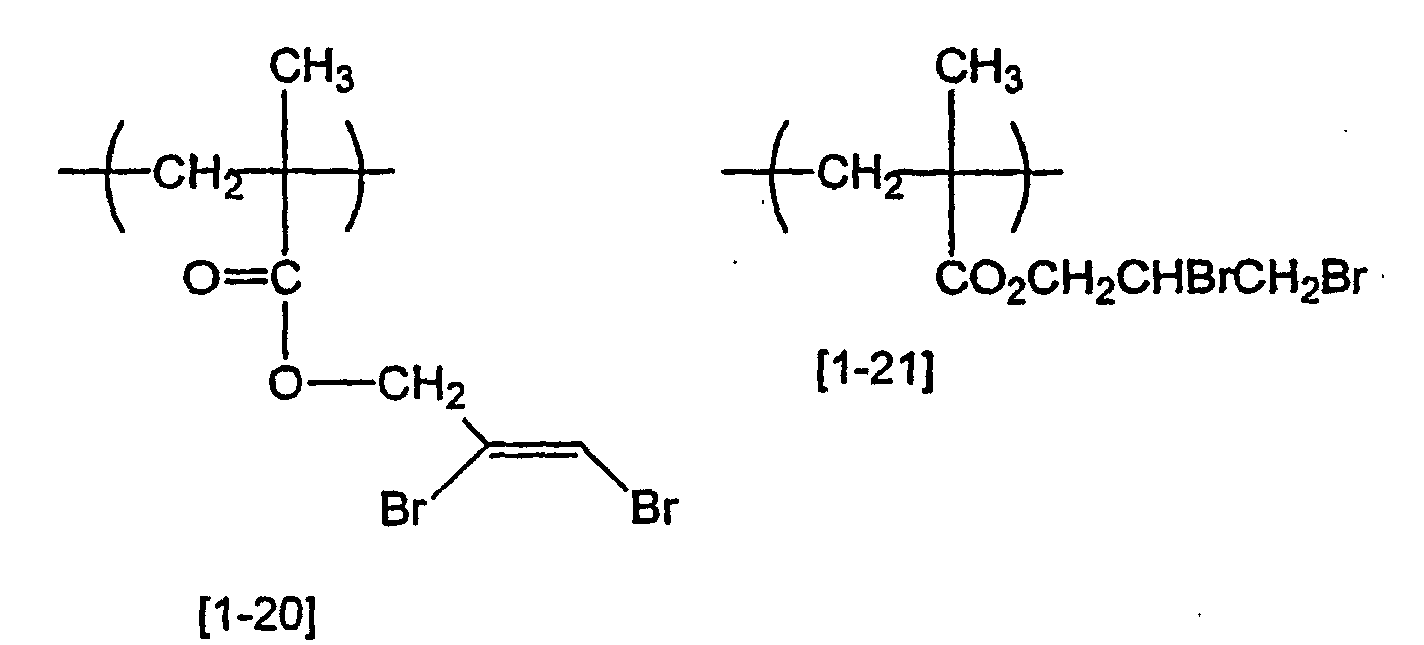
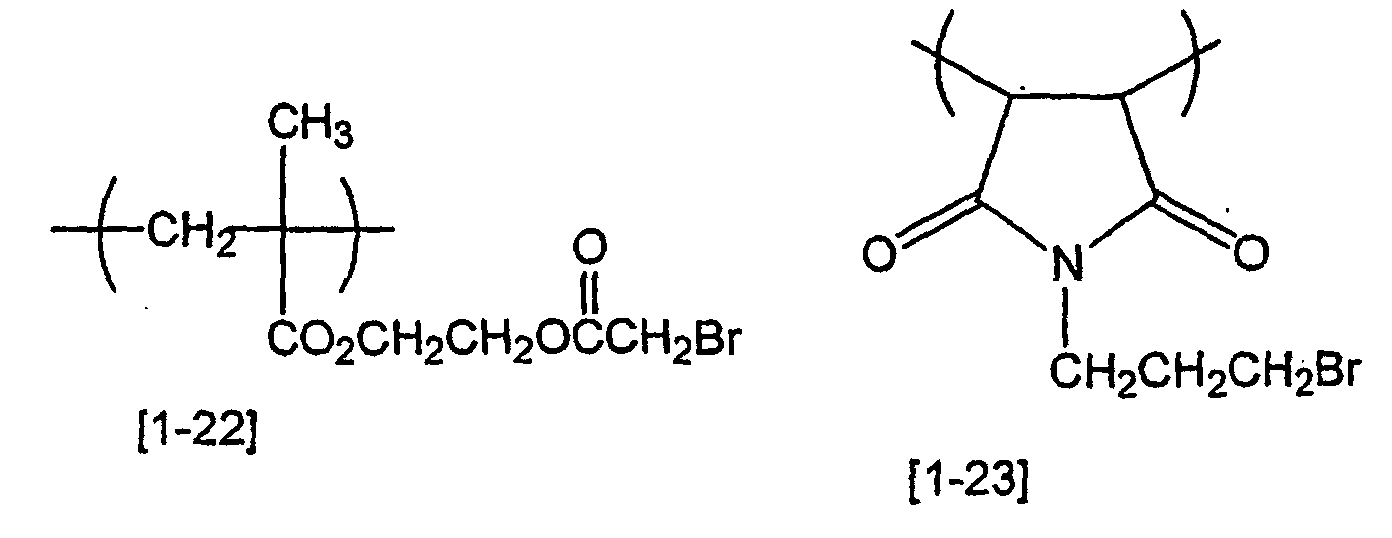


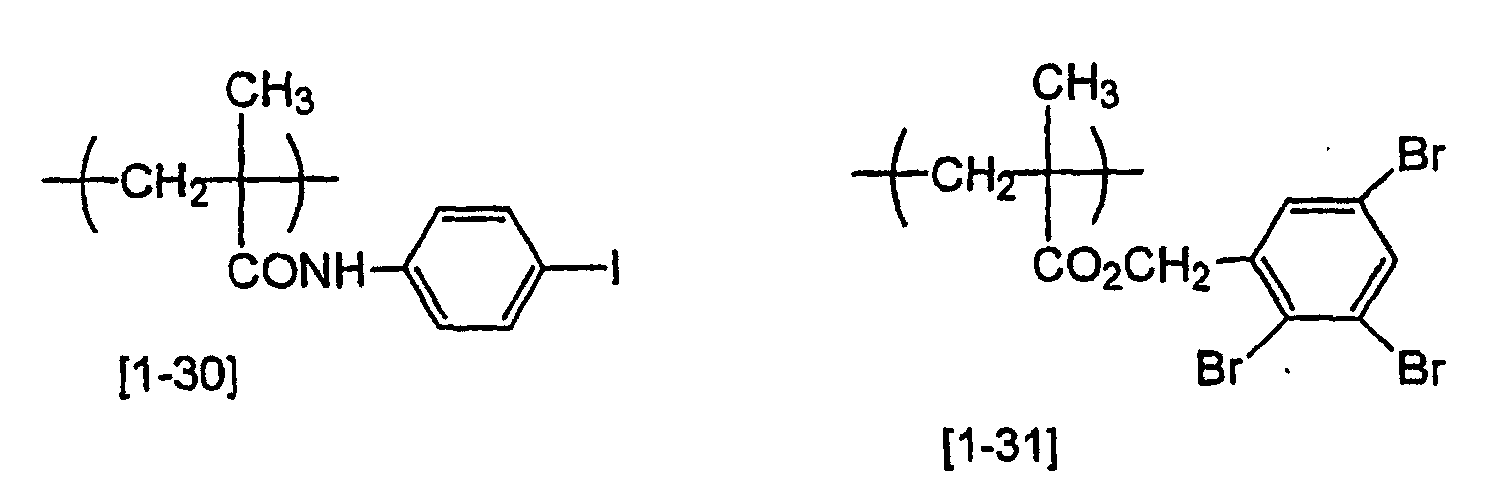








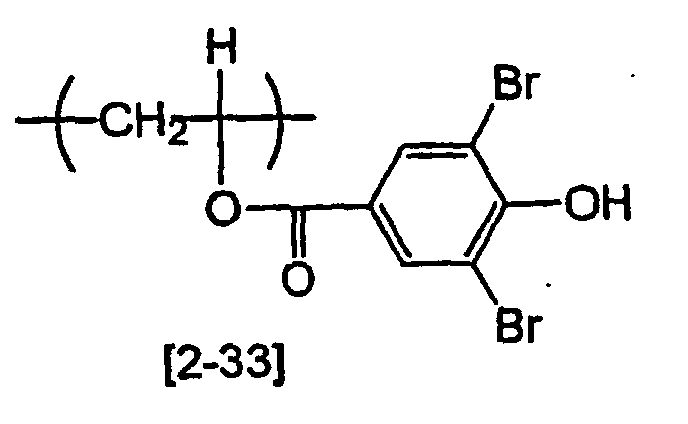
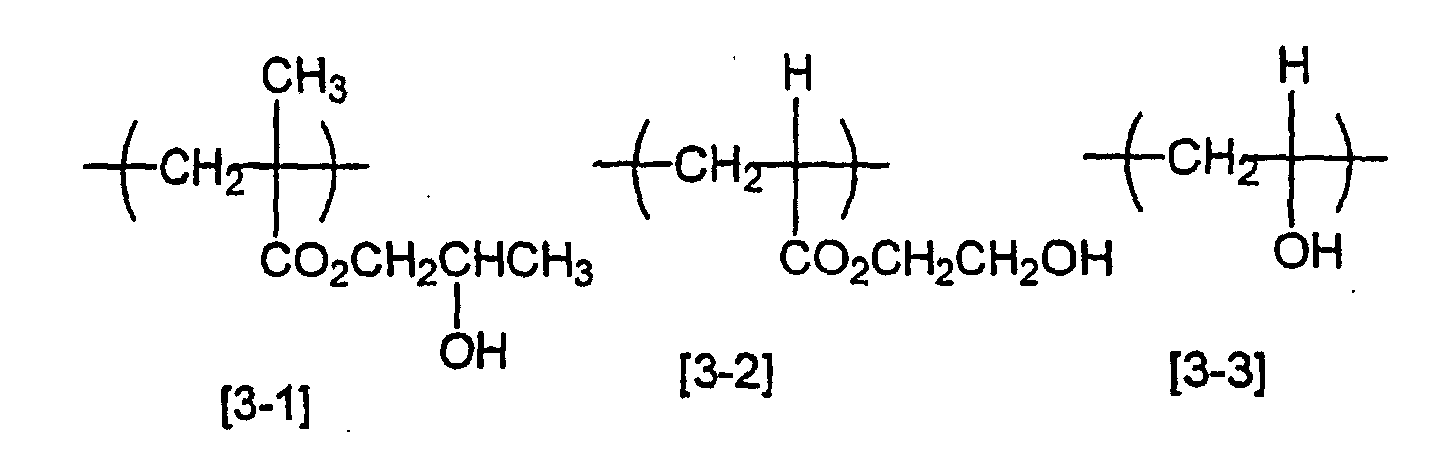

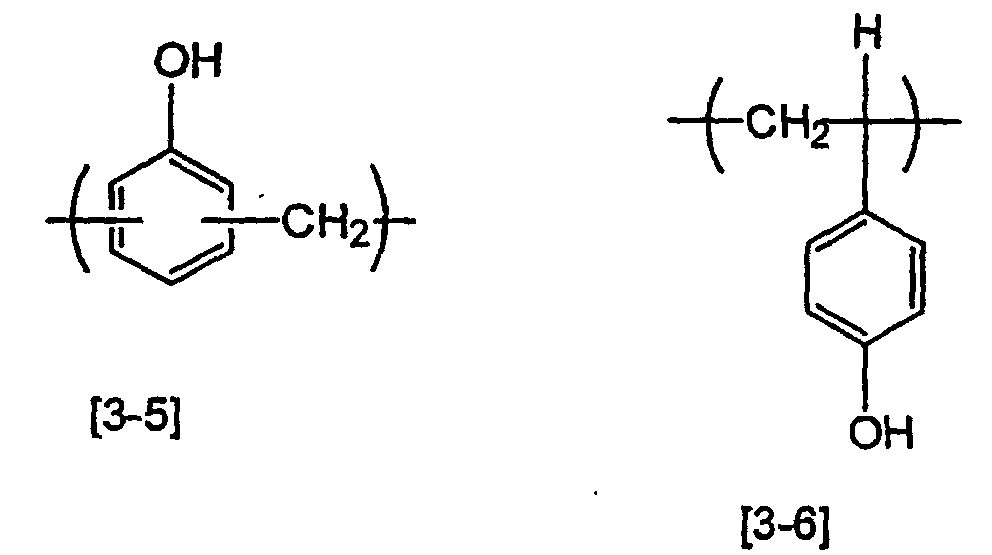


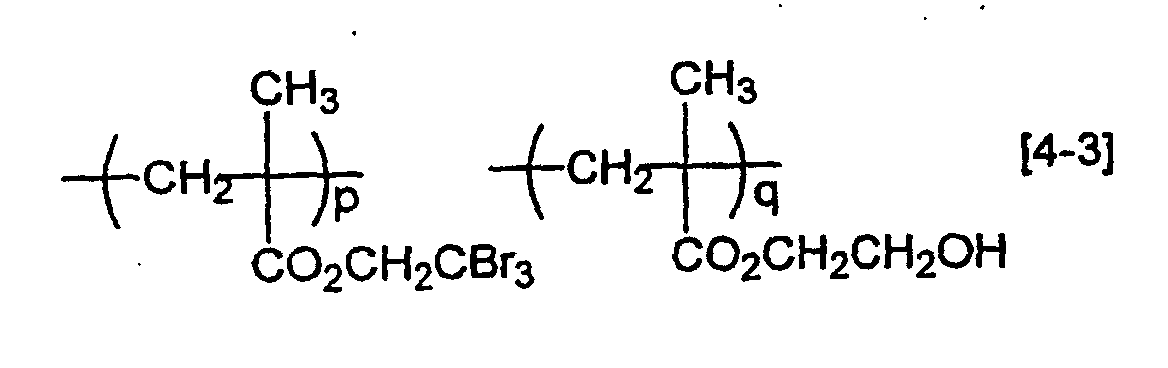
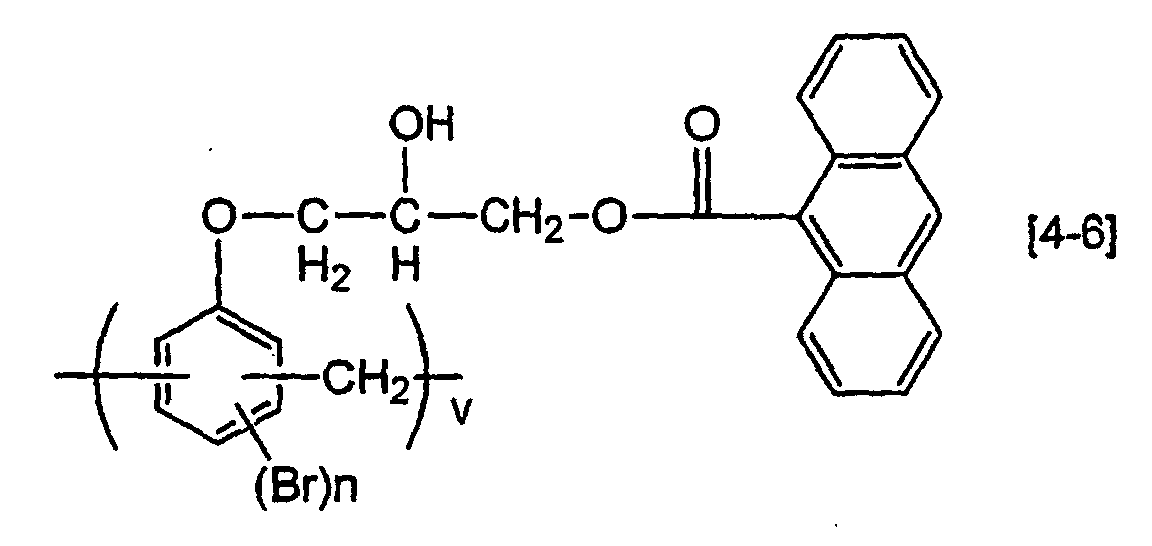
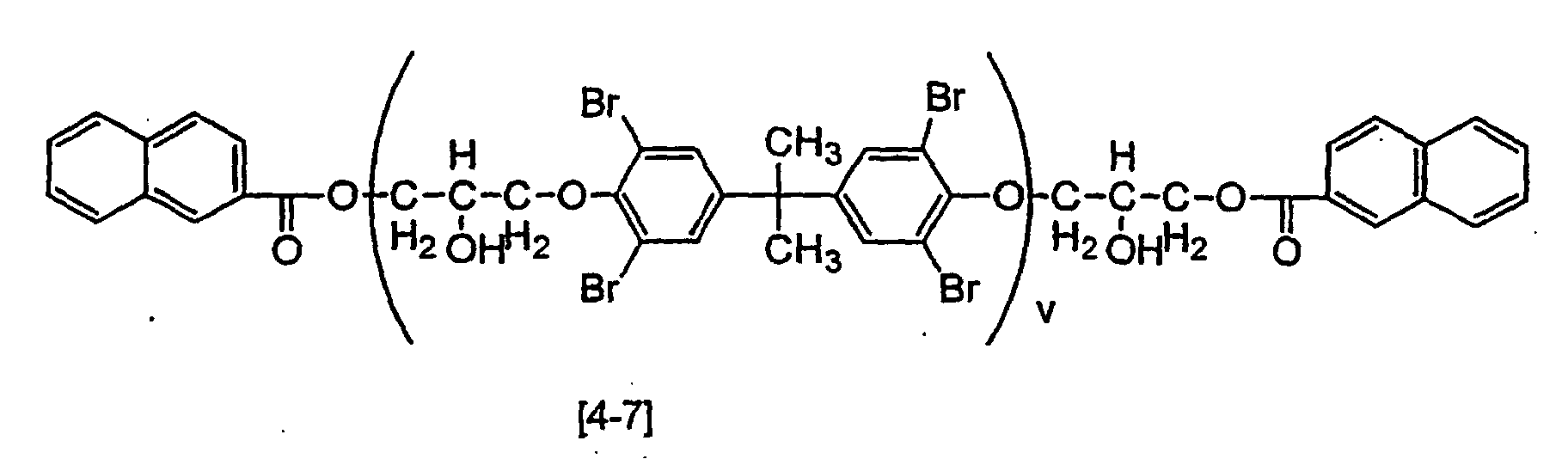
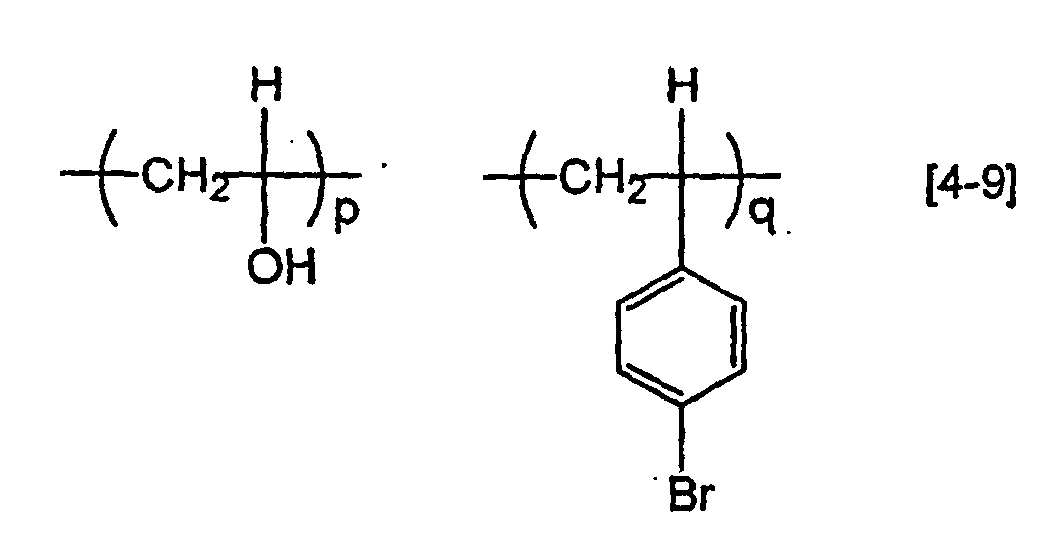
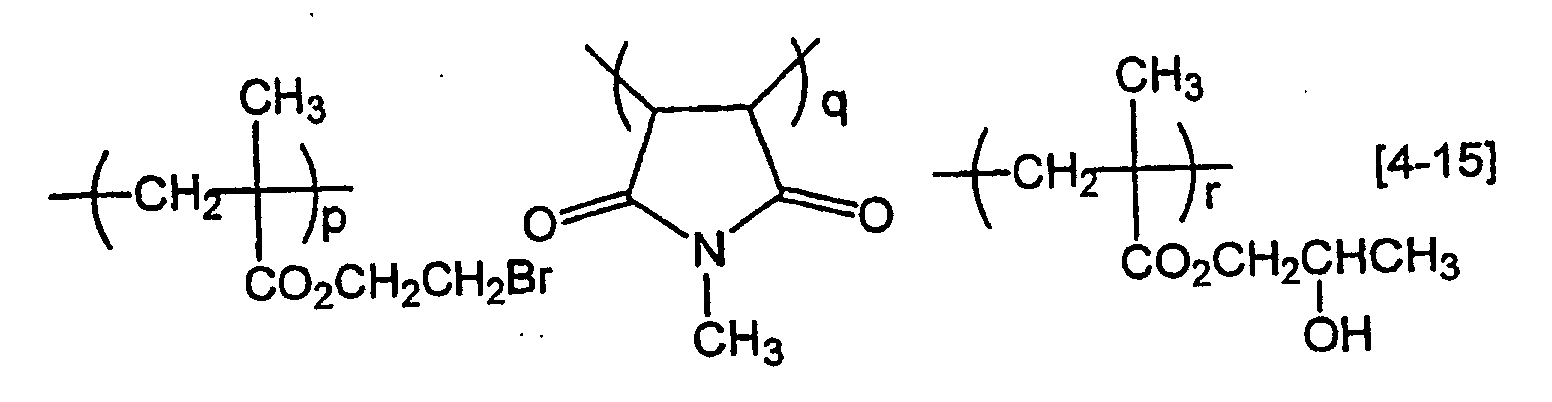
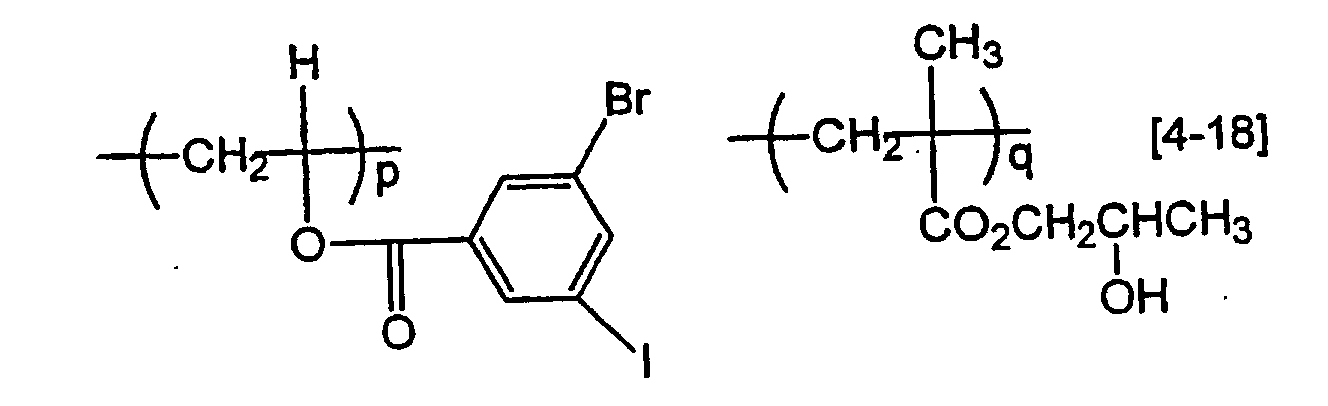
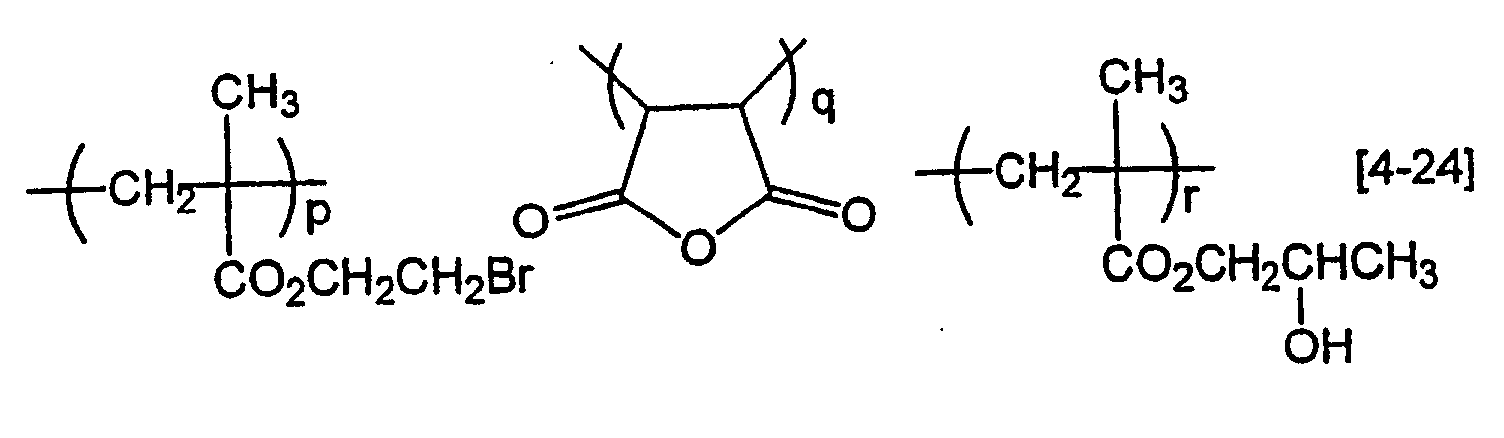
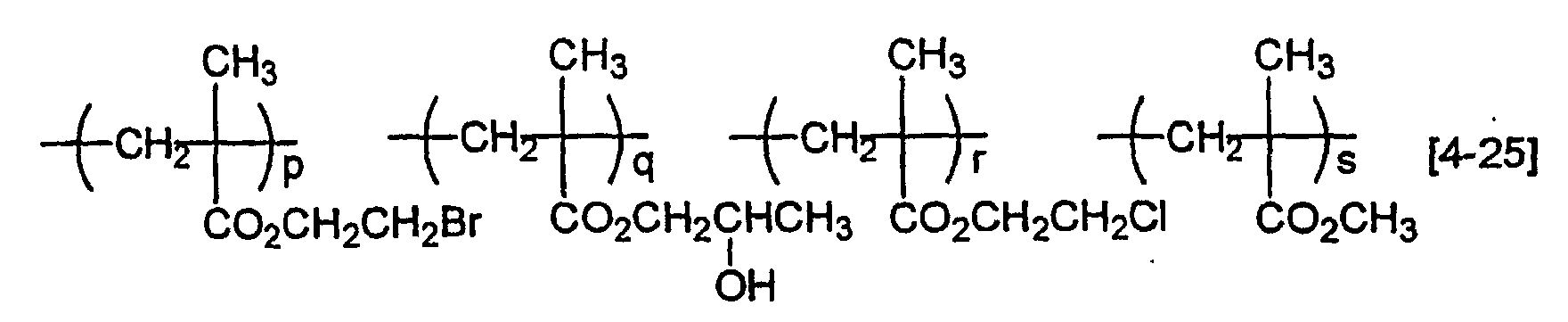
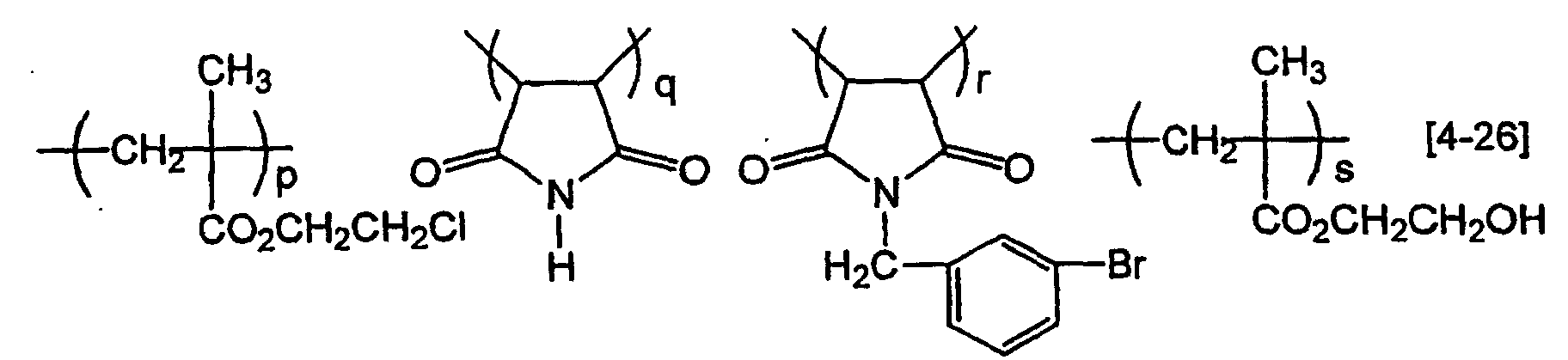
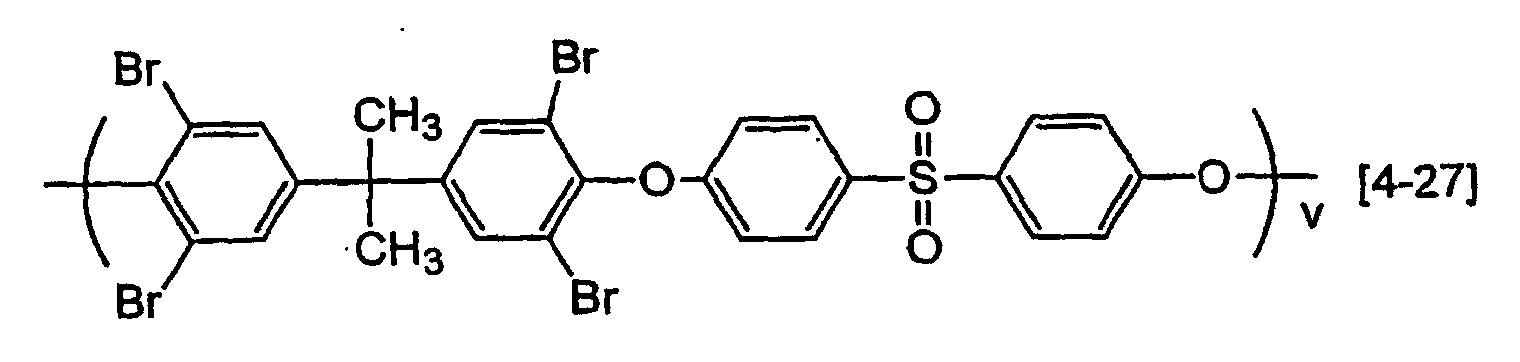
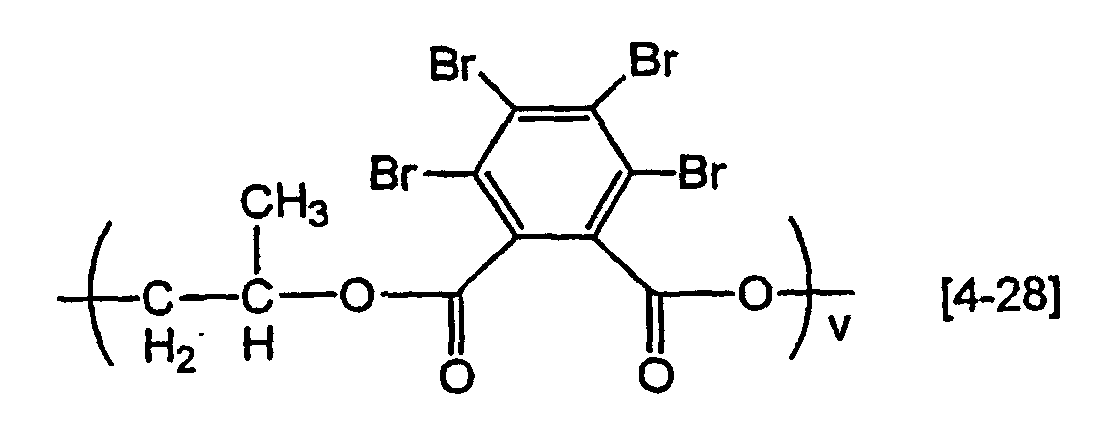
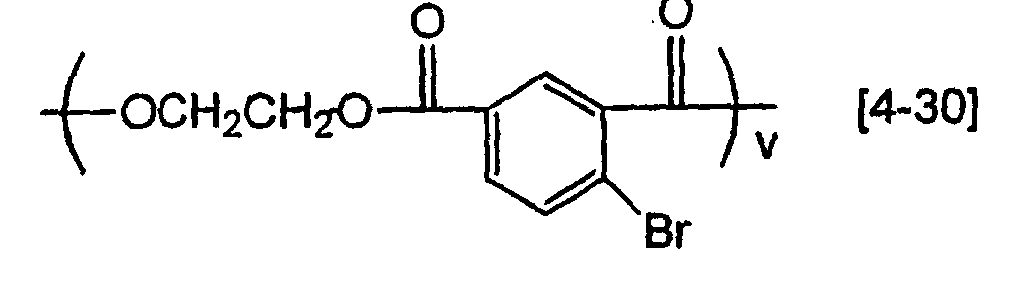
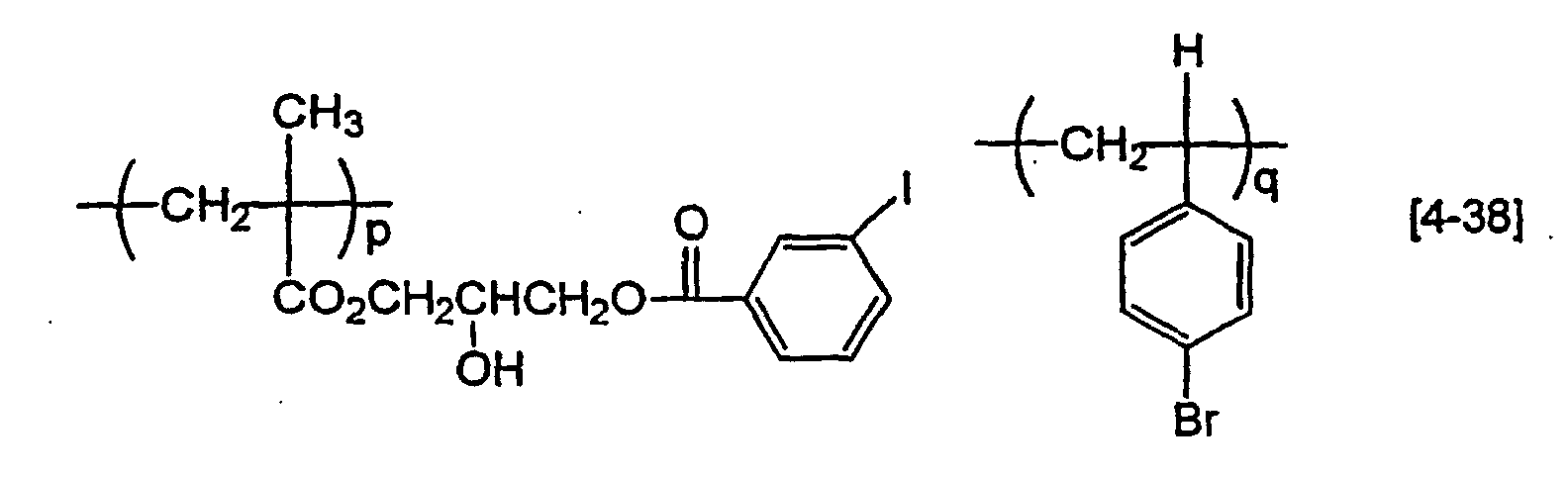
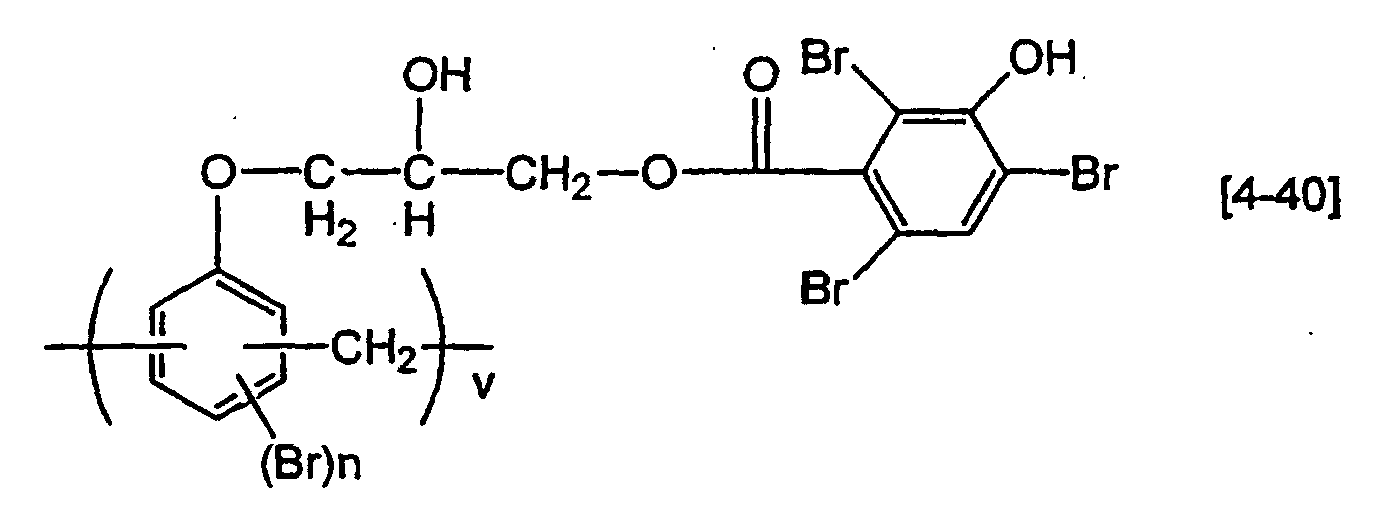
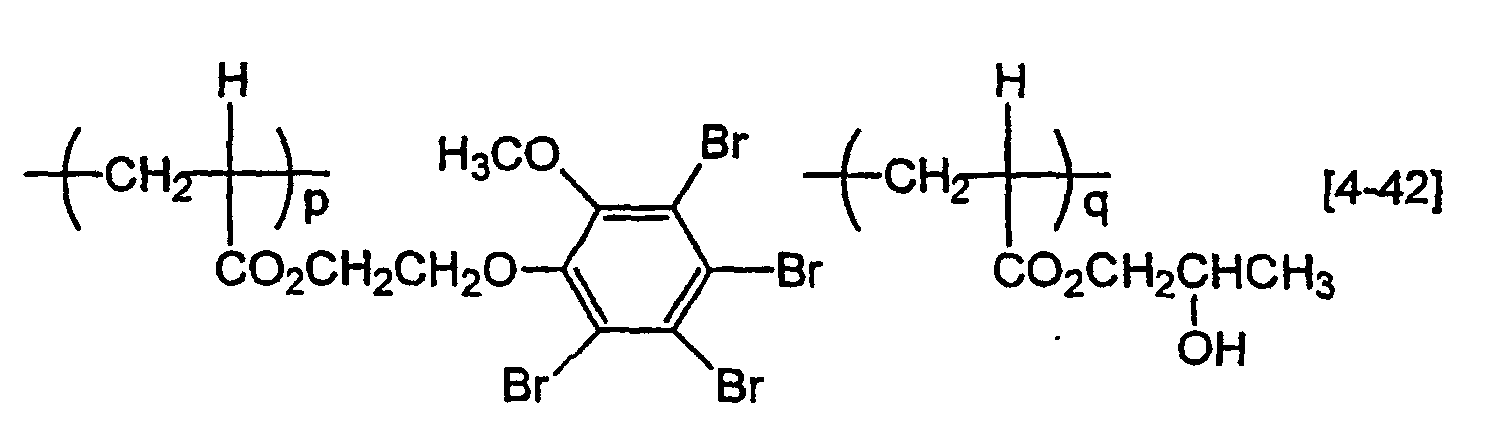
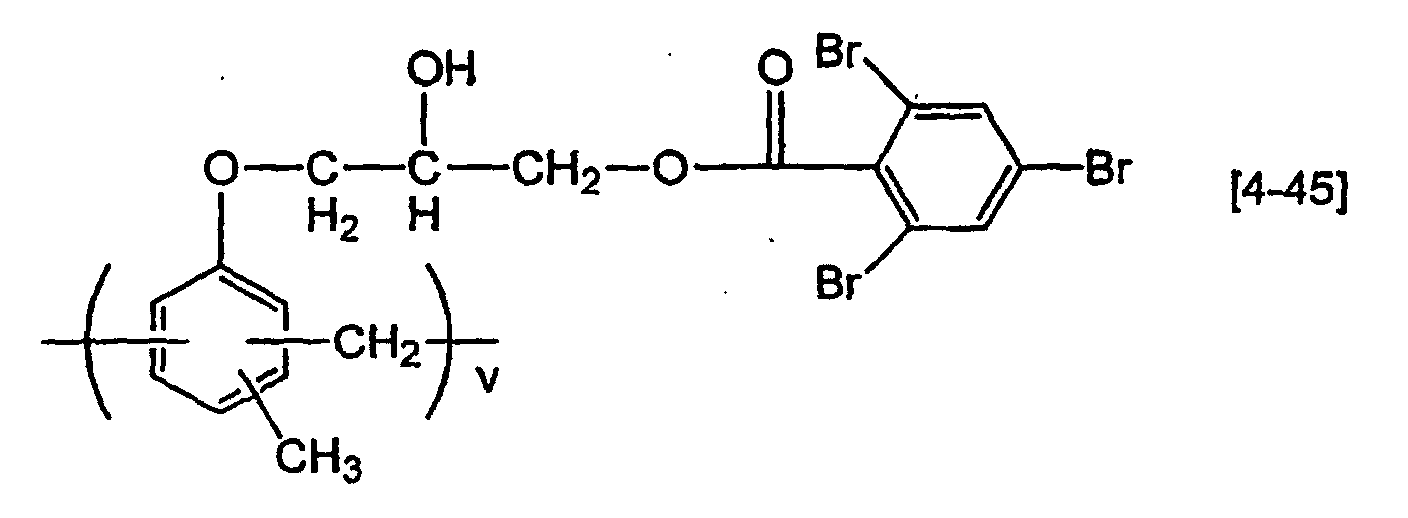
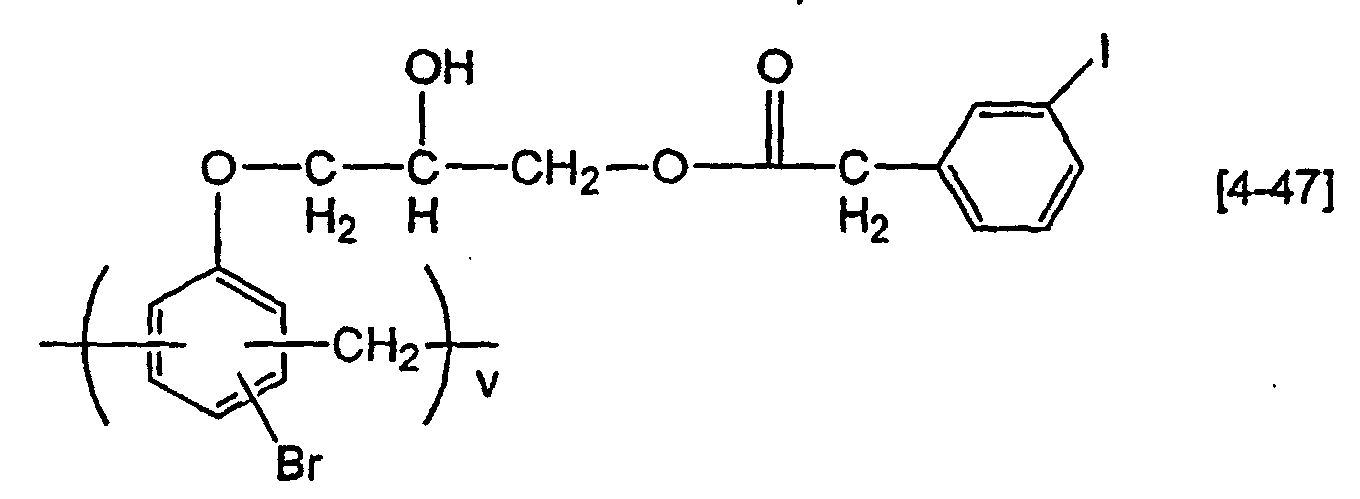
The followings are concrete examples of the polymer compound (formulae
[4-1] to [4-47]) in the present invention, to which the present invention is not limited (in
the formulae, p, q, r and s are molar ratio of the corresponding constituent unit
monomer in the polymer compound, and v is the number of the repeated constituent
unit monomers).



















The composition for forming anti-reflective coating according to the present
invention can alter the content (mass%) of halogen atom contained in the polymer
compound in the composition. That is, the selection of main chain structure of
polymer compound, the selection of kind of unit monomer used for the synthesis of
polymer compound, the selection of kind of compound with which the polymer
obtained by the polymerization reaction is reacted, the selection of number and kind of
halogen atom contained in the polymer compound make possible to alter the content
(mass%) of halogen atom contained in the polymer compound. The use of polymer
compound with different content (mass%) of halogen atom makes possible to alter the
content (mass%) of halogen atom in the solid content of the anti-reflective coating,
that is, the content (mass%) of halogen atom in the formed anti-reflective coating.
And it is possible to control attenuation coefficient k of anti-reflective coating by
altering the content (mass%) of halogen atom in the formed anti-reflective coating.
In addition, it is also possible to alter the content (mass%) of halogen atom in the
formed anti-reflective coating by changing the proportion in the solid content of
polymer compound containing halogen atom in a constant content. Therefore, it is
also possible to control attenuation coefficient k of anti-reflective coating according to
this process. In the meanwhile, in this specification, the solid content means
components other than the solvent in composition for forming anti-reflective coating,
and the content (mass%) of halogen atom in the formed anti-reflective coating means
the content (mass%) of halogen atom in the solid content of the composition for
forming anti-reflective coating.
It is required that the solid content in the composition for forming anti-reflective
coating according to the present invention contains at least 10 mass% of
halogen atom so that the anti-reflective coating formed from the composition for
forming anti-reflective coating could sufficiently absorb a light from F2 excimer laser
(wavelength 157 nm). The proportion of halogen atom in the solid content of the
composition for forming anti-reflective coating according to the present invention is 10
mass% to 60 mass%, or 15 mass% to 55 mass%, or 20 mass% to 50 mass%. The
halogen atom in the solid content of the composition for forming anti-reflective coating
according to the present invention is chlorine atom, bromine atom or iodine atom, and
preferably bromine atom or iodine atom.
The halogen atom in the solid content of the composition for forming anti-reflective
coating according to the present invention is contained in the polymer
compound as mentioned above. Alternatively, a compound containing halogen atom
may be added to the composition for forming anti-reflective coating.
The compound containing halogen atom includes for example a compound
having crosslink-forming substituent, such as 4-bromobenzoic acid, 3-iodobenzoic
acid, 2,4,6-tribromophenol, 2,4,6-tribromoresorcinol, 2,4,6-triiodophenol, 4-iodo-2-methylphenol,
5-iodo methyl salicylate, 3,4,5-triiodobenzoic acid, 2,4,6-triiodo-3-aminobenzoic
acid, 5-amino-2,4,6-triiodoisophthalic acid, 5-hydroxy-2,4,6-triiodoisophthalic
acid, 2,4,6-tribromobenzoic acid, 2-amino-4,5-dibromo-3,6-dimethylbenzoic
acid, 3,5-dibromo-4-hydroxybenzoic acid, 3,5-dibromo-2,4-dihydroxybenzoic
acid, 3,5-diiodo-2-hydroxybenzoic acid, 2,4,6-triiodo-3-hydroxybenzoic
acid or 2,4,6-tribromo-3-hydroxybenzoic acid.
The anti-reflective coating forming composition according to the present
invention is preferably crosslinked after application by heating in order to prevent
intermixing with a photoresist applied thereon. In addition, the anti-reflective coating
forming composition according to the present invention may further contain a
crosslinking agent component. The crosslinking agent includes melamines and
substituted ureas having crosslink-forming substituents such as methylol or
methoxymethyl groups, or polymer compounds having epoxy groups, and the like.
Preferable crosslinking agents are ones having at least two crosslink-forming
substituents, for example, compounds such as methoxymethylated glycoluril,
methoxymethylated melamine, more preferably tetramethoxymethyl glycoluril or
hexamethoxymethyl melamine. Further, the crosslinking agents include compounds
such as tetramethoxymethyl urea or tetrabutoxymethyl urea. The addition amount of
the crosslinking agent may vary depending on the coating solvents used, the
underlying substrate used, the viscosity of the solution required, the shape of the
coating required, etc., and usually 0.001 to 20 mass%, preferably 0.01 to 15 mass%,
more preferably 0.05 to 10 mass% in the total composition. These crosslinking
agents occasionally occur a crosslinking reaction due to self-condensation, but in
case where a crosslink-forming substituent is present in the polymer compound in the
present invention, the crosslinking agents can react with the crosslink-forming
substituent.
As catalyst for promoting the above-mentioned crosslinking reaction in the
present invention, acid compounds, such as p-toluenesulfonic acid,
trifluoromethanesulfonic acid, pyridinium p-toluenesulfonate, salicylic acid,
sulfosalicylic acid, citric acid, benzoic acid, hydroxybenzoic acid, etc. or/and thermal
acid generators, such as 2,4,4,6-tetrabromocyclohexadienone, benzointosylate, 2-nitrobenzyltosylate,
etc. may be added. The blending amount thereof is 0.02 to 10
mass%, preferably 0.04 to 5 mass% based on 100 mass% of the total solid content.
The anti-reflective coating composition according to the present invention
may contain photoacid generators in order to adjust the acidity to that of a photoresist
applied thereon in the lithography process. Preferable photoacid generators include
for example onium salt photoacid generators, such as bis(4-t-butylpheny)iodonium
trifluoromethanesulfonate or triphenylsulfonium trifluoromethanesulfonate, halogen-containing
photoacid generators, such as phenyl-bis(trichloromethyl)-s-triazine,
sulfonate photoacid generators, such as benzoin tosylate or N-hydroxysuccinimide
trifluoromethanesulfonate. The photoacid generators are added in an amount of 0.2
to 3 mass%, preferably 0.4 to 2 mass% based on 100 mass% of the total solid
content.
The anti-reflective coating forming composition according to the present
invention may contain further light absorbing agents, rheology controlling agents,
adhesion auxiliaries, surfactants, etc. in addition to the above described ones, if
necessary.
As the further light absorbing agents, the followings can be suitably used: for
example commercially available light absorbing agents described in "Technique and
Market of Industrial Pigments" (CMC Publishing Co., Ltd.) or "Dye Handbook" (edited
by The Society of Synthetic Organic Chemistry, Japan), such as C. I. Disperse Yellow
1, 3, 4, 5, 7, 8, 13, 23, 31, 49, 50, 51, 54, 60, 64, 66, 68, 79, 82, 88, 90, 93, 102, 114
and 124; C. I. Disperse Orange 1, 5, 13, 25, 29, 30, 31, 44, 57, 72 and 73; C. I.
Disperse Red 1, 5, 7, 13, 17, 19, 43, 50, 54, 58, 65, 72, 73, 88, 117, 137, 143, 199 and
210; C. I. Disperse Violet 43; C. I. Disperse Blue 96; C. I. Fluorescent Brightening
Agent 112, 135 and 163; C. I. Solvent Orange 2 and 45; C. I. Solvent Red 1, 3, 8, 23,
24, 25, 27 and 49; C. I. Pigment Green 10; C. I. Pigment Brown 2, and the others.
The light absorbing agent is usually blended in an amount of 10 mass% or less,
preferably 5 mass% or less based on 100 mass% of the total composition.
The rheology controlling agents are added mainly aiming at increasing the
flowability of the anti-reflective coating forming composition and in particular in the
baking step, increasing filling property of the anti-reflective coating forming
composition into the inside of holes. Specific examples thereof include phthalic acid
derivatives such as dimethyl phthalate, diethyl phthalate, diisobutyl phthalate, dihexyl
phthalate or butyl isodecyl phthalate; adipic acid derivatives such as di-n-butyl adipate,
diisobutyl adipate, diisooctyl adipate or octyldecyl adipate; maleic acid derivatives
such as di-n-butyl maleate, diethyl maleate or dinonyl maleate; oleic acid derivatives
such as methyl oleate, butyl oleate or tetrahydrofurfuryl oleate; or stearic acid
derivatives such as n-butyl stearate or glyceryl stearate. The rheology controlling
agents are blended in proportions of usually less than 30 mass% based on 100
mass% of the total composition.
The adhesion auxiliaries are added mainly for the purpose of increasing the
adhesion between the substrate or photoresist and the anti-reflective coating forming
composition, in particular preventing the detachment of the photoresist in
development. Specific examples thereof include chlorosilanes such as
trimethylchlorosilane, dimethylvinylchlorosilane, methyldiphenylchlorosilane or
chloromethyldimethyl-chlorosilane; alkoxysilanes such as trimethylmethoxysilane,
dimethyldiethoxysilane, methyldimethoxysilane, dimethylvinylethoxysilane,
diphenyldimethoxysilane or phenyltriethoxysilane; silazanes such as
hexamethyldisilazane, N,N'-bis(trimethylsilyl)urea, dimethyltrimethylsilylamine or
trimethylsilylimidazole; silanes such as vinyltrichlorosilane, γ-chloropropyltrimethoxysilane,
γ-aminopropyltriethoxy-silane or γ-glycidoxypropyltrimethoxysilane;
heterocyclic compounds such as benzotriazole,
benzimidazole, indazole, imidazole, 2-mercaptobenzimidazole, 2-mercaptobenzothiazole,
2-mercaptobenzoxazole, urazole, thiouracyl,
mercaptoimidazole or mercaptopyrimidine; ureas such as 1,1-dimethylurea or 1,3-dimethylurea,
or thiourea compounds. The adhesion auxiliaries are added in
proportions of usually less than 5 mass%, preferably less than 2 mass%, based on
100 mass% of the total composition of the anti-reflective coating for lithography.
The anti-reflective coating forming composition according to the present
invention may contain surfactants with view to preventing the occurrence of pinholes
or striations and further increasing coatability not to cause surface unevenness. As
the surfactants, mention may be made of, for example, nonionic surfactants such as
polyoxyethylene alkyl ethers, e.g., polyoxyethylene lauryl ether, polyoxyethylene
stearyl ether, polyoxyethylene cetyl ether, polyoxyethylene oleyl ether, etc.,
polyoxyethylene alkyl allyl ethers, e.g., polyoxyethylene octyl phenol ether,
polyoxyethylene nonyl phenol ether; polyoxyethylene/polyoxypropylene block
copolymers, sorbitan fatty acid esters, e.g., sorbitan monolaurate, sorbitan
monopalmitate, sorbitan monostearate, sorbitan monooleate, sorbitan trioleate,
sorbitan tristearate, etc., polyoxyethylene sorbitan fatty acid esters, e.g.,
polyoxyethylene sorbitan monolaurate, polyoxyethylene sorbitan monopalmitate,
polyoxyethylene sorbitan monostearate, polyoxyethylene sorbitan trioleate,
polyoxyethylene sorbitan tristearate, etc.; fluorine based surfactants, e.g., EFTOP
EF301, EF303, EF352 (Tochem Products Co., Ltd.), MEGAFAC F171, F173
(Dainippon Ink and Chemicals, Inc.), FLUORAD FC430, FC431 (Sumitomo 3M
Limited), ASAHI GUARD AG710, SURFLON S-382, SC101, SC102, SC103, SC104,
SC105, SC106 (Asahi Glass Co., Ltd.), organosiloxane polymer KP341 (Shinetsu
Chemical Co., Ltd.), etc. The blending amount of the surfactants is usually 0.2
mass% or less, preferably 0.1 mass% or less, based on 100 mass% of the total
composition of the anti-reflective coating for lithography according to the present
invention. The surfactants may be added singly or two or more of them may be
added in combination.
In the present invention, as the solvents for dissolving the above-described
solid content such as polymer compounds, use may be made of ethylene glycol
monomethyl ether, ethylene glycol monoethyl ether, methyl cellosolve acetate, ethyl
cellosolve acetate, diethylene glycol monomethyl ether, diethylene glycol monoethyl
ether, propylene glycol, propylene glycol monomethyl ether, propylene glycol
monomethyl ether acetate, propylene glycol propyl ether acetate, toluene, xylene,
methyl ethyl ketone, cyclopentanone, cyclohexanone, ethyl 2-hydroxypropionate,
ethyl 2-hydroxy-2-methylpropionate, ethyl ethoxyacetate, ethyl hydroxyacetate,
methyl 2-hydroxy-3-methylbutanoate, methyl 3-methoxypropionate, ethyl 3-methoxypropionate,
ethyl 3-ethoxypropionate, methyl 3-ethoxypropionate, methyl
pyruvate, ethyl pyruvate, ethyl acetate, butyl acetate, ethyl lactate, butyl lactate, etc.
The organic solvents may be used singly or in combination of two or more of them.
Further, high boiling solvents such as propylene glycol monobutyl ether or
propylene glycol monobutyl ether acetate may be mixed. Among the solvents,
propylene glycol monomethyl ether, propylene glycol monomethyl ether acetate, ethyl
lactate, butyl lactate, and cyclohexanone are preferred for increasing the leveling
property.
As photoresist to be coated as an upper layer of the anti-reflective coating in
the present invention, any of negative type and positive type photoresists may be
used. The photoresist includes a chemically-amplified type resist which consists of a
photoacid generator and a binder having a group which is decomposed with an acid
and increases alkali dissolution rate, a chemically-amplified type resist consisting of
an alkali-soluble binder, a photoacid generator, and a low molecular compound which
is decomposed with an acid and increases the alkali dissolution rate of the resist, a
chemically-amplified resist consisting of a photoacid generator, a binder having a
group which is decomposed with an acid and increases the alkali dissolution rate, and
a low molecular compound which is decomposed with an acid and increases the alkali
dissolution rate of the resist. The photoresist includes also fluorine atom-containing
polymer type photoresist as described in Proc. SPIE, Vol. 3999, 330-334 (2000), Proc.
SPIE, Vol. 3999, 357-364 (2000) or Proc. SPIE, Vol. 3999, 365-374 (2000).
As the developer for the above-mentioned positive type photoresist having the
anti-reflective coating for lithography formed by using the anti-reflective coating
forming composition of the present invention, use may be made of aqueous solutions
of alkalis, e.g., inorganic alkalis such as sodium hydroxide, potassium hydroxide,
sodium carbonate, sodium silicate, sodium metasilicate or aqueous ammonia, primary
amines such as ethylamine or n-propylamine, secondary amines such as
diethylamine or di-n-butylamine, tertiary amines such as triethylamine or
methyldiethylamine, alcohol amines such as dimethylethanolamine or triethanolamine,
quaternary ammonium salts such as tetramethylammonium hydroxide,
tetraethylammonium hydroxide or choline, cyclic amines such as pyrrole or piperidine,
etc. Furthermore, a suitable amount of alcohols such as isopropyl alcohol or
surfactants such as nonionic surfactant can be added to the aqueous solution of
above-described alkalis. Among these, a preferred developer includes quaternary
ammonium salts, more preferably tetramethylammonium hydroxide and choline.
Now, the method for forming photoresist patterns will be described. On a
substrate for use in the production of precision integrated circuit element
(silicon/silicon dioxide coat substrate, silicon nitride substrate, glass substrate, ITO
substrate or the like), an anti-reflective coating forming composition is coated by a
suitable coating method, for example, with a spinner, a coater or the like, and
thereafter the substrate is baked to cure the composition to fabricate an anti-reflective
coating. The film thickness of the anti-reflective coating is preferably 0.01 to 3.0 µm.
The conditions of baking after the coating are 80 to 250°C for 0.5 to 120 minutes.
Then, a photoresist is coated, it is exposed to light through a predetermined mask,
developed, rinsed and dried to obtain a good photoresist pattern. If necessary, post
exposure bake (PEB) may be performed. In addition, it is able to form a desired
pattern on the substrate by removing by dry etching a part of the anti-reflective coating
which a photoresist was removed by development in the previous step.
The anti-reflective coating produced from the composition for forming anti-reflective
coating according to the present invention in which a polymer compound
having repeating structural unit containing halogen atom is contained has a property
of absorbing efficiently irradiation light with a wavelength of 157 nm. Therefore, the
coating exerts an excellent effect of preventing reflection light from a substrate, and
thus a photoresist pattern being an upper layer can be satisfactorily formed. In
addition, the anti-reflective coating produced from the composition for forming anti-reflective
coating according to the present invention in which a polymer compound
having repeating structural unit containing halogen atom has a relatively high dry
etching rate owing to inclusion of halogen atom, and can control dry etching rate by
changing the content of halogen atom.
The anti-reflective coating formed from the composition for forming anti-reflective
coating according to the present invention can be used by selecting process
condition as a coating having the following functions: a function of preventing
reflection light, a function of preventing a mutual interaction between a substrate and
a photoresist, a function of preventing an adverse effect to a substrate by a material
used in the photoresist or a substance generated on exposure to the photoresist, or a
function of preventing an adverse effect to a photoresist by a substance generated
from the substrate on exposure to light or heating.
Hereinafter, the present invention will be described based on examples and
comparative examples but the present invention is not limited thereto.
After 13.09 g of 2-bromoethyl methacrylate and 2.44 g of 2-hydroxypropylmethacrylate
were dissolved in 54 g of propylene glycol monomethyl
ether, the atmosphere was replaced with nitrogen. The resulting solution was
warmed to 70°C, and then a solution of 0.47 g of azobisisobutyronitrile dissolved in 10
g of propylene glycol monomethyl ether was added dropwise. The resulting solution
was subjected to a reaction under nitrogen atmosphere for 24 hours to obtain a
solution of polymer compound of concrete example [4-1]. The resulting polymer
compound was subjected to GPC analysis and had a weight average molecular
weight (Mw) of 31,000 in terms of standard polystyrene.
After 11.23 g of 2,2,2-tribromoethyl methacrylate and 4.3 g of 2-hydroxypropylmethacrylate
were dissolved in 54 g of propylene glycol monomethyl
ether, the atmosphere was replaced with nitrogen. The resulting solution was
warmed to 70°C, and then a solution of 0.47 g of azobisisobutyronitrile dissolved in 10
g of propylene glycol monomethyl ether was added dropwise. The resulting solution
was subjected to a reaction under nitrogen atmosphere for 24 hours to obtain a
solution of polymer compound of concrete example [4-2]. The resulting polymer
compound was subjected to GPC analysis and had a weight average molecular
weight of 22,000 in terms of standard polystyrene.
After 17.72 g of 2,2,2-tribromoethyl methacrylate and 1.7 g of 2-hydroxypropylmethacrylate
were dissolved in 70 g of propylene glycol monomethyl
ether, the atmosphere was replaced with nitrogen. The resulting solution was
warmed to 70°C, and then a solution of 0.58 g of azobisisobutyronitrile dissolved in 10
g of propylene glycol monomethyl ether was added dropwise. The resulting solution
was subjected to a reaction under nitrogen atmosphere for 24 hours to obtain a
solution of polymer compound of concrete example [4-2]. The resulting polymer
compound was subjected to GPC analysis and had a weight average molecular
weight of 9,500 in terms of standard polystyrene.
After 10.00 g of brominated bisphenol A epoxy resin (manufactured by Tohto
Kasei Co., Ltd.; trade name: YDB-400; weight average molecular weight: 700) was
dissolved in 21.33 g of propylene glycol monomethyl ether, 4.12 g of 2-naphthalene
carboxylic acid and 0.10 g of benzyl triethylammonium chloride were mixed therewith.
The resulting mixture was subjected to a reaction under nitrogen atmosphere at
130°C for 24 hours to obtain a solution of polymer compound of concrete example [4-7].
The resulting polymer compound was subjected to GPC analysis and had a
weight average molecular weight of 900 in terms of standard polystyrene.
After 20.00 g of brominated bisphenol A epoxy resin (manufactured by Tohto
Kasei Co., Ltd.; trade name: YDB-400; weight average molecular weight: 700) was
dissolved in 50.25 g of propylene glycol monomethyl ether, 13.50 g of 3,5-dibromobenzoic
acid and 0.30 g of benzyl triethylammonium chloride were mixed
therewith. The resulting mixture was subjected to a reaction under nitrogen
atmosphere at 130°C for 24 hours to obtain a solution of polymer compound of
concrete example [4-8]. The resulting polymer compound was subjected to GPC
analysis and had a weight average molecular weight of 1,000 in terms of standard
polystyrene.
After 50.00 g of brominated epoxy phenol novolak resin (manufactured by
Nippon Kayaku Co., Ltd.; trade name: BREN-304; content of bromine atom: 42
mass%; substituted with c.a. 1.5 bromine atom per benzene ring) was dissolved in
146 g of propylene glycol monomethyl ether, 33.78 g of 9-anthracene carboxylic acid
and 1.05 g of benzyl triethylammonium chloride were mixed therewith. The resulting
mixture was subjected to a reaction under nitrogen atmosphere at 130°C for 24 hours
to obtain a solution of polymer compound of concrete example [4-6] (wherein n = 1.5).
The resulting polymer compound was subjected to GPC analysis and had a weight
average molecular weight of 1,600 in terms of standard polystyrene.
After 6.74 g of 2,2,2-trichloroethyl methacrylate and 2.79 g of 2-hydroxypropylmethacrylate
were dissolved in 80 g of propylene glycol monomethyl
ether, the atmosphere was replaced with nitrogen. The resulting solution was
warmed to 70°C, and then a solution of 0.48 g of 2,2'-azobis(4-methoxy-2,4-dimethylvaleronitrile)
dissolved in 10 g of propylene glycol monomethyl ether was
added dropwise. The resulting solution was subjected to a reaction under nitrogen
atmosphere for 24 hours to obtain a solution of polymer compound of concrete
example [4-4]. The resulting polymer compound was subjected to GPC analysis and
had a weight average molecular weight of 12,000 in terms of standard polystyrene.
After 30 g of 20 mass% solution of copolymer (molar ratio 50:50) of glycidyl
methacrylate and 2-hydroxypropyl methacrylate in propylene glycol monomethyl ether
was mixed with 4.79 g of 4-iodobenzoic acid, 0.12 g of benzyl triethyl ammonium
chloride and 19.64 g of propylene glycol monomethyl ether, the resulting mixture was
subjected to a reaction by heating at reflux under nitrogen atmosphere for 24 hours to
obtain a solution of polymer compound of concrete example [4-5].
After 20 g of 20 mass% solution of polyglycidyl methacrylate in propylene
glycol monomethyl ether was mixed with 6.21 g of 4-iodobenzoic acid, 0.12 g of
benzyl triethyl ammonium chloride and 25.44 g of propylene glycol monomethyl ether,
the resulting mixture was subjected to a reaction by heating at reflux under nitrogen
atmosphere for 24 hours to obtain a solution of polymer compound of concrete
example [4-19].
After 60 g of 2-hydroxypropyl methacrylate was dissolved in 242 g of
propylene glycol monomethyl ether, the resulting solution was warmed to 70°C.
Thereafter, while the reaction solution was kept at 70°C, 0.6 of azobisisobutyronitrile
was added thereto, and then the resulting solution was subjected to a reaction at 70°C
for 24 hours to obtain a solution of poly 2-hydroxypropyl methacrylate. The resulting
polymer compound was subjected to GPC analysis and had a weight average
molecular weight of 50,000 in terms of standard polystyrene.
After 10.00 g of brominated epoxy phenol novolak resin (manufactured by
Nippon Kayaku Co., Ltd.; trade name: BREN-304; content of bromine atom: 42
mass%; substituted with c.a. 1.5 bromine atom per benzene ring) was dissolved in
32.88 g of propylene glycol monomethyl ether, 11.63 g of 3,5-diiodo salicylic acid and
0.29 g of benzyl triethylammonium chloride were mixed therewith. The resulting
mixture was subjected to a reaction under nitrogen atmosphere at 130°C for 24 hours
to obtain a solution of polymer compound of concrete example [4-39] (wherein n =
1.5). The resulting polymer compound was subjected to GPC analysis and had a
weight average molecular weight of 2,000 in terms of standard polystyrene.
After 10.00 g of brominated epoxy phenol novolak resin (manufactured by
Nippon Kayaku Co., Ltd.; trade name: BREN-304; content of bromine atom: 42
mass%; substituted with c.a. 1.5 bromine atom per benzene ring) was dissolved in
32.20 g of propylene glycol monomethyl ether, 11.18 g of 2,4,6-tribromo-3-hydroxy
benzoic acid and 1.05 g of benzyl triethylammonium chloride were mixed therewith.
The resulting mixture was subjected to a reaction under nitrogen atmosphere at
130°C for 24 hours to obtain a solution of polymer compound of concrete example [4-40]
(wherein n = 1.5). The resulting polymer compound was subjected to GPC
analysis and had a weight average molecular weight of 3,800 in terms of standard
polystyrene.
After 3.04 g of 2-(2,4,6-tribromophenoxy) ethylacrylate and 0.92 g of 2-hydroxypropylacrylate
were dissolved in 10 g of propylene glycol monomethyl ether,
the atmosphere was replaced with nitrogen. The resulting solution was warmed to
70°C, and then a solution of 0.040 g of azobisisobutyronitrile dissolved in 6 g of
propylene glycol monomethyl ether was added dropwise. The resulting solution was
subjected to a reaction under nitrogen atmosphere for 24 hours to obtain a solution of
polymer compound of concrete example [4-41]. The resulting polymer compound
was subjected to GPC analysis and had a weight average molecular weight of 12,000
in terms of standard polystyrene.
After 1.20 g of 2-(2,3,4,5-tetrabromo-6-methoxyphenoxy) ethylacrylate and
0.29 g of 2-hydroxypropylacrylate were dissolved in 5 g of cyclohexanone, the
atmosphere was replaced with nitrogen. The resulting solution was warmed to 70°C,
and then a solution of 0.015 g of azobisisobutyronitrile dissolved in 3.5 g of
cyclohexanone was added dropwise. The resulting solution was subjected to a
reaction under nitrogen atmosphere for 24 hours to obtain a solution of polymer
compound of concrete example [4-42]. The resulting polymer compound was
subjected to GPC analysis and had a weight average molecular weight of 7,400 in
terms of standard polystyrene.
10 g of a solution containing 2 g of the polymer compound obtained in
Synthesis Example 1 was mixed with 0.5 g of tetramethoxymethyl glycoluril as a
crosslinking agent and 0.05 g of p-toluenesulfonic acid as a catalyst, and dissolved in
56.7 g of propylene glycol monomethyl ether as a solvent to obtain a solution. Then,
the solution was filtered through a micro filter made of polyethylene having a pore
diameter of 0.10 µm, and then, the solution was filtered through a micro filter made of
polyethylene having a pore diameter of 0.05 µm, to prepare a composition solution for
forming anti-reflective coating.
10 g of a solution containing 2 g of the polymer compound obtained in
Synthesis Example 2 was mixed with 0.5 g of tetramethoxymethyl glycoluril as a
crosslinking agent and 0.05 g of p-toluenesulfonic acid as a catalyst, and dissolved in
56.7 g of propylene glycol monomethyl ether as a solvent to obtain a solution. Then,
the solution was filtered through a micro filter made of polyethylene having a pore
diameter of 0.10 µm, and then, the solution was filtered through a micro filter made of
polyethylene having a pore diameter of 0.05 µm, to prepare a composition solution for
forming anti-reflective coating.
10 g of a solution containing 2 g of the polymer compound obtained in
Synthesis Example 3 was mixed with 0.5 g of tetramethoxymethyl glycoluril as a
crosslinking agent and 0.05 g of p-toluenesulfonic acid as a catalyst, and dissolved in
56.7 g of propylene glycol monomethyl ether as a solvent to obtain a solution. Then,
the solution was filtered through a micro filter made of polyethylene having a pore
diameter of 0.10 µm, and then, the solution was filtered through a micro filter made of
polyethylene having a pore diameter of 0.05 µm, to prepare a composition solution for
forming anti-reflective coating.
10 g of a solution containing 2 g of the polymer compound obtained in
Synthesis Example 4 was mixed with 0.5 g of tetramethoxymethyl glycoluril as a
crosslinking agent and 0.05 g of p-toluenesulfonic acid as a catalyst, and dissolved in
56.7 g of propylene glycol monomethyl ether as a solvent to obtain a solution. Then,
the solution was filtered through a micro filter made of polyethylene having a pore
diameter of 0.10 µm, and then, the solution was filtered through a micro filter made of
polyethylene having a pore diameter of 0.05 µm, to prepare a composition solution for
forming anti-reflective coating.
10 g of a solution containing 2 g of the polymer compound obtained in
Synthesis Example 5 was mixed with 0.5 g of tetramethoxymethyl glycoluril as a
crosslinking agent and 0.05 g of p-toluenesulfonic acid as a catalyst, and dissolved in
56.7 g of propylene glycol monomethyl ether as a solvent to obtain a solution. Then,
the solution was filtered through a micro filter made of polyethylene having a pore
diameter of 0.10 µm, and then, the solution was filtered through a micro filter made of
polyethylene having a pore diameter of 0.05 µm, to prepare a composition solution for
forming anti-reflective coating.
10 g of a solution containing 2 g of the polymer compound obtained in
Synthesis Example 6 was mixed with 0.5 g of tetramethoxymethyl glycoluril as a
crosslinking agent and 0.05 g of p-toluenesulfonic acid as a catalyst, and dissolved in
56.7 g of propylene glycol monomethyl ether as a solvent to obtain a solution. Then,
the solution was filtered through a micro filter made of polyethylene having a pore
diameter of 0.10 µm, and then, the solution was filtered through a micro filter made of
polyethylene having a pore diameter of 0.05 µm, to prepare a composition solution for
forming anti-reflective coating.
10 g of a solution of propylene glycol monomethyl ether containing 2 g of a
commercially available bromide of polyparavinylphenol (Maruzen Petrochemical Co.,
Ltd.; trade name: Maruka Lyncur MB) was mixed with 0.5 g of tetramethoxymethyl
glycoluril as a crosslinking agent and 0.05 g of p-toluenesulfonic acid as a catalyst,
and dissolved in 56.7 g of propylene glycol monomethyl ether as a solvent to obtain a
solution. Then, the solution was filtered through a micro filter made of polyethylene
having a pore diameter of 0.10 µm, and then, the solution was filtered through a micro
filter made of polyethylene having a pore diameter of 0.05 µm, to prepare a
composition solution for forming anti-reflective coating.
10 g of a solution containing 2 g of the polymer compound obtained in
Synthesis Example 7 was mixed with 0.5 g of tetramethoxymethyl glycoluril as a
crosslinking agent and 0.05 g of p-toluenesulfonic acid as a catalyst, and dissolved in
56.7 g of propylene glycol monomethyl ether as a solvent to obtain a solution. Then,
the solution was filtered through a micro filter made of polyethylene having a pore
diameter of 0.10 µm, and then, the solution was filtered through a micro filter made of
polyethylene having a pore diameter of 0.05 µm, to prepare a composition solution for
forming anti-reflective coating.
10 g of a solution containing 2 g of the polymer compound obtained in
Synthesis Example 8 was mixed with 0.5 g of tetramethoxymethyl glycoluril as a
crosslinking agent and 0.05 g of p-toluenesulfonic acid as a catalyst, and dissolved in
56.7 g of propylene glycol monomethyl ether as a solvent to obtain a solution. Then,
the solution was filtered through a micro filter made of polyethylene having a pore
diameter of 0.10 µm, and then, the solution was filtered through a micro filter made of
polyethylene having a pore diameter of 0.05 µm, to prepare a composition solution for
forming anti-reflective coating.
10 g of a solution containing 2 g of the polymer compound obtained in
Synthesis Example 9 was mixed with 0.5 g of tetramethoxymethyl glycoluril as a
crosslinking agent and 0.05 g of p-toluenesulfonic acid as a catalyst, and dissolved in
56.7 g of propylene glycol monomethyl ether as a solvent to obtain a solution. Then,
the solution was filtered through a micro filter made of polyethylene having a pore
diameter of 0.10 µm, and then, the solution was filtered through a micro filter made of
polyethylene having a pore diameter of 0.05 µm, to prepare a composition solution for
forming anti-reflective coating.
10 g of a solution containing 2 g of the polymer compound obtained in
Synthesis Example 11 was mixed with 0.5 g of tetramethoxymethyl glycoluril as a
crosslinking agent and 0.05 g of p-toluenesulfonic acid as a catalyst, and dissolved in
56.7 g of propylene glycol monomethyl ether as a solvent to obtain a solution. Then,
the solution was filtered through a micro filter made of polyethylene having a pore
diameter of 0.10 µm, and then, the solution was filtered through a micro filter made of
polyethylene having a pore diameter of 0.05 µm, to prepare a composition solution for
forming anti-reflective coating.
10 g of a solution containing 2 g of the polymer compound obtained in
Synthesis Example 12 was mixed with 0.5 g of tetramethoxymethyl glycoluril as a
crosslinking agent and 0.05 g of p-toluenesulfonic acid as a catalyst, and dissolved in
56.7 g of propylene glycol monomethyl ether as a solvent to obtain a solution. Then,
the solution was filtered through a micro filter made of polyethylene having a pore
diameter of 0.10 µm, and then, the solution was filtered through a micro filter made of
polyethylene having a pore diameter of 0.05 µm, to prepare a composition solution for
forming anti-reflective coating.
10 g of a solution containing 2 g of the polymer compound obtained in
Synthesis Example 13 was mixed with 0.5 g of tetramethoxymethyl glycoluril as a
crosslinking agent and 0.05 g of p-toluenesulfonic acid as a catalyst, and dissolved in
56.7 g of propylene glycol monomethyl ether as a solvent to obtain a solution. Then,
the solution was filtered through a micro filter made of polyethylene having a pore
diameter of 0.10 µm, and then, the solution was filtered through a micro filter made of
polyethylene having a pore diameter of 0.05 µm, to prepare a composition solution for
forming anti-reflective coating.
10 g of a solution containing 2 g of the polymer compound obtained in
Synthesis Example 14 was mixed with 0.5 g of tetramethoxymethyl glycoluril as a
crosslinking agent and 0.05 g of p-toluenesulfonic acid as a catalyst, and dissolved in
56.7 g of propylene glycol monomethyl ether as a solvent to obtain a solution. Then,
the solution was filtered through a micro filter made of polyethylene having a pore
diameter of 0.10 µm, and then, the solution was filtered through a micro filter made of
polyethylene having a pore diameter of 0.05 µm, to prepare a composition solution for
forming anti-reflective coating.
10 g of a solution containing 2 g of the polymer compound obtained in
Synthesis Example 12 was mixed with 6.0 g of tetrabutoxymethyl glycoluril (product
name: Cymel 1170; manufactured by Mitsui Cytec Co., Ltd.) as a crosslinking agent
and 0.6 g of pyridinium p-toluenesulfonic acid as a catalyst, and dissolved in 103.7 g
of propylene glycol monomethyl ether and 47.0 g of propylene glycol monomethyl
ether acetate as solvents to obtain a solution. Then, the solution was filtered through
a micro filter made of polyethylene having a pore diameter of 0.10 µm, and then, the
solution was filtered through a micro filter made of polyethylene having a pore
diameter of 0.05 µm, to prepare a composition solution for forming anti-reflective
coating.
10 g of a solution containing 2 g of the polymer compound obtained in
Synthesis Example 10 was mixed with 0.5 g of tetramethoxymethyl glycoluril as a
crosslinking agent and 0.05 g of p-toluenesulfonic acid as a catalyst, and dissolved in
56.7 g of propylene glycol monomethyl ether as a solvent to obtain a solution. Then,
the solution was filtered through a micro filter made of polyethylene having a pore
diameter of 0.10 µm, and then, the solution was filtered through a micro filter made of
polyethylene having a pore diameter of 0.05 µm, to prepare a composition solution for
forming anti-reflective coating.
The composition solutions for forming anti-reflective coating obtained in
Examples 1 to 15 and Comparative Example 1 were coated on silicon wafers by
means of a spinner. The coated silicon wafers were heated at 205°C for 1 minute on
a hot plate to form anti-reflective coatings (film thickness 0.10 µm). The anti-reflective
coatings were dipped in a solvent used for resists, that is ethyl lactate and
propylene glycol monomethyl ether and as a result it was confirmed that the resulting
coatings were insoluble in these solvents.
The composition solutions for forming anti-reflective coating obtained in
Examples 1 to 15 and Comparative Example 1 were coated on silicon wafers by
means of a spinner. The coated silicon wafers were heated at 205°C for 1 minute on
a hot plate to form anti-reflective coatings (film thickness 0.10 µm). On each anti-reflective
coating was coated a commercially available photoresist solution
(manufactured by Shipley Company; trade name: APEX-E) by means of a spinner.
The coated wafers were heated at 90°C for 1 minute on a hot plate. After exposure
of the resists to light, post exposure bake (PEB) was performed at 90°C for 1.5 minute.
After developing the photoresists, the film thickness of the anti-reflective coatings was
measured and no change was confirmed in the film thickness. Thus it was confirmed
that no intermixing occurred between the anti-reflective coatings obtained from anti-reflective
coating solutions prepared in Examples 1 to 15 and Comparative Example 1
and the photoresist layers.
The composition solutions for forming anti-reflective coating obtained in
Examples 1 to 15 and Comparative Example 1 were coated on silicon wafers by
means of a spinner. The coated silicon wafers were heated at 205°C for 1 minute on
a hot plate to form anti-reflective coatings (film thickness 0.06 µm). On each anti-reflective
coating, refractive index (n) and attenuation coefficient (k) at a wavelength of
157 nm were measured with a spectroscopic ellipsometer (manufactured by J. A.
Woollam Co., VUV-VASE VU-302). The results of the measurement are shown in
Table 1. In addition, Table 2 shows the content (mass%) of halogen atom in the solid
content in the composition of Examples together with attenuation coefficient (k).
| Refractive index (n) | Attenuation coefficient (k) | |
| Example 1 | 1.79 | 0.31 |
| Example 2 | 1.79 | 0.40 |
| Example 3 | 1.78 | 0.48 |
| Example 4 | 1.68 | 0.30 |
| Example 5 | 1.73 | 0.36 |
| Example 6 | 1.64 | 0.29 |
| Example 7 | 1.80 | 0.39 |
| Example 8 | 1.82 | 0.25 |
| Example 9 | 1.72 | 0.25 |
| Example 10 | 1.69 | 0.32 |
| Example 11 | 1.70 | 0.46 |
| Example 12 | 1.74 | 0.39 |
| Example 13 | 1.81 | 0.30 |
| Example 14 | 1.78 | 0.32 |
| Example 15 | 1.65 | 0.36 |
| Comparative Example 1 | 1.75 | 0.19 |
| Content of halogen atom (mass%) | Attenuation coefficient (k) | |
| Example 1 | 27 | 0.31 |
| Example 2 | 38 | 0.40 |
| Example 3 | 49 | 0.48 |
| Example 8 | 27 | 0.25 |
| Example 9 | 19 | 0.25 |
| Example 10 | 25 | 0.32 |
From these results, it is understood that the anti-reflective coating material of
the present invention has a satisfactorily high attenuation coefficient k for a light of a
wavelength of 157 nm, and can control the k value in a range of 0.2 to 0.48 by
changing the kind or content of halogen atom, thereby providing excellent bottom type
organic anti-reflective coatings. In addition, Examples 1 to 3, 9 and 10 in Table 2
shows that in case where the anti-reflective coatings contain the same kind of halogen
atom, attenuation coefficient k increases with the increase of its content. Further,
from the comparison of the content of halogen atom and the attenuation coefficient k
in Examples 1, 2 and 8, it is understood that bromine atom has a larger effect on the k
value than chlorine atom, that is, bromine atom can afford a large attenuation
coefficient k in a lower content compared with chlorine atom. From the comparison
of Examples 1 and 10, it is understood that bromine atom has an effect on the k value
comparable with iodine atom.
The present invention provides a composition for forming anti-reflective
coating having a strong absorption of light at a wavelength of 157 nm. The anti-reflective
coating obtained from the composition efficiently absorbs reflection light
from a substrate.
The present invention provides a composition for forming anti-reflective
coating for lithography which effectively absorbs reflection light from a substrate when
irradiation light from F2 excimer laser (wavelength 157 nm) is used for micro-processing,
and which causes no intermixing with photoresist layer
Further, the present invention provides a method of controlling attenuation
coefficient k of anti-reflective coating. The control of attenuation coefficient k is
carried out by changing the content of halogen atom in the solid content of the
composition for forming anti-reflective coating. The control method enables
modification in characteristics of anti-reflective coatings so as to suit the kind or
required characteristics of photoresists.
Claims (18)
- A composition for forming anti-reflective coating characterized in that the composition comprises a solid content and a solvent, and a proportion of halogen atom in the solid content is 10 mass% to 60 mass%.
- The composition for forming anti-reflective coating according to claim 1, wherein the solid content contains a polymer compound having a repeating structural unit containing a halogen atom.
- The composition for forming anti-reflective coating according claim 1, wherein the solid content contains a polymer compound having a repeating structural unit containing a halogen atom and a crosslink-forming substituent.
- The composition for forming anti-reflective coating according to claim 1, wherein the solid content contains a polymer compound having a repeating structural unit containing a halogen atom and a repeating structural unit containing a crosslink-forming substituent.
- A composition for forming anti-reflective coating characterized in that the composition contains a polymer compound having a repeating structural unit containing a halogen atom, and an attenuation coefficient k of a coating formed from the composition to light at a wavelength of 157 nm is 0.20 to 0.50.
- A composition for forming anti-reflective coating characterized in that the composition contains a polymer compound having a repeating structural unit containing a halogen atom and a crosslink-forming substituent, and an attenuation coefficient k of a coating formed from the composition to light at a wavelength of 157 nm is 0.20 to 0.50.
- A composition for forming anti-reflective coating characterized in that the composition contains a polymer compound having a repeating structural unit containing a halogen atom and a repeating structural unit containing a crosslink-forming substituent, and an attenuation coefficient k of a coating formed from the composition to light at a wavelength of 157 nm is 0.20 to 0.50.
- The composition for forming anti-reflective coating according to any one of claims 2 to 7, wherein the polymer compound contains at least one halogen atom selected from chlorine atom, bromine atom and iodine atom.
- The composition for forming anti-reflective coating according to any one of claims 2 to 8, wherein the polymer compound contains at least 10 mass% of a halogen atom.
- The composition for forming anti-reflective coating according to any one of claims 2 to 9, wherein the polymer compound has a weight average molecular weight of 700 to 1,000,000.
- The composition for forming anti-reflective coating according to claim 3 or 6, wherein the repeating structural unit containing a halogen atom and a crosslink-forming substituent is represented by formula (1)wherein L is a bonding group constituting a main chain of the polymer compound, M is a linking group containing at least one linking group selected from -C(=O)-, -CH2- or -O-, or a direct bond, X is bromine atom or iodine atom, t is a number of 1 or 2, u is a number of 2, 3 or 4, v is a number of the repeating structural units contained in the polymer compound and is a number of 1 to 3,000.
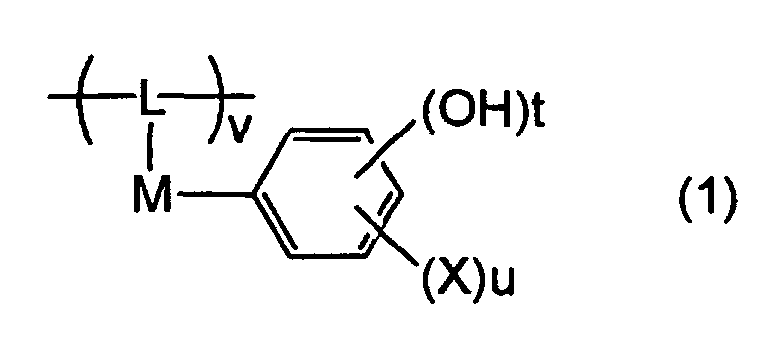
- The composition for forming anti-reflective coating according to any one of claims 1 to 11, wherein the solid content further contains a crosslinking agent having at least two crosslink-forming substituents.
- A method of forming an anti-reflective coating for use in a manufacture of a semiconductor device, comprising the steps of: coating the composition for forming anti-reflective coating according to any one of claims 1 to 12 on a substrate, and baking it.
- A method of forming an anti-reflective coating for use in a manufacture of a semiconductor device by use of a light of wavelength 157 nm, comprising the steps of: coating the composition for forming anti-reflective coating according to any one of claims 1 to 12 on a substrate, and baking it.
- An anti-reflective coating produced by coating the composition for forming anti-reflective coating according to any one of claims 1 to 12 on a semiconductor substrate, and baking it, wherein the anti-reflective coating has an attenuation coefficient k to a light at a wavelength of 157 nm ranging from 0.20 to 0.50.
- A method of forming an anti-reflective coating for use in a manufacture of a semiconductor device, in which an attenuation coefficient k is altered by changing a content of a halogen atom in the anti-reflective coating.
- A method of forming an anti-reflective coating for use in a manufacture of a semiconductor device, in which an attenuation coefficient k to a light at a wavelength of 157 nm is altered by changing a content of a halogen atom in the anti-reflective coating.
- A method of forming a photoresist pattern for use in a manufacture of a semiconductor device comprising the steps of:coating the composition for forming anti-reflective coating according to any one of claims 1 to 12 on a semiconductor substrate and baking it to form an anti-reflective coating;forming a photoresist layer on the anti-reflective coating;exposing the semiconductor substrate covered with the anti-reflective coating and the photoresist layer with F2 eximer laser (wavelength 157 nm); anddeveloping the exposed photoresist layer.
Applications Claiming Priority (5)
| Application Number | Priority Date | Filing Date | Title |
|---|---|---|---|
| JP2002041482 | 2002-02-19 | ||
| JP2002041482 | 2002-02-19 | ||
| JP2002167343 | 2002-06-07 | ||
| JP2002167343 | 2002-06-07 | ||
| PCT/JP2003/001542 WO2003071357A1 (en) | 2002-02-19 | 2003-02-14 | Composition for forming anti-reflection coating |
Publications (2)
| Publication Number | Publication Date |
|---|---|
| EP1484645A1 true EP1484645A1 (en) | 2004-12-08 |
| EP1484645A4 EP1484645A4 (en) | 2008-12-17 |
Family
ID=27759636
Family Applications (1)
| Application Number | Title | Priority Date | Filing Date |
|---|---|---|---|
| EP03705153A Withdrawn EP1484645A4 (en) | 2002-02-19 | 2003-02-14 | Composition for forming anti-reflection coating |
Country Status (7)
| Country | Link |
|---|---|
| US (1) | US7309560B2 (en) |
| EP (1) | EP1484645A4 (en) |
| JP (1) | JP4038688B2 (en) |
| KR (1) | KR100949343B1 (en) |
| CN (1) | CN100526983C (en) |
| TW (1) | TW200303455A (en) |
| WO (1) | WO2003071357A1 (en) |
Cited By (2)
| Publication number | Priority date | Publication date | Assignee | Title |
|---|---|---|---|---|
| US20120040291A1 (en) * | 2009-04-21 | 2012-02-16 | Nissan Chemical Industries, Ltd. | Composition for forming resist underlayer film for euv lithography |
| US20140004465A1 (en) * | 2011-03-15 | 2014-01-02 | Nissan Chemical Industries, Ltd. | Resist underlayer film forming composition and method for forming resist pattern using the same |
Families Citing this family (36)
| Publication number | Priority date | Publication date | Assignee | Title |
|---|---|---|---|---|
| KR100827741B1 (en) | 2000-07-17 | 2008-05-07 | 보드 오브 리전츠, 더 유니버시티 오브 텍사스 시스템 | Automated Fluid Dispensing Method and System for Imprint Lithography Process |
| JP2004101794A (en) * | 2002-09-09 | 2004-04-02 | Toray Ind Inc | Flattening composition for semiconductor device |
| US20040112862A1 (en) * | 2002-12-12 | 2004-06-17 | Molecular Imprints, Inc. | Planarization composition and method of patterning a substrate using the same |
| JP4105036B2 (en) * | 2003-05-28 | 2008-06-18 | 信越化学工業株式会社 | Resist underlayer film material and pattern forming method |
| US7157036B2 (en) | 2003-06-17 | 2007-01-02 | Molecular Imprints, Inc | Method to reduce adhesion between a conformable region and a pattern of a mold |
| US20060108710A1 (en) * | 2004-11-24 | 2006-05-25 | Molecular Imprints, Inc. | Method to reduce adhesion between a conformable region and a mold |
| US7307118B2 (en) * | 2004-11-24 | 2007-12-11 | Molecular Imprints, Inc. | Composition to reduce adhesion between a conformable region and a mold |
| US7122482B2 (en) * | 2003-10-27 | 2006-10-17 | Molecular Imprints, Inc. | Methods for fabricating patterned features utilizing imprint lithography |
| US8076386B2 (en) | 2004-02-23 | 2011-12-13 | Molecular Imprints, Inc. | Materials for imprint lithography |
| WO2005088398A1 (en) * | 2004-03-16 | 2005-09-22 | Nissan Chemical Industries, Ltd. | Antireflective film containing sulfur atom |
| US7939131B2 (en) * | 2004-08-16 | 2011-05-10 | Molecular Imprints, Inc. | Method to provide a layer with uniform etch characteristics |
| US20060062922A1 (en) | 2004-09-23 | 2006-03-23 | Molecular Imprints, Inc. | Polymerization technique to attenuate oxygen inhibition of solidification of liquids and composition therefor |
| US20060081557A1 (en) * | 2004-10-18 | 2006-04-20 | Molecular Imprints, Inc. | Low-k dielectric functional imprinting materials |
| US7189640B2 (en) * | 2004-12-02 | 2007-03-13 | United Microelectronics Corp. | Method of forming damascene structures |
| JP4595606B2 (en) * | 2005-03-17 | 2010-12-08 | Jsr株式会社 | Antireflection film forming composition, laminate, and resist pattern forming method |
| JP4575220B2 (en) * | 2005-04-14 | 2010-11-04 | 信越化学工業株式会社 | Resist underlayer film material and pattern forming method |
| US7375172B2 (en) | 2005-07-06 | 2008-05-20 | International Business Machines Corporation | Underlayer compositions containing heterocyclic aromatic structures |
| US7759407B2 (en) | 2005-07-22 | 2010-07-20 | Molecular Imprints, Inc. | Composition for adhering materials together |
| US8808808B2 (en) | 2005-07-22 | 2014-08-19 | Molecular Imprints, Inc. | Method for imprint lithography utilizing an adhesion primer layer |
| US8557351B2 (en) * | 2005-07-22 | 2013-10-15 | Molecular Imprints, Inc. | Method for adhering materials together |
| US7736822B2 (en) | 2006-02-13 | 2010-06-15 | Hoya Corporation | Resist underlayer coating forming composition for mask blank, mask blank and mask |
| JP5014822B2 (en) * | 2006-02-13 | 2012-08-29 | Hoya株式会社 | Resist underlayer film forming composition for mask blank, mask blank and mask |
| US7563563B2 (en) * | 2006-04-18 | 2009-07-21 | International Business Machines Corporation | Wet developable bottom antireflective coating composition and method for use thereof |
| US7416834B2 (en) * | 2006-09-27 | 2008-08-26 | Az Electronic Materials Usa Corp. | Antireflective coating compositions |
| KR101462508B1 (en) * | 2007-02-27 | 2014-11-17 | 닛산 가가쿠 고교 가부시키 가이샤 | A resist underlayer film forming composition for electron beam lithography |
| US7651830B2 (en) * | 2007-06-01 | 2010-01-26 | 3M Innovative Properties Company | Patterned photoacid etching and articles therefrom |
| US20090101203A1 (en) * | 2007-10-23 | 2009-04-23 | Guardian Industries Corp. | Method of making an antireflective silica coating, resulting product, and photovoltaic device comprising same |
| US11392037B2 (en) * | 2008-02-18 | 2022-07-19 | Nissan Chemical Industries, Ltd. | Resist underlayer film forming composition containing silicone having cyclic amino group |
| US8617641B2 (en) * | 2009-11-12 | 2013-12-31 | Guardian Industries Corp. | Coated article comprising colloidal silica inclusive anti-reflective coating, and method of making the same |
| JP6892633B2 (en) * | 2015-07-02 | 2021-06-23 | 日産化学株式会社 | A resist underlayer film forming composition containing an epoxy adduct having a long-chain alkyl group. |
| KR102643360B1 (en) * | 2017-09-22 | 2024-03-07 | 닛산 가가쿠 가부시키가이샤 | Resist underlayer film forming composition |
| KR102400604B1 (en) * | 2019-04-23 | 2022-05-19 | 삼성에스디아이 주식회사 | Resist underlayer composition, and method of forming patterns using the composition |
| TWI837443B (en) * | 2019-12-31 | 2024-04-01 | 南韓商羅門哈斯電子材料韓國公司 | Coating composition, coated substrate and method of forming electronic device |
| US20230096137A1 (en) * | 2020-02-06 | 2023-03-30 | Mitsubishi Gas Chemical Company, Inc. | Composition for lithography and pattern formation method |
| CN113621278B (en) * | 2021-08-30 | 2022-05-27 | 厦门恒坤新材料科技股份有限公司 | Bottom anti-reflection coating composition used with photoresist and method for forming photoresist relief image |
| CN116009355A (en) * | 2023-01-18 | 2023-04-25 | 上海英迈特材料科技有限公司 | Two-color UV-absorbing dye structure, two-color lithography anti-reflection coating and preparation method |
Family Cites Families (24)
| Publication number | Priority date | Publication date | Assignee | Title |
|---|---|---|---|---|
| US5498748A (en) * | 1993-07-20 | 1996-03-12 | Wako Pure Chemical Industries, Ltd. | Anthracene derivatives |
| US5576359A (en) * | 1993-07-20 | 1996-11-19 | Wako Pure Chemical Industries, Ltd. | Deep ultraviolet absorbent composition |
| US5597868A (en) * | 1994-03-04 | 1997-01-28 | Massachusetts Institute Of Technology | Polymeric anti-reflective compounds |
| US5693691A (en) * | 1995-08-21 | 1997-12-02 | Brewer Science, Inc. | Thermosetting anti-reflective coatings compositions |
| US5820957A (en) * | 1996-05-06 | 1998-10-13 | Minnesota Mining And Manufacturing Company | Anti-reflective films and methods |
| US5886102A (en) | 1996-06-11 | 1999-03-23 | Shipley Company, L.L.C. | Antireflective coating compositions |
| TW406215B (en) * | 1996-08-07 | 2000-09-21 | Fuji Photo Film Co Ltd | Composition for anti-reflective coating material in lithographic process, and process for forming resist pattern |
| JP3632875B2 (en) | 1996-12-24 | 2005-03-23 | 富士写真フイルム株式会社 | Composition for antireflection film material |
| JP3851402B2 (en) * | 1997-02-28 | 2006-11-29 | 富士写真フイルム株式会社 | Antireflection film material composition and resist pattern forming method using the same |
| JP3852868B2 (en) * | 1997-02-06 | 2006-12-06 | 富士写真フイルム株式会社 | Antireflection film material composition and resist pattern forming method using the same |
| US5919599A (en) * | 1997-09-30 | 1999-07-06 | Brewer Science, Inc. | Thermosetting anti-reflective coatings at deep ultraviolet |
| JPH11194499A (en) * | 1998-01-07 | 1999-07-21 | Sony Corp | Method for manufacturing semiconductor device |
| US6190839B1 (en) * | 1998-01-15 | 2001-02-20 | Shipley Company, L.L.C. | High conformality antireflective coating compositions |
| US6410209B1 (en) | 1998-09-15 | 2002-06-25 | Shipley Company, L.L.C. | Methods utilizing antireflective coating compositions with exposure under 200 nm |
| US6316165B1 (en) | 1999-03-08 | 2001-11-13 | Shipley Company, L.L.C. | Planarizing antireflective coating compositions |
| KR100355604B1 (en) * | 1999-12-23 | 2002-10-12 | 주식회사 하이닉스반도체 | Anti-reflective coating polymers and preparation thereof |
| US6416690B1 (en) * | 2000-02-16 | 2002-07-09 | Zms, Llc | Precision composite lens |
| JP4654544B2 (en) * | 2000-07-12 | 2011-03-23 | 日産化学工業株式会社 | Gap fill material forming composition for lithography |
| US6495305B1 (en) * | 2000-10-04 | 2002-12-17 | Tomoyuki Enomoto | Halogenated anti-reflective coatings |
| JP2002198283A (en) | 2000-12-25 | 2002-07-12 | Toshiba Corp | Method of forming resist pattern |
| JP3509760B2 (en) * | 2001-02-08 | 2004-03-22 | 株式会社半導体先端テクノロジーズ | Method for manufacturing semiconductor device |
| JP4729803B2 (en) * | 2001-03-29 | 2011-07-20 | Jsr株式会社 | Underlayer film forming composition for multilayer resist process |
| JP4614197B2 (en) | 2001-06-14 | 2011-01-19 | 独立行政法人産業技術総合研究所 | Method for producing metal oxide short fiber |
| JP2003086487A (en) * | 2001-09-11 | 2003-03-20 | Toshiba Corp | Method for determining optical constant of antireflection film and method for forming resist pattern |
-
2003
- 2003-02-14 WO PCT/JP2003/001542 patent/WO2003071357A1/en not_active Ceased
- 2003-02-14 US US10/504,686 patent/US7309560B2/en not_active Expired - Lifetime
- 2003-02-14 JP JP2003570188A patent/JP4038688B2/en not_active Expired - Lifetime
- 2003-02-14 EP EP03705153A patent/EP1484645A4/en not_active Withdrawn
- 2003-02-14 CN CNB038042126A patent/CN100526983C/en not_active Expired - Fee Related
- 2003-02-14 KR KR1020047012936A patent/KR100949343B1/en not_active Expired - Lifetime
- 2003-02-18 TW TW092103327A patent/TW200303455A/en not_active IP Right Cessation
Cited By (4)
| Publication number | Priority date | Publication date | Assignee | Title |
|---|---|---|---|---|
| US20120040291A1 (en) * | 2009-04-21 | 2012-02-16 | Nissan Chemical Industries, Ltd. | Composition for forming resist underlayer film for euv lithography |
| US9005873B2 (en) | 2009-04-21 | 2015-04-14 | Nissan Chemical Industries, Ltd. | Composition for forming resist underlayer film for EUV lithography |
| US20140004465A1 (en) * | 2011-03-15 | 2014-01-02 | Nissan Chemical Industries, Ltd. | Resist underlayer film forming composition and method for forming resist pattern using the same |
| US8962234B2 (en) * | 2011-03-15 | 2015-02-24 | Nissan Chemical Industries, Ltd. | Resist underlayer film forming composition and method for forming resist pattern using the same |
Also Published As
| Publication number | Publication date |
|---|---|
| CN1636166A (en) | 2005-07-06 |
| TW200303455A (en) | 2003-09-01 |
| TWI311238B (en) | 2009-06-21 |
| KR100949343B1 (en) | 2010-03-26 |
| KR20040091066A (en) | 2004-10-27 |
| US20050118749A1 (en) | 2005-06-02 |
| JPWO2003071357A1 (en) | 2005-06-16 |
| WO2003071357A1 (en) | 2003-08-28 |
| JP4038688B2 (en) | 2008-01-30 |
| US7309560B2 (en) | 2007-12-18 |
| CN100526983C (en) | 2009-08-12 |
| EP1484645A4 (en) | 2008-12-17 |
Similar Documents
| Publication | Publication Date | Title |
|---|---|---|
| US7309560B2 (en) | Composition for forming anti-reflective coating | |
| EP1560070B1 (en) | Composition for forming antireflection film for lithography | |
| US7226721B2 (en) | Underlayer coating forming composition for lithography containing compound having protected carboxyl group | |
| US7425403B2 (en) | Composition for forming anti-reflective coating for use in lithography | |
| US7038328B2 (en) | Anti-reflective compositions comprising triazine compounds | |
| US7816067B2 (en) | Coating-type underlayer coating forming composition for lithography containing naphthalene resin derivative | |
| US7947424B2 (en) | Composition for forming anti-reflective coat | |
| US8257908B2 (en) | Coating-type underlayer coating forming composition for lithography containing vinylnaphthalene resin derivative | |
| JP4250939B2 (en) | Anti-reflective film forming composition | |
| US11372330B2 (en) | Anti-reflective coating forming composition containing reaction product of isocyanuric acid compound with benzoic acid compound | |
| JP4214380B2 (en) | Anti-reflective film forming composition containing epoxy compound derivative | |
| JP4243825B2 (en) | Antireflection film forming composition for lithography | |
| JP4164638B2 (en) | Anti-reflective film forming composition | |
| CN100547487C (en) | Composition for forming antireflection film for photolithography | |
| JP4753018B2 (en) | Anti-reflective film forming composition for lithography comprising addition polymerizable resin | |
| JP4438931B2 (en) | Method for forming photoresist pattern |
Legal Events
| Date | Code | Title | Description |
|---|---|---|---|
| PUAI | Public reference made under article 153(3) epc to a published international application that has entered the european phase |
Free format text: ORIGINAL CODE: 0009012 |
|
| 17P | Request for examination filed |
Effective date: 20040908 |
|
| AK | Designated contracting states |
Kind code of ref document: A1 Designated state(s): AT BE BG CH CY CZ DE DK EE ES FI FR GB GR HU IE IT LI LU MC NL PT SE SI SK TR |
|
| A4 | Supplementary search report drawn up and despatched |
Effective date: 20081118 |
|
| 17Q | First examination report despatched |
Effective date: 20160701 |
|
| STAA | Information on the status of an ep patent application or granted ep patent |
Free format text: STATUS: THE APPLICATION IS DEEMED TO BE WITHDRAWN |
|
| 18D | Application deemed to be withdrawn |
Effective date: 20170714 |