EP1480687B1 - Compose phosphocalcique modifie, composition injectable le contenant - Google Patents
Compose phosphocalcique modifie, composition injectable le contenant Download PDFInfo
- Publication number
- EP1480687B1 EP1480687B1 EP03717407A EP03717407A EP1480687B1 EP 1480687 B1 EP1480687 B1 EP 1480687B1 EP 03717407 A EP03717407 A EP 03717407A EP 03717407 A EP03717407 A EP 03717407A EP 1480687 B1 EP1480687 B1 EP 1480687B1
- Authority
- EP
- European Patent Office
- Prior art keywords
- compound
- phosphocalcic
- modified
- alkyl radical
- radical
- Prior art date
- Legal status (The legal status is an assumption and is not a legal conclusion. Google has not performed a legal analysis and makes no representation as to the accuracy of the status listed.)
- Expired - Lifetime
Links
Images


Classifications
-
- A—HUMAN NECESSITIES
- A61—MEDICAL OR VETERINARY SCIENCE; HYGIENE
- A61L—METHODS OR APPARATUS FOR STERILISING MATERIALS OR OBJECTS IN GENERAL; DISINFECTION, STERILISATION OR DEODORISATION OF AIR; CHEMICAL ASPECTS OF BANDAGES, DRESSINGS, ABSORBENT PADS OR SURGICAL ARTICLES; MATERIALS FOR BANDAGES, DRESSINGS, ABSORBENT PADS OR SURGICAL ARTICLES
- A61L27/00—Materials for grafts or prostheses or for coating grafts or prostheses
- A61L27/02—Inorganic materials
- A61L27/12—Phosphorus-containing materials, e.g. apatite
-
- A—HUMAN NECESSITIES
- A61—MEDICAL OR VETERINARY SCIENCE; HYGIENE
- A61L—METHODS OR APPARATUS FOR STERILISING MATERIALS OR OBJECTS IN GENERAL; DISINFECTION, STERILISATION OR DEODORISATION OF AIR; CHEMICAL ASPECTS OF BANDAGES, DRESSINGS, ABSORBENT PADS OR SURGICAL ARTICLES; MATERIALS FOR BANDAGES, DRESSINGS, ABSORBENT PADS OR SURGICAL ARTICLES
- A61L27/00—Materials for grafts or prostheses or for coating grafts or prostheses
- A61L27/50—Materials characterised by their function or physical properties, e.g. injectable or lubricating compositions, shape-memory materials, surface modified materials
- A61L27/54—Biologically active materials, e.g. therapeutic substances
-
- A—HUMAN NECESSITIES
- A61—MEDICAL OR VETERINARY SCIENCE; HYGIENE
- A61P—SPECIFIC THERAPEUTIC ACTIVITY OF CHEMICAL COMPOUNDS OR MEDICINAL PREPARATIONS
- A61P19/00—Drugs for skeletal disorders
- A61P19/08—Drugs for skeletal disorders for bone diseases, e.g. rachitism, Paget's disease
- A61P19/10—Drugs for skeletal disorders for bone diseases, e.g. rachitism, Paget's disease for osteoporosis
-
- A—HUMAN NECESSITIES
- A61—MEDICAL OR VETERINARY SCIENCE; HYGIENE
- A61P—SPECIFIC THERAPEUTIC ACTIVITY OF CHEMICAL COMPOUNDS OR MEDICINAL PREPARATIONS
- A61P35/00—Antineoplastic agents
-
- A—HUMAN NECESSITIES
- A61—MEDICAL OR VETERINARY SCIENCE; HYGIENE
- A61L—METHODS OR APPARATUS FOR STERILISING MATERIALS OR OBJECTS IN GENERAL; DISINFECTION, STERILISATION OR DEODORISATION OF AIR; CHEMICAL ASPECTS OF BANDAGES, DRESSINGS, ABSORBENT PADS OR SURGICAL ARTICLES; MATERIALS FOR BANDAGES, DRESSINGS, ABSORBENT PADS OR SURGICAL ARTICLES
- A61L2300/00—Biologically active materials used in bandages, wound dressings, absorbent pads or medical devices
- A61L2300/20—Biologically active materials used in bandages, wound dressings, absorbent pads or medical devices containing or releasing organic materials
- A61L2300/216—Biologically active materials used in bandages, wound dressings, absorbent pads or medical devices containing or releasing organic materials with other specific functional groups, e.g. aldehydes, ketones, phenols, quaternary phosphonium groups
-
- A—HUMAN NECESSITIES
- A61—MEDICAL OR VETERINARY SCIENCE; HYGIENE
- A61L—METHODS OR APPARATUS FOR STERILISING MATERIALS OR OBJECTS IN GENERAL; DISINFECTION, STERILISATION OR DEODORISATION OF AIR; CHEMICAL ASPECTS OF BANDAGES, DRESSINGS, ABSORBENT PADS OR SURGICAL ARTICLES; MATERIALS FOR BANDAGES, DRESSINGS, ABSORBENT PADS OR SURGICAL ARTICLES
- A61L2300/00—Biologically active materials used in bandages, wound dressings, absorbent pads or medical devices
- A61L2300/40—Biologically active materials used in bandages, wound dressings, absorbent pads or medical devices characterised by a specific therapeutic activity or mode of action
- A61L2300/432—Inhibitors, antagonists
-
- A—HUMAN NECESSITIES
- A61—MEDICAL OR VETERINARY SCIENCE; HYGIENE
- A61L—METHODS OR APPARATUS FOR STERILISING MATERIALS OR OBJECTS IN GENERAL; DISINFECTION, STERILISATION OR DEODORISATION OF AIR; CHEMICAL ASPECTS OF BANDAGES, DRESSINGS, ABSORBENT PADS OR SURGICAL ARTICLES; MATERIALS FOR BANDAGES, DRESSINGS, ABSORBENT PADS OR SURGICAL ARTICLES
- A61L2300/00—Biologically active materials used in bandages, wound dressings, absorbent pads or medical devices
- A61L2300/60—Biologically active materials used in bandages, wound dressings, absorbent pads or medical devices characterised by a special physical form
- A61L2300/602—Type of release, e.g. controlled, sustained, slow
Definitions
- the invention relates to a phosphocalcic compound modified with a gem-biphosphonic compound, a process for its preparation and its use for the preparation of an injectable composition.
- osteoporosis The disruption of the bone activity of an individual is at the origin of many bone pathologies such as osteoporosis, Paget's disease or osteolytic tumors.
- osteoporosis has become a public health problem and a lot of research has been done to address it.
- the gem-biphosphonic acids which are used to date for the treatment of bone lesions are used systemically and thus generate some undesirable side effects. They can cause kidney problems when administered intravenously, and disorders of the digestive system, including esophagitis or stomach ulcers, when administered orally. Lin JH, Bone 1996: 18; 75-85 ) or ( Thiebauld D. et al., Osteroporos Int 1994; 76-73 )]. Another disadvantage of the administration by oral is the low rate of absorption of the active ingredient on the bone.
- Injectable compositions for the purpose of forming bone substitutes are also known.
- FR-2715853 discloses biosorbent compositions for resorption / substitution of supporting tissues, comprising a mineral phase composed of BCP or calcium-titanium-phosphate, and a liquid aqueous phase comprising an aqueous solution of a polymer derived from cellulose. These injectable compositions do not contain any active ingredient.
- the document WO 00/47214 describes an injection-usable composition for the treatment of osteoporosis or recurrences of lytic tumors by inhibiting the osteoclastic activity obtained by contacting a bone cement paste with an anti-resorptive agent such as a bisphosphonate.
- Non-injectable bone substitutes which are in the form of implants, are also known.
- H. Denissen, et al J. Periodontal, vol 71, n ° 2, February 2000, pp. 280-296 ) discloses hydroxyapatite implants modified by adsorption of a particular gem-biphosphonic acid, namely (3-dimethylamino-1-hydroxypropylidene) -1,1-bisphosphonic acid or olpadronate. In situ release of the acid would promote bone reconstruction.
- hydroxyapatite itself has the disadvantage of being very weakly absorbable.
- the object of the present invention is to provide a composition containing an active ingredient inhibiting the activity of osteoclasts and which can be administered without producing side effects related to systemic administration or the use of a solid implant.
- the subject of the present invention is a modified phosphocalcic compound, a process for its preparation and its use as an active ingredient in an injectable composition.
- the modified phosphocalcic compound according to the present invention can be obtained by adding a gem-biphosphonic acid or one of its alkali or alkaline earth metal salts to a suspension of a precursor phosphocalcic compound in ultrapure water, in stirring the reaction medium at room temperature and then recovering by centrifugation the compound formed. The compound can then be purified by washing with ultrapure water, followed by filtration and air drying at room temperature.
- the precursor phosphocalcic compound is chosen from orthophosphates of calcium having a solubility in water greater than 4.10 -59 mol.l -1 .
- BCPs which are a mixture of hydroxyapatite and tricalcium phosphate ⁇ (generally designated by ⁇ -TCP) in variable proportions
- CDA which is a hydroxyapatite deficient in calcium (obtained for example by hydrolysis alkaline of an acid calcium orthophosphate)
- ⁇ -TCP tricalcium phosphate
- ultrapure water By ultrapure water is meant in this text a water having a resistivity of about 18 M ⁇ cm.
- Stirring at room temperature is preferably maintained for a period between 1 h and 72 h, for example for 48 hours.
- the nature of the agitation and the particle size of the precursor phosphocalcic compound have an effect on the proportion of gem-biphosphonic compound that can be grafted. It is therefore preferable, when a given particle size has been chosen for the precursor phosphocalcic compound, to adapt the agitation so as not to modify said particle size.
- R 2 is an alkyl radical
- alkyls having 1 to 6 carbon atoms are preferred.
- R 2 is an aminoalkyl radical
- the radicals NH 2 (CH) n - in which n is less than 6 are preferred.
- R 2 is an alkylaminoalkyl radical
- R'R "N (CH 2 ) m - in which R 'and R" represent independently of each other H, or an alkyl radical having at most 5 atoms, are preferred. of carbon, and m is less than 6.
- R 2 is an alkylamino radical
- R c NH- in which R c is a cycloalkyl having from 3 to 7 carbon atoms are preferred.
- R 2 is an alkyl radical carrying an aromatic substituent comprising at least one N atom
- alkyls having at most 3 carbon atoms and carrying a pyridinyl or imidazoyl group are preferred.
- R 2 is an alkyl radical carrying an aromatic thioether group
- alkyls having at most 3 carbon atoms and carrying a phenylthio group in which the phenyl group optionally carries a halogen substituent are preferred.
- R 2 is an alkyl radical carrying an aromatic substituent comprising at least one N atom, such as zoledronate or risedronate, are particularly preferred.
- a modified phosphocalcic compound according to the invention is characterized by the following chemical composition: Ca (10-a ) (Mg, K, Na) b (PO 4 ) 6-c (HPO 4 , CO 3 ) d (OH) 2-e (F, Cl, CO 3 ) f [(OA) (OE) P (O) -CR 1 R 2 -P (O) (OA) (OE)] g , wherein A and E are H, an alkali metal, an alkaline earth metal or none, and wherein R 1 and R 2 have the meaning given above, and 0 ⁇ a ⁇ 9; 0 ⁇ b ⁇ 2; 0 ⁇ c ⁇ 5; 0 ⁇ d ⁇ 2; 0 ⁇ e ⁇ 2; 0 ⁇ f ⁇ 2; g ⁇ 0.5.
- a or E represents H
- the oxygen atom which gate is not bound to the phosphocalcic matrix or is simply associated with it by hydrogen bonding.
- a or E is "nil"
- the oxygen atom carrying it is coordinated to another element of the composition, for example to a Ca.
- the gem-biphosphonic acid content of a modified phosphocalcic compound can be determined by UV-visible spectroscopy according to the method described by Ames, BN, particularly in Methods in Enzymology, Colowick, SP and Kaplan, Eds. NO, Academic Press, Orlando, 1966, vol. 8, pp. 115-118 . It can also be determined by 31 P liquid NMR. The characterization of the modified phosphocalcic compound can be carried out essentially by 31 P MAS NMR which shows both the presence of the phosphocalcic carrier and that of the active ingredient.
- compositions that can be used by injection for the treatment of osteoporosis or recurrences of lytic tumors by inhibition of osteoclastic activity.
- Said composition is a suspension of the modified phosphocalcic compound defined above in a solution or a biocompatible gel having a viscosity allowing the transport of granules of size between 40 ⁇ m and 500 ⁇ m.
- hydrogels of biological interest described in Chem. Rev. (2001) .; 101 (7): 1869-1879 , especially hydrogels derived from cellulose or based on sodium hyaluronate.
- An injectable composition according to the invention preferably contains from 40% to 75% by weight of modified phosphocalcic compound, from 60% to 25% by weight of hydrogel, and optionally various additives.
- the additives are selected from compounds capable of introducing various ions of biological interest such as for example. K + , Na + , Zn 2+ , Mg 2+ , CO 3 2- , HPO 4 2- , F - or Cl - .
- the composition may be prepared by suspending in the appropriate medium the modified phosphocalcic compound prepared in a preliminary step. It can also be prepared by precipitating the modified phosphocalcic compound in situ, from a hydrogel defined as before and previously loaded with phosphate ions (respectively calcium) in which will be added an appropriate solution containing calcium ions (respectively phosphates) and the desired concentration of bisphosphonic acid.
- the mode of association between the phosphocalcic matrix and the bisphosphonic acid is different according to the phosphocalcic matrix used, and this difference results in a different biological efficiency during in vitro tests on osteoclast cultures.
- composition according to the invention in injectable form, makes it possible to locally treat a bone problem on the main sites at identified risks (neck of the femur and vertebral body), using an active ingredient known for its use systemically. which has various disadvantages mentioned above.
- the phosphocalcic phase which plays the role of vector of the active principle, has a complementary effect in that it allows the gem-biphosphonic acid to be maintained in place, and that it constitutes a source of calcium and calcium. phosphate necessary for the stimulation of bone remodeling.
- HA hydroxyapatite
- a suspension of calcium phosphate was prepared by introducing 700 mg of BCP having a particle size of 40-80 ⁇ m in 3.5 ml of ultrapure water, and 56 mg (0.14 mmol) of zoledronate was added. .
- the suspension was placed in a tube maintained at room temperature and stirred with a rotary shaker at 16 rpm for 48 h. Then, the suspension was centrifuged and the pellet was removed from the supernatant.
- the solid phase was then washed several times with ultrapure water, then filtered and dried at room temperature.
- the process was also carried out using the following phosphocalcic compounds: CDA NaOH route, CDA ammonia route and ⁇ -TCP.
- the amount of zoledronate incorporated in each of the phosphocalcic matrices was determined by difference, by assaying the amount of zoledronate present in the supernatant. This assay was performed on the supernatant solution separated from the pellet after centrifugation by 31 P liquid NMR from previously established calibration curves. It can also be carried out by UV-visible spectroscopy according to the method described above by Ames.
- T (%) indicates the zoledronate content in the final product, expressed as mg of active ingredient per 100 mg of phosphocalcic compound
- P (%) indicates the percentage of zoledronate bound to the compound relative to the amount introduced into the medium.
- Precursor T (%) P (%) BCP (75% ⁇ -TCP / 25% HA) 1 13 BCP (25% ⁇ -TCP / 75% HA) 2.7 33 CDA NaOH route 5.2 65 CDA ammonia pathway 6.4 80 ⁇ -TCP 6.4 80
- the figure 1 represents the 31 P liquid NMR spectrum of the supernatant obtained after centrifugation of the reaction medium corresponding to the precursor CDA (NaOH route).
- the integration of the signals accounts for the abundance of each species and the chemical shift (characteristic of the species) is plotted on the abscissa.
- Peak 1 represents the zoledronate content
- peak 2 represents the phosphate released into the medium by the phosphocalcic compound
- peak 3 represents the reference NaH 2 PO 4 .
- the characterization of the solids obtained shows two different modes of association of zoledronate according to the nature of the starting phosphocalcic compound.
- the figure 2 represents a photograph by scanning electron microscopy (SEM) carried out on the compound derived from ⁇ -TCP. It shows that a form of zoledronate (probably associated with calcium) crystallizes on the surface of the phosphocalcic matrix. The same phenomenon is observed in the case of BCP, whether they are rich in ⁇ -TCP (75% ⁇ -TCP - 25% HA) or poor in ⁇ -TCP (25% ⁇ -TCP - 275% HA).
- the 31 P MAS solid 31 NMR data are represented on the figure 3 for the compound derived from ⁇ -TCP.
- the spectrum 1 acquired in CP mode (Cross Polarization) makes it possible to selectively observe the incorporated zoledronate. Fine signals reflect its presence in a crystalline form.
- the spectrum 2 recorded in proton decoupling mode makes it possible to selectively observe the unaltered ⁇ -TCP support.
- the NMR spectrum of the solid 31 P CP-MAS is represented on the figure 4 for the compound derived from CDA (ammonia route).
- the signal of zoledronate (peak 1) is very wide. No crystalline phase is detected on the surface of the material, which probably indicates a chemisorption of zoledronate on the surface of the CDA. Peak 2 is characteristic of CDA.
- a suspension of calcium phosphate was prepared by introducing 700 mg of ⁇ -TCP having a particle size of 40-80 ⁇ m into 3.5 ml of ultrapure water, and 52.5 mg (0.14 mmol) was added. ) of tiludronate. The suspension was placed in a tube maintained at room temperature and stirred with a rotary shaker at 16 rpm for 48 h. then, the suspension was centrifuged and the pellet was removed from the supernatant.
- the solid phase was then washed several times with ultrapure water, then filtered and dried at room temperature.
- FIG. 5 shows the 31 P NMR spectrum CP-MAS ⁇ -TCP treated with tiludronate. Tiludronate can be observed in the form of a crystalline phase (solid 1 consisting of fine signals) deposited on the phosphocalcic phase (which appears weakly (solid 2) under these recording conditions of the spectrum.
- An injectable composition was prepared from each of the modified compounds obtained in Examples 1 and 2, with the exception of the modified compounds obtained from hydroxyapatite, according to the following method.
- granules were prepared, 95% by volume of which had an equivalent particle diameter of between 40 and 80 ⁇ m, and these granules were introduced into an aqueous solution containing 3% of hydroxypropyl methylcellulose comprising 21% by mass of groups. methyl and 8% by weight of hydroxypropyl group with a degree of polymerization equal to 110, so as to obtain a composition comprising 49% by weight of granules.
- compositions thus prepared were placed in a glass vial and sterilized by autoclaving at 121 ° C for 20 minutes.
- Total bone cells isolated from long bones of newborn rabbits, were used to evaluate the efficacy of the combination of the modified phosphocalcic compound.
- the performance of the modified BCP and modified ammonia modified CDA obtained in Example 1 were measured and compared with that of the respective phosphocalcic precursor not treated with gem-biphosphonic acid.
Landscapes
- Health & Medical Sciences (AREA)
- Chemical & Material Sciences (AREA)
- Life Sciences & Earth Sciences (AREA)
- Medicinal Chemistry (AREA)
- Veterinary Medicine (AREA)
- Public Health (AREA)
- General Health & Medical Sciences (AREA)
- Animal Behavior & Ethology (AREA)
- Epidemiology (AREA)
- Dermatology (AREA)
- Oral & Maxillofacial Surgery (AREA)
- Transplantation (AREA)
- Physical Education & Sports Medicine (AREA)
- Engineering & Computer Science (AREA)
- Biomedical Technology (AREA)
- Rheumatology (AREA)
- Pharmacology & Pharmacy (AREA)
- Organic Chemistry (AREA)
- Nuclear Medicine, Radiotherapy & Molecular Imaging (AREA)
- General Chemical & Material Sciences (AREA)
- Inorganic Chemistry (AREA)
- Orthopedic Medicine & Surgery (AREA)
- Chemical Kinetics & Catalysis (AREA)
- Molecular Biology (AREA)
- Bioinformatics & Cheminformatics (AREA)
- Pharmaceuticals Containing Other Organic And Inorganic Compounds (AREA)
- Medicinal Preparation (AREA)
- Medicines Containing Material From Animals Or Micro-Organisms (AREA)
- Saccharide Compounds (AREA)
- Agricultural Chemicals And Associated Chemicals (AREA)
- Cosmetics (AREA)
Description
- L'invention concerne un composé phosphocalcique modifié par un composé gem-biphosphonique, un procédé pour sa préparation, ainsi que son utilisation pour l'élaboration d'une composition injectable.
- Le dérèglement de l'activité osseuse d'un individu est à l'origine de nombreuses pathologies osseuses telles que l'ostéoporose, la maladie de Paget ou les tumeurs ostéolytiques. Compte tenu notamment de l'augmentation de la longévité des personnes, l'ostéoporose est devenu un problème de santé publique et de nombreuses recherches ont été entreprises pour y remédier. Les pathologies osseuses considérées étant provoquées par un déséquilibre du remodelage osseux au profit de l'activité des ostéoclastes, l'une des voies de traitement envisagée a consisté à diminuer l'activité des ostéoclastes, en vue de ralentir la dégradation de la matière osseuse.
- Les recherches effectuées sur divers acides gem-biphosphoniques ont montré leur pouvoir inhibiteur de l'activité des ostéoclastes (G. A. Rodan, et al., Therapeutic Approaches to Bone Diseases, 1 septembre 2000, vol. 289, Science, p.1508-1514). L'usage de certains d'entre eux comme médicament a été admis dans divers pays, notamment l'étidronate, le clodronate, le pamidronate, l'alendronate, le risedronate, le tiludronate et l'ibandronate. Des données ont été publiées pour d'autres composés acides gem-biphosphoniques, notamment le zoledronate, l'incadronate, l'olpadronate, le neridronate. Les acides gem-biphosphoniques qui sont utilisés à ce jour pour le traitement de lésions osseuses sont utilisés par voie systémique et génèrent de ce fait quelques effets secondaires indésirables. Ils peuvent provoquer des troubles rénaux lorsqu'ils sont administrés par voie intraveineuse, et des troubles du système digestif, notamment des oesophagites ou des ulcères de l'estomac, lorsqu'ils sont administrés par voie orale [(Lin J.H., Bone 1996 : 18 ; 75-85) ou (Thiébauld D. et al., Osteroporos Int 1994 ; 76-73)]. Un autre inconvénient de l'administration par voie orale réside dans le faible taux d'absorption du principe actif sur la matière osseuse.
- On connaît par ailleurs des compositions injectables destinées à former des substituts osseux.
FR-2715853 - Le document
WO 00/47214 - On connaît également des substituts osseux non injectables, qui se présentent sous forme d'implants. Par exemple, H. Denissen, et al (J. Periodontal, vol. 71, n°2, Février 2000, p. 280-296) décrit des implants d'hydroxyapatite modifiée par adsorption d'un acide gem-biphosphonique particulier, à savoir l'acide (3-diméthylamino-1-hydroxypropylidène)-1,1-biphosphonique ou olpadronate. La libération in situ de l'acide favoriserait la reconstruction osseuse. Cependant, l'hydroxyapatite elle-même présente l'inconvénient d'être très faiblement résorbable.
- Le but de la présente invention est de fournir une composition contenant un principe actif inhibant l'activité des ostéoclastes et qui puisse être administrée sans produire les effets secondaires liés à une administration par voie systémique ou à l'utilisation d'un implant solide.
- C'est pourquoi la présente invention a pour objet un composé phosphocalcique modifié, un procédé pour sa préparation, ainsi que son utilisation comme principe actif dans une composition injectable.
- Le composé phosphocalcique modifié selon la présente invention peut être obtenu en ajoutant un acide gem-biphosphonique ou l'un de ses sels de métal alcalin ou alcalino-terreux à une suspension d'un composé phosphocalcique précurseur dans l'eau ultra-pure, en agitant le milieu réactionnel à température ambiante, puis en récupérant par centrifugation le composé formé. Le composé peut être ensuite purifié par lavage à l'eau ultra-pure, suivi d'une filtration et d'un séchage à l'air à température ambiante. Le composé phosphocalcique précurseur est choisi parmi les orthophosphates de calcium ayant une solubilité dans l'eau supérieure à 4.10-59 mol.l-1. A titre d'exemple, on peut citer les BCP qui sont un mélange d'hydroxyapatite et de phosphate tricalcique β (généralement désigné par β-TCP) en proportions variables, le CDA qui est une hydroxyapatite déficiente en calcium (obtenue par exemple par hydrolyse alcaline d'un orthophosphate de calcium acide), et le β-TCP.
- Par eau ultra-pure, on entend dans ce texte une eau ayant une résistivité voisine de 18 MΩ cm.
- L'agitation à température ambiante est maintenue de préférence pendant une durée entre 1 h et 72 h, par exemple pendant 48 heures. La nature de l'agitation et la granulométrie du composé phosphocalcique précurseur ont un effet sur la proportion de composé gem-biphosphonique qui peut être greffé. Il est donc préférable, lorsqu'une granulométrie donnée a été choisie pour le composé phosphocalcique précurseur, d'adapter l'agitation de sorte à ne pas modifier ladite granulométrie.
- Les acides ou les sels qui peuvent être utilisés comme composés gem-biphosphoniques répondent à la formule (OY) (OX)P(O)-CR1R2 P(O) (OX) (OY) dans laquelle X ou Y représentent indépendamment l'un de l'autre H ou un cation de métal alcalin ou alcalino-terreux, R1 représente H, OH ou un halogène, et R2 représente :
- un hydrogène ou un halogène,
- un radical alkyle,
- un radical aminoalkyle dans lequel le groupe amino porte éventuellement un substituant alkyle,
- un radical alkylamino,
- un radical alkyle portant un substituant aromatique comprenant au moins un atome N,
- un radical alkyle portant un groupe thioéther aromatique. Lorsque R1 et/ou R2 représentent un halogène, Cl est particulièrement préféré.
- Lorsque R2 est un radical alkyle, on préfère les alkyles ayant de 1 à 6 atomes de carbone.
- Lorsque R2 est un radical aminoalkyle, on préfère les radicaux NH2(CH)n- dans lesquels n est inférieur à 6.
- Lorsque R2 est un radical alkylaminoalkyle, on préfère les radicaux R'R"N(CH2)m- dans lesquels R' et R" représentent indépendamment l'un de l'autre H, ou un radical alkyle ayant au plus 5 atomes de carbone, et m est inférieur à 6.
- Lorsque R2 est un radical alkylamino, on préfère les radicaux RcNH- dans lesquels Rc est un cycloalkyle ayant de 3 à 7 atomes de carbone.
- Lorsque R2 est un radical alkyle portant un substituant aromatique comprenant au moins un atome N, on préfère les alkyles ayant au plus 3 atomes de carbone et portant un groupe pyridinyle ou imidazoyle.
- Lorsque R2 est un radical alkyle portant un groupe thioéther aromatique, on préfère les alkyles ayant au plus 3 atomes de carbone et portant un groupe phénylthio dans lequel le groupe phényle porte éventuellement un substituant halogène.
- Parmi ces composés gem-biphosphoniques, on peut citer :
- l'étidronate (R1 = OH, R2 = CH3) ,
- le clodronate (R1 = Cl, R2 = Cl),
- le pamidronate (R1 = OH, R2 = -CH2CH2NH2),
- l'alendronate (R1 = OH, R2 = - (CH2)3NH2),
- le risedronate (R1 = OH, R2 = -CH2-3-pyridine),
- le tiludronate (R1 = H, R2 = -CH2-S-C6H4-Cl),
- l'ibandronate (R1 = OH, R2 = -CH2-CH2-N(CH3)pentyle),
- le zoledronate (R1 = OH, R2 = -CH2-imidazole),
- l'incadronate (R1 = H, R2 = -NH-(cycloheptyle)),
- l'olpadronate (R1 = OH, R2 = CH2-CH2-N(CH3)2),
- le neridronate (R1 = OH, R2 = -(CH2)5NH2).
- Les acides dans lesquels R2 est un radical alkyle portant un substituant aromatique comprenant au moins un atome N, tels que le zoledronate ou le risedronate, sont particulièrement préférés.
- Un composé phosphocalcique modifié selon l'invention est caractérisé par la composition chimique suivante :
Ca(10-a) (Mg,K,Na)b(PO4)6-c(HPO4,CO3)d(OH)2-e(F,Cl,CO3)f
[(OA) (OE) P (O) -CR1R2-P (O) (OA) (OE)]g, dans laquelle A et E représentent H, un métal alcalin, un métal alcalino-terreux ou néant, et où R1 et R2 ont la signification donnée ci-dessus, et 0<a<9 ; 0<b<2 ; 0<c<5 ; 0<d<2 ; 0<e<2 ; 0<f<2 ; g<0,5. Lorsque A ou E représente H, l'atome d'oxygène qui le porte n'est pas lié à la matrice phosphocalcique ou il lui est simplement associé par liaison hydrogène. Lorsque A ou E est "néant", l'atome d'oxygène qui le porte est coordiné à un autre élément de la composition, par exemple à un Ca. - La teneur en acide gem-biphosphonique d'un composé phosphocalcique modifié peut être déterminée par spectroscopie UV-visible selon la méthode décrite par Ames, B.N., notamment dans Methods in Enzymology, Colowick, S. P. and Kaplan, N. O. Eds., Academic Press, Orlando, 1966, vol. 8, pp. 115-118. Elle peut en outre être déterminée par RMN liquide 31P. La caractérisation du composé phosphocalcique modifié peut être effectuée essentiellement par la RMN du solide 31P MAS qui montre à la fois la présence du support phosphocalcique et celle du principe actif.
- Un autre objet de l'invention est une composition utilisable par injection pour le traitement d'ostéoporose ou de récidives de tumeurs lytiques par inhibition de l'activité ostéoclastique. Ladite composition est une suspension du composé phosphocalcique modifié défini ci-dessus dans une solution ou un gel biocompatible présentant une viscosité permettant le transport de granules de taille comprise entre 40 µm et 500 µm. A titre d'exemple, on peut citer les hydrogels d'intérêt biologique décrits dans Chem. Rev. (2001).; 101(7) : 1869-1879, notamment les hydrogels dérivés de la cellulose ou à base d'hyaluronate de sodium.
- Le choix du diamètre particulaire est guidé par la cinétique de résorption d'une part et la rhéologie à l'injection d'autre part. Les particules de diamètre inférieur à 40µm présentent une cinétique de biorésorption trop rapide et les particules de diamètre supérieur à 500 µm présentent des problèmes de rhéologie à l'injection. Il est toutefois entendu qu'une faible proportion de particules (jusqu'à 10% en volume) peut avoir un diamètre inférieur à 40µm ou supérieur à 500µm. Une composition injectable selon l'invention contient de préférence de 40 % à 75 % en masse de composé phosphocalcique modifié, de 60 % à 25 % en masse d'hydrogel, et éventuellement divers additifs. Les additifs sont choisis parmi les composés capables d'introduire divers ions d'intérêt biologique tels que par exemple . K+, Na+, Zn2+, Mg2+, CO3 2-, HPO4 2-, F- ou Cl-.
- La composition peut être préparée en mettant en suspension dans le milieu approprié le composé phosphocalcique modifié préparé dans une étape préliminaire. Il peut en outre être préparé en précipitant le composé phosphocalcique modifié in situ, à partir d'un hydrogel défini comme précédemment et préalablement chargé en ions phosphates (respectivement calcium) dans lequel sera ajoutée une solution appropriée contenant des ions calcium (respectivement phosphates) et la concentration souhaitée en acide biphosphonique.
- Le mode d'association entre la matrice phosphocalcique et l'acide biphosphonique est différent suivant la matrice phosphocalcique utilisée, et cette différence se traduit par une efficacité biologique différente lors de tests in vitro sur des cultures d'ostéoclastes.
- La composition selon l'invention, sous formé injectable, permet de traiter localement un problème osseux sur les principaux sites à risques identifiés (col du fémur et corps vertébraux), à l'aide d'un principe actif connu pour son utilisation par voie systémique qui présente divers inconvénients rappelés précédemment. En outre, la phase phosphocalcique, qui joue le rôle de vecteur du principe actif, exerce un effet complémentaire en ce sens qu'elle permet de maintenir l'acide gem-biphosphonique en place, et qu'elle constitue une source de calcium et de phosphate nécessaire pour la stimulation du remodelage osseux. L'hydroxyapatite (HA) décrite dans l'art antérieur comme matrice d'un implant imprégné d'un principe actif ne fait pas partie des composés phosphocalciques utilisables dans la présente invention, car elle a une solubilité relativement faible, elle possède intrinsèquement un caractère faiblement résorbable, et l'introduction d'acide gem-biphosphonique diminue le potentiel de résorbabilité des composés phosphocalciques de manière générale.
- La présente invention est décrite plus en détail par les exemples suivants, qui sont donnés à titre d'illustration, mais auxquels l'invention n'est pas limitée.
- Les composés et réactifs suivants ont été utilisés :
- ■ eau ultra-pure : eau ayant une résistivité voisine de 18 MΩ cm
- ■ zoledronate de sodium : acide gem biphosphonique commercialisé par la société Novartis
- ■ tiludronate de sodium : acide gem biphosphonique commercialisé par la société Sanofi-Synthélabo
- ■ CDA voie NaOH : hydroxyapatite déficiente en calcium obtenue par hydrolyse de phosphate dicalcique dihydraté avec une solution aqueuse de NaOH), sous forme de granules ayant une granulométrie entre 40-80 µm)
- ■ CDA voie ammoniaque (hydroxyapatite déficiente en calcium obtenue par hydrolyse de phosphate dicalcique dihydraté avec de l'ammoniaque), sous forme de granules ayant une granulométrie entre 40-80 µm
- ■ β-TCP, sous forme de granules ayant une granulométrie entre 40-80 µm.
- ■ BCP (75% β-TCP / 25% HA) sous forme de granules ayant une granulométrie entre 40-80 µm
- ■ BCP (25% β-TCP / 75% HA) sous forme de granules ayant une granulométrie entre 40-80 µm.
- On a préparé une suspension de phosphate de calcium en introduisant 700 mg de BCP ayant une granulométrie de 40-80 µm, dans 3,5 ml d'eau ultra-pure, et on a ajouté 56 mg (0,14 mmol) de zoledronate. On a placé la suspension dans un tube maintenu à température ambiante, et on a agité par un agitateur rotatif à 16 tr/min pendant 48 h. Ensuite, on a centrifugé la suspension et on a séparé le culot du surnageant.
- La phase solide a ensuite été lavée plusieurs fois avec de l'eau ultra-pure, puis filtrée et séchée à température ambiante.
- Le procédé a également été mis en oeuvre à partir des composés phosphocalciques suivants : CDA voie NaOH, CDA voie ammoniaque et β-TCP.
- La quantité de zoledronate incorporée dans chacune des matrices phosphocalciques a été déterminée par différence, en dosant la quantité de zoledronate présente dans le surnageant. Ce dosage a été effectué, sur la solution surnageante séparée du culot après centrifugation, par RMN liquide 31P à partir de courbes d'étalonnage préalablement établies. Il peut également être effectué par spectroscopie UV-visible selon la méthode précitée décrite par Ames.
- Les résultats obtenus pour chacun des composés phosphocalciques précurseurs sont donnés dans le tableau ci-dessous. T (%) indique la teneur en zoledronate dans le produit final, exprimée en mg de principe actif pour 100 mg de composé phosphocalcique, et P (%) indique le pourcentage de zoledronate fixé sur le composé par rapport à la quantité introduite dans le milieu réactionnel :
Précurseur T (%) P (%) BCP (75% β-TCP / 25% HA) 1 13 BCP (25% β-TCP / 75% HA) 2,7 33 CDA voie NaOH 5,2 65 CDA voie ammoniaque 6,4 80 β-TCP 6,4 80 - La
figure 1 représente le spectre RMN liquide 31P du surnageant obtenu après centrifugation du milieu réactionnel correspondant au précurseur CDA (voie NaOH). L'intégration des signaux rend compte de l'abondance de chaque espèce et le déplacement chimique (caractéristique de l'espèce) est porté en abscisse. Le pic 1 représente la teneur en zoledronate, le pic 2 représente le phosphate relargué dans le milieu par le composé phosphocalcique et le pic 3 représente la référence NaH2PO4. - Le spectre RMN liquide 31P des composés obtenus à partir des autres précurseurs (sauf l'hydroxyapatite) est analogue et l'on remarque dans tous les cas un relargage de phosphate en cours de réaction.
- La caractérisation des solides obtenus montre deux modes d'association différents du zoledronate suivant la nature du composé phosphocalcique de départ. La
figure 2 représente une photographie par microscopie électronique à balayage (M.E.B.) effectuée sur le composé issu du β-TCP. Elle montre qu'une forme de zoledronate (probablement associée à du calcium) cristallise à la surface de la matrice phosphocalcique. Le même phénomène est observé dans le cas des BCP, qu'ils soient riches en β-TCP (75% β-TCP - 25% HA) ou pauvres en β-TCP (25% β-TCP - 275% HA). - Les données RMN du solide 31P MAS sont représentées sur la
figure 3 pour le composé issu du β-TCP. Le spectre 1 acquis en mode CP (Polarisation Croisée) permet d'observer sélectivement le zoledronate incorporé. Les signaux fins rendent compte de sa présence sous une forme cristalline. Le spectre 2 enregistré en mode découplage proton permet d'observer sélectivement le support β-TCP non altéré. - Le spectre RMN du solide 31P CP-MAS est représenté sur la
figure 4 pour le composé issu du CDA (voie ammoniaque). Le signal du zoledronate (pic 1) est très large. Aucune phase cristalline n'est détectée à la surface du matériau, ce qui indique probablement une chimisorption du zoledronate à la surface du CDA. Le pic 2 est caractéristique du CDA. - On a préparé une suspension de phosphate de calcium en introduisant 700 mg de β-TCP ayant une granulométrie de 40-80 µm, dans 3,5 ml d'eau ultra pure, et on a ajouté 52,5 mg (0,14 mmol) de tiludronate. On a placé la suspension dans un tube maintenu à température ambiante, et on a agité par un agitateur rotatif à 16 tr/min pendant 48 h. ensuite, on a centrifugé la suspension et on a séparé le culot du surnageant.
- La phase solide a ensuite été lavée plusieurs fois avec de l'eau ultra-pure, puis filtrée et séchée à température ambiante.
- Une réactivité semblable à celle enregistrée avec le zoledronate est observée. La
figure 5 montre le spectre RMN 31P CP-MAS du β-TCP traité par le tiludronate. Le tiludronate peut être observé sous forme d'une phase cristalline (massif 1 constitué de signaux fins) déposée sur la phase phosphocalcique (qui apparaît faiblement (massif 2) dans ces conditions d'enregistrement du spectre. - On a préparé une composition injectable à partir de chacun des composés modifiés obtenus dans les exemples 1 et 2, à l'exception des composés modifiés obtenus à partir d'hydroxyapatite, selon le procédé suivant.
- Pour chaque composé modifié, on a préparé des granules dont 95% en volume avaient un diamètre particulaire équivalent compris entre 40 et 80 µm, et on a introduit ces granules dans une solution aqueuse contenant 3% d'hydroxypropylméthylcellulose comprenant 21% en masse de groupe méthyle et 8% en masse de groupe hydroxypropyle avec un degré de polymérisation égal à 110, de façon à obtenir une composition comprenant 49% en masse de granules.
- Chacune des compositions ainsi préparées a été introduite dans un flacon de verre et stérilisée à l'autoclave à 121°C pendant 20 minutes.
- Des cellules osseuses totales, isolées à partir d'os longs de lapins nouveaux-nés, ont été utilisées pour évaluer l'efficacité de l'association du composé phosphocalcique modifié. Les performances du BCP modifié et du CDA voie ammoniaque modifié obtenus dans l'exemple 1 ont été mesurées et comparées avec celle du précurseur phosphocalcique respectif non traité par l'acide gem-biphosphonique.
- Pour chaque essai, on a chargé dans un premier puit de culture deux pastilles de dentine de cachalot (composé de référence pour la mesure de la résorption) et une pastille de composé phosphocalcique non traité, et dans un second puit de culture, deux pastilles de dentine et une pastille de composé phosphocalcique traité en surface.
- L'activité de résorption des ostéoclastes dans ces conditions de culture a été évaluée (après 5 jours) par trois paramètres différents :
- 1- Le nombre de total de lacunes formées à la surface de la dentine de cachalot
- 2- La surface moyenne des lacunes
- 3- La surface de dentine résorbée.
- Il apparaît que :
- ■ En présence de pastilles de BCP modifiées par 1 % de zoledronate en poids, l'activité de résorption résiduelle des cellules osseuses du modèle était indétectable. Ce phénomène serait lié à un relargage important de zoledronate ayant eu un effet cytotoxique. En effet, si l'on met du BCP ou du β-TCP modifié dans de l'eau, un pourcentage significatif du zoledronate chargé repasse rapidement en solution. Par exemple, 60 mg de β-TCP modifié mis en suspension dans 1 ml d'eau pendant 8 heures conduit au relargage d'environ 25 % du zoledronate chargé, soit une concentration molaire de 10-2 M.
- ■ En présence de pastilles de CDA modifiées par 6,4 % de zoledronate en poids, l'activité de résorption des cellules était réduite d'environ 80 % par rapport au contrôle sans zoledronate. Comme dans le cas du β-TCP modifié, si l'on met en suspension 60 mg de CDA modifiée dans 1 ml d'eau pendant 8 heures, aucune trace de zoledronate n'est détectée (méthode UV-visible). Ceci implique que le zoledronate n'est potentiellement présent qu'à des concentrations inférieures à 10-4 M (limite de détection dans nos conditions d'analyse).
- Ces résultats montrent que les performances du matériau résultent non pas de la seule quantité de zoledronate fixée sur la matrice phosphocalcique, mais aussi de la vitesse de relargage du zolédronate, et ils confirment un effet à distance de la matrice phosphocalcique modifiée.
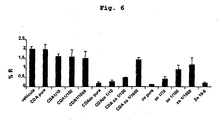
- Plusieurs échantillons de CDA (200 mg) modifiée par ajout de zoledronate conformément au procédé de l'exemple 1 et plusieurs échantillons de CDA non modifiée ont été incubés dans 5 ml de milieu de culture à 37 °C. Après 96 heures d'incubation, les différents surnageants ont été recueillis et utilisés purs, dilués 10, 100 et 1000 fois dans un modèle d'ostéoclastes de lapins.
- Les résultats sont représentés sur la
figure 6 , sur laquelle le pourcentage de résorption R est indiqué en ordonnées, les conditions étant indiquées en abscisse. Parmi les conditions : - "vehicule" signifie le milieu de culture seul
- "CDA pure" signifie le surnageant issu de l'incubation de CDA pure dans le milieu de culture ; "CDA1/10", "CDA1/100" et "CDA1/1000" signifient respectivement la solution désignée ci-dessus et diluée à 1/10, 1/100 et 1/1000.
- "zo pure" signifie une solution de zoledronate 10-6 M dans le milieu de culture, "zo1/10", "zo1/100", "zo1/1000" signifient respectivement la solution désignée ci-dessus et diluée à 1/10, 1/100 et 1/1000.
- "CDAzo pure" signifie le surnageant issu de l'incubation de CDA chargée en zoledronate dans le milieu de culture "CDAzol/10", "CDAzol/100" et "CDAzol/1000" signifient respectivement la solution désignée ci-dessus et diluée à 1/10, 1/100 et 1/1000.
- Ces résultats montrent que :
- le zoledronate libéré par la phase phosphocalcique (CDAzo) conserve son activité inhibitrice de la résorption ostéoclastique avec un effet dose marqué,
- la CDA seule ne semble pas influencer la résorption ostéoclastique quelle que soit la dilution du surnageant, 1
- le zoledronate en solution (zo) conserve son activité biologique et inhibe selon une relation dose/effet la résorption.
- La comparaison des profils d'inhibition de la résorption ostéoclastique provoquée par l'association CDA/Zo et par le zoledronate seul (solution 10-6 M utilisée pure, diluée 10, 100 et 1000 fois) permet de suggérer que le matériau libère une quantité de zoledronate correspondant à une concentration de l'ordre de 10-6 M.
Claims (18)
- Procédé de préparation d'un composé phosphocalcique modifié, caractérisé en ce qu'il consiste à ajouter un acide gem-biphosphonique ou l'un de ses sels de métal alcalin ou alcalino-terreux à une suspension d'un composé phosphocalcique précurseur dans l'eau ultra-pure, à agiter le milieu réactionnel à température ambiante, puis en récupérer par centrifugation le composé formé.
- Procédé selon la revendication 1, caractérisé en ce que tes acides ou les sels utilisés comme composés gem-biphosphoniques répondent à la formule (OY)(OX)P(O)-CR1CR2-P(O)(OX)(OY) dans laquelle X ou Y représentent indépendamment l'un de l'autre H ou un cation de métal alcalin ou alcalino-terreux, R1 représente H, OH ou un halogène, et R2 représente :• un hydrogène ou un halogène,• un radical alkyle,• un radical aminoalkyle dans lequel le groupe amino porte éventuellement un substituant alkyle,• un radical alkylamino,• un radical alkyle portant un substituant aromatique comprenant au moins un atome N,• un radical alkyle portant un groupe thioéther aromatique.
- Procédé selon la revendication 2, caractérisé en ce que R1 et/ou R2 représentent Cl.
- Procédé selon la revendication 2, caractérisé en ce que R2 est un radical ayant de 1 à 6 atomes de carbone.
- Procédé selon la revendication 2, caractérisé en ce que R2 est un radical aminoalkyle NH2(CH)n- dans lequel n est inférieur à 6.
- Procédé selon la revendication 2, caractérisé en ce que R2 est un radical alkylaminoalkyle R'R"N(CH2)m- dans lequel R' et R" représentent indépendamment l'un de l'autre H ou un radical alkyle ayant au plus 5 atomes de carbone, et m est inférieur à 6.
- Procédé selon la revendication 2, caractérisé en ce que R2 est un radical alkylamino RcNH- dans lequel Rc est un cycloalkyle ayant de 3 à 7 atomes de carbone.
- Procédé selon la revendication 2, caractérisé en ce que R2 est un radical alkyle ayant au plus 3 atomes de carbone et portant un groupe pyridinyle ou imidazolyle,
- Procédé selon la revendication 2, caractérisé en ce que R2 est un radical alkyle ayant au plus 3 atomes de carbone et portant un groupe phénylthio dans lequel le groupe phényle porte éventuellement un substituant halogène.
- Procédé selon la revendication 2, caractérisé en ce que R1 est OH, R2 est -CH2-imidazole, A et E représentent H.
- Procédé selon la revendication 1, caractérisé en ce que le composé formé est purifié par lavage à l'eau ultra-pure, suivi d'une filtration et d'un séchage à l'air à température ambiante.
- Procédé selon la revendication 1, caractérisé en ce que le composé phosphocalcique est choisi parmi le BCP, la CDA qui est une hydroxyapatite déficiente en calcium et le β-TCP.
- Procédé selon la revendication 1, caractérisé en ce que l'agitation à température ambiante est maintenue pendant une durée entre 1 h et 72 h.
- Composé phosphocalcique modifié susceptible d'être obtenu par le procédé selon l'une des revendications 1 à 13.
- Composé phosphocalcique modifié selon la revendication 14, dans lequel le composé phosphocalcique est choisi parmi le BCP, la CDA qui est une hydroxyapatite déficiente en calcium et le β-TCP.
- Composition utilisable par injection pour le traitement d'ostéoporose ou de récidives de tumeurs lytiques par inhibition de l'activité ostéoclastique, caractérisée en ce qu'elle est constituée par une suspension de 40 à 75% en masse du composé phosphocalcique modifié selon l'une des revendications 14 ou 15, dans 60 à 25% en masse d'un hydrogel.
- Composition selon la revendication 16, caractérisée en ce que le gel biocompatible est un hydrogel d'intérêt biologique.
- Composition selon la revendication 17, caractérisée en ce que le gel est un hydrogel dérivé de la cellulose ou un gel à base d'hyaluronate de sodium.
Applications Claiming Priority (3)
| Application Number | Priority Date | Filing Date | Title |
|---|---|---|---|
| FR0202707A FR2836681B1 (fr) | 2002-03-04 | 2002-03-04 | Compose phosphocalcique modifie, composition injectable le contenant |
| FR0202707 | 2002-03-04 | ||
| PCT/FR2003/000527 WO2003074098A1 (fr) | 2002-03-04 | 2003-02-18 | Compose phosphocalcique modifie, composition injectable le contenant |
Publications (2)
| Publication Number | Publication Date |
|---|---|
| EP1480687A1 EP1480687A1 (fr) | 2004-12-01 |
| EP1480687B1 true EP1480687B1 (fr) | 2009-02-11 |
Family
ID=27741420
Family Applications (1)
| Application Number | Title | Priority Date | Filing Date |
|---|---|---|---|
| EP03717407A Expired - Lifetime EP1480687B1 (fr) | 2002-03-04 | 2003-02-18 | Compose phosphocalcique modifie, composition injectable le contenant |
Country Status (10)
| Country | Link |
|---|---|
| US (2) | US7521436B2 (fr) |
| EP (1) | EP1480687B1 (fr) |
| JP (1) | JP4248407B2 (fr) |
| AT (1) | ATE422370T1 (fr) |
| AU (1) | AU2003222575B2 (fr) |
| CA (1) | CA2477756C (fr) |
| DE (1) | DE60326122D1 (fr) |
| ES (1) | ES2322343T3 (fr) |
| FR (1) | FR2836681B1 (fr) |
| WO (1) | WO2003074098A1 (fr) |
Families Citing this family (17)
| Publication number | Priority date | Publication date | Assignee | Title |
|---|---|---|---|---|
| FR2836681B1 (fr) * | 2002-03-04 | 2004-06-18 | Centre Nat Rech Scient | Compose phosphocalcique modifie, composition injectable le contenant |
| US7429378B2 (en) * | 2003-05-13 | 2008-09-30 | Depuy Spine, Inc. | Transdiscal administration of high affinity anti-MMP inhibitors |
| US20040229878A1 (en) * | 2003-05-13 | 2004-11-18 | Depuy Spine, Inc. | Transdiscal administration of specific inhibitors of P38 kinase |
| US7344716B2 (en) * | 2003-05-13 | 2008-03-18 | Depuy Spine, Inc. | Transdiscal administration of specific inhibitors of pro-inflammatory cytokines |
| US8273347B2 (en) | 2003-05-13 | 2012-09-25 | Depuy Spine, Inc. | Autologous treatment of degenerated disc with cells |
| US7553827B2 (en) * | 2003-08-13 | 2009-06-30 | Depuy Spine, Inc. | Transdiscal administration of cycline compounds |
| US8361467B2 (en) | 2003-07-30 | 2013-01-29 | Depuy Spine, Inc. | Trans-capsular administration of high specificity cytokine inhibitors into orthopedic joints |
| US8895540B2 (en) | 2003-11-26 | 2014-11-25 | DePuy Synthes Products, LLC | Local intraosseous administration of bone forming agents and anti-resorptive agents, and devices therefor |
| US8071574B2 (en) * | 2005-02-22 | 2011-12-06 | John Dennis Bobyn | Implant improving local bone formation |
| WO2008005509A2 (fr) * | 2006-07-06 | 2008-01-10 | Massachusetts Institute Of Technology | Procédés et compositions destinés à modifier des surfaces biologiques |
| US8974801B2 (en) | 2006-12-21 | 2015-03-10 | Amphastar Pharmaceuticals Inc. | Long term sustained release pharmaceutical composition containing aqueous suspension of bisphosphonate |
| EP1958649A1 (fr) * | 2007-02-14 | 2008-08-20 | Graftys | Ciment calcium-phosphate injectable libérant un inhibiteur de la résorption osseuse |
| US8986696B2 (en) | 2007-12-21 | 2015-03-24 | Depuy Mitek, Inc. | Trans-capsular administration of p38 map kinase inhibitors into orthopedic joints |
| US8882740B2 (en) * | 2009-12-23 | 2014-11-11 | Stryker Trauma Gmbh | Method of delivering a biphosphonate and/or strontium ranelate below the surface of a bone |
| WO2015135822A1 (fr) * | 2014-03-14 | 2015-09-17 | Ecole Polytechnique Federale De Lausanne (Epfl) | Combinaison agent actif-particule favorisant la régénération osseuse |
| US10537661B2 (en) | 2017-03-28 | 2020-01-21 | DePuy Synthes Products, Inc. | Orthopedic implant having a crystalline calcium phosphate coating and methods for making the same |
| US10537658B2 (en) | 2017-03-28 | 2020-01-21 | DePuy Synthes Products, Inc. | Orthopedic implant having a crystalline gallium-containing hydroxyapatite coating and methods for making the same |
Citations (1)
| Publication number | Priority date | Publication date | Assignee | Title |
|---|---|---|---|---|
| WO1995021634A1 (fr) * | 1994-02-08 | 1995-08-17 | Centre National De La Recherche Scientifique (C.N.R.S.) | Composition pour bio-materiau; procede de preparation |
Family Cites Families (3)
| Publication number | Priority date | Publication date | Assignee | Title |
|---|---|---|---|---|
| US5208234A (en) * | 1992-03-10 | 1993-05-04 | E. R. Squibb & Sons, Inc. | Substituted imidazole phosphonic and phosphinic acid derivatives |
| WO2000047214A1 (fr) * | 1999-02-09 | 2000-08-17 | Sloan-Kettering Institute For Cancer Research | Ciments osseux anti-resorption et implants osseux allogenes, autogreffes et xenogreffes |
| FR2836681B1 (fr) * | 2002-03-04 | 2004-06-18 | Centre Nat Rech Scient | Compose phosphocalcique modifie, composition injectable le contenant |
-
2002
- 2002-03-04 FR FR0202707A patent/FR2836681B1/fr not_active Expired - Lifetime
-
2003
- 2003-02-18 AU AU2003222575A patent/AU2003222575B2/en not_active Expired
- 2003-02-18 US US10/506,550 patent/US7521436B2/en not_active Expired - Lifetime
- 2003-02-18 ES ES03717407T patent/ES2322343T3/es not_active Expired - Lifetime
- 2003-02-18 CA CA002477756A patent/CA2477756C/fr not_active Expired - Lifetime
- 2003-02-18 DE DE60326122T patent/DE60326122D1/de not_active Expired - Lifetime
- 2003-02-18 WO PCT/FR2003/000527 patent/WO2003074098A1/fr not_active Ceased
- 2003-02-18 AT AT03717407T patent/ATE422370T1/de active
- 2003-02-18 JP JP2003572611A patent/JP4248407B2/ja not_active Expired - Fee Related
- 2003-02-18 EP EP03717407A patent/EP1480687B1/fr not_active Expired - Lifetime
-
2009
- 2009-04-14 US US12/385,614 patent/US8044037B2/en not_active Expired - Fee Related
Patent Citations (1)
| Publication number | Priority date | Publication date | Assignee | Title |
|---|---|---|---|---|
| WO1995021634A1 (fr) * | 1994-02-08 | 1995-08-17 | Centre National De La Recherche Scientifique (C.N.R.S.) | Composition pour bio-materiau; procede de preparation |
Also Published As
| Publication number | Publication date |
|---|---|
| CA2477756C (fr) | 2010-02-02 |
| ATE422370T1 (de) | 2009-02-15 |
| US20090203648A1 (en) | 2009-08-13 |
| JP4248407B2 (ja) | 2009-04-02 |
| AU2003222575A1 (en) | 2003-09-16 |
| US8044037B2 (en) | 2011-10-25 |
| US20050282783A1 (en) | 2005-12-22 |
| AU2003222575B2 (en) | 2008-08-21 |
| FR2836681A1 (fr) | 2003-09-05 |
| FR2836681B1 (fr) | 2004-06-18 |
| WO2003074098A1 (fr) | 2003-09-12 |
| DE60326122D1 (de) | 2009-03-26 |
| JP2005531510A (ja) | 2005-10-20 |
| EP1480687A1 (fr) | 2004-12-01 |
| US7521436B2 (en) | 2009-04-21 |
| ES2322343T3 (es) | 2009-06-19 |
| CA2477756A1 (fr) | 2003-09-12 |
Similar Documents
| Publication | Publication Date | Title |
|---|---|---|
| CA2477756C (fr) | Compose phosphocalcique modifie, composition injectable le contenant | |
| US5958430A (en) | Thin film composition with biological substance and method of making | |
| Josse et al. | Novel biomaterials for bisphosphonate delivery | |
| US11965016B2 (en) | Crystal structures comprising elastin-like peptides | |
| CA2226304C (fr) | Composition pour bio-materiau, procede de preparation | |
| Ciocilteu et al. | Hydroxyapatite-ciprofloxacin delivery system: Synthesis, characterisation and antibacterial activity | |
| JP2023181185A (ja) | ビスホスホネート・キノロン複合体及びそれらの用途 | |
| KR20090026566A (ko) | 인산칼슘 마이크로스피어 약물전달체 및 이의 제조방법 | |
| Qi et al. | Ga3+-doped coenzyme-based adhesives for periodontitis treatment | |
| WO2009131323A2 (fr) | Complexe os-remplissage à l'acide hyaluronique et son procédé de fabrication | |
| KR101315925B1 (ko) | 치과용 임플란트 및 그의 제조 방법 | |
| JP2004002422A (ja) | S−オメプラゾールのマグネシウム塩 | |
| JP7160267B2 (ja) | ヒドロゲル、及び、キット | |
| JP2015534970A (ja) | 多発性骨髄腫の治療のためのアントシアニジン複合体 | |
| CA3105829A1 (fr) | Conjugues bisphosphonate quinolone et utilisations associees | |
| MX2011006605A (es) | Compuestos de fenilalquilo-imidazol-bifosfonato. | |
| JP7098611B2 (ja) | 第八リン酸カルシウム成形体の製造方法 | |
| Papathanasiou et al. | Silica-based polymeric gels as platforms for delivery of phosphonate pharmaceutics | |
| EP4703409A1 (fr) | Molécule de conception cellulaire sensible à la lumière | |
| SI21703A (en) | Inclusion complexes of perindopril, procedure of their preparation, pharmaceutical compositions containing these complexes and their application in treatment of hypertensia | |
| US20250127961A1 (en) | Bone regeneration material, method for manufacturing bone regeneration material, and bone regeneration material manufacturing device | |
| KR20220131607A (ko) | 임플란트 식립부의 골생성 유도용 조성물 및 그 제조방법 | |
| WO2023248246A1 (fr) | Compositions de nanoparticules de phosphate de calcium avec des sophorolipides et leur procédé de préparation | |
| KR20200062054A (ko) | 의료용 고분자 화합물, 의료용 복합체, 및 의료용 복합체 제조 방법 | |
| JP2025517853A (ja) | ビスホスホネートの担体としての細胞取り込みが向上したレシチン修飾リン酸カルシウムナノ粒子の製剤化とその調製方法 |
Legal Events
| Date | Code | Title | Description |
|---|---|---|---|
| PUAI | Public reference made under article 153(3) epc to a published international application that has entered the european phase |
Free format text: ORIGINAL CODE: 0009012 |
|
| 17P | Request for examination filed |
Effective date: 20040902 |
|
| AK | Designated contracting states |
Kind code of ref document: A1 Designated state(s): AT BE BG CH CY CZ DE DK EE ES FI FR GB GR HU IE IT LI LU MC NL PT SE SI SK TR |
|
| RIN1 | Information on inventor provided before grant (corrected) |
Inventor name: JANVIER, PASCAL Inventor name: BUJOLI, BRUNO Inventor name: DACULSI, GUY Inventor name: JOSSE, SOLEN Inventor name: GUICHEUX, JEROEME Inventor name: BOULER, JEAN-MICHEL |
|
| 17Q | First examination report despatched |
Effective date: 20070705 |
|
| GRAP | Despatch of communication of intention to grant a patent |
Free format text: ORIGINAL CODE: EPIDOSNIGR1 |
|
| GRAS | Grant fee paid |
Free format text: ORIGINAL CODE: EPIDOSNIGR3 |
|
| GRAA | (expected) grant |
Free format text: ORIGINAL CODE: 0009210 |
|
| AK | Designated contracting states |
Kind code of ref document: B1 Designated state(s): AT BE BG CH CY CZ DE DK EE ES FI FR GB GR HU IE IT LI LU MC NL PT SE SI SK TR |
|
| REG | Reference to a national code |
Ref country code: GB Ref legal event code: FG4D Free format text: NOT ENGLISH |
|
| REG | Reference to a national code |
Ref country code: CH Ref legal event code: EP |
|
| REG | Reference to a national code |
Ref country code: IE Ref legal event code: FG4D Free format text: LANGUAGE OF EP DOCUMENT: FRENCH |
|
| REF | Corresponds to: |
Ref document number: 60326122 Country of ref document: DE Date of ref document: 20090326 Kind code of ref document: P |
|
| REG | Reference to a national code |
Ref country code: SE Ref legal event code: TRGR |
|
| REG | Reference to a national code |
Ref country code: GR Ref legal event code: EP Ref document number: 20090401247 Country of ref document: GR |
|
| REG | Reference to a national code |
Ref country code: ES Ref legal event code: FG2A Ref document number: 2322343 Country of ref document: ES Kind code of ref document: T3 |
|
| PG25 | Lapsed in a contracting state [announced via postgrant information from national office to epo] |
Ref country code: SI Free format text: LAPSE BECAUSE OF FAILURE TO SUBMIT A TRANSLATION OF THE DESCRIPTION OR TO PAY THE FEE WITHIN THE PRESCRIBED TIME-LIMIT Effective date: 20090211 Ref country code: FI Free format text: LAPSE BECAUSE OF FAILURE TO SUBMIT A TRANSLATION OF THE DESCRIPTION OR TO PAY THE FEE WITHIN THE PRESCRIBED TIME-LIMIT Effective date: 20090211 |
|
| BERE | Be: lapsed |
Owner name: CENTRE NATIONAL DE LA RECHERCHE SCIENTIFIQUE Effective date: 20090228 Owner name: INSTITUT NATIONAL DE LA SANTE ET DE LA RECHERCHE Effective date: 20090228 Owner name: UNIVERSITE DE NANTES Effective date: 20090228 |
|
| REG | Reference to a national code |
Ref country code: IE Ref legal event code: FD4D |
|
| PG25 | Lapsed in a contracting state [announced via postgrant information from national office to epo] |
Ref country code: MC Free format text: LAPSE BECAUSE OF NON-PAYMENT OF DUE FEES Effective date: 20090228 |
|
| REG | Reference to a national code |
Ref country code: CH Ref legal event code: PL |
|
| REG | Reference to a national code |
Ref country code: HU Ref legal event code: AG4A Ref document number: E005762 Country of ref document: HU |
|
| PG25 | Lapsed in a contracting state [announced via postgrant information from national office to epo] |
Ref country code: IE Free format text: LAPSE BECAUSE OF FAILURE TO SUBMIT A TRANSLATION OF THE DESCRIPTION OR TO PAY THE FEE WITHIN THE PRESCRIBED TIME-LIMIT Effective date: 20090211 Ref country code: LI Free format text: LAPSE BECAUSE OF NON-PAYMENT OF DUE FEES Effective date: 20090228 Ref country code: PT Free format text: LAPSE BECAUSE OF FAILURE TO SUBMIT A TRANSLATION OF THE DESCRIPTION OR TO PAY THE FEE WITHIN THE PRESCRIBED TIME-LIMIT Effective date: 20090713 Ref country code: DK Free format text: LAPSE BECAUSE OF FAILURE TO SUBMIT A TRANSLATION OF THE DESCRIPTION OR TO PAY THE FEE WITHIN THE PRESCRIBED TIME-LIMIT Effective date: 20090211 Ref country code: CH Free format text: LAPSE BECAUSE OF NON-PAYMENT OF DUE FEES Effective date: 20090228 Ref country code: EE Free format text: LAPSE BECAUSE OF FAILURE TO SUBMIT A TRANSLATION OF THE DESCRIPTION OR TO PAY THE FEE WITHIN THE PRESCRIBED TIME-LIMIT Effective date: 20090211 |
|
| PG25 | Lapsed in a contracting state [announced via postgrant information from national office to epo] |
Ref country code: SK Free format text: LAPSE BECAUSE OF FAILURE TO SUBMIT A TRANSLATION OF THE DESCRIPTION OR TO PAY THE FEE WITHIN THE PRESCRIBED TIME-LIMIT Effective date: 20090211 |
|
| PLBE | No opposition filed within time limit |
Free format text: ORIGINAL CODE: 0009261 |
|
| STAA | Information on the status of an ep patent application or granted ep patent |
Free format text: STATUS: NO OPPOSITION FILED WITHIN TIME LIMIT |
|
| 26N | No opposition filed |
Effective date: 20091112 |
|
| PG25 | Lapsed in a contracting state [announced via postgrant information from national office to epo] |
Ref country code: BG Free format text: LAPSE BECAUSE OF FAILURE TO SUBMIT A TRANSLATION OF THE DESCRIPTION OR TO PAY THE FEE WITHIN THE PRESCRIBED TIME-LIMIT Effective date: 20090511 |
|
| PG25 | Lapsed in a contracting state [announced via postgrant information from national office to epo] |
Ref country code: BE Free format text: LAPSE BECAUSE OF NON-PAYMENT OF DUE FEES Effective date: 20090228 |
|
| PG25 | Lapsed in a contracting state [announced via postgrant information from national office to epo] |
Ref country code: LU Free format text: LAPSE BECAUSE OF NON-PAYMENT OF DUE FEES Effective date: 20090218 |
|
| PG25 | Lapsed in a contracting state [announced via postgrant information from national office to epo] |
Ref country code: CY Free format text: LAPSE BECAUSE OF FAILURE TO SUBMIT A TRANSLATION OF THE DESCRIPTION OR TO PAY THE FEE WITHIN THE PRESCRIBED TIME-LIMIT Effective date: 20090211 |
|
| REG | Reference to a national code |
Ref country code: FR Ref legal event code: PLFP Year of fee payment: 14 |
|
| REG | Reference to a national code |
Ref country code: FR Ref legal event code: PLFP Year of fee payment: 15 |
|
| REG | Reference to a national code |
Ref country code: FR Ref legal event code: PLFP Year of fee payment: 16 |
|
| PGFP | Annual fee paid to national office [announced via postgrant information from national office to epo] |
Ref country code: HU Payment date: 20220124 Year of fee payment: 20 Ref country code: GB Payment date: 20220218 Year of fee payment: 20 Ref country code: DE Payment date: 20220214 Year of fee payment: 20 Ref country code: AT Payment date: 20220118 Year of fee payment: 20 |
|
| PGFP | Annual fee paid to national office [announced via postgrant information from national office to epo] |
Ref country code: TR Payment date: 20220207 Year of fee payment: 20 Ref country code: SE Payment date: 20220216 Year of fee payment: 20 Ref country code: NL Payment date: 20220121 Year of fee payment: 20 Ref country code: IT Payment date: 20220211 Year of fee payment: 20 Ref country code: GR Payment date: 20220119 Year of fee payment: 20 Ref country code: FR Payment date: 20220228 Year of fee payment: 20 Ref country code: ES Payment date: 20220303 Year of fee payment: 20 Ref country code: CZ Payment date: 20220121 Year of fee payment: 20 |
|
| REG | Reference to a national code |
Ref country code: DE Ref legal event code: R071 Ref document number: 60326122 Country of ref document: DE |
|
| REG | Reference to a national code |
Ref country code: NL Ref legal event code: MK Effective date: 20230217 |
|
| REG | Reference to a national code |
Ref country code: GB Ref legal event code: PE20 Expiry date: 20230217 |
|
| REG | Reference to a national code |
Ref country code: SE Ref legal event code: EUG |
|
| REG | Reference to a national code |
Ref country code: AT Ref legal event code: MK07 Ref document number: 422370 Country of ref document: AT Kind code of ref document: T Effective date: 20230218 |
|
| PG25 | Lapsed in a contracting state [announced via postgrant information from national office to epo] |
Ref country code: CZ Free format text: LAPSE BECAUSE OF EXPIRATION OF PROTECTION Effective date: 20230218 |
|
| REG | Reference to a national code |
Ref country code: ES Ref legal event code: FD2A Effective date: 20230428 |
|
| PG25 | Lapsed in a contracting state [announced via postgrant information from national office to epo] |
Ref country code: GB Free format text: LAPSE BECAUSE OF EXPIRATION OF PROTECTION Effective date: 20230217 |
|
| PG25 | Lapsed in a contracting state [announced via postgrant information from national office to epo] |
Ref country code: ES Free format text: LAPSE BECAUSE OF EXPIRATION OF PROTECTION Effective date: 20230219 |