EP1480107A2 - Verfahren zur Authentifizierung eines Nutzers mit einem Apparat zur Authorisierung, und ein Sicherheitsapparat zum Ausführen der Methode - Google Patents
Verfahren zur Authentifizierung eines Nutzers mit einem Apparat zur Authorisierung, und ein Sicherheitsapparat zum Ausführen der Methode Download PDFInfo
- Publication number
- EP1480107A2 EP1480107A2 EP04405306A EP04405306A EP1480107A2 EP 1480107 A2 EP1480107 A2 EP 1480107A2 EP 04405306 A EP04405306 A EP 04405306A EP 04405306 A EP04405306 A EP 04405306A EP 1480107 A2 EP1480107 A2 EP 1480107A2
- Authority
- EP
- European Patent Office
- Prior art keywords
- user
- authorizing device
- input
- data
- security apparatus
- Prior art date
- Legal status (The legal status is an assumption and is not a legal conclusion. Google has not performed a legal analysis and makes no representation as to the accuracy of the status listed.)
- Withdrawn
Links
Images

Classifications
-
- G—PHYSICS
- G07—CHECKING-DEVICES
- G07F—COIN-FREED OR LIKE APPARATUS
- G07F7/00—Mechanisms actuated by objects other than coins to free or to actuate vending, hiring, coin or paper currency dispensing or refunding apparatus
- G07F7/08—Mechanisms actuated by objects other than coins to free or to actuate vending, hiring, coin or paper currency dispensing or refunding apparatus by coded identity card or credit card or other personal identification means
- G07F7/10—Mechanisms actuated by objects other than coins to free or to actuate vending, hiring, coin or paper currency dispensing or refunding apparatus by coded identity card or credit card or other personal identification means together with a coded signal, e.g. in the form of personal identification information, like personal identification number [PIN] or biometric data
- G07F7/1008—Active credit-cards provided with means to personalise their use, e.g. with PIN-introduction/comparison system
-
- G—PHYSICS
- G06—COMPUTING OR CALCULATING; COUNTING
- G06Q—INFORMATION AND COMMUNICATION TECHNOLOGY [ICT] SPECIALLY ADAPTED FOR ADMINISTRATIVE, COMMERCIAL, FINANCIAL, MANAGERIAL OR SUPERVISORY PURPOSES; SYSTEMS OR METHODS SPECIALLY ADAPTED FOR ADMINISTRATIVE, COMMERCIAL, FINANCIAL, MANAGERIAL OR SUPERVISORY PURPOSES, NOT OTHERWISE PROVIDED FOR
- G06Q20/00—Payment architectures, schemes or protocols
- G06Q20/02—Payment architectures, schemes or protocols involving a neutral party, e.g. certification authority, notary or trusted third party [TTP]
-
- G—PHYSICS
- G06—COMPUTING OR CALCULATING; COUNTING
- G06Q—INFORMATION AND COMMUNICATION TECHNOLOGY [ICT] SPECIALLY ADAPTED FOR ADMINISTRATIVE, COMMERCIAL, FINANCIAL, MANAGERIAL OR SUPERVISORY PURPOSES; SYSTEMS OR METHODS SPECIALLY ADAPTED FOR ADMINISTRATIVE, COMMERCIAL, FINANCIAL, MANAGERIAL OR SUPERVISORY PURPOSES, NOT OTHERWISE PROVIDED FOR
- G06Q20/00—Payment architectures, schemes or protocols
- G06Q20/30—Payment architectures, schemes or protocols characterised by the use of specific devices or networks
- G06Q20/34—Payment architectures, schemes or protocols characterised by the use of specific devices or networks using cards, e.g. integrated circuit [IC] cards or magnetic cards
- G06Q20/341—Active cards, i.e. cards including their own processing means, e.g. including an IC or chip
-
- G—PHYSICS
- G06—COMPUTING OR CALCULATING; COUNTING
- G06Q—INFORMATION AND COMMUNICATION TECHNOLOGY [ICT] SPECIALLY ADAPTED FOR ADMINISTRATIVE, COMMERCIAL, FINANCIAL, MANAGERIAL OR SUPERVISORY PURPOSES; SYSTEMS OR METHODS SPECIALLY ADAPTED FOR ADMINISTRATIVE, COMMERCIAL, FINANCIAL, MANAGERIAL OR SUPERVISORY PURPOSES, NOT OTHERWISE PROVIDED FOR
- G06Q20/00—Payment architectures, schemes or protocols
- G06Q20/38—Payment protocols; Details thereof
- G06Q20/382—Payment protocols; Details thereof insuring higher security of transaction
- G06Q20/3829—Payment protocols; Details thereof insuring higher security of transaction involving key management
-
- G—PHYSICS
- G06—COMPUTING OR CALCULATING; COUNTING
- G06Q—INFORMATION AND COMMUNICATION TECHNOLOGY [ICT] SPECIALLY ADAPTED FOR ADMINISTRATIVE, COMMERCIAL, FINANCIAL, MANAGERIAL OR SUPERVISORY PURPOSES; SYSTEMS OR METHODS SPECIALLY ADAPTED FOR ADMINISTRATIVE, COMMERCIAL, FINANCIAL, MANAGERIAL OR SUPERVISORY PURPOSES, NOT OTHERWISE PROVIDED FOR
- G06Q20/00—Payment architectures, schemes or protocols
- G06Q20/38—Payment protocols; Details thereof
- G06Q20/40—Authorisation, e.g. identification of payer or payee, verification of customer or shop credentials; Review and approval of payers, e.g. check credit lines or negative lists
-
- G—PHYSICS
- G06—COMPUTING OR CALCULATING; COUNTING
- G06Q—INFORMATION AND COMMUNICATION TECHNOLOGY [ICT] SPECIALLY ADAPTED FOR ADMINISTRATIVE, COMMERCIAL, FINANCIAL, MANAGERIAL OR SUPERVISORY PURPOSES; SYSTEMS OR METHODS SPECIALLY ADAPTED FOR ADMINISTRATIVE, COMMERCIAL, FINANCIAL, MANAGERIAL OR SUPERVISORY PURPOSES, NOT OTHERWISE PROVIDED FOR
- G06Q20/00—Payment architectures, schemes or protocols
- G06Q20/38—Payment protocols; Details thereof
- G06Q20/40—Authorisation, e.g. identification of payer or payee, verification of customer or shop credentials; Review and approval of payers, e.g. check credit lines or negative lists
- G06Q20/401—Transaction verification
- G06Q20/4014—Identity check for transactions
-
- G—PHYSICS
- G06—COMPUTING OR CALCULATING; COUNTING
- G06Q—INFORMATION AND COMMUNICATION TECHNOLOGY [ICT] SPECIALLY ADAPTED FOR ADMINISTRATIVE, COMMERCIAL, FINANCIAL, MANAGERIAL OR SUPERVISORY PURPOSES; SYSTEMS OR METHODS SPECIALLY ADAPTED FOR ADMINISTRATIVE, COMMERCIAL, FINANCIAL, MANAGERIAL OR SUPERVISORY PURPOSES, NOT OTHERWISE PROVIDED FOR
- G06Q20/00—Payment architectures, schemes or protocols
- G06Q20/38—Payment protocols; Details thereof
- G06Q20/40—Authorisation, e.g. identification of payer or payee, verification of customer or shop credentials; Review and approval of payers, e.g. check credit lines or negative lists
- G06Q20/409—Device specific authentication in transaction processing
- G06Q20/4097—Device specific authentication in transaction processing using mutual authentication between devices and transaction partners
-
- G—PHYSICS
- G07—CHECKING-DEVICES
- G07C—TIME OR ATTENDANCE REGISTERS; REGISTERING OR INDICATING THE WORKING OF MACHINES; GENERATING RANDOM NUMBERS; VOTING OR LOTTERY APPARATUS; ARRANGEMENTS, SYSTEMS OR APPARATUS FOR CHECKING NOT PROVIDED FOR ELSEWHERE
- G07C9/00—Individual registration on entry or exit
- G07C9/20—Individual registration on entry or exit involving the use of a pass
- G07C9/22—Individual registration on entry or exit involving the use of a pass in combination with an identity check of the pass holder
- G07C9/25—Individual registration on entry or exit involving the use of a pass in combination with an identity check of the pass holder using biometric data, e.g. fingerprints, iris scans or voice recognition
- G07C9/257—Individual registration on entry or exit involving the use of a pass in combination with an identity check of the pass holder using biometric data, e.g. fingerprints, iris scans or voice recognition electronically
-
- G—PHYSICS
- G07—CHECKING-DEVICES
- G07C—TIME OR ATTENDANCE REGISTERS; REGISTERING OR INDICATING THE WORKING OF MACHINES; GENERATING RANDOM NUMBERS; VOTING OR LOTTERY APPARATUS; ARRANGEMENTS, SYSTEMS OR APPARATUS FOR CHECKING NOT PROVIDED FOR ELSEWHERE
- G07C9/00—Individual registration on entry or exit
- G07C9/20—Individual registration on entry or exit involving the use of a pass
- G07C9/22—Individual registration on entry or exit involving the use of a pass in combination with an identity check of the pass holder
- G07C9/23—Individual registration on entry or exit involving the use of a pass in combination with an identity check of the pass holder by means of a password
Definitions
- the invention relates to a method for authentication of a user with an authorizing device according to the precharacterizing clause of Claim 1, and to a security apparatus for carrying out the method according to Claim 6.
- the invention furthermore relates to an authentication system according to Claim 8 and to a method for operation of an authentication system according to Claim 9.
- One simple security element is a credit card, bank card or access code card which, for example, has a magnetic strip or an integrated circuit as an identification element.
- This identification element is supplied to an authorizing device which then checks a code, the so-called PIN code, of the user of the card.
- EP 1 255 178 also discloses a method, however, in which, once the user has entered a first identification code, information is sent to the user directly or by means of the security element to the authorizing device, which information is transformed by a processor in the security element into a further access code to be entered only if the biometric identity of the user has been confirmed by the security element.
- the security has therefore been transferred from the authorizing device to the user and his security element or, in other words, the user now entrusts only the card-issuing authority with most of the information relating to his private domain. In this case, he need inform the card-issuing authority only of as much data as is required for correct recording in the list of authorized users. In particular, no biometric data is reported. All that is necessary is to ensure by means of the initialization process that only the authorized person is storing his biometric data on the card.
- the authorizing device now only requires secure communication with the card (and its user), but does not require any further information relating to the user in order to allow this user to be identified unambiguously. The complexity of the system in the authorizing device or devices is thus moved to the card, so that on the one hand the authorizing device has the advantage of a simpler and thus lower-cost infrastructure while the user can largely protect his private domain, in comparison to known authorization methods.
- the invention is based on the object of specifying a secure method differing from this prior art.
- the expression authorizing device should be understood as meaning that institution that the user makes use of. This may be a user of a building with secure access; it may be a cash dispenser, or may be an Internet provider of goods and/or services, or many other things.
- the authorizing device and the institution which issues the card may be identical institutions or two different institutions; in other words, a card check can be carried out only in the authorizing device, or this authorizing device can carry out the check with the institution issuing the card.
- the two units may also be coincident.
- three criteria may be used for authorization: for example something one has (token, in this case the card); for example something one knows (a secret, in the exemplary embodiments the alphabet associated with the fingers); for example what one is (biometry, in the exemplary embodiments, the fingerprints, per se).
- token in this case the card
- biometry in the exemplary embodiments, the fingerprints, per se.
- the combination of a fingerprint sequence with a secret may be extended in the case of the method described here such that the secret is regenerated whenever the card is used; it can thus not be discovered by third parties by observation or carelessness.
- the secret (the knowledge of the card holder) lies in a method as to how a secret code is produced (alphabet) and not in the sequence (code) itself.
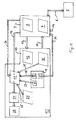
- FIG. 1 shows a highly schematic illustration of a security apparatus 10 in the area of an authorizing device 2 according to the invention.
- the authorizing device 2 has at least one output appliance 3 and at least one input appliance 4, either directly or indirectly.
- the output appliance may be a loudspeaker or a screen for the user, which are connected to his computer which, for example, is connected via a modem or Internet link to the central computer of the authorizing device 2.
- the expression direct output appliance 3 may be understood by a person skilled in the art as a screen, a loudspeaker or other transmission sources, such as infrared transmitters, radio transmitters, RFID, etc, which are directly connected to the local computer of the authorizing device 2.
- the authorizing device 2 may itself be the card issuing authority or may be a corresponding separate institution 5, which is generally connected to the authorizing devices 2 via data lines 6.
- Personal data and card-related data 11 are stored by the user on the security apparatus 10.
- This may be biometric data 31, code words or other graphical code characters, in particular, which can be entered.
- Card-related data 21 can in general be checked and may preferably exist in a machine-legible form such as a magnetic strip, a chip or a bar code, or identification number which can be transmitted by means of an RFID tag.
- the security apparatus 10 also has a receiving means 12, by means of which data which is output via the or an output appliance 3 of the authorizing device 2 can be transmitted, as illustrated by the arrow 13, to the security apparatus 10.
- a first information item is input in one of the said input appliances 4 of the authorizing device 2.
- This may be an identification number which is transmitted by means of a direct user input on the input appliance 4 (arrow 14), a direct biometric input (arrow 14), which is also a direct user input, or else a data transmission 24 of data 21 which can be emitted freely from the security apparatus 10, for example information which is stored on a bar code, a magnetic strip, a chip or an RFID-TAG, which is read by the authorizing device 2.
- the data may also be entered on the security apparatus 10 in an input appliance 15, and may be transmitted (arrow 34). This data from the input 14 is processed by the authorizing device 2.
- the authorizing device 2 produces first data items 16 and possibly second data items 26 directly or indirectly, which are output via the at least one output appliance 3 of the authorizing device 2.
- the first data items 16 may be received and decoded by the security apparatus 10 only if the user identifies in advance what is indicated by the checking element with the reference symbol 17. This may be done by a user data input on and in the security apparatus 10 by means of the input appliance 15. This may be a keyboard input in the sense of the transmission 35 of information which is known only to the user, or the like. A user secret may be checked by the input of data 26 by a dedicated check using this keyboard input. This may also be a biometric input 25 but in which case this data interchange 45 with the checking element 17 may also be bi-directional in the sense of a protocol.
- the elements 15 and 25 may be physically formed by the same input apparatus.
- the secret and/or the biometric data are/is stored as data 31 in the memory 11, and are/is interchanged to the necessary extent from the checking element 17 via the connection 18. If the security requirements are not stringent, this step of checking via the second data 26 may also be omitted, particularly if the decoded first data items 16 could not be used by an unauthorized user of the card, as will be seen further below. However, if the input exists, then the input which has been made is compared with an expected input from the memory 11 in the security apparatus 10.
- the security apparatus 10 converts the received data to information, as an input request, which can be identified by the user on an output appliance 28. This may be an input of an identification number (PIN) by the user in one of the said input appliances 4 of the authorizing device 2 directly (corresponding to the arrow 14) or indirectly by means of an input appliance 15 of the security device 10 (corresponding to the arrow 34).
- PIN an identification number
- the input is then compared in the authorizing device 2 (or in the institution 5) with the input that is expected with respect to the data that is produced. If the data comparison is successful, the authentication is confirmed by the authorizing device 2.
- the security of the method can be enhanced by designing the biometric input appropriately.
- the existence of a secret or a partial secret of the user can be checked by a dedicated check by means of the data 26, using the keyboard input or a combination of 25 and 15.
- the check of his secret can be manifested in the data 26 by requesting him to place a specific finger on the biometric reader, or to place a sequence of fingers on the biometric reader or readers.
- This secret may also be stored directly as data 41 in the memory 11 without any check by the second data 26, such that, on request by the security apparatus 10 when the data 16 arrives, specific fingers or a sequence of fingers must be placed on the biometric reader. This results in a secret.
- this secret may be stored in the form of a structure principle.
- the principle then allows a secret to be constructed on an ad-hoc basis, with the secret being changed continually and being checked, for example, by the data 26 or by means of a random structure.
- the data which can be represented by the user can check which secret (what biometric sequence) should be checked.
- the biometric data may be fingerprint data or else other data which essentially uniquely indicates an individual, be this data which is associated with physiological characteristics, or data representing a typical behavior pattern, or other appropriate identification elements.
- the secret 41 of the biometric input may comprise a sequential or parallel biometric input which can be compared with the or a corresponding part of the stored biometric data.
- the pattern is defined as mentioned above, or is transmitted as second data items 26.
- the parallel biometric input when the input appliance has more than one biometric sensor.
- This may also comprise a combination of different biometric data and input appliances, such as a retina scan with finger identification (of a specific finger) or the pushing of different predetermined biometric finger sensors with predetermined fingers in a predetermined sequence.
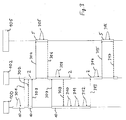
- FIG. 2 shows a sequence diagram for the initialization of a security apparatus as shown in Figure 1.
- the same features are provided with the same reference symbols in all of the figures.
- the user 100 has the security apparatus 10, the authorizing device 102 has an access computer 2, and the certifying institution 105 uses the computer that is annotated by the reference symbol 5 in Figure 1.
- the certifying institution 105 produces the security apparatus 10', stores the secret key of an asymmetric encryption pair on it, links this security apparatus with a user number, and stores the associated public key on its own computer 5, possibly only in the form that is certified by its own private key.
- the security apparatus 10 is then sent to the user 100 (arrow 201), with an initialization code (arrow 202) being dispatched separately, as normal.
- the user 100 contacts an authorizing device 102, the first authorizing device 102.
- the connection 202 is set up to the associated computer 2, and the initialization code is transmitted. This is passed on 204 to the computer 5 in the certifying institution 105, which checks it 205 and sends back the result 206.
- the computer 2 in the authorizing device 102 then transmits 207 the public key of the authorizing device 102 and control commands for the further processing in the security apparatus 10.
- the security apparatus 10 then passes through an initialization mode 208. Coding of the fingerprint sequence is then 209 either predetermined such that it is fixed, or the corresponding alphabet is indicated, which may be necessary for decoding of the second data items 26 in order to prepare for the input request.
- the biometric data is then 210 recorded, either with the data being recorded in the sequence of the indicated coding or in any desired sequence, for example from the thumb to the little finger.
- the sequence of the steps 209 and 210 may, of course, then be reversed.
- the security device 10 is then ready for use.
- the method is appropriately simplified since only one communication within the concern need then take place.
- the authorizing device 102 itself issues the security apparatuses 10 which it obtains from the certification authority 105, the steps 204 to 206 are omitted, since they are carried out during the process of presenting the security apparatuses 10 to the authorizing device 102.
- the method as shown in Figure 2 may be carried out with the exception of the step 201, with the step 201 being replaced by the request from the holder of the security apparatuses 10 for reinitialization.
- FIG 3 shows a sequence diagram for the use of a security apparatus 10 as shown in Figure 1.
- the reference symbol 301 denotes the activation of the security apparatus 10, for example card activation by presentation of the card to a radio transmitter (passive RFID), by activation of the elements 15 or 25 by the user, by connection of an activation card to the security apparatus, or by insertion of the card in a reader.
- the computer 2 in the authorizing device 102 checks identification information (arrow 302) and, for example, transmits this as the information 21 from the memory 11 (arrow 303).
- This information is generally transmitted directly, corresponding to the arrow 304, to the computer 5 in the certifying institution 105, which produces a data stream from a coded report (arrow 305) corresponding to the transmitted number, and this is then transmitted to the computer 2 (arrow 306).
- the coded report with an uncoded identification for the authorizing device 102, comprises the authorization code with a coding with the public key of the user 100 and the secret key of the authorizing device 102.
- One possible refinement of the code transmission to the security apparatus is implemented by means of a method as in EP 1 255 178, that is to say, corresponding to the procedure 308, graphical information is transmitted to an input appliance 12 on the security apparatus 10, whilst this is being set up in an appropriate manner such that it is ready to receive, corresponding to the reference symbol 307.
- the reference 307 may indicate the card being held on the screen, or some other action indicating readiness.
- the report is transmitted to the security apparatus 10, corresponding to the arrow 309.
- the information is processed further (arrow 310) in the security apparatus 10; in the solution addressed in EP 1 255 178, the graphical information is scanned in and processed, and appropriate implementations will be familiar to those skilled in the art, together with other transmission options, as well.
- the received data is then decrypted (arrow 311) and is output on the output appliance 28.
- the decryption process is carried out using the secret key of the user 100 (stored in 11), and the public key for the authorizing device 102 that is stored on the card, thus resulting in the authorization code.
- the output may be a display of a bar code which is transmitted, corresponding to the arrow 313, to the computer 2 in the authorizing device 102, and is converted (arrow 314).
- This may be an alphanumeric display on a display which is entered by an input appliance 15 or 4 via a keyboard or a pointer appliance.
- the data which is converted as an authorization code is transmitted as shown by the arrow 315 to the computer 5, where it is checked (arrow 316) and is transmitted back to the computer 2 in the authorizing device 102 in the form of a response 317, so that the confirmation of the authentication can be accepted or rejected there, in order to initiate or to reject the action desired by the user.
- the protocol can be repeated fully or to a reduced extent after a specific time or when specific circumstances occur.
- the coded report in the course of such a repetition may contain and transmit information which is directly related to the preceding dialogue between the holder of the apparatus 10 and the authorizing institution. In particular, this may be a hash code for an electronic agreement, and an associated method instruction.
- a manual input 14 is made instead of the steps 301 to 303 and leads, within the authorizing device 102, to its implementation in the card number, which is then transmitted to the certifying institution 105.
- the report 306 then also includes an initialization sequence, in order that the card can receive the message 309. Since registration with the security apparatus 10 has then not been carried out initially either, the authorizing device 102 must then also be selected from the card, in order to use the correct public key. Then, in the example of website registration, the authorization code may be displayed alphanumerically on a display, so that it can be entered appropriately on the website (corresponding to the step 313).
- this second provider must be able to make sure of the identity of the user .100.
- One possibility would be to store the user data in the certifying institution 105, although, from the international perspective, this could generate data protection problems.
- One solution is the storage of hash values of the user data for the user 100 in the certifying institution 105, so that there is no raw data there, but a user can verify the user data without any problems.
- the example has been described using asymmetric encryption.
Landscapes
- Business, Economics & Management (AREA)
- Engineering & Computer Science (AREA)
- Accounting & Taxation (AREA)
- General Physics & Mathematics (AREA)
- Physics & Mathematics (AREA)
- Strategic Management (AREA)
- General Business, Economics & Management (AREA)
- Theoretical Computer Science (AREA)
- Computer Security & Cryptography (AREA)
- Finance (AREA)
- Microelectronics & Electronic Packaging (AREA)
- Computer Networks & Wireless Communication (AREA)
- Human Computer Interaction (AREA)
- Storage Device Security (AREA)
- Financial Or Insurance-Related Operations Such As Payment And Settlement (AREA)
Applications Claiming Priority (2)
| Application Number | Priority Date | Filing Date | Title |
|---|---|---|---|
| CH8802003 | 2003-05-16 | ||
| CH8802003 | 2003-05-16 |
Publications (2)
| Publication Number | Publication Date |
|---|---|
| EP1480107A2 true EP1480107A2 (de) | 2004-11-24 |
| EP1480107A3 EP1480107A3 (de) | 2006-05-24 |
Family
ID=33035117
Family Applications (1)
| Application Number | Title | Priority Date | Filing Date |
|---|---|---|---|
| EP04405306A Withdrawn EP1480107A3 (de) | 2003-05-16 | 2004-05-13 | Verfahren zur Authentifizierung eines Nutzers mit einem Apparat zur Authorisierung, und ein Sicherheitsapparat zum Ausführen der Methode |
Country Status (2)
| Country | Link |
|---|---|
| US (1) | US20040230812A1 (de) |
| EP (1) | EP1480107A3 (de) |
Cited By (3)
| Publication number | Priority date | Publication date | Assignee | Title |
|---|---|---|---|---|
| US7730308B2 (en) | 2005-04-11 | 2010-06-01 | Axsionics Ag | System and method for providing an user's security when setting-up a connection over insecure networks |
| US8044947B2 (en) | 2005-11-22 | 2011-10-25 | Axsionics Ag | Method to transmit a coded information and device therefore |
| US8341714B2 (en) | 2005-12-29 | 2012-12-25 | Axsionics Ag | Security token and method for authentication of a user with the security token |
Families Citing this family (9)
| Publication number | Priority date | Publication date | Assignee | Title |
|---|---|---|---|---|
| US20050044387A1 (en) * | 2003-08-18 | 2005-02-24 | Ozolins Helmars E. | Portable access device |
| JP2009076172A (ja) * | 2007-09-25 | 2009-04-09 | Hitachi Ltd | データ伝送方法、光ディスク記録方法及び光ディスク記録装置 |
| US7690032B1 (en) | 2009-05-22 | 2010-03-30 | Daon Holdings Limited | Method and system for confirming the identity of a user |
| US9998288B2 (en) | 2010-02-26 | 2018-06-12 | International Business Machines Corporation | Management of secret data items used for server authentication |
| US9042281B2 (en) * | 2010-12-08 | 2015-05-26 | At&T Intellectual Property I, L.P. | Method and apparatus for initializing an RFID tag via an optical display |
| US9432378B1 (en) | 2011-09-23 | 2016-08-30 | Jerome Svigals | Internet of things security |
| US9344437B2 (en) | 2011-09-23 | 2016-05-17 | Jerome Svigals | Internet of things security |
| US9319404B2 (en) | 2011-09-23 | 2016-04-19 | Jerome Svigals | Security for the internet of things |
| US8997188B2 (en) * | 2012-04-11 | 2015-03-31 | Jerome Svigals | System for enabling a smart device to securely accept unsolicited transactions |
Citations (5)
| Publication number | Priority date | Publication date | Assignee | Title |
|---|---|---|---|---|
| US4614861A (en) | 1984-11-15 | 1986-09-30 | Intellicard International, Inc. | Unitary, self-contained card verification and validation system and method |
| US4819267A (en) | 1984-02-22 | 1989-04-04 | Thumbscan, Inc. | Solid state key for controlling access to computer systems and to computer software and/or for secure communications |
| US5432851A (en) | 1993-10-21 | 1995-07-11 | Tecsec Incorporated | Personal computer access control system |
| DE19648767A1 (de) | 1995-12-21 | 1997-06-26 | Siemens Ag Oesterreich | Identifikationssystem mit elektronischer Chipkarte |
| US6148406A (en) | 1995-04-27 | 2000-11-14 | Weisz; Herman | Access control password generated as a function of random numbers |
Family Cites Families (46)
| Publication number | Priority date | Publication date | Assignee | Title |
|---|---|---|---|---|
| US4590470A (en) * | 1983-07-11 | 1986-05-20 | At&T Bell Laboratories | User authentication system employing encryption functions |
| EP0197535A3 (en) * | 1985-04-09 | 1988-09-21 | Siemens Aktiengesellschaft Berlin Und Munchen | Data input device |
| US5060263A (en) * | 1988-03-09 | 1991-10-22 | Enigma Logic, Inc. | Computer access control system and method |
| WO1991000139A1 (en) * | 1989-06-30 | 1991-01-10 | Nauchno-Proizvodstvennaya Assotsiatsia 'transsonik' | Device for preparation of emulsions |
| US5613012A (en) * | 1994-11-28 | 1997-03-18 | Smarttouch, Llc. | Tokenless identification system for authorization of electronic transactions and electronic transmissions |
| US5764789A (en) * | 1994-11-28 | 1998-06-09 | Smarttouch, Llc | Tokenless biometric ATM access system |
| US7248719B2 (en) * | 1994-11-28 | 2007-07-24 | Indivos Corporation | Tokenless electronic transaction system |
| US6366682B1 (en) * | 1994-11-28 | 2002-04-02 | Indivos Corporation | Tokenless electronic transaction system |
| US5870723A (en) * | 1994-11-28 | 1999-02-09 | Pare, Jr.; David Ferrin | Tokenless biometric transaction authorization method and system |
| US6154879A (en) * | 1994-11-28 | 2000-11-28 | Smarttouch, Inc. | Tokenless biometric ATM access system |
| DE19507043B4 (de) * | 1995-03-01 | 2006-11-23 | Deutsche Telekom Ag | Verfahren zur Erzeugung und Verteilung unpersonalisierter vertraulicher elektronischer Schlüssel |
| US5778072A (en) * | 1995-07-07 | 1998-07-07 | Sun Microsystems, Inc. | System and method to transparently integrate private key operations from a smart card with host-based encryption services |
| JP3272213B2 (ja) * | 1995-10-02 | 2002-04-08 | インターナショナル・ビジネス・マシーンズ・コーポレーション | Icカード及び情報処理装置の認証方法 |
| DE19816117A1 (de) * | 1998-04-09 | 1999-10-14 | Primax Electronics Ltd | Elektronische Schlüsseleingabevorrichtung zur Bereitsetzung eines Computersystems |
| US6363485B1 (en) * | 1998-09-09 | 2002-03-26 | Entrust Technologies Limited | Multi-factor biometric authenticating device and method |
| US6567915B1 (en) * | 1998-10-23 | 2003-05-20 | Microsoft Corporation | Integrated circuit card with identity authentication table and authorization tables defining access rights based on Boolean expressions of authenticated identities |
| US20020124176A1 (en) * | 1998-12-14 | 2002-09-05 | Michael Epstein | Biometric identification mechanism that preserves the integrity of the biometric information |
| US6393139B1 (en) * | 1999-02-23 | 2002-05-21 | Xirlink, Inc. | Sequence-encoded multiple biometric template security system |
| US7039221B1 (en) * | 1999-04-09 | 2006-05-02 | Tumey David M | Facial image verification utilizing smart-card with integrated video camera |
| AU4598399A (en) * | 1999-07-06 | 2001-01-22 | Swisscom Mobile Ag | Method for checking user authorization |
| US6654484B2 (en) * | 1999-10-28 | 2003-11-25 | Catherine Topping | Secure control data entry system |
| US6738901B1 (en) * | 1999-12-15 | 2004-05-18 | 3M Innovative Properties Company | Smart card controlled internet access |
| WO2001050429A1 (en) * | 2000-01-05 | 2001-07-12 | American Express Travel Related Services Company, Inc. | Smartcard internet authorization system |
| BR0109231A (pt) * | 2000-03-13 | 2003-06-03 | Pittway Corp | Sistema integrado de segurança e comunicações com enlace de comunicações seguro |
| JP2001312284A (ja) * | 2000-04-27 | 2001-11-09 | Nec Corp | コンテンツ配信方法およびコンテンツ配信システム |
| US20020073315A1 (en) * | 2000-12-08 | 2002-06-13 | Brant Candelore | Placing a cryptogram on the magnetic stripe of a personal transaction card |
| US7921297B2 (en) * | 2001-01-10 | 2011-04-05 | Luis Melisendro Ortiz | Random biometric authentication utilizing unique biometric signatures |
| US20020104027A1 (en) * | 2001-01-31 | 2002-08-01 | Valene Skerpac | N-dimensional biometric security system |
| US20020122571A1 (en) * | 2001-03-01 | 2002-09-05 | Shawn Bradley | Identity verification using biometrics in analog format |
| US6816058B2 (en) * | 2001-04-26 | 2004-11-09 | Mcgregor Christopher M | Bio-metric smart card, bio-metric smart card reader and method of use |
| EP1255178B1 (de) * | 2001-05-03 | 2004-02-11 | Berner Fachhochschule Hochschule für Technic und Architektur Biel | Sicherheitsvorrichtung für On-line Transaktionen |
| JP2003050783A (ja) * | 2001-05-30 | 2003-02-21 | Fujitsu Ltd | 複合認証システム |
| US7003670B2 (en) * | 2001-06-08 | 2006-02-21 | Musicrypt, Inc. | Biometric rights management system |
| JP2003006168A (ja) * | 2001-06-25 | 2003-01-10 | Ntt Docomo Inc | 移動端末認証方法及び移動端末 |
| US20030018532A1 (en) * | 2001-07-23 | 2003-01-23 | General Motors Corporation | Method and device for conducting mobile commerce |
| US6990471B1 (en) * | 2001-08-02 | 2006-01-24 | Oracle International Corp. | Method and apparatus for secure electronic commerce |
| US6715674B2 (en) * | 2002-08-27 | 2004-04-06 | Ultra-Scan Corporation | Biometric factor augmentation method for identification systems |
| KR100899199B1 (ko) * | 2002-11-05 | 2009-05-27 | 삼성전자주식회사 | 지문인식을 이용한 보안시스템 및 보안방법 |
| US20040177258A1 (en) * | 2003-03-03 | 2004-09-09 | Ong Peng T. | Secure object for convenient identification |
| EP1633051A1 (de) * | 2004-09-06 | 2006-03-08 | Berner Fachhochschule Hochschule für Technic und Architektur Biel | Sigma-Delta Modulator und Sigma-Delta A/D-Wandler |
| IL165586A0 (en) * | 2004-12-06 | 2006-01-15 | Daphna Palti Wasserman | Multivariate dynamic biometrics system |
| EP1713230B1 (de) * | 2005-04-11 | 2011-07-20 | AXSionics AG | System und Verfahren zur Benützersicherheit bei einer Herstellung einer Kommunikationsverbindung über ein unsicheres Netzwerk |
| DE602005014939D1 (de) * | 2005-04-11 | 2009-07-30 | Axsionics Ag | System und Verfahren zur Benutzersicherheit bei einer Herstellung einer Kommunikationsverbindung über ein unsicheres Netzwerk |
| EP1788509A1 (de) * | 2005-11-22 | 2007-05-23 | Berner Fachhochschule, Hochschule für Technik und Architektur | Verfahren zum Senden einer verschlüsselten Information und Vorrichtung dafür |
| EP1804220A1 (de) * | 2005-12-29 | 2007-07-04 | AXSionics AG | Verfahren zur berechtigten Gewährung eines Dienstes und portables Gerät zu dessen Durchführung |
| EP1811421A1 (de) * | 2005-12-29 | 2007-07-25 | AXSionics AG | Sicherheitstoken und Verfahren zur Benutzerauthentifizierung mit dem Sicherheitstoken |
-
2004
- 2004-05-13 EP EP04405306A patent/EP1480107A3/de not_active Withdrawn
- 2004-05-14 US US10/845,841 patent/US20040230812A1/en not_active Abandoned
Patent Citations (5)
| Publication number | Priority date | Publication date | Assignee | Title |
|---|---|---|---|---|
| US4819267A (en) | 1984-02-22 | 1989-04-04 | Thumbscan, Inc. | Solid state key for controlling access to computer systems and to computer software and/or for secure communications |
| US4614861A (en) | 1984-11-15 | 1986-09-30 | Intellicard International, Inc. | Unitary, self-contained card verification and validation system and method |
| US5432851A (en) | 1993-10-21 | 1995-07-11 | Tecsec Incorporated | Personal computer access control system |
| US6148406A (en) | 1995-04-27 | 2000-11-14 | Weisz; Herman | Access control password generated as a function of random numbers |
| DE19648767A1 (de) | 1995-12-21 | 1997-06-26 | Siemens Ag Oesterreich | Identifikationssystem mit elektronischer Chipkarte |
Cited By (4)
| Publication number | Priority date | Publication date | Assignee | Title |
|---|---|---|---|---|
| US7730308B2 (en) | 2005-04-11 | 2010-06-01 | Axsionics Ag | System and method for providing an user's security when setting-up a connection over insecure networks |
| US8266434B2 (en) | 2005-04-11 | 2012-09-11 | Mueller Lorenz | System and method for providing an user's security when setting-up a connection over insecure networks |
| US8044947B2 (en) | 2005-11-22 | 2011-10-25 | Axsionics Ag | Method to transmit a coded information and device therefore |
| US8341714B2 (en) | 2005-12-29 | 2012-12-25 | Axsionics Ag | Security token and method for authentication of a user with the security token |
Also Published As
| Publication number | Publication date |
|---|---|
| US20040230812A1 (en) | 2004-11-18 |
| EP1480107A3 (de) | 2006-05-24 |
Similar Documents
| Publication | Publication Date | Title |
|---|---|---|
| US7107454B2 (en) | Signature system presenting user signature information | |
| JP5362558B2 (ja) | 生体特徴による身分認証の方法 | |
| EP2648163B1 (de) | Personalisiertes biometrisches identifikations- und nicht-zurückweisungs-system | |
| US7246244B2 (en) | Identity verification method using a central biometric authority | |
| EP3646247B1 (de) | Benutzerauthentifizierung basierend auf rfid-fähigen ausweisdokumenten und geste challenge-response-protokoll | |
| US9124433B2 (en) | Remote authentication and transaction signatures | |
| US20080028230A1 (en) | Biometric authentication proximity card | |
| US6829711B1 (en) | Personal website for electronic commerce on a smart java card with multiple security check points | |
| WO1999008217A1 (en) | Fingerprint collation | |
| JP2001325549A (ja) | バイオメトリクス本人確認サービス提供システム | |
| TW201528027A (zh) | 資料加密機制和儲存加密資料的智慧卡 | |
| JPH11161793A (ja) | 個人認証装置と個人認証方法 | |
| CN102638447A (zh) | 基于用户自主产生的口令对系统登录的方法和装置 | |
| JP2000215172A (ja) | 個人認証システム | |
| WO2023036143A1 (zh) | 去中心化零信任身份核实认证系统及方法 | |
| US20040230812A1 (en) | Method for authentication of a user with an authorizing device, and a security apparatus for carrying out the method | |
| JP2017117301A (ja) | チケット発行システム | |
| US10726417B1 (en) | Systems and methods for multifactor authentication | |
| US20070185811A1 (en) | Authorization of a transaction | |
| JP2002189702A (ja) | 個人認証情報出力装置 | |
| JP4665352B2 (ja) | 顧客認証システム、顧客認証方法、及び該方法を実施するための制御プログラム | |
| Nandhini et al. | Mobile communication based security for ATM PIN entry | |
| ES2631002B1 (es) | Dispositivo para facilitar transacciones financieras, procedimiento e instalación correspondientes | |
| JP2010079515A (ja) | 認証システム、そのシステムに用いるキー、認証方法およびプログラム | |
| KR20210143378A (ko) | 유전체 정보로부터 개인 인증키를 생성하는 장치 및 이를 이용한 인증시스템 |
Legal Events
| Date | Code | Title | Description |
|---|---|---|---|
| PUAI | Public reference made under article 153(3) epc to a published international application that has entered the european phase |
Free format text: ORIGINAL CODE: 0009012 |
|
| AK | Designated contracting states |
Kind code of ref document: A2 Designated state(s): AT BE BG CH CY CZ DE DK EE ES FI FR GB GR HU IE IT LI LU MC NL PL PT RO SE SI SK TR |
|
| AX | Request for extension of the european patent |
Extension state: AL HR LT LV MK |
|
| PUAL | Search report despatched |
Free format text: ORIGINAL CODE: 0009013 |
|
| AK | Designated contracting states |
Kind code of ref document: A3 Designated state(s): AT BE BG CH CY CZ DE DK EE ES FI FR GB GR HU IE IT LI LU MC NL PL PT RO SE SI SK TR |
|
| AX | Request for extension of the european patent |
Extension state: AL HR LT LV MK |
|
| 17P | Request for examination filed |
Effective date: 20061122 |
|
| 17Q | First examination report despatched |
Effective date: 20061222 |
|
| AKX | Designation fees paid |
Designated state(s): AT BE BG CH CY CZ DE DK EE ES FI FR GB GR HU IE IT LI LU MC NL PL PT RO SE SI SK TR |
|
| RAP1 | Party data changed (applicant data changed or rights of an application transferred) |
Owner name: AXSIONICS AG |
|
| 111L | Licence recorded |
Designated state(s): AT BE BG CH CY CZ DE DK EE ES FI FR GB GR HU IE IT LU MC NL PL PT RO SE SI SK TR Name of requester: BERNER FACHHOCHSHULE, CH Effective date: 20111010 |
|
| 111Z | Information provided on other rights and legal means of execution |
Free format text: AT BE BG CH CY CZ DE DK EE ES FI FR GB GR HU IE IT LU MC NL PL PT RO SE SI SK TR Effective date: 20111010 |
|
| 19U | Interruption of proceedings before grant |
Effective date: 20120105 |
|
| 19W | Proceedings resumed before grant after interruption of proceedings |
Effective date: 20210601 |
|
| STAA | Information on the status of an ep patent application or granted ep patent |
Free format text: STATUS: EXAMINATION IS IN PROGRESS |
|
| STAA | Information on the status of an ep patent application or granted ep patent |
Free format text: STATUS: THE APPLICATION IS DEEMED TO BE WITHDRAWN |
|
| 18D | Application deemed to be withdrawn |
Effective date: 20211202 |