EP1476576B1 - Fluorogene farbstoffe - Google Patents
Fluorogene farbstoffe Download PDFInfo
- Publication number
- EP1476576B1 EP1476576B1 EP03732051A EP03732051A EP1476576B1 EP 1476576 B1 EP1476576 B1 EP 1476576B1 EP 03732051 A EP03732051 A EP 03732051A EP 03732051 A EP03732051 A EP 03732051A EP 1476576 B1 EP1476576 B1 EP 1476576B1
- Authority
- EP
- European Patent Office
- Prior art keywords
- compound
- cell
- library
- reporter
- fluorogenic
- Prior art date
- Legal status (The legal status is an assumption and is not a legal conclusion. Google has not performed a legal analysis and makes no representation as to the accuracy of the status listed.)
- Expired - Lifetime
Links
- 239000000975 dye Substances 0.000 title abstract description 12
- 150000001875 compounds Chemical class 0.000 claims description 99
- QVGXLLKOCUKJST-UHFFFAOYSA-N atomic oxygen Chemical compound [O] QVGXLLKOCUKJST-UHFFFAOYSA-N 0.000 claims description 68
- 229910052760 oxygen Inorganic materials 0.000 claims description 68
- 239000001301 oxygen Substances 0.000 claims description 68
- 239000001257 hydrogen Substances 0.000 claims description 43
- 229910052739 hydrogen Inorganic materials 0.000 claims description 43
- 238000000034 method Methods 0.000 claims description 39
- 125000000217 alkyl group Chemical group 0.000 claims description 29
- 108010043958 Peptoids Proteins 0.000 claims description 27
- -1 cyano, amino Chemical group 0.000 claims description 21
- 125000005208 trialkylammonium group Chemical group 0.000 claims description 19
- 125000003118 aryl group Chemical group 0.000 claims description 11
- 238000004113 cell culture Methods 0.000 claims description 11
- 239000007790 solid phase Substances 0.000 claims description 10
- 125000003342 alkenyl group Chemical group 0.000 claims description 9
- 229910019142 PO4 Inorganic materials 0.000 claims description 8
- 125000000304 alkynyl group Chemical group 0.000 claims description 8
- NBIIXXVUZAFLBC-UHFFFAOYSA-K phosphate Chemical compound [O-]P([O-])([O-])=O NBIIXXVUZAFLBC-UHFFFAOYSA-K 0.000 claims description 8
- 239000010452 phosphate Substances 0.000 claims description 8
- 108090000765 processed proteins & peptides Proteins 0.000 claims description 8
- 125000003545 alkoxy group Chemical group 0.000 claims description 7
- 125000004435 hydrogen atom Chemical class [H]* 0.000 claims description 6
- 125000000753 cycloalkyl group Chemical group 0.000 claims description 5
- 125000002485 formyl group Chemical class [H]C(*)=O 0.000 claims description 5
- 125000001475 halogen functional group Chemical group 0.000 claims description 5
- 229930194542 Keto Natural products 0.000 claims description 4
- 239000002253 acid Substances 0.000 claims description 4
- 125000002252 acyl group Chemical group 0.000 claims description 4
- 239000000556 agonist Substances 0.000 claims description 4
- 239000005557 antagonist Substances 0.000 claims description 4
- 239000011324 bead Substances 0.000 claims description 4
- 150000001720 carbohydrates Chemical class 0.000 claims description 4
- 125000002795 guanidino group Chemical group C(N)(=N)N* 0.000 claims description 4
- 125000004970 halomethyl group Chemical group 0.000 claims description 4
- 125000000468 ketone group Chemical group 0.000 claims description 4
- 108020004707 nucleic acids Proteins 0.000 claims description 4
- 102000039446 nucleic acids Human genes 0.000 claims description 4
- 150000007523 nucleic acids Chemical class 0.000 claims description 4
- 150000002923 oximes Chemical class 0.000 claims description 4
- 150000003431 steroids Chemical class 0.000 claims description 4
- NEAQRZUHTPSBBM-UHFFFAOYSA-N 2-hydroxy-3,3-dimethyl-7-nitro-4h-isoquinolin-1-one Chemical compound C1=C([N+]([O-])=O)C=C2C(=O)N(O)C(C)(C)CC2=C1 NEAQRZUHTPSBBM-UHFFFAOYSA-N 0.000 claims description 3
- QAOWNCQODCNURD-UHFFFAOYSA-L Sulfate Chemical compound [O-]S([O-])(=O)=O QAOWNCQODCNURD-UHFFFAOYSA-L 0.000 claims description 3
- NINIDFKCEFEMDL-UHFFFAOYSA-N Sulfur Chemical compound [S] NINIDFKCEFEMDL-UHFFFAOYSA-N 0.000 claims description 3
- 239000003242 anti bacterial agent Substances 0.000 claims description 3
- 125000000852 azido group Chemical group *N=[N+]=[N-] 0.000 claims description 3
- 230000003115 biocidal effect Effects 0.000 claims description 3
- 125000005518 carboxamido group Chemical group 0.000 claims description 3
- 230000010261 cell growth Effects 0.000 claims description 3
- 125000004122 cyclic group Chemical group 0.000 claims description 3
- 238000013537 high throughput screening Methods 0.000 claims description 3
- 150000002540 isothiocyanates Chemical class 0.000 claims description 3
- VPKDCDLSJZCGKE-UHFFFAOYSA-N methanediimine Chemical compound N=C=N VPKDCDLSJZCGKE-UHFFFAOYSA-N 0.000 claims description 3
- 125000000449 nitro group Chemical group [O-][N+](*)=O 0.000 claims description 3
- 125000001997 phenyl group Chemical group [H]C1=C([H])C([H])=C(*)C([H])=C1[H] 0.000 claims description 3
- UEZVMMHDMIWARA-UHFFFAOYSA-M phosphonate Chemical compound [O-]P(=O)=O UEZVMMHDMIWARA-UHFFFAOYSA-M 0.000 claims description 3
- 229940124530 sulfonamide Drugs 0.000 claims description 3
- 150000003456 sulfonamides Chemical class 0.000 claims description 3
- BDHFUVZGWQCTTF-UHFFFAOYSA-M sulfonate Chemical compound [O-]S(=O)=O BDHFUVZGWQCTTF-UHFFFAOYSA-M 0.000 claims description 3
- 125000000472 sulfonyl group Chemical group *S(*)(=O)=O 0.000 claims description 3
- 239000011593 sulfur Substances 0.000 claims description 3
- 229910052717 sulfur Inorganic materials 0.000 claims description 3
- 229940088597 hormone Drugs 0.000 claims description 2
- 239000005556 hormone Substances 0.000 claims description 2
- 108090000623 proteins and genes Proteins 0.000 claims description 2
- 102000004169 proteins and genes Human genes 0.000 claims description 2
- 150000003384 small molecules Chemical class 0.000 claims description 2
- 239000013543 active substance Substances 0.000 claims 3
- 239000000126 substance Substances 0.000 claims 2
- 239000002532 enzyme inhibitor Substances 0.000 claims 1
- 229940125532 enzyme inhibitor Drugs 0.000 claims 1
- 238000000684 flow cytometry Methods 0.000 claims 1
- 238000003384 imaging method Methods 0.000 claims 1
- 210000004027 cell Anatomy 0.000 description 50
- 125000001495 ethyl group Chemical group [H]C([H])([H])C([H])([H])* 0.000 description 41
- 125000002496 methyl group Chemical group [H]C([H])([H])* 0.000 description 41
- UFHFLCQGNIYNRP-UHFFFAOYSA-N Hydrogen Chemical compound [H][H] UFHFLCQGNIYNRP-UHFFFAOYSA-N 0.000 description 32
- OKKJLVBELUTLKV-UHFFFAOYSA-N Methanol Chemical compound OC OKKJLVBELUTLKV-UHFFFAOYSA-N 0.000 description 24
- 125000003178 carboxy group Chemical group [H]OC(*)=O 0.000 description 24
- 125000004663 dialkyl amino group Chemical group 0.000 description 16
- GNBHRKFJIUUOQI-UHFFFAOYSA-N fluorescein Chemical class O1C(=O)C2=CC=CC=C2C21C1=CC=C(O)C=C1OC1=CC(O)=CC=C21 GNBHRKFJIUUOQI-UHFFFAOYSA-N 0.000 description 14
- 230000032258 transport Effects 0.000 description 13
- QTBSBXVTEAMEQO-UHFFFAOYSA-N Acetic acid Chemical compound CC(O)=O QTBSBXVTEAMEQO-UHFFFAOYSA-N 0.000 description 12
- 125000002147 dimethylamino group Chemical group [H]C([H])([H])N(*)C([H])([H])[H] 0.000 description 12
- 238000011534 incubation Methods 0.000 description 12
- 238000003756 stirring Methods 0.000 description 12
- GETQZCLCWQTVFV-UHFFFAOYSA-N trimethylamine Chemical group CN(C)C GETQZCLCWQTVFV-UHFFFAOYSA-N 0.000 description 12
- FAPWRFPIFSIZLT-UHFFFAOYSA-M Sodium chloride Chemical compound [Na+].[Cl-] FAPWRFPIFSIZLT-UHFFFAOYSA-M 0.000 description 10
- 239000007787 solid Substances 0.000 description 10
- 238000006243 chemical reaction Methods 0.000 description 9
- 239000000203 mixture Substances 0.000 description 9
- YMWUJEATGCHHMB-UHFFFAOYSA-N Dichloromethane Chemical compound ClCCl YMWUJEATGCHHMB-UHFFFAOYSA-N 0.000 description 8
- XEKOWRVHYACXOJ-UHFFFAOYSA-N Ethyl acetate Chemical compound CCOC(C)=O XEKOWRVHYACXOJ-UHFFFAOYSA-N 0.000 description 8
- 238000003786 synthesis reaction Methods 0.000 description 8
- XLYOFNOQVPJJNP-UHFFFAOYSA-N water Substances O XLYOFNOQVPJJNP-UHFFFAOYSA-N 0.000 description 8
- 230000015572 biosynthetic process Effects 0.000 description 7
- 150000002431 hydrogen Chemical class 0.000 description 7
- 239000000047 product Substances 0.000 description 7
- 239000000243 solution Substances 0.000 description 7
- 239000002904 solvent Substances 0.000 description 7
- DTQVDTLACAAQTR-UHFFFAOYSA-N trifluoroacetic acid Substances OC(=O)C(F)(F)F DTQVDTLACAAQTR-UHFFFAOYSA-N 0.000 description 7
- VEXZGXHMUGYJMC-UHFFFAOYSA-N Hydrochloric acid Chemical compound Cl VEXZGXHMUGYJMC-UHFFFAOYSA-N 0.000 description 6
- HEMHJVSKTPXQMS-UHFFFAOYSA-M Sodium hydroxide Chemical compound [OH-].[Na+] HEMHJVSKTPXQMS-UHFFFAOYSA-M 0.000 description 6
- VHJLVAABSRFDPM-QWWZWVQMSA-N dithiothreitol Chemical compound SC[C@@H](O)[C@H](O)CS VHJLVAABSRFDPM-QWWZWVQMSA-N 0.000 description 6
- 125000000524 functional group Chemical group 0.000 description 6
- 150000002632 lipids Chemical group 0.000 description 6
- 239000011541 reaction mixture Substances 0.000 description 6
- WEVYAHXRMPXWCK-UHFFFAOYSA-N Acetonitrile Chemical compound CC#N WEVYAHXRMPXWCK-UHFFFAOYSA-N 0.000 description 5
- 230000003834 intracellular effect Effects 0.000 description 5
- 102000004196 processed proteins & peptides Human genes 0.000 description 5
- 239000011780 sodium chloride Substances 0.000 description 5
- 150000003573 thiols Chemical class 0.000 description 5
- BZTDTCNHAFUJOG-UHFFFAOYSA-N 6-carboxyfluorescein Chemical compound C12=CC=C(O)C=C2OC2=CC(O)=CC=C2C11OC(=O)C2=CC=C(C(=O)O)C=C21 BZTDTCNHAFUJOG-UHFFFAOYSA-N 0.000 description 4
- IJGRMHOSHXDMSA-UHFFFAOYSA-N Atomic nitrogen Chemical compound N#N IJGRMHOSHXDMSA-UHFFFAOYSA-N 0.000 description 4
- 210000000170 cell membrane Anatomy 0.000 description 4
- 235000019439 ethyl acetate Nutrition 0.000 description 4
- 125000005647 linker group Chemical group 0.000 description 4
- 239000012071 phase Substances 0.000 description 4
- GHYOCDFICYLMRF-UTIIJYGPSA-N (2S,3R)-N-[(2S)-3-(cyclopenten-1-yl)-1-[(2R)-2-methyloxiran-2-yl]-1-oxopropan-2-yl]-3-hydroxy-3-(4-methoxyphenyl)-2-[[(2S)-2-[(2-morpholin-4-ylacetyl)amino]propanoyl]amino]propanamide Chemical compound C1(=CCCC1)C[C@@H](C(=O)[C@@]1(OC1)C)NC([C@H]([C@@H](C1=CC=C(C=C1)OC)O)NC([C@H](C)NC(CN1CCOCC1)=O)=O)=O GHYOCDFICYLMRF-UTIIJYGPSA-N 0.000 description 3
- UHOVQNZJYSORNB-UHFFFAOYSA-N Benzene Chemical compound C1=CC=CC=C1 UHOVQNZJYSORNB-UHFFFAOYSA-N 0.000 description 3
- PEDCQBHIVMGVHV-UHFFFAOYSA-N Glycerine Chemical compound OCC(O)CO PEDCQBHIVMGVHV-UHFFFAOYSA-N 0.000 description 3
- 229910004373 HOAc Inorganic materials 0.000 description 3
- 108010070875 Human Immunodeficiency Virus tat Gene Products Proteins 0.000 description 3
- 125000003710 aryl alkyl group Chemical group 0.000 description 3
- 229910052799 carbon Inorganic materials 0.000 description 3
- 238000000423 cell based assay Methods 0.000 description 3
- 239000013592 cell lysate Substances 0.000 description 3
- 239000003795 chemical substances by application Substances 0.000 description 3
- 229940125797 compound 12 Drugs 0.000 description 3
- 238000001514 detection method Methods 0.000 description 3
- 150000002148 esters Chemical group 0.000 description 3
- 230000005284 excitation Effects 0.000 description 3
- 238000002474 experimental method Methods 0.000 description 3
- 238000012203 high throughput assay Methods 0.000 description 3
- RAXXELZNTBOGNW-UHFFFAOYSA-N imidazole Natural products C1=CNC=N1 RAXXELZNTBOGNW-UHFFFAOYSA-N 0.000 description 3
- 229920000642 polymer Polymers 0.000 description 3
- 238000010992 reflux Methods 0.000 description 3
- 239000012508 resin bead Substances 0.000 description 3
- 125000001424 substituent group Chemical group 0.000 description 3
- FWMUJAIKEJWSSY-UHFFFAOYSA-N sulfur dichloride Chemical compound ClSCl FWMUJAIKEJWSSY-UHFFFAOYSA-N 0.000 description 3
- 238000012360 testing method Methods 0.000 description 3
- DGVVWUTYPXICAM-UHFFFAOYSA-N β‐Mercaptoethanol Chemical compound OCCS DGVVWUTYPXICAM-UHFFFAOYSA-N 0.000 description 3
- 239000004475 Arginine Substances 0.000 description 2
- XKRFYHLGVUSROY-UHFFFAOYSA-N Argon Chemical compound [Ar] XKRFYHLGVUSROY-UHFFFAOYSA-N 0.000 description 2
- 0 C*(C)CCCNNCCCC(*(C)(C=C)c1cc(Oc2cc(*(C)(*)C3OC3CCCNNCC*(C)(C)*)ccc2C2(c3c4cccc3)OC4=O)c2cc1)=O Chemical compound C*(C)CCCNNCCCC(*(C)(C=C)c1cc(Oc2cc(*(C)(*)C3OC3CCCNNCC*(C)(C)*)ccc2C2(c3c4cccc3)OC4=O)c2cc1)=O 0.000 description 2
- OKTJSMMVPCPJKN-UHFFFAOYSA-N Carbon Chemical compound [C] OKTJSMMVPCPJKN-UHFFFAOYSA-N 0.000 description 2
- 108090000790 Enzymes Proteins 0.000 description 2
- 102000004190 Enzymes Human genes 0.000 description 2
- LFQSCWFLJHTTHZ-UHFFFAOYSA-N Ethanol Chemical compound CCO LFQSCWFLJHTTHZ-UHFFFAOYSA-N 0.000 description 2
- YLQBMQCUIZJEEH-UHFFFAOYSA-N Furan Chemical compound C=1C=COC=1 YLQBMQCUIZJEEH-UHFFFAOYSA-N 0.000 description 2
- SIKJAQJRHWYJAI-UHFFFAOYSA-N Indole Chemical compound C1=CC=C2NC=CC2=C1 SIKJAQJRHWYJAI-UHFFFAOYSA-N 0.000 description 2
- 239000004472 Lysine Substances 0.000 description 2
- KDXKERNSBIXSRK-UHFFFAOYSA-N Lysine Natural products NCCCCC(N)C(O)=O KDXKERNSBIXSRK-UHFFFAOYSA-N 0.000 description 2
- CSNNHWWHGAXBCP-UHFFFAOYSA-L Magnesium sulfate Chemical compound [Mg+2].[O-][S+2]([O-])([O-])[O-] CSNNHWWHGAXBCP-UHFFFAOYSA-L 0.000 description 2
- JGFZNNIVVJXRND-UHFFFAOYSA-N N,N-Diisopropylethylamine (DIPEA) Chemical compound CCN(C(C)C)C(C)C JGFZNNIVVJXRND-UHFFFAOYSA-N 0.000 description 2
- 229910004879 Na2S2O5 Inorganic materials 0.000 description 2
- JUJWROOIHBZHMG-UHFFFAOYSA-N Pyridine Chemical compound C1=CC=NC=C1 JUJWROOIHBZHMG-UHFFFAOYSA-N 0.000 description 2
- KAESVJOAVNADME-UHFFFAOYSA-N Pyrrole Chemical compound C=1C=CNC=1 KAESVJOAVNADME-UHFFFAOYSA-N 0.000 description 2
- ZIHQUWYJSTVYAT-UHFFFAOYSA-N [NH-][N+]([O-])=O Chemical compound [NH-][N+]([O-])=O ZIHQUWYJSTVYAT-UHFFFAOYSA-N 0.000 description 2
- 125000002015 acyclic group Chemical group 0.000 description 2
- ODKSFYDXXFIFQN-UHFFFAOYSA-N arginine Natural products OC(=O)C(N)CCCNC(N)=N ODKSFYDXXFIFQN-UHFFFAOYSA-N 0.000 description 2
- 230000009286 beneficial effect Effects 0.000 description 2
- 235000014633 carbohydrates Nutrition 0.000 description 2
- 239000011203 carbon fibre reinforced carbon Substances 0.000 description 2
- 230000004700 cellular uptake Effects 0.000 description 2
- 229940079593 drug Drugs 0.000 description 2
- 239000003814 drug Substances 0.000 description 2
- 239000007850 fluorescent dye Substances 0.000 description 2
- RWSXRVCMGQZWBV-WDSKDSINSA-N glutathione Chemical compound OC(=O)[C@@H](N)CCC(=O)N[C@@H](CS)C(=O)NCC(O)=O RWSXRVCMGQZWBV-WDSKDSINSA-N 0.000 description 2
- 229910052736 halogen Inorganic materials 0.000 description 2
- 150000002367 halogens Chemical class 0.000 description 2
- 239000010410 layer Substances 0.000 description 2
- 210000005229 liver cell Anatomy 0.000 description 2
- 210000004962 mammalian cell Anatomy 0.000 description 2
- 125000002950 monocyclic group Chemical group 0.000 description 2
- VLKZOEOYAKHREP-UHFFFAOYSA-N n-Hexane Chemical class CCCCCC VLKZOEOYAKHREP-UHFFFAOYSA-N 0.000 description 2
- 229910052757 nitrogen Inorganic materials 0.000 description 2
- 239000012044 organic layer Substances 0.000 description 2
- XHXFXVLFKHQFAL-UHFFFAOYSA-N phosphoryl trichloride Chemical compound ClP(Cl)(Cl)=O XHXFXVLFKHQFAL-UHFFFAOYSA-N 0.000 description 2
- 239000000523 sample Substances 0.000 description 2
- 238000010898 silica gel chromatography Methods 0.000 description 2
- HRZFUMHJMZEROT-UHFFFAOYSA-L sodium disulfite Chemical compound [Na+].[Na+].[O-]S(=O)S([O-])(=O)=O HRZFUMHJMZEROT-UHFFFAOYSA-L 0.000 description 2
- 125000001302 tertiary amino group Chemical group 0.000 description 2
- WTKQMHWYSBWUBE-UHFFFAOYSA-N (3-nitropyridin-2-yl) thiohypochlorite Chemical compound [O-][N+](=O)C1=CC=CN=C1SCl WTKQMHWYSBWUBE-UHFFFAOYSA-N 0.000 description 1
- QFLWZFQWSBQYPS-AWRAUJHKSA-N (3S)-3-[[(2S)-2-[[(2S)-2-[5-[(3aS,6aR)-2-oxo-1,3,3a,4,6,6a-hexahydrothieno[3,4-d]imidazol-4-yl]pentanoylamino]-3-methylbutanoyl]amino]-3-(4-hydroxyphenyl)propanoyl]amino]-4-[1-bis(4-chlorophenoxy)phosphorylbutylamino]-4-oxobutanoic acid Chemical compound CCCC(NC(=O)[C@H](CC(O)=O)NC(=O)[C@H](Cc1ccc(O)cc1)NC(=O)[C@@H](NC(=O)CCCCC1SC[C@@H]2NC(=O)N[C@H]12)C(C)C)P(=O)(Oc1ccc(Cl)cc1)Oc1ccc(Cl)cc1 QFLWZFQWSBQYPS-AWRAUJHKSA-N 0.000 description 1
- NTBLZMAMTZXLBP-UHFFFAOYSA-M 2-acetylsulfanylethyl(trimethyl)azanium;iodide Chemical compound [I-].CC(=O)SCC[N+](C)(C)C NTBLZMAMTZXLBP-UHFFFAOYSA-M 0.000 description 1
- QKNYBSVHEMOAJP-UHFFFAOYSA-N 2-amino-2-(hydroxymethyl)propane-1,3-diol;hydron;chloride Chemical compound Cl.OCC(N)(CO)CO QKNYBSVHEMOAJP-UHFFFAOYSA-N 0.000 description 1
- VHYFNPMBLIVWCW-UHFFFAOYSA-N 4-Dimethylaminopyridine Chemical compound CN(C)C1=CC=NC=C1 VHYFNPMBLIVWCW-UHFFFAOYSA-N 0.000 description 1
- YOAWSYSKQHLFPM-UHFFFAOYSA-N 5-amino-3',6'-dihydroxyspiro[2-benzofuran-3,9'-xanthene]-1-one Chemical compound C12=CC=C(O)C=C2OC2=CC(O)=CC=C2C11OC(=O)C2=CC=C(N)C=C21 YOAWSYSKQHLFPM-UHFFFAOYSA-N 0.000 description 1
- GZAJOEGTZDUSKS-UHFFFAOYSA-N 5-aminofluorescein Chemical compound C12=CC=C(O)C=C2OC2=CC(O)=CC=C2C21OC(=O)C1=CC(N)=CC=C21 GZAJOEGTZDUSKS-UHFFFAOYSA-N 0.000 description 1
- 108700031308 Antennapedia Homeodomain Proteins 0.000 description 1
- 241000894006 Bacteria Species 0.000 description 1
- GGOCJANJYXBRDI-UHFFFAOYSA-N CC(C)(CCSSCC[IH][N](C)(C)C)C(O)=O Chemical compound CC(C)(CCSSCC[IH][N](C)(C)C)C(O)=O GGOCJANJYXBRDI-UHFFFAOYSA-N 0.000 description 1
- SJKBABISSNGDPG-UHFFFAOYSA-N CC(SCC[IH][N](C)(C)C)=O Chemical compound CC(SCC[IH][N](C)(C)C)=O SJKBABISSNGDPG-UHFFFAOYSA-N 0.000 description 1
- 239000004215 Carbon black (E152) Substances 0.000 description 1
- 108010069514 Cyclic Peptides Proteins 0.000 description 1
- 102000001189 Cyclic Peptides Human genes 0.000 description 1
- 229930105110 Cyclosporin A Natural products 0.000 description 1
- PMATZTZNYRCHOR-CGLBZJNRSA-N Cyclosporin A Chemical compound CC[C@@H]1NC(=O)[C@H]([C@H](O)[C@H](C)C\C=C\C)N(C)C(=O)[C@H](C(C)C)N(C)C(=O)[C@H](CC(C)C)N(C)C(=O)[C@H](CC(C)C)N(C)C(=O)[C@@H](C)NC(=O)[C@H](C)NC(=O)[C@H](CC(C)C)N(C)C(=O)[C@H](C(C)C)NC(=O)[C@H](CC(C)C)N(C)C(=O)CN(C)C1=O PMATZTZNYRCHOR-CGLBZJNRSA-N 0.000 description 1
- 108010036949 Cyclosporine Proteins 0.000 description 1
- 229920002307 Dextran Polymers 0.000 description 1
- KMSNYNIWEORQDJ-UHFFFAOYSA-N Dihydro-2(3H)-thiophenone Chemical compound O=C1CCCS1 KMSNYNIWEORQDJ-UHFFFAOYSA-N 0.000 description 1
- BWGNESOTFCXPMA-UHFFFAOYSA-N Dihydrogen disulfide Chemical compound SS BWGNESOTFCXPMA-UHFFFAOYSA-N 0.000 description 1
- 108090000371 Esterases Proteins 0.000 description 1
- 108010024636 Glutathione Proteins 0.000 description 1
- 229930186217 Glycolipid Natural products 0.000 description 1
- 239000007821 HATU Substances 0.000 description 1
- 206010061218 Inflammation Diseases 0.000 description 1
- FXHOOIRPVKKKFG-UHFFFAOYSA-N N,N-Dimethylacetamide Chemical group CN(C)C(C)=O FXHOOIRPVKKKFG-UHFFFAOYSA-N 0.000 description 1
- 108010049175 N-substituted Glycines Proteins 0.000 description 1
- 229910019213 POCl3 Inorganic materials 0.000 description 1
- 229910006024 SO2Cl2 Inorganic materials 0.000 description 1
- 229930182558 Sterol Natural products 0.000 description 1
- YXFVVABEGXRONW-UHFFFAOYSA-N Toluene Chemical compound CC1=CC=CC=C1 YXFVVABEGXRONW-UHFFFAOYSA-N 0.000 description 1
- 210000004504 adult stem cell Anatomy 0.000 description 1
- 229940088710 antibiotic agent Drugs 0.000 description 1
- 239000002246 antineoplastic agent Substances 0.000 description 1
- 230000006907 apoptotic process Effects 0.000 description 1
- 229910052786 argon Inorganic materials 0.000 description 1
- 238000003556 assay Methods 0.000 description 1
- 125000002619 bicyclic group Chemical group 0.000 description 1
- 210000003443 bladder cell Anatomy 0.000 description 1
- 210000000601 blood cell Anatomy 0.000 description 1
- 125000003739 carbamimidoyl group Chemical group C(N)(=N)* 0.000 description 1
- 150000001732 carboxylic acid derivatives Chemical class 0.000 description 1
- 125000002843 carboxylic acid group Chemical group 0.000 description 1
- 239000006143 cell culture medium Substances 0.000 description 1
- 230000003915 cell function Effects 0.000 description 1
- 230000004656 cell transport Effects 0.000 description 1
- 230000001413 cellular effect Effects 0.000 description 1
- 229930183167 cerebroside Natural products 0.000 description 1
- 150000001784 cerebrosides Chemical class 0.000 description 1
- 235000012000 cholesterol Nutrition 0.000 description 1
- HVYWMOMLDIMFJA-DPAQBDIFSA-N cholesterol group Chemical group [C@@H]1(CC[C@H]2[C@@H]3CC=C4C[C@@H](O)CC[C@]4(C)[C@H]3CC[C@]12C)[C@H](C)CCCC(C)C HVYWMOMLDIMFJA-DPAQBDIFSA-N 0.000 description 1
- 150000001841 cholesterols Chemical class 0.000 description 1
- 229960001265 ciclosporin Drugs 0.000 description 1
- 238000003776 cleavage reaction Methods 0.000 description 1
- 229940125773 compound 10 Drugs 0.000 description 1
- 210000000805 cytoplasm Anatomy 0.000 description 1
- 230000002950 deficient Effects 0.000 description 1
- 229910003460 diamond Inorganic materials 0.000 description 1
- 239000010432 diamond Substances 0.000 description 1
- 230000000694 effects Effects 0.000 description 1
- 238000004520 electroporation Methods 0.000 description 1
- 210000001671 embryonic stem cell Anatomy 0.000 description 1
- 210000002919 epithelial cell Anatomy 0.000 description 1
- 210000003527 eukaryotic cell Anatomy 0.000 description 1
- 238000001704 evaporation Methods 0.000 description 1
- 230000008020 evaporation Effects 0.000 description 1
- 210000002950 fibroblast Anatomy 0.000 description 1
- 239000000706 filtrate Substances 0.000 description 1
- 230000006870 function Effects 0.000 description 1
- 150000002270 gangliosides Chemical class 0.000 description 1
- 230000014509 gene expression Effects 0.000 description 1
- 229960003180 glutathione Drugs 0.000 description 1
- IXCSERBJSXMMFS-UHFFFAOYSA-N hcl hcl Chemical compound Cl.Cl IXCSERBJSXMMFS-UHFFFAOYSA-N 0.000 description 1
- 125000001072 heteroaryl group Chemical group 0.000 description 1
- 238000004128 high performance liquid chromatography Methods 0.000 description 1
- 239000003668 hormone analog Substances 0.000 description 1
- 229930195733 hydrocarbon Natural products 0.000 description 1
- 150000002430 hydrocarbons Chemical class 0.000 description 1
- 230000007062 hydrolysis Effects 0.000 description 1
- 238000006460 hydrolysis reaction Methods 0.000 description 1
- 230000002209 hydrophobic effect Effects 0.000 description 1
- 210000002865 immune cell Anatomy 0.000 description 1
- 238000003018 immunoassay Methods 0.000 description 1
- PZOUSPYUWWUPPK-UHFFFAOYSA-N indole Natural products CC1=CC=CC2=C1C=CN2 PZOUSPYUWWUPPK-UHFFFAOYSA-N 0.000 description 1
- RKJUIXBNRJVNHR-UHFFFAOYSA-N indolenine Natural products C1=CC=C2CC=NC2=C1 RKJUIXBNRJVNHR-UHFFFAOYSA-N 0.000 description 1
- 230000001939 inductive effect Effects 0.000 description 1
- 208000015181 infectious disease Diseases 0.000 description 1
- 230000004054 inflammatory process Effects 0.000 description 1
- 230000002401 inhibitory effect Effects 0.000 description 1
- 230000000968 intestinal effect Effects 0.000 description 1
- 230000010189 intracellular transport Effects 0.000 description 1
- INQOMBQAUSQDDS-UHFFFAOYSA-N iodomethane Chemical compound IC INQOMBQAUSQDDS-UHFFFAOYSA-N 0.000 description 1
- 125000001449 isopropyl group Chemical group [H]C([H])([H])C([H])(*)C([H])([H])[H] 0.000 description 1
- ZLVXBBHTMQJRSX-VMGNSXQWSA-N jdtic Chemical compound C1([C@]2(C)CCN(C[C@@H]2C)C[C@H](C(C)C)NC(=O)[C@@H]2NCC3=CC(O)=CC=C3C2)=CC=CC(O)=C1 ZLVXBBHTMQJRSX-VMGNSXQWSA-N 0.000 description 1
- 210000003292 kidney cell Anatomy 0.000 description 1
- 239000002502 liposome Substances 0.000 description 1
- 229920002521 macromolecule Polymers 0.000 description 1
- 229910052943 magnesium sulfate Inorganic materials 0.000 description 1
- 238000004949 mass spectrometry Methods 0.000 description 1
- 239000000463 material Substances 0.000 description 1
- 230000001404 mediated effect Effects 0.000 description 1
- 239000002609 medium Substances 0.000 description 1
- 230000034217 membrane fusion Effects 0.000 description 1
- 238000000520 microinjection Methods 0.000 description 1
- 238000012544 monitoring process Methods 0.000 description 1
- AHEWZZJEDQVLOP-UHFFFAOYSA-N monobromobimane Chemical compound BrCC1=C(C)C(=O)N2N1C(C)=C(C)C2=O AHEWZZJEDQVLOP-UHFFFAOYSA-N 0.000 description 1
- 125000004108 n-butyl group Chemical group [H]C([H])([H])C([H])([H])C([H])([H])C([H])([H])* 0.000 description 1
- 125000003136 n-heptyl group Chemical group [H]C([H])([H])C([H])([H])C([H])([H])C([H])([H])C([H])([H])C([H])([H])C([H])([H])* 0.000 description 1
- 125000001624 naphthyl group Chemical group 0.000 description 1
- 210000003061 neural cell Anatomy 0.000 description 1
- 230000002611 ovarian Effects 0.000 description 1
- WOQPIIAJLDWJCH-UHFFFAOYSA-N oxolane-2-thione Chemical compound S=C1CCCO1 WOQPIIAJLDWJCH-UHFFFAOYSA-N 0.000 description 1
- 125000005561 phenanthryl group Chemical group 0.000 description 1
- 150000008105 phosphatidylcholines Chemical class 0.000 description 1
- 150000008104 phosphatidylethanolamines Chemical class 0.000 description 1
- 229940067605 phosphatidylethanolamines Drugs 0.000 description 1
- 229940067626 phosphatidylinositols Drugs 0.000 description 1
- 150000003905 phosphatidylinositols Chemical class 0.000 description 1
- UHZYTMXLRWXGPK-UHFFFAOYSA-N phosphorus pentachloride Chemical compound ClP(Cl)(Cl)(Cl)Cl UHZYTMXLRWXGPK-UHFFFAOYSA-N 0.000 description 1
- 238000011197 physicochemical method Methods 0.000 description 1
- 230000010287 polarization Effects 0.000 description 1
- IUBQJLUDMLPAGT-UHFFFAOYSA-N potassium bis(trimethylsilyl)amide Chemical compound C[Si](C)(C)N([K])[Si](C)(C)C IUBQJLUDMLPAGT-UHFFFAOYSA-N 0.000 description 1
- 238000001556 precipitation Methods 0.000 description 1
- 238000002953 preparative HPLC Methods 0.000 description 1
- 210000001236 prokaryotic cell Anatomy 0.000 description 1
- 230000001737 promoting effect Effects 0.000 description 1
- 210000005267 prostate cell Anatomy 0.000 description 1
- 238000000746 purification Methods 0.000 description 1
- UMJSCPRVCHMLSP-UHFFFAOYSA-N pyridine Natural products COC1=CC=CN=C1 UMJSCPRVCHMLSP-UHFFFAOYSA-N 0.000 description 1
- 239000011347 resin Substances 0.000 description 1
- 229920005989 resin Polymers 0.000 description 1
- 238000004007 reversed phase HPLC Methods 0.000 description 1
- 150000003839 salts Chemical class 0.000 description 1
- 230000007017 scission Effects 0.000 description 1
- 238000012216 screening Methods 0.000 description 1
- 238000000926 separation method Methods 0.000 description 1
- 210000002966 serum Anatomy 0.000 description 1
- WBHQBSYUUJJSRZ-UHFFFAOYSA-M sodium bisulfate Chemical compound [Na+].OS([O-])(=O)=O WBHQBSYUUJJSRZ-UHFFFAOYSA-M 0.000 description 1
- 229910000342 sodium bisulfate Inorganic materials 0.000 description 1
- 150000003408 sphingolipids Chemical class 0.000 description 1
- 238000010186 staining Methods 0.000 description 1
- 150000003432 sterols Chemical class 0.000 description 1
- 235000003702 sterols Nutrition 0.000 description 1
- 239000011550 stock solution Substances 0.000 description 1
- 125000004434 sulfur atom Chemical group 0.000 description 1
- YBBRCQOCSYXUOC-UHFFFAOYSA-N sulfuryl dichloride Chemical compound ClS(Cl)(=O)=O YBBRCQOCSYXUOC-UHFFFAOYSA-N 0.000 description 1
- 125000000999 tert-butyl group Chemical group [H]C([H])([H])C(*)(C([H])([H])[H])C([H])([H])[H] 0.000 description 1
- 230000001225 therapeutic effect Effects 0.000 description 1
- 238000001890 transfection Methods 0.000 description 1
- 238000012546 transfer Methods 0.000 description 1
- GPRLSGONYQIRFK-MNYXATJNSA-N triton Chemical compound [3H+] GPRLSGONYQIRFK-MNYXATJNSA-N 0.000 description 1
- 229910009112 xH2O Inorganic materials 0.000 description 1
- 210000005253 yeast cell Anatomy 0.000 description 1
Images


Classifications
-
- G—PHYSICS
- G01—MEASURING; TESTING
- G01N—INVESTIGATING OR ANALYSING MATERIALS BY DETERMINING THEIR CHEMICAL OR PHYSICAL PROPERTIES
- G01N33/00—Investigating or analysing materials by specific methods not covered by groups G01N1/00 - G01N31/00
- G01N33/48—Biological material, e.g. blood, urine; Haemocytometers
- G01N33/50—Chemical analysis of biological material, e.g. blood, urine; Testing involving biospecific ligand binding methods; Immunological testing
- G01N33/5005—Chemical analysis of biological material, e.g. blood, urine; Testing involving biospecific ligand binding methods; Immunological testing involving human or animal cells
- G01N33/5008—Chemical analysis of biological material, e.g. blood, urine; Testing involving biospecific ligand binding methods; Immunological testing involving human or animal cells for testing or evaluating the effect of chemical or biological compounds, e.g. drugs, cosmetics
-
- C—CHEMISTRY; METALLURGY
- C09—DYES; PAINTS; POLISHES; NATURAL RESINS; ADHESIVES; COMPOSITIONS NOT OTHERWISE PROVIDED FOR; APPLICATIONS OF MATERIALS NOT OTHERWISE PROVIDED FOR
- C09B—ORGANIC DYES OR CLOSELY-RELATED COMPOUNDS FOR PRODUCING DYES, e.g. PIGMENTS; MORDANTS; LAKES
- C09B11/00—Diaryl- or thriarylmethane dyes
- C09B11/04—Diaryl- or thriarylmethane dyes derived from triarylmethanes, i.e. central C-atom is substituted by amino, cyano, alkyl
- C09B11/10—Amino derivatives of triarylmethanes
- C09B11/24—Phthaleins containing amino groups ; Phthalanes; Fluoranes; Phthalides; Rhodamine dyes; Phthaleins having heterocyclic aryl rings; Lactone or lactame forms of triarylmethane dyes
-
- C—CHEMISTRY; METALLURGY
- C09—DYES; PAINTS; POLISHES; NATURAL RESINS; ADHESIVES; COMPOSITIONS NOT OTHERWISE PROVIDED FOR; APPLICATIONS OF MATERIALS NOT OTHERWISE PROVIDED FOR
- C09B—ORGANIC DYES OR CLOSELY-RELATED COMPOUNDS FOR PRODUCING DYES, e.g. PIGMENTS; MORDANTS; LAKES
- C09B49/00—Sulfur dyes
- C09B49/12—Sulfur dyes from other compounds, e.g. other heterocyclic compounds
- C09B49/126—Sulfur dyes from other compounds, e.g. other heterocyclic compounds from triarylmethane compounds
-
- G—PHYSICS
- G01—MEASURING; TESTING
- G01N—INVESTIGATING OR ANALYSING MATERIALS BY DETERMINING THEIR CHEMICAL OR PHYSICAL PROPERTIES
- G01N33/00—Investigating or analysing materials by specific methods not covered by groups G01N1/00 - G01N31/00
- G01N33/48—Biological material, e.g. blood, urine; Haemocytometers
- G01N33/50—Chemical analysis of biological material, e.g. blood, urine; Testing involving biospecific ligand binding methods; Immunological testing
- G01N33/5005—Chemical analysis of biological material, e.g. blood, urine; Testing involving biospecific ligand binding methods; Immunological testing involving human or animal cells
- G01N33/5008—Chemical analysis of biological material, e.g. blood, urine; Testing involving biospecific ligand binding methods; Immunological testing involving human or animal cells for testing or evaluating the effect of chemical or biological compounds, e.g. drugs, cosmetics
- G01N33/502—Chemical analysis of biological material, e.g. blood, urine; Testing involving biospecific ligand binding methods; Immunological testing involving human or animal cells for testing or evaluating the effect of chemical or biological compounds, e.g. drugs, cosmetics for testing non-proliferative effects
-
- G—PHYSICS
- G01—MEASURING; TESTING
- G01N—INVESTIGATING OR ANALYSING MATERIALS BY DETERMINING THEIR CHEMICAL OR PHYSICAL PROPERTIES
- G01N33/00—Investigating or analysing materials by specific methods not covered by groups G01N1/00 - G01N31/00
- G01N33/48—Biological material, e.g. blood, urine; Haemocytometers
- G01N33/50—Chemical analysis of biological material, e.g. blood, urine; Testing involving biospecific ligand binding methods; Immunological testing
- G01N33/53—Immunoassay; Biospecific binding assay; Materials therefor
- G01N33/543—Immunoassay; Biospecific binding assay; Materials therefor with an insoluble carrier for immobilising immunochemicals
- G01N33/54366—Apparatus specially adapted for solid-phase testing
- G01N33/54373—Apparatus specially adapted for solid-phase testing involving physiochemical end-point determination, e.g. wave-guides, FETS, gratings
-
- G—PHYSICS
- G01—MEASURING; TESTING
- G01N—INVESTIGATING OR ANALYSING MATERIALS BY DETERMINING THEIR CHEMICAL OR PHYSICAL PROPERTIES
- G01N33/00—Investigating or analysing materials by specific methods not covered by groups G01N1/00 - G01N31/00
- G01N33/48—Biological material, e.g. blood, urine; Haemocytometers
- G01N33/50—Chemical analysis of biological material, e.g. blood, urine; Testing involving biospecific ligand binding methods; Immunological testing
- G01N33/58—Chemical analysis of biological material, e.g. blood, urine; Testing involving biospecific ligand binding methods; Immunological testing involving labelled substances
- G01N33/582—Chemical analysis of biological material, e.g. blood, urine; Testing involving biospecific ligand binding methods; Immunological testing involving labelled substances with fluorescent label
-
- Y—GENERAL TAGGING OF NEW TECHNOLOGICAL DEVELOPMENTS; GENERAL TAGGING OF CROSS-SECTIONAL TECHNOLOGIES SPANNING OVER SEVERAL SECTIONS OF THE IPC; TECHNICAL SUBJECTS COVERED BY FORMER USPC CROSS-REFERENCE ART COLLECTIONS [XRACs] AND DIGESTS
- Y10—TECHNICAL SUBJECTS COVERED BY FORMER USPC
- Y10S—TECHNICAL SUBJECTS COVERED BY FORMER USPC CROSS-REFERENCE ART COLLECTIONS [XRACs] AND DIGESTS
- Y10S435/00—Chemistry: molecular biology and microbiology
- Y10S435/961—Chemistry: molecular biology and microbiology including a step of forming, releasing, or exposing the antigen or forming the hapten-immunogenic carrier complex or the antigen per se
-
- Y—GENERAL TAGGING OF NEW TECHNOLOGICAL DEVELOPMENTS; GENERAL TAGGING OF CROSS-SECTIONAL TECHNOLOGIES SPANNING OVER SEVERAL SECTIONS OF THE IPC; TECHNICAL SUBJECTS COVERED BY FORMER USPC CROSS-REFERENCE ART COLLECTIONS [XRACs] AND DIGESTS
- Y10—TECHNICAL SUBJECTS COVERED BY FORMER USPC
- Y10S—TECHNICAL SUBJECTS COVERED BY FORMER USPC CROSS-REFERENCE ART COLLECTIONS [XRACs] AND DIGESTS
- Y10S436/00—Chemistry: analytical and immunological testing
- Y10S436/80—Fluorescent dyes, e.g. rhodamine
-
- Y—GENERAL TAGGING OF NEW TECHNOLOGICAL DEVELOPMENTS; GENERAL TAGGING OF CROSS-SECTIONAL TECHNOLOGIES SPANNING OVER SEVERAL SECTIONS OF THE IPC; TECHNICAL SUBJECTS COVERED BY FORMER USPC CROSS-REFERENCE ART COLLECTIONS [XRACs] AND DIGESTS
- Y10—TECHNICAL SUBJECTS COVERED BY FORMER USPC
- Y10T—TECHNICAL SUBJECTS COVERED BY FORMER US CLASSIFICATION
- Y10T436/00—Chemistry: analytical and immunological testing
- Y10T436/14—Heterocyclic carbon compound [i.e., O, S, N, Se, Te, as only ring hetero atom]
-
- Y—GENERAL TAGGING OF NEW TECHNOLOGICAL DEVELOPMENTS; GENERAL TAGGING OF CROSS-SECTIONAL TECHNOLOGIES SPANNING OVER SEVERAL SECTIONS OF THE IPC; TECHNICAL SUBJECTS COVERED BY FORMER USPC CROSS-REFERENCE ART COLLECTIONS [XRACs] AND DIGESTS
- Y10—TECHNICAL SUBJECTS COVERED BY FORMER USPC
- Y10T—TECHNICAL SUBJECTS COVERED BY FORMER US CLASSIFICATION
- Y10T436/00—Chemistry: analytical and immunological testing
- Y10T436/17—Nitrogen containing
- Y10T436/173845—Amine and quaternary ammonium
-
- Y—GENERAL TAGGING OF NEW TECHNOLOGICAL DEVELOPMENTS; GENERAL TAGGING OF CROSS-SECTIONAL TECHNOLOGIES SPANNING OVER SEVERAL SECTIONS OF THE IPC; TECHNICAL SUBJECTS COVERED BY FORMER USPC CROSS-REFERENCE ART COLLECTIONS [XRACs] AND DIGESTS
- Y10—TECHNICAL SUBJECTS COVERED BY FORMER USPC
- Y10T—TECHNICAL SUBJECTS COVERED BY FORMER US CLASSIFICATION
- Y10T436/00—Chemistry: analytical and immunological testing
- Y10T436/17—Nitrogen containing
- Y10T436/173845—Amine and quaternary ammonium
- Y10T436/174614—Tertiary amine
-
- Y—GENERAL TAGGING OF NEW TECHNOLOGICAL DEVELOPMENTS; GENERAL TAGGING OF CROSS-SECTIONAL TECHNOLOGIES SPANNING OVER SEVERAL SECTIONS OF THE IPC; TECHNICAL SUBJECTS COVERED BY FORMER USPC CROSS-REFERENCE ART COLLECTIONS [XRACs] AND DIGESTS
- Y10—TECHNICAL SUBJECTS COVERED BY FORMER USPC
- Y10T—TECHNICAL SUBJECTS COVERED BY FORMER US CLASSIFICATION
- Y10T436/00—Chemistry: analytical and immunological testing
- Y10T436/18—Sulfur containing
-
- Y—GENERAL TAGGING OF NEW TECHNOLOGICAL DEVELOPMENTS; GENERAL TAGGING OF CROSS-SECTIONAL TECHNOLOGIES SPANNING OVER SEVERAL SECTIONS OF THE IPC; TECHNICAL SUBJECTS COVERED BY FORMER USPC CROSS-REFERENCE ART COLLECTIONS [XRACs] AND DIGESTS
- Y10—TECHNICAL SUBJECTS COVERED BY FORMER USPC
- Y10T—TECHNICAL SUBJECTS COVERED BY FORMER US CLASSIFICATION
- Y10T436/00—Chemistry: analytical and immunological testing
- Y10T436/18—Sulfur containing
- Y10T436/182—Organic or sulfhydryl containing [e.g., mercaptan, hydrogen, sulfide, etc.]
-
- Y—GENERAL TAGGING OF NEW TECHNOLOGICAL DEVELOPMENTS; GENERAL TAGGING OF CROSS-SECTIONAL TECHNOLOGIES SPANNING OVER SEVERAL SECTIONS OF THE IPC; TECHNICAL SUBJECTS COVERED BY FORMER USPC CROSS-REFERENCE ART COLLECTIONS [XRACs] AND DIGESTS
- Y10—TECHNICAL SUBJECTS COVERED BY FORMER USPC
- Y10T—TECHNICAL SUBJECTS COVERED BY FORMER US CLASSIFICATION
- Y10T436/00—Chemistry: analytical and immunological testing
- Y10T436/19—Halogen containing
- Y10T436/196666—Carbon containing compound [e.g., vinylchloride, etc.]
-
- Y—GENERAL TAGGING OF NEW TECHNOLOGICAL DEVELOPMENTS; GENERAL TAGGING OF CROSS-SECTIONAL TECHNOLOGIES SPANNING OVER SEVERAL SECTIONS OF THE IPC; TECHNICAL SUBJECTS COVERED BY FORMER USPC CROSS-REFERENCE ART COLLECTIONS [XRACs] AND DIGESTS
- Y10—TECHNICAL SUBJECTS COVERED BY FORMER USPC
- Y10T—TECHNICAL SUBJECTS COVERED BY FORMER US CLASSIFICATION
- Y10T436/00—Chemistry: analytical and immunological testing
- Y10T436/20—Oxygen containing
- Y10T436/200833—Carbonyl, ether, aldehyde or ketone containing
- Y10T436/201666—Carboxylic acid
Definitions
- the present invention relates to the use of fluorogenic dyes as reporter molecules for detecting cell entry by a specific molecule.
- the present invention has application to cellular assays, including high throughput assays that utilize fluorogenic reporters to detect transportation of a molecule across a cell membrane.
- FPIAs fluorescent polarization immunoassays
- Examples of such derivatives include 5- and 6-amino fluorescein( M.T. Ship Chandler, et al., Anal. Biochem. 162:89 (1987 ); Mattingly, U.S. Patents Nos. 5,573,904 (1996 ) and 5,756,771 (1996 ), and Ghoshal, et al., U.S. Patent No. 5,986,094 ( 1999 )).
- Fluorescein dyes particularly have been used to detect cell entry.
- fluorescein 1 has been employed especially to detect cell entry by peptides.
- carboxyfluorescein diacetate 2 and its derivatives find known application in staining liver cells because upon entry a cellular esterase cleaves the ester moiety resulting in the generation of fluorescein, which is highly fluorescent ( A. Laurent, et al. Bioconjugate chem. 8:856 (1997 )).
- Monobromobimane 3 which does not fluoresce until reacted with a thiol, has also been used to detect cell entry. In particular, this compound does not fluoresce until it contacts the cell cytoplasm and interacts with glutathione, a tripeptide thiol.
- 3 can be used to detect cell entry or intracellular thiol levels based on an increase in fluorescence relative to the extracellular environment, which typically contains little or no free thiol.
- electron-deficient heterocycle-substituted fluorescent dyes have been used as fluorimetric reporter molecules (see, e . g ., U.S. Patent No. 6,221,604 ).
- fluorescein derivatives have been widely used as reporter molecules to detect cell entry
- known fluorescein derivatives suffer from significant disadvantages.
- the use of known fluorescein dyes to detect cell entry requires tedious separation of intracellular fluorescence from extracellular fluorescence; and, therefore, the use of fluorescein dyes to detect cell entry are not amenable to high-throughput assays.
- carboxyfluorescein diacetate 2 suffers from a short half-life, which has been attributed to the hydrolysis of its ester moieties at physiological pH.
- Certain peptides are recognized to possess the ability to enter cells as well as to transport attached molecules into cells.
- Examples of such peptides include those derived from HIV tat protein, lysine polymers, Antennapedia homeodomain, and Arg 9 among others. ( See e . g ., U.S. Patent No.
- Physicochemical methods to facilitate the delivery of macromolecules into cells have been developed. Such methods include, by way of example, electroporation, membrane fusion with liposomes, calcium-phosphate-DNA precipitation, DEAE-dextran-mediated transfection, infection with modified nucleic acids and direct microinjection into cells.
- the present invention provides novel fluorogenic compounds and associated compositions and methods including such compounds.
- the compounds, compositions, and methods provided by the invention are useful in applications requiring quantitative detection of cellular uptake of compounds.
- the present invention provides novel fluorogenic compounds that produce a detectable signal upon uptake by a cell.
- the novel compounds provided by the invention have the structure shown below ( 4 ):
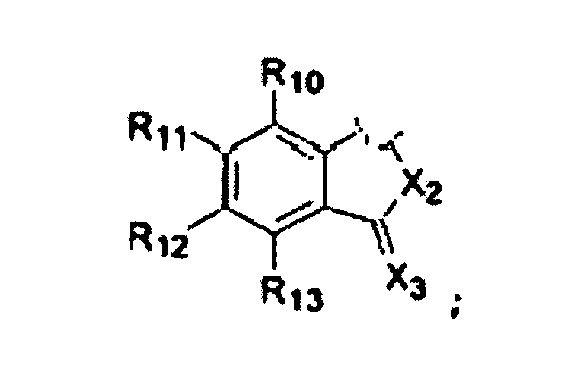
- the substituent R 5 is a spirocyclic moiety having the formula: wherein the phenyl ring of R 5 can be oriented above or below the face of the plane defined by the fused ring system of compound 4.
- R 2 and R 8 independently have the structure: or where the indices m and n independently are integers between 0 and 5 inclusive, such that the sum m + n is equal to or less than ten.
- R 1 , R 3 , R 4 , R 6 , R 7 , and R 9 -R 16 are selected independently from the group consisting of hydrogen, halo, cyano, amino, azido, aldehyde, mercapto, hydroxy, nitro, and optionally substituted, alkyl, cycloalkyl, alkenyl, alkynyl, aryl, acyl, mono- or di- or trialkylammonium, guanidino, carboxamido, carboxy, methylamino, haloacetamido, hydrazido, maleimido, keto, oxime, (mono-, di-, tri-)halomethyl, hydroxamic acid, hydroxylamino, alkoxy, sulfate, sulfonate, phosphate, phosphonate, sulfonyl, sulfonamide, isothiocyanate, halosulfonyl, carboxyazid
- m and n are selected independently from integers between 1 and 3 inclusive. In more particular embodiments, m and n are selected independently from integers between 1 and 3 inclusive, and R 3 -R 6 are selected independently from hydrogen, alkyl, cycloalkyl. In still more particular embodiments, m and n are selected independently from integers between 1 and 3 inclusive, and R 3 -R 6 are selected independently from hydrogen, alkyl, cycloalkyl; and X 1 -X 7 are each oxygen.
- the invention provides improved methods for identifying molecules capable of entering cells and, more particularly, molecules useful to facilitate the entry of other molecules into cells, such as, fluorogenic dyes, which dyes optionally may be attached to another compound such as a therapeutic.
- the methods for identification of molecules comprise high-throughput assays to detect cell entry.
- the invention provides a high throughput screening method for identifying compounds in a compound library that are transport compounds, wherein a transport compound refers to a compound that is internalized by a cell comprising:
- the molecules to be identified are peptoids.
- the peptoids are conjugated with a fluorogenic compound of the invention, so that cellular uptake of the peptoid can be determined efficiently.
- the invention provides a method for determining whether a compound is a transport molecule that is internalized by a cell comprising:
- a library of compounds is provided that is to be screened for the ability of the compounds to be internalized by a cell, the library comprising a plurality of different compounds, wherein the different compounds in the library are covalently attached to a fluorogenic reporter molecule according to the invention.
- the present invention includes methods that comprise screening combinatorial peptoid libraries to identify peptoids that cross the cell membrane and/or peptoids that function to facilitate molecular transport, in which the peptoids being screened are attached covalently to a fluorogenic reporter molecule, and determining whether the resulting conjugate produces increased fluorescence when contacted with a cell.
- the peptoids can be conjugated with a fluorogenic compound of the invention.
- a “peptoid” is a poly(N-substituted amide), preferably a poly(N-substituted glycine), as known in the chemistry and bioorganic chemistry arts and described, for example, in co-owned PCT Publications WO 94/06451 , WO 98/06437 , WO 99/08711 , and U.S. Patent Nos. 5,877,278 ; 6,251,433 ; 6,197,332 ; 6,075,121 ; 5,977,301 ; 5,965,695 ; 5,877,278 ; and 5,831,005 .
- the peptoids have the structure shown below:
- R a and R c are selected independently from the group consisting of alkyl, aryl, aralkyl, aralkenyl, and aralkynyl, any of which may be substituted.
- R a and/or R c is substituted with a lipid moiety, wherein the lipid moiety may be conjugated to a linker moiety.
- R b is independently selected from the group consisting of alkyl, aryl, aralkyl, aralkenyl, and aralkynyl, any of which may be substituted.
- R 21 and R 22 are independently selected from hydrogen, and optionally substituted lower alkyl and lower alkoxy.
- the index p is an integer selected from 2 to about 50, more specifically between about 4 and about 30, still more specifically between about 6 and about 20, and yet more specifically between about 8 and about 15.
- the term "peptoid” encompasses lipitoids and cholesteroids, which are described in Section 1.1.3 and in co-owned U.S. Patent Nos. 6,251,433 and 6,197,332 ; and PCT Publication. Nos. WO 99/08711 and WO 98/06437 .
- a “lipid moiety” is a hydrophobic moiety having a substantial hydrocarbon component, preferably comprising a group selected from C 10 -C 50 branched or unbranched alkyl, alkenyl or alkynyl, C 14 -C 50 aryl, aralkyl, aralkenyl, or aralkynyl, or a steroid nucleus.
- lipid moieties include dialkyl- or dialkenyl-phospholipids, such as phosphatidylcholines, phosphatidylethanolamines and phosphatidylinositols, glycolipids, such as cerebrosides and gangliosides, fatty diacylglycerides, glycosylglycerides, sphingolipids, and steroids, including sterols.
- dialkyl- or dialkenyl-phospholipids such as phosphatidylcholines, phosphatidylethanolamines and phosphatidylinositols
- glycolipids such as cerebrosides and gangliosides
- fatty diacylglycerides such as glycosylglycerides, sphingolipids, and steroids, including sterols.
- a “lipitoid” is a lipid-substituted peptoid, i . e ., a compound described in Section 1.1.1 where R a comprises a lipid moiety.
- a “cholesteroid” is a cholesterol-substituted peptoid, i . e ., a compound described in Section 1.1.1 where R a comprises a cholesteryl moiety. While cholesterols are preferred in some applications, further disclosure of steroids useful for incorporating into steroid-peptoid conjugates is found in PCT publication WO 97/46223 (Fasbender et al .) and corresponding U.S. Patent No. 5,935,936 .
- Alkyl refers to a fully saturated acyclic monovalent radical containing carbon and hydrogen, which may be branched or a straight chain. Examples of alkyl groups are methyl, ethyl, n -butyl, t -butyl, n -heptyl, and isopropyl.
- Alkenyl refers to an acyclic monovalent radical containing carbon and hydrogen, which may be branched or a straight chain, and which contains at least one carbon-carbon double bond. The alkenyl group may be monounsaturated or polyunsaturated.
- alkynyl refers to such a radical having at least one carbon-carbon triple bond.
- “Lower” alkyl refers to a group having 1 to 6 carbons, preferably 1 to 4 carbons.
- An alkyl, alkenyl, or alkynyl group can be optionally substituted; in some embodiments, the substituent is selected from the group consisting of halogen, lower alkyl, lower alkoxy, nitro, amide, tertiary amino, hydroxy, and halo(lower alkyl).
- Aryl refers to a substituted or unsubstituted monovalent aromatic radical having a single ring ( e . g ., benzene) or two or three condensed rings e . g ., naphthyl or phenanthryl).
- Groups having a single ring (monocyclic) or two condensed rings (bicyclic) are generally preferred, with monocyclic groups being particularly preferred.
- the term includes heteroaryl groups, which are aromatic ring groups having one or more nitrogen, oxygen, or sulfur atoms in the ring, such as furan, pyrrole, pyridine, imidazole, and indole.
- substituted is meant that one or more ring hydrogen atoms in the aryl group is replaced with a non-hydrogen group, preferably selected from halogen, lower alkyl, lower alkoxy, nitro, amide, tertiary amino, hydroxy, and halo(lower alkyl).
- the present invention provides novel fluorogenic compounds having the structure shown below ( 4 ):
- the substituent R 5 is a spirocyclic moiety having the formula: wherein the phenyl ring of R 5 can be oriented above or below the face of the plane defined by the fused ring system of compound 4.
- R 2 and R 8 independently have the structure: or where the indices m and n independently are integers between 0 and 5 inclusive, such that the sum m + n is equal to or less than ten.
- R 1 , R 3 , R 4 , R 6 , R 7 , and R 9 -R 16 are selected independently from the group consisting of hydrogen, halo, cyano, amino, azido, aldehyde, mercapto, hydroxy, nitro, and optionally substituted, alkyl, cycloalkyl, alkenyl, alkynyl, aryl, acyl, mono- or di- or trialkylammonium, guanidino, carboxamido, carboxy, methylamino, haloacetamido, hydrazido, maleimido, keto, oxime, (mono-, di-, tri-)halomethyl, hydroxamic acid, hydroxylamino, alkoxy, sulfate, sulfonate, phosphate, phosphonate, sulfonyl, sulfonamide, isothiocyanate, halosulfonyl, carboxyazid
- X 1 is oxygen.
- X 1 -X 3 are oxygen.
- X 1 -X 5 are oxygen.
- X 1 -X 5 are oxygen.
- m 2, and n is 3.
- the invention further includes embodiments in which X 1 -X 5 are oxygen, m is 2, n is 3, and R 16 is trialkylammonium.
- X 1 -X 5 are oxygen, m is 2, n is 3, R 16 is trialkylammonium, and R 14 and R 15 are optionally substituted lower alkyl.
- Still more specific embodiment are those in which X 1 -X 5 are oxygen, m is 2, n is 3, R 16 is trialkylammonium, and R 14 and R 15 independently are methyl or ethyl.
- Other more specific embodiments include those in which X 1 -X 5 are oxygen, m is 2, n is 3, R 16 is trialkylammonium, R 14 and R 15 independently are methyl or ethyl, and R 3 , R 4 , R 6 , R 7 , and R 10 -R 13 are hydrogen.
- the invention provides a specific embodiment in which X 1 -X 5 are oxygen, m is 2, n is 3, R 16 is trimethylammonium, R 14 and R 15 independently are methyl or ethyl, and R 3 , R 4 , R 6 , R 7 , and R 10 -R 13 are hydrogen.
- X 1 -X 5 are oxygen, m is 2, n is 3, R 16 is trimethylammonium, R 14 and R 15 independently are methyl or ethyl, and R 3 , R 4 , R 6 , R 7 , and R 10 -R 13 are hydrogen or carboxyl; and, still more specifically, X 1 -X 5 are oxygen, m is 2, n is 3, R 16 is trimethylammonium, R 14 and R 15 independently are methyl or ethyl, and R 3 , R 4 , R 6 , R 7 , and R 10 -R 13 are hydrogen or carboxyl, and at least one of R 10 -R 13 is carboxyl.
- X 1 -X 5 are oxygen
- m 2, and n is 3, R 16 is dialkylamino.
- X 1 -X 5 are oxygen, m is 2, n is 3, R 16 is dialkylamino, and R 14 and R 15 are optionally substituted lower alkyl.
- Still more specific embodiment are those in which X 1 -X 5 are oxygen, m is 2, n is 3, R 16 is dialkylamino, and R 14 and R 15 independently are methyl or ethyl.
- X 1 -X 5 are oxygen
- m is 2, n is 3
- R 16 is dialkylamino
- R 14 and R 15 independently are methyl or ethyl
- R 3 , R 4 , R 6 , R 7 , and R 10 -R 13 are hydrogen.
- the invention provides a specific embodiment in which X 1 -X 5 are oxygen, m is 2, n is 3, R 16 is dimethylamino, R 14 and R 15 independently are methyl or ethyl, and R 3 , R 4 , R 6 , R 7 , and R 10 -R 13 are hydrogen.
- X 1 -X 5 are oxygen, m is 2, n is 3, R 16 is dimethylamino, R 14 and R 15 independently are methyl or ethyl, and R 3 , R 4 , R 6 , R 7 , and R 10 -R 13 are hydrogen or carboxyl; and, still more specifically, X 1 -X 5 are oxygen, m is 2, n is 3, R 16 is dimethylamino, R 14 and R 15 independently are methyl or ethyl, and R 3 , R 4 , R 6 , R 7 , and R 10 -R 13 are hydrogen or carboxyl, and at least one of R 10 -R 13 is carboxyl.
- X 1 -X 5 are oxygen m is 2, and n is 0.
- the invention further includes embodiments in which X 1 -X 5 are oxygen, m is 2, n is 3, and R 16 is trialkylammonium.
- X 1 -X 5 are oxygen, m is 2, n is 0, R 16 is trialkylammonium, and R 14 and R 15 are optionally substituted lower alkyl.
- Still more specific embodiment are those in which X 1 -X 5 are oxygen, m is 2, n is 0, R 16 is trialkylammonium, and R 14 and R 15 independently are methyl or ethyl.
- X 1 -X 5 are oxygen, m is 2, n is 0, R 16 is trialkylammonium, R 14 and R 15 independently are methyl or ethyl, and R 3 , R 4 , R 6 , R 7 , and R 10 -R 13 are hydrogen.
- the invention provides a specific embodiment in which X 1 -X 5 are oxygen, m is 2, n is 0, R 16 is trimethylammonium, R 14 and R 15 independently are methyl or ethyl, and R 3 , R 4 , R 6 , R 7 , and R 10 -R 13 are hydrogen.
- X 1 -X 5 are oxygen, m is 2, n is 0, R 16 is trimethylammonium, R 14 and R 15 independently are methyl or ethyl, and R 3 , R 4 , R 6 , R 7 , and R 10 -R 13 are hydrogen or carboxyl; and, still more specifically, X 1 -X 5 are oxygen, m is 2, n is 0, R 16 is trimethylammonium, R 14 and R 15 independently are methyl or ethyl, and R 3 , R 4 , R 6 , R 7 , and R 10 -R 13 are hydrogen or carboxyl, and at least one of R 10 -R 13 is carboxyl.
- X 1 -X 5 are oxygen
- m 2, n is 0, and R 16 is dialkylamino.
- X 1 -X 5 are oxygen, m is 2, n is 0, R 16 is dialkylamino, and R 14 and R 15 are optionally substituted lower alkyl.
- Still more specific embodiment are those in which X 1 -X 5 are oxygen, m is 2, n is 0, R 16 is dialkylamino, and R 14 and R 15 independently are methyl or ethyl.
- X 1 -X 5 are oxygen, m is 2, n is 0, R 16 is dialkylamino, R 14 and R 15 independently are methyl or ethyl, and R 3 , R 4 , R 6 , R 7 , and R 10 -R 13 are hydrogen.
- the invention provides a specific embodiment in which X 1 -X 5 are oxygen, m is 2, n is 0, R 16 is dimethylamino, R 14 and R 15 independently are methyl or ethyl, and R 3 , R 4 , R 6 , R 7 , and R 10 -R 13 are hydrogen.
- X 1 -X 5 are oxygen, m is 2, n is 0, R 16 is dimethylamino, R 14 and R 15 independently are methyl or ethyl, and R 3 , R 4 , R 6 , R 7 , and R 10 -R 13 are hydrogen or carboxyl; and, still more specifically, X 1 -X 5 are oxygen, m is 2, n is 0, R 16 is dimethylamino, R 14 and R 15 independently are methyl or ethyl, and R 3 , R 4 , R 6 , R 7 , and R 10 -R 13 are hydrogen or carboxyl, and at least one of R 10 -R 13 is carboxyl.
- X 1 -X 3 and X 5 are oxygen and X 4 is NR 17 .
- more specific embodiments include those in which m is 2, and n is 3.
- the invention further includes embodiments in which X 1 -X 3 and X 5 are oxygen and X 4 is NR 17 , m is 2, n is 3, and R 16 is trialkylammonium.
- X 1 -X 3 and X 5 are oxygen and X 4 is NR 17 , m is 2, n is 3, R 16 is trialkylammonium, and R 14 and R 15 are optionally substituted lower alkyl.
- Still more specific embodiment are those in which X 1 -X 3 and X 5 are oxygen and X 4 is NR 17 , m is 2, n is 3, R 16 is trialkylammonium, and R 14 and R 15 independently are methyl or ethyl.
- Other more specific embodiments include those in which X 1 -X 3 and X 5 are oxygen and X 4 is NR 17 , m is 2, n is 3, R 16 is trialkylammonium, R 14 and R 15 independently are methyl or ethyl, and R 3 , R 4 , R 6 , R 7 , and R 10 -R 13 are hydrogen.
- the invention provides a specific embodiment in which X 1 -X 3 and X 5 are oxygen and X 4 is NR 17 , m is 2, n is 3, R 16 is trimethylammonium, R 14 and R 15 independently are methyl or ethyl, and R 3 , R 4 , R 6 , R 7 , and R 10 -R 13 are hydrogen.
- X 1 -X 3 and X 5 are oxygen and X 4 is NR 17 , m is 2, n is 3, R 16 is trimethylammonium, R 14 and R 15 independently are methyl or ethyl, and R 3 , R 4 , R 6 , R 7 , and R 10 -R 13 are hydrogen or carboxyl; and, still more specifically, X 1 -X 3 and X 5 are oxygen and X 4 is NR 17 , m is 2, n is 3, R 16 is trimethylammonium, R 14 and R 15 independently are methyl or ethyl, and R 3 , R 4 , R 6 , R 7 , and R 10 -R 13 are hydrogen or carboxyl, and at least one of R 10 -R 13 is carboxyl.
- X 1 -X 3 and X 5 are oxygen and X 4 is NR 17 , m is 2, and n is 3, R 16 is dialkylamino.
- X 1 -X 3 and X 5 are oxygen and X 4 is NR 17 , m is 2, n is 3, R 16 is dialkylamino, and R 14 and R 15 are optionally substituted lower alkyl.
- Still more specific embodiment are those in which X 1 -X 3 and X 5 are oxygen and X 4 is NR 17 , m is 2, n is 3, R 16 is dialkylamino, and R 14 and R 15 independently are methyl or ethyl.
- X 1 -X 3 and X 5 are oxygen and X 4 is NR 17 , m is 2, n is 3, R 16 is dialkylamino, R 14 and R 15 independently are methyl or ethyl, and R 3 , R 4 , R 6 , R 7 , and R 10 -R 13 are hydrogen.
- the invention provides a specific embodiment in which X 1 -X 3 and X 5 are oxygen and X 4 is NR 17 , m is 2, n is 3, R 16 is dimethylamino, R 14 and R 15 independently are methyl or ethyl, and R 3 , R 4 , R 6 , R 7 , and R 10 -R 13 are hydrogen.
- X 1 -X 3 and X 5 are oxygen and X 4 is NR 17 , m is 2, n is 3, R 16 is dimethylamino, R 14 and R 15 independently are methyl or ethyl, and R 3 , R 4 , R 6 , R 7 , and R 10 -R 13 are hydrogen or carboxyl; and, still more specifically, X 1 -X 3 and X 5 are oxygen and X 4 is NR 17 , m is 2, n is 3, R 16 is dimethylamino, R 14 and R 15 independently are methyl or ethyl, and R 3 , R 4 , R 6 , R 7 , and R 10 -R 13 are hydrogen or carboxyl, and at least one of R 10 -R 13 is carboxyl.
- X 1 -X 3 and X 5 are oxygen and X 4 is NR 17 , m is 2, and n is 0.
- the invention further includes embodiments in which X 1 -X 3 and X 5 are oxygen and X 4 is NR 17 , m is 2, n is 3, and R 16 is trialkylammonium.
- X 1 -X 3 and X 5 are oxygen and X 4 is NR 17 , m is 2, n is 0, R 16 is trialkylammonium, and R 14 and R 15 are optionally substituted lower alkyl.
- Still more specific embodiment are those in which X 1 -X 3 and X 5 are oxygen and X 4 is NR 17 , m is 2, n is 0, R 16 is trialkylammonium, and R 14 and R 15 independently are methyl or ethyl.
- Other more specific embodiments include those in which X 1 -X 3 and X 5 are oxygen and X 4 is NR 17 , m is 2, n is 0, R 16 is trialkylammonium, R 14 and R 15 independently are methyl or ethyl, and R 3 , R 4 , R 6 , R 7 , and R 10 -R 13 are hydrogen.
- the invention provides a specific embodiment in which X 1 -X 3 and X 5 are oxygen and X 4 is NR 17 , m is 2, n is 0, R 16 is trimethylammonium, R 14 and R 15 independently are methyl or ethyl, and R 3 , R 4 , R 6 , R 7 , and R 10 -R 13 are hydrogen.
- X 1 -X 3 and X 5 are oxygen and X 4 is NR 17 , m is 2, n is 0, R 16 is trimethylammonium, R 14 and R 15 independently are methyl or ethyl, and R 3 , R 4 , R 6 , R 7 , and R 10 -R 13 are hydrogen or carboxyl; and, still more specifically, X 1 -X 3 and X 5 are oxygen and X 4 is NR 17 , m is 2, n is 0, R 16 is trimethylammonium, R 14 and R 15 independently are methyl or ethyl, and R 3 , R 4 , R 6 , R 7 , and R 10 -R 13 are hydrogen or carboxyl, and at least one of R 10 -R 13 is carboxyl.
- X 1 -X 3 and X 5 are oxygen and X 4 is NR 17
- m is 2, n is 0, and R 16 is dialkylamino.
- X 1 -X 3 and X 5 are oxygen and X 4 is NR 17
- m is 2
- n is 0,
- R 16 is dialkylamino
- R 14 and R 15 are optionally substituted lower alkyl.
- Still more specific embodiment are those in which X 1 -X 3 and X 5 are oxygen and X 4 is NR 17 , m is 2, n is 0, R 16 is dialkylamino, and R 14 and R 15 independently are methyl or ethyl.
- X 1 -X 3 and X 5 are oxygen and X 4 is NR 17 , m is 2, n is 0, R 16 is dialkylamino, R 14 and R 15 independently are methyl or ethyl, and R 3 , R 4 , R 6 , R 7 , and R 10 -R 13 are hydrogen.
- the invention provides a specific embodiment in which X 1 -X 3 and X 5 are oxygen and X 4 is NR 17 , m is 2, n is 0, R 16 is dimethylamino, R 14 and R 15 independently are methyl or ethyl, and R 3 , R 4 , R 6 , R 7 , and R 10 -R 13 are hydrogen.
- X 1 -X 3 and X 5 are oxygen and X 4 is NR 17 , m is 2, n is 0, R 16 is dimethylamino, R 14 and R 15 independently are methyl or ethyl, and R 3 , R 4 , R 6 , R 7 , and R 10 -R 13 are hydrogen or carboxyl; and, still more specifically, X 1 -X 3 and X 5 are oxygen and X 4 is NR 17 , m is 2, n is 0, R 16 is dimethylamino, R 14 and R 15 independently are methyl or ethyl, and R 3 , R 4 , R 6 , R 7 , and R 10 -R 13 are hydrogen or carboxyl, and at least one of R 10 -R 13 is carboxyl.
- the compounds of the invention are useful as reporters for detecting cell entry by specific compounds. More specifically, attachment of a compound of the invention to another molecule allows detection and quantitation of the transport of the molecule across a cell membrane.
- the compound of the invention is attached to a molecule to be tested using a functional group contained on the fluorogenic compound of the invention, such as, but not limited to, a carboxylic acid group located on the lower aromatic ring of the fluorophore compound.
- Suitable functional groups that may be used in lieu of a carboxylic acid include by way of example amino, aminomethyl, halomethyl, haloacetamido, mercapto, maleimido, hydrazido, oxime, aldehyde, and keto.
- the choice of functional group will be familiar to those having skill in the organic synthesis and biochemistry arts.
- Compounds to be screened for their ability to facilitate cell entry by the fluorogenic reporter of the invention will include a functional group that is suitably reactive with the functional group on the fluorogenic reporter.
- Examples of compounds that can be screened for cell entry with a fluorophore according to the invention include, but are not limited to: peptides, peptoids, proteins, carbohydrates, nucleic acids, carbohydrates, small molecules and libraries containing such compounds, both random and non-random libraries.
- Linker elements can also be used to facilitate attachment to the test molecule.
- a cleavable linker e . g ., a disulfide or ester linkage between the reporter molecule and transporter group to allow the resultant fluorescent dye to exit the cell into the surrounding medium. Fluorescence is detected by fluorimetry or other methods, as appropriate.
- the choice of linker will be familiar to those having skill in the organic synthesis and biochemistry arts.
- the subject reporter is used to screen combinatorial peptoid libraries containing potential cell-transport molecules. Such libraries and methods for their synthesis are discussed in detail supra.
- the fluorogenic reporter molecules of the invention are used to screen libraries by high-throughput screening methodologies to identify transport molecules that facilitate cell entry of biologically active molecules, e.g., enzyme agonists or antagonists, antibiotics, hormone agonists or antagonists, modulators of gene expression, and the like.
- the transport molecule can further include a "cargo" molecule that is to be transported by the peptoid into the intracellular milieu.
- diverse combinatorial libraries of peptoids are synthesized on a solid-phase resin, e.g., a resin bead, such that one compound is attached to each bead.
- the reporter of the invention is then conjugated to the peptoid compound on each bead.
- the peptoids will further include a "cargo" molecule that is to be transported by the peptoid into the intracellular milieu.
- cargo molecules include, but are not limited to, antibiotic, enzyme agonists or antagonists, hormone analogs, cell growth promoting agents, cell growth inhibiting agents, anti-tumor agents, and apoptosis inducing agents.
- the putative reporter-transport molecule After attachment, the putative reporter-transport molecule is cleaved from the resin bead and is screened in a cell-based assay to determine whether cell entry is achieved (based on generation of fluorescence by the compound of the invention).
- the fluorogenic reporter of the invention can be attached to the putative transport molecule ( e . g ., the peptoid) in solution after cleavage from the resin bead.
- the reporter system provided by the present invention is amenable to any cell that is to be screened for entry by desired compounds.
- examples of such cells include by way of nonlimiting example, prokaryotic cells, eukaryotic cells, mammalian cells, and plant cells. More specific examples of cell types include: fibroblasts, epithelial cells, neural cells, intestinal cells, embryonic and adult stem cells, ovarian cells, liver cells, prostate cells, kidney cells, bladder cells, blood cells, yeast cells, bacteria cells, and immune cells.
- human and non-human mammalian cell lines include, but are not limited to: HeLa, COS, CHO, BHK, Vero, SP2/0, DG44, HT1080, NIH3T3, THP-1, and NR833.
- the reporter-transporter molecule conjugate according to the invention can be added to a cell culture, e . g ., HeLa cell culture, and the fluorescence levels of the cell culture measured to identify whether the putative transporter compound facilitates cell entry (based on an increase in fluorescence). This may be accomplished by addition to microwell cell cultures, e . g ., a 96- or 384-well format or on slides. Fluorescence will only be observed in cell cultures when the putative transport compound has entered the cells.
- DMF (0.1 mL) was added to an oven dried flask containing acid 8 (4.5 mg, 15 ⁇ mol, 3eq) and HATU (11.4 mg, 30 ⁇ mol, 6eq) followed by addition of diisopropylethylamine (5.2 ⁇ L, 30 ⁇ mol, 6 eq). After stirring for 0.5 h, fluorescein (1.7 mg, 5 ⁇ mol, 1eq) was added followed by 4-(dimethylamino)pyridine (1.8 mg, 15 ⁇ mol, 3eq). Additional DMF (0.2 mL) was added after 1 h and the reaction was stirred overnight. A second reaction was carried out on the same scale as the first but in which the DMF was replaced with dimethylacetamide as the solvent.
- Figure 1 contains the fluorescence (excitation 485 nm, emission 535 nm) of compound 9 over time under various conditions.
- opticalmem solid red circle
- cell lysate solid green square
- 9 was incubated in a HeLa cell lysate prepared from approximately 2 ⁇ 10 6 cells lysed by freeze/thaw in a buffer containing 20 mM Tris-HCl, 137 mM NaCl, 1% Triton, and 15% glycerol in a volume of 100 ⁇ L.
- Figure 2 shows the fluorescence (excitation 485 nm, emission 535 nm) over time of compound 9 and an analog in which the ⁇ , ⁇ -dimethyl substituents on the acyl groups have been replaced by ⁇ , ⁇ -dihydrogen substituents.
- Each compound was incubated at a concentration of 50 ⁇ M (diluted from a 2 mM stock in DMF) in 10 mM Na phosphate, pH 7.5, containing 154 mM NaCl, at 37°C. The volume of each incubation was 100 ⁇ L. Results are expressed as a percentage of the fluorescence of a fluorescein control at the same concentration under the same conditions.
- Figure 3 shows the fluorescence (excitation 485 nm, emission 535 nm) of compound 9 after a 60-minute incubation in 10 mM Na phosphate, pH 7.5, containing 154 mM NaCl and ⁇ -mercaptoethanol at concentrations of 0.1, 1, 10, and 100 mM.
- the volume of each incubation was 100 ⁇ L, and the temperature was 37°C. Results are expressed as a percentage of the fluorescence of a fluorescein control at the same concentration under the same conditions.
Landscapes
- Health & Medical Sciences (AREA)
- Life Sciences & Earth Sciences (AREA)
- Engineering & Computer Science (AREA)
- Immunology (AREA)
- Biomedical Technology (AREA)
- Chemical & Material Sciences (AREA)
- Molecular Biology (AREA)
- Hematology (AREA)
- Urology & Nephrology (AREA)
- Physics & Mathematics (AREA)
- Microbiology (AREA)
- Cell Biology (AREA)
- Food Science & Technology (AREA)
- Medicinal Chemistry (AREA)
- Biotechnology (AREA)
- Analytical Chemistry (AREA)
- Biochemistry (AREA)
- General Health & Medical Sciences (AREA)
- General Physics & Mathematics (AREA)
- Pathology (AREA)
- Bioinformatics & Cheminformatics (AREA)
- Toxicology (AREA)
- Tropical Medicine & Parasitology (AREA)
- Organic Chemistry (AREA)
- Measuring Or Testing Involving Enzymes Or Micro-Organisms (AREA)
- Coloring (AREA)
- Heterocyclic Carbon Compounds Containing A Hetero Ring Having Oxygen Or Sulfur (AREA)
- Investigating Or Analysing Biological Materials (AREA)
- Non-Silver Salt Photosensitive Materials And Non-Silver Salt Photography (AREA)
- Heat Sensitive Colour Forming Recording (AREA)
Claims (30)
- Fluorogener Farbstoff mit der Struktur:

wobei R2 und R8 unabhängig voneinander die Struktur:

wobei R1, R3, R4, R6, R7 und R9-R16 unabhängig voneinander ausgewählt sind aus der Gruppe bestehend aus Wasserstoff, Halogen, Cyano, Amino, Azido, Aldehyd, Mercapto, Hydroxy, Nitro und gegebenenfalls substituiertes Alkyl, Cycloalkyl, Alkenyl, Alkinyl, Aryl, Acyl, Mono- oder Di- oder Trialkylammonium, Guanidino, Carboxamido, Carboxy, Methylamino, Halogenacetamido, Hydrazido, Maleimido, Keto, Oxim, (Mono-, Di-, Tri-)Halogenmethyl, Hydroxamsäure, Hydroxylamino, Alkoxy, Sulfat, Sulfonat, Phosphat, Phosphonat, Sulfonyl, Sulfonamid, Isothiocyanat, Halogensulfonyl, Carboxyazido, Semicarbazido, Thiosemicarbazido, Sulfonylhydrazido, Carbodimid; und
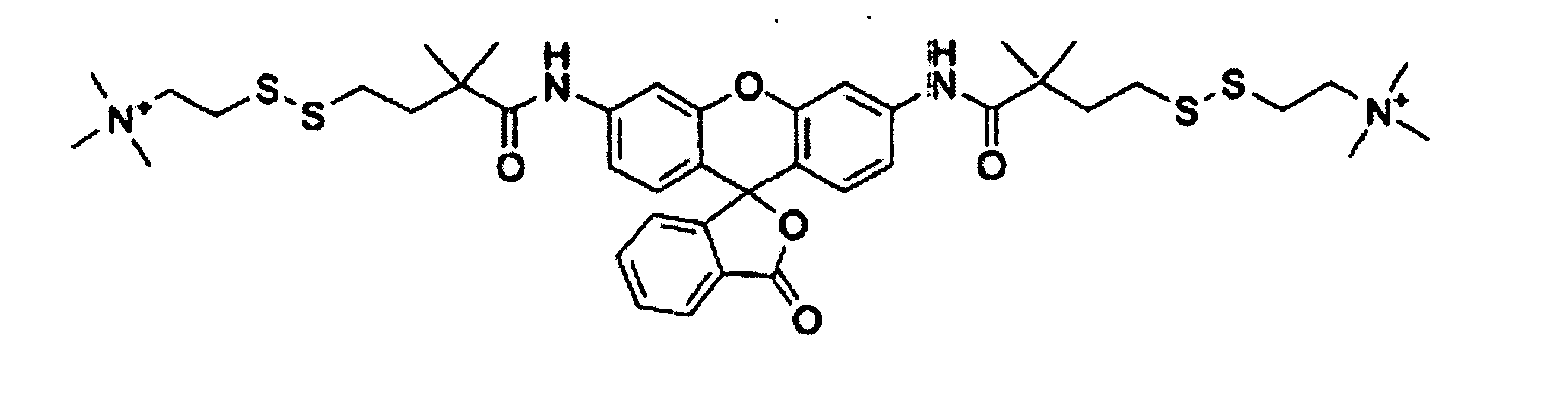
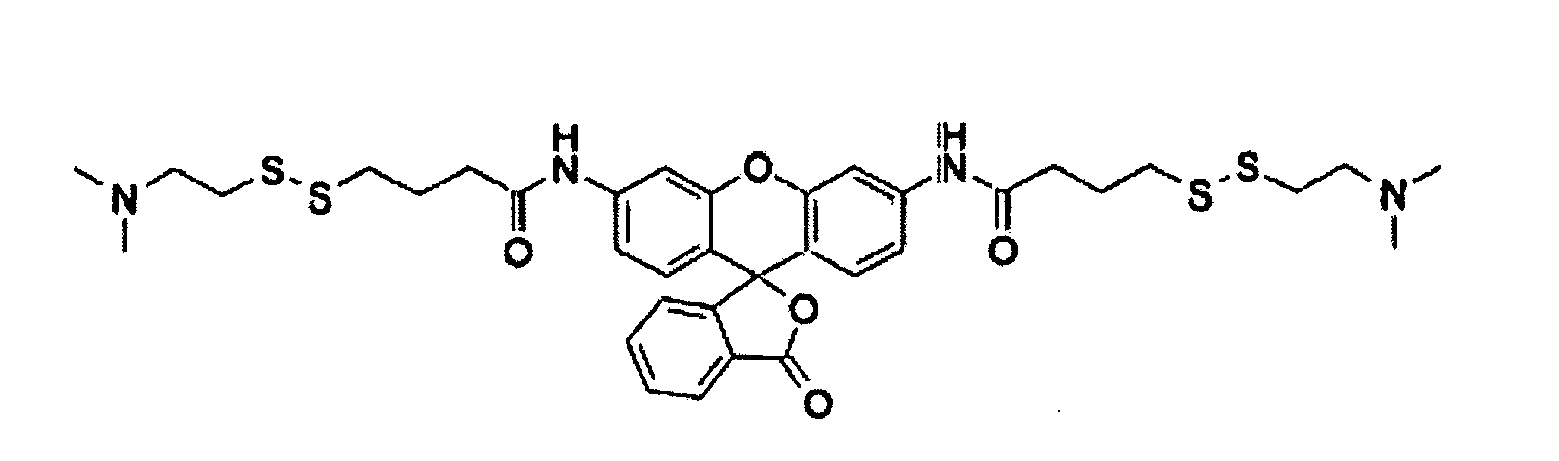
wobei X1-X5 unabhängig voneinander ausgewählt sind aus der Gruppe bestehend aus Sauerstoff, Schwefel und NR17, wobei R17 Wasserstoff oder gegebenenfalls substituiertes Niederalkyl ist. - Fluorogener Farbstoff nach Anspruch 1, wobei die Struktur ausgewählt ist aus der Gruppe bestehend aus




- Farbstoff nach Anspruch 1, wobei die Struktur die Folgende ist:

- Farbstoff nach Anspruch 1, wobei die Struktur die Folgende ist:

- Hochdurchsatz-Screeningverfahren zur Identifizierung von Verbindungen in einer Verbindungsbibliothek, die Transportverbindungen sind, wobei sich eine Transportverbindung auf eine Verbindung bezieht, die von einer Zelle internalisiert wird, bei dem man:a) die einzelnen Verbindungen in einer Verbindungsbibliothek über eine spaltbare Verknüpfung an eine Festphase anheftet, wobei jede der einzelnen Verbindungen direkt oder indirekt an einen fluorogenen Reporter angeheftet ist, der bei Eintritt in die Zelle fluoreszent wird, wobei der fluorogene Reporter ein fluorogener Farbstoff nach einem der Ansprüche 1 bis 4 ist;b) das Reporter-Verbindungskonjugat von der Festphase freisetzt;c) das freigesetzte Reporter-Verbindungskonjugat mit einer Zelle in Kontakt bringt; undd) basierend darauf, ob es eine nachweisbare Fluoreszenzveränderung gibt, bestimmt, ob die Verbindung ein Transportermolekül ist.
- Verfahren nach Anspruch 5, bei dem die Festphase ein Kügelchen (bead) ist.
- Verfahren nach Anspruch 5, bei dem die kombinatorische Bibliothek eine Peptoid-Bibliothek ist.
- Verfahren nach Anspruch 5, bei dem die kombinatorische Bibliothek ausgewählt ist aus einer Peptid-Bibliothek, einer Peptoid-Bibliothek, einer Nukleinsäure-Bibliothek, einer Kohlenhydrat-Bibliothek oder einer Small Molecule-Bibliothek.
- Verfahren nach Anspruch 5, bei dem das Transportmolekül ferner ein Frachtmolekül (cargo molecule) umfasst.
- Verfahren nach Anspruch 9, bei dem das Frachtmolekül ein Wirkstoff ist.
- Verfahren nach Anspruch 10, bei dem der Wirkstoff ein Antibiotikum, ein Enzym-Inhibitor, ein Hormon-Agonist oder Hormon-Antagonist oder ein Zellwachstumsmodulator ist.
- Verfahren nach Anspruch 11, bei dem der Wirkstoff ein Antibiotikum ist.
- Verfahren zur Bestimmung, ob eine Verbindung ein Transportmolekül ist, das von einer Zelle internalisiert wird, bei dem man:a) eine Zelle mit einem Konjugat in Kontakt bringt, das eine Reporterverbindung umfasst, die nur nach Eintritt in die Zelle eine Fluoreszenz erzeugt, wobei der Reporter kovalent an eine potentielle Transportverbindung gebunden ist, welche hinsichtlich ihrer Fähigkeit untersucht werden soll, von der kontaktierten Zelle internalisiert zu werden, und wobei der fluorogene Reporter ein fluorogener Farbstoff nach einem der Ansprüche 1 bis 4 ist;b) nachweist, ob nach dem Schritt des Inkontaktbringens eine Fluoreszenz erzeugt wird; undc) die Erzeugung einer Fluoreszenz mit der Internalisierung der Transportverbindung durch die Zelle in Beziehung setzt.
- Verfahren nach Anspruch 13, bei der die potentielle Transportverbindung über eine spaltbare Verknüpfung an eine Festphase angeheftet ist und vor dem Inkontaktbringen mit der Zelle von dieser abgespalten wird.
- Verfahren nach Anspruch 14, bei der die Festphase ein Kügelchen eines Säulenmaterials (resinous bead) ist.
- Verfahren nach Anspruch 13, bei dem die potentielle Transportverbindung ausgewählt ist aus der Gruppe bestehend aus einem Peptid, einem Protein, einer Nukleinsäure, einem Peptoid, einem Kohlenhydrat und einem Steroid.
- Verfahren nach Anspruch 13, bei dem die potentielle Transportverbindung in einer kombinatorischen, chemischen Bibliothek enthalten ist.
- Verfahren nach Anspruch 17, bei dem die kombinatorische, chemische Bibliothek eine Peptoid-Bibliothek ist.
- Verfahren nach Anspruch 13, bei dem der Reporter chemisch an die potentielle Transportverbindung, die hinsichtlich ihrer Fähigkeit, von einer Zelle in Lösung internalisiert zu werden, untersucht werden soll, angeheftet ist.
- Verfahren nach Anspruch 13, bei dem der Reporter chemisch an eine potentielle Transportverbindung angeheftet ist, bei der untersucht werden soll, ob sie von einer Zelle internalisiert wird, während diese Verbindung an eine Festphase angeheftet ist.
- Verbindungsbibliothek, die hinsichtlich der Fähigkeit der Verbindungen, von einer Zelle internalisiert zu werden, untersucht werden soll, wobei die Bibliothek eine Vielzahl von verschiedenen Verbindungen umfasst, wobei die verschiedenen Verbindungen in der Bibliothek kovalent an ein fluorogenes Reportermolekül angeheftet sind, das fluoreszent wird, nachdem es in eine Zelle eingetreten ist, wobei das fluorogene Reportermolekül ein fluorogener Farbstoff nach einem der Ansprüche 1 bis 4 ist.
- Bibliothek nach Anspruch 21, wobei der fluorogene Reporter ein fluorogener Farbstoff nach Anspruch 2 ist.
- Bibliothek nach Anspruch 21, wobei jedes der verschiedenen Verbindungskonjugate an eine Festphase angeheftet ist.
- Bibliothek nach Anspruch 23, wobei die verschiedenen Konjugate in verschiedenen Mikrovertiefungen enthalten sind.
- Bibliothek nach Anspruch 23, wobei die verschiedenen Konjugate auf verschiedenen Objektträgern oder Scheiben oder auf einzelnen Teilen dieser Objektträger oder Scheiben vorliegen.
- Verfahren zur Bestimmung, ob eine Bibliothek Verbindungen umfasst, die in eine Zelle transportiert werden, bei dem man:a) eine Bibliothek von Reporter-Verbindungskonjugaten nach Anspruch 21 bereitstellt;b) die verschiedenen Reporter-Verbindungskonjugate mit einer Zellkultur in Kontakt bringt; undc) bestimmt, ob die Zellkultur fluoresziert, wenn sie mit dem Reporter-Verbindungskonjugat in Kontakt gebracht wird, und die Erzeugung einer Fluoreszenz mit der Internalisierung der Verbindung durch die Zelle in Beziehung setzt.
- Verfahren nach Anspruch 26, bei dem die Zellkultur in einer Mikrovertiefung enthalten ist.
- Verfahren nach Anspruch 26, bei dem die Zellkultur auf einem beschichteten Objektträger vorliegt.
- Verfahren nach Anspruch 26, bei dem die Fluoreszenz durch direkte Bildgebung nachgewiesen wird.
- Verfahren nach Anspruch 26, bei dem die Fluoreszenz durch Durchflusszytometrie nachgewiesen wird.
Applications Claiming Priority (3)
| Application Number | Priority Date | Filing Date | Title |
|---|---|---|---|
| US35116802P | 2002-01-22 | 2002-01-22 | |
| US351168P | 2002-01-22 | ||
| PCT/US2003/001958 WO2003062451A2 (en) | 2002-01-22 | 2003-01-22 | Fluorogenic dyes |
Publications (3)
| Publication Number | Publication Date |
|---|---|
| EP1476576A2 EP1476576A2 (de) | 2004-11-17 |
| EP1476576A4 EP1476576A4 (de) | 2006-05-17 |
| EP1476576B1 true EP1476576B1 (de) | 2008-10-29 |
Family
ID=27613467
Family Applications (1)
| Application Number | Title | Priority Date | Filing Date |
|---|---|---|---|
| EP03732051A Expired - Lifetime EP1476576B1 (de) | 2002-01-22 | 2003-01-22 | Fluorogene farbstoffe |
Country Status (9)
| Country | Link |
|---|---|
| US (1) | US7026166B2 (de) |
| EP (1) | EP1476576B1 (de) |
| AT (1) | ATE412894T1 (de) |
| AU (1) | AU2003210620A1 (de) |
| CA (1) | CA2473747C (de) |
| DE (1) | DE60324388D1 (de) |
| ES (1) | ES2316765T3 (de) |
| PT (1) | PT1476576E (de) |
| WO (1) | WO2003062451A2 (de) |
Families Citing this family (7)
| Publication number | Priority date | Publication date | Assignee | Title |
|---|---|---|---|---|
| US7704756B2 (en) * | 2003-01-21 | 2010-04-27 | Novartis Vaccines And Diagnostics, Inc. | Fluorogenic dyes |
| WO2005047245A2 (en) | 2003-11-14 | 2005-05-26 | Wisconsin Alumni Research Foundation | Fluorescence assays with improved blocking groups |
| US8586743B2 (en) * | 2007-01-30 | 2013-11-19 | Life Technologies Corporation | Labeling reagents and methods of their use |
| WO2010017412A1 (en) | 2008-08-06 | 2010-02-11 | The Regents Of The University Of California | Novel biomimetic peptoid polymers |
| MX391259B (es) | 2015-10-14 | 2025-03-21 | X Therma Inc | Composiciones y métodos para reducir la formación de cristales de hielo. |
| CN110272637B (zh) * | 2018-03-16 | 2021-06-04 | 中国科学院大连化学物理研究所 | 一种耐酸性光控荧光分子开关及其合成方法和应用 |
| CN116396984B (zh) * | 2022-07-21 | 2024-02-13 | 苏州炫景生物科技有限公司 | 核酸递送载体及功能协同的药物组合物应用 |
Family Cites Families (28)
| Publication number | Priority date | Publication date | Assignee | Title |
|---|---|---|---|---|
| US3728113A (en) * | 1971-07-06 | 1973-04-17 | Eastman Kodak Co | Selective transfer system and compounds for employment therein |
| BE792600A (fr) * | 1972-02-17 | 1973-06-12 | Eastman Kodak Co | Produits et procedes pour la photographie en couleurs |
| JPS55500053A (de) | 1978-01-16 | 1980-01-31 | ||
| US4713324A (en) * | 1983-09-01 | 1987-12-15 | Technicon Instruments Corporation | Inverted latency specific binding assay |
| US4889916A (en) * | 1985-11-19 | 1989-12-26 | The Johns Hopkins University | Protein label and drug delivery system |
| US5055561A (en) * | 1985-11-19 | 1991-10-08 | The Johns Hopkins University | Protein label and drug delivery system |
| US4751286A (en) * | 1985-11-19 | 1988-06-14 | The Johns Hopkins University | Protein label and drug delivery system |
| EP0264797B1 (de) | 1986-10-24 | 1996-01-10 | Abbott Laboratories | Test, Indikatoren, Immunogene und Antikörper für Benzodiazepine |
| US4868132A (en) * | 1987-02-03 | 1989-09-19 | Abbott Laboratories | Fluorescence polarization immunoassay for amphetamine/methamphetamine |
| US4869132A (en) * | 1987-07-17 | 1989-09-26 | Clem Michael L | Automated electrical switching system |
| JPH03503845A (ja) * | 1988-04-22 | 1991-08-29 | マサチユセツツ・インスチチユート・オブ・テクノロジー | 微小滴を形成しそして使用する方法 |
| US5804604A (en) * | 1989-12-21 | 1998-09-08 | Biogen, Inc. | Tat-derived transport polypeptides and fusion proteins |
| US5639603A (en) * | 1991-09-18 | 1997-06-17 | Affymax Technologies N.V. | Synthesizing and screening molecular diversity |
| US5352803A (en) * | 1992-03-30 | 1994-10-04 | Abbott Laboratories | 5(6)-methyl substituted fluorescein derivatives |
| CA2135642C (en) | 1992-08-21 | 1999-12-14 | James G. Barsoum | Tat-derived transport polypeptides |
| TW251236B (de) * | 1992-09-10 | 1995-07-11 | Ciba Vision Ag | |
| US5837533A (en) * | 1994-09-28 | 1998-11-17 | American Home Products Corporation | Complexes comprising a nucleic acid bound to a cationic polyamine having an endosome disruption agent |
| US5756771A (en) * | 1995-04-13 | 1998-05-26 | Abbott Laboratories | 5(6)-methyl substituted fluorescein derivatives |
| US20030215798A1 (en) * | 1997-06-16 | 2003-11-20 | Diversa Corporation | High throughput fluorescence-based screening for novel enzymes |
| CA2251781A1 (en) * | 1996-03-20 | 1997-09-25 | Charles Nicolette | A method for identifying cytotoxic t-cell epitopes |
| IT1298693B1 (it) * | 1996-04-24 | 2000-01-12 | Hoffmann La Roche | Derivati della fluoresceina 4'-metil sostituiti |
| US5800996A (en) * | 1996-05-03 | 1998-09-01 | The Perkin Elmer Corporation | Energy transfer dyes with enchanced fluorescence |
| US6756207B1 (en) * | 1997-02-27 | 2004-06-29 | Cellomics, Inc. | System for cell-based screening |
| IL132941A0 (en) | 1997-05-21 | 2001-03-19 | Univ Leland Stanford Junior | Composition and method for enhancing transport across biological membranes |
| DE19935302A1 (de) * | 1999-07-28 | 2001-02-08 | Aventis Pharma Gmbh | Konjugate und Verfahren zu deren Herstellung sowie deren Verwendung zum Transport von Molekülen über biologische Membranen |
| US7413536B1 (en) * | 1999-09-14 | 2008-08-19 | Xenoport, Inc. | Substrates and screening methods for transport proteins |
| US6221604B1 (en) * | 2000-02-07 | 2001-04-24 | Pe Corporation | Electron-deficient nitrogen heterocycle-substituted fluorescein dyes |
| ES2300379T3 (es) * | 2000-12-23 | 2008-06-16 | Novartis Vaccines And Diagnostics, Inc. | Procedimiento de deteccion selectiva de transfeccion de oligonucleotidos. |
-
2003
- 2003-01-21 US US10/349,256 patent/US7026166B2/en not_active Expired - Fee Related
- 2003-01-22 CA CA2473747A patent/CA2473747C/en not_active Expired - Fee Related
- 2003-01-22 ES ES03732051T patent/ES2316765T3/es not_active Expired - Lifetime
- 2003-01-22 PT PT03732051T patent/PT1476576E/pt unknown
- 2003-01-22 AU AU2003210620A patent/AU2003210620A1/en not_active Abandoned
- 2003-01-22 EP EP03732051A patent/EP1476576B1/de not_active Expired - Lifetime
- 2003-01-22 WO PCT/US2003/001958 patent/WO2003062451A2/en not_active Ceased
- 2003-01-22 AT AT03732051T patent/ATE412894T1/de not_active IP Right Cessation
- 2003-01-22 DE DE60324388T patent/DE60324388D1/de not_active Expired - Lifetime
Also Published As
| Publication number | Publication date |
|---|---|
| CA2473747C (en) | 2012-09-11 |
| US20030165955A1 (en) | 2003-09-04 |
| EP1476576A2 (de) | 2004-11-17 |
| DE60324388D1 (de) | 2008-12-11 |
| EP1476576A4 (de) | 2006-05-17 |
| WO2003062451A2 (en) | 2003-07-31 |
| ES2316765T3 (es) | 2009-04-16 |
| AU2003210620A1 (en) | 2003-09-02 |
| WO2003062451A3 (en) | 2004-04-15 |
| ATE412894T1 (de) | 2008-11-15 |
| US7026166B2 (en) | 2006-04-11 |
| CA2473747A1 (en) | 2003-07-31 |
| PT1476576E (pt) | 2008-12-09 |
Similar Documents
| Publication | Publication Date | Title |
|---|---|---|
| AU783487B2 (en) | Detection of transmembrane potentials by optical methods | |
| US7317111B2 (en) | Green and orange fluorescent labels and their uses | |
| AU716130B2 (en) | Detection of transmembrane potentials by optical methods | |
| EP2185721B1 (de) | Caspase-bildgebungssonden | |
| Turnbull et al. | Phosphonofluoresceins: Synthesis, spectroscopy, and applications | |
| US9701667B2 (en) | Coumarin-based fluorogenic agents and uses thereof for specific protein labelling | |
| US7704756B2 (en) | Fluorogenic dyes | |
| EP1476576B1 (de) | Fluorogene farbstoffe | |
| JPH09124599A (ja) | インドシアニン化合物 | |
| Lapeyre et al. | Aryldithioethyloxycarbonyl (Ardec): a new family of amine protecting groups removable under mild reducing conditions and their applications to peptide synthesis | |
| US9127164B2 (en) | Fluorescent dyes and uses thereof | |
| US8603966B2 (en) | Amino acid-based compounds, their methods of use, and methods of screening | |
| WO2012138805A2 (en) | Substituted anthraquinone dyes for cellular stains and enzyme detection | |
| Li et al. | General strategy for the preparation of membrane permeable fluorogenic peptide ester conjugates for in vivo studies of ester prodrug stability | |
| Luo et al. | Dual-monomer solvatochromic probe system (DSPS) for effectively differentiating lipid raft cholesterol and active membrane cholesterol in the inner-leaflet plasma membrane | |
| US9958452B2 (en) | Highly fluorogenic protein labelling agents | |
| Gupta et al. | A novel cyan-emitting fluorescent α-amino acid: synthesis, photophysical characterization and live-cell imaging properties | |
| Puckett | The cellular uptake of luminescent ruthenium complexes | |
| CN120208883A (zh) | α-酰氧基烯酰胺亲电弹头及其用途 | |
| HK1090422B (en) | A system for determining the electrical potential across a membrane |
Legal Events
| Date | Code | Title | Description |
|---|---|---|---|
| PUAI | Public reference made under article 153(3) epc to a published international application that has entered the european phase |
Free format text: ORIGINAL CODE: 0009012 |
|
| 17P | Request for examination filed |
Effective date: 20040820 |
|
| AK | Designated contracting states |
Kind code of ref document: A2 Designated state(s): AT BE BG CH CY CZ DE DK EE ES FI FR GB GR HU IE IT LI LU MC NL PT SE SI SK TR |
|
| AX | Request for extension of the european patent |
Extension state: AL LT LV MK RO |
|
| RIC1 | Information provided on ipc code assigned before grant |
Ipc: G01N 33/543 20060101ALI20060313BHEP Ipc: G01N 33/542 20060101ALI20060313BHEP Ipc: G01N 33/50 20060101AFI20060313BHEP |
|
| A4 | Supplementary search report drawn up and despatched |
Effective date: 20060404 |
|
| 17Q | First examination report despatched |
Effective date: 20061220 |
|
| RAP1 | Party data changed (applicant data changed or rights of an application transferred) |
Owner name: NOVARTIS VACCINES AND DIAGNOSTICS, INC. |
|
| GRAP | Despatch of communication of intention to grant a patent |
Free format text: ORIGINAL CODE: EPIDOSNIGR1 |
|
| GRAS | Grant fee paid |
Free format text: ORIGINAL CODE: EPIDOSNIGR3 |
|
| GRAA | (expected) grant |
Free format text: ORIGINAL CODE: 0009210 |
|
| AK | Designated contracting states |
Kind code of ref document: B1 Designated state(s): AT BE BG CH CY CZ DE DK EE ES FI FR GB GR HU IE IT LI LU MC NL PT SE SI SK TR |
|
| REG | Reference to a national code |
Ref country code: GB Ref legal event code: FG4D |
|
| REG | Reference to a national code |
Ref country code: CH Ref legal event code: EP |
|
| REG | Reference to a national code |
Ref country code: PT Ref legal event code: SC4A Free format text: AVAILABILITY OF NATIONAL TRANSLATION Effective date: 20081124 |
|
| REG | Reference to a national code |
Ref country code: IE Ref legal event code: FG4D |
|
| REF | Corresponds to: |
Ref document number: 60324388 Country of ref document: DE Date of ref document: 20081211 Kind code of ref document: P |
|
| REG | Reference to a national code |
Ref country code: ES Ref legal event code: FG2A Ref document number: 2316765 Country of ref document: ES Kind code of ref document: T3 |
|
| PG25 | Lapsed in a contracting state [announced via postgrant information from national office to epo] |
Ref country code: BG Free format text: LAPSE BECAUSE OF FAILURE TO SUBMIT A TRANSLATION OF THE DESCRIPTION OR TO PAY THE FEE WITHIN THE PRESCRIBED TIME-LIMIT Effective date: 20090129 Ref country code: AT Free format text: LAPSE BECAUSE OF FAILURE TO SUBMIT A TRANSLATION OF THE DESCRIPTION OR TO PAY THE FEE WITHIN THE PRESCRIBED TIME-LIMIT Effective date: 20081029 |
|
| PG25 | Lapsed in a contracting state [announced via postgrant information from national office to epo] |
Ref country code: FI Free format text: LAPSE BECAUSE OF FAILURE TO SUBMIT A TRANSLATION OF THE DESCRIPTION OR TO PAY THE FEE WITHIN THE PRESCRIBED TIME-LIMIT Effective date: 20081029 Ref country code: SI Free format text: LAPSE BECAUSE OF FAILURE TO SUBMIT A TRANSLATION OF THE DESCRIPTION OR TO PAY THE FEE WITHIN THE PRESCRIBED TIME-LIMIT Effective date: 20081029 |
|
| PG25 | Lapsed in a contracting state [announced via postgrant information from national office to epo] |
Ref country code: DK Free format text: LAPSE BECAUSE OF FAILURE TO SUBMIT A TRANSLATION OF THE DESCRIPTION OR TO PAY THE FEE WITHIN THE PRESCRIBED TIME-LIMIT Effective date: 20081029 Ref country code: BE Free format text: LAPSE BECAUSE OF FAILURE TO SUBMIT A TRANSLATION OF THE DESCRIPTION OR TO PAY THE FEE WITHIN THE PRESCRIBED TIME-LIMIT Effective date: 20081029 Ref country code: EE Free format text: LAPSE BECAUSE OF FAILURE TO SUBMIT A TRANSLATION OF THE DESCRIPTION OR TO PAY THE FEE WITHIN THE PRESCRIBED TIME-LIMIT Effective date: 20081029 |
|
| PG25 | Lapsed in a contracting state [announced via postgrant information from national office to epo] |
Ref country code: SE Free format text: LAPSE BECAUSE OF FAILURE TO SUBMIT A TRANSLATION OF THE DESCRIPTION OR TO PAY THE FEE WITHIN THE PRESCRIBED TIME-LIMIT Effective date: 20090129 Ref country code: CZ Free format text: LAPSE BECAUSE OF FAILURE TO SUBMIT A TRANSLATION OF THE DESCRIPTION OR TO PAY THE FEE WITHIN THE PRESCRIBED TIME-LIMIT Effective date: 20081029 Ref country code: MC Free format text: LAPSE BECAUSE OF NON-PAYMENT OF DUE FEES Effective date: 20090131 |
|
| REG | Reference to a national code |
Ref country code: CH Ref legal event code: PL |
|
| PLBE | No opposition filed within time limit |
Free format text: ORIGINAL CODE: 0009261 |
|
| STAA | Information on the status of an ep patent application or granted ep patent |
Free format text: STATUS: NO OPPOSITION FILED WITHIN TIME LIMIT |
|
| PG25 | Lapsed in a contracting state [announced via postgrant information from national office to epo] |
Ref country code: SK Free format text: LAPSE BECAUSE OF FAILURE TO SUBMIT A TRANSLATION OF THE DESCRIPTION OR TO PAY THE FEE WITHIN THE PRESCRIBED TIME-LIMIT Effective date: 20081029 |
|
| 26N | No opposition filed |
Effective date: 20090730 |
|
| REG | Reference to a national code |
Ref country code: IE Ref legal event code: MM4A |
|
| PG25 | Lapsed in a contracting state [announced via postgrant information from national office to epo] |
Ref country code: LI Free format text: LAPSE BECAUSE OF NON-PAYMENT OF DUE FEES Effective date: 20090131 Ref country code: CH Free format text: LAPSE BECAUSE OF NON-PAYMENT OF DUE FEES Effective date: 20090131 |
|
| PG25 | Lapsed in a contracting state [announced via postgrant information from national office to epo] |
Ref country code: IE Free format text: LAPSE BECAUSE OF NON-PAYMENT OF DUE FEES Effective date: 20090122 |
|
| PG25 | Lapsed in a contracting state [announced via postgrant information from national office to epo] |
Ref country code: GR Free format text: LAPSE BECAUSE OF FAILURE TO SUBMIT A TRANSLATION OF THE DESCRIPTION OR TO PAY THE FEE WITHIN THE PRESCRIBED TIME-LIMIT Effective date: 20090130 |
|
| PG25 | Lapsed in a contracting state [announced via postgrant information from national office to epo] |
Ref country code: LU Free format text: LAPSE BECAUSE OF NON-PAYMENT OF DUE FEES Effective date: 20090122 |
|
| PG25 | Lapsed in a contracting state [announced via postgrant information from national office to epo] |
Ref country code: HU Free format text: LAPSE BECAUSE OF FAILURE TO SUBMIT A TRANSLATION OF THE DESCRIPTION OR TO PAY THE FEE WITHIN THE PRESCRIBED TIME-LIMIT Effective date: 20090430 |
|
| PG25 | Lapsed in a contracting state [announced via postgrant information from national office to epo] |
Ref country code: TR Free format text: LAPSE BECAUSE OF FAILURE TO SUBMIT A TRANSLATION OF THE DESCRIPTION OR TO PAY THE FEE WITHIN THE PRESCRIBED TIME-LIMIT Effective date: 20081029 |
|
| PG25 | Lapsed in a contracting state [announced via postgrant information from national office to epo] |
Ref country code: CY Free format text: LAPSE BECAUSE OF FAILURE TO SUBMIT A TRANSLATION OF THE DESCRIPTION OR TO PAY THE FEE WITHIN THE PRESCRIBED TIME-LIMIT Effective date: 20081029 |
|
| PGFP | Annual fee paid to national office [announced via postgrant information from national office to epo] |
Ref country code: IT Payment date: 20120114 Year of fee payment: 10 |
|
| PGFP | Annual fee paid to national office [announced via postgrant information from national office to epo] |
Ref country code: DE Payment date: 20130116 Year of fee payment: 11 Ref country code: GB Payment date: 20130116 Year of fee payment: 11 Ref country code: FR Payment date: 20130204 Year of fee payment: 11 |
|
| PGFP | Annual fee paid to national office [announced via postgrant information from national office to epo] |
Ref country code: NL Payment date: 20130110 Year of fee payment: 11 |
|
| REG | Reference to a national code |
Ref country code: PT Ref legal event code: MM4A Free format text: LAPSE DUE TO NON-PAYMENT OF FEES Effective date: 20140722 |
|
| REG | Reference to a national code |
Ref country code: DE Ref legal event code: R119 Ref document number: 60324388 Country of ref document: DE |
|
| REG | Reference to a national code |
Ref country code: NL Ref legal event code: V1 Effective date: 20140801 |
|
| GBPC | Gb: european patent ceased through non-payment of renewal fee |
Effective date: 20140122 |
|
| REG | Reference to a national code |
Ref country code: DE Ref legal event code: R119 Ref document number: 60324388 Country of ref document: DE Effective date: 20140801 |
|
| PG25 | Lapsed in a contracting state [announced via postgrant information from national office to epo] |
Ref country code: NL Free format text: LAPSE BECAUSE OF NON-PAYMENT OF DUE FEES Effective date: 20140801 Ref country code: DE Free format text: LAPSE BECAUSE OF NON-PAYMENT OF DUE FEES Effective date: 20140801 |
|
| REG | Reference to a national code |
Ref country code: FR Ref legal event code: ST Effective date: 20140930 |
|
| PG25 | Lapsed in a contracting state [announced via postgrant information from national office to epo] |
Ref country code: FR Free format text: LAPSE BECAUSE OF NON-PAYMENT OF DUE FEES Effective date: 20140131 Ref country code: GB Free format text: LAPSE BECAUSE OF NON-PAYMENT OF DUE FEES Effective date: 20140122 |
|
| PG25 | Lapsed in a contracting state [announced via postgrant information from national office to epo] |
Ref country code: PT Free format text: LAPSE BECAUSE OF NON-PAYMENT OF DUE FEES Effective date: 20140722 |
|
| REG | Reference to a national code |
Ref country code: PT Ref legal event code: NF4A Free format text: RESTITUTIO IN INTEGRUM Effective date: 20150119 |
|
| PGFP | Annual fee paid to national office [announced via postgrant information from national office to epo] |
Ref country code: ES Payment date: 20150115 Year of fee payment: 13 Ref country code: PT Payment date: 20150119 Year of fee payment: 13 |
|
| PGRI | Patent reinstated in contracting state [announced from national office to epo] |
Ref country code: PT Effective date: 20150119 |
|
| PG25 | Lapsed in a contracting state [announced via postgrant information from national office to epo] |
Ref country code: IT Free format text: LAPSE BECAUSE OF NON-PAYMENT OF DUE FEES Effective date: 20140122 |
|
| PG25 | Lapsed in a contracting state [announced via postgrant information from national office to epo] |
Ref country code: PT Free format text: LAPSE BECAUSE OF NON-PAYMENT OF DUE FEES Effective date: 20160722 |
|
| REG | Reference to a national code |
Ref country code: ES Ref legal event code: FD2A Effective date: 20170228 |
|
| PG25 | Lapsed in a contracting state [announced via postgrant information from national office to epo] |
Ref country code: ES Free format text: LAPSE BECAUSE OF NON-PAYMENT OF DUE FEES Effective date: 20160123 |