EP1475077A2 - Zweiphasige flüssige Antitranspirant-Zusammensetzungen - Google Patents
Zweiphasige flüssige Antitranspirant-Zusammensetzungen Download PDFInfo
- Publication number
- EP1475077A2 EP1475077A2 EP04010428A EP04010428A EP1475077A2 EP 1475077 A2 EP1475077 A2 EP 1475077A2 EP 04010428 A EP04010428 A EP 04010428A EP 04010428 A EP04010428 A EP 04010428A EP 1475077 A2 EP1475077 A2 EP 1475077A2
- Authority
- EP
- European Patent Office
- Prior art keywords
- oil
- weight
- phase
- composition according
- ethylene oxide
- Prior art date
- Legal status (The legal status is an assumption and is not a legal conclusion. Google has not performed a legal analysis and makes no representation as to the accuracy of the status listed.)
- Granted
Links
Classifications
-
- A—HUMAN NECESSITIES
- A61—MEDICAL OR VETERINARY SCIENCE; HYGIENE
- A61Q—SPECIFIC USE OF COSMETICS OR SIMILAR TOILETRY PREPARATIONS
- A61Q15/00—Anti-perspirants or body deodorants
-
- A—HUMAN NECESSITIES
- A61—MEDICAL OR VETERINARY SCIENCE; HYGIENE
- A61K—PREPARATIONS FOR MEDICAL, DENTAL OR TOILETRY PURPOSES
- A61K8/00—Cosmetics or similar toiletry preparations
- A61K8/02—Cosmetics or similar toiletry preparations characterised by special physical form
- A61K8/03—Liquid compositions with two or more distinct layers
Definitions
- the present invention relates to cosmetic formulations for liquid, two-phase antiperspirant compositions.
- the feature “two-phase” means that the formulation is a aqueous and an oil phase that retires as two by one Separate layers of liquid are present, but before use briefly shake the container to an oil-in-water emulsion or a water-in-oil emulsion be mixed.
- both phases are quickly and as completely as possible segregate as soon as they are at rest.
- the time until complete segregation ranges from a few seconds to 24 hours.
- Two-phase cosmetic compositions with a non-permanently emulsified oil and water phase are known in the prior art. It can be seen that in particular the factors emulsifier quantity and type, ratio between oil and water phase, electrolyte content, thickener content and possibly the presence of alcohols influence the properties of such compositions, especially the speed of phase separation.
- Various optical effects can be set via the two-phase system. The visualization of the oil phase visually emphasizes the nourishing effect of such compositions for the consumer. The optical distinction between the two phases can be emphasized by the choice of oil-soluble or water-soluble dyes. During the short-term emulsification, mixed colors are formed, which change effectively due to the separation during the subsequent phase separation.
- the individual constituents of the composition can also be selected such that an intermediate third emulsion layer remains as a phase boundary between the oil and water phase for a certain time during the separation process.
- Aesthetically less appealing phenomena such as the formation of drops or streaks on the inner wall of the storage container, should be avoided by appropriate coordination of the individual components.
- Antiperspirant compositions contain astringent aluminum, zinc, Zirconium or titanium compounds in larger quantities. On this given The electrolyte content, the expert must coordinate the choice of the other components in order to produce a product that satisfies the consumer.
- compositions known in the prior art show in many respects still have disadvantages which are overcome by the present invention.
- the object of the present invention was to develop an application form for deodorant or antiperspirant compositions, which are preferably intended for use in the armpit, in which the composition remains at the original application site without leaving any visible residues. Another task was to provide a composition that left a fresh, pleasant feeling on the skin. Another task was to provide a composition which, through its appearance and consistency when applied, gives a nourishing impression. Another task was to provide a composition with which attractive optical effects can be achieved.
- the time is complete Separation from about 5 seconds to 24 hours, preferably 10 seconds to 5 Hours, particularly preferably 30 seconds to 30 minutes.
- nonionic emulsifiers suitable according to the invention are selected from the adducts of 4 to 100 ethylene oxide units with optionally hardened mono-, di- and triglycerides of C 8-22 fatty acids, the adducts of 5 to 40 ethylene oxide units with C 8-22 Fatty alcohols and the adducts of 2 to 50 ethylene oxide units and 2 to 35 propylene oxide units with C 3 -C 5 alkanols.
- ethoxylated mono-, di- and triglycerides of C 8-22 fatty acids with 4 to 60 ethylene oxide units are hydrogenated ethoxylated castor oil (INCl name, for example PEG-40 hydrogenated castor oil), olive oil ethoxylate (INCl name: PEG-10 Olive Glycerides), almond oil ethoxylate, mink oil ethoxylate, polyoxyethylene glycol capryl / capric acid glycerides, polyoxyethylene glycerol monolaurate and polyoxyethylene glycol coconut fatty acid glycerides.
- C 8-22 ethoxylated fatty alcohols are Laureth-12, Laureth-23, Trideceth-8, Ceteareth-12, Ceteareth-15, Ceteareth-20, Ceteareth-30, Steareth-10, Steareth-15, Steareth-20 , Steareth-30, Steareth-40, Oleth-10 or Oleth-20.
- Suitable polyethylene glycol-polypropylene glycol mixed ethers of C 3 -C 5 -alkanols are the PEG-PPG adducts of 1-propanol, 2-propanol and isoPropanol, 1-butanol, 2-butanol, iso-butanol and 1-pentanol, 2-pentanol and amyl alcohol with 2-50, preferably 4-40 ethylene oxide units and 2-35, preferably 4-30 propylene oxide units, in particular PPG-28-buteth-35, PPG-26-buteth-26, PPG-5 -Buteth-5, PPG-25-Buteth-25, PPG-5-Buteth-20, PPG-33-Buteth-45, PPG-20-Buteth-30 or PPG-12-Buteth-16.
- Suitable nonionic emulsifiers are also the ethylene oxide adducts of linear C 3 -C 22 alcohols with an average number of ethylene oxide units of 1-30.
- Preferred nonionic emulsifiers are ethylene oxide adducts of branched C 3 -C 28 alcohols, in particular so-called Guerbet alcohols, with an average number of ethylene oxide units of 1-30.
- nonionic emulsifiers are ethylene oxide / propylene oxide mixed adducts of linear C 3 -C 22 alcohols with an average number of ethylene oxide units of 2-50, preferably 4-40 and an average number of propylene oxide units of 2-35, preferably 4-30.
- nonionic emulsifiers are propylene oxide adducts of linear C 3 C 22 alcohols.
- the average number of propylene oxide units is 1-30, preferably 5-25 and particularly preferably 8-15.
- Suitable propoxylated emulsifiers are e.g. B. PPG-3 myristyl ether (Witconol® APM), PPG-14 butyl ether (Ucon Fluid® AP), PPG-15 stearyl ether (Arlamol® E), PPG-9 butyl ether (Breox® B25) and PPG-10 -Butanediol (Macol® 57), with PPG-14 butyl ether and PPG-15 stearyl ether being particularly preferred.
- compositions according to the invention contain the nonionic Emulsifiers in amounts of 0.01-2% by weight, preferably 0.05-1.5% by weight and particularly preferably 0.1-1.0% by weight, based in each case on the total liquid Composition.
- Zwitterionic emulsifiers are surface-active compounds which contain at least one quaternary ammonium group and at least one -COO - or - SO 3 - group in the molecule wear ().
- Particularly suitable zwitterionic emulsifiers are the so-called betaines such as the N-alkyl-N, N-dimethylammonium glycinate, for example the cocoalkyldimethylammonium glycinate, N-acylaminopropyl-N, N-dimethylammonium glycinate, for example the cocoacylaminopropyldimethylammonium glycinate, and 2-alkylethyl-3-carboximid-3-carboximide each with 8 to 18 carbon atoms in the alkyl or acyl group and the cocoacylaminoethylhydroxyethylcarboxymethylglycinate.
- a preferred zwitterionic emulsifier is the fatty acid
- Cationic emulsifiers of the type of the quaternary ammonium compounds, the esterquats and the amidoamines are also suitable according to the invention.
- Preferred quaternary ammonium compounds are ammonium halides, in particular chlorides and bromides, such as alkyltrimethylammonium chlorides, dialkyldimethylammonium chlorides and trialkylmethylammonium chlorides, e.g. B.
- cetyltrimethylammonium chloride stearyltrimethylammonium chloride, distearyldimethylammonium chloride, lauryldimethylammonium chloride, lauryldimethylbenzylammonium chloride and tricetylmethylammonium chloride, as well as the imidazolium compounds known under the INCl names Quaternium-27 and Quaternium-83.
- the long alkyl chains of the above emulsifiers preferably have 10 to 18 carbon atoms.
- Ester quats are known substances which contain both at least one ester function and at least one quaternary ammonium group as a structural element.
- Preferred ester quats are quaternized ester salts of fatty acids with triethanolamine, quaternized ester salts of fatty acids with diethanolalkylamines and quaternized ester salts of fatty acids with 1,2-dihydroxypropyldialkylamines.
- Such products are sold, for example, under the trademarks Stepantex®, Dehyquart® and Armocare®.
- the products Armocare® VGH-70, an N, N-bis (2-palmitoyloxyethyl) dimethylammonium chloride, as well as Dehyquart® F-75, Dehyquart® C-4046, Dehyquart® L80 and Dehyquart® AU-35 are examples of such esterquats.
- the alkylamidoamines are usually produced by amidation of natural or synthetic fatty acids and fatty acid cuts with dialkylaminoamines.
- a compound from this group of substances which is particularly suitable according to the invention is the stearamidopropyldimethylamine commercially available under the name Tegoamid® S 18.
- Esterquats are particularly preferred cationic emulsifiers according to the invention. In a particularly preferred embodiment, only nonionic emulsifiers are contained. Non-foaming emulsifiers are extremely preferred.
- the compositions according to the invention contain the emulsifiers in amounts of 0.01-2% by weight, preferably 0.05-1.5% by weight and particularly preferably 0.1-1.0% by weight, based in each case on the total liquid composition.
- the oils mentioned can be used both individually and in mixtures. When using mixtures, make sure that the individual oils form a clear mixture with each other. Fast drying oils are preferred.
- the compositions according to the invention contain the oil component which is liquid at 25 ° C. in amounts of 10-49% by weight, preferably 12-30% by weight, particularly preferably 15-25% by weight and extremely preferably 18-22% by weight , each based on the total liquid composition.
- Perfume oils suitable according to the invention are, for example, mixtures of natural and synthetic fragrances.
- Natural fragrances are extracts of flowers (lily, lavender, rose, jasmine, neroli, ylang-ylang), stems and leaves (geranium, patchouli, petitgrain), fruits (anise, coriander, caraway, juniper), fruit peel (bergamot, lemon, Oranges), roots (mace, angelica, celery, cardamom, costus, iris, calmus), wood (pine, sandal, guaiac, cedar, rosewood), herbs and grasses (tarragon, lemongrass, sage, thyme), Needles and twigs (spruce, fir, pine, mountain pine), resins and balms (galbanum, elemi, benzoin, myrrh, olibanum, opoponax).
- Typical synthetic fragrance compounds are products of the ester, ether, aldehyde, ketone, alcohol and hydrocarbon type. Fragrance compounds of the ester type are, for example, benzyl acetate, phenoxyethyl isobutyrate, p-tert-butylcyclohexyl acetate, linalyl acetate, dimethylbenzylcarbinylacetate, phenylethyl acetate, linalyl benzoate, benzyl formate, ethyl methylphenyl glycinate, allyl cyclohexyl benzylatepylpropionate, stally.
- the ethers include, for example, benzyl ethyl ether
- the aldehydes include, for example, the linear alkanals with 8-18 C atoms, citral, citronellal, citronellyloxyacetaldehyde, cyclamenaldehyde, hydroxycitronellal, lilial and bourgeonal
- the ketones include, for example, the jonones, ⁇ -isomethyl ionone and methyl cedryl ketone the alcohols anethole, citronellol, eugenol, isoeugenol, geraniol, linalool, phenylethyl alcohol and terpineol
- the hydrocarbons mainly include the terpenes and balsams.
- fragrance oils which are mostly used as aroma components, are also suitable as perfume oils, e.g. sage oil, chamomile oil, clove oil, lemon balm oil, mint oil, cinnamon leaf oil, linden blossom oil, juniper berry oil, vetiver oil, oliban oil, galbanum oil, labolanum oil and lavandin oil.
- bergamot oil dihydromyrcenol, lilial, lyral, citronellol, phenylethyl alcohol, ⁇ -hexylcinnamaldehyde, geraniol, benzyl acetone, cyclamen aldehyde, linalool, Boisambrene Forte, Ambroxan, indole, hedione, Sandelice, lemon oil, mandarin oil, orange oil, allyl amyl glycolate, Cyclovertal, lavandin oil, muscatel Sage oil, ⁇ -damascone, geranium oil bourbon, cyclohexyl salicylate, Vertofix Coeur, Iso-E-Super, Fixolide NP, Evernyl, Iraldein gamma, phenylacetic acid, geranyl acetate, benzyl acetate, rose oxide, romilllate, iroty
- Suitable antiperspirant active substances according to the invention are water-soluble astringent or protein-coagulating metallic salts, in particular inorganic and organic salts of aluminum, zirconium, zinc and titanium, and any mixtures of these salts.
- water solubility is understood to mean a solubility of at least 4 g of active substance per 100 g of solution at 20 ° C.
- Usable according to the invention are, for example, alum (KAI (SO 4 ) 2 .12 H 2 O), aluminum sulfate, aluminum lactate, sodium aluminum chlorohydroxyl lactate, aluminum chlorohydroxyallantoinate, aluminum chlorohydrate, aluminum sulfocarbolate, aluminum zirconium chlorohydrate, zinc chloride, zinc sulfocarbolate, zinc sulfate, aluminum zirconium chlorohydrate -Zirconium-chlorohydrate-glycine complexes and complexes of basic aluminum chlorides with propylene glycol or polyethylene glycol.
- the liquid active substance preparations preferably contain an astringent aluminum salt, in particular aluminum chlorohydrate, and / or an aluminum-zirconium compound.
- Aluminum chlorohydrates are sold, for example, in powder form as Micro Dry® Ultrafine or in activated form as Reach® 501 or Reach® 103 from Reheis and in the form of aqueous solutions as Locron® L from Clariant or as Chlorhydrol® from Reheis.
- An aluminum sesquichlorohydrate from Reheis is available under the name Reach® 301.
- the use of aluminum-zirconium-tri- or tetrachlorohydrex-glycine complexes, which are commercially available, for example, from Reheis under the name Rezal® 36G, is also particularly advantageous according to the invention.
- the antiperspirant active ingredient in the compositions according to the invention is in an amount of 2 to 30% by weight, preferably 5 to 25% by weight and in particular 10 to 20% by weight, based on the amount of the active ingredient in the total liquid composition, contain.
- compositions according to the invention contain at least one organic polymer with a thickening effect which is compatible with the antiperspirant compounds.
- the nonionic, cationic and amphoteric polymers are particularly compatible with the cationic antiperspirant compounds.
- the nonionic polymers, in particular the nonionic polysaccharides, are preferred.
- Nonionic polysaccharides suitable according to the invention are composed of more than ten monosaccharide units.
- Preferred nonionic polysaccharides are nonionic cellulose derivatives, such as methyl cellulose, hydroxypropyl cellulose, methyl hydroxypropyl cellulose or hydroxyethyl cellulose.
- the starches composed of ⁇ -D-glucose units and starch breakdown products such as amylose, amylopectin and dextrins are also suitable.
- Chemically and / or thermally modified starches e.g. B. Hydroxypropyireheatphosphat, Dihydroxypropyldärmaschinekephosphat or the commercial products Dry Flo®.
- Suitable cationic polymers are cationic cellulose derivatives, e.g. B. the commercial products Celquat® and Polymer JR®, and preferably Celquat® H 100, Celquat® L 200 and Polymer JR® 400 (Polyquaternium-10) and Polyquaternium-24.
- the thickening polymers are in the compositions according to the invention in an amount of 0.02-1.5% by weight, preferably 0.05-1.0% by weight and in particular 0.1-0.5% by weight, based on the amount of active substance in the total liquid composition.
- compositions according to the invention furthermore contain at least one water-soluble polyol, selected from water-soluble diols, triols and higher alcohols and polyethylene glycols.
- water solubility means that at least 5% by weight of the polyol clearly dissolves at 20 ° C. or - in the case of long-chain or polymeric polyols - can be brought into solution by heating the solution to 50 ° C. to 60 ° C.
- the diols are C 2 -C 12 diols, in particular 1,2-propylene glycol, dipropylene glycol, tripropylene glycol, butylene glycols such as. B.
- 1,2-butylene glycol, 1,3-butylene glycol and 1,4-butylene glycol pentanediols, e.g. B. 1,2-pentanediol, and hexanediols, e.g. B. 1,6-hexanediol.
- PEG polyethylene glycols
- Other suitable higher alcohols are the C 4 -, C 5 - and C 6 -monosaccharides and the corresponding sugar alcohols, e.g. B. mannitol or sorbitol.
- the compositions according to the invention contain the water-soluble polyol in amounts of 1-30% by weight, preferably 2-15% by weight and particularly preferably 3-10% by weight, in each case based on the total liquid composition.
- compositions according to the invention further comprise at least one salt, selected from sodium chloride and potassium chloride.
- the invention Compositions contain sodium chloride and / or potassium chloride in amounts of 0.5-10% by weight, preferably 0.5-8% by weight and particularly preferably 1-6% by weight and very particularly preferably 3-5% by weight, in each case based on the total liquid Composition.
- the cosmetic according to the invention contain Compositions 0.5-50% by weight, preferably 1-10% by weight, particularly preferably 4 - 8 wt .-%, based on the total composition, ethanol or / and Isopropanol.
- the inventive cosmetic compositions at least one water-soluble and / or oil-soluble skin care ingredient.
- inventive cosmetic compositions free of cyclic silicone oils.
- the cosmetic according to the invention Compositions packed in transparent or translucent packaging.
- Suitable packaging is glass bottles or plastic bottles with one for rollon applications suitable ball.
- the packaging can be a written one Instructions included to shake the product before use.
- compositions according to the invention can optionally contain deodorants.
- deodorants are fragrances, antimicrobial, antibacterial or germ-inhibiting substances, enzyme-inhibiting substances, antioxidants and odor adsorbents.
- Suitable antimicrobial, antibacterial or antimicrobial substances are in particular C 1 -C 4 alkanols, C 2 -C 4 alkanediols, organohalogen compounds and halides, quaternary ammonium compounds, a number of plant extracts and zinc compounds.
- Halogenated phenol derivatives such as, for. B.
- hexachlorophene or Irgasan DP 300 (triclosan, 2,4,4'-trichloro-2'hydroxydiphenyl ether), 3,4,4'-trichlorocarbonilide, chlorhexidine (1,1'-hexamethylene-bis- [5- (4- chlorphenyl)] - biguanide), chlorhexidine gluconate, benzalkonium halides and cetyl pyridinium chloride.
- deodorant active ingredients Even weakly effective antimicrobial substances, but which have a specific effect against the gram-positive germs responsible for the decomposition of perspiration, can be used as deodorant active ingredients.
- deodorant active ingredients include many essential oils such as B. clove oil (eugenol), mint oil (menthol) or thyme oil (thymol) and terpene alcohols such as. B. Farnesol.
- Aromatic alcohols such as. B. benzyl alcohol, 2-phenylethanol or 2-phenoxyethanol can be used as deodorant active ingredients.
- Other antibacterial deodorants are lantibiotics, glycoglycerolipids, sphingolipids (ceramides), sterols and other active ingredients that inhibit bacterial adhesion to the skin, e.g. B.
- glycosidases e.g. B. 1,2-alkane (C 8 -C 18 ) diols, glycerol mono- (C 6 -C 16 ) alkyl ether or glycerol mono (C 8 -C 18 ) fatty acid esters, which are very well tolerated by the skin and mucous membranes and against Corynebacteria are effective.
- Deodorising agents which inhibit ester-splitting enzymes and in this way counteract the decomposition of perspiration are especially deodorising as enzyme-inhibiting substances.
- Zinc salts plant extracts, for example citrus kernel extracts, and the esters of aliphatic C 2 -C 6 carboxylic acids or hydroxycarboxylic acids and C 2 -C 6 alcohols or polyols, e.g. As triethyl citrate, propylene glycol lactate or glycerol triacetate (triacetin).
- Antioxidative substances can counteract the oxidative decomposition of the welding components and thus inhibit the development of odors.
- Suitable antioxidants are amino acids (e.g. glycine, histidine, tyrosine, tryptophan) and their derivatives, imidazole and imidazole derivatives (e.g. urocanic acid), peptides such as e.g. B. D, L-carnosine, D-carnosine, L-carnosine and their derivatives (e.g. anserine), carotenoids, carotenes (e.g. ⁇ -carotene, ⁇ -carotene, lycopene) and their derivatives, lipoic acid and their derivatives (e.g.
- thioglycerin thiosorbitol, thioglycolic acid, thioredoxin, glutathione, cysteine, cystine, cystamine and their glycosyl, N-acetyl, methyl, ethyl -, Propyl, amyl; butyl, lauryl, palmitoyl, oleyl, ⁇ -linoleyl, cholesteryl and glyceryl esters
- salts dilauryl thiodipropionate, distearyl thiodipropionate, thiodipropionic acid and their derivatives (esters, ethers, peptides, lipids , Nucleotides, nucleosides and salts) as well as sulfoximine compounds (e.g.
- buthionine sulfoximines in very low tolerable dosages (e.g. pmol / kg to ⁇ mol / kg), as well as metal chelators (e.g. ⁇ -hydroxy fatty acids, EDTA, EGTA, phytic acid, L actoferrin), ⁇ -hydroxy acids (e.g. B. citric acid, lactic acid, malic acid), humic acids, bile acid, bile extracts, gallic acid esters (e.g.
- propyl, octyl and dodecyl gallate flavonoids, catechins, bilirubin, biliverdin and their derivatives, unsaturated fatty acids and their derivatives (e.g. ⁇ -linolenic acid, linoleic acid, arachidonic acid, oleic acid), folic acid and its derivatives, hydroquinone and its derivatives (e.g. arbutin), ubiquinone and ubiquinol and its derivatives, vitamin C and its derivatives (e.g.
- vitamin A palmitate the coniferyl benzoate of the benzoin resin, Rutin, rutinic acid and its derivatives, disodium rutinyl disulfate, cinnamic acid and their derivatives (e.g. B. ferulic acid, ethyl ferulate, caffeic acid), kojic acid, chitosan glycolate and salicylate, butylhydroxytoluene, butylhydroxyanisole, Nordihydroguajakharzklazklare, nordihydroguaiaretic acid, trihydroxybutyrophenone, uric acid and derivatives thereof, mannose and derivatives thereof, zinc and zinc derivatives (eg.
- ZnO, ZnSO 4 Selenium and selenium derivatives (e.g. selenium methionine), stilbenes and stilbene derivatives (e.g. stilbene oxide, trans-stilbene oxide).
- suitable derivatives salts, esters, sugars, nucleotides, nucleosides, peptides and lipids
- mixtures of these active ingredients or plant extracts e.g. tea tree oil, rosemary extract and rosemary acid
- Preferred lipophilic, oil-soluble antioxidants from this group are tocopherol and its derivatives, gallic acid esters, flavonoids and carotenoids, and butylated hydroxytoluene / anisole.
- water-soluble antioxidants are amino acids, e.g. B. tyrosine and cysteine and their derivatives and tannins, especially those of plant origin are preferred.
- the total amount of the antioxidants in the liquid compositions according to the invention is 0.001-10% by weight, preferably 0.05-5% by weight and in particular 0.05-2% by weight, based on the total liquid composition.
- the following substances can be used as odor absorbers: zinc ricinoleate, cyclodextrin and its derivatives, hydroxypropyl- ⁇ -cyclodextrin, furthermore oxides such as magnesium oxide or zinc oxide, the oxides not being compatible with aluminum chlorohydrate, furthermore starch and starch derivatives, silicas, which may have been modified , Zeolites, talc and synthetic polymers, eg nylon.
- Complex-forming substances can also support the deodorizing effect by stably complexing the oxidatively catalytically active heavy metal ions (e.g. iron or copper).
- Suitable complexing agents are e.g. B. the salts of ethylenediaminetetraacetic acid or nitrilotriacetic acid and the salts of 1-hydroxyethane-1,1-diphosphonic acid.
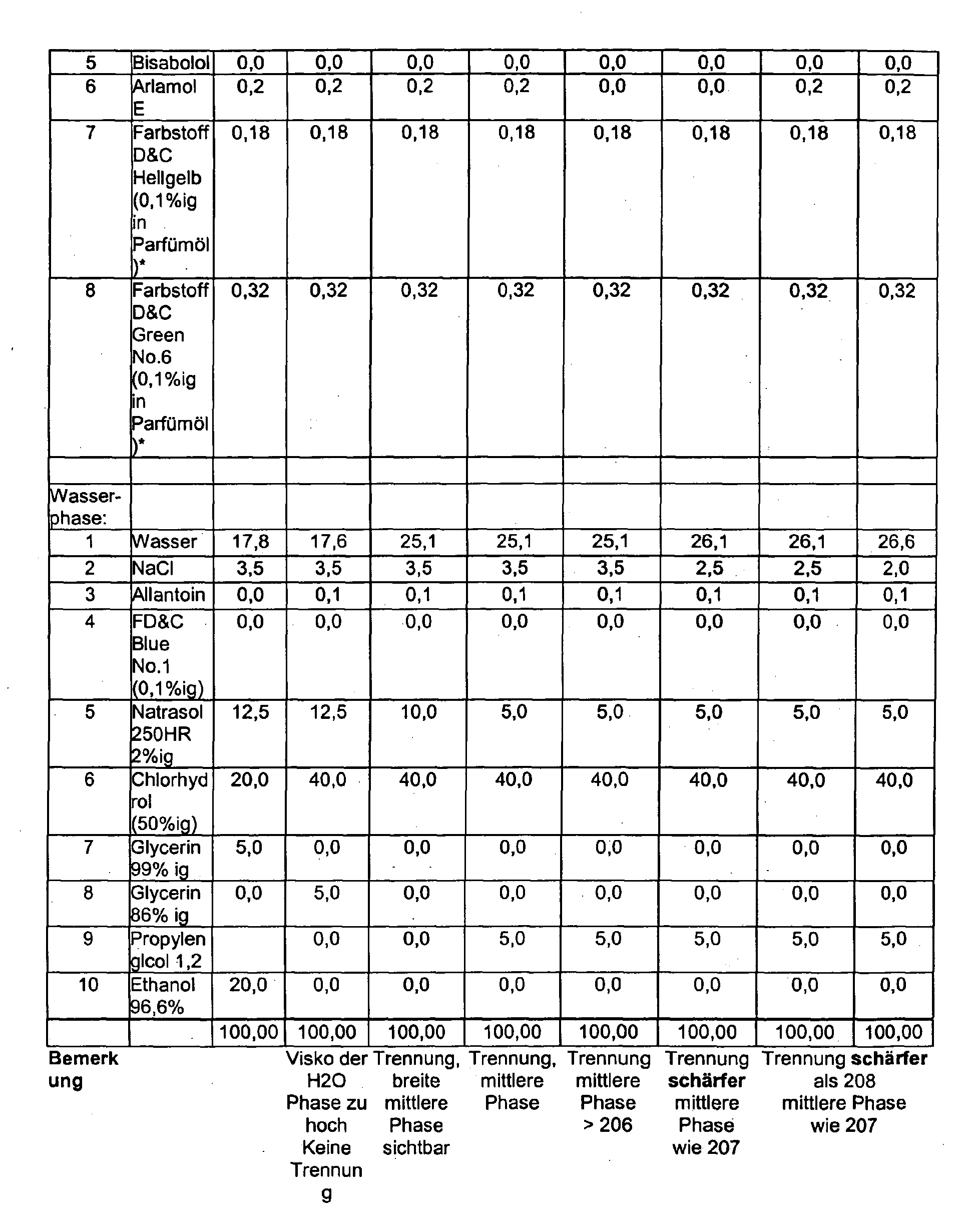
- the oil phase is e.g. dyed green.
- the amounts in% by weight relate to the content of active substance, based on the total composition.
- the 2% natrasol swelling is made.
- the water is in one Beaker submitted, the Natrasol powder carefully sprinkled in (avoiding Lump formation) and 1-2 drops of NaOH (50%) for better swelling.
- the batch is homogenized for about 1 hour.
- the following raw materials are consecutively in weighed into a beaker and stirred with a paddle stirrer: NaCl is dissolved in water dissolved, then skin-care additives and the dye are added if necessary.
- the 2% Natrasol swelling is added and the mixture is stirred a little longer until a homogeneous Mixture has arisen. Then successively Locron L, glycerin / propylene glycol and possibly added ethanol. It is then stirred until the mixture is complete is homogeneous.
- the oil phase is weighed in a second beaker. It will be one after the other Weighed Nexbase 2004 FG and the silicone oil in a beaker and with a Magnetic stirrer stirred. Then a premix of perfume oil, Arlamol E and possibly added to the dye and homogenized everything. After that, both phases filled into suitable application bottles.
Landscapes
- Health & Medical Sciences (AREA)
- Life Sciences & Earth Sciences (AREA)
- Animal Behavior & Ethology (AREA)
- General Health & Medical Sciences (AREA)
- Public Health (AREA)
- Veterinary Medicine (AREA)
- Birds (AREA)
- Epidemiology (AREA)
- Cosmetics (AREA)
Abstract
Description
Über die Zweiphasigkeit lassen sich verschiedene optische Effekte einstellen. Das Sichtbarmachen der Ölphase unterstreicht optisch für den Verbraucher den pflegenden Effekt derartiger Zusammensetzungen. Durch die Wahl öllöslicher bzw. wasserlöslicher Farbstoffe kann die optische Unterscheidung der beiden Phasen betont werden. Bei der kurzzeitigen Emulgierung bilden sich Mischfarben, die sich bei der anschließenden Phasentrennung durch das Entmischen effektvoll verändern. Die Auswahl der einzelnen Bestandteile der Zusammensetzung kann auch so erfolgen, dass während des Entmischungsvorgangs für eine gewisse Zeit eine intermediäre dritte Emulsionsschicht als Phasengrenze zwischen ÖI- und Wasserphase bestehen bleibt. Ästhetisch weniger ansprechende Phänomene, z.B. Tropfen- oder Schlierenbildung an der Innenwand des Aufbewahrungsbehälters, sollten durch geeignete Abstimmung der einzelnen Bestandteile aufeinander vermieden werden.
Eine weitere Aufgabe war die Bereitstellung einer Zusammensetzung, mit der sich ansprechende optische Effekte erzielen lassen.
- mindestens ein kosmetisches, bei 25° C flüssiges Öl,
- mindestens ein Parfümöl,
- 0,01 - 2 Gew.-% eines nichtionischen, kationischen, zwitterionischen oder amphoteren Emulgators,
- 2 - 30 Gew.-%, mindestens einer Aluminium-, Zirkon-, Zink- oder TitanVerbindung mit transpirationshemmender Wirkung,
- mindestens ein mit den transpirationshemmenden Verbindungen kompatibles organisches Polymer mit verdickender Wirkung,
- mindestens ein wasserlösliches Polyol,
- 0,5 - 10 Gew.-% Natrium- oder Kaliumchlorid,
- alkoxylierte Fettsäurealkylester der Formel R1CO-(OCH2CHR 2)xOR3, in der R1CO für einen linearen oder verzweigten, gesättigten und/oder ungesättigten Acylrest mit 6 bis 22 Kohlenstoffatomen, R2 für Wasserstoff oder Methyl, R3 für lineare oder verzweigte Alkylreste mit 1 bis 4 Kohlenstoffatomen und x für Zahlen von 1 bis 20 steht,
- Anlagerungsprodukte von Ethylenoxid an Fettsäurealkanolamide und Fettamine,
- Fettsäure-N-alkylglucamide,
- C8 - C22-Alkylamin-N-oxide,
- Alkylpolygykoside entsprechend der allgemeinen Formel RO-(Z)x wobei R für eine
C8- C16-Alkylgruppe, Z für Zucker sowie x für die Anzahl der Zuckereinheiten steht.
Die erfindungsgemäß verwendbaren Alkylpolyglykoside können lediglich einen
bestimmten Alkylrest R enthalten. Üblicherweise werden diese Verbindungen aber
ausgehend von natürlichen Fetten und Ölen oder Mineralölen hergestellt. In diesem
Fall liegen als Alkylreste R Mischungen entsprechend den Ausgangsverbindungen
bzw. entsprechend der jeweiligen Aufarbeitung dieser Verbindungen vor. Besonders
bevorzugt sind solche Alkylpolyglykoside, bei denen R im wesentlichen aus C8- und
C10-Alkylgruppen, im wesentlichen aus C12- und C14-Alkylgruppen, im wesentlichen
aus C8- bis C16-Alkylgruppen oder im wesentlichen aus C12- bis C16-Alkylgruppen
besteht.
Als Zuckerbaustein Z können beliebige Mono- oder Oligosaccharide eingesetzt werden. Üblicherweise werden Zucker mit 5 bzw. 6 Kohlenstoffatomen sowie die entsprechenden Oligosaccharide eingesetzt, beispielsweise Glucose, Fructose, Galactose, Arabinose, Ribose, Xylose, Lyxose, Allose, Altrose, Mannose, Gulose, Idose, Talose und Sucrose. Bevorzugte Zuckerbausteine sind Glucose, Fructose, Galactose, Arabinose und Sucrose; Glucose ist besonders bevorzugt. Die erfindungsgemäß verwendbaren Alkylpolyglykoside enthalten im Schnitt 1,1 bis 5, bevorzugt 1,1 bis 2,0 besonders bevorzugt 1,1 bis 1,8 Zuckereinheiten. Auch die alkoxylierten Homologen der genannten Alkylpolyglykoside können erfindungsgemäß eingesetzt werden. Diese Homologen können durchschnittlich bis zu 10 Ethylenoxidund/oder Propylenoxideinheiten pro Alkylglykosideinheit enthalten.
Geeignete nichtionische Emulgatoren sind weiterhin die Ethylenoxid-Addukte von linearen C3-C22-Alkoholen mit einer mittleren Anzahl der Ethylenoxid-Einheiten von 1-30. Bevorzugt geeignete nichtionische Emulgatoren sind Ethylenoxid-Addukte von verzweigten C3-C28-Alkoholen, insbesondere von sogenannten Guerbet-Alkoholen, mit einer mittleren Anzahl von Ethylenoxid-Einheiten von 1-30.
Bei Esterquats handelt es sich um bekannte Stoffe, die sowohl mindestens eine Esterfunktion als auch mindestens eine quartäre Ammoniumgruppe als Strukturelement enthalten. Bevorzugte Esterquats sind quaternierte Estersalze von Fettsäuren mit Triethanolamin, quaternierte Estersalze von Fettsäuren mit Diethanolalkylaminen und quaternierten Estersalzen von Fettsäuren mit 1,2-Dihydroxypropyldialkylaminen. Solche Produkte werden beispielsweise unter den Warenzeichen Stepantex®, Dehyquart® und Armocare® vertrieben. Die Produkte Armocare® VGH-70, ein N,N-Bis(2-Palmitoyloxyethyl)dimethylammoniumchlorid, sowie Dehyquart® F-75, Dehyquart® C-4046, Dehyquart® L80 und Dehyquart® AU-35 sind Beispiele für solche Esterquats.
Die Alkylamidoamine werden üblicherweise durch Amidierung natürlicher oder synthetischer Fettsäuren und Fettsäureschnitte mit Dialkylaminoaminen hergestellt. Eine erfindungsgemäß besonders geeignete Verbindung aus dieser Substanzgruppe stellt das unter der Bezeichnung Tegoamid® S 18 im Handel erhältliche Stearamidopropyldimethylamin dar.
Esterquats sind erfindungsgemäß besonders bevorzugte kationische Emulgatoren.
In einer besonders bevorzugten Ausführungsform sind nur nichtionische Emulgatoren enthalten. Nichtschäumende Emulgatoren sind außerordentlich bevorzugt.
Die erfindungsgemäßen Zusammensetzungen enthalten die Emulgatoren in Mengen von 0,01 - 2 Gew.-%, bevorzugt 0,05 - 1,5 Gew.-% und besonders bevorzugt 0,1 - 1,0 Gew.-%, jeweils bezogen auf die gesamte flüssige Zusammensetzung.
- Siliconöle, wobei insbesondere die linearen Siliconöle mit der INCl-Bezeichnung Dimethicone, Trisiloxane, Hexamethyldisiloxan bevorzugt sind, die cyclischen Siliconöle Octamethylcyclotetrasiloxan, Decamethylcyclopentasiloxan und Dodecamethylcyclohexasiloxan aber technisch auch geeignet sind,
- aliphatische Kohlenwasserstoffe, z. B. Paraffinöle und Isoparaffinöle, insbesondere Polyalphaolefine wie die Öle der Produktserie Nexbase, z.B. Hydrogenated Polydecene, weiterhin Polyisobuten, Polyethylen, z.B. der Rohstoff Performalene 400,
- alicyclische Kohlenwasserstoffe, die keine von Kohlenstoff und Wasserstoff verschiedenen Atome enthalten, z. B. substituierte Cyclohexane wie 1,3-Bis(2-ethylhexyl)cyclohexan (Cetiol® S),
- verzweigte primäre Alkohole, insbesondere Guerbetalkohole auf Basis von Fettalkoholen mit 6 bis 22, vorzugsweise 8 bis 10 Kohlenstoffatomen,
- die Ester von gesättigten oder ungesättigten, linearen oder verzweigten C3-C22-Fettsäuren oder den Dimeren ungesättigter C12-C22-Fettsäuren (Dimerfettsäuren) mit a) einwertigen linearen, verzweigten oder cyclischen C2-C22-Alkanolen, b) mehrwertigen linearen oder verzweigten C2-C6-Alkanolen, c) Polyglycerinen der Formel CH2OH-CHOH-CH2[-O-CH2-CHOH-CH2]n-O-CH2-CHOH-CH2OH mit n = 0 - 8, oder d) den Dicarbonsäure- und Tricarbonsäureestern von linearen und verzweigten C2-C10-Alkanolen, wobei als bevorzugte Komponenten a) die Ester von linearen C6-C22-Fettsäuren mit linearen C6-C22-Fettalkoholen, sogenannte Wachsester, sofern diese bei 25° C flüssig sind, wie beispielsweise Jojobaöl, weiterhin die flüssigen Mono-/Di-/Triglyceridmischungen auf Basis von C6-C18-Fettsäuren sowie pflanzliche Öle und als bevorzugte Komponente d) Citronensäuretriethylester zu nennen sind,
- Ester von linearen und verzweigten C12-C22-Alkanolen ein- und mehrwertiger C2-C7-Hydroxycarbonsäuren, die aromatisch sein können, insbesondere Benzoesäure (z.B. Finsolv® TN),
- Dialkylether, z. B. Dioctylether (Cetiol® OE),
- Ringöffnungsprodukte von epoxidierten Fettsäureestern mit Polyolen,
- sowie symmetrische, unsymmetrische oder cyclische Ester der Kohlensäure mit linearen und verzweigten C8-C18-Alkanolen, z. B. Cetiol® CC.
Die erfindungsgemäßen Zusammensetzungen enthalten die bei 25° C flüssige Ölkomponente in Mengen von 10 - 49 Gew.-%, bevorzugt 12 - 30 Gew.-%, besonders bevorzugt 15 - 25 Gew.-% und außerordentlich bevorzugt 18 - 22 Gew.-%, jeweils bezogen auf die gesamte flüssige Zusammensetzung.
Auch ätherische Öle geringerer Flüchtigkeit, die meist als Aromakomponenten verwendet werden, eignen sich als Parfümöle, z.B. Salbeiöl, Kamillenöl, Nelkenöl, Melissenöl, Minzenöl, Zimtblätteröl, Lindenblütenöl, Wacholderbeerenöl, Vetiveröl, Olibanöl, Galbanumöl, Labolanumöl und Lavandinöl.
Die erfindungsgemäßen Zusammensetzungen enthalten das Parfümöl in Mengen von 0,01 - 2 Gew.-%, bevorzugt 0,1 - 1,5 Gew.-%, jeweils bezogen auf die gesamte flüssige Zusammensetzung.
Der schweißhemmende Wirkstoff ist in den erfindungsgemäßen Zusammensetzungen in einer Menge von 2 - 30 Gew.-%, vorzugsweise 5 - 25 Gew.-% und insbesondere 10 - 20 Gew.-%, bezogen auf die Menge der Aktivsubstanz in der gesamten flüssigen Zusammensetzung, enthalten.
Als kationische Polymere geeignet sind kationische Cellulose-Derivate, z. B. die Handelsprodukte Celquat® und Polymer JR®, und bevorzugt Celquat® H 100, Celquat® L 200 und Polymer JR® 400 (Polyquaternium-10) sowie Polyquaternium-24.
Die verdickenden Polymere sind in den erfindungsgemäßen Zusammensetzungen in einer Menge von 0,02 - 1,5 Gew.-%, vorzugsweise 0,05 - 1,0 Gew.-% und insbesondere 0,1 - 0,5 Gew.-%, bezogen auf die Menge der Aktivsubstanz in der gesamten flüssigen Zusammensetzung, enthalten.
Die erfindungsgemäßen Zusammensetzungen enthalten das wasserlösliche Polyol in Mengen von 1 - 30 Gew.-%, bevorzugt 2 - 15 Gew.-% und besonders bevorzugt 3 - 10 Gew.-%, jeweils bezogen auf die gesamte flüssige Zusammensetzung.
Als enzymhemmende Stoffe sind vor allem solche desodorierend wirksam, die esterspaltende Enzyme inhibieren und auf diese Weise der Schweißzersetzung entgegenwirken. Hierfür eignen sich vor allem Zinksalze, Pflanzenextrakte, z.B. Citruskernextrakte, sowie die Ester von aliphatischen C2-C6-Carbonsäuren oder Hydroxycarbonsäuren und C2-C6-Alkoholen oder Polyolen, z. B. Triethylcitrat, Propylenglycollactat oder Glycerintriacetat (Triacetin).
Die Gesamtmenge der Antioxidantien in den erfindungsgemäßen flüssigen Zusammensetzungen beträgt 0,001 - 10 Gew.-%, vorzugsweise 0,05 - 5 Gew.-% und insbesondere 0,05 - 2 Gew.-%, bezogen auf die gesamte flüssige Zusammensetzung.
Als Geruchsabsorber können folgende Substanzen eingesetzt werden: Zinkricinoleat, Cyclodextrin und dessen Derivate, Hydroxypropyl-β-Cyclodextrin, weiterhin Oxide wie Magnesiumoxid oder Zinkoxid, wobei die Oxide nicht mit Aluminiumchlorhydrat kompatibel sind, weiterhin Stärke und Stärkederivate, Kieselsäuren, die ggf. modifiziert sein können, Zeolithe, Talcum sowie synthetische Polymere, z.B. Nylon.
Auch komplexbildende Stoffe können die desodorierende Wirkung unterstützen, indem sie die oxidativ katalytisch wirkenden Schwermetallionen (z. B. Eisen oder Kupfer) stabil komplexieren. Geeignete Komplexbildner sind z. B. die Salze der Ethylendiamintetraessigsäure oder der Nitrilotriessigsäure sowie die Salze der 1-Hydroxyethan-1,1-diphosphonsäure.



Claims (9)
- Kosmetische Antitranspirant-Zusammensetzung, enthaltend eine Ölphase und eine Wasserphase, die im Ruhezustand nicht-emulgiert und durch eine Phasengrenze voneinander getrennt vorliegen, durch kurzzeitiges Schütteln emulgierbar sind, wobei die vollständige Entmischung im Ruhezustand innerhalb von 5 Sekunden bis 24 Stunden erfolgt, gekennzeichnet durch einen Gehalt anwobei sich alle Mengenangaben in Gew.-% auf das Gewicht der Gesamtzusammensetzung beziehen.c) 15 - 50 Gew.-% Ölphase, deren einzelne Komponenten miteinander eine klare Mischung bilden, enthaltendmindestens ein kosmetisches, bei 25° C flüssiges Öl,mindestens ein Parfümöl,0,01 - 2 Gew.-% eines nichtionischen, kationischen, zwitterionischen oder amphoteren Emulgators,d) 50 - 85 Gew.-% wässrige Phase, enthaltend2 - 30 Gew.-%, mindestens einer Aluminium-, Zirkon-, Zink- oder TitanVerbindung mit transpirationshemmender Wirkung,mindestens ein mit den transpirationshemmenden Verbindungen kompatibles organisches Polymer mit verdickender Wirkung,mindestens ein wasserlösliches Polyol,0,5 - 10 Gew.-% Natrium- oder Kaliumchlorid,
- Kosmetische Zusammensetzung gemäß Patentanspruch 1, dadurch gekennzeichnet, dass der nichtionische Emulgator ausgewählt ist aus Ethylenoxid-Addukten von linearen C3C22-Alkoholen mit einer mittleren Anzahl der Ethylenoxid-Einheiten von 1 - 30 Ethylenoxid-Addukten von verzweigten C3-C28-Alkoholen mit einer mittleren Anzahl von Ethylenoxid-Einheiten von 1 - 30, Ethylenoxid-Propylenoxid-Mischaddukten von linearen C3-C22-Alkoholen mit einer mittleren Anzahl an Ethylenoxid-Einheiten von 2 - 50 und einer mittleren Anzahl an Propylenoxid-Einheiten von 2 - 35 und Propylenoxid-Addukten von linearen C3-C22-Alkoholen mit einer mittleren Anzahl der Propylenoxid-Einheiten von 1 - 30.
- Kosmetische Zusammensetzung gemäß einem der vorstehenden Ansprüche, dadurch gekennzeichnet, dass 0,5 - 50 Gew.-%, bezogen auf die gesamte Zusammensetzung, Ethanol oder/und Isopropanol enthalten ist.
- Kosmetische Zusammensetzung gemäß einem der vorstehenden Ansprüche, dadurch gekennzeichnet, dass mindestens ein wasserlöslicher und/oder öllöslicher hautpflegender Wirkstoff enthalten ist.
- Kosmetische Zusammensetzung gemäß einem der vorstehenden Ansprüche, dadurch gekennzeichnet, dass mindestens ein lineares Silicon-Öl enthalten ist.
- Kosmetische Zusammensetzung gemäß einem der vorstehenden Ansprüche, dadurch gekennzeichnet, dass die Zusammensetzung frei ist von cyclischen Silicon-Ölen.
- Kosmetische Zusammensetzung gemäß einem der vorstehenden Ansprüche, dadurch gekennzeichnet, dass das organische Polymer mit verdickender Wirkung aus nichtionischen Polymeren, insbesondere nichtionischen Cellulosederivaten, ausgewählt ist.
- Kosmetische Zusammensetzung gemäß einem der vorstehenden Ansprüche, dadurch gekennzeichnet, dass die Zusammensetzung in einer transparenten oder transluzenten Verpackung verpackt ist.
- Kosmetische Zusammensetzung gemäß Anspruch 8, dadurch gekennzeichnet, dass die Verpackung eine geschriebene Anweisung enthält, gemäß der das Produkt vor dem Gebrauch zu schütteln ist.
Applications Claiming Priority (2)
| Application Number | Priority Date | Filing Date | Title |
|---|---|---|---|
| DE10321138 | 2003-05-09 | ||
| DE10321138A DE10321138A1 (de) | 2003-05-09 | 2003-05-09 | Zweiphasige flüssige Antitranspirant-Zusammensetzungen |
Publications (3)
| Publication Number | Publication Date |
|---|---|
| EP1475077A2 true EP1475077A2 (de) | 2004-11-10 |
| EP1475077A3 EP1475077A3 (de) | 2005-01-26 |
| EP1475077B1 EP1475077B1 (de) | 2006-08-02 |
Family
ID=32981326
Family Applications (1)
| Application Number | Title | Priority Date | Filing Date |
|---|---|---|---|
| EP04010428A Expired - Lifetime EP1475077B1 (de) | 2003-05-09 | 2004-05-03 | Zweiphasige flüssige Antitranspirant-Zusammensetzungen |
Country Status (3)
| Country | Link |
|---|---|
| EP (1) | EP1475077B1 (de) |
| AT (1) | ATE334722T1 (de) |
| DE (2) | DE10321138A1 (de) |
Cited By (5)
| Publication number | Priority date | Publication date | Assignee | Title |
|---|---|---|---|---|
| EP2444056A1 (de) * | 2010-08-19 | 2012-04-25 | Henkel AG & Co. KGaA | Sprühbares zweiphasiges Haarkonditioniermittel |
| US9713582B2 (en) | 2015-04-13 | 2017-07-25 | The Procter & Gamble Company | Multi-layered cosmetic composition |
| WO2020015880A1 (en) * | 2018-07-16 | 2020-01-23 | Beiersdorf Ag | Bi-phase deodorizing cosmetic composition |
| WO2020030784A1 (en) * | 2018-08-09 | 2020-02-13 | L'oreal | Bi-phase composition comprising an anti-transpirant or deodorant agent |
| CN112351769A (zh) * | 2018-09-28 | 2021-02-09 | 株式会社漫丹 | 化妆料 |
Families Citing this family (1)
| Publication number | Priority date | Publication date | Assignee | Title |
|---|---|---|---|---|
| DE102009010665A1 (de) | 2009-02-27 | 2010-09-16 | Beiersdorf Ag | Verwendung von geladenen Tensiden zur Verminderung der Textilverfleckung durch Antitranspirantien |
Family Cites Families (7)
| Publication number | Priority date | Publication date | Assignee | Title |
|---|---|---|---|---|
| CA783534A (en) * | 1965-06-15 | 1968-04-23 | Unilever Limited | Liquid detergent compositions |
| JPS6078907A (ja) * | 1983-10-04 | 1985-05-04 | Kobayashi Kooc:Kk | 二層型化粧料 |
| JPS6327409A (ja) * | 1986-07-18 | 1988-02-05 | Shiseido Co Ltd | 多層型化粧料 |
| FR2638636B1 (fr) * | 1988-11-09 | 1992-09-11 | Oreal | Demaquillant pour les yeux a deux phases distinctes |
| FR2699404B1 (fr) * | 1992-12-18 | 1995-01-27 | Oreal | Composition cosmétique ou dermatologique biphase pour le démaquillage, le nettoyage ou le soin de la peau contenant du chlorure de benzalkonium. |
| US6649174B2 (en) * | 1998-05-07 | 2003-11-18 | E-L Management Corp. | Dual phase cosmetic composition |
| DE10258827A1 (de) * | 2002-12-17 | 2004-07-08 | Henkel Kgaa | Zweischichtige temporör emulgierbare Zusammensetzungen |
-
2003
- 2003-05-09 DE DE10321138A patent/DE10321138A1/de not_active Withdrawn
-
2004
- 2004-05-03 EP EP04010428A patent/EP1475077B1/de not_active Expired - Lifetime
- 2004-05-03 AT AT04010428T patent/ATE334722T1/de active
- 2004-05-03 DE DE502004001074T patent/DE502004001074D1/de not_active Expired - Lifetime
Cited By (6)
| Publication number | Priority date | Publication date | Assignee | Title |
|---|---|---|---|---|
| EP2444056A1 (de) * | 2010-08-19 | 2012-04-25 | Henkel AG & Co. KGaA | Sprühbares zweiphasiges Haarkonditioniermittel |
| US9713582B2 (en) | 2015-04-13 | 2017-07-25 | The Procter & Gamble Company | Multi-layered cosmetic composition |
| WO2020015880A1 (en) * | 2018-07-16 | 2020-01-23 | Beiersdorf Ag | Bi-phase deodorizing cosmetic composition |
| WO2020030784A1 (en) * | 2018-08-09 | 2020-02-13 | L'oreal | Bi-phase composition comprising an anti-transpirant or deodorant agent |
| FR3084835A1 (fr) * | 2018-08-09 | 2020-02-14 | L'oreal | Composition bi-phase comprenant un actif anti-transpirant ou deodorant |
| CN112351769A (zh) * | 2018-09-28 | 2021-02-09 | 株式会社漫丹 | 化妆料 |
Also Published As
| Publication number | Publication date |
|---|---|
| EP1475077A3 (de) | 2005-01-26 |
| ATE334722T1 (de) | 2006-08-15 |
| DE502004001074D1 (de) | 2006-09-14 |
| DE10321138A1 (de) | 2004-11-25 |
| EP1475077B1 (de) | 2006-08-02 |
Similar Documents
| Publication | Publication Date | Title |
|---|---|---|
| JP6454270B2 (ja) | 可溶化剤としてのn−メチル−n−アシルグルカミンの使用 | |
| EP2243462B1 (de) | Emulgatorsystem | |
| WO2010121759A1 (de) | Kosmetische oder dermatologische zubereitung | |
| DE10216368A1 (de) | Arylsulfatase-Inhibitoren in Deodorantien und Antitranspirantien | |
| DE10163247A1 (de) | Deodorant-Schaum | |
| CA3228529A1 (en) | Composition | |
| DE19911056B4 (de) | Kosmetische Zubereitungen und deren Verwendung | |
| EP1255525B1 (de) | Kosmetische zubereitungen in form disperser systeme perlglanzwachse enthaltend | |
| DE10208550A1 (de) | Transparente kosmetische Zubereitungen | |
| EP1894994A1 (de) | Zwei- oder mehrphasiges Gesichtsreinigungsmittel mit verbessertem reversiblen Mischungs- und Entmischungsverfahren | |
| EP1475077B1 (de) | Zweiphasige flüssige Antitranspirant-Zusammensetzungen | |
| DE19910704B4 (de) | Kosmetische Zubereitungen und deren Verwendung | |
| DE102016209979A1 (de) | "Cold Cream enthaltende Emulsionszusammensetzung" | |
| DE102018220966A1 (de) | Deodorantzusammensetzungen, calciumsilicat undnatriumbicarbonat umfassend | |
| JP6852981B2 (ja) | 水中油型乳化組成物 | |
| DE102016225735A1 (de) | Kosmetische Mittel gegen Körpergeruch mit verbesserter Langzeitwirkung | |
| JP2010024204A (ja) | 皮膚外用剤 | |
| WO2004083351A1 (de) | Tensidmischungen | |
| WO2003068182A1 (de) | Desodorierende zubereitungen mit chitosanen und/oder chitosanderivaten | |
| JP2006036772A (ja) | コンディショニング界面活性製剤 | |
| DE19858812A1 (de) | Desodorierende kosmetische Mittel | |
| WO2003051323A1 (de) | Antitranspirant-zusammensetzung | |
| WO2013144121A2 (de) | SCHWEIßHEMMENDE ZUSAMMENSETZUNGEN MIT CYCLOALIPHATISCHEN DIOLEN UND ZIRKONIUMSALZEN | |
| DE19858811A1 (de) | Desodorierende kosmetische Mittel | |
| DE102014205199A1 (de) | Schweißhemmende kosmetische Mittel enthaltend wasserlösliche Polysaccharide |
Legal Events
| Date | Code | Title | Description |
|---|---|---|---|
| PUAI | Public reference made under article 153(3) epc to a published international application that has entered the european phase |
Free format text: ORIGINAL CODE: 0009012 |
|
| 17P | Request for examination filed |
Effective date: 20040503 |
|
| AK | Designated contracting states |
Kind code of ref document: A2 Designated state(s): AT BE BG CH CY CZ DE DK EE ES FI FR GB GR HU IE IT LI LU MC NL PL PT RO SE SI SK TR |
|
| AX | Request for extension of the european patent |
Extension state: AL HR LT LV MK |
|
| PUAL | Search report despatched |
Free format text: ORIGINAL CODE: 0009013 |
|
| AK | Designated contracting states |
Kind code of ref document: A3 Designated state(s): AT BE BG CH CY CZ DE DK EE ES FI FR GB GR HU IE IT LI LU MC NL PL PT RO SE SI SK TR |
|
| AX | Request for extension of the european patent |
Extension state: AL HR LT LV MK |
|
| AKX | Designation fees paid |
Designated state(s): AT BE BG CH CY CZ DE DK EE ES FI FR GB GR HU IE IT LI LU MC NL PL PT RO SE SI SK TR |
|
| GRAP | Despatch of communication of intention to grant a patent |
Free format text: ORIGINAL CODE: EPIDOSNIGR1 |
|
| RIC1 | Information provided on ipc code assigned before grant |
Ipc: A61K 8/34 20060101ALI20060306BHEP Ipc: A61K 8/39 20060101ALI20060306BHEP Ipc: A61K 8/28 20060101ALI20060306BHEP Ipc: A61K 8/67 20060101ALI20060306BHEP Ipc: A61K 8/20 20060101ALI20060306BHEP Ipc: A61K 8/03 20060101ALI20060306BHEP Ipc: A61K 8/29 20060101ALI20060306BHEP Ipc: A61K 8/27 20060101ALI20060306BHEP Ipc: A61K 8/891 20060101ALI20060306BHEP Ipc: A61K 8/73 20060101ALI20060306BHEP Ipc: A61Q 15/00 20060101AFI20060306BHEP Ipc: A61K 8/26 20060101ALI20060306BHEP |
|
| GRAS | Grant fee paid |
Free format text: ORIGINAL CODE: EPIDOSNIGR3 |
|
| GRAA | (expected) grant |
Free format text: ORIGINAL CODE: 0009210 |
|
| AK | Designated contracting states |
Kind code of ref document: B1 Designated state(s): AT BE BG CH CY CZ DE DK EE ES FI FR GB GR HU IE IT LI LU MC NL PL PT RO SE SI SK TR |
|
| PG25 | Lapsed in a contracting state [announced via postgrant information from national office to epo] |
Ref country code: IT Free format text: LAPSE BECAUSE OF FAILURE TO SUBMIT A TRANSLATION OF THE DESCRIPTION OR TO PAY THE FEE WITHIN THE PRESCRIBED TIME-LIMIT;WARNING: LAPSES OF ITALIAN PATENTS WITH EFFECTIVE DATE BEFORE 2007 MAY HAVE OCCURRED AT ANY TIME BEFORE 2007. THE CORRECT EFFECTIVE DATE MAY BE DIFFERENT FROM THE ONE RECORDED. Effective date: 20060802 Ref country code: RO Free format text: LAPSE BECAUSE OF FAILURE TO SUBMIT A TRANSLATION OF THE DESCRIPTION OR TO PAY THE FEE WITHIN THE PRESCRIBED TIME-LIMIT Effective date: 20060802 Ref country code: NL Free format text: LAPSE BECAUSE OF FAILURE TO SUBMIT A TRANSLATION OF THE DESCRIPTION OR TO PAY THE FEE WITHIN THE PRESCRIBED TIME-LIMIT Effective date: 20060802 Ref country code: IE Free format text: LAPSE BECAUSE OF FAILURE TO SUBMIT A TRANSLATION OF THE DESCRIPTION OR TO PAY THE FEE WITHIN THE PRESCRIBED TIME-LIMIT Effective date: 20060802 Ref country code: SI Free format text: LAPSE BECAUSE OF FAILURE TO SUBMIT A TRANSLATION OF THE DESCRIPTION OR TO PAY THE FEE WITHIN THE PRESCRIBED TIME-LIMIT Effective date: 20060802 Ref country code: PL Free format text: LAPSE BECAUSE OF FAILURE TO SUBMIT A TRANSLATION OF THE DESCRIPTION OR TO PAY THE FEE WITHIN THE PRESCRIBED TIME-LIMIT Effective date: 20060802 Ref country code: FI Free format text: LAPSE BECAUSE OF FAILURE TO SUBMIT A TRANSLATION OF THE DESCRIPTION OR TO PAY THE FEE WITHIN THE PRESCRIBED TIME-LIMIT Effective date: 20060802 Ref country code: SK Free format text: LAPSE BECAUSE OF FAILURE TO SUBMIT A TRANSLATION OF THE DESCRIPTION OR TO PAY THE FEE WITHIN THE PRESCRIBED TIME-LIMIT Effective date: 20060802 Ref country code: CZ Free format text: LAPSE BECAUSE OF FAILURE TO SUBMIT A TRANSLATION OF THE DESCRIPTION OR TO PAY THE FEE WITHIN THE PRESCRIBED TIME-LIMIT Effective date: 20060802 |
|
| REG | Reference to a national code |
Ref country code: GB Ref legal event code: FG4D Free format text: NOT ENGLISH |
|
| REG | Reference to a national code |
Ref country code: CH Ref legal event code: EP |
|
| REG | Reference to a national code |
Ref country code: IE Ref legal event code: FG4D Free format text: LANGUAGE OF EP DOCUMENT: GERMAN |
|
| REF | Corresponds to: |
Ref document number: 502004001074 Country of ref document: DE Date of ref document: 20060914 Kind code of ref document: P |
|
| PG25 | Lapsed in a contracting state [announced via postgrant information from national office to epo] |
Ref country code: SE Free format text: LAPSE BECAUSE OF FAILURE TO SUBMIT A TRANSLATION OF THE DESCRIPTION OR TO PAY THE FEE WITHIN THE PRESCRIBED TIME-LIMIT Effective date: 20061102 Ref country code: DK Free format text: LAPSE BECAUSE OF FAILURE TO SUBMIT A TRANSLATION OF THE DESCRIPTION OR TO PAY THE FEE WITHIN THE PRESCRIBED TIME-LIMIT Effective date: 20061102 Ref country code: BG Free format text: LAPSE BECAUSE OF FAILURE TO SUBMIT A TRANSLATION OF THE DESCRIPTION OR TO PAY THE FEE WITHIN THE PRESCRIBED TIME-LIMIT Effective date: 20061102 |
|
| PG25 | Lapsed in a contracting state [announced via postgrant information from national office to epo] |
Ref country code: ES Free format text: LAPSE BECAUSE OF FAILURE TO SUBMIT A TRANSLATION OF THE DESCRIPTION OR TO PAY THE FEE WITHIN THE PRESCRIBED TIME-LIMIT Effective date: 20061113 |
|
| GBT | Gb: translation of ep patent filed (gb section 77(6)(a)/1977) |
Effective date: 20061108 |
|
| NLV1 | Nl: lapsed or annulled due to failure to fulfill the requirements of art. 29p and 29m of the patents act | ||
| PG25 | Lapsed in a contracting state [announced via postgrant information from national office to epo] |
Ref country code: PT Free format text: LAPSE BECAUSE OF FAILURE TO SUBMIT A TRANSLATION OF THE DESCRIPTION OR TO PAY THE FEE WITHIN THE PRESCRIBED TIME-LIMIT Effective date: 20070102 |
|
| ET | Fr: translation filed | ||
| REG | Reference to a national code |
Ref country code: IE Ref legal event code: FD4D |
|
| PLBE | No opposition filed within time limit |
Free format text: ORIGINAL CODE: 0009261 |
|
| STAA | Information on the status of an ep patent application or granted ep patent |
Free format text: STATUS: NO OPPOSITION FILED WITHIN TIME LIMIT |
|
| 26N | No opposition filed |
Effective date: 20070503 |
|
| BERE | Be: lapsed |
Owner name: HENKEL K.G.A.A. Effective date: 20070531 |
|
| PG25 | Lapsed in a contracting state [announced via postgrant information from national office to epo] |
Ref country code: MC Free format text: LAPSE BECAUSE OF NON-PAYMENT OF DUE FEES Effective date: 20070531 |
|
| PG25 | Lapsed in a contracting state [announced via postgrant information from national office to epo] |
Ref country code: BE Free format text: LAPSE BECAUSE OF NON-PAYMENT OF DUE FEES Effective date: 20070531 |
|
| PG25 | Lapsed in a contracting state [announced via postgrant information from national office to epo] |
Ref country code: GR Free format text: LAPSE BECAUSE OF FAILURE TO SUBMIT A TRANSLATION OF THE DESCRIPTION OR TO PAY THE FEE WITHIN THE PRESCRIBED TIME-LIMIT Effective date: 20061103 |
|
| PG25 | Lapsed in a contracting state [announced via postgrant information from national office to epo] |
Ref country code: EE Free format text: LAPSE BECAUSE OF FAILURE TO SUBMIT A TRANSLATION OF THE DESCRIPTION OR TO PAY THE FEE WITHIN THE PRESCRIBED TIME-LIMIT Effective date: 20060802 |
|
| PG25 | Lapsed in a contracting state [announced via postgrant information from national office to epo] |
Ref country code: LU Free format text: LAPSE BECAUSE OF NON-PAYMENT OF DUE FEES Effective date: 20070503 Ref country code: CY Free format text: LAPSE BECAUSE OF FAILURE TO SUBMIT A TRANSLATION OF THE DESCRIPTION OR TO PAY THE FEE WITHIN THE PRESCRIBED TIME-LIMIT Effective date: 20060802 |
|
| PG25 | Lapsed in a contracting state [announced via postgrant information from national office to epo] |
Ref country code: TR Free format text: LAPSE BECAUSE OF FAILURE TO SUBMIT A TRANSLATION OF THE DESCRIPTION OR TO PAY THE FEE WITHIN THE PRESCRIBED TIME-LIMIT Effective date: 20060802 Ref country code: HU Free format text: LAPSE BECAUSE OF FAILURE TO SUBMIT A TRANSLATION OF THE DESCRIPTION OR TO PAY THE FEE WITHIN THE PRESCRIBED TIME-LIMIT Effective date: 20070203 |
|
| PGFP | Annual fee paid to national office [announced via postgrant information from national office to epo] |
Ref country code: AT Payment date: 20120426 Year of fee payment: 9 |
|
| PGFP | Annual fee paid to national office [announced via postgrant information from national office to epo] |
Ref country code: CH Payment date: 20130514 Year of fee payment: 10 |
|
| REG | Reference to a national code |
Ref country code: DE Ref legal event code: R084 Ref document number: 502004001074 Country of ref document: DE Effective date: 20130807 |
|
| REG | Reference to a national code |
Ref country code: CH Ref legal event code: PL |
|
| REG | Reference to a national code |
Ref country code: AT Ref legal event code: MM01 Ref document number: 334722 Country of ref document: AT Kind code of ref document: T Effective date: 20140503 |
|
| PG25 | Lapsed in a contracting state [announced via postgrant information from national office to epo] |
Ref country code: CH Free format text: LAPSE BECAUSE OF NON-PAYMENT OF DUE FEES Effective date: 20140531 Ref country code: LI Free format text: LAPSE BECAUSE OF NON-PAYMENT OF DUE FEES Effective date: 20140531 |
|
| PG25 | Lapsed in a contracting state [announced via postgrant information from national office to epo] |
Ref country code: AT Free format text: LAPSE BECAUSE OF NON-PAYMENT OF DUE FEES Effective date: 20140503 |
|
| REG | Reference to a national code |
Ref country code: FR Ref legal event code: PLFP Year of fee payment: 12 |
|
| PGFP | Annual fee paid to national office [announced via postgrant information from national office to epo] |
Ref country code: DE Payment date: 20150521 Year of fee payment: 12 Ref country code: GB Payment date: 20150521 Year of fee payment: 12 |
|
| PGFP | Annual fee paid to national office [announced via postgrant information from national office to epo] |
Ref country code: FR Payment date: 20150521 Year of fee payment: 12 |
|
| REG | Reference to a national code |
Ref country code: DE Ref legal event code: R119 Ref document number: 502004001074 Country of ref document: DE |
|
| GBPC | Gb: european patent ceased through non-payment of renewal fee |
Effective date: 20160503 |
|
| REG | Reference to a national code |
Ref country code: FR Ref legal event code: ST Effective date: 20170131 |
|
| PG25 | Lapsed in a contracting state [announced via postgrant information from national office to epo] |
Ref country code: FR Free format text: LAPSE BECAUSE OF NON-PAYMENT OF DUE FEES Effective date: 20160531 Ref country code: DE Free format text: LAPSE BECAUSE OF NON-PAYMENT OF DUE FEES Effective date: 20161201 |
|
| PG25 | Lapsed in a contracting state [announced via postgrant information from national office to epo] |
Ref country code: GB Free format text: LAPSE BECAUSE OF NON-PAYMENT OF DUE FEES Effective date: 20160503 |