EP1475075A1 - Défrisage alcalin en présence d'un polymère hydrosoluble de haut poids moléculaire - Google Patents
Défrisage alcalin en présence d'un polymère hydrosoluble de haut poids moléculaire Download PDFInfo
- Publication number
- EP1475075A1 EP1475075A1 EP04291136A EP04291136A EP1475075A1 EP 1475075 A1 EP1475075 A1 EP 1475075A1 EP 04291136 A EP04291136 A EP 04291136A EP 04291136 A EP04291136 A EP 04291136A EP 1475075 A1 EP1475075 A1 EP 1475075A1
- Authority
- EP
- European Patent Office
- Prior art keywords
- water
- alkaline
- soluble polymer
- component
- hair
- Prior art date
- Legal status (The legal status is an assumption and is not a legal conclusion. Google has not performed a legal analysis and makes no representation as to the accuracy of the status listed.)
- Granted
Links
Classifications
-
- A—HUMAN NECESSITIES
- A61—MEDICAL OR VETERINARY SCIENCE; HYGIENE
- A61K—PREPARATIONS FOR MEDICAL, DENTAL OR TOILETRY PURPOSES
- A61K8/00—Cosmetics or similar toiletry preparations
- A61K8/18—Cosmetics or similar toiletry preparations characterised by the composition
- A61K8/72—Cosmetics or similar toiletry preparations characterised by the composition containing organic macromolecular compounds
- A61K8/81—Cosmetics or similar toiletry preparations characterised by the composition containing organic macromolecular compounds obtained by reactions involving only carbon-to-carbon unsaturated bonds
- A61K8/817—Compositions of homopolymers or copolymers of compounds having one or more unsaturated aliphatic radicals, each having only one carbon-to-carbon double bond, and at least one being terminated by a single or double bond to nitrogen or by a heterocyclic ring containing nitrogen; Compositions or derivatives of such polymers, e.g. vinylimidazol, vinylcaprolactame, allylamines (Polyquaternium 6)
-
- A—HUMAN NECESSITIES
- A61—MEDICAL OR VETERINARY SCIENCE; HYGIENE
- A61K—PREPARATIONS FOR MEDICAL, DENTAL OR TOILETRY PURPOSES
- A61K8/00—Cosmetics or similar toiletry preparations
- A61K8/18—Cosmetics or similar toiletry preparations characterised by the composition
- A61K8/72—Cosmetics or similar toiletry preparations characterised by the composition containing organic macromolecular compounds
- A61K8/81—Cosmetics or similar toiletry preparations characterised by the composition containing organic macromolecular compounds obtained by reactions involving only carbon-to-carbon unsaturated bonds
- A61K8/8141—Compositions of homopolymers or copolymers of compounds having one or more unsaturated aliphatic radicals, each having only one carbon-to-carbon double bond, and at least one being terminated by only one carboxyl radical, or of salts, anhydrides, esters, amides, imides or nitriles thereof; Compositions of derivatives of such polymers
- A61K8/8158—Homopolymers or copolymers of amides or imides, e.g. (meth) acrylamide; Compositions of derivatives of such polymers
-
- A—HUMAN NECESSITIES
- A61—MEDICAL OR VETERINARY SCIENCE; HYGIENE
- A61Q—SPECIFIC USE OF COSMETICS OR SIMILAR TOILETRY PREPARATIONS
- A61Q5/00—Preparations for care of the hair
- A61Q5/04—Preparations for permanent waving or straightening the hair
-
- A—HUMAN NECESSITIES
- A61—MEDICAL OR VETERINARY SCIENCE; HYGIENE
- A61K—PREPARATIONS FOR MEDICAL, DENTAL OR TOILETRY PURPOSES
- A61K2800/00—Properties of cosmetic compositions or active ingredients thereof or formulation aids used therein and process related aspects
- A61K2800/80—Process related aspects concerning the preparation of the cosmetic composition or the storage or application thereof
- A61K2800/88—Two- or multipart kits
-
- A—HUMAN NECESSITIES
- A61—MEDICAL OR VETERINARY SCIENCE; HYGIENE
- A61K—PREPARATIONS FOR MEDICAL, DENTAL OR TOILETRY PURPOSES
- A61K2800/00—Properties of cosmetic compositions or active ingredients thereof or formulation aids used therein and process related aspects
- A61K2800/80—Process related aspects concerning the preparation of the cosmetic composition or the storage or application thereof
- A61K2800/88—Two- or multipart kits
- A61K2800/884—Sequential application
Definitions
- the present invention relates to the use of a dispersion of a high molecular weight water-soluble polymer to protect fibers keratin against chemical degradation during the alkaline straightening of hair, a multi-compartment kit for alkaline straightening containing a dispersion or solution of such a polymer, a hair straightening composition ready to use and an alkaline straightening process using such a kit or a such ready-to-use composition.
- This degradation of the fibers is particularly undesirable because it irreversibly deteriorates the physico-chemical properties of the hair. These become more porous and therefore more difficult to dry. They have a greater sensitivity to various other hair treatments such as coloring, and see their mechanical properties and their properties unfavorably modified surface, which results for example by a decrease in tensile strength or an increase in the coefficient of friction.
- the Applicant was surprised to discover that it was possible to significantly reduce the chemical degradation of keratin fibers resulting from alkaline hair straightening treatment, using the hair straightening agent alkaline in combination with at least one polymer chosen from polymers high molecular weight, obtained by heterogeneous radical polymerization of water-soluble monomers with precipitation of the polymer formed in the reaction medium.
- the protective effect of keratin fibers is obtained not only in the event of joint use (simultaneous application) of the straightening agent alkaline and high molecular weight polymer, but also when uses a two-step straightening process first comprising the treatment of keratin fibers with the protective polymer then the step of alkaline straightening, these two steps can be separated by a step of intermediate rinse. A less protective effect is obtained in the event application of the high molecular weight polymer after the hair straightening step alkaline.
- the polymers used in the present invention are obtained by heterogeneous radical polymerization of a mixture of water-soluble monomers.
- the polymerization medium is a saline aqueous solution having a relatively high ionic strength, chosen so that the polymer, soluble in pure water, precipitates at as it is formed so as to form a dispersion of fines polymer particles in a continuous saline aqueous phase.
- This dispersion has the advantage of having both a fairly concentrated important in high molecular weight polymer and viscosity relatively moderate allowing quick and easy mixing of this dispersion with alkaline straightening agent. This last property allows the use of high-weight water-soluble polymer dispersions molecular in straightening kits where the alkaline agent and the polymer water soluble are packaged in separate compartments and are mixed immediately before application to the hair.
- the water-soluble polymer having a weight average molecular weight greater than 10 6 can also be, not in dispersed form, but in dissolved form in a physiologically acceptable aqueous medium.
- the present invention therefore also relates to a hair straightening agent as described above comprising, in place of component (b1), a component (b2) in the form of a composition containing an aqueous solution of a water-soluble polymer having a weight average molecular mass greater than 10 6 , obtained by heterogeneous radical polymerization of water-soluble monomers with precipitation of the polymer formed.
- the multi-component alkaline straightening agent of the invention is preferably in the form of a multi-compartment kit for the alkaline straightening of keratin fibers, with at least a first compartment containing the first component (a) and at least a second compartment containing the second component (b1) or (b2).
- the synthesis of water-soluble polymers of high molecular weight, used in the present invention for the protection of keratin fibers against alkaline degradation is carried out by heterogeneous radical polymerization of water-soluble monomers comprising at least one ethylenic unsaturation.
- the polymerization is carried out in an aqueous solution of a mineral electrolyte (salt) having an ionic strength sufficient to cause precipitation of the polymer formed as soon as it reaches a certain molecular mass.
- This polymerization technique thus makes it possible, thanks to the well known salting-out phenomenon , the preparation of aqueous saline dispersions of particles of water-soluble polymers.
- the polymers thus synthesized are distinguished by a high molecular weight average mass, generally greater than 10 6 .
- heterogeneous radical polymerization technique in medium aqueous with precipitation of the polymer formed is described for example in the US patent 4,929,655, in patent application EP 0 943 628 or also in international application WO 02/34796.
- This agent dispersant is preferably a polyelectrolyte which, unlike the polymer high molecular weight used in the invention, is soluble in the medium aqueous polymerization of high ionic strength.
- This dispersing polyelectrolyte preferably has a charge identical to that of the polymer synthesized, in other words for the synthesis of cationic polyelectrolytes, a polyelectrolyte is generally used cationic dispersant.
- a polyamine such as a polyalkyleneamine.
- the dispersing agent is preferably used in an amount of 1 to 10% by weight, based on the total weight of the monomers to be polymerized.
- the aqueous saline solution which serves as synthesis medium and high molecular weight water soluble polymer dispersion is a solution of one or more mineral salts preferably chosen from divalent anionic salts.
- divalent anionic salts for example ammonium sulfate, ammonium hydrogen sulfate, sodium sulfate, sodium hydrogen sulfate, magnesium sulfate, magnesium hydrogen sulfate, aluminum sulfate and aluminum hydrogen sulfate.
- Ammonium sulfate and sodium are particularly preferred.
- the concentration of this (these) salt (s) should preferably be sufficient to induce precipitation of the water-soluble polymer formed in the polymerization.
- the salt concentration is preferably at least equal to 15% by weight and can go up to the saturation concentration of each salt.
- the saline aqueous solution can additionally contain monovalent salts such as sodium chloride and ammonium chloride.
- Heterogeneous radical polymerization in an aqueous medium such as described above is most often accompanied by a significant increase viscosity of the reaction medium, which results in difficulties agitation, lack of homogeneity of the reaction medium and enlargement the particle size of the polymer particles formed.
- High molecular weight water-soluble polymers used in the present invention are preferably prepared in the presence of such an agent preventing the viscosity from increasing.
- the addition of at least one agent preventing the increase in viscosity as described above allows the polymerization of the water-soluble monomers described above with a low stirrer power while avoiding the formation of coarse particles.
- the agents preventing viscosity increase are preferably soluble in the aqueous reaction medium.
- compounds (A) mention may be made of oxalic acid, adipic acid, tartaric acid, malic acid, phthalic acid and their salts.
- compounds (B) mention may in particular be made of: resorcinol and pyrogallol.
- compounds (C) mention may be made of m-hydroxybenzoic acid, p-hydroxybenzoic acid, salicylic acid, acid gallic acid, tannic acid and the salts of these acids.
- gluconate sodium, potassium gluconate, ammonium gluconate and various salts gluconic acid amino acids mention may be made of gluconate sodium, potassium gluconate, ammonium gluconate and various salts gluconic acid amino acids.
- compounds (E) there may be mentioned those obtained by reaction of a compound that generates radicals, under a stream of gas oxygenated, in a solution containing methoxyhydroquinone and / or a cationic (meth) acrylic monomer.
- the compound that generates radicals may be an initiator commonly used for radical polymerization.
- water-soluble azo initiators such as 2,2'-azo-bis (2-amidinopropane) hydrochloride sold for example under the designation V-50 by the company Wako Chemical Industries, or the 2,2'-azo-bis [2- (2-imidazoline-2-yl) propane] hydrochloride sold by example under the trade name VA-044 by the company Wako Chemical Industries, or an initiator from the redox group water-soluble such as ammonium persulfate / hydrogen sulfite combination sodium.
- water-soluble azo initiators such as 2,2'-azo-bis (2-amidinopropane) hydrochloride sold for example under the designation V-50 by the company Wako Chemical Industries, or the 2,2'-azo-bis [2- (2-imidazoline-2-yl) propane] hydrochloride sold by example under the trade name VA-044 by the company Wako Chemical Industries, or an initiator from the redox group water-soluble such as ammonium persulfate / hydrogen sulfite combination
- An agent preventing viscosity increase (F) can be obtained by reaction of a radical initiator, under an oxygenated atmosphere, with a dispersing agent according to the invention.
- the polymerization initiator can be a water-soluble azo initiator or a water-soluble redox such as described above.
- the compounds (G) can be obtained in the form of polymers oxidized with low molecular weight by oxidation of a dispersing agent cationic according to the invention obtained by polymerization of a monomer cationic (meth) acrylic, using peroxide as an oxidizing agent hydrogen or halogen.
- cationic (meth) acrylic monomers used for the preparation of agents preventing increase in viscosity (E), (F) and (G) there may be mentioned for example the hydrochloride or (meth) acrylate sulfate dimethylaminoethyl, (meth) acryloyloxyethyltrimethylammonium chloride, (meth) acryloyloxyethyldimethylbenzylammonium chloride, hydrochloride or sulfate derived from N-dimethylaminopropyl (meth) -acrylamide, (meth) acrylamidopropyltrimethylammonium chloride, dimethylaminohydroxypropyl (meth) acrylate chloride or sulphate, (meth) acryloyloxyhydroxypropyltrimethylammonium chloride, chloride of (meth) acryloyloxyhydroxypropyldimethylbenzylammonium.
- These agents preventing the increase in viscosity (A) to (G) can be used alone or as a mixture, in an amount of preferably between 10 ppm and 10,000 ppm relative to the total weight of the solution reaction.
- Water-soluble monomers polymerized by polymerization heterogeneous radical with a view to obtaining water-soluble polymers of high molecular weight are monomers comprising at least a double ethylenic bond, for example a vinyl, acrylic or allyl. They can be cationic, anionic or non-ionic and be used in mixture.
- anionic monomers water-soluble acrylic acid, methacrylic acid, acrylamido-2-methylpropanesulfonic acid and itaconic acid. These anionic monomers are at least partially neutralized in the form of an alkali metal salt, of an alkaline earth metal, of ammonium or of an organic amine such as alkanolamine.
- water-soluble nonionic monomers mention may be made of acrylamide, methacrylamide, N-vinylformamide, N-vinylacetonamide, hydroxypropyl acrylate and methacrylate hydroxypropyl.
- the water-soluble cationic monomers are preferably chosen from di (C 1-4 alkyl) -diallylammonium salts and the compounds of formula (I) in which R 1 represents a hydrogen atom or a methyl group, R 2 and R 3 , identical or different, each represent a hydrogen atom or a linear or branched C 1-4 alkyl group, R 4 represents a hydrogen atom, a linear or branched C 1-4 alkyl group or an aryl group, D represents the following pattern in which Y represents an amide (-CO-NH-), ester (-O-CO- or - CO-O-), urethane (-O-CO-NH-) or urea (-NH-CO-NH-) function )
- A represents a linear, branched or cyclic C 1-10 alkylene group, which can be substituted or interrupted by a divalent aromatic or heteroaromatic ring, or which can be interrupted by a heteroatom chosen from O, N, S and P, and which can
- water-soluble cationic monomers it is possible to cite dimethylaminoethyl (meth) acrylate hydrochloride or sulfate, (meth) acryloyloxyethyltrimethylammonium chloride, chloride (meth) acryloyloxyethyldimethylbenzylammonium, hydrochloride or sulfate N-dimethylaminopropyl- (meth) acrylamide, (meth) acrylamidopropyltrimethylammonium chloride, (meth) acrylamidopropyldimethylbenzylammonium chloride, (meth) acrylate hydrochloride or sulfate dimethylaminohydroxypropyle, (meth) acryloyloxyhydroxypropyltrimethylammonium chloride, (meth) acryloyloxyhydroxypropyldimethylbenzylammonium chloride and dimethyldiallylammonium chloride.
- the high molecular weight water-soluble polymer is preferably a polyelectrolyte, and in particular a cationic polyelectrolyte or amphoteric, i.e. a polyelectrolyte polymerized from at least one cationic monomer of formula (I).
- the high molecular weight water soluble polymer is obtained by heterogeneous radical polymerization of a mixture of monomers consisting of 0 to 30 mole% acrylic acid, 0 to 95.5 mole% of acrylamide and from 0.5 to 10 mol% of at least one cationic monomer of formula (I).
- the polymers water-soluble are obtained by polymerization of a mixture of monomers consisting of acrylic acid and a cationic monomer of formula (I), in which the number of moles of cationic monomer of formula (I) is greater than the number of moles of acrylic acid.
- the high molecular weight water soluble polymer can also be an anionic polyelectrolyte polymerized from a mixture of anionic monomers and nonionic monomers.
- anionic polyelectrolyte a copolymer obtained from a mixture of 30 mol% of acrylic acid and 70 mol% acrylamide.
- the water-soluble polymers used in the present invention have a weight average molecular weight greater than 1,000,000, preferably between 1,000,000 and 50,000,000. This weight average molecular weight is determined by the RSV (Reduced Specific Viscosity) method as defined in "Principles of Polymer Chemistry", Georgia University Press, Ithaca, NY, 1953, Chapter VII titled “Determination of Molecular Weight", pages 266 - 316.
- RSV Reduced Specific Viscosity
- the concentration of high molecular weight water-soluble polymer in the compartment dispersion (b1) or in the compartment solution (b2) is preferably between 0.01 and 20% by weight, based on the weight total dispersion or solution.
- the alkaline agent used in the present invention for straightening alkaline keratin fibers is an aqueous composition containing, in the state dissolved, at least one mineral or organic hydroxide, preferably chosen among the hydroxides of an alkali metal, the hydroxides of an alkaline earth metal, hydroxides of a transition metal, hydroxides of metals groups III, IV, V and VI, the hydroxides of lanthanides or actinides, ammonium hydroxides and guanidinium hydroxide.
- the hydroxide can be formed in situ such as for example guanidine hydroxide by reaction of calcium hydroxide and guanidine carbonate.
- This alkaline agent must have a sufficient concentration to allow permanent deformation of the treated keratin fibers.
- Such a permanent deformation is generally obtained with compositions aqueous alkalis having a pH between 9 and 13, preferably between 10 and 13.
- These compositions may also contain usual additives in hair cosmetics and in particular fatty substances.
- the present invention also relates to a ready-to-use hair straightening composition containing both a water-soluble polymer having a weight-average molecular mass greater than 10 6 and an alkaline agent in a concentration sufficient to obtain permanent deformation of the keratin fibers. treated with this composition.
- the pH of the straightening composition ready for use is preferably between 9 and 13, and in particular between 10 and 13.
- the ready-to-use straightening composition is prepared by mixture of an alkaline composition and a composition containing a dispersion of water-soluble polymer particles
- the dilution of the saline dispersion by the alkaline aqueous agent has the effect of reducing the ionic strength and total or partial solubilization of the polymer particles water-soluble.
- the mixing ratio and the concentration of the dispersion or solution of water-soluble polymer are preferably chosen so that that the concentration of the water-soluble polymer is between 0.01 and 10% by weight, preferably between 0.05 and 2% by weight.
- the ready-to-use straightening composition of the present invention may also contain a number of other cosmetic active ingredients or formulation adjuvants commonly used in the field of care capillaries.
- additives include the agents anionic, cationic, nonionic or amphoteric surfactants, perfumes, chelating agents, preservatives, proteins, silicones, polymers thickeners, vegetable, synthetic or mineral oils, waxes, agents pad, UV filters and hair dyes.
- the ready-to-use composition can be presented in any which shape allows easy application and spreading on the hair.
- the present invention also relates to methods of hair straightening separately using the alkaline composition of straightening and the water-soluble polymer of high molecular weight, or else the ready-to-use straightening composition, described above.
- the protective effect of keratin fibers by the polymer high molecular weight water soluble is obtained as well in case simultaneous application of the alkaline composition and the polymer water-soluble (one-step process) only in case of successive application (two-step process).
- Step (C) can be followed by a neutralizing shampoo.
- Step (E) can be followed by a neutralizing shampoo.
- step A The order of application of the polymer in the form of a dispersion or solution (step A) and the alkaline composition (step C) can be reversed, i.e. the application of the alkaline composition may precede the application water-soluble polymer.
- Sufficient exposure time to obtain permanent deformation hair is generally between 1 and 45 minutes, preferably between 1 and 30 minutes.
- the present invention is illustrated by the following example.
- the chemical degradation of the locks is evaluated by measuring the porosity of keratin fibers before and after alkaline treatment.
- the porosity of keratin fibers is measured by fixing at 37 ° C, in 2 minutes, 0.25% 2-nitroparaphenylenediamine in a mixture ethanol / buffer (volume ratio 10/90) at pH 10.
- the porosity of the locks treated by the simultaneous application of a alkaline composition and a water-soluble high molecular weight polymer is very close to that of the locks before treatment, so that the alkaline treatment in the absence of water-soluble polymer (Composition B) causes a large increase in porosity, a sign of deterioration important chemical of keratin fibers.
- the locks of hair treated with composition B have in besides less satisfactory cosmetic properties such as a more tactile rough as that of the locks treated with Composition A.
Landscapes
- Life Sciences & Earth Sciences (AREA)
- Health & Medical Sciences (AREA)
- Animal Behavior & Ethology (AREA)
- General Health & Medical Sciences (AREA)
- Public Health (AREA)
- Veterinary Medicine (AREA)
- Birds (AREA)
- Epidemiology (AREA)
- Cosmetics (AREA)
- Addition Polymer Or Copolymer, Post-Treatments, Or Chemical Modifications (AREA)
Abstract
Description
- le traitement des fibres kératiniques avec un agent réducteur provoquant la coupure des ponts disulfure (S-S) de la kératine, suivi d'un traitement oxydant appliqué sur les cheveux soumis à une contrainte mécanique, et
- le traitement des fibres kératiniques soumises à une contrainte mécanique avec un agent fortement alcalin.
- en tant que premier composant, (a) une composition aqueuse alcaline de défrisage, et,
- en tant que deuxième composant, (b1) une composition contenant une dispersion de particules d'un polymère hydrosoluble, de préférence un polyélectrolyte, ayant une masse moléculaire moyenne en poids supérieure à 106 dans une solution aqueuse saline, obtenu par polymérisation radicalaire hétérogène de monomères hydrosolubles avec précipitation du polymère formé, les deux composants (a) et (b1) étant destinés à être appliqués simultanément ou successivement sur les fibres kératiniques à défriser.
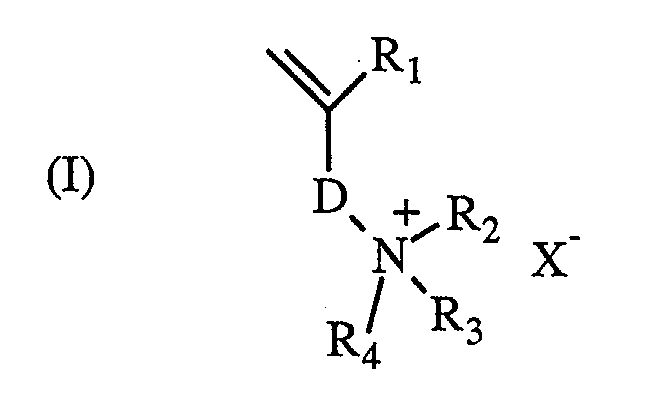
R1 représente un atome d'hydrogène ou un groupe méthyle,
R2 et R3, identiques ou différents, représentent chacun un atome d'hydrogène ou un groupe alkyle en C1-4 linéaire ou ramifié,
R4 représente un atome d'hydrogène, un groupe alkyle en C1-4 linéaire ou ramifié ou un groupe aryle,
D représente le motif suivant

A représente un groupe alkyène en C1-10 linéaire, ramifié ou cyclique, pouvant être substitué ou interrompu par un cycle aromatique ou hétéroaromatique divalent, ou pouvant être interrompu par un hétéroatome choisi parmi O, N, S et P, et pouvant comporter une fonction cétone, amide, ester, uréthane ou urée,
n vaut 0 ou 1, et
X- représente un contre-ion anionique tel qu'un ion chlorure ou sulfate.
- de 10 % en moles de chlorure d'acryloyloxyéthyldiméthylbenzylammonium et de 90 % en moles d'acrylamide.
- de 30 % en moles de chlorure d'acryloyloxytriméthylammonium, de 50 % en moles de chlorure d'acryloyloxyéthyldiméthybenzylammonium et de 20 % en moles d'acrylamide.
- de 10 % en moles de chlorure d'acryloyloxyéthyltriméthylammonium et de 90 % en moles d'acrylamide.
- de 30 % en moles de chlorure de diallyldiméthylammonium et de 70 % en moles d'acrylamide.
- d'une composition alcaline et
- d'une composition contenant une dispersion de particules d'un polymère
hydrosoluble ayant une masse moléculaire moyenne en poids supérieure à
106 dans une solution aqueuse saline, obtenu par polymérisation radicalaire
hétérogène de monomères hydrosolubles avec précipitation du polymère
formé,
ou - d'une solution aqueuse d'un polymère hydrosoluble ayant une masse moléculaire moyenne en poids supérieure à 106 obtenu par polymérisation radicalaire hétérogène de monomères hydrosolubles avec précipitation du polymère formé,
| Composition A (selon l'invention) | Composition B (comparative) | |
| NaOH | 1,99 g | 1,99 g |
| Polymère hydrosoluble | 6,65 g | - |
| Eau | q.s.p. 100 g | q.s.p. 100 g |
| Porosité | |
| Mèches non traitées | 14 |
| Mèches traitées avec la solution A | 19 |
| Mèches traitées avec la solution B | 37 |
Claims (28)
- Agent de défrisage alcalin multi-composants comportant,les deux composants (a) et (b1) ou (a) et (b2) étant destinés à être appliqués simultanément ou successivement sur les fibres kératiniques à défriser.en tant que premier composant, (a) une composition alcaline de défrisage, et,en tant que deuxième composant, (b1) une composition contenant une dispersion de particules d'un polymère hydrosoluble ayant une masse moléculaire moyenne en poids supérieure à 106 dans une solution aqueuse saline, obtenu par polymérisation radicalaire hétérogène de monomères hydrosolubles avec précipitation du polymère formé ou (b2) une solution aqueuse d'un polymère hydrosoluble ayant une masse moléculaire moyenne en poids supérieure à 106, obtenu par polymérisation radicalaire hétérogène de monomères hydrosolubles avec précipitation du polymère formé,
- Agent de défrisage alcalin multi-composants selon la revendication 1, caractérisé par le fait qu'il se présente sous forme d'un kit multi-compartiments pour le défrisage alcalin des fibres kératiniques, avec au moins un premier compartiment contenant le premier composant (a) et au moins un deuxième compartiment contenant le deuxième composant (b1) ou (b2).
- Agent de défrisage alcalin multi-composants selon la revendication 1 ou 2, caractérisé par le fait que le polymère hydrosoluble est un polyélectrolyte.
- Agent de défrisage alcalin multi-composants selon l'une quelconque des revendications précédentes, caractérisé par le fait que le ou les monomères hydrosolubles sont choisis parmi les monomères cationiques, anioniques ou non-ioniques comportant au moins une double liaison éthylénique ou un mélange de ceux-ci.
- Agent de défrisage alcalin multi-composants selon la revendication 4, caractérisé par le fait que les monomères anioniques sont choisis parmi l'acide acrylique, l'acide méthacrylique, l'acide acrylamido-2-méthylpropanesulfonique et l'acide itaconique.
- Agent de défrisage alcalin multi-composants selon la revendication 4, caractérisé par le fait que les monomères non-ioniques sont choisis parmi l'acrylamide, le méthacrylamide, le N-vinylformamide, le N-vinylacétonamide, l'acrylate d'hydroxypropyle et le méthacrylate d'hydroxypropyle.
- Agent de défrisage alcalin multi-composants selon la revendication 4, caractérisé par le fait que les monomères cationiques sont choisis parmi les sels de di(alkyle en C1-4)-diallylammonium et les composés de formule (I)dans laquelle
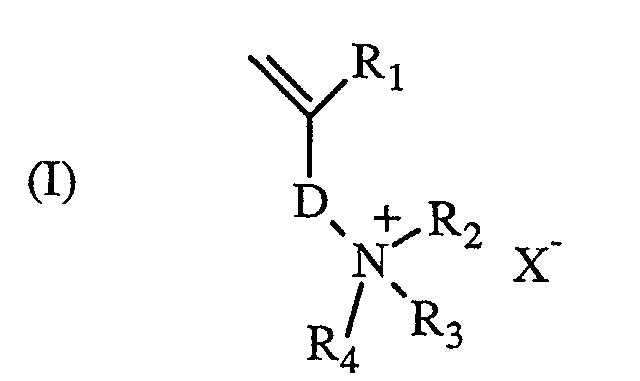
R1 représente un atome d'hydrogène ou un groupe méthyle,
R2 et R3, identiques ou différents, représentent chacun un atome d'hydrogène ou un groupe alkyle en C1-4 linéaire ou ramifié,
R4 représente un atome d'hydrogène, un groupe alkyle en C1-4 linéaire ou ramifié ou un groupe aryle,
D représente le motif suivantdans lequel Y représente une fonction amide, ester, uréthane ou urée,
A représente un groupe alkyène en C1-10 linéaire, ramifié ou cyclique, pouvant être substitué ou interrompu par un cycle aromatique ou hétéroaromatique divalent, ou pouvant être interrompu par un hétéroatome choisi parmi O, N, S et P, et pouvant comporter une fonction cétone, amide, ester, uréthane ou urée,
n vaut 0 ou 1, et
X- représente un contre-ion anionique tel qu'un ion halogénure ou sulfate. - Agent de défrisage alcalin multi-composants selon l'une quelconque des revendications précédentes, caractérisé par le fait que le polymère hydrosoluble est polymérisé à partir d'au moins un monomère cationique de formule (I).
- Agent de défrisage alcalin multi-composants selon la revendication 8, caractérisé par le fait que le polymère hydrosoluble est polymérisé à partir d'un mélange de monomères constitué de 0 à 30 % en moles d'acide acrylique, de 0 à 95,5 % en moles d'acrylamide et de 0,5 à 10 % en moles d'au moins un monomère cationique de formule (I).
- Agent de défrisage alcalin multi-composants selon la revendication 8, caractérisé par le fait que le polymère hydrosoluble est polymérisé à partir d'un mélange de monomères constitué d'acide acrylique et d'un monomère cationique de formule (I), le nombre de moles du monomère cationique de formule (I) étant supérieur au nombre de moles d'acide acrylique.
- Agent de défrisage alcalin multi-composants selon la revendication 8, caractérisé par le fait que le polymère hydrosoluble est polymérisé à partir d'un mélange de monomères constitué de 10 % en moles de chlorure d'acryloyloxyéthyldiméthylbenzyl-ammonium et de 90 % en moles d'acrylamide.
- Agent de défrisage alcalin multi-composants selon la revendication 8, caractérisé par le fait que le polymère hydrosoluble est polymérisé à partir d'un mélange de monomères constitué de 30 % en moles de chlorure d'acryloyloxytriméthylammonium, de 50 % en moles de chlorure d'acryloyloxyéthyldiméthybenzylammonium et de 20 % en moles d'acrylamide.
- Agent de défrisage alcalin multi-composants selon la revendication 8, caractérisé par le fait que le polymère hydrosoluble est polymérisé à partir de 10 % en moles de chlorure d'acryloyloxyéthyltriméthylammonium et de 90 % en moles d'acrylamide.
- Agent de défrisage alcalin multi-composants selon la revendication 8, caractérisé par le fait que le polymère hydrosoluble est polymérisé à partir de 30 % en moles de chlorure de diallyldiméthylammonium et de 70 % en moles d'acrylamide.
- Agent de défrisage alcalin multi-composants l'une des revendications 1 à 6, caractérisé par le fait que le polymère hydrosoluble est un polymère anionique polymérisé à partir de 30 % en moles d'acide acrylique et de 70 % en moles d'acrylamide.
- Agent de défrisage alcalin multi-composants selon l'une quelconque des revendications précédentes, caractérisé par le fait que la concentration des particules de polymère hydrosoluble en dispersion dans une solution aqueuse saline dans le compartiment (b1) est comprise entre 0,01 et 20 % en poids.
- Agent de défrisage alcalin multi-composants selon l'une quelconque des revendications 1 à 16, caractérisé par le fait que la concentration du polymère hydrosoluble en solution dans le compartiment (b2) est comprise entre 0,01 et 20 % en poids.
- Agent de défrisage alcalin multi-composants selon l'une quelconque des revendications précédentes, caractérisé par le fait que la solution aqueuse saline dans le compartiment (b1) ou (b2) contient au moins un sel anionique divalent.
- Agent de défrisage alcalin multi-composants selon la revendication 18, caractérisé par le fait que le sel anionique divalent est choisi parmi le sulfate d'ammonium, l'hydrogénosulfate d'ammonium, le sulfate de sodium, l'hydrogénosulfate de sodium, le sulfate de magnésium, l'hydrogénosulfate de magnésium, le sulfate d'aluminium, l'hydrogénosulfate d'aluminium.
- Agent de défrisage alcalin multi-composants selon l'une quelconque des revendications précédentes, caractérisé par le fait que la composition alcaline a un pH compris entre 9 et 13, de préférence entre 10 et 13.
- Agent de défrisage alcalin multi-composants selon l'une quelconque des revendications précédentes, caractérisé par le fait que la composition alcaline est une solution aqueuse d'au moins un hydroxyde minéral ou organique choisi parmi les hydroxydes d'un métal alcalin, les hydroxydes d'un métal alcalino-terreux, les hydroxydes d'un métal de transition, les hydroxydes des métaux des groupes III, IV, V et VI, les hydroxydes des lanthanides ou des actinides, les hydroxydes d'ammonium et l'hydroxyde de guanidinium.
- Composition de défrisage prête à l'emploi contenant à la fois un polymère hydrosoluble ayant une masse moléculaire moyenne en poids supérieure à 106 et un agent alcalin en une concentration suffisante pour obtenir une déformation permanente des fibres kératiniques traitées avec cette composition
- Composition de défrisage prête à l'emploi selon la revendication 22, caractérisée par le fait qu'elle est obtenue par mélangetels que définis dans les revendications précédentes.d'une composition alcaline etd'une composition contenant une dispersion de particules d'un polymère hydrosoluble ayant une masse moléculaire moyenne en poids supérieure à 106 dans une solution aqueuse saline, obtenue par polymérisation radicalaire hétérogène de monomères hydrosolubles avec précipitation du polymère formé,
oud'une solution aqueuse d'un polymère hydrosoluble ayant une masse moléculaire moyenne en poids supérieure à 106, obtenu par polymérisation radicalaire hétérogène de monomères hydrosolubles avec précipitation du polymère formé, - Composition de défrisage prête à l'emploi selon la revendication 22 ou 23 caractérisée par le fait qu'elle a un pH compris entre 9 et 13, de préférence compris entre 10 et 13.
- Composition de défrisage prête à l'emploi selon l'une quelconque des revendications 22 à 24, caractérisée par le fait que la concentration en polymère hydrosoluble ayant une masse moléculaire moyenne en poids supérieure à 106 est comprise entre 0,01 et 10 % en poids, de préférence entre 0,05 et 2 % en poids.
- Procédé de défrisage des cheveux comprenant(A) l'application d'une composition de défrisage prête à l'emploi selon l'une quelconque des revendications 22 à 25 sur des cheveux soumis à une contrainte mécanique,(B) un temps de pose suffisant pour obtenir une déformation permanente des cheveux, et(C) le rinçage des cheveux.
- Procédé de défrisage des cheveux comprenant(A) l'application, sur les cheveux, d'une composition contenant une dispersion de particules d'un polymère hydrosoluble ayant une masse moléculaire moyenne en poids supérieure à 106 dans une solution aqueuse saline, obtenu par polymérisation radicalaire hétérogène de monomères hydrosolubles avec précipitation du polymère formé, ou d'une composition contenant une solution aqueuse d'un polymère hydrosoluble ayant une masse moléculaire moyenne en poids supérieure à 106 obtenu par polymérisation radicalaire hétérogène de monomères hydrosolubles avec précipitation du polymère formé, suivie éventuellement d'un temps de pose,(B) éventuellement un rinçage des cheveux,(C) l'application d'une composition alcaline sur les cheveux soumis à une contrainte mécanique,(D) un temps de pose suffisant pour obtenir une déformation permanente des cheveux, et(E) le rinçage des cheveux.
- Procédé de défrisage des cheveux selon la revendication 27, caractérisé par le fait que l'ordre des étapes (A) et (C) est inversé.
Applications Claiming Priority (2)
| Application Number | Priority Date | Filing Date | Title |
|---|---|---|---|
| FR0305451 | 2003-05-05 | ||
| FR0305451A FR2854567B1 (fr) | 2003-05-05 | 2003-05-05 | Defrisage alcalin en presence d'un polymere hydrosoluble de haut poids moleculaire |
Publications (2)
| Publication Number | Publication Date |
|---|---|
| EP1475075A1 true EP1475075A1 (fr) | 2004-11-10 |
| EP1475075B1 EP1475075B1 (fr) | 2009-07-22 |
Family
ID=32982363
Family Applications (1)
| Application Number | Title | Priority Date | Filing Date |
|---|---|---|---|
| EP20040291136 Revoked EP1475075B1 (fr) | 2003-05-05 | 2004-05-04 | Défrisage alcalin en présence d'un polymère hydrosoluble de haut poids moléculaire |
Country Status (3)
| Country | Link |
|---|---|
| EP (1) | EP1475075B1 (fr) |
| DE (1) | DE602004022098D1 (fr) |
| FR (1) | FR2854567B1 (fr) |
Cited By (2)
| Publication number | Priority date | Publication date | Assignee | Title |
|---|---|---|---|---|
| WO2007135298A1 (fr) * | 2006-05-24 | 2007-11-29 | L'oreal | Procede de defrisage des fibres keratiniques avec un moyen de chauffage et un compose aromatique |
| CN117003940A (zh) * | 2023-09-01 | 2023-11-07 | 中国石油大学(华东) | 一种适用于天然气水合物储层井壁稳定的双效抑制剂及其制备方法与应用 |
Citations (2)
| Publication number | Priority date | Publication date | Assignee | Title |
|---|---|---|---|---|
| WO1991004007A1 (fr) * | 1989-09-22 | 1991-04-04 | Johnson Products Co., Inc. | Lotion d'assouplissement capillaire |
| US5639449A (en) * | 1994-08-17 | 1997-06-17 | Avlon Industries, Inc. | Hair strengthening composition and method |
-
2003
- 2003-05-05 FR FR0305451A patent/FR2854567B1/fr not_active Expired - Fee Related
-
2004
- 2004-05-04 DE DE200460022098 patent/DE602004022098D1/de not_active Expired - Lifetime
- 2004-05-04 EP EP20040291136 patent/EP1475075B1/fr not_active Revoked
Patent Citations (3)
| Publication number | Priority date | Publication date | Assignee | Title |
|---|---|---|---|---|
| WO1991004007A1 (fr) * | 1989-09-22 | 1991-04-04 | Johnson Products Co., Inc. | Lotion d'assouplissement capillaire |
| US5639449A (en) * | 1994-08-17 | 1997-06-17 | Avlon Industries, Inc. | Hair strengthening composition and method |
| US5641478A (en) * | 1994-08-17 | 1997-06-24 | Avlon Industries, Inc. | Hair strengthening method |
Cited By (3)
| Publication number | Priority date | Publication date | Assignee | Title |
|---|---|---|---|---|
| WO2007135298A1 (fr) * | 2006-05-24 | 2007-11-29 | L'oreal | Procede de defrisage des fibres keratiniques avec un moyen de chauffage et un compose aromatique |
| FR2901470A1 (fr) * | 2006-05-24 | 2007-11-30 | Oreal | Procede de defrisage des fibres keratimiques avec un moyen de chauffage et un compose aromatique |
| CN117003940A (zh) * | 2023-09-01 | 2023-11-07 | 中国石油大学(华东) | 一种适用于天然气水合物储层井壁稳定的双效抑制剂及其制备方法与应用 |
Also Published As
| Publication number | Publication date |
|---|---|
| EP1475075B1 (fr) | 2009-07-22 |
| DE602004022098D1 (de) | 2009-09-03 |
| FR2854567A1 (fr) | 2004-11-12 |
| FR2854567B1 (fr) | 2006-08-25 |
Similar Documents
| Publication | Publication Date | Title |
|---|---|---|
| EP0829258B1 (fr) | Composition oxydante gélifiée et utilisations pour la teinture, pour la déformation permanente ou pour la décoloration des cheveux | |
| CA2297275C (fr) | Composition anhydre de decoloration des fibres keratiniques comprenant l'association de polymeres amphiphiles anioniques et/ou non ioniques comportant au moins une chaine grasse et de polymeres substantifs cationiques ou amphoteres | |
| RU2266103C2 (ru) | Окисляющая композиция для обработки кератиновых материалов на основе амфифильных полимеров по меньшей мере из одного мономера с двойной связью и сульфогруппой, включающих гидрофобную смесь | |
| CA1117017A (fr) | Compositions cosmetiques pour les cheveux et la peau a base de copolymeres porteurs de fonctions amines tertiaires et/ou ammonium quaternaires | |
| CA1091156A (fr) | Compositions cosmetiques a base de polymeres prepares en presence d'ions cerium | |
| EP1027028B1 (fr) | Procede de deformation permanente des matieres keratiniques sans rin age intermediaire | |
| WO2002041856A1 (fr) | Utilisation en cosmetique d'un polymere hydrosoluble sous forme d'une dispersion et composition cosmetique le contenant | |
| EP0432051A1 (fr) | Composition cosmétique réductrice pour la permanente des cheveux, à base de cystéamine et/ou de son dérivé N-acétylé et d'un polymère cationique, et son utilisation dans un procédé de déformation permanente des cheveux | |
| CH646592A5 (fr) | Procede de deformation permanente des cheveux, et composition destinee a la mise en oeuvre de ce procede. | |
| EP0139588B1 (fr) | Tétrapolymères ampholytes cationiques, leur application dans le traitement des fibres kératiniques et les compositions les renfermant | |
| FR2472382A1 (fr) | Procede de deformation permanente des cheveux | |
| FR2495931A2 (fr) | Procede de defrisage des cheveux, et composition destinee a la mise en oeuvre de ce procede | |
| EP1415641B1 (fr) | Emulsion crème oxydante, huile-dans-eau, pour le traitement des fibres kératiniques humaines | |
| EP1475075B1 (fr) | Défrisage alcalin en présence d'un polymère hydrosoluble de haut poids moléculaire | |
| FR3070599A1 (fr) | Agent de traitement capillaire avec un cation metallique multivalent i | |
| US7022144B2 (en) | Oxidizing compositions containing a mixture of polymers including at least one copolymer based on acrylamide and 2-acrylamido-2-methylpropanesulphonic acid | |
| FR2848109A1 (fr) | Compositions oxydantes contenant un melange de polymeres dont au moins un copolymere a base d'acide acrylique ou d'acrylate d'alkyle eventuellement hydroxyle et d'acide 2-acrylamido-2-methylpropane sulfonique | |
| EP1600150A1 (fr) | Composition pour le traitement de matières kératiniques comprenant un composé polycarboxylique particulier et un polymère épaississant et procédés la mettant en oeuvre | |
| CN103764112A (zh) | 包含丁基化羟基苯甲醚化合物的个人护理组合物 | |
| FR3040299B1 (fr) | Agent de traitement capillaire puissant comportant un proteolipide et un sel de magnesium | |
| WO2004098488A2 (fr) | Utilisation de dithiols dans une composition de deformation permanente des cheveux | |
| EP1428500A1 (fr) | Composition oxydantes contenant un mélange de polymères dont au moins un copolymère à base d'acrylamide et d'acide 2-acrylamido-2-méthylpropane sulfonique | |
| EP1779895B1 (fr) | Composition cosmétique comprenant au moins un polymère fixant particulier et au moins un polymère sulfoné | |
| EP1627627A1 (fr) | Composition pour le traitement de matières kératiniques comprenant un composé polycarboxylique particulier et un polymère cationique et procédés la mettant en oeuvre | |
| FR2848107A1 (fr) | Compositions oxydantes contenant un melange de polymeres dont au moins un copolymere polyoxyethylene/polyoxypropylene |
Legal Events
| Date | Code | Title | Description |
|---|---|---|---|
| PUAI | Public reference made under article 153(3) epc to a published international application that has entered the european phase |
Free format text: ORIGINAL CODE: 0009012 |
|
| 17P | Request for examination filed |
Effective date: 20040513 |
|
| AK | Designated contracting states |
Kind code of ref document: A1 Designated state(s): AT BE BG CH CY CZ DE DK EE ES FI FR GB GR HU IE IT LI LU MC NL PL PT RO SE SI SK TR |
|
| AX | Request for extension of the european patent |
Extension state: AL HR LT LV MK |
|
| AKX | Designation fees paid |
Designated state(s): AT BE BG CH CY CZ DE DK EE ES FI FR GB GR HU IE IT LI LU MC NL PL PT RO SE SI SK TR |
|
| RIC1 | Information provided on ipc code assigned before grant |
Ipc: A61K 8/81 20060101ALI20081110BHEP Ipc: A61Q 5/04 20060101AFI20081110BHEP |
|
| GRAP | Despatch of communication of intention to grant a patent |
Free format text: ORIGINAL CODE: EPIDOSNIGR1 |
|
| RTI1 | Title (correction) |
Free format text: ALCALINE STRAIGHTENING OF THE HAIR IN THE PRESENCE OF A HYDROSOLUBLE POLYMER HAVING A HIGH MOLECULAR WEIGHT |
|
| GRAS | Grant fee paid |
Free format text: ORIGINAL CODE: EPIDOSNIGR3 |
|
| GRAA | (expected) grant |
Free format text: ORIGINAL CODE: 0009210 |
|
| AK | Designated contracting states |
Kind code of ref document: B1 Designated state(s): AT BE BG CH CY CZ DE DK EE ES FI FR GB GR HU IE IT LI LU MC NL PL PT RO SE SI SK TR |
|
| REG | Reference to a national code |
Ref country code: GB Ref legal event code: FG4D Free format text: NOT ENGLISH |
|
| REG | Reference to a national code |
Ref country code: CH Ref legal event code: EP |
|
| REG | Reference to a national code |
Ref country code: IE Ref legal event code: FG4D |
|
| REF | Corresponds to: |
Ref document number: 602004022098 Country of ref document: DE Date of ref document: 20090903 Kind code of ref document: P |
|
| NLV1 | Nl: lapsed or annulled due to failure to fulfill the requirements of art. 29p and 29m of the patents act | ||
| PG25 | Lapsed in a contracting state [announced via postgrant information from national office to epo] |
Ref country code: SE Free format text: LAPSE BECAUSE OF FAILURE TO SUBMIT A TRANSLATION OF THE DESCRIPTION OR TO PAY THE FEE WITHIN THE PRESCRIBED TIME-LIMIT Effective date: 20090722 Ref country code: AT Free format text: LAPSE BECAUSE OF FAILURE TO SUBMIT A TRANSLATION OF THE DESCRIPTION OR TO PAY THE FEE WITHIN THE PRESCRIBED TIME-LIMIT Effective date: 20090722 Ref country code: ES Free format text: LAPSE BECAUSE OF FAILURE TO SUBMIT A TRANSLATION OF THE DESCRIPTION OR TO PAY THE FEE WITHIN THE PRESCRIBED TIME-LIMIT Effective date: 20091102 Ref country code: FI Free format text: LAPSE BECAUSE OF FAILURE TO SUBMIT A TRANSLATION OF THE DESCRIPTION OR TO PAY THE FEE WITHIN THE PRESCRIBED TIME-LIMIT Effective date: 20090722 |
|
| PG25 | Lapsed in a contracting state [announced via postgrant information from national office to epo] |
Ref country code: PL Free format text: LAPSE BECAUSE OF FAILURE TO SUBMIT A TRANSLATION OF THE DESCRIPTION OR TO PAY THE FEE WITHIN THE PRESCRIBED TIME-LIMIT Effective date: 20090722 Ref country code: NL Free format text: LAPSE BECAUSE OF FAILURE TO SUBMIT A TRANSLATION OF THE DESCRIPTION OR TO PAY THE FEE WITHIN THE PRESCRIBED TIME-LIMIT Effective date: 20090722 Ref country code: SI Free format text: LAPSE BECAUSE OF FAILURE TO SUBMIT A TRANSLATION OF THE DESCRIPTION OR TO PAY THE FEE WITHIN THE PRESCRIBED TIME-LIMIT Effective date: 20090722 |
|
| REG | Reference to a national code |
Ref country code: IE Ref legal event code: FD4D |
|
| PG25 | Lapsed in a contracting state [announced via postgrant information from national office to epo] |
Ref country code: BG Free format text: LAPSE BECAUSE OF FAILURE TO SUBMIT A TRANSLATION OF THE DESCRIPTION OR TO PAY THE FEE WITHIN THE PRESCRIBED TIME-LIMIT Effective date: 20091022 Ref country code: PT Free format text: LAPSE BECAUSE OF FAILURE TO SUBMIT A TRANSLATION OF THE DESCRIPTION OR TO PAY THE FEE WITHIN THE PRESCRIBED TIME-LIMIT Effective date: 20091122 |
|
| PLBI | Opposition filed |
Free format text: ORIGINAL CODE: 0009260 |
|
| PG25 | Lapsed in a contracting state [announced via postgrant information from national office to epo] |
Ref country code: CZ Free format text: LAPSE BECAUSE OF FAILURE TO SUBMIT A TRANSLATION OF THE DESCRIPTION OR TO PAY THE FEE WITHIN THE PRESCRIBED TIME-LIMIT Effective date: 20090722 Ref country code: DK Free format text: LAPSE BECAUSE OF FAILURE TO SUBMIT A TRANSLATION OF THE DESCRIPTION OR TO PAY THE FEE WITHIN THE PRESCRIBED TIME-LIMIT Effective date: 20090722 Ref country code: RO Free format text: LAPSE BECAUSE OF FAILURE TO SUBMIT A TRANSLATION OF THE DESCRIPTION OR TO PAY THE FEE WITHIN THE PRESCRIBED TIME-LIMIT Effective date: 20090722 Ref country code: IE Free format text: LAPSE BECAUSE OF FAILURE TO SUBMIT A TRANSLATION OF THE DESCRIPTION OR TO PAY THE FEE WITHIN THE PRESCRIBED TIME-LIMIT Effective date: 20090722 Ref country code: EE Free format text: LAPSE BECAUSE OF FAILURE TO SUBMIT A TRANSLATION OF THE DESCRIPTION OR TO PAY THE FEE WITHIN THE PRESCRIBED TIME-LIMIT Effective date: 20090722 |
|
| 26 | Opposition filed |
Opponent name: KPSS-KAO PROFESSIONAL SALON SERVICES GMBH Effective date: 20100421 |
|
| PLAX | Notice of opposition and request to file observation + time limit sent |
Free format text: ORIGINAL CODE: EPIDOSNOBS2 |
|
| PG25 | Lapsed in a contracting state [announced via postgrant information from national office to epo] |
Ref country code: SK Free format text: LAPSE BECAUSE OF FAILURE TO SUBMIT A TRANSLATION OF THE DESCRIPTION OR TO PAY THE FEE WITHIN THE PRESCRIBED TIME-LIMIT Effective date: 20090722 |
|
| PGFP | Annual fee paid to national office [announced via postgrant information from national office to epo] |
Ref country code: FR Payment date: 20100525 Year of fee payment: 7 |
|
| PGFP | Annual fee paid to national office [announced via postgrant information from national office to epo] |
Ref country code: DE Payment date: 20100430 Year of fee payment: 7 |
|
| PLAF | Information modified related to communication of a notice of opposition and request to file observations + time limit |
Free format text: ORIGINAL CODE: EPIDOSCOBS2 |
|
| PG25 | Lapsed in a contracting state [announced via postgrant information from national office to epo] |
Ref country code: GR Free format text: LAPSE BECAUSE OF FAILURE TO SUBMIT A TRANSLATION OF THE DESCRIPTION OR TO PAY THE FEE WITHIN THE PRESCRIBED TIME-LIMIT Effective date: 20091023 |
|
| BERE | Be: lapsed |
Owner name: L'OREAL Effective date: 20100531 |
|
| PG25 | Lapsed in a contracting state [announced via postgrant information from national office to epo] |
Ref country code: MC Free format text: LAPSE BECAUSE OF NON-PAYMENT OF DUE FEES Effective date: 20100531 |
|
| REG | Reference to a national code |
Ref country code: CH Ref legal event code: PL |
|
| GBPC | Gb: european patent ceased through non-payment of renewal fee |
Effective date: 20100504 |
|
| RDAF | Communication despatched that patent is revoked |
Free format text: ORIGINAL CODE: EPIDOSNREV1 |
|
| REG | Reference to a national code |
Ref country code: DE Ref legal event code: R103 Ref document number: 602004022098 Country of ref document: DE Ref country code: DE Ref legal event code: R064 Ref document number: 602004022098 Country of ref document: DE |
|
| PG25 | Lapsed in a contracting state [announced via postgrant information from national office to epo] |
Ref country code: CH Free format text: LAPSE BECAUSE OF NON-PAYMENT OF DUE FEES Effective date: 20100531 Ref country code: LI Free format text: LAPSE BECAUSE OF NON-PAYMENT OF DUE FEES Effective date: 20100531 |
|
| PG25 | Lapsed in a contracting state [announced via postgrant information from national office to epo] |
Ref country code: BE Free format text: LAPSE BECAUSE OF NON-PAYMENT OF DUE FEES Effective date: 20100531 Ref country code: IT Free format text: LAPSE BECAUSE OF FAILURE TO SUBMIT A TRANSLATION OF THE DESCRIPTION OR TO PAY THE FEE WITHIN THE PRESCRIBED TIME-LIMIT Effective date: 20090722 |
|
| RDAG | Patent revoked |
Free format text: ORIGINAL CODE: 0009271 |
|
| STAA | Information on the status of an ep patent application or granted ep patent |
Free format text: STATUS: PATENT REVOKED |
|
| 27W | Patent revoked |
Effective date: 20110225 |
|
| PG25 | Lapsed in a contracting state [announced via postgrant information from national office to epo] |
Ref country code: GB Free format text: LAPSE BECAUSE OF NON-PAYMENT OF DUE FEES Effective date: 20100504 |
|
| REG | Reference to a national code |
Ref country code: DE Ref legal event code: R107 Ref document number: 602004022098 Country of ref document: DE Effective date: 20110908 |
|
| PG25 | Lapsed in a contracting state [announced via postgrant information from national office to epo] |
Ref country code: CY Free format text: LAPSE BECAUSE OF FAILURE TO SUBMIT A TRANSLATION OF THE DESCRIPTION OR TO PAY THE FEE WITHIN THE PRESCRIBED TIME-LIMIT Effective date: 20090722 |
|
| PG25 | Lapsed in a contracting state [announced via postgrant information from national office to epo] |
Ref country code: LU Free format text: LAPSE BECAUSE OF REVOCATION BY EPO Effective date: 20100504 Ref country code: HU Free format text: LAPSE BECAUSE OF FAILURE TO SUBMIT A TRANSLATION OF THE DESCRIPTION OR TO PAY THE FEE WITHIN THE PRESCRIBED TIME-LIMIT Effective date: 20100123 |