EP1471237A2 - Operating method for a combustion engine comprising a catalyst and pre-catalyst - Google Patents
Operating method for a combustion engine comprising a catalyst and pre-catalyst Download PDFInfo
- Publication number
- EP1471237A2 EP1471237A2 EP03029000A EP03029000A EP1471237A2 EP 1471237 A2 EP1471237 A2 EP 1471237A2 EP 03029000 A EP03029000 A EP 03029000A EP 03029000 A EP03029000 A EP 03029000A EP 1471237 A2 EP1471237 A2 EP 1471237A2
- Authority
- EP
- European Patent Office
- Prior art keywords
- catalyst
- catalytic converter
- storage
- operating
- phase
- Prior art date
- Legal status (The legal status is an assumption and is not a legal conclusion. Google has not performed a legal analysis and makes no representation as to the accuracy of the status listed.)
- Withdrawn
Links
Images

Classifications
-
- F—MECHANICAL ENGINEERING; LIGHTING; HEATING; WEAPONS; BLASTING
- F02—COMBUSTION ENGINES; HOT-GAS OR COMBUSTION-PRODUCT ENGINE PLANTS
- F02D—CONTROLLING COMBUSTION ENGINES
- F02D41/00—Electrical control of supply of combustible mixture or its constituents
- F02D41/02—Circuit arrangements for generating control signals
- F02D41/021—Introducing corrections for particular conditions exterior to the engine
- F02D41/0235—Introducing corrections for particular conditions exterior to the engine in relation with the state of the exhaust gas treating apparatus
- F02D41/027—Introducing corrections for particular conditions exterior to the engine in relation with the state of the exhaust gas treating apparatus to purge or regenerate the exhaust gas treating apparatus
- F02D41/0275—Introducing corrections for particular conditions exterior to the engine in relation with the state of the exhaust gas treating apparatus to purge or regenerate the exhaust gas treating apparatus the exhaust gas treating apparatus being a NOx trap or adsorbent
- F02D41/028—Desulfurisation of NOx traps or adsorbent
-
- F—MECHANICAL ENGINEERING; LIGHTING; HEATING; WEAPONS; BLASTING
- F02—COMBUSTION ENGINES; HOT-GAS OR COMBUSTION-PRODUCT ENGINE PLANTS
- F02D—CONTROLLING COMBUSTION ENGINES
- F02D41/00—Electrical control of supply of combustible mixture or its constituents
- F02D41/02—Circuit arrangements for generating control signals
- F02D41/021—Introducing corrections for particular conditions exterior to the engine
- F02D41/0235—Introducing corrections for particular conditions exterior to the engine in relation with the state of the exhaust gas treating apparatus
- F02D41/024—Introducing corrections for particular conditions exterior to the engine in relation with the state of the exhaust gas treating apparatus to increase temperature of the exhaust gas treating apparatus
- F02D41/025—Introducing corrections for particular conditions exterior to the engine in relation with the state of the exhaust gas treating apparatus to increase temperature of the exhaust gas treating apparatus by changing the composition of the exhaust gas, e.g. for exothermic reaction on exhaust gas treating apparatus
-
- F—MECHANICAL ENGINEERING; LIGHTING; HEATING; WEAPONS; BLASTING
- F02—COMBUSTION ENGINES; HOT-GAS OR COMBUSTION-PRODUCT ENGINE PLANTS
- F02D—CONTROLLING COMBUSTION ENGINES
- F02D41/00—Electrical control of supply of combustible mixture or its constituents
- F02D41/24—Electrical control of supply of combustible mixture or its constituents characterised by the use of digital means
- F02D41/2406—Electrical control of supply of combustible mixture or its constituents characterised by the use of digital means using essentially read only memories
- F02D41/2425—Particular ways of programming the data
- F02D41/2429—Methods of calibrating or learning
- F02D41/2451—Methods of calibrating or learning characterised by what is learned or calibrated
- F02D41/2454—Learning of the air-fuel ratio control
- F02D41/2461—Learning of the air-fuel ratio control by learning a value and then controlling another value
-
- F—MECHANICAL ENGINEERING; LIGHTING; HEATING; WEAPONS; BLASTING
- F02—COMBUSTION ENGINES; HOT-GAS OR COMBUSTION-PRODUCT ENGINE PLANTS
- F02D—CONTROLLING COMBUSTION ENGINES
- F02D41/00—Electrical control of supply of combustible mixture or its constituents
- F02D41/30—Controlling fuel injection
-
- Y—GENERAL TAGGING OF NEW TECHNOLOGICAL DEVELOPMENTS; GENERAL TAGGING OF CROSS-SECTIONAL TECHNOLOGIES SPANNING OVER SEVERAL SECTIONS OF THE IPC; TECHNICAL SUBJECTS COVERED BY FORMER USPC CROSS-REFERENCE ART COLLECTIONS [XRACs] AND DIGESTS
- Y02—TECHNOLOGIES OR APPLICATIONS FOR MITIGATION OR ADAPTATION AGAINST CLIMATE CHANGE
- Y02T—CLIMATE CHANGE MITIGATION TECHNOLOGIES RELATED TO TRANSPORTATION
- Y02T10/00—Road transport of goods or passengers
- Y02T10/10—Internal combustion engine [ICE] based vehicles
- Y02T10/12—Improving ICE efficiencies
Definitions
- the invention relates to an operating method for an internal combustion engine with a precatalyst and a storage catalyst according to the preamble of claim 1.
- Modern internal combustion engines have a controlled three-way catalytic converter and an NO x storage catalytic converter for exhaust gas purification.
- the three-way catalyst (TWC engl. - T hree- W ay C atalyst) as a TWC catalyst and serves as pre-catalyst for the reduction of carbon monoxide and hydrocarbons in the exhaust gas.
- the NO x storage catalytic converter is arranged downstream of the TWC catalytic converter and has the task of receiving nitrogen oxides from the exhaust gas and storing them temporarily in superstoichiometric operation.
- the storage capacity of the NO x storage catalyst is limited, so that the NO x storage catalyst must be regenerated in time before the exhaustion of its storage capacity to prevent breakdown of the NO x storage catalyst, as this leads to an increase in NO x emissions would.
- the regeneration of the NO x storage catalytic converter can take place by a temporary enrichment of the internal combustion engine mixture composition, so that the stored nitrogen oxides are converted into less environmentally harmful compounds.
- sulfur oxides are formed which are bound and stored in the NO x storage catalytic converter such as nitrogen oxides on the catalytically active surface.
- the sulfur oxides stored in this way in the NO x storage catalytic converter are chemically substantially more stable than the NO x compounds, so that the stored sulfur oxides are not removed from the NO x storage catalytic converter during the usual regeneration of the NO x storage catalytic converter.
- the absolute NO x storage capacity of the NO x storage catalytic converter constantly decreases.
- the sulfur poisoning of the NO x storage catalytic converter and the associated decrease in the absolute NO x storage capacity can however be reversed by heating the NO x storage catalytic converter to the so-called desulfurization temperature and operating in the substoichiometric range which is above the normal operating temperature and for example, in an NO x storage in barium technology at about 650 ° Celsius to 750 ° Celsius.
- the desaturation of the NO x storage tank required for increasing the exhaust gas temperature can be done, for example, by adjusting the ignition timing in the late direction.
- a disadvantage of this method for desulfating the NO x storage catalytic converter is the fact that when the desulfurization temperature in the NO x storage catalytic converter is reached, there is the danger that the maximum permissible operating temperature of the primary catalytic converter is exceeded, since a temperature gradient between the primary catalytic converter and the downstream catalytic converter usually occurs NO x storage catalytic converter consists.
- Another disadvantage of the known method described above for desulfating the NO x storage catalytic converter is that only a limited increase in the exhaust gas temperature can be achieved by the retardation of the ignition, so that the desulfurization of the NO x storage catalytic converter usually only in the upper part load range of Internal combustion engine can be done.
- the invention is therefore based on the object, an operating method for an internal combustion engine with a pre-catalyst and to provide a storage catalyst that desulfation the storage catalyst allows without the Pre-catalyst damage, the desulfation with lowest possible additional fuel consumption also in the lower part load range of the internal combustion engine to be possible should.
- the invention is based on the physical knowledge that in a catalyst at the transition from substoichiometric Operation (rich operation) for superstoichiometric operation (lean operation) first an exothermic reaction takes place, as the in the catalyst during the previous substoichiometric Operating stored fuel with the excess air during superstoichiometric operation. This exothermic reaction leads to a heating of the catalyst, what for the pre-catalyst as well as for the Storage catalyst applies.
- the invention now provides that the internal combustion engine for Desulfatization of the storage catalyst alternately in the superstoichiometric Operation and in the stoichiometric Operation works.
- the precatalyst After the exhaustion of its storage capacity, the precatalyst becomes but then does not heat up, so the remaining period of the over- or substoichiometric Operating phase referred to as the cooling phase for the precatalyst can be.
- the downstream storage catalyst preferably a storage capacity that neither during the stoichiometric Operating phase still during the superstoichiometric Operating phase is exhausted. This means that the storage catalyst both during superstoichiometric Operation as well as during the stoichiometric operating phase is heated permanently and without interruption.
- the substoichiometric operating phase and the superstoichiometric Operating phase should continue as long as each be that the absolute oxygen storage capacity of the precatalyst is exceeded and thus a so-called Oxygen breakdown occurs. This is useful because the desired Cooling effect or the end of heating only after an oxygen breakdown of the precatalyst occurs.
- the oxygen concentration in the exhaust gas of the internal combustion engine measured to an oxygen penetration of the Recognizing the precatalyst the transition from the superstoichiometric Operating phase (lean phase) to the substoichiometric Operating phase (enrichment phase) or vice versa at the earliest after an oxygen breakdown of the precatalyst he follows.
- the measurement of the oxygen concentration in the exhaust gas of the internal combustion engine takes place here preferably by an exhaust gas probe, between the pre-catalyst and the storage catalyst is arranged so that an oxygen breakdown of the Pre-catalyst on a sudden increase in the measured Oxygen concentration in the exhaust gas between the pre-catalyst and the storage catalyst can be detected.
- the method is the superstoichiometric or substoichiometric Operating phase after a breakdown of the Pre-catalyst still continued for a given cooling phase, to cool the precatalyst and thereby damage of the precatalyst by the following exotherm Prevent reaction.
- the time required to protect the precatalyst Cooling phase is hereby preferably in dependence on the Operating point of the internal combustion engine and can, for example be read out of a map.
- the electronic engine control (English: ECU - Electronic Control Unit) available stand.
- the oxygen concentration in the exhaust of the internal combustion engine downstream measured after the storage catalyst also a To detect breakdown of the storage catalyst, wherein the substoichiometric operating phase and / or the superstoichiometric Operating phase at a breakdown of the storage catalyst is ended.
- the breakdown of the storage catalyst forms So an additional termination criterion for Termination of the superstoichiometric or substoichiometric Operating phase, this abort criterion preferably with the other termination criteria (e.g. Heating phase or expiry of the cooling phase) is OR-linked.
- the temperature of the Storage catalyst during the stoichiometric operation preferably at least up to the desulfating temperature of the storage catalyst is raised.
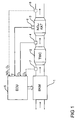
- FIG. 1 shows in highly simplified form an internal combustion engine 1 with an exhaust gas purification system, the exhaust gas cleaning system a three way catalyst (engl TWC -. T hree- W ay C atalyst) and includes a downstream three-way catalyst 2 arranged NO x storage catalytic converter 3 ,
- the three-way catalyst 2 serves to reduce the hydrocarbon and carbon monoxide concentration in the exhaust gas, while the NO x storage catalytic converter 3 has the task to absorb nitrogen oxides from the exhaust gas and to buffer them.
- the exhaust gas purification system has an exhaust gas probe 4, which is arranged between the three-way catalytic converter 2 and the NO x storage catalytic converter 3 and measures the oxygen concentration in the exhaust gas.
- the exhaust gas sensor 4 is (engl ECU. - E lectronic C ontrol U nit) with an electronic engine controller 5 is connected, which controls the internal combustion engine 1 or predetermines the mixture composition of the internal combustion engine 1.
- the emission control system has a temperature sensor 6 which is attached to the NO x storage catalytic converter 3 and indirectly detects the temperature of the NO x storage catalytic converter 3, wherein the temperature sensor 6 is also connected to the electronic engine control 5 on the output side.
- the measurement of the temperature of the NO x storage catalytic converter 3 is necessary since the NO x storage catalytic converter 3 must be heated at regular intervals for sulfur detoxification, whereby a certain minimum temperature must be reached in order to reduce the stored sulfur compounds, which is thus controlled by the electronic engine controller 5 can be.
- the emission control system an exhaust gas probe 7, which in an exhaust passage between the internal combustion engine 1 and the three-way catalyst 2 arranged is and the oxygen concentration in the exhaust gas of Internal combustion engine 1 upstream of the three-way catalyst 2 measures. From the oxygen concentration thus measured, the electronic engine controller 5 then determine whether the oxygen storage capacity of the three-way catalyst 2 exhausted is, as will be described in detail.
- a further exhaust gas probe 8 is additionally arranged downstream of the NO x storage catalytic converter 3, which measures the exhaust gas composition downstream of the NO x storage catalytic converter 3 in order to be able to detect a breakdown of the NO x storage catalytic converter 3.
- a breakdown of the NO x storage catalytic converter 3 occurs when the absolute storage capacity of the NO x storage catalytic converter 3 is exceeded and the nitrogen oxides contained in the exhaust gas of the internal combustion engine 1 can thus no longer be stored in the NO x storage catalytic converter.
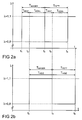
- Figure 2a shows the time profile of the air ratio ⁇ at the entrance of the three-way catalyst 2
- Figure 2b shows the time course of the air ratio ⁇ between the three-way catalyst 2 and the NO x storage catalyst 3 for the same period.
- the heating phase T HEIZ continues only until the storage capacity of the three-way catalyst 2 is exhausted and the previously stored in the three-way catalyst 2 hydrocarbons is exothermally burned.
- the oxygen concentration in the exhaust gas of the internal combustion engine 1 in the exhaust passage between the three-way catalyst 2 and the NO x storage catalyst 3 is continuously measured by the exhaust gas probe 4 in order to detect an oxygen breakdown of the three-way catalyst 2.
- the superstoichiometric operating phase T MAGER with a lean mixture of the internal combustion engine 1 is still maintained for a predetermined cooling phase T COOL , in order to cool the three-way catalyst 2.
- T COOL also the storage of oxygen in the three-way catalyst 2.
- the duration of the cooling phase T COOL is hereby read in dependence on the current operating point of the internal combustion engine 1 from a map.
- Such a premature termination of the superstoichiometric operating phase T MAGER at a breakdown of the NO x storage catalyst 3 is useful, since the NO x storage catalyst 3 is not further heated in a continuation of the superstoichiometric operation after an oxygen breakdown.
- This heating of the three-way catalyst 2 is caused by the fact that the previously stored oxygen reacts exothermically with the excess fuel.
- fuel is stored in the three-way catalyst 2, which is burned exothermic during the next heating phase T HEIZ .
- the oxygen concentration between the three-way catalytic converter 2 and the NO x storage catalytic converter 3 is continuously measured by the exhaust gas probe 4 in order to be able to detect a breakdown of the three-way catalytic converter 2.
- the substoichiometric operating phase T FAT is then ended.
- the substoichiometric operating phase T FETT is also terminated when the NO x storage catalyst 3 strikes through during the substoichiometric operating phase T FAT .
- This premature termination of the stoichiometric operating phase T FAT in the event of a breakdown of the NO x storage catalytic converter 3 makes sense, since the NO x storage catalytic converter 3 is not further heated after a breakdown due to an exhaustion of its storage capacity.
- the substoichiometric operating phase T FET of the NO x storage catalytic converter 3 also begins only at the time t 4 in the event of a breakdown of the three-way catalytic converter 2.
Landscapes
- Engineering & Computer Science (AREA)
- Chemical & Material Sciences (AREA)
- Combustion & Propulsion (AREA)
- Mechanical Engineering (AREA)
- General Engineering & Computer Science (AREA)
- Exhaust Gas After Treatment (AREA)
Abstract
Die Erfindung betrifft ein Betriebsverfahren für eine Brennkraftmaschine (1) mit einem Vorkatalysator (2) und einem Speicherkatalysator (3), wobei die Gemischzusammensetzung der Brennkraftmaschine (1) während einer unterstöchiometrischen Betriebsphase (T FETT ) angefettet wird, um den Speicherkatalysator (3) dadurch zu regenerieren. Es wird vorgeschlagen, dass die Gemischzusammensetzung der Brennkraftmaschine vor der unterstöchiometrischen Betriebsphase (T FETT ) während einer überstöchiometrischen Betriebsphase (T MAGER ) abgemagert wird.The invention relates to an operating method for an internal combustion engine (1) with a pre-catalytic converter (2) and a storage catalytic converter (3), wherein the mixture composition of the internal combustion engine (1) is enriched during a substoichiometric operating phase (T FAT) to the storage catalytic converter (3) to regenerate. It is proposed that the mixture composition of the internal combustion engine be emaciated before the substoichiometric operating phase (T FAT) during a superstoichiometric operating phase (T MAGER).
Description
Die Erfindung betrifft ein Betriebsverfahren für eine Brennkraftmaschine mit einem Vorkatalysator und einem Speicherkatalysator gemäß dem Oberbegriff des Anspruchs 1.The invention relates to an operating method for an internal combustion engine with a precatalyst and a storage catalyst according to the preamble of claim 1.
Moderne Brennkraftmaschinen weisen zur Abgasreinigung einen geregelten Dreiwegekatalysator und einen NOx-Speicherkatalysator auf. Der Dreiwegekatalysator wird auch als TWC-Katalysator (engl. TWC - Three-Way-Catalyst) bezeichnet und dient als Vorkatalysator zur Reduktion von Kohlenmonoxid und Kohlenwasserstoffen im Abgas. Der NOx-Speicherkatalysator ist dagegen stromabwärts dem TWC-Katalysator angeordnet und hat im überstöchiometrischen Betrieb die Aufgabe, Stickoxide aus dem Abgas aufzunehmen und zwischenzuspeichern.Modern internal combustion engines have a controlled three-way catalytic converter and an NO x storage catalytic converter for exhaust gas purification. The three-way catalyst (TWC engl. - T hree- W ay C atalyst) as a TWC catalyst and serves as pre-catalyst for the reduction of carbon monoxide and hydrocarbons in the exhaust gas. By contrast, the NO x storage catalytic converter is arranged downstream of the TWC catalytic converter and has the task of receiving nitrogen oxides from the exhaust gas and storing them temporarily in superstoichiometric operation.
Das Speichervermögen des NOx-Speicherkatalysators ist jedoch begrenzt, so dass der NOx-Speicherkatalysator rechtzeitig vor der Erschöpfung seines Speichervermögens regeneriert werden muss, um einen Durchschlag des NOx-Speicherkatalysators zu verhindern, da dies zu einem Anstieg der NOx-Emmissionen führen würde.However, the storage capacity of the NO x storage catalyst is limited, so that the NO x storage catalyst must be regenerated in time before the exhaustion of its storage capacity to prevent breakdown of the NO x storage catalyst, as this leads to an increase in NO x emissions would.
Die Regeneration des NOx-Speicherkatalysators kann bekanntermaßen durch eine vorübergehende Anfettung der Gemischzusammensetzung der Brennkraftmaschine erfolgen, so dass die gespeicherten Stickoxide in weniger umweltschädliche Verbindungen umgewandelt werden.As is known, the regeneration of the NO x storage catalytic converter can take place by a temporary enrichment of the internal combustion engine mixture composition, so that the stored nitrogen oxides are converted into less environmentally harmful compounds.
Problematisch an derartigen Abgasreinigungsanlagen mit einem NOx-Speicherkatalysator ist die Tatsache, dass der NOx-Speicherkatalysator durch den in handelsüblichen Kraftstoffen heute noch enthaltenen Schwefel vergiftet wird, wodurch das NOx-Speichervermögen mit zunehmender Betriebsdauer nachlässt. The problem with such emission control systems with a NO x storage catalytic converter is the fact that the NO x storage catalyst is poisoned by the sulfur contained in commercial fuels today, whereby the NO x storage capacity decreases with increasing operating time.
So entstehen bei der Verbrennung von schwefelhaltigem Kraftstoff insbesondere im Magerbetrieb Schwefeloxide, die in dem NOx-Speicherkatalysator wie Stickoxide an der katalytisch aktiven Oberfläche gebunden und eingespeichert werden. Die auf diese Weise in dem NOx-Speicherkatalysator eingespeicherten Schwefeloxide sind jedoch chemisch wesentlich stabiler als die NOx-Verbindungen, so dass die eingespeicherten Schwefeloxide bei der üblichen Regeneration des NOx-Speicherkatalysators nicht aus dem NOx-Speicherkatalysator entfernt werden. Durch die während der Betriebsdauer zunehmende Einlagerung von Schwefeloxiden in dem NOx-Speicherkatalysator verringert sich also ständig das absolute NOx-Speichervermögen des NOx-Speicherkatalysators.Thus, during the combustion of sulfur-containing fuel, in particular in lean operation, sulfur oxides are formed which are bound and stored in the NO x storage catalytic converter such as nitrogen oxides on the catalytically active surface. However, the sulfur oxides stored in this way in the NO x storage catalytic converter are chemically substantially more stable than the NO x compounds, so that the stored sulfur oxides are not removed from the NO x storage catalytic converter during the usual regeneration of the NO x storage catalytic converter. As a result of the increasing storage of sulfur oxides in the NO x storage catalytic converter during the operating period, the absolute NO x storage capacity of the NO x storage catalytic converter constantly decreases.
Die schwefelbedingte Vergiftung des NOx-Speicherkatalysators und die damit verbundene Abnahme des absoluten NOx-Speichervermögens kann jedoch rückgängig gemacht werden, indem der NOx-Speicherkatalysator auf die sogenannte Desulfatisierungstemperatur erhitzt und im unterstöchiometrischen Bereich betrieben wird, welche über der normalen Betriebstemperatur liegt und beispielsweise bei einem NOx-Speicherkatalysator in Bariumtechnologie bei ca. 650° Celsius bis 750° Celsius liegt. Die zur Desulfatisierung des NOx-Speicherkatalysators erforderliche Anhebung der Abgastemperatur kann beispielsweise durch eine Verstellung des Zündzeitpunktes in Richtung spät erfolgen.The sulfur poisoning of the NO x storage catalytic converter and the associated decrease in the absolute NO x storage capacity can however be reversed by heating the NO x storage catalytic converter to the so-called desulfurization temperature and operating in the substoichiometric range which is above the normal operating temperature and for example, in an NO x storage in barium technology at about 650 ° Celsius to 750 ° Celsius. The desaturation of the NO x storage tank required for increasing the exhaust gas temperature can be done, for example, by adjusting the ignition timing in the late direction.
Nachteilig an diesem Verfahren zur Desulfatisierung des NOx-Speicherkatalysators ist die Tatsache, dass beim Erreichen der Desulfatisierungstemperatur in dem NOx-Speicherkatalysator die Gefahr besteht, dass die maximal zulässige Betriebstemperatur des Vorkatalysators überschritten wird, da üblicherweise ein Temperaturgefälle zwischen dem Vorkatalysator und dem nachgeordneten NOx-Speicherkatalysators besteht.A disadvantage of this method for desulfating the NO x storage catalytic converter is the fact that when the desulfurization temperature in the NO x storage catalytic converter is reached, there is the danger that the maximum permissible operating temperature of the primary catalytic converter is exceeded, since a temperature gradient between the primary catalytic converter and the downstream catalytic converter usually occurs NO x storage catalytic converter consists.
Ein weiterer Nachteil an dem vorstehend beschriebenen bekannten Verfahren zur Desulfatisierung des NOx-Speicherkatalysators besteht darin, dass durch die Spätverstellung des Zündzeitpunktes nur eine begrenzte Erhöhung der Abgastemperatur erreicht werden kann, so dass die Desulfatisierung des NOx-Speicherkatalysators meist nur im oberen Teillastbereich der Brennkraftmaschine erfolgen kann.Another disadvantage of the known method described above for desulfating the NO x storage catalytic converter is that only a limited increase in the exhaust gas temperature can be achieved by the retardation of the ignition, so that the desulfurization of the NO x storage catalytic converter usually only in the upper part load range of Internal combustion engine can be done.
Schließlich führt das vorstehend beschriebene Verfahren zur Desulfatisierung des NOx-Speicherkatalysators zu einem stark erhöhten Kraftstoffverbrauch.Finally, the process described above for desulfating the NO x storage catalytic converter leads to a greatly increased fuel consumption.
Der Erfindung liegt somit die Aufgabe zugrunde, ein Betriebsverfahren für eine Brennkraftmaschine mit einem Vorkatalysator und einem Speicherkatalysator anzugeben, das eine Desulfatisierung des Speicherkatalysators ermöglicht, ohne den Vorkatalysator zu beschädigen, wobei die Desulfatisierung mit möglichst geringem zusätzlichen Kraftstoffverbrauch auch im unteren Teillastbereich der Brennkraftmaschine möglich sein soll.The invention is therefore based on the object, an operating method for an internal combustion engine with a pre-catalyst and to provide a storage catalyst that desulfation the storage catalyst allows without the Pre-catalyst damage, the desulfation with lowest possible additional fuel consumption also in the lower part load range of the internal combustion engine to be possible should.
Diese Aufgabe wird, ausgehend von dem vorstehend beschriebenen Verfahren zur Desulfatisierung eines NOx-Speicherkatalysators gemäß dem Oberbegriff des Anspruchs 1, durch die kennzeichnenden Merkmale des Anspruchs 1 gelöst.This object is achieved, starting from the above-described method for desulfating a NO x storage catalyst according to the preamble of claim 1, by the characterizing features of claim 1.
Die Erfindung beruht auf der physikalischen Erkenntnis, dass in einem Katalysator beim Übergang vom unterstöchiometrischen Betrieb (Fettbetrieb) zum überstöchiometrischen Betrieb (Magerbetrieb) zunächst eine exotherme Reaktion erfolgt, da der in dem Katalysator während des vorangegangenen unterstöchiometrischen Betriebs gespeicherte Kraftstoff mit dem Luftüberschuss während des überstöchiometrischen Betriebs reagiert. Diese exotherme Reaktion führt zu einer Aufheizung des Katalysators, was sowohl für den Vorkatalysator als auch für den Speicherkatalysator gilt.The invention is based on the physical knowledge that in a catalyst at the transition from substoichiometric Operation (rich operation) for superstoichiometric operation (lean operation) first an exothermic reaction takes place, as the in the catalyst during the previous substoichiometric Operating stored fuel with the excess air during superstoichiometric operation. This exothermic reaction leads to a heating of the catalyst, what for the pre-catalyst as well as for the Storage catalyst applies.
Die exotherme Reaktion beim Übergang vom unterstöchiometrischen Betrieb zum überstöchiometrischen Betrieb hält jedoch nur solange an, bis das Speichervermögen des Katalysators erschöpft und der zuvor eingespeicherte Kraftstoff verbrannt ist. Dieser Zeitpunkt lässt sich daran erkennen, dass der Sauerstoffüberschuss am Eingang des Katalysators auf den Ausgang des Katalysators durchschlägt.The exothermic reaction at the transition from the sub-stoichiometric However, operation for superstoichiometric operation stops only until the storage capacity of the catalyst is exhausted and burned the previously stored fuel is. This point in time can be recognized by the fact that the Oxygen excess at the entrance of the catalyst on the output the catalyst breaks through.
Falls der überstöchiometrische Betrieb über diesen Zeitpunkt hinaus fortgesetzt wird, so führt dies zur Einspeicherung von Sauerstoff in dem Katalysator, wobei der Katalysator jedoch nicht weiter aufgeheizt wird.If the over-stoichiometric operation over this time is continued, this leads to the storage of Oxygen in the catalyst, however, the catalyst is not heated further.
Beim anschließenden Übergang vom überstöchiometrischen Betrieb (Magerbetrieb) zum unterstöchiometrischen Betrieb (Fettbetrieb) des Katalysators findet dann ebenfalls zunächst eine exotherme Reaktion statt, wobei der zuvor eingespeicherte Sauerstoff mit dem Kraftstoffüberschuss während des unterstöchiometrischen Betriebs reagiert.During the subsequent transition from superstoichiometric operation (Lean operation) for substoichiometric operation (Fat operation) of the catalyst then also takes place first an exothermic reaction takes place, the previously stored Oxygen with the fuel surplus during the substoichiometric Operation reacts.
Auch diese exotherme Reaktion hält jedoch nur solange an, bis das Speichervermögen des Katalysators erschöpft und der zuvor eingespeicherte Sauerstoff verbrannt ist. Dieser Zeitpunkt lässt sich daran erkennen, dass der Kraftstoffüberschuss am Eingang des Katalysators auf den Ausgang des Katalysators durchschlägt.However, this exothermic reaction also only lasts until exhausted the storage capacity of the catalyst and the previously stored oxygen is burned. This time can be seen from the fact that the excess fuel on the Input of the catalyst on the output of the catalyst by strikes.
Falls der unterstöchiometrische Betrieb über diesen Zeitpunkt hinaus fortgesetzt wird, so führt dies zur Einspeicherung von Kraftstoff in dem Katalysator, wobei der Katalysator jedoch nicht weiter aufgeheizt wird.If the sub-stoichiometric operation over this time is continued, this leads to the storage of Fuel in the catalyst, however, the catalyst is not heated further.
Die Erfindung sieht nun vor, dass die Brennkraftmaschine zur Desulfatisierung des Speicherkatalysators abwechselnd im überstöchiometrischen Betrieb und im unterstöchiometrischen Betrieb arbeitet.The invention now provides that the internal combustion engine for Desulfatization of the storage catalyst alternately in the superstoichiometric Operation and in the stoichiometric Operation works.
Bei jedem Übergang zwischen einer unterstöchiometrischen Betriebsphase und einer überstöchiometrischen Betriebsphase wird der Vorkatalysator zwar zunächst aufgeheizt, bis das Speichervermögen des Vorkatalysators erschöpft ist.At each transition between a substoichiometric phase of operation and a stoichiometric operating phase Although the precatalyst is initially heated until the Storage capacity of the precatalyst is exhausted.
Nach der Erschöpfung seines Speichervermögens wird der Vorkatalysator dann jedoch nicht weiter aufheizt, so dass der verbleibende Zeitraum der über- bzw. unterstöchiometrischen Betriebsphase als Kühlphase für den Vorkatalysator bezeichnet werden kann.After the exhaustion of its storage capacity, the precatalyst becomes but then does not heat up, so the remaining period of the over- or substoichiometric Operating phase referred to as the cooling phase for the precatalyst can be.
Der nachgeordnete Speicherkatalysator weist dagegen vorzugsweise ein Speichervermögen auf, das weder während der unterstöchiometrischen Betriebsphase noch während der überstöchiometrischen Betriebsphase erschöpft wird. Dies bedeutet, dass der Speicherkatalysator sowohl während überstöchiometrischen Betriebs als auch während der unterstöchiometrischen Betriebsphase dauerhaft und ohne Unterbrechung erhitzt wird.The downstream storage catalyst, however, preferably a storage capacity that neither during the stoichiometric Operating phase still during the superstoichiometric Operating phase is exhausted. This means that the storage catalyst both during superstoichiometric Operation as well as during the stoichiometric operating phase is heated permanently and without interruption.
Im Ergebnis führt der dauernde Wechsel zwischen unter- und überstöchiometrischem Betrieb also zu einer unterbrechungsfreien Aufheizung des Speicherkatalysators, während der Vorkatalysator nur beim jedem Übergang zwischen über- und unterstöchiometrischem Betrieb kurzfristig aufgeheizt wird und ansonsten wieder abkühlen kann. Auf diese Weise wird vorteilhaft eine starke Erhitzung des Speicherkatalysators ermöglicht, ohne dass der Vorkatalysator überhitzt wird.As a result, the constant change between sub-stoichiometric and superstoichiometric So operation to an uninterruptible Heating the storage catalyst, while the pre-catalyst only at each transition between superstoichiometric and Operation is heated up at short notice and otherwise it can cool down again. This will be beneficial allows a strong heating of the storage catalyst, without overheating the precatalyst.
Die unterstöchiometrische Betriebsphase und die überstöchiometrische Betriebsphase sollte jeweils solange fortgesetzt werden, dass das absolute Sauerstoffspeichervermögen des Vorkatalysators überschritten wird und somit ein sogenannter Sauerstoffdurchschlag erfolgt. Dies ist sinnvoll, da der gewünschte Kühleffekt bzw. das Ende der Aufheizung erst nach einem Sauerstoffdurchschlag des Vorkatalysators auftritt.The substoichiometric operating phase and the superstoichiometric Operating phase should continue as long as each be that the absolute oxygen storage capacity of the precatalyst is exceeded and thus a so-called Oxygen breakdown occurs. This is useful because the desired Cooling effect or the end of heating only after an oxygen breakdown of the precatalyst occurs.
Im Rahmen des erfindungsgemäßen Verfahrens wird deshalb vorzugsweise die Sauerstoffkonzentration im Abgas der Brennkraftmaschine gemessen, um einen Sauerstoffdurchschlag des Vorkatalysators zu erkennen, wobei der Übergang von der überstöchiometrischen Betriebsphase (Magerphase) zu der unterstöchiometrischen Betriebsphase (Anfettungsphase) oder umgekehrt frühestens nach einem Sauerstoffdurchschlag des Vorkatalysators erfolgt.In the context of the method according to the invention is therefore preferred the oxygen concentration in the exhaust gas of the internal combustion engine measured to an oxygen penetration of the Recognizing the precatalyst, the transition from the superstoichiometric Operating phase (lean phase) to the substoichiometric Operating phase (enrichment phase) or vice versa at the earliest after an oxygen breakdown of the precatalyst he follows.
Die Messung der Sauerstoffkonzentration im Abgas der Brennkraftmaschine erfolgt hierbei vorzugsweise durch eine Abgassonde, die zwischen dem Vorkatalysator und dem Speicherkatalysator angeordnet ist, so dass ein Sauerstoffdurchschlag des Vorkatalysators an einem plötzlichen Anstieg der gemessenen Sauerstoffkonzentration im Abgas zwischen dem Vorkatalysator und dem Speicherkatalysator erkannt werden kann.The measurement of the oxygen concentration in the exhaust gas of the internal combustion engine takes place here preferably by an exhaust gas probe, between the pre-catalyst and the storage catalyst is arranged so that an oxygen breakdown of the Pre-catalyst on a sudden increase in the measured Oxygen concentration in the exhaust gas between the pre-catalyst and the storage catalyst can be detected.
Es ist jedoch alternativ auch möglich, dass zur Erkennung eines Sauerstoffdurchschlags des Vorkatalysators die Sauerstoffkonzentration durch eine Abgassonde vor dem Vorkatalysator gemessen wird. Aus der vor dem Vorkatalysator gemessenen Sauerstoffkonzentration im Abgas der Brennkraftmaschine kann dann der Sauerstofffüllungsgrad des Vorkatalysators abgeleitet werden, um einen Sauerstoffdurchschlag des Vorkatalysators zu erkennen.However, it is alternatively also possible for the detection of a Oxygen penetration of the precatalyst the oxygen concentration through an exhaust gas probe in front of the pre-catalyst is measured. From the measured before the precatalyst Oxygen concentration in the exhaust gas of the internal combustion engine can then the degree of oxygen filling of the precatalyst is deduced be to an oxygen breakdown of the precatalyst to recognize.
In den bevorzugten Ausführungsbeispielen des erfindungsgemäßen Verfahrens wird die überstöchiometrische bzw. unterstöchiometrische Betriebsphase nach einem Durchschlag des Vorkatalysators noch für eine vorgegebene Kühlphase fortgesetzt, um den Vorkatalysator zu kühlen und dadurch eine Beschädigung des Vorkatalysators durch die folgende exotherme Reaktion zu verhindern.In the preferred embodiments of the invention The method is the superstoichiometric or substoichiometric Operating phase after a breakdown of the Pre-catalyst still continued for a given cooling phase, to cool the precatalyst and thereby damage of the precatalyst by the following exotherm Prevent reaction.
Die Dauer der zum Schutz des Vorkatalysators erforderlichen Kühlphase wird hierbei vorzugsweise in Abhängigkeit von dem Betriebspunkt der Brennkraftmaschine festgelegt und kann beispielsweise aus einem Kennfeld ausgelesen werden. Bei der Festlegung der Dauer der Kühlphase können verschiedene Sensorsignale ausgewertet werden, die der elektronischen Motorsteuerung (engl. ECU - Electronic Control Unit) zur Verfügung stehen.The time required to protect the precatalyst Cooling phase is hereby preferably in dependence on the Operating point of the internal combustion engine and can, for example be read out of a map. In the Determining the duration of the cooling phase can be different sensor signals be evaluated, the electronic engine control (English: ECU - Electronic Control Unit) available stand.
In einer vorteilhaften Variante der Erfindung wird die Sauerstoffkonzentration im Abgas der Brennkraftmaschine stromabwärts nach dem Speicherkatalysator gemessen, um auch einen Durchschlag des Speicherkatalysators zu erkennen, wobei die unterstöchiometrische Betriebsphase und/oder die überstöchiometrische Betriebsphase bei einem Durchschlag des Speicherkatalysators beendet wird. Ein derartiger Abbruch des unterstöchiometrischen bzw. überstöchiometrischen Betriebs ist sinnvoll, um einen Kühleffekt nach einem Durchschlag zu verhindern. In dieser Variante bildet der Durchschlag des Speicherkatalysators also ein zusätzliches Abbruchkriterium zur Beendigung der überstöchiometrischen bzw. unterstöchiometrischen Betriebsphase, wobei dieses Abbruchkriterium vorzugsweise mit den sonstigen Abbruchkriterien (z.B. Ablauf der Heizphase bzw. Ablauf der Kühlphase) ODER-verknüpft wird.In an advantageous variant of the invention, the oxygen concentration in the exhaust of the internal combustion engine downstream measured after the storage catalyst, also a To detect breakdown of the storage catalyst, wherein the substoichiometric operating phase and / or the superstoichiometric Operating phase at a breakdown of the storage catalyst is ended. Such a demolition of the stoichiometric or over-stoichiometric operation useful to prevent a cooling effect after a breakdown. In this variant, the breakdown of the storage catalyst forms So an additional termination criterion for Termination of the superstoichiometric or substoichiometric Operating phase, this abort criterion preferably with the other termination criteria (e.g. Heating phase or expiry of the cooling phase) is OR-linked.
Es versteht sich ferner von selbst, dass die Temperatur des Speicherkatalysators während der unterstöchiometrischen Betriebsweise vorzugsweise mindestens bis auf die Desulfatisierungstemperatur des Speicherkatalysators angehoben wird.It goes without saying that the temperature of the Storage catalyst during the stoichiometric operation preferably at least up to the desulfating temperature of the storage catalyst is raised.
Andere vorteilhafte Weiterbildungen der Erfindung sind in den Unteransprüchen gekennzeichnet oder werden nachstehend zusammen mit der Beschreibung der bevorzugten Ausführungsbeispiele der Erfindung anhand der Figuren näher erläutert. Es zeigen:
- Figur 1
- eine stark vereinfachte schematische Darstellung einer Brennkraftmaschine mit einer Abgasreinigungsanlage,
- Figur 2a
- ein Zeitdiagramm mit dem Verlauf des Luftverhältnisses λ am Eingang des Vorkatalysators,
- Figur 2b
- ein Zeitdiagramm mit dem Verlauf des Luftverhältnisses λ zwischen dem Vorkatalysator und dem Speicherkatalysator sowie
- Figuren 3a und 3b
- das erfindungsgemäße Verfahren als Flussdiagramm
- FIG. 1
- a greatly simplified schematic representation of an internal combustion engine with an emission control system,
- FIG. 2a
- a time diagram with the profile of the air ratio λ at the input of the precatalyst,
- FIG. 2b
- a time chart with the course of the air ratio λ between the pre-catalyst and the storage catalyst and
- FIGS. 3a and 3b
- the inventive method as a flowchart
Die schematische Darstellung in Figur 1 zeigt in stark vereinfachter
Form eine Brennkraftmaschine 1 mit einer Abgasreinigungsanlage,
wobei die Abgasreinigungsanlage einen Dreiwegekatalysator
(engl. TWC - Three-Way-Catalyst) sowie einen
stromabwärts dem Dreiwegekatalysator 2 angeordneten NOx-Speicherkatalysator
3 umfasst.The schematic diagram in Figure 1 shows in highly simplified form an internal combustion engine 1 with an exhaust gas purification system, the exhaust gas cleaning system a three way catalyst (engl TWC -. T hree- W ay C atalyst) and includes a downstream three-
Der Dreiwegekatalysator 2 dient hierbei zur Reduzierung der
Kohlenwasserstoff- und Kohlenmonoxidkonzentration im Abgas,
während der NOx-Speicherkatalysator 3 die Aufgabe hat, Stickoxide
aus dem Abgas aufzunehmen und zwischenzuspeichern.The three-
Darüber hinaus weist die Abgasreinigungsanlage eine Abgassonde
4 auf, die zwischen dem Dreiwegekatalysator 2 und dem NOx-Speicherkatalysator
3 angeordnet ist und die Sauerstoffkonzentration
im Abgas misst. Ausgangsseitig ist die Abgassonde
4 mit einer elektronischen Motorsteuerung 5 (engl. ECU -
Electronic Control Unit) verbunden, welche die Brennkraftmaschine
1 steuert bzw. die Gemischzusammensetzung der Brennkraftmaschine
1 vorgibt.In addition, the exhaust gas purification system has an exhaust gas probe 4, which is arranged between the three-way
Ferner weist die Abgasreinigungsanlage einen Temperatursensor
6 auf, der an dem NOx-Speicherkatalysator 3 angebracht
ist und mittelbar die Temperatur des NOx-Speicherkatalysators
3 erfasst, wobei der Temperatursensor 6 ausgangsseitig ebenfalls
mit der elektronischen Motorsteuerung 5 verbunden ist.
Die Messung der Temperatur des NOx-Speicherkatalysators 3 ist
erforderlich, da der NOx-Speicherkatalysator 3 zur Schwefelentgiftung
in regelmäßigen Abständen aufgeheizt werden muss,
wobei zum Abbau der eingespeicherten Schwefelverbindungen eine
bestimmte Mindesttemperatur erreicht werden muss, was somit
von der elektronischen Motorsteuerung 5 kontrolliert werden
kann.Furthermore, the emission control system has a
In einer Variante der Erfindung weist die Abgasreinigungsanlage
eine Abgassonde 7 auf, die in einem Abgaskanal zwischen
der Brennkraftmaschine 1 und dem Dreiwegekatalysator 2 angeordnet
ist und die Sauerstoffkonzentration im Abgas der
Brennkraftmaschine 1 stromaufwärts des Dreiwegekatalysators 2
misst. Aus der so gemessenen Sauerstoffkonzentration kann die
elektronische Motorsteuerung 5 dann ermitteln, ob das Sauerstoffspeichervermögen
des Dreiwegekatalysators 2 ausgeschöpft
ist, wie noch detailliert beschrieben wird.In a variant of the invention, the emission control system
an exhaust gas probe 7, which in an exhaust passage between
the internal combustion engine 1 and the three-
In einer weiteren Variante der Erfindung ist zusätzlich
stromabwärts des NOx-Speicherkatalysators 3 eine weitere Abgassonde
8 angeordnet, welche die Abgaszusammensetzung stromabwärts
des NOx-Speicherkatalysators 3 misst, um einen Durchschlag
des NOx-Speicherkatalysators 3 erkennen zu können. Ein
derartiger Durchschlag des NOx-Speicherkatalysators 3 tritt
dann auf, wenn das absolute Speichervermögen des NOx-Speicherkatalysators
3 überschritten ist und die im Abgas der
Brennkraftmaschine 1 enthaltenen Stickoxide somit nicht mehr
in den NOx-Speicherkatalysator eingespeichert werden können.In a further variant of the invention, a further
Im folgenden wird nun anhand des in den Figuren 3a und 3b
dargestellten Flussdiagramms das erfindungsgemäße Verfahren
zur Desulfatisierung des NOx-Speicherkatalysators 3 beschrieben,
wobei auf die Zeitdiagramme in den Figuren 2a und 2b Bezug
genommen wird.In the following, the inventive method for desulfating the NO x storage
Hierbei zeigt Figur 2a den zeitlichen Verlauf des Luftverhältnisses
λ am Eingang des Dreiwegekatalysators 2, wohingegen
Figur 2b den zeitlichen Verlauf des Luftverhältnisses λ
zwischen dem Dreiwegekatalysator 2 und dem NOx-Speicherkatalysator
3 für den gleichen Zeitraum wiedergibt. Here, Figure 2a shows the time profile of the air ratio λ at the entrance of the three-
Zu Beginn des Verfahrens wird zunächst geprüft, ob eine Anforderung
zum Heizen des NOx-Speicherkatalysators 3 vorliegt,
wobei eine derartige Anforderung von der elektronischen Motorsteuerung
5 in Abhängigkeit von dem Alterungszustand des
NOx-Speicherkatalysators 3 erzeugt wird. Falls keine derartige
Anforderung zur Desulfatisierung des NOx-Speicherkatalysators
3 vorliegt, so wird das Verfahren beendet.At the beginning of the method, it is first checked whether there is a request to heat the NO x storage catalyst 3, such a request being generated by the electronic
Anderenfalls wird dagegen zum Zeitpunkt t=t1 eine überstöchiometrische Betriebsphase TMAGER der Brennkraftmaschine 1 eingeleitet, in der das Luftverhältnis λ im Abgas der Brennkraftmaschine 1 beispielsweise λ=1,1 beträgt, so dass die Brennkraftmaschine 1 mit einem mageren Gemisch betrieben wird.Otherwise, on the other hand, at the time t = t 1, a superstoichiometric operating phase T MAGER of the internal combustion engine 1 is initiated, in which the air ratio λ in the exhaust gas of the internal combustion engine 1 is λ = 1.1, for example, so that the internal combustion engine 1 is operated with a lean mixture.
Während dieser überstöchiometrischen Betriebsphase TMAGER des
Dreiwegekatalysators 2 zwischen t=t1 und t=t3 beginnt zunächst
eine Heizphase THEIZ zwischen t=t1 und t=t2, in der sich
der Dreiwegekatalysator 2 aufheizt. Diese Aufheizung des
Dreiwegekatalysators 2 wird dadurch verursacht, dass der in
dem Dreiwegekatalysator 2 gespeicherte Kohlenwasserstoffe mit
dem Luftüberschuss exotherm reagiert.During this superstoichiometric operating phase T MAGER of the three-way
Die Heizphase THEIZ dauert jedoch nur solange an, bis das
Speichervermögen des Dreiwegekatalysators 2 erschöpft und die
zuvor in den Dreiwegekatalysator 2 eingespeicherten Kohlenwasserstoffe
exotherm verbrannt ist. Es ist jedoch für die
erfindungsgemäße Funktion sinnvoll, dass die überstöchiometrische
Betriebsphase TMAGER des Dreiwegekatalysators 2 anschließend
noch fortgesetzt wird, um dem Dreiwegekatalysator
2 während einer Kühlphase TKÜHL zwischen t=t2 und t=t3 die Möglichkeit
zur Abkühlung zu geben.However, the heating phase T HEIZ continues only until the storage capacity of the three-
Die Erschöpfung des Speichervermögens des Dreiwegekatalysators
2 zum Zeitpunkt t=t2 ist an einem Sauerstoffdurchschlag
zwischen dem Dreiwegekatalysator 2 und dem NOx-Speicherkatalysator
3 erkennbar, wie aus Figur 2b im Zeitpunkt t=t2 ersichtlich
ist. Zur Erkennung eines derartigen Sauerstoffdurchschlags
wird deshalb von der Abgassonde 4 laufend die
Sauerstoffkonzentration im Abgas der Brennkraftmaschine 1 im
Abgaskanal zwischen dem Dreiwegekatalysators 2 und dem NOx-Speicherkatalysator
3 gemessen, um einen Sauerstoffdurchschlag
des Dreiwegekatalysators 2 erkennen zu können.The exhaustion of the storage capacity of the three-way
Nach dem Sauerstoffdurchschlag zum Zeitpunkt t=t2 wird die überstöchiometrische
Betriebsphase TMAGER mit einem mageren Gemisch
der Brennkraftmaschine 1 noch für eine vorgegebene
Kühlphase TKÜHL, beibehalten, um den Dreiwegekatalysator 2 zu
kühlen. Darüber hinaus erfolgt während der Kühlphase TKÜHL
auch die Einspeicherung von Sauerstoff in den Dreiwegekatalysator
2. Die Dauer der Kühlphase TKÜHL wird hierbei in Abhängigkeit
von dem aktuellen Betriebspunkt der Brennkraftmaschine
1 aus einem Kennfeld ausgelesen.After the oxygen breakdown at the time t = t 2 , the superstoichiometric operating phase T MAGER with a lean mixture of the internal combustion engine 1 is still maintained for a predetermined cooling phase T COOL , in order to cool the three-
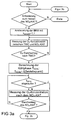
Nach Ablauf der Kühlphase TKÜHL zum Zeitpunkt t=t3 wird dann die überstöchiometrische Betriebsphase TMAGER beendet und zu der unterstöchiometrischen Betriebsphase TFETT zwischen t=t3 und t=t5 übergegangen, wobei die unterstöchiometrische Betriebsphase in dem Flussdiagramm in Figur 3a dargestellt ist.After the cooling phase T COOL at the time t = t 3 , the superstoichiometric operating phase T MAGER is ended and transitioned to the substoichiometric operating phase T FAT between t = t 3 and t = t 5 , the substoichiometric operating phase being illustrated in the flow chart in FIG is.
Ein Übergang von der überstöchiometrischen Betriebsphase
TMAGER zu der unterstöchiometrischen Betriebsphase TFETT erfolgt
jedoch unabhängig von dem Ablauf der Kühlphase TKÜHL auch
dann, wenn die Messung der Sauerstoffkonzentration durch die
Abgassonde 8 ergibt, dass ein Durchschlag des NOx-Speicherkatalysators
3 vorliegt, weil das O2-Speichervermögen des
NOx-Speicherkatalysators 3 erschöpft ist. Im Rahmen des erfindungsgemäßen
Verfahrens wird deshalb auch die Abgaszusammensetzung
stromabwärts dem NOx-Speicherkatalysator 3 gemessen,
um die überstöchiometrische Betriebsphase bei einem
Durchschlag des NOx-Speicherkatalysators gegebenenfalls vorzeitig
abbrechen zu können. Ein derartiger vorzeitiger Abbruch
der überstöchiometrischen Betriebsphase TMAGER bei einem
Durchschlag des NOx-Speicherkatalysators 3 ist sinnvoll, da
der NOx-Speicherkatalysator 3 bei einer Fortsetzung des überstöchiometrischen
Betriebs nach einem Sauerstoffdurchschlag
nicht weiter aufgeheizt wird.However, a transition from the superstoichiometric operating phase T MAGER to the substoichiometric operating phase T FAT takes place independently of the end of the cooling phase T COOL even if the measurement of the oxygen concentration by the
Im folgenden wird nun anhand des Flussdiagramms in Figur 3b die unterstöchiometrische Betriebsphase TFETT zwischen t=t3 und t=t5 beschrieben.The substoichiometric operating phase T FAT between t = t 3 and t = t 5 will now be described below with reference to the flowchart in FIG. 3 b .
So wird die Brennkraftmaschine 1 zum Zeitpunkt t=t3 von der elektronischen Motorsteuerung mit einer Luftzahl beispielsweise λ=0,8 angesteuert, was zu einer fetten Gemischzusammensetzung führt.Thus, the internal combustion engine 1 at time t = t 3 of the electronic engine control with an air ratio, for example, λ = 0.8 is driven, resulting in a rich mixture composition.
Zu Beginn der unterstöchiometrischen Betriebsphase TFETT wird
der Dreiwegekatalysator 2 zunächst während einer Heizphase
THEIZ zwischen t=t3 und t=t4 aufgeheizt. Diese Aufheizung des
Dreiwegekatalysators 2 wird dadurch verursacht, dass der zuvor
eingespeicherte Sauerstoff mit dem Kraftstoffüberschuss
exotherm reagiert.At the beginning of the substoichiometric operating phase T FAT , the three-way
Die Aufheizung des Dreiwegekatalysators 2 dauert jedoch nur
solange an, bis das Sauerstoffspeichervermögen des Dreiwegekatalysators
2 zum Zeitpunkt t=t4 ausgeschöpft ist. Es ist
jedoch für die erfindungsgemäße Funktion sinnvoll, dass die
unterstöchiometrische Betriebsphase TFETT über diesen Zeitpunkt
hinaus fortgesetzt wird, damit der Dreiwegekatalysator
2 während der anschließenden Kühlphase TKÜHL zwischen t=t4 und
t=t5 genügend Zeit zum Abkühlen hat. Darüber hinaus wird während
der Kühlphase TKÜHL zwischen t=t4 und t=t5 Kraftstoff in
den Dreiwegekatalysator 2 eingespeichert, der während der
nächsten Heizphase THEIZ exotherm verbrannt wird.The heating of the three-
Während der unterstöchiometrischen Betriebsphase TFETT zwischen
t=t3 und t=t5 wird deshalb von der Abgassonde 4 laufend
die Sauerstoffkonzentration zwischen dem Dreiwegekatalysator
2 und dem NOx-Speicherkatalysator 3 gemessen, um einen
Durchschlag des Dreiwegekatalysators 2 erkennen zu können. During the substoichiometric operating phase T FAT between t = t 3 and t = t 5 , therefore, the oxygen concentration between the three-way
Nach einem derartigen Durchschlag des Dreiwegekatalysators 2
während der unterstöchiometrischen Betriebsphase TFETT zum
Zeitpunkt t=t4 wird die unterstöchiometrische Betriebsphase
TFETT noch für eine vorgehende Kühlphase TKÜHL bis zum Zeitpunkt
t=t5 fortgesetzt, wobei die Kühlphase TKÜHL in Abhängigkeit
von dem aktuellen Betriebspunkt der Brennkraftmaschine 1
beispielsweise aus einem Kennfeld ausgelesen wird. Nach Ablauf
der vorgegebenen Kühlphase TKÜHL zum Zeitpunkt t=t5 wird
dann die unterstöchiometrische Betriebsphase TFETT beendet.After such a breakdown of the three-way
Darüber hinaus wird die unterstöchiometrische Betriebsphase
TFETT auch dann beendet, wenn der NOx-Speicherkatalysator 3
während der unterstöchiometrischen Betriebsphase TFETT durchschlägt.
Zur Erkennung eines Durchschlags wird von der Abgassonde
8 laufend die Abgaszusammensetzung stromabwärts nach
dem NOx-Speicherkatalysator 3 gemessen. Falls diese Messung
einen Durchschlag des NOx-Speicherkatalysators 3 anzeigt, so
wird die unterstöchiometrische Betriebsphase TFETT bereits vor
dem Zeitpunkt t=t5 vorzeitig abgebrochen. Dieser vorzeitige
Abbruch der unterstöchiometrischen Betriebsphase TFETT bei einem
Durchschlag des NOx-Speicherkatalysators 3 ist sinnvoll,
da der NOx-Speicherkatalysator 3 nach einem Durchschlag aufgrund
einer Erschöpfung seines Speichervermögens nicht weiter
aufgeheizt wird.In addition, the substoichiometric operating phase T FETT is also terminated when the NO x storage catalyst 3 strikes through during the substoichiometric operating phase T FAT . To detect a breakdown of the
Die Kühlung des Dreiwegekatalysators 2 während der Kühlphase
TKÜHL zwischen t=t4 und t=t5 verhindert, dass der Dreiwegekatalysator
2 während der Aufheizung in den Heizphasen THEIZ zwischen
t=t1 und t=t2 sowie zwischen t=t3 und t=t4 über seine
maximal zulässige Betriebstemperatur hinaus aufgeheizt wird,
obwohl der NOx-Speicherkatalysator 3 dann bis auf die Desulfatisierungstemperatur
von rund 700° Celsius aufgeheizt wird.The cooling of the three-
Aus einem Vergleich der beiden Zeitdiagramme in den Figuren
2a und 2b ist ersichtlich, dass die über- bzw. unterstöchiometrischen
Betriebsphasen des Dreiwegekatalysators 2 gegenüber
den entsprechenden über- bzw. unterstöchiometrischen Betriebsphasen
des NOx-Speicherkatalysators 3 phasenverschoben
sind.It can be seen from a comparison of the two timing diagrams in FIGS. 2a and 2b that the over- or under-stoichiometric operating phases of the three-way
So beginnt die überstöchiometrisches Betriebsphase TMAGER des
NOx-Speicherkatalysators 3 erst zum Zeitpunkt t=t2, also bei
einem Durchschlag des Dreiwegekatalysators 2.Thus, the superstoichiometric operating phase T MAGER of the NO x storage
Entsprechend beginnt auch die unterstöchiometrische Betriebsphase
TFETT des NOx-Speicherkatalysators 3 erst zum Zeitpunkt
t4 bei einem Durchschlag des Dreiwegekatalysators 2.Correspondingly, the substoichiometric operating phase T FET of the NO x storage
Somit führt der dauernde Wechsel zwischen unter- und überstöchiometrischen
Betriebsphasen also zu einer unterbrechungsfreien
Aufheizung des NOx-Speicherkatalysators 3, während
der Dreiwegekatalysator 2 nur beim jedem Übergang zwischen
über- und unterstöchiometrischen Betriebsphasen jeweils
während der Heizphasen THEIZ kurzfristig aufgeheizt wird und
ansonsten während der folgenden Kühlphasen TKÜHL wieder abkühlen
kann. Auf diese Weise wird vorteilhaft eine starke Erhitzung
des NOx-Speicherkatalysators ermöglicht, ohne dass der
Dreiwegekatalysator 2 überhitzt wird.Thus, the continuous change between under- and over-stoichiometric operating phases thus leads to an uninterrupted heating of the NO x storage
Die Erfindung ist nicht auf das vorstehend beschriebene Ausführungsbeispiel der Erfindung beschränkt. Vielmehr ist eine Vielzahl von Varianten und Abwandlungen möglich, die ebenfalls von dem Erfindungsgedanken Gebrauch machen und deshalb in den Schutzbereich fallen.The invention is not limited to the embodiment described above limited to the invention. Rather, one is Variety of variants and modifications possible, as well to make use of the idea of the invention and therefore fall into the scope.
Claims (9)
dadurch gekennzeichnet, dass die Gemischzusammensetzung der Brennkraftmaschine (1) vor der unterstöchiometrischen Betriebsphase (TFETT) während einer überstöchiometrischen Betriebsphase (TMAGER) abgemagert wird.Operating method for an internal combustion engine (1) with a pre-catalyst (2) and a storage catalyst (3), wherein the mixture composition of the internal combustion engine (1) during a stoichiometric operating phase (T FAT ) is enriched to increase the temperature of the storage catalyst (3) and thereby regenerating the storage catalyst (3)
characterized in that the mixture composition of the internal combustion engine (1) is emaciated before the substoichiometric operating phase (T FAT ) during a superstoichiometric operating phase (T MAGER ).
dadurch gekennzeichnet, dass die unterstöchiometrische Betriebsphase (TFETT) und die überstöchiometrische Betriebsphase (TMAGER) während eines Regenerationsbetriebs zur Regeneration des Speicherkatalysators (3) zyklisch abwechselnd wiederholt werden.Operating method according to claim 1,
characterized in that the substoichiometric operating phase (T FAT ) and the superstoichiometric operating phase (T MAGER ) are cyclically alternately repeated during a regeneration operation for the regeneration of the storage catalytic converter (3).
dadurch gekennzeichnet, dass während der überstöchiometrischen Betriebsphase (TMAGER) und/oder während der unterstöchiometrischen Betriebsphase (TFETT) die Sauerstoffkonzentration im Abgas der Brennkraftmaschine (1) gemessen wird, um einen Durchschlag des Vorkatalysators (2) zu erkennen, wobei der Übergang von der überstöchiometrischen Betriebsphase (TMAGER) zu der unterstöchiometrischen Betriebsphase (TFETT) oder umgekehrt frühestens nach einem Durchschlag des Vorkatalysators (2) erfolgt.Operating method according to claim 1 or claim 2,
characterized in that during the superstoichiometric operating phase (T MAGER ) and / or during the substoichiometric operating phase (T FAT ), the oxygen concentration in the exhaust gas of the internal combustion engine (1) is measured to detect a breakdown of the precatalyst (2), wherein the transition from the superstoichiometric operating phase (T MAGER ) to the substoichiometric operating phase (T FAT ) or vice versa at the earliest after a breakdown of the precatalyst (2).
dadurch gekennzeichnet, dass die Sauerstoffkonzentration zwischen dem Vorkatalysator (2) und dem Speicherkatalysator (3) gemessen wird. Operating method according to claim 3,
characterized in that the oxygen concentration between the precatalyst (2) and the storage catalyst (3) is measured.
dadurch gekennzeichnet, dass die Sauerstoffkonzentration vor dem Vorkatalysator (2) gemessen wird, wobei aus der gemessenen Sauerstoffkonzentration der Sauerstofffüllungsgrad des Vorkatalysators (2) abgeleitet wird, um einen Durchschlag des Vorkatalysators (2) zu erkennen.Operating method according to claim 3,
characterized in that the oxygen concentration before the precatalyst (2) is measured, wherein from the measured oxygen concentration of the oxygen content of the pre-catalyst (2) is derived to detect a breakdown of the precatalyst (2).
dadurch gekennzeichnet, dass die überstöchiometrische Betriebsphase (TMAGER) nach einem Durchschlag des Vorkatalysators (2) für eine vorgegebene Kühlphase (TKÜHL) fortgesetzt wird, um eine Überhitzung des Vorkatalysators (2) zu vermeiden.Operating method according to at least one of claims 3 to 5,
characterized in that the superstoichiometric operating phase (T lean) for a breakdown of the primary catalytic converter (2) for a predetermined cooling phase (T COOL) is continued, in order to avoid overheating of the primary catalytic converter (2).
dadurch gekennzeichnet, dass die Dauer der Kühlphase (TKÜHL) in Abhängigkeit von dem Betriebspunkt der Brennkraftmaschine (1) festgelegt wird.Operating method according to claim 6,
characterized in that the duration of the cooling phase (T COOL ) is determined in dependence on the operating point of the internal combustion engine (1).
dadurch gekennzeichnet, dass die Sauerstoffkonzentration im Abgas der Brennkraftmaschine (1) stromabwärts nach dem Speicherkatalysator (3) gemessen wird, um einen Durchschlag des Speicherkatalysators (3) zu erkennen, wobei die unterstöchiometrische Betriebsphase (TFETT) und/oder die überstöchiometrische Betriebsphase (TMAGER) bei einem Durchschlag des Speicherkatalysators (3) beendet wird.Operating method according to at least one of the preceding claims,
characterized in that the oxygen concentration in the exhaust gas of the internal combustion engine (1) downstream of the storage catalyst (3) is measured to detect a breakdown of the storage catalyst (3), wherein the substoichiometric operating phase (T FAT ) and / or the superstoichiometric operating phase (T MAGER ) is terminated at a breakdown of the storage catalyst (3).
dadurch gekennzeichnet, dass die Temperatur des Speicherkatalysators (3) mindestens bis auf die Desulfatisierungstemperatur des Speicherkatalysators (3) angehoben wird.Operating method according to at least one of the preceding claims,
characterized in that the temperature of the storage catalytic converter (3) is raised at least to the desulfurization temperature of the storage catalytic converter (3).
Applications Claiming Priority (2)
| Application Number | Priority Date | Filing Date | Title |
|---|---|---|---|
| DE10318210A DE10318210B4 (en) | 2003-04-22 | 2003-04-22 | Operating method for an internal combustion engine with a pre-catalyst and a storage catalyst |
| DE10318210 | 2003-04-22 |
Publications (2)
| Publication Number | Publication Date |
|---|---|
| EP1471237A2 true EP1471237A2 (en) | 2004-10-27 |
| EP1471237A3 EP1471237A3 (en) | 2010-11-03 |
Family
ID=32946394
Family Applications (1)
| Application Number | Title | Priority Date | Filing Date |
|---|---|---|---|
| EP03029000A Withdrawn EP1471237A3 (en) | 2003-04-22 | 2003-12-17 | Operating method for a combustion engine comprising a catalyst and pre-catalyst |
Country Status (2)
| Country | Link |
|---|---|
| EP (1) | EP1471237A3 (en) |
| DE (1) | DE10318210B4 (en) |
Cited By (1)
| Publication number | Priority date | Publication date | Assignee | Title |
|---|---|---|---|---|
| GB2467245A (en) * | 2005-05-02 | 2010-07-28 | Cummins Inc | Method for regenerating an exhaust gas aftertreatment component using oxygen concentration |
Families Citing this family (1)
| Publication number | Priority date | Publication date | Assignee | Title |
|---|---|---|---|---|
| DE102005032941A1 (en) * | 2005-07-14 | 2007-01-18 | Siemens Ag | Process and apparatus for desulfating a NOx storage catalyst |
Family Cites Families (12)
| Publication number | Priority date | Publication date | Assignee | Title |
|---|---|---|---|---|
| JP2778383B2 (en) * | 1992-10-02 | 1998-07-23 | 日産自動車株式会社 | Engine air-fuel ratio control device |
| US5473890A (en) * | 1992-12-03 | 1995-12-12 | Toyota Jidosha Kabushiki Kaisha | Exhaust purification device of internal combustion engine |
| WO2000060229A1 (en) * | 1999-04-06 | 2000-10-12 | Mitsubishi Jidosha Kogyo Kabushiki Kaisha | Exhaust emission control device of internal combustion engines |
| DE19923498A1 (en) * | 1999-05-21 | 2000-11-23 | Volkswagen Ag | Controlling the regeneration of a nitrogen oxides storage catalyst in the exhaust gas channel of an IC engine comprises comparing the measured nitrogen oxides concentration with a set concentration after the storage catalyst |
| DE19926146A1 (en) * | 1999-06-09 | 2000-12-14 | Volkswagen Ag | Method for initiating and monitoring desulfurization of at least one NOx storage catalytic converter arranged in an exhaust gas duct of an internal combustion engine |
| DE19926149A1 (en) * | 1999-06-09 | 2000-12-14 | Volkswagen Ag | Method for detecting damage to a sensor sensor in a NO¶x¶ storage catalytic converter arranged in an exhaust gas duct of an internal combustion engine |
| JP2001050086A (en) * | 1999-08-09 | 2001-02-23 | Denso Corp | Air-fuel ratio control device for internal combustion engine |
| DE10008563A1 (en) * | 2000-01-19 | 2002-05-02 | Volkswagen Ag | Nitrogen oxide storage catalyst diagnosis process, involving reporting value of characteristics of desorption peak as storage catalyst changes mode |
| DE10036390B4 (en) * | 2000-07-26 | 2010-05-12 | Volkswagen Ag | Method and device for desulphurizing a NOx storage catalytic converter |
| DE60111315T2 (en) * | 2000-08-22 | 2006-03-23 | Mazda Motor Corp. | Emission control system for an internal combustion engine |
| DE10057936A1 (en) * | 2000-11-22 | 2002-05-23 | Volkswagen Ag | Regenerating nitrogen oxides storage catalyst in exhaust gas channel of lean-burn I.C. engine involves using extrapolated oxygen-dependent signal |
| DE10057938A1 (en) * | 2000-11-22 | 2002-05-23 | Volkswagen Ag | Regenerating nitrogen oxides storage catalyst in I.C. engine involves extrapolating oxygen-dependent signal from oxygen-sensitive measuring device |
-
2003
- 2003-04-22 DE DE10318210A patent/DE10318210B4/en not_active Expired - Fee Related
- 2003-12-17 EP EP03029000A patent/EP1471237A3/en not_active Withdrawn
Cited By (2)
| Publication number | Priority date | Publication date | Assignee | Title |
|---|---|---|---|---|
| GB2467245A (en) * | 2005-05-02 | 2010-07-28 | Cummins Inc | Method for regenerating an exhaust gas aftertreatment component using oxygen concentration |
| GB2467245B (en) * | 2005-05-02 | 2010-12-22 | Cummins Inc | Apparatus and method for regenerating an exhaust gas aftertreatment component of an internal combustion engine |
Also Published As
| Publication number | Publication date |
|---|---|
| DE10318210B4 (en) | 2006-06-14 |
| DE10318210A1 (en) | 2004-11-25 |
| EP1471237A3 (en) | 2010-11-03 |
Similar Documents
| Publication | Publication Date | Title |
|---|---|---|
| EP0892158B1 (en) | Method and device to monitor the desulphurization of NOx storage catalytic converters | |
| DE19731624A1 (en) | Reversible rich regeneration of nitrogen@ oxide absorption catalyst | |
| DE102016209566A1 (en) | Controlling a nitrogen oxide emission in the exhaust gas of an internal combustion engine | |
| DE10027347B4 (en) | Exhaust emission control device for an internal combustion engine | |
| EP1193376B1 (en) | Control of an NOx-storage catalyst | |
| EP1192343B1 (en) | METHOD FOR INITIATING AND MONITORING A DESULFURIZATION OF AT LEAST ONE NOx STORAGE-TYPE CATALYTIC CONVERTER ARRANGED IN AN EXHAUST CHANNEL OF AN INTERNAL COMBUSTION ENGINE | |
| EP1117916B1 (en) | REGENERATION METHOD FOR A NOx STORAGE CATALYST PERTAINING TO AN INTERNAL COMBUSTION ENGINE | |
| DE10160704B4 (en) | Method for operating exhaust gas purification devices | |
| EP1422410B1 (en) | Method for operating a multi-cylinder internal combustion engine with nox-catalyst | |
| DE10114456A1 (en) | Device and method for coordinating emissions-related measures | |
| DE10226873B4 (en) | Method for controlling the mode selection of an internal combustion engine | |
| EP1204815B1 (en) | Method for regulating the exhaust gas temperature of a lean combustion engine during the desulphurization of a catalyst | |
| EP1179124B1 (en) | Desulphurisation method | |
| DE10318210B4 (en) | Operating method for an internal combustion engine with a pre-catalyst and a storage catalyst | |
| DE10026762A1 (en) | Desulfurization of nitrogen oxides storage catalyst arranged in exhaust gas pipe of a diesel engine comprises comparing lambda signal before/after catalyst during regeneration or through signal of sensor in lean phase | |
| EP2148049A1 (en) | Method for removing sulphur from a NOX storage catalytic converter | |
| DE10330367A1 (en) | Method and device for desulfurization of a catalyst | |
| DE10153901A1 (en) | Process for desulfurizing NOx accumulation catalyst placed downstream of diesel engine by altering amount of fuel injected into working cycle of cylinder(s) of engine | |
| EP1303690B1 (en) | Method for adapting a required catalyst temperature range for a no x? storage catalyst | |
| DE10318214B4 (en) | Method for determining the aging state of a storage catalytic converter | |
| EP1252420B1 (en) | Device and method for controlling a nox regeneration of a nox storage catalyst | |
| EP1471222B1 (en) | Regeneration method for a storage catalyst of an internal combustion engine | |
| DE10112938A1 (en) | Method for controlling a catalyst system warm-up | |
| EP1188915B1 (en) | Method for regulating the regeneration of a NOx storage catalyst | |
| DE10347446B4 (en) | Method for heating and desulfating a main catalytic converter of a multi-flow exhaust gas layer of a multi-cylinder internal combustion engine of a vehicle, in particular of a motor vehicle |
Legal Events
| Date | Code | Title | Description |
|---|---|---|---|
| PUAI | Public reference made under article 153(3) epc to a published international application that has entered the european phase |
Free format text: ORIGINAL CODE: 0009012 |
|
| AK | Designated contracting states |
Kind code of ref document: A2 Designated state(s): AT BE BG CH CY CZ DE DK EE ES FI FR GB GR HU IE IT LI LU MC NL PT RO SE SI SK TR |
|
| AX | Request for extension of the european patent |
Extension state: AL LT LV MK |
|
| RAP1 | Party data changed (applicant data changed or rights of an application transferred) |
Owner name: DAIMLERCHRYSLER AG Owner name: SIEMENS AKTIENGESELLSCHAFT |
|
| RAP1 | Party data changed (applicant data changed or rights of an application transferred) |
Owner name: DAIMLER AG Owner name: SIEMENS AKTIENGESELLSCHAFT |
|
| RAP1 | Party data changed (applicant data changed or rights of an application transferred) |
Owner name: DAIMLER AG Owner name: CONTINENTAL AUTOMOTIVE GMBH |
|
| PUAL | Search report despatched |
Free format text: ORIGINAL CODE: 0009013 |
|
| AK | Designated contracting states |
Kind code of ref document: A3 Designated state(s): AT BE BG CH CY CZ DE DK EE ES FI FR GB GR HU IE IT LI LU MC NL PT RO SE SI SK TR |
|
| AX | Request for extension of the european patent |
Extension state: AL LT LV MK |
|
| RIC1 | Information provided on ipc code assigned before grant |
Ipc: F02D 41/30 20060101ALI20100928BHEP Ipc: F02D 41/02 20060101ALI20100928BHEP Ipc: F02D 41/14 20060101AFI20040802BHEP |
|
| REG | Reference to a national code |
Ref country code: DE Ref legal event code: R108 |
|
| AKY | No designation fees paid | ||
| REG | Reference to a national code |
Ref country code: DE Ref legal event code: R108 Effective date: 20110701 |
|
| STAA | Information on the status of an ep patent application or granted ep patent |
Free format text: STATUS: THE APPLICATION IS DEEMED TO BE WITHDRAWN |
|
| 18D | Application deemed to be withdrawn |
Effective date: 20110504 |