EP1470975A2 - Regensensor, insbesondere für ein Kraftfahrzeug - Google Patents
Regensensor, insbesondere für ein Kraftfahrzeug Download PDFInfo
- Publication number
- EP1470975A2 EP1470975A2 EP03028200A EP03028200A EP1470975A2 EP 1470975 A2 EP1470975 A2 EP 1470975A2 EP 03028200 A EP03028200 A EP 03028200A EP 03028200 A EP03028200 A EP 03028200A EP 1470975 A2 EP1470975 A2 EP 1470975A2
- Authority
- EP
- European Patent Office
- Prior art keywords
- radiation
- section
- rain sensor
- degrees
- disc
- Prior art date
- Legal status (The legal status is an assumption and is not a legal conclusion. Google has not performed a legal analysis and makes no representation as to the accuracy of the status listed.)
- Granted
Links
Images

Classifications
-
- B—PERFORMING OPERATIONS; TRANSPORTING
- B60—VEHICLES IN GENERAL
- B60S—SERVICING, CLEANING, REPAIRING, SUPPORTING, LIFTING, OR MANOEUVRING OF VEHICLES, NOT OTHERWISE PROVIDED FOR
- B60S1/00—Cleaning of vehicles
- B60S1/02—Cleaning windscreens, windows or optical devices
- B60S1/04—Wipers or the like, e.g. scrapers
- B60S1/06—Wipers or the like, e.g. scrapers characterised by the drive
- B60S1/08—Wipers or the like, e.g. scrapers characterised by the drive electrically driven
- B60S1/0818—Wipers or the like, e.g. scrapers characterised by the drive electrically driven including control systems responsive to external conditions, e.g. by detection of moisture, dirt or the like
- B60S1/0822—Wipers or the like, e.g. scrapers characterised by the drive electrically driven including control systems responsive to external conditions, e.g. by detection of moisture, dirt or the like characterized by the arrangement or type of detection means
- B60S1/0833—Optical rain sensor
- B60S1/084—Optical rain sensor including a hologram
-
- B—PERFORMING OPERATIONS; TRANSPORTING
- B60—VEHICLES IN GENERAL
- B60S—SERVICING, CLEANING, REPAIRING, SUPPORTING, LIFTING, OR MANOEUVRING OF VEHICLES, NOT OTHERWISE PROVIDED FOR
- B60S1/00—Cleaning of vehicles
- B60S1/02—Cleaning windscreens, windows or optical devices
- B60S1/04—Wipers or the like, e.g. scrapers
- B60S1/06—Wipers or the like, e.g. scrapers characterised by the drive
- B60S1/08—Wipers or the like, e.g. scrapers characterised by the drive electrically driven
- B60S1/0818—Wipers or the like, e.g. scrapers characterised by the drive electrically driven including control systems responsive to external conditions, e.g. by detection of moisture, dirt or the like
- B60S1/0822—Wipers or the like, e.g. scrapers characterised by the drive electrically driven including control systems responsive to external conditions, e.g. by detection of moisture, dirt or the like characterized by the arrangement or type of detection means
Definitions
- the invention relates to a rain sensor, in particular for a motor vehicle Genre of independent claim.
- rain sensors are already known, the ones on the window of a Motor vehicle moisture can detect, and the Wiper device of the motor vehicle can control accordingly.
- Such rain sensors have a measuring section partially arranged in the pane on, which consist of a transmitter for the emission of radiation and a receiver for Detection of radiation is formed.
- the disk is of this type within this measuring section arranged that moisture on the surface of the disc through which Change in the total reflection angle at the glass-air interface of the pane is detectable. This change will cause the radiation to spread through the surface moisture influences what is detected by the receiver.
- EP 0 999 104 shows a sensor device in which holographic Elements are provided which between the radiation on their radiation path Lead transmitter and receiver.
- Retroreflectors With the radiation paths shown there Retroreflectors used, the efficiency of which is strongly dependent on the wavelength, and whose effect only occurs in a very narrow angular range of a few degrees.
- the sensitive area is very small, so that the Sensitivity of such a sensor device is limited.
- the rain sensor according to the invention with the features of the main claim has the Advantage that a holographic element, which is in or on the disc is arranged, the radiation is deflected in the direction of the surface such that the Radiation path includes an angle when projected onto the surface, so that retroreflectors with the disadvantages described above can be dispensed with.
- the angle of the radiation path is smaller than 180 ° C, in particular between 45 ° C and 135 ° C and is preferably 90 ° C because In this way, suitable radiation paths can be realized that are optimal Get measurement result.
- the holographic element has radiation in at least two Splits directions so that there are two radiation paths that are projected on the surface enclose two angles that are of the same amount. To this Ways two or more sensitive can be made with a single holographic element Areas are created, making the sensitivity of the rain sensor even further is increased.
- a higher sensitivity of the rain sensor is achieved by the sensitive Area is enlarged. This is achieved in that the radiation is in a band runs and the deflection area of the holographic element a strip corresponds, the longitudinal extent of which makes an angle with the direction of the radiation path of about 45 ° C.
- the sensitive surface of the Rain sensor can be arranged anywhere on the disc, if at least one Radiation conductor is arranged on or in the disc.
- the radiation path has four Sections, namely a first section which is substantially parallel to Surface runs and is arranged inside or on the disc, a second Section adjoining the first section and in which the radiation in Headed towards the surface, a third section adjoining the second Connects section is provided by the radiation from the surface into the Disk is guided and is provided in the fourth section by the of the Surface at least partially reflected radiation approximately parallel to the surface is headed.
- the transmission means emits the radiation in the first Section emits and the receiver means the radiation from the fourth section receives.
- a particularly large sensitive area and thus an increased sensitivity of the Rain sensor can be achieved here if additional sections are provided are arranged symmetrically to the first and / or the fourth section, so that result in several measurement sections.
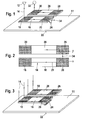
- a rain sensor 10 is a schematic Principle sketch shown.
- An infrared LED as transmitter 12 sends radiation 14 in Direction of a holographic coupling element 16.
- the coupling element 16 is as Formed film in which a hologram is embossed.
- the hologram is like this formed that the radiation is coupled to a radiation conductor 18 which the Radiation leads to the holographic element 20.
- the holographic coupling element 16 the radiation conductor 18 and the holographic element 20 are in one piece formed of a film which is applied to the inner surface of the disc 11.
- the holographic element 20 is further configured such that the radiation on the one hand is directed in the direction of the outer surface 22 of the disk 11 and on the other hand in a further direction, namely perpendicular to the direction of incidence the radiation through the radiation guide 18 into the holographic element 20th is distracted. In this way, a radiation path 21 is created, which in a to Disk 11 parallel plane encloses an angle alpha. In addition, the Radiation out of this parallel plane, in the direction of the surface 22 distracted.
- the radiation becomes a sensitive area 24 when the disk 11 is dry totally reflected and thereby directed to a further holographic element 26.
- This in turn is designed in such a way that the radiation is emitted by another Radiation conductor 28, which connects directly to the further holographic element 26, is passed to a decoupling element 30.
- This is also holographic formed and directs the radiation coming from the further radiation conductor 28 into Direction towards a receiver means 32.
- the path that the radiation from the holographic Element 20 to the further holographic element 26 forms here Measuring section 34 within which the sensitive area 24 lies.
- the radiation path 14 is shown in a plan view.
- the radiation runs from the coupling element 16 via the radiation conductor 18 to the holographic element 20.
- FIG. 3 the real radiation conditions on a rain sensor 10 are schematic shown.
- the radiation 14 emerges from the transmitter means 12 (FIG. 1) in a larger one Area and is from there via the coupling element 16 to the radiation conductor 18 holographic element 20 passed. Since the radiation guide 18 and the holographic Element 20 normally only about 0.2 mm thick, and therefore very thin, arise in Area of the holographic element 20, which has the function of an angle converter perceives multiple reflections. This causes most of the light in a very narrow area of about 2 mm is coupled out, which results in a Enlargement of the holographic element 20 remains essentially ineffective. Analogously to that shown in FIG.
- the light from the holographic element 20 in Direction of the disc and additionally deflected such that it is reflected on the Surface 22 of the pane 11 meets the further holographic element 26. From there this radiation band becomes a decoupling element via the further radiation conductor 28 30 and passed to the receiver means 32 ( Figure 1).
- the strip 36 by the holographic element 20 acting obliquely to be ordered In this way, the sensitive area 24 is significantly enlarged.
- the strip 36 is approximately 45 degrees to the main radiation direction in the radiation guide 18 arranged.
- the further holographic element 26 which reflects the radiation reflected on the surface 22 of the pane 11 into the couples further radiation conductor 28.
- FIG. 5 shows a variation of a rain sensor according to the invention in one illustration as shown in Figure 2.
- the radiation is from the coupling element 16 in the Radiation conductor 18 coupled.
- the main radiation direction which is the radiation has in the radiation conductor 18, the holographic element 20, the radiation in the direction of the pane and 90 degrees to the main radiation direction - as in FIG. 2 - distracted.
- the other half of the radiation is in the direction of -90 degrees - so oppositely-deflected, so that there are two sensitive surfaces lying next to each other result.
- Two further holographic elements 26a and 26b are then used for this purpose needed, to which there are two further radiation conductors 28a, 28b, which the Lead radiation to the coupling element 30a and 30b.
- the 5 shows the holographic element 20 or 26a, 26b, diagonally to Radiation direction can be arranged, as shown in Figure 4. That way even with an arrangement according to FIG. 5, an enlargement of the sensitive area 24 possible.
- the condition of total reflection in air limits the direction of incidence of the radiation to around 42 degrees to 63 degrees.
- the light should be reflected back into the holographic element 20 are avoided, and on the other hand, the light should be as possible can be absorbed without loss by the further holographic element 26. Therefore must the distance between the two radiation conductors 18 and 28 or the holographic elements 20 and 26 are chosen so that this is approximately twice the glass thickness, i.e. approximately 5 mm is assumed if an average direction of incidence of approximately 45 degrees to 50 degrees becomes.
Landscapes
- Engineering & Computer Science (AREA)
- Automation & Control Theory (AREA)
- Mechanical Engineering (AREA)
- Investigating Or Analysing Materials By Optical Means (AREA)
Abstract
Description
Claims (10)
- Regensensor (10), insbesondere für ein Kraftfahrzeug, mit einer Messstrecke (34), die zumindest aus einem Sendemittel (12) zur Emission von Strahlung und einem Empfängermittel (32) zur Detektion von Strahlung gebildet ist, wobei innerhalb der Messstrecke (34) eine Scheibe (11) mit mindestens einer Oberfläche (22) derart angeordnet ist, dass die Ausbreitung der Strahlung durch auf der Oberfläche (22) befindliche Feuchtigkeit beeinflusst ist, dadurch gekennzeichnet, dass zumindest ein einziges holographisches Element (20) zur Führung der Strahlung vorgesehen ist, das auf und/oder in der Scheibe (11) angeordnet ist, und die Strahlung (14) in Richtung der Oberfläche (22) derart ablenkt, dass ein Strahlungspfad (21) entsteht, der bei einer Projektion auf die Oberfläche (22) einen Winkel (Alpha) einschließt.
- Regensensor (10) nach Anspruch 1, dadurch gekennzeichnet, dass der Winkel (Alpha) des Strahlungspfads (21) weniger als 180 Grad, insbesondere zwischen 45 Grad und 135 Grad und vorzugsweise 90 Grad beträgt.
- Regensensor (10) nach einem der vorhergehenden Ansprüche, dadurch gekennzeichnet, dass das holographische Element (20) die Strahlung in mindestens zwei Richtungen aufteilt, sodass zwei Strahlungspfade (21, 21a) entstehen, die bei einer Projektion auf die Oberfläche (22) zwei Winkel (Alpha, Beta) einschließen, die insbesondere von gleichem Betrage sind.
- Regensensor (10) nach einem der vorhergehenden Ansprüche, dadurch gekennzeichnet, dass die Scheibe (11) die Windschutzscheibe einer Kraftfahrzeugs ist und die Sendemittel (12) und die Empfängermittel (32) außerhalb des Sichtfelds des Fahrzeugführers angeordnet sind.
- Regensensor (10) nach einem der vorhergehenden Ansprüche, dadurch gekennzeichnet, dass die Strahlung in einem Band mit der Breite b verläuft und der Ablenkungsbereich des holographischen Elements (20) im wesentlichen einem Streifen (36) entspricht, dessen Längserstreckung mit der Richtung des Strahlungspfads (21) einen Winkel von insbesondere 45 Grad einschließt.
- Regensensor (10) nach einem der vorhergehenden Ansprüche, dadurch gekennzeichnet, dass mindestens ein Strahlungsleiter (18) auf oder in der Scheibe (11) angeordnet ist.
- Regensensor (10) nach einem der vorhergehenden Ansprüche, dadurch gekennzeichnet, dass der Strahlungspfad (21) einen ersten Abschnitt aufweist, der im wesentlichen parallel zur Oberfläche verläuft und in oder auf der Scheibe (11) angeordnet ist, dass der Strahlungspfad einen zweiten Abschnitt aufweist, der sich an den ersten Abschnitt anschließt, in dem die Strahlung in Richtung der Oberfläche (22) geleitet ist, und dass ein dritter, sich an den zweiten Abschnitt anschließender Abschnitt vorgesehen ist, in dem die Strahlung von der Oberfläche (22) in die Scheibe (11) geleitet ist, und dass ein vierter Abschnitt vorgesehen ist, in dem die von der Oberfläche (22) zumindest teilweise reflektierte Strahlung im wesentlichen parallel zur Oberfläche (22) geleitet ist.
- Regensensor (10) nach Anspruch 7, dadurch gekennzeichnet, dass das Sendemittel (12) Strahlung in den ersten Abschnitt abgibt und das Empfängermittel (32) Strahlung aus dem vierten Abschnitt empfängt.
- Regensensor (10) nach Anspruch 7 oder 8, dadurch gekennzeichnet, dass der ebene Abstand (a) zwischen dem ersten Abschnitt und dem vierten Abschnitt etwa der doppelten Dicke der Scheibe (11) entspricht.
- Regensensor (10) nach einem der Ansprüche 7 bis 9, dadurch gekennzeichnet, dass weitere Abschnitte vorgesehen sind, die symmetrisch zum ersten Abschnitt und/oder zum vierten Abschnitt angeordnet sind.
Applications Claiming Priority (2)
| Application Number | Priority Date | Filing Date | Title |
|---|---|---|---|
| DE2003114704 DE10314704A1 (de) | 2003-03-31 | 2003-03-31 | Regensensor, insbesondere für ein Kraftfahrzeug |
| DE10314704 | 2003-03-31 |
Publications (3)
| Publication Number | Publication Date |
|---|---|
| EP1470975A2 true EP1470975A2 (de) | 2004-10-27 |
| EP1470975A3 EP1470975A3 (de) | 2005-04-20 |
| EP1470975B1 EP1470975B1 (de) | 2007-07-18 |
Family
ID=32946360
Family Applications (1)
| Application Number | Title | Priority Date | Filing Date |
|---|---|---|---|
| EP20030028200 Expired - Lifetime EP1470975B1 (de) | 2003-03-31 | 2003-12-09 | Regensensor, insbesondere für ein Kraftfahrzeug |
Country Status (3)
| Country | Link |
|---|---|
| EP (1) | EP1470975B1 (de) |
| DE (2) | DE10314704A1 (de) |
| ES (1) | ES2287404T3 (de) |
Families Citing this family (5)
| Publication number | Priority date | Publication date | Assignee | Title |
|---|---|---|---|---|
| DE102004050765A1 (de) * | 2004-10-16 | 2006-04-27 | Robert Bosch Gmbh | Optischer Sensor zur Detektion von Feuchtigkeit auf einer Scheibe eines Kraftfahrzeugs |
| DE102013210887B4 (de) | 2013-06-11 | 2019-12-12 | Robert Bosch Gmbh | Optische Sensoranordnung für ein Fahrzeug und Fahrzeug mit einer derartigen Sensoranordnung |
| GB201714591D0 (en) * | 2017-09-11 | 2017-10-25 | Pilkington Group Ltd | Mist sensor and glazing incorporating a mist sensor |
| DE102018209015A1 (de) * | 2018-06-07 | 2019-12-12 | Robert Bosch Gmbh | Vorrichtung und Verfahren zur Erkennung einer Verschmutzung wenigstens eines Sendefensters und/oder eines Empfangsfensters eines Sensors |
| DE102018209020A1 (de) | 2018-06-07 | 2019-12-12 | Robert Bosch Gmbh | Vorrichtung, ausgebildet zur Erkennung einer Verschmutzung wenigstens eines Sendefensters und/oder eines Empfangsfensters eines Sensors |
Family Cites Families (5)
| Publication number | Priority date | Publication date | Assignee | Title |
|---|---|---|---|---|
| US5623561A (en) * | 1995-09-29 | 1997-04-22 | Georgia Tech Research Corporation | Integrated optic interferometric sensor |
| JP2000193589A (ja) * | 1998-12-28 | 2000-07-14 | Central Glass Co Ltd | 雨滴検出装置 |
| EP0999104A3 (de) * | 1998-11-02 | 2003-09-17 | Central Glass Company, Limited | Regensensor und Belichtungsystem für Hologram |
| DE10049401A1 (de) * | 2000-10-05 | 2002-04-25 | Hsm Gmbh | Feuchtigkeitssensor |
| DE10132889A1 (de) * | 2001-07-06 | 2003-01-23 | Bosch Gmbh Robert | Optischer Sensor zur Erfassung einer Benetzung einer Oberfläche |
-
2003
- 2003-03-31 DE DE2003114704 patent/DE10314704A1/de not_active Withdrawn
- 2003-12-09 DE DE50307696T patent/DE50307696D1/de not_active Expired - Lifetime
- 2003-12-09 EP EP20030028200 patent/EP1470975B1/de not_active Expired - Lifetime
- 2003-12-09 ES ES03028200T patent/ES2287404T3/es not_active Expired - Lifetime
Also Published As
| Publication number | Publication date |
|---|---|
| DE50307696D1 (de) | 2007-08-30 |
| DE10314704A1 (de) | 2004-10-14 |
| EP1470975A3 (de) | 2005-04-20 |
| EP1470975B1 (de) | 2007-07-18 |
| ES2287404T3 (es) | 2007-12-16 |
Similar Documents
| Publication | Publication Date | Title |
|---|---|---|
| DE69838859T2 (de) | Kompakter Feuchtigkeitssensor mit wirksamer, sehr schräggestellter Optik | |
| DE10326848B4 (de) | Optischer Sensor | |
| EP2520924A1 (de) | Verfahren und Messanordnung zur Verbesserung der Signalauflösung bei der Gasabsorptionsspektroskopie | |
| DE102015100706A1 (de) | Selbsttätig verfahrbares Reinigungsgerät | |
| DE102011015527A1 (de) | Sensor zur berührungslosen Bestimmung der Fahrbahnbeschaffenheit und dessen Verwendung | |
| DE4340681A1 (de) | Sensorsystem | |
| EP1784324B1 (de) | Optoelektronische sensoreinrichtung für ein kraftfahrzeug | |
| EP1523669A1 (de) | Vorrichtung zur ir-spektrometrischen analyse eines festen, flüssigen oder gasförmigen mediums semination | |
| EP1470975B1 (de) | Regensensor, insbesondere für ein Kraftfahrzeug | |
| DE19815746C1 (de) | Sensoreinrichtung zur Erfassung einer Benetzung auf einer Scheibe | |
| DE19815747C1 (de) | Sensoreinrichtung zur Erfassung einer Benetzung auf einer Scheibe | |
| EP0911231B1 (de) | Regensensor | |
| DE10316514A1 (de) | Vorrichtung zur IR-spektrometrischen Analyse eines festen, flüssigen oder gasförmigen Mediums | |
| DE102019135877B4 (de) | System zur Messung des Vorhandenseins und/oder der Konzentration einer in Körperflüssigkeit gelösten Analysesubstanz | |
| EP1698532B1 (de) | Optischer Sensor mit optimierter Sensitivität | |
| EP2560208B1 (de) | Optoelektronischer Sensor | |
| DE102015222380B4 (de) | Entfernungsmesssystem | |
| DE102012019621A1 (de) | Regensensor, Kraftfahrzeug und Verfahren zum Erfassen der Intensität eines Niederschlags | |
| DE102017127368A1 (de) | Bedienvorrichtung mit fokussierendem Bedienelement | |
| DE102013009126B4 (de) | Sensorvorrichtung | |
| DE10012522A1 (de) | Distanzsensor | |
| DE102005050795A1 (de) | Meßvorrichtung zur Bestimmung der Dicke und/oder der optischen Transmissionseigenschaften einer Scheibe, vorzugsweise einer Fahrzeugscheibe | |
| DE102019106544A1 (de) | Messvorrichtung zur Erfassung des Umgebungslichts, Regen-Licht-Sensor zur Verwendung an einer Windschutzscheibe und Kraftfahrzeug | |
| DE102010006011A1 (de) | Vorrichtung und Verfahren zur berührungslosen Messung eines Abstands und/oder eines Profils | |
| EP1341118B1 (de) | Optoelektronische Vorrichtung |
Legal Events
| Date | Code | Title | Description |
|---|---|---|---|
| PUAI | Public reference made under article 153(3) epc to a published international application that has entered the european phase |
Free format text: ORIGINAL CODE: 0009012 |
|
| AK | Designated contracting states |
Kind code of ref document: A2 Designated state(s): AT BE BG CH CY CZ DE DK EE ES FI FR GB GR HU IE IT LI LU MC NL PT RO SE SI SK TR |
|
| AX | Request for extension of the european patent |
Extension state: AL LT LV MK |
|
| PUAL | Search report despatched |
Free format text: ORIGINAL CODE: 0009013 |
|
| AK | Designated contracting states |
Kind code of ref document: A3 Designated state(s): AT BE BG CH CY CZ DE DK EE ES FI FR GB GR HU IE IT LI LU MC NL PT RO SE SI SK TR |
|
| AX | Request for extension of the european patent |
Extension state: AL LT LV MK |
|
| 17P | Request for examination filed |
Effective date: 20051020 |
|
| AKX | Designation fees paid |
Designated state(s): CZ DE ES FR GB IT |
|
| GRAP | Despatch of communication of intention to grant a patent |
Free format text: ORIGINAL CODE: EPIDOSNIGR1 |
|
| GRAS | Grant fee paid |
Free format text: ORIGINAL CODE: EPIDOSNIGR3 |
|
| GRAA | (expected) grant |
Free format text: ORIGINAL CODE: 0009210 |
|
| AK | Designated contracting states |
Kind code of ref document: B1 Designated state(s): CZ DE ES FR GB IT |
|
| REG | Reference to a national code |
Ref country code: GB Ref legal event code: FG4D Free format text: NOT ENGLISH |
|
| REF | Corresponds to: |
Ref document number: 50307696 Country of ref document: DE Date of ref document: 20070830 Kind code of ref document: P |
|
| GBT | Gb: translation of ep patent filed (gb section 77(6)(a)/1977) |
Effective date: 20071024 |
|
| REG | Reference to a national code |
Ref country code: ES Ref legal event code: FG2A Ref document number: 2287404 Country of ref document: ES Kind code of ref document: T3 |
|
| ET | Fr: translation filed | ||
| PLBE | No opposition filed within time limit |
Free format text: ORIGINAL CODE: 0009261 |
|
| STAA | Information on the status of an ep patent application or granted ep patent |
Free format text: STATUS: NO OPPOSITION FILED WITHIN TIME LIMIT |
|
| 26N | No opposition filed |
Effective date: 20080421 |
|
| PGFP | Annual fee paid to national office [announced via postgrant information from national office to epo] |
Ref country code: FR Payment date: 20110107 Year of fee payment: 8 |
|
| PGFP | Annual fee paid to national office [announced via postgrant information from national office to epo] |
Ref country code: CZ Payment date: 20101126 Year of fee payment: 8 |
|
| PGFP | Annual fee paid to national office [announced via postgrant information from national office to epo] |
Ref country code: GB Payment date: 20101221 Year of fee payment: 8 |
|
| PGFP | Annual fee paid to national office [announced via postgrant information from national office to epo] |
Ref country code: IT Payment date: 20101228 Year of fee payment: 8 |
|
| PGFP | Annual fee paid to national office [announced via postgrant information from national office to epo] |
Ref country code: ES Payment date: 20101222 Year of fee payment: 8 |
|
| PG25 | Lapsed in a contracting state [announced via postgrant information from national office to epo] |
Ref country code: CZ Free format text: LAPSE BECAUSE OF NON-PAYMENT OF DUE FEES Effective date: 20111209 |
|
| GBPC | Gb: european patent ceased through non-payment of renewal fee |
Effective date: 20111209 |
|
| REG | Reference to a national code |
Ref country code: FR Ref legal event code: ST Effective date: 20120831 |
|
| PG25 | Lapsed in a contracting state [announced via postgrant information from national office to epo] |
Ref country code: GB Free format text: LAPSE BECAUSE OF NON-PAYMENT OF DUE FEES Effective date: 20111209 |
|
| PG25 | Lapsed in a contracting state [announced via postgrant information from national office to epo] |
Ref country code: IT Free format text: LAPSE BECAUSE OF NON-PAYMENT OF DUE FEES Effective date: 20111209 |
|
| PG25 | Lapsed in a contracting state [announced via postgrant information from national office to epo] |
Ref country code: FR Free format text: LAPSE BECAUSE OF NON-PAYMENT OF DUE FEES Effective date: 20120102 |
|
| REG | Reference to a national code |
Ref country code: ES Ref legal event code: FD2A Effective date: 20130703 |
|
| PG25 | Lapsed in a contracting state [announced via postgrant information from national office to epo] |
Ref country code: ES Free format text: LAPSE BECAUSE OF NON-PAYMENT OF DUE FEES Effective date: 20111210 |
|
| PGFP | Annual fee paid to national office [announced via postgrant information from national office to epo] |
Ref country code: DE Payment date: 20150224 Year of fee payment: 12 |
|
| REG | Reference to a national code |
Ref country code: DE Ref legal event code: R119 Ref document number: 50307696 Country of ref document: DE |
|
| PG25 | Lapsed in a contracting state [announced via postgrant information from national office to epo] |
Ref country code: DE Free format text: LAPSE BECAUSE OF NON-PAYMENT OF DUE FEES Effective date: 20160701 |