EP1469898B1 - System zum behandeln einer vorhofarrythmie - Google Patents
System zum behandeln einer vorhofarrythmie Download PDFInfo
- Publication number
- EP1469898B1 EP1469898B1 EP03707537A EP03707537A EP1469898B1 EP 1469898 B1 EP1469898 B1 EP 1469898B1 EP 03707537 A EP03707537 A EP 03707537A EP 03707537 A EP03707537 A EP 03707537A EP 1469898 B1 EP1469898 B1 EP 1469898B1
- Authority
- EP
- European Patent Office
- Prior art keywords
- patient
- imd
- drug therapy
- ventricular
- interval
- Prior art date
- Legal status (The legal status is an assumption and is not a legal conclusion. Google has not performed a legal analysis and makes no representation as to the accuracy of the status listed.)
- Expired - Lifetime
Links
Images

Classifications
-
- A—HUMAN NECESSITIES
- A61—MEDICAL OR VETERINARY SCIENCE; HYGIENE
- A61M—DEVICES FOR INTRODUCING MEDIA INTO, OR ONTO, THE BODY; DEVICES FOR TRANSDUCING BODY MEDIA OR FOR TAKING MEDIA FROM THE BODY; DEVICES FOR PRODUCING OR ENDING SLEEP OR STUPOR
- A61M5/00—Devices for bringing media into the body in a subcutaneous, intra-vascular or intramuscular way; Accessories therefor, e.g. filling or cleaning devices, arm-rests
- A61M5/14—Infusion devices, e.g. infusing by gravity; Blood infusion; Accessories therefor
- A61M5/142—Pressure infusion, e.g. using pumps
- A61M5/14244—Pressure infusion, e.g. using pumps adapted to be carried by the patient, e.g. portable on the body
-
- A—HUMAN NECESSITIES
- A61—MEDICAL OR VETERINARY SCIENCE; HYGIENE
- A61P—SPECIFIC THERAPEUTIC ACTIVITY OF CHEMICAL COMPOUNDS OR MEDICINAL PREPARATIONS
- A61P9/00—Drugs for disorders of the cardiovascular system
- A61P9/06—Antiarrhythmics
-
- A—HUMAN NECESSITIES
- A61—MEDICAL OR VETERINARY SCIENCE; HYGIENE
- A61B—DIAGNOSIS; SURGERY; IDENTIFICATION
- A61B17/00—Surgical instruments, devices or methods
- A61B2017/00017—Electrical control of surgical instruments
- A61B2017/00022—Sensing or detecting at the treatment site
- A61B2017/00039—Electric or electromagnetic phenomena other than conductivity, e.g. capacity, inductivity, Hall effect
- A61B2017/00044—Sensing electrocardiography, i.e. ECG
-
- A—HUMAN NECESSITIES
- A61—MEDICAL OR VETERINARY SCIENCE; HYGIENE
- A61M—DEVICES FOR INTRODUCING MEDIA INTO, OR ONTO, THE BODY; DEVICES FOR TRANSDUCING BODY MEDIA OR FOR TAKING MEDIA FROM THE BODY; DEVICES FOR PRODUCING OR ENDING SLEEP OR STUPOR
- A61M2230/00—Measuring parameters of the user
- A61M2230/04—Heartbeat characteristics, e.g. ECG, blood pressure modulation
-
- A—HUMAN NECESSITIES
- A61—MEDICAL OR VETERINARY SCIENCE; HYGIENE
- A61M—DEVICES FOR INTRODUCING MEDIA INTO, OR ONTO, THE BODY; DEVICES FOR TRANSDUCING BODY MEDIA OR FOR TAKING MEDIA FROM THE BODY; DEVICES FOR PRODUCING OR ENDING SLEEP OR STUPOR
- A61M5/00—Devices for bringing media into the body in a subcutaneous, intra-vascular or intramuscular way; Accessories therefor, e.g. filling or cleaning devices, arm-rests
- A61M5/14—Infusion devices, e.g. infusing by gravity; Blood infusion; Accessories therefor
- A61M5/168—Means for controlling media flow to the body or for metering media to the body, e.g. drip meters, counters ; Monitoring media flow to the body
- A61M5/172—Means for controlling media flow to the body or for metering media to the body, e.g. drip meters, counters ; Monitoring media flow to the body electrical or electronic
- A61M5/1723—Means for controlling media flow to the body or for metering media to the body, e.g. drip meters, counters ; Monitoring media flow to the body electrical or electronic using feedback of body parameters, e.g. blood-sugar, pressure
-
- A—HUMAN NECESSITIES
- A61—MEDICAL OR VETERINARY SCIENCE; HYGIENE
- A61N—ELECTROTHERAPY; MAGNETOTHERAPY; RADIATION THERAPY; ULTRASOUND THERAPY
- A61N1/00—Electrotherapy; Circuits therefor
- A61N1/18—Applying electric currents by contact electrodes
- A61N1/32—Applying electric currents by contact electrodes alternating or intermittent currents
- A61N1/36—Applying electric currents by contact electrodes alternating or intermittent currents for stimulation
- A61N1/362—Heart stimulators
- A61N1/3621—Heart stimulators for treating or preventing abnormally high heart rate
Definitions
- the present invention relates to terminating atrial and ventricular fibrillations.
- the invention relates to terminating atrial fibrillation while preventing the occurrence of ventricular proarrhythmia ( i . e ., irregular ventricular rhythm).
- FIG. 1 illustrates a portion of an ECG tracing of two complete cycles of the cardiac signal.
- Each cardiac signal comprises five major signal portions that are identified respectively as the P, Q, R, S and T waves.
- the P wave represents electrical depolarization of the atrium.
- the Q wave represents the initial stages of ventricle depolarization and the R wave represents the peak of the depolarization of a ventricular myocardium.
- the S wave represents the final stages of ventricular depolarization and the T wave represents ventricular repolarization.
- the QRS complex of the ventricle generally masks atrial repolarization.
- the R wave represents the conducted sinus beat of the heart.
- the interval between each apex of consecutive R waves represents the heart period in units of time, with the heart rate being the reciprocal of the RR interval expressed as beats per minute.
- FIG. 1 further illustrates a normal cardiac signal labeled with two Q-T intervals, Q-T 1 and Q-T 2 .
- Each Q-T interval is usually measured from the beginning of the Q wave to the end of the T wave.
- the duration of the Q-T interval may be an indicator of cardiac electrical abnormalities.
- a prolonged Q-T interval under certain conditions, can indicate a risk of sudden cardiac arrest Electrical heterogenerty is a substrate for ventricular arrhythmia.
- a prolonged Q-T interval can also indicate that a ventricular arrhythmia ( i . e ., an irregular heartbeat or rhythm) in the patient's heart may be imminent. Left untreated, sustained ventricular arrhythmia can detrimentally impact a patient's health.
- Implanted medical devices exist today that are capable of detecting and treating arrhythmia of a patient.
- the implanted medical device includes a defibrillator that applies an electrical therapy to a patient's heart upon detecting an atrial fibrillation.
- Cardioverters or defibrillators discharge relatively high energy electrical shocks across cardiac tissue to arrest a life threatening atrial or ventricular fibrillation that is detected by the implanted medical device. Defibrillation shocks, while highly effective at arresting the fibrillation, may cause considerable patient discomfort.
- US 5,042,497 describes a system for arrhythmia prediction and prevention for implanted devices.
- WO 94/21237 describes a system for cnntrolled release of antiarrhythmia agents.
- a system for responding, from internally within a patient, to an atrial arrhythmia in a heart comprising:
- a system for responding, from internally within a patient, to an atrial arrhythmia in a heart comprising:
- the heart is paced from within the patient at a predefined rate responsive to measuring the at least one electrocardiogram characteristic. Pacing may occur alone, or in combination with drug therapy delivery.
- the present invention is generally directed to a system for automatic intervention by an implanted device to prevent and/or terminate an atrial arrhythmia in a patient's heart using pacing and/or pharmaceutical therapies.
- the safety of each therapy is gauged by monitoring whether the therapy triggers conditions in the patient that incite a ventricular arrhythmia (irregular ventricle rhythm).
- a patient's cardiac signals such as those illustrated in the ECG tracing of FIG. 1 , provide real-time indications of conditions indicative of the potential safety of a therapy, for example a pharmaceutical or drug therapy. While the present invention is not necessarily limited to such pacing and/or drug therapy applications, the invention will be better appreciated using a discussion of example embodiments in such a specific context.
- Various embodiments of the present invention are directed to an implantable medical device (IMD) that routinely monitors cardiac electrical signals to determine, then react responsively to, conditions predictive of an impending ventricular arrhythmia.
- the IMD monitors conditions of Q-T interval, Q-T dispersion and ventricular ectopy (premature heartbeats), the IMD making comparisons of the measurements to predetermined thresholds and selecting an operating mode responsive to the comparisons.
- the IMD automatically initiates ventricular overdrive pacing in an attempt to prevent ventricular proarrhythmia responsive to the comparisons. According to another example embodiment, the IMD automatically initiates ventricular overdrive pacing in an attempt to prevent ventricular proarrhythmia responsive to comparisons made following initiations of drug therapy.
- monitoring and pacing continue beyond onset of a ventricular proarrhythmia event.
- post-event IMD monitoring continues using pre-event thresholds, new thresholds, or some combination thereof as is applicable to the particular cardiac signal being measured in a particular installation.
- the IMD in addition to reacting responsively to monitored cardiac signals by pacing, the IMD reacts responsively addressing various needs in connection with administering anti-arrhythmic drugs to a patient to prevent and/or terminate atrial fibrillation while monitoring a patient's cardiac signals to predict and/or detect an onset of ventricular proarrhythmia.
- Drug therapy initiation/termination thresholds may be the same or different than thresholds established for the initiation/termination of pacing operations, and drug therapy termination thresholds may be different than drug therapy initiation thresholds.
- the IMD routinely monitors cardiac signals for conditions including, but not limited to, Q-T interval prolongation, Q-T interval variability and a high frequency of ventricular ectopy as indicators that conditions exist for the onset of ventricular arrhythmia and that drug therapy should be terminated.
- the IMD automatically initiates a course of drug therapy without ventricular overdrive pacing in an attempt to prevent ventricular proarrhythmia responsive to the comparisons.
- Cardiac signal monitoring continues after initiation of the drug therapy, and drug therapy discontinued should conditions be detected predictive or indicative of an onset of ventricular proarrhythmia.
- the pharmaceuticals are staged outside a patient's body at the time conditions are detected that result in pharmaceutical delivery to the patient
- the pharmaceuticals are staged inside a patient's body (but within a container isolating the drugs from the patient's body) at the time conditions are detected that result in pharmaceutical delivery to the patient
- the method for terminating an atrial arrhythmia using drug therapy includes pacing a ventricle of the heart at a predefined rate in response to conditions indicative of the atrial arrhythmia and, while pacing the ventricle but before the patient receives the drug therapy, actively measuring at least one Q-T interval of the heart.
- the method also includes delivering a drug therapy to the patient responsive to measuring the Q-T interval within predetermined duration limits, and preventing drug therapy delivery responsive to measuring the Q-T interval outside of a selected duration range ( i . e ., excessively long duration).
- the Q-T interval is further measured during a drug delivery therapy for comparison with the pacing Q-T interval.
- Q-T intervals that begin to increase in duration during drug therapy, and exceed a predetermined duration from the pacing Q-T interval terminates the drug therapy to avoid triggering ventricular arrhythmia.
- Q-T interval variability is used as a measure of safety of the drug therapy on terminating the atrial fibrillation.
- Time variations between individual Q-T intervals over a number of set time periods or set heartbeats indicate that Q-T interval variability is occurring and that the drug therapy is to be terminated to avoid triggering more serious heart conditions.
- Variability in Q-T intervals is measured before and after delivering a drug therapy. Drug therapy is terminated where Q-T intervals continue to vary, from one interval to another, and exceed a selected threshold Q-T interval variability.
- a frequency of ventricular ectopy is measured before and after drug delivery. An increase in the frequency is used as a criteria for termination of the drug therapy.
- drug therapy safety in terminating the atrial fibrillation is measured using the variation in the frequency of ventricular ectopy after drug therapy with respect to the frequency of ventricular ectopy occurring in a set time period before drug therapy. Drug therapy is terminated where the monitored frequency of ventricular ectopy exceeds a selected threshold level.
- one example embodiment of the present invention uses the monitoring methods for predicting ventricular arrhythmia described to schedule automatic countertherapies (e . g ., heart pacing operations) in the absence of any pharmaceutical therapy.
- automatic countertherapies e . g ., heart pacing operations
- the implanted system initiates or discontinues pharmaceutical therapy if relevant, and initiates or discontinues pacing at an overdrive rate if relevant to a particular installation.
- This automatic intervention by an implanted device is in an attempt to thwart impending ventricular arrhythmia.
- the active cardiac signal 100 represented in the electrocardiogram (ECG) tracing is useful in monitoring the effectiveness of drug therapy in terminating an atrial fibrillation.
- ECG electrocardiogram
- a patient's cardiac signal provides a physician with immediate feedback on the effects of a particular drug therapy that is administered or delivered to the patient either intravenously, intramuscularly, orally, nasally (spray, mask or misting bottle), occularly, transcutaneously or via an internal infusion device.
- Q-T interval prolongation in the patient occurs where the duration of interval Q-T 2 is greater than the duration interval Q-T.
- the likelihood of an onset of ventricular arrhythmia increases with prolongation of the duration of Q-T intervals over time.
- Q-T interval variability in the patient occurs whenever the duration of Q-T intervals, measured over a select time period, consistently vary and are not stable. As Q-T interval variability continues over the select period of time, the likelihood of an onset of ventricular arrhythmia increases.
- the high frequency of ventricular ectopy in the patient in a select period of time provides an indication that the conditions exist for the onset of ventricular arrhythmia.
- FIG. 1 As discussed above, the high frequency of ventricular ectopy in the patient in a select period of time provides an indication that the conditions exist for the onset of ventricular arrhythmia.
- FIG. 2 As discussed above, the high frequency of ventricular ectopy in the patient in a select period of time provides an indication that the conditions exist for the onset of ventricular arrhythmia.
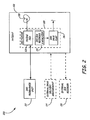
- FIG. 2 is a block diagram of a system 200 for responding to an atrial arrhythmia using cardiac pacing and pharmaceutical therapies according to an example embodiment of the invention.
- the response is to arrest or terminate the atrial arrhythmia using cardiac pacing and the pharmaceutical therapies.
- the response is implemented internally within a patient via at least one IMD.
- a patient 102 has a pacing implanted medical device (IMD) 103 that can detect an arrhythmia (irregular heartbeats) of a heart 105.
- IMD 103 measures at least one electrocardiogram characteristic indicative of an atrial fibrillation, thereby detecting an atrial arrhythmia of the heart, and thereafter transmitting a warning signal to patient 102.
- patient 102 chooses a pharmaceutical therapy via an available drug delivery arrangement, for example via an external drug delivery arrangement 114 ( e .
- IMD effectively supervises drug therapy delivery to the patient.
- Heart conditions detectable by IMD 103 include, but are not limited to, ventricular fibrillation, tachycardia, bradycardia and eventual heart failure.
- IMD 103 before patient 102 receives the pharmaceutical or drug therapy to terminate the atrial fibrillation, IMD 103 commences pacing a ventricle in heart 105 at a rate that exceeds, by a predetermined value, the spontaneous ventricular rate originally set by a physician as a means to prevent bradycardia associated with drug-induced proarrhythmia.
- the cardiac signals of heart 105 are monitored using an ECG (electrocardiogram) recorder.
- ECG recorder 118 is external to patient 102, as is conventional, the ECG traces being interpreted by a physician.
- the ECG recorder is an IMD recorder and analyzer 110.
- IMD ECG recorder and analyzer 110 internally monitors and processes the patient 102's cardiac signals.
- the functionality of pacing IMD 103 and IMD 110 are integrated into a single IMD package as indicated in FIG. 2 by dashed box 120.
- IMD drug pump 116 may or may not be integrated into IMD package 120, as is discussed further below.
- IMD 110 monitors ECG tracings similar to tracing 100 in FIG. 1 .
- IMD 110 collects and stores data from patient 102.
- IMD 110 also includes application software that processes the cardiac signal data and generates data in various forms including Q-T prolongation data, Q-T interval variability data and ventricular ectopy data.
- IMD 110 is further adapted to process the cardiac signal data to determine whether conditions exist predictive of a possible onset of ventricular arrhythmia within patient 102, for example by measuring and comparing Q-T intervals.
- IMD 110 continues monitoring cardiac signal data, for example measuring at least one Q-T interval of the heart and comparing the measured Q-T interval duration to a selected duration range. IMD 110 is adapted to determine that conditions predictive of a possible onset of ventricular arrhythmia exist whenever measured Q-T interval durations exceed the predetermined duration limits.
- IMD 110 signals patient 102 to not begin drug therapy responsive to a determination that conditions are detected that are predictive of a possible onset of ventricular arrhythmia.
- IMD 110 prevents delivery of drug therapy responsive to a determination that conditions are detected that are predictive of a possible onset of ventricular arrhythmia.
- IMD 110 is adapted to prevent drug delivery from IMD drug pump 116 responsive to a determination by IMD 110 that conditions are detected that are predictive of a possible onset of ventricular arrhythmia, for example through comparison of a measured Q-T interval duration with a predetermined range for Q-T interval duration, drug therapy delivery being prevented responsive to the Q-T interval duration being out of range.
- IMD drug pump 116 is a stand-alone IMD, communicatively coupled to IMDs 103 and/or 110, or IMD package 120, in one example implementation. According to another example implementation, IMD drug pump 116 is integral to IMD package 120 and communicatively coupled to IMDs 103 and/or 110. Drug therapies are staged within patient 102 prior to onset of the atrial arrhythmia, for subsequent delivery by IMD drug pump 116.
- patient 102 begins receiving a medication from a drug delivery arrangement, for example external drug delivery arrangement 114, and/or IMD drug pump 116 communicatively coupled to IMD 110.
- Drug therapy delivery includes delivering an anti-arrhythmic drug, Ibutilide for example.
- the drug or medication is deliverable to patient 102 in various ways and with various drug delivery devices.
- Drug delivery devices include, but are not limited to, catheters, inhalers, face-masks, hypodermic needles, intravenous lines and the like.
- IMD 110 concurrently monitors the patient's cardiac signals, measuring at least one Q-T interval of the heart. IMD 110 processes the cardiac signals to determine the effect that the delivered medication is having on patient 102 regarding arrhythmia status. For example, IMD 110 is adapted to determine that conditions predictive of a possible onset of ventricular arrhythmia exist by measuring Q-T interval durations outside a selected threshold duration range.
- IMD 110 signals patient 102, or an attending physician, to terminate drug therapy responsive to a determination that conditions are detected that are predictive of a possible onset of ventricular arrhythmia.
- IMD 110 terminates delivery of drug therapy responsive to a determination that conditions are detected that are predictive of a possible onset of ventricular arrhythmia.
- IMD 110 is adapted to terminate drug delivery from IMD drug pump 116 responsive to a determination by IMD recorder 110 that conditions are detected that are predictive of a possible onset of ventricular arrhythmia.
- the patient's cardiac condition continues to be monitored by IMDs 103 and/or 110.
- patient 102 is given a warning or alert that patient 102 is in ventricular arrhythmia.
- IMD 110 while pacing the ventricles in response to the atrial arrhythmia, and prior to drug delivery, IMD 110 measures a Q-T interval of heart 105 and stores the pacing Q-T interval measurement as a control parameter.
- Drug delivery arrangement 114, and/or IMD drug pump 116 prevents drug therapy if the Q-T interval is at least as great as a threshold value.
- drug therapy initiation is prevented if the Q-T interval prior to drug delivery is measured to be greater than 480 mS. If not prevented, the drug delivery arrangement 114, and/or IMD drug pump 116, subsequently delivers an anti-arrhythmic drug such as Ibutilide, to patient 102 after measuring the Q-T interval.
- drug therapy is prevented should prolongation of the Q-T interval occur in excess of a threshold prior to drug delivery.
- IMD 110 While delivering the drug therapy, or shortly thereafter, IMD 110 measures at least one additional Q-T interval and denominates it as the drug therapy Q-T interval(s). Drug therapy is terminated if a drug therapy Q-T interval is measured to be greater than a drug therapy Q-T interval threshold. In a more particular example embodiment, drug therapy is stopped if the Q-T interval measured after initiation of drug therapy is measured to exceed 500 mS. According to another aspect, IMD 110 also compares the pacing Q-T interval (control parameter) with the drug therapy Q-T interval(s) to determine whether, and by what additional duration, the drug therapy Q-T interval(s) exceed the control parameter. After initiation of drug therapy delivery, Q-T interval prolongation exceeding a prolongation threshold, as detected by IMD 110, is indicative that conditions exist for the onset of ventricular arrhythmia. IMD 110 thereafter either warns patient 102, or terminates drug therapy.
- control parameter the pacing Q-T interval prolongation exceeding a prolongation threshold
- Q-T interval variability or dispersion is used as a measure of the effectiveness of the drug therapy in terminating an atrial fibrillation.
- IMD 103 paces the ventricles in response to the atrial arrhythmia, and prior to drug therapy, IMD 110 measures variability in Q-T intervals (or dispersion) over a selected period, for example for a selected number of heartbeats. According to a more particular example implementation, the selected period is 20 heartbeats.
- IMD 110 measures dispersion, and stores a paced Q-T interval dispersion measurement as a dispersion control parameter. Subsequently, drug delivery arrangement 114, and/or IMD drug pump 116, delivers an anti-arrhythmic drug to patient 102.
- IMD 110 again measures Q-T interval dispersion and classifies it as the drug therapy dispersion. IMD 110 measures dispersion over the period selected for measuring the dispersion control parameter, for example 20 heart beats, and refreshes the drug therapy dispersion measurement continuously. IMD 110 periodically compares the paced Q-T interval (control parameter) with the drug therapy Q-T dispersion. Drug therapy is terminated whenever the monitored drug therapy dispersion exceeds the dispersion control parameter by a selected quantity. According to a more particular implementation, IMD 110 signals for termination of, and/or terminates, drug therapy whenever the drug therapy dispersion exceeds the dispersion control parameter by fifty percent (50%) or more. Q-T interval dispersion provides an indication that conditions exist for the possible onset of ventricular arrhythmia, thereby mandating warning and/or termination of further drug therapy by IMD 110.
- Q-T interval dispersion provides an indication that conditions exist for the possible onset of ventricular arrhythmia, thereby mandating warning and/or termination of further drug therapy by I
- a high frequency of ventricular ectopy in the patient during a select period of time is used as a measure of the effectiveness of a drug therapy in terminating an atrial fibrillation.
- IMD 103 paces the ventricles in response to the atrial arrhythmia, and prior to drug therapy, IMD 110 measures the frequency of ventricular ectopy over a selected period of time and stores a paced ventricular ectopy measurement as a ectopy control parameter.
- the selected period is sixty (60) seconds.
- drug delivery arrangement 114 and/or IMD drug pump 116 delivers an anti-arrhythmic drug to patient 102.
- IMD 110 again measures the ventricular ectopy and classifies it as the drug therapy ventricular ectopy.
- IMD 110 compares the paced ventricular ectopy (control parameter) with the drug therapy ventricular ectopy, signaling to patient 102 that drug therapy should be terminated and/or terminating the drug therapy where the drug therapy ventricular ectopy exceeds the ectopy control parameter by a selected quantity.
- IMD 110 signals and/or terminates drug therapy whenever the drug therapy ventricular ectopy exceeds the ectopy control parameter by fifty percent (50%) or more.
- a high frequency of ventricular ectopy provides an indication that conditions exist for the possible onset of ventricular arrhythmia, thereby mandating the warning and/or termination of drug therapy by IMD 110.
- IMD 110 alerts patient 102 that at least one ventricle is in arrhythmia after terminating the drug therapy delivery.
- IMD 110, IMD 103, IMD drug pump 116, and/or IMD package 120 are configured to communicate with each other.
- at least one of IMD 110, IMD 103, IMD drug pump 116, and IMD package is a discrete device and various telemetry communication techniques are used to communicatively couple any or all implanted devices to each other, or to external devices.
- Telemetry communication techniques include, but are not limited to, magnetic-field coupling, reflected impedance coupling and radio frequency (RF) coupling.
- RF radio frequency
Landscapes
- Health & Medical Sciences (AREA)
- Life Sciences & Earth Sciences (AREA)
- Engineering & Computer Science (AREA)
- Veterinary Medicine (AREA)
- Heart & Thoracic Surgery (AREA)
- Public Health (AREA)
- General Health & Medical Sciences (AREA)
- Animal Behavior & Ethology (AREA)
- Anesthesiology (AREA)
- Vascular Medicine (AREA)
- Hematology (AREA)
- Biomedical Technology (AREA)
- General Chemical & Material Sciences (AREA)
- Nuclear Medicine, Radiotherapy & Molecular Imaging (AREA)
- Chemical Kinetics & Catalysis (AREA)
- Chemical & Material Sciences (AREA)
- Cardiology (AREA)
- Medicinal Chemistry (AREA)
- Bioinformatics & Cheminformatics (AREA)
- Pharmacology & Pharmacy (AREA)
- Organic Chemistry (AREA)
- Electrotherapy Devices (AREA)
- Measurement And Recording Of Electrical Phenomena And Electrical Characteristics Of The Living Body (AREA)
- Acyclic And Carbocyclic Compounds In Medicinal Compositions (AREA)
- Media Introduction/Drainage Providing Device (AREA)
Claims (5)
- System (200) zum Reagieren, aus dem Inneren eines Patienten heraus, auf eine atriale Arrhythmie in einem Herzen, wobei das System aufweist:Mittel (103) zum Messen, aus dem Inneren des Patienten heraus, wenigstens eines Elektrokardiogrammmerkmals, das bezüglich der atrialen Arrhythmie kennzeichnend ist;Mittel zum Einleiten einer Medikamententherapieabgabe an den Patienten, auf das Messen des wenigstens einen Elektrokardiogrammmerkmals ansprechend, wobei die Medikamententherapie in dem Patienten vor dem Messen des wenigstens einen Elektrokardiogrammmerkmals gestuft ist;Mittel (110) zum Steuern, aus dem Inneren des Patienten heraus, einer Medikamententherapieabgabe an den Patienten, auf das Messen des wenigstens einen Elektrokardiogrammmerkmals ansprechend;dadurch gekennzeichnet, dass das System ferner aufweist:Mittel (110) zum Überwachen kardialer elektrischer Signale des Herzens zum Vorhersagen und/oder Bestimmen des Einsetzens ventrikulärer Proarrhythmie; und
wobei die Mittel zum Steuern auch auf die Vorhersage und/oder Bestimmung ventrikulärer Proarrhythmie ansprechen. - System nach Anspruch 2, wobei die Medikamententherapie Ibitulid beinhaltet.
- System nach Anspruch 2, das ferner Mittel zum Stimulieren des Herzens, aus dem Inneren des Patienten heraus, mit einer vorbestimmten Frequenz bzw. Rate aufweist, auf das Messen des wenigstens einen Elektrokardiogrammmerkmals ansprechend.
- System (200) nach Anspruch 1, wobei die Mittel zum Messen wenigstens eines bezüglich atrialer Arrhythmie kennzeichnenden Elektrokardiogrammmerkmals in dem Patienten eine erste implantierbare medizinische Vorrichtung (103) darstellen, und die Mittel zum Steuern der Medikamententherapieabgabe, aus dem Inneren des Patienten heraus, ansprechend auf das Messen des wenigstens einen Elektrokardiogrammmerkmals, eine zweite implantierbare medizinische Vorrichtung (110) darstellen.
- System nach Anspruch 4, das ferner aufweist:eine dritte implantierbare medizinische Vorrichtung, die dafür eingerichtet ist, das Herz aus dem Inneren des Patienten heraus mit einer vorbestimmten Frequenz zu stimulieren, ansprechend auf das Messen des wenigstens einen Elektrokardiogrammmerkmals.
Applications Claiming Priority (3)
| Application Number | Priority Date | Filing Date | Title |
|---|---|---|---|
| US59824 | 2002-01-30 | ||
| US10/059,824 US6968226B2 (en) | 2002-01-30 | 2002-01-30 | Method and system for terminating an atrial arrhythmia |
| PCT/US2003/002254 WO2003063933A1 (en) | 2002-01-30 | 2003-01-27 | A method and system for treating an atrial arrhythmia |
Publications (2)
| Publication Number | Publication Date |
|---|---|
| EP1469898A1 EP1469898A1 (de) | 2004-10-27 |
| EP1469898B1 true EP1469898B1 (de) | 2009-12-30 |
Family
ID=27609903
Family Applications (1)
| Application Number | Title | Priority Date | Filing Date |
|---|---|---|---|
| EP03707537A Expired - Lifetime EP1469898B1 (de) | 2002-01-30 | 2003-01-27 | System zum behandeln einer vorhofarrythmie |
Country Status (6)
| Country | Link |
|---|---|
| US (2) | US6968226B2 (de) |
| EP (1) | EP1469898B1 (de) |
| JP (1) | JP2005515846A (de) |
| CA (1) | CA2471850A1 (de) |
| DE (1) | DE60330748D1 (de) |
| WO (1) | WO2003063933A1 (de) |
Families Citing this family (105)
| Publication number | Priority date | Publication date | Assignee | Title |
|---|---|---|---|---|
| US20030176797A1 (en) * | 2002-03-12 | 2003-09-18 | Fernando Anzellini | Thrombust; implantable delivery system sensible to self diagnosis of acute myocardial infarction for thrombolysis in the first minutes of chest pain |
| US7970464B2 (en) | 2002-11-13 | 2011-06-28 | Physio-Control, Inc. | Method and system for responding to non-perfusing and non-shockable heart rhythms |
| US7734346B2 (en) * | 2003-04-25 | 2010-06-08 | Medtronic, Inc. | Identification of premature atrial contractions that trigger arrhythmia |
| US7142911B2 (en) * | 2003-06-26 | 2006-11-28 | Pacesetter, Inc. | Method and apparatus for monitoring drug effects on cardiac electrical signals using an implantable cardiac stimulation device |
| US7336994B2 (en) * | 2004-01-16 | 2008-02-26 | Medtronic, Inc. | Control of atrial defibrillation therapy based on hemodynamic sensor feedback |
| US8391990B2 (en) | 2005-05-18 | 2013-03-05 | Cardiac Pacemakers, Inc. | Modular antitachyarrhythmia therapy system |
| US8892197B2 (en) * | 2005-07-29 | 2014-11-18 | Medtronic, Inc. | Method and apparatus to control conduction through the heart to treat cardiac conditions |
| JP4867438B2 (ja) * | 2006-04-06 | 2012-02-01 | 株式会社ジェイ・エム・エス | 心不全(hf)治療用デバイス |
| US20080082415A1 (en) * | 2006-09-20 | 2008-04-03 | Vishwanath Shastry | Listing generation and advertising management utilizing catalog information |
| US8825677B2 (en) | 2006-09-20 | 2014-09-02 | Ebay Inc. | Listing generation utilizing catalog information |
| US8311620B2 (en) * | 2007-08-22 | 2012-11-13 | Cardiac Pacemakers, Inc. | Methods and apparatus to treat and prevent atrial tachyarrhythmias |
| US20090326510A1 (en) * | 2008-06-30 | 2009-12-31 | Haefner Paul A | Drug Delivery Methods and Systems |
| US20110245756A1 (en) | 2009-12-03 | 2011-10-06 | Rishi Arora | Devices for material delivery, electroporation, sonoporation, and/or monitoring electrophysiological activity |
| US8442624B2 (en) | 2010-05-12 | 2013-05-14 | Siemens Medical Solutions Usa, Inc. | System for cardiac medical condition detection |
| US8433398B2 (en) | 2011-03-10 | 2013-04-30 | Siemens Medical Solutions Usa, Inc. | Signal analysis system for heart condition determination |
| EP2510872A1 (de) | 2011-04-13 | 2012-10-17 | BIOTRONIK SE & Co. KG | Verfahren zur Bestimmung einer Arrhythmieart im Herz eines Patienten und entsprechende Vorrichtung |
| US9277956B2 (en) | 2011-11-09 | 2016-03-08 | Siemens Medical Solutions Usa, Inc. | System for automatic medical ablation control |
| US20150196769A1 (en) | 2014-01-10 | 2015-07-16 | Cardiac Pacemakers, Inc. | Methods and systems for improved communication between medical devices |
| AU2015204701B2 (en) | 2014-01-10 | 2018-03-15 | Cardiac Pacemakers, Inc. | Systems and methods for detecting cardiac arrhythmias |
| US9526909B2 (en) | 2014-08-28 | 2016-12-27 | Cardiac Pacemakers, Inc. | Medical device with triggered blanking period |
| EP3827877B1 (de) | 2015-02-06 | 2024-06-19 | Cardiac Pacemakers, Inc. | Systeme zur behandlung von herzrhythmusstörungen |
| ES2713231T3 (es) | 2015-02-06 | 2019-05-20 | Cardiac Pacemakers Inc | Sistemas para el suministro seguro de una terapia de estimulación eléctrica |
| WO2016130477A2 (en) | 2015-02-09 | 2016-08-18 | Cardiac Pacemakers, Inc. | Implantable medical device with radiopaque id tag |
| EP3265172B1 (de) | 2015-03-04 | 2018-12-19 | Cardiac Pacemakers, Inc. | System zur behandlung von herzrhythmusstörungen |
| US10050700B2 (en) | 2015-03-18 | 2018-08-14 | Cardiac Pacemakers, Inc. | Communications in a medical device system with temporal optimization |
| CN107427222B (zh) | 2015-03-18 | 2021-02-09 | 心脏起搏器股份公司 | 使用链路质量评估的医疗设备系统中的通信 |
| WO2017031347A1 (en) | 2015-08-20 | 2017-02-23 | Cardiac Pacemakers, Inc. | Systems and methods for communication between medical devices |
| US9853743B2 (en) | 2015-08-20 | 2017-12-26 | Cardiac Pacemakers, Inc. | Systems and methods for communication between medical devices |
| US9956414B2 (en) | 2015-08-27 | 2018-05-01 | Cardiac Pacemakers, Inc. | Temporal configuration of a motion sensor in an implantable medical device |
| US9968787B2 (en) | 2015-08-27 | 2018-05-15 | Cardiac Pacemakers, Inc. | Spatial configuration of a motion sensor in an implantable medical device |
| US10137305B2 (en) | 2015-08-28 | 2018-11-27 | Cardiac Pacemakers, Inc. | Systems and methods for behaviorally responsive signal detection and therapy delivery |
| US10226631B2 (en) | 2015-08-28 | 2019-03-12 | Cardiac Pacemakers, Inc. | Systems and methods for infarct detection |
| WO2017040115A1 (en) | 2015-08-28 | 2017-03-09 | Cardiac Pacemakers, Inc. | System for detecting tamponade |
| WO2017044389A1 (en) | 2015-09-11 | 2017-03-16 | Cardiac Pacemakers, Inc. | Arrhythmia detection and confirmation |
| US10065041B2 (en) | 2015-10-08 | 2018-09-04 | Cardiac Pacemakers, Inc. | Devices and methods for adjusting pacing rates in an implantable medical device |
| JP6608063B2 (ja) | 2015-12-17 | 2019-11-20 | カーディアック ペースメイカーズ, インコーポレイテッド | 植込み型医療装置 |
| US10905886B2 (en) | 2015-12-28 | 2021-02-02 | Cardiac Pacemakers, Inc. | Implantable medical device for deployment across the atrioventricular septum |
| WO2017127548A1 (en) | 2016-01-19 | 2017-07-27 | Cardiac Pacemakers, Inc. | Devices for wirelessly recharging a rechargeable battery of an implantable medical device |
| CN109069495A (zh) * | 2016-02-01 | 2018-12-21 | 英凯达治疗公司 | 电子监测联合吸入药理学疗法管理包括心房颤动在内的心律失常 |
| WO2017136548A1 (en) | 2016-02-04 | 2017-08-10 | Cardiac Pacemakers, Inc. | Delivery system with force sensor for leadless cardiac device |
| US11116988B2 (en) | 2016-03-31 | 2021-09-14 | Cardiac Pacemakers, Inc. | Implantable medical device with rechargeable battery |
| US10668294B2 (en) | 2016-05-10 | 2020-06-02 | Cardiac Pacemakers, Inc. | Leadless cardiac pacemaker configured for over the wire delivery |
| US10328272B2 (en) | 2016-05-10 | 2019-06-25 | Cardiac Pacemakers, Inc. | Retrievability for implantable medical devices |
| JP6764956B2 (ja) | 2016-06-27 | 2020-10-07 | カーディアック ペースメイカーズ, インコーポレイテッド | 再同期ペーシング管理に皮下で感知されたp波を使用する心臓治療法システム |
| US11207527B2 (en) | 2016-07-06 | 2021-12-28 | Cardiac Pacemakers, Inc. | Method and system for determining an atrial contraction timing fiducial in a leadless cardiac pacemaker system |
| WO2018009392A1 (en) | 2016-07-07 | 2018-01-11 | Cardiac Pacemakers, Inc. | Leadless pacemaker using pressure measurements for pacing capture verification |
| CN109475743B (zh) | 2016-07-20 | 2022-09-02 | 心脏起搏器股份公司 | 在无引线心脏起搏器系统中利用心房收缩定时基准的系统 |
| WO2018035343A1 (en) | 2016-08-19 | 2018-02-22 | Cardiac Pacemakers, Inc. | Trans septal implantable medical device |
| EP3503970B1 (de) | 2016-08-24 | 2023-01-04 | Cardiac Pacemakers, Inc. | Kardiale resynchronisierung mittels fusionsförderung zur taktungsverwaltung |
| CN109640809B (zh) | 2016-08-24 | 2021-08-17 | 心脏起搏器股份公司 | 使用p波到起搏定时的集成式多装置心脏再同步治疗 |
| WO2018057626A1 (en) | 2016-09-21 | 2018-03-29 | Cardiac Pacemakers, Inc. | Implantable cardiac monitor |
| US10758737B2 (en) | 2016-09-21 | 2020-09-01 | Cardiac Pacemakers, Inc. | Using sensor data from an intracardially implanted medical device to influence operation of an extracardially implantable cardioverter |
| WO2018057318A1 (en) | 2016-09-21 | 2018-03-29 | Cardiac Pacemakers, Inc. | Leadless stimulation device with a housing that houses internal components of the leadless stimulation device and functions as the battery case and a terminal of an internal battery |
| WO2018081237A1 (en) | 2016-10-27 | 2018-05-03 | Cardiac Pacemakers, Inc. | Use of a separate device in managing the pace pulse energy of a cardiac pacemaker |
| US10758724B2 (en) | 2016-10-27 | 2020-09-01 | Cardiac Pacemakers, Inc. | Implantable medical device delivery system with integrated sensor |
| AU2017350759B2 (en) | 2016-10-27 | 2019-10-17 | Cardiac Pacemakers, Inc. | Implantable medical device with pressure sensor |
| US10413733B2 (en) | 2016-10-27 | 2019-09-17 | Cardiac Pacemakers, Inc. | Implantable medical device with gyroscope |
| WO2018081275A1 (en) | 2016-10-27 | 2018-05-03 | Cardiac Pacemakers, Inc. | Multi-device cardiac resynchronization therapy with timing enhancements |
| WO2018081133A1 (en) | 2016-10-27 | 2018-05-03 | Cardiac Pacemakers, Inc. | Implantable medical device having a sense channel with performance adjustment |
| US10434317B2 (en) | 2016-10-31 | 2019-10-08 | Cardiac Pacemakers, Inc. | Systems and methods for activity level pacing |
| EP3532157B1 (de) | 2016-10-31 | 2020-08-26 | Cardiac Pacemakers, Inc. | Systeme zur aktivitätsgradstimulation |
| WO2018089311A1 (en) | 2016-11-08 | 2018-05-17 | Cardiac Pacemakers, Inc | Implantable medical device for atrial deployment |
| WO2018089308A1 (en) | 2016-11-09 | 2018-05-17 | Cardiac Pacemakers, Inc. | Systems, devices, and methods for setting cardiac pacing pulse parameters for a cardiac pacing device |
| EP3541473B1 (de) | 2016-11-21 | 2020-11-11 | Cardiac Pacemakers, Inc. | Elektrodenloser herzschrittmacher mit multimodaler kommunikation |
| US10639486B2 (en) | 2016-11-21 | 2020-05-05 | Cardiac Pacemakers, Inc. | Implantable medical device with recharge coil |
| EP3541472B1 (de) | 2016-11-21 | 2023-06-07 | Cardiac Pacemakers, Inc. | Implantierbare medizinische vorrichtung mit einem magnetisch permeablen gehäuse und einer um das gehäuse herum angeordneten induktiven spule |
| CN109982746B (zh) | 2016-11-21 | 2023-04-04 | 心脏起搏器股份公司 | 提供心脏再同步治疗的无引线心脏起搏器 |
| US10881869B2 (en) | 2016-11-21 | 2021-01-05 | Cardiac Pacemakers, Inc. | Wireless re-charge of an implantable medical device |
| US11207532B2 (en) | 2017-01-04 | 2021-12-28 | Cardiac Pacemakers, Inc. | Dynamic sensing updates using postural input in a multiple device cardiac rhythm management system |
| JP7000438B2 (ja) | 2017-01-26 | 2022-01-19 | カーディアック ペースメイカーズ, インコーポレイテッド | 冗長メッセージ送信を伴う人体デバイス通信 |
| CN110198759B (zh) | 2017-01-26 | 2023-08-11 | 心脏起搏器股份公司 | 具有可拆卸固定件的无引线可植入装置 |
| CN110234392B (zh) | 2017-01-26 | 2023-08-11 | 心脏起搏器股份公司 | 具有被包覆模制的组件的无引线装置 |
| US10905872B2 (en) | 2017-04-03 | 2021-02-02 | Cardiac Pacemakers, Inc. | Implantable medical device with a movable electrode biased toward an extended position |
| US10821288B2 (en) | 2017-04-03 | 2020-11-03 | Cardiac Pacemakers, Inc. | Cardiac pacemaker with pacing pulse energy adjustment based on sensed heart rate |
| EP3668592B1 (de) | 2017-08-18 | 2021-11-17 | Cardiac Pacemakers, Inc. | Implantierbare medizinische vorrichtung mit drucksensor |
| WO2019036568A1 (en) | 2017-08-18 | 2019-02-21 | Cardiac Pacemakers, Inc. | IMPLANTABLE MEDICAL DEVICE COMPRISING A FLOW CONCENTRATOR AND A RECEPTION COIL PROVIDED AROUND THE FLOW CONCENTRATOR |
| JP6938778B2 (ja) | 2017-09-20 | 2021-09-22 | カーディアック ペースメイカーズ, インコーポレイテッド | 複数の作動モードを備えた移植式医療用装置 |
| US11185703B2 (en) | 2017-11-07 | 2021-11-30 | Cardiac Pacemakers, Inc. | Leadless cardiac pacemaker for bundle of his pacing |
| EP3717060B1 (de) | 2017-12-01 | 2022-10-05 | Cardiac Pacemakers, Inc. | Leitungsloser herzschritzmascher mit reversionärem verhalten |
| EP3717063B1 (de) | 2017-12-01 | 2023-12-27 | Cardiac Pacemakers, Inc. | Systeme zum erkennen von vorhofkontraktions-timing-bezugswerte und zum bestimmen eines herzintervalls von einem ventrikulär implantierten leitungslosen herzschrittmacher |
| EP3717059B1 (de) | 2017-12-01 | 2024-11-20 | Cardiac Pacemakers, Inc. | Systeme zur erkennung von referenzpunkten für die vorhofkontraktionszeit innerhalb eines suchfensters von einem ventrikulär implantierten leitungslosen herzschrittmacher |
| WO2019108545A1 (en) | 2017-12-01 | 2019-06-06 | Cardiac Pacemakers, Inc. | Methods and systems for detecting atrial contraction timing fiducials during ventricular filling from a ventricularly implanted leadless cardiac pacemaker |
| US11529523B2 (en) | 2018-01-04 | 2022-12-20 | Cardiac Pacemakers, Inc. | Handheld bridge device for providing a communication bridge between an implanted medical device and a smartphone |
| EP3735293B1 (de) | 2018-01-04 | 2022-03-09 | Cardiac Pacemakers, Inc. | Zweikammer-stimulation ohne schlag-zu-schlag-kommunikation |
| US10744087B2 (en) | 2018-03-22 | 2020-08-18 | Incarda Therapeutics, Inc. | Method to slow ventricular rate |
| JP2021518192A (ja) | 2018-03-23 | 2021-08-02 | メドトロニック,インコーポレイテッド | VfA心臓再同期治療 |
| EP3768369A1 (de) | 2018-03-23 | 2021-01-27 | Medtronic, Inc. | Av-synchrone vfa-herztherapie |
| US11058880B2 (en) | 2018-03-23 | 2021-07-13 | Medtronic, Inc. | VFA cardiac therapy for tachycardia |
| EP3856331A1 (de) | 2018-09-26 | 2021-08-04 | Medtronic, Inc. | Erfassung in der ventrikel-aus-atrium-herztherapie |
| US11951313B2 (en) | 2018-11-17 | 2024-04-09 | Medtronic, Inc. | VFA delivery systems and methods |
| EP3897816B1 (de) | 2018-12-21 | 2024-03-27 | Medtronic, Inc. | Freisetzungssysteme für linksventrikuläre stimulation |
| US11679265B2 (en) | 2019-02-14 | 2023-06-20 | Medtronic, Inc. | Lead-in-lead systems and methods for cardiac therapy |
| US11697025B2 (en) | 2019-03-29 | 2023-07-11 | Medtronic, Inc. | Cardiac conduction system capture |
| US11213676B2 (en) | 2019-04-01 | 2022-01-04 | Medtronic, Inc. | Delivery systems for VfA cardiac therapy |
| US11712188B2 (en) | 2019-05-07 | 2023-08-01 | Medtronic, Inc. | Posterior left bundle branch engagement |
| AU2020323594B2 (en) | 2019-08-01 | 2022-02-03 | Incarda Therapeutics, Inc. | Antiarrhythmic formulation |
| US11007185B2 (en) | 2019-08-01 | 2021-05-18 | Incarda Therapeutics, Inc. | Antiarrhythmic formulation |
| US11305127B2 (en) | 2019-08-26 | 2022-04-19 | Medtronic Inc. | VfA delivery and implant region detection |
| US11813466B2 (en) | 2020-01-27 | 2023-11-14 | Medtronic, Inc. | Atrioventricular nodal stimulation |
| US12543992B2 (en) | 2020-03-30 | 2026-02-10 | Medtronic, Inc. | Pacing efficacy determination using a representative morphology of external cardiac signals |
| US11911168B2 (en) | 2020-04-03 | 2024-02-27 | Medtronic, Inc. | Cardiac conduction system therapy benefit determination |
| US12605103B2 (en) | 2020-05-21 | 2026-04-21 | Medtronic, Inc. | QRS detection and bracketing |
| US12465770B2 (en) | 2020-07-31 | 2025-11-11 | Medtronic, Inc. | Coronary sinus conduction system pacing and delivery |
| US11813464B2 (en) | 2020-07-31 | 2023-11-14 | Medtronic, Inc. | Cardiac conduction system evaluation |
| CA3200432A1 (en) * | 2020-12-17 | 2022-06-23 | Incarda Therapeutics, Inc. | Kits and methods for induction of cardioversion in subjects with atrial arrhythmias |
Family Cites Families (14)
| Publication number | Priority date | Publication date | Assignee | Title |
|---|---|---|---|---|
| US3311111A (en) * | 1964-08-11 | 1967-03-28 | Gen Electric | Controllable electric body tissue stimulators |
| US3805796A (en) * | 1971-05-10 | 1974-04-23 | Cordis Corp | Implantable cardiac pacer having adjustable operating parameters |
| US4223679A (en) * | 1979-02-28 | 1980-09-23 | Pacesetter Systems, Inc. | Telemetry means for tissue stimulator system |
| US5042497A (en) * | 1990-01-30 | 1991-08-27 | Cardiac Pacemakers, Inc. | Arrhythmia prediction and prevention for implanted devices |
| US5087243A (en) * | 1990-06-18 | 1992-02-11 | Boaz Avitall | Myocardial iontophoresis |
| US5437285A (en) * | 1991-02-20 | 1995-08-01 | Georgetown University | Method and apparatus for prediction of sudden cardiac death by simultaneous assessment of autonomic function and cardiac electrical stability |
| US5544651A (en) * | 1992-09-08 | 1996-08-13 | Wilk; Peter J. | Medical system and associated method for automatic treatment |
| JPH07509735A (ja) | 1993-03-15 | 1995-10-26 | ザ ボード オブ リージェンツ オブ ザ ユニヴァーシティ オブ ミシガン | 抗不整脈薬の放出制御用システム |
| US5683432A (en) * | 1996-01-11 | 1997-11-04 | Medtronic, Inc. | Adaptive, performance-optimizing communication system for communicating with an implanted medical device |
| US5690682A (en) * | 1996-06-17 | 1997-11-25 | Pharmatarget, Inc. | Device and method for treatment of cardiac arrhythmia |
| US5919210A (en) * | 1997-04-10 | 1999-07-06 | Pharmatarget, Inc. | Device and method for detection and treatment of syncope |
| US6178349B1 (en) * | 1999-04-15 | 2001-01-23 | Medtronic, Inc. | Drug delivery neural stimulation device for treatment of cardiovascular disorders |
| US6453195B1 (en) * | 2001-03-19 | 2002-09-17 | Medtronic, Inc. | Closed loop drug delivery system and remote management thereof |
| US20020188327A1 (en) * | 2001-04-26 | 2002-12-12 | Chester Struble | Drug delivery for treatment of cardiac arrhythmia |
-
2002
- 2002-01-30 US US10/059,824 patent/US6968226B2/en not_active Expired - Fee Related
-
2003
- 2003-01-27 DE DE60330748T patent/DE60330748D1/de not_active Expired - Lifetime
- 2003-01-27 JP JP2003563620A patent/JP2005515846A/ja active Pending
- 2003-01-27 EP EP03707537A patent/EP1469898B1/de not_active Expired - Lifetime
- 2003-01-27 WO PCT/US2003/002254 patent/WO2003063933A1/en not_active Ceased
- 2003-01-27 CA CA002471850A patent/CA2471850A1/en not_active Abandoned
-
2005
- 2005-10-06 US US11/244,764 patent/US7951137B2/en not_active Expired - Lifetime
Also Published As
| Publication number | Publication date |
|---|---|
| US6968226B2 (en) | 2005-11-22 |
| JP2005515846A (ja) | 2005-06-02 |
| DE60330748D1 (de) | 2010-02-11 |
| US20030144701A1 (en) | 2003-07-31 |
| EP1469898A1 (de) | 2004-10-27 |
| WO2003063933A1 (en) | 2003-08-07 |
| US7951137B2 (en) | 2011-05-31 |
| CA2471850A1 (en) | 2003-08-07 |
| US20060069410A1 (en) | 2006-03-30 |
Similar Documents
| Publication | Publication Date | Title |
|---|---|---|
| EP1469898B1 (de) | System zum behandeln einer vorhofarrythmie | |
| JP4494976B2 (ja) | 心臓治療薬剤を供給するための埋込可能なデバイス | |
| EP1827596B1 (de) | Gerät zur bestimmung von oversensing in einem medizinprodukt | |
| US5042497A (en) | Arrhythmia prediction and prevention for implanted devices | |
| EP1515778B1 (de) | Vorrichtung zur verhütung von arrhythmie-häufungen unter verwendung von schnellgang-impulsgebung | |
| US9636506B2 (en) | Method and apparatus for reducing inappropriate detection of lead-related noise | |
| US7333855B2 (en) | Method and apparatus for determining oversensing in a medical device | |
| EP1899005B1 (de) | Unterdrückung von hochfrequenz-pacing zur reduzierung von ischämischer erregbarkeit des myokards | |
| US9561377B2 (en) | Method and apparatus for identifying lead-related conditions using prediction and detection criteria | |
| EP3908178B1 (de) | System zur verbesserung der detektion von vorhofflimmern |
Legal Events
| Date | Code | Title | Description |
|---|---|---|---|
| PUAI | Public reference made under article 153(3) epc to a published international application that has entered the european phase |
Free format text: ORIGINAL CODE: 0009012 |
|
| 17P | Request for examination filed |
Effective date: 20040820 |
|
| AK | Designated contracting states |
Kind code of ref document: A1 Designated state(s): AT BE BG CH CY CZ DE DK EE ES FI FR GB GR HU IE IT LI LU MC NL PT SE SI SK TR |
|
| 17Q | First examination report despatched |
Effective date: 20070514 |
|
| RTI1 | Title (correction) |
Free format text: SYSTEM FOR TREATING AN ATRIAL ARRHYTHMIA |
|
| GRAP | Despatch of communication of intention to grant a patent |
Free format text: ORIGINAL CODE: EPIDOSNIGR1 |
|
| GRAS | Grant fee paid |
Free format text: ORIGINAL CODE: EPIDOSNIGR3 |
|
| GRAA | (expected) grant |
Free format text: ORIGINAL CODE: 0009210 |
|
| AK | Designated contracting states |
Kind code of ref document: B1 Designated state(s): CH DE FR LI NL SE |
|
| REG | Reference to a national code |
Ref country code: CH Ref legal event code: EP |
|
| REF | Corresponds to: |
Ref document number: 60330748 Country of ref document: DE Date of ref document: 20100211 Kind code of ref document: P |
|
| PG25 | Lapsed in a contracting state [announced via postgrant information from national office to epo] |
Ref country code: SE Free format text: LAPSE BECAUSE OF FAILURE TO SUBMIT A TRANSLATION OF THE DESCRIPTION OR TO PAY THE FEE WITHIN THE PRESCRIBED TIME-LIMIT Effective date: 20091230 |
|
| REG | Reference to a national code |
Ref country code: NL Ref legal event code: VDEP Effective date: 20091230 |
|
| PG25 | Lapsed in a contracting state [announced via postgrant information from national office to epo] |
Ref country code: NL Free format text: LAPSE BECAUSE OF FAILURE TO SUBMIT A TRANSLATION OF THE DESCRIPTION OR TO PAY THE FEE WITHIN THE PRESCRIBED TIME-LIMIT Effective date: 20091230 |
|
| REG | Reference to a national code |
Ref country code: CH Ref legal event code: PL |
|
| PG25 | Lapsed in a contracting state [announced via postgrant information from national office to epo] |
Ref country code: LI Free format text: LAPSE BECAUSE OF NON-PAYMENT OF DUE FEES Effective date: 20100131 Ref country code: CH Free format text: LAPSE BECAUSE OF NON-PAYMENT OF DUE FEES Effective date: 20100131 |
|
| PLBE | No opposition filed within time limit |
Free format text: ORIGINAL CODE: 0009261 |
|
| STAA | Information on the status of an ep patent application or granted ep patent |
Free format text: STATUS: NO OPPOSITION FILED WITHIN TIME LIMIT |
|
| 26N | No opposition filed |
Effective date: 20101001 |
|
| REG | Reference to a national code |
Ref country code: FR Ref legal event code: PLFP Year of fee payment: 14 |
|
| REG | Reference to a national code |
Ref country code: FR Ref legal event code: PLFP Year of fee payment: 15 |
|
| PGFP | Annual fee paid to national office [announced via postgrant information from national office to epo] |
Ref country code: DE Payment date: 20170125 Year of fee payment: 15 Ref country code: FR Payment date: 20170125 Year of fee payment: 15 |
|
| REG | Reference to a national code |
Ref country code: DE Ref legal event code: R119 Ref document number: 60330748 Country of ref document: DE |
|
| PG25 | Lapsed in a contracting state [announced via postgrant information from national office to epo] |
Ref country code: FR Free format text: LAPSE BECAUSE OF NON-PAYMENT OF DUE FEES Effective date: 20180131 Ref country code: DE Free format text: LAPSE BECAUSE OF NON-PAYMENT OF DUE FEES Effective date: 20180801 |
|
| REG | Reference to a national code |
Ref country code: FR Ref legal event code: ST Effective date: 20180928 |