EP1467006A1 - Fibres composées de polyméres biodegradables ayant une surface à basse friction - Google Patents
Fibres composées de polyméres biodegradables ayant une surface à basse friction Download PDFInfo
- Publication number
- EP1467006A1 EP1467006A1 EP04252053A EP04252053A EP1467006A1 EP 1467006 A1 EP1467006 A1 EP 1467006A1 EP 04252053 A EP04252053 A EP 04252053A EP 04252053 A EP04252053 A EP 04252053A EP 1467006 A1 EP1467006 A1 EP 1467006A1
- Authority
- EP
- European Patent Office
- Prior art keywords
- fiber
- fibers
- low friction
- exposed surface
- particles
- Prior art date
- Legal status (The legal status is an assumption and is not a legal conclusion. Google has not performed a legal analysis and makes no representation as to the accuracy of the status listed.)
- Withdrawn
Links
- 239000000835 fiber Substances 0.000 title claims abstract description 193
- 229920002988 biodegradable polymer Polymers 0.000 title claims abstract description 33
- 239000004621 biodegradable polymer Substances 0.000 title claims abstract description 33
- 239000002245 particle Substances 0.000 claims abstract description 53
- 229920000747 poly(lactic acid) Polymers 0.000 claims description 30
- 239000000306 component Substances 0.000 claims description 27
- 239000000463 material Substances 0.000 claims description 25
- 239000004626 polylactic acid Substances 0.000 claims description 25
- -1 polyethylene Polymers 0.000 claims description 16
- 239000004810 polytetrafluoroethylene Substances 0.000 claims description 12
- 239000000203 mixture Substances 0.000 claims description 11
- 229920001343 polytetrafluoroethylene Polymers 0.000 claims description 11
- 229920002313 fluoropolymer Polymers 0.000 claims description 10
- 239000004811 fluoropolymer Substances 0.000 claims description 10
- 229920000728 polyester Polymers 0.000 claims description 10
- 239000002783 friction material Substances 0.000 claims description 9
- 229920001577 copolymer Polymers 0.000 claims description 8
- 239000008358 core component Substances 0.000 claims description 6
- 229920000098 polyolefin Polymers 0.000 claims description 5
- 229920001059 synthetic polymer Polymers 0.000 claims description 4
- 239000004698 Polyethylene Substances 0.000 claims description 3
- NIXOWILDQLNWCW-UHFFFAOYSA-N acrylic acid group Chemical group C(C=C)(=O)O NIXOWILDQLNWCW-UHFFFAOYSA-N 0.000 claims description 3
- 239000000178 monomer Substances 0.000 claims description 3
- 229920000573 polyethylene Polymers 0.000 claims description 3
- 229920002635 polyurethane Polymers 0.000 claims description 3
- 239000004814 polyurethane Substances 0.000 claims description 3
- 229920001897 terpolymer Polymers 0.000 claims description 3
- 229920001169 thermoplastic Polymers 0.000 claims description 3
- 239000004416 thermosoftening plastic Substances 0.000 claims description 3
- BQCIDUSAKPWEOX-UHFFFAOYSA-N 1,1-Difluoroethene Chemical class FC(F)=C BQCIDUSAKPWEOX-UHFFFAOYSA-N 0.000 claims description 2
- IMROMDMJAWUWLK-UHFFFAOYSA-N Ethenol Chemical compound OC=C IMROMDMJAWUWLK-UHFFFAOYSA-N 0.000 claims description 2
- 239000004952 Polyamide Substances 0.000 claims description 2
- 239000004793 Polystyrene Substances 0.000 claims description 2
- QYKIQEUNHZKYBP-UHFFFAOYSA-N Vinyl ether Chemical class C=COC=C QYKIQEUNHZKYBP-UHFFFAOYSA-N 0.000 claims description 2
- 239000011354 acetal resin Substances 0.000 claims description 2
- HCDGVLDPFQMKDK-UHFFFAOYSA-N hexafluoropropylene Chemical group FC(F)=C(F)C(F)(F)F HCDGVLDPFQMKDK-UHFFFAOYSA-N 0.000 claims description 2
- 229920001519 homopolymer Polymers 0.000 claims description 2
- 229920002647 polyamide Polymers 0.000 claims description 2
- 229920006324 polyoxymethylene Polymers 0.000 claims description 2
- 229920002223 polystyrene Polymers 0.000 claims description 2
- 229920001567 vinyl ester resin Polymers 0.000 claims description 2
- DHKHKXVYLBGOIT-UHFFFAOYSA-N 1,1-Diethoxyethane Chemical compound CCOC(C)OCC DHKHKXVYLBGOIT-UHFFFAOYSA-N 0.000 claims 1
- 229920000058 polyacrylate Polymers 0.000 claims 1
- 229920002725 thermoplastic elastomer Polymers 0.000 claims 1
- 229920000642 polymer Polymers 0.000 description 28
- 229920001296 polysiloxane Polymers 0.000 description 11
- 238000000034 method Methods 0.000 description 10
- 238000002844 melting Methods 0.000 description 8
- 230000008018 melting Effects 0.000 description 8
- 238000010276 construction Methods 0.000 description 7
- 238000001125 extrusion Methods 0.000 description 7
- 238000004519 manufacturing process Methods 0.000 description 7
- 230000008569 process Effects 0.000 description 7
- 239000000047 product Substances 0.000 description 7
- 230000008901 benefit Effects 0.000 description 6
- JVTAAEKCZFNVCJ-UHFFFAOYSA-N lactic acid Chemical compound CC(O)C(O)=O JVTAAEKCZFNVCJ-UHFFFAOYSA-N 0.000 description 6
- 239000012530 fluid Substances 0.000 description 5
- 239000000654 additive Substances 0.000 description 4
- 239000011248 coating agent Substances 0.000 description 4
- 238000000576 coating method Methods 0.000 description 4
- 210000003746 feather Anatomy 0.000 description 4
- 239000012510 hollow fiber Substances 0.000 description 4
- 229920000139 polyethylene terephthalate Polymers 0.000 description 4
- 239000005020 polyethylene terephthalate Substances 0.000 description 4
- 239000007787 solid Substances 0.000 description 4
- 239000004310 lactic acid Substances 0.000 description 3
- 235000014655 lactic acid Nutrition 0.000 description 3
- JJTUDXZGHPGLLC-UHFFFAOYSA-N lactide Chemical compound CC1OC(=O)C(C)OC1=O JJTUDXZGHPGLLC-UHFFFAOYSA-N 0.000 description 3
- 244000005700 microbiome Species 0.000 description 3
- 238000006116 polymerization reaction Methods 0.000 description 3
- 229920005989 resin Polymers 0.000 description 3
- 239000011347 resin Substances 0.000 description 3
- QGZKDVFQNNGYKY-UHFFFAOYSA-N Ammonia Chemical compound N QGZKDVFQNNGYKY-UHFFFAOYSA-N 0.000 description 2
- 239000002028 Biomass Substances 0.000 description 2
- CURLTUGMZLYLDI-UHFFFAOYSA-N Carbon dioxide Chemical compound O=C=O CURLTUGMZLYLDI-UHFFFAOYSA-N 0.000 description 2
- RAHZWNYVWXNFOC-UHFFFAOYSA-N Sulphur dioxide Chemical compound O=S=O RAHZWNYVWXNFOC-UHFFFAOYSA-N 0.000 description 2
- 230000000996 additive effect Effects 0.000 description 2
- 230000002411 adverse Effects 0.000 description 2
- 150000001336 alkenes Chemical group 0.000 description 2
- 239000004760 aramid Substances 0.000 description 2
- 229920006231 aramid fiber Polymers 0.000 description 2
- 239000011230 binding agent Substances 0.000 description 2
- 230000015556 catabolic process Effects 0.000 description 2
- 238000001816 cooling Methods 0.000 description 2
- 238000006731 degradation reaction Methods 0.000 description 2
- 239000004744 fabric Substances 0.000 description 2
- 230000009970 fire resistant effect Effects 0.000 description 2
- 238000010438 heat treatment Methods 0.000 description 2
- 239000000155 melt Substances 0.000 description 2
- VNWKTOKETHGBQD-UHFFFAOYSA-N methane Chemical compound C VNWKTOKETHGBQD-UHFFFAOYSA-N 0.000 description 2
- 238000012986 modification Methods 0.000 description 2
- 230000004048 modification Effects 0.000 description 2
- 229920002451 polyvinyl alcohol Polymers 0.000 description 2
- 239000000843 powder Substances 0.000 description 2
- 239000003381 stabilizer Substances 0.000 description 2
- 229920002994 synthetic fiber Polymers 0.000 description 2
- 239000012209 synthetic fiber Substances 0.000 description 2
- HBAQYPYDRFILMT-UHFFFAOYSA-N 8-[3-(1-cyclopropylpyrazol-4-yl)-1H-pyrazolo[4,3-d]pyrimidin-5-yl]-3-methyl-3,8-diazabicyclo[3.2.1]octan-2-one Chemical class C1(CC1)N1N=CC(=C1)C1=NNC2=C1N=C(N=C2)N1C2C(N(CC1CC2)C)=O HBAQYPYDRFILMT-UHFFFAOYSA-N 0.000 description 1
- 241000894006 Bacteria Species 0.000 description 1
- 229920000742 Cotton Polymers 0.000 description 1
- 241000195493 Cryptophyta Species 0.000 description 1
- VGGSQFUCUMXWEO-UHFFFAOYSA-N Ethene Chemical compound C=C VGGSQFUCUMXWEO-UHFFFAOYSA-N 0.000 description 1
- 239000005977 Ethylene Substances 0.000 description 1
- 241000233866 Fungi Species 0.000 description 1
- 241000500881 Lepisma Species 0.000 description 1
- 239000004594 Masterbatch (MB) Substances 0.000 description 1
- 240000007930 Oxalis acetosella Species 0.000 description 1
- 235000008098 Oxalis acetosella Nutrition 0.000 description 1
- 240000007643 Phytolacca americana Species 0.000 description 1
- 239000005062 Polybutadiene Substances 0.000 description 1
- 239000004743 Polypropylene Substances 0.000 description 1
- 239000004372 Polyvinyl alcohol Substances 0.000 description 1
- 229920001131 Pulp (paper) Polymers 0.000 description 1
- 229920000297 Rayon Polymers 0.000 description 1
- 125000001931 aliphatic group Chemical group 0.000 description 1
- 229920003232 aliphatic polyester Polymers 0.000 description 1
- 230000000172 allergic effect Effects 0.000 description 1
- 229910021529 ammonia Inorganic materials 0.000 description 1
- 239000003963 antioxidant agent Substances 0.000 description 1
- 208000010668 atopic eczema Diseases 0.000 description 1
- 229920000229 biodegradable polyester Polymers 0.000 description 1
- 239000004622 biodegradable polyester Substances 0.000 description 1
- 239000001569 carbon dioxide Substances 0.000 description 1
- 229910002092 carbon dioxide Inorganic materials 0.000 description 1
- 210000003850 cellular structure Anatomy 0.000 description 1
- 229920002301 cellulose acetate Polymers 0.000 description 1
- 230000008859 change Effects 0.000 description 1
- 239000007795 chemical reaction product Substances 0.000 description 1
- 239000003795 chemical substances by application Substances 0.000 description 1
- 239000012141 concentrate Substances 0.000 description 1
- 230000007812 deficiency Effects 0.000 description 1
- 239000006185 dispersion Substances 0.000 description 1
- 238000009826 distribution Methods 0.000 description 1
- 238000005108 dry cleaning Methods 0.000 description 1
- 230000000694 effects Effects 0.000 description 1
- 238000010894 electron beam technology Methods 0.000 description 1
- 238000005516 engineering process Methods 0.000 description 1
- BFMKFCLXZSUVPI-UHFFFAOYSA-N ethyl but-3-enoate Chemical compound CCOC(=O)CC=C BFMKFCLXZSUVPI-UHFFFAOYSA-N 0.000 description 1
- 229920006242 ethylene acrylic acid copolymer Polymers 0.000 description 1
- 238000007380 fibre production Methods 0.000 description 1
- 125000005842 heteroatom Chemical group 0.000 description 1
- 229920001903 high density polyethylene Polymers 0.000 description 1
- 239000004700 high-density polyethylene Substances 0.000 description 1
- 239000003864 humus Substances 0.000 description 1
- 230000007062 hydrolysis Effects 0.000 description 1
- 238000006460 hydrolysis reaction Methods 0.000 description 1
- 230000003116 impacting effect Effects 0.000 description 1
- 238000010348 incorporation Methods 0.000 description 1
- 239000011810 insulating material Substances 0.000 description 1
- 238000004900 laundering Methods 0.000 description 1
- 229920000092 linear low density polyethylene Polymers 0.000 description 1
- 239000004707 linear low-density polyethylene Substances 0.000 description 1
- 239000007788 liquid Substances 0.000 description 1
- 229920001684 low density polyethylene Polymers 0.000 description 1
- 239000004702 low-density polyethylene Substances 0.000 description 1
- 238000002074 melt spinning Methods 0.000 description 1
- 230000005012 migration Effects 0.000 description 1
- 238000013508 migration Methods 0.000 description 1
- 238000002156 mixing Methods 0.000 description 1
- 230000003287 optical effect Effects 0.000 description 1
- 239000000049 pigment Substances 0.000 description 1
- 239000005014 poly(hydroxyalkanoate) Substances 0.000 description 1
- 229920002857 polybutadiene Polymers 0.000 description 1
- 229920001083 polybutene Polymers 0.000 description 1
- 229920001610 polycaprolactone Polymers 0.000 description 1
- 239000004632 polycaprolactone Substances 0.000 description 1
- 229920000903 polyhydroxyalkanoate Polymers 0.000 description 1
- 229920001195 polyisoprene Polymers 0.000 description 1
- 230000000379 polymerizing effect Effects 0.000 description 1
- 229920001155 polypropylene Polymers 0.000 description 1
- QQONPFPTGQHPMA-UHFFFAOYSA-N propylene Natural products CC=C QQONPFPTGQHPMA-UHFFFAOYSA-N 0.000 description 1
- 125000004805 propylene group Chemical group [H]C([H])([H])C([H])([*:1])C([H])([H])[*:2] 0.000 description 1
- 230000005855 radiation Effects 0.000 description 1
- 239000002964 rayon Substances 0.000 description 1
- 239000004447 silicone coating Substances 0.000 description 1
- 239000000779 smoke Substances 0.000 description 1
- 238000007711 solidification Methods 0.000 description 1
- 230000008023 solidification Effects 0.000 description 1
- 239000002904 solvent Substances 0.000 description 1
- 238000009987 spinning Methods 0.000 description 1
- 239000004094 surface-active agent Substances 0.000 description 1
- BFKJFAAPBSQJPD-UHFFFAOYSA-N tetrafluoroethene Chemical group FC(F)=C(F)F BFKJFAAPBSQJPD-UHFFFAOYSA-N 0.000 description 1
- 239000004753 textile Substances 0.000 description 1
- 230000036967 uncompetitive effect Effects 0.000 description 1
- 238000011144 upstream manufacturing Methods 0.000 description 1
- 125000000391 vinyl group Chemical group [H]C([*])=C([H])[H] 0.000 description 1
- XLYOFNOQVPJJNP-UHFFFAOYSA-N water Substances O XLYOFNOQVPJJNP-UHFFFAOYSA-N 0.000 description 1
- 239000001993 wax Substances 0.000 description 1
- 210000002268 wool Anatomy 0.000 description 1
Images

Classifications
-
- D—TEXTILES; PAPER
- D01—NATURAL OR MAN-MADE THREADS OR FIBRES; SPINNING
- D01F—CHEMICAL FEATURES IN THE MANUFACTURE OF ARTIFICIAL FILAMENTS, THREADS, FIBRES, BRISTLES OR RIBBONS; APPARATUS SPECIALLY ADAPTED FOR THE MANUFACTURE OF CARBON FILAMENTS
- D01F1/00—General methods for the manufacture of artificial filaments or the like
- D01F1/02—Addition of substances to the spinning solution or to the melt
- D01F1/10—Other agents for modifying properties
-
- D—TEXTILES; PAPER
- D01—NATURAL OR MAN-MADE THREADS OR FIBRES; SPINNING
- D01F—CHEMICAL FEATURES IN THE MANUFACTURE OF ARTIFICIAL FILAMENTS, THREADS, FIBRES, BRISTLES OR RIBBONS; APPARATUS SPECIALLY ADAPTED FOR THE MANUFACTURE OF CARBON FILAMENTS
- D01F8/00—Conjugated, i.e. bi- or multicomponent, artificial filaments or the like; Manufacture thereof
- D01F8/04—Conjugated, i.e. bi- or multicomponent, artificial filaments or the like; Manufacture thereof from synthetic polymers
- D01F8/14—Conjugated, i.e. bi- or multicomponent, artificial filaments or the like; Manufacture thereof from synthetic polymers with at least one polyester as constituent
-
- Y—GENERAL TAGGING OF NEW TECHNOLOGICAL DEVELOPMENTS; GENERAL TAGGING OF CROSS-SECTIONAL TECHNOLOGIES SPANNING OVER SEVERAL SECTIONS OF THE IPC; TECHNICAL SUBJECTS COVERED BY FORMER USPC CROSS-REFERENCE ART COLLECTIONS [XRACs] AND DIGESTS
- Y10—TECHNICAL SUBJECTS COVERED BY FORMER USPC
- Y10T—TECHNICAL SUBJECTS COVERED BY FORMER US CLASSIFICATION
- Y10T428/00—Stock material or miscellaneous articles
- Y10T428/29—Coated or structually defined flake, particle, cell, strand, strand portion, rod, filament, macroscopic fiber or mass thereof
- Y10T428/2913—Rod, strand, filament or fiber
-
- Y—GENERAL TAGGING OF NEW TECHNOLOGICAL DEVELOPMENTS; GENERAL TAGGING OF CROSS-SECTIONAL TECHNOLOGIES SPANNING OVER SEVERAL SECTIONS OF THE IPC; TECHNICAL SUBJECTS COVERED BY FORMER USPC CROSS-REFERENCE ART COLLECTIONS [XRACs] AND DIGESTS
- Y10—TECHNICAL SUBJECTS COVERED BY FORMER USPC
- Y10T—TECHNICAL SUBJECTS COVERED BY FORMER US CLASSIFICATION
- Y10T428/00—Stock material or miscellaneous articles
- Y10T428/29—Coated or structually defined flake, particle, cell, strand, strand portion, rod, filament, macroscopic fiber or mass thereof
- Y10T428/2913—Rod, strand, filament or fiber
- Y10T428/2927—Rod, strand, filament or fiber including structurally defined particulate matter
Definitions
- the present invention relates to fibers having a biodegradable component, and more particularly to low friction biodegradable fibers and products made therefrom.
- crimped synthetic staple fiber particularly polyester fiberfill
- polyester fiberfill is generally made from polyethylene terephthalate (PET) fibers in staple form, of various cut lengths.
- Polyester fiberfill filling material has become well accepted as a reasonably inexpensive filling and/or insulating material for filled articles, such as pillows, cushions and other furnishing materials, bedding materials, such as mattress pads, quilts, comforters and duvets, in apparel, such as parkas and other insulated articles of apparel and sleeping bags, because of its bulk filling power, aesthetic qualities and various advantages over other filling materials. Accordingly, polyester fiberfill is now manufactured and used in large quantities commercially.
- polyester fiberfill is useful, there are some disadvantages associated with its use.
- batts made from such fiberfill materials usually have very little fire resistance.
- U.S. Patent No. 5,578,368 to Forsten et al. is directed to the fire resistant material that includes a fiberfill batt and at least one fire resistant layer of aramid fibers.
- aramid fibers are expensive and can reduce the desired aesthetics of the end product.
- the present invention provides unique fiber constructions that exhibit a variety of properties in a single fiber construction.
- the fibers include at least one biodegradable polymer that forms a portion, and advantageously the entirety, of the outer surface of the fiber.
- the fibers of the invention include a plurality of particles formed of a low friction material. The low friction particles are dispersed in the biodegradable polymer and also form a portion of the outer surface of the fibers.
- Exemplary biodegradable polymers useful in the invention include polylactic acid (PLA) polymers.
- PLA polylactic acid
- PLA offers several advantages, in addition to biodegradability.
- fibers formed of PLA can exhibit excellence resilience.
- Such fibers also exhibit inherent low flammability, smoke generation, and heat release. These properties render the fibers of the invention particularly useful for fiberfill applications.
- PLA fibers have not met with widespread use in fiberfill or other applications requiring lubricity or low friction.
- PLA fibers exhibit fiber-to-fiber-friction that is significantly higher than other fiberfill candidates, such as PET.
- PET fibers are coated with a liquid silicone agent to increase lubricity.
- the silicone must be cured (crosslinked) onto the fiber surface for durability. This curing step requires the application of heat. Because the melt temperature of PLA is relatively low (ca. 165°C), such a heating step cannot be run at conventional temperatures, but rather must be slowed to about half the conventional speed. This in turn results in uncompetitive economics for production of silicone coated PLA fibers. Further, the silicone coating is flammable, thus negatively impacting the inherent low flammability of PLA.
- the fibers of the invention overcome the problems associated with the high fiber-to-fiber friction of PLA fibers.
- the presence of the low friction particles on a portion of the outer surface of the fiber imparts improved lubricity to the fiber. This in turn renders the fibers appropriate for use in fiberfill.
- the low friction material itself is not flammable, thus its use does not compromise the low flammability of PLA fibers.
- the fibers do not require a coating that must be cured, production speeds are not are not are not hampered, therefore improving the economies of production of such fibers.
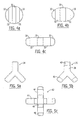
- Figures 1 and 2 are transverse cross sectional views of exemplary fiber configurations useful in the present invention.
- the fiber can be a monocomponent fiber 10 having a single polymer component 12 .
- the single polymer component in this embodiment is formed of a biodegradable polymer, as discussed in more detail below.
- the fiber can be a multicomponent fiber.
- Figure 2 illustrates an exemplary multicomponent fiber construction useful in the present invention, namely, a bicomponent fiber 14 having an inner core polymer domain 16 and surrounding sheath polymer domain 18 .
- the sheath component is formed of a biodegradable polymer.
- the fibers also includes a plurality of particles formed of a low friction material, indicated as 20 in both Figures 1 and 2.
- the low friction particles are present along a portion of the outer surface of the fiber. In this manner the low friction particles can impart a desired level of lubricity to the fibers so as to render the fibers useful in various applications requiring low fiber-to-fiber friction.
- multicomponent fibers includes staple and continuous filaments prepared from two or more polymers present in discrete structured domains in the fiber, as opposed to blends where the domains tend to be dispersed, random or unstructured.
- the two or more structured polymeric components are arranged in substantially constantly positioned distinct zones across the cross section of the multicomponent fiber and extending continuously along the length of the multicomponent fiber.
- the present invention will generally be described in terms of a bicomponent fiber comprising two components. However, it should be understood that the scope of the present invention is meant to include fibers with two or more structured components.
- FIG. 3 illustrates a cross sectional view of one such fiber 22 , which includes an outer "sea" component 24 formed of a biodegradable polymer and having low friction particles along an outer surface thereof and a plurality of island components 26 .
- the island components can be formed of a biodegradable or non-biodegradable polymer.
- the islands-in-the-sea fiber can optionally also include a core 28 , which also can be formed of a biodegradable or non-biodegradable polymer.
- Figures 4a-c are cross sectional views of additional fibers constructions, namely segmented fibers, such as a segmented round fibers (Figure 4a), segmented oval fibers ( Figure 4b), and segmented rectangular fibers ( Figure 4c).
- the segmented fibers include biodegradable polymer segments or components 30 having low friction particles present therein alternating with polymer segments or components 32 .
- Segments 32 can be formed of a biodegradable or non-biodegradable polymer. Although not illustrated, segments 32 can also include low friction particles present therein.
- the fibers can be multilobal fibers having three or more arms or lobes extending outwardly from a central portion thereof.
- Figures 5a-5b are cross sectional views of exemplary multilobal fibers of the invention.
- the multilobal fibers can be formed entirely of the biodegradable polymer with low friction particles dispersed therein so the particles form a portion of the outer surface of the fiber, such as fiber 34 in Figure 5a.
- the multilobal fibers can include other polymeric components, such as fiber 36 of Figure 5b, which includes a central core 38 and arms or lobes 40 extending outwardly therefrom.
- the arms or lobes 40 are formed of a biodegradable polymer with low friction particles present therein.
- Central core 38 can be formed of a biodegradable or non-biodegradable polymer and optionally can also include low friction particles.
- FIG 5c Another exemplary multilobal figure is shown in Figure 5c, designated as 42 , having arms of alternating segments or components 44 and 46. Segments 46 are formed of a biodegradable polymer with low friction particles present therein. Segments 44 can be formed of a biodegradable or non-biodegradable polymer, and also can optionally include low friction particles as well.
- any of these or other multicomponent fiber constructions may be used, so long as at least a portion of the outer surface of the fiber includes the biodegradable polymer and further so long as a plurality of low friction particles are present on the outer surface of the fiber as well.
- the cross section of the fiber is preferably circular, since the equipment typically used in the production of synthetic fibers normally produces fibers with a substantially circular cross section.
- the configuration of the first and second components can be either concentric or acentric, the latter configuration sometimes being known as a "modified side-by-side" or an "eccentric" multicomponent fiber.
- the fibers of the invention include at least one biodegradable polymer as known in the art.
- biodegradable refers to a material that degrades under aerobic and/or anaerobic conditions in the presence of bacteria, fungi, algae, and other microorganisms to carbon dioxide/methane, water and biomass, although materials containing heteroatoms can also yield other products such as ammonia or sulfur dioxide.
- Biomass generally refers to the portion of the metabolized materials incorporated into the cellular structure of the organisms present or converted to humus fractions indistinguishable from material of biological origin.
- the biodegradable polymeric component comprises polylactic acid (PLA).
- PLA polylactic acid
- PLA polymer fibers are particularly useful in fiberfill applications because of their resilience, inherent low flammability, and renewability.
- At least a portion of the outer surface of the fibers comprises the biodegradable, e.g., PLA, polymer.
- the entire outer surface of the fiber comprises PLA polymer.
- Polylactic acid polymer is a biodegradable polyester polymer generally prepared by the polymerization of lactic acid.
- polylactic acid polymer is intended to represent the polymer that is prepared by either the polymerization of lactic acid or lactide.
- Lactic acid and lactide are known to be an asymmetrical molecules, having two optical isomers referred to, respectively as the levorotatory (hereinafter referred to as "L”) enantiomer and the dextrorotatory (hereinafter referred to as "D") enantiomer.
- L levorotatory
- D dextrorotatory
- the fibers of the invention can also include non-biodegradable polymers, for example, to form a core component of a sheath/core fiber, the island components of an islands-in-the-sea fiber, and the like.
- Non-biodegradable polymers suitable for use in the fibers of the invention include without limitation polyolefins, polystyrenes, polyurethanes, acetal resins, polyethylene vinyl alcohol, and copolymers, terpolymers, and mixtures thereof. Olefinic resins, long-chain, synthetic polymers of at least 85 weight percent ethylene, propylene or other olefin unit, are of particular interest.
- Suitable polyolefins include polypropylene, low density polyethylene, high density polyethylene, linear low density polyethylene, polybutene, and copolymers, terpolymers and mixtures thereof.
- the non-biodegradable polymeric component may include mixtures of polyolefins with other polymers, such as but not limited to (ethyl vinyl acetate) copolymers, (ethylene acrylic acid) copolymers, and the like.
- Each of the biodegradable and non-biodegradable polymers can optionally include other components not adversely affecting the desired properties thereof.
- Exemplary materials that could be used as additional components would include, without limitation, pigments, antioxidants, stabilizers, surfactants, waxes, flow promoters, solid solvents, particulates, and other materials added to enhance processability of the first and the second components.
- a stabilizing agent may be added to the biodegradable polymer to reduce thermal degradation which might otherwise occur during the polylactic acid spinning process.
- additives that enhance the biodegradability of the polylactic acid may optionally be included. These and other additives can be used in conventional amounts.
- the particles 20 are formed of a material capable of imparting low friction properties to a product produced having the same dispersed therein.
- the low friction material is selected to have minimal or no flammability.
- the low friction material is selected to be non-melting or have a melting point that is sufficiently above the melting point of the polymers used to produce the fibers so that the particles do not melt during production of the fibers.
- the low friction material is a fluoropolymer, and more preferably a non-melt processable fluoropolymer as known in the art.
- Non-melt processable fluoropolymers typically have high melting points as compared to fluoropolymers prepared for extrusion applications.
- thermoplastic fluoropolymers developed for extrusion processes generally can also be useful in the present invention, so long as the fluoropolymer has a sufficiently high melting point so that the particles do not melt during fiber production.
- fluoropolymers include non-melt processable polytetrafluoroethylene (PTFE) homopolymer. Copolymers of PTFE can also be used. Exemplary comonomers include all of the olefins capable of copolymerizing with tetrafluoroethylene, including without limitation, hexafluoropropylene, perfluorooxyalkyl vinyl ethers having C1-C4 alkyl radicals, vinylidene fluoride, ethylene and/or propylene, vinyl esters and acrylic monomers.
- PTFE polytetrafluoroethylene
- comonomers include all of the olefins capable of copolymerizing with tetrafluoroethylene, including without limitation, hexafluoropropylene, perfluorooxyalkyl vinyl ethers having C1-C4 alkyl radicals, vinylidene fluoride, ethylene and/or propylene, vinyl esters and acrylic monomers.
- the amount of comonomer when present can vary, so long as the amount does not effect the properties necessary for use in the production of fibers, for example, does not lower the melt temperature significantly so that the particles melt during fiber extrusion, change the particle morphology to preclude significant migration thereof to the fiber surface during extrusion, and the like.
- the low friction particles are present in the biodegradable polymer component forming a surface of the fiber in an amount sufficient to provide the desired degree of fiber-to-fiber friction for a particular application.
- the fibers can include up to 15 percent by weight of the low friction particles.
- the invention is effective at much lower concentrations of the low friction particles, even at levels of about 4 percent by weight, or less, for example as little as 0.1 percent by weight, based on the total weight of the fiber.
- the low friction particles can be blended with the polymer in dry form, i.e., by dry blending solid state forms of the low friction particles and polymer in powder form.
- the dry blend can then be used in a fiber extrusion process under conditions sufficient to form a polymer melt without also melting the low friction particles and to extrude the polymer melt to form fibers with the low friction particles along a surface thereof.
- the low friction particles, in the form of a powder or non-aqueous dispersion can be added to an extruder and blended with the polymer melt, again at temperatures sufficient to form a polymer melt without also melting the low friction particles.
- the low friction particles may be added to the polymer directly or in the form of a concentrate (or masterbatch).
- the low friction particles advantageously have an average particle size that is small enough to allow fiber extrusion without significant clogging of the spinneret or upstream polymer filters. Yet the particles are also of sufficient size so as to impart the desired level of lubricity to the resultant fibers.
- Useful low friction particles include particles having an average diameter ranging from about less than one (submicron particles) to about 10 microns, and include PTFE micropowders prepared by radiation (gamma or electron beam) degradation.
- Low friction particles, including PTFE particles are known in the art and include those available from Shamrock Technologies, Inc. under the trade name NanoFLON TM and Fluoro TM PTFE.
- the fibers can include varying percentages of the biodegradable polymer component with low friction particles present therein.
- the fiber can include from as little as 8 percent by weight, based on the total fiber weight, up to 100 percent of the biodegradable polymer with low friction particles.
- the fiber includes a weight ratio of sheath to core ranging from about 10:90 to 90:10, more advantageously from about 30:70 to about 70:30, and most advantageously from about 25:75 to about 70:25. Fibers in which the sheath:core ratio is about 25:75 to about 30:70 can be particularly useful when the core includes the same polymer as the sheath.
- multicomponent fibers are well known and need not be described here in detail.
- at least two polymers are extruded separately and fed into a polymer distribution system wherein the polymers are introduced into a spinneret plate.
- the polymers follow separate paths to the fiber spinneret and are combined in a spinneret hole.
- the spinneret is configured so that the extrudant has the desired shape.
- the resulting thin fluid strands, or filaments remain in the molten state for some distance before they are solidified by cooling in a surrounding fluid medium, which may be chilled air blown through the strands.
- a surrounding fluid medium which may be chilled air blown through the strands.
- the filaments are taken up on a godet or another take-up surface.
- the strands are taken up on a godet which draws down the thin fluid streams in proportion to the speed of the take-up godet.
- the strands are collected in a jet, such as for example, an air gun, and blown onto a take-up surface such as a roller or a moving belt to form a spunbond web.
- meltblown process air is ejected at the surface of the spinnerette which serves to simultaneously draw down and cool the thin fluid streams as they are deposited on a take-up surface in the path of cooling air, thereby forming a fiber web.
- melt draw down ratios known in the art may be utilized.
- a continuous filament or staple process it may be desirable to draw the strands in the solid state with conventional drawing equipment, such as, for example, sequential godets operating at differential speeds.
- the continuous filaments may be crimped or texturized and cut into a desirable fiber length, thereby producing staple fiber.
- the length of the staple fibers generally ranges from about 25 to about 50 millimeters, although the fibers can be longer or shorter as desired.
- the fibers of the invention can be staple fibers, continuous filaments, or meltblown fibers.
- staple, multi-filament, and spunbond fibers formed in accordance with the present invention can have a fineness of about 0.5 to about 100 denier.
- Meltblown filaments can have a fineness of about 0.001 to about 10.0 denier.
- Monofilament fibers can have a fineness of about 50 to about 10,000 denier.
- the fibers of the invention are useful in the production of a wide variety of products, including without limitation nonwoven structures, such as but not limited to carded webs, wet laid webs, dry laid webs, spunbonded webs, meltblown webs, and the like.
- the fibers of the invention can also be used to make other textile structures such as but not limited to woven and knit fabrics. Fibers other than the fibers of the invention may be present in articles produced therefrom, including any of the various synthetic and/or natural fibers known in the art.
- Exemplary synthetic fibers include polyolefin, polyester, polyamide, acrylic, rayon, cellulose acetate, thermoplastic multicomponent fibers (such as conventional sheath/core fibers, for example polyethylene sheath/polyester core fibers) and the like and mixtures thereof.
- Exemplary natural fibers include wool, cotton, wood pulp fibers and the like and mixtures thereof.
- the fibers are used as a filling material, also referred to in the art as fiberfill.
- the fibers may be processed using known techniques to make a fiberfill, typically to produce a batting which may be bonded or non-bonded.
- the fibers of the invention may make up 100% of the fiberfill.
- other types of fibers such as noted above can be included as a part of the batting when desired.
- the fiberfill includes at least about 50 percent up to 100 percent by weight of the fibers of the invention.
- the invention also provides filled articles wherein at least some of the filling material is in the form of batting of the fibers of the invention.
- the invention includes articles such as a pillow filled with filling material that includes the fibers formed of a biodegradable polymer and low friction particles.
- Other filled articles in accordance with the invention include, without limitation, articles of apparel, such as parkas and other insulated or insulating articles of apparel, bedding materials (sometimes referred to as sleep products) other than pillows, including mattress pads, comforters and quilts including duvets, mattress tops, and sleeping bags and other filled articles suitable for camping purposes, for example, furnishing articles, such as cushions, "throw pillows" (which are not necessarily intended for use as bedding materials), and filled furniture itself, toys and, indeed, any articles that can be filled with polyester fiberfill.
- articles of apparel such as parkas and other insulated or insulating articles of apparel
- bedding materials sometimes referred to as sleep products
- bedding materials sometimes referred to as sleep products
- pillows including mattress pads, comforters and quilts including duvets, mattress tops, and sleeping bags and other filled articles suitable for camping purposes, for example, furnishing articles, such as cushions, "throw pillows" (which are not necessarily intended for use as bedding materials), and filled furniture itself, toys and, indeed, any articles that can be filled with polyester fiber
- Example 1 A hollow fiber was made from PLA, cut, crimped, and a conventional fiber finish applied. The fiber was judged to be not nearly slick enough for use in fiberfill applications.
- Example 2 A hollow fiber was made from PLA, crimped, cut, and a non-silicone "slickening" finish applied. The fiber was judged to be not slick enough for use in fiberfill applications.
- Example 3 A hollow fiber was made from PLA, crimped, cut, and a second non-silicone "slickening" finish applied. The fiber was judged to be not slick enough for use in fiberfill applications.
- Example 4 A hollow fiber was made from PLA, crimped, cut, and a silicone finish applied. To cure the silicone finish without reaching temperatures that would adversely affect the PLA fiber properties, the heat-treatment step following finish application had to be run at one half the speed of the process used in Examples 1, 2, 3, 5, and 6. This fiber was judged suitably slick for use in fiberfill applications.
- Example 5 A sheath/core fiber with a diameter equal to those in examples 1-4 was made with a core of PLA incorporating no PTFE additive and a sheath with 4% sub-micron PTFE particles. The sheath comprised 35% of the fiber by volume, while the core comprised 65%. The fiber was crimped, cut, and the non-silicone "slickening" finish used in Example 2 applied. The fiber was judged slick enough for use in fiberfill applications.
- Example 6 A sheath/core fiber with a diameter equal to those in examples 1-4 was made with a core of PLA incorporating no PTFE additive and a sheath with 4% sub-micron PTFE particles. The sheath comprised 35% of the fiber by volume, while the core comprised 65%. The fiber was crimped, cut, and the non-silicone "slickening" finish used in Example 3 applied. The fiber was judged slick enough for use in fiberfill applications, and even slicker than the fibers in any of the other examples, including that of Example 4.
Landscapes
- Engineering & Computer Science (AREA)
- Chemical & Material Sciences (AREA)
- Chemical Kinetics & Catalysis (AREA)
- General Chemical & Material Sciences (AREA)
- Textile Engineering (AREA)
- Manufacturing & Machinery (AREA)
- Multicomponent Fibers (AREA)
Applications Claiming Priority (2)
| Application Number | Priority Date | Filing Date | Title |
|---|---|---|---|
| US46156403P | 2003-04-09 | 2003-04-09 | |
| US461564P | 2003-04-09 |
Publications (1)
| Publication Number | Publication Date |
|---|---|
| EP1467006A1 true EP1467006A1 (fr) | 2004-10-13 |
Family
ID=32869686
Family Applications (1)
| Application Number | Title | Priority Date | Filing Date |
|---|---|---|---|
| EP04252053A Withdrawn EP1467006A1 (fr) | 2003-04-09 | 2004-04-07 | Fibres composées de polyméres biodegradables ayant une surface à basse friction |
Country Status (2)
| Country | Link |
|---|---|
| US (1) | US7056580B2 (fr) |
| EP (1) | EP1467006A1 (fr) |
Cited By (3)
| Publication number | Priority date | Publication date | Assignee | Title |
|---|---|---|---|---|
| WO2008025557A1 (fr) * | 2006-08-31 | 2008-03-06 | Twd Fibres Gmbh | Produit textile et procédé pour sa fabrication |
| CN104204312A (zh) * | 2012-04-17 | 2014-12-10 | 爱尔铃克铃尔股份公司 | 借助于熔融纺丝法制造的纤维 |
| CN108330566A (zh) * | 2018-02-07 | 2018-07-27 | 湖州科博信息科技有限公司 | 一种可降解高弹纤维及其制备工艺 |
Families Citing this family (11)
| Publication number | Priority date | Publication date | Assignee | Title |
|---|---|---|---|---|
| US7754241B1 (en) | 2004-11-12 | 2010-07-13 | Clemson University Research Foundation | Macromonomer for preparation of a degradable hydrogel |
| US7790640B2 (en) * | 2006-03-23 | 2010-09-07 | Kimberly-Clark Worldwide, Inc. | Absorbent articles having biodegradable nonwoven webs |
| US8293531B1 (en) | 2007-08-31 | 2012-10-23 | Clemson University Research Foundation | Three-dimensional ex vivo system |
| TWI649468B (zh) * | 2010-05-26 | 2019-02-01 | 伊唯斯科技公司 | 具降低摩擦力之雙成份彈性纖維 |
| US20140017263A1 (en) | 2012-06-28 | 2014-01-16 | Clemson University | Delivery Agents for Targeted Treatment of Elastin Degradation |
| US9795573B2 (en) | 2013-09-24 | 2017-10-24 | Clemson University | Multi-step connective tissue stabilization method and stabilized tissue formed thereby |
| EP3592891B1 (fr) * | 2017-03-10 | 2025-11-05 | Biome Bioplastics Limited | Tissus |
| JP2021509448A (ja) * | 2018-01-02 | 2021-03-25 | プリマロフト,インコーポレイテッド | 生分解性向上合成繊維およびその製造方法 |
| EA202192033A1 (ru) | 2019-01-22 | 2021-10-21 | Клемсон Юниверсити Рисерч Фаундейшн | Антитела к эластину и способы их применения |
| US20250283252A1 (en) * | 2021-01-15 | 2025-09-11 | Indorama Ventures Public Company Ltd | Biologically Degradable MULTI-COMPONENT POLYMER FIBRES |
| WO2024042490A1 (fr) * | 2022-08-26 | 2024-02-29 | Asselin Jean Francois | Système de garnitures de taie d'oreiller à libération de tension |
Citations (2)
| Publication number | Priority date | Publication date | Assignee | Title |
|---|---|---|---|---|
| JPS54124055A (en) * | 1978-03-20 | 1979-09-26 | Toray Ind Inc | Low friction polyester composition |
| WO2004030880A1 (fr) * | 2002-10-01 | 2004-04-15 | Shamrock Technologies, Inc. | Procede de production de fibres synthetiques filees par fusion avec du polytetrafluoroethylene (ptfe) |
Family Cites Families (23)
| Publication number | Priority date | Publication date | Assignee | Title |
|---|---|---|---|---|
| US5344707A (en) * | 1980-12-27 | 1994-09-06 | E. I. Du Pont De Nemours And Company | Fillings and other aspects of fibers |
| US4618531A (en) * | 1985-05-15 | 1986-10-21 | E. I. Du Pont De Nemours And Company | Polyester fiberfill and process |
| US5165993A (en) * | 1983-07-04 | 1992-11-24 | Akzo N.V. | Aromatic polyamide yarn impregnated with lubricating particles, a process for the manufacture of such a yarn, and packing material or rope containing this yarn |
| JPH0781204B2 (ja) * | 1987-04-21 | 1995-08-30 | 株式会社バイオマテリアルユニバ−ス | ポリ乳酸繊維 |
| US5069970A (en) * | 1989-01-23 | 1991-12-03 | Allied-Signal Inc. | Fibers and filters containing said fibers |
| JP2682130B2 (ja) * | 1989-04-25 | 1997-11-26 | 三井石油化学工業株式会社 | 柔軟な長繊維不織布 |
| US5057368A (en) * | 1989-12-21 | 1991-10-15 | Allied-Signal | Filaments having trilobal or quadrilobal cross-sections |
| US5277976A (en) * | 1991-10-07 | 1994-01-11 | Minnesota Mining And Manufacturing Company | Oriented profile fibers |
| US5142023A (en) * | 1992-01-24 | 1992-08-25 | Cargill, Incorporated | Continuous process for manufacture of lactide polymers with controlled optical purity |
| JPH08500065A (ja) * | 1992-08-17 | 1996-01-09 | イー・アイ・デュポン・ドゥ・ヌムール・アンド・カンパニー | 化繊綿バットを含む耐火材 |
| US5382400A (en) * | 1992-08-21 | 1995-01-17 | Kimberly-Clark Corporation | Nonwoven multicomponent polymeric fabric and method for making same |
| US5336552A (en) * | 1992-08-26 | 1994-08-09 | Kimberly-Clark Corporation | Nonwoven fabric made with multicomponent polymeric strands including a blend of polyolefin and ethylene alkyl acrylate copolymer |
| CA2124842C (fr) * | 1992-10-02 | 2003-07-15 | Patrick R. Gruber | Tissu polymerique a base de lactide stable et procede pour sa fabrication |
| US5593778A (en) * | 1993-09-09 | 1997-01-14 | Kanebo, Ltd. | Biodegradable copolyester, molded article produced therefrom and process for producing the molded article |
| US5590420A (en) * | 1994-03-24 | 1997-01-07 | Gunn; Robert T. | Low friction apparel |
| US5829057A (en) * | 1994-03-24 | 1998-11-03 | Robert T. Gunn | Low friction outer apparel |
| EP0753539B1 (fr) * | 1995-07-13 | 2001-10-10 | Mitsubishi Gas Chemical Company, Inc. | Composition de polymères de polyesters aliphatiques à base de polymères d'acide lactique, procédé de préparation et procédé de moulage de ceux-ci |
| JP3140373B2 (ja) * | 1996-07-05 | 2001-03-05 | 帝人株式会社 | ポリエステル組成物およびその製造方法 |
| US5698322A (en) * | 1996-12-02 | 1997-12-16 | Kimberly-Clark Worldwide, Inc. | Multicomponent fiber |
| US6261677B1 (en) * | 1997-12-22 | 2001-07-17 | Kimberly-Clark Worldwide, Inc. | Synthetic fiber |
| US6509092B1 (en) * | 1999-04-05 | 2003-01-21 | Fiber Innovation Technology | Heat bondable biodegradable fibers with enhanced adhesion |
| US6441267B1 (en) * | 1999-04-05 | 2002-08-27 | Fiber Innovation Technology | Heat bondable biodegradable fiber |
| US6451914B1 (en) * | 1999-04-26 | 2002-09-17 | Dyneon Gmbh & Co. Kg | Emulsion polytetrafluoroethylene micropowder additive for fiber-forming plastics |
-
2004
- 2004-04-01 US US10/815,460 patent/US7056580B2/en not_active Expired - Fee Related
- 2004-04-07 EP EP04252053A patent/EP1467006A1/fr not_active Withdrawn
Patent Citations (2)
| Publication number | Priority date | Publication date | Assignee | Title |
|---|---|---|---|---|
| JPS54124055A (en) * | 1978-03-20 | 1979-09-26 | Toray Ind Inc | Low friction polyester composition |
| WO2004030880A1 (fr) * | 2002-10-01 | 2004-04-15 | Shamrock Technologies, Inc. | Procede de production de fibres synthetiques filees par fusion avec du polytetrafluoroethylene (ptfe) |
Non-Patent Citations (2)
| Title |
|---|
| DUGAN J S: "Novel Properties of PLA Fibers", INTERNATIONAL NONWOVENS JOURNAL, vol. 10, no. 3, 2001, XP002289477, Retrieved from the Internet <URL:www.inda.org/subscrip/inj01_3/fall01.pdf> [retrieved on 20040720] * |
| PATENT ABSTRACTS OF JAPAN vol. 0031, no. 47 (C - 066) 5 December 1979 (1979-12-05) * |
Cited By (3)
| Publication number | Priority date | Publication date | Assignee | Title |
|---|---|---|---|---|
| WO2008025557A1 (fr) * | 2006-08-31 | 2008-03-06 | Twd Fibres Gmbh | Produit textile et procédé pour sa fabrication |
| CN104204312A (zh) * | 2012-04-17 | 2014-12-10 | 爱尔铃克铃尔股份公司 | 借助于熔融纺丝法制造的纤维 |
| CN108330566A (zh) * | 2018-02-07 | 2018-07-27 | 湖州科博信息科技有限公司 | 一种可降解高弹纤维及其制备工艺 |
Also Published As
| Publication number | Publication date |
|---|---|
| US20040265579A1 (en) | 2004-12-30 |
| US7056580B2 (en) | 2006-06-06 |
Similar Documents
| Publication | Publication Date | Title |
|---|---|---|
| US7056580B2 (en) | Fibers formed of a biodegradable polymer and having a low friction surface | |
| US5244724A (en) | Self-bonded fibrous nonwoven webs having improved softness | |
| US5407739A (en) | Ignition resistant meltbrown or spunbonded insulation material | |
| US5399423A (en) | Ignition resistant meltblown or spunbonded insulation material | |
| KR102213562B1 (ko) | 섬유의 제조 방법, 섬유 및 섬유로 제조된 원사 | |
| Kalebek et al. | Fiber selection for the production of nonwovens | |
| CA2127494C (fr) | Fil de polymere de propylene ameliore et articles fabriques a l'aide de ce fil | |
| KR101035480B1 (ko) | 표면 변형된 이성분 중합체 섬유 | |
| US20040170836A1 (en) | Hollow fiber fabrics | |
| EP3172363B1 (fr) | Fibre remplie de particules et articles formés à partir de celle-ci | |
| US3242035A (en) | Fibrillated product | |
| JPH06511292A (ja) | 配向した異形繊維 | |
| US10619268B2 (en) | Metal detectable fiber and articles formed from the same | |
| US20190233983A1 (en) | Fiber-filled material and fiber product obtained by using same | |
| WO2015164447A2 (fr) | Fibres comprenant un mélange de polyester aliphatique et fils, câbles et tissus à base de celles-ci | |
| WO2004001108A1 (fr) | Fibres polyester et non-tisse constitue de ces fibres | |
| US6630087B1 (en) | Process of making low surface energy fibers | |
| EP2918709A1 (fr) | Les fibres multicomponents de polyester aliphatique | |
| US5723215A (en) | Bicomponent polyester fibers | |
| TWI868270B (zh) | 由自膨化性含ptt之雙組分纖維製成的地毯及生產地毯的改進之方法 | |
| JP4872339B2 (ja) | 芯鞘型複合繊維、捲縮糸、およびそれらを用いてなる繊維構造体 | |
| CN101195934A (zh) | 一种吸湿聚酰胺6纤维及其制作方法 | |
| US5882794A (en) | Synthetic fiber cross-section | |
| JP4582886B2 (ja) | 耐候性長繊維不織布 | |
| US20110281057A1 (en) | Bulked continuous filaments with hexalobal cross-section and three voids and spinneret plates for producing the filament |
Legal Events
| Date | Code | Title | Description |
|---|---|---|---|
| PUAI | Public reference made under article 153(3) epc to a published international application that has entered the european phase |
Free format text: ORIGINAL CODE: 0009012 |
|
| AK | Designated contracting states |
Kind code of ref document: A1 Designated state(s): AT BE BG CH CY CZ DE DK EE ES FI FR GB GR HU IE IT LI LU MC NL PL PT RO SE SI SK TR |
|
| AX | Request for extension of the european patent |
Extension state: AL HR LT LV MK |
|
| 17P | Request for examination filed |
Effective date: 20041112 |
|
| AKX | Designation fees paid |
Designated state(s): AT BE BG CH CY CZ DE DK EE ES FI FR GB GR HU IE IT LI LU MC NL PL PT RO SE SI SK TR |
|
| AXX | Extension fees paid |
Extension state: MK Payment date: 20041112 Extension state: LV Payment date: 20041112 Extension state: LT Payment date: 20041112 Extension state: HR Payment date: 20041112 Extension state: AL Payment date: 20041112 |
|
| GRAP | Despatch of communication of intention to grant a patent |
Free format text: ORIGINAL CODE: EPIDOSNIGR1 |
|
| GRAS | Grant fee paid |
Free format text: ORIGINAL CODE: EPIDOSNIGR3 |
|
| STAA | Information on the status of an ep patent application or granted ep patent |
Free format text: STATUS: THE APPLICATION IS DEEMED TO BE WITHDRAWN |
|
| 18D | Application deemed to be withdrawn |
Effective date: 20090814 |