EP1467001A1 - METHOD FOR FORMING Re COATING FILM OR Re-Cr ALLOY COATING FILM THROUGH ELECTROPLATING - Google Patents
METHOD FOR FORMING Re COATING FILM OR Re-Cr ALLOY COATING FILM THROUGH ELECTROPLATING Download PDFInfo
- Publication number
- EP1467001A1 EP1467001A1 EP03701766A EP03701766A EP1467001A1 EP 1467001 A1 EP1467001 A1 EP 1467001A1 EP 03701766 A EP03701766 A EP 03701766A EP 03701766 A EP03701766 A EP 03701766A EP 1467001 A1 EP1467001 A1 EP 1467001A1
- Authority
- EP
- European Patent Office
- Prior art keywords
- concentration
- mol
- ion
- plating bath
- less
- Prior art date
- Legal status (The legal status is an assumption and is not a legal conclusion. Google has not performed a legal analysis and makes no representation as to the accuracy of the status listed.)
- Withdrawn
Links
Images


Classifications
-
- C—CHEMISTRY; METALLURGY
- C25—ELECTROLYTIC OR ELECTROPHORETIC PROCESSES; APPARATUS THEREFOR
- C25D—PROCESSES FOR THE ELECTROLYTIC OR ELECTROPHORETIC PRODUCTION OF COATINGS; ELECTROFORMING; APPARATUS THEREFOR
- C25D3/00—Electroplating: Baths therefor
- C25D3/02—Electroplating: Baths therefor from solutions
- C25D3/56—Electroplating: Baths therefor from solutions of alloys
Definitions
- the present invention relates to a method for forming a Re-Cr alloy or Re-based film usable as a corrosion-resistant coating for high-temperature components or the like.
- a Ni-based superalloy substrate for use in a blade for jet engines, gas turbines or the like is strictly required to have high oxidation resistance and corrosion resistance.
- Such required high-temperature oxidation resistance has been obtained through a surface diffusion treatment, for example, by coating a substrate surface with an Al 2 O 3 film.
- a technique for forming a diffusion barrier layer of Pt or the like on a substrate Rhenium (Re) can be used as the diffusion barrier layer to provide enhanced high-temperature corrosion resistance.
- Re excellent in thermal shock resistance is also used as high-temperature members or components of various combustors, such as a rocket-engine combustor, or high-temperature nozzles.
- a physical deposition process allows a film thickness and/or composition to be readily controlled.
- problems such as, (i) many restrictions on the size and shape of a substrate, (ii) the need for a large-scaled apparatus and complicated operations and (iii) a relatively large number of defects or cracks in an obtained film.
- a thermal spraying process involves problems, such as, (i) a relatively large number of defects in an obtained film, (ii) lack of compatibility to the formation of thin films (10 ⁇ m or less) and (iii) poor process yield and low economical efficiency.
- Ni-Cr-Re alloy film having a Re content of up to 50 weight% (this percentage becomes lower when converted into atomic composition ratio)
- Ni-Co-Re alloy film see, for example, Japanese Patent Laid-Open Publication Nos. 09-302495 and 09-302496
- Re-Ni alloy film for electric contacts which has a Re content of up to 85 weight% (63 atomic%)
- the content of Re is in a low level.
- the inventors first developed a Re-Cr alloy film electroplating process in which the respective concentrations of a perrhenate ion and a chromium (III) ion in a plating bath are adjusted, and one or more effective ions are added into the plating bath, so as to freely control the composition of a plated film.
- a method for forming a Re-Cr alloy film comprising performing an electroplating process using a plating bath which contains an aqueous solution including a perrhenate ion in a concentration of 0.0001 to less than 2.0 mol/L, and a chromium (III) ion in a concentration of greater than 0.001 to 10.0 mol/L.
- the molar ratio of the perrhenate ion to the chromium (III) ion in the plating bath is in the range of greater than 0.001 to less than 0.1, and the plating bath has a pH of 0 to 8 and a temperature of 10 to 80°C.
- the composition of the Re-Cr alloy film can be freely controlled to have Re in the range of greater than 0 (zero) to less than 98% by atomic composition.
- the concentration of perrhenate ion is less than 0.0001 mol/L, no Re will be contained in a resulting plated film. Further, if the concentration of perrhenate ion is 2.0 mol/L or more, no Cr will be contained in a resulting plated film. If the concentration of chromium (III) ion is 0.001 mol/L or less, no Cr will be contained in a resulting plated film. Further, the use of a concentration of chromium (III) ion greater than 10.0 mol/L causes creation of an insoluble substance in the bath to result in deteriorated flowability of the aqueous solution.
- the molar ratio of the perrhenate ion to the chromium (III) ion in the plating bath is 0.1 or more, almost no Cr will be contained in a resulting plated film. Further, if the molar ratio is 0.001 or less, substantially no Re will be contained in a resulting plated film.
- the concentration of the perrhenate ion is defined in the range of 0.0001 to less than 2.0 mol/L; the concentration of the chromium (III) ion is defined in the range of greater than 0.001 to 10.0 mol/L; and the molar ratio of the perrhenate ion to the chromium (III) ion is defined in the range of greater than 0.001 to less than 0.1.
- the inventors secondly found that a specific type of alkali metal ion or alkali earth metal ion can be added into the above plating bath in an appropriate concentration to control the activity of the perrhenate ion. Based on this knowledge, the inventors developed a Re-Cr alloy film electroplating process capable of freely controlling the composition of a plated film.
- a method for forming a Re-Cr alloy film comprising performing an electroplating process using a plating bath which contains an aqueous solution including a perrhenate ion in a concentration of 0.0001 to less than 2.0 mol/L, a chromium (III) ion in a concentration of greater than 0.001 to 10.0 mol/L, and at least one ion selected from the group consisting of potassium, rubidium, cesium, calcium, strontium and barium ions, in a concentration of 0.001 to 10.0 mol/L.
- the plating bath has a pH of 0 to 8, and a temperature of 10 to 80°C.
- the composition of the Re-Cr alloy film can be freely controlled to have Re in the range of greater than 0 (zero) to less than 98% by atomic composition.
- the concentration of perrhenate ion is less than 0.0001 mol/L, no Re will be contained in a resulting plated film. Further, if the concentration of perrhenate ion is 2.0 mol/L or more, no Cr will be contained in a resulting plated film. If the concentration of chromium (III) ion is 0.001 mol/L or less, no Cr will be contained in a resulting plated film. Further, the use of a concentration of chromium (III) ion greater than 10.0 mol/L causes creation of an insoluble substance in the bath to result in deteriorated flowability of the aqueous solution.
- the use of a concentration of the ion less than 0.001 causes deterioration in the effect of suppressing the activity of ReO 4 - . Further, even if the ion is added in a concentration of greater than 10.0 mol/L, this effect will not be improved any more.
- the concentration of the perrhenate ion is defined in the range of 0.0001 to less than 2.0 mol/L; the concentration of the chromium (III) ion is defined in the range of greater than 0.001 to 10.0 mol/L; and the concentration of the at least one ion selected from the group consisting of potassium, rubidium, cesium, calcium, strontium and barium ions, is defined in the range of 0.001 to 10.0 mol/L.
- the alloy film to be formed may have a composition consisting of Re in the range of greater than zero to less than 98% by atomic composition, and the remainder being Cr except inevitable impurities.
- This alloy film can have desired functions depending on the type of substrate and an intended purpose.
- the inventors thirdly found that, while a plating bath containing only a transition metal ion and a perrhenate ion provides almost no electrolytic deposition of Re, a plating bath with a perrhenate ion and a Cr 3+ ion coexisting therein allows only Re to be electrolytically deposited with a purity of 98 atomic% or more, almost without electrolytic deposition of Cr, by controlling the concentration ratio between the perrhenate ion and other metal ions and the pH of the plating bath.
- a method for forming a Re-based film comprising performing an electroplating process using a plating bath which contains an aqueous solution including a perrhenate ion in a concentration of 0.001 to 2.0 mol/L, and a chromium (III) ion in a concentration of 0.01 to 10.0 mol/L.
- the molar ratio of the perrhenate ion to the chromium (III) ion in the plating bath is 0.1 or more.
- the plating bath has a pH of 0 to 8, and a temperature of 10 to 80°C. According to this method, Re can be electrolytically deposited with a purity of 98 atomic% or more.
- the use of a concentration of perrhenate ion less than 0.001 mol/L results in an insufficient Re content in a resulting plated film
- the use of a concentration of perrhenate ion greater than 2.0 mol/L causes creation of an insoluble substance in the bath.
- the use of a concentration of Cr 3+ ion less than 0.01 mol/L causes significant deterioration in electrolytic deposition efficiency of Re
- the use of a concentration of Cr 3+ ion greater than 10.0 mol/L causes creation of an insoluble substance in the bath.
- the concentration of the perrhenate ion is defined in the range of 0.001 to 2.0 mol/L, and the concentration of the Cr 3+ ion is defined in the range of 0.01 to 10.0 mol/L.
- the film to be formed has a composition consisting of greater than 98% or more, by atomic composition, of Re, with the remainder being Cr and inevitable impurities.
- This alloy film can have desired functions depending on the type of substrate and an intended purpose.
- the plating bath may contain an organic acid in a concentration of 0.1 to 15.0 equivalents to the concentration of all of the metal ions. This can facilitate the control of the composition of the film.
- the type and concentration of the organic acid can be specified to control the film composition with a higher degree of accuracy. In this case, if the organic acid is contained in the plating bath in a concentration of less than 0.1 equivalents to the concentration of all of the metal ions, an intended effect cannot be sufficiently obtained. Further, the use of a concentration of organic acid greater than 15 equivalents causes creation of an insoluble substance in the bath to result in deteriorated flowability of the aqueous solution. Therefore, the concentration of the organic acid is preferably set in the range of 0.1 to 15.0 equivalents.
- the inventors fourthly developed an electroplating technique in which the respective concentrations of a perrhenate ion and a chromium (III) ion in a plating bath are controlled, and one or more effective chemical species are added into the plating bath, so as to form a Re-Cr-Ni alloy film, or an alloy film formed by further adding Ni into the Re-Cu alloy, which has a composition effective to a heat/corrosion-resistant coating.
- a method for forming a Re-Cr-Ni alloy film comprising performing an electroplating process using a plating bath which contains an aqueous solution including a perrhenate ion in a concentration of 0.01 to 2.0 mol/L, a chromium (III) ion in a concentration of greater than 0.8 to 4.0 mol/L, and a nickel (II) ion in a concentration of 0.0001 to 0.2 mol/L.
- the plating bath has a pH of 0 to 8, and a temperature of 10 to 80°C.
- a Re-Cr-Ni alloy film capable of serving as a heat/corrosion-resistant alloy coating can be electrolytically deposited or plated.
- the concentration of perrhenate ion is less than 0.001 mol/L, no Re will be contained in a resulting plated film. Further, if the concentration of perrhenate ion is greater than 2.0 mol/L, no Cr will be contained in a resulting plated film. If the concentration of chromium (III) ion is 0.8 mol/L or less, no Cr will be contained in a resulting plated film. Further, the use of a concentration of chromium (III) ion greater than 4.0 mol/L causes creation of an insoluble substance in the bath to result in deteriorated flowability of the aqueous solution.
- the concentration of the perrhenate ion is defined in the range of 0.001 to 2.0 mol/L; the concentration of the chromium (III) ion is defined in the range of greater than 0.8 to 4.0 mol/L; and the concentration of the nickel (II) ion is defined in the range of 0.0001 to 0.2 mol/L.
- the molar ratio of the chromium (III) ion to the nickel (II) ion in the plating bath may be 2 or more. If the molar ratio is less than 2, the content of Cr will be likely to be insufficient
- the alloy film to be formed may have a composition consisting of Re in the range of 50 to less than 98% by atomic composition, Cr in range of 2 to less than 45% by atomic composition, and the remainder being Ni except inevitable impurities.
- This alloy film can have desired functions depending on the type of substrate and an intended purpose.
- the plating bath may contain an organic acid and/or a boric acid, in a concentration of 0.1 to 5.0 equivalents to the concentration of all of said metal ions.
- an organic acid and/or a boric acid in a concentration of 0.1 to 5.0 equivalents to the concentration of all of said metal ions.
- the type and concentration of the organic acid can be specified to control the film composition with a higher degree of accuracy.
- the concentration of the organic acid is preferably set in the range of 0.1 to 15.0 equivalents.
- the organic acid when added to the electroplating bath, it is preferably selected from the group consisting of hydroxycarboxylic acid, carboxylic acid and amino acid.
- the hydroxycarboxylic acid may be at least one selected from the group consisting of lactic acid, hydroxybutyric acid, glycolic acid, mandelic acid, malic acid, tartaric acid, glyconic acid and citric acid, and their soluble salts.
- the carboxylic acid may be at least one selected from the group consisting of formic acid, propionic acid, acetic acid, oxalic acid, acrylic acid, malonic acid and ethylenediamine tetraacetic acid, and their soluble salts.
- the amino acid may be at least one selected from the group consisting of glycine, alanine, proline, valine, leucine, isoleucine, methionine, serine, cysteine, asparagine, glutamine and tyrosine.
- the electroplating bath has a pH of 0 to 8. This provides a high covering power and a plated film having a homogeneous composition.
- the use of a pH less than 0 (zero) causes deterioration in covering cover, and the use of a pH greater than 8 causes deteriorated flowability due to creation of a large amount of insoluble substance.
- the electroplating bath has a plating temperature of 10 to 80°C.
- the use of a plating temperature less than 10°C causes significant deterioration in electrolytic deposition efficiency, and the use of a plating temperature greater than 80°C causes deterioration in covering power.
- the bath pH is set in the range of 2 to 5
- the plating temperature is set in the range of 40 to 60°C.
- the plating bath may contain an ammonium ion in a concentration of 0.0001 to 5.0 mol/L, and/or a boric acid in a concentration of 0.0001 to 5.0 mol/L.
- the addition of these substances provides stability in the plating bath to allow the film to be formed with a homogeneous thickness.
- the use of a concentration of ammonium ion or boric acid less than 0.0001 mol/L causes spots in a plated film, and the use of a concentration of ammonium ion or boric acid grater than 5.0 mol/L causes creation of an insoluble substance to result in deteriorated flowability of the aqueous solution. Therefore, the concentration of the ammonium ion and/or boric acid is preferably set in the range of 0.0001 to 5.0 mol/L.
- the plating bath may contain a bromine ion in a concentration of 0.0001 to 5.0 mol/L. This prevent the generation of harmful chlorine gas. This effect cannot be obtained by a concentration of bromine ion less than 0.0001 mol/L, and the use of a concentration of bromine ion greater than 5.0 mol/L causes the generation of gas containing Br as a primary component. Therefore, the concentration of the bromine ion is preferably set in the range of 0.0001 to 5.0 mol/L.
- the plating bath may contain a sulfate ion in a concentration of 0.0001 to 5.0 mol/L, a chloride ion in a concentration of 0.0001 to 5.0 mol/L, a lithium ion in a concentration of 0.0001 to 5.0 mol/L, a sodium ion in a concentration of 0.0001 to 5.0 mol/L, and/or a potassium ion in a concentration of 0.0001 to 5.0 mol/L.
- the addition of these substances can prevent the lowering of a liquid-junction potential, and makes it possible to achieve enhanced covering power and stable film composition.
- concentration of each of the ions is less than 0.0001 mol/L, these effects cannot be sufficiently obtained. Further, if the concentration of each of the ions is greater than 5.0 mol/L, the aqueous solution cannot have enhanced flowability due to creation of an insoluble substance. Therefore, it is preferable to set the concentration of each of the ions in the range of 0.0001 to 5.0 mol/L.
- a copper plate was subjected to degreasing/cleaning, and used as a substrate.
- a solution was prepared using chromium chloride to have a Cr 3+ ion in a concentration of 1.0 mol/L and a ReO 4 - ion in a concentration of 0.005 mol/L.
- ReO 4 - ion and Cr 3+ ion 1.5 mol/L of acetic acid, 0.5 mol/L of ammonium chloride and 0.5 mol/L of potassium bromide were added to the solution to prepare a plating bath.
- the pH of the plating bath was adjusted at 4 using sulfuric acid and sodium hydrate.
- an electroplating process was performed under a plating bath temperature of 35°C and a current density of 100 mA/cm 2 .
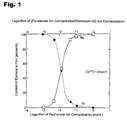
- FIG. 1 shows the relationship between the composition of a plated film and each of the molar concentration of ReO 4 - and the molar concentration ratio of ReO 4 - /Cr 3+ in the plating bath in each of Inventive Examples 1 to 5 and Comparative Example 1.
- the plated film obtained from Comparative Example 1 using the bath containing ReO 4 - in a concentration of 0.001 mol/L has a composition consisting of 100 atomic% of Cr.
- the plated film obtained from Inventive Example 1 using the bath containing ReO 4 - in a concentration of 0.05 mol/L has a composition comprising about 10 atomic% of Re and about 90 atomic% of Cr.
- the Re content in the film is increased as the concentration of ReO 4 - ion is increased, and the plated film obtained from Inventive Example 4 using the bath containing ReO 4 - in a concentration of 0.1 mol/L has a composition comprising 98 atomic% of Re and 2 atomic% of Cr.
- a solution containing Cr 3+ in a concentration of 0.4 mol/L and ReO 4 - in a concentration of 0.005 mol/L was added with 1.0 mol/L of formic acid, 1.0 mol/L of ammonium chloride, 0.1 mol/L of potassium bromide and 0.8 mol/L of boric acid, to prepare a plating bath.
- the pH of the plating bath was adjusted at 3 using sulfuric acid and sodium hydrate.
- an electroplating process was performed under a room temperature. Other conditions were the same as those in Inventive Example 1. After the electroplating process, an alloy film having 90 atomic% of Re and 10 atomic% of Cr was deposited on the surface of the substrate or electrode.
- a solution containing Cr 3+ in a concentration of 0.4 mol/L and ReO 4 - in a concentration of 0.0075 mol/L was added with 1.0 mol/L of formic acid, 1.0 mol/L of ammonium chloride, 0.1 mol/L of potassium bromide and 0.8 mol/L of boric acid, to prepare a plating bath.
- the pH of the plating bath was adjusted at 3 using sulfuric acid and sodium hydrate.
- an electroplating process was performed under a room temperature. Other conditions were the same as those in Inventive Example 1. After the electroplating process, an alloy film having 90 atomic% of Re and 10 atomic% of Cr was deposited on the surface of the substrate or electrode.
- a solution containing Cr 3+ in a concentration of 0.4 mol/L and ReO 4 - in a concentration of 0.01 mol/L was added with 1.0 mol/L of formic acid, 1.0 mol/L of ammonium chloride, 0.1 mol/L of potassium bromide and 0.8 mol/L of boric acid, to prepare a plating bath.
- the pH of the plating bath was adjusted at 3 using sulfuric acid and sodium hydrate.
- an electroplating process was performed under a room temperature. Other conditions were the same as those in Inventive Example 1. After the electroplating process, an alloy film having 93 atomic% of Re and 7 atomic% of Cr was deposited on the surface of the substrate or electrode.
- a copper plate was subjected to degreasing/cleaning, and used as a substrate.
- a solution was prepared using chromium chloride to have a Cr 3+ ion in a concentration of 0.1 mol/L and a ReO 4 - ion in a concentration of 0.01 mol/L.
- ReO 4 - ion and Cr 3+ ion 1.5 mol/L of acetic acid, 0.5 mol/L of ammonium chloride and 0.5 mol/L of potassium bromide were added to the solution to prepare a plating bath.
- the pH of the plating bath was adjusted at 4 using sulfuric acid and sodium hydrate.
- an electroplating process was performed under a plating bath temperature of 35°C and a current density of 100 mA/cm 2 .
- FIG 2 shows the relationship between the composition of a plated film and each of the molar concentration of ReO 4 - and the molar concentration ratio of ReO 4 - /Cr 3+ in the plating bath in each of Inventive Examples 9 to 12. As seen in FIG.
- the plated film obtained from Inventive Example 11 using the bath containing ReO 4 - in a concentration of 0.0001 mol/L has a composition comprising about 55 atomic% of Re and about 45 atomic% of Cr
- the plated film obtained from Inventive Example 12 using the bath containing ReO 4 - in a concentration of 0.005 mol/L has a composition comprising about 92 atomic% of Re and about 8 atomic% of Cr.
- the plated film obtained from Inventive Example 9 or 10 using the bath containing ReO 4 - in a concentration of 0.01 mol/L or more has a Re content of 98 atomic% or more.
- a copper plate was subjected to degreasing/cleaning, and used as a substrate.
- a solution was prepared to have a K + ion in a concentration of 0.1 mol/L.
- 0.1 mol/L of ReO 4 - 0.1 mol/L of ReO 4 - , 0.5 mol/L of Cr 3+ , 1.5 mol/L of acetic acid, 0.5 mol/L of ammonium chloride and 0.5 mol/L of potassium bromide were added to the solution to prepare a plating bath.
- the pH of the plating bath was adjusted at 4 using sulfuric acid and sodium hydrate.
- an electroplating process was performed under a plating bath temperature of 35°C and a current density of 100 mA/cm 2 .
- FIG. 3 shows the relationship between the composition of a plated film and each of the molar concentration of K + in the plating bath in each of Inventive Examples 13 to 15. As seen in FIG. 3, the content of Re in the plated film is reduced as the concentration of K + is increased.
- a copper plate was subjected to degreasing/cleaning, and used as a substrate.
- a solution was prepared using chromium chloride to have a Cr 3+ ion in a concentration of 1.0 mol/L.
- 0.15 mol/L of perrhenate ion, 0.1 mol/L of Ni 2+ , 1.5 mol/L of ⁇ -hydroxybutyric acid and 1.0 mol/L of glycine were added to the solution to prepare a plating bath.
- the pH of the plating bath was adjusted at 3 using sulfuric acid and sodium hydrate.
- an electroplating process was performed under a plating bath temperature of 50°C and a current density of 100 mA/cm 2 .
- FIG. 4 shows the relationship between the composition of a plated film and the molar concentration of Cr 3+ ion in a plating bath in each of Inventive Examples 16 to 19 and Comparative Example 2.
- the plated film obtained from Comparative Example 2 using the bath containing Cr 3+ in a concentration of 0.7 mol/L has a composition consisting of 89 atomic% of Re and 11 atomic% of Ni.
- the plated film obtained from Inventive Example 16 using the bath containing Cr 3+ in a concentration of 1.0 mol/L has a composition comprising 65 atomic% of Re, 20 atomic% of Ni and 15 atomic% of Cr. Then, the Cr content in the film is increased as the concentration of Cr 3+ ion is increased.
- a solution was prepared to have a Cr 3+ ion in a concentration of 1.5 mol/L.
- 0.15 mol/L of perrhenate ion, 0.1 mol/L of Ni 2+ , 1.0 mol/L of serine and 0.5 mol/L of citric acid were added to the solution to prepare a plating bath.
- the pH and temperature of the plating bath and a current density were set at the same values as those in Inventive Example 16.
- an alloy film having 60 atomic% of Re, 20 atomic% of Cr and 20 atomic% of Ni was deposited on the surface of an electrode.
- a solution was prepared to have a Cr 3+ ion in a concentration of 1.0 mol/L.
- 0.15 mol/L of perrhenate ion, 0.1 mol/L of Ni 2+ and 1.0 mol/L of glycine were added to the solution to prepare a plating bath.
- the pH and temperature of the plating bath and a current density were set at the same values as those in Inventive Example 16.
- an alloy film having 80 atomic% of Re, 15 atomic% of Cr and 5 atomic% of Ni was deposited on the surface of an electrode.
- the present invention allows a Re-Cr alloy or Re-based film usable as a corrosion-resistant alloy coating for a high-temperature component or the like to be formed through an electroplating process using an aqueous solution, so as to provide heat/corrosion resistances to the component, even if it has a complicated shape, in a simplified manner at a low cost.
Landscapes
- Chemical & Material Sciences (AREA)
- Engineering & Computer Science (AREA)
- Chemical Kinetics & Catalysis (AREA)
- Electrochemistry (AREA)
- Materials Engineering (AREA)
- Metallurgy (AREA)
- Organic Chemistry (AREA)
- Electroplating And Plating Baths Therefor (AREA)
Abstract
Description
Claims (13)
- A method for forming a Re-Cr alloy film, comprising performing an electroplating process using a plating bath which contains an aqueous solution including:wherein said plating bath has a pH of 0 to 8, and a temperature of 10 to 80°C.a perrhenate ion in a concentration of 0.0001 to less than 2.0 mol/L; anda chromium (III) ion in a concentration of greater than 0.001 to 10.0 mol/L, wherein the molar ratio of the perrhenate ion to the chromium (III) ion in said plating bath is in the range of greater than 0.001 to less than 0.1,
- A method for forming a Re-Cr alloy film, comprising performing an electroplating process using a plating bath which contains an aqueous solution including:wherein said plating bath has a pH of 0 to 8, and a temperature of 10 to 80°C.a perrhenate ion in a concentration of 0.0001 to less than 2.0 mol/L;a chromium (III) ion in a concentration of greater than 0.001 to 10.0 mol/L; andat least one ion selected from the group consisting of potassium, rubidium, cesium, calcium, strontium and barium ions, in a concentration of 0.001 to 10.0 mol/L,
- The method as defined in claim 1 or 2, wherein said alloy film to be formed has a composition consisting of Re in the range of greater than zero to less than 98% by atomic composition, and the remainder being Cr except inevitable impurities.
- A method for forming a Re-based film, comprising performing an electroplating process using a plating bath which contains an aqueous solution including:wherein said plating bath has a pH of 0 to 8, and a temperature of 10 to 80°C.a perrhenate ion in a concentration of 0.001 to 2.0 mol/L; anda chromium (III) ion in a concentration of 0.01 to 10.0 mol/L, wherein the molar ratio of the perrhenate ion to the chromium (III) ion in said plating bath is 0.1 or more,
- The method as defined in claim 4, wherein said film to be formed has a composition consisting of greater than 98% or more, by atomic composition, of Re, with the remainder being Cr and inevitable impurities.
- The method as defined in either one of claims 1 to 5, wherein said plating bath contains an organic acid in a concentration of 0.1 to 15.0 equivalents to the concentration of all of said metal ions.
- A method for forming a Re-Cr-Ni alloy film, comprising performing an electroplating process using a plating bath which contains an aqueous solution including:wherein said plating bath has a pH of 0 to 8, and a temperature of 10 to 80°C.a perrhenate ion in a concentration of 0.01 to 2.0 mol/L;a chromium (III) ion in a concentration of greater than 0.8 to 4.0 mol/L; anda nickel (II) ion in a concentration of 0.0001 to 0.2 mol/L,
- The method as defined in claim 7, wherein the molar ratio of the chromium (III) ion to the nickel (II) ion in said plating bath is 2 or more.
- The method as defined in claim 7 or 8, wherein said film to be formed has a composition consisting of Re in the range of 50 to less than 98% by atomic composition, Cr in range of 2 to less than 45% by atomic composition, and the remainder being Ni except inevitable impurities.
- The method as defined in either one of claims 7 to 9, wherein said plating bath contains an organic acid and/or a boric acid, in a concentration of 0.1 to 5.0 equivalents to the concentration of all of said metal ions.
- The method as defined in either one of claims 1 to 10, wherein said plating bath contains an ammonium ion in a concentration of 0.0001 to 5.0 mol/L, and/or a boric acid in a concentration of 0.0001 to 5.0 mol/L.
- The method as defined in either one of claims 1 to 11, wherein said plating bath contains a bromine ion in a concentration of 0.0001 to 5.0 mol/L.
- The method as defined in either one of claims 1 to 12, wherein said plating bath contains a sulfate ion in a concentration of 0.0001 to 5.0 mol/L, a chloride ion in a concentration of 0.0001 to 5.0 mol/L, a lithium ion in a concentration of 0.0001 to 5.0 mol/L, a sodium ion in a concentration of 0.0001 to 5.0 mol/L, and/or a potassium ion in a concentration of 0.0001 to 5.0 mol/L.
Applications Claiming Priority (9)
| Application Number | Priority Date | Filing Date | Title |
|---|---|---|---|
| JP2002010787 | 2002-01-18 | ||
| JP2002010723 | 2002-01-18 | ||
| JP2002010787A JP4271399B2 (en) | 2002-01-18 | 2002-01-18 | Method for forming Re film by electrolytic plating using Cr (III) -containing bath |
| JP2002010693 | 2002-01-18 | ||
| JP2002010693 | 2002-01-18 | ||
| JP2002010764 | 2002-01-18 | ||
| JP2002010764A JP2003213483A (en) | 2002-01-18 | 2002-01-18 | Method for forming Re-Cr alloy film by electrolytic plating using bath containing alkali or alkaline earth metal ions |
| JP2002010723 | 2002-01-18 | ||
| PCT/JP2003/000353 WO2003062500A1 (en) | 2002-01-18 | 2003-01-17 | METHOD FOR FORMING Re COATING FILM OR Re-Cr ALLOY COATING FILM THROUGH ELECTROPLATING |
Publications (2)
| Publication Number | Publication Date |
|---|---|
| EP1467001A1 true EP1467001A1 (en) | 2004-10-13 |
| EP1467001A4 EP1467001A4 (en) | 2007-02-21 |
Family
ID=27617714
Family Applications (1)
| Application Number | Title | Priority Date | Filing Date |
|---|---|---|---|
| EP03701766A Withdrawn EP1467001A4 (en) | 2002-01-18 | 2003-01-17 | PROCESS FOR FORMING AL OR RE-CR ALLOY COATING FILM BY ELECTROPLACING |
Country Status (3)
| Country | Link |
|---|---|
| US (1) | US6979392B2 (en) |
| EP (1) | EP1467001A4 (en) |
| WO (1) | WO2003062500A1 (en) |
Cited By (1)
| Publication number | Priority date | Publication date | Assignee | Title |
|---|---|---|---|---|
| CN110079840A (en) * | 2019-04-26 | 2019-08-02 | 山东金宝电子股份有限公司 | A kind of surface treatment additive package improving copper foil high-temp antioxidizing performance |
Families Citing this family (7)
| Publication number | Priority date | Publication date | Assignee | Title |
|---|---|---|---|---|
| EP1467002A4 (en) * | 2002-01-18 | 2007-02-28 | Japan Science & Tech Agency | PROCESS FOR FORMING A RE-ALLOY COATING FILM HAVING A HIGH RE-CONTENT BY ELECTROPLACING |
| JP5050048B2 (en) * | 2006-03-31 | 2012-10-17 | アトテック・ドイチュラント・ゲーエムベーハー | Crystalline chromium deposits |
| WO2009046181A1 (en) * | 2007-10-02 | 2009-04-09 | Atotech Deutschland Gmbh | Crystalline chromium alloy deposit |
| US7998594B2 (en) * | 2008-02-11 | 2011-08-16 | Honeywell International Inc. | Methods of bonding pure rhenium to a substrate |
| CN101580954B (en) * | 2009-06-23 | 2010-11-03 | 安徽华东光电技术研究所 | Composition used for plating rhenium and use method thereof |
| US11306407B2 (en) * | 2018-12-21 | 2022-04-19 | The Board Of Trustees Of The University Of Alabama | Methods for electrodeposition |
| CN111763968A (en) * | 2020-07-29 | 2020-10-13 | 济南东方结晶器有限公司 | Plating solution for Co-Re-Cr nano-diamond wear-resistant ablation-resistant coating |
Family Cites Families (6)
| Publication number | Priority date | Publication date | Assignee | Title |
|---|---|---|---|---|
| US3285839A (en) * | 1963-12-16 | 1966-11-15 | American Chem & Refining Co | Method and bath for electroplating rhenium |
| DE1771763A1 (en) * | 1967-07-03 | |||
| JPS5493453A (en) | 1978-01-06 | 1979-07-24 | Hitachi Ltd | Electric contact |
| US4477318A (en) * | 1980-11-10 | 1984-10-16 | Omi International Corporation | Trivalent chromium electrolyte and process employing metal ion reducing agents |
| JPS63111195A (en) * | 1986-10-28 | 1988-05-16 | Shin Etsu Chem Co Ltd | Electroplating bath |
| JPH09302496A (en) * | 1996-05-09 | 1997-11-25 | Asahi Glass Co Ltd | Chromium-containing alloy film plating method |
-
2003
- 2003-01-17 US US10/501,720 patent/US6979392B2/en not_active Expired - Fee Related
- 2003-01-17 EP EP03701766A patent/EP1467001A4/en not_active Withdrawn
- 2003-01-17 WO PCT/JP2003/000353 patent/WO2003062500A1/en not_active Ceased
Cited By (1)
| Publication number | Priority date | Publication date | Assignee | Title |
|---|---|---|---|---|
| CN110079840A (en) * | 2019-04-26 | 2019-08-02 | 山东金宝电子股份有限公司 | A kind of surface treatment additive package improving copper foil high-temp antioxidizing performance |
Also Published As
| Publication number | Publication date |
|---|---|
| EP1467001A4 (en) | 2007-02-21 |
| WO2003062500A1 (en) | 2003-07-31 |
| US20050126922A1 (en) | 2005-06-16 |
| US6979392B2 (en) | 2005-12-27 |
Similar Documents
| Publication | Publication Date | Title |
|---|---|---|
| Abbott et al. | Electrofinishing of metals using eutectic based ionic liquids | |
| US20090211914A1 (en) | Trivalent Chromium Electroplating Solution and an Operational Method Thereof | |
| US3309292A (en) | Method for obtaining thick adherent coatings of platinum metals on refractory metals | |
| US6979392B2 (en) | Method for forming Re—Cr alloy film or Re-based film through electroplating process | |
| US4414064A (en) | Method for preparing low voltage hydrogen cathodes | |
| GB2065171A (en) | Low overvoltage hydrogen cathodes | |
| JP5247142B2 (en) | Silver plating method | |
| EP2787102B1 (en) | Replenisher and method for producing surface-treated steel sheet | |
| Green et al. | Pulse plating of copper from deep eutectic solvents | |
| JP2008285732A (en) | Nickel plating solution, electroplating method using the nickel plating solution, and chip component formed with a nickel plating film by the electroplating method | |
| CA3221841A1 (en) | Methods and compositions for electrochemical deposition of metal rich layers in aqueous solutions | |
| US6998035B2 (en) | Method for forming Re-Cr alloy film through electroplating process using bath containing Cr(VI) | |
| EP1467002A1 (en) | METHOD FOR FORMING Re ALLOY COATING FILM HAVING HIGH Re CONTENT THROUGH ELECTROPLATING | |
| US20150197870A1 (en) | Method for Plating Fine Grain Copper Deposit on Metal Substrate | |
| Galvanauskaite et al. | Influence of Te (VI) additive on manganese electrodeposition at room temperature and coating properties | |
| JP4271399B2 (en) | Method for forming Re film by electrolytic plating using Cr (III) -containing bath | |
| JP3904197B2 (en) | Method for forming Re film by electrolytic plating | |
| AU2020205312B2 (en) | Functional chromium alloy plating from trivalent chromium electrolytes | |
| Liu et al. | Electrodeposition of molybdenum from water-in-acetate electrolytes | |
| JP3942437B2 (en) | Method of forming high concentration Re alloy film by electrolytic plating | |
| JP4323816B2 (en) | Method for forming Re-Cr alloy film by electroplating using Cr (III) -containing bath | |
| JPH10330998A (en) | Electroplating method | |
| JP2003213483A (en) | Method for forming Re-Cr alloy film by electrolytic plating using bath containing alkali or alkaline earth metal ions | |
| TWI726640B (en) | Manufacturing method of surface-treated steel plate and surface-treated steel plate | |
| JP2003277971A (en) | Method of forming Re-Cr-Ni alloy film by electrolytic plating |
Legal Events
| Date | Code | Title | Description |
|---|---|---|---|
| PUAI | Public reference made under article 153(3) epc to a published international application that has entered the european phase |
Free format text: ORIGINAL CODE: 0009012 |
|
| 17P | Request for examination filed |
Effective date: 20040716 |
|
| AK | Designated contracting states |
Kind code of ref document: A1 Designated state(s): AT BE BG CH CY CZ DE DK EE ES FI FR GB GR HU IE IT LI LU MC NL PT SE SI SK TR |
|
| AX | Request for extension of the european patent |
Extension state: AL LT LV MK RO |
|
| A4 | Supplementary search report drawn up and despatched |
Effective date: 20070118 |
|
| RAP1 | Party data changed (applicant data changed or rights of an application transferred) |
Owner name: SAPPORO ELECTROPLATING INDUSTRIAL CO., LTD. Owner name: EBARA CORPORATION Owner name: NARITA, TOSHIO |
|
| STAA | Information on the status of an ep patent application or granted ep patent |
Free format text: STATUS: THE APPLICATION HAS BEEN WITHDRAWN |
|
| 18W | Application withdrawn |
Effective date: 20090730 |