EP1460093A1 - Polycarbodiimide copolymer and production method thereof - Google Patents
Polycarbodiimide copolymer and production method thereof Download PDFInfo
- Publication number
- EP1460093A1 EP1460093A1 EP04005430A EP04005430A EP1460093A1 EP 1460093 A1 EP1460093 A1 EP 1460093A1 EP 04005430 A EP04005430 A EP 04005430A EP 04005430 A EP04005430 A EP 04005430A EP 1460093 A1 EP1460093 A1 EP 1460093A1
- Authority
- EP
- European Patent Office
- Prior art keywords
- carbon atoms
- polycarbodiimide
- structural unit
- diisocyanate
- integer
- Prior art date
- Legal status (The legal status is an assumption and is not a legal conclusion. Google has not performed a legal analysis and makes no representation as to the accuracy of the status listed.)
- Granted
Links
- VGHSXKTVMPXHNG-UHFFFAOYSA-N O=C=Nc1cc(N=C=O)ccc1 Chemical compound O=C=Nc1cc(N=C=O)ccc1 VGHSXKTVMPXHNG-UHFFFAOYSA-N 0.000 description 1
Images

Classifications
-
- A—HUMAN NECESSITIES
- A47—FURNITURE; DOMESTIC ARTICLES OR APPLIANCES; COFFEE MILLS; SPICE MILLS; SUCTION CLEANERS IN GENERAL
- A47K—SANITARY EQUIPMENT; ACCESSORIES THEREFOR, e.g. TOILET ACCESSORIES
- A47K10/00—Body-drying implements; Toilet paper; Holders therefor
- A47K10/04—Towel racks; Towel rails; Towel rods; Towel rolls, e.g. rotatable
-
- C—CHEMISTRY; METALLURGY
- C08—ORGANIC MACROMOLECULAR COMPOUNDS; THEIR PREPARATION OR CHEMICAL WORKING-UP; COMPOSITIONS BASED THEREON
- C08G—MACROMOLECULAR COMPOUNDS OBTAINED OTHERWISE THAN BY REACTIONS ONLY INVOLVING UNSATURATED CARBON-TO-CARBON BONDS
- C08G18/00—Polymeric products of isocyanates or isothiocyanates
- C08G18/06—Polymeric products of isocyanates or isothiocyanates with compounds having active hydrogen
- C08G18/08—Processes
- C08G18/09—Processes comprising oligomerisation of isocyanates or isothiocyanates involving reaction of a part of the isocyanate or isothiocyanate groups with each other in the reaction mixture
- C08G18/095—Processes comprising oligomerisation of isocyanates or isothiocyanates involving reaction of a part of the isocyanate or isothiocyanate groups with each other in the reaction mixture oligomerisation to carbodiimide or uretone-imine groups
-
- C—CHEMISTRY; METALLURGY
- C08—ORGANIC MACROMOLECULAR COMPOUNDS; THEIR PREPARATION OR CHEMICAL WORKING-UP; COMPOSITIONS BASED THEREON
- C08G—MACROMOLECULAR COMPOUNDS OBTAINED OTHERWISE THAN BY REACTIONS ONLY INVOLVING UNSATURATED CARBON-TO-CARBON BONDS
- C08G18/00—Polymeric products of isocyanates or isothiocyanates
- C08G18/06—Polymeric products of isocyanates or isothiocyanates with compounds having active hydrogen
- C08G18/28—Polymeric products of isocyanates or isothiocyanates with compounds having active hydrogen characterised by the compounds used containing active hydrogen
- C08G18/67—Unsaturated compounds having active hydrogen
- C08G18/69—Polymers of conjugated dienes
-
- C—CHEMISTRY; METALLURGY
- C08—ORGANIC MACROMOLECULAR COMPOUNDS; THEIR PREPARATION OR CHEMICAL WORKING-UP; COMPOSITIONS BASED THEREON
- C08G—MACROMOLECULAR COMPOUNDS OBTAINED OTHERWISE THAN BY REACTIONS ONLY INVOLVING UNSATURATED CARBON-TO-CARBON BONDS
- C08G18/00—Polymeric products of isocyanates or isothiocyanates
- C08G18/06—Polymeric products of isocyanates or isothiocyanates with compounds having active hydrogen
- C08G18/70—Polymeric products of isocyanates or isothiocyanates with compounds having active hydrogen characterised by the isocyanates or isothiocyanates used
- C08G18/71—Monoisocyanates or monoisothiocyanates
-
- C—CHEMISTRY; METALLURGY
- C08—ORGANIC MACROMOLECULAR COMPOUNDS; THEIR PREPARATION OR CHEMICAL WORKING-UP; COMPOSITIONS BASED THEREON
- C08G—MACROMOLECULAR COMPOUNDS OBTAINED OTHERWISE THAN BY REACTIONS ONLY INVOLVING UNSATURATED CARBON-TO-CARBON BONDS
- C08G18/00—Polymeric products of isocyanates or isothiocyanates
- C08G18/06—Polymeric products of isocyanates or isothiocyanates with compounds having active hydrogen
- C08G18/70—Polymeric products of isocyanates or isothiocyanates with compounds having active hydrogen characterised by the isocyanates or isothiocyanates used
- C08G18/72—Polyisocyanates or polyisothiocyanates
- C08G18/74—Polyisocyanates or polyisothiocyanates cyclic
- C08G18/76—Polyisocyanates or polyisothiocyanates cyclic aromatic
- C08G18/7607—Compounds of C08G18/7614 and of C08G18/7657
-
- A—HUMAN NECESSITIES
- A47—FURNITURE; DOMESTIC ARTICLES OR APPLIANCES; COFFEE MILLS; SPICE MILLS; SUCTION CLEANERS IN GENERAL
- A47K—SANITARY EQUIPMENT; ACCESSORIES THEREFOR, e.g. TOILET ACCESSORIES
- A47K2201/00—Details of connections of bathroom accessories, e.g. fixing soap or towel holder to a wall
Definitions
- This invention relates to a polycarbodiimide having high heat resistance and electric insulation performance, and a production method thereof.
- polycarbodiimide resins are thermosetting resins having excellent heat resistance, they are slightly soluble in various solvents and have low fluidity when melted, so that their mold processing becomes difficult in their practical use.
- JP-A-51-61599, JP-A-61-246245, JP-A-4-261428 and the like disclose preparation of a powdery polycarbodiimide using 4,4'-diphenylmethane diisocyanate (MDI hereinafter) and a monoisocyanate.
- MDI 4,4'-diphenylmethane diisocyanate
- JP-A-2-292316 and JP-A-5-310877 describe a method for producing a polycarbodiimide solution using a specified solvent in carrying out polymerization from tolylene diisocyanate (TDI hereinafter).Though there are descriptions therein stating that the moldability is improved, flexibility of the hardened products is lower than that of the polycarbodiimide obtained from 4,4'-diphenylmethane diisocyanate.
- the object of the present invention is to provide a thermosetting resin polycarbodiimide having high heat resistance and excellent flexibility and also having good workability and moldability and a production method thereof.
- the present inventors have carried out intensive studies on such an object. As a result, it was found unexpectedly that the introduction of an aliphatic isocyanate in carrying out polymerization using an aromatic diisocyanate and a straight chain aliphatic isocyanate as the starting materials, which was difficult to perform in the prior art, can be achieved by setting the reaction temperature to a low level, so that a polycarbodiimide capable of showing excellent flexibility while keeping high heat resistance can be obtained, thus resulting in the accomplishment of the present invention.
- the conventionally known polycarbodiimides solely comprising aromatic compounds were not able to be used as film materials due to their brittleness.
- the polycarbodiimide copolymer of the present invention is a thermosetting resin capable of showing excellent flexibility while keeping high heat resistance, so that it can provide films and various molding materials.
- polycarbodiimide copolymer of the present invention a polycarbodiimide copolymer wherein the terminal structural unit of the molecule is a substituted or unsubstituted phenyl group, naphthyl group or alkyl group having from 1 to 10 carbon atoms can be exemplified.
- the present invention also provides a polycarbodiimide copolymer solution prepared by dissolving the polycarbodiimide copolymer of the formula (1) in an aprotic organic solvent.
- the present invention provides a method for the production of a polycarbodiimide copolymer, which comprises allowing at least one bifunctional liquid rubber selected from liquid rubbers having the repeating structural units represented by the aforementioned formulae (1) and (2), an organic diisocyanate and a monoisocyanate to undergo the reaction in an aprotic solvent in the presence of a catalyst.
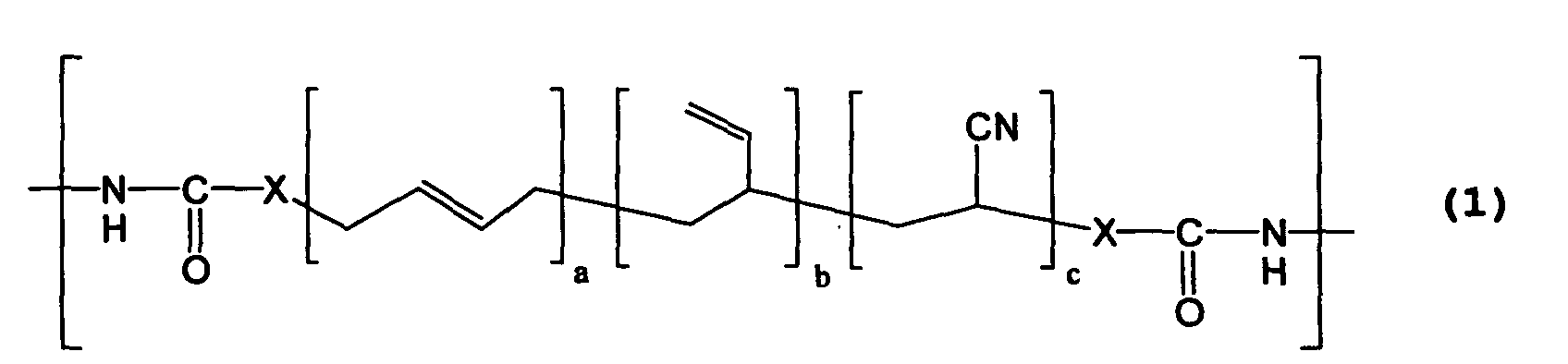
- the polycarbodiimide of the present invention is a copolymer containing the structural units (rubber residues) represented by the formulae (1) and (2) and the repeating structural unit represented by the formula (3), at a predetermined ratio in one molecule. That is, this polycarbodiimide contains units (rubber residues) represented by the following formulae (1) and (2) in a number "m": (wherein each of a, b and c is an integer of from 0 to 200, and X represents an alkylene group having from 0 to 5 carbon atoms).
- One species of the structural unit of formula (1) and/or (2) may be contained in one molecule, or two or more species of the structural unit of the formula (1) and/or (2) as a mixture therein.
- m is an integer of 2 or more and generally 1,000 or less, and is preferably an integer of from 2 to 10.
- n is an integer of 1 or more and generally 500 or less, and is preferably an integer of from 1 to 10.
- m + n is from 3 to 1,500, preferably from 3 to 20, and m/(m + n) is from 1/1,500 to 1/3, preferably from 1/11 to 1/3.
- terminal structural unit is an alkyl group
- examples in which the terminal structural unit is an alkyl group include n-butyl, n-hexyl, n-octyl and the like alkyl groups having from 1 to 10 carbon atoms.
- Aromatic and aliphatic diisocyanates can be used as the organic diisocyanate. These may be used alone or as a mixture of two or more. Amount of the organic diisocyanate to be used is from 10 to 1,000 moles, preferably from 20 to 500 moles, based on 100 moles of the aforementioned bifunctional liquid rubber.
- X 1 represents an alkyl group having from 1 to 5 carbon atoms, an alkoxyl group (preferably having from 1 to 2 carbon atoms) or a halogen.
- Illustrative examples of the diisocyanate having the structure of above formula (4) include m-phenylene diisocyanate, 2,4-tolylene diisocyanate, 2,6-tolylene diisocyanate, 6-methoxy-2,4-phenylene diisocyanate, 5-bromo-2,4-tolylene diisocyanate and the like.
- X 2 represents an alkylene group having from 0 to 5 carbon atoms, an oxy group, a sulfo group or a sulfoxyl group
- X 3 and X 4 respectively represent an alkyl group having from 1 to 5 carbon atoms, an alkoxyl group (preferably having from 1 to 2 carbon atoms) or a halogen.
- diisocyanates having the structures represented by the following formula (6), the following formula (7) and the following formula (8) can be used as the aliphatic organic diisocyanate.
- X 5 and X 6 respectively represent an alkylene group having from 0 to 5 carbon atoms
- X 7 represents an alkyl group having from 1 to 5 carbon atoms or an alkylene group having from 0 to 5 carbon atoms.
- diisocyanate having the structure of above formula (5) examples include 4,4-dicyclohexylmethane diisocyanate, norbornane diisocyanate, 4,4'-cyclohexane diisocyanate, isophorone diisocyanate, methylcyclohexane-2,4-diisocyanate, 2,4-bis(isocyanatomethyl)cyclohexane and the like.
- OCN-X 8 -NCO (7) (In this formula, X 8 represents an alkylene group having from 1 to 18 carbon atoms.)
- diisocyanate having the structure of above formula (8) examples include xylene diisocyanate, ⁇ , ⁇ , ⁇ ', ⁇ '-tetramethylxylylene diisocyanate, 4-isocyanatomethyl-phenyl isocyanate and the like.
- the monoisocyanate is used for controlling chain length of the copolymer of interest, and its examples include isocyanates having substituted or unsubstituted aryl groups such as phenyl isocyanate, naphthyl isocyanate, tolyl isocyanate, isopropylphenyl isocyanate, methoxyphenyl isocyanate, chlorophenyl isocyanate and the like; or alkyl isocyanates having from 1 to 10 carbon atoms such as n-butyl isocyanate, n-hexyl isocyanate, n-octyl isocyanate and the like.
- phosphine oxides such as triphenylphosphine oxide, tritolylphosphine oxide, bis(oxadiphenylphosphino)ethene and the like can also be used.
- Amount of the catalyst is from 0.001 to 5% by mole based on the total isocyanate components.
- the amount of use is smaller than this range, the polymerization requires a lot of time which is not practical, and when it exceeds this range on the other hand, the reaction becomes so quick that the product is solidified into a gel shape during the reaction and its storage stability is considerably reduced.
- a polycarbodiimide copolymer solution can be obtained by subjecting the polycarbodiimide copolymer of the present invention to a carbodiimide-forming reaction in an aprotic organic solvent.
- an aprotic organic solvent include toluene, xylene, an alkyl toluene having from 3 to 5 carbon atoms in the alkyl moiety thereof, benzene, an alkyl benzene having from 3 to 36 carbon atoms in the alkyl moiety thereof, naphthalene, tetrahydrofuran, dioxane, acetone, butanone, cyclohexanone, N-methylpyrrolidone, N,N-dimethylformamide, N,N-dimethylacetamide and the like.
- These solvents may be used alone or as a mixture of two or more. In addition, these may be contaminated with a component which is not concerned in the reaction.
Landscapes
- Chemical & Material Sciences (AREA)
- Health & Medical Sciences (AREA)
- Chemical Kinetics & Catalysis (AREA)
- Medicinal Chemistry (AREA)
- Polymers & Plastics (AREA)
- Organic Chemistry (AREA)
- Public Health (AREA)
- Polyurethanes Or Polyureas (AREA)
- Manufacture Of Macromolecular Shaped Articles (AREA)
- Macromolecular Compounds Obtained By Forming Nitrogen-Containing Linkages In General (AREA)
Abstract


(̵R―N=C=N)̵ (3)
and which comprises on both termini a terminal structural unit derived from a monoisocyanate, wherein m is an integer of 2 or more, n is an integer of 1 or more, m + n is from 3 to 1,500 and m/(m + n) is from 1/1,500 to 1/3. The polycarbodiimide is capable of keeping the inherent heat resistance and also showing excellent flexibility. Films and molding materials having high heat resistance and flexibility can be obtained.
Description
- This invention relates to a polycarbodiimide having high heat resistance and electric insulation performance, and a production method thereof.
- Though polycarbodiimide resins are thermosetting resins having excellent heat resistance, they are slightly soluble in various solvents and have low fluidity when melted, so that their mold processing becomes difficult in their practical use. With the aim of improving mold processing ability of such a polycarbodiimide, JP-A-51-61599, JP-A-61-246245, JP-A-4-261428 and the like disclose preparation of a powdery polycarbodiimide using 4,4'-diphenylmethane diisocyanate (MDI hereinafter) and a monoisocyanate. Though such a polycarbodiimide can be molded into a sheet shape by hot pressing, its workability cannot be said high and the moldings are hard and poor in flexibility.
- Also, JP-A-2-292316 and JP-A-5-310877 describe a method for producing a polycarbodiimide solution using a specified solvent in carrying out polymerization from tolylene diisocyanate (TDI hereinafter).Though there are descriptions therein stating that the moldability is improved, flexibility of the hardened products is lower than that of the polycarbodiimide obtained from 4,4'-diphenylmethane diisocyanate.
- In addition, JP-A-11-322888 and US Patent 5,357,021 disclose that flexibility of a polycarbodiimide is improved by introducing a long chain polyether or a long chain polyester into its molecule through urethane bond, urea bond or the like. However, heat resistance of the polycarbodiimide is sharply reduced by such a modification.
- The object of the present invention is to provide a thermosetting resin polycarbodiimide having high heat resistance and excellent flexibility and also having good workability and moldability and a production method thereof. The present inventors have carried out intensive studies on such an object. As a result, it was found unexpectedly that the introduction of an aliphatic isocyanate in carrying out polymerization using an aromatic diisocyanate and a straight chain aliphatic isocyanate as the starting materials, which was difficult to perform in the prior art, can be achieved by setting the reaction temperature to a low level, so that a polycarbodiimide capable of showing excellent flexibility while keeping high heat resistance can be obtained, thus resulting in the accomplishment of the present invention.
- The present invention provides a polycarbodiimide copolymer which comprises at least one structural unit selected from rubber residues represented by the following formulae (1) and (2) in a number "m":


(̵R-N=C=N)̵ (3)
(wherein R means an alkyl group having from 4 to 20 carbon atoms or an aryl group) and which comprises on each of the both termini a terminal structural unit derived from a monoisocyanate, wherein m is an integer of 2 or more, n is an integer of 1 or more, m + n is from 3 to 1,500 and m/(m + n) is from 1/1,500 to 1/3, and a production method thereof. - By way of example and to make the description more clear, reference is made to the accompanying drawing in which:
- Fig. 1 is an IR absorption spectrum of the polymer obtained in Example 1.
- Fig. 2 is a chart showing a result of GPC analysis of the polymer obtained in Example 1.
- The conventionally known polycarbodiimides solely comprising aromatic compounds were not able to be used as film materials due to their brittleness. Different from the conventional modified carbodiimides, the polycarbodiimide copolymer of the present invention is a thermosetting resin capable of showing excellent flexibility while keeping high heat resistance, so that it can provide films and various molding materials.
- Also, as a more preferred embodiment of the polycarbodiimide copolymer of the present invention, a polycarbodiimide copolymer wherein the terminal structural unit of the molecule is a substituted or unsubstituted phenyl group, naphthyl group or alkyl group having from 1 to 10 carbon atoms can be exemplified. In addition, the present invention also provides a polycarbodiimide copolymer solution prepared by dissolving the polycarbodiimide copolymer of the formula (1) in an aprotic organic solvent.
- Also, the present invention provides a method for the production of a polycarbodiimide copolymer, which comprises allowing at least one bifunctional liquid rubber selected from liquid rubbers having the repeating structural units represented by the aforementioned formulae (1) and (2), an organic diisocyanate and a monoisocyanate to undergo the reaction in an aprotic solvent in the presence of a catalyst.
- In the present specification, "an alkylene group having 0 carbon atom" means a single bond (a direct bond).
- The following describes the present invention further in detail. The polycarbodiimide of the present invention is a copolymer containing the structural units (rubber residues) represented by the formulae (1) and (2) and the repeating structural unit represented by the formula (3), at a predetermined ratio in one molecule. That is, this polycarbodiimide contains units (rubber residues) represented by the following formulae (1) and (2) in a number "m":


- In the above formulas (1) and (2), the plural number of "a", "b" and "X" may be the same or different from each other, respectively.
- It also contains an another repeating structural unit (isocyanate residue) represented by the following formula (3) in a number "n":
(̵R-N=C=N)̵ (3)
(wherein R means an alkyl group having from 4 to 20 carbon atoms or an aryl group) in one molecule. - The aforementioned m is an integer of 2 or more and generally 1,000 or less, and is preferably an integer of from 2 to 10. Also, n is an integer of 1 or more and generally 500 or less, and is preferably an integer of from 1 to 10. In this connection, m + n is from 3 to 1,500, preferably from 3 to 20, and m/(m + n) is from 1/1,500 to 1/3, preferably from 1/11 to 1/3.
- Also, as the terminal structural unit, a substituted or unsubstituted aryl group, or an alkyl group can be cited. Examples of the unsubstituted aryl group include phenyl, naphthyl and the like. Typical examples of the aryl group having a substituent group include tolyl, isopropylphenyl, methoxyphenyl, chlorophenyl and the like.
- In addition, examples in which the terminal structural unit is an alkyl group include n-butyl, n-hexyl, n-octyl and the like alkyl groups having from 1 to 10 carbon atoms.
- The polycarbodiimide copolymer of the present invention having the aforementioned structure is obtained by allowing a bifunctional liquid rubber to react with an organic diisocyanate in an aprotic solvent and then with an organic monoisocyanate for chain length control and a carbodiimide forming catalyst.
- According to the present invention, examples of the bifunctional liquid rubber for introducing the repeating structural unit of formula (1) and/or formula (2) include a liquid polybutadiene [the following formula (1); provided that c = 0], a liquid polybutadiene-acrylonitrile copolymer [the following formula (1); provided that c # 0] and the like.

- Also, as another bifunctional liquid rubber, a liquid hydrogenated polybutadiene [the following formula (2); provided that c = 0] can be cited.

- These may be used alone or as a mixture of two or more.
- Examples of commercially available products of the aforementioned liquid polybutadiene include Hycar CTB (registered trademark) manufactured by Ube Industries, Nippon Soda C-1000 and the like. Also, examples of the liquid polybutadiene-acrylonitrile copolymer include Hycar CTBN (registered trademark) manufactured by Ube Industries [e.g., CTBN1300X13 or CTBN1300X8] and the like. In addition, examples of the liquid hydrogenated polybutadiene include Nippon Soda CI-1000 and the like. Also, these may be used by optionally modifying them.
- Aromatic and aliphatic diisocyanates can be used as the organic diisocyanate. These may be used alone or as a mixture of two or more. Amount of the organic diisocyanate to be used is from 10 to 1,000 moles, preferably from 20 to 500 moles, based on 100 moles of the aforementioned bifunctional liquid rubber.
- (i) Structures represented by the following formulae (4) and (5) can be used as the aromatic isocyanate.

- Illustrative examples of the diisocyanate having the structure of above formula (4) include m-phenylene diisocyanate, 2,4-tolylene diisocyanate, 2,6-tolylene diisocyanate, 6-methoxy-2,4-phenylene diisocyanate, 5-bromo-2,4-tolylene diisocyanate and the like.

- Illustrative examples of the diisocyanate having the structure of above formula (5) include 4,4'-diphenylmethane diisocyanate, 3,3',5,5'-tetraethyl-4,4'-diphenylmethane diisocyanate, 4,4'-diphenylisopropylidene diisocyanate, 4,4'-diphenylether diisocyanate, 4,4'-diphenylsulfide diisocyanate, 4,4'-diphenylsulfoxide diisocyanate, 3,3',5,5'-tetramethyl-4,4'-diphenyl diisocyanate, 3,3'-dimethoxy-4,4'-biphenyl diisocyanate, 3,3'-dibromo-4,4'-biphenyl diisocyanate and the like.
- (ii) Also, diisocyanates having the structures represented by the following formula (6), the following formula (7) and the following formula (8) can be used as the aliphatic organic diisocyanate.

- Illustrative examples of the diisocyanate having the structure of above formula (5) include 4,4-dicyclohexylmethane diisocyanate, norbornane diisocyanate, 4,4'-cyclohexane diisocyanate, isophorone diisocyanate, methylcyclohexane-2,4-diisocyanate, 2,4-bis(isocyanatomethyl)cyclohexane and the like.
OCN-X8-NCO (7)
(In this formula, X8 represents an alkylene group having from 1 to 18 carbon atoms.) - Illustrative examples of the diisocyanate having the structure of above formula (7) include hexamethylene diisocyanate, 2,2,4-trimethylhexamethylene diisocyanate, octamethylene diisocyanate, dodecamethylene diisocyanate and the like.
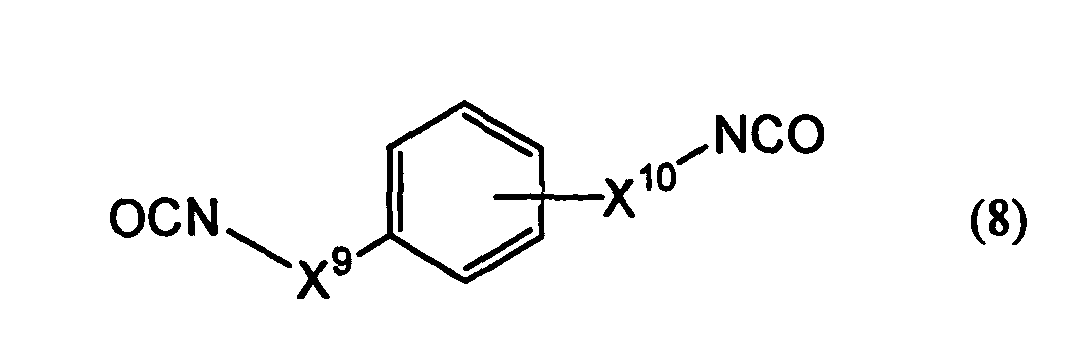
- Illustrative examples of the diisocyanate having the structure of above formula (8) include xylene diisocyanate, α, α, α', α'-tetramethylxylylene diisocyanate, 4-isocyanatomethyl-phenyl isocyanate and the like.
- The monoisocyanate is used for controlling chain length of the copolymer of interest, and its examples include isocyanates having substituted or unsubstituted aryl groups such as phenyl isocyanate, naphthyl isocyanate, tolyl isocyanate, isopropylphenyl isocyanate, methoxyphenyl isocyanate, chlorophenyl isocyanate and the like; or alkyl isocyanates having from 1 to 10 carbon atoms such as n-butyl isocyanate, n-hexyl isocyanate, n-octyl isocyanate and the like.
- It is desirable to use the monoisocyanate in an amount of from 1 to 10 moles based on 100 moles of the diisocyanate component. When the amount of monoisocyanate is smaller than this, molecular weight of the obtained polycarbodiimide may become too large, increase of the solution viscosity and solidification of the solution occur due to crosslinking reaction, and considerable reduction of storage stability of the polycarbodiimide solution may be generated. On the other hand, when the amount of monoisocyanate is larger than this, solution viscosity of the obtained polycarbodiimide solution may become so low that good films may not be formed by film molding through coating and drying of the solution.
- Various substances can be used as the catalyst to be used in the polymerization reaction, but preferred are 3-methyl-1-phenyl-2-phosphorene-1-oxide, 1-phenyl-2-phosphorene-1-oxide, 1-phenyl-2-phosphorene-1-sulfide, 1-ethyl-3-methyl-2-phosphorene-1-oxide, 3-methyl-1-phenyl-1-phospha-3-cyelopentene-1-oxide, 2,5-dihydro-3-methyl-1-phenylphosphor-1-oxide, isomers corresponding thereto and 3-phosphorene. In addition, phosphine oxides such as triphenylphosphine oxide, tritolylphosphine oxide, bis(oxadiphenylphosphino)ethene and the like can also be used.
- Amount of the catalyst is from 0.001 to 5% by mole based on the total isocyanate components. When the amount of use is smaller than this range, the polymerization requires a lot of time which is not practical, and when it exceeds this range on the other hand, the reaction becomes so quick that the product is solidified into a gel shape during the reaction and its storage stability is considerably reduced.
- The polycarbodiimide copolymer of the present invention is obtained by carrying out polymerization reaction of a liquid chain rubber having carboxyl groups on both termini with a diisocyanate in an aprotic organic solvent at a temperature of from 10 to 150°C, preferably from 60 to 110°C, in the presence of a carbodiimide forming catalyst. When the polymerization temperature exceeds the above range, the reaction progresses too quickly, the product is solidified into a gel state during the reaction due to formation of a side reaction, and its storage stability is considerably reduced. Also, when the reaction temperature at the time of polymerization is lower than the above temperature range, it is not desirable because the reaction progresses too slowly and stability of the polycarbodiimide copolymer solution is lowered due to the isocyanate functional group remained in the solution.
- The time of reaction is not particuarly limited and may be appropriately decided by monitering the decrease in the N-C-O stretching vibration of the isocyanate and increase in the N-C-N stretching vibration of the carbodiimide. The time of reaction is generally from 30 min. to 150 min., preferably from 40 min. to 120 min., most preferably from 60 min. to 90 min.
- A polycarbodiimide copolymer solution can be obtained by subjecting the polycarbodiimide copolymer of the present invention to a carbodiimide-forming reaction in an aprotic organic solvent. Examples of such an aprotic organic solvent include toluene, xylene, an alkyl toluene having from 3 to 5 carbon atoms in the alkyl moiety thereof, benzene, an alkyl benzene having from 3 to 36 carbon atoms in the alkyl moiety thereof, naphthalene, tetrahydrofuran, dioxane, acetone, butanone, cyclohexanone, N-methylpyrrolidone, N,N-dimethylformamide, N,N-dimethylacetamide and the like. These solvents may be used alone or as a mixture of two or more. In addition, these may be contaminated with a component which is not concerned in the reaction.
- The solvent may be used in such an amount that concentration of the polycarbodiimide copolymer in the polymer solution becomes from 1 to 90% by weight based on the total weight of the polymer solution. When concentration of the solid polymer content exceeds 90% by weight, the viscosity becomes high and storage stability of the solution also becomes poor. In addition, when its concentration becomes less than 1% by weight, it is necessary to remove a large amount of the solvent at the time of molding of the obtained polymer, which is not practical.
- In a typical production method of the present invention, 70 parts by weight of a liquid rubber component, 30 parts by weight of tolylene diisocyanate and 2 parts by mole of 1-naphthyl isocyanate based on tolylene diisocyanate are mixed in toluene solvent, the mixture is stirred at 50°C for 1 hour, and then a carbodiimide forming catalyst is added to the mixture. The temperature is increased to 100°C while confirming progress of the reaction by an infrared spectrophotometry, and the carbodiimide forming reaction is carried out at this temperature for 2 hours.
- The following describes the present invention further illustratively with reference to examples.
- A 42.5 g (244 mmol) portion of TDI (a mixture of 80% 2,4-TDI and 20% 2,6-TDI) was mixed with 61.1 g (244 mmol) of 4,4'-diphenylmethane diisocyanate, 48.7 g of CTBN1300X13 (Ube Industries) and 226 g of toluene. This was kept for 1 hour while stirring at 40°C. After confirming progress of the reaction by an infrared spectrophotometry, 8.3 g (49 mmol) of 1-naphthyl isocyanate and 1.88 g (9.7 mmol) of 3-methyl-1-phenyl-2-phosphorene-1-oxide were added thereto, and then temperature of the reaction mixture was increased to 80°C. Progress of the reaction was confirmed by the infrared spectrophotometry. Concretely, decrease in the N-C-O stretching vibration (2270 cm-1) of the isocyanate and increase in the N-C-N stretching vibration (2135 cm-1) of the carbodiimide were observed. While stirring, the thus obtained polycarbodiimide solution was added dropwise to 1 liter of heptane, and the thus formed precipitate was collected and dried to obtain 122 g of the polymer. An IR absorption spectrum of the thus obtained polymer and a result of its GPC analysis are respectively shown in Fig. 1 and Fig. 2.
- The solvent toluene was removed from the thus obtained polycarbodiimide solution under conditions of a reduced pressure of 10 mmHg, at 80°C and for 1 hour, and the residual solid was hydrolyzed with potassium hydroxide aqueous solution by the method described in J. Appl. Polym. Sci., 14, 35 (1970) and then extracted with ether. Tolylenediamine and 4,4'-diphenylmethanediamine in the ether phase were determined using a gas chromatograph-mass spectrometer (GC-MS). For the determination, a calibration curve was prepared using respective standard samples. It was confirmed by this that amounts of tolylenediamine and 4,4'-diphenylmethanediamine were at a ratio of 50:50, and weight fraction of the structure originated from each diamine in the solid matter was 68%. Thus, it was confirmed that the ratio of structural units [m/m + n] was 1/45.4. Based on this ratio and a result that the weight average molecular weight obtained by analyzing the polycarbodiimide solution using a GPC was 1.3 x 10⁴, it was able to confirm that m + n was 53.8.
- Since the aromatic-aliphatic copolymer polycarbodiimide of the present invention shows improved flexibility without reducing the heat resistance inherent to polycarbodiimide, films and molding materials having high heat resistance can be provided. In addition, it can be provided under a semi-hardened filmy state.
Accordingly, it can be applied to the field for preparing heat-resistant adhesives for precision electronics, composite films by laminating and the like, which were difficult to achieve in the prior art. - While the invention has been described in detail and with reference to specific embodiments thereof, it will be apparent to one skilled in the art that various changes and modifications can be made therein without departing from the scope thereof.
- This application is based on Japanese patent application No. 2003-062523 filed March 7, 2003, the entire contents thereof being hereby incorporated by reference.
Claims (5)
- A polycarbodiimide copolymer which comprises at least one structural unit selected from rubber residues represented by the following formulae (1) and (2) in a number "m":


(̵R-N=C=N)̵ (3)
(wherein R means an alkyl group having from 4 to 20 carbon atoms or an aryl group) and which comprises on each of the both termini a terminal structural unit derived from a monoisocyanate, wherein m is an integer of 2 or more, n is an integer of 1 or more, m + n is from 3 to 1,500 and m/(m + n) is from 1/1,500 to 1/3. - The polycarbodiimide copolymer according to claim 1, wherein the terminal structural unit is a substituted or unsubstituted phenyl group, naphthyl group or alkyl group having from 1 to 10 carbon atoms.
- A polycarbodiimide copolymer solution prepared by dissolving the polycarbodiimide copolymer of claim 1 in an aprotic organic solvent.
- A method for producing a polycarbodiimide copolymer, which comprises allowing at least one bifunctional liquid rubber selected from liquid rubbers having repeating structural units represented by the following formulae (1) and (2):

- The method for producing a polycarbodiimide copolymer according to claim 4, wherein the aprotic solvent is at least one solvent selected from toluene, xylene, an alkyl toluene having from 3 to 5 carbon atoms in the alkyl moiety thereof, benzene, an alkyl benzene having from 3 to 36 carbon atoms in the alkyl moiety thereof, naphthalene, tetrahydrofuran, dioxane, acetone, butanone, cyclohexanone, N-methylpyrrolidone, N,N-dimethylformamide and N,N-dimethylacetamide.
Applications Claiming Priority (2)
| Application Number | Priority Date | Filing Date | Title |
|---|---|---|---|
| JP2003062523A JP2004269691A (en) | 2003-03-07 | 2003-03-07 | Polycarbodiimide copolymer and method for producing the same |
| JP2003062523 | 2003-03-07 |
Publications (2)
| Publication Number | Publication Date |
|---|---|
| EP1460093A1 true EP1460093A1 (en) | 2004-09-22 |
| EP1460093B1 EP1460093B1 (en) | 2006-11-08 |
Family
ID=32821249
Family Applications (1)
| Application Number | Title | Priority Date | Filing Date |
|---|---|---|---|
| EP04005430A Expired - Lifetime EP1460093B1 (en) | 2003-03-07 | 2004-03-08 | Polycarbodiimide copolymer and production method thereof |
Country Status (8)
| Country | Link |
|---|---|
| US (1) | US7034101B2 (en) |
| EP (1) | EP1460093B1 (en) |
| JP (1) | JP2004269691A (en) |
| KR (1) | KR100618061B1 (en) |
| CN (1) | CN1288191C (en) |
| AT (1) | ATE344808T1 (en) |
| DE (1) | DE602004003084T2 (en) |
| TW (1) | TWI316521B (en) |
Cited By (2)
| Publication number | Priority date | Publication date | Assignee | Title |
|---|---|---|---|---|
| EP1512706A3 (en) * | 2003-08-29 | 2006-05-03 | Nitto Denko Corporation | Thermosetting resin |
| EP1555862A3 (en) * | 2004-01-19 | 2007-08-08 | Nitto Denko Corporation | Process for producing circuit board having built-in electronic part |
Families Citing this family (7)
| Publication number | Priority date | Publication date | Assignee | Title |
|---|---|---|---|---|
| US20090246393A1 (en) * | 2008-03-27 | 2009-10-01 | Ppg Industries Ohio, Inc. | Polycarbodiimides |
| EP3262091B1 (en) * | 2015-02-26 | 2019-12-25 | Covestro Deutschland AG | Method for producing a composition comprising polycarbodiimides with improved storage stability |
| US11028216B2 (en) | 2016-11-18 | 2021-06-08 | Nisshinbo Chemical Inc. | Polycarbodiimide copolymer |
| JP6834421B2 (en) * | 2016-11-30 | 2021-02-24 | 横浜ゴム株式会社 | One-component moisture-curable polyurethane composition |
| JP6834420B2 (en) * | 2016-11-30 | 2021-02-24 | 横浜ゴム株式会社 | Polyurethane composition |
| CN109749403B (en) * | 2018-12-29 | 2021-10-12 | 北京东方雨虹防水技术股份有限公司 | Polyureide elastomer and preparation method and application thereof |
| CN112920359B (en) * | 2021-01-22 | 2023-05-23 | 上海涵点科技有限公司 | Synthesis method and application of copolymerization type polycarbodiimide |
Citations (5)
| Publication number | Priority date | Publication date | Assignee | Title |
|---|---|---|---|---|
| US3929733A (en) * | 1974-10-02 | 1975-12-30 | Upjohn Co | Polycarbodiimides from 4,4{40 -methylenebis(phenyl isocyanate) and certain carbocyclic monoisocyanates |
| US4060664A (en) * | 1975-12-08 | 1977-11-29 | Minnesota Mining And Manufacturing Company | Bonded composite structures |
| US4721768A (en) * | 1985-11-21 | 1988-01-26 | The Dow Chemical Company | Azetidinedione-monocarbonamide capped prepolymer |
| EP0943642A1 (en) * | 1998-03-20 | 1999-09-22 | Nisshinbo Industries, Inc. | Polycarbodiimide copolymer and process for production thereof |
| JPH11322888A (en) * | 1998-03-20 | 1999-11-26 | Nisshinbo Ind Inc | Polycarbodiimide copolymer and its production |
Family Cites Families (8)
| Publication number | Priority date | Publication date | Assignee | Title |
|---|---|---|---|---|
| US4260718A (en) | 1979-12-18 | 1981-04-07 | The Upjohn Company | Modified carbodiimide-containing polyisocyanates and glassy polyurethanes therefrom |
| JPS61246245A (en) | 1985-04-25 | 1986-11-01 | Nisshinbo Ind Inc | Production of thermosetting resin |
| JP2769852B2 (en) | 1989-05-02 | 1998-06-25 | 日清紡績株式会社 | High molecular weight polycarbodiimide solution and method for producing the same |
| JPH04261428A (en) | 1991-02-15 | 1992-09-17 | Mitsui Toatsu Chem Inc | Polycarbodiimide and production thereof |
| JP2849001B2 (en) | 1992-05-14 | 1999-01-20 | 三井化学株式会社 | Carbodiimide copolymer and method for producing the same |
| US5357021A (en) | 1993-07-21 | 1994-10-18 | Basf Corporation | Reactive carbodimide compositions |
| US6492484B2 (en) * | 2000-09-01 | 2002-12-10 | Nitto Denko Corporation | Polycarbodiimide |
| JP2004165471A (en) * | 2002-11-14 | 2004-06-10 | Nitto Denko Corp | Adhesive film for underfill and semiconductor device using the same |
-
2003
- 2003-03-07 JP JP2003062523A patent/JP2004269691A/en active Pending
-
2004
- 2004-03-05 TW TW093105831A patent/TWI316521B/en not_active IP Right Cessation
- 2004-03-05 US US10/793,213 patent/US7034101B2/en not_active Expired - Fee Related
- 2004-03-05 KR KR1020040014996A patent/KR100618061B1/en not_active Expired - Fee Related
- 2004-03-08 AT AT04005430T patent/ATE344808T1/en not_active IP Right Cessation
- 2004-03-08 CN CNB2004100080394A patent/CN1288191C/en not_active Expired - Fee Related
- 2004-03-08 DE DE602004003084T patent/DE602004003084T2/en not_active Expired - Fee Related
- 2004-03-08 EP EP04005430A patent/EP1460093B1/en not_active Expired - Lifetime
Patent Citations (6)
| Publication number | Priority date | Publication date | Assignee | Title |
|---|---|---|---|---|
| US3929733A (en) * | 1974-10-02 | 1975-12-30 | Upjohn Co | Polycarbodiimides from 4,4{40 -methylenebis(phenyl isocyanate) and certain carbocyclic monoisocyanates |
| JPS5161599A (en) * | 1974-10-02 | 1976-05-28 | Upjohn Co | |
| US4060664A (en) * | 1975-12-08 | 1977-11-29 | Minnesota Mining And Manufacturing Company | Bonded composite structures |
| US4721768A (en) * | 1985-11-21 | 1988-01-26 | The Dow Chemical Company | Azetidinedione-monocarbonamide capped prepolymer |
| EP0943642A1 (en) * | 1998-03-20 | 1999-09-22 | Nisshinbo Industries, Inc. | Polycarbodiimide copolymer and process for production thereof |
| JPH11322888A (en) * | 1998-03-20 | 1999-11-26 | Nisshinbo Ind Inc | Polycarbodiimide copolymer and its production |
Cited By (2)
| Publication number | Priority date | Publication date | Assignee | Title |
|---|---|---|---|---|
| EP1512706A3 (en) * | 2003-08-29 | 2006-05-03 | Nitto Denko Corporation | Thermosetting resin |
| EP1555862A3 (en) * | 2004-01-19 | 2007-08-08 | Nitto Denko Corporation | Process for producing circuit board having built-in electronic part |
Also Published As
| Publication number | Publication date |
|---|---|
| TW200508267A (en) | 2005-03-01 |
| EP1460093B1 (en) | 2006-11-08 |
| CN1526751A (en) | 2004-09-08 |
| TWI316521B (en) | 2009-11-01 |
| DE602004003084D1 (en) | 2006-12-21 |
| US7034101B2 (en) | 2006-04-25 |
| CN1288191C (en) | 2006-12-06 |
| ATE344808T1 (en) | 2006-11-15 |
| KR100618061B1 (en) | 2006-08-30 |
| JP2004269691A (en) | 2004-09-30 |
| DE602004003084T2 (en) | 2007-02-15 |
| KR20040078920A (en) | 2004-09-13 |
| US20040176547A1 (en) | 2004-09-09 |
Similar Documents
| Publication | Publication Date | Title |
|---|---|---|
| EP2552982B1 (en) | Carbodiimidation method | |
| EP1460093B1 (en) | Polycarbodiimide copolymer and production method thereof | |
| EP1445269B1 (en) | Polycarbodiimide having high index of refraction and production method thereof | |
| EP0522414B1 (en) | Polycarbodiimide pulp and process for production thereof | |
| DE69904279T2 (en) | Aromatic polycarbodiimide and polycarbodiimide film | |
| JP3470464B2 (en) | Thermosetting resin composition | |
| EP0711793B1 (en) | Process for production of polycarbodiimide resin powder | |
| US5696235A (en) | Polyimide AMD process for producing the same | |
| CN113136162B (en) | High-temperature-resistant high-humidity-resistant double-component polyurethane flame-retardant pouring sealant and preparation method thereof | |
| CN112194776B (en) | Preparation method of hydroxyl polyurethane | |
| JPH08208788A (en) | Polycarbodiimide copolymer and method for producing the same | |
| JP3456265B2 (en) | Manufacturing method of thermosetting resin | |
| JP2004175987A (en) | Aromatic-aliphatic copolymerized polycarbodiimide and method for producing the same | |
| WO2005064620A1 (en) | Polymer solid electrolyte | |
| JPH09255752A (en) | Production of polyurethane resin | |
| KR900005399B1 (en) | Composition of polyurethane adhesive | |
| JPH0252947B2 (en) | ||
| WO2025243644A1 (en) | Polycarbodiimide compound, resin composition, and cured resin product | |
| JPH11116772A (en) | Thermosetting resin composition and cured product thereof | |
| JPH0912556A (en) | Process for producing low-melting point diphenylmethane diisocyanate dimer | |
| CN119081055A (en) | A method for preparing low-temperature resistant polyether ester type polyurethane elastomer | |
| JPH09136869A (en) | Double bond-terminated carbodiimide compound | |
| CN121873729A (en) | Low-melting-point TPU hot melt adhesive film and preparation method thereof | |
| JPH08245941A (en) | Heat resistant adhesive | |
| JP3892598B2 (en) | Aromatic polycarbodiimide and sheet thereof |
Legal Events
| Date | Code | Title | Description |
|---|---|---|---|
| PUAI | Public reference made under article 153(3) epc to a published international application that has entered the european phase |
Free format text: ORIGINAL CODE: 0009012 |
|
| AK | Designated contracting states |
Kind code of ref document: A1 Designated state(s): AT BE BG CH CY CZ DE DK EE ES FI FR GB GR HU IE IT LI LU MC NL PL PT RO SE SI SK TR |
|
| AX | Request for extension of the european patent |
Extension state: AL LT LV MK |
|
| 17P | Request for examination filed |
Effective date: 20041122 |
|
| AKX | Designation fees paid |
Designated state(s): AT BE BG CH CY CZ DE DK EE ES FI FR GB GR HU IE IT LI LU MC NL PL PT RO SE SI SK TR |
|
| GRAP | Despatch of communication of intention to grant a patent |
Free format text: ORIGINAL CODE: EPIDOSNIGR1 |
|
| GRAS | Grant fee paid |
Free format text: ORIGINAL CODE: EPIDOSNIGR3 |
|
| GRAA | (expected) grant |
Free format text: ORIGINAL CODE: 0009210 |
|
| AK | Designated contracting states |
Kind code of ref document: B1 Designated state(s): AT BE BG CH CY CZ DE DK EE ES FI FR GB GR HU IE IT LI LU MC NL PL PT RO SE SI SK TR |
|
| PG25 | Lapsed in a contracting state [announced via postgrant information from national office to epo] |
Ref country code: IT Free format text: LAPSE BECAUSE OF FAILURE TO SUBMIT A TRANSLATION OF THE DESCRIPTION OR TO PAY THE FEE WITHIN THE PRESCRIBED TIME-LIMIT;WARNING: LAPSES OF ITALIAN PATENTS WITH EFFECTIVE DATE BEFORE 2007 MAY HAVE OCCURRED AT ANY TIME BEFORE 2007. THE CORRECT EFFECTIVE DATE MAY BE DIFFERENT FROM THE ONE RECORDED. Effective date: 20061108 Ref country code: SI Free format text: LAPSE BECAUSE OF FAILURE TO SUBMIT A TRANSLATION OF THE DESCRIPTION OR TO PAY THE FEE WITHIN THE PRESCRIBED TIME-LIMIT Effective date: 20061108 Ref country code: SK Free format text: LAPSE BECAUSE OF FAILURE TO SUBMIT A TRANSLATION OF THE DESCRIPTION OR TO PAY THE FEE WITHIN THE PRESCRIBED TIME-LIMIT Effective date: 20061108 Ref country code: CZ Free format text: LAPSE BECAUSE OF FAILURE TO SUBMIT A TRANSLATION OF THE DESCRIPTION OR TO PAY THE FEE WITHIN THE PRESCRIBED TIME-LIMIT Effective date: 20061108 Ref country code: LI Free format text: LAPSE BECAUSE OF FAILURE TO SUBMIT A TRANSLATION OF THE DESCRIPTION OR TO PAY THE FEE WITHIN THE PRESCRIBED TIME-LIMIT Effective date: 20061108 Ref country code: RO Free format text: LAPSE BECAUSE OF FAILURE TO SUBMIT A TRANSLATION OF THE DESCRIPTION OR TO PAY THE FEE WITHIN THE PRESCRIBED TIME-LIMIT Effective date: 20061108 Ref country code: CH Free format text: LAPSE BECAUSE OF FAILURE TO SUBMIT A TRANSLATION OF THE DESCRIPTION OR TO PAY THE FEE WITHIN THE PRESCRIBED TIME-LIMIT Effective date: 20061108 Ref country code: PL Free format text: LAPSE BECAUSE OF FAILURE TO SUBMIT A TRANSLATION OF THE DESCRIPTION OR TO PAY THE FEE WITHIN THE PRESCRIBED TIME-LIMIT Effective date: 20061108 Ref country code: FI Free format text: LAPSE BECAUSE OF FAILURE TO SUBMIT A TRANSLATION OF THE DESCRIPTION OR TO PAY THE FEE WITHIN THE PRESCRIBED TIME-LIMIT Effective date: 20061108 Ref country code: AT Free format text: LAPSE BECAUSE OF FAILURE TO SUBMIT A TRANSLATION OF THE DESCRIPTION OR TO PAY THE FEE WITHIN THE PRESCRIBED TIME-LIMIT Effective date: 20061108 |
|
| REG | Reference to a national code |
Ref country code: GB Ref legal event code: FG4D |
|
| REG | Reference to a national code |
Ref country code: CH Ref legal event code: EP |
|
| REG | Reference to a national code |
Ref country code: IE Ref legal event code: FG4D |
|
| REF | Corresponds to: |
Ref document number: 602004003084 Country of ref document: DE Date of ref document: 20061221 Kind code of ref document: P |
|
| REG | Reference to a national code |
Ref country code: SE Ref legal event code: TRGR |
|
| PG25 | Lapsed in a contracting state [announced via postgrant information from national office to epo] |
Ref country code: BG Free format text: LAPSE BECAUSE OF FAILURE TO SUBMIT A TRANSLATION OF THE DESCRIPTION OR TO PAY THE FEE WITHIN THE PRESCRIBED TIME-LIMIT Effective date: 20070208 Ref country code: DK Free format text: LAPSE BECAUSE OF FAILURE TO SUBMIT A TRANSLATION OF THE DESCRIPTION OR TO PAY THE FEE WITHIN THE PRESCRIBED TIME-LIMIT Effective date: 20070208 |
|
| PG25 | Lapsed in a contracting state [announced via postgrant information from national office to epo] |
Ref country code: ES Free format text: LAPSE BECAUSE OF FAILURE TO SUBMIT A TRANSLATION OF THE DESCRIPTION OR TO PAY THE FEE WITHIN THE PRESCRIBED TIME-LIMIT Effective date: 20070219 |
|
| PG25 | Lapsed in a contracting state [announced via postgrant information from national office to epo] |
Ref country code: PT Free format text: LAPSE BECAUSE OF FAILURE TO SUBMIT A TRANSLATION OF THE DESCRIPTION OR TO PAY THE FEE WITHIN THE PRESCRIBED TIME-LIMIT Effective date: 20070409 |
|
| ET | Fr: translation filed | ||
| REG | Reference to a national code |
Ref country code: CH Ref legal event code: PL |
|
| PLBE | No opposition filed within time limit |
Free format text: ORIGINAL CODE: 0009261 |
|
| STAA | Information on the status of an ep patent application or granted ep patent |
Free format text: STATUS: NO OPPOSITION FILED WITHIN TIME LIMIT |
|
| 26N | No opposition filed |
Effective date: 20070809 |
|
| PG25 | Lapsed in a contracting state [announced via postgrant information from national office to epo] |
Ref country code: MC Free format text: LAPSE BECAUSE OF NON-PAYMENT OF DUE FEES Effective date: 20070331 Ref country code: IE Free format text: LAPSE BECAUSE OF NON-PAYMENT OF DUE FEES Effective date: 20070308 |
|
| PG25 | Lapsed in a contracting state [announced via postgrant information from national office to epo] |
Ref country code: GR Free format text: LAPSE BECAUSE OF FAILURE TO SUBMIT A TRANSLATION OF THE DESCRIPTION OR TO PAY THE FEE WITHIN THE PRESCRIBED TIME-LIMIT Effective date: 20070209 |
|
| PGFP | Annual fee paid to national office [announced via postgrant information from national office to epo] |
Ref country code: SE Payment date: 20080306 Year of fee payment: 5 |
|
| PGFP | Annual fee paid to national office [announced via postgrant information from national office to epo] |
Ref country code: BE Payment date: 20080522 Year of fee payment: 5 |
|
| PG25 | Lapsed in a contracting state [announced via postgrant information from national office to epo] |
Ref country code: EE Free format text: LAPSE BECAUSE OF FAILURE TO SUBMIT A TRANSLATION OF THE DESCRIPTION OR TO PAY THE FEE WITHIN THE PRESCRIBED TIME-LIMIT Effective date: 20061108 |
|
| PGFP | Annual fee paid to national office [announced via postgrant information from national office to epo] |
Ref country code: NL Payment date: 20090315 Year of fee payment: 6 |
|
| PGFP | Annual fee paid to national office [announced via postgrant information from national office to epo] |
Ref country code: GB Payment date: 20090304 Year of fee payment: 6 |
|
| PG25 | Lapsed in a contracting state [announced via postgrant information from national office to epo] |
Ref country code: CY Free format text: LAPSE BECAUSE OF FAILURE TO SUBMIT A TRANSLATION OF THE DESCRIPTION OR TO PAY THE FEE WITHIN THE PRESCRIBED TIME-LIMIT Effective date: 20061108 Ref country code: LU Free format text: LAPSE BECAUSE OF NON-PAYMENT OF DUE FEES Effective date: 20070308 |
|
| PGFP | Annual fee paid to national office [announced via postgrant information from national office to epo] |
Ref country code: DE Payment date: 20090306 Year of fee payment: 6 |
|
| BERE | Be: lapsed |
Owner name: *NITTO DENKO CORP. Effective date: 20090331 |
|
| PG25 | Lapsed in a contracting state [announced via postgrant information from national office to epo] |
Ref country code: TR Free format text: LAPSE BECAUSE OF FAILURE TO SUBMIT A TRANSLATION OF THE DESCRIPTION OR TO PAY THE FEE WITHIN THE PRESCRIBED TIME-LIMIT Effective date: 20061108 Ref country code: HU Free format text: LAPSE BECAUSE OF FAILURE TO SUBMIT A TRANSLATION OF THE DESCRIPTION OR TO PAY THE FEE WITHIN THE PRESCRIBED TIME-LIMIT Effective date: 20070509 |
|
| PGFP | Annual fee paid to national office [announced via postgrant information from national office to epo] |
Ref country code: FR Payment date: 20090316 Year of fee payment: 6 |
|
| EUG | Se: european patent has lapsed | ||
| PG25 | Lapsed in a contracting state [announced via postgrant information from national office to epo] |
Ref country code: BE Free format text: LAPSE BECAUSE OF NON-PAYMENT OF DUE FEES Effective date: 20090331 |
|
| REG | Reference to a national code |
Ref country code: NL Ref legal event code: V1 Effective date: 20101001 |
|
| GBPC | Gb: european patent ceased through non-payment of renewal fee |
Effective date: 20100308 |
|
| REG | Reference to a national code |
Ref country code: FR Ref legal event code: ST Effective date: 20101130 |
|
| PG25 | Lapsed in a contracting state [announced via postgrant information from national office to epo] |
Ref country code: FR Free format text: LAPSE BECAUSE OF NON-PAYMENT OF DUE FEES Effective date: 20100331 Ref country code: NL Free format text: LAPSE BECAUSE OF NON-PAYMENT OF DUE FEES Effective date: 20101001 |
|
| PG25 | Lapsed in a contracting state [announced via postgrant information from national office to epo] |
Ref country code: DE Free format text: LAPSE BECAUSE OF NON-PAYMENT OF DUE FEES Effective date: 20101001 |
|
| PG25 | Lapsed in a contracting state [announced via postgrant information from national office to epo] |
Ref country code: GB Free format text: LAPSE BECAUSE OF NON-PAYMENT OF DUE FEES Effective date: 20100308 |
|
| PG25 | Lapsed in a contracting state [announced via postgrant information from national office to epo] |
Ref country code: SE Free format text: LAPSE BECAUSE OF NON-PAYMENT OF DUE FEES Effective date: 20090309 |