Field of the Invention
This invention relates to a method of generating hydrogen gas
efficiently using hydrogen-generating bacteria, by heat-treating
organic waste under specific conditions.
Prior Art
Various types of germs are contained in organic waste or
wastewater. The various germs mixed in processes which treat
organic waste and wastewater contain both useful microorganisms and
microorganisms which have a negative effect. For this reason, in
the prior art, refractory organic substances were solubilized by
carrying out high temperature treatment of organic waste or
wastewater at 130-180°C (Li Yu You, Tatsuya Noike (1989), "The
effect of pre-heat treatment and residence time on the anaerobic
digestion of excess sludge", Water Pollution Research, 12(2),
112-121"), but due to the high temperature used, useful
microorganisms were also sterilized, and energy consumption was
high.
Of the anaerobic bacteria contained in these germs, there are
some in the genus Clostridium which have hydrogen-generating
ability, and when they are independently cultured, hydrogen is
actively generated. However, since anaerobic hydrogen-consuming
methane-generating bacteria are also present in nature, when
organic waste such as raw sludge or kitchen garbage containing these
bacteria is cultured as a substrate, the generated hydrogen is
consumed and is promptly converted into methane, so the apparent
yield of hydrogen gas falls. Therefore, in hydrogen production
using an anaerobic non-photosynthetic bacterium, it is essential
to find a means of reducing hydrogen-consuming bacteria, such as
hydrogen-consuming, methane-generating bacteria. It has been
reported in the literature that an inhibitor such as chloroform can
be added to inactivate hydrogen-consuming, methane-generating
bacteria and thereby increase hydrogen-generating ability, but it
is known that in general, this inhibitory effect declines during
long periods of operation, and a toxic inhibitor remains in the
waste after hydrogen generation. Hence, an effective method had
not been found.
Problems which this Invention Attempts to Solve
In order to eliminate microorganisms which have a negative
effect, such as hydrogen-consuming, methane-generating bacteria
contained in organic waste or wastewater, it is usual to autoclave
at 121°C for 20 minutes on a laboratory scale, but this technique
is not effective in actual processes. It is therefore an object
of this invention to provide a means, by heat-treating under
controlled conditions, of reducing only the hydrogen consumption
activity of bacteria, such as hydrogen-consuming, methane-generating
bacteria, contained in organic waste or wastewater, and
thus of making effective use of anaerobic non-photosynthesizing
hydrogen-generating bacteria.
Means for Solving the Above Problems
Most microorganisms have temperature specificity, and most
microorganisms inactivate at about 60-90°C. However,
microorganisms having sporulation ability are highly heat
resistant, and this method is therefore considered particularly
effective when microorganisms having sporulation ability are
specifically selected.
The inventors noted that some anaerobic non-photosynthetic
bacteria which generate hydrogen are microorganisms having such
sporulation ability, and have a high heat resistance. They also
succeeded in discovering conditions for specifically selecting
only hydrogen-generating bacteria.
This invention achieves control of the biota by heat
treatment aimed at reducing hydrogen-consuming, methane-generating
bacteria while maintaining the activity of hydrogen-generating
bacteria having sporulation ability contained in
organic waste.
Thus, by efficiently employing only the hydrogen-generating
bacteria, useful hydrogen gas, which is an energy source and is also
a raw material for chemical plants, can be produced using organic
waste as a raw material.
This invention provides a method of effectively using
hydrogen-generating bacteria by adopting a treatment temperature
of 68-95°C, and by adjusting treatment time and pH.
As hydrogen-consuming, methane-generating bacteria are
destroyed by higher treatment temperatures, a higher temperature
is preferred, but as the destruction of hydrogen-generating
bacteria simultaneously increases, 68-95°C is suitable for the
treatment temperature range. Also, hydrogen-consuming,
methane-generating bacteria are destroyed at lower pH, so a lower
pH is preferred, but as the destruction of hydrogen-generating
bacteria simultaneously increases, the minimum pH is about 3.7.
Treatment time is described later, but energy consumption increases
with longer treatment times, which is undesirable, so an upper limit
is set from this viewpoint.
The present invention is therefore a method of generating
hydrogen gas using hydrogen-generating bacteria comprising a step
of treating organic waste or wastewater under anaerobic conditions,
and adjusting pH and treatment temperature to correspond to any of
the conditions A-F of Table 1. It is also a method of generating
hydrogen gas wherein the treatment time in A-C of Table 1 is at least
10 minutes, and the treatment time in D-F of Table 1 is at least
60 minutes.
| | pH |
| | 3.7 to 5.7 | more than 5.7 to 8.0 | more than 8.0 to 9.0 |
| Treatment temperature (°C) | 68 to less than 75 | A | - | - |
| 75 to less than 85 | B | D | - |
| 85 to less than 95 | C | E | F |
In this Table 1, the treatment times in A-C are respectively,
preferably at least 30 minutes, but more preferably 60 minutes. The
treatment times in D-F are respectively, preferably at least 90
minutes, but more preferably at least 120 minutes.
By treating organic waste and wastewater under anaerobic
conditions which combine this treatment temperature, treatment
time and pH, it is possible to inactivate hydrogen-consuming
methane-generating bacteria, to activate hydrogen-generating
bacteria, and to generate hydrogen gas to the maximum extent.
Detailed Description of the Invention
Examples of the organic waste and wastewater which can be used
in the method of this invention are organic waste and wastewater
from factories such as food processing plants, bioculture plants,
petroleum plants, chemical plants and pharmaceutical plants, total
waste and wastewater containing organic waste such as agricultural
waste, feces and urine, raw sludge and slot sludge, and sludge at
the bottom of lakes and marshes. Waste and wastewater from food
processing plants or bioculture plants, or agricultural waste,
feces and urine, raw sludge, sludge at the bottom of lakes and
marshes or slot sludge, are particularly suitable. Hydrogen-forming
bacteria and methane-generating bacteria are bacteria
present in the natural environment, and it is thought that they also
inhabit this organic waste.
The hydrogen-generating bacteria which have activity in this
invention are preferably those of the Clostridium group. Examples
of Clostridium group bacteria are those listed in the following
Table 2 (M. Ingram: "In the Bacterial Spore (G. W. Gould, A. Hurst
ed.), p577, Academic Press, London). The value D in the table
represents the time for which they can withstand this temperature.
It is seen that the spores of most Clostridium group bacteria can
withstand a value D of at least 80°C.
| Name of sporulating bacterium | D value (min) |
| | 120°C | 100°C | 80°C |
| Cl. thermosaccharolyticum | 3∼4 |
| Cl. nigrificans | 2∼3 |
| Cl. sporogenes | 0.1∼1.5 |
| Cl. botulinum A and B | 0.1∼0.2 | 50 |
| Cl. perfringens | | 0.3∼20 |
| Cl. caloritolerans | | 3 |
| Cl. histolyticum | | 1 | 115 |
| Cl. butyricum | | 0.1∼0.5 |
| Cl. pasteurianum |
| Cl. sordellii | | | 40 |
| Cl. subterminale | | | 30 |
| Cl. botulinum E | | | 0.3∼3 |
There are also some types of Clostridium bacteria which have
pathological activity, such as Cl.botulinum, Cl.histolyticum and
Cl.perfringens, and are therefore unsuitable. Clostridium group
bacteria appropriate for use in the present invention include
Cl.thermosaccharolyticum, Cl.butyricum and Cl.pasteurianum.
It is thought that except for some sporulation bacteria, high
temperature bacteria and medium temperature bacteria of the
Clostridium group, the bacteria lose their activity at about
60-90°C.
Hereafter, this invention will be described by means of
some examples, but these are not meant to limit this invention in
any way.
Examples
A sludge obtained by storing an anaerobic digestion sludge
extracted from an anaerobic digestion tub of raw sludge at room
temperature for about three months, was used as a sample for heat
treatment.
20mL of this heat treatment sample was introduced into a vial,
the initial pH was adjusted from 4.0 to 10.0, and the sample was
then treated using a water bath at 60, 70, 80 and 90°C respectively
for 10 or 60 minutes. Herein, the pH was adjusted by adding a
suitable amount of 1N HCl solution or 1N NaOH solution to the vial
into which 20mL of the heat treatment sample had been introduced.
Regarding the amount of 1N HCl solution or 1N NaOH solution, this
was taken as the amount which gave the desired pH when 1N HCl
solution or 1N NaOH solution was added to a vial provided with a
pH sensor containing an identical sample. The heat treatment time
was taken as the elapsed time after the heat treatment sample
reached a set temperature.
After heat treatment, the effect of surplus heat was
suppressed by quenching in ice water. The pH of the sample after
heat treatment was adjusted to 7.0, and 60mL of a sterilized medium
having glucose as carbon source was added. The medium shown in
Table 3 was used as a culture medium after autoclave sterilization
(121°C, 20 minutes). Then, the culture medium was cultured at 35°C
for four weeks.
| Glucose | 3.0g/L |
| Yeast extract | 0.5g/L |
| KH2PO4 | 0.4g/L |
| K2HPO4 | 0.4g/L |
| NH4Cl | 1.0g/L |
| MgCl2.6H2O | 0.1g/L |
| Mineral solution 1) | 10 mL/L |
| Vitamin solution 2) | 10 mL/L |
| NaHCO3 | 6.0g/L |
| L-cysteine.HCl-H2O | 0.5g/L |
| Na2S.9H2O | 0.25g/L |
| Resazurin | 0.002g/L |
The substances in Table 4 and Table 5 were used, respectively,
as the mineral solution
1) and the vitamin solution
2) in Table 3.
| (Mineral solution) |
| N(CH2COOH)3 | 4.5g/L |
| FeCl2.4H2O | 0.40g/L |
| CoCl2.6H2O | 0.12g/L |
| AlK(SO4)2 | 0.01g/L |
| NaCl | 1.00g/L |
| CaCl2 | 0.02g/L |
| Na2MoO4 | 0.01g/L |
| MnCl2.4H2O | 0.1g/L |
| ZnCl2 | 0.1g/L |
| H3BO3 | 0.01g/L |
| CuSO4.H2O | 0.01g/L |
| NiCl2.6H2O | 0.02g/L |
| (Vitamin solution) |
| Biotin | 2 mg/L |
| Folic acid | 2 mg/L |
| Pyridoxine hydrochloride | 10 mg/L |
| Thiamine hydrochloride | 5 mg/L |
| Riboflavin | 5 mg/L |
| Nicotinic acid | 5 mg/L |
| DL-calcium pantothenate | 5 mg/L |
| Vitamin B12 | 0.1 mg/L |
| p-aminobenzoic acid | 5 mg/L |
| Lipoic acid | 5 mg/L |
All operations, such as preparation of culture media,
dilution and inoculation were performed under anaerobic conditions.
For anaerobic operations, the Hungate gas injection method was used,
and the injection gas was 80%N
2+20%CO
2 mixed gas deoxidized at 330°C
by a reduced copper column. The composition of the dilution water
is shown in Table 6.
| KH2PO4 | 0.4g/L |
| K2HPO4 | 0.4g/L |
| NH4Cl | 1.0g/L |
| MgCl2.6H2O | 0.1g/L |
| NaHCO3 | 4.36g/L |
| 0.1% resazurin | 2.0 mL/L |
| L-cysteine.HCl-H2O | 0.5g/L |
| Na2S.9H2O | 0.25g/L |
The culture media used for counting bacterial groups are
shown in Table 7.
| Composition | Hydrogen-consuming methane-generating bacillus | Hydrogen-generating bacillus |
| Glucose | - | 3.0g/L |
| Vapor phase part gas | 80%H2+20%CO2 | 80%N2+20%CO2 |
| Yeast extract | 0.2 g/L | 0.2g/L |
| KH2PO4 | 4.0g/L | 4.0g/L |
| K2HPO4 | 4.0g/L | 4.0g/L |
| NH4Cl | 10.0g/L | 10.0g/L |
| MgCl2.6H2O | 1.0 g/L | 1.0g/L |
| Mineral solution1) | 10 mL/L | 10 mL/L |
| Vitamin solution 2) | 10 mL/L | 10 mL/L |
| NaHCO3 | 6.0g/L | 6.0g/L |
| L-cysteine.HCl-H2O | 0.5 g/L | 0.5g/L |
| Na2S.9H2O | 0.2 g/L | 0.2g/L |
| Resazurin | 0.002 g/L | 0.002g/L |
| * The mineral solution 1) and the vitamin solution 2) are identical to those of Table 3. |
The dilution water and the medium were sterilized by high
pressure steam at 120°C using an autoclave. However, in the case
of hydrogen-consuming, methane-generating bacteria, the vapor
phase part after sterilization was pressurized to 1.5 atmospheres
by 80%H2+20%CO2 gas which had passed through a 0.22 µm membrane
filter.
The chemical composition (proportion of hydrogen and
methane) and generation amount of the biogas produced from the vapor
phase part of the vial, were measured at effectively fixed intervals
over the whole culture period. The number of moles of hydrogen and
methane generated at each period were measured from the data for
each period, and the ratio of the total number of moles of hydrogen
(methane) obtained by summing over the whole experimental period
(four weeks) to the number of moles of glucose added to the vial
when the experiment started, was taken as the hydrogen yield
(methane yield).
The MPN method was used for measurement of bacterial count.
Specifically, a vial containing 90mL of the dilution water was
inoculated with 10mL of sample (this solution was a 10 strength
sample), and a 10n strength sample was prepared by repeating the
same operation. Next, samples diluted to different strengths were
injected in 1mL aliquot parts by a sterilized disposable syringe
into a test-tube containing the medium for bacterial counts. Herein,
three test-tubes were inoculated with a sample of each dilution
strength. The inoculated test-tubes were cultured at 36±1°C for
four weeks in the case of methane-generating bacteria, and for three
days in the case of hydrogen-generating bacteria. After culture,
the gas composition of the vapor phase part of the test tube was
measured. Test-tubes were taken as positive if they were found to
contain methane or hydrogen, and negative if they did not. The gas
composition was measured using gas chromatography. The number of
positive test-tubes of the samples of each dilution strength, the
hydrogen-generating bacterial count and the methane-generating
bacterial count were found using the MPN Code Table (Method 3-3-3)
for sewage testing.
Table 8 shows the hydrogen and methane yield after 28 days
for untreated sludge, and for heat-treated samples of different pH.
At pH 5.5, although the hydrogen yield was high at 70 and 80°C,
it fell at 90°C. Methane was not generated at all by heat treatment
at 70°C or more. At pH 7.4, the hydrogen yield was high when the
heat treatment temperature was 70 and 80°C, and methane generation
was also observed except for the case of heat-treatment at 90°C for
60 minutes. At pH 8.5, the hydrogen yield was a maximum at 80°C.
Methane generation was observed at all heat treatment temperatures.
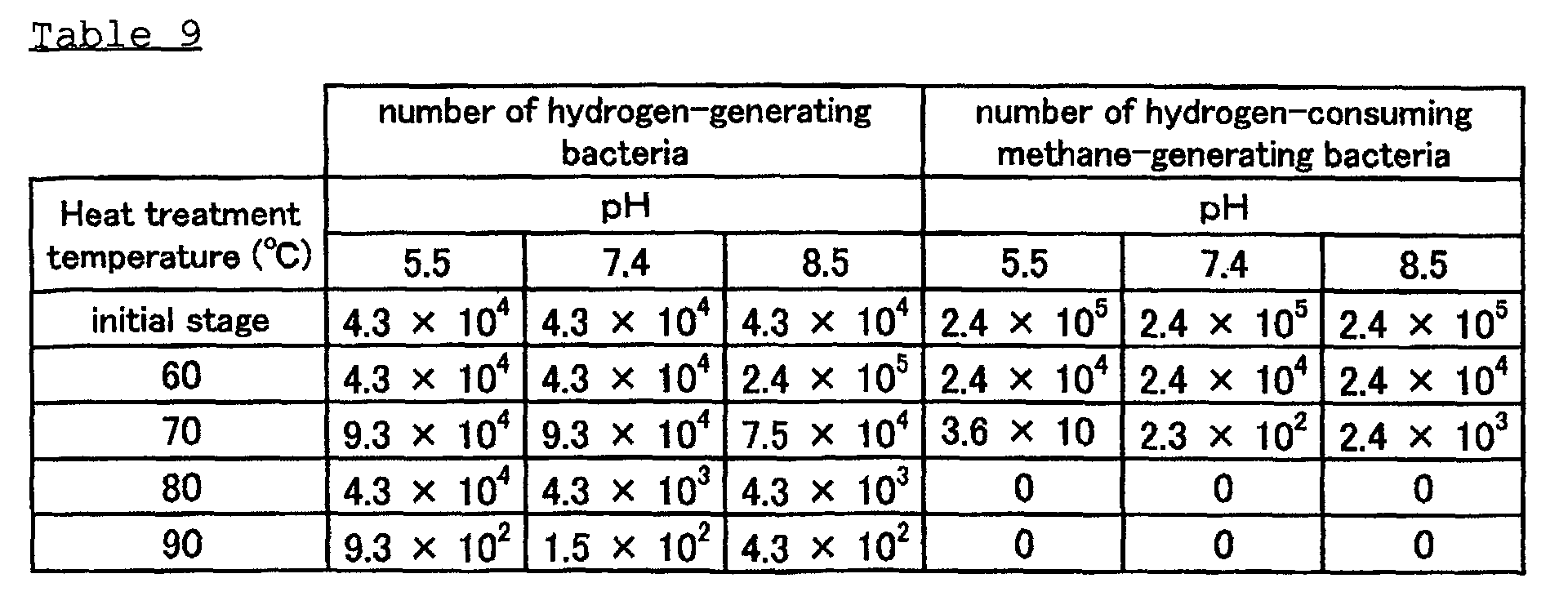
Table 9 shows bacterial counts of hydrogen-generating
bacteria and hydrogen-consuming methane-generating bacteria in a
sample heat-treated at pH 5.5, 7.4 and 8.5 at 60, 70, 80 and 90°C
for 60 minutes. A sample before heat treatment is also shown (shown
as "initial stage" in the table).
At pH 5.5, when the heat treatment temperature was 80°C or
less, the hydrogen-generating bacterial count was almost constant,
but at 90°C, it decreased to 1/100. At pH 7.4, and 60 and 70°C,
a large difference in the hydrogen-generating bacterial count was
not observed, but at 80°C, it fell to about 1/20, and at 90°C, to
about 1 in 600. At pH 8.5, as the heat treatment temperature
increased to 60, 70, 80 and 90°C, the hydrogen-generating bacterial
count gradually decreased. When the heat treatment temperature
reached 70°C, the decrease rate of the hydrogen-consuming,
methane-generating bacterial count became larger as the pH fell.
At any pH, at a heat treatment temperature of 80°C or more, the
hydrogen-consuming, methane-generating bacteria died or
remarkably decreased. The result that hydrogen-consuming,
methane-generating bacteria have more heat resistance under
alkaline conditions than under acid conditions, is in agreement
with the result that the methane yield falls when the pH during heat
treatment shown in Table 1, is low.
The above shows that, by performing heat-treatment under
anaerobic conditions combining the treatment temperature,
treatment time and pH according to this invention, microflora can
be controlled to be suitable for hydrogen-generating.