EP1455997B1 - Process and equipment for the production of granules of expandable thermoplastic polymers - Google Patents
Process and equipment for the production of granules of expandable thermoplastic polymers Download PDFInfo
- Publication number
- EP1455997B1 EP1455997B1 EP02791780A EP02791780A EP1455997B1 EP 1455997 B1 EP1455997 B1 EP 1455997B1 EP 02791780 A EP02791780 A EP 02791780A EP 02791780 A EP02791780 A EP 02791780A EP 1455997 B1 EP1455997 B1 EP 1455997B1
- Authority
- EP
- European Patent Office
- Prior art keywords
- polymer
- die
- granules
- cutting
- previous
- Prior art date
- Legal status (The legal status is an assumption and is not a legal conclusion. Google has not performed a legal analysis and makes no representation as to the accuracy of the status listed.)
- Expired - Lifetime
Links
- 239000008187 granular material Substances 0.000 title claims abstract description 51
- 229920001169 thermoplastic Polymers 0.000 title claims abstract description 22
- 238000004519 manufacturing process Methods 0.000 title claims abstract description 11
- 238000000034 method Methods 0.000 title abstract description 16
- 229920000642 polymer Polymers 0.000 claims abstract description 60
- 238000005520 cutting process Methods 0.000 claims abstract description 48
- 239000003795 chemical substances by application Substances 0.000 claims abstract description 28
- 238000000137 annealing Methods 0.000 claims abstract description 12
- 238000001125 extrusion Methods 0.000 claims abstract description 12
- 238000001816 cooling Methods 0.000 claims abstract description 11
- 239000000463 material Substances 0.000 claims abstract description 6
- 238000002844 melting Methods 0.000 claims abstract description 3
- 230000008018 melting Effects 0.000 claims abstract description 3
- XLYOFNOQVPJJNP-UHFFFAOYSA-N water Substances O XLYOFNOQVPJJNP-UHFFFAOYSA-N 0.000 claims description 22
- 239000007788 liquid Substances 0.000 claims description 17
- 238000005469 granulation Methods 0.000 claims description 12
- 230000003179 granulation Effects 0.000 claims description 12
- CURLTUGMZLYLDI-UHFFFAOYSA-N Carbon dioxide Chemical compound O=C=O CURLTUGMZLYLDI-UHFFFAOYSA-N 0.000 claims description 11
- 239000000654 additive Substances 0.000 claims description 10
- 239000000178 monomer Substances 0.000 claims description 10
- -1 freon Natural products 0.000 claims description 8
- 239000000203 mixture Substances 0.000 claims description 7
- 229910002092 carbon dioxide Inorganic materials 0.000 claims description 6
- 239000001569 carbon dioxide Substances 0.000 claims description 5
- 238000010438 heat treatment Methods 0.000 claims description 5
- 229910052751 metal Inorganic materials 0.000 claims description 5
- 239000002184 metal Substances 0.000 claims description 5
- 238000005507 spraying Methods 0.000 claims description 5
- PEDCQBHIVMGVHV-UHFFFAOYSA-N Glycerine Chemical compound OCC(O)CO PEDCQBHIVMGVHV-UHFFFAOYSA-N 0.000 claims description 4
- 230000009477 glass transition Effects 0.000 claims description 4
- 230000001105 regulatory effect Effects 0.000 claims description 4
- VUZPPFZMUPKLLV-UHFFFAOYSA-N methane;hydrate Chemical compound C.O VUZPPFZMUPKLLV-UHFFFAOYSA-N 0.000 claims description 3
- 239000004417 polycarbonate Substances 0.000 claims description 3
- 229920000515 polycarbonate Polymers 0.000 claims description 3
- 229920002725 thermoplastic elastomer Polymers 0.000 claims description 3
- XUIMIQQOPSSXEZ-UHFFFAOYSA-N Silicon Chemical compound [Si] XUIMIQQOPSSXEZ-UHFFFAOYSA-N 0.000 claims description 2
- 238000009833 condensation Methods 0.000 claims description 2
- 230000005494 condensation Effects 0.000 claims description 2
- 229920001577 copolymer Polymers 0.000 claims description 2
- 235000011187 glycerol Nutrition 0.000 claims description 2
- 229930195733 hydrocarbon Natural products 0.000 claims description 2
- 150000002430 hydrocarbons Chemical class 0.000 claims description 2
- 239000002480 mineral oil Substances 0.000 claims description 2
- 235000010446 mineral oil Nutrition 0.000 claims description 2
- 239000003921 oil Substances 0.000 claims description 2
- 229920000058 polyacrylate Polymers 0.000 claims description 2
- 229920000728 polyester Polymers 0.000 claims description 2
- 229920000098 polyolefin Polymers 0.000 claims description 2
- 238000012545 processing Methods 0.000 claims description 2
- 239000010703 silicon Substances 0.000 claims description 2
- 229910052710 silicon Inorganic materials 0.000 claims description 2
- 239000002699 waste material Substances 0.000 claims description 2
- 239000004793 Polystyrene Substances 0.000 description 11
- 229920002223 polystyrene Polymers 0.000 description 10
- 239000000047 product Substances 0.000 description 8
- PPBRXRYQALVLMV-UHFFFAOYSA-N Styrene Chemical group C=CC1=CC=CC=C1 PPBRXRYQALVLMV-UHFFFAOYSA-N 0.000 description 7
- 239000011324 bead Substances 0.000 description 7
- KFZMGEQAYNKOFK-UHFFFAOYSA-N Isopropanol Chemical compound CC(C)O KFZMGEQAYNKOFK-UHFFFAOYSA-N 0.000 description 6
- 210000003850 cellular structure Anatomy 0.000 description 6
- 238000009825 accumulation Methods 0.000 description 5
- 239000004698 Polyethylene Substances 0.000 description 4
- GWEVSGVZZGPLCZ-UHFFFAOYSA-N Titan oxide Chemical compound O=[Ti]=O GWEVSGVZZGPLCZ-UHFFFAOYSA-N 0.000 description 4
- 229920000573 polyethylene Polymers 0.000 description 4
- NLHHRLWOUZZQLW-UHFFFAOYSA-N Acrylonitrile Chemical compound C=CC#N NLHHRLWOUZZQLW-UHFFFAOYSA-N 0.000 description 3
- LYCAIKOWRPUZTN-UHFFFAOYSA-N Ethylene glycol Chemical compound OCCO LYCAIKOWRPUZTN-UHFFFAOYSA-N 0.000 description 3
- CERQOIWHTDAKMF-UHFFFAOYSA-N Methacrylic acid Chemical compound CC(=C)C(O)=O CERQOIWHTDAKMF-UHFFFAOYSA-N 0.000 description 3
- OKKJLVBELUTLKV-UHFFFAOYSA-N Methanol Chemical compound OC OKKJLVBELUTLKV-UHFFFAOYSA-N 0.000 description 3
- 230000032683 aging Effects 0.000 description 3
- 210000004027 cell Anatomy 0.000 description 3
- 239000007795 chemical reaction product Substances 0.000 description 3
- 239000000945 filler Substances 0.000 description 3
- 230000004927 fusion Effects 0.000 description 3
- 229920005669 high impact polystyrene Polymers 0.000 description 3
- 239000004797 high-impact polystyrene Substances 0.000 description 3
- MYRTYDVEIRVNKP-UHFFFAOYSA-N 1,2-Divinylbenzene Chemical compound C=CC1=CC=CC=C1C=C MYRTYDVEIRVNKP-UHFFFAOYSA-N 0.000 description 2
- KAKZBPTYRLMSJV-UHFFFAOYSA-N Butadiene Chemical compound C=CC=C KAKZBPTYRLMSJV-UHFFFAOYSA-N 0.000 description 2
- RYGMFSIKBFXOCR-UHFFFAOYSA-N Copper Chemical compound [Cu] RYGMFSIKBFXOCR-UHFFFAOYSA-N 0.000 description 2
- BAPJBEWLBFYGME-UHFFFAOYSA-N Methyl acrylate Chemical compound COC(=O)C=C BAPJBEWLBFYGME-UHFFFAOYSA-N 0.000 description 2
- VVQNEPGJFQJSBK-UHFFFAOYSA-N Methyl methacrylate Chemical compound COC(=O)C(C)=C VVQNEPGJFQJSBK-UHFFFAOYSA-N 0.000 description 2
- OFBQJSOFQDEBGM-UHFFFAOYSA-N Pentane Chemical compound CCCCC OFBQJSOFQDEBGM-UHFFFAOYSA-N 0.000 description 2
- VYPSYNLAJGMNEJ-UHFFFAOYSA-N Silicium dioxide Chemical compound O=[Si]=O VYPSYNLAJGMNEJ-UHFFFAOYSA-N 0.000 description 2
- 239000000956 alloy Substances 0.000 description 2
- 229910045601 alloy Inorganic materials 0.000 description 2
- XYLMUPLGERFSHI-UHFFFAOYSA-N alpha-Methylstyrene Chemical compound CC(=C)C1=CC=CC=C1 XYLMUPLGERFSHI-UHFFFAOYSA-N 0.000 description 2
- 239000007900 aqueous suspension Substances 0.000 description 2
- 230000015572 biosynthetic process Effects 0.000 description 2
- IISBACLAFKSPIT-UHFFFAOYSA-N bisphenol A Chemical compound C=1C=C(O)C=CC=1C(C)(C)C1=CC=C(O)C=C1 IISBACLAFKSPIT-UHFFFAOYSA-N 0.000 description 2
- 125000004432 carbon atom Chemical group C* 0.000 description 2
- 230000000052 comparative effect Effects 0.000 description 2
- 229910052802 copper Inorganic materials 0.000 description 2
- 239000010949 copper Substances 0.000 description 2
- 238000009826 distribution Methods 0.000 description 2
- 239000000975 dye Substances 0.000 description 2
- 229920006248 expandable polystyrene Polymers 0.000 description 2
- 239000012530 fluid Substances 0.000 description 2
- 229910052739 hydrogen Inorganic materials 0.000 description 2
- 239000001257 hydrogen Substances 0.000 description 2
- 238000002347 injection Methods 0.000 description 2
- 239000007924 injection Substances 0.000 description 2
- 239000003595 mist Substances 0.000 description 2
- 239000002667 nucleating agent Substances 0.000 description 2
- 238000006116 polymerization reaction Methods 0.000 description 2
- 229920001296 polysiloxane Polymers 0.000 description 2
- 239000004408 titanium dioxide Substances 0.000 description 2
- 125000004178 (C1-C4) alkyl group Chemical group 0.000 description 1
- SVHAMPNLOLKSFU-UHFFFAOYSA-N 1,2,2-trichloroethenylbenzene Chemical compound ClC(Cl)=C(Cl)C1=CC=CC=C1 SVHAMPNLOLKSFU-UHFFFAOYSA-N 0.000 description 1
- AUHKVLIZXLBQSR-UHFFFAOYSA-N 1,2-dichloro-3-(1,2,2-trichloroethenyl)benzene Chemical compound ClC(Cl)=C(Cl)C1=CC=CC(Cl)=C1Cl AUHKVLIZXLBQSR-UHFFFAOYSA-N 0.000 description 1
- XPXMCUKPGZUFGR-UHFFFAOYSA-N 1-chloro-2-(1,2,2-trichloroethenyl)benzene Chemical compound ClC(Cl)=C(Cl)C1=CC=CC=C1Cl XPXMCUKPGZUFGR-UHFFFAOYSA-N 0.000 description 1
- VZSRBBMJRBPUNF-UHFFFAOYSA-N 2-(2,3-dihydro-1H-inden-2-ylamino)-N-[3-oxo-3-(2,4,6,7-tetrahydrotriazolo[4,5-c]pyridin-5-yl)propyl]pyrimidine-5-carboxamide Chemical compound C1C(CC2=CC=CC=C12)NC1=NC=C(C=N1)C(=O)NCCC(N1CC2=C(CC1)NN=N2)=O VZSRBBMJRBPUNF-UHFFFAOYSA-N 0.000 description 1
- WZFUQSJFWNHZHM-UHFFFAOYSA-N 2-[4-[2-(2,3-dihydro-1H-inden-2-ylamino)pyrimidin-5-yl]piperazin-1-yl]-1-(2,4,6,7-tetrahydrotriazolo[4,5-c]pyridin-5-yl)ethanone Chemical compound C1C(CC2=CC=CC=C12)NC1=NC=C(C=N1)N1CCN(CC1)CC(=O)N1CC2=C(CC1)NN=N2 WZFUQSJFWNHZHM-UHFFFAOYSA-N 0.000 description 1
- YJLUBHOZZTYQIP-UHFFFAOYSA-N 2-[5-[2-(2,3-dihydro-1H-inden-2-ylamino)pyrimidin-5-yl]-1,3,4-oxadiazol-2-yl]-1-(2,4,6,7-tetrahydrotriazolo[4,5-c]pyridin-5-yl)ethanone Chemical compound C1C(CC2=CC=CC=C12)NC1=NC=C(C=N1)C1=NN=C(O1)CC(=O)N1CC2=C(CC1)NN=N2 YJLUBHOZZTYQIP-UHFFFAOYSA-N 0.000 description 1
- CTHJQRHPNQEPAB-UHFFFAOYSA-N 2-methoxyethenylbenzene Chemical compound COC=CC1=CC=CC=C1 CTHJQRHPNQEPAB-UHFFFAOYSA-N 0.000 description 1
- BTOVVHWKPVSLBI-UHFFFAOYSA-N 2-methylprop-1-enylbenzene Chemical compound CC(C)=CC1=CC=CC=C1 BTOVVHWKPVSLBI-UHFFFAOYSA-N 0.000 description 1
- FMFHUEMLVAIBFI-UHFFFAOYSA-N 2-phenylethenyl acetate Chemical compound CC(=O)OC=CC1=CC=CC=C1 FMFHUEMLVAIBFI-UHFFFAOYSA-N 0.000 description 1
- JLBJTVDPSNHSKJ-UHFFFAOYSA-N 4-Methylstyrene Chemical compound CC1=CC=C(C=C)C=C1 JLBJTVDPSNHSKJ-UHFFFAOYSA-N 0.000 description 1
- CONKBQPVFMXDOV-QHCPKHFHSA-N 6-[(5S)-5-[[4-[2-(2,3-dihydro-1H-inden-2-ylamino)pyrimidin-5-yl]piperazin-1-yl]methyl]-2-oxo-1,3-oxazolidin-3-yl]-3H-1,3-benzoxazol-2-one Chemical compound C1C(CC2=CC=CC=C12)NC1=NC=C(C=N1)N1CCN(CC1)C[C@H]1CN(C(O1)=O)C1=CC2=C(NC(O2)=O)C=C1 CONKBQPVFMXDOV-QHCPKHFHSA-N 0.000 description 1
- HRPVXLWXLXDGHG-UHFFFAOYSA-N Acrylamide Chemical compound NC(=O)C=C HRPVXLWXLXDGHG-UHFFFAOYSA-N 0.000 description 1
- WKBOTKDWSSQWDR-UHFFFAOYSA-N Bromine atom Chemical compound [Br] WKBOTKDWSSQWDR-UHFFFAOYSA-N 0.000 description 1
- OKTJSMMVPCPJKN-UHFFFAOYSA-N Carbon Chemical compound [C] OKTJSMMVPCPJKN-UHFFFAOYSA-N 0.000 description 1
- 239000004215 Carbon black (E152) Substances 0.000 description 1
- ZAMOUSCENKQFHK-UHFFFAOYSA-N Chlorine atom Chemical compound [Cl] ZAMOUSCENKQFHK-UHFFFAOYSA-N 0.000 description 1
- MQIUGAXCHLFZKX-UHFFFAOYSA-N Di-n-octyl phthalate Natural products CCCCCCCCOC(=O)C1=CC=CC=C1C(=O)OCCCCCCCC MQIUGAXCHLFZKX-UHFFFAOYSA-N 0.000 description 1
- VGGSQFUCUMXWEO-UHFFFAOYSA-N Ethene Chemical compound C=C VGGSQFUCUMXWEO-UHFFFAOYSA-N 0.000 description 1
- JIGUQPWFLRLWPJ-UHFFFAOYSA-N Ethyl acrylate Chemical compound CCOC(=O)C=C JIGUQPWFLRLWPJ-UHFFFAOYSA-N 0.000 description 1
- 239000005977 Ethylene Substances 0.000 description 1
- GYCMBHHDWRMZGG-UHFFFAOYSA-N Methylacrylonitrile Chemical compound CC(=C)C#N GYCMBHHDWRMZGG-UHFFFAOYSA-N 0.000 description 1
- 239000004743 Polypropylene Substances 0.000 description 1
- BQCADISMDOOEFD-UHFFFAOYSA-N Silver Chemical compound [Ag] BQCADISMDOOEFD-UHFFFAOYSA-N 0.000 description 1
- YMOONIIMQBGTDU-VOTSOKGWSA-N [(e)-2-bromoethenyl]benzene Chemical compound Br\C=C\C1=CC=CC=C1 YMOONIIMQBGTDU-VOTSOKGWSA-N 0.000 description 1
- 229920000122 acrylonitrile butadiene styrene Polymers 0.000 description 1
- 239000004676 acrylonitrile butadiene styrene Substances 0.000 description 1
- 230000000996 additive effect Effects 0.000 description 1
- 150000001338 aliphatic hydrocarbons Chemical class 0.000 description 1
- 125000000217 alkyl group Chemical group 0.000 description 1
- PNEYBMLMFCGWSK-UHFFFAOYSA-N aluminium oxide Inorganic materials [O-2].[O-2].[O-2].[Al+3].[Al+3] PNEYBMLMFCGWSK-UHFFFAOYSA-N 0.000 description 1
- 150000001408 amides Chemical class 0.000 description 1
- 239000003963 antioxidant agent Substances 0.000 description 1
- BJQHLKABXJIVAM-UHFFFAOYSA-N bis(2-ethylhexyl) phthalate Chemical compound CCCCC(CC)COC(=O)C1=CC=CC=C1C(=O)OCC(CC)CCCC BJQHLKABXJIVAM-UHFFFAOYSA-N 0.000 description 1
- 229940106691 bisphenol a Drugs 0.000 description 1
- GDTBXPJZTBHREO-UHFFFAOYSA-N bromine Substances BrBr GDTBXPJZTBHREO-UHFFFAOYSA-N 0.000 description 1
- 229910052794 bromium Inorganic materials 0.000 description 1
- MPMBRWOOISTHJV-UHFFFAOYSA-N but-1-enylbenzene Chemical compound CCC=CC1=CC=CC=C1 MPMBRWOOISTHJV-UHFFFAOYSA-N 0.000 description 1
- CQEYYJKEWSMYFG-UHFFFAOYSA-N butyl acrylate Chemical compound CCCCOC(=O)C=C CQEYYJKEWSMYFG-UHFFFAOYSA-N 0.000 description 1
- 239000006229 carbon black Substances 0.000 description 1
- 229910052801 chlorine Inorganic materials 0.000 description 1
- 239000000460 chlorine Substances 0.000 description 1
- 239000011248 coating agent Substances 0.000 description 1
- 238000000576 coating method Methods 0.000 description 1
- 239000000498 cooling water Substances 0.000 description 1
- 230000007423 decrease Effects 0.000 description 1
- 230000008021 deposition Effects 0.000 description 1
- IEJIGPNLZYLLBP-UHFFFAOYSA-N dimethyl carbonate Chemical compound COC(=O)OC IEJIGPNLZYLLBP-UHFFFAOYSA-N 0.000 description 1
- 235000013870 dimethyl polysiloxane Nutrition 0.000 description 1
- 238000007599 discharging Methods 0.000 description 1
- 239000006185 dispersion Substances 0.000 description 1
- 230000008030 elimination Effects 0.000 description 1
- 238000003379 elimination reaction Methods 0.000 description 1
- 238000005516 engineering process Methods 0.000 description 1
- 230000007613 environmental effect Effects 0.000 description 1
- SUPCQIBBMFXVTL-UHFFFAOYSA-N ethyl 2-methylprop-2-enoate Chemical compound CCOC(=O)C(C)=C SUPCQIBBMFXVTL-UHFFFAOYSA-N 0.000 description 1
- 238000007730 finishing process Methods 0.000 description 1
- PCHJSUWPFVWCPO-UHFFFAOYSA-N gold Chemical compound [Au] PCHJSUWPFVWCPO-UHFFFAOYSA-N 0.000 description 1
- 229910052737 gold Inorganic materials 0.000 description 1
- 239000010931 gold Substances 0.000 description 1
- 229910002804 graphite Inorganic materials 0.000 description 1
- 239000010439 graphite Substances 0.000 description 1
- 150000008282 halocarbons Chemical class 0.000 description 1
- 229910052736 halogen Inorganic materials 0.000 description 1
- 150000002367 halogens Chemical class 0.000 description 1
- KETWBQOXTBGBBN-UHFFFAOYSA-N hex-1-enylbenzene Chemical compound CCCCC=CC1=CC=CC=C1 KETWBQOXTBGBBN-UHFFFAOYSA-N 0.000 description 1
- 125000004435 hydrogen atom Chemical group [H]* 0.000 description 1
- 229910052500 inorganic mineral Inorganic materials 0.000 description 1
- 230000001788 irregular Effects 0.000 description 1
- QWTDNUCVQCZILF-UHFFFAOYSA-N iso-pentane Natural products CCC(C)C QWTDNUCVQCZILF-UHFFFAOYSA-N 0.000 description 1
- 230000014759 maintenance of location Effects 0.000 description 1
- FPYJFEHAWHCUMM-UHFFFAOYSA-N maleic anhydride Chemical compound O=C1OC(=O)C=C1 FPYJFEHAWHCUMM-UHFFFAOYSA-N 0.000 description 1
- 239000011159 matrix material Substances 0.000 description 1
- 150000002739 metals Chemical class 0.000 description 1
- FQPSGWSUVKBHSU-UHFFFAOYSA-N methacrylamide Chemical compound CC(=C)C(N)=O FQPSGWSUVKBHSU-UHFFFAOYSA-N 0.000 description 1
- 125000002496 methyl group Chemical group [H]C([H])([H])* 0.000 description 1
- 239000010445 mica Substances 0.000 description 1
- 229910052618 mica group Inorganic materials 0.000 description 1
- 239000011707 mineral Substances 0.000 description 1
- 238000002156 mixing Methods 0.000 description 1
- 238000002663 nebulization Methods 0.000 description 1
- 150000002825 nitriles Chemical class 0.000 description 1
- PNJWIWWMYCMZRO-UHFFFAOYSA-N pent‐4‐en‐2‐one Natural products CC(=O)CC=C PNJWIWWMYCMZRO-UHFFFAOYSA-N 0.000 description 1
- 229920000435 poly(dimethylsiloxane) Polymers 0.000 description 1
- 229920003229 poly(methyl methacrylate) Polymers 0.000 description 1
- 229920002285 poly(styrene-co-acrylonitrile) Polymers 0.000 description 1
- 229920000570 polyether Polymers 0.000 description 1
- 230000000379 polymerizing effect Effects 0.000 description 1
- 239000004926 polymethyl methacrylate Substances 0.000 description 1
- 229920001955 polyphenylene ether Polymers 0.000 description 1
- 229920001155 polypropylene Polymers 0.000 description 1
- 238000002360 preparation method Methods 0.000 description 1
- 230000002035 prolonged effect Effects 0.000 description 1
- LYBIZMNPXTXVMV-UHFFFAOYSA-N propan-2-yl prop-2-enoate Chemical compound CC(C)OC(=O)C=C LYBIZMNPXTXVMV-UHFFFAOYSA-N 0.000 description 1
- 238000004064 recycling Methods 0.000 description 1
- 239000012763 reinforcing filler Substances 0.000 description 1
- 238000012216 screening Methods 0.000 description 1
- 239000000377 silicon dioxide Substances 0.000 description 1
- 229910052709 silver Inorganic materials 0.000 description 1
- 239000004332 silver Substances 0.000 description 1
- 239000007921 spray Substances 0.000 description 1
- 239000003381 stabilizer Substances 0.000 description 1
- 230000003068 static effect Effects 0.000 description 1
- 238000003860 storage Methods 0.000 description 1
- 230000035882 stress Effects 0.000 description 1
- 229920000638 styrene acrylonitrile Polymers 0.000 description 1
- 239000011145 styrene acrylonitrile resin Substances 0.000 description 1
- 229920003048 styrene butadiene rubber Polymers 0.000 description 1
- 239000000454 talc Substances 0.000 description 1
- 229910052623 talc Inorganic materials 0.000 description 1
- 238000009834 vaporization Methods 0.000 description 1
- 239000001993 wax Substances 0.000 description 1
- XOOUIPVCVHRTMJ-UHFFFAOYSA-L zinc stearate Chemical compound [Zn+2].CCCCCCCCCCCCCCCCCC([O-])=O.CCCCCCCCCCCCCCCCCC([O-])=O XOOUIPVCVHRTMJ-UHFFFAOYSA-L 0.000 description 1
Images

Classifications
-
- B—PERFORMING OPERATIONS; TRANSPORTING
- B29—WORKING OF PLASTICS; WORKING OF SUBSTANCES IN A PLASTIC STATE IN GENERAL
- B29C—SHAPING OR JOINING OF PLASTICS; SHAPING OF MATERIAL IN A PLASTIC STATE, NOT OTHERWISE PROVIDED FOR; AFTER-TREATMENT OF THE SHAPED PRODUCTS, e.g. REPAIRING
- B29C44/00—Shaping by internal pressure generated in the material, e.g. swelling or foaming ; Producing porous or cellular expanded plastics articles
- B29C44/34—Auxiliary operations
- B29C44/3461—Making or treating expandable particles
-
- B—PERFORMING OPERATIONS; TRANSPORTING
- B29—WORKING OF PLASTICS; WORKING OF SUBSTANCES IN A PLASTIC STATE IN GENERAL
- B29B—PREPARATION OR PRETREATMENT OF THE MATERIAL TO BE SHAPED; MAKING GRANULES OR PREFORMS; RECOVERY OF PLASTICS OR OTHER CONSTITUENTS OF WASTE MATERIAL CONTAINING PLASTICS
- B29B7/00—Mixing; Kneading
- B29B7/30—Mixing; Kneading continuous, with mechanical mixing or kneading devices
- B29B7/58—Component parts, details or accessories; Auxiliary operations
- B29B7/582—Component parts, details or accessories; Auxiliary operations for discharging, e.g. doors
-
- B—PERFORMING OPERATIONS; TRANSPORTING
- B29—WORKING OF PLASTICS; WORKING OF SUBSTANCES IN A PLASTIC STATE IN GENERAL
- B29B—PREPARATION OR PRETREATMENT OF THE MATERIAL TO BE SHAPED; MAKING GRANULES OR PREFORMS; RECOVERY OF PLASTICS OR OTHER CONSTITUENTS OF WASTE MATERIAL CONTAINING PLASTICS
- B29B7/00—Mixing; Kneading
- B29B7/80—Component parts, details or accessories; Auxiliary operations
- B29B7/82—Heating or cooling
-
- B—PERFORMING OPERATIONS; TRANSPORTING
- B29—WORKING OF PLASTICS; WORKING OF SUBSTANCES IN A PLASTIC STATE IN GENERAL
- B29B—PREPARATION OR PRETREATMENT OF THE MATERIAL TO BE SHAPED; MAKING GRANULES OR PREFORMS; RECOVERY OF PLASTICS OR OTHER CONSTITUENTS OF WASTE MATERIAL CONTAINING PLASTICS
- B29B9/00—Making granules
- B29B9/02—Making granules by dividing preformed material
- B29B9/06—Making granules by dividing preformed material in the form of filamentary material, e.g. combined with extrusion
- B29B9/065—Making granules by dividing preformed material in the form of filamentary material, e.g. combined with extrusion under-water, e.g. underwater pelletizers
-
- B—PERFORMING OPERATIONS; TRANSPORTING
- B29—WORKING OF PLASTICS; WORKING OF SUBSTANCES IN A PLASTIC STATE IN GENERAL
- B29B—PREPARATION OR PRETREATMENT OF THE MATERIAL TO BE SHAPED; MAKING GRANULES OR PREFORMS; RECOVERY OF PLASTICS OR OTHER CONSTITUENTS OF WASTE MATERIAL CONTAINING PLASTICS
- B29B9/00—Making granules
- B29B9/12—Making granules characterised by structure or composition
-
- B—PERFORMING OPERATIONS; TRANSPORTING
- B29—WORKING OF PLASTICS; WORKING OF SUBSTANCES IN A PLASTIC STATE IN GENERAL
- B29C—SHAPING OR JOINING OF PLASTICS; SHAPING OF MATERIAL IN A PLASTIC STATE, NOT OTHERWISE PROVIDED FOR; AFTER-TREATMENT OF THE SHAPED PRODUCTS, e.g. REPAIRING
- B29C48/00—Extrusion moulding, i.e. expressing the moulding material through a die or nozzle which imparts the desired form; Apparatus therefor
- B29C48/03—Extrusion moulding, i.e. expressing the moulding material through a die or nozzle which imparts the desired form; Apparatus therefor characterised by the shape of the extruded material at extrusion
- B29C48/05—Filamentary, e.g. strands
-
- B—PERFORMING OPERATIONS; TRANSPORTING
- B29—WORKING OF PLASTICS; WORKING OF SUBSTANCES IN A PLASTIC STATE IN GENERAL
- B29C—SHAPING OR JOINING OF PLASTICS; SHAPING OF MATERIAL IN A PLASTIC STATE, NOT OTHERWISE PROVIDED FOR; AFTER-TREATMENT OF THE SHAPED PRODUCTS, e.g. REPAIRING
- B29C48/00—Extrusion moulding, i.e. expressing the moulding material through a die or nozzle which imparts the desired form; Apparatus therefor
- B29C48/25—Component parts, details or accessories; Auxiliary operations
- B29C48/30—Extrusion nozzles or dies
- B29C48/345—Extrusion nozzles comprising two or more adjacently arranged ports, for simultaneously extruding multiple strands, e.g. for pelletising
-
- B—PERFORMING OPERATIONS; TRANSPORTING
- B29—WORKING OF PLASTICS; WORKING OF SUBSTANCES IN A PLASTIC STATE IN GENERAL
- B29B—PREPARATION OR PRETREATMENT OF THE MATERIAL TO BE SHAPED; MAKING GRANULES OR PREFORMS; RECOVERY OF PLASTICS OR OTHER CONSTITUENTS OF WASTE MATERIAL CONTAINING PLASTICS
- B29B7/00—Mixing; Kneading
- B29B7/30—Mixing; Kneading continuous, with mechanical mixing or kneading devices
- B29B7/34—Mixing; Kneading continuous, with mechanical mixing or kneading devices with movable mixing or kneading devices
- B29B7/38—Mixing; Kneading continuous, with mechanical mixing or kneading devices with movable mixing or kneading devices rotary
- B29B7/40—Mixing; Kneading continuous, with mechanical mixing or kneading devices with movable mixing or kneading devices rotary with single shaft
- B29B7/42—Mixing; Kneading continuous, with mechanical mixing or kneading devices with movable mixing or kneading devices rotary with single shaft with screw or helix
-
- B—PERFORMING OPERATIONS; TRANSPORTING
- B29—WORKING OF PLASTICS; WORKING OF SUBSTANCES IN A PLASTIC STATE IN GENERAL
- B29B—PREPARATION OR PRETREATMENT OF THE MATERIAL TO BE SHAPED; MAKING GRANULES OR PREFORMS; RECOVERY OF PLASTICS OR OTHER CONSTITUENTS OF WASTE MATERIAL CONTAINING PLASTICS
- B29B7/00—Mixing; Kneading
- B29B7/30—Mixing; Kneading continuous, with mechanical mixing or kneading devices
- B29B7/34—Mixing; Kneading continuous, with mechanical mixing or kneading devices with movable mixing or kneading devices
- B29B7/38—Mixing; Kneading continuous, with mechanical mixing or kneading devices with movable mixing or kneading devices rotary
- B29B7/46—Mixing; Kneading continuous, with mechanical mixing or kneading devices with movable mixing or kneading devices rotary with more than one shaft
- B29B7/48—Mixing; Kneading continuous, with mechanical mixing or kneading devices with movable mixing or kneading devices rotary with more than one shaft with intermeshing devices, e.g. screws
-
- B—PERFORMING OPERATIONS; TRANSPORTING
- B29—WORKING OF PLASTICS; WORKING OF SUBSTANCES IN A PLASTIC STATE IN GENERAL
- B29C—SHAPING OR JOINING OF PLASTICS; SHAPING OF MATERIAL IN A PLASTIC STATE, NOT OTHERWISE PROVIDED FOR; AFTER-TREATMENT OF THE SHAPED PRODUCTS, e.g. REPAIRING
- B29C35/00—Heating, cooling or curing, e.g. crosslinking or vulcanising; Apparatus therefor
- B29C35/16—Cooling
- B29C2035/1616—Cooling using liquids
-
- B—PERFORMING OPERATIONS; TRANSPORTING
- B29—WORKING OF PLASTICS; WORKING OF SUBSTANCES IN A PLASTIC STATE IN GENERAL
- B29C—SHAPING OR JOINING OF PLASTICS; SHAPING OF MATERIAL IN A PLASTIC STATE, NOT OTHERWISE PROVIDED FOR; AFTER-TREATMENT OF THE SHAPED PRODUCTS, e.g. REPAIRING
- B29C2793/00—Shaping techniques involving a cutting or machining operation
- B29C2793/009—Shaping techniques involving a cutting or machining operation after shaping
-
- B—PERFORMING OPERATIONS; TRANSPORTING
- B29—WORKING OF PLASTICS; WORKING OF SUBSTANCES IN A PLASTIC STATE IN GENERAL
- B29C—SHAPING OR JOINING OF PLASTICS; SHAPING OF MATERIAL IN A PLASTIC STATE, NOT OTHERWISE PROVIDED FOR; AFTER-TREATMENT OF THE SHAPED PRODUCTS, e.g. REPAIRING
- B29C48/00—Extrusion moulding, i.e. expressing the moulding material through a die or nozzle which imparts the desired form; Apparatus therefor
- B29C48/03—Extrusion moulding, i.e. expressing the moulding material through a die or nozzle which imparts the desired form; Apparatus therefor characterised by the shape of the extruded material at extrusion
- B29C48/04—Particle-shaped
-
- B—PERFORMING OPERATIONS; TRANSPORTING
- B29—WORKING OF PLASTICS; WORKING OF SUBSTANCES IN A PLASTIC STATE IN GENERAL
- B29K—INDEXING SCHEME ASSOCIATED WITH SUBCLASSES B29B, B29C OR B29D, RELATING TO MOULDING MATERIALS OR TO MATERIALS FOR MOULDS, REINFORCEMENTS, FILLERS OR PREFORMED PARTS, e.g. INSERTS
- B29K2009/00—Use of rubber derived from conjugated dienes, as moulding material
- B29K2009/06—SB polymers, i.e. butadiene-styrene polymers
-
- B—PERFORMING OPERATIONS; TRANSPORTING
- B29—WORKING OF PLASTICS; WORKING OF SUBSTANCES IN A PLASTIC STATE IN GENERAL
- B29K—INDEXING SCHEME ASSOCIATED WITH SUBCLASSES B29B, B29C OR B29D, RELATING TO MOULDING MATERIALS OR TO MATERIALS FOR MOULDS, REINFORCEMENTS, FILLERS OR PREFORMED PARTS, e.g. INSERTS
- B29K2023/00—Use of polyalkenes or derivatives thereof as moulding material
- B29K2023/04—Polymers of ethylene
- B29K2023/06—PE, i.e. polyethylene
-
- B—PERFORMING OPERATIONS; TRANSPORTING
- B29—WORKING OF PLASTICS; WORKING OF SUBSTANCES IN A PLASTIC STATE IN GENERAL
- B29K—INDEXING SCHEME ASSOCIATED WITH SUBCLASSES B29B, B29C OR B29D, RELATING TO MOULDING MATERIALS OR TO MATERIALS FOR MOULDS, REINFORCEMENTS, FILLERS OR PREFORMED PARTS, e.g. INSERTS
- B29K2025/00—Use of polymers of vinyl-aromatic compounds or derivatives thereof as moulding material
-
- B—PERFORMING OPERATIONS; TRANSPORTING
- B29—WORKING OF PLASTICS; WORKING OF SUBSTANCES IN A PLASTIC STATE IN GENERAL
- B29K—INDEXING SCHEME ASSOCIATED WITH SUBCLASSES B29B, B29C OR B29D, RELATING TO MOULDING MATERIALS OR TO MATERIALS FOR MOULDS, REINFORCEMENTS, FILLERS OR PREFORMED PARTS, e.g. INSERTS
- B29K2027/00—Use of polyvinylhalogenides or derivatives thereof as moulding material
-
- B—PERFORMING OPERATIONS; TRANSPORTING
- B29—WORKING OF PLASTICS; WORKING OF SUBSTANCES IN A PLASTIC STATE IN GENERAL
- B29K—INDEXING SCHEME ASSOCIATED WITH SUBCLASSES B29B, B29C OR B29D, RELATING TO MOULDING MATERIALS OR TO MATERIALS FOR MOULDS, REINFORCEMENTS, FILLERS OR PREFORMED PARTS, e.g. INSERTS
- B29K2069/00—Use of PC, i.e. polycarbonates or derivatives thereof, as moulding material
-
- B—PERFORMING OPERATIONS; TRANSPORTING
- B29—WORKING OF PLASTICS; WORKING OF SUBSTANCES IN A PLASTIC STATE IN GENERAL
- B29K—INDEXING SCHEME ASSOCIATED WITH SUBCLASSES B29B, B29C OR B29D, RELATING TO MOULDING MATERIALS OR TO MATERIALS FOR MOULDS, REINFORCEMENTS, FILLERS OR PREFORMED PARTS, e.g. INSERTS
- B29K2105/00—Condition, form or state of moulded material or of the material to be shaped
- B29K2105/0085—Copolymers
-
- B—PERFORMING OPERATIONS; TRANSPORTING
- B29—WORKING OF PLASTICS; WORKING OF SUBSTANCES IN A PLASTIC STATE IN GENERAL
- B29K—INDEXING SCHEME ASSOCIATED WITH SUBCLASSES B29B, B29C OR B29D, RELATING TO MOULDING MATERIALS OR TO MATERIALS FOR MOULDS, REINFORCEMENTS, FILLERS OR PREFORMED PARTS, e.g. INSERTS
- B29K2105/00—Condition, form or state of moulded material or of the material to be shaped
- B29K2105/04—Condition, form or state of moulded material or of the material to be shaped cellular or porous
- B29K2105/048—Expandable particles, beads or granules
Definitions
- the present invention relates to a process for the production of granules of expandable thermoplastic polymers and the equipment suitable for the purpose.
- the present invention relates to a process for the production of granules of expandable vinylaromatic polymers, by means of extrustion, and the equipment suitable for the purpose.
- the present invention relates to a process for the production, by means of extrusion, of granules of expandable polystyrene, and the relative equipment.
- the granules of expandable polystyrene thus obtained are of an excellent quality as they are neither oriented nor stressed and are therefore particularly suitable for the preparation of expanded end-products with a homogeneous internal cellular structure.
- thermoplastic polymers such as polystyrene can be expanded by incorporating an expanding agent in the polymer and subsequently heating the polymer to such temperatures as to allow the expanding agent to vaporize and form the cellular structure.
- the known expanding agents consist of a liquid hydrocarbon containing from 4 to 6 carbon atoms, a halogenated hydrocarbon (Freon), carbon dioxide or water.
- the quantity of expanding agent generally ranges from 2 to 10% by weight.
- Expandable polymers are usually produced in the form of beads or granules which, due to the action of heat, for example supplied by water vapour, are first pre-expanded to a desired density and, after aging, are sintered in closed moulds to obtain blocks or finished articles.
- Expandable beads can be obtained by means of a batch polymerization process in aqueous suspension. This process supplies a good-quality product but with the following disadvantages:
- Expandable granules can also be prepared in continuous by the addition of the expanding agent in the plasticized polymer in an extruder, with the subsequent hot cutting of the polymer through the holes of a die, as described in GB-A-1,062,307 and GB-A-1,234,639.
- the object of the present invention is to provide a process for the production of thermoplastic polymers, optionally expandable, which overcomes the drawbacks mentioned above, and which therefore supplies granules having very limited dimensions and of an excellent quality and homogeneity. More specifically, these granules are neither oriented nor stressed and the cellular structure of the relative expanded products is homogeneous.
- the polymer is fed to an extruder, for example a single- or twin-screw extruder, equipped with a feeding hopper and injection point of the expanding agent, and brought to the molten state after heating to a temperature at least 50°C higher than the glass transition temperature (Tg) or softening point of the polymeric composition containing the expanding agent, for example from 100 to 200°C.
- the polymer can at least partly consist, for example up to 30% by weight, of recycled product or waste from previous processings.
- thermoplastic polymer can be used in the process, object of the present invention.
- Typical examples are polyolefins, condensation (co)polymers such as polycarbonates and polyesters, (meth)acrylic polymers, engineering polymers, thermoplastic rubbers and polymers deriving from vinylaromatic monomers.
- vinyllaromatic monomer essentially refers to a product which corresponds to the following general formula: wherein R is a hydrogen or methyl group, n is zero or an integer ranging from 1 to 5 and Y is a halogen, such as chlorine or bromine, or an alkyl or alkoxyl radical having from 1 to 4 carbon atoms.
- vinylaromatic monomers having the above general formula are: styrene, ⁇ -methylstyrene, methylstyrene, ethylstyrene, butylstyrene, dimethylstyrene, mono-, di-, tri-, tetra- and penta-chlorostyrene, bromo-styrene, methoxy-styrene, acetoxy-styrene, etc.
- Preferred vinylaromatic monomers are styrene and ⁇ -methylstyrene.
- the vinylaromatic monomers having general formula (I) can be used alone or in a mixture of up to 50% by weight with other copolymerizable monomers.
- these monomers are (meth)acrylic acid, C 1 -C 4 alkyl esters of (meth)acrylic acid, such as methyl acrylate, methylmethacrylate, ethyl acrylate, ethylmethacrylate, isopropyl acrylate, butyl acrylate, amides and nitriles of (meth)acrylic acid such as acrylamide, methacrylamide, acrylonitrile, methacrylonitrile, butadiene, ethylene, divinylbenzene, maleic anhydride, etc.
- Preferred copolymerizable monomers are acrylonitrile and methylmethacrylate.
- thermoplastic polymers which can be granulated with the present device are polystyrene (PS), high impact polystyrene (HIPS), polyethylene (PE), polypropylene, the relative PS/PE (or HIPS/PE) alloys, SAN, ABS, polymethylmethacrylate, polyethers such as polyphenyleneether (PPO), polycarbonate from Bisphenol-A, the relative alloys, styrene-butadiene copolymers and, in general, thermoplastic rubbers containing styrene.
- PS polystyrene
- HIPS high impact polystyrene
- PE polyethylene
- PE polypropylene
- the relative PS/PE (or HIPS/PE) alloys SAN
- ABS polymethylmethacrylate
- polyethers such as polyphenyleneether (PPO), polycarbonate from Bisphenol-A, the relative alloys, styrene-butadiene copolymers and, in general, thermoplastic rubbers containing st
- An expanding agent selected from C 3 -C 6 aliphatic hydrocarbons, freon, carbon dioxide, water or a combination of these expanding agents is added to the above polymers, in a quantity ranging from 1 to 10% by weight. These agents can be incorporated into the polymer directly in the extruder or also in a static mixer.
- the polymers can incorporate additives capable of forming bonds, both weak (for example hydrogen bridges) and strong (for example by means of acid-base adducts) with the expanding agent.
- additives capable of forming bonds, both weak (for example hydrogen bridges) and strong (for example by means of acid-base adducts) with the expanding agent.
- these additives are methyl alcohol, isopropyl alcohol, dioctylphthalate and dimethylcarbonate.
- the basic polymer may also contain further additives commonly used in traditional granulation processes such as dyes, stabilizers, nucleating agents, shock-resistance agents, inert mineral reinforcing fillers, such as short fibres, mica, talc, silica, alumina, etc. or fillers of a thermal materials such as graphite, carbon black, titanium dioxide.
- further additives commonly used in traditional granulation processes such as dyes, stabilizers, nucleating agents, shock-resistance agents, inert mineral reinforcing fillers, such as short fibres, mica, talc, silica, alumina, etc. or fillers of a thermal materials such as graphite, carbon black, titanium dioxide.
- the cutting chamber is preferably under pressure to eliminate any risks of pre-expansion of the granules. Pressures ranging from 0.11 to 10 MPa are generally adopted. This pressure is then also maintained in the subsequent annealing step.
- the polymer is annealed in a tubular reactor.
- the granules which are collected on the bottom of the cutting chamber, together with the thermostat-regulating fluid, are discharged, further water or another thermostat-regulating liquid is added, and they are then sent to the annealing section which comprises at least one tubular reactor.
- a temperature equal to or higher than the Tg is maintained inside the tubular reactor and the granules remain at this temperature for at least 30 minutes, generally for a time ranging from 30 to 600 minutes.
- the granules are brought to atmospheric pressure, while slowly cooled to room temperature, filtered, dried, screened and finally stored.
- a further objective of the present invention relates to the granulation device described in paragraph (iii) above, together with the extruder and annealing reactor.
- the die is capable of ensuring high flow-rates of polymer in the molten state and of conveying a uniform thermal flow to the free edge of the duct to avoid cooling the polymer itself at the centre of the duct. This guarantees a uniform flow-rate of the extruder and consequently a homogeneous granule size.
- the body of the die is thermostat-regulated and maintained at a temperature close to or higher than the softening point of the polymer.
- the thermostat-regulation can be obtained with any means known in this field, for example by means of electrical resistances or by the circulation of a hot fluid in appropriate channels situated in the body of the die.
- the feeding ducts of the polymer can, for example, be arranged in parallel directions with each other and with the axis of the die (substantially coinciding with the rotation shaft of the cutting system), and are lined with a metal having a thermal conductivity higher than 40 W/mK, preferably higher than 100 W/mK.
- a metal having a thermal conductivity higher than 40 W/mK, preferably higher than 100 W/mK are copper, silver, gold.
- the feeding ducts draw the polymer to be granulated through perforated small plates characterized by a number of holes which varies in relation to the flow-rate to be obtained. This number can be greater than or equal to 1, for example from 4 to 10.
- the diameter of the holes depends on the type and diameter of the granule to be prepared and is greater than 0.2 mm, typically ranging from 0.2 to 5 mm, preferably from 0.3 to 1.5 mm, even more preferably from 0.4 to 1 mm.
- the small plates can be eliminated and the extrusion holes arranged directly on the die in correspondence with each feeding duct of the molten polymer.
- the extruded polymer is granulated by the cutting system and cooled by means of a jet of droplets of thermostat-regulating liquid, nebulized and sprayed against the die, thereby forming a mist.
- This liquid generally consists of water or glycerin, ethylene glycol, mineral oil, silicon oil, etc. or mixtures thereof, and is maintained at a temperature ranging from 10°C to the softening point of the polymer.
- the granulation phase of the expandable polymer can be further facilitated by the use of antisticking additives to be dosed in the thermostat-regulating liquid either in continuous or batchwise, before the formation of the jet of droplets.
- antisticking additives facilitate the detachment of the beads from the knives as they form a very thin layer on the metal by preventing the gradual fouling of the blades and therefore ensuring a perfect cut also for prolonged runs.
- Preferred antisticking agents according to the present invention are polysiloxanes such as polydimethylsiloxanes soluble or emulsifiable in water.
- the quantity of polysiloxane to be added to the thermostat-regulating liquid before nebulization is higher than 1 ppm, preferably from 1 to 1000 ppm, even more preferably from 10 to 100 ppm.
- the thermostat-regulating liquid is sprayed against the die by means of spraying nozzles arranged, for example, in an orthogonal and/or tangential position to the die or fixed to the knives.
- the spraying nozzles are preferably arranged behind the blade-holder disk so that the surface projected by the knives regulates the flow of droplets on the die by the geometry of the knives themselves and/or the rotation rate of the blade-holder disk and/or of the sprayed drops.
- the thermostat-regulating liquid is collected on the bottom of the cutting chamber, together with the cut granules which are discharged and sent to the subsequent annealing treatment.
- the cutting system essentially consists of a plate on which two or more knives are constrained.
- the number and dimensions of the knives can vary in relation to the number and diameter of the ducts of the die or the type of polymer to be granulated, i.e. whether it is a high or low viscosity polymer. Generally, a number of knives greater than or equal to 1, preferably ranging from 2 to 40, is used.
- the knives are generally step-shaped as this guarantees a uniform wear and the knives can be bent without breaking considerably facilitating the multiple start-up operations. Furthermore, step-shaped knives, arranged radially, not only have the purpose of effectively cutting the polymer but also of partializing the flow of thermostat-regulating liquid, nebulized against the die, making it intermittent and uniform.
- the knives operate at a constant pressure due to the thrust against the die maintained by a specific positioning system such as that described, for example, in European patent application 266,673.
- the positioning system allows an optimum pressure to be exerted, which is sufficiently high to guarantee a homogeneous cutting of the granules, thus avoiding the formation of agglomerates, but not excessive in order to limit the wear of the knives and die.
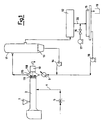
- polystyrene granules are fed, through the hopper (1), to a screw extruder (2) of the known type for the hot plasticizing of polystyrene and conveying of the polymer under pressure to the extrusion head or die (111).
- the expanding agent is fed to the extruder (2), through the injection line (4) by means of a pump (5).
- the last part of the extruder (2) is appropriately shaped for the mixing required for ensuring a perfect distribution of the expanding agent in the polystyrene.
- the polymer containing the expanding agent is extruded through the holes of the die (111) and cut by knives (215).
- the polymer cut into granules, enters the cutting chamber (118) which surrounds the die and in which water and antisticking additive are sprayed at a pressure of over 0.2 MPa and a temperature ranging from the Tg to the Tg+20°C of the polymer.
- a heat exchanger (9) maintains the water entering the chamber (118) at the required temperature whereas a specific device (10) maintains a constant pressure of the knives (215) against the die (111).
- the granules are transported to the upper part of an accumulation tower (11) by the stream of water and subsequently to the tubular annealing reactor (12).
- the excess water passes through the filter (13) of the accumulation tower and, by means of a pump (14), reaches the exchanger (9) and is thus recycled to the cutting chamber (118).
- the polystyrene is kept at a pressure of over 0.2 MPa both in the accumulation tower and in the tubular reactor (12) and the temperature in the tubular reactor is also maintained at a value equal to or higher than the Tg of the product.
- the tubular reactor (12), thermostat-regulated, consists of a pipe having a length of various meters, depending on the diameter of the pipe and the residence time which should be at least 30 minutes.
- the granules and water are then cooled by discharging in a stream of water before entering the centrifuge (15).
- the discharge in a stream of water takes place in a pipe (20), a few meters long, so that the pressure drop during the run lowers the pressure from over 0.2 MPa to 0.1 MPa (atmospheric value).
- the flow-rate of the cooling water, sent by the pump (17), is regulated by a valve (16) so as to maintain a constant temperature ranging from 30 to 35°C.
- the polymer is then separated from the water and dried by the centrifuge (15).
- the water is filtered to remove any possible granules and recycled by the pump (18) to the cutting chamber (118).
- the dried granules are collected in the storage container (19) and sent to the subsequent finishing processes (for example deposition of the coating).
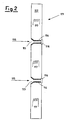
- Figure 2 shows a flat cross-section of the die (111) substantially consisting of the cylindrical body (112) inside which there are ducts (113), lined with a material having a high thermal conductivity (114), for the feeding of the molten polymer (115).
- the ducts (113) extend outwards through the perforated small plates (116).
- Electrical resistances (117) maintain the cylindrical body of the die under correct temperature.
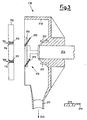
- FIG. 3 shows a flat cross-section of the cutting chamber (118) associated with the corresponding cutting system (119).
- the cutting chamber substantially comprises a container (210) which matches with the die (111), equipped with an outlet (211) from which the mixture (212) of granules mixed with the thermostat-regulating liquid is recovered.
- the cutting system comprises a blade-holder disk (213), facing the die (111), firmly fixed to a rotation shaft (214).
- the knives (215) with the stepped cutting edge (216) arranged radially with respect to the die (111), are constrained to the blade-holder disk.
- Hydraulic nozzles (217), constrained to the rear of the container (210), are situated behind the blade-holder disk, which, fed by a high pressure pump, not illustrated in the Figure, nebulize the thermostat-regulating liquid and spray it against the die in the form of drops or micro-drops.
- Figure 4 illustrates a simplified view of a rear section of the blade-holder disk (213) on which are arranged, for illustrative purposes only, eight knives (215) with the cutting edge radially positioned.
- FIG. 1 A polystyrene having an MFI of 8 g/10' (at 200°C/5kg) is fed to the extruder (2) through the hopper (1).
- the expandable polymer is extruded at about 170°C through the die (111), equipped with ducts lined with copper and holes having a diameter of 0.5mm, and cut by knives (215). Spherical granules are obtained, having an average diameter of 1 mm, with a very narrow distribution (98% ranging from 0.9 to 1.1 mm).
- the die (111) extends into the cutting chamber in which water is nebulized at 0.3 MPa and at a temperature of 60°C, forming a mist in the chamber itself.
- the granules are then collected in the accumulation tower (11), sent to the tubular reactor (12) and annealed therein at 60°C for 120', with a pressure of 0.3 MPa maintained in the whole equipment.
- the granules are subsequently conveyed into the pipe (20) having a length of 30 m with water at 20°C. The pressure decreases from 0.3 to 0.1 MPa due to the pressure drop along the pipe.
- the end-product is then sent to the centrifuge (15) to eliminate the water and collected in the container (19).
- the beads expanded at 15 g/l have a uniform cellular structure, with closed cells and with a diameter of about 60 ⁇ m.
- the expanded beads were then moulded in blocks having dimensions of 1000 x 1080 x 600 mm after 24 hours of aging at a vapour pressure of 0.04 MPa to evaluate the aging at a vapour pressure of 0.04 MPa to evaluate the cooling time, shrinkage, fusion, with the results indicated in Table 2, and the thermal conductivity at 23°C (39 mW/mk at a density of 14 g/l).
- a part of the expanded beads is expanded a second time to further reduce the density to 7.8 g/l.
- Example 2 The same procedure is used as in Example 1 but with the difference that water is nebulized in the cutting chamber at 0.1 MPa. The granules obtained are partially expanded.
- Example 2 The same procedure is used as in Example 1, passing the granules directly from the cutting chamber to the pipe (20) for cooling.
- the granules obtained, once expanded at 15 g/l, have a non-uniform cellular structure with an external corona of cells having a diameter of about 60 ⁇ m and an internal part with larger cells having a diameter ranging from 60 to 150 ⁇ m.
- Example 2 The same procedure is used as in Example 1, adding 1% by weight of titanium dioxide having a diameter of 0.2 ⁇ m, to the polystyrene.
- the expanded beads have a uniform cellular structure, with a diameter of about 55 ⁇ m.
- the thermal conductivity is 36.7 mW/mk (density of 14 g/l).
- Example 2 The same procedure is used as in Example 1, feeding however a styrene-acrylonitrile copolymer having a 33% content of acrylonitrile and an MFI of 20 g/10' (220°C/10 kg) .
- Liquid carbon dioxide is added to the molten polymer by means of a pump (5) and line (4), in a quantity of about 6% by weight.
- the cutting chamber unlike Example 1, is maintained at a pressure of 8 MPa.
- a pressure of 2 MPa is maintained both in the accumulation tower and tubular reactor.
- Example 5 The same procedure is used as in Example 5, adding liquid carbon dioxide by means of a pump (5) and line (4), in a quantity of about 6% by weight, and isopropyl alcohol in a quantity of about 2% by weight.
- the expansion of the granules obtained is effected with vapour at 103°C.
Landscapes
- Engineering & Computer Science (AREA)
- Mechanical Engineering (AREA)
- Manufacturing & Machinery (AREA)
- Processing And Handling Of Plastics And Other Materials For Molding In General (AREA)
- Manufacture Of Porous Articles, And Recovery And Treatment Of Waste Products (AREA)
Applications Claiming Priority (3)
| Application Number | Priority Date | Filing Date | Title |
|---|---|---|---|
| IT2001MI002706A ITMI20012706A1 (it) | 2001-12-20 | 2001-12-20 | Procedimento per la produzione di granuli di polimeri termoplastici espandibili ed apparecchiatura adatta allo scopo |
| ITMI20012706 | 2001-12-20 | ||
| PCT/EP2002/013788 WO2003053651A1 (en) | 2001-12-20 | 2002-12-05 | Process and equipment for the production of granules of expandable thermoplastic polymers |
Publications (2)
| Publication Number | Publication Date |
|---|---|
| EP1455997A1 EP1455997A1 (en) | 2004-09-15 |
| EP1455997B1 true EP1455997B1 (en) | 2006-03-08 |
Family
ID=11448715
Family Applications (1)
| Application Number | Title | Priority Date | Filing Date |
|---|---|---|---|
| EP02791780A Expired - Lifetime EP1455997B1 (en) | 2001-12-20 | 2002-12-05 | Process and equipment for the production of granules of expandable thermoplastic polymers |
Country Status (14)
| Country | Link |
|---|---|
| US (1) | US7846360B2 (enExample) |
| EP (1) | EP1455997B1 (enExample) |
| JP (1) | JP4227523B2 (enExample) |
| CN (1) | CN100460181C (enExample) |
| AU (1) | AU2002358097A1 (enExample) |
| BR (1) | BR0215028B1 (enExample) |
| CA (1) | CA2469829C (enExample) |
| DE (1) | DE60209791T2 (enExample) |
| ES (1) | ES2260498T3 (enExample) |
| IT (1) | ITMI20012706A1 (enExample) |
| MX (1) | MXPA04005874A (enExample) |
| PL (1) | PL206831B1 (enExample) |
| RU (1) | RU2282533C2 (enExample) |
| WO (1) | WO2003053651A1 (enExample) |
Cited By (1)
| Publication number | Priority date | Publication date | Assignee | Title |
|---|---|---|---|---|
| US7470118B2 (en) | 2005-11-25 | 2008-12-30 | Kabushiki Kaisha Kobe Seiko Sho | Underwater cutting pelletizer |
Families Citing this family (31)
| Publication number | Priority date | Publication date | Assignee | Title |
|---|---|---|---|---|
| DE10226749B4 (de) | 2002-06-14 | 2014-09-04 | Basf Se | Verfahren zur Herstellung von expandierbarem Polystyrol |
| FR2856950B1 (fr) * | 2003-07-04 | 2007-03-02 | Rhodia Polyamide Intermediates | Procede de preparation de perle a base de polymere expanse |
| KR100726534B1 (ko) | 2003-09-17 | 2007-06-11 | 세키스이가세이힝코교가부시키가이샤 | 열가소성 수지 발포성 입자의 제조 방법 |
| DE10358804A1 (de) | 2003-12-12 | 2005-07-14 | Basf Ag | Expandierbare Styrolpolymergranulate mit bi- oder multimodaler Molekulargewichtsverteilung |
| DE10358805A1 (de) | 2003-12-12 | 2005-07-14 | Basf Ag | Partikelschaumformteile aus expandierbaren, schlagzähmodifizierten, thermoplastischen Polymergranulaten |
| DK1928756T3 (da) | 2005-06-08 | 2010-07-26 | Biotec Biolog Naturverpack | Polymerprop, sammensætning og fremgangsmåde |
| RU2395391C2 (ru) * | 2006-03-22 | 2010-07-27 | Басф Се | Способ и устройство для грануляции расплавов полимеров, содержащих порообразователь |
| ES2358307T3 (es) * | 2007-04-11 | 2011-05-09 | Basf Se | Material espumado elástico en forma de partículas, a base de mezclas poliméricas de poliolefina/estireno. |
| ITMI20071005A1 (it) * | 2007-05-18 | 2008-11-19 | Polimeri Europa Spa | Procedimento per la preparazione di granuli a base di polimeri termoplastici espandibili e relativo prodotto |
| ITMI20071003A1 (it) * | 2007-05-18 | 2008-11-19 | Polimeri Europa Spa | Compositi a base di polimeri vinilaromatici aventi migliorate proprieta' di isolamento termico e procedimento per la loro preparazione |
| AT14242U1 (de) * | 2007-06-25 | 2015-06-15 | Gala Inc | Verfahren und Vorrichtung zur Herstellung von Polymerpellets mit flüchtigen Bestandteilen und/oder solche erzeugende Materialien |
| US20100102467A1 (en) * | 2008-10-28 | 2010-04-29 | E. I. Du Pont De Nemours And Company | Polymer underwater melt cutter and processes associated therewith |
| DE102008062480A1 (de) * | 2008-12-16 | 2010-06-17 | Automatik Plastics Machinery Gmbh | Verfahren zum Granulieren von Kunststoff mit hoher Erweichungstemperatur |
| IT1392391B1 (it) | 2008-12-19 | 2012-03-02 | Polimeri Europa Spa | Composizioni di polimeri vinilaromatici espansibili a migliorata capacita' di isolamento termico, procedimento per la loro preparazione ed articoli espansi da loro ottenuti |
| IT1394749B1 (it) | 2009-07-16 | 2012-07-13 | Polimeri Europa Spa | Articoli espansi termoisolanti e composizioni per la loro preparazione |
| IT1396193B1 (it) | 2009-10-07 | 2012-11-16 | Polimeri Europa Spa | Composizioni polimeriche nanocomposite termoplastiche espansibili con migliorata capacita' di isolamento termico. |
| DE202009015876U1 (de) * | 2009-11-20 | 2010-03-04 | Automatik Plastics Machinery Gmbh | Vorrichtung zum Granulieren |
| IT1401950B1 (it) | 2010-09-21 | 2013-08-28 | Polimeri Europa Spa | Composizioni di (co)polimeri vinilaromatici espansibili autoestinguenti e procedimento per la loro preparazione. |
| NL1039259C2 (en) * | 2011-12-22 | 2013-07-01 | Joa Technology Beheer B V | Method for the preparation of polymer comprising particles. |
| KR101569246B1 (ko) | 2013-02-19 | 2015-11-13 | 주식회사 엘지화학 | 발포성 폴리스티렌의 제조 장치 및 방법 |
| KR102217486B1 (ko) | 2013-06-13 | 2021-02-22 | 바스프 에스이 | 팽창된 펠릿의 제조 |
| EP2918388A1 (en) | 2014-03-10 | 2015-09-16 | Sulzer Chemtech AG | A process to recycle expandable plastic materials and an expandable or expanded plastic material obtainable thereby |
| JP7354112B2 (ja) * | 2017-12-27 | 2023-10-02 | ベルサリス エッセ.ピー.アー. | 粒状発泡性ポリマーの連続大量生産のためのプラントで過渡状態を管理するための回路およびプロセス |
| RU2689605C1 (ru) * | 2018-08-06 | 2019-05-28 | Александр Борисович Домрачев | Установка для предварительной переработки отходов полимеров и вспененных полимеров на месте их сбора |
| IT201800020404A1 (it) | 2018-12-20 | 2020-06-20 | Versalis Spa | Composizione polimerica espandibile e procedimento per la sua produzione |
| WO2021079413A1 (ja) * | 2019-10-21 | 2021-04-29 | 株式会社日本製鋼所 | ダイス、ダイスの製造方法、押出機およびペレットの製造方法 |
| WO2021106795A1 (ja) * | 2019-11-27 | 2021-06-03 | 株式会社カネカ | 熱可塑性樹脂発泡粒子の製造方法および製造装置 |
| CN113698780B (zh) * | 2021-07-29 | 2023-06-20 | 锦绣防水科技有限公司 | 一种橡胶改性沥青聚酯胎防水卷材及其制备方法 |
| CN118946443B (zh) * | 2022-04-26 | 2025-07-29 | 巴塞尔聚烯烃意大利有限公司 | 用于制备聚烯烃组合物的方法 |
| IT202300001389A1 (it) | 2023-01-30 | 2024-07-30 | Versalis Spa | Granuli espandibili e manufatti da essi ottenuti. |
| WO2024218053A1 (de) | 2023-04-19 | 2024-10-24 | Covestro Deutschland Ag | Verfahren zur herstellung von schaumteilchen aus einer polycarbonat-formulierung |
Family Cites Families (9)
| Publication number | Priority date | Publication date | Assignee | Title |
|---|---|---|---|---|
| US3341892A (en) * | 1965-02-23 | 1967-09-19 | Midland Ross Corp | Pelletizing apparatus |
| SU573356A1 (ru) * | 1976-03-24 | 1977-09-25 | Предприятие П/Я В-8406 | Гранулирующее устройство |
| IT1163386B (it) | 1983-05-19 | 1987-04-08 | Montedison Spa | Procedimento per la produzione di granuli espandibili di polimeri termoplastici e relativa apparecchiatura |
| IT1174480B (it) * | 1984-02-02 | 1987-07-01 | Montedison Spa | Filiera per il taglio a caldo di polimeri termoplastici |
| EP0305862A1 (en) * | 1987-09-04 | 1989-03-08 | General Electric Company | One-step process for the production of expandable foam beads |
| US5267845A (en) * | 1992-05-13 | 1993-12-07 | Polysource, Inc. | Apparatus for manufacturing expandable polystyrene (EPS) pellets |
| US5605937A (en) * | 1994-09-30 | 1997-02-25 | Knaus; Dennis A. | Moldable thermoplastic polymer foam beads |
| DE19756264C2 (de) * | 1997-12-18 | 2001-09-20 | Gefinex Polymerschaeume Gmbh | Verfahren zur Herstellung eines aufgeschäumten Granulates |
| ITMI20012708A1 (it) | 2001-12-20 | 2003-06-20 | Enichem Spa | Dispositivo per la granulazione a caldo di polimeri termolastici |
-
2001
- 2001-12-20 IT IT2001MI002706A patent/ITMI20012706A1/it unknown
-
2002
- 2002-12-05 CA CA002469829A patent/CA2469829C/en not_active Expired - Lifetime
- 2002-12-05 PL PL369226A patent/PL206831B1/pl unknown
- 2002-12-05 JP JP2003554401A patent/JP4227523B2/ja not_active Expired - Fee Related
- 2002-12-05 US US10/499,323 patent/US7846360B2/en not_active Expired - Fee Related
- 2002-12-05 DE DE60209791T patent/DE60209791T2/de not_active Expired - Lifetime
- 2002-12-05 EP EP02791780A patent/EP1455997B1/en not_active Expired - Lifetime
- 2002-12-05 CN CNB028254449A patent/CN100460181C/zh not_active Expired - Fee Related
- 2002-12-05 WO PCT/EP2002/013788 patent/WO2003053651A1/en not_active Ceased
- 2002-12-05 ES ES02791780T patent/ES2260498T3/es not_active Expired - Lifetime
- 2002-12-05 BR BRPI0215028-0A patent/BR0215028B1/pt not_active IP Right Cessation
- 2002-12-05 AU AU2002358097A patent/AU2002358097A1/en not_active Abandoned
- 2002-12-05 MX MXPA04005874A patent/MXPA04005874A/es active IP Right Grant
- 2002-12-05 RU RU2004117599/12A patent/RU2282533C2/ru active
Cited By (1)
| Publication number | Priority date | Publication date | Assignee | Title |
|---|---|---|---|---|
| US7470118B2 (en) | 2005-11-25 | 2008-12-30 | Kabushiki Kaisha Kobe Seiko Sho | Underwater cutting pelletizer |
Also Published As
| Publication number | Publication date |
|---|---|
| RU2004117599A (ru) | 2006-01-27 |
| DE60209791T2 (de) | 2006-11-30 |
| BR0215028A (pt) | 2004-11-09 |
| DE60209791D1 (de) | 2006-05-04 |
| EP1455997A1 (en) | 2004-09-15 |
| RU2282533C2 (ru) | 2006-08-27 |
| BR0215028B1 (pt) | 2012-01-10 |
| CN100460181C (zh) | 2009-02-11 |
| CN1606492A (zh) | 2005-04-13 |
| ES2260498T3 (es) | 2006-11-01 |
| PL206831B1 (pl) | 2010-09-30 |
| MXPA04005874A (es) | 2004-09-13 |
| PL369226A1 (en) | 2005-04-18 |
| JP4227523B2 (ja) | 2009-02-18 |
| US7846360B2 (en) | 2010-12-07 |
| WO2003053651A1 (en) | 2003-07-03 |
| CA2469829C (en) | 2008-07-08 |
| JP2005512851A (ja) | 2005-05-12 |
| CA2469829A1 (en) | 2003-07-03 |
| AU2002358097A1 (en) | 2003-07-09 |
| US20050140039A1 (en) | 2005-06-30 |
| ITMI20012706A1 (it) | 2003-06-20 |
Similar Documents
| Publication | Publication Date | Title |
|---|---|---|
| EP1455997B1 (en) | Process and equipment for the production of granules of expandable thermoplastic polymers | |
| CN100436516C (zh) | 由可膨胀聚苯乙烯及热塑性聚合物的混合物组成的膨胀珠粒模塑件 | |
| KR100975495B1 (ko) | 발포성 폴리스티렌의 제조 방법 | |
| US7320585B2 (en) | Device for the hot granulation of thermoplastic polymers | |
| EP0126459B1 (en) | A process for the production of expandable granules of thermoplastic polymers and relative apparatus | |
| KR20100053524A (ko) | 발포성 아크릴로니트릴 공중합체로 이루어진 발포 성형체 | |
| CN106061702A (zh) | 回收可发性塑料材料的工艺以及可由此获得的可发性塑料材料或膨胀的塑料材料 | |
| US10093057B2 (en) | Method to start-up a process to make non-expandable vinyl aromatic polymers | |
| US7868053B2 (en) | Expandable polystyrene granulates with a bi- or multi-modal molecular-weight distribution | |
| JPS62169605A (ja) | ポリカ−ボネ−トの造粒方法 |
Legal Events
| Date | Code | Title | Description |
|---|---|---|---|
| PUAI | Public reference made under article 153(3) epc to a published international application that has entered the european phase |
Free format text: ORIGINAL CODE: 0009012 |
|
| 17P | Request for examination filed |
Effective date: 20040601 |
|
| AK | Designated contracting states |
Kind code of ref document: A1 Designated state(s): AT BE BG CH CY CZ DE DK EE ES FI FR GB GR IE IT LI LU MC NL PT SE SI SK TR |
|
| AX | Request for extension of the european patent |
Extension state: AL LT LV MK RO |
|
| 17Q | First examination report despatched |
Effective date: 20050124 |
|
| GRAP | Despatch of communication of intention to grant a patent |
Free format text: ORIGINAL CODE: EPIDOSNIGR1 |
|
| GRAS | Grant fee paid |
Free format text: ORIGINAL CODE: EPIDOSNIGR3 |
|
| GRAA | (expected) grant |
Free format text: ORIGINAL CODE: 0009210 |
|
| AK | Designated contracting states |
Kind code of ref document: B1 Designated state(s): DE ES FR GB |
|
| REG | Reference to a national code |
Ref country code: GB Ref legal event code: FG4D |
|
| REF | Corresponds to: |
Ref document number: 60209791 Country of ref document: DE Date of ref document: 20060504 Kind code of ref document: P |
|
| REG | Reference to a national code |
Ref country code: ES Ref legal event code: FG2A Ref document number: 2260498 Country of ref document: ES Kind code of ref document: T3 |
|
| ET | Fr: translation filed | ||
| PLBE | No opposition filed within time limit |
Free format text: ORIGINAL CODE: 0009261 |
|
| STAA | Information on the status of an ep patent application or granted ep patent |
Free format text: STATUS: NO OPPOSITION FILED WITHIN TIME LIMIT |
|
| 26N | No opposition filed |
Effective date: 20061211 |
|
| REG | Reference to a national code |
Ref country code: FR Ref legal event code: PLFP Year of fee payment: 14 |
|
| REG | Reference to a national code |
Ref country code: FR Ref legal event code: PLFP Year of fee payment: 15 |
|
| REG | Reference to a national code |
Ref country code: FR Ref legal event code: PLFP Year of fee payment: 16 |
|
| PGFP | Annual fee paid to national office [announced via postgrant information from national office to epo] |
Ref country code: FR Payment date: 20201227 Year of fee payment: 19 Ref country code: GB Payment date: 20201228 Year of fee payment: 19 |
|
| PGFP | Annual fee paid to national office [announced via postgrant information from national office to epo] |
Ref country code: ES Payment date: 20210104 Year of fee payment: 19 Ref country code: DE Payment date: 20201229 Year of fee payment: 19 |
|
| REG | Reference to a national code |
Ref country code: DE Ref legal event code: R119 Ref document number: 60209791 Country of ref document: DE |
|
| GBPC | Gb: european patent ceased through non-payment of renewal fee |
Effective date: 20211205 |
|
| PG25 | Lapsed in a contracting state [announced via postgrant information from national office to epo] |
Ref country code: GB Free format text: LAPSE BECAUSE OF NON-PAYMENT OF DUE FEES Effective date: 20211205 Ref country code: DE Free format text: LAPSE BECAUSE OF NON-PAYMENT OF DUE FEES Effective date: 20220701 |
|
| PG25 | Lapsed in a contracting state [announced via postgrant information from national office to epo] |
Ref country code: FR Free format text: LAPSE BECAUSE OF NON-PAYMENT OF DUE FEES Effective date: 20211231 |
|
| REG | Reference to a national code |
Ref country code: ES Ref legal event code: FD2A Effective date: 20230216 |
|
| PG25 | Lapsed in a contracting state [announced via postgrant information from national office to epo] |
Ref country code: ES Free format text: LAPSE BECAUSE OF NON-PAYMENT OF DUE FEES Effective date: 20211206 |