EP1455535A2 - Verfahren und Vorrichtung zur Videodatenaufteilung - Google Patents
Verfahren und Vorrichtung zur Videodatenaufteilung Download PDFInfo
- Publication number
- EP1455535A2 EP1455535A2 EP20030006824 EP03006824A EP1455535A2 EP 1455535 A2 EP1455535 A2 EP 1455535A2 EP 20030006824 EP20030006824 EP 20030006824 EP 03006824 A EP03006824 A EP 03006824A EP 1455535 A2 EP1455535 A2 EP 1455535A2
- Authority
- EP
- European Patent Office
- Prior art keywords
- inverse
- signal
- quantizing
- coefficient
- quantizer
- Prior art date
- Legal status (The legal status is an assumption and is not a legal conclusion. Google has not performed a legal analysis and makes no representation as to the accuracy of the status listed.)
- Withdrawn
Links
- 238000000638 solvent extraction Methods 0.000 title claims abstract description 64
- 238000000034 method Methods 0.000 title claims abstract description 51
- 238000013139 quantization Methods 0.000 claims description 21
- 239000003550 marker Substances 0.000 claims description 3
- 238000005192 partition Methods 0.000 description 20
- 230000005540 biological transmission Effects 0.000 description 10
- 238000004891 communication Methods 0.000 description 6
- 238000010586 diagram Methods 0.000 description 5
- 238000000926 separation method Methods 0.000 description 3
- 238000001228 spectrum Methods 0.000 description 3
- 238000010276 construction Methods 0.000 description 2
- 239000012535 impurity Substances 0.000 description 2
- 238000007796 conventional method Methods 0.000 description 1
- 230000003247 decreasing effect Effects 0.000 description 1
- 230000000694 effects Effects 0.000 description 1
- 230000036039 immunity Effects 0.000 description 1
- 238000010295 mobile communication Methods 0.000 description 1
- 230000008520 organization Effects 0.000 description 1
- 230000001105 regulatory effect Effects 0.000 description 1
Images



Classifications
-
- F—MECHANICAL ENGINEERING; LIGHTING; HEATING; WEAPONS; BLASTING
- F23—COMBUSTION APPARATUS; COMBUSTION PROCESSES
- F23G—CREMATION FURNACES; CONSUMING WASTE PRODUCTS BY COMBUSTION
- F23G7/00—Incinerators or other apparatus for consuming industrial waste, e.g. chemicals
-
- H—ELECTRICITY
- H04—ELECTRIC COMMUNICATION TECHNIQUE
- H04N—PICTORIAL COMMUNICATION, e.g. TELEVISION
- H04N19/00—Methods or arrangements for coding, decoding, compressing or decompressing digital video signals
- H04N19/65—Methods or arrangements for coding, decoding, compressing or decompressing digital video signals using error resilience
- H04N19/66—Methods or arrangements for coding, decoding, compressing or decompressing digital video signals using error resilience involving data partitioning, i.e. separation of data into packets or partitions according to importance
-
- F—MECHANICAL ENGINEERING; LIGHTING; HEATING; WEAPONS; BLASTING
- F23—COMBUSTION APPARATUS; COMBUSTION PROCESSES
- F23G—CREMATION FURNACES; CONSUMING WASTE PRODUCTS BY COMBUSTION
- F23G5/00—Incineration of waste; Incinerator constructions; Details, accessories or control therefor
- F23G5/44—Details; Accessories
- F23G5/46—Recuperation of heat
-
- H—ELECTRICITY
- H04—ELECTRIC COMMUNICATION TECHNIQUE
- H04N—PICTORIAL COMMUNICATION, e.g. TELEVISION
- H04N19/00—Methods or arrangements for coding, decoding, compressing or decompressing digital video signals
- H04N19/10—Methods or arrangements for coding, decoding, compressing or decompressing digital video signals using adaptive coding
- H04N19/102—Methods or arrangements for coding, decoding, compressing or decompressing digital video signals using adaptive coding characterised by the element, parameter or selection affected or controlled by the adaptive coding
- H04N19/124—Quantisation
- H04N19/126—Details of normalisation or weighting functions, e.g. normalisation matrices or variable uniform quantisers
-
- H—ELECTRICITY
- H04—ELECTRIC COMMUNICATION TECHNIQUE
- H04N—PICTORIAL COMMUNICATION, e.g. TELEVISION
- H04N19/00—Methods or arrangements for coding, decoding, compressing or decompressing digital video signals
- H04N19/10—Methods or arrangements for coding, decoding, compressing or decompressing digital video signals using adaptive coding
- H04N19/169—Methods or arrangements for coding, decoding, compressing or decompressing digital video signals using adaptive coding characterised by the coding unit, i.e. the structural portion or semantic portion of the video signal being the object or the subject of the adaptive coding
- H04N19/18—Methods or arrangements for coding, decoding, compressing or decompressing digital video signals using adaptive coding characterised by the coding unit, i.e. the structural portion or semantic portion of the video signal being the object or the subject of the adaptive coding the unit being a set of transform coefficients
-
- H—ELECTRICITY
- H04—ELECTRIC COMMUNICATION TECHNIQUE
- H04N—PICTORIAL COMMUNICATION, e.g. TELEVISION
- H04N19/00—Methods or arrangements for coding, decoding, compressing or decompressing digital video signals
- H04N19/10—Methods or arrangements for coding, decoding, compressing or decompressing digital video signals using adaptive coding
- H04N19/169—Methods or arrangements for coding, decoding, compressing or decompressing digital video signals using adaptive coding characterised by the coding unit, i.e. the structural portion or semantic portion of the video signal being the object or the subject of the adaptive coding
- H04N19/187—Methods or arrangements for coding, decoding, compressing or decompressing digital video signals using adaptive coding characterised by the coding unit, i.e. the structural portion or semantic portion of the video signal being the object or the subject of the adaptive coding the unit being a scalable video layer
-
- H—ELECTRICITY
- H04—ELECTRIC COMMUNICATION TECHNIQUE
- H04N—PICTORIAL COMMUNICATION, e.g. TELEVISION
- H04N19/00—Methods or arrangements for coding, decoding, compressing or decompressing digital video signals
- H04N19/30—Methods or arrangements for coding, decoding, compressing or decompressing digital video signals using hierarchical techniques, e.g. scalability
- H04N19/37—Methods or arrangements for coding, decoding, compressing or decompressing digital video signals using hierarchical techniques, e.g. scalability with arrangements for assigning different transmission priorities to video input data or to video coded data
-
- H—ELECTRICITY
- H04—ELECTRIC COMMUNICATION TECHNIQUE
- H04N—PICTORIAL COMMUNICATION, e.g. TELEVISION
- H04N19/00—Methods or arrangements for coding, decoding, compressing or decompressing digital video signals
- H04N19/60—Methods or arrangements for coding, decoding, compressing or decompressing digital video signals using transform coding
- H04N19/61—Methods or arrangements for coding, decoding, compressing or decompressing digital video signals using transform coding in combination with predictive coding
-
- H—ELECTRICITY
- H04—ELECTRIC COMMUNICATION TECHNIQUE
- H04N—PICTORIAL COMMUNICATION, e.g. TELEVISION
- H04N19/00—Methods or arrangements for coding, decoding, compressing or decompressing digital video signals
- H04N19/85—Methods or arrangements for coding, decoding, compressing or decompressing digital video signals using pre-processing or post-processing specially adapted for video compression
- H04N19/89—Methods or arrangements for coding, decoding, compressing or decompressing digital video signals using pre-processing or post-processing specially adapted for video compression involving methods or arrangements for detection of transmission errors at the decoder
-
- F—MECHANICAL ENGINEERING; LIGHTING; HEATING; WEAPONS; BLASTING
- F23—COMBUSTION APPARATUS; COMBUSTION PROCESSES
- F23G—CREMATION FURNACES; CONSUMING WASTE PRODUCTS BY COMBUSTION
- F23G2202/00—Combustion
- F23G2202/10—Combustion in two or more stages
- F23G2202/103—Combustion in two or more stages in separate chambers
-
- F—MECHANICAL ENGINEERING; LIGHTING; HEATING; WEAPONS; BLASTING
- F23—COMBUSTION APPARATUS; COMBUSTION PROCESSES
- F23G—CREMATION FURNACES; CONSUMING WASTE PRODUCTS BY COMBUSTION
- F23G2206/00—Waste heat recuperation
- F23G2206/20—Waste heat recuperation using the heat in association with another installation
- F23G2206/203—Waste heat recuperation using the heat in association with another installation with a power/heat generating installation
-
- Y—GENERAL TAGGING OF NEW TECHNOLOGICAL DEVELOPMENTS; GENERAL TAGGING OF CROSS-SECTIONAL TECHNOLOGIES SPANNING OVER SEVERAL SECTIONS OF THE IPC; TECHNICAL SUBJECTS COVERED BY FORMER USPC CROSS-REFERENCE ART COLLECTIONS [XRACs] AND DIGESTS
- Y02—TECHNOLOGIES OR APPLICATIONS FOR MITIGATION OR ADAPTATION AGAINST CLIMATE CHANGE
- Y02E—REDUCTION OF GREENHOUSE GAS [GHG] EMISSIONS, RELATED TO ENERGY GENERATION, TRANSMISSION OR DISTRIBUTION
- Y02E20/00—Combustion technologies with mitigation potential
- Y02E20/12—Heat utilisation in combustion or incineration of waste
-
- Y—GENERAL TAGGING OF NEW TECHNOLOGICAL DEVELOPMENTS; GENERAL TAGGING OF CROSS-SECTIONAL TECHNOLOGIES SPANNING OVER SEVERAL SECTIONS OF THE IPC; TECHNICAL SUBJECTS COVERED BY FORMER USPC CROSS-REFERENCE ART COLLECTIONS [XRACs] AND DIGESTS
- Y02—TECHNOLOGIES OR APPLICATIONS FOR MITIGATION OR ADAPTATION AGAINST CLIMATE CHANGE
- Y02E—REDUCTION OF GREENHOUSE GAS [GHG] EMISSIONS, RELATED TO ENERGY GENERATION, TRANSMISSION OR DISTRIBUTION
- Y02E20/00—Combustion technologies with mitigation potential
- Y02E20/34—Indirect CO2mitigation, i.e. by acting on non CO2directly related matters of the process, e.g. pre-heating or heat recovery
Definitions
- the present invention relates to an apparatus and a method for partitioning moving picture data, and in particular to an apparatus and a method for partitioning DCT coefficient information in order to perform error tolerance transmission of moving picture information.
- a moving picture experts group (MPEG) is recognized as an important technique essential to all digital image services.
- a MPEG is the international standard for defining video coding, audio coding and connection to a communication network. It is regulated by the ISO/IEC (international electrotechnical commission) of the ISO(international standard organization), and standardization thereof has proceeded with the cooperation of the international telecommunication union(ITU).
- ISO/IEC international electrotechnical commission
- the MPEG standardization has been started as a method for coding video and audio information stored in a digital storage medium.
- MPEG-2 has been developed as a multimedia standard for next generation broadcast such as a HDTV and a digital satelite broadcast.
- MPEG-4 is a multimedia coding method used in most on the Internet, and it is a kind of system protocols for defining interface, etc. with a communication network.
- Figure 1 is a block diagram illustrating a construction of an encoder used for a data partitioning method in accordance with the conventional art.
- the encoder includes a first combining unit 1 for adding a received video signal to a compensated signal; a DCT unit 2 for performing DCT(discrete cosine transform) of a signal outputted from the first combining unit 1; a quantizing unit 3 for quantizing a signal of the DCT unit 2; an inverse-quantizing unit 4 for inverse-quantizing a signal outputted from the quantizing unit 3; an IDCT (inverse discrete cosine transform) unit 5 for performing IDCT of a signal outputted from the inverses-quantizing unit 4; a second combining unit 6 for combining an output signal of the IDCT unit 5 with an output signal of a motion compensating unit 9; a frame memory 7 for clipping and storing a signal outputted from the second combining unit 6; a motion judging unit 8 for estimating motion through a signal of the frame memory 7 and a received video signal; a motion compensating unit 9 for compensating motion by reflecting the estimation judged in the motion judging unit 8 in the signal stored
- the data partitioning method is a technique for partitioning a video stream into parts not less than two.
- the data partitioning method used for encoding standardization is for separating motion information and metro block header from a DCT coefficient.
- the texture information is disregarded, and accordingly reproduction screen is constructed only with motion information.
- the DCT coefficient loss has a bad effect upon a picture quality of a moving picture.
- Figure 2 shows a bit string structure of the data partitioning method used for the MPEG-2 standard, and arrows (A, B, C, D) indicate decoding orders.
- the DCT coefficient is divided into a partition 0 corresponding to a priority part and a partition 1 corresponding to a background (lower priority) part, construction part included in the partition 0 is determined by a priority breakpoint.
- the priority breakpoint value it is determined whether how many coefficients are included in the priority part (partition 0), and the rest low frequency parts are included in the background part.
- the spectrum separation method can provide error immunity about the DCT coefficient, however, picture quality of the priority part is considerably lowered in comparison with a single stream having the same bit rate. Accordingly, when error occurs in the background part, although screen is constructed only with the priority part, there is no such a big gain.
- Figures 3A and 3B show a bit string structure of the data partitioning method used for the MPEG-4 standard.
- Figure 3A shows frames between screens
- Figure 3B shows frames in a screen.
- a macro block header and motion information are separated from the DCT coefficient and are allocated to the priority part, and the DCT coefficients is allocated to the background part. And, in frames in a screen, only a DC coefficient is allocated to the priority part with a macro block header, and the rest AC coefficient is allocated to the background part.
- an encoder when an error occurs in the background part, an encoder has to reconstruct a screen by using the priority part information. In more detail, if the DCT coefficient of the frames between the screens is lost due to a transmission error, the encoder reconstructs the damaged macro block with motion information. If the background part of the frame in the screen is lost due to an error, the encoder has to reconstruct the macro block only with the DC coefficient. In addition, if an error occurs in the priority part, the encoder has to disregard the encoded all information.
- an apparatus for partitioning moving picture data in accordance with the present invention includes a first quantizing unit for first-quantizing a received video signal and outputting a first-quantized signal; and a second quantizing unit for second-quantizing the first-quantized signal and partitioning/outputting it into a preceding part and a succeeding part.
- An apparatus for partitioning moving picture data in accordance with the present invention includes a first inverse-quantizing unit for outputting a first-quantized signal by first-quantizing a preceding part and a succeeding part of a data-partitioned stream; and a second inverse-quantizing unit for outputting a video signal by performing inverse-quantization and inverse discrete cosine transform of the first quantized signal.
- An apparatus for partitioning moving picture data in accordance with the present invention includes a coding unit for outputting a stream including a DCT coefficient divided into an even-approximated coefficient and an odd-remainder coefficient by first-quantizing a received video signal and second-quantizing the signal; and a decoding unit for obtaining a first-quantized signal by performing inverse-quantization about the second-quantization of the stream received from the coding unit and obtaining a restored video signal by performing inverse-quantization about the first-quantization.
- a method for partitioning moving picture data in accordance with the present invention includes outputting a first-quantized signal by first-quantizing a received video signal; partitioning the first-quantized signal into a preceding part and a succeeding part through second-quantization; and outputting an output signal of the second quantization as a partitioned stream signal.
- a method for partitioning moving picture data in accordance with the present invention includes outputting a first-quantized signal by first-decoding a received stream; and restoring a video signal by second-decoding the first-quantized signal.
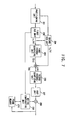
- FIG. 4 is a block diagram illustrating a structure of an encoder in an apparatus for partitioning moving picture data in accordance with the present invention.
- the encoder includes a first combining unit 11 for adding a received video signal to an output signal of a motion compensating unit 19; a DCT unit 12 for performing DCT (discrete cosine transform) of the signal outputted from the first combining unit 11; a first quantizing unit 13 for quantizing the signal of the DCT unit 12; a first inverse-quantizing unit 14 for inverse-quantizing the signal outputted from the first quantizing unit 13; an IDCT (inverse discrete cosine transform) unit 15 for performing IDCT of the signal outputted from the first inverse-quantizing unit 14; a second combining unit 16 for combining the output signal of the IDCT unit 15 with the output signal of the motion compensating unit 19; a frame memory 17 for clipping and storing the signal outputted from the second combining unit 16; a motion judging unit 18 for estimating motion through the signal of the frame memory 17 and
- the second quantizing unit 100 includes a second quantizer 101 for re-quantizing a signal outputted from the first quantizing unit 13; a fist VLC (variable length coding) unit 102 for performing VLC (variable length coding) of a signal ouptutted from the second quantizer 101; a second inverse-quantizing unit 103 for inverse-quantizing a signal outputted from the second quantizer 101; a third combining unit 104 for performing subtraction operation of an output signal from the second inverse-quantizing unit 103 and an output signal from the first quantizing unit 13; a second VLC unit 105 for performing VLC (variable length coding) of output signals of the third combining unit 104 and the second quantizer 101; and a data partitioning unit 106 for data-partitioning output signals of the second VLC unit 105 and the first VLC unit 102 and outputting them.
- a fist VLC (variable length coding) unit 102 for performing VLC (variable length coding) of a
- the encoder in accordance with the present invention partitions a DCT coefficient into a preceding part as a priority part and a succeeding part as a lower priority part.
- the preceding part is a stream generated through the first quantizing unit 13 and the second quantizer 101
- the succeeding part is a quantizing error signal as a difference between the output signal of the first quantizing unit 13 and the preceding part signal.
- the DCT coefficient is partitioned into y 1 ( k ) as a stream generated by the second quantizer 101 and y 2 ( k ) as a quantizing error signal between the y 1 ( k ) and the output signal of the first quantizing unit 13.
- y 1 ( k ) can be defined as following.
- x ( k ) Ny 1 ( k ), 1 ⁇ k ⁇ 64
- ⁇ x ⁇ is a maximum constant not greater than x
- x and ( k ) is a reproduction value of the preceding part restored through the second quantizer 101
- y 2 ( k ) is a coefficient of the succeeding part.
- another stream is constructed through a difference value between the signal (approximate stream) and the signal before the re-quantization.
- the coefficient y 1 ( k ) of the preceding part is an even-approximated coefficient of a first-quantized signal ( x ( k )) outputted from the first quantizing unit 13, and the coefficient y 2 ( k ) of the succeeding part is an odd-remainder value generated by the even-approximation of the preceding part.
- Figure 5 shows an embodiment of a data partitioning method in accordance with the present invention, and it shows a first-quantized signal ( x ( k )), a preceding part and a succeeding part partitioned by even-approximation.
- Figures 6A and 6B show a bit string structure of a data partitioning method in accordance with the present invention
- Figure 6A shows frames between screens
- Figure 6B shows frames in a screen.
- Figure 7 shows a structure of a decoder used for the data partitioning method in accordance with the present invention.
- the decoder includes a partitioning unit 201 for receiving an encoded bit stream and partitioning it into a preceding part and a succeeding part; a first VLD (variable length decoding) unit for performing VLD of the preceding part of an output signal of the partitioning unit 201 and outputting an even-approximation coefficient; a first inverse-quantizing unit 203 for inverse-quantizing the even-approximate coefficient outputted from the first VLD unit 202 and outputting a preceding part reproduction value; a second VLD unit 204 for performing VLD of the succeeding part of the output signal of the partitioning unit 201 and outputting an odd-remaining coefficient; a first combining unit 205 for combining the odd-remaining coefficient with the preceding part reproduction value; a second inverse-quantizing unit 206 for inverse-quantizing the output signal of the first combining unit 205; an IDCT (inverse discrete cosine transform) unit 207 for performing IDCT if the output signal of the second
- the decoder partitions an inputted bit stream into each partition divided by a marker.
- y 1 ( k ) as a preceding part is decoded according to a defined coding table and is doubled in the first inverse-quantizing unit 203.
- the succeeding part as the odd-remaining coefficient of the even-approximated coefficient is decoded in the second VLD unit 204.
- additional 1 bit showing code information of the odd-remaining coefficient is decoded only when the even-approximated coefficient is 0.
- a code of the odd-remaining coefficient is determined as the same code with the odd-approximated coefficient.
- a first-quantized coefficient x ( k ) can be reconstructed by adding the output signal of the first inverse-quantizing unit 203 to the output signal of the second VLD unit 204.
- the first-quantized coefficient is added to the signal motion-compensated through the second inverse-quantizing unit 206 and the IDCT unit 207 and is outputted as a decoded video signal.
- decoding when a transmission error occurs, decoding is performed in order from a preceding part in which loss does not occur, if the preceding part is lost, part lower than the preceding part is disregarded.
- decoding when loss occurs in the partition 2 by a transmission error, decoding is performed through the partitions 0 and 1. When loss occurs in the partition 1, lost macro block is reconstructed through information in the partition 0. And, when loss occurs in the partition 0, the decoder disregards all information.
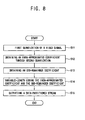
- Figure 8 is a flow chart illustrating a moving picture data partitioning method in accordance with the present invention, it shows the data partitioning method in encoding.
- a received video signal is first-quantized as shown at step S11, the first-quantized signal is outputted, and the first-quantized signal is second-quantized as shown at step S12.
- a second quantized output signal is an even-approximated coefficient about the first-quantized signal.
- the even-approximated coefficient is an approximate stream including all frequency components from a low frequency component as the preceding part and a high frequency part as the succeeding part.
- an odd-remaining coefficient is calculated as shown at step S13.
- the odd-remaining coefficient is corresponded to the succeeding part, absolute value thereof can be described as 0 and 1. Because it has the same code with that of the even-approximated coefficient, only when the even-approximated coefficient is 0 and the odd-remaining coefficient is not 0, code information as additional 1 bit is inserted in order to describe a sign.
- even-approximated coefficient is ⁇ ...-3, -2, -2, -1, -1, 0, 0, 0, 1, 1, 2, 2, 3... ⁇
- odd-remainder coefficient is ⁇ ...0, -1, 0, -1, 0, -1, 0, 1, 0, 1, 0, 1, 0... ⁇ .
- even-approximated coefficient of the first quantized signal ⁇ -1, 1 ⁇ is ⁇ 0, 0 ⁇
- a code bit for respectively showing ⁇ -1, 1 ⁇ is inserted into the odd-remainder coefficient.
- a signal is outputted from the data partitioning unit as a partitioned stream as shown at step S15.
- Figure 9 is a flow chart illustrating a method for partitioning moving picture data, a data partitioning method in decoding will be described.
- an even-approximated coefficient and an odd-remainder coefficient are obtained as shown at step S23.
- the even-approximated coefficient is inverse-quantized about the second quantizing in the encoding process, is added to the odd-remainder coefficient and is outputted as a first-quantized signal.
- the even-approximated coefficient is ⁇ ...-3, -2, -2, -1, -1, 0, 0, 0, 1, 1, 2, 2, 3... ⁇
- the odd-remainder coefficient is ⁇ ...0, -1, 0, -1, 0, -1, 0, 1, 0, 1, 0, 1, 0... ⁇
- a second-quantizing interval in the encoding process is 2
- the even-approximated coefficient through the inverse-quantizing is outputted as ⁇ ...-6, -5, -4, - 3, -2, -1, 0, 1, 2, 3, 4, 5, 6... ⁇
- a signal same with the first-quantized signal in the encoding process is outputted.
- step S24 inverse-quantizing about the first quantizing in the encoding process is performed as shown at step S24, motion compensation about the signal is performed, and accordingly a video signal is obtained as shown at step S25.
- the apparatus and method for partitioning moving picture data in accordance with the present invention can be efficiently used for not only a radio terminal using a radio communication network but also error impurity transmission of moving picture information in a wire communication network. And, it can be applied to not only moving picture transmission such as a MPEG-2, a MPEG-4 and a H.263, etc. but also still picture transmission such as a JPEG (joint photographic coding expert group), etc.
- the present invention can be efficiently applied to error impurity transmission of all multimedia information encoded by using a DCT in a wire/wireless communication network.
Landscapes
- Engineering & Computer Science (AREA)
- Multimedia (AREA)
- Signal Processing (AREA)
- Mechanical Engineering (AREA)
- General Engineering & Computer Science (AREA)
- Environmental & Geological Engineering (AREA)
- Compression Or Coding Systems Of Tv Signals (AREA)
- Detection And Prevention Of Errors In Transmission (AREA)
- Mobile Radio Communication Systems (AREA)
- Compression, Expansion, Code Conversion, And Decoders (AREA)
Applications Claiming Priority (2)
| Application Number | Priority Date | Filing Date | Title |
|---|---|---|---|
| KR10-2003-0014095A KR100533025B1 (ko) | 2003-03-06 | 2003-03-06 | 동영상 데이터의 분할장치 및 방법 |
| KR2003014095 | 2003-03-06 |
Publications (2)
| Publication Number | Publication Date |
|---|---|
| EP1455535A2 true EP1455535A2 (de) | 2004-09-08 |
| EP1455535A3 EP1455535A3 (de) | 2005-10-12 |
Family
ID=32822718
Family Applications (1)
| Application Number | Title | Priority Date | Filing Date |
|---|---|---|---|
| EP03006824A Withdrawn EP1455535A3 (de) | 2003-03-06 | 2003-03-27 | Verfahren und Vorrichtung zur Videodatenaufteilung |
Country Status (4)
| Country | Link |
|---|---|
| US (2) | US6956900B2 (de) |
| EP (1) | EP1455535A3 (de) |
| JP (1) | JP2004274686A (de) |
| KR (1) | KR100533025B1 (de) |
Families Citing this family (5)
| Publication number | Priority date | Publication date | Assignee | Title |
|---|---|---|---|---|
| US7769084B1 (en) | 2002-07-15 | 2010-08-03 | Apple Inc. | Method for implementing a quantizer in a multimedia compression and encoding system |
| KR100533025B1 (ko) * | 2003-03-06 | 2005-12-02 | 엘지전자 주식회사 | 동영상 데이터의 분할장치 및 방법 |
| US7512570B2 (en) * | 2006-05-30 | 2009-03-31 | Zaracom Technologies Inc. | Artificial intelligence analyzer and generator |
| US9510002B2 (en) | 2013-09-09 | 2016-11-29 | Apple Inc. | Chroma quantization in video coding |
| JP6417815B2 (ja) * | 2014-09-19 | 2018-11-07 | 富士ゼロックス株式会社 | 情報処理装置及び情報処理プログラム |
Family Cites Families (9)
| Publication number | Priority date | Publication date | Assignee | Title |
|---|---|---|---|---|
| JPH0638198A (ja) * | 1992-05-19 | 1994-02-10 | Sony Corp | 画像信号伝送装置及び画像信号伝送方法 |
| FR2697393A1 (fr) * | 1992-10-28 | 1994-04-29 | Philips Electronique Lab | Dispositif de codage de signaux numériques représentatifs d'images, et dispositif de décodage correspondant. |
| DE69522861T2 (de) * | 1994-06-30 | 2002-04-11 | Koninklijke Philips Electronics N.V., Eindhoven | Verfahren und Einrichtung zur Codeumwandlung von codiertem Datenstrom |
| US5825970A (en) * | 1994-12-20 | 1998-10-20 | Lg Electronics Inc. | Quantization number selecting apparatus for DVCR and method therefor |
| JP3743837B2 (ja) * | 1996-06-14 | 2006-02-08 | 株式会社大宇エレクトロニクス | ランレングス符号器 |
| KR100331333B1 (ko) | 1998-11-13 | 2002-05-09 | 윤종용 | 영상데이터 분할방법 및 그에 의한 부호화 데이터의 복호화방법 |
| KR100375345B1 (ko) | 1998-12-01 | 2003-03-10 | 삼성전자주식회사 | 오류 허용 모드를 위한 비디오 코딩 방법 및 그 장치 |
| CN1223091C (zh) * | 1999-07-02 | 2005-10-12 | 皇家菲利浦电子有限公司 | 在存储器中存储数据项以及读出数据项的方法和装置 |
| KR100533025B1 (ko) * | 2003-03-06 | 2005-12-02 | 엘지전자 주식회사 | 동영상 데이터의 분할장치 및 방법 |
-
2003
- 2003-03-06 KR KR10-2003-0014095A patent/KR100533025B1/ko not_active Expired - Fee Related
- 2003-03-27 JP JP2003089434A patent/JP2004274686A/ja active Pending
- 2003-03-27 EP EP03006824A patent/EP1455535A3/de not_active Withdrawn
- 2003-08-25 US US10/647,937 patent/US6956900B2/en not_active Expired - Fee Related
-
2005
- 2005-07-25 US US11/189,963 patent/US7474697B2/en not_active Expired - Fee Related
Non-Patent Citations (4)
| Title |
|---|
| HSU Y-F ET AL: "Embedded SNR scalable MPEG-2 video encoder and its associated error resilience decoding procedures" SIGNAL PROCESSING. IMAGE COMMUNICATION, ELSEVIER SCIENCE PUBLISHERS, AMSTERDAM, NL, vol. 14, no. 5, March 1999 (1999-03), pages 397-412, XP004163262 ISSN: 0923-5965 * |
| MENDES L R ET AL: "Two-scale transmission of DCT-coded video over lossy packet networks" TELECOMMUNICATIONS SYMPOSIUM, 1998. ITS '98 PROCEEDINGS. SBT/IEEE INTERNATIONAL SAO PAULO, BRAZIL 9-13 AUG. 1998, NEW YORK, NY, USA,IEEE, US, vol. 2, 9 August 1998 (1998-08-09), pages 510-515, XP010300835 ISBN: 0-7803-5030-8 * |
| ROH K-C ET AL: "Data partitioning and coding of DCT coefficients based on requantization for error-resilient transmission of video" SIGNAL PROCESSING. IMAGE COMMUNICATION, ELSEVIER SCIENCE PUBLISHERS, AMSTERDAM, NL, vol. 17, no. 8, September 2002 (2002-09), pages 573-585, XP004378875 ISSN: 0923-5965 * |
| WERNER O: "REQUANTIZATION FOR TRANSCODING OF MPEG-2 INTRAFRAMES" IEEE TRANSACTIONS ON IMAGE PROCESSING, IEEE INC. NEW YORK, US, vol. 8, no. 2, February 1999 (1999-02), pages 179-191, XP000831918 ISSN: 1057-7149 * |
Also Published As
| Publication number | Publication date |
|---|---|
| US6956900B2 (en) | 2005-10-18 |
| US7474697B2 (en) | 2009-01-06 |
| JP2004274686A (ja) | 2004-09-30 |
| KR100533025B1 (ko) | 2005-12-02 |
| US20050254580A1 (en) | 2005-11-17 |
| KR20040079156A (ko) | 2004-09-14 |
| EP1455535A3 (de) | 2005-10-12 |
| US20040184536A1 (en) | 2004-09-23 |
Similar Documents
| Publication | Publication Date | Title |
|---|---|---|
| Le Gall | The MPEG video compression algorithm | |
| US7469069B2 (en) | Method and apparatus for encoding/decoding image using image residue prediction | |
| US5777678A (en) | Predictive sub-band video coding and decoding using motion compensation | |
| US5136371A (en) | Digital image coding using random scanning | |
| EP1701552B1 (de) | Bildumsetzungsvorrichtung | |
| US6130911A (en) | Method and apparatus for compressing reference frames in an interframe video codec | |
| US6256348B1 (en) | Reduced memory MPEG video decoder circuits and methods | |
| US7636392B2 (en) | Non-compensated transcoding of a video stream | |
| US20050157788A1 (en) | Information processing apparatus and method, and program storage medium | |
| US20150043630A1 (en) | Image encoding device, image decoding device, image encoding method, and image decoding method | |
| JPH08228156A (ja) | デジタル信号を部分的に再圧縮するための方法及び装 置 | |
| JP3244399B2 (ja) | 圧縮動画像符号信号の情報量変換回路、及び方法 | |
| US20050157794A1 (en) | Scalable video encoding method and apparatus supporting closed-loop optimization | |
| WO2000021300A1 (en) | Method and apparatus for converting the bitrate of an encoded bitstream without full re-encoding | |
| US9264736B2 (en) | Encoding method, decoding method, encoding device, and decoding device | |
| US7436889B2 (en) | Methods and systems for reducing requantization-originated generational error in predictive video streams using motion compensation | |
| US6195390B1 (en) | Picture signal encoding apparatus and picture signal decoding apparatus | |
| EP1455535A2 (de) | Verfahren und Vorrichtung zur Videodatenaufteilung | |
| EP1173027B1 (de) | Verfahren und Vorrichtung für fast verlustfreie verkettete Blocktransformkodierung | |
| US6356661B1 (en) | Method and device for robust decoding of header information in macroblock-based compressed video data | |
| US20050129319A1 (en) | Fast discrete wavelet encoding apparatus and method for encoding a still image at a high speed based on energy of each block | |
| JP2000244872A (ja) | トランスコーダ装置 | |
| JP3166501B2 (ja) | 画像再圧縮方法及び画像再圧縮装置 | |
| WO2006000964A1 (en) | Video transcoding with selection of data portions to be processed | |
| JP2776424B2 (ja) | セル廃棄補償画像復号化方式 |
Legal Events
| Date | Code | Title | Description |
|---|---|---|---|
| PUAI | Public reference made under article 153(3) epc to a published international application that has entered the european phase |
Free format text: ORIGINAL CODE: 0009012 |
|
| 17P | Request for examination filed |
Effective date: 20030327 |
|
| AK | Designated contracting states |
Kind code of ref document: A2 Designated state(s): AT BE BG CH CY CZ DE DK EE ES FI FR GB GR HU IE IT LI LU MC NL PT SE SI SK TR |
|
| AX | Request for extension of the european patent |
Extension state: AL LT LV MK RO |
|
| PUAL | Search report despatched |
Free format text: ORIGINAL CODE: 0009013 |
|
| AK | Designated contracting states |
Kind code of ref document: A3 Designated state(s): AT BE BG CH CY CZ DE DK EE ES FI FR GB GR HU IE IT LI LU MC NL PT SE SI SK TR |
|
| AX | Request for extension of the european patent |
Extension state: AL LT LV MK RO |
|
| RIC1 | Information provided on ipc code assigned before grant |
Ipc: 7H 04N 7/64 B Ipc: 7H 04N 7/50 B Ipc: 7H 04N 7/26 A |
|
| AKX | Designation fees paid |
Designated state(s): AT BE BG CH CY CZ DE DK EE ES FI FR GB GR HU IE IT LI LU MC NL PT SE SI SK TR |
|
| STAA | Information on the status of an ep patent application or granted ep patent |
Free format text: STATUS: THE APPLICATION HAS BEEN WITHDRAWN |
|
| 18W | Application withdrawn |
Effective date: 20060718 |