EP1453465B1 - Behälter zum transport von gütern bei gleichbleibender temperatur - Google Patents
Behälter zum transport von gütern bei gleichbleibender temperatur Download PDFInfo
- Publication number
- EP1453465B1 EP1453465B1 EP03708154A EP03708154A EP1453465B1 EP 1453465 B1 EP1453465 B1 EP 1453465B1 EP 03708154 A EP03708154 A EP 03708154A EP 03708154 A EP03708154 A EP 03708154A EP 1453465 B1 EP1453465 B1 EP 1453465B1
- Authority
- EP
- European Patent Office
- Prior art keywords
- fluorine
- containers
- container
- approximately
- paraffins
- Prior art date
- Legal status (The legal status is an assumption and is not a legal conclusion. Google has not performed a legal analysis and makes no representation as to the accuracy of the status listed.)
- Expired - Lifetime
Links
- 239000004033 plastic Substances 0.000 claims abstract description 22
- 229920003023 plastic Polymers 0.000 claims abstract description 22
- 229910052731 fluorine Inorganic materials 0.000 claims abstract description 19
- 239000011737 fluorine Substances 0.000 claims abstract description 19
- 238000003682 fluorination reaction Methods 0.000 claims abstract description 18
- 239000000203 mixture Substances 0.000 claims abstract description 15
- 239000012188 paraffin wax Substances 0.000 claims abstract description 7
- 229910001873 dinitrogen Inorganic materials 0.000 claims abstract description 5
- YCKRFDGAMUMZLT-UHFFFAOYSA-N Fluorine atom Chemical compound [F] YCKRFDGAMUMZLT-UHFFFAOYSA-N 0.000 claims description 18
- 238000005338 heat storage Methods 0.000 claims description 18
- 238000000034 method Methods 0.000 claims description 17
- 239000011232 storage material Substances 0.000 claims description 14
- 230000035515 penetration Effects 0.000 claims description 9
- 238000003860 storage Methods 0.000 claims description 9
- YPDSOAPSWYHANB-UHFFFAOYSA-N [N].[F] Chemical compound [N].[F] YPDSOAPSWYHANB-UHFFFAOYSA-N 0.000 claims description 7
- 125000004435 hydrogen atom Chemical group [H]* 0.000 claims description 7
- 229920000642 polymer Polymers 0.000 claims description 7
- 125000001153 fluoro group Chemical group F* 0.000 claims description 6
- -1 polyethylene Polymers 0.000 claims description 6
- 230000008569 process Effects 0.000 claims description 5
- 238000006467 substitution reaction Methods 0.000 claims description 5
- 238000004347 surface barrier Methods 0.000 claims description 5
- 239000004215 Carbon black (E152) Substances 0.000 claims description 4
- 230000015572 biosynthetic process Effects 0.000 claims description 4
- 229920001577 copolymer Polymers 0.000 claims description 4
- 229930195733 hydrocarbon Natural products 0.000 claims description 4
- 150000002430 hydrocarbons Chemical class 0.000 claims description 4
- 238000004519 manufacturing process Methods 0.000 claims description 4
- 239000004793 Polystyrene Substances 0.000 claims description 3
- 239000011261 inert gas Substances 0.000 claims description 3
- 239000004952 Polyamide Substances 0.000 claims description 2
- 239000004698 Polyethylene Substances 0.000 claims description 2
- 239000004743 Polypropylene Substances 0.000 claims description 2
- 229920000058 polyacrylate Polymers 0.000 claims description 2
- 229920002647 polyamide Polymers 0.000 claims description 2
- 229920001748 polybutylene Polymers 0.000 claims description 2
- 239000004417 polycarbonate Substances 0.000 claims description 2
- 229920000515 polycarbonate Polymers 0.000 claims description 2
- 229920000573 polyethylene Polymers 0.000 claims description 2
- 229920001155 polypropylene Polymers 0.000 claims description 2
- 229920002223 polystyrene Polymers 0.000 claims description 2
- 239000004800 polyvinyl chloride Substances 0.000 claims description 2
- 229920000915 polyvinyl chloride Polymers 0.000 claims description 2
- 238000005303 weighing Methods 0.000 claims description 2
- 229920003229 poly(methyl methacrylate) Polymers 0.000 claims 2
- 239000004926 polymethyl methacrylate Substances 0.000 claims 2
- WOBHKFSMXKNTIM-UHFFFAOYSA-N Hydroxyethyl methacrylate Chemical compound CC(=C)C(=O)OCCO WOBHKFSMXKNTIM-UHFFFAOYSA-N 0.000 claims 1
- 229920001283 Polyalkylene terephthalate Polymers 0.000 claims 1
- 238000004140 cleaning Methods 0.000 claims 1
- 238000001035 drying Methods 0.000 claims 1
- 229920000098 polyolefin Polymers 0.000 claims 1
- 229920001296 polysiloxane Polymers 0.000 claims 1
- 239000011253 protective coating Substances 0.000 claims 1
- 239000000463 material Substances 0.000 abstract description 4
- 239000012782 phase change material Substances 0.000 abstract 2
- PXGOKWXKJXAPGV-UHFFFAOYSA-N Fluorine Chemical compound FF PXGOKWXKJXAPGV-UHFFFAOYSA-N 0.000 abstract 1
- 229960005419 nitrogen Drugs 0.000 abstract 1
- IJGRMHOSHXDMSA-UHFFFAOYSA-N Atomic nitrogen Chemical compound N#N IJGRMHOSHXDMSA-UHFFFAOYSA-N 0.000 description 11
- 239000007789 gas Substances 0.000 description 6
- 229910052757 nitrogen Inorganic materials 0.000 description 5
- 239000002985 plastic film Substances 0.000 description 4
- 229920006255 plastic film Polymers 0.000 description 4
- QVGXLLKOCUKJST-UHFFFAOYSA-N atomic oxygen Chemical compound [O] QVGXLLKOCUKJST-UHFFFAOYSA-N 0.000 description 3
- 239000000945 filler Substances 0.000 description 3
- 239000001301 oxygen Substances 0.000 description 3
- 229910052760 oxygen Inorganic materials 0.000 description 3
- 229940127557 pharmaceutical product Drugs 0.000 description 3
- 230000004888 barrier function Effects 0.000 description 2
- 239000008280 blood Substances 0.000 description 2
- 210000004369 blood Anatomy 0.000 description 2
- 238000009792 diffusion process Methods 0.000 description 2
- 229920001903 high density polyethylene Polymers 0.000 description 2
- 239000004700 high-density polyethylene Substances 0.000 description 2
- 238000010348 incorporation Methods 0.000 description 2
- 229940127554 medical product Drugs 0.000 description 2
- 239000011241 protective layer Substances 0.000 description 2
- 108090000623 proteins and genes Proteins 0.000 description 2
- 239000000126 substance Substances 0.000 description 2
- 239000002344 surface layer Substances 0.000 description 2
- 241000531116 Blitum bonus-henricus Species 0.000 description 1
- 235000008645 Chenopodium bonus henricus Nutrition 0.000 description 1
- WFWLQNSHRPWKFK-UHFFFAOYSA-N Tegafur Chemical compound O=C1NC(=O)C(F)=CN1C1OCCC1 WFWLQNSHRPWKFK-UHFFFAOYSA-N 0.000 description 1
- 125000004429 atom Chemical group 0.000 description 1
- 229910052799 carbon Inorganic materials 0.000 description 1
- 239000012876 carrier material Substances 0.000 description 1
- 238000004113 cell culture Methods 0.000 description 1
- 238000006243 chemical reaction Methods 0.000 description 1
- 239000003795 chemical substances by application Substances 0.000 description 1
- 239000011248 coating agent Substances 0.000 description 1
- 238000000576 coating method Methods 0.000 description 1
- 230000000295 complement effect Effects 0.000 description 1
- 230000006735 deficit Effects 0.000 description 1
- 235000013312 flour Nutrition 0.000 description 1
- 239000001307 helium Substances 0.000 description 1
- 229910052734 helium Inorganic materials 0.000 description 1
- SWQJXJOGLNCZEY-UHFFFAOYSA-N helium atom Chemical compound [He] SWQJXJOGLNCZEY-UHFFFAOYSA-N 0.000 description 1
- 238000009413 insulation Methods 0.000 description 1
- 239000010410 layer Substances 0.000 description 1
- 230000007774 longterm Effects 0.000 description 1
- 238000012423 maintenance Methods 0.000 description 1
- 238000005259 measurement Methods 0.000 description 1
- 238000000465 moulding Methods 0.000 description 1
- 229910052756 noble gas Inorganic materials 0.000 description 1
- 210000000056 organ Anatomy 0.000 description 1
- 230000035699 permeability Effects 0.000 description 1
- 239000000825 pharmaceutical preparation Substances 0.000 description 1
- 239000011148 porous material Substances 0.000 description 1
- 238000002360 preparation method Methods 0.000 description 1
- 230000001681 protective effect Effects 0.000 description 1
- 102000004169 proteins and genes Human genes 0.000 description 1
- 238000010926 purge Methods 0.000 description 1
- 238000005057 refrigeration Methods 0.000 description 1
- 238000007788 roughening Methods 0.000 description 1
- 239000007787 solid Substances 0.000 description 1
- 238000007592 spray painting technique Methods 0.000 description 1
- 239000007858 starting material Substances 0.000 description 1
- 239000013585 weight reducing agent Substances 0.000 description 1
Images
Classifications
-
- F—MECHANICAL ENGINEERING; LIGHTING; HEATING; WEAPONS; BLASTING
- F28—HEAT EXCHANGE IN GENERAL
- F28D—HEAT-EXCHANGE APPARATUS, NOT PROVIDED FOR IN ANOTHER SUBCLASS, IN WHICH THE HEAT-EXCHANGE MEDIA DO NOT COME INTO DIRECT CONTACT
- F28D20/00—Heat storage plants or apparatus in general; Regenerative heat-exchange apparatus not covered by groups F28D17/00 or F28D19/00
- F28D20/02—Heat storage plants or apparatus in general; Regenerative heat-exchange apparatus not covered by groups F28D17/00 or F28D19/00 using latent heat
-
- A—HUMAN NECESSITIES
- A61—MEDICAL OR VETERINARY SCIENCE; HYGIENE
- A61J—CONTAINERS SPECIALLY ADAPTED FOR MEDICAL OR PHARMACEUTICAL PURPOSES; DEVICES OR METHODS SPECIALLY ADAPTED FOR BRINGING PHARMACEUTICAL PRODUCTS INTO PARTICULAR PHYSICAL OR ADMINISTERING FORMS; DEVICES FOR ADMINISTERING FOOD OR MEDICINES ORALLY; BABY COMFORTERS; DEVICES FOR RECEIVING SPITTLE
- A61J1/00—Containers specially adapted for medical or pharmaceutical purposes
- A61J1/14—Details; Accessories therefor
- A61J1/16—Holders for containers
- A61J1/165—Cooled holders, e.g. for medications, insulin, blood or plasma
-
- B—PERFORMING OPERATIONS; TRANSPORTING
- B65—CONVEYING; PACKING; STORING; HANDLING THIN OR FILAMENTARY MATERIAL
- B65D—CONTAINERS FOR STORAGE OR TRANSPORT OF ARTICLES OR MATERIALS, e.g. BAGS, BARRELS, BOTTLES, BOXES, CANS, CARTONS, CRATES, DRUMS, JARS, TANKS, HOPPERS, FORWARDING CONTAINERS; ACCESSORIES, CLOSURES, OR FITTINGS THEREFOR; PACKAGING ELEMENTS; PACKAGES
- B65D81/00—Containers, packaging elements, or packages, for contents presenting particular transport or storage problems, or adapted to be used for non-packaging purposes after removal of contents
- B65D81/38—Containers, packaging elements, or packages, for contents presenting particular transport or storage problems, or adapted to be used for non-packaging purposes after removal of contents with thermal insulation
- B65D81/3813—Containers, packaging elements, or packages, for contents presenting particular transport or storage problems, or adapted to be used for non-packaging purposes after removal of contents with thermal insulation rigid container being in the form of a box, tray or like container
- B65D81/382—Containers, packaging elements, or packages, for contents presenting particular transport or storage problems, or adapted to be used for non-packaging purposes after removal of contents with thermal insulation rigid container being in the form of a box, tray or like container provided with liquid material between double walls
-
- C—CHEMISTRY; METALLURGY
- C09—DYES; PAINTS; POLISHES; NATURAL RESINS; ADHESIVES; COMPOSITIONS NOT OTHERWISE PROVIDED FOR; APPLICATIONS OF MATERIALS NOT OTHERWISE PROVIDED FOR
- C09K—MATERIALS FOR MISCELLANEOUS APPLICATIONS, NOT PROVIDED FOR ELSEWHERE
- C09K5/00—Heat-transfer, heat-exchange or heat-storage materials, e.g. refrigerants; Materials for the production of heat or cold by chemical reactions other than by combustion
- C09K5/02—Materials undergoing a change of physical state when used
- C09K5/06—Materials undergoing a change of physical state when used the change of state being from liquid to solid or vice versa
- C09K5/063—Materials absorbing or liberating heat during crystallisation; Heat storage materials
-
- F—MECHANICAL ENGINEERING; LIGHTING; HEATING; WEAPONS; BLASTING
- F25—REFRIGERATION OR COOLING; COMBINED HEATING AND REFRIGERATION SYSTEMS; HEAT PUMP SYSTEMS; MANUFACTURE OR STORAGE OF ICE; LIQUEFACTION SOLIDIFICATION OF GASES
- F25D—REFRIGERATORS; COLD ROOMS; ICE-BOXES; COOLING OR FREEZING APPARATUS NOT OTHERWISE PROVIDED FOR
- F25D2303/00—Details of devices using other cold materials; Details of devices using cold-storage bodies
- F25D2303/08—Devices using cold storage material, i.e. ice or other freezable liquid
- F25D2303/082—Devices using cold storage material, i.e. ice or other freezable liquid disposed in a cold storage element not forming part of a container for products to be cooled, e.g. ice pack or gel accumulator
- F25D2303/0822—Details of the element
-
- F—MECHANICAL ENGINEERING; LIGHTING; HEATING; WEAPONS; BLASTING
- F25—REFRIGERATION OR COOLING; COMBINED HEATING AND REFRIGERATION SYSTEMS; HEAT PUMP SYSTEMS; MANUFACTURE OR STORAGE OF ICE; LIQUEFACTION SOLIDIFICATION OF GASES
- F25D—REFRIGERATORS; COLD ROOMS; ICE-BOXES; COOLING OR FREEZING APPARATUS NOT OTHERWISE PROVIDED FOR
- F25D2303/00—Details of devices using other cold materials; Details of devices using cold-storage bodies
- F25D2303/08—Devices using cold storage material, i.e. ice or other freezable liquid
- F25D2303/082—Devices using cold storage material, i.e. ice or other freezable liquid disposed in a cold storage element not forming part of a container for products to be cooled, e.g. ice pack or gel accumulator
- F25D2303/0822—Details of the element
- F25D2303/08222—Shape of the element
-
- F—MECHANICAL ENGINEERING; LIGHTING; HEATING; WEAPONS; BLASTING
- F25—REFRIGERATION OR COOLING; COMBINED HEATING AND REFRIGERATION SYSTEMS; HEAT PUMP SYSTEMS; MANUFACTURE OR STORAGE OF ICE; LIQUEFACTION SOLIDIFICATION OF GASES
- F25D—REFRIGERATORS; COLD ROOMS; ICE-BOXES; COOLING OR FREEZING APPARATUS NOT OTHERWISE PROVIDED FOR
- F25D2303/00—Details of devices using other cold materials; Details of devices using cold-storage bodies
- F25D2303/08—Devices using cold storage material, i.e. ice or other freezable liquid
- F25D2303/085—Compositions of cold storage materials
-
- F—MECHANICAL ENGINEERING; LIGHTING; HEATING; WEAPONS; BLASTING
- F25—REFRIGERATION OR COOLING; COMBINED HEATING AND REFRIGERATION SYSTEMS; HEAT PUMP SYSTEMS; MANUFACTURE OR STORAGE OF ICE; LIQUEFACTION SOLIDIFICATION OF GASES
- F25D—REFRIGERATORS; COLD ROOMS; ICE-BOXES; COOLING OR FREEZING APPARATUS NOT OTHERWISE PROVIDED FOR
- F25D3/00—Devices using other cold materials; Devices using cold-storage bodies
- F25D3/02—Devices using other cold materials; Devices using cold-storage bodies using ice, e.g. ice-boxes
- F25D3/06—Movable containers
- F25D3/08—Movable containers portable, i.e. adapted to be carried personally
-
- Y—GENERAL TAGGING OF NEW TECHNOLOGICAL DEVELOPMENTS; GENERAL TAGGING OF CROSS-SECTIONAL TECHNOLOGIES SPANNING OVER SEVERAL SECTIONS OF THE IPC; TECHNICAL SUBJECTS COVERED BY FORMER USPC CROSS-REFERENCE ART COLLECTIONS [XRACs] AND DIGESTS
- Y02—TECHNOLOGIES OR APPLICATIONS FOR MITIGATION OR ADAPTATION AGAINST CLIMATE CHANGE
- Y02E—REDUCTION OF GREENHOUSE GAS [GHG] EMISSIONS, RELATED TO ENERGY GENERATION, TRANSMISSION OR DISTRIBUTION
- Y02E60/00—Enabling technologies; Technologies with a potential or indirect contribution to GHG emissions mitigation
- Y02E60/14—Thermal energy storage
Definitions
- the invention relates to plastic containers for transport and storage of goods at a constant temperature according to the preamble of claim 1 and a method for Production of such containers according to the preamble of Claim 6.
- plastic containers For transport and storage of goods at a constant Temperature are known plastic containers, which in the Normally formed approximately cuboid and a cavity or a chamber for a high-capacity agent for cold or heat, for example a latent heat storage material, exhibit. These refrigeration and heat storage can also be made from a plastic film and as Bag be formed, which is the corresponding latent heat storage material contain. These plastic containers are usually used in insulated bags and boxes and arranged in close contact with the goods to be tempered.
- German patent application DE 100 30 102 A1 is a consisting of two nearly identical, double-walled cells Transport, storage and protective container described.
- the cells are shaped to form a receiving space for the good to be kept when they are joined.
- To the outside is the receiving space through the cavities the two cells with the latent heat storage material received therein shielded.
- latent heat storage paraffins are in the cooled Condition usually a solid mass, which is why the temperature maintenance should also be checked visually can if the container is at least partially transparent is trained.
- paraffins in an immobilized state to be used as latent heat storage material.
- the paraffins are e.g. in pores or capillaries of a carrier material, which is preferably granular, added.
- a carrier material which is preferably granular, added.
- the immobilized form is a larger one Volume for each required conversion energy required.
- the invention has for its object to provide a plastic container for the transport and storage of goods, which can be used extremely well for all goods and especially for highly sensitive materials of the medical and pharmaceutical sector even when using paraffins as latent heat storage material.
- a method for producing such a container is given.
- a basic idea of the invention can be seen therein form the plastic container diffusion-tight, so that the paraffins in non-immobilized form as latent heat storage used and easy in one or more Cavities can be filled, with diffusion losses as well as damage to the goods to be transported be prevented.
- a container made of a hydrocarbon plastic a barrier in its near-surface Areas, which by a fluorine penetration and Substitution of the hydrogen atoms formed by fluorine atoms and is impermeable to paraffins.
- a plastic container which at least one Cavity for receiving a latent heat storage based on paraffin having a fluorine treatment under defined Is subjected to conditions on its surfaces, which may include the surfaces in the cavities, a teflon-like structure formed, which is based on a fluorine penetration and substitution of the hydrogen atoms Flour atoms is due.
- the fluorinated surface layer is nonpolar and repulsive to the nonpolar Paraffins, especially n-paraffins, of the latent heat storage material.
- plastic bags For the production of diffusion-proof plastic bags recommends it is the starting material, e.g. Plastic films or hoses to undergo fluorination.
- US Pat. No. 5,475,450 discloses a process for incorporation of fluorine described in contact lenses to a higher Resistance to protein deposits, an improved Gas permeability, especially for oxygen, and a to achieve lower adhesion tendency.
- DE 34 15 381 C2 relates to O-rings of polymers, their friction behavior by treatment with a fluorine-gas mixture should be increased.
- DE 24 11 908 C3 is the fluorination of plastic films described which to improve the printability and adhesion.
- the fluorination is carried out for the preparation a subsequent coating with a gas mixture, which in addition to fluorine and nitrogen 10 to 16 vol .-% Contains oxygen, and that described in EP 0 767 198 A1 Fluorine treatment is a subsequent electrostatic Improve spray painting.
- None of the aforementioned publications relates to containers for Transport and storage of goods at constant temperature with a paraffin-based latent heat storage material in a cavity, with the help of a fluorination paraffin-impermeable surface protective layers be formed.
- the fluorination takes place paraffin-forming Protective layers on containers made of hydrocarbon polymer in a vacuum process, which in a reactor, e.g. in an autoclave.
- containers made of hydrocarbon polymer in a vacuum process, which in a reactor, e.g. in an autoclave.
- a reactor e.g. in an autoclave.
- Transport and storage containers are cleaned and dried and spaced from each other in the nitrogen rinsed autoclave arranged.
- a Fluorine-nitrogen gas mixture introduced, which consists of about 5 to 20 vol.%, preferably 10 vol.% fluorine, and 95 to 80 Vol .-%, preferably 90 vol .-% nitrogen.
- a Gas mixture of nitrogen and 10 vol .-% fluorine is advantageously bottled available, so that a separate supply and control of the gas components can be omitted.
- the autoclave is filled with the fluorine-nitrogen gas mixture filled to a pressure of about 500 mbar, which then at a temperature in the range of about 30 to 60 ° C, especially at about 40 ° C, at least 30 minutes, advantageously about 1 hour, on the plastic container acts.
- the fluorination may be under plasma or non-plasma conditions be performed.
- the penetration depth of the fluorine atoms can also be determined by measurement become.
- Advantageous is a fluorine penetration in a penetration depth of at least about 1 ⁇ m.
- the main advantages of fluorinated, paraffin-impermeable Plastic transport container and the invention Procedure are that pure paraffins as latent heat storage material in the at least one Cavity of a plastic container can be filled and immobilization is not required. In addition to one Better handling is a lower material consumption to record paraffins. In addition, will an impairment of highly sensitive goods, such as Cell structures, gene and tissue material, pharmaceutical Products and the like, by escaping paraffins prevented. The procedure can be done quickly and effectively be carried out, especially if using an autoclave a corresponding capacity is available.
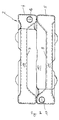
- the single drawing figure ( Figure 1) shows in a cross-sectional view a container 2 made of HDPE (high-density polyethylene), which is intended for the transport of blood is.
- the container consists of two container parts or cells 4, 5, which are formed substantially the same.
- the cells 4, 5 have edge recesses and complementary Moldings (not shown) for a clamping or latching connection of the cells 4, 5.
- the cells 4, 5 also each have an inner side 7, 8, which is formed deepened, so that when connected Cells 4, 5 a receiving space 10 for the stored and to be transported Good (not shown) formed is.
- the cells 4, 5 are also each with one Cavity 14, 15 provided, which with a latent heat storage material is filled.
- the receiving space 10 is almost completely from the two cavities 14, 15 and the n-paraffins surrounded as latent heat storage material.
- both cells 4, 5 are fluorinated and all surfaces, including the insides 7, 8 provided with a Teflon-like barrier layer. This is a diffusion of paraffins through the wall effective and long-term stable prevented.
- the fluorination of the container 2 takes place in an autoclave, in which the individual cells 4, 5 spaced from each other to be ordered.
- a filler neck 16, 17 in both cells 4, 5 is not closed, so that the fluorine-nitrogen mixture with a fluorine concentration of 10 Vol .-% also in the cavities 14, 15 can get.
- the supply of fluorine-nitrogen mixture is carried out after Evacuation of the autoclave to an absolute pressure of about 1 mbar. Thereafter, the above-mentioned fluorine-nitrogen mixture up to an absolute pressure of about 500 mbar and at about 40 ° C and a process duration The fluorination was carried out for about 1 h.
Landscapes
- Engineering & Computer Science (AREA)
- Health & Medical Sciences (AREA)
- Chemical & Material Sciences (AREA)
- Mechanical Engineering (AREA)
- Physics & Mathematics (AREA)
- Thermal Sciences (AREA)
- Animal Behavior & Ethology (AREA)
- Veterinary Medicine (AREA)
- Materials Engineering (AREA)
- Hematology (AREA)
- Pharmacology & Pharmacy (AREA)
- Life Sciences & Earth Sciences (AREA)
- Combustion & Propulsion (AREA)
- General Health & Medical Sciences (AREA)
- Public Health (AREA)
- Organic Chemistry (AREA)
- Chemical Kinetics & Catalysis (AREA)
- General Engineering & Computer Science (AREA)
- Medical Preparation Storing Or Oral Administration Devices (AREA)
- Packages (AREA)
- Laminated Bodies (AREA)
- Processing And Handling Of Plastics And Other Materials For Molding In General (AREA)
- Lubricants (AREA)
- Table Devices Or Equipment (AREA)
- Supplying Of Containers To The Packaging Station (AREA)
Description
Claims (13)
- Behälter aus Kunststoff zum Transport und Lagern von Gütern bei gleichbleibender Temperatur,
mit wenigstens einem Hohlraum (14; 15) zur Aufnahme eines Latentwärmespeichermaterials auf Paraffinbasis,
dadurch gekennzeichnet, dass der Behälter (2) fluorierte Oberflächen-Sperrschichten aufweist und
dass in dem Hohlraum (14; 15) Paraffine in unimmobilisierter Form diffusionsdicht aufgenommen sind. - Behälter nach Anspruch 1,
dadurch gekennzeichnet, dass der Behälter (2) aus einem Kunststoffpolymer besteht, welches Wasserstoffatome enthält, und
dass die fluorierten Oberflächen-Sperrschichten durch eine Fluorpenetration und Substitution der Wasserstoffatome durch Fluoratome in einer Eindringtiefe von wenigstens 1 µm gebildet sind. - Behälter nach Anspruch 2,
dadurch gekennzeichnet, dass das Kunststoffpolymer ein Polyolefin, insbesondere Polyethylen, Polypropylen, Polybutylen oder ein Copolymerisat sowie Polycarbonat, Polyvinylchlorid, Polystyrol, Polyamid, Polyalkylenteraphtalat, ein Acrylpolymer, insbesondere Polymethylmethacrylat (PMMA), ein Polymer aus 2-Hydroxyethylmethylacrylat (HEMA), ein Silicon oder ein Polysulfonat oder ein Co- oder Mischpolymer ist. - Behälter nach einem der vorhergehenden Ansprüche,
dadurch gekennzeichnet, dass die fluorierten paraffinundurchlässigen Oberflächen-Sperrschichten durch eine Behandlung mit einem Fluor-Inertgas-Gemisch unter Plasma- oder Nichtplasma-Bedingungen gebildet sind. - Behälter nach einem der vorhergehenden Ansprüche,
dadurch gekennzeichnet, dass zwei nahezu gleiche Zellen (4, 5) unter Ausbildung eines Aufnahmeraums (10) für das zu transportierende Gut verbunden sind und dass beide Zellen (4, 5) einen Hohlraum (14, 15) für n-Paraffine aufweisen, welche nach einer Fluorierung der Zellen (4, 5) mit Ausbildung von diffusionsdichten Oberflächen-Sperrschichten in die Hohlräume (14, 15) einfüllbar sind. - Verfahren zum Herstellen von paraffindichten Behältern aus Kunststoff zum Transport und Lagern von Gütern bei gleichbleibender Temperatur, insbesondere nach einem der vorhergehenden Ansprüche,
dadurch gekennzeichnet, dass die aus einem Kohlenwasserstoffpolymer bestehenden Behälter in einem Reaktor angeordnet und bei Unterdruck einem Fluor-Inertgasgemisch zur Ausbildung teflonähnlicher Oberflächen-Schutzschichten ausgesetzt werden. - Verfahren nach Anspruch 6,
dadurch gekennzeichnet, dass die Behälter nach einer Säuberung und Trocknung einem Fluor-Stickstoff-Gasgemisch, welches 5 bis 20 Vol.-% Fluor enthält, bei einem Druck von etwa 300 bis 700 mbar und bei einer Temperatur von 30 bis 60° C für etwa 30 bis 300 Minuten ausgesetzt werden. - Verfahren nach Anspruch 6 oder 7,
dadurch gekennzeichnet, dass die Behälter in einem Autoklaven beabstandet zueinander angeordnet werden, dass der Autoklav auf etwa 1 mbar evakuiert wird, danach ein Fluor-Stickstoff-Gemisch, welches etwa 10 Vol.-% Fluor enthält, bis zu einem Druck von etwa 500 mbar eingefüllt wird und dass die Behälter bei etwa 40 °C in etwa 60 Minuten fluoriert werden. - Verfahren nach einem der Ansprüche 6 bis 8,
dadurch gekennzeichnet, dass die Fluorierung in einer Plasma- oder Nichtplasma-Atmosphäre durchgeführt wird. - Verfahren nach einem der Ansprüche 6 bis 9,
dadurch gekennzeichnet, dass die Fluorpenetration und Substitution der Wasserstoffatome durch die Fluoratome bis zu einer Eindringtiefe von ≥ 1 µm durchgeführt wird. - Verfahren nach Anspruch 10,
dadurch gekennzeichnet, dass bei der Fluorierung etwa 25 % der Wasserstoffatome des Kohlenwasserstoffpolymers in oberflächennahen Bereichen durch Fluoratome substituiert werden. - Verfahren nach einem der Ansprüche 6 bis 11,
dadurch gekennzeichnet, dass die Verfahrensbedingungen der Fluorierung in Abhängigkeit von der Größe, Form und Anzahl der zu fluorierenden Behälter empirisch über die Paraffindichtigkeit bestimmt werden. - Verfahren nach Anspruch 12,
dadurch gekennzeichnet, dass die Paraffindichtigkeit der fluorierten Behälter durch Wägungen der mit Paraffinen als Latentwärmespeichermaterial in wenigstens einem Hohlraum versehenen Behälter in bestimmten Zeitabständen festgestellt wird.
Applications Claiming Priority (3)
| Application Number | Priority Date | Filing Date | Title |
|---|---|---|---|
| DE10216263 | 2002-04-12 | ||
| DE10216263A DE10216263B4 (de) | 2002-04-12 | 2002-04-12 | Behälter aus Kunststoff zum Transport und Lagern von Gütern bei gleichbleibender Temperatur und Verfahren zur Herstellung der Behälter |
| PCT/EP2003/002022 WO2003086269A1 (de) | 2002-04-12 | 2003-02-27 | Behälter zum transport von gütern bei gleichbleibender temperatur |
Publications (2)
| Publication Number | Publication Date |
|---|---|
| EP1453465A1 EP1453465A1 (de) | 2004-09-08 |
| EP1453465B1 true EP1453465B1 (de) | 2005-05-04 |
Family
ID=28798396
Family Applications (1)
| Application Number | Title | Priority Date | Filing Date |
|---|---|---|---|
| EP03708154A Expired - Lifetime EP1453465B1 (de) | 2002-04-12 | 2003-02-27 | Behälter zum transport von gütern bei gleichbleibender temperatur |
Country Status (7)
| Country | Link |
|---|---|
| EP (1) | EP1453465B1 (de) |
| JP (1) | JP4106032B2 (de) |
| AT (1) | ATE294560T1 (de) |
| AU (1) | AU2003212284A1 (de) |
| DE (2) | DE10216263B4 (de) |
| ES (1) | ES2242158T3 (de) |
| WO (1) | WO2003086269A1 (de) |
Families Citing this family (15)
| Publication number | Priority date | Publication date | Assignee | Title |
|---|---|---|---|---|
| JP4632791B2 (ja) * | 2004-01-09 | 2011-02-16 | ニプロ株式会社 | 細胞培養容器 |
| JP4872511B2 (ja) * | 2006-08-02 | 2012-02-08 | 株式会社日立製作所 | 温度調整部材 |
| JP5033557B2 (ja) * | 2007-09-20 | 2012-09-26 | 株式会社日立製作所 | 温度調整部材 |
| US9301520B2 (en) | 2007-12-21 | 2016-04-05 | Sartorius Stedim North America Inc. | Systems and methods for freezing, storing and thawing biopharmaceutical materials |
| US8177123B2 (en) * | 2008-09-24 | 2012-05-15 | Sartorius Stedim North America Inc. | Systems and methods for freezing, storing and thawing biopharmaceutical materials |
| WO2009086136A2 (en) * | 2007-12-21 | 2009-07-09 | Sartorius Stedim Systems Inc. | Systems and methods for freezing, storing and thawing biopharmaceutical materials |
| DE102008019717B4 (de) | 2008-04-18 | 2012-08-09 | Va-Q-Tec Ag | Verbunddämmplatte mit Vakuumdämmung und Latentwärmespeicher |
| GB2465376B (en) | 2008-11-14 | 2012-11-28 | Tower Cold Chain Solutions Ltd | Thermally insulated reuseable transportation container |
| US20110024433A1 (en) * | 2009-07-30 | 2011-02-03 | E.I. Du Pont De Nemours And Company | Thermal insulation unit |
| DE102009058462A1 (de) | 2009-12-16 | 2011-06-22 | Bayer MaterialScience AG, 51373 | Polycarbonat mit erhöhter Transmission und bakterizider Wirksamkeit |
| US8192924B1 (en) * | 2011-04-21 | 2012-06-05 | Tcp Reliable, Inc. | Rapid cooling to and maintaining of whole blood at 20 to 24C for processing |
| US20150239640A1 (en) * | 2013-10-10 | 2015-08-27 | Paradigm Design Solutions, Inc. | Transport container assembly |
| GB2530077A (en) | 2014-09-12 | 2016-03-16 | Peli Biothermal Ltd | Thermally insulated containers |
| US10683158B2 (en) | 2017-01-26 | 2020-06-16 | Pelican Biothermal, Llc | Protectively framed and covered thermal insulation panel |
| US12202665B2 (en) * | 2021-07-15 | 2025-01-21 | Pelican Biothermal, Llc | Phase change material panel and passive thermally controlled shipping container employing the panels |
Family Cites Families (11)
| Publication number | Priority date | Publication date | Assignee | Title |
|---|---|---|---|---|
| CA1027326A (en) * | 1973-03-16 | 1978-03-07 | Air Products And Chemicals | Rapid fluorination of polyolefin substrates |
| US4144374A (en) * | 1974-12-12 | 1979-03-13 | Massachusetts Institute Of Technology | Perfluorinated functionalized materials |
| US3992221A (en) * | 1975-10-23 | 1976-11-16 | Vitek, Inc. | Method of treating extensible hydrocarbon articles |
| DE3415381C2 (de) * | 1984-04-25 | 1996-06-13 | Kali Chemie Ag | Verfahren zur Reibungsminderung von Polymeroberflächen |
| CA2112137C (en) * | 1991-06-13 | 2004-08-31 | Robert Patterson | Composite integral sheet of highly absorbent wrap material with hydrophobic water-vapor permeable pellicle and method of making same |
| US5310571A (en) * | 1992-09-01 | 1994-05-10 | Allergan, Inc. | Chemical treatment to improve oxygen permeability through and protein deposition on hydrophilic (soft) and rigid gas permeable (RGP) contact lenses |
| ES2115799T3 (es) * | 1993-06-19 | 1998-07-01 | Fluor Tech Sys Gmbh | Procedimiento para el tratamiento previo de superficies a barnizar de piezas de material sintetico. |
| DE4320388A1 (de) * | 1993-06-19 | 1994-12-22 | Ahlbrandt System Gmbh | Verfahren zur Vorbehandlung von zu lackierenden Oberflächen von Kunststoffteilen |
| DE19527883A1 (de) * | 1995-07-29 | 1997-01-30 | Fluor Tech Sys Gmbh | Verfahren zum Beschichten von elektrisch nicht leitenden Kunststoffteilen |
| DE19832559C2 (de) * | 1998-07-20 | 2002-11-28 | Erich Rossmanith | Fluorierungsverfahren für Kunststoffe |
| DE10030102C2 (de) * | 2000-06-19 | 2003-05-15 | Delta T Ges Fuer Medizintechni | System zum Transport von Gütern bei gleichbleibenden Temperaturen |
-
2002
- 2002-04-12 DE DE10216263A patent/DE10216263B4/de not_active Expired - Lifetime
-
2003
- 2003-02-27 AU AU2003212284A patent/AU2003212284A1/en not_active Abandoned
- 2003-02-27 WO PCT/EP2003/002022 patent/WO2003086269A1/de not_active Ceased
- 2003-02-27 ES ES03708154T patent/ES2242158T3/es not_active Expired - Lifetime
- 2003-02-27 AT AT03708154T patent/ATE294560T1/de not_active IP Right Cessation
- 2003-02-27 JP JP2003583296A patent/JP4106032B2/ja not_active Expired - Fee Related
- 2003-02-27 EP EP03708154A patent/EP1453465B1/de not_active Expired - Lifetime
- 2003-02-27 DE DE50300516T patent/DE50300516D1/de not_active Expired - Lifetime
Also Published As
| Publication number | Publication date |
|---|---|
| ATE294560T1 (de) | 2005-05-15 |
| WO2003086269A1 (de) | 2003-10-23 |
| JP4106032B2 (ja) | 2008-06-25 |
| DE10216263A1 (de) | 2003-11-06 |
| AU2003212284A1 (en) | 2003-10-27 |
| EP1453465A1 (de) | 2004-09-08 |
| ES2242158T3 (es) | 2005-11-01 |
| DE50300516D1 (de) | 2005-06-09 |
| DE10216263B4 (de) | 2005-03-31 |
| JP2006504584A (ja) | 2006-02-09 |
Similar Documents
| Publication | Publication Date | Title |
|---|---|---|
| DE10216263B4 (de) | Behälter aus Kunststoff zum Transport und Lagern von Gütern bei gleichbleibender Temperatur und Verfahren zur Herstellung der Behälter | |
| EP1675722B1 (de) | Arzneimittelblisterverpackung | |
| DE69305443T2 (de) | Blutabnahmeröhrchen | |
| AU2003209462B2 (en) | Stopper | |
| EP2911875B1 (de) | Verbundmaterial für ein pharmazeutisches packmittel, verfahren zu dessen herstellung und verwendung des verbundmaterials | |
| JP4533885B2 (ja) | 剥離可能オーバーポーチフィルム | |
| FR2516017A1 (fr) | Pellicule stratifiee retractable a chaud | |
| FR2739028A1 (fr) | Dispositif d'encapsulation de cellules ameliore | |
| DE2355250A1 (de) | Waermeisolierende vakuumbehaelter und -kappen und verfahren zu deren herstellung | |
| DE69629142T2 (de) | Verpackungs-Verfahren | |
| DE102010014785A1 (de) | Mehrschichtfolie, Verwendung einer Mehrschichtfolie und Verfahren zur Herstellung einer Mehrschichtfolie | |
| EP2347897B1 (de) | Verpackungsmaterial für korrosionsanfällige Gegenstände aus Metall | |
| DE3212377C2 (de) | ||
| DE2716178A1 (de) | Verfahren zur herstellung einer gasimpermeablen packung und die dabei hergestellte packung | |
| DE60210473T2 (de) | Verbessertes flexibles Verpackungsbehältnis und Verfahren zum Versiegeln eines flexiblen Behältnisses | |
| DE2239227A1 (de) | Wasserloeslicher behaelter und verfahren zu seiner herstellung | |
| US20160273104A1 (en) | Polyolefins having long lasting hydrophilic interfaces | |
| CZ290335B6 (cs) | Mnohovrstevný materiál a obal z tohoto materiálu | |
| EP1910450B1 (de) | Behälter aus kunststoffmaterialien mit einer polymeren fluororganischen innenbeschichtung für wirkstoffformulierungen für den pflanzen- oder materialschutz | |
| DE19700154A1 (de) | Verpackungsmulde | |
| DE102004017241B4 (de) | Verbundmaterial und Verfahren zu seiner Herstellung | |
| FR2466487A1 (fr) | Latex d'un copolymere de chlorure de vinylidene | |
| DE69509832T2 (de) | Verbundwerkstück und Verfahren zu seiner Herstellung | |
| FR3044691B1 (fr) | Procede de recouvrement d’une salle blanche, film plastique du procede et panneau d’un tel film | |
| KR20120097373A (ko) | 향상된 대전 방지 특성을 갖춘 박막을 포함하는 용기 및 관련 방법 |
Legal Events
| Date | Code | Title | Description |
|---|---|---|---|
| PUAI | Public reference made under article 153(3) epc to a published international application that has entered the european phase |
Free format text: ORIGINAL CODE: 0009012 |
|
| 17P | Request for examination filed |
Effective date: 20040115 |
|
| AK | Designated contracting states |
Kind code of ref document: A1 Designated state(s): AT BE BG CH CY CZ DE DK EE ES FI FR GB GR HU IE IT LI LU MC NL PT SE SI SK TR |
|
| AX | Request for extension of the european patent |
Extension state: AL LT LV MK RO |
|
| GRAP | Despatch of communication of intention to grant a patent |
Free format text: ORIGINAL CODE: EPIDOSNIGR1 |
|
| RAP1 | Party data changed (applicant data changed or rights of an application transferred) |
Owner name: DELTA T GESELLSCHAFT FUER MEDIZINTECHNIK GMBH |
|
| GRAS | Grant fee paid |
Free format text: ORIGINAL CODE: EPIDOSNIGR3 |
|
| GRAA | (expected) grant |
Free format text: ORIGINAL CODE: 0009210 |
|
| AK | Designated contracting states |
Kind code of ref document: B1 Designated state(s): AT BE BG CH CY CZ DE DK EE ES FI FR GB GR HU IE IT LI LU MC NL PT SE SI SK TR |
|
| PG25 | Lapsed in a contracting state [announced via postgrant information from national office to epo] |
Ref country code: IE Free format text: LAPSE BECAUSE OF FAILURE TO SUBMIT A TRANSLATION OF THE DESCRIPTION OR TO PAY THE FEE WITHIN THE PRESCRIBED TIME-LIMIT Effective date: 20050504 Ref country code: CZ Free format text: LAPSE BECAUSE OF FAILURE TO SUBMIT A TRANSLATION OF THE DESCRIPTION OR TO PAY THE FEE WITHIN THE PRESCRIBED TIME-LIMIT Effective date: 20050504 Ref country code: SI Free format text: LAPSE BECAUSE OF FAILURE TO SUBMIT A TRANSLATION OF THE DESCRIPTION OR TO PAY THE FEE WITHIN THE PRESCRIBED TIME-LIMIT Effective date: 20050504 Ref country code: NL Free format text: LAPSE BECAUSE OF FAILURE TO SUBMIT A TRANSLATION OF THE DESCRIPTION OR TO PAY THE FEE WITHIN THE PRESCRIBED TIME-LIMIT Effective date: 20050504 Ref country code: FI Free format text: LAPSE BECAUSE OF FAILURE TO SUBMIT A TRANSLATION OF THE DESCRIPTION OR TO PAY THE FEE WITHIN THE PRESCRIBED TIME-LIMIT Effective date: 20050504 Ref country code: SK Free format text: LAPSE BECAUSE OF FAILURE TO SUBMIT A TRANSLATION OF THE DESCRIPTION OR TO PAY THE FEE WITHIN THE PRESCRIBED TIME-LIMIT Effective date: 20050504 |
|
| REG | Reference to a national code |
Ref country code: GB Ref legal event code: FG4D Free format text: NOT ENGLISH |
|
| REG | Reference to a national code |
Ref country code: CH Ref legal event code: EP |
|
| REG | Reference to a national code |
Ref country code: IE Ref legal event code: FG4D Free format text: LANGUAGE OF EP DOCUMENT: GERMAN |
|
| REF | Corresponds to: |
Ref document number: 50300516 Country of ref document: DE Date of ref document: 20050609 Kind code of ref document: P |
|
| PG25 | Lapsed in a contracting state [announced via postgrant information from national office to epo] |
Ref country code: SE Free format text: LAPSE BECAUSE OF FAILURE TO SUBMIT A TRANSLATION OF THE DESCRIPTION OR TO PAY THE FEE WITHIN THE PRESCRIBED TIME-LIMIT Effective date: 20050804 Ref country code: GR Free format text: LAPSE BECAUSE OF FAILURE TO SUBMIT A TRANSLATION OF THE DESCRIPTION OR TO PAY THE FEE WITHIN THE PRESCRIBED TIME-LIMIT Effective date: 20050804 Ref country code: BG Free format text: LAPSE BECAUSE OF FAILURE TO SUBMIT A TRANSLATION OF THE DESCRIPTION OR TO PAY THE FEE WITHIN THE PRESCRIBED TIME-LIMIT Effective date: 20050804 Ref country code: DK Free format text: LAPSE BECAUSE OF FAILURE TO SUBMIT A TRANSLATION OF THE DESCRIPTION OR TO PAY THE FEE WITHIN THE PRESCRIBED TIME-LIMIT Effective date: 20050804 |
|
| GBT | Gb: translation of ep patent filed (gb section 77(6)(a)/1977) |
Effective date: 20050726 |
|
| PG25 | Lapsed in a contracting state [announced via postgrant information from national office to epo] |
Ref country code: PT Free format text: LAPSE BECAUSE OF FAILURE TO SUBMIT A TRANSLATION OF THE DESCRIPTION OR TO PAY THE FEE WITHIN THE PRESCRIBED TIME-LIMIT Effective date: 20051017 |
|
| NLV1 | Nl: lapsed or annulled due to failure to fulfill the requirements of art. 29p and 29m of the patents act | ||
| REG | Reference to a national code |
Ref country code: ES Ref legal event code: FG2A Ref document number: 2242158 Country of ref document: ES Kind code of ref document: T3 |
|
| PG25 | Lapsed in a contracting state [announced via postgrant information from national office to epo] |
Ref country code: HU Free format text: LAPSE BECAUSE OF FAILURE TO SUBMIT A TRANSLATION OF THE DESCRIPTION OR TO PAY THE FEE WITHIN THE PRESCRIBED TIME-LIMIT Effective date: 20051105 |
|
| REG | Reference to a national code |
Ref country code: IE Ref legal event code: FD4D |
|
| PG25 | Lapsed in a contracting state [announced via postgrant information from national office to epo] |
Ref country code: AT Free format text: LAPSE BECAUSE OF NON-PAYMENT OF DUE FEES Effective date: 20060227 |
|
| PG25 | Lapsed in a contracting state [announced via postgrant information from national office to epo] |
Ref country code: MC Free format text: LAPSE BECAUSE OF NON-PAYMENT OF DUE FEES Effective date: 20060228 Ref country code: LU Free format text: LAPSE BECAUSE OF NON-PAYMENT OF DUE FEES Effective date: 20060228 Ref country code: BE Free format text: LAPSE BECAUSE OF NON-PAYMENT OF DUE FEES Effective date: 20060228 |
|
| PLBE | No opposition filed within time limit |
Free format text: ORIGINAL CODE: 0009261 |
|
| STAA | Information on the status of an ep patent application or granted ep patent |
Free format text: STATUS: NO OPPOSITION FILED WITHIN TIME LIMIT |
|
| ET | Fr: translation filed | ||
| 26N | No opposition filed |
Effective date: 20060207 |
|
| PG25 | Lapsed in a contracting state [announced via postgrant information from national office to epo] |
Ref country code: CH Free format text: LAPSE BECAUSE OF NON-PAYMENT OF DUE FEES Effective date: 20070228 Ref country code: LI Free format text: LAPSE BECAUSE OF NON-PAYMENT OF DUE FEES Effective date: 20070228 |
|
| REG | Reference to a national code |
Ref country code: CH Ref legal event code: PL |
|
| BERE | Be: lapsed |
Owner name: DELTA T G.- FUR MEDIZINTECHNIK GMBH Effective date: 20060228 |
|
| PG25 | Lapsed in a contracting state [announced via postgrant information from national office to epo] |
Ref country code: EE Free format text: LAPSE BECAUSE OF FAILURE TO SUBMIT A TRANSLATION OF THE DESCRIPTION OR TO PAY THE FEE WITHIN THE PRESCRIBED TIME-LIMIT Effective date: 20050504 |
|
| PG25 | Lapsed in a contracting state [announced via postgrant information from national office to epo] |
Ref country code: TR Free format text: LAPSE BECAUSE OF FAILURE TO SUBMIT A TRANSLATION OF THE DESCRIPTION OR TO PAY THE FEE WITHIN THE PRESCRIBED TIME-LIMIT Effective date: 20050504 |
|
| PG25 | Lapsed in a contracting state [announced via postgrant information from national office to epo] |
Ref country code: CY Free format text: LAPSE BECAUSE OF FAILURE TO SUBMIT A TRANSLATION OF THE DESCRIPTION OR TO PAY THE FEE WITHIN THE PRESCRIBED TIME-LIMIT Effective date: 20050504 |
|
| REG | Reference to a national code |
Ref country code: FR Ref legal event code: PLFP Year of fee payment: 14 |
|
| REG | Reference to a national code |
Ref country code: FR Ref legal event code: PLFP Year of fee payment: 15 |
|
| REG | Reference to a national code |
Ref country code: FR Ref legal event code: PLFP Year of fee payment: 16 |
|
| REG | Reference to a national code |
Ref country code: DE Ref legal event code: R082 Ref document number: 50300516 Country of ref document: DE Representative=s name: WUNDERLICH & HEIM PATENTANWAELTE PARTNERSCHAFT, DE |
|
| PGFP | Annual fee paid to national office [announced via postgrant information from national office to epo] |
Ref country code: IT Payment date: 20180221 Year of fee payment: 16 |
|
| PGFP | Annual fee paid to national office [announced via postgrant information from national office to epo] |
Ref country code: SE Payment date: 20180727 Year of fee payment: 10 |
|
| PG25 | Lapsed in a contracting state [announced via postgrant information from national office to epo] |
Ref country code: IT Free format text: LAPSE BECAUSE OF NON-PAYMENT OF DUE FEES Effective date: 20190227 |
|
| REG | Reference to a national code |
Ref country code: ES Ref legal event code: FD2A Effective date: 20210707 |
|
| PG25 | Lapsed in a contracting state [announced via postgrant information from national office to epo] |
Ref country code: ES Free format text: LAPSE BECAUSE OF NON-PAYMENT OF DUE FEES Effective date: 20200228 |
|
| REG | Reference to a national code |
Ref country code: DE Ref legal event code: R039 Ref document number: 50300516 Country of ref document: DE Ref country code: DE Ref legal event code: R008 Ref document number: 50300516 Country of ref document: DE |
|
| PGFP | Annual fee paid to national office [announced via postgrant information from national office to epo] |
Ref country code: GB Payment date: 20220221 Year of fee payment: 20 Ref country code: DE Payment date: 20220222 Year of fee payment: 20 |
|
| PGFP | Annual fee paid to national office [announced via postgrant information from national office to epo] |
Ref country code: FR Payment date: 20220221 Year of fee payment: 20 |
|
| REG | Reference to a national code |
Ref country code: DE Ref legal event code: R071 Ref document number: 50300516 Country of ref document: DE |
|
| REG | Reference to a national code |
Ref country code: GB Ref legal event code: PE20 Expiry date: 20230226 |
|
| PG25 | Lapsed in a contracting state [announced via postgrant information from national office to epo] |
Ref country code: GB Free format text: LAPSE BECAUSE OF EXPIRATION OF PROTECTION Effective date: 20230226 |
|
| P01 | Opt-out of the competence of the unified patent court (upc) registered |
Effective date: 20240412 |