EP1452955A2 - Verfahren und System um die Verwendung von Druckerverbrauchsmaterial abzusschätzen - Google Patents
Verfahren und System um die Verwendung von Druckerverbrauchsmaterial abzusschätzen Download PDFInfo
- Publication number
- EP1452955A2 EP1452955A2 EP03256781A EP03256781A EP1452955A2 EP 1452955 A2 EP1452955 A2 EP 1452955A2 EP 03256781 A EP03256781 A EP 03256781A EP 03256781 A EP03256781 A EP 03256781A EP 1452955 A2 EP1452955 A2 EP 1452955A2
- Authority
- EP
- European Patent Office
- Prior art keywords
- data
- imaging material
- printing device
- ready data
- Prior art date
- Legal status (The legal status is an assumption and is not a legal conclusion. Google has not performed a legal analysis and makes no representation as to the accuracy of the status listed.)
- Ceased
Links
Images


Classifications
-
- G—PHYSICS
- G06—COMPUTING OR CALCULATING; COUNTING
- G06F—ELECTRIC DIGITAL DATA PROCESSING
- G06F3/00—Input arrangements for transferring data to be processed into a form capable of being handled by the computer; Output arrangements for transferring data from processing unit to output unit, e.g. interface arrangements
- G06F3/12—Digital output to print unit, e.g. line printer, chain printer
- G06F3/1201—Dedicated interfaces to print systems
- G06F3/1202—Dedicated interfaces to print systems specifically adapted to achieve a particular effect
- G06F3/1203—Improving or facilitating administration, e.g. print management
- G06F3/1206—Improving or facilitating administration, e.g. print management resulting in increased flexibility in input data format or job format or job type
-
- G—PHYSICS
- G06—COMPUTING OR CALCULATING; COUNTING
- G06F—ELECTRIC DIGITAL DATA PROCESSING
- G06F3/00—Input arrangements for transferring data to be processed into a form capable of being handled by the computer; Output arrangements for transferring data from processing unit to output unit, e.g. interface arrangements
- G06F3/12—Digital output to print unit, e.g. line printer, chain printer
- G06F3/1201—Dedicated interfaces to print systems
- G06F3/1202—Dedicated interfaces to print systems specifically adapted to achieve a particular effect
- G06F3/121—Facilitating exception or error detection and recovery, e.g. fault, media or consumables depleted
-
- G—PHYSICS
- G06—COMPUTING OR CALCULATING; COUNTING
- G06F—ELECTRIC DIGITAL DATA PROCESSING
- G06F3/00—Input arrangements for transferring data to be processed into a form capable of being handled by the computer; Output arrangements for transferring data from processing unit to output unit, e.g. interface arrangements
- G06F3/12—Digital output to print unit, e.g. line printer, chain printer
- G06F3/1201—Dedicated interfaces to print systems
- G06F3/1223—Dedicated interfaces to print systems specifically adapted to use a particular technique
- G06F3/1229—Printer resources management or printer maintenance, e.g. device status, power levels
-
- G—PHYSICS
- G06—COMPUTING OR CALCULATING; COUNTING
- G06F—ELECTRIC DIGITAL DATA PROCESSING
- G06F3/00—Input arrangements for transferring data to be processed into a form capable of being handled by the computer; Output arrangements for transferring data from processing unit to output unit, e.g. interface arrangements
- G06F3/12—Digital output to print unit, e.g. line printer, chain printer
- G06F3/1201—Dedicated interfaces to print systems
- G06F3/1223—Dedicated interfaces to print systems specifically adapted to use a particular technique
- G06F3/1237—Print job management
- G06F3/1244—Job translation or job parsing, e.g. page banding
- G06F3/1247—Job translation or job parsing, e.g. page banding by conversion to printer ready format
-
- G—PHYSICS
- G06—COMPUTING OR CALCULATING; COUNTING
- G06F—ELECTRIC DIGITAL DATA PROCESSING
- G06F3/00—Input arrangements for transferring data to be processed into a form capable of being handled by the computer; Output arrangements for transferring data from processing unit to output unit, e.g. interface arrangements
- G06F3/12—Digital output to print unit, e.g. line printer, chain printer
- G06F3/1201—Dedicated interfaces to print systems
- G06F3/1278—Dedicated interfaces to print systems specifically adapted to adopt a particular infrastructure
- G06F3/1284—Local printer device
-
- G—PHYSICS
- G06—COMPUTING OR CALCULATING; COUNTING
- G06F—ELECTRIC DIGITAL DATA PROCESSING
- G06F3/00—Input arrangements for transferring data to be processed into a form capable of being handled by the computer; Output arrangements for transferring data from processing unit to output unit, e.g. interface arrangements
- G06F3/12—Digital output to print unit, e.g. line printer, chain printer
- G06F3/1201—Dedicated interfaces to print systems
- G06F3/1202—Dedicated interfaces to print systems specifically adapted to achieve a particular effect
- G06F3/1203—Improving or facilitating administration, e.g. print management
- G06F3/1207—Improving or facilitating administration, e.g. print management resulting in the user being informed about print result after a job submission
-
- G—PHYSICS
- G06—COMPUTING OR CALCULATING; COUNTING
- G06F—ELECTRIC DIGITAL DATA PROCESSING
- G06F3/00—Input arrangements for transferring data to be processed into a form capable of being handled by the computer; Output arrangements for transferring data from processing unit to output unit, e.g. interface arrangements
- G06F3/12—Digital output to print unit, e.g. line printer, chain printer
- G06F3/1201—Dedicated interfaces to print systems
- G06F3/1223—Dedicated interfaces to print systems specifically adapted to use a particular technique
- G06F3/1237—Print job management
- G06F3/1244—Job translation or job parsing, e.g. page banding
- G06F3/1248—Job translation or job parsing, e.g. page banding by printer language recognition, e.g. PDL, PCL, PDF
Definitions
- the present invention arose out of concerns associated with providing improved accuracy in estimating print imaging material usage for a given printing or imaging device.
- Fig. 1 shows a block diagram of an exemplary host computing device.
- Fig. 2 shows a block diagram of an exemplary printing device.
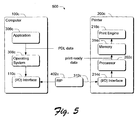
- Figs. 3-5 show block diagrams of exemplary printing systems.
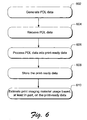
- Fig. 6 shows a flow diagram that describes acts in a method in accordance with one embodiment.
- page description language data or "PDL” data is generated or otherwise produced on a host computing device.
- a page description language specifies the arrangement of a printed page through commands from a computer that the printer carries out.
- PCL Hewlett Packard's Printer Control Language
- Postscript are the two most commonly used PDLs.
- Modern PDLs describe page elements as geometrical objects, such as lines, arcs, and so on.
- PDLs define page elements independently of printer technology, so that a page's appearance should be consistent regardless of the specific printer used.
- PDL data is intended to include any representation whatsoever of a PDL that is created by a host computer.
- a host computing device includes any suitable computing device including, but not limited to, variously configured personal computers (“PCs”), Apple Macintosh products, and digital cameras.
- the PDL data comprises the digital data that is created by the host computing device and that contains the information that PDLs typically include.
- the PDL data is a device independent format that can provide instructions for displaying or printing an image ("print job") on various devices including printing devices.
- the PDL data comprising a print job can be processed into printer-ready data that is utilized to produce an image on a given printing device's print engine.
- the print-ready data can be considered as device specific data that can comprise a series of dots or pixels comprising an individual page to be printed.
- pixel means the smallest unit of area to which a printing device can either apply or not apply a print imaging material.
- the term "printing device” is intended to include any device whatsoever that is capable of rendering, displaying or printing an image corresponding to the PDL data. Specific examples of printing devices include, without limitation, printers such as laser and ink jet printers, digital presses, facsimile machines, copying machines and the like.
- the print-ready data can be analyzed, either before or after printing, to estimate an amount of print imaging material (such as ink or toner) that the printing device used, or will use, to print the print job.
- this analysis can comprise determining a total number of pixels in a unit of the print-ready data and a sub-set of the pixels to which a print imaging material is to be applied. This can allow an accurate estimation of print imaging material usage.
- Fig. 1 is a block diagram showing exemplary components of a host computing device in the form of a computer 100.
- Computer 100 includes a processor 102, a memory 104 (such as ROM and RAM), user input devices 106, a disk drive 108, input/output (I/O) interfaces 110 for inputting and outputting data, a floppy disk drive 112, and a CD-ROM drive 114.
- Processor 102 performs various instructions to control the operation of computer 100.
- User input devices 106 include a keyboard, mouse, pointing device, or other mechanism for inputting information to computer 100.
- I/O interfaces 110 provide a mechanism for computer 100 to communicate with other devices.
- Fig. 2 is a block diagram showing exemplary components of one type of printing device in the form of a printer 200. It will be appreciated and understood that the illustrated printer constitutes but one exemplary printing device and is not intended to be limiting in any way. Accordingly, other printing devices can be used in connection with the inventive techniques and systems described herein. These other printing devices can have components that are different from, or additional to, those described immediately below.
- Printer 200 includes a processor 202 and several memory mechanisms including an electrically erasable programmable read-only memory (EEPROM) 204, and a random access memory (RAM) 206.
- Processor 202 processes various instructions necessary to operate the printer 200 and communicate with other devices.
- EEPROM 204 and RAM 206 store various information such as configuration information, fonts, templates, data being printed, and menu structure information.
- a particular printer may also contain a ROM (non-erasable) in place of or in addition to EEPROM 204.
- a printer may alternatively contain a flash memory device in place of or in addition to EEPROM 204.
- Printer 200 also includes a disk drive 212, and input/output (I/O) interface(s) 214.
- I/O interface(s) can include, but are not limited to, serial/parallel interfaces, and network interfaces.
- Disk drive 212 provides additional memory for data being printed or other information used by the printer 200.
- RAM 206 and disk drive 212 are illustrated in Fig. 2, a particular printer may contain either RAM 206 or disk drive 212, depending on the storage needs of the printer. For example, an inexpensive printer may contain a small amount of RAM 206 and no disk drive 212, thereby reducing the manufacturing cost of the printer.
- An I/O interface can comprise a network interface that provides a connection between printer 200 and a data communication network.
- a network interface can allow devices coupled to a common data communication network to send print jobs, menu data, and other information to printer 200 via the network.
- an I/O interface comprising a serial/parallel interface provides a data communication path directly between printer 200 and another device, such as a workstation, server, or other computing device.
- some exemplary printing devices may employ a single I/O interface, while others employ multiple I/O interfaces.
- Printer 200 also includes a print engine 210 that includes mechanisms that are arranged to selectively apply a print imaging material (e.g., liquid ink, toner, etc.) to a print media (e.g., paper, plastic, fabric, etc.) in accordance with print-ready data corresponding to a print job.
- a print imaging material e.g., liquid ink, toner, etc.
- Suitable printers can be configured to apply one or more colors of print imaging material to the print media. For example, some suitable printers are configured to apply a single color of print imaging material. Other suitable printers can be configured to apply 4 or 8 colors of print imaging material, among others.
- the print engine 210 can comprise conventional laser or inkjet mechanisms, among others.
- a laser printing mechanism selectively causes toner to be applied to an intermediate surface of a drum or belt.
- the intermediate surface can then be brought within close proximity of a print media in a manner that causes the toner to be transferred to the print media in a controlled fashion.
- the toner on the print media can then be more permanently fixed to the print media, for example, by selectively applying thermal energy to the toner.
- a laser printer is an example of a "half-tone printer.”
- a half-tone printer With a half-tone printer, a given unit or pixel of the print media either receives print imaging material or it does not.
- Such printers achieve various shades and colors by creating an agglomeration of adjacent units, which when viewed by the human eye, appear in as a desired image.
- Other suitable printer types will be recognized by the skilled artisan.
- Print engine 210 can also be configured to support duplex printing, for example, by selectively flipping or turning the print media as required to print on both sides.
- print engine 210 can include any of these various types.
- Printer 200 also contains a user interface/menu browser 208 and a display panel 218.
- User interface/menu browser 208 allows the user of the printer to navigate the printer's menu structure.
- User interface 208 may be a series of buttons, switches or other indicators that are manipulated by the user of the printer.
- Display panel 218 is a graphical display that provides information regarding the status of the printer and the current options available through the menu structure.
- Fig. 3 shows an exemplary system 300 comprising a computer 100a communicably coupled to a printer 200a.
- the computer 100a comprises one or more applications 306, and an operating system 308.
- the operating system 308 and applications 306 can run on a processor, such as processor 102 described above.
- Application(s) 306 can comprise any suitable applications that permit a user to create a document for printing.
- Application 306 and operating system 308 cooperate to provide PDL data.
- An exemplary application might be a word processing, or spreadsheet application, among others.
- the PDL data can represent various page images.
- the pages can include text, graphics, and scanned or computer-generated images among others.
- the PDL data can include commands that define graphic states for each page or sub-set of a page.
- the graphic states are sets of attributes such as angle, scale factor, type-font, location etc. describing the image.
- PDL data can be sent from the computer's I/O interface 110a coupled to a bus 312.
- the PDL data can be received from bus 312 by an I/O interface 214a of printer 200a.
- the PDL data can be processed by the printer's processor 202a to print-ready data.
- the PDL data can be stored in memory 314 before processing. Suitable memory is described above in relation to Fig. 2. Further embodiments can store the print-ready data until utilized in association with the print engine.
- the processor 202a can comprise a rastor image processor (RIP).
- the RIP can generate data regarding multiple pixels.
- a bit map comprising data regarding multiple pixels can be formed by the RIP.
- a bit map can be organized into suitable distinct units.
- a suitable unit can comprise a printable page.
- a bit map of a given page can contain data about every pixel comprising that page.
- a bit map can be created for each color that the printer is capable of printing. So for example, on a four color printer, a one page print job can be represented as 4 individual monochromatic bit maps; one for each page for each color.
- While some suitable embodiments utilize one page bit maps, other embodiments can utilize other bit map sizes. For example, some embodiments can group the print-ready data into bands which are geometrical subsets of a page. Those of skill in the art will recognize other suitable configurations.
- an individual pixel may have a group of bits dedicated to describing it, and then the next pixel is described in a corresponding manner.
- a first pixel may have four concurrent bits dedicated to it, one corresponding to the presence or absence of each color.
- the next four bits describe the next pixel, and so on.
- data can be obtained form various types of bit maps.
- the bit map data can be in any suitable format; examples include, but are not limited to, BMP, TIFF, GIF, and JPEG.
- the RIP converts the PDL data to TIFF format files.
- individual monochromatic TIFF files can be made for each page; the number of TIFF files corresponding to the number of colors of print-imaging material that the printer possesses multiplied by the number of pages in a print job. For example, for a one page print job, a printing device that has only one color of print imaging material can form a single one page bit map. Similarly, a printing device that has eight colors of print imaging material can form a monochromatic bit map page for each color, resulting in eight TIFF files.
- a suitable printing device can process PDL data into print-ready data in accordance with various suitable parameters. Commonly processing the PDL data to print-ready data can include incorporating adjustments for a given printing device and/or print engine.
- PDL data may describe a "desired image” which in this example comprises the character "e” in a specific font size and type.
- the PDL data can further describe the desired image as being a desired shade of blue color, and a location where the desired image should appear.
- the RIP can process this data into print-ready data that will cause certain pixels to receive blue print imaging material while other pixels will not receive print imaging material.
- printers and/or print engines can employ various algorithms to produce a print image which closely approximates the desired image, as will be recognized by one of skill in the art.
- Such algorithms can contain various compensations for human perception of color shades which are often not linear. For example, one line of printers may achieve a desired shade by coloring 40 percent of the pixels while another printer line may require 50 percent coverage.
- the print-ready data can be accessed to estimate an amount of print imaging material required for a print job on a given printing device.
- the printing device's processor 202a can access the print-ready data to estimate an amount of print imaging material required for the print job.
- the processor can access the print-ready data from memory 314.
- the print-ready data is stored as individual TIFF files comprising individual monochromatic bit maps
- the processor can access each monochromatic page. Using this data, a number of pixels on each page and which of those pixels are to have ink applied to them can be calculated or otherwise estimated. This can be achieved in one embodiment by counting the number of pixels that are to have ink applied to them, counting the total number of pixels on the page, and dividing the later into the former to calculate the coverage.
- an estimation of print imaging material usage can be determined by, among other suitable ways, determining an average number of pixels that a given unit of print imaging material will cover. For example, an amount of pixels that can be covered with a given amount of print imaging material can be predetermined for a given printer type. The skilled artisan will recognize various suitable techniques for establishing such a figure.
- a container containing print imaging material can be weighed and then installed in a given model of a printing device. A known number of pixels can then have print imaging material applied thereon. The container can then be removed and weighed again, the difference between the first and second weights comprising an amount of print imaging material used. So for example, applying print imaging material to 1,000,000 pixels may require one gram of print imaging material. Utilizing this predetermined value in combination with determining a number of pixels to be "covered" in a print job allows an estimate of print imaging material usage to be determined.
- suitable embodiments can make estimations for usage for each of the colors the printing device is capable of printing.
- Other suitable embodiments can provide data on a per page basis and/or on a complete print job basis, among others. Further, where it is desired to make multiple copies of the same print job, an amount of print imaging material usage for the total number of copies can be determined.
- Print imaging material usage estimations based on the print-ready data can be more accurate than those made from PDL data.
- the print-ready data can more accurately portray how a given printer will achieve a desired image contained in the PDL data than can be established from analyzing the PDL data or other methods.
- the print imaging material usage information can, in some embodiments, be displayed for a user. Suitable display devices are described above in relation to Figs. 1 and 2 above. In some embodiments, the display can be on the printing device, while other suitable embodiments can display the information on the host computing device. Other suitable embodiments will be recognized by the skilled artisan.
- Fig. 4 shows another exemplary system 400.
- the system comprises a computer 100b and a printer 200b.
- the computer has an application 306b and an operating system 308b.
- PDL data can be produced in the operating system 308b and application 306b.
- the computer can also contain a RIP 402.
- the computer can run software and/or firmware that can allow the computer to achieve the functionality of a RIP to process PDL data into print-ready data appropriate for a printing device to which the computer can be functionally coupled.
- I/O Interface 110b can be coupled to bus 312b and ultimately to printer 200b via I/O interface 214b.
- the printer's processor 202b and memory 314b can receive the print-ready data and cause pages to be rendered accordingly by print engine 218b.
- the exemplary computer 100b can be coupled to other printing devices in addition to printer 200b as shown here. Depending upon various characteristics of the other printing devices', computer 100b can contain a different RIP for each of the different types of printing devices to which it is coupled. In some of these embodiments, a PDL file could be ripped according to a particular printing device selected by a user. The RIPed data can then be processed by the computer to estimate print imaging material usage.
- a PDL file can be run through a RIP corresponding to each of several different printing devices to which the computer is coupled. This can allow for print-ready data to be formed for the print job for each of the printing devices.
- the print-ready data for each different printing device can be analyzed to determine potential print imaging material usage. In this way, a comparison of the print imaging material usage of the different printing devices can be compared for that particular print job. Among other advantages, this can allow the most cost effective printing device to be utilized for the print job.
- Fig. 5 shows another exemplary system 500.
- the system comprises a computer 100c coupled to a printer 200c.
- the computer 100c has an application 306c and an operating system 308c.
- PDL data can be produced in the operating system 308c and application 306c.
- the PDL data can be output via I/O interface 110c to a bus 312c or other suitable communication device.
- This embodiment has a freestanding processing device 502 comprising a RIP that can process the PDL data from the computer 100c into print-ready data for a given printing device 200c.
- the print-ready data can be sent via the bus 312c to an I/O interface 214c of printing device 200c.
- the processing device 502 can further have software and/or firmware for accessing the print-ready data to estimate print imaging material usage for the print-ready data.
- the estimated print imaging material usage can in some embodiments be displayed for a user, either prior to, or subsequent to, printing.
- the processing device can have display capabilities, while in other embodiments, the print imaging material usage information can be sent to another device, such as computer 100c and/or printer 200c for display.
- the embodiments described above have processed PDL data into print-ready data at one location such as a printing device or a computing device and then processed the print-ready data to determine print imaging material usage at that same location.
- a printing device can receive PDL data and process the PDL data to print-ready data.
- the print-ready data can be accessed and analyzed by a host computing device to estimate an amount of print imaging material usage associated with the print-ready data.
- Fig. 6 is a flow diagram that describes acts in a method in accordance with one embodiment.
- the acts can be implemented in any suitable hardware, software, firmware or combination thereof.
- the acts are implemented in software. All of the described acts need not be present in a particular embodiment. Further, the acts described below may occur on different devices comprising an exemplary system.
- the exemplary method can generate PDL data.
- PDL data can comprise a document which a user desires to print.
- the PDL data can be generated on various suitable applications embodied, for example, on a host computing device, examples of which are described above.
- the method can further receive PDL data as shown at 604.
- the PDL data can be received by a printing device or a freestanding RIP among others.
- the method can process PDL data into print-ready data as shown at 606.
- Such an act can, in some embodiments, comprise RIPing the PDL data.
- the act of processing can be achieved by a processing device configured with suitable firmware or software as described above. Such processing can include various compensations that allow a given printing device to better approximate a desired image described in the PDL data.
- Act 608 can store the print-ready data. This can allow the print-ready data to be generated by the processor regardless of the availability of the print engine to actually render a printed image from the print-ready data. Some suitable memory components for storing the print-ready data are described above.
- the method can, as shown at 610, estimate print imaging material usage based, at least in part, on the print-ready data. This can be achieved in some embodiments by accessing the print-ready data stored as bit map images.
- the bit map images can describe a number of pixels contained therein, and a subset of those pixels to which print imaging material is to be applied. Some embodiments can form a monochromatic bit map page for each individual page to be printed.
- Some of these embodiments can determine a total number of pixels contained in the print-ready data, and which of those pixels receives print-imaging material.
- print-imaging material usage can be estimated per color, per page, total usage, or any other combination which can be desirable for a user.
- Such information can be displayed in a manner and location suitable for a user. This can be advantageous in allowing a user to accurately estimate print imaging material usage before actually printing.
- the print imaging material usage estimations can also be conducted on multiple different printing device models to allow the user to compare relative print-imaging material usage and therefore cost. This can allow the user to advantageously select one of the printing devices based, at least in part, on relative print-imaging material usage.
- Another application can be to track supplies in open loop systems.
- the amount of ink or toner that was loaded into a printing device is often known and/or controlled. As printing progresses, it has previously been difficult to accurately determine the current amount of ink in the printing device.
- the amount of ink remaining in the printing device can be determined and printing stopped before the supply becomes inadequate for proper printing.
- the same can apply to estimating if there is enough ink or toner in the printing device to print a document before allowing the document to be printed. This can be especially applicable in instances of unattended printing. For example, where a print job is started by a user and then the user leaves and returns subsequently to pick up the completed print job.
- Similar embodiments can be utilized with large format printers.
- a print job was started with an inadequate ink supply, and had to be stopped to add ink part way through the printing process, a visible band might be created in the print image due to ink drying on the print media during the time required to refill the ink supply.
- the amount of ink remaining in the printing device and the amount required to complete a desired print job can be compared to determine if the print job can be completed without adding ink to the printing device.
- the methods and systems described above enable a print job to be generated as PDL data.
- the PDL data can be processed into print-ready data appropriate for a given printing device.
- the print-ready data can be analyzed to provide an estimation of print-imaging material usage for the print job on a given printing device.
- estimating the print-imaging material as a function of the print-ready data a more accurate understanding of available or used resources can be provided.
- the ability to manage, organize and schedule consumables can be enhanced.
Landscapes
- Engineering & Computer Science (AREA)
- Theoretical Computer Science (AREA)
- Human Computer Interaction (AREA)
- Physics & Mathematics (AREA)
- General Engineering & Computer Science (AREA)
- General Physics & Mathematics (AREA)
- Accessory Devices And Overall Control Thereof (AREA)
- Record Information Processing For Printing (AREA)
Applications Claiming Priority (2)
| Application Number | Priority Date | Filing Date | Title |
|---|---|---|---|
| US10/286,533 US20040085551A1 (en) | 2002-10-31 | 2002-10-31 | Methods and systems for estimating print imaging material usage |
| US286533 | 2002-10-31 |
Publications (2)
| Publication Number | Publication Date |
|---|---|
| EP1452955A2 true EP1452955A2 (de) | 2004-09-01 |
| EP1452955A3 EP1452955A3 (de) | 2006-06-21 |
Family
ID=32175482
Family Applications (1)
| Application Number | Title | Priority Date | Filing Date |
|---|---|---|---|
| EP03256781A Ceased EP1452955A3 (de) | 2002-10-31 | 2003-10-28 | Verfahren und System um die Verwendung von Druckerverbrauchsmaterial abzusschätzen |
Country Status (3)
| Country | Link |
|---|---|
| US (1) | US20040085551A1 (de) |
| EP (1) | EP1452955A3 (de) |
| JP (1) | JP2004148832A (de) |
Families Citing this family (6)
| Publication number | Priority date | Publication date | Assignee | Title |
|---|---|---|---|---|
| US20020105668A1 (en) * | 1999-01-20 | 2002-08-08 | Lilland Kevin R. | Print consumables monitoring |
| US8661332B2 (en) | 2004-04-30 | 2014-02-25 | Microsoft Corporation | Method and apparatus for document processing |
| US7383500B2 (en) | 2004-04-30 | 2008-06-03 | Microsoft Corporation | Methods and systems for building packages that contain pre-paginated documents |
| US7880918B2 (en) * | 2004-05-19 | 2011-02-01 | Microsoft Corporation | System and method for generating unified image output |
| US8223358B2 (en) * | 2006-04-28 | 2012-07-17 | Ricoh Production Print Solutions LLC | Printer output coverage estimation system |
| WO2009014520A1 (en) * | 2007-07-25 | 2009-01-29 | Hewlett-Packard Development Company, L.P. | Stabilization of ink concentration in a solid ink add system |
Citations (1)
| Publication number | Priority date | Publication date | Assignee | Title |
|---|---|---|---|---|
| US6356359B1 (en) * | 1998-01-20 | 2002-03-12 | Electronics For Imaging, Inc | Toner usage estimation system |
Family Cites Families (7)
| Publication number | Priority date | Publication date | Assignee | Title |
|---|---|---|---|---|
| US5592298A (en) * | 1994-06-03 | 1997-01-07 | Xerox Corporation | Apparatus and method for detecting digitized image area coverage by counting pixels |
| US6549657B2 (en) * | 1995-04-06 | 2003-04-15 | Canon Kabushiki Kaisha | Image processing apparatus and method |
| US6029021A (en) * | 1996-12-20 | 2000-02-22 | Fuji Xerox Co., Ltd. | Image forming apparatus having an adaptive mode density control system |
| JP3486517B2 (ja) * | 1997-01-31 | 2004-01-13 | キヤノン株式会社 | 印刷システム及び印刷制御方法 |
| US6785481B2 (en) * | 2001-04-27 | 2004-08-31 | Xerox Corporation | Developer housing with variable speed mixing for improving material life and performance |
| JP4051894B2 (ja) * | 2001-05-09 | 2008-02-27 | 富士ゼロックス株式会社 | インクジェット記録装置 |
| US6801731B2 (en) * | 2002-07-25 | 2004-10-05 | Hewlett-Packard Development Company, L.P. | Pre-flight estimation of cost for print jobs |
-
2002
- 2002-10-31 US US10/286,533 patent/US20040085551A1/en not_active Abandoned
-
2003
- 2003-10-28 EP EP03256781A patent/EP1452955A3/de not_active Ceased
- 2003-10-31 JP JP2003371553A patent/JP2004148832A/ja active Pending
Patent Citations (1)
| Publication number | Priority date | Publication date | Assignee | Title |
|---|---|---|---|---|
| US6356359B1 (en) * | 1998-01-20 | 2002-03-12 | Electronics For Imaging, Inc | Toner usage estimation system |
Also Published As
| Publication number | Publication date |
|---|---|
| JP2004148832A (ja) | 2004-05-27 |
| US20040085551A1 (en) | 2004-05-06 |
| EP1452955A3 (de) | 2006-06-21 |
Similar Documents
| Publication | Publication Date | Title |
|---|---|---|
| EP2317753B1 (de) | Drucksteuerverfahren und -Vorrichtung | |
| US7999971B2 (en) | Optimization techniques during processing of print jobs | |
| US8711392B2 (en) | Information processing apparatus, information processing method, and program | |
| US8194258B2 (en) | Processing print jobs | |
| US5988899A (en) | In-RIP sorting of objects in the slow scan direction | |
| US8339667B2 (en) | Optimizing to-be printed objects during print job processing | |
| US20040205607A1 (en) | Printing method using Nup function, and computer readable recording medium storing computer program for executing the printing method | |
| EP1452955A2 (de) | Verfahren und System um die Verwendung von Druckerverbrauchsmaterial abzusschätzen | |
| US7310693B2 (en) | Method and apparatus for viewing on a client computer's display device a preview of a print document to be printed | |
| JP2019098580A (ja) | 画像形成装置 | |
| US20050213119A1 (en) | Processing print jobs according to size of to-be-printed objects and bands containing same | |
| CN102693097A (zh) | 图像处理系统和图像处理方法 | |
| US20050213142A1 (en) | Optimization techniques during processing of print jobs | |
| US8184304B2 (en) | System and method of operating a raster image processor | |
| JP2006159738A (ja) | 印刷制御装置およびそのデータ処理方法並びに記憶媒体。 | |
| US7310166B2 (en) | Information processing apparatus and method, and print control program | |
| US20040070784A1 (en) | Methods, computer media and devices for processing compressed data intended for printing | |
| US8908227B2 (en) | Image forming apparatus, image forming system, image data processing method, program, and storage medium | |
| JP2005182694A (ja) | 割付印刷システム | |
| KR100653054B1 (ko) | 인쇄시스템 및 인쇄방법 | |
| JPH09120345A5 (de) | ||
| JP2004102478A (ja) | 印刷システム、プリンタホスト、印刷装置およびプリンタドライバ | |
| JP3495876B2 (ja) | 文字出力装置および文字出力方法およびコンピュータが読み出し可能なプログラムを格納した記憶媒体 | |
| JP2002007088A (ja) | 印刷データ処理方法 | |
| JP2005148927A (ja) | 情報処理装置および印刷制御方法 |
Legal Events
| Date | Code | Title | Description |
|---|---|---|---|
| PUAI | Public reference made under article 153(3) epc to a published international application that has entered the european phase |
Free format text: ORIGINAL CODE: 0009012 |
|
| AK | Designated contracting states |
Kind code of ref document: A2 Designated state(s): AT BE BG CH CY CZ DE DK EE ES FI FR GB GR HU IE IT LI LU MC NL PT RO SE SI SK TR |
|
| AX | Request for extension of the european patent |
Extension state: AL LT LV MK |
|
| PUAL | Search report despatched |
Free format text: ORIGINAL CODE: 0009013 |
|
| AK | Designated contracting states |
Kind code of ref document: A3 Designated state(s): AT BE BG CH CY CZ DE DK EE ES FI FR GB GR HU IE IT LI LU MC NL PT RO SE SI SK TR |
|
| AX | Request for extension of the european patent |
Extension state: AL LT LV MK |
|
| 17P | Request for examination filed |
Effective date: 20061130 |
|
| AKX | Designation fees paid |
Designated state(s): DE FR GB |
|
| 17Q | First examination report despatched |
Effective date: 20100429 |
|
| STAA | Information on the status of an ep patent application or granted ep patent |
Free format text: STATUS: THE APPLICATION HAS BEEN REFUSED |
|
| 18R | Application refused |
Effective date: 20130808 |