EP1452210A1 - Paire de skis prévus pour la pratique de la glisse et notamment du ski alpin - Google Patents
Paire de skis prévus pour la pratique de la glisse et notamment du ski alpin Download PDFInfo
- Publication number
- EP1452210A1 EP1452210A1 EP04004339A EP04004339A EP1452210A1 EP 1452210 A1 EP1452210 A1 EP 1452210A1 EP 04004339 A EP04004339 A EP 04004339A EP 04004339 A EP04004339 A EP 04004339A EP 1452210 A1 EP1452210 A1 EP 1452210A1
- Authority
- EP
- European Patent Office
- Prior art keywords
- ski
- portions
- asymmetrical
- middle portion
- lateral
- Prior art date
- Legal status (The legal status is an assumption and is not a legal conclusion. Google has not performed a legal analysis and makes no representation as to the accuracy of the status listed.)
- Granted
Links
- 230000002787 reinforcement Effects 0.000 claims abstract description 12
- 238000005452 bending Methods 0.000 claims description 8
- 238000000429 assembly Methods 0.000 claims description 7
- 238000010276 construction Methods 0.000 description 6
- 230000003014 reinforcing effect Effects 0.000 description 5
- 238000000034 method Methods 0.000 description 3
- OKTJSMMVPCPJKN-UHFFFAOYSA-N Carbon Chemical compound [C] OKTJSMMVPCPJKN-UHFFFAOYSA-N 0.000 description 1
- 229920005830 Polyurethane Foam Polymers 0.000 description 1
- 239000004760 aramid Substances 0.000 description 1
- 229920006231 aramid fiber Polymers 0.000 description 1
- 229910052799 carbon Inorganic materials 0.000 description 1
- 239000002131 composite material Substances 0.000 description 1
- 238000005034 decoration Methods 0.000 description 1
- 239000000835 fiber Substances 0.000 description 1
- 239000006260 foam Substances 0.000 description 1
- 239000011521 glass Substances 0.000 description 1
- 238000011065 in-situ storage Methods 0.000 description 1
- 238000002347 injection Methods 0.000 description 1
- 239000007924 injection Substances 0.000 description 1
- 238000003754 machining Methods 0.000 description 1
- 239000002184 metal Substances 0.000 description 1
- 239000011496 polyurethane foam Substances 0.000 description 1
- 239000011347 resin Substances 0.000 description 1
- 229920005989 resin Polymers 0.000 description 1
- 239000002023 wood Substances 0.000 description 1
Images

Classifications
-
- A—HUMAN NECESSITIES
- A63—SPORTS; GAMES; AMUSEMENTS
- A63C—SKATES; SKIS; ROLLER SKATES; DESIGN OR LAYOUT OF COURTS, RINKS OR THE LIKE
- A63C5/00—Skis or snowboards
- A63C5/04—Structure of the surface thereof
- A63C5/0405—Shape thereof when projected on a plane, e.g. sidecut, camber, rocker
- A63C5/0411—Shape thereof when projected on a plane, e.g. sidecut, camber, rocker asymmetric
-
- A—HUMAN NECESSITIES
- A63—SPORTS; GAMES; AMUSEMENTS
- A63C—SKATES; SKIS; ROLLER SKATES; DESIGN OR LAYOUT OF COURTS, RINKS OR THE LIKE
- A63C5/00—Skis or snowboards
- A63C5/06—Skis or snowboards with special devices thereon, e.g. steering devices
- A63C5/07—Skis or snowboards with special devices thereon, e.g. steering devices comprising means for adjusting stiffness
Definitions
- the invention relates to a pair of skis intended for alpine skiing.
- an alpine ski is a composite structure which is formed from a core and various reinforcing layers above and below the core.
- the ski technique has also recently evolved with the technique known as "Carving".
- the dimension line of the skis has been increased, the length of the skis has been reduced.
- Cornering instead of putting your weight mainly on a ski, the skier keeps his support on the two skis that he keeps apart.
- An object which the invention proposes to achieve is to adapt the structure of the skis mentioned above to this new ski technique so as to improve the behavior of the skiing on snow.
- the ski according to the invention comprises a slender structure extending in a longitudinal direction and comprising a core, upper reinforcement sub-assemblies and bottom surrounding the core, a gliding sole bordered by two lateral edges by which the ski rests on its sliding surface, the structure of the ski comprising at least over a part of the length three juxtaposed portions, a middle portion located towards the longitudinal direction of the ski and two lateral portions located on either side of the portion median, the lateral portions being both more rigid in flexion and / or torsion than the middle portion.
- the ski is characterized by the fact that the lateral portions are asymmetrical by relative to a plane perpendicular to the gliding sole and passing through the direction longitudinal of the ski, and / or that the middle portion is asymmetrical with respect to said plane.
- the invention also relates to a pair of skis in which each of the skis presents a symmetrical construction of the other.
- the middle zone forms a sort of hinge between the two lateral zones which are more rigid and which find their support on the edges side.
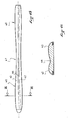
- Figure 1 is a side view of a ski according to a non-limiting mode of implementation work of the invention.
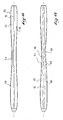
- Figure 2 shows the ski of Figure 1 in top view.
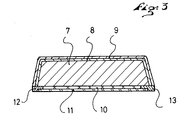
- Figure 3 is a sectional view of the ski of Figures 1 and 2 in the central area.
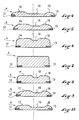
- Figures 4 to 10 show the ski in cross section through cutting planes IV-IV to X-X, respectively.
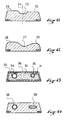
- Figures 11 to 14 are sectional views of a ski which illustrate different construction variants.
- Figure 15 shows a top view of a ski according to another variant of implementation work of the invention.
- Figure 16 is a sectional view of the ski of Figure 11 along the section plane XVI-XVI.
- Figures 17 and 18 relate to other alternative embodiments of the invention.
- Ski 1 represented in FIGS. 1 and 2 has the shape of an elongated beam according to a longitudinal direction whose trace in the plane of Figure 2 is shown schematically by the line mixed 2. At rest, the ski is arched and it rests on the ground by two support zones which are usually calls the front and rear contact lines. These lines are identified in 6a, 6b in Figure 1.
- the ski 1 has a central zone 3 also called the skate, and front and rear zones 4 and 5 which terminate respectively in front and behind of the contact lines with the tip and the heel.
- ski The internal structure of the ski of Figures 1 and 2 is illustrated in Figure 3 which is a view in section of the ski in the central zone 3.
- This structure is of a traditional type.
- Ski comprises a central core 7 which is of any suitable type, for example it is made of wood, or of especially polyurethane foam. In the case of a foam core, the core can be shaped before being placed in the mold or injected in situ.
- the core is covered on top of a sub-assembly upper reinforcement 8, comprising for example one or more layers of fibers of glass, carbon, aramid fibers or other impregnated with resin, then a layer 9 decoration.
- the reinforcing sub-assembly may also include a reinforcing layer metallic. It can also have a variable nature over the length of the ski.
- the core rests on a lower reinforcement sub-assembly 10 which is for example of the same nature as the subassembly 8, and a gliding sole 11.
- the sole is bordered laterally by two metal edges 12 and 13.
- edges are curved along the length of the ski according to curves which define the ski's dimension lines.
- these curves can be symmetrical or asymmetrical with respect to a plane perpendicular to the sliding surface and passing through the longitudinal direction 2. This plane will be called in the following the plane longitudinal median of the ski.
- the front and rear zones 4 and 5 of the ski comprise three portions arranged transversely side by side. These portions extend over the longest length of the front and rear zones, i.e. at least up to the lines front and rear contact 6a, 6b.
- the front zone 4 is formed of three portions, two lateral portions 14 and 15 which extend along the side edges of the ski and a middle portion 16 which is located between the two side portions.
- the rear zone 5 comprises two lateral portions 17 and 18 and a middle portion 19.
- Figures 4 to 10 show different consecutive sections of the ski along its front zone 4, its central zone 3 and its rear zone 5. For reasons of simplicity, these figures do not show the internal structure of the ski. For this internal structure we refer to what has been described above in relation to FIG. 3.
- the reinforcement sub-assemblies upper and lower 8 and 10 are further apart from each other in the side portions 14, 15 and 17, 18 than in the middle portions 16 and 19. More precisely, the spacing maximum of the lower and upper reinforcement subsets is greater in the portion 14 than in the portion 15. It follows that locally the ski is more rigid in torsion and / or in flexion in these lateral portions than in these median portions. These are indeed the reinforcing sub-assemblies by their nature and their spacing which mainly determine flexural and / or torsional properties.
- the middle portions form a kind of hinge along the length of the front and rear areas, and the flexural and / or torsional stiffness is mainly concentrated towards the side edges of the ski.
- the variation in spacing of the reinforcement sub-assemblies is obtained by varying the thickness of the core 7, either by machining or during its injection into the mold due to the shape of the mold.
- the lateral portions are asymmetrical with respect to the median plane ski.
- the asymmetry concerns the structure and / or the external shape of the lateral portions. She may also concern the middle portions. So we can manage the bending and / or twisting of the right and left lateral portions of the ski.
- the distance between the reinforcement sub-assemblies varies over a large amplitude, and extend over a greater width than the portions 15 and 18.
- the ski is more rigid in bending and / or torsion along the edge 12 than the other square.
- middle portions 16 and 19 are offset to the edge 13 where the rigidity is lower. This is partly due to the asymmetry of the portions lateral which are transferred to the middle portion.
- the other ski of the pair would be constructed so symmetrical with mirror symmetry so that overall we find the same rigidity on the outside of the skis on the one hand and on the inside on the other.
- a ski needs to be less rigid on the inner edge than on the outer edge, but this is not limiting.
- FIG. 11 illustrates an alternative embodiment where the middle portion 23 of the ski is symmetrical with respect to the median plane shown diagrammatically at 24, and where the lateral portions 25 and 26 are asymmetrical with respect to this same plane.
- Figure 12 shows another variant.
- the middle portion 27 is itself asymmetrical.
- the concept of central portion and middle portion is relatively vague.
- the middle portion can be defined as forming a kind of hinge between the two lateral portions which border it and which have greater rigidity.
- FIG. 13 shows two tubes 30 and 31 embedded in the core 32. These tubes form a mechanical unit for reinforcing the core. So according to the transverse direction of the ski, there are indeed two lateral portions 34 and 35, those which contain the tubes, which have a rigidity greater than the middle portion 36 located towards the plane ski median. According to the invention these tubes 30 and 31 have a rigidity due to their diameter or because of their section as shown in Figure 14 with the tubes 38 and 39.
- the ski represented in these figures 13 and 14 has a symmetrical external shape by in relation to the median plane, but of course its external shape could be asymmetrical, that is to say that we could combine this construction variant with the other modes of construction which are described here.
- the reinforcement units could include several tubes located side by side.
- FIG. 15 illustrates the fact that the lateral portions 42, 43 and median 44 can extend over the entire length of the ski.
- the lateral portions 42 and 43 are asymmetrical in the front and rear zones 46, 48 of the ski, and they are symmetrical in the middle zone 47.
- an interface wedge can be provided in the central zone 47 to allow the mounting of the retaining elements.
- FIG. 17 shows a ski with lateral portions 50 and 52 symmetrical towards the front and rear ends of the ski, and asymmetrical towards the central area.
- FIG. 18 illustrates the fact that the asymmetry of the lateral portions 60 and 62 can be performed in correlation with the asymmetry of the dimension lines of edges 63 and 64.
- the asymmetry of the lateral portions is performed as a function of the asymmetry of the lines of odds.
- the middle portion 61 is made in geometry homothety with the dimension lines, i.e. with points narrow offset.
- the ski which has just been described therefore has a reduced weight and inertia. due to the middle portion which has a weakened structure. The presence of this middle zone allows the two lateral portions to be decoupled from each other in their bending behavior or twist.
- the asymmetry allows for lateral portions with different properties of bending and / or torsion, and thus manage in a way different support of the ski on each of its edges.
Landscapes
- Fittings On The Vehicle Exterior For Carrying Loads, And Devices For Holding Or Mounting Articles (AREA)
- Professional, Industrial, Or Sporting Protective Garments (AREA)
- Materials Applied To Surfaces To Minimize Adherence Of Mist Or Water (AREA)
- Road Paving Structures (AREA)
Abstract
Description
Claims (11)
- Ski pour la pratique de la glisse ayant une structure longiligne s'étendant selon une direction longitudinale (2) et comprenant un noyau (7, 32), des sous-ensembles de renfort supérieur et inférieur (8, 10) entourant le noyau, une semelle de glisse (11) bordée de deux carres (12, 13) latérales par lesquelles le ski prend appui sur sa surface de glisse, la structure du ski comprenant au moins sur une partie de la longueur trois portions juxtaposées (14-15-16, 17-18-19, 24-25-26, 27-29-30, 34-35-36, 42-43-44, 50-51-52, 60-61-62), une portion médiane (16, 19, 23, 37, 36, 44, 51, 61) située vers la direction longitudinale du ski et deux portions latérales (14-15, 17-18, 25-26, 29-30, 34-35, 42-43, 50-52, 60-62) situées de part et d'autre de la portion médiane, les portions latérales étant toutes deux plus rigides en flexion et/ou torsion que la portion médiane, caractérisé par le fait que les portions latérales (14-15, 17-18, 25-26, 29-30, 34-35, 42-43, 50-52, 60-62) sont asymétriques par rapport à un plan perpendiculaire à la semelle de glisse et passant par la direction longitudinale du ski, et/ou que la portion médiane (16, 19, 23, 37, 36, 44, 51, 61) est asymétrique par rapport audit plan.
- Ski selon la revendication 1, caractérisé par le fait que l'écartement maximum des sous-ensembles de renfort supérieur et inférieur (8, 10) est au moins localement plus grand dans l'une (14, 25) des portions latérales que dans l'autre (15, 26).
- Ski selon la revendication 1, caractérisé par le fait que la largeur de l'une (14) des portions latérales est plus grande que la largeur de l'autre (15).
- Ski selon la revendication 1, caractérisé par le fait que la portion médiane (16) est déportée vers l'une (13) des carres du ski.
- Ski selon la revendication 1, caractérisé par le fait que la portion médiane (27) est asymétrique par rapport au plan perpendiculaire à la semelle de glisse et passant par la direction longitudinale du ski.
- Ski selon la revendication 5, où des unités de renfort formées par des tubes (30, 31, 38, 39) sont noyées dans le noyau, caractérisé par le fait que les tubes (30, 31, 38, 39) sont asymétriques par rapport au plan perpendiculaire à la semelle de glisse et passant par la direction longitudinale du ski.
- Ski selon la revendication 6, caractérisé par le fait que les tubes (30, 31) ont un diamètre différent.
- Ski selon la revendication 6, caractérisé par le fait que les tubes (38, 39) ont une section de forme différente.
- Ski selon la revendication 1 où les portions latérales et médianes s'étendent sur toute la longueur du ski, caractérisé par le fait que les portions latérales ((42, 43, 50, 52) sont asymétriques dans au moins l'une des zones avant arrière ou centrale (46, 47, 48, 53, 54, 55).
- Ski selon la revendication 1 où les lignes de cotes des carres (63, 64) sont asymétriques, caractérisé par le fait que les portions latérales (60, 62) sont asymétriques dans une relation d'homothétie avec l'asymétrie des lignes de cotes.
- Paire de skis pour la pratique de la glisse comprenant deux skis, caractérisée par le fait que les deux skis sont conformes à l'une quelconques des revendications 1 à 10 précédentes avec une symétrie de miroir l'un par rapport à l'autre.
Applications Claiming Priority (2)
| Application Number | Priority Date | Filing Date | Title |
|---|---|---|---|
| FR0302569A FR2851475B1 (fr) | 2003-02-26 | 2003-02-26 | Paire de skis prevus pour la pratique de la glisse et notamment du ski alpin |
| FR0302569 | 2003-02-26 |
Publications (2)
| Publication Number | Publication Date |
|---|---|
| EP1452210A1 true EP1452210A1 (fr) | 2004-09-01 |
| EP1452210B1 EP1452210B1 (fr) | 2009-10-07 |
Family
ID=32749759
Family Applications (1)
| Application Number | Title | Priority Date | Filing Date |
|---|---|---|---|
| EP04004339A Expired - Lifetime EP1452210B1 (fr) | 2003-02-26 | 2004-02-26 | Paire de skis prévus pour la pratique de la glisse et notamment du ski alpin |
Country Status (4)
| Country | Link |
|---|---|
| EP (1) | EP1452210B1 (fr) |
| AT (1) | ATE444785T1 (fr) |
| DE (1) | DE602004023448D1 (fr) |
| FR (1) | FR2851475B1 (fr) |
Citations (3)
| Publication number | Priority date | Publication date | Assignee | Title |
|---|---|---|---|---|
| EP0580522A1 (fr) * | 1992-06-11 | 1994-01-26 | Skis Rossignol S.A. | Ski à profil perfectionné |
| FR2731159A1 (fr) * | 1995-03-02 | 1996-09-06 | Dynastar Skis Sa | Procede pour la fabrication d'une planche de glisse dont la face superieure presente des evidements et planche de glisse ainsi obtenue |
| EP1239929A1 (fr) * | 1999-12-22 | 2002-09-18 | ATOMIC Austria GmbH | Appareil de glisse en forme de planche, en particulier ski et planche a neige |
Family Cites Families (6)
| Publication number | Priority date | Publication date | Assignee | Title |
|---|---|---|---|---|
| EP0081834B1 (fr) | 1981-12-15 | 1985-11-13 | DYNAMIC Société Anonyme dite: | Ski du type à noyau à structure allégée et son procédé de fabrication |
| FR2611518B1 (fr) * | 1987-02-27 | 1989-11-17 | Salomon Sa | Ski a amortissement reparti |
| FR2664172B1 (fr) | 1990-07-09 | 1992-09-18 | Salomon Sa | Ski a face superieure nervuree. |
| FR2684012B1 (fr) * | 1991-11-22 | 1994-08-05 | Rossignol Sa | Ski en forme, de section non rectangulaire. |
| FR2722418B1 (fr) | 1994-07-13 | 1996-09-27 | Salomon Sa Societe Anonyme | Ski alpin en forme et a profil evolutif ameliore |
| FR2729866B1 (fr) * | 1995-01-30 | 1997-04-11 | Rossignol Sa | Perfectionnement aux skis a coque pourvus de chants de support de la coque |
-
2003
- 2003-02-26 FR FR0302569A patent/FR2851475B1/fr not_active Expired - Fee Related
-
2004
- 2004-02-26 EP EP04004339A patent/EP1452210B1/fr not_active Expired - Lifetime
- 2004-02-26 DE DE602004023448T patent/DE602004023448D1/de not_active Expired - Fee Related
- 2004-02-26 AT AT04004339T patent/ATE444785T1/de not_active IP Right Cessation
Patent Citations (3)
| Publication number | Priority date | Publication date | Assignee | Title |
|---|---|---|---|---|
| EP0580522A1 (fr) * | 1992-06-11 | 1994-01-26 | Skis Rossignol S.A. | Ski à profil perfectionné |
| FR2731159A1 (fr) * | 1995-03-02 | 1996-09-06 | Dynastar Skis Sa | Procede pour la fabrication d'une planche de glisse dont la face superieure presente des evidements et planche de glisse ainsi obtenue |
| EP1239929A1 (fr) * | 1999-12-22 | 2002-09-18 | ATOMIC Austria GmbH | Appareil de glisse en forme de planche, en particulier ski et planche a neige |
Also Published As
| Publication number | Publication date |
|---|---|
| FR2851475A1 (fr) | 2004-08-27 |
| FR2851475B1 (fr) | 2006-10-13 |
| EP1452210B1 (fr) | 2009-10-07 |
| ATE444785T1 (de) | 2009-10-15 |
| DE602004023448D1 (de) | 2009-11-19 |
Similar Documents
| Publication | Publication Date | Title |
|---|---|---|
| EP0622096B1 (fr) | Planche de surf de neige | |
| EP0543743B2 (fr) | Ski en forme de section non rectangulaire | |
| EP0577947B1 (fr) | Ski nervuré muni d'un support | |
| EP0744194B1 (fr) | Planche de glisse sur neige pourvue de chants auxiliaires de hauteur inférieure à celle de la planche | |
| EP0465794B1 (fr) | Ski à face supérieure nervurée | |
| EP0938917A1 (fr) | Dispositif interface entre un ski et des éléments de retenue d'une chaussure sur le ski | |
| EP1902758B1 (fr) | Planche de glisse pour la neige avec une fente longitudinale sur une extrémité au moins | |
| EP1145742B1 (fr) | Ski alpin | |
| WO1999040810A1 (fr) | Chaussure comportant un insert grind | |
| EP2000180A1 (fr) | Planche de glisse ou de roulage avec un renfort de fibres naturelles | |
| EP0628327B1 (fr) | Ski alpin à profil perfectionné | |
| EP1813320B1 (fr) | Planche de glisse sur neige comprenant deux éléments complémentaires associés à un organe de liaison | |
| EP0755703B1 (fr) | Planche de glisse comportant une plate-forme de réception et de surélévation des fixations de la chaussure | |
| EP1452210B1 (fr) | Paire de skis prévus pour la pratique de la glisse et notamment du ski alpin | |
| EP1484091B1 (fr) | Ski prévu pour la pratique du ski alpin | |
| EP1523375B1 (fr) | Chassis pour patin en ligne | |
| EP0723791B1 (fr) | Perfectionnement aux skis à coque pourvus de chants de support de la coque | |
| EP0661086B1 (fr) | Ski | |
| EP1264618B1 (fr) | Ski prévu pour la pratique du ski alpin | |
| FR2703257A1 (fr) | Surf de neige à profil perfectionné. | |
| FR2802438A1 (fr) | Planche de glisse | |
| EP3415206B1 (fr) | Planche de glisse | |
| EP0806228A1 (fr) | Ski | |
| EP1153633A1 (fr) | Ski prévu pour pratique du ski alpin | |
| FR2781384A1 (fr) | Ski presentant sur chacun de ses chants des elements de renforcement |
Legal Events
| Date | Code | Title | Description |
|---|---|---|---|
| PUAI | Public reference made under article 153(3) epc to a published international application that has entered the european phase |
Free format text: ORIGINAL CODE: 0009012 |
|
| AK | Designated contracting states |
Kind code of ref document: A1 Designated state(s): AT BE BG CH CY CZ DE DK EE ES FI FR GB GR HU IE IT LI LU MC NL PT RO SE SI SK TR |
|
| AX | Request for extension of the european patent |
Extension state: AL LT LV MK |
|
| 17P | Request for examination filed |
Effective date: 20041215 |
|
| AKX | Designation fees paid |
Designated state(s): AT BE CH DE IT LI SI |
|
| RBV | Designated contracting states (corrected) |
Designated state(s): AT CH DE IT LI SI |
|
| 17Q | First examination report despatched |
Effective date: 20070725 |
|
| GRAP | Despatch of communication of intention to grant a patent |
Free format text: ORIGINAL CODE: EPIDOSNIGR1 |
|
| RAP1 | Party data changed (applicant data changed or rights of an application transferred) |
Owner name: SALOMON S.A.S. |
|
| GRAS | Grant fee paid |
Free format text: ORIGINAL CODE: EPIDOSNIGR3 |
|
| GRAA | (expected) grant |
Free format text: ORIGINAL CODE: 0009210 |
|
| AK | Designated contracting states |
Kind code of ref document: B1 Designated state(s): AT CH DE IT LI SI |
|
| REG | Reference to a national code |
Ref country code: CH Ref legal event code: EP |
|
| REF | Corresponds to: |
Ref document number: 602004023448 Country of ref document: DE Date of ref document: 20091119 Kind code of ref document: P |
|
| PG25 | Lapsed in a contracting state [announced via postgrant information from national office to epo] |
Ref country code: SI Free format text: LAPSE BECAUSE OF FAILURE TO SUBMIT A TRANSLATION OF THE DESCRIPTION OR TO PAY THE FEE WITHIN THE PRESCRIBED TIME-LIMIT Effective date: 20091007 |
|
| PG25 | Lapsed in a contracting state [announced via postgrant information from national office to epo] |
Ref country code: AT Free format text: LAPSE BECAUSE OF FAILURE TO SUBMIT A TRANSLATION OF THE DESCRIPTION OR TO PAY THE FEE WITHIN THE PRESCRIBED TIME-LIMIT Effective date: 20091007 |
|
| PLBE | No opposition filed within time limit |
Free format text: ORIGINAL CODE: 0009261 |
|
| STAA | Information on the status of an ep patent application or granted ep patent |
Free format text: STATUS: NO OPPOSITION FILED WITHIN TIME LIMIT |
|
| 26N | No opposition filed |
Effective date: 20100708 |
|
| REG | Reference to a national code |
Ref country code: CH Ref legal event code: PL |
|
| PG25 | Lapsed in a contracting state [announced via postgrant information from national office to epo] |
Ref country code: CH Free format text: LAPSE BECAUSE OF NON-PAYMENT OF DUE FEES Effective date: 20100228 Ref country code: LI Free format text: LAPSE BECAUSE OF NON-PAYMENT OF DUE FEES Effective date: 20100228 |
|
| PG25 | Lapsed in a contracting state [announced via postgrant information from national office to epo] |
Ref country code: DE Free format text: LAPSE BECAUSE OF NON-PAYMENT OF DUE FEES Effective date: 20100901 |
|
| PG25 | Lapsed in a contracting state [announced via postgrant information from national office to epo] |
Ref country code: IT Free format text: LAPSE BECAUSE OF FAILURE TO SUBMIT A TRANSLATION OF THE DESCRIPTION OR TO PAY THE FEE WITHIN THE PRESCRIBED TIME-LIMIT Effective date: 20091007 |