EP1449582A1 - Transparent thin film and method for production thereof - Google Patents
Transparent thin film and method for production thereof Download PDFInfo
- Publication number
- EP1449582A1 EP1449582A1 EP01974722A EP01974722A EP1449582A1 EP 1449582 A1 EP1449582 A1 EP 1449582A1 EP 01974722 A EP01974722 A EP 01974722A EP 01974722 A EP01974722 A EP 01974722A EP 1449582 A1 EP1449582 A1 EP 1449582A1
- Authority
- EP
- European Patent Office
- Prior art keywords
- thin film
- transparent thin
- titania
- film according
- producing
- Prior art date
- Legal status (The legal status is an assumption and is not a legal conclusion. Google has not performed a legal analysis and makes no representation as to the accuracy of the status listed.)
- Withdrawn
Links
Images

Classifications
-
- C—CHEMISTRY; METALLURGY
- C23—COATING METALLIC MATERIAL; COATING MATERIAL WITH METALLIC MATERIAL; CHEMICAL SURFACE TREATMENT; DIFFUSION TREATMENT OF METALLIC MATERIAL; COATING BY VACUUM EVAPORATION, BY SPUTTERING, BY ION IMPLANTATION OR BY CHEMICAL VAPOUR DEPOSITION, IN GENERAL; INHIBITING CORROSION OF METALLIC MATERIAL OR INCRUSTATION IN GENERAL
- C23C—COATING METALLIC MATERIAL; COATING MATERIAL WITH METALLIC MATERIAL; SURFACE TREATMENT OF METALLIC MATERIAL BY DIFFUSION INTO THE SURFACE, BY CHEMICAL CONVERSION OR SUBSTITUTION; COATING BY VACUUM EVAPORATION, BY SPUTTERING, BY ION IMPLANTATION OR BY CHEMICAL VAPOUR DEPOSITION, IN GENERAL
- C23C18/00—Chemical coating by decomposition of either liquid compounds or solutions of the coating forming compounds, without leaving reaction products of surface material in the coating; Contact plating
- C23C18/02—Chemical coating by decomposition of either liquid compounds or solutions of the coating forming compounds, without leaving reaction products of surface material in the coating; Contact plating by thermal decomposition
- C23C18/06—Coating on selected surface areas, e.g. using masks
-
- B—PERFORMING OPERATIONS; TRANSPORTING
- B01—PHYSICAL OR CHEMICAL PROCESSES OR APPARATUS IN GENERAL
- B01J—CHEMICAL OR PHYSICAL PROCESSES, e.g. CATALYSIS OR COLLOID CHEMISTRY; THEIR RELEVANT APPARATUS
- B01J21/00—Catalysts comprising the elements, oxides, or hydroxides of magnesium, boron, aluminium, carbon, silicon, titanium, zirconium, or hafnium
- B01J21/06—Silicon, titanium, zirconium or hafnium; Oxides or hydroxides thereof
- B01J21/08—Silica
-
- B—PERFORMING OPERATIONS; TRANSPORTING
- B01—PHYSICAL OR CHEMICAL PROCESSES OR APPARATUS IN GENERAL
- B01J—CHEMICAL OR PHYSICAL PROCESSES, e.g. CATALYSIS OR COLLOID CHEMISTRY; THEIR RELEVANT APPARATUS
- B01J31/00—Catalysts comprising hydrides, coordination complexes or organic compounds
- B01J31/02—Catalysts comprising hydrides, coordination complexes or organic compounds containing organic compounds or metal hydrides
- B01J31/0231—Halogen-containing compounds
-
- B—PERFORMING OPERATIONS; TRANSPORTING
- B01—PHYSICAL OR CHEMICAL PROCESSES OR APPARATUS IN GENERAL
- B01J—CHEMICAL OR PHYSICAL PROCESSES, e.g. CATALYSIS OR COLLOID CHEMISTRY; THEIR RELEVANT APPARATUS
- B01J31/00—Catalysts comprising hydrides, coordination complexes or organic compounds
- B01J31/02—Catalysts comprising hydrides, coordination complexes or organic compounds containing organic compounds or metal hydrides
- B01J31/0272—Catalysts comprising hydrides, coordination complexes or organic compounds containing organic compounds or metal hydrides containing elements other than those covered by B01J31/0201 - B01J31/0255
- B01J31/0274—Catalysts comprising hydrides, coordination complexes or organic compounds containing organic compounds or metal hydrides containing elements other than those covered by B01J31/0201 - B01J31/0255 containing silicon
-
- B—PERFORMING OPERATIONS; TRANSPORTING
- B01—PHYSICAL OR CHEMICAL PROCESSES OR APPARATUS IN GENERAL
- B01J—CHEMICAL OR PHYSICAL PROCESSES, e.g. CATALYSIS OR COLLOID CHEMISTRY; THEIR RELEVANT APPARATUS
- B01J31/00—Catalysts comprising hydrides, coordination complexes or organic compounds
- B01J31/02—Catalysts comprising hydrides, coordination complexes or organic compounds containing organic compounds or metal hydrides
- B01J31/0272—Catalysts comprising hydrides, coordination complexes or organic compounds containing organic compounds or metal hydrides containing elements other than those covered by B01J31/0201 - B01J31/0255
- B01J31/0275—Catalysts comprising hydrides, coordination complexes or organic compounds containing organic compounds or metal hydrides containing elements other than those covered by B01J31/0201 - B01J31/0255 also containing elements or functional groups covered by B01J31/0201 - B01J31/0269
-
- B—PERFORMING OPERATIONS; TRANSPORTING
- B01—PHYSICAL OR CHEMICAL PROCESSES OR APPARATUS IN GENERAL
- B01J—CHEMICAL OR PHYSICAL PROCESSES, e.g. CATALYSIS OR COLLOID CHEMISTRY; THEIR RELEVANT APPARATUS
- B01J35/00—Catalysts, in general, characterised by their form or physical properties
- B01J35/30—Catalysts, in general, characterised by their form or physical properties characterised by their physical properties
- B01J35/39—Photocatalytic properties
-
- B—PERFORMING OPERATIONS; TRANSPORTING
- B01—PHYSICAL OR CHEMICAL PROCESSES OR APPARATUS IN GENERAL
- B01J—CHEMICAL OR PHYSICAL PROCESSES, e.g. CATALYSIS OR COLLOID CHEMISTRY; THEIR RELEVANT APPARATUS
- B01J37/00—Processes, in general, for preparing catalysts; Processes, in general, for activation of catalysts
- B01J37/02—Impregnation, coating or precipitation
- B01J37/03—Precipitation; Co-precipitation
- B01J37/036—Precipitation; Co-precipitation to form a gel or a cogel
-
- C—CHEMISTRY; METALLURGY
- C03—GLASS; MINERAL OR SLAG WOOL
- C03C—CHEMICAL COMPOSITION OF GLASSES, GLAZES OR VITREOUS ENAMELS; SURFACE TREATMENT OF GLASS; SURFACE TREATMENT OF FIBRES OR FILAMENTS MADE FROM GLASS, MINERALS OR SLAGS; JOINING GLASS TO GLASS OR OTHER MATERIALS
- C03C17/00—Surface treatment of glass, not in the form of fibres or filaments, by coating
- C03C17/22—Surface treatment of glass, not in the form of fibres or filaments, by coating with other inorganic material
- C03C17/23—Oxides
- C03C17/25—Oxides by deposition from the liquid phase
- C03C17/256—Coating containing TiO2
-
- C—CHEMISTRY; METALLURGY
- C23—COATING METALLIC MATERIAL; COATING MATERIAL WITH METALLIC MATERIAL; CHEMICAL SURFACE TREATMENT; DIFFUSION TREATMENT OF METALLIC MATERIAL; COATING BY VACUUM EVAPORATION, BY SPUTTERING, BY ION IMPLANTATION OR BY CHEMICAL VAPOUR DEPOSITION, IN GENERAL; INHIBITING CORROSION OF METALLIC MATERIAL OR INCRUSTATION IN GENERAL
- C23C—COATING METALLIC MATERIAL; COATING MATERIAL WITH METALLIC MATERIAL; SURFACE TREATMENT OF METALLIC MATERIAL BY DIFFUSION INTO THE SURFACE, BY CHEMICAL CONVERSION OR SUBSTITUTION; COATING BY VACUUM EVAPORATION, BY SPUTTERING, BY ION IMPLANTATION OR BY CHEMICAL VAPOUR DEPOSITION, IN GENERAL
- C23C18/00—Chemical coating by decomposition of either liquid compounds or solutions of the coating forming compounds, without leaving reaction products of surface material in the coating; Contact plating
- C23C18/02—Chemical coating by decomposition of either liquid compounds or solutions of the coating forming compounds, without leaving reaction products of surface material in the coating; Contact plating by thermal decomposition
- C23C18/12—Chemical coating by decomposition of either liquid compounds or solutions of the coating forming compounds, without leaving reaction products of surface material in the coating; Contact plating by thermal decomposition characterised by the deposition of inorganic material other than metallic material
- C23C18/1204—Chemical coating by decomposition of either liquid compounds or solutions of the coating forming compounds, without leaving reaction products of surface material in the coating; Contact plating by thermal decomposition characterised by the deposition of inorganic material other than metallic material inorganic material, e.g. non-oxide and non-metallic such as sulfides, nitrides based compounds
- C23C18/1208—Oxides, e.g. ceramics
- C23C18/1212—Zeolites, glasses
-
- C—CHEMISTRY; METALLURGY
- C23—COATING METALLIC MATERIAL; COATING MATERIAL WITH METALLIC MATERIAL; CHEMICAL SURFACE TREATMENT; DIFFUSION TREATMENT OF METALLIC MATERIAL; COATING BY VACUUM EVAPORATION, BY SPUTTERING, BY ION IMPLANTATION OR BY CHEMICAL VAPOUR DEPOSITION, IN GENERAL; INHIBITING CORROSION OF METALLIC MATERIAL OR INCRUSTATION IN GENERAL
- C23C—COATING METALLIC MATERIAL; COATING MATERIAL WITH METALLIC MATERIAL; SURFACE TREATMENT OF METALLIC MATERIAL BY DIFFUSION INTO THE SURFACE, BY CHEMICAL CONVERSION OR SUBSTITUTION; COATING BY VACUUM EVAPORATION, BY SPUTTERING, BY ION IMPLANTATION OR BY CHEMICAL VAPOUR DEPOSITION, IN GENERAL
- C23C18/00—Chemical coating by decomposition of either liquid compounds or solutions of the coating forming compounds, without leaving reaction products of surface material in the coating; Contact plating
- C23C18/02—Chemical coating by decomposition of either liquid compounds or solutions of the coating forming compounds, without leaving reaction products of surface material in the coating; Contact plating by thermal decomposition
- C23C18/12—Chemical coating by decomposition of either liquid compounds or solutions of the coating forming compounds, without leaving reaction products of surface material in the coating; Contact plating by thermal decomposition characterised by the deposition of inorganic material other than metallic material
- C23C18/1204—Chemical coating by decomposition of either liquid compounds or solutions of the coating forming compounds, without leaving reaction products of surface material in the coating; Contact plating by thermal decomposition characterised by the deposition of inorganic material other than metallic material inorganic material, e.g. non-oxide and non-metallic such as sulfides, nitrides based compounds
- C23C18/1208—Oxides, e.g. ceramics
- C23C18/1216—Metal oxides
-
- B—PERFORMING OPERATIONS; TRANSPORTING
- B01—PHYSICAL OR CHEMICAL PROCESSES OR APPARATUS IN GENERAL
- B01D—SEPARATION
- B01D2255/00—Catalysts
- B01D2255/80—Type of catalytic reaction
- B01D2255/802—Photocatalytic
-
- B—PERFORMING OPERATIONS; TRANSPORTING
- B01—PHYSICAL OR CHEMICAL PROCESSES OR APPARATUS IN GENERAL
- B01J—CHEMICAL OR PHYSICAL PROCESSES, e.g. CATALYSIS OR COLLOID CHEMISTRY; THEIR RELEVANT APPARATUS
- B01J37/00—Processes, in general, for preparing catalysts; Processes, in general, for activation of catalysts
- B01J37/02—Impregnation, coating or precipitation
- B01J37/0215—Coating
- B01J37/0219—Coating the coating containing organic compounds
-
- C—CHEMISTRY; METALLURGY
- C03—GLASS; MINERAL OR SLAG WOOL
- C03C—CHEMICAL COMPOSITION OF GLASSES, GLAZES OR VITREOUS ENAMELS; SURFACE TREATMENT OF GLASS; SURFACE TREATMENT OF FIBRES OR FILAMENTS MADE FROM GLASS, MINERALS OR SLAGS; JOINING GLASS TO GLASS OR OTHER MATERIALS
- C03C2217/00—Coatings on glass
- C03C2217/40—Coatings comprising at least one inhomogeneous layer
- C03C2217/42—Coatings comprising at least one inhomogeneous layer consisting of particles only
-
- C—CHEMISTRY; METALLURGY
- C03—GLASS; MINERAL OR SLAG WOOL
- C03C—CHEMICAL COMPOSITION OF GLASSES, GLAZES OR VITREOUS ENAMELS; SURFACE TREATMENT OF GLASS; SURFACE TREATMENT OF FIBRES OR FILAMENTS MADE FROM GLASS, MINERALS OR SLAGS; JOINING GLASS TO GLASS OR OTHER MATERIALS
- C03C2217/00—Coatings on glass
- C03C2217/70—Properties of coatings
- C03C2217/71—Photocatalytic coatings
-
- C—CHEMISTRY; METALLURGY
- C03—GLASS; MINERAL OR SLAG WOOL
- C03C—CHEMICAL COMPOSITION OF GLASSES, GLAZES OR VITREOUS ENAMELS; SURFACE TREATMENT OF GLASS; SURFACE TREATMENT OF FIBRES OR FILAMENTS MADE FROM GLASS, MINERALS OR SLAGS; JOINING GLASS TO GLASS OR OTHER MATERIALS
- C03C2218/00—Methods for coating glass
- C03C2218/10—Deposition methods
- C03C2218/11—Deposition methods from solutions or suspensions
- C03C2218/113—Deposition methods from solutions or suspensions by sol-gel processes
-
- C—CHEMISTRY; METALLURGY
- C03—GLASS; MINERAL OR SLAG WOOL
- C03C—CHEMICAL COMPOSITION OF GLASSES, GLAZES OR VITREOUS ENAMELS; SURFACE TREATMENT OF GLASS; SURFACE TREATMENT OF FIBRES OR FILAMENTS MADE FROM GLASS, MINERALS OR SLAGS; JOINING GLASS TO GLASS OR OTHER MATERIALS
- C03C2218/00—Methods for coating glass
- C03C2218/30—Aspects of methods for coating glass not covered above
- C03C2218/32—After-treatment
-
- Y—GENERAL TAGGING OF NEW TECHNOLOGICAL DEVELOPMENTS; GENERAL TAGGING OF CROSS-SECTIONAL TECHNOLOGIES SPANNING OVER SEVERAL SECTIONS OF THE IPC; TECHNICAL SUBJECTS COVERED BY FORMER USPC CROSS-REFERENCE ART COLLECTIONS [XRACs] AND DIGESTS
- Y10—TECHNICAL SUBJECTS COVERED BY FORMER USPC
- Y10T—TECHNICAL SUBJECTS COVERED BY FORMER US CLASSIFICATION
- Y10T428/00—Stock material or miscellaneous articles
- Y10T428/25—Web or sheet containing structurally defined element or component and including a second component containing structurally defined particles
Definitions
- the present invention relates to a transparent thin film and a method for producing the same. More particularly, the invention relates to a novel transparent thin film exhibiting a high photocatalytic activity and a superhydrophilicity as well as a method for producing such a transparent thin film at a low temperature.
- a titania is present in any of the three crystalline form, i.e., anatase type, rutile type and brookite type and also in an amorphous form, among which the anatase type of a titania is known to exhibit the highest photocatalytic activity. Also among such an anatase type of the titania, a microcrystal having a large specific surface area exhibits a photocatalytic activity higher than that of a bulk crystal.
- a material containing an anatase type titania microcrystal dispersed therein is employed for the purpose of the photolysis of an air pollutant such as acetaldehyde or nitrogen oxides, the photolysis of a water pollutant such as a halide, and the disinfecting or antibacterial effect on any hazardous microorganism, and its application is also expected.
- a sol-gel method is exemplified as a most appropriate technology since it is a process conducted at a relatively low temperature and allows any shape to be formed.
- a thin film prepared by the sol-gel method is generally in an amorphous form, and such an amorphous thin film should be subjected to a heat treatment at 300 to 800°C in order to crystallize it.
- the sol-gel method is conducted first to prepare an amorphous titania thin film, which is then subjected to a heat treatment at a temperature as high as 300°C or higher.
- a poorly heat resistant material such as an organic polymer have not been able to be employed as a support, and the materials for the supports are limited.
- the invention was established under the circumstance described above, and its objective is to provide a novel transparent thin film exhibiting a high photocatalytic activity and a superhydrophilicity in addition to a high light transmittance, as well as a method for producing such a transparent thin film with no need of a high temperature treatment.
- the invention provides any of the following aspects as a means for solving the problems discussed above.
- a transparent thin film comprising as main ingredients a silica and a titania characterized in that an anatase-type titania microcrystal is dispersed highly over the surface of the thin film is provided.
- a transparent thin film comprising as main ingredients a silica and a titania characterized in that a titania microcrystal in a crystalline form having a lattice spacing of about 0.7 nm is dispersed highly over the surface of the thin film is provided.
- the invention provides a method for producing any of the above-mentioned thin film comprising starting from a solution of a silicone alkoxide and a hydrolyzable titanium compound to form a gel film containing a composite metal oxide or hydroxide of the titanium compound and the silicon alkoxide followed by bringing into contact with water or heated water to precipitate a titania microcrystal on the surface of the thin film.
- the invention also provides the eighth aspect which is a method for producing a transparent thin film wherein said hydrolyzable titanium compound is a titanium alkoxide
- the eleventh aspect which is a method for producing a transparent thin film characterized in that a fluoroalkylsilane was coated on the transparent thin film, and irradiated with an ultraviolet light via a photomask to form a superhydrophilicity-superhydrophobic pattern on the transparent thin film.
- a transparent thin film according to the first and the second aspects of the invention is a transparent thin film comprising as main ingredients a silica and a titania and characterized in that an anatase-type titania microcrystal or a titania microcrystal in a crystalline form having a lattice spacing of about 0.7 nm, or a titania microcrystal having the both crystalline phase is dispersed highly over the surface of the thin film.
- a crystalline phase having a lattice spacing of about 0.7 nm other than that of an anatase type has not been known, and is contained characteristically in an inventive titania microcrystal.
- the expression "dispersed highly” means that the titania microcrystal gives a markedly irregular surface of a film, generally to a level allowing the titania microcrystal to occupy 30 % or more, especially 50 % or more of the surface area of the film which has been brought into contact with water or heated water as described below.
- An inventive transparent thin film has a high light transmittance and also has a durability.
- a titania exhibiting a high photocatalytic activity described above is dispersed highly as a microcrystal.
- the titania microcrystal has a particle size of several 10 to 1000 nm, and has a large specific surface area.
- the inventive transparent thin film exhibits an extremely high photocatalytic activity. Also since it can be produced at a temperature as low as 100°C or below, it can be formed directly on various materials.
- a transparent thin film as the third aspect of the invention is characterized in that a superhydrophilicity reflected by a contact angle with water is 5° or less is exhibited in conjunction with the above mentioned first and second aspects.
- An inventive transparent thin film has a titania mycrocrystal as being dispersed highly thereon, and its film surface is imparted with a fine irregular matrix, which is smaller sufficiently than a light wavelength and imparts the thin film with a transparency and a visually advantageous appearance, and it also exhibits a self-cleaning ability because of a superhydrophilicity reflected by a contact angle with water is 5° or less.
- a transparent thin film as the 6th aspect of the invention is characterized in that a superhydrophilicity-superhydrophobic pattern consisting of a superhydrophilic part and a superhydrophobic part is possessed in the fifth aspect of the invention.
- the superhydrophobic part can be obtained by forming a hydrophobic film on the transparent thin film of the invention.
- the hydrophobic film and the superhydrophilicity-superhydrophobic pattern may be any desired pattern.
- hydrophilic fluid it is also possible to bring a hydrophilic fluid into contact with the surface of an inventive transparent thin film to allow the hydrophilic fluid to be located only on the superhydrophilic part and to be solidified, whereby obtaining a swollen pattern of a desired shape.
- a method for producing a transparent thin film provided as the 7th aspect of the invention is a method for producing a transparent thin film described above, and comprises starting from a solution of a silicone alkoxide and a hydrolyzable titanium compound to form a gel film containing a composite metal oxide or hydroxide of the titanium compound and the silicon alkoxide followed by bringing said gel film into contact with water or heated water to precipitate a titania microcrystal on the surface of the thin film.
- a silicon alkoxide as a starting material may be any of various materials represented by Formula: Si(OR) 4 .
- Each organic group R as a constituent of the alkoxyl group may for example be a same or different lower alkyl group having 1 to 6 carbon atoms, such as methyl group, ethyl group, propyl group, isopropyl group, butyl group, isobutyl group and the like.
- silicon tetraethoxide is employed preferably.
- the silicon alkoxide is dissolved in an organic solvent to prepare a silicon alkoxide solution.
- a catalyst for promoting the hydrolysis of the alkoxyl group or promoting the dehydration condensation reaction and water may be added if desired.
- the molar ratios of the organic solvent and water to be added to the silicon alkoxide are preferably 1 to 8 and 1 to 6, respectively.
- An organic solvent may for example be methanol, ethanol, 1-propanol, isopropyl alcohol, 1-butanol, 2-butanol, isobutyl alcohol, t-butyl alcohol, 1-pentanol, 2-pentanol, 3-pentanol and the like.
- a catalyst may for example be nitric acid, hydrochloric acid, sulfuric acid, phosphoric acid, acefic acid, ammonia and the like.
- a hydrolyzable titanium compound as a starting material may for example be an metal organic compound titanium alkoxide, titanium oxalate, a metal inorganic compound titanium nitrate, titanium tetrachloride and the like, with a titanium alkoxide being employed preferably.
- a titanium alkoxide may for example be tetramethoxytitanium, tetraethoxytitanium, tetra-n-propoxytitanium, tetraisopropoxytitanium, tetra-n-butoxytitanium, tetraisobutoxytitanium and the like.
- a titanium compound is also dissolved in an organic solvent described above to prepare a titanium solution.
- the molar ratio of the organic solvent to be added to a titanium compound is preferably about 20.
- a silicon alkoxide solution and a titanium solution thus prepared are mixed to form a gel film containing a composite metal oxide or hydroxide of the titanium compound and the silicon alkoxide.
- a molar ratio of the silicon alkoxide and the titanium compound of about 3:1 serves to further increase the photocatalytic activity of the inventive transparent thin film.
- a gel film can be formed on a support made from various materials.
- a support may be made from any of various glass materials, metal materials, inorganic materials, plastic materials, papers and woody materials.
- the method for the application onto the support may be any of various methods such as dip coating, spray coating, spin coating and the like.
- such a gel film may be treated with water or heated water to precipitate a titania microcrystal as described above on the surface of the thin film. It is preferable especially to use as a heated water, whose temperature is 100°C or below, for example 50 to 100°C.
- the treatment time when using a heated water may vary depending on the temperature of the heated water, and about 1 hour is sufficient when using a boiling water.
- a titania microcrystal described above precipitated by the heated water treatment described above consists of a titania microcrystal of an anatase type or in a crystalline form having a lattice spacing of about 0.7 nm or the both, and forms a irregular matrix on the surface of the transparent thin film.
- this transparent thin film exhibits a superhydrophilicity reflected by a contact angle with water is 5° or less. Accordingly, a transparent thin film exhibiting a high photocatalytic activity and a superhydrophilicity in addition to a high light transmittance can be produced with no need of a high temperature treatment.
- An inventive method is an extremely effective technology in a practical use of a titania photocatalyst, since it can be conducted at a temperature as low as 100°C or lower and allows a transparent anatase thin film to be formed even on a poorly heat resistant support.
- a method for producing a transparent thin film provided as the tenth aspect of the invention is characterized in that a fluoroalkylsilane was coated on the transparent thin film, and irradiated with an ultraviolet light via a photomask to form a superhydrophilicity-superhydrophobic pattern on the transparent thin film.
- a fluoroalkylsilane can be employed as a hydrophobic film material.
- the fluoroalkylsilane may for example be a homopolymerization condensation compound of 3,3,3-trifluoropropyltrialkoxysilane, more typically 3,3,3-trifluoropropyltrimethoxysilane or 3,3,3-trifluoropropyltriethoxysilane and the like. Its oligomer or a polymerization condensation product obtained from such an oligomer may also be employed.
- a method for applying a fluoroalkoxysilane onto a transparent thin film may be any ordinary method such as a solution coating or vapor deposition.
- a photomask may be any of various commercially available photomasks employed usually depending on the purpose of use.
- a metal mesh mask having an opening formed in a metal such as gold, silver, copper, stainless steel, chromium, titanium, aluminum and the like.
- a fluoroalkylsilane-coated transparent thin film is then irradiated with an ultraviolet light via a photomask having a desired pattern as an opening.
- the transparent thin film part aligned with the opening of the photomask is irradiated with the ultraviolet light.
- a titania microcrystal of an anatase type or in a crystalline form having a lattice spacing of about 0.7 nm on the surface of the transparent thin film part irradiated with the ultraviolet light exerts a photocatalytic effect, whereby decomposing the fluoroalkylsilane on the transparent thin film.
- the part irradiated with the ultraviolet light exhibits a superhydrophilicity
- the masked part shield from the ultraviolet light exhibits a superhydrophobicity, resulting in the formation of the superhydrophilicity-superhydrophobic pattern.
- a swollen pattern of a desired shape can be produced for example on the basis of the difference in the solid surface energy.
- a microlense and other micro optical elements such as those having focusing, filtering and multiplexing functions such as a waveguide can be produced. It can be applied also to a printing plate.
- any of these sol solution was coated onto the surface of an inorganic alkaline glass support by a dip coating method, and heated for 1 hour at 90°C to obtain a thin film.
- the thin film was then treated with a heated water for 1 hour at 100°C to obtain SiO 2 :TiO 2 transparent thin films (a) to (d).
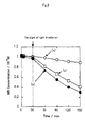
- a support onto which each of the transparent thin films (a) to (d) had been coated over 1.0 cm 2 was inserted into a Pyrex optical cell containing 2.0 g of a 1 x 10 -5 M aqueous solution of methylene blue (MB), and the change in the concentration of the MB aqueous solution in the cell upon irradiation of the transparent thin film with the ultraviolet light at 67 mW/cm 2 was measured by an ultraviolet visual absorption spectroscopy. The irradiation of the ultraviolet light was initiated 30 minutes after the initiation of the measurement of the change in the concentration of the MB aqueous solution. The results are shown in Figure 1.
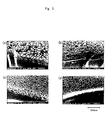
- each of the transparent thin films (a) to (d) was imparted with a fine irregularity attributable to the anatase crystal precipitated by the heated water treatment and also to the titania in a crystalline phase having a lattice spacing of about 0.7 nm.
- a fine irregular matrix analogous to a flower petal-like Ai 2 O 3 was formed, indicating not only a high photocatalytic activity but also of the possibility of being used as superhydrophilic and superhydrophobic thin films.
- the measurement of the contact angle was conducted for a thin film itself in the 1st time, for a fluoroalkylsilane-coated thin film in the 2nd time, and for an UV-irradiated thin film in the 3rd time.
- each of the inventive transparent thin films (2) to (7) was proven to exhibit a superhydrophilicity reflected by a contact angle with water of 5° or less.
- each of the transparent thin films (2) to (8) exhibiting the photocatalytic activity was revealed to exhibit a superhydrophilicity again after the UV irradiation. Accordingly, each of the transparent thin films (2) to (8) was proven to be capable of decomposing the fluoroalkylsilane in response to the UV irradiation.
- the invention provides a novel transparent thin film exhibiting a high photocatalytic activity and a superhydrophilicity and a method for producing such a transparent thin film at a low temperature.
Landscapes
- Chemical & Material Sciences (AREA)
- Engineering & Computer Science (AREA)
- Materials Engineering (AREA)
- Organic Chemistry (AREA)
- Chemical Kinetics & Catalysis (AREA)
- General Chemical & Material Sciences (AREA)
- Metallurgy (AREA)
- Mechanical Engineering (AREA)
- Physics & Mathematics (AREA)
- Thermal Sciences (AREA)
- Ceramic Engineering (AREA)
- Inorganic Chemistry (AREA)
- Life Sciences & Earth Sciences (AREA)
- Geochemistry & Mineralogy (AREA)
- Dispersion Chemistry (AREA)
- Catalysts (AREA)
- Inorganic Compounds Of Heavy Metals (AREA)
- Surface Treatment Of Glass (AREA)
Abstract
Description
| No. | 1 | 2 | 3 | 4 | 5 | 6 | 7 | 8 |
| TiO2 % by | 0 | 9 | 16.5 | 25 | 33 | 50 | 75 | 100 |
| 1st time | <5° | <5° | <5° | <5° | <5° | <5° | <5° | <5° |
| 2nd time | 108° | 120° | 123° | 145° | 138° | 116° | 115° | 110° |
| 3rd time | 108° | <5° | <5° | <5° | <5° | <5° | <5° | <5° |
Claims (14)
- A transparent thin film comprising as main ingredients a silica and a titania characterized in that an anatase-type titania microcrystal is dispersed highly over the surface of the thin film.
- A transparent thin film comprising as main ingredients a silica and a titania characterized in that a titania microcrystal in a crystalline form having a lattice spacing of about 0.7 nm is dispersed highly over the surface of the thin film.
- A transparent thin film according to Claim 1 or 2 characterized in that a superhydrophilicity reflected by a contact angle with water is 5° or less is exhibited.
- A transparent thin film according to any of Claims 1 to 3 characterized in that the silica and the titania are incorporated in a molar ratio within a range of SiO2:TiO2=5:1 to 1:3.
- A transparent thin film according to any of Claims 1 to 4 characterized in that the silica and the titania are incorporated in the molar ratio of SiO2:TiO2=3:1.
- A transparent thin film according to Claim 5 characterized in that a superhydrophilicity-superhydrophobic pattern consisting of a superhydrophilic part and a superhydrophobic part is possessed.
- A transparent thin film according to Claim 6 characterized in that the superhydrophobic part consists of a fluoroalkylsilane.
- A method for producing a transparent thin film according to any of Claims 1 to 7 comprising starting from a solution of a silicone alkoxide and a hydrolyzable titanium compound to form a gel film containing a composite metal oxide or hydroxide of the titanium compound and the silicon alkoxide followed by bringing into contact with water or heated water to precipitate a titania microcrystal on the surface of the thin film.
- A method for producing a transparent thin film according to Claim 8 wherein said silicon alkoxide is silicon tetraethoxide.
- A method for producing a transparent thin film according to Claim 8 or 9 wherein said hydrolyzable titanium compound is a titanium alkoxide.
- A method for producing a transparent thin film according to any of Claims 8 to 10 wherein the silicon alkoxide and the titanium compound are incorporated in a molar ratio within a range of SiO2:TiO2=5:1 to 1:3.
- A method for producing a transparent thin film according to any of Claims 8 to 11 wherein the silicon alkoxide and the titanium compound are incorporated in the molar ratio of SiO2:TiO2=3:1.
- A method for producing a transparent thin film according to any of Claims 8 to 12 involving a contact with a heated water at 50 to 100°C.
- A method for producing a transparent thin film according to any of Claims 8 to 12 characterized in that a fluoroalkylsilane was coated on the transparent thin film, and irradiated with an ultraviolet light via a photomask to form a superhydrophilicity-superhydrophobic pattern on the transparent thin film.
Applications Claiming Priority (1)
| Application Number | Priority Date | Filing Date | Title |
|---|---|---|---|
| PCT/JP2001/008812 WO2003031060A1 (en) | 2000-09-22 | 2001-10-05 | Transparent thin film and method for production thereof |
Publications (2)
| Publication Number | Publication Date |
|---|---|
| EP1449582A1 true EP1449582A1 (en) | 2004-08-25 |
| EP1449582A4 EP1449582A4 (en) | 2005-01-19 |
Family
ID=32732624
Family Applications (1)
| Application Number | Title | Priority Date | Filing Date |
|---|---|---|---|
| EP01974722A Withdrawn EP1449582A4 (en) | 2001-10-05 | 2001-10-05 | TRANSPARENT THIN FILM AND PROCESS FOR PRODUCING THE SAME |
Country Status (2)
| Country | Link |
|---|---|
| EP (1) | EP1449582A4 (en) |
| WO (1) | WO2003031060A1 (en) |
Cited By (3)
| Publication number | Priority date | Publication date | Assignee | Title |
|---|---|---|---|---|
| ES2334542A1 (en) * | 2008-07-22 | 2010-03-11 | Universidad Carlos Iii De Madrid | Sol-gel coating with nanoparticles of titania for the protection of a substrate and procedure for its obtaining (Machine-translation by Google Translate, not legally binding) |
| CN102294253A (en) * | 2011-06-10 | 2011-12-28 | 上海师范大学 | Low temperature preparation method for TiOF2 photocatalyst film, and application thereof |
| US9074778B2 (en) | 2009-11-04 | 2015-07-07 | Ssw Holding Company, Inc. | Cooking appliance surfaces having spill containment pattern |
Families Citing this family (2)
| Publication number | Priority date | Publication date | Assignee | Title |
|---|---|---|---|---|
| JP2002097013A (en) * | 2000-09-22 | 2002-04-02 | Japan Science & Technology Corp | Transparent thin film and its manufacturing method |
| CN116875088A (en) * | 2023-07-03 | 2023-10-13 | 武汉理工大学 | Silicon-titanium composite super-hydrophilic coating with photocatalytic activity induced at low temperature and preparation thereof |
Family Cites Families (4)
| Publication number | Priority date | Publication date | Assignee | Title |
|---|---|---|---|---|
| ATE279490T1 (en) * | 1995-03-20 | 2004-10-15 | Toto Ltd | USE OF A PHOTOCATALYTIC SUPERHYDROPHILIC SURFACE WITH ANTI-FOG EFFECT |
| JP3971517B2 (en) * | 1998-09-14 | 2007-09-05 | 大日本印刷株式会社 | Composite material that changes from super water-repellent to super-hydrophilic surface |
| DE19860511A1 (en) * | 1998-12-28 | 2000-07-13 | Fraunhofer Ges Forschung | Process for the production of a microstructured SiO¶2¶ / TiO¶2¶ layer system |
| KR100374478B1 (en) * | 1999-09-20 | 2003-03-03 | 엘지전자 주식회사 | Method for Preparing an Anatase Typed-Titanium Dioxide Photocatalyst and Photocatalyst Produced by the same |
-
2001
- 2001-10-05 EP EP01974722A patent/EP1449582A4/en not_active Withdrawn
- 2001-10-05 WO PCT/JP2001/008812 patent/WO2003031060A1/en not_active Ceased
Cited By (5)
| Publication number | Priority date | Publication date | Assignee | Title |
|---|---|---|---|---|
| ES2334542A1 (en) * | 2008-07-22 | 2010-03-11 | Universidad Carlos Iii De Madrid | Sol-gel coating with nanoparticles of titania for the protection of a substrate and procedure for its obtaining (Machine-translation by Google Translate, not legally binding) |
| ES2334542B1 (en) * | 2008-07-22 | 2011-01-10 | Universidad Carlos Iii De Madrid | SOL-GEL COATING WITH TITANIA NANOPARTICLES FOR THE PROTECTION OF A SUBSTRATE AND PROCEDURE FOR OBTAINING IT. |
| US9074778B2 (en) | 2009-11-04 | 2015-07-07 | Ssw Holding Company, Inc. | Cooking appliance surfaces having spill containment pattern |
| CN102294253A (en) * | 2011-06-10 | 2011-12-28 | 上海师范大学 | Low temperature preparation method for TiOF2 photocatalyst film, and application thereof |
| CN102294253B (en) * | 2011-06-10 | 2013-04-17 | 上海师范大学 | A low-temperature preparation method and application of TiOF2 photocatalytic thin film |
Also Published As
| Publication number | Publication date |
|---|---|
| EP1449582A4 (en) | 2005-01-19 |
| WO2003031060A1 (en) | 2003-04-17 |
Similar Documents
| Publication | Publication Date | Title |
|---|---|---|
| JP4335446B2 (en) | Titanium oxide sol, thin film and method for producing them | |
| US20050129927A1 (en) | Transparent thin film and method for production thereof | |
| Matsuda et al. | Transparent anatase nanocomposite films by the sol–gel process at low temperatures | |
| KR100935065B1 (en) | Titanium oxide photocatalyst, its manufacturing method and use | |
| EP0581216B1 (en) | Process for producing coating films of titanium oxide | |
| EP0866101B1 (en) | Photocatalytic coating composition and photocatalyst-bearing structure | |
| RU2431604C2 (en) | METHOD OF PREPARING AQUEOUS DISPERSIONS OF TiO2 IN FORM OF NANOPARTICLES AND DISPERSIONS OBTAINED USING SAID METHOD | |
| EP1127844B1 (en) | Finely particulate titanium-containing substance, coating fluid containing the same, processes for producing these, and molded article having thin film comprising the substance | |
| US20010016264A1 (en) | Particles, aqueous dispersion and film of titanium oxide, and preparation thereof | |
| US6576589B1 (en) | Method for making anatase type titanium dioxide photocatalyst | |
| KR100444892B1 (en) | Synthesis of highly active photocatalytic TiO2-sol containing active metals | |
| EP1016459A1 (en) | Titanium oxide-based photocatalyst, process for preparing the same, and use thereof | |
| JP4619601B2 (en) | PHOTOCATALYTIC COATING COMPOSITION AND PRODUCT HAVING PHOTOCATALYTIC THIN FILM | |
| JP2010285300A (en) | Antifouling glass manufacturing method and antifouling glass | |
| JP4738736B2 (en) | Photocatalyst composite, coating solution for forming photocatalyst layer, and photocatalyst carrying structure | |
| Yuan et al. | Synthesis of TiO2 thin film by a modified sol-gel method and properties of the prepared films for photocatalyst | |
| CN100450622C (en) | Transparent film forming composition and application thereof | |
| JPH10167727A (en) | Modified titanium oxide sol, photocatalyst composition and forming agent therefor | |
| JP3791067B2 (en) | Photocatalyst composition and glass article | |
| JP4139090B2 (en) | Method for producing spherical particles with crystalline titanium oxide coating layer | |
| JP2004091263A (en) | Anatase-type titania film, method for producing anatase-type titania sol, and method for producing anatase-type titania film | |
| WO2003031060A1 (en) | Transparent thin film and method for production thereof | |
| KR100378279B1 (en) | Transparent TiO2 sol manufacturing method for normal temperature coating | |
| KR100411953B1 (en) | The method of titanium oxide sol manufacture and coating for superior transmittance. | |
| WO2024209090A1 (en) | Titanium-oxo-cores, a coating composition containing the titanium-oxo-cores, an object having on a surface thereof a titanium oxide coating formed from the coating composition, and methods for their preparation |
Legal Events
| Date | Code | Title | Description |
|---|---|---|---|
| PUAI | Public reference made under article 153(3) epc to a published international application that has entered the european phase |
Free format text: ORIGINAL CODE: 0009012 |
|
| 17P | Request for examination filed |
Effective date: 20040505 |
|
| AK | Designated contracting states |
Kind code of ref document: A1 Designated state(s): AT BE CH CY DE DK ES FI FR GB GR IE IT LI LU MC NL PT SE TR |
|
| RIC1 | Information provided on ipc code assigned before grant |
Ipc: 7B 01J 35/00 A Ipc: 7C 03C 17/25 B Ipc: 7B 01J 37/10 B Ipc: 7B 01J 37/03 B |
|
| A4 | Supplementary search report drawn up and despatched |
Effective date: 20041202 |
|
| 17Q | First examination report despatched |
Effective date: 20070323 |
|
| STAA | Information on the status of an ep patent application or granted ep patent |
Free format text: STATUS: THE APPLICATION IS DEEMED TO BE WITHDRAWN |
|
| 18D | Application deemed to be withdrawn |
Effective date: 20070803 |