EP1444404B1 - Pfahlräumer mit erdaushubbehälter - Google Patents
Pfahlräumer mit erdaushubbehälter Download PDFInfo
- Publication number
- EP1444404B1 EP1444404B1 EP02740037A EP02740037A EP1444404B1 EP 1444404 B1 EP1444404 B1 EP 1444404B1 EP 02740037 A EP02740037 A EP 02740037A EP 02740037 A EP02740037 A EP 02740037A EP 1444404 B1 EP1444404 B1 EP 1444404B1
- Authority
- EP
- European Patent Office
- Prior art keywords
- tool
- collecting means
- cutting
- spoil
- cylindrical body
- Prior art date
- Legal status (The legal status is an assumption and is not a legal conclusion. Google has not performed a legal analysis and makes no representation as to the accuracy of the status listed.)
- Expired - Lifetime
Links
- 238000005520 cutting process Methods 0.000 claims abstract description 58
- 239000000463 material Substances 0.000 claims abstract description 15
- 239000002689 soil Substances 0.000 claims description 15
- 239000002184 metal Substances 0.000 claims description 4
- 230000000295 complement effect Effects 0.000 claims description 3
- 238000005553 drilling Methods 0.000 description 11
- 238000000034 method Methods 0.000 description 9
- 230000008901 benefit Effects 0.000 description 3
- 238000004140 cleaning Methods 0.000 description 3
- 230000008878 coupling Effects 0.000 description 3
- 238000010168 coupling process Methods 0.000 description 3
- 238000005859 coupling reaction Methods 0.000 description 3
- 239000004927 clay Substances 0.000 description 2
- 229910000831 Steel Inorganic materials 0.000 description 1
- 238000009412 basement excavation Methods 0.000 description 1
- 238000010276 construction Methods 0.000 description 1
- 230000001419 dependent effect Effects 0.000 description 1
- 230000001627 detrimental effect Effects 0.000 description 1
- 230000000694 effects Effects 0.000 description 1
- 238000009434 installation Methods 0.000 description 1
- 238000005304 joining Methods 0.000 description 1
- 238000004519 manufacturing process Methods 0.000 description 1
- 238000003825 pressing Methods 0.000 description 1
- 238000007790 scraping Methods 0.000 description 1
- 239000010959 steel Substances 0.000 description 1
- 238000010408 sweeping Methods 0.000 description 1
Images


Classifications
-
- E—FIXED CONSTRUCTIONS
- E02—HYDRAULIC ENGINEERING; FOUNDATIONS; SOIL SHIFTING
- E02D—FOUNDATIONS; EXCAVATIONS; EMBANKMENTS; UNDERGROUND OR UNDERWATER STRUCTURES
- E02D5/00—Bulkheads, piles, or other structural elements specially adapted to foundation engineering
- E02D5/22—Piles
- E02D5/34—Concrete or concrete-like piles cast in position ; Apparatus for making same
- E02D5/38—Concrete or concrete-like piles cast in position ; Apparatus for making same making by use of mould-pipes or other moulds
- E02D5/44—Concrete or concrete-like piles cast in position ; Apparatus for making same making by use of mould-pipes or other moulds with enlarged footing or enlargements at the bottom of the pile
-
- E—FIXED CONSTRUCTIONS
- E21—EARTH OR ROCK DRILLING; MINING
- E21B—EARTH OR ROCK DRILLING; OBTAINING OIL, GAS, WATER, SOLUBLE OR MELTABLE MATERIALS OR A SLURRY OF MINERALS FROM WELLS
- E21B10/00—Drill bits
- E21B10/26—Drill bits with leading portion, i.e. drill bits with a pilot cutter; Drill bits for enlarging the borehole, e.g. reamers
- E21B10/32—Drill bits with leading portion, i.e. drill bits with a pilot cutter; Drill bits for enlarging the borehole, e.g. reamers with expansible cutting tools
-
- E—FIXED CONSTRUCTIONS
- E21—EARTH OR ROCK DRILLING; MINING
- E21B—EARTH OR ROCK DRILLING; OBTAINING OIL, GAS, WATER, SOLUBLE OR MELTABLE MATERIALS OR A SLURRY OF MINERALS FROM WELLS
- E21B27/00—Containers for collecting or depositing substances in boreholes or wells, e.g. bailers, baskets or buckets for collecting mud or sand; Drill bits with means for collecting substances, e.g. valve drill bits
Definitions
- This invention relates to the construction of piles and, in particular, relates to a tool for enlarging a portion of an underground pile shaft.
- the arms On retraction of the drilling bar, the arms are also retracted. While the arms are extended from the underreamer body and are pressing against the surrounding soil, the tool is rotated by the drilling bar so that a soil cutting action is performed. Soil is drawn into the body or centre part of the tool and from time to time the tool is withdrawn from the hole in the ground where the cut soil is removed.
- Underreaming is carried out, for example, in forming ground anchors in clay where the objective is to apply loads to the anchor which tend to withdraw it from the ground, so that the process of cleaning the bottom of the shaft is unimportant and does not affect the performance of the anchor.
- the objective is to apply loads to the anchor which tend to withdraw it from the ground, so that the process of cleaning the bottom of the shaft is unimportant and does not affect the performance of the anchor.
- holes of up to 300mm diameter are used for ground anchors.
- the downward load carried by the pile is transmitted to the ground through the base of the pile shaft, and consequently it has been found that base cleaning of such pile shafts is critical in assuring satisfactory and consistent performance in piles.
- an underreamer which comprises a cylindrical body having at least on slot through which a cutting member can protrude.
- the tool was designed to enable the cutting member to be retracted inside the cylindrical body while the tool is lowered into, or raised from, a pre-formed shaft.
- An elongate container is also provided below the cutting member so as to collect the spoil generated during the cutting of the surrounding shaft.
- the volume of spoil generated will invariably be greater than the volume of the material before it is cut from the pile shaft.
- the so-called "bulking" of the material is dependent on a number of factors including soil type, cutting technique and tool configuration.
- a tool for enlarging a portion of an underground shaft which tool comprises:
- the collecting means which forms part of the tool of the present invention can be advantageously adjusted such that the volume of spoil which can be accommodated therein is optimised according to the ground conditions and the technique.
- a tool according to the present invention preferably allows a ream to be constructed in an underground pile shaft in a single operation.
- the adjustability of the collecting means allows the position of the ream to be determined without being restricted by the dimensions of the collecting means.
- the collecting means preferably comprises a hollow, cylindrically shaped body which is closed at one end. It may be formed of any suitable material such as metal or plastic.
- the collecting means may advantageously be formed of a number of cylindrical sections which are telescopic; the size of the collecting means being determined by the degree of extension of the cylindrical sections. Alternatively, a single cylindrical section is envisaged which can slide inside, or around, the cylindrical body portion of the tool.
- a clamping means is advantageously provided which provides a means of continuously varying the position of the base of the collecting means, with respect to the cylindrical body. Alternatively, there may be a number of discrete positions at which the bottom of the collecting means can be fixed.
- the clamping means may be in the form of one or a plurality of bolts provided on either the collecting means or the cylindrical body which engage with slots.
- the clamping means may be in the form of a captive bolt which communicates with a vertical or spiral slot. Any other clamping configurations are also envisaged.
- a tool of the present invention may advantageously be provided with a compacting plate or a pair of compacting plates which are disposed within the collecting means. In use, the plate(s) advantageously extend either fully or partially across the diameter of the collecting means.
- the plate(s) may preferably be pivotally mounted on the inner surface of the collecting means so that they can rotate from a position in which the plate(s) lies adjacent to the side of the collecting means, to a position in which the plate(s) extend orthogonally from the inner surface of the compacting means.
- the plates may be pivotally mounted to a support which is disposed within the central region of the tool.
- a means to allow the plates to move up and down the axis of the compacting means is also provided so that, in use, the plate(s) can extend from a required position within the collecting means in accordance with the level of spoil contained within the collecting means.
- one end of the plates namely that end about which the plate(s) pivot, is provided with a toothed wheel which communicates with a complementary series of grooves provided on the collecting means.
- the toothed wheel can then be rotated, either by mechanical, electrical or hydraulic means, so that the teeth communicate with the grooves thereby allowing the plate(s) to move up and down within the collecting means.
- the cutting means advantageously comprises at least one cutting member pivotally connected to the body portion of the tool.
- the sides of the cylindrical body of the tool are preferably provided with one or a number of slots such that the cutting member(s) can be extended through the slot(s) so to perform the cutting action on surrounding ground material.
- the cutting member is advantageously retracted within the cylinder body when not in use.
- the cutting member includes at least one blade which is advantageously arranged such that, when it protrudes through the slot or opening to the maximum possible extent, the maximum area is made available within the tool for the collection of any cuttings.
- a number of different blade configurations are envisages such as linear or arcuate shaped blades.
- the blade(s) may be in the form of metal struts hinged at their inboard ends directly or indirectly to said cylindrical body portion.
- the blade(s) are caused to move by a mechanical linkage arrangement when the tool is in use.
- a hydraulic operating system may be employed, e.g. a hydraulically-linked piston and a pair of rams, one acting on each of two cutting members.
- each slot through which a cutting member protrudes is arranged with its major axis parallel to the axis of rotation.
- the tool has two opposed slots each containing a similar cutting member.
- the upper part of the cylindrical body portion will generally include a coupling connection for drilling (Kelly) bar of a rotary boring machine.
- FIG. 2 a further known underreamer is depicted.
- hinges 6 and 7 are located at the bottom end of blades 4 and 5, while linkages 9 and 10 are disposed upwardly of hinges 6 and 7.
- the blades 4 and 5 nest inwardly (with linkages 9 and 10 substantially vertical) when the tool is lowered into shaft 3. Rotation of the tool when it is at the base of the shaft after blades 4 and 5 have moved outwardly under downward pressure from drilling bar 2 results in excavation of a sector of a sphere which is conical in section.
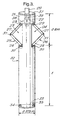
- a tool according to the present invention which comprises a cylindrical body portion 21 having at its top end a coupling connector 22 adapted to receive drilling bar 20.
- the body 21 includes two opposed slots 23 and 24 through which cutting members 25 and 26 are able to protrude.
- each cutting member comprises an upper blade 27 and a lower blade 28.
- Each blade is in the form of a linear strut hinged at the inboard end to a plate 36 which is able to move upwardly and downwardly within body 21.
- the upper hinges are denoted by reference 29, and the lower hinges by reference 30.
- each blade 27 is pivotally connected to its companion blade 28 by a hinge 31.
- the two cutting members adopt a "V"-shaped form.
- Each stop member 38 and 39 may take the form of two steel blocks (one on each side diametrically of the interior of body 21) welded to the inner side wall of body 21.
- each stop member 38 and 39 may take the form of a cross bar extending across the interior of body 21.
- Stop member 38 is positioned so that when cutting member 25 and 26 are extended to their maximum, the members 25 and 26 are extended to their maximum, the slope of lower blades 28 is kept at an angle which allows cut spoil to roll down into the interior of container 32. Typically this angle will be about 30°.
- the tool is provided with an adjustable container 32 which is disposed below the cutting members and serves to catch spoil produced during the cutting operation.
- the length of the container 32 is denoted by X which will vary.
- the position of the base 33 of the adjustable container 32 is releasably secured by means of clamps 34 and 35 which allow the bottom of the base to be secured in a number of discrete positions.
- the tool is first lowered into a pre-formed shaft, during which the cutting members 25 and 26 are retracted into the interior of body portion 21. Stop member 39 is located so that, with the cutting members retracted, hinge joint 31 is just outside the line joining points 29 and 30 so that when the action of moving cutting members 25 and 26 begins there is always a tendency for blades 27 and 28 to move outwardly.
- drilling bar 20 is rotated while under downward pressure, this serving to force cutting members 25 and 26 to protrude through slots 23 and 24 and to cut away the surrounding ground material.
- the rotational sweeping of the cutting members together with the inclined lower floor of the enlarged shaft section encourages spoil to enter the adjustable container 32.
- the size, and thus the capacity, of the container 32 is chosen, either prior to commencing the operation or during the cutting stage, such that all of the ground material cut in generating the enlarged shaft portion can be accommodated therein. A single operation is therefore all that is required in forming the enlarged portion. Furthermore, the need to supervise the operation of debris removing equipment is alleviated. At the end of this operation, rotation of drilling bar 20 is stopped, and bar 20 and the tool to which it is attached are raised. Initially, this results in cutting members 25 and 26 retracting into the body 21, as plate 36 moves upwardly towards stop member 39. When parts 36 and 39 meet, blades 27 and 28 are within slots 23 and 24, but are not quite co-linear. This prevents any tendency for hinge joint 31 to move inwardly instead of outwardly when the next reaming operation is commenced. Once members 25 and 26 are within slots 23 and 24, respectively, further lifting action applied will result in the tool being raised to the surface.
- a tool of the type illustrated in Fig. 3 has a number of important advantages compared to the prior art tools of Figs. 1 and 2. These are:
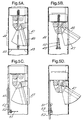
- FIGS 5A to 5D A number of different embodiments of the present invention are illustrated in figures 5A to 5D.
- Figures 5A and 5B illustrate a tool of the present invention in a first position (5A) when the blade 46 is retracted within the cylindrical body portion, and in a second position (5B), when the blade extends through the slot 47.
- a clamping means is provided which comprises a pair of compacting plates 49 and 50. The plates are pivotally mounted to a support which extends along the central longitudinal axis of the tool.
- the plates(s) can be rotated from a first position shown in 5B, in which they extend upwardly in a direction substantially parallel to the central longitudinal axis of the tool, to a second position shown in 5A in which the plates extend across the radius of the tool, and are operable to exert a force on spoil collected below the plates.
- a further compacting means is illustrated in which the plates 51 are pivotally mounted to the inner surface of the adjustable collecting means.
- the plate 51 is provided at one end with a toothed wheel 52 which communicates with a series of complementary grooves 53 provided on the inner surface of the adjustable collecting means.
- the toothed wheel can then be rotated, either by mechanical, electrical or hydraulic means, so that the teeth communicate with the grooves thereby allowing the plate(s) to move up and down within the collecting means.
- an adjustable collecting means requires the underream to be cut at an appropriate level above the base of the borehole.
- the necessary distance between the ream and the base of the bore will depend upon the maximum shaft enlargement which is required. Typically, an enlargement up to a maximum of twice the bore diameter will be adopted, and the slope of the floor of the ream is about 30° to the horizontal. It is, of course, possible to adopt any desired values for bore enlargement and inclination of the lower cutting blade at maximum extension.
Landscapes
- Engineering & Computer Science (AREA)
- Life Sciences & Earth Sciences (AREA)
- Mining & Mineral Resources (AREA)
- Geology (AREA)
- General Life Sciences & Earth Sciences (AREA)
- Structural Engineering (AREA)
- Fluid Mechanics (AREA)
- Environmental & Geological Engineering (AREA)
- Physics & Mathematics (AREA)
- Geochemistry & Mineralogy (AREA)
- Civil Engineering (AREA)
- Paleontology (AREA)
- Mechanical Engineering (AREA)
- General Engineering & Computer Science (AREA)
- Earth Drilling (AREA)
- Placing Or Removing Of Piles Or Sheet Piles, Or Accessories Thereof (AREA)
- Organic Low-Molecular-Weight Compounds And Preparation Thereof (AREA)
- Glass Compositions (AREA)
- Memory System Of A Hierarchy Structure (AREA)
- Plural Heterocyclic Compounds (AREA)
Claims (17)
- Werkzeug zur Vergrößerung eines Bereichs in einem Untergrundschacht, umfassenda) einen in der Regel zylindrisches Körperteil (40), deren Achse eine Drehachse bestimmt;b) eine Scheideeinrichtung (43) zur Durchführung einer Schneidwirkung auf das umgebende Erdmaterial, wird das Werkzeug um die Drehachse gedreht; undc) eine Sammeleinrichtung (44), befestigt am oder ein Teil bildend vom Zylinderkörperteil, wobei die Sammeleinrichtung unterhalb der Schneideinrichtung derart angeordnet ist, dass bei Gebrauch ein von der Schneideinrichtung erzeugter Abraum darin gesammelt wird, dadurch gekennzeichnet, dass die Sammeleinrichtung mindestens zwei zylindrische Abschnitte umfasst, die für ein Verschieben ineinander ausgelegt sind, so dass die Gesamtlänge der Sammeleinrichtung hierdurch angepasst und das Volumen des Abraums, der von der Sammeleinrichtung aufgenommen wird, verändert werden kann.
- Werkzeug nach Anspruch 1, wobei die Sammeleinrichtung hohl und in der Regel zylinderförmig ist.
- Werkzeug nach Anspruch 1 oder 2, wobei das untere Ende der Sammeleinrichtung versehen ist mit einem Basisabschnitt (45), der befestigt ist an oder ausgebildet ist als Teil der Sammeleinrichtung.
- Werkzeug nach irgendeinem vorhergehenden Anspruch, wobei die Sammeleinrichtung aus Metall oder Kunststoff ausgebildet ist.
- Werkzeug nach irgendeinem vorhergehenden Anspruch, wobei der unterste Zylinderabschnitt versehen ist mit einem Basisbereich, der befestigt ist an oder einen Teil bildet des zylindrischen Abschnitts.
- Werkzeug nach irgendeinem vorhergehenden Anspruch, zudem umfassend eine Klammereinrichtung (49, 50), die zur Halterung der anpassbaren Sammeleinrichtung am Zylinderkörperteil dient.
- Werkzeug nach Anspruch 6, wobei die Klammereinrichtung mindestens einen Bolzen umfasst, der mit mindestens einem Schlitz kooperiert, wobei entweder der Bolzen auf der Sammelvorrichtung und der Schlitz auf dem Zylinderkörper ist oder umgekehrt.
- Werkzeug nach irgendeinem vorhergehenden Anspruch, zudem umfassend eine Kompaktiereinrichtung (51), die angeordnet ist über der Ebene des gesammelten Abraums und die betrieben werden kann zur Ausübung einer Kraft von oben auf den Abraum, um so das Volumen des aufgenommenen Abraums zu vermindern.
- Werkzeug nach Anspruch 8, wobei die Kompaktiereinrichtung umfasst mindestens eine Druckplatte (51), die sich bei Betrieb entweder voll oder partiell über den Durchmesser der Sammeleinrichtung erstreckt.
- Werkzeug nach Anspruch 9, wobei die Platte(n) jeweils schwenkbar in dem Werkzeug montiert ist (sind) und wobei die Platte(n) aus einer ersten Stellung drehbar ist, in der die Platte(n) im Wesentlichen parallel zur Längsachse des Werkzeugs liegt (liegen) in eine zweite Stellung, in der die Platte(n) verläuft (verlaufen) in eine Richtung im Wesentlichen orthogonal zur Längsachse.
- Werkzeug nach Anspruch 10, wobei die Platte(n) versehen ist (sind) mit einem Zahnrad (52), das eine Manschette bildet um das Schwenkende der Platte und wobei eine Reihe komplementärer Nuten (53) angeordnet sind in dem Werkzeug derart, dass das Zahnrad zusammenwirkt mit den Nuten, werden die Platten in der Sammeleinrichtung nach oben und unten bewegt.
- Werkzeug nach Anspruch 11, wobei das Zahnrad angetrieben wird längs der Nutreihe durch pneumatische oder elektrische oder hydraulische Einrichtungen.
- Werkzeug nach irgendeinem vorhergehenden Anspruch, wobei die Schneideinrichtung umfasst mindestens ein Messer, das schwenkbar verbunden ist mit dem Zylinderkörperteil des Werkzeugs.
- Werkzeug nach Anspruch 13, wobei das oder die Messer gebogen sind.
- Werkzeug nach Anspruch 13, wobei das oder die Messer gerade sind.
- Werkzeug nach irgendeinem der Anspruche 13 bis 15, wobei das oder die Messer die Form einer Anzahl Metallstreben besitzen, welche an ihren Innenenden am Zylinderkörperteil angelenkt sind.
- Werkzeug nach irgendeinem vorhergehenden Anspruch, zudem umfassend mindestens einen Schlitz in der Seite des Zylinderkörperteils, wobei die Schneideeinrichtung so angeordnet ist, dass sie durch den Schlitz vorsteht und eine Schneidewirkung auf das umgebende Erdreich ausübt und wobei die Schneideeinrichtung durch den Schlitz zurückgezogen werden kann, wird sie nicht gebraucht.
Applications Claiming Priority (3)
| Application Number | Priority Date | Filing Date | Title |
|---|---|---|---|
| GB0103163A GB2372056B (en) | 2001-02-08 | 2001-02-08 | Improvements relating to piles |
| GB0103163 | 2001-02-08 | ||
| PCT/GB2002/000136 WO2002063104A2 (en) | 2001-02-08 | 2002-01-14 | Pile reamer with spoil container |
Publications (2)
| Publication Number | Publication Date |
|---|---|
| EP1444404A2 EP1444404A2 (de) | 2004-08-11 |
| EP1444404B1 true EP1444404B1 (de) | 2006-12-06 |
Family
ID=9908381
Family Applications (1)
| Application Number | Title | Priority Date | Filing Date |
|---|---|---|---|
| EP02740037A Expired - Lifetime EP1444404B1 (de) | 2001-02-08 | 2002-01-14 | Pfahlräumer mit erdaushubbehälter |
Country Status (6)
| Country | Link |
|---|---|
| US (1) | US6854536B2 (de) |
| EP (1) | EP1444404B1 (de) |
| AT (1) | ATE347637T1 (de) |
| DE (1) | DE60216628D1 (de) |
| GB (1) | GB2372056B (de) |
| WO (1) | WO2002063104A2 (de) |
Families Citing this family (18)
| Publication number | Priority date | Publication date | Assignee | Title |
|---|---|---|---|---|
| GB2394489A (en) * | 2002-10-23 | 2004-04-28 | Balfour Beatty Plc | Underreamer for making piles |
| GB0601346D0 (en) * | 2006-01-23 | 2006-03-01 | Cementation Found Skanska Ltd | Earth boring apparatus |
| CN100491690C (zh) * | 2006-10-25 | 2009-05-27 | 贺德新 | 旋挖挤扩钻机及其工法 |
| GB2484431B (en) * | 2008-03-05 | 2012-07-04 | Cementation Skanska Ltd | Device for recovering detachable base from bore hole |
| US20090285637A1 (en) * | 2008-05-16 | 2009-11-19 | W.T.W. Construction, Inc. | Pile mandrel with extendable reaming members |
| BR102012001494B1 (pt) * | 2012-01-23 | 2018-01-02 | Roberto Teixeira Wilson | Dispositivo alargador de base de tubulões |
| CN102953684A (zh) * | 2012-11-30 | 2013-03-06 | 中铁建工集团有限公司 | 一种带扩大钻头的钻杆 |
| JP6085198B2 (ja) * | 2013-03-14 | 2017-02-22 | 戸田建設株式会社 | 掘削孔の段差処理装置 |
| JP6517082B2 (ja) * | 2014-05-19 | 2019-05-22 | 大和ハウス工業株式会社 | 節付き現場打ちコンクリート系杭の杭築造用管 |
| CN105839617B (zh) * | 2016-05-25 | 2024-03-22 | 浙江乔兴建设集团有限公司 | 一种高稳固建筑桩 |
| JP6770732B2 (ja) * | 2016-06-24 | 2020-10-21 | 三和機材株式会社 | 場所打ち杭の拡大掘削装置および場所打ち杭の拡大掘削工法 |
| RU2655280C1 (ru) * | 2017-07-06 | 2018-05-24 | Федеральное государственное автономное образовательное учреждение высшего образования "Сибирский федеральный университет" | Уширитель скважины |
| GB2564468B (en) * | 2017-07-13 | 2020-01-01 | Equinor Energy As | Cutting tool with pivotally fixed cutters |
| JP6970340B2 (ja) * | 2017-11-14 | 2021-11-24 | ジャパンパイル株式会社 | 可動式掘削翼の作動確認装置及びそれを備える拡大掘削装置 |
| JP6632087B2 (ja) * | 2018-09-20 | 2020-01-15 | 株式会社アクティブ | 孔拡径装置 |
| CN111705577A (zh) * | 2020-07-02 | 2020-09-25 | 安徽杰智建设工程有限公司 | 一种基坑路基回填结构 |
| WO2022020398A1 (en) * | 2020-07-20 | 2022-01-27 | Jess Tools, Inc. | Post hole belling auger |
| US12442151B2 (en) * | 2021-07-20 | 2025-10-14 | Jess Tools, Llc | Post hole belling auger |
Family Cites Families (10)
| Publication number | Priority date | Publication date | Assignee | Title |
|---|---|---|---|---|
| US167628A (en) * | 1875-09-14 | Improvement in earth-augers | ||
| US1406348A (en) * | 1920-09-04 | 1922-02-14 | Clyde S Corrigan | Deep-well reamer |
| US2031353A (en) * | 1935-08-16 | 1936-02-18 | Woodruff Harvey Ellis | Underreamer |
| US3010527A (en) * | 1957-05-27 | 1961-11-28 | Bell Bottom Foundation Company | Underreamer |
| US3112802A (en) * | 1959-07-17 | 1963-12-03 | Economic Foundations Ltd | Earth boring under-reaming tool |
| US3231029A (en) * | 1963-10-28 | 1966-01-25 | Robbins & Assoc James S | Articulated drilling shafts for raise drilling |
| US3414069A (en) * | 1966-08-08 | 1968-12-03 | Lamphere Jean K | Apparatus for recovering formation wall samples from a bore hole |
| JPS60168813A (ja) * | 1984-02-13 | 1985-09-02 | Hitachi Constr Mach Co Ltd | ア−スドリル工法による拡底杭の拡底部掘削装置 |
| SU1484878A1 (ru) * | 1987-06-01 | 1989-06-07 | Ki Otdel Vnii Gidromekhanizat | Устройство для образования уширений |
| GB2222621B (en) * | 1988-07-22 | 1992-11-04 | Cementation Piling & Found | Improvements relating to piles |
-
2001
- 2001-02-08 GB GB0103163A patent/GB2372056B/en not_active Expired - Fee Related
-
2002
- 2002-01-14 US US10/467,621 patent/US6854536B2/en not_active Expired - Fee Related
- 2002-01-14 EP EP02740037A patent/EP1444404B1/de not_active Expired - Lifetime
- 2002-01-14 AT AT02740037T patent/ATE347637T1/de not_active IP Right Cessation
- 2002-01-14 DE DE60216628T patent/DE60216628D1/de not_active Expired - Lifetime
- 2002-01-14 WO PCT/GB2002/000136 patent/WO2002063104A2/en not_active Ceased
Also Published As
| Publication number | Publication date |
|---|---|
| US6854536B2 (en) | 2005-02-15 |
| US20040108143A1 (en) | 2004-06-10 |
| GB2372056A (en) | 2002-08-14 |
| ATE347637T1 (de) | 2006-12-15 |
| GB0103163D0 (en) | 2001-03-28 |
| GB2372056B (en) | 2004-07-07 |
| DE60216628D1 (de) | 2007-01-18 |
| WO2002063104A2 (en) | 2002-08-15 |
| EP1444404A2 (de) | 2004-08-11 |
| WO2002063104A3 (en) | 2004-05-27 |
Similar Documents
| Publication | Publication Date | Title |
|---|---|---|
| US6854536B2 (en) | Pile reamer with spoil container | |
| US4396076A (en) | Under-reaming pile bore excavator | |
| CN207393121U (zh) | 一种钻孔灌注桩扩底钻头 | |
| CN116043835B (zh) | 一种冲孔扩底灌注桩的扩底装置及施工方法 | |
| CN111819337B (zh) | 钻头和包括这种钻头的钻孔系统 | |
| CN117072067A (zh) | 一种带有可伸缩扩刀的扩孔装置 | |
| GB2222621A (en) | Underreamer for making piles | |
| CN223343943U (zh) | 一种旋挖钻孔灌注桩结构 | |
| CN213898914U (zh) | 一种粘性土地层旋挖钻孔钻头 | |
| US8915313B2 (en) | Hole boring tool | |
| EP3938615B1 (de) | Steinzertrümmerungseinheit zum aufweiten eines pilotloches auf gesteinsgelände | |
| US11788245B2 (en) | Post hole belling auger | |
| RU2170804C2 (ru) | Буровое устройство для расширяемой скважины | |
| CN214145372U (zh) | 旋挖钻机及其钻头 | |
| GB2183703A (en) | In situ concrete pile construction and under cutting tool | |
| CN213086758U (zh) | 一种三段式挤密螺纹桩的施工设备 | |
| JPH086864Y2 (ja) | 拡底工法用の掘削装置 | |
| KR102505718B1 (ko) | 연약지반 굴착용 비트 | |
| RU233160U1 (ru) | Разбуриватель для свай | |
| CN223497841U (zh) | 一种钻机扩底钻头 | |
| US2139323A (en) | Self-expanding and cleaning earth reamer | |
| CN223754019U (zh) | 一种高强度旋挖斗齿 | |
| JP2916598B2 (ja) | 掘削機 | |
| JP2715275B2 (ja) | 掘削工法 | |
| RU2119036C1 (ru) | Универсальный уширитель |
Legal Events
| Date | Code | Title | Description |
|---|---|---|---|
| PUAI | Public reference made under article 153(3) epc to a published international application that has entered the european phase |
Free format text: ORIGINAL CODE: 0009012 |
|
| 17P | Request for examination filed |
Effective date: 20030820 |
|
| AK | Designated contracting states |
Kind code of ref document: A2 Designated state(s): AT BE CH CY DE DK ES FI FR GB GR IE IT LI LU MC NL PT SE TR |
|
| GRAP | Despatch of communication of intention to grant a patent |
Free format text: ORIGINAL CODE: EPIDOSNIGR1 |
|
| RBV | Designated contracting states (corrected) |
Designated state(s): AT BE CH CY DE DK ES FI FR GR IE IT LI LU MC NL PT SE TR |
|
| GRAS | Grant fee paid |
Free format text: ORIGINAL CODE: EPIDOSNIGR3 |
|
| GRAA | (expected) grant |
Free format text: ORIGINAL CODE: 0009210 |
|
| AK | Designated contracting states |
Kind code of ref document: B1 Designated state(s): AT BE CH CY DE DK ES FI FR GR IE IT LI LU MC NL PT SE TR |
|
| PG25 | Lapsed in a contracting state [announced via postgrant information from national office to epo] |
Ref country code: IT Free format text: LAPSE BECAUSE OF FAILURE TO SUBMIT A TRANSLATION OF THE DESCRIPTION OR TO PAY THE FEE WITHIN THE PRESCRIBED TIME-LIMIT;WARNING: LAPSES OF ITALIAN PATENTS WITH EFFECTIVE DATE BEFORE 2007 MAY HAVE OCCURRED AT ANY TIME BEFORE 2007. THE CORRECT EFFECTIVE DATE MAY BE DIFFERENT FROM THE ONE RECORDED. Effective date: 20061206 Ref country code: LI Free format text: LAPSE BECAUSE OF FAILURE TO SUBMIT A TRANSLATION OF THE DESCRIPTION OR TO PAY THE FEE WITHIN THE PRESCRIBED TIME-LIMIT Effective date: 20061206 Ref country code: DK Free format text: LAPSE BECAUSE OF FAILURE TO SUBMIT A TRANSLATION OF THE DESCRIPTION OR TO PAY THE FEE WITHIN THE PRESCRIBED TIME-LIMIT Effective date: 20061206 Ref country code: FI Free format text: LAPSE BECAUSE OF FAILURE TO SUBMIT A TRANSLATION OF THE DESCRIPTION OR TO PAY THE FEE WITHIN THE PRESCRIBED TIME-LIMIT Effective date: 20061206 Ref country code: NL Free format text: LAPSE BECAUSE OF FAILURE TO SUBMIT A TRANSLATION OF THE DESCRIPTION OR TO PAY THE FEE WITHIN THE PRESCRIBED TIME-LIMIT Effective date: 20061206 Ref country code: BE Free format text: LAPSE BECAUSE OF FAILURE TO SUBMIT A TRANSLATION OF THE DESCRIPTION OR TO PAY THE FEE WITHIN THE PRESCRIBED TIME-LIMIT Effective date: 20061206 Ref country code: CH Free format text: LAPSE BECAUSE OF FAILURE TO SUBMIT A TRANSLATION OF THE DESCRIPTION OR TO PAY THE FEE WITHIN THE PRESCRIBED TIME-LIMIT Effective date: 20061206 Ref country code: AT Free format text: LAPSE BECAUSE OF FAILURE TO SUBMIT A TRANSLATION OF THE DESCRIPTION OR TO PAY THE FEE WITHIN THE PRESCRIBED TIME-LIMIT Effective date: 20061206 |
|
| REG | Reference to a national code |
Ref country code: CH Ref legal event code: EP |
|
| REG | Reference to a national code |
Ref country code: IE Ref legal event code: FG4D |
|
| REF | Corresponds to: |
Ref document number: 60216628 Country of ref document: DE Date of ref document: 20070118 Kind code of ref document: P |
|
| PG25 | Lapsed in a contracting state [announced via postgrant information from national office to epo] |
Ref country code: MC Free format text: LAPSE BECAUSE OF NON-PAYMENT OF DUE FEES Effective date: 20070131 |
|
| PG25 | Lapsed in a contracting state [announced via postgrant information from national office to epo] |
Ref country code: SE Free format text: LAPSE BECAUSE OF FAILURE TO SUBMIT A TRANSLATION OF THE DESCRIPTION OR TO PAY THE FEE WITHIN THE PRESCRIBED TIME-LIMIT Effective date: 20070306 |
|
| PG25 | Lapsed in a contracting state [announced via postgrant information from national office to epo] |
Ref country code: DE Free format text: LAPSE BECAUSE OF FAILURE TO SUBMIT A TRANSLATION OF THE DESCRIPTION OR TO PAY THE FEE WITHIN THE PRESCRIBED TIME-LIMIT Effective date: 20070307 |
|
| PG25 | Lapsed in a contracting state [announced via postgrant information from national office to epo] |
Ref country code: ES Free format text: LAPSE BECAUSE OF FAILURE TO SUBMIT A TRANSLATION OF THE DESCRIPTION OR TO PAY THE FEE WITHIN THE PRESCRIBED TIME-LIMIT Effective date: 20070317 |
|
| PG25 | Lapsed in a contracting state [announced via postgrant information from national office to epo] |
Ref country code: PT Free format text: LAPSE BECAUSE OF FAILURE TO SUBMIT A TRANSLATION OF THE DESCRIPTION OR TO PAY THE FEE WITHIN THE PRESCRIBED TIME-LIMIT Effective date: 20070507 |
|
| NLV1 | Nl: lapsed or annulled due to failure to fulfill the requirements of art. 29p and 29m of the patents act | ||
| REG | Reference to a national code |
Ref country code: CH Ref legal event code: PL |
|
| EN | Fr: translation not filed | ||
| PLBE | No opposition filed within time limit |
Free format text: ORIGINAL CODE: 0009261 |
|
| STAA | Information on the status of an ep patent application or granted ep patent |
Free format text: STATUS: NO OPPOSITION FILED WITHIN TIME LIMIT |
|
| 26N | No opposition filed |
Effective date: 20070907 |
|
| PG25 | Lapsed in a contracting state [announced via postgrant information from national office to epo] |
Ref country code: GR Free format text: LAPSE BECAUSE OF FAILURE TO SUBMIT A TRANSLATION OF THE DESCRIPTION OR TO PAY THE FEE WITHIN THE PRESCRIBED TIME-LIMIT Effective date: 20070307 Ref country code: FR Free format text: LAPSE BECAUSE OF FAILURE TO SUBMIT A TRANSLATION OF THE DESCRIPTION OR TO PAY THE FEE WITHIN THE PRESCRIBED TIME-LIMIT Effective date: 20070727 |
|
| PG25 | Lapsed in a contracting state [announced via postgrant information from national office to epo] |
Ref country code: FR Free format text: LAPSE BECAUSE OF FAILURE TO SUBMIT A TRANSLATION OF THE DESCRIPTION OR TO PAY THE FEE WITHIN THE PRESCRIBED TIME-LIMIT Effective date: 20061206 |
|
| PG25 | Lapsed in a contracting state [announced via postgrant information from national office to epo] |
Ref country code: LU Free format text: LAPSE BECAUSE OF NON-PAYMENT OF DUE FEES Effective date: 20070114 Ref country code: CY Free format text: LAPSE BECAUSE OF FAILURE TO SUBMIT A TRANSLATION OF THE DESCRIPTION OR TO PAY THE FEE WITHIN THE PRESCRIBED TIME-LIMIT Effective date: 20061206 |
|
| PG25 | Lapsed in a contracting state [announced via postgrant information from national office to epo] |
Ref country code: TR Free format text: LAPSE BECAUSE OF FAILURE TO SUBMIT A TRANSLATION OF THE DESCRIPTION OR TO PAY THE FEE WITHIN THE PRESCRIBED TIME-LIMIT Effective date: 20061206 |
|
| PGFP | Annual fee paid to national office [announced via postgrant information from national office to epo] |
Ref country code: IE Payment date: 20130122 Year of fee payment: 12 |
|
| REG | Reference to a national code |
Ref country code: IE Ref legal event code: MM4A |
|
| PG25 | Lapsed in a contracting state [announced via postgrant information from national office to epo] |
Ref country code: IE Free format text: LAPSE BECAUSE OF NON-PAYMENT OF DUE FEES Effective date: 20140114 |