EP1437211B1 - Verfahren zur Herstellung einer Zahnbürste - Google Patents
Verfahren zur Herstellung einer Zahnbürste Download PDFInfo
- Publication number
- EP1437211B1 EP1437211B1 EP03028055.6A EP03028055A EP1437211B1 EP 1437211 B1 EP1437211 B1 EP 1437211B1 EP 03028055 A EP03028055 A EP 03028055A EP 1437211 B1 EP1437211 B1 EP 1437211B1
- Authority
- EP
- European Patent Office
- Prior art keywords
- molded
- molded part
- injection
- plastic
- forming
- Prior art date
- Legal status (The legal status is an assumption and is not a legal conclusion. Google has not performed a legal analysis and makes no representation as to the accuracy of the status listed.)
- Expired - Lifetime
Links
- 238000004519 manufacturing process Methods 0.000 title abstract description 5
- 229920003023 plastic Polymers 0.000 claims abstract description 61
- 239000004033 plastic Substances 0.000 claims abstract description 59
- 238000000034 method Methods 0.000 claims abstract description 19
- 229920001155 polypropylene Polymers 0.000 claims abstract description 18
- 238000001746 injection moulding Methods 0.000 claims abstract description 14
- -1 polypropylene Polymers 0.000 claims abstract description 11
- 239000004743 Polypropylene Substances 0.000 claims abstract description 10
- SCUZVMOVTVSBLE-UHFFFAOYSA-N prop-2-enenitrile;styrene Chemical compound C=CC#N.C=CC1=CC=CC=C1 SCUZVMOVTVSBLE-UHFFFAOYSA-N 0.000 claims abstract 2
- 229920000638 styrene acrylonitrile Polymers 0.000 claims abstract 2
- 239000000463 material Substances 0.000 claims description 19
- 229920002647 polyamide Polymers 0.000 claims description 5
- 229920000515 polycarbonate Polymers 0.000 claims description 4
- 229920002725 thermoplastic elastomer Polymers 0.000 claims description 4
- 229920000728 polyester Polymers 0.000 claims description 3
- 239000004952 Polyamide Substances 0.000 claims description 2
- 239000001525 mentha piperita l. herb oil Substances 0.000 claims description 2
- 235000019477 peppermint oil Nutrition 0.000 claims description 2
- 239000004417 polycarbonate Substances 0.000 claims description 2
- XECAHXYUAAWDEL-UHFFFAOYSA-N acrylonitrile butadiene styrene Chemical compound C=CC=C.C=CC#N.C=CC1=CC=CC=C1 XECAHXYUAAWDEL-UHFFFAOYSA-N 0.000 claims 1
- 229920000122 acrylonitrile butadiene styrene Polymers 0.000 claims 1
- 239000004676 acrylonitrile butadiene styrene Substances 0.000 claims 1
- 239000012459 cleaning agent Substances 0.000 claims 1
- 238000000465 moulding Methods 0.000 abstract description 22
- 238000002347 injection Methods 0.000 abstract description 6
- 239000007924 injection Substances 0.000 abstract description 6
- JDCCCHBBXRQRGU-UHFFFAOYSA-N 5-phenylpenta-2,4-dienenitrile Chemical compound N#CC=CC=CC1=CC=CC=C1 JDCCCHBBXRQRGU-UHFFFAOYSA-N 0.000 description 9
- 239000000126 substance Substances 0.000 description 6
- 229920002457 flexible plastic Polymers 0.000 description 4
- 239000000551 dentifrice Substances 0.000 description 3
- 239000007788 liquid Substances 0.000 description 3
- HIZCTWCPHWUPFU-UHFFFAOYSA-N Glycerol tribenzoate Chemical compound C=1C=CC=CC=1C(=O)OCC(OC(=O)C=1C=CC=CC=1)COC(=O)C1=CC=CC=C1 HIZCTWCPHWUPFU-UHFFFAOYSA-N 0.000 description 2
- 239000003708 ampul Substances 0.000 description 2
- 238000004873 anchoring Methods 0.000 description 2
- 239000012535 impurity Substances 0.000 description 2
- 239000000843 powder Substances 0.000 description 2
- 239000011145 styrene acrylonitrile resin Substances 0.000 description 2
- 210000003813 thumb Anatomy 0.000 description 2
- XLYOFNOQVPJJNP-UHFFFAOYSA-N water Substances O XLYOFNOQVPJJNP-UHFFFAOYSA-N 0.000 description 2
- 235000010585 Ammi visnaga Nutrition 0.000 description 1
- 244000153158 Ammi visnaga Species 0.000 description 1
- NIXOWILDQLNWCW-UHFFFAOYSA-N acrylic acid group Chemical group C(C=C)(=O)O NIXOWILDQLNWCW-UHFFFAOYSA-N 0.000 description 1
- MTAZNLWOLGHBHU-UHFFFAOYSA-N butadiene-styrene rubber Chemical compound C=CC=C.C=CC1=CC=CC=C1 MTAZNLWOLGHBHU-UHFFFAOYSA-N 0.000 description 1
- 239000000470 constituent Substances 0.000 description 1
- 230000001419 dependent effect Effects 0.000 description 1
- 238000005516 engineering process Methods 0.000 description 1
- GDVWDDRKKYMHKS-UHFFFAOYSA-N hepta-1,4,6-trien-3-one;styrene Chemical compound C=CC=CC(=O)C=C.C=CC1=CC=CC=C1 GDVWDDRKKYMHKS-UHFFFAOYSA-N 0.000 description 1
- 238000003780 insertion Methods 0.000 description 1
- 230000037431 insertion Effects 0.000 description 1
- 239000002324 mouth wash Substances 0.000 description 1
- 229940051866 mouthwash Drugs 0.000 description 1
- 230000000149 penetrating effect Effects 0.000 description 1
- 239000007787 solid Substances 0.000 description 1
- 239000000606 toothpaste Substances 0.000 description 1
- 229940034610 toothpaste Drugs 0.000 description 1
Images


Classifications
-
- A—HUMAN NECESSITIES
- A46—BRUSHWARE
- A46B—BRUSHES
- A46B5/00—Brush bodies; Handles integral with brushware
- A46B5/02—Brush bodies; Handles integral with brushware specially shaped for holding by the hand
-
- A—HUMAN NECESSITIES
- A46—BRUSHWARE
- A46D—MANUFACTURE OF BRUSHES
- A46D1/00—Bristles; Selection of materials for bristles
-
- B—PERFORMING OPERATIONS; TRANSPORTING
- B29—WORKING OF PLASTICS; WORKING OF SUBSTANCES IN A PLASTIC STATE IN GENERAL
- B29C—SHAPING OR JOINING OF PLASTICS; SHAPING OF MATERIAL IN A PLASTIC STATE, NOT OTHERWISE PROVIDED FOR; AFTER-TREATMENT OF THE SHAPED PRODUCTS, e.g. REPAIRING
- B29C45/00—Injection moulding, i.e. forcing the required volume of moulding material through a nozzle into a closed mould; Apparatus therefor
- B29C45/16—Making multilayered or multicoloured articles
-
- B—PERFORMING OPERATIONS; TRANSPORTING
- B29—WORKING OF PLASTICS; WORKING OF SUBSTANCES IN A PLASTIC STATE IN GENERAL
- B29C—SHAPING OR JOINING OF PLASTICS; SHAPING OF MATERIAL IN A PLASTIC STATE, NOT OTHERWISE PROVIDED FOR; AFTER-TREATMENT OF THE SHAPED PRODUCTS, e.g. REPAIRING
- B29C65/00—Joining or sealing of preformed parts, e.g. welding of plastics materials; Apparatus therefor
- B29C65/66—Joining or sealing of preformed parts, e.g. welding of plastics materials; Apparatus therefor by liberation of internal stresses, e.g. shrinking of one of the parts to be joined
- B29C65/665—Joining or sealing of preformed parts, e.g. welding of plastics materials; Apparatus therefor by liberation of internal stresses, e.g. shrinking of one of the parts to be joined using shrinking during cooling
-
- B—PERFORMING OPERATIONS; TRANSPORTING
- B29—WORKING OF PLASTICS; WORKING OF SUBSTANCES IN A PLASTIC STATE IN GENERAL
- B29C—SHAPING OR JOINING OF PLASTICS; SHAPING OF MATERIAL IN A PLASTIC STATE, NOT OTHERWISE PROVIDED FOR; AFTER-TREATMENT OF THE SHAPED PRODUCTS, e.g. REPAIRING
- B29C66/00—General aspects of processes or apparatus for joining preformed parts
- B29C66/01—General aspects dealing with the joint area or with the area to be joined
- B29C66/05—Particular design of joint configurations
- B29C66/10—Particular design of joint configurations particular design of the joint cross-sections
- B29C66/12—Joint cross-sections combining only two joint-segments; Tongue and groove joints; Tenon and mortise joints; Stepped joint cross-sections
- B29C66/122—Joint cross-sections combining only two joint-segments, i.e. one of the parts to be joined comprising only two joint-segments in the joint cross-section
- B29C66/1222—Joint cross-sections combining only two joint-segments, i.e. one of the parts to be joined comprising only two joint-segments in the joint cross-section comprising at least a lapped joint-segment
-
- B—PERFORMING OPERATIONS; TRANSPORTING
- B29—WORKING OF PLASTICS; WORKING OF SUBSTANCES IN A PLASTIC STATE IN GENERAL
- B29C—SHAPING OR JOINING OF PLASTICS; SHAPING OF MATERIAL IN A PLASTIC STATE, NOT OTHERWISE PROVIDED FOR; AFTER-TREATMENT OF THE SHAPED PRODUCTS, e.g. REPAIRING
- B29C66/00—General aspects of processes or apparatus for joining preformed parts
- B29C66/01—General aspects dealing with the joint area or with the area to be joined
- B29C66/05—Particular design of joint configurations
- B29C66/10—Particular design of joint configurations particular design of the joint cross-sections
- B29C66/12—Joint cross-sections combining only two joint-segments; Tongue and groove joints; Tenon and mortise joints; Stepped joint cross-sections
- B29C66/122—Joint cross-sections combining only two joint-segments, i.e. one of the parts to be joined comprising only two joint-segments in the joint cross-section
- B29C66/1224—Joint cross-sections combining only two joint-segments, i.e. one of the parts to be joined comprising only two joint-segments in the joint cross-section comprising at least a butt joint-segment
-
- B—PERFORMING OPERATIONS; TRANSPORTING
- B29—WORKING OF PLASTICS; WORKING OF SUBSTANCES IN A PLASTIC STATE IN GENERAL
- B29C—SHAPING OR JOINING OF PLASTICS; SHAPING OF MATERIAL IN A PLASTIC STATE, NOT OTHERWISE PROVIDED FOR; AFTER-TREATMENT OF THE SHAPED PRODUCTS, e.g. REPAIRING
- B29C66/00—General aspects of processes or apparatus for joining preformed parts
- B29C66/01—General aspects dealing with the joint area or with the area to be joined
- B29C66/05—Particular design of joint configurations
- B29C66/10—Particular design of joint configurations particular design of the joint cross-sections
- B29C66/12—Joint cross-sections combining only two joint-segments; Tongue and groove joints; Tenon and mortise joints; Stepped joint cross-sections
- B29C66/124—Tongue and groove joints
- B29C66/1244—Tongue and groove joints characterised by the male part, i.e. the part comprising the tongue
- B29C66/12445—Tongue and groove joints characterised by the male part, i.e. the part comprising the tongue having the tongue on the side
-
- B—PERFORMING OPERATIONS; TRANSPORTING
- B29—WORKING OF PLASTICS; WORKING OF SUBSTANCES IN A PLASTIC STATE IN GENERAL
- B29C—SHAPING OR JOINING OF PLASTICS; SHAPING OF MATERIAL IN A PLASTIC STATE, NOT OTHERWISE PROVIDED FOR; AFTER-TREATMENT OF THE SHAPED PRODUCTS, e.g. REPAIRING
- B29C66/00—General aspects of processes or apparatus for joining preformed parts
- B29C66/01—General aspects dealing with the joint area or with the area to be joined
- B29C66/05—Particular design of joint configurations
- B29C66/10—Particular design of joint configurations particular design of the joint cross-sections
- B29C66/12—Joint cross-sections combining only two joint-segments; Tongue and groove joints; Tenon and mortise joints; Stepped joint cross-sections
- B29C66/124—Tongue and groove joints
- B29C66/1246—Tongue and groove joints characterised by the female part, i.e. the part comprising the groove
- B29C66/12469—Tongue and groove joints characterised by the female part, i.e. the part comprising the groove being asymmetric
-
- B—PERFORMING OPERATIONS; TRANSPORTING
- B29—WORKING OF PLASTICS; WORKING OF SUBSTANCES IN A PLASTIC STATE IN GENERAL
- B29C—SHAPING OR JOINING OF PLASTICS; SHAPING OF MATERIAL IN A PLASTIC STATE, NOT OTHERWISE PROVIDED FOR; AFTER-TREATMENT OF THE SHAPED PRODUCTS, e.g. REPAIRING
- B29C66/00—General aspects of processes or apparatus for joining preformed parts
- B29C66/50—General aspects of joining tubular articles; General aspects of joining long products, i.e. bars or profiled elements; General aspects of joining single elements to tubular articles, hollow articles or bars; General aspects of joining several hollow-preforms to form hollow or tubular articles
- B29C66/51—Joining tubular articles, profiled elements or bars; Joining single elements to tubular articles, hollow articles or bars; Joining several hollow-preforms to form hollow or tubular articles
- B29C66/53—Joining single elements to tubular articles, hollow articles or bars
- B29C66/534—Joining single elements to open ends of tubular or hollow articles or to the ends of bars
-
- B—PERFORMING OPERATIONS; TRANSPORTING
- B29—WORKING OF PLASTICS; WORKING OF SUBSTANCES IN A PLASTIC STATE IN GENERAL
- B29C—SHAPING OR JOINING OF PLASTICS; SHAPING OF MATERIAL IN A PLASTIC STATE, NOT OTHERWISE PROVIDED FOR; AFTER-TREATMENT OF THE SHAPED PRODUCTS, e.g. REPAIRING
- B29C66/00—General aspects of processes or apparatus for joining preformed parts
- B29C66/70—General aspects of processes or apparatus for joining preformed parts characterised by the composition, physical properties or the structure of the material of the parts to be joined; Joining with non-plastics material
- B29C66/71—General aspects of processes or apparatus for joining preformed parts characterised by the composition, physical properties or the structure of the material of the parts to be joined; Joining with non-plastics material characterised by the composition of the plastics material of the parts to be joined
-
- B—PERFORMING OPERATIONS; TRANSPORTING
- B29—WORKING OF PLASTICS; WORKING OF SUBSTANCES IN A PLASTIC STATE IN GENERAL
- B29C—SHAPING OR JOINING OF PLASTICS; SHAPING OF MATERIAL IN A PLASTIC STATE, NOT OTHERWISE PROVIDED FOR; AFTER-TREATMENT OF THE SHAPED PRODUCTS, e.g. REPAIRING
- B29C66/00—General aspects of processes or apparatus for joining preformed parts
- B29C66/70—General aspects of processes or apparatus for joining preformed parts characterised by the composition, physical properties or the structure of the material of the parts to be joined; Joining with non-plastics material
- B29C66/71—General aspects of processes or apparatus for joining preformed parts characterised by the composition, physical properties or the structure of the material of the parts to be joined; Joining with non-plastics material characterised by the composition of the plastics material of the parts to be joined
- B29C66/712—General aspects of processes or apparatus for joining preformed parts characterised by the composition, physical properties or the structure of the material of the parts to be joined; Joining with non-plastics material characterised by the composition of the plastics material of the parts to be joined the composition of one of the parts to be joined being different from the composition of the other part
-
- A—HUMAN NECESSITIES
- A46—BRUSHWARE
- A46B—BRUSHES
- A46B2200/00—Brushes characterized by their functions, uses or applications
- A46B2200/10—For human or animal care
- A46B2200/1066—Toothbrush for cleaning the teeth or dentures
-
- B—PERFORMING OPERATIONS; TRANSPORTING
- B29—WORKING OF PLASTICS; WORKING OF SUBSTANCES IN A PLASTIC STATE IN GENERAL
- B29C—SHAPING OR JOINING OF PLASTICS; SHAPING OF MATERIAL IN A PLASTIC STATE, NOT OTHERWISE PROVIDED FOR; AFTER-TREATMENT OF THE SHAPED PRODUCTS, e.g. REPAIRING
- B29C45/00—Injection moulding, i.e. forcing the required volume of moulding material through a nozzle into a closed mould; Apparatus therefor
- B29C45/16—Making multilayered or multicoloured articles
- B29C45/1657—Making multilayered or multicoloured articles using means for adhering or bonding the layers or parts to each other
- B29C2045/1665—Shrinkage bonds
-
- B—PERFORMING OPERATIONS; TRANSPORTING
- B29—WORKING OF PLASTICS; WORKING OF SUBSTANCES IN A PLASTIC STATE IN GENERAL
- B29C—SHAPING OR JOINING OF PLASTICS; SHAPING OF MATERIAL IN A PLASTIC STATE, NOT OTHERWISE PROVIDED FOR; AFTER-TREATMENT OF THE SHAPED PRODUCTS, e.g. REPAIRING
- B29C45/00—Injection moulding, i.e. forcing the required volume of moulding material through a nozzle into a closed mould; Apparatus therefor
- B29C45/16—Making multilayered or multicoloured articles
- B29C2045/1681—Making multilayered or multicoloured articles one layer penetrating at one or more areas through another layer
-
- B—PERFORMING OPERATIONS; TRANSPORTING
- B29—WORKING OF PLASTICS; WORKING OF SUBSTANCES IN A PLASTIC STATE IN GENERAL
- B29L—INDEXING SCHEME ASSOCIATED WITH SUBCLASS B29C, RELATING TO PARTICULAR ARTICLES
- B29L2031/00—Other particular articles
- B29L2031/42—Brushes
- B29L2031/425—Toothbrush
Definitions
- the invention relates to a method for producing a toothbrush according to the preamble of claim 1.
- Toothbrushes are mass-produced and must therefore be able to be produced inexpensively.
- the toothbrush comprises two plastic parts: a first plastic part made of a first plastic, e.g. Polypropylene, extends from the handle of the toothbrush to the brush head and has interconnected recesses.
- a toothbrush and a method for producing a toothbrush of generic type is known from DE-A-195 35 134 known.
- a flexible plastic is molded to a main body made of plastic of the handle of a toothbrush.
- the main body is provided with a central injection channel, which communicates with the outer body of the more flexible plastic to the main body from the inside.
- the present invention has for its object to provide a method of the type mentioned, with a cost-effective production of a diverse design of toothbrushes is possible.
- the two parts of the toothbrush are formed by at least two moldings consisting of different plastics which do not bond to each other during the injection molding process, which in particular are in a non-positive and / or positive connection with each other, many possibilities exist for an expedient design of the toothbrush plastic article.
- plastics with different chemical character. These may differ more or less strongly in their structural formula and their chemical constituents.
- At the contact surfaces there must be no chemical or physical bonds between the plastics, for example in the form of bridging bonds or forces from the Waals. Only the frictional forces between the moldings in the schwinditatisartig constructed connection are sufficient to connect the two moldings firmly together.
- interlocking realized by means of interlocking parts at the contact surfaces of the two moldings connection is prevented from forming gaps between the two mold parts during the shrinkage, in the water and impurities can penetrate, or even could lead to breakage.
- the one molded part may e.g. made of polypropylene (polypropylene is cheap, flexible, chemically resistant, but not fully transparent available), while for the other molding, for example, styrene-acrylonitrile (SAN) can be selected (also cheap, transparent, aesthetic).
- SAN styrene-acrylonitrile
- the mold head carrying the brush head is made of polypropylene because polypropylene is resistant to the often aggressive dentifrice materials.
- the two plastics have a different shrinkage behavior, since such a solid shrinkage connection is easier to achieve.
- that molding is injection molded, which is made of plastic with the lower shrinkage.
- the second molded part made of plastic is injected with the larger Schwindmass, whereby a natural contact pressure of the second plastic is achieved over the first.
- a toothbrush 1 has a first molded part 2 which carries a brush head 3 in its front region 2a.
- the first made of a plastic A molding 2 is over a portion of its length, namely in its rear handle portion 2b, by a second, consisting of a plastic B molded part 4 and connected to this in a kind Schwindtagen non-positively.
- the plastics A and B are such plastics that do not combine with each other during the injection molding process at the contact surfaces.
- the two mold parts 2, 4 in Fig. 4 to 7 shown separated from each other.
- the two mold parts 2, 4 have - as will be described below - in their contact counter-equal, interlocking projections or recesses, by means of which in addition to the non-positive connection of the two mold parts 2, 4 additionally a positive connection of the same is realized.
- this connection only arises during the injection molding process, in which, in a first step, one of the molded parts and then in a second step the other molded part is sprayed around or into it.
- the mold part which is to be produced from plastic with a smaller shrinkage mass is first injected.
- injection molding of the other molding made of plastic with greater shrinkage whereby a natural contact pressure of the second plastic over the first Plastic is created.
- the second, in 6 and 7 individually illustrated and substantially the toothbrush handle forming molding 4 is designed sleeve-shaped, that is provided with an inner longitudinal bore 7, the shape and diameter of the rear handle portion 2b of the first, in 4 and 5 individually shown molding 2 corresponds.
- the sleeve-shaped molding 4 has an outer surface 6.
- a front end face 8 of the sleeve-shaped second molded part 4 is seen in the longitudinal direction of the toothbrush a shoulder surface 9 of the first molded part 2 (FIG. Fig. 4 ).
- an annular, front projection 10 of the second molded part 4 protrudes into a diametrically opposite recesses 11 of the first molded part 2, which in particular Fig. 8 is clearly visible.
- a rear end face 14 of the sleeve-shaped second molded part 4 is assigned to a shoulder surface 16 of an end piece 15 of the first molded part 2.
- an annular, rear projection 17 of the second molded part 4 projects into a diametrically opposite recess 18 of the end piece 15.
- the second mold part 4 is provided with a transversely to the longitudinal bore 7 arranged in cross-section oval, elongated transverse bore 20 which is provided for a gegen Eisenen, the transverse bore 20 penetrating part 21 of the first mold part 2.
- the oval part 21 has an upper and a lower edge surface 22, 22 '.
- the second mold part 4 is provided with the transverse bore 20 bordering, the edge surfaces 22, 22 'opposite shoulder surfaces 23, 23' provided.
- the edge surfaces 22, 22 'and the shoulder surfaces 23, 23' in turn form a kind of projection / recess positive connection between the two mold parts 2, 4.
- the outer surface 6 of the tubular shaped part 4 forms together with outer surfaces 19, 19 '(FIG. Fig. 4 ) of the oval part 21 a handle surface.
- the respective subgroups include the plastics belonging to the corresponding family.
- the second sleeve-shaped molded part 4 is first produced by means of injection molding. Subsequently, in a second step, the first molded part 2 is injected, wherein the already described positive connection in the contact region of both mold parts 2, 4 is formed.
- a toothbrush 1 consisting of two molded parts 2, 4 was shown and described. Another embodiment of the two moldings would be quite possible. The sleeve-like configuration of one of the molded parts is not absolutely necessary.
- a toothbrush could also have a plurality of molded parts made of plastics which do not connect to one another during the injection molding process and which are in a non-positive and / or positive connection with one another.
- a second embodiment of a toothbrush 1 ' is shown, which also has two of different, during the injection molding process with each other not connecting plastics A and B existing mold parts 32, 34.
- the first mold part 32 forms a brush head 3 'supporting toothbrush part (in 10 and 11 the bristles of the brush head 3 'are not shown; only the depressions 35 provided for anchoring bristle tufts can be seen).
- the second mold part 34 forms a toothbrush handle. This is provided over a part of its length with a cylindrical recess 36, through which a cavity 37, which is open towards the rear and can be closed by means of a closure part 38, is formed in the toothbrush handle.
- the second molded part 34 is preferably made of an at least partially transparent or translucent material component, such as SAN, so that various aesthetically-acting means can be visibly housed in the cavity 37 (loose objects, liquid, powder, printed rolls, etc.).
- the closure member 38 may be permanently or releasably connected to the second mold member 34. In the latter case, in the cavity 37, for example, utility items such as toothpick or ampoule with mouthwash or toothpaste can be accommodated.
- the contact surfaces of both mold parts 32, 34 are provided with interlocking parts 40, 41, so that the Both plastic parts are brought in injection molding in a positive and positive connection.
- the interlocking parts 40, 41 are formed for example by a projection 40 on the end face of the handle forming molding 34 and a gegentechnische recess 41 on the end face of the other molding 32.
- this handle-forming molded part 34 is produced by injection molding and then the mold head 32 carrying the brush head is injected, for example, from more resistant polypropylene.
- Both the bristle-carrying part of the toothbrush and the handle may have parts made of other material components.
- a recess for a thumb rest 42 of a further material component for example of a thermoplastic elastomer (TPE) is provided.
- TPE thermoplastic elastomer
- toothbrushes corresponds to the toothbrush 1 'after 10 and 11 , however, is opposite to the Fig. 10 in an enlarged scale and partly in section (the same parts are denoted by the same reference numerals).
- This toothbrush 1 ' is provided for insertion of variously filled ampoules 45, for which a holder 46 made of an elastically flexible plastic in the front region of the recess 36 is present.
- the closure member 38 is provided inside with an elastically resilient counter-holder 38 '.
- the ampoule 45 is by the two brackets 36, 38 'both radially, and axially in position held.
- the holder 36 may for example be molded from the same plastic (preferably made of PP) and in the same step with the brush head 3 'bearing molding 32 (the existing connection channel is in Fig. 12 designated 47). From the same plastic and in the same step, a transverse bore 48 in the first molded part 34 (for example, from SAN) can be filled, whereby the thumb rest 42 is formed on the outside of the handle.
- the ampoules 45 may include various aesthetically-pleasing objects (loose or suspended in a liquid), liquid, powder, etc.
Landscapes
- Engineering & Computer Science (AREA)
- Mechanical Engineering (AREA)
- Manufacturing & Machinery (AREA)
- Brushes (AREA)
- Orthopedics, Nursing, And Contraception (AREA)
- Materials For Medical Uses (AREA)
- Cosmetics (AREA)
- Injection Moulding Of Plastics Or The Like (AREA)
- Professional, Industrial, Or Sporting Protective Garments (AREA)
- Gloves (AREA)
- Absorbent Articles And Supports Therefor (AREA)
Description
- Die Erfindung betrifft ein Verfahren zur Herstellung einer Zahnbürste gemäss dem Oberbegriff des Anspruches 1.
- Zahnbürsten sind Massenartikel und müssen daher kostengünstig hergestellt werden können. Bekannt sind Zahnbürsten aus einem einzigen Kunststoff und Zahnbürsten aus zwei Kunststoffkomponenten, die z.B. im Zweikomponentenspritzverfahren hergestellt werden. Im letzteren Fall umfasst die Zahnbürste zwei Kunststoffteile: Ein erstes Kunststoffteil aus einem ersten Kunststoff, z.B. Polypropylen, erstreckt sich vom Griff der Zahnbürste bis zum Bürstenkopf und weist miteinander verbundene Ausnehmungen auf. Ein zweites Kunststoffteil aus einem zweiten Kunststoff, z.B thermoplastisches Elastomer, füllt die Ausnehmungen des ersten Kunststoffteils aus. Diese beiden Kunststoffe verbinden sich an der Berührungsfläche der beiden Kunststoffteile. Gegenüber einer Zahnbürste aus nur einem Kunststoff ergibt dies eine grössere Gestaltungsmöglichkeit. Da sich jedoch die beiden Kunststoffe während des Spritzgiessvorganges miteinander verbinden müssen, ist man bei der Auswahl der Kunststoffe und damit bei der Gestaltung der Zahnbürste eingeschränkt.
- Eine Zahnbürste und ein Verfahren zur Herstellung einer Zahnbürste gattungsbildender Art ist aus der
DE-A-195 35 134 bekannt. An einen Hauptkörper aus Kunststoff des Handgriffs einer Zahnbürste ist ein flexibler Kunststoff angespritzt. Um von vorneherein eine zuverlässige Verankerung des flexibleren Kunststoffs im Hauptkörper zu gewährleisten, ist der Hauptkörper mit einem zentralen Spritzkanal versehen, der von innen her mit äusseren Anspritzbereichen des flexibleren Kunststoffs an den Hauptkörper kommuniziert. - Es ist ferner in der Spritzgusstechnolgie allgemein bekannt, dass kraftschlüssige Verbindungen durch Schwindprozesse realisiert werden können. z.B. beim Umspritzen von sogenannten "Inserts" mit Kunststoff.
- Der vorliegenden Erfindung liegt die Aufgabe zugrunde, ein Verfahren der eingangs genannten Art bereitzustellen, mit dem bei einer kostengünstigen Herstellung eine vielfältige Gestaltung von Zahnbürsten möglich ist.
- Diese Aufgabe wird erfindungsgemäss mit einem Verfahren mit den Merkmalen des Anspruches 1 gelöst. Bevorzugte Weitergestaltungen des erfindungsgemässen Verfahrens bilden den Gegenstand der abhängigen Ansprüche.
- Dadurch, dass die beiden Teile der Zahnbürste durch mindestens zwei aus verschiedenen, sich während des Spritzgiessvorganges miteinander nicht verbindenden Kunststoffen bestehende Formteile gebildet sind, die insbesondere miteinander in einer kraft- und/oder formschlüssigen Verbindung stehen, bieten sich viele Möglichkeiten für eine zweckmässige Gestaltung des Kunststoffgegenstandes. Es können Kunststoffe mit unterschiedlichem chemischen Charakter verwendet werden. Diese können sich mehr oder weniger stark in ihrer Strukturformel und ihren chemischen Bausteinen unterscheiden. An den Berührungsflächen müssen zwischen den Kunststoffen keinerlei chemische oder physikalische Bindungen z.B. in Form von Brückenbindungen oder von der Waalschen Kräften vorliegen. Allein die Reibungskräfte zwischen den Formteilen in der schwindverbindungsartig aufgebauten Verbindung reichen aus, um die beiden Formteile fest miteinander zu verbinden.
- Durch die formschlüssige, mittels ineinandergreifenden Teile an den Berührungsflächen der beiden Formteile realisierte Verbindung wird verhindert, dass sich zwischen den beiden Formteilen während des Schwindvorganges Spalte bilden, in die Wasser und Verunreinigungen eindringen können, oder die gar zu einem Bruch führen könnten.
- So können beispielsweise bei einer Zahnbürste am richtigen Ort Kunststoffe mit vorteilhaften Eigenschaften eingesetzt werden. Das eine Formteil kann z.B. aus Polypropylen bestehen (Polypropylen ist günstig, flexibel, chemisch resistent, jedoch nicht voll transparent erhältlich), während für das andere Formteil beispielsweise Styrol-Acryl-Nitril (SAN) gewählt werden kann (ebenfalls günstig, transparent, ästhetisch). Vorzugsweise wird das den Bürstenkopf tragende Formteil aus Polypropylen hergestellt, da Polypropylen gegen die oft aggressiven Stoffe der Zahnputzmittel resistent ist.
- Vorzugsweise haben die zwei Kunststoffe ein unterschiedliches Schwindverhalten, da so eine feste Schwindverbindung leichter zu erreichen ist. In diesem Fall wird vorzugsweise in einem ersten Schritt dasjenige Formteil gespritzt, das aus Kunstoff mit dem geringeren Schwindmass hergestellt wird. In einem zweiten Schritt wird das zweite Formteil aus Kunstoff mit dem grösseren Schwindmass gespritzt, wodurch ein natürlicher Anpressdruck des zweiten Kunststoffes gegenüber dem ersten erzielt wird.
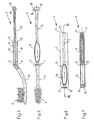
- Die Erfindung wird im folgenden anhand der Zeichnung näher erläutert.
- Es zeigen:
- Fig. 1
- ein erstes Ausführungsbeispiel einer aus zwei Formteilen bestehenden Zahnbürste in Seitenansicht und teilweise im Längsschnitt;
- Fig. 2
- die Zahnbürste nach
Fig. 1 in Draufsicht; - Fig. 3
- die Zahnbürste nach
Fig. 1 in Untersicht; - Fig. 4
- ein erstes Formteil der Zahnbürste nach
Fig. 1 in Ansicht und teilweise im Längsschnitt; - Fig. 5
- das Formteil nach
Fig. 4 in Draufsicht; - Fig. 6
- ein zweites Formteil der Zahnbürste nach
Fig. 1 in Draufsicht; - Fig. 7
- einen Schnitt nach Linie VII-VII in
Fig. 6 ; - Fig. 8
- eine Verbindungsstelle der beiden Formteile nach
Fig. 1 im vergrösserten Massstab; - Fig. 9
- im vergrösserten Massstab einen Schnitt nach Linie IX-IX in
Fig. 2 ; - Fig. 10
- ein zweites Ausführungsbeispiel einer aus zwei Formteilen bestehenden Zahnbürste in Seitenansicht;
- Fig. 11
- die Zahnbürste nach
Fig. 10 in Draufsicht; und - Fig. 12
- die Zahnbürste nach
Fig. 10 im vergrösserten Massstab, in Seitenansicht und teilweise im Schnitt, wobei ein Verschlussteil zum Verschliessen eines Handgriff-Hohlraumes vom übrigen Zahnbürstenteil getrennt dargestellt ist. - Gemäss
Fig. 1 bis 3 weist eine Zahnbürste 1 ein erstes Formteil 2 auf, das in seinem vorderen Bereich 2a einen Bürstenkopf 3 trägt. Das erste, aus einem Kunststoff A bestehende Formteil 2 ist über einen Abschnitt seiner Länge, nämlich in seinem hinteren Handgriffbereich 2b, von einem zweiten, aus einem Kunststoff B bestehenden Formteil 4 umfasst und mit diesem in einer Art Schwindverbindung kraftschlüssig verbunden. Bei den Kunststoffen A und B handelt es sich um derartige Kunststoffe, die sich während des Spritzgiessvorganges an den Berührungsflächen nicht miteinander verbinden. - Zwecks besserer Anschaulichkeit sind die beiden Formteile 2, 4 in
Fig. 4 bis 7 voneinander getrennt dargestellt. Die beiden Formteile 2, 4 weisen - wie weiter unten beschrieben wird - in ihrem Berührungsbereich gegengleiche, ineinandergreifende Vorsprünge bzw. Ausnehmungen auf, mittels welcher neben der kraftschlüssigen Verbindung beider Formteile 2, 4 zusätzlich eine formschlüssige Verbindung derselben realisiert wird. Diese Verbindung entsteht selbstverständlich erst während des Spritzgussvorganges, bei dem in einem ersten Schritt eines der Formteile und danach in einem zweiten Schritt das andere Formteil um das eine herum oder in dieses hinein gespritzt wird. Mit Vorteil wird beim unterschiedlichen Schwindmass beider Formteile 2, 4 zuerst dasjenige Formteil gespritzt, das aus Kunststoff mit geringerem Schwindmass hergestellt werden soll. Im zweiten Schritt erfolgt Spritzgiessen des anderen Formteils aus Kunststoff mit grösserem Schwindmass, wodurch ein natürlicher Anpressdruck des zweiten Kunststoffes gegenüber dem ersten Kunststoff entsteht. - Das zweite, in
Fig. 6 und 7 einzeln dargestellte und im wesentlichen den Zahnbürsten-Handgriff bildende Formteil 4 ist hülsenförmig ausgestaltet, d.h. mit einer inneren Längsbohrung 7 versehen, die in ihrer Form und Durchmesser dem hinteren Handgriffbereich 2b des ersten, inFig. 4 und 5 einzeln dargestellten Formteils 2 entspricht. Das hülsenförmige Formteil 4 weist eine Aussenfläche 6 auf. - Eine vordere Stirnfläche 8 des hülsenförmigen zweiten Formteils 4 ist in Längsrichtung der Zahnbürste gesehen einer Absatzfläche 9 des ersten Formteils 2 (
Fig. 4 ) zugeordnet. Dabei ragt ein ringförmiger, vorderer Vorsprung 10 des zweiten Formteils 4 in eine gegengleiche Ausnehmungen 11 des ersten Formteils 2 hinein, was insbesondere ausFig. 8 gut ersichtlich ist. Eine hintere Stirnfläche 14 des hülsenförmigen zweiten Formteils 4 ist einer Absatzfläche 16 eines Endstückes 15 des ersten Formteils 2 zugeordnet. Auch hier ragt ein ringförmiger, hinterer Vorsprung 17 des zweiten Formteils 4 in eine gegengleiche Ausnehmung 18 des Endstückes 15 hinein. - Das zweite Formteil 4 ist mit einer quer zur Längsbohrung 7 angeordneten, im Querschnitt ovalen, länglichen Querbohrung 20 ausgestattet, die für einen gegengleichen, die Querbohrung 20 durchdringenden Teil 21 des ersten Formteils 2 vorgesehen ist. Der ovale Teil 21 weist eine obere und eine untere Randfläche 22, 22' auf. Das zweite Formteil 4 ist mit die Querbohrung 20 umrandenden, den Randflächen 22, 22' gegengleichen Absatzflächen 23, 23' versehen. Die Randflächen 22, 22' und die Absatzflächen 23, 23' bilden wiederum eine Art Vorsprung/Ausnehmung-Formschlussverbindung zwischen den beiden Formteilen 2, 4.
- Die Aussenfläche 6 des hülsenförmigen Formteils 4 bildet zusammen mit Aussenflächen 19, 19' (
Fig. 4 ) des ovalen Teiles 21 eine Handgriffläche. - Was Material für die beiden Formteile 2, 4 anbelangt kann als Kunststoff A für das erste Formteil 2 mit Vorteil beispielsweise Polypropylen (PP) gewählt werden, während das zweite Formteil 4 beispielsweise aus folgenden Kunststoffen B bestehen kann:
- Styrol-Acryl-Nitril (SAN) und Untergruppen,
- Acryl-Butadien-Styrol (ABS) und Untergruppen,
- Polyamid (PA) und Untergruppen,
- Polycarbonat (PC) und Untergruppen,
- Polyester (PBT) und Untergruppen, oder andere
- transparente, sich mit Polypropylen (PP) nicht verbindende Kunststoffe.
- Die jeweiligen Untergruppen umfassen die zur entsprechenden Familie gehörenden Kunststoffe.
- Durch diese Materialkombination ergibt sich ein besonderer Vorteil. Da die heutigen Zahnputzmittel häufig aggressive Substanzen, wie z.B. Pfefferminzöl, enthalten, werden billige Kunststoffe wie z.B. SAN oft angegriffen. Ist das erste, den Bürstenkopf 3 tragende Formteil 2 aus gegen die aggressiven Stoffe resistentem, aber nicht vollständig durchsichtigem PP und das zweite, den Griff beinhaltende Formteil 4 aus durchsichtigem, aber weniger beständigem SAN, so liegt in dieser speziellen Ausgestaltungsform der Erfindung eine kostengünstig herstellbare Zahnbürste vor, die gegen die aggressiven Stoffe der Zahnputzmittel beständig ist und auch ästhetisch zu gefallen vermag. Natürlich kann statt des PP auch jeder andere beständige Kunststoff und statt des SAN beispielsweise einer der oben genannten, billigeren und in der Regel daher weniger beständigeren Kunststoffe verwendet werden.
- Bei diesen Materialkombinationen wird in einem ersten Schritt vorzugsweise zuerst das zweite, hülsenförmige Formteil 4 mittels Spritzgiessens hergestellt. Anschliessend wird in einem zweiten Schritt das erste Formteil 2 gespritzt, wobei die bereits beschriebene formschlüssige Verbindung im Berührungsbereich beider Formteile 2, 4 entsteht. Durch das grössere Schwindmass des zuletzt gespritzten Materials A (PP) des ersten Teiles 2 entsteht ein natürlicher Anpressdruck gegenüber dem aus Material B (z.B. SAN) bestehenden zweiten Teil 4, und es wird eine kraft- und formschlüssige Verbindung beider Formteile 2, 4 durch Ineinandergreifen der Vorsprünge 10, 17, 22, 22' in Ausnehmungen 11, 18, 23, 23' bewerkstelligt, ohne dass sich zwischen den sich eigentlich nicht verbindenden Kunststoffen A, B Spalte bilden, in die Wasser und Verunreinigungen eindringen können oder die gar zu einem Bruch führen könnten.
- Als Beispiel wurde eine aus zwei Formteilen 2, 4 bestehende Zahnbürste 1 dargestellt und beschrieben. Eine andere Ausgestaltung der beiden Formteile wäre durchaus möglich. Die hülsenförmige Ausgestaltung eines der Formteile ist nicht zwingend notwendig.
- Selbstverständlich könnte eine Zahnbürste auch mehrere Formteile aus sich während des Spritzgiessvorganges miteinander nicht verbindenden Kunststoffen aufweisen, die miteinander in einer kraft- und/oder formschlüssigen Verbindung stehen.
- Es könnten aber auch aus zwei oder mehreren Kunststoffkomponenten bestehende Formteile, bei denen z.B. eine (oder mehrere) Komponente des einen Formteiles mit einer (oder mehreren) Komponente des anderen Formteiles nicht verbindbar ist, miteinander kraft- und/oder formschlüssig verbunden werden.
- In
Fig. 10 und 11 ist ein zweites Ausführungsbeispiel einer Zahnbürste 1' dargestellt, die ebenfalls zwei aus verschiedenen, sich während des Spritzgiessvorganges miteinander nicht verbindenden Kunststoffen A und B bestehende Formteile 32, 34 aufweist. Auch hier bildet das erste Formteil 32 einen den Bürstenkopf 3' tragenden Zahnbürstenteil (inFig. 10 und 11 sind die Borsten des Bürstenkopfes 3' nicht dargestellt; es sind lediglich die zur Verankerung von Borstenbüscheln vorgesehene Vertiefungen 35 ersichtlich). Das zweite Formteil 34 bildet einen Zahnbürsten-Handgriff. Dieser ist über einen Teil seiner Länge mit einer zylindrischen Aussparung 36 versehen, durch welche ein nach hinten offener und mittels eines Verschlussteils 38 verschliessbarer Hohlraum 37 im Zahnbürsten-Handgriff gebildet ist. Das zweite Formteil 34 besteht vorzugsweise aus einer wenigstens teilweise transparenten oder transluzenten Materialkomponente, beispielsweise SAN, so dass im Hohlraum 37 verschiedene ästhetisch wirkende Mittel sichtbar untergebracht werden können (lose Gegenstände, Flüssigkeit, Pulver, bedruckte Rollen etc.). Der Verschlussteil 38 kann unlösbar oder lösbar mit dem zweiten Formteil 34 verbunden werden. Im letzteren Fall können im Hohlraum 37 beispielsweise auch Nutzgegenstände wie Zahnstocher oder Ampulle mit Mundwasser oder Zahnpasta untergebracht werden. - Auch bei dieser Zahnbürsten-Ausführungsform sind die Berührungsflächen beider Formteile 32, 34 mit ineinandergreifenden Teilen 40, 41 versehen, so dass die beiden Kunststoffteile beim Spritzgiessen in eine kraftund formschlüssige Verbindung gebracht werden. Die ineinandergreifenden Teile 40, 41 sind beispielsweise durch einen Vorsprung 40 an der Stirnseite des den Handgriff bildenden Formteils 34 und eine gegengleiche Ausnehmung 41 an der Stirnseite des anderen Formteils 32 gebildet.
- Wird der Handgriff aus dem transparenten SAN hergestellt, so wird auch bei dieser Ausführungsform vorzugsweise zuerst dieses handgriffbildende Formteil 34 im Spritzgiessverfahren hergestellt und anschliessend das den Bürstenkopf tragende Formteil 32 beispielsweise aus beständigerem Polypropylen gespritzt.
- Sowohl der borstentragende Teil der Zahnbürste als auch der Handgriff können aus weiteren Materialkomponenten bestehende Teile aufweisen. So kann z.B. im Formteil 34 eine Vertiefung für eine Daumenauflage 42 aus einer weiteren Materialkomponente, beispielsweise aus einem thermoplastischen Elastomer (TPE), vorgesehen.
- Die in
Fig. 12 gezeigte Zahnbürste entspricht der Zahnbürste 1' nachFig. 10 und 11 , ist jedoch gegenüber derFig. 10 in einem vergrösserten Massstab und teilweise im Schnitt dargestellt (die gleichen Teile sind mit den gleichen Bezugsziffern bezeichnet). Diese Zahnbürste 1' ist zum Einsetzen von verschiedentlich gefüllten Ampullen 45 vorgesehen, für die eine Halterung 46 aus einem elastisch nachgiebigen Kunststoff im vorderen Bereich der Aussparung 36 vorhanden ist. Der Verschlussteil 38 ist im Innern mit einer elastisch nachgiebigen Gegenhalterung 38' versehen. Die Ampulle 45 wird durch die beiden Halterungen 36, 38' sowohl radial, als auch axial in ihrer Lage gehalten. Die Halterung 36 kann beispielsweise aus dem gleichen Kunststoff (vorzugsweise aus PP) und im gleichen Schritt mit dem den Bürstenkopf 3' tragenden Formteil 32 gespritzt werden (der dafür vorhandene Verbindungskanal ist inFig. 12 mit 47 bezeichnet). Aus dem gleichen Kunststoff und im gleichen Schritt kann auch eine Querbohrung 48 im zuerst gespritzten Formteil 34 (beispielsweise aus SAN) gefüllt werden, wodurch auf der Aussenseite des Handgriffes die Daumenauflage 42 gebildet wird. - Die Ampullen 45 können verschiedene ästhetisch wirkende Gegenstände (lose oder in einer Flüssigkeit schwebend), Flüssigkeit, Pulver etc. beinhalten.
Claims (13)
- Verfahren zur Herstellung einer Zahnbürste (1;1') mittels Spritzgiessen, bei welchem ein einen Bürstenkopf (3;3') tragendes Formteil (2;32) und ein zumindest einen Teil eines zahnbürsten-Handgriffs bildendes Formteil (4;34) gespritzt werden, wobei das eine Formteil (2;32) das andere Formteil (4;34) zumindest teilweise umfasst und die beiden Formteile (2,4;32,34) aus sich während des Spritzgiessens nicht miteinander verbindenden Kunststoffen (A,B) gespritzt werden, dadurch gekennzeichnet, dass in einem ersten Schritt das zumindest einen Teil des Zahnbürsten-Handgriffs bildende Formteil (4;34) und in einem zweiten Schritt das den Bürstenkopf (3;3') tragende Formteil (2;32) gespritzt werden und im zweiten Schritt der Kunststoff (A) zum Bilden des den Bürstenkopf (3;3') tragenden Formteils (2;32) um das zumindest einen Teil des Zahnbürsten-Handgriffs bildende Formteil (4;34) herum oder in dieses hinein gespritzt wird, um dieses zur Bildung einer Schwindverbindung zumindest teilweise zu umfassen, und dass wenigstens eines der Formteile (2,4;32,34) mit aus einer weiteren Materialkomponente bestehenden Teilen (42) versehen wird.
- Verfahren nach Anspruch 1, dadurch gekennzeichnet, dass die Kunststoffe (A,B) ein unterschiedliches Schwindmass aufweisen, und das Schwindmass des im ersten Schritt verwendeten Kunststoffs (B) geringer ist als jenes des im zweiten Schritt verwendeten Kunststoffs (A).
- Verfahren nach einem der Ansprüche 1 oder 2, dadurch gekennzeichnet, dass im ersten Schritt ein Kunststoff (B) verwendet wird, der gegen Pfefferminzöl enthaltendes Zahnputzmittel weniger beständig ist als der im zweiten Schritt verwendete Kunststoff (A).
- Verfahren nach einem der Ansprüche 1 oder 2, dadurch gekennzeichnet, dass im ersten Schritt ein transparenter Kunststoff (B) verwendet wird.
- Verfahren nach dem Anspruch 1 oder 2, dadurch gekennzeichnet, dass im ersten Schritt Styro-Acryl-Nitril, Acryl-Butadien-Styrol, Polyamid, Polycarbonat oder Polyester verwendet wird.
- Verfahren nach einem der Ansprüche 1 bis 5, dadurch gekennzeichnet, dass im zweiten Schritt Polypropylen verwendet wird.
- Verfahren nach einem der Ansprüche 1 bis 6, dadurch gekennzeichnet, dass im ersten Schritt am zumindest einen Teil des Zahnbürsten-Handgriffs bildenden Formteil (4;34) wenigstens an einem Teil von dessen Berührungsfläche mit dem den Bürstenkopf (3;3') tragenden Formteil (2;32) vorzugsweise ringförmige Vorsprünge (10,17;40) oder Ausnehmungen und im zweiten Schritt am den Bürstenkopf (3;3') tragenden Formteil (2;32) gegengleiche Ausnehmungen (11,18;41) beziehungsweise Vorsprünge gebildet werden, die mit den Vorsprüngen oder Ausnehmungen am zumindest einen Teil des Zahnbürsten-Handgriffs bildenden Formteil (4;34) in Eingriff sind.
- Verfahren nach einem der Ansprüche 1 bis 7, dadurch gekennzeichnet, dass wenigstens eines der beiden Formteile (2,32 bzw. 4;34) aus zwei oder mehreren Kunststoffkomponenten hergestellt wird, von denen wenigsten eine mit dem Kunststoff (A bzw. B) des anderen Formteils nicht verbindbar ist.
- Verfahren nach Anspruch 8, dadurch gekennzeichnet, dass als eine der Kunststoffkomponenten ein thermoplastisches Elastomer verwendet wird,
- Verfahren nach einem der Ansprüche 1 bis 9, dadurch gekennzeichnet, dass das zumindest einen Teil des Zahnbürsten-Handgriffs bildende Formteil (4) hülsenförmig und mit einer vorderen und einer hinteren Stirnfläche (8;14) ausgestaltet wird, und beim zweiten Schritt am den Bürstenkopf (3) tragenden Formteil (2) eine mit der vorderen Stirnfläche (8) zusammenwirkende Absatzfläche (9) und eine mit der hinteren Stirnfläche (14) zusammenwirkende weitere Absatzfläche (16) gebildet wird.
- Verfahren nach Anspruch 10, dadurch gekennzeichnet, dass an der vorderen und/oder hinteren Stirnflächen (8,14) ringförmige Vorsprünge (10,17) ausgebildet werden, zur formschlüssigen Verbindung mit dem den Bürstenkopf (3) tragenden Formteil (2).
- Verfahren nach einem der Ansprüche 1 bis 8, dadurch gekennzeichnet, dass im ersten Schritt ein den Zahnbürsten-Handgriff bildendes Formteil (34) mit einem Vorsprung (40) an einer Stirnseite gebildet wird, und im zweiten Schritt das den Bürstenkopf (3') tragende Formteil (32) mit einer zum Vorsprung (40) gegengleichen Ausnehmung angespritzt wird.
- Verfahren nach einem der Ansprüche 1 bis 12, dadurch gekennzeichnet, dass im ersten Schritt am zumindest einen Teil des Zahnbürsten-Handgriffs bildenden Formteils (4,34) eine Querbohrung (20,48) ausgebildet wird, die für die Aufnahme eines gegengleichen Teils (21) des den Bürstenkopf tragenden Formteils (2,32) bestimmt ist.
Priority Applications (1)
| Application Number | Priority Date | Filing Date | Title |
|---|---|---|---|
| EP10009556.1A EP2292400B1 (de) | 1998-12-10 | 1999-12-07 | Durch Spritzgiessen hergestellte Zahnbürste und Spritzgiessverfahren |
Applications Claiming Priority (3)
| Application Number | Priority Date | Filing Date | Title |
|---|---|---|---|
| CH244898 | 1998-12-10 | ||
| CH244898 | 1998-12-10 | ||
| EP99973269A EP1054761B1 (de) | 1998-12-10 | 1999-12-07 | Kunststoffgegenstand für die verwendung im bereich der körperpflege |
Related Parent Applications (2)
| Application Number | Title | Priority Date | Filing Date |
|---|---|---|---|
| EP99973269.6 Division | 1999-12-07 | ||
| EP99973269A Division EP1054761B1 (de) | 1998-12-10 | 1999-12-07 | Kunststoffgegenstand für die verwendung im bereich der körperpflege |
Related Child Applications (2)
| Application Number | Title | Priority Date | Filing Date |
|---|---|---|---|
| EP10009556.1A Division EP2292400B1 (de) | 1998-12-10 | 1999-12-07 | Durch Spritzgiessen hergestellte Zahnbürste und Spritzgiessverfahren |
| EP10009556.1 Division-Into | 2010-09-14 |
Publications (3)
| Publication Number | Publication Date |
|---|---|
| EP1437211A2 EP1437211A2 (de) | 2004-07-14 |
| EP1437211A3 EP1437211A3 (de) | 2005-06-29 |
| EP1437211B1 true EP1437211B1 (de) | 2013-04-24 |
Family
ID=4234070
Family Applications (3)
| Application Number | Title | Priority Date | Filing Date |
|---|---|---|---|
| EP03028055.6A Expired - Lifetime EP1437211B1 (de) | 1998-12-10 | 1999-12-07 | Verfahren zur Herstellung einer Zahnbürste |
| EP99973269A Expired - Lifetime EP1054761B1 (de) | 1998-12-10 | 1999-12-07 | Kunststoffgegenstand für die verwendung im bereich der körperpflege |
| EP10009556.1A Expired - Lifetime EP2292400B1 (de) | 1998-12-10 | 1999-12-07 | Durch Spritzgiessen hergestellte Zahnbürste und Spritzgiessverfahren |
Family Applications After (2)
| Application Number | Title | Priority Date | Filing Date |
|---|---|---|---|
| EP99973269A Expired - Lifetime EP1054761B1 (de) | 1998-12-10 | 1999-12-07 | Kunststoffgegenstand für die verwendung im bereich der körperpflege |
| EP10009556.1A Expired - Lifetime EP2292400B1 (de) | 1998-12-10 | 1999-12-07 | Durch Spritzgiessen hergestellte Zahnbürste und Spritzgiessverfahren |
Country Status (9)
| Country | Link |
|---|---|
| US (4) | US6972106B2 (de) |
| EP (3) | EP1437211B1 (de) |
| CN (1) | CN1112287C (de) |
| AT (1) | ATE260173T1 (de) |
| AU (1) | AU1371300A (de) |
| BR (1) | BR9907835A (de) |
| DE (1) | DE59908650D1 (de) |
| NO (1) | NO20004032L (de) |
| WO (1) | WO2000034022A1 (de) |
Families Citing this family (82)
| Publication number | Priority date | Publication date | Assignee | Title |
|---|---|---|---|---|
| US6553604B1 (en) | 2000-03-16 | 2003-04-29 | Gillette Canada Company | Toothbrush |
| BR0208361A (pt) * | 2001-03-30 | 2004-03-23 | Unilever Nv | Escova de dentes |
| US20040177462A1 (en) | 2003-03-14 | 2004-09-16 | The Gillette Company | Toothbrush head |
| US7941886B2 (en) | 2003-09-19 | 2011-05-17 | Braun Gmbh | Toothbrushes |
| US7237892B2 (en) * | 2004-06-02 | 2007-07-03 | Bacou-Dalloz Eye & Face Protection, Inc. | Temple bar with ball and socket hinge and method of making same |
| US20060070198A1 (en) * | 2004-10-06 | 2006-04-06 | Deroma Flavio | Broom with a flexible neck |
| US20060156499A1 (en) * | 2005-01-18 | 2006-07-20 | Deroma Flavio | Broom with a flexible neck |
| FR2893237B1 (fr) * | 2005-11-17 | 2008-06-27 | Oreal | Applicateur pinceau. |
| US20070267333A1 (en) * | 2006-05-18 | 2007-11-22 | Aspen Pet Products, Inc. | Waste scoop |
| EP1927454A1 (de) * | 2006-11-29 | 2008-06-04 | Trisa Holding AG | Zahnbürste mit partiell beschichteter Oberfläche |
| KR100820076B1 (ko) * | 2007-01-28 | 2008-04-07 | (주)씨피아이케이알 | 마스카라 브러시 |
| US20090072610A1 (en) * | 2007-09-14 | 2009-03-19 | Alan Vincent Sorrentino | Method of providing a decorative member on a toothbrush |
| DE202007014474U1 (de) * | 2007-10-16 | 2009-03-05 | Schwan-Stabilo Cosmetics Gmbh & Co. Kg | Aufgespritzte Applikatoren |
| AU2012200354B2 (en) * | 2008-06-20 | 2012-08-02 | Colgate-Palmolive Company | Toothbrush with visual and/or other sensory effects |
| US8510893B2 (en) | 2008-06-20 | 2013-08-20 | Colgate-Palmolive Company | Toothbrush with visual and/or other sensory effects |
| US20100009057A1 (en) * | 2008-07-14 | 2010-01-14 | Simonetto Kemp | Tequila based drink preparations |
| USD645252S1 (en) | 2008-08-15 | 2011-09-20 | Mcneil-Ppc, Inc. | Toothbrush |
| USD658885S1 (en) | 2008-09-30 | 2012-05-08 | Mcneil-Ppc, Inc. | Toothbrush handle |
| US8745804B2 (en) * | 2009-08-27 | 2014-06-10 | Steven Jaksha | Stainless steel toothbrush with thermochromic display |
| USD654695S1 (en) | 2009-12-18 | 2012-02-28 | Colgate-Palmolive Company | Toothbrush |
| USD654696S1 (en) | 2009-12-18 | 2012-02-28 | Colgate-Palmolive Company | Toothbrush handle with tissue cleaner |
| PH12012501160A1 (en) | 2009-12-18 | 2012-11-05 | Colgate Palmolive Co | Oral care implement having a body disposed within the handle |
| USD654270S1 (en) | 2009-12-18 | 2012-02-21 | Colgate-Palmolive Company | Toothbrush handle |
| USD675830S1 (en) | 2009-12-18 | 2013-02-12 | Colgate-Palmolive Company | Toothbrush |
| USD632484S1 (en) | 2009-12-18 | 2011-02-15 | Eduardo Jimenez | Toothbrush handle with tissue cleaner |
| USD657568S1 (en) | 2010-02-26 | 2012-04-17 | Colgate-Palmolive Company | Oral care implement |
| USD657569S1 (en) | 2010-02-26 | 2012-04-17 | Colgate-Palmolive Company | Head portion of an oral care implement |
| JP5626777B2 (ja) * | 2010-08-04 | 2014-11-19 | シロキ工業株式会社 | ラゲージロック装置 |
| JP2012036579A (ja) * | 2010-08-04 | 2012-02-23 | Shiroki Corp | ラゲージロック装置 |
| CN102241107B (zh) * | 2011-05-23 | 2013-05-22 | 泰德兴精密电子(昆山)有限公司 | 采用双色模具注塑成型的塑料制品 |
| EP2827737B1 (de) * | 2012-03-22 | 2016-06-22 | Colgate-Palmolive Company | Mundpflegevorrichtung mit flexiblem griff |
| EP2807946B1 (de) * | 2013-05-29 | 2019-01-23 | The Gillette Company LLC | Aus drei Teilen kombiniertes Handzahnbürstenkonzept |
| ES2848321T3 (es) | 2014-09-17 | 2021-08-06 | Richard M Levitan | Canalizador para intubación con tubo traqueal |
| CN107072387B (zh) | 2014-11-10 | 2019-09-17 | 高露洁-棕榄公司 | 具有光透射手柄的牙刷 |
| WO2016105359A1 (en) | 2014-12-23 | 2016-06-30 | Colgate-Palmolive Company | Oral care implement |
| MX393729B (es) | 2014-12-23 | 2025-03-19 | Colgate Palmolive Co | Implemento para el cuidado bucal con un mango de componentes múltiples. |
| RU2674724C1 (ru) | 2014-12-23 | 2018-12-12 | Колгейт-Палмолив Компани | Приспособление для ухода за полостью рта |
| US11291293B2 (en) | 2014-12-23 | 2022-04-05 | Colgate-Palmolive Company | Oral care implement |
| WO2016105364A1 (en) | 2014-12-23 | 2016-06-30 | Colgate-Palmolive Company | Oral care implement having multi-component handle |
| MX2017007850A (es) | 2014-12-23 | 2017-09-19 | Colgate Palmolive Co | Implemento para el cuidado bucal. |
| EP3782508B1 (de) | 2014-12-23 | 2023-06-07 | Colgate-Palmolive Company | Mundpflegevorrichtung mit griff aus mehreren bestandteilen |
| CA2970708C (en) | 2014-12-23 | 2022-05-24 | Colgate-Palmolive Company | Oral care implement |
| USD780457S1 (en) | 2014-12-23 | 2017-03-07 | Colgate-Palmolive Company | Oral care implement |
| AU2014414825B2 (en) | 2014-12-23 | 2018-04-12 | Colgate-Palmolive Company | Oral care implement |
| EP3995036B1 (de) | 2014-12-23 | 2025-06-04 | Colgate-Palmolive Company | Mundpflegevorrichtung |
| US10182644B2 (en) | 2014-12-23 | 2019-01-22 | Colgate-Palmolive Company | Oral care implement |
| USD780458S1 (en) * | 2015-01-16 | 2017-03-07 | Radius Corporation | Toothbrush |
| US9802347B2 (en) | 2015-02-02 | 2017-10-31 | Colgate-Palmolive Company | Method of forming an oral care implement |
| WO2016209739A1 (en) * | 2015-06-26 | 2016-12-29 | Modern Packaging Llc | Overmolded low cost cutlery |
| US10226315B2 (en) * | 2015-06-30 | 2019-03-12 | Braun Gmbh | Multi-component plastic housing |
| USD777446S1 (en) | 2015-07-23 | 2017-01-31 | Colgate-Palmolive Company | Oral care implement handle |
| CN107920654A (zh) | 2015-07-23 | 2018-04-17 | 高露洁-棕榄公司 | 口腔护理器具 |
| GB2547017B (en) | 2016-02-04 | 2021-08-04 | Intersurgical Ag | Improvements to intubation aids |
| CA181150S (en) | 2017-11-02 | 2020-05-25 | Braun Gmbh | Head for electric toothbrush |
| US10709533B2 (en) | 2017-12-12 | 2020-07-14 | Colgate-Palmolive Company | Oral care implement and handle and refill head thereof |
| USD846883S1 (en) | 2017-12-12 | 2019-04-30 | Colgate-Palmolive Company | Handle of an oral care implement |
| US10631964B2 (en) | 2017-12-12 | 2020-04-28 | Colgate-Palmolive Company | Oral care implement |
| EP3501334B1 (de) | 2017-12-20 | 2020-06-24 | The Gillette Company LLC | Mundpflegevorrichtung |
| EP3501335B1 (de) | 2017-12-20 | 2020-06-17 | The Gillette Company LLC | Zahnbürste |
| EP3501333B1 (de) | 2017-12-20 | 2020-06-24 | The Gillette Company LLC | Zahnbürste |
| EP3524093A1 (de) | 2018-02-09 | 2019-08-14 | The Gillette Company LLC | Verfahren zur herstellung eines mundpflegegeräts |
| PL3524091T3 (pl) | 2018-02-09 | 2025-06-23 | The Gillette Company Llc | Ręczne narzędzie do higieny jamy ustnej |
| USD960581S1 (en) | 2018-02-09 | 2022-08-16 | The Gillette Company Llc | Toothbrush head |
| US10925384B2 (en) | 2018-04-16 | 2021-02-23 | Colgate-Palmolive Company | Oral care implement |
| USD891784S1 (en) | 2018-12-18 | 2020-08-04 | Colgate-Palmolive Company | Electric toothbrush handle |
| USD953744S1 (en) | 2019-02-08 | 2022-06-07 | Braun Gmbh | Head for electric toothbrush |
| JP2021078714A (ja) * | 2019-11-19 | 2021-05-27 | 花王株式会社 | 歯ブラシ |
| US11800924B2 (en) * | 2019-12-03 | 2023-10-31 | Colgate-Palmolive Company | Oral care implement |
| EP3995041A1 (de) | 2020-11-06 | 2022-05-11 | The Gillette Company LLC | Polymeres griffmaterial und dessen verwendung |
| EP3995038B1 (de) * | 2020-11-06 | 2025-05-14 | The Gillette Company LLC | Griff für ein körperpflegegerät sowie körperpflegegerät |
| EP3854346B1 (de) | 2020-01-22 | 2022-09-21 | The Gillette Company LLC | Verfahren zur herstellung eines griffs für ein elektrisch betriebenes körperpflegegerät |
| USD1014095S1 (en) | 2020-07-02 | 2024-02-13 | The Gillette Company Llc. | Toothbrush |
| USD957135S1 (en) | 2020-07-02 | 2022-07-12 | The Gillette Company Llc | Toothbrush head |
| PL3995040T3 (pl) | 2020-11-06 | 2025-06-16 | The Gillette Company Llc | Rękojeść urządzenia do higieny osobistej i urządzenie do higieny osobistej |
| ES2967286T3 (es) * | 2020-11-06 | 2024-04-29 | Gillette Co Llc | Mango para un utensilio de cuidado personal y utensilio de cuidado personal |
| PL3995282T3 (pl) | 2020-11-06 | 2025-11-03 | The Gillette Company Llc | Sposób wytwarzania rączki do przyrządu do higieny osobistej |
| PL3995042T3 (pl) | 2020-11-06 | 2025-07-21 | The Gillette Company Llc | Rękojeść urządzenia do higieny osobistej i urządzenie do higieny osobistej |
| USD994341S1 (en) | 2020-11-06 | 2023-08-08 | The Gillette Company Llc | Toothbrush |
| PL3995037T3 (pl) * | 2020-11-06 | 2025-06-02 | The Gillette Company Llc | Rączka dla przyrządu do higieny osobistej i przyrząd do higieny osobistej |
| CA220438S (en) | 2020-12-02 | 2023-04-17 | Braun Gmbh | Head for electric toothbrush |
| USD960582S1 (en) | 2020-12-10 | 2022-08-16 | Colgate-Palmolive Company | Oral care refill head |
| USD1051608S1 (en) | 2021-05-04 | 2024-11-19 | The Gillette Company Llc | Handle for battery operated toothbrush |
Family Cites Families (20)
| Publication number | Priority date | Publication date | Assignee | Title |
|---|---|---|---|---|
| DE7736610U1 (de) * | 1976-12-02 | 1978-06-29 | (Italien) | Zahnbuerste |
| JP2815046B2 (ja) | 1987-06-19 | 1998-10-27 | ミノルタ株式会社 | 成形部材及びその結合方法 |
| GB8807673D0 (en) * | 1988-03-31 | 1988-05-05 | Lingner & Fischer Gmbh | Novel article |
| DE4036361A1 (de) * | 1989-12-30 | 1991-07-04 | Josef Gleixner | Verfahren zur herstellung eines medizinischen anschlusselementes zur verwendung bei transfusionsleitungen, infusionsleitungen und dgl. medizinischen leitungen sowie nach diesem verfahren hergestelltes anschlusselement |
| US5464578A (en) | 1992-03-18 | 1995-11-07 | Hewlett-Packard Company | Method of making a compact fluid coupler for thermal inkjet print cartridge ink reservoir |
| US5339482A (en) | 1992-07-21 | 1994-08-23 | Johnson & Johnson Consumer Products, Inc. | Toothbrush having non-slip surface |
| DE4229152A1 (de) | 1992-09-01 | 1994-03-03 | Jordan As Oslo | Zahnbürste sowie Herstellungsverfahren für Zahnbürsten |
| GR1002012B (en) | 1993-02-16 | 1995-10-30 | Johnson & Johnson Consumer | Self-standing toothbrush |
| US5398369A (en) * | 1994-07-07 | 1995-03-21 | Chesebrough-Pond's Usa Co., Division Of Conopco, Inc. | Toothbrush with pliable pressure pad |
| DE4435888A1 (de) * | 1994-10-07 | 1996-04-11 | Coronet Werke Gmbh | Zahnbürste |
| BE1009384A3 (nl) * | 1995-05-10 | 1997-03-04 | Boucherie Nv G B | Werkwijze en inrichting voor het vervaardigen van borstellichamen. |
| GB9513883D0 (en) * | 1995-07-07 | 1995-09-06 | Lingner & Fischer Gmbh | Toothbrush |
| DE19535134C2 (de) | 1995-09-21 | 1997-10-16 | Lingner & Fischer Gmbh | Handgriff einer Zahnbürste |
| GB9601905D0 (en) | 1996-01-31 | 1996-04-03 | Secr Defence | Protection of human head and body |
| KR20000071063A (ko) * | 1997-02-14 | 2000-11-25 | 만프레트 쉐스퀘 | 두 성분으로 구성된 물품을 제조하기 위한 사출 성형 방법 및 장치 |
| US5735012A (en) * | 1997-04-01 | 1998-04-07 | Chesebrough-Pond's Usa Co., Division Of Conopco, Inc. | Resiliently flexible toothbrush |
| US5778478A (en) * | 1997-06-12 | 1998-07-14 | Coleman; Brian V. | Toothbrush with flexible handle |
| US6072223A (en) * | 1998-09-02 | 2000-06-06 | Micron Technology, Inc. | Circuit and method for a memory cell using reverse base current effect |
| US6292973B1 (en) * | 1999-04-29 | 2001-09-25 | Robert Moskovich | Toothbrush having controlled head movement |
| US6735012B2 (en) * | 2002-03-22 | 2004-05-11 | The Boeing Company | System for phase modulating an incoming optical wavefront |
-
1999
- 1999-12-07 DE DE59908650T patent/DE59908650D1/de not_active Expired - Lifetime
- 1999-12-07 BR BR9907835-0A patent/BR9907835A/pt not_active IP Right Cessation
- 1999-12-07 AT AT99973269T patent/ATE260173T1/de not_active IP Right Cessation
- 1999-12-07 AU AU13713/00A patent/AU1371300A/en not_active Abandoned
- 1999-12-07 EP EP03028055.6A patent/EP1437211B1/de not_active Expired - Lifetime
- 1999-12-07 CN CN99802849A patent/CN1112287C/zh not_active Expired - Lifetime
- 1999-12-07 EP EP99973269A patent/EP1054761B1/de not_active Expired - Lifetime
- 1999-12-07 WO PCT/CH1999/000586 patent/WO2000034022A1/de not_active Ceased
- 1999-12-07 EP EP10009556.1A patent/EP2292400B1/de not_active Expired - Lifetime
-
2000
- 2000-08-10 NO NO20004032A patent/NO20004032L/no not_active Application Discontinuation
-
2004
- 2004-01-29 US US10/765,972 patent/US6972106B2/en not_active Expired - Lifetime
-
2005
- 2005-10-04 US US11/241,957 patent/US7937794B2/en not_active Expired - Lifetime
-
2009
- 2009-08-05 US US12/461,242 patent/US8083980B2/en not_active Expired - Fee Related
-
2011
- 2011-11-22 US US13/302,604 patent/US8940211B2/en not_active Expired - Fee Related
Also Published As
| Publication number | Publication date |
|---|---|
| EP2292400A2 (de) | 2011-03-09 |
| DE59908650D1 (de) | 2004-04-01 |
| EP1054761A1 (de) | 2000-11-29 |
| US20040181889A1 (en) | 2004-09-23 |
| US20060021173A1 (en) | 2006-02-02 |
| WO2000034022A1 (de) | 2000-06-15 |
| US6972106B2 (en) | 2005-12-06 |
| EP1054761B1 (de) | 2004-02-25 |
| US8940211B2 (en) | 2015-01-27 |
| ATE260173T1 (de) | 2004-03-15 |
| CN1290206A (zh) | 2001-04-04 |
| NO20004032D0 (no) | 2000-08-10 |
| BR9907835A (pt) | 2000-10-24 |
| US20120068375A1 (en) | 2012-03-22 |
| EP2292400A3 (de) | 2013-08-21 |
| EP1437211A2 (de) | 2004-07-14 |
| CN1112287C (zh) | 2003-06-25 |
| EP1437211A3 (de) | 2005-06-29 |
| NO20004032L (no) | 2000-08-10 |
| US7937794B2 (en) | 2011-05-10 |
| AU1371300A (en) | 2000-06-26 |
| US8083980B2 (en) | 2011-12-27 |
| US20090295025A1 (en) | 2009-12-03 |
| EP2292400B1 (de) | 2016-02-17 |
Similar Documents
| Publication | Publication Date | Title |
|---|---|---|
| EP2292400B1 (de) | Durch Spritzgiessen hergestellte Zahnbürste und Spritzgiessverfahren | |
| EP1194053B1 (de) | Zahnbürste | |
| EP3348167B1 (de) | Verfahren zur herstellung einer zahnbürste | |
| EP2030524B1 (de) | Abstreifer einer Kosmetikeinheit | |
| EP2862478B1 (de) | Zahnbürste und Verfahren zur Herstellung | |
| DE10033256A1 (de) | Verfahren und Vorrichtung zur Herstellung von Borstenwaren sowie Borstenware | |
| EP2866610A1 (de) | Verfahren zur herstellung von bürsten, insbesondere interdentalbürsten, sowie bürste, insbesondere interdentalbürste und produktgruppe aus mehreren bürsten | |
| DD244062A5 (de) | Verfahren zur herstellung von borstenwaren | |
| DE102012018536A1 (de) | Bürste, insbesondere Zahnbürste, mit weichelastischem Element | |
| EP1110478A1 (de) | Verfahren zur Herstellung eines Bürstenkopfes im Wege des Spritzgiessens | |
| DE102012025039B4 (de) | Verfahren zur Herstellung von Spritzgießteilen in Zwei-Komponenten-Spritzgießtechnik sowie Spritzgießteil | |
| EP1154731A1 (de) | Reinigungselement, insbesondere zur reinigung von zähnen und verfahren zu seiner herstellung | |
| EP2574304B1 (de) | Zahnreinigungsgerät | |
| EP1908370B1 (de) | Zahnbürste und Verfahren zu deren Herstellung | |
| EP1726237B1 (de) | Bürste und Verfahren zu deren Herstellung | |
| EP3945934B1 (de) | Bürste, insbesondere zahnbürste, und verfahren zu deren herstellung | |
| EP2877331B1 (de) | Einstückig mehrkomponentig spritzgegossene bürste und verfahren zu ihrer herstellung | |
| DE102005036301A1 (de) | Zahnbürste | |
| DE10204806A1 (de) | Verfahren zur Herstellung dickwandiger Kunststoffteile | |
| DE202006016127U1 (de) | Bürste, insbesondere Zahnbürste | |
| EP2620078A1 (de) | Applikationsvorrichtung |
Legal Events
| Date | Code | Title | Description |
|---|---|---|---|
| PUAI | Public reference made under article 153(3) epc to a published international application that has entered the european phase |
Free format text: ORIGINAL CODE: 0009012 |
|
| AC | Divisional application: reference to earlier application |
Ref document number: 1054761 Country of ref document: EP Kind code of ref document: P |
|
| AK | Designated contracting states |
Kind code of ref document: A2 Designated state(s): AT BE CH CY DE DK ES FI FR GB GR IE IT LI LU MC NL PT SE |
|
| PUAL | Search report despatched |
Free format text: ORIGINAL CODE: 0009013 |
|
| AK | Designated contracting states |
Kind code of ref document: A3 Designated state(s): AT BE CH CY DE DK ES FI FR GB GR IE IT LI LU MC NL PT SE |
|
| 17P | Request for examination filed |
Effective date: 20051209 |
|
| AKX | Designation fees paid |
Designated state(s): AT BE CH CY DE DK ES FI FR GB GR IE IT LI LU MC NL PT SE |
|
| 17Q | First examination report despatched |
Effective date: 20060522 |
|
| GRAP | Despatch of communication of intention to grant a patent |
Free format text: ORIGINAL CODE: EPIDOSNIGR1 |
|
| RIC1 | Information provided on ipc code assigned before grant |
Ipc: B29C 45/16 20060101AFI20121019BHEP Ipc: A46D 1/00 20060101ALN20121019BHEP Ipc: A46B 5/02 20060101ALI20121019BHEP |
|
| GRAS | Grant fee paid |
Free format text: ORIGINAL CODE: EPIDOSNIGR3 |
|
| GRAA | (expected) grant |
Free format text: ORIGINAL CODE: 0009210 |
|
| AC | Divisional application: reference to earlier application |
Ref document number: 1054761 Country of ref document: EP Kind code of ref document: P |
|
| AK | Designated contracting states |
Kind code of ref document: B1 Designated state(s): AT BE CH CY DE DK ES FI FR GB GR IE IT LI LU MC NL PT SE |
|
| REG | Reference to a national code |
Ref country code: GB Ref legal event code: FG4D Free format text: NOT ENGLISH |
|
| REG | Reference to a national code |
Ref country code: CH Ref legal event code: EP Ref country code: CH Ref legal event code: NV Representative=s name: PATENTANWAELTE SCHAAD, BALASS, MENZL AND PARTN, CH |
|
| REG | Reference to a national code |
Ref country code: AT Ref legal event code: REF Ref document number: 608322 Country of ref document: AT Kind code of ref document: T Effective date: 20130515 |
|
| REG | Reference to a national code |
Ref country code: IE Ref legal event code: FG4D Free format text: LANGUAGE OF EP DOCUMENT: GERMAN |
|
| REG | Reference to a national code |
Ref country code: DE Ref legal event code: R096 Ref document number: 59915374 Country of ref document: DE Effective date: 20130613 |
|
| REG | Reference to a national code |
Ref country code: NL Ref legal event code: VDEP Effective date: 20130424 |
|
| PG25 | Lapsed in a contracting state [announced via postgrant information from national office to epo] |
Ref country code: ES Free format text: LAPSE BECAUSE OF FAILURE TO SUBMIT A TRANSLATION OF THE DESCRIPTION OR TO PAY THE FEE WITHIN THE PRESCRIBED TIME-LIMIT Effective date: 20130804 Ref country code: FI Free format text: LAPSE BECAUSE OF FAILURE TO SUBMIT A TRANSLATION OF THE DESCRIPTION OR TO PAY THE FEE WITHIN THE PRESCRIBED TIME-LIMIT Effective date: 20130424 Ref country code: SE Free format text: LAPSE BECAUSE OF FAILURE TO SUBMIT A TRANSLATION OF THE DESCRIPTION OR TO PAY THE FEE WITHIN THE PRESCRIBED TIME-LIMIT Effective date: 20130424 Ref country code: GR Free format text: LAPSE BECAUSE OF FAILURE TO SUBMIT A TRANSLATION OF THE DESCRIPTION OR TO PAY THE FEE WITHIN THE PRESCRIBED TIME-LIMIT Effective date: 20130725 Ref country code: PT Free format text: LAPSE BECAUSE OF FAILURE TO SUBMIT A TRANSLATION OF THE DESCRIPTION OR TO PAY THE FEE WITHIN THE PRESCRIBED TIME-LIMIT Effective date: 20130826 |
|
| PG25 | Lapsed in a contracting state [announced via postgrant information from national office to epo] |
Ref country code: CY Free format text: LAPSE BECAUSE OF FAILURE TO SUBMIT A TRANSLATION OF THE DESCRIPTION OR TO PAY THE FEE WITHIN THE PRESCRIBED TIME-LIMIT Effective date: 20130424 |
|
| PG25 | Lapsed in a contracting state [announced via postgrant information from national office to epo] |
Ref country code: DK Free format text: LAPSE BECAUSE OF FAILURE TO SUBMIT A TRANSLATION OF THE DESCRIPTION OR TO PAY THE FEE WITHIN THE PRESCRIBED TIME-LIMIT Effective date: 20130424 |
|
| PG25 | Lapsed in a contracting state [announced via postgrant information from national office to epo] |
Ref country code: NL Free format text: LAPSE BECAUSE OF FAILURE TO SUBMIT A TRANSLATION OF THE DESCRIPTION OR TO PAY THE FEE WITHIN THE PRESCRIBED TIME-LIMIT Effective date: 20130424 |
|
| PLBE | No opposition filed within time limit |
Free format text: ORIGINAL CODE: 0009261 |
|
| STAA | Information on the status of an ep patent application or granted ep patent |
Free format text: STATUS: NO OPPOSITION FILED WITHIN TIME LIMIT |
|
| 26N | No opposition filed |
Effective date: 20140127 |
|
| REG | Reference to a national code |
Ref country code: DE Ref legal event code: R097 Ref document number: 59915374 Country of ref document: DE Effective date: 20140127 |
|
| PG25 | Lapsed in a contracting state [announced via postgrant information from national office to epo] |
Ref country code: LU Free format text: LAPSE BECAUSE OF FAILURE TO SUBMIT A TRANSLATION OF THE DESCRIPTION OR TO PAY THE FEE WITHIN THE PRESCRIBED TIME-LIMIT Effective date: 20131207 Ref country code: MC Free format text: LAPSE BECAUSE OF FAILURE TO SUBMIT A TRANSLATION OF THE DESCRIPTION OR TO PAY THE FEE WITHIN THE PRESCRIBED TIME-LIMIT Effective date: 20130424 |
|
| REG | Reference to a national code |
Ref country code: IE Ref legal event code: MM4A |
|
| PG25 | Lapsed in a contracting state [announced via postgrant information from national office to epo] |
Ref country code: IE Free format text: LAPSE BECAUSE OF NON-PAYMENT OF DUE FEES Effective date: 20131207 |
|
| PGFP | Annual fee paid to national office [announced via postgrant information from national office to epo] |
Ref country code: CH Payment date: 20141201 Year of fee payment: 16 |
|
| REG | Reference to a national code |
Ref country code: AT Ref legal event code: MM01 Ref document number: 608322 Country of ref document: AT Kind code of ref document: T Effective date: 20131207 |
|
| PG25 | Lapsed in a contracting state [announced via postgrant information from national office to epo] |
Ref country code: AT Free format text: LAPSE BECAUSE OF NON-PAYMENT OF DUE FEES Effective date: 20131207 |
|
| PGFP | Annual fee paid to national office [announced via postgrant information from national office to epo] |
Ref country code: BE Payment date: 20141219 Year of fee payment: 16 |
|
| REG | Reference to a national code |
Ref country code: FR Ref legal event code: PLFP Year of fee payment: 17 |
|
| PG25 | Lapsed in a contracting state [announced via postgrant information from national office to epo] |
Ref country code: BE Free format text: LAPSE BECAUSE OF NON-PAYMENT OF DUE FEES Effective date: 20151231 |
|
| REG | Reference to a national code |
Ref country code: CH Ref legal event code: PL |
|
| PG25 | Lapsed in a contracting state [announced via postgrant information from national office to epo] |
Ref country code: LI Free format text: LAPSE BECAUSE OF NON-PAYMENT OF DUE FEES Effective date: 20151231 Ref country code: CH Free format text: LAPSE BECAUSE OF NON-PAYMENT OF DUE FEES Effective date: 20151231 |
|
| REG | Reference to a national code |
Ref country code: FR Ref legal event code: PLFP Year of fee payment: 18 |
|
| REG | Reference to a national code |
Ref country code: FR Ref legal event code: PLFP Year of fee payment: 19 |
|
| PGFP | Annual fee paid to national office [announced via postgrant information from national office to epo] |
Ref country code: DE Payment date: 20181210 Year of fee payment: 20 |
|
| PGFP | Annual fee paid to national office [announced via postgrant information from national office to epo] |
Ref country code: FR Payment date: 20181219 Year of fee payment: 20 Ref country code: GB Payment date: 20181218 Year of fee payment: 20 |
|
| PGFP | Annual fee paid to national office [announced via postgrant information from national office to epo] |
Ref country code: IT Payment date: 20181220 Year of fee payment: 20 |
|
| REG | Reference to a national code |
Ref country code: DE Ref legal event code: R071 Ref document number: 59915374 Country of ref document: DE |
|
| REG | Reference to a national code |
Ref country code: GB Ref legal event code: PE20 Expiry date: 20191206 |
|
| PG25 | Lapsed in a contracting state [announced via postgrant information from national office to epo] |
Ref country code: GB Free format text: LAPSE BECAUSE OF EXPIRATION OF PROTECTION Effective date: 20191206 |