EP1433810A1 - Glassy carbon thermoplastic compositions - Google Patents
Glassy carbon thermoplastic compositions Download PDFInfo
- Publication number
- EP1433810A1 EP1433810A1 EP20030026662 EP03026662A EP1433810A1 EP 1433810 A1 EP1433810 A1 EP 1433810A1 EP 20030026662 EP20030026662 EP 20030026662 EP 03026662 A EP03026662 A EP 03026662A EP 1433810 A1 EP1433810 A1 EP 1433810A1
- Authority
- EP
- European Patent Office
- Prior art keywords
- composition
- polyester
- glassy carbon
- reheat
- bottle
- Prior art date
- Legal status (The legal status is an assumption and is not a legal conclusion. Google has not performed a legal analysis and makes no representation as to the accuracy of the status listed.)
- Withdrawn
Links
- 239000000203 mixture Substances 0.000 title claims abstract description 260
- 229910021397 glassy carbon Inorganic materials 0.000 title claims abstract description 150
- 229920001169 thermoplastic Polymers 0.000 title claims abstract description 74
- 239000004416 thermosoftening plastic Substances 0.000 title claims abstract description 53
- 229920000728 polyester Polymers 0.000 claims abstract description 168
- -1 polyethylene terephthalate Polymers 0.000 claims abstract description 76
- 229920000139 polyethylene terephthalate Polymers 0.000 claims abstract description 71
- 239000005020 polyethylene terephthalate Substances 0.000 claims abstract description 71
- 229920000642 polymer Polymers 0.000 claims abstract description 69
- 230000003068 static effect Effects 0.000 claims abstract description 47
- 239000000654 additive Substances 0.000 claims description 152
- 230000000996 additive effect Effects 0.000 claims description 117
- 239000002245 particle Substances 0.000 claims description 72
- 238000000034 method Methods 0.000 claims description 43
- 239000012141 concentrate Substances 0.000 claims description 34
- 238000004519 manufacturing process Methods 0.000 claims description 27
- 230000008569 process Effects 0.000 claims description 22
- 239000007787 solid Substances 0.000 claims description 22
- 235000013361 beverage Nutrition 0.000 claims description 14
- 238000005259 measurement Methods 0.000 claims description 14
- 238000006068 polycondensation reaction Methods 0.000 claims description 13
- 238000001746 injection moulding Methods 0.000 claims description 11
- 239000000155 melt Substances 0.000 claims description 11
- 229920000098 polyolefin Polymers 0.000 claims description 7
- 239000002243 precursor Substances 0.000 claims description 7
- MMINFSMURORWKH-UHFFFAOYSA-N 3,6-dioxabicyclo[6.2.2]dodeca-1(10),8,11-triene-2,7-dione Chemical group O=C1OCCOC(=O)C2=CC=C1C=C2 MMINFSMURORWKH-UHFFFAOYSA-N 0.000 claims description 6
- 239000007788 liquid Substances 0.000 claims description 5
- 229920000515 polycarbonate Polymers 0.000 claims description 5
- 239000004417 polycarbonate Substances 0.000 claims description 5
- 229920000620 organic polymer Polymers 0.000 claims description 2
- LYCAIKOWRPUZTN-UHFFFAOYSA-N Ethylene glycol Chemical compound OCCO LYCAIKOWRPUZTN-UHFFFAOYSA-N 0.000 description 43
- OKTJSMMVPCPJKN-UHFFFAOYSA-N Carbon Chemical compound [C] OKTJSMMVPCPJKN-UHFFFAOYSA-N 0.000 description 30
- 235000008504 concentrate Nutrition 0.000 description 25
- 239000012071 phase Substances 0.000 description 22
- 229920005989 resin Polymers 0.000 description 21
- 239000011347 resin Substances 0.000 description 21
- 239000003795 chemical substances by application Substances 0.000 description 18
- 239000000463 material Substances 0.000 description 16
- 239000000454 talc Substances 0.000 description 16
- 229910052623 talc Inorganic materials 0.000 description 16
- WOZVHXUHUFLZGK-UHFFFAOYSA-N dimethyl terephthalate Chemical compound COC(=O)C1=CC=C(C(=O)OC)C=C1 WOZVHXUHUFLZGK-UHFFFAOYSA-N 0.000 description 14
- 238000002347 injection Methods 0.000 description 14
- 239000007924 injection Substances 0.000 description 14
- 239000006229 carbon black Substances 0.000 description 13
- 150000001875 compounds Chemical class 0.000 description 13
- 238000012360 testing method Methods 0.000 description 13
- OKKJLVBELUTLKV-UHFFFAOYSA-N Methanol Chemical compound OC OKKJLVBELUTLKV-UHFFFAOYSA-N 0.000 description 12
- 239000008188 pellet Substances 0.000 description 12
- IJGRMHOSHXDMSA-UHFFFAOYSA-N Atomic nitrogen Chemical compound N#N IJGRMHOSHXDMSA-UHFFFAOYSA-N 0.000 description 11
- 150000002009 diols Chemical class 0.000 description 11
- 238000006243 chemical reaction Methods 0.000 description 10
- 229910002804 graphite Inorganic materials 0.000 description 10
- 239000010439 graphite Substances 0.000 description 10
- 239000000126 substance Substances 0.000 description 10
- 229910052799 carbon Inorganic materials 0.000 description 9
- 239000003054 catalyst Substances 0.000 description 9
- XLYOFNOQVPJJNP-UHFFFAOYSA-N water Substances O XLYOFNOQVPJJNP-UHFFFAOYSA-N 0.000 description 9
- 101100371340 Saccharomyces cerevisiae (strain ATCC 204508 / S288c) TYE7 gene Proteins 0.000 description 8
- KKEYFWRCBNTPAC-UHFFFAOYSA-N Terephthalic acid Chemical compound OC(=O)C1=CC=C(C(O)=O)C=C1 KKEYFWRCBNTPAC-UHFFFAOYSA-N 0.000 description 8
- 238000006116 polymerization reaction Methods 0.000 description 8
- VYPSYNLAJGMNEJ-UHFFFAOYSA-N silicon dioxide Inorganic materials O=[Si]=O VYPSYNLAJGMNEJ-UHFFFAOYSA-N 0.000 description 8
- 238000007664 blowing Methods 0.000 description 7
- 230000007423 decrease Effects 0.000 description 7
- 238000009826 distribution Methods 0.000 description 7
- 238000009472 formulation Methods 0.000 description 7
- 238000011068 loading method Methods 0.000 description 7
- 238000002156 mixing Methods 0.000 description 7
- 239000000843 powder Substances 0.000 description 7
- 230000032050 esterification Effects 0.000 description 6
- 238000005886 esterification reaction Methods 0.000 description 6
- 230000006872 improvement Effects 0.000 description 6
- 239000011148 porous material Substances 0.000 description 6
- 238000002360 preparation method Methods 0.000 description 6
- 239000000047 product Substances 0.000 description 6
- 239000010453 quartz Substances 0.000 description 6
- 238000010998 test method Methods 0.000 description 6
- 239000010936 titanium Substances 0.000 description 6
- OAICVXFJPJFONN-UHFFFAOYSA-N Phosphorus Chemical compound [P] OAICVXFJPJFONN-UHFFFAOYSA-N 0.000 description 5
- 239000002253 acid Substances 0.000 description 5
- 230000009286 beneficial effect Effects 0.000 description 5
- 125000004432 carbon atom Chemical group C* 0.000 description 5
- 230000000694 effects Effects 0.000 description 5
- 239000004615 ingredient Substances 0.000 description 5
- 229910052757 nitrogen Inorganic materials 0.000 description 5
- 229910052698 phosphorus Inorganic materials 0.000 description 5
- 239000011574 phosphorus Substances 0.000 description 5
- 238000012545 processing Methods 0.000 description 5
- 238000000197 pyrolysis Methods 0.000 description 5
- 230000009467 reduction Effects 0.000 description 5
- 239000007921 spray Substances 0.000 description 5
- QPFMBZIOSGYJDE-UHFFFAOYSA-N 1,1,2,2-tetrachloroethane Chemical compound ClC(Cl)C(Cl)Cl QPFMBZIOSGYJDE-UHFFFAOYSA-N 0.000 description 4
- OFOBLEOULBTSOW-UHFFFAOYSA-N Malonic acid Chemical compound OC(=O)CC(O)=O OFOBLEOULBTSOW-UHFFFAOYSA-N 0.000 description 4
- NBIIXXVUZAFLBC-UHFFFAOYSA-N Phosphoric acid Chemical compound OP(O)(O)=O NBIIXXVUZAFLBC-UHFFFAOYSA-N 0.000 description 4
- ADCOVFLJGNWWNZ-UHFFFAOYSA-N antimony trioxide Chemical compound O=[Sb]O[Sb]=O ADCOVFLJGNWWNZ-UHFFFAOYSA-N 0.000 description 4
- 230000005540 biological transmission Effects 0.000 description 4
- 238000002425 crystallisation Methods 0.000 description 4
- 230000008025 crystallization Effects 0.000 description 4
- 150000001991 dicarboxylic acids Chemical class 0.000 description 4
- VNGOYPQMJFJDLV-UHFFFAOYSA-N dimethyl benzene-1,3-dicarboxylate Chemical compound COC(=O)C1=CC=CC(C(=O)OC)=C1 VNGOYPQMJFJDLV-UHFFFAOYSA-N 0.000 description 4
- 238000002474 experimental method Methods 0.000 description 4
- 238000010438 heat treatment Methods 0.000 description 4
- WTFXARWRTYJXII-UHFFFAOYSA-N iron(2+);iron(3+);oxygen(2-) Chemical compound [O-2].[O-2].[O-2].[O-2].[Fe+2].[Fe+3].[Fe+3] WTFXARWRTYJXII-UHFFFAOYSA-N 0.000 description 4
- SZVJSHCCFOBDDC-UHFFFAOYSA-N iron(II,III) oxide Inorganic materials O=[Fe]O[Fe]O[Fe]=O SZVJSHCCFOBDDC-UHFFFAOYSA-N 0.000 description 4
- QQVIHTHCMHWDBS-UHFFFAOYSA-N isophthalic acid Chemical compound OC(=O)C1=CC=CC(C(O)=O)=C1 QQVIHTHCMHWDBS-UHFFFAOYSA-N 0.000 description 4
- 229910052751 metal Inorganic materials 0.000 description 4
- 239000002184 metal Substances 0.000 description 4
- 239000000243 solution Substances 0.000 description 4
- 239000004609 Impact Modifier Substances 0.000 description 3
- 239000004698 Polyethylene Substances 0.000 description 3
- 229910052787 antimony Inorganic materials 0.000 description 3
- WATWJIUSRGPENY-UHFFFAOYSA-N antimony atom Chemical compound [Sb] WATWJIUSRGPENY-UHFFFAOYSA-N 0.000 description 3
- 229910021383 artificial graphite Inorganic materials 0.000 description 3
- 239000012298 atmosphere Substances 0.000 description 3
- 229920005601 base polymer Polymers 0.000 description 3
- 230000008901 benefit Effects 0.000 description 3
- 230000015572 biosynthetic process Effects 0.000 description 3
- 239000003086 colorant Substances 0.000 description 3
- MTHSVFCYNBDYFN-UHFFFAOYSA-N diethylene glycol Chemical compound OCCOCCO MTHSVFCYNBDYFN-UHFFFAOYSA-N 0.000 description 3
- 238000000295 emission spectrum Methods 0.000 description 3
- 150000002148 esters Chemical class 0.000 description 3
- 239000000945 filler Substances 0.000 description 3
- 239000011521 glass Substances 0.000 description 3
- WGCNASOHLSPBMP-UHFFFAOYSA-N hydroxyacetaldehyde Natural products OCC=O WGCNASOHLSPBMP-UHFFFAOYSA-N 0.000 description 3
- 239000000314 lubricant Substances 0.000 description 3
- 239000002932 luster Substances 0.000 description 3
- 229920000573 polyethylene Polymers 0.000 description 3
- 239000000376 reactant Substances 0.000 description 3
- 239000011541 reaction mixture Substances 0.000 description 3
- 239000012798 spherical particle Substances 0.000 description 3
- 239000003381 stabilizer Substances 0.000 description 3
- 238000002834 transmittance Methods 0.000 description 3
- 230000000007 visual effect Effects 0.000 description 3
- IKHGUXGNUITLKF-UHFFFAOYSA-N Acetaldehyde Chemical compound CC=O IKHGUXGNUITLKF-UHFFFAOYSA-N 0.000 description 2
- QTBSBXVTEAMEQO-UHFFFAOYSA-M Acetate Chemical compound CC([O-])=O QTBSBXVTEAMEQO-UHFFFAOYSA-M 0.000 description 2
- CURLTUGMZLYLDI-UHFFFAOYSA-N Carbon dioxide Chemical compound O=C=O CURLTUGMZLYLDI-UHFFFAOYSA-N 0.000 description 2
- 229920001634 Copolyester Polymers 0.000 description 2
- 102100021792 Gamma-sarcoglycan Human genes 0.000 description 2
- 101000616435 Homo sapiens Gamma-sarcoglycan Proteins 0.000 description 2
- 101000873676 Homo sapiens Secretogranin-2 Proteins 0.000 description 2
- 101000873658 Homo sapiens Secretogranin-3 Proteins 0.000 description 2
- 102100030550 Menin Human genes 0.000 description 2
- 229910019142 PO4 Inorganic materials 0.000 description 2
- ISWSIDIOOBJBQZ-UHFFFAOYSA-N Phenol Chemical compound OC1=CC=CC=C1 ISWSIDIOOBJBQZ-UHFFFAOYSA-N 0.000 description 2
- 239000004743 Polypropylene Substances 0.000 description 2
- GWEVSGVZZGPLCZ-UHFFFAOYSA-N Titan oxide Chemical compound O=[Ti]=O GWEVSGVZZGPLCZ-UHFFFAOYSA-N 0.000 description 2
- YIMQCDZDWXUDCA-UHFFFAOYSA-N [4-(hydroxymethyl)cyclohexyl]methanol Chemical compound OCC1CCC(CO)CC1 YIMQCDZDWXUDCA-UHFFFAOYSA-N 0.000 description 2
- 239000006096 absorbing agent Substances 0.000 description 2
- WNLRTRBMVRJNCN-UHFFFAOYSA-N adipic acid Chemical compound OC(=O)CCCCC(O)=O WNLRTRBMVRJNCN-UHFFFAOYSA-N 0.000 description 2
- 239000000443 aerosol Substances 0.000 description 2
- 229910000147 aluminium phosphate Inorganic materials 0.000 description 2
- 238000004458 analytical method Methods 0.000 description 2
- 229910000410 antimony oxide Inorganic materials 0.000 description 2
- 239000003963 antioxidant agent Substances 0.000 description 2
- 125000003118 aryl group Chemical group 0.000 description 2
- 238000000071 blow moulding Methods 0.000 description 2
- WERYXYBDKMZEQL-UHFFFAOYSA-N butane-1,4-diol Chemical compound OCCCCO WERYXYBDKMZEQL-UHFFFAOYSA-N 0.000 description 2
- 239000007833 carbon precursor Substances 0.000 description 2
- 239000000969 carrier Substances 0.000 description 2
- 239000003638 chemical reducing agent Substances 0.000 description 2
- 238000000576 coating method Methods 0.000 description 2
- 150000001869 cobalt compounds Chemical class 0.000 description 2
- 239000000571 coke Substances 0.000 description 2
- 238000013329 compounding Methods 0.000 description 2
- 238000009833 condensation Methods 0.000 description 2
- 230000005494 condensation Effects 0.000 description 2
- 238000001816 cooling Methods 0.000 description 2
- 229920001577 copolymer Polymers 0.000 description 2
- QYQADNCHXSEGJT-UHFFFAOYSA-N cyclohexane-1,1-dicarboxylate;hydron Chemical compound OC(=O)C1(C(O)=O)CCCCC1 QYQADNCHXSEGJT-UHFFFAOYSA-N 0.000 description 2
- 238000011049 filling Methods 0.000 description 2
- 230000009477 glass transition Effects 0.000 description 2
- 238000011065 in-situ storage Methods 0.000 description 2
- 239000011261 inert gas Substances 0.000 description 2
- 229910052500 inorganic mineral Inorganic materials 0.000 description 2
- 238000003780 insertion Methods 0.000 description 2
- 230000037431 insertion Effects 0.000 description 2
- 230000001788 irregular Effects 0.000 description 2
- 230000033001 locomotion Effects 0.000 description 2
- 239000006078 metal deactivator Substances 0.000 description 2
- 239000011707 mineral Substances 0.000 description 2
- 235000010755 mineral Nutrition 0.000 description 2
- XBGNERSKEKDZDS-UHFFFAOYSA-N n-[2-(dimethylamino)ethyl]acridine-4-carboxamide Chemical compound C1=CC=C2N=C3C(C(=O)NCCN(C)C)=CC=CC3=CC2=C1 XBGNERSKEKDZDS-UHFFFAOYSA-N 0.000 description 2
- RXOHFPCZGPKIRD-UHFFFAOYSA-N naphthalene-2,6-dicarboxylic acid Chemical compound C1=C(C(O)=O)C=CC2=CC(C(=O)O)=CC=C21 RXOHFPCZGPKIRD-UHFFFAOYSA-N 0.000 description 2
- 229910021382 natural graphite Inorganic materials 0.000 description 2
- BDJRBEYXGGNYIS-UHFFFAOYSA-N nonanedioic acid Chemical compound OC(=O)CCCCCCCC(O)=O BDJRBEYXGGNYIS-UHFFFAOYSA-N 0.000 description 2
- 239000002667 nucleating agent Substances 0.000 description 2
- VTRUBDSFZJNXHI-UHFFFAOYSA-N oxoantimony Chemical compound [Sb]=O VTRUBDSFZJNXHI-UHFFFAOYSA-N 0.000 description 2
- 239000010452 phosphate Substances 0.000 description 2
- XNGIFLGASWRNHJ-UHFFFAOYSA-N phthalic acid Chemical compound OC(=O)C1=CC=CC=C1C(O)=O XNGIFLGASWRNHJ-UHFFFAOYSA-N 0.000 description 2
- 239000000049 pigment Substances 0.000 description 2
- 239000011295 pitch Substances 0.000 description 2
- 229920003023 plastic Polymers 0.000 description 2
- 239000004033 plastic Substances 0.000 description 2
- 239000011112 polyethylene naphthalate Substances 0.000 description 2
- 229920001155 polypropylene Polymers 0.000 description 2
- YPFDHNVEDLHUCE-UHFFFAOYSA-N propane-1,3-diol Chemical compound OCCCO YPFDHNVEDLHUCE-UHFFFAOYSA-N 0.000 description 2
- 238000005096 rolling process Methods 0.000 description 2
- CXMXRPHRNRROMY-UHFFFAOYSA-N sebacic acid Chemical compound OC(=O)CCCCCCCCC(O)=O CXMXRPHRNRROMY-UHFFFAOYSA-N 0.000 description 2
- 229910001220 stainless steel Inorganic materials 0.000 description 2
- 239000010935 stainless steel Substances 0.000 description 2
- 238000003756 stirring Methods 0.000 description 2
- ISIJQEHRDSCQIU-UHFFFAOYSA-N tert-butyl 2,7-diazaspiro[4.5]decane-7-carboxylate Chemical compound C1N(C(=O)OC(C)(C)C)CCCC11CNCC1 ISIJQEHRDSCQIU-UHFFFAOYSA-N 0.000 description 2
- 229920001187 thermosetting polymer Polymers 0.000 description 2
- 229910052719 titanium Inorganic materials 0.000 description 2
- VXUYXOFXAQZZMF-UHFFFAOYSA-N titanium(IV) isopropoxide Chemical compound CC(C)O[Ti](OC(C)C)(OC(C)C)OC(C)C VXUYXOFXAQZZMF-UHFFFAOYSA-N 0.000 description 2
- PUPZLCDOIYMWBV-UHFFFAOYSA-N (+/-)-1,3-Butanediol Chemical compound CC(O)CCO PUPZLCDOIYMWBV-UHFFFAOYSA-N 0.000 description 1
- VLDPXPPHXDGHEW-UHFFFAOYSA-N 1-chloro-2-dichlorophosphoryloxybenzene Chemical compound ClC1=CC=CC=C1OP(Cl)(Cl)=O VLDPXPPHXDGHEW-UHFFFAOYSA-N 0.000 description 1
- RTBFRGCFXZNCOE-UHFFFAOYSA-N 1-methylsulfonylpiperidin-4-one Chemical compound CS(=O)(=O)N1CCC(=O)CC1 RTBFRGCFXZNCOE-UHFFFAOYSA-N 0.000 description 1
- FQXGHZNSUOHCLO-UHFFFAOYSA-N 2,2,4,4-tetramethyl-1,3-cyclobutanediol Chemical compound CC1(C)C(O)C(C)(C)C1O FQXGHZNSUOHCLO-UHFFFAOYSA-N 0.000 description 1
- YQPCHPBGAALCRT-UHFFFAOYSA-N 2-[1-(carboxymethyl)cyclohexyl]acetic acid Chemical compound OC(=O)CC1(CC(O)=O)CCCCC1 YQPCHPBGAALCRT-UHFFFAOYSA-N 0.000 description 1
- ICPXIRMAMWRMAD-UHFFFAOYSA-N 2-[3-[2-[3-(2-hydroxyethoxy)phenyl]propan-2-yl]phenoxy]ethanol Chemical compound C=1C=CC(OCCO)=CC=1C(C)(C)C1=CC=CC(OCCO)=C1 ICPXIRMAMWRMAD-UHFFFAOYSA-N 0.000 description 1
- WTPYFJNYAMXZJG-UHFFFAOYSA-N 2-[4-(2-hydroxyethoxy)phenoxy]ethanol Chemical compound OCCOC1=CC=C(OCCO)C=C1 WTPYFJNYAMXZJG-UHFFFAOYSA-N 0.000 description 1
- CPHURRLSZSRQFS-UHFFFAOYSA-N 3-[4-[2-[4-(3-hydroxypropoxy)phenyl]propan-2-yl]phenoxy]propan-1-ol Chemical compound C=1C=C(OCCCO)C=CC=1C(C)(C)C1=CC=C(OCCCO)C=C1 CPHURRLSZSRQFS-UHFFFAOYSA-N 0.000 description 1
- CDBAMNGURPMUTG-UHFFFAOYSA-N 4-[2-(4-hydroxycyclohexyl)propan-2-yl]cyclohexan-1-ol Chemical compound C1CC(O)CCC1C(C)(C)C1CCC(O)CC1 CDBAMNGURPMUTG-UHFFFAOYSA-N 0.000 description 1
- 101150015738 Fev gene Proteins 0.000 description 1
- 229920000106 Liquid crystal polymer Polymers 0.000 description 1
- 239000004977 Liquid-crystal polymers (LCPs) Substances 0.000 description 1
- PWHULOQIROXLJO-UHFFFAOYSA-N Manganese Chemical compound [Mn] PWHULOQIROXLJO-UHFFFAOYSA-N 0.000 description 1
- ALQSHHUCVQOPAS-UHFFFAOYSA-N Pentane-1,5-diol Chemical compound OCCCCCO ALQSHHUCVQOPAS-UHFFFAOYSA-N 0.000 description 1
- 239000004642 Polyimide Substances 0.000 description 1
- 102100037681 Protein FEV Human genes 0.000 description 1
- KDYFGRWQOYBRFD-UHFFFAOYSA-N Succinic acid Natural products OC(=O)CCC(O)=O KDYFGRWQOYBRFD-UHFFFAOYSA-N 0.000 description 1
- RTAQQCXQSZGOHL-UHFFFAOYSA-N Titanium Chemical compound [Ti] RTAQQCXQSZGOHL-UHFFFAOYSA-N 0.000 description 1
- ZJCCRDAZUWHFQH-UHFFFAOYSA-N Trimethylolpropane Chemical compound CCC(CO)(CO)CO ZJCCRDAZUWHFQH-UHFFFAOYSA-N 0.000 description 1
- HCHKCACWOHOZIP-UHFFFAOYSA-N Zinc Chemical compound [Zn] HCHKCACWOHOZIP-UHFFFAOYSA-N 0.000 description 1
- 238000002835 absorbance Methods 0.000 description 1
- 238000010521 absorption reaction Methods 0.000 description 1
- 150000008065 acid anhydrides Chemical class 0.000 description 1
- 150000007513 acids Chemical class 0.000 description 1
- 239000001361 adipic acid Substances 0.000 description 1
- 235000011037 adipic acid Nutrition 0.000 description 1
- 239000003463 adsorbent Substances 0.000 description 1
- 125000001931 aliphatic group Chemical group 0.000 description 1
- JFCQEDHGNNZCLN-UHFFFAOYSA-N anhydrous glutaric acid Natural products OC(=O)CCCC(O)=O JFCQEDHGNNZCLN-UHFFFAOYSA-N 0.000 description 1
- 150000001558 benzoic acid derivatives Chemical class 0.000 description 1
- 230000000443 biocontrol Effects 0.000 description 1
- 229920000402 bisphenol A polycarbonate polymer Polymers 0.000 description 1
- 230000000903 blocking effect Effects 0.000 description 1
- 238000009835 boiling Methods 0.000 description 1
- 239000006085 branching agent Substances 0.000 description 1
- KDYFGRWQOYBRFD-NUQCWPJISA-N butanedioic acid Chemical compound O[14C](=O)CC[14C](O)=O KDYFGRWQOYBRFD-NUQCWPJISA-N 0.000 description 1
- 239000006227 byproduct Substances 0.000 description 1
- 239000001569 carbon dioxide Substances 0.000 description 1
- 229910002092 carbon dioxide Inorganic materials 0.000 description 1
- 239000003575 carbonaceous material Substances 0.000 description 1
- 235000014171 carbonated beverage Nutrition 0.000 description 1
- 238000012993 chemical processing Methods 0.000 description 1
- 239000007795 chemical reaction product Substances 0.000 description 1
- 150000001805 chlorine compounds Chemical class 0.000 description 1
- 239000003245 coal Substances 0.000 description 1
- 239000011248 coating agent Substances 0.000 description 1
- 239000010941 cobalt Substances 0.000 description 1
- 229910017052 cobalt Inorganic materials 0.000 description 1
- GUTLYIVDDKVIGB-UHFFFAOYSA-N cobalt atom Chemical compound [Co] GUTLYIVDDKVIGB-UHFFFAOYSA-N 0.000 description 1
- 238000004590 computer program Methods 0.000 description 1
- 238000011109 contamination Methods 0.000 description 1
- 238000005520 cutting process Methods 0.000 description 1
- 230000001066 destructive effect Effects 0.000 description 1
- JVLRYPRBKSMEBF-UHFFFAOYSA-K diacetyloxystibanyl acetate Chemical compound [Sb+3].CC([O-])=O.CC([O-])=O.CC([O-])=O JVLRYPRBKSMEBF-UHFFFAOYSA-K 0.000 description 1
- AYOHIQLKSOJJQH-UHFFFAOYSA-N dibutyltin Chemical compound CCCC[Sn]CCCC AYOHIQLKSOJJQH-UHFFFAOYSA-N 0.000 description 1
- 125000001142 dicarboxylic acid group Chemical group 0.000 description 1
- 150000005690 diesters Chemical class 0.000 description 1
- 229910001873 dinitrogen Inorganic materials 0.000 description 1
- 238000002845 discoloration Methods 0.000 description 1
- 239000000975 dye Substances 0.000 description 1
- 229920001971 elastomer Polymers 0.000 description 1
- 238000005516 engineering process Methods 0.000 description 1
- 238000011156 evaluation Methods 0.000 description 1
- 239000000835 fiber Substances 0.000 description 1
- 239000012530 fluid Substances 0.000 description 1
- 235000003599 food sweetener Nutrition 0.000 description 1
- SLGWESQGEUXWJQ-UHFFFAOYSA-N formaldehyde;phenol Chemical compound O=C.OC1=CC=CC=C1 SLGWESQGEUXWJQ-UHFFFAOYSA-N 0.000 description 1
- 235000011389 fruit/vegetable juice Nutrition 0.000 description 1
- 229910021485 fumed silica Inorganic materials 0.000 description 1
- 238000005469 granulation Methods 0.000 description 1
- 230000003179 granulation Effects 0.000 description 1
- 238000013038 hand mixing Methods 0.000 description 1
- XXMIOPMDWAUFGU-UHFFFAOYSA-N hexane-1,6-diol Chemical compound OCCCCCCO XXMIOPMDWAUFGU-UHFFFAOYSA-N 0.000 description 1
- 229920001519 homopolymer Polymers 0.000 description 1
- 229930195733 hydrocarbon Natural products 0.000 description 1
- 150000002430 hydrocarbons Chemical class 0.000 description 1
- 239000005457 ice water Substances 0.000 description 1
- 238000010348 incorporation Methods 0.000 description 1
- 150000002506 iron compounds Chemical class 0.000 description 1
- JEIPFZHSYJVQDO-UHFFFAOYSA-N iron(III) oxide Inorganic materials O=[Fe]O[Fe]=O JEIPFZHSYJVQDO-UHFFFAOYSA-N 0.000 description 1
- 239000003077 lignite Substances 0.000 description 1
- 235000014666 liquid concentrate Nutrition 0.000 description 1
- UEGPKNKPLBYCNK-UHFFFAOYSA-L magnesium acetate Chemical class [Mg+2].CC([O-])=O.CC([O-])=O UEGPKNKPLBYCNK-UHFFFAOYSA-L 0.000 description 1
- 235000011285 magnesium acetate Nutrition 0.000 description 1
- 238000012423 maintenance Methods 0.000 description 1
- 229910052748 manganese Inorganic materials 0.000 description 1
- 239000011572 manganese Substances 0.000 description 1
- CESXSDZNZGSWSP-UHFFFAOYSA-L manganese(2+);diacetate;tetrahydrate Chemical compound O.O.O.O.[Mn+2].CC([O-])=O.CC([O-])=O CESXSDZNZGSWSP-UHFFFAOYSA-L 0.000 description 1
- WPBNNNQJVZRUHP-UHFFFAOYSA-L manganese(2+);methyl n-[[2-(methoxycarbonylcarbamothioylamino)phenyl]carbamothioyl]carbamate;n-[2-(sulfidocarbothioylamino)ethyl]carbamodithioate Chemical compound [Mn+2].[S-]C(=S)NCCNC([S-])=S.COC(=O)NC(=S)NC1=CC=CC=C1NC(=S)NC(=O)OC WPBNNNQJVZRUHP-UHFFFAOYSA-L 0.000 description 1
- 238000002844 melting Methods 0.000 description 1
- 230000008018 melting Effects 0.000 description 1
- OJURWUUOVGOHJZ-UHFFFAOYSA-N methyl 2-[(2-acetyloxyphenyl)methyl-[2-[(2-acetyloxyphenyl)methyl-(2-methoxy-2-oxoethyl)amino]ethyl]amino]acetate Chemical compound C=1C=CC=C(OC(C)=O)C=1CN(CC(=O)OC)CCN(CC(=O)OC)CC1=CC=CC=C1OC(C)=O OJURWUUOVGOHJZ-UHFFFAOYSA-N 0.000 description 1
- 230000000877 morphologic effect Effects 0.000 description 1
- 238000000465 moulding Methods 0.000 description 1
- 229920000368 omega-hydroxypoly(furan-2,5-diylmethylene) polymer Polymers 0.000 description 1
- 239000011368 organic material Substances 0.000 description 1
- 238000004806 packaging method and process Methods 0.000 description 1
- 238000005453 pelletization Methods 0.000 description 1
- WXZMFSXDPGVJKK-UHFFFAOYSA-N pentaerythritol Chemical compound OCC(CO)(CO)CO WXZMFSXDPGVJKK-UHFFFAOYSA-N 0.000 description 1
- 230000035699 permeability Effects 0.000 description 1
- 229920001568 phenolic resin Polymers 0.000 description 1
- NBIIXXVUZAFLBC-UHFFFAOYSA-K phosphate Chemical compound [O-]P([O-])([O-])=O NBIIXXVUZAFLBC-UHFFFAOYSA-K 0.000 description 1
- 230000000704 physical effect Effects 0.000 description 1
- 229920003207 poly(ethylene-2,6-naphthalate) Polymers 0.000 description 1
- 229920002239 polyacrylonitrile Polymers 0.000 description 1
- 229920001721 polyimide Polymers 0.000 description 1
- 239000012704 polymeric precursor Substances 0.000 description 1
- 229920005862 polyol Polymers 0.000 description 1
- 150000003077 polyols Chemical class 0.000 description 1
- XRVCFZPJAHWYTB-UHFFFAOYSA-N prenderol Chemical compound CCC(CC)(CO)CO XRVCFZPJAHWYTB-UHFFFAOYSA-N 0.000 description 1
- 230000002035 prolonged effect Effects 0.000 description 1
- OGHBATFHNDZKSO-UHFFFAOYSA-N propan-2-olate Chemical compound CC(C)[O-] OGHBATFHNDZKSO-UHFFFAOYSA-N 0.000 description 1
- 238000010926 purge Methods 0.000 description 1
- 238000000746 purification Methods 0.000 description 1
- 239000011819 refractory material Substances 0.000 description 1
- 238000003303 reheating Methods 0.000 description 1
- 230000002787 reinforcement Effects 0.000 description 1
- 238000009877 rendering Methods 0.000 description 1
- 238000007788 roughening Methods 0.000 description 1
- 239000002002 slurry Substances 0.000 description 1
- 239000007790 solid phase Substances 0.000 description 1
- 238000001228 spectrum Methods 0.000 description 1
- 229910052596 spinel Inorganic materials 0.000 description 1
- 239000011029 spinel Substances 0.000 description 1
- 239000003765 sweetening agent Substances 0.000 description 1
- 238000003786 synthesis reaction Methods 0.000 description 1
- 238000010189 synthetic method Methods 0.000 description 1
- 239000004408 titanium dioxide Substances 0.000 description 1
- 238000005809 transesterification reaction Methods 0.000 description 1
- ILJSQTXMGCGYMG-UHFFFAOYSA-N triacetic acid Chemical compound CC(=O)CC(=O)CC(O)=O ILJSQTXMGCGYMG-UHFFFAOYSA-N 0.000 description 1
- ZIBGPFATKBEMQZ-UHFFFAOYSA-N triethylene glycol Chemical compound OCCOCCOCCO ZIBGPFATKBEMQZ-UHFFFAOYSA-N 0.000 description 1
- SRPWOOOHEPICQU-UHFFFAOYSA-N trimellitic anhydride Chemical compound OC(=O)C1=CC=C2C(=O)OC(=O)C2=C1 SRPWOOOHEPICQU-UHFFFAOYSA-N 0.000 description 1
- 238000009423 ventilation Methods 0.000 description 1
- 238000001429 visible spectrum Methods 0.000 description 1
- 238000004065 wastewater treatment Methods 0.000 description 1
- 239000002023 wood Substances 0.000 description 1
- 239000011701 zinc Substances 0.000 description 1
- 229910052725 zinc Inorganic materials 0.000 description 1
Images

Classifications
-
- C—CHEMISTRY; METALLURGY
- C08—ORGANIC MACROMOLECULAR COMPOUNDS; THEIR PREPARATION OR CHEMICAL WORKING-UP; COMPOSITIONS BASED THEREON
- C08K—Use of inorganic or non-macromolecular organic substances as compounding ingredients
- C08K3/00—Use of inorganic substances as compounding ingredients
- C08K3/02—Elements
- C08K3/04—Carbon
-
- C—CHEMISTRY; METALLURGY
- C08—ORGANIC MACROMOLECULAR COMPOUNDS; THEIR PREPARATION OR CHEMICAL WORKING-UP; COMPOSITIONS BASED THEREON
- C08L—COMPOSITIONS OF MACROMOLECULAR COMPOUNDS
- C08L67/00—Compositions of polyesters obtained by reactions forming a carboxylic ester link in the main chain; Compositions of derivatives of such polymers
- C08L67/02—Polyesters derived from dicarboxylic acids and dihydroxy compounds
-
- B—PERFORMING OPERATIONS; TRANSPORTING
- B29—WORKING OF PLASTICS; WORKING OF SUBSTANCES IN A PLASTIC STATE IN GENERAL
- B29C—SHAPING OR JOINING OF PLASTICS; SHAPING OF MATERIAL IN A PLASTIC STATE, NOT OTHERWISE PROVIDED FOR; AFTER-TREATMENT OF THE SHAPED PRODUCTS, e.g. REPAIRING
- B29C2949/00—Indexing scheme relating to blow-moulding
- B29C2949/20—Preforms or parisons whereby a specific part is made of only one component, e.g. only one layer
- B29C2949/22—Preforms or parisons whereby a specific part is made of only one component, e.g. only one layer at neck portion
-
- B—PERFORMING OPERATIONS; TRANSPORTING
- B29—WORKING OF PLASTICS; WORKING OF SUBSTANCES IN A PLASTIC STATE IN GENERAL
- B29C—SHAPING OR JOINING OF PLASTICS; SHAPING OF MATERIAL IN A PLASTIC STATE, NOT OTHERWISE PROVIDED FOR; AFTER-TREATMENT OF THE SHAPED PRODUCTS, e.g. REPAIRING
- B29C2949/00—Indexing scheme relating to blow-moulding
- B29C2949/20—Preforms or parisons whereby a specific part is made of only one component, e.g. only one layer
- B29C2949/24—Preforms or parisons whereby a specific part is made of only one component, e.g. only one layer at flange portion
-
- B—PERFORMING OPERATIONS; TRANSPORTING
- B29—WORKING OF PLASTICS; WORKING OF SUBSTANCES IN A PLASTIC STATE IN GENERAL
- B29C—SHAPING OR JOINING OF PLASTICS; SHAPING OF MATERIAL IN A PLASTIC STATE, NOT OTHERWISE PROVIDED FOR; AFTER-TREATMENT OF THE SHAPED PRODUCTS, e.g. REPAIRING
- B29C2949/00—Indexing scheme relating to blow-moulding
- B29C2949/20—Preforms or parisons whereby a specific part is made of only one component, e.g. only one layer
- B29C2949/26—Preforms or parisons whereby a specific part is made of only one component, e.g. only one layer at body portion
-
- B—PERFORMING OPERATIONS; TRANSPORTING
- B29—WORKING OF PLASTICS; WORKING OF SUBSTANCES IN A PLASTIC STATE IN GENERAL
- B29C—SHAPING OR JOINING OF PLASTICS; SHAPING OF MATERIAL IN A PLASTIC STATE, NOT OTHERWISE PROVIDED FOR; AFTER-TREATMENT OF THE SHAPED PRODUCTS, e.g. REPAIRING
- B29C2949/00—Indexing scheme relating to blow-moulding
- B29C2949/20—Preforms or parisons whereby a specific part is made of only one component, e.g. only one layer
- B29C2949/28—Preforms or parisons whereby a specific part is made of only one component, e.g. only one layer at bottom portion
-
- B—PERFORMING OPERATIONS; TRANSPORTING
- B29—WORKING OF PLASTICS; WORKING OF SUBSTANCES IN A PLASTIC STATE IN GENERAL
- B29C—SHAPING OR JOINING OF PLASTICS; SHAPING OF MATERIAL IN A PLASTIC STATE, NOT OTHERWISE PROVIDED FOR; AFTER-TREATMENT OF THE SHAPED PRODUCTS, e.g. REPAIRING
- B29C2949/00—Indexing scheme relating to blow-moulding
- B29C2949/30—Preforms or parisons made of several components
- B29C2949/3024—Preforms or parisons made of several components characterised by the number of components or by the manufacturing technique
-
- B—PERFORMING OPERATIONS; TRANSPORTING
- B29—WORKING OF PLASTICS; WORKING OF SUBSTANCES IN A PLASTIC STATE IN GENERAL
- B29C—SHAPING OR JOINING OF PLASTICS; SHAPING OF MATERIAL IN A PLASTIC STATE, NOT OTHERWISE PROVIDED FOR; AFTER-TREATMENT OF THE SHAPED PRODUCTS, e.g. REPAIRING
- B29C2949/00—Indexing scheme relating to blow-moulding
- B29C2949/30—Preforms or parisons made of several components
- B29C2949/3032—Preforms or parisons made of several components having components being injected
-
- C—CHEMISTRY; METALLURGY
- C08—ORGANIC MACROMOLECULAR COMPOUNDS; THEIR PREPARATION OR CHEMICAL WORKING-UP; COMPOSITIONS BASED THEREON
- C08K—Use of inorganic or non-macromolecular organic substances as compounding ingredients
- C08K2201/00—Specific properties of additives
- C08K2201/002—Physical properties
- C08K2201/005—Additives being defined by their particle size in general
-
- C—CHEMISTRY; METALLURGY
- C08—ORGANIC MACROMOLECULAR COMPOUNDS; THEIR PREPARATION OR CHEMICAL WORKING-UP; COMPOSITIONS BASED THEREON
- C08K—Use of inorganic or non-macromolecular organic substances as compounding ingredients
- C08K2201/00—Specific properties of additives
- C08K2201/016—Additives defined by their aspect ratio
-
- C—CHEMISTRY; METALLURGY
- C08—ORGANIC MACROMOLECULAR COMPOUNDS; THEIR PREPARATION OR CHEMICAL WORKING-UP; COMPOSITIONS BASED THEREON
- C08K—Use of inorganic or non-macromolecular organic substances as compounding ingredients
- C08K7/00—Use of ingredients characterised by shape
- C08K7/16—Solid spheres
- C08K7/18—Solid spheres inorganic
-
- Y—GENERAL TAGGING OF NEW TECHNOLOGICAL DEVELOPMENTS; GENERAL TAGGING OF CROSS-SECTIONAL TECHNOLOGIES SPANNING OVER SEVERAL SECTIONS OF THE IPC; TECHNICAL SUBJECTS COVERED BY FORMER USPC CROSS-REFERENCE ART COLLECTIONS [XRACs] AND DIGESTS
- Y10—TECHNICAL SUBJECTS COVERED BY FORMER USPC
- Y10T—TECHNICAL SUBJECTS COVERED BY FORMER US CLASSIFICATION
- Y10T428/00—Stock material or miscellaneous articles
- Y10T428/13—Hollow or container type article [e.g., tube, vase, etc.]
- Y10T428/1352—Polymer or resin containing [i.e., natural or synthetic]
-
- Y—GENERAL TAGGING OF NEW TECHNOLOGICAL DEVELOPMENTS; GENERAL TAGGING OF CROSS-SECTIONAL TECHNOLOGIES SPANNING OVER SEVERAL SECTIONS OF THE IPC; TECHNICAL SUBJECTS COVERED BY FORMER USPC CROSS-REFERENCE ART COLLECTIONS [XRACs] AND DIGESTS
- Y10—TECHNICAL SUBJECTS COVERED BY FORMER USPC
- Y10T—TECHNICAL SUBJECTS COVERED BY FORMER US CLASSIFICATION
- Y10T428/00—Stock material or miscellaneous articles
- Y10T428/31504—Composite [nonstructural laminate]
- Y10T428/31786—Of polyester [e.g., alkyd, etc.]
Definitions
- compositions particularly compositions comprising poly(ethylene terephthalate) or copolymers thereof (hereinafter collectively referred to as "PET"), for example in the form of films, bottles and other containers is well known.
- PET poly(ethylene terephthalate) or copolymers thereof
- container-forming compositions in the form of polymer chips or pellets, are usually formed into the container shape in a two stage process. First, a tube-shaped preform is injection molded. Second, the preform is heated above its glass transition temperature and blown into a mold with high pressure air in order to shape it into a bottle.
- a quartz infrared lamp is used to "reheat" the preform in the second stage.
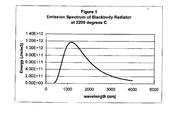
- Typical lamp temperatures are 2000 - 3000 K, having a broad emission spectrum in the range of 500 to 2000 nm.
- the maximum light emission from quartz lamps occurs in the range of about 1100- 1200 nm.
- PET absorbs energy poorly in the region of 500 - 2000 nm.
- infrared absorbing compounds are sometimes added to PET. Unfortunately, these materials also have a negative effect on the visual appearance of the PET bottle, causing it to darken and become less bright and more hazy. Since compounds with absorbance in the range of 400-700 nm appeared colored to the human eye, compounds that absorb in this range will impart color to the polymer.
- a variety of black and gray body absorbing compounds have previously been used as reheat agents to improve the heat up characteristics of polyester under quartz lamps.
- a variety of infrared absorbing compounds can be added to PET to increase the reheat rate of the preforms.
- Such reheat additives include carbon black, graphite, antimony metal, black iron oxide, red iron oxide, inert iron compounds, spinel pigments, and infrared absorbing dyes.
- the amount of absorbing compounds that can be added to a polymer is limited by its impact on the visual properties of the polymer, such as brightness, which is a measure of transparency, and color.
- reheat additives significantly improve the reheat rate of polyethylene terephthalate preforms.
- the disadvantage of these additives is that cause a significant loss in brightness and/or clarity in the resin.
- the quantity of reheat additive is reduced, which in turn reduces the reheat rate.
- the type and amount of reheat additive added to a polyethylene terephthalate resin is adjusted to strike the desired balance between increasing the reheat rate and retaining acceptable brightness and color levels.
- thermoplastic composition having a good reheat rate with improved L* and b* ratings.
- thermoplastic composition which has a low coefficient of static friction and a good reheat rate.
- thermoplastic composition with a good reheat rate and low sidewall bottle haze.
- thermoplastic composition comprising a polyester and glassy carbon.
- a process for manufacturing a polyester composition comprising combining glassy carbon with a polyester composition or a composition comprising polyester precursors.
- a process for manufacturing a polyester composition comprising adding a solid or liquid concentrate comprising glassy carbon and polyethylene terephthalate to bulk polyethylene terephthalate after melt phase polymerization of the bulk polyethylene terephthalate and before or at injection molding the polyester composition.
- a process for manufacturing a polyester composition comprising adding glassy carbon neat or as a concentrate or in a carrier to a melt phase for the manufacture of polyethylene terephthalate.
- a concentrate composition comprising glassy carbon in an amount ranging from 0.05 wt.% to about 35 wt.% and a polymer in an amount ranging from at least 65 wt.% up to 99.95 wt.%, each based on the weight of the concentrate composition.
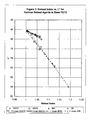
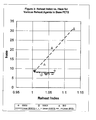
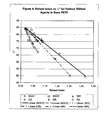
- a polyester composition having an L* value, and a reheat index which increases between 0.95 and 1.15 with an increasing amount of an additive present in the polyester composition, wherein the slope of a curve representing increasing amounts of said additive plotted against L* measurements on a y axis and the reheat index on an x axis is less than
- a polyester preform having a final reheat temperature delta of 5°C or more, an L* rating of 70 or more, and has a b* rating of 3.8 or less.
- a polyester preform having a final reheat temperature delta of 10°C or more and an L* rating of 70 or more.
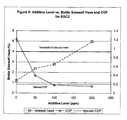
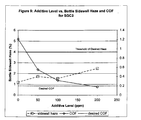
- a further unexpected result observed in the composition of the invention is that the static coefficient of static friction of a bottle can be reduced by incorporating into a polyester composition an additive at typical sticky bottle additive levels (70-150 ppm), while functioning also as a reheat additive, and in addition, maintaining acceptable brightness, sidewall bottle haze and color. It has not been possible to elevate the quantity of conventional reheat additives, such as carbon black or black iron oxide to the typical sticky bottle additive level ranging from 70 to 125 ppm because at such levels the preform and resulting article would have an unacceptably low L* and high haze levels.
- conventional reheat additives such as carbon black or black iron oxide
- another embodiment of the invention provides for a polyester beverage bottle made from a preform, wherein the preform has a final reheat temperature delta of 5°C or more, a b* rating of less than 3.8, and a bottle made from the preform having a coefficient of static friction of 0.6 or less.
- the invention provides for a polyester beverage bottle made from a preform, wherein the preform has a final reheat temperature delta of 5°C or more, and an L* value of at least 70, and the bottle has a coefficient of static friction of 0.6 or less.
- a polyester beverage bottle made from a preform, wherein the preform has reheat index of 1.05 or more and an L* value of 78 or more.
- a polyester composition having a haze % value, and a reheat index which increases between 0.95 and 1.15 with an increasing amount of an additive present in the polyester composition reheat index, wherein the slope of a curve represented by haze %, as measured on 3 stacked discs each having a thickness of 67 mil for a total thickness of 201 mil, on the y axis in digits from 1% to 40% and the reheat index on the x axis is less than 75, as measured by at least three data points anywhere between 1.00 and 1.15 with respect to reheat index values using intervals of at least 0.03 units, and said polyester composition has a coefficient of static friction of less than 0.8
- the invention also includes an embodiment wherein there is provided a polyester composition comprising an additive in an amount ranging from 50 ppm to 150 ppm which functions to increase the reheat rate of the composition by at least 2.5°C for the first 50 ppm of additive and reduces the coefficient of static friction of the composition by at least 20% for the first 50 ppm of additive, each relative to a composition without said additive, wherein the composition has a haze value of less than 9%, and preferably a bottle sidewall haze value of 5% or less.
- thermoplastic composition comprising a thermoplastic composition comprising a thermoplastic polymer continuous phase solid at 25°C and 1 atm and an additive reducing a coefficient of static friction of the composition relative to a composition without the additive, wherein said composition has a coefficient of static friction of 0.2 as measured at a point within an additive range of 50 ppm to 250 ppm relative to the weight of the thermoplastic continuous phase.
- thermoplastic preform a thermoplastic "preform”, “article”, “container”, or “bottle”
- article a thermoplastic preform
- container a thermoplastic preform
- bottle a thermoplastic preform
- Ranges may be expressed herein as from “about” or “approximately” one particular value and/or to “about” or “approximately” another particular value. When such a range is expressed, another embodiment includes from the one particular value and/or to the other particular value.
- composition or article By “comprising” or “containing” is meant that at least the named compound, element, particle, etc must be present in the composition or article, but does not exclude the presence of other compounds, materials, particles, etc, even if the other such compounds, material, particles, etc have the same function as what is named.
- reheat additive any ingredient or combination of reactive ingredients to produce a compound or element suitable for addition to a polyester or a polyester precursor which has the capability of increasing the final temperature of the composition by at least 3°C within the first 100 ppm of the additive compared to the same composition except without that particular additive present and under identical test conditions, and whether or not the application actually requires reheating the composition.
- thermoplastic polymer composition comprising glassy carbon particles distributed within a thermoplastic polymer continuous phase which is solid at 25°C and 1 atm.
- a thermoplastic polymer is distinguishable from liquid crystal polymers in that thermoplastic polymers have no ordered structure while in the liquid (melt) phase.
- the thermoplastic composition may optionally be isolated as such.
- At least one of the reheat additives contained in the thermoplastic composition are glassy carbon particles, and more preferably spherical glassy carbon.
- glassy carbon is well known to those of skill in the art of carbon types. It is commonly known as vitreous carbon. Those of skill in carbon types recognize that graphite, carbon black, activated carbon, and glassy carbon are distinct forms of carbon which can be differentiated by one or more of their structure, properties, methods of manufacture, and uses.
- glassy carbon Without limiting the meaning of glassy carbon, the following description is provided to illustrate one or more features of commonly produced glassy carbon forms.
- One or more features can be used to describe glassy carbon, and these include its appearance, properties, structure, method of manufacture, and common use.
- the most common forms of glassy carbon can be described as black, dense, brittle materials with a high luster and a vitreous or glassy appearance when fractured.
- glassy carbon normally has a low density, its permeability is exceptionally low due to its extremely fine pore structure.
- Glassy carbon typically has an porosity of less than 0.05%, although some grades can be prepared with porosity as high as 50% through the use of pore-forming agents in the synthesis process.
- the structure of glassy carbon can be described as a random arrangement of ribbon-like molecules with no long-range order. While the synthetic method for the manufacture of glassy carbon is not limited, common known methods for its production include the formation of a polymeric carbon precursor, such as polyfurfuryl alcohol, phenol-formaldehyde condensation polymer, polyimide and polyacrylonitrile, or even thermoplastic polymers, which are usually cross-linked to varying degrees into a three dimensional structure and then pulverized, followed by the controlled pyrolysis of the carbon precursor in a reducing atmosphere or in an inactive atmosphere, such as a vacuum or in a inert gas (including nitrogen), at a controlled rate to a maximum temperature ranging from 600°C up to about 2800°C, and typically from 1000°C to 2000°C for up to 72 hours, typically 48 hours or less, and once the final temperature is obtained, may be pyrolyzed for only 2 to 5 hours.
- a polymeric carbon precursor such as polyfurfuryl alcohol, phenol-formal
- a common rate of pyrolysis is 10°C/minute, but the rate may be slower at lower temperatures, such as about 2°C/hr up to 600 to 700°C. Also, by varying the time and temperature, the electrical resistivity of the glassy carbon can be adjusted if desired. Any other method for the manufacture of vitreous carbon is also suitable.
- thermosetting resin polymer may be pulverized by any granulation method, such as a high speed centrifugal mill, spray dried or suspended, and then sintered in a pyrolysis furnace. By first reducing the thermosetting resin to a powder, the pyrolysis time can also be reduced. While the method for forming the spheres is not limited and any method known at the time of inclusion into a polyester is included, any carbon formed by the pyrolysis of a polymeric precursor is a suitable glassy carbon material for use in the invention. Based on its high purity and outstanding chemical resistance, glassy carbon has found use as vessels for chemical and metallurgical processing and as spherical supports for catalysts.
- graphite In contrast to glassy carbon which has little or substantially no long-range crystalline order, graphite is composed of a series of stacked parallel planes. As a result, graphite exhibits strong anisotropic properties. While glassy carbon and graphite have high luster, graphite is softer material than glassy carbon. Natural graphite is a mineral form that occurs in nature and synthetic graphite is produced by heating coke or pitch to above 2500 °C. The major uses of natural and synthetic graphite are as lubricants, refractory materials and electrodes.
- Carbon black is an amorphous form of carbon which is formed by burning hydrocarbons in insufficient air. Carbon black lacks the luster and vitreous appearance of glassy carbon.
- the structure of carbon black consists of graphite platelets in parallel stacks which are randomly oriented with respect to each other. Carbon black lacks the three-dimensional crystalline order seen in graphite. It is used primarily to reinforcement of rubber and as a black pigment.
- Activated carbon is a material with a more highly developed internal pore structure and larger internal surface area than glassy carbon.
- Activated carbon is formed from organic materials which are rich in carbon, such as coal, lignite, wood, nut shells, pitches and cokes. It is produced in two-stage process. In the first stage, the organic precursor is carbonized to produce a material with a latent pore structure. In the second stage, the char is burned in superheated steam or carbon dioxide to remove carbon residues blocking the pore entrances.
- Activated carbons are used as an adsorbent in a variety of purification processes, including wastewater treatment, sweetener discoloration and miscellaneous chemical processing applications.
- the shape of the glassy carbon particles used in the invention is not limited, and includes spheres, platelets, needles, cylinders, and irregular shapes such as what is found by crushing the carbon to a powder.
- the shape of the average glassy carbon particle is preferably spherical.
- Spherical particles include not only what is commonly understood as a sphere, but also oval shaped particles, star shapes, and any other irregular shaped particles having a substantial three dimensional structure with an aspect ratio of 2 or less as measured along each combination of any two x, y, and z particle axes.
- the average sphere has smooth curved edges.
- the spherical shape of the glassy carbon particles contributes to the improvement seen in L* brightness and b* color, and further aids in the reduction of the coefficient of static friction by providing a more uniform surface roughening across the bottle finish.
- the particles size of the glassy carbon used in the invention is also not particularly limited. However, in selecting the particle size, consideration should be taken to the effect particle size will have on the brightness of the preforms and the haze values.
- the preferred average particle size of glassy carbon is at least 0.1 micron, preferably at least 0.4 microns, more preferably at least 1 micron, and suitably up to 400 microns or less, preferably 100 microns or less, more preferably 40 microns or less, most preferably 20 microns or less, and even 12 microns or less.
- spherical glassy carbon sphere sizes are provided as a composition having a range of particle sizes with an average particle size somewhere within that range.
- the average particle size is represented by the largest number of particles having a particular size within the range. If desired, the particle size can be measured with a laser diffraction type particle size distribution meter.
- the particle size distribution of the glassy carbon particles used in the polyester is not limited. Glassy carbon particles having a narrow or broad particle size distribution can be used. To illustrate, the glassy carbon compositions optionally have a particle size distribution of a 40 micron or less, or a 20 micron or less, or a 10 micron or less, or a 5 micron or less differential between the lowest size point having at least 5% of the particles and the highest size point having at least 5% of the particles.
- the particles size distribution curve can be mono or polymodal.
- glassy carbon particles which are free of aggregates in order to avoid the formation of visible specks in the polyester. It is also preferable to use that the glassy carbon is free of ash to minimize impact on haze and L*. Further, the particular manufacturing process employed or the shipping conditions may cause some of the spherical particles to fracture and break. When spherical particles are used, it is desirable to use compositions in which 25% or less, more preferably 5% or less of the particles are fractured, broken, or splintered in order to enhance L* at a given rate of reheat and to improve the rate of reheat.
- glassy carbon having the following morphological properties may be employed in the practice of the invention.
- a useful form of glassy carbon in the thermoplastic composition has a bulk density of 1.40-1.70 g/cm 3 , a resistivity of 5 x 10 5 - 10 x 10 5 ⁇ /cm, a thermal conductivity of 0.01-0.2 cal/cm•sec•°C, and an open porosity of 0%. If desired, however, other forms of glassy carbon outside these ranges are also useful.
- the porosity of the glassy carbon is also not particularly limited. However, glassy carbon particles having small surface pore not exceeding 1 micron in largest dimension across the surface of the particles are suitable. Also, glassy carbon compositions having a degree of porosity ranging from 0.0 to 0.03% are also suitable. Nevertheless, glassy carbon particles having surface pores exceeding 1 micron and which are highly porous, in excess of 0.03%, are also suitable as reheat additives in the thermoplastic composition.
- a particular advantage of the glassy carbon is that a polyester composition, and in particular polyethylene terephthalate, will exhibit high brightness and have a b* rating below +4 even at large loadings of glassy carbon, thus providing a wide window within which the quantity of glassy carbon can be adjusted to obtain additional improvements in COF and reheat rates.
- Other black colored reheat additives graphite, carbon black, black iron oxide used in polyester compositions for improving the reheat rate of a preform either do not function to reduce COF of blown bottles or if added in quantities typically seen to reduce the COF (e.g. 60 ppm to 150 ppm), the haze level and the L* rating would be so unacceptable as to be visibly dark or black.
- the amount of glassy carbon which may be used is not restricted to the low levels of 10 to 30 ppm as in the case of carbon black or graphite.
- the amount of glassy carbon used in the polyester will depend upon the particular application, the desired reduction in reheat time, the level of decrease in COF desired, and the toleration level in the reduction of a* and b* away from zero along with the movement of L* brightness values away from 100.
- the quantity of glassy carbon is at least 1 ppm, more preferably at least 5 ppm, most preferably at least 50 ppm.
- the quantity of spherical glassy carbon is at least 50 ppm, in some cases at least 60 ppm, and even at least 70 ppm.
- the maximum amount of spherical glassy carbon is limited only by any one or more of the desired reheat rate, reduction in COF, or maintenance in L*, b* and haze, which may vary among applications or customer requirements.
- the amount will generally not exceed 500 ppm, and will more typically be below 300 ppm, and in most cases the amount will not exceed 250 ppm.
- the amount of glassy carbon used can be up to 5,000 ppm and even up to 10,000 ppm. The amount can exceed 10,000 ppm when formulating a concentrate with glassy carbon as discussed below.
- the glassy carbon particles used for incorporating into the continuous phase of a thermoplastic polymer may also be modified glassy carbon particles.
- a thermoplastic polymer composition comprising 1 ppm to 500 ppm of modified glassy carbon particles within a thermoplastic polymer continuous phase solid at 25°C and 1 atm.
- the glassy carbon may be modified by appending organic polymeric chains or organic polymeric coatings onto the glassy carbon particles or chemically or physically treating the surface of the particles.
- the method by which the glassy carbon particles are incorporated into the polyester composition is not limited.
- Glassy carbon particles can be added to the polymer reactant system, during or after polymerization, to the polymer melt, or to the molding powder or pellets or molten bulk polyester in the injection-molding machine from which the bottle preforms are made.
- Glassy carbon may be added to a polyester polymer, preferably polyethylene terephthalate, and fed to an injection molding machine by any method, including feeding the glassy carbon to the molten polymer in the injection molding machine, or combining the glassy carbon with a feed of polyethylene terephthalate to the injection molding machine, either by melt blending or by dry blending pellets.
- glassy carbon may be added to an esterification reactor, such as with and through the ethylene glycol feed optionally combined with phosphoric acid, a prepolymer reactor, a polycondensation reactor, or to solid pellets in a reactor for solid stating, or at any point in-between these stages.
- glassy carbon may be combined with polyethylene terephthalate or its precursors neat, as a concentrate containing polyethylene terephthalate, or diluted with a carrier.
- the carrier may be reactive to polyethylene terephthalate or non-reactive.
- the glassy carbon, whether neat or in a concentrate or in a carrier, and the bulk polyester, are preferably dried prior to mixing together. These may be dried in an atmosphere of dried air or other inert gas, such as nitrogen, and if desired, under sub-atmospheric pressure.
- a concentrate composition comprising glassy carbon in an amount of at least 0.05 wt.%, preferably at least 2 wt.%, and up to about 35 wt.%, preferably up to 20 wt.% and a thermoplastic polymer normally solid at 25°C and 1 atm such as a polyester, polyolefin, or polycarbonate in an amount of at least 65 wt.% and preferably at least 80 wt.% and up to 99 wt.% and preferably up to 98 wt.%, each based on the weight of the concentrate composition.
- the concentrate may be in liquid or solid form.
- the converter of polymer to preforms has the flexibility of adding glassy carbon to bulk polyester at the injection molding stage continuously or intermittently, in liquid molten form or as a solid blend, and further custom adjusting the amount of glassy carbon contained in the preform by metering the amount of concentrate to fit the end use application and customer requirement.
- the concentrate may be made by mixing glassy carbon with a polymer such as polycarbonate, a polyester, or a polyolefin, in a single or twin-screw extruder and optionally compounding with other reheat additives.
- a preferred polycarbonate is bisphenol A polycarbonate.
- Preferred polyolefins are polyethylene and polypropylene.
- Melt temperatures must be at least as high as the melting point of the polymer. For a polyester such as polyethylene terephthalate, the melt temperatures are typically in the range of 260°-310°C. Preferably, the melt compounding temperature is maintained as low as possible.
- the extrudate may be withdrawn in any form, such as a strand form, and recovered according to the usual way such as cutting.
- the concentrate is prepared in a similar polyester as used in the final article.
- another polymer in the concentrate such as a polyolefin.
- the polyolefin is incorporated as a nucleator additive for the bulk polyester.
- the concentrate is added to a bulk polyester or anywhere along the different stages for manufacturing polyethylene terephthalate in a manner such that the concentrate is most compatible with the bulk polyester or its precursors.
- the point of addition or the ItV of the concentrate may be chosen such that the ItV of the polyethylene terephthalate and the ItV of the concentrate are similar, e.g. +/-0.2 ItV measured at 25°C in a 60/40 wt/wt phenol/tetrachloroethane solution.
- a concentrate can be made with an ItV ranging from 0.3 to 0.65 to match the typical ItV of a polyethylene terephthalate under manufacture in the polycondensation stage.
- a concentrate can be made with an ItV similar to that of solid stated pellets used at the injection molding stage (e.g. ItV from 0.6 to 1.1).
- crystallization aids such as crystallization aids, impact modifiers, surface lubricants, denesting agents, stabilizers, antioxidants, ultraviolet light absorbing agents, metal deactivators, colorants such as titanium dioxide and carbon black, nucleating agents such as polyethylene and polypropylene, phosphate stabilizers, fillers, and the like, can be included herein. All of these additives and the use thereof are well known in the art.
- thermoplastic polymers in the present composition can be any thermoplastic homopolymer or copolymer but which are solid at 25°C and 1 atm.
- the thermoplastic polymers form a continuous phase within which is dispersed glassy carbon.
- dispersed “within” the continuous phase is meant that the glassy carbon is contained at least within a portion of a cross-sectional cut of the thermoplastic composition as opposed to being disposed only on a surface as would normally be expected in a coating. Glassy carbon may be disposed on the surface of the thermoplastic polymer so long as particles are found in a region other than the surface of the polymer.
- the glassy carbon may be distributed within the thermoplastic polymer randomly, dispersed throughout randomly, distributed within discrete regions, or distributed only in a portion of the thermoplastic polymer.
- the glassy carbon is randomly distributed within the thermoplastic continuous phase, and more preferably the distribution is uniform, and most preferably the distribution is additionally throughout the continuous phase of the thermoplastic polymer.
- thermoplastic polymers examples include polyethylene terephthalate (PET), polyethylene naphthalate (PEN), polycarbonate (PC) and copolyesters of each and blends of each, such as PET and PEN.
- the thermoplastic polymer used in the present invention most usefully comprises a polyester composition, particularly a partially aromatic polyester, especially a polyester derived, at least mainly, from an aromatic diacid and an aliphatic diol.
- the preferred polyester is polyethylene terephthalate.
- polyethylene terephthalate means a polymer having ethylene terephthalate units in an amount of at least 60 mole% based on the total moles of units in the polymer.
- the polymer contains ethylene terephthalate units in an amount of at least 85 mole%.
- a polyethylene terephthalate polymer may comprise a copolyester of ethylene terephthalate units and other units derived from an alkylene glycol or aryl glycol with a aliphatic or aryl dicarboxylic acid.
- polyethylene terephthalate can be manufactured by reacting a diacid or diester component comprising at least 60 mole % terephthalic acid or C 1 - C 4 dialkylterephthalate, preferably at least 70 mole %, more preferably at least 85 mole %, even more preferably, at least 90 mole %, and for many applications will be at least 95 mole%, and a diol component comprising at least 60 mole % ethylene glycol, preferably at least 70 mole %, more preferably at least 85 mole %, even more preferably at least 90 mole %, and for many applications, will be at least 95 mole%.
- a diacid or diester component comprising at least 60 mole % terephthalic acid or C 1 - C 4 dialkylterephthalate, preferably at least 70 mole %, more preferably at least 85 mole %, even more preferably, at least 90 mole %, and for many applications will be at least 95 mole%
- the diacid component is terephthalic acid and the diol component is ethylene glycol.
- the mole percentage for all of the diacid component totals 100 mole %, and the mole percentage for all of the diol component totals 100 mole %.
- the thermoplastic composition comprises a majority of a polyester composition, preferably a polyester composition present in an amount of at least 80 wt.%, more preferably at least 95 wt.%, and most preferably at least 98 wt.%, based on the weight of polymers in the thermoplastic composition forming the continuous phase of the composition (excluding fillers, fibers, impact modifiers, or other polymers which form a discontinuous phase).
- the polyester composition preferably comprises at least 60 wt.% of a polyethylene terephthalate, more preferably at least 90 wt.% of a polyethylene terephthalate, and most preferably 100 wt.% of a polyethylene terephthalate.
- a polyethylene terephthalate polymer contains at least 60 mole% of ethylene terephthalate units.
- the polyethylene terephthalate is made from at least 90 mole% terephthalic acid and at least 90 mole% of ethylene glycol.
- polyesters such as polyethylene terephthalate polymer are made by reacting a glycol with a dicarboxylic acid as the free acid or its dimethyl ester to produce a prepolymer compound which is then polycondensed to produce the polyester. If required, the molecular weight of the polyester can then be increased further by solid state polymerization. After melt and/or solid phase polycondensation the polyesters preferably have an intrinsic viscosity (It.V.) of at least 0.60 dL/g, more preferably at least 0. 70 dL/g measured at 25°C in a 60/40 ratio by weight of phenol/tetrachloroethane.
- It.V. intrinsic viscosity
- the acid component of the present polyester may be modified with units derived from one or more additional dicarboxylic acids.
- additional dicarboxylic acids include aromatic dicarboxylic acids preferably having 8 to 14 carbon atoms, aliphatic dicarboxylic acids preferably having 4 to 12 carbon atoms, or cycloaliphatic dicarboxylic acids preferably having 8 to 12 carbon atoms.
- dicarboxylic acid units useful for modifying the acid component are units from phthalic acid, isophthalic acid, naphthalene-2,6-dicarboxylic acid, cyclohexanedicarboxylic acid, cyclohexanediacetic acid, diphenyl-4,4'-dicarboxylic acid, succinic acid, glutaric acid, adipic acid, azelaic acid, sebacic acid, and the like, with isophthalic acid, naphthalene-2,6-dicarboxylic acid, and cyclohexanedicarboxylic acid being most preferable. It should be understood that use of the corresponding acid anhydrides, esters, and acid chlorides of these acids is included in the term "dicarboxylic acid".
- the diol component of the present polyester may be modified with units from additional diols including cycloaliphatic diols preferably having 6 to 20 carbon atoms and aliphatic diols preferably having 3 to 20 carbon atoms.
- diols examples include diethylene glycol, triethylene glycol, 1, 4-cyclohexanedimethanol, propane-1,3- diol, butane- 1, 4-diol, pentane-1,5-diol, hexane-1,6-diol, 3- methylpentanediol- (2,4), 2-methylpentanediol-(1,4), 2,2,4-trimethylpentane-diol-(1,3), 2,5- ethylhexanediol-(1,3), 2,2-diethyl propanediol -(1, 3), hexanediol- (1,3), 1,4-di- (hydroxyethoxy) -benzene, 2,2-bis-(4-hydroxycyclohexyl)-propane, 2,4- dihydroxy- 1,1,3,3-tetramethyl-cyclobutane, 2,2-bis-(3-hydroxyethoxyphenyl)
- Polyesters can be prepared by conventional polymerization procedures well-known in the art sufficient to effect esterification and polycondensation.
- Polyester polycondensation processes include direct condensation of dicarboxylic acid with the diol, ester interchange, and solid state polymerization methods.
- Typical polyesterification catalysts which may be used include titanium alkoxides, dibutyl tin dilaruate, and antimony oxide or antimony triacetate, used separately or in combination, optionally with zinc, manganese, or magnesium acetates or benzoates and/or other such catalyst materials as are well known to those skilled in the art.
- Phosphorus and cobalt compounds may also optionally be present.
- a mixture of one or more dicarboxylic acids, preferably aromatic dicarboxylic acids, or ester forming derivatives thereof, and one or more diols may be heated in the presence of esterification and/or transesterification catalysts in an esterification zone, optionally with a polycondensation catalyst, at temperatures in the range of about 150°C to about 300°C, preferably, about 200°C to about 300°C, and in conventional reactions, typically between about 260°C to about 300°C, and pressures ranging from atmospheric to about 0.2 mm Hg.
- the dicarboxylic acid is esterified with the diol(s) at elevated pressure and at a temperature of about 240°C to about 270°C.
- Polycondensation reactions are initiated and continued in the melt phase in a prepolymerization zone and finished in the melt phase in a finishing zone, after which polycondensation reactions are continued in the solid state in a solid stating zone.
- molecular weight build up is effected by increasing the temperature from about 260°C up to about 280°C and lowering the pressure while excess diol is removed from the mixture.
- Polycondensation can be continued in a finishing zone in a series of finishing vessels ramped up to higher temperatures until an ItV of about 0.70 or less is achieved.
- the catalyst material such as antimony oxide or triacetate may be added to the prepolymerization zone along with phosphorus, cobalt compounds, and colorants, which may optionally be added to the finishing zone.
- phosphorus, cobalt compounds, and colorants may optionally be added to the finishing zone.
- other catalyst material and points of adding the catalyst material and other ingredients vary from a typical direct esterification process. Glassy carbon may be added at any stage in the melt phase, including the esterification, prepolymer, and/or the finishing stages, including at any stages before pelletization.
- the polyester is pelletized and transferred to a solid state polymerization vessel, optionally through a crystallizer to prevent the pellets from sticking together in the solid stating zone, to continue polycondensation molecular weight build up and produce pellets having the final desired ItV.
- compositions of the present invention can be added to the composition of the present invention to enhance the performance properties of the polyester composition.
- crystallization aids such as trifunctional or tetrafunctional comonomers such as trimellitic anhydride, trimethylol propane, pyromellitic dianhydride, pentaerythritol, and other polyester forming polyacids or polyols generally known in the art.
- the present composition be essentially comprised of a blend of thermoplastic polymer and glassy carbon, with only a modifying amount of other ingredients being present.
- the polyester composition of the present invention may be used to form bottle preforms, also known as parisons, which are test tube shaped, generally injection molded or thermoformed articles.
- the amorphous preform is typically heated to about 20°C above the glass transition temperature of the polymer composition by passing the preform through a bank of quartz infrared heating lamps, positioning the preform in a bottle mold, and then blowing pressurized air through the open end of the mold, and in some cases, stretch blow molding the preform.
- thermoplastic preferably polyester compositions of the invention.
- Articles include sheet, film, bottles, trays, other packaging, rods, tubes, lids, and injection molded articles. Any type of bottle can be made from the polyester composition of the invention.
- a beverage bottle made from polyethylene terephthalate suitable for holding water.
- a heat set beverage bottle suitable for holding beverages which are hot filled into the bottle.
- Crystallization of the preform finish can be performed either to the preform (as in the Yoshino process), to a pre-bottle (as in the Sidel SRCF process outlined in U.S. Patent No. 5,382,157, or to the actual heat-set bottle.
- a heat set bottle can be made by placing a preform into a warm or hot mold and stretched into a container. These bottles are typically designed to withstand hot-filling without shrinkage greater than about 1% by volume. It is also desirable, although not required, to achieve a large degree of spherulitic crystallinity in the bottle sidewall in order to resist thermal distortion upon hot- filling of the bottle.
- the preform is transported to a crystallization machine.
- the preforms are preferably loaded into carriers which shield the bodies of the preforms against exposure to crystallizing heat, but leave the finishes exposed.
- the carriers, containing the preforms are passed through the crystallizing machine, where the preform finishes are exposed to infrared energy for a sufficient amount of time to allow the finishes to crystallize.
- This stage preferably involves exposing at least a portion of the preform finish to radiant heat from lamps in a row of ovens (across a spectrum that may include the IR range) while protecting the body of the preform.
- the finish is heated to temperatures at which the selected polyester crystallizes rapidly (for PET about 150°C to about 180°C).
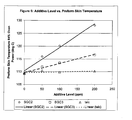
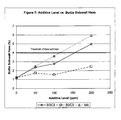
- the glassy carbon reheat additives used in the invention impact the reheat rate, brightness, and color of preforms and the haze value and coefficient of static friction of the bottles made from these preforms. Any one or more of these performance characteristics can be adjusted merely by varying the amount of reheat additive used.
- the reheat index is a convenient value which quickly indicates the performance of a sample against a control.
- the impact of any reheat additive, including glassy carbon, on the color of the resin can be judged using the CIE color standard L*, a*, and b* values.
- the L* value is a measure of brightness
- a* value is a measure of redness (+) and greenness (-)
- b* value is a measure of yellowness (+) and blueness (-).
- Brightness is measured as L* in the CIE 1976 opponent-color scale, with 100% representing a perfect white object reflecting 100% at all wavelengths, or a colorless sample transmitting 100% at all wavelengths.
- An L* of 100 in a colorless sample would be perfectly transparent, while an L* of 0 in a colorless sample would be opaque. Reference is made to the apparent transparency, since L* is calibrated to respond as the human eye would respond.
- reheat agents which are dark in the visible spectrum can be added in only very small quantities because of their negative impact on L*.
- L* values for the polyester compositions as measured on bottle preforms discussed herein should generally be greater than 65.0, more preferably at least 70.0, and most preferably at least 75.0 (as measured on a preform sample having a sidewall cross sectional thickness of about 154 mil). Specifying a particular L* brightness does not imply that a preform having a particular sidewall cross-sectional thickness is actually used, but only that in the event the L* is measured, the polyester composition actually used is, for purposes of testing and evaluating the L* of the composition, is injection molded to make a perform having at thickness of 154 mil. The same it true for all test methods which specify a particular wall thickness.
- the color of a thermoplastic composition is generally indicated by an a* coordinate value preferably ranging from about minus 2.0 to about plus 1.0, more preferably from about minus 1.5 to about plus 0.5.
- a b* coordinate value it is generally desired to make a bottle preform having a b* value coordinate ranging from -3.0 to positive value of less than +5.0, more preferably less than +4.0, and most preferably less than +3.8, as measured on a sample having a sidewall cross sectional thickness of 154 mil.
- Polyesters having an acceptable bottle sidewall haze generally have a haze value, as measured on samples having a cross-sectional thickness of about 12.5 mils, of less than 6.0%, preferably less than 5.0%, more preferably less than 4.0%, most preferably 3.0% or less. It is to be noted, however, that bright preforms (high L* values) blow molded into bottles having a relatively high haze value may nevertheless appear clear to the eye. The haze window can be enlarged if compensated by preforms having high brightness.
- thermoplastic compositions preferably polyester composition, containing glassy carbon
- the compositions and tube shaped preforms made from these compositions have an improved reheat rate relative to a control having without a reheat additive.
- the final reheat temperature of a polyester composition containing glassy carbon is 112.5°C, preferably 115°C, more preferably 120.0°C
- the polyester composition preferably is 100% polyethylene terephthalate, the polyethylene terephthalate having at least 95 wt.% ethylene terephthalate units.
- thermoplastic compositions preferably polyester compositions, containing glassy carbon
- the compositions and tube shaped preforms made from these compositions can be made to have a b* color of less than 4.0, preferably less than 3.8, and more preferably less than 3.7, and in each case preferably greater than -3.0, even at high loadings ranging from 100 ppm to 200 ppm.
- thermoplastic compositions preferably polyester compositions, containing glassy carbon
- the L* brightness of compositions and tube shaped preforms made from these compositions is not highly sensitive to glassy carbon loadings, even at higher loadings of glassy carbon (e.g. 100 ppm to 200 ppm).
- thermoplastic, preferably polyester, composition containing glassy carbon, and the preforms and bottles made from these compositions having an L* of at least 70.0, preferably at least 75.0, more preferably at least 80.0.
- thermoplastic compositions preferably polyester compositions, containing glassy carbon
- the coefficient of static friction of bottles made from these compositions is low.
- a thermoplastic composition preferably a polyester composition, containing glassy carbon, preferably spherical glassy carbon, in the shape of a bottle having a coefficient of static friction 0.60 or less, preferably 0.40 or less, more preferably 0.20 or less.
- the spherical glassy carbon particles have an average particle size anywhere within the range of 0.1 microns to 20 microns.
- thermoplastic compositions preferably polyester compositions, containing glassy carbon
- the increase in bottle sidewall percent haze is much less than compositions containing other types of black colored reheat additives at the same levels of reheat additive.
- thermoplastic composition preferably a polyester composition, containing glassy carbon having a sidewall bottle haze value measured at a thickness of 12.5 mils (+/- 0.4) of 6.0% or less, preferably 5.0% or less, more preferably 4.0% or less.
- thermoplastic compositions including polyester compositions such as polyethylene terephthalate, and the preforms, sheets, trays, bottles, or other articles made from this composition, having a particular combination of physical properties.
- a final reheat temperature delta as measured by a perform sidewall skin temperature obtained from a Sidel 2/3
- a final reheat temperature delta is meant the difference between the final reheat temperature of a polyester sample composition and the final reheat temperature of the same composition without any additive or combination of additives which absorb energy to raise the reheat rate of the polyester composition, as measured according to the above test method.
- the polyester composition preferably contains glassy carbon as an reheat additive, more preferably spherical glassy carbon.
- a preform shaped polyester composition having a final reheat temperature of greater than 10.0°C, more preferably 15.0°C or more, and an L* rating 70.0 or more. Not only does the unique combination of the very high rate of reheat and high brightness provide an advantage, but also one has the flexibility of varying the amount of reheat additive within a wide processing window to obtain further improvements in the brightness of the polyester composition.
- the L* is preferably 75 or more.
- the polyester composition preferably contains glassy carbon as an reheat additive, more preferably spherical glassy carbon.
- polyester composition preferably a beverage bottle made from a preform or thermoformed sheet, wherein the preform or sheet has a final reheat temperature delta of 5.0°C or more, a b* rating of 3.8 or less, more preferably 3.7 or less and wherein the bottle has a coefficient of static friction of 0.6 or less, more preferably 0.5 or less, and most preferably 0.4 or less.
- the L* rating in this embodiment is 65 or more, more preferably 70 or more, most preferably 75 or more.
- the polyester composition preferably contains glassy carbon as an reheat additive, more preferably spherical glassy carbon.
- a polyester composition preferably a polyester beverage bottle made from a preform or thermoformed sheet, wherein the preform has a final reheat temperature of 5.0°C or more, preferably 10°C or more, more preferably 15°C or more, and an L* value of at least 70, more preferably at least 75, and the bottle has a coefficient of static friction of 0.6 or less, more preferably 0.5 or less, and most preferably 0.4 or less.
- the polyester composition preferably contains glassy carbon as a reheat additive, more preferably spherical glassy carbon.
- polyester composition comprising a polyester beverage bottle made from a preform, wherein a molded disc (67 mils thick and 3cm diameter) made from the polyester composition has reheat index of 1.05 or more and an L* value of 78 or more (as measured by stacking 3 of the discs).
- a polyester composition comprising a reheat additive in an amount ranging from 50 ppm to 150 ppm which increases the reheat rate of the composition by at least 2.5°C for the first 50 ppm of additive and reduces the coefficient of static friction of the composition by at least 20% for the first 50 ppm of additive, each relative to a composition without said additive, wherein the composition has a sidewall bottle haze value of 9% or less measured at a thickness of 12.5 mils, preferably 8% or less, more preferably 5% or less.
- the reheat additive preferably comprises glassy carbon, more preferably spherical glassy carbon.
- a polyester composition suitable for the manufacture of beverage bottles comprising a reheat additive in an amount of at least 50 ppm, preferably at least 60 ppm, said composition having a bottle sidewall haze value measured by a sidewall bottle test at a thickness of 12.5 mils of less than 8%, preferably 5.5% or less, and wherein said additive is selected such that the haze value of said polyester composition remains at less than 8%, preferably at 5.5% or less, throughout the reheat additive concentration ranging from 50 ppm to 200 ppm.
- the reheat additive is preferably spherical glassy carbon
- the polyester comprises polyethylene terephthalate.
- polyester composition having an L* value, and a reheat index which increases between 0.95 and 1.15 with an increasing amount of any reheat additive present in the polyester composition, wherein the slope of a curve representing increasing amounts of the additive plotted against L* measurements on a y axis and the reheat index on an x axis is
- the polyester composition has an L* of at least 75.
- the slope of the curve is preferably less than
- This embodiment also includes these polyester compositions in the shape of preforms and bottles.
- the preferred reheat additive is glassy carbon, more preferably spherical glassy carbon, most preferably spherical glassy carbon having an average particle size within the range of 0.1 microns to 40 microns, more preferably between 0.5 to 20 microns.
- a polyester composition having a haze % value, and a reheat index which increases between 0.95 and 1.15 with an increasing amount of an reheat additive present in the polyester composition reheat index, wherein the slope of a curve represented by haze % on the y axis in digits from 1% to 40% and the reheat index on the x axis is less than 75, more preferably less than 50, as measured by at least three data points anywhere between 1.00 and 1.15 with respect to reheat index values using intervals of at least 0.03 units, and said polyester composition has a coefficient of static friction of 0.5 or less, preferably 0.4 or less. Haze measurements in this embodiment are determined on 3 molded discs of polymer which were 201 mil total thickness.
- thermoplastic composition and preferably a polyethylene terephthalate bottle, containing an additive reducing the coefficient of static friction of the composition relative to a composition without the additive, wherein the thermoplastic composition has a coefficient of static friction of 0.2 as measured at a point within an additive range of 50 ppm to 250 ppm relative to the weight of the thermoplastic continuous phase.
- the thermoplastic composition comprises an additive in an amount ranging from 50 ppm to 250 ppm relative to the weight of the thermoplastic continuous phase.
- polyester compositions having this set of properties and the bottles made from these preforms or made from thermoformed articles, as well as sheet, film packages, rod, tubing, injection molded articles, and any other article made from these polyester compositions.
- the polyester composition preferably contains glassy carbon as a reheat additive, more preferably spherical glassy carbon.
- the polyester compositions preferably comprise a reheat additive, more preferably glassy carbon, most preferably spherical glassy carbon.
- Reheat rate measurements were made according to the following test methods.
- the polymer samples were injection molded into discs 3 cm diameter with a thickness of 67 mils or into 3" by 3" plaques with a thickness of 150 mils.
- the discs or plaques were set aside for 24 hours to equilibrate to ambient temperature.
- Both the control discs/plaques and a set of three sample discs/plaques at each level of reheat additive were each treated as follows.
- the disc/plaque was placed onto a support contacting the molded item only along its edges. An actuator then automatically moved the disc/plaque beneath a pyrometer and measured the initial temperature (T i ).
- the disc/plaque was then moved to a fixed distance below a lamp equipped with a bulb (GE DYH projection bulb, 250-W, 120-V) operating at 60V and was exposed to radiant light for 30 seconds in the case of plaques or 20 seconds in the case of discs.
- the color temperature of the lamp was approximately 2200 °C.
- the emission spectrum of an ideal black body radiator at 2200 °C is shown in Figure 1 below.
- L*, a* and b* were conducted according to the following method. Color was measured either on molded discs (3 cm diameter with a thickness of 67 mils), molded plaques (3" by 3" with a thickness of 150 mils), or on molded preforms.
- the preform style utilized was a standard 2-liter bottle injection molded preform consisting of a cylinder of approximately 6" in length, by 1.25" in diameter, having a single-wall thickness of 154 mils, and a weight of 54 grams.
- the preform included a collar and screw neck at the open end.
- a HunterLabUltraScan spectrocolorimeter was used to measure L*, a* and b* on three discs stacked together (approximately 200-mil thickness).
- the instrument was operated using a D65 illuminant light source with a 10° observation angle and integrating sphere geometry.
- the color measurements were made in the total transmission (TTRAN) mode, in which both light transmitted directly through the sample and the light that is diffusely scattered is measured.
- TTRAN total transmission
- a HunterLab UltraScan XE diffuse/8° spectrophotometer standardized in total transmittance (TTRAN) mode was used to measure the L*, a* and b* color coordinates.
- the light source was a D65 illuminant and the observation angle was 10°.
- Two of the 3" x 3" x 1/8" plaques were placed together and presented to the light source using a custom sample holder. The plaque was presented with the plane formed by the 3" x 3" side perpendicular to the light source.
- a HunterLab UltraScan XE diffuse/8° spectrophotometer standardized in regular transmittance (RTRAN) mode was used to measure the L*, a* and b* color coordinates.
- the regular transmittance mode measures light that passes directly through the sample.
- the light source was a D65 illuminant and the observation angle was 10°.
- the preform was placed on a special holder base directly in front of the lens for the measurement.
- Haze was measured both on molded discs and bottle sidewall specimens.
- a HunterLabUltraScan spectrocolorimeter was used to measure haze.
- Three discs were stacked together directly in front of the light source, with the largest surface area placed perpendicular to the light source.
- the instrument was operated in the TTRAN mode, using a D65 illuminant and a 10° observer.
- the measurement of bottle sidewall haze was conducted according to the following method. Haze measurements were made in accordance with ASTM D-1003-00 on the 4" x 4" sections of the bottle sidewalls using a Hazegard Plus Model 4725 with illuminant C, using ASTM D1003, Method A. The cross-sectional thickness of the bottle sidewall was 12.5 mils.
- the same resin formulation used for the manufacture of bottles subjected to destructive haze testing and the bottles subjected to coefficient of static friction tests was also used for the manufacture of preforms subjected to testing for L*, a* and b* color tests.
- the measurement for coefficient of static friction was determined according to the following test method.
- This test method provides a speed and torque-sensing device capable of measuring the frictional characteristics of plastic bottles or surfaces with cylindrical or complex shapes.
- Coefficient of static friction was measured by mounting 2 liter bottles perpendicular and in contact with each other across the bottle centers and rolling one bottle against a static bottle. Each of the mounted bottles was tested within 1 hour of blowing and releasing from the mold.
- a first rotatable bottle to be tested is screwed into screw cap that is attached to a motor shaft.
- a second bottle is screwed into screw cap that is hinged and connected to a post. The second hinged bottle is allowed to contact the top sidewall of the first bottle at a perpendicular 90° angle to the first rotatable bottle.
- a cord to which is attached a 500 gram weight is hung around the end of the second hinged bottle distal to the pivot point to which the bottle is attached to the post.
- a computer command is entered to activate rolling rotation of the first rotatable bottle attached to the motor shaft from a standstill to the fixed speed of 10 rpm.
- the computer records the output voltage from a torque-sensing motor, such as Model No. 1602-100, Lebow Products Inc., as the motor power is increased in order to reach and maintain a constant speed (10 rpm). This output voltage is proportional to the torque experienced by the bottle as it is rotated at a constant speed, while in contact with the like.
- a tachogenerator that is associated with the torque-sensing motor automatically adjusts the torque in order to maintain a constant speed as bottles are in contact and set in motion from a standstill.
- F 2 is the load experienced by bottles at their contact point
- F 1 is the load or weight applied to the hinged bottle (500 g)
- L 1 is the distance from the hinged bottle pivot point to the point where the weight is applied (12.25 inches)
- L 2 is the distance from the bottle pivot point and the contact point between the bottles (6.25 inches).
- Base PET1 is a polyethylene terephthalate polymer commercially available from Eastman Chemical Company as Heatwave® Polymer CF746 having an intrinsic viscosity of 0.87 +/- 0.02.
- Base PET2 is a polyethylene terephthalate polymer commercially available from Eastman Chemical Company as 9921 W. This product has an intrinsic viscosity of approximately 0.80 +/- 0.02.
- Base PET3 is a polyethylene terephthalate polymer commercially available from Eastman Chemical Company as CB12 having enhance reheat properties and an intrinsic viscosity of 0.84 +/- 0.02.
- Base PET4 is polyethylene terephthalate polymer 9921 commercially available from Eastman Chemical Company having an intrinsic viscosity of 0.80 +/- 0.02 .
- SGC is the generic designation for spherical glassy carbon of any particle size.
- SGC1 is spherical glassy carbon having particle size ranging from 0.4 to 12 microns, commercially available from Alfa Aesar.
- SGC2 is spherical glassy carbon having a particle size ranging from 2 to 12 microns, commercially available from Aldrich Chemical Company.
- SGC3 is spherical glassy carbon having a particle size ranging from 10 to 40 microns, commercially available from Aldrich Chemical Company.
- BIO is black iron oxide having an average particle size of about 1 micron, commercially available from Ferro Corporation.
- CB is carbon black Special Black 4 obtained from DeGussa Corporation.
- GR is synthetic graphite powder (1 - 2 micron particle size) available from Aldrich Chemical Company.
- RA is reduced antimony formed by the in-situ addition of a phosphorous acid reducing agent to a polyethylene terephthalate containing antimony trioxide.
- SGC2 reheat additive is compared to a BIO control.
- the reheat additives were combined with Base PET4 by the following method in the amounts shown in Table 1. Prior to any mixing the Base PET4 pellets were ground to a powder and dried at 150° C for 8 hours in a Conair® dehumidifying dryer. Each subsequent sample was prepared by dry blending the powder of Base PET4 with the appropriate level of reheat additive followed by hand mixing in a polyethylene bag. The mixture was then added to the feed hopper of a twin screw extruder, fitted with a set of high shear mixing screws. The extruder's vent was plugged and nitrogen was continuously fed to the feed hopper and extruder throat to exclude air.
- the extruder was operated at a screw speed of 200 rpm and a temperature of approximately 282° C. Under these conditions the polymer residence time in the extruder's barrel was approximately three minutes. The extrudate was quenched in an ice water bath and cut into small cylindrical pellets. The resulting amorphous pelletized material was dried and crystallized for 45 minutes at 175° C. The final crystalline product was further dried at 170° for 8 hours before being injection molded into 3"x 3" x 1/8" plaques for color, haze and reheat testing.
- the SCG2 additive effectively increased the reheat rate as shown by the higher reheat index of samples containing SGC2 relative to Base PET4 without any additive.
- polymer containing SGC2 is brighter (i.e. higher L*) than polymer of the same reheat index containing BIO.
- the polyethylene terephthalate polymer containing SGC2 is brighter than the polyethylene terephthalate polymer containing BIO even though the amount of SGC2 in the polymer is almost four times as high as the polymer containing BIO. This result is particularly surprising because, absent other factors, one would expect that a polymer containing a high concentration of reheat additive or elemental material would not be as bright as a polymer containing less reheat additive or elements.
- Blends of these additives in Base PET2 were prepared in the following manner. Each additive was dry blended in a glass bottle with Base PET2 that had been cryogenically ground to a particle size that was small enough to pass through a sieve with 3-mm diameter circular holes. The reheat additive loading in this concentrate mixture was 0.2 weight percent. The mixture was dried at 110° C overnight in a vacuum oven at a pressure of less than thirty inches of water. The dry mixture was melt blended in a DACA® MicroCompounder/MicroInjector, using a screw temperature of 290° C and a screw speed of 120 rpm.
- the mixture was circulated in the instrument for two minutes and then extruded.
- the resulting extrudate was cryogenically ground in a Wiley mill to produce a powder small enough to pass a screen with 3-mm diameter holes.
- This final melt concentrate was then dry blended with additional Base PET2 in a series of glass jars to produce the desired concentration of reheat additive in the final polymer set. Typically these final concentrations ranged from 5 to 200 ppm of the reheat additive in the Base PET2.
- the final mixtures were dried overnight at 110° C before the final preparation of discs.
- a series of three, 3-cm diameter, 67 mil thick clear discs were prepared from each of the final mixtures described above.
- Disc preparation was done by extruding each mixture at a temperature of 290° C and 120 rpm screw speed into the instrument's micro-injector barrel. The barrel was purged with material before attempting to mold any discs.
- the final discs were prepared using an injector pressure between 80 and 120 psi to the injection piston.
- the disc mold was maintained at a temperature range of 10-25° C by circulation of chilled water. Reheat, color and haze were evaluated according to the methods described above for discs. The results of the testing are shown in Table 2 and Figure 2.
- Figure 2 illustrates the relationship between reheat index and disc L*.
- the disc brightness decreases (i.e. a negative slope). Therefore, due to this relationship, an increase in reheat index (a desirable property of a resin) also results in an undesirable property in the resin, namely, a decrease in brightness.
- not all of the polymer formulations have the same slope of the reheat index/L* plot.
- the slope of a curve representing SGC as the reheat additive is not as steep as the slope of a curve represented by the same base polymer containing BIO or CB.
- the L* of base polymers containing BIO or CB drops at a significantly higher rate than compared to the same base polymer containing SGC.
- the formulations of the invention have superior brightness at the same level of reheat performance compared to known reheat additives, such as CB and BIO.
- the slope of the curve represented by SGC 2 was calculated to be about -70, and the slope of the curve represented by SGC3 was calculated to be about -30, while the slopes for CB and BIO were calculated in excess of about -100.
- the results shown in Figure 2 indicate that it is now possible to obtain a polyester composition having an L* value, and a reheat index which increases between 0.95 and 1.15 with an increasing amount of any reheat additive present in the polyester composition, wherein the slope of a curve representing increasing amounts of the reheat additive plotted against L* measurements on a y axis and the reheat index on an x axis is
- Figure 3 graphically illustrates the improvement in haze for Base PET2 polymers containing SGC2 and SGC3 compared to Base PET2 polymers containing BIO.
- Table 3 also demonstrates that it is now possible to manufacture a polyester preform having a reheat index of 1.05 or more, preferably 1.060 or more, and an L* value of 78 or more as shown by several of the examples containing SGC 2 and SCG3.
- the reaction mixture was heated and stirred and methanol was removed via a packed column.
- the temperature of the reaction mixture was allowed to increase until the mass of methanol removed was approximately the level expected for 100 % conversion of the DMT charged.
- the heating source was removed and the mixture was allowed to cool to a temperature below the boiling point of EG, at which time the mixture was poured into a stainless steel pan and allowed to cool and solidify.
- reaction product was charged to each of several 500 ml round-bottom flasks. Each flask was then fitted with a condensate take-off head that had provision for the insertion of the shaft of a stainless steel stirring apparatus. The head also included a hose connection to permit the introduction of nitrogen gas. A nitrogen purge was initiated and the flask was immersed into a molten metal bath which served as the source of heat for the reaction. The metal bath was preheated to a temperature of 225° C prior to insertion of the reaction flask. Polymerization was accomplished according to the reaction profile shown below. The appropriate reheat agent was added at stage 3 at the amounts give in Table 3. The reheat agent was typically added as a slurry in ethylene glycol.
- stage 3 An appropriate amount of phosphorus, as phosphoric acid in ethylene glycol, was also added at stage 3. Generally the reheat agent was added separately from the phosphorus but this is not required. The reaction continued according to the set-points shown in the table. Using this procedure and catalyst system, a product intrinsic viscosity of 0.71 was typically obtained. Stage Time (minutes) Temperature set-point(° C) Pressure (mm Hg) Stirring rate (shaft rpm) 1 0.1 275 ATM 0 2 10 275 ATM 100 3 2 275 165 100 4 5 275 165 100 5 30 275 165 100 6 10 292 3.8 100 7 35 292 3.8 100 8 3 298 0.8 100 9 22 298 0.8 100 10 1 298 150 0
- the results in Table 3 also demonstrate that the haze is less for SGC containing discs than for BIO containing discs at a similar reheat index.
- the results in Table 3 demonstrates that polyethylene terephthalate bottles containing glassy carbon can have disc haze values, when measured at a thickness of 201 mils of 8.0% or less, preferably 6.0% or less.
- Figure 4 graphically illustrates that the L* of samples made with glassy carbon SGC1 and SGC2 in Base PET5 did not decrease as sharply as the L* of samples made with other common reheat agents, such as carbon black, BIO, and GR. At any given reheat index, the L* for samples made with SGC1 and SGC2 was higher relative to those made with carbon black, BIO and GR.
- SGC2 and SGC3 additives were evaluated by manufacturing polymer in a batch pilot plant scale facility, injection molding bottle preforms and finally blowing 2-liter sized bottles. The following procedures were used to manufacture the concentrates, injection mold the preforms and blown finished bottles.
- the pellets were dried and crystallized prior to being solid state polymerized in a static bed solid stating unit. Solid state polymerization was carried out at 215° C and with a constant flow of dry nitrogen passing through the pellet bed. Under these conditions the polymer produced in the melt phase reactor required approximately 12 hours to reach the target intrinsic viscosity of 0.81.
- the product polyester synthesized via the above described processes was then blended with Base PET2 so as to produce approximately thirty pounds of mixture with the SGC concentrations shown in the attached table.
- the blends were then used to prepare 2-liter bottle preforms.
- Preform preparation was done using a Husky model XL-160 with an eight cavity mold. Fifty preforms were randomly selected from the center cut of the produced preforms for blowing into bottles. Preforms produced before and after each set of fifty were discarded to prevent contamination by subsequent blends.
- Bottle blowing was done using a Sidel model SB02/3 blow molding unit.
- a preliminary experiment was conducted in order to evaluate the relative reheat rates of the base PET2 to those containing the SGC additives and to a commercially available reheat resin, CB12 (Base PET3).
- the power output to the quartz heaters was set at 84%.
- a series of three preforms of each resin formulation was passed in front of the quartz heaters and the preform skin temperature was measured. The higher the preform skin temperature, the higher the reheat index of the resin.
- power outputs were selected for each resin such that a constant preform skin temperature of about 110 °C could be obtained in the bottle-making process.
- a lower oven power was required to achieve a preform skin temperature of 110 °C for the SGC resin formulations with high reheat index.
- a higher oven power was required for the Base PET2 resin without reheat additive. Blowing the bottles at a consistent preform skin temperature minimizes differences in bottle properties which would be caused by blowing at different temperatures.
- the SGC simultaneously functions as a sticky bottle additive, while most other reheat additives lack this function or exhibit this function to only an insignificant amount.
- the amount of additive used is fairly substantial, e.g. in excess of 60 ppm.
- commonly known reheat rate additives such as CB, RA and BIO would darken the preform and bottle, rendering unacceptably high haze values and extremely low L* values. While the these additives are not known to function as an anti-sticky bottle additives, raising their amount to greater than 60 ppm would decrease the L* and increase the haze values to such a great extent as to be readily visible to the eye as unacceptable.
- SGC in polyethylene terephthalate as a preferred embodiment gives an excellent combination of all the desired properties: low COF, low sidewall haze, high reheat, high L* and low positive b* values (less yellow).
- polyester compositions including bottles, having a haze value of less than 4% and a COF of less than 0.30 and even 0.20 or less, with a b* of less than 3.80 and an L* of 70 or more having a 4.0°C reheat rate improvement are attainable.
- Table 4 also indicate that it is possible to obtain a preform shaped polyester composition having a final reheat temperature delta of 5.0 °C or more, an L* rating of about 70.0 or more, and a b* rating of less than 3.8. See examples corresponding to Base PET2 w/200 ppm SGC3, and 50, 100, and 200 ppm SGC2.
- results in Table 4 also indicate that it is now possible to obtain a preform shaped polyester composition having a final reheat temperature delta of greater than 10.0°C, more preferably 15.0°C or more, and an L* rating of 70 or more.
- the results for Base PET2 with 100 and 200 ppm SGC2 had a final reheat temperature delta of greater than 10.0°C and 15.0°C respectively, and each has an L* rating of 70.0 or more.
- Table 5 indicates that a COF is 0.2 or less can be obtained in polyethylene terephthalate compositions. In our experiments, this COF value was found to be equivalent to a water spray on the bottles, which some manufacturers use as a solution to the problem of bottles sticking together. None of the compositions containing talc, a conventional agent for reducing the COF in polyester compositions, could reduce the COF below 0.2 in the tested quantities, while many of the compositions containing glassy carbon successfully reduced the COF of the compositions to below 0.2.
- Figure 6 graphically illustrates the effect of the SGC2, SGC3 and talc additives on bottle coefficient of static friction (COF) from the data taken in Table 5.
- Figure 6 shows that only the SGC additives are capable of achieving a coefficient of 0.2 or less. Further it shows that the smaller size sticky bottle additive, SGC2, is more effective at reducing the COF than larger size particles of glassy carbon represented by SGC3.
- Figure 7 illustrates the relationship between an additive concentration and bottle sidewall haze taken from the data in Table 5.
- One of the measures to determine the visual appeal of a bottle is sidewall bottle haze.
- the bottle industry desires to manufacture bottles having a sidewall haze of about 4% or less to provide high clarity. While this measure is flexible, especially where the brightness of the preform is high, it would nevertheless be desirable to provide a bottle which has a haze value of 4.0% or less.
- the sticky bottle additive does not impart a sidewall haze greater than 4.0%. All of the additives tested increased the bottle sidewall haze as shown in Figure 7.
- the rate of increase in haze is much less with SGC2 and SGC3 compared to talc.
- the 4% haze limit is reached at an additive level of about 110 ppm for talc, at about 150 ppm of SGC2 and at greater than 200 ppm for SGC3.
- Figure 8 graphically plots the COF and bottle haze for SGC2 taken from Table 5 along with the threshold haze limit of 4% and desired COF value of 0.20 or less. This Figure 8 illustrates that the desired COF of 0.20 is obtained at around 100 ppm, and the bottle sidewall haze is about 2.8 %, well below the acceptable threshold of 4%.
- Figure 9 graphically plots the COF and bottle haze data for SGC3 from Table 5.
- SGC2 which is 2 - 12 microns average particle size
- SGC3 which is 10 - 40 microns average particle size
- Figure 10 graphically plots the COF and bottle haze data from Table 5. This plot illustrates that the desired COF of 0.2 or less is not achievable with talc even at concentrations of up to 200 ppm. While the COF of 0.20 using talc is approached, but not achieved, at talc levels of around 100 ppm, at this level the haze is very close to the 4.0% ceiling, and the ceiling is exceeded at about 110 ppm talc. Thus, these results in this Example show that the SGC additives have superior performance to talc in lowering bottle coefficient of static friction with low bottle sidewall haze and in increasing the preform reheat rate. Furthermore, they show that the preferred embodiment of the invention is the smaller particle size SGC, due to its more efficient lowering of COF and increasing reheat rate relative to the larger particle size material.
- a polyester composition preferably a beverage bottle, comprising a reheat additive in an amount of at least 50 ppm and having a bottle sidewall haze value of less than 8%, preferably 5.5% or less and such that the additive selected does not elevate the haze value of the composition by more than 8%, preferably by more than 5.5%, when measured throughout a reheat additive concentration ranging from 50 ppm to 200 ppm (whether or not the amount of additive actually used is up to 200 ppm). All of the tested polyester compositions containing SGC maintained a bottle sidewall haze level of 5.5% or less throughout a range from 50 ppm to 200 ppm.
Landscapes
- Chemical & Material Sciences (AREA)
- Health & Medical Sciences (AREA)
- Chemical Kinetics & Catalysis (AREA)
- Medicinal Chemistry (AREA)
- Polymers & Plastics (AREA)
- Organic Chemistry (AREA)
- Compositions Of Macromolecular Compounds (AREA)
- Processing And Handling Of Plastics And Other Materials For Molding In General (AREA)
- Blow-Moulding Or Thermoforming Of Plastics Or The Like (AREA)
- Containers Having Bodies Formed In One Piece (AREA)
- Injection Moulding Of Plastics Or The Like (AREA)
- Manufacture Of Macromolecular Shaped Articles (AREA)
Applications Claiming Priority (2)
| Application Number | Priority Date | Filing Date | Title |
|---|---|---|---|
| US10/304,227 US20040101642A1 (en) | 2002-11-26 | 2002-11-26 | Glassy carbon thermoplastic compositions |
| US304227 | 2002-11-26 |
Publications (1)
| Publication Number | Publication Date |
|---|---|
| EP1433810A1 true EP1433810A1 (en) | 2004-06-30 |
Family
ID=32325159
Family Applications (1)
| Application Number | Title | Priority Date | Filing Date |
|---|---|---|---|
| EP20030026662 Withdrawn EP1433810A1 (en) | 2002-11-26 | 2003-11-19 | Glassy carbon thermoplastic compositions |
Country Status (10)
| Country | Link |
|---|---|
| US (1) | US20040101642A1 (enExample) |
| EP (1) | EP1433810A1 (enExample) |
| JP (1) | JP2004176067A (enExample) |
| KR (1) | KR20040047662A (enExample) |
| CN (2) | CN1502658A (enExample) |
| AR (1) | AR041377A1 (enExample) |
| BR (1) | BR0305204A (enExample) |
| CA (1) | CA2437230A1 (enExample) |
| MX (1) | MXPA03009296A (enExample) |
| TW (1) | TW200417462A (enExample) |
Families Citing this family (40)
| Publication number | Priority date | Publication date | Assignee | Title |
|---|---|---|---|---|
| US7303795B2 (en) * | 2003-03-13 | 2007-12-04 | Invista North America S.A. R.L. | Molding of polypropylene with enhanced reheat characteristics |
| US20050261462A1 (en) * | 2004-05-20 | 2005-11-24 | Nichols Carl S | Methods of making titanium-catalyzed polyester resins |
| US20070059465A1 (en) * | 2004-05-20 | 2007-03-15 | Thompson David E | Polyester Resins for High-Strength Articles |
| BRPI0410573B1 (pt) * | 2003-05-21 | 2015-12-01 | Dak Americas Mississippi Inc | resinas de poliéster de cristalização lenta e o método para a produção das mesmas |
| US7094863B2 (en) * | 2003-05-21 | 2006-08-22 | Wellman, Inc. | Polyester preforms useful for enhanced heat-set bottles |
| US7368523B2 (en) * | 2004-11-12 | 2008-05-06 | Eastman Chemical Company | Polyester polymer and copolymer compositions containing titanium nitride particles |
| US7662880B2 (en) * | 2004-09-03 | 2010-02-16 | Eastman Chemical Company | Polyester polymer and copolymer compositions containing metallic nickel particles |
| US20060051542A1 (en) * | 2004-09-03 | 2006-03-09 | Zhiyong Xia | Polyester polymer and copolymer compositions containing metallic molybdenum particles |
| US7816436B2 (en) * | 2004-11-08 | 2010-10-19 | INVISTA North America S.à.r.l. | Carbon black with large primary particle size as reheat additive for polyester and polypropylene resins |
| US7300967B2 (en) * | 2004-11-12 | 2007-11-27 | Eastman Chemical Company | Polyester polymer and copolymer compositions containing metallic titanium particles |
| US20090169782A1 (en) * | 2004-11-22 | 2009-07-02 | Invista North America S Ar L | Process for crystallizing and solid state polymerizing polymers and the coated polymer |
| US7262476B2 (en) * | 2004-11-30 | 2007-08-28 | Agere Systems Inc. | Semiconductor device having improved power density |
| US20060122300A1 (en) * | 2004-12-07 | 2006-06-08 | Zhiyong Xia | Polyester polymer and copolymer compositions containing steel particles |
| US20060177614A1 (en) * | 2005-02-09 | 2006-08-10 | Zhiyong Xia | Polyester polymer and copolymer compositions containing metallic tantalum particles |
| US20060222795A1 (en) * | 2005-03-31 | 2006-10-05 | Howell Earl E Jr | Polyester polymer and copolymer compositions containing particles of one or more transition metal compounds |
| US8557950B2 (en) | 2005-06-16 | 2013-10-15 | Grupo Petrotemex, S.A. De C.V. | High intrinsic viscosity melt phase polyester polymers with acceptable acetaldehyde generation rates |
| US20060287471A1 (en) * | 2005-06-16 | 2006-12-21 | Schreiber Benjamin R | Accelerated acetaldehyde testing of polymers |
| US7776942B2 (en) * | 2005-09-16 | 2010-08-17 | Eastman Chemical Company | Polyester polymer and copolymer compositions containing particles of titanium nitride and carbon-coated iron |
| US7745512B2 (en) * | 2005-09-16 | 2010-06-29 | Eastman Chemical Company | Polyester polymer and copolymer compositions containing carbon-coated iron particles |
| US7655746B2 (en) * | 2005-09-16 | 2010-02-02 | Eastman Chemical Company | Phosphorus containing compounds for reducing acetaldehyde in polyesters polymers |
| US8431202B2 (en) | 2005-09-16 | 2013-04-30 | Grupo Petrotemex, S.A. De C.V. | Aluminum/alkaline or alkali/titanium containing polyesters having improved reheat, color and clarity |
| US7838596B2 (en) * | 2005-09-16 | 2010-11-23 | Eastman Chemical Company | Late addition to effect compositional modifications in condensation polymers |
| US9267007B2 (en) * | 2005-09-16 | 2016-02-23 | Grupo Petrotemex, S.A. De C.V. | Method for addition of additives into a polymer melt |
| US7932345B2 (en) | 2005-09-16 | 2011-04-26 | Grupo Petrotemex, S.A. De C.V. | Aluminum containing polyester polymers having low acetaldehyde generation rates |
| US20070260002A1 (en) * | 2006-05-04 | 2007-11-08 | Zhiyong Xia | Titanium nitride particles, methods of making them, and their use in polyester compositions |
| US20080027207A1 (en) * | 2006-07-28 | 2008-01-31 | Jason Christopher Jenkins | Non-precipitating alkali/alkaline earth metal and aluminum compositions made with mono-ol ether solvents |
| US7745368B2 (en) * | 2006-07-28 | 2010-06-29 | Eastman Chemical Company | Non-precipitating alkali/alkaline earth metal and aluminum compositions made with organic hydroxyacids |
| US7709593B2 (en) * | 2006-07-28 | 2010-05-04 | Eastman Chemical Company | Multiple feeds of catalyst metals to a polyester production process |
| US7709595B2 (en) * | 2006-07-28 | 2010-05-04 | Eastman Chemical Company | Non-precipitating alkali/alkaline earth metal and aluminum solutions made with polyhydroxyl ether solvents |
| US20080058495A1 (en) * | 2006-09-05 | 2008-03-06 | Donna Rice Quillen | Polyester polymer and copolymer compositions containing titanium and yellow colorants |
| GB2473226A (en) * | 2009-09-04 | 2011-03-09 | Hexcel Composites Ltd | Composite materials |
| US8563677B2 (en) * | 2006-12-08 | 2013-10-22 | Grupo Petrotemex, S.A. De C.V. | Non-precipitating alkali/alkaline earth metal and aluminum solutions made with diols having at least two primary hydroxyl groups |
| US8791225B2 (en) * | 2008-06-06 | 2014-07-29 | Dak Americas Mississippi Inc. | Titanium-nitride catalyzed polyester |
| CN102388089B (zh) * | 2009-04-07 | 2014-01-01 | 荷兰颜料股份有限公司 | 用于聚合物的添加剂浓缩物 |
| US10240021B2 (en) | 2012-01-12 | 2019-03-26 | Dak Americas Llc | Polyester resins with particular carbon black as a reheat additive in the production of stretch blow molded bottles and containers |
| FR3001912B1 (fr) * | 2013-02-14 | 2015-02-27 | Sidel Participations | "procede d'obtention d'un recipient marque comportant une etape de marquage d'une preforme" |
| JP6481496B2 (ja) * | 2015-05-13 | 2019-03-13 | 三菱ケミカル株式会社 | 材料押出式3次元プリンター用フィラメント用樹脂 |
| EP3513937B1 (en) * | 2018-01-22 | 2022-03-30 | Canon Kabushiki Kaisha | Blow bottle and method for molding blow bottle |
| CN108407117A (zh) * | 2018-05-23 | 2018-08-17 | 江苏聚成金刚石科技有限公司 | 一种改善金刚线切片质量的切片机 |
| CN114230774A (zh) * | 2022-01-25 | 2022-03-25 | 江苏江南高纤股份有限公司 | 一种热稳定性优异的聚酯及其制备方法 |
Citations (1)
| Publication number | Priority date | Publication date | Assignee | Title |
|---|---|---|---|---|
| US5124397A (en) * | 1990-04-19 | 1992-06-23 | Nippon Petrochemicals Company, Limited | Resin composition for sliding movement and sealing member comprising same |
Family Cites Families (21)
| Publication number | Priority date | Publication date | Assignee | Title |
|---|---|---|---|---|
| US4420581A (en) * | 1979-03-19 | 1983-12-13 | Eastman Kodak Company | Thermoplastic polyester molding compositions |
| US4250078A (en) * | 1979-03-19 | 1981-02-10 | Eastman Kodak Company | Thermoplastic polyester molding compositions |
| US4535118A (en) * | 1982-02-24 | 1985-08-13 | The Goodyear Tire & Rubber Company | High clarity, low haze polyesters having reduced infrared heat-up times |
| US4408004A (en) * | 1982-02-24 | 1983-10-04 | The Goodyear Tire & Rubber Company | High clarity, low haze polyesters having reduced infrared heat-up times |
| US4476272A (en) * | 1982-02-24 | 1984-10-09 | The Goodyear Tire & Rubber Company | High clarity, low haze polyesters having reduced infrared heat-up times |
| US4481314A (en) * | 1983-06-29 | 1984-11-06 | Eastman Kodak Company | Infrared radiation absorbent anthraquinone derivatives in polyester compositions |
| US5236784A (en) * | 1987-02-09 | 1993-08-17 | Kabushiki Kaisha Sankyo Seiki Seisakusho | Bearing material and plastic bearing |
| US5028462A (en) * | 1989-07-21 | 1991-07-02 | Amoco Corporation | Molded bottles and method of producing same |
| GB8926631D0 (en) * | 1989-11-24 | 1990-01-17 | Ici Plc | Polymer compositions |
| FR2658119B1 (fr) * | 1990-02-13 | 1992-06-05 | Sidel Sa | Procede et installation pour fabriquer des recipients, tels que des bouteilles, en polyethyleneterephtalate, resistant a des conditions thermiques relativement severes au cours de leur utilisation. |
| GB9013481D0 (en) * | 1990-06-15 | 1990-08-08 | Ici Plc | Polyester polymer products |
| US5258233A (en) * | 1992-04-02 | 1993-11-02 | Eastman Kodak Company | Polyester/polyamide blend having improved flavor retaining property and clarity |
| TW354305B (en) * | 1994-12-22 | 1999-03-11 | Eastman Chem Co | Production of particular polyesters using a novel catalyst system |
| US6197851B1 (en) * | 1996-08-30 | 2001-03-06 | Eastman Chemical Company | Polyester compositions containing near infrared absorbing materials to improve reheat |
| DE19720505A1 (de) * | 1997-05-15 | 1998-11-19 | Hoechst Diafoil Gmbh | Biaxial orientierte Polyesterfolie mit hoher Sauerstoffbarriere, Verfahren zu deren Herstellung und Verwendung |
| ID21405A (id) * | 1997-12-02 | 1999-06-03 | Mitsubishi Chem Corp | Poliester, produk cetakan hembus regangnya dan metoda untuk memproduksi poliester |
| US6472471B2 (en) * | 1997-12-16 | 2002-10-29 | Cabot Corporation | Polymeric products containing modified carbon products and methods of making and using the same |
| US6022920A (en) * | 1998-01-23 | 2000-02-08 | Eastman Chemical Company | Method for the production of clear bottles having improved reheat |
| AU3471099A (en) * | 1998-04-03 | 1999-10-25 | Cabot Corporation | Modified pigments having improved dispersing properties |
| US6323271B1 (en) * | 1998-11-03 | 2001-11-27 | Arteva North America S.A.R.L. | Polyester resins containing silica and having reduced stickiness |
| US20020011694A1 (en) * | 1999-02-10 | 2002-01-31 | Nichols Carl S. | Thermoplastic polymers with improved infrared reheat properties |
-
2002
- 2002-11-26 US US10/304,227 patent/US20040101642A1/en not_active Abandoned
-
2003
- 2003-08-14 CA CA 2437230 patent/CA2437230A1/en not_active Abandoned
- 2003-09-08 TW TW92124732A patent/TW200417462A/zh unknown
- 2003-09-24 AR ARP030103477 patent/AR041377A1/es not_active Application Discontinuation
- 2003-10-10 MX MXPA03009296A patent/MXPA03009296A/es unknown
- 2003-11-19 EP EP20030026662 patent/EP1433810A1/en not_active Withdrawn
- 2003-11-21 BR BR0305204A patent/BR0305204A/pt not_active IP Right Cessation
- 2003-11-25 JP JP2003394027A patent/JP2004176067A/ja not_active Withdrawn
- 2003-11-26 KR KR1020030084455A patent/KR20040047662A/ko not_active Withdrawn
- 2003-11-26 CN CNA2003101179256A patent/CN1502658A/zh active Pending
- 2003-11-26 CN CNA2006101659971A patent/CN1982372A/zh active Pending
Patent Citations (1)
| Publication number | Priority date | Publication date | Assignee | Title |
|---|---|---|---|---|
| US5124397A (en) * | 1990-04-19 | 1992-06-23 | Nippon Petrochemicals Company, Limited | Resin composition for sliding movement and sealing member comprising same |
Also Published As
| Publication number | Publication date |
|---|---|
| JP2004176067A (ja) | 2004-06-24 |
| AR041377A1 (es) | 2005-05-11 |
| KR20040047662A (ko) | 2004-06-05 |
| TW200417462A (en) | 2004-09-16 |
| CN1982372A (zh) | 2007-06-20 |
| CA2437230A1 (en) | 2004-05-26 |
| BR0305204A (pt) | 2004-08-31 |
| US20040101642A1 (en) | 2004-05-27 |
| CN1502658A (zh) | 2004-06-09 |
| MXPA03009296A (es) | 2005-04-11 |
Similar Documents
| Publication | Publication Date | Title |
|---|---|---|
| EP1433810A1 (en) | Glassy carbon thermoplastic compositions | |
| CA2446679C (en) | Polyester compositions containing silicon carbide | |
| EP1631432B1 (en) | Compositions and a method for improving reheat rate of pet using activated carbon | |
| US7300967B2 (en) | Polyester polymer and copolymer compositions containing metallic titanium particles | |
| US7662880B2 (en) | Polyester polymer and copolymer compositions containing metallic nickel particles | |
| EP1863870B1 (en) | Polyester polymer and copolymer compositions containing particles of one or more transition metal compounds | |
| US20060110557A1 (en) | Polyester polymer and copolymer compositions containing metallic tungsten particles | |
| CN1566209A (zh) | 含聚酯组合物的型坯和瓶产品及该型坯的制法 | |
| US20060105129A1 (en) | Polyester polymer and copolymer compositions containing titanium carbide particles | |
| US7745512B2 (en) | Polyester polymer and copolymer compositions containing carbon-coated iron particles | |
| US20070260002A1 (en) | Titanium nitride particles, methods of making them, and their use in polyester compositions | |
| US20060051542A1 (en) | Polyester polymer and copolymer compositions containing metallic molybdenum particles | |
| CA2596420A1 (en) | Glassy carbon thermoplastic compositions | |
| CA2588236A1 (en) | Polyester polymer and copolymer compositions containing metallic molybdenum particles |
Legal Events
| Date | Code | Title | Description |
|---|---|---|---|
| PUAI | Public reference made under article 153(3) epc to a published international application that has entered the european phase |
Free format text: ORIGINAL CODE: 0009012 |
|
| AK | Designated contracting states |
Kind code of ref document: A1 Designated state(s): AT BE BG CH CY CZ DE DK EE ES FI FR GB GR HU IE IT LI LU MC NL PT RO SE SI SK TR |
|
| AX | Request for extension of the european patent |
Extension state: AL LT LV MK |
|
| 17P | Request for examination filed |
Effective date: 20041201 |
|
| AKX | Designation fees paid |
Designated state(s): AT BE BG CH CY CZ DE DK EE ES FI FR GB GR HU IE IT LI LU MC NL PT RO SE SI SK TR |
|
| 17Q | First examination report despatched |
Effective date: 20070322 |
|
| GRAP | Despatch of communication of intention to grant a patent |
Free format text: ORIGINAL CODE: EPIDOSNIGR1 |
|
| STAA | Information on the status of an ep patent application or granted ep patent |
Free format text: STATUS: THE APPLICATION IS DEEMED TO BE WITHDRAWN |
|
| 18D | Application deemed to be withdrawn |
Effective date: 20100504 |