EP1430867A1 - Procédé de préparation de nanoémulsion cationique et composition cosmétique - Google Patents
Procédé de préparation de nanoémulsion cationique et composition cosmétique Download PDFInfo
- Publication number
- EP1430867A1 EP1430867A1 EP03292766A EP03292766A EP1430867A1 EP 1430867 A1 EP1430867 A1 EP 1430867A1 EP 03292766 A EP03292766 A EP 03292766A EP 03292766 A EP03292766 A EP 03292766A EP 1430867 A1 EP1430867 A1 EP 1430867A1
- Authority
- EP
- European Patent Office
- Prior art keywords
- oil
- cationic
- fatty
- chosen
- alkyl
- Prior art date
- Legal status (The legal status is an assumption and is not a legal conclusion. Google has not performed a legal analysis and makes no representation as to the accuracy of the status listed.)
- Granted
Links
Classifications
-
- A—HUMAN NECESSITIES
- A61—MEDICAL OR VETERINARY SCIENCE; HYGIENE
- A61K—PREPARATIONS FOR MEDICAL, DENTAL OR TOILETRY PURPOSES
- A61K8/00—Cosmetics or similar toiletry preparations
- A61K8/18—Cosmetics or similar toiletry preparations characterised by the composition
- A61K8/72—Cosmetics or similar toiletry preparations characterised by the composition containing organic macromolecular compounds
- A61K8/84—Cosmetics or similar toiletry preparations characterised by the composition containing organic macromolecular compounds obtained by reactions otherwise than those involving only carbon-carbon unsaturated bonds
- A61K8/89—Polysiloxanes
- A61K8/896—Polysiloxanes containing atoms other than silicon, carbon, oxygen and hydrogen, e.g. dimethicone copolyol phosphate
- A61K8/898—Polysiloxanes containing atoms other than silicon, carbon, oxygen and hydrogen, e.g. dimethicone copolyol phosphate containing nitrogen, e.g. amodimethicone, trimethyl silyl amodimethicone or dimethicone propyl PG-betaine
-
- A—HUMAN NECESSITIES
- A61—MEDICAL OR VETERINARY SCIENCE; HYGIENE
- A61K—PREPARATIONS FOR MEDICAL, DENTAL OR TOILETRY PURPOSES
- A61K8/00—Cosmetics or similar toiletry preparations
- A61K8/02—Cosmetics or similar toiletry preparations characterised by special physical form
- A61K8/04—Dispersions; Emulsions
- A61K8/06—Emulsions
-
- A—HUMAN NECESSITIES
- A61—MEDICAL OR VETERINARY SCIENCE; HYGIENE
- A61K—PREPARATIONS FOR MEDICAL, DENTAL OR TOILETRY PURPOSES
- A61K8/00—Cosmetics or similar toiletry preparations
- A61K8/18—Cosmetics or similar toiletry preparations characterised by the composition
- A61K8/30—Cosmetics or similar toiletry preparations characterised by the composition containing organic compounds
- A61K8/40—Cosmetics or similar toiletry preparations characterised by the composition containing organic compounds containing nitrogen
- A61K8/41—Amines
- A61K8/416—Quaternary ammonium compounds
-
- A—HUMAN NECESSITIES
- A61—MEDICAL OR VETERINARY SCIENCE; HYGIENE
- A61Q—SPECIFIC USE OF COSMETICS OR SIMILAR TOILETRY PREPARATIONS
- A61Q5/00—Preparations for care of the hair
- A61Q5/12—Preparations containing hair conditioners
-
- B—PERFORMING OPERATIONS; TRANSPORTING
- B82—NANOTECHNOLOGY
- B82Y—SPECIFIC USES OR APPLICATIONS OF NANOSTRUCTURES; MEASUREMENT OR ANALYSIS OF NANOSTRUCTURES; MANUFACTURE OR TREATMENT OF NANOSTRUCTURES
- B82Y5/00—Nanobiotechnology or nanomedicine, e.g. protein engineering or drug delivery
-
- C—CHEMISTRY; METALLURGY
- C09—DYES; PAINTS; POLISHES; NATURAL RESINS; ADHESIVES; COMPOSITIONS NOT OTHERWISE PROVIDED FOR; APPLICATIONS OF MATERIALS NOT OTHERWISE PROVIDED FOR
- C09K—MATERIALS FOR MISCELLANEOUS APPLICATIONS, NOT PROVIDED FOR ELSEWHERE
- C09K23/00—Use of substances as emulsifying, wetting, dispersing, or foam-producing agents
- C09K23/017—Mixtures of compounds
-
- A—HUMAN NECESSITIES
- A61—MEDICAL OR VETERINARY SCIENCE; HYGIENE
- A61K—PREPARATIONS FOR MEDICAL, DENTAL OR TOILETRY PURPOSES
- A61K2800/00—Properties of cosmetic compositions or active ingredients thereof or formulation aids used therein and process related aspects
- A61K2800/20—Chemical, physico-chemical or functional or structural properties of the composition as a whole
- A61K2800/21—Emulsions characterized by droplet sizes below 1 micron
-
- A—HUMAN NECESSITIES
- A61—MEDICAL OR VETERINARY SCIENCE; HYGIENE
- A61K—PREPARATIONS FOR MEDICAL, DENTAL OR TOILETRY PURPOSES
- A61K2800/00—Properties of cosmetic compositions or active ingredients thereof or formulation aids used therein and process related aspects
- A61K2800/40—Chemical, physico-chemical or functional or structural properties of particular ingredients
- A61K2800/41—Particular ingredients further characterized by their size
- A61K2800/413—Nanosized, i.e. having sizes below 100 nm
Definitions
- the present invention relates to a process for preparing a cationic nanoemulsion, a cosmetic composition capable of to be obtained by said process and use of said composition.
- microemulsions and nanoemulsions of the prior art are well known in cosmetics and are sought after for their properties cosmetics. They allow in particular to obtain a disentangling, a softness, feel, rinse and conditioning effect of keratin materials such as hair, which are better for compared to the conventional emulsions and dispersions used in this field.
- Microemulsions and nanoemulsions are generally obtained either by a high pressure homogenization process, either by a phase inversion temperature process. However, these two methods have major drawbacks.
- the high pressure homogenization process requires specific and particularly heavy equipment to be able to work under high pressures ranging from 12.10 7 to 18.10 7 Pa. This process is therefore not easy to implement in industry .
- phase inversion temperature process leads to nanoemulsions whose particle size is rarely less than 100 nm.
- the Applicant then surprisingly discovered that by mixing with stirring in the following order, the components of the fatty phase and of nonionic surfactants, at a temperature higher than the melting temperatures of the phase components fatty and nonionic surfactants, and at atmospheric pressure water, followed by the addition of at least one surfactant cationic, cationic nanoemulsions of the oil-in-water type were obtained, having a smaller average particle size at 100 nm.
- These cationic nanoemulsions obtained with this process also have cosmetic properties such as detangling, a softness, a touch, and a rinsability and a conditioning effect, which are significantly improved compared to cosmetic properties nanoemulsions of the prior art.
- This process is also easier to implement than the two known processes of the prior art cited above, and do not require no specific equipment.
- the present invention therefore relates to a method of preparation of cationic nanoemulsion.
- Another subject of the invention consists of a composition cosmetic in the form of a cationic nanoemulsion capable to be obtained by said process.
- the invention also relates to a use of said composition as a cleaning, dyeing or permanent, as a pretreatment or post-treatment composition dyes, perms, bleaches and straighteners.
- the invention also relates to a method for processing keratin materials using said composition.
- the choice of the proportions of the components of the nanoemulsion is therefore done using the fatty phase / phase ternary phase diagram non-ionic emulsifier / water in which the fatty phase is consisting of at least one fatty compound as described below, and the non-ionic emulsifying phase consists of at least one nonionic surfactant as described below.
- This diagram allows to determine the zone where there is formation of a nanoemulsion of the type oil-in-water. Such a diagram is presented in Figure 1 in which p represents the zone of formation of said nanoemulsion.
- This weight ratio ⁇ is generally between 0.1 and 1.5 and better still between 0.1 and 1.
- the temperature T m is preferably between room temperature and 100 ° C, better still between 20 ° C and 85 ° C.
- ambient temperature is meant a temperature of the order of 20 ° C.
- the addition of water takes place around the temperature T m , and even more preferably at a temperature ⁇ between T m and T m -20 ° C.
- the amount of fatty compound (s) used in step (a) is generally between 1 and 30% by weight, preferably between 1 and 20% by weight, better still between 4 and 12% by weight relative to the total weight of the cationic nanoemulsion.
- the amount of nonionic surfactant (s) used in the step (a) is between 2 and 30% by weight, preferably between 2 and 20 % by weight, better still between 8 and 20% by weight compared to total weight of the cationic nanoemulsion.
- the amount of water generally added in step (b) of the process is between 40 and 97% by weight, preferably between 50 and 90% by weight and more particularly from 65 to 90% by weight per relative to the total weight of the cationic nanoemulsion.
- the cationic surfactant added is preferably in the form of a solution or dispersion in water.
- the addition temperature of the cationic surfactant is not essential, but preferably it will be chosen close to ⁇ or T m .
- the amount of cationic surfactant (s) used in the step (c) is generally between 0.1 and 10% by weight, of preferably between 0.2 and 6% by weight relative to the total weight of the cationic nanoemulsion.
- the cooling phase at room temperature can do before or after step (c). In both cases, the size of the particles is retained during this cooling, which is not especially not the case in a PIT process.
- the method according to the invention makes it possible to obtain a nanoemulsion whose particles have an average size in number less than 100 nm, preferably between 10 and 100 nm, and even more preferably between 20 and 90 nm.
- the number average particle size can be determined in particular by the known method of quasi-elastic light scattering.
- a device which can be used for this determination mention may be made of the BROOKHAVEN brand device equipped with an SX 200 optical bench (with laser at 532 nm), and a BI 9000 correlator.
- This device provides a measurement of the diameter means by photon correlation spectroscopy (or PCS: "Photon Correlation Spectroscopy ”) which makes it possible to determine the number average diameter from the polydispersity factor also measured by the apparatus.
- the turbidity of nanoemulsions of the invention is generally less than 400 units NTU, and preferably between 50 and 250 NTU units.
- the fatty compounds which can be used in the process according to the invention are preferably chosen from fatty acid esters, the oils transesterified or not, and mixtures thereof.
- R a COOR b As fatty acid ester, mention may in particular be made of the compounds of formula R a COOR b in which R a represents the remainder of a fatty acid, saturated or unsaturated, containing from 6 to 29 carbon atoms, preferably from 8 to 22 carbon atoms, and R b represents a saturated or unsaturated hydrocarbon chain, containing from 1 to 30 carbon atoms, preferably from 1 to 12 carbon atoms, such as Purcellin oil (stearyl octanoate), myristate isopropyl, isopropyl palmitate, butyl stearate, hexyl laurate, diisopropyl adipate, isononyl isononanoate, 2-ethylhexyl palmitate, 2-hexyldecyl laurate, palmitate of 2-octyldecyl, myristate or lactate of 2-octyldodecyl.
- R a
- vegetable oil mention may in particular be made of oil sweet almond, avocado oil, castor oil, olive oil, wax jojoba, sunflower oil, wheat germ oil, sesame, peanut oil, grape seed oil, soybean oil, rapeseed oil, safflower oil, coconut oil, corn oil, hazelnut oil, shea butter, palm oil, apricot kernel, calophyllum oil.
- transesterified vegetable oil preferably used olive oil transesterified with hexanol, jojoba wax transesterified with ethanol.
- the fatty compounds which are particularly preferred in the context of the present invention are isopropyl myristate, isononanoate of isononyle, jojoba wax, olive oil transesterified with hexanol, jojoba wax transesterified with ethanol, and their mixtures.
- nonionic surfactants which can be used in the process of the invention are also compounds well known per se (see in particular in this regard "Handbook of Surfactants” by MR PORTER, Blackie & Son editions (Glasgow and London), 1991, pp 116-178).
- oils can in particular be chosen from (nonlimiting list) vegetable oils, hydrogenated or not, polyoxyalkylenated (2-50 moles of alkylene oxide), preferably polyoxyethylenated or polyoxypropylenated, mono-, di- or triglycerides of C 8-30 fatty acid, polyoxyethylenated and / or polyoxypropylenated alcohols, polyoxyethylenated and / or polyoxypropylenated alpha-diols, polyoxyethylenated and / or polyoxypropylenated alkylphenols, having a fatty chain comprising for example 8 to 18 carbon atoms, the number of ethylene oxide or propylene oxide groups which can range in particular from 2 to 50, and mixtures thereof.
- Particularly preferred nonionic surfactants in the invention are in particular chosen from hydrogenated castor oil polyoxyethylenated to 35 moles of ethylene oxide (hereinafter "to 35 OE "), 7 moles polyoxyethylene hydrogenated castor oil ethylene oxide (or 7 EO), polyoxyethylene olive oil 7 EO, sorbitan mono-oleates with 4 EO, 5 EO or 20 EO, (alkyl in C12-C14) glycosides or (C8-C14 alkyl) glycosides, the glycerol monostearate at 30 EO, decaglyceryl mono-oleate, polyoxyalkylenated oleic alcohol with 2 or 10 EO, lauric alcohol polyoxyethylenated to 7 EO, methylglucoside dioleate and their mixtures.
- cationic surfactants which can be used in the process according to the invention are those well known per se, such as salts of primary, secondary or tertiary fatty amines, optionally polyoxyalkylenated, quaternary ammonium salts, and their mixtures.
- the alkyl radicals R 15 can be linear or branched and more particularly linear.
- R 15 denotes a methyl, ethyl, hydroxyethyl or dihydroxypropyl radical, and more particularly a methyl or ethyl radical.
- the sum x + y + z is worth from 1 to 10.
- R 16 is a hydrocarbon radical R 20 , it can be long and have from 12 to 22 carbon atoms, or short and have from 1 to 3 carbon atoms.
- R 18 is a hydrocarbon radical R 22 , it preferably has 1 to 3 carbon atoms.
- R 17 , R 19 and R 21 are chosen from C 11 -C 21 hydrocarbon radicals, linear or branched, saturated or unsaturated, and more particularly from C 11 -C alkyl and alkenyl radicals 21 , linear or branched, saturated or unsaturated.
- x and z are worth 0 or 1.
- y is equal to 1.
- r, s and t are worth 2 or 3, and even more particularly are equal to 2.
- the anion is preferably a halide (chloride, bromide or iodide) or an alkyl sulfate, more particularly methyl sulfate.
- a halide chloride, bromide or iodide
- alkyl sulfate more particularly methyl sulfate.
- the anion X - is even more particularly the chloride or the methyl sulphate.
- hydrocarbon radicals are linear.
- acyl radicals preferably have 14 to 18 carbon atoms and more specifically from an oil vegetable like palm or sunflower oil. When the compound contains several acyl radicals, these can be identical or different.
- These products are obtained, for example, by direct esterification triethanolamine, triisopropanolamine, alkyldiethanolamine or alkyldiisopropanolamine optionally oxyalkylenated on fatty acids or on mixtures of fatty acids of vegetable origin or animal, or by transesterification of their methyl esters.
- This esterification is followed by quaternization using an alkylating agent such as an alkyl halide (preferably methyl or ethyl), a dialkyl sulfate (preferably methyl or ethyl), methanesulfonate methyl, methyl para-toluenesulfonate, glycol or glycerol hydrochloride.
- an alkylating agent such as an alkyl halide (preferably methyl or ethyl), a dialkyl sulfate (preferably methyl or ethyl), methanesulfonate methyl, methyl para-toluen
- Such compounds are for example marketed under the DEHYQUART® names by HENKEL, STEPANQUAT® by STEPAN, NOXAMIUM® by CECA, REWOQUAT® WE 18 by the company REWO-WITCO.
- a mixture of ammonium salts it is possible to use by example the mixture containing 15 to 30% by weight of methyl sulfate acyloxyethyl-dihydroxyethyl-methylammonium, 45 to 60% methyl sulfate of diacyloxyethyl-hydroxyethyl-methylammonium and 15 to 30% of triacyloxyethyl-methylammonium methyl sulfate, the radicals acyls having 14 to 18 carbon atoms and originating from palm oil possibly partially hydrogenated.
- ammonium salts containing at least an ester function described in patents US-A-4,874,554 and US-A-4,137,180.
- tetraalkylammonium chlorides such as, for example example, dialkyldimethylammonium or alkyltrimethylammonium chlorides in which the alkyl radical contains from approximately 12 to 22 carbon atoms, in particular behenyltrimethylammonium chloride (Genamin® KDMP from Clariant), distearyldimethylammonium chlorides, cetyltrimethylammonium, benzyldimethylstearylammonium or, on the other hand, palmitylamidopropyltrimethylammonium chloride or stearamidopropyldimethyl chloride (myristyl acetate) -ammonium marketed under the name CERAPHYL® 70 by the company VAN DYK.
- CERAPHYL® 70 by the company VAN DYK.
- the cationic surfactants which are particularly preferred in the process of the invention are chosen from ammonium salts quaternary, and in particular among palmitylamidopropyltrimethylammonium chloride, cetyl-trimethylammonium chloride and behenyltrimethylammonium chloride.
- alkyltrimethylammonium chlorides in which the radical alkyl has about 12 to 22 carbon atoms, especially the behenyltrimethylammonium chloride (Genamin® KDMP from Clariant), cetyltrimethylammonium chlorides, or, on the other hand, palmitylamidopropyltrimethylammonium chloride or chloride marketed stearamidopropyldimethyl- (myristyl acetate) -ammonium under the name CERAPHYL® 70 by the company VAN DYK.
- behenyltrimethylammonium chloride Genamin® KDMP from Clariant
- cetyltrimethylammonium chlorides or, on the other hand, palmitylamidopropyltrimethylammonium chloride or chloride marketed stearamidopropyldimethyl- (myristyl acetate) -ammonium under the name CERAPHYL® 70 by the company VAN DYK.
- the cationic surfactants which are particularly preferred in the compositions of the invention are chosen from ammonium salts quaternary, and in particular among palmitylamidopropyltrimethylammonium chloride, cetyl-trimethylammonium chloride and behenyltrimethylammonium chloride.
- compositions according to the invention comprise (s) fatty compound (s), nonionic surfactant (s) and (s) cationic surfactant (s) in a compound weight ratio (s) fatty / (nonionic surfactant (s) + cationic surfactant (s)) generally less than 1.5, preferably between 0.1 and 1.
- compositions are capable of being obtained by method of the invention as described above.
- the pH of the compositions of the invention is generally between 3 and 8, preferably between 4 and 7.
- compositions according to the invention can also contain additives such as cationic, anionic polymers, non ionic or amphoteric, non-volatile silicones, modified or not, natural or synthetic, anionic polymeric thickeners, amphoteric, zwitterionic, nonionic or cationic, associative or not, non-polymeric thickeners such as electrolytes, sugars, nacrants, opacifiers, sunscreens, vitamins or provitamins, perfumes, dyes, particles organic or mineral, preservatives, stabilizers pH, sugars.
- additives such as cationic, anionic polymers, non ionic or amphoteric, non-volatile silicones, modified or not, natural or synthetic, anionic polymeric thickeners, amphoteric, zwitterionic, nonionic or cationic, associative or not, non-polymeric thickeners such as electrolytes, sugars, nacrants, opacifiers, sunscreens, vitamins or provitamins
- additives are present in the composition according to the invention in an amount ranging from 0 to 50% by weight relative to the total weight of composition.
- compositions can be used, for example, as cleaning, dyeing or perming composition, such as shampoo pretreatment or post-treatment composition, dyes, perms, bleaching and straightening. So preferred, the compositions of the invention are conditioners rinsed or not rinsed.
- the present invention also relates to a method of cosmetic treatment of keratin materials which consists in applying an effective amount of a cosmetic composition such as described above, on keratin materials, to perform a possible rinsing after possible exposure time.
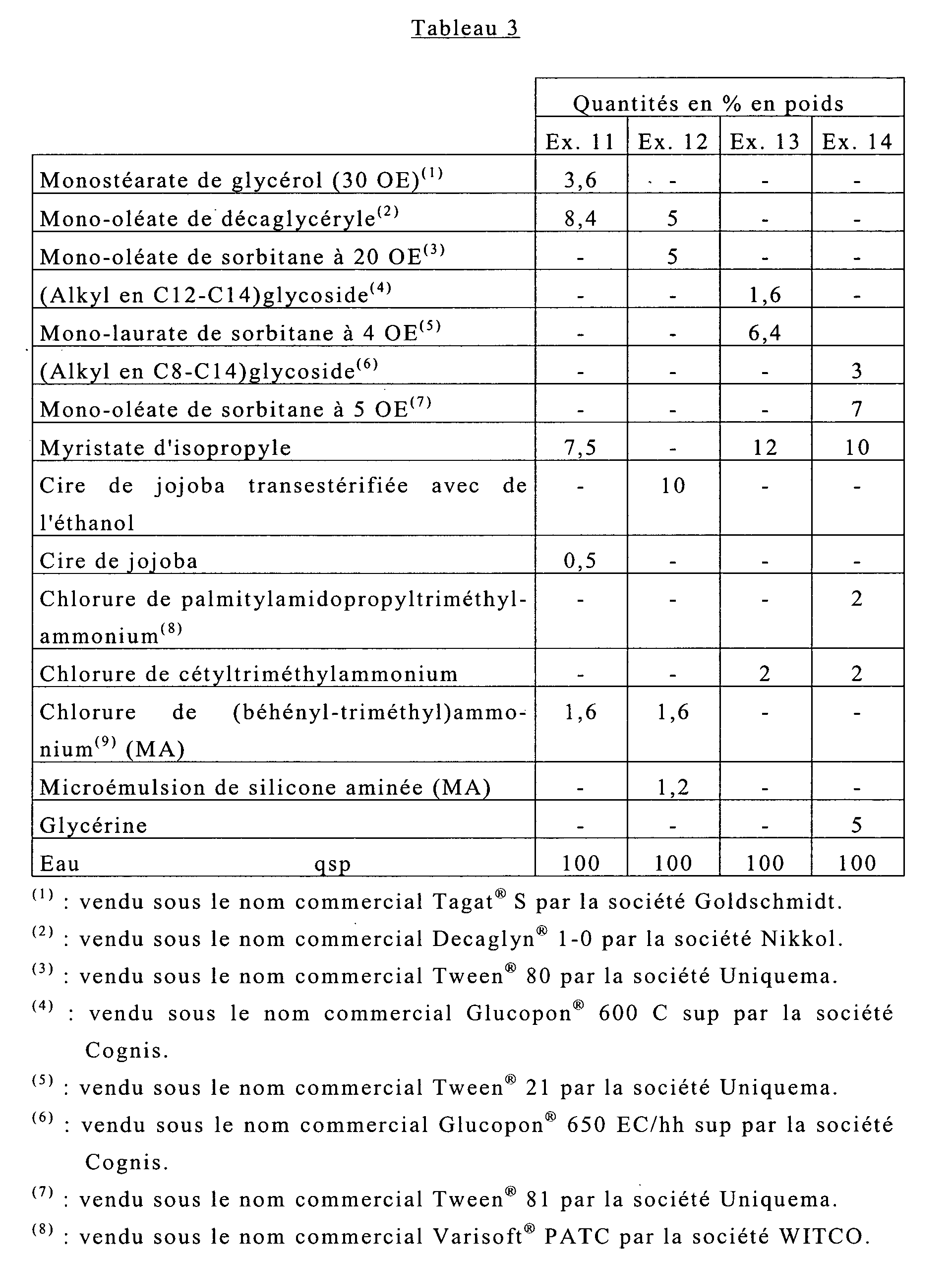
- compositions of Examples 1 to 14, according to the invention are prepared according to the procedure of the invention from the ingredients indicated in Tables 1 to 3 below. Ultimately, cationic nanoemulsions were obtained.
- compositions give said hair softness, flexibility and straightening, tone.
Landscapes
- Health & Medical Sciences (AREA)
- Life Sciences & Earth Sciences (AREA)
- Chemical & Material Sciences (AREA)
- General Health & Medical Sciences (AREA)
- Public Health (AREA)
- Engineering & Computer Science (AREA)
- Veterinary Medicine (AREA)
- Animal Behavior & Ethology (AREA)
- Birds (AREA)
- Epidemiology (AREA)
- Nanotechnology (AREA)
- Bioinformatics & Cheminformatics (AREA)
- Molecular Biology (AREA)
- Dermatology (AREA)
- Organic Chemistry (AREA)
- Biophysics (AREA)
- Biotechnology (AREA)
- General Engineering & Computer Science (AREA)
- Medical Informatics (AREA)
- Medicinal Chemistry (AREA)
- Dispersion Chemistry (AREA)
- Pharmacology & Pharmacy (AREA)
- Crystallography & Structural Chemistry (AREA)
- Materials Engineering (AREA)
- Cosmetics (AREA)
- Pharmaceuticals Containing Other Organic And Inorganic Compounds (AREA)
- Medicinal Preparation (AREA)
- Acyclic And Carbocyclic Compounds In Medicinal Compositions (AREA)
Abstract
Description
- ceux qui présentent la formule générale (I) suivante :
dans laquelle les radicaux R1 à R4, qui peuvent être identiques ou différents, représentent un radical aliphatique, linéaire ou ramifié, comportant de 1 à 30 atomes de carbone, ou un radical aromatique tel que aryle ou alkylaryle. Les radicaux aliphatiques peuvent comporter des hétéroatomes tels que notamment l'oxygène, l'azote, le soufre et les halogènes. Les radicaux aliphatiques sont, par exemple, choisis parmi les radicaux alkyle, alcoxy, polyoxyalkylène (C2-C6), alkylamide, alkyl(C12-C22)amidoalkyle(C2-C6), alkyl (C12-C22)acétate, hydroxyalkyle, comportant environ de 1 à 30 atomes de carbone ; X est un anion choisi dans le groupe des halogénures, phosphates, acétates, lactates, alkyl(C1-C6)sulfates, (alkyl en C1-C6)- ou (alkyl en C1-C6)aryl-sulfonates ;

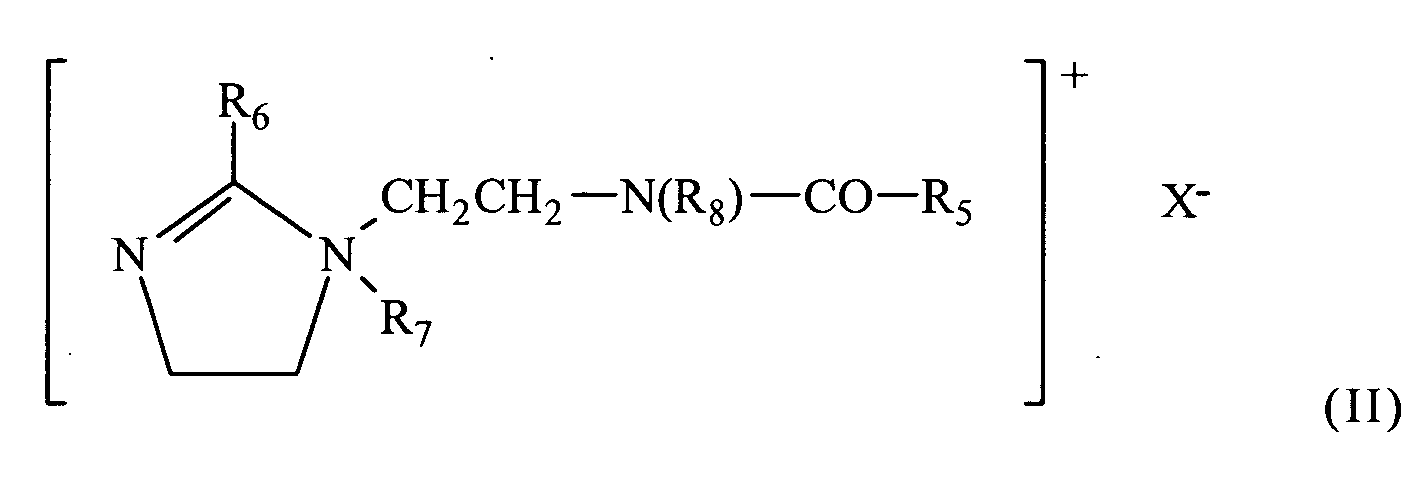
- les sels d'ammonium quaternaire de l'imidazoline, comme par
exemple ceux de formule (II) suivante :
dans laquelle R5 représente un radical alcényle ou alkyle comportant de 8 à 30 atomes de carbone, par exemple dérivés des acides gras du suif, R6 représente un atome d'hydrogène, un radical alkyle en C1-C4 ou un radical alcényle ou alkyle comportant de 8 à 30 atomes de carbone, R7 représente un radical alkyle en C1-C4, R8 représente un atome d'hydrogène, un radical alkyle en C1-C4, X-, est un anion choisi dans le groupe des halogénures, phosphates, acétates, lactates, alkylsulfates, alkyl- ou alkylaryl-sulfonates. De préférence, R5 et R6 désignent un mélange de radicaux alcényle ou alkyle comportant de 12 à 21 atomes de carbone, par exemple dérivés des acides gras du suif, R7 désigne un radical méthyle, R8 désigne un atome d'hydrogène. Un tel produit est par exemple commercialisé sous la dénomination REWOQUAT® W 75 par la société REWO ;
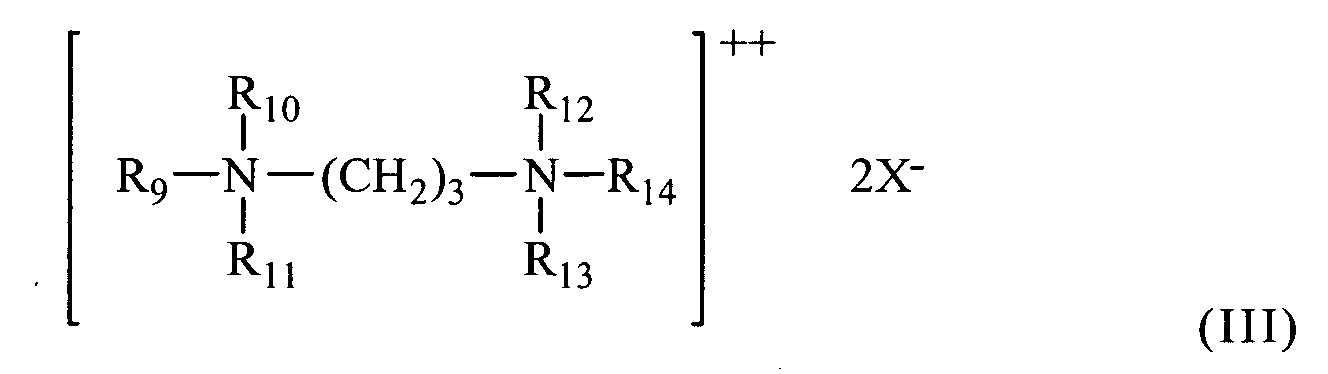
- les sels de diammonium quaternaire de formule (III) :
dans laquelle R9 désigne un radical aliphatique comportant environ de 16 à 30 atomes de carbone, R10, R11, R12, R13 et R14 , identiques ou différents sont choisis parmi l'hydrogène ou un radical alkyle comportant de 1 à 4 atomes de carbone, et X est un anion choisi dans le groupe des halogénures, acétates, phosphates, nitrates et méthylsulfates. De tels sels de diammonium quaternaire comprennent notamment le dichlorure de propanesuif diammonium ;
- les sels d'ammonium quaternaire contenant au moins une
fonction ester, tels que ceux de formule (IV) suivante :
dans laquelle :

- R15 est choisi parmi les radicaux alkyles en C1-C6 et les radicaux hydroxyalkyles ou dihydroxyalkyles en C1-C6 ;
- R16 est choisi parmi :
- le radical

- les radicaux R20 hydrocarbonés en C1-C22, linéaires ou ramifiés, saturés ou insaturés,
- l'atome d'hydrogène,
- le radical
- R18 est choisi parmi :
- le radical

- les radicaux R22 hydrocarbonés en C1-C6, linéaires ou ramifiés, saturés ou insaturés,
- l'atome d'hydrogène,
- le radical
- R17, R19 et R21, identiques ou différents, sont choisis parmi les radicaux hydrocarbonés en C7-C21, linéaires ou ramifiés, saturés ou insaturés ;
- r, s et t, identiques ou différents, sont des entiers valant de 2 à 6 ;
- y est un entier valant de 1 à 10 ;
- x et z, identiques ou différents, sont des entiers valant de 0 à 10 ;
- X- est un anion simple ou complexe, organique ou inorganique ; sous réserve que la somme x + y + z vaut de 1 à 15, que lorsque x vaut 0 alors R16 désigne R20 et que lorsque z vaut 0 alors R18 désigne R22.
- R15 désigne un radical méthyle ou éthyle,
- x et y sont égaux à 1 ;
- z est égal à 0 ou 1 ;
- r, s et t sont égaux à 2 ;
- R16 est choisi parmi :
- le radical

- les radicaux méthyle, éthyle ou hydrocarbonés en C14-C22,
- l'atome d'hydrogène ;
- le radical
- R18 est choisi parmi :
- le radical

- l'atome d'hydrogène ;
- le radical
- R17, R19 et R21, identiques ou différents, sont choisis parmi les radicaux hydrocarbonés en C13-C17, linéaires ou ramifiés, saturés ou insaturés, et de préférence parmi les radicaux alkyles et alcényles en C13-C17, linéaires ou ramifiés, saturés ou insaturés.
le tensioactif cationique étant choisi parmi :
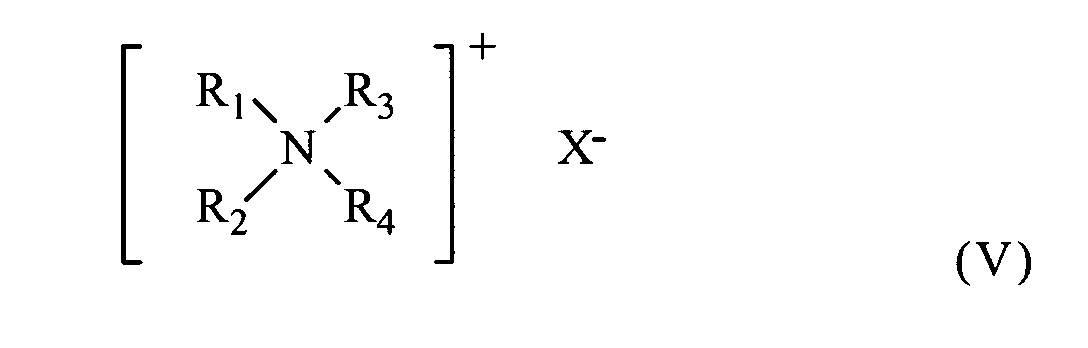
- ceux qui présentent la formule générale (V) suivante :
dans laquelle le radical R1 représente un radical aliphatique, linéaire ou ramifié, comportant de 8 à 30 atomes de carbone, ou un radical aromatique tel que aryle ou alkylaryle, les radicaux R2, R3 et R4, qui peuvent être identiques ou différents, représentent un radical aliphatique, linéaire ou ramifié, comportant de 1 à 6 atomes de carbone, en particulier alkyle ou hydroxyalkyle ; X est un anion choisi dans le groupe des halogénures, phosphates, acétates, lactates, alkyl(C1-C6)sulfates, (alkyl en C1-C6)- ou (alkyl en C1-C6)aryl-sulfonates ; Les radicaux R1 aliphatiques peuvent comporter des hétéroatomes tels que notamment l'oxygène, l'azote, le soufre et les halogènes. Les radicaux aliphatiques sont, par exemple, choisis parmi les radicaux alkyle, alcoxy, alkylamide, alkyl(C12-C22)amidoalkyle(C2-C6), alkyl(C12-C22)acétate, hydroxyalkyle, comportant environ de 8 à 30 atomes de carbone,
- les sels d'ammonium quaternaire de l'imidazoline, comme par exemple ceux de formule (II) ci-dessus
- les sels de diammonium quaternaire de formule (III) ci-dessus.
- les sels d'ammonium quaternaire contenant au moins une fonction ester, tels que ceux de formule (IV) ci-dessus.



- une taille des particules moyenne en nombre strictement inférieure à 100 nm, et
- une turbidité strictement inférieure à 150 unités NTU.
Claims (25)
- Procédé de préparation d'une nanoémulsion cationique comprenant les étapes suivantes :(a) mélange sous agitation, d'au moins un composé gras et d'au moins un tensioactif non ionique à une température Tm supérieure à la température de fusion du ou des composés gras et du ou des tensioactifs non ioniques, sous pression atmosphérique normale, le diagramme de phase ternaire composé(s) gras/tensioactif(s) non ionique(s)/eau présentant au moins une zone d'existence d'une phase nanoémulsion de type huile-dans-eau et les concentrations du ou des composés gras et du ou des tensioactifs non ioniques étant choisies de telle sorte que l'on puisse atteindre cette zone de nanoémulsion par simple dilution à l'eau,(b) ajout de l'eau sous agitation, de manière à atteindre cette zone de nanoémulsion, et(c) ajout à la nanoémulsion ainsi obtenue, d'au moins un tensioactif cationique.
- Procédé selon la revendication 1, caractérisé en ce que Tm est comprise entre la température ambiante et 100 °C.
- Procédé selon la revendication 1 ou 2, caractérisé en ce que le rapport pondéral τ composé(s) gras/tensioactif(s) non ionique(s) est inférieur à 2, de préférence compris entre 0,1 et 1,5, et mieux encore entre 0,1 et 1.
- Procédé selon l'une quelconque des revendications 1 à 3, caractérisé en ce qu'il comprend en outre une étape de refroidissement à température ambiante se situant avant ou après l'étape (c).
- Procédé selon l'une quelconque des revendications précédentes, caractérisé en ce que le tensioactif cationique est ajouté sous forme d'une solution ou d'une dispersion dans l'eau.
- Procédé selon l'une quelconque des revendications précédentes, caractérisé en ce que le composé gras est choisi parmi les esters d'acide gras, les huiles végétales transestérifiées ou non, et leurs mélanges.
- Procédé selon la revendication 6, caractérisé en ce que le composé gras est choisi parmi les composés de formule RaCOORb dans laquelle Ra représente le reste d'un acide gras supérieur, saturé ou insaturé, comportant de 6 à 29 atomes de carbone, de préférence de 8 à 22 atomes de carbone, et Rb représente une chaíne hydrocarbonée, saturée ou insaturée, contenant de 1 à 30 atomes de carbone, de préférence de 1 à 12 atomes de carbone ; l'huile d'amande douce, l'huile d'avocat, l'huile de ricin, l'huile d'olive, la cire de jojoba, l'huile de tournesol, l'huile de germes de blé, l'huile de sésame, l'huile d'arachide, l'huile de pépins de raisin, l'huile de soja, l'huile de colza, l'huile de carthame, l'huile de coprah, l'huile de maïs, l'huile de noisette, le beurre de karité, l'huile de palme, l'huile de noyau d'abricot, l'huile de calophyllum ; l'huile d'olive transestérifiée avec de l'hexanol, la cire de jojoba transestérifiée avec de l'éthanol ; et leurs mélanges.
- Procédé selon la revendication 7, caractérisé en ce que le composé gras est choisi parmi le myristate d'isopropyle, l'isononanoate d'isononyle, la cire de jojoba, l'huile d'olive transestérifiée avec de l'hexanol, la cire de jojoba transestérifiée avec de l'éthanol, et leurs mélanges.
- Procédé selon l'une quelconque des revendications précédentes, caractérisé en ce que l'on utilise au moins deux tensioactifs non ioniques dans l'étape (a).
- Procédé selon l'une quelconque des revendications précédentes, caractérisé en ce que le tensioactif non ionique est choisi parmi les huiles végétales polyoxyalkylénées (2-50 moles d'oxyde d'alkylène), hydrogénées ou non, les mono-, di- ou triglycérides d'acide gras en C8-30, les alcools polyoxyéthylénés et/ou polyoxypropylénés, les alpha-diols polyoxyéthylénés et/ou polyoxypropylénés, les alkylphénols polyoxyéthylénés et/ou polyoxypropylénés, ayant une chaíne grasse, le nombre de groupements oxyde d'éthylène ou oxyde de propylène pouvant aller notamment de 2 à 50, les copolymères d'oxyde d'éthylène et de propylène, les condensats d'oxyde d'éthylène et de propylène sur des alcools gras ; les amides gras polyoxyéthylénés ayant de 2 à 30 moles d'oxyde d'éthylène, les amides gras polyglycérolés comportant en moyenne 1 à 5 groupements glycérol et en particulier 1,5 à 4 ; les esters d'acides gras du sorbitane ou les esters d'acides gras du sorbitane polyoxyéthylénés ayant de 2 à 30 moles d'oxyde d'éthylène ; les esters d'acides gras du saccharose, les esters d'acides gras du polyéthylèneglycol, les esters d'acide gras en C8-30 du polyglycérol, les alkylpolyglycosides, les dérivés de N-alkyl-glucamine, les oxydes d'amines tels que les oxydes d'(alkyl en C10-C14)amine ou les oxydes de N-acylaminopropylmorpholine et leurs mélanges
- Procédé selon la revendication 10, caractérisé en ce que le tensioactif non ionique est choisi parmi l'huile de ricin hydrogénée polyoxyéthylénée à 35 OE, l'huile de ricin hydrogénée polyoxyéthylénée à 7 OE, l'huile d'olive polyoxyéthylénée à 7 OE, les mono-oléates de sorbitane à 4 OE, 5 OE ou à 20 OE, les (alkyl en C12-C14)glycosides, ou (alkyl en C8-C14)glycosides, le monostéarate de glycérol à 30 OE, le mono-oléate de décaglycéryle, l'alcool oléïque polyoxyéthylénéeà 2 ou 10 OE, l'alcool laurique polyoxyéthyléné à 7 OE, le dioléate de méthylglucoside et leurs mélanges.
- Procédé selon l'une quelconque des revendications précédentes, caractérisé en ce que le tensioactif cationique est choisi parmi :ceux qui présentent la formule générale (I) suivante :dans laquelle les radicaux R1 à R4, qui peuvent être identiques ou différents, représentent un radical aliphatique, linéaire ou ramifié, comportant de 1 à 30 atomes de carbone, ou un radical aromatique tel que aryle ou alkylaryle ; X est un anion choisi dans le groupe des halogénures, phosphates, acétates, lactates, alkyl(C1-C6)sulfates, (alkyl en C1-C6)- ou (alkyl en C1-C6)aryl-sulfonates ;
 les sels d'ammonium quaternaire de l'imidazoline ;les sels de diammonium quaternaire de formule (VIII) :dans laquelle R9 désigne un radical aliphatique comportant environ de 16 à 30 atomes de carbone, R10, R11, R12, R13 et R14 , identiques ou différents sont choisis parmi l'hydrogène ou un radical alkyle comportant de 1 à 4 atomes de carbone, et X est un anion choisi dans le groupe des halogénures, acétates, phosphates, nitrates et méthylsulfates ;
 les sels d'ammonium quaternaire contenant au moins une fonction ester.
 - Procédé selon la revendication 12, caractérisé en ce que les tensioactifs cationiques sont choisis parmi le chlorure de palmitamidopropyltrimonium, le chlorure de cétyl-triméthylammonium et le chlorure de béhényl-triméthylammonium.
- Procédé selon l'une quelconque des revendications précédentes, caractérisé en ce que la quantité de composé(s) gras est comprise entre 1 et 30 % en poids, de préférence entre 1 et 20 % en poids par rapport au poids total de la nanoémulsion cationique.
- Procédé selon l'une quelconque des revendications précédentes, caractérisé en ce que la quantité de tensioactif(s) non ionique(s) est comprise entre 2 et 30 % en poids, de préférence entre 2 et 20 % en poids par rapport au poids total de la nanoémulsion cationique.
- Procédé selon l'une quelconque des revendications précédentes, caractérisé en ce que la quantité d'eau est comprise entre 40 et 97 % en poids, de préférence entre 50 et 90 % en poids par rapport au poids total de la nanoémulsion cationique.
- Procédé selon l'une quelconque des revendications précédentes, caractérisé en ce que la quantité de tensioactif(s) cationique(s) est comprise entre 0,1 et 10 % en poids, de préférence entre 0,2 et 6 % en poids par rapport au poids total de la nanoémulsion cationique.
- Composition cosmétique sous forme de nanoémulsion cationique de type huile-dans-eau susceptible d'être obtenue par le procédé selon l'une quelconque des revendications 1 à 17.
- Composition cosmétique sous forme de nanoémulsion cationique dont les particules présentent une taille moyenne en nombre inférieure à 100 nm, comprenant au moins un composé gras et 2 à 30% en poids d'au moins un tensioactif non ionique en un rapport pondéral τ composé(s) gras/tensioactif(s) non ionique(s) est compris entre 0,1 et 1,5, au moins un tensioactif cationique et de l'eau,
le tensioactif cationique étant choisi parmi :ceux qui présentent la formule générale (I) suivante :dans laquelle le radical R1 représente un radical aliphatique, linéaire ou ramifié, comportant de 8 à 30 atomes de carbone, ou un radical aromatique tel que aryle ou alkylaryle, les radicaux R2, R3 et R4, qui peuvent être identiques ou différents, représentent un radical aliphatique, linéaire ou ramifié, comportant de 1 à 6 atomes de carbone ; X est un anion choisi dans le groupe des halogénures, phosphates, acétates, lactates, alkyl(C1-C6)sulfates, (alkyl en C1-C6)- ou (alkyl en C1-C6)aryl-sulfonates ; les sels d'ammonium quaternaire de l'imidazoline ;les sels de diammonium quaternaire de formule (VIII) :dans laquelle R9 désigne un radical aliphatique comportant environ de 16 à 30 atomes de carbone, R10, R11, R12, R13 et R14 , identiques ou différents sont choisis parmi l'hydrogène ou un radical alkyle comportant de 1 à 4 atomes de carbone, et X est un anion choisi dans le groupe des halogénures, acétates, phosphates, nitrates et méthylsulfates ;
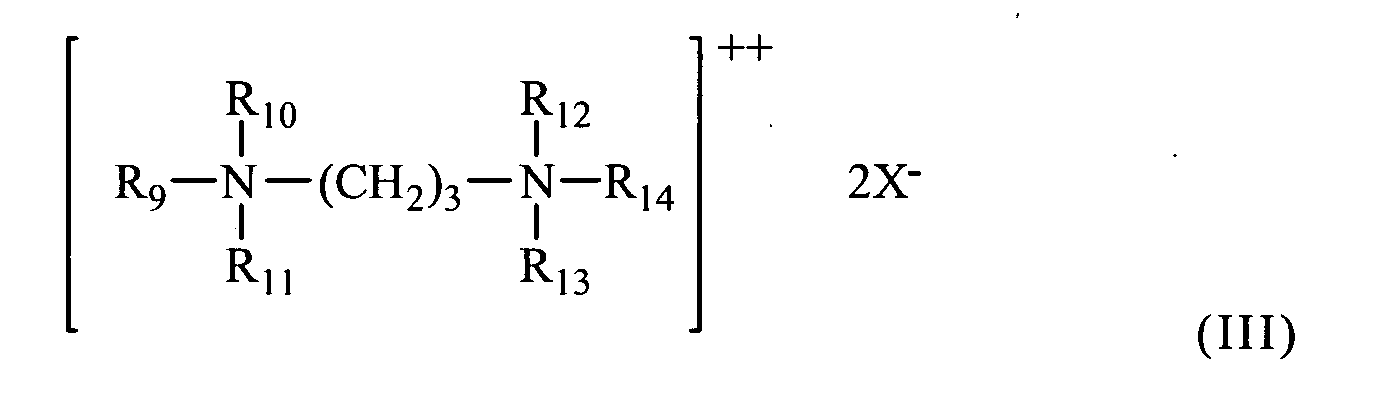 les sels d'ammonium quaternaire contenant au moins une fonction ester.
 - Composition cosmétique selon la revendication 19, caractérisée ce que le rapport pondéral τ composé(s) gras/tensioactif(s) non ionique(s) est compris entre 0,1 et 1.
- Composition selon l'une quelconque des revendications 19
ou 20, caractérisée en ce qu'elle comprend au moins deux tensioactifs non ioniques. - Composition selon l'une quelconque des revendications 18 à 21, caractérisée en ce que le rapport pondéral composé(s) gras/(tensioactif(s) non ionique(s) + tensioactif(s) cationique(s)) est inférieur à 1,5, de préférence compris entre 0,1 et 1
- Composition cosmétique selon l'une quelconque des revendication 18 à 22, caractérisée en ce qu'elle comprend des additifs choisis parmi des polymères cationiques, anioniques, non ioniques ou amphotères, des silicones non volatiles, modifiées ou non, des épaississants polymériques naturels ou synthétiques, anioniques, amphotères, zwittérioniques, non ioniques ou cationiques, associatifs ou non, des épaississants non polymériques comme des électrolytes, des sucres, des nacrants, des opacifiants, des filtres solaires, des vitamines et provitamines, des parfums, des colorants, des particules organiques ou minérales, des conservateurs, des agents de stabilisation du pH, des sucres.
- Utilisation de la composition cosmétique selon l'une quelconque des revendications 18 à 23, comme composition de nettoyage, de teinture ou de permanente, comme composition de prétraitement ou de post-traitement des shampooings, teintures, permanentes, décolorations et défrisages.
- Utilisation selon la revendication 23, en tant qu'après-shampoing.
Priority Applications (1)
| Application Number | Priority Date | Filing Date | Title |
|---|---|---|---|
| EP08171186.3A EP2074983B1 (fr) | 2002-11-29 | 2003-11-05 | Procédé de préparation de nanoémulsion cationique et composition cosmétique |
Applications Claiming Priority (2)
| Application Number | Priority Date | Filing Date | Title |
|---|---|---|---|
| FR0215080A FR2847831B1 (fr) | 2002-11-29 | 2002-11-29 | Procede de preparation de nanoemulsion cationique et composition cosmetique |
| FR0215080 | 2002-11-29 |
Related Child Applications (2)
| Application Number | Title | Priority Date | Filing Date |
|---|---|---|---|
| EP08171186.3A Division-Into EP2074983B1 (fr) | 2002-11-29 | 2003-11-05 | Procédé de préparation de nanoémulsion cationique et composition cosmétique |
| EP08171186.3A Division EP2074983B1 (fr) | 2002-11-29 | 2003-11-05 | Procédé de préparation de nanoémulsion cationique et composition cosmétique |
Publications (2)
| Publication Number | Publication Date |
|---|---|
| EP1430867A1 true EP1430867A1 (fr) | 2004-06-23 |
| EP1430867B1 EP1430867B1 (fr) | 2010-02-10 |
Family
ID=32309867
Family Applications (2)
| Application Number | Title | Priority Date | Filing Date |
|---|---|---|---|
| EP08171186.3A Expired - Lifetime EP2074983B1 (fr) | 2002-11-29 | 2003-11-05 | Procédé de préparation de nanoémulsion cationique et composition cosmétique |
| EP03292766A Expired - Lifetime EP1430867B1 (fr) | 2002-11-29 | 2003-11-05 | Procédé de préparation de nanoémulsion cationique |
Family Applications Before (1)
| Application Number | Title | Priority Date | Filing Date |
|---|---|---|---|
| EP08171186.3A Expired - Lifetime EP2074983B1 (fr) | 2002-11-29 | 2003-11-05 | Procédé de préparation de nanoémulsion cationique et composition cosmétique |
Country Status (5)
| Country | Link |
|---|---|
| EP (2) | EP2074983B1 (fr) |
| AT (1) | ATE457159T1 (fr) |
| DE (1) | DE60331212D1 (fr) |
| ES (1) | ES2624482T3 (fr) |
| FR (1) | FR2847831B1 (fr) |
Cited By (12)
| Publication number | Priority date | Publication date | Assignee | Title |
|---|---|---|---|---|
| EP1561457A3 (fr) * | 2004-02-03 | 2006-01-18 | Alberto-Culver Company | Composition cosmétique à pouvoir d' hydratation cutanèe de longue durée |
| FR2930436A1 (fr) * | 2008-04-28 | 2009-10-30 | Oreal | Composition cosmetique comprenant une emulsion obtenue par un procede pit |
| FR2930442A1 (fr) * | 2008-04-28 | 2009-10-30 | Oreal | Composition cosmetique comprenant une emulsion obtenue par procede pit |
| EP2612898A4 (fr) * | 2010-08-31 | 2014-06-25 | Univ Tokyo | Nanoémulsion eau/huile et son procédé de fabrication |
| FR3002439A1 (fr) * | 2013-02-28 | 2014-08-29 | Oreal | Composition cosmetique sous forme d'une nanoemulsion huile-dans-eau destinee a la coloration d'oxydation des fibres keratiniques |
| FR3002438A1 (fr) * | 2013-02-28 | 2014-08-29 | Oreal | Composition cosmetique oxydante sous forme d'une nanoemulsion huile-dans-eau destinee a la coloration et/ou la decoloration des fibres keratiniques |
| FR3002441A1 (fr) * | 2013-02-28 | 2014-08-29 | Oreal | Procede de coloration des fibres keratiniques mettant en oeuvre une nanoemulsion colorante et une nanoemulsion oxydante |
| FR3002440A1 (fr) * | 2013-02-28 | 2014-08-29 | Oreal | Composition cosmetique sous forme d'une nanoemulsion huile-dans-eau destinee a la coloration directe des fibres keratiniques |
| WO2014131871A3 (fr) * | 2013-02-28 | 2015-01-15 | L'oreal | Composition cosmétique se présentant sous la forme d'une nanoémulsion huile dans l'eau pour la coloration d'oxydation de fibres kératiniques, et procédé associé |
| WO2015061878A1 (fr) | 2013-10-30 | 2015-05-07 | Natura Cosméticos S.A. | Composition cosmétique revitalisante nanostructurée, son utilisation dans des préparations cosmétiques, et shampooing revitalisant |
| WO2016097387A1 (fr) * | 2014-12-18 | 2016-06-23 | L'oreal | Composition sous la forme d'une nano-émulsion de type huile dans l'eau comprenant au moins un tensioactif non ionique polyéthoxylé, au moins une substance grasse liquide et au moins une silicone |
| CN113543872A (zh) * | 2019-03-13 | 2021-10-22 | 巴斯夫欧洲公司 | 用于蜡分散体的稳定剂浓缩物 |
Families Citing this family (6)
| Publication number | Priority date | Publication date | Assignee | Title |
|---|---|---|---|---|
| FR2873573B1 (fr) * | 2004-08-02 | 2006-11-17 | Oreal | Emulsion eau-dans-huile comprenant une huile non-volatile non-siliconee, un tensioactif cationique, une polyolefine a partie's) polaire(s), et un alkylmonoglycoside ou alkylpolyglycoside |
| FR2873572B1 (fr) * | 2004-08-02 | 2007-03-09 | Oreal | Emulsion eau-dans-huile comprenant une huile non-volatile non-siliconee, des tensioactifs cationiques et non ioniques, et un alkylmonoglycoside ou alkylpolyglycoside |
| FR2892623B1 (fr) * | 2005-10-28 | 2008-01-11 | Oreal | Composition cosmetique comprenant un cation, un corps gras solide et un ester de sorbitan et procede de traitement cosmetique |
| FR2892630B1 (fr) * | 2005-10-28 | 2008-01-11 | Oreal | Composition cosmetique comprenant un ester de sorbitan oxyethylene, un polymere cationique, un corps gras solide et procede de traitement cosmetique |
| FR2892624B1 (fr) * | 2005-10-28 | 2009-06-05 | Oreal | Composition cosmetique comprenant un cation, un corps gras liquide et un ester de sorbitan et procede de traitement cosmetique |
| FR2954107B1 (fr) | 2009-12-23 | 2012-04-20 | Oreal | Composition cosmetique sous forme de nanoemulsion contenant un alcane lineaire volatil |
Citations (7)
| Publication number | Priority date | Publication date | Assignee | Title |
|---|---|---|---|---|
| US5298240A (en) * | 1990-12-07 | 1994-03-29 | Wella Aktiengesellschaft | Hair care composition in the form of a microemulsion |
| US5468725A (en) * | 1993-07-01 | 1995-11-21 | International Flvos & Fragrances Inc. | Alcohol free perfume |
| EP0820758A2 (fr) * | 1996-07-25 | 1998-01-28 | Beiersdorf Aktiengesellschaft | Composition pour les soins des cheveux sous la forme d'une microémulsion huile-dans-l'eau transparente ou translucide |
| DE19710155A1 (de) * | 1997-03-12 | 1998-09-17 | Henkel Kgaa | Kationische Mikroemulsionen |
| EP1120102A2 (fr) * | 2000-01-21 | 2001-08-01 | L'oreal | Nanoémulsion contenant des lipides amphiphiles et un polymère non ionique et utilisation en cosmétologie |
| WO2001056537A1 (fr) * | 2000-02-03 | 2001-08-09 | Goldschmidt Chemical Corporation | Microemulsions limpides destinees a etre utilisees dans des formulations apres-shampooing |
| EP1129684A2 (fr) * | 2000-01-21 | 2001-09-05 | L'oreal | Nanoémulsion à base de lipides amphiphiles et de polymères cationiques et utilisation en cosmétologie |
Family Cites Families (2)
| Publication number | Priority date | Publication date | Assignee | Title |
|---|---|---|---|---|
| GB1567947A (en) | 1976-07-02 | 1980-05-21 | Unilever Ltd | Esters of quaternised amino-alcohols for treating fabrics |
| DE3623215A1 (de) | 1986-07-10 | 1988-01-21 | Henkel Kgaa | Neue quartaere ammoniumverbindungen und deren verwendung |
-
2002
- 2002-11-29 FR FR0215080A patent/FR2847831B1/fr not_active Expired - Lifetime
-
2003
- 2003-11-05 AT AT03292766T patent/ATE457159T1/de not_active IP Right Cessation
- 2003-11-05 EP EP08171186.3A patent/EP2074983B1/fr not_active Expired - Lifetime
- 2003-11-05 ES ES08171186.3T patent/ES2624482T3/es not_active Expired - Lifetime
- 2003-11-05 EP EP03292766A patent/EP1430867B1/fr not_active Expired - Lifetime
- 2003-11-05 DE DE60331212T patent/DE60331212D1/de not_active Expired - Lifetime
Patent Citations (7)
| Publication number | Priority date | Publication date | Assignee | Title |
|---|---|---|---|---|
| US5298240A (en) * | 1990-12-07 | 1994-03-29 | Wella Aktiengesellschaft | Hair care composition in the form of a microemulsion |
| US5468725A (en) * | 1993-07-01 | 1995-11-21 | International Flvos & Fragrances Inc. | Alcohol free perfume |
| EP0820758A2 (fr) * | 1996-07-25 | 1998-01-28 | Beiersdorf Aktiengesellschaft | Composition pour les soins des cheveux sous la forme d'une microémulsion huile-dans-l'eau transparente ou translucide |
| DE19710155A1 (de) * | 1997-03-12 | 1998-09-17 | Henkel Kgaa | Kationische Mikroemulsionen |
| EP1120102A2 (fr) * | 2000-01-21 | 2001-08-01 | L'oreal | Nanoémulsion contenant des lipides amphiphiles et un polymère non ionique et utilisation en cosmétologie |
| EP1129684A2 (fr) * | 2000-01-21 | 2001-09-05 | L'oreal | Nanoémulsion à base de lipides amphiphiles et de polymères cationiques et utilisation en cosmétologie |
| WO2001056537A1 (fr) * | 2000-02-03 | 2001-08-09 | Goldschmidt Chemical Corporation | Microemulsions limpides destinees a etre utilisees dans des formulations apres-shampooing |
Cited By (23)
| Publication number | Priority date | Publication date | Assignee | Title |
|---|---|---|---|---|
| EP1561457A3 (fr) * | 2004-02-03 | 2006-01-18 | Alberto-Culver Company | Composition cosmétique à pouvoir d' hydratation cutanèe de longue durée |
| US7691399B2 (en) | 2004-02-03 | 2010-04-06 | Alberto Culver Company | Cosmetic compositions with long lasting skin moisturizing properties |
| EP2281549A1 (fr) * | 2004-02-03 | 2011-02-09 | Alberto-Culver Company | Composition cosmétique à pouvoir d' hydratation cutanèe de longue durée |
| FR2930436A1 (fr) * | 2008-04-28 | 2009-10-30 | Oreal | Composition cosmetique comprenant une emulsion obtenue par un procede pit |
| FR2930442A1 (fr) * | 2008-04-28 | 2009-10-30 | Oreal | Composition cosmetique comprenant une emulsion obtenue par procede pit |
| EP2113240A1 (fr) * | 2008-04-28 | 2009-11-04 | L'Oréal | Composition cosmétique comprenant une émulsion obtenue par procédé PIT. |
| EP2116220A1 (fr) * | 2008-04-28 | 2009-11-11 | L'Oreal | Composition cosmétique comprenant une émulsion obtenue par un procédé PIT |
| EP2612898A4 (fr) * | 2010-08-31 | 2014-06-25 | Univ Tokyo | Nanoémulsion eau/huile et son procédé de fabrication |
| FR3002441A1 (fr) * | 2013-02-28 | 2014-08-29 | Oreal | Procede de coloration des fibres keratiniques mettant en oeuvre une nanoemulsion colorante et une nanoemulsion oxydante |
| FR3002438A1 (fr) * | 2013-02-28 | 2014-08-29 | Oreal | Composition cosmetique oxydante sous forme d'une nanoemulsion huile-dans-eau destinee a la coloration et/ou la decoloration des fibres keratiniques |
| FR3002439A1 (fr) * | 2013-02-28 | 2014-08-29 | Oreal | Composition cosmetique sous forme d'une nanoemulsion huile-dans-eau destinee a la coloration d'oxydation des fibres keratiniques |
| FR3002440A1 (fr) * | 2013-02-28 | 2014-08-29 | Oreal | Composition cosmetique sous forme d'une nanoemulsion huile-dans-eau destinee a la coloration directe des fibres keratiniques |
| WO2014131870A1 (fr) * | 2013-02-28 | 2014-09-04 | L'oreal | Procédé de teinture et/ou de décoloration de fibres de kératine au moyen d'une composition oxydante sous forme de nanoémulsion huile dans eau |
| WO2014131872A3 (fr) * | 2013-02-28 | 2014-12-31 | L'oreal | Composition cosmétique se présentant sous la forme d'une nanoémulsion huile dans l'eau pour la coloration directe de fibres kératiniques |
| WO2014131871A3 (fr) * | 2013-02-28 | 2015-01-15 | L'oreal | Composition cosmétique se présentant sous la forme d'une nanoémulsion huile dans l'eau pour la coloration d'oxydation de fibres kératiniques, et procédé associé |
| WO2015061878A1 (fr) | 2013-10-30 | 2015-05-07 | Natura Cosméticos S.A. | Composition cosmétique revitalisante nanostructurée, son utilisation dans des préparations cosmétiques, et shampooing revitalisant |
| US20160271024A1 (en) * | 2013-10-30 | 2016-09-22 | Natura Cosméticos S.A. | A nanostructured conditioning cosmetic composition, the use thereof in cosmetic preparations, and a conditioning shampoo |
| US9918913B2 (en) | 2013-10-30 | 2018-03-20 | Natura Cosméticos S.A. | Nanostructured conditioning cosmetic composition, the use thereof in cosmetic preparations, and a conditioning shampoo |
| WO2016097387A1 (fr) * | 2014-12-18 | 2016-06-23 | L'oreal | Composition sous la forme d'une nano-émulsion de type huile dans l'eau comprenant au moins un tensioactif non ionique polyéthoxylé, au moins une substance grasse liquide et au moins une silicone |
| FR3030271A1 (fr) * | 2014-12-18 | 2016-06-24 | Oreal | Composition sous forme de nanoemulsion de type huile dans l'eau comprenant au moins un tensioactif non ionique polyethoxyle, au moins un corps gras liquide et au moins une silicone |
| CN113543872A (zh) * | 2019-03-13 | 2021-10-22 | 巴斯夫欧洲公司 | 用于蜡分散体的稳定剂浓缩物 |
| CN113543872B (zh) * | 2019-03-13 | 2024-03-22 | 巴斯夫欧洲公司 | 用于蜡分散体的稳定剂浓缩物 |
| US12274770B2 (en) | 2019-03-13 | 2025-04-15 | Basf Se | Stabilizer concentrates for wax dispersions |
Also Published As
| Publication number | Publication date |
|---|---|
| DE60331212D1 (de) | 2010-03-25 |
| FR2847831B1 (fr) | 2006-06-02 |
| FR2847831A1 (fr) | 2004-06-04 |
| ATE457159T1 (de) | 2010-02-15 |
| EP1430867B1 (fr) | 2010-02-10 |
| EP2074983B1 (fr) | 2017-03-15 |
| ES2624482T3 (es) | 2017-07-14 |
| EP2074983A2 (fr) | 2009-07-01 |
| EP2074983A3 (fr) | 2011-09-07 |
Similar Documents
| Publication | Publication Date | Title |
|---|---|---|
| EP2074983B1 (fr) | Procédé de préparation de nanoémulsion cationique et composition cosmétique | |
| US7476393B2 (en) | Process for the preparation of a cationic nanoemulsion, and cosmetic composition | |
| EP1795180B1 (fr) | Composition cosmétique comprenant un cation, un corps gras solide et un ester de sorbitan et procédé de traitement cosmétique | |
| EP2111848B1 (fr) | Composition cosmétique comprenant au moins un composé organique de silicium, au moins un tensioactif cationique et au moins un acide organique, et un procédé de traitement cosmétique mettant en oeuvre ladite composition | |
| EP1779896B1 (fr) | Composition cosmétique comprenant au moins un polymère fixant particulier et au moins un tensioactif ionique ou non ionique | |
| EP2338466B1 (fr) | Composition cosmétique comprenant au moins un alcane linéaire volatil, au moins une silicone aminée de teneur particulière et au moins une huile végétale | |
| EP2343036B1 (fr) | Composition cosmétique sous forme de nanoémulsion contenant un alcane linéaire volatil | |
| EP2149363B1 (fr) | Composition cosmétique aqueuse comprenant un copolymère vinylformamide / vinylamine, un corps gras non siliconé, un tensioactif et une silicone. | |
| CA2332469A1 (fr) | Nanoemulsion contenant des lipides amphiphiles et un polymere non ionique et utilisations | |
| EP1325731B1 (fr) | Agent microbicide et composition de traitement cosmétique le contenant | |
| EP1347738B1 (fr) | Composition transparente de traitement cosmetique de type emulsion eau-dans-huile | |
| EP1029534B1 (fr) | Compositions cosmétiques détergentes contenant un tensioactif hydroxyalkylether anionique et une gomme de guar cationique et leurs utilisations | |
| WO2002053112A1 (fr) | Composition cosmetique comprenant une silicone volatile, un tensioactif silicone et un tensioactif cationique | |
| EP1637121B1 (fr) | Composition cosmétique à base d'un tensioactif cationique, d'une silicone aminée, d'un alcool gras et d'un diol | |
| EP1629865B1 (fr) | Emulsion eau-dans-huile, comprenant une huile non-volatile non-siliconée, un tensioactif cationique, une polyoléfine à partie(s) polaire(s), et un alkylmonoglycoside ou alkylpolyglycoside. | |
| EP1627667B1 (fr) | Emulsion eau-dan-huile, comprenant une huile non-volatile non-siliconée, des tensioactifs cationique et non ioniques, et un alkylmonoglycoside ou alkylpolyglycoside | |
| EP0373988B2 (fr) | Composition cosmétique ou pharmaceutique pour le traitement des cheveux et du cuir chevelu | |
| EP0655236A1 (fr) | Composition fondante contenant des sels d'ammonium quaternaire à fonction ester, son utilisation comme produit capillaire | |
| EP1779841B1 (fr) | Composition cosmétique comprenant un ester de sorbitan oxyéthyléné, un polymère cationique, un corps gras solide et procédé de traitement cosmétique | |
| EP1782791B2 (fr) | Composition cosmétique comprenant un tensioactif cationique,un corps gras liquide et un ester de sorbitan | |
| FR3157166A3 (fr) | Compositions et procédés de traitement des fibres de kératine | |
| FR3052971B1 (fr) | Composition cosmetique oxydante sous forme d'une nanoemulsion comprenant un tensioactif non-ionique polyoxyethylene | |
| FR3157172A3 (fr) | Procédés de traitement des cheveux | |
| FR3157168A3 (fr) | Procédés de traitement de fibres de kératine | |
| FR3157169A3 (fr) | Procédés de traitement des fibres de kératine |
Legal Events
| Date | Code | Title | Description |
|---|---|---|---|
| PUAI | Public reference made under article 153(3) epc to a published international application that has entered the european phase |
Free format text: ORIGINAL CODE: 0009012 |
|
| AK | Designated contracting states |
Kind code of ref document: A1 Designated state(s): AT BE BG CH CY CZ DE DK EE ES FI FR GB GR HU IE IT LI LU MC NL PT RO SE SI SK TR |
|
| AX | Request for extension of the european patent |
Extension state: AL LT LV MK |
|
| 17P | Request for examination filed |
Effective date: 20041223 |
|
| AKX | Designation fees paid |
Designated state(s): AT BE BG CH CY CZ DE DK EE ES FI FR GB GR HU IE IT LI LU MC NL PT RO SE SI SK TR |
|
| GRAP | Despatch of communication of intention to grant a patent |
Free format text: ORIGINAL CODE: EPIDOSNIGR1 |
|
| RTI1 | Title (correction) |
Free format text: PROCESS TO PREPARE A CATIONIC NANOEMULSION |
|
| GRAS | Grant fee paid |
Free format text: ORIGINAL CODE: EPIDOSNIGR3 |
|
| GRAA | (expected) grant |
Free format text: ORIGINAL CODE: 0009210 |
|
| RIC1 | Information provided on ipc code assigned before grant |
Ipc: B01F 17/42 20060101ALI20091216BHEP Ipc: A61K 8/41 20060101ALI20091216BHEP Ipc: B01F 17/18 20060101ALI20091216BHEP Ipc: A61K 8/06 20060101AFI20091216BHEP |
|
| AK | Designated contracting states |
Kind code of ref document: B1 Designated state(s): AT BE BG CH CY CZ DE DK EE ES FI FR GB GR HU IE IT LI LU MC NL PT RO SE SI SK TR |
|
| REG | Reference to a national code |
Ref country code: GB Ref legal event code: FG4D Free format text: NOT ENGLISH |
|
| REG | Reference to a national code |
Ref country code: CH Ref legal event code: EP |
|
| REG | Reference to a national code |
Ref country code: IE Ref legal event code: FG4D |
|
| REF | Corresponds to: |
Ref document number: 60331212 Country of ref document: DE Date of ref document: 20100325 Kind code of ref document: P |
|
| REG | Reference to a national code |
Ref country code: NL Ref legal event code: VDEP Effective date: 20100210 |
|
| PG25 | Lapsed in a contracting state [announced via postgrant information from national office to epo] |
Ref country code: ES Free format text: LAPSE BECAUSE OF FAILURE TO SUBMIT A TRANSLATION OF THE DESCRIPTION OR TO PAY THE FEE WITHIN THE PRESCRIBED TIME-LIMIT Effective date: 20100521 Ref country code: PT Free format text: LAPSE BECAUSE OF FAILURE TO SUBMIT A TRANSLATION OF THE DESCRIPTION OR TO PAY THE FEE WITHIN THE PRESCRIBED TIME-LIMIT Effective date: 20100611 |
|
| PG25 | Lapsed in a contracting state [announced via postgrant information from national office to epo] |
Ref country code: SI Free format text: LAPSE BECAUSE OF FAILURE TO SUBMIT A TRANSLATION OF THE DESCRIPTION OR TO PAY THE FEE WITHIN THE PRESCRIBED TIME-LIMIT Effective date: 20100210 Ref country code: AT Free format text: LAPSE BECAUSE OF FAILURE TO SUBMIT A TRANSLATION OF THE DESCRIPTION OR TO PAY THE FEE WITHIN THE PRESCRIBED TIME-LIMIT Effective date: 20100210 Ref country code: FI Free format text: LAPSE BECAUSE OF FAILURE TO SUBMIT A TRANSLATION OF THE DESCRIPTION OR TO PAY THE FEE WITHIN THE PRESCRIBED TIME-LIMIT Effective date: 20100210 |
|
| REG | Reference to a national code |
Ref country code: IE Ref legal event code: FD4D |
|
| PG25 | Lapsed in a contracting state [announced via postgrant information from national office to epo] |
Ref country code: SE Free format text: LAPSE BECAUSE OF FAILURE TO SUBMIT A TRANSLATION OF THE DESCRIPTION OR TO PAY THE FEE WITHIN THE PRESCRIBED TIME-LIMIT Effective date: 20100210 Ref country code: EE Free format text: LAPSE BECAUSE OF FAILURE TO SUBMIT A TRANSLATION OF THE DESCRIPTION OR TO PAY THE FEE WITHIN THE PRESCRIBED TIME-LIMIT Effective date: 20100210 Ref country code: GR Free format text: LAPSE BECAUSE OF FAILURE TO SUBMIT A TRANSLATION OF THE DESCRIPTION OR TO PAY THE FEE WITHIN THE PRESCRIBED TIME-LIMIT Effective date: 20100511 Ref country code: CY Free format text: LAPSE BECAUSE OF FAILURE TO SUBMIT A TRANSLATION OF THE DESCRIPTION OR TO PAY THE FEE WITHIN THE PRESCRIBED TIME-LIMIT Effective date: 20100210 Ref country code: IE Free format text: LAPSE BECAUSE OF FAILURE TO SUBMIT A TRANSLATION OF THE DESCRIPTION OR TO PAY THE FEE WITHIN THE PRESCRIBED TIME-LIMIT Effective date: 20100210 Ref country code: NL Free format text: LAPSE BECAUSE OF FAILURE TO SUBMIT A TRANSLATION OF THE DESCRIPTION OR TO PAY THE FEE WITHIN THE PRESCRIBED TIME-LIMIT Effective date: 20100210 Ref country code: RO Free format text: LAPSE BECAUSE OF FAILURE TO SUBMIT A TRANSLATION OF THE DESCRIPTION OR TO PAY THE FEE WITHIN THE PRESCRIBED TIME-LIMIT Effective date: 20100210 |
|
| PLBI | Opposition filed |
Free format text: ORIGINAL CODE: 0009260 |
|
| PG25 | Lapsed in a contracting state [announced via postgrant information from national office to epo] |
Ref country code: SK Free format text: LAPSE BECAUSE OF FAILURE TO SUBMIT A TRANSLATION OF THE DESCRIPTION OR TO PAY THE FEE WITHIN THE PRESCRIBED TIME-LIMIT Effective date: 20100210 Ref country code: CZ Free format text: LAPSE BECAUSE OF FAILURE TO SUBMIT A TRANSLATION OF THE DESCRIPTION OR TO PAY THE FEE WITHIN THE PRESCRIBED TIME-LIMIT Effective date: 20100210 Ref country code: BG Free format text: LAPSE BECAUSE OF FAILURE TO SUBMIT A TRANSLATION OF THE DESCRIPTION OR TO PAY THE FEE WITHIN THE PRESCRIBED TIME-LIMIT Effective date: 20100510 |
|
| 26 | Opposition filed |
Opponent name: HENKEL AG & CO. KGAA Effective date: 20101103 |
|
| PLAX | Notice of opposition and request to file observation + time limit sent |
Free format text: ORIGINAL CODE: EPIDOSNOBS2 |
|
| PG25 | Lapsed in a contracting state [announced via postgrant information from national office to epo] |
Ref country code: DK Free format text: LAPSE BECAUSE OF FAILURE TO SUBMIT A TRANSLATION OF THE DESCRIPTION OR TO PAY THE FEE WITHIN THE PRESCRIBED TIME-LIMIT Effective date: 20100210 |
|
| PG25 | Lapsed in a contracting state [announced via postgrant information from national office to epo] |
Ref country code: IT Free format text: LAPSE BECAUSE OF FAILURE TO SUBMIT A TRANSLATION OF THE DESCRIPTION OR TO PAY THE FEE WITHIN THE PRESCRIBED TIME-LIMIT Effective date: 20100210 |
|
| PLBB | Reply of patent proprietor to notice(s) of opposition received |
Free format text: ORIGINAL CODE: EPIDOSNOBS3 |
|
| BERE | Be: lapsed |
Owner name: L'OREAL Effective date: 20101130 |
|
| PG25 | Lapsed in a contracting state [announced via postgrant information from national office to epo] |
Ref country code: MC Free format text: LAPSE BECAUSE OF NON-PAYMENT OF DUE FEES Effective date: 20101130 |
|
| REG | Reference to a national code |
Ref country code: CH Ref legal event code: PL |
|
| PG25 | Lapsed in a contracting state [announced via postgrant information from national office to epo] |
Ref country code: LI Free format text: LAPSE BECAUSE OF NON-PAYMENT OF DUE FEES Effective date: 20101130 Ref country code: CH Free format text: LAPSE BECAUSE OF NON-PAYMENT OF DUE FEES Effective date: 20101130 |
|
| PG25 | Lapsed in a contracting state [announced via postgrant information from national office to epo] |
Ref country code: BE Free format text: LAPSE BECAUSE OF NON-PAYMENT OF DUE FEES Effective date: 20101130 |
|
| PG25 | Lapsed in a contracting state [announced via postgrant information from national office to epo] |
Ref country code: LU Free format text: LAPSE BECAUSE OF NON-PAYMENT OF DUE FEES Effective date: 20101105 Ref country code: HU Free format text: LAPSE BECAUSE OF FAILURE TO SUBMIT A TRANSLATION OF THE DESCRIPTION OR TO PAY THE FEE WITHIN THE PRESCRIBED TIME-LIMIT Effective date: 20100811 |
|
| PG25 | Lapsed in a contracting state [announced via postgrant information from national office to epo] |
Ref country code: TR Free format text: LAPSE BECAUSE OF FAILURE TO SUBMIT A TRANSLATION OF THE DESCRIPTION OR TO PAY THE FEE WITHIN THE PRESCRIBED TIME-LIMIT Effective date: 20100210 |
|
| PLCK | Communication despatched that opposition was rejected |
Free format text: ORIGINAL CODE: EPIDOSNREJ1 |
|
| APBM | Appeal reference recorded |
Free format text: ORIGINAL CODE: EPIDOSNREFNO |
|
| APBP | Date of receipt of notice of appeal recorded |
Free format text: ORIGINAL CODE: EPIDOSNNOA2O |
|
| APAH | Appeal reference modified |
Free format text: ORIGINAL CODE: EPIDOSCREFNO |
|
| APBQ | Date of receipt of statement of grounds of appeal recorded |
Free format text: ORIGINAL CODE: EPIDOSNNOA3O |
|
| REG | Reference to a national code |
Ref country code: FR Ref legal event code: PLFP Year of fee payment: 13 |
|
| REG | Reference to a national code |
Ref country code: FR Ref legal event code: PLFP Year of fee payment: 14 |
|
| APBU | Appeal procedure closed |
Free format text: ORIGINAL CODE: EPIDOSNNOA9O |
|
| REG | Reference to a national code |
Ref country code: FR Ref legal event code: PLFP Year of fee payment: 15 |
|
| REG | Reference to a national code |
Ref country code: DE Ref legal event code: R100 Ref document number: 60331212 Country of ref document: DE |
|
| PLBN | Opposition rejected |
Free format text: ORIGINAL CODE: 0009273 |
|
| STAA | Information on the status of an ep patent application or granted ep patent |
Free format text: STATUS: OPPOSITION REJECTED |
|
| 27O | Opposition rejected |
Effective date: 20180412 |
|
| REG | Reference to a national code |
Ref country code: FR Ref legal event code: PLFP Year of fee payment: 16 |
|
| PGFP | Annual fee paid to national office [announced via postgrant information from national office to epo] |
Ref country code: GB Payment date: 20220915 Year of fee payment: 20 |
|
| PGFP | Annual fee paid to national office [announced via postgrant information from national office to epo] |
Ref country code: FR Payment date: 20220908 Year of fee payment: 20 |
|
| PGFP | Annual fee paid to national office [announced via postgrant information from national office to epo] |
Ref country code: DE Payment date: 20220914 Year of fee payment: 20 |
|
| REG | Reference to a national code |
Ref country code: DE Ref legal event code: R071 Ref document number: 60331212 Country of ref document: DE |
|
| REG | Reference to a national code |
Ref country code: GB Ref legal event code: PE20 Expiry date: 20231104 |
|
| PG25 | Lapsed in a contracting state [announced via postgrant information from national office to epo] |
Ref country code: GB Free format text: LAPSE BECAUSE OF EXPIRATION OF PROTECTION Effective date: 20231104 |
|
| PG25 | Lapsed in a contracting state [announced via postgrant information from national office to epo] |
Ref country code: GB Free format text: LAPSE BECAUSE OF EXPIRATION OF PROTECTION Effective date: 20231104 |