EP1428871A1 - Cultured cell construct containing spheroids of cultured animal cells and utilization thereof - Google Patents
Cultured cell construct containing spheroids of cultured animal cells and utilization thereof Download PDFInfo
- Publication number
- EP1428871A1 EP1428871A1 EP02755656A EP02755656A EP1428871A1 EP 1428871 A1 EP1428871 A1 EP 1428871A1 EP 02755656 A EP02755656 A EP 02755656A EP 02755656 A EP02755656 A EP 02755656A EP 1428871 A1 EP1428871 A1 EP 1428871A1
- Authority
- EP
- European Patent Office
- Prior art keywords
- cells
- cultured cell
- spheroid
- cell construct
- cultivated
- Prior art date
- Legal status (The legal status is an assumption and is not a legal conclusion. Google has not performed a legal analysis and makes no representation as to the accuracy of the status listed.)
- Granted
Links
Images

Classifications
-
- C—CHEMISTRY; METALLURGY
- C12—BIOCHEMISTRY; BEER; SPIRITS; WINE; VINEGAR; MICROBIOLOGY; ENZYMOLOGY; MUTATION OR GENETIC ENGINEERING
- C12N—MICROORGANISMS OR ENZYMES; COMPOSITIONS THEREOF; PROPAGATING, PRESERVING, OR MAINTAINING MICROORGANISMS; MUTATION OR GENETIC ENGINEERING; CULTURE MEDIA
- C12N5/00—Undifferentiated human, animal or plant cells, e.g. cell lines; Tissues; Cultivation or maintenance thereof; Culture media therefor
-
- C—CHEMISTRY; METALLURGY
- C12—BIOCHEMISTRY; BEER; SPIRITS; WINE; VINEGAR; MICROBIOLOGY; ENZYMOLOGY; MUTATION OR GENETIC ENGINEERING
- C12N—MICROORGANISMS OR ENZYMES; COMPOSITIONS THEREOF; PROPAGATING, PRESERVING, OR MAINTAINING MICROORGANISMS; MUTATION OR GENETIC ENGINEERING; CULTURE MEDIA
- C12N5/00—Undifferentiated human, animal or plant cells, e.g. cell lines; Tissues; Cultivation or maintenance thereof; Culture media therefor
- C12N5/06—Animal cells or tissues; Human cells or tissues
- C12N5/0602—Vertebrate cells
- C12N5/067—Hepatocytes
- C12N5/0671—Three-dimensional culture, tissue culture or organ culture; Encapsulated cells
-
- C—CHEMISTRY; METALLURGY
- C12—BIOCHEMISTRY; BEER; SPIRITS; WINE; VINEGAR; MICROBIOLOGY; ENZYMOLOGY; MUTATION OR GENETIC ENGINEERING
- C12N—MICROORGANISMS OR ENZYMES; COMPOSITIONS THEREOF; PROPAGATING, PRESERVING, OR MAINTAINING MICROORGANISMS; MUTATION OR GENETIC ENGINEERING; CULTURE MEDIA
- C12N5/00—Undifferentiated human, animal or plant cells, e.g. cell lines; Tissues; Cultivation or maintenance thereof; Culture media therefor
- C12N5/06—Animal cells or tissues; Human cells or tissues
- C12N5/0602—Vertebrate cells
-
- C—CHEMISTRY; METALLURGY
- C12—BIOCHEMISTRY; BEER; SPIRITS; WINE; VINEGAR; MICROBIOLOGY; ENZYMOLOGY; MUTATION OR GENETIC ENGINEERING
- C12N—MICROORGANISMS OR ENZYMES; COMPOSITIONS THEREOF; PROPAGATING, PRESERVING, OR MAINTAINING MICROORGANISMS; MUTATION OR GENETIC ENGINEERING; CULTURE MEDIA
- C12N5/00—Undifferentiated human, animal or plant cells, e.g. cell lines; Tissues; Cultivation or maintenance thereof; Culture media therefor
- C12N5/06—Animal cells or tissues; Human cells or tissues
- C12N5/0697—Artificial constructs associating cells of different lineages, e.g. tissue equivalents
-
- C—CHEMISTRY; METALLURGY
- C12—BIOCHEMISTRY; BEER; SPIRITS; WINE; VINEGAR; MICROBIOLOGY; ENZYMOLOGY; MUTATION OR GENETIC ENGINEERING
- C12N—MICROORGANISMS OR ENZYMES; COMPOSITIONS THEREOF; PROPAGATING, PRESERVING, OR MAINTAINING MICROORGANISMS; MUTATION OR GENETIC ENGINEERING; CULTURE MEDIA
- C12N2502/00—Coculture with; Conditioned medium produced by
- C12N2502/14—Coculture with; Conditioned medium produced by hepatocytes
-
- C—CHEMISTRY; METALLURGY
- C12—BIOCHEMISTRY; BEER; SPIRITS; WINE; VINEGAR; MICROBIOLOGY; ENZYMOLOGY; MUTATION OR GENETIC ENGINEERING
- C12N—MICROORGANISMS OR ENZYMES; COMPOSITIONS THEREOF; PROPAGATING, PRESERVING, OR MAINTAINING MICROORGANISMS; MUTATION OR GENETIC ENGINEERING; CULTURE MEDIA
- C12N2502/00—Coculture with; Conditioned medium produced by
- C12N2502/28—Vascular endothelial cells
-
- C—CHEMISTRY; METALLURGY
- C12—BIOCHEMISTRY; BEER; SPIRITS; WINE; VINEGAR; MICROBIOLOGY; ENZYMOLOGY; MUTATION OR GENETIC ENGINEERING
- C12N—MICROORGANISMS OR ENZYMES; COMPOSITIONS THEREOF; PROPAGATING, PRESERVING, OR MAINTAINING MICROORGANISMS; MUTATION OR GENETIC ENGINEERING; CULTURE MEDIA
- C12N2533/00—Supports or coatings for cell culture, characterised by material
- C12N2533/30—Synthetic polymers
-
- C—CHEMISTRY; METALLURGY
- C12—BIOCHEMISTRY; BEER; SPIRITS; WINE; VINEGAR; MICROBIOLOGY; ENZYMOLOGY; MUTATION OR GENETIC ENGINEERING
- C12N—MICROORGANISMS OR ENZYMES; COMPOSITIONS THEREOF; PROPAGATING, PRESERVING, OR MAINTAINING MICROORGANISMS; MUTATION OR GENETIC ENGINEERING; CULTURE MEDIA
- C12N2533/00—Supports or coatings for cell culture, characterised by material
- C12N2533/30—Synthetic polymers
- C12N2533/40—Polyhydroxyacids, e.g. polymers of glycolic or lactic acid (PGA, PLA, PLGA); Bioresorbable polymers
-
- C—CHEMISTRY; METALLURGY
- C12—BIOCHEMISTRY; BEER; SPIRITS; WINE; VINEGAR; MICROBIOLOGY; ENZYMOLOGY; MUTATION OR GENETIC ENGINEERING
- C12N—MICROORGANISMS OR ENZYMES; COMPOSITIONS THEREOF; PROPAGATING, PRESERVING, OR MAINTAINING MICROORGANISMS; MUTATION OR GENETIC ENGINEERING; CULTURE MEDIA
- C12N2535/00—Supports or coatings for cell culture characterised by topography
- C12N2535/10—Patterned coating
Definitions
- This invention relates to a cultured animal cells and a construct of said cultured cells, and, more specifically, to a co-culture which contains spheroids of cultured cells and bio-devices which support said co-culture on their surface.
- Bio-devices and a co-culture per se are usable in the field of the physiological or pathophysiological examination of animal cells, transplantation, organo-regeneration engineering, hybrid-type prosthesis, etc.
- parenchymal cells fulfill functions of tissues or organs.
- hepatocytes i.e., parenchymal cells of liver, undertake the synthesis, decomposition and storage of various substances, and are therefore very important basic units for a living organism.
- three-dimensional architecture three-dimensional growth pattern
- the function of cultured cells which are given by three-dimensional architecture is closer to that of hepatocytes in vivo than the function of cultured cells which are given by monolayer cultivation.
- Cultured cells of such a three-dimensional architecture system are liable to be peeled off the culture support, and, therefore, no three-dimensional structures have ever been realized on a patterned surface.
- three-dimensional architecture three-dimensional growth pattern
- organs of animals are constituted by tissues (groups of cells having similar function) of different properties.
- cells which are units to constitute tissues keep their function through interaction between the same or different species of cells.
- S.N. Bhatia et al. set forth results of the study of the preservation of phenotype of hepatocyte which is given by the cocultivation of hepatocytes and fibroblasts which are non-parenchymal cells [S.N. Bhatia et al., The FASEB Journal, Vol. 13 (1999); 1883-1900].
- the intra-cellular albumin production ability for instance, of hepatocytes which are located at a distance of three or four cells from the boundary between the monolayer of hepatocytes and the non-parenchymal cells decreases down to the same degree as that of purely cultured hepatocytes.
- the objective of the present invention is to provide a system of cultured animal cells by which to maintain specific function of parenchymal cells such as hepatocytes steadily and over a long period of time, and by which to keep micropattern stably when cells of the system are micropatterned.
- Inventors of this invention have studied both a cultivation system of hepatocytes as one of two different species of cells, and the function of cultured hepatocytes which are obtained from said cultivation system. They have resultantly found out that, when hepatocytes are cultivated on a cellular monolayer of a certain region of cultivated endothelial cells or fibroblasts, not co-cultivated with non-parenchymal cells on the same plane so that interaction may occur via heterotypic interface as taught by the above-mentioned S.N.
- both a co-culture which comprises the above-mentioned spheroid and a monolayer of cells, other than hepatocytes, which forms a substratum in contact with said spheroid, and a cultured cell construct (hereinafter sometimes referred to as spheroid/cultured cell monolayer/support) which comprises said co-culture and support therefor show resistance (stability) to peeling of each of cultured cells from the support.
- endothelial cells or fibroblasts have generally strong proliferous potential and/or motility, and tend to migrate to, and grow on, the periphery of island on support on which the endothelial cells or fibroblasts are seeded and cultivated.
- the inventors have, however, further found out that the enclosing of said island with a surface of a certain hydrophilic and cytophobic polymer can prevent not only cultures of said endothelial cells or fibroblasts or the like but also spheroid which is formed on such cultured cells from migrating or moving from said island, and that a co-culture having a special form can be thus kept stable on a support.
- this invention provides a cultured cell construct which comprises one, two or more co-cultures of different animal cells on a support.
- Each of co-cultures in such a cultured cell construct comprises a spheroid which is derived from cultivated cells of one of different cell species, preferably parenchymal cells, and a substantially single layer of cultivated cells which are derived from the other of said different cell species, which layer constitutes a substratum in contact with said spheroid and is capable of making cells which form said spheroid survive and function.
- this invention provides a bio-device which comprises a surface composed of two or more of the above-mentioned co-cultures.
- this invention provides a process to prepare a cultured cell construct which comprises one, two or more co-cultures of different animal cells on a support in which co-cultures spheroids that have been formed from cultured cells are supported on separated plural islands, which process is characterized in that, on the surface of a material on which a co-culture is to be adhered, there is formed a polymer layer based on a polyethylene glycol segment one of whose terminal is unbound or covalently bound to a compound selected from the group consisting of mono- or oligosaccharides and oligopeptides which constitute a binding domain of ligand for an animal cell surface receptors, that the above-mentioned polymer layer is subjected to plasma treatment via a mask pattern having plural circular holes which are separated from one another at an interval of at least about 100 ⁇ m and which have a diameter of about 50-100 ⁇ m, that polymer layer is thus removed from islands which correspond to the above-mentioned holes, that, if necessary
- This invention also provides a co-culture per se which has been peeled off the support of the above-mentioned cultured cell construct.
- This invention as explained above achieves an effect which is similar to the one attained by the cultivation of hepatocytes and endothelial cells or fibroblasts. For instance, a spheroid of cultivated hepatocytes maintains, at least for three weeks, an ability to produce albumin at a high level.
- One of the different animal cells which are to be co-cultivated in accordance with this invention may be cells any of any species so long as they are capable of forming a spheroid through co-cultivation as mentioned later.
- said cells are parenchymal cells.
- Parenchymal cell means a cell which fulfills functions of a tissue or organ. For instance, parenchymal cell of liver is hepatocyte, and parenchymal cell of lung is alveolar epithelial cell. Any cell that falls under this definition and suits the purpose of this invention is to be called parenchymal cell in this invention.
- parenchymal cells which are primarily intended to be used in this invention include, although not restrictive, hepatocytes, beta cells of pancreas, cardiac muscle cells, glia cells, skin epithelial cells (keratinocytes), chondrocytes, osteocytes and embryonal or adult stem cells.
- hepatocytes beta cells of pancreas
- cardiac muscle cells glia cells
- skin epithelial cells keratinocytes
- chondrocytes chondrocytes
- osteocytes embryonal or adult stem cells.
- non-parenchymal cells are included in the above-mentioned animal cells so long as they are capable of forming a spheroid and suit the purpose of this invention, as stated above.
- the other one of the different animal cells which are to be co-cultivated may be any species of cells so long as they, when co-cultivated, serve to help the above-mentioned spheroid-forming cells to survive and function, and so long as they are different from said spheroid-forming cells.
- Endothelial cells, epithelial cells and fibroblasts can be mentioned as examples of such cells.
- Preferable are endothelial cells, in particular angio endothelial cells, among which funicular vein endothelial cells are most desirable.
- Fibroblasts are also preferable. Fibroblasts are mesoblast-derived cells which are dispersed in almost all tissues of an animal body.
- Fibroblasts are to be chosen according to the cells which form a spheroid when cultivated as mentioned above, or, in other words, fibroblasts which play important roles for the morphogenesis of an organ where the spheroid-forming cells exist are preferably used.
- a combination of different animal cell species which are to be co-cultivated also includes, in addition to the above-mentioned ones, a combination of non-parenchymal cell-non-parenchymal cell such as fibroblast-endothelial cell and epithelial cell-endothelial cell, and a combination of parenchymal cell-parenchymal cell such as cardiac muscle cell-hepatocyte and beta cell of pancreas-hepatocyte, although not restrictive.
- Animals from which the above-mentioned cells are originated may be of any kind, examples of which include poultry and mammals, in particular human being.
- endothelial cells, epithelial cells or fibroblasts form substantially a monolayer of cultivated cells as anchorage dependent cells or feeder cells on the surface of culture support, and, subsequently, cells, preferably parenchymal cells, which have been cultivated on said monolayer and which are different from the cells that form the monolayer, come into contact with the cultivated cells which constitute said monolayer, and, through heterotypic interaction, maintain a function specific to corresponding cells stably for a long period of time.
- form substantially a monolayer of cultivated cells means that at least 80 %, preferably at least 90 %, more desirably at least 95 %, of region on which to form said cellular layer is composed of monolayer of cultivated cells.
- co-cultivation if only the above-mentioned different animal cells are cultivated together for some period, it comes under the definition of "co-cultivation”.
- endothelial cells or fibroblasts for example are firstly cultivated to form a monolayer, and, subsequently, these feeder cells and parenchymal cells are cultivated together.
- the above-mentioned endothelial cells, epithelial cells or fibroblasts are cultivated on an island on the surface of culture support, and, on this island, there is constructed a feeder layer which is composed of thus cultivated cells, and, later, there is formed a construct of cultivated cells which comprises a co-culture that is composed of said feeder layer and a spheroid which is in direct contact with said feeder layer and which is preferably originated from parenchymal cells.
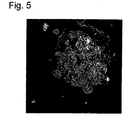
- a spheroid which is formed from a culture of some species of cells means, as is known from the term "spheroid", a substantially spheric agglomerate of cultivated parenchymal cells, which has a shape as shown by the confocal laser micrograph that is attached hereto as Figure 5, or a shape which resembles the same.
- the phrase "substantially spheric” is intended to include not only a completely spheric shape but also a slightly flat one.
- the island is subject to no restrictions so long as it achieves the purpose of this invention.
- the island may have any shape including circle, polygon such as quadrilateral, ellipse, etc., that has an area of about 1,000 to about 200,000 ⁇ m 2 , preferably about 1,500 to about 50,000 ⁇ m 2 .
- Circular shape is preferable, in which case the circle has a diameter of about 40 to about 500 ⁇ m, preferably about 50 to 200 ⁇ m, more desirably about 50 to about 100 ⁇ m.
- each culture or co-culture may possibly show a tendency to peel off the surface of support, or the spheroid may possibly fail to stably maintain the function of parenchymal cells from which the spheroid has been originated.
- this invention provides a surface, produced by hydrophilic and cytophobic substance, which encircles said island. Details of such a substance are mentioned later. Attention is drawn to the fact, for the present, that, although the above-mentioned U.S. Patent 5,976,826 teaches that sialic acid, lectin, polygalactose and other carbohydrates mediate cell binding, and although P. H. Weigel et al., J. Bio. Chem. Vol.
- cytophobic substance in this invention is sometimes independent of, or even opposite to, these teachings.
- hydrophilic and cytophobic substance in accordance with this invention has properties as follows: the above-mentioned anchorage-dependent cultivated cells or feeder layer-forming cultivated cells cannot adhere to a surface which is made of said hydrophilic and cytophobic substance under cultivation conditions as mentioned later, or, even though adhered, said anchorage-dependent cultivated cells or feeder layer-forming cultivated cells can be easily detached by mild cleansing or rinsing, and, thus, when parenchymal cells are to be cultivated later, said anchorage-dependent cultivated cells or feeder layer-forming cultivated cells cannot be cultivated stably for a long period of time, or, furthermore, also the cultivated parenchymal cells are hard to adhere to this surface made of the hydrophilic and cytophobic substance of this invention.
- a part of substance which is capable of forming such a surface as mentioned above may be a substance which forms a cytophobic or biophobic monomolecular layer as set forth in the above-mentioned U.S. Patent 5,976,826.
- Preferable examples include compounds which contain a portion of polyethylene glycol (hereinafter may sometimes be referred to as "PEG").
- PEG polyethylene glycol
- a compound e.g., HS(CH 2 ) 11 (OCH 2 CH 2 ) 6 OH] which has six ethylene glycol units.
- cytophobic substance in this invention is saccharide derivative or peptide derivative each of which is based on a polyethylene glycol segment to one of whose terminals is covalently bound a mono- or oligosaccharide or a certain kind of oligopeptide each of which constitutes a binding domain of ligand to cell surface receptors, or polysaccharide, although it is said that hepatocytes adhere to saccharides.
- a surface which encircles the above-mentioned island is preferably made of polymer based on PEG segment although such a surface can also be made of such compounds as mentioned in the U.S. Patent 5,976,826.
- the phrase "based on PEG segment” means that said polymer, when it has no sugar residue, comprises PEG segment so that thus formed surface is covered mainly with free chain of PEG segment. So long as such an action is exerted, said polymer may be homopolymer, block copolymer or a derivative thereof.
- free chain means a state of polymer chain in which said segment can take a substantially free conformation when placed in an aqueous medium.
- such a polymer, or sugar derivative which has a sugar residue, or peptide derivative which has an oligopeptide residue has the following general formula (I): Y-L 1 -(B) m -L 2 -(CH 2 CH 2 O) n -L 3 -X
- L 1 , L 2 and L 3 independently denote valence bond, oxygen atom or linker with the proviso that, when m is 0 (zero), L 1 and L 2 , taken together, may denote valence bond, oxygen atom or linker.
- R 1 and R 2 independently denote a hydrogen atom or an alkyl group having one to five carbon atoms; p denotes an integer of 2 to 5; X denotes a hydrogen atom, a sugar residue or a peptide residue; Y denotes a hydrogen atom or a functional group which is capable of binding or adhering said polymer to the surface of device; m denotes an integer of 0-10,000; and n denotes an integer of 10-20,000.
- L 1 denotes a valence bond or a linker of -(CH 2 ) q -O-, -(CH 2 ) q -COO-, -(CH 2 ) q -S- or -CO-(CH 2 ) q -NH-.
- m denotes 0 (zero)
- L 1 and L 2 taken together, denote a linker as defined above with respect to L 1 .
- the mark q denotes an integer of 2 to 6.
- L 2 denotes -O- or -O-CH 2 CH 2 -O.
- L 3 denotes a valence bond or -(CH 2 ) r - wherein r may denote an integer of 1 to 6.
- polymers there may be used the polymers as are shown in WO 96/32434 (or U.S. Patent 5,037,969) which was disclosed by a part of inventors of the present invention, WO 96/33233 (or U.S. Patent 5,925,720) and WO 97/06202 (or U.S. Patent 5,929,177) and in Jo et al., Biomaterials, 21, 605-612, 2002, or a slight modification of these polymers, or polymers which are to be produced in a way similar to these patents or document.
- a polymer wherein X denotes monosaccharides is disclosed in the above-mentioned WO 96/32434 (or U.S. Patent 5,037,969).
- any sugar residue as desired can be made to be supported.
- a slight modification of said method gives a polymer wherein X denotes polysaccharide residue or oligosaccharide residue.
- a polymer wherein X denotes sugar residue can also be obtained by another method as disclosed in the above-mentioned WO 96/33233 (or U.S. Patent 5,925,720), according to which acetal group of a polymer having an acetal group at X is converted into aldehyde group, which in turn is subjected to a reductive amination reaction with an amino group which has previously been introduced into mono- or oligosaccharide.
- oligosaccharides those which contain at least one galactopyranosyl are preferably used.
- examples of such oligosaccharides include lactose and various kinds of sialooligosaccharide.
- Hydrophilic polymer of the above-mentioned general formula (I) wherein X denotes an oligopeptide residue which constitutes a binding domain of ligand to cell surface receptors is also preferably used in this invention.
- Said ligand may be lectin water-soluble signal molecule (e.g., protein hormone, growth factor protein).
- oligopeptide As examples of such an oligopeptide, there may be mentioned, although non-restrictive, one which is composed of up to 10 amino acid residues including at least arginine (Arg), glycine (Gly) and aspartic acid (Asp), and which can be water-soluble as a whole.
- Arg arginine
- Gly glycine
- Asp aspartic acid
- hydrophilic polymer in addition to the above-mentioned sugar derivatives of polymer based on PEG to which sugar has been covalently bound, polysaccharide per se such as polygalactose, sialic acid and others to which lectin can bind may be used as a hydrophilic polymer in this invention.
- hydrophilic polymer means either a polymer the whole of which is water-soluble under an ambient condition, or a polymer wherein polymer (polyethylene in the above-mentioned example) which corresponds to polymer-constituting segment is water-soluble.
- polymer polyethylene in the above-mentioned example
- Y, or Y-L 1 -(B)- under circumstances, in general formula (I) may be chosen suitably according to the properties of substratum (base plate, film, coating film or deposited film which forms directly or indirectly a surface of culture support or a surface of device) on which a surface of said hydrophilic substance is to be formed.
- said surface of culture support may have a surface to which a polymer of general formula (I) can surely be adhered or bound.
- Y-L 1 -(B)- may be so selected as to form a block copolymer wherein m denotes an integer other than 0 (zero), e.g., five or more, in the general formula (I), and, thus, with use of the hydrophobicity of thus obtained ester segment, said polymer may be adhered to said surface of culture support to make a surface of hydrophilic substance.
- the group Y may be another functional group which reacts with the above-mentioned functional group to form a covalent bond such as -CONH-, -CONHCO-, -S-S-, -O-, -Si-O-, -NH-, etc.
- a functional group such as -CONH-, -CONHCO-, -S-S-, -O-, -Si-O-, -NH-, etc.
- Patent 5,976,826 Such a surface of support can also be prepared by subjecting a surface which has been coated with polyamide, polyurethane, polyacrylamide, etc., to plasma treatment by any known method, or by subjecting a monomer which has a protected functional group corresponding to the above-mentioned functional groups to any known plasma treatment and, if necessary, eliminating the protective group.
- the group Y is desirably a mercapto group, by which a polymer of the general formula (I) can be adhered to substratum through so-called chemical adsorption, and, thus, a desired surface can be produced.
- the above-mentioned island may be treated so that its surface may be cytophilic.
- cytophilic in this specification means that, when the afore-mentioned endothelial cells, epithelial cells or fibroblasts are cultivated on a surface having such a property, thus cultivated cells adhere, and thus adhered cells are not detached by mild cleansing or rinsing.
- Such a surface may be formed of a compound which has hydrophobic group (e.g., hydrocarbon group, alkyl silyl group, alkyl fluoride group, etc.) or a compound (including protein which constitutes extracellular matrix) which has charged group (e.g., -COO - , -PO 3 H - , etc.).
- a surface can be prepared by replacing hydrophilic substance (or hydrophilic polymer) with one of the above-recited compounds in the above-mentioned process to produce a surface of hydrophilic substance.
- Islands having a cytophilic surface can be produced by any method well known to those skilled in the art, such as a pattern-forming method and a micropatterning method.
- islands having a cytophilic surface are produced in the following manner: a surface of hydrophilic polymer is formed on a suitable support, and, on this surface, there is placed a pattern on which holes corresponding to islands are arrayed in a desired manner, and, via these holes, a plasma treatment with use of H 2 + N 2 is conducted to remove polymer layer which has formed said surface, and, then, thus obtained islands are, if necessary, treated with a compound which may form the above-mentioned cytophilic surface.
- Interval of thus produced islands is preferably about 100 ⁇ m at least.
- surface domain of hydrophilic polymer in a cultivation system wherein endothelial cells or fibroblasts are selected as anchorage dependent cells or feeder layer-forming cells there occurs substantially no connection or crosslinkage among thus cultivated endothelial cells or fibroblasts and cultivated parenchymal cells, in particular among hepatocyte spheroids, on the above-mentioned islands.
- the passage "there occurs substantially no connection or crosslinkage” means that the morphological connection of spheroids of cultivated hepatocyte with one another on a large number of islands accounts for less than 10 %, preferably less than 5 %, more desirably 0 %.
- Such a construct of cultivated cells which supports a culture that contains spheroid formed from cultivated cells and arrayed (or patterned) in a desired manner can also be obtained conveniently by a process for the preparation of a construct of cultivated cells as another embodiment of this invention.
- Animal cells which are to be used in this invention are preferably primary cells as obtained by any known method such as surgical ones. Also usable are those which are available on the market from suppliers such as the Human Science Promotion Foundation.
- co-culture is usable either for bio-devices whose surface is made of a cultivated cell construct per se which has the co-culture on the surface of a support, or for bio-devices whose surface is formed from said co-culture.
- bio-device include a device for the test of toxicity of cultivated parenchymal cells, a device for the screening of substances which activate the function of cultivated parenchymal cells, a device for medical support of the deficiency of parenchymal cells and a device for trial examination of the physiological activity of parenchymal cells.
- a co-culture (comprising a spheroid formed from cultivated cell and a substantially single layer of cultivated cell which forms a substratum in contact with said spheroid and which is different from the cell that forms said spheroid) in accordance with this invention which is supported on bio-devices is retained on the surface of said device stably over a long period of time, and also maintains function (such as insulin-secreting function in the case of beta cell of pancreas, pulsation function in the case of cardiac muscle cell, with regard to cells other than hepatocytes) which is specific to each parenchymal cells.
- function such as insulin-secreting function in the case of beta cell of pancreas, pulsation function in the case of cardiac muscle cell, with regard to cells other than hepatocytes
- a bio-device which is produced from hepatocytes for instance, morphologically uniform spheroids are supported on a predetermined arrayal pattern.
- the shape of spheroid on one island is substantially independent from that of spheroid on another.
- spheroid on a bio-device in accordance with this invention maintains a high-level hepatocyte function (e.g., high-level albumin-production ability) for at least three weeks stably.
- a bio-device is, therefore, usable for the screening of environment or substance which may have an influence on hepatic function. Such an influence can be evaluated by the monitoring of the morphological change or product of spheroid, e.g., change in albumin-production ability.
- Co-culture which is contained in the afore-mentioned culture cell construct can be peeled off the support by a physical or biochemical treatment.
- peeled culture per se is an embodiment of this invention, and is usable in transplantation, organo-regeneration engineering and hybrid-type prosthesis.
- a white slide glass (26 ⁇ 76 ⁇ 0.8 mm / Takahashi Giken Glass Co., Ltd.) was boiled with sulfuric acid/hydrogen peroxide (50/50) for 60 minutes, and was then washed. Subsequently, the surface of this glass was rendered hydrophobic by a silane coupling treatment with a 2 % [3-(methacryloyloxy)propyl]trimethoxysilane solution in ethanol/water (95/5).
- the surface of thus prepared hydrophobic-treated slide glass was coated with a 4 % solution, in toluene, of polylactide having a molecular weight of 20,000 by spin coating, and subsequently with a 2 % solution, in toluene, of lactose-PEG/PLA which had been obtained by reductive amination of aldehyde, converted from acetal-polyethylene glycol (molecular weight: 6,000) copolylactide (molecular weight: 8,000; hereinafter referred to as acetal-PEG/PLA), with aminophenyl lactose by spin coating, and, thus, a polymeric layer surface with a thickness of about 100 ⁇ m was formed.
- DMEN Dulbecco's modified Eagle's medium
- angioendothelial cells Bovine aortic endothelial cells
- angioendothelial cells Bovine aortic endothelial cells
- endothelial cells were adhered according to the glass pattern of exposed pores (see Figure 2).
- primary culture of hepatocytes which had been prepared from rat's liver by collagenase perfusion was seeded at a cell density of 1 ⁇ 10 6 cells/cm 2 , and was then statically cultured in an atmosphere of 5 % CO 2 at 37°C for 24 hours.
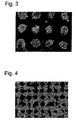
- hepatocytes were adhered only to the endothelial cells which had formed domains according to the above-mentioned pattern, and, thus, an array of spheroids was formed (see Figure 3).
- These hepatic spheroids maintained hepatic function (e.g., albumin-producing ability) at least for three weeks, and, thus, cytoskeleton was observed (Figure 5 shows a three-dimensional enlarged image of spheroid).
- hepatic function is maintained over a long period of time.
- one culture dish may contain tens of thousands (theoretically an infinite number) of hepatic spheroids, and, therefore, such a culture dish is usable for the medicinal assay of tens of thousands of medicines at a time.
- co-culture e.g., cultivated hepatic spheroid, which is to be peeled off said array may be used in the field of transplantation or liver-regeneration engineering.
- this invention is usable in an industry which is involved with examination to evaluate medicinal action or in a medical support industry.
Landscapes
- Health & Medical Sciences (AREA)
- Engineering & Computer Science (AREA)
- Biomedical Technology (AREA)
- Life Sciences & Earth Sciences (AREA)
- Biotechnology (AREA)
- Organic Chemistry (AREA)
- Chemical & Material Sciences (AREA)
- Genetics & Genomics (AREA)
- Bioinformatics & Cheminformatics (AREA)
- Wood Science & Technology (AREA)
- Zoology (AREA)
- Biochemistry (AREA)
- Microbiology (AREA)
- General Engineering & Computer Science (AREA)
- General Health & Medical Sciences (AREA)
- Cell Biology (AREA)
- Gastroenterology & Hepatology (AREA)
- Micro-Organisms Or Cultivation Processes Thereof (AREA)
- Immobilizing And Processing Of Enzymes And Microorganisms (AREA)
- Apparatus Associated With Microorganisms And Enzymes (AREA)
Abstract
Description

Claims (25)
- A cultured cell construct which comprises one, two or more co-cultures of different animal cell species on a support, said cultured cell construct thus containing co-cultures and a support, wherein each of the co-cultures comprises a spheroid that is derived from cultivated cells of one of said different cell species, and a substantially single layer, on an island on support, of cultivated cells which are derived from the other of the above-mentioned different cell species, and which constitutes a substratum in contact with said spheroid and is capable of making cells which form said spheroid survive and/or function.
- A cultured cell construct of claim 1 wherein cells which form spheroid are parenchymal cells.
- A cultured cell construct of claim 1 wherein cells which form spheroid are parenchymal cells which are selected from the group consisting of hepatocytes, beta cells of pancreas, cardiac muscle cells, glia cells, skin epithelial cells (keratinocytes), chondrocytes, osteocytes and stem cells, and wherein the other species of cells which are different from said spheroid-forming cells are selected from the group consisting of endothelial cells, fibroblasts and epithelial cells.
- A cultured cell construct of claim 1 wherein cells which form spheroid are hepatocytes, and wherein the other species of cultivated cells which are different from said spheroid-forming cells are originated from endothelial cells or fibroblasts.
- A cultured cell construct of claim 1 wherein there are contained at least two co-cultures, and wherein said co-cultures are separated from one another.
- A cultured cell construct of claim 1 wherein the island has an area of about 1,500 to 30,000 µm2.
- A cultured cell construct of claim 1 wherein the island is substantially circular and has a diameter of about 50 to 500 µm.
- A cultured cell construct of claim 1 wherein there are contained at least two co-cultures; the island is substantially circular and has a diameter of about 50 to 200 µm; and the interval between adjacent islands is at least about 100 µm.
- A cultured cell construct of claim 1 wherein there are contained at least two co-cultures; and the islands each of which carries a culture are separated by a surface of support which is made from a hydrophilic and cytophobic substance.
- A cultured cell construct of claim 1 wherein the hydrophilic and cytophobic substance is a polymer based on polyethyleneglycol segment which has a hydroxyl group at one of its terminals.
- A cultured cell construct of claim 1 wherein the hydrophilic and cytophobic substance has polyethyleneglycol segment and polylactide segment.
- A cultured cell construct of claim 1 wherein the hydrophilic and cytophobic substance is selected from the group consisting of polysaccharides and derivatives which are based on a polyethylene glycol segment, to one of whose terminals is covalently bound a compound which is selected from the group consisting of mono- or oligosaccharides and oligopeptides each of which constitute a binding domain of ligand to cell surface receptors.
- A cultured cell construct of claim 1 wherein the hydrophilic and cytophobic substance is a sugar derivative based on a polyethylene glycol segment, to one of whose terminals are covalently bound mono- or oligosaccharides each of which contain at least one galactosyl group.
- A cultured cell construct of claim 1 wherein the hydrophilic and cytophobic substance is a sugar derivative which comprises a polyethylene glycol segment, to one of whose terminals are covalently bound mono- or oligosaccharides each of which contain at least one galactopyranosyl group, and a polylactide segment.
- A cultured cell construct of claim 1 wherein the hydrophilic and cytophobic substance is a peptide derivative based on a polyethylene glycol segment, to one of whose terminals are covalently bound oligopeptides which comprise an amino acid sequence of arginine-glycine-aspartic acid.
- A cultured cell construct of claim 1 wherein island has a surface which is made of a cytophilic substance.
- A cultured cell construct of claim 1 wherein island has a surface which is made of a cytophilic substance selected from the group consisting of a compound that has a hydrocarbon group, an alkyl silyl group and an alkyl fluoride group; a compound that has a carboxylate anion and a phosphate anion; and protein that constitutes extracellular matrices.
- A co-culture which has been peeled off a support of cultured cell construct as defined in any one of claims 1 to 17.
- A bio-device which comprises a surface formed from a cultured cell construct as defined in any one of claims 1 to 17.
- A bio-device of claim 19 wherein each spheroid in two or more co-cultures in the cultured cell construct has a substantially spheric shape and has a diameter of about 50 to 100 µm; the interval between adjacent spheroids is at least about 100 µm; and the spheroids are so arrayed as to form a certain pattern.
- A bio-device of claim 19 which is selected from the group consisting of a device for the test of toxicity of spheroid-forming cells, a device for the screening of substance which activates the function of spheroid-forming cells, a device for medical support of the deficiency of spheroid-forming cells and a device for trial examination of the physiological activity of parenchymal cells.
- A process to prepare a cultured cell construct which comprises one, two or more co-cultures of different animal cell species on a support in which co-cultures spheroids that have been formed from cultured cells are carried on separated plural islands, which process is characterized in that, on the surface of a material on which a co-culture is to be adhered, there is formed a polymer layer based on a polyethylene glycol segment one of whose terminals is either covalently unbound or covalently bound to a compound selected from the group consisting of mono- or oligosaccharides and oligopeptides which constitute a binding domain of ligand to animal cell surface receptors, that the above-mentioned polymer layer is subjected to plasma treatment via a mask pattern having plural circular holes which are separated from one another at an interval of at least about 100 µm and which have a diameter of about 50-100 µm, that polymer layer is thus removed from islands which correspond to the above-mentioned holes, that, if necessary, cytophilic substance is applied to islands from which polymer layer has been removed, that endothelial cells or fibroblasts are cultivated on said islands to form a monolayer of cultivated cells, and that cells which are different from said cultivated cells are cultivated on said cultivated cells to form a spheroid of the cells.
- A process to prepare a cultured cell construct as defined in claim 22 wherein spheroid-forming cells are selected from the group consisting of hepatocytes, beta cells of pancreas, cardiac muscle cells, glia cells, skin epithelial cells (keratocytes), chondrocytes, osteocytes and embryonal or adult stem cells.
- A process to prepare a cultured cell construct as defined in claim 22 wherein spheroid-forming cells are hepatocytes.
- A process to prepare a cultured cell construct as defined in claim 22 wherein the polymer layer comprises a polymer which is based on a polyethylene glycol segment one of whose terminals is covalently bound to mono- or oligosaccharides.
Priority Applications (1)
| Application Number | Priority Date | Filing Date | Title |
|---|---|---|---|
| EP08005978A EP1939280B1 (en) | 2001-07-26 | 2002-07-25 | Cultured cell construct which contains spheroids of cultured animal cells and the use thereof |
Applications Claiming Priority (3)
| Application Number | Priority Date | Filing Date | Title |
|---|---|---|---|
| JP2001226293 | 2001-07-26 | ||
| JP2001226293 | 2001-07-26 | ||
| PCT/JP2002/007539 WO2003010302A1 (en) | 2001-07-26 | 2002-07-25 | Cultured cell construct containing spheroids of cultured animal cells and utilization thereof |
Related Child Applications (1)
| Application Number | Title | Priority Date | Filing Date |
|---|---|---|---|
| EP08005978A Division EP1939280B1 (en) | 2001-07-26 | 2002-07-25 | Cultured cell construct which contains spheroids of cultured animal cells and the use thereof |
Publications (3)
| Publication Number | Publication Date |
|---|---|
| EP1428871A1 true EP1428871A1 (en) | 2004-06-16 |
| EP1428871A4 EP1428871A4 (en) | 2004-11-24 |
| EP1428871B1 EP1428871B1 (en) | 2008-08-27 |
Family
ID=19059133
Family Applications (2)
| Application Number | Title | Priority Date | Filing Date |
|---|---|---|---|
| EP08005978A Expired - Lifetime EP1939280B1 (en) | 2001-07-26 | 2002-07-25 | Cultured cell construct which contains spheroids of cultured animal cells and the use thereof |
| EP02755656A Expired - Lifetime EP1428871B1 (en) | 2001-07-26 | 2002-07-25 | Cultured cell construct containing spheroids of cultured animal cells and utilization thereof |
Family Applications Before (1)
| Application Number | Title | Priority Date | Filing Date |
|---|---|---|---|
| EP08005978A Expired - Lifetime EP1939280B1 (en) | 2001-07-26 | 2002-07-25 | Cultured cell construct which contains spheroids of cultured animal cells and the use thereof |
Country Status (9)
| Country | Link |
|---|---|
| US (2) | US7470424B2 (en) |
| EP (2) | EP1939280B1 (en) |
| JP (1) | JP4111446B2 (en) |
| KR (1) | KR100675533B1 (en) |
| CN (1) | CN1798832B (en) |
| AT (1) | ATE406436T1 (en) |
| CA (1) | CA2454807C (en) |
| DE (2) | DE60228594D1 (en) |
| WO (1) | WO2003010302A1 (en) |
Cited By (10)
| Publication number | Priority date | Publication date | Assignee | Title |
|---|---|---|---|---|
| EP1448053A4 (en) * | 2001-10-02 | 2005-03-09 | Becton Dickinson Co | Proliferation and differentiation of stem cells using extracellular matrix and other molecules |
| EP1961809A1 (en) * | 2007-02-20 | 2008-08-27 | FUJIFILM Corporation | Tissue construct-forming substrate, tissue construct-forming kit, method for forming tissue construct using the same and three-dimensional tissue construct formed by the method |
| EP1904625A4 (en) * | 2005-05-24 | 2009-12-23 | Univ California | MICRO-STRUCTURED AND MICRO-SCALE IN VITRO FABRICS |
| EP2064375A4 (en) * | 2006-06-06 | 2010-01-06 | Commercialisation Des Produits | TEST MEDIA COMPRISING A POLYETHYLENE GLYCOL CARRIER, THIS FIXED CARRIER FROM A POLYETHYLENE GLYCOL SOLUTION UNDER TROUBLE POINT CONDITIONS (SOLVENT THETA) |
| EP2120546A4 (en) * | 2006-12-18 | 2010-05-26 | Univ Ben Gurion | SCAFFOLDING FOR TISSUE REGENERATION OR REPAIR |
| WO2013014164A1 (en) * | 2011-07-25 | 2013-01-31 | Cytoo | Methods and a device for the formation of three-dimensional multicellular assemblies |
| US8592139B2 (en) | 2006-11-10 | 2013-11-26 | Dai Nippon Printing Co., Ltd. | Test method using cells and test kit therefor |
| US8741645B2 (en) | 2006-11-10 | 2014-06-03 | Dai Nippon Printing Co., Ltd. | Test kit comprising a culture instrument with a cell pattern and a gel suitable to embed cell pattern |
| AU2012216645B2 (en) * | 2005-05-24 | 2015-06-25 | The Regents Of The University Of California | Microscale micropatterned engineered in vitro tissue |
| AU2013202489B2 (en) * | 2005-11-18 | 2016-03-03 | Lifescan, Inc. | A method for creating cell clusters |
Families Citing this family (50)
| Publication number | Priority date | Publication date | Assignee | Title |
|---|---|---|---|---|
| US20060240400A1 (en) * | 2003-02-06 | 2006-10-26 | Masayuki Yamato | High-density cell array board, process for producing the same and method of using the same |
| EP2267115B8 (en) * | 2003-02-06 | 2014-07-23 | Cellseed Inc. | Anterior ocular segment related cell sheets, three-dimensional structures, and processes for producing the same |
| KR101141985B1 (en) | 2003-02-06 | 2012-05-17 | 고지 니시다 | Cell sheets for ectocornea formation, method of producing the same and method of using the same |
| JP4649935B2 (en) * | 2004-02-02 | 2011-03-16 | コニカミノルタホールディングス株式会社 | Inkjet printer |
| US8241905B2 (en) | 2004-02-24 | 2012-08-14 | The Curators Of The University Of Missouri | Self-assembling cell aggregates and methods of making engineered tissue using the same |
| EP1857126B1 (en) * | 2005-02-28 | 2018-10-24 | CellSeed Inc. | Cultured cell sheet, production method thereof, and application method thereof |
| WO2006093153A1 (en) | 2005-02-28 | 2006-09-08 | Cellseed Inc. | Cultured cell sheet, process for producing the same and method for restoring tissue using the same |
| ES2700847T3 (en) * | 2005-11-18 | 2019-02-19 | Lifescan Inc | A method to create groups of pancreatic cells |
| JP5070565B2 (en) | 2006-05-29 | 2012-11-14 | 大日本印刷株式会社 | Cell culture substrate |
| WO2009050965A1 (en) * | 2007-10-19 | 2009-04-23 | Japan As Represented By General Director Of Agency Of National Center For Child Health And Development | Support for immobilizing frozen cells, tool for primary hepatocyte culture and method of producing tool for primary hepatocyte culture |
| WO2009072590A1 (en) * | 2007-12-06 | 2009-06-11 | Tokyo University Of Science Educational Foundation Administrative Organization | Branched polyalkylene glycol derivative, photosensitive composition, crosslinked material, and substrate |
| EP3059302A1 (en) | 2008-06-24 | 2016-08-24 | The Curators Of The University Of Missouri | Self-assembling multicellular bodies and methods of producing a three-dimensional biological structure using the same |
| KR101005874B1 (en) * | 2008-08-27 | 2011-01-06 | 한길토건(주) | Construction method of rock crushing protection facility that can recycle steel |
| WO2010044417A1 (en) * | 2008-10-14 | 2010-04-22 | 株式会社セルシード | Temperature-responsive cell culture substrate and method for producing same |
| JP5496488B2 (en) * | 2008-10-22 | 2014-05-21 | 学校法人東京女子医科大学 | Cell pattern collection tool |
| EP2358860A1 (en) * | 2008-11-21 | 2011-08-24 | Corning Incorporated | Spaced projection substrates and devices for cell culture |
| US20100166822A1 (en) * | 2008-12-31 | 2010-07-01 | Howmedica Osteonics Corp. | Adhesive cartilage implant |
| JP2010233538A (en) * | 2009-03-31 | 2010-10-21 | Trans Parent:Kk | Method for evaluating substrate metabolite |
| AU2010233169A1 (en) | 2009-04-09 | 2011-11-03 | Arizona Board Of Regents On Behalf Of The University Of Arizona | Cellular seeding and co-culture of a three dimensional fibroblast construct |
| HUP0900819A2 (en) * | 2009-05-05 | 2011-01-28 | Pecsi Tudomanyegyetem | Lung tissue culture |
| US8481303B2 (en) | 2009-10-12 | 2013-07-09 | Corning Incorporated | Microfluidic device for cell culture |
| EP2546334A4 (en) * | 2010-03-12 | 2014-10-29 | Fundación Progreso Y Salud | PROCESS FOR IN VITRO PROLIFERATION OF CELLS FROM ENDODERMIC TISSUE |
| CN101955595B (en) * | 2010-08-11 | 2012-01-04 | 东南大学 | Method for guiding fixed-point cell growth by preparing chemical micro-patterns on surfaces of various materials |
| WO2012048170A2 (en) * | 2010-10-06 | 2012-04-12 | Massachusetts Institute Of Technology | Humanized animals via tissue engineering and uses therefor |
| EP2872155A4 (en) | 2012-07-10 | 2016-07-13 | Univ Pennsylvania | BIOMATERIALS TO IMPROVE THE INTEGRATION OF THE IMPLANT WITHIN THE HOST |
| WO2014050139A1 (en) | 2012-09-27 | 2014-04-03 | 株式会社クラレ | Method for evaluating influence of cytokine on metabolic capacity of cytochrome p450, and method for screening for medicinal agent |
| US10221230B2 (en) | 2013-02-25 | 2019-03-05 | Ohio State Innovation Foundation | HER-1, HER-3 and IGF-1R compositions and uses thereof |
| WO2014143998A1 (en) | 2013-03-15 | 2014-09-18 | The Broad Institute | Systems and methods for culturing epithelial cells |
| US9790465B2 (en) | 2013-04-30 | 2017-10-17 | Corning Incorporated | Spheroid cell culture well article and methods thereof |
| JP6122817B2 (en) * | 2014-03-26 | 2017-04-26 | 株式会社Screenホールディングス | Spheroid evaluation method and spheroid evaluation apparatus |
| KR101647793B1 (en) * | 2014-09-02 | 2016-08-12 | 충남대학교산학협력단 | Cell culture container for formation spheroid using thermosensitive glycol chitosan derivatives and spheroid formation method using the same |
| KR102460969B1 (en) | 2014-10-29 | 2022-10-31 | 코닝 인코포레이티드 | Cell culture insert |
| SG11201703500XA (en) | 2014-10-29 | 2017-05-30 | Corning Inc | Perfusion bioreactor platform |
| JP2017532971A (en) | 2014-10-29 | 2017-11-09 | コーニング インコーポレイテッド | Design and manufacture of microwells to generate cell culture assemblies |
| CN104630148B (en) * | 2015-01-19 | 2017-06-06 | 西安交通大学 | A kind of cell ball in-situ preparation method based on hydrogel microwell plate |
| CN104894051A (en) * | 2015-05-27 | 2015-09-09 | 成都易创思生物科技有限公司 | Novel cell culture method |
| US11338065B2 (en) | 2015-10-08 | 2022-05-24 | Massachusetts Institute Of Technology | In situ expansion of engineered devices for regeneration |
| US11123404B2 (en) | 2016-01-07 | 2021-09-21 | B. G. Negev Technologies And Applications Ltd., At Ben-Gurion University | Methods for generating immunotolerant responses |
| KR102038496B1 (en) * | 2016-10-07 | 2019-10-30 | 울산과학기술원 | Hanging drop cell culture device using porous membrane, method of manufacturing the same, method of hanging drop cell culturing, and automatic hanging drop cell culture device |
| EP3652292B1 (en) | 2017-07-14 | 2025-06-18 | Corning Incorporated | Cell culture vessel for 3d culture and methods of culturing 3d cells |
| JP7197557B2 (en) | 2017-07-14 | 2022-12-27 | コーニング インコーポレイテッド | Cell culture vessel with porous support |
| US11857970B2 (en) | 2017-07-14 | 2024-01-02 | Corning Incorporated | Cell culture vessel |
| CN111051494B (en) | 2017-07-14 | 2024-03-29 | 康宁股份有限公司 | 3D cell culture vessel for manual or automatic media exchange |
| CN111432824A (en) * | 2017-09-22 | 2020-07-17 | 莱福奈特海尔斯公司 | Plated hepatocytes and preparation and use thereof |
| ES3070913T3 (en) * | 2018-05-16 | 2026-06-18 | Inst Nat Sante Rech Med | Method of culturing proliferative hepatocytes |
| EP3649229B1 (en) | 2018-07-13 | 2021-08-25 | Corning Incorporated | Cell culture vessels with stabilizer devices |
| JP7171696B2 (en) | 2018-07-13 | 2022-11-15 | コーニング インコーポレイテッド | Fluidic device comprising a microplate with interconnected wells |
| US11912968B2 (en) | 2018-07-13 | 2024-02-27 | Corning Incorporated | Microcavity dishes with sidewall including liquid medium delivery surface |
| KR20210070648A (en) * | 2019-12-05 | 2021-06-15 | 한국화학연구원 | cardiomyocyte spheroid formed on cell nonadhesive PEG polymer substrate and method for preparing the same |
| KR102940307B1 (en) * | 2021-04-09 | 2026-03-18 | 고려대학교 산학협력단 | 3D hybrid cell culture system for chronic upper upper respiratory inflammatory disease model |
Family Cites Families (13)
| Publication number | Priority date | Publication date | Assignee | Title |
|---|---|---|---|---|
| FR2545100B1 (en) * | 1983-04-29 | 1985-12-20 | Inst Nat Sante Rech Med | PROCESS FOR OBTAINING CULTURES OF HUMAN HEPATOCYTES, THE CULTURES OBTAINED AND THEIR BIOLOGICAL AND BIOCHEMICAL APPLICATIONS |
| US5037969A (en) | 1986-07-03 | 1991-08-06 | Takeda Chemical Industries, Ltd. | Glycosyl derivatives and use thereof |
| JPH0751061B2 (en) | 1989-06-03 | 1995-06-05 | 鐘淵化学工業株式会社 | Manufacturing method of cell array control tool |
| DE3938632C1 (en) * | 1989-11-21 | 1991-03-14 | Adelbert Prof. Dr.Dr. 8046 Garching De Bacher | Culturing living animal cells - using natural or synthetic polymer substrate vacuum deposition coated with e.g. nitride of Gp=III element |
| EP0529751A1 (en) * | 1991-08-09 | 1993-03-03 | W.R. Grace & Co.-Conn. | Cell culture substrate, test material for cell culture and preparations thereof |
| US5776748A (en) * | 1993-10-04 | 1998-07-07 | President And Fellows Of Harvard College | Method of formation of microstamped patterns on plates for adhesion of cells and other biological materials, devices and uses therefor |
| JP2609073B2 (en) | 1994-10-26 | 1997-05-14 | 鐘淵化学工業株式会社 | Cell arrangement control tool and cell arrangement control method |
| JP4036472B2 (en) | 1995-04-14 | 2008-01-23 | 一則 片岡 | Polyethylene oxide having sugar at one end and different functional groups at the other end and method for producing the same |
| KR19990007861A (en) | 1995-04-19 | 1999-01-25 | 가타오카가즈노리 | Heterotereric block copolymer and preparation method thereof |
| WO1997006202A1 (en) | 1995-08-10 | 1997-02-20 | Kazunori Kataoka | Block polymer having functional groups at both ends |
| WO1998051785A1 (en) * | 1997-05-14 | 1998-11-19 | The General Hospital Corporation | Co-cultivation of cells in a micropatterned configuration |
| JP3077628B2 (en) * | 1997-05-27 | 2000-08-14 | 日本電気株式会社 | Cytotoxicity test method |
| JP2973976B2 (en) | 1997-06-23 | 1999-11-08 | 日本電気株式会社 | Toxicity test method using adherent cells |
-
2002
- 2002-07-25 WO PCT/JP2002/007539 patent/WO2003010302A1/en not_active Ceased
- 2002-07-25 EP EP08005978A patent/EP1939280B1/en not_active Expired - Lifetime
- 2002-07-25 CN CN028148428A patent/CN1798832B/en not_active Expired - Fee Related
- 2002-07-25 EP EP02755656A patent/EP1428871B1/en not_active Expired - Lifetime
- 2002-07-25 DE DE60228594T patent/DE60228594D1/en not_active Expired - Lifetime
- 2002-07-25 CA CA2454807A patent/CA2454807C/en not_active Expired - Fee Related
- 2002-07-25 AT AT02755656T patent/ATE406436T1/en not_active IP Right Cessation
- 2002-07-25 US US10/484,839 patent/US7470424B2/en not_active Expired - Fee Related
- 2002-07-25 KR KR1020047000851A patent/KR100675533B1/en not_active Expired - Fee Related
- 2002-07-25 JP JP2003515653A patent/JP4111446B2/en not_active Expired - Fee Related
- 2002-07-25 DE DE60236974T patent/DE60236974D1/en not_active Expired - Lifetime
-
2008
- 2008-09-08 US US12/230,916 patent/US7691369B2/en not_active Expired - Fee Related
Cited By (14)
| Publication number | Priority date | Publication date | Assignee | Title |
|---|---|---|---|---|
| EP1448053A4 (en) * | 2001-10-02 | 2005-03-09 | Becton Dickinson Co | Proliferation and differentiation of stem cells using extracellular matrix and other molecules |
| EP2495310A3 (en) * | 2005-05-24 | 2013-03-27 | The Regents Of the University of California | Microscale micropatterned engineered in vitro tissue |
| EP1904625A4 (en) * | 2005-05-24 | 2009-12-23 | Univ California | MICRO-STRUCTURED AND MICRO-SCALE IN VITRO FABRICS |
| AU2012216645B2 (en) * | 2005-05-24 | 2015-06-25 | The Regents Of The University Of California | Microscale micropatterned engineered in vitro tissue |
| AU2006250079B2 (en) * | 2005-05-24 | 2012-05-31 | The Regents Of The University Of California | Microscale micropatterned engineered in vitor tissue |
| AU2013202489B2 (en) * | 2005-11-18 | 2016-03-03 | Lifescan, Inc. | A method for creating cell clusters |
| EP2064375A4 (en) * | 2006-06-06 | 2010-01-06 | Commercialisation Des Produits | TEST MEDIA COMPRISING A POLYETHYLENE GLYCOL CARRIER, THIS FIXED CARRIER FROM A POLYETHYLENE GLYCOL SOLUTION UNDER TROUBLE POINT CONDITIONS (SOLVENT THETA) |
| US8741645B2 (en) | 2006-11-10 | 2014-06-03 | Dai Nippon Printing Co., Ltd. | Test kit comprising a culture instrument with a cell pattern and a gel suitable to embed cell pattern |
| US8592139B2 (en) | 2006-11-10 | 2013-11-26 | Dai Nippon Printing Co., Ltd. | Test method using cells and test kit therefor |
| EP2120546A4 (en) * | 2006-12-18 | 2010-05-26 | Univ Ben Gurion | SCAFFOLDING FOR TISSUE REGENERATION OR REPAIR |
| US9127254B2 (en) | 2006-12-18 | 2015-09-08 | Ben-Gurion University Of The Negev Research And Development Authority | Scaffolding for tissue regeneration or repair |
| US8815595B2 (en) | 2007-02-20 | 2014-08-26 | Fujifilm Corporation | Substrate for forming a three-dimensional tissue construct and method of use |
| EP1961809A1 (en) * | 2007-02-20 | 2008-08-27 | FUJIFILM Corporation | Tissue construct-forming substrate, tissue construct-forming kit, method for forming tissue construct using the same and three-dimensional tissue construct formed by the method |
| WO2013014164A1 (en) * | 2011-07-25 | 2013-01-31 | Cytoo | Methods and a device for the formation of three-dimensional multicellular assemblies |
Also Published As
| Publication number | Publication date |
|---|---|
| CN1798832A (en) | 2006-07-05 |
| EP1939280B1 (en) | 2010-07-07 |
| US7691369B2 (en) | 2010-04-06 |
| DE60228594D1 (en) | 2008-10-09 |
| EP1428871A4 (en) | 2004-11-24 |
| EP1939280A1 (en) | 2008-07-02 |
| KR20040025700A (en) | 2004-03-24 |
| JPWO2003010302A1 (en) | 2005-06-02 |
| CA2454807C (en) | 2012-09-18 |
| EP1428871B1 (en) | 2008-08-27 |
| US7470424B2 (en) | 2008-12-30 |
| WO2003010302A1 (en) | 2003-02-06 |
| US20040197907A1 (en) | 2004-10-07 |
| CN1798832B (en) | 2010-04-28 |
| KR100675533B1 (en) | 2007-01-29 |
| DE60236974D1 (en) | 2010-08-19 |
| ATE406436T1 (en) | 2008-09-15 |
| CA2454807A1 (en) | 2003-02-06 |
| JP4111446B2 (en) | 2008-07-02 |
| US20090011504A1 (en) | 2009-01-08 |
Similar Documents
| Publication | Publication Date | Title |
|---|---|---|
| EP1428871B1 (en) | Cultured cell construct containing spheroids of cultured animal cells and utilization thereof | |
| Tang et al. | Recent development of temperature-responsive surfaces and their application for cell sheet engineering | |
| Guillame‐Gentil et al. | Engineering the extracellular environment: strategies for building 2D and 3D cellular structures | |
| Ito | Surface micropatterning to regulate cell functions | |
| US20070026518A1 (en) | Controlling stem cell destiny with tunable matrices | |
| US9206391B2 (en) | Method for preparing biological tissue | |
| WO2015157732A1 (en) | Hydrogel compositions for use in promoting tubulogenesis | |
| AU2008296981A1 (en) | Compliant surface multi-well culture plate | |
| WO2004085606A1 (en) | Cell culture medium and solidified preparation of cell adhesion protein or peptide | |
| JP4486359B2 (en) | Cultured cell migration jig and method of using the same | |
| EP1921450B1 (en) | Test method using cells and test kit therefor | |
| JP4336756B2 (en) | Animal cell culture constructs | |
| US9085758B2 (en) | Method of culturing vascular smooth muscle cells, culture device and medical material obtained by the culture | |
| US9546349B2 (en) | Supports for cell culture and cell sheet detachment and methods for cell sheet detachment | |
| Desai et al. | Microtextured cell culture platforms: Biomimetic substrates for the growth of cardiac myocytes and fibroblasts | |
| JP2007049918A (en) | Cell culture support, cell culture method, recovery of cell, and cell | |
| Civantos et al. | Polymeric and Non-Polymeric Platforms for Cell Sheet Detachment | |
| US8592139B2 (en) | Test method using cells and test kit therefor | |
| US20200048611A1 (en) | Engineered platform for connected micropatterned cardiac tissues | |
| McDevitt | Spatially controlled engineering of myocardial tissue | |
| Patel | A spin-coated thermoresponsive substrate for rapid cell sheet detachment and its applications in cardiac tissue engineering | |
| CA3013971A1 (en) | Engineered platform for connected micropatterned muscle tissues | |
| Chen | Biophysical dynamics of smooth muscle cell on thermo-responsive and bio-functionalized polymers | |
| Schnekenburger et al. | Interaction of Structured and Functionalized Polymers | |
| Embrechts et al. | Interaction of Structured and Functionalized Polymers with Cancer Cells |
Legal Events
| Date | Code | Title | Description |
|---|---|---|---|
| PUAI | Public reference made under article 153(3) epc to a published international application that has entered the european phase |
Free format text: ORIGINAL CODE: 0009012 |
|
| 17P | Request for examination filed |
Effective date: 20040219 |
|
| AK | Designated contracting states |
Kind code of ref document: A1 Designated state(s): AT BE BG CH CY CZ DE DK EE ES FI FR GB GR IE IT LI LU MC NL PT SE SK TR |
|
| AX | Request for extension of the european patent |
Extension state: AL LT LV MK RO SI |
|
| A4 | Supplementary search report drawn up and despatched |
Effective date: 20041013 |
|
| 17Q | First examination report despatched |
Effective date: 20041222 |
|
| GRAP | Despatch of communication of intention to grant a patent |
Free format text: ORIGINAL CODE: EPIDOSNIGR1 |
|
| RAP1 | Party data changed (applicant data changed or rights of an application transferred) |
Owner name: TRANSPARENT INC. |
|
| GRAS | Grant fee paid |
Free format text: ORIGINAL CODE: EPIDOSNIGR3 |
|
| GRAA | (expected) grant |
Free format text: ORIGINAL CODE: 0009210 |
|
| AK | Designated contracting states |
Kind code of ref document: B1 Designated state(s): AT BE BG CH CY CZ DE DK EE ES FI FR GB GR IE IT LI LU MC NL PT SE SK TR |
|
| REG | Reference to a national code |
Ref country code: GB Ref legal event code: FG4D |
|
| REG | Reference to a national code |
Ref country code: CH Ref legal event code: EP |
|
| REG | Reference to a national code |
Ref country code: IE Ref legal event code: FG4D |
|
| REF | Corresponds to: |
Ref document number: 60228594 Country of ref document: DE Date of ref document: 20081009 Kind code of ref document: P |
|
| PG25 | Lapsed in a contracting state [announced via postgrant information from national office to epo] |
Ref country code: NL Free format text: LAPSE BECAUSE OF FAILURE TO SUBMIT A TRANSLATION OF THE DESCRIPTION OR TO PAY THE FEE WITHIN THE PRESCRIBED TIME-LIMIT Effective date: 20080827 Ref country code: ES Free format text: LAPSE BECAUSE OF FAILURE TO SUBMIT A TRANSLATION OF THE DESCRIPTION OR TO PAY THE FEE WITHIN THE PRESCRIBED TIME-LIMIT Effective date: 20081208 |
|
| PG25 | Lapsed in a contracting state [announced via postgrant information from national office to epo] |
Ref country code: FI Free format text: LAPSE BECAUSE OF FAILURE TO SUBMIT A TRANSLATION OF THE DESCRIPTION OR TO PAY THE FEE WITHIN THE PRESCRIBED TIME-LIMIT Effective date: 20080827 Ref country code: AT Free format text: LAPSE BECAUSE OF FAILURE TO SUBMIT A TRANSLATION OF THE DESCRIPTION OR TO PAY THE FEE WITHIN THE PRESCRIBED TIME-LIMIT Effective date: 20080827 |
|
| PG25 | Lapsed in a contracting state [announced via postgrant information from national office to epo] |
Ref country code: BE Free format text: LAPSE BECAUSE OF FAILURE TO SUBMIT A TRANSLATION OF THE DESCRIPTION OR TO PAY THE FEE WITHIN THE PRESCRIBED TIME-LIMIT Effective date: 20080827 |
|
| PG25 | Lapsed in a contracting state [announced via postgrant information from national office to epo] |
Ref country code: DK Free format text: LAPSE BECAUSE OF FAILURE TO SUBMIT A TRANSLATION OF THE DESCRIPTION OR TO PAY THE FEE WITHIN THE PRESCRIBED TIME-LIMIT Effective date: 20080827 Ref country code: BG Free format text: LAPSE BECAUSE OF FAILURE TO SUBMIT A TRANSLATION OF THE DESCRIPTION OR TO PAY THE FEE WITHIN THE PRESCRIBED TIME-LIMIT Effective date: 20081127 |
|
| PG25 | Lapsed in a contracting state [announced via postgrant information from national office to epo] |
Ref country code: PT Free format text: LAPSE BECAUSE OF FAILURE TO SUBMIT A TRANSLATION OF THE DESCRIPTION OR TO PAY THE FEE WITHIN THE PRESCRIBED TIME-LIMIT Effective date: 20090127 Ref country code: SK Free format text: LAPSE BECAUSE OF FAILURE TO SUBMIT A TRANSLATION OF THE DESCRIPTION OR TO PAY THE FEE WITHIN THE PRESCRIBED TIME-LIMIT Effective date: 20080827 Ref country code: CZ Free format text: LAPSE BECAUSE OF FAILURE TO SUBMIT A TRANSLATION OF THE DESCRIPTION OR TO PAY THE FEE WITHIN THE PRESCRIBED TIME-LIMIT Effective date: 20080827 |
|
| PLBE | No opposition filed within time limit |
Free format text: ORIGINAL CODE: 0009261 |
|
| STAA | Information on the status of an ep patent application or granted ep patent |
Free format text: STATUS: NO OPPOSITION FILED WITHIN TIME LIMIT |
|
| PG25 | Lapsed in a contracting state [announced via postgrant information from national office to epo] |
Ref country code: EE Free format text: LAPSE BECAUSE OF FAILURE TO SUBMIT A TRANSLATION OF THE DESCRIPTION OR TO PAY THE FEE WITHIN THE PRESCRIBED TIME-LIMIT Effective date: 20080827 |
|
| 26N | No opposition filed |
Effective date: 20090528 |
|
| PG25 | Lapsed in a contracting state [announced via postgrant information from national office to epo] |
Ref country code: IT Free format text: LAPSE BECAUSE OF FAILURE TO SUBMIT A TRANSLATION OF THE DESCRIPTION OR TO PAY THE FEE WITHIN THE PRESCRIBED TIME-LIMIT Effective date: 20080827 |
|
| PG25 | Lapsed in a contracting state [announced via postgrant information from national office to epo] |
Ref country code: SE Free format text: LAPSE BECAUSE OF FAILURE TO SUBMIT A TRANSLATION OF THE DESCRIPTION OR TO PAY THE FEE WITHIN THE PRESCRIBED TIME-LIMIT Effective date: 20081127 |
|
| PG25 | Lapsed in a contracting state [announced via postgrant information from national office to epo] |
Ref country code: MC Free format text: LAPSE BECAUSE OF NON-PAYMENT OF DUE FEES Effective date: 20090731 |
|
| REG | Reference to a national code |
Ref country code: CH Ref legal event code: PL |
|
| PG25 | Lapsed in a contracting state [announced via postgrant information from national office to epo] |
Ref country code: CH Free format text: LAPSE BECAUSE OF NON-PAYMENT OF DUE FEES Effective date: 20090731 Ref country code: LI Free format text: LAPSE BECAUSE OF NON-PAYMENT OF DUE FEES Effective date: 20090731 |
|
| PG25 | Lapsed in a contracting state [announced via postgrant information from national office to epo] |
Ref country code: IE Free format text: LAPSE BECAUSE OF NON-PAYMENT OF DUE FEES Effective date: 20090725 |
|
| PG25 | Lapsed in a contracting state [announced via postgrant information from national office to epo] |
Ref country code: GR Free format text: LAPSE BECAUSE OF FAILURE TO SUBMIT A TRANSLATION OF THE DESCRIPTION OR TO PAY THE FEE WITHIN THE PRESCRIBED TIME-LIMIT Effective date: 20081128 |
|
| PG25 | Lapsed in a contracting state [announced via postgrant information from national office to epo] |
Ref country code: LU Free format text: LAPSE BECAUSE OF NON-PAYMENT OF DUE FEES Effective date: 20090725 |
|
| PG25 | Lapsed in a contracting state [announced via postgrant information from national office to epo] |
Ref country code: TR Free format text: LAPSE BECAUSE OF FAILURE TO SUBMIT A TRANSLATION OF THE DESCRIPTION OR TO PAY THE FEE WITHIN THE PRESCRIBED TIME-LIMIT Effective date: 20080827 |
|
| PG25 | Lapsed in a contracting state [announced via postgrant information from national office to epo] |
Ref country code: CY Free format text: LAPSE BECAUSE OF FAILURE TO SUBMIT A TRANSLATION OF THE DESCRIPTION OR TO PAY THE FEE WITHIN THE PRESCRIBED TIME-LIMIT Effective date: 20080827 |
|
| PGFP | Annual fee paid to national office [announced via postgrant information from national office to epo] |
Ref country code: GB Payment date: 20130724 Year of fee payment: 12 |
|
| REG | Reference to a national code |
Ref country code: DE Ref legal event code: R082 Ref document number: 60228594 Country of ref document: DE Representative=s name: PATENT- UND RECHTSANWAELTE KRAUS & WEISERT, DE |
|
| REG | Reference to a national code |
Ref country code: DE Ref legal event code: R079 Ref document number: 60228594 Country of ref document: DE Free format text: PREVIOUS MAIN CLASS: C12N0005060000 Ipc: C12N0005070000 |
|
| REG | Reference to a national code |
Ref country code: DE Ref legal event code: R079 Ref document number: 60228594 Country of ref document: DE Free format text: PREVIOUS MAIN CLASS: C12N0005060000 Ipc: C12N0005070000 Effective date: 20140811 Ref country code: DE Ref legal event code: R082 Ref document number: 60228594 Country of ref document: DE Representative=s name: KRAUS & WEISERT PATENTANWAELTE PARTGMBB, DE Effective date: 20140808 Ref country code: DE Ref legal event code: R081 Ref document number: 60228594 Country of ref document: DE Owner name: TOYO GOSEI CO., LTD., ICHIKAWA, JP Free format text: FORMER OWNER: TRANSPARENT INC., KASHIWA, CHIBA, JP Effective date: 20140808 |
|
| REG | Reference to a national code |
Ref country code: FR Ref legal event code: TP Owner name: TOYO GOSEI CO., LTD., JP Effective date: 20140930 |
|
| GBPC | Gb: european patent ceased through non-payment of renewal fee |
Effective date: 20140725 |
|
| PG25 | Lapsed in a contracting state [announced via postgrant information from national office to epo] |
Ref country code: GB Free format text: LAPSE BECAUSE OF NON-PAYMENT OF DUE FEES Effective date: 20140725 |
|
| REG | Reference to a national code |
Ref country code: FR Ref legal event code: PLFP Year of fee payment: 15 |
|
| REG | Reference to a national code |
Ref country code: FR Ref legal event code: PLFP Year of fee payment: 16 |
|
| REG | Reference to a national code |
Ref country code: FR Ref legal event code: PLFP Year of fee payment: 17 |
|
| PGFP | Annual fee paid to national office [announced via postgrant information from national office to epo] |
Ref country code: FR Payment date: 20210727 Year of fee payment: 20 |
|
| PGFP | Annual fee paid to national office [announced via postgrant information from national office to epo] |
Ref country code: DE Payment date: 20210721 Year of fee payment: 20 |
|
| REG | Reference to a national code |
Ref country code: DE Ref legal event code: R071 Ref document number: 60228594 Country of ref document: DE |