EP1428865A1 - Lubricating oil composition - Google Patents
Lubricating oil composition Download PDFInfo
- Publication number
- EP1428865A1 EP1428865A1 EP02798809A EP02798809A EP1428865A1 EP 1428865 A1 EP1428865 A1 EP 1428865A1 EP 02798809 A EP02798809 A EP 02798809A EP 02798809 A EP02798809 A EP 02798809A EP 1428865 A1 EP1428865 A1 EP 1428865A1
- Authority
- EP
- European Patent Office
- Prior art keywords
- lubricating oil
- mass
- alkaline earth
- percent
- component
- Prior art date
- Legal status (The legal status is an assumption and is not a legal conclusion. Google has not performed a legal analysis and makes no representation as to the accuracy of the status listed.)
- Withdrawn
Links
Classifications
-
- C—CHEMISTRY; METALLURGY
- C10—PETROLEUM, GAS OR COKE INDUSTRIES; TECHNICAL GASES CONTAINING CARBON MONOXIDE; FUELS; LUBRICANTS; PEAT
- C10M—LUBRICATING COMPOSITIONS; USE OF CHEMICAL SUBSTANCES EITHER ALONE OR AS LUBRICATING INGREDIENTS IN A LUBRICATING COMPOSITION
- C10M141/00—Lubricating compositions characterised by the additive being a mixture of two or more compounds covered by more than one of the main groups C10M125/00 - C10M139/00, each of these compounds being essential
- C10M141/08—Lubricating compositions characterised by the additive being a mixture of two or more compounds covered by more than one of the main groups C10M125/00 - C10M139/00, each of these compounds being essential at least one of them being an organic sulfur-, selenium- or tellurium-containing compound
-
- C—CHEMISTRY; METALLURGY
- C10—PETROLEUM, GAS OR COKE INDUSTRIES; TECHNICAL GASES CONTAINING CARBON MONOXIDE; FUELS; LUBRICANTS; PEAT
- C10M—LUBRICATING COMPOSITIONS; USE OF CHEMICAL SUBSTANCES EITHER ALONE OR AS LUBRICATING INGREDIENTS IN A LUBRICATING COMPOSITION
- C10M159/00—Lubricating compositions characterised by the additive being of unknown or incompletely defined constitution
- C10M159/12—Reaction products
- C10M159/20—Reaction mixtures having an excess of neutralising base, e.g. so-called overbasic or highly basic products
-
- C—CHEMISTRY; METALLURGY
- C10—PETROLEUM, GAS OR COKE INDUSTRIES; TECHNICAL GASES CONTAINING CARBON MONOXIDE; FUELS; LUBRICANTS; PEAT
- C10M—LUBRICATING COMPOSITIONS; USE OF CHEMICAL SUBSTANCES EITHER ALONE OR AS LUBRICATING INGREDIENTS IN A LUBRICATING COMPOSITION
- C10M163/00—Lubricating compositions characterised by the additive being a mixture of a compound of unknown or incompletely defined constitution and a non-macromolecular compound, each of these compounds being essential
-
- C—CHEMISTRY; METALLURGY
- C10—PETROLEUM, GAS OR COKE INDUSTRIES; TECHNICAL GASES CONTAINING CARBON MONOXIDE; FUELS; LUBRICANTS; PEAT
- C10M—LUBRICATING COMPOSITIONS; USE OF CHEMICAL SUBSTANCES EITHER ALONE OR AS LUBRICATING INGREDIENTS IN A LUBRICATING COMPOSITION
- C10M169/00—Lubricating compositions characterised by containing as components a mixture of at least two types of ingredient selected from base-materials, thickeners or additives, covered by the preceding groups, each of these compounds being essential
- C10M169/04—Mixtures of base-materials and additives
- C10M169/048—Mixtures of base-materials and additives the additives being a mixture of compounds of unknown or incompletely defined constitution, non-macromolecular and macromolecular compounds
-
- C—CHEMISTRY; METALLURGY
- C10—PETROLEUM, GAS OR COKE INDUSTRIES; TECHNICAL GASES CONTAINING CARBON MONOXIDE; FUELS; LUBRICANTS; PEAT
- C10M—LUBRICATING COMPOSITIONS; USE OF CHEMICAL SUBSTANCES EITHER ALONE OR AS LUBRICATING INGREDIENTS IN A LUBRICATING COMPOSITION
- C10M2201/00—Inorganic compounds or elements as ingredients in lubricant compositions
- C10M2201/087—Boron oxides, acids or salts
-
- C—CHEMISTRY; METALLURGY
- C10—PETROLEUM, GAS OR COKE INDUSTRIES; TECHNICAL GASES CONTAINING CARBON MONOXIDE; FUELS; LUBRICANTS; PEAT
- C10M—LUBRICATING COMPOSITIONS; USE OF CHEMICAL SUBSTANCES EITHER ALONE OR AS LUBRICATING INGREDIENTS IN A LUBRICATING COMPOSITION
- C10M2203/00—Organic non-macromolecular hydrocarbon compounds and hydrocarbon fractions as ingredients in lubricant compositions
- C10M2203/10—Petroleum or coal fractions, e.g. tars, solvents, bitumen
- C10M2203/1006—Petroleum or coal fractions, e.g. tars, solvents, bitumen used as base material
-
- C—CHEMISTRY; METALLURGY
- C10—PETROLEUM, GAS OR COKE INDUSTRIES; TECHNICAL GASES CONTAINING CARBON MONOXIDE; FUELS; LUBRICANTS; PEAT
- C10M—LUBRICATING COMPOSITIONS; USE OF CHEMICAL SUBSTANCES EITHER ALONE OR AS LUBRICATING INGREDIENTS IN A LUBRICATING COMPOSITION
- C10M2207/00—Organic non-macromolecular hydrocarbon compounds containing hydrogen, carbon and oxygen as ingredients in lubricant compositions
- C10M2207/02—Hydroxy compounds
- C10M2207/023—Hydroxy compounds having hydroxy groups bound to carbon atoms of six-membered aromatic rings
- C10M2207/027—Neutral salts thereof
-
- C—CHEMISTRY; METALLURGY
- C10—PETROLEUM, GAS OR COKE INDUSTRIES; TECHNICAL GASES CONTAINING CARBON MONOXIDE; FUELS; LUBRICANTS; PEAT
- C10M—LUBRICATING COMPOSITIONS; USE OF CHEMICAL SUBSTANCES EITHER ALONE OR AS LUBRICATING INGREDIENTS IN A LUBRICATING COMPOSITION
- C10M2207/00—Organic non-macromolecular hydrocarbon compounds containing hydrogen, carbon and oxygen as ingredients in lubricant compositions
- C10M2207/02—Hydroxy compounds
- C10M2207/023—Hydroxy compounds having hydroxy groups bound to carbon atoms of six-membered aromatic rings
- C10M2207/028—Overbased salts thereof
-
- C—CHEMISTRY; METALLURGY
- C10—PETROLEUM, GAS OR COKE INDUSTRIES; TECHNICAL GASES CONTAINING CARBON MONOXIDE; FUELS; LUBRICANTS; PEAT
- C10M—LUBRICATING COMPOSITIONS; USE OF CHEMICAL SUBSTANCES EITHER ALONE OR AS LUBRICATING INGREDIENTS IN A LUBRICATING COMPOSITION
- C10M2207/00—Organic non-macromolecular hydrocarbon compounds containing hydrogen, carbon and oxygen as ingredients in lubricant compositions
- C10M2207/26—Overbased carboxylic acid salts
- C10M2207/262—Overbased carboxylic acid salts derived from hydroxy substituted aromatic acids, e.g. salicylates
-
- C—CHEMISTRY; METALLURGY
- C10—PETROLEUM, GAS OR COKE INDUSTRIES; TECHNICAL GASES CONTAINING CARBON MONOXIDE; FUELS; LUBRICANTS; PEAT
- C10M—LUBRICATING COMPOSITIONS; USE OF CHEMICAL SUBSTANCES EITHER ALONE OR AS LUBRICATING INGREDIENTS IN A LUBRICATING COMPOSITION
- C10M2207/00—Organic non-macromolecular hydrocarbon compounds containing hydrogen, carbon and oxygen as ingredients in lubricant compositions
- C10M2207/28—Esters
-
- C—CHEMISTRY; METALLURGY
- C10—PETROLEUM, GAS OR COKE INDUSTRIES; TECHNICAL GASES CONTAINING CARBON MONOXIDE; FUELS; LUBRICANTS; PEAT
- C10M—LUBRICATING COMPOSITIONS; USE OF CHEMICAL SUBSTANCES EITHER ALONE OR AS LUBRICATING INGREDIENTS IN A LUBRICATING COMPOSITION
- C10M2209/00—Organic macromolecular compounds containing oxygen as ingredients in lubricant compositions
- C10M2209/02—Macromolecular compounds obtained by reactions only involving carbon-to-carbon unsaturated bonds
- C10M2209/08—Macromolecular compounds obtained by reactions only involving carbon-to-carbon unsaturated bonds containing monomers having an unsaturated radical bound to a carboxyl radical, e.g. acrylate type
- C10M2209/084—Acrylate; Methacrylate
-
- C—CHEMISTRY; METALLURGY
- C10—PETROLEUM, GAS OR COKE INDUSTRIES; TECHNICAL GASES CONTAINING CARBON MONOXIDE; FUELS; LUBRICANTS; PEAT
- C10M—LUBRICATING COMPOSITIONS; USE OF CHEMICAL SUBSTANCES EITHER ALONE OR AS LUBRICATING INGREDIENTS IN A LUBRICATING COMPOSITION
- C10M2215/00—Organic non-macromolecular compounds containing nitrogen as ingredients in lubricant Compositions
- C10M2215/02—Amines, e.g. polyalkylene polyamines; Quaternary amines
-
- C—CHEMISTRY; METALLURGY
- C10—PETROLEUM, GAS OR COKE INDUSTRIES; TECHNICAL GASES CONTAINING CARBON MONOXIDE; FUELS; LUBRICANTS; PEAT
- C10M—LUBRICATING COMPOSITIONS; USE OF CHEMICAL SUBSTANCES EITHER ALONE OR AS LUBRICATING INGREDIENTS IN A LUBRICATING COMPOSITION
- C10M2215/00—Organic non-macromolecular compounds containing nitrogen as ingredients in lubricant Compositions
- C10M2215/24—Organic non-macromolecular compounds containing nitrogen as ingredients in lubricant Compositions having hydrocarbon substituents containing thirty or more carbon atoms, e.g. nitrogen derivatives of substituted succinic acid
- C10M2215/28—Amides; Imides
-
- C—CHEMISTRY; METALLURGY
- C10—PETROLEUM, GAS OR COKE INDUSTRIES; TECHNICAL GASES CONTAINING CARBON MONOXIDE; FUELS; LUBRICANTS; PEAT
- C10M—LUBRICATING COMPOSITIONS; USE OF CHEMICAL SUBSTANCES EITHER ALONE OR AS LUBRICATING INGREDIENTS IN A LUBRICATING COMPOSITION
- C10M2219/00—Organic non-macromolecular compounds containing sulfur, selenium or tellurium as ingredients in lubricant compositions
- C10M2219/04—Organic non-macromolecular compounds containing sulfur, selenium or tellurium as ingredients in lubricant compositions containing sulfur-to-oxygen bonds, i.e. sulfones, sulfoxides
- C10M2219/044—Sulfonic acids, Derivatives thereof, e.g. neutral salts
-
- C—CHEMISTRY; METALLURGY
- C10—PETROLEUM, GAS OR COKE INDUSTRIES; TECHNICAL GASES CONTAINING CARBON MONOXIDE; FUELS; LUBRICANTS; PEAT
- C10M—LUBRICATING COMPOSITIONS; USE OF CHEMICAL SUBSTANCES EITHER ALONE OR AS LUBRICATING INGREDIENTS IN A LUBRICATING COMPOSITION
- C10M2219/00—Organic non-macromolecular compounds containing sulfur, selenium or tellurium as ingredients in lubricant compositions
- C10M2219/04—Organic non-macromolecular compounds containing sulfur, selenium or tellurium as ingredients in lubricant compositions containing sulfur-to-oxygen bonds, i.e. sulfones, sulfoxides
- C10M2219/046—Overbased sulfonic acid salts
-
- C—CHEMISTRY; METALLURGY
- C10—PETROLEUM, GAS OR COKE INDUSTRIES; TECHNICAL GASES CONTAINING CARBON MONOXIDE; FUELS; LUBRICANTS; PEAT
- C10M—LUBRICATING COMPOSITIONS; USE OF CHEMICAL SUBSTANCES EITHER ALONE OR AS LUBRICATING INGREDIENTS IN A LUBRICATING COMPOSITION
- C10M2219/00—Organic non-macromolecular compounds containing sulfur, selenium or tellurium as ingredients in lubricant compositions
- C10M2219/08—Thiols; Sulfides; Polysulfides; Mercaptals
- C10M2219/082—Thiols; Sulfides; Polysulfides; Mercaptals containing sulfur atoms bound to acyclic or cycloaliphatic carbon atoms
- C10M2219/087—Thiols; Sulfides; Polysulfides; Mercaptals containing sulfur atoms bound to acyclic or cycloaliphatic carbon atoms containing hydroxy groups; Derivatives thereof, e.g. sulfurised phenols
- C10M2219/088—Neutral salts
-
- C—CHEMISTRY; METALLURGY
- C10—PETROLEUM, GAS OR COKE INDUSTRIES; TECHNICAL GASES CONTAINING CARBON MONOXIDE; FUELS; LUBRICANTS; PEAT
- C10M—LUBRICATING COMPOSITIONS; USE OF CHEMICAL SUBSTANCES EITHER ALONE OR AS LUBRICATING INGREDIENTS IN A LUBRICATING COMPOSITION
- C10M2219/00—Organic non-macromolecular compounds containing sulfur, selenium or tellurium as ingredients in lubricant compositions
- C10M2219/08—Thiols; Sulfides; Polysulfides; Mercaptals
- C10M2219/082—Thiols; Sulfides; Polysulfides; Mercaptals containing sulfur atoms bound to acyclic or cycloaliphatic carbon atoms
- C10M2219/087—Thiols; Sulfides; Polysulfides; Mercaptals containing sulfur atoms bound to acyclic or cycloaliphatic carbon atoms containing hydroxy groups; Derivatives thereof, e.g. sulfurised phenols
- C10M2219/089—Overbased salts
-
- C—CHEMISTRY; METALLURGY
- C10—PETROLEUM, GAS OR COKE INDUSTRIES; TECHNICAL GASES CONTAINING CARBON MONOXIDE; FUELS; LUBRICANTS; PEAT
- C10M—LUBRICATING COMPOSITIONS; USE OF CHEMICAL SUBSTANCES EITHER ALONE OR AS LUBRICATING INGREDIENTS IN A LUBRICATING COMPOSITION
- C10M2223/00—Organic non-macromolecular compounds containing phosphorus as ingredients in lubricant compositions
-
- C—CHEMISTRY; METALLURGY
- C10—PETROLEUM, GAS OR COKE INDUSTRIES; TECHNICAL GASES CONTAINING CARBON MONOXIDE; FUELS; LUBRICANTS; PEAT
- C10M—LUBRICATING COMPOSITIONS; USE OF CHEMICAL SUBSTANCES EITHER ALONE OR AS LUBRICATING INGREDIENTS IN A LUBRICATING COMPOSITION
- C10M2223/00—Organic non-macromolecular compounds containing phosphorus as ingredients in lubricant compositions
- C10M2223/02—Organic non-macromolecular compounds containing phosphorus as ingredients in lubricant compositions having no phosphorus-to-carbon bonds
-
- C—CHEMISTRY; METALLURGY
- C10—PETROLEUM, GAS OR COKE INDUSTRIES; TECHNICAL GASES CONTAINING CARBON MONOXIDE; FUELS; LUBRICANTS; PEAT
- C10M—LUBRICATING COMPOSITIONS; USE OF CHEMICAL SUBSTANCES EITHER ALONE OR AS LUBRICATING INGREDIENTS IN A LUBRICATING COMPOSITION
- C10M2223/00—Organic non-macromolecular compounds containing phosphorus as ingredients in lubricant compositions
- C10M2223/02—Organic non-macromolecular compounds containing phosphorus as ingredients in lubricant compositions having no phosphorus-to-carbon bonds
- C10M2223/04—Phosphate esters
-
- C—CHEMISTRY; METALLURGY
- C10—PETROLEUM, GAS OR COKE INDUSTRIES; TECHNICAL GASES CONTAINING CARBON MONOXIDE; FUELS; LUBRICANTS; PEAT
- C10M—LUBRICATING COMPOSITIONS; USE OF CHEMICAL SUBSTANCES EITHER ALONE OR AS LUBRICATING INGREDIENTS IN A LUBRICATING COMPOSITION
- C10M2223/00—Organic non-macromolecular compounds containing phosphorus as ingredients in lubricant compositions
- C10M2223/02—Organic non-macromolecular compounds containing phosphorus as ingredients in lubricant compositions having no phosphorus-to-carbon bonds
- C10M2223/04—Phosphate esters
- C10M2223/045—Metal containing thio derivatives
-
- C—CHEMISTRY; METALLURGY
- C10—PETROLEUM, GAS OR COKE INDUSTRIES; TECHNICAL GASES CONTAINING CARBON MONOXIDE; FUELS; LUBRICANTS; PEAT
- C10M—LUBRICATING COMPOSITIONS; USE OF CHEMICAL SUBSTANCES EITHER ALONE OR AS LUBRICATING INGREDIENTS IN A LUBRICATING COMPOSITION
- C10M2223/00—Organic non-macromolecular compounds containing phosphorus as ingredients in lubricant compositions
- C10M2223/02—Organic non-macromolecular compounds containing phosphorus as ingredients in lubricant compositions having no phosphorus-to-carbon bonds
- C10M2223/049—Phosphite
-
- C—CHEMISTRY; METALLURGY
- C10—PETROLEUM, GAS OR COKE INDUSTRIES; TECHNICAL GASES CONTAINING CARBON MONOXIDE; FUELS; LUBRICANTS; PEAT
- C10N—INDEXING SCHEME ASSOCIATED WITH SUBCLASS C10M RELATING TO LUBRICATING COMPOSITIONS
- C10N2010/00—Metal present as such or in compounds
- C10N2010/02—Groups 1 or 11
-
- C—CHEMISTRY; METALLURGY
- C10—PETROLEUM, GAS OR COKE INDUSTRIES; TECHNICAL GASES CONTAINING CARBON MONOXIDE; FUELS; LUBRICANTS; PEAT
- C10N—INDEXING SCHEME ASSOCIATED WITH SUBCLASS C10M RELATING TO LUBRICATING COMPOSITIONS
- C10N2010/00—Metal present as such or in compounds
- C10N2010/04—Groups 2 or 12
-
- C—CHEMISTRY; METALLURGY
- C10—PETROLEUM, GAS OR COKE INDUSTRIES; TECHNICAL GASES CONTAINING CARBON MONOXIDE; FUELS; LUBRICANTS; PEAT
- C10N—INDEXING SCHEME ASSOCIATED WITH SUBCLASS C10M RELATING TO LUBRICATING COMPOSITIONS
- C10N2030/00—Specified physical or chemical properties which is improved by the additive characterising the lubricating composition, e.g. multifunctional additives
- C10N2030/02—Pour-point; Viscosity index
-
- C—CHEMISTRY; METALLURGY
- C10—PETROLEUM, GAS OR COKE INDUSTRIES; TECHNICAL GASES CONTAINING CARBON MONOXIDE; FUELS; LUBRICANTS; PEAT
- C10N—INDEXING SCHEME ASSOCIATED WITH SUBCLASS C10M RELATING TO LUBRICATING COMPOSITIONS
- C10N2030/00—Specified physical or chemical properties which is improved by the additive characterising the lubricating composition, e.g. multifunctional additives
- C10N2030/06—Oiliness; Film-strength; Anti-wear; Resistance to extreme pressure
-
- C—CHEMISTRY; METALLURGY
- C10—PETROLEUM, GAS OR COKE INDUSTRIES; TECHNICAL GASES CONTAINING CARBON MONOXIDE; FUELS; LUBRICANTS; PEAT
- C10N—INDEXING SCHEME ASSOCIATED WITH SUBCLASS C10M RELATING TO LUBRICATING COMPOSITIONS
- C10N2030/00—Specified physical or chemical properties which is improved by the additive characterising the lubricating composition, e.g. multifunctional additives
- C10N2030/08—Resistance to extreme temperature
-
- C—CHEMISTRY; METALLURGY
- C10—PETROLEUM, GAS OR COKE INDUSTRIES; TECHNICAL GASES CONTAINING CARBON MONOXIDE; FUELS; LUBRICANTS; PEAT
- C10N—INDEXING SCHEME ASSOCIATED WITH SUBCLASS C10M RELATING TO LUBRICATING COMPOSITIONS
- C10N2030/00—Specified physical or chemical properties which is improved by the additive characterising the lubricating composition, e.g. multifunctional additives
- C10N2030/10—Inhibition of oxidation, e.g. anti-oxidants
-
- C—CHEMISTRY; METALLURGY
- C10—PETROLEUM, GAS OR COKE INDUSTRIES; TECHNICAL GASES CONTAINING CARBON MONOXIDE; FUELS; LUBRICANTS; PEAT
- C10N—INDEXING SCHEME ASSOCIATED WITH SUBCLASS C10M RELATING TO LUBRICATING COMPOSITIONS
- C10N2030/00—Specified physical or chemical properties which is improved by the additive characterising the lubricating composition, e.g. multifunctional additives
- C10N2030/40—Low content or no content compositions
- C10N2030/44—Boron free or low content boron compositions
-
- C—CHEMISTRY; METALLURGY
- C10—PETROLEUM, GAS OR COKE INDUSTRIES; TECHNICAL GASES CONTAINING CARBON MONOXIDE; FUELS; LUBRICANTS; PEAT
- C10N—INDEXING SCHEME ASSOCIATED WITH SUBCLASS C10M RELATING TO LUBRICATING COMPOSITIONS
- C10N2030/00—Specified physical or chemical properties which is improved by the additive characterising the lubricating composition, e.g. multifunctional additives
- C10N2030/52—Base number [TBN]
-
- C—CHEMISTRY; METALLURGY
- C10—PETROLEUM, GAS OR COKE INDUSTRIES; TECHNICAL GASES CONTAINING CARBON MONOXIDE; FUELS; LUBRICANTS; PEAT
- C10N—INDEXING SCHEME ASSOCIATED WITH SUBCLASS C10M RELATING TO LUBRICATING COMPOSITIONS
- C10N2040/00—Specified use or application for which the lubricating composition is intended
- C10N2040/04—Oil-bath; Gear-boxes; Automatic transmissions; Traction drives
-
- C—CHEMISTRY; METALLURGY
- C10—PETROLEUM, GAS OR COKE INDUSTRIES; TECHNICAL GASES CONTAINING CARBON MONOXIDE; FUELS; LUBRICANTS; PEAT
- C10N—INDEXING SCHEME ASSOCIATED WITH SUBCLASS C10M RELATING TO LUBRICATING COMPOSITIONS
- C10N2040/00—Specified use or application for which the lubricating composition is intended
- C10N2040/04—Oil-bath; Gear-boxes; Automatic transmissions; Traction drives
- C10N2040/042—Oil-bath; Gear-boxes; Automatic transmissions; Traction drives for automatic transmissions
-
- C—CHEMISTRY; METALLURGY
- C10—PETROLEUM, GAS OR COKE INDUSTRIES; TECHNICAL GASES CONTAINING CARBON MONOXIDE; FUELS; LUBRICANTS; PEAT
- C10N—INDEXING SCHEME ASSOCIATED WITH SUBCLASS C10M RELATING TO LUBRICATING COMPOSITIONS
- C10N2060/00—Chemical after-treatment of the constituents of the lubricating composition
- C10N2060/14—Chemical after-treatment of the constituents of the lubricating composition by boron or a compound containing boron
Definitions
- This invention relates to lubricating oil compositions and more particularly to those which have excellent anti-wear properties and a long fatigue life, suitable for transmissions for automobiles.
- An automatic transmission for automobiles comprises a torque converter, a planetary gear unit, bearings, a wet clutch, and a hydraulic control unit controlling these components.
- automatic transmissions have been susceptible to more sever load than ever due to the progresses of the development of high-powered engines and of the downsizing of automatic transmissions.
- Lubricating oils to be filled into such transmissions i.e., transmission oils are required to have excellent extreme pressure properties and anti-wear properties while maintaining a high lubricity and a long fatigue life which is an ability to prevent pitching or flaking (defects at the lubricated surface because of being damaged) in bearings and gears for a long life.
- lubricating oils such as automotive transmission oils are blended with sulfur- or phosphorus-based additives having excellent extreme pressure properties and anti-wear properties.
- sulfur-based additives are excellent in extreme pressure properties, they can not avoid wears caused by corrosion and abrasion due to their strong activity to metal surfaces, leading to a problem when they are used alone.
- phosphorus-based additives are less in wear caused by corrosion and abrasion due to their weaker activity to metal surfaces, than the sulfur-based additives but often have problems due to the lack of extreme pressure properties to avoid pitching or flaking when they are used alone in automatic transmissions where extreme pressure properties are required to be exhibited under severe conditions.
- the object of the present invention is to provide a lubricating oil composition, particularly suitable as an automotive transmission oil, which is excellent in anti-wear properties and capable of inhibiting pitching, resulting in an improved fatigue life.
- a lubricating oil composition which comprises a lubricating base oil, (A) a boron-containing ashless dispersant in an amount of 0.02 to 0.1 percent by mass in terms of boron, based on the total mass of the composition, (B) an alkaline earth metal-based detergent with a base number of 0 to 500 mgKOH/g in an amount of 0.01 percent by mass or more in term of alkaline earth metal, based on the total mass of the composition, and (C) an alkali metal borate or a hydrate thereof.
- Component (C) is preferably a potassium borate hydrate.
- Component (C) is preferably contained in an amount of 0.002 to 0.1 percent by mass in terms of boron based on the total mass of the composition.
- Component (A) is preferably a succinimide modified with a boron compound.
- Component (B) is preferably an alkaline earth metal sulfonate or an alkaline earth metal salicylate.
- Component (B) is preferably an alkaline earth calcium.
- the lubricating oil composition is preferably used in an automatic transmission equipped with a wet clutch.
- Lubricating base oils used in the present invention may be any mineral base oils and/or synthetic base oils which have conventionally been used as base oils for lubricating oils.
- mineral base oil examples include paraffinic or naphthenic oils which can be obtained by subjecting a lubricating oil fraction produced by atmospheric- or vacuum-distilling a crude oil, to any one or more refining processes selected from solvent deasphalting, solvent extraction, hydrocracking, solvent dewaxing, catalytic dewaxing, hydrorefining, washing with sulfuric acid, and clay treatment; and n-paraffines.
- synthetic base oils include poly- ⁇ -olefins such as 1-octene oligomer, 1-decene oligomer, and ethylene-propylene oligomer, and hydrides thereof; isobutene oligomer and hydrides thereof; isoparaffines; alkylbenzenes; alkylnaphthalenes; diesters such as ditridecyl glutarate, di-2-ethylhexyl adipate, diisodecyl adipate, ditridecyl adipate, and di-2-ethylhexyl cebacate; polyol esters such as trimethylolpropane caprylate, trimethylolpropane pelargonate, pentaerythritol-2-ethyl hexanoate, and pentaerythritol pelargonate; polyoxyalkylene glycols;
- the kinematic viscosity of the lubricating base oil is preferably from 1 to 20 mm 2 /s, and more preferably from 2 to 10 mm 2 /s.
- Component (A) of the lubricating oil composition of the present invention is a boron-containing ashless dispersant.
- Component (A) importantly contains boron.
- a boron-free ashless dispersant is used as Component (A) because it not only fails to inhibit fatigue caused by pitching or flaking but also becomes ineffective in anti-wear properties and oxidation stability even though it is used in combination with Components (B) and (C) described below.
- the lower limit is preferably 0.2 percent by mass, more preferably 0.4 percent by mass with the objective of excellent fatigue life and anti-wear properties while the upper limit is 4 percent by mass, more preferably 2.5 percent by mass.
- Component (A) include modified products with a born compound, such as nitrogen-containing compounds having at least one alkyl or alkenyl group having 40 to 400 carbon atoms per molecule and derivatives thereof. Any one or more kinds selected from these compounds may be blended.
- a born compound such as nitrogen-containing compounds having at least one alkyl or alkenyl group having 40 to 400 carbon atoms per molecule and derivatives thereof. Any one or more kinds selected from these compounds may be blended.
- the alkyl or alkenyl group may be straight-chain or branched but is preferably a branched alkyl or alkenyl group derived from an oligomer of an olefin such as propylene, 1-butene, and isobutylene or a cooligomer of ethylene and propylene.
- the carbon number of the alkyl or alkenyl group is optional, it is preferably 40 to 400, more preferably 60 to 350 carbon atoms.
- An alkyl or alkenyl group having less than 40 carbon atoms would deteriorate the solubility of the compound in a base oil, while an alkyl or alkenyl group having more than 400 carbon atoms would deteriorate the low-temperature fluidity of the resulting lubricating oil composition.
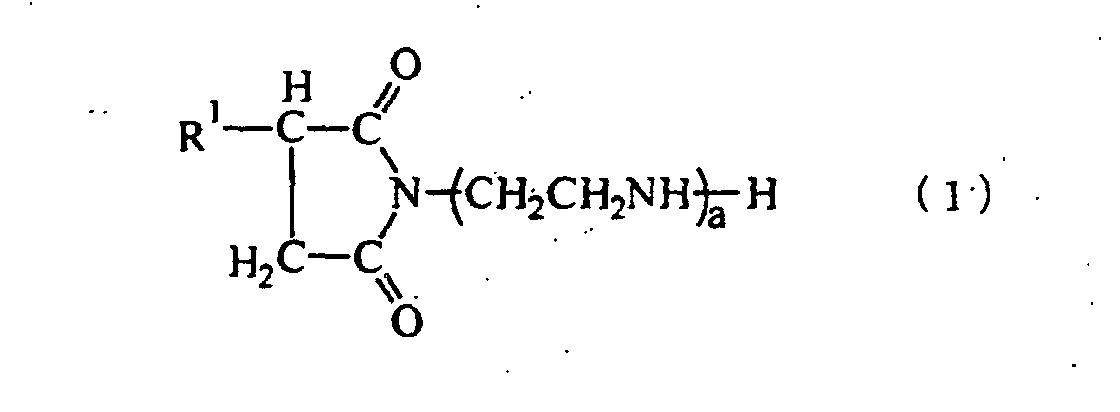
- nitrogen-containing compound is any one or more kinds of compounds selected from:
- R 1 is an alkyl or alkenyl group having 40 to 400, preferably 60 to 350 carbon atoms, and a is an integer from 1 to 5, preferably 2 to 4.
- R 2 and R 3 are each independently an alkyl or alkenyl group having 40 to 400, preferably 60 to 350 carbon atoms, and b is an integer from 0 to 4, preferably 1 to 3.
- the succinimides are classified into mono-type succinimides wherein a succinic anhydride is added to one end of a polyamine as represented by formula (1) and bis-type succinimides wherein a succinic anhydride is added to both ends of a polyamine as represented by formula (2).
- both types of the succinimides and mixtures thereof can be used as Component (A).
- (A-2) benzylamines are compounds represented by the formula
- R 4 is an alkyl or alkenyl group having 40 to 400, preferably 60 to 350 carbon atoms, and c is an integer from 1 to 5, preferably 2 to 4.
- one of the benzylamines may be produced by reacting a polyolefin such as propylene oligomer, polybutene, or ethylene- ⁇ -olefin copolymer with phenol so as to obtain an alkylphenol, followed by a Mannich reaction thereof with formaldehyde and a polyamine such as diethylenetriamine, triethylenetetramine, tetraethylenepentamine, or pentaethylenehexamine.
- a polyolefin such as propylene oligomer, polybutene, or ethylene- ⁇ -olefin copolymer
- formaldehyde a Mannich reaction thereof with formaldehyde and a polyamine such as diethylenetriamine, triethylenetetramine, tetraethylenepentamine, or pentaethylenehexamine.
- (A-3) polyamines are compounds represented by the formula
- R 5 is an alkyl or alkenyl group having 40 to 400, preferably 60 to 350 carbon atoms, and d is an integer from 1 to 5, preferably 2 to 4.
- one of the polyamines may be produced by subjecting a polyolefin such as propylene oligomer, polybutene, or ethylene- ⁇ -olefin copolymer to chloridization, followed by a reaction with ammonia or a polyamine such as ethylenediamine, diethylenetriamine, triethylenetetramine, tetraethylenepentamine, or pentaethylenehexamine.
- a polyolefin such as propylene oligomer, polybutene, or ethylene- ⁇ -olefin copolymer to chloridization
- ammonia or a polyamine such as ethylenediamine, diethylenetriamine, triethylenetetramine, tetraethylenepentamine, or pentaethylenehexamine.
- the derivatives of the nitrogen-containing compound are carboxylic acid-modified compounds obtained by bringing any one of the aforesaid nitrogen-containing compounds into a reaction with a monocarboxylic acid (fatty acid) having 2 to 30 carbon atoms or a polycarboxylic acid having 2 to 30 carbon atoms, such as oxalic acid, phthalic acid, trimellitic acid, or pyromellitic acid so as to neutralize or amidize the whole or part of the remaining amino and/or imino groups; sulfur-modified compounds obtained by bringing any one of the aforesaid nitrogen-containing compounds into a reaction with a sulfuric compound; and mixtures thereof.
- a monocarboxylic acid fatty acid
- a polycarboxylic acid having 2 to 30 carbon atoms such as oxalic acid, phthalic acid, trimellitic acid, or pyromellitic acid so as to neutralize or amidize the whole or part of the remaining amino and/or imino groups
- Component (A) used in the present invention is a compound obtained by modifying any one of the aforesaid nitrogen-containing compounds or a derivative thereof with a boron compound.
- any suitable method may be employed.
- any one of the aforesaid nitrogen compounds or derivatives thereof is reacted with a boron compound such as boric acid, a borate, or a boric acid ester so as to neutralize or amidize the whole or part of the amino and/or imino groups remaining in the nitrogen-containing compound or derivative thereof.
- boron compounds used herein are orthoboric acid, methaboric acid, and tetraboric acid.
- borates are alkali metal salts, alkaline earth metal salts, or ammonium salts of boric acid.
- lithium borate such as lithium methaborate, lithium tetraborate, lithium pentaborate, and lithium perborate
- sodium borate such as sodium methaborate, sodium diborate, sodium tetraborate, sodium pentaborate, sodium hexaborate, and sodium octaborate
- potassium borate such as potassium methaborate, potassium tetraborate, potassium pentaborate, potassium hexaborate, and potassium octaborate
- calcium borate such as calcium methaborate, calcium diborate, tricalcium tetraborate, pentacalcium tetraborate, and calcium hexaborate
- magnesium borate such as magnesium methaborate, magnesium diborate, trimagnesium tetraborate, pentamagnesium tetraborate, and magnesium hexaborate
- ammonium borate such as ammonium methaborate, ammonium tetraborate, ammonium pentaborate, and ammonium
- boric acid esters are esters of boric acid and an alkyl alcohol having 1 to 6 carbon atoms and more specifically monomethyl borate, dimethyl borate, trimethyl borate, monoethyl borate, diethyl borate, triethyl borate, monopropyl borate, dipropyl borate, tripropyl borate, monobutyl borate, dibutyl borate, and tributyl borate.
- Preferred for Component (A) are those obtained by modifying (A-1) succinimides having at least one alkyl or alkenyl group having 40 to 400 carbon atoms per molecule or derivatives thereof used as the aforesaid nitrogen-containing compounds with the aforesaid boron compounds; and mixtures thereof with the objective of improved fatigue life and anti-wear properties.
- the lower limit content of Component (A) in the lubricating oil composition of the present invention is 0.02 percent by mass, preferably 0.03 percent by mass in terms of boron, based on the total mass of the composition, while the upper limit is 0.1 percent by mass, preferably 0.08 percent by mass in terms of boron, based on the total mass of the composition.
- Component (A) of less than the lower limit would be ineffective in inhibiting pitching or flaking, while Component (A) of more than the upper limit would deteriorate the oxidation stability of the resulting lubricating oil composition.
- Component (B) used in the present invention is an alkaline earth metal-based detergent.
- Component (B) has a base number of 0 to 500 mgKOH/g, preferably 0 to 400 mgKOH/g.
- Component (B) having a base number in excess of 500 mgKOH/g is unstable in structure and deteriorates the storage stability of the resulting oil composition.
- base number used herein denotes a base number measured by the perchloric acid potentiometric titration method in accordance with section 7 of JIS K2501 (1992) "Petroleum products and lubricants-Determination of neutralization number".
- Component (B) makes it possible to not only improve the properties to inhibiting fatigue caused by pitching or flaking and the anti-wear properties but also optimize the friction properties of a wet clutch and thus suppress the decrease in strength thereof caused by repeatedly applied compression.
- Component (B) are any one or more kinds of metal-based detergents-selected from:
- (B-1) alkaline earth metal sulfonates are alkaline earth metal salts, particularly preferably magnesium salts and/or calcium salts, of an alkyl aromatic sulfonic acid obtained by sulfonating an alkyl aromatic compound having a molecular weight of 100 to 1,500 and preferably 200 to 700.
- alkyl aromatic sulfonic acids are petroleum sulfonic acids and synthetic sulfonic acids.
- Petroleum sulfonic acids may be those obtained by sulfonating the alkyl aromatic compound contained in the lubricant fraction of a mineral oil or mahogany acid by-produced upon production of white oil.
- Synthetic sulfonic acids may be those obtained by sulfonating an alkyl benzene having a straight-chain or branched alkyl group, which may be by-produced from a plant for producing an alkyl benzene used as materials of detergents or obtained by alkylating a polyolefin to benzene or by sulfonating dinonylnaphthalene.
- No particular limitation is imposed on sulfonating agents used for sulfonating alkyl aromatic compounds. However, fuming sulfuric acids and sulfuric acid are generally used.
- Examples of (B-2) alkaline earth metal salicylates are alkaline earth metal salts, preferably magnesium salts and/or calcium salts, of an alkyl salicylic acid having at least one straight-chain or branched alkyl group having 4 to 30, preferably 6 to 18 carbon atoms.
- alkaline earth metal phenates are alkaline earth metal salts, preferably magnesium salts and/or calcium salts, of alkylphenolsulfides obtained by reacting an alkylphenol having at least one straight-chain or branched alkyl group having 4 to 30, preferably 6 to 18 carbon atoms with sulfur or of a Mannich reaction product obtained by reacting such an alkylphenol with formaldehyde.
- Component (B) i.e., an alkaline earth metal sulfonate, an alkaline earth metal salicylate or an alkaline earth metal phenate each has a base number within a range of 0 to 500 mgKOH/g, it may be a neutral (normal) salt obtained by reacting an alkylaromatic sulfonic acid, an alkyl salicylic acid, an alkylphenol, an alkylphenolsulfide, or a Mannich reaction product of an alkylphenol directly with an alkaline earth metal base such as an oxide or hydroxide of an alkaline earth metal of magnesium and/or calcium or obtained by substituting an alkylaromatic sulfonic acid, an alkyl salicylic acid, an alkylphenol, an alkylphenolsulfide, or a Mannich reaction product of an alkylphenol which has once been converted to an alkali metal salt such as a sodium salt or a potassium salt, with an alkaline earth metal salt.
- Components (B) may be a basic salt obtained by heating a normal salt as described above with an excess amount of an alkaline earth metal salt or an alkaline earth metal base (a hydroxide or oxide of an alkaline earth metal) in the presence of water. Further alternatively, Component (B) may be an overbased salt obtained by reacting a normal salt as described above with a base of an alkaline earth metal in the presence of carbonic acid gas.
- Metal-based detergents are commercially available in the form of being diluted with a light fraction lubricating base oil. It is preferred to use a metal-based detergent whose metal content is within the range of 1.0 to 20 percent by mass, preferably 2.0 to 16 percent by mass.
- the lower limit content of Component (B) is 0.01 percent by mass, preferably 0.05 percent by mass, more preferably 0.1 percent by mass, and particularly preferably 0.15 percent by mass in terms of an alkaline earth metal, based on the total mass of the composition.
- the upper limit is preferably 0.7 percent by mass or less, and particularly preferably 0.4 percent by mass or less, based on the total mass of the composition.
- Component (B) of less than the lower limit would be ineffective in inhibiting fatigue caused by pitching or flaking even though combined with the above described Component (A) and Component (C) described below, while Component (B) in excess of 0.7 percent by mass would deteriorate the oxidation stability of the resulting composition.
- Component (C) used in the present invention is an alkali metal borate or a hydrate thereof.
- Component (C) examples include lithium borate hydrate, sodium borate hydrate, potassium borate hydrate, rubidium borate hydrate, and cesium borate hydrate. Particularly preferred is potassium borate hydrate.
- these alkali metal borates can be obtained in the form of a fine particle-like dispersant of potassium borate hydrate or sodium borate hydrate obtained by dissolving potassium hydroxide or sodium hydroxide and boric acid in water such that the atomic ratio of boron and an alkali metal (potassium, sodium, or the like) is within the range of 2.0 to 4.5, adding the resulting solution to an oil solution containing a neutral alkaline earth metal sulfonate or a succinimide-based ashless dispersant, followed by stirring vigorously so as to obtain an oil in water emulsion, and dehydrating the emulsion.
- a fine particle-like dispersant of potassium borate hydrate or sodium borate hydrate obtained by dissolving potassium hydroxide or sodium hydroxide and boric acid in water such that the atomic ratio of boron and an alkali metal (potassium, sodium, or the like) is within the range of 2.0 to 4.5, adding the resulting solution to an oil solution containing
- the content of Component (C) may be arbitrarily selected. However, the lower limit content is 0.002 percent by mass, preferably 0.005 percent by mass in terms of boron, based on the total mass of the composition.
- the upper limit is 0.1 percent by mass, preferably 0.06 percent by mass in terms of boron, based on the total mass of the composition.
- Component (C) of less than 0.002 percent by mass in terms of boron would result in a lubricating oil composition which is ineffective in inhibiting fatigue caused by pitching or flaking, while Component (C) in excess of 0.1 percent by'mass in terms of boron would deteriorate the storage stability of the resulting lubricating oil composition.
- Component (C) When Component (C) is obtained in the form of a dispersant in an alkaline earth metal sulfonate, the resulting lubricating oil composition contains such sulfonate. However, there is no problem that the total amount of alkaline earth metal of this alkaline earth metal sulfonate and Component (B) is within the range of Component (B) as described above.
- the lubricating oil composition of the present invention may be blended with known additives for the purpose of further enhancing its functions as a lubricating oil.
- additives are (D) boron-free ashless dispersants, (E) friction modifiers, (F) oxidation inhibitors, (G) extreme pressure additives, (H) wear inhibitors, (I) viscosity index improvers, (J) rust preventives, (K) corrosion inhibitors, (L) pour-point depressants, (M) rubber swelling agents, (N) antifoamers, and (O) coloring agents.
- additives may be used singlely or in combination.
- one or more kinds of compounds selected from such ashless dispersants may be blended in an arbitrary amount.
- the content of boron-free ashless dispersants is preferably from 0.1 to 10 percent by mass, based on the total mass of the lubricating oil composition.
- Friction modifiers which may be used in combination with the lubricating oil composition of the present invention are any conventional compounds which have been used as friction modifiers for lubricating oils and include amine compounds, fatty acid esters, fatty acid amides, and fatty acid metal salts, each of which has at least one alkyl or alkenyl group having 6 to 30 carbon atoms, preferably straight-chain alkyl or alkenyl group having 6 to 30 carbon atoms per molecule.
- Examples of the amine compounds include straight-chain or branched, preferably straight-chain aliphatic monoamines having 6 to 30 carbon atoms, straight-chain or branched, preferably straight-chain aliphatic polyamines having 6 to 30 carbon atoms, and alkyleneoxide adducts of these aliphatic amines.
- Examples of the fatty acid esters include esters of straight-chain or branched, preferably straight-chain fatty acids having 7 to 31 carbon atoms and aliphatic monohydric alcohols or aliphatic polyhydric alcohols.
- fatty acid amides include amides of straight-chain or branched, preferably straight-chain fatty acids having 7 to 31 carbon atoms and aliphatic monoamines or aliphatic polyamines.
- fatty acid metal salts include alkaline earth metal salts (magnesium salts and calcium salts) or zinc salts of straight-chain or branched, preferably straight-chain fatty acids having 7 to 31 carbon atoms.
- any one or more kinds of compounds selected from such friction modifiers may be blended in an arbitrary amount.
- the content of the friction modifiers is from 0.01 to 5.0 percent by mass, preferably from 0.03 to 3.0 percent by mass, based on the total mass of the lubricating oil composition.
- Oxidation inhibitors which may be used in combination with the lubricating oil compositions of the present invention may be any conventional ones such as phenol-based compounds or amine-based compounds which are usually used as oxidation inhibitors in a lubricating oil.
- oxidation inhibitors are alkylphenols such as 2-6-di-tert-butyl-4-methylphenol, bisphenols such as methylene-4,4-bisphenol(2,6-di-tert-butyl-4-methylphenol), naphtylamines such as phenyl- ⁇ - naphtylamine, dialkyldiphenylamines, zinc dialkyldithiophosphates such as zinc di-2-ethylhexyldithiophosphate, and esters of (3,5-di-tert-butyl-4-hydroxyphenyl)fatty acid such as propionic acid and monohydric or polyhydric alcohols such as methanol, octadecanol, 1,6-hexanediol, neopentyl glycol, thiodiethylene glycol, triethylene glycol, and pentaerythritol.
- alkylphenols such as 2-6-di-tert-butyl
- Any one or more compounds selected from the above-described oxidation inhibitors maybe blended in an arbitrary amount.
- the content of the oxidation inhibitors is generally from 0.01 to 5.0 percent by mass, based on the total mass of the lubricating oil composition.
- Extreme pressure additives which may be used in combination with the lubricating oil compositions of the present invention may be any compounds which have been conventionally used as extreme pressure additives in lubricating oils.
- the extreme pressure additives include sulfur-based compounds such as disulfides, olefin sulfides, and sulfide oils and fats. Any one or more compounds selected from these extreme pressure additives may be blended in an arbitrary amount.
- the content of the extreme pressure additives is generally from 0.01 to 5.0 percent by mass, based on the total mass of the lubricating oil composition.
- wear inhibitors which may be used in combination with the lubricating oil compositions of the present invention include zinc dialkyldithiophosphates, phosphoric acid, monophosphates, diphosphates, triphosphates, metal salts or amine salts of phosphoric acid, monophosphates, and diphosphates, and mixtures thereof.
- those other than phosphoric acid are generally compounds containing a hydrocarbon group having 2 to 30, preferably 3 to 20 carbon atoms.
- the content of the wear inhibitors is preferably from 0.005 to 0.2 percent by mass in terms of phosphorus, based on the total mass of the lubricating oil composition.
- a content of less than 0.005 percent by mass in terms of phosphorus would be less effective in wear resistance, while a content of more than 0.2 percent by mass would deteriorate the oxidation stability of the resulting lubricating oil composition.
- Viscosity index improvers which may be used in combination with the lubricating oil compositions of the present invention may be non dispersion-type viscosity index improvers such as polymers or copolymers of one or more monomers selected from various methacrylates or hydrogenated products thereof and dispersion-type viscosity index improvers such as copolymers of methacrylates and various methacrylates further containing nitrogen compounds.
- viscosity index improvers are non dispersion- or dispersion-type ethylene- ⁇ -olefin copolymers wherein the ⁇ -olefin may be propylene, 1-butene, or 1-pentene, or the hydrides thereof, polyisobutylenes or the hydrides thereof, styrene-diene hydrogenated copolymers, styrene-maleate anhydride copolymers, and polyalkylstyrenes.
- ⁇ -olefin may be propylene, 1-butene, or 1-pentene, or the hydrides thereof, polyisobutylenes or the hydrides thereof, styrene-diene hydrogenated copolymers, styrene-maleate anhydride copolymers, and polyalkylstyrenes.
- the number-average molecular weight of non-dispersion or dispersion type polymethacrylates is preferably from 5,000 to 150,000, and more preferably from 5,000 to 35,000.
- the number-average molecular weight of polyisobutylenes or hydrides thereof is from 800 to 5,000, preferably from 1,000 to 4,000.
- Ethylene- ⁇ -olefin copolymers and hydrides thereof each have a number-average molecular weight of from 800 to 150,000, preferably from 3,000 to 12,000.
- any one or more compounds selected from the above-described viscosity index improvers may be blended in an arbitrary amount.
- the content of the viscosity index improvers is generally from 0.1 to 40.0 percent by mass, based on the total mass of the lubricating oil composition.
- rust preventives examples include alkenyl succinic acids, alkenyl succinic acid esters, polyhydric alcohol esters, petroleum sulfonates, and dinonylnaphthalenesulfonate.
- Corrosion inhibitors which may be used in combination with the lubricating oil composition of the present invention may be any compounds which have been usually used as corrosion inhibitors for lubricating oils.
- corrosion inhibitors include benzotriazole-, tolyltriazole-, thidiazole-, and imidazole-based compounds.
- pour-point depressants are polymethacrylate-based polymers, which are adaptable to a lubricating base oil to be used.
- Examples of rubber swelling agents include aromatic compounds and sulfur-based compounds.
- antifoamers examples include silicones such as dimethylsilicone and fluorosilicone.
- the contents of these additives may be arbitrarily selected.
- the content of each of the rust preventives, corrosion inhibitors, pour-point depressants, and rubber swelling agents is from 0.005 to 3 percent by mass, based on the total mass of the composition.
- the content of the antifoamers is from 0.0005 to 0.01 percent by mass, based on the total mass of the composition.
- the lubricating oil compositions of the present invention have a kinematic viscosity at 100°C of preferably 4 to 30 mm 2 /s, more preferably 5 to 25 mm 2 /s.
- the lubricating oil compositions of the present invention are excellent in anti-wear properties and anti-pitching properties and thus are suitably applicable as lubricating oils which are required to have such properties, such as gear oils for automobiles, construction machinery, and agriculture machinery, and lubricating oils for automatic or manual transmissions.
- the lubricating oil compositions of the present invention are also applicable as gear oils for industrial use, lubricating oils for gasoline engines, diesel engines, and gas engines of automobiles such as two or' four wheel vehicles, electric generators, and vessels; turbine oils; and compressor oils.
- Various lubricating oil compositions (Examples in Table 1 and Comparative Examples in Table 2) were prepared by adding various additives shown in Table 1 or 2 to a base oil (mineral oil having a kinematic viscosity at 100 °C of 3.8 mm 2 /s). The amount of each additives was on the basis of total mass of the composition.
- the amount of wear is in the range of 0 to 100 mg. Therefore, if the amount of wear is 100 mg or less, the composition was evaluated as being excellent in anti-wear properties.
- the lubricating oil compositions of the present invention had excellent properties such as excellent anti-wear properties and a long fatigue life.
- compositions of Comparative Examples 1 and 4 whose content of Component (A) or (C) was less than that as defined by the present invention were poor in anti-wear properties.
- the compositions of Comparative Examples 2 and 3 whose content of Component (B) was less than that as defined by the present invention had a short fatigue life due to pitching.
- the lubricating oil compositions of the present invention are excellent in anti-wear properties and can be extended in fatigue life by inhibiting pitching or flaking. Therefore, the lubricating oil compositions are suitably applicable as lubricating oils which are required to have such properties, such as gear oils for automobiles, construction machinery, and agriculture machinery, and lubricating oils for automatic or manual transmissions. Alternatively, the lubricating oil compositions of the present invention are also applicable as gear oils for industrial use, lubricating oils for gasoline engines, diesel engines, and gas engines of automobiles such as two or four wheel vehicles, electric generators, and vessels; turbine oils; and compressor oils.
Landscapes
- Chemical & Material Sciences (AREA)
- Chemical Kinetics & Catalysis (AREA)
- General Chemical & Material Sciences (AREA)
- Oil, Petroleum & Natural Gas (AREA)
- Organic Chemistry (AREA)
- Lubricants (AREA)
Abstract
Description


| (Run-in conditions) | |
| Oil temperature | 80 °C |
| Number of revolutions | 2,500 rpm |
| Load | 380 N |
| Test time | 20 minutes |
| (Actual test conditions) | |
| Oil temperature: | 80 °C |
| Number of revolutions: | 3,000 rpm |
| Load: | 380 N |
| Test time: 1 | 20 minutes |
| (Cylinder) | |
| Material | SCM436 |
| Shape | Φ 68 mm x 10 mm |
| Hardness | SB3000 to 340 |
| (Test conditions) | |
| Peripheral velocity | driving side: 12 m/s, Driven side: 10 m/s |
| Oil temperature | 60 °C |
| Surface pressure | 12 MPa |


Claims (7)
- A lubricating oil composition which comprises a lubricating base oil, (A) a boron-containing ashless dispersant in an amount of 0.02 to 0.1 percent by mass in terms of boron, based on the total mass of the composition, (B) an alkaline earth metal-based detergent with a base number of 0 to 500 mgKOH/g in an amount of 0.01 percent by mass or more in terms of alkaline earth metal, based on the total mass of the composition, and (C) an alkali metal borate or a hydrate thereof.
- The lubricating oil composition according to claim 1 wherein Component (C) is a potassium borate hydrate.
- The lubricating oil composition according to claim 1 wherein Component (C) is contained in an amount of 0.002 to 0.1 percent by mass in terms of boron based on the total mass of the composition.
- The lubricating oil composition according to claim 1 wherein Component (A) is a succinimide modified with a boron compound.
- The lubricating oil composition according to claim 1 wherein Component (B) is an alkaline earth metal sulfonate or an alkaline earth metal salicylate.
- The lubricating oil composition according to claim 1 wherein Component (B) is an alkaline earth calcium.
- The lubricating oil composition according to claim 1 wherein said composition is used in an automatic transmission equipped with a wet clutch.
Applications Claiming Priority (3)
| Application Number | Priority Date | Filing Date | Title |
|---|---|---|---|
| JP2001282318A JP5283296B2 (en) | 2001-09-17 | 2001-09-17 | Lubricating oil composition |
| JP2001282318 | 2001-09-17 | ||
| PCT/JP2002/009122 WO2003025103A1 (en) | 2001-09-17 | 2002-09-06 | Lubricating oil composition |
Publications (2)
| Publication Number | Publication Date |
|---|---|
| EP1428865A1 true EP1428865A1 (en) | 2004-06-16 |
| EP1428865A4 EP1428865A4 (en) | 2009-06-17 |
Family
ID=19105983
Family Applications (1)
| Application Number | Title | Priority Date | Filing Date |
|---|---|---|---|
| EP02798809A Withdrawn EP1428865A4 (en) | 2001-09-17 | 2002-09-06 | LUBRICATING OIL COMPOSITION |
Country Status (5)
| Country | Link |
|---|---|
| US (1) | US7371710B2 (en) |
| EP (1) | EP1428865A4 (en) |
| JP (1) | JP5283296B2 (en) |
| CN (1) | CN1260334C (en) |
| WO (1) | WO2003025103A1 (en) |
Families Citing this family (9)
| Publication number | Priority date | Publication date | Assignee | Title |
|---|---|---|---|---|
| JP5019738B2 (en) * | 2005-11-02 | 2012-09-05 | Jx日鉱日石エネルギー株式会社 | Lubricating oil composition |
| US8921287B2 (en) | 2005-11-02 | 2014-12-30 | Nippon Oil Corporation | Lubricating oil composition |
| JP5188019B2 (en) * | 2005-11-02 | 2013-04-24 | Jx日鉱日石エネルギー株式会社 | Lubricating oil composition |
| EP1954791A1 (en) * | 2005-12-02 | 2008-08-13 | United Technologies Corporation | Methods and systems to enhance efficiency of power-transmission systems containing higher viscosity lubricants |
| JP5207599B2 (en) * | 2006-06-08 | 2013-06-12 | Jx日鉱日石エネルギー株式会社 | Lubricating oil composition |
| CA2752867C (en) * | 2009-02-18 | 2017-11-28 | The Lubrizol Corporation | Amine derivatives as friction modifiers in lubricants |
| US9365794B2 (en) * | 2010-02-19 | 2016-06-14 | Infineum International Limited | Wet friction clutch—lubricant systems providing high dynamic coefficients of friction through the use of borated detergents |
| CN104845706B (en) * | 2014-02-18 | 2019-06-07 | 吉坤日矿日石能源株式会社 | Lubricating oil composition for transmission |
| US20180100114A1 (en) * | 2016-10-07 | 2018-04-12 | Exxonmobil Research And Engineering Company | Low conductivity lubricating oils for electric and hybrid vehicles |
Family Cites Families (31)
| Publication number | Priority date | Publication date | Assignee | Title |
|---|---|---|---|---|
| US3853772A (en) * | 1971-06-01 | 1974-12-10 | Chevron Res | Lubricant containing alkali metal borate dispersed with a mixture of dispersants |
| US3929650A (en) * | 1974-03-22 | 1975-12-30 | Chevron Res | Extreme pressure agent and its preparation |
| JPS5133263A (en) * | 1974-07-11 | 1976-03-22 | Chevron Res | HOSANKARIUMUGANJUJUNKATSUZAI |
| US4089790A (en) * | 1975-11-28 | 1978-05-16 | Chevron Research Company | Synergistic combinations of hydrated potassium borate, antiwear agents, and organic sulfide antioxidants |
| US5739088A (en) * | 1990-03-14 | 1998-04-14 | Nippon Oil Co., Ltd. | Method of lubricating an alcohol-based fuel engine with an engine oil composition |
| JP3554757B2 (en) * | 1992-12-21 | 2004-08-18 | シェブロンテキサコジャパン株式会社 | Engine oil composition |
| JPH06200269A (en) * | 1992-12-29 | 1994-07-19 | Cosmo Sogo Kenkyusho:Kk | Wet brake and gear oil composition |
| TW425425B (en) * | 1994-08-03 | 2001-03-11 | Lubrizol Corp | Lubricating compositions, concentrates, and greases containing the combination of an organic polysulfide and an overbased composition or a phosphorus or boron compound |
| AU724613B2 (en) * | 1995-05-26 | 2000-09-28 | Elf Antar France | Lubricants with molybdenum containing compositions and methods of using the same |
| JP3504405B2 (en) * | 1995-10-23 | 2004-03-08 | 新日本石油株式会社 | Diesel engine oil composition |
| JP3609526B2 (en) * | 1996-02-29 | 2005-01-12 | 東燃ゼネラル石油株式会社 | Lubricating oil composition |
| US5840663A (en) * | 1996-12-18 | 1998-11-24 | Exxon Chemical Patents Inc. | Power transmitting fluids improved anti-shudder durability |
| JPH11269477A (en) * | 1998-03-20 | 1999-10-05 | Cosmo Sogo Kenkyusho Kk | Engine oil composition |
| JP3992369B2 (en) * | 1998-07-17 | 2007-10-17 | 出光興産株式会社 | Lubricating oil composition for internal combustion engines |
| JP3026195B2 (en) * | 1998-08-17 | 2000-03-27 | 本田技研工業株式会社 | Lubricating oil composition for automatic transmission |
| JP2000063878A (en) * | 1998-08-25 | 2000-02-29 | Japan Energy Corp | Continuously variable transmission oil composition |
| JP3977942B2 (en) * | 1998-10-07 | 2007-09-19 | 新日本石油株式会社 | Lubricating oil composition for metal belt type continuously variable transmission |
| JP3977940B2 (en) * | 1998-10-07 | 2007-09-19 | 新日本石油株式会社 | Lubricating oil composition for metal belt type continuously variable transmission |
| US6451745B1 (en) * | 1999-05-19 | 2002-09-17 | The Lubrizol Corporation | High boron formulations for fluids continuously variable transmissions |
| JP2001158896A (en) * | 1999-12-02 | 2001-06-12 | Chevron Oronite Ltd | Lubricating oil composition for internal combustion engine particularly effective for lubrication of gas engine |
| US6423670B2 (en) * | 2000-03-20 | 2002-07-23 | Infineum International Ltd. | Lubricating oil compositions |
| JP4663843B2 (en) * | 2000-03-29 | 2011-04-06 | Jx日鉱日石エネルギー株式会社 | Lubricating oil composition |
| JP2001342486A (en) * | 2000-06-05 | 2001-12-14 | Tonengeneral Sekiyu Kk | Lubricating oil composition for continuously variable transmission |
| JP4409055B2 (en) * | 2000-06-19 | 2010-02-03 | 株式会社ジャパンエナジー | Gear oil composition |
| JP4856305B2 (en) * | 2000-10-30 | 2012-01-18 | Jx日鉱日石エネルギー株式会社 | Engine oil composition |
| JP4673487B2 (en) * | 2001-02-02 | 2011-04-20 | Jx日鉱日石エネルギー株式会社 | Lubricating oil composition for metal belt type continuously variable transmission |
| US6534450B1 (en) * | 2001-09-28 | 2003-03-18 | Chevron Oronite Company Llc | Dispersed hydrated sodium borate compositions having improved properties in lubricating oil compositions |
| US6632781B2 (en) * | 2001-09-28 | 2003-10-14 | Chevron Oronite Company Llc | Lubricant composition comprising alkali metal borate dispersed in a polyalkylene succinic anhydride and a metal salt of a polyisobutenyl sulfonate |
| US7026273B2 (en) * | 2001-11-09 | 2006-04-11 | Infineum International Limited | Lubricating oil compositions |
| US6737387B2 (en) * | 2002-05-02 | 2004-05-18 | Chevron Oronite Company Llc | Dispersed hydrated potassium borate compositions having improved properties in lubricating oil compositions |
| US6841521B2 (en) * | 2003-03-07 | 2005-01-11 | Chevron Oronite Company Llc | Methods and compositions for reducing wear in heavy-duty diesel engines |
-
2001
- 2001-09-17 JP JP2001282318A patent/JP5283296B2/en not_active Expired - Fee Related
-
2002
- 2002-09-06 EP EP02798809A patent/EP1428865A4/en not_active Withdrawn
- 2002-09-06 WO PCT/JP2002/009122 patent/WO2003025103A1/en not_active Ceased
- 2002-09-06 CN CNB028181743A patent/CN1260334C/en not_active Expired - Fee Related
-
2004
- 2004-03-10 US US10/797,386 patent/US7371710B2/en not_active Expired - Lifetime
Also Published As
| Publication number | Publication date |
|---|---|
| EP1428865A4 (en) | 2009-06-17 |
| JP5283296B2 (en) | 2013-09-04 |
| JP2003082376A (en) | 2003-03-19 |
| US7371710B2 (en) | 2008-05-13 |
| WO2003025103A1 (en) | 2003-03-27 |
| CN1606612A (en) | 2005-04-13 |
| CN1260334C (en) | 2006-06-21 |
| US20040176258A1 (en) | 2004-09-09 |
Similar Documents
| Publication | Publication Date | Title |
|---|---|---|
| EP1428866B1 (en) | Lubricating oil composition | |
| US10087389B2 (en) | Lubricating oil composition | |
| US8921287B2 (en) | Lubricating oil composition | |
| US20160075964A1 (en) | Lubricating oil composition for automatic transmission | |
| US8349776B2 (en) | Trunk piston engine lubricating oil compositions | |
| JP2002129182A (en) | Engine oil composition | |
| JP2019157131A (en) | Lubricant containing amine salt and hydrocarbyl borate of acid phosphate | |
| JP2001342486A (en) | Lubricating oil composition for continuously variable transmission | |
| JP6259511B2 (en) | Lubricating oil composition | |
| US9567546B2 (en) | Lubricating oil composition | |
| JP2001342484A (en) | Lubricating oil composition for automatic transmission | |
| JP2000109872A (en) | Lubricating oil composition for metal belt type continuously variable transmission | |
| JP6126024B2 (en) | Lubricating oil composition for transmission | |
| US20050026790A1 (en) | Lubricating oil composition | |
| US7371710B2 (en) | Lubricating oil composition | |
| JP2001342485A (en) | Lubricating oil composition for continuously variable transmission | |
| JPH09202890A (en) | Lubricating oil composition for automatic transmission | |
| JP5473236B2 (en) | Lubricating oil composition | |
| CN110229710A (en) | Speed changer lubricant oil composite | |
| JP3936823B2 (en) | Engine oil composition | |
| CA3174129C (en) | Rejuvenation and/or extension of the lifetime of frictional performance in transmission fluids | |
| CA2794654A1 (en) | Method for improving fluorocarbon elastomer seal compatibility | |
| WO2023144721A1 (en) | Lubricating oil composition | |
| WO2015057293A1 (en) | Lubricating oil composition for protection of silver bearings in medium speed diesel engines | |
| JP2006241468A (en) | Lubricating oil composition for metal belt type continuously variable transmission |
Legal Events
| Date | Code | Title | Description |
|---|---|---|---|
| PUAI | Public reference made under article 153(3) epc to a published international application that has entered the european phase |
Free format text: ORIGINAL CODE: 0009012 |
|
| 17P | Request for examination filed |
Effective date: 20040316 |
|
| AK | Designated contracting states |
Kind code of ref document: A1 Designated state(s): AT BE BG CH CY CZ DE DK EE ES FI FR GB GR IE IT LI LU MC NL PT SE SK TR |
|
| AX | Request for extension of the european patent |
Extension state: AL LT LV MK RO SI |
|
| A4 | Supplementary search report drawn up and despatched |
Effective date: 20090514 |
|
| RIC1 | Information provided on ipc code assigned before grant |
Ipc: C10N 40/04 20060101ALN20090508BHEP Ipc: C10N 30/06 20060101ALN20090508BHEP Ipc: C10N 30/00 20060101ALN20090508BHEP Ipc: C10N 10/04 20060101ALN20090508BHEP Ipc: C10M 155/04 20060101ALI20090508BHEP Ipc: C10M 159/20 20060101ALI20090508BHEP Ipc: C10M 139/00 20060101ALI20090508BHEP Ipc: C10M 125/26 20060101ALI20090508BHEP Ipc: C10M 167/00 20060101ALI20090508BHEP Ipc: C10M 163/00 20060101AFI20030401BHEP |
|
| 17Q | First examination report despatched |
Effective date: 20090925 |
|
| STAA | Information on the status of an ep patent application or granted ep patent |
Free format text: STATUS: THE APPLICATION IS DEEMED TO BE WITHDRAWN |
|
| 18D | Application deemed to be withdrawn |
Effective date: 20100804 |