EP1427045A2 - Fuel cell container cooling system - Google Patents
Fuel cell container cooling system Download PDFInfo
- Publication number
- EP1427045A2 EP1427045A2 EP03257437A EP03257437A EP1427045A2 EP 1427045 A2 EP1427045 A2 EP 1427045A2 EP 03257437 A EP03257437 A EP 03257437A EP 03257437 A EP03257437 A EP 03257437A EP 1427045 A2 EP1427045 A2 EP 1427045A2
- Authority
- EP
- European Patent Office
- Prior art keywords
- fuel cell
- container
- shield
- disposed
- cell assembly
- Prior art date
- Legal status (The legal status is an assumption and is not a legal conclusion. Google has not performed a legal analysis and makes no representation as to the accuracy of the status listed.)
- Withdrawn
Links
- 239000000446 fuel Substances 0.000 title claims abstract description 217
- 238000001816 cooling Methods 0.000 title description 4
- 239000012809 cooling fluid Substances 0.000 claims abstract description 28
- 239000000919 ceramic Substances 0.000 claims description 15
- OKKJLVBELUTLKV-UHFFFAOYSA-N Methanol Chemical compound OC OKKJLVBELUTLKV-UHFFFAOYSA-N 0.000 claims description 9
- 239000007787 solid Substances 0.000 claims description 8
- NBIIXXVUZAFLBC-UHFFFAOYSA-N Phosphoric acid Chemical compound OP(O)(O)=O NBIIXXVUZAFLBC-UHFFFAOYSA-N 0.000 claims description 6
- 239000004020 conductor Substances 0.000 claims description 5
- BVKZGUZCCUSVTD-UHFFFAOYSA-L Carbonate Chemical compound [O-]C([O-])=O BVKZGUZCCUSVTD-UHFFFAOYSA-L 0.000 claims description 3
- HCHKCACWOHOZIP-UHFFFAOYSA-N Zinc Chemical compound [Zn] HCHKCACWOHOZIP-UHFFFAOYSA-N 0.000 claims description 3
- 229910000147 aluminium phosphate Inorganic materials 0.000 claims description 3
- 239000012528 membrane Substances 0.000 claims description 3
- 239000007769 metal material Substances 0.000 claims description 3
- 230000001172 regenerating effect Effects 0.000 claims description 3
- 229910052725 zinc Inorganic materials 0.000 claims description 3
- 239000011701 zinc Substances 0.000 claims description 3
- 239000002826 coolant Substances 0.000 description 28
- 239000007800 oxidant agent Substances 0.000 description 28
- 230000001590 oxidative effect Effects 0.000 description 28
- 239000012530 fluid Substances 0.000 description 10
- 238000000034 method Methods 0.000 description 10
- 230000001413 cellular effect Effects 0.000 description 6
- 239000006261 foam material Substances 0.000 description 6
- 239000011810 insulating material Substances 0.000 description 6
- 238000013461 design Methods 0.000 description 5
- 230000000712 assembly Effects 0.000 description 4
- 238000000429 assembly Methods 0.000 description 4
- 239000003792 electrolyte Substances 0.000 description 4
- -1 oxygen ions Chemical class 0.000 description 4
- 238000006243 chemical reaction Methods 0.000 description 3
- 238000010276 construction Methods 0.000 description 3
- 230000005611 electricity Effects 0.000 description 3
- 239000000463 material Substances 0.000 description 3
- 239000001301 oxygen Substances 0.000 description 3
- 229910052760 oxygen Inorganic materials 0.000 description 3
- 230000002093 peripheral effect Effects 0.000 description 3
- 238000010248 power generation Methods 0.000 description 3
- 238000012546 transfer Methods 0.000 description 3
- 230000003466 anti-cipated effect Effects 0.000 description 2
- 230000004907 flux Effects 0.000 description 2
- 239000007789 gas Substances 0.000 description 2
- 238000010438 heat treatment Methods 0.000 description 2
- 239000007788 liquid Substances 0.000 description 2
- VNWKTOKETHGBQD-UHFFFAOYSA-N methane Chemical compound C VNWKTOKETHGBQD-UHFFFAOYSA-N 0.000 description 2
- 238000012986 modification Methods 0.000 description 2
- 230000004048 modification Effects 0.000 description 2
- 239000002918 waste heat Substances 0.000 description 2
- 230000008901 benefit Effects 0.000 description 1
- 238000005524 ceramic coating Methods 0.000 description 1
- 238000000576 coating method Methods 0.000 description 1
- 238000004891 communication Methods 0.000 description 1
- 238000009413 insulation Methods 0.000 description 1
- 238000002955 isolation Methods 0.000 description 1
- 239000002184 metal Substances 0.000 description 1
- 229910052751 metal Inorganic materials 0.000 description 1
- 229910044991 metal oxide Inorganic materials 0.000 description 1
- 239000000203 mixture Substances 0.000 description 1
- 239000003345 natural gas Substances 0.000 description 1
- 238000005192 partition Methods 0.000 description 1
- 230000008569 process Effects 0.000 description 1
- 238000005476 soldering Methods 0.000 description 1
- 239000012720 thermal barrier coating Substances 0.000 description 1
- XLYOFNOQVPJJNP-UHFFFAOYSA-N water Substances O XLYOFNOQVPJJNP-UHFFFAOYSA-N 0.000 description 1
- 238000003466 welding Methods 0.000 description 1
- 229910001233 yttria-stabilized zirconia Inorganic materials 0.000 description 1
Images



Classifications
-
- H—ELECTRICITY
- H01—ELECTRIC ELEMENTS
- H01M—PROCESSES OR MEANS, e.g. BATTERIES, FOR THE DIRECT CONVERSION OF CHEMICAL ENERGY INTO ELECTRICAL ENERGY
- H01M8/00—Fuel cells; Manufacture thereof
- H01M8/24—Grouping of fuel cells, e.g. stacking of fuel cells
- H01M8/2465—Details of groupings of fuel cells
- H01M8/247—Arrangements for tightening a stack, for accommodation of a stack in a tank or for assembling different tanks
- H01M8/2475—Enclosures, casings or containers of fuel cell stacks
-
- H—ELECTRICITY
- H01—ELECTRIC ELEMENTS
- H01M—PROCESSES OR MEANS, e.g. BATTERIES, FOR THE DIRECT CONVERSION OF CHEMICAL ENERGY INTO ELECTRICAL ENERGY
- H01M8/00—Fuel cells; Manufacture thereof
- H01M8/04—Auxiliary arrangements, e.g. for control of pressure or for circulation of fluids
- H01M8/04007—Auxiliary arrangements, e.g. for control of pressure or for circulation of fluids related to heat exchange
-
- Y—GENERAL TAGGING OF NEW TECHNOLOGICAL DEVELOPMENTS; GENERAL TAGGING OF CROSS-SECTIONAL TECHNOLOGIES SPANNING OVER SEVERAL SECTIONS OF THE IPC; TECHNICAL SUBJECTS COVERED BY FORMER USPC CROSS-REFERENCE ART COLLECTIONS [XRACs] AND DIGESTS
- Y02—TECHNOLOGIES OR APPLICATIONS FOR MITIGATION OR ADAPTATION AGAINST CLIMATE CHANGE
- Y02E—REDUCTION OF GREENHOUSE GAS [GHG] EMISSIONS, RELATED TO ENERGY GENERATION, TRANSMISSION OR DISTRIBUTION
- Y02E60/00—Enabling technologies; Technologies with a potential or indirect contribution to GHG emissions mitigation
- Y02E60/30—Hydrogen technology
- Y02E60/50—Fuel cells
Definitions
- the present invention relates generally to power generation equipment such as fuel cell assemblies, and particularly to thermal management of fuel cell assemblies, such as solid oxide fuel cell assemblies.
- Thermal energy is generated in a fuel cell from the reaction of a fuel and an oxidant.
- Fuel cells such as solid oxide fuel cells operate at a temperature typically between about 600 °C to about 1300 °C.
- Such fuel cells typically used in power generation applications, are disposed within a pressurized container.
- maintaining structural integrity of such container poses challenges, particularly as it is desirable to fabricate the container from available materials which are relatively inexpensive but that can nevertheless withstand the specified temperature range during operation.
- a particular challenge in thermal management of fuel cells is to maintain a certain maximum temperature, or lower, of the container.
- Another difficulty resides in maintaining fairly uniform thermal gradients in the container, both through the thickness of the container wall and associated structures, and along the container wall (e.g. in lateral directions). Such thermal gradients can generate thermal hot spots at localized regions in the container, and cause structural and material problems, due to differential thermal expansion, for example.
- Certain existing fuel cell designs make use of insulation within a part of the container, typically integral with the container wall. Other designs form cooling channels within the container wall itself. However, conventional fuel cell applications that use such integral cooling channels generally cannot maintain an isothermal condition throughout the container, and do not reduce the heating of the container wall. Additionally, removing waste heat flux generated by the fuel cell outside the fuel cell assembly can result in poor thermal performance of the fuel cell assembly. Similarly, partitions or channels of the type used in existing arrangements can actually cause substantial thermal gradients along the container wall, resulting in the type of differential heating that should be avoided.
- a fuel cell assembly comprises a container configured to be pressurized.
- a fuel cell is disposed in the container and a thermal shield substantially surrounds an inner periphery of the container to provide generally uniform thermal shielding around the fuel cell.
- the thermal shield is disposed between the container and the fuel cell and is spaced from the container to form a flow path therebetween for a cooling fluid.
- a fuel cell assembly comprising a container, which is configured to be pressurized.
- a fuel cell is disposed in the container and a metallic shield is disposed between the container and the fuel cell.
- the metallic shield is spaced from the container to form a flow path therebetween for a cooling fluid.
- a fuel cell assembly comprising a container configured to be pressurized.
- a fuel cell is disposed in the container and a shield substantially surrounds a perimeter of the fuel cell.
- the shield is disposed between the container and the fuel cell and is spaced from the container to form a flow path therebetween for a cooling fluid.
- a fuel cell assembly comprising a container configured to be pressurized.
- a fuel cell is disposed in the container and a shield substantially surrounds an inner periphery of the container to provide generally uniform thermal shielding around the fuel cell.
- the shield is disposed between the container and the fuel cell and spaced from the container to form a flow path therebetween for a cooling fluid.
- Another embodiment of the present technique provides a fuel cell assembly comprising a pressurized container.
- a fuel cell is disposed in the container; and a thermally conductive shield is disposed between the container and the fuel cell and spaced from the container to form a flow path therebetween for a cooling fluid.
- Fuel cells such as solid oxide fuel cells, have demonstrated a potential for high efficiency and low pollution in power generation.
- a fuel cell is an energy conversion device that produces electricity, by electrochemically combining a fuel and an oxidant across an ionic conducting layer. Fuel cells may be stacked together either in series or in parallel to construct the fuel cell architecture, capable of producing a resultant electrical energy output.
- an exemplary fuel cell assembly 10 such as a solid oxide fuel cell assembly, comprises a fuel cell 12 (which may be referred to as a stack or collection of cells or stacks) disposed within a pressurized container 14.
- a thermal shield 16 is disposed between the fuel cell 12 and the container 14 to provide improved thermal management of heat flux generated by the fuel cell 12 during operation, as discussed in greater detail below.
- the fuel cell 12 comprises a single fuel cell having planar configuration, although multiple such cells may be provided in a single structure.
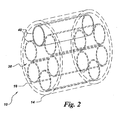
- fuel cell assembly 10 comprises a set 38 of fuel cells.
- the set 38 of fuel cells comprises fuel cells 40 having tubular configuration.
- the fuel cells 12, 40 can be any type of fuel cell including, but not limited to, solid oxide fuel cells, proton exchange membrane fuel cells, molten carbonate fuel cells, phosphoric acid fuel cells, alkaline fuel cells, direct methanol fuel cells, regenerative fuel cells, zinc air fuel cells, and protonic ceramic fuel cells.
- the exemplary fuel cell 12 comprises an anodes 20 and 28, a cathode 24, an electrolyte 22 interposed therebetween, an interconnect 26 which is in intimate contact with at least one of the anode 20, the cathode 24 and the electrolyte 22.
- an oxidant such as air
- a fuel flow is introduced into the assembly, as indicated generally at reference numeral 34.
- the oxidant flows through a coolant channel defined between the inner wall of the container 14 and the thermal shield 16, and is introduced into the fuel cell 12, as indicated generally at reference numeral 36 to provide oxidant to the cathode 24.
- oxygen ions (O 2- ) generated at the cathode 24 are transported across the electrolyte 22 interposed between the anode 20 and the cathode 24.
- the fuel 34 for example natural gas, is fed to the anode 20.
- the fuel 34 at the anode 20 site reacts with oxygen ions (O 2- ) transported to the anode 20 across the electrolyte 22.
- the oxygen ions (O 2- ) are de-ionized to release electrons to an external electric circuit (not shown).
- the electron flow thus produces direct current electricity across the external electric circuit.
- the electricity generation process produces certain exhaust gases and generates waste heat.
- the exhaust gases are exhausted through outlet 32.
- the present technique offers a number of possibilities for at least partially thermally shielding the container wall from heat generated by the fuel cell.
- one or more flow paths are defined between the container wall and the thermal shield, and a coolant is circulated though the paths to extract heat via convective heat transfer.
- the coolant stream comprises at least part of the oxidant needed for operation of the fuel cell. All or part of the coolant may be circulated through the cell, or the coolant stream may be supplemented by additional flow, depending upon such factors as the heat load, the coolant inlet temperature, the mass flow rate of coolant, and the mass flow rate of oxidant.
- oxidant as coolant also provides the advantage of preheating the oxidant for more efficient reaction within the fuel cell.
- a separate coolant including gaseous, liquid or mixed phase coolants, may be employed and isolated from the oxidant stream, as described in greater detail below.
- the fuel cell assembly 10 comprises a fuel cell 12 disposed within a container 14 configured to be pressurized, and a thermal shield 16 disposed between the fuel cell 12 and the container 14.
- a lower distribution passage 42 is formed to distribute coolant flow 46.
- the thermal shield 16 is spaced from the fuel cell container 14 to form a peripheral flow path 44 therebetween in fluid communication with the distribution passage 42.
- the coolant flow 46 which again in certain embodiments may comprise some or all of the needed oxidant, enters through the oxidant inlet 30 and flows through the lower distribution passage 42.
- the coolant flow 46 is then distributed in the lower distribution passage and enters a peripheral passage 44, as indicated generally at reference numeral 48.
- the coolant comprises oxidant, preheated by energy extracted from the thermal shield 16 and container 14 wall, at least a portion of the coolant flow 50, 52 is directed into the fuel cell 12, before being exhausted through the outlet 32.
- the thermal shield 16 presents an inner wall 54 disposed generally towards the fuel cell 12 and an outer wall 56 oriented towards the inner wall or periphery 58 of the container 14.
- the thermal shield 16 is configured to substantially surround an inner volume 60 within which the fuel cell 12 is disposed, and to similarly contiguously circumscribes the inner wall or periphery 58 of the container 14 to provide for lowering the operating temperature of the container 14 and to provide more uniform heat distribution around the inner periphery 58 of the container 14.
- the peripheral passage or flow path 44 is defined by the thermal shield outer surface 56 and container inner surface 58.
- the thermal shield 16 may comprise a thermally conductive material such as a metallic material.
- the thermal shield 16 and the coolant flow through the flow path 44 maintain temperatures of the fuel cell container 14 at or below prescribed limits. Maintaining temperature of the fuel cell container 14 at or below prescribed limits aids in maintaining structural integrity of the fuel cell container 14, which may be fabricated from conventionally available and economically affordable materials which can nevertheless withstand the operating temperature range, such as between about 600 °C to about 1300 °C. In actual implementation, it is anticipated that the container will ideally operate at temperatures well below those of the fuel cell assembly, such as below the 600 °C to 1300 °C temperature range indicated.
- the thermal shield 16 includes an insulating layer 62 on the inner surface 54 of the thermal shield 16.
- the container 14 has another insulating layer 66 disposed on the inner surface 58 of the container 14.
- the insulating layers 62 and 66 comprise an insulating material, which may include, but is not limited to, a ceramic coating such as plasma sprayed thermal barrier coating.
- a ceramic coating such as plasma sprayed thermal barrier coating.
- Such coatings may include, for example, yttria stabilized zirconia oxides, porous or cellular ceramic foam materials, or other ceramics or low thermal conductivity metallic oxides capable of operating at the temperatures anticipated in the fuel cell assembly.
- the insulating layers 62, 66 maintain a desired thermal gradient through the thermal shield 16 and wall 58 of the container 14 so as to reduce the temperature of the container wall during operation. Moreover, the thermal shield 16 effectively avoids or reduces thermal hot spots at localized regions in the container 14 ensuring uniform structural integrity throughout the container 14 surface.
- the thermal shield 16 further comprises a second shield wall 70 configured to define an inner surface 58 of the container 14.
- the insulating layer 66 is disposed between the second shield wall 70 and the inner surface 58 of the container 14.
- the flow path 44 is defined by the inner surface 72 of the second shield wall 70 and the outer surface 56 of the thermal shield 16.
- the thermal shield 16 comprises fluid distribution manifolds 76 and 78, joined by a plurality of fluid conduits 80 configured to receive the cooling fluid therethrough.
- the plurality of fluid conduits 80 receive and return circulating coolant by cooperation with passages within the fluid distribution manifolds 76 and 78.
- the arrangement of Figs. 9 and 10 may permit the use of a coolant stream different from the oxidant, including a gaseous, liquid or mixed phase coolants, by isolation of the manifolds 76 and 78 from oxidant flow into and out of the fuel cell assembly 10. It should be noted, however, that the basic structure of this embodiment shares characteristics with the other embodiments described herein, such as substantially surrounding the fuel cell 12 and providing generally continuous shielding of the container wall.
- the cooling fluid enters the container 14 through a cooling fluid inlet 88.
- the cooling fluid is exhausted through a cooling fluid outlet 90.
- the oxidant 30 enters through an oxidant inlet 84 and is exhausted through an oxidant outlet 86.
- the cooling fluid may include any suitable fluid, such as water, steam, a mixture thereof, or other fluids having desirable cooling properties (e.g. relatively high specific heat values).
- the thermal shield may comprise a cylindrical shield assembly 82.
- the cylindrical shield assembly 82 separates oxidant flow, received through inlet 84 and exhausted through outlet 86, from coolant, which is received through coolant inlet 88 and exits through coolant outlet 90.
- the cylindrical shield assembly 82 further comprises a base 92 having an annular groove 94 for receiving a seal 96.
- the base 92 supports a lower edge 100 of the cylindrical shield 98.
- the seal 96 fits within an annular groove 94 and separates the cooling fluid from the oxidant.
- Other construction techniques may, of course, be envisaged, such as for joining the base 92 and the cylindrical shield 98 by welding, soldering, and so forth.
- thermal shield may be provided on the outer surface of the thermal shield to further enhance heat transfer from the thermal shield.
- the thermal shield is made of a thermally conductive material, such as a metal
- fins or other features may be provided that offer greater surface areas for heat transfer, increase or orient flow of coolant over the surfaces, or increase residence time of the coolant in the structure.
- such structures may be provided separately from the thermal shield itself and disposed within the coolant passage, or affixed to the thermal shield during assembly.
Landscapes
- Life Sciences & Earth Sciences (AREA)
- Engineering & Computer Science (AREA)
- Manufacturing & Machinery (AREA)
- Sustainable Development (AREA)
- Sustainable Energy (AREA)
- Chemical & Material Sciences (AREA)
- Chemical Kinetics & Catalysis (AREA)
- Electrochemistry (AREA)
- General Chemical & Material Sciences (AREA)
- Fuel Cell (AREA)
- Hybrid Cells (AREA)
Applications Claiming Priority (2)
| Application Number | Priority Date | Filing Date | Title |
|---|---|---|---|
| US10/305,162 US6896987B2 (en) | 2002-11-27 | 2002-11-27 | Fuel cell container cooling system |
| US305162 | 2002-11-27 |
Publications (1)
| Publication Number | Publication Date |
|---|---|
| EP1427045A2 true EP1427045A2 (en) | 2004-06-09 |
Family
ID=32312180
Family Applications (1)
| Application Number | Title | Priority Date | Filing Date |
|---|---|---|---|
| EP03257437A Withdrawn EP1427045A2 (en) | 2002-11-27 | 2003-11-26 | Fuel cell container cooling system |
Country Status (5)
| Country | Link |
|---|---|
| US (1) | US6896987B2 (https=) |
| EP (1) | EP1427045A2 (https=) |
| JP (1) | JP2004179166A (https=) |
| CN (1) | CN1507100A (https=) |
| CA (1) | CA2449261A1 (https=) |
Cited By (1)
| Publication number | Priority date | Publication date | Assignee | Title |
|---|---|---|---|---|
| US8241813B2 (en) | 2005-04-05 | 2012-08-14 | Rolls-Royce Plc | Fuel cell arrangement |
Families Citing this family (11)
| Publication number | Priority date | Publication date | Assignee | Title |
|---|---|---|---|---|
| KR101049830B1 (ko) * | 2004-04-21 | 2011-07-15 | 삼성에스디아이 주식회사 | 연료 전지 시스템 |
| JP4958080B2 (ja) * | 2005-03-11 | 2012-06-20 | 一般財団法人電力中央研究所 | 遮熱容器を備えた燃料電池 |
| JP2007134178A (ja) * | 2005-11-10 | 2007-05-31 | Toyota Motor Corp | チューブ型燃料電池モジュール |
| US20070185216A1 (en) | 2006-02-09 | 2007-08-09 | Marcia Snyder | Antiviral method |
| US20080276631A1 (en) * | 2007-05-07 | 2008-11-13 | Ajith Kuttannair Kumar | System and Method for Cooling a Battery |
| JP5309139B2 (ja) * | 2007-08-20 | 2013-10-09 | マイ エフシー エイビー | 電気化学的電池を相互接続するための配置、燃料電池アッセンブリ、および燃料電池装置を製造する方法 |
| JP5334513B2 (ja) * | 2008-09-25 | 2013-11-06 | 京セラ株式会社 | 燃料電池モジュールおよび燃料電池装置 |
| US20100285386A1 (en) * | 2009-05-08 | 2010-11-11 | Treadstone Technologies, Inc. | High power fuel stacks using metal separator plates |
| JP5645375B2 (ja) * | 2009-07-17 | 2014-12-24 | 三菱重工業株式会社 | コンバインド発電システム |
| DE102013200790A1 (de) * | 2013-01-18 | 2014-07-24 | Robert Bosch Gmbh | Kühlsystem mit einem kühlmitteldurchströmten Kühlkörper zur Kühlung einer Batterie |
| JP6331970B2 (ja) * | 2014-10-30 | 2018-05-30 | 株式会社デンソー | 燃料電池装置 |
Family Cites Families (4)
| Publication number | Priority date | Publication date | Assignee | Title |
|---|---|---|---|---|
| US5952116A (en) * | 1995-02-16 | 1999-09-14 | Siemens Aktiengesellschaft | Solid electrolyte high temperature fuel cell module and method for its operation |
| US5750278A (en) * | 1995-08-10 | 1998-05-12 | Westinghouse Electric Corporation | Self-cooling mono-container fuel cell generators and power plants using an array of such generators |
| DE10040792C2 (de) * | 2000-08-21 | 2003-04-10 | Proton Motor Fuel Cell Gmbh | Polymerelektrolytmembran-Brennstoffzellensystem mit Kühlmedium-Verteilungsraum und-Sammelraum und mit Kühlung durch fluide Medien |
| US20030054215A1 (en) * | 2001-09-20 | 2003-03-20 | Honeywell International, Inc. | Compact integrated solid oxide fuel cell system |
-
2002
- 2002-11-27 US US10/305,162 patent/US6896987B2/en not_active Expired - Fee Related
-
2003
- 2003-11-13 CA CA002449261A patent/CA2449261A1/en not_active Abandoned
- 2003-11-26 EP EP03257437A patent/EP1427045A2/en not_active Withdrawn
- 2003-11-27 JP JP2003396594A patent/JP2004179166A/ja active Pending
- 2003-11-27 CN CNA2003101196618A patent/CN1507100A/zh active Pending
Cited By (1)
| Publication number | Priority date | Publication date | Assignee | Title |
|---|---|---|---|---|
| US8241813B2 (en) | 2005-04-05 | 2012-08-14 | Rolls-Royce Plc | Fuel cell arrangement |
Also Published As
| Publication number | Publication date |
|---|---|
| US6896987B2 (en) | 2005-05-24 |
| CA2449261A1 (en) | 2004-05-27 |
| JP2004179166A (ja) | 2004-06-24 |
| US20040101726A1 (en) | 2004-05-27 |
| CN1507100A (zh) | 2004-06-23 |
Similar Documents
| Publication | Publication Date | Title |
|---|---|---|
| US6146779A (en) | Fluid flow plate, fuel cell assembly system, and method employing same for controlling heat in fuel cells | |
| US7329471B2 (en) | Methods and apparatus for assembling solid oxide fuel cells | |
| KR20030076259A (ko) | 열교환기 일체형 연료 전지 배터리 | |
| EP4135082B1 (en) | Fuel plenum and fuel cell stack including same | |
| US6756144B2 (en) | Integrated recuperation loop in fuel cell stack | |
| US20070003806A1 (en) | Heat exchanger for fuel cell stack | |
| US6896987B2 (en) | Fuel cell container cooling system | |
| CN102047481A (zh) | 固体氧化物燃料电池系统 | |
| US11764389B2 (en) | Fuel cell manifold having an embedded dielectric layer and methods of making thereof | |
| US8021794B2 (en) | Fuel cell with cross-shaped reformer | |
| JP5122319B2 (ja) | 固体酸化物形燃料電池 | |
| JP2004139960A (ja) | 燃料電池 | |
| US9444117B2 (en) | Proton exchange membrane fuel cell with open pore cellular foam | |
| US8808940B2 (en) | Solid oxide fuel cell with sealed structure | |
| JP4544055B2 (ja) | 燃料電池 | |
| US20250062369A1 (en) | Interconnect for a fuel cell stack and method of operating the stack | |
| US12341224B2 (en) | Fuel cell stack assembly including heat sink inserts | |
| JP2007005134A (ja) | 水蒸気発生器および燃料電池 | |
| JP2010238440A (ja) | 燃料電池モジュール | |
| JP2025097628A (ja) | 電気化学スタック、ホットモジュール及び水素製造装置 | |
| CA3181279A1 (en) | Fuel cell stack assembly including heat sink inserts | |
| JPS61148768A (ja) | 溶融炭酸塩型燃料電池 | |
| JPH0589895A (ja) | 固体電解質型燃料電池 | |
| JPS61148767A (ja) | 溶融炭酸塩型燃料電池 |
Legal Events
| Date | Code | Title | Description |
|---|---|---|---|
| PUAI | Public reference made under article 153(3) epc to a published international application that has entered the european phase |
Free format text: ORIGINAL CODE: 0009012 |
|
| AK | Designated contracting states |
Kind code of ref document: A2 Designated state(s): AT BE BG CH CY CZ DE DK EE ES FI FR GB GR HU IE IT LI LU MC NL PT RO SE SI SK TR |
|
| AX | Request for extension of the european patent |
Extension state: AL LT LV MK |
|
| STAA | Information on the status of an ep patent application or granted ep patent |
Free format text: STATUS: THE APPLICATION IS DEEMED TO BE WITHDRAWN |
|
| 18D | Application deemed to be withdrawn |
Effective date: 20080602 |