EP1425940B1 - Innenohrelektrode mit teilweise abnehmbarem hydrophilem segment zur späteren selbstpositionierung - Google Patents
Innenohrelektrode mit teilweise abnehmbarem hydrophilem segment zur späteren selbstpositionierung Download PDFInfo
- Publication number
- EP1425940B1 EP1425940B1 EP02779789A EP02779789A EP1425940B1 EP 1425940 B1 EP1425940 B1 EP 1425940B1 EP 02779789 A EP02779789 A EP 02779789A EP 02779789 A EP02779789 A EP 02779789A EP 1425940 B1 EP1425940 B1 EP 1425940B1
- Authority
- EP
- European Patent Office
- Prior art keywords
- hydrophilic segment
- electrode
- elastomer
- perimodiolar
- carrier
- Prior art date
- Legal status (The legal status is an assumption and is not a legal conclusion. Google has not performed a legal analysis and makes no representation as to the accuracy of the status listed.)
- Expired - Lifetime
Links
- 210000003477 cochlea Anatomy 0.000 claims abstract description 13
- 210000001079 scala tympani Anatomy 0.000 claims abstract description 13
- 238000003780 insertion Methods 0.000 claims abstract description 12
- 230000037431 insertion Effects 0.000 claims abstract description 12
- 238000002513 implantation Methods 0.000 claims abstract description 5
- 229920001971 elastomer Polymers 0.000 claims description 32
- 239000000806 elastomer Substances 0.000 claims description 32
- 238000000034 method Methods 0.000 claims description 23
- 239000003054 catalyst Substances 0.000 claims description 20
- 238000002156 mixing Methods 0.000 claims description 19
- 239000000017 hydrogel Substances 0.000 claims description 18
- 239000007943 implant Substances 0.000 claims description 16
- 229910052751 metal Inorganic materials 0.000 claims description 14
- 239000002184 metal Substances 0.000 claims description 14
- BASFCYQUMIYNBI-UHFFFAOYSA-N platinum Chemical group [Pt] BASFCYQUMIYNBI-UHFFFAOYSA-N 0.000 claims description 12
- 229920002379 silicone rubber Polymers 0.000 claims description 12
- 239000000203 mixture Substances 0.000 claims description 11
- 230000008961 swelling Effects 0.000 claims description 11
- 239000004944 Liquid Silicone Rubber Substances 0.000 claims description 7
- 239000000178 monomer Substances 0.000 claims description 6
- 229910052697 platinum Inorganic materials 0.000 claims description 6
- 239000004945 silicone rubber Substances 0.000 claims description 5
- XLYOFNOQVPJJNP-UHFFFAOYSA-N water Chemical compound O XLYOFNOQVPJJNP-UHFFFAOYSA-N 0.000 claims description 4
- 239000004971 Cross linker Substances 0.000 claims description 3
- 239000012153 distilled water Substances 0.000 claims description 3
- 238000000605 extraction Methods 0.000 claims description 3
- 239000011521 glass Substances 0.000 claims description 3
- 239000003999 initiator Substances 0.000 claims description 3
- 238000006116 polymerization reaction Methods 0.000 claims description 3
- 229920002635 polyurethane Polymers 0.000 claims description 3
- 239000004814 polyurethane Substances 0.000 claims description 3
- 241000122159 Modiolus Species 0.000 abstract description 5
- 229920000642 polymer Polymers 0.000 description 13
- 230000000638 stimulation Effects 0.000 description 9
- 230000008569 process Effects 0.000 description 6
- 239000004205 dimethyl polysiloxane Substances 0.000 description 4
- 229920000435 poly(dimethylsiloxane) Polymers 0.000 description 4
- 108091006146 Channels Proteins 0.000 description 3
- 230000008901 benefit Effects 0.000 description 3
- 230000003993 interaction Effects 0.000 description 3
- 239000003550 marker Substances 0.000 description 3
- 230000007383 nerve stimulation Effects 0.000 description 3
- 230000004936 stimulating effect Effects 0.000 description 3
- 230000000694 effects Effects 0.000 description 2
- 210000000256 facial nerve Anatomy 0.000 description 2
- 229920001477 hydrophilic polymer Polymers 0.000 description 2
- 210000000944 nerve tissue Anatomy 0.000 description 2
- -1 polydimethylsiloxane Polymers 0.000 description 2
- 229920001296 polysiloxane Polymers 0.000 description 2
- 239000000243 solution Substances 0.000 description 2
- SMZOUWXMTYCWNB-UHFFFAOYSA-N 2-(2-methoxy-5-methylphenyl)ethanamine Chemical compound COC1=CC=C(C)C=C1CCN SMZOUWXMTYCWNB-UHFFFAOYSA-N 0.000 description 1
- NIXOWILDQLNWCW-UHFFFAOYSA-N 2-Propenoic acid Natural products OC(=O)C=C NIXOWILDQLNWCW-UHFFFAOYSA-N 0.000 description 1
- HRPVXLWXLXDGHG-UHFFFAOYSA-N Acrylamide Chemical group NC(=O)C=C HRPVXLWXLXDGHG-UHFFFAOYSA-N 0.000 description 1
- 241001465754 Metazoa Species 0.000 description 1
- RTAQQCXQSZGOHL-UHFFFAOYSA-N Titanium Chemical compound [Ti] RTAQQCXQSZGOHL-UHFFFAOYSA-N 0.000 description 1
- 230000006978 adaptation Effects 0.000 description 1
- 230000000181 anti-adherent effect Effects 0.000 description 1
- 210000000721 basilar membrane Anatomy 0.000 description 1
- 230000009286 beneficial effect Effects 0.000 description 1
- 230000015572 biosynthetic process Effects 0.000 description 1
- 239000008280 blood Substances 0.000 description 1
- 210000004369 blood Anatomy 0.000 description 1
- 230000001427 coherent effect Effects 0.000 description 1
- 229920001577 copolymer Polymers 0.000 description 1
- 238000007334 copolymerization reaction Methods 0.000 description 1
- 238000004132 cross linking Methods 0.000 description 1
- 230000007423 decrease Effects 0.000 description 1
- 238000004090 dissolution Methods 0.000 description 1
- 210000003027 ear inner Anatomy 0.000 description 1
- 238000002347 injection Methods 0.000 description 1
- 239000007924 injection Substances 0.000 description 1
- 230000010354 integration Effects 0.000 description 1
- 231100000053 low toxicity Toxicity 0.000 description 1
- 210000004379 membrane Anatomy 0.000 description 1
- 239000012528 membrane Substances 0.000 description 1
- 230000004048 modification Effects 0.000 description 1
- 238000012986 modification Methods 0.000 description 1
- 210000003205 muscle Anatomy 0.000 description 1
- 210000005036 nerve Anatomy 0.000 description 1
- 230000001590 oxidative effect Effects 0.000 description 1
- 238000011417 postcuring Methods 0.000 description 1
- 238000000926 separation method Methods 0.000 description 1
- 238000001356 surgical procedure Methods 0.000 description 1
- 230000002522 swelling effect Effects 0.000 description 1
- 230000002123 temporal effect Effects 0.000 description 1
- 210000001519 tissue Anatomy 0.000 description 1
- 239000010936 titanium Substances 0.000 description 1
- 229910052719 titanium Inorganic materials 0.000 description 1
Images




Classifications
-
- A—HUMAN NECESSITIES
- A61—MEDICAL OR VETERINARY SCIENCE; HYGIENE
- A61N—ELECTROTHERAPY; MAGNETOTHERAPY; RADIATION THERAPY; ULTRASOUND THERAPY
- A61N1/00—Electrotherapy; Circuits therefor
- A61N1/02—Details
- A61N1/04—Electrodes
- A61N1/05—Electrodes for implantation or insertion into the body, e.g. heart electrode
- A61N1/0526—Head electrodes
- A61N1/0541—Cochlear electrodes
Definitions
- the present invention relates to cochlear implants, and more particularly to a perimodiolar electrode designed for cochlear implantation.
- implants containing electrodes for stimulation of nerve tissue include, for example, pacemakers, oral implants for stimulating muscle tissue in the mouth of a subject or patient as well as nerve tissue associated with a subject's sinus cavity and cochlear implants for stimulating the tissues of the inner ear.
- pacemakers for example, pacemakers, oral implants for stimulating muscle tissue in the mouth of a subject or patient as well as nerve tissue associated with a subject's sinus cavity
- cochlear implants for stimulating the tissues of the inner ear.
- the dynamic range of stimulation is often limited and channel interaction often interferes with the effectiveness of the implant. Channel interaction may be caused by the temporal integration of charges at the membrane level or by the field overlap from individual electrodes.
- Another problem associated with cochlear implants is a tendency for the electrode to move after placement in the ear. Such movement decreases the control of place stimulation, and consequently lowers the hearing performance of the subject. Movement of the electrode of a cochlear implant may also contribute to unwanted and unnecessary nerve stimulation such as facial nerve stimulation.
- PDMS polydimethylsiloxane
- a perimodiolar electrode for cochlear implantation includes an electrode carrier having a front end and a back end.
- the carrier includes one or more contacts and a hydrophilic segment that swells after insertion in a cochlea and detaches at least in part from the carrier.
- the hydrophilic segment may detach from the electrode carrier between the front end and the back end.
- the detached hydrophilic segment may surround the modiolus of a scala tympani of the cochlea or the inner wall of a scala tympani of the cochlea.
- the electrode carrier may include an elastomer.
- the hydrophilic segment may include an elastomer and a metal-based catalyst.
- the elastomer may be silicone rubber or the elastomer may be polyurethane.
- the catalyst may be platinum-based.
- the hydrophilic segment may include a hydrogel or the hydrophilic segment may include a hydrogel and an elastomer.
- a method for forming a cochlear implant electrode includes preparing a hydrophilic segment and placing the hydrophilic segment in a first section of an electrode mold. Electrical contacts are placed in a second section of the electrode mold and an elastomeric carrier is injected into the mold.
- preparing a hydrophilic segment may include forming a hydrogel.
- preparing a hydrophilic segment may include mixing a hydrogel and an elastomer.
- mixing a hydrogel and an elastomer may include mixing a hydrogel and liquid silicone rubber.
- preparing a hydrophilic segment may include mixing an elastomer and a metal-based catalyst, and mixing an elastomer and a metal-based catalyst may include mixing liquid silicone rubber and a platinum-based catalyst.
- a method for preparing a hydrophilic segment includes adding a metal-based catalyst to an elastomer and mechanically mixing the metal-based catalyst and the elastomer to form a cross-linked product.
- the mixture is de-gassed and cured in a segment mold.
- the mixture is then immersed in a polymerization solution and suspended in a sealed glass reactor.
- the method may also include raising the temperature to allow a monomer, initiator, and cross-linker to react and removing monomers and unreacted hompolymers by soxlet extraction in distilled water.
- the present application pertains to the formation of implantable apparatuses such as pacemakers, cochlear implants, and other nerve stimulating devices.
- implantable apparatuses such as pacemakers, cochlear implants, and other nerve stimulating devices.
- PDMS polydimethylsiloxane
- elastomers are used to aid in the positioning of the implantable device subsequent to insertion into the body of a subject or patient.
- Modeling of intra-cochlear stimulation and animal EABR data indicates that an electrode (or electrode array) positioned close to the inner wall of the scala tympani would be beneficial to the neuro-stimulation of cochlea implants (hence the name perimodiolar electrode).
- perimodiolar electrode would lower psyco-accoustic threshold, increase the dynamic range of stimulation, and reduce channel interaction.
- Other potential benefits expected from a perimodiolar electrode array include reduced power consumption to drive the implant, reduced side effects for the subject or patient, implementation of innovative stimulation schema, and better place coding of frequency.
- a perimodiolar electrode would allow a larger number of electrodes to be used effectively. It is hoped that an increase in the control of place stimulation would contribute toward raising the level of subjects or patients with poor hearing performance.
- An additional, potential benefit expected from a perimodiolar electrode is the side effect of unwanted and unnecessary stimulation would be reduced (especially reduced facial nerve stimulation).
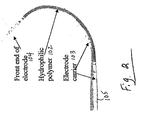
- Figs. 1 and 2 illustrate a perimodiolar electrode with a hydrophylic segment prior to insertion into a cochlea in accordance with one embodiment of the invention.
- the perimodiolar electrode 101 is designed for implantation into the cochlea of a subject and includes an electrode which can surround the modiolus or the inner wall (also called the medial wall) of the scala tympani.
- the electrode 101 includes a front end 104 and a back end 105.
- the electrode 101 also includes a hydrophilic segment 102 that is initially substantially fully connected to an electrode carrier 103.
- the cross sectional shape of the electrode 101 may be ellipsoid, round, somewhat rectangular, or any combination of the above.
- the electrode 101 may be tapered or un-tapered along its length.
- the hydrophilic segment 102 is substantially fully connected to the electrode carrier 103, the overall electrode 101 appears as a single unit, as shown in cross section A-A' of Fig. 1 .
- the electrode 101 is fully or partially introduced in the scala tympani spiral, it lays against the outer wall of the lumen.
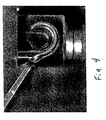
- Figs. 3 and 5 illustrate that at some time after insertion into the scala tympani, the hydrophilic segment 102 of the electrode 101 begins swelling.
- the swelling of the hydrophilic polymer causes an increase in diameter as well as an elongation of the hydrophilic segment 102.
- the swelling hydrophilic segment 102 detaches itself from the electrode carrier 103, except at the front end 104 and back end 105, as shown in Figs. 3 and 5 .
- the swelling segment of the electrode stays in close contact with the outer wall of the scala tympani. Elongation of the hydrophilic segment 102 causes the electrode 101 to position itself against the inner wall of the scala tympani as shown in Fig. 5 .
- the shape of the swelling hydrophilic segment 102 is determined by the mold that receives the injection of the polymer or other composition from which the segment it is formed.
- the shape may be that of a half circle, an ellipsoid, a rectangle, or any other shape which may promote or restrict the swelling properties of the segment in relation to the electrode carrier.
- the increase in volume of the swelling polymer is a control parameter and may vary between 10% and 60% depending on the hydrophilic mixture.
- the elongation of the swelling polymer may be anywhere between 10% and 50%.
- the relative size of the swelling polymer compared to the electrode carrier may be arbitrary.
- the electrode 101 In its final state, the electrode 101 consists of two connected branches and as shown in Fig. 3 .
- the electrode carrier 103 and the hydrophilic segment 102 both have a front-end connection 301 and a back-end connection 302.
- the front-end connection 301 and back-end connection 302 consist of any means which keeps the electrode carrier 103 and the hydrophilic segment 102 connected before, during, and after completion of swelling while permitting detachment of the hydrophilic segment 102 over at least part of the distance between the front-end connection 301 and the back-end connection 302.
- Such a connection includes but is not limited to polymer bonding, clip, pin-notch system, or any means as deemed profitable.
- the front-end connection 301 is disconnectable for the purpose of ex-plantation of the electrode 101 when necessary.
- the hydrophilic segment 102 is easily disconnectable.
- the hydrophilic segment 102 and the electrode carrier 103 may be joined by a bare PtIr ribbon section, which comes out of the hydrophilic segment 102 and is lodged snuggly or loosely in an oriented silicone cavity molded on the electrode carrier 103.
- the hydrophilic segment 102 can be dislocated at the front-end connection 301 by simply pulling back on the hydrophilic segment 102 with sufficient force.
- the front-end connection 301 may be any other system known in the art and deemed advantageous.
- the back-end connection 302 may be accomplished through polymer bonding. Similarly, the back-end connection 302 may be accomplished through a medical grade titanium clip such as those produced by Heinz Kurz GmbH in Dusslingen, Germany.
- the branches may also be attached with a PtIr wire, a silicone ring, or surgical sutures.
- the front end 104 generally projects beyond the hydrophilic segment 102 by some distance.
- the length ratio between the front end 104 and hydrophilic segment 102 may be anywhere from 0.3 to 3.
- the electrode carrier 103 usually includes a single row of contacts 106 facing the modiolus and the number of contacts 106 may be arbitrarily fixed.
- the electrode 101 may have double or more contacts to increase the surface area of the electrode and reduce the impedance.
- the contact distribution between the front end 104 and the rest of the electrode 101 can be arbitrary.
- the front end 104 may receive anywhere from 0.1 n to 0.8n of the contacts, as deemed advantageous for stimulation.
- the electrode 101 is built with no front end 104 and that the hydrophilic segment 102 converges at the tip of the electrode 101.
- the contact spacing on the front end 104 may be equal, logarithmic, or equal and logarithmic.
- Dummy contacts or markers can be placed between the last contact on the electrode (most basal) and for a distance of up to 15 mm. Dummy contact or marker separation is arbitrary. The role of the dummy contact or marker is to give an indication of the insertion depth of the electrode to the surgeon.
- the dummy contact or marker may be shape coded to indicate distance along the array without having to count the number of interval between the contacts.
- Fig. 6 is a flow chart illustrating a method for making a perimodiolar electrode in accordance with another embodiment of the invention.
- a hydrophilic segment is prepared and then placed 602 in a first section of an electrode mold.
- Preparing a hydrophilic segment may include forming a hydrogel.
- the term "hydrogel” refers to a coherent three-dimensional polymeric network that can imbibe large quantities of water without the dissolution of the polymer network.
- Preparing a hydrophilic segment may further include a mixing a hydrogel and an elastomer.
- mixing a hydrogel and an elastomer may include mixing a hydrogel and liquid silicone rubber.
- preparing a hydrophilic segment may include mixing an elastomer and a metal-based catalyst, and mixing an elastomer and a metal-based catalyst may include mixing liquid silicone rubber and a platinum-based catalyst. Electrical contacts are placed 603 in a second section of the electrode mold and an elastomeric carrier is injected 604 into the mold.
- the hydrophilic segment can be prepared from a hydrogel or a multi-component system of hydrogel and elastomer (silicone rubber or polyurethane).
- the multi-component system may be fabricated by co-polymerization, grafting, blending, simultaneous interpenetrating polymer network, and sequential interpenetrating polymer network.
- An interpenetrating polymer network (“IPN") is defined as an intimate combination of two or more polymers, at least one of which is synthesized or cross-linked in the immediate presence of the other. The cross linking of at least one of the polymer systems distinguishes an IPN from an ordinary blend or a co-polymer.
- Fig. 7 is a flow chart illustrating a method for making a hydrophilic segment in accordance with a further embodiment of the invention.
- the hydrophilic segment is prepared by adding, in process 701, a metal-based catalyst to an elastomer.
- a metal-based catalyst for example, liquid silicone rubber (“LSR") may be mixed with a platinum-based catalyst.
- LSR liquid silicone rubber
- the metal-based catalyst and the elastomer are mechanically mixed 702 to form a cross-linked product.
- the mixture is de-gassed in process 703 and injected into a mold with a pre-designed cavity shaped for the hydrophilic segment.
- the product is immersed 705 for approximately twenty-four hours at room temperature in a polymerization solution that may include acrylic acid or acrylamide monomer.
- a polymerization solution that may include acrylic acid or acrylamide monomer.
- the swollen hydrophilic segment samples are suspended 706 in a sealed glass reactor. The temperature is raised 707 and kept at a definite temperature to allow the monomer, initiator, and cross-linker to react.
- the monomers and unreacted hompolymers are removed 708 by soxlet extraction in distilled water.
- the hydrophilic segment is placed in a first part of a mold, and, after fixation of wires inside a second part of the mold, LSR is injected in to the mold to produce the final electrode.
- the electrode carrier and hydrophilic polymer are and remain attached during the insertion process; b) a surgeon does not have to perform any additional positioning since the electrode is self positioning post operatively; c) the connection to the electrode modiolus is independent of morphology; d) the front end of the electrode has less of a tendency to perforate the basilar membrane during the positioning process; e) no special tools are needed for insertion or positioning; f) the electrode and the insertion aperture on the bony promontory may remain small in diameter; and g) a section of the electrode (e.g., the front end) may be deeply inserted in the cochlear.
Landscapes
- Health & Medical Sciences (AREA)
- Otolaryngology (AREA)
- Cardiology (AREA)
- Heart & Thoracic Surgery (AREA)
- Engineering & Computer Science (AREA)
- Biomedical Technology (AREA)
- Nuclear Medicine, Radiotherapy & Molecular Imaging (AREA)
- Radiology & Medical Imaging (AREA)
- Life Sciences & Earth Sciences (AREA)
- Animal Behavior & Ethology (AREA)
- General Health & Medical Sciences (AREA)
- Public Health (AREA)
- Veterinary Medicine (AREA)
- Prostheses (AREA)
- Materials For Medical Uses (AREA)
- Electrotherapy Devices (AREA)
- Investigating Or Analyzing Materials By The Use Of Electric Means (AREA)
- Measurement Of The Respiration, Hearing Ability, Form, And Blood Characteristics Of Living Organisms (AREA)
- Fixed Capacitors And Capacitor Manufacturing Machines (AREA)
Claims (19)
- Perimodiolarelektrode zur Implantation in die Cochlea, umfassend:einen Elektrodenträger (101) mit einem vorderen Ende (104) und einem hinteren Ende (105), wobei der Träger ein oder mehrere Kontakte (106) und einen hydrophilen Abschnitt (102) enthält, der nach Einsetzen in eine Cochlea quillt und der dadurch gekennzeichnet ist, dass der Elektrodenträger (103) und der hydrophile Abschnitt (102) jeweils eine Verbindung (301) am vorderen Ende und eine Verbindung (302) am hinteren Ende aufweisen, wodurch der Elektrodenträger (103) und der hydrophile Abschnitt (102) vor, während und nach Abschluss der Quellung verbunden bleiben, während eine Ablösung des hydrophilen Abschnittes (102) zumindest entlang eines Teils der Distanz zwischen der Verbindung (301) am vorderen Ende und der Verbindung (302) am hinteren Ende ermöglicht wird.
- Perimodiolarelektrode nach Anspruch 1, wobei der hydrophile Abschnitt sich zumindest teilweise vom Elektrodenträger ablöst, wobei der Elektrodenträger so ausgelegt ist, dass er die innere Wandung einer Scala tympani der Cochlea kontaktiert.
- Perimodiolarelektrode nach Anspruch 1, wobei, wenn der hydrophile Abschnitt sich zumindest teilweise vom Elektrodenträger ablöst, der abgelöste hydrophile Abschnitt ausgelegt ist, um die äußere Wandung einer Scala tympani der Cochlea zu kontaktieren.
- Perimodiolarelektrode nach Anspruch 1, wobei der Elektrodenträger weiterhin ein Elastomer aufweist.
- Perimodiolarelektrode nach Anspruch 1, wobei der hydrophile Abschnitt ein Elastomer und einen auf einem Metall basierenden Katalysator aufweist.
- Perimodiolarelektrode nach Anspruch 5, wobei das Elastomer Silikongummi ist.
- Perimodiolarelektrode nach Anspruch 5, bei das Elastomer Polyurethan ist.
- Perimodiolarelektrode nach Anspruch 5, wobei der Katalysator auf Platin basiert.
- Perimodiolarelektrode nach Anspruch 1, wobei der hydrophile Abschnitt ein Hydrogel enthält.
- Perimodiolarelektrode nach Anspruch 1, wobei der hydrophile Abschnitt ein Hydrogel und ein Elastomer enthält.
- Perimodiolarelektrode nach Anspruch 10, wobei das Elastomer Silikongummi ist.
- Verfahren zum Ausbilden einer Implantatelektrode für die Cochlea, wobei das Verfahren folgendes umfaßt:Herstellen eines hydrophilen Abschnittes;Einsetzen des Hydrophilen Abschnittes in einen ersten Teil einer Elektrodenform;Einsetzen von elektrischen Kontakten in einen zweiten Teil der Elektrodenform; undInjizieren eines elastomeren Trägers in die Form.
- Verfahren nach Anspruch 12, wobei das Herstellen eines hydrophilen Abschnittes die Ausbildung eines Hydrogels umfaßt.
- Verfahren nach Anspruch 12, wobei das Herstellen eines hydrophilen Abschnittes ein Vermischen eines Hydrogels und eines Eleastomeren umfaßt.
- Verfahren nach Anspruch 14, wobei das Elastomer einen flüssigen Silikongummi umfasst.
- Verfahren nach Anspruch 12, wobei das Herstellen eines hydrophilen Abschnittes das Vermischen eines Elastomeren und eines auf einem Metall basierenden Katalysators umfaßt.
- Verfahren nach Anspruch 16, wobei das Vermischen eines Elastomeren und eines auf einem Metall basierenden Katalysators das Vermischen eines flüssigen Silikongummis und eines auf Platin basierenden Katalysators umfaßt.
- Verfahren nach Anspruch 12, wobei es weiterhin das Herstellen des hydrophilen Abschnittes durch ein Verfahren umfasst, welches folgendes umfasst:Hinzufügen eines auf einem Metall basierenden Katalysators zu einem Elastomeren;mechanisches Vermischen des auf einem Metall basierenden Katalysators und des Elastomeren, um ein vernetztes Produkt auszubilden;Entgasen der Mischung:Härten der Mischung in einer Abschnittsform;Eintauchen der Mischung in eine Polymerisationslösung; undSuspendieren der Mischung in einem abgedichteten Glasreaktor.
- Verfahren nach Anspruch 18, welches weiterhin umfaßt:Erhöhen der Temperatur, um die Umsetzung des Monomeren, des Initiators und des Vernetzungsmittels zu ermöglichen; undEntfernen der Monomere und der nicht umgesetzten Homopolymere durch Soxhlet-Extraktion in destilliertem Wasser.
Applications Claiming Priority (3)
| Application Number | Priority Date | Filing Date | Title |
|---|---|---|---|
| US32204901P | 2001-09-13 | 2001-09-13 | |
| US322049P | 2001-09-13 | ||
| PCT/IB2002/004202 WO2003024153A1 (en) | 2001-09-13 | 2002-09-13 | Intra-cochlear electrode with a partially detachable hydrophilic segment for deferred self-positioning |
Publications (3)
| Publication Number | Publication Date |
|---|---|
| EP1425940A1 EP1425940A1 (de) | 2004-06-09 |
| EP1425940A4 EP1425940A4 (de) | 2008-02-06 |
| EP1425940B1 true EP1425940B1 (de) | 2009-03-04 |
Family
ID=23253173
Family Applications (1)
| Application Number | Title | Priority Date | Filing Date |
|---|---|---|---|
| EP02779789A Expired - Lifetime EP1425940B1 (de) | 2001-09-13 | 2002-09-13 | Innenohrelektrode mit teilweise abnehmbarem hydrophilem segment zur späteren selbstpositionierung |
Country Status (6)
| Country | Link |
|---|---|
| US (2) | US20030078516A1 (de) |
| EP (1) | EP1425940B1 (de) |
| AT (1) | ATE424695T1 (de) |
| DE (1) | DE60231413D1 (de) |
| ES (1) | ES2222116T1 (de) |
| WO (1) | WO2003024153A1 (de) |
Cited By (3)
| Publication number | Priority date | Publication date | Assignee | Title |
|---|---|---|---|---|
| US7949412B1 (en) | 2005-06-02 | 2011-05-24 | Advanced Bionics, Llc | Coated electrode array having uncoated electrode contacts |
| US8190271B2 (en) | 2007-08-29 | 2012-05-29 | Advanced Bionics, Llc | Minimizing trauma during and after insertion of a cochlear lead |
| US8271101B2 (en) | 2007-08-29 | 2012-09-18 | Advanced Bionics | Modular drug delivery system for minimizing trauma during and after insertion of a cochlear lead |
Families Citing this family (11)
| Publication number | Priority date | Publication date | Assignee | Title |
|---|---|---|---|---|
| AUPS322702A0 (en) * | 2002-06-28 | 2002-07-18 | Cochlear Limited | Cochlear implant electrode array |
| DE102006006263B3 (de) * | 2006-02-10 | 2007-11-22 | Universität Rostock | Cochleaelektrode |
| WO2008058232A2 (en) * | 2006-11-08 | 2008-05-15 | Massachusetts Eye & Ear Infirmary | Spatially-focused actuation in a neural prosthesis |
| US9402990B2 (en) * | 2007-03-20 | 2016-08-02 | Cochlear Limited | Securing an implanted medical device in a patient |
| US8718795B2 (en) | 2007-03-20 | 2014-05-06 | Cochlear Limited | Securing an implanted medical device in a patient |
| AT506651B1 (de) * | 2008-04-11 | 2012-04-15 | Cochlear Ltd | Befestigung eines medizinischen implantats in einem patienten |
| US20140276405A1 (en) * | 2013-03-15 | 2014-09-18 | Christopher Robert Miller | Drug Delivery with an Expandable Polymeric Component |
| EP3154601A1 (de) | 2014-06-13 | 2017-04-19 | Hörsys GmbH | Selbstkrümmendes implantat |
| EP3169395B1 (de) | 2014-07-17 | 2019-04-17 | Cochlear Limited | Implantierbare stimulationsanordnungen |
| DE102016110137A1 (de) * | 2016-06-01 | 2017-12-07 | Medizinische Hochschule Hannover | Formadaptives medizinisches Implantat sowie Verwendung einer elektrischen Signalquelle |
| TR202018288A2 (tr) * | 2020-11-16 | 2022-05-23 | Hacettepe Ueniversitesi Rektoerluek | Koklear i̇mplantlarda kullanilan atravmati̇k bi̇r elektrod demeti̇ si̇stemi̇ |
Family Cites Families (17)
| Publication number | Priority date | Publication date | Assignee | Title |
|---|---|---|---|---|
| US4364813A (en) * | 1979-12-19 | 1982-12-21 | Ppg Industries, Inc. | Solid polymer electrolyte cell and electrode for same |
| US4445985A (en) * | 1983-03-25 | 1984-05-01 | Ppg Industries, Inc. | Electro organic method and apparatus for carrying out same |
| US4898183A (en) * | 1987-07-24 | 1990-02-06 | Cochlear Pty. Limited | Apparatus and method for insertion of cochlear electrode assembly |
| US5232984A (en) * | 1990-10-15 | 1993-08-03 | The Board Of The Regents The University Of Texas | Biocompatible microcapsules |
| US5397848A (en) * | 1991-04-25 | 1995-03-14 | Allergan, Inc. | Enhancing the hydrophilicity of silicone polymers |
| JP3522749B2 (ja) * | 1991-09-27 | 2004-04-26 | コックレア プロプライアタリー リミティド | 自己湾曲性蝸牛電極アレイ |
| US5545219A (en) * | 1995-03-30 | 1996-08-13 | Cochlear, Ltd. | Cochlear electrode implant assemblies with positioning system therefor |
| AU702746B2 (en) | 1995-09-20 | 1999-03-04 | Cochlear Limited | Bioresorbable polymer use in cochlear and other implants |
| WO1997030670A1 (en) * | 1996-02-26 | 1997-08-28 | Med-El Elektromedizinische Geräte GmbH | Structure method of use, and method of manufacture of an implanted hearing prosthesis |
| WO1998040119A1 (en) * | 1997-03-10 | 1998-09-17 | Med-El Elektromedizinische Geräte GmbH | Apparatus and method for perimodiolar cochlear implant with retro-positioning |
| US6231604B1 (en) * | 1998-02-26 | 2001-05-15 | Med-El Elektromedizinische Gerate Ges.M.B.H | Apparatus and method for combined acoustic mechanical and electrical auditory stimulation |
| US6078841A (en) * | 1998-03-27 | 2000-06-20 | Advanced Bionics Corporation | Flexible positioner for use with implantable cochlear electrode array |
| DE19853299C2 (de) * | 1998-11-19 | 2003-04-03 | Thomas Lenarz | Katheter zur Applikation von Medikamenten in Flüssigkeitsräumen des menschlichen Innenohrs |
| WO2000071063A1 (en) * | 1999-05-21 | 2000-11-30 | Cochlear Limited | A cochlear implant electrode array |
| US6408213B1 (en) * | 1999-09-29 | 2002-06-18 | Cardiac Pacemakers, Inc. | Low profile, ventricular, transvenous, epicardial defibrillation lead |
| EP1251809B1 (de) * | 2000-01-31 | 2007-01-03 | Med-El Elektromedizinische Geräte GmbH | Cochlear-implantatsystem mit im aussenohr einsetzbarem teil |
| US20060095045A1 (en) * | 2004-11-01 | 2006-05-04 | Sdgi Holdings, Inc. | Methods for explantation of intervertebral disc implants |
-
2002
- 2002-09-13 EP EP02779789A patent/EP1425940B1/de not_active Expired - Lifetime
- 2002-09-13 US US10/243,633 patent/US20030078516A1/en not_active Abandoned
- 2002-09-13 ES ES02779789T patent/ES2222116T1/es active Pending
- 2002-09-13 WO PCT/IB2002/004202 patent/WO2003024153A1/en not_active Ceased
- 2002-09-13 DE DE60231413T patent/DE60231413D1/de not_active Expired - Lifetime
- 2002-09-13 AT AT02779789T patent/ATE424695T1/de active
-
2007
- 2007-11-05 US US11/934,962 patent/US8145326B2/en not_active Expired - Fee Related
Cited By (3)
| Publication number | Priority date | Publication date | Assignee | Title |
|---|---|---|---|---|
| US7949412B1 (en) | 2005-06-02 | 2011-05-24 | Advanced Bionics, Llc | Coated electrode array having uncoated electrode contacts |
| US8190271B2 (en) | 2007-08-29 | 2012-05-29 | Advanced Bionics, Llc | Minimizing trauma during and after insertion of a cochlear lead |
| US8271101B2 (en) | 2007-08-29 | 2012-09-18 | Advanced Bionics | Modular drug delivery system for minimizing trauma during and after insertion of a cochlear lead |
Also Published As
| Publication number | Publication date |
|---|---|
| EP1425940A4 (de) | 2008-02-06 |
| ATE424695T1 (de) | 2009-03-15 |
| DE60231413D1 (de) | 2009-04-16 |
| WO2003024153A8 (en) | 2003-05-01 |
| EP1425940A1 (de) | 2004-06-09 |
| US20030078516A1 (en) | 2003-04-24 |
| US8145326B2 (en) | 2012-03-27 |
| WO2003024153A1 (en) | 2003-03-20 |
| US20080058914A1 (en) | 2008-03-06 |
| ES2222116T1 (es) | 2005-02-01 |
Similar Documents
| Publication | Publication Date | Title |
|---|---|---|
| US8145326B2 (en) | Intra-cochlear electrode with a partially detachable hydrophilic segment for deferred self-positioning | |
| EP1441679B1 (de) | Implantierbare flüssigkeitsabgabegeräte und implantierbare elektrode | |
| US20260027353A1 (en) | Implantable stimulating assembly | |
| RU2423154C2 (ru) | Имплантируемое устройство и способ доставки текучего лекарственного препарата в ткань | |
| JP3962330B2 (ja) | 移植蝸牛電極列のための挿入具 | |
| EP1478433B1 (de) | Verbindungselement für ein medikamentenabgabesystem in einem cochlear-implantat | |
| CN105960262B (zh) | 具有防回弹部件的电极 | |
| US10792504B2 (en) | Malleable implantable medical device | |
| AU2002363103A1 (en) | Implantable fluid delivery apparatuses and implantable electrode | |
| US20120041531A1 (en) | Cochlear implant with improved lumen arrangement | |
| US10010713B2 (en) | Nerve stimulation device for treating or reducing paralysis | |
| CN108778405A (zh) | 细胞聚集物和组织片段的植入方法 | |
| CN220424361U (zh) | 人工耳蜗给药电极、人工耳蜗植入体和人工耳蜗 | |
| EP3706857B1 (de) | Navigationsfähige implantierbare elektrode und kollabierender schmiermittelspeicher | |
| US20060178720A1 (en) | Method and apparatus for sealing a lumen in an electrode assembly | |
| RU2855654C1 (ru) | Имплантируемая нейроплатформа для стимуляции головного мозга либо регистрации электрической активности головного мозга | |
| AU2008212014A1 (en) | Connector for drug delivery system in cochlear implant | |
| US20140276405A1 (en) | Drug Delivery with an Expandable Polymeric Component | |
| AU2003287772A1 (en) | Method and apparatus for sealing a lumen in an electrode assembly |
Legal Events
| Date | Code | Title | Description |
|---|---|---|---|
| PUAI | Public reference made under article 153(3) epc to a published international application that has entered the european phase |
Free format text: ORIGINAL CODE: 0009012 |
|
| 17P | Request for examination filed |
Effective date: 20040211 |
|
| AK | Designated contracting states |
Kind code of ref document: A1 Designated state(s): AT BE BG CH CY CZ DE DK EE ES FI FR GB GR IE IT LI LU MC NL PT SE SK TR |
|
| EL | Fr: translation of claims filed | ||
| TCAT | At: translation of patent claims filed | ||
| A4 | Supplementary search report drawn up and despatched |
Effective date: 20080107 |
|
| RIC1 | Information provided on ipc code assigned before grant |
Ipc: H04R 25/00 20060101AFI20030327BHEP Ipc: A61F 2/18 20060101ALI20071228BHEP Ipc: A61N 1/05 20060101ALI20071228BHEP |
|
| 17Q | First examination report despatched |
Effective date: 20080616 |
|
| GRAP | Despatch of communication of intention to grant a patent |
Free format text: ORIGINAL CODE: EPIDOSNIGR1 |
|
| GRAS | Grant fee paid |
Free format text: ORIGINAL CODE: EPIDOSNIGR3 |
|
| GRAA | (expected) grant |
Free format text: ORIGINAL CODE: 0009210 |
|
| AK | Designated contracting states |
Kind code of ref document: B1 Designated state(s): AT BE BG CH CY CZ DE DK EE ES FI FR GB GR IE IT LI LU MC NL PT SE SK TR |
|
| REG | Reference to a national code |
Ref country code: GB Ref legal event code: FG4D |
|
| REG | Reference to a national code |
Ref country code: CH Ref legal event code: EP Ref country code: CH Ref legal event code: NV Representative=s name: KIRKER & CIE S.A. |
|
| REG | Reference to a national code |
Ref country code: IE Ref legal event code: FG4D |
|
| REF | Corresponds to: |
Ref document number: 60231413 Country of ref document: DE Date of ref document: 20090416 Kind code of ref document: P |
|
| PG25 | Lapsed in a contracting state [announced via postgrant information from national office to epo] |
Ref country code: NL Free format text: LAPSE BECAUSE OF FAILURE TO SUBMIT A TRANSLATION OF THE DESCRIPTION OR TO PAY THE FEE WITHIN THE PRESCRIBED TIME-LIMIT Effective date: 20090304 Ref country code: FI Free format text: LAPSE BECAUSE OF FAILURE TO SUBMIT A TRANSLATION OF THE DESCRIPTION OR TO PAY THE FEE WITHIN THE PRESCRIBED TIME-LIMIT Effective date: 20090304 |
|
| NLV1 | Nl: lapsed or annulled due to failure to fulfill the requirements of art. 29p and 29m of the patents act | ||
| PG25 | Lapsed in a contracting state [announced via postgrant information from national office to epo] |
Ref country code: SE Free format text: LAPSE BECAUSE OF FAILURE TO SUBMIT A TRANSLATION OF THE DESCRIPTION OR TO PAY THE FEE WITHIN THE PRESCRIBED TIME-LIMIT Effective date: 20090604 |
|
| PG25 | Lapsed in a contracting state [announced via postgrant information from national office to epo] |
Ref country code: BE Free format text: LAPSE BECAUSE OF FAILURE TO SUBMIT A TRANSLATION OF THE DESCRIPTION OR TO PAY THE FEE WITHIN THE PRESCRIBED TIME-LIMIT Effective date: 20090304 |
|
| PG25 | Lapsed in a contracting state [announced via postgrant information from national office to epo] |
Ref country code: EE Free format text: LAPSE BECAUSE OF FAILURE TO SUBMIT A TRANSLATION OF THE DESCRIPTION OR TO PAY THE FEE WITHIN THE PRESCRIBED TIME-LIMIT Effective date: 20090304 Ref country code: PT Free format text: LAPSE BECAUSE OF FAILURE TO SUBMIT A TRANSLATION OF THE DESCRIPTION OR TO PAY THE FEE WITHIN THE PRESCRIBED TIME-LIMIT Effective date: 20090819 Ref country code: ES Free format text: LAPSE BECAUSE OF FAILURE TO SUBMIT A TRANSLATION OF THE DESCRIPTION OR TO PAY THE FEE WITHIN THE PRESCRIBED TIME-LIMIT Effective date: 20090615 Ref country code: CZ Free format text: LAPSE BECAUSE OF FAILURE TO SUBMIT A TRANSLATION OF THE DESCRIPTION OR TO PAY THE FEE WITHIN THE PRESCRIBED TIME-LIMIT Effective date: 20090304 |
|
| PG25 | Lapsed in a contracting state [announced via postgrant information from national office to epo] |
Ref country code: SK Free format text: LAPSE BECAUSE OF FAILURE TO SUBMIT A TRANSLATION OF THE DESCRIPTION OR TO PAY THE FEE WITHIN THE PRESCRIBED TIME-LIMIT Effective date: 20090304 |
|
| PLBE | No opposition filed within time limit |
Free format text: ORIGINAL CODE: 0009261 |
|
| STAA | Information on the status of an ep patent application or granted ep patent |
Free format text: STATUS: NO OPPOSITION FILED WITHIN TIME LIMIT |
|
| PG25 | Lapsed in a contracting state [announced via postgrant information from national office to epo] |
Ref country code: BG Free format text: LAPSE BECAUSE OF FAILURE TO SUBMIT A TRANSLATION OF THE DESCRIPTION OR TO PAY THE FEE WITHIN THE PRESCRIBED TIME-LIMIT Effective date: 20090604 Ref country code: DK Free format text: LAPSE BECAUSE OF FAILURE TO SUBMIT A TRANSLATION OF THE DESCRIPTION OR TO PAY THE FEE WITHIN THE PRESCRIBED TIME-LIMIT Effective date: 20090304 |
|
| 26N | No opposition filed |
Effective date: 20091207 |
|
| PG25 | Lapsed in a contracting state [announced via postgrant information from national office to epo] |
Ref country code: MC Free format text: LAPSE BECAUSE OF NON-PAYMENT OF DUE FEES Effective date: 20090930 |
|
| REG | Reference to a national code |
Ref country code: CH Ref legal event code: PL |
|
| GBPC | Gb: european patent ceased through non-payment of renewal fee |
Effective date: 20090913 |
|
| PG25 | Lapsed in a contracting state [announced via postgrant information from national office to epo] |
Ref country code: IE Free format text: LAPSE BECAUSE OF NON-PAYMENT OF DUE FEES Effective date: 20090913 |
|
| PG25 | Lapsed in a contracting state [announced via postgrant information from national office to epo] |
Ref country code: GR Free format text: LAPSE BECAUSE OF FAILURE TO SUBMIT A TRANSLATION OF THE DESCRIPTION OR TO PAY THE FEE WITHIN THE PRESCRIBED TIME-LIMIT Effective date: 20090605 Ref country code: LI Free format text: LAPSE BECAUSE OF NON-PAYMENT OF DUE FEES Effective date: 20090930 Ref country code: CH Free format text: LAPSE BECAUSE OF NON-PAYMENT OF DUE FEES Effective date: 20090930 |
|
| PG25 | Lapsed in a contracting state [announced via postgrant information from national office to epo] |
Ref country code: GB Free format text: LAPSE BECAUSE OF NON-PAYMENT OF DUE FEES Effective date: 20090913 |
|
| PG25 | Lapsed in a contracting state [announced via postgrant information from national office to epo] |
Ref country code: IT Free format text: LAPSE BECAUSE OF FAILURE TO SUBMIT A TRANSLATION OF THE DESCRIPTION OR TO PAY THE FEE WITHIN THE PRESCRIBED TIME-LIMIT Effective date: 20090304 |
|
| PG25 | Lapsed in a contracting state [announced via postgrant information from national office to epo] |
Ref country code: LU Free format text: LAPSE BECAUSE OF NON-PAYMENT OF DUE FEES Effective date: 20090913 |
|
| PG25 | Lapsed in a contracting state [announced via postgrant information from national office to epo] |
Ref country code: TR Free format text: LAPSE BECAUSE OF FAILURE TO SUBMIT A TRANSLATION OF THE DESCRIPTION OR TO PAY THE FEE WITHIN THE PRESCRIBED TIME-LIMIT Effective date: 20090304 |
|
| PG25 | Lapsed in a contracting state [announced via postgrant information from national office to epo] |
Ref country code: CY Free format text: LAPSE BECAUSE OF FAILURE TO SUBMIT A TRANSLATION OF THE DESCRIPTION OR TO PAY THE FEE WITHIN THE PRESCRIBED TIME-LIMIT Effective date: 20090304 |
|
| PGFP | Annual fee paid to national office [announced via postgrant information from national office to epo] |
Ref country code: AT Payment date: 20110921 Year of fee payment: 10 |
|
| REG | Reference to a national code |
Ref country code: AT Ref legal event code: MM01 Ref document number: 424695 Country of ref document: AT Kind code of ref document: T Effective date: 20120913 |
|
| PG25 | Lapsed in a contracting state [announced via postgrant information from national office to epo] |
Ref country code: AT Free format text: LAPSE BECAUSE OF NON-PAYMENT OF DUE FEES Effective date: 20120913 |
|
| REG | Reference to a national code |
Ref country code: FR Ref legal event code: PLFP Year of fee payment: 14 |
|
| REG | Reference to a national code |
Ref country code: FR Ref legal event code: PLFP Year of fee payment: 15 |
|
| REG | Reference to a national code |
Ref country code: FR Ref legal event code: PLFP Year of fee payment: 16 |
|
| REG | Reference to a national code |
Ref country code: FR Ref legal event code: PLFP Year of fee payment: 17 |
|
| PGFP | Annual fee paid to national office [announced via postgrant information from national office to epo] |
Ref country code: FR Payment date: 20210927 Year of fee payment: 20 |
|
| PGFP | Annual fee paid to national office [announced via postgrant information from national office to epo] |
Ref country code: DE Payment date: 20211126 Year of fee payment: 20 |
|
| REG | Reference to a national code |
Ref country code: DE Ref legal event code: R071 Ref document number: 60231413 Country of ref document: DE |