EP1420013A1 - Verfahren zur Hydrierung von aromatischen Urethanen in Gegenwart eines geträgerten Rutheniumkatalysators - Google Patents
Verfahren zur Hydrierung von aromatischen Urethanen in Gegenwart eines geträgerten Rutheniumkatalysators Download PDFInfo
- Publication number
- EP1420013A1 EP1420013A1 EP03103533A EP03103533A EP1420013A1 EP 1420013 A1 EP1420013 A1 EP 1420013A1 EP 03103533 A EP03103533 A EP 03103533A EP 03103533 A EP03103533 A EP 03103533A EP 1420013 A1 EP1420013 A1 EP 1420013A1
- Authority
- EP
- European Patent Office
- Prior art keywords
- catalyst
- dialkyl
- hydrogenation
- support
- ruthenium
- Prior art date
- Legal status (The legal status is an assumption and is not a legal conclusion. Google has not performed a legal analysis and makes no representation as to the accuracy of the status listed.)
- Granted
Links
- 0 *c1ccccc1 Chemical compound *c1ccccc1 0.000 description 2
Classifications
-
- C—CHEMISTRY; METALLURGY
- C07—ORGANIC CHEMISTRY
- C07C—ACYCLIC OR CARBOCYCLIC COMPOUNDS
- C07C269/00—Preparation of derivatives of carbamic acid, i.e. compounds containing any of the groups, the nitrogen atom not being part of nitro or nitroso groups
- C07C269/06—Preparation of derivatives of carbamic acid, i.e. compounds containing any of the groups, the nitrogen atom not being part of nitro or nitroso groups by reactions not involving the formation of carbamate groups
-
- B—PERFORMING OPERATIONS; TRANSPORTING
- B01—PHYSICAL OR CHEMICAL PROCESSES OR APPARATUS IN GENERAL
- B01J—CHEMICAL OR PHYSICAL PROCESSES, e.g. CATALYSIS OR COLLOID CHEMISTRY; THEIR RELEVANT APPARATUS
- B01J23/00—Catalysts comprising metals or metal oxides or hydroxides, not provided for in group B01J21/00
- B01J23/38—Catalysts comprising metals or metal oxides or hydroxides, not provided for in group B01J21/00 of noble metals
- B01J23/40—Catalysts comprising metals or metal oxides or hydroxides, not provided for in group B01J21/00 of noble metals of the platinum group metals
- B01J23/46—Ruthenium, rhodium, osmium or iridium
- B01J23/462—Ruthenium
-
- B—PERFORMING OPERATIONS; TRANSPORTING
- B01—PHYSICAL OR CHEMICAL PROCESSES OR APPARATUS IN GENERAL
- B01J—CHEMICAL OR PHYSICAL PROCESSES, e.g. CATALYSIS OR COLLOID CHEMISTRY; THEIR RELEVANT APPARATUS
- B01J35/00—Catalysts, in general, characterised by their form or physical properties
- B01J35/60—Catalysts, in general, characterised by their form or physical properties characterised by their surface properties or porosity
-
- C—CHEMISTRY; METALLURGY
- C07—ORGANIC CHEMISTRY
- C07C—ACYCLIC OR CARBOCYCLIC COMPOUNDS
- C07C271/00—Derivatives of carbamic acids, i.e. compounds containing any of the groups, the nitrogen atom not being part of nitro or nitroso groups
- C07C271/06—Esters of carbamic acids
- C07C271/08—Esters of carbamic acids having oxygen atoms of carbamate groups bound to acyclic carbon atoms
- C07C271/10—Esters of carbamic acids having oxygen atoms of carbamate groups bound to acyclic carbon atoms with the nitrogen atoms of the carbamate groups bound to hydrogen atoms or to acyclic carbon atoms
- C07C271/20—Esters of carbamic acids having oxygen atoms of carbamate groups bound to acyclic carbon atoms with the nitrogen atoms of the carbamate groups bound to hydrogen atoms or to acyclic carbon atoms to carbon atoms of hydrocarbon radicals substituted by nitrogen atoms not being part of nitro or nitroso groups
-
- B—PERFORMING OPERATIONS; TRANSPORTING
- B01—PHYSICAL OR CHEMICAL PROCESSES OR APPARATUS IN GENERAL
- B01J—CHEMICAL OR PHYSICAL PROCESSES, e.g. CATALYSIS OR COLLOID CHEMISTRY; THEIR RELEVANT APPARATUS
- B01J35/00—Catalysts, in general, characterised by their form or physical properties
- B01J35/30—Catalysts, in general, characterised by their form or physical properties characterised by their physical properties
- B01J35/391—Physical properties of the active metal ingredient
- B01J35/392—Metal surface area
-
- B—PERFORMING OPERATIONS; TRANSPORTING
- B01—PHYSICAL OR CHEMICAL PROCESSES OR APPARATUS IN GENERAL
- B01J—CHEMICAL OR PHYSICAL PROCESSES, e.g. CATALYSIS OR COLLOID CHEMISTRY; THEIR RELEVANT APPARATUS
- B01J35/00—Catalysts, in general, characterised by their form or physical properties
- B01J35/30—Catalysts, in general, characterised by their form or physical properties characterised by their physical properties
- B01J35/396—Distribution of the active metal ingredient
- B01J35/397—Egg shell like
-
- B—PERFORMING OPERATIONS; TRANSPORTING
- B01—PHYSICAL OR CHEMICAL PROCESSES OR APPARATUS IN GENERAL
- B01J—CHEMICAL OR PHYSICAL PROCESSES, e.g. CATALYSIS OR COLLOID CHEMISTRY; THEIR RELEVANT APPARATUS
- B01J35/00—Catalysts, in general, characterised by their form or physical properties
- B01J35/60—Catalysts, in general, characterised by their form or physical properties characterised by their surface properties or porosity
- B01J35/61—Surface area
- B01J35/613—10-100 m2/g
-
- B—PERFORMING OPERATIONS; TRANSPORTING
- B01—PHYSICAL OR CHEMICAL PROCESSES OR APPARATUS IN GENERAL
- B01J—CHEMICAL OR PHYSICAL PROCESSES, e.g. CATALYSIS OR COLLOID CHEMISTRY; THEIR RELEVANT APPARATUS
- B01J35/00—Catalysts, in general, characterised by their form or physical properties
- B01J35/60—Catalysts, in general, characterised by their form or physical properties characterised by their surface properties or porosity
- B01J35/66—Pore distribution
-
- B—PERFORMING OPERATIONS; TRANSPORTING
- B01—PHYSICAL OR CHEMICAL PROCESSES OR APPARATUS IN GENERAL
- B01J—CHEMICAL OR PHYSICAL PROCESSES, e.g. CATALYSIS OR COLLOID CHEMISTRY; THEIR RELEVANT APPARATUS
- B01J35/00—Catalysts, in general, characterised by their form or physical properties
- B01J35/60—Catalysts, in general, characterised by their form or physical properties characterised by their surface properties or porosity
- B01J35/66—Pore distribution
- B01J35/69—Pore distribution bimodal
-
- B—PERFORMING OPERATIONS; TRANSPORTING
- B01—PHYSICAL OR CHEMICAL PROCESSES OR APPARATUS IN GENERAL
- B01J—CHEMICAL OR PHYSICAL PROCESSES, e.g. CATALYSIS OR COLLOID CHEMISTRY; THEIR RELEVANT APPARATUS
- B01J35/00—Catalysts, in general, characterised by their form or physical properties
- B01J35/60—Catalysts, in general, characterised by their form or physical properties characterised by their surface properties or porosity
- B01J35/66—Pore distribution
- B01J35/695—Pore distribution polymodal
-
- B—PERFORMING OPERATIONS; TRANSPORTING
- B01—PHYSICAL OR CHEMICAL PROCESSES OR APPARATUS IN GENERAL
- B01J—CHEMICAL OR PHYSICAL PROCESSES, e.g. CATALYSIS OR COLLOID CHEMISTRY; THEIR RELEVANT APPARATUS
- B01J35/00—Catalysts, in general, characterised by their form or physical properties
- B01J35/70—Catalysts, in general, characterised by their form or physical properties characterised by their crystalline properties, e.g. semi-crystalline
-
- B—PERFORMING OPERATIONS; TRANSPORTING
- B01—PHYSICAL OR CHEMICAL PROCESSES OR APPARATUS IN GENERAL
- B01J—CHEMICAL OR PHYSICAL PROCESSES, e.g. CATALYSIS OR COLLOID CHEMISTRY; THEIR RELEVANT APPARATUS
- B01J35/00—Catalysts, in general, characterised by their form or physical properties
- B01J35/80—Catalysts, in general, characterised by their form or physical properties characterised by their amorphous structures
-
- B—PERFORMING OPERATIONS; TRANSPORTING
- B01—PHYSICAL OR CHEMICAL PROCESSES OR APPARATUS IN GENERAL
- B01J—CHEMICAL OR PHYSICAL PROCESSES, e.g. CATALYSIS OR COLLOID CHEMISTRY; THEIR RELEVANT APPARATUS
- B01J37/00—Processes, in general, for preparing catalysts; Processes, in general, for activation of catalysts
- B01J37/02—Impregnation, coating or precipitation
- B01J37/0201—Impregnation
Definitions
- the invention relates to a process for the hydrogenation of aromatic urethanes which have one or more aromatic rings and one or more urethane groups bonded directly and / or indirectly to one or different aromatic rings, the hydrogenation with hydrogen in the presence of a supported catalyst which is known as Contains active metal ruthenium.
- the catalyst to be used in the process according to the invention contains a catalyst support with a special combination of properties.
- the invention is directed to a process for the hydrogenation of dibutyl 4,4'-methylenedicarbanilate (hereinafter abbreviated as MDU) to dibutyl 4,4'-methylenedicyclohexylcarbamate (hereinafter abbreviated as H 12 MDU) containing the trans-trans Isomers of ⁇ 30%, preferably of ⁇ 20%, particularly preferably from 5 to 15%.
- MDU dibutyl 4,4'-methylenedicarbanilate
- H 12 MDU dibutyl 4,4'-methylenedicyclohexylcarbamate
- the cycloaliphatic urethanes obtained can be mixed directly with polyols high-quality, light-stable polyurethanes. More preferred than that Cycloaliphatic urethanes are used for the production of polyurethanes Corresponding cycloaliphatic isocyanates used, which from the Cycloaliphatic urethanes are accessible by splitting off the alcohol groups.
- H 12 MDI bis [4-isocyanatocyclohexyl] methane
- H 12 MDI The application properties of H 12 MDI are directly linked to the isomer ratio, in particular the content of the 4,4'-trans-trans isomer.
- the H 12 MDI is present as a homogeneous liquid with no solids content at room temperature.
- the temperature drops, at which the first solid particles form in the H 12 MDI.
- Products with a low 4,4'-trans-trans content are therefore liquid in a wider temperature range and therefore have a considerable application advantage.
- the isomer ratio in an H 12 MDI which was prepared from H 12 MDU by splitting off the alcohol groups, is essentially equal to the isomer ratio in the H 12 MDU itself. Therefore, if a low 4,4'-trans-trans content to be achieved in the H 12 MDI, it is particularly economical if the hydrogenation of the MDU results in an H 12 MDU with a low 4,4'-trans-trans content, which then leads directly to an H 12 MDI with a correspondingly low 4 4'-trans-trans portion can be processed.
- the catalyst can contain, in addition to ruthenium, other metals from the first, seventh or eighth subgroup of the periodic table.
- the carrier material has a BET surface area of at most 30 m 2 / g and an average pore diameter of at least 50 nm.
- the catalyst used here is also characterized by a ratio of the surface area of the active metal and surface area of the catalyst support of less than 0.05.
- the macroporous support materials with an average pore diameter of preferably 500 nm to approximately 50 ⁇ m are preferably aluminum oxide and zirconium dioxide. Details of the hydrogenation of MDU to HMDU cannot be found in this document.
- EP 0 814 098 A method similar to that of EP 0 813 906 is taught by EP 0 814 098:
- the materials used for the supported ruthenium hydrogenation catalyst are materials whose pore volume is 10 to 50% macropores with a pore diameter in the range from 50 to 10,000 nm and is formed from 50 to 90% of mesopores with a pore diameter in the range from 2 to 50 nm.
- the BET surface area of the support is given as 50 to 500 m 2 / g, in particular 200 to 350 m 2 / g.
- the ratio of the surface of the active metal and the carrier should be less than 0.3, in particular less than 0.1. Information about the activity of such catalysts and the isomer ratio in the hydrogenation of MDU to H 12 MDU cannot be found in this document.
- Catalysts are known from EP 0 653 243 which are suitable for the hydrogenation of aromatic compounds are suitable. With the catalysts listed therein are systems that are created by introducing the dissolved active component into an organic polymer can be produced. This mixture must then be included a backing material to be finally shaped and to be heat treated. The preparation of the catalyst formulated in this way is comparatively complex since many individual sub-steps are taken into account need to be, which are costly in total, since a number of chemical Additives are needed. In addition, the active component is homogeneous with the Mixed carrier mass, so that it is only partially for catalytic reaction Available.
- DE-OS 26 39 842 describes a process for the production of cycloaliphatic urethanes by hydrogenating aromatic urethanes.
- Hydrogenation catalysts are transition metals of group VIII of the Periodic table used, with rhodium being particularly preferred. described among other things, the hydrogenation of dimethyl 4,4'-methylenedicarbanilate Dimethyl 4,4'-methylenedicyclohexyl carbamate. The hydrogenation is carried out in an inert Solvent, preferably an aliphatic alcohol, performed.
- an inert Solvent preferably an aliphatic alcohol
- DE-OS 44 07 019 describes a process for the hydrogenation of aromatic urethanes in an inert solvent with metals from group VIII of the periodic table or their compounds as hydrogenation catalysts, with ruthenium being particularly preferred.
- the production of H 12 MDI from MDI is given as an example. This example involves the hydrogenation of dimethyl 4,4'-methylenedicarbanilate to dimethyl 4,4'-methylenedicyclohexylcarbamate.
- EP 0 023 649 discloses a process for the preparation of aliphatic isocyanates from aromatic isocyanates, which is characterized in that an aromatic isocyanate is first reacted with a lactam and in a subsequent step the lactam-blocked isocyanate is core-hydrogenated on a rhodium catalyst. The lactam is thermally split off to obtain the free aliphatic isocyanate. It is disadvantageous that the lactam-blocked aromatic isocyanates split back into isocyanate and lactam even at relatively low temperatures, and this leads to losses in yield and to catalyst deactivation.
- EP 0 268 856 teaches a process for the preparation of aralkyl mono- and diurethanes by acid-catalyzed addition of formaldehyde and carbamic esters to aromatics.
- the products produced in this way can either be cleaved directly to aromatic isocyanates or initially hydrogenated in the nucleus and then cleaved to release the aliphatic isocyanates.
- no method for producing H 12 MDU can be derived from the document.
- the object of the present invention is to demonstrate a process for the hydrogenation of aromatic urethanes in the presence of a ruthenium-containing supported catalyst, by means of which the desired cycloaliphatic urethanes can be obtained with high selectivity.
- a further object of the invention is to provide a process for the preparation of H 12 MDU by catalytic hydrogenation of MDU, the 4,4'-trans-trans isomer fraction of the H 12 DMU being less than 30%, preferably less than 20% , particularly preferably 5 to 15%. Another task is aimed at maintaining a low 4,4'-trans-trans portion despite high sales.
- the catalyst used in the process should have a long service life and the isomer distribution should remain essentially unchanged even after a long period of operation.
- the invention relates to a process for the hydrogenation of aromatic urethanes which have one or more aromatic rings and one or more urethane groups bonded directly and / or indirectly to one or different aromatic rings, by reacting the aromatic urethane with hydrogen in the presence of a supported catalyst which contains ruthenium as active metal alone or together with at least one metal from subgroup I, VII or VIII of the Periodic Table in an amount of 0.01 to 20% by weight of active metals, based on the supported catalyst, applied to a support and wherein the catalyst support has a BET surface area in the range of greater than 30 m 2 / g to less than 70m 2 / g and more than 50% of the pore volume of the catalyst support macropores having a pore diameter of greater than 50 nm and less than 50% mesopores having a Are pore diameters from 2 to 50 nm.
- the catalyst to be used in the process of the present invention differs in principle from the catalyst mentioned in EP 0 813 906 A2 because the catalyst support in the previously known process is macroporous, but the BET surface area is at most 30 m 2 / g and should preferably be at most 15 m 2 / g.
- the ratio of the surface area of the active metal and the catalyst support is in the range from 0.01 to 0.5, in particular 0.03 to 0.3.
- a low surface ratio of the active metal, determined by CO chemisorption, and the catalyst support, determined according to BET, of 0.03 to 0.06 in the case of the catalysts to be used according to the invention under mild hydrogenation conditions leads to high catalyst activity.
- the inventive Process in connection with the catalysts used according to the invention Hydrogenation products with low trans-trans isomer contents of less than 30% be preserved.
- the method is also suitable for the production of Hydrogenation products with a trans-trans isomer fraction of less than 20%, especially from 5 to 15%, from bridged, binuclear starting products, as mentioned in the next section, for example.
- the process is particularly suitable for the hydrogenation of dibutyl 4,4'-methylenedicarbanilate to dibutyl 4,4'-methylenedicyclohexylcarbamate with a trans-trans isomer portion of ⁇ 30%, preferably of ⁇ 20%, particularly preferably of 5 to 15 %.
- Aromatic urethanes
- Aromatic urethanes of all kinds can be hydrogenated to the corresponding cycloaliphatic compounds using the process according to the invention.
- the aromatic compounds can be mononuclear or polynuclear aromatic compounds.
- the aromatic compounds are preferably mono- and dinuclear aromatic urethanes or diurethanes or triurethanes.
- the aromatic urethanes can be substituted on the aromatic nucleus or / and on the urethane group, for example by one or more alkyl and / or alkoxy radicals, preferably C 1-20 alkyl and / or C 1-20 alkoxy radicals.
- substituents are C 1-10 alkyl radicals, in particular methyl, ethyl, propyl, isopropyl, butyl, isobutyl, tert-butyl radicals; among the alkoxy radicals, the C 1-8 alkoxy radicals, in particular methoxy, ethoxy, propoxy and butoxy, are preferred.
- the aromatic nucleus or aromatic nuclei and the alkyl and alkoxy radicals can optionally be substituted by halogen atoms, in particular fluorine atoms, or have other suitable inert or hydrogenatable substituents.
- the aromatic urethane can also have a plurality of aromatic nuclei which are linked via a divalent hydrocarbon radical, such as a methylene group or ethylene group, it being possible for one or both aromatic nuclei to have a further urethane group and / or a C 1 to C 3 alkyl or alkoxy group ,
- the linking radical can have one or more alkyl substituents, in particular C 1-20 alkyl radicals, preferably one or more methyl, ethyl, n- or iso-propyl, n- or sec-butyl or tert-butyl radicals.
- Preferred compounds are dialkyl 4,4 '- (C 1 to C 4 ) alkane dicarbanilate and / or a 2,4'- and / or 2,2'-isomer or mixtures thereof, particularly preferably dibutyl 4,4'-methylene dicarbanilate or an isomer or a mixture (MDU).
- dibutyl 4,4'-methylenedicarbanilate is hydrogenated to dibutyl 4,4'-methylenedicyclohexylcarbamate with a trans-trans isomer content of ⁇ 30%, preferably ⁇ 20%, particularly preferably from 5 to 15%.
- a starting material is preferred used that does not affect the life of the catalyst. It turned out to be it is advantageous if no phosphorus, sulfur and / or chlorine-containing There are connections in the starting material.
- the supported catalysts to be used according to the invention can be technical are produced by applying ruthenium and optionally at least a metal of subgroup I, VII or VIII on a suitable support.
- the Application can be done by soaking the vehicle in aqueous metal salt solutions such as Ruthenium salt solutions, by spraying on corresponding metal salt solutions the carrier or by other suitable methods.
- salts for Production of ruthenium salt solutions and solutions of metal salts from Elements of the 1-, VII or VIII subgroup are suitable for the nitrates, nitrosyl nitrates, Halides, carbonates, carboxylates, acetylacetonates, chlorine complexes, nitro complexes or amine complexes of the corresponding metals; nitrates and Nitrosylnitrates.
- the metal salts or metal salt solutions can simultaneously or applied one after the other.
- the supports coated or impregnated with a ruthenium salt or additional metal salt solutions are dried, preferably at temperatures between 100 and 150 ° C, and optionally calcined at temperatures between 200 and 600 ° C.
- the coated supports are then activated by treating the coated supports in a gas stream which contains free hydrogen at temperatures between 30 and 600 ° C., preferably between 150 and 400 ° C.
- the gas stream preferably consists of 50 to 100% by volume H 2 and 0 to 50% by volume N 2 .
- one or more other metals are formed on the carriers subgroup I, VII or VIII, and the application is carried out one after the other, so the wearer can after each application or watering Temperatures between 100 and 150 ° C can be dried and optionally at Temperatures between 200 and 600 ° C can be calcined.
- the order in which the metal salt solutions are applied can be chosen arbitrarily become.
- the carrier is coated by Spray on a metal salt solution at elevated temperature, especially above 50 ° C and particularly preferably at 80 to 150 ° C, so that already during the Coating the solvent is at least partially evaporated and the Depth of penetration of the catalytically active metals is limited.
- the Penetration depth in the range of 5 to 250 microns, in particular 10 to 150 microns and particularly preferred at 50 to 120 microns.
- the ruthenium salt solution and optionally further metal salt solutions are in such an amount applied to the support or supports that 0.01 to 20% by weight, based on the total weight of the catalyst, of ruthenium and optionally other metals of subgroups I, VII or VIII on the carrier be applied.
- the amount of active metals is preferably 0.2 to 15% by weight, in particular approximately 0.2 to 3% by weight, the ruthemium content being the The content of the other metals expediently exceeds.
- the support materials of the catalysts to be used according to the invention have a specific BET surface area (determined according to DIN 66 131 with N 2 ) in the range from greater than 30 m 2 / g and less than 70 m 2 / g.
- the carrier contains macropores with a pore diameter of greater than 50 nm
- the diameter of the macropores is in particular in the range from 50 to 50,000 nm, often in the range of 50 to 10,000 nm. So far the carrier also mesopores encompasses pores in the range from 2 to 50 nm. At least 50% of the pore volume is made up of macropores and less than 50% Mesopores formed.
- Preferred carriers contain macropores in an amount of Take 55 to 85% of the pore volume, and 15 to 45% of the pore volume Mesopores. In particularly preferred carriers, mesopores take about 25 to 45% of the pore volume and macropores the rest of the pore volume. Micropores with a pore diameter of less than 2 nm are, if present, only in an amount of less than 10% of the pore volume, in particular less present as 1%.
- the modification of the carrier can be uniform or mixed, so that the Pore distribution can be monomodal, bimodal or trimodal.
- the carriers can also be known in a known manner with alkali or / and Alkaline earth compounds and / or modified with metals of the lanthanide series.
- Exemplary carriers are oxides from the series Al 2 O 2 , TiO 2 , ZrO 2 , SiO 2 , MgO and ZnO, and also mixed oxides, such as spinels, e.g. B. MgAl 2 O 4 .
- Aluminum silicates and activated carbon are also suitable, provided that these carriers have the required combination of properties.
- the oxides Al 2 O 3 and TiO 2 are particularly preferred.
- the hydrogenation is carried out at a temperature in the range from 20 to 250 ° C., in particular at below 200 ° C. and an effective H 2 partial pressure, in the range from approximately 1 to 30 MPa, preferably below 15 MPa, in a continuous or batchwise manner Suspension or fixed bed hydrogenation reactor carried out.
- the activity of the catalysts according to the invention makes it possible to carry out the hydrogenation under mild conditions, in particular at a temperature in the range from 50 to 150 ° C., in particular 70 to 120 ° C. and an H 2 pressure in the range from 3 to 15 MPa, so that technically less complex reactors can be used, which increases the economics of the process.
- the hydrogenation can be in the presence or absence of a suitable solvent be performed.
- a solvent is preferably present, specifically in one Amount of about 10 to 90 wt .-%, based on the solution of the hydrogenated aromatic urethane.
- Suitable solvents are: primary, secondary and tertiary mono- or polyhydric alcohols, such as methanol, ethanol, n- and i-propanol, n-, sec-, and tert-butanol, ethylene glycol, ethylene glycol mono (C 1 -C 4 ) alkyl ethers; linear ethers such as ethylene glycol di (C 1 -C 3 ) alkyl ether; cyclic ethers, such as tetrahydrofuran and dioxane, alkanes, such as n- and iso-alkanes with 4 to 12 carbon atoms, e.g. B. n-pentane, n-hexane and isooctane, and cyclic alkanes such as cyclohexane and decalin.
- primary, secondary and tertiary mono- or polyhydric alcohols such as methanol, ethanol, n- and i-prop
- the hydrogenation product itself ie a cycloaliphatic, can also be solvent Be urethane.
- a mixture of two or more solvents that are composed of alcohols and Ethers corresponds, preferably n-butanol.
- the preferred ether is THF. It was surprising found that the alcohol addition did not only increase the selectivity of the Hydrogenation leads to what to expect from the law of mass action Reduction of the cleavage of the urethane in alcohol and isocyanate is to be attributed, but also the activity of the catalyst and thus the space-time yield of the entire process increases significantly.
- the alcohol content of the Solvent mixture varies from 0.1 to 99.9% by weight, preferably from less 50% by weight, particularly preferably from 5 to 30% by weight.
- a fixed bed reactor is preferred for continuous hydrogenation.
- the fixed bed reactor can be operated as a bubble reactor, but a trickle bed procedure is preferred.
- a tube bundle reactor is used and this is operated in a trickle bed mode.
- Another object of the present invention is the use of a supported catalyst which, as the active metal ruthenium, alone or together with at least one metal from subgroup I, VII or VIII of the periodic table in an amount of 0.01 to 20% by weight of active metals , based on the supported catalyst, applied to a support for the hydrogenation of aromatic urethanes which have one or more aromatic rings and one or more urethane groups bonded directly and / or indirectly to one or different aromatic rings, the catalyst support having a BET Surface area in the range from greater than 30 m 2 / g to less than 70 m 2 / g and more than 50% of the pore volume of the catalyst support has macropores with a pore diameter of greater than 50 nm and less than 50% mesopores with a pore diameter of 2 to 50 nm are.
- the amount of ruthenium preferably exceeds the amount of the other active metals.
- the catalyst preferably contains 0.2 to 3% by weight of active metals, in particular at least 90% of ruthen
- the catalyst solution has a concentration of 5% metal, based on the weight of the solution.
- the thus coated support is heated at a temperature of 120 to 180 ° C and then reduced with a mixture of 50% H 2 and 50% N 2 at 200 ° C for 4 hours.
- the catalyst produced in this way contains 3% by weight of ruthenium, based on the total weight of the catalyst.
- the penetration depth of the ruthenium is 70 to 90 ⁇ m.
- the ratio of the ruthenium surface, determined by CO chemisorption, to the surface of the uncoated carrier material, determined according to BET, is approximately 0.05.
- the aluminum oxide molded body consists essentially of alpha- and gamma-Al 2 O 3 (approx. 18% by weight. SiO 2 and approx. 2% by weight alkali and alkaline earth oxides Fe 2 O 3 and Ti 2 O.
- An alumina shaped body (extrudate, d 3 mm) of a composition similar to that of the carrier of Example 1 with a BET surface area of approximately 32 m 2 / g, trimodal pore distribution and a pore volume nm of 0.58 ml / g is produced in an analogous manner impregnated as in Example 1.
- the pore volume of the carrier material results from 31% pores from 2 to 50 nm, 44% pores from 50 to 10,000 nm and 25% pores with a pore diameter of greater than 10,000 nm to 5 ⁇ m.
- the catalyst thus prepared contains 3% by weight of ruthenium, as in Example 1, and the depth of penetration is 70 to 90 ⁇ m.
- the impregnation of the support, calcination and reduction of the catalyst are carried out in the same way as in Example 1.
- the catalyst produced in this way contains 3% by weight of ruthenium, based on the total weight of the catalyst.
- the penetration depth is 70 to 90 nm.
- the alumina molded body used comprises the alpha, theta and gamma-Al 2 O 3 modifications.
- An alumina shaped body balls with 2 to 4 mm with a BET surface area of approx. 35 m 2 / g has a pore volume of 0.5 ml / g with a monomodal pore distribution. 42% of the pore volume is formed from mesopores (2 to 50 nm) and 58% from macropores (50 to 10,000 nm).
- the carrier material comprises the theta and gamma Al 2 O 3 modifications. The impregnation, calcination and reduction are carried out in the same way as in Example 1.
- the support-bound ruthenium catalyst thus obtained contains 3% by weight of ruthenium, based on the total weight of the catalyst. The penetration depth of the ruthenium is 80 to 120 ⁇ m.
- the pore volume is formed 100% from mesopores (2 to 50 nm).
- the molded body is impregnated in a manner analogous to that in Example 1, but drying takes place at 150 to 160 ° C., and the subsequent reduction takes place at 180 ° C. within 4 hours.
- the catalyst produced in this way contains 3% by weight of ruthenium, based on the total weight of the catalyst.
- the penetration depth is 90 to 120 ⁇ m.
- the carrier is impregnated with an aqueous ruthenium (III) nitrate solution at room temperature.
- the catalyst solution has a concentration of 5% metal, based on the weight of the solution.
- the impregnated support is heated at a temperature of 150 to 160 ° C and then reduced with a mixture of 50% H 2 and 50% N 2 at 180 ° C for 4 hours.
- the catalyst prepared in this way contains 5% by weight of ruthenium, based on the total weight of the catalyst.
- the penetration depth is up to 600 ⁇ m.
- This example is intended to show the influence of n-butanol on catalyst activity clarify.
- Example 5 Based on Example 5, three 10% by weight MDU solutions with different n-butanol contents (0, 10 and 20% by weight in the final solution, MDI from Aldrich) are prepared. These solutions are hydrogenated in a 1 L laboratory autoclave with a catalyst basket at 100 ° C and 80 bar. 600 g of MDU solution and 48.3 g of the catalyst according to the invention are used in each case. After 5 hours, a sample is taken from the reactor, which is analyzed by means of HPLC / CLND, HPLC / MS and GC-KAS-MS. The result is shown in Table 1.
- This example is intended to show the positive influence of n-butanol on selectivity clarify.
- Example 5 Based on Example 5, three 10% by weight MDU solutions with different n-butanol contents (0, 10 and 20% by weight in the final solution, MDI from Aldrich) are prepared. These solutions are hydrogenated in a 1 L laboratory autoclave with a catalyst basket at 120 ° C and 80 bar. 600 g of MDU solution and 48.3 g of the catalyst according to the invention are used in each case. After 4 hours, a sample was taken from the reactor and analyzed using HPLC / CLND, HPLC / MS and GC-KAS-MS. The result is shown in Table 2. In all experiments, no hydrogenable intermediate product is detectable after 4 hours.
Landscapes
- Chemical & Material Sciences (AREA)
- Organic Chemistry (AREA)
- Chemical Kinetics & Catalysis (AREA)
- Engineering & Computer Science (AREA)
- Materials Engineering (AREA)
- Organic Low-Molecular-Weight Compounds And Preparation Thereof (AREA)
- Catalysts (AREA)
- Low-Molecular Organic Synthesis Reactions Using Catalysts (AREA)
Abstract
Description
Im Verfahren gemäß EP 0 813 906 lassen sich organische Verbindungen, darunter auch aromatische Verbindungen, in welchen mindestens eine funktionelle Gruppe an einem aromatischen Kern gebunden ist, unter Verwendung eines Ruthenium-Trägerkatalalysators hydrieren. Der Katalysator kann als Aktivmetall zusätzlich zu Ruthenium andere Metalle aus der ersten, siebten oder achten Nebengruppe des Periodensystems enthalten. Das Trägermaterial weist eine BET-Oberfläche von höchstens 30 m2/g und einen mittleren Porendurchmesser von mindestens 50 nm auf. Gekennzeichnet ist der hier verwendete Katalysator zudem durch ein Verhältnis der Oberfläche des Aktivmetalls und Oberfläche des Katalysatorträgers von kleiner 0,05. Bei den makroporösen Trägermaterialien mit einem mittleren Porendurchmesser von vorzugsweise 500 nm bis ungefähr 50 µm handelt es sich bevorzugt um Aluminiumoxid und Zirkoniumdioxid. Einzelheiten zur Hydrierung von MDU zu HMDU sind diesem Dokument nicht zu entnehmen. Insbesondere wird die Hydrierung substituierter aromatischer Verbindungen, in denen entweder mindestens eine Hydroxy- oder eine Aminogruppe an einen aromatischen Kern gebunden ist, beschrieben. Im Gegensatz hierzu stellten sich die Erfinder der vorliegenden Anmeldung die Aufgabe, substituierte aromatische Urethane in cycloaliphatische Urethane mit niedrigem 4,4'-trans-trans-Anteil zu überführen.


| Ergebnis der Hydrierung von MDU-Lösung mit unterschiedlichen n-Butanolgehalten. Hydrierbedingungen 100 °C, 80 bar. Alle Angaben in Gew.-%. | |||
| Reaktionsmischung Nr. | 1 | 2 | 3 |
| Eduktzusammensetzung | |||
| MDU | 10 | 10 | 10 |
| THF | 90 | 80 | 70 |
| n- Butanol | 0 | 10 | 20 |
| Produktzusammensetzung | |||
| MDU | 6,8 | 0 | 0 |
| Hydrierbare | 54,9 | 15 | 3,3 |
| Zwischenprodukte | |||
| H12MDU | 36,4 | 81,9 | 92,3 |
| Nebenprodukte | 1,9 | 3,1 | 4,4 |
| 4,4'-Trans-trans-Anteil | 7 | 8 | 8 |
| Ergebnis der Hydrierung von MDU-Lösung mit unterschiedlichen n-Butanolgehalten. Hydrierbedingungen: 120 °C, 80 bar. Alle Angaben in Gew.-%. | |||
| Reaktionsmischung Nr. | 1 | 2 | 3 |
| Eduktzusammensetzung | |||
| MDU | 10 | 10 | 10 |
| THF | 90 | 80 | 70 |
| n- Butanol | 0 | 10 | 20 |
| Produktzusammensetzung | |||
| MDU | 0 | 0 | 0 |
| Hydrierbare | 0 | 0 | 0 |
| Zwischenprodukte | |||
| H12MDU | 92 | 93,5 | 94,8 |
| Nebenprodukte | 8 | 6,5 | 5,2 |
| 4,4'-Trans-trans-Anteil | 8 | 7 | 7 |
| Ergebnis der kontinuierlichen Hydrierung von MDU-Lösung mit unterschiedlichen n-Butanolgehalten. Hydrierbedingungen: 100 °C, 80 bar. Alle Angaben in Gew.-%. | |||
| Reaktionsmischung Nr. | 1 | 2 | 3 |
| Eduktzusammensetzung | |||
| MDU | 10 | 15 | 10 |
| THF | 90 | 80 | 80 |
| n- Butanol | 0 | 5 | 10 |
| Produktzusammensetzung | |||
| MDU | 8,6 | 0 | 0 |
| Hydrierbare | 47,6 | 0,4 | 0 |
| Zwischenprodukte | |||
| H12MDU | 39,1 | 95,7 | 98,1 |
| Nebenprodukte | 4,6 | 3,9 | 2,0 |
| 4,4'-Trans-trans-Anteil | 9,6 | 8,9 | 9,8 |
Claims (18)
- Verfahren zur Hydrierung von aromatischen Urethanen, welche einen oder mehrere aromatische Ringe und eine oder mehrere, direkt und/oder indirekt an einem oder verschiedenen aromatischen Ringen gebundene Urethangruppen aufweisen, durch Umsetzung des aromatischen Urethans mit Wasserstoff in Gegenwart eines geträgerten Katalysators, der als Aktivmetall Ruthenium alleine oder zusammen mit mindestens einem Metall der I., VII. oder VIII. Nebengruppe des Periodensystems in einer Menge von 0,01 bis 20 Gew.-% Aktivmetalle, bezogen auf den geträgerten Katalysator, auf einen Träger aufgebracht enthält, und wobei der Katalysatorträger eine BET-Oberfläche im Bereich von größer 30 m2/g bis kleiner 70m2/g aufweist und mehr als 50 % des Porenvolumens des Katalysatorträgers Makroporen mit einem Porendurchmesser von größer 50 nm und weniger als 50 % Mesoporen mit einem Porendurchmesser von 2 bis 50 nm sind.
- Verfahren nach Anspruch 1,
dadurch gekennzeichnet, dass das auf den Katalysator aufgebrachte Aktivmetall eine Eindringtiefe in den Träger im Bereich von 20 bis 500 µm, insbesondere 25 bis 250 µm, aufweist. - Verfahren nach Anspruch 1 oder 2,
dadurch gekennzeichnet, dass das Verhältnis der Oberflächen des Aktivmetalls, bestimmt durch CO-Pulschemisorption, und des Katalysatorträgers, bestimmt nach BET, größer als 0,01, insbesondere 0,03 bis 0,3, ist. - Verfahren nach mindestens einem der Ansprüche 1 bis 3,
dadurch gekennzeichnet, dass das Trägermaterial ausgewählt ist aus der Reihe der kristallinen und amorphen Oxide und Silikate, insbesondere ausgewählt aus der Reihe Al2O3, SiO2, TiO2, ZrO2, MgO, ZnO und Alumosilikate. - Verfahren nach mindestens einem der Ansprüche 1 bis 4,
dadurch gekennzeichnet, dass der Katalysatorträger eine BET-Oberfläche im Bereich von 32 bis 67 m2/g aufweist, die Eindringtiefe der Aktivmetalle im Bereich von 50 bis 200 µm und die Ru-Menge im Bereich von 0,2 bis 3 Gew.-%, bezogen auf den Katalysator, liegt und mindestens 55 % des Porenvolumens des Katalysatorträgers aus Makroporen und weniger als 45 % aus Mesoporen gebildet wird. - Verfahren nach mindestens einem der Ansprüche 1 bis 5,
dadurch gekennzeichnet, dass man die Hydrierung in einem kontinuierlich oder diskontinuierlich zu betreibenden Suspensions- oder Festbett-Hydrierreaktor bei einer Temperatur im Bereich von 20 bis 250 °C, insbesondere von 50 bis 150 °C, besonders bevorzugt 70 bis 120 °C und einem Wasserstoffpartialdruck im Bereich von 1 bis 30 MPa, insbesondere von 3 bis 15 MPa, durchführt. - Verfahren nach mindestens einem der Ansprüche 1 bis 6,
dadurch gekennzeichnet, dass man die Hydrierung in einem Festbettreaktor, insbesondere in einem Rohrbündelreaktor, in Rieselbettfahrweise durchführt. - Verfahren nach mindestens einem der Ansprüche 1 bis 7,
dadurch gekennzeichnet, dass man einen geträgerten Katalysator verwendet, dessen Aktivmetall Ruthenium auf einen Träger aufgebracht wurde durch Besprühen des Trägers mit einer verdünnten Rutheniumsalzlösung, insbesondere einer Rutheniumnitrosylnitratlösung, bei einer Temperatur von mindestens 80 °C mit anschließender Temperung und Aktivierung des Katalysators durch Reduktion in einem wasserstoffhaltigen Gas. - Verfahren nach mindestens einem der Ansprüche 1 bis 8,
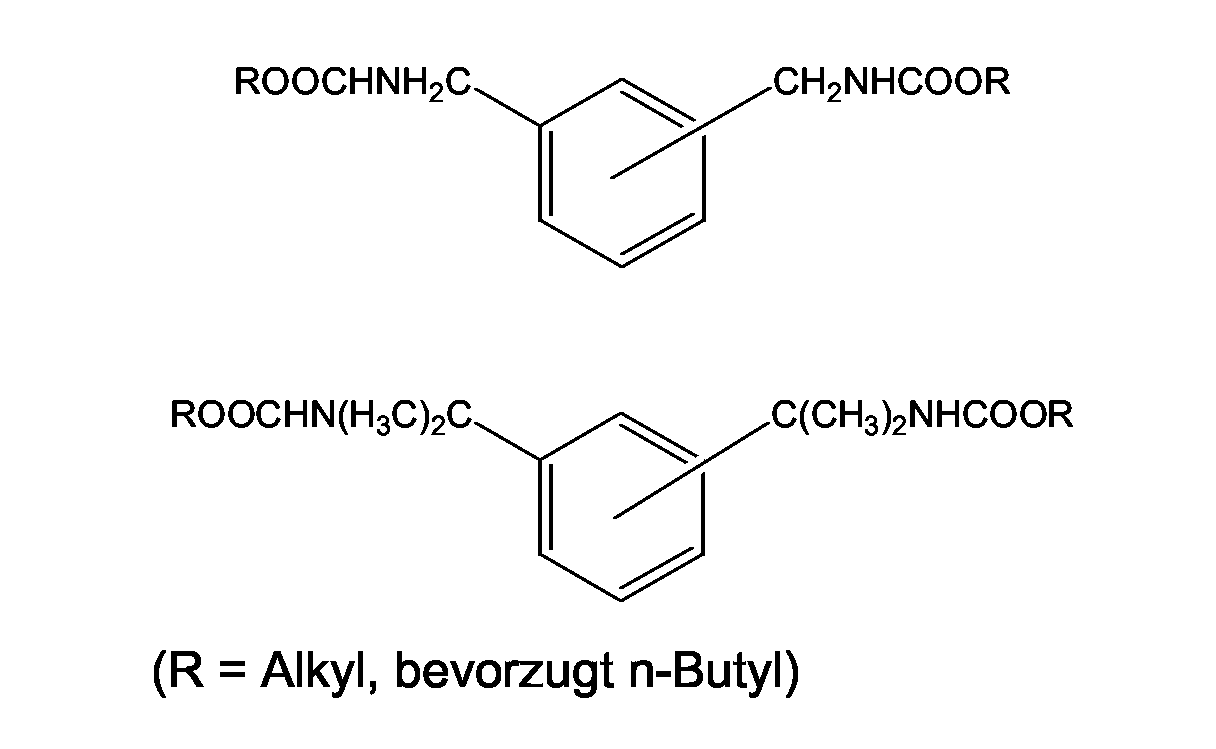
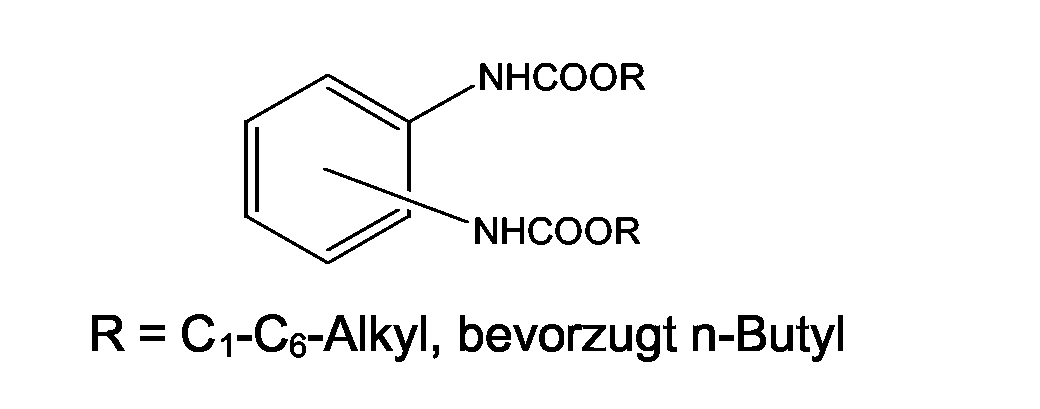
dadurch gekennzeichnet, dass Verbindungen, ausgewählt aus Dialkyl 4,4'-methylendicarbanilat, Dialkyl 2,4'-methylendicarbanilat, Dialkyl 2,2'-methylendicarbanilat und mehrkernige methylenverbrückte Alkyl-Carbanilate (PMDU) sowie Gemische davon,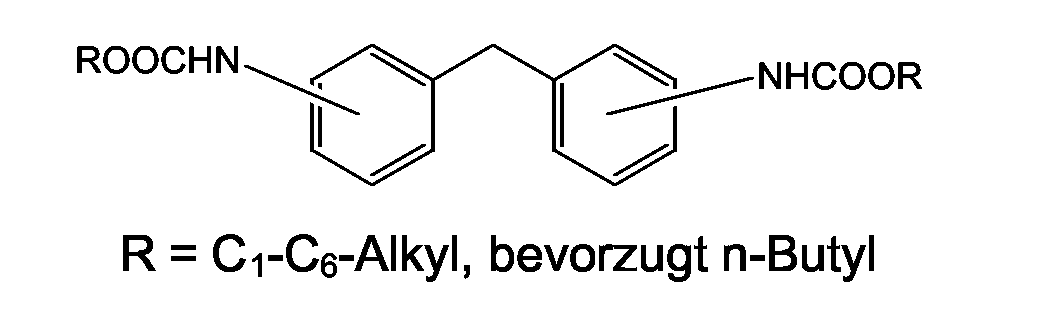 Dialkyl 4,4'-methylen-3,3'-dicarbanilat, Dialkyl 2,4'-methylen-3,3'-dicarbanilat, Dialkyl 2,2'-methylen-3,3'-dicarbanilat sowie Gemische davon,
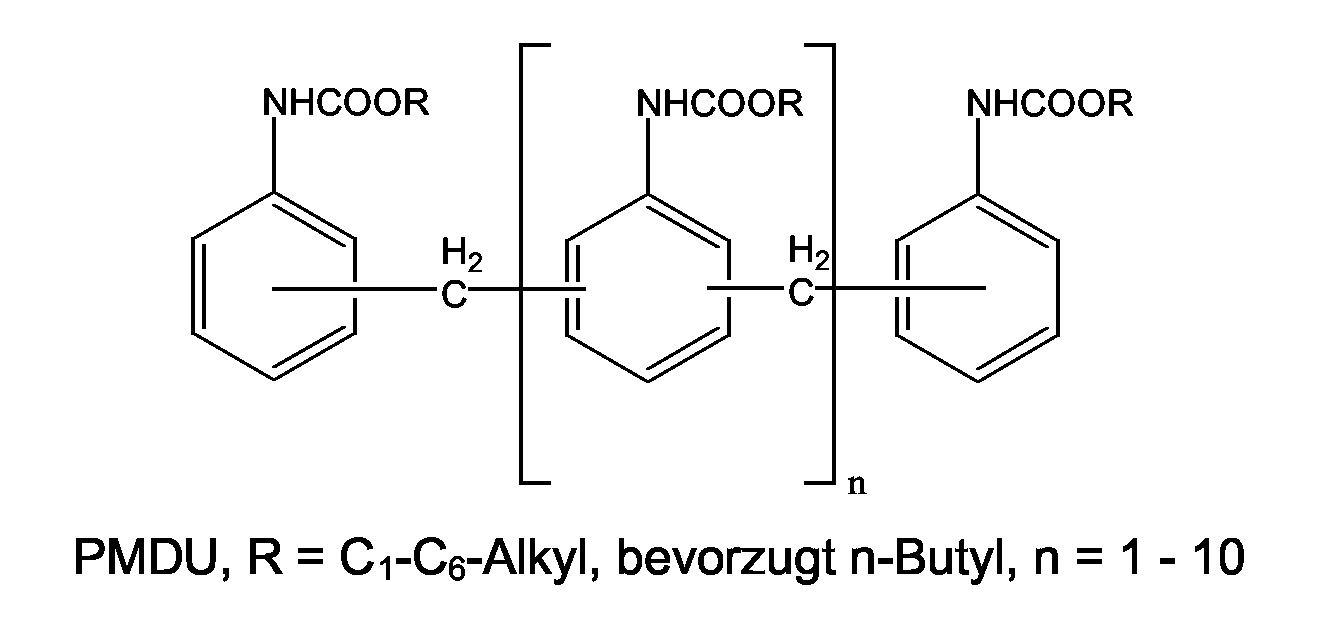 Dialkyl 1,2-Phenyldicarbamat, Dialkyl 1,3-Phenyldicarbamat und Dialkyl 1,4-Phenyldicarbamat sowie Gemische davon,
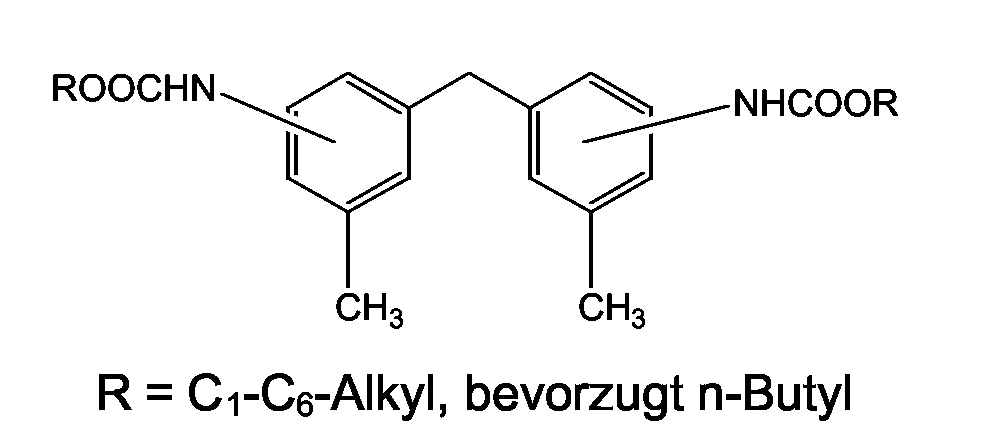 Dialkyl 2,4-Toluoldicarbamat, Dialkyl 2,6-Toluoldicarbamat sowie deren Mischungen,
 Dialkyl 1,6-Naphthalindicarbamat,
 die zum so genannten MXDI und TMXDI korrespondierenden Urethane,
 hydriert werden.
- Verfahren nach mindestens einem der Ansprüche 1 bis 9,
dadurch gekennzeichnet, dass man ein Dialkyl 4,4'-(C1 bis C4)alkan-dicarbanilat und/oder ein 2,4'- und/oder 2,2'-Isomeres oder Gemische hiervon, hydriert. - Verfahren nach Anspruch 10,
dadurch gekennzeichnet, dass man ein Dibutyl 4,4'-methylendicarbanilat oder ein Isomeres oder ein Gemisch hydriert. - Verfahren nach mindestens einem der Ansprüche 1 bis 11,
dadurch gekennzeichnet, dass aus verbrückten zweikernigen Ausgangsprodukten Hydrierprodukte mit einem trans-trans-Isomerenanteil von < 30 %, bevorzugt von < 20 %, ganz besonders bevorzugt von 5 bis 15 %, hergestellt werden. - Verfahren nach mindestens einem der Ansprüche 1 bis 12 zur Hydrierung von Dibutyl 4,4'-methylendicarbanilat zu Dibutyl 4,4'-methylendicyclohexylcarbamat mit einem trans-trans-Isomerenanteil von < 30 %, bevorzugt von < 20%, besonders bevorzugt von 5 bis 15 %.
- Verfahren nach mindestens einem der Ansprüche 1 bis 13,
dadurch gekennzeichnet, dass die Hydrierung in einem Lösemittel oder Lösemittelgemisch, insbesondere aus Alkoholen und/oder Ethern, durchgeführt wird. - Verfahren nach Anspruch 14,
dadurch gekennzeichnet, dass der Alkohol dem Alkoholrest des Urethans entspricht. - Verfahren nach den Ansprüchen 14 bis 15,
dadurch gekennzeichnet, dass n-Butanol und Tetrahydrofuran eingesetzt werden. - Verfahren nach mindestens einem der vorherigen Ansprüche,
dadurch gekennzeichnet, dass ein schwefel- und/oder phosphor- und/oder chlorfreies Startmaterial eingesetzt wird. - Verwendung eines geträgerten Katalysators, der als Aktivmetall Ruthenium alleine oder zusammen mit mindestens einem Metall des I., VII. oder VIII. Nebengruppe des Periodensystems in einer Menge von 0,01 bis 20 Gew.-% Aktivmetalle, bezogen auf den geträgerten Katalysator, auf einen Träger aufgebracht enthält, zur Hydrierung von aromatischen Urethanen, welche einen oder mehrere aromatische Ringe und eine oder mehrere, direkt und/oder indirekt an einem oder verschiedenen aromatischen Ringen gebundene Urethangruppen aufweisen, wobei der Katalysatorträger eine BET-Oberfläche im Bereich von größer 30 m2/g bis kleiner 70 m2/g aufweist und mehr als 50 % des Porenvolumens des Katalysatorträgers Makroporen mit einem Porendurchmesser von größer 50 nm und weniger als 50 % Mesoporen mit einem Porendurchmesser von 2 bis 50 nm sind.
Applications Claiming Priority (2)
| Application Number | Priority Date | Filing Date | Title |
|---|---|---|---|
| DE10253802A DE10253802A1 (de) | 2002-11-18 | 2002-11-18 | Verfahren zur Hydrierung von aromatischen Urethanen in Gegenwart eines geträgerten Rutheniumkatalysators |
| DE10253802 | 2002-11-18 |
Publications (2)
| Publication Number | Publication Date |
|---|---|
| EP1420013A1 true EP1420013A1 (de) | 2004-05-19 |
| EP1420013B1 EP1420013B1 (de) | 2008-04-02 |
Family
ID=32115568
Family Applications (1)
| Application Number | Title | Priority Date | Filing Date |
|---|---|---|---|
| EP03103533A Expired - Lifetime EP1420013B1 (de) | 2002-11-18 | 2003-09-24 | Verfahren zur Hydrierung von aromatischen Urethanen in Gegenwart eines geträgerten Rutheniumkatalysators |
Country Status (8)
| Country | Link |
|---|---|
| US (1) | US6809215B2 (de) |
| EP (1) | EP1420013B1 (de) |
| JP (1) | JP2004168777A (de) |
| CN (1) | CN1296350C (de) |
| AT (1) | ATE391119T1 (de) |
| CA (1) | CA2449235A1 (de) |
| DE (2) | DE10253802A1 (de) |
| MX (1) | MXPA03010384A (de) |
Families Citing this family (8)
| Publication number | Priority date | Publication date | Assignee | Title |
|---|---|---|---|---|
| ATE422962T1 (de) * | 2002-05-31 | 2009-03-15 | Evonik Degussa Gmbh | Geträgerter rutheniumkatalysator und verfahren zur hydrierung eines aromatischen amins in gegenwart dieses katalysators |
| DE102005029200A1 (de) * | 2005-06-22 | 2006-12-28 | Basf Ag | Katalysator und Verfahren zur Hydrierung von hydrierbare Gruppen enthaltenden organischen Verbindungen |
| EP1896174A1 (de) * | 2005-06-22 | 2008-03-12 | Basf Se | Ruthenium-heterogenkatalysator und verfahren zur hydrierung einer carbocyclischen aromatischen gruppe, insbesondere zur herstellung von kernhydrierten bisglycidylethern der bisphenole a und f |
| DE102008016105A1 (de) * | 2008-03-28 | 2009-10-01 | Cognis Oleochemicals Gmbh | Verfahren und Vorrichtung zur katalytischen Hydrierung ungesättigter Fettsäuren und Fettsäurederivate |
| KR102324239B1 (ko) * | 2017-11-06 | 2021-11-08 | 한화솔루션 주식회사 | 방향족 화합물의 수소화 반응용 촉매 및 이의 제조방법 |
| CN112898184A (zh) * | 2021-01-25 | 2021-06-04 | 河北工业大学 | 一种连续合成脂环族氨基甲酸酯方法 |
| CN116768763B (zh) * | 2022-03-07 | 2026-02-27 | 中国科学院过程工程研究所 | 一种脂环族氨基甲酸酯的制备方法及其应用 |
| CN114644576A (zh) * | 2022-04-21 | 2022-06-21 | 中国科学院过程工程研究所 | 一种1,3-环己烷二亚甲基二氨基甲酸酯及其制备方法与应用 |
Citations (4)
| Publication number | Priority date | Publication date | Assignee | Title |
|---|---|---|---|---|
| DE2639842A1 (de) * | 1975-09-04 | 1977-03-17 | Uniroyal Inc | Kernhydrierung von n-arylcarbamaten |
| DE4407019A1 (de) * | 1993-03-05 | 1994-09-08 | Basf Ag | Verfahren zur Herstellung von cycloaliphatischen Urethanen |
| EP0813906A2 (de) * | 1996-06-19 | 1997-12-29 | Basf Aktiengesellschaft | Verfahren zur Umsetzung einer organischen Verbindung in Gegenwart eines geträgerten Rutheniumkatalysators |
| EP0814098A2 (de) * | 1996-06-19 | 1997-12-29 | Basf Aktiengesellschaft | Verfahren zur Umsetzung einer organischen Verbindung in Gegenwart eines geträgerten Rutheniumkatalysators |
Family Cites Families (3)
| Publication number | Priority date | Publication date | Assignee | Title |
|---|---|---|---|---|
| KR0162831B1 (ko) * | 1995-12-30 | 1998-12-01 | 김광호 | 가변 상관기 |
| CN1174454A (zh) * | 1996-08-19 | 1998-02-25 | 合泰半导体股份有限公司 | 多段线性变化的偏压产生电路 |
| MY129474A (en) * | 1997-12-19 | 2007-04-30 | Basf Ag | Method for hydrogenating benzene polycarboxylic acids or derivatives thereof by using a catalyst containing macropores |
-
2002
- 2002-11-18 DE DE10253802A patent/DE10253802A1/de not_active Withdrawn
- 2002-12-31 US US10/331,644 patent/US6809215B2/en not_active Expired - Fee Related
-
2003
- 2003-09-24 DE DE50309525T patent/DE50309525D1/de not_active Expired - Lifetime
- 2003-09-24 EP EP03103533A patent/EP1420013B1/de not_active Expired - Lifetime
- 2003-09-24 AT AT03103533T patent/ATE391119T1/de not_active IP Right Cessation
- 2003-11-13 MX MXPA03010384A patent/MXPA03010384A/es active IP Right Grant
- 2003-11-14 CA CA002449235A patent/CA2449235A1/en not_active Abandoned
- 2003-11-17 CN CNB200310116152XA patent/CN1296350C/zh not_active Expired - Fee Related
- 2003-11-17 JP JP2003387124A patent/JP2004168777A/ja not_active Withdrawn
Patent Citations (4)
| Publication number | Priority date | Publication date | Assignee | Title |
|---|---|---|---|---|
| DE2639842A1 (de) * | 1975-09-04 | 1977-03-17 | Uniroyal Inc | Kernhydrierung von n-arylcarbamaten |
| DE4407019A1 (de) * | 1993-03-05 | 1994-09-08 | Basf Ag | Verfahren zur Herstellung von cycloaliphatischen Urethanen |
| EP0813906A2 (de) * | 1996-06-19 | 1997-12-29 | Basf Aktiengesellschaft | Verfahren zur Umsetzung einer organischen Verbindung in Gegenwart eines geträgerten Rutheniumkatalysators |
| EP0814098A2 (de) * | 1996-06-19 | 1997-12-29 | Basf Aktiengesellschaft | Verfahren zur Umsetzung einer organischen Verbindung in Gegenwart eines geträgerten Rutheniumkatalysators |
Also Published As
| Publication number | Publication date |
|---|---|
| MXPA03010384A (es) | 2005-04-11 |
| JP2004168777A (ja) | 2004-06-17 |
| CN1296350C (zh) | 2007-01-24 |
| CA2449235A1 (en) | 2004-05-18 |
| US20040097661A1 (en) | 2004-05-20 |
| DE50309525D1 (de) | 2008-05-15 |
| DE10253802A1 (de) | 2004-06-03 |
| CN1500777A (zh) | 2004-06-02 |
| EP1420013B1 (de) | 2008-04-02 |
| US6809215B2 (en) | 2004-10-26 |
| ATE391119T1 (de) | 2008-04-15 |
Similar Documents
| Publication | Publication Date | Title |
|---|---|---|
| EP1366812B1 (de) | Geträgerter Rutheniumkatalysator und Verfahren zur Hydrierung eines aromatischen Amins in Gegenwart dieses Katalysators | |
| EP1420012B1 (de) | Verfahren zur Herstellung von aliphatischen Isocyanaten aus aromatischen Isocyanaten | |
| EP0846669B1 (de) | Verfahren zur Hydrierung einer aromatischen Verbindung in Gegenwart eines Trägerkatalysators | |
| EP1337331B1 (de) | Verfahren zur katalytischen hydrierung von aromatischen oder heteroaromatischen aminen | |
| EP3080071B1 (de) | Verfahren zur hydrierung aromatischer verbindungen | |
| EP0873300B1 (de) | Verfahren zur hydrierung von aromatischen verbindungen, in denen mindestens eine aminogruppe an einen aromatischen kern gebunden ist | |
| EP0770049B1 (de) | Verfahren und katalysator zur selektivhydrierung von butindiol zu butendiol | |
| EP2883863B1 (de) | Verfahren zur Hydrierung von 4,4'-Methylendianilin | |
| EP0799814B1 (de) | Verfahren zur Hydrierung von aromatischen Verbindungen, in denen mindestens eine Hydroxylgruppe an einen aromatischen Kern gebunden ist | |
| EP0606072B1 (de) | Selektive katalytische Hydrierung von aromatischen Aldehyden | |
| EP0816350A1 (de) | Verfahren zur Herstellung von N-substituierten cyclischen Aminen | |
| EP1420013B1 (de) | Verfahren zur Hydrierung von aromatischen Urethanen in Gegenwart eines geträgerten Rutheniumkatalysators | |
| EP0968996A2 (de) | Verfahren zur Herstellung von Gemischen aus Cyclohexylamin und Dicyclohexylamin in variablen Mengenverhältnissen | |
| EP0854148B1 (de) | Verfahren zur Hydrierung von Zuckern | |
| DE10119135A1 (de) | Kontinuierliches Verfahren zur Herstellung von Diaminodicyclohexylmethan | |
| DE19624485A1 (de) | Verfahren zur Hydrierung einer aromatischen Verbindung in Gegenwart eines geträgerten Rutheniumkatalysators | |
| EP0949233B1 (de) | Verfahren zur Herstellung von Zuckeralkoholen | |
| EP1169285A1 (de) | Verfahren zur hydrierung von unsubstituierten oder alkylsubstituierten aromaten unter verwendung eines makroporen aufweisenden katalysators | |
| EP0922689B1 (de) | Verfahren zur Hydrierung von Alkinolen unter Verwendung eines Makroporen aufweisenden Katalysators | |
| EP1189858B1 (de) | Verfahren zur herstellung von mannit | |
| DE19624484A1 (de) | Verfahren zur Hydrierung einer aromatischen Verbindung in Gegenwart eines geträgerten Rutheniumkatalysators | |
| EP3269718A1 (de) | Verfahren zur entschützung eines carbapenems durch heterogenkatalytische hydrierung mit wasserstoff in gegenwart eines organischen amins | |
| DE102023107602A1 (de) | Verfahren zur direkten Mechanokatalyse | |
| DE19622705A1 (de) | Verfahren zur Hydrierung einer aromatischen Verbindung in Gegenwart eines in situ gebildeten Rutheniumkatalysators | |
| DE102005060176A1 (de) | Verfahren zur Herstellung von Ethylcyclohexan durch selektive Hydrierung von 4-Vinylcyclohexen |
Legal Events
| Date | Code | Title | Description |
|---|---|---|---|
| PUAI | Public reference made under article 153(3) epc to a published international application that has entered the european phase |
Free format text: ORIGINAL CODE: 0009012 |
|
| 17P | Request for examination filed |
Effective date: 20030924 |
|
| AK | Designated contracting states |
Kind code of ref document: A1 Designated state(s): AT BE BG CH CY CZ DE DK EE ES FI FR GB GR HU IE IT LI LU MC NL PT RO SE SI SK TR |
|
| AX | Request for extension of the european patent |
Extension state: AL LT LV MK |
|
| AKX | Designation fees paid |
Designated state(s): AT BE BG CH CY CZ DE DK EE ES FI FR GB GR HU IE IT LI LU MC NL PT RO SE SI SK TR |
|
| RAP1 | Party data changed (applicant data changed or rights of an application transferred) |
Owner name: DEGUSSA GMBH |
|
| RAP1 | Party data changed (applicant data changed or rights of an application transferred) |
Owner name: EVONIK DEGUSSA GMBH |
|
| GRAP | Despatch of communication of intention to grant a patent |
Free format text: ORIGINAL CODE: EPIDOSNIGR1 |
|
| GRAS | Grant fee paid |
Free format text: ORIGINAL CODE: EPIDOSNIGR3 |
|
| GRAA | (expected) grant |
Free format text: ORIGINAL CODE: 0009210 |
|
| AK | Designated contracting states |
Kind code of ref document: B1 Designated state(s): AT BE BG CH CY CZ DE DK EE ES FI FR GB GR HU IE IT LI LU MC NL PT RO SE SI SK TR |
|
| REG | Reference to a national code |
Ref country code: GB Ref legal event code: FG4D Free format text: NOT ENGLISH |
|
| REG | Reference to a national code |
Ref country code: IE Ref legal event code: FG4D Free format text: LANGUAGE OF EP DOCUMENT: GERMAN Ref country code: CH Ref legal event code: EP |
|
| REF | Corresponds to: |
Ref document number: 50309525 Country of ref document: DE Date of ref document: 20080515 Kind code of ref document: P |
|
| RAP2 | Party data changed (patent owner data changed or rights of a patent transferred) |
Owner name: EVONIK DEGUSSA GMBH |
|
| PG25 | Lapsed in a contracting state [announced via postgrant information from national office to epo] |
Ref country code: SI Free format text: LAPSE BECAUSE OF FAILURE TO SUBMIT A TRANSLATION OF THE DESCRIPTION OR TO PAY THE FEE WITHIN THE PRESCRIBED TIME-LIMIT Effective date: 20080402 |
|
| NLT2 | Nl: modifications (of names), taken from the european patent patent bulletin |
Owner name: EVONIK DEGUSSA GMBH Effective date: 20080806 |
|
| REG | Reference to a national code |
Ref country code: IE Ref legal event code: FD4D |
|
| PG25 | Lapsed in a contracting state [announced via postgrant information from national office to epo] |
Ref country code: PT Free format text: LAPSE BECAUSE OF FAILURE TO SUBMIT A TRANSLATION OF THE DESCRIPTION OR TO PAY THE FEE WITHIN THE PRESCRIBED TIME-LIMIT Effective date: 20080902 Ref country code: ES Free format text: LAPSE BECAUSE OF FAILURE TO SUBMIT A TRANSLATION OF THE DESCRIPTION OR TO PAY THE FEE WITHIN THE PRESCRIBED TIME-LIMIT Effective date: 20080713 Ref country code: FI Free format text: LAPSE BECAUSE OF FAILURE TO SUBMIT A TRANSLATION OF THE DESCRIPTION OR TO PAY THE FEE WITHIN THE PRESCRIBED TIME-LIMIT Effective date: 20080402 Ref country code: BG Free format text: LAPSE BECAUSE OF FAILURE TO SUBMIT A TRANSLATION OF THE DESCRIPTION OR TO PAY THE FEE WITHIN THE PRESCRIBED TIME-LIMIT Effective date: 20080702 |
|
| PGFP | Annual fee paid to national office [announced via postgrant information from national office to epo] |
Ref country code: CH Payment date: 20080915 Year of fee payment: 6 |
|
| PGFP | Annual fee paid to national office [announced via postgrant information from national office to epo] |
Ref country code: FR Payment date: 20080912 Year of fee payment: 6 Ref country code: NL Payment date: 20080915 Year of fee payment: 6 Ref country code: IT Payment date: 20080920 Year of fee payment: 6 |
|
| ET | Fr: translation filed | ||
| PG25 | Lapsed in a contracting state [announced via postgrant information from national office to epo] |
Ref country code: CZ Free format text: LAPSE BECAUSE OF FAILURE TO SUBMIT A TRANSLATION OF THE DESCRIPTION OR TO PAY THE FEE WITHIN THE PRESCRIBED TIME-LIMIT Effective date: 20080402 Ref country code: SE Free format text: LAPSE BECAUSE OF FAILURE TO SUBMIT A TRANSLATION OF THE DESCRIPTION OR TO PAY THE FEE WITHIN THE PRESCRIBED TIME-LIMIT Effective date: 20080702 Ref country code: IE Free format text: LAPSE BECAUSE OF FAILURE TO SUBMIT A TRANSLATION OF THE DESCRIPTION OR TO PAY THE FEE WITHIN THE PRESCRIBED TIME-LIMIT Effective date: 20080402 Ref country code: DK Free format text: LAPSE BECAUSE OF FAILURE TO SUBMIT A TRANSLATION OF THE DESCRIPTION OR TO PAY THE FEE WITHIN THE PRESCRIBED TIME-LIMIT Effective date: 20080402 |
|
| PLBE | No opposition filed within time limit |
Free format text: ORIGINAL CODE: 0009261 |
|
| STAA | Information on the status of an ep patent application or granted ep patent |
Free format text: STATUS: NO OPPOSITION FILED WITHIN TIME LIMIT |
|
| PG25 | Lapsed in a contracting state [announced via postgrant information from national office to epo] |
Ref country code: SK Free format text: LAPSE BECAUSE OF FAILURE TO SUBMIT A TRANSLATION OF THE DESCRIPTION OR TO PAY THE FEE WITHIN THE PRESCRIBED TIME-LIMIT Effective date: 20080402 Ref country code: RO Free format text: LAPSE BECAUSE OF FAILURE TO SUBMIT A TRANSLATION OF THE DESCRIPTION OR TO PAY THE FEE WITHIN THE PRESCRIBED TIME-LIMIT Effective date: 20080402 |
|
| 26N | No opposition filed |
Effective date: 20090106 |
|
| PGFP | Annual fee paid to national office [announced via postgrant information from national office to epo] |
Ref country code: BE Payment date: 20081001 Year of fee payment: 6 |
|
| PG25 | Lapsed in a contracting state [announced via postgrant information from national office to epo] |
Ref country code: EE Free format text: LAPSE BECAUSE OF FAILURE TO SUBMIT A TRANSLATION OF THE DESCRIPTION OR TO PAY THE FEE WITHIN THE PRESCRIBED TIME-LIMIT Effective date: 20080402 Ref country code: MC Free format text: LAPSE BECAUSE OF NON-PAYMENT OF DUE FEES Effective date: 20080930 |
|
| GBPC | Gb: european patent ceased through non-payment of renewal fee |
Effective date: 20080924 |
|
| PG25 | Lapsed in a contracting state [announced via postgrant information from national office to epo] |
Ref country code: CY Free format text: LAPSE BECAUSE OF FAILURE TO SUBMIT A TRANSLATION OF THE DESCRIPTION OR TO PAY THE FEE WITHIN THE PRESCRIBED TIME-LIMIT Effective date: 20080402 |
|
| PG25 | Lapsed in a contracting state [announced via postgrant information from national office to epo] |
Ref country code: AT Free format text: LAPSE BECAUSE OF NON-PAYMENT OF DUE FEES Effective date: 20080924 |
|
| PG25 | Lapsed in a contracting state [announced via postgrant information from national office to epo] |
Ref country code: GB Free format text: LAPSE BECAUSE OF NON-PAYMENT OF DUE FEES Effective date: 20080924 |
|
| BERE | Be: lapsed |
Owner name: EVONIK DEGUSSA G.M.B.H. Effective date: 20090930 |
|
| REG | Reference to a national code |
Ref country code: NL Ref legal event code: V1 Effective date: 20100401 |
|
| REG | Reference to a national code |
Ref country code: CH Ref legal event code: PL |
|
| REG | Reference to a national code |
Ref country code: FR Ref legal event code: ST Effective date: 20100531 |
|
| PG25 | Lapsed in a contracting state [announced via postgrant information from national office to epo] |
Ref country code: HU Free format text: LAPSE BECAUSE OF FAILURE TO SUBMIT A TRANSLATION OF THE DESCRIPTION OR TO PAY THE FEE WITHIN THE PRESCRIBED TIME-LIMIT Effective date: 20081003 Ref country code: FR Free format text: LAPSE BECAUSE OF NON-PAYMENT OF DUE FEES Effective date: 20090930 Ref country code: NL Free format text: LAPSE BECAUSE OF NON-PAYMENT OF DUE FEES Effective date: 20100401 Ref country code: LU Free format text: LAPSE BECAUSE OF NON-PAYMENT OF DUE FEES Effective date: 20080924 |
|
| PG25 | Lapsed in a contracting state [announced via postgrant information from national office to epo] |
Ref country code: BE Free format text: LAPSE BECAUSE OF NON-PAYMENT OF DUE FEES Effective date: 20090930 Ref country code: TR Free format text: LAPSE BECAUSE OF FAILURE TO SUBMIT A TRANSLATION OF THE DESCRIPTION OR TO PAY THE FEE WITHIN THE PRESCRIBED TIME-LIMIT Effective date: 20080402 |
|
| PG25 | Lapsed in a contracting state [announced via postgrant information from national office to epo] |
Ref country code: CH Free format text: LAPSE BECAUSE OF NON-PAYMENT OF DUE FEES Effective date: 20090930 Ref country code: LI Free format text: LAPSE BECAUSE OF NON-PAYMENT OF DUE FEES Effective date: 20090930 Ref country code: GR Free format text: LAPSE BECAUSE OF FAILURE TO SUBMIT A TRANSLATION OF THE DESCRIPTION OR TO PAY THE FEE WITHIN THE PRESCRIBED TIME-LIMIT Effective date: 20080703 |
|
| PG25 | Lapsed in a contracting state [announced via postgrant information from national office to epo] |
Ref country code: IT Free format text: LAPSE BECAUSE OF NON-PAYMENT OF DUE FEES Effective date: 20090924 |
|
| PGFP | Annual fee paid to national office [announced via postgrant information from national office to epo] |
Ref country code: DE Payment date: 20160921 Year of fee payment: 14 |
|
| REG | Reference to a national code |
Ref country code: DE Ref legal event code: R119 Ref document number: 50309525 Country of ref document: DE |
|
| PG25 | Lapsed in a contracting state [announced via postgrant information from national office to epo] |
Ref country code: DE Free format text: LAPSE BECAUSE OF NON-PAYMENT OF DUE FEES Effective date: 20180404 |