EP1419761A1 - Kosmetische Zubereitung enthaltend einen Komplex aus Cyclodextrin und Vitamin F - Google Patents
Kosmetische Zubereitung enthaltend einen Komplex aus Cyclodextrin und Vitamin F Download PDFInfo
- Publication number
- EP1419761A1 EP1419761A1 EP03026137A EP03026137A EP1419761A1 EP 1419761 A1 EP1419761 A1 EP 1419761A1 EP 03026137 A EP03026137 A EP 03026137A EP 03026137 A EP03026137 A EP 03026137A EP 1419761 A1 EP1419761 A1 EP 1419761A1
- Authority
- EP
- European Patent Office
- Prior art keywords
- cyclodextrin
- fatty acid
- essential fatty
- complex
- alpha
- Prior art date
- Legal status (The legal status is an assumption and is not a legal conclusion. Google has not performed a legal analysis and makes no representation as to the accuracy of the status listed.)
- Granted
Links
Images
Classifications
-
- A—HUMAN NECESSITIES
- A61—MEDICAL OR VETERINARY SCIENCE; HYGIENE
- A61K—PREPARATIONS FOR MEDICAL, DENTAL OR TOILETRY PURPOSES
- A61K8/00—Cosmetics or similar toiletry preparations
- A61K8/18—Cosmetics or similar toiletry preparations characterised by the composition
- A61K8/30—Cosmetics or similar toiletry preparations characterised by the composition containing organic compounds
- A61K8/33—Cosmetics or similar toiletry preparations characterised by the composition containing organic compounds containing oxygen
- A61K8/36—Carboxylic acids; Salts or anhydrides thereof
- A61K8/361—Carboxylic acids having more than seven carbon atoms in an unbroken chain; Salts or anhydrides thereof
-
- A—HUMAN NECESSITIES
- A61—MEDICAL OR VETERINARY SCIENCE; HYGIENE
- A61K—PREPARATIONS FOR MEDICAL, DENTAL OR TOILETRY PURPOSES
- A61K8/00—Cosmetics or similar toiletry preparations
- A61K8/18—Cosmetics or similar toiletry preparations characterised by the composition
- A61K8/30—Cosmetics or similar toiletry preparations characterised by the composition containing organic compounds
- A61K8/67—Vitamins
-
- A—HUMAN NECESSITIES
- A61—MEDICAL OR VETERINARY SCIENCE; HYGIENE
- A61K—PREPARATIONS FOR MEDICAL, DENTAL OR TOILETRY PURPOSES
- A61K8/00—Cosmetics or similar toiletry preparations
- A61K8/18—Cosmetics or similar toiletry preparations characterised by the composition
- A61K8/72—Cosmetics or similar toiletry preparations characterised by the composition containing organic macromolecular compounds
- A61K8/73—Polysaccharides
- A61K8/738—Cyclodextrins
-
- A—HUMAN NECESSITIES
- A61—MEDICAL OR VETERINARY SCIENCE; HYGIENE
- A61Q—SPECIFIC USE OF COSMETICS OR SIMILAR TOILETRY PREPARATIONS
- A61Q19/00—Preparations for care of the skin
-
- A—HUMAN NECESSITIES
- A61—MEDICAL OR VETERINARY SCIENCE; HYGIENE
- A61K—PREPARATIONS FOR MEDICAL, DENTAL OR TOILETRY PURPOSES
- A61K2800/00—Properties of cosmetic compositions or active ingredients thereof or formulation aids used therein and process related aspects
- A61K2800/40—Chemical, physico-chemical or functional or structural properties of particular ingredients
- A61K2800/56—Compounds, absorbed onto or entrapped into a solid carrier, e.g. encapsulated perfumes, inclusion compounds, sustained release forms
Definitions
- the invention relates to a cosmetic preparation containing a complex of cyclodextrin and vitamin F as well as preferred Cyclodextrin and vitamin F complexes
- Cyclodextrins are cyclic oligosaccharides made from 6.7 or 8 ⁇ (1-4) -linked anhydroglucose units are constructed.
- the ⁇ -, ⁇ -or produced by enzymatic starch conversion ⁇ -Cyclodextrins differ in the diameter of their hydrophobic cavity and are generally suitable for inclusion numerous lipophilic substances.
- Vitamin F essentially consists of a mixture of essential Essential Fatty Acids (EFA), in particular Omega-6 polyunsaturated fatty acids. Therefore, in the sense the present invention under vitamin F, preferably EFA, in particular omega-6 polyunsaturated fatty acid. The body cannot produce EFA in the required amount, however, adequate care is essential for natural Body functions essential.
- EFA essential Essential Fatty Acids
- essential fatty acids used preferably unsaturated fatty acids with chain lengths greater or equal to 18 carbon atoms, the at least two double bonds exhibit.
- Omega-6 polyunsaturated fatty acids it is particularly preferably linoleic acid and their isomers to linolenic acid and their isomers as well as others very oxidation sensitive acids. Vitamin F unfolds like has shown certain properties that include For improvement the appearance of the skin are particularly desirable.
- the vitamin that is of particular interest to the formulators of Has found cosmetic products is the vitamin F. It practices one beneficial effect on dry and rough skin as well as on the Skin that shows certain signs of irritation.
- the application of the Vitamins F in cosmetics has always been particularly acute Problem affected, essentially in the big one Instability of this material against oxidation by the Oxygen is seen in the atmosphere. It has been particularly shown that very quickly after storage or the form decomposition products with a rancid smell when used for the first time, on the further use of cosmetic preparations prevent the foundation of this vitamin.
- the vitamin F in essentially from linoleic acid and its isomers and in particular from linolenic acid and its isomers and other very oxidation sensitive
- an acid preferably in the Cosmetics and the corresponding alcohols in food or the esters e.g. uses the triglycerides of this acid which are more stable, in which case a significant loss of activity has to be accepted. Stabilization opportunities of essential fatty acids are therefore of extraordinary quality Interest.
- vitamin F important physiological functions of vitamin F, among other things because of the high proportion of linoleic acid, are the build-up of arachidonic acid, a component of phospholipids (cell membranes) and prostaglandins (autocoids), which influence serum cholesterol levels and blood pressure.
- a lack of linoleic acid in children leads to growth disorders, increased susceptibility to infections, skin changes (eczema) and impaired capillary function.
- Vitamin F is used for wound healing disorders.
- the skin care properties which can be determined even in low concentrations, make it an extremely valuable substance. In the field of cosmetics, there is therefore great interest in the increased use of vitamin F, especially in dermatological formulations.
- the topical application of vitamin F stabilizes the skin's balance of essential fatty acids.
- vitamin F leads to damage especially to the cell membrane of the skin (phospholipid structure) as well as in the skin lipids (ceramide structure) to increased wrinkling and horn formation ("photoaging") and to a loss of elasticity of the skin.
- the main problem for the wider use of vitamin F is its sensitivity to oxidation, especially when exposed to light.
- vitamin F consists essentially of Linoleic acid and its isomers, with particular preference the 9,12 isomer is contained in an amount ranging between about 40 and 70%, the total proportion of linoleic acid and whose isomers form about 80 to 90% of the material, while the rest of the material consists essentially of a mixture of other essential fatty acids.
- CH 646049 describes the production of oxidation-resistant cosmetic preparations that contain vitamin F or essential Contain fatty acids, by means of a vegetable oil, namely Jojoba oil.
- An object of the present invention is to provide a cosmetic or dermatological preparation containing vitamin F for To provide the stabilized against oxidative decomposition is.
- the task is solved by a preparation that thereby is characterized that the vitamin F in the form of a complex with a cyclodextrin selected from the group alpha, beta and gamma-cyclodextrin is present.
- the cosmetic or dermatological preparation according to the invention is resistant to oxidation and is particularly suitable for Care and protection of the skin, especially sensitive ones and dry skin. In particular, it fixes the one Damage associated with skin aging and permanent prophylaxis and with no risk of side effects by taking the Avoids disadvantages of the prior art.
- the complex of vitamin F and cyclodextrin (CD) can in in a manner known per se from e.g. Solution or with paste method getting produced.
- the production has proven to be advantageous proven from concentrated, aqueous CD solutions.
- the CD concentration the aqueous solutions are preferably between 5-50% by weight, a CD concentration of is preferred 20-50%.
- the weight ratio of Vit. F to CD is between 1: 4 and 1:40, preferably between 1:15 and 1:20.
- the approaches are stirred or kneaded depending on the consistency.
- the reaction temperature is usually 20 - 85 ° C.
- Prefers is at 20 - 75 ° C, particularly preferably at 50 - 70 ° C, worked.
- the reaction time depends on the temperature and is preferably between one hour and a few days. A reaction time of 30 to 80 hours is preferred.
- the complexation usually takes place under normal pressure. Prefers finds the complexation under a protective gas atmosphere (Nitrogen or argon) instead.
- Complexes of alpha, beta or gamma cyclodextrin are particularly preferred and an essential fatty acid ratio 3: 1 or 4: 1 and a mixture containing these complexes.
- the invention therefore also relates to complexes of cyclodextrin and an essential fatty acid in a ratio of 3: 1 or 4: 1 and a mixture containing these complexes.
- the cyclodextrin is alpha-cyclodextrin.
- compositions that Active ingredient combinations of cyclodextrin with Vit. F, preferably an essential fatty acid, are in different Forms, e.g. as water-in-oil emulsions (W / O) or oil-in-water (O / W), preparations of this type are milk preparations, lotions, creams or ointments and gels, Powders, masks, packs, sprays, aerosols or pens either for coloring the lips or for treating chapped lips Serve lips, or make-up products for the eyes or the make-up.
- W / O water-in-oil emulsions
- O / W oil-in-water
- a complex according to the invention or a mixture of the inventive Complexes can also be found on textiles or non-wovens are applied and thus via this medium to the skin Will be provided.
- Cosmetic and dermatological formulations according to the invention preferably also contain linear and cyclic silicone oils, for example dimethicone and cyclomethicone, moisturizing agents, i.e. substances that protect the skin from drying out, such as propylene glycol, Mg sulfate, glycerin, Substances that care for the skin, such as cetyl alcohol, paraffinium liquid, petrolatum, caprylic / capric triglycerides, mineral oils, stearic acid, bees, candelilla wax, isopropyl and myristyl myristates, octyldodecanol, octyldodecyllanolates, polyethylene glycol (PEG) -22 / dodecyl , Hydrolyzed wheat germ protein, natural oils such as sunflower, soybean, almond, palm, coconut and olive oil Gel formers, such as salts of carbopole, polymethacrylates, polysaccharides O / W and
- a composition according to the invention is incorporated of a CD / Vitamin F complex in a conventional cosmetic or dermatological formulation produced.
- the preparation by dispersing the complex in water and Mix the aqueous dispersion into the lipophilic part the emulsion.
- This process step is essential for the cosmetic quality of the emulsion. Drawing skin care products when applied to the skin by a pleasant feeling on the skin out.
- the complexes are set without prior dispersion in cosmetic emulsions results when applied sandy to scratchy skin feeling. If the complex is not in the manner described by dispersing to particle sizes Prepared ⁇ 200 micrometers is an additional step like grinding or sieving mandatory.
- dispersion can complexes of any particle size, including granules, without additional comminution of large complex particles can be used in cosmetic formulations such as emulsions.
- the dispersion can take place over a period of 10 minutes to 2 hours at a temperature of 20 ° C to 80 ° C, preferred 30 minutes at 30-50 ° C.
- Example 1 Complexation of linoleic acid with ⁇ -cyclodextrin
- Example 2 Preparation of the physical mixture of ⁇ -cyclodextrin / linoleic acid 4: 1 (comparative example)
- ⁇ -Cyclodextrin 0.01 mol were weighed into a grater and triturated intensively with 0.0025 mol linoleic acid until a homogeneous Powder was obtained.
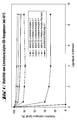
- Example 3 Determination of the storage stability of complexes ⁇ -cyclodextrins and linoleic acid and as a physical mixture, corresponding to a 4: 1 complex of ⁇ -cyclodextrin linoleic acid
- Fig. 1 shows the linoleic acid content in the stored samples in Dependence on the storage period.
- ⁇ -cyclodextrin 0.1 mol was mixed with 100 g of H 2 O, 0.033 mol of linoleic acid was added, the mixture was homogenized and the mixture was stirred at RT for 70 h and at 70 ° C. for 8 h.
- the active ingredient combination is dispersed in water, filtered, washed with water and dried at 40 ° C. under vacuum.
- ⁇ -cyclodextrin 0.1 mol was mixed with 100 g of H 2 O, 0.033 mol of linoleic acid was added, the mixture was homogenized and the mixture was stirred at RT for 70 h and at 70 ° C. for 8 h.
- the active ingredient combination is dispersed in water, filtered, washed with water and dried at 40 ° C. under vacuum.
- Example 6 Preparation of cosmetic formulations with a Active ingredient combination of ⁇ -cyclodextrin with linoleic acid
- composition and proportions by weight drugs weight A Octyl palmitate 2.5% octyl 3.5% Polyglycerol-2 sesquiisostearate 2.0% Cyclomethicone, dimethiconol 3.0% Lauryl dimethicone 2.0% Octyl dimethicone ethoxy glycoside, cyclomethicone 12.0% B Titanium dioxide 5.0% polymethyl 1.0% Zinc oxides 2.0% C glycerin 2.0% methylparaben 0.1% sodium chloride 0.4% water 59.0% ⁇ -cyclodextrin- ⁇ -tocopherol complex 1.5% ⁇ -Cyclodextrin-linoleic acid complex 4.0%
- Heat components A to 70 ° C, B after 30 min. disperse at room temperature, heat to 70 ° C and work into A, homogenize well, cool to 40 ° C while stirring, add C, keep stirring until cold.
- composition and proportions by weight drugs weight A cetyl alcohol 1.5% mineral oil 5.0% stearic acid 5.0% B allantoin 0.5% propylene glycol 3.0% water 45.0% C Cyclomethicone, Dimethicone 15.0% Phenyl trimethicone 2.0% D ⁇ -Cyclodextrin-linoleic acid complex ⁇ -Cyclodexextrin-Retinol complex 2.0% 0.4% water 20.0% e phenoxyethanol, Methyl paraben, butyl paraben, Ethyl paraben, propyl paraben, 0.3% Perfume 0.3%
- Component A 30 min. disperse at room temperature, to 75 ° C heat, incorporate B, heat C to 70 ° C and slowly in AB stir in, then stir in D to cool to room temperature.
- composition and proportions by weight drugs weight A Carbopol 0.1% water 80.0% glycerin ⁇ -Cyclodextrin-linoleic acid complex 3.0% 4.4% B triethanolamine 0.9% C stearic acid 0.8% isopropyl 3.0% Nexbase 2.0% Arlacel 165 1.5% cetyl alcohol 1.0% D BELSIL® 3.0% BHT 0.3%
- composition and proportions by weight drugs weight A Stearyl glucoside 3% Glyceryl stearate 2% Stearyl alcohol 1% Decyl Cocoate 10% Cetearyl ethyl hexanoate 9% B glycerin 3% water 62% ⁇ -Cyclodextrin-linoleic acid complex 9% ⁇ -cyclodextrin-retinol complex 1%
- composition and proportions by weight drugs weight A Stearyl glucoside 3.0% Glyceryl stearate 2.1% Stearyl alcohol 0.9% Ethylhexyl Stearate 10.0% Caprylic / Capric triglycerides avocado oil 10.0% 3.7% B glycerin 3.0% water 59.0% ⁇ -Cyclodextrin-linoleic acid complex 6.0% C Sodium lactate, urea, lactic acid 2.0% tocopheryl acetate 0.3%
- composition and proportions by weight drugs weight A White beeswax 2.70% Polyglyceryl-2 sesquiisostearate 2.40% Dimethicone 10.00% Dimethicone 2.50% Octyl dimethicone ethoxy glucoside, cyclomethicone 11.00% trimethylsiloxysilicate 1.50% B iron oxide 1.45% talc 5.00% Titanium dioxides; 7.00% C sodium chloride 2.00% water 50.00% ⁇ -cyclodextrin- ⁇ -tocopherol complex ⁇ -Cyclodextrin-linoleic acid complex 1.70% 2.40% D Methylchloroisothiazolinone 0.05% Perfume 0.30%
- the raw materials A are placed in a beaker and heated to 65 ° C., the raw materials B in a stirred vessel at 50 ° C. for 20 minutes. dispersed. Both mixtures are emulsified at 65 ° C with a high-speed paddle and allowed to cool to 40 ° C with further stirring and homogenized with the Ultra-Turrax (max. 500 rpm). The air dissolved in the cream is removed by carefully applying a water jet vacuum. drugs weight A glycerol monomyristate 1.4% stearic acid 1.2% cetyl alcohol 0.5% isopropyl palmitate 5.0% B Distilled water 87.5% methylparaben 1.0% ⁇ -Cyclodextrin-linoleic acid complex 3.4%
Landscapes
- Health & Medical Sciences (AREA)
- Life Sciences & Earth Sciences (AREA)
- Animal Behavior & Ethology (AREA)
- General Health & Medical Sciences (AREA)
- Public Health (AREA)
- Veterinary Medicine (AREA)
- Birds (AREA)
- Epidemiology (AREA)
- Dermatology (AREA)
- Emergency Medicine (AREA)
- Cosmetics (AREA)
- Medicinal Preparation (AREA)
Abstract
Description
Das Hauptproblem für die breitere Anwendung von Vitamin F besteht in seiner Empfindlichkeit gegen Oxidation, insbesondere unter Lichteinwirkung.
An der konjugiert ungesättigten Kohlenwasserstoffkette des Fettsäuremoleküls findet eine Autoxidation statt, die zur Bildung zahlreicher Zersetzungsprodukte, zu Isomerisierungen und Polymerisationen führt. Beim Ranzigwerden von Fetten kann beispielsweise die Linolsäure, eine der essentiellen Fettsäuren in eine isomere Fettsäure mit konjugierter Doppelbindung über gehen, die keinen Vitamin-Charakter mehr besitzt und Mangelschäden sogar verstärken kann. Aus der ursprünglich öligen, dünnflüssigen Substanz entsteht dabei eine zäh-flüssige Masse. Der Geruch wird als intensiv ranzig wahrgenommen. Durch intermediär gebildete Peroxide erhöht sich das toxische Potential der Formulierungen, der kosmetisch wie ernährungsphysiologisch erwünschte Effekt des intakten Vitamin F wird verringert.
- 1mol beta-Cyclodextrin : 1mol einer essentiellen Fettsäure
- 2mol beta-Cyclodextrin : 1mol einer essentiellen Fettsäure
- 3mol beta-Cyclodextrin : 1mol einer essentiellen Fettsäure
- 1mol gamma-Cyclodextrin : 1mol einer essentiellen Fettsäure
- 2mol gamma-Cyclodextrin : 1mol einer essentiellen Fettsäure
- 3mol gamma-Cyclodextrin : 1mol einer essentiellen Fettsäure
feuchthaltende Mittel, also Substanzen, welche die Haut vor dem Austrocknen schützen, wie Propylenglycol, Mg-Sulfat, Glycerin,
Substanzen, welche die Haut pflegen, wie Cetyl Alkohol, Paraffinium liquide, Petrolatum, Caprylic/Capric Triglyceride, Mineralöle, Stearinsäure, Bienen-, Candelillawachs, Isopropyl- und Myristyl Myristate, Octyldodecanol, Octyldodecyllanolate, Polyethylenglycol (PEG)-22/Dodecyl Glycol Copolymer, Hydrolysiertes Weizenkeimprotein, natürliche Öle z.B. Sonnenblumen-, Soja-, Mandel-, Palm-, Kokos- und Olivenöl
Gel-Bildner, wie Salze des Carbopols, Polymethacrylate, Polysaccharide
O/W sowie W/O-Emulgatoren, z. B.: Polysorbate 20, PEG-40 Stearate, PEG Hydrogenated Castor Oil, Aluminium-, Octyl- oder Glyceryl-Stearate, Lecithin,
Konservierungsmittel wie Urea, Chlorhexidine Digluconate, Phenoxyethanol, Natriumbenzoat, Sorbinsäure, Methyl-, Ethyl-, Butylparabene, BHT, BHA,
Bakterizide, Antioxidantien wie Vitamin C und entsprechende Derivate, alpha-Hydroxysäuren und entsprechende Derivate, Vitamin E und entsprechende Derivate, Sonnenschutzfilter wie UVA- und UVB-Filter, z.B. Oxyde 4-Methylbenzylidene Camphor, DEA-methoxycinnamate, Benzophenone-4, Octyldimethyl PABA, anorganische Pigmente wie Oxyde von Titanium, Eisen, Zink, Selbstbräunungsmittel wie: Dihydroxyacetone, Zusatzstoffe- und Hilfsstoffe beispielsweise Insektrepellentien, Konsistenzgeber, Füllstoffe, Elektrolyte, Vitamine, Alkohol, Wasser, Salze, Stabilisatoren, Farbstoffe, Parfüme, etherische Öle.
Alle Ansätze werden in offenen Schalen bei 45°C im Trockenschrank gelagert.
Der Gehalt an Linolsäure der physikalischen Mischung und der Wirkstoffkombinationen wurde über NMR bestimmt.
| Wirkstoffe | Gewichtsanteile | |
| A | ||
| Octyl Palmitat | 2,5% | |
| Octylstearat | 3,5% | |
| Polyglycerol-2 Sesquiisostearat | 2,0% | |
| Cyclomethicone, Dimethiconol | 3,0% | |
| Lauryl Dimethicon | 2,0% | |
| Octyl Dimethicone Ethoxy Glycosid, Cyclomethicon | 12,0% | |
| B | ||
| Titan Dioxid | 5,0% | |
| Polymethylsilsesquioxan | 1,0% | |
| Zink Oxyde | 2,0% | |
| C | ||
| Glycerin | 2,0% | |
| Methylparaben | 0,1% | |
| Natriumchlorid | 0,4% | |
| Wasser | 59,0% | |
| γ-Cyclodextrin-α-Tocopherol-Komplex | 1,5% | |
| α-Cyclodextrin-Linolsäure Komplex | 4,0% |
| Wirkstoffe | Gewichtsanteile |
| A | |
| Bienenwachs | 3,0% |
| Hostacerin | 3,0% |
| BELSIL® CM 1000 | 5,0% |
| BELSIL® DM 1plus | 7,0% |
| BELSIL® PDM 20 | 4,55% |
| BELSIL® SPG 128 VP | 12,0% |
| B | |
| Natriumchlorid | 2,0% |
| Wasser | 59,4% |
| α-Cyclodextrin-Linolsäure Komplex | 4,0% |
| C | |
| Kathon | 0,05% |
| Wirkstoffe | Gewichtsanteile | |
| A | ||
| Cetylalkohol | 1,5% | |
| Mineralöl | 5,0% | |
| Stearinsäure | 5,0% | |
| B | ||
| Allantoin | 0,5% | |
| Propylenglykol | 3,0% | |
| Wasser | 45,0% | |
| C | ||
| Cyclomethicone, Dimethicone | 15,0% | |
| Phenyl Trimethicone | 2,0% | |
| D | ||
| α-Cyclodextrin-Linolsäure Komplex γ-Cyclodexextrin-Retinol Komplex | 2,0% 0,4% | |
| Wasser | 20,0% | |
| E | ||
| Phenoxyethanol, Methylparaben, Butylparaben, Ethylparaben, Propylparaben, | 0,3% | |
| Parfüm | 0,3% |
| Wirkstoffe | Gewichtsanteile | |
| A | ||
| Carbopol | 0,1% | |
| Wasser | 80,0% | |
| Glycerin α-Cyclodextrin-Linolsäure Komplex | 3,0% 4,4% | |
| B | ||
| Triethanolamin | 0,9% | |
| C | ||
| Stearinsäure | 0,8% | |
| Isopropylmyristat | 3,0% | |
| Nexbase | 2,0% | |
| Arlacel 165 | 1,5% | |
| Cetylalkohol | 1,0% | |
| D | ||
| BELSIL® | 3,0% | |
| BHT | 0,3% |
| Wirkstoffe | Gewichtsanteile | |
| A | ||
| Stearyl-glucoside | 3% | |
| Glyceryl Stearate | 2% | |
| Stearyl Alkohol | 1% | |
| Decyl Cocoate | 10% | |
| Cetearyl Ethylhexanoate | 9% | |
| B | ||
| Glycerin | 3% | |
| Wasser | 62% | |
| α-Cyclodextrin-Linolsäure Komplex | 9% | |
| γ-Cyclodextrin-Retinol Komplex | 1% |
| Wirkstoffe | Gewichtsanteile | |
| A | ||
| Stearyl-glucoside | 3,0% | |
| Glyceryl Stearate | 2,1% | |
| Stearyl Alkohol | 0,9% | |
| Ethylhexyl-Stearate | 10,0% | |
| Caprylic / Capric Triglyceride Avocadoöl | 10,0% 3,7% | |
| B | ||
| Glycerin | 3,0% | |
| Wasser | 59,0% | |
| α-Cyclodextrin-Linolsäure Komplex | 6,0% | |
| C | ||
| Sodium Lactate, Urea, Lactic Acid | 2,0% | |
| Tocopherylacetat | 0,3% |
| Wirkstoffe | Gewichtsanteile | |
| A | ||
| Weißes Bienenwachs | 2,70% | |
| Polyglyceryl-2 Sesquiisostearate | 2,40% | |
| Dimethicone | 10,00% | |
| Dimethicone | 2,50% | |
| Octyl Dimethicone Ethoxy Glucosid, Cyclomethicone | 11,00% | |
| Trimethylsiloxysilicat | 1,50% | |
| B | ||
| Eisenoxid | 1,45% | |
| Talk | 5,00% | |
| Titan Dioxide; | 7,00% | |
| C | ||
| Natriumchlorid | 2,00% | |
| Wasser | 50,00% | |
| γ-Cyclodextrin-α-Tocopherol-Komplex α-Cyclodextrin-Linolsäure Komplex | 1,70% 2,40% | |
| D | ||
| Methylchloroisothiazolinone | 0,05% | |
| Parfüm | 0,30% |
| Wirkstoffe | Gewichtsanteile | |
| A | ||
| Glycerinmonomyristat | 1,4% | |
| Stearinsäure | 1,2% | |
| Cetylalkohol | 0,5% | |
| Isopropylpalmitat | 5,0% | |
| B | ||
| Wasser dest. | 87,5% | |
| Methylparaben | 1,0% | |
| α-Cyclodextrin-Linolsäure Komplex | 3,4% |
Claims (10)
- Kosmetische oder dermatologische Zubereitungen enthaltend Vitamin F, dadurch gekennzeichnet, dass das Vitamin F in Form eines Komplexes mit einem Cyclodextrin ausgewählt aus der Gruppe alpha-, beta- und gamma-Cyclodextrin vorliegt.
- Zubereitungen gemäß Anspruch 1, dadurch gekennzeichnet, dass Vitamin F eine essentielle Fettsäure ist.
- Zubereitungen gemäß Anspruch 2, dadurch gekennzeichnet, dass essentielle Fettsäure und Cyclodextrin im Komplex in einem der folgenden Verhältnisse vorliegt:1mol alpha-Cyclodextrin : 1mol einer essentiellen Fettsäure2mol alpha-Cyclodextrin : 1mol einer essentiellen Fettsäure3mol alpha-Cyclodextrin : 1mol einer essentiellen Fettsäure4mol alpha-Cyclodextrin : 1mol einer essentiellen Fettsäure1mol beta-Cyclodextrin : 1mol einer essentiellen Fettsäure2mol beta-Cyclodextrin : 1mol einer essentiellen Fettsäure3mol beta-Cyclodextrin : 1mol einer essentiellen Fettsäureoder eine Mischung dieser Komplexe.1mol gamma-Cyclodextrin : 1mol einer essentiellen Fettsäure2mol gamma-Cyclodextrin : 1mol einer essentiellen Fettsäure3mol gamma-Cyclodextrin : 1mol einer essentiellen Fettsäure
- Komplex aus Cyclodextrin und einer essentiellen Fettsäure im molaren Verhältnis 3 : 1 oder 4 : 1.
- Komplex nach Anspruch 4, dadurch gekennzeichnet, dass es sich bei dem Cyclodextrin um alpha-Cyclodextrin handelt.
- Mischung aus Cyclodextrin und einer essentiellen Fettsäure enthaltend einen Komplex gemäß Anspruch 4 oder 5.
- Mischung gemäß Anspruch 6, dadurch gekennzeichnet, dass sieeinen 4:1 Komplex von alpha-CD und essentieller Fettsäure in einer Menge von 10 bis 90 Gew. %, odereinen 3:1 Komplex von alpha-CD und essentieller Fettsäure in einer Menge von 40 bis 80 Gew. %, odereinen 2:1 Komplex von alpha-CD und essentieller Fettsäure in einer Menge von 30 bis 70 Gew. %, odereinen 1:1 Komplex von alpha-CD und essentieller Fettsäure in einer Menge von 20 bis 60 Gew. % enthält.
- Zubereitung gemäß Anspruch 1, 2 oder 3, dadurch gekennzeichnet, dass sie ferner eine oder mehrere der folgenden Komponenten enthält: lineare wie cylische Silikonöle, feuchthaltende Mittel, Substanzen, welche die Haut pflegen, Gel-Bildner, O/W- oder W/O-Emulgatoren, Konservierungsmittel, Bakterizide, Antioxidantien, Sonnenschutzfilter, anorganische Pigmente, Selbstbräunungsmittel, Zusatzstoffe- und Hilfsstoffe, Konsistenzgeber, Füllstoffe, Elektrolyte, Vitamine, Alkohol, Wasser, Salze, Stabilisatoren, Farbstoffe, Parfüme, etherische Öle.
- Verfahren zur Herstellung einer Zubereitung gemäß Anspruch 1, 2, 3 oder 8, dadurch gekennzeichnet, dass ein Komplex aus Vitamin F und Cyclodextrin in Wasser dispergiert wird und anschließend in den lipophilen Teil der Emulsion eingemischt wird.
- Verfahren gemäß Anspruch 9, dadurch gekennzeichnet, dass die Dispergierung über einen Zeitraum von 10 Minuten bis 2 Stunden bei einer Temperatur von 20°C bis 80°C erfolgt.
Applications Claiming Priority (2)
| Application Number | Priority Date | Filing Date | Title |
|---|---|---|---|
| DE10253042A DE10253042A1 (de) | 2002-11-14 | 2002-11-14 | Kosmetische Zubereitung enthaltend einen Komplex aus Cyclodextrin und Vitamin F |
| DE10253042 | 2002-11-14 |
Publications (2)
| Publication Number | Publication Date |
|---|---|
| EP1419761A1 true EP1419761A1 (de) | 2004-05-19 |
| EP1419761B1 EP1419761B1 (de) | 2005-10-19 |
Family
ID=32115507
Family Applications (1)
| Application Number | Title | Priority Date | Filing Date |
|---|---|---|---|
| EP03026137A Expired - Lifetime EP1419761B1 (de) | 2002-11-14 | 2003-11-13 | Mischung enthaltend einen Komplex aus alpha-Cyclodextrin und Vitamin F |
Country Status (5)
| Country | Link |
|---|---|
| US (1) | US7667057B2 (de) |
| EP (1) | EP1419761B1 (de) |
| JP (1) | JP2004161775A (de) |
| KR (1) | KR100550246B1 (de) |
| DE (2) | DE10253042A1 (de) |
Cited By (4)
| Publication number | Priority date | Publication date | Assignee | Title |
|---|---|---|---|---|
| WO2008101852A3 (en) * | 2007-02-23 | 2008-12-11 | Unilever Plc | Malodor reduction of cosmetic products |
| WO2008087034A3 (en) * | 2007-01-17 | 2009-01-29 | Devirex Ag | Cyclodextrin formulations |
| WO2009047022A1 (de) * | 2007-10-05 | 2009-04-16 | Henkel Ag & Co. Kgaa | Oxidative haarbehandlung mit verringerter haarschädigung |
| US10945945B2 (en) | 2016-12-22 | 2021-03-16 | Conopco, Inc. | Stabilization of cosmetic compositions comprising fish oils and hydroxylated fatty acids and/or its derivatives |
Families Citing this family (14)
| Publication number | Priority date | Publication date | Assignee | Title |
|---|---|---|---|---|
| US7099884B2 (en) | 2002-12-06 | 2006-08-29 | Innopath Software | System and method for data compression and decompression |
| MX2007015862A (es) * | 2005-06-13 | 2008-02-22 | Cargill Inc | Complejos de inclusion de ciclodextrina y metodos para preparar los mismos. |
| MX2007015871A (es) * | 2005-06-13 | 2008-03-04 | Cargill Inc | Complejos de inclusion de ciclodextrina y metodos para preparar los mismos. |
| JP2009539978A (ja) * | 2006-06-13 | 2009-11-19 | カーギル インコーポレイテッド | 大粒子シクロデキストリン包接複合体及びその製造方法 |
| EP2049083A2 (de) * | 2006-12-27 | 2009-04-22 | Cargill, Incorporated | Cyclodextrin-einschlusskomplexe und verfahren zu ihrer herstellung |
| US20080283693A1 (en) * | 2007-05-15 | 2008-11-20 | Evans Michael J F | Propulsion apparatus and system |
| JP2009183809A (ja) * | 2008-02-01 | 2009-08-20 | Fujifilm Corp | 乳化物または分散物の製造方法、並びにこれを含む食品、皮膚外用剤及び医薬品 |
| US20100102142A1 (en) * | 2008-10-28 | 2010-04-29 | Daria Tagliareni | Scent dispenser assembly |
| EA201391043A1 (ru) * | 2011-02-17 | 2014-03-31 | Сентисс Фарма Прайвет Лимитед | Способ и композиция для замедления сорбции консервантов пластиками |
| US10619932B2 (en) | 2015-10-23 | 2020-04-14 | Hyfra Industriekuhlanlagen Gmbh | System for cooling a fluid with a microchannel evaporator |
| US11193715B2 (en) | 2015-10-23 | 2021-12-07 | Hyfra Industriekuhlanlagen Gmbh | Method and system for cooling a fluid with a microchannel evaporator |
| FR3075604B1 (fr) * | 2017-12-21 | 2020-07-03 | Roquette Freres | Composition emulsionnante et procede de fabrication d'une composition de type emulsion de pickering h/e. |
| US11226139B2 (en) | 2019-04-09 | 2022-01-18 | Hyfra Industriekuhlanlagen Gmbh | Reversible flow evaporator system |
| IT202100014330A1 (it) * | 2021-06-01 | 2022-12-01 | The Ubeauty Com Llc | Prodotto per la cura della pelle e procedimento per la sua realizzazione. |
Citations (10)
| Publication number | Priority date | Publication date | Assignee | Title |
|---|---|---|---|---|
| US4732759A (en) * | 1985-06-13 | 1988-03-22 | Japan Liquid Crystal Co., Ltd. | Bath preparations and method for producing the same |
| US4775749A (en) * | 1983-08-08 | 1988-10-04 | Kabushiki Kaisha Hayashibara Seibutsu Kagaku Kenkyujo | Inclusion compound of eicosapentaenoic of acid and food product containing the same |
| EP0470452A2 (de) * | 1990-08-09 | 1992-02-12 | Staroil Limited | Verfahren zur Herstellung von Komplexen aus mehrfachungesättigten Fettsäuren mit langer Kette und Cyclodextrinen und die so erhaltenen Komplexe |
| JPH06153860A (ja) * | 1992-11-25 | 1994-06-03 | Nissei Kosan Kk | 痩身用食品 |
| JPH07215911A (ja) * | 1994-02-04 | 1995-08-15 | Ensuiko Sugar Refining Co Ltd | α−リノレン酸のサイクロデキストリン包接物およびその製造法 |
| WO1997009039A2 (en) * | 1995-09-08 | 1997-03-13 | The Government Of The United States Of America, Represented By The Secretary Of The Department Of Health And Human Services | Composition comprising vitamin f |
| WO1997036972A1 (de) * | 1996-03-29 | 1997-10-09 | Wacker-Chemie Gmbh | VERFAHREN ZUR STABILISIERUNG UND DISPERGIERUNG VON PFLANZENÖLEN, DIE MEHRFACH UNGESÄTTIGTE FETTSÄURERESTE ENTHALTEN, MITTELS η-CYCLODEXTRIN |
| CH689373A5 (fr) * | 1995-01-30 | 1999-03-31 | Givenchy Parfums | Complexe hydratant et compositions cosmétiques le contenant. |
| EP1041136A1 (de) * | 1999-04-01 | 2000-10-04 | Wacker Biochem Corporation | Verfahren zur Stabilisierung von Acylglycerinen, die einen hohen Anteil an w-3 mehrfach ungesättigten Fettsäuren enthalten, mittels gamma-Cyclodextrin |
| WO2002038123A1 (en) * | 2000-11-13 | 2002-05-16 | Wadlund As | A skin cream composition |
Family Cites Families (18)
| Publication number | Priority date | Publication date | Assignee | Title |
|---|---|---|---|---|
| FR2474310A1 (fr) * | 1980-01-25 | 1981-07-31 | Oreal | Solution stable a l'oxydation de vitamine f et d'huile de jojoba et compositions cosmetiques la contenant |
| JPS5813541A (ja) * | 1981-07-16 | 1983-01-26 | Kureha Chem Ind Co Ltd | エイコサペンタエン酸又はドコサヘキサエン酸のシクロデキストリン包接化合物 |
| US4559225A (en) * | 1984-02-16 | 1985-12-17 | Fourman Robert G | Sunscreen composition |
| JPS60181014A (ja) | 1984-02-27 | 1985-09-14 | Ichiro Shibauchi | 浴剤およびその製造方法 |
| US5250289A (en) * | 1987-07-24 | 1993-10-05 | The Boots Company Plc | Sunscreen compositions |
| DE4242876C2 (de) * | 1992-12-18 | 1997-11-27 | Beiersdorf Ag | Kosmetische und/oder dermatologische Zubereitungen zur kosmetischen und/oder dermatologischen Pflege der Haut und/oder der Hautanhangsgebilde |
| US5690948A (en) * | 1997-01-10 | 1997-11-25 | Elizabeth Arden Co., Division Of Conopco, Inc. | Antisebum and antioxidant compositions containing guguliped and alcoholic fraction thereof |
| US6224888B1 (en) * | 1999-02-12 | 2001-05-01 | The Procter & Gamble Company | Cosmetic compositions |
| FR2790758A1 (fr) | 1999-03-09 | 2000-09-15 | Commissariat Energie Atomique | Solubilisation d'acides gras polyinsatures et de leurs derives par formation de complexes d'inclusion avec une cyclodextrine et leur utilisation dans des compositions pharmaceutiques, cosmetiques ou alimentaires |
| FR2792642B1 (fr) * | 1999-04-21 | 2001-06-08 | Oreal | Composition cosmetique contenant des particules de resine de melamine-formaldehyde ou d'uree-formaldehyde et ses utilisations |
| EP1125574B1 (de) * | 2000-02-19 | 2005-06-22 | Goldschmidt GmbH | Kosmetische und pharmazeutische Öl-in-Wasser-Emulsionen von polyethermodifizierten Polysiloxanen |
| US6649178B2 (en) * | 2000-06-13 | 2003-11-18 | Fatemeh Mohammadi | Cosmetic composition for stressed skin under extreme conditions |
| US20030228267A1 (en) * | 2001-07-09 | 2003-12-11 | Aust Duncan T. | Suncreen composition wit enhanced spf and water resistant properties |
| EP1317246A1 (de) * | 2000-09-13 | 2003-06-11 | The Procter & Gamble Company | Kosmetische verwendung |
| US6811770B2 (en) * | 2001-04-10 | 2004-11-02 | L'oreal | Two-coat make-up process and a make-up kit containing first and second compositions |
| US6638557B2 (en) * | 2001-08-14 | 2003-10-28 | Cerestar Holding B.V. | Dry, edible oil and starch composition |
| KR100439068B1 (ko) * | 2001-09-07 | 2004-07-05 | 주식회사 코리아나화장품 | 레티놀을 3중으로 안정화한 화장료 |
| DE10244282A1 (de) * | 2002-09-23 | 2004-04-01 | Merck Patent Gmbh | Zubereitung mit antioxidanten Eigenschaften |
-
2002
- 2002-11-14 DE DE10253042A patent/DE10253042A1/de not_active Withdrawn
-
2003
- 2003-11-04 KR KR1020030077579A patent/KR100550246B1/ko not_active Expired - Fee Related
- 2003-11-12 US US10/712,703 patent/US7667057B2/en not_active Expired - Fee Related
- 2003-11-13 EP EP03026137A patent/EP1419761B1/de not_active Expired - Lifetime
- 2003-11-13 DE DE50301407T patent/DE50301407D1/de not_active Expired - Lifetime
- 2003-11-14 JP JP2003385675A patent/JP2004161775A/ja active Pending
Patent Citations (10)
| Publication number | Priority date | Publication date | Assignee | Title |
|---|---|---|---|---|
| US4775749A (en) * | 1983-08-08 | 1988-10-04 | Kabushiki Kaisha Hayashibara Seibutsu Kagaku Kenkyujo | Inclusion compound of eicosapentaenoic of acid and food product containing the same |
| US4732759A (en) * | 1985-06-13 | 1988-03-22 | Japan Liquid Crystal Co., Ltd. | Bath preparations and method for producing the same |
| EP0470452A2 (de) * | 1990-08-09 | 1992-02-12 | Staroil Limited | Verfahren zur Herstellung von Komplexen aus mehrfachungesättigten Fettsäuren mit langer Kette und Cyclodextrinen und die so erhaltenen Komplexe |
| JPH06153860A (ja) * | 1992-11-25 | 1994-06-03 | Nissei Kosan Kk | 痩身用食品 |
| JPH07215911A (ja) * | 1994-02-04 | 1995-08-15 | Ensuiko Sugar Refining Co Ltd | α−リノレン酸のサイクロデキストリン包接物およびその製造法 |
| CH689373A5 (fr) * | 1995-01-30 | 1999-03-31 | Givenchy Parfums | Complexe hydratant et compositions cosmétiques le contenant. |
| WO1997009039A2 (en) * | 1995-09-08 | 1997-03-13 | The Government Of The United States Of America, Represented By The Secretary Of The Department Of Health And Human Services | Composition comprising vitamin f |
| WO1997036972A1 (de) * | 1996-03-29 | 1997-10-09 | Wacker-Chemie Gmbh | VERFAHREN ZUR STABILISIERUNG UND DISPERGIERUNG VON PFLANZENÖLEN, DIE MEHRFACH UNGESÄTTIGTE FETTSÄURERESTE ENTHALTEN, MITTELS η-CYCLODEXTRIN |
| EP1041136A1 (de) * | 1999-04-01 | 2000-10-04 | Wacker Biochem Corporation | Verfahren zur Stabilisierung von Acylglycerinen, die einen hohen Anteil an w-3 mehrfach ungesättigten Fettsäuren enthalten, mittels gamma-Cyclodextrin |
| WO2002038123A1 (en) * | 2000-11-13 | 2002-05-16 | Wadlund As | A skin cream composition |
Non-Patent Citations (4)
| Title |
|---|
| DATABASE WPI Week 199427, Derwent World Patents Index; AN 1994-220438, XP002248894 * |
| DATABASE WPI Week 199541, Derwent World Patents Index; AN 1995-317436, XP002036274 * |
| LANDAUS: "International Dictionnary of Medicine and Biology", 1986, JOHN WILEY & SONS, USA VOL. III, XP002264554 * |
| SZENTE ET AL.: "Fatty Acid-Cyclodextrin Complexes: Properties and Applications", JOURNAL OF INCLUSION PHENOMENA AND MOLECULAR RECOGNITION IN CHEMISTRY, vol. 16, 1993, pages 339 - 354, XP000675556 * |
Cited By (5)
| Publication number | Priority date | Publication date | Assignee | Title |
|---|---|---|---|---|
| WO2008087034A3 (en) * | 2007-01-17 | 2009-01-29 | Devirex Ag | Cyclodextrin formulations |
| WO2008101852A3 (en) * | 2007-02-23 | 2008-12-11 | Unilever Plc | Malodor reduction of cosmetic products |
| EA020750B1 (ru) * | 2007-02-23 | 2015-01-30 | Унилевер Н.В. | Подавление неприятного запаха косметических продуктов |
| WO2009047022A1 (de) * | 2007-10-05 | 2009-04-16 | Henkel Ag & Co. Kgaa | Oxidative haarbehandlung mit verringerter haarschädigung |
| US10945945B2 (en) | 2016-12-22 | 2021-03-16 | Conopco, Inc. | Stabilization of cosmetic compositions comprising fish oils and hydroxylated fatty acids and/or its derivatives |
Also Published As
| Publication number | Publication date |
|---|---|
| EP1419761B1 (de) | 2005-10-19 |
| DE10253042A1 (de) | 2004-06-03 |
| US7667057B2 (en) | 2010-02-23 |
| DE50301407D1 (de) | 2006-03-02 |
| US20040096413A1 (en) | 2004-05-20 |
| KR20040042827A (ko) | 2004-05-20 |
| JP2004161775A (ja) | 2004-06-10 |
| KR100550246B1 (ko) | 2006-02-08 |
Similar Documents
| Publication | Publication Date | Title |
|---|---|---|
| EP0867175B1 (de) | Verfahren zur Stabilisierung von Retinol bzw. Retinol-Derivaten | |
| EP1419761B1 (de) | Mischung enthaltend einen Komplex aus alpha-Cyclodextrin und Vitamin F | |
| EP0889944B1 (de) | VERFAHREN ZUR STABILISIERUNG UND DISPERGIERUNG VON PFLANZENÖLEN, DIE MEHRFACH UNGESÄTTIGTE FETTSÄURERESTE ENTHALTEN, MITTELS gamma-CYCLODEXTRIN | |
| EP0934053B1 (de) | Kosmetische oder dermatologische mikroemulsion | |
| DE69526966T2 (de) | Hautkräftigende kometische zusammensetzung | |
| DE69427498T2 (de) | Verfahren zur Stabilisierung von Vesikeln aus amphiphilen Lipiden und diese stabilisierte Vesikeln enthaltende Zusammensetzung für die topische Anwendung | |
| DE69900264T3 (de) | Nanoemulsion aus ethoxylierten Fettalkoholethern oder ethoxylierten Fettsäureestern und deren Verwendungen in Kosmetika, Dermatologie und/oder Ophthalmologie | |
| DE69416153T2 (de) | Kosmetische zusammensetzung enthaltend ein hydrochalkon und retinol oder dessen derivate | |
| EP0930866B1 (de) | Kosmetische oder dermatologische gele auf der basis von mikroemulsionen | |
| DE60023816T2 (de) | Verwendung von Lycopin in Zusammensetzungen zur Behandlung von Hautalterungserscheinungen | |
| DE19859427A1 (de) | Kosmetische oder pharmazeutische lecithinhaltige Gele oder niedrigviskose, lecithinhaltige O/W-Mikroemulsionen | |
| DE19619837A1 (de) | Kosmetische oder pharmazeutische Zubereitungen mit vermindertem Klebrigkeitsgefühl | |
| EP0716847A1 (de) | Kosmetische oder dermatologische Wirkstoffkombinationen aus Zimtsäurederivaten und Flavonglycosiden | |
| DE19927229A1 (de) | Enzymhaltiges Kosmetikum | |
| JP2897973B2 (ja) | 化粧料用又は皮膚科用組成物 | |
| DE10200657B4 (de) | 2:1-Komplex aus β- oder γ-Cyclodextrin und α-Tocopherol | |
| DE4423450C2 (de) | Verwendung anorganischer Pigmente in kosmetischen oder dermatologischen Zubereitungen, welche alpha-Hydroxycarbonsäuren und/oder alpha-Ketocarbonsäuren enthalten | |
| DE10128910A1 (de) | Verwendung von Wirkstoffkombinationen aus Arginin und Ascorbinsäure zur Hautstraffung | |
| DE19615575A1 (de) | Verwendung von Glucosiden und Ferulasäure als antiirritativer Wirkstoff in kosmetischen und topischen dermatologischen Zubereitungen | |
| DE19518845A1 (de) | Kosmetische oder dermatologische Zubereitungen mit einem Gehalt an Phytinsäure | |
| DE19844261A1 (de) | Kosmetische und dermatologische Zubereitungen in Form von W/O-Emulsionen mit einem Gehalt an niedermolekularen Siliconen | |
| DE19520237A1 (de) | Kosmetische oder dermatologische Zubereitungen, enthaltend Oligomere oder Polymere von alpha-Hydroxycarbonsäuren | |
| DE60036725T2 (de) | Zusammensetzungen enthaltend vernix und ein uv-schutzmittel, und deren verwendung | |
| DE19518815A1 (de) | Kosmetische oder dermatologische Zubereitungen mit einem Gehalt an alpha-Hydroxyfettsäuren | |
| DE19642090A1 (de) | Kosmetische oder dermatologische Gele auf der Basis von Mikroemulsionen |
Legal Events
| Date | Code | Title | Description |
|---|---|---|---|
| PUAI | Public reference made under article 153(3) epc to a published international application that has entered the european phase |
Free format text: ORIGINAL CODE: 0009012 |
|
| 17P | Request for examination filed |
Effective date: 20031113 |
|
| AK | Designated contracting states |
Kind code of ref document: A1 Designated state(s): AT BE BG CH CY CZ DE DK EE ES FI FR GB GR HU IE IT LI LU MC NL PT RO SE SI SK TR |
|
| AX | Request for extension of the european patent |
Extension state: AL LT LV MK |
|
| 17Q | First examination report despatched |
Effective date: 20040506 |
|
| AKX | Designation fees paid |
Designated state(s): DE FR GB |
|
| GRAP | Despatch of communication of intention to grant a patent |
Free format text: ORIGINAL CODE: EPIDOSNIGR1 |
|
| RTI1 | Title (correction) |
Free format text: MIXTURE COMPRISING A COMPLEX OF CYCLODEXTRIN AND VITAMIN F |
|
| GRAS | Grant fee paid |
Free format text: ORIGINAL CODE: EPIDOSNIGR3 |
|
| GRAA | (expected) grant |
Free format text: ORIGINAL CODE: 0009210 |
|
| AK | Designated contracting states |
Kind code of ref document: B1 Designated state(s): DE FR GB |
|
| REG | Reference to a national code |
Ref country code: GB Ref legal event code: FG4D Free format text: NOT ENGLISH |
|
| GBT | Gb: translation of ep patent filed (gb section 77(6)(a)/1977) |
Effective date: 20051207 |
|
| RAP2 | Party data changed (patent owner data changed or rights of a patent transferred) |
Owner name: WACKER CHEMIE AG |
|
| REF | Corresponds to: |
Ref document number: 50301407 Country of ref document: DE Date of ref document: 20060302 Kind code of ref document: P |
|
| ET | Fr: translation filed | ||
| PLBE | No opposition filed within time limit |
Free format text: ORIGINAL CODE: 0009261 |
|
| STAA | Information on the status of an ep patent application or granted ep patent |
Free format text: STATUS: NO OPPOSITION FILED WITHIN TIME LIMIT |
|
| 26N | No opposition filed |
Effective date: 20060720 |
|
| PGFP | Annual fee paid to national office [announced via postgrant information from national office to epo] |
Ref country code: FR Payment date: 20101130 Year of fee payment: 8 |
|
| PGFP | Annual fee paid to national office [announced via postgrant information from national office to epo] |
Ref country code: DE Payment date: 20101119 Year of fee payment: 8 |
|
| PGFP | Annual fee paid to national office [announced via postgrant information from national office to epo] |
Ref country code: GB Payment date: 20101118 Year of fee payment: 8 |
|
| GBPC | Gb: european patent ceased through non-payment of renewal fee |
Effective date: 20111113 |
|
| REG | Reference to a national code |
Ref country code: FR Ref legal event code: ST Effective date: 20120731 |
|
| REG | Reference to a national code |
Ref country code: DE Ref legal event code: R119 Ref document number: 50301407 Country of ref document: DE Effective date: 20120601 |
|
| PG25 | Lapsed in a contracting state [announced via postgrant information from national office to epo] |
Ref country code: GB Free format text: LAPSE BECAUSE OF NON-PAYMENT OF DUE FEES Effective date: 20111113 |
|
| PG25 | Lapsed in a contracting state [announced via postgrant information from national office to epo] |
Ref country code: FR Free format text: LAPSE BECAUSE OF NON-PAYMENT OF DUE FEES Effective date: 20111130 |
|
| PG25 | Lapsed in a contracting state [announced via postgrant information from national office to epo] |
Ref country code: DE Free format text: LAPSE BECAUSE OF NON-PAYMENT OF DUE FEES Effective date: 20120601 |