EP1415965A1 - Procédé de régenération d'une solution aqueuse de glycol contenant des sels - Google Patents
Procédé de régenération d'une solution aqueuse de glycol contenant des sels Download PDFInfo
- Publication number
- EP1415965A1 EP1415965A1 EP20030292563 EP03292563A EP1415965A1 EP 1415965 A1 EP1415965 A1 EP 1415965A1 EP 20030292563 EP20030292563 EP 20030292563 EP 03292563 A EP03292563 A EP 03292563A EP 1415965 A1 EP1415965 A1 EP 1415965A1
- Authority
- EP
- European Patent Office
- Prior art keywords
- glycol
- solution
- salts
- water
- hydrocarbons
- Prior art date
- Legal status (The legal status is an assumption and is not a legal conclusion. Google has not performed a legal analysis and makes no representation as to the accuracy of the status listed.)
- Granted
Links
Images

Classifications
-
- C—CHEMISTRY; METALLURGY
- C07—ORGANIC CHEMISTRY
- C07C—ACYCLIC OR CARBOCYCLIC COMPOUNDS
- C07C29/00—Preparation of compounds having hydroxy or O-metal groups bound to a carbon atom not belonging to a six-membered aromatic ring
- C07C29/74—Separation; Purification; Use of additives, e.g. for stabilisation
- C07C29/76—Separation; Purification; Use of additives, e.g. for stabilisation by physical treatment
-
- C—CHEMISTRY; METALLURGY
- C07—ORGANIC CHEMISTRY
- C07C—ACYCLIC OR CARBOCYCLIC COMPOUNDS
- C07C29/00—Preparation of compounds having hydroxy or O-metal groups bound to a carbon atom not belonging to a six-membered aromatic ring
- C07C29/74—Separation; Purification; Use of additives, e.g. for stabilisation
- C07C29/76—Separation; Purification; Use of additives, e.g. for stabilisation by physical treatment
- C07C29/80—Separation; Purification; Use of additives, e.g. for stabilisation by physical treatment by distillation
-
- C—CHEMISTRY; METALLURGY
- C10—PETROLEUM, GAS OR COKE INDUSTRIES; TECHNICAL GASES CONTAINING CARBON MONOXIDE; FUELS; LUBRICANTS; PEAT
- C10L—FUELS NOT OTHERWISE PROVIDED FOR; NATURAL GAS; SYNTHETIC NATURAL GAS OBTAINED BY PROCESSES NOT COVERED BY SUBCLASSES C10G OR C10K; LIQUIFIED PETROLEUM GAS; USE OF ADDITIVES TO FUELS OR FIRES; FIRE-LIGHTERS
- C10L3/00—Gaseous fuels; Natural gas; Synthetic natural gas obtained by processes not covered by subclass C10G, C10K; Liquefied petroleum gas
- C10L3/06—Natural gas; Synthetic natural gas obtained by processes not covered by C10G, C10K3/02 or C10K3/04
- C10L3/10—Working-up natural gas or synthetic natural gas
- C10L3/101—Removal of contaminants
- C10L3/106—Removal of contaminants of water
-
- C—CHEMISTRY; METALLURGY
- C10—PETROLEUM, GAS OR COKE INDUSTRIES; TECHNICAL GASES CONTAINING CARBON MONOXIDE; FUELS; LUBRICANTS; PEAT
- C10L—FUELS NOT OTHERWISE PROVIDED FOR; NATURAL GAS; SYNTHETIC NATURAL GAS OBTAINED BY PROCESSES NOT COVERED BY SUBCLASSES C10G OR C10K; LIQUIFIED PETROLEUM GAS; USE OF ADDITIVES TO FUELS OR FIRES; FIRE-LIGHTERS
- C10L3/00—Gaseous fuels; Natural gas; Synthetic natural gas obtained by processes not covered by subclass C10G, C10K; Liquefied petroleum gas
- C10L3/06—Natural gas; Synthetic natural gas obtained by processes not covered by C10G, C10K3/02 or C10K3/04
- C10L3/10—Working-up natural gas or synthetic natural gas
- C10L3/107—Limiting or prohibiting hydrate formation
-
- C—CHEMISTRY; METALLURGY
- C10—PETROLEUM, GAS OR COKE INDUSTRIES; TECHNICAL GASES CONTAINING CARBON MONOXIDE; FUELS; LUBRICANTS; PEAT
- C10L—FUELS NOT OTHERWISE PROVIDED FOR; NATURAL GAS; SYNTHETIC NATURAL GAS OBTAINED BY PROCESSES NOT COVERED BY SUBCLASSES C10G OR C10K; LIQUIFIED PETROLEUM GAS; USE OF ADDITIVES TO FUELS OR FIRES; FIRE-LIGHTERS
- C10L2290/00—Fuel preparation or upgrading, processes or apparatus therefore, comprising specific process steps or apparatus units
- C10L2290/12—Regeneration of a solvent, catalyst, adsorbent or any other component used to treat or prepare a fuel
-
- C—CHEMISTRY; METALLURGY
- C10—PETROLEUM, GAS OR COKE INDUSTRIES; TECHNICAL GASES CONTAINING CARBON MONOXIDE; FUELS; LUBRICANTS; PEAT
- C10L—FUELS NOT OTHERWISE PROVIDED FOR; NATURAL GAS; SYNTHETIC NATURAL GAS OBTAINED BY PROCESSES NOT COVERED BY SUBCLASSES C10G OR C10K; LIQUIFIED PETROLEUM GAS; USE OF ADDITIVES TO FUELS OR FIRES; FIRE-LIGHTERS
- C10L2290/00—Fuel preparation or upgrading, processes or apparatus therefore, comprising specific process steps or apparatus units
- C10L2290/54—Specific separation steps for separating fractions, components or impurities during preparation or upgrading of a fuel
- C10L2290/543—Distillation, fractionation or rectification for separating fractions, components or impurities during preparation or upgrading of a fuel
-
- Y—GENERAL TAGGING OF NEW TECHNOLOGICAL DEVELOPMENTS; GENERAL TAGGING OF CROSS-SECTIONAL TECHNOLOGIES SPANNING OVER SEVERAL SECTIONS OF THE IPC; TECHNICAL SUBJECTS COVERED BY FORMER USPC CROSS-REFERENCE ART COLLECTIONS [XRACs] AND DIGESTS
- Y10—TECHNICAL SUBJECTS COVERED BY FORMER USPC
- Y10S—TECHNICAL SUBJECTS COVERED BY FORMER USPC CROSS-REFERENCE ART COLLECTIONS [XRACs] AND DIGESTS
- Y10S203/00—Distillation: processes, separatory
- Y10S203/09—Plural feed
Definitions
- the present invention relates to the technical field of regeneration of an aqueous glycol solution containing salts, and more particularly monoethylene glycol (MEG) used for the transport of natural gas.
- MEG monoethylene glycol
- Natural gas leaving production wells is often associated with deposit water containing dissolved salts (sodium chlorides, chlorides potassium, calcium chlorides, sodium bicarbonates, etc.).
- the gas natural is transported from the place of production to a place of processing by circulation in pipes.
- hydrate plugs can form leading to the cessation of production.
- an inhibitor hydrates such as glycol
- aqueous solution containing between 60% and 90% by weight of glycol.
- a mixture of reservoir water and glycol is recovered, then treated in a glycol regeneration unit in order to reconcentrate glycol, i.e. removing water. Regenerated glycol can again be injected into the natural gas transport lines.
- Glycol distillation systems to separate glycol from mixture of water and glycol are known to those skilled in the art.
- prior art systems provide an aqueous solution containing between 70% and 90% glycol.
- the regeneration of the glycol leads to concentrating the salts, initially present in reservoir water, in regenerated glycol.
- the salt concentration is causing operational problems such as the accumulation of salts on certain parts of the regeneration device thereby reducing its effectiveness and such as corrosion problems of the regeneration device.
- the present invention provides a method of regenerating a aqueous glycol solution to remove part of the water, as well as salts.
- the solubility of salts in aqueous glycol solutions varies with the temperature and the water content of the solution. By adjusting the temperature and by lowering the water content, the solubility of the salts in the aqueous glycol solutions. So we can cause the precipitation of salts, then separate the precipitated salts from the aqueous glycol solution.
- the precipitated salts can be separated from the glycol solution by means of at least one of the techniques: filtration, centrifugation, separation by ultrasound.
- the solution enriched in glycol obtained in step b) can be cooled or heated to a temperature between 30 ° C and 150 ° C.
- said solution can be expanded to a pressure between 0.1 MPa and 2 MPa absolute, and in step b), it can be distilled at atmospheric pressure.
- the depleted glycol solution obtained in step e) can reheat the low-hydrocarbon solution obtained in step a).
- the glycol can consist of a compound chosen from the group comprising monoethylene glycol, diethylene glycol, triethylene glycol and tetraethylene glycol.
- the salts can include at least one of following compounds: sodium chloride, potassium chloride, chloride sodium calcium and bicarbonate, sodium sulfate, potassium sulfate, calcium sulfate.
- Natural gas from an oil production well is transported by circulation in pipes to a processing unit, for example a dehydration, deacidification and / or degassing unit.
- a processing unit for example a dehydration, deacidification and / or degassing unit.
- glycol is injected into the pipes transporting natural gas.
- natural gas in gaseous form is separated from the aqueous glycol solution, for example by means of a separation flask.
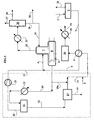
- the aqueous glycol solution arrives through the conduit (1).
- the glycol (1) loaded with water and salts is introduced into a flash balloon (2) where it releases, via the conduit (2a), the hydrocarbons coabsorbed during contact with natural gas.
- the tank (2) can operate between 0.1 MPa and 2 MPa absolute, preferably between 0.1 and 0.6 MPa absolute.
- the expanded glycol discharged through line (3) is heated in an exchanger (4) before being introduced via lines (5) and (6) into a regeneration column (7).
- the column (7) consists of a distillation column provided with a reboiler (8) at the bottom of the column and a conduit (31) supplying a reflux liquid at the head of the column.
- the column (7) is provided with trays, bulk packings or structured packings.
- Column (7) can operate at atmospheric pressure. Thanks to the reboiling heat provided by the heating element (9) and to the distillation effect operated in the column (7), a vapor is produced at the head of the column, mainly consisting of water and in a lower proportion. hydrocarbons. The vapor is evacuated from the column (7) through the conduit (24).
- the vapor evacuated through the conduit (27) is separated in the flask (26), a liquid hydrocarbon phase evacuated through the conduit (28) and an aqueous phase evacuated by the conduit (29).
- Part of the aqueous phase is sent through line (31) to column (7) for reflux, the remaining part being removed through line (30).
- the glycol recovered at the bottom of the reboiler (8) is heated or cooled in the exchanger (23) before being introduced into the tank (11) via the conduit (10).
- the exchanger (23) makes it possible to adjust the temperature, for example between 30 ° C and 150 ° C, at which the salts are liable to precipitate.
- the glycol circulating in the conduit (10) can be drawn off through the conduit (10bis), then mixed with the solution circulating in the conduit (15).
- the glycol flows from the reboiler (8) to the tank (11) by pressure difference.
- the capacity (11) is connected to the vacuum pump (21) by the conduit (20).
- the vacuum pump (21) makes it possible to evacuate the capacity (11), that is to say to maintain the capacity (11) at a pressure below atmospheric pressure, for example less than 90,000 Pa absolute , preferably less than 50,000 Pa absolute or 20,000 Pa absolute.
- the vacuum pressure is chosen as a function, in particular, of the quantities of dissolved salts and of water contained in the glycol solution, of the temperature of the glycol solution and of the nature of the salts.
- the solution containing the crystallized salts is discharged from the tank (11) through the conduit (12) and is sent to a separation device (13).
- the mixture can flow by gravity from the capacity (11) into the separation device (13) thanks to the difference in level between these two elements.
- the device (13) separates the precipitated salts from the rest of the solution.
- the salts are recovered through the conduit (14).
- the aqueous glycol solution, freed from part of its salts, is evacuated from the device (13) by the conduit (15).
- the salts remaining in the solution circulating in the conduit (15) are in equilibrium, that is to say that a modification of the thermodynamic conditions could cause precipitation of these salts.
- water can be injected there through the pipe (E). It is also possible to introduce part of the glycol circulating in the conduit (10) into the conduit (15) via the conduit (10bis). Thus, the remaining salts are not likely to precipitate because the water content of the solution circulating in the conduit (15) has been increased.
- the solution circulating in the conduit (15) is heated or cooled in the heat exchanger (4) before being stored in the tank (16).
- the glycol solution is evacuated from the tank (16) via the pipe (19) after any cooling in the exchanger (18), then is injected into a pipe carrying a natural gas coming from a production well.
- the separation device (13) may consist of a filtration device (filtration on a filtering medium or on a pre-layer), a centrifugation device (use of centrifuge or cyclone), an ultrasonic separation device or a combination of these techniques.
- FIG. 2 shows a variant of part of the process according to Figure 1.
- the process according to Figure 2 replaces the part of the process of Figure 1 contained in the dotted rectangle.
- the identical references designate the same elements.
- the process part represented by FIG. 2 comprises two stages of precipitation and separation of the salts placed in series.
- the glycol recovered at the bottom of the regeneration column arrives via line (10), for example at atmospheric pressure. It is heated or cooled, for example to a temperature between 30 ° C and 150 ° C, in the heat exchanger (23) then is introduced into the tank (11).
- the capacity (11) is connected to the vacuum pump (21) by the conduit (20).
- the vacuum pump (21) enables the capacity (11) to be evacuated by maintaining the capacity (11) at a pressure of less than 90,000 Pa absolute, preferably less than 50,000 Pa.
- the water vaporized in the capacity (11) is pumped by the pump (21), then is sent via the conduit (22) into the reboiler (8) of the regeneration column (7).
- the solution containing the crystallized salts is discharged from the tank (11) through the conduit (12), and is sent to a separation device (13).
- the device (13) separates the precipitated salts from the rest of the solution.
- the salts are recovered through the conduit (14).
- the aqueous glycol solution at least partially freed from its salts is evacuated from the device (13) through the conduit (32).
- the solution circulating in the conduit (32) is heated or cooled, for example to a temperature between 30 ° C and 150 ° C, by the heat exchanger (33), then is sent by the conduit (34) in the capacity (35).
- the capacity (35) is connected to the vacuum pump (41) by the conduit (40).
- the vacuum pump (41) enables the capacity (34) to be evacuated, while maintaining the capacity (34) at a pressure of less than 50,000 Pa absolute, preferably less than 20,000 Pa.
- the vaporized water in the tank (35) is pumped by the pump (41), then is sent via the conduits (42) and (22) into the reboiler (8) of the regeneration column.
- the mixture of crystallized salts and the solution is evacuated from the tank (35) via the conduit (36), and is sent to a separation device (37).
- the device (37) separates the precipitated salts from the rest of the solution.
- the salts are recovered through the conduit (38).
- the aqueous glycol solution partially freed from its salts is evacuated from the device (37) by the conduit (15) towards the storage capacity (16). This particular device makes it possible to further reduce the residual quantity of salts present in the regenerated glycol solution.
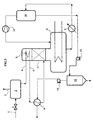
- a numerical example of the operating conditions of the process according to the invention is given in relation to the process shown diagrammatically in FIG. 3.
- a rich glycol (MEG + water + salts) arriving via the conduit (1) must be treated in order to concentrate it at 90% by weight and in order to eliminate part of the salts which it contains so as to avoid salt deposits certain elements of regeneration and to limit corrosion phenomena.
- the flow rate of rich glycol to be treated is 12,500 kg / h, its concentration is 55% by weight of MEG and it contains 0.3% by weight of salts. It is available at 30 ° C and 0.6 MPa absolute.
- the rich glycol (1) is expanded to 0.5 MPa absolute by the valve (V), then is sent to a flash balloon (2) where the oil dissolved in the glycol are vaporized, then evacuated through the conduit (3).
- Rich glycol from balloon (2) through the conduit (4) is heated in the reflux coil (S) of the regeneration column (7), then is introduced through the conduit (5) into the exchanger (6) to be heated to a temperature of about 75 ° C, then feeds the regeneration column (7).
- the reboiler (8) operates at atmospheric pressure at a temperature of 116.5 ° C, the glycol is then concentrated at 70% by weight and under these conditions, there is little or no risk of precipitation of salts in the reboiler.
- the partially regenerated glycol is then heated to a temperature of 131 ° C in the exchanger (9) and introduced in capacity (10).
- the capacity (10) is maintained under vacuum at a pressure of 80,000 Pa absolute.
- the operating conditions for this capacity have been chosen so as to concentrate the glycol up to 90% by weight and to make precipitate the salts.
- the water vaporized in the tank (10) is pumped by the pump (11) and returned to the reboiler (8).
- the concentrated glycol solution at 90% by weight and containing crystallized salts is sent by the pump (12) to a centrifugal separation device (13).
- Regenerated glycol and freed of its salts is then pumped (14) and sent to the exchanger (6) in order to be cooled by heat exchange with the glycol circulating in the conduit (5).
Landscapes
- Chemical & Material Sciences (AREA)
- Organic Chemistry (AREA)
- Oil, Petroleum & Natural Gas (AREA)
- Engineering & Computer Science (AREA)
- Chemical Kinetics & Catalysis (AREA)
- General Chemical & Material Sciences (AREA)
- Organic Low-Molecular-Weight Compounds And Preparation Thereof (AREA)
- Vaporization, Distillation, Condensation, Sublimation, And Cold Traps (AREA)
- Saccharide Compounds (AREA)
- Solid-Sorbent Or Filter-Aiding Compositions (AREA)
Abstract
Description
Avant l'étape c), on peut refroidir ou chauffer la solution enrichie en glycol obtenue à l'étape b) à une température comprise entre 30°C et 150°C.
A l'étape a), on peut détendre ladite solution à une pression comprise entre 0,1 MPa et 2 MPa absolu, et à l'étape b), on peut distiller à pression atmosphérique.
La solution de glycol appauvrie obtenue à l'étape e) peut réchauffer la solution pauvre en hydrocarbures obtenue à l'étape a).
- la figure 1 représente schématiquement le procédé selon l'invention,
- les figures 2 et 3 représentent schématiquement des variantes du procédé selon l'invention.
Sur la figure 1, la solution aqueuse de glycol arrive par le conduit (1). Le glycol (1) chargé en eau et en sels est introduit dans un ballon de flash (2) où il libère par le conduit (2 bis) les hydrocarbures coabsorbés lors du contact avec le gaz naturel. Le ballon (2) peut fonctionner entre 0,1 MPa et 2 MPa absolu, de préférence entre 0,1 et 0,6 MPa absolu.
Le glycol détendu évacué par le conduit (3) est réchauffé dans un échangeur (4) avant d'être introduit par l'intermédiaire des conduits (5) et (6) dans une colonne de régénération (7). La colonne (7) consiste en une colonne de distillation pourvue d'un rebouilleur (8) en fond de colonne et d'un conduit (31) amenant un liquide de reflux en tête de colonne. La colonne (7) est munie de plateaux, de garnissages en vrac ou de garnissages structurés. La colonne (7) peut fonctionner à pression atmosphérique. Grâce à la chaleur de rebouillage apportée par l'élément chauffant (9) et à l'effet de distillation opéré dans la colonne (7), une vapeur est produite en tête de colonne, principalement constituée d'eau et dans une proportion plus faible d'hydrocarbures.
La vapeur est évacuée de la colonne (7) par le conduit (24). Après refroidissement de cette vapeur dans un échangeur de chaleur (25), on sépare dans le ballon (26) de la vapeur évacuée par le conduit (27), une phase hydrocarbure liquide évacuée par le conduit (28) et une phase aqueuse évacuée par le conduit (29). Une partie de la phase aqueuse est envoyée par le conduit (31) dans la colonne (7) pour reflux, la partie restante étant évacuée par le conduit (30).
Le glycol récupéré en fond du rebouilleur (8) est chauffé ou refroidi dans l'échangeur (23) avant d'être introduit dans la capacité (11) par l'intermédiaire du conduit (10). L'échangeur (23) permet de régler la température, par exemple entre 30°C et 150°C, à laquelle les sels sont susceptibles de précipiter. Une partie du glycol circulant dans le conduit (10) peut être soutirée par le conduit (10bis), puis mélangée avec la solution circulant dans le conduit (15). Le glycol s'écoule du rebouilleur (8) vers la capacité (11) par différence de pression. La capacité (11) est reliée à la pompe à vide (21) par le conduit (20). La pompe à vide (21) permet de réaliser une mise sous vide de la capacité (11), c'est à dire à maintenir la capacité (11) à une pression inférieure à la pression atmosphérique, par exemple inférieure à 90 000 Pa absolu, de préférence inférieure à 50 000 Pa absolu ou 20 000 Pa absolu. La pression de mise sous vide est choisie en fonction, notamment, des quantités de sels dissous et d'eau contenus dans la solution de glycol, de la température de la solution de glycol et de la nature des sels. Dans la capacité (11), sous l'effet de l'ajustement de température et de la mise sous vide, une partie de l'eau se vaporise avec un peu de glycol. L'eau vaporisée dans la capacité (11) est pompée par la pompe (21), puis est envoyée par le conduit (22) dans le rebouilleur (8) de la colonne de régénération. L'abaissement de la teneur en eau, couplé à l'ajustement de la température, permet la précipitation des sels dissous dans la solution aqueuse de glycol au niveau de la capacité (11).
Les sels restants dans la solution circulant dans le conduit (15) sont en équilibres, c'est à dire qu'une modification des conditions thermodynamiques pourrait provoquer une précipitation de ces sels. Pour éviter la précipitation des sels dans le conduit (15), on peut y injecter de l'eau par l'intermédiaire du conduit (E). On peut également introduire une partie du glycol circulant dans le conduit (10) dans le conduit (15) par l'intermédiaire du conduit (10bis). Ainsi, les sels restants ne sont pas susceptibles de précipiter car la teneur en eau de la solution circulant dans le conduit (15) a été augmentée.
Le dispositif de séparation (13) peut consister en un dispositif de filtration (filtration sur media filtrant ou sur précouche), un dispositif de centrifugation (utilisation de centrifugeuse ou de cyclone), un dispositif de séparation par ultrason ou une association des ces techniques.
La partie de procédé représentée par la figure 2 comportent deux étapes de précipitation et de séparation des sels mises en série.
Le glycol récupéré en fond de la colonne de régénération arrive par le conduit (10), par exemple sous pression atmosphérique. Il est réchauffé ou refroidi, par exemple à une température comprise entre 30°C et 150°C, dans l'échangeur de chaleur (23) puis est introduit dans la capacité (11). La capacité (11) est reliée à la pompe à vide (21) par le conduit (20). La pompe à vide (21) permet de réaliser une mise sous vide de la capacité (11) en maintenant la capacité (11) à une pression inférieure à 90 000 Pa absolu, de préférence inférieure à 50 000 Pa. L'eau vaporisée dans la capacité (11) est pompée par la pompe (21), puis est envoyée par le conduit (22) dans le rebouilleur (8) de la colonne de régénération (7). La solution contenant les sels cristallisés est évacuée de la capacité (11) par le conduit (12), et est envoyée vers un dispositif de séparation (13). Le dispositif (13) sépare les sels précipités du reste de la solution. Les sels sont récupérés par le conduit (14). La solution aqueuse de glycol au moins en partie débarrassée de ses sels est évacuée du dispositif (13) par le conduit (32).
La solution circulant dans le conduit (32) est réchauffée ou refroidie, par exemple à une température comprise entre 30°C et 150°C, par l'échangeur de chaleur (33), puis est envoyée par le conduit (34) dans la capacité (35). La capacité (35) est reliée à la pompe à vide (41) par le conduit (40). La pompe à vide (41) permet de réaliser une mise sous vide de la capacité (34), en maintenant la capacité (34) à une pression inférieure à 50 000 Pa absolu, de préférence inférieure à 20 000 Pa. L'eau vaporisée dans la capacité (35) est pompée par la pompe (41), puis est envoyée par les conduits (42) et (22) dans le rebouilleur (8) de la colonne de régénération. Le mélange de sels cristallisés et de la solution est évacué de la capacité (35) par le conduit (36), et est envoyé vers un dispositif de séparation (37). Le dispositif (37) sépare les sels précipités du reste de la solution. Les sels sont récupérés par le conduit (38). La solution aqueuse de glycol en partie débarrassée de ses sels est évacuée du dispositif (37) par le conduit (15) vers la capacité de stockage (16). Ce dispositif particulier permet de réduire de façon plus poussée la quantité résiduelle de sels présents dans la solution de glycol régénéré.
Un glycol riche (MEG + eau + sels) arrivant par le conduit (1) doit être traité afin de le concentrer à 90 % poids et afin d'éliminer une partie des sels qu'il contient de manière à éviter des dépôts de sels sur certains éléments de la régénération et à limiter les phénomènes de corrosion. Le débit de glycol riche à traiter est de 12 500 kg/h, sa concentration est de 55 % poids de MEG et il contient 0,3 % poids de sels. Il est disponible à 30°C et à 0,6 MPa absolu.
Claims (13)
- Procédé de régénération d'une solution de glycol contenant de l'eau, des hydrocarbures et des sels dissous, comportant les étapes:a) on détend ladite solution pour libérer des hydrocarbures et pour obtenir une solution pauvre en hydrocarbures,b) on distille dans une colonne de distillation la solution pauvre en hydrocarbures obtenue à l'étape a) pour obtenir une solution enrichie en glycol et une vapeur contenant de l'eau et des hydrocarbures,c) on met sous vide une première partie de la solution enrichie en glycol obtenue à l'étape b) sous une pression inférieure à 90 000 Pa absolu pour obtenir de l'eau vaporisée et une solution de glycol contenant des sels précipités,d) on sépare les sels précipités de la solution de glycol obtenue à l'étape c) pour obtenir des sels précipités et une solution de glycol appauvrie en sels.
- Procédé selon la revendication 1, comportant les étapes:e) on met sous vide la solution de glycol appauvrie en sels obtenue à l'étape d) sous une pression inférieure à 50 000 Pa absolu pour obtenir de l'eau vaporisée et une solution de glycol contenant des sels précipités,f) on sépare les sels précipités de la solution de glycol obtenue à l'étape e) pour obtenir des sels précipités et une deuxième solution de glycol appauvrie en sels.
- Procédé selon l'une des revendications précédentes dans lequel, à l'étape d), on sépare les sels précipités de la solution de glycol au moyen d'au moins une des techniques: filtration, centrifugation, séparation par ultrason.
- Procédé selon l'une des revendications précédentes, dans lequel avant l'étape c), on refroidit la solution enrichie en glycol obtenue à l'étape b) à une température comprise entre 30°C et 150°C.
- Procédé selon l'une des revendications 1 à 3, dans lequel avant l'étape c), on chauffe la solution enrichie en glycol obtenue à l'étape b) à une température comprise entre 30°C et 150°C.
- Procédé selon l'une des revendications précédentes, dans lequel à l'étape a), on détend ladite solution à une pression comprise entre 0,1 MPa et 2 MPa absolu, et dans lequel à l'étape b), on distille à pression atmosphérique.
- Procédé selon l'une des revendications précédentes, dans lequel la solution de glycol appauvrie obtenue à l'étape e) réchauffe la solution pauvre en hydrocarbures obtenue à l'étape a).
- Procédé selon l'une des revendications précédentes, dans lequel on effectue les étapes:g) on refroidit la vapeur contenant de l'eau et des hydrocarbures obtenue à l'étape b) pour obtenir de la vapeur d'eau, une phase hydrocarbures liquides et une phase aqueuse,h) une partie de la phase aqueuse obtenue à l'étape g) est envoyée en tête de la colonne de distillation.
- Procédé selon l'une des revendications précédentes, dans lequel on effectue l'étape:i) on introduit l'eau vaporisée obtenue à l'étape c) dans ladite colonne de distillation.
- Procédé selon l'une des revendications précédentes, dans lequel on effectue l'étape:j) on réunit une deuxième partie de la solution enrichie en glycol obtenue à l'étape b) et la solution de glycol appauvrie en sels obtenue à l'étape d).
- Procédé selon l'une des revendications 1 à 10, dans lequel on effectue l'étape:k) on introduit de l'eau dans la solution de glycol appauvrie en sels obtenue à l'étape d).
- Procédé selon l'une des revendications précédentes dans lequel le glycol consiste en un composé choisi dans le groupe comportant le monoéthylène glycol, le diéthylène glycol et le triéthylène glycol.
- Procédé selon l'une des revendications précédentes dans lequel les sels comprennent au moins un des composés suivants: chlorure de sodium, chlorure de potassium, chlorure de calcium et bicarbonate de sodium, sulfate de sodium, sulfate de potassium, sulfate de calcium.
Applications Claiming Priority (2)
| Application Number | Priority Date | Filing Date | Title |
|---|---|---|---|
| FR0213425A FR2846323B1 (fr) | 2002-10-28 | 2002-10-28 | Procede de regeneration d'une solution aqueuse de glycol contenant des sels |
| FR0213425 | 2002-10-28 |
Publications (3)
| Publication Number | Publication Date |
|---|---|
| EP1415965A1 true EP1415965A1 (fr) | 2004-05-06 |
| EP1415965A8 EP1415965A8 (fr) | 2004-07-28 |
| EP1415965B1 EP1415965B1 (fr) | 2006-12-20 |
Family
ID=32088306
Family Applications (1)
| Application Number | Title | Priority Date | Filing Date |
|---|---|---|---|
| EP20030292563 Expired - Lifetime EP1415965B1 (fr) | 2002-10-28 | 2003-10-15 | Procédé de régenération d'une solution aqueuse de glycol contenant des sels |
Country Status (7)
| Country | Link |
|---|---|
| US (1) | US7232505B2 (fr) |
| EP (1) | EP1415965B1 (fr) |
| AT (1) | ATE348791T1 (fr) |
| CA (1) | CA2445855A1 (fr) |
| DE (1) | DE60310503T2 (fr) |
| DK (1) | DK1415965T3 (fr) |
| FR (1) | FR2846323B1 (fr) |
Cited By (3)
| Publication number | Priority date | Publication date | Assignee | Title |
|---|---|---|---|---|
| DE10360205A1 (de) * | 2003-12-20 | 2005-07-28 | Enviro-Chemie Gmbh | Verfahren zur Aufbereitung von Glykol/Wasser-Gemischen aus der Erdgasförderung |
| EP1874439A4 (fr) * | 2005-04-07 | 2012-09-19 | Exxonmobil Upstream Res Co | Recuperation d'inhibiteur d'hydrate cinetique |
| CN104645651A (zh) * | 2013-11-22 | 2015-05-27 | 普罗舎纳特公司 | 处理用于天然气开采的溶剂如单乙二醇的灵活方法 |
Families Citing this family (39)
| Publication number | Priority date | Publication date | Assignee | Title |
|---|---|---|---|---|
| NO20056113L (no) * | 2005-12-21 | 2007-06-22 | Statoil Asa | Fremgangsmate og anlegg for regenerering av glykol |
| FR2914684A1 (fr) * | 2007-04-03 | 2008-10-10 | Total Sa | Procede de recyclage d'agents retardateurs de formation d'hydrates |
| BRPI0814016A2 (pt) * | 2007-07-30 | 2015-02-03 | Cameron Int Corp | Remoção de sólidos em reparação de monoetilenoglicol |
| NO332854B1 (no) | 2009-01-08 | 2013-01-21 | Aker Process Systems As | Fremgangsmåte for re-konsentrasjon og gjenvinning av monoetylenglykol |
| GB2467169B (en) * | 2009-01-26 | 2014-08-06 | Statoil Petroleum As | Process and apparatus for the production of lean liquid hydrate inhibitor composition |
| GB2473213B (en) | 2009-09-02 | 2011-12-28 | Aker Process Systems As | Device and method for recovering MEG |
| CN103702962B (zh) * | 2011-06-14 | 2016-09-07 | 挪威国家石油公司 | 用于从单乙二醇中去除多价阳离子的方法和装置 |
| WO2013000896A1 (fr) * | 2011-06-27 | 2013-01-03 | Shell Internationale Research Maatschappij B.V. | Procédé et appareil de mise en circulation d'un flux de glycol contenant une concentration de cations divalents, et procédé de production d'un flux de gaz naturel en produit |
| NO333182B1 (no) | 2011-07-20 | 2013-03-25 | Aker Process Systems As | HI gjenvinningsprosess |
| CN103946348B (zh) * | 2011-09-22 | 2015-12-16 | 挪威国家石油公司 | 动力学水合物抑制剂的再生 |
| US9790153B2 (en) * | 2011-11-14 | 2017-10-17 | Cameron International Corporation | Process scheme to improve divalent metal salts removal from mono ethylene glycol (MEG) |
| WO2013169679A1 (fr) * | 2012-05-07 | 2013-11-14 | M-I L.L.C. | Procédés de nettoyage de gazoducs de gaz naturel |
| AP2014008097A0 (en) | 2012-05-11 | 2014-12-31 | Fjords Proc As | Carboxylic acid salt removal during hydrate inhibitor recovery |
| AU2013269181B2 (en) | 2012-05-30 | 2016-03-24 | Grant Prideco, Inc. | System and method for removal of heavy metal ions from a rich hydrate inhibitor stream |
| US9433875B2 (en) * | 2012-08-24 | 2016-09-06 | Cameron International Corporation | Divalent cation removal from rich monoethylene glycol (MEG) feed streams by ion exchange |
| US9145345B2 (en) * | 2012-08-30 | 2015-09-29 | Glyeco, Inc. | Method and apparatus for processing glycol |
| MX360436B (es) * | 2013-03-14 | 2018-11-01 | Persedo LLC | Conversion de contaminantes en alcohol-agua. |
| BR112015029660B1 (pt) | 2013-05-31 | 2021-11-03 | Shell Internationale Research Maatschappij B.V. | Método para recuperar um álcool a partir de uma corrente aquosa |
| EP3004037B1 (fr) | 2013-05-31 | 2018-08-29 | Shell International Research Maatschappij B.V. | Procédé pour la séparation d'alkylène glycol |
| EP3004039B1 (fr) | 2013-05-31 | 2018-07-04 | Shell International Research Maatschappij B.V. | Procédé de séparation de 1,4-butanediol et de coproduits |
| US20150104356A1 (en) | 2013-10-10 | 2015-04-16 | Cameron Solutions, Inc. | System and Process For Removal Of Organic Carboxylates From Mono Ethylene Glycol (MEG) Water Streams By Acidification and Vaporization Under Vacuum |
| CN106132912B (zh) | 2014-04-02 | 2018-05-11 | 国际壳牌研究有限公司 | 用于分离单乙二醇和1,2-丁二醇的方法 |
| WO2015198212A1 (fr) * | 2014-06-27 | 2015-12-30 | Reliance Industries Limited | Systeme de regeneration d'ethane-1,2-diol et procede associe |
| WO2017053269A1 (fr) | 2015-09-23 | 2017-03-30 | Saudi Arabian Oil Company | Élimination d'inhibiteurs cinétiques d'hydrates |
| KR102439330B1 (ko) * | 2015-11-04 | 2022-09-02 | 한국조선해양 주식회사 | 수화물 억제제 처리 시스템 |
| KR101805491B1 (ko) * | 2015-11-23 | 2017-12-07 | 대우조선해양 주식회사 | Meg 재생 시스템 |
| CN105861089B (zh) * | 2016-06-17 | 2019-01-25 | 中石化节能环保工程科技有限公司 | 一种气相提浓式三甘醇脱水再生系统 |
| KR101795003B1 (ko) * | 2016-11-10 | 2017-11-08 | 서울대학교 산학협력단 | Meg 회수 장치 및 meg 회수 방법 |
| NO342676B1 (en) | 2016-12-23 | 2018-06-25 | Nov Process & Flow Tech As | Hydrate inhibitor recovery system |
| WO2020104004A1 (fr) * | 2018-11-19 | 2020-05-28 | Nov Process & Flow Technologies As | Système de récupération d'inhibiteur d'hydrates |
| NL2022037B1 (en) * | 2018-11-21 | 2020-06-05 | Ioniqa Tech B V | A separation method and reactor system for a glycol-water mixture |
| US10954179B1 (en) * | 2019-08-28 | 2021-03-23 | Cameron International Corporation | Method and apparatus for filtering heat transfer fluid from a monoethylene glycol stream |
| FR3104452B1 (fr) * | 2019-12-13 | 2022-09-09 | Ifp Energies Now | Procede de regeneration d’une solution aqueuse de meg contenant des sels avec traitement de la purge |
| CN112107876A (zh) * | 2020-09-27 | 2020-12-22 | 江苏科技大学 | 深海天然气开采过程中乙二醇富液再生脱水系统及其再生脱水方法 |
| CN112121452A (zh) * | 2020-09-27 | 2020-12-25 | 江苏科技大学 | 深海天然气开采中含高溶解度盐的乙二醇贫液的脱盐系统及其脱盐方法 |
| EP4277887A4 (fr) | 2021-01-18 | 2024-12-11 | Cameron Technologies Limited | Élimination de sulfate à partir de fux de meg à l'aide de chlorure de calcium |
| US11958795B2 (en) | 2022-03-09 | 2024-04-16 | Gly-Tech Services, Inc. | Chloride salt eliminator for glycol in natural gas dehydration |
| CN114632342B (zh) * | 2022-05-07 | 2022-08-05 | 山东省章丘鼓风机股份有限公司 | 一种海上乙二醇防垢再生系统 |
| US12540086B2 (en) | 2022-10-24 | 2026-02-03 | Cameron International Corporation | Bicarbonate removal from monoethylene glycol-water streams |
Citations (1)
| Publication number | Priority date | Publication date | Assignee | Title |
|---|---|---|---|---|
| US4427507A (en) * | 1982-03-22 | 1984-01-24 | Shell Oil Company | Process for the separation of glycol from an electrolyte-containing aqueous solution |
Family Cites Families (4)
| Publication number | Priority date | Publication date | Assignee | Title |
|---|---|---|---|---|
| GB1221019A (en) * | 1968-02-09 | 1971-02-03 | Coalite Chem Prod Ltd | Process for the production of dihalophenols |
| IT1141032B (it) * | 1980-08-29 | 1986-10-01 | Snam Progetti | Processo per la concentrazione di soluzioni acquose di glicoli |
| US6023003A (en) * | 1998-01-13 | 2000-02-08 | Reading & Bates Development Co. | Process and system for recovering glycol from glycol/brine streams |
| FR2822839B1 (fr) * | 2001-03-29 | 2003-05-16 | Inst Francais Du Petrole | Procede ameliore des deshydratation et de degazolinage d'un gaz naturel humide |
-
2002
- 2002-10-28 FR FR0213425A patent/FR2846323B1/fr not_active Expired - Fee Related
-
2003
- 2003-10-15 DK DK03292563T patent/DK1415965T3/da active
- 2003-10-15 EP EP20030292563 patent/EP1415965B1/fr not_active Expired - Lifetime
- 2003-10-15 AT AT03292563T patent/ATE348791T1/de not_active IP Right Cessation
- 2003-10-15 DE DE2003610503 patent/DE60310503T2/de not_active Expired - Fee Related
- 2003-10-24 CA CA 2445855 patent/CA2445855A1/fr not_active Abandoned
- 2003-10-24 US US10/691,508 patent/US7232505B2/en not_active Expired - Fee Related
Patent Citations (1)
| Publication number | Priority date | Publication date | Assignee | Title |
|---|---|---|---|---|
| US4427507A (en) * | 1982-03-22 | 1984-01-24 | Shell Oil Company | Process for the separation of glycol from an electrolyte-containing aqueous solution |
Non-Patent Citations (1)
| Title |
|---|
| DATABASE WPI Section Ch Week 199421, Derwent World Patents Index; Class H01, AN 1994-175166, XP002269571 * |
Cited By (7)
| Publication number | Priority date | Publication date | Assignee | Title |
|---|---|---|---|---|
| DE10360205A1 (de) * | 2003-12-20 | 2005-07-28 | Enviro-Chemie Gmbh | Verfahren zur Aufbereitung von Glykol/Wasser-Gemischen aus der Erdgasförderung |
| EP1874439A4 (fr) * | 2005-04-07 | 2012-09-19 | Exxonmobil Upstream Res Co | Recuperation d'inhibiteur d'hydrate cinetique |
| CN104645651A (zh) * | 2013-11-22 | 2015-05-27 | 普罗舎纳特公司 | 处理用于天然气开采的溶剂如单乙二醇的灵活方法 |
| FR3013710A1 (fr) * | 2013-11-22 | 2015-05-29 | Prosernat | Procede flexible pour le traitement de solvant, tel que le monoethylene glycol, utilise dans l'extraction du gaz naturel |
| EP2878589A1 (fr) * | 2013-11-22 | 2015-06-03 | Prosernat | Procédé flexible pour le traitement de solvant, tel que le monoéthylène glycol, utilise dans l'extraction du gaz naturel |
| US9943775B2 (en) | 2013-11-22 | 2018-04-17 | Prosernat | Flexible process for treating solvent, such as monoethylene glycol, used in natural gas extraction |
| CN104645651B (zh) * | 2013-11-22 | 2018-07-20 | 普罗舎纳特公司 | 处理用于天然气开采的溶剂如单乙二醇的灵活方法 |
Also Published As
| Publication number | Publication date |
|---|---|
| FR2846323B1 (fr) | 2004-12-10 |
| EP1415965A8 (fr) | 2004-07-28 |
| FR2846323A1 (fr) | 2004-04-30 |
| DE60310503D1 (de) | 2007-02-01 |
| ATE348791T1 (de) | 2007-01-15 |
| US7232505B2 (en) | 2007-06-19 |
| EP1415965B1 (fr) | 2006-12-20 |
| US20050072663A1 (en) | 2005-04-07 |
| DK1415965T3 (da) | 2007-04-30 |
| DE60310503T2 (de) | 2007-09-27 |
| CA2445855A1 (fr) | 2004-04-28 |
Similar Documents
| Publication | Publication Date | Title |
|---|---|---|
| EP1415965B1 (fr) | Procédé de régenération d'une solution aqueuse de glycol contenant des sels | |
| CA2357863C (fr) | Procede de pretraitement d'un gaz naturel contenant des gaz acides | |
| EP0770667B1 (fr) | Procédé de séchage de gaz au glycol incluant la purification des rejets gazeux | |
| DK178720B1 (en) | Method and apparatus for circulating a glycol stream, and method of producing a natural gas product stream | |
| FR2773793A1 (fr) | Procede et systeme pour separer un glycol de courants de glycol/saumure | |
| CA2230092C (fr) | Procede de desacidification avec production de gaz acides en phase liquide | |
| FR2848218A1 (fr) | Procede de desacidification et de deshydratation d'un gaz naturel | |
| EP2582446B1 (fr) | Procede et appareil de sechage et de compression d'un flux riche en co2 | |
| EP3643394B1 (fr) | Procédé de déshydratation d'un gaz hydrocarbone | |
| FR3034509B1 (fr) | Procede de traitement du gaz naturel pour minimiser la perte d'ethane | |
| EP0605322B1 (fr) | Procédé de déshydratation et/ou dessalage et de fractionnement simultané d'un effluent de gisement pétrolier | |
| KR102008834B1 (ko) | Meg 재생장치 | |
| KR102097609B1 (ko) | Meg 재생장치 | |
| FR3090832A1 (fr) | Procédé et appareil de séparation d’un courant d’alimentation comprenant au moins du CO2 ainsi qu’au moins un composé léger | |
| KR20140041764A (ko) | 2가 양이온의 농도를 갖는 글리콜 스트림을 순환시키는 방법 및 장치, 및 천연 가스 생성물 스트림의 제조 방법 | |
| KR102119474B1 (ko) | Meg 재생장치 | |
| EP4072701B1 (fr) | Procede de regeneration d'une solution aqueuse de meg contenant des sels avec traitement de la purge | |
| FR2914684A1 (fr) | Procede de recyclage d'agents retardateurs de formation d'hydrates | |
| CN113056318B (zh) | 水合物抑制剂回收系统 | |
| EP2937125A1 (fr) | Procédé de traitement d'une solution aqueuse contenant des matières dissoutes par cristallisation de clathrates hydrates | |
| KR102097608B1 (ko) | Meg 재생장치 | |
| KR20190125638A (ko) | Meg 재생장치 | |
| FR3080857A1 (fr) | Procede et dispositif de separation d'aromatiques sous vide | |
| FR2628983A1 (fr) | Procede de purification de composes emulsionnants en vue de reduire leur teneur en dioxanne |
Legal Events
| Date | Code | Title | Description |
|---|---|---|---|
| PUAI | Public reference made under article 153(3) epc to a published international application that has entered the european phase |
Free format text: ORIGINAL CODE: 0009012 |
|
| AK | Designated contracting states |
Kind code of ref document: A1 Designated state(s): AT BE BG CH CY CZ DE DK EE ES FI FR GB GR HU IE IT LI LU MC NL PT RO SE SI SK TR |
|
| AX | Request for extension of the european patent |
Extension state: AL LT LV MK |
|
| RIN1 | Information on inventor provided before grant (corrected) |
Inventor name: LABORIE, GERALDINE Inventor name: RIGAILL, CHANTAL Inventor name: LECOMTE, FABRICE Inventor name: WAINTRAUB. LIONEL |
|
| RAP1 | Party data changed (applicant data changed or rights of an application transferred) |
Owner name: PROSERNAT Owner name: INSTITUT FRANEAIS DU PETROLE |
|
| 17P | Request for examination filed |
Effective date: 20041108 |
|
| AKX | Designation fees paid |
Designated state(s): AT BE BG CH CY CZ DE DK EE ES FI FR GB GR HU IE IT LI LU MC NL PT RO SE SI SK TR |
|
| RIN1 | Information on inventor provided before grant (corrected) |
Inventor name: LABORIE, GERALDINE Inventor name: RIGAILL, CHANTAL Inventor name: LECOMTE, FABRICE Inventor name: WAINTRAUB, LIONEL |
|
| 17Q | First examination report despatched |
Effective date: 20050408 |
|
| GRAP | Despatch of communication of intention to grant a patent |
Free format text: ORIGINAL CODE: EPIDOSNIGR1 |
|
| GRAS | Grant fee paid |
Free format text: ORIGINAL CODE: EPIDOSNIGR3 |
|
| GRAA | (expected) grant |
Free format text: ORIGINAL CODE: 0009210 |
|
| AK | Designated contracting states |
Kind code of ref document: B1 Designated state(s): AT BE BG CH CY CZ DE DK EE ES FI FR GB GR HU IE IT LI LU MC NL PT RO SE SI SK TR |
|
| PG25 | Lapsed in a contracting state [announced via postgrant information from national office to epo] |
Ref country code: IT Free format text: LAPSE BECAUSE OF FAILURE TO SUBMIT A TRANSLATION OF THE DESCRIPTION OR TO PAY THE FEE WITHIN THE PRESCRIBED TIME-LIMIT;WARNING: LAPSES OF ITALIAN PATENTS WITH EFFECTIVE DATE BEFORE 2007 MAY HAVE OCCURRED AT ANY TIME BEFORE 2007. THE CORRECT EFFECTIVE DATE MAY BE DIFFERENT FROM THE ONE RECORDED. Effective date: 20061220 Ref country code: SI Free format text: LAPSE BECAUSE OF FAILURE TO SUBMIT A TRANSLATION OF THE DESCRIPTION OR TO PAY THE FEE WITHIN THE PRESCRIBED TIME-LIMIT Effective date: 20061220 Ref country code: CZ Free format text: LAPSE BECAUSE OF FAILURE TO SUBMIT A TRANSLATION OF THE DESCRIPTION OR TO PAY THE FEE WITHIN THE PRESCRIBED TIME-LIMIT Effective date: 20061220 Ref country code: RO Free format text: LAPSE BECAUSE OF FAILURE TO SUBMIT A TRANSLATION OF THE DESCRIPTION OR TO PAY THE FEE WITHIN THE PRESCRIBED TIME-LIMIT Effective date: 20061220 Ref country code: SK Free format text: LAPSE BECAUSE OF FAILURE TO SUBMIT A TRANSLATION OF THE DESCRIPTION OR TO PAY THE FEE WITHIN THE PRESCRIBED TIME-LIMIT Effective date: 20061220 Ref country code: AT Free format text: LAPSE BECAUSE OF FAILURE TO SUBMIT A TRANSLATION OF THE DESCRIPTION OR TO PAY THE FEE WITHIN THE PRESCRIBED TIME-LIMIT Effective date: 20061220 Ref country code: FI Free format text: LAPSE BECAUSE OF FAILURE TO SUBMIT A TRANSLATION OF THE DESCRIPTION OR TO PAY THE FEE WITHIN THE PRESCRIBED TIME-LIMIT Effective date: 20061220 Ref country code: IE Free format text: LAPSE BECAUSE OF FAILURE TO SUBMIT A TRANSLATION OF THE DESCRIPTION OR TO PAY THE FEE WITHIN THE PRESCRIBED TIME-LIMIT Effective date: 20061220 |
|
| REG | Reference to a national code |
Ref country code: GB Ref legal event code: FG4D Free format text: NOT ENGLISH |
|
| REG | Reference to a national code |
Ref country code: CH Ref legal event code: EP |
|
| REF | Corresponds to: |
Ref document number: 60310503 Country of ref document: DE Date of ref document: 20070201 Kind code of ref document: P |
|
| REG | Reference to a national code |
Ref country code: IE Ref legal event code: FG4D Free format text: LANGUAGE OF EP DOCUMENT: FRENCH |
|
| PG25 | Lapsed in a contracting state [announced via postgrant information from national office to epo] |
Ref country code: SE Free format text: LAPSE BECAUSE OF FAILURE TO SUBMIT A TRANSLATION OF THE DESCRIPTION OR TO PAY THE FEE WITHIN THE PRESCRIBED TIME-LIMIT Effective date: 20070320 Ref country code: BG Free format text: LAPSE BECAUSE OF FAILURE TO SUBMIT A TRANSLATION OF THE DESCRIPTION OR TO PAY THE FEE WITHIN THE PRESCRIBED TIME-LIMIT Effective date: 20070320 |
|
| PG25 | Lapsed in a contracting state [announced via postgrant information from national office to epo] |
Ref country code: ES Free format text: LAPSE BECAUSE OF FAILURE TO SUBMIT A TRANSLATION OF THE DESCRIPTION OR TO PAY THE FEE WITHIN THE PRESCRIBED TIME-LIMIT Effective date: 20070331 |
|
| PG25 | Lapsed in a contracting state [announced via postgrant information from national office to epo] |
Ref country code: PT Free format text: LAPSE BECAUSE OF FAILURE TO SUBMIT A TRANSLATION OF THE DESCRIPTION OR TO PAY THE FEE WITHIN THE PRESCRIBED TIME-LIMIT Effective date: 20070424 |
|
| REG | Reference to a national code |
Ref country code: DK Ref legal event code: T3 |
|
| PLBE | No opposition filed within time limit |
Free format text: ORIGINAL CODE: 0009261 |
|
| STAA | Information on the status of an ep patent application or granted ep patent |
Free format text: STATUS: NO OPPOSITION FILED WITHIN TIME LIMIT |
|
| 26N | No opposition filed |
Effective date: 20070921 |
|
| BERE | Be: lapsed |
Owner name: PROSERNAT Effective date: 20071031 Owner name: INSTITUT FRANCAIS DU PETROLE Effective date: 20071031 |
|
| PG25 | Lapsed in a contracting state [announced via postgrant information from national office to epo] |
Ref country code: GR Free format text: LAPSE BECAUSE OF FAILURE TO SUBMIT A TRANSLATION OF THE DESCRIPTION OR TO PAY THE FEE WITHIN THE PRESCRIBED TIME-LIMIT Effective date: 20070321 |
|
| PG25 | Lapsed in a contracting state [announced via postgrant information from national office to epo] |
Ref country code: MC Free format text: LAPSE BECAUSE OF NON-PAYMENT OF DUE FEES Effective date: 20071031 |
|
| REG | Reference to a national code |
Ref country code: CH Ref legal event code: PL |
|
| PG25 | Lapsed in a contracting state [announced via postgrant information from national office to epo] |
Ref country code: CH Free format text: LAPSE BECAUSE OF NON-PAYMENT OF DUE FEES Effective date: 20071031 Ref country code: LI Free format text: LAPSE BECAUSE OF NON-PAYMENT OF DUE FEES Effective date: 20071031 |
|
| PG25 | Lapsed in a contracting state [announced via postgrant information from national office to epo] |
Ref country code: BE Free format text: LAPSE BECAUSE OF NON-PAYMENT OF DUE FEES Effective date: 20071031 |
|
| REG | Reference to a national code |
Ref country code: FR Ref legal event code: ST Effective date: 20080630 |
|
| PGFP | Annual fee paid to national office [announced via postgrant information from national office to epo] |
Ref country code: NL Payment date: 20081028 Year of fee payment: 6 |
|
| PG25 | Lapsed in a contracting state [announced via postgrant information from national office to epo] |
Ref country code: EE Free format text: LAPSE BECAUSE OF FAILURE TO SUBMIT A TRANSLATION OF THE DESCRIPTION OR TO PAY THE FEE WITHIN THE PRESCRIBED TIME-LIMIT Effective date: 20061220 |
|
| PGFP | Annual fee paid to national office [announced via postgrant information from national office to epo] |
Ref country code: DE Payment date: 20081103 Year of fee payment: 6 Ref country code: DK Payment date: 20081027 Year of fee payment: 6 |
|
| PG25 | Lapsed in a contracting state [announced via postgrant information from national office to epo] |
Ref country code: FR Free format text: LAPSE BECAUSE OF NON-PAYMENT OF DUE FEES Effective date: 20071031 |
|
| PGFP | Annual fee paid to national office [announced via postgrant information from national office to epo] |
Ref country code: GB Payment date: 20081028 Year of fee payment: 6 |
|
| PG25 | Lapsed in a contracting state [announced via postgrant information from national office to epo] |
Ref country code: LU Free format text: LAPSE BECAUSE OF NON-PAYMENT OF DUE FEES Effective date: 20071015 Ref country code: CY Free format text: LAPSE BECAUSE OF FAILURE TO SUBMIT A TRANSLATION OF THE DESCRIPTION OR TO PAY THE FEE WITHIN THE PRESCRIBED TIME-LIMIT Effective date: 20061220 |
|
| PG25 | Lapsed in a contracting state [announced via postgrant information from national office to epo] |
Ref country code: TR Free format text: LAPSE BECAUSE OF FAILURE TO SUBMIT A TRANSLATION OF THE DESCRIPTION OR TO PAY THE FEE WITHIN THE PRESCRIBED TIME-LIMIT Effective date: 20061220 Ref country code: HU Free format text: LAPSE BECAUSE OF FAILURE TO SUBMIT A TRANSLATION OF THE DESCRIPTION OR TO PAY THE FEE WITHIN THE PRESCRIBED TIME-LIMIT Effective date: 20070621 |
|
| REG | Reference to a national code |
Ref country code: NL Ref legal event code: V1 Effective date: 20100501 |
|
| REG | Reference to a national code |
Ref country code: DK Ref legal event code: EBP |
|
| PG25 | Lapsed in a contracting state [announced via postgrant information from national office to epo] |
Ref country code: DE Free format text: LAPSE BECAUSE OF NON-PAYMENT OF DUE FEES Effective date: 20100501 Ref country code: NL Free format text: LAPSE BECAUSE OF NON-PAYMENT OF DUE FEES Effective date: 20100501 |
|
| PG25 | Lapsed in a contracting state [announced via postgrant information from national office to epo] |
Ref country code: GB Free format text: LAPSE BECAUSE OF NON-PAYMENT OF DUE FEES Effective date: 20091015 |
|
| PG25 | Lapsed in a contracting state [announced via postgrant information from national office to epo] |
Ref country code: DK Free format text: LAPSE BECAUSE OF NON-PAYMENT OF DUE FEES Effective date: 20091031 |