EP1413762A2 - A method of balancing the supply of bleed air from a plurality of gas turbine engines - Google Patents
A method of balancing the supply of bleed air from a plurality of gas turbine engines Download PDFInfo
- Publication number
- EP1413762A2 EP1413762A2 EP03022641A EP03022641A EP1413762A2 EP 1413762 A2 EP1413762 A2 EP 1413762A2 EP 03022641 A EP03022641 A EP 03022641A EP 03022641 A EP03022641 A EP 03022641A EP 1413762 A2 EP1413762 A2 EP 1413762A2
- Authority
- EP
- European Patent Office
- Prior art keywords
- air
- engines
- bleed
- flow rate
- air flow
- Prior art date
- Legal status (The legal status is an assumption and is not a legal conclusion. Google has not performed a legal analysis and makes no representation as to the accuracy of the status listed.)
- Granted
Links
- 238000000034 method Methods 0.000 title claims abstract description 21
- 238000004378 air conditioning Methods 0.000 claims description 8
- 230000003247 decreasing effect Effects 0.000 description 2
- 238000004519 manufacturing process Methods 0.000 description 2
- 230000001143 conditioned effect Effects 0.000 description 1
- 230000001419 dependent effect Effects 0.000 description 1
- 230000001627 detrimental effect Effects 0.000 description 1
- 238000010586 diagram Methods 0.000 description 1
- 230000000694 effects Effects 0.000 description 1
- 238000012423 maintenance Methods 0.000 description 1
- 230000001105 regulatory effect Effects 0.000 description 1
- 230000006641 stabilisation Effects 0.000 description 1
Images
Classifications
-
- F—MECHANICAL ENGINEERING; LIGHTING; HEATING; WEAPONS; BLASTING
- F02—COMBUSTION ENGINES; HOT-GAS OR COMBUSTION-PRODUCT ENGINE PLANTS
- F02C—GAS-TURBINE PLANTS; AIR INTAKES FOR JET-PROPULSION PLANTS; CONTROLLING FUEL SUPPLY IN AIR-BREATHING JET-PROPULSION PLANTS
- F02C9/00—Controlling gas-turbine plants; Controlling fuel supply in air- breathing jet-propulsion plants
- F02C9/26—Control of fuel supply
- F02C9/42—Control of fuel supply specially adapted for the control of two or more plants simultaneously
-
- F—MECHANICAL ENGINEERING; LIGHTING; HEATING; WEAPONS; BLASTING
- F02—COMBUSTION ENGINES; HOT-GAS OR COMBUSTION-PRODUCT ENGINE PLANTS
- F02C—GAS-TURBINE PLANTS; AIR INTAKES FOR JET-PROPULSION PLANTS; CONTROLLING FUEL SUPPLY IN AIR-BREATHING JET-PROPULSION PLANTS
- F02C6/00—Plural gas-turbine plants; Combinations of gas-turbine plants with other apparatus; Adaptations of gas-turbine plants for special use
- F02C6/02—Plural gas-turbine plants having a common power output
-
- F—MECHANICAL ENGINEERING; LIGHTING; HEATING; WEAPONS; BLASTING
- F02—COMBUSTION ENGINES; HOT-GAS OR COMBUSTION-PRODUCT ENGINE PLANTS
- F02C—GAS-TURBINE PLANTS; AIR INTAKES FOR JET-PROPULSION PLANTS; CONTROLLING FUEL SUPPLY IN AIR-BREATHING JET-PROPULSION PLANTS
- F02C6/00—Plural gas-turbine plants; Combinations of gas-turbine plants with other apparatus; Adaptations of gas-turbine plants for special use
- F02C6/04—Gas-turbine plants providing heated or pressurised working fluid for other apparatus, e.g. without mechanical power output
- F02C6/06—Gas-turbine plants providing heated or pressurised working fluid for other apparatus, e.g. without mechanical power output providing compressed gas
- F02C6/08—Gas-turbine plants providing heated or pressurised working fluid for other apparatus, e.g. without mechanical power output providing compressed gas the gas being bled from the gas-turbine compressor
-
- F—MECHANICAL ENGINEERING; LIGHTING; HEATING; WEAPONS; BLASTING
- F02—COMBUSTION ENGINES; HOT-GAS OR COMBUSTION-PRODUCT ENGINE PLANTS
- F02C—GAS-TURBINE PLANTS; AIR INTAKES FOR JET-PROPULSION PLANTS; CONTROLLING FUEL SUPPLY IN AIR-BREATHING JET-PROPULSION PLANTS
- F02C9/00—Controlling gas-turbine plants; Controlling fuel supply in air- breathing jet-propulsion plants
- F02C9/48—Control of fuel supply conjointly with another control of the plant
- F02C9/50—Control of fuel supply conjointly with another control of the plant with control of working fluid flow
- F02C9/52—Control of fuel supply conjointly with another control of the plant with control of working fluid flow by bleeding or by-passing the working fluid
-
- F—MECHANICAL ENGINEERING; LIGHTING; HEATING; WEAPONS; BLASTING
- F04—POSITIVE - DISPLACEMENT MACHINES FOR LIQUIDS; PUMPS FOR LIQUIDS OR ELASTIC FLUIDS
- F04D—NON-POSITIVE-DISPLACEMENT PUMPS
- F04D27/00—Control, e.g. regulation, of pumps, pumping installations or pumping systems specially adapted for elastic fluids
- F04D27/02—Surge control
Definitions
- This invention relates to a method of balancing the supply of bleed air from a plurality of gas turbine engines.
- pressurised air from a gas turbine engine of, for example, an aircraft in ancillary systems of the aircraft such as for examples only, an air conditioning system or an anti-icing system.
- gas turbine engines were tolerant of bleed air being extracted and thus more than enough pressurised air for the ancillary system or systems was bled from the engine, with surplus pressurised air being discarded. More modem high performance engines are however less tolerant of pressurised air being taken from them; if excess pressurised air is bled from such engines, this is likely to be detrimental to engine performance, and results in an increase in required engine maintenance. Also, discarding excess bleed air has an economic effect.
- one or more engines may be throttled back resulting in lower bleed pressure being available from that or those engines.
- each air bleed line including a control valve which is controllable by a controller to vary the flow rate of air bled from the associated engine
- the method including providing to the controller a demand signal indicative of the demand for bleed air by the ancillary system, sensing air pressure in the distribution line and comparing the demand signal with the sensed air pressure to derive a command signal, sensing the air flow rates individually in each of the air bleed lines from the engines with respective air flow rate sensors which provide air flow rate signals to the controller, comparing the air flow rates in each of the air bleed lines to derive individual flow matching signals for each of the engines, comparing each of the flow matching signals to the command signal to derive a drive signal for each of the control valves, and applying the drive signals to the respective control valves.
- control valves are individually controlled by the controller so that the flow rates of air bled from individual engines is balanced regardless of differing engine performance and manufacturing tolerances.
- the lowest for the time being of the air flow rates is used as a reference with which the air flow rate or rates for the other or others of the engines is compared so that the air flow rate from the other or others of the engines is matched to the air flow rate of the reference.
- the lowest bleed air flow rate for the time being used as the reference is preferably determined dynamically so that the available bleed air closely matches demand with minimal surplus air being bled from the engines.
- the method may include sensing that the bleed air flow rate from one of the engines is below a threshold level, providing a drive signal to the relevant control valve to cause the control valve fully to open, and balancing the supplies of bleed air from the remainder of the engines.
- a threshold level e.g., if one or more of the engines is throttled back, a maximum contribution to the supply of bleed air from that engine or engines is obtained, with the supplies from the remainder of the engines being balanced.
- the ancillary system may be an air conditioning system and/or an anti-icing system.
- the air pressure sensors may be for examples only, venturi or hot wire types of sensors.
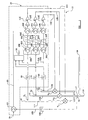
- FIG 1 there is shown a control system 10 for balancing the supply of bleed air from a plurality of, in this example, three gas turbine engines 11, 12, 13 of an aircraft, although it will be appreciated that the invention need not be applied to aircraft engines but any other multi-gas turbine engine system where a supply of pressurised bleed air is required for an ancillary system.
- the bleed air is pressurised and bled for use in an ancillary system, in this example an anti-icing system 14 or an air conditioning system 15, the bled air being available to the anti-icing system 14 and air conditioning system 15 from a common distribution line 17.
- an ancillary system in this example an anti-icing system 14 or an air conditioning system 15, the bled air being available to the anti-icing system 14 and air conditioning system 15 from a common distribution line 17.
- the air bled from each of the engines 11, 12, 13 passes along a respective air bleed line 11a, 12a, 13a to the common distribution line 17, via a respective valve V1, V2 or V3, which in this example may be rotary valves capable of metering the air flow, such as butterfly valves, or linear valves as desired.
- the valves V1, V2 and V3 may be electrically or pneumatically operated, but in each case are controllable by a system controller 20 to control the flow rate of bleed air from the respective air bleed lines 11a, 12a, 13a to the common distribution line 17.
- the system 10 includes a pressure sensor 22 to sense the air pressure in the common distribution line 17.
- the sensor 22 is preferably a transducer which produces an electrical signal indicative of the air pressure in the distribution line 17.
- the signal is conditioned by a signal conditioner 22 a before being supplied along line 22 b to a comparator 23 which also receives a demand signal along a line 24 which is indicative of the demand for bleed air from the anti-icing system 14 and air conditioning system 15.
- the comparator 23 thus produces a command signal along line 25 which is indicative of the difference between the demand for bleed air and the availability of bleed air in the common distribution line 17.
- the command signal on line 25 is subsequently used to produce drive signals for each of the control valves V1, V2, V3 on lines 11b, 12b, an 13b, as hereinafter explained, so that the control valves V1, V2, V3 are each operated so that, as far as is possible, the flow rates of bleed air supplied from each of the three engines 11, 12, 13 is balanced and so that the pressure in the common distribution line 17 is equal to the demand indicated by the signal on line 24.
- the air flow rate in each of the air bleed lines 11a, 12a, 13a is sensed by a suitable flow rate sensor S1, S2, S3, each of which provides a signal to the controller 20 indicative of air flow rate in the respective air bleed line 11a, 12a, 13a.
- Each of the signals from the air flow rate sensors S1, S2, S3 is individually processed by a respective signal conditioner 30, 31, 32 and filter to convert the air flow information contained in the respective signal, to a measure of flow rate of the bleed air in the respective air bleed lines 11a, 12a, 13a on respective lines indicated at 30a, 31a and 32 a .
- the air flow rates thus determined for each of the air bleed lines 11a, 12a, 13a are then compared in a lowest/least select comparator 35 to determine which of the air flow rates sensed by the sensors S1, S2 and S3 in the air bleed lines 11a, 12a, 13a is the lowest for the time being.
- the lowest/least flow rate is then used as a reference with which the flow rate signals on lines 30 a , 31 a and 32 a are compared to derive individual flow matching signals for the bleed air flows from each of the flow rate error signals 30b, 31b, 32b.
- the least/lowest flow rate is determined dynamically in use for optimum balancing, but may be determined at intervals only as desired.
- the limited flow rate error signals 30d, 31d, 32d are each subtracted from the command signal on line 35 by comparators 30e, 31e and 32e (although one of these, the reference determined by the lowest/least select comparator 35 will be zero) to provide flow matching signals which are then fed to suitable valve drive circuitry 11d, 12d, 13d, to produce respective drive signals provided on lines 11b, 12b, 13b for the respective valves V1, V2, V3, which open/close in response to balance the bleed air flow contributions from the three engines 11, 12, 13 and to satisfy the demand indicated on line 24.
- the valve drive circuitry 11d, 12d and 13d may include an integrator and amplifier and may cause ramping up or down of the flow matching signals when the input to the drive circuitry is not zero.
- the system is rateless with the pressure sensed by pressure sensor 22 in the common distribution line 17 being adjusted to equal the demand indicated on line 24 in the steady state.
- valve drive circuitry 11d, 12d and 13d is associated with a proportional gain and a derivative gain in a classical PID controller familiar to those versed in the art of control theory. Stabilisation and response optimisation is necessary but is not part of the present invention.
- Alternative controller 20 architectures are possible dependent on the dynamic requirements.
- the controller functions may be partitioned into several controllers, one for each engine and/or exhaust.
- the resultant air pressure in the distribution line 17 is continuously compared with the demand signal on line 24 in the comparator 23 and the drive signals on lines 11b, 12b, 13b for the valves V1, V2 and V3 are adjusted until the availability of bleed air in the distribution line 17 matches demand.
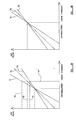
- demand may change, as indicated by the graphs in figures 2a and 2b in which case the command signal on line 25 will change and as a result the valve drive circuitry 11d, 12d, 13d will open/close the valves V1, V2 and V3 appropriately to match the demand.
- FIG 2a a relationships between air flow and (normalised) drive current for the three valves V1, V2 and V3 are shown. Because of differing engine 11, 12, 13 performance and manufacturing tolerances in the system 10, the relationship is different for each valve V1, V2 and V3. In figure 2a, for example, only limited air is required, e.g. the air conditioning system-15 is operating. As demand increases, for example because the anti-icing system 14 is brought on line, then this will result in an increase in a magnitude of the command signal on line 25 requiring an increase on drive current indicated at x 1 .
- the air flow rates delivered by the three valves V1, V2 and V3 can be balanced as indicated in Figure 2b by adjusting the drive current to each of the three valves V1, V2 and V3.
- the pressure sensor 22 in the common distribution line 17 and the flow rate sensors S1, S2 and S3 in the bleed air lines 11a, 12a, 13a may be venturi, hot wire or any other kinds of sensors as desired, which preferably are transducers which produce electrical signals to the controller 20 indicative of sensed pressure flow rate.
- the particular electronic scheme indicated in figure 1 is only an example of a scheme which may be utilised to enable the command signal on line 25 to be applied to each of the valves V1, V2 and V3, but corrected to balance the rates of bleed air flow contributed by each of the engines 11, 12, 13.
- the controller 20 in response to the airflow contribution from any one engine 11, 12, 13 decreasing below a predetermined threshold, responds by fully opening the respective control valve V1, V2, V3, so that a maximum contribution of air flow from the throttled back engine is achieved, and the controller 20 balances the contributions to bleed air flow from the remaining non-throttled back engines 11, 12,13.
- the temperature of the bleed air may be used to calculate the mass flow of bleed air for the purpose of balancing flow.
Landscapes
- Engineering & Computer Science (AREA)
- Chemical & Material Sciences (AREA)
- Combustion & Propulsion (AREA)
- Mechanical Engineering (AREA)
- General Engineering & Computer Science (AREA)
- Physics & Mathematics (AREA)
- Fluid Mechanics (AREA)
- Flow Control (AREA)
- Fluid-Pressure Circuits (AREA)
Abstract
Description
- This invention relates to a method of balancing the supply of bleed air from a plurality of gas turbine engines.
- It is known to use pressurised air from a gas turbine engine of, for example, an aircraft, in ancillary systems of the aircraft such as for examples only, an air conditioning system or an anti-icing system.
- Historically, gas turbine engines were tolerant of bleed air being extracted and thus more than enough pressurised air for the ancillary system or systems was bled from the engine, with surplus pressurised air being discarded. More modem high performance engines are however less tolerant of pressurised air being taken from them; if excess pressurised air is bled from such engines, this is likely to be detrimental to engine performance, and results in an increase in required engine maintenance. Also, discarding excess bleed air has an economic effect.
- Accordingly it is desirable for the amount of pressurised air bled from the engines more closely to match demand.
- In an aircraft having a plurality of engines, it is desirable that the air bled from each of the engines is matched with equal flow rates to avoid any one engine from supplying all the bleed air whilst the other engine(s) contributes little because otherwise there is a tendency for the amount of bleed air supplied from the engines to diverge. Such difference in flow rates can arise due to differing engine performance or difference in the characteristics of individual regulating valves together with any differences in bleed air pipe length.
- In some instances one or more engines may be throttled back resulting in lower bleed pressure being available from that or those engines.
- According to the invention we provide a method of balancing the supply of bleed air from a plurality of gas turbine engines, there being an air bleed line from each of the engines to a common distribution line which distributes the bled air to at least one ancillary system, each air bleed line including a control valve which is controllable by a controller to vary the flow rate of air bled from the associated engine, the method including providing to the controller a demand signal indicative of the demand for bleed air by the ancillary system, sensing air pressure in the distribution line and comparing the demand signal with the sensed air pressure to derive a command signal, sensing the air flow rates individually in each of the air bleed lines from the engines with respective air flow rate sensors which provide air flow rate signals to the controller, comparing the air flow rates in each of the air bleed lines to derive individual flow matching signals for each of the engines, comparing each of the flow matching signals to the command signal to derive a drive signal for each of the control valves, and applying the drive signals to the respective control valves.
- Thus utilising the method of the invention, the control valves are individually controlled by the controller so that the flow rates of air bled from individual engines is balanced regardless of differing engine performance and manufacturing tolerances.
- In a preferred method, in comparing the bleed air flow rates- in each of the air bleed lines to derive individual flow matching signals for each of the engines, the lowest for the time being of the air flow rates is used as a reference with which the air flow rate or rates for the other or others of the engines is compared so that the air flow rate from the other or others of the engines is matched to the air flow rate of the reference.
- The lowest bleed air flow rate for the time being used as the reference is preferably determined dynamically so that the available bleed air closely matches demand with minimal surplus air being bled from the engines.
- Where there are three or more engines, the method may include sensing that the bleed air flow rate from one of the engines is below a threshold level, providing a drive signal to the relevant control valve to cause the control valve fully to open, and balancing the supplies of bleed air from the remainder of the engines. Thus for example, if one or more of the engines is throttled back, a maximum contribution to the supply of bleed air from that engine or engines is obtained, with the supplies from the remainder of the engines being balanced.
- The ancillary system may be an air conditioning system and/or an anti-icing system. The air pressure sensors may be for examples only, venturi or hot wire types of sensors.
- Embodiments of the invention will now be described with reference to the accompanying drawings in which:-
- FIGURE 1 is an illustrative diagram showing a control system for balancing the supply of bleed air from a plurality of gas turbine engines to which the method of the invention may be performed;
- FIGURE 2a shows graphically the relationship between valve drive current and air flow rate for each of the engines;
- FIGURE 2b is a graph similar to that of figure 2a but where there is an increased demand for bleed air.
- Referring to figure 1 there is shown a
control system 10 for balancing the supply of bleed air from a plurality of, in this example, threegas turbine engines - The bleed air is pressurised and bled for use in an ancillary system, in this example an
anti-icing system 14 or anair conditioning system 15, the bled air being available to theanti-icing system 14 andair conditioning system 15 from acommon distribution line 17. - The air bled from each of the
engines bleed line 11a, 12a, 13a to thecommon distribution line 17, via a respective valve V1, V2 or V3, which in this example may be rotary valves capable of metering the air flow, such as butterfly valves, or linear valves as desired. The valves V1, V2 and V3 may be electrically or pneumatically operated, but in each case are controllable by asystem controller 20 to control the flow rate of bleed air from the respective airbleed lines 11a, 12a, 13a to thecommon distribution line 17. - The
system 10 includes apressure sensor 22 to sense the air pressure in thecommon distribution line 17. Thesensor 22 is preferably a transducer which produces an electrical signal indicative of the air pressure in thedistribution line 17. The signal is conditioned by a signal conditioner 22a before being supplied alongline 22b to acomparator 23 which also receives a demand signal along aline 24 which is indicative of the demand for bleed air from theanti-icing system 14 andair conditioning system 15. Thecomparator 23 thus produces a command signal alongline 25 which is indicative of the difference between the demand for bleed air and the availability of bleed air in thecommon distribution line 17. - The command signal on
line 25 is subsequently used to produce drive signals for each of the control valves V1, V2, V3 onlines 11b, 12b, an 13b, as hereinafter explained, so that the control valves V1, V2, V3 are each operated so that, as far as is possible, the flow rates of bleed air supplied from each of the threeengines common distribution line 17 is equal to the demand indicated by the signal online 24. - The air flow rate in each of the air bleed
lines 11a, 12a, 13a is sensed by a suitable flow rate sensor S1, S2, S3, each of which provides a signal to thecontroller 20 indicative of air flow rate in the respective air bleedline 11a, 12a, 13a. - Each of the signals from the air flow rate sensors S1, S2, S3 is individually processed by a
respective signal conditioner bleed lines 11a, 12a, 13a on respective lines indicated at 30a, 31a and 32a. - The air flow rates thus determined for each of the air bleed
lines 11a, 12a, 13a are then compared in a lowest/leastselect comparator 35 to determine which of the air flow rates sensed by the sensors S1, S2 and S3 in the airbleed lines 11a, 12a, 13a is the lowest for the time being. The lowest/least flow rate is then used as a reference with which the flow rate signals onlines rate error signals - One of the
flow error signals Limiters 30c, 31c and 32c constrain the flow rate error signals for control purposes. - The limited flow
rate error signals line 35 bycomparators 30e, 31e and 32e (although one of these, the reference determined by the lowest/leastselect comparator 35 will be zero) to provide flow matching signals which are then fed to suitablevalve drive circuitry lines engines line 24. - The
valve drive circuitry pressure sensor 22 in thecommon distribution line 17 being adjusted to equal the demand indicated online 24 in the steady state. - Normally the integral gain in the
valve drive circuitry Alternative controller 20 architectures are possible dependent on the dynamic requirements. The controller functions may be partitioned into several controllers, one for each engine and/or exhaust. - The resultant air pressure in the
distribution line 17 is continuously compared with the demand signal online 24 in thecomparator 23 and the drive signals onlines distribution line 17 matches demand. Of course, demand may change, as indicated by the graphs in figures 2a and 2b in which case the command signal online 25 will change and as a result thevalve drive circuitry - Referring to figure 2a, a relationships between air flow and (normalised) drive current for the three valves V1, V2 and V3 are shown. Because of
differing engine system 10, the relationship is different for each valve V1, V2 and V3. In figure 2a, for example, only limited air is required, e.g. the air conditioning system-15 is operating. As demand increases, for example because theanti-icing system 14 is brought on line, then this will result in an increase in a magnitude of the command signal online 25 requiring an increase on drive current indicated at x1. However, if the drive currents to all three of the valves V1, V2 and V3 are similarly increased, the air flow rates V1, V2 and V3 for the three valves will be different as indicated by the lines f1, f2 and f3 in the figure. - However, after a very short time, by performing the method of the invention, the air flow rates delivered by the three valves V1, V2 and V3 can be balanced as indicated in Figure 2b by adjusting the drive current to each of the three valves V1, V2 and V3.
- In the example shown and described with reference to figure 1, the
pressure sensor 22 in thecommon distribution line 17 and the flow rate sensors S1, S2 and S3 in thebleed air lines 11a, 12a, 13a may be venturi, hot wire or any other kinds of sensors as desired, which preferably are transducers which produce electrical signals to thecontroller 20 indicative of sensed pressure flow rate. - The particular electronic scheme indicated in figure 1 is only an example of a scheme which may be utilised to enable the command signal on
line 25 to be applied to each of the valves V1, V2 and V3, but corrected to balance the rates of bleed air flow contributed by each of theengines - If desired, particularly but not exclusively for a four or more engined system, it may be desirable in use to throttle back one or more of the engines, for example during landing of the aircraft or during cruise. Thus the contribution to bleed air flow in the
system 10 may decrease significantly. In order to prevent the contributions from the remaining engines from decreasing to match the low air flow from the throttled back engine, which would most likely result in insufficient air being available to theanti-icing system 14 orair conditioning system 15, desirably thecontroller 20, in response to the airflow contribution from any oneengine controller 20 responds by fully opening the respective control valve V1, V2, V3, so that a maximum contribution of air flow from the throttled back engine is achieved, and thecontroller 20 balances the contributions to bleed air flow from the remainingnon-throttled back engines - It is also realised that along with pressure the temperature of the bleed air may be used to calculate the mass flow of bleed air for the purpose of balancing flow.
- The features disclosed in the foregoing description, or the following claims, or the accompanying drawings, expressed in their specific forms or in terms of a means for performing the disclosed function, or a method or process for attaining the disclosed result, as appropriate, may, separately, or in any combination of such features, be utilised for realising the invention in diverse forms thereof.
Claims (6)
- A method of balancing the supply of bleed air from a plurality of gas turbine engines (11, 12, 13), there being an air bleed line (11a, 12a, 13a) from each of the engines to a common distribution line (17) which distributes the bled air to at least one ancillary system (14, 15), each air bleed line (11a, 12a, 13a) including a control valve (V1, V2, V3) which is controllable by a controller (20) to vary the flow rate of air bled from the associated engine (11, 12, 13), the method including providing to the controller (20) a demand signal (24) indicative of the demand for bleed air by the ancillary system (14, 15), sensing air pressure in the distribution line (17) and comparing the demand signal (24) with the sensed air pressure to derive a command signal (25), sensing the air flow rates individually in each of the air bleed lines (11a, 12, 13a) from the engines (11, 12, 13) with respective flow rates sensors (S1, S2, S3) which provide air flow rates signals to the controller (20), comparing the air flow rates in each of the air bleed lines (11a, 11b, 11c) to derive individual flow matching signals (30b, 31b, 32b) for each of the engines (11, 12, 13), comparing each of the flow matching signals (30b, 31b, 32b) to the command signal (25) to derive a drive signal (11b, 12b, 13b) for each of the control valves (V1, V2, V3), and applying the drive signals to the respective control valves (V1, V2, V3).
- A method according to claim 1 wherein in comparing the air flow rates in each of the air bleed lines (11a, 12a, 13a) to derive individual flow matching signals for each of the engines (11, 12, 13), the lowest for the time being of the air flow rates is used as a reference with which the air flow rate or rates for the other or others of the engines (11, 12, 13) is compared so that the air flow rate from the other or others of the engines (11, 12, 13) is matched to the air flow rate of the reference.
- A method according to claim 2 wherein the lowest air flow rate for the time being is determined dynamically.
- A method according to any one of the preceding claims wherein there are three or more engines (11, 12, 13), the method including sensing that the bleed air flow rate from one of the engines is below a threshold level, providing a control signal to the relevant control valve (V1, V2, V3) to cause the control valve to open fully, and balancing the supplies of bleed air from the remainder of the engines (11, 12, 13).
- A method according to any one of the preceding claims wherein the ancillary system is an air conditioning system (15) and/or an anti-icing system (14).
- A method according to any one of the preceding claims wherein the or at least one of the air flow rate sensors (S1, S2, S3) is one of a venturi or hot wire type of sensors.
Applications Claiming Priority (2)
| Application Number | Priority Date | Filing Date | Title |
|---|---|---|---|
| GBGB0224625.4A GB0224625D0 (en) | 2002-10-23 | 2002-10-23 | Method of balancing the supply of bleed air from a plurality of engines |
| GB0224625 | 2002-10-23 |
Publications (3)
| Publication Number | Publication Date |
|---|---|
| EP1413762A2 true EP1413762A2 (en) | 2004-04-28 |
| EP1413762A3 EP1413762A3 (en) | 2004-12-01 |
| EP1413762B1 EP1413762B1 (en) | 2010-12-08 |
Family
ID=9946399
Family Applications (1)
| Application Number | Title | Priority Date | Filing Date |
|---|---|---|---|
| EP03022641A Expired - Lifetime EP1413762B1 (en) | 2002-10-23 | 2003-10-06 | A method of balancing the supply of bleed air from a plurality of gas turbine engines |
Country Status (5)
| Country | Link |
|---|---|
| US (1) | US7036319B2 (en) |
| EP (1) | EP1413762B1 (en) |
| DE (1) | DE60335233D1 (en) |
| ES (1) | ES2357558T3 (en) |
| GB (1) | GB0224625D0 (en) |
Cited By (3)
| Publication number | Priority date | Publication date | Assignee | Title |
|---|---|---|---|---|
| WO2006104535A1 (en) * | 2005-02-09 | 2006-10-05 | Honeywell International Inc. | Method and system for balancing bleed flows from gas turbine engines |
| CN101555835A (en) * | 2008-04-07 | 2009-10-14 | 通用电气公司 | Method and system for controlling load point of gas turbine engine |
| EP2543595A3 (en) * | 2011-07-06 | 2014-12-24 | Hamilton Sundstrand Corporation | Decoupling control architecture for pressure and flow controls in series |
Families Citing this family (14)
| Publication number | Priority date | Publication date | Assignee | Title |
|---|---|---|---|---|
| US8033118B2 (en) * | 2008-01-31 | 2011-10-11 | EMBRAER—Empresa Brasileira de Aeronautica S.A. | Bleed airflow balancing control using simplified sensing |
| US8240153B2 (en) * | 2008-05-14 | 2012-08-14 | General Electric Company | Method and system for controlling a set point for extracting air from a compressor to provide turbine cooling air in a gas turbine |
| US8337139B2 (en) * | 2009-11-10 | 2012-12-25 | General Electric Company | Method and system for reducing the impact on the performance of a turbomachine operating an extraction system |
| US9359949B2 (en) * | 2011-02-17 | 2016-06-07 | Honeywell International Inc. | Distributed bleed system temperature management |
| US10041407B2 (en) * | 2011-03-29 | 2018-08-07 | General Electric Company | System and method for air extraction from gas turbine engines |
| US8612063B2 (en) * | 2011-05-02 | 2013-12-17 | Honeywell International, Inc. | Temperature control setpoint offset for ram air minimization |
| EP2642099A1 (en) * | 2012-03-23 | 2013-09-25 | Alstom Technology Ltd | Method for determining at least one firing temperature for the control of a gas turbine and gas turbine for carrying out the method |
| FR2996257B1 (en) * | 2012-10-03 | 2014-10-10 | Snecma | METHOD AND APPARATUS FOR DETERMINING AIR COLLECTION ON AN AIRCRAFT TURBOJET ENGINE |
| DE102013012943B4 (en) * | 2013-08-01 | 2018-03-22 | Ee Emission Engineering Gmbh | Method for operating a multi-burner system |
| GB2522925B (en) * | 2014-02-11 | 2016-05-11 | Ge Aviat Systems Ltd | Method for detecting a bleed air system fault |
| US10814988B2 (en) | 2015-06-08 | 2020-10-27 | Hamilton Sunstrand Corporation | Unequal bleed flow |
| US10926883B2 (en) | 2018-03-21 | 2021-02-23 | Hamilton Sunstrand Corporation | Environmental control system including shared air source with balanced airflow output |
| US11761378B2 (en) * | 2019-05-13 | 2023-09-19 | Rolls-Royce Corporation | Bleed air charged cooling system with turbo-generator |
| US11530710B2 (en) | 2020-01-28 | 2022-12-20 | Pratt & Whitney Canada Corp. | Aircraft pneumatic system |
Family Cites Families (4)
| Publication number | Priority date | Publication date | Assignee | Title |
|---|---|---|---|---|
| SE8107800L (en) * | 1981-03-30 | 1982-10-01 | Avco Corp | Temperature controllings / SYNCHRONIZATION SYSTEM |
| US4779644A (en) * | 1985-02-08 | 1988-10-25 | Allied-Signal Inc. | Aircraft engine bleed air flow balancing technique |
| US5155991A (en) * | 1991-04-01 | 1992-10-20 | United Technologies Corporation | Bleed air flow regulators with flow balance |
| US6494047B2 (en) * | 2000-12-07 | 2002-12-17 | Honeywell International Inc. | Airflow sharing |
-
2002
- 2002-10-23 GB GBGB0224625.4A patent/GB0224625D0/en not_active Ceased
-
2003
- 2003-10-06 DE DE60335233T patent/DE60335233D1/en not_active Expired - Lifetime
- 2003-10-06 EP EP03022641A patent/EP1413762B1/en not_active Expired - Lifetime
- 2003-10-06 ES ES03022641T patent/ES2357558T3/en not_active Expired - Lifetime
- 2003-10-08 US US10/681,761 patent/US7036319B2/en not_active Expired - Lifetime
Cited By (5)
| Publication number | Priority date | Publication date | Assignee | Title |
|---|---|---|---|---|
| WO2006104535A1 (en) * | 2005-02-09 | 2006-10-05 | Honeywell International Inc. | Method and system for balancing bleed flows from gas turbine engines |
| US7536865B2 (en) | 2005-02-09 | 2009-05-26 | Honeywell International Inc. | Method and system for balancing bleed flows from gas turbine engines |
| CN101555835A (en) * | 2008-04-07 | 2009-10-14 | 通用电气公司 | Method and system for controlling load point of gas turbine engine |
| CN101555835B (en) * | 2008-04-07 | 2013-11-06 | 通用电气公司 | Method and system for controlling load point of gas turbine engine |
| EP2543595A3 (en) * | 2011-07-06 | 2014-12-24 | Hamilton Sundstrand Corporation | Decoupling control architecture for pressure and flow controls in series |
Also Published As
| Publication number | Publication date |
|---|---|
| US7036319B2 (en) | 2006-05-02 |
| EP1413762B1 (en) | 2010-12-08 |
| DE60335233D1 (en) | 2011-01-20 |
| EP1413762A3 (en) | 2004-12-01 |
| US20060059920A1 (en) | 2006-03-23 |
| ES2357558T3 (en) | 2011-04-27 |
| GB0224625D0 (en) | 2002-12-04 |
Similar Documents
| Publication | Publication Date | Title |
|---|---|---|
| EP1413762B1 (en) | A method of balancing the supply of bleed air from a plurality of gas turbine engines | |
| EP2252784B1 (en) | Bleed airflow balancing control using simplified sensing | |
| US5155991A (en) | Bleed air flow regulators with flow balance | |
| US6544114B2 (en) | Method and system for controlling an air mass flow in an aircraft | |
| US7472540B2 (en) | Method and device for compensating variations in fuel composition in a gas turbine system | |
| EP1060115B1 (en) | Method and plant for pneumatic transport of solid particles | |
| US6494047B2 (en) | Airflow sharing | |
| US6782701B2 (en) | Master-slave engine bleed flow sharing control method and system | |
| CN105775147B (en) | A kind of airplane intake closed-loop flow control device and control method | |
| JP4256684B2 (en) | Gas supply method | |
| AU2010241938B2 (en) | System and method for controlling temperature in a forehearth | |
| US10926883B2 (en) | Environmental control system including shared air source with balanced airflow output | |
| CN115562320B (en) | Variable thrust propulsion system and control method | |
| SU1200102A1 (en) | Method of automatic control of spray-drying process | |
| JPH01252819A (en) | Combustion device | |
| JPS63267467A (en) | Paint discharge controller of coating device | |
| SU304186A1 (en) | AIR TEMPERATURE REGULATOR IN AIRPLANE | |
| WO1996030703A1 (en) | Process control, method and apparatus | |
| JPH05240422A (en) | Combustion air flow rate controller | |
| AU2014200715B2 (en) | Method for controlling temperature in a forehearth | |
| SU926474A1 (en) | Method of automatic control of loose material drying process | |
| SU1452582A1 (en) | Automatic control system for grinding and drying materials in milling unit | |
| GB2232790A (en) | Pneumatic pressure regulator | |
| HK1129913A (en) | Method for regulating pressure in a weaving machine and weaving machine with pressure regulating system |
Legal Events
| Date | Code | Title | Description |
|---|---|---|---|
| PUAI | Public reference made under article 153(3) epc to a published international application that has entered the european phase |
Free format text: ORIGINAL CODE: 0009012 |
|
| AK | Designated contracting states |
Kind code of ref document: A2 Designated state(s): AT BE BG CH CY CZ DE DK EE ES FI FR GB GR HU IE IT LI LU MC NL PT RO SE SI SK TR |
|
| AX | Request for extension of the european patent |
Extension state: AL LT LV MK |
|
| PUAL | Search report despatched |
Free format text: ORIGINAL CODE: 0009013 |
|
| AK | Designated contracting states |
Kind code of ref document: A3 Designated state(s): AT BE BG CH CY CZ DE DK EE ES FI FR GB GR HU IE IT LI LU MC NL PT RO SE SI SK TR |
|
| AX | Request for extension of the european patent |
Extension state: AL LT LV MK |
|
| RIC1 | Information provided on ipc code assigned before grant |
Ipc: 7F 02C 9/42 B Ipc: 7F 02C 9/52 B Ipc: 7F 02C 6/08 B Ipc: 7F 02C 6/02 B Ipc: 7F 04D 27/00 A |
|
| 17P | Request for examination filed |
Effective date: 20050506 |
|
| AKX | Designation fees paid |
Designated state(s): DE ES FR GB IT |
|
| RAP1 | Party data changed (applicant data changed or rights of an application transferred) |
Owner name: HONEYWELL AEROSPACE BV Owner name: HONEYWELL UK LIMITED |
|
| GRAP | Despatch of communication of intention to grant a patent |
Free format text: ORIGINAL CODE: EPIDOSNIGR1 |
|
| GRAS | Grant fee paid |
Free format text: ORIGINAL CODE: EPIDOSNIGR3 |
|
| GRAA | (expected) grant |
Free format text: ORIGINAL CODE: 0009210 |
|
| AK | Designated contracting states |
Kind code of ref document: B1 Designated state(s): DE ES FR GB IT |
|
| REG | Reference to a national code |
Ref country code: GB Ref legal event code: FG4D |
|
| REF | Corresponds to: |
Ref document number: 60335233 Country of ref document: DE Date of ref document: 20110120 Kind code of ref document: P |
|
| REG | Reference to a national code |
Ref country code: ES Ref legal event code: FG2A Ref document number: 2357558 Country of ref document: ES Kind code of ref document: T3 Effective date: 20110427 |
|
| PLBE | No opposition filed within time limit |
Free format text: ORIGINAL CODE: 0009261 |
|
| STAA | Information on the status of an ep patent application or granted ep patent |
Free format text: STATUS: NO OPPOSITION FILED WITHIN TIME LIMIT |
|
| 26N | No opposition filed |
Effective date: 20110909 |
|
| PGFP | Annual fee paid to national office [announced via postgrant information from national office to epo] |
Ref country code: FR Payment date: 20111005 Year of fee payment: 9 Ref country code: GB Payment date: 20110930 Year of fee payment: 9 |
|
| REG | Reference to a national code |
Ref country code: DE Ref legal event code: R097 Ref document number: 60335233 Country of ref document: DE Effective date: 20110909 |
|
| PGFP | Annual fee paid to national office [announced via postgrant information from national office to epo] |
Ref country code: ES Payment date: 20111026 Year of fee payment: 9 |
|
| GBPC | Gb: european patent ceased through non-payment of renewal fee |
Effective date: 20121006 |
|
| REG | Reference to a national code |
Ref country code: FR Ref legal event code: ST Effective date: 20130628 |
|
| PG25 | Lapsed in a contracting state [announced via postgrant information from national office to epo] |
Ref country code: GB Free format text: LAPSE BECAUSE OF NON-PAYMENT OF DUE FEES Effective date: 20121006 |
|
| PG25 | Lapsed in a contracting state [announced via postgrant information from national office to epo] |
Ref country code: FR Free format text: LAPSE BECAUSE OF NON-PAYMENT OF DUE FEES Effective date: 20121031 Ref country code: IT Free format text: LAPSE BECAUSE OF NON-PAYMENT OF DUE FEES Effective date: 20121006 |
|
| REG | Reference to a national code |
Ref country code: ES Ref legal event code: FD2A Effective date: 20140207 |
|
| PG25 | Lapsed in a contracting state [announced via postgrant information from national office to epo] |
Ref country code: ES Free format text: LAPSE BECAUSE OF NON-PAYMENT OF DUE FEES Effective date: 20121007 |
|
| PGFP | Annual fee paid to national office [announced via postgrant information from national office to epo] |
Ref country code: DE Payment date: 20211027 Year of fee payment: 19 |
|
| REG | Reference to a national code |
Ref country code: DE Ref legal event code: R119 Ref document number: 60335233 Country of ref document: DE |
|
| PG25 | Lapsed in a contracting state [announced via postgrant information from national office to epo] |
Ref country code: DE Free format text: LAPSE BECAUSE OF NON-PAYMENT OF DUE FEES Effective date: 20230503 |
|
| P01 | Opt-out of the competence of the unified patent court (upc) registered |
Effective date: 20230830 |