EP1413620B1 - Negativtypflüssigkristalle enthaltend Dotierstoffe - Google Patents
Negativtypflüssigkristalle enthaltend Dotierstoffe Download PDFInfo
- Publication number
- EP1413620B1 EP1413620B1 EP02023817A EP02023817A EP1413620B1 EP 1413620 B1 EP1413620 B1 EP 1413620B1 EP 02023817 A EP02023817 A EP 02023817A EP 02023817 A EP02023817 A EP 02023817A EP 1413620 B1 EP1413620 B1 EP 1413620B1
- Authority
- EP
- European Patent Office
- Prior art keywords
- dopant
- liquid crystal
- negative
- crystal material
- type
- Prior art date
- Legal status (The legal status is an assumption and is not a legal conclusion. Google has not performed a legal analysis and makes no representation as to the accuracy of the status listed.)
- Expired - Lifetime
Links
Images





Classifications
-
- C—CHEMISTRY; METALLURGY
- C09—DYES; PAINTS; POLISHES; NATURAL RESINS; ADHESIVES; COMPOSITIONS NOT OTHERWISE PROVIDED FOR; APPLICATIONS OF MATERIALS NOT OTHERWISE PROVIDED FOR
- C09K—MATERIALS FOR MISCELLANEOUS APPLICATIONS, NOT PROVIDED FOR ELSEWHERE
- C09K19/00—Liquid crystal materials
- C09K19/52—Liquid crystal materials characterised by components which are not liquid crystals, e.g. additives with special physical aspect: solvents, solid particles
- C09K19/58—Dopants or charge transfer agents
-
- C—CHEMISTRY; METALLURGY
- C09—DYES; PAINTS; POLISHES; NATURAL RESINS; ADHESIVES; COMPOSITIONS NOT OTHERWISE PROVIDED FOR; APPLICATIONS OF MATERIALS NOT OTHERWISE PROVIDED FOR
- C09K—MATERIALS FOR MISCELLANEOUS APPLICATIONS, NOT PROVIDED FOR ELSEWHERE
- C09K2323/00—Functional layers of liquid crystal optical display excluding electroactive liquid crystal layer characterised by chemical composition
Definitions
- the present invention relates to a method of improving the response times and bulk on-state alignments of negative-type liquid crystals.
- Electronic device display technologies require displays with high brightness and contrast, low-power consumption and fast refresh/response speed.
- liquid crystal technology is being explored in particular, negative-type liquid crystals, homeotropically aligned in the off state, are of interest. In these materials, it is important to achieve good homeotropicity in the off-state, rapid response times, good homogenous alignment in the on-state, high opacity in the off-state and good contrast.
- an electric field is applied to a homeotropically aligned, birefringent liquid crystal.
- the liquid crystal aligns to some degree with the field and the birefringence changes, thus, the optical transmission of the system changes.
- the alignment requires some time, which should be as rapid as possible.
- the liquid crystal aligns to some degree to its original position or to the new field and the birefringence changes again. This response time should also be minimised in order to improve the quality of the liquid crystal display.
- EP 0 541 388 describes a liquid crystal display device and a method of producing the same.
- devices of the type having a glass substrate coated with a negative-type-alignment undercoat film.
- the negative-type-alignment undercoat film is a film of an oxide deposited on the substrate by ion-beam assisted angle vapour deposition.
- US 3,656,834 describes an additive for a liquid crystal material.
- the liquid crystal material assumes a negative-type texture comprising nematic material having dissolved therein an additive, which can be, amongst others, hexadecyltrimethyl ammonium bromide.
- EP 1 197 791 describes a liquid crystal mixture, especially for a liquid crystal cell for a colour liquid crystal display (LCD) comprising a liquid crystal material and dye, wherein said dye has a dipole, preferably a permanent dipole.
- EP 1 197 791 describes doping positive-type liquid crystals as opposed to negative-type crystals in order to improve the response times of said liquid crystals.
- Moklyachuk, L.I et al. describe the synthesis of fluorinated liquid crystalline compounds in the form of mesogenic fluorinated derivatives of MBBA.
- the attempts to synthesise the fluorinated derivatives of the cyano-compounds led to non-mesomorphic compounds or compounds that show only the smectic phase.
- fluorinated compounds that contain CN groups and exhibit the nematic phase were finally obtained.
- liquid crystals known in the art have a slow response time and poor bulk on-state alignment. The latter requiring stronger methods to promote desired on-state alignment, which can be to the detriment of homeotropicity in the off-state.
- the present invention relates to a liquid crystal material, comprising at least one negative-type mesogen comprising at least one soluble, dipolar dopant, wherein the dopant is organic and comprises at least one fluorinated group and at least one cyano end group, or wherein the dopant is selected from the group consisting of FMor2, J6, J6a, J10B, J21, 5DCNQ1 and 13FPHPIP.
- the negative-type mesogen is selected from the group comprising MLC-2038, MLC-6608, MLC-6609 and MLC-6610.
- the dopant is present in an amount of between about 0.01 to about 10wt% of the mixture.
- the dopant is present in an amount of between about 0.05 to about 5wt% of the mixture.
- the dopant is present in an amount of about 0.1 to about 1.5wt% of the mixture.
- the present invention relates to a liquid crystal cell or a negative-type liquid crystal display, comprising a liquid crystal material according to the present invention.
- the present invention relates to a method of producing a liquid crystal material, comprising mixing at least one negative-type mesogen with a soluble, dipolar dopant, wherein the dopant is organic and comprises at least one fluorinated group and at least one cyano end group, or wherein the dopant is selected from the group consisting of FMor2, J6, J6a, J10B, J21, 5DCNQ1 and 13FPHPIP.
- the negative-type mesogen is selected from the group comprising MLC-2038, MLC-6608, MLC-6609 and MLC-6610.
- the dopant is admixed in an amount of between about 0.01 to about 10wt% of the final mixture.
- the dopant is admixed in an amount of between about 0.05 to about 5wt% of the final mixture.
- the dopant is admixed in an amount of about 0.1 to about 1.5wt% of the final mixture.
- Another aspect of the present invention relates to a method of producing liquid crystal cells or negative-type crystal displays of the present invention comprising the steps of a) mixing at least one negative-type mesogen and about 0.01 to about 10wt% of at least one soluble, dipolar dopant, b) centrifuging the mixture, c) filling cells with the mixture and, d) annealing the filled cells.
- Another aspect of the present invention relates to a method of improving the response times, homogenous on-state alignments and contrast of a negative-type liquid crystal material without degrading the off-state, comprising adding at least one soluble, dipolar dopant to said liquid crystal material, wherein the dopant is organic and comprises at least one fluorinated group and at least one cyano end group, or wherein the dopant is selected from the group consisting of FMor2, J6, J6a, J10B, J21, 5DCNQ1 and 13FPHPIP.
- the dopant is added in an amount of between about 0.01 to about 10wt% of the negative-type liquid crystal material.
- the dopant is admixed in an amount of between about 0.05 to about 5wt% of the negative-type liquid crystal material.
- the dopant is admixed in an amount of about 0.1 to about 1.5wt% of the negative-type liquid crystal material.
- Another aspect of the present invention relates to the use of a liquid crystal material of the present invention in an LC-material for display applications, for reducing the time that the material requires to respond to the application or removal of an electric field, wherein the dopant is organic and comprises at least one fluorinated group and at least one cyano end group, or wherein the dopant is selected from the group consisting of FMor2, J6, J6a, J10B, J21, 5DCNQ1 and 13FPHPIP.
- a liquid crystal material that comprises at least one negative-type mesogen comprising at least one soluble, dipolar dopant.
- the invention is based on the surprising finding that the use of a soluble dopant, a property which can be achieved for organic dopants, for example, by fluorination, and which also is dipolar, a property which can be achieved for organic dopants, for example, by having a cyano end group in the liquid crystal material, significantly reduces the time that the mixture requires to respond to the application or removal of an electric field. Furthermore, the uniformity of the on-state homogeneous alignment of the bulk can be improved by some of said dopants. Moreover, it is an object of the present invention that the off-state (blackness) of a display system using the new material is improved.
- liquid crystal material refers to a substance having a permanent dipole induced dipole and/or has ferroelectric properties.
- the induction of a dipole can be realised, for example, by slight rearrangements of electrons and protons in the molecules when an electric field is applied.
- Liquid crystals have in general a resistivity greater than 10 12 ⁇ , preferably greater than about 10 13 ⁇ . It can be a blend (mixture) of different liquid crystal materials and, thus a liquid crystal mixture has to be understood in a general meaning to comprise essentially all materials or elements that might be used or useful in a functional mixture or layer. The liquid crystal mixture has therefore to be understood in case of an application in a liquid crystal cell for, e.g. a display, as the complete film or cell itself.
- liquid crystal material can comprise only one specific kind of liquid crystal material and can also comprise different liquid crystal materials as a blend. It can also comprise additional materials not being liquid crystals.
- the liquid crystals can also be embedded in other materials or molecular groups. Also, any kind of interaction between one or more liquid crystal materials and/or other materials or groups or chemical bindings may occur, still being comprised from the expression liquid crystal material.
- the distinguishing characteristic of the liquid crystalline state is the tendency of the molecules to point along the same direction, called the director.
- the tendency of the liquid crystal molecules to point along the director leads to a condition known as anisotropy. This term means that the properties of the material depend upon the direction in which they are measured. This anisotropic nature of liquid crystals is responsible for its unique optical and electrical properties- Liquid crystals are preferably switchable in an electric, magnetic or optical field and alignable by surface effects.
- mesogen refers to a molecule possessing a "mesogenic" phase which means that they have one or more phases between the solid and the liquid phase of matter.
- Liquid crystals are mesogens.
- negative-type liquid crystal or “negative-type” mesogen within the present invention refers to materials that posses negative dielectric anisotropy, including dual-frequency liquid crystals, whereby the dielectric anisotropy is chosen by the nature of the driving field.
- Such negative-type liquid crystals are usually used in applications such that they are aligned in the off-state in a homotropic texture. However, it is also possible to align them homogeneously or heterogeneously in the off-state and turn them on by means of in-plane-switching or similar techniques known in the art.
- the liquid crystal material of the present invention can comprise only one type of negative-type mesogen but will in most cases comprise a mixture of several different negative-type mesogens.
- homeotropic refers to any alignment of a liquid crystal such that the angle its director makes with the normal of the cell walls is less than 45°, ideally 0°, although some degree of pre-tilt may be advantageous to the functionality of the cell.
- Liquid crystals in homeotrophic cells usually possess negative dielectric anisotropy and are in the homeotropic state when the cell has no field applied.
- homogeneous refers to any alignment of a liquid crystal such that the angle its director makes with the normal to the cell wall is greater than 45°, ideally 90°, although some degree of pre-tilt may be advantageous to the functionality of the cell.
- Liquid crystals in homogenous cells usually possess positive dielectric anisotropy and are in the homogenous state.
- heterogeneous refers to any alignment of the liquid crystal in a cell such that the alignments on each wall differ, e.g.on one cell wall it is homeotropically aligned, and on the other wall it is homogeneously aligned.
- dopant refers to a substance that is an additive or guest. It is a material which is added to a system, or host, in order to change the properties of the host.
- the dopants' degree of solubility in the host is a maximum of 50% by weight, volume or molar concentration. At higher concentrations than 50% the host becomes the dopant, and the dopant the host.
- the liquid crystal material can comprise only one dopant, but can also comprise various mixtures of dopants.
- dipolar refers to a substance that has a permanent or inducible dipole moment, preferably a permanent dipole moment.
- a dipole moment is introduced into a molecule if it contains substituents which result in charge separation and if the individual bond moments are not cancelled out by the overall symmetry of the molecule.
- the dipole moment of the soluble, dipolar dopants of the present invention is at least 1 D, preferably at least 5 , preferably at least 10 D and most preferably at least 15 D.
- the group introducing a dipole moment is located at the end of a linear molecule or if the molecule is branched at the end of one branch of the molecule. Suitable groups, which induce a dipole moment in the dopant are, for example CF 3 , CN or NO 2 .
- soluble refers to a substance that is soluble in the liquid crystal material, comprising at least one negative type mesogen in an amount of at least 0.001, preferably of at least 0.01, more preferably of at least 0.05 and most preferably of at least 0.1wt%.
- the dopant is an organic molecule which is soluble in the at least one negative-type mesogen. Solubility of the organic dopant is achieved by attaching electronegative-atoms to the groups forming the dopant.
- the substituted fluorinated dopants of the present invention contain preferably between one and ten similar or different electronegative-atom(s).
- the organic dopant contains at least one group, which induces a dipole moment in the dopant like, for example, CN, C(CN) 2 , CH(CN) 2 or C(CN) 3 .
- the general structure of such an organic dipolar molecule is depicted in the following formula: wherein D is selected from, for example, but not limited to, the group aryl, heteroaryl, cycloalkyl, dialkylamino, pyridino and pyrimidino and wherein A is selected from, for example, but not limited to, the group CN, C(CN) 2 , CH(CN) 2 and C(CN) 3 .
- the dipole moment of the organic soluble, dipolar dopants of the present invention is at least 1 D, preferably at least 5 , preferably at least 10 D and most preferably at least 15 D.
- the group introducing a dipole moment is located at the end of a linear organic molecule or if the organic molecule is branched at the end of one branch of the molecule.
- the dopant contains two or more dipole inducing groups and more preferably two cyano groups at the end of a linear or at the end of one branch of a branched molecule (so called "end group").
- a dopant having one or more dipole inducing cyano groups, at the end of a linear or branched molecule can additionally have further dipole inducing groups, preferably cyano group(s) at position(s) that is(are) not end position(s) and which do not significantly contribute to the dipole moment.
- the dopant of the present invention is fluorinated and has at least one, preferably two cyano end groups.
- the invention is based on the finding, that a small but effective amount of a dopant provides positive properties to the liquid crystal materials of the invention.
- the dopant is present in an amount of between about 0.01 to about 10wt% of the mixture. More preferably, the liquid crystal material according to the present invention contains dopant in an amount of between about 0.05 to about 5wt% of the mixture. Most preferred is an amount of dopant of about 0.1 to about 1.5wt% of the mixture.
- dopants can be used for the liquid crystal material according to the present invention.
- the dopant or dopants must be soluble in the mesogens and be dipolar.
- the dopant is fluorinated and comprises at least one cyano end group.
- said dopant is selected from the group consisting of FMor2, J6 J6a, J10B, J21, 5DCNQ1 and 13FPHPIP, according to the following formulas:
- dopants derived from the above indicated dopants can also be used. Such derivatives contain further side chains and/or substituents like, for example, F, Cl, Br, CN, CF 3 , NO 2 , CH 3 as long as the solubility or dipolarity is not markedly decreased.
- 5DCNQ1 or J21 can additionally be fluorinated, e.g. at the benzol ring and at at least one of the benzol rings, respectively, to increase solubility.
- dipolar fluorinated derivatives that contain CN group(s) can be used as well.
- Another aspect of the present invention relates to a liquid crystal cell or a negative-type liquid crystal display, comprising a liquid crystal material according to the present invention.
- the thus formed liquid crystal cells or negative-type liquid crystal displays exhibit advantageous properties as provided by said dopants.
- Yet another aspect of the present invention relates to a method of producing a liquid crystal material, comprising mixing at least one negative-type mesogen with a soluble, dipolar, dopant.
- the dopant is organic and comprises at least one solubility increasing group, a fluorinated group and at least one dipolarity increasing group, a cyano end group.
- the negative-type mesogen is, for example, MLC-2038 MLC-6608, MLC-6609 or MLC-6610 (obtainable from Merck).
- MLC-2038 MLC-6608, MLC-6609 or MLC-6610 (obtainable from Merck).
- MLC-2038 MLC-6608, MLC-6609 or MLC-6610 (obtainable from Merck).
- MLC-2038 MLC-2038
- other mesogens can be used as well.
- the invention is based on the finding, that adding a small but effective amount of a dopant provides positive properties to the liquid crystal materials of the invention.
- the dopant is admixed in an amount of between about 0.01 to about 10wt% of the final mixture. More preferably, in another method according to the present invention, the dopant is admixed in an amount of between about 0.05 to about 5wt% of the final mixture. Most preferred is a method according to the present invention wherein the dopant is admixed in an amount of about 0.1 to about 1.5wt% of the final mixture.
- the dopant is selected from the group consisting of FMor2, J6 J6a, J10B, J21, 5DCNQ1 and 13FPHPIP, according to the above-mentioned formulae. Soluble and dipolar derivatives of those molecules are also preferred. If derivatives are used they are preferably, fluorinated derivatives that contain CN groups.
- a preferred method for the production of liquid crystal cells or negative-type crystal displays comprises the steps of a) mixing the negative-type mesogen and about 0.01 to about 10wt%, preferably about 0.05 to about 5wt% and most preferably about 0.1 to about 1.5wt% of the dopant, b) centrifuging the mixture, preferably at approx. 5,000 rpm for approx. 5 to 10 minutes, i.e. a time sufficient to sediment the mixture, c) filling cells with the mixtures, preferably by capillary action, and, d) annealing the filled cells. Annealing is performed preferably for at least 10 h and most preferably for about 20h.
- the annealing temperature is chosen to be preferably between 80 to 120°C. The most preferred annealing temperature is about 100°C.
- the time and temperature will depend upon the nature of the cell, main determinants are the cell gap thickness and the alignment layer used.
- Yet another aspect of the present invention relates to a method of improving the response times, heterogeneous on-state alignments and contrast of a negative-type liquid crystal material with improving or at least without degrading the off-state, comprising adding at least one soluble, dipolar, dopant to said negative-type liquid crystal material.
- the dopant is organic and comprises at least one solubility increasing group, i.e. a fluorinated group and at least one dipolarity increasing group, i.e. a cyano end group.
- the negative-type mesogen is, for example, MLC-2038 MLC-6608, MLC-6609 or MLC-6610 (obtainable from Merck).
- MLC-2038 MLC-6608, MLC-6609 or MLC-6610 (obtainable from Merck).
- MLC-2038 MLC-6608, MLC-6609 or MLC-6610 (obtainable from Merck).
- MLC-2038 MLC-2038
- other mesogens can be used as well.
- the dopant is added in an amount of between about 0.01 to about 10wt% of the of the negative-type liquid crystal material. More preferably, in another method according to the present invention, the dopant is added in an amount of between about 0.05 to about 5wt% of the of the negative-type liquid crystal material. Most preferred is a method according to the present invention wherein the dopant is added in an amount of about 0.1 to about 1,5wt% of the of the negative-type liquid crystal material.
- the dopant is selected from the group consisting of FMor2, J6 J6a, J10B, J21, 5DCNQ1 and 13FPHPIP, according to the above-mentioned formulae. Soluble and dipolar derivatives of those molecules are also preferred. If derivatives are used they are preferably, fluorinated derivatives that contain CN groups.
- the liquid crystal material according to the invention can be advantageously used in an improved LC-material for display applications.
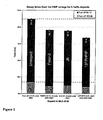
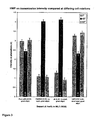
- the use of the fluorinated dopants with a cyano end group in the liquid crystal material reduces the turn-on time of negative-type liquid crystals, such as MLC-2038, in the order of approximately 16% (FMor2), 20% (J6), and 26% (13FPHPIP). Furthermore, importantly, the decay time is improved by approximately 14% (FMor2), 15% (J6) and 25% (13FPHPIP).
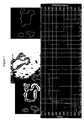
- the dopants can also help in the macroscopic ordering in the on-state, aligning the bulk liquid crystal collinear with the homogeneous on-state alignment. These improvements are provided without detrimental loss of the negative-type alignment.
- an electric field is applied to a homeotropically aligned, birefringent liquid crystal.
- the liquid crystal aligns to some degree with the field and the birefringence changes, thus the optical transmission of the system changes.
- the alignment requires some time and the present invention significantly and simply reduces this time.
- the liquid crystal aligns to some degree to its original position or to the new field and the birefringence changes again.
- This invention also reduces this response time. This is a surprising effect that provides even more advantages for the liquid crystal material according to the present invention.
- the material according to the present invention resolves the orientation of the liquid crystal in the system when it is not in the homeotropic state, thereby improving the uniformity of the alignment of the optical axis and director of the liquid crystal and thus the uniformity of the transmission and contrast of the system.
- This invention therefore allows the use of cells with high homeotropic and/or lower strength homogeneous rubbing/orientation.
- these new types of materials according to the present invention increase the overall versatility of negative-type liquid crystals by reducing the rise time and decay time of said liquid crystals. Furthermore, the invention improves the bulk on-state alignment.
- a method of improving the response times, homogeneous on-state alignments and contrast with improving, or at least without degrading the off-state, homeotropicity is provided.
- the invention therefore provides for an improved LC-material which is more suited to display applications.
- an amount of dopant is added to a negative-type liquid crystal in order to create a new material with improved properties.
- a 0.10% by weight mixture of J8 in MLC-2038 shows an improvement of 20% in the rise time, 15% in the decay time and 340% in the contrast over undoped MLC-2038.
- the dopant is dipolar and soluble in the liquid crystal and the dopant is fluorinated and has one cyano end group.
- the method of the present invention provides a simple method for improving the properties of negative-type liquid crystals, involving no complex fabrication steps, merely the addition of an inexpensive dopant.
- the response times both rise and decay
- the bulk on-state homogeneous alignment is made more uniform
- the contrast of the liquid crystal display is improved whilst the homeotropicity of the host material is mostly improved.
- the response profile was measured by placing the cell on an optical microscope with crossed polarizers, then applying 250 Hz square-wave AC drive and measuring the transmission using a photodiode.
- the response times to be compared for the improvement are those for the 1 st HWP voltage.
- the field strength varies by ⁇ 0.1 Vpp/ ⁇ m for all dopants.
- the 1 st HWP voltage is 5.3 Vpp.
- the 1 st HWP voltage for doped cells is above 5.3 Vpp (e.g. when doped with 13 FPHPIP), then the response of these doped cells was also measured at 5.3 Vpp, and it is these results taken at 5.3 Vpp that are compared and presented.
- the pure MLC-2038 exhibits slow initial response to an applied voltage. In most cases adding dopants reduces this slow initial response. However, this is likely to be due to the impurities or crystals interfering with the homeotropic alignment. This defect induced alignment perturbation is unwanted and must be carefully distinguished from the response improvement of the dipolar dopant.
Landscapes
- Chemical & Material Sciences (AREA)
- Crystallography & Structural Chemistry (AREA)
- Engineering & Computer Science (AREA)
- Materials Engineering (AREA)
- Organic Chemistry (AREA)
- Liquid Crystal Substances (AREA)
Claims (20)
- Flüssigkristallmaterial, umfassend wenigstens ein Mesogen vom Negativ-Typ, umfassend wenigstens einen löslichen dipolaren Dotierstoff, wobei der Dotierstoff organisch ist und wenigstens eine fluorierte Gruppe und wenigstens eine Cyano-Endgruppe umfaßt.
- Flüssigkristallmaterial, umfassend wenigstens ein Mesogen vom Negativ-Typ, umfassend wenigstens einen löslichen dipolaren Dotierstoff, wobei der Dotierstoff ausgewählt ist aus der Gruppe, bestehend aus FMor2, J6, J6a, J10B, J21, 5DCNQ1 und 13FPHPIP.
- Flüssigkristallmaterial nach Anspruch 1 oder 2, wobei das Mesogen vom Negativ-Typ ausgewählt ist aus der Gruppe, umfassend MLC-2038, MLC-6608, MLC-6609 und MLC-6610.
- Flüssigkristallmaterial nach einem der Ansprüche 1 bis 3, wobei der Dotierstoff in einer Menge von zwischen ungefähr 0,01 bis ungefähr 10 Gew.% der Mischung vorliegt.
- Flüssigkristallmaterial nach einem der Ansprüche 1 bis 4, wobei der Dotierstoff in einer Menge von zwischen ungefähr 0,05 bis ungefähr 5 Gew.% der Mischung vorliegt.
- Flüssigkristallmaterial nach einem der Ansprüche 1 bis 5, wobei der Dotierstoff in einer Menge von zwischen ungefähr 0,1 bis ungefähr 1,5 Gew.% der Mischung vorliegt.
- Flüssigkristallzelle oder Flüssigkristallanzeige vom Negativ-Typ, umfassend ein Flüssigkristallmaterial nach einem der Ansprüche 1 bis 6.
- Verfahren zum Herstellen eines Flüssigkristallmaterials, umfassend das Mischen von wenigstens einem Mesogen vom Negativ-Typ mit einem löslichen dipolaren Dotierstoff, wobei der Dotierstoff organisch ist und wenigstens eine fluorierte Gruppe und wenigstens eine Cyano-Endgruppe umfaßt.
- Verfahren zum Herstellen eines Flüssigkristallmaterials, umfassend das Mischen von wenigstens einem Mesogen vom Negativ-Typ mit einem löslichen dipolaren Dotierstoff, wobei der Dotierstoff ausgewählt ist aus der Gruppe, bestehend aus FMor2, J6, J6a, J10B, J21, 5DCNQ1 und 13FPHPIP.
- Verfahren nach Anspruch 8 oder 9, wobei das Mesogen vom Negativ-Typ ausgewählt ist aus der Gruppe, umfassend MLC-2038, MLC-6608, MLC-6609 und MLC-6610.
- Verfahren nach einem der Ansprüche 8 bis 10, wobei der Dotierstoff in einer Menge von zwischen ungefähr 0,01 bis ungefähr 10 Gew.% der endgültigen Mischung beigemischt wird.
- Verfahren nach einem der Ansprüche 8 bis 11, wobei der Dotierstoff in einer Menge von zwischen ungefähr 0,05 bis ungefähr 5 Gew.% der endgültigen Mischung beigemischt wird.
- Verfahren nach einem der Ansprüche 8 bis 12, wobei der Dotierstoff in einer Menge von ungefähr 0,1 bis ungefähr 1,5 Gew.% der endgültigen Mischung beigemischt wird.
- Verfahren zum Herstellen von Flüssigkristallzellen oder Flüssigkristallanzeigen vom Negativ-Typ nach Anspruch 7, umfassend die Schritte: a) Mischen von wenigstens einem Mesogen vom Negativ-Typ und ungefähr 0,01 bis ungefähr 10 Gew.% von wenigstens einem löslichen dipolaren Dotierstoff, b) Zentrifugieren der Mischung, c) Füllen der Zellen mit der Mischung und d) Tempern der gefüllten Zellen.
- Verfahren zum Verbessern der Ansprechzeiten, homogenen Ausrichtungen im An-Zustand und des Kontrasts eines Flüssigkristallmaterials vom Negativ-Typ, ohne den AusZustand zu verschlechtern, umfassend das Zugeben von wenigstens einem löslichen dipolaren Dotierstoff zu besagtem Flüssigkristallmaterial, wobei der Dotierstoff organisch ist und wenigstens eine fluorierte Gruppe und wenigstens eine Cyano-Endgruppe umfaßt.
- Verfahren zum Verbessern der Ansprechzeiten, homogenen Ausrichtungen im An-Zustand und des Kontrasts eines Flüssigkristallmaterials vom Negativ-Typ, ohne den AusZustand zu verschlechtern, umfassend das Zugeben von wenigstens einem löslichen dipolaren Dotierstoff zu besagtem Flüssigkristallmaterial, wobei der Dotierstoff ausgewählt ist aus der Gruppe, bestehend aus FMor2, J6, J6a, J10B, J21, 5DCNQ1 und 13FPHPIP.
- Verfahren nach Anspruch 15 oder 16, wobei der Dotierstoff in einer Menge von zwischen ungefähr 0,01 bis ungefähr 10 Gew.% des Flüssigkristallmaterials vom Negativ-Typ zugegeben wird.
- Verfahren nach einem der Ansprüche 15 bis 17, wobei der Dotierstoff in einer Menge von zwischen ungefähr 0,05 bis ungefähr 5 Gew.% des Flüssigkristallmaterials vom Negativ-Typ beigemischt wird.
- Verfahren nach einem der Ansprüche 15 bis 18, wobei der Dotierstoff in einer Menge von ungefähr 0,1 bis ungefähr 1,5 Gew.% des Flüssigkristallmaterials vom Negativ-Typ beigemischt wird.
- Verwendung eines Flüssigkristallmaterials, umfassend wenigstens ein Mesogen vom Negativ-Typ, umfassend wenigstens einen löslichen dipolaren Dotierstoff in einem LC-Material für Anzeigeanwendungen zum Reduzieren der Zeit, die das Material benötigt, um auf das Anlegen oder Entfernen eines elektrischen Feldes anzusprechen, wobei der Dotierstoff organisch ist und wenigstens eine fluorierte Gruppe und wenigstens eine Cyano-Endgruppe umfaßt, oder wobei der Dotierstoff ausgewählt ist aus der Gruppe, bestehend aus FMor2, J6, J6a, J10B, J21, 5DCNQ1 und 13FPHPIP.
Priority Applications (5)
| Application Number | Priority Date | Filing Date | Title |
|---|---|---|---|
| EP02023817A EP1413620B1 (de) | 2002-10-23 | 2002-10-23 | Negativtypflüssigkristalle enthaltend Dotierstoffe |
| DE60221671T DE60221671T2 (de) | 2002-10-23 | 2002-10-23 | Negativtypflüssigkristalle enthaltend Dotierstoffe |
| US10/690,292 US7014891B2 (en) | 2002-10-23 | 2003-10-21 | Response to the negative-type liquid crystals |
| JP2003363726A JP2004162058A (ja) | 2002-10-23 | 2003-10-23 | ネガティブタイプ液晶の応答の改善 |
| CNB2003101027272A CN1329480C (zh) | 2002-10-23 | 2003-10-23 | 改进负型液晶响应的方法 |
Applications Claiming Priority (1)
| Application Number | Priority Date | Filing Date | Title |
|---|---|---|---|
| EP02023817A EP1413620B1 (de) | 2002-10-23 | 2002-10-23 | Negativtypflüssigkristalle enthaltend Dotierstoffe |
Publications (2)
| Publication Number | Publication Date |
|---|---|
| EP1413620A1 EP1413620A1 (de) | 2004-04-28 |
| EP1413620B1 true EP1413620B1 (de) | 2007-08-08 |
Family
ID=32050012
Family Applications (1)
| Application Number | Title | Priority Date | Filing Date |
|---|---|---|---|
| EP02023817A Expired - Lifetime EP1413620B1 (de) | 2002-10-23 | 2002-10-23 | Negativtypflüssigkristalle enthaltend Dotierstoffe |
Country Status (5)
| Country | Link |
|---|---|
| US (1) | US7014891B2 (de) |
| EP (1) | EP1413620B1 (de) |
| JP (1) | JP2004162058A (de) |
| CN (1) | CN1329480C (de) |
| DE (1) | DE60221671T2 (de) |
Families Citing this family (1)
| Publication number | Priority date | Publication date | Assignee | Title |
|---|---|---|---|---|
| DE60320116T2 (de) * | 2003-12-11 | 2009-05-28 | Sony Deutschland Gmbh | Zusammensetzung enthaltend ein flüssigkristallines Material und einen Zusatzstoff |
Family Cites Families (12)
| Publication number | Priority date | Publication date | Assignee | Title |
|---|---|---|---|---|
| US3838059A (en) * | 1972-02-22 | 1974-09-24 | Hughes Aircraft Co | Liquid crystal composition |
| US3932298A (en) * | 1973-07-19 | 1976-01-13 | Temple University | Nematic liquid crystals with charge-transfer acceptors as dopants |
| US3848966A (en) * | 1973-10-15 | 1974-11-19 | Gen Motors Corp | Homeotropic alignment additive for liquid crystals |
| US3963638A (en) * | 1974-01-08 | 1976-06-15 | Eastman Kodak Company | Liquid crystal compositions, methods and devices |
| GB2072401B (en) * | 1981-02-27 | 1983-09-21 | Sharp Kk | Liquid crystal display device sealing |
| JPS5876483A (ja) * | 1981-10-30 | 1983-05-09 | Alps Electric Co Ltd | 液晶混合物 |
| DE3807909A1 (de) * | 1988-03-10 | 1989-09-21 | Merck Patent Gmbh | Guest-host-fluessigkristallanzeigeelement |
| JP2746456B2 (ja) * | 1989-09-14 | 1998-05-06 | シャープ株式会社 | 液晶表示装置 |
| WO1996010774A1 (en) * | 1994-09-30 | 1996-04-11 | Rockwell International Corporation | Viewing angle enhancement for vertically aligned cholesteric liquid crystal displays |
| US6100933A (en) * | 1994-10-31 | 2000-08-08 | Intel Corporation | Process and apparatus for compressing and decompressing digital video signals using horizontally-based vector quantization |
| KR100313952B1 (ko) * | 1998-08-20 | 2002-11-23 | 엘지.필립스 엘시디 주식회사 | 멀티도메인 액정표시소자 |
| EP1197791A3 (de) * | 2000-10-10 | 2002-12-04 | Sony International (Europe) GmbH | Flüssigkristallmischung, die einen Farbstoff mit Dipolmoment enthält |
-
2002
- 2002-10-23 DE DE60221671T patent/DE60221671T2/de not_active Expired - Fee Related
- 2002-10-23 EP EP02023817A patent/EP1413620B1/de not_active Expired - Lifetime
-
2003
- 2003-10-21 US US10/690,292 patent/US7014891B2/en not_active Expired - Fee Related
- 2003-10-23 CN CNB2003101027272A patent/CN1329480C/zh not_active Expired - Fee Related
- 2003-10-23 JP JP2003363726A patent/JP2004162058A/ja active Pending
Non-Patent Citations (1)
| Title |
|---|
| None * |
Also Published As
| Publication number | Publication date |
|---|---|
| US20040094746A1 (en) | 2004-05-20 |
| JP2004162058A (ja) | 2004-06-10 |
| DE60221671T2 (de) | 2008-04-30 |
| CN1497037A (zh) | 2004-05-19 |
| EP1413620A1 (de) | 2004-04-28 |
| DE60221671D1 (de) | 2007-09-20 |
| CN1329480C (zh) | 2007-08-01 |
| US7014891B2 (en) | 2006-03-21 |
Similar Documents
| Publication | Publication Date | Title |
|---|---|---|
| US7828992B2 (en) | Composition comprising at least one type of liquid crystal | |
| KR100883004B1 (ko) | 호메오트로픽 얼라인먼트 층 | |
| CA2088934C (en) | High contrast distorted helix effect electro-optic devices and tight ferroelectric pitch ferroelectric liquid crystal compositions useful therein | |
| EP1642953B1 (de) | Flüssigkristallorientierungsschicht | |
| EP0234892B1 (de) | Verdrillt-nematische Flüssigkristall-Anzeigevorrichtung | |
| JPH0699392B2 (ja) | 強誘電性ピリジン化合物及び液晶組成物 | |
| KR970006721B1 (ko) | 강유전성 액정 조성물 | |
| JP2594583B2 (ja) | 液晶表示装置 | |
| EP1541661B1 (de) | Zusammensetzung enthaltend ein flüssigkristallines Material und einen Zusatzstoff | |
| EP1413620B1 (de) | Negativtypflüssigkristalle enthaltend Dotierstoffe | |
| KR100645830B1 (ko) | 극성 네마틱 액정 어셈블리 및 이를 이용한 액정 소자 | |
| Kilickiran et al. | Towards faster liquid crystals at lower driving voltages | |
| EP0393577A2 (de) | Flüssigkristallzusammensetzung und Vorrichtung, die diese verwendet | |
| CN119828377A (zh) | 一种液晶调光器件 | |
| JPH11124579A (ja) | 液晶組成物 | |
| Li et al. | Effects of polymer network with electric field to the ferroelectric liquid crystal molecular alignments | |
| KR20140001090A (ko) | 액정 표시 장치 | |
| Iwashita et al. | 33.3: Applications of New Fluorinated Liquid Crystals of Fused Ring Systems for Active Matrix LCD | |
| JPH07150142A (ja) | 強誘電液晶組成物 | |
| HK1030060B (en) | Liquid crystal orientation layer | |
| JPH07286176A (ja) | 液晶組成物、液晶素子及びこれらを使用した液晶装置並びに液晶表示装置 | |
| JPH10237447A (ja) | 強誘電性液晶組成物、強誘電性液晶素子及びその駆動方法 |
Legal Events
| Date | Code | Title | Description |
|---|---|---|---|
| PUAI | Public reference made under article 153(3) epc to a published international application that has entered the european phase |
Free format text: ORIGINAL CODE: 0009012 |
|
| AK | Designated contracting states |
Kind code of ref document: A1 Designated state(s): AT BE BG CH CY CZ DE DK EE ES FI FR GB GR IE IT LI LU MC NL PT SE SK TR |
|
| AX | Request for extension of the european patent |
Extension state: AL LT LV MK RO SI |
|
| 17P | Request for examination filed |
Effective date: 20041007 |
|
| AKX | Designation fees paid |
Designated state(s): DE FR GB NL |
|
| 17Q | First examination report despatched |
Effective date: 20050628 |
|
| RAP1 | Party data changed (applicant data changed or rights of an application transferred) |
Owner name: SONY DEUTSCHLAND GMBH Owner name: SONY CORPORATION |
|
| GRAP | Despatch of communication of intention to grant a patent |
Free format text: ORIGINAL CODE: EPIDOSNIGR1 |
|
| RAP1 | Party data changed (applicant data changed or rights of an application transferred) |
Owner name: SONY DEUTSCHLAND GMBH Owner name: SONY CORPORATION |
|
| GRAS | Grant fee paid |
Free format text: ORIGINAL CODE: EPIDOSNIGR3 |
|
| GRAA | (expected) grant |
Free format text: ORIGINAL CODE: 0009210 |
|
| AK | Designated contracting states |
Kind code of ref document: B1 Designated state(s): DE FR GB NL |
|
| REG | Reference to a national code |
Ref country code: GB Ref legal event code: FG4D |
|
| REF | Corresponds to: |
Ref document number: 60221671 Country of ref document: DE Date of ref document: 20070920 Kind code of ref document: P |
|
| ET | Fr: translation filed | ||
| PLBE | No opposition filed within time limit |
Free format text: ORIGINAL CODE: 0009261 |
|
| STAA | Information on the status of an ep patent application or granted ep patent |
Free format text: STATUS: NO OPPOSITION FILED WITHIN TIME LIMIT |
|
| 26N | No opposition filed |
Effective date: 20080509 |
|
| PGFP | Annual fee paid to national office [announced via postgrant information from national office to epo] |
Ref country code: NL Payment date: 20081005 Year of fee payment: 7 |
|
| PGFP | Annual fee paid to national office [announced via postgrant information from national office to epo] |
Ref country code: DE Payment date: 20081016 Year of fee payment: 7 |
|
| PGFP | Annual fee paid to national office [announced via postgrant information from national office to epo] |
Ref country code: FR Payment date: 20081014 Year of fee payment: 7 |
|
| PGFP | Annual fee paid to national office [announced via postgrant information from national office to epo] |
Ref country code: GB Payment date: 20081022 Year of fee payment: 7 |
|
| REG | Reference to a national code |
Ref country code: NL Ref legal event code: V1 Effective date: 20100501 |
|
| REG | Reference to a national code |
Ref country code: FR Ref legal event code: ST Effective date: 20100630 |
|
| PG25 | Lapsed in a contracting state [announced via postgrant information from national office to epo] |
Ref country code: FR Free format text: LAPSE BECAUSE OF NON-PAYMENT OF DUE FEES Effective date: 20091102 Ref country code: NL Free format text: LAPSE BECAUSE OF NON-PAYMENT OF DUE FEES Effective date: 20100501 Ref country code: DE Free format text: LAPSE BECAUSE OF NON-PAYMENT OF DUE FEES Effective date: 20100501 |
|
| PG25 | Lapsed in a contracting state [announced via postgrant information from national office to epo] |
Ref country code: GB Free format text: LAPSE BECAUSE OF NON-PAYMENT OF DUE FEES Effective date: 20091023 |