EP1411026A2 - Vorrichtung und Methode zur Erzeugung von Wasserstoff - Google Patents
Vorrichtung und Methode zur Erzeugung von Wasserstoff Download PDFInfo
- Publication number
- EP1411026A2 EP1411026A2 EP03022477A EP03022477A EP1411026A2 EP 1411026 A2 EP1411026 A2 EP 1411026A2 EP 03022477 A EP03022477 A EP 03022477A EP 03022477 A EP03022477 A EP 03022477A EP 1411026 A2 EP1411026 A2 EP 1411026A2
- Authority
- EP
- European Patent Office
- Prior art keywords
- reaction
- chamber
- separator
- bed
- reaction chamber
- Prior art date
- Legal status (The legal status is an assumption and is not a legal conclusion. Google has not performed a legal analysis and makes no representation as to the accuracy of the status listed.)
- Withdrawn
Links
Images
Classifications
-
- C—CHEMISTRY; METALLURGY
- C01—INORGANIC CHEMISTRY
- C01B—NON-METALLIC ELEMENTS; COMPOUNDS THEREOF; METALLOIDS OR COMPOUNDS THEREOF NOT COVERED BY SUBCLASS C01C
- C01B3/00—Hydrogen; Gaseous mixtures containing hydrogen; Separation of hydrogen from mixtures containing it; Purification of hydrogen; Reversible storage of hydrogen
- C01B3/50—Separation of hydrogen or hydrogen-containing gases from gaseous mixtures, e.g. purification
- C01B3/56—Separation of hydrogen or hydrogen-containing gases from gaseous mixtures, e.g. purification by contacting with solids; Regeneration of used solids
-
- B—PERFORMING OPERATIONS; TRANSPORTING
- B01—PHYSICAL OR CHEMICAL PROCESSES OR APPARATUS IN GENERAL
- B01J—CHEMICAL OR PHYSICAL PROCESSES, e.g. CATALYSIS OR COLLOID CHEMISTRY; THEIR RELEVANT APPARATUS
- B01J8/00—Chemical or physical processes in general, conducted in the presence of fluids and solid particles; Apparatus for such processes
- B01J8/18—Chemical or physical processes in general, conducted in the presence of fluids and solid particles; Apparatus for such processes with fluidised particles
- B01J8/1872—Details of the fluidised bed reactor
-
- B—PERFORMING OPERATIONS; TRANSPORTING
- B01—PHYSICAL OR CHEMICAL PROCESSES OR APPARATUS IN GENERAL
- B01J—CHEMICAL OR PHYSICAL PROCESSES, e.g. CATALYSIS OR COLLOID CHEMISTRY; THEIR RELEVANT APPARATUS
- B01J8/00—Chemical or physical processes in general, conducted in the presence of fluids and solid particles; Apparatus for such processes
- B01J8/18—Chemical or physical processes in general, conducted in the presence of fluids and solid particles; Apparatus for such processes with fluidised particles
- B01J8/24—Chemical or physical processes in general, conducted in the presence of fluids and solid particles; Apparatus for such processes with fluidised particles according to "fluidised-bed" technique
- B01J8/26—Chemical or physical processes in general, conducted in the presence of fluids and solid particles; Apparatus for such processes with fluidised particles according to "fluidised-bed" technique with two or more fluidised beds, e.g. reactor and regeneration installations
- B01J8/28—Chemical or physical processes in general, conducted in the presence of fluids and solid particles; Apparatus for such processes with fluidised particles according to "fluidised-bed" technique with two or more fluidised beds, e.g. reactor and regeneration installations the one above the other
-
- B—PERFORMING OPERATIONS; TRANSPORTING
- B01—PHYSICAL OR CHEMICAL PROCESSES OR APPARATUS IN GENERAL
- B01J—CHEMICAL OR PHYSICAL PROCESSES, e.g. CATALYSIS OR COLLOID CHEMISTRY; THEIR RELEVANT APPARATUS
- B01J8/00—Chemical or physical processes in general, conducted in the presence of fluids and solid particles; Apparatus for such processes
- B01J8/18—Chemical or physical processes in general, conducted in the presence of fluids and solid particles; Apparatus for such processes with fluidised particles
- B01J8/24—Chemical or physical processes in general, conducted in the presence of fluids and solid particles; Apparatus for such processes with fluidised particles according to "fluidised-bed" technique
- B01J8/38—Chemical or physical processes in general, conducted in the presence of fluids and solid particles; Apparatus for such processes with fluidised particles according to "fluidised-bed" technique with fluidised bed containing a rotatable device or being subject to rotation or to a circulatory movement, i.e. leaving a vessel and subsequently re-entering it
- B01J8/384—Chemical or physical processes in general, conducted in the presence of fluids and solid particles; Apparatus for such processes with fluidised particles according to "fluidised-bed" technique with fluidised bed containing a rotatable device or being subject to rotation or to a circulatory movement, i.e. leaving a vessel and subsequently re-entering it being subject to a circulatory movement only
- B01J8/386—Chemical or physical processes in general, conducted in the presence of fluids and solid particles; Apparatus for such processes with fluidised particles according to "fluidised-bed" technique with fluidised bed containing a rotatable device or being subject to rotation or to a circulatory movement, i.e. leaving a vessel and subsequently re-entering it being subject to a circulatory movement only internally, i.e. the particles rotate within the vessel
-
- C—CHEMISTRY; METALLURGY
- C01—INORGANIC CHEMISTRY
- C01B—NON-METALLIC ELEMENTS; COMPOUNDS THEREOF; METALLOIDS OR COMPOUNDS THEREOF NOT COVERED BY SUBCLASS C01C
- C01B3/00—Hydrogen; Gaseous mixtures containing hydrogen; Separation of hydrogen from mixtures containing it; Purification of hydrogen; Reversible storage of hydrogen
- C01B3/02—Production of hydrogen; Production of gaseous mixtures containing hydrogen
- C01B3/32—Production of hydrogen; Production of gaseous mixtures containing hydrogen by reaction of gaseous or liquid organic compounds with gasifying agents, e.g. water, carbon dioxide or air
- C01B3/34—Production of hydrogen; Production of gaseous mixtures containing hydrogen by reaction of gaseous or liquid organic compounds with gasifying agents, e.g. water, carbon dioxide or air by reaction of hydrocarbons with gasifying agents
- C01B3/38—Production of hydrogen; Production of gaseous mixtures containing hydrogen by reaction of gaseous or liquid organic compounds with gasifying agents, e.g. water, carbon dioxide or air by reaction of hydrocarbons with gasifying agents using catalysts
- C01B3/42—Production of hydrogen; Production of gaseous mixtures containing hydrogen by reaction of gaseous or liquid organic compounds with gasifying agents, e.g. water, carbon dioxide or air by reaction of hydrocarbons with gasifying agents using catalysts using moving solid particles, e.g. fluidised bed technique
-
- B—PERFORMING OPERATIONS; TRANSPORTING
- B01—PHYSICAL OR CHEMICAL PROCESSES OR APPARATUS IN GENERAL
- B01J—CHEMICAL OR PHYSICAL PROCESSES, e.g. CATALYSIS OR COLLOID CHEMISTRY; THEIR RELEVANT APPARATUS
- B01J2208/00—Processes carried out in the presence of solid particles; Reactors therefor
- B01J2208/00008—Controlling the process
- B01J2208/00017—Controlling the temperature
- B01J2208/00106—Controlling the temperature by indirect heat exchange
- B01J2208/00168—Controlling the temperature by indirect heat exchange with heat exchange elements outside the bed of solid particles
-
- B—PERFORMING OPERATIONS; TRANSPORTING
- B01—PHYSICAL OR CHEMICAL PROCESSES OR APPARATUS IN GENERAL
- B01J—CHEMICAL OR PHYSICAL PROCESSES, e.g. CATALYSIS OR COLLOID CHEMISTRY; THEIR RELEVANT APPARATUS
- B01J2208/00—Processes carried out in the presence of solid particles; Reactors therefor
- B01J2208/00743—Feeding or discharging of solids
- B01J2208/00752—Feeding
-
- B—PERFORMING OPERATIONS; TRANSPORTING
- B01—PHYSICAL OR CHEMICAL PROCESSES OR APPARATUS IN GENERAL
- B01J—CHEMICAL OR PHYSICAL PROCESSES, e.g. CATALYSIS OR COLLOID CHEMISTRY; THEIR RELEVANT APPARATUS
- B01J2208/00—Processes carried out in the presence of solid particles; Reactors therefor
- B01J2208/00743—Feeding or discharging of solids
- B01J2208/00761—Discharging
-
- B—PERFORMING OPERATIONS; TRANSPORTING
- B01—PHYSICAL OR CHEMICAL PROCESSES OR APPARATUS IN GENERAL
- B01J—CHEMICAL OR PHYSICAL PROCESSES, e.g. CATALYSIS OR COLLOID CHEMISTRY; THEIR RELEVANT APPARATUS
- B01J2219/00—Chemical, physical or physico-chemical processes in general; Their relevant apparatus
- B01J2219/00002—Chemical plants
- B01J2219/00004—Scale aspects
- B01J2219/00006—Large-scale industrial plants
-
- B—PERFORMING OPERATIONS; TRANSPORTING
- B01—PHYSICAL OR CHEMICAL PROCESSES OR APPARATUS IN GENERAL
- B01J—CHEMICAL OR PHYSICAL PROCESSES, e.g. CATALYSIS OR COLLOID CHEMISTRY; THEIR RELEVANT APPARATUS
- B01J23/00—Catalysts comprising metals or metal oxides or hydroxides, not provided for in group B01J21/00
- B01J23/70—Catalysts comprising metals or metal oxides or hydroxides, not provided for in group B01J21/00 of the iron group metals or copper
- B01J23/76—Catalysts comprising metals or metal oxides or hydroxides, not provided for in group B01J21/00 of the iron group metals or copper combined with metals, oxides or hydroxides provided for in groups B01J23/02 - B01J23/36
- B01J23/78—Catalysts comprising metals or metal oxides or hydroxides, not provided for in group B01J21/00 of the iron group metals or copper combined with metals, oxides or hydroxides provided for in groups B01J23/02 - B01J23/36 with alkali- or alkaline earth metals
-
- C—CHEMISTRY; METALLURGY
- C01—INORGANIC CHEMISTRY
- C01B—NON-METALLIC ELEMENTS; COMPOUNDS THEREOF; METALLOIDS OR COMPOUNDS THEREOF NOT COVERED BY SUBCLASS C01C
- C01B2203/00—Integrated processes for the production of hydrogen or synthesis gas
- C01B2203/02—Processes for making hydrogen or synthesis gas
- C01B2203/0205—Processes for making hydrogen or synthesis gas containing a reforming step
- C01B2203/0227—Processes for making hydrogen or synthesis gas containing a reforming step containing a catalytic reforming step
- C01B2203/0233—Processes for making hydrogen or synthesis gas containing a reforming step containing a catalytic reforming step the reforming step being a steam reforming step
-
- C—CHEMISTRY; METALLURGY
- C01—INORGANIC CHEMISTRY
- C01B—NON-METALLIC ELEMENTS; COMPOUNDS THEREOF; METALLOIDS OR COMPOUNDS THEREOF NOT COVERED BY SUBCLASS C01C
- C01B2203/00—Integrated processes for the production of hydrogen or synthesis gas
- C01B2203/02—Processes for making hydrogen or synthesis gas
- C01B2203/0283—Processes for making hydrogen or synthesis gas containing a CO-shift step, i.e. a water gas shift step
-
- C—CHEMISTRY; METALLURGY
- C01—INORGANIC CHEMISTRY
- C01B—NON-METALLIC ELEMENTS; COMPOUNDS THEREOF; METALLOIDS OR COMPOUNDS THEREOF NOT COVERED BY SUBCLASS C01C
- C01B2203/00—Integrated processes for the production of hydrogen or synthesis gas
- C01B2203/04—Integrated processes for the production of hydrogen or synthesis gas containing a purification step for the hydrogen or the synthesis gas
- C01B2203/0415—Purification by absorption in liquids
-
- C—CHEMISTRY; METALLURGY
- C01—INORGANIC CHEMISTRY
- C01B—NON-METALLIC ELEMENTS; COMPOUNDS THEREOF; METALLOIDS OR COMPOUNDS THEREOF NOT COVERED BY SUBCLASS C01C
- C01B2203/00—Integrated processes for the production of hydrogen or synthesis gas
- C01B2203/04—Integrated processes for the production of hydrogen or synthesis gas containing a purification step for the hydrogen or the synthesis gas
- C01B2203/042—Purification by adsorption on solids
- C01B2203/0425—In-situ adsorption process during hydrogen production
-
- C—CHEMISTRY; METALLURGY
- C01—INORGANIC CHEMISTRY
- C01B—NON-METALLIC ELEMENTS; COMPOUNDS THEREOF; METALLOIDS OR COMPOUNDS THEREOF NOT COVERED BY SUBCLASS C01C
- C01B2203/00—Integrated processes for the production of hydrogen or synthesis gas
- C01B2203/04—Integrated processes for the production of hydrogen or synthesis gas containing a purification step for the hydrogen or the synthesis gas
- C01B2203/0465—Composition of the impurity
- C01B2203/0475—Composition of the impurity the impurity being carbon dioxide
-
- C—CHEMISTRY; METALLURGY
- C01—INORGANIC CHEMISTRY
- C01B—NON-METALLIC ELEMENTS; COMPOUNDS THEREOF; METALLOIDS OR COMPOUNDS THEREOF NOT COVERED BY SUBCLASS C01C
- C01B2203/00—Integrated processes for the production of hydrogen or synthesis gas
- C01B2203/04—Integrated processes for the production of hydrogen or synthesis gas containing a purification step for the hydrogen or the synthesis gas
- C01B2203/0465—Composition of the impurity
- C01B2203/048—Composition of the impurity the impurity being an organic compound
-
- C—CHEMISTRY; METALLURGY
- C01—INORGANIC CHEMISTRY
- C01B—NON-METALLIC ELEMENTS; COMPOUNDS THEREOF; METALLOIDS OR COMPOUNDS THEREOF NOT COVERED BY SUBCLASS C01C
- C01B2203/00—Integrated processes for the production of hydrogen or synthesis gas
- C01B2203/08—Methods of heating or cooling
- C01B2203/0805—Methods of heating the process for making hydrogen or synthesis gas
- C01B2203/0811—Methods of heating the process for making hydrogen or synthesis gas by combustion of fuel
-
- C—CHEMISTRY; METALLURGY
- C01—INORGANIC CHEMISTRY
- C01B—NON-METALLIC ELEMENTS; COMPOUNDS THEREOF; METALLOIDS OR COMPOUNDS THEREOF NOT COVERED BY SUBCLASS C01C
- C01B2203/00—Integrated processes for the production of hydrogen or synthesis gas
- C01B2203/10—Catalysts for performing the hydrogen forming reactions
- C01B2203/1041—Composition of the catalyst
- C01B2203/1047—Group VIII metal catalysts
- C01B2203/1052—Nickel or cobalt catalysts
-
- C—CHEMISTRY; METALLURGY
- C01—INORGANIC CHEMISTRY
- C01B—NON-METALLIC ELEMENTS; COMPOUNDS THEREOF; METALLOIDS OR COMPOUNDS THEREOF NOT COVERED BY SUBCLASS C01C
- C01B2203/00—Integrated processes for the production of hydrogen or synthesis gas
- C01B2203/10—Catalysts for performing the hydrogen forming reactions
- C01B2203/1041—Composition of the catalyst
- C01B2203/1082—Composition of support materials
-
- C—CHEMISTRY; METALLURGY
- C01—INORGANIC CHEMISTRY
- C01B—NON-METALLIC ELEMENTS; COMPOUNDS THEREOF; METALLOIDS OR COMPOUNDS THEREOF NOT COVERED BY SUBCLASS C01C
- C01B2203/00—Integrated processes for the production of hydrogen or synthesis gas
- C01B2203/12—Feeding the process for making hydrogen or synthesis gas
- C01B2203/1205—Composition of the feed
- C01B2203/1211—Organic compounds or organic mixtures used in the process for making hydrogen or synthesis gas
- C01B2203/1235—Hydrocarbons
- C01B2203/1241—Natural gas or methane
-
- C—CHEMISTRY; METALLURGY
- C01—INORGANIC CHEMISTRY
- C01B—NON-METALLIC ELEMENTS; COMPOUNDS THEREOF; METALLOIDS OR COMPOUNDS THEREOF NOT COVERED BY SUBCLASS C01C
- C01B2203/00—Integrated processes for the production of hydrogen or synthesis gas
- C01B2203/14—Details of the flowsheet
- C01B2203/145—At least two purification steps in parallel
-
- C—CHEMISTRY; METALLURGY
- C01—INORGANIC CHEMISTRY
- C01B—NON-METALLIC ELEMENTS; COMPOUNDS THEREOF; METALLOIDS OR COMPOUNDS THEREOF NOT COVERED BY SUBCLASS C01C
- C01B2203/00—Integrated processes for the production of hydrogen or synthesis gas
- C01B2203/14—Details of the flowsheet
- C01B2203/146—At least two purification steps in series
-
- C—CHEMISTRY; METALLURGY
- C01—INORGANIC CHEMISTRY
- C01B—NON-METALLIC ELEMENTS; COMPOUNDS THEREOF; METALLOIDS OR COMPOUNDS THEREOF NOT COVERED BY SUBCLASS C01C
- C01B2203/00—Integrated processes for the production of hydrogen or synthesis gas
- C01B2203/14—Details of the flowsheet
- C01B2203/148—Details of the flowsheet involving a recycle stream to the feed of the process for making hydrogen or synthesis gas
-
- Y—GENERAL TAGGING OF NEW TECHNOLOGICAL DEVELOPMENTS; GENERAL TAGGING OF CROSS-SECTIONAL TECHNOLOGIES SPANNING OVER SEVERAL SECTIONS OF THE IPC; TECHNICAL SUBJECTS COVERED BY FORMER USPC CROSS-REFERENCE ART COLLECTIONS [XRACs] AND DIGESTS
- Y02—TECHNOLOGIES OR APPLICATIONS FOR MITIGATION OR ADAPTATION AGAINST CLIMATE CHANGE
- Y02P—CLIMATE CHANGE MITIGATION TECHNOLOGIES IN THE PRODUCTION OR PROCESSING OF GOODS
- Y02P20/00—Technologies relating to chemical industry
- Y02P20/50—Improvements relating to the production of bulk chemicals
- Y02P20/52—Improvements relating to the production of bulk chemicals using catalysts, e.g. selective catalysts
Definitions
- the present invention relates to the production of hydrogen molecules, and particularly relates to an apparatus and method for producing a substantially pure hydrogen molecule stream requiring little downstream purification.
- Hydrogen molecules and atoms are used in many commercial and industrial applications. Generally, hydrogen may be used for upgrading petroleum feed stock to more useful products. In addition, hydrogen is used in many chemical reactions, such as reducing or synthesizing compounds. Particularly, hydrogen is used as a primary chemical reactant in the production of useful commercial products, such as cyclohexane, ammonia, and methanol. Moreover, hydrogen itself is quickly becoming a fuel of choice because it reduces green house emissions. Particularly, hydrogen can be used in fuel cell and other similar applications to produce a substantially clean source of electricity for powering industrial machines and automobiles.
- the pressure swing absorbers can be used to further purify the hydrogen stream, a hydrogen stream must first be produced.
- SMR steam methane reformers
- SMRs generally produce less than 90% pure hydrogen molecules in their product streams.
- side products such as carbon dioxide, methane, and other bi-products are produced, all of which pollute the hydrogen stream.
- the SMRs are generally operated at high temperatures and pressures. SMRs are typically operated at a temperature of at least about 800°C (about 1470°F). To achieve such high temperatures, large amounts of supplemental heating fuel must be used to raise the temperatures of the reaction chambers.
- the SMRs generally require pressures in excess of 20 atmospheres. Again, an additional energy source must be used to raise the reaction chambers to such a pressure. Therefore, these systems use a large amount of energy to produce the hydrogen product stream.
- the SMRs must also be augmented by the PSAs. Because the stream of hydrogen produced by the SMRs is generally less than about 90% pure hydrogen, the PSAs assist in purifying the hydrogen stream further.
- the PSA is generally known in the art, but is discussed briefly herein.
- a PSA the hydrogen stream is passed over a filter or bed.
- bed products may be used depending upon the contaminant desired to be removed at a particular step.
- Bed products include carbon beds or molecular sieves.
- Different filters absorb the different contaminant molecules. As each of the filter sections become filled or saturated with the various contaminant products, they begin to elude that particular bi-product. At this point, the stream is swung or switched to a different PSA, while the filters in the first are regenerated off-stream. During this purification process a portion of the hydrogen, which initially is introduced into the PSA, is lost.
- SMRs and PSA purifiers though able to make a hydrogen stream, which is ultimately approximately 99% pure, do not meet the theoretical yields that are possible using a hydrocarbon fuel source, such as methane.
- a hydrocarbon fuel source such as methane.
- the SMRs and PSAs are approximately about 75% efficient in generating hydrogen from a methane fuel source.
- catalysts may be used in a reaction chamber to help separate the bi-products, such as carbon dioxide and carbon monoxide, from the hydrogen product.
- These processes generally use solid beds as catalyst beds, which require specific maintenance and specifications.
- the method as described in "Hydrogen From Methane In A Single - Step Process," B.balasubramanian, et al., Chemical Engineering Science, 54, 3543-3552 (1999) is impractical for large scale industrial production.
- the present invention is directed to a system to produce hydrogen from a fuel source.
- a hydrocarbon is an appropriate fuel source that may be reformed to produce the hydrogen product.
- the system includes two chambers, one where the reformation and a reaction cooperator is placed and a second where the reaction cooperator may be recycled.
- the reaction cooperator removes a contaminant from the reformation of the fuel in one chamber and the contaminant is removed from the reaction cooperator in the second chamber.
- a first preferred embodiment of the present invention provides an apparatus for a steam reformation of a fuel to form a hydrogen product.
- the apparatus comprises a first reaction chamber, including a reaction cooperator, and a second reaction chamber.
- a transport system transfers a portion of the reaction cooperator to the second reaction chamber.
- a fuel supply supplies a volume of the fuel to the apparatus. The volume of fuel is reformed in the first reaction chamber.
- the reaction cooperator moves a product, other than the hydrogen product, from the first reaction chamber to the second reaction chamber. Also, the hydrogen product is removed from the apparatus.
- a second preferred embodiment of the present invention provides a system for the steam reformation of a fuel to produce a hydrogen product stream.
- the system comprises a first reaction chamber in which the fuel is reformed.
- a separator removes a contaminant product of the reformation from the first reaction chamber.
- a second reaction chamber provides an area where the contaminant product is removed from the separator.
- a hydrogen outlet allows the removal of the hydrogen product from the system.
- the present invention provides a preferred method to reform a fuel in a reaction vessel, including a first chamber and a second chamber, to produce a hydrogen product with a separator to increase the production and purity of the hydrogen product.
- the method comprises reforming the fuel in the first chamber with a reforming agent, wherein the hydrogen product and at least one contaminant is produced.
- the contaminant is reacted with the separator.
- the separator is then moved to the second chamber. Finally, the contaminant may be removed from the separator.
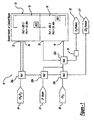
- FIG. 1 is a simplified schematic view of a hydrogen generation unit in accordance with a preferred embodiment of the present invention.
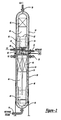
- Figure 2 is a simplified cross-sectional view of a hydrogen generation vessel represented in Figure 1.
- the unit 10 generally includes a reaction vessel 12 having a lower or primary reaction chamber 14 and an upper or secondary reaction chamber 16.
- the reaction vessel 12 includes an inlet 18 to allow methane from a methane source 20 to be introduced into the lower chamber 14.
- the inlet 18 also provides an inlet for steam from a steam source 21.
- the steam reforms the methane to produce the hydrogen stream or hydrogen product discussed more fully herein.
- Provided in the transport lines are a plurality of heat exchangers 25a, 25b, 25c, and 25d.
- the heat exchangers 25a, 25b, 25c, 25d may provide required thermal energy or remove excess energy as required.
- the upper chamber 16 generally includes a methane and oxygen inlet 22 that is provided to receive methane and oxygen from a methane and oxygen source 24. It will be understood, however, that an alternative fuel may be used to heat the secondary chamber 16 such as waste gas from the unit 10, or the hydrogen product. Furthermore, another oxidizer, such as atmospheric air, may be used as an oxidizer.
- methane is an exemplary heat fuel and oxygen an exemplary oxidizer.
- the reaction vessel 12 also includes a carbon dioxide outlet 26.
- the carbon dioxide outlet 26 provides a path for removing carbon dioxide, which is a bi-product and described more further herein of the hydrogen generation process, and collecting the carbon dioxide in a carbon dioxide product container 27.
- a hydrogen stream outlet 28 is provided so that the hydrogen generated from the process can be removed from the reaction vessel 12. More specifically, the hydrogen stream is primarily removed from the primary reaction chamber 14, which is the lower chamber of the reaction vessel 12. Some unreacted or excess methane may also be included in the hydrogen stream, which is removed by a filter or scrubber 30.
- the methane filter 30 is provided in line with the methane supply 20 such that the methane removed from the product stream from the reaction vessel 12 can be provided back to the reaction vessel 12 through the methane inlet 18.
- the final hydrogen product can then be collected in a hydrogen container 32 and be removed. It will also be understood that the hydrogen product may be further purified if required.
- the general schematic of the hydrogen generation unit 10 provides a system to generate hydrogen from a methane source in a new reaction vessel 12. Although methane is described herein, it will be understood that other fuels may be used to produce the hydrogen product.
- the unit 10 provides a system to produce and collect hydrogen. The intrinsic reactions are discussed briefly herein to help the reader more fully understand the present system and process.
- the reforming of the methane generally proceeds according to the reformation reaction indicated by the formula as follows: Reforming Reaction: CH 4 +H 2 O ⁇ CO+3H 2 This reforming reaction produces a first portion of hydrogen and carbon monoxide from the steam reformation of methane.
- a second reaction is the shift reaction that produces a second portion of hydrogen by the reaction of the carbon monoxide, from the reforming reaction, with steam: Shift: CO+H 2 O reaction ⁇ CO 2 +H 2 . These are the two main reactions, that produce the hydrogen product.
- the hydrogen product or stream is removed through hydrogen outlet 28.
- the reaction vessel 12, particularly in the primary reaction chamber 14, also includes a primary bed ( Figure 2 at 42) that includes a separator or reaction cooperator.
- the primary bed 42 generally includes a catalyst and a calcium containing substance or constituent. Examples include calcium oxide and calcium carbonate which are placed in the primary bed 42 with a reaction catalyst. The presence of the calcium helps remove the carbon dioxide from the shift reaction.
- the removal also known as a separation reaction, proceeds as follows: Separation: CaO+CO 2 ⁇ CaCO 3 .
- the product of the separation reaction is a solid, whereas the hydrogen product generated from the methane source is a gas. Therefore, gravity can be used to separate the solid calcium product from the gaseous hydrogen by allowing it to fall to the bottom of the primary reaction chamber 14.
- This general process allows for a theoretically pure hydrogen product gas to be formed in an area above the primary bed 42. Although this may generally not be the case, the purity of the hydrogen can be in substantial excess of the current methods.
- the calcium is generally mixed with a suitable catalyst to assist in the production of hydrogen product gas from the methane source.
- a suitable catalyst to assist in the production of hydrogen product gas from the methane source.
- an exemplary catalyst is 4-22 wt. % nickel on alpha alumina interspersed with the calcium.
- the primary reaction chamber 14 may be operated at a temperature substantially below the generally known temperatures in a SMR.
- the primary reaction chamber 14 may be sustained at a temperature between about 625°C and about 725°C (about 1150°F and about 1340°F).
- the primary reaction chamber 14 need only be kept at a pressure of between about 4 and about 6 atmospheres.
- the secondary reaction chamber 16 can be kept at an elevated temperature relative the temperature of the primary reaction chamber 14.
- the secondary reaction chamber 16 has a temperature between about 900°C and about 1000°C (about 1650°F and about 1840°F). The elevated temperature is maintained by using a small amount of heating fuel and oxidizer.
- methane and oxygen may be provided from the methane and oxygen source 24 through the methane and oxygen inlet 22 into the secondary reaction chamber 16.
- the secondary chamber 16 is held at an elevated temperature, it is at a substantially equal pressure as the primary chamber 14.
- This secondary chamber is also generally between about 4 and about 6 atmospheres.
- the primary bed 42 is where the initial reformation of the methane into other products, specifically following the Reformation Reaction, occurs. Moreover, the shift reaction also occurs within the primary bed 42, as will be discussed more fully herein.
- the primary bed 42 may be any appropriate type of bed such as, for example, a fluidized bed.
- a fluidized bed is generally a bed, that has solid particles that are small and sufficiently fine to resemble a fluid.
- the separation reaction product described herein to include calcium carbonate as an example, is then moved in bulk to the secondary reaction chamber 16. Here the calcium carbonate product is elevated to the higher temperatures of the secondary reaction chamber 16. These elevated temperatures drive the carbon dioxide from the calcium carbonate product causing the reversion of the calcium carbonate to the original calcium bed substance. The carbon dioxide may then be removed as a gas from the secondary reaction chamber 16. It will be understood that other fuels and other reaction cooperators may form other separation reaction products.
- the reaction vessel 12 allows a substantially closed reaction area. Simply, the single reaction vessel 12 surrounds all of the combustion and reformation processes that occur. Therefore, the system of the reaction vessel 12 is substantially sealed relative to the outside atmosphere. Therefore, a substantial reduction, or virtual elimination, of undesirable pollutants occurs, such as combustion exhaust produced by other generally known external reactors.
- an exemplary vessel 38 for a steam methane reformer is illustrated.
- the vessel 38 includes the primary reaction chamber 14 and the secondary reaction chamber 16.
- the vessel 38 substantially surrounds the primary reaction chamber 14 and the secondary reaction chamber 16 with a single wall or container 39. This reduces the ability of any of the interior reactants to exit into the environment surrounding the vessel 38.
- the system is substantially contained and enclosed. Particularly there are no combustors outside of the vessel 38 which may produce an exhaust.
- Methane and steam are provided to the primary reaction chamber 14 through the methane and steam inlet port 18.
- the methane and steam then enters a bottom portion 40 of the primary reaction chamber 14.
- the primary bed 42 includes the fluidized calcium substance and the desired catalyst.
- the primary bed 42 in one exemplary form is fluidized, it may also be bubbled or otherwise in motion. It will also be understood that the primary bed 42 may be a solid bed over which the methane and steam flows. As the methane and steam travel through the primary bed 42, all three of the above described reactions, that being the reformation, the shift, and the separation reactions, occur.
- a primary chamber free-board area 44 In this area gas that comes from the primary bed 42 flows freely upwards. Specifically, the gas in the free-board area is substantially hydrogen product gas. Nevertheless the gas, which is formed from the methane and steam, may include other bi-products.
- the gas from the free-board area then encounters a first or primary filter 46.
- the primary filter 46 is an initial filter to help remove bi-products from the hydrogen product stream or to remove solid contaminants that may be carried from the bed.
- a purer stream of hydrogen product exits through the hydrogen ports 28. After the hydrogen exits the hydrogen ports 28, it may be collected in the appropriate hydrogen collection container (illustrated in Figure 1).
- a bed moving or transport mechanism 48 Also in the primary reaction chamber 14 is a bed moving or transport mechanism 48.
- the bed transport mechanism 48 moves bed material from the primary bed 42 to a secondary bed 50 in the secondary reaction chamber 16.
- the bed material from the primary bed 42 is moved in bulk using the bed transport mechanism 48 to a position above the secondary bed 50 such that the material may simply fall from the bed transport mechanism 48 into the secondary bed 50. It will be understood, however, that the bed transport mechanism 48 may deposit the bed material directly in the secondary bed 50.
- An exemplary bed transport mechanism 48 includes a lift or chain mechanism having a continuous chain system that removes a portion of the primary bed 42, carries it a distance to a position above the secondary bed 50, and drops it via gravity into the secondary bed 50 at the drop point 52.
- This transported bed material includes the calcium carbonate product from the separation reaction.
- the bed material is heated to the elevated temperatures.
- the heat is provided by a combustion of the heat fuel and oxidizer which combust to heat the secondary bed 50.
- methane is one exemplary fuel that may be used to reduce the number of constituents required to operate the hydrogen generation unit 10.
- the methane and oxygen combusts in a combustion chamber 54 to heat the secondary bed 50.
- carbon dioxide is released from the bed material and a carbon dioxide gas moves into the secondary free board area 56.
- the secondary bed 50 is also moving, but not necessarily fluidized. However, the secondary bed 50 may also be fluidized.
- a drop or return line 58 operably connects the secondary bed 50 and the primary bed 42.
- the drop line 58 includes a valve, for example, a star valve 60.
- the valve 60 helps regulate or meter the movement of the bed material from the secondary bed 50 back into the primary bed 42.
- the return line 58 interconnects the secondary bed 50 and the primary bed 42 via gravity.
- a gravity return system is illustrated, an active return system may be provided.
- a second bed transport mechanism may transport bed material from the secondary bed 50 to the primary bed 42. Material from the secondary bed 50 may drop back into the primary bed 42. This recycles the bed materials.
- the catalyst and calcium constituent are not consumed in the system.
- the material from the secondary bed 50 needs only to be dropped via gravity through the drop line 58. This requires only an active handling or movement of the material from the primary bed using the transport mechanism 48.
- the material in the primary bed 42 is cooler than the material in the secondary bed 50. Therefore, the wear on the bed transport mechanism 48 is reduced by having it only need to contact a cooler material. It will be understood, however, that an active transport mechanism can be used to move the material in the secondary bed.
- Regulating the flow of bed material with the valve 60 helps control the temperatures of the two beds. Specifically, it is desirable that the primary bed 42 be held at a temperature below that of the secondary bed 50. Therefore, a large amount of material moving from the hot secondary bed 50 to the cool primary bed 42 would upset the heat balance.
- the carbon dioxide which is in the second free board area 56, may initially be filtered in a secondary filter 62 before it is removed from the CO 2 removal port 26.
- the secondary filter 62 generally removes solid particles from the bed so that the particles do not impede the gas removal. Once removed from the CO 2 port, the CO 2 may then be collected at an appropriate chamber (illustrated in Figure 1).
- the hydrogen product may be further purified in secondary systems.
- the hydrogen product may be purified in PSAs.
- the PSAs may further remove any additional contaminants, such as carbon dioxide and other contaminants, that may still be present in the hydrogen stream.
- the hydrogen product stream produced by the reaction vessel 12 is at least about 93% pure hydrogen before any further purification occurs. Therefore, any further purification processes may be minimized due to the substantially pure hydrogen produced by the reaction vessel 12.
- the hydrogen stream is initially so pure, a much smaller amount is lost in other purification processes that may follow the initial hydrogen generation.
- One reason for the purity of the hydrogen stream is the removal of one of the major side products from the reformation and shift reaction, that being carbon dioxide.
- the inclusion of the reaction cooperator, for example the calcium constituent, in the primary bed 42 helps to remove this product from the reformation and shift reactions. Not only does this produce a substantially pure hydrogen product, but it also increases the hydrogen generation from the fuel. Specifically, this is due to the Le Chatelier's Principle. Briefly, the Le Chatelier's Principle states that removing a product of a reaction will shift the equilibrium of the reaction, thereby increasing the production of the other reaction products.
- the shift reaction consumes the carbon monoxide from the reforming reaction to produce carbon dioxide and additional hydrogen gas.
- the separation reaction consumes carbon dioxide from the shift reaction to produce the solid calcium carbonate product. Because all of the other reactants are gas, the calcium carbonate, being a solid, is substantially removed. Therefore, substantially all of the hydrogen producing reactions, those being the reforming and shift reactions, include a further reaction that removes an undesirable or contaminant product, either carbon monoxide or carbon dioxide, which increases the rate of the production of hydrogen product gas.
- the reaction vessel 12 thus allows for an easy removal of the carbon dioxide from the bed material where the separation reaction occurs.
- the bed material is not consumed, but merely recycled so that it may again perform the separation reaction to remove additional carbon dioxide from the primary reaction chamber 14. Therefore, the production of a substantially pure hydrogen stream is increased.
- the secondary reaction bed 50 above the primary bed 42 also allows for a more efficient and complete use of all thermal energy provided to the unit 10. Specifically, the secondary bed 50 must be heated to perform the removal or CO 2 desorption reactions of the steam reformer system in the unit 10. Therefore, the material in the secondary reaction bed 50 is heated to an elevated temperature. By utilizing the drop line 58, the heated material from the secondary reaction bed 50 can be used to offset the slightly endothermic reaction that occurs in the primary bed 42. Specifically, as a CO 2 desorbs from the primary bed 42, energy is absorbed into the bed material therefore cooling the primary bed 42. Moreover, as hydrogen is produced in the primary bed 42, energy is absorbed into the bed material that results in cooling of the primary bed 42.
- the unit 10 substantially reduces any thermal loss by allowing the material from the secondary reaction bed 50 to be dropped into the primary bed 42 and the thermal energy remaining in the material to be used in the primary bed 42.
Landscapes
- Chemical & Material Sciences (AREA)
- Organic Chemistry (AREA)
- Chemical Kinetics & Catalysis (AREA)
- Engineering & Computer Science (AREA)
- Combustion & Propulsion (AREA)
- Inorganic Chemistry (AREA)
- Health & Medical Sciences (AREA)
- General Health & Medical Sciences (AREA)
- Hydrogen, Water And Hydrids (AREA)
- Devices And Processes Conducted In The Presence Of Fluids And Solid Particles (AREA)
- Fuel Cell (AREA)
- Organic Low-Molecular-Weight Compounds And Preparation Thereof (AREA)
Applications Claiming Priority (2)
| Application Number | Priority Date | Filing Date | Title |
|---|---|---|---|
| US271406 | 2002-10-15 | ||
| US10/271,406 US20040068932A1 (en) | 2002-10-15 | 2002-10-15 | Hydrogen generation apparatus and method |
Publications (2)
| Publication Number | Publication Date |
|---|---|
| EP1411026A2 true EP1411026A2 (de) | 2004-04-21 |
| EP1411026A3 EP1411026A3 (de) | 2004-12-15 |
Family
ID=32042911
Family Applications (1)
| Application Number | Title | Priority Date | Filing Date |
|---|---|---|---|
| EP03022477A Withdrawn EP1411026A3 (de) | 2002-10-15 | 2003-10-08 | Vorrichtung und Methode zur Erzeugung von Wasserstoff |
Country Status (5)
| Country | Link |
|---|---|
| US (1) | US20040068932A1 (de) |
| EP (1) | EP1411026A3 (de) |
| JP (1) | JP2004137149A (de) |
| CN (1) | CN1515486A (de) |
| RU (1) | RU2275323C2 (de) |
Cited By (1)
| Publication number | Priority date | Publication date | Assignee | Title |
|---|---|---|---|---|
| WO2006023287A1 (en) * | 2004-08-16 | 2006-03-02 | The Boeing Company | Hydrogen generation apparatus and method |
Families Citing this family (10)
| Publication number | Priority date | Publication date | Assignee | Title |
|---|---|---|---|---|
| US8067469B2 (en) | 2002-05-08 | 2011-11-29 | Woodstream Corporation | System for trapping flying insects with attractant lures |
| US6942719B2 (en) * | 2003-06-30 | 2005-09-13 | The Boeing Company | Methods and systems for pressure swing regeneration for hydrogen generation |
| JP4180534B2 (ja) * | 2004-02-24 | 2008-11-12 | 本田技研工業株式会社 | 燃料ガス製造装置及びその運転方法 |
| US7293387B2 (en) | 2004-06-08 | 2007-11-13 | Woodstream Corporation | Attractant system for mounting to an insect trapping apparatus |
| US20080134570A1 (en) * | 2004-06-08 | 2008-06-12 | Woodstream Corporaton | Attractant system for mounting to an insect trapping apparatus |
| US7547419B2 (en) | 2004-06-16 | 2009-06-16 | United Technologies Corporation | Two phase injector for fluidized bed reactor |
| RU2301772C1 (ru) * | 2005-10-31 | 2007-06-27 | Институт Катализа Им. Г.К. Борескова Сибирского Отделения Российской Академии Наук | Способ получения водородсодержащего газа и способ регенерации поглотителя, применяемого в этом способе |
| CN101190781B (zh) * | 2006-11-23 | 2011-05-11 | 成都汉尊能源有限公司 | 小型轻烃水蒸气转化制氢工艺方法 |
| AU2010310862B2 (en) * | 2009-10-24 | 2015-08-13 | Calix Limited | System and method for processing an input fuel gas and steam to produce carbon dioxide and an output fuel gas |
| PL249307B1 (pl) * | 2022-11-02 | 2026-03-23 | Politechnika Krakowska Im Tadeusza Kosciuszki | Sposób konwersji kwasu metanowego do wodoru z użyciem katalitycznego złoża fluidalnego |
Family Cites Families (16)
| Publication number | Priority date | Publication date | Assignee | Title |
|---|---|---|---|---|
| US2561419A (en) * | 1945-12-12 | 1951-07-24 | Lummus Co | Process for producing gas from oil |
| US3108857A (en) * | 1961-04-10 | 1963-10-29 | Consolidation Coal Co | Method for the production of hydrogen |
| US3573224A (en) * | 1967-11-14 | 1971-03-30 | Chemical Construction Corp | Production of hydrogen-rich synthesis gas |
| US4025457A (en) * | 1970-09-04 | 1977-05-24 | Toyo Engineering Corporation | Process for manufacturing gaseous mixtures rich in hydrogen |
| US3953356A (en) * | 1971-04-19 | 1976-04-27 | Toyo Engineering Corporation | Method of producing gaseous mixture rich in hydrogen |
| US4946667A (en) * | 1985-06-10 | 1990-08-07 | Engelhard Corporation | Method of steam reforming methanol to hydrogen |
| US4814068A (en) * | 1986-09-03 | 1989-03-21 | Mobil Oil Corporation | Fluid catalytic cracking process and apparatus for more effective regeneration of zeolite catalyst |
| CA2081170C (en) * | 1992-10-22 | 2002-12-24 | Alaa-Eldin Moustafa Adris | Fluidized bed reaction system for steam/hydrocarbon gas reforming to produce hydrogen |
| JP3432892B2 (ja) * | 1994-06-08 | 2003-08-04 | 日本碍子株式会社 | 改質ガスのco除去方法 |
| US5525322A (en) * | 1994-10-12 | 1996-06-11 | The Regents Of The University Of California | Method for simultaneous recovery of hydrogen from water and from hydrocarbons |
| US5858314A (en) * | 1996-04-12 | 1999-01-12 | Ztek Corporation | Thermally enhanced compact reformer |
| US6221117B1 (en) * | 1996-10-30 | 2001-04-24 | Idatech, Llc | Hydrogen producing fuel processing system |
| JP3816681B2 (ja) * | 1998-11-09 | 2006-08-30 | 東芝三菱電機産業システム株式会社 | 含炭素燃料の炭素分離装置 |
| DE19946381C2 (de) * | 1999-09-28 | 2001-09-06 | Zsw | Verfahren und Vorrichtung zur Erzeugung eines kohlendioxidarmen, wasserstoffreichen Gases oder eines konditionierten Synthesegases und Verwendung derselben |
| AU2002338422B2 (en) * | 2001-04-18 | 2008-06-19 | Texaco Development Corporation | Integrated fuel processor, fuel cell stack and tail gas oxidizer with carbon dioxide removal |
| US20040244289A1 (en) * | 2001-09-28 | 2004-12-09 | Fumiaki Morozumi | Process for reforming inflammable gas, apparatus for reforming inflammable gas and gasification apparatus |
-
2002
- 2002-10-15 US US10/271,406 patent/US20040068932A1/en not_active Abandoned
-
2003
- 2003-10-08 EP EP03022477A patent/EP1411026A3/de not_active Withdrawn
- 2003-10-14 RU RU2003130216/15A patent/RU2275323C2/ru not_active IP Right Cessation
- 2003-10-14 JP JP2003353177A patent/JP2004137149A/ja not_active Withdrawn
- 2003-10-15 CN CNA2003101147804A patent/CN1515486A/zh active Pending
Cited By (1)
| Publication number | Priority date | Publication date | Assignee | Title |
|---|---|---|---|---|
| WO2006023287A1 (en) * | 2004-08-16 | 2006-03-02 | The Boeing Company | Hydrogen generation apparatus and method |
Also Published As
| Publication number | Publication date |
|---|---|
| US20040068932A1 (en) | 2004-04-15 |
| CN1515486A (zh) | 2004-07-28 |
| RU2003130216A (ru) | 2005-04-20 |
| JP2004137149A (ja) | 2004-05-13 |
| EP1411026A3 (de) | 2004-12-15 |
| RU2275323C2 (ru) | 2006-04-27 |
Similar Documents
| Publication | Publication Date | Title |
|---|---|---|
| WO2006023287A1 (en) | Hydrogen generation apparatus and method | |
| US6942719B2 (en) | Methods and systems for pressure swing regeneration for hydrogen generation | |
| US6667022B2 (en) | Process for separating synthesis gas into fuel cell quality hydrogen and sequestration ready carbon dioxide | |
| US7384621B2 (en) | Reforming with hydration of carbon dioxide fixing material | |
| AU772704B2 (en) | Hydrogen production from carbonaceous material | |
| CN102159497B (zh) | 产生超纯高压氢气的系统和方法 | |
| EP1207132A1 (de) | Verfahren zur herstellung von wasserstoff durch vergasung von brennbarem material und verfahren zur elektrischen stromherstellung unter verwendung einer brennstoffzelle und system zur stromerzeugung brennstoffzellen verwendend | |
| US8241374B2 (en) | Fluidized bed system for single step reforming for the production of hydrogen | |
| US7192569B2 (en) | Hydrogen generation with efficient byproduct recycle | |
| CN104918882A (zh) | 平行制备氢气、一氧化碳和含碳产物的方法 | |
| Chen et al. | Sorbent-enhanced/membrane-assisted steam-methane reforming | |
| US20190084833A1 (en) | Production of liquid hydrocarbons, biofuels and uncontaminated co2 from gaseous feedstock | |
| CN101605718B (zh) | 用于热集成氢生成系统的处理方法和设备 | |
| US20040068932A1 (en) | Hydrogen generation apparatus and method | |
| CN107223114A (zh) | 制造氨的方法 | |
| Fernández et al. | Sorption enhanced reforming of methane combined with an iron oxide chemical loop for the production of hydrogen with CO2 capture: Conceptual design and operation strategy | |
| US20240359980A1 (en) | Hydrogen production system | |
| EP4292979B1 (de) | Wasserstofferzeugungssystem | |
| WO2025243936A1 (ja) | 反応装置 |
Legal Events
| Date | Code | Title | Description |
|---|---|---|---|
| PUAI | Public reference made under article 153(3) epc to a published international application that has entered the european phase |
Free format text: ORIGINAL CODE: 0009012 |
|
| AK | Designated contracting states |
Kind code of ref document: A2 Designated state(s): AT BE BG CH CY CZ DE DK EE ES FI FR GB GR HU IE IT LI LU MC NL PT RO SE SI SK TR |
|
| AX | Request for extension of the european patent |
Extension state: AL LT LV MK |
|
| PUAL | Search report despatched |
Free format text: ORIGINAL CODE: 0009013 |
|
| AK | Designated contracting states |
Kind code of ref document: A3 Designated state(s): AT BE BG CH CY CZ DE DK EE ES FI FR GB GR HU IE IT LI LU MC NL PT RO SE SI SK TR |
|
| AX | Request for extension of the european patent |
Extension state: AL LT LV MK |
|
| RIC1 | Information provided on ipc code assigned before grant |
Ipc: 7C 01B 3/56 B Ipc: 7C 01B 3/38 A |
|
| 17P | Request for examination filed |
Effective date: 20050517 |
|
| AKX | Designation fees paid |
Designated state(s): DE FR GB |
|
| RAP1 | Party data changed (applicant data changed or rights of an application transferred) |
Owner name: PRATT & WHITNEY ROCKETDYNE, INC. |
|
| STAA | Information on the status of an ep patent application or granted ep patent |
Free format text: STATUS: THE APPLICATION IS DEEMED TO BE WITHDRAWN |
|
| 18D | Application deemed to be withdrawn |
Effective date: 20090505 |