EP1405858A1 - Process for producing sugar chain asparagine derivative - Google Patents
Process for producing sugar chain asparagine derivative Download PDFInfo
- Publication number
- EP1405858A1 EP1405858A1 EP02743643A EP02743643A EP1405858A1 EP 1405858 A1 EP1405858 A1 EP 1405858A1 EP 02743643 A EP02743643 A EP 02743643A EP 02743643 A EP02743643 A EP 02743643A EP 1405858 A1 EP1405858 A1 EP 1405858A1
- Authority
- EP
- European Patent Office
- Prior art keywords
- sugar chain
- mixture
- compound
- chain asparagine
- man4
- Prior art date
- Legal status (The legal status is an assumption and is not a legal conclusion. Google has not performed a legal analysis and makes no representation as to the accuracy of the status listed.)
- Granted
Links
- 0 C**(C)(COC(*)C(**C***)ON=CC(*(C(*)C1)*1[C@@](*C(*)C(O)O)OC(C)*)O)*(C)(C(C)C(C)C)*(C)C1*(C*(*)=C)C1OC(*C(C*)SC1O)*1NC(C)=O Chemical compound C**(C)(COC(*)C(**C***)ON=CC(*(C(*)C1)*1[C@@](*C(*)C(O)O)OC(C)*)O)*(C)(C(C)C(C)C)*(C)C1*(C*(*)=C)C1OC(*C(C*)SC1O)*1NC(C)=O 0.000 description 13
Images


Classifications
-
- C—CHEMISTRY; METALLURGY
- C07—ORGANIC CHEMISTRY
- C07H—SUGARS; DERIVATIVES THEREOF; NUCLEOSIDES; NUCLEOTIDES; NUCLEIC ACIDS
- C07H13/00—Compounds containing saccharide radicals esterified by carbonic acid or derivatives thereof, or by organic acids, e.g. phosphonic acids
- C07H13/02—Compounds containing saccharide radicals esterified by carbonic acid or derivatives thereof, or by organic acids, e.g. phosphonic acids by carboxylic acids
- C07H13/10—Compounds containing saccharide radicals esterified by carbonic acid or derivatives thereof, or by organic acids, e.g. phosphonic acids by carboxylic acids having the esterifying carboxyl radicals directly attached to heterocyclic rings
-
- C—CHEMISTRY; METALLURGY
- C07—ORGANIC CHEMISTRY
- C07H—SUGARS; DERIVATIVES THEREOF; NUCLEOSIDES; NUCLEOTIDES; NUCLEIC ACIDS
- C07H15/00—Compounds containing hydrocarbon or substituted hydrocarbon radicals directly attached to hetero atoms of saccharide radicals
- C07H15/02—Acyclic radicals, not substituted by cyclic structures
- C07H15/12—Acyclic radicals, not substituted by cyclic structures attached to a nitrogen atom of the saccharide radical
-
- C—CHEMISTRY; METALLURGY
- C07—ORGANIC CHEMISTRY
- C07H—SUGARS; DERIVATIVES THEREOF; NUCLEOSIDES; NUCLEOTIDES; NUCLEIC ACIDS
- C07H5/00—Compounds containing saccharide radicals in which the hetero bonds to oxygen have been replaced by the same number of hetero bonds to halogen, nitrogen, sulfur, selenium, or tellurium
- C07H5/04—Compounds containing saccharide radicals in which the hetero bonds to oxygen have been replaced by the same number of hetero bonds to halogen, nitrogen, sulfur, selenium, or tellurium to nitrogen
- C07H5/06—Aminosugars
-
- C—CHEMISTRY; METALLURGY
- C07—ORGANIC CHEMISTRY
- C07H—SUGARS; DERIVATIVES THEREOF; NUCLEOSIDES; NUCLEOTIDES; NUCLEIC ACIDS
- C07H7/00—Compounds containing non-saccharide radicals linked to saccharide radicals by a carbon-to-carbon bond
- C07H7/02—Acyclic radicals
- C07H7/027—Keto-aldonic acids
-
- C—CHEMISTRY; METALLURGY
- C12—BIOCHEMISTRY; BEER; SPIRITS; WINE; VINEGAR; MICROBIOLOGY; ENZYMOLOGY; MUTATION OR GENETIC ENGINEERING
- C12P—FERMENTATION OR ENZYME-USING PROCESSES TO SYNTHESISE A DESIRED CHEMICAL COMPOUND OR COMPOSITION OR TO SEPARATE OPTICAL ISOMERS FROM A RACEMIC MIXTURE
- C12P13/00—Preparation of nitrogen-containing organic compounds
- C12P13/04—Alpha- or beta- amino acids
-
- C—CHEMISTRY; METALLURGY
- C12—BIOCHEMISTRY; BEER; SPIRITS; WINE; VINEGAR; MICROBIOLOGY; ENZYMOLOGY; MUTATION OR GENETIC ENGINEERING
- C12P—FERMENTATION OR ENZYME-USING PROCESSES TO SYNTHESISE A DESIRED CHEMICAL COMPOUND OR COMPOSITION OR TO SEPARATE OPTICAL ISOMERS FROM A RACEMIC MIXTURE
- C12P19/00—Preparation of compounds containing saccharide radicals
- C12P19/04—Polysaccharides, i.e. compounds containing more than five saccharide radicals attached to each other by glycosidic bonds
-
- C—CHEMISTRY; METALLURGY
- C12—BIOCHEMISTRY; BEER; SPIRITS; WINE; VINEGAR; MICROBIOLOGY; ENZYMOLOGY; MUTATION OR GENETIC ENGINEERING
- C12P—FERMENTATION OR ENZYME-USING PROCESSES TO SYNTHESISE A DESIRED CHEMICAL COMPOUND OR COMPOSITION OR TO SEPARATE OPTICAL ISOMERS FROM A RACEMIC MIXTURE
- C12P19/00—Preparation of compounds containing saccharide radicals
- C12P19/26—Preparation of nitrogen-containing carbohydrates
- C12P19/28—N-glycosides
-
- Y—GENERAL TAGGING OF NEW TECHNOLOGICAL DEVELOPMENTS; GENERAL TAGGING OF CROSS-SECTIONAL TECHNOLOGIES SPANNING OVER SEVERAL SECTIONS OF THE IPC; TECHNICAL SUBJECTS COVERED BY FORMER USPC CROSS-REFERENCE ART COLLECTIONS [XRACs] AND DIGESTS
- Y02—TECHNOLOGIES OR APPLICATIONS FOR MITIGATION OR ADAPTATION AGAINST CLIMATE CHANGE
- Y02P—CLIMATE CHANGE MITIGATION TECHNOLOGIES IN THE PRODUCTION OR PROCESSING OF GOODS
- Y02P20/00—Technologies relating to chemical industry
- Y02P20/50—Improvements relating to the production of bulk chemicals
- Y02P20/55—Design of synthesis routes, e.g. reducing the use of auxiliary or protecting groups
Definitions
- the present invention relates to a process for preparing a sugar chain asparagine derivative and a sugar chain asparagine derivative.
- a first is a process for isolating and purifying an asparagine type sugar chain complex from a naturally occurring glycoprotein. Representative examples of this type are those reported in T. Tamura, et al., Anal . Biochem ., 1994, 216, p335-344, V. H. Thomas, et al., Carbohydr. Res ., 1998, 306, p387-400, K. G. Rice, et al., Biochemistry , 1993, 32 , p7264-7270 and the like.
- the advantage of these processes is that the synthesis of the sugar chain is not necessary.
- the sugar chain derived from the above glycoprotein is obtained as a mixture of the sugar chains having random deletions of several sugar residues in non-reducing terminal moieties, and the sugar chains contained in the above mixture are similar to each other in their physical and chemical characteristics, so that it is very difficult to separate into individual sugar chains, thereby making it substantially impossible to obtain a single sugar chain in a large amount.
- a sugar chain has been isolated from a protein in human blood (isolation from Fibrinogen: C. H. Hokke, et al., Carbohydr.
- a compound 56 shown in Figure 5 from a bovine fetuin (bovine-derived glycoprotein) and then synthesized a compound 10 shown in Figure 1 via a compound 33 shown in Figure 3.
- a hydrazine degradation reaction has been utilized.
- This hydrazine is highly toxic, so that there is a problem in safety when the resulting sugar chain derivative is applied to a pharmaceutical, due to the contamination of a trace amount of the hydrazine.
- the sugar chain derivatives of the compounds 56, 33 and 10 to which sialic acid is not bound can be obtained only in a small amount.
- a second process is a process of synthesizing a sugar chain chemically.
- a construction of about 10 sugars prepared by combining monosaccharides according to a chemical synthesis process can be made as shown in a reported case of J. Seifert et al., Angew Chem Int. Ed . 2000, 39 , p531-534.
- the advantage of this process is that all of the sugar chain derivatives can be theoretically obtained.
- its preparation steps are enormous, there is a defect that a synthesis in a large amount is difficult.
- a time period of as long as about one year is required. While there have been so far some cases where several sugar chains are synthesized chemically, most of the cases actually could synthesize the intended sugar chain only in an amount as small as several milligrams.
- a third process is a process of synthesizing a sugar chain by combining an enzymatic reaction and a chemical reaction.
- a process as reported by Carlo Unverzagt, Angew Chem Int. Ed. 1996, 35, p2350-2353.
- This process employs a technique in which a sugar chain is constructed to a certain length by chemical synthesis, and thereafter a sugar residue is added to the sugar chain by an enzymatic reaction, thereby extending the sugar chain.
- the enzyme used in the chain extension has substrate specificity, the kinds of sugar which can be introduced into the sugar chain are limited.
- a sugar chain having only one asparagine (Asn) residue bound to its non-reducing terminal moiety is shown in a drawing of this article.
- a mixture of sugar chains each having on average about 2.5 amino acids other than asparagine, such as lysine, which are bound to a non-reducing terminal of the sugar chain Therefore, a sugar chain derivative cannot be obtained as a single compound. Also, there is not suggested obtainment of individual derivatives of the compounds having arbitrary deletions of the sugar residues in the branched sugar chain of the branching sugar chains in a large amount.
- An object of the present invention is to provide a process for preparing a sugar chain asparagine derivative, whereby various isolated sugar chain asparagine derivatives useful in the field of the development of pharmaceuticals and the like can be conveniently obtained in a large amount as compared to those of the prior art.
- Another object of the present invention is to provide a process for preparing a sugar chain asparagine and a process for preparing a sugar chain via a step for preparing a sugar chain asparagine derivative, whereby various isolated sugar chain asparagines and sugar chains, which are useful as much as sugar chain asparagine derivatives, can be conveniently obtained in a large amount as compared to those of the prior art.
- Still another object of the present invention is to provide a novel sugar chain asparagine derivative, a sugar chain asparagine and a sugar chain.
- the present invention relates to:
- One of the features of the process for preparing a sugar chain asparagine derivative of the present invention resides in that the process comprises introducing (binding) a fat-soluble protecting group into (to) a sugar chain asparagine derived from, for instance, a naturally occurring glycoprotein, preferably a sugar chain asparagine contained in a mixture of sugar chain asparagines obtained from asparagine type sugar chains, to give a mixture of sugar chain asparagine derivatives, and thereafter separating the mixture into each of the sugar chain asparagine derivatives.
- sugar chain asparagine refers to a sugar chain having asparagine in a binding state.
- the term "asparagine type sugar chain” refers to a group of sugar chains in each of which N-acetylglucosamine existing in a reducing terminal is bound by N-glycoside linkage to an acid amino group of asparagine (Asn) in a polypeptide of a protein, wherein the group of sugar chains have Man- ⁇ -(1-4)-GlcNAc- ⁇ -(1-4)-GlcNAc as a mother core.
- sugar chain asparagine derivative refers to a sugar chain asparagine having a fat-soluble protecting group in a state of binding to an asparagine residue.
- AcHN denotes acetamide group.
- the sugar chain derived from a naturally occurring glycoprotein is a mixture of sugar chains having random deletions of sugar residues at non-reducing terminals.
- the present inventors have surprisingly found that a fat-soluble protecting group is introduced into a sugar chain derived from a naturally occurring glycoprotein, concretely a sugar chain asparagine contained in a mixture of sugar chain asparagines, so that a mixture of the resulting sugar chain asparagine derivatives into which the protecting groups are introduced can be easily separated to individual sugar chain asparagine derivatives by means of a known chromatography.
- each of the sugar chain asparagine derivatives having a diversity of structures can be prepared in a large amount.
- sugar chain asparagine derivatives having analogous structures which had been conventionally difficult to separate, such as compounds 2 and 6 shown in Figure 1 and compounds 3 and 7 shown in Figure 2, can be separated, so that each of those compounds can be prepared easily in a large amount.
- many kinds of the sugar chain asparagine derivatives can be synthesized more by, for instance, removing the sugar residues from the resulting sugar chain asparagine derivative sequentially with glycosidases.
- the individual sugar chain asparagine derivatives can be separated by introducing a fat-soluble protecting group into a sugar chain asparagine to derivatize the sugar chain asparagine.
- a fat solubility of the overall sugar chain asparagine derivatives is increased by the introduction of the fat-soluble protecting group, so that an interaction with, for instance, a preferably employed reverse phase column is markedly improved, thereby resulting in even more sensitively separating individual sugar chain asparagine derivatives reflecting the difference in the sugar chain structures.
- the fat solubility of Fmoc group which is a fat-soluble protecting group preferably used in the present invention, is very high.
- the fluorenyl backbone in Fmoc group has a very highly fat-soluble structure in which two benzene rings are bound to the 5-membered ring center.
- ODS column being one of the reverse phase columns, whereby the sugar chain asparagine derivatives having analogous structures can be separated.
- the process for preparing a sugar chain asparagine derivative according to the present invention comprises the steps of:
- the mixture of one or more sugar chain asparagines usable in the step (a) is not particularly limited, as long as the mixture is a mixture of one or more sugar chains each having asparagine in a binding state.
- the mixture may be a mixture of one or more sugar chains to which one or more asparagines are bound.
- the mixture of one or more sugar chains having asparagines bound at reducing terminals is preferred from the viewpoint of facilitation of availability.
- sugar chain refers to a sugar chain in which two or more monosaccharides are bound.
- the mixture of the sugar chain asparagines can be obtained by a known process, preferably by obtaining a mixture of glycoproteins and/or glycopeptides from naturally occurring raw materials, such as milk, bovine-derived fetuin or egg, and adding to the mixture an enzyme such as protease, for instance, pronase (manufactured by Wako Pure Chemical Industries, Ltd.), Actinase-E (manufactured by Kaken Pharmaceutical Co., Ltd.) or a general carboxypeptidase or aminopeptidase to carry out a reaction under known reaction conditions to cleave a peptide moiety, thereby giving the mixture of the sugar chain asparagines as a reaction mixture after the reaction, or further removing the components other than the sugar chain asparagines from the reaction mixture by a known process, such as purification process using various chromatographic methods using gel filtration columns, ion exchange columns and the like and a high-performance liquid chromatography (HPLC), thereby giving the mixture of
- the above mixture is prepared by using a known egg-derived glycopeptide [ Biochimica et Biophysica Acta 1335 (1997) p23-32; crude SGP (a mixture containing proteins in egg yolk, an inorganic salt and the like, wherein the glycopeptide is contained in an amount of from about 10 to about 80% by weight)].
- the sugar chain asparagines contained in the mixture are hydrolyzed to previously cleave a part of sugar residues thereof, from the viewpoint of efficiently obtaining the sugar chain asparagine derivatives having desired sugar chain structures.
- the degree of the cleavage is not particularly limited as long as the structure is retained within the scope of the term "sugar chain” as used herein.
- the mixture obtained as described above includes, for instance, a mixture containing a compound 24 shown in Figure 3 and/or a compound having one or more deletions of sugar residues in the above compound. In this case, the upper limit of deletions of sugar residues from the compound is 9, from the viewpoint of retaining the structure of the "sugar chain" as used herein in the compound.
- compounds 25 and 29 shown in Figure 3 can be efficiently obtained in a mixture of the sugar chain asparagines containing the compound 24 (hereinafter referred to as a compound 24 mixture) by subjecting the mixture to an acid hydrolysis in the manner as described below, and furthermore the compounds 2 and 6 shown in Figure 1, which are corresponding sugar chain asparagine derivatives, can be obtained efficiently.
- an appropriate amount of an about 0.1 N aqueous acidic solution is added to the compound 24 mixture to carry out a reaction, for instance, at 4° to 100°C.
- a reaction for instance, at 4° to 100°C.
- the reaction is stopped at a point where the compounds 25 and 29 can be obtained in the largest amount. For instance, the reaction may be stopped after about 5 to 10 hours under the condition of 25°C, or after about several minutes under the condition of 100°C.
- the reaction is carried out at 70°C, the reaction is stopped 35 minutes after the beginning of the reaction, and the mixture is cooled on ice rapidly.
- the reaction can be stopped by neutralizing the reaction solution.
- the above acid is not particularly limited.
- inorganic acids and organic acids such as hydrochloric acid, sulfuric acid, nitric acid and trifluoroacetic acid, a cationic exchange resin, an insoluble solid reagent and the like.
- a compound 33 can be efficiently obtained from the compound 24 in the above mixture.
- an appropriate amount of the above aqueous acidic solution is added to the compound 24 mixture, the reaction is carried out preferably at 80°C, and the reaction is stopped at preferably 60 minutes after the beginning of the reaction.
- the hydrolysis may also be carried out enzymatically.
- the enzyme used in the reaction is preferably a glycosidase, and an enzyme of either endo- or exo-reaction forms can be used.
- a sialic acid hydrolase having an activity of cleaving sialic acid at a terminal can be used.
- the enzyme is not particularly limited, and the enzyme may be any of commercially available enzymes, newly isolated enzymes, enzymes generated by means of genetic engineering and the like, as long as the enzyme has the above activity.
- the enzymatic reaction may be carried out in accordance with a known condition. During the reaction, the progress is monitored by thin layer chromatography in the same manner as described above, and the reaction may be appropriately stopped at a point where the compounds 25 and 29 are obtained in the largest amounts.
- the fat-soluble protecting group is introduced into the sugar chain asparagine contained in the mixture of sugar chain asparagines using the mixture obtained as described above.
- the protecting group is not particularly limited, and there can be used, for instance, a carbonate-based or amide-based protecting group, such as Fmoc group, t-butyloxycarbonyl (Boc) group, benzyl group, allyl group, allyloxycarbonate group, or acetyl group.
- the above protecting group is preferably Fmoc group, Boc group or the like, more preferably Fmoc group.
- the Fmoc group is especially effective when there exists in the sugar chain a sugar, such as sialic acid, which is relative unstable under acidic conditions.
- the introduction of the protecting group may be carried out according to a known process (for instance, Protecting Groups in Organic Chemistry, John Wiley & Sons INC., New York 1991, ISBN 0-471-62301-6).
- Fmoc group when Fmoc group is used, an appropriate amount of acetone is added to the mixture containing sugar chain asparagines, 9-fluorenylmethyl-N-succinimidyl carbonate and sodium hydrogencarbonate are further added thereto and dissolved, and thereafter the resulting mixture is subjected to a binding reaction of Fmoc group to an asparagine residue at 25°C, whereby the Fmoc group can be introduced into the asparagine residue of the above sugar chain asparagine.
- the mixture of the sugar chain asparagine derivatives is subjected to a known chromatography, especially a fractional chromatography, to separate each of the sugar chain asparagine derivatives therefrom.
- the mixture of sugar chain asparagine derivatives obtained in the above step (a) can be directly used.
- the degree of the cleavage of the sugar residues is the same as that described above.
- the hydrolysis may be carried out in the same manner as described above.
- the mixture containing compounds 2 and 6 is subjected to hydrolytic treatment with a galactosidase, instead of separating the compounds 3 and 7 from the mixture, whereby the compounds 3 and 7 can be further easily separated from the resulting mixture by HPLC, and each of the compounds can be obtained as an isolated product in a large amount.
- each of sugar chain asparagine derivatives by chromatography can be carried out by appropriately using known chromatographies, singly or in a combination of plural chromatographies.
- the resulting mixture of sugar chain asparagine derivatives is purified by a gel filtration column chromatography, and then purified by using HPLC.
- the column which can be used in HPLC is preferably a reverse phase column, for instance, ODS, phenyl-based, nitrile-based, or anion exchange-based column, and concretely, a monoQ column manufactured by Pharmacia, Iatro-beads column manufactured by Iatron can be utilized.
- the separation conditions and the like may be adjusted by referring to a known condition.
- each of the desired sugar chain asparagine derivatives can be obtained from the mixture of sugar chain asparagine derivatives.
- Figure 7 schematically shows an example of a step in the process for preparing a sugar chain asparagine derivative of the present invention.
- the sugar chain asparagine derivative having a desired sugar chain structure can be efficiently obtained by hydrolyzing the sugar chain asparagine derivatives separated in the step (b) [step (b')].
- the sugar chain asparagine derivatives can be roughly separated by limiting the kinds of the sugar chain asparagine derivatives contained in the mixture, and thereafter the sugar chain asparagine derivatives are subjected to hydrolysis, for instance, hydrolysis with a glycosidase, whereby the sugar chain asparagine derivatives having the desired sugar chain structures can be efficiently obtained.
- the hydrolysis can be carried out in the same manner as described above. Especially, it is preferable that the hydrolysis is carried out with a glycosidase of which cleavage mode of the sugar residues is clear, from the viewpoint of more efficiently obtaining the sugar chain asparagine derivatives having the desired sugar chain structures.
- the conversion of the compounds 2 and 6 to the compounds 3 and 7 by the removal of the galactose residues can be accomplished by dissolving the compounds 2 and 6 in a buffer (for instance, phosphate buffer, acetate buffer, Good's buffer or the like), and carrying out cleavage reaction of the galactose residues with a galactosidase in accordance with a known condition.
- a buffer for instance, phosphate buffer, acetate buffer, Good's buffer or the like
- the compounds 2 and 6 may be a mixture of these or individually isolated compounds. It is preferable that a commercially available known exo-form enzyme is utilized for the galactosidase used in this reaction. Also, the enzyme may be a newly isolated enzyme or an enzyme generated by genetic engineering, as long as the enzyme has a similar activity.
- the reaction solution obtained after the reaction (a mixture of sugar chain asparagine derivatives of which sugar residues are cleaved) may be subjected to chromatography to give each of sugar chain asparagine derivatives.
- the conversion of the compounds 3 and 7 to the compounds 4 and 8 by the removal of the N-acetylglucosamine residues can be accomplished by dissolving the compounds 3 and 7 in a buffer (for instance, phosphate buffer, acetate buffer, Good's buffer or the like), and carrying out cleavage reaction of the N-acetylglucosamine residues with an N-acetylglucosaminidase in accordance with a known condition. Also, an N-acetylhexosaminidase can be used.
- the compounds 3 and 7 may be mixtures of these or individually isolated compounds. It is preferable that a commercially available known exo-form enzyme is utilized for each enzyme used in this reaction.
- the enzyme may be a newly isolated enzyme or an enzyme generated by genetic engineering, as long as the enzyme has a similar activity.
- the reaction solution obtained after the reaction (a mixture of sugar chain asparagine derivatives of which sugar residues are cleaved) is subjected to chromatography to give each of sugar chain asparagine derivatives.
- the conversion of the compounds 4 and 8 to the compounds 5 and 9 by the removal of the mannose residues can be accomplished by dissolving the compounds 4 and 8 in a buffer (for instance, phosphate buffer, acetate buffer, Good's buffer or the like), and carrying out cleavage reaction of the mannose residues with a mannosidase under a known condition.
- a buffer for instance, phosphate buffer, acetate buffer, Good's buffer or the like
- the compounds 4 and 8 may be a mixture of these or individually isolated compounds. It is preferable that a commercially available known exo-form enzyme is utilized for the mannosidase used in this reaction. Also, the enzyme may be a newly isolated enzyme or an enzyme generated by genetic engineering, as long as the enzyme has a similar activity.
- the reaction solution obtained after the reaction (a mixture of sugar chain asparagine derivatives of which sugar residues are cleaved) is subjected to chromatography to give each of sugar chain asparagine derivatives.
- the conversion of the compound 10 to the compound 11 by the removal of the galactose residues can be accomplished by dissolving a compound 10 in a buffer (for instance, phosphate buffer, acetate buffer, Good's buffer or the like), and carrying out cleavage reaction of the galactose residues with a galactosidase in accordance with a known condition in the same manner as described above.
- a buffer for instance, phosphate buffer, acetate buffer, Good's buffer or the like
- the compound 11 by further hydrolyzing the compound 11 with an arbitrary glycosidase, the compound can be converted into various sugar chain asparagine derivatives (for instance, compounds 11, 12, 13 and the like).
- the conversion of the compound 11 to the compound 12 by the removal of the N-acetylglucosamine residues can be accomplished by dissolving the compound 11 in a buffer (for instance, phosphate buffer, acetate buffer, Good's buffer or the like), and carrying out cleavage reaction of the N-acetylglucosamine residues with an N-acetylglucosamidase under a known condition in the same manner as described above.
- a buffer for instance, phosphate buffer, acetate buffer, Good's buffer or the like
- the conversion of the compound 12 to the compound 13 by the removal of the mannose residues can be accomplished by dissolving the compound 12 in a buffer (for instance, phosphate buffer, acetate buffer, Good's buffer or the like), and carrying out cleavage reaction of the mannose residues with a mannosidase in accordance with a known condition in the same manner as described above.
- a buffer for instance, phosphate buffer, acetate buffer, Good's buffer or the like
- the conversion of the compounds 3 and 7 to the compounds 14 and 19 can be accomplished by dissolving the compounds 3 and 7 in a buffer (for instance, phosphate buffer, acetate buffer, Good's buffer or the like), and carrying out cleavage reaction of the sialic acid residues with a neuraminidase in accordance with a known condition.
- a buffer for instance, phosphate buffer, acetate buffer, Good's buffer or the like
- the compounds 3 and 7 may be a mixture of these or individually isolated compounds. It is preferable that a commercially available known exo-form enzyme is utilized for the sialic acid hydrolase used in this reaction. Also, the enzyme may be a newly isolated enzyme or an enzyme generated by genetic engineering, as long as the enzyme has a similar activity.
- the reaction solution obtained after the reaction (a mixture of sugar chain asparagine derivatives of which sugar residues are cleaved) is subjected to chromatography to give each of sugar chain asparagine derivatives.
- the conversion of the compounds 14 and 19 to the compounds 15 and 20 by the removal of the N-acetylglucosamine residues can be accomplished by dissolving the compounds 14 and 19 in a buffer (for instance, phosphate buffer, acetate buffer, Good's buffer or the like), and carrying out cleavage reaction of the N-acetylglucosamine residues with an N-acetylglucosaminidase or the like in accordance with a known condition in the same manner as described above.
- a buffer for instance, phosphate buffer, acetate buffer, Good's buffer or the like
- the conversion of the compounds 15 and 20 to the compounds 16 and 21 by the removal of the mannose residues can be accomplished by dissolving the compounds 15 and 20 in a buffer (for instance, phosphate buffer, acetate buffer, Good's buffer or the like), and carrying out cleavage reaction of the mannose residues with a mannosidase in accordance with a known condition in the same manner as described above.
- a buffer for instance, phosphate buffer, acetate buffer, Good's buffer or the like
- the conversion of the compounds 16 and 21 to the compounds 17 and 22 by the removal of the galactose residues can be accomplished by dissolving the compounds 16 and 21 in a buffer (for instance, phosphate buffer, acetate buffer, Good's buffer or the like), and carrying out cleavage reaction of the galactose residues with a galactosidase in accordance with a known condition in the same manner as described above.
- a buffer for instance, phosphate buffer, acetate buffer, Good's buffer or the like
- the conversion of the compounds 17 and 22 to the compounds 18 and 23 by the removal of the N-acetylglucosamine residues can be accomplished by dissolving the compounds 17 and 22 in a buffer (for instance, phosphate buffer, acetate buffer, Good's buffer or the like), and carrying out cleavage reaction of the N-acetylglucosamine residues with an N-acetylglucosaminidase or the like in accordance with a known condition in the same manner as described above.
- a buffer for instance, phosphate buffer, acetate buffer, Good's buffer or the like
- each of the various sugar chain asparagine derivatives of which branching structures at the terminals of the sugar chains are not uniform can be obtained as individual isolated compounds by further hydrolyzing the derivatives with various glycosidases and the like to remove the sugar residues at non-reducing terminals of the sugar chains after the obtainment of each of the sugar chain asparagine derivatives.
- even a larger number of the kinds of the sugar chain asparagine derivatives can be prepared by changing the order or the kind of hydrolysis with various glycosidases.
- sugar chain asparagine derivatives having very limited sugar chain structures are required even on an analytical scale.
- about 1 gram of the sugar chain asparagine derivatives having desired sugar chain structures can be prepared in an about 2-week period by using a conventional gel filtration column, HPLC column, and at least three kinds of glycosidases (for instance, galactosidase, mannosidase, and N-acetylglucosamidase) without necessitating any particular devices or reagents.
- glycosidases for instance, galactosidase, mannosidase, and N-acetylglucosamidase
- the protecting group for instance, is Fmoc group
- a sugar chain asparagine derivative represented by the general formula: wherein R 1 and R 2 , which may be identical or different, are H, or with proviso that a case where R 1 and R 2 are both is excluded.
- the above sugar chain asparagine derivative includes, for instance, each of the compounds shown in Figure 1 and Figure 2.
- the compound 1, the compounds 2 to 9,11 to 23, 70 and 71 are compounds prepared for the first time in the present invention.
- the present invention encompasses the above compounds.
- the step (a) is a step of providing a mixture of one or more sugar chain asparagines each having a sialic acid residue at a non-reducing terminal, introducing Fmoc group into the sugar chain asparagines contained in the above mixture, and introducing benzyl group into the sialic acid residue, to give a mixture of sugar chain asparagine derivatives.
- the step (a) is a step of providing a mixture of one or more sugar chain asparagines each having a sialic acid residue at a non-reducing terminal, introducing Fmoc group into the sugar chain asparagines contained in the above mixture, and introducing benzyl group into the sialic acid residue, to give a mixture of sugar chain asparagine derivatives.
- the separation efficiency of the compounds 2 and 6 shown in Figure 1 can be increased, whereby the both compounds can be efficiently prepared.
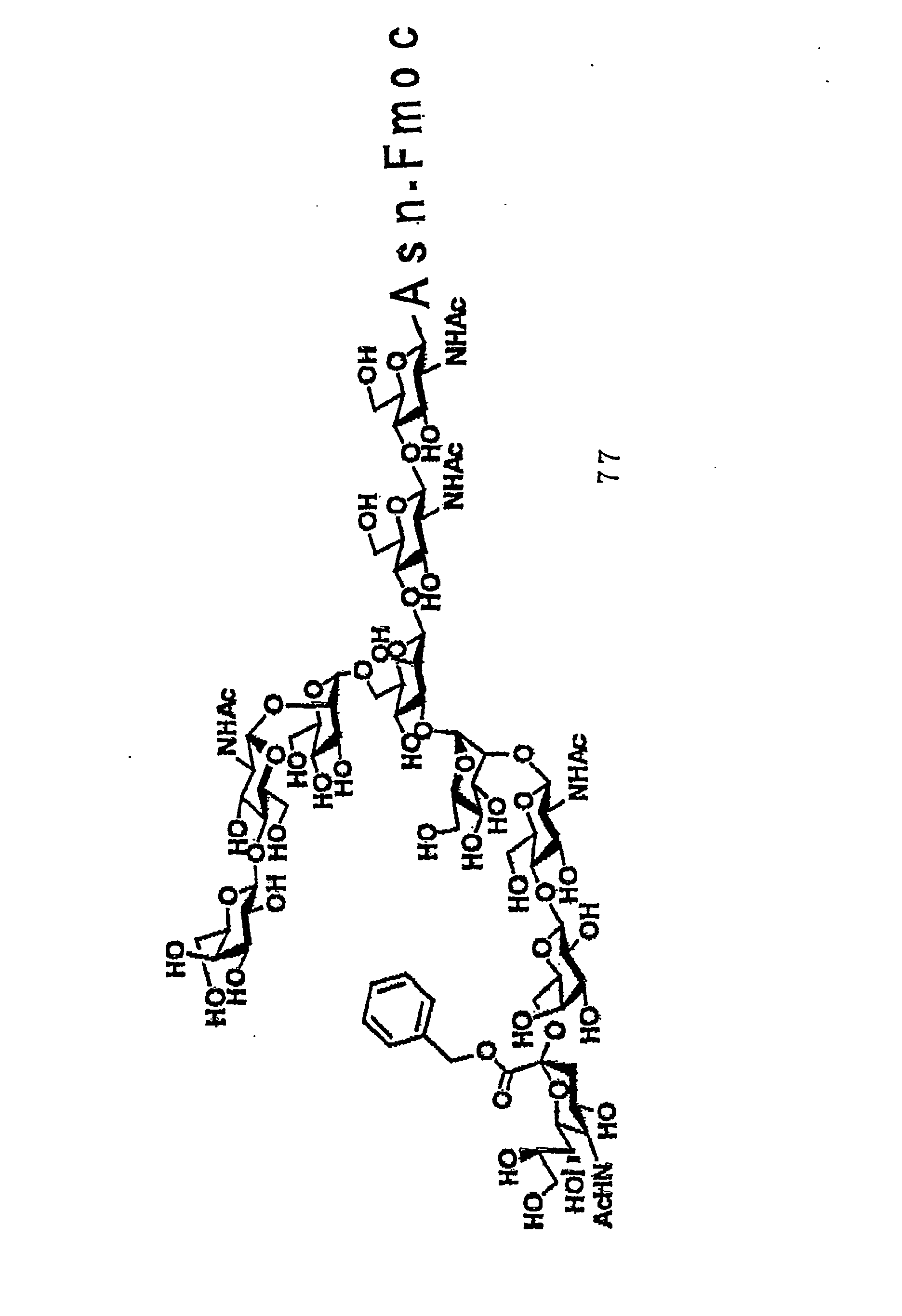
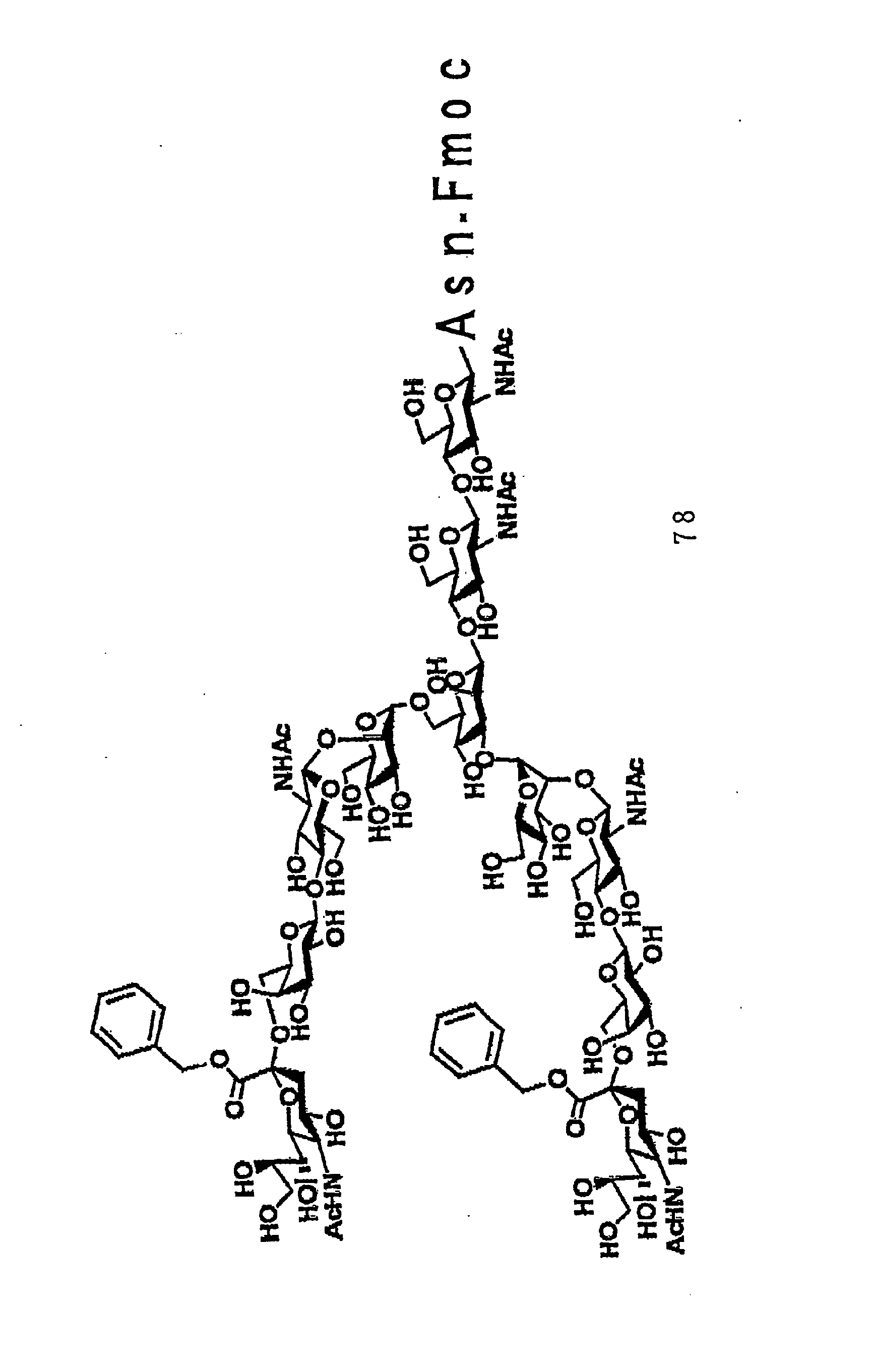
- the both compounds can be efficiently obtained from the mixture by introducing benzyl group into a sialic acid residue of the both compounds, and subjecting to the above step (b) first of all as a mixture of the following compounds 76 and 77: Therefore, since the compounds 76 and 77 can be relatively easily separated, the compounds can be separated, and thereafter removing the benzyl group from the compounds 76 and 77 by a process described below enable compounds 2 and 6 to be efficiently separated and obtained from the mixture of the compounds.
- the mixture of one or more sugar chain asparagines each having a sialic acid residue at a non-reducing terminal is not particularly limited, as long as the mixture is a mixture of one or more sugar chain asparagines having the above structure.
- a mixture of one or more sugar chains each having a sialic acid residue at a non-reducing terminal and also having asparagine bound at a reducing terminal is preferred from the viewpoint of easy availability.
- a mixture containing the compound 24 shown in Figure 3 and/or a compound having one or more deletions of sugar residues in the above compound is preferred.
- step (b') It is preferable to carry out the above step (b'), from the viewpoint of further efficiently obtaining a sugar chain asparagine derivative having the desired sugar chain structure.
- sugar chain asparagine derivatives there are obtained those prepared by introducing benzyl group and Fmoc group thereinto, and those prepared by introducing only Fmoc group thereinto.
- benzyl group into a sialic acid residue of the sugar chain asparagine may be carried out in accordance with a known process (for instance, see Protecting Groups in Organic Chemistry, John Wiley & Sons INC., New York 1991, ISBN 0-471-62301-6).
- the sugar chain asparagine derivative having benzyl group and Fmoc group introduced thereinto, respectively, which is represented by the general formula: wherein one of R x and R y is and the other is H, or Concretely, the sugar chain asparagine derivative includes the above compounds 76 and 77, and the following compound 78:
- the sugar chain asparagine derivative obtained according to this embodiment can be directly used in solid phase synthesis of a glycopeptide.
- carboxyl group existing in a sialic acid residue of the sugar chain asparagine derivative is protected by benzyl group, there are some advantages that the desired sugar peptide can be efficiently obtained without causing side reactions involving the carboxyl group in the solid phase synthesis of the glycopeptide, as compared to the sugar chain asparagine derivative without introduction of benzyl group.
- the present invention provides a process for preparing a sugar chain asparagine capable of obtaining each of the various isolated sugar chain asparagines in a large amount.
- the above process further comprises, subsequent to the step of preparing a sugar chain asparagine derivative in accordance with the above process for preparing a sugar chain asparagine derivative, a step of removing the protecting group from the resulting sugar chain asparagine derivative.
- the process for preparing a sugar chain asparagine according to the present invention comprises the steps of:
- steps (a) and (b) are the same as those in the above process for preparing a sugar chain asparagine derivative, and the mixture of one or more sugar chain asparagines used and the fat-soluble protecting group used are also the same as those described above.
- the removal of the protecting group from the sugar chain asparagine derivative in the step (c) can be carried out in accordance with a known process (for instance, see Protecting Groups in Organic Chemistry, John Wiley & Sons INC., New York 1991, ISBN 0-471-62301-6).
- the protecting group is Fmoc group
- the Fmoc group can be removed by adding morpholine to the sugar chain asparagine derivative in N,N-dimethylformamide (DMF) to carry out the reaction, as schematically shown in Figure 12.
- DMF N,N-dimethylformamide
- Boc group can be removed by a reaction with a weak acid.
- a sugar chain asparagine may be properly obtained by purifying a reaction mixture by a known process such as various chromatographies employing a gel filtration column, an ion exchange column or the like or a process of separation by HPLC as desired.
- the step (a) is a step of providing a mixture of one or more sugar chain asparagines each having a sialic acid residue at a non-reducing terminal, introducing Fmoc group into the sugar chain asparagines contained in the above mixture, and introducing benzyl group into the sialic acid residue, to give a mixture of sugar chain asparagine derivatives.
- the step (c) the removal of benzyl group in addition to the removal of Fmoc group is carried out.
- the removal of benzyl group can be carried out in accordance with a known process (for instance, see Protecting Groups in Organic Chemistry , John Wiley & Sons INC., New York 1991, ISBN 0-471-62301-6).
- the hydrolysis can be carried out in the same manner as described above. It is more preferable to carry out the hydrolysis with a glycosidase [step (b') and/or step (c')], from the viewpoint of more efficiently obtaining a sugar chain asparagine having a desired sugar chain structure.
- the sugar chain asparagine represented by the general formula: wherein R 3 and R 4 , which may be identical or different, are H, with proviso that a case where R 3 and R 4 are both or is excluded.
- the sugar chain asparagine includes, for instance, each of the compounds shown in Figure 3 and Figure 4.
- the compounds 25 to 32, 34 to 46, 72 and 73 are the compounds prepared for the first time in the present invention.
- the present invention encompasses the above compounds.
- the present invention provides a process for preparing a sugar chain capable of obtaining the various isolated sugar chains in a large amount.
- the above process further comprises, subsequent to the step of preparing a sugar chain asparagine in accordance with the above process for preparing a sugar chain asparagine, a step of removing an asparagine residue from the resulting sugar chain asparagine.
- the process for preparing a sugar chain of the present invention comprises the step of:
- steps (a) to (c) are the same as those in the above process for preparing a sugar chain asparagine, and the mixture of one or more sugar chain asparagines used and the fat-soluble protecting group used are also the same as those mentioned above.
- the step (a) is a step of providing a mixture of one or more sugar chain asparagines each having a sialic acid residue at a non-reducing terminal, introducing Fmoc group into the sugar chain asparagines contained in the above mixture, and introducing benzyl group into the sialic acid residue to give a mixture of sugar chain asparagine derivatives.
- the step (c) the removal of benzyl group in addition to the removal of Fmoc group is carried out. The removal of benzyl group can be carried out in accordance with the above process.
- the removal of the asparagine residue from the sugar chain asparagine in the step (d) can be carried out in accordance with a known process.
- the sugar chain asparagine is reacted with anhydrous hydrazine and then acetylated to remove the asparagine residue, whereby a sugar chain can be obtained, as schematically shown in Figure 12.
- a sugar chain can be also obtained by refluxing the sugar chain asparagine with heating in a basic aqueous solution and thereafter acetylating the sugar chain asparagine to remove the asparagine residue.
- the sugar chain may be purified appropriately by a known process such as various chromatographies employing a gel filtration column, an ion exchange column or the like, and a separation process by HPLC as desired.
- the hydrolysis may be carried out in the same manner as described above. It is more preferable to carry out the hydrolysis with a glycosidase [the step (b') and/or the step (c') and/or the step (d')], from the viewpoint of more efficiently obtaining a sugar chain having a desired sugar chain structure.
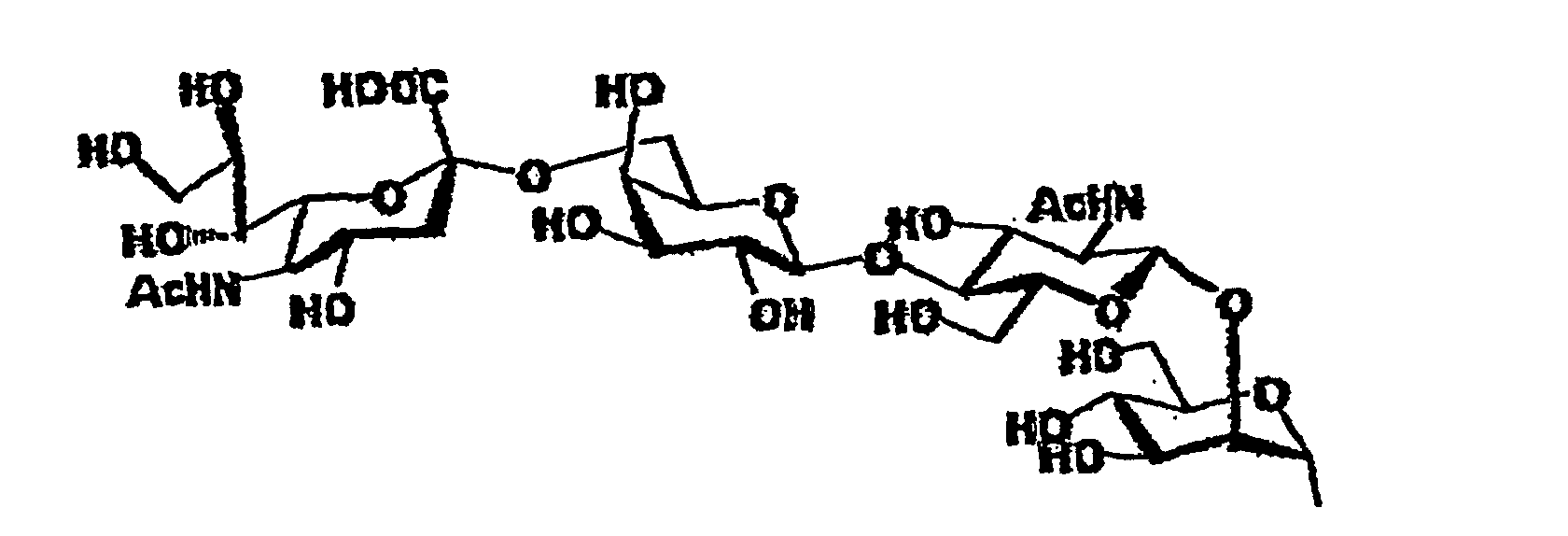
- the sugar chain includes, for instance, each of the compounds shown in Figure 5 and Figure 6.
- the compounds 48 to 55, 57 to 69, 74 and 75 are the compounds prepared for the first time in the present invention.
- the present invention encompasses the above compounds.
- the sugar chain asparagine derivative, the sugar chain asparagine and the sugar chain (hereinafter these three terms are collectively referred to as "sugar chain series" in some case) each having a desired sugar chain structure can be prepared at a low cost, efficiently and in a large amount.
- the above sugar chain series are very useful in the field of the development of pharmaceuticals and the like.
- An application example in the development of the pharmaceuticals includes, for instance, a synthesis of cancer vaccine. It has been known that when the cell is cancerated, a sugar chain which is not initially existing in a body is expressed. It has been also known that when the sugar chain is synthesized chemically and administered to an individual as a vaccine, the cancer proliferation is suppressed. Therefore, if a desired sugar chain series can be prepared according to the present invention, a vaccine effective in the treatment of cancer can be synthesized. Also, a novel vaccine can be synthesized by derivatizing sugar chain series obtained according to the present invention by further bonding new sugar residues using a combination of a chemical reaction and a sugar transferase reaction and the like.
- erythropoietin a glycoprotein
- EPO erythropoietin
- a glycoprotein has been used as a therapeutic agent for an anemia owing to its erythrocyte-proliferating ability, but it has been found that the EPO does not have any activity unless the EPO has a sugar chain bound thereto.
- some proteins exhibit their physiological effects only under the binding of sugar chains. Therefore, for instance, a novel glycoprotein having a novel physiological effect can be synthesized by preparing a protein itself in a large amount in an E.
- a novel physiological activity can be imparted by substituting a sugar chain existing in a naturally occurring glycoprotein with a sugar chain prepared according to the present invention.
- a technique of substituting a sugar chain owned by a glycoprotein with a sugar chain obtained according to the present invention includes, for instance, a process described in P. Sears and C. H. Wong, Science, 2001, vol. 291, p.2344-2350.
- the process includes a process of treating a glycoprotein with a ⁇ -N-acetylglucosaminidase (Endo-H) to put the glycoprotein in a state in which only one N-acetylglucosamine residue is bound to the asparagine residue on the surface of the protein, and subsequently binding a desired sugar chain in the sugar chain asparagine obtained according to the present invention (for instance, each of the compounds shown in Figure 3 and Figure 4) to the N-acetylglucosamine residue described above with a ⁇ -N-acetylglucosaminidase (Endo-M).
- Endo-H ⁇ -N-acetylglucosaminidase
- the problem encountered currently when a glycoprotein is utilized as a therapeutic agent includes a rapid metabolic rate of the glycoprotein administered. This is due to the fact that the glycoprotein is metabolized by the liver immediately after the removal of the sialic acid existing in the sugar chain terminal of the glycoprotein in a living body. Therefore, it is necessary that the glycoprotein is administered at a certain dose.
- a sugar chain is prepared according to the present invention, wherein sialic acid is newly introduced to a terminal of the sugar chain so as to be less removed, and the sugar chain is introduced into a target protein with Endo-M, the metabolic rate of the glycoprotein in a living body can be controlled, so that the amount of the glycoprotein to be administered can be lowered.
- Example 2 The compound 24 (609 mg, 261 ⁇ mol) obtained in Example 1 was dissolved in 20.7 ml of water, and 13.8 ml of 0.1 N hydrochloric acid was added thereto. Immediately after heating this solution at 70°C for 35 minutes, the solution was cooled on ice, and a saturated aqueous sodium hydrogencarbonate was added thereto to adjust its pH to 7. The solution was lyophilized, and thereafter the residue was purified by gel filtration column chromatography (Sephadex G-25, 2.5 ⁇ ⁇ 1 m, eluent: water, flow rate: 1.0 ml/min), to give 534 mg of a mixture of a compound 24, compounds 25 and 29, and a compound 33 each shown in Figure 3. These four components were proceeded to the next step without being isolated from each other.
- the compound 1 was eluted after 51 minutes, a mixture of the compounds 2 and 6 was eluted after 67 minutes, and the compound 10 was eluted after 93 minutes.
- Each of the fractions were collected and lyophilized, and thereafter desalted by gel filtration column chromatography (Sephadex G-25, 2.5 ⁇ ⁇ 30 cm, eluent: water, flow rate: 1.0 ml/min), thereby giving 150 mg of a desired mixture of the compounds 2 and 6.
- the mixture (224 mg, 97 ⁇ mol) of the compounds 2 and 6 obtained in Example 2 and 24 mg of bovine serum albumin were dissolved in 22 ml of HEPES buffer (50 mM, pH 6.0), and Diplococcus pneumoniae -derived ⁇ -galactosidase (1.35 U) was added thereto. This solution was allowed to stand at 37°C for 15 hours, and thereafter lyophilized.
- the fraction was desalted by HPLC (ODS column, 2.0 ⁇ ⁇ 25 cm, eluent: water for a first 15 minutes, and applied to a gradient of water : acetonitrile of from 10:0 to 85:15 (volume ratio) for a period of from 16 to 30 minutes, and then to a gradient of water : acetonitrile from 85:15 to 80:20 for a period of from 31 to 45 minutes; flow rate: 3.0 ml/min), to give a desired compound 3 in an amount of 81 mg and a compound 7 in an amount of 75 mg.
- HPLC ODS column, 2.0 ⁇ ⁇ 25 cm, eluent: water for a first 15 minutes, and applied to a gradient of water : acetonitrile of from 10:0 to 85:15 (volume ratio) for a period of from 16 to 30 minutes, and then to a gradient of water : acetonitrile from 85:15 to 80:20 for a period of from 31 to 45 minutes; flow
- a mixture (90 mg, 47.3 ⁇ mol) of the compounds 3 and 7 obtained in Example 3 was dissolved in 8.1 ml of HEPES buffer (50 mM, pH 6.0) together with 8 mg of bovine serum albumin without separating the compounds from each other, and 2.88 U of a bovine kidney-derived ⁇ -glucosaminidase (manufactured by Sigma-Aldrich Corporation, from bovine kidney) was added thereto. This solution was allowed to stand at 37°C for 18 hours, and thereafter lyophilized.
- the fraction was desalted by HPLC (ODS column, 2.0 ⁇ ⁇ 25 cm, eluent: water for a first 15 minutes, and applied to a gradient of water : acetonitrile of from 10:0 to 85:15 for a period of from 16 to 30 minutes, and then to a gradient of water : acetonitrile of from 85:15 to 80:20 for a period of from 31 to 45 minutes; flow rate: 3.0 ml/min), to give a desired compound 4 in an amount of 40 mg and a compound 8 in an amount of 37 mg.
- HPLC ODS column, 2.0 ⁇ ⁇ 25 cm, eluent: water for a first 15 minutes, and applied to a gradient of water : acetonitrile of from 10:0 to 85:15 for a period of from 16 to 30 minutes, and then to a gradient of water : acetonitrile of from 85:15 to 80:20 for a period of from 31 to 45 minutes; flow rate: 3.0 ml
- the compound 4 (30 mg, 473 ⁇ mol) obtained in Example 4 and 3 mg of bovine serum albumin were dissolved in 6 ml of HEPES buffer (50 mM, pH 6.0), and 10 U of Jack Beans-derived ⁇ -mannosidase was added thereto. This solution was allowed to stand at 37°C for 21 hours, and then lyophilized.
- the compound 8 (40 mg, 630 ⁇ mol) obtained in Example 4 and 5 mg of bovine serum albumin were dissolved in 7.8 ml of HEPES buffer (50 mM, pH 6.0), and 38 U of a Jack Beans-derived ⁇ -mannosidase was added thereto. This solution was allowed to stand at 37°C for 63 hours, and then lyophilized.
- Example 2 The compound 10 (10.5 mg, 5.27 ⁇ mol) obtained in Example 2 was dissolved in 1.4 ml of a 50% morpholine/N,N-dimethylformamide solution, and the solution was reacted for 2 hours under argon atmosphere at room temperature. Three milliliters of toluene was added to this solution, and the mixture was applied to an evaporator at 35°C. The procedures were repeated three times to remove the reaction solvent. The residue was purified by gel filtration column chromatography (Sephadex G-25, 2.5 ⁇ ⁇ 30 cm, eluent: water, flow rate: 1.0 ml/min), to give 7 mg of a desired compound 33 shown in Figure 3 (yield: 76%). The structure of the resulting compound was confirmed from the finding that its 1 H-NMR spectrum was identical to that of the resulting compound 33 from Example 2.
- the compound 3 (28 mg, 21.3 ⁇ mol) and 1.0 mg of bovine serum albumin were dissolved in HEPES buffer (50 mM, pH 5.0, 454 ⁇ L), and neuraminidase (manufactured by Sigma-Aldrich Corporation, from Viblio Cholerae, 198 mU) was added thereto. This solution was allowed to stand at 37°C for 20 hours, and thereafter the termination of the reaction was confirmed by HPLC analysis. The reaction solution was purified by HPLC (YMC Packed Column D-ODS-5 S-5 120A ODS No.
- the compound 7 (20 mg, 9.4 ⁇ mol) and 1.6 mg of bovine serum albumin were dissolved in HEPES buffer (50 mM, pH 5.0, 323 ⁇ L), and neuraminidase (manufactured by Sigma-Aldrich Corporation, from Viblio Cholerae, 141 mU) was added thereto. This solution was allowed to stand at 37°C for 18 hours, and thereafter the termination of the reaction was confirmed by HPLC analysis. Subsequently, the reaction solution was purified by HPLC (YMC Packed Column D-ODS-5 S-5 120A ODS No.
- the compound 4 (45 mg, 24 ⁇ mol) and 1.7 mg of bovine serum albumin were dissolved in HEPES buffer (50 mM, pH 5.0, 820 ⁇ L), and neuraminidase (manufactured by Sigma-Aldrich Corporation, from Viblio Cholerae, 134 mU) was added thereto. This solution was allowed to stand at 37°C for 14 hours, and thereafter the termination of the reaction was confirmed by HPLC analysis. Subsequently, the reaction solution was purified by HPLC (YMC Packed Column D-ODS-5 S-5 120A ODS No.
- the compound 15 (11 mg, 6.8 ⁇ mol) and 1.5 mg of bovine serum albumin were dissolved in HEPES buffer (50 mM, pH 5.0, 269 ⁇ L), and ⁇ -galactosidase (manufactured by Seikagaku Corporation, from Jack Beans, 11 ⁇ L, 275 mU) was added thereto. This solution was allowed to stand at 37°C for 14 hours, and thereafter the termination of the reaction was confirmed by HPLC analysis. The reaction solution was purified by HPLC (YMC Packed Column D-ODS-5 S-5 120A ODS No.
- the compound 8 (47 mg, 25 ⁇ mol) and 1.9 mg of bovine serum albumin were dissolved in HEPES buffer (50 mM, pH 5.0, 840 ⁇ L), and neuraminidase (manufactured by Sigma-Aldrich Corporation, from Viblio Cholerae, 369 mU) was added thereto. This solution was allowed to stand at 37°C for 37 hours, and thereafter the termination of the reaction was confirmed by HPLC analysis. The reaction solution was lyophilized, and the lyophilized product was subsequently purified by HPLC (YMC Packed Column D-ODS-5 S-5 120A ODS No.
- the compound 20 (12 mg, 7.4 ⁇ mol) and 1.0 mg of bovine serum albumin were dissolved in HEPES buffer (50 mM, pH 5.0, 330 ⁇ L), and ⁇ -galactosidase (manufactured by Seikagaku Corporation, from Jack Beans, 12 ⁇ L, 297 mU) was added thereto. This solution was allowed to stand at 37°C for 46 hours, and thereafter the termination of the reaction was confirmed by HPLC analysis. The reaction solution was purified by HPLC (YMC Packed Column D-ODS-5 S-5 120A ODS No.
- the compound 5 (32 mg, 18.4 ⁇ mol) and 2.5 mg of bovine serum albumin were dissolved in HEPES buffer (50 mM, pH 5.0, 713 ⁇ L), and neuraminidase (manufactured by Sigma-Aldrich Corporation, from Viblio Cholerae, 134 mU) was added thereto. This solution was allowed to stand at 37°C for 17 hours, and thereafter the termination of the reaction was confirmed by HPLC analysis. Subsequently, the reaction solution was purified by HPLC (YMC Packed Column D-ODS-5 S-5 120A ODS No.
- the compound 16 (9 mg, 6.2 ⁇ mol) and 1.6 mg of bovine serum albumin were dissolved in HEPES buffer (50 mM, pH 5.0, 613 ⁇ L), and ⁇ -galactosidase (manufactured by Seikagaku Corporation, from Jack Beans, 186 mU) was added thereto. This solution was allowed to stand at 37°C for 32 hours, and thereafter the termination of the reaction was confirmed by HPLC analysis. The reaction solution was purified by HPLC (YMC Packed Column D-ODS-5 S-5 120A ODS No.
- the compound 17 (3.4 mg, 2.6 ⁇ mol) and 1.1 mg of bovine serum albumin were dissolved in HEPES buffer (50 mM, pH 5.0, 257 ⁇ L), and N-acetyl- ⁇ -D-glucosaminidase (Sigma-Aldrich Corporation, from Jack Beans, 144 mU) was added thereto. This solution was allowed to stand at 37°C for 24 hours, and thereafter the termination of the reaction was confirmed by HPLC analysis. The reaction solution was purified by HPLC (YMC Packed Column D-ODS-5 S-5 120A ODS No.
- the compound 9 (28 mg, 16 ⁇ mol) and 1.7 mg of bovine serum albumin were dissolved in HEPES buffer (50 mM, pH 5.0, 624 ⁇ L), and neuraminidase (manufactured by Sigma-Aldrich Corporation, from Viblio Cholerae, 117 mU) was added thereto. This solution was allowed to stand at 37°C for 17 hours, and thereafter the termination of the reaction was confirmed by HPLC analysis. Subsequently, the reaction solution was purified by HPLC (YMC Packed Column D-ODS-5 S-5 120A ODS No.
- the compound 21 (10 mg, 6.9 ⁇ mol) and 1.6 mg of bovine serum albumin were dissolved in HEPES buffer (50 mM, pH 5.0, 672 ⁇ L), and ⁇ -galactosidase (manufactured by Seikagaku Corporation, from Jack Beans, 205 mU) was added thereto. This solution was allowed to stand at 37°C for 20 hours, and thereafter the termination of the reaction was confirmed by HPLC analysis. The reaction solution was purified by HPLC (YMC Packed Column D-ODS-5 S-5 120A ODS No.
- the compound 22 (3.6 mg, 2.8 ⁇ mol) and 1.2 mg of bovine serum albumin were dissolved in HEPES buffer (50 mM, pH 5.0, 277 ⁇ L), and N-acetyl- ⁇ -D-glucosaminidase (Sigma-Aldrich Corporation, from Jack Beans, 195 mU) was added thereto. This solution was allowed to stand at 37°C for 24 hours, and thereafter the termination of the reaction was confirmed by HPLC analysis. The reaction solution was purified by HPLC (YMC Packed Column D-ODS-5 S-5 120A ODS No.
- the compound 10 (123 mg, 62 ⁇ mol) and bovine serum albumin (1.1 mg) were dissolved in HEPES buffer (50 mM, pH 5.0, 2.5 mL), and ⁇ -galactosidase (manufactured by Seikagaku Corporation, from Jack Beans, 24 ⁇ L, 612 mU) was added thereto.
- HEPES buffer 50 mM, pH 5.0, 2.5 mL
- ⁇ -galactosidase manufactured by Seikagaku Corporation, from Jack Beans, 24 ⁇ L, 612 mU
- the compound 11 50 mg, 30 ⁇ mol
- 2.0 mg of bovine serum albumin were dissolved in HEPES buffer (50 mM, pH 5.0, 920 ⁇ L), and N-acetyl- ⁇ -D-glucosaminidase (manufactured by Sigma-Aldrich Corporation, from Jack Beans, 2.1 U) was added thereto. This solution was allowed to stand at 37°C for 48 hours, and thereafter the termination of the reaction was confirmed by HPLC analysis. The reaction solution was purified by HPLC (YMC Packed Column D-ODS-5 S-5 120A ODS No.
- the compound 12 (10 mg, 11 ⁇ mol) and 0.9 mg of bovine serum albumin were dissolved in HEPES buffer (50 mM, pH 5.0, 440 ⁇ L), and ⁇ -mannosidase (manufactured by Sigma-Aldrich Corporation, from Jack Beans, 30 ⁇ L, 3.2 U) was added thereto. This solution was allowed to stand at 37°C for 21 hours, and thereafter the termination of the reaction was confirmed by HPLC analysis. Subsequently, the reaction solution was purified by HPLC (YMC Packed Column D-ODS-5 S-5 120A ODS No.
- the compound 10 (10.5 mg, 5.3 ⁇ mol) was reacted for 7 hours in accordance with the above procedures, to give a desired compound 33 (7 mg, yield: 76%).
- the resulting compound was confirmed from the finding that its 1 H-NMR was identical to that of the preparation.
- the compound 23 (1.6 mg, 1.5 ⁇ mol) was subjected to the reaction for 14 hours in accordance with the above procedures, to give a desired compound 46 (1.1 mg, 6.4 ⁇ mol, yield: 85%).
- the physical data for the resulting compound are as follows.
- the compounds 2 and 6 (5.0 mg, 2.2 ⁇ mol) were dissolved in 220 ⁇ L of water, and 100 ⁇ L of a 22 mM aqueous cesium carbonate was added thereto to adjust its pH to 7.0. This solution was lyophilized. Four-hundred and thirty microliters of N,N-dimethylformamide was added to the solid obtained after drying, and further 20 ⁇ L of a 6.6 ⁇ mol benzyl bromide/-N,N-dimethylformamide solution was added thereto. This solution was stirred under argon atmosphere.
- a cooled aqueous solution of the compound 1 (20 mg) was applied onto a Dowex-50Wx8 (H + ) column ( ⁇ 0.5 cm ⁇ 5 cm) chilled at 4°C, and the eluted aqueous solution was lyophilized.
- the resulting lyophilized product was dissolved in a chilled water at 4°C, an aqueous Cs 2 CO 3 (2.5 mg/1 ml) was added thereto to adjust a pH of the aqueous solution to 5 to 6, and the aqueous solution was then lyophilized.
- the Fmoc-disialo-sugar chain sample after the lyophilization was dissolved in a dry DMF (1.3 ml), and benzyl bromide (5.1 ⁇ l) was added thereto with stirring the mixture at room temperature for 45 minutes under argon gas stream.
- the termination of the reaction was confirmed by TLC, thereafter the reaction solution was cooled to 0°C, and 10 ml of diethyl ether was added to the reaction solution to precipitate the desired product. This substance was filtered with a filter paper. Distilled water was added to the residual desired product, and eluted as a filtrate, and subsequently concentrated under a reduced pressure.
- the resulting residue was purified by applying to an ODS column ( ⁇ 1.6 cm ⁇ 14 cm, eluent: H 2 O ⁇ 40% aqueous MeOH), to give a compound 78 (18.2 mg, yield: 85%).
- the physical data for the resulting compound 78 are as follows.
- sugar chains having desired sugar chain structures can be obtained in large amounts very conveniently. Therefore, there is expected to be utilized for therapeutic agents against cancer, inflammation, influenza and the like.
- sugar chain asparagine derivative and sugar chain asparagine which can be obtained in the present invention are excellent in safety without any risks such as admixing of toxic substances during the preparation processes.
Landscapes
- Chemical & Material Sciences (AREA)
- Organic Chemistry (AREA)
- Life Sciences & Earth Sciences (AREA)
- Engineering & Computer Science (AREA)
- Health & Medical Sciences (AREA)
- Biochemistry (AREA)
- General Health & Medical Sciences (AREA)
- Genetics & Genomics (AREA)
- Biotechnology (AREA)
- Wood Science & Technology (AREA)
- Zoology (AREA)
- Molecular Biology (AREA)
- General Engineering & Computer Science (AREA)
- Chemical Kinetics & Catalysis (AREA)
- General Chemical & Material Sciences (AREA)
- Microbiology (AREA)
- Bioinformatics & Cheminformatics (AREA)
- Crystallography & Structural Chemistry (AREA)
- Preparation Of Compounds By Using Micro-Organisms (AREA)
- Polysaccharides And Polysaccharide Derivatives (AREA)
- Saccharide Compounds (AREA)
- Peptides Or Proteins (AREA)
Abstract
Description


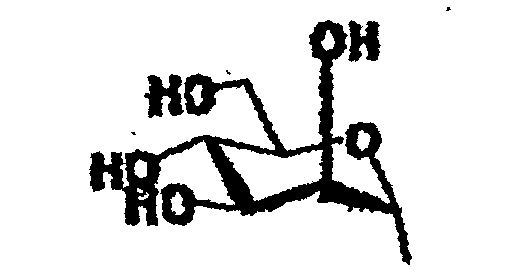


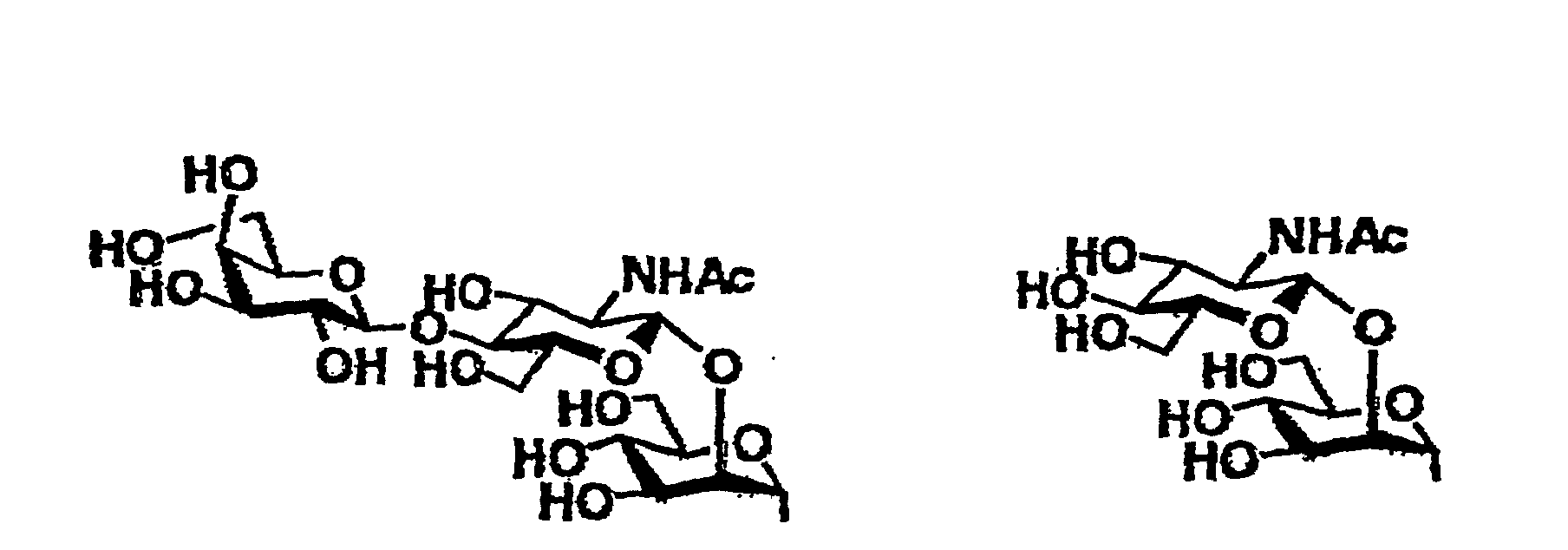


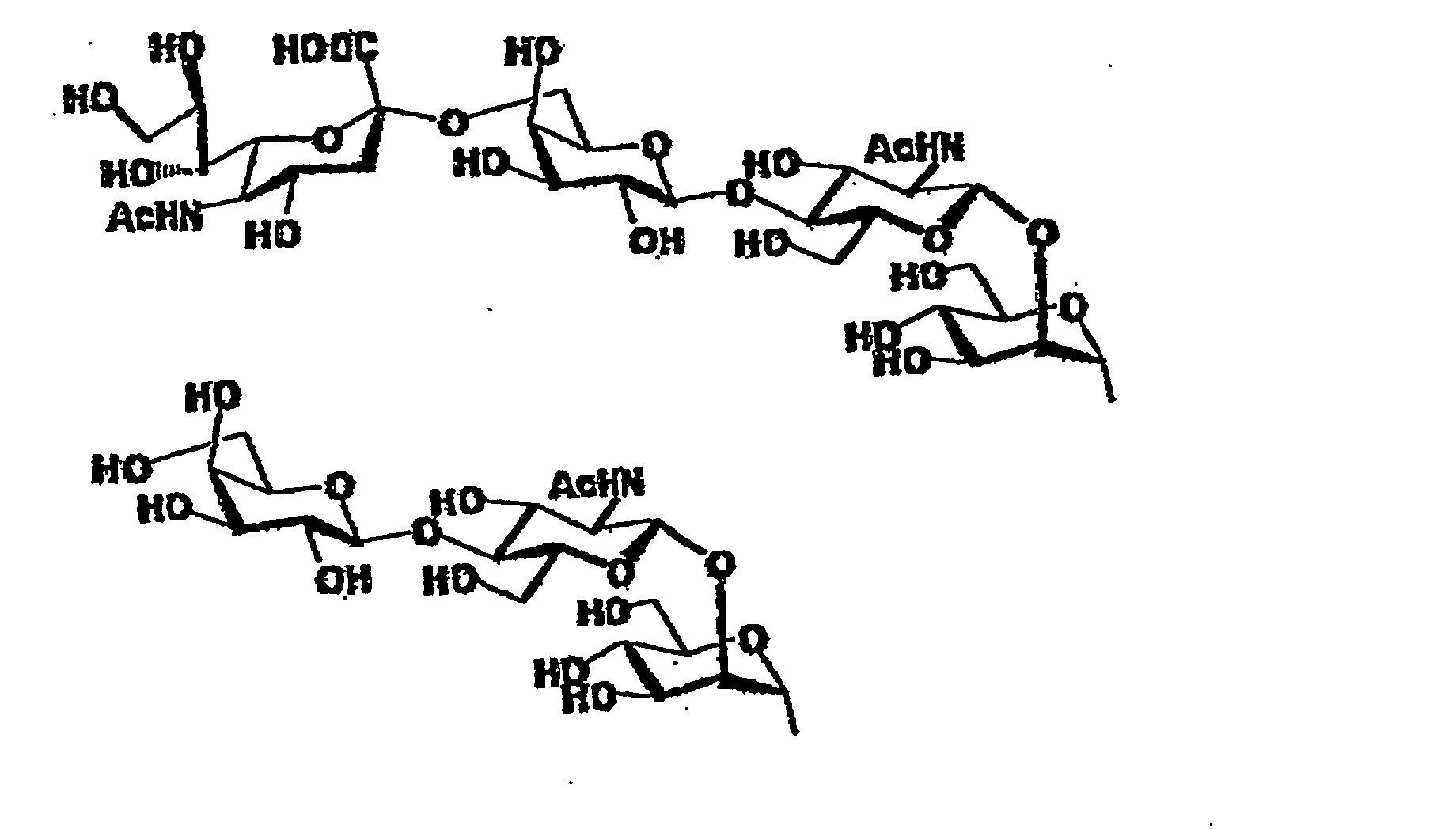


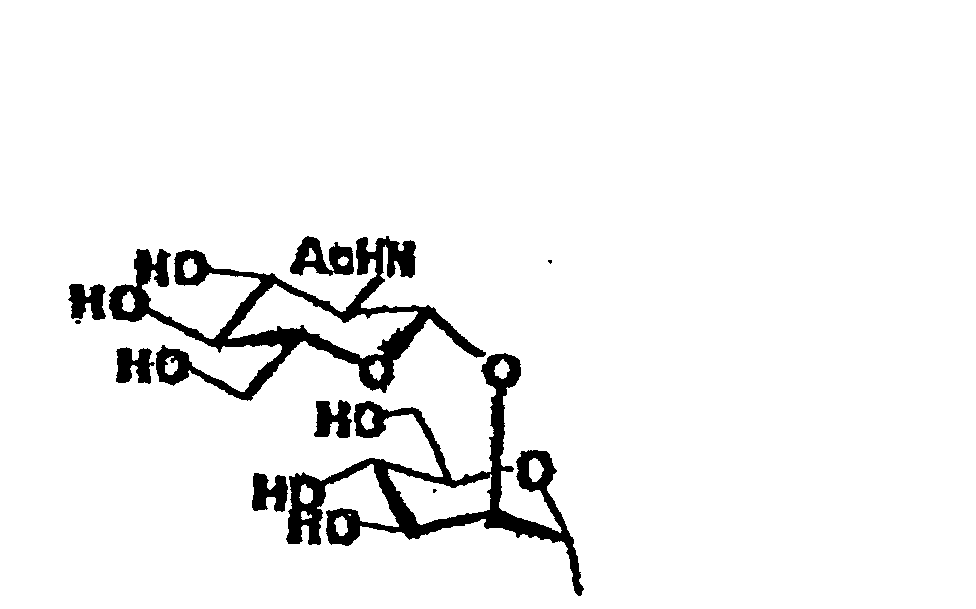
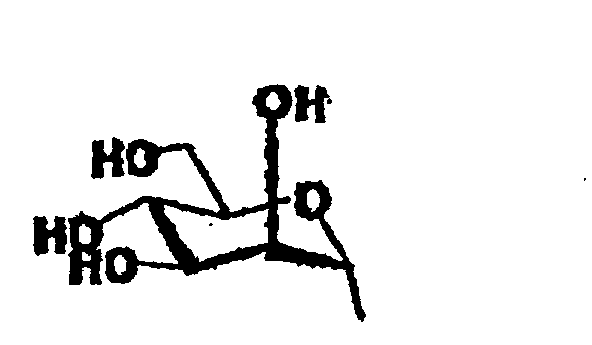

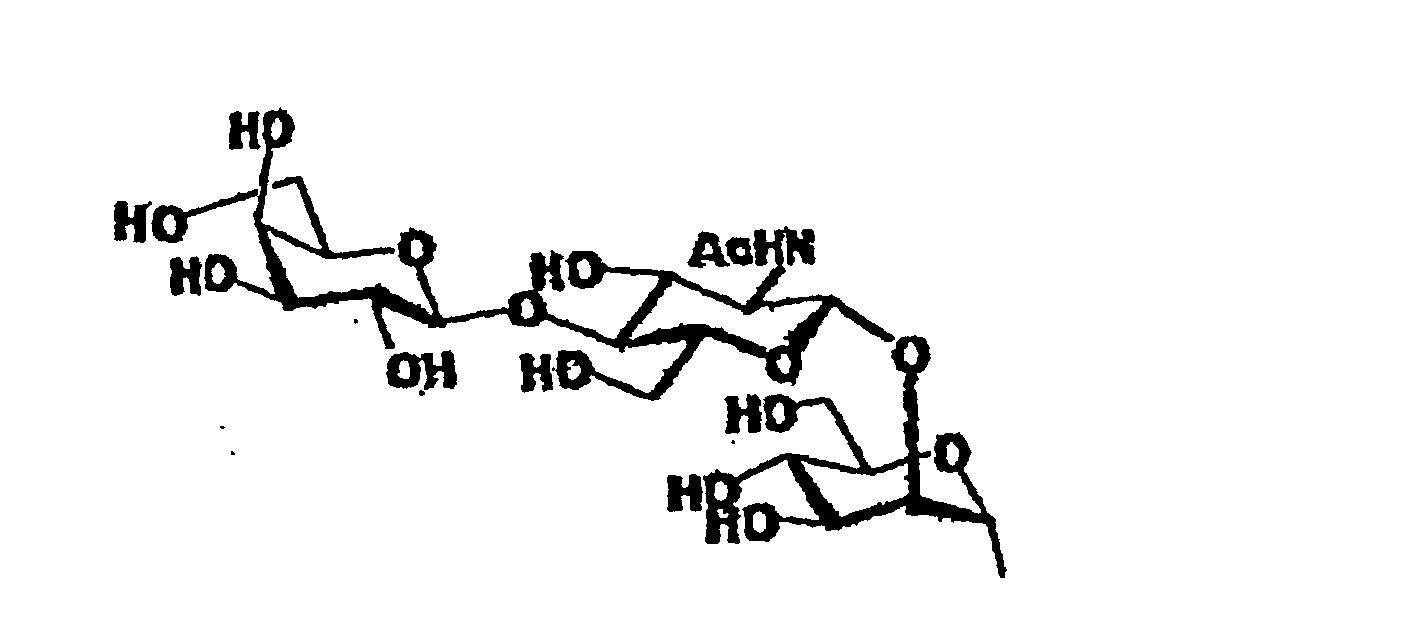
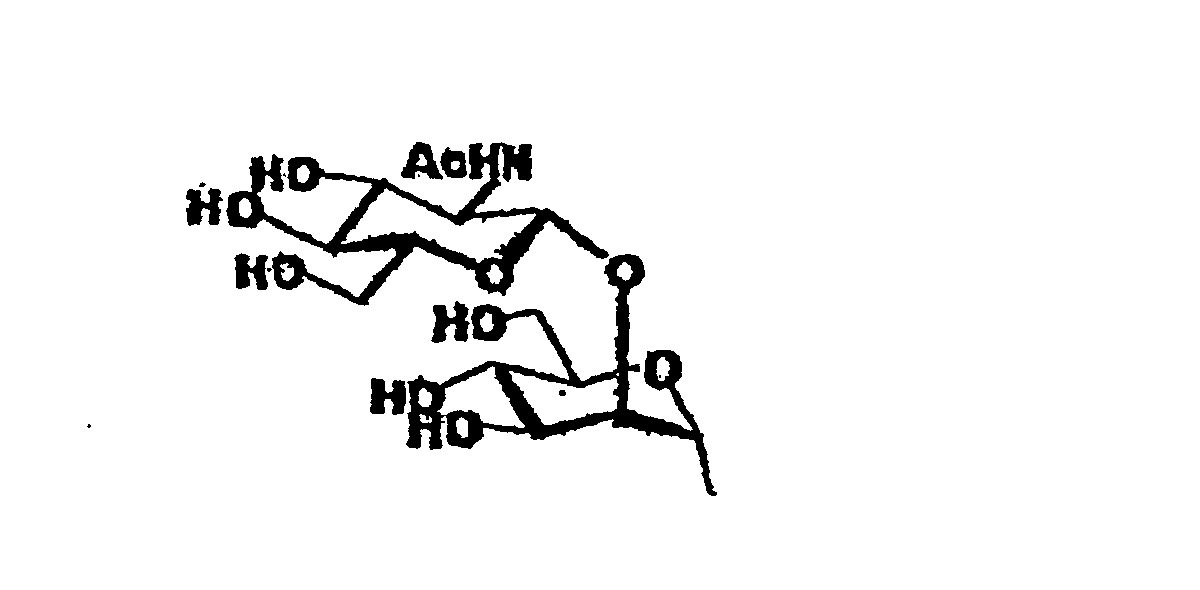

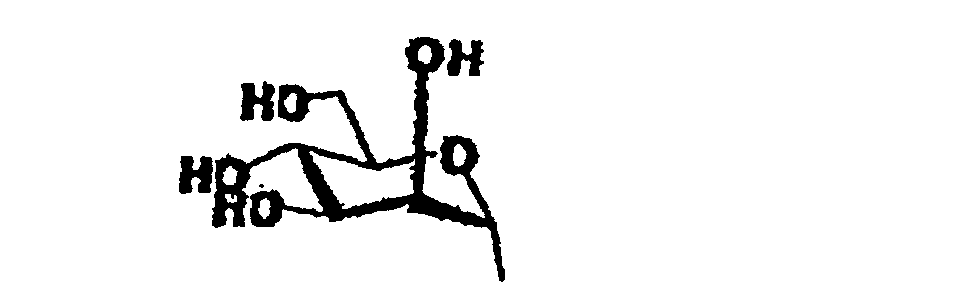

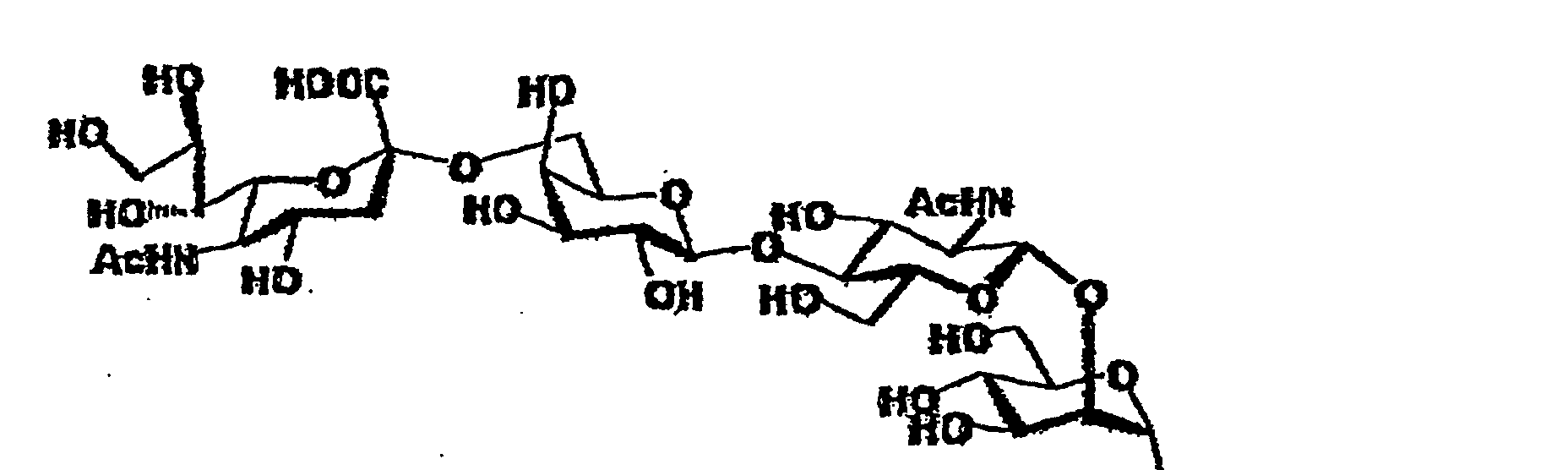


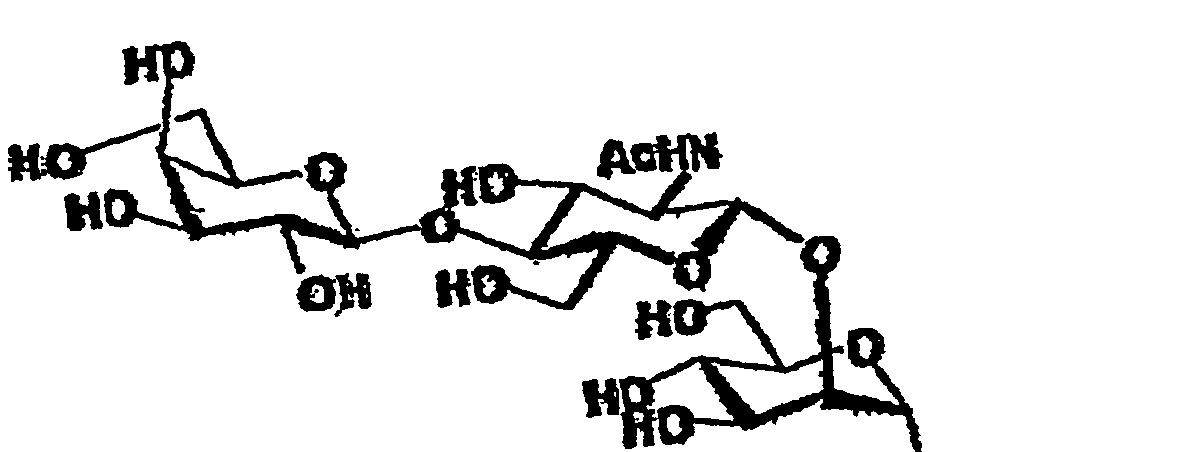
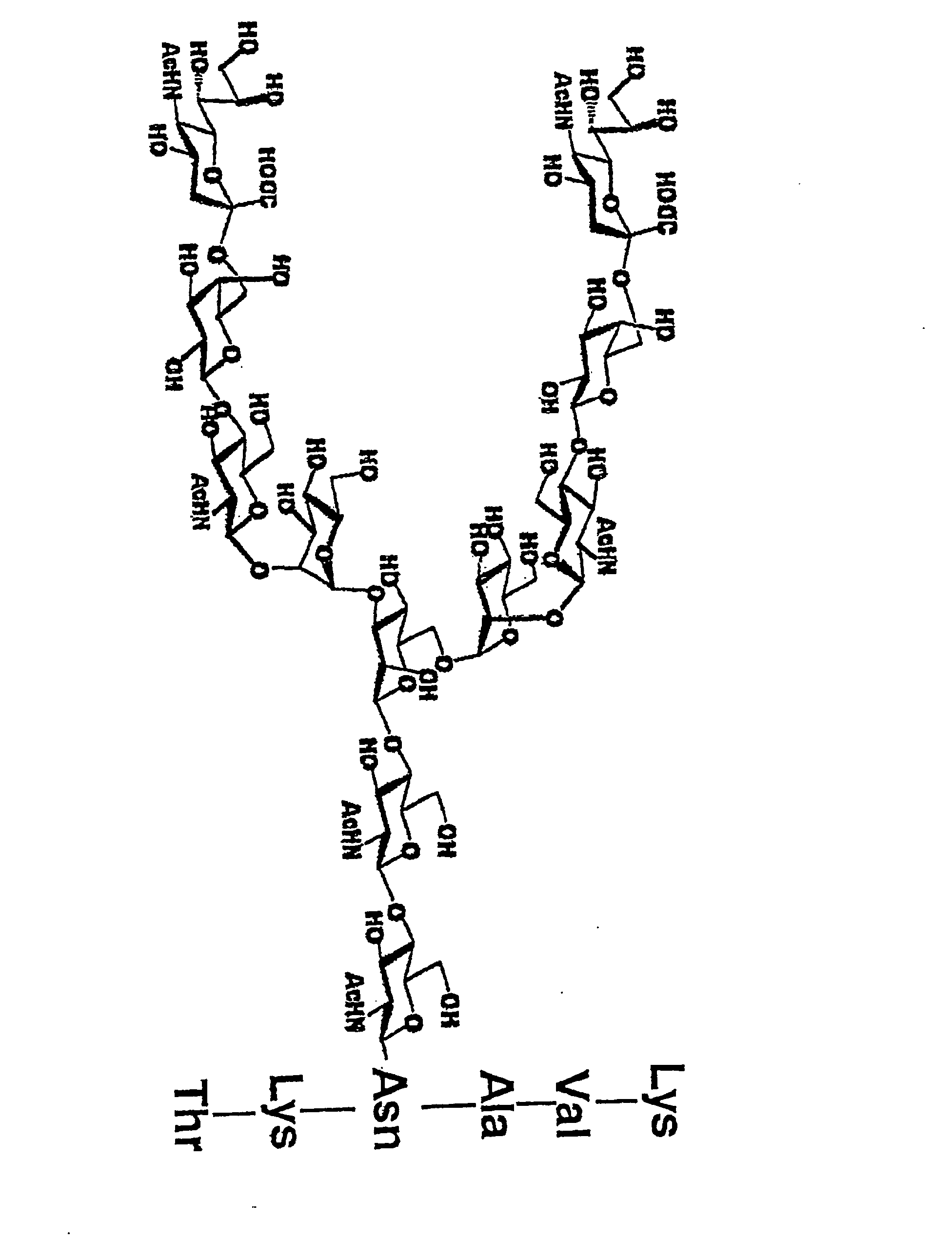
Concretely, the above sugar chain asparagine derivative includes, for instance, each of the compounds shown in Figure 1 and Figure 2. Among them, the



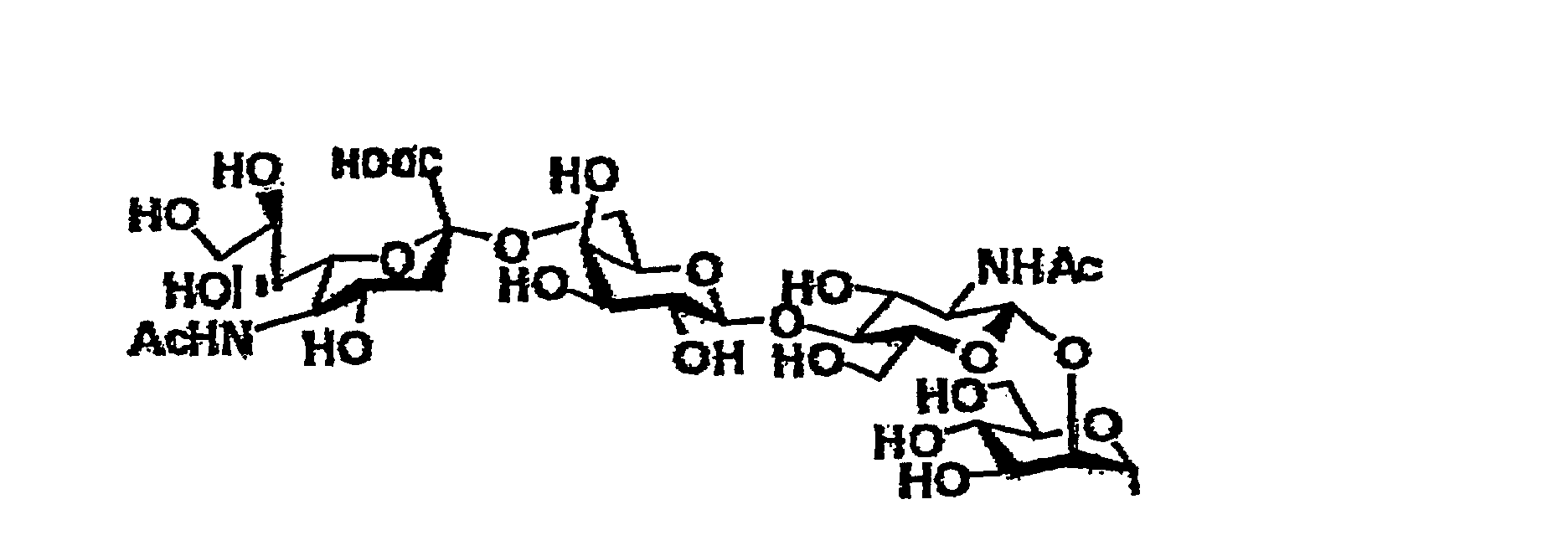
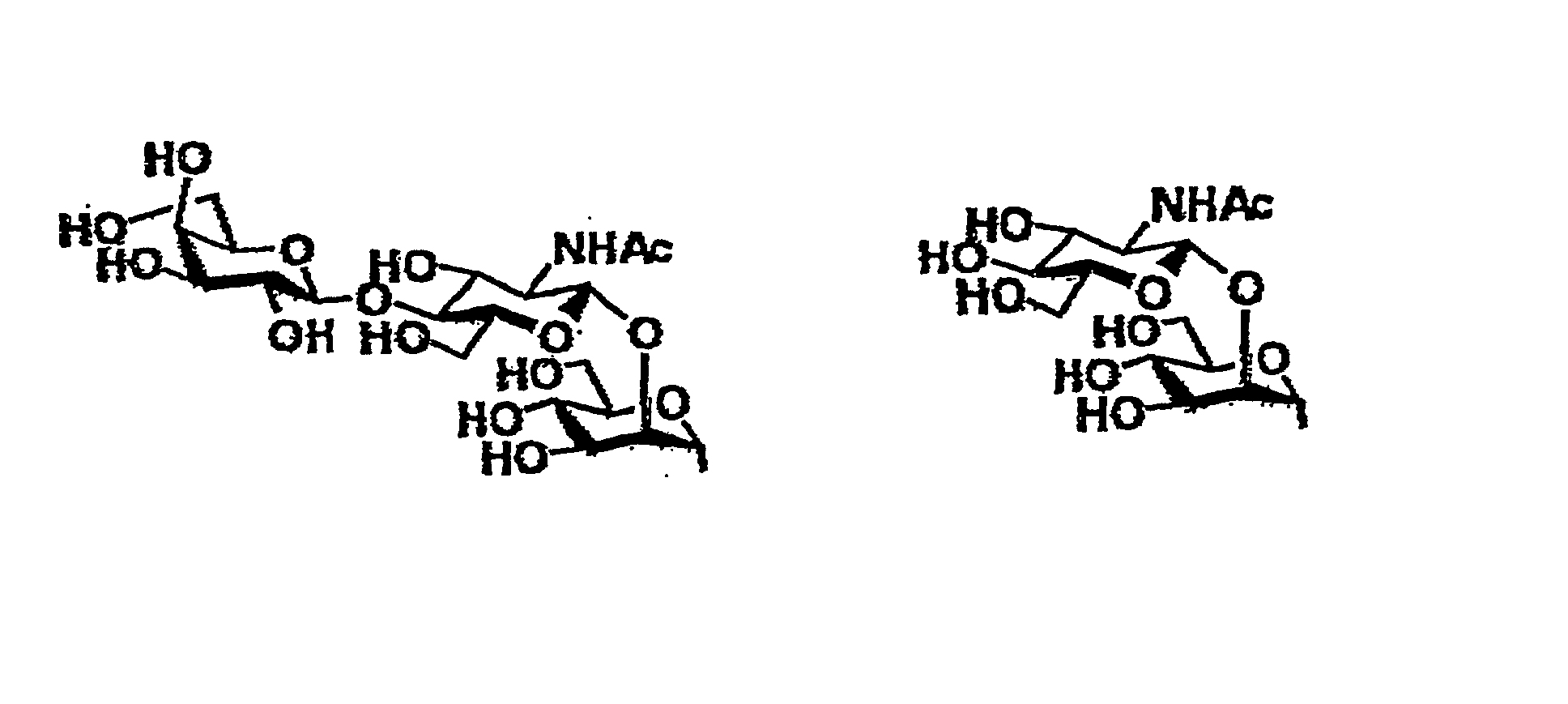

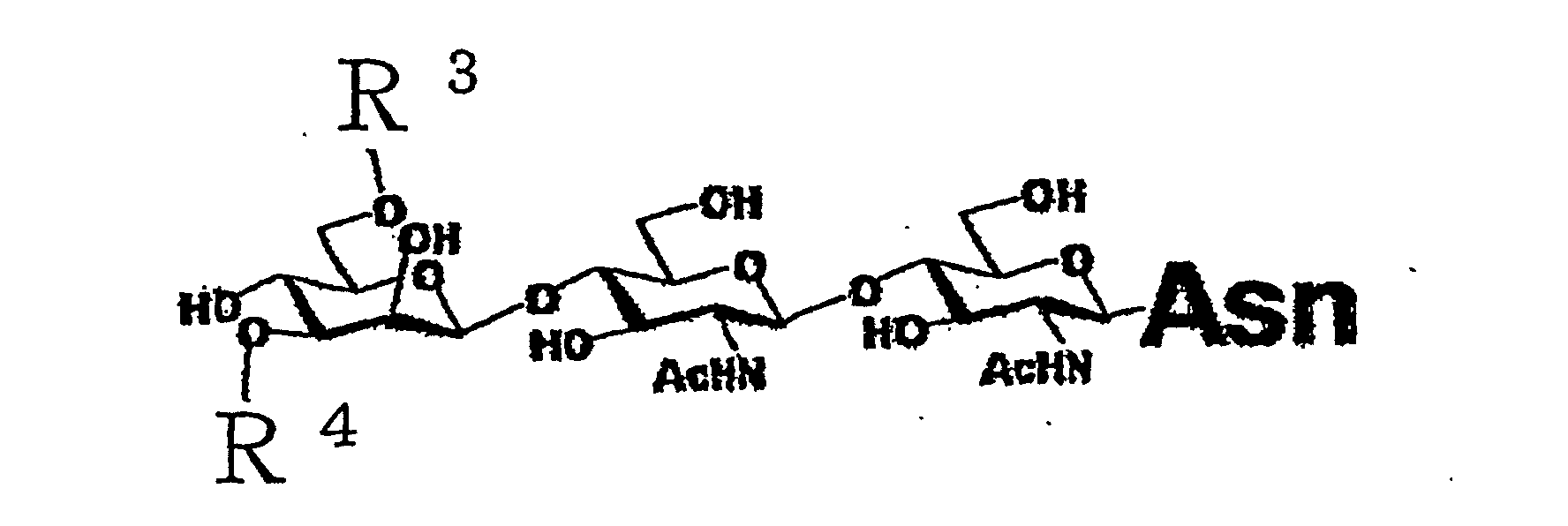
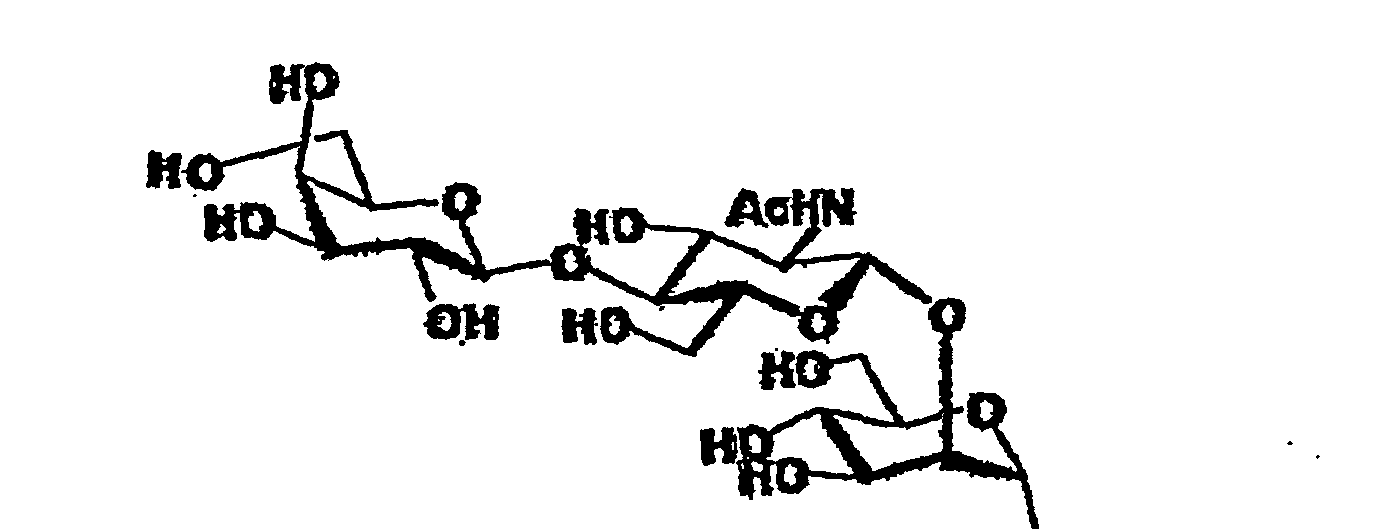

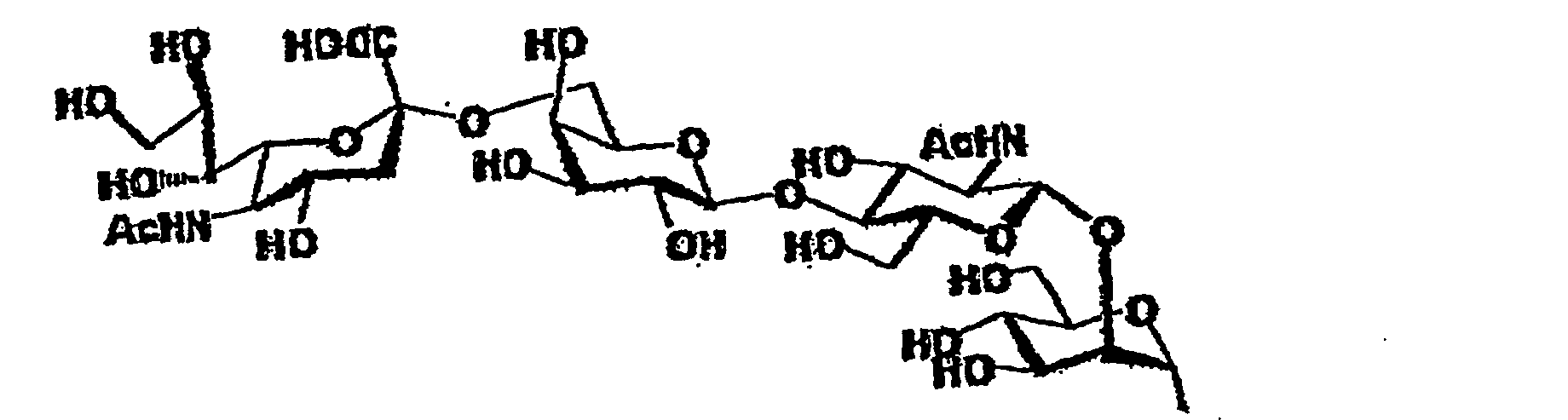

Concretely, the sugar chain asparagine includes, for instance, each of the compounds shown in Figure 3 and Figure 4. Among them, the


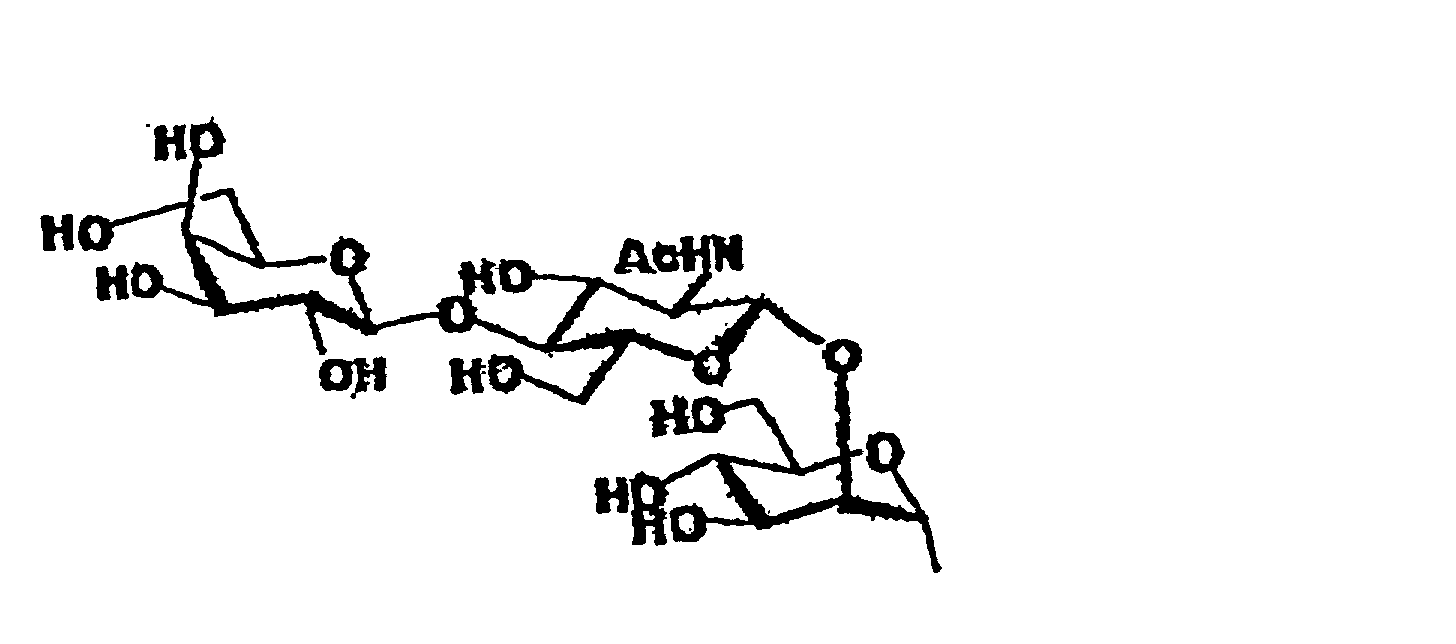
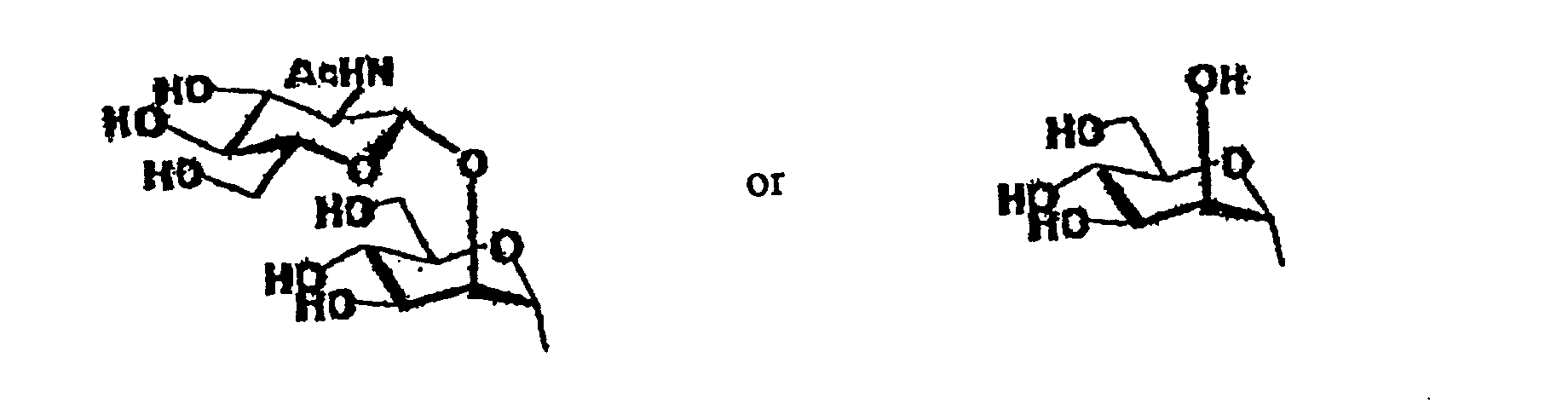
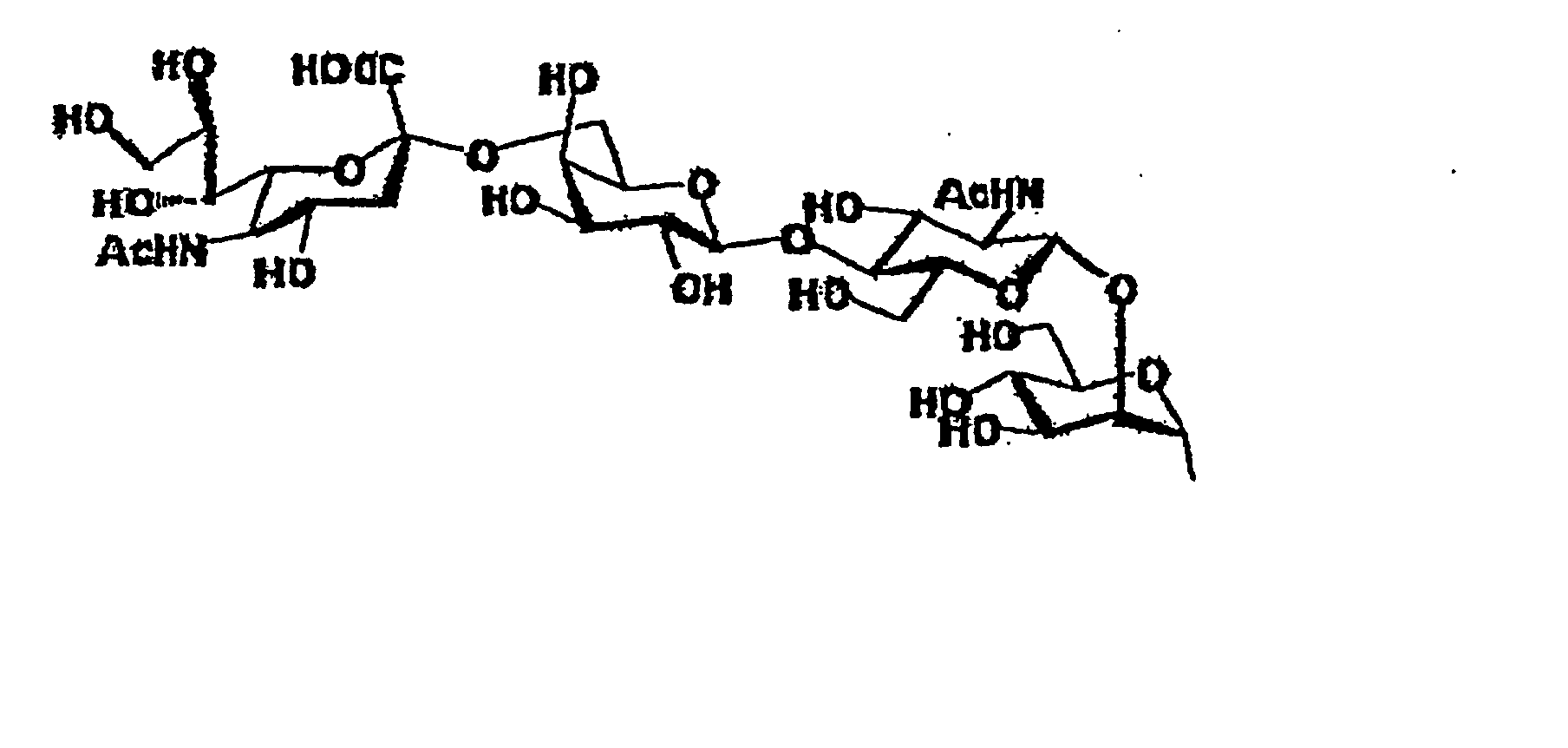


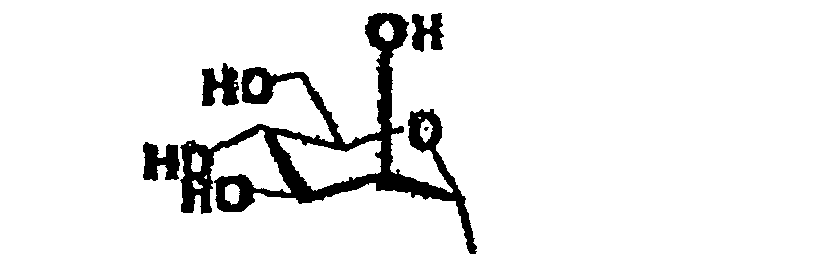
Concretely, the sugar chain includes, for instance, each of the compounds shown in Figure 5 and Figure 6. Among them, the
1H-NMR (D2O, 30°C)
5.15 (1H, s, Man4-H1), 5.06 (1H, d, GlcNAc1-H1), 4.95 (1H, s, Man4'- H1), 4.82 (1H, s, Man3-H1), 4.69 (1H, d, GlcNAc2-H1), 4.67 (2H, d, GlcNAc5,5'-H1), 4.53 (2H, d, Gal6,6'-H1), 4.34 (1H, d, Man3-H2), 4.27 (1H, d, Man4'-H2), 4.19 (1H, d, Man4-H2), 3.03 (1H, dd, Asn-βCH), 3.00 (1H, dd, Asn-βCH), 2.76 (2H, dd, NeuAc7,7'-H3eq), 2.15 (18H, s ×6, -Ac), 1.79 (2H, dd, NeuAc7,7'-H3ax)
1H-NMR (D2O, 30°C)
5.13 (s, Man4-H1), 5.12 (s, Man4-H1), 5.01 (d, GlcNAc1-H1), 4.94 (s, Man4'-H1), 4.93 (s, Man4'-H1), 4.82 (s, Man3-H1), 4.60 (d, GlcNAc2-H1), 4.58 (d, GlcNAc5,5'-H1), 4.47 (dd, Gal6,6'-H1), 4.44 (d, Gal6,6'-H1), 4.24 (d, Man3-H2), 4.19 (d, Man4'-H2), 4.11 (d, Man4-H2), 2.97 (bdd, Asn-βCH), 2.72 (dd, NeuAc7-H3eq, NeuAc7-H3eq), 2.64 (bdd, Asn-βCH), 2.15 (s ×5, -Ac), 1.79 (dd, NeuAc7-H3ax, NeuAc7'-H3ax)
1H-NMR (D2O, 30°C)
7.99 (2H, d, Fmoc), 7.79 (2H, d, Fmoc), 7.55 (4H, m, Fmoc), 5.15 (1H, s, Man4-H1), 5.06 (1H, d, GlcNAc1-H1), 4.95 (1H, s, Man4'-H1), 4.82 (1H, s, Man3-H1), 4.69 (1H, d, GlcNAc2-H1), 4.67 (2H, d, GlcNAc5,5'-H1), 4.53 (2H, d, Gal6,6'-H1), 4.34 (1H, d, Man3-H2), 4.27 (1H, d, Man4'-H2), 4.19 (1H, d, Man4-H2), 3.03 (1H, bdd, Asn-βCH), 3.00 (1H, bdd, Asn-βCH), 2.76 (2H, dd, NeuAc7,7'-H3eq), 2.15 (18H, s ×6, -Ac), 1.79 (2H, dd, NeuAc7,7'-H3ax); HRMS Calcd for C103H154N8NaO66[M+Na+] 2581.8838, found 2581.8821.
1H-NMR (D2O, 30°C)
7.99 (d, Fmoc), 7.79 (d, Fmoc), 7.55 (m, Fmoc), 5.14 (s, Man4-H1), 5.12 (s, Man4-H), 5.00 (d, GlcNAc1-H1), 4.94 (s, Man4'-H1), 4.93 (s, Man4'-H1), 4.82 (s, Man3-H1), 4.60 (d, GlcNAc2-H1), 4.58 (d, GlcNAc5,5'-H1), 4.46 (dd, Gal6,6'-H1), 4.44 (d, Gal6,6'-H1), 4.24 (d, Man3-H2), 4.19 (d, Man4'-H2), 4.11 (d, Man4-H2), 2.97 (bdd, Asn-βCH), 2.72 (dd, NeuAc7-H3eq, NeuAc7-H3eq), 2.64 (bdd, Asn-βCH), 2.15 (s ×5, -Ac), 1.79 (dd, NeuAc7-H3ax, NeuAc7'-H3ax)
1H-NMR (D2O, 30°C)
7.99 (2H, d, Fmoc), 7.79 (2H, d, Fmoc), 7.55 (4H, m, Fmoc), 5.12 (1H, s, Man4-H1), 5.06 (1H, d, GlcNAc1-H1), 4.93 (1H, s, Man4'-H1), 4.82 (1H, s, Man3-H1), 4.69 (1H, d, GlcNAc2-H1), 4.67 (2H, d, GlcNAc5,5'-H1), 4.53 (2H, d, Gal6,6'-H1), 4.34 (1H, d, Man3-H2), 4.27 (1H, d, Man4'-H2), 4.19 (1H, d, Man4-H2), 3.03 (1H, bdd, Asn-βCH), 3.00 (1H, bdd, Asn-βCH), 2.15 (12H, s ×4, -Ac); HRMS Calcd for C81H120N6NaO50[M+Na+] 1999.6930, found 1999.6939.
1H-NMR (D2O, 30°C)
7.99 (2H, d, Fmoc), 7.79 (2H, d, Fmoc), 7.55 (4H, m, Fmoc), 5.15 (1H, S, Man4-H1), 5.06 (1H, d, GlcNAc1-H1), 4.95 (1H, s, Man4'-H1), 4.82 (1H, s, Man3-H1), 4.69 (1H, d, GlcNAc2-H1), 4.67 (2H, d, GlcNAc5,5'-H1), 4.53 (1H, d, Gal6'-H1), 4.34 (1H, d, Man3-H2), 4.27 (1H, d, Man4'-H2), 4.19 (1H, d, Man4-H2), 2.97 (1H, bdd, Asn-βCH), 2.76 (1H, dd, NeuAc7'-H3eq), 2.61 (1H, bdd, Asn-βCH), 2.15 (15H, s ×5, -Ac), 1.79 (1H, dd, NeuAc7'-H3ax); HRMS Calcd for C86H127N7NaO53 [M+Na+] 2128.7356, found 2128.7363.
1H-NMR(D2O, 30°C)
7.99 (2H, d, Fmoc), 7.79 (2H, d, Fmoc), 7.55 (4H, m, Fmoc), 5.15 (1H, S, Man4-H1), 5.06 (1H, d, GlcNAc1-H1), 4.95 (1H, s, Man4'-H1), 4.82 (1H, s, Man3-H1), 4.69 (1H, d, GlcNAc2-H1), 4.67 (2H, d, GlcNAc5,5'-H1), 4.53 (1H, d, Gal6-H1), 4.34 (1H, d, Man3-H2), 4.27 (1H, d, Man4'-H2), 4.19 (1H, d, Man4-H2), 2.97 (1H, bdd, Asn-βCH), 2.76 (1H, dd, NeuAc7-H3eq), 2.60 (1H, b dd, Asn-βCH), 2.15 (15H, s ×5, -Ac), 1.79 (1H, dd, NeuAc7-H3ax) ; HRMS Calcd for C86H125N7Na3O53[M+Na+] 2172.6995, found 2172.7084.
1H-NMR (D2O, 30°C)
8.01 (2H, d, Fmoc), 7.80 (2H, d, Fmoc), 7.56 (4H, m, Fmoc), 5.22 (1H, s, Man4-H1), 5.08 (1H, d, GlcNAc1-H1), 4.94 (1H, s, Man4'-H1), 4.84 (1H, s, Man3-H1), 4.69 (1H, d, GlcNAc2-H1), 4.67 (1H, d, GlcNAc5-H1), 4.55 (1H, d, Gal6-H1), 4.33 (1H, dd, Man3-H2), 4.20 (1H, dd, Man4-H2), 4.15 (1H, dd, Man4'-H2), 2.97 (1H, bdd, Asn-βCH), 2.76 (2H, dd, NeuAc7,7'-H3eq), 2.62 (1H, bdd, Asn-βCH), 2.15 (12H, s ×4, -Ac), 1.79 (2H, dd, NeuAc7, 7'-H3ax); HRMS Calcd for C78H114N6NaO48[M+Na+] 1925.6562, found 1925.6539.
1H-NMR (D2O, 30°C)
7.99 (2H ,d, Fmoc), 7.79 (2H, d, Fmoc), 7.55 (4H, m, Fmoc), 5.15 (1H, S, Man4-H1), 5.06 (1H, d, GlcNAc1-H1), 4.95 (1H, s, Man4'-H1), 4.82 (1H, s, Man3-H1), 4.69 (1H, d, GlcNAc2-H1), 4.67 (2H, d, GlcNAc5,5'-H1), 4.53 (2H, d, Gal6,6'-H1), 4.34 (1H, d, Man3-H2), 4.27 (1H, d, Man4'-H2), 2.97 (1H, bdd, Asn-βCH2), 2.76 (1H, dd, NeuAc7'-H3eq), 2.61 (1H, bdd, Asn-βCH2), 2.15 (12H, s ×4, -Ac), 1.79 (1H, dd, NeuAc7'-H3ax); HRMS Calcd for C78H114N6NaO48[M+Na+] 1925.6562, found 1925.6533.
1H-NMR (D2O, 30°C)
8.01 (2H, d, Fmoc), 7.80 (2H, d, Fmoc), 7.56 (4H, m, Fmoc), 5.00 (1H, d, GlcNAc1-H1), 4.95 (1H, s, Man4'-H1), 4.84 (1H, s, Man3-H1), 4.67 (1H, d, GlcNAc2-H1), 4.56 (1H, d, GlcNAc5-H1), 4.44 (1H, d, Gal6-H1), 4.11 (1H, dd, Man4'-H2), 4.07 (1H, dd; Man3-H2), 2.97 (1H, bdd, Asn-βCH), 2.76 (1H, dd, NeuAc7'-H3eq), 2.62 (1H, bdd, Asn-βCH), 2.15 (12H, s ×4, -Ac), 1.79 (2H, dd, NeuAc7'-H3ax); HRMS Calcd for C72H104N6NaO43[M+Na+] 1763.6034, found 1763.6074.
1H-NMR (D2O, 30°C)
8.01 (2H, d, Fmoc), 7.80 (2H, d, Fmoc), 7.56 (4H, m, Fmoc), 5.23 (1H, s, Man4-H1), 5.08 (1H, d, GlcNAc1-H1), 4.53 (1H, d, Gal6-H1), 4.32 (1H, dd, Man3-H2), 4.28 (1H, dd, Man4-H2), 2.81 (1H, bdd, Asn-βCH), 2.76 (1H, dd, NeuAc7-H3eq), 2.59 (1H, bdd, Asn-βCH), 2.13 (12H, s ×4, -Ac), 1.80 (1H, dd, NeuAc7H3ax) ; HRMS Calcd for C72H104N6NaO43[M+Na+] 1763.6034, found 1763.6041.
1H-NMR (30°C)
δ5.12 (s, 1H, Man4-H-1), 5.07 (d, 1H, J = 9.7 Hz, GlcNAc1-H-1), 4.92 (s, 1H, Man4'-H-1), 4.76 (s, 1H, Man3-H-1), 4.62 (d, 1H, J = 8.0 Hz, GlcNAc2-H-1), 4.58 (d, 2H, J = 7.8 Hz, GlcNAc5,5'-H-1), 4.47 (d, 2H, J = 7.9 Hz, Gal6,6'-H-1), 4.24 (bd, 1H, Man3-H-2), 4.19 (bdd, 1H, J = 3.2 Hz, 1.4 Hz, Man4'-H-2), 4.12 (bdd, 1H, J = 3.2 Hz, 1.4 Hz, Man4-H-2), 2.93 (dd, 1H, J = 4.5 Hz, 17.0 Hz, Asn-βCH), 2.93 (dd, 1H, J = 6.8 Hz, 17.0 Hz, Asn-βCH), 2.08 (s, 3H, Ac), 2.05 (s, 6H, Ac×2), 2.01 (s, 3H, Ac)
1H-NMR (30°C)
δ7.91 (d, 2H, J = 7.5 Hz, Fmoc), 7.71 (d, 2H, J = 7.5 Hz, Fmoc), 7.51 (dd, 2H, J = 7.5 Hz, Fmoc), 7.43 (dd, 2H, J = 7.5 Hz, Fmoc), 5.12 (s, 1H, Man4-H-1), 4.99 (d, 1H, J = 9.5 Hz, GlcNAc1-H-1), 4.92 (s, 1H, Man4'-H-1), 4.76 (s, 1H, Man3-H-1), 4.58 (d, 1H, J = 8.0 Hz, GlcNAc2-H-1), 4.55 (d, 1H, J = 8.4 Hz, GlcNAc5'-H-1), 4.47 (d, 1H, J = 7.8 Hz, Gal6'-H-1), 4.34 (t, 1H, Fmoc), 4.24 (bd, 1H, J = 1.9 Hz Man3-H-2), 4.18 (bdd, 1H, J = 1.4 Hz, 3.3 Hz, Man4-H-2), 4.11 (bdd, 1H, J = 1.4 Hz, 3.5 Hz, Man4'-H-2), 2.72 (bdd, 1H, J = 3.0 Hz, 15.7 Hz, Asn-βCH), 2.52 (bdd, 1H, J = 8.7 Hz, 15.7 Hz, Asn-βCH), 2.06, 2.05, 2.04, 1.89 (each s, each 3H, Ac); HRMS Calcd for C75H110N6NaO45[M+Na+] 1837.6402, found 1837.6471.
1H-NMR (30°C)
δ7.92 (d, 2H, J = 7.5 Hz, Fmoc), 7.71 (d, 2H, J = 7.5 Hz, Fmoc), 7.51 (dd, 2H, J = 7.5 Hz, Fmoc), 7.44 (dd, 2H, J = 7.5 Hz, Fmoc), 5.10 (s, 1H, Man4-H-1), 4.99 (d, 1H, J = 9.5 Hz, GlcNAc1-H-1), 4.92 (s, 1H, Man4'-H-1), 4.76 (s, 1H, Man3-H-1), 4.58 (d, 2H, GlcNAc2,5'-H-1), 4.47 (d, 1H, J = 8.0 Hz, Gal6'-H-1), 4.35 (t, 1H, Fmoc), 4.24 (bd, 1H, J = 1.9 Hz, Man3-H-2), 4.11 (bs, 1H, Man4'-H-2), 4.07 (bs, 1H, Man4-H-2), 2.72 (bd, 1H, J = 15.5 Hz, Asn-βCH), 2.52 (bdd, 1H, J = 8.7 Hz, 15.5 Hz, Asn-βCH), 2.06, 2.04, 1.89 (each s, each 3H, Ac); HRMS Calcd for C67H97N5NaO40[M+Na+] 1634.5608, found 1634.5564
1H-NMR (30°C)
δ7.91 (d, 2H, J = 7.5 Hz, Fmoc), 7.70 (d, 2H, J = 7.5 Hz, Fmoc), 7.50 (dd, 2H, J = 7.5 Hz, Fmoc), 7.43 (dd, 2H, J = 7.5 Hz, Fmoc), 5.10 (s, 1H, Man4-H-1), 4.99 (d, 1H, J = 9.5 Hz, GlcNAc1-H-1), 4.91 (s, 1H, Man4'-H-1), 4.76 (s, 1H, Man3-H-1), 4.55 (d, 2H, GlcNAc2,5'-H-1), 4.32 (t, 1H, Fmoc), 4.24 (bs, 1H, Man3-H-2), 4.10 (bs, 1H, Man4-H-2), 4.06 (bs, 1H, J = 1.3 Hz, Man4'-H-2), 2.72 (bd, 1H, J = 14.0 Hz, Asn-βCH), 2.52 (bdd, 1H, J = 9.5 Hz, 14.8 Hz, Asn-βCH), 2.06, 2.05, 1.89 (each s, each 3H, Ac); MS(Fab) Calcd for C61H88N5O35[M+H+] 1450.5, found 1450.4.
1H-NMR (30°C)
δ7.92 (d, 2H, J = 7.5 Hz, Fmoc), 7.71 (d, 2H, J = 7.5 Hz, Fmoc), 7.51 (dd, 2H, J = 7.5 Hz, Fmoc), 7.43 (dd, 2H, J = 7.5 Hz, Fmoc), 5.12 (s, 1H, Man4-H-1), 4.99 (d, 1H, J = 9.4 Hz, GlcNAc1-H-1), 4.91 (s, 1H, Man4'-H-1), 4.77 (s, 1H, Man3-H-1), 4.57 (bd, 2H, GlcNAc2,5'-H-1), 4.46 (d, 1H, J = 7.5 Hz, Gal6'-H-1), 4.34 (t, 3H, Fmoc), 4.24 (bs, 1H, Man4'-H-2), 4.19 (bs, 1H, Man4-H-2), 2.72 (bd, 1H, J = 15.5 Hz, Asn-βCH), 2.52 (bdd, 1H, J = 9.2 Hz, 15.5 Hz, Asn-βCH), 2.06, 2.05, 1.89 (each s, each 3H, Ac); HRMS Calcd for C67H97N5NaO40[M+Na+] 1634.5608, found 1634.5644.
1H-NMR (30°C)
δ7.90 (d, 2H, J = 7.5 Hz, Fmoc), 7.70 (d, 2H, J = 7.5 Hz, Fmoc), 7.49 (dd, 2H, J = 7.5 Hz, Fmoc), 7.42 (dd, 2H, J = 7.5 Hz, Fmoc), 5.11 (s, 1H, Man4-H-1), 4.99 (d, 1H, J = 9.4 Hz, GlcNAc1-H-1), 4.91 (s, 1H, Man4'-H-1), 4.76 (s, 1H, Man3-H-1), 4.55 (d, 2H, GlcNAc2,5-H-1), 4.31 (b, 1H, Fmoc), 4.24 (bs, 1H, Man3-H-2), 4.18 (bs, 1H, Man4-H-2), 3.97 (dd, 1H, J = 1.8 Hz, 3.3 Hz, Man4'-H-2), 2.72 (bd, 1H, J = 15.5 Hz, Asn-βCH), 2.52 (bdd, 1H, J = 8.0 Hz, 15.5 Hz, Asn-βCH), 2.06, 2.05, 1.88 (each s, each 3H, Ac); MS(Fab) Calcd for C61H88N5O35[M+H+] 1450.5, found 1450.3
1H-NMR (30°C)
δ7.92 (d, 2H, J = 7.5 Hz, Fmoc), 7.71 (d, 2H, J = 7.5 Hz, Fmoc), 7.51 (dd, 2H, J = 7.5 Hz, Fmoc), 7.44 (dd, 2H, J = 7.5 Hz, Fmoc), 5.00 (d, 1H, J = 9.9 Hz, GlcNAc1-H-1), 4.92 (s, 1H, Man4'-H-1), 4.75 (s, 1H, Man3-H-1), 4.58 (d, 2H, J = 7.5 Hz, GlcNAc2,5'-H-1), 4.47 (d, 1H, J = 7.8 Hz, Gal6'-H-1), 4.34 (t, 1H, Fmoc), 4.10 (bd, 1H, Man3-H-2), 4.07 (bs, 1H, Man4'-H-2), 2.72 (bdd, 1H, J = 15.5 Hz, Asn-βCH), 2.52 (bdd, 1H, J = 9.2 Hz, 15.5 Hz, Asn-βCH), 2.07,2.05,1.89 (each s, each 3H, Ac); MS(Fab) Calcd for C61H88N5O35[M+H+] 1450.5, found 1450.3.
1H-NMR (30°C)
δ7.89 (d, 2H, J = 7.5 Hz, Fmoc), 7.68 (d, 2H, J = 7.5 Hz, Fmoc), 7.49 (dd, 2H, J = 7.5 Hz, Fmoc), 7.42 (dd, 2H, J = 7.5 Hz, Fmoc), 4.99 (d, 1H, J = 9.7 Hz, GlcNAc1-H-1), 4.91 (s, 1H, Man4'-H-1), 4.55 (d, 1H, J = 8.1 Hz, GlcNAc2,5'-H-1), 4.09,4.07 (s, 1H, Man4'-H-2, Man3-H-2), 2.72 (bd, 1H, J = 15.5 Hz Asn-βCH), 2.56 (bdd, 1H, J = 8.1 Hz, 15.5 Hz, Asn-βCH), 2.07, 2.05, 1.89 (each s, each 3H, Ac); MS(Fab) Calcd for C55H77N5NaO30[M+Na+] 1310.5, found 1310.2
1H-NMR (30°C)
δ7.91 (d, 2H, J = 7.5 Hz, Fmoc), 7.71 (d, 2H, J = 7.5 Hz, Fmoc), 7.51 (dd, 2H, J = 7.5 Hz, 7.5 Hz, Fmoc), 7.43 (dd, 2H, J = 7.5 Hz, 7.5 Hz, Fmoc), 5.00 (d, 1H, J = 9.7 Hz, GlcNAc1-H-1), 4.91 (d, 1H, J = 1.6 Hz, Man4'-H-1), 4.76 (s, 1H, Man3-H-1), 4.58 (d, 1H, J = 7.8 Hz, GlcNAc2-H-1), 4.34 (t, 1H, Fmoc), 4.07 (d, 1H, J = 2.7 Hz, Man4'-H-2), 3.97 (dd, 1H, J = 1.6 Hz, 3.7 Hz, Man3-H-2), 2.72 (bdd, 1H, J = 3.2 Hz, 15.1 Hz, Asn-βCH), 2.52 (bdd, 1H, J = 8.9 Hz, 15.1 Hz, Asn-βCH), 2.07, 1.89 (each s, each 3H, Ac); MS(Fab) Calcd for C47H65N4O25[M+Na+] 1085.4, found 1085.3
1H-NMR (30°C)
δ7.92 (d, 2H, J = 7.5 Hz, Fmoc), 7.71 (d, 2H, J = 7.5 Hz, Fmoc), 7.50 (dd, 2H, J = 7.5 Hz, Fmoc), 7.43 (dd, 2H, J = 7.5 Hz, Fmoc), 5.12 (s, 1H, Man4-H-1), 4.99 (d, 1H, J = 9.5 Hz, GlcNAc1-H-1), 4.77 (s, 1H, Man3-H-1), 4.57 (d, 2H, J = 7.2 Hz, GlcNAc2-H-1), 4.46 (d, 1H, J = 7.8 Hz, Gal6-H-1), 4.34 (t, 1H Fmoc), 4.22 (bd, 1H, J = 2.7 Hz, Man3-H-2), 4.19 (b, 1H, Man4-H-2), 2.72 (bdd, 1H, J = 15.5 Hz, Asn-βCH), 2.52 (bdd, 1H, J = 9.8 Hz, 15.5 Hz, Asn-βCH), 2.05 (s, 6H, Ac×2), 1.89 (s, 3H, Ac); MS(Fab) Calcd for C61H88N5O35[M+H+] 1450.5, found 1450.3.
1H-NMR (30°C)
δ7.87 (d, 2H, J = 7.5 Hz, Fmoc), 7.67 (d, 2H, J = 7.5 Hz, Fmoc), 7.48 (dd, 2H, J = 7.5 Hz, Fmoc), 7.41 (dd, 2H, J = 7.5 Hz, Fmoc), 5.12 (s, 1H, Man4-H-1), 4.99 (d, 1H, J = 9.7 Hz, GlcNAc1-H-1), 4.76 (s, 1H, Man3-H-1), 4.55 (d, 2H, J = 8.6 Hz, GlcNAc2,5-H-1), 4.26 (t, 1H, Fmoc), 4.22 (d, 1H, J = 2.2 Hz, Man3-H-2), 4.18 (bdd, 1H, J = 1.3 Hz, 3.3 Hz, Man4-H-2), 2.72 (bd, 1H, J = 15.5 Hz, Asn-βCH), 2.54 (bdd, 1H, J = 9.5 Hz, 15.5 Hz, Asn-βCH), 2.05 (s, 6H, Ac×2), 1.88 (s, 3H, Ac); MS(Fab) Calcd for C55H78N5O30[M+H+] 1288.5, found 1288.3.
1H-NMR (30°C)
δ7.91 (d, 2H, J = 7.5 Hz, Fmoc), 7.70 (d, 2H, J = 7.5 Hz, Fmoc), 7.50 (dd, 2H, J = 7.5 Hz, Fmoc), 7.43 (dd, 2H, J = 7.5 Hz, Fmoc), 5.11 (s, 1H, Man4-H-1), 4.99 (d, 1H, J = 9.7 Hz, GlcNAc1-H-1), 4.77 (s, 1H, Man3-H-1), 4.57 (d, 1H, J = 6.5 Hz, GlcNAc-H-1), 4.33 (t, 1H, Fmoc), 4.22 (d, 1H, J = 3.0 Hz, Man3-H-2), 4.07 (bdd, 1H, J = 2.1 Hz, Man4-H-2), 2.72 (bdd, 1H, J = 15.5 Hz, Asn-βCH), 2.52 (bdd, 1H, J = 8.9 Hz, 15.5 Hz, Asn-βCH), 2.05, 1.89 (each s, each 3H, Ac); MS(Fab) Calcd for C47H65N4O25[M+H+] 1085.4, found 1085.3.
1H-NMR (30°C)
δ7.91 (d, 2H, J = 7.5 Hz, Fmoc), 7.71 (d, 2H, J = 7.5 Hz, Fmoc), 7.50 (dd, 2H, J = 7.5 Hz, Fmoc), 7.43 (dd, 2H, J = 7.5 Hz, Fmoc), 5.11 (s, 1H, Man4-H-1), 4.99 (1H, d, J = 9.9 Hz, GlcNAc1-H-1), 4.91 (s, 1H, Man4'-H-1), 4.76 (s, 1H, Man3-H-1), 4.55 (d, 2H, J = 8.6 Hz, GlcNAc2,5-H-1), 4.34 (t, 1H, Fmoc), 4.24 (s, 1H, Man3-H-2), 4.18 (s, 1H, Man4-H-2), 4.10 (s, 1H, Man4'-H-2), 2.72 (bd, 1H, J = 15.5 Hz, Asn-βCH), 2.51 (bdd, 1H, J = 9.0 Hz, 15.5 Hz, Asn-βCH), 2.06 (s, 3H, Ac), 2.05 (s, 6H, Acx2), 1.88 (s, 3H, Ac); HRMS Calcd for C69H100N6NaO40[M+Na+] 1675.5873, found 1675.5841.
1H-NMR (30°C)
δ7.91 (d, 2H, J = 7.5 Hz, Fmoc), 7.70 (d, 2H, J = 7.5 Hz, Fmoc), 7.50 (dd, 2H, J = 7.5 Hz, Fmoc), 7.43 (dd, 2H, J = 7.5 Hz, Fmoc), 5.10 (s, 1H, Man4-H-1), 4.99 (d, 1H, J = 9.7 Hz, GlcNAc1-H-1), 4.91 (bd, 1H, J = 1.6 Hz, Man4'-H-1), 4.77 (s, 1H, Man3-H-1), 4.58-4.52 (b, 1H, GlcNAc2-H-1), 4.33 (t, 1H, Fmoc), 4.24 (bs, 1H, Man3-H-2), 4.06 (dd, 1H, J = 1.6 Hz, 3.2 Hz, Man4-H-2), 3.97 (dd, 1H, J = 1.6 Hz, 3.5 Hz, Man4'-H-2), 2.72 (bd, 1H, J = 15.5 Hz, Asn-βCH), 2.53 (bdd, 1H, J = 9.0 Hz, 15.5 Hz, Asn-βCH), 2.05, 1.88 (each s, each 3H, Ac).
1H-NMR (30°C)
δ7.92 (d, 2H, J = 7.5 Hz, Fmoc), 7.71 (d, 2H, J = 7.5 Hz, Fmoc), 7.51 (dd, 2H, J = 7.5 Hz, Fmoc), 7.43 (dd, 2H, J = 7.5 Hz, Fmoc), 4.99 (d, 1H, J = 9.5 Hz, GlcNAc1-H-1), 4.76 (s, 1H, Man3-H-1), 4.57 (1H, GlcNAc2-H-1), 4.06 (d, 1H, J = 3.2 Hz, Man3-H-2), 2.72 (bd, 1H, J = 15.5 Hz, Asn-βCH), 2.52 (bdd, 1H, J = 8.3 Hz, 15.5 Hz, Asn-βCH), 2.05, 1.89 (each s, each 3H, Ac).
1H-NMR (30°C)
δ5.13 (s, 1H, Man4-H-1), 5.07 (d, 1H, J = 9.9 Hz, GlcNAc1-H-1), 4.95 (s, 1H, Man4'-H-1), 4.78 (s, 1H, Man3-H-1), 4.62 (2H, GlcNAc2,5'-H-1), 4.56 (d, 1H, J = 8.1 Hz, GlcNAc5-H-1), 4.52 (d, 1H, J = 7.8 Hz, Gal6'-H-1), 4.25 (bs, 1H, Man3-H-2), 4.19 (bs, 1H, Man4'-H-2), 4.12 (bs, 1H, Man4-H-2), 2.94 (dd,1H, J = 4.5 Hz, 17.0 Hz, Asn-βCH), 2.85 (dd, 1H, J = 6.8 Hz, 17.0 Hz, Asn-βCH), 2.68 (dd, 1H, J = 4.6 Hz, 12.4 Hz, NeuAc7'-H-3eq), 2.08, 2.07, 2.06, 2.04, 2.02 (each s, each 3H, Ac), 1.72 (dd, 1H, J = 12.1 Hz, 12.1 Hz, NeuAc7'-H-3ax); MS(Fab) Calcd for C71H118N7O51[M+H+] 1884.7, found 1884.5.
1H-NMR (30°C)
δ5.11 (s, 1H, Man4-H-1), 5.08 (d, 1H, J = 9.7 Hz, GlcNAc1-H-1), 4.95 (s, 1H, Man4'-H-1), 4.78 (s, 1H, Man3-H-1), 4.62 (d, 2H, GlcNAc2,5'-H-1), 4.45 (d, 1H, J = 7.6 Hz, Gal6'-H-1), 4.26 (bd, 1H, Man3-H-2), 4.12 (bd, 1H, Man4'-H-2), 4.08 (bdd, 1H, J = 1.6 Hz, 3.3 Hz, Man4-H-2), 2.94 (dd, 1H, J = 4.0 Hz, 17.2 Hz, Asn-βCH), 2.85 (dd, 1H, J = 7.2 Hz, 17.2 Hz, Asn-βCH), 2.68 (dd, 1H, J = 4.1 Hz, 12.1 Hz, NeuAc7'-H-3eq), 2.09, 2.07, 2.04, 2.02 (each s, each 3H, Ac), 1.72 (dd, 1H, J = 12.1 Hz, 12.1 Hz, NeuAc7'-H-3ax); MS(Fab) Calcd for C63H104N6NaO46[M+Na+] 1703.6, found 1703.1.
1H-NMR (30°C)
δ5.07 (d, 1H, J = 9.4 Hz, GlcNAc1-H-1), 4.94 (s, 1H, Man4'-H-1), 4.76 (s, 1H, Man3-H-1), 4.61, 4.59 (each d, each 1H, GlcNAc2,5'-H-1), 4.44 (d, 1H, J = 7.8 Hz, Gal6'-H-1), 4.10, 4.07 (each 1H, Man4',3-H-2), 2.93 (dd, 1H, J = 4.6 Hz, 17.5 Hz, Asn-βCH), 2.85 (dd, 1H, J = 7.0 Hz, 17.5 Hz, Asn-βCH), 2.67 (dd, 1H, J = 4.6 Hz, 12.2 Hz, NeuAc7'-H-3eq), 2.08, 2.06, 2.02, 2.01 (each s, each 3H, Ac), 1.71 (2H, dd, J = 12.2 Hz, 12.2 Hz, NeuAc7'-H-3ax); MS(Fab) Calcd for C57H94N6NaO41[M+Na+] 1541.5, found 1541.3.
1H-NMR (30°C)
δ5.13 (s, 1H, Man4-H-1), 5.06 (d, 1H, J = 9.9 Hz, GlcNAc1-H-1), 4.91 (s, 1H, Man4'-H-1), 4.77 (s, 1H, Man3-H-1), 4.61, 4.60 (each d, each 1H, J = 8.0 Hz, GlcNAc2,5-H-1), 4.55 (d, 1H, J = 8.4 Hz, GlcNAc5'-H-1), 4.44 (d, 1H, J = 8.0 Hz, Gal6-H-1), 4.24 (bd, 1H, Man3-H-2), 4.19 (bdd, 1H, J = 1.3 Hz, 3.2 Hz, Man4'-H-2), 4.10 (bdd, 1H, J = 1.4 Hz, 3.2 Hz, Man4-H-2), 2.90 (dd, 1H, J = 4.5 Hz, 16.7 Hz, Asn-βCH), 2.80 (dd, 1H, J = 7.5 Hz, 16.7 Hz, Asn-βCH), 2.66 (dd, 1H, J = 4.6 Hz, 12.4 Hz, NeuAc7-H-3eq), 2.07, 2.06, 2.05, 2.02, 2.01 (each s, each 3H, Ac), 1.71 (dd, 1H, J = 12.4 Hz, 12.4 Hz, NeuAc7-H-3ax); MS(Fab) Calcd for C71H117N7NaO51[M+Na+] 1906.7, found 1906.1
1H-NMR (30°C)
δ5.12 (s, 1H, Man4-H-1), 5.06 (d, 1H, J = 9.5 Hz, GlcNAc1-H-1), 4.91 (s, 1H, Man4'-H-1), 4.77 (s, 1H, Man3-H-1), 4.61, 4.59 (each d, each 1H, GlcNAc2,5-H-1), 4.43 (d, 1H, J = 8.0 Hz, Gal6-H-1), 4.24 (bd, 1H, Man3-H-2), 4.18 (bdd, 1H, Man4'-H-2), 2.91 (bd, 1H, J = 17.0 Hz, Asn-βCH), 2.81 (dd, 1H, J = 6.5 Hz, 17.0 Hz, Asn-βCH), 2.66 (dd, 1H, J = 4.6 Hz, 12.6 Hz, NeuAc7-H-3eq), 2.06, 2.06, 2.02, 2.00 (each s, each 3H, Ac), 1.70 (dd, 1H, J = 12.6 Hz, 12.6 Hz, NeuAc7-H-3ax); MS(Fab) Calcd for C63H104N6NaO46[M+Na+] 1703.6, found 1703.0.
1H-NMR (30°C)
δ5.14 (s, 1H, Man4-H-1), 5.07 (d, 1H, J = 9.4 Hz, GlcNAc1-H-1), 4.78 (s, 1H, Man3-H-1), 4.61, 4,60 (each d, each 1H, GlcNAc2,5-H-1), 4.44 (d, 1H, J = 8.0 Hz, Gal6-H-1), 4.23 (d, 1H, J = 3.0 Hz, Man3-H-2), 4.19 (bdd, 1H, J = 1.3 Hz, 2.9 Hz, Man4-H-2), 2.92 (dd, 1H, J = 4.1 Hz, 17.2 Hz, Asn-βCH), 2.83 (dd, 1H, J = 7.5 Hz, 12.7 Hz, Asn-βCH), 2.67 (dd, 1H, J = 4.6 Hz, 12.7 Hz, NeuAc7-H-3eq), 2.06 (s, 6H, Acx2), 2.03, 2.01 (each s, each 3H, Ac), 1.71 (dd, 1H, J = 12.7 Hz, 12.7 Hz, NeuAc7-H-3ax); MS(Fab) Calcd for C57H94N6NaO41[M+Na+] 1541.5, found 1541.2.
1H-NMR (30°C)
δ5.11 (s, 1H, Man4-H-1), 5.06 (d, 1H, J = 9.5 Hz, GlcNAc1-H-1), 4.92 (s, 1H, Man4'-H-1), 4.75 (s, 1H, Man3-H-1), 4.61, 4.57, 4.55 (each d, each 1H, J = 7.5 Hz, GlcNAc2,5,5'-H-1), 4.46 (d, 1H, J = 7.3 Hz, Gal6'-H-1), 4.23 (bs, 1H, Man3-H-2), 4.18 (bs, 1H, Man4'-H-2), 4.10 (bs, 1H, Man4-H-2), 2.87 (dd, 1H, J = 4.8 Hz, 17.0 Hz, Asn-βCH), 2.76 (dd, 1H, J = 7.2 Hz, 17.0 Hz, Asn-βCH), 2.07 (s, 3H, Ac), 2.04 (s, 6H, Ac×2), 2.00 (s, 3H, Ac); MS(Fab) Calcd for C60H100N6NaO43[M+Na+] 1615.6, found 1615.0.
1H-NMR (30°C)
δ5.11 (s, 1H, Man4-H-1), 5.06 (d, 1H, J = 9.5 Hz, GlcNAc1-H-1), 4.91 (s, 1H, Man4'-H-1), 4.76 (s, 1H, Man3-H-1), 4.60,4.57,4.55 (each d, each 1H, GlcNAc2,5,5'-H-1), 4.46 (d, 1H, J = 7.8 Hz, Gal6-H-1), 4.28 (s, 1H, Man3-H-2), 4.18 (s, 1H, Man4'-H-2), 4.10 (s, 1H, Man4-H-2), 2.88 (dd, 1H, J = 4.0 Hz, 16.6 Hz, Asn-βCH), 2.77 (dd, 1H, J = 7.5 Hz, 16.6 Hz, Asn-βCH), 2.07 (s, 3H, Ac), 2.04 (s, 6H, Ac×2), 2.00 (s, 3H, Ac); MS(Fab) Calcd for C60H101N6O43[M+H+] 1593.6, found 1593.8.
1H-NMR (30°C)
δ5.10 (s, 1H, Man4-H-1), 5.07 (d, 1H,J = 9.4 Hz, GlcNAc1-H-1), 4.92 (s, 1H, Man4'-H-1), 4.76 (s, 1H, Man3-H-1), 4.61, 4.57 (each d, each 1H, J = 7.8 Hz, GlcNAc2,5'-H-1), 4.47 (d, 1H, J = 7.8 Hz, Gal6'-H-1), 4.24 (d, 1H, J = 2.3 Hz, Man3-H-2), 4.10,4.06 (each bd, each 1H, Man4',4-H-2), 2.90 (dd, 1H, J = 4.2 Hz, 16.8 Hz, Asn-βCH), 2.81 (dd, 1H, J = 7.3 Hz, 16.8 Hz, Asn-βCH), 2.07, 2.04, 2.01 (each s, each 3H, Ac); MS(Fab) Calcd for C52H88N5O38[M+H+] 1390.5, found 1390.1.
1H-NMR (30°C)
δ5.09 (s, 1H, Man4-H-1), 5.06 (d, 1H, J = 9.8 Hz, GlcNAc1-H-1), 4.91 (s, 1H, Man4'-H-1), 4.76 (s, 1H, Man3-H-1), 4.61, 4.54 (each d, each 1H, GlcNAc2,5-H-1), 4.24 (s, 1H, Man3-H-2), 4.10,4.06 (each bs, each 1H, Man4,4'-H-2), 2.87 (dd, 1H, J = 17.2 Hz, Asn-βCH), 2.76 (dd, 1H, J = 6.5 Hz, 17.2 Hz, Asn-βCH), 2.07, 2.04, 2.00 (each s, each 3H, Ac); MS(Fab) Calcd for C46H78N5O33[M+H+] 1228.5, found 1228.3.
1H-NMR (30°C)
δ5.11 (s, 1H, Man4-H-1), 5.07 (d, 1H, J = 9.5 Hz, GlcNAc1-H-1), 4.91 (s, 1H, Man4'-H-1), 4.77 (s, 1H, Man3-H-1), 4.61, 4.57 (each d, each 1H, GlcNAc2,5-H-1), 4.46 (d, 1H, Gal6-H-1), 4.24 (s, 1H, Man3-H-2), 4.18 (bs, 1H, Man4-H-2), 2.90 (dd, 1H, J = 4.0 Hz, 17.0 Hz, Asn-βCH), 2.80 (dd, 1H, J = 7.3 Hz, 17.0 Hz, Asn-βCH), 2.07, 2.04, 2.01 (each s, each 3H, Ac); MS(Fab) Calcd for C52H88N5O38[M+H+] 1390.5, found 1390.2.
1H-NMR (30°C)
δ5.11 (s, 1H, Man4-H-1), 5.06 (d, 1H, J = 9.9 Hz, GlcNAc1-H-1), 4.91 (s, 1H, Man4'-H-1), 4.77 (s, 1H, Man3-H-1), 4.60, 4.54 (each d, each 1H, J = 7.9 Hz, GlcNAc2,5-H-1), 4.24 (s, 1H, Man3-H-2), 4.18 (dd, 1H, J = 1.6 Hz, 1.6 Hz, Man4-H-2), 3.96 (1H, dd, J = 1.6 Hz, 1.6 Hz, Man4-H-2), 2.88 (dd, 1H, J = 4.3 Hz, 16.8 Hz, Asn-βCH), 2.77 (dd, 1H, J = 7.2 Hz, 16.8 Hz, Asn-βCH), 2.06, 2.04, 2.00 (each s, each 3H, Ac); MS(Fab) Calcd for C46H78N5O33[M+H+] 1228.5, found 1228.3.
1H-NMR (30°C)
δ5.07 (d, 1H, J = 9.7 Hz, GlcNAc1-H-1), 4.92 (s, 1H, Man4'-H-1), 4.75 (s, 1H, Man3-H-1), 4.62, 4.58 (each d, each 1H, GlcNAc2,5-H-1), 4.09, 4.08 (each s, each 1H, Man3,4'-H-2), 2.91 (dd, 1H, J = 4.1 Hz, 16.9 Hz, Asn-βCH), 2.81 (dd, 1H, J = 6.8 Hz, 16.9 Hz, Asn-βCH), 2.08, 2.04, 2.01 (each s, each 3H, Ac); MS(Fab) Calcd for C46H77N5NaO33[M+Na+] 1250.4, found 1250.3.
1H-NMR (30°C)
δ5.07 (d, 1H, J = 9.5 Hz, GlcNAc1-H-1), 4.91 (s, 1H, Man4'-H-1), 4.76 (s, 1H, Man3-H-1), 4.62,4.55 (each d, each 1H, GlcNAc2,5-H-1), 4.10,4.07 (each s, each 1H, Man4',3-H-2 ), 2.89 (dd, 1H, J = 3.7 Hz, 17.0 Hz, Asn-βCH), 2.79 (dd, 1H, J = 7.0 Hz, 17.0 Hz, Asn-βCH), 2.07, 2.05, 2.01 (each s, each 3H, Ac); MS(Fab) Calcd for C40H67N5NaO28[M+Na+] 1088.4, found 1088.2.
1H-NMR (30°C)
δ5.07 (d, 1H, J = 9.5 Hz, GlcNAc1-H-1), 4.91 (s, 1H, Man4'-H-1), 4.76 (s, 1H, Man3-H-1), 4.62 (d, 1H, J = 7.8 Hz, GlcNAc2-H-1), 4.08 (d, 1H, J = 2.9 Hz, Man3-H-2), 2.92 (dd, 1H, J = 3.9 Hz, 17.3 Hz, Asn-βCH), 2.83 (dd, 1H, J = 7.0 Hz, 17.3 Hz, Asn-βCH), 2.07,2.01 (each s, each 3H, Ac); MS(Fab) Calcd for C32H55N4O27[M+H+] 863.3, found 863.2.
1H-NMR (30°C)
δ5.11 (s, 1H, Man4-H-1), 5.06 (d, 1H, J = 9.8 Hz, GlcNAc1-H-1), 4.77 (s, 1H, Man3-H-1), 4.61, 4.57 (each d, each 1H, GlcNAc2,5-H-1), 4.46 (d, 1H, J = 7.8 Hz, Gal-H-1), 4.22, 4.18 (each bs, each 1H, Man3,4-H-2), 2.91 (dd, 1H, J = 4.1 Hz, 17.3 Hz, Asn-βCH), 2.82 (dd, 1H, J = 7.0 Hz, 17.3 Hz, Asn-βCH), 2.05, 2.04, 2.01 (each s, each 3H, Ac); MS(Fab) Calcd for C46H78N5O33[M+H+] 1228.5, found 1228.3.
1H-NMR (30°C)
δ5.12 (s, 1H, Man4-H-1), 5.07 (d, 1H, J = 9.7 Hz, GlcNAc1-H-1), 4.77 (s, 1H, Man3-H-1), 4.61, 4.54 (each d, each 1H, GlcNAc2,5-H-1), 4.22 (d, 1H, J = 2.5 Hz, Man3-H-2), 4.18 (dd, 1H, J = 1.4 Hz, 3.0 Hz, Man4'-H-2), 2.89 (dd, 1H, J = 4.3 Hz, 16.9 Hz, Asn-βCH), 2.78 (dd, 1H, J = 7.5 Hz, 16.9 Hz, Asn-βCH), 2.06, 2.05, 2.01 (each s, each 3H, Ac); MS(Fab) Calcd for C40H67N5NaO28[M+Na+] 1088.4, found 1088.3.
1H-NMR (30°C)
δ5.10 (s, 1H, Man4-H-1), 5.06 (d, 1H, J = 9.5 Hz, GlcNAc1-H-1), 4.77 (s, 1H, Man3-H-1), 4.61 (d, 1H, J = 7.3 Hz, GlcNAc2-H-1), 4.22 (d, 1H, J = 2.4 Hz, Man3-H-2), 4.07 (dd, 1H, J = 1.6 Hz, 3.0 Hz, Man4'-H-2), 2.90 (dd, 1H, J = 4.3 Hz, 17.0 Hz, Asn-βCH), 2.80 (dd, 1H, J = 7.0 Hz, 17.2 Hz, Asn-βCH), 2.05, 2.01 (each s, each 3H, Ac); MS(Fab) Calcd for C32H55N4O23[M+H+] 863.3, found 863.3.
1H-NMR (30°C)
δ5.11 (s, 1H, Man4-H-1), 5.07 (d, 1H, J = 10.0 Hz, GlcNAc1-H-1), 4.91 (s, 1H, Man4'-H-1), 4.77 (s, 1H, Man3-H-1), 4.61 (d, 1H, J = 6.8 Hz, GlcNAc2-H-1), 4.55 (d, 2H, GlcNAc5,5'-H-1), 4.24 (bs, 1H, Man3-H-2), 4.18 (bs, 1H, Man4'-H-2), 4.10 (bs, 1H, Man4-H-2), 2.80 (dd, 1H, J = 3.8 Hz, 15.6 Hz, Asn-βCH), 2.63 (dd, 1H, J = 8.2 Hz, 15.6 Hz, Asn-βCH), 2.07 (s, 3H, Ac), 2.05 (s, 6H, Ac×2), 2.01 (s, 3H, Ac); MS(Fab) Calcd for C54H90N6NaO38[M+Na+] 1453.5, found 1453.2.
1H-NMR (30°C)
δ5.10 (s, 1H, Man4-H-1), 5.07 (d, 1H, J = 9.7 Hz, GlcNAc1-H-1), 4.91 (s, 1H, Man4'-H-1), 4.78 (s, 1H, Man3-H-1), 4.61 (d, 1H, J = 8.0 Hz, GlcNAc2-H-1), 4.25 (bs, 1H, Man3-H-2), 4.06 (bs, 1H, Man4'-H-2), 3.97 (bs, 1H, Man4-H-2), 2.79 (dd, 1H, J = 5.0 Hz, 17.0 Hz, Asn-βCH), 2.61 (dd, 1H, J = 7.3 Hz, 17.0 Hz, Asn-βCH), 2.07, 2.01 (each s, each 3H, Ac); MS(Fab) Calcd for C38H65N4O28[M+H+] 1025.4, found 1025.2.
Data for Compound 76
1H-NMR (30°C)
δ7.92 (d, 2H, J = 7.5 Hz, Fmoc), 7.71 (d, 2H, J = 7.5 Hz, Fmoc), 7.53-7.40 (m, 9H, Fmoc, -CH2-Ph), 5.38 (d, 1H, J = 12.1 Hz, -CH 2-Ph), 5.31 (d, 1H, J = 12.1 Hz, -CH2 -Ph), 5.12 (s, 1H, Man4-H-1), 4.99 (d, 1H, J = 9.5 Hz, GlcNAc1-H-1), 4.92 (s, 1H, Man4'-H-1), 4.76 (s, 1H, Man3-H-1), 4.58 (m, 3H, GlcNAc2,5,5'-H-1), 4.47 (d, 1H, J = 7.9 Hz, Gal6'-H-1), 4.33 (d, 1H, J = 7.9 Hz, Gal6-H-1), 4.24 (bs, 1H, Man3-H-2), 4.19 (bs, 1H, Man4'-H-2), 4.11 (bs, 1H, Man4-H-2), 2.72 (bd, 1H, Asn-βCH), 2.68 (dd, 1H, J = 4.6 Hz, 12.7 Hz, NeuAc7-H-3eq), 2.52 (dd, 1H, J = 8.7 Hz, 15.0 Hz, Asn-βCH), 2.07, 2.04, 2.03, 2.02, 1.89 (each s, each 3H, Ac), 1.84 (dd, 1H, J = 12.7 Hz, 12.7 Hz, NeuAc7-H3ax); MS(Fab) Calcd for C99H143N17NaO58[M+H+] 2380.8, found 2380.0.
Data for Compound 77
1H-NMR (30°C)
δ7.91 (d, 2H, J =7.5 Hz, Fmoc), 7.71 (d, 2H, J = 7.5 Hz, Fmoc), 7.53-7.41 (m, 9H, Fmoc, -CH2-Ph), 5.37 (d, 1H, J = 12.1 Hz, -CH 2-Ph), 5.31 (d, 1H, J = 12.1 Hz, -CH 2-Ph), 5.12 (s, 1H, Man4-H-1), 4.99 (d, 1H, J = 9.8 Hz, GlcNAc1-H-1), 4.93 (s, 1H, Man4'-H-1), 4.76 (s, 1H, Man3-H-1), 4.58 (m, 3H, GlcNAc2,5,5'-H-1), 4.46 (1H, d, J = 7.8 Hz, Gal6-H-1), 4.33 (d, 1H, J =7.8 Hz, Gal6'-H-1), 4.24 (bs, 1H, Man3-H-2), 4.19 (bs, 1H, Man4'-H-2), 4.11 (bs, 1H, Man4-H-2), 2.72 (bd, 1H, Asn-βCH), 2.68 (dd, 1H, J = 4.8 Hz, 13.0 Hz, NeuAc7-H-3eq), 2.52 (bdd, 1H, J = 9.7 Hz, 14.1 Hz, Asn-βCH), 2.06, 2.05, 2.04, 2.02, 1.89 (each s, each 3H, Ac), 1.84 (dd, 1H, J = 13.0 Hz, 13.0 Hz, NeuAc7-H-3ax); MS(Fab) Calcd for C99H143N7NaO58[M+H+] 2380.8, found 2380.5
1H-NMR (30°C)
7.90 (d, 2H, Fmoc), 7.70 (d, 2H, Fmoc), 7.53-7.40 (m, 9H, Bn, Fmoc), 5.36 (d, 2H, J = 11.6 Hz, CH2), 5.30 (d, 2H, J = 11.6 Hz, CH2), 5.12 (s, 1H, Man4-H1), 4.99 (d, 1H, J = 9.7 Hz, GlcNAc1-H1), 4.93 (s, 1H, Man4'-H1), 4.75 (s, 1H, Man3-H1), 4.57 (m, 3H, GlcNAc2-H1, GlcNAc5,5'-H1), 4.32 (d, 2H, Gal6,6'-H1), 4.24 (d, 1H, Man3-H2), 4.18 (d, 1H, Man4'-H2), 4.10 (1H, d, Man4-H2), 2.72 (bd, 1H, Asn-βCH), 2.67 (dd, 2H, NeuAc7,7'-H3eq), 2.51 (bdd, 1H, Asn-βCH), 2.06 (s, 3H, Ac), 2.03, 2.01 (each s, each 6H, Ac × 2), 1.89 (s, 3H, Ac), 1.83 (2H, dd, J = 12.2, 12.2 Hz, NeuAc7,7'-H3ax); HRMS Calcd for C117H165N8Na2O66[M+Na+] 2783.9597, found 2783.9501.
Claims (19)
- A process for preparing a sugar chain aspargine derivative derived from a sugar chain asparagine, comprising the steps of:(a) introducing a fat-soluble protecting group into the sugar chain aspargine contained in a mixture of one or more sugar chain asparagines, to give a mixture of sugar chain asparagine derivatives; and(b) subjecting the mixture of sugar chain asparagine derivatives or a mixture obtainable by hydrolyzing a sugar chain asparagine derivative contained in the mixture of sugar chain asparagine derivatives to chromatography, to separate each of the sugar chain asparagine derivatives therefrom.
- The process according to claim 1, further comprising the step of (b'): hydrolyzing the sugar chain asparagine derivative separated in step (b) with a glycosidase.
- The process according to claim 1 or 2, wherein the mixture of one or more sugar chain asparagines comprises:and/or a compound having one or more deletions of sugar residues in the above compound.
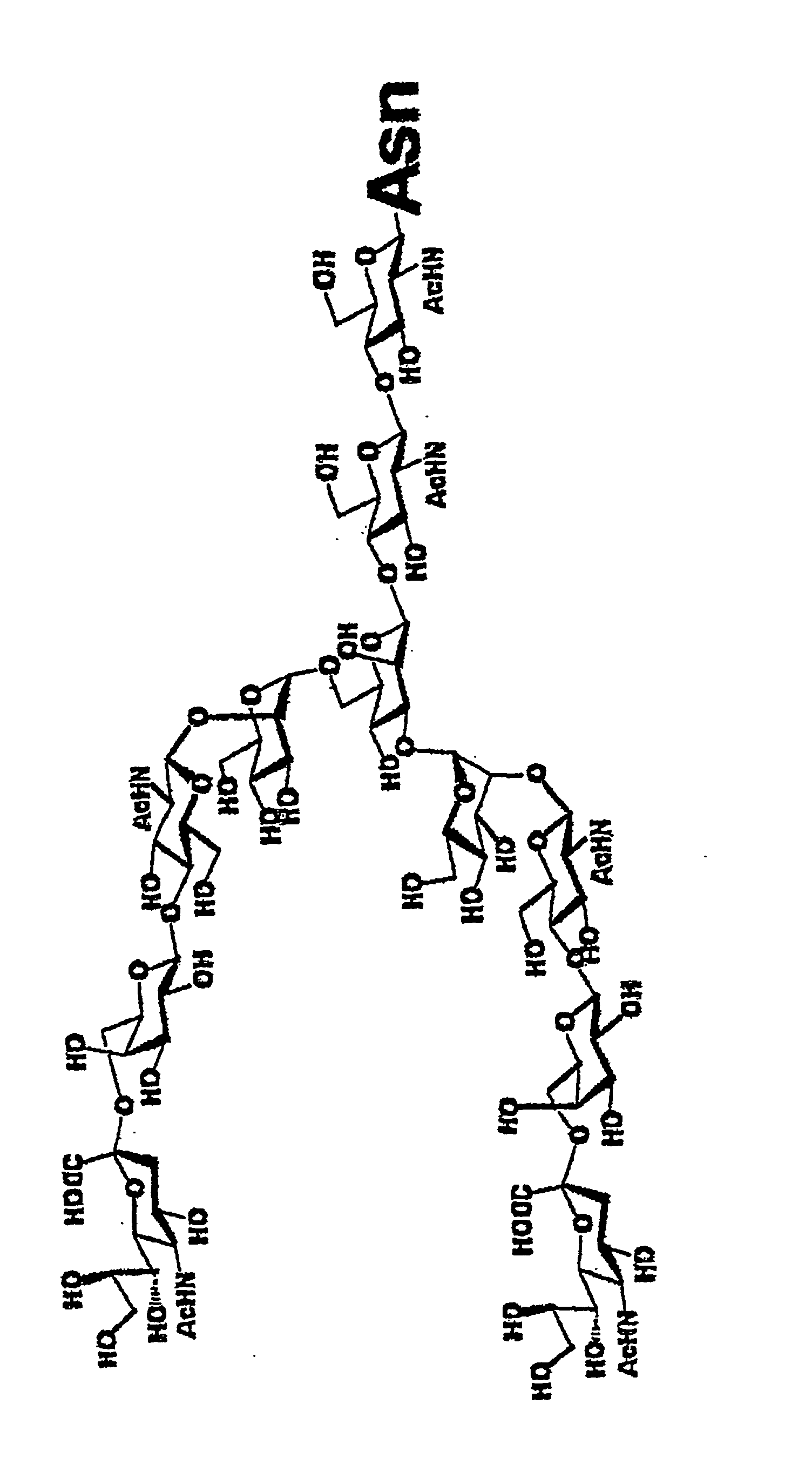
- The process according to any one of claims 1 to 3, wherein the fat-soluble protecting group is fluorenylmethoxycarbonyl (Fmoc) group.
- The process according to any one of claims 1 to 3, wherein the step (a) is a step of introducing Fmoc group into the sugar chain aspargine contained in a mixture of one or more sugar chain asparagines having a sialic acid residue at a non-reducing terminal, and introducing benzyl group into the sialic acid residue, to give a mixture of sugar chain asparagine derivatives.
- A process for preparing a sugar chain aspargine, comprising the steps of:(a) introducing a fat-soluble protecting group into a sugar chain aspargine contained in a mixture of one or more sugar chain asparagines, to give a mixture of sugar chain asparagine derivatives;(b) subjecting the mixture of sugar chain asparagine derivatives or a mixture obtainable by hydrolyzing a sugar chain asparagine derivative contained in the mixture of sugar chain asparagine derivatives to chromatography, to separate each of the sugar chain asparagine derivatives therefrom; and(c) removing the protecting group from the sugar chain asparagine derivative separated in the step (b), to give the sugar chain asparagine.
- The process according to claim 6, further comprising the step of:(b') hydrolyzing the sugar chain asparagine derivative separated in step (b) with a glycosidase; and/or(c') hydrolyzing the sugar chain asparagine obtained in step (c) with a glycosidase.
- The process according to claim 6 or 7, wherein the mixture of one or more sugar chain asparagines comprises:and/or a compound having one or more deletions of sugar residues in the above compound.
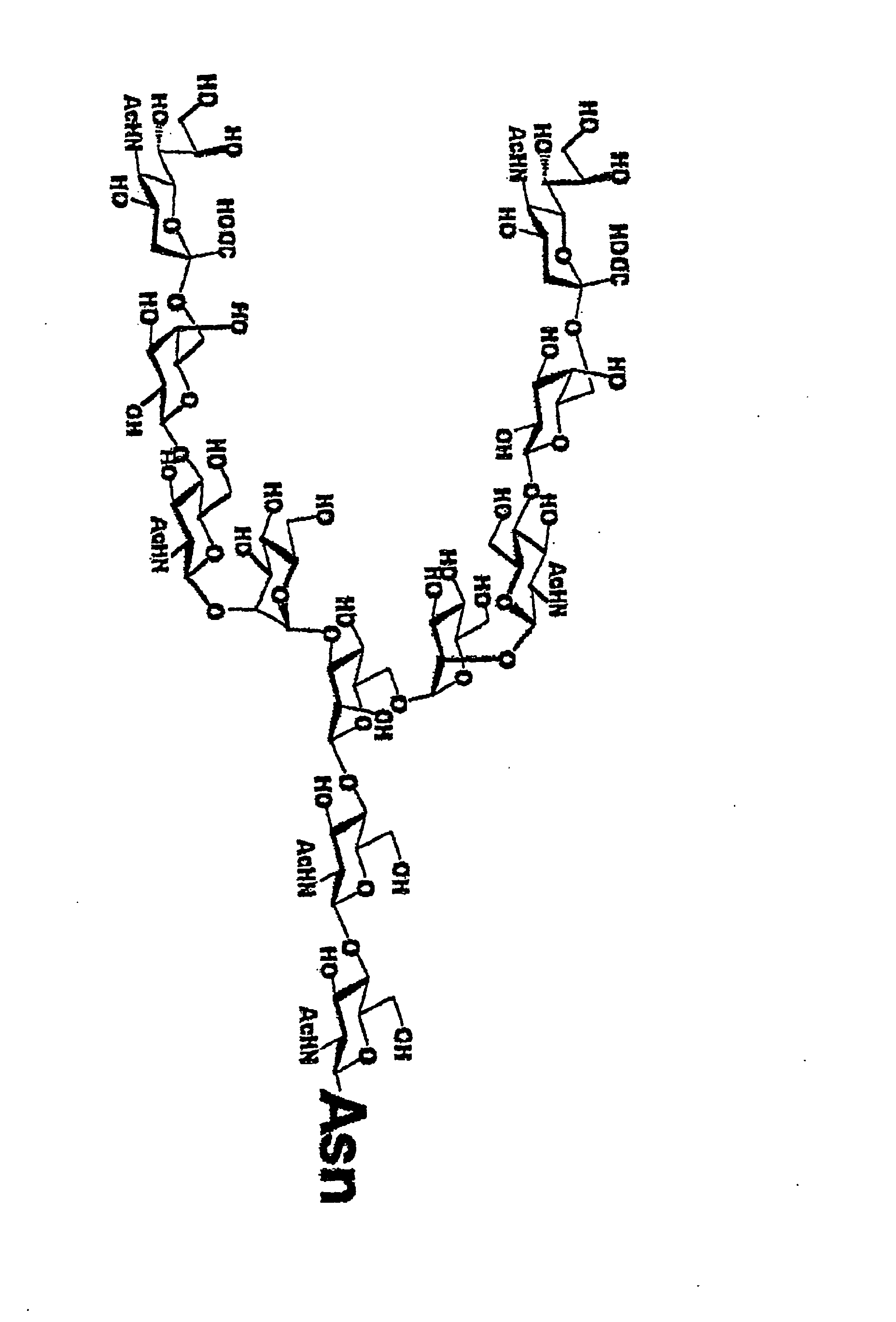
- The process according to any one of claims 6 to 8, wherein the fat-soluble protecting group is Fmoc group.
- The process according to any one of claims 6 to 8, wherein the step (a) is a step of introducing Fmoc group into the sugar chain aspargine contained in a mixture of one or more sugar chain asparagines having a sialic acid residue at a non-reducing terminal, and introducing benzyl group into the sialic acid residue, to give a mixture of sugar chain asparagine derivatives.
- A process for preparing a sugar chain, comprising the steps of:(a) introducing a fat-soluble protecting group into a sugar chain aspargine contained in a mixture of one or more sugar chain asparagines, to give a mixture of sugar chain asparagine derivatives;(b) subjecting the mixture of sugar chain asparagine derivatives or a mixture obtainable by hydrolyzing a sugar chain asparagine derivative contained in the mixture of sugar chain asparagine derivatives to chromatography, to separate each of the sugar chain asparagine derivatives therefrom;(c) removing the protecting group from the sugar chain asparagine derivative separated in the step (b), to give a sugar chain asparagine; and(d) removing an asparagine residue from the sugar chain asparagine obtained in the step (c), to give the sugar chain.
- The process claim 11, further comprising the step of:(b') hydrolyzing the sugar chain asparagine derivative separated in step (b) with a glycosidase; and/or(c') hydrolyzing the sugar chain asparagine obtained in step (c) with a glycosidase; and/or(d') hydrolyzing the sugar chain obtained in step (d) with a glycosidase.
- The process according to claim 11 or 12, wherein the mixture of one or more sugar chain asparagines comprises:and/or a compound having one or more deletions of sugar residues in the above compound.

- The process according to any one of claims 11 to 13, wherein the fat-soluble protecting group is Fmoc group.
- The process according to any one of claims 11 to 13, wherein the step (a) is a step of introducing Fmoc group into the sugar chain aspargine contained in a mixture of one or more sugar chain asparagines having a sialic acid residue at a non-reducing terminal, and introducing benzyl group into the sialic acid residue, to give a mixture of sugar chain asparagine derivatives.
- A sugar chain asparagine derivative having the general formula:wherein R1 and R2, which may be identical or different, are H,

 or
or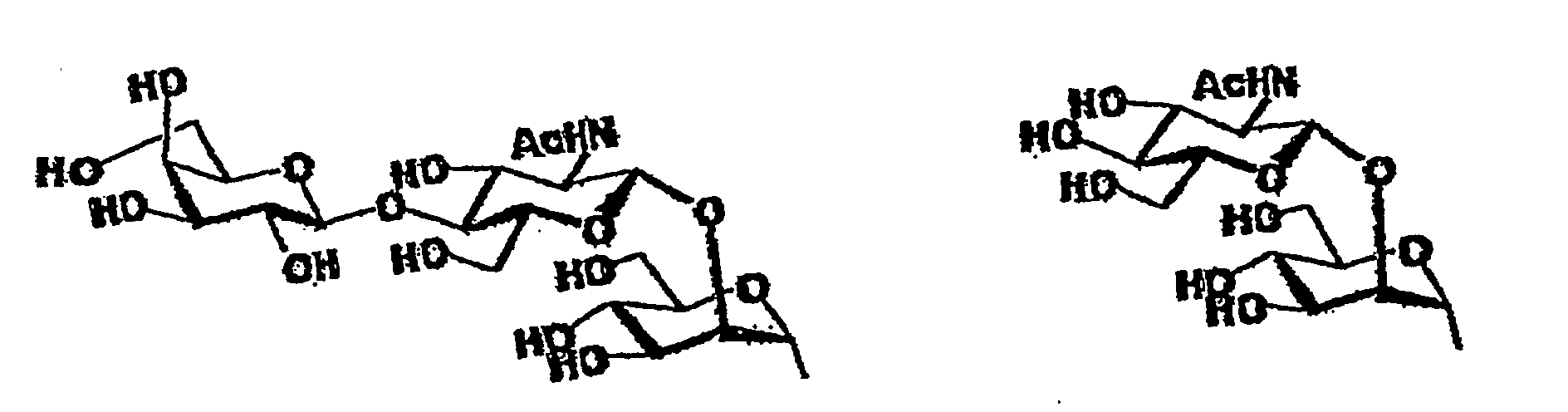 with proviso that a case where R1 and R2 are both
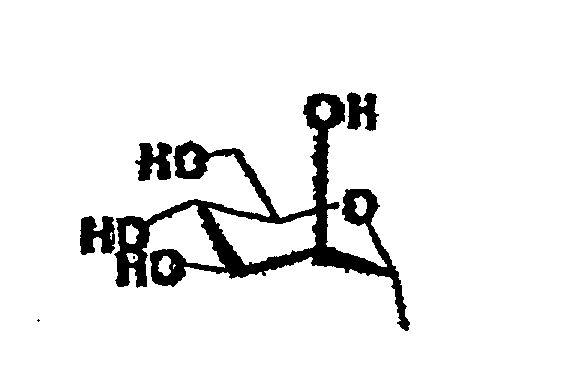 is excluded.
- A sugar chain asparagine derivative having the general formula:wherein one of Rx and Ry is
 and the other is H,
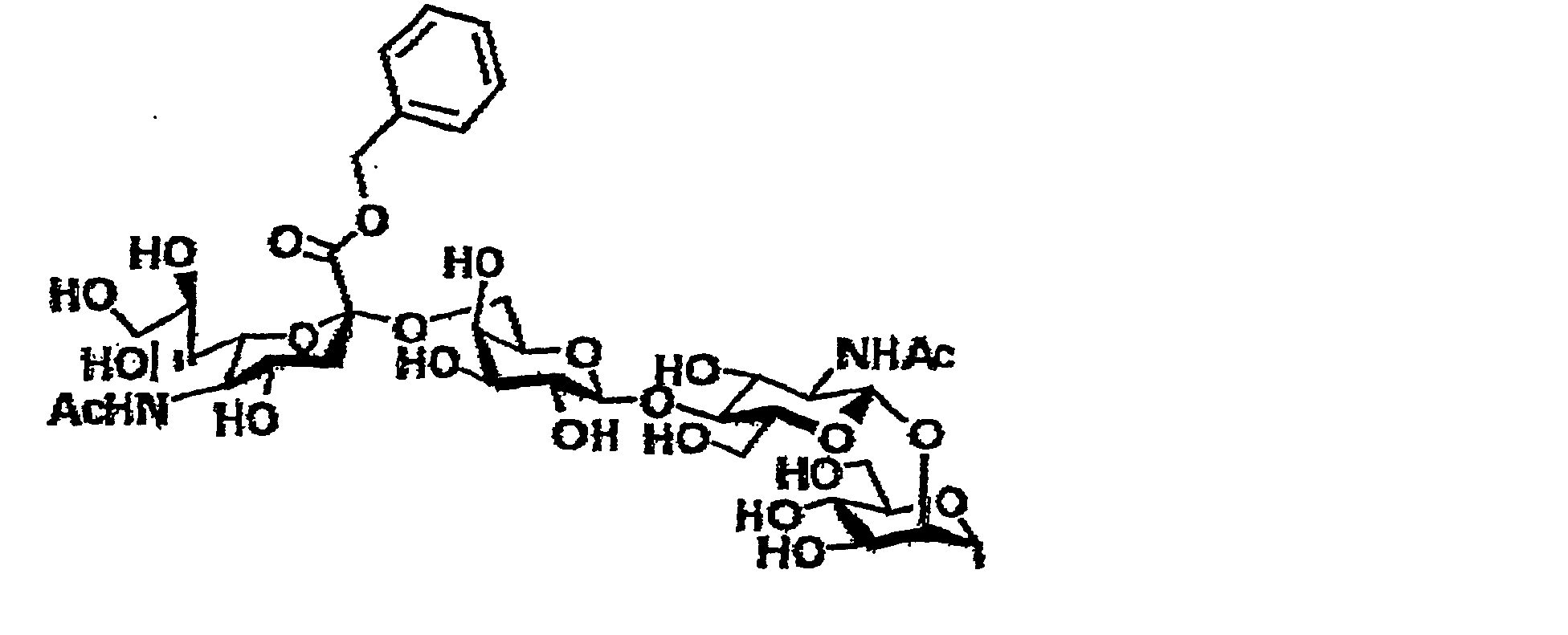
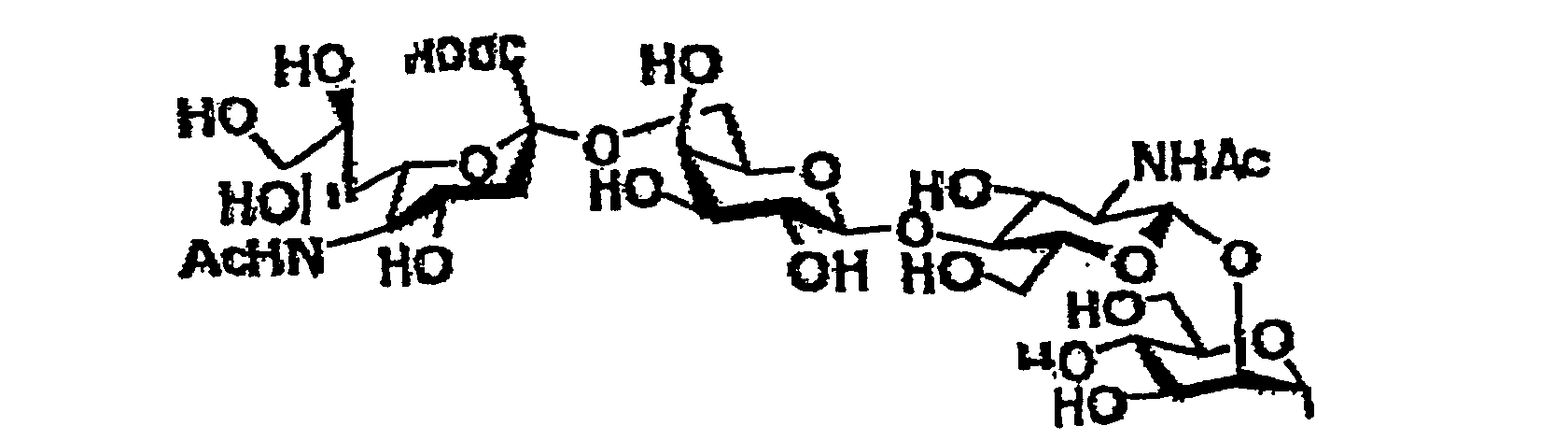 or
or
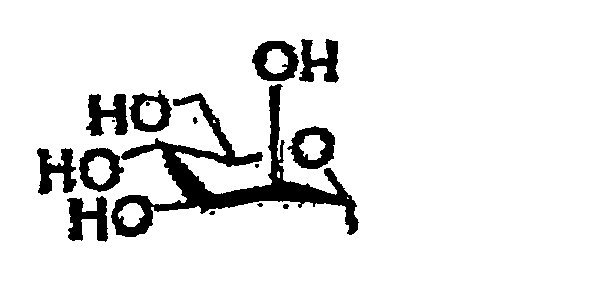
- A sugar chain asparagine having the general formula:wherein R3 and R4, which may be identical or different, are H,
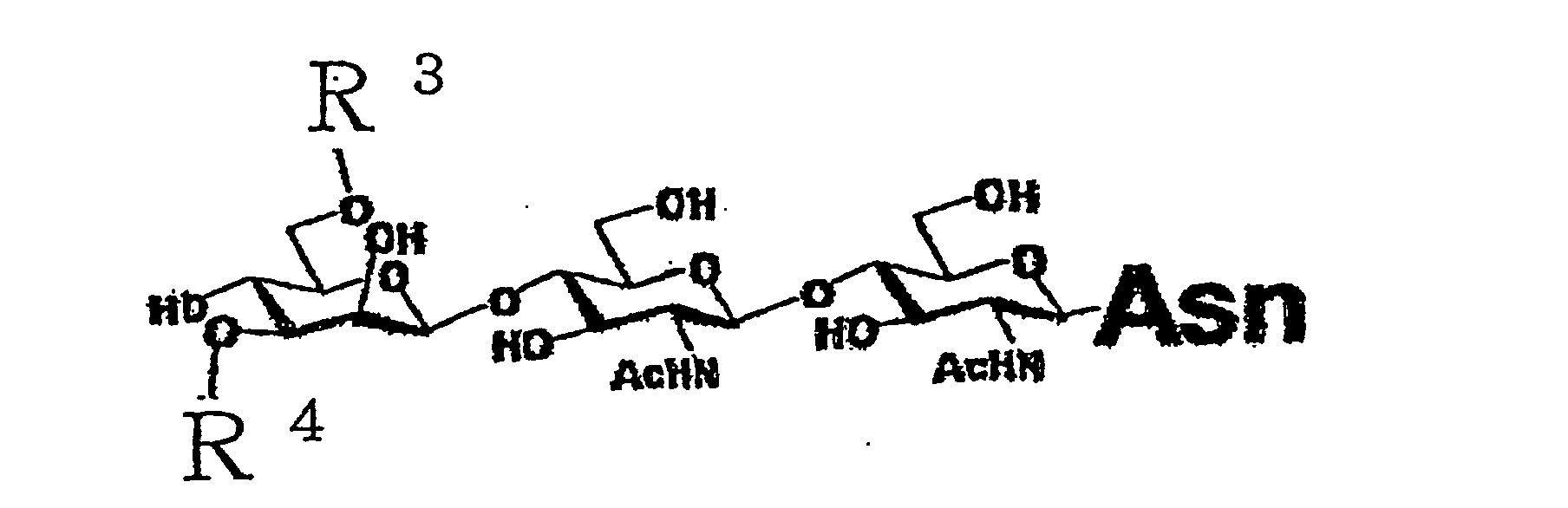

 or
or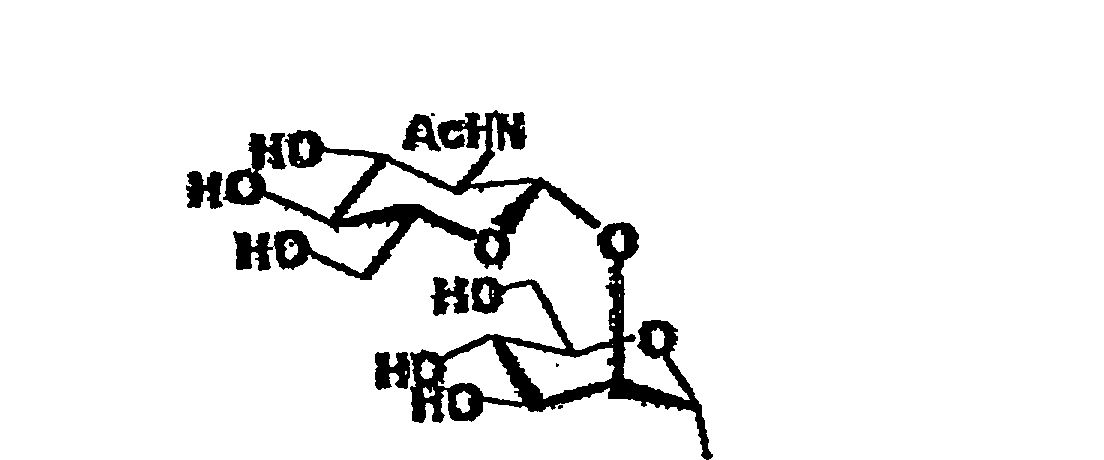 with proviso that a case where R3 and R4 are both
 or
or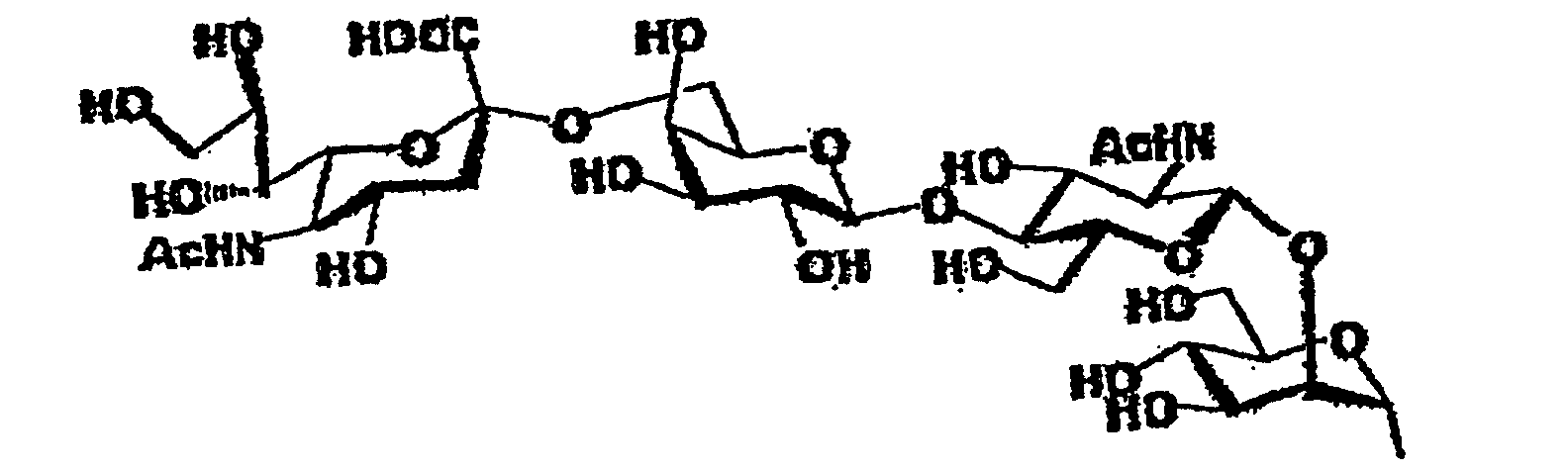 is excluded.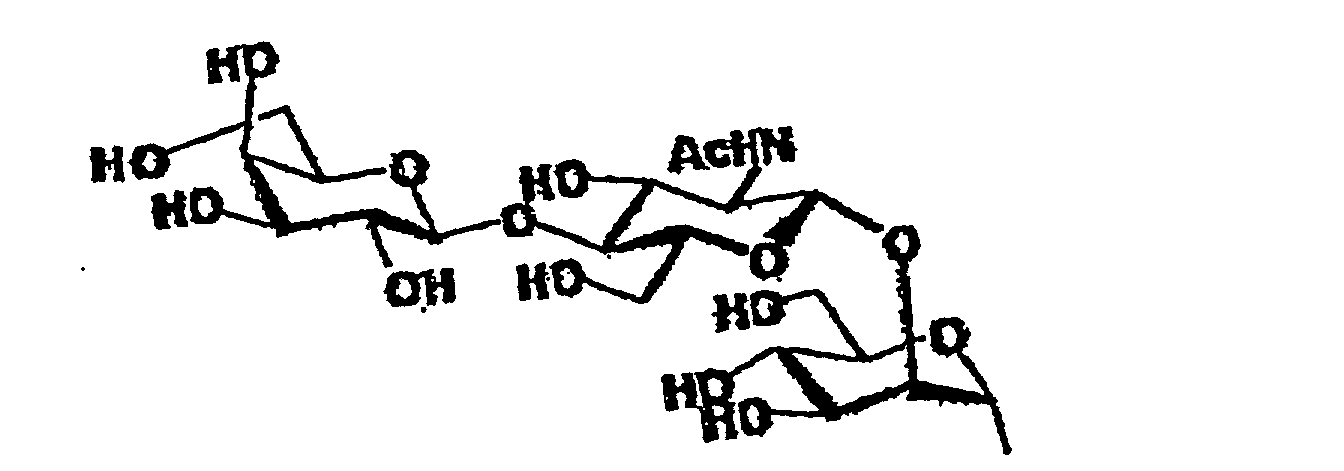
- A sugar chain having the general formula:wherein R5 and R6, which may be identical or different, are H,
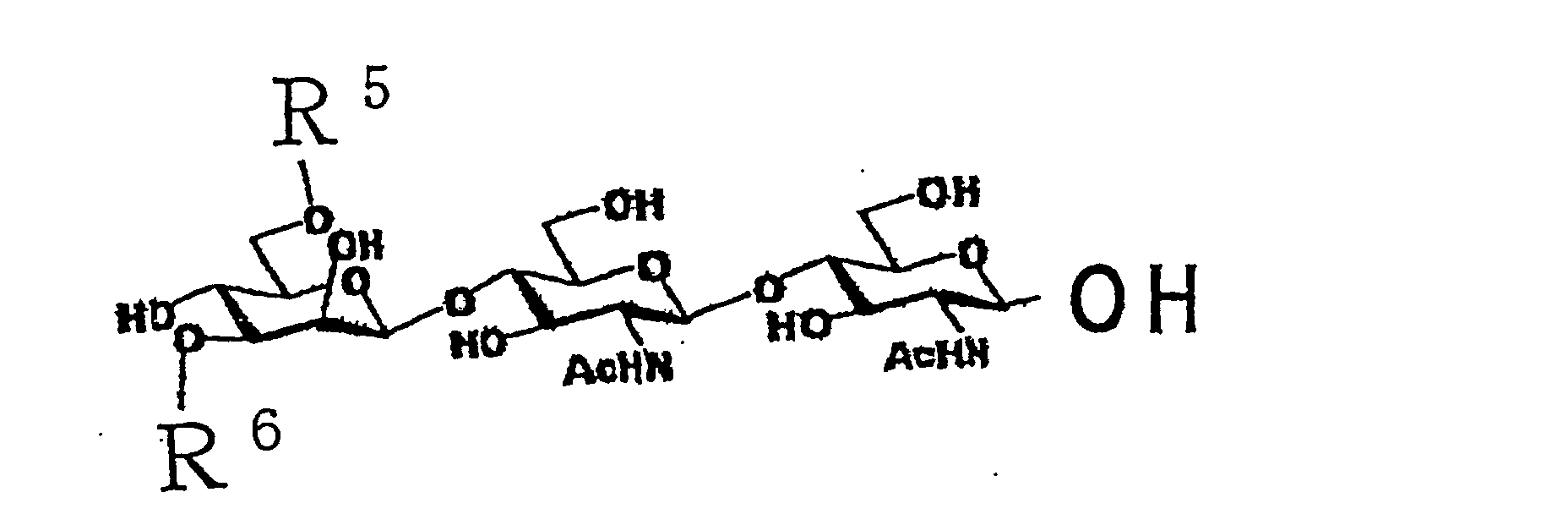
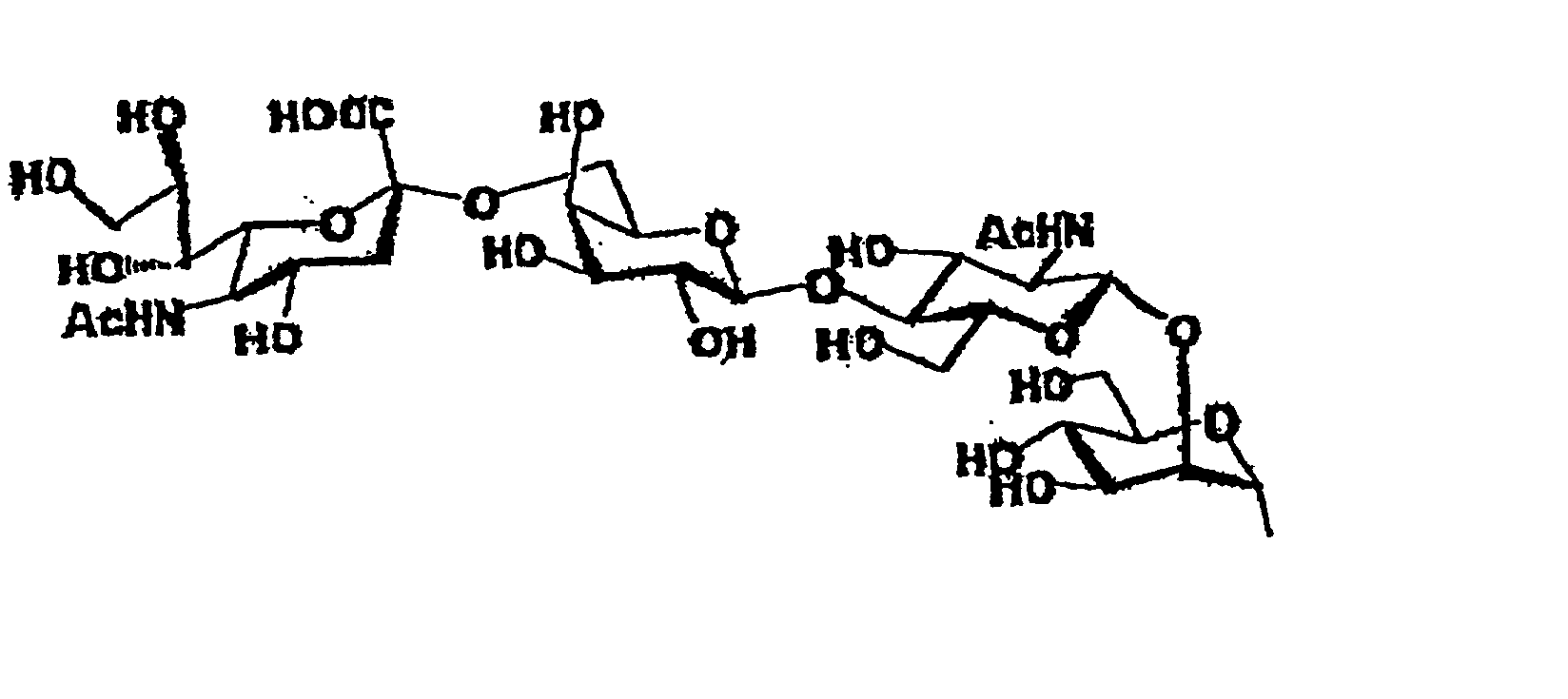
 with proviso that a case where R5 and R6 are both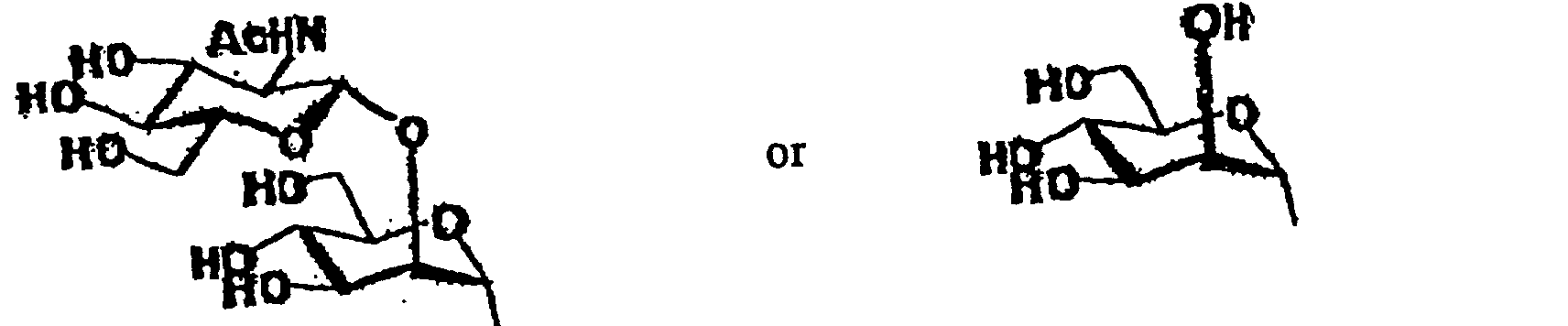
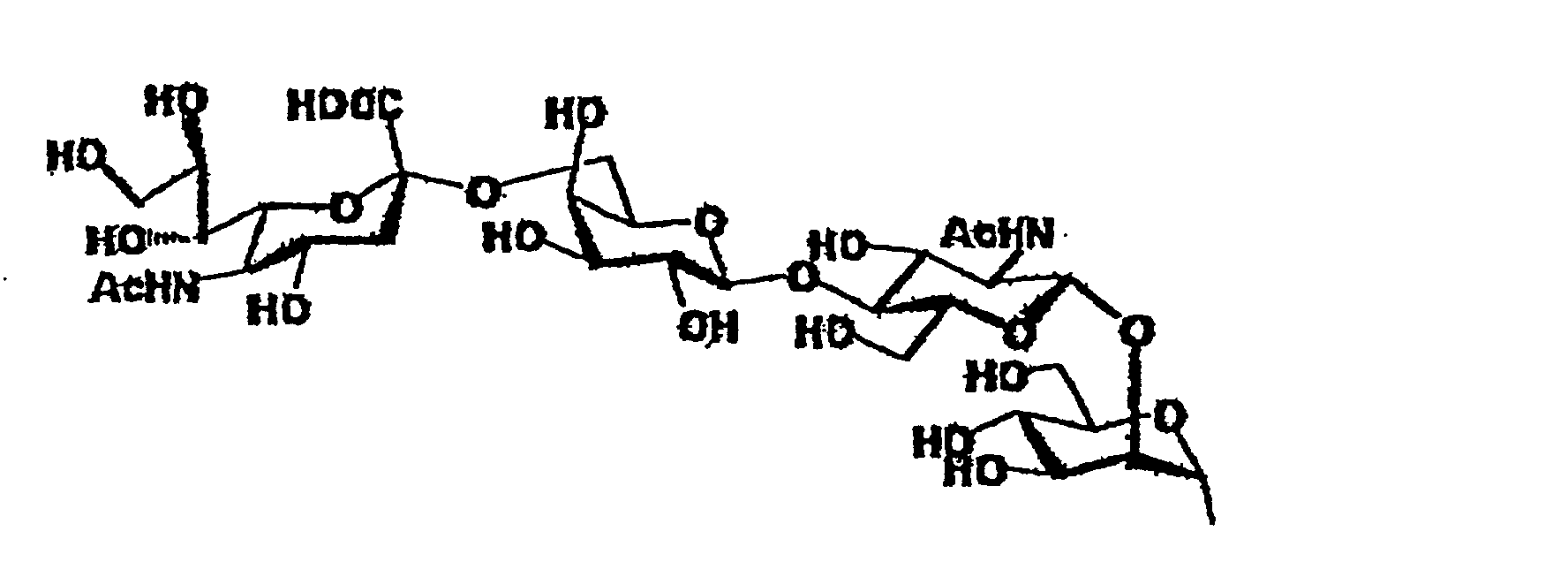
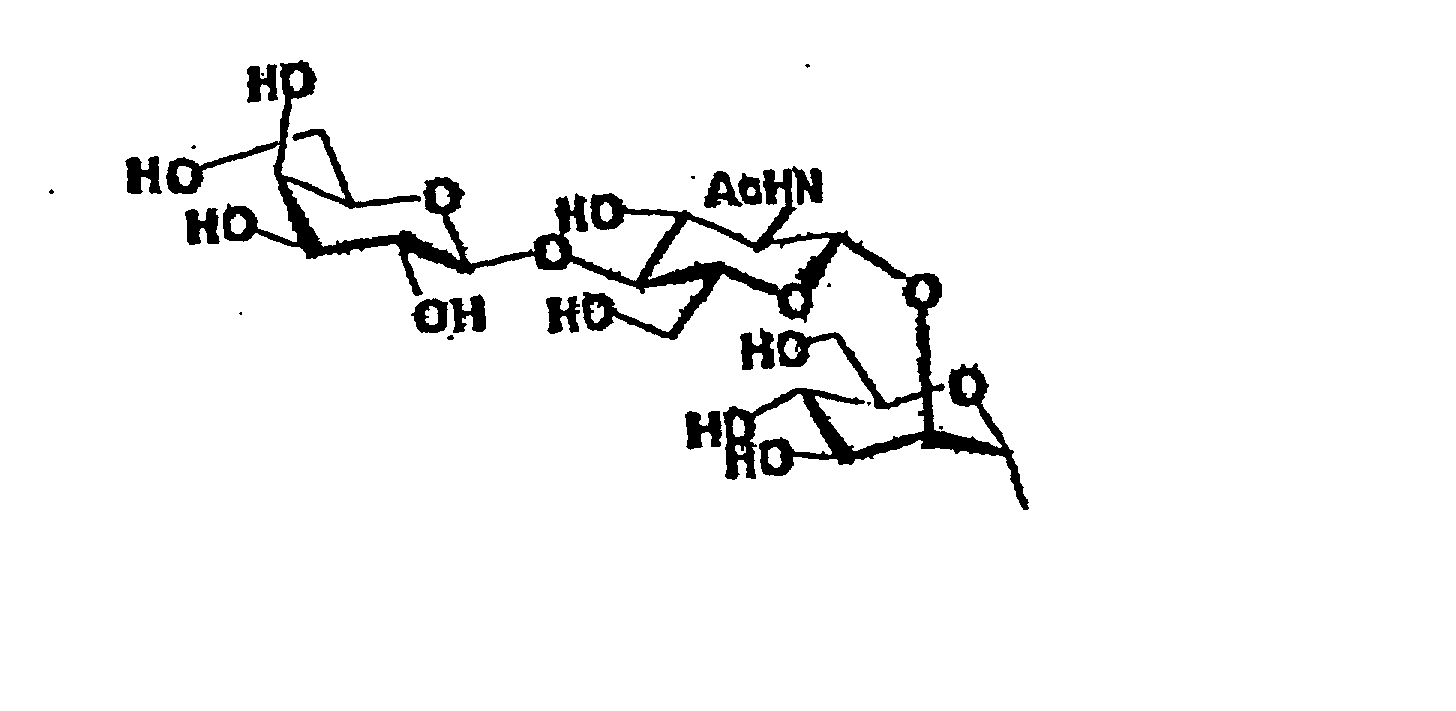 or
or or one of R5 or R6 is H and the other is
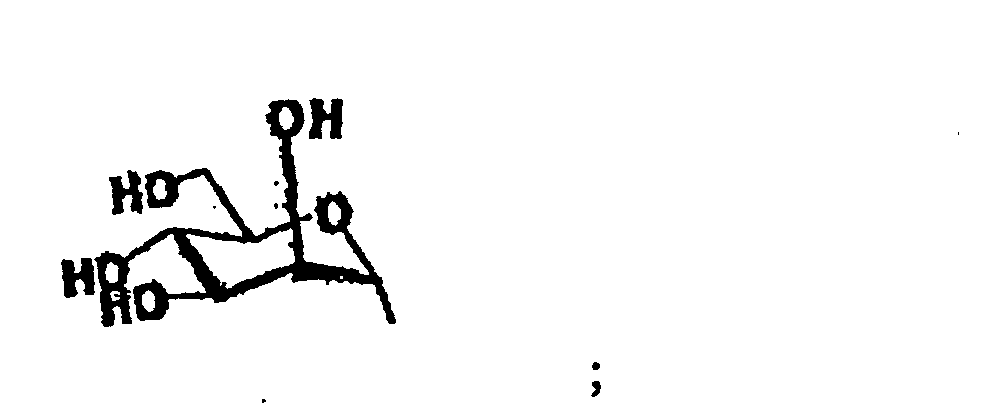 is excluded.
Priority Applications (3)
| Application Number | Priority Date | Filing Date | Title |
|---|---|---|---|
| EP12162076A EP2481746A1 (en) | 2001-06-19 | 2002-06-19 | Process for producing sugar chain asparagine derivative |
| EP11151987A EP2322533A1 (en) | 2001-06-19 | 2002-06-19 | Process for producing sugar chain asparagine derivative |
| CY20131100235T CY1114536T1 (en) | 2001-06-19 | 2013-03-20 | METHOD FOR PRODUCING ASPARAGINI PRODUCTION IN SUGAR CHAIN |
Applications Claiming Priority (3)
| Application Number | Priority Date | Filing Date | Title |
|---|---|---|---|
| JP2001185685 | 2001-06-19 | ||
| JP2001185685 | 2001-06-19 | ||
| PCT/JP2002/006091 WO2003008431A1 (en) | 2001-06-19 | 2002-06-19 | Process for producing sugar chain asparagine derivative |
Related Child Applications (2)
| Application Number | Title | Priority Date | Filing Date |
|---|---|---|---|
| EP11151987.2 Division-Into | 2011-01-25 | ||
| EP12162076.9 Division-Into | 2012-03-29 |
Publications (4)
| Publication Number | Publication Date |
|---|---|
| EP1405858A1 true EP1405858A1 (en) | 2004-04-07 |
| EP1405858A8 EP1405858A8 (en) | 2004-11-10 |
| EP1405858A4 EP1405858A4 (en) | 2009-11-25 |
| EP1405858B1 EP1405858B1 (en) | 2013-01-02 |
Family
ID=19025226
Family Applications (3)
| Application Number | Title | Priority Date | Filing Date |
|---|---|---|---|
| EP12162076A Withdrawn EP2481746A1 (en) | 2001-06-19 | 2002-06-19 | Process for producing sugar chain asparagine derivative |
| EP02743643A Expired - Lifetime EP1405858B1 (en) | 2001-06-19 | 2002-06-19 | Process for producing sugar chain asparagine derivative |
| EP11151987A Withdrawn EP2322533A1 (en) | 2001-06-19 | 2002-06-19 | Process for producing sugar chain asparagine derivative |
Family Applications Before (1)
| Application Number | Title | Priority Date | Filing Date |
|---|---|---|---|
| EP12162076A Withdrawn EP2481746A1 (en) | 2001-06-19 | 2002-06-19 | Process for producing sugar chain asparagine derivative |
Family Applications After (1)
| Application Number | Title | Priority Date | Filing Date |
|---|---|---|---|
| EP11151987A Withdrawn EP2322533A1 (en) | 2001-06-19 | 2002-06-19 | Process for producing sugar chain asparagine derivative |
Country Status (12)
| Country | Link |
|---|---|
| US (1) | US7135566B2 (en) |
| EP (3) | EP2481746A1 (en) |
| JP (1) | JP4323139B2 (en) |
| KR (2) | KR100775805B1 (en) |
| CN (1) | CN100343264C (en) |
| AU (1) | AU2002346294B2 (en) |
| CA (1) | CA2451971C (en) |
| CY (1) | CY1114536T1 (en) |
| DK (1) | DK1405858T3 (en) |
| ES (1) | ES2402089T3 (en) |
| PT (1) | PT1405858E (en) |
| WO (1) | WO2003008431A1 (en) |
Cited By (4)
| Publication number | Priority date | Publication date | Assignee | Title |
|---|---|---|---|---|
| AU2004252028B2 (en) * | 2003-06-30 | 2008-05-08 | Glytech, Inc. | Disialoundecasaccharide chain asparagine/fatty acid amide and medical drug containing the same |
| EP1577397A4 (en) * | 2002-12-24 | 2011-03-30 | Yasuhiro Kajihara | Sugar chain asparagine derivatives, sugar chain asparagine, sugar chain, and processes for producing these |
| EP2626429A1 (en) * | 2003-02-04 | 2013-08-14 | Glytech, Inc. | Process for producing sugar chain asparagine derivative |
| CN103534276A (en) * | 2011-03-10 | 2014-01-22 | 株式会社糖锁工学研究所 | Method for producing glycopeptide having sialyl sugar chain, sialyl sugar chain-added amino acid derivative to be used in same, and glycopeptide |
Families Citing this family (34)
| Publication number | Priority date | Publication date | Assignee | Title |
|---|---|---|---|---|
| US7943763B2 (en) * | 2002-07-05 | 2011-05-17 | Otsuka Chemical Holdings Co., Ltd. | Process for preparing glycopeptides having asparagine-linked oligosaccharides, and the glycopeptides |
| CN100413889C (en) * | 2002-12-24 | 2008-08-27 | 大塚化学株式会社 | Sugar chain asparagine derivative, sugar chain asparagine and sugar chain, and their production methods |
| CA2511205C (en) * | 2002-12-26 | 2009-07-14 | Otsuka Chemical Co., Ltd. | Sugar-chain asparagine derivatives and processes for the preparation thereof |
| US7851618B2 (en) | 2003-07-28 | 2010-12-14 | Otsuka Chemical Co., Ltd. | Aminated complex-type sugar chain derivatives and process for the production thereof |
| FI20031536A0 (en) * | 2003-10-20 | 2003-10-20 | Biotie Therapies Oyj | High affinity ligands for influenza viruses and their production processes |
| EP1698634A4 (en) * | 2003-12-26 | 2010-11-03 | Shionogi & Co | Synthesis of core sugar chain structure of aspargine-linked glycoprotein |
| JP2006022191A (en) * | 2004-07-07 | 2006-01-26 | Yasuhiro Kajiwara | Three-branched sugar chain asparagine derivative, the sugar chain asparagine, the sugar chain and their preparation methods |
| TWI342880B (en) * | 2005-07-19 | 2011-06-01 | Otsuka Chemical Co Ltd | Method for producing sugar chain derivatives, and sugar chain derivatives |
| JP5004464B2 (en) * | 2005-12-02 | 2012-08-22 | 大塚化学株式会社 | Glycosylated liposomes |
| DK2000474T3 (en) * | 2006-03-29 | 2018-01-22 | Glytech Inc | PROCEDURE FOR PRODUCING A PEPTID THIOESTER COMPOUND |
| JP2009155353A (en) * | 2006-03-30 | 2009-07-16 | Yokohama City Univ | Method for producing sugar chain compound |
| JP2007297429A (en) * | 2006-04-27 | 2007-11-15 | Institute Of Physical & Chemical Research | Method for producing sugar chain library and use thereof |
| KR101534881B1 (en) | 2007-07-31 | 2015-07-07 | 가부시키가이샤 도우사 고가쿠 겐큐쇼 | Method for producing peptide |
| JP5604297B2 (en) * | 2008-06-17 | 2014-10-08 | 株式会社糖鎖工学研究所 | Glycosylated GLP-1 peptide |
| EP2330114B1 (en) | 2008-08-19 | 2017-08-16 | Glytech, Inc. | Glycoprotein production method and screening method |
| TW201031749A (en) | 2009-02-10 | 2010-09-01 | Otsuka Chemical Co Ltd | IgG-Fc fragment and method for manufacturing the same |
| WO2011007747A1 (en) | 2009-07-16 | 2011-01-20 | 大塚化学株式会社 | Sugar chain-added ailim extracellular domain and method for producing same |
| EP2474560B1 (en) | 2009-09-03 | 2014-03-19 | The Noguchi Institute | Method for producing 11-sugar sialyloligosaccharide-peptide |
| RU2012122162A (en) | 2009-10-30 | 2013-12-10 | Глитек,Инк. | GLYCOLIZED FORM ANALOGUE OF ANTIGENIC GLP-1 |
| JP5813294B2 (en) * | 2010-04-30 | 2015-11-17 | 旭化成株式会社 | Glycopeptide derivative and method for producing the same |
| JP5680576B2 (en) * | 2011-03-03 | 2015-03-04 | 旭化成株式会社 | Method for producing 11-saccharide sialyl-oligosaccharide asparagine |
| CA2847334C (en) | 2011-09-04 | 2020-09-01 | Glytech, Inc. | Glycosylated polypeptide and drug composition containing said polypeptide |
| JP6211418B2 (en) | 2011-09-04 | 2017-10-11 | 株式会社糖鎖工学研究所 | Glycosylated polypeptide and pharmaceutical composition containing the polypeptide |
| CN102382178B (en) * | 2011-10-21 | 2013-05-29 | 山东大学 | A kind of separation method of sialic acid glycopeptide |
| US9708413B2 (en) | 2012-11-22 | 2017-07-18 | Glytech, Inc. | Glycosylated linker, compound containing glycosylated linker moiety and physiologically active substance moiety or salt thereof, and methods for producing said compound or salt thereof |
| JP6219308B2 (en) | 2012-11-30 | 2017-10-25 | 株式会社糖鎖工学研究所 | Glycosylation linker, compound containing glycosylation linker and physiologically active substance or salt thereof, and production method thereof |
| MY171183A (en) | 2013-03-29 | 2019-09-30 | Glytech Inc | Polypeptide glycosylated with sialylated sugar chain |
| SG11201508032RA (en) | 2013-03-30 | 2015-10-29 | Glytech Inc | (sugar chain)-polypeptide complex |
| JP6618176B2 (en) * | 2015-11-30 | 2019-12-11 | 公益財団法人野口研究所 | Method for producing heptasaccharide oligosaccharide |
| JP7275049B2 (en) | 2017-12-27 | 2023-05-17 | 協和キリン株式会社 | IL-2 variants |
| JPWO2023074843A1 (en) * | 2021-10-29 | 2023-05-04 | ||
| JPWO2023145812A1 (en) * | 2022-01-31 | 2023-08-03 | ||
| EP4524252A1 (en) | 2022-05-13 | 2025-03-19 | Glytech, Inc. | Method for producing sialic-acid-containing sugar chain |
| JPWO2024122608A1 (en) * | 2022-12-07 | 2024-06-13 |
Family Cites Families (4)
| Publication number | Priority date | Publication date | Assignee | Title |
|---|---|---|---|---|
| JPH07224082A (en) * | 1994-02-14 | 1995-08-22 | Rikagaku Kenkyusho | Asparagine-linked sugar derivative and method for producing the same |
| JPH0924082A (en) * | 1995-07-12 | 1997-01-28 | Chieko Sugimura | Antibacterial acupuncture needle for infant |
| JPH10306099A (en) * | 1997-03-04 | 1998-11-17 | Noguchi Inst | Novel glycoconjugates and their production |
| JPH11255807A (en) | 1998-03-13 | 1999-09-21 | Noguchi Inst | Sugar chain asparagine active ester derivatives and their synthetic intermediates |
-
2002
- 2002-06-19 EP EP12162076A patent/EP2481746A1/en not_active Withdrawn
- 2002-06-19 AU AU2002346294A patent/AU2002346294B2/en not_active Expired
- 2002-06-19 ES ES02743643T patent/ES2402089T3/en not_active Expired - Lifetime
- 2002-06-19 CA CA2451971A patent/CA2451971C/en not_active Expired - Lifetime
- 2002-06-19 WO PCT/JP2002/006091 patent/WO2003008431A1/en not_active Ceased
- 2002-06-19 JP JP2002178032A patent/JP4323139B2/en not_active Expired - Fee Related
- 2002-06-19 EP EP02743643A patent/EP1405858B1/en not_active Expired - Lifetime
- 2002-06-19 PT PT2743643T patent/PT1405858E/en unknown
- 2002-06-19 KR KR1020037016586A patent/KR100775805B1/en not_active Expired - Lifetime
- 2002-06-19 EP EP11151987A patent/EP2322533A1/en not_active Withdrawn
- 2002-06-19 DK DK02743643.5T patent/DK1405858T3/en active
- 2002-06-19 CN CNB028162110A patent/CN100343264C/en not_active Expired - Lifetime
- 2002-06-19 KR KR1020067013635A patent/KR100885149B1/en not_active Expired - Fee Related
- 2002-06-19 US US10/481,246 patent/US7135566B2/en not_active Expired - Lifetime
-
2013
- 2013-03-20 CY CY20131100235T patent/CY1114536T1/en unknown
Cited By (5)
| Publication number | Priority date | Publication date | Assignee | Title |
|---|---|---|---|---|
| EP1577397A4 (en) * | 2002-12-24 | 2011-03-30 | Yasuhiro Kajihara | Sugar chain asparagine derivatives, sugar chain asparagine, sugar chain, and processes for producing these |
| EP2626429A1 (en) * | 2003-02-04 | 2013-08-14 | Glytech, Inc. | Process for producing sugar chain asparagine derivative |
| AU2004252028B2 (en) * | 2003-06-30 | 2008-05-08 | Glytech, Inc. | Disialoundecasaccharide chain asparagine/fatty acid amide and medical drug containing the same |
| CN103534276A (en) * | 2011-03-10 | 2014-01-22 | 株式会社糖锁工学研究所 | Method for producing glycopeptide having sialyl sugar chain, sialyl sugar chain-added amino acid derivative to be used in same, and glycopeptide |
| CN103534276B (en) * | 2011-03-10 | 2016-03-02 | 株式会社糖锁工学研究所 | There is the manufacture method of the glycopeptide of sialic acid sugar chain, for the sialic acid sugar chain addition amino acid derivative of this manufacture method and this glycopeptide |
Also Published As
| Publication number | Publication date |
|---|---|
| WO2003008431A1 (en) | 2003-01-30 |
| CY1114536T1 (en) | 2016-10-05 |
| EP1405858A4 (en) | 2009-11-25 |
| CA2451971C (en) | 2010-09-07 |
| KR20060084456A (en) | 2006-07-24 |
| JP2003128703A (en) | 2003-05-08 |
| EP2481746A1 (en) | 2012-08-01 |
| PT1405858E (en) | 2013-03-11 |
| KR100775805B1 (en) | 2007-11-12 |
| CN1543471A (en) | 2004-11-03 |
| AU2002346294B2 (en) | 2006-08-17 |
| ES2402089T3 (en) | 2013-04-26 |
| KR20040026667A (en) | 2004-03-31 |
| US20040181054A1 (en) | 2004-09-16 |
| CA2451971A1 (en) | 2003-01-30 |
| EP1405858A8 (en) | 2004-11-10 |
| EP2322533A1 (en) | 2011-05-18 |
| US7135566B2 (en) | 2006-11-14 |
| CN100343264C (en) | 2007-10-17 |
| JP4323139B2 (en) | 2009-09-02 |
| EP1405858B1 (en) | 2013-01-02 |
| KR100885149B1 (en) | 2009-02-23 |
| DK1405858T3 (en) | 2013-02-18 |
Similar Documents
| Publication | Publication Date | Title |
|---|---|---|
| EP1405858B1 (en) | Process for producing sugar chain asparagine derivative | |
| EP1591532B1 (en) | Process for producing sugar chain asparagine derivative | |
| KR100736510B1 (en) | Sugar chain asparagine derivatives, sugar chain asparagine, sugar chain, and processes for producing these | |
| US7273934B2 (en) | Three-branched sugar-chain asparagine derivatives, the sugar-chain asparagines, the sugar chains, and processes for producing these | |
| CA2511205C (en) | Sugar-chain asparagine derivatives and processes for the preparation thereof | |
| AU2006203198B2 (en) | Sugar chain asparagine derivative | |
| TWI324607B (en) | ||
| JPH10248590A (en) | Method for producing glycosyl asparagine derivative | |
| JPH0319239B2 (en) | ||
| JP2006022191A (en) | Three-branched sugar chain asparagine derivative, the sugar chain asparagine, the sugar chain and their preparation methods | |
| WO2012171966A1 (en) | Method for the regioselective hydrolysis of monosaccharides |
Legal Events
| Date | Code | Title | Description |
|---|---|---|---|
| PUAI | Public reference made under article 153(3) epc to a published international application that has entered the european phase |
Free format text: ORIGINAL CODE: 0009012 |
|
| 17P | Request for examination filed |
Effective date: 20040105 |
|
| AK | Designated contracting states |
Kind code of ref document: A1 Designated state(s): AT BE CH CY DE DK ES FI FR GB GR IE IT LI LU MC NL PT SE TR |
|
| AX | Request for extension of the european patent |
Extension state: AL LT LV MK RO SI |
|
| RAP1 | Party data changed (applicant data changed or rights of an application transferred) |
Owner name: OTSUKA CHEMICAL CO., LTD. Owner name: KAJIHARA, YASUHIRO |
|
| RAP1 | Party data changed (applicant data changed or rights of an application transferred) |
Owner name: KAJIHARA, YASUHIRO Owner name: OTSUKA CHEMICAL CO., LTD. |
|
| A4 | Supplementary search report drawn up and despatched |
Effective date: 20091026 |
|
| RIC1 | Information provided on ipc code assigned before grant |
Ipc: C12P 19/04 20060101ALI20091016BHEP Ipc: C12P 13/04 20060101ALI20091016BHEP Ipc: C07H 13/10 20060101AFI20091016BHEP Ipc: C08B 37/00 20060101ALI20091016BHEP Ipc: C07H 5/06 20060101ALI20091016BHEP Ipc: C07H 15/12 20060101ALI20091016BHEP Ipc: C07H 7/027 20060101ALI20091016BHEP |
|
| 17Q | First examination report despatched |
Effective date: 20100421 |
|
| GRAP | Despatch of communication of intention to grant a patent |
Free format text: ORIGINAL CODE: EPIDOSNIGR1 |
|
| GRAS | Grant fee paid |
Free format text: ORIGINAL CODE: EPIDOSNIGR3 |
|
| GRAA | (expected) grant |
Free format text: ORIGINAL CODE: 0009210 |
|
| AK | Designated contracting states |
Kind code of ref document: B1 Designated state(s): AT BE CH CY DE DK ES FI FR GB GR IE IT LI LU MC NL PT SE TR |
|
| RAP1 | Party data changed (applicant data changed or rights of an application transferred) |
Owner name: KAJIHARA, YASUHIRO Owner name: GLYTECH, INC. |
|
| REG | Reference to a national code |
Ref country code: GB Ref legal event code: FG4D |
|
| REG | Reference to a national code |
Ref country code: CH Ref legal event code: EP Ref country code: AT Ref legal event code: REF Ref document number: 591568 Country of ref document: AT Kind code of ref document: T Effective date: 20130115 |
|
| REG | Reference to a national code |
Ref country code: IE Ref legal event code: FG4D |
|
| REG | Reference to a national code |
Ref country code: DK Ref legal event code: T3 |
|
| REG | Reference to a national code |
Ref country code: DE Ref legal event code: R096 Ref document number: 60244333 Country of ref document: DE Effective date: 20130228 |
|
| REG | Reference to a national code |
Ref country code: PT Ref legal event code: SC4A Free format text: AVAILABILITY OF NATIONAL TRANSLATION Effective date: 20130228 |
|
| REG | Reference to a national code |
Ref country code: CH Ref legal event code: NV Representative=s name: NOVAGRAAF INTERNATIONAL SA, CH |
|
| REG | Reference to a national code |
Ref country code: SE Ref legal event code: TRGR |
|
| REG | Reference to a national code |
Ref country code: NL Ref legal event code: T3 |
|
| REG | Reference to a national code |
Ref country code: GR Ref legal event code: EP Ref document number: 20130400570 Country of ref document: GR Effective date: 20130418 |
|
| PLBE | No opposition filed within time limit |
Free format text: ORIGINAL CODE: 0009261 |
|
| STAA | Information on the status of an ep patent application or granted ep patent |
Free format text: STATUS: NO OPPOSITION FILED WITHIN TIME LIMIT |
|
| 26N | No opposition filed |
Effective date: 20131003 |
|
| REG | Reference to a national code |
Ref country code: DE Ref legal event code: R097 Ref document number: 60244333 Country of ref document: DE Effective date: 20131003 |
|
| REG | Reference to a national code |
Ref country code: FR Ref legal event code: PLFP Year of fee payment: 14 |
|
| REG | Reference to a national code |
Ref country code: FR Ref legal event code: PLFP Year of fee payment: 15 |
|
| REG | Reference to a national code |
Ref country code: FR Ref legal event code: PLFP Year of fee payment: 16 |
|
| REG | Reference to a national code |
Ref country code: FR Ref legal event code: PLFP Year of fee payment: 17 |
|
| PGFP | Annual fee paid to national office [announced via postgrant information from national office to epo] |
Ref country code: LU Payment date: 20210527 Year of fee payment: 20 |
|
| PGFP | Annual fee paid to national office [announced via postgrant information from national office to epo] |
Ref country code: FI Payment date: 20210524 Year of fee payment: 20 Ref country code: FR Payment date: 20210615 Year of fee payment: 20 Ref country code: DE Payment date: 20210615 Year of fee payment: 20 Ref country code: MC Payment date: 20210519 Year of fee payment: 20 Ref country code: NL Payment date: 20210623 Year of fee payment: 20 Ref country code: IT Payment date: 20210622 Year of fee payment: 20 Ref country code: GR Payment date: 20210628 Year of fee payment: 20 Ref country code: PT Payment date: 20210608 Year of fee payment: 20 |
|
| PGFP | Annual fee paid to national office [announced via postgrant information from national office to epo] |
Ref country code: GB Payment date: 20210623 Year of fee payment: 20 Ref country code: CH Payment date: 20210611 Year of fee payment: 20 Ref country code: DK Payment date: 20210616 Year of fee payment: 20 Ref country code: SE Payment date: 20210518 Year of fee payment: 20 Ref country code: IE Payment date: 20210514 Year of fee payment: 20 Ref country code: AT Payment date: 20210625 Year of fee payment: 20 Ref country code: BE Payment date: 20210615 Year of fee payment: 20 Ref country code: TR Payment date: 20210517 Year of fee payment: 20 |
|
| PGFP | Annual fee paid to national office [announced via postgrant information from national office to epo] |
Ref country code: CY Payment date: 20210614 Year of fee payment: 20 |
|
| PGFP | Annual fee paid to national office [announced via postgrant information from national office to epo] |
Ref country code: ES Payment date: 20210702 Year of fee payment: 20 |
|
| REG | Reference to a national code |
Ref country code: DE Ref legal event code: R071 Ref document number: 60244333 Country of ref document: DE |
|
| REG | Reference to a national code |
Ref country code: DK Ref legal event code: EUP Expiry date: 20220619 |
|
| REG | Reference to a national code |
Ref country code: NL Ref legal event code: MK Effective date: 20220618 |
|
| REG | Reference to a national code |
Ref country code: CH Ref legal event code: PL |
|
| REG | Reference to a national code |
Ref country code: BE Ref legal event code: MK Effective date: 20220619 |
|
| REG | Reference to a national code |
Ref country code: FI Ref legal event code: MAE |
|
| REG | Reference to a national code |
Ref country code: GB Ref legal event code: PE20 Expiry date: 20220618 |
|
| PG25 | Lapsed in a contracting state [announced via postgrant information from national office to epo] |
Ref country code: PT Free format text: LAPSE BECAUSE OF EXPIRATION OF PROTECTION Effective date: 20220630 Ref country code: GB Free format text: LAPSE BECAUSE OF EXPIRATION OF PROTECTION Effective date: 20220618 |
|
| REG | Reference to a national code |
Ref country code: SE Ref legal event code: EUG |
|
| REG | Reference to a national code |
Ref country code: IE Ref legal event code: MK9A |
|
| REG | Reference to a national code |
Ref country code: ES Ref legal event code: FD2A Effective date: 20220805 |
|
| REG | Reference to a national code |
Ref country code: AT Ref legal event code: MK07 Ref document number: 591568 Country of ref document: AT Kind code of ref document: T Effective date: 20220619 |
|
| PG25 | Lapsed in a contracting state [announced via postgrant information from national office to epo] |
Ref country code: IE Free format text: LAPSE BECAUSE OF EXPIRATION OF PROTECTION Effective date: 20220619 Ref country code: ES Free format text: LAPSE BECAUSE OF EXPIRATION OF PROTECTION Effective date: 20220620 |