EP1398736A1 - Device and method for monitoring the tire pressure - Google Patents
Device and method for monitoring the tire pressure Download PDFInfo
- Publication number
- EP1398736A1 EP1398736A1 EP20030020637 EP03020637A EP1398736A1 EP 1398736 A1 EP1398736 A1 EP 1398736A1 EP 20030020637 EP20030020637 EP 20030020637 EP 03020637 A EP03020637 A EP 03020637A EP 1398736 A1 EP1398736 A1 EP 1398736A1
- Authority
- EP
- European Patent Office
- Prior art keywords
- vehicle
- air pressure
- tire
- signal
- abnormality
- Prior art date
- Legal status (The legal status is an assumption and is not a legal conclusion. Google has not performed a legal analysis and makes no representation as to the accuracy of the status listed.)
- Granted
Links
- 238000000034 method Methods 0.000 title claims description 9
- 238000012544 monitoring process Methods 0.000 title description 5
- 230000005856 abnormality Effects 0.000 claims abstract description 84
- 230000002159 abnormal effect Effects 0.000 claims abstract description 47
- 238000004891 communication Methods 0.000 claims description 15
- 238000010586 diagram Methods 0.000 description 6
- 230000008054 signal transmission Effects 0.000 description 6
- 238000001514 detection method Methods 0.000 description 5
- 238000005516 engineering process Methods 0.000 description 5
- 230000005540 biological transmission Effects 0.000 description 4
- 238000013459 approach Methods 0.000 description 3
- 230000006870 function Effects 0.000 description 3
- 230000015654 memory Effects 0.000 description 3
- 238000005259 measurement Methods 0.000 description 1
Images



Classifications
-
- B—PERFORMING OPERATIONS; TRANSPORTING
- B60—VEHICLES IN GENERAL
- B60C—VEHICLE TYRES; TYRE INFLATION; TYRE CHANGING; CONNECTING VALVES TO INFLATABLE ELASTIC BODIES IN GENERAL; DEVICES OR ARRANGEMENTS RELATED TO TYRES
- B60C23/00—Devices for measuring, signalling, controlling, or distributing tyre pressure or temperature, specially adapted for mounting on vehicles; Arrangement of tyre inflating devices on vehicles, e.g. of pumps or of tanks; Tyre cooling arrangements
- B60C23/02—Signalling devices actuated by tyre pressure
- B60C23/04—Signalling devices actuated by tyre pressure mounted on the wheel or tyre
- B60C23/0408—Signalling devices actuated by tyre pressure mounted on the wheel or tyre transmitting the signals by non-mechanical means from the wheel or tyre to a vehicle body mounted receiver
-
- B—PERFORMING OPERATIONS; TRANSPORTING
- B60—VEHICLES IN GENERAL
- B60C—VEHICLE TYRES; TYRE INFLATION; TYRE CHANGING; CONNECTING VALVES TO INFLATABLE ELASTIC BODIES IN GENERAL; DEVICES OR ARRANGEMENTS RELATED TO TYRES
- B60C23/00—Devices for measuring, signalling, controlling, or distributing tyre pressure or temperature, specially adapted for mounting on vehicles; Arrangement of tyre inflating devices on vehicles, e.g. of pumps or of tanks; Tyre cooling arrangements
- B60C23/02—Signalling devices actuated by tyre pressure
- B60C23/04—Signalling devices actuated by tyre pressure mounted on the wheel or tyre
- B60C23/0401—Signalling devices actuated by tyre pressure mounted on the wheel or tyre characterised by the type of alarm
- B60C23/0406—Alarms noticeable from outside the vehicle, e.g. indication in side mirror, front light or audible alarms
-
- B—PERFORMING OPERATIONS; TRANSPORTING
- B60—VEHICLES IN GENERAL
- B60C—VEHICLE TYRES; TYRE INFLATION; TYRE CHANGING; CONNECTING VALVES TO INFLATABLE ELASTIC BODIES IN GENERAL; DEVICES OR ARRANGEMENTS RELATED TO TYRES
- B60C23/00—Devices for measuring, signalling, controlling, or distributing tyre pressure or temperature, specially adapted for mounting on vehicles; Arrangement of tyre inflating devices on vehicles, e.g. of pumps or of tanks; Tyre cooling arrangements
- B60C23/02—Signalling devices actuated by tyre pressure
- B60C23/04—Signalling devices actuated by tyre pressure mounted on the wheel or tyre
- B60C23/0408—Signalling devices actuated by tyre pressure mounted on the wheel or tyre transmitting the signals by non-mechanical means from the wheel or tyre to a vehicle body mounted receiver
- B60C23/0479—Communicating with external units being not part of the vehicle, e.g. tools for diagnostic, mobile phones, electronic keys or service stations
-
- G—PHYSICS
- G07—CHECKING-DEVICES
- G07C—TIME OR ATTENDANCE REGISTERS; REGISTERING OR INDICATING THE WORKING OF MACHINES; GENERATING RANDOM NUMBERS; VOTING OR LOTTERY APPARATUS; ARRANGEMENTS, SYSTEMS OR APPARATUS FOR CHECKING NOT PROVIDED FOR ELSEWHERE
- G07C5/00—Registering or indicating the working of vehicles
- G07C5/08—Registering or indicating performance data other than driving, working, idle, or waiting time, with or without registering driving, working, idle or waiting time
- G07C5/0841—Registering performance data
- G07C5/085—Registering performance data using electronic data carriers
Definitions
- the present invention relates to a tire air pressure monitoring system (TPMS) comprising a vehicle-installed device, a portable keyless entry device, and a tire air pressure transmitter, and, more particularly, to a technology for giving a warning when an abnormality in the air pressure of a tire occurs.
- TPMS tire air pressure monitoring system
- a tire air pressure abnormality warning device comprises air pressure sensors for detecting the internal air pressures of tires. Detection signals from the sensors are output from transmitters mounted to wheels, and a receiver in an automobile receives the output detection signals. When an abnormal air pressure of any tire is detected, a warning is given by a driver's indicator panel.
- Japanese Patent No. 2716335 discloses a structure in which a receiver, which receives a door lock signal and a door unlock signal from a radio-wave key (operating key), in a vehicle receives an abnormality detection signal from a transmitter that indicates an abnormal state of a tire. It also discloses a technology in which, based on the tire abnormality detection signal, a first warning unit or a second warning unit is selectively driven in order to output a warning inside or outside the vehicle. In other words, by selectively giving a warning inside or outside the vehicle when an abnormality of a tire is detected, the warning is given in accordance with whether a person is in the vehicle or is not in a parked vehicle.
- the related technology for giving a warning by a driver's indicator panel causes inconvenience to a driver because, after a warning has been given by the indicator panel, the driver must get out of the vehicle in order to check the actual air pressure of a tire.
- a person cannot confirm any warning unless the person gets into the vehicle and looks at or listens to the driver's indicator panel. Therefore, after confirming the warning, the person must get off the vehicle again and actually check the abnormality of the tire, thereby causing inconvenience to the person.
- a tire air pressure abnormality warning device comprising a transmitter for transmitting a signal that corresponds to air pressure of a tire measured by a pressure sensor; a portable keyless entry device for opening and closing a door lock of a vehicle; and a vehicle-installed device for determining whether or not the air pressure of the tire is abnormal by receiving the signal from the transmitter in order to output data regarding the determination, the vehicle-installed device driving the door lock by communication with the portable device.
- the vehicle-installed device comprises a recording section for recording data of any abnormality in the air pressure of the tire.
- the portable device comprises a warning indicating section for indicating that the air pressure of the tire is abnormal.
- the vehicle-installed device searches for any abnormality data from the recording section when the vehicle-installed device communicates with the portable device, so that, when there is abnormality data, a tire air pressure abnormality signal is transmitted to the portable device.
- the portable device indicates a warning of an abnormal air pressure of the tire by the tire air pressure abnormality signal that the portable device has received.
- abnormal tire air pressures are stored in a storage section.
- the vehicle-installed device reads out any abnormal tire air pressure and transmits a tire air pressure abnormality signal to the portable device.
- the portable device receives the tire air pressure abnormality signal and, by using the signal, indicates an abnormality in the air pressure of a tire at the warning indicating section.
- the warning indicating section at the portable keyless entry device, it is possible to indicate a warning of an abnormality in the air pressure of a tire at the portable device.
- a driver carrying the portable device can know that an abnormality in the air pressure of a tire has occurred before getting into the vehicle, so that the driver can immediately confirm the abnormality of the tire.
- the communication between the vehicle-installed device and the portable device is a passive keyless entry communication using a request signal from the vehicle-installed device and an answer signal from the portable device, and the tire air pressure abnormality signal is transmitted along with the request signal.
- the tire air pressure abnormality warning device of the present invention when a passive keyless entry communication is carried out between the portable device carried by the driver and the vehicle-installed device, a tire air pressure abnormality signal, as well as a request signal, is transmitted to the portable device from the vehicle-installed device.
- the driver can confirm the vehicle's door locking/unlocking controlling operation and any abnormal tire air pressure without particularly being conscious of confirming them.
- a door of the vehicle comprises a door touch switch, and the request signal and the tire air pressure abnormality signal are transmitted by operating the door touch switch.
- the transmitter periodically measures the air pressure of the tire and transmits the measured value to the vehicle-installed device, and, when the vehicle-installed device determines that the air pressure of the tire is abnormal, the vehicle-installed device records abnormality data in the recording section, with a driver taking out the data from the recording section at a timing in which the driver gets into or out of the vehicle.
- the driver can know that an abnormality in the air pressure of a tire has occurred in a very short time at a timing in which the driver gets into and out of the vehicle.
- the method comprises the steps of:
- abnormal tire air pressures are stored in a storage section.
- the vehicle-installed device searches for any abnormal tire air pressure and transmits a tire air pressure abnormality signal to the portable device.
- the portable device receives the tire air pressure abnormality signal to cause the warning indicating section to indicate that an abnormality in the air pressure of a tire has occurred. According to the present invention, it is possible to indicate a warning at the portable device that an abnormality in the air pressure of a tire has occurred.
- any abnormal tire air pressure is automatically checked and a warning is indicated at the portable device, a driver carrying the portable device can know that the air pressure of a tire is abnormal before getting into the vehicle, so that the driver can immediately confirm the tire abnormality.
- Fig. 1 shows the overall structure of a tire air pressure abnormality warning device of an embodiment of the present invention.
- Fig. 2 is a block diagram of the structure of a vehicle-installed device of a tire air pressure monitoring system (TPMS), which is used in the embodiment of the present invention.
- Fig. 3 is a block diagram of the structure of a portable device used in the embodiment of the present invention.
- Fig. 4 is a block diagram of the structure of a transmitter used in the embodiment of the present invention.
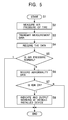
- Fig. 5 is a flow chart illustrating signal transmission and reception between the vehicle-installed device and the transmitter.
- Fig. 6 is a flow chart illustrating signal transmission and reception between the vehicle-installed device and the portable device.
- reference numeral 1 denotes a vehicle
- reference numeral 2 denotes a vehicle-installed device
- reference numerals 3 denote transmitters
- reference numerals 4 denote tires
- reference numeral 5 denotes a vehicle-installed indicator device
- reference numeral 6 denotes a portable device
- reference numeral 7 denotes a door-touch switch
- reference numerals 21 and 31 denote receiving sections
- reference numerals 22, 32, and 42 denote transmitting sections
- reference numeral 23 denotes a recording section
- reference numerals 24, 34, and 44 denote controlling sections
- reference numerals 25, 35, and 45 denote memories
- reference numeral 36 denotes an input section
- reference numeral 43 denotes a pressure sensor.
- the transmitters 3 are mounted to the respective tires or wheels of the vehicle 1. They periodically measure the pressures and/or temperatures in the tires and modulate the measured values for transmission by radio. More specifically, as shown in Fig. 4, each transmitter 3 comprises its associated pressure sensor 43 for measuring the air pressure in its associated tire, and periodically measures the pressure by a controlling operation of its associated controlling section 44 for transmitting the measured value through its associated transmitting section 42 and antenna.
- Each memory 45 stores, for example, a tire ID and a program for the controlling operation of its associated controlling section 44.
- the vehicle-installed device 2 is disposed at a suitable location in the vehicle 1. It transmits a radio signal to and receives a radio signal from the portable device 6, that is, it transmits a request signal and receives an answer signal. In addition, it receives pieces of tire air pressure data from the transmitters 3 in order to determine whether or not the received pieces of data indicate normal or abnormal tire air pressures by means of the controlling sections (CPU). Here, when any of the controlling sections determines that the air pressure of a tire is abnormal, this abnormal state is recorded in the recording section 23.
- An actuator for driving a door lock is attached to the vehicle-installed device 2 and receives electrical power from a battery for the driving.
- a passive keyless entry and a manual keyless entry related to the aforementioned request signal and answer signal will be described.
- Keyless entry is carried out to lock and unlock a door of the vehicle.
- the TPMS is an overall system for monitoring the air pressures of the tires of the vehicle.
- manual keyless entry is carried out to lock and unlock a door of the vehicle by operating a lock button and an unlock button in the vicinity of the vehicle. It is a type of keyless entry in which a unidirectional manual signal, that is, a lock signal or an unlock signal is transmitted to the vehicle-installed device from the portable device along with a portable device ID.
- passive keyless entry is another type of keyless entry in which signal transmission and reception are carried out bi-directionally between the vehicle-installed device and the portable device.
- a request signal including a vehicle ID is transmitted to the portable device from the vehicle-installed device, and an answer signal including the portable device ID is transmitted to the vehicle-installed device from the portable device. The IDs are compared in order to lock or unlock a door.
- Passive keyless entry is carried out for strict security and theft control.
- the former is a type that reliably gives concrete form to any intention of the driver to get into the vehicle.
- the driver carrying the portable device is beside the vehicle, so that the portable device immediately receives the request signal and transmits an answer signal.
- the driver carrying the portable device receives the request signal for the first time when the driver approaches the vehicle and comes within a range in which the request signal can be received, and, then, transmits an answer signal.
- a type of keyless entry that is a combination of the manual keyless entry and the passive keyless entry.
- a lock button and an unlock button are provided in a passive portable keyless entry device.
- a passive keyless entry operation basically does not use a portable device that is provided with a lock and an unlock button.
- a relatively weak radio signal is transmitted and received, so that a locking or an unlocking operation is carried out when the portable device is at or near the vehicle.
- a manual keyless entry operation basically uses a portable device that is provided with a lock button and an unlock button.
- a relatively strong manual radio signal is transmitted to carry out a locking or an unlocking operation.
- a passive portable keyless entry device having a lock button and an unlock button is used in order to make it possible to transmit a manual signal.
- the portable device 6 is carried by the driver.
- the portable device 6 has buttons for directing the driver to lock and unlock the doors of the vehicle.
- the portable device 6 transmits a manual radio signal for locking or unlocking a door.
- it receives a request signal from the vehicle-installed device 2 and transmits an answer signal.
- it receives an abnormal air pressure signal from the vehicle-installed device 2 and indicates a warning. More specifically, as shown in Fig.
- the portable device 6 comprises the receiving section 31, the transmitting section 32, the indicating section 33 for indicating a warning, an inputting section 36, including a lock and an unlock button, the controlling section 34 for controlling these parts, and the memory 35 for storing the portable device ID, a program, etc.
- the embodiment of the present invention is applicable to both manual keyless entry and passive keyless entry.
- the vehicle-installed indicator 5 (see Fig. 1) is disposed at a meter panel in the vehicle that can be easily checked by the driver when he is driving the vehicle, and receives an abnormal air pressure signal from the vehicle-installed device 2 by radio in order to indicate a warning. It receives electrical power from a battery of the vehicle.
- a plurality of the door-touch switches 7 are disposed at the knobs of the respective doors. Each switch 7 generates a trigger signal for transmitting a request signal to the portable device 6 from the vehicle-installed device 2. In other words, when the driver who is outside the vehicle approaches the vehicle and touches the door-touch switches 7, trigger signals are generated in order to transmit the request signal to the portable device 6 from the vehicle-installed device 2.
- the portable device In the basic operational process of manual keyless entry, when an operator operates a button (a lock button or an unlock button) of the portable device, the portable device transmits a manual signal in accordance with the function of the button. When the vehicle-installed device receives the manual signal, it checks a portable device ID. If the portable device ID is OK, a door lock actuator is driven. On the other hand, in the basic operational process of passive keyless entry, when the operator touches any of the door-touch switches attached to the respective doors of the vehicle, the vehicle-installed device transmits a request signal (such as a signal including vehicle IDs according to vehicle types).
- a request signal such as a signal including vehicle IDs according to vehicle types.
- the portable device When the portable device receives the request signal, checks the vehicle ID, and determines that the vehicle ID is OK, it transmits an answer signal (such as a signal including portable device IDs according to portable devices). Then, the vehicle-installed device receives the answer signal, and checks the portable device ID. If the portable device ID is OK, a door lock actuator is driven to unlock the door.
- an answer signal such as a signal including portable device IDs according to portable devices.
- Step S2 In the transmission and reception of signals between the transmitters 3 and the vehicle-installed device 2 (more specifically, one-way transmission of signals from the transmitters), the transmitters 3 measure air pressures in Step S2, and transmit data including the measured values each time a certain period of time elapses using radio waves in Step S3.
- the vehicle-mounted device 2 receives the signals in Step S4, it determines whether the signals indicate normal or abnormal air pressures in Step S5. If it determines that the air pressure of any of the tires is abnormal, it records the abnormality in the recording section in Step S6.
- What are recorded are, for example, data concerning the time and date of occurrence of the abnormality, which tire or tires among the mounted tires have become abnormal, whether the air pressure is too high or too low, and whether an absence of a signal is due to a dead battery or batteries of any of the tires.
- Step S7 When an abnormal state data is recorded in the recording section, if an ignition switch (IGN SW) is on in Step S7, that is, if the operator is in the vehicle for starting the engine of the vehicle, a warning is output at the vehicle-installed indicator 5 in Step S8, so that the driver can check the warning, thereby allowing the driver to easily realize that the air pressure of a tire is abnormal.
- IGN SW ignition switch
- the vehicle-installed device 2 examines the recording section 23 (see Fig. 2) in Step S13. If an abnormality data is not recorded, a signal including a vehicle ID and a portable device ID is transmitted as a request signal. The portable device 6 receives the signal from the vehicle-installed device 2, and compares the vehicle ID and the portable device ID. If they match, the portable device 6 transmits an answer signal. The vehicle-installed device 2 receives the answer signal, so that a door actuator is driven in order to unlock the door.
- Step S13 shown in Fig. 6 an abnormality data is recorded in the vehicle-installed device 2
- the vehicle-installed device 2 transmits an abnormal air pressure signal (such as a signal indicating whether or not an abnormality in air pressure has occurred) in addition to the request signal including the vehicle ID and the portable ID in Step S14.
- the vehicle-installed device 2 transmits data carrying the request signal and the signal indicating whether or not an abnormality in air pressure has occurred.
- an ordinary signal corresponds to the request signal.
- the portable device 6 receives the data signals in Step S15. If the IDs match, a warning is indicated at the warning indicating section 33 (see Fig. 3) of the portable device 6 in Step S16.
- the warning is indicated using characters, sound, vibration, or the like.
- the driver can realize that an abnormality in the air pressure of a tire has occurred before getting into the vehicle, so that the driver can actually examine the tire before he gets into the vehicle.
- the driver can check the details of any abnormal tire air pressure at the vehicle-installed indicator 5.
- an abnormal air pressure signal (the signal may also be an abnormal tire signal) is also transmitted to the portable device.
- an abnormal air pressure signal is transmitted to the portable device.
- an abnormal air pressure signal is transmitted to the portable device by the operation of any of the door touch switches (when the driver has approached the vehicle and is ready to get into it)
- the present invention is not limited thereto.
- warning device having both a manual keyless entry function and a passive keyless entry function is described.
- the present invention is applicable to keyless entry using manual signals (lock and unlock signals), a request signal, and an answer signal.
- the present invention makes it possible to indicate a warning at the portable device that an abnormality in the air pressure of a tire has occurred by disposing an indicating section or an informing section in the portable device.
- the driver or operator can obtain a warning by taking out an abnormal state signal at a timing that is required by the driver or operator.
Landscapes
- Engineering & Computer Science (AREA)
- Mechanical Engineering (AREA)
- Physics & Mathematics (AREA)
- General Physics & Mathematics (AREA)
- Lock And Its Accessories (AREA)
Abstract
Description
- The present invention relates to a tire air pressure monitoring system (TPMS) comprising a vehicle-installed device, a portable keyless entry device, and a tire air pressure transmitter, and, more particularly, to a technology for giving a warning when an abnormality in the air pressure of a tire occurs.
- According to a related technology, a tire air pressure abnormality warning device comprises air pressure sensors for detecting the internal air pressures of tires. Detection signals from the sensors are output from transmitters mounted to wheels, and a receiver in an automobile receives the output detection signals. When an abnormal air pressure of any tire is detected, a warning is given by a driver's indicator panel.
- Japanese Patent No. 2716335 discloses a structure in which a receiver, which receives a door lock signal and a door unlock signal from a radio-wave key (operating key), in a vehicle receives an abnormality detection signal from a transmitter that indicates an abnormal state of a tire. It also discloses a technology in which, based on the tire abnormality detection signal, a first warning unit or a second warning unit is selectively driven in order to output a warning inside or outside the vehicle. In other words, by selectively giving a warning inside or outside the vehicle when an abnormality of a tire is detected, the warning is given in accordance with whether a person is in the vehicle or is not in a parked vehicle.
- The related technology for giving a warning by a driver's indicator panel causes inconvenience to a driver because, after a warning has been given by the indicator panel, the driver must get out of the vehicle in order to check the actual air pressure of a tire. In particular, when an abnormality in the air pressure of a tire of a parked vehicle is detected, a person cannot confirm any warning unless the person gets into the vehicle and looks at or listens to the driver's indicator panel. Therefore, after confirming the warning, the person must get off the vehicle again and actually check the abnormality of the tire, thereby causing inconvenience to the person.
- In addition, in the technology that is disclosed in the aforementioned document, although, when the driver is outside the vehicle, he can know that a tire abnormality has occurred by a warning that is directed to the outside of the vehicle, the driver cannot know that the abnormality has occurred when he is outside a range that allows him to hear the warning.
- Accordingly, it is an object of the present invention to make it possible to efficiently warn a driver of an abnormal air pressure of a tire and make it possible for the driver to efficiently confirm any tire abnormality in accordance with whether the driver gets into or out of a vehicle by warning the driver of the abnormal tire air pressure when the driver gets into or out of the vehicle.
- To this end, according to a first aspect of the present invention, there is provided a tire air pressure abnormality warning device comprising a transmitter for transmitting a signal that corresponds to air pressure of a tire measured by a pressure sensor; a portable keyless entry device for opening and closing a door lock of a vehicle; and a vehicle-installed device for determining whether or not the air pressure of the tire is abnormal by receiving the signal from the transmitter in order to output data regarding the determination, the vehicle-installed device driving the door lock by communication with the portable device. The vehicle-installed device comprises a recording section for recording data of any abnormality in the air pressure of the tire. The portable device comprises a warning indicating section for indicating that the air pressure of the tire is abnormal. The vehicle-installed device searches for any abnormality data from the recording section when the vehicle-installed device communicates with the portable device, so that, when there is abnormality data, a tire air pressure abnormality signal is transmitted to the portable device. The portable device indicates a warning of an abnormal air pressure of the tire by the tire air pressure abnormality signal that the portable device has received.
- By virtue of this structure, in the tire air pressure abnormality warning device of the present invention, abnormal tire air pressures are stored in a storage section. During keyless entry communication between the portable device and the vehicle-installed device, the vehicle-installed device reads out any abnormal tire air pressure and transmits a tire air pressure abnormality signal to the portable device. The portable device receives the tire air pressure abnormality signal and, by using the signal, indicates an abnormality in the air pressure of a tire at the warning indicating section. According to the present invention, by disposing the warning indicating section at the portable keyless entry device, it is possible to indicate a warning of an abnormality in the air pressure of a tire at the portable device. In addition, since, during key entry communication, an abnormal tire air pressure is automatically checked and a warning is indicated by the portable device, a driver carrying the portable device can know that an abnormality in the air pressure of a tire has occurred before getting into the vehicle, so that the driver can immediately confirm the abnormality of the tire.
- When the structure of the first aspect of the present invention is used, in a first form, the communication between the vehicle-installed device and the portable device is a passive keyless entry communication using a request signal from the vehicle-installed device and an answer signal from the portable device, and the tire air pressure abnormality signal is transmitted along with the request signal.
- By virtue of this structure, in the tire air pressure abnormality warning device of the present invention, when a passive keyless entry communication is carried out between the portable device carried by the driver and the vehicle-installed device, a tire air pressure abnormality signal, as well as a request signal, is transmitted to the portable device from the vehicle-installed device. According to the present invention, the driver can confirm the vehicle's door locking/unlocking controlling operation and any abnormal tire air pressure without particularly being conscious of confirming them.
- When the structure of the first form is used, in a second form, a door of the vehicle comprises a door touch switch, and the request signal and the tire air pressure abnormality signal are transmitted by operating the door touch switch.
- By virtue of this structure, in the tire air pressure abnormality warning device of the present invention, it is possible to restrict power consumption without emitting a request signal or a tire gas pressure signal at all times.
- When the structure of the first aspect or the first form is used, in a third form, the transmitter periodically measures the air pressure of the tire and transmits the measured value to the vehicle-installed device, and, when the vehicle-installed device determines that the air pressure of the tire is abnormal, the vehicle-installed device records abnormality data in the recording section, with a driver taking out the data from the recording section at a timing in which the driver gets into or out of the vehicle.
- By virtue of this structure, in the tire air pressure abnormality warning device of the present invention, since abnormal tire air pressures are previously stored in the storage section, the driver can know that an abnormality in the air pressure of a tire has occurred in a very short time at a timing in which the driver gets into and out of the vehicle.
- According to a second aspect of the present invention, there is provided a method for performing a tire air pressure abnormality warning operation using a transmitter for transmitting a signal that corresponds to air pressure of a tire measured by a pressure sensor, a portable keyless entry device for opening and closing a door lock of a vehicle, and a vehicle-installed device for determining whether or not the air pressure of the tire is abnormal by receiving the signal from the transmitter in order to output data regarding the determination, the vehicle-installed device driving the door lock by communication with the portable device. The method comprises the steps of:
- by the vehicle-installed device, determining that the signal transmitted from the transmitter indicates an abnormality in the air pressure of the tire and recording abnormality data in a recording section;
- during communication of the vehicle-installed device with the portable device, by the vehicle-installed device, searching for any abnormality data from the recording section and, if there is any abnormality data, transmitting a tire air pressure abnormality signal to the portable device; and
- by the portable device, indicating a warning of abnormal air pressure of the tire by the tire air pressure abnormality signal using a warning indicating section.
-
- By virtue of this structure, in the tire air pressure abnormality warning method of the present invention, abnormal tire air pressures are stored in a storage section. For keyless entry communication between the portable device and the vehicle-installed device, the vehicle-installed device searches for any abnormal tire air pressure and transmits a tire air pressure abnormality signal to the portable device. The portable device receives the tire air pressure abnormality signal to cause the warning indicating section to indicate that an abnormality in the air pressure of a tire has occurred. According to the present invention, it is possible to indicate a warning at the portable device that an abnormality in the air pressure of a tire has occurred. In addition, since, during key entry communication, any abnormal tire air pressure is automatically checked and a warning is indicated at the portable device, a driver carrying the portable device can know that the air pressure of a tire is abnormal before getting into the vehicle, so that the driver can immediately confirm the tire abnormality.
-
- Fig. 1 shows the overall structure of a tire air pressure abnormality warning device of an embodiment of the present invention;
- Fig. 2 is a block diagram of the structure of a vehicle-installed device used in the embodiment of the present invention;
- Fig. 3 is a block diagram of the structure of a portable device used in the embodiment of the present invention;
- Fig. 4 is a block diagram of the structure of a transmitter used in the embodiment of the present invention;
- Fig. 5 is a flow chart illustrating signal transmission and reception between the vehicle-installed device and the transmitter; and
- Fig. 6 is a flow chart illustrating signal transmission and reception between the vehicle-installed device and the portable device.
-
- Hereunder, a description of a tire air pressure abnormality warning device and method of embodiments of the present invention will be given with reference to the drawings. Fig. 1 shows the overall structure of a tire air pressure abnormality warning device of an embodiment of the present invention. Fig. 2 is a block diagram of the structure of a vehicle-installed device of a tire air pressure monitoring system (TPMS), which is used in the embodiment of the present invention. Fig. 3 is a block diagram of the structure of a portable device used in the embodiment of the present invention. Fig. 4 is a block diagram of the structure of a transmitter used in the embodiment of the present invention. Fig. 5 is a flow chart illustrating signal transmission and reception between the vehicle-installed device and the transmitter. Fig. 6 is a flow chart illustrating signal transmission and reception between the vehicle-installed device and the portable device.
- In these figures,
reference numeral 1 denotes a vehicle,reference numeral 2 denotes a vehicle-installed device,reference numerals 3 denote transmitters,reference numerals 4 denote tires,reference numeral 5 denotes a vehicle-installed indicator device, reference numeral 6 denotes a portable device, reference numeral 7 denotes a door-touch switch,reference numerals reference numerals reference numeral 23 denotes a recording section,reference numerals reference numerals reference numeral 36 denotes an input section, andreference numeral 43 denotes a pressure sensor. - In Fig. 1, the
transmitters 3 are mounted to the respective tires or wheels of thevehicle 1. They periodically measure the pressures and/or temperatures in the tires and modulate the measured values for transmission by radio. More specifically, as shown in Fig. 4, eachtransmitter 3 comprises its associatedpressure sensor 43 for measuring the air pressure in its associated tire, and periodically measures the pressure by a controlling operation of its associated controllingsection 44 for transmitting the measured value through its associatedtransmitting section 42 and antenna. Eachmemory 45 stores, for example, a tire ID and a program for the controlling operation of its associated controllingsection 44. - The vehicle-installed
device 2 is disposed at a suitable location in thevehicle 1. It transmits a radio signal to and receives a radio signal from the portable device 6, that is, it transmits a request signal and receives an answer signal. In addition, it receives pieces of tire air pressure data from thetransmitters 3 in order to determine whether or not the received pieces of data indicate normal or abnormal tire air pressures by means of the controlling sections (CPU). Here, when any of the controlling sections determines that the air pressure of a tire is abnormal, this abnormal state is recorded in therecording section 23. An actuator for driving a door lock is attached to the vehicle-installeddevice 2 and receives electrical power from a battery for the driving. - A passive keyless entry and a manual keyless entry related to the aforementioned request signal and answer signal will be described. "Keyless entry" is carried out to lock and unlock a door of the vehicle. The TPMS is an overall system for monitoring the air pressures of the tires of the vehicle.
- In general, manual keyless entry is carried out to lock and unlock a door of the vehicle by operating a lock button and an unlock button in the vicinity of the vehicle. It is a type of keyless entry in which a unidirectional manual signal, that is, a lock signal or an unlock signal is transmitted to the vehicle-installed device from the portable device along with a portable device ID.
- On the other hand, passive keyless entry is another type of keyless entry in which signal transmission and reception are carried out bi-directionally between the vehicle-installed device and the portable device. A request signal including a vehicle ID is transmitted to the portable device from the vehicle-installed device, and an answer signal including the portable device ID is transmitted to the vehicle-installed device from the portable device. The IDs are compared in order to lock or unlock a door. Passive keyless entry is carried out for strict security and theft control. There are two types of passive keyless entry. In one type, a request signal is transmitted from the vehicle-installed device when a person touches or presses a door-touch switch on a door. In the other type, a request signal is intermittently transmitted from the vehicle-installed device at all times. In terms of disposing door-touch switches, the former is a type that reliably gives concrete form to any intention of the driver to get into the vehicle. In the former, when the request signal is transmitted, the driver carrying the portable device is beside the vehicle, so that the portable device immediately receives the request signal and transmits an answer signal. In the latter, the driver carrying the portable device receives the request signal for the first time when the driver approaches the vehicle and comes within a range in which the request signal can be received, and, then, transmits an answer signal.
- In the vehicle, it is also possible to carry out a type of keyless entry that is a combination of the manual keyless entry and the passive keyless entry. In this type of keyless entry, a lock button and an unlock button are provided in a passive portable keyless entry device.
- Accordingly, a passive keyless entry operation basically does not use a portable device that is provided with a lock and an unlock button. Here, a relatively weak radio signal is transmitted and received, so that a locking or an unlocking operation is carried out when the portable device is at or near the vehicle. On the other hand, a manual keyless entry operation basically uses a portable device that is provided with a lock button and an unlock button. Here, a relatively strong manual radio signal is transmitted to carry out a locking or an unlocking operation. In the keyless entry type that is a combination of the passive entry type and the manual keyless entry type, a passive portable keyless entry device having a lock button and an unlock button is used in order to make it possible to transmit a manual signal.
- The portable device 6 is carried by the driver. In the case of manual keyless entry, the portable device 6 has buttons for directing the driver to lock and unlock the doors of the vehicle. The portable device 6 transmits a manual radio signal for locking or unlocking a door. In addition, in the case of passive keyless entry, it receives a request signal from the vehicle-installed
device 2 and transmits an answer signal. Further, regardless of the type of keyless entry, it receives an abnormal air pressure signal from the vehicle-installeddevice 2 and indicates a warning. More specifically, as shown in Fig. 3, the portable device 6 comprises the receivingsection 31, the transmittingsection 32, the indicatingsection 33 for indicating a warning, an inputtingsection 36, including a lock and an unlock button, the controllingsection 34 for controlling these parts, and thememory 35 for storing the portable device ID, a program, etc. In other words, the embodiment of the present invention is applicable to both manual keyless entry and passive keyless entry. - The vehicle-installed indicator 5 (see Fig. 1) is disposed at a meter panel in the vehicle that can be easily checked by the driver when he is driving the vehicle, and receives an abnormal air pressure signal from the vehicle-installed
device 2 by radio in order to indicate a warning. It receives electrical power from a battery of the vehicle. - A plurality of the door-touch switches 7 are disposed at the knobs of the respective doors. Each switch 7 generates a trigger signal for transmitting a request signal to the portable device 6 from the vehicle-installed
device 2. In other words, when the driver who is outside the vehicle approaches the vehicle and touches the door-touch switches 7, trigger signals are generated in order to transmit the request signal to the portable device 6 from the vehicle-installeddevice 2. - Next, a description of the operation of the tire air pressure abnormality warning device of the embodiment of the present invention will be given with reference to Figs. 5 and 6. In the basic operational process of manual keyless entry, when an operator operates a button (a lock button or an unlock button) of the portable device, the portable device transmits a manual signal in accordance with the function of the button. When the vehicle-installed device receives the manual signal, it checks a portable device ID. If the portable device ID is OK, a door lock actuator is driven. On the other hand, in the basic operational process of passive keyless entry, when the operator touches any of the door-touch switches attached to the respective doors of the vehicle, the vehicle-installed device transmits a request signal (such as a signal including vehicle IDs according to vehicle types). When the portable device receives the request signal, checks the vehicle ID, and determines that the vehicle ID is OK, it transmits an answer signal (such as a signal including portable device IDs according to portable devices). Then, the vehicle-installed device receives the answer signal, and checks the portable device ID. If the portable device ID is OK, a door lock actuator is driven to unlock the door.
- Next, a tire air pressure monitoring operation in the embodiment of the present invention will be described with reference to Fig. 5. In the transmission and reception of signals between the
transmitters 3 and the vehicle-installed device 2 (more specifically, one-way transmission of signals from the transmitters), thetransmitters 3 measure air pressures in Step S2, and transmit data including the measured values each time a certain period of time elapses using radio waves in Step S3. When the vehicle-mounteddevice 2 receives the signals in Step S4, it determines whether the signals indicate normal or abnormal air pressures in Step S5. If it determines that the air pressure of any of the tires is abnormal, it records the abnormality in the recording section in Step S6. What are recorded are, for example, data concerning the time and date of occurrence of the abnormality, which tire or tires among the mounted tires have become abnormal, whether the air pressure is too high or too low, and whether an absence of a signal is due to a dead battery or batteries of any of the tires. - When an abnormal state data is recorded in the recording section, if an ignition switch (IGN SW) is on in Step S7, that is, if the operator is in the vehicle for starting the engine of the vehicle, a warning is output at the vehicle-installed
indicator 5 in Step S8, so that the driver can check the warning, thereby allowing the driver to easily realize that the air pressure of a tire is abnormal. - Next, referring to Fig. 6, in the transmission and reception of signals between the vehicle-installed
device 2 and the portable device 6, when the driver who is carrying the portable device 6 presses any of the door touch switches 7 while the doors of the vehicle are locked in Step S12, the vehicle-installeddevice 2 examines the recording section 23 (see Fig. 2) in Step S13. If an abnormality data is not recorded, a signal including a vehicle ID and a portable device ID is transmitted as a request signal. The portable device 6 receives the signal from the vehicle-installeddevice 2, and compares the vehicle ID and the portable device ID. If they match, the portable device 6 transmits an answer signal. The vehicle-installeddevice 2 receives the answer signal, so that a door actuator is driven in order to unlock the door. - On the other hand, if, in Step S13 shown in Fig. 6, an abnormality data is recorded in the vehicle-installed
device 2, the vehicle-installeddevice 2 transmits an abnormal air pressure signal (such as a signal indicating whether or not an abnormality in air pressure has occurred) in addition to the request signal including the vehicle ID and the portable ID in Step S14. In other words, the vehicle-installeddevice 2 transmits data carrying the request signal and the signal indicating whether or not an abnormality in air pressure has occurred. (In Fig. 6, what is called an ordinary signal corresponds to the request signal.) The portable device 6 receives the data signals in Step S15. If the IDs match, a warning is indicated at the warning indicating section 33 (see Fig. 3) of the portable device 6 in Step S16. The warning is indicated using characters, sound, vibration, or the like. By the warning, the driver can realize that an abnormality in the air pressure of a tire has occurred before getting into the vehicle, so that the driver can actually examine the tire before he gets into the vehicle. The driver can check the details of any abnormal tire air pressure at the vehicle-installedindicator 5. - In the foregoing description, in order to make the driver realize that an abnormality in the air pressure of any of the tires has occurred before he gets into the vehicle, when the driver carrying the portable device approaches and reaches the vehicle and operates any of the door touch switches, an abnormal air pressure signal (the signal may also be an abnormal tire signal) is also transmitted to the portable device. In addition to this, in order to make the driver realize that an abnormality in the air pressure of any of the tires has occurred when he moves away from the vehicle, when the driver gets out of the vehicle and locks the doors with the door touch switches, an abnormal air pressure signal is transmitted to the portable device.
- Although in the foregoing description, the case where an abnormal air pressure signal is transmitted to the portable device by the operation of any of the door touch switches (when the driver has approached the vehicle and is ready to get into it), the present invention is not limited thereto. Alternatively, it is possible to, when a manual signal is transmitted from the portable device to lock or unlock a door, detect reception of the manual signal and to transmit an abnormal air pressure signal from the vehicle-installed device to the portable device based on the detection.
- In the foregoing description a warning device having both a manual keyless entry function and a passive keyless entry function is described. In short, the present invention is applicable to keyless entry using manual signals (lock and unlock signals), a request signal, and an answer signal.
- The present invention makes it possible to indicate a warning at the portable device that an abnormality in the air pressure of a tire has occurred by disposing an indicating section or an informing section in the portable device.
- Since the air pressures of the tires are periodically measured and the measurements are transmitted to the vehicle-installed device, and any abnormal air pressure is checked and recorded in the vehicle-installed device, the driver or operator can obtain a warning by taking out an abnormal state signal at a timing that is required by the driver or operator.
- By transmitting an abnormal air pressure signal from the vehicle-installed device to the portable device by operation (touching, pressing, or lifting) of any of the door touch switches of the vehicle, it is possible to inform the driver that an abnormality has occurred immediately before he gets into the vehicle, so that a period of efficient transmission to the portable device can be ensured.
Claims (5)
- A tire air pressure abnormality warning device comprising:wherein the vehicle-installed device comprises a recording section for recording data of any abnormality in. the air pressure of the tire,a transmitter for transmitting a signal that corresponds to air pressure of a tire measured by a pressure sensor;a portable keyless entry device for opening and closing a door lock of a vehicle; anda vehicle-installed device for determining whether or not the air pressure of the tire is abnormal by receiving the signal from the transmitter in order to output data regarding the determination, the vehicle-installed device driving the door lock by communication with the portable device;
wherein the portable device comprises a warning indicating section for indicating that the air pressure of the tire is abnormal,
wherein the vehicle-installed device searches for any abnormality data from the recording section when the vehicle-installed device communicates with the portable device, so that, when there is abnormality data, a tire air pressure abnormality signal is transmitted to the portable device, and
wherein the portable device indicates a warning of an abnormal air pressure of the tire by the tire air pressure abnormality signal that the portable device has received. - A tire air pressure abnormality warning device according to Claim 1, wherein the communication between the vehicle-installed device and the portable device is a passive keyless entry communication using a request signal from the vehicle-installed device and an answer signal from the portable device, and wherein the tire air pressure abnormality signal is transmitted along with the request signal.
- A tire air pressure abnormality warning device according to Claim 2, wherein a door of the vehicle comprises a door touch switch, and wherein the request signal and the tire air pressure abnormality signal are transmitted by operating the door touch switch.
- A tire air pressure abnormality warning device according to any of Claims 1 to 3, wherein the transmitter periodically measures the air pressure of the tire and transmits the measured value to the vehicle-installed device, and wherein, when the vehicle-installed device determines that the air pressure of the tire is abnormal, the vehicle-installed device records abnormality data in the recording section, with a driver taking out the data from the recording section at a timing in which the driver gets into or out of the vehicle.
- A method for performing a tire air pressure abnormality warning operation using a transmitter for transmitting a signal that corresponds to air pressure of a tire measured by a pressure sensor, a portable keyless entry device for opening and closing a door lock of a vehicle, and a vehicle-installed device for determining whether or not the air pressure of the tire is abnormal by receiving the signal from the transmitter in order to output data regarding the determination, the vehicle-installed device driving the door lock by communication with the portable device, the method comprising the steps of:by the vehicle-installed device, determining that the signal transmitted from the transmitter indicates an abnormality in the air pressure of the tire and recording abnormality data in a recording section;during communication of the vehicle-installed device with the portable device, by the vehicle-installed device, searching for any abnormality data from the recording section and, if there is any abnormality data, transmitting a tire air pressure abnormality signal to the portable device; andby the portable device, indicating a warning of abnormal air pressure of the tire by the tire air pressure abnormality signal using a warning indicating section.
Applications Claiming Priority (2)
| Application Number | Priority Date | Filing Date | Title |
|---|---|---|---|
| JP2002265514 | 2002-09-11 | ||
| JP2002265514A JP3964764B2 (en) | 2002-09-11 | 2002-09-11 | Tire pressure abnormality warning device and method |
Publications (2)
| Publication Number | Publication Date |
|---|---|
| EP1398736A1 true EP1398736A1 (en) | 2004-03-17 |
| EP1398736B1 EP1398736B1 (en) | 2005-11-30 |
Family
ID=31884771
Family Applications (1)
| Application Number | Title | Priority Date | Filing Date |
|---|---|---|---|
| EP20030020637 Expired - Lifetime EP1398736B1 (en) | 2002-09-11 | 2003-09-10 | Device and method for monitoring the tire pressure |
Country Status (4)
| Country | Link |
|---|---|
| US (1) | US7124002B2 (en) |
| EP (1) | EP1398736B1 (en) |
| JP (1) | JP3964764B2 (en) |
| DE (1) | DE60302511T2 (en) |
Cited By (1)
| Publication number | Priority date | Publication date | Assignee | Title |
|---|---|---|---|---|
| DE102005009754B4 (en) * | 2004-03-04 | 2012-02-23 | Mitsubishi Jidosha Kogyo K.K. | Tire pressure warning system |
Families Citing this family (22)
| Publication number | Priority date | Publication date | Assignee | Title |
|---|---|---|---|---|
| US7821421B2 (en) * | 2003-07-07 | 2010-10-26 | Sensomatix Ltd. | Traffic information system |
| JP2006138156A (en) * | 2004-11-15 | 2006-06-01 | Denso Corp | Portable communication device, portable electronic device mounting communication device, and program |
| US20060206247A1 (en) * | 2005-03-09 | 2006-09-14 | Trw Automotive U.S. Llc | Tire parameter sensing system having a tire-based unit that is responsive to a trigger signal and associated method |
| JP4812350B2 (en) * | 2005-07-19 | 2011-11-09 | 株式会社ブリヂストン | Tire inspection system and tire inspection device |
| FR2894517B1 (en) * | 2005-12-09 | 2010-01-08 | Renault | TIRE PRESSURE MONITORING SYSTEM OF A MOTOR VEHICLE AND METHOD FOR ESTABLISHING A DIAGNOSIS THEREWITH |
| DE102008018016B4 (en) * | 2008-04-09 | 2016-06-09 | Continental Automotive Gmbh | A method of detecting a tire theft and tire pressure monitoring system |
| JP2009248959A (en) * | 2008-04-11 | 2009-10-29 | Denso Corp | Monitoring device |
| JP5138487B2 (en) * | 2008-07-10 | 2013-02-06 | 本田技研工業株式会社 | Device anti-theft device |
| AU2009202622B2 (en) | 2008-07-10 | 2010-12-23 | Honda Motor Co., Ltd. | Antitheft system |
| JP2010125920A (en) * | 2008-11-26 | 2010-06-10 | Alps Electric Co Ltd | Mounting structure of tire information transmitter |
| US8493177B2 (en) | 2010-01-29 | 2013-07-23 | Immersion Corporation | System and method of haptically communicating vehicle information from a vehicle to a keyless entry device |
| JP5569203B2 (en) * | 2010-07-13 | 2014-08-13 | 横浜ゴム株式会社 | Tire information monitoring system and method for setting tire information monitoring system |
| JP2013082381A (en) * | 2011-10-12 | 2013-05-09 | Denso Corp | Wheel position detecting device |
| JP5852414B2 (en) * | 2011-11-07 | 2016-02-03 | 株式会社東海理化電機製作所 | Wireless communication system |
| JP6060665B2 (en) | 2012-12-13 | 2017-01-18 | 株式会社デンソー | Tire theft alarm system |
| KR101578066B1 (en) * | 2014-05-28 | 2015-12-16 | (주)티에이치엔 | Method for detecting dangerous condition of vehicle tires |
| JP2016199071A (en) * | 2015-04-07 | 2016-12-01 | アルパイン株式会社 | On-vehicle equipment, on-vehicle equipment system, warning method in on-vehicle equipment, and program for causing computer to execute processing in on-vehicle equipment |
| ES2710508T3 (en) * | 2016-05-27 | 2019-04-25 | Wegmann Automotive Gmbh | Tire pressure monitoring sensor that allows quick configuration and software updates |
| US11161378B2 (en) * | 2018-07-19 | 2021-11-02 | Nissan North America, Inc. | Vehicle tire pressure monitoring interface |
| US12227036B2 (en) * | 2018-07-19 | 2025-02-18 | Nissan North America, Inc. | Vehicle tire pressure alert system for paved road and off-road driving conditions |
| CN111284280A (en) * | 2018-12-10 | 2020-06-16 | 上海博泰悦臻电子设备制造有限公司 | Vehicle-mounted TBOX, vehicle and tire pressure abnormity notification method and system |
| US12377812B2 (en) * | 2022-06-15 | 2025-08-05 | Sensata Technologies, Inc. | Wheel theft detection and notification using a tire pressure monitoring system |
Citations (4)
| Publication number | Priority date | Publication date | Assignee | Title |
|---|---|---|---|---|
| US5081443A (en) * | 1987-06-02 | 1992-01-14 | Christoph Breit | Device for protecting the systems and load of motor vehicles |
| EP0995619A1 (en) * | 1998-10-21 | 2000-04-26 | LOUREIRO BENIMELI, Fermin, Jaime | A device for controlling the pressure in the pneumatic tyres of motocars and similar vehicles |
| US20010050611A1 (en) * | 2000-03-22 | 2001-12-13 | Nolex Ag | Tire pressure display device |
| DE10164333A1 (en) * | 2001-01-02 | 2002-09-05 | Trw Inc | Remote-controlled convenience and information transmission system associated with a vehicle |
Family Cites Families (15)
| Publication number | Priority date | Publication date | Assignee | Title |
|---|---|---|---|---|
| US5500637A (en) * | 1993-02-22 | 1996-03-19 | Kabushiki Kaisha Tokai Rika Denki Seisakusho | Abnormal condition signal transmitting device for a rotating body |
| US5463374A (en) * | 1994-03-10 | 1995-10-31 | Delco Electronics Corporation | Method and apparatus for tire pressure monitoring and for shared keyless entry control |
| JP3982830B2 (en) * | 1994-11-22 | 2007-09-26 | シュレイダー・オートモーティヴ・インコーポレイテッド | Remote tire pressure monitoring system |
| JPH08244424A (en) * | 1995-03-08 | 1996-09-24 | Yokogawa Electric Corp | Tire pressure monitor system |
| US6043738A (en) * | 1998-06-26 | 2000-03-28 | Schrader-Bridgeport International, Inc. | Method and apparatus for identifying remote sending units in a vehicle |
| FR2798238B1 (en) * | 1999-09-03 | 2008-05-09 | Sagem | TIRE PRESSURE MONITORING RECEIVER OF A VEHICLE AND ASSOCIATED TRANSMITTER OF VEHICLE ORGAN REMOTE CONTROL |
| US6259362B1 (en) * | 1999-09-21 | 2001-07-10 | Trw Inc. | System for conveying vehicle status information upon exit from a vehicle |
| JP2001108551A (en) * | 1999-10-13 | 2001-04-20 | Pacific Ind Co Ltd | Tire pneumatic pressure monitoring device and external communication device |
| US6243007B1 (en) * | 1999-12-01 | 2001-06-05 | Mclaughlin John T. | Tire condition monitoring system |
| JP2001191768A (en) * | 1999-12-29 | 2001-07-17 | Ko Tobun | Tire pressure detection system |
| JP2001248339A (en) * | 2000-03-03 | 2001-09-14 | Calsonic Kansei Corp | Operation controller for on-vehicle electronic unit |
| DE10013542A1 (en) * | 2000-03-20 | 2001-09-27 | Philips Corp Intellectual Pty | Passive keyless entry system arrangement for motor vehicle uses antenna coils and UHF coils to obtain relative position of data card w.r.t. base station |
| JP2002316520A (en) * | 2001-04-20 | 2002-10-29 | Nippon Seiki Co Ltd | Tire pneumatic pressure monitoring device |
| US6647773B2 (en) * | 2002-03-01 | 2003-11-18 | Lear Corporation | System and method for integrated tire pressure monitoring and passive entry |
| JP3994823B2 (en) * | 2002-08-23 | 2007-10-24 | トヨタ自動車株式会社 | Mobile body state acquisition device |
-
2002
- 2002-09-11 JP JP2002265514A patent/JP3964764B2/en not_active Expired - Fee Related
-
2003
- 2003-09-09 US US10/659,875 patent/US7124002B2/en not_active Expired - Lifetime
- 2003-09-10 EP EP20030020637 patent/EP1398736B1/en not_active Expired - Lifetime
- 2003-09-10 DE DE2003602511 patent/DE60302511T2/en not_active Expired - Lifetime
Patent Citations (4)
| Publication number | Priority date | Publication date | Assignee | Title |
|---|---|---|---|---|
| US5081443A (en) * | 1987-06-02 | 1992-01-14 | Christoph Breit | Device for protecting the systems and load of motor vehicles |
| EP0995619A1 (en) * | 1998-10-21 | 2000-04-26 | LOUREIRO BENIMELI, Fermin, Jaime | A device for controlling the pressure in the pneumatic tyres of motocars and similar vehicles |
| US20010050611A1 (en) * | 2000-03-22 | 2001-12-13 | Nolex Ag | Tire pressure display device |
| DE10164333A1 (en) * | 2001-01-02 | 2002-09-05 | Trw Inc | Remote-controlled convenience and information transmission system associated with a vehicle |
Cited By (1)
| Publication number | Priority date | Publication date | Assignee | Title |
|---|---|---|---|---|
| DE102005009754B4 (en) * | 2004-03-04 | 2012-02-23 | Mitsubishi Jidosha Kogyo K.K. | Tire pressure warning system |
Also Published As
| Publication number | Publication date |
|---|---|
| US7124002B2 (en) | 2006-10-17 |
| JP3964764B2 (en) | 2007-08-22 |
| JP2004098929A (en) | 2004-04-02 |
| US20040049329A1 (en) | 2004-03-11 |
| DE60302511T2 (en) | 2006-06-08 |
| DE60302511D1 (en) | 2006-01-05 |
| EP1398736B1 (en) | 2005-11-30 |
Similar Documents
| Publication | Publication Date | Title |
|---|---|---|
| EP1398736B1 (en) | Device and method for monitoring the tire pressure | |
| EP2338704B1 (en) | Tire condition monitoring apparatus with keyless entry function | |
| JP5402058B2 (en) | Portable device, portable communication terminal, and vehicle system | |
| JP4610300B2 (en) | VEHICLE CONTROL DEVICE AND VEHICLE CONTROL METHOD | |
| US20090096578A1 (en) | Smart entry system | |
| US9487055B2 (en) | Vehicle theft alert system | |
| CN105751830B (en) | A kind of tire monitor system and automobile | |
| US20050190039A1 (en) | System for controlling a valet mode of a vehicle | |
| US7065439B2 (en) | Vehicle door locking and unlocking system | |
| KR20030015879A (en) | A protection device against burglars of vehicles | |
| CN104870266A (en) | Tire theft alarm system | |
| JP5224134B2 (en) | Vehicle detection device | |
| EP1820704B1 (en) | Keyless entry system adapted for motor vehicle | |
| JP2012126192A (en) | Id registration system for tire air pressure sensor | |
| US7009491B2 (en) | Dual purpose vehicle key fob for training tire pressure sensors | |
| JP4213719B2 (en) | In-vehicle device remote control device | |
| JP5375782B2 (en) | Portable device, in-vehicle device, and vehicle system | |
| JP2006347298A (en) | Vehicle anti-theft system | |
| JP3508482B2 (en) | Vehicle remote control system | |
| JP5368273B2 (en) | Blow delay device for security alarm system | |
| JP3829932B2 (en) | Vehicle theft reporting device | |
| KR100243884B1 (en) | Car burglar alarm | |
| JP2001254546A (en) | Battery consumption state determination device | |
| KR200362297Y1 (en) | A condition recognize device of packing car | |
| RU190789U1 (en) | Automotive telematics system unit |
Legal Events
| Date | Code | Title | Description |
|---|---|---|---|
| PUAI | Public reference made under article 153(3) epc to a published international application that has entered the european phase |
Free format text: ORIGINAL CODE: 0009012 |
|
| AK | Designated contracting states |
Kind code of ref document: A1 Designated state(s): AT BE BG CH CY CZ DE DK EE ES FI FR GB GR HU IE IT LI LU MC NL PT RO SE SI SK TR |
|
| AX | Request for extension of the european patent |
Extension state: AL LT LV MK |
|
| 17P | Request for examination filed |
Effective date: 20040326 |
|
| AKX | Designation fees paid |
Designated state(s): DE FR GB |
|
| GRAP | Despatch of communication of intention to grant a patent |
Free format text: ORIGINAL CODE: EPIDOSNIGR1 |
|
| GRAS | Grant fee paid |
Free format text: ORIGINAL CODE: EPIDOSNIGR3 |
|
| GRAA | (expected) grant |
Free format text: ORIGINAL CODE: 0009210 |
|
| AK | Designated contracting states |
Kind code of ref document: B1 Designated state(s): DE FR GB |
|
| REG | Reference to a national code |
Ref country code: GB Ref legal event code: FG4D |
|
| REF | Corresponds to: |
Ref document number: 60302511 Country of ref document: DE Date of ref document: 20060105 Kind code of ref document: P |
|
| ET | Fr: translation filed | ||
| PLBE | No opposition filed within time limit |
Free format text: ORIGINAL CODE: 0009261 |
|
| STAA | Information on the status of an ep patent application or granted ep patent |
Free format text: STATUS: NO OPPOSITION FILED WITHIN TIME LIMIT |
|
| 26N | No opposition filed |
Effective date: 20060831 |
|
| REG | Reference to a national code |
Ref country code: FR Ref legal event code: PLFP Year of fee payment: 14 |
|
| REG | Reference to a national code |
Ref country code: DE Ref legal event code: R082 Ref document number: 60302511 Country of ref document: DE Representative=s name: SCHMITT-NILSON SCHRAUD WAIBEL WOHLFROM PATENTA, DE |
|
| REG | Reference to a national code |
Ref country code: FR Ref legal event code: PLFP Year of fee payment: 15 |
|
| REG | Reference to a national code |
Ref country code: FR Ref legal event code: PLFP Year of fee payment: 16 |
|
| REG | Reference to a national code |
Ref country code: DE Ref legal event code: R082 Ref document number: 60302511 Country of ref document: DE Representative=s name: SCHMITT-NILSON SCHRAUD WAIBEL WOHLFROM PATENTA, DE Ref country code: DE Ref legal event code: R081 Ref document number: 60302511 Country of ref document: DE Owner name: ALPS ALPINE CO., LTD., JP Free format text: FORMER OWNER: ALPS ELECTRIC CO., LTD., TOKIO/TOKYO, JP |
|
| PGFP | Annual fee paid to national office [announced via postgrant information from national office to epo] |
Ref country code: DE Payment date: 20190918 Year of fee payment: 17 Ref country code: FR Payment date: 20190925 Year of fee payment: 17 |
|
| PGFP | Annual fee paid to national office [announced via postgrant information from national office to epo] |
Ref country code: GB Payment date: 20190920 Year of fee payment: 17 |
|
| REG | Reference to a national code |
Ref country code: DE Ref legal event code: R119 Ref document number: 60302511 Country of ref document: DE |
|
| GBPC | Gb: european patent ceased through non-payment of renewal fee |
Effective date: 20200910 |
|
| PG25 | Lapsed in a contracting state [announced via postgrant information from national office to epo] |
Ref country code: DE Free format text: LAPSE BECAUSE OF NON-PAYMENT OF DUE FEES Effective date: 20210401 Ref country code: FR Free format text: LAPSE BECAUSE OF NON-PAYMENT OF DUE FEES Effective date: 20200930 |
|
| PG25 | Lapsed in a contracting state [announced via postgrant information from national office to epo] |
Ref country code: GB Free format text: LAPSE BECAUSE OF NON-PAYMENT OF DUE FEES Effective date: 20200910 |