EP1398319A1 - Chirale Monophosphorverbindungen und deren Übergangsmetallkomplexe - Google Patents
Chirale Monophosphorverbindungen und deren Übergangsmetallkomplexe Download PDFInfo
- Publication number
- EP1398319A1 EP1398319A1 EP03019803A EP03019803A EP1398319A1 EP 1398319 A1 EP1398319 A1 EP 1398319A1 EP 03019803 A EP03019803 A EP 03019803A EP 03019803 A EP03019803 A EP 03019803A EP 1398319 A1 EP1398319 A1 EP 1398319A1
- Authority
- EP
- European Patent Office
- Prior art keywords
- alkyl
- formula
- compounds
- transition metal
- aryl
- Prior art date
- Legal status (The legal status is an assumption and is not a legal conclusion. Google has not performed a legal analysis and makes no representation as to the accuracy of the status listed.)
- Granted
Links
- 229910052723 transition metal Chemical class 0.000 title claims abstract description 34
- 150000003624 transition metals Chemical class 0.000 title claims abstract description 34
- OAICVXFJPJFONN-UHFFFAOYSA-N Phosphorus Chemical class [P] OAICVXFJPJFONN-UHFFFAOYSA-N 0.000 title description 6
- -1 Phosphorus-substituted furan Chemical class 0.000 claims abstract description 167
- 150000001875 compounds Chemical class 0.000 claims abstract description 97
- 125000000217 alkyl group Chemical group 0.000 claims abstract description 56
- 125000003118 aryl group Chemical group 0.000 claims abstract description 35
- 125000003710 aryl alkyl group Chemical group 0.000 claims abstract description 24
- 239000001257 hydrogen Substances 0.000 claims abstract description 20
- 229910052739 hydrogen Inorganic materials 0.000 claims abstract description 20
- 125000004432 carbon atom Chemical group C* 0.000 claims abstract description 19
- 239000003054 catalyst Substances 0.000 claims abstract description 16
- 229910052760 oxygen Inorganic materials 0.000 claims abstract description 11
- 239000001301 oxygen Substances 0.000 claims abstract description 10
- 125000003545 alkoxy group Chemical group 0.000 claims abstract description 9
- QVGXLLKOCUKJST-UHFFFAOYSA-N atomic oxygen Chemical group [O] QVGXLLKOCUKJST-UHFFFAOYSA-N 0.000 claims abstract description 8
- 238000002360 preparation method Methods 0.000 claims abstract description 8
- 125000002947 alkylene group Chemical group 0.000 claims abstract description 5
- 125000004093 cyano group Chemical group *C#N 0.000 claims abstract description 4
- 239000000543 intermediate Substances 0.000 claims abstract description 4
- 125000000325 methylidene group Chemical group [H]C([H])=* 0.000 claims abstract description 3
- 239000010948 rhodium Substances 0.000 claims description 72
- KDLHZDBZIXYQEI-UHFFFAOYSA-N Palladium Chemical compound [Pd] KDLHZDBZIXYQEI-UHFFFAOYSA-N 0.000 claims description 49
- PXHVJJICTQNCMI-UHFFFAOYSA-N Nickel Chemical compound [Ni] PXHVJJICTQNCMI-UHFFFAOYSA-N 0.000 claims description 44
- 239000000460 chlorine Substances 0.000 claims description 37
- BASFCYQUMIYNBI-UHFFFAOYSA-N platinum Chemical compound [Pt] BASFCYQUMIYNBI-UHFFFAOYSA-N 0.000 claims description 31
- PXBRQCKWGAHEHS-UHFFFAOYSA-N dichlorodifluoromethane Chemical compound FC(F)(Cl)Cl PXBRQCKWGAHEHS-UHFFFAOYSA-N 0.000 claims description 30
- 229910052741 iridium Inorganic materials 0.000 claims description 28
- GKOZUEZYRPOHIO-UHFFFAOYSA-N iridium atom Chemical compound [Ir] GKOZUEZYRPOHIO-UHFFFAOYSA-N 0.000 claims description 28
- 125000001997 phenyl group Chemical group [H]C1=C([H])C([H])=C(*)C([H])=C1[H] 0.000 claims description 26
- 229910052703 rhodium Inorganic materials 0.000 claims description 25
- MHOVAHRLVXNVSD-UHFFFAOYSA-N rhodium atom Chemical compound [Rh] MHOVAHRLVXNVSD-UHFFFAOYSA-N 0.000 claims description 25
- 150000003623 transition metal compounds Chemical class 0.000 claims description 25
- 239000010949 copper Substances 0.000 claims description 24
- 229910052707 ruthenium Inorganic materials 0.000 claims description 23
- KJTLSVCANCCWHF-UHFFFAOYSA-N Ruthenium Chemical compound [Ru] KJTLSVCANCCWHF-UHFFFAOYSA-N 0.000 claims description 21
- 229910052759 nickel Inorganic materials 0.000 claims description 21
- 229910052763 palladium Inorganic materials 0.000 claims description 21
- 229910052802 copper Inorganic materials 0.000 claims description 17
- VYXHVRARDIDEHS-UHFFFAOYSA-N 1,5-cyclooctadiene Chemical compound C1CC=CCCC=C1 VYXHVRARDIDEHS-UHFFFAOYSA-N 0.000 claims description 16
- ZAMOUSCENKQFHK-UHFFFAOYSA-N Chlorine atom Chemical compound [Cl] ZAMOUSCENKQFHK-UHFFFAOYSA-N 0.000 claims description 16
- UFHFLCQGNIYNRP-UHFFFAOYSA-N Hydrogen Chemical compound [H][H] UFHFLCQGNIYNRP-UHFFFAOYSA-N 0.000 claims description 16
- RYGMFSIKBFXOCR-UHFFFAOYSA-N Copper Chemical compound [Cu] RYGMFSIKBFXOCR-UHFFFAOYSA-N 0.000 claims description 15
- 150000003254 radicals Chemical class 0.000 claims description 15
- 239000004912 1,5-cyclooctadiene Substances 0.000 claims description 14
- 229910052801 chlorine Inorganic materials 0.000 claims description 14
- 238000000034 method Methods 0.000 claims description 14
- 229910052697 platinum Inorganic materials 0.000 claims description 13
- 125000004122 cyclic group Chemical group 0.000 claims description 12
- 150000002431 hydrogen Chemical class 0.000 claims description 11
- WHXSMMKQMYFTQS-UHFFFAOYSA-N Lithium Chemical compound [Li] WHXSMMKQMYFTQS-UHFFFAOYSA-N 0.000 claims description 10
- 229910052744 lithium Inorganic materials 0.000 claims description 10
- HFPZCAJZSCWRBC-UHFFFAOYSA-N p-cymene Chemical compound CC(C)C1=CC=C(C)C=C1 HFPZCAJZSCWRBC-UHFFFAOYSA-N 0.000 claims description 10
- CPELXLSAUQHCOX-UHFFFAOYSA-M Bromide Chemical compound [Br-] CPELXLSAUQHCOX-UHFFFAOYSA-M 0.000 claims description 9
- VEXZGXHMUGYJMC-UHFFFAOYSA-M Chloride anion Chemical compound [Cl-] VEXZGXHMUGYJMC-UHFFFAOYSA-M 0.000 claims description 9
- PXGOKWXKJXAPGV-UHFFFAOYSA-N Fluorine Chemical compound FF PXGOKWXKJXAPGV-UHFFFAOYSA-N 0.000 claims description 9
- JUJWROOIHBZHMG-UHFFFAOYSA-N Pyridine Chemical compound C1=CC=NC=C1 JUJWROOIHBZHMG-UHFFFAOYSA-N 0.000 claims description 9
- 238000009876 asymmetric hydrogenation reaction Methods 0.000 claims description 9
- JFDZBHWFFUWGJE-UHFFFAOYSA-N benzonitrile Chemical compound N#CC1=CC=CC=C1 JFDZBHWFFUWGJE-UHFFFAOYSA-N 0.000 claims description 9
- ITMCEJHCFYSIIV-UHFFFAOYSA-M triflate Chemical compound [O-]S(=O)(=O)C(F)(F)F ITMCEJHCFYSIIV-UHFFFAOYSA-M 0.000 claims description 9
- ZLMJMSJWJFRBEC-UHFFFAOYSA-N Potassium Chemical compound [K] ZLMJMSJWJFRBEC-UHFFFAOYSA-N 0.000 claims description 8
- MDFFNEOEWAXZRQ-UHFFFAOYSA-N aminyl Chemical compound [NH2] MDFFNEOEWAXZRQ-UHFFFAOYSA-N 0.000 claims description 8
- WEVYAHXRMPXWCK-UHFFFAOYSA-N Acetonitrile Chemical compound CC#N WEVYAHXRMPXWCK-UHFFFAOYSA-N 0.000 claims description 7
- 150000001336 alkenes Chemical class 0.000 claims description 7
- 125000003709 fluoroalkyl group Chemical group 0.000 claims description 7
- UQRONKZLYKUEMO-UHFFFAOYSA-N 4-methyl-1-(2,4,6-trimethylphenyl)pent-4-en-2-one Chemical group CC(=C)CC(=O)Cc1c(C)cc(C)cc1C UQRONKZLYKUEMO-UHFFFAOYSA-N 0.000 claims description 6
- QTBSBXVTEAMEQO-UHFFFAOYSA-M Acetate Chemical compound CC([O-])=O QTBSBXVTEAMEQO-UHFFFAOYSA-M 0.000 claims description 6
- QGZKDVFQNNGYKY-UHFFFAOYSA-O Ammonium Chemical compound [NH4+] QGZKDVFQNNGYKY-UHFFFAOYSA-O 0.000 claims description 6
- 125000003358 C2-C20 alkenyl group Chemical group 0.000 claims description 6
- VGGSQFUCUMXWEO-UHFFFAOYSA-N Ethene Chemical compound C=C VGGSQFUCUMXWEO-UHFFFAOYSA-N 0.000 claims description 6
- AFVFQIVMOAPDHO-UHFFFAOYSA-N Methanesulfonic acid Chemical compound CS(O)(=O)=O AFVFQIVMOAPDHO-UHFFFAOYSA-N 0.000 claims description 6
- 229910052794 bromium Inorganic materials 0.000 claims description 6
- 229910052799 carbon Inorganic materials 0.000 claims description 6
- 239000011737 fluorine Substances 0.000 claims description 6
- 229910052731 fluorine Inorganic materials 0.000 claims description 6
- 150000002466 imines Chemical class 0.000 claims description 6
- VLTRZXGMWDSKGL-UHFFFAOYSA-M perchlorate Inorganic materials [O-]Cl(=O)(=O)=O VLTRZXGMWDSKGL-UHFFFAOYSA-M 0.000 claims description 6
- 239000011734 sodium Substances 0.000 claims description 6
- 239000000758 substrate Substances 0.000 claims description 6
- DGAQECJNVWCQMB-PUAWFVPOSA-M Ilexoside XXIX Chemical compound C[C@@H]1CC[C@@]2(CC[C@@]3(C(=CC[C@H]4[C@]3(CC[C@@H]5[C@@]4(CC[C@@H](C5(C)C)OS(=O)(=O)[O-])C)C)[C@@H]2[C@]1(C)O)C)C(=O)O[C@H]6[C@@H]([C@H]([C@@H]([C@H](O6)CO)O)O)O.[Na+] DGAQECJNVWCQMB-PUAWFVPOSA-M 0.000 claims description 5
- 125000005018 aryl alkenyl group Chemical group 0.000 claims description 5
- URYYVOIYTNXXBN-UPHRSURJSA-N cyclooctene Chemical compound C1CCC\C=C/CC1 URYYVOIYTNXXBN-UPHRSURJSA-N 0.000 claims description 5
- 239000004913 cyclooctene Substances 0.000 claims description 5
- 229910052740 iodine Inorganic materials 0.000 claims description 5
- 150000002576 ketones Chemical class 0.000 claims description 5
- 229910052700 potassium Inorganic materials 0.000 claims description 5
- 239000011591 potassium Substances 0.000 claims description 5
- 229910052708 sodium Inorganic materials 0.000 claims description 5
- POILWHVDKZOXJZ-ARJAWSKDSA-M (z)-4-oxopent-2-en-2-olate Chemical compound C\C([O-])=C\C(C)=O POILWHVDKZOXJZ-ARJAWSKDSA-M 0.000 claims description 4
- BTBUEUYNUDRHOZ-UHFFFAOYSA-N Borate Chemical compound [O-]B([O-])[O-] BTBUEUYNUDRHOZ-UHFFFAOYSA-N 0.000 claims description 4
- WKBOTKDWSSQWDR-UHFFFAOYSA-N Bromine atom Chemical compound [Br] WKBOTKDWSSQWDR-UHFFFAOYSA-N 0.000 claims description 4
- 150000005840 aryl radicals Chemical class 0.000 claims description 4
- 125000001797 benzyl group Chemical group [H]C1=C([H])C([H])=C(C([H])=C1[H])C([H])([H])* 0.000 claims description 4
- GDTBXPJZTBHREO-UHFFFAOYSA-N bromine Substances BrBr GDTBXPJZTBHREO-UHFFFAOYSA-N 0.000 claims description 4
- 125000005610 enamide group Chemical group 0.000 claims description 4
- 150000002081 enamines Chemical class 0.000 claims description 4
- 125000001188 haloalkyl group Chemical group 0.000 claims description 4
- 229910052751 metal Inorganic materials 0.000 claims description 4
- 239000002184 metal Substances 0.000 claims description 4
- VLTRZXGMWDSKGL-UHFFFAOYSA-N perchloric acid Chemical compound OCl(=O)(=O)=O VLTRZXGMWDSKGL-UHFFFAOYSA-N 0.000 claims description 4
- XTFIVUDBNACUBN-UHFFFAOYSA-N 1,3,5-trinitro-1,3,5-triazinane Chemical compound [O-][N+](=O)N1CN([N+]([O-])=O)CN([N+]([O-])=O)C1 XTFIVUDBNACUBN-UHFFFAOYSA-N 0.000 claims description 3
- ZCYVEMRRCGMTRW-UHFFFAOYSA-N 7553-56-2 Chemical compound [I] ZCYVEMRRCGMTRW-UHFFFAOYSA-N 0.000 claims description 3
- 238000007341 Heck reaction Methods 0.000 claims description 3
- NHNBFGGVMKEFGY-UHFFFAOYSA-N Nitrate Chemical compound [O-][N+]([O-])=O NHNBFGGVMKEFGY-UHFFFAOYSA-N 0.000 claims description 3
- 238000007792 addition Methods 0.000 claims description 3
- 239000003905 agrochemical Substances 0.000 claims description 3
- 150000001450 anions Chemical class 0.000 claims description 3
- 238000009903 catalytic hydrogenation reaction Methods 0.000 claims description 3
- WMKGGPCROCCUDY-PHEQNACWSA-N dibenzylideneacetone Chemical compound C=1C=CC=CC=1\C=C\C(=O)\C=C\C1=CC=CC=C1 WMKGGPCROCCUDY-PHEQNACWSA-N 0.000 claims description 3
- 239000003814 drug Substances 0.000 claims description 3
- JAGYXYUAYDLKNO-UHFFFAOYSA-N hepta-2,5-diene Chemical compound CC=CCC=CC JAGYXYUAYDLKNO-UHFFFAOYSA-N 0.000 claims description 3
- 238000005669 hydrocyanation reaction Methods 0.000 claims description 3
- 238000007037 hydroformylation reaction Methods 0.000 claims description 3
- 239000011630 iodine Substances 0.000 claims description 3
- 238000004519 manufacturing process Methods 0.000 claims description 3
- 125000003386 piperidinyl group Chemical group 0.000 claims description 3
- 125000000719 pyrrolidinyl group Chemical group 0.000 claims description 3
- 125000001424 substituent group Chemical group 0.000 claims description 3
- RRKODOZNUZCUBN-CCAGOZQPSA-N (1z,3z)-cycloocta-1,3-diene Chemical compound C1CC\C=C/C=C\C1 RRKODOZNUZCUBN-CCAGOZQPSA-N 0.000 claims description 2
- 125000004641 (C1-C12) haloalkyl group Chemical group 0.000 claims description 2
- 125000004765 (C1-C4) haloalkyl group Chemical group 0.000 claims description 2
- 239000005977 Ethylene Substances 0.000 claims description 2
- YLQBMQCUIZJEEH-UHFFFAOYSA-N Furan Chemical group C=1C=COC=1 YLQBMQCUIZJEEH-UHFFFAOYSA-N 0.000 claims description 2
- 125000000393 L-methionino group Chemical group [H]OC(=O)[C@@]([H])(N([H])[*])C([H])([H])C(SC([H])([H])[H])([H])[H] 0.000 claims description 2
- 229910002651 NO3 Inorganic materials 0.000 claims description 2
- GGRQQHADVSXBQN-FGSKAQBVSA-N carbon monoxide;(z)-4-hydroxypent-3-en-2-one;rhodium Chemical compound [Rh].[O+]#[C-].[O+]#[C-].C\C(O)=C\C(C)=O GGRQQHADVSXBQN-FGSKAQBVSA-N 0.000 claims description 2
- 125000002915 carbonyl group Chemical group [*:2]C([*:1])=O 0.000 claims description 2
- 229910017052 cobalt Inorganic materials 0.000 claims description 2
- 239000010941 cobalt Substances 0.000 claims description 2
- GUTLYIVDDKVIGB-UHFFFAOYSA-N cobalt atom Chemical compound [Co] GUTLYIVDDKVIGB-UHFFFAOYSA-N 0.000 claims description 2
- 125000000058 cyclopentadienyl group Chemical group C1(=CC=CC1)* 0.000 claims description 2
- 150000001993 dienes Chemical class 0.000 claims description 2
- ZSWFCLXCOIISFI-UHFFFAOYSA-N endo-cyclopentadiene Natural products C1C=CC=C1 ZSWFCLXCOIISFI-UHFFFAOYSA-N 0.000 claims description 2
- 150000002825 nitriles Chemical class 0.000 claims description 2
- 229910052762 osmium Inorganic materials 0.000 claims description 2
- SYQBFIAQOQZEGI-UHFFFAOYSA-N osmium atom Chemical compound [Os] SYQBFIAQOQZEGI-UHFFFAOYSA-N 0.000 claims description 2
- SUSQOBVLVYHIEX-UHFFFAOYSA-N phenylacetonitrile Chemical compound N#CCC1=CC=CC=C1 SUSQOBVLVYHIEX-UHFFFAOYSA-N 0.000 claims description 2
- 239000013543 active substance Substances 0.000 claims 1
- GJVFBWCTGUSGDD-UHFFFAOYSA-L pentamethonium bromide Chemical compound [Br-].[Br-].C[N+](C)(C)CCCCC[N+](C)(C)C GJVFBWCTGUSGDD-UHFFFAOYSA-L 0.000 claims 1
- 125000001153 fluoro group Chemical group F* 0.000 abstract description 4
- 125000004435 hydrogen atom Chemical group [H]* 0.000 abstract 2
- 125000001989 1,3-phenylene group Chemical group [H]C1=C([H])C([*:1])=C([H])C([*:2])=C1[H] 0.000 abstract 1
- 125000005529 alkyleneoxy group Chemical group 0.000 abstract 1
- 125000002529 biphenylenyl group Chemical group C1(=CC=CC=2C3=CC=CC=C3C12)* 0.000 abstract 1
- 125000006297 carbonyl amino group Chemical group [H]N([*:2])C([*:1])=O 0.000 abstract 1
- 125000001309 chloro group Chemical group Cl* 0.000 abstract 1
- 125000005843 halogen group Chemical group 0.000 abstract 1
- 238000006243 chemical reaction Methods 0.000 description 12
- 239000002904 solvent Substances 0.000 description 12
- UHOVQNZJYSORNB-UHFFFAOYSA-N Benzene Chemical compound C1=CC=CC=C1 UHOVQNZJYSORNB-UHFFFAOYSA-N 0.000 description 9
- XEKOWRVHYACXOJ-UHFFFAOYSA-N Ethyl acetate Chemical compound CCOC(C)=O XEKOWRVHYACXOJ-UHFFFAOYSA-N 0.000 description 9
- 229910018286 SbF 6 Inorganic materials 0.000 description 8
- 239000003446 ligand Substances 0.000 description 8
- 239000000203 mixture Substances 0.000 description 8
- 229910020366 ClO 4 Inorganic materials 0.000 description 7
- 125000005036 alkoxyphenyl group Chemical group 0.000 description 7
- 125000005037 alkyl phenyl group Chemical group 0.000 description 7
- 238000005984 hydrogenation reaction Methods 0.000 description 7
- 125000004400 (C1-C12) alkyl group Chemical group 0.000 description 6
- YMWUJEATGCHHMB-UHFFFAOYSA-N Dichloromethane Chemical compound ClCCl YMWUJEATGCHHMB-UHFFFAOYSA-N 0.000 description 6
- YXFVVABEGXRONW-UHFFFAOYSA-N Toluene Chemical compound CC1=CC=CC=C1 YXFVVABEGXRONW-UHFFFAOYSA-N 0.000 description 6
- VLKZOEOYAKHREP-UHFFFAOYSA-N n-Hexane Chemical compound CCCCCC VLKZOEOYAKHREP-UHFFFAOYSA-N 0.000 description 6
- 125000004178 (C1-C4) alkyl group Chemical group 0.000 description 5
- 125000001495 ethyl group Chemical group [H]C([H])([H])C([H])([H])* 0.000 description 5
- 125000002496 methyl group Chemical group [H]C([H])([H])* 0.000 description 5
- 238000003786 synthesis reaction Methods 0.000 description 5
- MCHWWJLLPNDHGL-KVTDHHQDSA-N (2r,3s,4s,5r)-2,5-bis(hydroxymethyl)oxolane-3,4-diol Chemical compound OC[C@H]1O[C@H](CO)[C@@H](O)[C@@H]1O MCHWWJLLPNDHGL-KVTDHHQDSA-N 0.000 description 4
- RFQVUTZSQKTQOE-MGXDLYCJSA-N (2r,3s,4s,5r)-2,5-bis[[tert-butyl(diphenyl)silyl]oxymethyl]oxolane-3,4-diol Chemical compound C([C@H]1O[C@@H]([C@H]([C@@H]1O)O)CO[Si](C(C)(C)C)(C=1C=CC=CC=1)C=1C=CC=CC=1)O[Si](C(C)(C)C)(C=1C=CC=CC=1)C1=CC=CC=C1 RFQVUTZSQKTQOE-MGXDLYCJSA-N 0.000 description 4
- 125000003837 (C1-C20) alkyl group Chemical group 0.000 description 4
- CSCPPACGZOOCGX-UHFFFAOYSA-N Acetone Chemical compound CC(C)=O CSCPPACGZOOCGX-UHFFFAOYSA-N 0.000 description 4
- XKRFYHLGVUSROY-UHFFFAOYSA-N Argon Chemical compound [Ar] XKRFYHLGVUSROY-UHFFFAOYSA-N 0.000 description 4
- 239000002585 base Substances 0.000 description 4
- 150000004678 hydrides Chemical class 0.000 description 4
- LYXHWHHENVLYCN-QMDOQEJBSA-N (1z,5z)-cycloocta-1,5-diene;rhodium;tetrafluoroborate Chemical compound [Rh].F[B-](F)(F)F.C\1C\C=C/CC\C=C/1.C\1C\C=C/CC\C=C/1 LYXHWHHENVLYCN-QMDOQEJBSA-N 0.000 description 3
- VUTUHLLWFPRWMT-QMDOQEJBSA-M (1z,5z)-cycloocta-1,5-diene;rhodium;trifluoromethanesulfonate Chemical compound [Rh].C\1C\C=C/CC\C=C/1.C\1C\C=C/CC\C=C/1.[O-]S(=O)(=O)C(F)(F)F VUTUHLLWFPRWMT-QMDOQEJBSA-M 0.000 description 3
- MCHWWJLLPNDHGL-UNTFVMJOSA-N (2s,3s,4s,5s)-2,5-bis(hydroxymethyl)oxolane-3,4-diol Chemical compound OC[C@@H]1O[C@@H](CO)[C@@H](O)[C@@H]1O MCHWWJLLPNDHGL-UNTFVMJOSA-N 0.000 description 3
- IAZDPXIOMUYVGZ-UHFFFAOYSA-N Dimethylsulphoxide Chemical compound CS(C)=O IAZDPXIOMUYVGZ-UHFFFAOYSA-N 0.000 description 3
- LFQSCWFLJHTTHZ-UHFFFAOYSA-N Ethanol Chemical compound CCO LFQSCWFLJHTTHZ-UHFFFAOYSA-N 0.000 description 3
- AFVFQIVMOAPDHO-UHFFFAOYSA-M Methanesulfonate Chemical compound CS([O-])(=O)=O AFVFQIVMOAPDHO-UHFFFAOYSA-M 0.000 description 3
- OKKJLVBELUTLKV-UHFFFAOYSA-N Methanol Chemical compound OC OKKJLVBELUTLKV-UHFFFAOYSA-N 0.000 description 3
- KEAYESYHFKHZAL-UHFFFAOYSA-N Sodium Chemical compound [Na] KEAYESYHFKHZAL-UHFFFAOYSA-N 0.000 description 3
- WYURNTSHIVDZCO-UHFFFAOYSA-N Tetrahydrofuran Chemical compound C1CCOC1 WYURNTSHIVDZCO-UHFFFAOYSA-N 0.000 description 3
- DHKHKXVYLBGOIT-UHFFFAOYSA-N acetaldehyde Diethyl Acetal Natural products CCOC(C)OCC DHKHKXVYLBGOIT-UHFFFAOYSA-N 0.000 description 3
- 150000001335 aliphatic alkanes Chemical class 0.000 description 3
- 150000001412 amines Chemical class 0.000 description 3
- 230000015572 biosynthetic process Effects 0.000 description 3
- 238000006555 catalytic reaction Methods 0.000 description 3
- 239000013256 coordination polymer Substances 0.000 description 3
- 125000000113 cyclohexyl group Chemical group [H]C1([H])C([H])([H])C([H])([H])C([H])(*)C([H])([H])C1([H])[H] 0.000 description 3
- 125000003983 fluorenyl group Chemical group C1(=CC=CC=2C3=CC=CC=C3CC12)* 0.000 description 3
- RAXXELZNTBOGNW-UHFFFAOYSA-N imidazole Natural products C1=CNC=N1 RAXXELZNTBOGNW-UHFFFAOYSA-N 0.000 description 3
- 125000001449 isopropyl group Chemical group [H]C([H])([H])C([H])(*)C([H])([H])[H] 0.000 description 3
- 150000002736 metal compounds Chemical class 0.000 description 3
- 125000004123 n-propyl group Chemical group [H]C([H])([H])C([H])([H])C([H])([H])* 0.000 description 3
- 125000001624 naphthyl group Chemical group 0.000 description 3
- 229910052757 nitrogen Inorganic materials 0.000 description 3
- IJGRMHOSHXDMSA-UHFFFAOYSA-N nitrogen Substances N#N IJGRMHOSHXDMSA-UHFFFAOYSA-N 0.000 description 3
- UMJSCPRVCHMLSP-UHFFFAOYSA-N pyridine Natural products COC1=CC=CN=C1 UMJSCPRVCHMLSP-UHFFFAOYSA-N 0.000 description 3
- MCHWWJLLPNDHGL-KAZBKCHUSA-N (2r,3s,4r,5r)-2,5-bis(hydroxymethyl)oxolane-3,4-diol Chemical compound OC[C@H]1O[C@H](CO)[C@H](O)[C@@H]1O MCHWWJLLPNDHGL-KAZBKCHUSA-N 0.000 description 2
- 125000004642 (C1-C12) alkoxy group Chemical group 0.000 description 2
- KLIDCXVFHGNTTM-UHFFFAOYSA-N 2,6-dimethoxyphenol Chemical group COC1=CC=CC(OC)=C1O KLIDCXVFHGNTTM-UHFFFAOYSA-N 0.000 description 2
- 125000005809 3,4,5-trimethoxyphenyl group Chemical group [H]C1=C(OC([H])([H])[H])C(OC([H])([H])[H])=C(OC([H])([H])[H])C([H])=C1* 0.000 description 2
- 125000003542 3-methylbutan-2-yl group Chemical group [H]C([H])([H])C([H])(*)C([H])(C([H])([H])[H])C([H])([H])[H] 0.000 description 2
- 229910021589 Copper(I) bromide Inorganic materials 0.000 description 2
- 229910021591 Copper(I) chloride Inorganic materials 0.000 description 2
- RTZKZFJDLAIYFH-UHFFFAOYSA-N Diethyl ether Chemical compound CCOCC RTZKZFJDLAIYFH-UHFFFAOYSA-N 0.000 description 2
- MYMOFIZGZYHOMD-UHFFFAOYSA-N Dioxygen Chemical compound O=O MYMOFIZGZYHOMD-UHFFFAOYSA-N 0.000 description 2
- KFZMGEQAYNKOFK-UHFFFAOYSA-N Isopropanol Chemical compound CC(C)O KFZMGEQAYNKOFK-UHFFFAOYSA-N 0.000 description 2
- BZLVMXJERCGZMT-UHFFFAOYSA-N Methyl tert-butyl ether Chemical compound COC(C)(C)C BZLVMXJERCGZMT-UHFFFAOYSA-N 0.000 description 2
- NINIDFKCEFEMDL-UHFFFAOYSA-N Sulfur Chemical group [S] NINIDFKCEFEMDL-UHFFFAOYSA-N 0.000 description 2
- 125000003158 alcohol group Chemical group 0.000 description 2
- 229910052784 alkaline earth metal Inorganic materials 0.000 description 2
- 150000001408 amides Chemical class 0.000 description 2
- 229910052786 argon Inorganic materials 0.000 description 2
- 150000004945 aromatic hydrocarbons Chemical class 0.000 description 2
- 238000011914 asymmetric synthesis Methods 0.000 description 2
- 150000001733 carboxylic acid esters Chemical class 0.000 description 2
- MVPPADPHJFYWMZ-UHFFFAOYSA-N chlorobenzene Chemical compound ClC1=CC=CC=C1 MVPPADPHJFYWMZ-UHFFFAOYSA-N 0.000 description 2
- 238000004440 column chromatography Methods 0.000 description 2
- OXBLHERUFWYNTN-UHFFFAOYSA-M copper(I) chloride Chemical compound [Cu]Cl OXBLHERUFWYNTN-UHFFFAOYSA-M 0.000 description 2
- 239000012043 crude product Substances 0.000 description 2
- 125000001664 diethylamino group Chemical group [H]C([H])([H])C([H])([H])N(*)C([H])([H])C([H])([H])[H] 0.000 description 2
- 125000005842 heteroatom Chemical group 0.000 description 2
- 150000004679 hydroxides Chemical class 0.000 description 2
- 125000000040 m-tolyl group Chemical group [H]C1=C([H])C(*)=C([H])C(=C1[H])C([H])([H])[H] 0.000 description 2
- 125000001570 methylene group Chemical group [H]C([H])([*:1])[*:2] 0.000 description 2
- SJYNFBVQFBRSIB-UHFFFAOYSA-N norbornadiene Chemical compound C1=CC2C=CC1C2 SJYNFBVQFBRSIB-UHFFFAOYSA-N 0.000 description 2
- 125000003261 o-tolyl group Chemical group [H]C1=C([H])C(*)=C(C([H])=C1[H])C([H])([H])[H] 0.000 description 2
- 150000002900 organolithium compounds Chemical class 0.000 description 2
- 125000001037 p-tolyl group Chemical group [H]C1=C([H])C(=C([H])C([H])=C1*)C([H])([H])[H] 0.000 description 2
- 239000002243 precursor Substances 0.000 description 2
- 229910052717 sulfur Inorganic materials 0.000 description 2
- 239000011593 sulfur Chemical group 0.000 description 2
- 125000000999 tert-butyl group Chemical group [H]C([H])([H])C(*)(C([H])([H])[H])C([H])([H])[H] 0.000 description 2
- RIOQSEWOXXDEQQ-UHFFFAOYSA-N triphenylphosphine Chemical compound C1=CC=CC=C1P(C=1C=CC=CC=1)C1=CC=CC=C1 RIOQSEWOXXDEQQ-UHFFFAOYSA-N 0.000 description 2
- LPYLNJHERBLCRN-QMDOQEJBSA-N (1z,5z)-cycloocta-1,5-diene;rhodium;hexafluorophosphate Chemical compound [Rh].F[P-](F)(F)(F)(F)F.C\1C\C=C/CC\C=C/1.C\1C\C=C/CC\C=C/1 LPYLNJHERBLCRN-QMDOQEJBSA-N 0.000 description 1
- MCHWWJLLPNDHGL-ZXXMMSQZSA-N (2r,3r,4r,5r)-2,5-bis(hydroxymethyl)oxolane-3,4-diol Chemical compound OC[C@H]1O[C@H](CO)[C@H](O)[C@H]1O MCHWWJLLPNDHGL-ZXXMMSQZSA-N 0.000 description 1
- MCHWWJLLPNDHGL-GUCUJZIJSA-N (2s,3s,4r,5r)-2,5-bis(hydroxymethyl)oxolane-3,4-diol Chemical compound OC[C@H]1O[C@@H](CO)[C@@H](O)[C@H]1O MCHWWJLLPNDHGL-GUCUJZIJSA-N 0.000 description 1
- MCHWWJLLPNDHGL-JGWLITMVSA-N (2s,3s,4s,5r)-2,5-bis(hydroxymethyl)oxolane-3,4-diol Chemical compound OC[C@H]1O[C@@H](CO)[C@@H](O)[C@@H]1O MCHWWJLLPNDHGL-JGWLITMVSA-N 0.000 description 1
- 125000000229 (C1-C4)alkoxy group Chemical group 0.000 description 1
- 125000005919 1,2,2-trimethylpropyl group Chemical group 0.000 description 1
- 125000005918 1,2-dimethylbutyl group Chemical group 0.000 description 1
- 125000004973 1-butenyl group Chemical group C(=CCC)* 0.000 description 1
- 125000006218 1-ethylbutyl group Chemical group [H]C([H])([H])C([H])([H])C([H])([H])C([H])(*)C([H])([H])C([H])([H])[H] 0.000 description 1
- 125000006039 1-hexenyl group Chemical group 0.000 description 1
- 125000006023 1-pentenyl group Chemical group 0.000 description 1
- 125000004343 1-phenylethyl group Chemical group [H]C1=C([H])C([H])=C(C([H])=C1[H])C([H])(*)C([H])([H])[H] 0.000 description 1
- 125000006017 1-propenyl group Chemical group 0.000 description 1
- 125000000453 2,2,2-trichloroethyl group Chemical group [H]C([H])(*)C(Cl)(Cl)Cl 0.000 description 1
- 125000004206 2,2,2-trifluoroethyl group Chemical group [H]C([H])(*)C(F)(F)F 0.000 description 1
- 125000004974 2-butenyl group Chemical group C(C=CC)* 0.000 description 1
- 125000006176 2-ethylbutyl group Chemical group [H]C([H])([H])C([H])([H])C([H])(C([H])([H])*)C([H])([H])C([H])([H])[H] 0.000 description 1
- 125000004200 2-methoxyethyl group Chemical group [H]C([H])([H])OC([H])([H])C([H])([H])* 0.000 description 1
- 125000006026 2-methyl-1-butenyl group Chemical group 0.000 description 1
- 125000006029 2-methyl-2-butenyl group Chemical group 0.000 description 1
- 125000004493 2-methylbut-1-yl group Chemical group CC(C*)CC 0.000 description 1
- 125000005916 2-methylpentyl group Chemical group 0.000 description 1
- 125000006024 2-pentenyl group Chemical group 0.000 description 1
- 125000005917 3-methylpentyl group Chemical group 0.000 description 1
- 125000001255 4-fluorophenyl group Chemical group [H]C1=C([H])C(*)=C([H])C([H])=C1F 0.000 description 1
- 125000004199 4-trifluoromethylphenyl group Chemical group [H]C1=C([H])C(=C([H])C([H])=C1*)C(F)(F)F 0.000 description 1
- KXMNRQFNCZJUSB-UHFFFAOYSA-N C12=CC=C(CC1)C2.CC=CCC=CC Chemical compound C12=CC=C(CC1)C2.CC=CCC=CC KXMNRQFNCZJUSB-UHFFFAOYSA-N 0.000 description 1
- SBUKLPSBNFWJCU-UHFFFAOYSA-N ClIBr Chemical compound ClIBr SBUKLPSBNFWJCU-UHFFFAOYSA-N 0.000 description 1
- 229910021595 Copper(I) iodide Inorganic materials 0.000 description 1
- XDTMQSROBMDMFD-UHFFFAOYSA-N Cyclohexane Chemical compound C1CCCCC1 XDTMQSROBMDMFD-UHFFFAOYSA-N 0.000 description 1
- 101100030361 Neurospora crassa (strain ATCC 24698 / 74-OR23-1A / CBS 708.71 / DSM 1257 / FGSC 987) pph-3 gene Proteins 0.000 description 1
- MCHWWJLLPNDHGL-FBXFSONDSA-N OC[C@H]1O[C@@H](CO)[C@H](O)[C@@H]1O Chemical compound OC[C@H]1O[C@@H](CO)[C@H](O)[C@@H]1O MCHWWJLLPNDHGL-FBXFSONDSA-N 0.000 description 1
- 101150003085 Pdcl gene Proteins 0.000 description 1
- VYPSYNLAJGMNEJ-UHFFFAOYSA-N Silicium dioxide Chemical compound O=[Si]=O VYPSYNLAJGMNEJ-UHFFFAOYSA-N 0.000 description 1
- 125000002777 acetyl group Chemical class [H]C([H])([H])C(*)=O 0.000 description 1
- 239000004480 active ingredient Substances 0.000 description 1
- 125000005073 adamantyl group Chemical group C12(CC3CC(CC(C1)C3)C2)* 0.000 description 1
- 230000006978 adaptation Effects 0.000 description 1
- 150000001338 aliphatic hydrocarbons Chemical class 0.000 description 1
- 239000003513 alkali Substances 0.000 description 1
- 150000001342 alkaline earth metals Chemical class 0.000 description 1
- 125000003342 alkenyl group Chemical group 0.000 description 1
- 125000002178 anthracenyl group Chemical group C1(=CC=CC2=CC3=CC=CC=C3C=C12)* 0.000 description 1
- 125000000499 benzofuranyl group Chemical group O1C(=CC2=C1C=CC=C2)* 0.000 description 1
- CODNYICXDISAEA-UHFFFAOYSA-N bromine monochloride Chemical compound BrCl CODNYICXDISAEA-UHFFFAOYSA-N 0.000 description 1
- 150000004649 carbonic acid derivatives Chemical class 0.000 description 1
- NEHMKBQYUWJMIP-NJFSPNSNSA-N chloro(114C)methane Chemical compound [14CH3]Cl NEHMKBQYUWJMIP-NJFSPNSNSA-N 0.000 description 1
- LACWHBSGXHWWIX-UHFFFAOYSA-N chloro-bis(2,4-dimethylphenyl)phosphane Chemical compound CC1=CC(C)=CC=C1P(Cl)C1=CC=C(C)C=C1C LACWHBSGXHWWIX-UHFFFAOYSA-N 0.000 description 1
- RRKODOZNUZCUBN-UHFFFAOYSA-N cycloocta-1,3-diene Chemical compound C1CCC=CC=CC1 RRKODOZNUZCUBN-UHFFFAOYSA-N 0.000 description 1
- URYYVOIYTNXXBN-UHFFFAOYSA-N cyclooctene Chemical compound [CH]1[CH]CCCCCC1 URYYVOIYTNXXBN-UHFFFAOYSA-N 0.000 description 1
- 125000001511 cyclopentyl group Chemical group [H]C1([H])C([H])([H])C([H])([H])C([H])(*)C1([H])[H] 0.000 description 1
- 230000005595 deprotonation Effects 0.000 description 1
- 238000010537 deprotonation reaction Methods 0.000 description 1
- 150000001983 dialkylethers Chemical class 0.000 description 1
- 150000002084 enol ethers Chemical class 0.000 description 1
- 239000011521 glass Substances 0.000 description 1
- 125000001072 heteroaryl group Chemical group 0.000 description 1
- PNDPGZBMCMUPRI-UHFFFAOYSA-N iodine Chemical compound II PNDPGZBMCMUPRI-UHFFFAOYSA-N 0.000 description 1
- 125000004491 isohexyl group Chemical group C(CCC(C)C)* 0.000 description 1
- 125000001972 isopentyl group Chemical group [H]C([H])([H])C([H])(C([H])([H])[H])C([H])([H])C([H])([H])* 0.000 description 1
- 125000000555 isopropenyl group Chemical group [H]\C([H])=C(\*)C([H])([H])[H] 0.000 description 1
- 125000005394 methallyl group Chemical group 0.000 description 1
- 125000004108 n-butyl group Chemical group [H]C([H])([H])C([H])([H])C([H])([H])C([H])([H])* 0.000 description 1
- 125000003136 n-heptyl group Chemical group [H]C([H])([H])C([H])([H])C([H])([H])C([H])([H])C([H])([H])C([H])([H])C([H])([H])* 0.000 description 1
- 125000001280 n-hexyl group Chemical group C(CCCCC)* 0.000 description 1
- 125000000740 n-pentyl group Chemical group [H]C([H])([H])C([H])([H])C([H])([H])C([H])([H])C([H])([H])* 0.000 description 1
- QJGQUHMNIGDVPM-UHFFFAOYSA-N nitrogen group Chemical group [N] QJGQUHMNIGDVPM-UHFFFAOYSA-N 0.000 description 1
- 125000005246 nonafluorobutyl group Chemical group FC(F)(F)C(F)(F)C(F)(F)C(F)(F)* 0.000 description 1
- 238000005457 optimization Methods 0.000 description 1
- 239000012074 organic phase Substances 0.000 description 1
- 125000002971 oxazolyl group Chemical group 0.000 description 1
- 125000003854 p-chlorophenyl group Chemical group [H]C1=C([H])C(*)=C([H])C([H])=C1Cl 0.000 description 1
- 230000020477 pH reduction Effects 0.000 description 1
- 125000006340 pentafluoro ethyl group Chemical group FC(F)(F)C(F)(F)* 0.000 description 1
- 125000003538 pentan-3-yl group Chemical group [H]C([H])([H])C([H])([H])C([H])(*)C([H])([H])C([H])([H])[H] 0.000 description 1
- 125000005007 perfluorooctyl group Chemical group FC(C(C(C(C(C(C(C(F)(F)F)(F)F)(F)F)(F)F)(F)F)(F)F)(F)F)(F)* 0.000 description 1
- 125000001792 phenanthrenyl group Chemical group C1(=CC=CC=2C3=CC=CC=C3C=CC12)* 0.000 description 1
- 125000002924 primary amino group Chemical group [H]N([H])* 0.000 description 1
- 125000004076 pyridyl group Chemical group 0.000 description 1
- 125000002943 quinolinyl group Chemical group N1=C(C=CC2=CC=CC=C12)* 0.000 description 1
- 239000011541 reaction mixture Substances 0.000 description 1
- 125000002914 sec-butyl group Chemical group [H]C([H])([H])C([H])([H])C([H])(*)C([H])([H])[H] 0.000 description 1
- 125000003548 sec-pentyl group Chemical group [H]C([H])([H])C([H])([H])C([H])([H])C([H])(*)C([H])([H])[H] 0.000 description 1
- 125000004469 siloxy group Chemical group [SiH3]O* 0.000 description 1
- 239000007858 starting material Substances 0.000 description 1
- 239000000126 substance Substances 0.000 description 1
- 238000006467 substitution reaction Methods 0.000 description 1
- MHYGQXWCZAYSLJ-UHFFFAOYSA-N tert-butyl-chloro-diphenylsilane Chemical compound C=1C=CC=CC=1[Si](Cl)(C(C)(C)C)C1=CC=CC=C1 MHYGQXWCZAYSLJ-UHFFFAOYSA-N 0.000 description 1
- 125000001973 tert-pentyl group Chemical group [H]C([H])([H])C([H])([H])C(*)(C([H])([H])[H])C([H])([H])[H] 0.000 description 1
- 125000002023 trifluoromethyl group Chemical group FC(F)(F)* 0.000 description 1
- 125000002221 trityl group Chemical group [H]C1=C([H])C([H])=C([H])C([H])=C1C([*])(C1=C(C(=C(C(=C1[H])[H])[H])[H])[H])C1=C([H])C([H])=C([H])C([H])=C1[H] 0.000 description 1
- 125000000391 vinyl group Chemical group [H]C([*])=C([H])[H] 0.000 description 1
- 229920002554 vinyl polymer Polymers 0.000 description 1
- XLYOFNOQVPJJNP-UHFFFAOYSA-N water Substances O XLYOFNOQVPJJNP-UHFFFAOYSA-N 0.000 description 1
Classifications
-
- C—CHEMISTRY; METALLURGY
- C07—ORGANIC CHEMISTRY
- C07D—HETEROCYCLIC COMPOUNDS
- C07D307/00—Heterocyclic compounds containing five-membered rings having one oxygen atom as the only ring hetero atom
- C07D307/02—Heterocyclic compounds containing five-membered rings having one oxygen atom as the only ring hetero atom not condensed with other rings
- C07D307/04—Heterocyclic compounds containing five-membered rings having one oxygen atom as the only ring hetero atom not condensed with other rings having no double bonds between ring members or between ring members and non-ring members
- C07D307/18—Heterocyclic compounds containing five-membered rings having one oxygen atom as the only ring hetero atom not condensed with other rings having no double bonds between ring members or between ring members and non-ring members with hetero atoms or with carbon atoms having three bonds to hetero atoms with at the most one bond to halogen, e.g. ester or nitrile radicals, directly attached to ring carbon atoms
- C07D307/20—Oxygen atoms
-
- C—CHEMISTRY; METALLURGY
- C07—ORGANIC CHEMISTRY
- C07C—ACYCLIC OR CARBOCYCLIC COMPOUNDS
- C07C231/00—Preparation of carboxylic acid amides
- C07C231/16—Preparation of optical isomers
- C07C231/18—Preparation of optical isomers by stereospecific synthesis
-
- C—CHEMISTRY; METALLURGY
- C07—ORGANIC CHEMISTRY
- C07F—ACYCLIC, CARBOCYCLIC OR HETEROCYCLIC COMPOUNDS CONTAINING ELEMENTS OTHER THAN CARBON, HYDROGEN, HALOGEN, OXYGEN, NITROGEN, SULFUR, SELENIUM OR TELLURIUM
- C07F9/00—Compounds containing elements of Groups 5 or 15 of the Periodic Table
- C07F9/02—Phosphorus compounds
- C07F9/547—Heterocyclic compounds, e.g. containing phosphorus as a ring hetero atom
- C07F9/655—Heterocyclic compounds, e.g. containing phosphorus as a ring hetero atom having oxygen atoms, with or without sulfur, selenium, or tellurium atoms, as the only ring hetero atoms
- C07F9/65515—Heterocyclic compounds, e.g. containing phosphorus as a ring hetero atom having oxygen atoms, with or without sulfur, selenium, or tellurium atoms, as the only ring hetero atoms the oxygen atom being part of a five-membered ring
-
- C—CHEMISTRY; METALLURGY
- C07—ORGANIC CHEMISTRY
- C07B—GENERAL METHODS OF ORGANIC CHEMISTRY; APPARATUS THEREFOR
- C07B2200/00—Indexing scheme relating to specific properties of organic compounds
- C07B2200/07—Optical isomers
Definitions
- the present invention relates to chiral monophosphorus compounds and their Transition metal complexes, a process for the preparation of chiral monophosphorus compounds and their transition metal complexes and their use in asymmetric syntheses.
- Enantiomerically enriched chiral compounds are valuable starting substances for the production of agrochemicals and pharmaceuticals.
- the asymmetrical Catalysis for the synthesis of such enantiomerically enriched chiral Connections gained great technical importance.
- optically active monophosphoramidites or their transition metal complexes in asymmetric syntheses, for example, from M. van den Berg et al., J. Am. Chem. Soc., 2000, 122, 11539-11540, WO-A 02/04466; H. Waldmann, Chem. Eur. J. 2000, 6, 671-675; the use of chiral monophosphonites for example from C. Claver et al., Chem. Commun., 2000, 961-962 known.
- a disadvantage of the cited monophosphorus compounds is that a steric and electronic variation of the ligand framework, which is used for targeted optimization and Adaptation of the ligands and thus the catalyst for a given substrate is necessary, only to a very limited extent and only through numerous, complex Synthesis steps are possible. These disadvantages limit industrial use such ligands and the catalysts that can be produced therefrom.
- Alkyl or alkylene or alkoxy or alkenyl each independently means a straight-chain, cyclic, branched or unbranched alkyl or alkylene or alkoxy or alkenyl radical, where the radicals mentioned can optionally be further substituted by C 1 -C 4 alkoxy radicals.
- C 1 -C 4 alkyl is, for example, methyl, ethyl, 2-methoxyethyl, n-propyl, isopropyl, n-butyl, sec-butyl and tert-butyl, C 1 -C 8 -alkyl, for example for n-pentyl, 1-methylbutyl, 2-methylbutyl, 3-methylbutyl, neoPentyl, 1-ethylpropyl, cyclo-hexyl, cyclo-pentyl, n-hexyl, 1,1-dimethylpropyl, 1,2-dimethylpropyl, 1,2 -Dimethylpropyl, 1-methylpentyl, 2-methylpentyl, 3-methylpentyl, 4-methylpentyl, 1,1-dimethylbutyl, 1,2-dimethylbutyl, 1,3-dimethylbutyl, 2,2-dimethylbutyl, 2,3-dimethylbut
- C 1 -C 8 alkoxy is, for example, methoxy, ethoxy, 2-methoxyethoxy, n-propoxy, iso-propoxy, n-butoxy, sec-butoxy and tert-butoxy, n-pentoxy, 1-methylbutoxy, 2- Methylbutoxy, 3-methylbutoxy, neo-pentoxy, 1-ethylpropoxy, cyclo-hexoxy, cyclo-pentoxy, n-hexoxy and n-octoxy, C 1 -C 12 alkoxy furthermore for example for adamantoxy, the isomeric menthoxy radicals, n-decoxy and n-dodecoxy.
- C 2 -C 20 alkenyl represents, for example, vinyl, 1-propenyl, isopropenyl, 1-butenyl, 2-butenyl, 1-pentenyl, 2-pentenyl, 2-methyl-1-butenyl, 2-methyl-2- butenyl, 3-methyl-1-buteny, 1-hexenyl, 1-heptenyl, 1-octenyl or 2-octenyl.
- Haloalkyl each independently means a straight-chain, cyclic, branched or unbranched alkyl radical which is substituted once, several times or completely by chlorine or fluorine atoms.
- C 1 -C 20 haloalkyl represents trifluoromethyl, 2,2,2-trichloroethyl, 2,2,2-trifluoroethyl, pentafluoroethyl, nonafluorobutyl, perfluorooctyl, perfluorododecyl and perfluorohexadecyl.
- Aryl each independently means a heteroaromatic radical having 5 to 18 carbon atoms in which none, one, two or three carbon atoms per cycle, but in the entire molecule at least one carbon atom, are substituted by heteroatoms selected from the group consisting of nitrogen, sulfur or oxygen can, but preferably for a carbocyclic aromatic radical having 6 to 18 carbon atoms.
- carbocyclic aromatic radicals with 6 to 18 carbon atoms are phenyl, naphthyl, phenanthrenyl, anthracenyl or fluorenyl, heteroaromatic Residues with 5 to 18 carbon atoms in which none, one, two or three Framework carbon atoms per cycle, but at least one in the entire molecule Carbon atom, by heteroatoms, selected from the group nitrogen, Sulfur or oxygen, which can be substituted, for example, pyridinyl, Oxazolyl, benzofuranyl, dibenzofuran-yl or quinolinyl.
- the carbocyclic aromatic radical or heteroaromatic radical can be substituted by up to five identical or different substituents per cycle, which are selected from the group chlorine, fluorine, C 1 -C 12 alkyl, C 1 -C 12 haloalkyl, C 1 -C 12 alkoxy, di (C 1 -C 8 alkyl) amino, COO (C 1 -C 8 alkyl), CON (C 1 -C 8 alkyl) 2 , COO (C 1 -C 8 arylalkyl ), COO (C 4 -C 14 aryl), CO (C 1 -C 8 alkyl), C 5 -C 15 arylalkyl or tri (C 1 -C 6 alkyl) siloxyl.
- substituents per cycle which are selected from the group chlorine, fluorine, C 1 -C 12 alkyl, C 1 -C 12 haloalkyl, C 1 -C 12 alkoxy, di (C 1 -C 8 alkyl) amino
- Arylalkyl each independently represents a straight-chain, cyclic, branched or unbranched alkyl radical which is simple; can be substituted several times or completely by aryl radicals as defined above.
- C 5 -C 25 arylalkyl is, for example, benzyl, diphenylbenzyl, triphenylbenzyl (trityl), 1-phenylethyl, 1-phenylpropyl, 2-phenylpropyl, 1-phenyl-1-methylethyl, 1-, 2-, 3- or 4- Phenylbutyl, 1-phenyl-1-methylpropyl, 1-phenyl-2-methylpropyl, phenyl-1,1-dimethylethyl, 1-, 2-, 3-, 4- or 5-phenylpentyl, phenyl-1-methylbutyl, phenyl- 2-methylbutyl, phenyl-3-methylbutyl, phenyl-2,2-dimethylpropyl, phenyl-1-ethylpropyl, 1-naphthylmethyl, 1-naphthylethyl, naphthyl-1-methylethyl, naphthylbutyl,
- Arylalkenyl each independently means a straight-chain, cyclic, branched or unbranched alkenyl radical which can be substituted once , several times or completely by aryl radicals as defined above.
- C 6 -C 26 arylalkenyl is, for example, 1-phenylvinyl or 2-phenylvinyl.
- Particularly preferred compounds of the formula (I) are those of the formulas (Ia) to (Id) in which * 1 , * 2 , * 3 , * 4 R 1 , R 2 , R 5 , R 12 , R 13 , R 14 and R 15 have the meaning and preferred ranges mentioned under the formula (I).
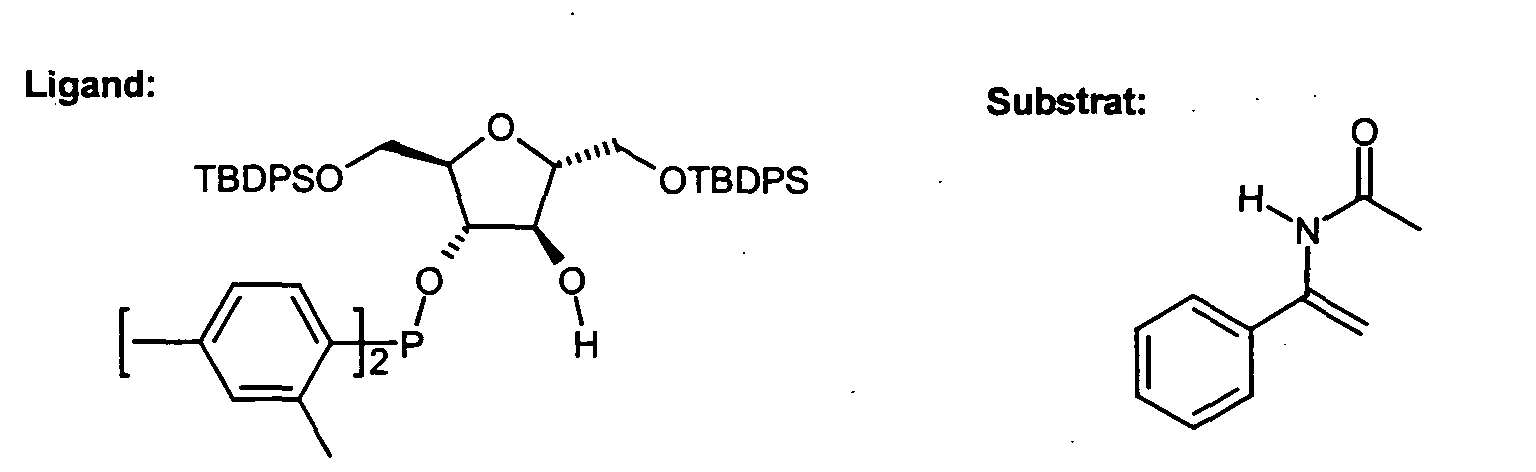
- a particularly preferred compound of the formula (I) is 2- O - (di (2,4-dimethylphenyl) phosphino) -1,6-di- O - (tert-butyldiphenylsilyl) -2,5-anhydro-D-mannitol.
- stereoisomerically enriched in the sense of the invention includes stereoisomerically pure Compounds or mixtures of stereoisomeric compounds in which one stereoisomer is in a greater relative proportion than one or the other Stereoisomers, preferably in a relative proportion of 50% to 100 mol%, particularly preferably 90 to 100 mol% and very particularly preferably 98 to 100 Mol%, is present and includes in particular enantiomerically enriched compounds to which the same definitions apply.
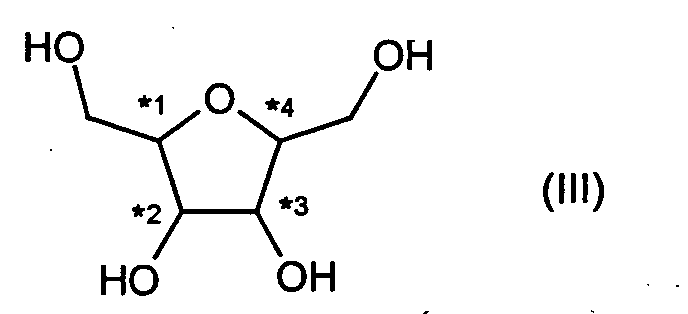
- the compounds of the formula (I) or (Ia) to (Id) can be prepared starting from the known 2,5-anhydrocyclopentoses of the formula (III).
- 2,5-anhydrocyclopentoses of the formula (III) are, for example: 2,5-anhydro-D-mannitol, 2,5-anhydro-L-mannitol, 2,5-anhydro-L-iditol, 2,5-anhydro-D iditol, 2,5-anhydro-L-glucitol, 2,5-anhydro-D-glucitol, 2,5-anhydro-altritol, 2,5-anhydro-D-altritol, 2,5-anhydro-galactitol, 2 , 5-anhydro-allitol.
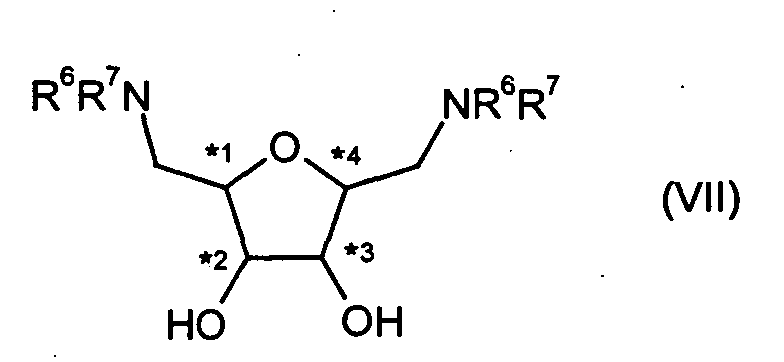
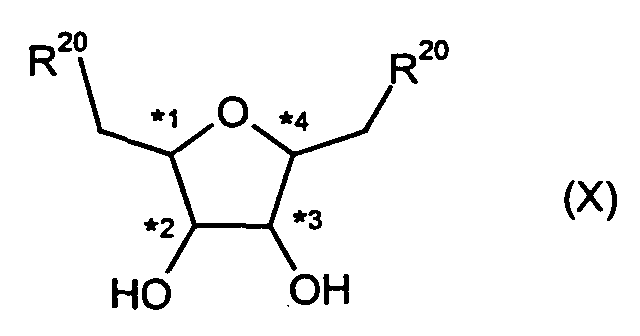
- the compounds of the formulas (V), (VII) and (X) together comprise the Compounds of formula (XI) used as intermediates for the preparation of the invention Compounds of formula (I) can be used.
- R 1 and R 2 have the same meaning and preferred ranges as described under formula (I).
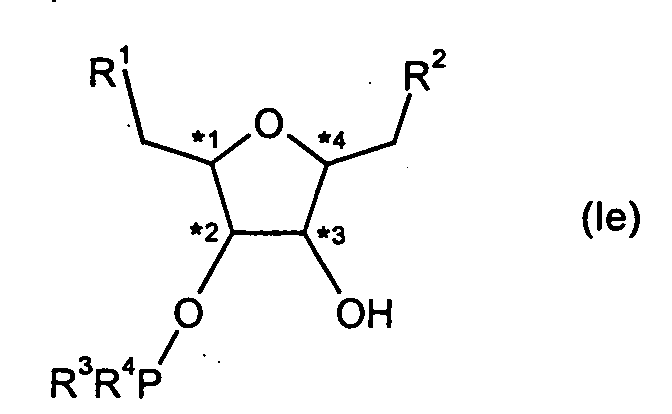
- Preferred bases are for the conversion to compounds of the formula (Ie) Amines or N-heteroaromatics such as, in particular, pyridine, for the reaction Compounds of the formula (If) carbonates, hydroxides, alcoholates, amides and Hydrides of alkali or alkaline earth metals, or amines or N-heteroaromatics such as especially pyridine.
- Suitable solvents for the reactions to give compounds of formula (Ie) for example chlorinated alkanes such as methylene chloride, aliphatic hydrocarbons such as hexane, cyclohexane, optionally chlorinated aromatic Hydrocarbons such as Chlorobenzene, toluene, pyridine, benzene, ketones such as e.g. Acetone or carboxylic acid esters such as e.g. Ethyl acetate or dialkyl ether, e.g. THF or methyl tert-butyl ether.
- Preferred solvent is methylene chloride used.
- Suitable solvents for the conversion to compounds of formula (If) basically the same solvents as for the conversion to compounds of Formula (Ie), when using strong bases such as hydroxides, alcoholates, amides and hydrides advantageously no chlorinated alkanes are used.
- the compounds of the formula (XVII) can be converted into compounds of the formula (Ib) in which R 5 is hydrogen by acidification.
- the invention further includes transition metal complexes that the invention Contain compounds of formula (I).
- Transition metal complexes are preferably those of ruthenium, osmium, cobalt, Rhodium, iridium, nickel, palladium, platinum and copper, preferably those from Ruthenium, rhodium, iridium, nickel, palladium, platinum and copper.
- the transition metal complexes according to the invention are particularly suitable as Catalysts. Therefore, the invention also includes catalysts that contain transition metal complexes according to the invention.
- transition metal complexes can be used as catalysts are used or such transition metal complexes, which by implementation of transition metal compounds and compounds of the formula (I) are available.
- Isolated transition metal complexes which contain the compounds of the formula (I) are preferably those in which the ratio of transition metal to compound of the formula (I) is 1: 2, 1: 3 or 1: 4.
- Preferred transition metal complexes are those which are obtained by reacting Transition metal compounds and compounds of formula (I) are available.
- the amount of metal in the transition metal compounds used can for example 5 to 100 mol% based on the compound of the formula used (I) are preferably 10 to 50 mol% and very particularly preferably 15 to 50 mol%.
- the catalysts which contain the transition metal complexes according to the invention are particularly suitable for use in a process for producing stereoisomerically enriched, preferably enantiomerically enriched, compounds.
- the catalysts are preferred for asymmetric 1,4-additions, asymmetric Hydroformylations, asymmetric hydrocyanations, asymmetric Heck reactions and asymmetric hydrogenations are used, especially preferred for asymmetric hydrogenations.
- the invention therefore also relates to a process for the preparation of stereoisomerically enriched, preferably enantiomerically enriched compounds by Catalytic hydrogenation of olefins, enamines, enamides, imines or ketones comprises, which is characterized in that such catalysts are used are, the transition metal complexes of compounds of formula (I) with that there specified meaning can be used.
- the amount of transition metal compound used or the amount used Transition metal complex can, for example 0.001 to 5 mol% based on that
- the substrate used is preferably 0.001 to 0.5 mol%, very particularly preferably 0.001 to 0.1 mol% and still more preferably 0.001 to 0.008 mol%.
- asymmetric hydrogenations can For example, be carried out so that the catalyst from a transition metal compound and compound of formula (I) optionally in a suitable one Solvent is generated, the substrate is added and the reaction mixture is placed under hydrogen pressure at the reaction temperature.
- Metal compounds of the general formula (XXI) are particularly preferably used for asymmetric hydrogenations as metal compounds (M (L 3 ) 2 ] to 4 where M is rhodium or iridium and L 3 and An are as defined above, or dinuclear complexes such as, for example, [Rh (1,5-cyclooctadiene) Cl] 2 , [Rh (1,5-cyclooctadiene) Br] 2 , [Rh (ethene) 2 Cl] 2 , [Rh (cyclooctene) 2 Cl] 2nd
- Particularly preferred metal compounds for asymmetric hydrogenation are [Rh (cod) 2 ] OTf, [Rh (cod) 2 ] BF 4 , [Rh (cod) 2 ] PF 6 , [Rh (nbd) 2 ] PF 6 , [Rh (nbd ) 2 ] BF 4 , and [Rh (norbornadiene) 2 ] OTf, [Ir (cod) 2 ] BF 4 and [Ir (cod) 2 PF 6 ].
- the transition metal compound and compound of the formula (I) are dissolved in degassed solvent in a heated glass autoclave.
- the mixture is stirred for about 5 minutes and then the substrate is added in degassed solvent. After the respective temperature has been set, the mixture is hydrogenated with H 2 overpressure.
- Suitable solvents for asymmetric catalysis are chlorinated alkanes such as methyl chloride, short-chain C 1 -C 6 alcohols such as methanol, isopropanol or ethanol, aromatic hydrocarbons such as toluene or benzene, ketones such as acetone or carboxylic acid esters such as ethyl acetate.
- Asymmetric catalysis is advantageous at a temperature from -20 ° C to 200 ° C, preferably 0 to 100 ° C and particularly preferably at 20 ° to 70 ° C.
- the hydrogen pressure can be, for example, 0.1 to 200 bar, preferably 0.5 to 100 bar are particularly preferably 1 to 70 bar.
- the catalysts of the invention are particularly suitable in one process for the production of stereoisomerically enriched, preferably enantiomerically enriched Active ingredients in pharmaceuticals and agrochemicals, or intermediates of these two classes.
- the advantage of the present invention is that the ligands are efficient can be produced and their electronic and steric properties are widely variable based on readily available starting materials.
- TBDMPSCl tert- butyldiphenylsilyl chloride
Landscapes
- Chemical & Material Sciences (AREA)
- Organic Chemistry (AREA)
- Health & Medical Sciences (AREA)
- Life Sciences & Earth Sciences (AREA)
- Biochemistry (AREA)
- General Health & Medical Sciences (AREA)
- Molecular Biology (AREA)
- Organic Low-Molecular-Weight Compounds And Preparation Thereof (AREA)
- Catalysts (AREA)
Abstract
Description

- *1, *2, *3 und *4 jeweils unabhängig voneinander ein stereogenes Kohlenstoffatom markieren, das in R- oder S- Konfiguration vorliegt,
- X fehlt oder für Sauerstoff steht und
- R1 und R2 jeweils unabhängig voneinander stehen können für: Wasserstoff,
C1-C20-Alkyl, C1-C20-Fluoralkyl, C2-C20-Alkenyl, C4-C24-Aryl, C5-C25-Arylalkyl,
C6-C26-Arylalkenyl oder NR6R7, OR7, -(C1-C8-Alkyl)-OR7, -(C1-C8-Alkyl)-NR6R7
oder -O2CR7,
wobei R6 und R7 jeweils unabhängig voneinander für C1-C8-Alkyl, C5-C15-Arylalkyl oder C4-C14-Aryl stehen oder R6 und R7 zusammen für einen cyclischen Aminorest mit insgesamt 4 bis 20 Kohlenstoffatomen steht,
oder R1 und R2 jeweils unabhängig voneinander für Reste der Formel (IIa) stehen
R8 fehlt, für Sauerstoff oder Methylen steht und
R9, R10 und R" jeweils unabhängig voneinander für C1-C12-Alkyl, C5-C15-Arylalkyl oder C4-C14-Aryl stehen und - R3 und R4 jeweils unabhängig voneinander für R12, OR13 oder NR14R15 stehen, wobei R12, R13, R14 und R15 jeweils unabhängig für C1-C12-Alkyl, C5-C15-Arylalkyl oder C4-C14-Aryl stehen oder NR14R15 zusammen für einen cyclischen Aminorest mit 4 bis 20 Kohlenstoffatomen steht oder R3 und R4 zusammen für -O-R16-O- stehen, wobei R16 für Reste steht, die ausgewählt sind aus der Gruppe C2-C4-Alkylen, 1,2-Phenylen, 1,3-Phenylen, 1,2-Cyclohexylen, 1,1'-Ferrocenylen, 1,2-Ferrocenylen, 2,2'-(1,1'-Binaphtylen), 2,2'-(1,1')-Biphenylen und 1,1'-(Diphenyl-2,2'-methylen)-diyl, wobei die genannten Reste gegebenenfalls einfach oder mehrfach durch Reste substituiert sein können, die ausgewählt sind aus der Gruppe Fluor, Chlor, C1-C8-Alkoxy und C1-C8-Alkyl und
- R5 für Wasserstoff, C1-C20-Alkyl, C4-C24-Aryl, C5-C25-Arylalkyl, C1-C20-Halogenalkyl
oder für Reste der Formel (IIb) steht
- A
- fehlt oder für C1-C12-Alkylen steht
- B
- für Funktionalitäten steht, die ausgewählt sind aus der Gruppe

- R17
- für C1-C20-Alkyl, C4-C24-Aryl, C5-C25-Arylalkyl steht und
- D
- für C1-C8-Alkyl, C4-C24-Aryl oder C5-C25-Arylalkyl steht oder
- B und D
- für den Fall, dass A nicht fehlt zusammen für Cyano oder [(C1-C8-Alkylen)-O]n-(C1-C8-Alkyl) stehen können, wobei n eine ganze Zahl zwischen 1 und 8 ist oder
- R17 und D
- zusammen für einen cyclischen Aminorest mit 4 bis 12 Kohlenstoffatomen stehen.
*1,*2,*3,*4 definieren zusammen folgende Stereoisomere des zentralen substituierten Furanringes:
(1R,2R,3R,4R), (1R,2R,3R,4S), (1R,2R,3S,4S), (1R,2S,3S,4S), (1R,2S,3R,4S), (1R,2S,3S,4R), (1R,2R,3S,4R), (1S,2S,3R,4S), (1S,2S,3S,4S), (1S,2S,3S,4R), (1S,2S,3R,4R), (1S,2R,3R,4R), (1S,2R,3S,4R), (1S,2R,3R,4S), (1S,2S,3R,4S), (1R,2R,3S,4R), bevorzugt (1R,2R,3R,4R), (1R,2R,3R,4S), (1R,2S,3S,4S), (1R,2S,3S,4R), (1R,2R,3S,4R), (1S,2S,3R,4S), (1S,2S,3S,4S), (1S,2S,3S,4R), (1S,2R,3R,4R), (1S,2R,3R,4S), (1S,2S,3R,4S), (1R,2R,3S,4R).
- R1 und R2
- stehen bevorzugt jeweils unabhängig voneinander für Wasserstoff, C1-C4-Alkyl, C4-C14-Aryl, O-R7, O2C-R7, wobei R7 vorzugsweise für C1-C12-Alkyl, C5-C25-Arylalkyl oder C4-C14-Aryl steht, oder OSiR9R10R11, wobei R9, R10, und R11 vorzugsweise jeweils unabhängig für C1-C12-Alkyl oder C4-C14-Aryl stehen.
- R1 und R2
- stehen besonders bevorzugt jeweils unabhängig voneinander für Wasserstoff, tert.-Butoxy, Trityloxy, tert-Butyldimethylsilyloxy, tert-Butyldiphenylsilyloxy, Trimethylsilyloxy, Triethylsilyloxy, Triisopropylsilyloxy, neo-Pentoxy oder 1-Adamantoxy.
- R3 und R4
- stehen bevorzugt jeweils unabhängig voneinander für R12, OR13 oder NR14 R15, wobei R12, R13, R14 und R15 jeweils unabhängig für C1-C12-Alkyl oder C4-C14-Aryl stehen oder NR14R15 zusammen für einen cyclischen Aminorest mit 4 bis 12 Kohlenstoffatomen wie zum Beispiel Pyrrolidinyl oder Piperidinyl steht oder R3 und R4 zusammen für -O-R16-O- stehen, wobei R16 für Ethylen, 1,2-Phenylen, 1,3-Phenylen, 1,2-Cyclohexylen, 1,1'-Ferrocenylen, zweifach oder vierfach durch C1-C8-Alkyl substituiertes 1,1'-(Diphenyl-2,2'-methylen)-diyl, 1,2-Ferrocenylen, 2,2'-(1,1'-Binaphtylen) oder 2,2'-(1,1')-Biphenylen steht, wobei 2,2'-(1,1'-Binaphtylen) oder 2,2'-(1,1')-Biphenylen zumindest in 6,6'-Position durch Reste substituiert ist, die ausgewählt sind aus der Gruppe C1-C8-Alkoxy und C1-C8-Alkyl und weiterhin in 5,5'-,4,4'-, 3,3'- oder 2,2'-Position durch Reste substituiert sein kann, die ausgewählt sind aus der Gruppe Fluor, Chlor, C1-C8-Alkoxy und C1-C8-Alkyl.
- R3 und R4
- stehen besonders bevorzugt jeweils unabhängig voneinander für R12, OR13 oder NR14R15, wobei R12 und R13 jeweils unabhängig steht für Methyl, Ethyl, n-Propyl, iso-Propyl, tert.-Butyl, Cyclohexyl, Phenyl, 2-(C1-C8)-alkylphenyl wie o-Tolyl, 3-(C1-C8)-alkylphenyl wie m-Tolyl, 4-(C1-C8)-alkylphenyl wie p-Tolyl, 2,6-Di-(C1-C8)-alkylphenyl wie 2,6-Dimethylphenyl, 2,4-Di-(C1-C8)-alkylphenyl wie 2,4-Dimethylphenyl, 3,5-Di-(C1-C8)-alkylphenyl wie 3,5-Dimethylphenyl, 3,4,5-Tri-(C1-C8)-alkylphenyl wie Mesityl und Isityl, 2-(C1-C8)-Alkoxyphenyl wie o-Anisyl und o-Phenetyl, 3-(C1-C8)-Alkoxyphenyl wie m-Anisyl und m-Phenetyl, 4-(C1-C8)-Alkoxyphenyl wie p-Anisyl und p-Phenetyl, 2,4-Di-(C1-C8)-alkoxyphenyl wie 2,4-Dimethoxyphenyl, 2,6-Di-(C1-C8)-alkoxyphenyl wie 2,6-Dimethoxyphenyl, 3,5-Di-(C1-C8)-Alkoxyphenyl wie 3,5-Dimethoxyphenyl, 3,4,5-Tri-(C1-C8)-alkoxyphenyl wie 3,4,5-Trimethoxyphenyl, 3,5-Dialkyl-4-(C1-C8)-alkoxyphenyl wie 3,5-Dimethyl-4-anisyl, 3,5-(C1-C8)-Dialkyl-4-di-(C1-C8)-alkylaminophenyl, 3,5-Dimethyl-4-dimethylamino-phenyl, 4-Di-(C1-C8)-alkylaminophenyl wie 4-Diethylaminophenyl und 4-Dimethylaminophenyl, 3,5-Bis-[(C1-C4)-fluoralkyl]phenyl wie 3,5-Bis-trifluormethylphenyl, 2,4-Bis-[(C1-C4)-fluoralkyl]phenyl wie 2,4-Bis-trifluormethylphenyl, 4-[(C1-C4)-Fluoralkyl]phenyl wie 4-Trifluormethylphenyl und ein-, zwei- drei-, vier- oder fünffach durch Fluor und/oder Chlor substituiertes Phenyl, Fluorenyl oder Naphthyl wie 4-Fluorphenyl und 4-Chlorphenyl und NR14R15 als Ganzes für Dimethylamino, Diethylamino, Pyrrolidino oder Diisopropylamino steht. Weiterhin stehen besonders bevorzugt R3 und R4 paarweise für O-R16-O, wobei R16 für 1,1'-Bis-(4,6-di-(C1-C8-Alkyl)-phenyl)-2,2'-methylen)-diyl wie insbesondere 1,1'-Bis-(4-methyl-6-tert.-butyl-phenyl-2,2'-methylen)-diyl und 1,1'-Bis-(4-methyl-6-(1-methylcyclohexyl)-phenyl-2,2'-methylen)-diyl steht oder wobei R16 für (R)-1,1'-Biphenyl-2,2'-diyl, (S)-1,1'-Biphenyl-2,2'-diyl, (R)-1,1'-Binaphthyl-2,2'diyl, (S)-1,1'-Binaphthyl-2,2'-diyl, 1,1'-[Bis-(4-methyl-6-tert.-butyl-phenyl)-2,2'-methylen)]-diyl oder 1,1'-[Bis-(4-methyl-6-(1-methylcyclohexyl)-2,2'methylen)]-diyl steht.
- R3 und R4
- stehen ganz besonders bevorzugt identisch für 2,4-Dimethylphenyl.
- R5
- steht bevorzugt für Wasserstoff, C1-C4-Alkyl, -CO(C1-C4-Alkyl), Benzyl-COPhenyl oder Phenyl, wobei Benzyl oder Phenyl gegebenenfalls einfach, zweifach oder dreifach durch Substituenten weiter substituiert sein kann, die ausgewählt sind aus der Gruppe C1-C4-Alkyl, C1-C4-Alkoxy oder C1-C4-Halogenalkyl.
- R5
- steht besonders bevorzugt für Wasserstoff, Methyl oder Ethyl.


- R19
- für C1-C12-Alkyl, C1-C12-Fluoralkyl, C5-C25-Arylalkyl oder C4-C24-Aryl steht
Hal für Chlor, Brom oder Iod steht
in Verbindungen der Formel (V) überfuhrt werden,

- R18
- jeweils unabhängig voneinander die unter der Formel (IV) genannte Bedeutung besitzt.
- R7und R8
- jeweils unabhängig voneinander die unter der Formel (I) angegebenen
Bedeutungen und Vorzugsbereiche besitzen in Verbindungen der Formel
(VII) überführt werden,
in der
- R6 und R7
- jeweils unabhängig voneinander die unter der Formel (IV) genannte Bedeutung besitzen.
- Met1
- für Lithium, Natrium oder Kalium, bevorzugt für Lithium,
- R20
- für Wasserstoff
- n
- für 1, 2, 3 oder 4, bevorzugt für 4 und
- R21
- für C1-C4-Alkyl steht
- R20
- für C1-C20-Alkyl, C1-C20-Fluoralkyl, C2-C20-Alkenyl, C4-C24-Aryl, C5-C25-Arylalkyl,
C6-C26-Arylalkenyl, -(C1-C8-Alkyl)-OR8, -(C1-C8-Alkyl)-NR7R8
oder (z.B. als cyclisches Acetal) geschütztes -(C1-C8-Alkyl)-CO-R8 steht zu
Verbindungen der Formel (X) umgesetzt werden,
in der
- R20
- die unter den Formeln (VIII) und (IX) angegebene Bedeutung besitzt.

- R3 und R4
- die gleiche Bedeutung und Vorzugsbereiche besitzen die unter der Formel (I) angegeben sind und
- Y
- für Chlor, Brom, Iod, Dimethylamino oder Diethylamino, vorzugsweise für Chlor steht,
- R1, R2, R3 und R4
- die gleiche Bedeutung und Vorzugsbereiche besitzen, wie sie unter der Formel (I) beschrieben sind.
- R5
- die gleichen Bedeutungen und Vorzugsbereiche besitzen, die unter der Formel (I) angegeben sind und
- Z
- für Chlor, Brom, Iod oder R19SO3 steht und im Falle dass R5 über eine Carbonylgruppe gebunden sein soll, auch für R5O- stehen kann

- R1, R2, R3, R4, und R6
- die gleichen Bedeutungen und Vorzugsbereiche besitzen, die unter der Formel (I) angegeben sind und R5 nicht für Wasserstoff steht.
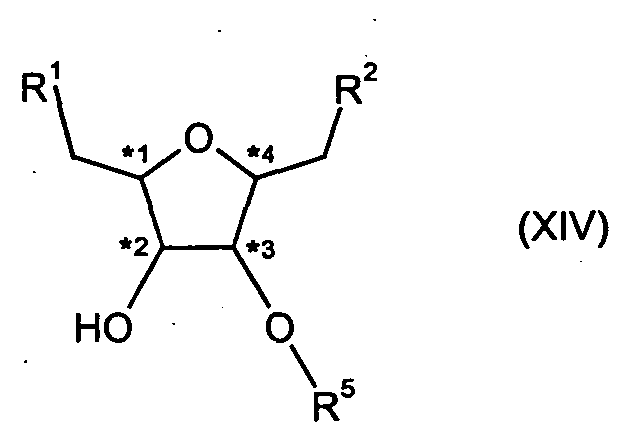
- R1, R2, R3, R4, und R6
- die gleichen Bedeutungen und Vorzugsbereiche besitzen, die unter der Formel (I) angegeben sind und R5 nicht für Wasserstoff steht und die Verbindungen der Formel (XIV) dann mit Verbindungen der Formel (XII) zu Verbindungen der Formel (If) umsetzt.
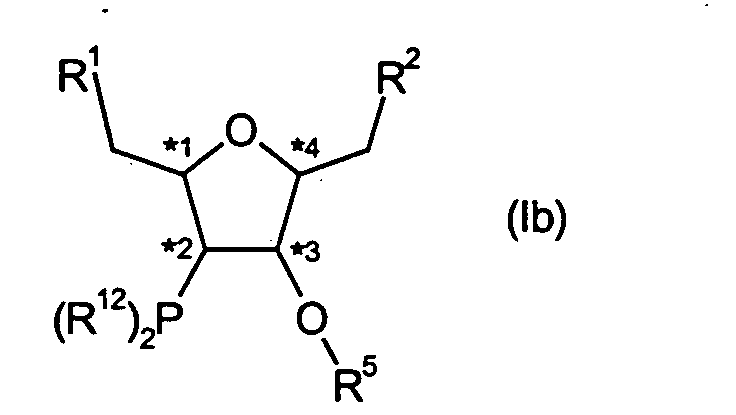
- R1, R2, R5, R6 und R12
- die unter der Formel (I) angegebenen Bedeutungen und
Vorzugsbereiche besitzen durch ein erfindungsgemäßes Verfahren dadurch
hergestellt werden, dass Verbindungen der Formel (XV)

- R1 und R2
- die unter der Formel (I) genannte Bedeutung und Vorzugsbereiche besitzen in Gegenwart von Verbindungen der Formel (XVI),
- Met2
- für Lithium, Natrium oder Kalium steht und
- R12
- die unter der Formel (I) genannte Bedeutung und Vorzugsbereiche besitzt

R1, R2, Met2 und R12 die vorstehend genannte Bedeutung besitzen
und die Verbindungen der Formel (XVII) mit Verbindungen der Formel (XIII) mit der dort angegebenen Bedeutung zu Verbindungen der Formel (Ib) umsetzt.


- R1 und R2
- die unter der Formel (I) genannte Bedeutung und Vorzugsbereiche besitzt und R19 die unter der Formel (IV) genannte Bedeutung und Vorzugsbereiche besitzt und die Verbindungen der Formel (XVIII) dann mit Phosphiden der Formel (XVI) umsetzt.
- (I)
- für Verbindungen der Formel (I) mit der dort genannten Bedeutung und deren Vorzugsbereichen steht und
- M
- für Rhodium oder Iridium steht.
- M
- für Rhodium, Iridium, Ruthenium, Nickel, Palladium, Platin oder Kupfer und
- An1
- für Chlorid, Bromid, Acetat, Nitrat, Methansulfonat, Trifluormethansulfonat oder Acetylacetonat und
- q
- für Rhodium, Iridium und Ruthenium für 3, für Nickel, Palladium und Platin für 2 und für Kupfer für 1 steht,
- M
- für Ruthenium, Iridium, Ruthenium, Nickel, Palladium, Platin oder Kupfer und
- An2
- für Chlorid, Bromid, Acetat, Methansulfonat oder Trifluormethansulfonat, Tetrafluoroborat oder Hexafluorophosphat, Perchlorat, Hexafluoroantimonat, Tetra(bis-3,5-trifluoromethylphenyl)-borat oder Tetraphenylborat steht und
- q
- für Rhodium und Iridium für 1, für Ruthenium, Nickel, Palladium und Platin für 2 und für Kupfer für 1 steht,
- L1
- jeweils für ein C2-C12-Alken wie beispielsweise Ethylen oder Cycloocten oder ein Nitril wie beispielsweise Acetonitril, Benzonitril oder Benzylnitril steht, oder
- L1 2
- zusammen für ein (C4-C12)-Dien wie beispielsweise Bicyclo[2.1.1]hepta-2,5-dien (Norbomadien) oder 1,5-Cyclooctadien steht
- M.
- für Ruthenium und
- L2
- für Arylreste wie zum Beispiel Cymol, Mesityl, Phenyl oder Cyclooctadien, Norbornadien oder Methylallyl steht
- M
- für Palladium, Nickel, Iridium oder Rhodium und
- An3
- für Chlorid oder Bromid steht und
- Met3
- für Lithium, Natrium, Kalium, Ammonium oder organisches Ammonium steht und
- q
- für Rhodium und Iridium für 3, für Nickel, Palladium und Platin für 2 steht,
- M
- für Iridium oder Rhodium und
- L3
- für (C4-C12)-Dien wie beispielsweise Bicyclo[2.1.1]hepta-2,5-dien (Norbornadien) oder 1,5-Cyclooctadien steht und
- An4
- für ein nicht oder schwach koordinierendes Anion wie zum Beispiel Methansulfonat, Trifluormethansulfonat, Tetrafluoroborat, Hexafluorophosphat, Perchlorat, Hexafluoroantimonat, Tetra(bis-3,5-trifluromethylphenyl)-borat oder Tetraphenylborat steht.
[Rh(cod)Cl]2, [Rh(cod)Br]2, [Rh(cod)2]ClO4, [Rh(cod)2]BF4, [Rh(cod)2]PF4, [Rh(cod)2]ClO6, [Rh(cod)2]OTf, [Rh(cod)2]BAr4 (Ar = 3,5-bistrifluormethylphenyl), [Rh(cod)2]SbF6, RuCl2(cod), [(Cymol)RuCl2]2, [(Benzol)RuCl2]2, [(Mesityl)RuCl2]2, [(Cymol)RuBr2]2, [(Cymol)RuI2]2, [(Cymol)Ru(BF4)2]2, [(Cymol)Ru(PF6)2]2, [(Cymol)Ru(BAr4)2]2 (Ar = 3,5-bistrifluormethylphenyl), [(Cymol)Ru(SbF6)2]2, [Ir(cod)Cl]2, [Ir(cod)2]PF6, [Ir(cod)2]ClO4, [Ir(cod)2]SbF6, [Ir(cod)2]BF4, [Ir(cod)2]OTf, [Ir(cod)2]BAr4 (Ar = 3,5-bistrifluormethylphenyl), RuCl3, NiCl3, RhCl3, PdCl2, PdBr2, Pd(OAc)2, Pd2(dibenzylidenaceton)3, Pd(acetylacetonat)2, CuOTf, CuI, CuCl, Cu(OTf)2, CuBr, CuI, CuBr2, CuCl2, CuI2, [Rh(nbd)Cl]2, [Rh(nbd)Br]2, [Rh(nbd)2]ClO4, [Rh(nbd)2]BF4, [Rh(nbd)2]PF6, [Rh(nbd)2]OTf, [Rh(nbd)2]BAr4 (Ar = 3,5-bistrifluormethylphenyl), [Rh(nbd)2]SbF6, RuCl2(nbd), [Ir(nbd)2]PF6, [Ir(nbd)2]ClO4, [Ir(nbd)2]SbF6, [Ir(nbd)2]BF4, [Ir(nbd)2]OTf, [Ir(nbd)2]BAr4 (Ar = 3,5-bistrifluormethylphenyl), Ir(pyridin)2(nbd), [Ru(DMSO)4Cl2], [Ru(CH3CN)4Cl2], [Ru(PhCN)4Cl2], [Ru(cod)Cl2]n, [Ru(cod)4(Methallyl)2], [Ru(acetylacetonat)3]
oder zweikernige Komplexe wie zum Beispiel [Rh(1,5-cyclooctadien)Cl]2, [Rh(1,5-cyclooctadien)Br]2, [Rh(Ethen)2Cl]2, [Rh(Cycloocten)2Cl]2.


| Beispiel | mol % Ligand | Metallprecursor | mol % Metallpre- cursor | T (°C) | P (bar) | Zeit (h) | Umsatz (%) | ee (%) |
| 3 | 2.7 | [Rh(nbd)2]PF6 | 1 | 25 | 3.5 | 16 | 96 | 18 |
| 4 | 2.7 | [Rh(cod)Cl2]2 | 0.5 | 25 | 30 | 24 | 100 | 83 |
Claims (27)
- Verbindungen der Formel (I),in der
 wobei*1, *2, *3 und *4 jeweils unabhängig voneinander ein stereogenes Kohlenstoffatom markieren, das in R- oder S- Konfiguration vorliegt,X fehlt oder für Sauerstoff steht undR1 und R2 jeweils unabhängig voneinander stehen können für: Wasserstoff, C1-C20-Alkyl, C1-C20-Fluoralkyl, C2-C20-Alkenyl, C4-C24-Aryl, C5-C25-Arylalkyl, C6-C26-Arylalkenyl oder NR6R7, OR7, -(C1-C8-Alkyl)-OR7, -(C1-C8-Alkyl)-NR6R7 oder -O2CR7,
wobei R6 und R7 jeweils unabhängig voneinander für C1-C8-Alkyl, C5-C15-Arylalkyl oder C4-C14-Aryl stehen oder R6 und R7 zusammen für einen cyclischen Aminorest mit insgesamt 4 bis 20 Kohlenstoffatomen steht,
oder R1 und R2 jeweils unabhängig voneinander für Reste der Formel (IIa) stehen- R8
- fehlt, für Sauerstoff oder Methylen steht und
- R9, R10 und R11
- jeweils unabhängig voneinander für C1-C12-Alkyl, C5-C15-Arylalkyl oder C4-C14-Aryl stehen und
R3 und R4 jeweils unabhängig voneinander für R12, OR13 oder NR14R15 stehen, wobei R12, R13, R14 und R15 jeweils unabhängig für C1-C12-Alkyl, C5-C15-Arylalkyl oder C4-C14-Aryl stehen oder NR14R15 zusammen für einen cyclischen Aminorest mit 4 bis 20 Kohlenstoffatomen steht oder R3 und R4 zusammen für -O-R16-Ostehen, wobei R16 für Reste steht, die ausgewählt, sind aus der Gruppe C2-C4-Alkylen, 1,2-Phenylen, 1,3-Phenylen, 1,2-Cyclohexylen, 1,1'-Ferrocenylen, 1,2-Ferrocenylen, 2,2'-(1,1'-Binaphtylen), 2,2'-(1,1')-Biphenylen und 1,1'-(Diphenyl-2,2'-methylen)-diyl, wobei die genannten Reste gegebenenfalls einfach oder mehrfach durch Reste substituiert sein können, die ausgewählt sind aus der Gruppe Fluor, Chlor, C1-C8-Alkoxy und C1-C8-Alkyl undR5 für Wasserstoff, C1-C20-Alkyl, C4-C24-Aryl, C5-C25-Arylalkyl, C1-C20-Halogenalkyl oder für Reste der Formel (IIb) steht- A
- fehlt oder für C1-C12-Alkylen steht
- B
- für Funktionalitäten steht, die ausgewählt sind aus der Gruppe

- R17
- für C1-C20-Alkyl, C4-C24-Aryl, C5-C25-Arylalkyl stehen kann
und - D
- für C1-C8-Alkyl, C4-C24-Aryl oder C5-C25-Arylalkyl steht oder
- B und D
- für den Fall, dass A nicht fehlt zusammen für Cyano oder [(C1-C8-Alkylen)-O]n-(C1-C8-Alkyl) stehen können, wobei n eine ganze Zahl zwischen 1 und 8 ist oder
- R17 und D
- zusammen für einen cyclischen Aminorest mit 4 bis 12 Kohlenstoffatomen stehen.
- Verbindungen gemäß Anspruch 1, dadurch gekennzeichnet, dass *1, *2, *3 und *4 zusammen folgende Stereoisomere des zentralen substituierten Furanringes definieren:
(1R,2R,3R,4R), (1R,2R,3R,4S), (1R,2S,3S,4S), (1R,2S,3S,4R), (1R,2R,3S,4R), (1S,2S,3R,4S), (1S,2S,3S,4S), (1S,2S,3S,4R), (1S,2R,3R,4R), (1S,2R,3R,4S), (1S,2S,3R,4S), (1R,2R,3S,4R). - Verbindungen gemäß mindestens einem der Ansprüche 1 und 2, dadurch gekennzeichnet, dass R1 und R2 jeweils unabhängig voneinander für Wasserstoff, tert.-Butoxy, Trityloxy, tert-Butyldimethylsilyloxy, tert-Butyldiphenylsilyloxy, Trimethylsilyloxy, Triethylsilyloxy, Triisopropylsilyloxy, neo-Pentoxy oder 1-Adamantoxy stehen.
- Verbindungen gemäß mindestens einem der Ansprüche 1 bis 3, dadurch gekennzeichnet, dass R1 und R2 identisch sind.
- Verbindungen gemäß mindestens einem der Ansprüche 1 bis 4, dadurch gekennzeichnet, dass R3 und R4 jeweils unabhängig voneinander für R12, OR13 oder NR14R15 stehen , wobei R12, R13, R14 und R15 jeweils unabhängig für C1-C12-Alkyl oder C4-C14-Aryl stehen oder NR14R15 zusammen für einen cyclischen Aminorest mit 4 bis 12 Kohlenstoffatomen wie zum Beispiel Pyrrolidinyl oder Piperidinyl steht oder R3 und R4 zusammen für -O-R16-Ostehen, wobei R16 für Ethylen, 1,2-Phenylen, 1,3-Phenylen, 1,2-Cyclohexylen, 1,1'-Ferrocenylen, zweifach oder vierfach durch C1-C8-Alkyl substituiertes 1,1'-(Diphenyl-2,2'-methylen)-diyl, 1,2-Ferrocenylen, 2,2'-(1,1'-Binaphtylen) oder 2,2'-(1,1')-Biphenylen steht, wobei 2,2'-(1,1'-Binaphtylen) oder 2,2'-(1,1')-Biphenylen zumindest in 6,6'-Position durch Reste substituiert ist, die ausgewählt sind aus der Gruppe C1-C8-Alkoxy und C1-C8-Alkyl und weiterhin in 5,5'-,4,4'-, 3,3'- oder 2,2'-Position durch Reste substituiert sein kann, die ausgewählt sind aus der Gruppe Fluor, Chlor, C1-C8-Alkoxy und C1-C8-Alkyl.
- Verbindungen gemäß mindestens einem der Ansprüche 1 bis 5, dadurch gekennzeichnet, dass R5 für Wasserstoff, C1-C4-Alkyl, -CO(C1-C4-Alkyl), Benzyl-COPhenyl oder Phenyl steht, wobei Benzyl oder Phenyl gegebenenfalls einfach, zweifach oder dreifach durch Substituenten weiter substituiert sein kann, die ausgewählt sind aus der Gruppe C1-C4-Alkyl, C1-C4-Alkoxy oder C1-C4-Halogenalkyl.
- Verbindungen gemäß mindestens einem der Ansprüche 1 bis 6, dadurch gekennzeichnet, dass sie den Formeln (Ia) bis (Id) gehorchen
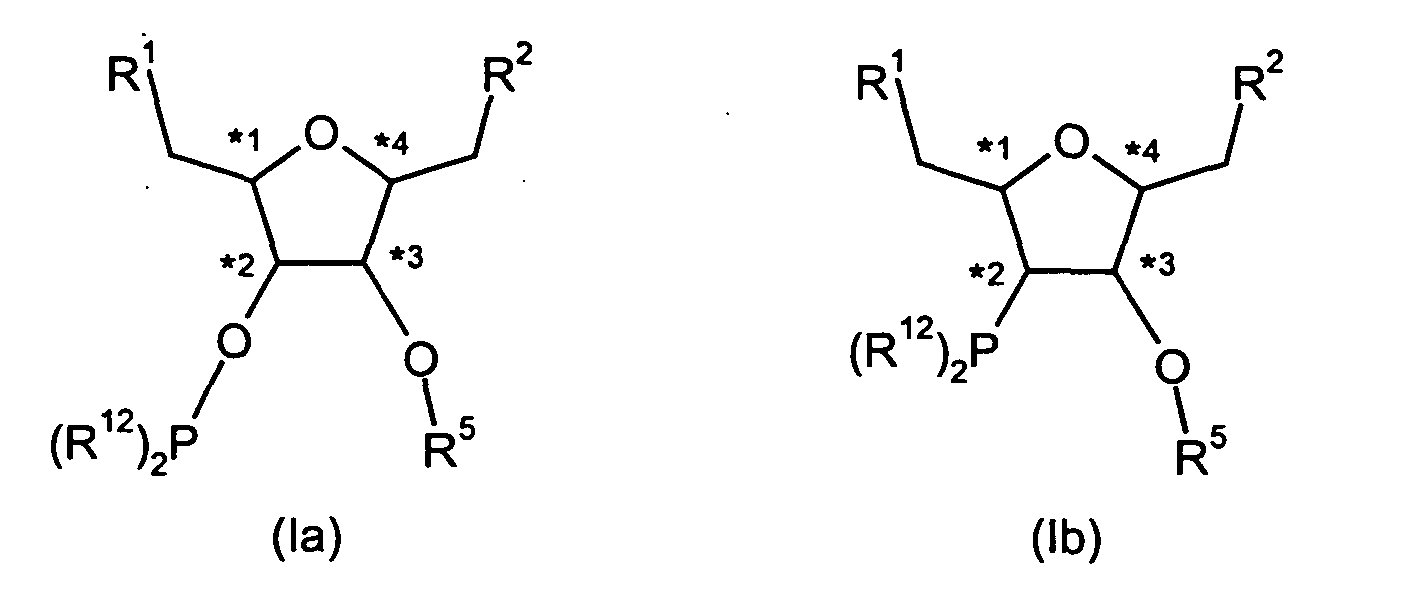 in denen *1,*2,*3,*4,R1, R2, R5, R12, R13, R14 und R15 die unter der Formel (I) genannte Bedeutung besitzen.
- 2-O-(Di(2,4-dimethylphenyl)phosphino)-1,6-di-O-(tert-butyldiphenylsilyl)-2,5-anhydro-D-mannit.
- Verfahren zur Herstellung von Verbindungen der Formel (Ib)in der

- R1, R2, R5, R6 und R12
- die unter der Formel (I) in Anspruch 1 angegebenen
Bedeutungen besitzen, dadurch gekennzeichnet, dass Verbindungen
der Formel (XV)
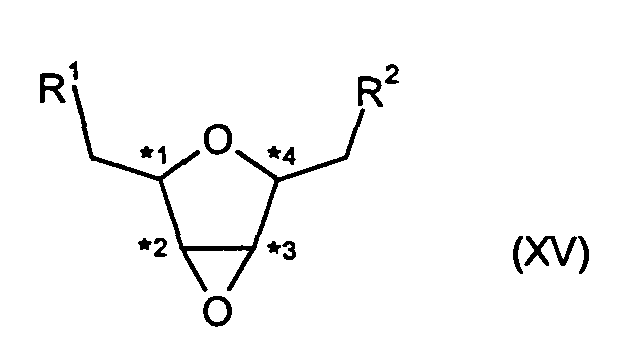
- R1 und R2
- die unter der Formel (I) genannte Bedeutung besitzen in Gegenwart von Verbindungen der Formel (XVI),
- Met2
- für Lithium, Natrium oder Kalium steht und
- R12
- die unter der Formel (I) genannte Bedeutung und Vorzugsbereiche besitzt
in der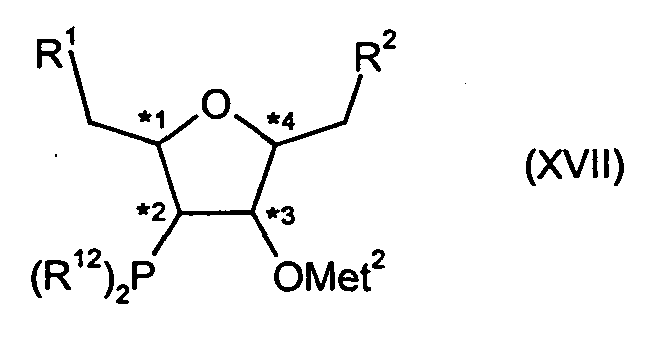
R', R2, Met2 und R12 die vorstehend genannte Bedeutung besitzen
und die Verbindungen der Formel (XVII) mit Verbindungen der Formel (XIII) umsetzt,- R5
- die gleichen Bedeutungen und Vorzugsbereiche besitzen, die unter der Formel (I) angegeben sind und
- Z
- für Chlor, Brom, Iod oder R19SO3 steht, wobei R19 für C1-C12-Alkyl, C1-C12-Halogenalkyl, C5-C25-Arylalkyl oder C4-C24-Aryl steht und im Falle dass R5 über eine Carbonylgruppe gebunden sein soll, auch für R5O- stehen kann.
- Übergangsmetallkomplexe enthaltend Verbindungen gemäß einem oder mehreren der Ansprüche 1 bis 8.
- Übergangsmetallkomplexe gemäß Anspruch 10, dadurch gekennzeichnet, dass das Übergangsmetall ausgewählt ist aus der Gruppe Ruthenium, Osmium, Cobalt, Rhodium, Iridium, Nickel, Palladium, Platin und Kupfer.
- Übergangsmetallkomplexe gemäß mindestens einem der Ansprüche 10 bis 11, dadurch gekennzeichnet, dass das molare Verhältnis von Übergangsmetall zu Verbindungen gemäß mindestens einem der Ansprüche 1 bis 8 1:2, 1:3 oder 1:4 beträgt.
- Übergangsmetallkomplexe gemäß mindestens einem der Ansprüche 10 bis 11, dadurch gekennzeichnet, dass sie der Formel (XIX) gehorchen
- (I)
- für Verbindungen der Formel (I) mit der in Anspruch 1 genannten Bedeutung und
- M
- für Rhodium oder Iridium steht.
- Übergangsmetallkomplexe gemäß mindestens einem der Ansprüche 10 bis 11, dadurch gekennzeichnet, dass sie durch Umsetzung von Übergangsmetallverbindungen und Verbindungen gemäß mindestens einem der Ansprüche 1 bis 8 gewonnen werden.
- Übergangsmetallkomplexe gemäß Anspruch 14, dadurch gekennzeichnet, dass als Übergangsmetallverbindungen eingesetzt werden:in derÜbergangsmetallverbindungen der Formel (XXa)
- M
- für Rhodium, Iridium, Ruthenium, Nickel, Palladium, Platin oder Kupfer und
- An1
- für Chlorid, Bromid, Acetat, Nitrat, Methansulfonat, Trifluormethansulfonat oder Acetylacetonat und
- q
- für Rhodium, Iridium und Ruthenium für 3, für Nickel, Palladium und Platin für 2 und für Kupfer für 1 steht,
- M
- für Ruthenium, Iridium, Ruthenium, Nickel, Palladium, Platin oder Kupfer und
- An2
- für Chlorid, Bromid, Acetat, Methansulfonat oder Trifluormethansulfonat, Tetrafluoroborat oder Hexafluorophosphat, Perchlorat, Hexafluoroantimonat, Tetra(bis-3,5-trifluoromethylphenyl)-borat oder Tetraphenylborat steht und
- q
- für Rhodium und Iridium für 1, für Ruthenium, Nickel, Palladium und Platin für 2 und für Kupfer für 1 steht,
- L1
- jeweils für ein C2-C12-Alken wie beispielsweise Ethylen oder Cycloocten oder ein Nitril wie beispielsweise Acetonitril, Benzonitril oder Benzylnitril steht, oder
- L1 2
- zusammen für ein (C4-C12)-Dien wie beispielsweise Bicyclo[2.1.1]hepta-2,5-dien (Norbomadien) oder 1,5-Cyclooctadien steht
- M
- für Ruthenium und
- L2
- für Arylreste wie zum Beispiel Cymol, Mesityl, Phenyl oder Cyclooctadien, Norbomadien oder Methylallyl steht
- M
- für Palladium, Nickel, Iridium oder Rhodium und
- An3
- für Chlorid oder Bromid steht und
- Met3
- für Lithium, Natrium, Kalium, Ammonium oder organisches Ammonium steht und
- q
- für Rhodium und Iridium für 3, für Nickel, Palladium und Platin für 2 steht,
- M
- für Iridium oder Rhodium und
- L3
- für (C4-C12)-Dien wie beispielsweise Bicyclo[2.1.1]hepta-2,5-dien (Norbomadien) oder 1,5-Cyclooctadien steht und
- An4
- für ein nicht oder schwach koordinierendes Anion wie zum Beispiel Methansulfonat, Trifluormethansulfonat, Tetrafluoroborat, Hexafluorophosphat, Perchlorat, Hexafluoroantimonat, Tetra(bis-3,5-trifluoromethylphenyl)-borat oder Tetraphenylborat steht,
- Übergangsmetallkomplexe gemäß mindestens einem der Ansprüche 14 bis 15, dadurch gekennzeichnet, dass die Menge des Metalls in den eingesetzten Übergangsmetallverbindungen 5 bis 100 mol-% bezogen auf die eingesetzte Verbindung gemäß mindestens einem der Ansprüche 1 bis 8 beträgt.
- Katalysatoren enthaltend Übergangsmetallkomplexe gemäß mindestens einem der Ansprüche 10 bis 16.
- Verwendung von Übergangsmetallkomplexen gemäß einem oder mehreren der Ansprüche 10 bis 16 oder Katalysatoren gemäß Anspruch 17 zur Herstellung von stereoisomerenangereicherten Verbindungen.
- Verwendung gemäß Anspruch 18, dadurch gekennzeichnet, dass die stereoisomerenangereicherte Verbindungen durch asymmetrische 1,4-Additionen, asymmetrische Hydroformylierungen, asymmetrische Hydrocyanierungen, asymmetrische Heck-Reaktionen und asymmetrische Hydrogenierungen erhalten werden.
- Verwendung gemäß einem oder mehreren der Ansprüche 18 und 19, dadurch gekennzeichnet, dass die stereoisomerenangereicherten Verbindungen zur Herstellung von Wirkstoffen in Arzneimitteln und Agrochemikalien, oder Zwischenprodukten dieser beiden Klassen verwendet werden.
- Verfahren zur Herstellung von stereoisomerenangereicherten Verbindungen durch katalytische Hydrierungen von Olefinen, Enaminen, Enamiden, Iminen oder Ketonen, 1,4-Additionen, Hydroformylierungen, Hydrocyanierungen oder Heck-Reaktionen, dadurch gekennzeichnet, dass als Katalysatoren solche verwendet werden, die Übergangsmetallkomplexe gemäß einem oder mehreren der Ansprüche 10 bis 16 enthalten.
- Verfahren gemäß Anspruch 21, dadurch gekennzeichnet, dass die Menge der eingesetzten Übergangsmetallkomplexe 0.001 bis 5 mol-% bezogen auf das eingesetzte Substrat beträgt.
- Verfahren gemäß einem oder mehreren der Ansprüche 21 und 22, dadurch gekennzeichnet, dass die stereoisomerenangereicherten Verbindungen durch katalytische Hydrierung von Olefinen, Enamiden oder Iminen gewonnen werden.
- Verfahren gemäß einem oder mehreren der Ansprüche 21 bis 23, dadurch gekennzeichnet, dass bei einer Temperatur von -20°C bis 200°C gearbeitet wird.
- Verfahren gemäß einem oder mehreren der Ansprüche 21 bis 24, dadurch gekennzeichnet, dass der Wasserstoffdruck 0,1 bis 200 bar beträgt.
- Verbindungen der Formel (XIV)in der

R1, R2 und R5 die unter der Formel (I) in Anspruch 1 genannte Bedeutung besitzen. - Verbindungen der Formel (XVIII)in der

- R1, R2 und R5
- die unter der Formel (I) in Anspruch 1 genannte Bedeutung besitzen und
- R19
- für C1-C12-Alkyl, C1-C12-Fluoralkyl, C5-C25-Arylalkyl oder C4-C24-Aryl steht.
Applications Claiming Priority (2)
| Application Number | Priority Date | Filing Date | Title |
|---|---|---|---|
| DE10242351A DE10242351A1 (de) | 2002-09-12 | 2002-09-12 | Chirale Monophosphorverbindungen und deren Übergangsmetallkomplexe |
| DE10242351 | 2002-09-12 |
Publications (2)
| Publication Number | Publication Date |
|---|---|
| EP1398319A1 true EP1398319A1 (de) | 2004-03-17 |
| EP1398319B1 EP1398319B1 (de) | 2005-11-09 |
Family
ID=31724702
Family Applications (1)
| Application Number | Title | Priority Date | Filing Date |
|---|---|---|---|
| EP03019803A Expired - Lifetime EP1398319B1 (de) | 2002-09-12 | 2003-08-30 | Chirale Monophosphorverbindungen und deren Übergangsmetallkomplexe |
Country Status (6)
| Country | Link |
|---|---|
| US (1) | US20040127430A1 (de) |
| EP (1) | EP1398319B1 (de) |
| CN (1) | CN1496991A (de) |
| AT (1) | ATE309255T1 (de) |
| DE (2) | DE10242351A1 (de) |
| ES (1) | ES2253620T3 (de) |
Cited By (1)
| Publication number | Priority date | Publication date | Assignee | Title |
|---|---|---|---|---|
| WO2006052514A1 (en) * | 2004-11-04 | 2006-05-18 | Merck & Co., Inc. | Asymmetric hydrogenation of enamides |
Citations (4)
| Publication number | Priority date | Publication date | Assignee | Title |
|---|---|---|---|---|
| WO1993012260A2 (en) * | 1991-12-09 | 1993-06-24 | Board Of Trustees Of The Leland Stanford Junio | Asymmetric ligands useful for transition metal catalyzed bond forming reactions |
| WO1995018787A1 (en) * | 1994-01-11 | 1995-07-13 | E.I. Du Pont De Nemours And Company | Selective asymmetric hydrogenation of dehydroamino acid derivatives using rhodium and iridium diphosphinite carbohydrate catalyst compositions |
| WO1996016971A1 (de) * | 1994-11-29 | 1996-06-06 | Lonza Ag | Verfahren zur herstellung optisch aktiver metallocenylphosphine |
| EP0885897A1 (de) * | 1997-06-18 | 1998-12-23 | Basf Aktiengesellschaft | Optisch aktive Diphosphinliganden |
Family Cites Families (1)
| Publication number | Priority date | Publication date | Assignee | Title |
|---|---|---|---|---|
| US5175335A (en) * | 1991-11-12 | 1992-12-29 | E. I. Du Pont De Nemours And Company | Enantioselective hydrocyanation of aromatic vinyl compounds |
-
2002
- 2002-09-12 DE DE10242351A patent/DE10242351A1/de not_active Withdrawn
-
2003
- 2003-08-30 AT AT03019803T patent/ATE309255T1/de not_active IP Right Cessation
- 2003-08-30 EP EP03019803A patent/EP1398319B1/de not_active Expired - Lifetime
- 2003-08-30 ES ES03019803T patent/ES2253620T3/es not_active Expired - Lifetime
- 2003-08-30 DE DE50301602T patent/DE50301602D1/de not_active Expired - Fee Related
- 2003-09-11 CN CNA031602819A patent/CN1496991A/zh active Pending
- 2003-09-11 US US10/660,150 patent/US20040127430A1/en not_active Abandoned
Patent Citations (4)
| Publication number | Priority date | Publication date | Assignee | Title |
|---|---|---|---|---|
| WO1993012260A2 (en) * | 1991-12-09 | 1993-06-24 | Board Of Trustees Of The Leland Stanford Junio | Asymmetric ligands useful for transition metal catalyzed bond forming reactions |
| WO1995018787A1 (en) * | 1994-01-11 | 1995-07-13 | E.I. Du Pont De Nemours And Company | Selective asymmetric hydrogenation of dehydroamino acid derivatives using rhodium and iridium diphosphinite carbohydrate catalyst compositions |
| WO1996016971A1 (de) * | 1994-11-29 | 1996-06-06 | Lonza Ag | Verfahren zur herstellung optisch aktiver metallocenylphosphine |
| EP0885897A1 (de) * | 1997-06-18 | 1998-12-23 | Basf Aktiengesellschaft | Optisch aktive Diphosphinliganden |
Non-Patent Citations (23)
| Title |
|---|
| BRIGL, GRUENER, CHEM. BER., vol. 67, 1934, pages 1582 - 1586 * |
| CHEMICAL ABSTRACTS, vol. 72, no. 17, 27 April 1970, Columbus, Ohio, US; abstract no. 90791, HOLY, ANTONIN: "Nucleic acid components and their analogs. CXXX. Preparation of nucleotide derivatives of 1'-homouridine and their behavior towards some nucleolytic enzymes" XP002262101 * |
| CLAVER C ET AL: "Biarylphosphonites: a class of monodentate phosphorus(III) ligands that outperform their chelating analogues in asymmetric hydrogenation catalysts", CHEMICAL COMMUNICATIONS - CHEMCOM, ROYAL SOCIETY OF CHEMISTRY, GB, no. 11, 7 June 2000 (2000-06-07), pages 961 - 962, XP002249649, ISSN: 1359-7345 * |
| COLLECTION OF CZECHOSLOVAK CHEMICAL COMMUNICATIONS (1970), 35(1), 81-8, 1970 * |
| DATABASE CROSSFIRE BEILSTEIN [online] Beilstein Institut zur Förderung der Chemischen Wissenschaften, Frankfurt am Main, DE; XP002262277, Database accession no. BRN 44924 * |
| DATABASE CROSSFIRE BEILSTEIN [online] Beilstein Institut zur Förderung der Chemischen Wissenschaften, Frankfurt am Main, DE; XP002262278, Database accession no. BRN 1438485 * |
| DATABASE CROSSFIRE BEILSTEIN [online] Beilstein Institut zur Förderung der Chemischen Wissenschaften, Frankfurt am Main, DE; XP002262279, Database accession no. BRN 5239417 * |
| DATABASE CROSSFIRE BEILSTEIN [online] Beilstein Institut zur Förderung der Chemischen Wissenschaften, Frankfurt am Main, DE; XP002262280, Database accession no. BRN 5239418 * |
| DATABASE CROSSFIRE BEILSTEIN [online] Beilstein Institut zur Förderung der Chemischen Wissenschaften, Frankfurt am Main, DE; XP002262281, Database accession no. BRN 1647462 * |
| DATABASE CROSSFIRE BEILSTEIN [online] Beilstein Institut zur Förderung der Chemischen Wissenschaften, Frankfurt am Main, DE; XP002262282, Database accession no. BRN 5602645 * |
| DATABASE CROSSFIRE BEILSTEIN [online] Beilstein Institut zur Förderung der Chemischen Wissenschaften, Frankfurt am Main, DE; XP002262283, Database accession no. BRN 5767036; BRN 5767037 * |
| DATABASE CROSSFIRE BEILSTEIN [online] Beilstein Institut zur Förderung der Chemischen Wissenschaften, Frankfurt am Main, DE; XP002262284, Database accession no. BRN 1688621 * |
| GUTHRIE, R.D. ET AL., AUST. J. CHEM., vol. 35, no. 10, 1982, pages 2169 - 2173 * |
| HASLEGRAVE ET AL., TETRAHEDRON LETT., 1979, pages 2279 - 2280 * |
| KOELL. P. ET AL, LIEBIGS ANN. CHEM., 1987, pages 205 - 214 * |
| KOERNER ET AL., J. BIOL. CHEM., vol. 249, 1974, pages 5749 - 5751 * |
| KUSZMANN, J. ET AL., CARBOHYDR. RES, vol. 123, 1983, pages 209 - 230 * |
| MANTELL S J ET AL: "3-HYDROXYMUSCARINES FROM L-RHAMNOSE", TETRAHEDRON, ELSEVIER SCIENCE PUBLISHERS, AMSTERDAM, NL, vol. 49, no. 16, 16 April 1993 (1993-04-16), pages 3343 - 3358, XP002016535, ISSN: 0040-4020 * |
| OTERO, DARIO ET AL., CARBOHYDR. RES, vol. 128, 1984, pages 79 - 86 * |
| RAJANBABU, T. V. ET AL: "Carbohydrate Phosphinites as Practical Ligands in Asymmetric Catalysis: Electronic Effects and Dependence of Backbone Chirality in Rh-Catalyzed Asymmetric Hydrogenations. Synthesis of R- or S-Amino Acids Using Natural Sugars as Ligand Precursors", JOURNAL OF ORGANIC CHEMISTRY (1997), 62(17), 6012-6028, XP002216106 * |
| RAJANBABU, T. V. ET AL: "Role of Electronic Asymmetry in the Design of New Ligands: The Asymmetric Hydrocyanation Reaction", JOURNAL OF THE AMERICAN CHEMICAL SOCIETY (1996), 118(26), 6325-6326, XP002262100 * |
| TAKAHASHI, S. ET AL.: "Total Synthesis of an Antitumor Agent , Muccin, Based on the "Chiron Approach"", J. ORG. CHEM., vol. 67, no. 16, 7 September 2002 (2002-09-07), pages 5739 - 5752, XP002262276 * |
| TAKAMOTO, T. ET AL., CARBOHYDR. RES, vol. 60, 1978, pages 97 - 103 * |
Cited By (1)
| Publication number | Priority date | Publication date | Assignee | Title |
|---|---|---|---|---|
| WO2006052514A1 (en) * | 2004-11-04 | 2006-05-18 | Merck & Co., Inc. | Asymmetric hydrogenation of enamides |
Also Published As
| Publication number | Publication date |
|---|---|
| DE10242351A1 (de) | 2004-03-18 |
| EP1398319B1 (de) | 2005-11-09 |
| ATE309255T1 (de) | 2005-11-15 |
| ES2253620T3 (es) | 2006-06-01 |
| US20040127430A1 (en) | 2004-07-01 |
| DE50301602D1 (de) | 2005-12-15 |
| CN1496991A (zh) | 2004-05-19 |
Similar Documents
| Publication | Publication Date | Title |
|---|---|---|
| EP0647648B1 (de) | Optisch aktive phosphorverbindungen | |
| EP1414783A1 (de) | Verfahren zur herstellung von aminen durch reduktive aminierung von carbonylverbindungen unter transfer-hydrierungsbedingungen | |
| EP0579797B1 (de) | Diphosphinliganden | |
| EP0530336B1 (de) | Chirale phosphine | |
| DE3780704T2 (de) | Verfahren zur herstellung von n-acyltetrahydroisochinoline. | |
| DE602004008478T2 (de) | Biphosphinrutheniumkomplexe mit chiralen diaminliganden als katalysatoren | |
| DE602005003572T2 (de) | Ferrocenylliganden für homogene, enantioselektive hydrierungskatalysatoren | |
| EP0218970B1 (de) | Chirale Rhodium-diphosphinkomplexe für asymmetrische Hydrierungen | |
| EP1394168B1 (de) | Verfahren zur Herstellung von Phosphiten und Übergangsmetallkomplexen | |
| EP1175426A1 (de) | Bidentate organophosphorliganden und ihre verwendung | |
| EP1398319B1 (de) | Chirale Monophosphorverbindungen und deren Übergangsmetallkomplexe | |
| DE19936473A1 (de) | Neue chirale Phosphorliganden und ihre Verwendung in der Herstellung optisch aktiver Produkte | |
| EP1186609B1 (de) | Diphosphine | |
| JP3827017B2 (ja) | ロジウムおよびイリジウムジホスフィナイト炭水化物触媒組成物を用いたデヒドロアミノ酸誘導体の選択的不斉水添 | |
| DE60203360T2 (de) | Neuer asymmetrischer Phosphin-Ligand | |
| EP1692151B1 (de) | Ferrocenyl-1, 2-diphosphine, deren herstellung und deren verwendung | |
| EP1400527B1 (de) | Chirale Diphosphorverbindungen und deren Übergangsmetallkomplexe | |
| EP0744401B1 (de) | Verfahren zur Herstellung von optisch aktiven 2-Piperazincarbonsäurederivaten | |
| DE60221117T2 (de) | Herstellung und verwendung von diolen | |
| EP1595885A2 (de) | Chirale Diphosphorverbindungen und deren Übergangsmetallkomplexe | |
| EP0397042A2 (de) | Herstellung von Isochinolinderivaten | |
| DE10148551A1 (de) | Chirale Monophosphorverbindungen | |
| EP0885897B1 (de) | Optisch aktive Diphosphinliganden | |
| DE10241256A1 (de) | Chirale Diphosphorverbindungen und deren Übergangsmetallkomplexe | |
| DE10323692A1 (de) | Chirale Liganden und deren Übergangsmetallkomplexe |
Legal Events
| Date | Code | Title | Description |
|---|---|---|---|
| PUAI | Public reference made under article 153(3) epc to a published international application that has entered the european phase |
Free format text: ORIGINAL CODE: 0009012 |
|
| AK | Designated contracting states |
Kind code of ref document: A1 Designated state(s): AT BE BG CH CY CZ DE DK EE ES FI FR GB GR HU IE IT LI LU MC NL PT RO SE SI SK TR |
|
| AX | Request for extension of the european patent |
Extension state: AL LT LV MK |
|
| 17P | Request for examination filed |
Effective date: 20040917 |
|
| AKX | Designation fees paid |
Designated state(s): AT BE BG CH CY CZ DE DK EE ES FI FR GB GR HU IE IT LI LU MC NL PT RO SE SI SK TR |
|
| GRAP | Despatch of communication of intention to grant a patent |
Free format text: ORIGINAL CODE: EPIDOSNIGR1 |
|
| 17Q | First examination report despatched |
Effective date: 20050315 |
|
| RAP1 | Party data changed (applicant data changed or rights of an application transferred) |
Owner name: LANXESS DEUTSCHLAND GMBH |
|
| GRAS | Grant fee paid |
Free format text: ORIGINAL CODE: EPIDOSNIGR3 |
|
| GRAA | (expected) grant |
Free format text: ORIGINAL CODE: 0009210 |
|
| AK | Designated contracting states |
Kind code of ref document: B1 Designated state(s): AT BE BG CH CY CZ DE DK EE ES FI FR GB GR HU IE IT LI LU MC NL PT RO SE SI SK TR |
|
| PG25 | Lapsed in a contracting state [announced via postgrant information from national office to epo] |
Ref country code: IT Free format text: LAPSE BECAUSE OF FAILURE TO SUBMIT A TRANSLATION OF THE DESCRIPTION OR TO PAY THE FEE WITHIN THE PRESCRIBED TIME-LIMIT;WARNING: LAPSES OF ITALIAN PATENTS WITH EFFECTIVE DATE BEFORE 2007 MAY HAVE OCCURRED AT ANY TIME BEFORE 2007. THE CORRECT EFFECTIVE DATE MAY BE DIFFERENT FROM THE ONE RECORDED. Effective date: 20051109 Ref country code: RO Free format text: LAPSE BECAUSE OF FAILURE TO SUBMIT A TRANSLATION OF THE DESCRIPTION OR TO PAY THE FEE WITHIN THE PRESCRIBED TIME-LIMIT Effective date: 20051109 Ref country code: CZ Free format text: LAPSE BECAUSE OF FAILURE TO SUBMIT A TRANSLATION OF THE DESCRIPTION OR TO PAY THE FEE WITHIN THE PRESCRIBED TIME-LIMIT Effective date: 20051109 Ref country code: FI Free format text: LAPSE BECAUSE OF FAILURE TO SUBMIT A TRANSLATION OF THE DESCRIPTION OR TO PAY THE FEE WITHIN THE PRESCRIBED TIME-LIMIT Effective date: 20051109 Ref country code: IE Free format text: LAPSE BECAUSE OF FAILURE TO SUBMIT A TRANSLATION OF THE DESCRIPTION OR TO PAY THE FEE WITHIN THE PRESCRIBED TIME-LIMIT Effective date: 20051109 Ref country code: SK Free format text: LAPSE BECAUSE OF FAILURE TO SUBMIT A TRANSLATION OF THE DESCRIPTION OR TO PAY THE FEE WITHIN THE PRESCRIBED TIME-LIMIT Effective date: 20051109 Ref country code: SI Free format text: LAPSE BECAUSE OF FAILURE TO SUBMIT A TRANSLATION OF THE DESCRIPTION OR TO PAY THE FEE WITHIN THE PRESCRIBED TIME-LIMIT Effective date: 20051109 |
|
| REG | Reference to a national code |
Ref country code: GB Ref legal event code: FG4D Free format text: NOT ENGLISH |
|
| REG | Reference to a national code |
Ref country code: CH Ref legal event code: EP |
|
| REG | Reference to a national code |
Ref country code: CH Ref legal event code: NV Representative=s name: E. BLUM & CO. PATENTANWAELTE |
|
| REG | Reference to a national code |
Ref country code: IE Ref legal event code: FG4D Free format text: LANGUAGE OF EP DOCUMENT: GERMAN |
|
| REF | Corresponds to: |
Ref document number: 50301602 Country of ref document: DE Date of ref document: 20051215 Kind code of ref document: P |
|
| PG25 | Lapsed in a contracting state [announced via postgrant information from national office to epo] |
Ref country code: DK Free format text: LAPSE BECAUSE OF FAILURE TO SUBMIT A TRANSLATION OF THE DESCRIPTION OR TO PAY THE FEE WITHIN THE PRESCRIBED TIME-LIMIT Effective date: 20060209 Ref country code: GR Free format text: LAPSE BECAUSE OF FAILURE TO SUBMIT A TRANSLATION OF THE DESCRIPTION OR TO PAY THE FEE WITHIN THE PRESCRIBED TIME-LIMIT Effective date: 20060209 Ref country code: BG Free format text: LAPSE BECAUSE OF FAILURE TO SUBMIT A TRANSLATION OF THE DESCRIPTION OR TO PAY THE FEE WITHIN THE PRESCRIBED TIME-LIMIT Effective date: 20060209 Ref country code: SE Free format text: LAPSE BECAUSE OF FAILURE TO SUBMIT A TRANSLATION OF THE DESCRIPTION OR TO PAY THE FEE WITHIN THE PRESCRIBED TIME-LIMIT Effective date: 20060209 |
|
| GBT | Gb: translation of ep patent filed (gb section 77(6)(a)/1977) |
Effective date: 20060222 |
|
| PG25 | Lapsed in a contracting state [announced via postgrant information from national office to epo] |
Ref country code: PT Free format text: LAPSE BECAUSE OF FAILURE TO SUBMIT A TRANSLATION OF THE DESCRIPTION OR TO PAY THE FEE WITHIN THE PRESCRIBED TIME-LIMIT Effective date: 20060410 |
|
| PG25 | Lapsed in a contracting state [announced via postgrant information from national office to epo] |
Ref country code: HU Free format text: LAPSE BECAUSE OF FAILURE TO SUBMIT A TRANSLATION OF THE DESCRIPTION OR TO PAY THE FEE WITHIN THE PRESCRIBED TIME-LIMIT Effective date: 20060510 |
|
| REG | Reference to a national code |
Ref country code: ES Ref legal event code: FG2A Ref document number: 2253620 Country of ref document: ES Kind code of ref document: T3 |
|
| REG | Reference to a national code |
Ref country code: IE Ref legal event code: FD4D |
|
| ET | Fr: translation filed | ||
| PGFP | Annual fee paid to national office [announced via postgrant information from national office to epo] |
Ref country code: FR Payment date: 20060808 Year of fee payment: 4 |
|
| PGFP | Annual fee paid to national office [announced via postgrant information from national office to epo] |
Ref country code: DE Payment date: 20060824 Year of fee payment: 4 |
|
| PG25 | Lapsed in a contracting state [announced via postgrant information from national office to epo] |
Ref country code: BE Free format text: LAPSE BECAUSE OF NON-PAYMENT OF DUE FEES Effective date: 20060831 Ref country code: MC Free format text: LAPSE BECAUSE OF NON-PAYMENT OF DUE FEES Effective date: 20060831 |
|
| PLBE | No opposition filed within time limit |
Free format text: ORIGINAL CODE: 0009261 |
|
| STAA | Information on the status of an ep patent application or granted ep patent |
Free format text: STATUS: NO OPPOSITION FILED WITHIN TIME LIMIT |
|
| PGFP | Annual fee paid to national office [announced via postgrant information from national office to epo] |
Ref country code: ES Payment date: 20060921 Year of fee payment: 4 |
|
| 26N | No opposition filed |
Effective date: 20060810 |
|
| REG | Reference to a national code |
Ref country code: CH Ref legal event code: PFA Owner name: LANXESS DEUTSCHLAND GMBH Free format text: LANXESS DEUTSCHLAND GMBH# #51369 LEVERKUSEN (DE) -TRANSFER TO- LANXESS DEUTSCHLAND GMBH# #51369 LEVERKUSEN (DE) |
|
| PG25 | Lapsed in a contracting state [announced via postgrant information from national office to epo] |
Ref country code: AT Free format text: LAPSE BECAUSE OF NON-PAYMENT OF DUE FEES Effective date: 20060830 |
|
| BERE | Be: lapsed |
Owner name: LANXESS DEUTSCHLAND G.M.B.H. Effective date: 20060831 |
|
| REG | Reference to a national code |
Ref country code: CH Ref legal event code: PL |
|
| GBPC | Gb: european patent ceased through non-payment of renewal fee |
Effective date: 20070830 |
|
| PG25 | Lapsed in a contracting state [announced via postgrant information from national office to epo] |
Ref country code: CH Free format text: LAPSE BECAUSE OF NON-PAYMENT OF DUE FEES Effective date: 20070831 Ref country code: NL Free format text: LAPSE BECAUSE OF NON-PAYMENT OF DUE FEES Effective date: 20080301 Ref country code: LI Free format text: LAPSE BECAUSE OF NON-PAYMENT OF DUE FEES Effective date: 20070831 |
|
| NLV4 | Nl: lapsed or anulled due to non-payment of the annual fee |
Effective date: 20080301 |
|
| PG25 | Lapsed in a contracting state [announced via postgrant information from national office to epo] |
Ref country code: EE Free format text: LAPSE BECAUSE OF FAILURE TO SUBMIT A TRANSLATION OF THE DESCRIPTION OR TO PAY THE FEE WITHIN THE PRESCRIBED TIME-LIMIT Effective date: 20051109 |
|
| REG | Reference to a national code |
Ref country code: FR Ref legal event code: ST Effective date: 20080430 |
|
| PG25 | Lapsed in a contracting state [announced via postgrant information from national office to epo] |
Ref country code: TR Free format text: LAPSE BECAUSE OF FAILURE TO SUBMIT A TRANSLATION OF THE DESCRIPTION OR TO PAY THE FEE WITHIN THE PRESCRIBED TIME-LIMIT Effective date: 20051109 Ref country code: DE Free format text: LAPSE BECAUSE OF NON-PAYMENT OF DUE FEES Effective date: 20080301 Ref country code: LU Free format text: LAPSE BECAUSE OF NON-PAYMENT OF DUE FEES Effective date: 20060830 |
|
| PG25 | Lapsed in a contracting state [announced via postgrant information from national office to epo] |
Ref country code: FR Free format text: LAPSE BECAUSE OF NON-PAYMENT OF DUE FEES Effective date: 20070831 |
|
| REG | Reference to a national code |
Ref country code: ES Ref legal event code: FD2A Effective date: 20070831 |
|
| PG25 | Lapsed in a contracting state [announced via postgrant information from national office to epo] |
Ref country code: CY Free format text: LAPSE BECAUSE OF FAILURE TO SUBMIT A TRANSLATION OF THE DESCRIPTION OR TO PAY THE FEE WITHIN THE PRESCRIBED TIME-LIMIT Effective date: 20051109 Ref country code: GB Free format text: LAPSE BECAUSE OF NON-PAYMENT OF DUE FEES Effective date: 20070830 |
|
| PG25 | Lapsed in a contracting state [announced via postgrant information from national office to epo] |
Ref country code: ES Free format text: LAPSE BECAUSE OF NON-PAYMENT OF DUE FEES Effective date: 20070831 |