EP1391528A1 - Ferritic stainless steal and martensitic stainless steel both being excellent in machinability - Google Patents
Ferritic stainless steal and martensitic stainless steel both being excellent in machinability Download PDFInfo
- Publication number
- EP1391528A1 EP1391528A1 EP01274234A EP01274234A EP1391528A1 EP 1391528 A1 EP1391528 A1 EP 1391528A1 EP 01274234 A EP01274234 A EP 01274234A EP 01274234 A EP01274234 A EP 01274234A EP 1391528 A1 EP1391528 A1 EP 1391528A1
- Authority
- EP
- European Patent Office
- Prior art keywords
- mass
- machinability
- steel
- stainless steel
- less
- Prior art date
- Legal status (The legal status is an assumption and is not a legal conclusion. Google has not performed a legal analysis and makes no representation as to the accuracy of the status listed.)
- Granted
Links
Images

Classifications
-
- C—CHEMISTRY; METALLURGY
- C22—METALLURGY; FERROUS OR NON-FERROUS ALLOYS; TREATMENT OF ALLOYS OR NON-FERROUS METALS
- C22C—ALLOYS
- C22C38/00—Ferrous alloys, e.g. steel alloys
- C22C38/60—Ferrous alloys, e.g. steel alloys containing lead, selenium, tellurium, or antimony, or more than 0.04% by weight of sulfur
-
- C—CHEMISTRY; METALLURGY
- C21—METALLURGY OF IRON
- C21D—MODIFYING THE PHYSICAL STRUCTURE OF FERROUS METALS; GENERAL DEVICES FOR HEAT TREATMENT OF FERROUS OR NON-FERROUS METALS OR ALLOYS; MAKING METAL MALLEABLE, e.g. BY DECARBURISATION OR TEMPERING
- C21D6/00—Heat treatment of ferrous alloys
- C21D6/002—Heat treatment of ferrous alloys containing Cr
-
- C—CHEMISTRY; METALLURGY
- C21—METALLURGY OF IRON
- C21D—MODIFYING THE PHYSICAL STRUCTURE OF FERROUS METALS; GENERAL DEVICES FOR HEAT TREATMENT OF FERROUS OR NON-FERROUS METALS OR ALLOYS; MAKING METAL MALLEABLE, e.g. BY DECARBURISATION OR TEMPERING
- C21D8/00—Modifying the physical properties of ferrous metals or ferrous alloys by deformation combined with, or followed by, heat treatment
-
- C—CHEMISTRY; METALLURGY
- C22—METALLURGY; FERROUS OR NON-FERROUS ALLOYS; TREATMENT OF ALLOYS OR NON-FERROUS METALS
- C22C—ALLOYS
- C22C38/00—Ferrous alloys, e.g. steel alloys
- C22C38/002—Ferrous alloys, e.g. steel alloys containing In, Mg, or other elements not provided for in one single group C22C38/001 - C22C38/60
-
- C—CHEMISTRY; METALLURGY
- C22—METALLURGY; FERROUS OR NON-FERROUS ALLOYS; TREATMENT OF ALLOYS OR NON-FERROUS METALS
- C22C—ALLOYS
- C22C38/00—Ferrous alloys, e.g. steel alloys
- C22C38/008—Ferrous alloys, e.g. steel alloys containing tin
-
- C—CHEMISTRY; METALLURGY
- C22—METALLURGY; FERROUS OR NON-FERROUS ALLOYS; TREATMENT OF ALLOYS OR NON-FERROUS METALS
- C22C—ALLOYS
- C22C38/00—Ferrous alloys, e.g. steel alloys
- C22C38/02—Ferrous alloys, e.g. steel alloys containing silicon
-
- C—CHEMISTRY; METALLURGY
- C22—METALLURGY; FERROUS OR NON-FERROUS ALLOYS; TREATMENT OF ALLOYS OR NON-FERROUS METALS
- C22C—ALLOYS
- C22C38/00—Ferrous alloys, e.g. steel alloys
- C22C38/04—Ferrous alloys, e.g. steel alloys containing manganese
-
- C—CHEMISTRY; METALLURGY
- C22—METALLURGY; FERROUS OR NON-FERROUS ALLOYS; TREATMENT OF ALLOYS OR NON-FERROUS METALS
- C22C—ALLOYS
- C22C38/00—Ferrous alloys, e.g. steel alloys
- C22C38/12—Ferrous alloys, e.g. steel alloys containing tungsten, tantalum, molybdenum, vanadium, or niobium
-
- C—CHEMISTRY; METALLURGY
- C22—METALLURGY; FERROUS OR NON-FERROUS ALLOYS; TREATMENT OF ALLOYS OR NON-FERROUS METALS
- C22C—ALLOYS
- C22C38/00—Ferrous alloys, e.g. steel alloys
- C22C38/14—Ferrous alloys, e.g. steel alloys containing titanium or zirconium
-
- C—CHEMISTRY; METALLURGY
- C22—METALLURGY; FERROUS OR NON-FERROUS ALLOYS; TREATMENT OF ALLOYS OR NON-FERROUS METALS
- C22C—ALLOYS
- C22C38/00—Ferrous alloys, e.g. steel alloys
- C22C38/18—Ferrous alloys, e.g. steel alloys containing chromium
-
- C—CHEMISTRY; METALLURGY
- C22—METALLURGY; FERROUS OR NON-FERROUS ALLOYS; TREATMENT OF ALLOYS OR NON-FERROUS METALS
- C22C—ALLOYS
- C22C38/00—Ferrous alloys, e.g. steel alloys
- C22C38/18—Ferrous alloys, e.g. steel alloys containing chromium
- C22C38/20—Ferrous alloys, e.g. steel alloys containing chromium with copper
-
- C—CHEMISTRY; METALLURGY
- C22—METALLURGY; FERROUS OR NON-FERROUS ALLOYS; TREATMENT OF ALLOYS OR NON-FERROUS METALS
- C22C—ALLOYS
- C22C38/00—Ferrous alloys, e.g. steel alloys
- C22C38/18—Ferrous alloys, e.g. steel alloys containing chromium
- C22C38/22—Ferrous alloys, e.g. steel alloys containing chromium with molybdenum or tungsten
-
- C—CHEMISTRY; METALLURGY
- C22—METALLURGY; FERROUS OR NON-FERROUS ALLOYS; TREATMENT OF ALLOYS OR NON-FERROUS METALS
- C22C—ALLOYS
- C22C38/00—Ferrous alloys, e.g. steel alloys
- C22C38/18—Ferrous alloys, e.g. steel alloys containing chromium
- C22C38/24—Ferrous alloys, e.g. steel alloys containing chromium with vanadium
-
- C—CHEMISTRY; METALLURGY
- C22—METALLURGY; FERROUS OR NON-FERROUS ALLOYS; TREATMENT OF ALLOYS OR NON-FERROUS METALS
- C22C—ALLOYS
- C22C38/00—Ferrous alloys, e.g. steel alloys
- C22C38/18—Ferrous alloys, e.g. steel alloys containing chromium
- C22C38/26—Ferrous alloys, e.g. steel alloys containing chromium with niobium or tantalum
-
- C—CHEMISTRY; METALLURGY
- C22—METALLURGY; FERROUS OR NON-FERROUS ALLOYS; TREATMENT OF ALLOYS OR NON-FERROUS METALS
- C22C—ALLOYS
- C22C38/00—Ferrous alloys, e.g. steel alloys
- C22C38/18—Ferrous alloys, e.g. steel alloys containing chromium
- C22C38/28—Ferrous alloys, e.g. steel alloys containing chromium with titanium or zirconium
-
- C—CHEMISTRY; METALLURGY
- C22—METALLURGY; FERROUS OR NON-FERROUS ALLOYS; TREATMENT OF ALLOYS OR NON-FERROUS METALS
- C22C—ALLOYS
- C22C38/00—Ferrous alloys, e.g. steel alloys
- C22C38/18—Ferrous alloys, e.g. steel alloys containing chromium
- C22C38/40—Ferrous alloys, e.g. steel alloys containing chromium with nickel
- C22C38/42—Ferrous alloys, e.g. steel alloys containing chromium with nickel with copper
-
- C—CHEMISTRY; METALLURGY
- C22—METALLURGY; FERROUS OR NON-FERROUS ALLOYS; TREATMENT OF ALLOYS OR NON-FERROUS METALS
- C22C—ALLOYS
- C22C38/00—Ferrous alloys, e.g. steel alloys
- C22C38/18—Ferrous alloys, e.g. steel alloys containing chromium
- C22C38/40—Ferrous alloys, e.g. steel alloys containing chromium with nickel
- C22C38/48—Ferrous alloys, e.g. steel alloys containing chromium with nickel with niobium or tantalum
-
- C—CHEMISTRY; METALLURGY
- C22—METALLURGY; FERROUS OR NON-FERROUS ALLOYS; TREATMENT OF ALLOYS OR NON-FERROUS METALS
- C22C—ALLOYS
- C22C38/00—Ferrous alloys, e.g. steel alloys
- C22C38/18—Ferrous alloys, e.g. steel alloys containing chromium
- C22C38/40—Ferrous alloys, e.g. steel alloys containing chromium with nickel
- C22C38/50—Ferrous alloys, e.g. steel alloys containing chromium with nickel with titanium or zirconium
-
- C—CHEMISTRY; METALLURGY
- C21—METALLURGY OF IRON
- C21D—MODIFYING THE PHYSICAL STRUCTURE OF FERROUS METALS; GENERAL DEVICES FOR HEAT TREATMENT OF FERROUS OR NON-FERROUS METALS OR ALLOYS; MAKING METAL MALLEABLE, e.g. BY DECARBURISATION OR TEMPERING
- C21D2211/00—Microstructure comprising significant phases
- C21D2211/005—Ferrite
-
- C—CHEMISTRY; METALLURGY
- C21—METALLURGY OF IRON
- C21D—MODIFYING THE PHYSICAL STRUCTURE OF FERROUS METALS; GENERAL DEVICES FOR HEAT TREATMENT OF FERROUS OR NON-FERROUS METALS OR ALLOYS; MAKING METAL MALLEABLE, e.g. BY DECARBURISATION OR TEMPERING
- C21D2211/00—Microstructure comprising significant phases
- C21D2211/008—Martensite
-
- C—CHEMISTRY; METALLURGY
- C21—METALLURGY OF IRON
- C21D—MODIFYING THE PHYSICAL STRUCTURE OF FERROUS METALS; GENERAL DEVICES FOR HEAT TREATMENT OF FERROUS OR NON-FERROUS METALS OR ALLOYS; MAKING METAL MALLEABLE, e.g. BY DECARBURISATION OR TEMPERING
- C21D6/00—Heat treatment of ferrous alloys
- C21D6/02—Hardening by precipitation
Definitions
- the present invention relates to ferritic and austenitic stainless steels improved in machinability by addition of nontoxic Cu .
- machinability of ferritic stainless steel is improved by addition of Se as noted in SUS430F regulated under JIS4303 .
- Machinability of martensitic stainless steel is improved by addition of Pb as noted in SUS410F and SUS410F2 , or by addition of S as noted in SUS416 and SUS420F , each regulated under JIS4303 .
- the additive S substantially degrades hot-workability, ductility and corrosion-resistance and also causes anisotropy of mechanical property, although it is effective for machinability.
- Ferritic or martensitic stainless steel which contains Pb for machinability, is un-recyclable due to unavoidable dissolution of toxic Pb during usage.
- Stainless steel 51430FSe regulated under SAE corresponding to Type 430Se under AISI ), which contains Se for machinability, actually causes environmental troubles due to toxicity of Se .
- the present invention aims at provision of ferritic and martensitic stainless steels improved in machinability without any harmful influences on workability, corrosion-resistance, mechanical property and environments, by precipitation of Cu -enriched particles instead of conventional elements.
- the present invention proposes ferritic and martensitic stainless steels in which Cu -enriched particles are dispersed at a ratio of 0.2 vol.% or more for improvement of machinability without any harmful influences on the environments.
- the Cu -enriched particles may be a phase containing C at a relatively high concentration of 0.1 mass % or more, or a phase containing Sn and/or In at a concentration of 10 mass % or more.
- the ferritic stainless steel has a basic composition consisting of 0.001-1 mass % of C , Si up to 1.0 mass %, Mn up to 1.0 mass %, 15-30 mass % of Cr , Ni up to 0.60 mass %, 0.5-6.0 mass % of Cu and the balance being Fe except inevitable impurities.
- the martensitic stainless steel has a basic composition consisting of 0.01-0.5 mass % of C , Si up to 1.0 mass %, Mn up to 1.0 mass %, 10-15 mass % of Cr , Ni up to 0.60 mass %, 0.5-6.0 mass % of Cu and the balance being Fe except inevitable impurities.
- the stainless steel is adjusted to a composition containing 0.005 mass % or more of Sn or In .
- Any of the ferritic and martensitic stainless steels may contain one or more of elements selected from 0.2-1.0 mass % of Nb , 0.02-1 mass % of Ti , 0-3 mass % of Mo , 0-1 mass % of Zr , 0-1 mass % of Al , 0-1 mass % of V , 0-0.05 mass % of B and 0-0.05 mass % of rare earth metals ( REM ).
- Either of Cu -enriched particles with concentration of C not less than 0.1 mass % or Cu -enriched particles with concentration of Sn or In not less than 10 mass % is dispersed as precipitates in a ferritic or martensitic matrix by at least one-time aging treatment, whereby the ferritic or martensitic stainless steel is held 1 hour or longer at 500-900 °C on a stage after a hot-rolling step before a forming step to a final product.
- Machinability of stainless steel is improved by fine precipitates of Cu -enriched phase, e.g. ⁇ - Cu , which lubricates between a steel material and a machining tool and promotes thermal flux, uniformly dispersed in a steel matrix.
- Cu -enriched phase e.g. ⁇ - Cu
- the effect of Cu -enriched phase on machinability is probably caused by its lubricating action and thermal conductivity to reduce abrasion at a rake face of the cutting tool. Reduction of abrasion leads up to decrease of machining resistance and also to prolongation of tool life.
- Ferritic stainless steel or as-tempered martensitic stainless steel has crystalline structure of B.C.C. (body-centered-cubic), while Cu -enriched phase is F.C.C. (face-centered cubic).
- Precipitation of Cu -enriched phase in the B.C.C. matrix brings out bigger effect on improvement of machinability, as compared with precipitation of Cu -enriched phase in austenitic stainless steel having the same crystalline structure F.C.C. .
- Sn and/or In are condensed at a ratio of 10 mass % or more in Cu -enriched particles and converted to a low-melting Cu-Sn or Cu-In alloy.
- low-melting Cu -enriched particles are dispersed as debris with big accumulation of dislocations, so as to promote lubrication between a steel material and a machining tool, resulting in remarkable prolongation of tool life.
- Precipitation of Cu -enriched phase is realized by isothermal treatment such as aging within a proper temperature range or by gradually cooling the steel material over a possible-longest period within a temperature zone for precipitation in a temperature-falling step after heat-treatment.
- the inventors have confirmed from a plenty of research results on precipitation of Cu -enriched phase that aging treatment at 500-900°C after final-annealing accelerates precipitation of Cu -enriched phase with condensation of C not less than 0.1 mass % or with condensation of Sn and/or In not less than 10 mass %.
- Precipitation of Cu -enriched phase also imparts anti-microbial property to the ferritic or martensitic stainless steel.
- Precipitation of Cu -enriched phase may be accelerated by addition of at least one carbonitride- or precipitate-forming element such as Nb , Ti or Mo .
- Carbonitrides of these elements serve as precipitation site to uniformly disperse Cu -enriched particles in the ferritic or martensitic matrix with good productivity.
- Each alloying component is added to stainless steel at a controlled ratio, as follows:
- C is condensed in Cu -enriched phase for embrittlement of Cu -enriched phase, and partially converted to chromium carbide, which act as precipitation site for Cu -enriched phase so as to uniformly distribute fine Cu -enriched particles in a steel matrix.
- the effect is typically noted at C content of 0.001 mass % or more in the ferritic stainless steel or at C content of 0.01 mass % or more in the martensitic stainless steel.
- excess C degrades productivity and corrosion-resistance of steel, so that an upper limit of C content is determined at 0.1 mass % for the ferritic stainless steel or at 0.5 mass % for the martensitic stainless steel.
- Si is an element for improvement of corrosion-resistance and anti-microbial property. However, excess Si content above 1.0 mass % degrades productivity of steel.
- Mn is an element for improvement of productivity and stabilizes harmful S as MnS in a steel matrix.
- the intermetallic compound MnS improves machinability of steel and also serves as a site for precipitation of fine Cu -enriched particles.
- excess Mn above 1.0 mass % degrades corrosion-resistance of steel.
- S is an element, which is converted to MnS effective on machinability, hot-workability and ductility of a stainless steel are degraded as increase of S content.
- an upper limit of S content is determined at 0.3 mass %.
- Cr is an essential element for corrosion-resistance of a stainless steel. Addition of Cr at a ratio more than 10 mass % is necessary to ensure corrosion-resistance. However, excess Cr above 30 mass % degrades productivity and workability of a ferritic stainless steel, or excess Cr above 15 mass % makes a ferritic phase too stable to induce martensitic transformation in an annealed state.
- Ni is an inevitable impurity included from raw materials, in a conventional process for manufacturing ferritic or martensitic stainless steels.
- An upper limit of Ni content is determined at a level of 0.60 mass %.
- Cu is an important element in the inventive stainless steel. Precipitation of Cu -enriched particles in a steel matrix at a ratio of 0.2 vol.% or more is necessary for realization of good machinability. In this sense, Cu content is determined at 0.5 mass % or more in order to precipitate Cu -enriched particles at a ratio not-less than 0.2 vol.% in the ferritic or martensitic stainless steel having the specified composition. However, excess Cu above 6.0 mass % degrades productivity, workability and corrosion-resistance of the stainless steels. There are no restrictions on size of Cu -enriched particles precipitated in the ferritic or martensitic matrix, but it is preferable to uniformly disperse Cu -enriched particles throughout the matrix including a surface layer. Uniform dispersion of Cu -enriched particles improves machinability of the stainless steels to a highly-stable level and also bestows the stainless steels with anti-microbial property.
- Sn and/or In are alloying elements necessary for precipitation of Cu -enriched particles, in which Sn and/or In are condensed.
- a melting temperature of Cu -enriched phase falls down as condensation of Sn and/or In at a ratio not less than 10 mass %, resulting in remarkable improvement of machinability.
- a ratio of Sn and/or In in the stainless steel is controlled to 0.005 mass % or more for falling a melting temperature of Cu -enriched phase. When both Sn and In are added to steel, a total ratio of Sn and In is determined at 0.005 mass % or more.
- an upper limit of Sn and/or In content is preferably determined at 0.5 mass %.
- Nb is an optional element. Among various precipitates, Nb precipitate is a most-effective site for precipitation of Cu -enriched particles.
- the metallurgical structure, wherein fine precipitates such as niobium carbide, nitride and carbonitride are uniformly dispersed, is suitable for uniform precipitation of Cu -enriched particles.
- excess Nb degrades productivity and workability of the stainless steel. In this sense, Nb is preferably added at a ratio within a range of 0.02-1 mass %.
- Ti is also an optional element for generation of titanium carbonitride, which serves as a site for precipitation of Cu -enriched particles, as the same as Nb .
- excess Ti degrades productivity and workability and also causes occurrence of scratches on a surface of a steel sheet. Therefore, Ti is preferably added at a ratio within a range of 0.02-1 mass %, if necessary.
- Mo is an optional element for corrosion-resistance. Mo is partially precipitated as intermetallic compounds such as Fe 2 Mo, which serve as sites for precipitation of fine Cu -enriched particles. However, excess Mo above 3 mass % degrades productivity and workability of the stainless steel.
- Zr is an optional element, which precipitates as carbonitride effective for precipitation of fine Cu -enriched particles. However, excess Zr above 1 mass % degrades productivity and workability of the stainless steel.
- Al is an optional element for improvement of corrosion-resistance as the same as Mo , and partially precipitated as compounds, which serve as sites for precipitation of Cu -enriched particles.
- excess Al above 1 mass % degrades productivity and workability of the stainless steel.
- V is an optional element, and partially precipitated as carbonitride, which serve as a site for precipitation of fine Cu -enriched particles, as the same as Zr .
- excess V above 1 mass % degrades productivity and workability of the stainless steel.
- B is an optional element for improvement of hot-workability and dispersed as fine precipitates in a steel matrix.
- the boron precipitates also serve as sites for precipitation of Cu -enriched particles.
- excess B causes degradation of hot-workability, so that an upper limit of B content is determined at 0.05 mass %.
- REM is an optional element, too. Hot-workability of the stainless steel is improved by addition of REM at a proper ratio as the same as B. REM is also dispersed as fine precipitates, which serve as sites for precipitation of Cu -enriched particles. However, excess REM above 0.05 mass % degrades hot-workability of the stainless steel.
- a stainless steel is advantageously aged at 500-900°C in order to precipitate Cu-enriched particles effective for machinability.
- a ratio of Cu-enriched particles precipitated in the steel matrix is rather reduced at a too-lower aging temperature due to slow diffusion rate.
- the inventors have confirmed from various experiments that a proper temperature range for aging treatment is 500-900°C for precipitation of Cu-enriched particles at a ratio not less than 0.2 vol. % suitable for improvement of machinability.
- the aging treatment may be performed on any stage after a hot-rolling step before a final step to form a product shape, but it shall be continued one hour or longer at the specified temperature.
- ferritic stainless steels with chemical compositions shown in Table 1 were melted in a 30kg-vacuum melting furnace, cast to slabs and forged to steel rods of 50 mm in diameter. Each steel rod was annealed 30 minutes at 1000°C and aged at a temperature varied within a range of 450-950°C.
- a test piece sampled from each steel rod was subjected to a machining test regulated under JIS B-4011 entitled "a method of machining test with a hard alloy bit".
- TEM transmission electron microscopy
- EDX Energy Dispersed X-ray Analysis
- the mark o ⁇ means machinability better than Steel E-1
- the mark ⁇ means machinability similar to Steel E-1
- the mark ⁇ means machinability poor than Steel E-1 . Results of machinability are shown in Table 2 .
- test steels A-1, B-1, C-1, F-1, G-1, I-1 and K-1 which contained not less than 0.5 mass % of Cu and had the structure that Cu -enriched particles with concentration of C not less than 0.1 mass % were dispersed in a ferrite matrix at a ratio of 0.2 vol. % or more by aging-treatment, was excellent in machinability.
- Steels A-2, B-2, C-2 and F-2 which were not subjected to aging treatment, had Cu -enriched particles dispersed at an insufficient ratio less than 0.2 vol. % regardless Cu content more than 0.5 mass %, resulting in poor machinability.
- Steel J-2 was poor of machinability due to shortage of Cu for dispersion of Cu -enriched particles at a ratio of 0.2 vol. % or more even after aging treatment.
- Steel P-1 did not exhibit well machinability due to poor embrittlement of Cu -enriched particles, since concentration of C in the Cu -enriched particles was less than 0.001 mass %, although it contained Cu more than 0.5 mass % and had Cu -enriched particles dispersed at a ratio more than 0.2 vol. %.
- Test pieces were sampled from Steel A in Table 1 under the same conditions as Example 1 . Test pieces were individually subjected to aging treatment under conditions varied within ranges of 450-950°C and 0.5-12 hours. Machinability of each aged test piece was evaluated in the same way as Example 1 .
- test pieces A-4 and A-6 to A-10 which was aged one hour or longer at 500-900°C, had Cu -enriched particles with concentration of C of 0.1 mass % or more dispersed in a ferrite matrix at a ratio of 0.2 vol. % or more, resulting in good machinability.
- Steel A-5 which had been aged at a temperature within a range of 500-900°C but for a period shorter than 1 hour, was poor of machinability due to the structure that Cu -enriched particles with concentration of C not less than 0.1 mass % were insufficiently dispersed at a ratio less than 0.2 vol. %.
- a precipitation ratio of Cu -enriched particles was also less than 0.2 vol. % at an aging temperature lower than 500°C or higher than 900°C.
- Test pieces sampled from each steel rod were subjected to the same tests as Example 1 , for measuring a precipitation ratio of Cu -enriched particles, concentration of C in the Cu -enriched particles and a wear-out period of bit.
- the mark o ⁇ means machinability better than Steel ME-1
- the mark ⁇ means machinability similar to Steel ME-1
- the mark ⁇ means inferior machinability to Steel ME-1 . Results of machinability are shown in Table 5 .
- test steels MA-1, MB-1, MC-1, MF-1, MG-1, MI-1 and MK-1 which contained Cu of 0.5 mass % or more and had the structure that Cu -enriched particles with concentration of Cu not less than 0.1 mass % were dispersed in a steel matrix at a ratio of 0.1 vol. % or more by aging-treatment, was excellent in machinability.
- Steels MA-2, MB-2, MC-2 and MF-2 which were not subjected to aging treatment, had Cu -enriched particles dispersed at an insufficient ratio less than 0.2 vol. % regardless Cu content more than 0.5 mass %, resulting in poor machinability.
- Steel MJ-2 was poor of machinability due to shortage of Cu for dispersion of Cu -enriched particles at a ratio of 0.2 vol. % or more even after aging treatment.
- Test pieces were sampled from Steel MA in Table 4 under the same conditions as Example 3 . Test pieces were individually subjected to aging treatment under conditions varied within ranges of 450-950°C and 0.5-12 hours. Machinability of each aged test piece was evaluated in the same way as Example 1 .
- test pieces MA-4 and MA-6 to MA-10 which was aged one hour or longer at 500-900°C, had Cu -enriched particles with concentration of C of 0.1 mass % or more dispersed in a steel matrix at a ratio of 0.2 vol. % or more, resulting in good machinability.
- Steel MA-5 which was aged at a temperature within a range of 500-900°C but for a period shorter than one hour, was poor of machinability due to the structure that Cu -enriched particles with concentration of C not less than 0.1 mass % were insufficiently dispersed at a ratio less than 0.2 vol. %.
- a precipitation ratio of Cu -enriched particles was also less than 0.2 vol. % at an aging temperature lower than 500°C or higher than 900°C.
- Each steel sheet was subjected to a machining test with a horizontal milling machine regulated by JIS B4107 , wherein 16 pieces of hard alloy bits 2 were attached to a miller 1 of 125 mm in outer diameter and 10 mm in width along a circumferential direction, and a test piece 3 was machined along a direction perpendicular to a rolling direction without use of a lubricant under conditions of a rotational speed of 2000 r.p.m., a feed rate of 0.6 mm/pass and a cutting depth of 0.5 mm/pass, as shown in Fig. 1 .
- the steel sheet was continuously machined by length of 1200 mm along its longitudinal direction, it was shifted by 10 mm along a traverse direction and machined again along its longitudinal direction at a position adjacent to the first machining position. A whole surface of the steel sheet was machined by depth of 0.5 mm by repetition of machining. Thereafter, the steel sheet was set at an original position and further machined by depth of 0.5 mm. The machining was repeated, and abrasion of the bits was evaluated by a machining period until the bits were worn out by 0.1 mm.
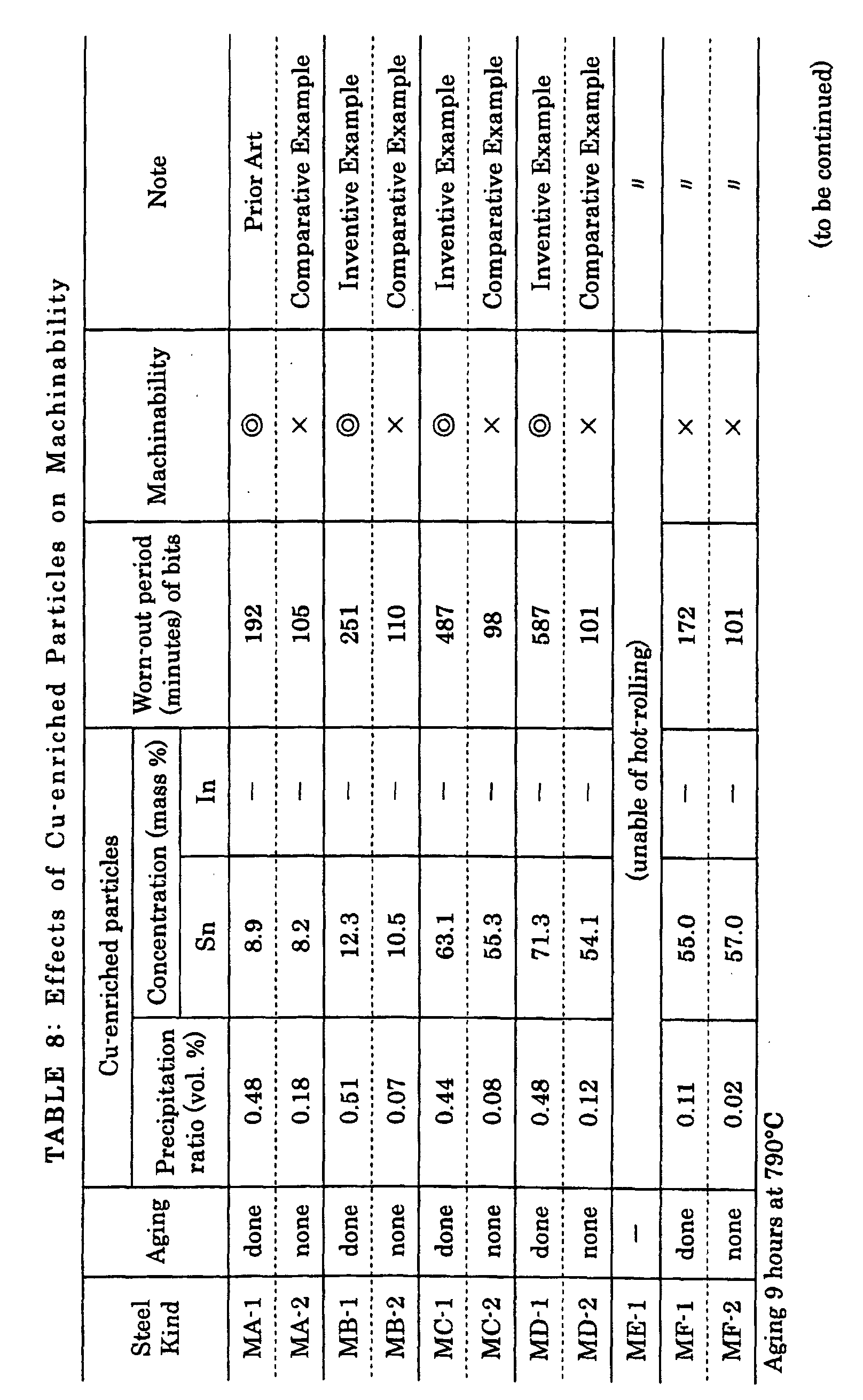
- Another test piece sampled from the same steel sheet was observed by TEM , and Cu -enriched particles dispersed in a steel matrix was quantitatively analyzed by an image processor to calculate a ratio (vol. %) of the Cu -enriched particles. Furthermore, concentration of Sn or In in the Cu -enriched particles was measured by EDX .
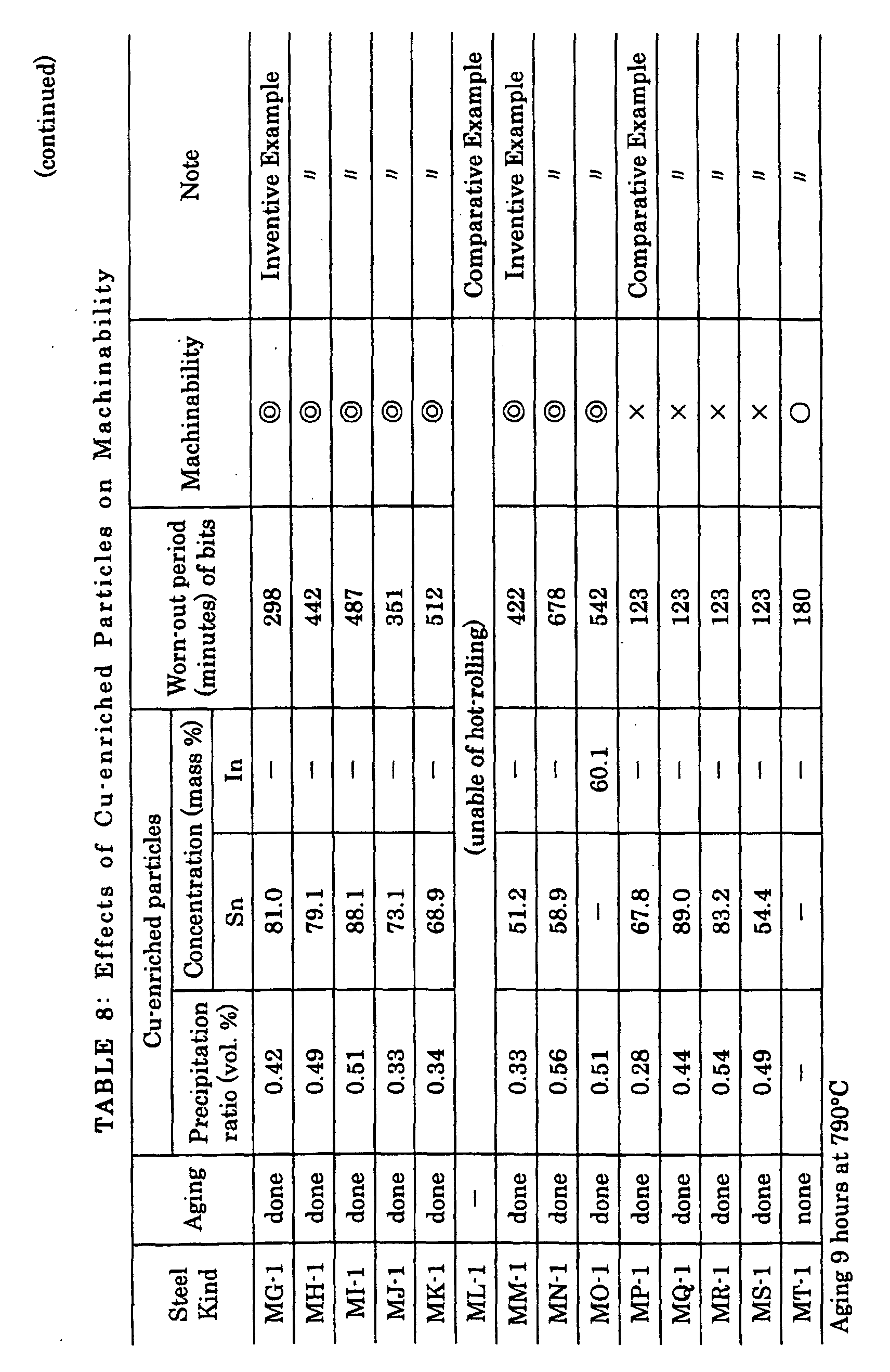
- Machinability of each test piece which were sampled from Steels MA-1 to MS-1 aged 9 hours at 790°C, was compared with machinability of Steel MT-1 , which has been regarded heretofore as material good of machinability.
- the mark o ⁇ means machinability better than Steel MT-1
- the mark ⁇ means machinability similar to Steel MT-1
- the mark ⁇ means inferior machinability to Steel MT-1 . Results of machinability are shown in Table 8 .
- any of Steels MB-1, MC-1, MD-1, MF-1, MG-1, MI-1, MJ-1, MK-1, ML-1, MM-1, MN-1, MO-1, MP-1, MQ-1, MR-1 and MS-1 which contained Cu not less than 0.5 mass % and Sn (or In in Steel MO-1 ) not less than 0.005 mass % had the structure that Cu -enriched particles with concentration of Sn or In not less than 10 mass % were dispersed in a steel matrix at a ratio of 0.2 vol. % or more by aging-treatment, was excellent in machinability.
- Steels MB-2, MC-2, MD-2, MF-2, MG-2, MI-2, MJ-2, MK-2, ML-2, MM-2, MN-2, MO-2, MP-2, MQ-2, MR-2 and MS-2 which were not subjected to aging treatment, had Cu -enriched particles dispersed at an insufficient ratio less than 0.2 vol. % regardless Cu content more than 0.5 mass %, resulting in poor machinability.
- Steels MF-1 and -2 were poor of machinability due to shortage of Cu for dispersion of Cu -enriched particles at a ratio of 0.2 vol. % or more after aging treatment.
- Steel MA-1 exhibited machinability better than Steel MT-1 , but the machinability was insufficient due to shortage of Sn for concentration of Sn not less than 10 mass % in Cu -enriched particles.
- Steel ML-1 which contained Sn more than 0.15 mass %, was too poor of hot-workability to prepare a test piece for evaluation.
- Test pieces were sampled from Steel MC in Table 7 under the same conditions as Example 5 . Test pieces were individually subjected to aging treatment under conditions varied within ranges of 450-950°C and 0.5-16 hours. Machinability of each aged test piece was evaluated in the same way as Example 5 .
- test pieces MC-4 and MC-6 to MC-10 which was aged one hour or longer at 500-900°C, had Cu -enriched particles with concentration of Sn of 10 mass % or more dispersed in a steel matrix at a ratio of 0.2 vol. % or more, resulting in good machinability.
- Steel MC-5 which was aged at a temperature within a range of 500-900°C but for a time shorter than one hour, was poor of machinability due to the structure that Cu -enriched particles were insufficiently dispersed at a ratio less than 0.2 vol. %.
- a precipitation ratio of Cu -enriched particles was also less than 0.2 vol. % at an aging temperature lower than 500°C or higher than 900°C.
- ferritic stainless steels with chemical compositions shown in Table 10 were melted in a 30kg-vacuum melting furnace, cast to slabs, heated one hour at 1230°C, hot-rolled to thickness of 4mm, aged at various temperatures and then pickled.
- Each steel sheet was subjected to the same machining test as Example 5 with a horizontal milling machine. Machinability of each test piece was evaluated by a machining period until the bits were worn out by 0.1 mm.
- Another test piece sampled from the same steel sheet was observed by TEM , and Cu -enriched particles dispersed in a steel matrix was quantitatively analyzed by an image processor to calculate a ratio (vol. %) of the Cu -enriched particles. Furthermore, concentration of Sn or In in the Cu -enriched particles was measured by EDX .
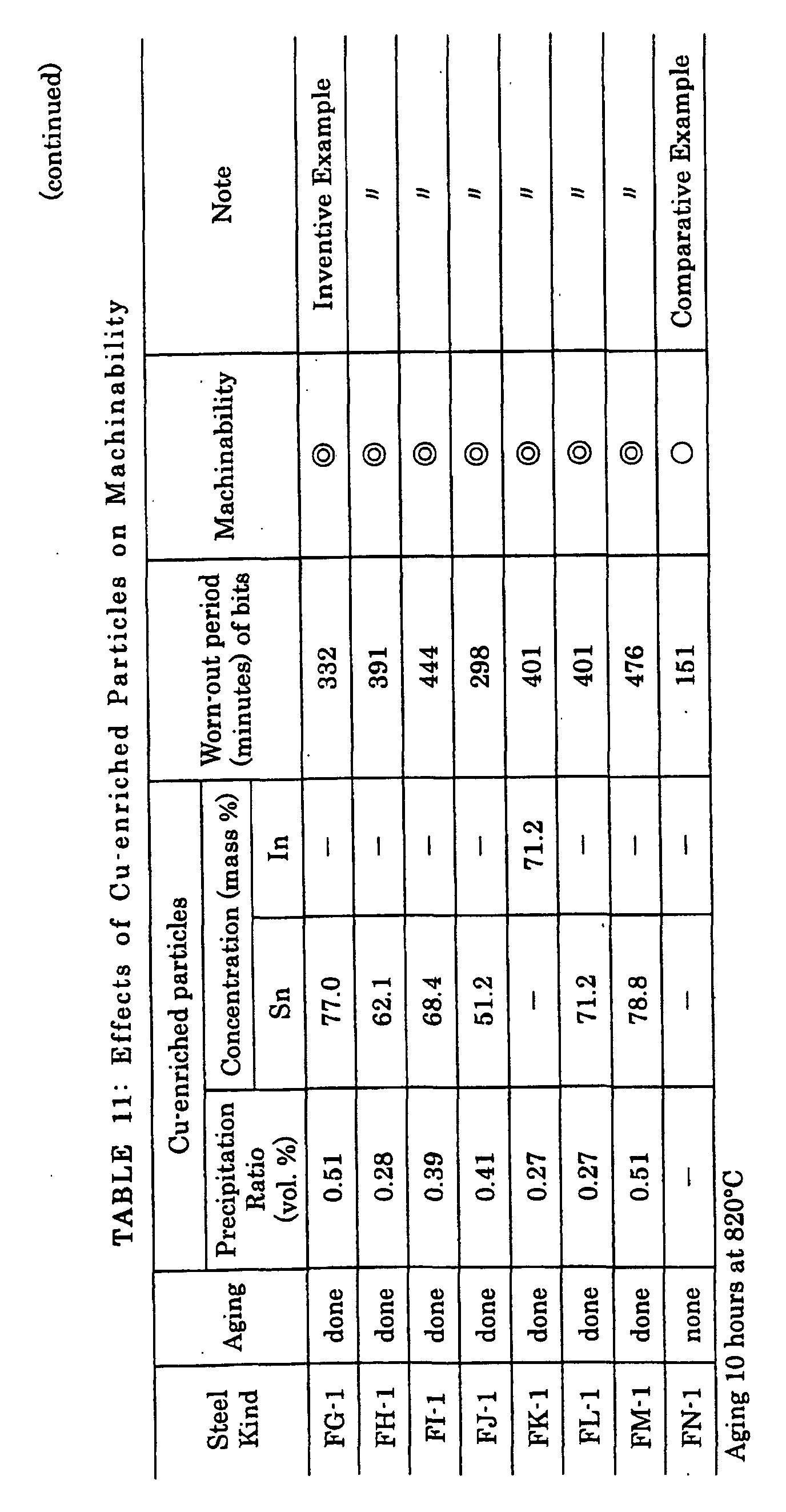
- Machinability of each test piece which were sampled from Steels FA-1 to FT-1 aged 9 hours at 820°C, was compared with machinability of Steel FN-1 , which has been regarded heretofore as material good of machinability.
- the mark o ⁇ means machinability better than Steel FN-1
- the mark ⁇ means machinability similar to Steel FN-1
- the mark ⁇ means inferior machinability to Steel FN-1 . Results of machinability are shown in Table 11 .
- any of Steels FB-1, FC-1, FF-1, FG-1, FH-1, FI-1, FJ-1, FK-1, FL-1 and FM-1 which contained Cu not less than 0.5 mass % and Sn (or In in Steel FK-1 ) not less than 0.005 mass % and had the structure that Cu -enriched particles with concentration of Sn or In not less than 10 mass % were dispersed in a steel matrix at a ratio of 0.2 vol. % or more by aging-treatment, was excellent in machinability.
- Steels FB-2, FC-2, FG-2, FH-2, FI-2, FJ-2, FK-2 and FM-2 which were not subjected to aging treatment, had Cu -enriched particles dispersed at an insufficient ratio less than 0.2 vol. % regardless Cu content more than 0.5 mass %, resulting in poor machinability.
- Steels FE-1 and -2 were poor of machinability due to shortage of Cu for dispersion of Cu -enriched particles at a ratio of 0.2 vol. % or more after aging treatment.
- Steel FA-1 had inferior machinability due to shortage of Sn for concentration of Sn not less than 10 mass % in Cu -enriched particles.
- Steel FD-1 which contained Sn more than 0.15 mass % on the contrary, was too poor of hot-workability to prepare a test piece for evaluation.
- Test pieces were sampled from Steel FC in Table 10 under the same conditions as Example 7 . Test pieces were individually subjected to aging treatment under conditions varied within ranges of 450-950°C and 0.5-11 hours. Machinability of each aged test piece was evaluated in the same way as Example 7 .
- test pieces FC-4 and FC-6 to FC-10 which was aged one hour or longer at 500-900°C, had Cu -enriched particles with concentration of Sn of 10 mass % or more dispersed in a steel matrix at a ratio of 0.2 vol. % or more, resulting in good machinability.
- Steel FC-5 which was aged at a temperature within a range of 500-900°C but for a period shorter than one hour, was poor of machinability due to the structure that Cu -enriched particles with concentration of Sn not less than 10 mass % were insufficiently dispersed at a ratio less than 0.2 vol. %.
- a precipitation ratio of Cu -enriched particles was also less than 0.2 vol. % at an aging temperature lower than 500°C or higher than 900°C.
- Ferritic and martensite stainless steels proposed by the present invention as above-mentioned are good of machinability, due to chemical compositions containing 0.5 mass % or more of Cu and at least one of 0.001 mass % or more of C , 0.1 mass % or more of Sn and 0.1 mass % or more of In as well as the structure that Cu -enriched particles with concentration of C not less than 0.1 mass % or Sn or In not less than 10 mass % are dispersed at a ratio of 0.2 vol. % in a ferritic or martensitic matrix.
- the stainless steels are machined to objective shapes and used as members for electric home appliance, furniture goods, kitchen equipment, machine, apparatus, and other equipment in various fields.
Landscapes
- Chemical & Material Sciences (AREA)
- Engineering & Computer Science (AREA)
- Mechanical Engineering (AREA)
- Materials Engineering (AREA)
- Metallurgy (AREA)
- Organic Chemistry (AREA)
- Physics & Mathematics (AREA)
- Thermal Sciences (AREA)
- Crystallography & Structural Chemistry (AREA)
- Heat Treatment Of Steel (AREA)
- Heat Treatment Of Sheet Steel (AREA)
Abstract
Description
| Chemical Compositions of Ferritic Stainless Steels | ||||||||
| Steel Kind | Alloying elements (mass %) | |||||||
| C | Si | Mn | S | Ni | Cr | Cu | Others | |
| A | 0.054 | 0.56 | 0.34 | 0.002 | 0.23 | 16.25 | 2.02 | ― |
| B | 0.061 | 0.62 | 0.22 | 0.003 | 0.34 | 16.49 | 1.48 | ― |
| C | 0.049 | 0.43 | 0.31 | 0.004 | 0.25 | 16.21 | 1.09 | ― |
| D | 0.055 | 0.51 | 0.41 | 0.005 | 0.21 | 16.19 | 0.40 | ― |
| E | 0.063 | 0.39 | 0.19 | 0.202 | 0.28 | 16.25 | 0.48 | ― |
| F | 0.059 | 0.44 | 0.42 | 0.002 | 0.33 | 16.38 | 0.51 | ― |
| G | 0.009 | 0.31 | 0.2 | 0.005 | 0.26 | 17.02 | 1.46 | Nb:0.36 |
| H | 0.011 | 0.42 | 0.23 | 0.003 | 0.38 | 17.11 | 0.32 | Nb:0.33 |
| I | 0.021 | 0.41 | 0.23 | 0.007 | 0.42 | 16.53 | 2.43 | Ti:0.35 |
| J | 0.019 | 0.35 | 0.31 | 0.004 | 0.28 | 16.42 | 0.48 | Ti:0.34 |
| K | 0.061 | 0.55 | 0.42 | 0.004 | 0.12 | 16.31 | 1.34 | Al:0.07 |
| L | 0.019 | 0.38 | 0.33 | 0.005 | 0.39 | 16.21 | 1.61 | Zr:0.88 |
| M | 0.024 | 0.56 | 0.18 | 0.002 | 0.29 | 17.12 | 1.89 | V:0.82 |
| N | 0.055 | 0.33 | 0.51 | 0.001 | 0.39 | 16.54 | 1.72 | B:0.006 |
| O | 0.051 | 0.42 | 0.18 | 0.003 | 0.26 | 17.21 | 2.33 | REM:0.02 |
| P | 0.0008 | 0.33 | 0.21 | 0.003 | 0.31 | 17.41 | 1.33 | ― |


| Chemical Compositions of Martensitic Stainless Steels | ||||||||
| Steel Kind | Alloying Elements (mass %) | |||||||
| C | Si | Mn | S | Ni | Cr | Cu | Others | |
| MA | 0.092 | 0.23 | 0.77 | 0.003 | 0.23 | 11.55 | 4.51 | ― |
| MB | 0.102 | 0.31 | 0.62 | 0.003 | 0.34 | 11.31 | 3.22 | ― |
| MC | 0.099 | 0.35 | 0.52 | 0.004 | 0.21 | 11.45 | 1.53 | ― |
| MD | 0.113 | 0.51 | 0.41 | 0.012 | 0.21 | 12.23 | 0.12 | ― |
| ME | 0.063 | 0.39 | 0.44 | 0.213 | 0.45 | 12.42 | 0.48 | ― |
| MF | 0.35 | 0.44 | 0.42 | 0.002 | 0.33 | 11.67 | 0.82 | ― |
| MG | 0.102 | 0.31 | 0.2 | 0.005 | 0.26 | 13.21 | 1.46 | Nb : 0.38 |
| MH | 0.142 | 0.42 | 0.23 | 0.003 | 0.38 | 12.98 | 0.32 | Nb : 0.31 |
| MI | 0.053 | 0.41 | 0.23 | 0.007 | 0.42 | 14.12 | 2.43 | Ti: 0.33 |
| MJ | 0.103 | 0.35 | 0.31 | 0.004 | 0.28 | 11.23 | 0.48 | Ti : 0.34 |
| MK | 0.202 | 0.55 | 0.42 | 0.004 | 0.12 | 13.67 | 1.21 | Al : 0.06 |
| ML | 0.019 | 0.38 | 0.33 | 0.005 | 0.39 | 10.76 | 1.77 | Zr : 0.88 |
| MM | 0.103 | 0.56 | 0.18 | 0.002 | 0.29 | 14.21 | 2.01 | V : 0.82 |
| MN | 0.082 | 0.33 | 0.51 | 0.001 | 0.39 | 11.23 | 1.72 | B : 0.006 |
| MO | 0.156 | 0.42 | 0.18 | 0.003 | 0.26 | 14.21 | 2.33 | REM : 0.02 |
| MP | 0.007 | 0.33 | 0.21 | 0.003 | 0.31 | 13.21 | 1.33 | ― |


| Chemical Compositions of Martensitic Stainless Steels | |||||||||
| Steel Kind | Alloying Elements (mass %) | ||||||||
| C | Si | Mn | S | Ni | Cr | Cu | Sn | Others | |
| MA | 0.061 | 0.31 | 0.81 | 0.005 | 0.12 | 11.62 | 3.01 | 0.004 | |
| MB | 0.058 | 0.33 | 0.77 | 0.002 | 0.33 | 11.24 | 2.98 | 0.006 | |
| MC | 0.059 | 0.28 | 0.34 | 0.012 | 0.18 | 11.98 | 3.21 | 0.212 | |
| MD | 0.066 | 0.41 | 0.64 | 0.001 | 0.21 | 12.43 | 1.53 | 0.487 | |
| ME | 0.062 | 0.37 | 0.82 | 0.009 | 0.34 | 12.02 | 2.87 | 0.512 | |
| MF | 0.102 | 0.29 | 0.43 | 0.008 | 0.42 | 14.12 | 0.47 | 0.112 | |
| MG | 0.007 | 0.37 | 0.51 | 0.004 | 0.26 | 11.76 | 0.54 | 0.142 | |
| MH | 0.088 | 0.51 | 0.31 | 0.005 | 0.22 | 13.21 | 1.01 | 0.213 | |
| MI | 0.052 | 0.34 | 0.62 | 0.012 | 0.44 | 12.02 | 4.03 | 0.081 | |
| MJ | 0.088 | 0.51 | 0.31 | 0.089 | 0.22 | 13.21 | 1.01 | 0.213 | |
| MK | 0.051 | 0.33 | 0.83 | 0.143 | 0.34 | 11.76 | 1.32 | 0.241 | |
| ML | 0.102 | 0.28 | 0.92 | 0.152 | 0.28 | 11.22 | 1.28 | 0.198 | |
| MM | 0.152 | 0.87 | 0.43 | 0.008 | 0.60 | 10.91 | 0.88 | 0.081 | Nb: 0.36 |
| MN | 0.008 | 0.12 | 0.88 | 0.012 | 0.22 | 13.09 | 1.23 | 0.092 | Ti:0.35 |
| MO | 0.043 | 0.08 | 0.97 | 0.014 | 0.09 | 12.55 | 5.21 | 0.002 | In:0.082 |
| MP | 0.002 | 0.98 | 0.24 | 0.092 | 0.18 | 12.12 | 1.98 | 0.152 | Al: 0.07 |
| MQ | 0.021 | 0.44 | 0.12 | 0.082 | 0.43 | 12.38 | 4.12 | 0.443 | Zr:0.88 |
| MR | 0.123 | 0.42 | 0.18 | 0.003 | 0.26 | 12.21 | 2.33 | 0.289 | V: 0.82 |
| MS | 0.089 | 0.33 | 0.21 | 0.003 | 0.31 | 12.41 | 1.21 | 0.181 | B: 0.006 |
| MT | 0.063 | 0.42 | 0.47 | 0.251 | 0.51 | 12.76 | 0.32 | 0.001 |

| Chemical Compositions of Ferritic Stainless Steels | |||||||||
| Steel Kind | Alloying Elements (mass %) | ||||||||
| C | Si | Mn | S | Ni | Cr | Cu | Sn | Others | |
| FA | 0.054 | 0.56 | 0.34 | 0.002 | 0.23 | 16.25 | 2.02 | 0.003 | |
| FB | 0.058 | 0.42 | 0.52 | 0.003 | 0.33 | 16.01 | 1.88 | 0.007 | |
| FC | 0.045 | 0.31 | 0.34 | 0.012 | 0.21 | 17.21 | 1.51 | 0.101 | |
| FD | 0.023 | 0.21 | 0.44 | 0.002 | 0.31 | 18.12 | 1.53 | 0.531 | |
| FE | 0.033 | 0.29 | 0.12 | 0.007 | 0.42 | 17.33 | 0.48 | 0.112 | |
| FF | 0.021 | 0.21 | 0.33 | 0.142 | 0.25 | 16.98 | 1.44 | 0.198 | |
| FG | 0.009 | 0.31 | 0.2 | 0.005 | 0.26 | 17.02 | 1.46 | 0.098 | Nb:0.32 |
| FH | 0.021 | 0.41 | 0.23 | 0.007 | 0.42 | 16.53 | 2.43 | 0.132 | Ti:0.28 |
| FI | 0.061 | 0.55 | 0.42 | 0.004 | 0.12 | 16.31 | 1.34 | 0.121 | Al:0.06 |
| FJ | 0.001 | 0.31 | 0.34 | 0.012 | 0.21 | 17.21 | 1.21 | 0.098 | Zr:0.45 |
| FK | 0.003 | 0.21 | 0.12 | 0.011 | 0.33 | 16.91 | 1.01 | 0.143 | In:0.12 |
| FL | 0.021 | 0.18 | 0.41 | 0.009 | 0.54 | 16.43 | 1.98 | 0.221 | B:0.009 |
| FM | 0.009 | 0.13 | 0.22 | 0.003 | 0.11 | 17.21 | 0.98 | 0.329 | REM:0.015 |
| FN | 0.041 | 0.23 | 0.22 | 0.278 | 0.12 | 17.33 | 0.12 | 0.002 |


Claims (4)
- A ferritic stainless steel good of machinability, which has:a chemical composition consisting of 0.001-0.1 mass % of C, Si up to 1.0 mass %, Mn up to 1.0 mass %, 15-30 mass % of Cr, Ni up to 0.60 mass %, 0.5-6.0 mass % of Cu, optionally one or more of Sn and In not less than 0.005 mass % in total, and the balance being Fe except inevitable impurities; andthe structure that Cu-enriched particles with concentration of C not less than 0.1 mass % or concentration of Sn and/or In not less than 10 mass % are dispersed at a ratio of 0.2 vol. % or more in a ferritic matrix.
- A martensitic stainless steel good of machinability, which has:a chemical composition consisting of 0.01-0.5 mass % of C, Si up to 1.0 mass %, Mn up to 1.0 mass %, 10-15 mass % of Cr, Ni up to 0.60 mass %, 0.5-6.0 mass % of Cu, optionally one or more of Sn and In not less than 0.005 mass % in total, and the balance being Fe except inevitable impurities; andthe structure that Cu-enriched particles with concentration of C not less than 0.1 mass % or concentration of Sn and/or In not less than 10 mass % are dispersed at a ratio of 0.2 vol. % or more in a martensitic matrix.
- The ferritic or martensitic stainless steel defined by Claim 1 or 2, wherein the composition further contains at least one or more of 0.2-1.0 mass % of Nb, 0.02-1 mass % of Ti, 0-3 mass % of Mo, 0-1 mass % of Zr, 0-1 mass % of Al, 0-1 mass % of V, 0-0.005 mass % of B and 0-0.05 mass % of rare earth metals (REM).
- A method of manufacturing a ferritic or martensitic stainless steel sheet good of machinability, which comprises the steps of:providing a stainless steel consisting of 0.001-0.5 mass % of C, Si up to 1.0 mass %, Mn up to 1.0 mass %, 10-30 mass % of Cr, Ni up to 0.60 mass %, 0.5-6.0 mass % of Cu, optionally one or more of Sn and In not less than 0.005 mass % in total, and the balance being Fe except inevitable impurities; andaging said ferritic or martensite stainless steel at a temperature within a range of 500-900°C for one hour or longer one or more times on any stage after a hot-rolling step until a forming step to a final product,whereby Cu-enriched particles with concentration of C not less than 0.1 mass % or concentration of Sn and/or In not less than 10 mass % were dispersed in a ferritic or martensitic matrix by said aging.
Priority Applications (1)
| Application Number | Priority Date | Filing Date | Title |
|---|---|---|---|
| EP07011517A EP1854902B1 (en) | 2001-05-15 | 2001-11-19 | Martensitic stainless steel excellent in machinability |
Applications Claiming Priority (5)
| Application Number | Priority Date | Filing Date | Title |
|---|---|---|---|
| JP2001145148 | 2001-05-15 | ||
| JP2001145148 | 2001-05-15 | ||
| JP2001205349 | 2001-07-05 | ||
| JP2001205349 | 2001-07-05 | ||
| PCT/JP2001/010084 WO2002092869A1 (en) | 2001-05-15 | 2001-11-19 | Ferritic stainless steal and martensitic stainless steel both being excellent in machinability |
Related Child Applications (1)
| Application Number | Title | Priority Date | Filing Date |
|---|---|---|---|
| EP07011517A Division EP1854902B1 (en) | 2001-05-15 | 2001-11-19 | Martensitic stainless steel excellent in machinability |
Publications (3)
| Publication Number | Publication Date |
|---|---|
| EP1391528A1 true EP1391528A1 (en) | 2004-02-25 |
| EP1391528A4 EP1391528A4 (en) | 2006-05-24 |
| EP1391528B1 EP1391528B1 (en) | 2008-03-05 |
Family
ID=26615121
Family Applications (2)
| Application Number | Title | Priority Date | Filing Date |
|---|---|---|---|
| EP01274234A Expired - Lifetime EP1391528B1 (en) | 2001-05-15 | 2001-11-19 | Ferritic stainless steal and martensitic stainless steel both being excellent in machinability |
| EP07011517A Expired - Lifetime EP1854902B1 (en) | 2001-05-15 | 2001-11-19 | Martensitic stainless steel excellent in machinability |
Family Applications After (1)
| Application Number | Title | Priority Date | Filing Date |
|---|---|---|---|
| EP07011517A Expired - Lifetime EP1854902B1 (en) | 2001-05-15 | 2001-11-19 | Martensitic stainless steel excellent in machinability |
Country Status (8)
| Country | Link |
|---|---|
| US (1) | US7070663B2 (en) |
| EP (2) | EP1391528B1 (en) |
| JP (1) | JP4090889B2 (en) |
| KR (1) | KR101084642B1 (en) |
| CN (3) | CN100478481C (en) |
| DE (2) | DE60134802D1 (en) |
| ES (1) | ES2301521T3 (en) |
| WO (1) | WO2002092869A1 (en) |
Cited By (6)
| Publication number | Priority date | Publication date | Assignee | Title |
|---|---|---|---|---|
| CN102341522A (en) * | 2009-03-03 | 2012-02-01 | 法国瓦罗里克.曼尼斯曼油汽公司 | Low alloy steel with a high yield strength and high sulphide stress cracking resistance |
| FR2987372A1 (en) * | 2012-02-24 | 2013-08-30 | Messier Bugatti Dowty | Manufacturing stainless steel part, comprises performing heat treatment to alter steel alloy part, passivating thermally altered part, and scouring thermally altered part after step of heat treatment and before step of passivation |
| CN103820727A (en) * | 2014-01-09 | 2014-05-28 | 马鞍山市恒毅机械制造有限公司 | Ferrotitanium material for manufacturing cutter and preparation method for ferrotitanium material |
| EP2677055A4 (en) * | 2011-02-17 | 2014-11-19 | Nippon Steel & Sumikin Sst | HIGH-PURITY, FERRITIC STAINLESS STEEL SHEET WITH EXCELLENT OXIDATION RESISTANCE AND EXCELLENT MECHANICAL RESISTANCE AT HIGH TEMPERATURES AND METHOD OF MANUFACTURING THE SAME |
| WO2016199932A1 (en) * | 2015-06-11 | 2016-12-15 | Hitachi Metals, Ltd. | Steel strip for cutlery |
| EP3258523A4 (en) * | 2015-02-13 | 2018-01-31 | Nippon Steel & Sumitomo Metal Corporation | Separator for solid polymer fuel cell and method for producing same |
Families Citing this family (33)
| Publication number | Priority date | Publication date | Assignee | Title |
|---|---|---|---|---|
| JP3942934B2 (en) * | 2002-03-29 | 2007-07-11 | 日新製鋼株式会社 | Manufacturing method of stainless steel molded products with excellent shape accuracy |
| CA2588597A1 (en) * | 2004-11-23 | 2006-06-01 | Celgene Corporation | Methods and compositions using immunomodulatory compounds for treatment and management of central nervous system injury |
| JP2007186764A (en) * | 2006-01-13 | 2007-07-26 | Nisshin Steel Co Ltd | Free-cutting ferritic stainless steel |
| KR100958996B1 (en) * | 2007-12-21 | 2010-05-20 | 주식회사 포스코 | Manufacturing method of ferritic stainless steel with improved surface roughness |
| JP4386144B2 (en) * | 2008-03-07 | 2009-12-16 | Jfeスチール株式会社 | Ferritic stainless steel with excellent heat resistance |
| US10351922B2 (en) | 2008-04-11 | 2019-07-16 | Questek Innovations Llc | Surface hardenable stainless steels |
| US8808471B2 (en) * | 2008-04-11 | 2014-08-19 | Questek Innovations Llc | Martensitic stainless steel strengthened by copper-nucleated nitride precipitates |
| CN101586209B (en) * | 2008-05-23 | 2012-03-28 | 宝山钢铁股份有限公司 | Hot rolling wire rod of 1800 MPa level for low-alloy structure and manufacture method thereof |
| US7931758B2 (en) * | 2008-07-28 | 2011-04-26 | Ati Properties, Inc. | Thermal mechanical treatment of ferrous alloys, and related alloys and articles |
| JP5335502B2 (en) * | 2009-03-19 | 2013-11-06 | 新日鐵住金ステンレス株式会社 | Martensitic stainless steel with excellent corrosion resistance |
| JP5737801B2 (en) * | 2011-02-04 | 2015-06-17 | 新日鐵住金ステンレス株式会社 | Ferritic free-cutting stainless steel and manufacturing method thereof |
| JP6025362B2 (en) * | 2012-03-29 | 2016-11-16 | 新日鐵住金ステンレス株式会社 | Ferritic stainless steel plate with excellent heat resistance |
| ES2787353T3 (en) * | 2012-10-30 | 2020-10-15 | Nippon Steel & Sumikin Sst | Ferritic stainless steel sheet that has excellent heat resistance |
| CN103484785A (en) * | 2013-08-16 | 2014-01-01 | 广东华鳌合金新材料有限公司 | High-strength alloy containing rare-earth elements and preparation method thereof |
| JP6308073B2 (en) * | 2013-10-31 | 2018-04-11 | セイコーエプソン株式会社 | Metal powder for powder metallurgy, compound, granulated powder and sintered body |
| CN103643111A (en) * | 2013-11-12 | 2014-03-19 | 铜陵市肆得科技有限责任公司 | Easy-to-process stainless steel material for pump valves and preparation method thereof |
| CN103667942B (en) * | 2013-11-14 | 2016-01-13 | 安徽荣达阀门有限公司 | A kind of wear-resisting pump shaft mild steel material and preparation method thereof |
| CN103820723A (en) * | 2014-01-09 | 2014-05-28 | 马鞍山市恒毅机械制造有限公司 | Cutlery stainless steel material and preparation method thereof |
| KR101641797B1 (en) * | 2014-12-26 | 2016-07-22 | 주식회사 포스코 | Martensitic stainless steel and manufacturing method thereof |
| JP6806984B2 (en) * | 2015-01-29 | 2021-01-06 | 株式会社不二越 | Martensitic stainless steel die for optical parts Elliptical vibration cutting method |
| CN105132812A (en) * | 2015-09-01 | 2015-12-09 | 启东市荣盛铜业有限公司 | Ferrite free-cutting stainless steel |
| CN105441826A (en) * | 2015-11-25 | 2016-03-30 | 铜陵市经纬流体科技有限公司 | High-silicon and low-nickel wear-resistance stainless steel pump valve casting and manufacturing method thereof |
| CN105839023A (en) * | 2016-05-09 | 2016-08-10 | 林淑录 | Alloy material for marine well drilling platform well drilling water system and preparing method for alloy material |
| JP6918238B2 (en) * | 2018-06-13 | 2021-08-11 | 日鉄ステンレス株式会社 | Martensitic S Free-cutting stainless steel |
| KR102065276B1 (en) * | 2018-10-26 | 2020-02-17 | 주식회사 포스코 | Steel Plate For Pressure Vessel With Excellent Toughness and Elongation Resistance And Manufacturing Method Thereof |
| CN110283979A (en) * | 2019-06-05 | 2019-09-27 | 无锡光旭新材料科技有限公司 | Method that is a kind of while improving ferrite stainless hardness of steel and plasticity |
| US12129536B2 (en) * | 2020-05-22 | 2024-10-29 | Crs Holdings, Llc | Strong, tough, and hard stainless steel and article made therefrom |
| CN112458258A (en) * | 2020-12-08 | 2021-03-09 | 安徽华飞机械铸锻有限公司 | Corrosion-resistant treatment method for antibacterial stainless steel |
| CN114657440B (en) * | 2020-12-23 | 2022-12-09 | 安徽工业大学科技园有限公司 | Martensite antibacterial stainless steel and preparation method thereof |
| CN114196891A (en) * | 2021-12-08 | 2022-03-18 | 山西太钢不锈钢股份有限公司 | Martensite antibacterial stainless steel with excellent hot workability and manufacturing method thereof |
| CN114369766B (en) * | 2022-01-19 | 2022-11-01 | 河北技投机械设备有限公司 | High-carbon duplex stainless steel material and preparation method thereof |
| CN116121627B (en) * | 2022-11-29 | 2025-04-29 | 成都先进金属材料产业技术研究院股份有限公司 | A composite free-cutting steel containing sulfur, tin and titanium and a vacuum induction preparation method thereof |
| CN116043134B (en) * | 2023-02-28 | 2024-10-25 | 宝钢德盛不锈钢有限公司 | Austenitic stainless steel and method for manufacturing the same |
Family Cites Families (19)
| Publication number | Priority date | Publication date | Assignee | Title |
|---|---|---|---|---|
| JPS5925002B2 (en) * | 1979-10-27 | 1984-06-13 | 大同特殊鋼株式会社 | free cutting stainless steel powder |
| CN1007993B (en) * | 1989-02-13 | 1990-05-16 | 冶金工业部钢铁研究总院 | Calcium-sulfur composite austenitic free-cutting stainless steel |
| US5049210A (en) * | 1989-02-18 | 1991-09-17 | Nippon Steel Corporation | Oil Country Tubular Goods or a line pipe formed of a high-strength martensitic stainless steel |
| JP2867295B2 (en) * | 1990-08-03 | 1999-03-08 | 新日本製鐵株式会社 | Method for producing martensitic stainless steel line pipe |
| US5362337A (en) * | 1993-09-28 | 1994-11-08 | Crs Holdings, Inc. | Free-machining martensitic stainless steel |
| US5496421A (en) * | 1993-10-22 | 1996-03-05 | Nkk Corporation | High-strength martensitic stainless steel and method for making the same |
| JP3281526B2 (en) * | 1996-01-12 | 2002-05-13 | 日新製鋼株式会社 | Martensitic stainless steel excellent in antibacterial property and method for producing the same |
| JP3223418B2 (en) * | 1995-12-15 | 2001-10-29 | 日新製鋼株式会社 | Ferritic stainless steel excellent in antibacterial property and method for producing the same |
| MY118759A (en) * | 1995-12-15 | 2005-01-31 | Nisshin Steel Co Ltd | Use of a stainless steel as an anti-microbial member in a sanitary environment |
| JP3497654B2 (en) * | 1996-03-08 | 2004-02-16 | 新日本製鐵株式会社 | Fe-Cu alloy steel having good strength, ductility, and toughness and method for producing the same |
| JPH10195529A (en) * | 1997-01-09 | 1998-07-28 | Nippon Metal Ind Co Ltd | Ferritic stainless steel in which Cu is uniformly precipitated and method for producing the same |
| JPH11229091A (en) * | 1998-02-17 | 1999-08-24 | Nisshin Steel Co Ltd | Stainless steel vessels and appliances |
| JP3398591B2 (en) * | 1998-03-16 | 2003-04-21 | 川崎製鉄株式会社 | Stainless steel material excellent in antibacterial property and method for producing the same |
| JP2000008145A (en) * | 1998-06-25 | 2000-01-11 | Sumitomo Metal Ind Ltd | Ferritic stainless steel excellent in antibacterial property and method for producing the same |
| JP2000063996A (en) * | 1998-08-18 | 2000-02-29 | Nisshin Steel Co Ltd | Austenitic stainless steel excellent in machinability and antibacterial characteristic |
| JP4221518B2 (en) * | 1998-08-31 | 2009-02-12 | 独立行政法人物質・材料研究機構 | Ferritic heat resistant steel |
| JP2000239808A (en) | 1999-02-16 | 2000-09-05 | Sanyo Special Steel Co Ltd | Corrosion-resistant soft magnetic material with excellent antibacterial properties |
| DE60019047T2 (en) * | 1999-09-21 | 2006-02-16 | Nisshin Steel Co., Ltd. | Use of a stainless steel sheet with copper-rich grains dispersed in the matrix and / or with a copper-condensed layer |
| JP4592224B2 (en) | 2001-07-05 | 2010-12-01 | 日新製鋼株式会社 | Austenitic stainless steel excellent in machinability and manufacturing method |
-
2001
- 2001-11-19 CN CNB2006101449278A patent/CN100478481C/en not_active Expired - Fee Related
- 2001-11-19 KR KR1020037014873A patent/KR101084642B1/en not_active Expired - Lifetime
- 2001-11-19 EP EP01274234A patent/EP1391528B1/en not_active Expired - Lifetime
- 2001-11-19 EP EP07011517A patent/EP1854902B1/en not_active Expired - Lifetime
- 2001-11-19 CN CNB018232590A patent/CN100420767C/en not_active Expired - Fee Related
- 2001-11-19 CN CNB2005100751317A patent/CN1324158C/en not_active Expired - Fee Related
- 2001-11-19 DE DE60134802T patent/DE60134802D1/en not_active Expired - Lifetime
- 2001-11-19 WO PCT/JP2001/010084 patent/WO2002092869A1/en not_active Ceased
- 2001-11-19 DE DE60133134T patent/DE60133134T2/en not_active Expired - Lifetime
- 2001-11-19 JP JP2002589731A patent/JP4090889B2/en not_active Expired - Lifetime
- 2001-11-19 ES ES01274234T patent/ES2301521T3/en not_active Expired - Lifetime
-
2003
- 2003-11-14 US US10/713,862 patent/US7070663B2/en not_active Expired - Fee Related
Cited By (7)
| Publication number | Priority date | Publication date | Assignee | Title |
|---|---|---|---|---|
| CN102341522A (en) * | 2009-03-03 | 2012-02-01 | 法国瓦罗里克.曼尼斯曼油汽公司 | Low alloy steel with a high yield strength and high sulphide stress cracking resistance |
| EP2677055A4 (en) * | 2011-02-17 | 2014-11-19 | Nippon Steel & Sumikin Sst | HIGH-PURITY, FERRITIC STAINLESS STEEL SHEET WITH EXCELLENT OXIDATION RESISTANCE AND EXCELLENT MECHANICAL RESISTANCE AT HIGH TEMPERATURES AND METHOD OF MANUFACTURING THE SAME |
| FR2987372A1 (en) * | 2012-02-24 | 2013-08-30 | Messier Bugatti Dowty | Manufacturing stainless steel part, comprises performing heat treatment to alter steel alloy part, passivating thermally altered part, and scouring thermally altered part after step of heat treatment and before step of passivation |
| CN103820727A (en) * | 2014-01-09 | 2014-05-28 | 马鞍山市恒毅机械制造有限公司 | Ferrotitanium material for manufacturing cutter and preparation method for ferrotitanium material |
| EP3258523A4 (en) * | 2015-02-13 | 2018-01-31 | Nippon Steel & Sumitomo Metal Corporation | Separator for solid polymer fuel cell and method for producing same |
| WO2016199932A1 (en) * | 2015-06-11 | 2016-12-15 | Hitachi Metals, Ltd. | Steel strip for cutlery |
| US10196718B2 (en) | 2015-06-11 | 2019-02-05 | Hitachi Metals, Ltd. | Steel strip for cutlery |
Also Published As
| Publication number | Publication date |
|---|---|
| WO2002092869A1 (en) | 2002-11-21 |
| KR101084642B1 (en) | 2011-11-17 |
| CN100478481C (en) | 2009-04-15 |
| EP1854902B1 (en) | 2008-07-09 |
| EP1854902A1 (en) | 2007-11-14 |
| CN1690240A (en) | 2005-11-02 |
| KR20030091094A (en) | 2003-12-01 |
| EP1391528A4 (en) | 2006-05-24 |
| DE60133134D1 (en) | 2008-04-17 |
| ES2301521T3 (en) | 2008-07-01 |
| JPWO2002092869A1 (en) | 2004-09-02 |
| CN100420767C (en) | 2008-09-24 |
| DE60133134T2 (en) | 2009-02-19 |
| CN1955327A (en) | 2007-05-02 |
| JP4090889B2 (en) | 2008-05-28 |
| EP1391528B1 (en) | 2008-03-05 |
| US20040096351A1 (en) | 2004-05-20 |
| DE60134802D1 (en) | 2008-08-21 |
| CN1518608A (en) | 2004-08-04 |
| CN1324158C (en) | 2007-07-04 |
| US7070663B2 (en) | 2006-07-04 |
Similar Documents
| Publication | Publication Date | Title |
|---|---|---|
| US7070663B2 (en) | Ferritic and martensitic stainless steels excellent in machinability | |
| JP4473928B2 (en) | Hot-worked steel with excellent machinability and impact value | |
| KR100726252B1 (en) | Forced mechanical structural parts, materials and manufacturing method thereof | |
| JP4964063B2 (en) | Case-hardened steel with excellent cold forgeability and grain coarsening prevention properties and machine parts obtained therefrom | |
| JP4384592B2 (en) | Rolled steel for carburizing with excellent high-temperature carburizing characteristics and hot forgeability | |
| JP3489434B2 (en) | High-strength free-cut non-heat treated steel | |
| WO2022183265A1 (en) | Martensitic steel and method of manufacturing a martensitic steel | |
| JP3713975B2 (en) | Steel for bearing | |
| JP7560714B2 (en) | Steel bars for machine structures | |
| JP2004084061A (en) | Non-tempered crankshaft | |
| JP2017066460A (en) | Age hardening steel | |
| JP4502929B2 (en) | Case hardening steel with excellent rolling fatigue characteristics and grain coarsening prevention characteristics | |
| JP3903966B2 (en) | Case-hardened steel with excellent chip control | |
| JP3644275B2 (en) | Martensitic bainite-type non-tempered steel material excellent in machinability and manufacturing method thereof | |
| JP4272397B2 (en) | Martensitic and ferritic stainless steels with excellent hot workability and machinability | |
| JP3489376B2 (en) | High-strength, high-toughness free-cut non-heat treated steel | |
| JP3249646B2 (en) | Machine structural steel with excellent machinability and cold forgeability | |
| JPH111743A (en) | High-strength, high-toughness tempered steel with excellent machinability | |
| JP5937852B2 (en) | Case-hardening steel parts | |
| JP4592224B2 (en) | Austenitic stainless steel excellent in machinability and manufacturing method | |
| JP2005105390A (en) | High temperature carburizing steel | |
| JP2021172875A (en) | Manufacturing method of abrasion resistant steel | |
| JP2021134418A (en) | Steel for machine structure and cutting method therefor | |
| JP3769918B2 (en) | Coarse grain-resistant case-hardened steel, surface-hardened parts excellent in strength and toughness, and manufacturing method thereof | |
| JPH06145890A (en) | High strength and high toughness free cutting steel |
Legal Events
| Date | Code | Title | Description |
|---|---|---|---|
| PUAI | Public reference made under article 153(3) epc to a published international application that has entered the european phase |
Free format text: ORIGINAL CODE: 0009012 |
|
| 17P | Request for examination filed |
Effective date: 20031030 |
|
| AK | Designated contracting states |
Kind code of ref document: A1 Designated state(s): AT BE CH CY DE DK ES FI FR GB GR IE IT LI LU MC NL PT SE TR |
|
| AX | Request for extension of the european patent |
Extension state: AL LT LV MK RO SI |
|
| RIC1 | Information provided on ipc code assigned before grant |
Ipc: 7C 22C 38/24 B Ipc: 7C 22C 38/20 B Ipc: 7C 21D 6/00 B Ipc: 7C 22C 38/00 B Ipc: 7C 22C 38/22 B Ipc: 7C 22C 38/26 B Ipc: 7C 22C 38/12 B Ipc: 7C 22C 38/42 A Ipc: 7C 22C 38/14 B Ipc: 7C 22C 38/28 B Ipc: 7C 22C 38/50 B Ipc: 7C 21D 8/00 B Ipc: 7C 22C 38/18 B |
|
| A4 | Supplementary search report drawn up and despatched |
Effective date: 20060406 |
|
| 17Q | First examination report despatched |
Effective date: 20060710 |
|
| 17Q | First examination report despatched |
Effective date: 20060710 |
|
| GRAP | Despatch of communication of intention to grant a patent |
Free format text: ORIGINAL CODE: EPIDOSNIGR1 |
|
| RBV | Designated contracting states (corrected) |
Designated state(s): DE ES FR GB IT SE |
|
| GRAS | Grant fee paid |
Free format text: ORIGINAL CODE: EPIDOSNIGR3 |
|
| GRAA | (expected) grant |
Free format text: ORIGINAL CODE: 0009210 |
|
| AK | Designated contracting states |
Kind code of ref document: B1 Designated state(s): DE ES FR GB IT SE |
|
| REG | Reference to a national code |
Ref country code: GB Ref legal event code: FG4D |
|
| REF | Corresponds to: |
Ref document number: 60133134 Country of ref document: DE Date of ref document: 20080417 Kind code of ref document: P |
|
| REG | Reference to a national code |
Ref country code: SE Ref legal event code: TRGR |
|
| REG | Reference to a national code |
Ref country code: ES Ref legal event code: FG2A Ref document number: 2301521 Country of ref document: ES Kind code of ref document: T3 |
|
| ET | Fr: translation filed | ||
| PLBE | No opposition filed within time limit |
Free format text: ORIGINAL CODE: 0009261 |
|
| STAA | Information on the status of an ep patent application or granted ep patent |
Free format text: STATUS: NO OPPOSITION FILED WITHIN TIME LIMIT |
|
| 26N | No opposition filed |
Effective date: 20081208 |
|
| PGFP | Annual fee paid to national office [announced via postgrant information from national office to epo] |
Ref country code: DE Payment date: 20091112 Year of fee payment: 9 Ref country code: ES Payment date: 20091125 Year of fee payment: 9 Ref country code: SE Payment date: 20091106 Year of fee payment: 9 |
|
| PGFP | Annual fee paid to national office [announced via postgrant information from national office to epo] |
Ref country code: FR Payment date: 20091123 Year of fee payment: 9 Ref country code: GB Payment date: 20091118 Year of fee payment: 9 Ref country code: IT Payment date: 20091118 Year of fee payment: 9 |
|
| REG | Reference to a national code |
Ref country code: SE Ref legal event code: EUG |
|
| GBPC | Gb: european patent ceased through non-payment of renewal fee |
Effective date: 20101119 |
|
| REG | Reference to a national code |
Ref country code: FR Ref legal event code: ST Effective date: 20110801 |
|
| REG | Reference to a national code |
Ref country code: DE Ref legal event code: R119 Ref document number: 60133134 Country of ref document: DE Effective date: 20110601 Ref country code: DE Ref legal event code: R119 Ref document number: 60133134 Country of ref document: DE Effective date: 20110531 |
|
| PG25 | Lapsed in a contracting state [announced via postgrant information from national office to epo] |
Ref country code: SE Free format text: LAPSE BECAUSE OF NON-PAYMENT OF DUE FEES Effective date: 20101120 |
|
| PG25 | Lapsed in a contracting state [announced via postgrant information from national office to epo] |
Ref country code: FR Free format text: LAPSE BECAUSE OF NON-PAYMENT OF DUE FEES Effective date: 20101130 |
|
| PG25 | Lapsed in a contracting state [announced via postgrant information from national office to epo] |
Ref country code: GB Free format text: LAPSE BECAUSE OF NON-PAYMENT OF DUE FEES Effective date: 20101119 |
|
| PG25 | Lapsed in a contracting state [announced via postgrant information from national office to epo] |
Ref country code: IT Free format text: LAPSE BECAUSE OF NON-PAYMENT OF DUE FEES Effective date: 20101119 |
|
| REG | Reference to a national code |
Ref country code: ES Ref legal event code: FD2A Effective date: 20120220 |
|
| PG25 | Lapsed in a contracting state [announced via postgrant information from national office to epo] |
Ref country code: ES Free format text: LAPSE BECAUSE OF NON-PAYMENT OF DUE FEES Effective date: 20101120 |
|
| PG25 | Lapsed in a contracting state [announced via postgrant information from national office to epo] |
Ref country code: DE Free format text: LAPSE BECAUSE OF NON-PAYMENT OF DUE FEES Effective date: 20110531 |