EP1391263B1 - Dust collector - Google Patents
Dust collector Download PDFInfo
- Publication number
- EP1391263B1 EP1391263B1 EP03018645A EP03018645A EP1391263B1 EP 1391263 B1 EP1391263 B1 EP 1391263B1 EP 03018645 A EP03018645 A EP 03018645A EP 03018645 A EP03018645 A EP 03018645A EP 1391263 B1 EP1391263 B1 EP 1391263B1
- Authority
- EP
- European Patent Office
- Prior art keywords
- remote
- motor
- dust collector
- control transmitter
- control
- Prior art date
- Legal status (The legal status is an assumption and is not a legal conclusion. Google has not performed a legal analysis and makes no representation as to the accuracy of the status listed.)
- Expired - Lifetime
Links
Images




Classifications
-
- A—HUMAN NECESSITIES
- A47—FURNITURE; DOMESTIC ARTICLES OR APPLIANCES; COFFEE MILLS; SPICE MILLS; SUCTION CLEANERS IN GENERAL
- A47L—DOMESTIC WASHING OR CLEANING; SUCTION CLEANERS IN GENERAL
- A47L9/00—Details or accessories of suction cleaners, e.g. mechanical means for controlling the suction or for effecting pulsating action; Storing devices specially adapted to suction cleaners or parts thereof; Carrying-vehicles specially adapted for suction cleaners
- A47L9/28—Installation of the electric equipment, e.g. adaptation or attachment to the suction cleaner; Controlling suction cleaners by electric means
- A47L9/2894—Details related to signal transmission in suction cleaners
-
- A—HUMAN NECESSITIES
- A47—FURNITURE; DOMESTIC ARTICLES OR APPLIANCES; COFFEE MILLS; SPICE MILLS; SUCTION CLEANERS IN GENERAL
- A47L—DOMESTIC WASHING OR CLEANING; SUCTION CLEANERS IN GENERAL
- A47L7/00—Suction cleaners adapted for additional purposes; Tables with suction openings for cleaning purposes; Containers for cleaning articles by suction; Suction cleaners adapted to cleaning of brushes; Suction cleaners adapted to taking-up liquids
- A47L7/0085—Suction cleaners adapted for additional purposes; Tables with suction openings for cleaning purposes; Containers for cleaning articles by suction; Suction cleaners adapted to cleaning of brushes; Suction cleaners adapted to taking-up liquids adapted for special purposes not related to cleaning
-
- A—HUMAN NECESSITIES
- A47—FURNITURE; DOMESTIC ARTICLES OR APPLIANCES; COFFEE MILLS; SPICE MILLS; SUCTION CLEANERS IN GENERAL
- A47L—DOMESTIC WASHING OR CLEANING; SUCTION CLEANERS IN GENERAL
- A47L7/00—Suction cleaners adapted for additional purposes; Tables with suction openings for cleaning purposes; Containers for cleaning articles by suction; Suction cleaners adapted to cleaning of brushes; Suction cleaners adapted to taking-up liquids
- A47L7/0095—Suction cleaners or attachments adapted to collect dust or waste from power tools
-
- A—HUMAN NECESSITIES
- A47—FURNITURE; DOMESTIC ARTICLES OR APPLIANCES; COFFEE MILLS; SPICE MILLS; SUCTION CLEANERS IN GENERAL
- A47L—DOMESTIC WASHING OR CLEANING; SUCTION CLEANERS IN GENERAL
- A47L9/00—Details or accessories of suction cleaners, e.g. mechanical means for controlling the suction or for effecting pulsating action; Storing devices specially adapted to suction cleaners or parts thereof; Carrying-vehicles specially adapted for suction cleaners
- A47L9/28—Installation of the electric equipment, e.g. adaptation or attachment to the suction cleaner; Controlling suction cleaners by electric means
- A47L9/2836—Installation of the electric equipment, e.g. adaptation or attachment to the suction cleaner; Controlling suction cleaners by electric means characterised by the parts which are controlled
- A47L9/2842—Suction motors or blowers
-
- B—PERFORMING OPERATIONS; TRANSPORTING
- B23—MACHINE TOOLS; METAL-WORKING NOT OTHERWISE PROVIDED FOR
- B23Q—DETAILS, COMPONENTS, OR ACCESSORIES FOR MACHINE TOOLS, e.g. ARRANGEMENTS FOR COPYING OR CONTROLLING; MACHINE TOOLS IN GENERAL CHARACTERISED BY THE CONSTRUCTION OF PARTICULAR DETAILS OR COMPONENTS; COMBINATIONS OR ASSOCIATIONS OF METAL-WORKING MACHINES, NOT DIRECTED TO A PARTICULAR RESULT
- B23Q1/00—Members which are comprised in the general build-up of a form of machine, particularly relatively large fixed members
- B23Q1/0009—Energy-transferring means or control lines for movable machine parts; Control panels or boxes; Control parts
-
- B—PERFORMING OPERATIONS; TRANSPORTING
- B23—MACHINE TOOLS; METAL-WORKING NOT OTHERWISE PROVIDED FOR
- B23Q—DETAILS, COMPONENTS, OR ACCESSORIES FOR MACHINE TOOLS, e.g. ARRANGEMENTS FOR COPYING OR CONTROLLING; MACHINE TOOLS IN GENERAL CHARACTERISED BY THE CONSTRUCTION OF PARTICULAR DETAILS OR COMPONENTS; COMBINATIONS OR ASSOCIATIONS OF METAL-WORKING MACHINES, NOT DIRECTED TO A PARTICULAR RESULT
- B23Q11/00—Accessories fitted to machine tools for keeping tools or parts of the machine in good working condition or for cooling work; Safety devices specially combined with or arranged in, or specially adapted for use in connection with, machine tools
- B23Q11/0042—Devices for removing chips
- B23Q11/0046—Devices for removing chips by sucking
-
- B—PERFORMING OPERATIONS; TRANSPORTING
- B23—MACHINE TOOLS; METAL-WORKING NOT OTHERWISE PROVIDED FOR
- B23Q—DETAILS, COMPONENTS, OR ACCESSORIES FOR MACHINE TOOLS, e.g. ARRANGEMENTS FOR COPYING OR CONTROLLING; MACHINE TOOLS IN GENERAL CHARACTERISED BY THE CONSTRUCTION OF PARTICULAR DETAILS OR COMPONENTS; COMBINATIONS OR ASSOCIATIONS OF METAL-WORKING MACHINES, NOT DIRECTED TO A PARTICULAR RESULT
- B23Q11/00—Accessories fitted to machine tools for keeping tools or parts of the machine in good working condition or for cooling work; Safety devices specially combined with or arranged in, or specially adapted for use in connection with, machine tools
- B23Q11/0042—Devices for removing chips
- B23Q11/0057—Devices for removing chips outside the working area
Definitions
- the present invention relates to a dust collector with a remote controller and connected via a hose to a dust discharge port of a hand-held power tool for performing cutting, grinding, shaving, or the like of a workpiece.
- a dust collector which is combined with a held-held power tool for effecting the cutting, grinding, shaving, or the like of a workpiece 12 to effect the collection and conveyance of dust discharged from the power tool, there are two kinds of systems if largely classified.
- a hose 7 extending from a dust collector 4' which incorporates amotor and a dust collection fan (neither are shown), and a dust collection tank 3, is connected to a sawdust discharging port 6 of a circular saw 5 which is one of hand-held power tools.
- Respective power cords 8 are connected to a main power source.
- the unillustrated starting/stopping switch of the dust collector 4' is turned on, and a suction force is generated within the hose 7 by means of the motor and the dust collection fan. Then, an operator moves to the place where the circular saw 5, which is one of power tools, is located, and turns on the starting/stopping switch to set the circular saw 5 in a state of being capable of effecting the cutting operation. Then, if the circular saw 5 is directed in the direction of the arrow, and the cutting operation of the workpiece 12 is started, sawdust produced by cutting is conveyed and collected into the interior of the dust collector 4' through the hose 7 from the sawdust discharging port 6 of the circular saw 5 by the suction force.
- the starting/stopping switch of the circular saw 5 Upon completion of the cutting operation, the starting/stopping switch of the circular saw 5 is turned off, and the operator : moves and turns off the starting/stopping switch of the dust collector 4'.
- the length of the hose 7 differs - depending on the details of the operation, the length is generally 5 m to 10 m in most cases. Accordingly, according to the above-described operation, the operator moves back and forth over the distance of 5 m to 10 m at maximum on each occasion of the start and end of the operation. Alternatively, only the starting/stopping switch of the circular saw 5 may be turned off after completion of the cutting operation.
- the continuous operation of the dust collector presents a problem in terms of problems concerning noise and problems in the working environment. In addition, the continuous operation of the dust collector is not preferable from the viewpoint of energy saving.
- the second system is the system shown in Fig. 9.
- the dust collector 4" has a motor for rotating an unillustrated dust collection fan, a socket outlet 18 for connecting to a power tool, and an interlocking device for starting and stopping the motor by detecting a working current value at the socket outlet 18.
- the dust collector 4" is connected to the power cord 8. The arrangement provided is such that if the power cord 8 of the power tool is connected to the socket outlet 18, the power source for the power tool and the dust collector 4" is supplied from a single power cord 8 of the dust collector 4". If the circular saw 5, which is one of power tools, is started, the motor of the dust collector 4" rotates by means of the interlocking device.
- the dust collection fan is rotated by the motor, and the sawdust discharged from the power tool is conveyed and collected into the dust collector 4" through the hose 7 by the suction force thus generated.
- the motor of the dust collector 4" stops by means of the interlocking device. Since the power source is supplied from the single power cord 8 of the dust collector 4", the electric capacity of either the dust collector 4" or the power tool connected thereto is restricted. In.the case of a general dust collector 4", the motor capacity is 10A to 12A or thereabouts in a case where the power source is 100V in the light of the problem of a required suction force.
- the electric capacity of the power tool used is within 15A and is not restricted.
- the starting/stopping switches of the power tool and the dust collector must be operated on each occasion.
- the operator must move back and forth at least over the range of the hose 7, i.e., a distance of 5 m to 10 m or thereabouts.
- the operating efficiency declines remarkably.
- the power tool and the dust collector are operated by operating the starting/stopping switch of the power tool.
- the power source is supplied from the single power cord of the dust collector, there has been a problem in that the electric capacity of the power tool which is connected is restricted, so that such a power tool is hardly usable for business use.
- vacuum cleaners for household or industrial use to be used for sucking in dust and dirt on a surface to be cleaned are known in the art.
- DE-A-197 36 595 discloses such cleaner having a transmitter for transmitting a signal and a receiver on the cleaner casing for receiving the signal and controlling the motor.
- An object of the invention is to provide a dust collector of a type combined with a hand-held power tool which overcomes the above-described problems, provides excellent operating efficiency, and permits the use of a power tool whose electric capacity is large. Specifically, the object is to make it possible to simply effect the starting and stopping of the power tool and the dust collector without requiring the operator to move from the place where the power tool is used, to eliminate the restriction of the electric capacity of the power tool used, and to increase the operating efficiency and make improvements in the working environment.
- the invention provides a dust collector including: a motor functioning as a driving source; a drive unit for driving a motor; a dust collection fan rotated by the motor; a head section for accommodating the dust collection fan; a switch provided on the head section to control the starting of the motor; a tank section located below the head section, for accommodating dust conveyed by the dust collection fan, the tank section having a connecting portion; a duct hose having one end and the other end, the one end attached to the connecting portion, the other end being detachable from a portion of a power tool; a remote-control transmitter for transmitting a signal; and a remote-control receiver for receiving the signal from the remote-control transmitter to control the drive unit to start or stop the motor.
- FIG. 1 is an outside perspective view illustrating a state in which a cutting operation is being performed by combining the dust collector in accordance with this embodiment and a circular saw which is one of power tools.
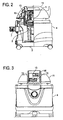
- Fig. 2 is a front elevational view, partly in section, of the dust collector;
- Fig. 3 is a side elevational view of Fig. 2;
- Fig. 4 is a block diagram;
- Figs. 5A-5C are schematic diagrams illustrating a remote-control transmitter.
- a remote-control transmitter 9 for transmitting a signal and a remote-control receiver 10, which effects signal processing of the signal from the remote-control transmitter 9 and starts and stops the motor 1 through an unillustrated drive unit 17, are disposed in a head section 11.
- the unillustrated switch is turned off to stop the circular saw 5.
- the remote-control transmitter 9 is operated from the position of the circular saw 5, and the remote-control receiver 10 located 5 m to 10 m away receives the signal.
- the motor 1 and the dust collection fan 2 of the dust collector 4 are hence stopped through the drive unit 17, and the suction force within the hose 7 ceases. Since the dust collector 4 and the circular saw 5 are connected to the main power source from their respective power cords 8 as described above, electric capacities of the dust collector 4 and the circular saw 5 are within 15A and are not restricted.
- the starting and stopping of the dust collector 4 can be effected by operating the remote-control transmitter 9 from the position of the circular saw 5 located at a distance of 5 m to 10 m at maximum away from the dust collector 4, it is unnecessary for the operator to move back and forth between the place of the cutting operation and the dust collector on each occasion of the starting and stopping of the dust collector 4.
- the starting and stopping of the dust collector 4 can be effected whenever necessary in time with the starting and stopping of the circular saw 5. Therefore, it is possible to obtain an effect in the improvement of the working environment such as noise.
- a changeover switch 13 for changing over the means for starting and stopping the motor 1 of the dust collector 4 is disposed in the head section 11. If the changeover switch 13 is changed over, a changeover is made to either of a remote control system for starting and stopping the motor 1 through the remote-control receiver 10 for receiving a signal from the remote-control transmitter 9 and the drive unit 17 and a power switch system for starting and stopping the motor 1 by directly turning on and off the power supply from the power cord 8.
- two kinds of means for starting and stopping the motor 1 are provided, as described above.
- a hook portion 14 having a substantially U-shaped cross section is formed at an appropriate portion of the remote-control transmitter 9 for transmitting a signal, so that the remote-control transmitter 9 can be caught and placed in an operator's chest pocket, on a belt, or the like.
- the hook portion 14 is made of a material having large resiliency, such as spring steel, the remote-control transmitter 9 conveniently becomes difficult to come off.
- an accommodating/retaining portion 15 for accommodating and/or retaining the remote-control transmitter 9 for transmitting a signal is provided in the head section 11 where the motor 1 and the like of the dust collector 4 are disposed.
- this arrangement is convenient in cases of accommodation, carriage, storage, and the like of the dust collector 4, and is also useful in preventing the missing of the remote-control transmitter 9.
- projection/depression-shaped portions 16 are formed at appropriate portions of the accommodating/retaining portion 15 for accommodating and/or retaining the remote-control transmitter 9, while counterpart projection/depression-shaped portions 16' are formed on exterior portions of the remote-control transmitter 9 so as to be fitted thereto. Therefore, the remote-control transmitter 9, when not in use, can be retained in the head section 11 of the dust collector 4. Also, since there is no risk of dislocation or dropping due to vibration or the like when the dust collector 4 is carried or moved, so that this arrangement is convenient.
- the projection/depression-shaped portions 16 are formed up to a midpoint on both side surfaces of the remote-control transmitter 9, so that the directionality of insertion of the remote-control transmitter 9 can be provided. That direction is set such that a switch operation surface for transmission of the remote-control transmitter 9 becomes an obverse surface, so that the starting and stopping of the dust collector 4 by the remote-control transmitter 9 is made possible even in an accommodated and retained state.
- the circular saw 5 has been described as the power tool by way of example, a power tool other than the circular saw may be used insofar as the power tool entails the occurrence of dust or the like during the work operation.
- respective power cords of the dust collector and the power tool used are connected to separate power sources, and the remote-control transmitter for transmitting a signal and the remote-control receiver, which effects signal processing of the signal from the remote-control transmitter and starts or stops the motor through the drive unit, are disposed in appropriate portions of the dust collector Accordingly, the electric capacity can be used up to 15A for both the power tool used and the dust collector.
- the remote-control transmitter from the place of use of the power tool connected by the hose extending 5 m to 10 m or thereabouts from the dust connector, a signal is received by the remote-control receiver disposed in an appropriate portion of the dust collector, and the starting and stopping of the motor are made possible through the drive unit.
- the dust collector is provided with two kinds of motor starting/stopping means, i.e., the remote-control receiver for instructing the starting or stopping of the motor through the drive unit on the basis of the signal from the remote-control transmitter, as well as the power switch for starting or stopping the motor.
- the changeover switch for effecting a changeover between the two kinds of motor starting/stopping means is disposed on the dust collector. Accordingly, selection can be made between the operation based on the remote-control transmitter and the operation based on the power switch according to the details of work or a preference, so that this arrangement is convenient.
- the hook portion having a substantially U-shaped cross section is provided at an appropriate portion of the remote-control transmitter for transmitting a signal, the remote-control transmitter can be caught and placed in the operator's chest pocket, on a belt, or the like. Hence, it is possible to prevent the missing of the remote-control transmitter and improve the operating efficiency.
- the accommodating/retaining portion for accommodating and/or retaining the remote-control transmitter for transmitting a signal is provided in the head section where the motor and the like of the dust collector are disposed.
- this arrangement is convenient in cases of accommodation, carriage, storage, and the like of the dust collector, and is also useful in preventing the missing of the remote-control transmitter.
- projection/depression-shaped portions are formed in the accommodating/retaining portion for accommodating and/or retaining the remote-control transmitter, while counterpart projection/depression-shaped portions are formed on exterior portions of the remote-control transmitter so as to be fitted thereto. Therefore, there is no risk of the dislocation or dropping of the remote-control transmitter due to vibration or the like when the dust collector is carried or moved, so that this arrangement is convenient.
- a remotely controllable distance becomes limited if the system is comprised of a dust collector body having a remote-controlled receiver for discriminating and receiving a signal of extremely low power using a frequency belonging to a frequency band of 3 MHz to 3 GHz and a controlling means for controlling the dust collector on the basis of the content of the signal received by the remote-controlled receiver; an operating portion for operating the dust collector body; and a remote-controlled transmitter for transmitting the signal of extremely low power to the receiver.
- a universal motor with a brush is adopted as the motor which is a driving source, the remotely controllable distance becomes substantially limited due to noise from the motor.
- the remotely controllable distance becomes limited, and that if a universal motor with a brush is .adopted as the motor which is a driving source, the remotely controllable distance becomes substantially limited due to noise from the motor.
- the receiver or a receiving antenna is provided within the height of the motor, the motor interferes with the transmitted radio wave and attenuates the radio wave depending on the direction of use of the remote-controlled transmitter. Therefore, there has been a problem in that the receiver is unable to catch the radio wave, thereby making it impossible to reliably effect the turning on and off of the dust collector.
- an object of this embodiment is to provide a dust collector which overcomes the above-described problems, is capable of receiving a signal by a remote-controlled receiver disposed at an appropriate portion of the dust collector and of starting and stopping the motor through a drive unit, and attains a substantial increase in the operating efficiency since the operator is not required to move back and forth several meters.
- Another object of this embodiment is to provide a dust collector which can be operated and stopped whenever necessary, as required, thereby overcoming the problems of such as noise and substantially improving the working environment.
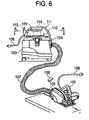
- FIG. 6 is an outside perspective view illustrating a state in which a cutting operation is being performed by combining the dust collector with a remote controller in accordance with this embodiment and a circular saw which is one of power tools.
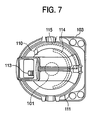
- Fig. 7 is a top view of the dust collector with a remote controller, and Fig. 8 is a side elevational view of the dust collector with a remote controller.
- a hose 7 extending from a dust collector 104 which incorporates a motor 101, a dust collection fan 102, and a dust collection tank 103, is connected to a sawdust discharging port 106 of a circular saw 105 which is one of hand-held power tools.
- Respective power cords 108 are connected to a main power source.
- a remote-control transmitter 109 for transmitting a signal and a remote-control receiver 110, which effects signal processing of the signal from the remote-control transmitter 109 and starts and stops the motor 101 through an unillustrated drive unit, are disposed in a head section 111. It should be noted that 3 MHz to 3 GHz, more preferably 3 MHz to 322 MHz, is preferable as the frequency band.
- a receiving antenna 114 As a receiving antenna 114, a half-wave dipole antenna, for example, is used, and is disposed above an end surface of the motor 101 in an upper portion of the head section 111. By disposing the receiving antenna 114 above an end surface of the motor 101, there are no directions in which radio waves reaching the plane A - A covered by the antenna from the transmitter are interfered by the motor 101. Hence, radio waves from any direction can be directly received by the antenna. Accordingly, it is possible to alleviate the effect of noise from the motor and enhance the reception sensitivity. In addition, in a case where the motor 101 is present in the plane A-A of the antenna 114, there is a drawback that directionality occurs in the antenna 114 since the motor 101 is a conductor. A coaxial cable 115 connects the receiving antenna and the remote-control receiver 110 by alleviating the effect of noise from the motor 101.
- the unillustrated switch is turned off to stop the circular saw 105.
- the remote-control transmitter 109 is operated from the position of the circular saw 105, and the remote-control receiver 110 located several meters away receives the signal.
- the motor 101 and the dust collection fan 102 of the dust collector 104 are hence stopped through the drive unit, and the suction force within the hose 107 ceases. Since the position of the receiving antenna 114 is located so as to obtain high sensitivity and avoid the effect of the noise from the motor 101 as described above, the starting and stopping of the dust collector 104 can be effected by operating the remote-control transmitter 109 from the position of the circular saw 105 located several meters away from the dust collector 104.
- the receiving antenna is disposed above the end face of the motor in the head section 111 (on a side of the head section which is away from the dust collection tank), the receiving antenna may be disposed at any position in the dust collector insofar as that position is unaffected by the motor 101 and the like.
- the receiving antenna may be disposed below the motor 101 inside the head section 111, specifically on an outer periphery or the inner side of the dust collection tank 103.
- the circular saw 105 has been described as the power tool by way of example, a power tool other than the circular saw may be used insofar as the power tool entails the occurrence of dust or the like.
- the remote-control transmitter for transmitting a signal the remote-control receiver, which effects signal processing of the signal from the remote-control transmitter and starts or stops the motor through the drive unit, and the receiving antenna are disposed in appropriate portions of the dust collector so as to obtain high sensitivity and avoid the effect of noise from the motor 101. Accordingly, by operating the remote-control transmitter from the place of use of the power tool connected by the hose extending several meters from the dust connector, a signal is received by the remote-control receiver disposed in an appropriate portion of the dust collector, and the starting and stopping of the motor are made possible through the drive unit. Since it is unnecessary for the operator to move back and forth several meters, the operating efficiency can be increased substantially. Furthermore, since the operation and stopping of the dust collector are possible whenever necessary, as required, problems of noise and the like can be overcome, and the working environment can be improved substantially.
Landscapes
- Engineering & Computer Science (AREA)
- Mechanical Engineering (AREA)
- Sawing (AREA)
Description
- The present invention relates to a dust collector with a remote controller and connected via a hose to a dust discharge port of a hand-held power tool for performing cutting, grinding, shaving, or the like of a workpiece.
- Referring to Figs. 9 and 10, a description will be given of the conventional art. As a dust collector which is combined with a held-held power tool for effecting the cutting, grinding, shaving, or the like of a
workpiece 12 to effect the collection and conveyance of dust discharged from the power tool, there are two kinds of systems if largely classified. - In the first system, in a state in which a cutting operation of the
workpiece 12 is being effected in the direction of the arrow shown in Fig. 10, ahose 7 extending from a dust collector 4' , which incorporates amotor and a dust collection fan (neither are shown), and adust collection tank 3, is connected to asawdust discharging port 6 of acircular saw 5 which is one of hand-held power tools.Respective power cords 8 are connected to a main power source. Hence, the circular saw 5 and the dust collector 4' are respectively provided with starting/stopping switches. First, the unillustrated starting/stopping switch of the dust collector 4' is turned on, and a suction force is generated within thehose 7 by means of the motor and the dust collection fan. Then, an operator moves to the place where the circular saw 5, which is one of power tools, is located, and turns on the starting/stopping switch to set thecircular saw 5 in a state of being capable of effecting the cutting operation. Then, if thecircular saw 5 is directed in the direction of the arrow, and the cutting operation of theworkpiece 12 is started, sawdust produced by cutting is conveyed and collected into the interior of the dust collector 4' through thehose 7 from the sawdustdischarging port 6 of thecircular saw 5 by the suction force. Upon completion of the cutting operation, the starting/stopping switch of thecircular saw 5 is turned off, and the operator : moves and turns off the starting/stopping switch of the dust collector 4'. Although the length of thehose 7 differs - depending on the details of the operation, the length is generally 5 m to 10 m in most cases. Accordingly, according to the above-described operation, the operator moves back and forth over the distance of 5 m to 10 m at maximum on each occasion of the start and end of the operation. Alternatively, only the starting/stopping switch of thecircular saw 5 may be turned off after completion of the cutting operation. However, the continuous operation of the dust collector presents a problem in terms of problems concerning noise and problems in the working environment. In addition, the continuous operation of the dust collector is not preferable from the viewpoint of energy saving. - The second system is the system shown in Fig. 9. The
dust collector 4" has a motor for rotating an unillustrated dust collection fan, asocket outlet 18 for connecting to a power tool, and an interlocking device for starting and stopping the motor by detecting a working current value at thesocket outlet 18. Thedust collector 4" is connected to thepower cord 8. The arrangement provided is such that if thepower cord 8 of the power tool is connected to thesocket outlet 18, the power source for the power tool and thedust collector 4" is supplied from asingle power cord 8 of thedust collector 4". If the circular saw 5, which is one of power tools, is started, the motor of thedust collector 4" rotates by means of the interlocking device. The dust collection fan is rotated by the motor, and the sawdust discharged from the power tool is conveyed and collected into thedust collector 4" through thehose 7 by the suction force thus generated. In addition, if the circular saw 5, which is one of power tools, is stopped, the motor of thedust collector 4" stops by means of the interlocking device. Since the power source is supplied from thesingle power cord 8 of thedust collector 4", the electric capacity of either thedust collector 4" or the power tool connected thereto is restricted. In.the case of ageneral dust collector 4", the motor capacity is 10A to 12A or thereabouts in a case where the power source is 100V in the light of the problem of a required suction force. Accordingly, since the capacities of thepower cord 8 and a plug are 15A at 100V, the capacity of the power tool which can be connected inevitably becomes 3A to 5A. In reality, however, if the power tool is limited to one which can be used for business use, in the case where the power source is 100V, a power tool having a capacity of 3A to 5A is unusable since its power is too small. In the case of power tools which are actually used for business use, most of them have capacities of 7A to 12A. Accordingly, the above-described second system has been difficult to use for business use. - As described above, with the above-described first system, the electric capacity of the power tool used is within 15A and is not restricted. However, the starting/stopping switches of the power tool and the dust collector must be operated on each occasion. Moreover, on each occasion of starting and stopping, the operator must move back and forth at least over the range of the
hose 7, i.e., a distance of 5 m to 10 m or thereabouts. Hence, there has been a problem in that the operating efficiency declines remarkably. - On the other hand, with the second system, the power tool and the dust collector are operated by operating the starting/stopping switch of the power tool. However, since the power source is supplied from the single power cord of the dust collector, there has been a problem in that the electric capacity of the power tool which is connected is restricted, so that such a power tool is hardly usable for business use.
- In general, vacuum cleaners for household or industrial use to be used for sucking in dust and dirt on a surface to be cleaned are known in the art. DE-A-197 36 595 discloses such cleaner having a transmitter for transmitting a signal and a receiver on the cleaner casing for receiving the signal and controlling the motor.
- An object of the invention is to provide a dust collector of a type combined with a hand-held power tool which overcomes the above-described problems, provides excellent operating efficiency, and permits the use of a power tool whose electric capacity is large. Specifically, the object is to make it possible to simply effect the starting and stopping of the power tool and the dust collector without requiring the operator to move from the place where the power tool is used, to eliminate the restriction of the electric capacity of the power tool used, and to increase the operating efficiency and make improvements in the working environment.
- This object is solved by the features of
claim 1. Further embodiments are defined in the dependent claims. - The invention provides a dust collector including: a motor functioning as a driving source; a drive unit for driving a motor; a dust collection fan rotated by the motor; a head section for accommodating the dust collection fan; a switch provided on the head section to control the starting of the motor; a tank section located below the head section, for accommodating dust conveyed by the dust collection fan, the tank section having a connecting portion; a duct hose having one end and the other end, the one end attached to the connecting portion, the other end being detachable from a portion of a power tool; a remote-control transmitter for transmitting a signal; and a remote-control receiver for receiving the signal from the remote-control transmitter to control the drive unit to start or stop the motor.
- The present invention may be more readily described with reference to the accompanying drawings, in which:
- Fig. 1 is an outside perspective view illustrating a state in which a cutting operation is being performed by combining a dust collector in accordance with an embodiment of the invention and a circular saw which is one of power tools;
- Fig. 2 is a front elevational view, partly in section, of the dust collector;
- Fig. 3 is a side elevational view of Fig. 2;
- Fig. 4 is a block diagram of the dust collector;
- Fig. 5A is a front view of a remote-control transmitter;
- Fig. 5B is a side view of a remote-control transmitter;
- Fig. 5C is a bottom view of a remote-control transmitter;
- Fig. 6 is an outside perspective view illustrating a state in which a cutting operation is being performed by combining a dust collector in accordance with an embodiment of the invention and a circular saw which is one of power tools;
- Fig. 7 is a top view of the dust collector in accordance with the invention;
- Fig. 8 is a side elevational view of the dust collector in accordance with the invention;
- Fig. 9 is an outside perspective view illustrating a state in which a cutting operation is being performed by combining a dust collector in accordance with a first system of the conventional art and a circular saw; and
- Fig. 10 is an outside perspective view illustrating a state in which a cutting operation is being performed by combining a dust collector in accordance with a second system of the conventional art and a circular saw.
- Referring to Figs. 1 to 5, a description will be given of a dust collector in accordance with this embodiment. Fig. 1 is an outside perspective view illustrating a state in which a cutting operation is being performed by combining the dust collector in accordance with this embodiment and a circular saw which is one of power tools. Fig. 2 is a front elevational view, partly in section, of the dust collector; Fig. 3 is a side elevational view of Fig. 2; Fig. 4 is a block diagram; and Figs. 5A-5C are schematic diagrams illustrating a remote-control transmitter. In Figs. 1 to 5, a
hose 7 extending from adust collector 4, which incorporates amotor 1, adust collection fan 2, and adust collection tank 3, is connected to asawdust discharging port 6 of acircular saw 5 which is one of hand-held power tools.Respective power cords 8 are connected to a main power source. A remote-control transmitter 9 for transmitting a signal and a remote-control receiver 10, which effects signal processing of the signal from the remote-control transmitter 9 and starts and stops themotor 1 through anunillustrated drive unit 17, are disposed in ahead section 11. - In the above-described configuration, if an unillustrated switch of the
circular saw 5 is turned on, thecircular saw 5 is started. If the remote-control transmitter 9 is operated at that place, a signal is received by the remote-control receiver 10 disposed in thehead section 11 of thedust collector 4 located 5 m to 10 m away, which in turn causes themotor 1 and thedust collection fan 2 to rotate by means of theunillustrated drive unit 17, thereby generating a suction force within thehose 7. If the cutting operation is started while moving thecircular saw 5 on a workpiece (material to be cut) 12 in the direction of the arrow, sawdust produced by cutting is conveyed into thedust collection tank 3 of thedust collector 4 by the suction force within thehose 7. After this cutting operation is performed repeatedly and the operation is completed, the unillustrated switch is turned off to stop thecircular saw 5. Next, the remote-control transmitter 9 is operated from the position of thecircular saw 5, and the remote-control receiver 10 located 5 m to 10 m away receives the signal. Themotor 1 and thedust collection fan 2 of thedust collector 4 are hence stopped through thedrive unit 17, and the suction force within thehose 7 ceases. Since thedust collector 4 and thecircular saw 5 are connected to the main power source from theirrespective power cords 8 as described above, electric capacities of thedust collector 4 and thecircular saw 5 are within 15A and are not restricted. Since the starting and stopping of thedust collector 4 can be effected by operating the remote-control transmitter 9 from the position of thecircular saw 5 located at a distance of 5 m to 10 m at maximum away from thedust collector 4, it is unnecessary for the operator to move back and forth between the place of the cutting operation and the dust collector on each occasion of the starting and stopping of thedust collector 4. Thus, it is possible to attain a substantial improvement of the operating efficiency of thedust collector 4 used by being connected to a power tool. At the same time, the starting and stopping of thedust collector 4 can be effected whenever necessary in time with the starting and stopping of thecircular saw 5. Therefore, it is possible to obtain an effect in the improvement of the working environment such as noise. - In addition, a
changeover switch 13 for changing over the means for starting and stopping themotor 1 of thedust collector 4 is disposed in thehead section 11. If thechangeover switch 13 is changed over, a changeover is made to either of a remote control system for starting and stopping themotor 1 through the remote-control receiver 10 for receiving a signal from the remote-control transmitter 9 and thedrive unit 17 and a power switch system for starting and stopping themotor 1 by directly turning on and off the power supply from thepower cord 8. In the invention of this application, two kinds of means for starting and stopping themotor 1 are provided, as described above. - In the above-described configuration, if the
changeover switch 13 is changed over to the remote control system, the above-described operation and action based on the remote-control transmitter 9 become possible. On the other hand, if thechangeover switch 13 is changed over to the power switch system, themotor 1, thedust collection fan 2, and the like of thedust collector 4 are started or stopped by turning thepower switch 20 on or off. Accordingly, selection can be made according to the details of work or a preference, so that this arrangement is convenient. - In addition, a
hook portion 14 having a substantially U-shaped cross section is formed at an appropriate portion of the remote-control transmitter 9 for transmitting a signal, so that the remote-control transmitter 9 can be caught and placed in an operator's chest pocket, on a belt, or the like. Hence, it is possible to prevent the missing of the remote-control transmitter 9 and improve the working efficiency. Furthermore, if thehook portion 14 is made of a material having large resiliency, such as spring steel, the remote-control transmitter 9 conveniently becomes difficult to come off. - In addition, an accommodating/retaining
portion 15 for accommodating and/or retaining the remote-control transmitter 9 for transmitting a signal is provided in thehead section 11 where themotor 1 and the like of thedust collector 4 are disposed. As a result, this arrangement is convenient in cases of accommodation, carriage, storage, and the like of thedust collector 4, and is also useful in preventing the missing of the remote-control transmitter 9. - In addition, projection/depression-shaped
portions 16 are formed at appropriate portions of the accommodating/retainingportion 15 for accommodating and/or retaining the remote-control transmitter 9, while counterpart projection/depression-shaped portions 16' are formed on exterior portions of the remote-control transmitter 9 so as to be fitted thereto. Therefore, the remote-control transmitter 9, when not in use, can be retained in thehead section 11 of thedust collector 4. Also, since there is no risk of dislocation or dropping due to vibration or the like when thedust collector 4 is carried or moved, so that this arrangement is convenient. The projection/depression-shapedportions 16 are formed up to a midpoint on both side surfaces of the remote-control transmitter 9, so that the directionality of insertion of the remote-control transmitter 9 can be provided. That direction is set such that a switch operation surface for transmission of the remote-control transmitter 9 becomes an obverse surface, so that the starting and stopping of thedust collector 4 by the remote-control transmitter 9 is made possible even in an accommodated and retained state. - It should be noted that although the
circular saw 5 has been described as the power tool by way of example, a power tool other than the circular saw may be used insofar as the power tool entails the occurrence of dust or the like during the work operation. - According to the invention, respective power cords of the dust collector and the power tool used are connected to separate power sources, and the remote-control transmitter for transmitting a signal and the remote-control receiver, which effects signal processing of the signal from the remote-control transmitter and starts or stops the motor through the drive unit, are disposed in appropriate portions of the dust collector Accordingly, the electric capacity can be used up to 15A for both the power tool used and the dust collector. In addition, by operating the remote-control transmitter from the place of use of the power tool connected by the hose extending 5 m to 10 m or thereabouts from the dust connector, a signal is received by the remote-control receiver disposed in an appropriate portion of the dust collector, and the starting and stopping of the motor are made possible through the drive unit. Since it is unnecessary for the operator to move back and forth over the distance from the power tool to the dust collector, the operating efficiency can be increased substantially. Furthermore, since the operation and stopping of the dust collector are possible whenever necessary, as required, problems of noise and the like can be overcome, and the working environment can be improved substantially.
- In addition, the dust collector is provided with two kinds of motor starting/stopping means, i.e., the remote-control receiver for instructing the starting or stopping of the motor through the drive unit on the basis of the signal from the remote-control transmitter, as well as the power switch for starting or stopping the motor. Further, the changeover switch for effecting a changeover between the two kinds of motor starting/stopping means is disposed on the dust collector. Accordingly, selection can be made between the operation based on the remote-control transmitter and the operation based on the power switch according to the details of work or a preference, so that this arrangement is convenient.
- In addition, since the hook portion having a substantially U-shaped cross section is provided at an appropriate portion of the remote-control transmitter for transmitting a signal, the remote-control transmitter can be caught and placed in the operator's chest pocket, on a belt, or the like. Hence, it is possible to prevent the missing of the remote-control transmitter and improve the operating efficiency.
- In addition, the accommodating/retaining portion for accommodating and/or retaining the remote-control transmitter for transmitting a signal is provided in the head section where the motor and the like of the dust collector are disposed. As a result, this arrangement is convenient in cases of accommodation, carriage, storage, and the like of the dust collector, and is also useful in preventing the missing of the remote-control transmitter.
- In addition, projection/depression-shaped portions are formed in the accommodating/retaining portion for accommodating and/or retaining the remote-control transmitter, while counterpart projection/depression-shaped portions are formed on exterior portions of the remote-control transmitter so as to be fitted thereto. Therefore, there is no risk of the dislocation or dropping of the remote-control transmitter due to vibration or the like when the dust collector is carried or moved, so that this arrangement is convenient.
- In practical use, however, it was found that a remotely controllable distance becomes limited if the system is comprised of a dust collector body having a remote-controlled receiver for discriminating and receiving a signal of extremely low power using a frequency belonging to a frequency band of 3 MHz to 3 GHz and a controlling means for controlling the dust collector on the basis of the content of the signal received by the remote-controlled receiver; an operating portion for operating the dust collector body; and a remote-controlled transmitter for transmitting the signal of extremely low power to the receiver. In addition, if a universal motor with a brush is adopted as the motor which is a driving source, the remotely controllable distance becomes substantially limited due to noise from the motor.
- As described above, there have been problems in that the remotely controllable distance becomes limited, and that if a universal motor with a brush is .adopted as the motor which is a driving source, the remotely controllable distance becomes substantially limited due to noise from the motor. In addition, since the receiver or a receiving antenna is provided within the height of the motor, the motor interferes with the transmitted radio wave and attenuates the radio wave depending on the direction of use of the remote-controlled transmitter. Therefore, there has been a problem in that the receiver is unable to catch the radio wave, thereby making it impossible to reliably effect the turning on and off of the dust collector.
- Accordingly, an object of this embodiment is to provide a dust collector which overcomes the above-described problems, is capable of receiving a signal by a remote-controlled receiver disposed at an appropriate portion of the dust collector and of starting and stopping the motor through a drive unit, and attains a substantial increase in the operating efficiency since the operator is not required to move back and forth several meters. Another object of this embodiment is to provide a dust collector which can be operated and stopped whenever necessary, as required, thereby overcoming the problems of such as noise and substantially improving the working environment.
- Referring to Figs. 6 to 8, a description will be given of a dust collector with a remote controller in accordance with this embodiment. Fig. 6 is an outside perspective view illustrating a state in which a cutting operation is being performed by combining the dust collector with a remote controller in accordance with this embodiment and a circular saw which is one of power tools. Fig. 7 is a top view of the dust collector with a remote controller, and Fig. 8 is a side elevational view of the dust collector with a remote controller.
- In Figs. 6 to 8, a
hose 7 extending from adust collector 104, which incorporates amotor 101, adust collection fan 102, and adust collection tank 103, is connected to asawdust discharging port 106 of acircular saw 105 which is one of hand-held power tools.Respective power cords 108 are connected to a main power source. A remote-control transmitter 109 for transmitting a signal and a remote-control receiver 110, which effects signal processing of the signal from the remote-control transmitter 109 and starts and stops themotor 101 through an unillustrated drive unit, are disposed in ahead section 111. It should be noted that 3 MHz to 3 GHz, more preferably 3 MHz to 322 MHz, is preferable as the frequency band. - As a receiving
antenna 114, a half-wave dipole antenna, for example, is used, and is disposed above an end surface of themotor 101 in an upper portion of thehead section 111. By disposing the receivingantenna 114 above an end surface of themotor 101, there are no directions in which radio waves reaching the plane A - A covered by the antenna from the transmitter are interfered by themotor 101. Hence, radio waves from any direction can be directly received by the antenna. Accordingly, it is possible to alleviate the effect of noise from the motor and enhance the reception sensitivity. In addition, in a case where themotor 101 is present in the plane A-A of theantenna 114, there is a drawback that directionality occurs in theantenna 114 since themotor 101 is a conductor. Acoaxial cable 115 connects the receiving antenna and the remote-control receiver 110 by alleviating the effect of noise from themotor 101. - In the above-described configuration, if an unillustrated switch of the
circular saw 105 is turned on, thecircular saw 105 is started. If the remote-control transmitter 109 is operated at that place, a signal is received by the remote-control receiver 110 disposed in thehead section 111 of thedust collector 104 located several meters away, which in turn causes themotor 101 and thedust collection fan 102 to rotate by means of the unillustrated drive unit, thereby generating a suction force within thehose 107. If the cutting operation is started while moving thecircular saw 105 on a workpiece (material to be cut) 112 in the direction of the arrow, sawdust produced by cutting is conveyed into thedust collection tank 103 of thedust collector 104 by the suction force within thehose 107. After this cutting operation is performed repeatedly and the operation is completed, the unillustrated switch is turned off to stop thecircular saw 105. Next, the remote-control transmitter 109 is operated from the position of thecircular saw 105, and the remote-control receiver 110 located several meters away receives the signal. Themotor 101 and thedust collection fan 102 of thedust collector 104 are hence stopped through the drive unit, and the suction force within thehose 107 ceases. Since the position of the receivingantenna 114 is located so as to obtain high sensitivity and avoid the effect of the noise from themotor 101 as described above, the starting and stopping of thedust collector 104 can be effected by operating the remote-control transmitter 109 from the position of thecircular saw 105 located several meters away from thedust collector 104. - In the above-described embodiment, although, as the range which is unaffected by the
motor 101, the receiving antenna is disposed above the end face of the motor in the head section 111 (on a side of the head section which is away from the dust collection tank), the receiving antenna may be disposed at any position in the dust collector insofar as that position is unaffected by themotor 101 and the like. For example, as the range which is unaffected by themotor 101, the receiving antenna may be disposed below themotor 101 inside thehead section 111, specifically on an outer periphery or the inner side of thedust collection tank 103. - It should be noted that although the
circular saw 105 has been described as the power tool by way of example, a power tool other than the circular saw may be used insofar as the power tool entails the occurrence of dust or the like. - According to the invention, the remote-control transmitter for transmitting a signal, the remote-control receiver, which effects signal processing of the signal from the remote-control transmitter and starts or stops the motor through the drive unit, and the receiving antenna are disposed in appropriate portions of the dust collector so as to obtain high sensitivity and avoid the effect of noise from the
motor 101. Accordingly, by operating the remote-control transmitter from the place of use of the power tool connected by the hose extending several meters from the dust connector, a signal is received by the remote-control receiver disposed in an appropriate portion of the dust collector, and the starting and stopping of the motor are made possible through the drive unit. Since it is unnecessary for the operator to move back and forth several meters, the operating efficiency can be increased substantially. Furthermore, since the operation and stopping of the dust collector are possible whenever necessary, as required, problems of noise and the like can be overcome, and the working environment can be improved substantially.
Claims (9)
- A combination of a dust collector (4) and a hand-held power tool (5), said dust collector (4) comprising:a motor (1) functioning as a driving source;a drive unit (17) for diving a motor;a dust collection fan (2) rotated by the motor;a head section (11) for accommodating the dust collection fan;a switch provided on the head section to control the starting of the motor;a tank section (3) located below the head section, for accommodating dust conveyed by the dust collection fan, the tank section having a connection portion;a duct hose (7) having one end and an other end, the one end attached to the connecting portion, the other end being detachably connected to a portion of said hand-held power tool (5); anda power cord (8, 108);said hand-held power tool (5) comprising a power cord (8, 108); said combination characterized in that:said dust collector (4) further comprises:a remote-control transmitter (9) for transmitting a signal;a remote-control receiver (10) for receiving the signal from the remote-control transmitter to control the drive unit to start or stop the motor; anda receiving antenna connected to the remote-control receiver; the receiving antenna being disposed in an area where the motor has not an influence.
- The combination according to claim 1, wherein the area where the motor has not an influence is located above the motor inside the head section.
- The combination according to claim 1, wherein the area where the motor has not an influence is located below the motor inside the head section.
- The combination according to claim 1, wherein the area where the motor has not an influence is located in the tank section.
- The combination according to claim 4, wherein connection between the receiving antenna and the remote-control receiver is effected by a coaxial cable disposed at a predetermined distance from a periphery of the motor.
- The combination according to any one of the preceding claims, further comprising:a changeover switch (13) for effecting a changeover between whether the drive unit is turned on or off by the turning on or off of the switch and whether the drive unit is turned on or off based on a reception of the signal from the remote-control transmitter by the remote-control receiver.
- The combination according to any one of the preceding claims, further comprising: a catching hook portion (14) having a substantially U-shaped cross section provided at the remote-control transmitter.
- The combination according to any one of the preceding claims, further comprising: at least one of an accommodating portion (15) for accommodating the remote-control transmitter and a retaining portion (15) for retaining the remote-control transmitter; and
the at least one of the accommodating portion and the retaining portion is provided in the head section. - The combination according to claim 8,
wherein the at least one of the accommodating portion and the retaining portion (15) has a projection/depression-shaped portion (16);
the remote-control transmitter has a counterpart projection/depression-shaped portion (16') to be fitted to the projection/depression-shaped portion; and
the counterpart projection/depression-shaped portion is formed on an exterior portion of the at least one of the accommodating portion and the retaining portion.
Applications Claiming Priority (4)
| Application Number | Priority Date | Filing Date | Title |
|---|---|---|---|
| JP2002241125 | 2002-08-21 | ||
| JP2002241125A JP2004073683A (en) | 2002-08-21 | 2002-08-21 | Dust collector |
| JP2002316903 | 2002-10-30 | ||
| JP2002316903A JP2004148216A (en) | 2002-10-30 | 2002-10-30 | Dust collector |
Publications (2)
| Publication Number | Publication Date |
|---|---|
| EP1391263A1 EP1391263A1 (en) | 2004-02-25 |
| EP1391263B1 true EP1391263B1 (en) | 2006-03-01 |
Family
ID=31190384
Family Applications (1)
| Application Number | Title | Priority Date | Filing Date |
|---|---|---|---|
| EP03018645A Expired - Lifetime EP1391263B1 (en) | 2002-08-21 | 2003-08-20 | Dust collector |
Country Status (5)
| Country | Link |
|---|---|
| US (1) | US7296323B2 (en) |
| EP (1) | EP1391263B1 (en) |
| CN (1) | CN1244309C (en) |
| DE (1) | DE60303720T2 (en) |
| TW (1) | TWI250890B (en) |
Cited By (1)
| Publication number | Priority date | Publication date | Assignee | Title |
|---|---|---|---|---|
| EP3854282B1 (en) * | 2017-06-08 | 2024-01-10 | Festool GmbH | Vacuum cleaner |
Families Citing this family (55)
| Publication number | Priority date | Publication date | Assignee | Title |
|---|---|---|---|---|
| US7064502B2 (en) * | 2002-11-22 | 2006-06-20 | Black & Decker Inc. | Power tool with remote stop |
| US7246406B2 (en) * | 2003-10-06 | 2007-07-24 | Glen Allen Yarbrough | Dust collection system |
| US20050279213A1 (en) * | 2004-06-18 | 2005-12-22 | Otto John E | Method and apparatus for controlling the operation of a dust collector |
| US20060075594A1 (en) * | 2004-09-22 | 2006-04-13 | Chuck Baird | Dust collection system |
| JP4747850B2 (en) * | 2006-01-20 | 2011-08-17 | 日立工機株式会社 | Dust collector |
| US20080022479A1 (en) * | 2006-06-30 | 2008-01-31 | Kong Zhao | Power tool combination and synchronization control device |
| US8015657B2 (en) * | 2007-02-09 | 2011-09-13 | Black & Decker Inc. | Vacuum electronic power tool sense |
| US20090241283A1 (en) * | 2008-01-21 | 2009-10-01 | Michael Loveless | Tool operated switch for vacuums |
| US9776296B2 (en) | 2008-05-09 | 2017-10-03 | Milwaukee Electric Tool Corporation | Power tool dust collector |
| US8967923B2 (en) | 2012-01-13 | 2015-03-03 | Aeg Electric Tools Gmbh | Dust suction device for drilling machine |
| US8397342B2 (en) | 2008-12-09 | 2013-03-19 | Credo Technology Corporation | Debris removal system for power tool |
| DE102008054489A1 (en) * | 2008-12-10 | 2010-06-17 | Hilti Aktiengesellschaft | Tooling system |
| US8152602B2 (en) * | 2009-01-30 | 2012-04-10 | JPL Global, LLC | Grinder and core drill with dust collection |
| US20100199453A1 (en) * | 2009-02-09 | 2010-08-12 | Brotto Daniele C | Wireless particle collection system |
| DE102009015642B4 (en) | 2009-03-21 | 2025-09-18 | Festool Gmbh | Suction device with functional module |
| JP5539020B2 (en) * | 2010-05-20 | 2014-07-02 | 株式会社マキタ | Cutting tool dust collector |
| CN102283615A (en) | 2010-06-18 | 2011-12-21 | 苏州宝时得电动工具有限公司 | Vacuum cleaner |
| US8370989B2 (en) * | 2010-07-31 | 2013-02-12 | Cheng Uei Precision Industry Co., Ltd. | Static eliminator with dust removal feature |
| DE102010040336A1 (en) * | 2010-09-07 | 2012-03-08 | Alfred Kärcher Gmbh & Co. Kg | Device and method for detecting a change in operating state of a power tool and vacuum cleaner |
| DE102011083319A1 (en) * | 2011-09-23 | 2013-03-28 | Robert Bosch Gmbh | Tool accessory equipment e.g. vacuum cleaner of machine tool system, has power conversion interface to which power supply of brushless drive unit of converterless machine tool can be connected |
| US9776315B2 (en) | 2011-11-11 | 2017-10-03 | Black & Decker Inc. | Power tool having interchangeable tool heads with an independent accessory switch |
| DE102012003076A1 (en) * | 2012-02-17 | 2013-08-22 | Festool Group Gmbh & Co. Kg | Suction device with a suction device transmitter and external communication device for it |
| DE102012003077A1 (en) * | 2012-02-17 | 2013-08-22 | Festool Group Gmbh & Co. Kg | Identification method for a suction device and a hand-held machine tool |
| DE102012003073A1 (en) * | 2012-02-17 | 2013-08-22 | Festool Group Gmbh & Co. Kg | Suction device for separating particle in suction flow from handheld machine tool, has suction communication device with suction channel to transmit leadless control signal and alarm signal to external communication device of hand tool |
| CN204833259U (en) | 2012-07-17 | 2015-12-02 | 米沃奇电动工具公司 | Electric tool and electric tool system |
| US9108285B2 (en) | 2013-03-15 | 2015-08-18 | Black & Decker Inc. | Cord clamp current sensor for dust collector |
| JP6038715B2 (en) * | 2013-04-10 | 2016-12-07 | 株式会社マキタ | Dust collector interlocking system |
| EP3028810B2 (en) | 2013-08-02 | 2023-12-27 | Makita Corporation | Dust collector |
| CN105629778B (en) * | 2014-11-28 | 2019-05-28 | 天佑电器(苏州)有限公司 | A kind of combination motor tool cooperative system and method |
| CN104625858A (en) * | 2014-12-11 | 2015-05-20 | 福建五行机械有限公司 | Metal chip removing machine |
| CN107613827A (en) * | 2015-04-30 | 2018-01-19 | 博世电动工具(中国)有限公司 | Electric tool component and its Cyclonic dust collector |
| CN105107792A (en) * | 2015-07-01 | 2015-12-02 | 于浩 | Desk type valve grinder dust cleaner |
| US10493579B2 (en) * | 2016-08-03 | 2019-12-03 | Robert Bosch Tool Corporation | Dust collection system for a rotary power tool |
| CN106180078B (en) * | 2016-08-30 | 2018-06-08 | 四川新环佳科技发展有限公司 | The antenna entirety mechanical part care device of portable satellite station |
| DE102017205072A1 (en) * | 2017-03-27 | 2018-09-27 | Robert Bosch Gmbh | Suction device with plug-in module |
| JP7341896B2 (en) | 2017-06-08 | 2023-09-11 | フェスツール ゲーエムベーハー | Energy accumulator module for manual machine tools |
| DE102017131457A1 (en) * | 2017-06-08 | 2018-12-13 | Festool Gmbh | Electrical device for controlling a vacuum cleaner |
| DE102017131462A1 (en) * | 2017-06-08 | 2018-12-13 | Festool Gmbh | Electrical device as a system component for controlling a vacuum cleaner |
| DE102017131456A1 (en) * | 2017-06-08 | 2018-12-13 | Festool Gmbh | Energy storage module for hand-held machine tools or vacuum cleaners |
| WO2019009938A1 (en) | 2017-07-05 | 2019-01-10 | Milwaukee Electric Tool Corporation | Adapters for communication between power tools |
| US10780541B2 (en) * | 2017-09-08 | 2020-09-22 | G.A.W. Inc. | Vacuum dust extraction apparatus for a percussive air tool |
| DE102017218852A1 (en) * | 2017-10-23 | 2019-04-25 | Robert Bosch Gmbh | Absauganschlussadapter |
| JP2019111161A (en) * | 2017-12-25 | 2019-07-11 | 日立グローバルライフソリューションズ株式会社 | Autonomous travel type vacuum cleaner |
| EP3505034B1 (en) | 2017-12-28 | 2025-02-12 | Makita Corporation | Interlocking adapter, and method for operating electric apparatus in interlocking manner with working machine |
| CN110315481B (en) * | 2018-03-30 | 2023-07-21 | 株式会社牧田 | Dust collector |
| DE102018108474A1 (en) * | 2018-04-10 | 2019-10-10 | Alfred Kärcher SE & Co. KG | Suction device with remote control |
| DE102018210682A1 (en) * | 2018-06-29 | 2020-01-02 | Robert Bosch Gmbh | System of suction device and hand tool |
| US11011053B2 (en) | 2018-07-31 | 2021-05-18 | Tti (Macao Commercial Offshore) Limited | Systems and methods for remote power tool device control |
| CN109465787A (en) * | 2018-11-01 | 2019-03-15 | 天佑电器(苏州)有限公司 | Wireless synchronization trigger device, power tool, combined synchronization tool system and method |
| JP2020157423A (en) * | 2019-03-26 | 2020-10-01 | 株式会社マキタ | Dust collection system |
| US11858106B2 (en) * | 2019-08-08 | 2024-01-02 | Black & Decker Inc. | Power tools and power tools platform |
| EP3827928B1 (en) * | 2019-11-26 | 2024-04-24 | Guido Valentini | Filter arrangement for filtering dust-laden air generated by a hand-guided power tool and power tool arrangement comprising a hand-guided power tool and such a filter arrangement |
| US11547257B2 (en) | 2020-02-04 | 2023-01-10 | Dustless Depot, Llc | Vacuum bag with inlet gasket and closure seal |
| US12273937B2 (en) | 2021-02-16 | 2025-04-08 | Milwaukee Electric Tool Corporation | Communication between a wireless dust extractor and a power tool |
| EP4091514B1 (en) * | 2021-05-20 | 2023-07-12 | Guido Valentini | Suction device and suction hose for such a suction device |
Family Cites Families (21)
| Publication number | Priority date | Publication date | Assignee | Title |
|---|---|---|---|---|
| US2839102A (en) * | 1957-03-06 | 1958-06-17 | George S Kido | Dust collecting attachments for power saws |
| US3626545A (en) * | 1969-10-09 | 1971-12-14 | Perry W Sparrow | Central vacuum cleaner with remote control |
| US4369543A (en) * | 1980-04-14 | 1983-01-25 | Jen Chen | Remote-control radio vacuum cleaner |
| US4611365A (en) * | 1983-02-12 | 1986-09-16 | Matsushita Electric Industrial Co., Ltd. | Vacuum cleaner |
| JP2553485Y2 (en) * | 1991-04-19 | 1997-11-05 | 株式会社マキタ | External power supply mechanism for dust collector |
| US5274878A (en) * | 1991-07-23 | 1994-01-04 | Cen-Tec Systems Inc. | Remote control system for central vacuum systems |
| US5210532A (en) * | 1991-09-03 | 1993-05-11 | Gerry Baby Products Company | Baby monitor receiver having indicator display and dual position clip |
| JPH0738840B2 (en) * | 1991-12-03 | 1995-05-01 | 株式会社スイデン | Suction cleaner |
| US5343590A (en) * | 1992-02-11 | 1994-09-06 | Lindsay Manufacturing, Inc. | Low voltage central vacuum control handle with an air flow sensor |
| US5237896A (en) * | 1992-04-27 | 1993-08-24 | Russell Albright | Dust evacuation and tool interlock |
| US5363534A (en) * | 1992-06-19 | 1994-11-15 | U.S. Philips Corporation | Vacuum cleaner and suction tube for use with a vacuum cleaner |
| US5606767A (en) * | 1995-05-19 | 1997-03-04 | Crlenjak; Jack | Vacuum operated dust and debris removal and collection system |
| JPH08336777A (en) | 1995-06-09 | 1996-12-24 | Hitachi Koki Co Ltd | Power tool combined equipment control device |
| JPH0924005A (en) | 1995-07-11 | 1997-01-28 | Tec Corp | Vacuum cleaner |
| SE506825C2 (en) * | 1996-06-14 | 1998-02-16 | Electrolux Ab | Vacuum cleaning system comprising a hand-held unit |
| JPH10257579A (en) | 1997-03-13 | 1998-09-25 | Sanwa Shutter Corp | Transmitter that opens and closes the shutter remotely |
| DE19736595B4 (en) | 1997-08-22 | 2007-04-12 | BSH Bosch und Siemens Hausgeräte GmbH | Wireless remote control device for a vacuum cleaner |
| DE19902130A1 (en) | 1998-01-23 | 1999-09-23 | Kwang Ju Electronics Co Ltd | Remote control device of a vacuum cleaner |
| US6445290B1 (en) * | 2000-04-30 | 2002-09-03 | Simone A Fingal | Remote control monitoring device |
| JP2001327448A (en) | 2000-05-19 | 2001-11-27 | Hiroyuki Egawa | Remote-controlled cleaner |
| US6946988B2 (en) * | 2000-11-10 | 2005-09-20 | Simple Devices | Detachable remote controller for an electronic entertainment device and a method for using the same |
-
2003
- 2003-08-19 US US10/642,670 patent/US7296323B2/en not_active Expired - Lifetime
- 2003-08-20 TW TW092122894A patent/TWI250890B/en not_active IP Right Cessation
- 2003-08-20 CN CNB031545947A patent/CN1244309C/en not_active Expired - Lifetime
- 2003-08-20 DE DE60303720T patent/DE60303720T2/en not_active Expired - Lifetime
- 2003-08-20 EP EP03018645A patent/EP1391263B1/en not_active Expired - Lifetime
Cited By (1)
| Publication number | Priority date | Publication date | Assignee | Title |
|---|---|---|---|---|
| EP3854282B1 (en) * | 2017-06-08 | 2024-01-10 | Festool GmbH | Vacuum cleaner |
Also Published As
| Publication number | Publication date |
|---|---|
| TWI250890B (en) | 2006-03-11 |
| TW200404596A (en) | 2004-04-01 |
| EP1391263A1 (en) | 2004-02-25 |
| US7296323B2 (en) | 2007-11-20 |
| US20040060145A1 (en) | 2004-04-01 |
| CN1244309C (en) | 2006-03-08 |
| DE60303720D1 (en) | 2006-04-27 |
| DE60303720T2 (en) | 2006-09-21 |
| CN1486797A (en) | 2004-04-07 |
Similar Documents
| Publication | Publication Date | Title |
|---|---|---|
| EP1391263B1 (en) | Dust collector | |
| US9723959B2 (en) | Dust collector interlocking system | |
| US20190298122A1 (en) | Backpack dust extractor | |
| CN102909697B (en) | Dust collecting device | |
| EP1502533B1 (en) | A control system of a robot cleaner | |
| EP1428468B1 (en) | Brush of cleaner | |
| CN211673995U (en) | Vacuum cleaning station | |
| DE102019107870A1 (en) | dust collectors | |
| US11491598B2 (en) | Dust collecting system | |
| JP2005102791A (en) | Dust collector | |
| US20240099534A1 (en) | Remote control for controlling an operation status of a suction device | |
| EP4233661B1 (en) | Suction hose for use with a suction device | |
| CN110625575B (en) | System comprising a handheld machine tool, a first and a second accessory, and a handheld machine tool or an accessory | |
| JP2004073683A (en) | Dust collector | |
| EP4091515B1 (en) | Suction hose for use with a suction device | |
| JP2004148216A (en) | Dust collector | |
| JP2002078656A (en) | Electric vacuum cleaner | |
| JP2018176315A (en) | Power tool and power tool system with dust collector interlocking function | |
| JPH119529A (en) | Electric vacuum cleaner | |
| KR200319677Y1 (en) | Radio control vacuum cleaner | |
| JPH0924005A (en) | Vacuum cleaner | |
| KR100232535B1 (en) | Central Dust Collector | |
| KR100222650B1 (en) | Remote controllable vacuum cleaner | |
| KR20220132387A (en) | Robot vacuum cleaner with charging stand | |
| KR20090102157A (en) | Wireless transmitting/receiving apparatus and cleaner having the same |
Legal Events
| Date | Code | Title | Description |
|---|---|---|---|
| PUAI | Public reference made under article 153(3) epc to a published international application that has entered the european phase |
Free format text: ORIGINAL CODE: 0009012 |
|
| AK | Designated contracting states |
Kind code of ref document: A1 Designated state(s): AT BE BG CH CY CZ DE DK EE ES FI FR GB GR HU IE IT LI LU MC NL PT RO SE SI SK TR |
|
| AX | Request for extension of the european patent |
Extension state: AL LT LV MK |
|
| 17P | Request for examination filed |
Effective date: 20040729 |
|
| AKX | Designation fees paid |
Designated state(s): DE FR GB |
|
| 17Q | First examination report despatched |
Effective date: 20041103 |
|
| GRAP | Despatch of communication of intention to grant a patent |
Free format text: ORIGINAL CODE: EPIDOSNIGR1 |
|
| GRAS | Grant fee paid |
Free format text: ORIGINAL CODE: EPIDOSNIGR3 |
|
| GRAA | (expected) grant |
Free format text: ORIGINAL CODE: 0009210 |
|
| AK | Designated contracting states |
Kind code of ref document: B1 Designated state(s): DE FR GB |
|
| REG | Reference to a national code |
Ref country code: GB Ref legal event code: FG4D |
|
| REF | Corresponds to: |
Ref document number: 60303720 Country of ref document: DE Date of ref document: 20060427 Kind code of ref document: P |
|
| ET | Fr: translation filed | ||
| PLBE | No opposition filed within time limit |
Free format text: ORIGINAL CODE: 0009261 |
|
| STAA | Information on the status of an ep patent application or granted ep patent |
Free format text: STATUS: NO OPPOSITION FILED WITHIN TIME LIMIT |
|
| 26N | No opposition filed |
Effective date: 20061204 |
|
| REG | Reference to a national code |
Ref country code: FR Ref legal event code: PLFP Year of fee payment: 14 |
|
| REG | Reference to a national code |
Ref country code: FR Ref legal event code: PLFP Year of fee payment: 15 |
|
| REG | Reference to a national code |
Ref country code: DE Ref legal event code: R082 Ref document number: 60303720 Country of ref document: DE Representative=s name: HOFFMANN - EITLE PATENT- UND RECHTSANWAELTE PA, DE Ref country code: DE Ref legal event code: R081 Ref document number: 60303720 Country of ref document: DE Owner name: KOKI HOLDINGS CO., LTD., JP Free format text: FORMER OWNER: HITACHI KOKI CO., LTD., TOKIO/TOKYO, JP |
|
| REG | Reference to a national code |
Ref country code: FR Ref legal event code: PLFP Year of fee payment: 16 |
|
| REG | Reference to a national code |
Ref country code: DE Ref legal event code: R084 Ref document number: 60303720 Country of ref document: DE |
|
| REG | Reference to a national code |
Ref country code: GB Ref legal event code: 746 Effective date: 20181031 |
|
| PGFP | Annual fee paid to national office [announced via postgrant information from national office to epo] |
Ref country code: GB Payment date: 20220822 Year of fee payment: 20 Ref country code: DE Payment date: 20220819 Year of fee payment: 20 |
|
| PGFP | Annual fee paid to national office [announced via postgrant information from national office to epo] |
Ref country code: FR Payment date: 20220823 Year of fee payment: 20 |
|
| REG | Reference to a national code |
Ref country code: DE Ref legal event code: R071 Ref document number: 60303720 Country of ref document: DE |
|
| REG | Reference to a national code |
Ref country code: GB Ref legal event code: PE20 Expiry date: 20230819 |
|
| PG25 | Lapsed in a contracting state [announced via postgrant information from national office to epo] |
Ref country code: GB Free format text: LAPSE BECAUSE OF EXPIRATION OF PROTECTION Effective date: 20230819 |