EP1384733A1 - Vinyl compound and cured product thereof - Google Patents
Vinyl compound and cured product thereof Download PDFInfo
- Publication number
- EP1384733A1 EP1384733A1 EP03254651A EP03254651A EP1384733A1 EP 1384733 A1 EP1384733 A1 EP 1384733A1 EP 03254651 A EP03254651 A EP 03254651A EP 03254651 A EP03254651 A EP 03254651A EP 1384733 A1 EP1384733 A1 EP 1384733A1
- Authority
- EP
- European Patent Office
- Prior art keywords
- formula
- alkyl group
- carbon atoms
- represent
- atom
- Prior art date
- Legal status (The legal status is an assumption and is not a legal conclusion. Google has not performed a legal analysis and makes no representation as to the accuracy of the status listed.)
- Granted
Links
- -1 Vinyl compound Chemical class 0.000 title description 49
- 229920002554 vinyl polymer Polymers 0.000 title description 44
- 125000000217 alkyl group Chemical group 0.000 claims abstract description 39
- 125000004432 carbon atom Chemical group C* 0.000 claims abstract description 34
- 150000001875 compounds Chemical class 0.000 claims abstract description 31
- 125000005843 halogen group Chemical group 0.000 claims abstract description 24
- 125000001997 phenyl group Chemical group [H]C1=C([H])C([H])=C(*)C([H])=C1[H] 0.000 claims abstract description 22
- 125000004435 hydrogen atom Chemical group [H]* 0.000 claims abstract description 17
- 125000000962 organic group Chemical group 0.000 claims abstract description 5
- 125000004430 oxygen atom Chemical group O* 0.000 claims abstract description 5
- 125000001424 substituent group Chemical group 0.000 claims abstract description 5
- 229910052717 sulfur Inorganic materials 0.000 claims abstract description 5
- 125000004434 sulfur atom Chemical group 0.000 claims abstract description 5
- 229910052799 carbon Inorganic materials 0.000 claims abstract description 4
- 125000000753 cycloalkyl group Chemical group 0.000 claims abstract description 4
- 229910052757 nitrogen Inorganic materials 0.000 claims abstract description 4
- 125000004433 nitrogen atom Chemical group N* 0.000 claims abstract description 4
- 239000011342 resin composition Substances 0.000 claims description 25
- 239000003999 initiator Substances 0.000 claims description 12
- 125000002496 methyl group Chemical group [H]C([H])([H])* 0.000 claims description 4
- ZWEHNKRNPOVVGH-UHFFFAOYSA-N 2-Butanone Chemical compound CCC(C)=O ZWEHNKRNPOVVGH-UHFFFAOYSA-N 0.000 description 72
- 229920005989 resin Polymers 0.000 description 55
- 239000011347 resin Substances 0.000 description 55
- 238000006243 chemical reaction Methods 0.000 description 30
- WYURNTSHIVDZCO-UHFFFAOYSA-N Tetrahydrofuran Chemical compound C1CCOC1 WYURNTSHIVDZCO-UHFFFAOYSA-N 0.000 description 24
- 239000003822 epoxy resin Substances 0.000 description 19
- 229920000647 polyepoxide Polymers 0.000 description 19
- OKKJLVBELUTLKV-UHFFFAOYSA-N Methanol Chemical compound OC OKKJLVBELUTLKV-UHFFFAOYSA-N 0.000 description 18
- YXFVVABEGXRONW-UHFFFAOYSA-N Toluene Chemical compound CC1=CC=CC=C1 YXFVVABEGXRONW-UHFFFAOYSA-N 0.000 description 18
- 239000000243 solution Substances 0.000 description 17
- BWHMMNNQKKPAPP-UHFFFAOYSA-L potassium carbonate Chemical compound [K+].[K+].[O-]C([O-])=O BWHMMNNQKKPAPP-UHFFFAOYSA-L 0.000 description 14
- 238000001723 curing Methods 0.000 description 13
- 229920001955 polyphenylene ether Polymers 0.000 description 13
- VEXZGXHMUGYJMC-UHFFFAOYSA-N Hydrochloric acid Chemical compound Cl VEXZGXHMUGYJMC-UHFFFAOYSA-N 0.000 description 12
- 239000007864 aqueous solution Substances 0.000 description 12
- 230000015572 biosynthetic process Effects 0.000 description 12
- 230000005587 bubbling Effects 0.000 description 12
- 238000011161 development Methods 0.000 description 12
- JQVDAXLFBXTEQA-UHFFFAOYSA-N dibutylamine Chemical compound CCCCNCCCC JQVDAXLFBXTEQA-UHFFFAOYSA-N 0.000 description 12
- 239000007787 solid Substances 0.000 description 12
- 238000003756 stirring Methods 0.000 description 12
- 238000003786 synthesis reaction Methods 0.000 description 12
- YLQBMQCUIZJEEH-UHFFFAOYSA-N tetrahydrofuran Natural products C=1C=COC=1 YLQBMQCUIZJEEH-UHFFFAOYSA-N 0.000 description 12
- 238000005406 washing Methods 0.000 description 12
- XLYOFNOQVPJJNP-UHFFFAOYSA-N water Substances O XLYOFNOQVPJJNP-UHFFFAOYSA-N 0.000 description 12
- 229920013636 polyphenyl ether polymer Polymers 0.000 description 11
- NIXOWILDQLNWCW-UHFFFAOYSA-M Acrylate Chemical compound [O-]C(=O)C=C NIXOWILDQLNWCW-UHFFFAOYSA-M 0.000 description 10
- AHHWIHXENZJRFG-UHFFFAOYSA-N oxetane Chemical compound C1COC1 AHHWIHXENZJRFG-UHFFFAOYSA-N 0.000 description 10
- ISWSIDIOOBJBQZ-UHFFFAOYSA-N Phenol Chemical compound OC1=CC=CC=C1 ISWSIDIOOBJBQZ-UHFFFAOYSA-N 0.000 description 9
- 239000000126 substance Substances 0.000 description 9
- 239000003795 chemical substances by application Substances 0.000 description 8
- XEZNGIUYQVAUSS-UHFFFAOYSA-N 18-crown-6 Chemical compound C1COCCOCCOCCOCCOCCO1 XEZNGIUYQVAUSS-UHFFFAOYSA-N 0.000 description 7
- IWTYTFSSTWXZFU-UHFFFAOYSA-N 3-chloroprop-1-enylbenzene Chemical compound ClCC=CC1=CC=CC=C1 IWTYTFSSTWXZFU-UHFFFAOYSA-N 0.000 description 7
- 230000001588 bifunctional effect Effects 0.000 description 7
- 238000011156 evaluation Methods 0.000 description 7
- 239000011521 glass Substances 0.000 description 7
- 229910001507 metal halide Inorganic materials 0.000 description 7
- 150000005309 metal halides Chemical class 0.000 description 7
- 239000000203 mixture Substances 0.000 description 7
- 229910000027 potassium carbonate Inorganic materials 0.000 description 7
- 229920001187 thermosetting polymer Polymers 0.000 description 7
- FPZWZCWUIYYYBU-UHFFFAOYSA-N 2-(2-ethoxyethoxy)ethyl acetate Chemical compound CCOCCOCCOC(C)=O FPZWZCWUIYYYBU-UHFFFAOYSA-N 0.000 description 6
- 229910021591 Copper(I) chloride Inorganic materials 0.000 description 6
- KCXVZYZYPLLWCC-UHFFFAOYSA-N EDTA Chemical compound OC(=O)CN(CC(O)=O)CCN(CC(O)=O)CC(O)=O KCXVZYZYPLLWCC-UHFFFAOYSA-N 0.000 description 6
- 238000005481 NMR spectroscopy Methods 0.000 description 6
- OXBLHERUFWYNTN-UHFFFAOYSA-M copper(I) chloride Chemical compound [Cu]Cl OXBLHERUFWYNTN-UHFFFAOYSA-M 0.000 description 6
- 238000001914 filtration Methods 0.000 description 6
- 125000002887 hydroxy group Chemical group [H]O* 0.000 description 6
- 238000000034 method Methods 0.000 description 6
- 239000012044 organic layer Substances 0.000 description 6
- 238000010992 reflux Methods 0.000 description 6
- 238000001226 reprecipitation Methods 0.000 description 6
- 238000007650 screen-printing Methods 0.000 description 6
- 239000012258 stirred mixture Substances 0.000 description 6
- 238000009281 ultraviolet germicidal irradiation Methods 0.000 description 6
- RIWRBSMFKVOJMN-UHFFFAOYSA-N 2-methyl-1-phenylpropan-2-ol Chemical compound CC(C)(O)CC1=CC=CC=C1 RIWRBSMFKVOJMN-UHFFFAOYSA-N 0.000 description 5
- 125000000524 functional group Chemical group 0.000 description 5
- 239000000463 material Substances 0.000 description 5
- 229920003986 novolac Polymers 0.000 description 5
- 230000000704 physical effect Effects 0.000 description 5
- 239000003505 polymerization initiator Substances 0.000 description 5
- 239000004593 Epoxy Substances 0.000 description 4
- VYPSYNLAJGMNEJ-UHFFFAOYSA-N Silicium dioxide Chemical compound O=[Si]=O VYPSYNLAJGMNEJ-UHFFFAOYSA-N 0.000 description 4
- 150000001252 acrylic acid derivatives Chemical class 0.000 description 4
- IISBACLAFKSPIT-UHFFFAOYSA-N bisphenol A Chemical compound C=1C=C(O)C=CC=1C(C)(C)C1=CC=C(O)C=C1 IISBACLAFKSPIT-UHFFFAOYSA-N 0.000 description 4
- PXKLMJQFEQBVLD-UHFFFAOYSA-N bisphenol F Chemical compound C1=CC(O)=CC=C1CC1=CC=C(O)C=C1 PXKLMJQFEQBVLD-UHFFFAOYSA-N 0.000 description 4
- ZUOUZKKEUPVFJK-UHFFFAOYSA-N diphenyl Chemical compound C1=CC=CC=C1C1=CC=CC=C1 ZUOUZKKEUPVFJK-UHFFFAOYSA-N 0.000 description 4
- QSHDDOUJBYECFT-UHFFFAOYSA-N mercury Chemical compound [Hg] QSHDDOUJBYECFT-UHFFFAOYSA-N 0.000 description 4
- 229910052753 mercury Inorganic materials 0.000 description 4
- 239000002861 polymer material Substances 0.000 description 4
- 125000000391 vinyl group Chemical group [H]C([*])=C([H])[H] 0.000 description 4
- HEMHJVSKTPXQMS-UHFFFAOYSA-M Sodium hydroxide Chemical compound [OH-].[Na+] HEMHJVSKTPXQMS-UHFFFAOYSA-M 0.000 description 3
- ZMANZCXQSJIPKH-UHFFFAOYSA-N Triethylamine Chemical compound CCN(CC)CC ZMANZCXQSJIPKH-UHFFFAOYSA-N 0.000 description 3
- 239000000853 adhesive Substances 0.000 description 3
- 230000001070 adhesive effect Effects 0.000 description 3
- 239000011248 coating agent Substances 0.000 description 3
- 229920001002 functional polymer Polymers 0.000 description 3
- LNEPOXFFQSENCJ-UHFFFAOYSA-N haloperidol Chemical compound C1CC(O)(C=2C=CC(Cl)=CC=2)CCN1CCCC(=O)C1=CC=C(F)C=C1 LNEPOXFFQSENCJ-UHFFFAOYSA-N 0.000 description 3
- 239000003504 photosensitizing agent Substances 0.000 description 3
- 238000012719 thermal polymerization Methods 0.000 description 3
- QQOMQLYQAXGHSU-UHFFFAOYSA-N 2,3,6-Trimethylphenol Chemical compound CC1=CC=C(C)C(O)=C1C QQOMQLYQAXGHSU-UHFFFAOYSA-N 0.000 description 2
- NXXYKOUNUYWIHA-UHFFFAOYSA-N 2,6-Dimethylphenol Chemical compound CC1=CC=CC(C)=C1O NXXYKOUNUYWIHA-UHFFFAOYSA-N 0.000 description 2
- VVBLNCFGVYUYGU-UHFFFAOYSA-N 4,4'-Bis(dimethylamino)benzophenone Chemical compound C1=CC(N(C)C)=CC=C1C(=O)C1=CC=C(N(C)C)C=C1 VVBLNCFGVYUYGU-UHFFFAOYSA-N 0.000 description 2
- KWOLFJPFCHCOCG-UHFFFAOYSA-N Acetophenone Chemical compound CC(=O)C1=CC=CC=C1 KWOLFJPFCHCOCG-UHFFFAOYSA-N 0.000 description 2
- 229940126062 Compound A Drugs 0.000 description 2
- NLDMNSXOCDLTTB-UHFFFAOYSA-N Heterophylliin A Natural products O1C2COC(=O)C3=CC(O)=C(O)C(O)=C3C3=C(O)C(O)=C(O)C=C3C(=O)OC2C(OC(=O)C=2C=C(O)C(O)=C(O)C=2)C(O)C1OC(=O)C1=CC(O)=C(O)C(O)=C1 NLDMNSXOCDLTTB-UHFFFAOYSA-N 0.000 description 2
- PPBRXRYQALVLMV-UHFFFAOYSA-N Styrene Chemical compound C=CC1=CC=CC=C1 PPBRXRYQALVLMV-UHFFFAOYSA-N 0.000 description 2
- ZJCCRDAZUWHFQH-UHFFFAOYSA-N Trimethylolpropane Chemical compound CCC(CO)(CO)CO ZJCCRDAZUWHFQH-UHFFFAOYSA-N 0.000 description 2
- TZCXTZWJZNENPQ-UHFFFAOYSA-L barium sulfate Chemical compound [Ba+2].[O-]S([O-])(=O)=O TZCXTZWJZNENPQ-UHFFFAOYSA-L 0.000 description 2
- 239000012965 benzophenone Substances 0.000 description 2
- 235000010290 biphenyl Nutrition 0.000 description 2
- 239000004305 biphenyl Substances 0.000 description 2
- 238000010538 cationic polymerization reaction Methods 0.000 description 2
- 239000008199 coating composition Substances 0.000 description 2
- 238000005227 gel permeation chromatography Methods 0.000 description 2
- 230000009477 glass transition Effects 0.000 description 2
- 239000011256 inorganic filler Substances 0.000 description 2
- 229910003475 inorganic filler Inorganic materials 0.000 description 2
- 239000002648 laminated material Substances 0.000 description 2
- 239000004973 liquid crystal related substance Substances 0.000 description 2
- 238000005259 measurement Methods 0.000 description 2
- 230000010355 oscillation Effects 0.000 description 2
- UNMJLQGKEDTEKJ-UHFFFAOYSA-N (3-ethyloxetan-3-yl)methanol Chemical compound CCC1(CO)COC1 UNMJLQGKEDTEKJ-UHFFFAOYSA-N 0.000 description 1
- OXYKVVLTXXXVRT-UHFFFAOYSA-N (4-chlorobenzoyl) 4-chlorobenzenecarboperoxoate Chemical compound C1=CC(Cl)=CC=C1C(=O)OOC(=O)C1=CC=C(Cl)C=C1 OXYKVVLTXXXVRT-UHFFFAOYSA-N 0.000 description 1
- RUEBPOOTFCZRBC-UHFFFAOYSA-N (5-methyl-2-phenyl-1h-imidazol-4-yl)methanol Chemical compound OCC1=C(C)NC(C=2C=CC=CC=2)=N1 RUEBPOOTFCZRBC-UHFFFAOYSA-N 0.000 description 1
- 125000004169 (C1-C6) alkyl group Chemical group 0.000 description 1
- 125000000171 (C1-C6) haloalkyl group Chemical group 0.000 description 1
- MSAHTMIQULFMRG-UHFFFAOYSA-N 1,2-diphenyl-2-propan-2-yloxyethanone Chemical compound C=1C=CC=CC=1C(OC(C)C)C(=O)C1=CC=CC=C1 MSAHTMIQULFMRG-UHFFFAOYSA-N 0.000 description 1
- OUPZKGBUJRBPGC-UHFFFAOYSA-N 1,3,5-tris(oxiran-2-ylmethyl)-1,3,5-triazinane-2,4,6-trione Chemical compound O=C1N(CC2OC2)C(=O)N(CC2OC2)C(=O)N1CC1CO1 OUPZKGBUJRBPGC-UHFFFAOYSA-N 0.000 description 1
- HECLRDQVFMWTQS-RGOKHQFPSA-N 1755-01-7 Chemical compound C1[C@H]2[C@@H]3CC=C[C@@H]3[C@@H]1C=C2 HECLRDQVFMWTQS-RGOKHQFPSA-N 0.000 description 1
- ILIKFPWSIPNAPS-UHFFFAOYSA-N 2,2,3,3,4,4-hexafluorooxetane Chemical compound FC1(F)OC(F)(F)C1(F)F ILIKFPWSIPNAPS-UHFFFAOYSA-N 0.000 description 1
- RNFJDJUURJAICM-UHFFFAOYSA-N 2,2,4,4,6,6-hexaphenoxy-1,3,5-triaza-2$l^{5},4$l^{5},6$l^{5}-triphosphacyclohexa-1,3,5-triene Chemical compound N=1P(OC=2C=CC=CC=2)(OC=2C=CC=CC=2)=NP(OC=2C=CC=CC=2)(OC=2C=CC=CC=2)=NP=1(OC=1C=CC=CC=1)OC1=CC=CC=C1 RNFJDJUURJAICM-UHFFFAOYSA-N 0.000 description 1
- XHYFCIYCSYEDCP-UHFFFAOYSA-N 2,2-dimethyloxetane Chemical compound CC1(C)CCO1 XHYFCIYCSYEDCP-UHFFFAOYSA-N 0.000 description 1
- BTJPUDCSZVCXFQ-UHFFFAOYSA-N 2,4-diethylthioxanthen-9-one Chemical compound C1=CC=C2C(=O)C3=CC(CC)=CC(CC)=C3SC2=C1 BTJPUDCSZVCXFQ-UHFFFAOYSA-N 0.000 description 1
- OZAIFHULBGXAKX-UHFFFAOYSA-N 2-(2-cyanopropan-2-yldiazenyl)-2-methylpropanenitrile Chemical compound N#CC(C)(C)N=NC(C)(C)C#N OZAIFHULBGXAKX-UHFFFAOYSA-N 0.000 description 1
- MTJUELTVQKBEPR-UHFFFAOYSA-N 2-(chloromethyl)oxetane Chemical compound ClCC1CCO1 MTJUELTVQKBEPR-UHFFFAOYSA-N 0.000 description 1
- KJSGODDTWRXQRH-UHFFFAOYSA-N 2-(dimethylamino)ethyl benzoate Chemical compound CN(C)CCOC(=O)C1=CC=CC=C1 KJSGODDTWRXQRH-UHFFFAOYSA-N 0.000 description 1
- TXBCBTDQIULDIA-UHFFFAOYSA-N 2-[[3-hydroxy-2,2-bis(hydroxymethyl)propoxy]methyl]-2-(hydroxymethyl)propane-1,3-diol Chemical compound OCC(CO)(CO)COCC(CO)(CO)CO TXBCBTDQIULDIA-UHFFFAOYSA-N 0.000 description 1
- HEQOJEGTZCTHCF-UHFFFAOYSA-N 2-amino-1-phenylethanone Chemical class NCC(=O)C1=CC=CC=C1 HEQOJEGTZCTHCF-UHFFFAOYSA-N 0.000 description 1
- UHFFVFAKEGKNAQ-UHFFFAOYSA-N 2-benzyl-2-(dimethylamino)-1-(4-morpholin-4-ylphenyl)butan-1-one Chemical compound C=1C=C(N2CCOCC2)C=CC=1C(=O)C(CC)(N(C)C)CC1=CC=CC=C1 UHFFVFAKEGKNAQ-UHFFFAOYSA-N 0.000 description 1
- 125000000954 2-hydroxyethyl group Chemical group [H]C([*])([H])C([H])([H])O[H] 0.000 description 1
- QKTWWGYCVXCKOJ-UHFFFAOYSA-N 2-methoxy-1-(2-methoxyphenyl)-2-phenylethanone Chemical compound C=1C=CC=CC=1C(OC)C(=O)C1=CC=CC=C1OC QKTWWGYCVXCKOJ-UHFFFAOYSA-N 0.000 description 1
- LWRBVKNFOYUCNP-UHFFFAOYSA-N 2-methyl-1-(4-methylsulfanylphenyl)-2-morpholin-4-ylpropan-1-one Chemical compound C1=CC(SC)=CC=C1C(=O)C(C)(C)N1CCOCC1 LWRBVKNFOYUCNP-UHFFFAOYSA-N 0.000 description 1
- LXBGSDVWAMZHDD-UHFFFAOYSA-N 2-methyl-1h-imidazole Chemical compound CC1=NC=CN1 LXBGSDVWAMZHDD-UHFFFAOYSA-N 0.000 description 1
- FZIIBDOXPQOKBP-UHFFFAOYSA-N 2-methyloxetane Chemical compound CC1CCO1 FZIIBDOXPQOKBP-UHFFFAOYSA-N 0.000 description 1
- QTWJRLJHJPIABL-UHFFFAOYSA-N 2-methylphenol;3-methylphenol;4-methylphenol Chemical compound CC1=CC=C(O)C=C1.CC1=CC=CC(O)=C1.CC1=CC=CC=C1O QTWJRLJHJPIABL-UHFFFAOYSA-N 0.000 description 1
- ZCUJYXPAKHMBAZ-UHFFFAOYSA-N 2-phenyl-1h-imidazole Chemical compound C1=CNC(C=2C=CC=CC=2)=N1 ZCUJYXPAKHMBAZ-UHFFFAOYSA-N 0.000 description 1
- KTALPKYXQZGAEG-UHFFFAOYSA-N 2-propan-2-ylthioxanthen-9-one Chemical compound C1=CC=C2C(=O)C3=CC(C(C)C)=CC=C3SC2=C1 KTALPKYXQZGAEG-UHFFFAOYSA-N 0.000 description 1
- RVGLUKRYMXEQAH-UHFFFAOYSA-N 3,3-dimethyloxetane Chemical compound CC1(C)COC1 RVGLUKRYMXEQAH-UHFFFAOYSA-N 0.000 description 1
- UIDDPPKZYZTEGS-UHFFFAOYSA-N 3-(2-ethyl-4-methylimidazol-1-yl)propanenitrile Chemical compound CCC1=NC(C)=CN1CCC#N UIDDPPKZYZTEGS-UHFFFAOYSA-N 0.000 description 1
- BVYPJEBKDLFIDL-UHFFFAOYSA-N 3-(2-phenylimidazol-1-yl)propanenitrile Chemical compound N#CCCN1C=CN=C1C1=CC=CC=C1 BVYPJEBKDLFIDL-UHFFFAOYSA-N 0.000 description 1
- YRNCACXJEDBLDE-UHFFFAOYSA-N 3-(methoxymethyl)-3-methyloxetane Chemical compound COCC1(C)COC1 YRNCACXJEDBLDE-UHFFFAOYSA-N 0.000 description 1
- LMIOYAVXLAOXJI-UHFFFAOYSA-N 3-ethyl-3-[[4-[(3-ethyloxetan-3-yl)methoxymethyl]phenyl]methoxymethyl]oxetane Chemical compound C=1C=C(COCC2(CC)COC2)C=CC=1COCC1(CC)COC1 LMIOYAVXLAOXJI-UHFFFAOYSA-N 0.000 description 1
- VJQHJNIGWOABDZ-UHFFFAOYSA-N 3-methyloxetane Chemical compound CC1COC1 VJQHJNIGWOABDZ-UHFFFAOYSA-N 0.000 description 1
- AKRWBYMONJDTKS-UHFFFAOYSA-N 4-[(4-hydroxy-2,3,5-trimethylphenyl)methyl]-2,3,6-trimethylphenol Chemical compound CC1=C(O)C(C)=CC(CC=2C(=C(C)C(O)=C(C)C=2)C)=C1C AKRWBYMONJDTKS-UHFFFAOYSA-N 0.000 description 1
- BWCAVNWKMVHLFW-UHFFFAOYSA-N 4-[1-(4-hydroxy-3,5-dimethylphenyl)cyclohexyl]-2,6-dimethylphenol Chemical compound CC1=C(O)C(C)=CC(C2(CCCCC2)C=2C=C(C)C(O)=C(C)C=2)=C1 BWCAVNWKMVHLFW-UHFFFAOYSA-N 0.000 description 1
- ODJUOZPKKHIEOZ-UHFFFAOYSA-N 4-[2-(4-hydroxy-3,5-dimethylphenyl)propan-2-yl]-2,6-dimethylphenol Chemical compound CC1=C(O)C(C)=CC(C(C)(C)C=2C=C(C)C(O)=C(C)C=2)=C1 ODJUOZPKKHIEOZ-UHFFFAOYSA-N 0.000 description 1
- ULKLGIFJWFIQFF-UHFFFAOYSA-N 5K8XI641G3 Chemical compound CCC1=NC=C(C)N1 ULKLGIFJWFIQFF-UHFFFAOYSA-N 0.000 description 1
- 229910002012 Aerosil® Inorganic materials 0.000 description 1
- 239000005995 Aluminium silicate Substances 0.000 description 1
- 239000004342 Benzoyl peroxide Substances 0.000 description 1
- OMPJBNCRMGITSC-UHFFFAOYSA-N Benzoylperoxide Chemical compound C=1C=CC=CC=1C(=O)OOC(=O)C1=CC=CC=C1 OMPJBNCRMGITSC-UHFFFAOYSA-N 0.000 description 1
- XEPLDELPFUTOGG-UHFFFAOYSA-N CC(C)CCC1=C(N(C)C)C=CC=C1C(O)=O Chemical compound CC(C)CCC1=C(N(C)C)C=CC=C1C(O)=O XEPLDELPFUTOGG-UHFFFAOYSA-N 0.000 description 1
- QSJXEFYPDANLFS-UHFFFAOYSA-N Diacetyl Chemical group CC(=O)C(C)=O QSJXEFYPDANLFS-UHFFFAOYSA-N 0.000 description 1
- CTQNGGLPUBDAKN-UHFFFAOYSA-N O-Xylene Chemical compound CC1=CC=CC=C1C CTQNGGLPUBDAKN-UHFFFAOYSA-N 0.000 description 1
- GWEVSGVZZGPLCZ-UHFFFAOYSA-N Titan oxide Chemical compound O=[Ti]=O GWEVSGVZZGPLCZ-UHFFFAOYSA-N 0.000 description 1
- GSEJCLTVZPLZKY-UHFFFAOYSA-N Triethanolamine Chemical compound OCCN(CCO)CCO GSEJCLTVZPLZKY-UHFFFAOYSA-N 0.000 description 1
- AMNPXXIGUOKIPP-UHFFFAOYSA-N [4-(carbamothioylamino)phenyl]thiourea Chemical compound NC(=S)NC1=CC=C(NC(N)=S)C=C1 AMNPXXIGUOKIPP-UHFFFAOYSA-N 0.000 description 1
- UUQQGGWZVKUCBD-UHFFFAOYSA-N [4-(hydroxymethyl)-2-phenyl-1h-imidazol-5-yl]methanol Chemical compound N1C(CO)=C(CO)N=C1C1=CC=CC=C1 UUQQGGWZVKUCBD-UHFFFAOYSA-N 0.000 description 1
- RJDOZRNNYVAULJ-UHFFFAOYSA-L [O--].[O--].[O--].[O--].[O--].[O--].[O--].[O--].[O--].[O--].[F-].[F-].[Mg++].[Mg++].[Mg++].[Al+3].[Si+4].[Si+4].[Si+4].[K+] Chemical compound [O--].[O--].[O--].[O--].[O--].[O--].[O--].[O--].[O--].[O--].[F-].[F-].[Mg++].[Mg++].[Mg++].[Al+3].[Si+4].[Si+4].[Si+4].[K+] RJDOZRNNYVAULJ-UHFFFAOYSA-L 0.000 description 1
- 150000008062 acetophenones Chemical class 0.000 description 1
- 239000000654 additive Substances 0.000 description 1
- 230000000996 additive effect Effects 0.000 description 1
- 125000002723 alicyclic group Chemical group 0.000 description 1
- WNROFYMDJYEPJX-UHFFFAOYSA-K aluminium hydroxide Chemical compound [OH-].[OH-].[OH-].[Al+3] WNROFYMDJYEPJX-UHFFFAOYSA-K 0.000 description 1
- PNEYBMLMFCGWSK-UHFFFAOYSA-N aluminium oxide Inorganic materials [O-2].[O-2].[O-2].[Al+3].[Al+3] PNEYBMLMFCGWSK-UHFFFAOYSA-N 0.000 description 1
- 235000012211 aluminium silicate Nutrition 0.000 description 1
- 239000003963 antioxidant agent Substances 0.000 description 1
- 230000003078 antioxidant effect Effects 0.000 description 1
- UMIVXZPTRXBADB-UHFFFAOYSA-N benzocyclobutene Chemical compound C1=CC=C2CCC2=C1 UMIVXZPTRXBADB-UHFFFAOYSA-N 0.000 description 1
- RWCCWEUUXYIKHB-UHFFFAOYSA-N benzophenone Chemical compound C=1C=CC=CC=1C(=O)C1=CC=CC=C1 RWCCWEUUXYIKHB-UHFFFAOYSA-N 0.000 description 1
- 150000008366 benzophenones Chemical class 0.000 description 1
- 235000019400 benzoyl peroxide Nutrition 0.000 description 1
- 125000001797 benzyl group Chemical group [H]C1=C([H])C([H])=C(C([H])=C1[H])C([H])([H])* 0.000 description 1
- UDYGXWPMSJPFDG-UHFFFAOYSA-M benzyl(tributyl)azanium;bromide Chemical compound [Br-].CCCC[N+](CCCC)(CCCC)CC1=CC=CC=C1 UDYGXWPMSJPFDG-UHFFFAOYSA-M 0.000 description 1
- 239000003054 catalyst Substances 0.000 description 1
- 239000004927 clay Substances 0.000 description 1
- 238000000576 coating method Methods 0.000 description 1
- 229930003836 cresol Natural products 0.000 description 1
- 239000003431 cross linking reagent Substances 0.000 description 1
- 239000005548 dental material Substances 0.000 description 1
- LSXWFXONGKSEMY-UHFFFAOYSA-N di-tert-butyl peroxide Chemical compound CC(C)(C)OOC(C)(C)C LSXWFXONGKSEMY-UHFFFAOYSA-N 0.000 description 1
- QGBSISYHAICWAH-UHFFFAOYSA-N dicyandiamide Chemical compound NC(N)=NC#N QGBSISYHAICWAH-UHFFFAOYSA-N 0.000 description 1
- XXBDWLFCJWSEKW-UHFFFAOYSA-N dimethylbenzylamine Chemical compound CN(C)CC1=CC=CC=C1 XXBDWLFCJWSEKW-UHFFFAOYSA-N 0.000 description 1
- 230000000694 effects Effects 0.000 description 1
- 238000010894 electron beam technology Methods 0.000 description 1
- 239000012776 electronic material Substances 0.000 description 1
- MTZQAGJQAFMTAQ-UHFFFAOYSA-N ethyl benzoate Chemical compound CCOC(=O)C1=CC=CC=C1 MTZQAGJQAFMTAQ-UHFFFAOYSA-N 0.000 description 1
- 229940071106 ethylenediaminetetraacetate Drugs 0.000 description 1
- 239000003063 flame retardant Substances 0.000 description 1
- 239000005350 fused silica glass Substances 0.000 description 1
- 150000002460 imidazoles Chemical class 0.000 description 1
- 239000003112 inhibitor Substances 0.000 description 1
- 239000000976 ink Substances 0.000 description 1
- 229940079865 intestinal antiinfectives imidazole derivative Drugs 0.000 description 1
- NLYAJNPCOHFWQQ-UHFFFAOYSA-N kaolin Chemical compound O.O.O=[Al]O[Si](=O)O[Si](=O)O[Al]=O NLYAJNPCOHFWQQ-UHFFFAOYSA-N 0.000 description 1
- 238000004519 manufacturing process Methods 0.000 description 1
- 238000000691 measurement method Methods 0.000 description 1
- 239000010445 mica Substances 0.000 description 1
- 229910052618 mica group Inorganic materials 0.000 description 1
- JAOPKYRWYXCGOQ-UHFFFAOYSA-N n,n-dimethyl-1-(4-methylphenyl)methanamine Chemical compound CN(C)CC1=CC=C(C)C=C1 JAOPKYRWYXCGOQ-UHFFFAOYSA-N 0.000 description 1
- 230000003287 optical effect Effects 0.000 description 1
- WXZMFSXDPGVJKK-UHFFFAOYSA-N pentaerythritol Chemical compound OCC(CO)(CO)CO WXZMFSXDPGVJKK-UHFFFAOYSA-N 0.000 description 1
- 150000002978 peroxides Chemical class 0.000 description 1
- 239000003444 phase transfer catalyst Substances 0.000 description 1
- 150000003003 phosphines Chemical class 0.000 description 1
- 150000004714 phosphonium salts Chemical class 0.000 description 1
- 150000003018 phosphorus compounds Chemical class 0.000 description 1
- 239000000049 pigment Substances 0.000 description 1
- 229920000642 polymer Polymers 0.000 description 1
- 238000006116 polymerization reaction Methods 0.000 description 1
- 230000000379 polymerizing effect Effects 0.000 description 1
- 229920001451 polypropylene glycol Polymers 0.000 description 1
- 238000007639 printing Methods 0.000 description 1
- RGBXDEHYFWDBKD-UHFFFAOYSA-N propan-2-yl propan-2-yloxy carbonate Chemical compound CC(C)OOC(=O)OC(C)C RGBXDEHYFWDBKD-UHFFFAOYSA-N 0.000 description 1
- 239000002994 raw material Substances 0.000 description 1
- 238000007789 sealing Methods 0.000 description 1
- QDRKDTQENPPHOJ-UHFFFAOYSA-N sodium ethoxide Chemical compound [Na+].CC[O-] QDRKDTQENPPHOJ-UHFFFAOYSA-N 0.000 description 1
- 229910000679 solder Inorganic materials 0.000 description 1
- 150000005846 sugar alcohols Polymers 0.000 description 1
- 239000000454 talc Substances 0.000 description 1
- 229910052623 talc Inorganic materials 0.000 description 1
- YRHRIQCWCFGUEQ-UHFFFAOYSA-N thioxanthen-9-one Chemical compound C1=CC=C2C(=O)C3=CC=CC=C3SC2=C1 YRHRIQCWCFGUEQ-UHFFFAOYSA-N 0.000 description 1
- 235000010215 titanium dioxide Nutrition 0.000 description 1
- 125000002023 trifluoromethyl group Chemical group FC(F)(F)* 0.000 description 1
- 239000006097 ultraviolet radiation absorber Substances 0.000 description 1
- 229910052724 xenon Inorganic materials 0.000 description 1
- FHNFHKCVQCLJFQ-UHFFFAOYSA-N xenon atom Chemical compound [Xe] FHNFHKCVQCLJFQ-UHFFFAOYSA-N 0.000 description 1
- 239000008096 xylene Substances 0.000 description 1
Classifications
-
- C—CHEMISTRY; METALLURGY
- C08—ORGANIC MACROMOLECULAR COMPOUNDS; THEIR PREPARATION OR CHEMICAL WORKING-UP; COMPOSITIONS BASED THEREON
- C08F—MACROMOLECULAR COMPOUNDS OBTAINED BY REACTIONS ONLY INVOLVING CARBON-TO-CARBON UNSATURATED BONDS
- C08F12/00—Homopolymers and copolymers of compounds having one or more unsaturated aliphatic radicals, each having only one carbon-to-carbon double bond, and at least one being terminated by an aromatic carbocyclic ring
-
- C—CHEMISTRY; METALLURGY
- C08—ORGANIC MACROMOLECULAR COMPOUNDS; THEIR PREPARATION OR CHEMICAL WORKING-UP; COMPOSITIONS BASED THEREON
- C08K—Use of inorganic or non-macromolecular organic substances as compounding ingredients
- C08K5/00—Use of organic ingredients
- C08K5/04—Oxygen-containing compounds
- C08K5/06—Ethers; Acetals; Ketals; Ortho-esters
-
- C—CHEMISTRY; METALLURGY
- C08—ORGANIC MACROMOLECULAR COMPOUNDS; THEIR PREPARATION OR CHEMICAL WORKING-UP; COMPOSITIONS BASED THEREON
- C08F—MACROMOLECULAR COMPOUNDS OBTAINED BY REACTIONS ONLY INVOLVING CARBON-TO-CARBON UNSATURATED BONDS
- C08F290/00—Macromolecular compounds obtained by polymerising monomers on to polymers modified by introduction of aliphatic unsaturated end or side groups
- C08F290/02—Macromolecular compounds obtained by polymerising monomers on to polymers modified by introduction of aliphatic unsaturated end or side groups on to polymers modified by introduction of unsaturated end groups
- C08F290/06—Polymers provided for in subclass C08G
- C08F290/062—Polyethers
-
- C—CHEMISTRY; METALLURGY
- C08—ORGANIC MACROMOLECULAR COMPOUNDS; THEIR PREPARATION OR CHEMICAL WORKING-UP; COMPOSITIONS BASED THEREON
- C08F—MACROMOLECULAR COMPOUNDS OBTAINED BY REACTIONS ONLY INVOLVING CARBON-TO-CARBON UNSATURATED BONDS
- C08F299/00—Macromolecular compounds obtained by interreacting polymers involving only carbon-to-carbon unsaturated bond reactions, in the absence of non-macromolecular monomers
- C08F299/02—Macromolecular compounds obtained by interreacting polymers involving only carbon-to-carbon unsaturated bond reactions, in the absence of non-macromolecular monomers from unsaturated polycondensates
- C08F299/022—Macromolecular compounds obtained by interreacting polymers involving only carbon-to-carbon unsaturated bond reactions, in the absence of non-macromolecular monomers from unsaturated polycondensates from polycondensates with side or terminal unsaturations
-
- C—CHEMISTRY; METALLURGY
- C08—ORGANIC MACROMOLECULAR COMPOUNDS; THEIR PREPARATION OR CHEMICAL WORKING-UP; COMPOSITIONS BASED THEREON
- C08G—MACROMOLECULAR COMPOUNDS OBTAINED OTHERWISE THAN BY REACTIONS ONLY INVOLVING UNSATURATED CARBON-TO-CARBON BONDS
- C08G65/00—Macromolecular compounds obtained by reactions forming an ether link in the main chain of the macromolecule
- C08G65/34—Macromolecular compounds obtained by reactions forming an ether link in the main chain of the macromolecule from hydroxy compounds or their metallic derivatives
- C08G65/48—Polymers modified by chemical after-treatment
- C08G65/485—Polyphenylene oxides
-
- C—CHEMISTRY; METALLURGY
- C08—ORGANIC MACROMOLECULAR COMPOUNDS; THEIR PREPARATION OR CHEMICAL WORKING-UP; COMPOSITIONS BASED THEREON
- C08L—COMPOSITIONS OF MACROMOLECULAR COMPOUNDS
- C08L71/00—Compositions of polyethers obtained by reactions forming an ether link in the main chain; Compositions of derivatives of such polymers
- C08L71/08—Polyethers derived from hydroxy compounds or from their metallic derivatives
- C08L71/10—Polyethers derived from hydroxy compounds or from their metallic derivatives from phenols
- C08L71/12—Polyphenylene oxides
- C08L71/126—Polyphenylene oxides modified by chemical after-treatment
Definitions
- the present invention relates to a novel vinyl compound, a curable resin composition containing the above compound and cured products of these. More specifically, according to the vinyl compound of the present invention, there can be provided a polymer material which can give a cured product excellent in heat resistance and dielectric characteristics by polymerizing the vinyl compound itself or copolymerizing the vinyl compound and a different unsaturated compound.
- a material which is thermally and electrically excellent and can be cured by heat or light for wide uses such as a resin for a resist, a sealing resin for a liquid-crystal display panel, a resin for a color filter of a liquid crystal, a UV coating composition, various coating agents, an adhesive, a buildup laminate material, and the like.
- vinyl compounds are widely used as a raw material for various functional polymer materials such as a photosensitive material, an optical material, a dental material, an electronic material and crosslinking agents for various polymers.
- functional polymer materials such as a photosensitive material, an optical material, a dental material, an electronic material and crosslinking agents for various polymers.
- physical properties required as a functional polymer material become severer increasingly. As such physical properties, for example, heat resistance, weather resistance, chemical resistance, low moisture absorptivity, high refractive index, high fracture toughness, low dielectric constant and low dielectric loss tangent are required. Until now, these required physical properties have not been completely satisfied.
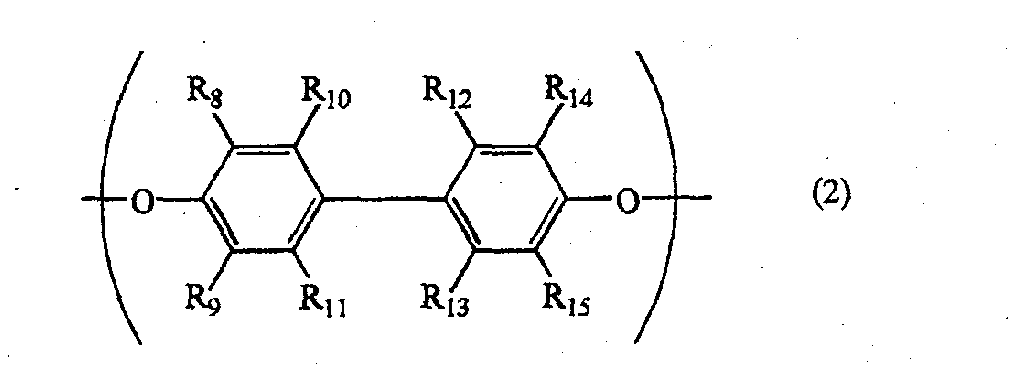
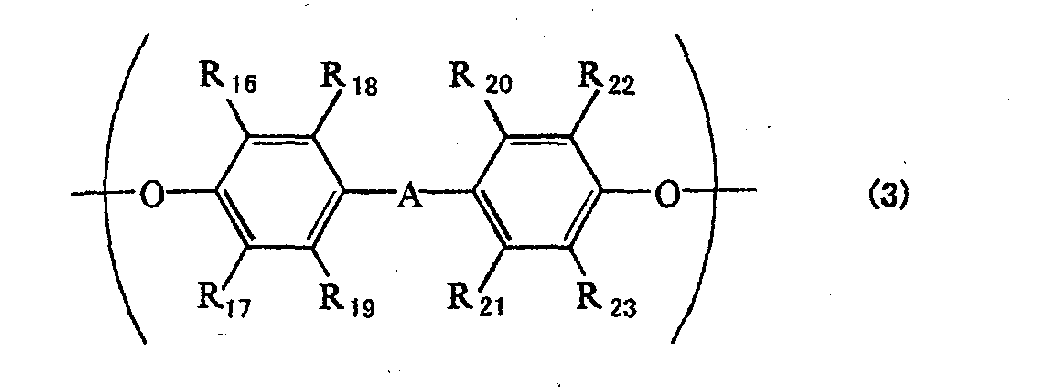
- the present invention relates to a vinyl compound of the formula (1), wherein R 1 , R 2 , R 3 , R 4 , R 5 , R 6 and R 7 may be the same or different and are a hydrogen atom, a halogen atom, an alkyl group, a halogenated alkyl group or a phenyl group, -(O-X-O)-is represented by the formula (2) or the formula (3) (in which R 8 , R 9 , R 10 , R 14 , R 15 , R 16 , R 17 , R 22 and R 23 may be the same or different and are a halogen atom, an alkyl group having 1 to 6 carbon atoms or a phenyl group, R 11 , R 12 , R 13 , R 18 , R 19 , R 20 and R 21 may be the same or different and are a hydrogen atom, a halogen atom, an alkyl group having 1 to 6 carbon atoms or a phenyl group, and and
- the present invention provides a curable resin composition containing the vinyl compound of the formula (1) and a cured product obtained by curing the above composition.
- thermosetting functional group obtained by introducing a thermosetting functional group to a terminal of a bi functional polyphenylene ether oligomer having the excellent dielectric characteristics and heat resistance of polyphenylene ether (to be sometimes referred to as "PPE" hereinafter)
- PPE polyphenylene ether
- a compound having thermosetting and photocurable functional groups introduced Japanese patent application No. 2002-038156 and 2002-055765.
- the compound having a thermosetting functional group introduced has excellent low dielectric characteristics, it is not photocurable.
- the compound having thermosetting and photocurable functional groups introduced is photocurable, while it does not attain the low dielectric characteristics of a thermosetting compound.
- the present inventors have made diligent studies for obtaining a compound having thermosetting and photocurable functional groups and having low dielectric characteristics equal to those of a thermosetting compound.
- the present inventors have found that a cured product having high curability, a low dielectric constant, a low dielectric loss tangent and high heat resistance can be obtained by introducing a vinyl group into a bifunctional PPE oligomer compound of the formula (1) in which -(O-X-O)- is represented by the formula (2) or the formula (3) and -(Y-O)- is an arrangement of one kind of structure defined by the formula (4) or a random arrangement of at least two kinds of structures defined by the formula (4). Accordingly, the present inventors have completed the present invention.
- R 1 , R 2 , R 3 , R 4 , R 5 , R 6 and R 7 may be the same or different and are a hydrogen atom, a halogen atom, an alkyl group, a halogenated alkyl group or a phenyl group.
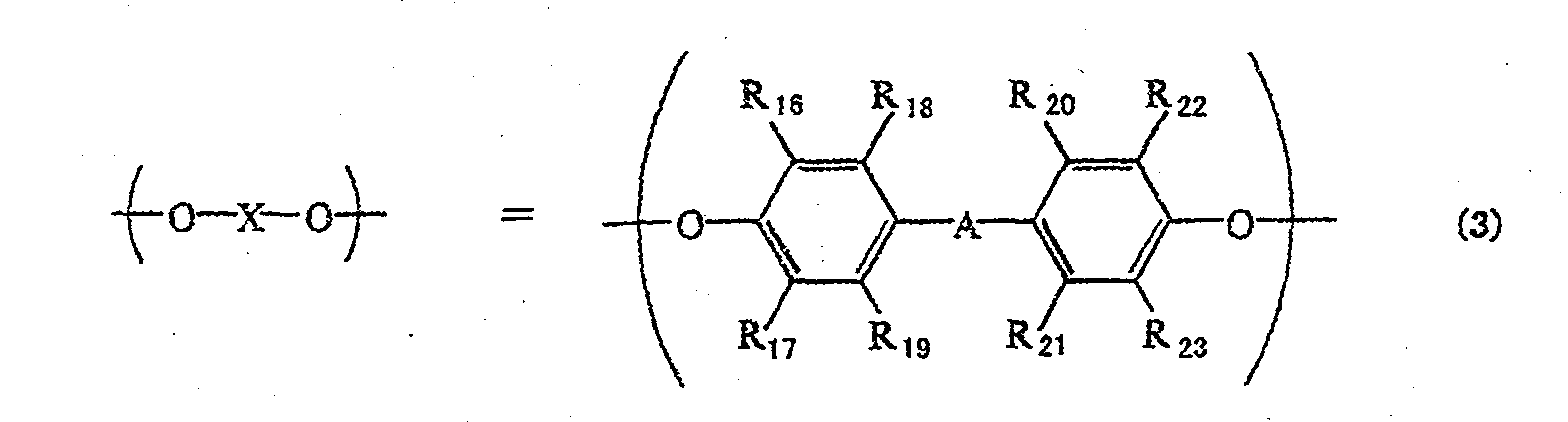
- -(O-X-O)- is represented by the formula (2) or the formula (3) in which R 8 , R 9 , R 10 , R 14 , R 15 , R 16 , R 17 , R 22 and R 23 may be the same or different and are a halogen atom, an alkyl group having 1 to 6 carbon atoms or a phenyl group.
- R 11 , R 12 , R 13 , R 18 , R 19 , R 20 and R 21 may be the same or different and are a hydrogen atom, a halogen atom, an alkyl group having 1 to 6 carbon atoms or a phenyl group.
- A is a linear or cyclic hydrocarbon which has 1 to 20 carbon atoms and which may have a substituent. The above substituent is preferably an alkyl group having 1 to 6 carbon atoms.
- -(O-X-O)- is represented by the formula (3), each of R 1 and R 2 is preferably an alkyl group, a halogenated alkyl group or a phenyl group.
- R 24 and R 25 may be the same or different and are a halogen atom, an alkyl group having 1 to 6 carbon atoms or a phenyl group.
- R 26 and R 27 may be the same or different and are a hydrogen atom, a halogen atom, an alkyl group having 1 to 6 carbon atoms or a phenyl group.
- Z is an organic group having at least one carbon atom which may contain an oxygen atom, a nitrogen atom, a sulfur atom or a halogen atom.
- Each of a and b is an integer of 0 to 300, provided that at least either a or b is not 0.
- Each of c and d is an integer of 0 or 1.
- R 8 , R 9 , R 10 , R 14 , R 15 , R 16 , R 17 , R 22 and R 23 are an alkyl group having 1 to 3 carbon atoms and R 11 , R 12 , R 13 , R 18 , R 19 , R 20 and R 21 are a hydrogen atom or an alkyl group having 1 to 3 carbon atoms.
- R 8 , R 9 , R 10 , R 14 , R 15 , R 16 , R 17 , R 22 and R 23 are a methyl group and R 11 , R 12 , R 13 , R 18 , R 19 , R 20 and R 21 are a hydrogen atom or a methyl group.
- R 24 and R 25 are an alkyl group having 1 to 3 carbon atoms and R 26 and R 27 are a hydrogen atom or an alkyl group having 1 to 3 carbon atoms.
- -(O-X-O)- is represented by the formula (7)
- -(Y-O)- is represented by the formula (5) or the formula (6).
- Z is preferably an organic group which has 1 to 10 carbon atoms and which may contain an oxygen atom or a sulfur atom. More specifically, examples thereof include the following groups.
- the production process of the vinyl compound of the formula (1) is not specially limited and the vinyl compound of the formula (1) may be produced by any methods.
- it can be obtained by reacting a compound represented by the formula (8) with chloromethylstyrene in the presence of an alkaline catalyst such as sodium hydroxide, potassium carbonate or sodium ethoxide and optionally in the presence of a phase transfer catalyst such as benzyltri-n-butylammonium bromide or 18-crown-6-ether.
- an alkaline catalyst such as sodium hydroxide, potassium carbonate or sodium ethoxide
- a phase transfer catalyst such as benzyltri-n-butylammonium bromide or 18-crown-6-ether.
- R 8 to R 23 and A in the formula (2) and formula (3) are as defined in the before-mentioned formula (2) and formula (3)
- -(Y-O)- is an arrangement of one kind of structure defined by the formula (4) or a random arrangement of at least two kinds of structures defined by the formula (4)
- R 24 to R 27 are as defined in the before-mentioned formula (4)
- each of a and b is an integer of 0 to 300, provided that at least either a or b is not 0.
- the compound of the formula (8) is produced by, for example, the method disclosed in JP-A-2003-12796 or Japanese patent application No. 2002-018508 in which a bivalent phenol and a monovalent phenol are copolymerized.
- the above curable resin composition contains the before-explained vinyl compound of the present invention. It is possible to incorporate a known epoxy resin, an oxetane resin, a compound having a polymerizable unsaturated group, photopolymerization and/or thermal-polymerization initiators, a photosensitizer, or the like, into the above resin composition.
- the epoxy resin can be selected from generally known epoxy resins. Examples thereof include a bisphenol A type epoxy resin, a bisphenol F type epoxy resin, a biphenyl type epoxy resin, a phenol novolak type epoxy resin, a cresol novolak type epoxy resin, a xylene novolak type epoxy resin, triglycidyl isocyanurate, an alicyclic epoxy resin, a dicyclopentadiene novolak type epoxy resin, a biphenyl novolak type epoxy resin and epoxy resins having a PPE structure disclosed in Japanese patent application Nos. 2001-353194 and 2002-018508. These epoxy resins may be used alone or in combination.
- the oxetane resin can be selected from generally known oxetane resins.
- the oxetane resin include alkyl oxetanes such as oxetane, 2-methyloxetane, 2, 2-dimethyloxetane, 3-methyloxetane and 3,3-dimethyloxetane, 3-methyl-3-methoxymethyloxetane, 3, 3' -di(trifluoromethyl) perfluorooxetane, 2-chloromethyloxetane, 3,3-bis(chrolomethyl)oxetane, OXT-101 (trade name, supplied by TOAGOSEI Co., Ltd.) and OXT-121 (trade name, supplied by TOAGOSEI Co., Ltd.). These oxetane resins may be used alone or in combination.
- an epoxy resin curing agent and/or an oxetane resin curing agent can be used.
- the epoxy resin curing agent is selected from generally known curing agents.
- epoxy resin curing agent examples include imidazole derivatives such as 2-methylimidazole, 2-ethyl-4-methylimidazole, 2-phenylimidazole, 1-cyanoethyl-2-phenylimidazole, 1-cyanoethyl-2-ethyl-4-methylimidazole, 2-phenyl-4, 5-dihydroxymethylimidazole and 2-phenyl-4-methyl-5-hydroxymethylimidazole; amine compounds such as dicyandiamide, benzyldimethylamine and 4-methyl-N,N-dimethylbenzylamine; and phosphorus compounds such as phosphine compounds and phosphonium compounds.
- imidazole derivatives such as 2-methylimidazole, 2-ethyl-4-methylimidazole, 2-phenylimidazole, 1-cyanoethyl-2-phenylimidazole, 1-cyanoethyl-2-ethyl-4-methylimidazole, 2-phenyl-4, 5-
- the oxetane resin curing agent can be selected from known cationic polymerization initiators.
- Commercially available examples include SAN-AID SI-60L, SAN-AID SI-80L, SAN-AID SI-100L (supplied by Sanshin Chemical Industry Co., Ltd.), CI-2064 (supplied by Nippon Soda Co., Ltd.), IRGACURE261 (supplied by Ciba Specialty Chemicals), ADEKAOPTMER SP-170, ADEKAOPTMER SP-150, (supplied by Asahi Denka Kogyo K.K.), and CYRACURE UVI-6990 (supplied by Union Carbide Corporation).
- the cationic polymerization initiators can be used as an epoxy resin curing agent. These curing agents may be used alone or in combination.
- the compound having a polymerizable unsaturated group can be selected from generally known compounds having a polymerizable unsaturated group.
- examples thereof include vinyl compounds such as ethylene, propylene and styrene, (meth) acrylates of monohydric and polyhydric alcohols such as methyl(meth)acrylate, 2-hydroxyethyl(meth) acrylate, 2-hydroxypropyl(meth)acrylate, polypropylene glycol di(meth)acrylate, trimethylol propane di(meth)acrylate, trimethylol propane tri(meth)acrylate, pentaerythritol tetra (meth) acrylate and dipentaerythritol hexa (meth) acrylate, epoxy (meth)acrylates such as a bisphenol A type epoxy (meth)acrylate, a bisphenol F type epoxy (meth)acrylate and epoxy (meth)acrylates having a PPE structure disclosed in Japanese patent application No.
- the photopolymerization initiator can be selected from generally known photopolymerization initiators.
- the photopolymerization initiator include ⁇ -diketones such as benzyl and diacetyl, acyloin ethers such as benzoyl ethyl ether and benzoin isopropyl ether, thioxanthones such as thioxanthone, 2,4-diethylthioxanthone and 2-isopropylthioxanthone, benzophenones such as benzophenone and 4,4'-bis(dimethylamino)benzophenone, acetophenones such as acetophenone, 2,2'-dimethoxy-2-phenylacetophenone and ⁇ -methoxy acetophenone, and aminoacetophenones such as 2-methyl-1-[4-(methylthio)phenyl]-2-morpholinopropane-1-on e and 2-benzyl-2-dimethylamin
- the photopolymerization initiator may be used in combination with one kind of or at least two kinds of known photosensitizer(s).
- the photosensitizer include N,N-dimethylaminoethylbenzoate, N,N-dimethylaminoisoamylbenzoate, triethanolamine and triethylamine.
- the thermal polymerization initiator may be selected from generally known thermal polymerization initiators. Examples thereof include peroxides such as benzoyl peroxide, p-chlorobenzoyl peroxide, di-t-butylperoxide, diisopropyl peroxy carbonate and di-2-ethylhexylperoxycarbonate, and azo compounds such as azobisisobutylonitrile.
- peroxides such as benzoyl peroxide, p-chlorobenzoyl peroxide, di-t-butylperoxide, diisopropyl peroxy carbonate and di-2-ethylhexylperoxycarbonate
- azo compounds such as azobisisobutylonitrile.
- the curable resin composition of the present invention when the curable resin composition of the present invention is produced, there may be added a known additive such as an inorganic filler, a color pigment, an antifoamer, a surface conditioner, a flame retardant, an ultraviolet absorber, an antioxidant, a polymerization inhibitor or a flow regulator, as required.
- a known additive such as an inorganic filler, a color pigment, an antifoamer, a surface conditioner, a flame retardant, an ultraviolet absorber, an antioxidant, a polymerization inhibitor or a flow regulator, as required.
- the inorganic filler include silicas such as natural silica, fused silica and amorphous silica, white carbon, titanium white, aerosil, alumina, talc, natural mica, synthetic mica, kaolin, clay, aluminum hydroxide, barium sulfate, E-glass, A-glass, C-glass, L-glass, D-glass, S-glass and M-glass G20.
- the cured product of the present invention can be obtained by curing the curable resin composition of the present invention, obtained by the above method, according to a known curing method such as a curing method using an electron beam, ultraviolet light or heat.
- a known curing method such as a curing method using an electron beam, ultraviolet light or heat.
- ultraviolet light there may be used a low-pressure mercury lamp, an intermediate-pressure mercury lamp, a high-pressure mercury lamp, an ultrahigh-pressure mercury lamp, a xenon lamp and a metal halide lamp as a light source for ultraviolet light.
- the vinyl compound of the present invention has a high glass transition temperature and gives a cured product having a low dielectric constant and a low dielectric loss tangent so that it is remarkably useful as a high-functional polymer material.
- the vinyl compound of the present invention can be cured by heat or light so that it can be used, as a thermally and electrically excellent material, for various uses such as various coating agents, UV coating compositions, adhesives, resists and buildup laminate materials.
- the vinyl compound resin had a number average molecular weight of 993 and a weight average molecular weight of 1,499.
- Example 2 10 g of the vinyl compound resin obtained in Example 1 was molten, degassed and molded at 150 °C and then thermally cured at 200°C for 6 hours, to obtain a cured product.
- Example 3 6 g of the vinyl compound resin obtained in Example 1 and 0.6 g of IRGACURE819 (supplied by Ciba Specialty Chemicals, photopolymerization initiator) were dissolved in 4 g of carbitol acetate to obtain a resin composition.
- the resin composition was applied to a copper-clad laminate surface with a screen-printing machine and then dried with an air dryer at 80 °C for 30 minutes. Then a pattern film was placed thereon and the copper-clad laminate surface was exposed at 2, 000 mJ/cm 2 using a UV irradiation device (supplied by EYE GRAPHICS Co.,Ltd. : UB0151, light source: metal halide lamp) .
- a UV irradiation device supplied by EYE GRAPHICS Co.,Ltd. : UB0151, light source: metal halide lamp
- Example 2 The cured product of the vinyl compound resin obtained in Example 2 was evaluated for properties by the following methods.
- Glass transition temperature (Tg) determined according to a dynamic viscoelasticity measurement (DMA). The measurement was carried out at an oscillation frequency of 10 Hz.
- Dielectric constant and dielectric loss tangent determined according to a cavity resonant oscillation method. Table 1 shows evaluation results of the above physical properties.
- Tg (°C) 195 Dielectric constant (1GHz) 2.71 Dielectric loss tangent (1GHz) 0.0041
- the resin had a number average molecular weight or 845, a weight average molecular weight of 1,106 and a hydroxyl group equivalent of 451.
- the vinyl compound resin had a number average molecular weight of 1,015 and a weight average molecular weight of 1,504.
- the resin had a number average molecular weight of 877, a weight average molecular weight of 1,183 and a hydroxyl group equivalent of 477.
- the vinyl compound resin had a number average molecular weight of 1, 022 and a weight average molecular weight of 1,533.
- the resin had a number average molecular weight of 852, a weight average molecular weight of 1,133 and a hydroxyl group equivalent of 460.
- the vinyl compound resin had a number average molecular weight of 1,011 and a weight average molecular weight of 1,510.
- the resin had a number average molecular weight of 934, a weight average molecular weight of 1, 223 and a hydroxyl group equivalent of 496.
- the vinyl compound resin had a number average molecular weight of 1,107 and a weight average molecular weight of 1,651.
- the resin had a number average molecular weight of 801, a weight average molecular weight of 1, 081 and a hydroxyl group equivalent of 455.
- the vinyl compound resin had a number average molecular weight of 988 and a weight average molecular weight of 1,420.
- Table 2 shows evaluation results of physical properties of the above resin-cured products.
- Example 4 Example 5
- Example 6 Example 7
- Example 8 Cured product Cured product Cured product Cured product Cured product Tg (°C) 188 192 190 202 191 Dielectric constant (1GHz) 2.80 2.82 2.79 2.80 2.78 Dielectric loss tangent (1GHz) 0.0055 0.0053 0.0053 0.0054 0.0052
- any one of R 1 to R 7 represents an alkyl or halogenated alkyl group, it represents a C 1 -C 6 alkyl or C 1 -C 6 haloalkyl group.
- the moiety A in the formula (3) is unsubstituted or is substituted by up to 10, preferably up to 5, C 1 -C 6 alkyl substituents.
- -(Y-O)- is a moiety of the formula (4), or a random arrangement of from 2 to 10, preferably 2 to 5, more preferably 2 to 3, moieties of the formula (4).
- -(Y-O)- is a moiety of the formula (5) or (6) or a random arrangement of from 2 to 10, preferably 2 to 5, more preferably 2 to 3, moieties of the formula (5) or (6).
- Z represents -(CH 2 ) n - n is typically 1 to 10.
- Z represents [ (CH 2 ) n -O-CH 2 ] n is typically from 0 to 9, and is preferably 1 to 9.
Landscapes
- Chemical & Material Sciences (AREA)
- Health & Medical Sciences (AREA)
- Chemical Kinetics & Catalysis (AREA)
- Medicinal Chemistry (AREA)
- Polymers & Plastics (AREA)
- Organic Chemistry (AREA)
- General Chemical & Material Sciences (AREA)
- Macromonomer-Based Addition Polymer (AREA)
- Materials For Photolithography (AREA)
Abstract

- (O-X-O)- represents a moiety of formula (2) or formula (3), in which R8, R9, R10, R14, R15, R16, R17, R22 and R23 are the same or different and represent a halogen atom, an alkyl group having 1 to 6 carbon atoms or a phenyl group and R11, R12, R13, R18, R19, R20 and R21 are the same or different and represent a hydrogen atom, a halogen atom, an alkyl group having 1 to 6 carbon atoms or a phenyl group, and A is a linear or cyclic hydrocarbon which has 1 to 20 carbon atoms and which may have a substituent;
- (Y-O)- is a moiety of the formula (4) in which R24 and R25 are the same or different and represent a halogen atom, an alkyl group having 1 to 6 carbon atoms or a phenyl group, and R26 and R27 are the same or different and represent a hydrogen atom, a halogen atom, an alkyl group having 1 to 6 carbon atoms or a phenyl group, or a random arrangement of at least two kinds of moieties of the formula (4);

Description
- The present invention relates to a novel vinyl compound, a curable resin composition containing the above compound and cured products of these. More specifically, according to the vinyl compound of the present invention, there can be provided a polymer material which can give a cured product excellent in heat resistance and dielectric characteristics by polymerizing the vinyl compound itself or copolymerizing the vinyl compound and a different unsaturated compound.
- Further, it can be used, as a material which is thermally and electrically excellent and can be cured by heat or light, for wide uses such as a resin for a resist, a sealing resin for a liquid-crystal display panel, a resin for a color filter of a liquid crystal, a UV coating composition, various coating agents, an adhesive, a buildup laminate material, and the like.
- Conventionally, vinyl compounds are widely used as a raw material for various functional polymer materials such as a photosensitive material, an optical material, a dental material, an electronic material and crosslinking agents for various polymers. However, since higher performances are required in these application fields in recent years, physical properties required as a functional polymer material become severer increasingly. As such physical properties, for example, heat resistance, weather resistance, chemical resistance, low moisture absorptivity, high refractive index, high fracture toughness, low dielectric constant and low dielectric loss tangent are required. Until now, these required physical properties have not been completely satisfied.
- It is an object of the present invention to provide a novel vinyl compound and a curable resin composition each of which is curable by heat or light, and gives a cured product having excellent heat resistance and having a low dielectric constant and a low dielectric loss tangent.
- The present invention relates to a vinyl compound of the formula (1),
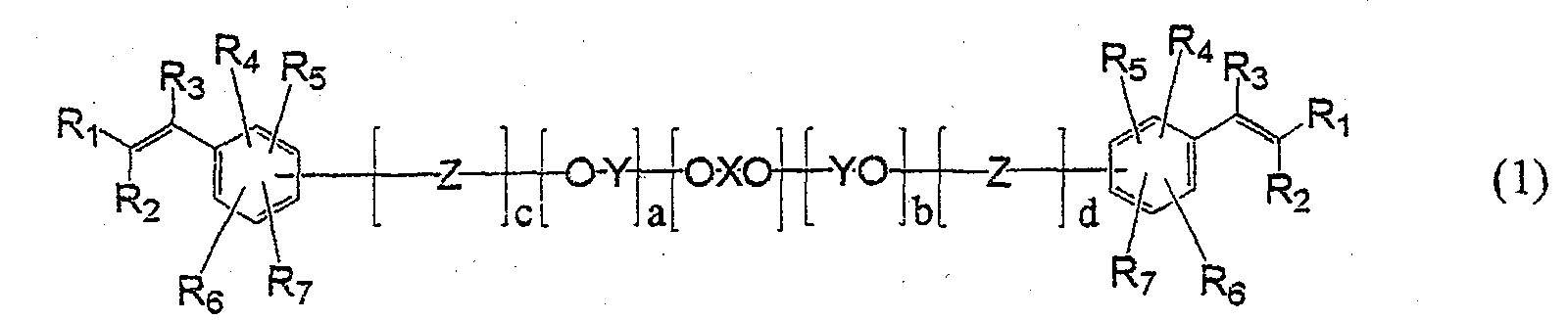
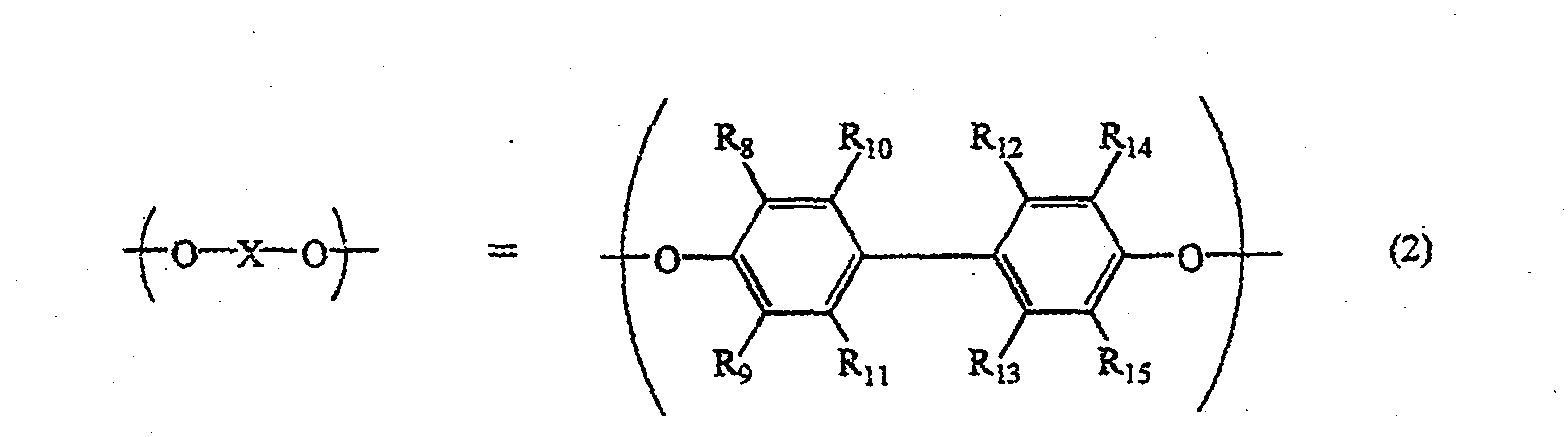
 wherein R1, R2, R3, R4, R5, R6 and R7 may be the same or different and are a hydrogen atom, a halogen atom, an alkyl group, a halogenated alkyl group or a phenyl group, -(O-X-O)-is represented by the formula (2) or the formula (3) (in which R8, R9, R10, R14, R15, R16, R17, R22 and R23 may be the same or different and are a halogen atom, an alkyl group having 1 to 6 carbon atoms or a phenyl group, R11, R12, R13, R18, R19, R20 and R21 may be the same or different and are a hydrogen atom, a halogen atom, an alkyl group having 1 to 6 carbon atoms or a phenyl group, and and A is a linear or cyclic hydrocarbon which has 1 to 20 carbon atoms and which may have a substituent), -(Y-O)- is an arrangement of one kind of structure defined by the formula (4) or a random arrangement of at least two kinds of structures defined by the formula (4) (in which R24 and R25 may be the same or different and are a halogen atom, an alkyl group having 1 to 6 carbon atoms or a phenyl group, and R26 and R27 may be the same or different and are a hydrogen atom, a halogen atom, an alkyl group having 1 to 6 carbon atoms or a phenyl group), Z is an organic group which has at least one carbon atom and which may contain an oxygen atom, a nitrogen atom, a sulfur atom or a halogen atom, each of a and b is an integer of 0 to 300, provided that at least either a or b is not 0, and each of c and d is an integer of 0 or 1.
- Further, the present invention provides a curable resin composition containing the vinyl compound of the formula (1) and a cured product obtained by curing the above composition.
- The present inventors have synthesized a compound obtained by introducing a thermosetting functional group to a terminal of a bi functional polyphenylene ether oligomer having the excellent dielectric characteristics and heat resistance of polyphenylene ether (to be sometimes referred to as "PPE" hereinafter) (Japanese patent application No. 2002-018508) and a compound having thermosetting and photocurable functional groups introduced (Japanese patent application No. 2002-038156 and 2002-055765). However, although the compound having a thermosetting functional group introduced has excellent low dielectric characteristics, it is not photocurable. On the other hand, the compound having thermosetting and photocurable functional groups introduced is photocurable, while it does not attain the low dielectric characteristics of a thermosetting compound. Thus, the present inventors have made diligent studies for obtaining a compound having thermosetting and photocurable functional groups and having low dielectric characteristics equal to those of a thermosetting compound. As a result, the present inventors have found that a cured product having high curability, a low dielectric constant, a low dielectric loss tangent and high heat resistance can be obtained by introducing a vinyl group into a bifunctional PPE oligomer compound of the formula (1) in which -(O-X-O)- is represented by the formula (2) or the formula (3) and -(Y-O)- is an arrangement of one kind of structure defined by the formula (4) or a random arrangement of at least two kinds of structures defined by the formula (4). Accordingly, the present inventors have completed the present invention.
- In the compound of the formula (1), R1, R2, R3, R4, R5, R6 and R7 may be the same or different and are a hydrogen atom, a halogen atom, an alkyl group, a halogenated alkyl group or a phenyl group. -(O-X-O)- is represented by the formula (2) or the formula (3) in which R8, R9, R10, R14, R15, R16, R17, R22 and R23 may be the same or different and are a halogen atom, an alkyl group having 1 to 6 carbon atoms or a phenyl group. R11, R12, R13, R18, R19, R20 and R21 may be the same or different and are a hydrogen atom, a halogen atom, an alkyl group having 1 to 6 carbon atoms or a phenyl group. A is a linear or cyclic hydrocarbon which has 1 to 20 carbon atoms and which may have a substituent. The above substituent is preferably an alkyl group having 1 to 6 carbon atoms. When -(O-X-O)- is represented by the formula (3), each of R1 and R2 is preferably an alkyl group, a halogenated alkyl group or a phenyl group. -(Y-O)-is represented by the formula (4) and is an arrangement of one kind of structure defined by the formula (4) or a random arrangement of at least two kinds of structures defined by the formula (4). R24 and R25 may be the same or different and are a halogen atom, an alkyl group having 1 to 6 carbon atoms or a phenyl group. R26 and R27 may be the same or different and are a hydrogen atom, a halogen atom, an alkyl group having 1 to 6 carbon atoms or a phenyl group. Z is an organic group having at least one carbon atom which may contain an oxygen atom, a nitrogen atom, a sulfur atom or a halogen atom. Each of a and b is an integer of 0 to 300, provided that at least either a or b is not 0. Each of c and d is an integer of 0 or 1.
- Of these, preferred is -(O-X-O)- in which R8, R9, R10, R14, R15, R16, R17, R22 and R23 are an alkyl group having 1 to 3 carbon atoms and R11, R12, R13, R18, R19, R20 and R21 are a hydrogen atom or an alkyl group having 1 to 3 carbon atoms. More preferred is -(O-X-O)- in which R8, R9, R10, R14, R15, R16, R17, R22 and R23 are a methyl group and R11, R12, R13, R18, R19, R20 and R21 are a hydrogen atom or a methyl group.
- Preferred is -(-Y-O-)- in which R24 and R25 are an alkyl group having 1 to 3 carbon atoms and R26 and R27 are a hydrogen atom or an alkyl group having 1 to 3 carbon atoms.
- Particularly preferably, -(O-X-O)- is represented by the formula (7), and -(Y-O)- is represented by the formula (5) or the formula (6).


- Z is preferably an organic group which has 1 to 10 carbon atoms and which may contain an oxygen atom or a sulfur atom. More specifically, examples thereof include the following groups.



- The production process of the vinyl compound of the formula (1) is not specially limited and the vinyl compound of the formula (1) may be produced by any methods. For example, it can be obtained by reacting a compound represented by the formula (8) with chloromethylstyrene in the presence of an alkaline catalyst such as sodium hydroxide, potassium carbonate or sodium ethoxide and optionally in the presence of a phase transfer catalyst such as benzyltri-n-butylammonium bromide or 18-crown-6-ether.


- In the above formulae, R8 to R23 and A in the formula (2) and formula (3) are as defined in the before-mentioned formula (2) and formula (3), -(Y-O)- is an arrangement of one kind of structure defined by the formula (4) or a random arrangement of at least two kinds of structures defined by the formula (4), R24 to R27 are as defined in the before-mentioned formula (4), and each of a and b is an integer of 0 to 300, provided that at least either a or b is not 0.
- The compound of the formula (8) is produced by, for example, the method disclosed in JP-A-2003-12796 or Japanese patent application No. 2002-018508 in which a bivalent phenol and a monovalent phenol are copolymerized.
- Then, the curable resin composition of the present invention will be explained. The above curable resin composition contains the before-explained vinyl compound of the present invention. It is possible to incorporate a known epoxy resin, an oxetane resin, a compound having a polymerizable unsaturated group, photopolymerization and/or thermal-polymerization initiators, a photosensitizer, or the like, into the above resin composition.
- The epoxy resin can be selected from generally known epoxy resins. Examples thereof include a bisphenol A type epoxy resin, a bisphenol F type epoxy resin, a biphenyl type epoxy resin, a phenol novolak type epoxy resin, a cresol novolak type epoxy resin, a xylene novolak type epoxy resin, triglycidyl isocyanurate, an alicyclic epoxy resin, a dicyclopentadiene novolak type epoxy resin, a biphenyl novolak type epoxy resin and epoxy resins having a PPE structure disclosed in Japanese patent application Nos. 2001-353194 and 2002-018508. These epoxy resins may be used alone or in combination.
- The oxetane resin can be selected from generally known oxetane resins. Examples of the oxetane resin include alkyl oxetanes such as oxetane, 2-methyloxetane, 2, 2-dimethyloxetane, 3-methyloxetane and 3,3-dimethyloxetane, 3-methyl-3-methoxymethyloxetane, 3, 3' -di(trifluoromethyl) perfluorooxetane, 2-chloromethyloxetane, 3,3-bis(chrolomethyl)oxetane, OXT-101 (trade name, supplied by TOAGOSEI Co., Ltd.) and OXT-121 (trade name, supplied by TOAGOSEI Co., Ltd.). These oxetane resins may be used alone or in combination.
- When the epoxy resin and/or the oxetane resin are used in the curable resin composition of the present invention, an epoxy resin curing agent and/or an oxetane resin curing agent can be used. The epoxy resin curing agent is selected from generally known curing agents. Examples of the epoxy resin curing agent include imidazole derivatives such as 2-methylimidazole, 2-ethyl-4-methylimidazole, 2-phenylimidazole, 1-cyanoethyl-2-phenylimidazole, 1-cyanoethyl-2-ethyl-4-methylimidazole, 2-phenyl-4, 5-dihydroxymethylimidazole and 2-phenyl-4-methyl-5-hydroxymethylimidazole; amine compounds such as dicyandiamide, benzyldimethylamine and 4-methyl-N,N-dimethylbenzylamine; and phosphorus compounds such as phosphine compounds and phosphonium compounds. The oxetane resin curing agent can be selected from known cationic polymerization initiators. Commercially available examples include SAN-AID SI-60L, SAN-AID SI-80L, SAN-AID SI-100L (supplied by Sanshin Chemical Industry Co., Ltd.), CI-2064 (supplied by Nippon Soda Co., Ltd.), IRGACURE261 (supplied by Ciba Specialty Chemicals), ADEKAOPTMER SP-170, ADEKAOPTMER SP-150, (supplied by Asahi Denka Kogyo K.K.), and CYRACURE UVI-6990 (supplied by Union Carbide Corporation). The cationic polymerization initiators can be used as an epoxy resin curing agent. These curing agents may be used alone or in combination.
- The compound having a polymerizable unsaturated group can be selected from generally known compounds having a polymerizable unsaturated group. Examples thereof include vinyl compounds such as ethylene, propylene and styrene, (meth) acrylates of monohydric and polyhydric alcohols such as methyl(meth)acrylate, 2-hydroxyethyl(meth) acrylate, 2-hydroxypropyl(meth)acrylate, polypropylene glycol di(meth)acrylate, trimethylol propane di(meth)acrylate, trimethylol propane tri(meth)acrylate, pentaerythritol tetra (meth) acrylate and dipentaerythritol hexa (meth) acrylate, epoxy (meth)acrylates such as a bisphenol A type epoxy (meth)acrylate, a bisphenol F type epoxy (meth)acrylate and epoxy (meth)acrylates having a PPE structure disclosed in Japanese patent application No. 2001-387968 and 2002-038156, (meth)acrylates having a PPE skeleton disclosed in Japanese patent application No. 2002-053653 and 2002-055765, and a benzocyclobutene resin. These compounds having an unsaturated group may be used alone or in combination.
- The photopolymerization initiator can be selected from generally known photopolymerization initiators. Examples of the photopolymerization initiator include α-diketones such as benzyl and diacetyl, acyloin ethers such as benzoyl ethyl ether and benzoin isopropyl ether, thioxanthones such as thioxanthone, 2,4-diethylthioxanthone and 2-isopropylthioxanthone, benzophenones such as benzophenone and 4,4'-bis(dimethylamino)benzophenone, acetophenones such as acetophenone, 2,2'-dimethoxy-2-phenylacetophenone and β-methoxy acetophenone, and aminoacetophenones such as 2-methyl-1-[4-(methylthio)phenyl]-2-morpholinopropane-1-on e and 2-benzyl-2-dimethylamino-1-(-4-morpholinophenyl)-butanone-1. These photopolymerization initiators are used alone or in combination.
- Further, the photopolymerization initiator may be used in combination with one kind of or at least two kinds of known photosensitizer(s). Examples of the photosensitizer include N,N-dimethylaminoethylbenzoate, N,N-dimethylaminoisoamylbenzoate, triethanolamine and triethylamine.
- The thermal polymerization initiator may be selected from generally known thermal polymerization initiators. Examples thereof include peroxides such as benzoyl peroxide, p-chlorobenzoyl peroxide, di-t-butylperoxide, diisopropyl peroxy carbonate and di-2-ethylhexylperoxycarbonate, and azo compounds such as azobisisobutylonitrile.
- Further, when the curable resin composition of the present invention is produced, there may be added a known additive such as an inorganic filler, a color pigment, an antifoamer, a surface conditioner, a flame retardant, an ultraviolet absorber, an antioxidant, a polymerization inhibitor or a flow regulator, as required. Examples of the inorganic filler include silicas such as natural silica, fused silica and amorphous silica, white carbon, titanium white, aerosil, alumina, talc, natural mica, synthetic mica, kaolin, clay, aluminum hydroxide, barium sulfate, E-glass, A-glass, C-glass, L-glass, D-glass, S-glass and M-glass G20. The thus-obtained curable resin composition is suitable for various uses such as a solder resist composition, buildup wiring board materials, insulating coatings, adhesives, printing inks and coating agents.
- The cured product of the present invention can be obtained by curing the curable resin composition of the present invention, obtained by the above method, according to a known curing method such as a curing method using an electron beam, ultraviolet light or heat. When ultraviolet light is used for the curing, there may be used a low-pressure mercury lamp, an intermediate-pressure mercury lamp, a high-pressure mercury lamp, an ultrahigh-pressure mercury lamp, a xenon lamp and a metal halide lamp as a light source for ultraviolet light.
- The vinyl compound of the present invention has a high glass transition temperature and gives a cured product having a low dielectric constant and a low dielectric loss tangent so that it is remarkably useful as a high-functional polymer material.
- Further, the vinyl compound of the present invention can be cured by heat or light so that it can be used, as a thermally and electrically excellent material, for various uses such as various coating agents, UV coating compositions, adhesives, resists and buildup laminate materials.
- Examples
- The present invention will be explained more concretely with reference to Examples hereinafter, while the present invention shall not be specially limited to these Examples. Number average molecular weights and weight average molecular weights were measured according to the gel permeation chromatography (GPC) method.
- Example 1
- Synthesis of bifunctional PPE oligomer compound
A longitudinally long reactor having a volume of 2 liters and equipped with a stirrer, a thermometer, an air-introducing tube and baffleplates was charged with 1.3 g (0.012 mol) of CuCl, 70.7 g (0.55 mol) of di-n-butylamine and 400 g of methyl ethyl ketone. The components were stirred at a reaction temperature of 40°C. A solution of 43.2 g (0.16 mol) of 2, 2', 3, 3' /5/5'-hexamethyl-[1,1'-biphenyl]-4,4'-diol as a bivalent phenol and 58. 6 g (0.48 mol) of 2, 6-dimehtylphenol in 800 g of methyl ethyl ketone was dropwise added to the reactor over 120 minutes while carrying out bubbling with 2L/min of air. After the completion of the addition, stirring was carried out for 60 minutes while continuing the bubbling with 2L/min of air. A disodium dihydrogen ethylenediamine tetraacetate aqueous solution was added to the stirred mixture to terminate the reaction. Then, washing was carried out with 1N hydrochloric acid aqueous solution and then washing was carried out with pure water. The thus-obtained solution was concentrated by an evaporator and then dried under reduced pressure, to obtain 96.7 g of a resin represented by the formula (8). The resin had a number average molecular weight of 810, a weight average molecular weight of 1,105 and a hydroxyl group equivalent of 475. - Synthesis of vinyl compound
A reactor equipped with a stirrer, a thermometer and a reflux tube was charged with 50 g of the above resin, 26 g of chloromethylstyrene (supplied by Tokyo Kasei Kogyo Co., Ltd.), 200 g of tetrahydrofuran, 24 g of potassium carbonate and 6 g of 18-crown-6-ether, and the components were stirred at a reaction temperature of 30 °C. The reaction was traced by a NMR measurement and the reaction was terminated after 6-hours stirring. The tetrahydrofuran was evaporated and then the resultant product was diluted with 200 g of toluene and then washed with pure water. An organic layer was concentrated and then dropwise added to methanol, to carry out a reprecipitation. A solid was recovered by filtration and the recovered solid was dried in vacuum to obtain 44 g of a vinyl compound resin represented by the formula (1). The vinyl compound resin had a number average molecular weight of 993 and a weight average molecular weight of 1,499. - Example 2
10 g of the vinyl compound resin obtained in Example 1 was molten, degassed and molded at 150 °C and then thermally cured at 200°C for 6 hours, to obtain a cured product. - Example 3
6 g of the vinyl compound resin obtained in Example 1 and 0.6 g of IRGACURE819 (supplied by Ciba Specialty Chemicals, photopolymerization initiator) were dissolved in 4 g of carbitol acetate to obtain a resin composition. The resin composition was applied to a copper-clad laminate surface with a screen-printing machine and then dried with an air dryer at 80 °C for 30 minutes. Then a pattern film was placed thereon and the copper-clad laminate surface was exposed at 2, 000 mJ/cm2 using a UV irradiation device (supplied by EYE GRAPHICS Co.,Ltd. : UB0151, light source: metal halide lamp) . After the exposure, development was carried out with methyl ethyl ketone. In this case, only non-exposed portions were dissolved in the methyl ethyl ketone, to obtain a development pattern of a resin-cured product. A pencil mar strength (JIS K5400) of the resin-cured product was H. - Measurement methods
The cured product of the vinyl compound resin obtained in Example 2 was evaluated for properties by the following methods.
Glass transition temperature (Tg): determined according to a dynamic viscoelasticity measurement (DMA). The measurement was carried out at an oscillation frequency of 10 Hz.
Dielectric constant and dielectric loss tangent: determined according to a cavity resonant oscillation method.
Table 1 shows evaluation results of the above physical properties.Example 2 Tg (°C) 195 Dielectric constant (1GHz) 2.71 Dielectric loss tangent (1GHz) 0.0041 - Example 4
- (Synthesis of bifunctional PPE oligomer compound)
A longitudinally long reactor having a volume of 2 liters and equipped with a stirrer, a thermometer, an air-introducing tube and baffleplates was charged with 1.3 g (0.012 mol) of CuCl, 70.7 g (0.55 mol) of di-n-butylamine and 400 g of methyl ethyl ketone. The components were stirred at a reaction temperature of 40 °C. A solution of 45.4 g (0.16 mol) of 4,4'-(1-methylethylidene)bis(2,6-dimethylphenol) as a bivalent phenol and 58.6 g (0.48 mol) of 2, 6-dimehtylphenol in 800 g of methyl ethyl ketone was dropwise added to the mixture in the reactor over 120 minutes while carrying out bubbling with 2L/min of air. After the completion of the addition, stirring was carried out for 60 minutes while continuing the bubbling with 2L/min of air. A disodium dihydrogen ethylenediamine tetraacetate aqueous solution was added to the stirred mixture to terminate the reaction. Then, washing was carried out with 1N hydrochloric acid aqueous solution and then washing was carried out with pure water. The thus-obtained solution was concentrated by an evaporator and then dried under reduced pressure, to obtain 98.8 g of a resin represented by the formula (8). The resin had a number average molecular weight or 845, a weight average molecular weight of 1,106 and a hydroxyl group equivalent of 451. - (Synthesis of vinyl compound)
A reactor equipped with a stirrer, a thermometer and a reflux tube was charged with 47 g of the above resin, 26 g of chloromethylstyrene (suppliedby Tokyo Kasei Kogyo Co. Ltd.), 200 g of tetrahydrofuran, 24 g of potassium carbonate and 6 g of 18-crown-6-ether, and the components were stirred at a reaction temperature of 30 °C. The reaction was traced by a NMR measurement and the reaction was terminated after 6-hours stirring. The tetrahydrofuran was evaporated and then the resultant product was diluted with 200 g of toluene and then washed with pure water. An organic layer was concentrated and then dropwise added to methanol, to carry out a reprecipitation. A solid was recovered by filtration and the recovered solid was dried in vacuum to obtain 40 g of a vinyl compound resin represented by the formula (1). The vinyl compound resin had a number average molecular weight of 1,015 and a weight average molecular weight of 1,504. - 10 g of the vinyl compound resin was molten, degassed and molded at 150 °C and then cured at 200°C for 6 hours, to obtain a cured product. Table 2 shows evaluation results of properties of the cured product.
- 6 g of the above vinyl compound resin was dissolved in 4 g of carbitol acetate and 0.6 g of Darocur 1173 (supplied by Ciba Specialty Chemicals, photopolymerization initiator) was added to the resultant solution to obtain a resin composition. The resin composition was applied to a copper-clad laminate surface with a screen-printing machine and then dried with an air dryer at 80 °C for 30 minutes. Then a pattern film was placed thereon and the copper-clad laminate surface was exposed at 2, 000 mJ using a UV irradiation device (supplied by EYE GRAPHICS Co., Ltd. : UB0151, light source: metal halide lamp) . After the exposure, development was carried out with methyl ethyl ketone. In this case, only non-exposed portions were dissolved in the methyl ethyl ketone, to obtain a development pattern of a resin-cured product. A pencil mar strength (JIS K5400) of the resin-cured product was H.
- Example 5
- (Synthesis of bifunctional PPE oligomer compound)
A longitudinally long reactor having a volume of 2 liters and equipped with a stirrer, a thermometer, an air-introducing tube and baffleplates was charged with 1.3 g (0.012 mol) of CuCl, 70.7 g (0.55 mol) of di-n-butylamine and 400 g of methyl ethyl ketone. The components were stirred at a reaction temperature of 40 °C. A solution of 51.8 g (0.16 mol) of 4, 4'-cyclohexylidenebis (2,6-dimethylphenol) as a bivalent phenol and 58.6 g (0.48 mol) of 2,6-dimehtylphenol in 800 g of methyl ethyl ketone was dropwise added to the mixture in the reactor over 120 minutes while carrying out bubbling with 2L/min of air. After the completion of the addition, stirring was carried out for 60 minutes while continuing the bubbling with 2L/min of air. A disodium dihydrogen ethylenediamine tetraacetate aqueous solution was added to the stirred mixture to terminate the reaction. Then, washing was carried out with 1N hydrochloric acid aqueous solution and then washing was carried out with pure water. The thus-obtained solution was concentrated by an evaporator and then dried under reduced pressure, to obtain 102.6 g of a resin represented by the formula (8). The resin had a number average molecular weight of 877, a weight average molecular weight of 1,183 and a hydroxyl group equivalent of 477. - (Synthesis of vinyl compound)
A reactor equipped with a stirrer, a thermometer and a reflux tube was charged with 50 g of the above resin, 26 g of chloromethylstyrene (suppliedby Tokyo Kasei Kogyo Co., Ltd.), 200 g of tetrahydrofuran, 24 g of potassium carbonate and 6 g of 18-crown-6-ether, and the components were stirred at a reaction temperature of 30 °C. The reaction was traced by a NMR measurement and the reaction was terminated after 6-hours stirring. The tetrahydrofuran was evaporated and then the resultant product was diluted with 200 g of toluene and then washed with pure water. An organic layer was concentrated and then dropwise added to methanol, to carry out a reprecipitation. A solid was recovered by filtration and the recovered solid was dried in vacuum to obtain 42 g of a vinyl compound resin represented by the formula (1). The vinyl compound resin had a number average molecular weight of 1, 022 and a weight average molecular weight of 1,533. - 10 g of the vinyl compound resin was molten, degassed and molded at 150 °C and then cured at 200°C for 6 hours, to obtain a cured product. Table 2 shows evaluation results of properties of the cured product.
- 6 g of the above vinyl compound resin was dissolved in 4 g of carbitol acetate and 0.6 g of Darocur 1173 (supplied by Ciba Specialty Chemicals, photopolymerization initiator) was added to the resultant solution to obtain a resin composition. The resin composition was applied to a copper-clad laminate surface with a screen-printing machine and then dried with an air dryer at 80 °C for 30 minutes. Then a pattern film was placed thereon and the copper-clad laminate surface was exposed at 2, 000 mJ using a UV irradiation device (supplied by EYE GRAPHICS Co., Ltd. : UB0151, light source: metal halide lamp). After the exposure, development was carried out with methyl ethyl ketone. In this case, only non-exposed portions were dissolved in the methyl ethyl ketone, to obtain a development pattern of a resin-cured product. A pencil mar strength (JIS K5400) of the resin-cured product was H.
- Example 6
- (Synthesis of bifunctional PPE oligomer compound)
A longitudinally long reactor having a volume of 2 liters and equipped with a stirrer, a thermometer, an air-introducing tube and baffleplates was charged with 1.3 g (0.012 mol) of CuCl, 70.7 g (0.55 mol) of di-n-butylamine and 400 g of methyl ethyl ketone. The components were stirred at a reaction temperature of 40 °C. A solution of 45.4 g (0.16 mol) or 4, 4'-methylidenebis (2, 3, 6-trimethylphenol) as a bivalent phenol and 58.6 g (0.48 mol) of 2,6-dimehtylphenol in 800 g of methyl ethyl ketone was dropwise added to the mixture in the reactor over 120 minutes while carrying out bubbling with 2L/min of air. After the completion of the addition, stirring was carried out for 60 minutes while continuing the bubbling with 2L/min of air. A disodium dihydrogen ethylenediamine tetraacetate aqueous solution was added to the stirred mixture to terminate the reaction. Then, washing was carried out with 1N hydrochloric acid aqueous solution and then washing was carried out with pure water. The thus-obtained solution was concentrated by an evaporator and then dried under reduced pressure, to obtain 97.4 g of a resin represented by the formula (8). The resin had a number average molecular weight of 852, a weight average molecular weight of 1,133 and a hydroxyl group equivalent of 460. - (Synthesis of vinyl compound)
A reactor equipped with a stirrer, a thermometer and a reflux tube was charged with 48 g of the above resin, 26 g of chloromethylstyrene ( supplied by Tokyo Kasei Kogyo Co., Ltd.), 200 g of tetrahydrofuran, 24 g of potassium carbonate and 6 g of 18-crown-6-ether, and the components were stirred at a reaction temperature of 30 °C. The reaction was traced by a NMR measurement and the reaction was terminated after 6-hours stirring. The tetrahydrofuran was evaporated and then the resultant product was diluted with 200 g of toluene and then washed with pure water. An organic layer was concentrated and then dropwise added to methanol, to carry out a reprecipitation. A solid was recovered by filtration and the recovered solid was dried in vacuum to obtain 38 g of a vinyl compound resin represented by the formula (1). The vinyl compound resin had a number average molecular weight of 1,011 and a weight average molecular weight of 1,510. - 10 g of the vinyl compound resin was molten, degassed and molded at 150 °C and then cured at 200°C for 6 hours, to obtain a cured product. Table 2 shows evaluation results of properties of the cured product.
- 6 g of the above vinyl compound resin was dissolved in 4 g of carbitol acetate and 0.6 g of Darocur 1173 (supplied by Ciba Specialty Chemicals, photopolymerization initiator) was added to the resultant solution to obtain a resin composition. The resin composition was applied to a copper-clad laminate surface with a screen-printing machine and then dried with an air dryer at 80 °C for 30 minutes. Then a pattern film was placed thereon and the copper-clad laminate surface was exposed at 2,000 mJ using a UV irradiation device (supplied by EYE GRAPHICS Co., Ltd. : UB0151, light source: metal halide lamp). After the exposure, development was carried out with methyl ethyl ketone. In this case, only non-exposed portions were dissolved in the methyl ethyl ketone, to obtain a development pattern of a resin-cured product. A pencil mar strength (JIS K5400) of the resin-cured product was H.
- Example 7
- (Synthesis of bifunctional PPE oligomer compound)
A longitudinally long reactor having a volume of 2 liters and equipped with a stirrer, a thermometer, an air-introducing tube and baffleplates was charged with 1.3 g (0.012 mol) of CuCl, 70.7 g (0.55 mol) of di-n-butylamine and 400 g of methyl ethyl ketone. The components were stirred at a reaction temperature of 40 °C. A solution of 68.8 g (0.16 mol) of 4,4'-[1,4-phenylenebis(1-methylethylidene)]bis(2,3,6-trime thylphenol) as a bivalent phenol and 58.6 g (0.48 mol) of 2, 6-dimehtylphenol in 800 g of methyl ethyl ketone was dropwise added to the mixture in the reactor over 120 minutes while carrying out bubbling with 2L/min of air. After the completion of the addition, stirring was carried out for 60 minutes while continuing the bubbling with 2L/min of air. Adisodiumdihydrogen ethylenediamine tetraacetate aqueous solution was added to the stirred mixture to terminate the reaction. Then, washing was carried out with 1N hydrochloric acid aqueous solution and then washing was carried out with pure water. The thus-obtained solution was concentrated by an evaporator and then dried under reduced pressure, to obtain 114.6 g of a resin represented by the formula (8) . The resin had a number average molecular weight of 934, a weight average molecular weight of 1, 223 and a hydroxyl group equivalent of 496. - (Synthesis of vinyl compound)
A reactor equipped with a stirrer, a thermometer and a reflux tube was charged with 52 g of the above resin, 26 g of chloromethylstyrene (supplied by Tokyo Kasei Kogyo Co., Ltd.), 200 g of tetrahydrofuran, 24 g of potassium carbonate and 6 g of 18-crown-6-ether, and the components were stirred at a reaction temperature of 30 °C. The reaction was traced by a NMR measurement and the reaction was terminated after 6-hours stirring. The tetrahydrofuran was evaporated and then the resultant product was diluted with 200 g of toluene and then washed with pure water. An organic layer was concentrated and then dropwise added to methanol, to carry out a reprecipitation. A solid was recovered by filtration and the recovered solid was dried in vacuum to obtain 44 g of a vinyl compound resin represented by the formula (1). The vinyl compound resin had a number average molecular weight of 1,107 and a weight average molecular weight of 1,651. - 10 g of the vinyl compound resin was molten, degassed and molded at 150 °C and then cured at 200°C for 6 hours, to obtain a cured product. Table 2 shows evaluation results of properties of the cured product.
- 6 g of the above vinyl compound resin was dissolved in 4 g of carbitol acetate and 0.6 g of Darocur 1173 (supplied by Ciba Specialty Chemicals, photopolymerization initiator) was added to the resultant solution to obtain a resin composition. The resin composition was applied to a copper-clad laminate surface with a screen-printing machine and then dried with an air dryer at 80 °C for 30 minutes. Then a pattern film was placed thereon and the copper-clad laminate surface was exposed at 2,000 mJ using a UV irradiation device (supplied by EYE GRAPHICS Co.,Ltd. : UB0151, light source: metal halide lamp). After the exposure, development was carried out with methyl ethyl ketone. In this case, only non-exposed portions were dissolved in the methyl ethyl ketone, to obtain a development pattern of a resin-cured product. A pencil mar strength (JIS K5400) of the resin-cured product was H.
- Example 8
- (Synthesis of bifunctional PPE oligomer compound)
A longitudinally long reactor having a volume of 2 liters and equipped with a stirrer, a thermometer, an air-introducing tube and baffleplates was charged with 1.3 g (0.012 mol) of CuCl, 70.7 g (0.55 mol) of di-n-butylamine and 400 g of methyl ethyl ketone. The components were stirred at a reaction temperature of 40 °C. A solution of 41.0 g (0.16 mol) of 4 4'-nethylenebis(2,6-dimethylphenol) as a bivalent phenol and 58.6 g (0.48 mol) of 2,6-dimehtylphenol in 800 g of methyl ethyl ketone was dropwise added to the mixture in the reactor over 120 minutes while carrying out bubbling with 2L/min of air. After the completion of the addition, stirring was carried out for 60 minutes while continuing the bubbling with 2L/min of air. A disodium dihydrogen ethylenediamine tetraacetate aqueous solution was added to the stirred mixture to terminate the reaction. Then, washing was carried out with 1N hydrochloric acid aqueous solution and then washing was carried out with pure water. The thus-obtained solution was concentrated by an evaporator and then dried under reduced pressure, to obtain 94.6 g of a resin represented by the formula (8). The resin had a number average molecular weight of 801, a weight average molecular weight of 1, 081 and a hydroxyl group equivalent of 455. - (Synthesis of vinyl compound)
A reactor equipped with a stirrer, a thermometer and a reflux tube was charged with 48 g of the above resin, 26 g of chloromethylstyrene (supplied by Tokyo Kasei Kogyo Co., Ltd.), 200 g of tetrahydrofuran, 24 g of potassium carbonate and 6 g of 18-crown-6-ether, and the components were stirred at a reaction temperature of 30 °C. The reaction was traced by a NMR measurement and the reaction was terminated after 6-hours stirring. The tetrahydrofuran was evaporated and then the resultant product was diluted with 200 g of toluene and then washed with pure water. An organic layer was concentrated and then dropwise added to methanol, to carry out a reprecipitation. A solid was recovered by filtration and the recovered solid was dried in vacuum to obtain 39 g of a vinyl compound resin represented by the formula (1). The vinyl compound resin had a number average molecular weight of 988 and a weight average molecular weight of 1,420. - 10 g of the vinyl compound resin was molten, degassed and molded at 150 °C and then cured at 200°C for 6 hours, to obtain a cured product. Table 2 shows evaluation results of properties of the cured product.
- 6 g of the above vinyl compound resin was dissolved in 4 g of carbitol acetate and 0.6 g of Darocur 1173 (supplied by Ciba Specialty Chemicals, photopolymerization initiator) was added to the resultant solution to obtain a resin composition. The resin composition was applied to a copper-clad laminate surface with a screen-printing machine and then dried with an air dryer at 80 °C for 30 minutes. Then a pattern film was placed thereon and the copper-clad laminate surface was exposed at 2, 000 mJ using a UV irradiation device (supplied by EYE GRAPHICS Co.,Ltd. : UB0151, light source: metal halide lamp) . After the exposure, development was carried out with methyl ethyl ketone. In this case, only non-exposed portions were dissolved in the methyl ethyl ketone, to obtain a development pattern of a resin-cured product. A pencil mar strength (JIS K5400) of the resin-cured product was H.
- Table 2 shows evaluation results of physical properties of the above resin-cured products.
Example 4 Example 5 Example 6 Example 7 Example 8 Cured product Cured product Cured product Cured product Cured product Tg (°C) 188 192 190 202 191 Dielectric constant (1GHz) 2.80 2.82 2.79 2.80 2.78 Dielectric loss tangent (1GHz) 0.0055 0.0053 0.0053 0.0054 0.0052
Typically, the moiety A in the formula (3) is unsubstituted or is substituted by up to 10, preferably up to 5, C1-C6 alkyl substituents.
Typically -(Y-O)- is a moiety of the formula (4), or a random arrangement of from 2 to 10, preferably 2 to 5, more preferably 2 to 3, moieties of the formula (4). Preferably, -(Y-O)- is a moiety of the formula (5) or (6) or a random arrangement of from 2 to 10, preferably 2 to 5, more preferably 2 to 3, moieties of the formula (5) or (6).
When Z represents -(CH2)n-, n is typically 1 to 10. When Z represents [ (CH2) n-O-CH2] , n is typically from 0 to 9, and is preferably 1 to 9.
Claims (9)
- A compound of the formula (1),wherein:
 R1, R2, R3, R4, R5, R6 and R7 are the same or different and represent a hydrogen atom, a halogen atom, an alkyl group, a halogenated alkyl group or a phenyl group;-(O-X-O)- represents a moiety of formula (2) or formula (3), in which R8, R9, R10, R14, R15, R16, R17, R22 and R23 are the same or different and represent a halogen atom, an alkyl group having 1 to 6 carbon atoms or a phenyl group and R11, R12, R13, R18, R19, R20 and R21 are the same or different and represent a hydrogen atom, a halogen atom, an alkyl group having 1 to 6 carbon atoms or a phenyl group, and A is a linear or cyclic hydrocarbon which has 1 to 20 carbon atoms and which may have a substituent;-(Y-O)- is a moiety of the formula (4), in which R24 and R25 are the same or different and represent a halogen atom, an alkyl group having 1 to 6 carbon atoms or a phenyl group, and R26 and R27 are the same or different and represent a hydrogen atom, a halogen atom, an alkyl group having 1 to 6 carbon atoms or a phenyl group, or a random arrangement of at least two kinds of moieties of the formula (4);Z is an organic group which has at least one carbon atom and which may contain an oxygen atom, a nitrogen atom, a sulfur atom or a halogen atom;each of a and b is an integer of 0 to 300, provided that at least one of a and b is not 0; andeach of c and d is an integer of 0 or 1.
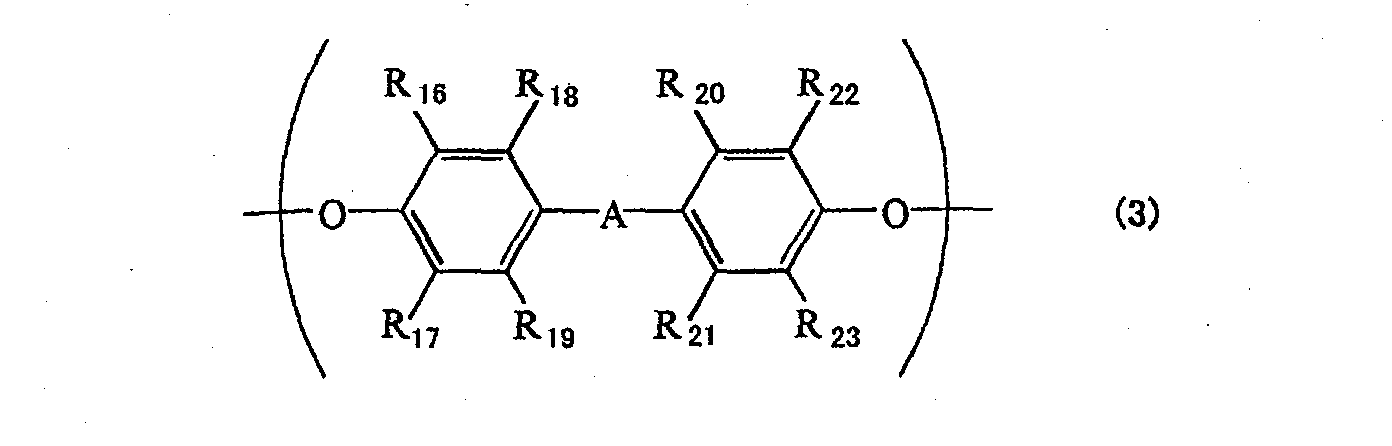
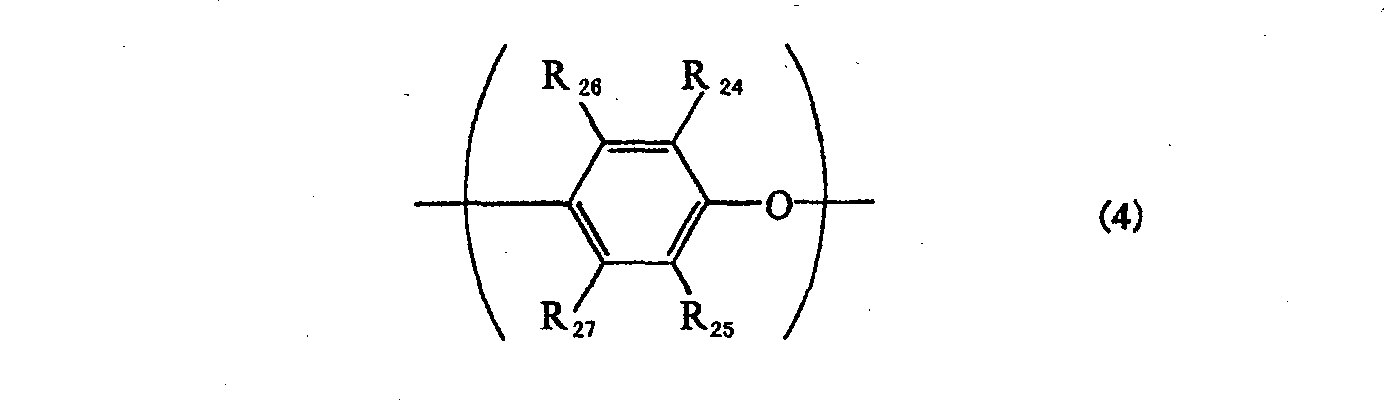
- A compound according to claim 1, wherein R8, R9, R10, R14, R15, R16, R17, R22 and R23 in the formula (2) or the formula (3) are the same or different and represent an alkyl group having 1 to 3 carbon atoms, and R11, R12, R13, R18, R19, R20 and R21 are the same or different and represent a hydrogen atom or an alkyl group having 1 to 3 carbon atoms.
- A compound according to claim 1 or 2, wherein, when -(O-X-O)- is represented by the formula (3), each of R1 and R2 is the same or different and represents an alkyl group, a halogenated alkyl group or a phenyl group.
- A compound according to any one of the preceding claims, wherein R24 and R25 in the formula (4) are the same or different and represent an alkyl group having 1 to 3 carbon atoms, and R26 and R27 in the formula (4) are the same or different and represent a hydrogen atom or an alkyl group having 1 to 3 carbon atoms.
- A compound according to any one of the preceding claims, wherein R8, R9, R10, R14, R15, R16, R17, R22 and R23 in the formula (2) or the formula (3) represent a methyl group and -(Y-O)- is a moiety of the formula (5) or the formula (6) or a random arrangement of at least two moieties of the formula (5) and the formula (6).

- A compound according to any one of the preceding claims, wherein the moiety of formula (2) is a moiety of formula (7).
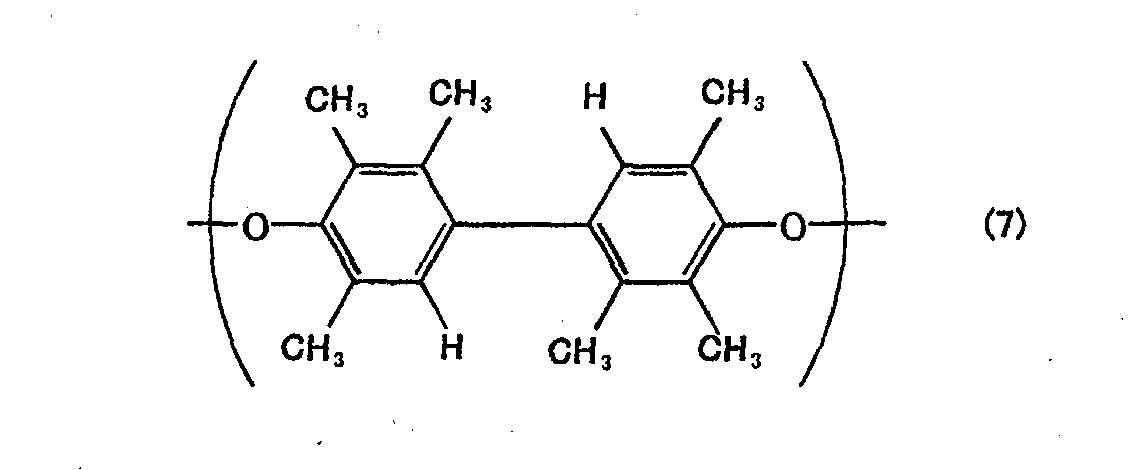
- A curable resin composition comprising a compound according to any one of the preceding claims.
- A photosensitive resin composition comprising a compound according to any one of the preceding claims and a photopolymerization initiator.
- A cured product obtainable by curing a curable resin composition according to claim 7 or 8.
Applications Claiming Priority (4)
| Application Number | Priority Date | Filing Date | Title |
|---|---|---|---|
| JP2002216724A JP4038667B2 (en) | 2002-07-25 | 2002-07-25 | Vinyl compounds and cured products thereof |
| JP2002216724 | 2002-07-25 | ||
| JP2002224937A JP2004067727A (en) | 2002-08-01 | 2002-08-01 | Vinyl compound and its cured product |
| JP2002224937 | 2002-08-01 |
Publications (2)
| Publication Number | Publication Date |
|---|---|
| EP1384733A1 true EP1384733A1 (en) | 2004-01-28 |
| EP1384733B1 EP1384733B1 (en) | 2007-04-25 |
Family
ID=30002393
Family Applications (1)
| Application Number | Title | Priority Date | Filing Date |
|---|---|---|---|
| EP03254651A Expired - Lifetime EP1384733B1 (en) | 2002-07-25 | 2003-07-25 | Vinyl compound and cured product thereof |
Country Status (6)
| Country | Link |
|---|---|
| US (1) | US6995195B2 (en) |
| EP (1) | EP1384733B1 (en) |
| KR (1) | KR100987983B1 (en) |
| CN (1) | CN1237084C (en) |
| DE (1) | DE60313402T2 (en) |
| TW (1) | TWI250995B (en) |
Cited By (5)
| Publication number | Priority date | Publication date | Assignee | Title |
|---|---|---|---|---|
| EP1489079A1 (en) * | 2003-06-18 | 2004-12-22 | Mitsubishi Gas Chemical Company, Inc. | Anhydrides and their polyimide derivatives |
| EP1508594A1 (en) * | 2003-08-20 | 2005-02-23 | Mitsubishi Gas Chemical Company, Inc. | Resin composition and prepreg for laminate and metal-clad laminate |
| EP1632534A3 (en) * | 2004-08-19 | 2007-05-30 | Mitsubishi Gas Chemical Company, Inc. | Curable resin composition, curable film and cured film |
| EP1997840A1 (en) | 2007-05-31 | 2008-12-03 | Mitsubishi Gas Chemical Company, Inc. | Curable resin composition, curable film and their products |
| US20170101507A1 (en) * | 2015-10-08 | 2017-04-13 | Chang Chun Plastics Co., Ltd. | Phosphinated poly(2,6-dimethyl phenylene oxide) oligomers and thermosets thereof |
Families Citing this family (32)
| Publication number | Priority date | Publication date | Assignee | Title |
|---|---|---|---|---|
| US7193019B2 (en) * | 2003-10-22 | 2007-03-20 | Mitsubishi Gas Chemical Company, Inc. | Process for the production of vinyl compound |
| US20090239992A1 (en) * | 2006-08-08 | 2009-09-24 | Toshiaki Yamada | Thermosetting resin composition and uncured film comprising the same |
| US20080071034A1 (en) * | 2006-09-15 | 2008-03-20 | Christina Louise Braidwood | Poly(arylene ether) composition and method |
| US20080071000A1 (en) * | 2006-09-15 | 2008-03-20 | Christina Louise Braidwood | Poly(arylene ether) composition and article |
| US20080097027A1 (en) * | 2006-10-23 | 2008-04-24 | General Electric Company | Varnish composition for insulating electrical machinery |
| US7655278B2 (en) | 2007-01-30 | 2010-02-02 | Sabic Innovative Plastics Ip B.V. | Composite-forming method, composites formed thereby, and printed circuit boards incorporating them |
| EP2006318B1 (en) * | 2007-06-18 | 2014-04-30 | Mitsubishi Gas Chemical Company, Inc. | Process for the production of vinyl compound |
| DE602009000326D1 (en) * | 2008-04-01 | 2010-12-23 | Mitsubishi Gas Chemical Co | Resin composition, prepreg and laminated with a metal foil laminate |
| US8058359B2 (en) * | 2008-11-10 | 2011-11-15 | Sabic Innovative Plastics Ip B.V. | Varnish compositions for electrical insulation and method of using the same |
| US8598281B2 (en) | 2011-09-01 | 2013-12-03 | Sabic Innovative Plastics Ip B.V. | Epoxybenzyl-terminated poly(arylene ether)s, method for preparation thereof, and curable compositions comprising same |
| JP6106405B2 (en) * | 2012-10-31 | 2017-03-29 | ナミックス株式会社 | Semiconductor device |
| TWI495651B (en) * | 2013-11-18 | 2015-08-11 | Chin Yee Chemical Industres Co Ltd | Unsaturated resin and its composition, thermosetting resin composition |
| CN105623238B (en) | 2014-11-06 | 2018-07-27 | 江苏雅克科技股份有限公司 | Phosphorus-containing functionalized poly(arylene ether) and preparation of compositions using it as raw material |
| JP6504386B2 (en) * | 2014-12-16 | 2019-04-24 | パナソニックIpマネジメント株式会社 | Polyphenylene ether resin composition, prepreg, metal-clad laminate and printed wiring board |
| TWI626272B (en) * | 2017-07-05 | 2018-06-11 | 國立中興大學 | Epoxy composition and cured object thereof |
| TWI628194B (en) * | 2017-09-06 | 2018-07-01 | 國立中興大學 | (2,6-dimethyl-1,4-phenylene oxide) oligomer-containing benzoxazine resin, thermoset and manufacturing methods thereof |
| TWI631143B (en) * | 2017-09-14 | 2018-08-01 | 台光電子材料股份有限公司 | Vinyl benzyl fluorene imine resin, preparation method of vinyl benzyl fluorene imine resin, vinyl benzyl fluorene imine prepolymer, resin composition and products thereof |
| US10995182B2 (en) | 2018-04-30 | 2021-05-04 | Shpp Global Technologies B.V. | Phenylene ether oligomer, curable composition comprising the phenylene ether oligomer, and thermoset composition derived therefrom |
| EP3567068A1 (en) | 2018-05-07 | 2019-11-13 | SABIC Global Technologies B.V. | Functional phenylene ether oligomer and curable and thermoset compositions prepared therefrom |
| CN110551257B (en) | 2018-06-04 | 2021-10-08 | 台燿科技股份有限公司 | Resin composition and its prepreg, metal foil laminate and printed circuit board |
| TWI686436B (en) | 2018-08-28 | 2020-03-01 | 台燿科技股份有限公司 | Halogen-free low dielectric resin composition, and pre-preg, metal-clad laminate, and printed circuit board using the same |
| TWI700332B (en) | 2018-12-06 | 2020-08-01 | 台燿科技股份有限公司 | Halogen-free low dielectric resin composition, and pre-preg, metal-clad laminate, and printed circuit board prepared using the same |
| TWI705984B (en) * | 2019-01-04 | 2020-10-01 | 國立中興大學 | (2,6-Dimethyl-1,4-phenylene ether) oligomers and cured products prepared therefrom |
| TWI794445B (en) | 2019-03-12 | 2023-03-01 | 台燿科技股份有限公司 | Resin composition and uses of the same |
| JP2022530543A (en) | 2019-04-30 | 2022-06-29 | エスエイチピーピー グローバル テクノロジーズ べスローテン フェンノートシャップ | Curable poly (polyphenylene ether) oligomer composition for coating |
| TWI740485B (en) | 2020-05-04 | 2021-09-21 | 台灣中油股份有限公司 | Oligomer (2,6-dimethylphenyl ether), preparation method thereof and cured product |
| TWI736247B (en) | 2020-05-04 | 2021-08-11 | 台灣中油股份有限公司 | Phosphinated (2,6-dimethylphenyl ether) oligomer, preparation method thereof and cured product |
| TWI725851B (en) | 2020-05-15 | 2021-04-21 | 台燿科技股份有限公司 | Resin composition, and pre-preg, metal-clad laminate, and printed circuit board prepared using the same |
| CN113773432B (en) * | 2021-09-27 | 2022-07-12 | 中国科学院兰州化学物理研究所 | Low-dielectric-constant shape memory polystyrene and preparation method and application thereof |
| TWI856398B (en) | 2022-10-19 | 2024-09-21 | 台燿科技股份有限公司 | Prepreg and uses thereof |
| TWI890113B (en) | 2023-08-11 | 2025-07-11 | 台燿科技股份有限公司 | Copper foil laminate and uses of the same |
| TWI860899B (en) | 2023-11-24 | 2024-11-01 | 台燿科技股份有限公司 | Prepreg and uses of the same |
Citations (5)
| Publication number | Priority date | Publication date | Assignee | Title |
|---|---|---|---|---|
| DE3117514A1 (en) * | 1981-05-02 | 1982-12-02 | Basf Ag, 6700 Ludwigshafen | Aromatic polyethers containing olefinic terminal groups |
| NL8902092A (en) * | 1989-08-18 | 1991-03-18 | Gen Electric | MATERIAL BASED ON A POLYPHENYLENE ETHHER PROVIDED WITH POLYMERISABLE END GROUPS. |
| EP0542232A1 (en) * | 1991-11-11 | 1993-05-19 | Sumitomo Chemical Company, Limited | Liquid crystalline polyester resin composition |
| EP0546497A2 (en) * | 1991-12-10 | 1993-06-16 | Idemitsu Kosan Company Limited | Thermoplastic resin composition |
| WO2000046275A1 (en) * | 1999-02-05 | 2000-08-10 | General Electric Company | Capping of polyphenylene ether resin |
Family Cites Families (9)
| Publication number | Priority date | Publication date | Assignee | Title |
|---|---|---|---|---|
| US4707558A (en) * | 1986-09-03 | 1987-11-17 | The Dow Chemical Company | Monomers and oligomers containing a plurality of vinylbenzyl ether groups, method for their preparation and cured products therefrom |
| JPH0687970A (en) * | 1992-09-04 | 1994-03-29 | Asahi Chem Ind Co Ltd | Stabilized polyphenylene ether resin foam |
| US6352782B2 (en) * | 1999-12-01 | 2002-03-05 | General Electric Company | Poly(phenylene ether)-polyvinyl thermosetting resin |
| US6794481B2 (en) * | 2001-06-28 | 2004-09-21 | Mitsubishi Gas Chemical Company, Inc. | Bifunctional phenylene ether oligomer, its derivatives, its use and process for the production thereof |
| US6620885B2 (en) * | 2001-08-30 | 2003-09-16 | General Electric Company | Copolymers of functionalized polyphenylene ether resins and blends thereof |
| KR100914020B1 (en) * | 2001-10-17 | 2009-08-28 | 미쯔비시 가스 케미칼 컴파니, 인코포레이티드 | Bifunctional biphenyl and process for producing bifunctional phenylene ether oligomer compound using the same |
| US6835785B2 (en) * | 2002-01-28 | 2004-12-28 | Mitsubishi Gas Chemical Company, Inc. | Polyphenylene ether oligomer compound, derivatives thereof and use thereof |
| TWI264440B (en) * | 2002-07-25 | 2006-10-21 | Mitsubishi Gas Chemical Co | (Meth)acrylate compound and cured product thereof |
| US7192651B2 (en) * | 2003-08-20 | 2007-03-20 | Mitsubishi Gas Chemical Company, Inc. | Resin composition and prepreg for laminate and metal-clad laminate |
-
2003
- 2003-07-25 EP EP03254651A patent/EP1384733B1/en not_active Expired - Lifetime
- 2003-07-25 DE DE60313402T patent/DE60313402T2/en not_active Expired - Lifetime
- 2003-07-25 CN CNB031461816A patent/CN1237084C/en not_active Expired - Lifetime
- 2003-07-25 TW TW092120375A patent/TWI250995B/en not_active IP Right Cessation
- 2003-07-25 US US10/626,569 patent/US6995195B2/en not_active Expired - Lifetime
- 2003-07-25 KR KR1020030051291A patent/KR100987983B1/en not_active Expired - Lifetime
Patent Citations (5)
| Publication number | Priority date | Publication date | Assignee | Title |
|---|---|---|---|---|
| DE3117514A1 (en) * | 1981-05-02 | 1982-12-02 | Basf Ag, 6700 Ludwigshafen | Aromatic polyethers containing olefinic terminal groups |
| NL8902092A (en) * | 1989-08-18 | 1991-03-18 | Gen Electric | MATERIAL BASED ON A POLYPHENYLENE ETHHER PROVIDED WITH POLYMERISABLE END GROUPS. |
| EP0542232A1 (en) * | 1991-11-11 | 1993-05-19 | Sumitomo Chemical Company, Limited | Liquid crystalline polyester resin composition |
| EP0546497A2 (en) * | 1991-12-10 | 1993-06-16 | Idemitsu Kosan Company Limited | Thermoplastic resin composition |
| WO2000046275A1 (en) * | 1999-02-05 | 2000-08-10 | General Electric Company | Capping of polyphenylene ether resin |
Cited By (11)
| Publication number | Priority date | Publication date | Assignee | Title |
|---|---|---|---|---|
| EP1489079A1 (en) * | 2003-06-18 | 2004-12-22 | Mitsubishi Gas Chemical Company, Inc. | Anhydrides and their polyimide derivatives |
| US7193030B2 (en) | 2003-06-18 | 2007-03-20 | Mitsubishi Gas Chemical Company, Inc. | Acid anhydride and polyimide using the same |
| EP1508594A1 (en) * | 2003-08-20 | 2005-02-23 | Mitsubishi Gas Chemical Company, Inc. | Resin composition and prepreg for laminate and metal-clad laminate |
| US7192651B2 (en) | 2003-08-20 | 2007-03-20 | Mitsubishi Gas Chemical Company, Inc. | Resin composition and prepreg for laminate and metal-clad laminate |
| EP1632534A3 (en) * | 2004-08-19 | 2007-05-30 | Mitsubishi Gas Chemical Company, Inc. | Curable resin composition, curable film and cured film |
| US7541408B2 (en) | 2004-08-19 | 2009-06-02 | Mitsubishi Gas Chemical Company, Inc. | Curable resin composition, curable film and cured film |
| EP1997840A1 (en) | 2007-05-31 | 2008-12-03 | Mitsubishi Gas Chemical Company, Inc. | Curable resin composition, curable film and their products |
| US9062145B2 (en) | 2007-05-31 | 2015-06-23 | Mitsubishi Gas Chemical Company, Inc. | Curable resin composition, curable film and their cured products |
| US20170101507A1 (en) * | 2015-10-08 | 2017-04-13 | Chang Chun Plastics Co., Ltd. | Phosphinated poly(2,6-dimethyl phenylene oxide) oligomers and thermosets thereof |
| JP2017071775A (en) * | 2015-10-08 | 2017-04-13 | 長春人造樹脂廠股▲分▼有限公司 | Phosphinated poly(2,6-dimethyl phenylene oxide) oligomers and thermosets thereof |
| US10544261B2 (en) | 2015-10-08 | 2020-01-28 | Chang Chun Plastics Co., Ltd. | Phosphinated poly(2,6-dimethyl phenylene oxide) oligomers and thermosets thereof |
Also Published As
| Publication number | Publication date |
|---|---|
| DE60313402T2 (en) | 2008-01-17 |
| DE60313402D1 (en) | 2007-06-06 |
| KR100987983B1 (en) | 2010-10-18 |
| US20040198863A1 (en) | 2004-10-07 |
| CN1237084C (en) | 2006-01-18 |
| TWI250995B (en) | 2006-03-11 |
| TW200408650A (en) | 2004-06-01 |
| US6995195B2 (en) | 2006-02-07 |
| KR20040010389A (en) | 2004-01-31 |
| EP1384733B1 (en) | 2007-04-25 |
| CN1480439A (en) | 2004-03-10 |
Similar Documents
| Publication | Publication Date | Title |
|---|---|---|
| EP1384733B1 (en) | Vinyl compound and cured product thereof | |
| US6835786B2 (en) | (Meth)acrylate compound and cured product thereof | |
| JP4038667B2 (en) | Vinyl compounds and cured products thereof | |
| US7247682B2 (en) | Bifunctional phenylene ether oligomer, its derivatives, its use and process for the production thereof | |
| JP2004067727A (en) | Vinyl compound and its cured product | |
| JP3731979B2 (en) | Calixarene derivative and curable resin composition containing the same | |
| JP4009826B2 (en) | (Meth) acrylate compound and cured product thereof | |
| JP3879832B2 (en) | Acrylate compound and cured product thereof | |
| JPH09263560A (en) | Calixarene derivative and curable resin composition containing the same derivative | |
| JP4196161B2 (en) | Polyfunctional (meth) acrylate compound and cured product thereof | |
| JP4196159B2 (en) | Polyfunctional (meth) acrylate compound and cured product thereof | |
| JP3900258B2 (en) | Epoxy acrylate compound and cured product thereof | |
| JP4475381B2 (en) | Vinyl compounds and cured products thereof | |
| JP3937142B2 (en) | Epoxy (meth) acrylate compound and cured product thereof | |
| JP4300411B2 (en) | (Meth) acrylate compound and cured product thereof |
Legal Events
| Date | Code | Title | Description |
|---|---|---|---|
| PUAI | Public reference made under article 153(3) epc to a published international application that has entered the european phase |
Free format text: ORIGINAL CODE: 0009012 |
|
| AK | Designated contracting states |
Kind code of ref document: A1 Designated state(s): AT BE BG CH CY CZ DE DK EE ES FI FR GB GR HU IE IT LI LU MC NL PT RO SE SI SK TR |
|
| AX | Request for extension of the european patent |
Extension state: AL LT LV MK |
|
| 17P | Request for examination filed |
Effective date: 20040521 |
|
| AKX | Designation fees paid |
Designated state(s): DE FR GB |
|
| GRAP | Despatch of communication of intention to grant a patent |
Free format text: ORIGINAL CODE: EPIDOSNIGR1 |
|
| GRAS | Grant fee paid |
Free format text: ORIGINAL CODE: EPIDOSNIGR3 |
|
| GRAA | (expected) grant |
Free format text: ORIGINAL CODE: 0009210 |
|
| AK | Designated contracting states |
Kind code of ref document: B1 Designated state(s): DE FR GB |
|
| REG | Reference to a national code |
Ref country code: GB Ref legal event code: FG4D |
|
| REF | Corresponds to: |
Ref document number: 60313402 Country of ref document: DE Date of ref document: 20070606 Kind code of ref document: P |
|
| PLBE | No opposition filed within time limit |
Free format text: ORIGINAL CODE: 0009261 |
|
| STAA | Information on the status of an ep patent application or granted ep patent |
Free format text: STATUS: NO OPPOSITION FILED WITHIN TIME LIMIT |
|
| 26N | No opposition filed |
Effective date: 20080128 |
|
| REG | Reference to a national code |
Ref country code: FR Ref legal event code: PLFP Year of fee payment: 14 |
|
| REG | Reference to a national code |
Ref country code: FR Ref legal event code: PLFP Year of fee payment: 15 |
|
| REG | Reference to a national code |
Ref country code: FR Ref legal event code: PLFP Year of fee payment: 16 |
|
| PGFP | Annual fee paid to national office [announced via postgrant information from national office to epo] |
Ref country code: GB Payment date: 20220606 Year of fee payment: 20 |
|
| PGFP | Annual fee paid to national office [announced via postgrant information from national office to epo] |
Ref country code: FR Payment date: 20220609 Year of fee payment: 20 |
|
| PGFP | Annual fee paid to national office [announced via postgrant information from national office to epo] |
Ref country code: DE Payment date: 20220531 Year of fee payment: 20 |
|
| REG | Reference to a national code |
Ref country code: DE Ref legal event code: R071 Ref document number: 60313402 Country of ref document: DE |
|
| REG | Reference to a national code |
Ref country code: GB Ref legal event code: PE20 Expiry date: 20230724 |
|
| PG25 | Lapsed in a contracting state [announced via postgrant information from national office to epo] |
Ref country code: GB Free format text: LAPSE BECAUSE OF EXPIRATION OF PROTECTION Effective date: 20230724 |