EP1371739A1 - Process for purifying zinc and rectifying column for purifying zinc - Google Patents
Process for purifying zinc and rectifying column for purifying zinc Download PDFInfo
- Publication number
- EP1371739A1 EP1371739A1 EP01271115A EP01271115A EP1371739A1 EP 1371739 A1 EP1371739 A1 EP 1371739A1 EP 01271115 A EP01271115 A EP 01271115A EP 01271115 A EP01271115 A EP 01271115A EP 1371739 A1 EP1371739 A1 EP 1371739A1
- Authority
- EP
- European Patent Office
- Prior art keywords
- zinc
- column
- cadmium
- lead
- purification
- Prior art date
- Legal status (The legal status is an assumption and is not a legal conclusion. Google has not performed a legal analysis and makes no representation as to the accuracy of the status listed.)
- Withdrawn
Links
Images




Classifications
-
- C—CHEMISTRY; METALLURGY
- C22—METALLURGY; FERROUS OR NON-FERROUS ALLOYS; TREATMENT OF ALLOYS OR NON-FERROUS METALS
- C22B—PRODUCTION AND REFINING OF METALS; PRETREATMENT OF RAW MATERIALS
- C22B19/00—Obtaining zinc or zinc oxide
- C22B19/04—Obtaining zinc by distilling
- C22B19/16—Distilling vessels
-
- C—CHEMISTRY; METALLURGY
- C22—METALLURGY; FERROUS OR NON-FERROUS ALLOYS; TREATMENT OF ALLOYS OR NON-FERROUS METALS
- C22B—PRODUCTION AND REFINING OF METALS; PRETREATMENT OF RAW MATERIALS
- C22B17/00—Obtaining cadmium
- C22B17/06—Refining
-
- C—CHEMISTRY; METALLURGY
- C22—METALLURGY; FERROUS OR NON-FERROUS ALLOYS; TREATMENT OF ALLOYS OR NON-FERROUS METALS
- C22B—PRODUCTION AND REFINING OF METALS; PRETREATMENT OF RAW MATERIALS
- C22B19/00—Obtaining zinc or zinc oxide
- C22B19/04—Obtaining zinc by distilling
- C22B19/14—Obtaining zinc by distilling in vertical retorts
-
- C—CHEMISTRY; METALLURGY
- C22—METALLURGY; FERROUS OR NON-FERROUS ALLOYS; TREATMENT OF ALLOYS OR NON-FERROUS METALS
- C22B—PRODUCTION AND REFINING OF METALS; PRETREATMENT OF RAW MATERIALS
- C22B19/00—Obtaining zinc or zinc oxide
- C22B19/32—Refining zinc
-
- C—CHEMISTRY; METALLURGY
- C22—METALLURGY; FERROUS OR NON-FERROUS ALLOYS; TREATMENT OF ALLOYS OR NON-FERROUS METALS
- C22B—PRODUCTION AND REFINING OF METALS; PRETREATMENT OF RAW MATERIALS
- C22B9/00—General processes of refining or remelting of metals; Apparatus for electroslag or arc remelting of metals
- C22B9/02—Refining by liquating, filtering, centrifuging, distilling, or supersonic wave action including acoustic waves
-
- C—CHEMISTRY; METALLURGY
- C22—METALLURGY; FERROUS OR NON-FERROUS ALLOYS; TREATMENT OF ALLOYS OR NON-FERROUS METALS
- C22B—PRODUCTION AND REFINING OF METALS; PRETREATMENT OF RAW MATERIALS
- C22B9/00—General processes of refining or remelting of metals; Apparatus for electroslag or arc remelting of metals
- C22B9/04—Refining by applying a vacuum
-
- Y—GENERAL TAGGING OF NEW TECHNOLOGICAL DEVELOPMENTS; GENERAL TAGGING OF CROSS-SECTIONAL TECHNOLOGIES SPANNING OVER SEVERAL SECTIONS OF THE IPC; TECHNICAL SUBJECTS COVERED BY FORMER USPC CROSS-REFERENCE ART COLLECTIONS [XRACs] AND DIGESTS
- Y02—TECHNOLOGIES OR APPLICATIONS FOR MITIGATION OR ADAPTATION AGAINST CLIMATE CHANGE
- Y02P—CLIMATE CHANGE MITIGATION TECHNOLOGIES IN THE PRODUCTION OR PROCESSING OF GOODS
- Y02P10/00—Technologies related to metal processing
- Y02P10/20—Recycling
Definitions
- the present invention relates to a process for purifying metal, especially, zinc which can achieve energy saving, equipment miniaturization and cost reduction, and a rectification column usable in the process.
- Electrolytic zinc (purest zinc) having purity of 99.99 % or more is produced after the electrolytic refining.
- distilled zinc (PW) having purity of 98.5 % or more is produced after the pyrometallurgy of zinc (ISP, vertical distillation, horizontal' distillation, electric heat distillation).
- ISP pyrometallurgy of zinc
- Such zinc having lower purity hereinafter referred to as "crude zinc” when supplied to a rectification column) is purified in the rectification column to provide purified zinc (SHG) having purity of 99.99 % or more which is nearly equal to the grade of the electrolytic zinc.
- Impurity metals such as metal lead and metal cadmium are contained in the distilled zinc obtained by the pyrometallurgy, and the distilled zinc is used for molten zinc plating of bridges, telegraph poles and guardrails. Because of the higher purity of the rectified zinc obtained by the rectifying the distilled zinc, the rectified zinc is used for various purposes (for example, electroplating and continuous plating of automobile body) and enjoys an increasing demand in the broader market.
- Fig. 1 shows a conventional rectification column used in the rectification step for purifying zinc.
- the rectification column generally consists of a rectification column for removing lead, iron and copper (lead column) and a rectification column for removing cadmium (cadmium column).
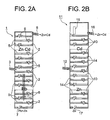
- Fig.2a is a partially broken and enlarged view of the lead column
- Fig.2b is a partially broken and enlarged view of the cadmium column.
- the lead column 1 has a plurality of stacked trays 2 (under the present situation, 24 trays only in a reflux section over a crude zinc supply port) and has the crude zinc supply port 3 at the central side surface thereof through which the crude zinc is supplied into the lead column 1.
- the crude zinc obtained by smelting crude ore contains about 98.5 % of zinc, and lead and cadmium as main impurities.
- a combustion chamber 4 is formed around the lead column 1 lower than the zinc supply port 3. Molten zinc 5 on one tray 2 flows over an upward weir 6 to move to another tray 2 immediately below the former tray 2. On the other hand, molten zinc 5 on the tray 2 inside of the combustion chamber 4 is vaporized by the heating, and the vaporized zinc vapor moves to the upward trays 2. The zinc vapor having moved in the direction of the upward trays 2 is gradually cooled after the zinc vapor reaches above the combustion chamber 4, and part of the zinc vapor is condensed on the trays 2 again. The condensed molten zinc 5 again flows over the upward weir 6 of the tray 2 to move to the tray 2 immediately below the former tray 2. The molten zinc reaches to the trays 2 inside of the combustion chamber 4 by the repetition thereof, and vaporized again by the heating in the combustion chamber 4.
- the metal having the lowest vapor pressure among the zinc (main component), the lead and the cadmium (impurities) is the lead.
- the lead less volatile than the zinc and the cadmium likely remains on the trays 2 inside of the combustion chamber 4. Accordingly, the zinc containing a relatively larger amount of the lead reaches to the lowest tray 2 by the repetition of the vaporizations and the condensations to be discharged through a lead discharge port 7.
- the zinc vapor containing the cadmium vapor and reaching to the highest tray 2 is discharged through an outward extending zinc vapor discharge port 8 at the top portion of the lead column 1 to be introduced into a condenser 9.
- the zinc vapor containing the cadmium vapor is cooled in the zinc vapor discharge port 8 and the condenser 9 to be converted into the molten zinc containing the cadmium.
- the molten zinc is supplied into the cadmium column 11 having 61 stacked trays 10 through a molten zinc supply port 12 formed nearly at the middle of the 61 stacked trays 10 of the cadmium column 11.
- a combustion chamber 13 is formed around the cadmium column 11 lower than the molten zinc supply port 12. Because the zinc having the lower vapor pressure than the cadmium is less volatile, the molten zinc 14 easily moves to the lower trays 10 when the molten zinc in the cadmium column 11 is heated by the combustion chamber 13 similarly to the lead column. On the other hand, the cadmium converted into the vapor together with the zinc vapor reaches to the highest tray 10 and is cooled by a condenser 15 in the space over the highest tray 10 to be converted into a molten state. The cadmium is then discharged out of the cadmium column 11 through a zinc-cadmium discharge port 16.
- the purity of the pure zinc obtained by the above process is 99.99 % or more and is satisfactory.
- the purification from the crude zinc to the rectified zinc is conducted at higher temperatures (ordinarily, about 900 to 1100°C) for elevating the rectification efficiency and requires a large amount of energy.
- the purity of the pure zinc can be increased to 99.99 % or more only by using the 24 trays in the reflux section of the lead column and the 61 trays in the cadmium column. When the lager number of these trays is required, the large-scaled equipments and the rise of the fabrication cost are inevitable.
- the rectification column made of brick has the disadvantages including the inferior mechanical strength and the weakness to natural disasters such as earthquake.
- An object of the present invention is to provide a purification process of metal such as zinc and a rectification column used for the process by means of overcoming the above defects of the prior art.
- the process can be operated with the lower energy, and with the lower cost and the higher operation efficiency by using the compact rectification column having the higher mechanical strength.
- the present invention is a process of purifying metal such as zinc including the steps of introducing the zinc containing impurities into a rectification column having a plurality of purification stages and distilling the metal in the rectification column under a reduced pressure for removing the impurities, thereby obtaining the zinc with a higher purity; and a rectification column usable in the process.
- the purification of the zinc is conducted in the rectification column for zinc purification such as a lead column and a cadmium column in which at least of one of them has the reduced pressure.
- the following effects can be obtained by conducting the metal purification, especially, the zinc purification under the reduced pressure.
- At least one of the rectification columns used for the purification of the metal such as the zinc is operated under the reduced pressure.
- the lead column and the cadmium column are generally employed.
- the operation is desirably conducted with both of the lead column and the cadmium column under the reduced pressure, and the above effects can be obtained even if either of the lead column or the cadmium column is used under the reduced pressure.
- the pressure in a line connecting the both columns may be reduced so that at least one of the both columns may be made under the reduced pressure indirectly.
- the purification may be conducted by using only the cadmium column (the cadmium column will also be referred to as cadmium removing column) without the lead column because the zinc vapor contains lower concentration of the cadmium.
- a degree of the reduced pressure is not restricted, and even a smaller degree of the reduced pressure generates the effects accordingly.
- the preferable degree of the reduced pressure is from 0.1 to 5000 Pa.
- the number of the trays in the reflux section of the lead column required for obtaining the purified zinc having, for example, a purity of 99.99 % which is the same to the conventional zinc purification process is three under the pressure of 20 Pa, and can be significantly reduced from 24 under the atmospheric pressure.
- the number of the total trays in the cadmium column required for obtaining the purified zinc having a purity of 99.99 % which is the same to the conventional zinc purification process is 26 under the pressure of 1260 Pa, and 18 under the pressure of 190 Pa. Both of them are significantly reduced from 61 under the atmospheric pressure.
- the material used for the rectification column is any material which endures the higher degree of the reduced pressure and does not react with a metal such as zinc and impurities.
- a metal or a metal alloy such as stainless steel or a refractory substance such as graphite and SiC is preferably employed.
- the means for reducing the pressure in the rectification column is not especially restricted, and any conventional means such as suction with a pump may be used without modification.
- the position of the rectification column to be connected with the sucking means such as the pump is selected such that the metals in the rectification column are not sucked, and a trap is preferably used depending on necessity.
- the zinc purified in the process of the present invention and containing the impurity is not especially restricted.
- the present process can be preferably applied to, for example, the crude zinc having a zinc content of about 98.5 % in weight and containing lead and cadmium as main impurities after the smelting process in the conventional zinc smelting.
- the zinc purification may be conducted by employing either of the rectification column including the lead column and the cadmium column or the rectification column including only the cadmium removal column.
- the crude zinc raw material containing the lead and the cadmium as the impurities is purified to provide the rectified zinc (SHG) with a purity (99.99 % or more) having been removed of the lead and the cadmium.
- the lead may be desirably contained in the zinc obtained by the latter process depending on use.
- the target zinc in the latter can be obtained with the lower cost and the higher operation efficiency because the install of the lead column and the fuel consumption are not required.
- the molten zinc supplied to the cadmium column or the cadmium removal column maintained under the reduced pressure in the present invention is usually heated to the higher temperature of 700 °C or more.
- the temperature is frequently high enough to initiate the spontaneous evaporation so that the rectification in the cadmium column or the like can be conducted without heating.
- the non-necessity of the heating not only saves the fuel cost but also removes the necessity of installation of the heating facility, and further generates the advantage in cost and contributes to the reduction of the occupied area.
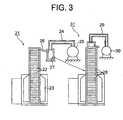
- Fig.3 is a schematic view illustrating a rectification column usable in the process of the present invention.
- a lead column includes therein stacked trays 22, and a supply port (not shown) for crude zinc (feed metal) is formed on the nearly middle part of a plurality of the trays 22.
- the crude zinc is supplied into the lead column 21 through the supply port.
- a combustion chamber 23 is installed around the lead column 21 lower than the crude zinc supply port, and heats inside of the lead column 21.
- a pump 25 for the lead column 25 connected to the upper section of a condenser 27 of the lead column through a conduit 24 maintains the inside of the lead column 21 under a reduced pressure.
- the supplied zinc on the tray 22 is heated by the combustion chamber 23 to be volatilized. Because of the reduced pressure in the lead column 21, the volatilization of the metal proceeds with relatively weaker heating.
- the lead is removed, and the zinc vapor containing a slight amount of cadmium vapor is supplied to the condenser 27 through a zinc vapor discharge port 26 formed on the upper side surface of the lead column 21.
- the zinc vapor containing the cadmium vapor is cooled in the zinc vapor discharge port 26 and the condenser 27 to be converted into molten zinc containing cadmium.
- the molten zinc is supplied into a cadmium column 31, and similarly to the prior art, the zinc is separated from the cadmium.
- the cadmium column has stacked trays 28 therein and a pump 30 for the cadmium column connected to the upper portion of the cadmium column through a conduit 29. Also in this case, the volatilization of the metal proceeds with relatively weaker heating because of the reduced pressure in the cadmium column 31, thereby easily performing the zinc purification to provide the rectified zinc (SHG).
- the crude zinc may be supplied into the cadmium (removal) column without mounting the lead column 21, thereby obtaining distilled zinc having lower concentration of cadmium (Removed CdPW).
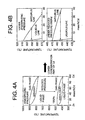
- Fig. 4a is an equilibrium diagram of a binary system containing zinc and cadmium in vapor and liquid phases
- Fig. 4b is partially enlarged views of Fig. 4a.
- the vapourus line and the liquidus line under the atmospheric pressure are cited from J. Rumusden, "Thermodynamics of Alloys", and the vapourus line and the liquidus line under the reduced pressure are calculated from a relational expression among the total pressure, the temperature and the composition by employing the thermodynamic data.
- the zinc and the cadmium reach to the gas-liquid equilibrium at about 800 to 900 °C under the atmospheric pressure.
- the equilibrium temperature gradually lowers with the decrease of the pressure from the atmospheric pressure, and the gas-liquid equilibrium is reached at about 400 to 470 °C under about 190 Pa. This means that the reduced pressure enables the zinc purification by the lower temperature distillation in which the cadmium is removed from the mixture of' zinc and cadmium.
- the energy provided to the lead column includes the direct hearting of the lead column by the combustion chamber and the preheating of the zinc and the air supplied to the lead column.
- the crude zinc is supplied to the lead column after the preheating to 590°C.
- the energy required for the preheating is 8.27 x 10 6 kcal/day.
- the crude zinc may be preheated only to 500°C , and the energy required for the preheating is 7.25 x 10 6 kcal/day.
- air is supplied to the lead column after the preheating to 790°C.
- the energy required for the preheating is 1.49 x 10 7 kcal/day.
- air may be preheated only to 200°C, and the energy required for the preheating is 2.57 x 10 6 kcal/day.
- the energy required for heating the lead column by the combustion chamber in the conventional operation is 6.59 x 10 7 kcal/day, and the energy required for the operation at 500°C is 4.67 x 10 7 kcal/day.
- the energies required for heating the lead column with the combustion chamber is converted into the amounts of LPG, the former is 6000 kg/day and the latter is 4250 kg/day.
- the energy reduction of about 30 % in the lead column is achieved by using the purification under the reduced pressure.
- the excess energy in the conventional operation is, after the heating of the metals, is discharged from the lead column in the form of radiation heat, high temperature exhaust gas, high temperature zinc-cadmium vapor and high temperature molten zinc. Accordingly, in addition to the larger energy supplied, the burdensome operation of cooling the discharge metal is necessary. On the other hand, the less energy supplied in the present invention reduces the radiation heat from the lead column, and enables the easier post-treatment.
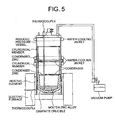
- a purification test of zinc alloy under a reduced pressure was conducted by employing a test apparatus shown in Fig. 5.
- Zinc alloy (zinc-lead 1.2 % in weight-cadmium 0.084 % in weight) was placed in a graphite crucible having a cylindrical shape with a bottom 'accommodated in a cylindrical reduced pressure vessel made of stainless steel.
- the lower periphery of the reduced pressure vessel was enwrapped with a heating element, and was settled in an electric furnace.
- a first thermocouple was placed from the top surface of the reduced vessel to reach to the zinc alloy, and a second thermocouple was placed to reach to the heating element so that the temperature of the zinc alloy could be measured by using the both thermocouples.
- a plate-like condenser having an opening at a central portion thereof was placed on the top periphery of the crucible, and a thin cylindrical member was placed on the condenser. Further, the condenser, the cylindrical member and the condenser were placed on the cylindrical member in this turn. Three water-cooling jackets having a doughnut shape were mounted around the reduced pressure vessel at the positions corresponding to the upper and the lower positions of the central condenser and the upper position of the uppermost condenser.
- a vacuum pump was connected to the opening of the top surface of the reduced pressure vessel through a conduit for the pump.
- the thermal treatment of the zinc alloy in the reduced pressure vessel was ready at a specified temperature and a specified degree of reduced pressure' by driving the vacuum pump and supplying electricity to the electric furnace.
- the lead -concentration was estimated in accordance with the operation results of the rectification column as follows.
- the lead concentration in the vapor zinc was shown in Table 1 under the same conditions except that the temperature is 907°C and the pressure is an atmospheric pressure (1000000 Pa).
- Example 2 After experiments the same as that of Example 1 were repeated at a plurality of temperatures, the compositions of the condensed zinc (gas phase) trapped in the condenser and the zinc (liquid phase) remaining in the crucible were analyzed.
- Evaporation Rate (kg/m 2 hr) (Amount of Evaporation)/ (Evaporation Area x Evaporation Time)
- the lead column and the cadmium column under the reduced pressure were analyzed (number of trays and thermal rating) based on the data obtained in Examples.
- the gas-liquid composition of each tray was determined by using a zinc-lead gas-liquid state diagram revised with the material balance and the distillation efficiency.
- Crude zinc heated to 590°C and containing 1.3 % of lead was supplied at 50 ton/day into the zinc vapor supply port of the lead column having a degree of reduced pressure at 190 Pa.
- the numbers of the trays of the combustion chamber and the reflux section of the lead column, and amounts of fuel required for adjusting the lead content at the top of the lead column to be 20 ppm at the respective temperatures of 620°C, 660°C, 700°C and 740°C were calculated.
- the number of the trays required for adjusting the lead content at top of the lead column to be 20 ppm was 56.
- the trays required in this Example were 34, 23, 19 and 27 in the order of the above temperatures as shown in Fig. 11, and it was apparent that the number of the trays could be made minimum in the operation at 700°C.
- the reduction rates of the fuel at the respective temperatures were shown in Table 2, and the operation at 620°C was preferable for reducing the fuel.
- the gas-liquid composition of each tray was determined by using a zinc-cadmium gas-liquid state diagram revised with the material balance and the distillation efficiency, and the required trays were calculated from the required evaporation area and by using the Ponchon-Savarit method.
- Molten zinc heated to 700°C and containing 1000 ppm of cadmium was supplied at 70 ton/day into the molten zinc supply port of the cadmium column having a degree of reduced pressure at 190 Pa.
- the numbers of the trays of the combustion chamber and the reflux section of the cadmium column, and amounts of fuel required for adjusting the cadmium content in the obtained SHG to be 20 ppm at the respective temperatures of 460°C and 500°C were calculated.
- the number of the trays required for adjusting the cadmium content to be 20 ppm was 64.
- the required trays in this Example were 20 and 18 in the order of the above temperatures as shown in Fig. 12, and the number of the trays could be made below one third.
- the pure zinc (SHG) at 500°C containing 20 ppm of the cadmium was discharged through the zinc discharge port positioned at the bottom surface of the cadmium column at a rate of 69.3 ton/day by supplying the molten zinc heated to about 700°C to the cadmium column.
- All the latent heat required for the evaporation could be provided by the temperature difference between the molten zinc supplied and the molten zinc in the rectification column (700°C and 500°C), and the operation could be conducted without heating the cadmium column, and the fuel reduction rate of 100 % was achieved in the operation under the reduced pressure.
- the gas-liquid composition of each tray was determined by using a zinc-cadmium gas-liquid state diagram revised with the material balance and the distillation efficiency, and the required trays were calculated from the required evaporation area and by using the Ponchon-Savarit method.
- Molten zinc heated to 700°C and containing 700 ppm of cadmium was supplied at 100 ton/day into the molten zinc supply port of the cadmium column having a degree of reduced pressure at 190 Pa.
- the numbers of the trays of the combustion chamber and the reflux section of the cadmium column, and amounts of fuel required for adjusting the cadmium content in the obtained SHG to be 100 ppm at the respective temperatures of 500°C and 540°C were calculated.
- the numbers of the trays required for adjusting the cadmium content to be 100 ppm were 14 and 13 in the order of the above temperatures as shown in Fig. 13.
Landscapes
- Engineering & Computer Science (AREA)
- Chemical & Material Sciences (AREA)
- Manufacturing & Machinery (AREA)
- Materials Engineering (AREA)
- Mechanical Engineering (AREA)
- Metallurgy (AREA)
- Organic Chemistry (AREA)
- Physics & Mathematics (AREA)
- Acoustics & Sound (AREA)
- Manufacture And Refinement Of Metals (AREA)
Abstract
A process of purifying zinc comprising the steps of
introducing the zinc containing impurities into a rectification
column having a plurality of purification stages: and distilling
the zinc in the rectification column under a reduced pressure for
removing the impurities, thereby obtaining the zinc with a
higher purity. The following effects can be obtained by
conducting the zinc purification in accordance with the present
invention. (1) The operation under a reduced temperature is
possible, thereby achieving the energy saving. (2) The reduction
of the purification efficiency probably due to the droplet
accompaniment is prevented, and the difference of the vapor
pressures between the metals increases under the reduced
pressure, thereby easily conducting the separation. Accordingly,
the purification with efficiency the same as or more than that of
the conventional purification can be made possible with the
rectification column having the smaller number of the trays.
Accordingly, the use of the downsized rectification column and
the reduction of the construction cost are attained. (3) The rise of
the mechanical strength of the rectification column for
performing the purification under the reduced pressure increases
durability of the rectification column and resistance to the
natural disasters. (4) The lower operation temperature lessens
the deterioration of the trays to make their lives longer. This zinc
purification may be conducted by employing either of the
rectification column including the lead column (21) and the
cadmium column (31) or the rectification column including only
the cadmium removal column. In the former, the crude zinc raw
material containing the lead and the cadmium as the impurities
is purified to provide the rectified zinc (SHG) with a purity
(99.99 % or more) having been removed of the lead and the
cadmium. In the latter, the zinc containing the lead removed of
the cadmium is obtained. The lead may be desirably contained in
the zinc obtained by the latter process depending on use. The
target zinc in the latter can be obtained with the lower cost and
the higher operation efficiency because the install of the lead
column and the fuel consumption are not required.
Description
The present invention relates to a process for purifying
metal, especially, zinc which can achieve energy saving,
equipment miniaturization and cost reduction, and a
rectification column usable in the process.
Electrolytic zinc (purest zinc) having purity of 99.99 % or
more is produced after the electrolytic refining. On the other
hand, distilled zinc (PW) having purity of 98.5 % or more is
produced after the pyrometallurgy of zinc (ISP, vertical
distillation, horizontal' distillation, electric heat distillation).
Such zinc having lower purity (hereinafter referred to as "crude
zinc" when supplied to a rectification column) is purified in the
rectification column to provide purified zinc (SHG) having purity
of 99.99 % or more which is nearly equal to the grade of the
electrolytic zinc. Impurity metals such as metal lead and metal
cadmium are contained in the distilled zinc obtained by the
pyrometallurgy, and the distilled zinc is used for molten zinc
plating of bridges, telegraph poles and guardrails. Because of the
higher purity of the rectified zinc obtained by the rectifying the
distilled zinc, the rectified zinc is used for various purposes (for
example, electroplating and continuous plating of automobile
body) and enjoys an increasing demand in the broader market.
Fig. 1 shows a conventional rectification column used in the
rectification step for purifying zinc. The rectification column
generally consists of a rectification column for removing lead,
iron and copper (lead column) and a rectification column for
removing cadmium (cadmium column). Fig.2a is a partially
broken and enlarged view of the lead column, and Fig.2b is a
partially broken and enlarged view of the cadmium column.
The lead column 1 has a plurality of stacked trays 2 (under
the present situation, 24 trays only in a reflux section over a
crude zinc supply port) and has the crude zinc supply port 3 at
the central side surface thereof through which the crude zinc is
supplied into the lead column 1. The crude zinc obtained by
smelting crude ore contains about 98.5 % of zinc, and lead and
cadmium as main impurities.
A combustion chamber 4 is formed around the lead column 1
lower than the zinc supply port 3. Molten zinc 5 on one tray 2
flows over an upward weir 6 to move to another tray 2
immediately below the former tray 2. On the other hand, molten
zinc 5 on the tray 2 inside of the combustion chamber 4 is
vaporized by the heating, and the vaporized zinc vapor moves to
the upward trays 2. The zinc vapor having moved in the direction
of the upward trays 2 is gradually cooled after the zinc vapor
reaches above the combustion chamber 4, and part of the zinc
vapor is condensed on the trays 2 again. The condensed molten
zinc 5 again flows over the upward weir 6 of the tray 2 to move to
the tray 2 immediately below the former tray 2. The molten zinc
reaches to the trays 2 inside of the combustion chamber 4 by the
repetition thereof, and vaporized again by the heating in the
combustion chamber 4.
The metal having the lowest vapor pressure among the zinc
(main component), the lead and the cadmium (impurities) is the
lead. The lead less volatile than the zinc and the cadmium likely
remains on the trays 2 inside of the combustion chamber 4.
Accordingly, the zinc containing a relatively larger amount of the
lead reaches to the lowest tray 2 by the repetition of the
vaporizations and the condensations to be discharged through a
lead discharge port 7.
The zinc vapor containing the cadmium vapor and reaching
to the highest tray 2 is discharged through an outward extending
zinc vapor discharge port 8 at the top portion of the lead column
1 to be introduced into a condenser 9. The zinc vapor containing
the cadmium vapor is cooled in the zinc vapor discharge port 8
and the condenser 9 to be converted into the molten zinc
containing the cadmium.
The molten zinc is supplied into the cadmium column 11
having 61 stacked trays 10 through a molten zinc supply port 12
formed nearly at the middle of the 61 stacked trays 10 of the
cadmium column 11.
Similarly to the lead column, a combustion chamber 13 is
formed around the cadmium column 11 lower than the molten
zinc supply port 12. Because the zinc having the lower vapor
pressure than the cadmium is less volatile, the molten zinc 14
easily moves to the lower trays 10 when the molten zinc in the
cadmium column 11 is heated by the combustion chamber 13
similarly to the lead column. On the other hand, the cadmium
converted into the vapor together with the zinc vapor reaches to
the highest tray 10 and is cooled by a condenser 15 in the space
over the highest tray 10 to be converted into a molten state. The
cadmium is then discharged out of the cadmium column 11
through a zinc-cadmium discharge port 16.
Since the cadmium is discharged out of the column in this
manner, pure zinc scarcely containing the cadmium exists on the
lower trays 10 of the cadmium column 11 and is discharged
through a zinc discharge port 17 formed on the bottom plate of
the cadmium column 11.
The purity of the pure zinc obtained by the above process is
99.99 % or more and is satisfactory.
However, the purification from the crude zinc to the
rectified zinc is conducted at higher temperatures (ordinarily,
about 900 to 1100°C) for elevating the rectification efficiency and
requires a large amount of energy. In the current zinc
purification, as mentioned earlier, the purity of the pure zinc can
be increased to 99.99 % or more only by using the 24 trays in the
reflux section of the lead column and the 61 trays in the
cadmium column. When the lager number of these trays is
required, the large-scaled equipments and the rise of the
fabrication cost are inevitable.
Due to the thermal deterioration of the rectification column
having therein the stacked trays, the trays are required to be
replaced and stacked about once in three years. The rectification
column made of brick has the disadvantages including the
inferior mechanical strength and the weakness to natural
disasters such as earthquake.
Similar defects are pointed out in the purification using a
rectification column made of a metal other than the zinc.
An object of the present invention is to provide a
purification process of metal such as zinc and a rectification
column used for the process by means of overcoming the above
defects of the prior art. The process can be operated with the
lower energy, and with the lower cost and the higher operation
efficiency by using the compact rectification column having the
higher mechanical strength.
The present invention is a process of purifying metal such
as zinc including the steps of introducing the zinc containing
impurities into a rectification column having a plurality of
purification stages and distilling the metal in the rectification
column under a reduced pressure for removing the impurities,
thereby obtaining the zinc with a higher purity; and a
rectification column usable in the process.
In the purification process of the metal, especially, the
purification process of the metal of the present invention, the
purification of the zinc is conducted in the rectification column
for zinc purification such as a lead column and a cadmium
column in which at least of one of them has the reduced pressure.
The following effects can be obtained by conducting the metal
purification, especially, the zinc purification under the reduced
pressure.
In the present invention, at least one of the rectification
columns used for the purification of the metal such as the zinc is
operated under the reduced pressure. In the zinc purification,
the lead column and the cadmium column are generally
employed. In the present invention, the operation is desirably
conducted with both of the lead column and the cadmium column
under the reduced pressure, and the above effects can be
obtained even if either of the lead column or the cadmium
column is used under the reduced pressure. In place of, or in
addition to using the both columns, the pressure in a line
connecting the both columns may be reduced so that at least one
of the both columns may be made under the reduced pressure
indirectly.
In the purification of the zinc containing the cadmium and
the lead as the main impurities, the purification may be
conducted by using only the cadmium column (the cadmium
column will also be referred to as cadmium removing column)
without the lead column because the zinc vapor contains lower
concentration of the cadmium.
A degree of the reduced pressure is not restricted, and even
a smaller degree of the reduced pressure generates the effects
accordingly. The preferable degree of the reduced pressure is
from 0.1 to 5000 Pa. The number of the trays in the reflux section
of the lead column required for obtaining the purified zinc having,
for example, a purity of 99.99 % which is the same to the
conventional zinc purification process is three under the pressure
of 20 Pa, and can be significantly reduced from 24 under the
atmospheric pressure. The number of the total trays in the
cadmium column required for obtaining the purified zinc having
a purity of 99.99 % which is the same to the conventional zinc
purification process is 26 under the pressure of 1260 Pa, and 18
under the pressure of 190 Pa. Both of them are significantly
reduced from 61 under the atmospheric pressure.
The material used for the rectification column is any
material which endures the higher degree of the reduced
pressure and does not react with a metal such as zinc and
impurities. A metal or a metal alloy such as stainless steel or a
refractory substance such as graphite and SiC is preferably
employed.
The means for reducing the pressure in the rectification
column is not especially restricted, and any conventional means
such as suction with a pump may be used without modification.
The position of the rectification column to be connected with the
sucking means such as the pump is selected such that the metals
in the rectification column are not sucked, and a trap is
preferably used depending on necessity.
The zinc purified in the process of the present invention
and containing the impurity is not especially restricted. The
present process can be preferably applied to, for example, the
crude zinc having a zinc content of about 98.5 % in weight and
containing lead and cadmium as main impurities after the
smelting process in the conventional zinc smelting.
The following effects can be obtained when the zinc
purification is conducted under the reduced pressure in
accordance with the present invention compared with that under
an atmospheric pressure.
The zinc purification may be conducted by employing either
of the rectification column including the lead column and the
cadmium column or the rectification column including only the
cadmium removal column. In the former, the crude zinc raw
material containing the lead and the cadmium as the impurities
is purified to provide the rectified zinc (SHG) with a purity
(99.99 % or more) having been removed of the lead and the
cadmium. The lead may be desirably contained in the zinc
obtained by the latter process depending on use. The target zinc
in the latter can be obtained with the lower cost and the higher
operation efficiency because the install of the lead column and
the fuel consumption are not required.
The molten zinc supplied to the cadmium column or the
cadmium removal column maintained under the reduced
pressure in the present invention is usually heated to the higher
temperature of 700 °C or more. The temperature is frequently
high enough to initiate the spontaneous evaporation so that the
rectification in the cadmium column or the like can be conducted
without heating. The non-necessity of the heating not only saves
the fuel cost but also removes the necessity of installation of the
heating facility, and further generates the advantage in cost and
contributes to the reduction of the occupied area.
Although an example of a rectification column usable in the
present invention will be described, the present invention shall
not be deemed to be restricted thereto.
Fig.3 is a schematic view illustrating a rectification column
usable in the process of the present invention.
A lead column includes therein stacked trays 22, and a
supply port (not shown) for crude zinc (feed metal) is formed on
the nearly middle part of a plurality of the trays 22. The crude
zinc is supplied into the lead column 21 through the supply port.
A combustion chamber 23 is installed around the lead
column 21 lower than the crude zinc supply port, and heats
inside of the lead column 21. A pump 25 for the lead column 25
connected to the upper section of a condenser 27 of the lead
column through a conduit 24 maintains the inside of the lead
column 21 under a reduced pressure.
The supplied zinc on the tray 22 is heated by the
combustion chamber 23 to be volatilized. Because of the reduced
pressure in the lead column 21, the volatilization of the metal
proceeds with relatively weaker heating. Similarly to the prior
art shown in Fig. 1, the lead is removed, and the zinc vapor
containing a slight amount of cadmium vapor is supplied to the
condenser 27 through a zinc vapor discharge port 26 formed on
the upper side surface of the lead column 21. The zinc vapor
containing the cadmium vapor is cooled in the zinc vapor
discharge port 26 and the condenser 27 to be converted into
molten zinc containing cadmium.
The molten zinc is supplied into a cadmium column 31, and
similarly to the prior art, the zinc is separated from the cadmium.
The cadmium column has stacked trays 28 therein and a pump
30 for the cadmium column connected to the upper portion of the
cadmium column through a conduit 29. Also in this case, the
volatilization of the metal proceeds with relatively weaker
heating because of the reduced pressure in the cadmium column
31, thereby easily performing the zinc purification to provide the
rectified zinc (SHG).
In another embodiment of the present invention, the crude
zinc may be supplied into the cadmium (removal) column
without mounting the lead column 21, thereby obtaining distilled
zinc having lower concentration of cadmium (Removed CdPW).
Then, the process of the present invention will be described
referring to an equilibrium diagram.
Fig. 4a is an equilibrium diagram of a binary system
containing zinc and cadmium in vapor and liquid phases, and
Fig. 4b is partially enlarged views of Fig. 4a. The vapourus line
and the liquidus line under the atmospheric pressure are cited
from J. Rumusden, "Thermodynamics of Alloys", and the
vapourus line and the liquidus line under the reduced pressure
are calculated from a relational expression among the total
pressure, the temperature and the composition by employing the
thermodynamic data.
As shown in Fig.4a, the zinc and the cadmium reach to the
gas-liquid equilibrium at about 800 to 900 °C under the
atmospheric pressure. The equilibrium temperature gradually
lowers with the decrease of the pressure from the atmospheric
pressure, and the gas-liquid equilibrium is reached at about 400
to 470 °C under about 190 Pa. This means that the reduced
pressure enables the zinc purification by the lower temperature
distillation in which the cadmium is removed from the mixture of'
zinc and cadmium.
As apparent from Fig. 4b, when the spacing between the
vapourus line and the liquidus line at the higher temperature,
for example, at 891°C under the atmospheric pressure is
compared with the spacing between the vapourus line and the
liquidus line at 453°C and at about 190 Pa having the same
cadmium concentration, the spacing is broader at the lower
temperature. This means that the cadmium concentration in the
gas phase evaporated from the liquid phase increases so that the
distillation efficiency is elevated.
Then, the energy balance in the lead lower for the zinc
purification will be described. The energy provided to the lead
column includes the direct hearting of the lead column by the
combustion chamber and the preheating of the zinc and the air
supplied to the lead column.
In the conventional operation under the atmospheric
pressure, the crude zinc is supplied to the lead column after the
preheating to 590°C. The energy required for the preheating is
8.27 x 10⁶ kcal/day. On the other hand, for operating the process
of the present invention at 500°C, the crude zinc may be
preheated only to 500°C , and the energy required for the
preheating is 7.25 x 10⁶ kcal/day.
In the conventional operation under the atmospheric
pressure, air is supplied to the lead column after the preheating
to 790°C. The energy required for the preheating is 1.49 x 10⁷
kcal/day. On the other hand, for the operation at 500°C, air may
be preheated only to 200°C, and the energy required for the
preheating is 2.57 x 10⁶ kcal/day.
Further, the energy required for heating the lead column by
the combustion chamber in the conventional operation is 6.59 x
107 kcal/day, and the energy required for the operation at 500°C
is 4.67 x 10⁷ kcal/day. When the energies required for heating the
lead column with the combustion chamber is converted into the
amounts of LPG, the former is 6000 kg/day and the latter is 4250
kg/day. The energy reduction of about 30 % in the lead column is
achieved by using the purification under the reduced pressure.
The excess energy in the conventional operation is, after
the heating of the metals, is discharged from the lead column in
the form of radiation heat, high temperature exhaust gas, high
temperature zinc-cadmium vapor and high temperature molten
zinc. Accordingly, in addition to the larger energy supplied, the
burdensome operation of cooling the discharge metal is necessary.
On the other hand, the less energy supplied in the present
invention reduces the radiation heat from the lead column, and
enables the easier post-treatment.
Although Examples of processes of zinc purification in
accordance with the present invention will be described, the
present invention shall not be restricted thereto.
A purification test of zinc alloy under a reduced pressure
was conducted by employing a test apparatus shown in Fig. 5.
Zinc alloy (zinc-lead 1.2 % in weight-cadmium 0.084 % in
weight) was placed in a graphite crucible having a cylindrical
shape with a bottom 'accommodated in a cylindrical reduced
pressure vessel made of stainless steel. The lower periphery of
the reduced pressure vessel was enwrapped with a heating
element, and was settled in an electric furnace. A first
thermocouple was placed from the top surface of the reduced
vessel to reach to the zinc alloy, and a second thermocouple was
placed to reach to the heating element so that the temperature of
the zinc alloy could be measured by using the both
thermocouples.
A plate-like condenser having an opening at a central
portion thereof was placed on the top periphery of the crucible,
and a thin cylindrical member was placed on the condenser.
Further, the condenser, the cylindrical member and the
condenser were placed on the cylindrical member in this turn.
Three water-cooling jackets having a doughnut shape were
mounted around the reduced pressure vessel at the positions
corresponding to the upper and the lower positions of the central
condenser and the upper position of the uppermost condenser.
A vacuum pump was connected to the opening of the top
surface of the reduced pressure vessel through a conduit for the
pump. The thermal treatment of the zinc alloy in the reduced
pressure vessel was ready at a specified temperature and a
specified degree of reduced pressure' by driving the vacuum
pump and supplying electricity to the electric furnace.
In this Example, the lead concentration in the condensed
zinc trapped in the condenser was investigated by changing the
temperature and the degree of the reduced pressure as shown in
Table 1. The results are shown in Table 1.
The lead -concentration was estimated in accordance with
the operation results of the rectification column as follows.
The lead concentration in the vapor zinc was shown in
Table 1 under the same conditions except that the temperature is
907°C and the pressure is an atmospheric pressure (1000000
Pa).
As apparent from the results of Table 1, the lead
concentration in the condensed zinc was reduced with the
reduction of the temperature. It is conjectured that the difference
of the vapor pressures between the lead and the zinc increases
with the decrease of the temperature so that a larger amount of
the lead evaporated than the zinc.
| Temperature (°C) | Degree of Reduced Pressure (Pa) | Pb (ppm) |
| 460 | 190 | 27 |
| 500 | 190 | 38 |
| 580 | 190 | 104 |
| 907 | 100000 | 5200(estimated) |
After experiments the same as that of Example 1 were
repeated at a plurality of temperatures, the compositions of the
condensed zinc (gas phase) trapped in the condenser and the zinc
(liquid phase) remaining in the crucible were analyzed.
The evaporation rate was calculated by using an equation
(1) to provide the temperature dependency of the evaporation
rate shown in Fig.6.
Evaporation Rate (kg/m2 hr) = (Amount of Evaporation)/
(Evaporation Area x Evaporation Time)
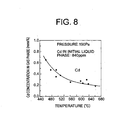
From the values of the compositions of the condensed zinc
and the remaining zinc, the temperature dependencies of the
lead concentration and the cadmium concentration in the
evaporated zinc were calculated and shown in graphs of Figs.7
and 8, respectively.
As apparent from these graphs, the lead concentration in
the gas phase increased with the temperature increase, and the
cadmium concentration in the gas phase decreased with the
temperature increase.
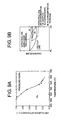
The distillation efficiencies of the lead at a plurality of
temperatures were calculated by using an equation (2), and the
results were shown in a graph of Fig.9a. "a1" and "b1" are
defined in Fig.9b.
Distillation Efficiency of Lead = (Lead Concentration in Gas
Phase at Gas-Liquid Equilibrium) / (Lead Concentration in
Gas Phase in Experiment) = a1/b1
Then, the distillation efficiencies of the cadmium at a
plurality of temperatures were calculated by using an equation
(3), and the results were shown in a graph of Fig.10a. "a2" and
"b2" are defined in Fig. 10b.
Distillation Efficiency of Cadmium = (Cadmium
Concentration in Gas in Experiment) / = (Cadmium
Concentration in Gas Phase at Gas-Liquid Equilibrium) =
a2/b2
The lead column and the cadmium column under the
reduced pressure were analyzed (number of trays and thermal
rating) based on the data obtained in Examples.
The gas-liquid composition of each tray was determined by
using a zinc-lead gas-liquid state diagram revised with the
material balance and the distillation efficiency.
Crude zinc heated to 590°C and containing 1.3 % of lead
was supplied at 50 ton/day into the zinc vapor supply port of the
lead column having a degree of reduced pressure at 190 Pa. The
numbers of the trays of the combustion chamber and the reflux
section of the lead column, and amounts of fuel required for
adjusting the lead content at the top of the lead column to be 20
ppm at the respective temperatures of 620°C, 660°C, 700°C and
740°C were calculated.
Under the existing conditions (under atmospheric pressure),
the number of the trays required for adjusting the lead content at
top of the lead column to be 20 ppm was 56. The trays required in
this Example were 34, 23, 19 and 27 in the order of the above
temperatures as shown in Fig. 11, and it was apparent that the
number of the trays could be made minimum in the operation at
700°C. The reduction rates of the fuel at the respective
temperatures were shown in Table 2, and the operation at 620°C
was preferable for reducing the fuel.
Under the conditions, the run-off metal containing 4.5 % of
the lead flowed out through the lead discharge port at a rate of
15 ton/day, and the zinc-cadmium vapor containing 20 ppm of the
lead was discharged through the zinc vapor discharge port of the
lead column at a rate of 35 ton/day.
| Operation Temperature (°C ) | 620 | 660 | 700 | 740 |
| Reduction Rate (%) | 28.0 | 24.8 | 21.4 | 17.7 |
The gas-liquid composition of each tray was determined by
using a zinc-cadmium gas-liquid state diagram revised with the
material balance and the distillation efficiency, and the required
trays were calculated from the required evaporation area and by
using the Ponchon-Savarit method.
Molten zinc heated to 700°C and containing 1000 ppm of
cadmium was supplied at 70 ton/day into the molten zinc supply
port of the cadmium column having a degree of reduced pressure
at 190 Pa. The numbers of the trays of the combustion chamber
and the reflux section of the cadmium column, and amounts of
fuel required for adjusting the cadmium content in the obtained
SHG to be 20 ppm at the respective temperatures of 460°C and
500°C were calculated.
Under the existing conditions (under atmospheric pressure),
the number of the trays required for adjusting the cadmium
content to be 20 ppm was 64. The required trays in this Example
were 20 and 18 in the order of the above temperatures as shown
in Fig. 12, and the number of the trays could be made below one
third.
In this Example, as mentioned earlier, in spite of no heating
of the combustion chamber, the pure zinc (SHG) at 500°C
containing 20 ppm of the cadmium was discharged through the
zinc discharge port positioned at the bottom surface of the
cadmium column at a rate of 69.3 ton/day by supplying the
molten zinc heated to about 700°C to the cadmium column.
All the latent heat required for the evaporation could be
provided by the temperature difference between the molten zinc
supplied and the molten zinc in the rectification column (700°C
and 500°C), and the operation could be conducted without
heating the cadmium column, and the fuel reduction rate of
100 % was achieved in the operation under the reduced pressure.
In this Example, the treatment of passing the crude zinc
through the lead column and then through the cadmium column
shown in Fig.3 was not conducted, and the acquirement of the
zinc with the reduced amount of the cadmium was attempted by
passing the zinc only through the cadmium column (referred to
as "cadmium removal column" in this analysis).
The gas-liquid composition of each tray was determined by
using a zinc-cadmium gas-liquid state diagram revised with the
material balance and the distillation efficiency, and the required
trays were calculated from the required evaporation area and by
using the Ponchon-Savarit method.
Molten zinc heated to 700°C and containing 700 ppm of
cadmium was supplied at 100 ton/day into the molten zinc supply
port of the cadmium column having a degree of reduced pressure
at 190 Pa. The numbers of the trays of the combustion chamber
and the reflux section of the cadmium column, and amounts of
fuel required for adjusting the cadmium content in the obtained
SHG to be 100 ppm at the respective temperatures of 500°C and
540°C were calculated.
The numbers of the trays required for adjusting the
cadmium content to be 100 ppm were 14 and 13 in the order of
the above temperatures as shown in Fig. 13.
In this Example, as mentioned earlier, in spite of no heating
of the combustion chamber, the distilled zinc removed of the
cadmium at 540°C containing 100 ppm of the cadmium was
discharged through the zinc discharge port positioned at the
bottom surface of the cadmium column at a rate of 99.4 ton/day
by supplying the 'molten zinc heated to about 700°C to the
cadmium column.
Claims (7)
- A process of purifying zinc comprising the steps ofintroducing the zinc containing impurities into a rectification column having a plurality of purification stages: anddistilling the zinc in the rectification column under a reduced pressure for removing the impurities; thereby obtaining the zinc with a higher purity.
- The process of purifying the zinc as defined in claim 1, wherein a degree of the reduced pressure is from 0.1 to 5000 Pa.
- The process of purifying the zinc as defined in claim 1, wherein the rectification column includes a lead column and a cadmium column, and after the zinc containing lead and cadmium as the impurities is introduced into the lead column for lead removal, the zinc containing the cadmium is introduced into the cadmium column for cadmium removal.
- The process of purifying the zinc as defined in claim 1, wherein the rectification column includes a cadmium removal column, and the zinc containing lead and cadmium as the impurities is introduced into the cadmium removal column for cadmium removal, thereby obtaining the zinc containing the lead.
- The process of purifying the zinc as defined in claim 3, wherein the purification in the cadmium column or the cadmium removal column is conducted without heating.
- A rectification column for purification under reduced pressure comprising a molded material selected from a group consisting of a metal, a metal alloy and a resin.
- A process of purifying a metal comprising the steps ofintroducing one metal selected from a group consisting of aluminum, copper, silver, gold copper and cadmium, and containing an impurity, into a rectification column having a plurality of purification stages: anddistilling the metal in the rectification column under reduced pressure for the impurity removal, thereby obtaining the high purity metal.
Applications Claiming Priority (5)
| Application Number | Priority Date | Filing Date | Title |
|---|---|---|---|
| JP2000384143 | 2000-12-18 | ||
| JP2000384143 | 2000-12-18 | ||
| JP2001342329 | 2001-11-07 | ||
| JP2001342329 | 2001-11-07 | ||
| PCT/JP2001/010957 WO2002050320A1 (en) | 2000-12-18 | 2001-12-13 | Process for purifying zinc and rectifying column for purifying zinc |
Publications (2)
| Publication Number | Publication Date |
|---|---|
| EP1371739A1 true EP1371739A1 (en) | 2003-12-17 |
| EP1371739A4 EP1371739A4 (en) | 2006-09-06 |
Family
ID=26606032
Family Applications (1)
| Application Number | Title | Priority Date | Filing Date |
|---|---|---|---|
| EP01271115A Withdrawn EP1371739A4 (en) | 2000-12-18 | 2001-12-13 | PROCESS FOR PURIFYING ZINC AND RECTIFICATION COLUMN FOR PURIFYING ZINC |
Country Status (4)
| Country | Link |
|---|---|
| EP (1) | EP1371739A4 (en) |
| JP (1) | JPWO2002050320A1 (en) |
| AU (1) | AU2002222638A1 (en) |
| WO (1) | WO2002050320A1 (en) |
Cited By (2)
| Publication number | Priority date | Publication date | Assignee | Title |
|---|---|---|---|---|
| CN101148707B (en) * | 2006-09-20 | 2010-12-08 | 徐建成 | Zinc rectification method and zinc rectification furnace |
| CN102277504A (en) * | 2011-08-19 | 2011-12-14 | 赵志强 | Process for extracting zinc and indium by rectifying hard zinc under constant pressure |
Family Cites Families (7)
| Publication number | Priority date | Publication date | Assignee | Title |
|---|---|---|---|---|
| JPS3614110B1 (en) * | 1958-10-06 | 1961-08-23 | ||
| JPS369157B1 (en) * | 1959-10-08 | 1961-06-30 | ||
| BE642687A (en) * | 1963-08-31 | 1900-01-01 | ||
| DE1234395B (en) * | 1965-04-30 | 1967-02-16 | Hans Grothe Dr Ing | Process for separating metal mixtures from easily and poorly volatile components, in particular for refining raw tines |
| GB1145688A (en) * | 1967-06-16 | 1969-03-19 | Cie Metaux Doverpelt Lommel | Improvements in and relating to the purification of zinc by fractional distillation |
| JPS54107422A (en) * | 1978-02-10 | 1979-08-23 | Nippon Mining Co Ltd | Purification of distilied zinc |
| JPH06108175A (en) * | 1992-09-30 | 1994-04-19 | Aichi Steel Works Ltd | Refining method for crude zinc and its device |
-
2001
- 2001-12-13 WO PCT/JP2001/010957 patent/WO2002050320A1/en not_active Ceased
- 2001-12-13 EP EP01271115A patent/EP1371739A4/en not_active Withdrawn
- 2001-12-13 AU AU2002222638A patent/AU2002222638A1/en not_active Abandoned
- 2001-12-13 JP JP2002551198A patent/JPWO2002050320A1/en active Pending
Cited By (3)
| Publication number | Priority date | Publication date | Assignee | Title |
|---|---|---|---|---|
| CN101148707B (en) * | 2006-09-20 | 2010-12-08 | 徐建成 | Zinc rectification method and zinc rectification furnace |
| CN102277504A (en) * | 2011-08-19 | 2011-12-14 | 赵志强 | Process for extracting zinc and indium by rectifying hard zinc under constant pressure |
| CN102277504B (en) * | 2011-08-19 | 2016-02-10 | 赵志强 | Hard zinc atmospheric distillation extracts zinc, indium technique |
Also Published As
| Publication number | Publication date |
|---|---|
| EP1371739A4 (en) | 2006-09-06 |
| AU2002222638A1 (en) | 2002-07-01 |
| JPWO2002050320A1 (en) | 2004-04-22 |
| WO2002050320A1 (en) | 2002-06-27 |
Similar Documents
| Publication | Publication Date | Title |
|---|---|---|
| US5582630A (en) | Ultra high purity magnesium vacuum distillation purification method | |
| US9540709B2 (en) | Vacuum refining furnace | |
| JP4538663B2 (en) | High-purity metal purification method and purification apparatus | |
| EP1335032A1 (en) | Vacuum distillation method and apparatus for enhanced purification of high-purity metals like indium | |
| CN106119561A (en) | A kind of method of vacuum distilling multi-stage condensing purifying crude indium | |
| CN107058766A (en) | A kind of preparation method of high purity indium | |
| US1994358A (en) | Purification or separation of metals | |
| CN101705370A (en) | Method for recovering valuable metal from ferro-aluminum slag and special horizontal vacuum furnace | |
| US3484233A (en) | Process and apparatus for separating metals by distillation | |
| JPH06108175A (en) | Refining method for crude zinc and its device | |
| US1994349A (en) | Purifying zinc metal | |
| JPWO2002050320A1 (en) | Zinc purification method and rectification column for zinc purification | |
| JP5248721B2 (en) | Method and apparatus for distillation purification of high melting point organic materials | |
| KR19980702359A (en) | Ultra high purity magnesium and vacuum distillation purification method and apparatus | |
| JPH01108322A (en) | Distillation refining process | |
| US3778044A (en) | Method and apparatus for recovery and refining of zinc | |
| CN111041228A (en) | Method and equipment for integrated refining of crude zinc | |
| US2267698A (en) | Method of recovering and refining metal | |
| US2331988A (en) | Continuous furnace for the separation of a metal alloyed with other metals | |
| US2720456A (en) | Distillation of metals | |
| US4077799A (en) | Method and apparatus of refining crude cadmium | |
| US4045006A (en) | Apparatus for continuous vacuum-refining of metals | |
| US1994352A (en) | Purifying zinc metal | |
| US2939783A (en) | Zinc refining | |
| WO2003048398A1 (en) | Method of and apparatus for condensing metallic vapours |
Legal Events
| Date | Code | Title | Description |
|---|---|---|---|
| PUAI | Public reference made under article 153(3) epc to a published international application that has entered the european phase |
Free format text: ORIGINAL CODE: 0009012 |
|
| 17P | Request for examination filed |
Effective date: 20030930 |
|
| AK | Designated contracting states |
Kind code of ref document: A1 Designated state(s): AT BE CH CY DE DK ES FI FR GB GR IE IT LI LU MC NL PT SE TR |
|
| RBV | Designated contracting states (corrected) |
Designated state(s): DE FR GB IT |
|
| A4 | Supplementary search report drawn up and despatched |
Effective date: 20060809 |
|
| 17Q | First examination report despatched |
Effective date: 20061213 |
|
| STAA | Information on the status of an ep patent application or granted ep patent |
Free format text: STATUS: THE APPLICATION IS DEEMED TO BE WITHDRAWN |
|
| 18D | Application deemed to be withdrawn |
Effective date: 20070424 |