EP1371481A1 - Vehicle windshield - Google Patents
Vehicle windshield Download PDFInfo
- Publication number
- EP1371481A1 EP1371481A1 EP03012934A EP03012934A EP1371481A1 EP 1371481 A1 EP1371481 A1 EP 1371481A1 EP 03012934 A EP03012934 A EP 03012934A EP 03012934 A EP03012934 A EP 03012934A EP 1371481 A1 EP1371481 A1 EP 1371481A1
- Authority
- EP
- European Patent Office
- Prior art keywords
- windshield
- interlayer
- vehicle
- passenger compartment
- curved
- Prior art date
- Legal status (The legal status is an assumption and is not a legal conclusion. Google has not performed a legal analysis and makes no representation as to the accuracy of the status listed.)
- Granted
Links
- 239000011229 interlayer Substances 0.000 claims abstract description 45
- 239000005340 laminated glass Substances 0.000 claims abstract description 18
- 239000005357 flat glass Substances 0.000 claims description 13
- 229920005989 resin Polymers 0.000 claims description 7
- 239000011347 resin Substances 0.000 claims description 7
- 239000000463 material Substances 0.000 claims description 6
- 239000011521 glass Substances 0.000 description 18
- 238000000034 method Methods 0.000 description 6
- 239000005336 safety glass Substances 0.000 description 6
- 238000004519 manufacturing process Methods 0.000 description 4
- 238000010586 diagram Methods 0.000 description 3
- 238000010438 heat treatment Methods 0.000 description 3
- 230000000116 mitigating effect Effects 0.000 description 3
- 238000000137 annealing Methods 0.000 description 2
- 238000004140 cleaning Methods 0.000 description 2
- 229920003023 plastic Polymers 0.000 description 2
- 239000004033 plastic Substances 0.000 description 2
- 229920002037 poly(vinyl butyral) polymer Polymers 0.000 description 2
- 238000005452 bending Methods 0.000 description 1
- 238000007689 inspection Methods 0.000 description 1
- 230000035515 penetration Effects 0.000 description 1
- 238000007665 sagging Methods 0.000 description 1
- 239000005341 toughened glass Substances 0.000 description 1
- 238000005406 washing Methods 0.000 description 1
Images



Classifications
-
- B—PERFORMING OPERATIONS; TRANSPORTING
- B32—LAYERED PRODUCTS
- B32B—LAYERED PRODUCTS, i.e. PRODUCTS BUILT-UP OF STRATA OF FLAT OR NON-FLAT, e.g. CELLULAR OR HONEYCOMB, FORM
- B32B17/00—Layered products essentially comprising sheet glass, or glass, slag, or like fibres
- B32B17/06—Layered products essentially comprising sheet glass, or glass, slag, or like fibres comprising glass as the main or only constituent of a layer, next to another layer of a specific material
- B32B17/10—Layered products essentially comprising sheet glass, or glass, slag, or like fibres comprising glass as the main or only constituent of a layer, next to another layer of a specific material of synthetic resin
- B32B17/10005—Layered products essentially comprising sheet glass, or glass, slag, or like fibres comprising glass as the main or only constituent of a layer, next to another layer of a specific material of synthetic resin laminated safety glass or glazing
- B32B17/1055—Layered products essentially comprising sheet glass, or glass, slag, or like fibres comprising glass as the main or only constituent of a layer, next to another layer of a specific material of synthetic resin laminated safety glass or glazing characterized by the resin layer, i.e. interlayer
- B32B17/10761—Layered products essentially comprising sheet glass, or glass, slag, or like fibres comprising glass as the main or only constituent of a layer, next to another layer of a specific material of synthetic resin laminated safety glass or glazing characterized by the resin layer, i.e. interlayer containing vinyl acetal
-
- B—PERFORMING OPERATIONS; TRANSPORTING
- B32—LAYERED PRODUCTS
- B32B—LAYERED PRODUCTS, i.e. PRODUCTS BUILT-UP OF STRATA OF FLAT OR NON-FLAT, e.g. CELLULAR OR HONEYCOMB, FORM
- B32B17/00—Layered products essentially comprising sheet glass, or glass, slag, or like fibres
- B32B17/06—Layered products essentially comprising sheet glass, or glass, slag, or like fibres comprising glass as the main or only constituent of a layer, next to another layer of a specific material
- B32B17/10—Layered products essentially comprising sheet glass, or glass, slag, or like fibres comprising glass as the main or only constituent of a layer, next to another layer of a specific material of synthetic resin
- B32B17/10005—Layered products essentially comprising sheet glass, or glass, slag, or like fibres comprising glass as the main or only constituent of a layer, next to another layer of a specific material of synthetic resin laminated safety glass or glazing
- B32B17/10009—Layered products essentially comprising sheet glass, or glass, slag, or like fibres comprising glass as the main or only constituent of a layer, next to another layer of a specific material of synthetic resin laminated safety glass or glazing characterized by the number, the constitution or treatment of glass sheets
- B32B17/10036—Layered products essentially comprising sheet glass, or glass, slag, or like fibres comprising glass as the main or only constituent of a layer, next to another layer of a specific material of synthetic resin laminated safety glass or glazing characterized by the number, the constitution or treatment of glass sheets comprising two outer glass sheets
-
- B—PERFORMING OPERATIONS; TRANSPORTING
- B32—LAYERED PRODUCTS
- B32B—LAYERED PRODUCTS, i.e. PRODUCTS BUILT-UP OF STRATA OF FLAT OR NON-FLAT, e.g. CELLULAR OR HONEYCOMB, FORM
- B32B17/00—Layered products essentially comprising sheet glass, or glass, slag, or like fibres
- B32B17/06—Layered products essentially comprising sheet glass, or glass, slag, or like fibres comprising glass as the main or only constituent of a layer, next to another layer of a specific material
- B32B17/10—Layered products essentially comprising sheet glass, or glass, slag, or like fibres comprising glass as the main or only constituent of a layer, next to another layer of a specific material of synthetic resin
- B32B17/10005—Layered products essentially comprising sheet glass, or glass, slag, or like fibres comprising glass as the main or only constituent of a layer, next to another layer of a specific material of synthetic resin laminated safety glass or glazing
- B32B17/10807—Making laminated safety glass or glazing; Apparatus therefor
-
- B—PERFORMING OPERATIONS; TRANSPORTING
- B32—LAYERED PRODUCTS
- B32B—LAYERED PRODUCTS, i.e. PRODUCTS BUILT-UP OF STRATA OF FLAT OR NON-FLAT, e.g. CELLULAR OR HONEYCOMB, FORM
- B32B17/00—Layered products essentially comprising sheet glass, or glass, slag, or like fibres
- B32B17/06—Layered products essentially comprising sheet glass, or glass, slag, or like fibres comprising glass as the main or only constituent of a layer, next to another layer of a specific material
- B32B17/10—Layered products essentially comprising sheet glass, or glass, slag, or like fibres comprising glass as the main or only constituent of a layer, next to another layer of a specific material of synthetic resin
- B32B17/10005—Layered products essentially comprising sheet glass, or glass, slag, or like fibres comprising glass as the main or only constituent of a layer, next to another layer of a specific material of synthetic resin laminated safety glass or glazing
- B32B17/10807—Making laminated safety glass or glazing; Apparatus therefor
- B32B17/10816—Making laminated safety glass or glazing; Apparatus therefor by pressing
- B32B17/10825—Isostatic pressing, i.e. using non rigid pressure-exerting members against rigid parts
- B32B17/10834—Isostatic pressing, i.e. using non rigid pressure-exerting members against rigid parts using a fluid
- B32B17/10844—Isostatic pressing, i.e. using non rigid pressure-exerting members against rigid parts using a fluid using a membrane between the layered product and the fluid
- B32B17/10853—Isostatic pressing, i.e. using non rigid pressure-exerting members against rigid parts using a fluid using a membrane between the layered product and the fluid the membrane being bag-shaped
-
- B—PERFORMING OPERATIONS; TRANSPORTING
- B32—LAYERED PRODUCTS
- B32B—LAYERED PRODUCTS, i.e. PRODUCTS BUILT-UP OF STRATA OF FLAT OR NON-FLAT, e.g. CELLULAR OR HONEYCOMB, FORM
- B32B17/00—Layered products essentially comprising sheet glass, or glass, slag, or like fibres
- B32B17/06—Layered products essentially comprising sheet glass, or glass, slag, or like fibres comprising glass as the main or only constituent of a layer, next to another layer of a specific material
- B32B17/10—Layered products essentially comprising sheet glass, or glass, slag, or like fibres comprising glass as the main or only constituent of a layer, next to another layer of a specific material of synthetic resin
- B32B17/10005—Layered products essentially comprising sheet glass, or glass, slag, or like fibres comprising glass as the main or only constituent of a layer, next to another layer of a specific material of synthetic resin laminated safety glass or glazing
- B32B17/10807—Making laminated safety glass or glazing; Apparatus therefor
- B32B17/10899—Making laminated safety glass or glazing; Apparatus therefor by introducing interlayers of synthetic resin
- B32B17/10935—Making laminated safety glass or glazing; Apparatus therefor by introducing interlayers of synthetic resin as a preformed layer, e.g. formed by extrusion
-
- B—PERFORMING OPERATIONS; TRANSPORTING
- B32—LAYERED PRODUCTS
- B32B—LAYERED PRODUCTS, i.e. PRODUCTS BUILT-UP OF STRATA OF FLAT OR NON-FLAT, e.g. CELLULAR OR HONEYCOMB, FORM
- B32B17/00—Layered products essentially comprising sheet glass, or glass, slag, or like fibres
- B32B17/06—Layered products essentially comprising sheet glass, or glass, slag, or like fibres comprising glass as the main or only constituent of a layer, next to another layer of a specific material
- B32B17/10—Layered products essentially comprising sheet glass, or glass, slag, or like fibres comprising glass as the main or only constituent of a layer, next to another layer of a specific material of synthetic resin
- B32B17/10005—Layered products essentially comprising sheet glass, or glass, slag, or like fibres comprising glass as the main or only constituent of a layer, next to another layer of a specific material of synthetic resin laminated safety glass or glazing
- B32B17/10807—Making laminated safety glass or glazing; Apparatus therefor
- B32B17/10899—Making laminated safety glass or glazing; Apparatus therefor by introducing interlayers of synthetic resin
- B32B17/10954—Making laminated safety glass or glazing; Apparatus therefor by introducing interlayers of synthetic resin by using an aligning laminating device
-
- B—PERFORMING OPERATIONS; TRANSPORTING
- B32—LAYERED PRODUCTS
- B32B—LAYERED PRODUCTS, i.e. PRODUCTS BUILT-UP OF STRATA OF FLAT OR NON-FLAT, e.g. CELLULAR OR HONEYCOMB, FORM
- B32B17/00—Layered products essentially comprising sheet glass, or glass, slag, or like fibres
- B32B17/06—Layered products essentially comprising sheet glass, or glass, slag, or like fibres comprising glass as the main or only constituent of a layer, next to another layer of a specific material
- B32B17/10—Layered products essentially comprising sheet glass, or glass, slag, or like fibres comprising glass as the main or only constituent of a layer, next to another layer of a specific material of synthetic resin
- B32B17/10005—Layered products essentially comprising sheet glass, or glass, slag, or like fibres comprising glass as the main or only constituent of a layer, next to another layer of a specific material of synthetic resin laminated safety glass or glazing
- B32B17/10807—Making laminated safety glass or glazing; Apparatus therefor
- B32B17/10981—Pre-treatment of the layers
-
- B—PERFORMING OPERATIONS; TRANSPORTING
- B32—LAYERED PRODUCTS
- B32B—LAYERED PRODUCTS, i.e. PRODUCTS BUILT-UP OF STRATA OF FLAT OR NON-FLAT, e.g. CELLULAR OR HONEYCOMB, FORM
- B32B38/00—Ancillary operations in connection with laminating processes
- B32B38/18—Handling of layers or the laminate
- B32B38/1866—Handling of layers or the laminate conforming the layers or laminate to a convex or concave profile
-
- B—PERFORMING OPERATIONS; TRANSPORTING
- B32—LAYERED PRODUCTS
- B32B—LAYERED PRODUCTS, i.e. PRODUCTS BUILT-UP OF STRATA OF FLAT OR NON-FLAT, e.g. CELLULAR OR HONEYCOMB, FORM
- B32B2315/00—Other materials containing non-metallic inorganic compounds not provided for in groups B32B2311/00 - B32B2313/04
- B32B2315/08—Glass
-
- B—PERFORMING OPERATIONS; TRANSPORTING
- B32—LAYERED PRODUCTS
- B32B—LAYERED PRODUCTS, i.e. PRODUCTS BUILT-UP OF STRATA OF FLAT OR NON-FLAT, e.g. CELLULAR OR HONEYCOMB, FORM
- B32B2329/00—Polyvinylalcohols, polyvinylethers, polyvinylaldehydes, polyvinylketones or polyvinylketals
- B32B2329/06—PVB, i.e. polyinylbutyral
-
- B—PERFORMING OPERATIONS; TRANSPORTING
- B32—LAYERED PRODUCTS
- B32B—LAYERED PRODUCTS, i.e. PRODUCTS BUILT-UP OF STRATA OF FLAT OR NON-FLAT, e.g. CELLULAR OR HONEYCOMB, FORM
- B32B38/00—Ancillary operations in connection with laminating processes
- B32B38/14—Printing or colouring
- B32B38/145—Printing
-
- B—PERFORMING OPERATIONS; TRANSPORTING
- B32—LAYERED PRODUCTS
- B32B—LAYERED PRODUCTS, i.e. PRODUCTS BUILT-UP OF STRATA OF FLAT OR NON-FLAT, e.g. CELLULAR OR HONEYCOMB, FORM
- B32B38/00—Ancillary operations in connection with laminating processes
- B32B38/16—Drying; Softening; Cleaning
- B32B38/162—Cleaning
-
- B—PERFORMING OPERATIONS; TRANSPORTING
- B32—LAYERED PRODUCTS
- B32B—LAYERED PRODUCTS, i.e. PRODUCTS BUILT-UP OF STRATA OF FLAT OR NON-FLAT, e.g. CELLULAR OR HONEYCOMB, FORM
- B32B38/00—Ancillary operations in connection with laminating processes
- B32B38/18—Handling of layers or the laminate
- B32B38/1875—Tensioning
-
- Y—GENERAL TAGGING OF NEW TECHNOLOGICAL DEVELOPMENTS; GENERAL TAGGING OF CROSS-SECTIONAL TECHNOLOGIES SPANNING OVER SEVERAL SECTIONS OF THE IPC; TECHNICAL SUBJECTS COVERED BY FORMER USPC CROSS-REFERENCE ART COLLECTIONS [XRACs] AND DIGESTS
- Y10—TECHNICAL SUBJECTS COVERED BY FORMER USPC
- Y10T—TECHNICAL SUBJECTS COVERED BY FORMER US CLASSIFICATION
- Y10T428/00—Stock material or miscellaneous articles
- Y10T428/24—Structurally defined web or sheet [e.g., overall dimension, etc.]
- Y10T428/24628—Nonplanar uniform thickness material
Definitions
- the present invention relates to a vehicle windshield for mitigating an impact on a colliding object colliding with the windshield from the front of the vehicle.
- This kind of windshield is known as disclosed, for example, in Japanese Patent Laid-Open Publication No. HEI-4-19136 as a laminated safety glass which consists of an annealing glass, a resin interlayer bonded to the interior side of the annealing glass, and an impermeable film bonded to the surface on the interior side of the resin interlayer.
- FIGS. 8A and 8B Another known example of such a windshield is shown in FIGS. 8A and 8B. These figures illustrate a state in which a colliding object is colliding with a windshield from the interior of the vehicle.
- OUT indicates the outside of a passenger compartment and IN the inside of the passenger compartment.
- FIG. 8A illustrates a colliding object 111 heading toward a windshield 112.
- the windshield 112 is made from a glass having two glasses 113 and 114 curved from the passenger compartment toward the vehicle outside bonded together with a plastic interlayer 115 (hereinafter referred to as a "laminated glass").
- the laminated safety glass in HEI-4-19136 or the windshield 112 shown in FIG. 8A takes into account the safety of vehicle passengers, and mitigates the impact on the head of a passenger hitting against the laminated safety glass or the windshield 112 upon a vehicle collision.
- no consideration is given to the safety of pedestrians, that is, a colliding object from the outside of the vehicle compartment toward the laminated safety glass or the windshield 112.
- the windshield 112 when the colliding object 111 hits on the windshield 112, the windshield 112 is partially broken, mitigating the impact of collision.
- the windshield 112 does not allow for impact from the outside of the passenger compartment.
- the windshield 112 has a shape curved outward of the passenger compartment, that is, a so-called "arch" shape in cross section, and is thus more unbreakable against a load from the outside of the passenger compartment than from the inside of the passenger compartment.
- a vehicle windshield which comprises: a laminated glass curved outward of a passenger compartment, the curved laminated glass being previously provided with a flexing force acting inward of the passenger compartment.
- the windshield in its entirety is flexible toward the inside of the passenger compartment.
- the windshield can flex toward the vehicle inside, thereby absorbing the impact of the collision and mitigating impact received by the colliding object.
- the windshield can flex toward the vehicle inside in a concave shape, thereby preventing the colliding object from being thrown out toward the side of the vehicle body after colliding with the windshield.
- the force is produced by applying tension to the interlayer to be disposed in the middle of the laminated glass so that the interlayer has a length larger than a free length. That is, the force is produced in the entire laminated glass by the interlayer constituting a part of the laminated glass, which eliminates the need for the addition of other extra components and can prevent increase in the number of components.
- a vehicle windshield which comprises: a plurality of sheet glasses curved outward of a vehicle; and an interlayer made from a resin material interposed between the sheet glasses for bonding the sheet glasses together, the interlayer being tensioned in every direction to have a return force.
- a method of producing a vehicle windshield comprises the steps of: curving a plurality of sheet glasses into a concave shape; applying tension to an interlayer made from a resin material so that the interlayer is stretched in every direction; interposing the tensioned interlayer between the curved sheet glasses; and bonding the curved sheet glasses and the tensioned interlayer together.
- the windshield can be easily provided with a return force.
- FIG. 1 show in perspective the front of a vehicle according to the present invention.
- a vehicle 10 has a windshield 12 at the front of a passenger compartment.
- Reference numeral 15 denotes a hood covering an upper portion of an engine compartment, 16 and 17 left and right front fenders, 18 a front bumper, 21 a front wheel (another front wheel is not shown), 23 and 24 left and right A-pillars, 25 a front door, and 26 a door mirror.
- the windshield 12 is made from a laminated glass, including an outer glass 32 arranged outside of the passenger compartment, an inner glass 33 arranged inside of the passenger compartment, and an interlayer 34 made of soft resin interposed between the outer glass 32 and the inner glass 33, bonding the outer glass 32 and the inner glass 33 together.
- Laminated glasses for automobiles are included in automobile safety glasses specified in JIS, defined as ones having at least two sheet glasses bonded together with plastic, as an interlayer so as to prevent, when broken by an external force, most broken pieces from scattering with the interlayer.
- the laminated glasses have improved safety as compared with tempered glasses which are also included in the automobile safety glasses, and are mainly used for windshields and sunshine roofs.
- the interlayer 34 is a film of polyvinyl butyral (PVB), and is flexible and tough. When the glass is broken, the interlayer 34 prevents the scattering of broken pieces and the entire collapse of the glass, and is also resistant to the penetration of a colliding object.
- PVB polyvinyl butyral
- the interlayer 34 is bonded to the outer glass 32 and the inner glass 33 while being tensioned to a predetermined degree in the production process.
- FIG. 3 illustrates the windshield 12 mounted between the left and right A-pillars 23 and 24.
- the windshield 12 is curved outward of the vehicle from the interior of a passenger compartment 36. As will be described below, when an external force of a given magnitude acts on the windshield 12 from the vehicle outside, the tension in the interlayer 34 causes the entire windshield 12 to be more flexible, and further mitigates the impact of collision of a colliding object from the vehicle outside if any than in a conventional manner.
- the interlayer 34 previously tensioned acts to change from a curved state into an upright state.
- the windshield 12 thus also acts to change from a curved state into an upright state. Specifically, a force C directed toward the passenger compartment as shown by an arrow is produced by a return force of the interlayer 34 in the windshield 12.
- FIG. 5A When a colliding object 38 heads toward the windshield 12 from the front of the vehicle 10 as shown by an arrow in FIG. 5A, for example, and collides with the windshield 12 as in FIG. 5B, a central portion of the windshield 12 is broken as shown in FIG. 5C. If the impact is great, the broken part spreads over the entire windshield 12 as shown in FIG. 5D.
- the windshield 12 when broken, becomes flexible by the above-described force C in the direction of the passenger compartment (see FIG. 4A), and the broken part becomes upright.
- the windshield 12 After being upright, the windshield 12 is curved inward of the passenger compartment 36 as shown in FIG. 5D by an inertia force of the colliding object 38.
- the windshield 12 thus configured to be broken by an external force of a given magnitude and to be flexible, can further absorb the impact of the colliding object 38.
- FIG. 6 is a perspective view of a production line illustrating a process of producing the windshield 12 according to the present invention, in which process steps are affixed the letters (a) to (k) and will be described in that order.
- the windshield 12 is produced in this manner.
- the windshield 12 is then inspected and packaged for shipment.
- the interlayer 61 are pulled at its sides 71 to 74 in arrow directions to apply tension to the interlayer 61.
- the interlayer 61 is expanded from a free length of longitudinal length F1 and transverse length F2 (length before the application of tension) into a set length (longitudinal length S1 and transverse length S2). That is, the interlayer 61 is tensioned to stretch in every direction.
- the outer plate 57 and the inner plate 58 are superimposed from the opposite sides as shown by hollow arrows for bonding.
- a windshield (12) of a laminated glass curved to protrude toward the vehicle outside.
- An interlayer (34) of the laminated glass is tensioned so that the windshield has a force (C) acting to cause the entire laminated glass to flex toward a passenger compartment.
- the windshield is configured in its entirety to be flexible toward the inside of the passenger compartment, so that the impact of an object (38) colliding with the windshield from the vehicle outside can be absorbed and impact received by the colliding object can be mitigated.
Landscapes
- Joining Of Glass To Other Materials (AREA)
- Body Structure For Vehicles (AREA)
- Window Of Vehicle (AREA)
Abstract
Description
- The present invention relates to a vehicle windshield for mitigating an impact on a colliding object colliding with the windshield from the front of the vehicle.
- This kind of windshield is known as disclosed, for example, in Japanese Patent Laid-Open Publication No. HEI-4-19136 as a laminated safety glass which consists of an annealing glass, a resin interlayer bonded to the interior side of the annealing glass, and an impermeable film bonded to the surface on the interior side of the resin interlayer.
- Another known example of such a windshield is shown in FIGS. 8A and 8B. These figures illustrate a state in which a colliding object is colliding with a windshield from the interior of the vehicle. In the figures, OUT indicates the outside of a passenger compartment and IN the inside of the passenger compartment.
- FIG. 8A illustrates a colliding object 111 heading toward a
windshield 112. Thewindshield 112 is made from a glass having twoglasses - The laminated safety glass in HEI-4-19136 or the
windshield 112 shown in FIG. 8A takes into account the safety of vehicle passengers, and mitigates the impact on the head of a passenger hitting against the laminated safety glass or thewindshield 112 upon a vehicle collision. However, no consideration is given to the safety of pedestrians, that is, a colliding object from the outside of the vehicle compartment toward the laminated safety glass or thewindshield 112. - In FIG. 8B, when the colliding object 111 hits on the
windshield 112, thewindshield 112 is partially broken, mitigating the impact of collision. However, as described above, thewindshield 112 does not allow for impact from the outside of the passenger compartment. Further, thewindshield 112 has a shape curved outward of the passenger compartment, that is, a so-called "arch" shape in cross section, and is thus more unbreakable against a load from the outside of the passenger compartment than from the inside of the passenger compartment. - Further, recent years' trends toward short-nose vehicles with passenger compartments expanded in space and slant-nose vehicles with front end portions inclined downward to reduce air resistance in high-speed travel result in increased collisions from the vehicle front toward windshields. On the other hand, with an increased rate of seatbelt wearing and the widespread adoption of airbags, importance is being attached to consideration to the safety of pedestrians in addition to the safety of vehicle passengers. In other words, it is desired to effectively mitigate the impact on a colliding object colliding with a windshield from the outside of a vehicle compartment.
- According to an aspect of the present invention, there is provided a vehicle windshield which comprises: a laminated glass curved outward of a passenger compartment, the curved laminated glass being previously provided with a flexing force acting inward of the passenger compartment.
- Since the force directed inward of the passenger compartment is previously provided to the windshield carved to protrude toward the vehicle outside, the windshield in its entirety is flexible toward the inside of the passenger compartment. When an object collides with the windshield from the vehicle outside, for example, the windshield can flex toward the vehicle inside, thereby absorbing the impact of the collision and mitigating impact received by the colliding object. Further, the windshield can flex toward the vehicle inside in a concave shape, thereby preventing the colliding object from being thrown out toward the side of the vehicle body after colliding with the windshield.
- In a preferred form, the force is produced by applying tension to the interlayer to be disposed in the middle of the laminated glass so that the interlayer has a length larger than a free length. That is, the force is produced in the entire laminated glass by the interlayer constituting a part of the laminated glass, which eliminates the need for the addition of other extra components and can prevent increase in the number of components.
- According to another aspect of the present invention, there is further provided a vehicle windshield which comprises: a plurality of sheet glasses curved outward of a vehicle; and an interlayer made from a resin material interposed between the sheet glasses for bonding the sheet glasses together, the interlayer being tensioned in every direction to have a return force.
- According to a further aspect of the present invention, there is provided a method of producing a vehicle windshield, which method comprises the steps of: curving a plurality of sheet glasses into a concave shape; applying tension to an interlayer made from a resin material so that the interlayer is stretched in every direction; interposing the tensioned interlayer between the curved sheet glasses; and bonding the curved sheet glasses and the tensioned interlayer together.
- By virtue of the method, the windshield can be easily provided with a return force.
- Preferred embodiments of the present invention will be described in detail below, by way of example only, with reference to the accompanying drawings, in which:
- FIG. 1 is a perspective view illustrating a part of a vehicle with a windshield according to the present invention;
- FIG. 2 is an exploded perspective view of the windshield shown in FIG. 1;
- FIG. 3 is a cross-sectional view of the windshield taken along line 3-3 in FIG. 1;
- FIGS. 4A and 4B are diagrams illustrating force acting on an interlayer of the windshield according to the present invention;
- FIGS. 5A to 5D are diagrams illustrating states of the windshield when an object collides with the windshield from the front of the vehicle;
- FIG. 6 is a perspective view of a production line illustrating a process of producing the windshield according to the present invention;
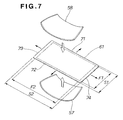
- FIG. 7 is a diagram illustrating the application of tension to the interlayer shown in FIG. 6; and
- FIGS. 8A and 8B are cross-sectional views of the conventional windshield.
-
- Reference is first made to FIG. 1 which show in perspective the front of a vehicle according to the present invention. A
vehicle 10 has awindshield 12 at the front of a passenger compartment.Reference numeral 15 denotes a hood covering an upper portion of an engine compartment, 16 and 17 left and right front fenders, 18 a front bumper, 21 a front wheel (another front wheel is not shown), 23 and 24 left and right A-pillars, 25 a front door, and 26 a door mirror. - As shown in FIG. 2, the
windshield 12 is made from a laminated glass, including anouter glass 32 arranged outside of the passenger compartment, aninner glass 33 arranged inside of the passenger compartment, and aninterlayer 34 made of soft resin interposed between theouter glass 32 and theinner glass 33, bonding theouter glass 32 and theinner glass 33 together. - Laminated glasses for automobiles are included in automobile safety glasses specified in JIS, defined as ones having at least two sheet glasses bonded together with plastic, as an interlayer so as to prevent, when broken by an external force, most broken pieces from scattering with the interlayer. The laminated glasses have improved safety as compared with tempered glasses which are also included in the automobile safety glasses, and are mainly used for windshields and sunshine roofs.
- The
interlayer 34 is a film of polyvinyl butyral (PVB), and is flexible and tough. When the glass is broken, theinterlayer 34 prevents the scattering of broken pieces and the entire collapse of the glass, and is also resistant to the penetration of a colliding object. - The
interlayer 34 is bonded to theouter glass 32 and theinner glass 33 while being tensioned to a predetermined degree in the production process. - FIG. 3 illustrates the
windshield 12 mounted between the left and right A-pillars 23 and 24. - The
windshield 12 is curved outward of the vehicle from the interior of apassenger compartment 36. As will be described below, when an external force of a given magnitude acts on thewindshield 12 from the vehicle outside, the tension in theinterlayer 34 causes theentire windshield 12 to be more flexible, and further mitigates the impact of collision of a colliding object from the vehicle outside if any than in a conventional manner. - Now the function of the
interlayer 34 of thewindshield 12 will be described with reference to FIGS. 4A and 4B. - In FIG. 4A, with the
curved windshield 12 mounted between theA-pillars interlayer 34 because tension is applied to theinterlayer 34 during the production process. When an elastic cord is stretched and fixed at its opposite ends, for example, the elastic cord attempts to contract to the original length. - In FIG. 4B, with the
outer glass 32 and theinner glass 33 entirely broken (32A and 33A denote broken pieces.) by an object colliding with thewindshield 12, there is no restraint on theinterlayer 34 which then changes from a curved state into an upright state as shown by an arrow between theA-pillars - As described with FIGS. 4A and 4B, the
interlayer 34 previously tensioned acts to change from a curved state into an upright state. Thewindshield 12 thus also acts to change from a curved state into an upright state. Specifically, a force C directed toward the passenger compartment as shown by an arrow is produced by a return force of theinterlayer 34 in thewindshield 12. - The function of the above-described
windshield 12 will be described with reference to FIGS. 5A to 5D. - When a colliding
object 38 heads toward thewindshield 12 from the front of thevehicle 10 as shown by an arrow in FIG. 5A, for example, and collides with thewindshield 12 as in FIG. 5B, a central portion of thewindshield 12 is broken as shown in FIG. 5C. If the impact is great, the broken part spreads over theentire windshield 12 as shown in FIG. 5D. - In FIGS. 5C and 5D, the
windshield 12, when broken, becomes flexible by the above-described force C in the direction of the passenger compartment (see FIG. 4A), and the broken part becomes upright. After being upright, thewindshield 12 is curved inward of thepassenger compartment 36 as shown in FIG. 5D by an inertia force of the collidingobject 38. - The
windshield 12 thus configured to be broken by an external force of a given magnitude and to be flexible, can further absorb the impact of the collidingobject 38. - FIG. 6 is a perspective view of a production line illustrating a process of producing the
windshield 12 according to the present invention, in which process steps are affixed the letters (a) to (k) and will be described in that order. - Step (a):
Material plates 51 are prepared. - Step (b): The
material plates 51 are cut into a predetermined shape to produceflat plates 52 which are stamped with a mark and chamfered. - Step (c): The
flat plates 52 are washed by acleaning device 53 and then dried. - Step (d): The
flat plates 52 are provided with prints as necessary. - Step (e): The
flat plate 52 to be theouter glass 32 of the windshield 12 (hereinafter referred to as an "outer plate") is superimposed on theflat plate 52 to be the inner glass 33 (hereinafter referred to as an "inner plate"). Theflat plates 52 are put on adie 54 for bending by sagging. - Step (f): The die 54 with the two
flat plates 52 placed thereon is passed through afurnace 56 for heating, and then slowly cooled. - Step (g): Resultant bent
outer plate 57 andinner plate 58 are washed by acleaning device 59. - Step (h): An
interlayer 61 cut into a predetermined dimension after washing and inspection is inserted between theouter plate 57 and theinner plate 58 while being tensioned. A portion of theinterlayer 61 extending off the edges of theouter plate 57 andinner plate 58 is trimmed. - Step (j): An
assemblage 62 resulting in the step (h) is inserted into a rubber bag and is passed through a preparative press-bondingdevice 63 for heating. This heating may be skipped. - Step (k): The
pre-bonded assemblage 62 is pressurized and heated by anautoclave device 64 for the final press-bonding of theassemblage 62. -
- The
windshield 12 is produced in this manner. Thewindshield 12 is then inspected and packaged for shipment. - Now the application of tension to the
interlayer 61 will be described with reference to FIG. 7. - First, the
interlayer 61 are pulled at itssides 71 to 74 in arrow directions to apply tension to theinterlayer 61. As a result, theinterlayer 61 is expanded from a free length of longitudinal length F1 and transverse length F2 (length before the application of tension) into a set length (longitudinal length S1 and transverse length S2). That is, theinterlayer 61 is tensioned to stretch in every direction. - On the
interlayer 61 in this state, theouter plate 57 and theinner plate 58 are superimposed from the opposite sides as shown by hollow arrows for bonding. - A windshield (12) of a laminated glass curved to protrude toward the vehicle outside. An interlayer (34) of the laminated glass is tensioned so that the windshield has a force (C) acting to cause the entire laminated glass to flex toward a passenger compartment. The windshield is configured in its entirety to be flexible toward the inside of the passenger compartment, so that the impact of an object (38) colliding with the windshield from the vehicle outside can be absorbed and impact received by the colliding object can be mitigated.
Claims (4)
- A vehicle windshield (12) comprising:a laminated glass curved outward of a passenger compartment, said curved laminated glass being previously provided with a flexing force (C) acting inward of said passenger compartment.
- The windshield of claim 1, wherein said force is produced by applying tension to an interlayer (34) to be disposed in the middle of said laminated glass so that said interlayer has a length larger than a free length.
- A vehicle windshield comprising:a plurality of sheet glasses (32, 33) curved outward of a vehicle; andan interlayer (34) made from a resin material interposed between said sheet glasses for bonding said sheet glasses together, said interlayer being tensioned in every direction to have a return force.
- Amethod of producing a vehicle windshield, comprising the steps of:a) curving a plurality of sheet glasses (32, 33) into a concave shape;b) applying tension to an interlayer (34) made from a resin material so that said interlayer is stretched in every direction;c) interposing said tensioned interlayer between said curved sheet glasses; andd) bonding said curved sheet glasses and said tensioned interlayer together.
Applications Claiming Priority (2)
| Application Number | Priority Date | Filing Date | Title |
|---|---|---|---|
| JP2002169159 | 2002-06-10 | ||
| JP2002169159A JP3805722B2 (en) | 2002-06-10 | 2002-06-10 | Vehicle windshield |
Publications (2)
| Publication Number | Publication Date |
|---|---|
| EP1371481A1 true EP1371481A1 (en) | 2003-12-17 |
| EP1371481B1 EP1371481B1 (en) | 2007-04-04 |
Family
ID=29561732
Family Applications (1)
| Application Number | Title | Priority Date | Filing Date |
|---|---|---|---|
| EP03012934A Expired - Lifetime EP1371481B1 (en) | 2002-06-10 | 2003-06-06 | Method for producing a vehicle windshield |
Country Status (4)
| Country | Link |
|---|---|
| US (1) | US6834905B2 (en) |
| EP (1) | EP1371481B1 (en) |
| JP (1) | JP3805722B2 (en) |
| DE (1) | DE60312925T2 (en) |
Cited By (2)
| Publication number | Priority date | Publication date | Assignee | Title |
|---|---|---|---|---|
| EP1591234A1 (en) * | 2004-04-26 | 2005-11-02 | Asahi Glass Company Ltd. | Laminated glass and interlayer for use in such a laminated glass |
| DE102006033670B4 (en) * | 2005-07-26 | 2011-08-25 | Honda Motor Co., Ltd. | Vehicle with collision object protection device |
Families Citing this family (10)
| Publication number | Priority date | Publication date | Assignee | Title |
|---|---|---|---|---|
| USD827526S1 (en) * | 2006-09-26 | 2018-09-04 | Ford Global Technologies, Llc | Vehicle windshield |
| US9333981B2 (en) * | 2007-12-19 | 2016-05-10 | Charles J. Roth | Semi-rigid transparent protective shield for jogging stroller and method of shielding occupant |
| DE102008038604B4 (en) * | 2008-08-21 | 2013-04-25 | Krauss-Maffei Wegmann Gmbh & Co. Kg | Armored vehicle with an A-pillar and a windshield |
| CA2735093C (en) * | 2008-09-15 | 2014-07-08 | Voith Patent Gmbh | Vehicle front-end for mounting to the front face of a track-bound vehicle, in particular a rail vehicle |
| WO2011096447A1 (en) * | 2010-02-03 | 2011-08-11 | 旭硝子株式会社 | Glass plate and method for manufacturing glass plate |
| US9616641B2 (en) | 2011-06-24 | 2017-04-11 | Corning Incorporated | Light-weight hybrid glass laminates |
| US10035331B2 (en) | 2011-06-24 | 2018-07-31 | Corning Incorporated | Light-weight hybrid glass laminates |
| DE102014215788B4 (en) * | 2014-08-08 | 2023-11-16 | Bayerische Motoren Werke Aktiengesellschaft | Pedestrian protection device for a motor vehicle |
| USD775029S1 (en) * | 2015-01-29 | 2016-12-27 | Volvo Bussar Ab | Windshield |
| CN105966415A (en) * | 2016-06-30 | 2016-09-28 | 中车长春轨道客车股份有限公司 | Arc-shaped passenger compartment window for low-floor vehicle |
Citations (5)
| Publication number | Priority date | Publication date | Assignee | Title |
|---|---|---|---|---|
| US3592726A (en) * | 1965-04-28 | 1971-07-13 | Corning Glass Works | Composite vehicle closure comprising an inner sheet of chemically strengthened glass |
| US3822122A (en) * | 1971-05-21 | 1974-07-02 | Glaverbel | Method of making flexed glass composite article |
| WO1979000162A1 (en) * | 1977-09-29 | 1979-04-05 | Kemanobel Ab | Glass-plastic laminate and method and device for its production |
| GB2019777A (en) * | 1977-12-23 | 1979-11-07 | Bfg Glassgroup | A Windscreen for a Motor Vehicle |
| EP0319251A2 (en) * | 1987-11-30 | 1989-06-07 | Nippon Sheet Glass Co., Ltd. | Method and apparatus for manufacturing laminated glass |
Family Cites Families (11)
| Publication number | Priority date | Publication date | Assignee | Title |
|---|---|---|---|---|
| GB1359166A (en) * | 1971-05-21 | 1974-07-10 | Glaverbel | Panels incorporating a glass or vitrocrystalline sheet and the manufacture thereof |
| CH624718A5 (en) | 1977-09-30 | 1981-08-14 | Rieter Ag Maschf | |
| JPH0419136A (en) | 1990-05-14 | 1992-01-23 | Nippon Sheet Glass Co Ltd | Safety laminated glass |
| DE4015571A1 (en) * | 1990-05-15 | 1991-11-21 | Hoechst Ag | METHOD FOR PRODUCING A FILM FROM THERMOPLASTIC PLASTIC, FILM, PRODUCED BY THE PROCESS, AND COMPOSITE SAFETY GLASS, PRODUCED BY USING THE FILM |
| US6284383B1 (en) * | 1996-11-05 | 2001-09-04 | Teijin Limited | Laminated glass for greenhouse |
| DE19711459A1 (en) * | 1997-03-19 | 1998-09-24 | Flachglas Automotive Gmbh | Process for the production of a curved laminated safety glass pane |
| PL202069B1 (en) * | 2000-01-13 | 2009-05-29 | Vetro Siv S P A Soc | Glazing panels |
| EP1188551B1 (en) | 2000-09-14 | 2006-08-09 | Asahi Glass Co., Ltd. | Laminated glass |
| CZ299033B6 (en) * | 2000-09-28 | 2008-04-09 | Solutia Inc. | Glass laminate resistant to unauthorized invasion |
| EP1215039B1 (en) * | 2000-12-06 | 2012-06-06 | Asahi Glass Company, Limited | Laminated glass and glass plate used for producing laminated glass |
| US6824868B2 (en) * | 2002-04-30 | 2004-11-30 | Solutia, Inc. | Digital color-design composite for use in laminated glass |
-
2002
- 2002-06-10 JP JP2002169159A patent/JP3805722B2/en not_active Expired - Fee Related
-
2003
- 2003-05-30 US US10/449,185 patent/US6834905B2/en not_active Expired - Fee Related
- 2003-06-06 DE DE60312925T patent/DE60312925T2/en not_active Expired - Lifetime
- 2003-06-06 EP EP03012934A patent/EP1371481B1/en not_active Expired - Lifetime
Patent Citations (5)
| Publication number | Priority date | Publication date | Assignee | Title |
|---|---|---|---|---|
| US3592726A (en) * | 1965-04-28 | 1971-07-13 | Corning Glass Works | Composite vehicle closure comprising an inner sheet of chemically strengthened glass |
| US3822122A (en) * | 1971-05-21 | 1974-07-02 | Glaverbel | Method of making flexed glass composite article |
| WO1979000162A1 (en) * | 1977-09-29 | 1979-04-05 | Kemanobel Ab | Glass-plastic laminate and method and device for its production |
| GB2019777A (en) * | 1977-12-23 | 1979-11-07 | Bfg Glassgroup | A Windscreen for a Motor Vehicle |
| EP0319251A2 (en) * | 1987-11-30 | 1989-06-07 | Nippon Sheet Glass Co., Ltd. | Method and apparatus for manufacturing laminated glass |
Cited By (2)
| Publication number | Priority date | Publication date | Assignee | Title |
|---|---|---|---|---|
| EP1591234A1 (en) * | 2004-04-26 | 2005-11-02 | Asahi Glass Company Ltd. | Laminated glass and interlayer for use in such a laminated glass |
| DE102006033670B4 (en) * | 2005-07-26 | 2011-08-25 | Honda Motor Co., Ltd. | Vehicle with collision object protection device |
Also Published As
| Publication number | Publication date |
|---|---|
| DE60312925D1 (en) | 2007-05-16 |
| US6834905B2 (en) | 2004-12-28 |
| EP1371481B1 (en) | 2007-04-04 |
| JP2004009963A (en) | 2004-01-15 |
| US20030227190A1 (en) | 2003-12-11 |
| JP3805722B2 (en) | 2006-08-09 |
| DE60312925T2 (en) | 2007-08-30 |
Similar Documents
| Publication | Publication Date | Title |
|---|---|---|
| US6834905B2 (en) | Vehicle windshield | |
| US6375251B1 (en) | Energy-absorbing structure for an automobile | |
| CN1131801C (en) | Safety bumper comprising an energy-absorbing element controlled by an impact sensor | |
| US6012764A (en) | Vehicle greenhouse support assembly and associated method | |
| US6851737B2 (en) | Vehicle windshield mounting structure | |
| US6769730B2 (en) | Vehicle windshield mounting structure | |
| US3814459A (en) | Vehicle passenger crash protector | |
| US20020053815A1 (en) | Structure for the absorption of impact energy | |
| US20080231028A1 (en) | Safety Device for Protecting Occupants of a Motor Vehicle in a Rollover Event | |
| JP2000289550A (en) | Automotive impact absorbing device | |
| JP3702786B2 (en) | Airbag device for vehicle | |
| JPH10138325A (en) | Car | |
| KR100265965B1 (en) | Shock Absorber of Vehicle Front Pillar Trim | |
| KR100550042B1 (en) | Nibolster Brackets for Automobiles | |
| KR200213368Y1 (en) | Interior shock absorber structure of automobile front pillar | |
| JPH10217868A (en) | Shock absorbing front pillar trim structure | |
| KR20040055066A (en) | bolster to protect knee of passenger | |
| KR200155467Y1 (en) | Car door pad | |
| KR20030096501A (en) | Impact absorbing structure of pilar trim for car | |
| KR20100062701A (en) | Roof side part structure of vehicle | |
| KR19980057769A (en) | Body side assembly of vehicle with impact reinforcement | |
| KR20030000337A (en) | Cowl Panel Structure of Vehicles for Walker Protection | |
| KR19980013688U (en) | Automotive roof panel with reinforcement panel | |
| KR20050093140A (en) | A structure for absorbing the knee shock of honeycomb type | |
| EP2762368A1 (en) | Pedestrian safety system for a motor vehicle, airbag for the use in such a pedestrian safety system and motor vehicle with such a pedestrian safety system |
Legal Events
| Date | Code | Title | Description |
|---|---|---|---|
| PUAI | Public reference made under article 153(3) epc to a published international application that has entered the european phase |
Free format text: ORIGINAL CODE: 0009012 |
|
| AK | Designated contracting states |
Kind code of ref document: A1 Designated state(s): AT BE BG CH CY CZ DE DK EE ES FI FR GB GR HU IE IT LI LU MC NL PT RO SE SI SK TR |
|
| AX | Request for extension of the european patent |
Extension state: AL LT LV MK |
|
| 17P | Request for examination filed |
Effective date: 20040225 |
|
| 17Q | First examination report despatched |
Effective date: 20040601 |
|
| AKX | Designation fees paid |
Designated state(s): DE FR GB |
|
| GRAP | Despatch of communication of intention to grant a patent |
Free format text: ORIGINAL CODE: EPIDOSNIGR1 |
|
| RIC1 | Information provided on ipc code assigned before grant |
Ipc: B32B 17/10 20060101AFI20061128BHEP Ipc: B32B 37/00 20060101ALI20061128BHEP Ipc: B60J 1/02 20060101ALI20061128BHEP |
|
| RTI1 | Title (correction) |
Free format text: METHOD FOR PRODUCING A VEHICLE WINDSHIELD |
|
| GRAS | Grant fee paid |
Free format text: ORIGINAL CODE: EPIDOSNIGR3 |
|
| GRAA | (expected) grant |
Free format text: ORIGINAL CODE: 0009210 |
|
| AK | Designated contracting states |
Kind code of ref document: B1 Designated state(s): DE FR GB |
|
| REG | Reference to a national code |
Ref country code: GB Ref legal event code: FG4D |
|
| REF | Corresponds to: |
Ref document number: 60312925 Country of ref document: DE Date of ref document: 20070516 Kind code of ref document: P |
|
| ET | Fr: translation filed | ||
| PGFP | Annual fee paid to national office [announced via postgrant information from national office to epo] |
Ref country code: GB Payment date: 20070606 Year of fee payment: 5 |
|
| PLBE | No opposition filed within time limit |
Free format text: ORIGINAL CODE: 0009261 |
|
| STAA | Information on the status of an ep patent application or granted ep patent |
Free format text: STATUS: NO OPPOSITION FILED WITHIN TIME LIMIT |
|
| 26N | No opposition filed |
Effective date: 20080107 |
|
| PGFP | Annual fee paid to national office [announced via postgrant information from national office to epo] |
Ref country code: FR Payment date: 20070608 Year of fee payment: 5 |
|
| GBPC | Gb: european patent ceased through non-payment of renewal fee |
Effective date: 20080606 |
|
| REG | Reference to a national code |
Ref country code: FR Ref legal event code: ST Effective date: 20090228 |
|
| PG25 | Lapsed in a contracting state [announced via postgrant information from national office to epo] |
Ref country code: GB Free format text: LAPSE BECAUSE OF NON-PAYMENT OF DUE FEES Effective date: 20080606 |
|
| PG25 | Lapsed in a contracting state [announced via postgrant information from national office to epo] |
Ref country code: FR Free format text: LAPSE BECAUSE OF NON-PAYMENT OF DUE FEES Effective date: 20080630 |
|
| REG | Reference to a national code |
Ref country code: DE Ref legal event code: R084 Ref document number: 60312925 Country of ref document: DE Effective date: 20130211 |
|
| PGFP | Annual fee paid to national office [announced via postgrant information from national office to epo] |
Ref country code: DE Payment date: 20130529 Year of fee payment: 11 |
|
| REG | Reference to a national code |
Ref country code: DE Ref legal event code: R119 Ref document number: 60312925 Country of ref document: DE |
|
| REG | Reference to a national code |
Ref country code: DE Ref legal event code: R119 Ref document number: 60312925 Country of ref document: DE Effective date: 20150101 |
|
| PG25 | Lapsed in a contracting state [announced via postgrant information from national office to epo] |
Ref country code: DE Free format text: LAPSE BECAUSE OF NON-PAYMENT OF DUE FEES Effective date: 20150101 |