EP1369909B1 - Herstellungsverfahren für MOS-Transistor mit verringerter Gate-Länge und einen solchen Transistor enthaltener integrierter Schaltkreis - Google Patents
Herstellungsverfahren für MOS-Transistor mit verringerter Gate-Länge und einen solchen Transistor enthaltener integrierter Schaltkreis Download PDFInfo
- Publication number
- EP1369909B1 EP1369909B1 EP03291262A EP03291262A EP1369909B1 EP 1369909 B1 EP1369909 B1 EP 1369909B1 EP 03291262 A EP03291262 A EP 03291262A EP 03291262 A EP03291262 A EP 03291262A EP 1369909 B1 EP1369909 B1 EP 1369909B1
- Authority
- EP
- European Patent Office
- Prior art keywords
- intermediate layer
- implantation
- gate
- process according
- substrate
- Prior art date
- Legal status (The legal status is an assumption and is not a legal conclusion. Google has not performed a legal analysis and makes no representation as to the accuracy of the status listed.)
- Expired - Lifetime
Links
Images
Classifications
-
- H—ELECTRICITY
- H10—SEMICONDUCTOR DEVICES; ELECTRIC SOLID-STATE DEVICES NOT OTHERWISE PROVIDED FOR
- H10P—GENERIC PROCESSES OR APPARATUS FOR THE MANUFACTURE OR TREATMENT OF DEVICES COVERED BY CLASS H10
- H10P30/00—Ion implantation into wafers, substrates or parts of devices
- H10P30/20—Ion implantation into wafers, substrates or parts of devices into semiconductor materials, e.g. for doping
- H10P30/202—Ion implantation into wafers, substrates or parts of devices into semiconductor materials, e.g. for doping characterised by the semiconductor materials
- H10P30/204—Ion implantation into wafers, substrates or parts of devices into semiconductor materials, e.g. for doping characterised by the semiconductor materials into Group IV semiconductors
-
- H—ELECTRICITY
- H10—SEMICONDUCTOR DEVICES; ELECTRIC SOLID-STATE DEVICES NOT OTHERWISE PROVIDED FOR
- H10D—INORGANIC ELECTRIC SEMICONDUCTOR DEVICES
- H10D30/00—Field-effect transistors [FET]
- H10D30/01—Manufacture or treatment
- H10D30/021—Manufacture or treatment of FETs having insulated gates [IGFET]
- H10D30/0223—Manufacture or treatment of FETs having insulated gates [IGFET] having source and drain regions or source and drain extensions self-aligned to sides of the gate
- H10D30/0227—Manufacture or treatment of FETs having insulated gates [IGFET] having source and drain regions or source and drain extensions self-aligned to sides of the gate having both lightly-doped source and drain extensions and source and drain regions self-aligned to the sides of the gate, e.g. lightly-doped drain [LDD] MOSFET or double-diffused drain [DDD] MOSFET
-
- H—ELECTRICITY
- H10—SEMICONDUCTOR DEVICES; ELECTRIC SOLID-STATE DEVICES NOT OTHERWISE PROVIDED FOR
- H10D—INORGANIC ELECTRIC SEMICONDUCTOR DEVICES
- H10D64/00—Electrodes of devices having potential barriers
- H10D64/01—Manufacture or treatment
- H10D64/021—Manufacture or treatment using multiple gate spacer layers, e.g. bilayered sidewall spacers
-
- H—ELECTRICITY
- H10—SEMICONDUCTOR DEVICES; ELECTRIC SOLID-STATE DEVICES NOT OTHERWISE PROVIDED FOR
- H10P—GENERIC PROCESSES OR APPARATUS FOR THE MANUFACTURE OR TREATMENT OF DEVICES COVERED BY CLASS H10
- H10P30/00—Ion implantation into wafers, substrates or parts of devices
- H10P30/20—Ion implantation into wafers, substrates or parts of devices into semiconductor materials, e.g. for doping
- H10P30/21—Ion implantation into wafers, substrates or parts of devices into semiconductor materials, e.g. for doping of electrically active species
- H10P30/212—Through-implantation
Definitions
- the invention relates to integrated circuits, and in particular but not exclusively isolated gated field effect transistors (MOSFET transistors) of reduced gate length, for example less than 180 nanometers, and in particular those of nanometric dimensions, it is that is, the gate length is less than about 100 nm.
- MOSFET transistors isolated gated field effect transistors
- One of the effective ways to reduce these parasitic "short channel” effects is to reduce the depth of the junctions of these extension zones, thereby reducing lateral scattering (which is proportional to the vertical depth of the junction) of these zones. 'extension.
- the reduction of the junction depth of these zones is accompanied by an increase in the layer resistance of these junctions when the depths become less than 40 nm in the case of the usual manufacturing processes which provide for an ion implantation of the species.
- dopants typically boron and arsenic
- thermal activation by high temperature annealing.
- offset spacers are used to shift the lateral positioning of the LDD junctions during the implantation thereof.
- the offset spacers are usually manufactured with silicon-based materials and it is therefore necessary to anisotropically etch the conforming deposits to reduce the thickness of the deposits at the foot of the spacers. Without this reduction in thickness, the increase in energy required for the crossing of this stack to arrive in the active zone of the transistor (that is to say to achieve the LDD zones) is such that the increase in the lateral dispersion of the dopants compensates for the offset provided by the offset spacers.
- the lateral dispersion under the gate electrode is even degraded.
- the document US 5,736,446 relates to a method of manufacturing a MOS transistor having spacers having an air gap.
- a nitride spacer for delimiting the air void space is formed on the substrate adjacent to the gate structure.
- An amorphous silicon spacer to close the air gap is formed next to the nitride spacer.
- the upper part of the amorphous silicon spacer is heavily doped during the implantation of the source / drain.
- the doped silicon amorphous spacer is oxidized by a wet oxidation process to form a doped oxide spacer.
- the implanted dopants in the amorphous silicon spacer migrate into the substrate and doped extension regions are formed.
- the invention aims to provide a solution to these problems.
- An object of the invention is to make it possible to obtain a lateral shift of the junctions of the LDD zones in a very simple manner, without any significant modification of a standard manufacturing process.
- the invention therefore proposes a method for manufacturing a MOS transistor comprising a step of producing source and drain extension regions (LDD regions), comprising the formation of a gate region on a semiconductor substrate and an implantation. of dopants in the substrate, on both sides and away from the gate of the transistor.
- LDD regions source and drain extension regions
- said step of producing the source and drain extension regions comprises the formation of an intermediate layer on the sides of the gate and on the surface of the substrate, this intermediate layer being formed of a less dense material than silicon dioxide. Said implantation of dopants is then performed through the intermediate layer portion located on the surface of the substrate.
- the portion of the intermediate layer located on the vertical sides of the grid makes it possible to offset the implantation laterally. Moreover, because of the low density of the material of the intermediate layer, the increase of the implantation energy required for the crossing of this layer remains low. Thus, there remains a gain significant on the lateral dispersion of the LDD junctions under the grid compared to the classical AC.
- the invention therefore makes it possible to easily integrate (without additional etching with respect to the conventional method) deep junctions while preserving the electrical length of the conduction channel.
- the material forming the intermediate layer may advantageously be an anti-reflective material used as an anti-reflective underlayer during exposure of a photoresist.
- an anti-reflective material used as an anti-reflective underlayer during exposure of a photoresist.
- Such a material is for example known to those skilled in the art under the name of "BARC" material (bottom anti-reflective coater) available for example from the company SHIPLEY.
- This material is an inorganic material used in photolithography to avoid parasitic reflections of the substrate during the exposure of the resin.
- the invention is therefore remarkable in that it uses a material whose purpose and function were so far totally different from those referred to here.
- the anti-reflective layer is traditionally etched after the development of the resin patterns
- this layer of BARC material deposited in a conformal manner and having a thickness varying between 1 and 100 nm, is, according to the invention, deliberately preserved after the development of the resin patterns.
- porous silicon dioxide as an intermediate layer material.
- the material forming the intermediate layer (CI) can be etched selectively with respect to silicon and the intermediate layer can be removed after said dopant implantation. This is particularly the case when the layer used is of the BARC type.
- a portion of the intermediate layer may be left on the sidewalls of the gate and on a portion of the substrate after said implantation.
- insulating lateral regions resting on the sides of the gate and on a portion of the substrate, these insulating lateral regions comprising said residual intermediate layer portion surmounted by another material, for example silicon nitride.
- the spacers finally made are then two-layered.
- the implantation energy is advantageously chosen so as to obtain a maximum of dopant distribution at a depth of at least 3 to 4 nm.
- the dopants it is also possible to cause the dopants to be diffused, via an activation thermal annealing, before the removal of the intermediate layer, in order to guard against any surface parasitic effect associated with etching or any cleaning. posterior.
- the invention also relates to an integrated circuit comprising at least one transistor obtained by the method, as defined above.
- the transistor comprises insulating lateral regions resting on the sides of the gate and on a portion of the substrate, these insulating lateral regions comprising an intermediate layer formed of a less dense material than silicon, for example porous silicon, this intermediate layer being surmounted by another material.
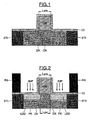
- the reference ZA designates an active zone of a silicon semiconductor substrate, delimited laterally by lateral isolation zones STI, for example of the shallow trench type.
- lateral isolation regions STI are made in a conventional manner and known per se to those skilled in the art.
- an intermediate layer CI is deposited here formed of a BARC type material, in a thickness typically comprised between 1 and 100 nm.
- This CI layer is suitably deposited.
- This inorganic BARC type material has a very low density, typically 1 g / cm 3 .
- IMP implantation is carried out in the orifice delimited by the resin block. This implantation IMP is thus done in particular through the horizontal portion of the layer CI, so as to form the LDD regions.
- the lateral shift, provided by the vertical portion of the IC layer, is here greater than the increase in lateral dispersion related to the increase in the implantation energy necessary for the depth crossing of the IC layer.
- the person skilled in the art will know how to choose it, from in order to obtain a maximum distribution of the dopants at a depth of at least 3 to 4 nm, for example 10 nm.
- a lateral dispersion is obtained post-implantation under the reduced gate of about 10 nm compared to a implantation through an equivalent thickness of silicon dioxide (density 2.3 g / cm 3 ) and decreased by about 7 nm compared to a conventional direct implantation in silicon, that is to say without offset spacers.
- PK regions ("pocket" in English) .
- the implantation of these PK regions can be carried out before or after the implantation of the LDD zones.
- These PK regions contribute to improving the control of short-channel effects and in particular avoid a too large drop in the threshold voltage of the transistor.
- offset spacers unlike the implementation of "offset" spacers according to the prior art, it is possible in the context of the present invention to implement the PK zones with the same level of photo-lithographic masking as that of the LDD zones. preserving their effectiveness. Indeed it is known that the effectiveness of these pockets is related to their precise location in the active area under the grid. This location is even less dispersed as their implantation energy is low. In the case of offset spacers according to the prior art, it is necessary to significantly increase the implantation energy of the PK zones.
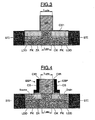
- the next step is to remove by plasma etching containing oxygen the IC layer ( figure 3 ) as well as the resin RS.
- the type of etching for the removal of the IC layer is oxidizing and leads to the formation of a surface oxide OX1.
- a variant of the invention it is possible to proceed with the implantation of the PK zones after removal of the IC layer and before removal of the resin.
- Such a variant makes it possible to implant the PK zones in a self-aligned manner on the grid while shifting the implantation of the LDD zones to control the short channel effects and that with the same photolithographic level.
- the remainder of the method of manufacturing the transistor is conventional and known per se and comprises in particular the removal of the layer OX1, then the formation of insulating spacers, for example silicon nitride, on the sides of the gate.
- the BARC type material can be replaced by any low density material (less than silicon dioxide) and capable of being etched selectively with respect to silicon.
- porous silicon dioxide By way of example, mention may be made of porous silicon dioxide. Such a material also has the advantage of not significantly modifying the conventional manufacturing method of a MOS transistor.
Landscapes
- Insulated Gate Type Field-Effect Transistor (AREA)
Claims (9)
- Verfahren zum Herstellen eines MOS-Transistors, das einen Schritt des Verwirklichens von Source- und Drain-Erweiterungsbereichen enthält und das Bilden eines Gate-Bereichs auf einem Halbleitersubstrat und einer Implantation von Störstellen in dem Substrat beiderseits des Gates des Transistors und in einem Abstand hiervon enthält, wobei der Schritt des Verwirklichens von Source- und Drain-Erweiterungsbereichen das Bilden einer Zwischenschicht (CI) an den Seitenflächen des Gates (GR) und auf der Oberfläche des Substrats enthält, wobei die Implantation von Störstellen (IMP) durch den Teil der Zwischenschicht, der sich auf dem Substrat befindet, erfolgt, dadurch gekennzeichnet, dass diese Zwischenschicht aus einem Material gebildet ist, das weniger dicht ist als Siliciumdioxid.
- Verfahren nach Anspruch 1, dadurch gekennzeichnet, dass das die Zwischenschicht (CI) bildende Material ein Antireflexionsmaterial ist, das als eine nicht reflektierende Unterschicht bei einer Belichtung eines lichtempfindlichen Harzes verwendet wird.
- Verfahren nach Anspruch 1, dadurch gekennzeichnet, dass das die Zwischenschicht (CI) bildende Material poröses Siliciumdioxid ist.
- Verfahren nach einem der vorhergehenden Ansprüche, dadurch gekennzeichnet, dass Bereiche (PK) durch schräge Implantation von Störstellen des Typs, der zu jenem entgegengesetzt ist, der für die Implantationen der Source, des Drains und der Source- und Drain-Erweiterungsbereiche (LDD) verwendet wird, gebildet werden und dass diese schräge Implantation durch die Zwischenschicht erfolgt.
- Verfahren nach einem der vorhergehenden Ansprüche, dadurch gekennzeichnet, dass das die Zwischenschicht (CI) bildende Material in Bezug auf Silicium selektiv geätzt wird und dass die Zwischenschicht nach der Implantation von Störstellen entfernt wird.
- Verfahren nach Anspruch 5, dadurch gekennzeichnet, dass Bereiche (PK) durch schräge Implantation von Störstellen des Typs, der zu jenem entgegengesetzt ist, der für die Implantationen der Source, des Drains und der Source- und Drain-Erweiterungsbereiche (LDD) verwendet wird, gebildet werden und dass diese schräge Implantation nach dem Entfernen der Zwischenschicht ausgeführt wird.
- Verfahren nach Anspruch 3, dadurch gekennzeichnet, dass auf den Seitenflächen des Gates (GR) und auf einem Teil des Substrats ein Abschnitt (CIR) der Zwischenschicht nach der Implantation zurückgelassen wird und dass isolierende seitliche Bereiche, die sich an den Seitenflächen des Gates und an einem Teil des Substrats abstützen, verwirklicht werden, wobei diese isolierenden seitlichen Bereiche (ESP) den restlichen Abschnitt der Zwischenschicht, auf dem ein anderes Material aufgebracht ist, enthalten.
- Verfahren nach einem der vorhergehenden Ansprüche, dadurch gekennzeichnet, dass die Implantationsenergie in der Weise gewählt wird, dass eine maximale Verteilung der Störstellen in einer Tiefe von wenigstens 3 bis 4 Nanometern erhalten wird.
- Verfahren nach einem der vorhergehenden Ansprüche, dadurch gekennzeichnet, dass die Abmessung des Gates, gerechnet parallel zur Länge des Kanals, kleiner ist als 180 Nanometer, beispielsweise kleiner als 100 Nanometer.
Applications Claiming Priority (2)
| Application Number | Priority Date | Filing Date | Title |
|---|---|---|---|
| FR0206870 | 2002-06-04 | ||
| FR0206870A FR2840453B1 (fr) | 2002-06-04 | 2002-06-04 | Procede de fabrication d'un transistor mos de longueur de grille reduite, et circuit integre comportant un tel transistor |
Publications (2)
| Publication Number | Publication Date |
|---|---|
| EP1369909A1 EP1369909A1 (de) | 2003-12-10 |
| EP1369909B1 true EP1369909B1 (de) | 2011-02-02 |
Family
ID=29433315
Family Applications (1)
| Application Number | Title | Priority Date | Filing Date |
|---|---|---|---|
| EP03291262A Expired - Lifetime EP1369909B1 (de) | 2002-06-04 | 2003-05-27 | Herstellungsverfahren für MOS-Transistor mit verringerter Gate-Länge und einen solchen Transistor enthaltener integrierter Schaltkreis |
Country Status (4)
| Country | Link |
|---|---|
| US (1) | US6806156B2 (de) |
| EP (1) | EP1369909B1 (de) |
| DE (1) | DE60335930D1 (de) |
| FR (1) | FR2840453B1 (de) |
Families Citing this family (5)
| Publication number | Priority date | Publication date | Assignee | Title |
|---|---|---|---|---|
| KR100468785B1 (ko) * | 2003-02-19 | 2005-01-29 | 삼성전자주식회사 | 포켓영역을 구비하는 모스 전계효과 트랜지스터의 제조방법 |
| US7420233B2 (en) * | 2003-10-22 | 2008-09-02 | Micron Technology, Inc. | Photodiode for improved transfer gate leakage |
| US7585763B2 (en) * | 2005-11-07 | 2009-09-08 | Samsung Electronics Co., Ltd. | Methods of fabricating integrated circuit devices using anti-reflective coating as implant blocking layer |
| US9530864B2 (en) * | 2014-06-25 | 2016-12-27 | Globalfoundries Inc. | Junction overlap control in a semiconductor device using a sacrificial spacer layer |
| CN113871451B (zh) * | 2021-09-24 | 2024-06-18 | 华虹半导体(无锡)有限公司 | Dmos器件及其形成方法 |
Family Cites Families (13)
| Publication number | Priority date | Publication date | Assignee | Title |
|---|---|---|---|---|
| US5492847A (en) * | 1994-08-01 | 1996-02-20 | National Semiconductor Corporation | Counter-implantation method of manufacturing a semiconductor device with self-aligned anti-punchthrough pockets |
| US5976769A (en) * | 1995-07-14 | 1999-11-02 | Texas Instruments Incorporated | Intermediate layer lithography |
| US5736446A (en) * | 1997-05-21 | 1998-04-07 | Powerchip Semiconductor Corp. | Method of fabricating a MOS device having a gate-side air-gap structure |
| US6180472B1 (en) * | 1998-07-28 | 2001-01-30 | Matsushita Electrons Corporation | Method for fabricating semiconductor device |
| US6274445B1 (en) * | 1999-02-03 | 2001-08-14 | Philips Semi-Conductor, Inc. | Method of manufacturing shallow source/drain junctions in a salicide process |
| US6274426B1 (en) * | 1999-02-25 | 2001-08-14 | Taiwan Semiconductor Manufacturing Company | Self-aligned contact process for a crown shaped dynamic random access memory capacitor structure |
| GB2362029A (en) * | 1999-10-27 | 2001-11-07 | Lucent Technologies Inc | Multi-layer structure for MOSFET Spacers |
| US6277683B1 (en) * | 2000-02-28 | 2001-08-21 | Chartered Semiconductor Manufacturing Ltd. | Method of forming a sidewall spacer and a salicide blocking shape, using only one silicon nitride layer |
| US6642590B1 (en) * | 2000-10-19 | 2003-11-04 | Advanced Micro Devices, Inc. | Metal gate with PVD amorphous silicon layer and barrier layer for CMOS devices and method of making with a replacement gate process |
| US6664143B2 (en) * | 2000-11-22 | 2003-12-16 | North Carolina State University | Methods of fabricating vertical field effect transistors by conformal channel layer deposition on sidewalls |
| US6537860B2 (en) * | 2000-12-18 | 2003-03-25 | Apd Semiconductor, Inc. | Method of fabricating power VLSI diode devices |
| US6448165B1 (en) * | 2000-12-21 | 2002-09-10 | Advanced Micro Devices, Inc. | Method for controlling the amount of trim of a gate structure of a field effect transistor |
| US6727534B1 (en) * | 2001-12-20 | 2004-04-27 | Advanced Micro Devices, Inc. | Electrically programmed MOS transistor source/drain series resistance |
-
2002
- 2002-06-04 FR FR0206870A patent/FR2840453B1/fr not_active Expired - Fee Related
-
2003
- 2003-05-27 DE DE60335930T patent/DE60335930D1/de not_active Expired - Lifetime
- 2003-05-27 EP EP03291262A patent/EP1369909B1/de not_active Expired - Lifetime
- 2003-06-04 US US10/454,361 patent/US6806156B2/en not_active Expired - Lifetime
Also Published As
| Publication number | Publication date |
|---|---|
| US6806156B2 (en) | 2004-10-19 |
| DE60335930D1 (de) | 2011-03-17 |
| FR2840453B1 (fr) | 2005-06-24 |
| EP1369909A1 (de) | 2003-12-10 |
| FR2840453A1 (fr) | 2003-12-05 |
| US20040046192A1 (en) | 2004-03-11 |
Similar Documents
| Publication | Publication Date | Title |
|---|---|---|
| EP0426251A1 (de) | Verfahren zur Herstellung eines MIS-Transistor-Bauelementes mit einer invertierten T-förmigen Gitterelektrode | |
| US6927130B2 (en) | Method of manufacturing a trench gate type field effect transistor | |
| FR3060850A1 (fr) | Procede de fabrication d’un transistor a nanocouches a canal vertical | |
| FR3043837A1 (fr) | Procede de realisation de transistor a nanofil semi-conducteur et comprenant une grille et des espaceurs auto-alignes | |
| EP2610915A1 (de) | Transistor und Herstellungsverfahren eines Transistors | |
| EP2876677A1 (de) | Verfahren zur Bildung von Abstandhaltern eines Gates eines Transistors | |
| FR3036530A1 (fr) | Procede de realisation de cellules memoires du type a programmation unique comportant des condensateurs mos et circuit integre correspondant | |
| US20050009278A1 (en) | Methods of fabricating multiple sets of field effect transistors | |
| FR2847383A1 (fr) | Procede de fabrication d'un transistor mos de longueur de grille reduite, et circuit integre comportant un tel transistor | |
| US6664153B2 (en) | Method to fabricate a single gate with dual work-functions | |
| FR3067516A1 (fr) | Realisation de regions semiconductrices dans une puce electronique | |
| WO2011114046A1 (fr) | Procédé de réalisation d'une électrode conductrice | |
| EP2120258A1 (de) | Herstellungsverfahren eines Transistors mit Metallquelle und -abfluss | |
| EP1369909A1 (de) | Herstellungsverfahren für MOS-Transistor mit verringerter Gate-Länge und einen solchen Transistor enthaltener integrierter Schaltkreis | |
| JP4782411B2 (ja) | 半導体装置及びその製造方法 | |
| CN101194350B (zh) | 用可弃式间隔物提高的源极与漏极工艺 | |
| EP1328969B1 (de) | Herstellungsverfahren eines mos-transistors | |
| EP3490007A1 (de) | Herstellungsmethode von koppelungen von cmos-transistoren vom typ fin-fet bei niedriger temperatur | |
| EP0522938A1 (de) | Verfahren zum Herstellen eines vertikalen Feldeffekt-Transistors und durch dieses Verfahren hergestellter Transistor | |
| CN100508138C (zh) | 制造具有双栅结构的半导体器件的方法 | |
| EP0607075B1 (de) | Elektronisches Halbleiterbauelement mit negativem dynamischem Widerstand und entsprechende Verwendungs- und Herstellungsverfahren | |
| EP3065180B1 (de) | Transistor mit mis-anschlüssen, und herstellungsverfahren | |
| EP1494273A1 (de) | Verfahren zur Oxidation von Silizium | |
| EP2479785A1 (de) | Feldeffekt-Bauelement mit einer Diffusionsbarrierezone für Dotierungsmittel und dessen Herstellungsverfahren | |
| KR100379510B1 (ko) | 반도체 소자 제조방법 |
Legal Events
| Date | Code | Title | Description |
|---|---|---|---|
| PUAI | Public reference made under article 153(3) epc to a published international application that has entered the european phase |
Free format text: ORIGINAL CODE: 0009012 |
|
| AK | Designated contracting states |
Kind code of ref document: A1 Designated state(s): AT BE BG CH CY CZ DE DK EE ES FI FR GB GR HU IE IT LI LU MC NL PT RO SE SI SK TR |
|
| AX | Request for extension of the european patent |
Extension state: AL LT LV MK |
|
| 17P | Request for examination filed |
Effective date: 20040609 |
|
| AKX | Designation fees paid |
Designated state(s): DE FR GB IT |
|
| 17Q | First examination report despatched |
Effective date: 20100219 |
|
| RAP1 | Party data changed (applicant data changed or rights of an application transferred) |
Owner name: STMICROELECTRONICS S.A. Owner name: COMMISSARIAT A L'ENERGIE ATOMIQUE ET AUX ENERGIES |
|
| GRAP | Despatch of communication of intention to grant a patent |
Free format text: ORIGINAL CODE: EPIDOSNIGR1 |
|
| GRAS | Grant fee paid |
Free format text: ORIGINAL CODE: EPIDOSNIGR3 |
|
| GRAA | (expected) grant |
Free format text: ORIGINAL CODE: 0009210 |
|
| AK | Designated contracting states |
Kind code of ref document: B1 Designated state(s): DE FR GB IT |
|
| REG | Reference to a national code |
Ref country code: GB Ref legal event code: FG4D Free format text: NOT ENGLISH |
|
| REF | Corresponds to: |
Ref document number: 60335930 Country of ref document: DE Date of ref document: 20110317 Kind code of ref document: P |
|
| REG | Reference to a national code |
Ref country code: DE Ref legal event code: R096 Ref document number: 60335930 Country of ref document: DE Effective date: 20110317 |
|
| PLBE | No opposition filed within time limit |
Free format text: ORIGINAL CODE: 0009261 |
|
| STAA | Information on the status of an ep patent application or granted ep patent |
Free format text: STATUS: NO OPPOSITION FILED WITHIN TIME LIMIT |
|
| 26N | No opposition filed |
Effective date: 20111103 |
|
| REG | Reference to a national code |
Ref country code: DE Ref legal event code: R097 Ref document number: 60335930 Country of ref document: DE Effective date: 20111103 |
|
| PGFP | Annual fee paid to national office [announced via postgrant information from national office to epo] |
Ref country code: DE Payment date: 20120423 Year of fee payment: 10 |
|
| PGFP | Annual fee paid to national office [announced via postgrant information from national office to epo] |
Ref country code: FR Payment date: 20120625 Year of fee payment: 10 Ref country code: GB Payment date: 20120423 Year of fee payment: 10 |
|
| PGFP | Annual fee paid to national office [announced via postgrant information from national office to epo] |
Ref country code: IT Payment date: 20120421 Year of fee payment: 10 |
|
| GBPC | Gb: european patent ceased through non-payment of renewal fee |
Effective date: 20130527 |
|
| PG25 | Lapsed in a contracting state [announced via postgrant information from national office to epo] |
Ref country code: DE Free format text: LAPSE BECAUSE OF NON-PAYMENT OF DUE FEES Effective date: 20131203 |
|
| PG25 | Lapsed in a contracting state [announced via postgrant information from national office to epo] |
Ref country code: IT Free format text: LAPSE BECAUSE OF NON-PAYMENT OF DUE FEES Effective date: 20130527 |
|
| REG | Reference to a national code |
Ref country code: DE Ref legal event code: R119 Ref document number: 60335930 Country of ref document: DE Effective date: 20131203 |
|
| REG | Reference to a national code |
Ref country code: FR Ref legal event code: ST Effective date: 20140131 |
|
| PG25 | Lapsed in a contracting state [announced via postgrant information from national office to epo] |
Ref country code: GB Free format text: LAPSE BECAUSE OF NON-PAYMENT OF DUE FEES Effective date: 20130527 |
|
| PG25 | Lapsed in a contracting state [announced via postgrant information from national office to epo] |
Ref country code: FR Free format text: LAPSE BECAUSE OF NON-PAYMENT OF DUE FEES Effective date: 20130531 |