EP1369901B1 - Ionenfallemassenspektrometer - Google Patents
Ionenfallemassenspektrometer Download PDFInfo
- Publication number
- EP1369901B1 EP1369901B1 EP03011348A EP03011348A EP1369901B1 EP 1369901 B1 EP1369901 B1 EP 1369901B1 EP 03011348 A EP03011348 A EP 03011348A EP 03011348 A EP03011348 A EP 03011348A EP 1369901 B1 EP1369901 B1 EP 1369901B1
- Authority
- EP
- European Patent Office
- Prior art keywords
- ions
- mass
- ion
- ion trap
- frequency
- Prior art date
- Legal status (The legal status is an assumption and is not a legal conclusion. Google has not performed a legal analysis and makes no representation as to the accuracy of the status listed.)
- Expired - Lifetime
Links
- 238000005040 ion trap Methods 0.000 title claims description 57
- 150000002500 ions Chemical class 0.000 claims description 114
- 150000001793 charged compounds Chemical class 0.000 claims description 28
- 238000004458 analytical method Methods 0.000 claims description 19
- 238000000034 method Methods 0.000 description 25
- 238000001819 mass spectrum Methods 0.000 description 20
- 238000007792 addition Methods 0.000 description 12
- 238000007796 conventional method Methods 0.000 description 7
- 230000005684 electric field Effects 0.000 description 3
- FKNQFGJONOIPTF-UHFFFAOYSA-N Sodium cation Chemical compound [Na+] FKNQFGJONOIPTF-UHFFFAOYSA-N 0.000 description 2
- 238000000065 atmospheric pressure chemical ionisation Methods 0.000 description 2
- 238000001514 detection method Methods 0.000 description 2
- 238000010586 diagram Methods 0.000 description 2
- 238000000132 electrospray ionisation Methods 0.000 description 2
- 239000012634 fragment Substances 0.000 description 2
- 239000012535 impurity Substances 0.000 description 2
- 238000005259 measurement Methods 0.000 description 2
- 239000002243 precursor Substances 0.000 description 2
- 229910001415 sodium ion Inorganic materials 0.000 description 2
- QGZKDVFQNNGYKY-UHFFFAOYSA-N Ammonia Chemical compound N QGZKDVFQNNGYKY-UHFFFAOYSA-N 0.000 description 1
- NPYPAHLBTDXSSS-UHFFFAOYSA-N Potassium ion Chemical compound [K+] NPYPAHLBTDXSSS-UHFFFAOYSA-N 0.000 description 1
- -1 ammonium ions Chemical class 0.000 description 1
- 230000003247 decreasing effect Effects 0.000 description 1
- 238000010494 dissociation reaction Methods 0.000 description 1
- 230000005593 dissociations Effects 0.000 description 1
- 230000000694 effects Effects 0.000 description 1
- 239000007788 liquid Substances 0.000 description 1
- 238000004895 liquid chromatography mass spectrometry Methods 0.000 description 1
- 238000004949 mass spectrometry Methods 0.000 description 1
- 229910001414 potassium ion Inorganic materials 0.000 description 1
- 238000004451 qualitative analysis Methods 0.000 description 1
- 238000004445 quantitative analysis Methods 0.000 description 1
- 230000035945 sensitivity Effects 0.000 description 1
- 239000002904 solvent Substances 0.000 description 1
- 239000000126 substance Substances 0.000 description 1
- 238000004885 tandem mass spectrometry Methods 0.000 description 1
- XLYOFNOQVPJJNP-UHFFFAOYSA-N water Substances O XLYOFNOQVPJJNP-UHFFFAOYSA-N 0.000 description 1
Images


Classifications
-
- H—ELECTRICITY
- H01—ELECTRIC ELEMENTS
- H01J—ELECTRIC DISCHARGE TUBES OR DISCHARGE LAMPS
- H01J49/00—Particle spectrometers or separator tubes
- H01J49/26—Mass spectrometers or separator tubes
- H01J49/34—Dynamic spectrometers
- H01J49/42—Stability-of-path spectrometers, e.g. monopole, quadrupole, multipole, farvitrons
- H01J49/4205—Device types
- H01J49/424—Three-dimensional ion traps, i.e. comprising end-cap and ring electrodes
-
- H—ELECTRICITY
- H01—ELECTRIC ELEMENTS
- H01J—ELECTRIC DISCHARGE TUBES OR DISCHARGE LAMPS
- H01J49/00—Particle spectrometers or separator tubes
- H01J49/26—Mass spectrometers or separator tubes
- H01J49/34—Dynamic spectrometers
- H01J49/42—Stability-of-path spectrometers, e.g. monopole, quadrupole, multipole, farvitrons
- H01J49/426—Methods for controlling ions
- H01J49/427—Ejection and selection methods
- H01J49/428—Applying a notched broadband signal
Definitions
- the present invention relates to an ion trap mass spectrometer, and especially to a method to select plural object ions from various ions stored in the ion trap.
- An ion trap mass spectrometer is composed of a ring electrode and a pair of end cap electrodes opposing each other with the ring electrode therebetween.
- the inner surface of the ring electrode is formed hyperboloid-of-one-sheet-of-revolution and the inner surface of the end cap electrodes are formed hyperboloid-of-two-sheets-of-revolution.
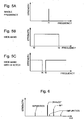
- FIGs. 5A-5C schematically illustrate some examples of frequency distribution of the RF voltage applied to the end cap electrodes for realizing various analyzing modes.
- a sinusoidal signal having a certain frequency f 1 which corresponds to the mass to charge ratio (m/z) of a certain ion is applied to the end cap electrodes, only the ions resonantly vibrate in the electric field and are ejected from the ion trap space, and other ions do not.
- a wide-band signal including a range of frequencies from f 2 to f 3 is applied to the end cap electrodes, ions having mass to charge ratio of a certain range corresponding to the frequency range vibrate simultaneously and are ejected from the ion trap space.
- notch a wide-band signal devoid of a certain narrow range of frequencies from f 4 to f 5 (“notch") is applied to the end cap electrodes, ions having the mass to charge ratios corresponding to the "notch" frequencies do not vibrate and remain in the ion trap space, while the other ions are ejected from it.
- the width of the notch f 4 - f 5 is set appropriately according to the resolution of the ion trap mass spectrometer, so that the desired object ions can be selected and stored in the ion trap space.
- APCI atmospheric pressure chemical ionization
- ESI electrospray ionization
- ions are generated such as a molecule plus H + (proton), Na+ (sodium ion), K+ (potassium ion), NH 4 + (ammonium ions) or a solvent ion, or a dehydrated ion which is a molecule ion minus a water molecule.
- Those ions are hereinafter referred to as "pseudo-molecular ions”.
- An example of a mass spectrum is shown in Fig. 6 , in which dehydrated ion [M-H 2 O] + and a molecular ion M + are simultaneously generated. As seen in the mass spectrum of Fig. 6 , peaks of impurities appear besides peaks of the object molecules.
- a wide-band signal having a notch of a certain width is prepared for each ion derived from the component molecule that needs to be measured.
- the notch corresponds to the mass to charge ratio of the ion. Measurements are made one by one for each ion using the wide-band signal, and the results of the measurements are added to obtain the result of analysis.
- Such a method is self-evidently complicated and inefficient.
- an MS/MS analysis ⁇ in which selected ions (precursor ions) are dissociated in the ion trap space, and the mass spectrum of the dissociated fragment ions is obtained ⁇ is performed using the method, the amount of precursor ions becomes less and the amount of fragment ions also becomes less, so that an adequate mass spectrum can not be obtained. This deteriorates the detection sensitivity, S/N ratio and precision of the mass to charge ratio of the analysis.
- the width of the notch is increased, or the difference of f 4 and f 5 in Fig. 5C is enlarged, and the range of mass to charge ratio is increased to cover all of the various ions to be measured.
- the ion selections are performed simultaneously.
- molecular ions M + and proton-added ions MH + can be selected simultaneously by enlarging the width of the notch by only 1 amu (if they are monovalent ions).
- the notch width should be broadened by 18 amu than normal, as shown in Fig. 8B .
- the notch width is thus broadened, it is probable that undesirable ions fall in the notch and remain in the ion trap space as shown in Fig. 8C . This produces chemical noises in the analysis.
- ions belonging to such a group have a wide variety of mass to charge ratios, and it is actually impossible anyway to select those ions simultaneously with the above method.
- a primary object of the present invention is to provide an ion trap mass spectrometer that can select molecular ions and pseudo-molecular ions simultaneously, and that can certainly avoid remaining of unwanted ions.
- Another object of the present invention is to provide an ion trap mass spectrometer that can select multivalent ions having a variety of mass to charge ratios appropriately, and that can certainly avoid remaining of unwanted ions.
- An ion trap mass spectrometer according to the preamble of claim 1 is known from US-A-5 196 699 , EP-A-0 575 778 and US-A-5 466 931 .
- an ion trap mass spectrometer is as defined in claim 1.
- the wide-band RF signal generator generates a wide-band signal having a plurality of notches which correspond to the frequencies or frequency channels given by the frequency determining means, and an RF voltage corresponding to the wide-band signal is applied to the end cap electrodes.
- the wide-band signal having such notches can be produced by adding a number of single-frequency sinusoidal signals differing in the frequency from one another by a predetermined step and falling within a wide range of frequencies excluding the frequencies of the notches.
- the ion trap mass spectrometer further comprises an input section for inputting primary information which is a mass to charge ratio of an object molecular ion or information that can derive the mass to charge ratio, and for inputting secondary information which can derive a mass to charge ratio of a pseudo-molecular ion; and the frequency determining means determines, based on the primary information and the secondary information, a first frequency or frequency channel of the molecular ion, and a second frequency or frequency channel of the pseudo-molecular ion which is apart from the first frequency or frequency channel by a predetermined value of frequency.
- a pseudo-molecular ion is, as explained before, an ion in which a particular component (proton, for example) is added to a molecular ion, or an ion in which a particular ion is subtracted from a molecular ion.
- a particular component proton, for example
- an ion in which a particular ion is subtracted from a molecular ion is known.
- the mass to charge ratio of the pseudo-molecular ions can be calculated using the primary information which is the mass to charge ratio of the molecular ion or other information that can derive it.
- the ion trap mass spectrometer comprises an input section for inputting primary information which is a mass to charge ratio of an object molecular ion or information that can derive the mass to charge ratio, and for inputting secondary information which indicates a multivalent ion analysis; and the frequency determining means determines, based on the primary information and the secondary information, a plurality of frequencies or frequency channels corresponding to multivalent ions whose mass to charge ratios fall within a predetermined range of mass to charge ratios to be analyzed.
- the mass to charge ratios of multivalent ions can be known if it is informed that a multivalent ion analysis is to be conducted.
- the information is inputted as the secondary information in addition to the primary information which is the mass to charge ratio of an object molecular ion or other information that can derive it. Then it is easy to determine the frequencies or frequency channels corresponding to the multivalent ions. If the molecular mass of the object molecule is very large, ions of smaller valence numbers (monovalent ions, for example) may fall out of the mass to charge ratio range that can be analyzed by the ion trap mass spectrometer.
- multivalent ions whose mass to charge ratios fall within the analyzable range should be selected and only such frequencies or frequency channels corresponding to those ions may be determined.
- multivalent ions derived from an object molecule can be selected simultaneously.
- a plurality of ions having distinct and separate mass to charge ratios can be selectedly left in the ion trap space while other unnecessary ions are ejected from it.
- the ions ejected out of the ion trap are included such ions whose mass to charge ratios fall between the frequencies (or frequency channels) of two kinds of ions that are left in the ion trap space.
- the amount of selected ions is large compared to the conventional method, so that a high-sensitivity, high-precision analysis is possible. Unwanted ions falling between two object ions can be surely avoided, so that noises coming into a mass spectrum are decreased. This leads to a high-precision quantitative as well as qualitative analysis of a sample component.
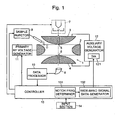
- Fig. 1 is a schematic diagram of the ion trap portion and its electrical system of the ion trap mass spectrometer.
- the ion trap 1 is substantially composed of a ring electrode 2 and a pair of end cap electrodes 3 and 4 placed opposed to each other with the ring electrode 2 therebetween.
- the ring electrode 2 has a hyperboloid-of-one-sheet-of-revolution inner surface, and the end cap electrodes 3 and 4 form hyperboloid-of-two-sheets-of-revolution inner surfaces.
- a primary RF voltage generator 11 is connected to the ring electrode 2, and an auxiliary voltage generator 12 is connected to the first and second end cap electrodes 3 and 4.
- the first end cap electrode 3 has an entrance hole 5 at its center, and a thermal electron generator 7 is placed just outside the entrance hole 5.
- Electrons ejected from the thermal electron generator 7 are introduced through the entrance hole 5 into the ion trap 1, and collide with sample molecules introduced there from the sample injector 9, so that the sample molecules are ionized.
- the second end cap electrode 4 has an exit hole 6 at its center, where the exit hole 6 is aligned with the entrance hole 5.
- a detector 8 which detects ions coming out of the ion trap 1 through the exit hole 6. The detection signal is sent from the detector 8 to the data processor 10.
- the primary RF voltage generator 11 and the auxiliary voltage generator 12 are controlled by signals from the controller 13.
- the controller 13 include a CPU, ROM, RAM and other components, and, according to conditions set by the user on the input section 14, sends control signals to respective sections of the mass spectrometer including the primary RF voltage generator 11 and the auxiliary voltage generator 12.
- the controller 13 includes functional sections of a notch frequency determiner 131 and a wide-band signal data generator 132.
- the notch frequency determiner 131 calculates out mass to charge ratios of ions to be analyzed based on the conditions given by the user, and determines the notch frequencies corresponding to the mass to charge ratios.
- the wide-band signal data generator 132 generates digital data corresponding to the wide-band signal having the notches determined by the notch frequency determiner 131.
- the data is sent to the auxiliary voltage generator 12, where the data is converted to an analog signal by the D/A converter 121, and the analog voltage is applied to the end cap electrodes 3 and 4.
- the controller 13 including the wide-band signal data generator 132 is actually realized by a personal computer, and the functional sections described above are realized by programs running on the personal computer.
- a wide-band signal including notches is produced, where the notches correspond to the frequencies determined by the notch frequency determiner 131.
- a large number of sinusoidal signals of different frequencies excluding the notch frequencies are added. In that process, it is necessary to adequately suppress the amplitude of the resultant addition signal.
- the signals are referred to as "component signals"
- the amplitudes of the component signals are adequately canceled while the frequencies of the component signals are incorporated into the resultant addition signal.
- a conventional method for such a calculation was as follows. Each time a candidate component signal is added, the initial phase of the candidate component signal is shifted slightly, and the addition is repeated. When the amplitude of the resultant addition signal is minimized, the initial phase at that time is adopted as the component signal to be used for actual adding.
- the mass spectrometer of the present embodiment uses the method to generate a wide-band signal, so that the number of calculations is easily performable by a normal personal computer while enabling the generation of a satisfactory wide-band signal.
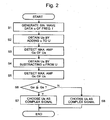
- Fig. 2 shows the flowchart of the process.
- the addition signal is initially zero, is a single sinusoidal signal when a sinusoidal signal is added, and then becomes complex after sinusoidal signals of different frequencies are added.
- Step S1 the data u of a sinusoidal signal having a single frequency f , a predetermined amplitude and the initial phase of zero are generated (Step S1)
- Step S2 Data of an object signal U and the data u of the sinusoidal signal are added to obtain data of an addition signal Ua (Step S2).
- Step S3 The maximum value and minimum value among the data Ua are detected, and the difference between them, which is the maximum amplitude Ga of the addition signal, is calculated (Step S3).
- Step S4 the data of the sinusoidal signal u are subtracted from the data of the object signal U to obtain the data Us of a difference signal (Step S4).
- the maximum value and the minimum value among the data Us are detected, and the difference between them, which is the maximum amplitude Gs of the difference signal, is calculated (Step S5).
- the amplitudes Ga and Gs are then compared (Step S6).
- Ga is smaller, Ua is chosen as the complex signal, and when Gs is smaller, Us is chosen as the complex signal (Steps S7, S8). That is, the complex signal is the signal having the smaller amplitude.
- Subtracting a signal of a waveform is the same as adding a signal of an opposite waveform.
- the waveform is sinusoidal, it is equal to add a sinusoidal waveform having a 180°-shifted phase.
- a sinusoidal signal is to be added, that of zero initial phase or that of 180° initial phase whichever the resultant amplitude is smaller is chosen.
- an addition of 180°-initial-phase sinusoidal signal can be replaced by a subtraction of 0°-initial-phase sinusoidal signal.
- the method is confirmed to have the amplitude suppressing effect comparable to that by the conventional method in which an optimal initial phase is determined while the initial phase is shifted step by step.
- Additions as described above are repeated with the frequency shifted by ⁇ f within the range from f L to f h (which corresponds to the range of mass to charge ratio to be analyzed), and the desired wide-band signal is obtained at high speed, where, in the additions, the sinusoidal signal of the frequency at the notch is excluded.
- the wide-band signal excluding the notch frequency is obtained at high speed.
- An example of a mass analysis using the above described ion trap mass spectrometer is described. It is supposed here to analyze molecular ions M + and dehydrated ions (M-H 2 O) + derived from the molecule of an object sample component. Before the analysis begins, analyzing conditions are set on the input section 14, in which the molecular mass of the object molecule or the mass to charge ratio of the molecular ion is input, and a simultaneous analysis of dehydrated ions is directed. Specifically, an optional item "Analysis of Dehydrated Ions" is prepared in the analysis menu shown on a screen of a display, and the user can simply choose the item.
- the frequency f 1 corresponding to the molecular ions is calculated from the molecular mass of the object molecule or the mass to charge ratio of the molecular ion, and the frequency f 2 corresponding to the dehydrated ions is also calculated. Then a frequency channel [ f 1 ] centering the frequency f 1 and another frequency channel [ f 2 ] centering the frequency f 2 both having a predetermined width are determined and sent to the. wide-band signal data generator 132.
- the wide-band signal data generator 132 adds a large number of single-frequency sinusoidal signals within a predetermined frequency range but excluding the frequency channels [ f 1 ] and [ f 2 ], as described before, whereby the wide-band signal as shown in Fig. 3B is generated.
- the wide-band signal is applied from the auxiliary voltage generator 12 to the end cap electrodes 3 and 4.
- ions corresponding to the notch frequencies do not vibrate resonantly, but other ions do and are ejected from the ion trap 1 through the holes 5 and 6.
- molecular ions and dehydrated ions of the object molecule remain in the ion trap 1.
- a list of other pseudo-molecular ions can be shown on the screen of the display, and, when one or several of pseudo-molecular ions are selected by the user, the corresponding frequency channel or channels are determined. It is further possible to show a box on the screen to allow the user to input a difference in the mass to charge ratio from the molecular ion. When a difference value is input, corresponding frequency f 2 is calculated, and the frequency channel [ f 2 ] is determined using the value, in which later part of the process is the same as the above-explained example.
- Another example analysis using the above described ion trap mass spectrometer is described. It is supposed to analyze multivalent ions derived from the molecule of an object sample component. Before the analysis begins, the user sets analyzing conditions on the input section 14, in which the molecular mass of the object molecule or the mass to charge ratio of the monovalent molecular ion is input, and a simultaneous analysis of multivalent ions is directed. Specifically, an optional item "Analysis of Multivalent Ions" is prepared in the analysis menu shown on a screen of a display, and the user can simply choose the item.
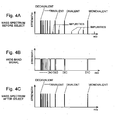
- the frequencies f 1 , f 2 , f 3 , ... corresponding to the multivalent ions are calculated from the molecular mass of the object molecule or the mass to charge ratio of the monovalent molecular ion, where the valence number may be restricted appropriately. Then frequency channels [ f 1 ]; [ f 2 ], [ f 3 ], ... centering the frequencies f 1 , f 2 , f 3 , ... having a predetermined width are determined and sent to the wide-band signal data generator 132.
- the wide-band signal data generator 132 adds a large number of single-frequency sinusoidal signals within a predetermined frequency range but excluding the frequency channels [ f 1 ], [ f 2 ], [ f 3 ], ..., as described before, whereby the wide-band signal as shown in Fig. 4B is generated.
- the wide-band signal is applied from the auxiliary voltage generator 12 to the end cap electrodes 3 and 4.
- ions corresponding to the notch frequencies do not vibrate resonantly, but other ions do and are ejected from the ion trap 1 through the holes 5 and 6. Thus only multivalent ions of the object molecule remain in the ion trap 1.
- ions of small valence numbers may fall out of the measurable mass to charge ratio range, but ions of large valence numbers may fall within the measurable range and can be analyzed.
- the method of generating data in the wide-band signal data generator 132 is not limited to the above described one.
- the signal generating method proposed in the Unexamined Publication No. 2003-045372 of Japanese patent application, which corresponds to the United States Patent Application Publication No. US2003/0071211A1 by the applicant of the present invention can bring about the same result by setting the generating conditions appropriately.
Landscapes
- Chemical & Material Sciences (AREA)
- Analytical Chemistry (AREA)
- Other Investigation Or Analysis Of Materials By Electrical Means (AREA)
- Electron Tubes For Measurement (AREA)
Claims (2)
- Ionenfallenmassenspektrometer (1), welches aufweist:eine Ringelektrode (2) und ein Paar von Endkappenelektroden (3, 4), die einander gegenüberliegend mit dazwischen liegender Ringelektrode (2) angeordnet sind, wobei ein Ionenfallenraum durch die Ringelektrode (2) und das Paar von Endkappenelektroden (3, 4) definiert wird;Frequenzbestimmungsmittel (131) zur Bestimmung einer Anzahl von Frequenzen oder einen Anzahl von Frequenzkanälen (f1, f2, f3, ...), jeweils entsprechend einem Masse-Ladungsverhältnis eines auszuwählenden Ions;einen Breitband-Hochfrequenzsignalgenerator (132) zur Erzeugung eines breitbandigen Hochfrequenzsignals mit einer Anzahl von Einschnitten, die der Anzahl von Frequenzen oder der Anzahl von Frequenzkanälen (f1, f2, f3, ...) entsprechen; undeinen Spannungsregler (13) zum Anlegen einer der Breitbandhochfrequenzspannung entsprechenden Spannung an das Paar von Endkappenelektroden (3, 4), wobei Ionen mit Masse-Ladungsverhältnissen, die den Frequenzen oder Frequenzkanälen (f1, f2, f3, ...) entsprechen, in dem Ionenfallenraum verbleiben, aber andere Ionen aus dem Ionenfallenraum ausgestoßen werden,wobei das Ionenfallenmassenspektrometer (1) ferner einen Eingabeabschnitt (14) zur Eingabe von Primärinformation, welche ein Masse-Ladungsverhältnis eines Objekt-Molekülions oder Information, aus der sich das Masse-Ladungsverhältnis herleiten lässt, aufweist, dadurch gekennzeichnet, dassder Eingabeabschnitt ferner für eine Eingabe von Sekundärinformation, welche eine Analyse von mehrwertigen Ionen angibt, eingerichtet ist; unddie Frequenzbestimmungsmittel (131) für eine Bestimmung, beruhend auf der Primärinformation und der Sekundärinformation, einer Anzahl von Frequenzen oder Frequenzkanälen (f1, f2, f3, ...), die mehrwertigen Ionen entsprechen, deren Masse-Ladungsverhältnis in einen bestimmten Bereich von zu analysierenden Masse-Ladungsverhältnissen fällt, gerichtet ist.
- Ionenfallenmassenspektrometer (1) nach Anspruch 1, wobei der Eingabeabschnitt (14) für eine Wiedergabe eines Postens von mehrwertigen Ionen auf einen Bildschirm einer Anzeige eingerichtet ist, die es einem Benutzer des Massenspektrometers ermöglicht, eine Analyse der mehrwertigen Ionen auszuwählen, und wobei die Frequenzbestimmungsmittel (131) für eine Bestimmung der Anzahl von Frequenzen oder Frequenzkanälen (f1, f2, f3, ...), die den mehrwertigen Ionen des Objekt-Molekülions entsprechen, eingerichtet sind.
Applications Claiming Priority (2)
| Application Number | Priority Date | Filing Date | Title |
|---|---|---|---|
| JP2002143999A JP3791455B2 (ja) | 2002-05-20 | 2002-05-20 | イオントラップ型質量分析装置 |
| JP2002143999 | 2002-05-20 |
Publications (3)
| Publication Number | Publication Date |
|---|---|
| EP1369901A2 EP1369901A2 (de) | 2003-12-10 |
| EP1369901A3 EP1369901A3 (de) | 2005-05-04 |
| EP1369901B1 true EP1369901B1 (de) | 2011-12-07 |
Family
ID=29417062
Family Applications (1)
| Application Number | Title | Priority Date | Filing Date |
|---|---|---|---|
| EP03011348A Expired - Lifetime EP1369901B1 (de) | 2002-05-20 | 2003-05-19 | Ionenfallemassenspektrometer |
Country Status (3)
| Country | Link |
|---|---|
| US (1) | US6847037B2 (de) |
| EP (1) | EP1369901B1 (de) |
| JP (1) | JP3791455B2 (de) |
Families Citing this family (19)
| Publication number | Priority date | Publication date | Assignee | Title |
|---|---|---|---|---|
| JP3676298B2 (ja) * | 2001-12-28 | 2005-07-27 | 三菱重工業株式会社 | 化学物質の検出装置および化学物質の検出方法 |
| JP2005108578A (ja) * | 2003-09-30 | 2005-04-21 | Hitachi Ltd | 質量分析装置 |
| JP4506260B2 (ja) * | 2004-04-23 | 2010-07-21 | 株式会社島津製作所 | イオン蓄積装置におけるイオン選別の方法 |
| GB0425426D0 (en) * | 2004-11-18 | 2004-12-22 | Micromass Ltd | Mass spectrometer |
| CA2607648A1 (en) * | 2005-05-09 | 2006-11-16 | Purdue Research Foundation | Parallel ion parking in ion traps |
| GB0511386D0 (en) | 2005-06-03 | 2005-07-13 | Shimadzu Res Lab Europe Ltd | Method for introducing ions into an ion trap and an ion storage apparatus |
| JP4697302B2 (ja) * | 2006-03-07 | 2011-06-08 | 株式会社島津製作所 | クロマトグラフ質量分析装置 |
| US8334506B2 (en) * | 2007-12-10 | 2012-12-18 | 1St Detect Corporation | End cap voltage control of ion traps |
| US7973277B2 (en) * | 2008-05-27 | 2011-07-05 | 1St Detect Corporation | Driving a mass spectrometer ion trap or mass filter |
| US8401681B2 (en) * | 2008-06-08 | 2013-03-19 | Apple Inc. | System and method for placeshifting media playback |
| JP5454462B2 (ja) * | 2010-12-22 | 2014-03-26 | 株式会社島津製作所 | クロマトグラフ質量分析装置 |
| JP2014526046A (ja) * | 2011-08-05 | 2014-10-02 | アカデミア シニカ | 高速プロテオミクスのためのステップ走査式イオントラップ質量分析 |
| EP2807669A2 (de) * | 2012-01-24 | 2014-12-03 | Thermo Finnigan LLC | Multinotch-isolation für eine ms3-massenanalyse |
| US9214325B2 (en) | 2013-03-15 | 2015-12-15 | 1St Detect Corporation | Ion trap with radial opening in ring electrode |
| JP6229529B2 (ja) * | 2014-02-19 | 2017-11-15 | 株式会社島津製作所 | イオントラップ質量分析装置及びイオントラップ質量分析方法 |
| US9847218B2 (en) * | 2015-11-05 | 2017-12-19 | Thermo Finnigan Llc | High-resolution ion trap mass spectrometer |
| US10192730B2 (en) * | 2016-08-30 | 2019-01-29 | Thermo Finnigan Llc | Methods for operating electrostatic trap mass analyzers |
| EP3373324A1 (de) * | 2017-03-10 | 2018-09-12 | Thermo Finnigan LLC | Verfahren und systeme quantitativen massenanalyse |
| CN119310171B (zh) * | 2024-12-17 | 2025-07-15 | 清谱科技(苏州)有限公司 | 非连续进样的质谱仪的多通道检测方法 |
Family Cites Families (7)
| Publication number | Priority date | Publication date | Assignee | Title |
|---|---|---|---|---|
| US4761545A (en) * | 1986-05-23 | 1988-08-02 | The Ohio State University Research Foundation | Tailored excitation for trapped ion mass spectrometry |
| US5196699A (en) * | 1991-02-28 | 1993-03-23 | Teledyne Mec | Chemical ionization mass spectrometry method using notch filter |
| US5134286A (en) * | 1991-02-28 | 1992-07-28 | Teledyne Cme | Mass spectrometry method using notch filter |
| US5449905A (en) * | 1992-05-14 | 1995-09-12 | Teledyne Et | Method for generating filtered noise signal and broadband signal having reduced dynamic range for use in mass spectrometry |
| US5248882A (en) * | 1992-05-28 | 1993-09-28 | Extrel Ftms, Inc. | Method and apparatus for providing tailored excitation as in Fourier transform mass spectrometry |
| JP3470671B2 (ja) * | 2000-01-31 | 2003-11-25 | 株式会社島津製作所 | イオントラップ型質量分析装置における広帯域信号生成方法 |
| JP3620479B2 (ja) | 2001-07-31 | 2005-02-16 | 株式会社島津製作所 | イオン蓄積装置におけるイオン選別の方法 |
-
2002
- 2002-05-20 JP JP2002143999A patent/JP3791455B2/ja not_active Expired - Lifetime
-
2003
- 2003-05-19 US US10/440,113 patent/US6847037B2/en not_active Expired - Lifetime
- 2003-05-19 EP EP03011348A patent/EP1369901B1/de not_active Expired - Lifetime
Also Published As
| Publication number | Publication date |
|---|---|
| JP2003338261A (ja) | 2003-11-28 |
| US20030213908A1 (en) | 2003-11-20 |
| JP3791455B2 (ja) | 2006-06-28 |
| EP1369901A2 (de) | 2003-12-10 |
| US6847037B2 (en) | 2005-01-25 |
| EP1369901A3 (de) | 2005-05-04 |
Similar Documents
| Publication | Publication Date | Title |
|---|---|---|
| EP1369901B1 (de) | Ionenfallemassenspektrometer | |
| JP5408107B2 (ja) | Ms/ms型質量分析装置及び同装置用プログラム | |
| US9698002B2 (en) | Method and apparatus for mass analysis utilizing ion charge feedback | |
| US7558682B2 (en) | Chromatograph mass spectrometer | |
| US10410847B2 (en) | Targeted mass analysis | |
| JP6090479B2 (ja) | 質量分析装置 | |
| US11515139B2 (en) | Method for determining a parameter to perform a mass analysis of sample ions with an ion trapping mass analyser | |
| JP5799618B2 (ja) | Ms/ms型質量分析装置及び同装置用プログラム | |
| JP6202103B2 (ja) | 質量分析装置及び質量分析方法 | |
| US20100065731A1 (en) | Quadrupole mass spectrometer | |
| WO2019229449A1 (en) | A method of performing a routine on a mass spectrometer | |
| GB2322961A (en) | Method for space-charge control of daughter ions in ion traps | |
| GB2616505A (en) | Mass spectrometer | |
| GB2323965A (en) | A method of comparative analysis using an ion trap mass spectrometer | |
| JP2019124610A (ja) | クロマトグラフ質量分析装置 | |
| JP4848657B2 (ja) | Ms/ms型質量分析装置 | |
| CN117795643A (zh) | Tof-ms中的空间电荷减少 | |
| CN117321730A (zh) | 用于使用ms灵敏度改进技术的按需/动态实施定量的增益校准 | |
| WO2018011861A1 (ja) | 分析装置 | |
| US20230245875A1 (en) | Method for mass spectrometry and mass spectrometer | |
| US20230010966A1 (en) | Fourier Transform Quadrupole Calibration Method |
Legal Events
| Date | Code | Title | Description |
|---|---|---|---|
| PUAI | Public reference made under article 153(3) epc to a published international application that has entered the european phase |
Free format text: ORIGINAL CODE: 0009012 |
|
| AK | Designated contracting states |
Kind code of ref document: A2 Designated state(s): AT BE BG CH CY CZ DE DK EE ES FI FR GB GR HU IE IT LI LU MC NL PT RO SE SI SK TR |
|
| AX | Request for extension of the european patent |
Extension state: AL LT LV MK |
|
| PUAL | Search report despatched |
Free format text: ORIGINAL CODE: 0009013 |
|
| AK | Designated contracting states |
Kind code of ref document: A3 Designated state(s): AT BE BG CH CY CZ DE DK EE ES FI FR GB GR HU IE IT LI LU MC NL PT RO SE SI SK TR |
|
| AX | Request for extension of the european patent |
Extension state: AL LT LV MK |
|
| 17P | Request for examination filed |
Effective date: 20050921 |
|
| AKX | Designation fees paid |
Designated state(s): DE GB |
|
| 17Q | First examination report despatched |
Effective date: 20070827 |
|
| GRAP | Despatch of communication of intention to grant a patent |
Free format text: ORIGINAL CODE: EPIDOSNIGR1 |
|
| GRAS | Grant fee paid |
Free format text: ORIGINAL CODE: EPIDOSNIGR3 |
|
| GRAA | (expected) grant |
Free format text: ORIGINAL CODE: 0009210 |
|
| AK | Designated contracting states |
Kind code of ref document: B1 Designated state(s): DE GB |
|
| REG | Reference to a national code |
Ref country code: GB Ref legal event code: FG4D |
|
| REG | Reference to a national code |
Ref country code: DE Ref legal event code: R096 Ref document number: 60339315 Country of ref document: DE Effective date: 20120308 |
|
| PLBE | No opposition filed within time limit |
Free format text: ORIGINAL CODE: 0009261 |
|
| STAA | Information on the status of an ep patent application or granted ep patent |
Free format text: STATUS: NO OPPOSITION FILED WITHIN TIME LIMIT |
|
| 26N | No opposition filed |
Effective date: 20120910 |
|
| REG | Reference to a national code |
Ref country code: DE Ref legal event code: R097 Ref document number: 60339315 Country of ref document: DE Effective date: 20120910 |
|
| REG | Reference to a national code |
Ref country code: DE Ref legal event code: R082 Ref document number: 60339315 Country of ref document: DE Representative=s name: KILIAN KILIAN & PARTNER MBB PATENTANWAELTE, DE Ref country code: DE Ref legal event code: R082 Ref document number: 60339315 Country of ref document: DE Representative=s name: KILIAN KILIAN & PARTNER, DE |
|
| PGFP | Annual fee paid to national office [announced via postgrant information from national office to epo] |
Ref country code: DE Payment date: 20190508 Year of fee payment: 17 |
|
| PGFP | Annual fee paid to national office [announced via postgrant information from national office to epo] |
Ref country code: GB Payment date: 20190515 Year of fee payment: 17 |
|
| REG | Reference to a national code |
Ref country code: DE Ref legal event code: R119 Ref document number: 60339315 Country of ref document: DE |
|
| GBPC | Gb: european patent ceased through non-payment of renewal fee |
Effective date: 20200519 |
|
| PG25 | Lapsed in a contracting state [announced via postgrant information from national office to epo] |
Ref country code: GB Free format text: LAPSE BECAUSE OF NON-PAYMENT OF DUE FEES Effective date: 20200519 |
|
| PG25 | Lapsed in a contracting state [announced via postgrant information from national office to epo] |
Ref country code: DE Free format text: LAPSE BECAUSE OF NON-PAYMENT OF DUE FEES Effective date: 20201201 |