EP1368301B1 - Seitenkettenhalogenierte aminodicarbonsaurederivate als arzneimittel zur behandlung von herz-kreislauf-erkrankungen - Google Patents
Seitenkettenhalogenierte aminodicarbonsaurederivate als arzneimittel zur behandlung von herz-kreislauf-erkrankungen Download PDFInfo
- Publication number
- EP1368301B1 EP1368301B1 EP02716805A EP02716805A EP1368301B1 EP 1368301 B1 EP1368301 B1 EP 1368301B1 EP 02716805 A EP02716805 A EP 02716805A EP 02716805 A EP02716805 A EP 02716805A EP 1368301 B1 EP1368301 B1 EP 1368301B1
- Authority
- EP
- European Patent Office
- Prior art keywords
- compounds
- formula
- general formula
- phenyl
- butyl
- Prior art date
- Legal status (The legal status is an assumption and is not a legal conclusion. Google has not performed a legal analysis and makes no representation as to the accuracy of the status listed.)
- Expired - Lifetime
Links
- 239000003814 drug Substances 0.000 title claims description 11
- 208000024172 Cardiovascular disease Diseases 0.000 title claims description 6
- KXDHJXZQYSOELW-UHFFFAOYSA-N Carbamic acid Chemical class NC(O)=O KXDHJXZQYSOELW-UHFFFAOYSA-N 0.000 title description 2
- 150000001875 compounds Chemical class 0.000 claims description 70
- -1 methoxy, ethoxy, n-propoxy, i-propoxy, n-butyloxy, i-butyloxy, t-butyloxy Chemical group 0.000 claims description 32
- 208000037265 diseases, disorders, signs and symptoms Diseases 0.000 claims description 17
- 229910052736 halogen Inorganic materials 0.000 claims description 16
- 150000002367 halogens Chemical group 0.000 claims description 16
- 150000003839 salts Chemical class 0.000 claims description 13
- 239000003960 organic solvent Substances 0.000 claims description 12
- 229910052801 chlorine Inorganic materials 0.000 claims description 11
- 229910052731 fluorine Inorganic materials 0.000 claims description 11
- 125000002496 methyl group Chemical group [H]C([H])([H])* 0.000 claims description 10
- 201000010099 disease Diseases 0.000 claims description 9
- 125000001997 phenyl group Chemical group [H]C1=C([H])C([H])=C(*)C([H])=C1[H] 0.000 claims description 9
- 125000000113 cyclohexyl group Chemical group [H]C1([H])C([H])([H])C([H])([H])C([H])(*)C([H])([H])C1([H])[H] 0.000 claims description 7
- 208000035475 disorder Diseases 0.000 claims description 7
- 210000004185 liver Anatomy 0.000 claims description 7
- 125000001424 substituent group Chemical group 0.000 claims description 7
- 125000006552 (C3-C8) cycloalkyl group Chemical group 0.000 claims description 6
- CIUQDSCDWFSTQR-UHFFFAOYSA-N [C]1=CC=CC=C1 Chemical compound [C]1=CC=CC=C1 CIUQDSCDWFSTQR-UHFFFAOYSA-N 0.000 claims description 6
- 239000003638 chemical reducing agent Substances 0.000 claims description 6
- 125000001495 ethyl group Chemical group [H]C([H])([H])C([H])([H])* 0.000 claims description 6
- 238000010438 heat treatment Methods 0.000 claims description 6
- 150000004677 hydrates Chemical class 0.000 claims description 6
- 125000000999 tert-butyl group Chemical group [H]C([H])([H])C(*)(C([H])([H])[H])C([H])([H])[H] 0.000 claims description 6
- 125000002887 hydroxy group Chemical group [H]O* 0.000 claims description 5
- 125000000959 isobutyl group Chemical group [H]C([H])([H])C([H])(C([H])([H])[H])C([H])([H])* 0.000 claims description 5
- 125000001449 isopropyl group Chemical group [H]C([H])([H])C([H])(*)C([H])([H])[H] 0.000 claims description 5
- 125000002023 trifluoromethyl group Chemical group FC(F)(F)* 0.000 claims description 5
- 229910052794 bromium Inorganic materials 0.000 claims description 4
- 125000004169 (C1-C6) alkyl group Chemical group 0.000 claims description 3
- 206010002383 Angina Pectoris Diseases 0.000 claims description 3
- 206010016654 Fibrosis Diseases 0.000 claims description 3
- 206010019280 Heart failures Diseases 0.000 claims description 3
- 206010020772 Hypertension Diseases 0.000 claims description 3
- 230000003176 fibrotic effect Effects 0.000 claims description 3
- 125000004108 n-butyl group Chemical group [H]C([H])([H])C([H])([H])C([H])([H])C([H])([H])* 0.000 claims description 3
- 125000004123 n-propyl group Chemical group [H]C([H])([H])C([H])([H])C([H])([H])* 0.000 claims description 3
- 125000004191 (C1-C6) alkoxy group Chemical group 0.000 claims description 2
- 208000011775 arteriosclerosis disease Diseases 0.000 claims description 2
- 238000005661 deetherification reaction Methods 0.000 claims description 2
- 230000004761 fibrosis Effects 0.000 claims description 2
- 208000028867 ischemia Diseases 0.000 claims description 2
- 230000009424 thromboembolic effect Effects 0.000 claims description 2
- 238000004519 manufacturing process Methods 0.000 claims 1
- 208000037997 venous disease Diseases 0.000 claims 1
- XEKOWRVHYACXOJ-UHFFFAOYSA-N Ethyl acetate Chemical compound CCOC(C)=O XEKOWRVHYACXOJ-UHFFFAOYSA-N 0.000 description 48
- MWUXSHHQAYIFBG-UHFFFAOYSA-N Nitric oxide Chemical compound O=[N] MWUXSHHQAYIFBG-UHFFFAOYSA-N 0.000 description 46
- 238000006243 chemical reaction Methods 0.000 description 33
- 102000007637 Soluble Guanylyl Cyclase Human genes 0.000 description 30
- 108010007205 Soluble Guanylyl Cyclase Proteins 0.000 description 30
- OKKJLVBELUTLKV-UHFFFAOYSA-N Methanol Chemical compound OC OKKJLVBELUTLKV-UHFFFAOYSA-N 0.000 description 27
- 239000000243 solution Substances 0.000 description 25
- IAZDPXIOMUYVGZ-UHFFFAOYSA-N Dimethylsulphoxide Chemical compound CS(C)=O IAZDPXIOMUYVGZ-UHFFFAOYSA-N 0.000 description 24
- 150000003278 haem Chemical group 0.000 description 23
- YMWUJEATGCHHMB-UHFFFAOYSA-N Dichloromethane Chemical compound ClCCl YMWUJEATGCHHMB-UHFFFAOYSA-N 0.000 description 21
- 238000011282 treatment Methods 0.000 description 17
- LFQSCWFLJHTTHZ-UHFFFAOYSA-N Ethanol Chemical compound CCO LFQSCWFLJHTTHZ-UHFFFAOYSA-N 0.000 description 15
- HEMHJVSKTPXQMS-UHFFFAOYSA-M Sodium hydroxide Chemical compound [OH-].[Na+] HEMHJVSKTPXQMS-UHFFFAOYSA-M 0.000 description 15
- 230000000694 effects Effects 0.000 description 13
- 239000000203 mixture Substances 0.000 description 13
- WEVYAHXRMPXWCK-UHFFFAOYSA-N Acetonitrile Chemical compound CC#N WEVYAHXRMPXWCK-UHFFFAOYSA-N 0.000 description 12
- XDTMQSROBMDMFD-UHFFFAOYSA-N Cyclohexane Chemical compound C1CCCCC1 XDTMQSROBMDMFD-UHFFFAOYSA-N 0.000 description 12
- 230000000638 stimulation Effects 0.000 description 12
- 239000000126 substance Substances 0.000 description 12
- XLYOFNOQVPJJNP-UHFFFAOYSA-N water Substances O XLYOFNOQVPJJNP-UHFFFAOYSA-N 0.000 description 12
- 238000005160 1H NMR spectroscopy Methods 0.000 description 11
- 102000004190 Enzymes Human genes 0.000 description 11
- 108090000790 Enzymes Proteins 0.000 description 11
- 239000002253 acid Substances 0.000 description 11
- 239000000460 chlorine Substances 0.000 description 11
- ZOOGRGPOEVQQDX-KHLHZJAASA-N cyclic guanosine monophosphate Chemical compound C([C@H]1O2)O[P@](O)(=O)O[C@@H]1[C@H](O)[C@H]2N1C(N=C(NC2=O)N)=C2N=C1 ZOOGRGPOEVQQDX-KHLHZJAASA-N 0.000 description 11
- 238000000034 method Methods 0.000 description 11
- RTZKZFJDLAIYFH-UHFFFAOYSA-N Diethyl ether Chemical compound CCOCC RTZKZFJDLAIYFH-UHFFFAOYSA-N 0.000 description 10
- KWYUFKZDYYNOTN-UHFFFAOYSA-M Potassium hydroxide Chemical compound [OH-].[K+] KWYUFKZDYYNOTN-UHFFFAOYSA-M 0.000 description 9
- 239000002585 base Substances 0.000 description 9
- 239000011734 sodium Substances 0.000 description 9
- 239000002904 solvent Substances 0.000 description 9
- 230000015572 biosynthetic process Effects 0.000 description 8
- CDBYLPFSWZWCQE-UHFFFAOYSA-L Sodium Carbonate Chemical compound [Na+].[Na+].[O-]C([O-])=O CDBYLPFSWZWCQE-UHFFFAOYSA-L 0.000 description 7
- 208000019425 cirrhosis of liver Diseases 0.000 description 7
- 239000000047 product Substances 0.000 description 7
- 230000002829 reductive effect Effects 0.000 description 7
- 210000002966 serum Anatomy 0.000 description 7
- RYHBNJHYFVUHQT-UHFFFAOYSA-N 1,4-Dioxane Chemical compound C1COCCO1 RYHBNJHYFVUHQT-UHFFFAOYSA-N 0.000 description 6
- JAVZWSOFJKYSDY-UHFFFAOYSA-N 4-bromo-2-chlorobenzoic acid Chemical compound OC(=O)C1=CC=C(Br)C=C1Cl JAVZWSOFJKYSDY-UHFFFAOYSA-N 0.000 description 6
- GOUHYARYYWKXHS-UHFFFAOYSA-N 4-formylbenzoic acid Chemical compound OC(=O)C1=CC=C(C=O)C=C1 GOUHYARYYWKXHS-UHFFFAOYSA-N 0.000 description 6
- HEDRZPFGACZZDS-UHFFFAOYSA-N Chloroform Chemical compound ClC(Cl)Cl HEDRZPFGACZZDS-UHFFFAOYSA-N 0.000 description 6
- WYURNTSHIVDZCO-UHFFFAOYSA-N Tetrahydrofuran Chemical compound C1CCOC1 WYURNTSHIVDZCO-UHFFFAOYSA-N 0.000 description 6
- YXFVVABEGXRONW-UHFFFAOYSA-N Toluene Chemical compound CC1=CC=CC=C1 YXFVVABEGXRONW-UHFFFAOYSA-N 0.000 description 6
- ZMANZCXQSJIPKH-UHFFFAOYSA-N Triethylamine Chemical compound CCN(CC)CC ZMANZCXQSJIPKH-UHFFFAOYSA-N 0.000 description 6
- 125000003545 alkoxy group Chemical group 0.000 description 6
- ILAHWRKJUDSMFH-UHFFFAOYSA-N boron tribromide Chemical compound BrB(Br)Br ILAHWRKJUDSMFH-UHFFFAOYSA-N 0.000 description 6
- 230000001419 dependent effect Effects 0.000 description 6
- HPNMFZURTQLUMO-UHFFFAOYSA-N diethylamine Chemical compound CCNCC HPNMFZURTQLUMO-UHFFFAOYSA-N 0.000 description 6
- KDLHZDBZIXYQEI-UHFFFAOYSA-N palladium Substances [Pd] KDLHZDBZIXYQEI-UHFFFAOYSA-N 0.000 description 6
- BWHMMNNQKKPAPP-UHFFFAOYSA-L potassium carbonate Chemical compound [K+].[K+].[O-]C([O-])=O BWHMMNNQKKPAPP-UHFFFAOYSA-L 0.000 description 6
- 239000007787 solid Substances 0.000 description 6
- 238000003786 synthesis reaction Methods 0.000 description 6
- XTHFKEDIFFGKHM-UHFFFAOYSA-N Dimethoxyethane Chemical compound COCCOC XTHFKEDIFFGKHM-UHFFFAOYSA-N 0.000 description 5
- VEXZGXHMUGYJMC-UHFFFAOYSA-N Hydrochloric acid Chemical compound Cl VEXZGXHMUGYJMC-UHFFFAOYSA-N 0.000 description 5
- DGAQECJNVWCQMB-PUAWFVPOSA-M Ilexoside XXIX Chemical compound C[C@@H]1CC[C@@]2(CC[C@@]3(C(=CC[C@H]4[C@]3(CC[C@@H]5[C@@]4(CC[C@@H](C5(C)C)OS(=O)(=O)[O-])C)C)[C@@H]2[C@]1(C)O)C)C(=O)O[C@H]6[C@@H]([C@H]([C@@H]([C@H](O6)CO)O)O)O.[Na+] DGAQECJNVWCQMB-PUAWFVPOSA-M 0.000 description 5
- XEEYBQQBJWHFJM-UHFFFAOYSA-N Iron Chemical group [Fe] XEEYBQQBJWHFJM-UHFFFAOYSA-N 0.000 description 5
- VYPSYNLAJGMNEJ-UHFFFAOYSA-N Silicium dioxide Chemical compound O=[Si]=O VYPSYNLAJGMNEJ-UHFFFAOYSA-N 0.000 description 5
- FAPWRFPIFSIZLT-UHFFFAOYSA-M Sodium chloride Chemical compound [Na+].[Cl-] FAPWRFPIFSIZLT-UHFFFAOYSA-M 0.000 description 5
- OQQVFCKUDYMWGV-UHFFFAOYSA-N [5-[1-(phenylmethyl)-3-indazolyl]-2-furanyl]methanol Chemical compound O1C(CO)=CC=C1C(C1=CC=CC=C11)=NN1CC1=CC=CC=C1 OQQVFCKUDYMWGV-UHFFFAOYSA-N 0.000 description 5
- 150000007513 acids Chemical class 0.000 description 5
- 230000008602 contraction Effects 0.000 description 5
- 238000003818 flash chromatography Methods 0.000 description 5
- 238000002360 preparation method Methods 0.000 description 5
- 239000000741 silica gel Substances 0.000 description 5
- 229910002027 silica gel Inorganic materials 0.000 description 5
- 229910052708 sodium Inorganic materials 0.000 description 5
- KSFOVUSSGSKXFI-GAQDCDSVSA-N CC1=C/2NC(\C=C3/N=C(/C=C4\N\C(=C/C5=N/C(=C\2)/C(C=C)=C5C)C(C=C)=C4C)C(C)=C3CCC(O)=O)=C1CCC(O)=O Chemical compound CC1=C/2NC(\C=C3/N=C(/C=C4\N\C(=C/C5=N/C(=C\2)/C(C=C)=C5C)C(C=C)=C4C)C(C)=C3CCC(O)=O)=C1CCC(O)=O KSFOVUSSGSKXFI-GAQDCDSVSA-N 0.000 description 4
- 102000008186 Collagen Human genes 0.000 description 4
- 108010035532 Collagen Proteins 0.000 description 4
- 108010078321 Guanylate Cyclase Proteins 0.000 description 4
- 102000014469 Guanylate cyclase Human genes 0.000 description 4
- 241001465754 Metazoa Species 0.000 description 4
- 239000004480 active ingredient Substances 0.000 description 4
- 125000004432 carbon atom Chemical group C* 0.000 description 4
- IJOOHPMOJXWVHK-UHFFFAOYSA-N chlorotrimethylsilane Chemical compound C[Si](C)(C)Cl IJOOHPMOJXWVHK-UHFFFAOYSA-N 0.000 description 4
- 229920001436 collagen Polymers 0.000 description 4
- 125000000596 cyclohexenyl group Chemical group C1(=CCCCC1)* 0.000 description 4
- 125000002433 cyclopentenyl group Chemical group C1(=CCCC1)* 0.000 description 4
- 125000001511 cyclopentyl group Chemical group [H]C1([H])C([H])([H])C([H])([H])C([H])(*)C1([H])[H] 0.000 description 4
- 238000002330 electrospray ionisation mass spectrometry Methods 0.000 description 4
- 238000000338 in vitro Methods 0.000 description 4
- 229910052742 iron Inorganic materials 0.000 description 4
- 230000008569 process Effects 0.000 description 4
- 229950003776 protoporphyrin Drugs 0.000 description 4
- 238000010992 reflux Methods 0.000 description 4
- 229910000104 sodium hydride Inorganic materials 0.000 description 4
- 230000004936 stimulating effect Effects 0.000 description 4
- FYSNRJHAOHDILO-UHFFFAOYSA-N thionyl chloride Chemical compound ClS(Cl)=O FYSNRJHAOHDILO-UHFFFAOYSA-N 0.000 description 4
- UHOVQNZJYSORNB-UHFFFAOYSA-N Benzene Chemical compound C1=CC=CC=C1 UHOVQNZJYSORNB-UHFFFAOYSA-N 0.000 description 3
- ZLMJMSJWJFRBEC-UHFFFAOYSA-N Potassium Chemical compound [K] ZLMJMSJWJFRBEC-UHFFFAOYSA-N 0.000 description 3
- 241000700159 Rattus Species 0.000 description 3
- 208000006011 Stroke Diseases 0.000 description 3
- KKPRMUSGTKHOTE-UHFFFAOYSA-N [2-fluoro-4-(4-methoxyphenyl)phenyl]methanol Chemical compound C1=CC(OC)=CC=C1C1=CC=C(CO)C(F)=C1 KKPRMUSGTKHOTE-UHFFFAOYSA-N 0.000 description 3
- 230000009471 action Effects 0.000 description 3
- 125000005907 alkyl ester group Chemical group 0.000 description 3
- 230000033228 biological regulation Effects 0.000 description 3
- 210000004027 cell Anatomy 0.000 description 3
- 210000003169 central nervous system Anatomy 0.000 description 3
- 239000012230 colorless oil Substances 0.000 description 3
- 235000014113 dietary fatty acids Nutrition 0.000 description 3
- 239000000194 fatty acid Substances 0.000 description 3
- 229930195729 fatty acid Natural products 0.000 description 3
- 238000001914 filtration Methods 0.000 description 3
- 229930195733 hydrocarbon Natural products 0.000 description 3
- 239000003112 inhibitor Substances 0.000 description 3
- 230000007246 mechanism Effects 0.000 description 3
- 125000000956 methoxy group Chemical group [H]C([H])([H])O* 0.000 description 3
- 239000000825 pharmaceutical preparation Substances 0.000 description 3
- 229910052700 potassium Inorganic materials 0.000 description 3
- 239000011591 potassium Substances 0.000 description 3
- 229910000027 potassium carbonate Inorganic materials 0.000 description 3
- 229910000029 sodium carbonate Inorganic materials 0.000 description 3
- 229940127296 soluble guanylate cyclase stimulator Drugs 0.000 description 3
- 238000012360 testing method Methods 0.000 description 3
- VOAAEKKFGLPLLU-UHFFFAOYSA-N (4-methoxyphenyl)boronic acid Chemical compound COC1=CC=C(B(O)O)C=C1 VOAAEKKFGLPLLU-UHFFFAOYSA-N 0.000 description 2
- IMGZOVHCVMEXBW-UHFFFAOYSA-N 1-(chloromethyl)-2-fluoro-4-(4-methoxyphenyl)benzene Chemical group C1=CC(OC)=CC=C1C1=CC=C(CCl)C(F)=C1 IMGZOVHCVMEXBW-UHFFFAOYSA-N 0.000 description 2
- 125000003229 2-methylhexyl group Chemical group [H]C([H])([H])C([H])([H])C([H])([H])C([H])([H])C([H])(C([H])([H])[H])C([H])([H])* 0.000 description 2
- BGNGWHSBYQYVRX-UHFFFAOYSA-N 4-(dimethylamino)benzaldehyde Chemical compound CN(C)C1=CC=C(C=O)C=C1 BGNGWHSBYQYVRX-UHFFFAOYSA-N 0.000 description 2
- HBAQYPYDRFILMT-UHFFFAOYSA-N 8-[3-(1-cyclopropylpyrazol-4-yl)-1H-pyrazolo[4,3-d]pyrimidin-5-yl]-3-methyl-3,8-diazabicyclo[3.2.1]octan-2-one Chemical class C1(CC1)N1N=CC(=C1)C1=NNC2=C1N=C(N=C2)N1C2C(N(CC1CC2)C)=O HBAQYPYDRFILMT-UHFFFAOYSA-N 0.000 description 2
- QTBSBXVTEAMEQO-UHFFFAOYSA-N Acetic acid Chemical compound CC(O)=O QTBSBXVTEAMEQO-UHFFFAOYSA-N 0.000 description 2
- QGZKDVFQNNGYKY-UHFFFAOYSA-N Ammonia Chemical compound N QGZKDVFQNNGYKY-UHFFFAOYSA-N 0.000 description 2
- XKRFYHLGVUSROY-UHFFFAOYSA-N Argon Chemical compound [Ar] XKRFYHLGVUSROY-UHFFFAOYSA-N 0.000 description 2
- 239000004215 Carbon black (E152) Substances 0.000 description 2
- UGFAIRIUMAVXCW-UHFFFAOYSA-N Carbon monoxide Chemical compound [O+]#[C-] UGFAIRIUMAVXCW-UHFFFAOYSA-N 0.000 description 2
- NOTFZGFABLVTIG-UHFFFAOYSA-N Cyclohexylethyl acetate Chemical compound CC(=O)OCCC1CCCCC1 NOTFZGFABLVTIG-UHFFFAOYSA-N 0.000 description 2
- QUSNBJAOOMFDIB-UHFFFAOYSA-N Ethylamine Chemical compound CCN QUSNBJAOOMFDIB-UHFFFAOYSA-N 0.000 description 2
- PXGOKWXKJXAPGV-UHFFFAOYSA-N Fluorine Chemical compound FF PXGOKWXKJXAPGV-UHFFFAOYSA-N 0.000 description 2
- XKMLYUALXHKNFT-UUOKFMHZSA-N Guanosine-5'-triphosphate Chemical compound C1=2NC(N)=NC(=O)C=2N=CN1[C@@H]1O[C@H](COP(O)(=O)OP(O)(=O)OP(O)(O)=O)[C@@H](O)[C@H]1O XKMLYUALXHKNFT-UUOKFMHZSA-N 0.000 description 2
- 229910010082 LiAlH Inorganic materials 0.000 description 2
- WMFOQBRAJBCJND-UHFFFAOYSA-M Lithium hydroxide Chemical compound [Li+].[OH-] WMFOQBRAJBCJND-UHFFFAOYSA-M 0.000 description 2
- LRHPLDYGYMQRHN-UHFFFAOYSA-N N-Butanol Chemical compound CCCCO LRHPLDYGYMQRHN-UHFFFAOYSA-N 0.000 description 2
- MZRVEZGGRBJDDB-UHFFFAOYSA-N N-Butyllithium Chemical compound [Li]CCCC MZRVEZGGRBJDDB-UHFFFAOYSA-N 0.000 description 2
- ISWSIDIOOBJBQZ-UHFFFAOYSA-N Phenol Chemical compound OC1=CC=CC=C1 ISWSIDIOOBJBQZ-UHFFFAOYSA-N 0.000 description 2
- UIIMBOGNXHQVGW-UHFFFAOYSA-M Sodium bicarbonate Chemical compound [Na+].OC([O-])=O UIIMBOGNXHQVGW-UHFFFAOYSA-M 0.000 description 2
- ALMFIOZYDASRRC-UHFFFAOYSA-N [4-(trifluoromethyl)phenyl]boronic acid Chemical compound OB(O)C1=CC=C(C(F)(F)F)C=C1 ALMFIOZYDASRRC-UHFFFAOYSA-N 0.000 description 2
- 230000004913 activation Effects 0.000 description 2
- 239000000654 additive Substances 0.000 description 2
- 125000003158 alcohol group Chemical group 0.000 description 2
- 125000000217 alkyl group Chemical group 0.000 description 2
- 150000003863 ammonium salts Chemical class 0.000 description 2
- 238000002399 angioplasty Methods 0.000 description 2
- 230000003510 anti-fibrotic effect Effects 0.000 description 2
- 239000003146 anticoagulant agent Substances 0.000 description 2
- 238000013459 approach Methods 0.000 description 2
- YZXBAPSDXZZRGB-DOFZRALJSA-N arachidonic acid Chemical compound CCCCC\C=C/C\C=C/C\C=C/C\C=C/CCCC(O)=O YZXBAPSDXZZRGB-DOFZRALJSA-N 0.000 description 2
- 125000001204 arachidyl group Chemical group [H]C([*])([H])C([H])([H])C([H])([H])C([H])([H])C([H])([H])C([H])([H])C([H])([H])C([H])([H])C([H])([H])C([H])([H])C([H])([H])C([H])([H])C([H])([H])C([H])([H])C([H])([H])C([H])([H])C([H])([H])C([H])([H])C([H])([H])C([H])([H])[H] 0.000 description 2
- 125000004429 atom Chemical group 0.000 description 2
- 230000037396 body weight Effects 0.000 description 2
- DKPFZGUDAPQIHT-UHFFFAOYSA-N butyl acetate Chemical compound CCCCOC(C)=O DKPFZGUDAPQIHT-UHFFFAOYSA-N 0.000 description 2
- 125000000484 butyl group Chemical group [H]C([*])([H])C([H])([H])C([H])([H])C([H])([H])[H] 0.000 description 2
- 229910002091 carbon monoxide Inorganic materials 0.000 description 2
- 125000003178 carboxy group Chemical group [H]OC(*)=O 0.000 description 2
- 230000003197 catalytic effect Effects 0.000 description 2
- 230000008859 change Effects 0.000 description 2
- 239000003795 chemical substances by application Substances 0.000 description 2
- NEHMKBQYUWJMIP-UHFFFAOYSA-N chloromethane Chemical compound ClC NEHMKBQYUWJMIP-UHFFFAOYSA-N 0.000 description 2
- 230000001276 controlling effect Effects 0.000 description 2
- 238000001816 cooling Methods 0.000 description 2
- 239000012043 crude product Substances 0.000 description 2
- 125000000392 cycloalkenyl group Chemical group 0.000 description 2
- 125000000753 cycloalkyl group Chemical group 0.000 description 2
- 125000001162 cycloheptenyl group Chemical group C1(=CCCCCC1)* 0.000 description 2
- 125000000582 cycloheptyl group Chemical group [H]C1([H])C([H])([H])C([H])([H])C([H])([H])C([H])(*)C([H])([H])C1([H])[H] 0.000 description 2
- XZWQKJXJNKYMAP-UHFFFAOYSA-N cyclohexen-1-ylboronic acid Chemical compound OB(O)C1=CCCCC1 XZWQKJXJNKYMAP-UHFFFAOYSA-N 0.000 description 2
- 125000000522 cyclooctenyl group Chemical group C1(=CCCCCCC1)* 0.000 description 2
- 125000000640 cyclooctyl group Chemical group [H]C1([H])C([H])([H])C([H])([H])C([H])([H])C([H])(*)C([H])([H])C([H])([H])C1([H])[H] 0.000 description 2
- 125000000298 cyclopropenyl group Chemical group [H]C1=C([H])C1([H])* 0.000 description 2
- 125000001559 cyclopropyl group Chemical group [H]C1([H])C([H])([H])C1([H])* 0.000 description 2
- 125000002704 decyl group Chemical group [H]C([H])([H])C([H])([H])C([H])([H])C([H])([H])C([H])([H])C([H])([H])C([H])([H])C([H])([H])C([H])([H])C([H])([H])* 0.000 description 2
- 238000001514 detection method Methods 0.000 description 2
- 239000012973 diazabicyclooctane Substances 0.000 description 2
- 238000001035 drying Methods 0.000 description 2
- 150000002170 ethers Chemical class 0.000 description 2
- 150000004665 fatty acids Chemical class 0.000 description 2
- 239000003119 guanylate cyclase activator Substances 0.000 description 2
- 125000003187 heptyl group Chemical group [H]C([*])([H])C([H])([H])C([H])([H])C([H])([H])C([H])([H])C([H])([H])C([H])([H])[H] 0.000 description 2
- 125000004051 hexyl group Chemical group [H]C([H])([H])C([H])([H])C([H])([H])C([H])([H])C([H])([H])C([H])([H])* 0.000 description 2
- 125000004491 isohexyl group Chemical group C(CCC(C)C)* 0.000 description 2
- JBQATDIMBVLPRB-UHFFFAOYSA-N isoliquiritigenin Natural products OC1=CC(O)=CC=C1C1OC2=CC(O)=CC=C2C(=O)C1 JBQATDIMBVLPRB-UHFFFAOYSA-N 0.000 description 2
- DXDRHHKMWQZJHT-FPYGCLRLSA-N isoliquiritigenin Chemical compound C1=CC(O)=CC=C1\C=C\C(=O)C1=CC=C(O)C=C1O DXDRHHKMWQZJHT-FPYGCLRLSA-N 0.000 description 2
- 235000008718 isoliquiritigenin Nutrition 0.000 description 2
- 125000001972 isopentyl group Chemical group [H]C([H])([H])C([H])(C([H])([H])[H])C([H])([H])C([H])([H])* 0.000 description 2
- KWGKDLIKAYFUFQ-UHFFFAOYSA-M lithium chloride Chemical compound [Li+].[Cl-] KWGKDLIKAYFUFQ-UHFFFAOYSA-M 0.000 description 2
- ZCSHNCUQKCANBX-UHFFFAOYSA-N lithium diisopropylamide Chemical compound [Li+].CC(C)[N-]C(C)C ZCSHNCUQKCANBX-UHFFFAOYSA-N 0.000 description 2
- 210000005228 liver tissue Anatomy 0.000 description 2
- 238000005259 measurement Methods 0.000 description 2
- 229910052751 metal Inorganic materials 0.000 description 2
- 239000002184 metal Substances 0.000 description 2
- SVZPBIYGRXOTHT-UHFFFAOYSA-N methyl 2-fluoro-4-(4-methoxyphenyl)benzoate Chemical compound C1=C(F)C(C(=O)OC)=CC=C1C1=CC=C(OC)C=C1 SVZPBIYGRXOTHT-UHFFFAOYSA-N 0.000 description 2
- JLQBCWWVEWJQOZ-UHFFFAOYSA-N methyl 4-[[(5-ethoxy-5-oxopentyl)-[2-[2-[[2-fluoro-4-(4-methoxyphenyl)phenyl]methoxy]phenyl]ethyl]amino]methyl]benzoate Chemical compound C=1C=C(C(=O)OC)C=CC=1CN(CCCCC(=O)OCC)CCC1=CC=CC=C1OCC(C(=C1)F)=CC=C1C1=CC=C(OC)C=C1 JLQBCWWVEWJQOZ-UHFFFAOYSA-N 0.000 description 2
- REXQBEYYHXLNSO-UHFFFAOYSA-N methyl 4-[[2-(2-hydroxyphenyl)ethyl-(5-methoxy-5-oxopentyl)amino]methyl]benzoate Chemical compound C=1C=C(C(=O)OC)C=CC=1CN(CCCCC(=O)OC)CCC1=CC=CC=C1O REXQBEYYHXLNSO-UHFFFAOYSA-N 0.000 description 2
- MYXXMAKCPFQVSK-UHFFFAOYSA-N methyl 4-[[2-(2-hydroxyphenyl)ethylamino]methyl]benzoate;hydrobromide Chemical compound Br.C1=CC(C(=O)OC)=CC=C1CNCCC1=CC=CC=C1O MYXXMAKCPFQVSK-UHFFFAOYSA-N 0.000 description 2
- INKIYXTWZHJNAH-UHFFFAOYSA-N methyl 4-[[2-(2-methoxyphenyl)ethylamino]methyl]benzoate Chemical compound C1=CC(C(=O)OC)=CC=C1CNCCC1=CC=CC=C1OC INKIYXTWZHJNAH-UHFFFAOYSA-N 0.000 description 2
- 238000013425 morphometry Methods 0.000 description 2
- 208000010125 myocardial infarction Diseases 0.000 description 2
- 125000001400 nonyl group Chemical group [H]C([*])([H])C([H])([H])C([H])([H])C([H])([H])C([H])([H])C([H])([H])C([H])([H])C([H])([H])C([H])([H])[H] 0.000 description 2
- 125000002347 octyl group Chemical group [H]C([*])([H])C([H])([H])C([H])([H])C([H])([H])C([H])([H])C([H])([H])C([H])([H])C([H])([H])[H] 0.000 description 2
- 239000012074 organic phase Substances 0.000 description 2
- 150000002941 palladium compounds Chemical class 0.000 description 2
- 125000001147 pentyl group Chemical group C(CCCC)* 0.000 description 2
- 230000002093 peripheral effect Effects 0.000 description 2
- 239000000546 pharmaceutical excipient Substances 0.000 description 2
- HXITXNWTGFUOAU-UHFFFAOYSA-N phenylboronic acid Chemical class OB(O)C1=CC=CC=C1 HXITXNWTGFUOAU-UHFFFAOYSA-N 0.000 description 2
- 239000002244 precipitate Substances 0.000 description 2
- 125000001436 propyl group Chemical group [H]C([*])([H])C([H])([H])C([H])([H])[H] 0.000 description 2
- 239000011541 reaction mixture Substances 0.000 description 2
- 230000009467 reduction Effects 0.000 description 2
- 238000006722 reduction reaction Methods 0.000 description 2
- 239000007858 starting material Substances 0.000 description 2
- 238000003756 stirring Methods 0.000 description 2
- 230000002195 synergetic effect Effects 0.000 description 2
- VZGDMQKNWNREIO-UHFFFAOYSA-N tetrachloromethane Chemical compound ClC(Cl)(Cl)Cl VZGDMQKNWNREIO-UHFFFAOYSA-N 0.000 description 2
- 230000001225 therapeutic effect Effects 0.000 description 2
- 210000001519 tissue Anatomy 0.000 description 2
- IMNIMPAHZVJRPE-UHFFFAOYSA-N triethylenediamine Chemical compound C1CN2CCN1CC2 IMNIMPAHZVJRPE-UHFFFAOYSA-N 0.000 description 2
- CSRZQMIRAZTJOY-UHFFFAOYSA-N trimethylsilyl iodide Chemical compound C[Si](C)(C)I CSRZQMIRAZTJOY-UHFFFAOYSA-N 0.000 description 2
- RIOQSEWOXXDEQQ-UHFFFAOYSA-N triphenylphosphine Chemical compound C1=CC=CC=C1P(C=1C=CC=CC=1)C1=CC=CC=C1 RIOQSEWOXXDEQQ-UHFFFAOYSA-N 0.000 description 2
- 230000002792 vascular Effects 0.000 description 2
- 230000003442 weekly effect Effects 0.000 description 2
- XPNGNIFUDRPBFJ-UHFFFAOYSA-N (2-methylphenyl)methanol Chemical compound CC1=CC=CC=C1CO XPNGNIFUDRPBFJ-UHFFFAOYSA-N 0.000 description 1
- CAYQIZIAYYNFCS-UHFFFAOYSA-N (4-chlorophenyl)boronic acid Chemical compound OB(O)C1=CC=C(Cl)C=C1 CAYQIZIAYYNFCS-UHFFFAOYSA-N 0.000 description 1
- MNJYZNVROSZZQC-UHFFFAOYSA-N (4-tert-butylphenyl)boronic acid Chemical compound CC(C)(C)C1=CC=C(B(O)O)C=C1 MNJYZNVROSZZQC-UHFFFAOYSA-N 0.000 description 1
- CXBDYQVECUFKRK-UHFFFAOYSA-N 1-methoxybutane Chemical compound CCCCOC CXBDYQVECUFKRK-UHFFFAOYSA-N 0.000 description 1
- WSWPCNMLEVZGSM-UHFFFAOYSA-N 2-(2-methoxyphenyl)ethanamine Chemical compound COC1=CC=CC=C1CCN WSWPCNMLEVZGSM-UHFFFAOYSA-N 0.000 description 1
- NOIXNOMHHWGUTG-UHFFFAOYSA-N 2-[[4-[4-pyridin-4-yl-1-(2,2,2-trifluoroethyl)pyrazol-3-yl]phenoxy]methyl]quinoline Chemical class C=1C=C(OCC=2N=C3C=CC=CC3=CC=2)C=CC=1C1=NN(CC(F)(F)F)C=C1C1=CC=NC=C1 NOIXNOMHHWGUTG-UHFFFAOYSA-N 0.000 description 1
- OQEBBZSWEGYTPG-UHFFFAOYSA-N 3-aminobutanoic acid Chemical compound CC(N)CC(O)=O OQEBBZSWEGYTPG-UHFFFAOYSA-N 0.000 description 1
- 239000003148 4 aminobutyric acid receptor blocking agent Substances 0.000 description 1
- DPWNKYXJIDBIIT-UHFFFAOYSA-N 4-[[4-carboxybutyl-[2-[2-[[2-fluoro-4-(4-methoxyphenyl)phenyl]methoxy]phenyl]ethyl]amino]methyl]benzoic acid Chemical compound C1=CC(OC)=CC=C1C(C=C1F)=CC=C1COC1=CC=CC=C1CCN(CCCCC(O)=O)CC1=CC=C(C(O)=O)C=C1 DPWNKYXJIDBIIT-UHFFFAOYSA-N 0.000 description 1
- MPTLTDSZHJQSQZ-UHFFFAOYSA-N 4-[[4-carboxybutyl-[2-[2-[[2-fluoro-4-[4-(trifluoromethyl)phenyl]phenyl]methoxy]phenyl]ethyl]amino]methyl]benzoic acid Chemical compound C=1C=C(C(O)=O)C=CC=1CN(CCCCC(=O)O)CCC1=CC=CC=C1OCC(C(=C1)F)=CC=C1C1=CC=C(C(F)(F)F)C=C1 MPTLTDSZHJQSQZ-UHFFFAOYSA-N 0.000 description 1
- ZQQSRVPOAHYHEL-UHFFFAOYSA-M 4-bromo-2-fluorobenzoate Chemical compound [O-]C(=O)C1=CC=C(Br)C=C1F ZQQSRVPOAHYHEL-UHFFFAOYSA-M 0.000 description 1
- ZQQSRVPOAHYHEL-UHFFFAOYSA-N 4-bromo-2-fluorobenzoic acid Chemical compound OC(=O)C1=CC=C(Br)C=C1F ZQQSRVPOAHYHEL-UHFFFAOYSA-N 0.000 description 1
- LBUNNMJLXWQQBY-UHFFFAOYSA-N 4-fluorophenylboronic acid Chemical compound OB(O)C1=CC=C(F)C=C1 LBUNNMJLXWQQBY-UHFFFAOYSA-N 0.000 description 1
- ZCYVEMRRCGMTRW-UHFFFAOYSA-N 7553-56-2 Chemical compound [I] ZCYVEMRRCGMTRW-UHFFFAOYSA-N 0.000 description 1
- 208000024827 Alzheimer disease Diseases 0.000 description 1
- 208000019901 Anxiety disease Diseases 0.000 description 1
- 239000004475 Arginine Substances 0.000 description 1
- 206010003210 Arteriosclerosis Diseases 0.000 description 1
- 201000001320 Atherosclerosis Diseases 0.000 description 1
- 206010004446 Benign prostatic hyperplasia Diseases 0.000 description 1
- 108091003079 Bovine Serum Albumin Proteins 0.000 description 1
- WKBOTKDWSSQWDR-UHFFFAOYSA-N Bromine atom Chemical compound [Br] WKBOTKDWSSQWDR-UHFFFAOYSA-N 0.000 description 1
- COVZYZSDYWQREU-UHFFFAOYSA-N Busulfan Chemical compound CS(=O)(=O)OCCCCOS(C)(=O)=O COVZYZSDYWQREU-UHFFFAOYSA-N 0.000 description 1
- 0 CC1(*)C(COc2ccccc2CCN(CCCCC(O)=O)Cc(cc2)ccc2C(O)=O)=C(*)C=C(*)C1 Chemical compound CC1(*)C(COc2ccccc2CCN(CCCCC(O)=O)Cc(cc2)ccc2C(O)=O)=C(*)C=C(*)C1 0.000 description 1
- 206010008120 Cerebral ischaemia Diseases 0.000 description 1
- VEXZGXHMUGYJMC-UHFFFAOYSA-M Chloride anion Chemical compound [Cl-] VEXZGXHMUGYJMC-UHFFFAOYSA-M 0.000 description 1
- ZAMOUSCENKQFHK-UHFFFAOYSA-N Chlorine atom Chemical compound [Cl] ZAMOUSCENKQFHK-UHFFFAOYSA-N 0.000 description 1
- XBPCUCUWBYBCDP-UHFFFAOYSA-N Dicyclohexylamine Chemical compound C1CCCCC1NC1CCCCC1 XBPCUCUWBYBCDP-UHFFFAOYSA-N 0.000 description 1
- 206010052804 Drug tolerance Diseases 0.000 description 1
- 206010048554 Endothelial dysfunction Diseases 0.000 description 1
- 208000010228 Erectile Dysfunction Diseases 0.000 description 1
- PIICEJLVQHRZGT-UHFFFAOYSA-N Ethylenediamine Chemical compound NCCN PIICEJLVQHRZGT-UHFFFAOYSA-N 0.000 description 1
- RZSYLLSAWYUBPE-UHFFFAOYSA-L Fast green FCF Chemical compound [Na+].[Na+].C=1C=C(C(=C2C=CC(C=C2)=[N+](CC)CC=2C=C(C=CC=2)S([O-])(=O)=O)C=2C(=CC(O)=CC=2)S([O-])(=O)=O)C=CC=1N(CC)CC1=CC=CC(S([O-])(=O)=O)=C1 RZSYLLSAWYUBPE-UHFFFAOYSA-L 0.000 description 1
- 206010057671 Female sexual dysfunction Diseases 0.000 description 1
- 208000010412 Glaucoma Diseases 0.000 description 1
- WQZGKKKJIJFFOK-GASJEMHNSA-N Glucose Natural products OC[C@H]1OC(O)[C@H](O)[C@@H](O)[C@@H]1O WQZGKKKJIJFFOK-GASJEMHNSA-N 0.000 description 1
- PMMYEEVYMWASQN-DMTCNVIQSA-N Hydroxyproline Chemical compound O[C@H]1CN[C@H](C(O)=O)C1 PMMYEEVYMWASQN-DMTCNVIQSA-N 0.000 description 1
- 206010021639 Incontinence Diseases 0.000 description 1
- 206010061218 Inflammation Diseases 0.000 description 1
- 102000004310 Ion Channels Human genes 0.000 description 1
- 108090000862 Ion Channels Proteins 0.000 description 1
- ODKSFYDXXFIFQN-BYPYZUCNSA-P L-argininium(2+) Chemical compound NC(=[NH2+])NCCC[C@H]([NH3+])C(O)=O ODKSFYDXXFIFQN-BYPYZUCNSA-P 0.000 description 1
- KDXKERNSBIXSRK-YFKPBYRVSA-N L-lysine Chemical compound NCCCC[C@H](N)C(O)=O KDXKERNSBIXSRK-YFKPBYRVSA-N 0.000 description 1
- KDXKERNSBIXSRK-UHFFFAOYSA-N Lysine Natural products NCCCCC(N)C(O)=O KDXKERNSBIXSRK-UHFFFAOYSA-N 0.000 description 1
- 239000004472 Lysine Substances 0.000 description 1
- FYYHWMGAXLPEAU-UHFFFAOYSA-N Magnesium Chemical compound [Mg] FYYHWMGAXLPEAU-UHFFFAOYSA-N 0.000 description 1
- AFVFQIVMOAPDHO-UHFFFAOYSA-N Methanesulfonic acid Chemical compound CS(O)(=O)=O AFVFQIVMOAPDHO-UHFFFAOYSA-N 0.000 description 1
- 208000019695 Migraine disease Diseases 0.000 description 1
- UEEJHVSXFDXPFK-UHFFFAOYSA-N N-dimethylaminoethanol Chemical compound CN(C)CCO UEEJHVSXFDXPFK-UHFFFAOYSA-N 0.000 description 1
- 108020001621 Natriuretic Peptide Proteins 0.000 description 1
- 102000004571 Natriuretic peptide Human genes 0.000 description 1
- CTQNGGLPUBDAKN-UHFFFAOYSA-N O-Xylene Chemical compound CC1=CC=CC=C1C CTQNGGLPUBDAKN-UHFFFAOYSA-N 0.000 description 1
- NDTYHASBYBFTMX-UHFFFAOYSA-N OBO.CC(C)(C)C1=CC=CC=C1 Chemical compound OBO.CC(C)(C)C1=CC=CC=C1 NDTYHASBYBFTMX-UHFFFAOYSA-N 0.000 description 1
- PFQHKFIRINNJRD-UHFFFAOYSA-N OC(CCCCN(CCc1ccccc1OCc(c(Cl)c1)ccc1-c(cc1)ccc1F)Cc(cc1)ccc1C(O)=O)=O Chemical compound OC(CCCCN(CCc1ccccc1OCc(c(Cl)c1)ccc1-c(cc1)ccc1F)Cc(cc1)ccc1C(O)=O)=O PFQHKFIRINNJRD-UHFFFAOYSA-N 0.000 description 1
- 241000283973 Oryctolagus cuniculus Species 0.000 description 1
- 208000002193 Pain Diseases 0.000 description 1
- 208000018262 Peripheral vascular disease Diseases 0.000 description 1
- 102000004861 Phosphoric Diester Hydrolases Human genes 0.000 description 1
- 108090001050 Phosphoric Diester Hydrolases Proteins 0.000 description 1
- 229920001213 Polysorbate 20 Polymers 0.000 description 1
- 208000004403 Prostatic Hyperplasia Diseases 0.000 description 1
- 102000001253 Protein Kinase Human genes 0.000 description 1
- WTKZEGDFNFYCGP-UHFFFAOYSA-N Pyrazole Chemical class C=1C=NNC=1 WTKZEGDFNFYCGP-UHFFFAOYSA-N 0.000 description 1
- 239000002262 Schiff base Substances 0.000 description 1
- 150000004753 Schiff bases Chemical class 0.000 description 1
- 201000001880 Sexual dysfunction Diseases 0.000 description 1
- KEAYESYHFKHZAL-UHFFFAOYSA-N Sodium Chemical compound [Na] KEAYESYHFKHZAL-UHFFFAOYSA-N 0.000 description 1
- PMZURENOXWZQFD-UHFFFAOYSA-L Sodium Sulfate Chemical compound [Na+].[Na+].[O-]S([O-])(=O)=O PMZURENOXWZQFD-UHFFFAOYSA-L 0.000 description 1
- 208000007718 Stable Angina Diseases 0.000 description 1
- 208000007536 Thrombosis Diseases 0.000 description 1
- 208000030886 Traumatic Brain injury Diseases 0.000 description 1
- GSEJCLTVZPLZKY-UHFFFAOYSA-N Triethanolamine Chemical compound OCCN(CCO)CCO GSEJCLTVZPLZKY-UHFFFAOYSA-N 0.000 description 1
- 208000007814 Unstable Angina Diseases 0.000 description 1
- 238000002835 absorbance Methods 0.000 description 1
- 238000009825 accumulation Methods 0.000 description 1
- 229960000583 acetic acid Drugs 0.000 description 1
- FXAGBTBXSJBNMD-UHFFFAOYSA-N acetic acid;2-hydroxypropane-1,2,3-tricarboxylic acid Chemical compound CC(O)=O.OC(=O)CC(O)(C(O)=O)CC(O)=O FXAGBTBXSJBNMD-UHFFFAOYSA-N 0.000 description 1
- 239000008186 active pharmaceutical agent Substances 0.000 description 1
- 150000001298 alcohols Chemical class 0.000 description 1
- 229910052783 alkali metal Inorganic materials 0.000 description 1
- 229910000102 alkali metal hydride Inorganic materials 0.000 description 1
- 150000008046 alkali metal hydrides Chemical class 0.000 description 1
- 150000001340 alkali metals Chemical class 0.000 description 1
- 150000001408 amides Chemical class 0.000 description 1
- 150000001412 amines Chemical class 0.000 description 1
- 229910021529 ammonia Inorganic materials 0.000 description 1
- 238000004458 analytical method Methods 0.000 description 1
- 239000002260 anti-inflammatory agent Substances 0.000 description 1
- 229940121363 anti-inflammatory agent Drugs 0.000 description 1
- 230000003110 anti-inflammatory effect Effects 0.000 description 1
- 230000000702 anti-platelet effect Effects 0.000 description 1
- 230000036506 anxiety Effects 0.000 description 1
- 239000008346 aqueous phase Substances 0.000 description 1
- 239000007864 aqueous solution Substances 0.000 description 1
- 229940114079 arachidonic acid Drugs 0.000 description 1
- 235000021342 arachidonic acid Nutrition 0.000 description 1
- ODKSFYDXXFIFQN-UHFFFAOYSA-N arginine Natural products OC(=O)C(N)CCCNC(N)=N ODKSFYDXXFIFQN-UHFFFAOYSA-N 0.000 description 1
- 229910052786 argon Inorganic materials 0.000 description 1
- 206010003119 arrhythmia Diseases 0.000 description 1
- 230000006793 arrhythmia Effects 0.000 description 1
- 210000001367 artery Anatomy 0.000 description 1
- 208000006673 asthma Diseases 0.000 description 1
- 150000007514 bases Chemical class 0.000 description 1
- 235000010233 benzoic acid Nutrition 0.000 description 1
- 150000001559 benzoic acids Chemical class 0.000 description 1
- 230000005540 biological transmission Effects 0.000 description 1
- YNHIGQDRGKUECZ-UHFFFAOYSA-L bis(triphenylphosphine)palladium(ii) dichloride Chemical compound [Cl-].[Cl-].[Pd+2].C1=CC=CC=C1P(C=1C=CC=CC=1)C1=CC=CC=C1.C1=CC=CC=C1P(C=1C=CC=CC=1)C1=CC=CC=C1 YNHIGQDRGKUECZ-UHFFFAOYSA-L 0.000 description 1
- 210000004369 blood Anatomy 0.000 description 1
- 239000008280 blood Substances 0.000 description 1
- 230000017531 blood circulation Effects 0.000 description 1
- 230000036772 blood pressure Effects 0.000 description 1
- 229940098773 bovine serum albumin Drugs 0.000 description 1
- GDTBXPJZTBHREO-UHFFFAOYSA-N bromine Substances BrBr GDTBXPJZTBHREO-UHFFFAOYSA-N 0.000 description 1
- CODNYICXDISAEA-UHFFFAOYSA-N bromine monochloride Chemical compound BrCl CODNYICXDISAEA-UHFFFAOYSA-N 0.000 description 1
- KVNRLNFWIYMESJ-UHFFFAOYSA-N butyronitrile Chemical compound CCCC#N KVNRLNFWIYMESJ-UHFFFAOYSA-N 0.000 description 1
- FJDQFPXHSGXQBY-UHFFFAOYSA-L caesium carbonate Chemical compound [Cs+].[Cs+].[O-]C([O-])=O FJDQFPXHSGXQBY-UHFFFAOYSA-L 0.000 description 1
- 229910000024 caesium carbonate Inorganic materials 0.000 description 1
- 159000000007 calcium salts Chemical class 0.000 description 1
- 229910002090 carbon oxide Inorganic materials 0.000 description 1
- 150000004649 carbonic acid derivatives Chemical class 0.000 description 1
- 150000001733 carboxylic acid esters Chemical group 0.000 description 1
- 150000001735 carboxylic acids Chemical class 0.000 description 1
- 230000004663 cell proliferation Effects 0.000 description 1
- 230000001413 cellular effect Effects 0.000 description 1
- 208000015114 central nervous system disease Diseases 0.000 description 1
- 230000003727 cerebral blood flow Effects 0.000 description 1
- 206010008118 cerebral infarction Diseases 0.000 description 1
- 239000003153 chemical reaction reagent Substances 0.000 description 1
- 238000013375 chromatographic separation Methods 0.000 description 1
- 230000007882 cirrhosis Effects 0.000 description 1
- 239000007979 citrate buffer Substances 0.000 description 1
- 230000007278 cognition impairment Effects 0.000 description 1
- 238000007887 coronary angioplasty Methods 0.000 description 1
- 238000006880 cross-coupling reaction Methods 0.000 description 1
- 239000013078 crystal Substances 0.000 description 1
- XDRVAZAFNWDVOE-UHFFFAOYSA-N cyclohexylboronic acid Chemical compound OB(O)C1CCCCC1 XDRVAZAFNWDVOE-UHFFFAOYSA-N 0.000 description 1
- 230000006378 damage Effects 0.000 description 1
- 229960002887 deanol Drugs 0.000 description 1
- 230000008021 deposition Effects 0.000 description 1
- 238000011161 development Methods 0.000 description 1
- XXJWXESWEXIICW-UHFFFAOYSA-N diethylene glycol monoethyl ether Chemical compound CCOCCOCCO XXJWXESWEXIICW-UHFFFAOYSA-N 0.000 description 1
- SBZXBUIDTXKZTM-UHFFFAOYSA-N diglyme Chemical compound COCCOCCOC SBZXBUIDTXKZTM-UHFFFAOYSA-N 0.000 description 1
- ZUOUZKKEUPVFJK-UHFFFAOYSA-N diphenyl Chemical class C1=CC=CC=C1C1=CC=CC=C1 ZUOUZKKEUPVFJK-UHFFFAOYSA-N 0.000 description 1
- XRKMNJXYOFSTBE-UHFFFAOYSA-N disodium;iron(4+);nitroxyl anion;pentacyanide;dihydrate Chemical compound O.O.[Na+].[Na+].[Fe+4].N#[C-].N#[C-].N#[C-].N#[C-].N#[C-].O=[N-] XRKMNJXYOFSTBE-UHFFFAOYSA-N 0.000 description 1
- 239000012153 distilled water Substances 0.000 description 1
- PMMYEEVYMWASQN-UHFFFAOYSA-N dl-hydroxyproline Natural products OC1C[NH2+]C(C([O-])=O)C1 PMMYEEVYMWASQN-UHFFFAOYSA-N 0.000 description 1
- 239000003480 eluent Substances 0.000 description 1
- 230000008694 endothelial dysfunction Effects 0.000 description 1
- 210000003038 endothelium Anatomy 0.000 description 1
- 230000032050 esterification Effects 0.000 description 1
- 238000005886 esterification reaction Methods 0.000 description 1
- 150000002148 esters Chemical group 0.000 description 1
- AFRWBGJRWRHQOV-UHFFFAOYSA-N ethyl 5-bromopentanoate Chemical compound CCOC(=O)CCCCBr AFRWBGJRWRHQOV-UHFFFAOYSA-N 0.000 description 1
- OAMZXMDZZWGPMH-UHFFFAOYSA-N ethyl acetate;toluene Chemical compound CCOC(C)=O.CC1=CC=CC=C1 OAMZXMDZZWGPMH-UHFFFAOYSA-N 0.000 description 1
- 238000001704 evaporation Methods 0.000 description 1
- 230000008020 evaporation Effects 0.000 description 1
- 238000002474 experimental method Methods 0.000 description 1
- 239000011737 fluorine Substances 0.000 description 1
- 235000013305 food Nutrition 0.000 description 1
- 150000002238 fumaric acids Chemical class 0.000 description 1
- 230000006870 function Effects 0.000 description 1
- 239000012362 glacial acetic acid Substances 0.000 description 1
- 239000008103 glucose Substances 0.000 description 1
- 150000004820 halides Chemical class 0.000 description 1
- 150000008282 halocarbons Chemical class 0.000 description 1
- 230000002140 halogenating effect Effects 0.000 description 1
- 239000000833 heterodimer Substances 0.000 description 1
- 238000010562 histological examination Methods 0.000 description 1
- 230000003054 hormonal effect Effects 0.000 description 1
- 150000002430 hydrocarbons Chemical class 0.000 description 1
- 229910052739 hydrogen Inorganic materials 0.000 description 1
- 230000007062 hydrolysis Effects 0.000 description 1
- 238000006460 hydrolysis reaction Methods 0.000 description 1
- 230000003301 hydrolyzing effect Effects 0.000 description 1
- 229960002591 hydroxyproline Drugs 0.000 description 1
- 201000001881 impotence Diseases 0.000 description 1
- 238000001727 in vivo Methods 0.000 description 1
- 238000011534 incubation Methods 0.000 description 1
- 230000004054 inflammatory process Effects 0.000 description 1
- 230000005764 inhibitory process Effects 0.000 description 1
- 150000007529 inorganic bases Chemical class 0.000 description 1
- 229910052500 inorganic mineral Inorganic materials 0.000 description 1
- 230000003993 interaction Effects 0.000 description 1
- 230000003834 intracellular effect Effects 0.000 description 1
- 238000010253 intravenous injection Methods 0.000 description 1
- 238000011835 investigation Methods 0.000 description 1
- 229910052740 iodine Inorganic materials 0.000 description 1
- 239000011630 iodine Substances 0.000 description 1
- PNDPGZBMCMUPRI-UHFFFAOYSA-N iodine Chemical compound II PNDPGZBMCMUPRI-UHFFFAOYSA-N 0.000 description 1
- 230000000302 ischemic effect Effects 0.000 description 1
- 230000007786 learning performance Effects 0.000 description 1
- 239000003446 ligand Substances 0.000 description 1
- 239000011777 magnesium Substances 0.000 description 1
- 229910052749 magnesium Inorganic materials 0.000 description 1
- 150000002689 maleic acids Chemical class 0.000 description 1
- 210000004962 mammalian cell Anatomy 0.000 description 1
- 230000010534 mechanism of action Effects 0.000 description 1
- 230000001404 mediated effect Effects 0.000 description 1
- 230000007334 memory performance Effects 0.000 description 1
- DLILIUSWDLJMCE-UHFFFAOYSA-N methyl 4-bromo-2-fluorobenzoate Chemical compound COC(=O)C1=CC=C(Br)C=C1F DLILIUSWDLJMCE-UHFFFAOYSA-N 0.000 description 1
- FEIOASZZURHTHB-UHFFFAOYSA-N methyl 4-formylbenzoate Chemical compound COC(=O)C1=CC=C(C=O)C=C1 FEIOASZZURHTHB-UHFFFAOYSA-N 0.000 description 1
- DVSDBMFJEQPWNO-UHFFFAOYSA-N methyllithium Chemical compound C[Li] DVSDBMFJEQPWNO-UHFFFAOYSA-N 0.000 description 1
- 206010027599 migraine Diseases 0.000 description 1
- 230000003278 mimic effect Effects 0.000 description 1
- 239000011707 mineral Substances 0.000 description 1
- 235000010755 mineral Nutrition 0.000 description 1
- 230000003562 morphometric effect Effects 0.000 description 1
- 239000012452 mother liquor Substances 0.000 description 1
- UOWHQKQTGZCVNP-UHFFFAOYSA-N n-ethylethanamine;nitroxyl Chemical compound O=N.CCNCC UOWHQKQTGZCVNP-UHFFFAOYSA-N 0.000 description 1
- 239000000692 natriuretic peptide Substances 0.000 description 1
- 230000007372 neural signaling Effects 0.000 description 1
- 239000002840 nitric oxide donor Substances 0.000 description 1
- 231100000252 nontoxic Toxicity 0.000 description 1
- 230000003000 nontoxic effect Effects 0.000 description 1
- 238000010534 nucleophilic substitution reaction Methods 0.000 description 1
- 239000003921 oil Substances 0.000 description 1
- 210000000056 organ Anatomy 0.000 description 1
- 150000007530 organic bases Chemical class 0.000 description 1
- 229940082615 organic nitrates used in cardiac disease Drugs 0.000 description 1
- 150000002900 organolithium compounds Chemical class 0.000 description 1
- 125000002524 organometallic group Chemical group 0.000 description 1
- 230000003647 oxidation Effects 0.000 description 1
- 238000007254 oxidation reaction Methods 0.000 description 1
- 125000004430 oxygen atom Chemical group O* 0.000 description 1
- SEVSMVUOKAMPDO-UHFFFAOYSA-N para-Acetoxybenzaldehyde Natural products CC(=O)OC1=CC=C(C=O)C=C1 SEVSMVUOKAMPDO-UHFFFAOYSA-N 0.000 description 1
- 230000001575 pathological effect Effects 0.000 description 1
- 230000004963 pathophysiological condition Effects 0.000 description 1
- 230000037361 pathway Effects 0.000 description 1
- 238000010647 peptide synthesis reaction Methods 0.000 description 1
- 239000003208 petroleum Substances 0.000 description 1
- 230000000144 pharmacologic effect Effects 0.000 description 1
- 239000012071 phase Substances 0.000 description 1
- SONNWYBIRXJNDC-VIFPVBQESA-N phenylephrine Chemical compound CNC[C@H](O)C1=CC=CC(O)=C1 SONNWYBIRXJNDC-VIFPVBQESA-N 0.000 description 1
- 229960001802 phenylephrine Drugs 0.000 description 1
- NHKJPPKXDNZFBJ-UHFFFAOYSA-N phenyllithium Chemical compound [Li]C1=CC=CC=C1 NHKJPPKXDNZFBJ-UHFFFAOYSA-N 0.000 description 1
- 239000008363 phosphate buffer Substances 0.000 description 1
- 230000035790 physiological processes and functions Effects 0.000 description 1
- 239000002504 physiological saline solution Substances 0.000 description 1
- 230000010118 platelet activation Effects 0.000 description 1
- 239000008389 polyethoxylated castor oil Substances 0.000 description 1
- 239000000256 polyoxyethylene sorbitan monolaurate Substances 0.000 description 1
- 235000010486 polyoxyethylene sorbitan monolaurate Nutrition 0.000 description 1
- 229910000105 potassium hydride Inorganic materials 0.000 description 1
- NTTOTNSKUYCDAV-UHFFFAOYSA-N potassium hydride Chemical compound [KH] NTTOTNSKUYCDAV-UHFFFAOYSA-N 0.000 description 1
- LPNYRYFBWFDTMA-UHFFFAOYSA-N potassium tert-butoxide Chemical compound [K+].CC(C)(C)[O-] LPNYRYFBWFDTMA-UHFFFAOYSA-N 0.000 description 1
- 230000002265 prevention Effects 0.000 description 1
- 125000002924 primary amino group Chemical group [H]N([H])* 0.000 description 1
- 230000035755 proliferation Effects 0.000 description 1
- VVWRJUBEIPHGQF-UHFFFAOYSA-N propan-2-yl n-propan-2-yloxycarbonyliminocarbamate Chemical compound CC(C)OC(=O)N=NC(=O)OC(C)C VVWRJUBEIPHGQF-UHFFFAOYSA-N 0.000 description 1
- 238000011321 prophylaxis Methods 0.000 description 1
- 150000003180 prostaglandins Chemical class 0.000 description 1
- 201000004240 prostatic hypertrophy Diseases 0.000 description 1
- 125000006239 protecting group Chemical group 0.000 description 1
- 108060006633 protein kinase Proteins 0.000 description 1
- 208000005069 pulmonary fibrosis Diseases 0.000 description 1
- 238000000746 purification Methods 0.000 description 1
- 238000011002 quantification Methods 0.000 description 1
- 238000005932 reductive alkylation reaction Methods 0.000 description 1
- 238000006578 reductive coupling reaction Methods 0.000 description 1
- 230000001105 regulatory effect Effects 0.000 description 1
- 208000037803 restenosis Diseases 0.000 description 1
- 238000002390 rotary evaporation Methods 0.000 description 1
- 239000012723 sample buffer Substances 0.000 description 1
- 231100000241 scar Toxicity 0.000 description 1
- 231100000872 sexual dysfunction Toxicity 0.000 description 1
- 230000019491 signal transduction Effects 0.000 description 1
- 208000019116 sleep disease Diseases 0.000 description 1
- 210000000329 smooth muscle myocyte Anatomy 0.000 description 1
- 229910000030 sodium bicarbonate Inorganic materials 0.000 description 1
- 235000017557 sodium bicarbonate Nutrition 0.000 description 1
- WRIKHQLVHPKCJU-UHFFFAOYSA-N sodium bis(trimethylsilyl)amide Chemical compound C[Si](C)(C)N([Na])[Si](C)(C)C WRIKHQLVHPKCJU-UHFFFAOYSA-N 0.000 description 1
- 239000011780 sodium chloride Substances 0.000 description 1
- 239000012312 sodium hydride Substances 0.000 description 1
- 229940083618 sodium nitroprusside Drugs 0.000 description 1
- BXSDMMPOQRECKB-UHFFFAOYSA-N sodium;chloro-(4-methylphenyl)sulfonylazanide;hydrate Chemical compound O.[Na+].CC1=CC=C(S(=O)(=O)[N-]Cl)C=C1 BXSDMMPOQRECKB-UHFFFAOYSA-N 0.000 description 1
- 238000001228 spectrum Methods 0.000 description 1
- 208000010110 spontaneous platelet aggregation Diseases 0.000 description 1
- 238000013223 sprague-dawley female rat Methods 0.000 description 1
- 150000003460 sulfonic acids Chemical class 0.000 description 1
- QAOWNCQODCNURD-UHFFFAOYSA-N sulfuric acid Substances OS(O)(=O)=O QAOWNCQODCNURD-UHFFFAOYSA-N 0.000 description 1
- YLQBMQCUIZJEEH-UHFFFAOYSA-N tetrahydrofuran Natural products C=1C=COC=1 YLQBMQCUIZJEEH-UHFFFAOYSA-N 0.000 description 1
- 238000002560 therapeutic procedure Methods 0.000 description 1
- 238000004809 thin layer chromatography Methods 0.000 description 1
- AWLILQARPMWUHA-UHFFFAOYSA-M thiopental sodium Chemical compound [Na+].CCCC(C)C1(CC)C(=O)NC([S-])=NC1=O AWLILQARPMWUHA-UHFFFAOYSA-M 0.000 description 1
- 229960000340 thiopental sodium Drugs 0.000 description 1
- 230000002537 thrombolytic effect Effects 0.000 description 1
- JOXIMZWYDAKGHI-UHFFFAOYSA-N toluene-4-sulfonic acid Chemical compound CC1=CC=C(S(O)(=O)=O)C=C1 JOXIMZWYDAKGHI-UHFFFAOYSA-N 0.000 description 1
- FGMPLJWBKKVCDB-UHFFFAOYSA-N trans-L-hydroxy-proline Natural products ON1CCCC1C(O)=O FGMPLJWBKKVCDB-UHFFFAOYSA-N 0.000 description 1
- 230000001052 transient effect Effects 0.000 description 1
- 241000701447 unidentified baculovirus Species 0.000 description 1
- 210000002700 urine Anatomy 0.000 description 1
- 210000002229 urogenital system Anatomy 0.000 description 1
- 230000002883 vasorelaxation effect Effects 0.000 description 1
- 239000008096 xylene Substances 0.000 description 1
Classifications
-
- C—CHEMISTRY; METALLURGY
- C07—ORGANIC CHEMISTRY
- C07C—ACYCLIC OR CARBOCYCLIC COMPOUNDS
- C07C229/00—Compounds containing amino and carboxyl groups bound to the same carbon skeleton
- C07C229/38—Compounds containing amino and carboxyl groups bound to the same carbon skeleton having amino groups bound to acyclic carbon atoms and carboxyl groups bound to carbon atoms of six-membered aromatic rings of the same carbon skeleton
-
- A—HUMAN NECESSITIES
- A61—MEDICAL OR VETERINARY SCIENCE; HYGIENE
- A61P—SPECIFIC THERAPEUTIC ACTIVITY OF CHEMICAL COMPOUNDS OR MEDICINAL PREPARATIONS
- A61P1/00—Drugs for disorders of the alimentary tract or the digestive system
- A61P1/16—Drugs for disorders of the alimentary tract or the digestive system for liver or gallbladder disorders, e.g. hepatoprotective agents, cholagogues, litholytics
-
- A—HUMAN NECESSITIES
- A61—MEDICAL OR VETERINARY SCIENCE; HYGIENE
- A61P—SPECIFIC THERAPEUTIC ACTIVITY OF CHEMICAL COMPOUNDS OR MEDICINAL PREPARATIONS
- A61P11/00—Drugs for disorders of the respiratory system
- A61P11/06—Antiasthmatics
-
- A—HUMAN NECESSITIES
- A61—MEDICAL OR VETERINARY SCIENCE; HYGIENE
- A61P—SPECIFIC THERAPEUTIC ACTIVITY OF CHEMICAL COMPOUNDS OR MEDICINAL PREPARATIONS
- A61P13/00—Drugs for disorders of the urinary system
-
- A—HUMAN NECESSITIES
- A61—MEDICAL OR VETERINARY SCIENCE; HYGIENE
- A61P—SPECIFIC THERAPEUTIC ACTIVITY OF CHEMICAL COMPOUNDS OR MEDICINAL PREPARATIONS
- A61P13/00—Drugs for disorders of the urinary system
- A61P13/08—Drugs for disorders of the urinary system of the prostate
-
- A—HUMAN NECESSITIES
- A61—MEDICAL OR VETERINARY SCIENCE; HYGIENE
- A61P—SPECIFIC THERAPEUTIC ACTIVITY OF CHEMICAL COMPOUNDS OR MEDICINAL PREPARATIONS
- A61P13/00—Drugs for disorders of the urinary system
- A61P13/10—Drugs for disorders of the urinary system of the bladder
-
- A—HUMAN NECESSITIES
- A61—MEDICAL OR VETERINARY SCIENCE; HYGIENE
- A61P—SPECIFIC THERAPEUTIC ACTIVITY OF CHEMICAL COMPOUNDS OR MEDICINAL PREPARATIONS
- A61P15/00—Drugs for genital or sexual disorders; Contraceptives
-
- A—HUMAN NECESSITIES
- A61—MEDICAL OR VETERINARY SCIENCE; HYGIENE
- A61P—SPECIFIC THERAPEUTIC ACTIVITY OF CHEMICAL COMPOUNDS OR MEDICINAL PREPARATIONS
- A61P15/00—Drugs for genital or sexual disorders; Contraceptives
- A61P15/08—Drugs for genital or sexual disorders; Contraceptives for gonadal disorders or for enhancing fertility, e.g. inducers of ovulation or of spermatogenesis
-
- A—HUMAN NECESSITIES
- A61—MEDICAL OR VETERINARY SCIENCE; HYGIENE
- A61P—SPECIFIC THERAPEUTIC ACTIVITY OF CHEMICAL COMPOUNDS OR MEDICINAL PREPARATIONS
- A61P15/00—Drugs for genital or sexual disorders; Contraceptives
- A61P15/10—Drugs for genital or sexual disorders; Contraceptives for impotence
-
- A—HUMAN NECESSITIES
- A61—MEDICAL OR VETERINARY SCIENCE; HYGIENE
- A61P—SPECIFIC THERAPEUTIC ACTIVITY OF CHEMICAL COMPOUNDS OR MEDICINAL PREPARATIONS
- A61P25/00—Drugs for disorders of the nervous system
-
- A—HUMAN NECESSITIES
- A61—MEDICAL OR VETERINARY SCIENCE; HYGIENE
- A61P—SPECIFIC THERAPEUTIC ACTIVITY OF CHEMICAL COMPOUNDS OR MEDICINAL PREPARATIONS
- A61P25/00—Drugs for disorders of the nervous system
- A61P25/20—Hypnotics; Sedatives
-
- A—HUMAN NECESSITIES
- A61—MEDICAL OR VETERINARY SCIENCE; HYGIENE
- A61P—SPECIFIC THERAPEUTIC ACTIVITY OF CHEMICAL COMPOUNDS OR MEDICINAL PREPARATIONS
- A61P25/00—Drugs for disorders of the nervous system
- A61P25/22—Anxiolytics
-
- A—HUMAN NECESSITIES
- A61—MEDICAL OR VETERINARY SCIENCE; HYGIENE
- A61P—SPECIFIC THERAPEUTIC ACTIVITY OF CHEMICAL COMPOUNDS OR MEDICINAL PREPARATIONS
- A61P25/00—Drugs for disorders of the nervous system
- A61P25/24—Antidepressants
-
- A—HUMAN NECESSITIES
- A61—MEDICAL OR VETERINARY SCIENCE; HYGIENE
- A61P—SPECIFIC THERAPEUTIC ACTIVITY OF CHEMICAL COMPOUNDS OR MEDICINAL PREPARATIONS
- A61P25/00—Drugs for disorders of the nervous system
- A61P25/26—Psychostimulants, e.g. nicotine, cocaine
-
- A—HUMAN NECESSITIES
- A61—MEDICAL OR VETERINARY SCIENCE; HYGIENE
- A61P—SPECIFIC THERAPEUTIC ACTIVITY OF CHEMICAL COMPOUNDS OR MEDICINAL PREPARATIONS
- A61P25/00—Drugs for disorders of the nervous system
- A61P25/30—Drugs for disorders of the nervous system for treating abuse or dependence
-
- A—HUMAN NECESSITIES
- A61—MEDICAL OR VETERINARY SCIENCE; HYGIENE
- A61P—SPECIFIC THERAPEUTIC ACTIVITY OF CHEMICAL COMPOUNDS OR MEDICINAL PREPARATIONS
- A61P27/00—Drugs for disorders of the senses
- A61P27/02—Ophthalmic agents
- A61P27/06—Antiglaucoma agents or miotics
-
- A—HUMAN NECESSITIES
- A61—MEDICAL OR VETERINARY SCIENCE; HYGIENE
- A61P—SPECIFIC THERAPEUTIC ACTIVITY OF CHEMICAL COMPOUNDS OR MEDICINAL PREPARATIONS
- A61P7/00—Drugs for disorders of the blood or the extracellular fluid
- A61P7/02—Antithrombotic agents; Anticoagulants; Platelet aggregation inhibitors
-
- A—HUMAN NECESSITIES
- A61—MEDICAL OR VETERINARY SCIENCE; HYGIENE
- A61P—SPECIFIC THERAPEUTIC ACTIVITY OF CHEMICAL COMPOUNDS OR MEDICINAL PREPARATIONS
- A61P9/00—Drugs for disorders of the cardiovascular system
-
- A—HUMAN NECESSITIES
- A61—MEDICAL OR VETERINARY SCIENCE; HYGIENE
- A61P—SPECIFIC THERAPEUTIC ACTIVITY OF CHEMICAL COMPOUNDS OR MEDICINAL PREPARATIONS
- A61P9/00—Drugs for disorders of the cardiovascular system
- A61P9/04—Inotropic agents, i.e. stimulants of cardiac contraction; Drugs for heart failure
-
- A—HUMAN NECESSITIES
- A61—MEDICAL OR VETERINARY SCIENCE; HYGIENE
- A61P—SPECIFIC THERAPEUTIC ACTIVITY OF CHEMICAL COMPOUNDS OR MEDICINAL PREPARATIONS
- A61P9/00—Drugs for disorders of the cardiovascular system
- A61P9/08—Vasodilators for multiple indications
-
- A—HUMAN NECESSITIES
- A61—MEDICAL OR VETERINARY SCIENCE; HYGIENE
- A61P—SPECIFIC THERAPEUTIC ACTIVITY OF CHEMICAL COMPOUNDS OR MEDICINAL PREPARATIONS
- A61P9/00—Drugs for disorders of the cardiovascular system
- A61P9/10—Drugs for disorders of the cardiovascular system for treating ischaemic or atherosclerotic diseases, e.g. antianginal drugs, coronary vasodilators, drugs for myocardial infarction, retinopathy, cerebrovascula insufficiency, renal arteriosclerosis
-
- A—HUMAN NECESSITIES
- A61—MEDICAL OR VETERINARY SCIENCE; HYGIENE
- A61P—SPECIFIC THERAPEUTIC ACTIVITY OF CHEMICAL COMPOUNDS OR MEDICINAL PREPARATIONS
- A61P9/00—Drugs for disorders of the cardiovascular system
- A61P9/12—Antihypertensives
Definitions
- the present invention relates to novel side chain halogenated aminocarboxylic acid derivatives which also stimulate soluble guanylate cyclase via a novel mode of action without involvement of the heme group of the enzyme, their preparation and their use as medicaments, in particular as medicaments for the treatment of cardiovascular diseases.
- cyclic guanosine monophosphate cGMP
- NO nitric oxide
- the guanylate cyclases catalyze the biosynthesis of cGMP from guanosine triphosphate (GTP).
- GTP guanosine triphosphate
- the previously known members of this family can be divided into two groups according to both structural features and the nature of the ligands: the particulate guanylate cyclases stimulable by natriuretic peptides and the soluble guanylate cyclases stimulable by NO.
- the soluble guanylate cyclases consist of two subunits and most likely contain one heme per heterodimer that is part of the regulatory center. This is central to the activation mechanism. NO can bind to the iron atom of the heme and thus significantly increase the activity of the enzyme. On the other hand, heme-free preparations can not be stimulated by NO. CO is also capable of attacking the iron central atom of the heme, with stimulation by CO being significantly less than by NO.
- guanylate cyclase plays a crucial role in various physiological processes, in particular in the relaxation and proliferation of smooth muscle cells, platelet aggregation and adhesion and neuronal signaling as well as diseases based on a disturbance of the above operations.
- the NO / cGMP system may be suppressed, which may, for example, lead to hypertension, platelet activation, increased cell proliferation, endothelial dysfunction, atherosclerosis, angina pectoris, heart failure, thrombosis, stroke and myocardial infarction.
- a NO-independent treatment option for such diseases which is aimed at influencing the cGMP pathway in organisms, is a promising approach on account of the expected high efficiency and low side effects.
- the soluble guanylate cyclase stimulators described above stimulate the enzyme either directly via the heme group (carbon monoxide, nitric oxide or diphenyliodonium hexafluorophosphate) by interaction with the heme group Iron center of the heme group and a consequent conformational change leading to an increase in enzyme activity ( Gerzer et al., FEBS Lett. 132 (1981), 71 ), or via a heme-dependent mechanism that is independent of NO but leads to a potentiation of the stimulatory effect of NO or CO (eg YC-1, Hoenicka et al., J. Mol. Med. (1999) 14; or in the WO 98/16223 . WO 98/16507 and WO 98/23619 described pyrazole derivatives).
- the enzyme When the heme group is removed from soluble guanylate cyclase, the enzyme still shows detectable catalytic basal activity, i. cGMP is still being formed. The remaining catalytic basal activity of the heme-free enzyme is not stimulable by any of the above known stimulators.
- protoporphyrin IX A stimulation of heme-free soluble guanylate cyclase by protoporphyrin IX has been described ( Ignarro et al., Adv. Pharmacol. 26 (1994), 35 ). However, protoporphyrin IX can be considered as a mimic for the NO-heme adduct, so the addition of protoporphyrin IX to soluble guanylate cyclase should lead to the formation of one of the NO-stimulated heme-containing soluble guanylate cyclase corresponding structure of the enzyme.
- the compounds of the present invention are capable of producing both the heme-containing and the heme-containing compounds To stimulate heme-free form of soluble guanylate cyclase.
- the stimulation of the enzyme proceeds in these new stimulators via a heme-independent path, which is also evidenced by the fact that the new stimulators on heme-containing enzyme on the one hand show no synergistic effect with NO and on the other hand, the effect of these novel stimulators not by the Inhibit heme-dependent inhibitor of soluble guanylate cyclase, 1 H -1,2,4-oxadiazole- (4,3-a) quinoxalin-1-one (ODQ).
- EP-A-0 341 551 discloses alkenoic acid derivatives as medicaments for the treatment of diseases of the circulatory system.
- aminoalkanecarboxylic acid (2) is described as an intermediate in peptide synthesis and its use as an active ingredient for the treatment of diseases of the central nervous system:
- the compounds of the general formula (I) according to the invention can also be present in the form of their salts.
- salts with organic or inorganic bases or acids may be mentioned here
- physiologically acceptable salts are preferred.
- Physiologically acceptable salts of the compounds according to the invention may be salts of the substances according to the invention with mineral acids, carboxylic acids or sulfonic acids. Particularly preferred are e.g. Salts with hydrochloric, hydrobromic, sulfuric, phosphoric, methanesulfonic, ethanesulfonic, p-toluenesulfonic, benzenesulfonic, naphthalenedisulfonic, acetic, propionic, lactic, tartaric, fumaric, maleic or benzoic acids.
- Physiologically acceptable salts may also be metal or ammonium salts of the compounds of the invention which have a free carboxyl group. Particularly preferred are e.g. Sodium, potassium, magnesium or calcium salts, and ammonium salts derived from ammonia, or organic amines such as ethylamine, di- or triethylamine, di- or triethanolamine, dicyclohexylamine, dimethylaminoethanol, arginine, lysine or ethylenediamine.
- the compounds of the invention may exist in stereoisomeric forms which are either as image and mirror image (enantiomers), or which do not behave as image and mirror image (diastereomers).
- the invention relates to both the enantiomers or diastereomers as well as their respective mixtures.
- the raceme forms can be as well as the diastereomers in a known manner, for example by racemate resolution or chromatographic separation, separate into the stereoisomerically uniform components.
- Double bonds present in the compounds according to the invention can be present in the cis or trans configuration (Z or E form).
- the present invention furthermore relates to a process for the preparation of the compounds of the formula (I), which comprises
- the preferred bases for the methods of the invention include basic compounds used for basic reactions.
- alkali metal hydrides such as sodium hydride or potassium hydride, or alkali metal such as sodium, sodium, potassium, potassium or potassium t-butoxide, or carbonates such as sodium carbonate, cesium carbonate or potassium carbonate or amides such as sodium or lithium diisopropylamide, or organolithium compounds such as phenyllithium, butyllithium or methyllithium or sodium hexamethyldisilazane.
- Preferred solvents for the reaction of the compounds of the formula (II) with the compounds of the formula (III) are conventional organic solvents which do not change under the reaction conditions.
- ethers such as diethyl ether, butyl methyl ether, dioxane, tetrahydrofuran, glycol dimethyl ether or diethylene glycol dimethyl ether, or hydrocarbons such as benzene, toluene, xylene or petroleum ether, or alcohols such as methanol or ethanol or halogenated hydrocarbons such as carbon tetrachloride, chloromethane or dichloromethane can be used for the inventive method. It is of course also possible to use mixtures of the abovementioned solvents. The use of toluene and / or methanol is preferred according to the invention.
- the compounds of the formula (II) are first reacted with a 4-formylbenzoic acid C 1-6 alkyl ester to a Schiff base and then reduced with conventional reducing agents, such as NaBH 4 , H 2 / Pd / C, etc., or directly under the conditions of a reductive alkylation in the presence of a reducing agent such as H 2 / Pd / C, NaCNBH 3 , NaH (OAc) 3 reacted (see. Patai, Ed., The Chemistry of the Carbon Nitrogen Double Bond, pp. 276-293 and the literature quoted there).
- the reaction can be carried out at room temperature or must be heated to 50 to 110 ° C for several hours to several days.
- the reaction can be carried out at atmospheric pressure, elevated or reduced pressure (for example in a range of 0.5 to 5 bar). In general, the reaction is carried out at atmospheric pressure.
- 4-formylbenzoic acid C 1-6 -alkyl esters are commercially available, known from the literature, or can be synthesized in analogy to processes known from the literature (cf., for example, US Pat J. Med. Chem. 1989, 32, 1277 ; Chem. Ber. 1938, 71, 335 ; Soc. Soc. Chim. Fr. 1996, 123, 679 . WO96 / 11902 ; DE-2209128 ; Synthesis 1995, 1135 ; Chem. Soc. Jpn. 1985, 58, 2192 . Synthesis 1983, 942 ; J. Am. Chem. Soc. 1992, 114, 8158 ).
- the reaction of the corresponding compound of formula (III) with the ⁇ -Halogenvalerianklarealkylester the existing methoxy group in the free hydroxy group.
- This can be done in a known manner (cf. TW Greene, PGM Wuts, Protective Groups in Organic Synthesis, Second Edition, New York, 1991 ).
- the methyl group can be cleaved to form the phenol by boron tribromide in methylene chloride at -70 to 20 ° C, by trimethylsilyl iodide in chloroform at 25-50 ° C or by sodium ethylthiolate in DMF at 150 ° C.
- the reaction with boron tribromide is preferred.
- the reaction of the compounds of formula (III) to the compounds of formula (IV) may preferably be carried out in acetonitrile or butyronitrile, each in the presence of a base such as sodium carbonate, Et 3 N, DABCO, K 2 CO 3 , KOH, NaOH or NaH.
- the reaction may be carried out generally in a temperature range of from -20 ° C to + 90 ° C, preferably from 0 ° C to + 70 ° C.
- the reaction can be carried out at atmospheric pressure, elevated or reduced pressure (for example in a range of 0.5 to 5 bar). In general, the reaction is carried out at atmospheric pressure.
- suitable solvents are, in principle, the solvents mentioned above for the reaction of the compounds of the formula (II) with the compounds of the formula (III).
- the ⁇ -halovaleric acid alkyl ester used according to the invention is preferably the corresponding ⁇ -bromovaleric acid ethyl ester.
- ⁇ -Halogenvalerianklarealkylester are commercially available, known from the literature or can be synthesized by literature methods (see, for example J. Chem. Soc. 1958, 3065 ).
- suitable leaving groups X are: halogen, tosylate, mesylate, or a hydroxyl function activated by reagents such as diisopropyl azodicarboxylate / PPh 3 (Mitsonobu reaction).
- X is halogen, more preferably C1.
- This reaction can be carried out in one of the abovementioned organic solvents, preferably in acetonitrile, by reaction of the compounds (IV) and (IV-A) in the presence of a base such as sodium carbonate, NaH, Et 3 N, DABCO, K 2 CO 3 , KOH, NaOH or preferably potassium carbonate are carried out.
- the reaction can be carried out generally in a temperature range of 20 ° C to + 90 ° C, preferably from 0 ° C to + 90 ° C.
- the reaction may be carried out at atmospheric pressure, elevated or reduced pressure (for example in a Range from 0.5 to 5 bar). In general, the reaction is carried out at atmospheric pressure.
- the compounds of formula (V) are then, for example, by addition of aqueous solutions of strong acids such as HCl or H 2 SO 4 , or strong bases such as NaOH, KOH or LiOH in the compounds of formula (I) by hydrolysis of the ester functions to the free Converted carboxyl groups.
- the reaction can be carried out in one of the abovementioned organic solvents, in water or in mixtures of organic solvents or in mixtures of organic solvents with water. For example, preference is given to carrying out the reaction in a mixture of water and methanol or dioxane.
- the reaction may be carried out generally in a temperature range of -20 ° C to + 90 ° C, preferably from 0 ° C to + 90 ° C.
- the reaction can be carried out at atmospheric pressure, elevated or reduced pressure (for example in a range of 0.5 to 5 bar). In general, the reaction is carried out at atmospheric pressure.
- the compounds of the formula (IV-A) are either commercially available, known from the literature or, for example, accessible in the following manner.
- 2,4-halobenzoic acids are first prepared by esterification under conventional conditions, for example by chlorotrimethylsilane in methanol, the corresponding 2,4-Halogenbenzoeklarealkylester which by reaction with a benzene boronic acid derivative in the presence of a palladium compound and optionally a reducing agent and further Additives are transferred in the basic medium in the corresponding biphenyl compounds.
- the latter reaction is formally a reductive coupling, as eg in LS Hegedus, Organometallics in Synthesis; M.
- a palladium compound can a palladium (II) compound such as Cl 2 Pd (PPh 3 ) 2 or Pd (OAc) 2 or a palladium (0) compound such as Pd (PPh 3 ) 4 or Pd 2 (dba) 3 are used.
- a reducing agent such as triphenylphosphine or other additives such as, for example, Cu (I) Br, NBu 4 NCl, LiCl or Ag 3 PO 4 can additionally be added to the reaction mixture (cf. T Jeffery, Tetrahedron Lett. 1985, 26, 2667-2670 ; T. Jeffery, J. Chem. Soc., Chem.
- the reaction is carried out in the presence of a conventional base such as Na 2 CO 3 , NaOH or triethylamine.
- Suitable solvents are the abovementioned organic solvents, ethers such as, for example, 1,2-dimethoxyethane being particularly preferred.
- the reaction can be carried out generally in a temperature range of -20 ° C to + 90 ° C, preferably from 0 ° C to + 90 ° C.
- the reaction can be carried out at atmospheric pressure, elevated or reduced pressure (for example in a range of 0.5 to 5 bar). In general, the reaction is carried out at atmospheric pressure.
- Benzolboronic acids are commercially available, known from the literature, or can be synthesized in analogy to processes known from the literature (cf., for example, US Pat J. Chem. Soc. 1966,566 , J. Org. Chem., 38, 1973, 4016 ).
- the compounds of formula (IV-A) can be prepared by conversion of the carboxylic ester function by reduction to the corresponding alcohol function with, for example, LiAlH 4 and conversion of the alcohol function to the corresponding halide, for example the corresponding chloride, with a conventionally used halogenating agent such as thionyl chloride.
- the compounds of general formula (I) according to the invention show an unpredictable, valuable spectrum of pharmacological activity.
- the compounds of the general formula (I) according to the invention lead to vascular relaxation, antiplatelet inhibition and to a reduction in blood pressure and to an increase in coronary blood flow. These effects are mediated via direct stimulation of soluble guanylate cyclase and intracellular cGMP increase.
- cardiovascular diseases such as hypertension and cardiac insufficiency, stable and unstable angina pectoris, peripheral and cardiovascular diseases, arrhythmias, for the treatment of thromboembolic disorders and ischaemias such as myocardial infarction, stroke, transient and ischemic attacks , peripheral circulatory disorders, prevention of restenosis such as after thrombolytic therapy, percutaneous transluminal angioplasties (PTA), percutaneous transluminal coronary angioplasty (PTCA), bypass and for the treatment of arteriosclerosis, fibrotic diseases such as liver fibrosis or pulmonary fibrosis, asthmatic diseases and diseases of the genitourinary system such as prostatic hypertrophy, erectile Dysfunction, female sexual dysfunction and incontinence, as well as for the treatment of glaucoma.
- cardiovascular diseases such as hypertension and cardiac insufficiency, stable and unstable angina pectoris, peripheral and cardiovascular diseases, arrhythmias
- thromboembolic disorders and ischaemias such as myocardi
- the compounds of the general formula (I) described in the present invention are also agents for controlling diseases in the central nervous system, which are characterized by disorders of the NO / cGMP system.
- diseases in the central nervous system which are characterized by disorders of the NO / cGMP system.
- they are suitable for eliminating cognitive deficits, for improving learning and memory performance and for treating Alzheimer's disease.
- central nervous system disorders such as states of anxiety, tension and depression, central nervous system-related sexual dysfunctions and sleep disorders, as well as for the regulation of pathological disorders of the intake of food, pleasure and addictive substances.
- the active ingredients are also suitable for the regulation of cerebral blood flow and thus represent effective means of combating migraine.
- the compounds of general formula (I) according to the invention can be used for controlling pain.
- the compounds of the invention have anti-inflammatory action and can therefore be used as anti-inflammatory agents.
- the compounds of the present invention have an unexpectedly long duration of action.
- Rabbits are anesthetized or killed by intravenous injection of thiopental sodium (approximately 50 mg / kg) and bled.
- the saphenous artery is removed and divided into 3 mm wide rings.
- the rings are individually mounted on a triangular, at the end open hook pair of 0.3 mm thick special wire (Remanium®).
- Each ring is placed under bias in 5 ml organ baths with 37 ° C warm carbogenbegaster Krebs-Henseleit solution of the following composition (mM): NaCl: 119; KCl: 4.8; CaCl 2 ⁇ 2 H 2 O: 1; MgSO 4 ⁇ 7H 2 O: 1.4; KH 2 PO 4: 1.2; NaHCO3: 25; Glucose: 10; Bovine serum albumin: 0.001%.
- the force of contraction is recorded with Statham UC2 cells, amplified and digitized via A / D converters (DAS-1802 HC, Keithley Instruments Munich), and registered in parallel on chart recorders. Contractions are induced by the addition of phenylephrine.
- the substance to be examined is added in each subsequent passage in increasing dosage and the height of the under
- the effect of the test substance on the contraction was compared with the height of the contraction achieved in the last predistortion. This is used to calculate the concentration required to reduce the contraction achieved in the pre-control to 50% (IC 50 ).
- the standard application volume is 5 ⁇ l.
- the DMSO content in the bath solution corresponds to 0.1%.
- the heme-free guanylate cyclase was obtained by adding Tween 20 to the sample buffer (0.5% in final concentration).
- the antifibrotic effect of the substances was investigated in the model of pig serum-induced liver fibrosis in the rat.
- Treatment with heterologous serum, eg pig serum in rats is a frequently used method in the literature for triggering liver fibrosis with subsequent cirrhosis, which, in contrast to other models, causes only minimal damage and inflammation of the liver parenchyma cells ( Bhunchet, E. and Wake, K. (1992): Role of mesenchymal cell populations in porcine serum-induced rat liver fibrosis. Hepatology 16: 1452-1473 ).
- Treatment with test substance once daily in 5 ml / kg po solvent consisting of 20% Cremophor, 10% Transcutol and 70% H 2 O was carried out in parallel to the pig serum treatment. After seven weeks of treatment, the animals were sacrificed and the livers were removed for quantification of collagen content.
- liver tissue For histological examination of liver tissue, standardized transverse tissue cylinders (approximately 10 x 2 mm) were punched from the right front lobe of the liver. Frozen sections were stained for detection of liver fibrosis-induced scar collagen with 0.1% Pikrosirius red solution.
- the OH-proline values are in very good agreement with the results of the morphometric measurement of the fibrosis: the pig serum treatment leads to a pronounced collagen accumulation in the liver without concomitant substance administration.
- the development of this collagen deposition is reduced by substance treatment; with example no. 6 already in the dosages 0.03 mg / kg and 0.1 mg / kg p.o. o.d. significantly by about half.
- the present invention includes pharmaceutical preparations which, in addition to non-toxic, inert pharmaceutically suitable excipients, contain the compounds according to the invention, in particular the compounds of the general formula (I), and also processes for the preparation of these preparations.
- the active compounds may also be present in microencapsulated form in one or more of the abovementioned excipients.
- the therapeutically active compounds in particular the compounds of the general formula (I), should be present in the abovementioned pharmaceutical preparations in a concentration of about 0.1 to 99.5, preferably of about 0.5 to 95,% by weight of the total mixture be.
- the abovementioned pharmaceutical preparations may also contain other active pharmaceutical ingredients.
- the active ingredient (s) according to the invention in total amounts of about 0.5 to about 500, preferably 5 to 100 mg / kg body weight per 24 hours, optionally in the form several single doses to give the desired results.
- a single dose contains the active ingredient (s) according to the invention preferably in amounts of about 1 to about 80, in particular 3 to 30 mg / kg of body weight
- Example III 4 - ⁇ [[2- (2-Hydroxyphenyl) ethyl] (5-methoxy-5-oxopentyl) amino] methyl ⁇ benzoic acid methyl ester
- Example VIII 4 - ⁇ [(2- ⁇ 2 - [(3-Fluoro-4'-methoxy-1,1'-biphenyl-4-yl) -methoxy] -phenyl ⁇ ethyl) (5-ethoxy-5 -oxopentyl) amino] methyl ⁇ -benzoic acid methylester
Landscapes
- Health & Medical Sciences (AREA)
- Organic Chemistry (AREA)
- Chemical & Material Sciences (AREA)
- Bioinformatics & Cheminformatics (AREA)
- Engineering & Computer Science (AREA)
- Pharmacology & Pharmacy (AREA)
- Public Health (AREA)
- General Chemical & Material Sciences (AREA)
- Medicinal Chemistry (AREA)
- Veterinary Medicine (AREA)
- Nuclear Medicine, Radiotherapy & Molecular Imaging (AREA)
- Chemical Kinetics & Catalysis (AREA)
- Life Sciences & Earth Sciences (AREA)
- Animal Behavior & Ethology (AREA)
- General Health & Medical Sciences (AREA)
- Cardiology (AREA)
- Neurosurgery (AREA)
- Neurology (AREA)
- Biomedical Technology (AREA)
- Heart & Thoracic Surgery (AREA)
- Urology & Nephrology (AREA)
- Reproductive Health (AREA)
- Endocrinology (AREA)
- Psychiatry (AREA)
- Ophthalmology & Optometry (AREA)
- Pulmonology (AREA)
- Gynecology & Obstetrics (AREA)
- Addiction (AREA)
- Anesthesiology (AREA)
- Vascular Medicine (AREA)
- Pain & Pain Management (AREA)
- Diabetes (AREA)
- Hematology (AREA)
- Gastroenterology & Hepatology (AREA)
- Hospice & Palliative Care (AREA)
- Pregnancy & Childbirth (AREA)
- Acyclic And Carbocyclic Compounds In Medicinal Compositions (AREA)
- Organic Low-Molecular-Weight Compounds And Preparation Thereof (AREA)
- Low-Molecular Organic Synthesis Reactions Using Catalysts (AREA)
- Pharmaceuticals Containing Other Organic And Inorganic Compounds (AREA)
Description
- Die vorliegende Erfindung betrifft neue seitenkettenhalogenierte Aminocarbonsäurederivate, welche die lösliche Guanylatcyclase auch über einen neuartigen, ohne Beteiligung der Häm-Gruppe des Enzyms verlaufenden Wirkmechanismus stimulieren, ihre Herstellung und ihre Verwendung als Arzneimittel, insbesondere als Arzneimittel zur Behandlung von Herz-Kreislauf Erkrankungen.
- Eines der wichtigsten zellulären Übertragungssysteme in Säugerzellen ist das cyclische Guanosinmonophosphat (cGMP). Zusammen mit Stickstoffmonoxid (NO), das aus dem Endothel freigesetzt wird und hormonelle und mechanische Signale überträgt, bildet es das NO/cGMP-System. Die Guanylatcyclasen katalysieren die Biosynthese von cGMP aus Guanosintriposphat (GTP). Die bisher bekannten Vertreter dieser Familie lassen sich sowohl nach strukturellen Merkmalen als auch nach der Art der Liganden in zwei Gruppen aufteilen: Die partikulären, durch natriuretische Peptide stimulierbaren Guanylatcyclasen und die löslichen, durch NO stimulierbaren Guanylatcyclasen. Die löslichen Guanylatcyclasen bestehen aus zwei Untereinheiten und enthalten höchstwahrscheinlich ein Häm pro Heterodimer, das ein Teil des regulatorischen Zentrums ist. Dieses hat eine zentrale Bedeutung für den Aktivierungsmechanismus. NO kann an das Eisenatom des Häms binden und so die Aktivität des Enzyms deutlich erhöhen. Hämfreie Präparationen lassen sich hingegen nicht durch NO stimulieren. Auch CO ist in der Lage, am Eisen-Zentralatom des Häms anzugreifen, wobei die Stimulierung durch CO deutlich geringer ist als die durch NO.
- Durch die Bildung von cGMP und der daraus resultierenden Regulation von Phosphodiesterasen, Ionenkanälen und Proteinkinasen spielt die Guanylatcyclase eine entscheidende Rolle bei unterschiedlichen physiologischen Prozessen, insbesondere bei der Relaxation und Proliferation glatter Muskelzellen, der Plättchenaggregation und -adhäsion und der neuronalen Signalübertragung sowie bei Erkrankungen, welche auf einer Störung der vorstehend genannten Vorgänge beruhen. Unter pathophysiologischen Bedingungen kann das NO/cGMP-System supprimiert sein, was zum Beispiel zu Bluthochdruck, einer Plättchenaktivierung, einer vermehrten Zellproliferation, endothelialer Dysfunktion, Atherosklerose, Angina pectoris, Herzinsuffizienz, Thrombosen, Schlaganfall und Myokardinfarkt führen kann.
- Eine auf die Beeinflussung des cGMP-Signalweges in Organismen abzielende NOunabhängige Behandlungsmöglichkeit für derartige Erkrankungen ist aufgrund der zu erwartenden hohen Effizienz und geringen Nebenwirkungen ein vielversprechender Ansatz.
- Zur therapeutischen Stimulation der löslichen Guanylatcyclase wurden bisher ausschließlich Verbindungen wie organische Nitrate verwendet, deren Wirkung auf NO beruht. Dieses wird durch Biokonversion gebildet und aktiviert die lösliche Guanylatcyclase durch Angriffe am Eisenzentralatom des Häms. Neben den Nebenwirkungen gehört die Toleranzentwicklung zu den entscheidenden Nachteilen dieser Behandlungsweise.
- In den letzten Jahren wurden einige Substanzen beschrieben, die die lösliche Guanylatcyclase direkt, d.h. ohne vorherige Freisetzung von NO stimulieren, wie beispielsweise 3-(5'-Hydroxymethyl-2'-furyl)-1-benzylindazol (YC-1, Wu et al., Blood 84 (1994), 4226; Mülsch et al., Br.J.Pharmacol. 120 (1997), 681), Fettsäuren (Goldberg et al, J. Biol. Chem. 252 (1977), 1279), Diphenyliodonium-hexafluorophosphat (Pettibone et al., Eur. J. Pharmacol. 116 (1985), 307), Isoliquiritigenin (Yu et al., Brit. J. Pharmacol. 114 (1995), 1587), sowie verschiedene substituierte Pyrazolderivate (
WO 98/16223 WO 98/16507 WO 98/23619 - Die vorstehend beschriebenen Stimulatoren der löslichen Guanylatcyclase stimulieren das Enzym entweder direkt über die Häm-Gruppe (Kohlenmonoxid, Stickstoffmonoxid oder Diphenyliodoniumhexafluorophosphat) durch Interaktion mit dem Eisenzentrum der Häm-Gruppe und eine sich daraus ergebende, zur Erhöhung der Enzymaktivität führende Konformationsänderung (Gerzer et al., FEBS Lett. 132(1981), 71), oder über einen Häm-abhängigen Mechanismus, der unabhängig von NO ist, aber zu einer Potenzierung der stimulierenden Wirkung von NO oder CO führt (z.B. YC-1, Hoenicka et al., J. Mol. Med. (1999) 14; oder die in der
WO 98/16223 WO 98/16507 WO 98/23619 - Die in der Literatur behauptete stimulierende Wirkung von Isoliquiritigenin und von Fettsäuren, wie z. B. Arachidonsäure, Prostaglandinendoperoxide und Fettsäurehydroperoxide auf die lösliche Guanylatcyclase konnte nicht bestätigt werden (vgl. z.B. Hoenicka et al., J. Mol. Med. 77 (1999), 14).
- Entfernt man von der löslichen Guanylatcyclase die Häm-Gruppe, zeigt das Enzym immer noch eine nachweisbare katalytische Basalaktivität, d.h. es wird nach wie vor cGMP gebildet. Die verbleibende katalytische Basalaktivität des Häm-freien Enzyms ist durch keinen der vorstehend genannten bekannten Stimulatoren stimulierbar.
- Es wurde eine Stimulation von Häm-freier löslicher Guanylatcyclase durch Protoporphyrin IX beschrieben (Ignarro et al., Adv. Pharmacol. 26 (1994), 35). Allerdings kann Protoporphyrin IX als Mimik für das NO-Häm-Addukt angesehen werden, weshalb die Zugabe von Protoporphyrin IX zur löslichen Guanylatcyclase zur Bildung einer der durch NO stimulierten Häm-haltigen löslichen Guanylatcyclase entsprechenden Struktur des Enzyms führen dürfte. Dies wird auch durch die Tatsache belegt, dass die stimulierende Wirkung von Protoporphyrin IX durch den vorstehend beschriebenen NO-unabhängigen, aber Häm-abhängigen Stimulator YC-1 erhöht wird (Mülsch et al., Naunyn Schmiedebergs Arch. Pharmacol. 355, R47).
- Im Gegensatz zu den vorstehend beschriebenen, aus dem Stand der Technik als Stimulatoren der löslichen Guanylatcyclase bekannten Verbindungen sind die erfindungsgemäßen Verbindungen in der Lage, sowohl die Häm-haltige als auch die Häm-freie Form der löslichen Guanylatcyclase zu stimulieren. Die Stimulierung des Enzyms verläuft bei diesen neuen Stimulatoren also über einen Häm-unabhängigen Weg, was auch dadurch belegt wird, dass die neuen Stimulatoren am Häm-haltigen Enzym einerseits keine synergistische Wirkung mit NO zeigen und andererseits sich die Wirkung dieser neuartigen Stimulatoren nicht durch den Häm-abhängigen Inhibitor der löslichen Guanylatcyclase, 1H-1,2,4-Oxadiazol-(4,3-a)-chinoxalin-1-on (ODQ), blockieren lässt.
-
EP-A-0 341 551 offenbart Alkensäurederivate als Medikamenten zur Behandlung von Krankheiten des Kreislaufsystems. - Dies stellt einen neuen Therapieansatz zur Behandlung von Herz-Kreislauf-erkrankungen und anderen über eine Beeinflussung des cGMP-Signalweges in Organismen therapierbaren Erkrankungen dar.
- In der
EP-A-0 345 068 ist unter anderem die Aminoalkancarbonsäure (1) als Zwischenprodukt bei der Synthese von GABA-Antagonisten beschrieben:
- In der
WO 93/00359 
- In keiner dieser beiden Schriften ist jedoch beschrieben, dass derartige Aminoalkancarbonsäuren einen von der im Enzym befindlichen Häm-Gruppe unabhängigen stimulierenden Effekt auf die lösliche Guanylatcyclase ausüben können.
- Den erfindungsgemäßen Verbindungen strukturell ähnliche Substanzen sind darüber hinaus aus
WO 01/19776 WO 01/19355 WO 01/19780 WO 01/19778 - Die vorliegende Erfindung betrifft Verbindungen der allgemeinen Formel (I)

- R1
- Halogen bedeutet;
- R2
- H oder Halogen bedeutet;
- R3
- C3-8-Cycloalkyl, C3-8-Cycloalkenyl oder Phenyl bedeutet, wobei der Phenylrest zusätzlich einen Substituenten aus der Gruppe, bestehend aus Halogen, C1-6-Alkyl, C1-6-Alkoxy, CF3, tragen kann;
- Gemäß einer bevorzugten Ausführungsform betrifft die vorliegende Erfindung Verbindungen der Formel (I), worin
- R1
- F oder Cl bedeutet;
- R2
- H bedeutet;
- R3
- C3-8-Cycloalkyl, C3-8-Cycloalkenyl oder Phenyl bedeutet, wobei der Phenylrest zusätzlich einen Substituenten aus der Gruppe, bestehend aus F, Cl, Br, Methyl, Ethyl, n-Propyl, i-Propyl, n-Butyl, i-Butyl, t-Butyl, Methoxy, Ethoxy, n-Propoxy, i-Propoxy, n-Butyloxy, i-Butyloxy, t-Butyloxy, CF3, tragen kann;
- Gemäß einer besonders bevorzugten Ausführungsform betrifft die vorliegende Erfindung Verbindungen der Formel (I), worin
- R1
- F oder Cl bedeutet;
- R2
- H bedeutet;
- R3
- Cyclohexyl, 1-Cyclohexenyl oder Phenyl bedeutet, wobei der Phenylrest zusätzlich einen Substituenten aus der Gruppe, bestehend aus F, Cl, t-Butyl,OMe, CF3, tragen kann;
- Die erfindungsgemäßen Verbindungen der allgemeinen Formel (I) können auch in Form ihrer Salze vorliegen. Im allgemeinen seien hier Salze mit organischen oder anorganischen Basen oder Säuren genannt
- Im Rahmen der vorliegenden Erfindung werden physiologisch unbedenkliche Salze bevorzugt. Physiologisch unbedenkliche Salze der erfindungsgemäßen Verbindungen können Salze der erfindungsgemäßen Stoffe mit Mineralsäuren, Carbonsäuren oder Sulfonsäuren sein. Besonders bevorzugt sind z.B. Salze mit Chlorwasserstoffsäure, Bromwasserstoffsäure, Schwefelsäure, Phosphorsäure, Methansulfonsäure, Ethansulfonsäure, p-Toluolsulfonsäure, Benzolsulfonsäure, Naphthalindisulfonsäure, Essigsäure, Propionsäure, Milchsäure, Weinsäure, Zitronensäure, Fumarsäure, Maleinsäure oder Benzoesäure.
- Physiologisch unbedenkliche Salze können ebenso Metall- oder Ammoniumsalze der erfindungsgemäßen Verbindungen sein, welche eine freie Carboxylgruppe besitzen. Besonders bevorzugt sind z.B. Natrium-, Kalium-, Magnesium- oder Calciumsalze, sowie Ammoniumsalze, die abgeleitet sind von Ammoniak, oder organischen Aminen wie beispielsweise Ethylamin, Di- bzw. Triethylamin, Di- bzw. Triethanolamin, Dicyclohexylamin, Dimethylaminoethanol, Arginin, Lysin oder Ethylendiamin.
- Die erfindungsgemäßen Verbindungen können in stereoisomeren Formen, die sich entweder wie Bild und Spiegelbild (Enantiomere), oder die sich nicht wie Bild und Spiegelbild (Diastereomere) verhalten, existieren Die Erfindung betrifft sowohl die Enantiomeren oder Diastereomeren als auch deren jeweilige Mischungen. Die Racemformen lassen sich ebenso wie die Diastereomeren in bekannter Weise, beispielsweise durch Racematspaltung oder chromatographische Trennung, in die stereoisomer einheitlichen Bestandteile trennen. In den erfindungsgemäßen Verbindungen vorhandene Doppelbindungen können in der cis- oder trans- Konfiguration (Z- oder E-Form) vorliegen.
- Im Rahmen der vorliegenden Erfindung haben die Substituenten soweit nicht anders angegeben im allgemeinen die folgende Bedeutung:
- Alkyl steht im allgemeinen für einen geradkettigen oder verzweigten Kohlenwasserstoffrest mit 1 bis 20 Kohlenstoffatomen. Beispielsweise seien Methyl, Ethyl, Propyl, Isopropyl, Butyl, Isobutyl, Pentyl, Isopentyl, Hexyl, Isohexyl, Heptyl, Isoheptyl, Octyl und Isooctyl, Nonyl, Decyl, Dodeyl, Eicosyl genannt.
- Alkoxy steht im allgemeinen für einen über einen Sauerstoffatom gebundenen geradkettigen oder verzweigten Kohlenwasserstoffrest mit 1 bis 14 Kohlenstoffatomen. Beispielsweise seien Methoxy, Ethoxy, Propoxy, Isopropoxy, Butoxy, Isobutoxy, Pentoxy Isopentoxy, Hexoxy, Isohexoxy, Heptoxy, Isoheptoxy, Octoxy oder Isooctoxy genannt. Die Begriffe "Alkoxy" und "Alkyloxy" werden synonym verwendet.
- Cycloalkyl steht im allgemeinen für einen cyclischen Kohlenwasserstoffrest mit 3 bis 8 Kohlenstoffatomen. Bevorzugt sind Cyclopropyl, Cyclopentyl und Cyclohexyl. Beispielsweise seien Cyclopentyl, Cyclohexyl, Cycloheptyl und Cyclooctyl genannt.
- Cycloalkenyl steht im allgemeinen für einen cyclischen Kohlenwasserstoffrest mit 3 bis 8 Kohlenstoffatomen, der zusätzlich eine Doppelbindung im Ring aufweist. Bevorzugt sind Cyclopropenyl, Cyclopentenyl und Cyclohexenyl. Beispielsweise seien Cyclopentenyl, Cyclohexenyl, Cycloheptenyl und Cyclooctenyl genannt.
- Halogen steht im Rahmen der Erfindung für Fluor, Chlor, Brom und Iod.
- Die vorliegende Erfindung betrifft weiterhin ein Verfahren zur Herstellung der Verbindungen der Formel (I), dadurch gekennzeichnet, dass man
- Verbindungen der Formel (II)

- L
- für Methyl steht,
- L
- die vorstehend angegebene Bedeutung hat und Q für einen C1-6-Alkylrest steht,
- Q
- die vorstehend angegebene Bedeutung hat und Q' für einen C1-6-Alkylrest steht,
- R1, R2 und R3
- die vorstehend angegebenen Bedeutung haben und X für Halogen steht,
- Die für die erfindungsgemäßen Verfahren bevorzugten Basen umfassen herkömmlicherweise für basische Reaktionen eingesetzte basische Verbindungen. Vorzugsweise können Alkalimetallhydride wie beispielsweise Natriumhydrid oder Kaliumhydrid, oder Alkalimetallalkoholate wie Natriummethanolat, Natriumethanolat, Kaliummethanolat, Kaliumethanolat oder Kalium-t.-butylat, oder Carbonate wie Natriumcarbonat, Cäsiumcarbonat oder Kaliumcarbonat oder Amide wie Natriumamid oder Lithiumdiisopropylamid, oder Organolithium-Verbindungen wie Phenyllithium, Butyllithium oder Methyllithium oder Natriumhexamethyldisilazan verwendet werden.
- Für die Umsetzung der Verbindungen der Formel (II) zu den Verbindungen der Formel (III) bevorzugte Lösungsmittel sind herkömmliche organische Lösungsmittel, welche sich unter den Reaktionsbedingungen nicht verändern. Vorzugsweise können für das erfindungsgemäße Verfahren Ether wie Diethylether, Butylmethylether, Dioxan, Tetrahydrofuran, Glykoldimethylether oder Diethylenglykoldimethylether, oder Kohlenwasserstoffe wie Benzol, Toluol, Xylol oder Petrolether, oder Alkohole wie Methanol oder Ethanol oder halogenierte Kohlenwasserstoffe wie Tetrachlorkohlenstoff, Chlormethan oder Dichlormethan verwendet werden. Es ist selbstverständlich auch möglich, Gemische der vorstehend genannten Lösungsmittel zu verwenden. Erfindungsgemäß bevorzugt ist die Verwendung von Toluol und/oder Methanol.
- Die Verbindungen der Formel (II) werden zunächst mit einem 4-Formylbenzoesäure-C1-6-alkylester zu einer Schiffschen Base umgesetzt und diese dann mit gängigen Reduktionsmitteln, wie z.B. NaBH4, H2/Pd/C usw. reduziert oder direkt unter den Bedingungen einer reduktiven Alkylierung in Gegenwart eines Reduktionsmittels, wie z.B. H2/Pd/C, NaCNBH3, NaH(OAc)3 umgesetzt (vgl. Patai, Ed., The Chemistry of the Carbon-Nitrogen Double Bond, S. 276-293 und die dort zitierte Literatur). Je nach Beschaffenheit der Ausgangsverbindung kann hierbei die Umsetzung bei Raumtemperatur erfolgen oder muss auf 50 bis 110°C für mehrere Stunden bis mehrere Tage erhitzt werden. Die Reaktion kann bei Normaldruck, erhöhtem oder verringertem Druck ausgeführt werden (beispielsweise in einem Bereich von 0,5 bis 5 bar). Im allgemeinen wird die Reaktion bei Normaldruck ausgeführt. 4-Formylbenzoesäure-C1-6-alkylester sind kommerziell erhältlich, literaturbekannt, oder können in Analogie zu literaturbekannten Verfahren synthetisiert werden (vgl. z.B. J. Med. Chem. 1989, 32, 1277; Chem. Ber. 1938, 71, 335; Bull. Soc. Chim. Fr. 1996, 123, 679,
WO96/11902 DE-2209128 ; Synthesis 1995, 1135; Bull. Chem. Soc. Jpn. 1985, 58, 2192, Synthesis 1983, 942; J. Am. Chem. Soc. 1992, 114, 8158). - Es sollte vor der Umsetzung der entsprechenden Verbindung der Formel (III) mit dem ω-Halogenvaleriansäurealkylester die vorhandene Methoxygruppe in die freie Hydroxygruppe überführt werden. Dies kann auf bekannte Art erfolgen (vgl. hierzu T.W. Greene, P.G.M. Wuts, Protective Groups in Organic Synthesis, second edition, New York, 1991). Beispielsweise lässt sich die Methylgruppe unter Bildung des Phenols durch Bortribromid in Methylenchlorid bei -70 bis 20°C, durch Trimethylsilyliodid in Chloroform bei 25-50°C oder durch Natriumethylthiolat in DMF bei 150°C abspalten. Erfindungsgemäß ist die Umsetzung mit Bortribromid bevorzugt.
- Die Umsetzung der Verbindungen der Formel (III) zu den Verbindungen der Formel (IV) kann vorzugsweise in Acetonitril oder Butyronitril jeweils in Gegenwart einer Base wie Natriumcarbonat, Et3N, DABCO, K2CO3, KOH, NaOH oder NaH durchgeführt werden. Die Reaktion kann im allgemeinen in einem Temperaturbereich von - 20°C bis +90°C, vorzugsweise von 0°C bis +70°C ausgeführt werden. Die Reaktion kann bei Normaldruck, erhöhtem oder verringertem Druck ausgeführt werden (beispielsweise in einem Bereich von 0,5 bis 5 bar). Im allgemeinen wird die Reaktion bei Normaldruck ausgeführt. Als Lösungsmittel kommen jedoch prinzipiell die vorstehend für die Umsetzung der Verbindungen der Formel (II) zu den Verbindungen der Formel (III) genannten Lösungsmittel in Frage. Als ω-Halogenvaleriansäurealkylester wird erfindungsgemäß bevorzugt der entsprechende ω-Bromvaleriansäureethylester verwendet. ω-Halogenvaleriansäurealkylester sind kommerziell erhältlich, literaturbekannt oder können nach literaturbekannten Verfahren synthetisiert werden (vgl. z.B. J. Chem. Soc. 1958, 3065).
- Anschließend wird die Umsetzung der Verbindungen der Formel (IV) mit den Verbindungen der Formel (IV-A) durchgeführt. Hierbei handelt es sich um eine nukleophile Substitution einer Abgangsgruppe X in der Verbindung der Formel (IV-A) durch die Hydroxyfunktion der Verbindung der Formel (IV). Als Abgangsgruppe X kommen hierbei beispielsweise in Frage: Halogen, Tosylat, Mesylat, oder eine durch Reagenzien wie Diisopropylazodicarboxylat/PPh3 aktivierte Hydroxyfunktion (Mitsonobu-Reaktion). Bevorzugt ist X gleich Halogen, besonders bevorzugt gleich Cl. Diese Reaktion kann in einem der vorstehend genannten organischen Lösungsmitteln, vorzugsweise in Acetonitril, durch Reaktion der Verbindungen (IV) und (IV-A) in Gegenwart einer Base wie Natriumcarbonat, NaH, Et3N, DABCO, K2CO3, KOH, NaOH oder vorzugsweise Kaliumcarbonat durchgeführt werden. Die Reaktion kann im allgemeinen in einem Temperaturbereich von 20°C bis +90°C, vorzugsweise von 0°C bis +90°C ausgeführt werden. Die Reaktion kann bei Normaldruck, erhöhtem oder verringertem Druck ausgeführt werden (beispielsweise in einem Bereich von 0,5 bis 5 bar). Im allgemeinen wird die Reaktion bei Normaldruck ausgeführt.
- Die Verbindungen der Formel (V) werden anschließend beispielsweise durch Zugabe wässriger Lösungen starker Säuren wie z.B. HCl oder H2SO4, oder starker Basen wie z.B. NaOH, KOH oder LiOH in die Verbindungen der Formel (I) durch Hydrolyse der Esterfunktionen zu den freien Carboxylgruppen überführt. Die Reaktion kann in einem der vorstehend genannten organischen Lösungsmitteln, in Wasser oder in Gemischen aus organischen Lösungsmitteln oder in Gemischen aus organischen Lösungsmitteln mit Wasser durchgeführt werden. Erfindungsgemäß bevorzugt ist beispielsweise die Durchführung der Reaktion in einem Gemisch aus Wasser und Methanol oder Dioxan. Die Reaktion kann im allgemeinen in einem Temperaturbereich von -20°C bis +90°C, vorzugsweise von 0°C bis +90°C ausgeführt werden. Die Reaktion kann bei Normaldruck, erhöhtem oder verringertem Druck ausgeführt werden (beispielsweise in einem Bereich von 0,5 bis 5 bar). Im allgemeinen wird die Reaktion bei Normaldruck ausgeführt.
- Die Verbindungen der Formel (II) sind kommerziell erhältlich oder literaturbekannt.
- Die Verbindungen der Formel (IV-A) sind entweder kommerziell erhältlich, literaturbekannt oder beispielsweise auf folgende Weise zugänglich. Ausgehend von käuflich erhältlichen oder literaturbekannten 2,4-Halogenbenzoesäuren werden zunächst durch Veresterung unter herkömmlichen Bedingungen, beispielsweise durch Chlortrimethylsilan in Methanol, die entsprechenden 2,4-Halogenbenzoesäurealkylester dargestellt, welche durch Umsetzung mit einem Benzolboronsäurederivat in Gegenwart einer Palladiumverbindung sowie gegebenenfalls eines Reduktionsmittels und weiterer Zusatzstoffe im basischen Medium in die entsprechenden Biphenylverbindungen überführt werden. Die letztere Reaktion stellt formal eine reduktive Kupplung dar, wie sie z.B. in L.S. Hegedus, Organometallics in Synthesis; M. Schlosser, Ed., Wiley & Sons, 1994, beschrieben ist. Als Palladiumverbindung kann eine Palladium(II)-Verbindung wie z.B. Cl2Pd(PPh3)2 oder Pd(OAc)2 oder eine Palladium(0)-Verbindung wie z.B. Pd(PPh3)4 oder Pd2(dba)3 verwendet werden. Falls erforderlich, können dem Reaktionsgemisch noch zusätzlich ein Reduktionsmittel wie beispielsweise Triphenylphosphin oder andere Zusatzstoffe wie beispielsweise Cu(I)Br, NBu4NCl, LiCl oder Ag3PO4 zugesetzt werden (vgl. hierzu T Jeffery, Tetrahedron lett. 1985, 26, 2667-2670; T. Jeffery, J. Chem. Soc., Chem Commun. 1984, 1287-1289; S. Bräse, A. deMejiere in "Metal-catalyzied cross-coupling reactions", Ed. F. Diederich, P. J. Stang, Wiley-VCH, Weinheim 1998, 99-166). Die Reaktion wird in Gegenwart einer herkömmlichen Base wie z.B. Na2CO3, NaOH oder Triethylamin durchgeführt. Als Lösungsmittel kommen die vorstehend genannten organischen Lösungsmittel in Frage, wobei Ether wie beispielsweise 1,2-Dimethoxyethan besonders bevorzugt sind. Die Reaktion kann im allgemeinen in einem Temperaturbereich von -20°C bis +90°C, vorzugsweise von 0°C bis +90°C ausgeführt werden. Die Reaktion kann bei Normaldruck, erhöhtem oder verringertem Druck ausgeführt werden (beispielsweise in einem Bereich von 0,5 bis 5 bar). Im allgemeinen wird die Reaktion bei Normaldruck ausgeführt.
- Benzolboronsäuren sind kommerziell erhältlich, literaturbekannt, oder können in Analogie zu literaturbekannten Verfahren synthetisiert werden (vgl. z.B. J.Chem.Soc.C 1966,566. J.Org.Chem., 38,1973,4016).
- Anschließend können die Verbindungen der Formel (IV-A) durch Überführung der Carbonsäureesterfunktion durch Reduktion zur entsprechenden Alkoholfunktion mit beispielsweise LiAlH4 und Überführung der Alkoholfunktion in das entsprechende Halogenid, beispielsweise das entsprechende Chlorid, mit einem herkömmlich verwendeten Halogenierungsmittel wie beispielsweise Thionylchlorid hergestellt werden.
- Die erfindungsgemäßen Verbindungen der allgemeinen Formel (I) zeigen ein nicht vorhersehbares, wertvolles pharmakologisches Wirkspektrum.
- Die erfindungsgemäßen Verbindungen der allgemeinen Formel (I), führen zu einer Gefäßrelaxation, Thrombozytenaggregationshemmung und zu einer Blutdrucksenkung sowie zu einer Steigerung des koronaren Blutflusses. Diese Wirkungen sind über eine direkte Stimulation der löslichen Guanylatcyclase und einem intrazellulären cGMP-Anstieg vermittelt.
- Sie können daher in Arzneimitteln zur Behandlung von kardiovaskulären Erkrankungen wie beispielsweise zur Behandlung des Bluthochdrucks und der Herzinsuffizienz, stabiler und instabiler Angina pectoris, peripheren und kardialen Gefäßerkrankungen, von Arrhythmien, zur Behandlung von thromboembolischen Erkrankungen und Ischämien wie Myokardinfarkt, Hirnschlag, transistorisch und ischämische Attacken, periphere Durchblutungsstörungen, Verhinderung von Restenosen wie nach Thrombolysetherapien, percutan transluminalen Angioplastien (PTA), percutan transluminalen Koronarangioplastien (PTCA), Bypass sowie zur Behandlung von Arteriosklerose, fibrotischen Erkrankungen wie Leberfibrose oder Lungenfibrose, asthmatischen Erkrankungen und Krankheiten des Urogenitalsystems wie beispielsweise Prostatahypertrophie, erektile Dysfunktion, weibliche sexuelle Dysfunktion und Inkontinenz sowie zur Behandlung von Glaucoma eingesetzt werden.
- Die in der vorliegenden Erfindung beschriebenen Verbindungen der allgemeinen Formel (I), stellen auch Wirkstoffe zur Bekämpfung von Krankheiten im Zentralnervensystem dar, die durch Störungen des NO/cGMP-Systems gekennzeichnet sind. Insbesondere sind sie geeignet zur Beseitigung kognitiver Defizite, zur Verbesserung von Lern- und Gedächtnisleistungen und zur Behandlung der Alzheimer'schen Krankheit. Sie eignen sich auch zur Behandlung von Erkrankungen des Zentralnervensystems wie Angst-, Spannungs- und Depressionszuständen, zentralnervös bedingten Sexualdysfunktionen und Schlafstörungen, sowie zur Regulierung krankhafter Störungen der Nahrungs-, Genuss- und Suchtmittelaufnahme.
- Weiterhin eignen sich die Wirkstoffe auch zur Regulation der cerebralen Durchblutung und stellen somit wirkungsvolle Mittel zur Bekämpfung von Migräne dar.
- Auch eignen sie sich zur Prophylaxe und Bekämpfung der Folgen cerebraler Infarktgeschehen (Apoplexia cerebri) wie Schlaganfall, cerebraler Ischämien und des Schädel-Him-Traumas. Ebenso können die erfindungsgemäßen Verbindungen der allgemeinen Formel (I) zur Bekämpfung von Schmerzzuständen eingesetzt werden.
- Zudem besitzen die erfindungsgemäßen Verbindungen antiinflammatorische Wirkung und können daher als entzündungshemmende Mittel eingesetzt werden.
- Als besonderes und überraschendes Merkmal weisen die Verbindungen der vorliegenden Erfindung eine unerwartet lange Wirkdauer auf.
- Kaninchen werden durch intravenöse Injektion von Thiopental-Natrium narkotisiert bzw. getötet (ca. 50 mg/kg,) und entblutet. Die Arteria Saphena wird entnommen und in 3 mm breite Ringe geteilt. Die Ringe werden einzeln auf je einem triangelförmigen, am Ende offenen Häkchenpaar aus 0,3 mm starkem Spezialdraht (Remanium®) montiert. Jeder Ring wird unter Vorspannung in 5 ml Organbäder mit 37°C warmer, carbogenbegaster Krebs-Henseleit-Lösung folgender Zusammensetzung (mM) gebracht: NaCl: 119; KCl: 4,8; CaCl2 x 2 H2O: 1; MgSO4 x 7 H2O: 1,4; KH2PO4: 1,2; NaHCO3: 25; Glucose: 10; Rinderserumalbumin: 0,001%. Die Kontraktionskraft wird mit Statham UC2-Zellen erfasst, verstärkt und über A/D-Wandler (DAS-1802 HC, Keithley Instruments München) digitalisiert, sowie parallel auf Linienschreibern registriert. Kontraktionen werden durch Zugabe von Phenylephrin induziert.
- Nach mehreren (allgemein 4) Kontrollzyklen wird die zu untersuchende Substanz in jedem weiteren Durchgang in steigender Dosierung zugesetzt und die Höhe der unter dem Einfluss der Testsubstanz erzielten Kontraktion mit der Höhe der im letzten Vordurchgang erreichten Kontraktion verglichen. Daraus wird die Konzentration errechnet, die erforderlich ist, um die in der Vorkontrolle erreichte Kontraktion auf 50 % zu reduzieren (IC50). Das Standardapplikationsvolumen beträgt 5 µl. Der DMSO-Anteil in der Badlösung entspricht 0,1 %.
- Die Ergebnisse sind in Tabelle 1 gezeigt:
Tabelle 1: Gefäßrelaxierende Wirkung in vitro Beispiel IC50 (nM) 2 0,15 6 0,17 9 1,8 12 2 - Die Untersuchungen zur Stimulation der rekombinanten löslichen Guanylatcyclase (sGC) und die erfindungsgemäßen Verbindungen mit und ohne Natriumnitroprussid sowie mit und ohne den Häm-abhängigen sGC-Inhibitor 1H-1,2,4-Oxadiazol-(4,3a)-chinoxalin-1-on (ODQ) wurden nach der in folgender Literaturstelle im Detail beschriebenen Methode durchgeführt: M. Hoenicka, E.M. Becker, H. Apeler, T. Sirichoke, H. Schroeder, R. Gerzer und J.-P. Stasch: Purified soluble guanylyl cyclase expressed in a baculovirus/Sf9 system: stimulation by YC-1, nitric oxide, and carbon oxide. J. Mol. Med. 77 (1999): 14-23.
- Die Häm-freie Guanylatcyclase wurde durch Zugabe von Tween 20 zum Probenpuffer (0,5 % in der Endkonzentration) erhalten.
- Die Aktivierung der sGC durch eine Prüfsubstanz wird als n-fache Stimulation der Basalaktivität angegeben. Die Ergebnisse sind in Tabelle 2 gezeigt:
Tabelle 2: Stimulation der rekombinanten löslichen Guanylatcyclase (sGC) in vitro Bsp. 6 Stimulation (n-fach)
Häm-haltige sGCHäm-freie sGC Konzentration (µM) Basal + DEA/NO (0.001 µM) + DEA/NO (0.01 µM) + DEA/NO (0.1 µM) + ODQ (10 µM) Basal + ODQ (10 µM) 0 1 5 30 124 - 1 - 0.001 2 6 32 127 35 10 25 0.01 9 13 39 134 95 55 61 0.1 18 25 52 157 147 81 79 1.0 23 30 53 151 150 83 83 10 25 30 67 174 159 84 83 - Aus Tabelle 2 ist ersichtlich, dass eine Stimulation sowohl des Häm-haltigen als auch des Häm-freien Enzyms erreicht wird. Weiterhin zeigt eine Kombination aus sGC-Stimulator und 2-(N,N-Diethylamino)diazenolat-2-oxid (DEA/NO), einem NO-Donor, keine synergistischen Effekt, d.h. die Wirkung von DEA/NO wird nicht potenziert, wie dies bei über einem Häm-abhängigen Mechanismus wirkenden sGC-Stimulatoren zu erwarten wäre. Darüber hinaus wird die Wirkung des erfindungsgemäßen sGC-Stimulators durch den Häm-abhängigen Inhibitor der löslichen Guanylatcyclase ODQ nicht blockiert. Die Ergebnisse aus Tabelle 2 belegen somit den neuen Wirkmechanismus der erfindungsgemäßen Stimulatoren der löslichen Guanylatcyclase.
- Die antifibrotische Wirkung der Substanzen wurde im Modell der Schweineseruminduzierten Leberfibrose bei der Ratte untersucht. Die Behandlung mit heterologem Serum, z.B. Schweineserum bei Ratten, ist eine häufig in der Literatur angewendete Methode zur Auslösung einer Leberfibrose mit anschließender Zirrhose, die im Gegensatz zu anderen Modellen nur eine minimale Schädigung und Entzündung der Leberzparenchymzellen hervorruft (Bhunchet, E. and Wake, K. (1992): Role of mesenchymal cell populations in porcine serum-induced rat liver fibrosis. Hepatology 16: 1452-1473). Weibliche Sprague Dawley Ratten wurden 2 x wöchentlich mit 0.5 ml/Tier sterilem Schweineserum (Sigma) i.p. behandelt, Kontrolltiere mit steriler physiologischer Kochsalzlösung (2 x wöchentlich 0.5 ml/Tier i.p.).Die Behandlung mit Prüfsubstanz (1 x täglich in 5 ml/kg p.o. Lösungsmittel bestehend aus 20% Cremophor, 10% Transcutol and 70 % H2O) erfolgte parallel zur Schweineserum-Behandlung. Nach sieben Wochen Behandlung wurden die Tiere getötet und die Lebern zur Quantifizierung des Kollagengehalts entnommen.
- Für die histologische Untersuchung des Lebergewebes wurden standardisierte transverse Gewebezylinder (etwa 10 x 2 mm) aus dem rechten Vorderlappen der Leber gestanzt. Gefrierschnitte wurden für die Detektion von durch Leberfibrose hervorgerufenem Narbenkollagen mit 0,1 %iger Pikrosiriusrot-Lösung gefärbt.
- Fast Green wurde als Gegenfärbung zur Kontrastverstärkung eingesetzt. Das Ausmaß der Leberfibrose wurde in jedem Schnitt als prozentualer Anteil der Pikrosiriusrotgefärbten Fläche an der gesamten Meßfläche bestimmt. Die Parameter der videomikroskopischen Farbdetektion wurden standardisiert und im gesamten Experiment konstant gehalten. 64 Felder eines standardisierten Rasters von 31 mm2 wurden bei 100-facher Endvergrößerung ausgemessen. Für die halbautomatische Morphometrie wurde ein Leica Quantimed 500MC (Leica Deutschland) eingesetzt.
Zur OH-Prolin-Bestimmung nach Prockop und Udenfried (Prockop, D.J. and Udenfried, S.A. (1960): A specific method for the analysis of hydroxyproline in tissues and urine. Anal. Biochem. 1 : 228-239) wurden je 50-100 mg Lebergewebe getrocknet und mit 6N HCl ca. 17 Std gekocht. Nach Verdampfen der Säure im Vakuum-Trockenschrank wurde der Rückstand mit 5 ml Aqua dest. gelöst und filtriert. 200 µl der filtrierten Lösung wurden mit 200 µl Ethanol und 200 µl Oxidationslösung (7%ige wässrige Chloramin T Hydrat-Lösung 1 : 4 mit Acetat-CitratPuffer pH 6.0 verdünnt) 25 min bei Zimmertemperatur inkubiert. Danach wurden 400 µl Ehrlich's Reagenz (12g 4-Dimethylaminobenzaldehyd in 20 ml Ethanol + 2,74 ml konzentrierte Schwefelsäure in 20 ml Ethanol) zugegeben. Nach 3 Stunden Inkubation bei 35°C wurde die Absorption bei 573 nm gemessen. Für die Eichreihe wurden wässrige OH-Prolin (Sigma)-Lösungen verwendet. Der OH-Prolin-Gehalt der Leberproben wurde in mg pro g Leber-Trockengewicht berechnet - Die OH-Prolin-Werte stimmen mit den Ergebnissen der morphometrischen Fibrosemessung sehr gut überein: Die Schweineserum-Behandlung führt ohne gleichzeitige Substanzgabe zu einer ausgeprägten Kollagenakkumulation in der Leber. Die Entstehung dieser Kollagenablagerung wird durch Substanzbehandlung reduziert; mit Beispiel Nr. 6 bereits in den Dosierungen 0,03 mg/kg und 0,1 mg/kg p.o. o.d. signifikant um etwa die Hälfte.
- Zur vorliegenden Erfindung gehören pharmazeutische Zubereitungen, die neben nichttoxischen, inerten pharmazeutisch geeigneten Trägerstoffen die erfindungsgemäßen Verbindungen, insbesondere die Verbindungen der allgemeinen Formel (I), enthält sowie Verfahren zur Herstellung dieser Zubereitungen.
- Die Wirkstoff können gegebenenfalls in einem oder mehreren der oben angegebenen Trägerstoffe auch in mikroverkapselter Form vorliegen.
- Die therapeutisch wirksamen Verbindungen, insbesondere die Verbindungen der allgemeinen Formel (I), sollen in den oben aufgeführten pharmazeutischen Zubereitungen in einer Konzentration von etwa 0,1 bis 99,5, vorzugsweise von etwa 0,5 bis 95 Gew.%, der Gesamtmischung vorhanden sein.
- Die oben aufgeführten pharmazeutischen Zubereitungen können außer den erfindungsgemäßen Verbindungen, insbesondere den Verbindungen der allgemeinen Formel (I), auch weitere pharmazeutische Wirkstoffe enthalten.
- Im allgemeinen hat es sich sowohl in der Human- als auch in der Veterinärmedizin als vorteilhaft erwiesen, den oder die erfindungsgemäßen Wirkstoffe in Gesamtmengen von etwa 0,5 bis etwa 500, vorzugsweise 5 bis 100 mg/kg Körpergewicht je 24 Stunden, gegebenenfalls in Form mehrerer Einzelgaben, zur Erzielung der gewünschten Ergebnisse zu verabreichen. Eine Einzelgabe enthält den oder die erfindungsgemäßen Wirkstoffe vorzugsweise in Mengen von etwa 1 bis etwa 80, insbesondere 3 bis 30 mg/kg Körpergewicht
- Die vorliegende Erfindung wird nachstehend anhand von nicht einschränkenden bevorzugten Beispielen näher dargestellt. Soweit nicht anderweitig angegeben, beziehen sich alle Mengenangaben auf Gewichtsprozente.
-
- RT:
- Raumtemperatur
- EE:
- Essigsäureethylester
- BABA:
- n-Butylacetat/n-Butanol/Eisessig/Phosphatpuffer pH 6 (50:9:25.15; org. Phase)
-
- T1 E1:
- Toluol - Essigsäureethylester (1:1)
- T1 EtOH1:
- Toluol-Methanol (1:1)
- C1 E1:
- Cyclohexan - Essigsäureethylester (1:1)
- C1 E2:
- Cyclohexan - Essigsäureethylester (1:2)
-

- Eine Lösung von 92,08 g (0,597 mol) 2-Methoxyphenethylamin und 98,0 g (0,597 mol) 4-Formylbenzoesäure-methylester in 21 Ethanol wird 2 Stunden zum Rückfluss erhitzt. Anschliessend wird das Lösemittel im Vakuum abgezogen und der erhaltene Rückstand in 11 Methanol gelöst. Portionsweise werden insgesamt 46,14 g fester NaBH4 zugesetzt. Nach zwei Stunden Rühren bei Raumtemperatur wird der Ansatz in Wasser gegossen und mit Essigester extrahiert. Der organische Extrakt wird mit gesättigter Kochsalz-Lösung gewaschen und über Na2SO4 getrocknet. Nach Filtration wird das Lösemittel im Vakuum entfernt. Es werden 167,7 g (0,559 mol, 77% Ausbeute) eines farblosen Öls erhalten, das ohne weitere Reinigung in der nächsten Stufe eingesetzt wird.
1H-NMR (200 MHz, DMSO-d6, δ/ppm): 7,90 (2H, d), 7,45 (2H, d), 7,17 (1H, t), 7,12 (1H, d), 6,92 (1H, d), 6,83 (1H, t), 3,83 (3H, s), 3,78 (2H, s), 3,73 (3H, s), 2,75-2,63 (4H, m).
MS (DCI, NH3): 300 (M+H+). -

- Eine Lösung von 60,0 g (0,2 mol) 4-({[2-(2-Methoxyphenyl)ethyl]amino}methyl)benzoesäure-methylester aus Bsp. I in 200 ml Dichlormethan wird bei 0°C mit 661,4 ml (0,66 mol) einer 1-molaren Lösung von Bortribromid in Dichlormethan versetzt. Man läßt eine Stunde bei 0°C weiterrühren. Dann werden 300 ml Methanol zugefügt und der Ansatz 18 Stunden zum Rückfluss erhitzt. Beim Abkühlen fällt das Produkt aus und wird abfiltriert. Weiteres Produkt wird nach Aufkonzentrieren der Mutterlauge erhalten. Die gesammelten Produktfraktionen werden mit Ether gewaschen. Es werden 45,04 g (0,16 mol, 56% Ausbeute) eines weissen kristallinen Feststoffs erhalten.
Rf (Dichlormethan/Methanol 10:1): 0,54.
1H-NMR (300 MHz, DMSO-d6, δ/ppm): 9,58 (1H, breit), 9,02 (2H, breit), 8,03 (2H, d), 7,68 (2H, d), 7,09 (1H, d), 7,07 (1H, t), 6,82 (1H, d), 6,77 (1H, t), 4,29 (2H, s), 3,89 (3H, s), 3,18-3,10 (2H, m), 2,94-2,88 (2H, m).
MS (ESI): 286 (M+H+). -

- 3,0 g (8,19 mmol) 4-({[2-(2-Hydroxyphenyl)ethyl]amino}methyl)benzoesäuremethylester-Hydrobromid aus Bsp. II, 1,3 ml (9,83 mmol) 5-Bromvaleriansäureethylester und 1,74 g (16,38 mmol) wasserfreies Natriumcarbonat werden in 20 ml Acetonitril drei Tage zum Rückfluss erhitzt. Anschliessend wird der Ansatz zur Trockene eingedampft, der Rückstand mit Essigester aufgenommen und mit Wasser und gesättigter Kochsalz-Lösung gewaschen. Nach Trocknen über Na2SO4 wird filtriert und eingedampft. Das Produkt wird durch Flash-Chromatographie (Kieselgel, Cyclohexan/Essigester 7:3) gereinigt. Es werden 2,2 g (5,51 mmol, 67% Ausbeute) eines blass gelben Öls erhalten.
Rf (Cyclohexan/Essigester 2:1): 0,28.
1H-NMR (300 MHz, DMSO-d6, δ/ppm): 9,57 (1H, s breit), 7,89 (2H, d), 7,43 (2H, d), 6,99 (1H, d), 6,98 (1H, t), 6,72 (1H, d), 6,67 (1H, t), 3,83 (3H, s), 3,69 (2H, s), 3,57 (3H, s), 2,71-2,66 (2H, m), 2,62-2,55 (2H, m), 2,45 (2H, t), 2,23 (2H, t), 1,51-1,40 (4H, m).
MS (DCI, NH3): 400 (M+H+), 252. -

- Eine Lösung von 8g (36,53 mmol) 4-Brom-2-fluorbenzoesäure in 44 ml Methanol wird mit 0,46 ml (3,65 mmol) Chlortrimethylsilan versetzt und 12 h zum Rückfluß erhitzt. Anschließend wird der Ansatz eingedampft, mit Cyclohexan aufgenommen und über Kieselgel filtriert. Es werden 4,487 g (19,25 mmol, 52% Ausbeute) eines weißen Feststoff erhalten.
Rf (Cyclohexan/Essigester 2:1): 0,5.
1H-NMR (200 MHz, DMSO-d6, δ/ppm): 7,84 (1H, t), 7,75 (1H, dd), 7,58 (1H dd), 3,88 (3H, s).
MS (EI): 232 (M+). -

- 1,45 g (6,22 mmol) 4-Brom-2-fluorbenzoesäuremethylester aus Bsp. IV wird in 15 ml 1,2-Dimethoxyethan gelöst und unter Argon mit 1,13 g (7,47 mmol) 4-Methoxybenzolboronsäure, 80 mg (0,11 mmol) Bis(triphenylphoshin)palladium(II)chlorid und mit 7 ml einer 2-molaren Na2CO3-Lösung in Wasser versetzt. Das Reaktionsgemisch wird anschließend 12 h unter Rückfluß gerührt. Nachfolgend wird der Ansatz abgekühlt und über 10g Extrelute filtriert, mit Dichlormethan gewaschen und einrotiert. Das erhaltene Produkt wird durch Flash-Chromatographie (Kieselgel, Cyclohexan/Essigester 2:1) gereinigt. Es werden 1,362g (5,23 mmol, 84% Ausbeute) weißer Feststoff erhalten.
Rf (Cyclohexan/Essigester 2:1): 0,44.
1H-NMR (200 MHz, DMSO-d6, δ/ppm): 7,96 (1H, t), 7,80-7,62 (2H, m), 7,49-7,28 (3H, m), 7,02 (1H, dd); 3,89 (3H, s), 3,82 (3H, s).
MS (EI): 260 (M+). -

- 3,14 ml (3,14 mmol) einer 1-molaren Lösung von LiAlH4 wasserfreiem THF werden bei 0°C tropfenweise mit einer Lösung von 1,36 g (5,23 mmol) 3-Fluor-4'-methoxy-1,1'-biphenyl-4-carbonsäure-methylester aus bsp. V in 10 ml wasserfreiem THF versetzt. Es wird zunächst 2 h bei 0°C gerührt. Anschliessend wird vorsichtig mit 10 ml ges. NH4Cl-Lösung versetzt, mit Essigester verdünnt und die organische Phase abgetrennt. Die organische Phase wird nacheinander mit Wasser und gesättigter Kochsalz-Lösung gewaschen, über wasserfreiem Natriumsulfat getrocknet und nach Filtration vom Lösemittel befreit. Das erhaltene Rohprodukt wird durch Flash-Chromatographie (Kieselgel, Cyclohexan/Essigester 5:1) gereinigt. Es werden 914 mg (3,94 mmol, 73% Ausbeute) (3-Fluor-4'-methoxy-1,1'-biphenyl-4-yl)-methanol erhalten.
Rf(Cyclohexan/Essigester 2:1): 0,29.
1H-NMR (300 MHz, DMSO-d6, δ/ppm): 7,58-7,45 (3H, m), 7,39 (1H, t), 7,29-7,20 (2H, m), 6,95 (1H, dd), 5,30 (1H, t), 4,58 (2H, d), 3,83 (3H, s).
MS (EI): 232 (M+). -

- Eine Lösung von 864 mg (3,72 mmol) (3-Fluor-4'-methoxy-1,1'-biphenyl-4-yl)-methanol aus Bsp. VI in 3 ml Chloroform wird langsam mit 0,54 ml (7,45 mmol) Thionylchlorid, gelöst in 2ml Chloroform, versetzt und 12 h bei Raumtemperatur gerührt. Anschließend wird der Ansatz eingedampft, mit Essigester aufgenommen und mit Wasser und zweimal mit ges. NaHCO3-Lösung gewaschen. Nach Trocknen über MgSO4, Filtration und Einengen wird das Produkt durch Flash-Chromatographie (Kieselgel Cyclohexan/Essigester 100:1) gereinigt. Es werden 511 mg (2,04 mmol, 55% Ausbeute) eines farblosen Öls erhalten.
Rf (Cyclohexan/Essigester 2:1): 0,52.
1H-NMR (200 MHz, DMSO-d6, δ/ppm): 7,68-7,52 (3H, m), 7,46-7,21 (3H, m), 6,99 (1H, dd), 4,86 (2H, s), 3,86 (3H, s).
MS (EI): 250 (M+). -
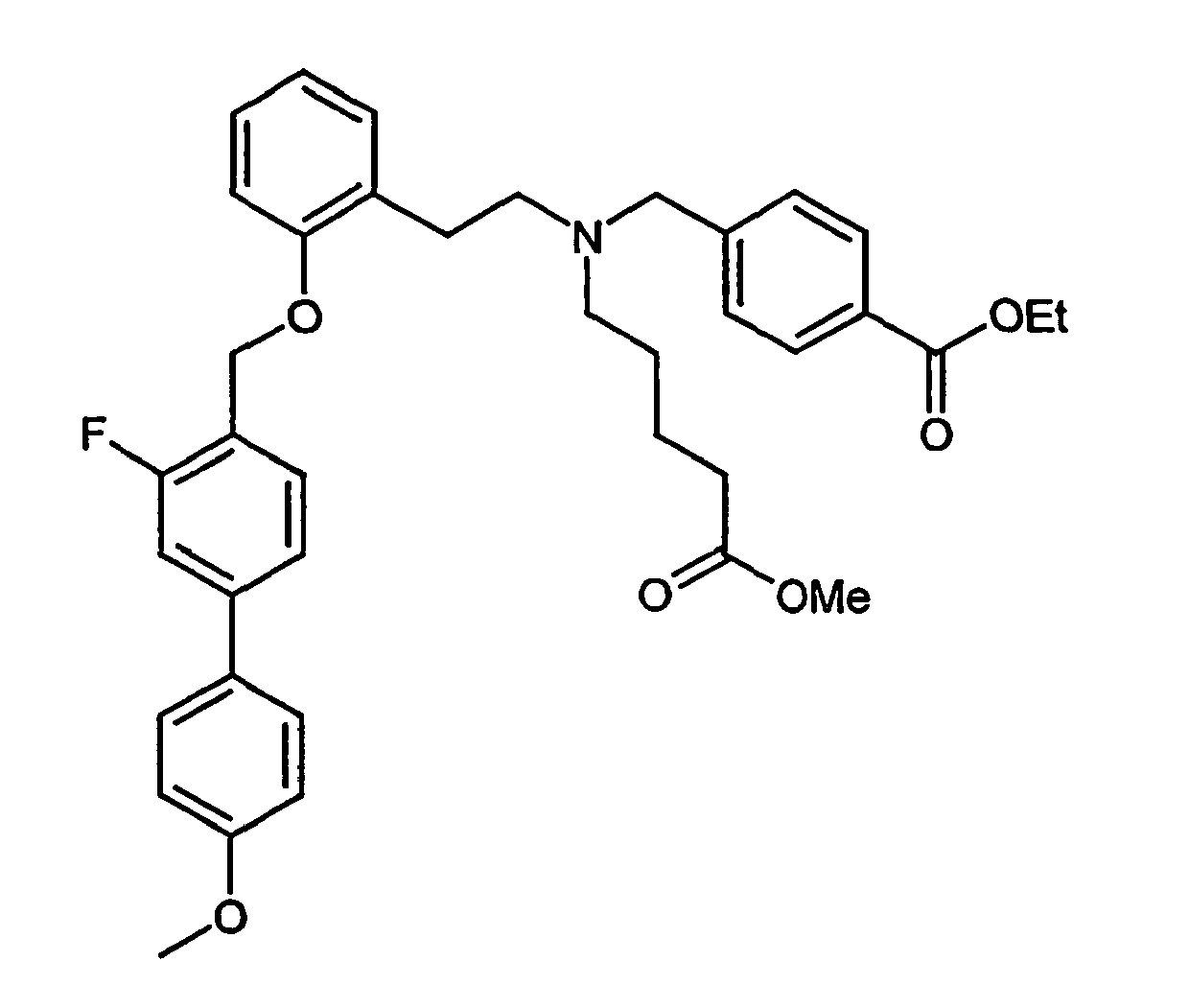
- Eine Lösung von 511 mg (2,04 mmol) 4-(Chlormethyl)-3-fluor-4'-methoxy-1,1'-biphenyl aus Bsp. VII in 7 ml trockenem Acetonitril wird mit 702 mg (1,7 mmol) 4-{[[2-(2-Hydroxyphenyl)ethyl](5-ethoxy-5-oxopentyl)amino]methyl}bcnzoesäuremethylester aus Bsp. III und 352 mg (2,55 mol) wasserfreiem Kaliumcarbonat versetzt und 12 Stunden zum Rückfluß erhitzt. Anschließend wird der Ansatz zur Trockene einrotiert. Das erhaltene Rohprodukt wird durch Flash-Chromatographie (Cyclohexan/Essigester 6:1) gereinigt. Es werden 1,018 g (1,62 mmol, 94 % Ausbeute) eines Feststoffs erhalten.
Rf (Cyclohexan/Essigester 2:1): 0,30.
1H-NMR (300 MHz, DMSO-d6, δ/ppm): 7,80 (2H, d), 7,56 (1H, d) 7,51-7,48 (2H, m), 7,41-7,05 (8H, m), 6,98 (1H, dd), 6,89 (1H, t), 5,12 (2H, s), 3,99 (2H, q), 3,86 (3H, s), 3,81 (3H, s), 3,59 (2H, s), 2,78-2,68 (2H, m), 2,63-2,53 (2H, m), 2,39 (2H, t), 2,11 (2H, t), 1,48-1,27 (4H, m), 1,10 (3H, t).
MS (ESI): 628 (M+H+). -

- Eine Lösung von 222 mg (0,37 mmol) 4-{[(2-{2-[(3-Fluor-4'-methoxy-1,1'-biphenyl-4-yl)-methoxy]-phenyl}-ethyl)(5-ethoxy-5-oxopentyl)-amino]-methyl}-benzoesäuremethylester aus Bsp. VIII in 10 ml Dioxan und 5 ml Wasser wird mit 0,46 ml einer 45 %igen Lösung von NaOH in Wasser versetzt und 2 Stunden lang bei 90°C gerührt. Nach dem Abkühlen wird das Dioxan abgezogen und die wässrige Phase wird mit 1-molarer Salzsäure auf pH 4 bis 5 eingestellt. Dabei fällt das Produkt aus, das abfiltriert, mit Wasser gewaschen und getrocknet wird. Es werden 738 mg (1,26 mmol, 81 % Ausbeute) eines weißen Feststoffs erhalten.
Rf (Dichlormethan/Methanol 7:3): 0,25.
1H-NMR (200 MHz, DMSO-d6, δ/ppm): 12,99-12,0 (2H, breites s), 7,82 (2H, d), 7,63 (2H, d) 7,54-7,41 (3H, m), 7,31 (2H, d), 7,24-7,03 (3H, m), 7,01 (2H, d), 6,89 (1H, t), 5,09 (2H, s), 3,80 (3H, s), 3,59 (2H, breites s), 2,78-2,65 (2H, m), 2,63-2,53 (2H, m), 2,45-2,31 (2H, m), 2,09 (2H, t), 1,47-1,30 (4H, m).
MS (ESI): 586 (M+H+). - Auf analoge Weise wurde erhalten:
Bsp. Formel 1H-NMR δ [ppm] (DMSO-d6) 2
(ausgehend von 4-t-Butylbenzolboronsäure)
12,32(2H,breit),7,84(2H,d), 7,61 (2H, d), 7,58-7,44 (5H, m), 7,41-7,28 (2H, m), 7,25-7,05 (3H, m), 6,89 (1H, t), 5,12 (2H ,s), 3,80-3,51 (2H, m), 2,81-2,57 (4H, m), 2,55-2,38 (2H+DMSO, m), 2,10 (2H, t), 1,49-1,38 (4H, m), 1,31 (9H, s). (300 MHz) 3
(ausgehend von 4-Trifluormethylbenzolboronsäure)
12,5 (2H, breit), 8,01-7,87 (4H, m), 7,80 (2H, d), 7,73-7,54 (5H, m), 7,32-7,09 (3H, m), 6,94 (1H, t), 5,20 (2H ,s), 4,48-4,30 (2H, m), 3,20-2,90 (4H, m),2,52-2,42 (2H+DMSO, m), 2,14 (2H, t), 1,75-1,57 (2H, m), 1,48-1,32 (2H, in). (300 MHz) 4
(ausgehend von 4-Brom-2-chlorbenzoesäure und 4-Methoxybenzolboronsäure)
12,45 (2H, breites s), 7,89-7,77 (2H, m), 7,74 (1H, s), 7,63 (2H, d), 7,59 (2H, s), 7,42-7,29 (2H, m), 7,17 (2H, t), 7,10-6,97 (3H, m), 6,89 (1H, t), 5,12 (2H ,s), 3,82 (3H, s), 3,70-3,51 (2H, m), 2,91-2,32 (6H+DMSO, m), 2,09 (2H, t), 1,51-1,39 (4H, m). (200 MHz) 5
(ausgehend von 4-Brom-2-chlorbenzoesäure und 4-Fluorbenzolboronsäure)
12,7-12,1 (2H, breit), 7,91-7,89 (2H, m), 7,88 (1H, d), 7,58 (2H, dd), 7,47 (2H, d), 7,42-6,99 (6H,m), 7,02 (1H, d), 6,89 (1H, t), 5,07 (2H,s), 3,68-3,49(2H,breit), 2,90-2,30 (6H+DMSO, m), 2,12 (2H, m), 1,52-1,30 (4H, m). (200 MHz) 6
(ausgehend von 4-Brom-2-chlorbenzoesäure und 4-Trifluormethylbenzolboronsäure)
12,40 (2H, breit), 8,01-7,52 (11H, m), 7,38-7,03 (3H, m), 7,02-6,85 (1H, m), 5,20 (2H, s), 4,39 (2H, s), 3,30-2,89 (6H, m), 2,21-2,02 (2H, m), 1,74-1,52 (2H, m), 1,48-1,28 (2H, m). (300 MHz) 7
(ausgehend von 4-Chlorbenzolboronsäure)
12,2 (2H, breit), 7,99-7,78 (2H, m), 7,71 (2H, d), 7,62-7,43 (6H, m), 7,40-7,01 (4H, m), 6,90 (1H, t), 5,14 (2H, s), von 4,60-1,28 (14H, m) darin 2,18-2,01 (2H, m), 1,49-1,28 (2H, m). (300 MHz) 8
(ausgehend von 1-Cyclohex-1-enboronsäure)
12,4 (2H, breit), 7,81 (2H, d), 7,44-6,99 (8H, m), 6,85 (1H, t), 6,24 (1H, t), 5,03 (2H, s),3,57 (2H, s), 2,78-2,62 (2H, m), 2,61-2,45 (2H+DMSO, m), 2,44-2,26 (4H, m), 2,25-2,00 (4H, m), 1,79-1,50 (4H, m), 1,48-1,28 (4H, m). (200 MHz) 9
(ausgehend von 4-Brom-2-chlorbenzoesäure und 1-Cyclohex-1-enboronsäure)
12,3 (1H, breit), 10,2 (1H, breit), 7,98(2H,d), 7,72-7,57 (2H,m), 7,54-7,42 (2H, m), 7,36 (1H, d), 7,31-7,17(2H, m), 7,10 (1H,d), 6,95(1H,t), 6,24 (1H,t), 5,12(2H,s), 4,38 (2H, s), 3,32-2,89 (5H, m), 2,39-2,26(2H,m), 2,25-2,04 (5H, m), 1,81-1,48 (6H, m), 1,47-1,27(2H,m).(200 MHz) 10
(ausgehend von 4-Brom-2-chlorbenzoesäure und 4-t-Butylbenzolboronsäure)
12,4 (2H, breit), 7,89-7,78 (2H, m), 7,77 (1H, s) 7,64-7,53 (4H, m), 7,49 (2H, d), 7,44-7,28 (2H, m), 7,27-7,11 (2H, m), 7,08 (1H, d), 6,91 (1H, t), 5,13 (2H, s), 3,75-3,52 (2H, breit), 2,90-2,60 (6H, breit), 2,11 (2H, t), 1,49-1,38 (4H, m), 1,33 (9H, s). (300 MHz) 11
(ausgehend von 1-Cyclohexanboronsäure)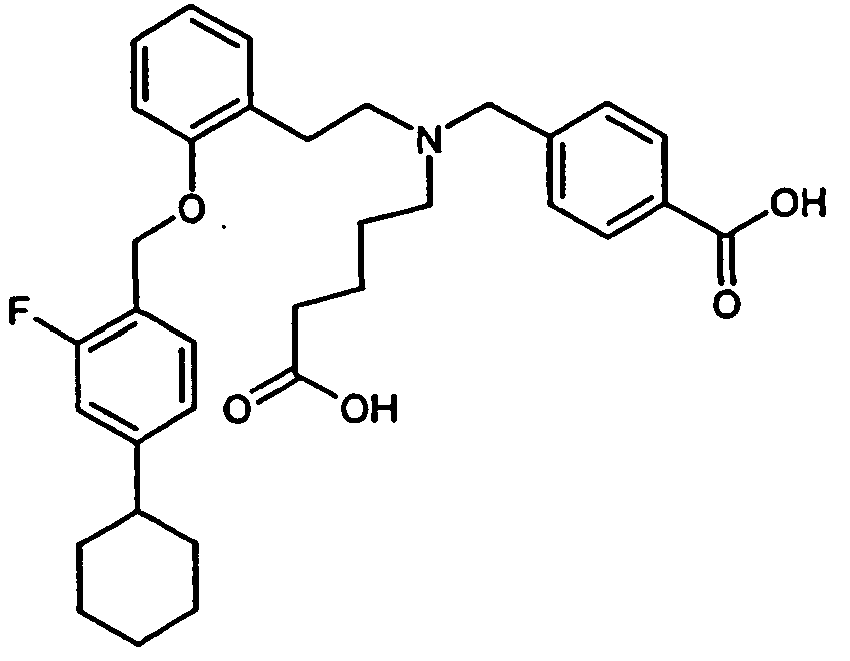
12,4 (2H, breit), 7,99-7,74 (2H, breit), 7,43-6,80 (9H, m), 5,02 (2H, s), 3,58 (2H, breit), 3,18-2,28 (5H + DMSO, m), 2,11 (2H, t), 1,87-1,60 (6H, m), 1,52-1,18 (10H, m). (300 MHz) 12
(ausgehend von 4-Brom-2-chlorbenzoesäure und 1-Cyclohexanboronsäure)
12,4 (2H, breit), 7,99-7,73 (2H, breit), 7,42-6,80 (2H, d), 7,32 (1H, pseudo-s), 7,18 (4H, dd), 7,06 (1H,d), 6,90 (1H, t), 5,07 (2H, s), 3,58 (2H, breit), 3,20-2,28 (5H+DMSO, m), 2,11 (2H, t), 1,88-1,61 (6H, m), 1,52-1,10 (10H, m). (200 MHz) -

- Eine Lösung von 220 mg 4-{[(4-Carboxybutyl)(2-{2-[(3-fluor-4'-trifluormethyl-1,1'-biphenyl-4-yl)methoxy]phenyl}ethyl)amino]methyl}benzoesäure aus Bsp. 3 in 0,2 ml Dioxan werden mit 0,5 ml (2 mmol) einer 4-molaren Lösung von HCl in Dioxan versetzt und 1 h bei 60°C gerührt. Anschließend wird der Ansatz eingedampft und das erhaltene farblose Öl mehrmals mit Diethylether verrührt. Die entstandenen Kristalle werden filtriert und getrocknet.
1H-NMR: δ [ppm] (DMSO-d6): 12,60 (2H, breit), 10,40 (1H, breit), 8,02-7,78 (6H, m), 7,76-7,54 (5H, m), 7,37-7,08 (3H, m), 6,93 (1H, t), 5,19 (2H, s), 4,40 (2H, s), 3,22-2,89 (6H, m), 2,14 (2H, t), 1,79-1,52 (2H, m), 1,50-1,29 (2H, m). (200 MHz) MS (ESI): 624 (M+H-HCl+).


Claims (11)
- Verbindungen der allgemeinen Formel (I)
 R1 Halogen bedeutet;R2 H oder Halogen bedeutet;R3 C3-8-Cycloalkyl, C3-8-Cycloalkenyl oder Phenyl bedeutet, wobei der Phenylrest zusätzlich einen Substituenten aus der Gruppe, bestehend aus Halogen, C1-6-Alkyl, C1-6-Alkoxy, CF3, tragen kann;sowie Salze, Isomere und Hydrate davon.
 - Verbindungen nach Anspruch 1, dadurch, gekennzeichnet, dassR1 F oder Cl bedeutet;R2 H bedeutet;R3 C3-8-Cycloalkyl, C3-8-Cycloalkenyl oder Phenyl bedeutet, wobei der Phenylrest zusätzlich einen Substituenten aus der Gruppe, bestehend aus F, Cl, Br, Methyl, Ethyl, n-Propyl, i-Propyl, n-Butyl, i-Butyl, t-Butyl, Methoxy, Ethoxy, n-Propoxy, i-Propoxy, n-Butyloxy, i-Butyloxy, t-Butyloxy" CF3, tragen kann;sowie Salze, Isomere und Hydrate davon.
- Verbindungen nach Anspruch 1, dadurch, gekennzeichnet, dassR1 F oder Cl bedeutet;R2 H bedeutet;R3 Cyclohexyl, 1-Cyclohexenyl oder Phenyl bedeutet, wobei der Phenylrest zusätzlich einen Substituenten aus der Gruppe, bestehend aus F, Cl, t-Butyl, OMe, CF3, tragen kann;sowie Salze, Isomere und Hydrate davon.
- Verfahren zur Herstellung von Verbindungen der allgemeinen Formel (I), dadurch gekennzeichnet, dass man Verbindungen der Formel (II)
 L für Methyl steht,mit einem 4-Formylbenzoesäure-C1-6-alkylester in einem organischen Lösungsmittel gegebenenfalls unter Erhitzen und gleichzeitiger oder anschließender Zugabe eines Reduktionsmittels zu Verbindungen der Formel (III) umsetzt,
 L die vorstehend angegebene Bedeutung hat und Q für einen C1-6-Alkylrest steht,anschließend - unter vorheriger Etherspaltung zur freien Hydroxylgruppe - mit einem ω-Halogenvaleriansäure-C1-6-alkylester in einem organischen Lösungsmittel in Gegenwart einer Base unter Erhitzen zu Verbindungen der Formel (IV) umsetzt,
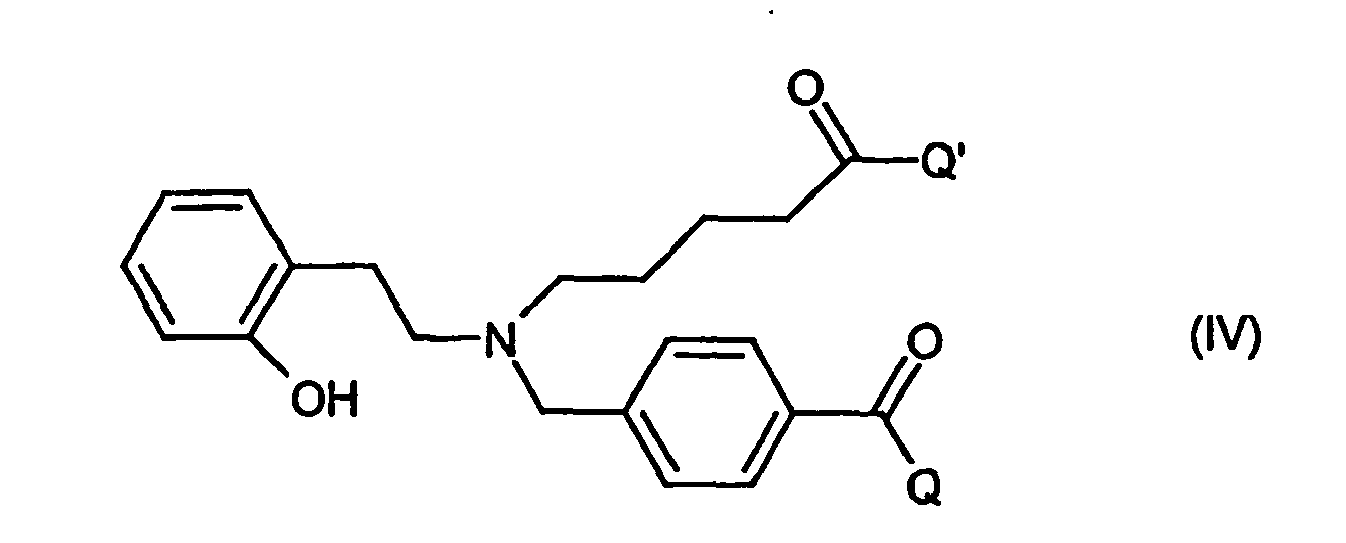 Q die vorstehend angegebene Bedeutung hat und Q' für einen C1-6-Alkylrest steht,anschließend mit einer Verbindung der Formel IV-A in einem organischen Lösungsmittel in Gegenwart einer Base unter Erhitzen
 R1, R2 und R3 die vorstehend angegebenen Bedeutung haben und X für Halogen steht,zu Verbindungen der Formel (V) umsetzt,
- Verbindungen nach einem der Ansprüche 1 bis 3 zur Behandlung von Krankheiten.
- Arzneimittel enthaltend mindestens eine Verbindung der allgemeinen Formel (I) gemäß einem der vorhergehenden Ansprüche.
- Verwendung von Verbindungen der Formel (I) gemäß einem der vorhergehenden Ansprüche zur Herstellung eines Arzneimittels zur Behandlung von Herz-Kreislauf-Erkrankungen.
- Verwendung von Verbindungen der allgemeinen Formel (I) gemäß einem der vorhergehenden Ansprüche zur Herstellung von Arzneimitteln zur Behandlung von Angina pectoris, Ischämien und Herzinsuffizienz.
- Verwendung von Verbindungen der allgemeinen Formel (I) gemäß einem der vorhergehenden Ansprüche zur Herstellung von Arzneimitteln zur Behandlung von Hypertonie, thromboembolischen Erkrankungen, Arteriosklerose und venösen Erkrankungen.
- Verwendung von Verbindungen der allgemeinen Formel (I) gemäß einem der vorhergehenden Ansprüche zur Herstellung von Arzneimitteln zur Behandlung von fibrotischen Erkrankungen.
- Verwendung nach Anspruch 10, dadurch gekennzeichnet, dass die fibrotische Erkrankung Leberfibrose ist.
Applications Claiming Priority (3)
| Application Number | Priority Date | Filing Date | Title |
|---|---|---|---|
| DE10109861A DE10109861A1 (de) | 2001-03-01 | 2001-03-01 | Neuartige seitenkettenhalogenierte Aminodicarbonsäurederivate |
| DE10109861 | 2001-03-01 | ||
| PCT/EP2002/001895 WO2002070461A1 (de) | 2001-03-01 | 2002-02-22 | Seitenkettenhalogenierte aminodicarbonsäurederivate als arzneimittel zur behandlung von herz-kreislauf-erkrankungen |
Publications (2)
| Publication Number | Publication Date |
|---|---|
| EP1368301A1 EP1368301A1 (de) | 2003-12-10 |
| EP1368301B1 true EP1368301B1 (de) | 2007-10-31 |
Family
ID=7675932
Family Applications (1)
| Application Number | Title | Priority Date | Filing Date |
|---|---|---|---|
| EP02716805A Expired - Lifetime EP1368301B1 (de) | 2001-03-01 | 2002-02-22 | Seitenkettenhalogenierte aminodicarbonsaurederivate als arzneimittel zur behandlung von herz-kreislauf-erkrankungen |
Country Status (7)
| Country | Link |
|---|---|
| US (1) | US6939989B2 (de) |
| EP (1) | EP1368301B1 (de) |
| JP (1) | JP4095899B2 (de) |
| CA (1) | CA2439647A1 (de) |
| DE (2) | DE10109861A1 (de) |
| ES (1) | ES2295329T3 (de) |
| WO (1) | WO2002070461A1 (de) |
Families Citing this family (20)
| Publication number | Priority date | Publication date | Assignee | Title |
|---|---|---|---|---|
| DE10109859A1 (de) * | 2001-03-01 | 2002-09-05 | Bayer Ag | Neuartige Aminodicarbonsäurederivate |
| DE10109858A1 (de) * | 2001-03-01 | 2002-09-05 | Bayer Ag | Neuartige halogensubstituierte Aminodicarbonsäurederivate |
| DE10110749A1 (de) * | 2001-03-07 | 2002-09-12 | Bayer Ag | Substituierte Aminodicarbonsäurederivate |
| DE10216145A1 (de) * | 2002-04-12 | 2003-10-23 | Bayer Ag | Verwendung von Stimulatoren der löslichen Guanylatcyclase zur Behandlung von Glaukom |
| US20070027105A1 (en) * | 2005-07-26 | 2007-02-01 | Alza Corporation | Peroxide removal from drug delivery vehicle |
| EP1951053A4 (de) * | 2005-10-19 | 2010-12-01 | Merck Sharp & Dohme | Cetp-inhibitoren |
| DE102005050497A1 (de) * | 2005-10-21 | 2007-04-26 | Bayer Healthcare Ag | Difluorphenol-Derivate und ihre Verwendung |
| DE102010020553A1 (de) | 2010-05-14 | 2011-11-17 | Bayer Schering Pharma Aktiengesellschaft | Substituierte 8-Alkoxy-2-aminotetralin-Derivate und ihre Verwendung |
| DK2875003T3 (en) | 2012-07-20 | 2017-02-20 | Bayer Pharma AG | NEW 5-AMINOTETRAHYDROQUINOLINE-2-CARBOXYLIC ACIDS AND THE USE OF IT |
| HK1211282A1 (en) | 2012-07-20 | 2016-05-20 | Bayer Pharma Aktiengesellschaft | Substituted aminoindane-and aminotetralincarboxylic acids and use thereof |
| CN105658621B (zh) * | 2013-10-15 | 2018-05-29 | 东亚荣养株式会社 | 4-氨甲基苯甲酸衍生物 |
| US20180169095A1 (en) | 2015-05-06 | 2018-06-21 | Bayer Pharma Aktiengesellschaft | The use of sgc stimulators, sgc activators, alone and combinations with pde5 inhibitors for the treatment of digital ulcers (du) concomitant to systemic sclerosis (ssc) |
| CN113750102A (zh) | 2015-07-23 | 2021-12-07 | 拜耳制药股份公司 | 可溶性鸟苷酸环化酶的刺激剂和/或活化剂及其用途 |
| CA3012001A1 (en) | 2016-02-01 | 2017-08-10 | Ironwood Pharmaceuticals, Inc. | Use of sgc stimulators for the treatment of nonalcoholic steatohepatitis (nash) |
| WO2018069148A1 (de) | 2016-10-11 | 2018-04-19 | Bayer Pharma Aktiengesellschaft | Kombination enthaltend sgc aktivatoren und mineralocorticoid-rezeptor-antagonisten |
| JP7101688B2 (ja) | 2016-10-11 | 2022-07-15 | バイエル・ファルマ・アクティエンゲゼルシャフト | sGC刺激薬とミネラルコルチコイド受容体拮抗薬とを含む組み合わせ |
| JP2021523201A (ja) | 2018-05-15 | 2021-09-02 | バイエル アクチェンゲゼルシャフトBayer Aktiengesellschaft | 神経線維感作に関連する疾患を治療するための1,3−チアゾール−2−イル置換ベンズアミド |
| WO2020164008A1 (en) | 2019-02-13 | 2020-08-20 | Bayer Aktiengesellschaft | Process for the preparation of porous microparticles |
| KR20240144178A (ko) | 2021-12-29 | 2024-10-02 | 바이엘 악티엔게젤샤프트 | 심폐 장애의 치료 |
| EP4457215A1 (de) | 2021-12-29 | 2024-11-06 | Bayer Aktiengesellschaft | Verfahren zur herstellung von (5s)-{[2-(4-carboxyphenyl)ethyl)2-(2-{3-chlor-4'-(trifluormethyl)biphenyl-4- yl!methoxy}phenyl)ethyl!aminol-5,6,7,8-tetrahydrochinolin-2-carbonsäure und ihre kristallinen formen |
Family Cites Families (9)
| Publication number | Priority date | Publication date | Assignee | Title |
|---|---|---|---|---|
| GB2218416A (en) * | 1988-05-13 | 1989-11-15 | Bayer Ag | Leukotriene disease antagonists |
| GB8813185D0 (en) | 1988-06-03 | 1988-07-06 | Wyeth John & Brother Ltd | New method & amines used therein |
| AU2238192A (en) | 1991-06-27 | 1993-01-25 | Du Pont Merck Pharmaceutical Company, The | Modified peptides transportable into the central nervous system |
| DE19642255A1 (de) | 1996-10-14 | 1998-04-16 | Bayer Ag | Verwendung von 1-Benzyl-3-(substituierten-hetaryl) -kondensierten Pyrazol-Derivaten |
| DE59713007D1 (de) | 1996-10-14 | 2009-06-25 | Bayer Healthcare Ag | Neue heterocyclylmethyl-substituierte pyrazolderivate und ihre verwendung in der behandlung von herz-kreislauf-erkrankungen |
| DE19649460A1 (de) | 1996-11-26 | 1998-05-28 | Bayer Ag | Neue substituierte Pyrazolderivate |
| US6451805B1 (en) | 1997-11-14 | 2002-09-17 | Bayer Aktiengesellschaft | Substituted pyrazole derivatives for the treatment of cardiocirculatory diseases |
| IT1303437B1 (it) | 1998-09-25 | 2000-11-06 | Elettrotecnica Sas Di Ricci En | Apparato di trasformazione per tubi illuminanti a catodo freddocaricati con neon od argon o miscelati. |
| DE19943635A1 (de) * | 1999-09-13 | 2001-03-15 | Bayer Ag | Neuartige Aminodicarbonsäurederivate mit pharmazeutischen Eigenschaften |
-
2001
- 2001-03-01 DE DE10109861A patent/DE10109861A1/de not_active Withdrawn
-
2002
- 2002-02-22 DE DE50211137T patent/DE50211137D1/de not_active Expired - Lifetime
- 2002-02-22 EP EP02716805A patent/EP1368301B1/de not_active Expired - Lifetime
- 2002-02-22 CA CA002439647A patent/CA2439647A1/en not_active Abandoned
- 2002-02-22 US US10/469,178 patent/US6939989B2/en not_active Expired - Fee Related
- 2002-02-22 ES ES02716805T patent/ES2295329T3/es not_active Expired - Lifetime
- 2002-02-22 JP JP2002569782A patent/JP4095899B2/ja not_active Expired - Fee Related
- 2002-02-22 WO PCT/EP2002/001895 patent/WO2002070461A1/de not_active Ceased
Also Published As
| Publication number | Publication date |
|---|---|
| JP4095899B2 (ja) | 2008-06-04 |
| WO2002070461A1 (de) | 2002-09-12 |
| US20040082658A1 (en) | 2004-04-29 |
| ES2295329T3 (es) | 2008-04-16 |
| EP1368301A1 (de) | 2003-12-10 |
| CA2439647A1 (en) | 2002-09-12 |
| DE10109861A1 (de) | 2002-09-05 |
| JP2004529898A (ja) | 2004-09-30 |
| US6939989B2 (en) | 2005-09-06 |
| DE50211137D1 (de) | 2007-12-13 |
Similar Documents
| Publication | Publication Date | Title |
|---|---|---|
| EP1368302B1 (de) | Neuartige aminodicarbonsäurederivate | |
| EP1216225B1 (de) | Neuartige aminodicarbonsäurederivate mit pharmazeutischen eigenschaften | |
| EP1368303B1 (de) | Halogensubstituierte aminodicarbonsäurederivate als arzneimittel zur behandlung von herz-kreislauf-erkrankungen | |
| EP1216223B1 (de) | Neuartige dicarbonsäurederivate mit pharmazeutischen eigenschaften | |
| WO2002070510A2 (de) | Aminodicarbonsäurederivate mit pharmazeutischen eigenschaften | |
| DE10109861A1 (de) | Neuartige seitenkettenhalogenierte Aminodicarbonsäurederivate | |
| EP1368300A1 (de) | Substituierte aminodicarbonsäurederivate | |
| EP1216222A2 (de) | Neuartige dicarbonsäurederivate mit pharmazeutischen eigenschaften | |
| WO2001019355A2 (de) | Dicarbonsäurederivate mit neuartigen pharmazeutischen eigenschaften | |
| EP1286957B1 (de) | Diphenylmethanderivate | |
| DE69911726T2 (de) | Derivate von Arylcarbonsäuren und Tetrazolen mit einer Carbamoyloxy-Gruppe |
Legal Events
| Date | Code | Title | Description |
|---|---|---|---|
| PUAI | Public reference made under article 153(3) epc to a published international application that has entered the european phase |
Free format text: ORIGINAL CODE: 0009012 |
|
| 17P | Request for examination filed |
Effective date: 20031001 |
|
| AK | Designated contracting states |
Kind code of ref document: A1 Designated state(s): AT BE CH CY DE DK ES FI FR GB GR IE IT LI LU MC NL PT SE TR |
|
| AX | Request for extension of the european patent |
Extension state: AL LT LV MK RO SI |
|
| RAP1 | Party data changed (applicant data changed or rights of an application transferred) |
Owner name: BAYER HEALTHCARE AG |
|
| GRAP | Despatch of communication of intention to grant a patent |
Free format text: ORIGINAL CODE: EPIDOSNIGR1 |
|
| GRAS | Grant fee paid |
Free format text: ORIGINAL CODE: EPIDOSNIGR3 |
|
| GRAA | (expected) grant |
Free format text: ORIGINAL CODE: 0009210 |
|
| AK | Designated contracting states |
Kind code of ref document: B1 Designated state(s): DE ES FR GB IT |
|
| REG | Reference to a national code |
Ref country code: GB Ref legal event code: FG4D Free format text: NOT ENGLISH |
|
| REF | Corresponds to: |
Ref document number: 50211137 Country of ref document: DE Date of ref document: 20071213 Kind code of ref document: P |
|
| GBT | Gb: translation of ep patent filed (gb section 77(6)(a)/1977) |
Effective date: 20080109 |
|
| REG | Reference to a national code |
Ref country code: ES Ref legal event code: FG2A Ref document number: 2295329 Country of ref document: ES Kind code of ref document: T3 |
|
| ET | Fr: translation filed | ||
| PLBE | No opposition filed within time limit |
Free format text: ORIGINAL CODE: 0009261 |
|
| STAA | Information on the status of an ep patent application or granted ep patent |
Free format text: STATUS: NO OPPOSITION FILED WITHIN TIME LIMIT |
|
| 26N | No opposition filed |
Effective date: 20080801 |
|
| REG | Reference to a national code |
Ref country code: FR Ref legal event code: TP |
|
| PGFP | Annual fee paid to national office [announced via postgrant information from national office to epo] |
Ref country code: FR Payment date: 20110218 Year of fee payment: 10 Ref country code: IT Payment date: 20110218 Year of fee payment: 10 Ref country code: DE Payment date: 20110126 Year of fee payment: 10 |
|
| PGFP | Annual fee paid to national office [announced via postgrant information from national office to epo] |
Ref country code: GB Payment date: 20110216 Year of fee payment: 10 Ref country code: ES Payment date: 20110315 Year of fee payment: 10 |
|
| GBPC | Gb: european patent ceased through non-payment of renewal fee |
Effective date: 20120222 |
|
| REG | Reference to a national code |
Ref country code: FR Ref legal event code: ST Effective date: 20121031 |
|
| PG25 | Lapsed in a contracting state [announced via postgrant information from national office to epo] |
Ref country code: IT Free format text: LAPSE BECAUSE OF NON-PAYMENT OF DUE FEES Effective date: 20120222 |
|
| REG | Reference to a national code |
Ref country code: DE Ref legal event code: R119 Ref document number: 50211137 Country of ref document: DE Effective date: 20120901 |
|
| PG25 | Lapsed in a contracting state [announced via postgrant information from national office to epo] |
Ref country code: FR Free format text: LAPSE BECAUSE OF NON-PAYMENT OF DUE FEES Effective date: 20120229 Ref country code: GB Free format text: LAPSE BECAUSE OF NON-PAYMENT OF DUE FEES Effective date: 20120222 |
|
| PG25 | Lapsed in a contracting state [announced via postgrant information from national office to epo] |
Ref country code: DE Free format text: LAPSE BECAUSE OF NON-PAYMENT OF DUE FEES Effective date: 20120901 |
|
| REG | Reference to a national code |
Ref country code: ES Ref legal event code: FD2A Effective date: 20130708 |
|
| PG25 | Lapsed in a contracting state [announced via postgrant information from national office to epo] |
Ref country code: ES Free format text: LAPSE BECAUSE OF NON-PAYMENT OF DUE FEES Effective date: 20120223 |