EP1367786A1 - Procédé de diffusion de données vers des terminaux différents - Google Patents
Procédé de diffusion de données vers des terminaux différents Download PDFInfo
- Publication number
- EP1367786A1 EP1367786A1 EP03291048A EP03291048A EP1367786A1 EP 1367786 A1 EP1367786 A1 EP 1367786A1 EP 03291048 A EP03291048 A EP 03291048A EP 03291048 A EP03291048 A EP 03291048A EP 1367786 A1 EP1367786 A1 EP 1367786A1
- Authority
- EP
- European Patent Office
- Prior art keywords
- data
- recipient
- terminal
- terminals
- strategy
- Prior art date
- Legal status (The legal status is an assumption and is not a legal conclusion. Google has not performed a legal analysis and makes no representation as to the accuracy of the status listed.)
- Granted
Links
- 238000000034 method Methods 0.000 title claims abstract description 32
- 230000005540 biological transmission Effects 0.000 title description 7
- 230000015654 memory Effects 0.000 claims abstract description 25
- 238000009792 diffusion process Methods 0.000 claims description 28
- 230000008569 process Effects 0.000 claims description 16
- 229940049705 immune stimulating antibody conjugate Drugs 0.000 claims description 10
- 238000006243 chemical reaction Methods 0.000 claims description 9
- 238000012545 processing Methods 0.000 claims description 6
- 230000004044 response Effects 0.000 claims description 4
- 238000006677 Appel reaction Methods 0.000 description 20
- 238000011161 development Methods 0.000 description 14
- 238000013515 script Methods 0.000 description 9
- 101100536354 Drosophila melanogaster tant gene Proteins 0.000 description 5
- 230000009466 transformation Effects 0.000 description 4
- 238000010586 diagram Methods 0.000 description 3
- 229940082150 encore Drugs 0.000 description 2
- 230000006870 function Effects 0.000 description 2
- 230000003993 interaction Effects 0.000 description 2
- 230000007246 mechanism Effects 0.000 description 2
- 230000002123 temporal effect Effects 0.000 description 2
- 241000287107 Passer Species 0.000 description 1
- 230000006978 adaptation Effects 0.000 description 1
- 230000002776 aggregation Effects 0.000 description 1
- 238000004220 aggregation Methods 0.000 description 1
- 238000004422 calculation algorithm Methods 0.000 description 1
- 230000001413 cellular effect Effects 0.000 description 1
- 238000004891 communication Methods 0.000 description 1
- 230000000295 complement effect Effects 0.000 description 1
- 238000010276 construction Methods 0.000 description 1
- 235000021183 entrée Nutrition 0.000 description 1
- 239000000284 extract Substances 0.000 description 1
- 238000007726 management method Methods 0.000 description 1
- 238000002360 preparation method Methods 0.000 description 1
- 230000000717 retained effect Effects 0.000 description 1
- 208000006379 syphilis Diseases 0.000 description 1
- 238000012546 transfer Methods 0.000 description 1
- 238000000844 transformation Methods 0.000 description 1
Images


Classifications
-
- H—ELECTRICITY
- H04—ELECTRIC COMMUNICATION TECHNIQUE
- H04L—TRANSMISSION OF DIGITAL INFORMATION, e.g. TELEGRAPHIC COMMUNICATION
- H04L51/00—User-to-user messaging in packet-switching networks, transmitted according to store-and-forward or real-time protocols, e.g. e-mail
- H04L51/06—Message adaptation to terminal or network requirements
- H04L51/066—Format adaptation, e.g. format conversion or compression
-
- H—ELECTRICITY
- H04—ELECTRIC COMMUNICATION TECHNIQUE
- H04L—TRANSMISSION OF DIGITAL INFORMATION, e.g. TELEGRAPHIC COMMUNICATION
- H04L51/00—User-to-user messaging in packet-switching networks, transmitted according to store-and-forward or real-time protocols, e.g. e-mail
- H04L51/56—Unified messaging, e.g. interactions between e-mail, instant messaging or converged IP messaging [CPM]
-
- H—ELECTRICITY
- H04—ELECTRIC COMMUNICATION TECHNIQUE
- H04M—TELEPHONIC COMMUNICATION
- H04M3/00—Automatic or semi-automatic exchanges
- H04M3/42—Systems providing special services or facilities to subscribers
- H04M3/42382—Text-based messaging services in telephone networks such as PSTN/ISDN, e.g. User-to-User Signalling or Short Message Service for fixed networks
-
- H—ELECTRICITY
- H04—ELECTRIC COMMUNICATION TECHNIQUE
- H04M—TELEPHONIC COMMUNICATION
- H04M2201/00—Electronic components, circuits, software, systems or apparatus used in telephone systems
- H04M2201/60—Medium conversion
-
- H—ELECTRICITY
- H04—ELECTRIC COMMUNICATION TECHNIQUE
- H04M—TELEPHONIC COMMUNICATION
- H04M2203/00—Aspects of automatic or semi-automatic exchanges
- H04M2203/20—Aspects of automatic or semi-automatic exchanges related to features of supplementary services
- H04M2203/205—Broadcasting
Definitions
- the present invention relates to the dissemination of a given to several terminals of a recipient, or more generally of several data towards the terminals respective of several recipients.
- It relates more particularly to the development of functionalities for disseminating heterogeneous data issued by a sender to recipients, without the sender is concerned about receiving the data and in particular from the terminal of each recipient who will receive the expected data.
- tele-computer systems incorporate a telephone broadcast function or by email.
- messaging unified voice services offer their users notification to post a message by mail electronic (e-mail), telephone or fax.
- the UK patent application GB 2366032 offers a message notification server electronic in which user data is broadcast to terminal devices of a recipient through gateways, depending on recipient preferences, unspecified, and of identifiers and characteristics of the terminals of the recipient.
- None of these systems can build precisely and unambiguously a dissemination strategy to broadcast data from a terminal or server intermediary sending the data to terminals a recipient with media types, i.e. means or channels of transmission and means receiving data, different like a phone, a fax machine, written email or voice, website, etc ...
- media types i.e. means or channels of transmission and means receiving data, different like a phone, a fax machine, written email or voice, website, etc ...
- the objective of the invention is to satisfy this need to build a dissemination strategy for given and more specifically of sequence construction call of one or more recipients from a set of predefined pre-saved criteria or determined in a sender request and relative including types of media.
- the method of the invention allows a server to service sending the data to minimize the description in his sender request.
- a server to service sending the data to minimize the description in his sender request.
- only the recipient's identifier and the data, or recipient identifiers and data to broadcast to these can be specified.
- the media types of the data are preference determined according to a content strategy identified in the sender request; if none content strategy is only indicated in the request, a default predetermined content strategy is applied.
- the sender of the data itself selects an access strategy determining which recipient terminals are likely to be called so that one of them can receive the data.
- the process includes designation of selected identifiers of terminals according to the access strategy which is identified in the shipping request or by default for the recipient and the data.
- the sender of the data itself selects a calling strategy determining the call procedure for each terminal designated recipient.
- the method includes an association of the identifier of a terminal designated with the identifier of a means of broadcasting with a media type compatible with that of the terminal designated and determined by a call strategy identified in the sender request or by default for the recipient and the data.
- the calling strategy can include a number and a frequency of call attempts from each terminal designated and call periods of each terminal, to enter in the multicast request.
- the invention also relates to the dissemination of the given to several recipients each having respective terminals.
- the sender request contains in addition to recipient identifiers or the identifier of a list of recipients identifiable in the first memory.
- the request of multicast also contains multiple sequences call terminals selected respectively for recipients.
- the invention also provides for the dissemination of several data respectively to the recipients, the call sequence (s) for a recipient in the multicast request further containing the one or more data to be broadcast to the selected terminals of the recipient. More generally, the method according to the invention makes it possible to broadcast one or more data of different kinds to one or more recipients each equipped with one or more terminals any.
- the diffusion process according to the invention is implemented in a platform specific multicast manager containing the first and second memories and connected by a network of packets to application service servers issuing requests from senders and means of distribution.
- Each means of dissemination receives respective information contained in the multicast request such as the call sequences of the respective terminals.
- the platform receives a dissemination result from each dissemination medium associated with a selected terminal to indicate whether the broadcast medium was called by the platform and if data has been disseminated by means of dissemination to the selected terminal.
- a system of data multicast includes terminals each, sometimes TEX sender terminal, sometimes TD recipient terminal, service servers SSA application called by senders' terminals TEX data messages, from servers known as DF broadcasters broadcasting data from senders to TD recipients, and a manager platform GMD multicast specific to the invention.
- the terminals TEX and TD and the DF diffusers are interconnected to through media of various types, including in known RA access networks, for example the network dial-up or radiotelephone networks cellular, and are connected to the SSA servers and to the GMD platform across an RP packet network like the internet network.
- SSA application service servers offer by example of communication functionality between terminals of association members, document exchange features of a nature different between members of the same group, or more usually broadcast features to terminals of predetermined type of recipients predetermined.
- the GMD multicast manager platform has role of developing and implementing a strategy adapted to a REX sender request sent by one SSA application service servers.
- the REX request usually contains data sent by the terminal TEX of a sender who wishes to transmit the data to one or more TD terminals of one or more recipients via one or more different media.
- the manager platform is related to several DF diffusers. Each of the diffusers is capable of transmit the data to be broadcast on one or more media, according to their technical particularities.
- a media includes a means or channel of transmission such as landline or personal traffic channel or professional in a radiotelephony network cell phone, or voice or written messaging (email), or a fax recorder.
- One or a few or all types of transmitters for these media can be included in a DF diffuser for several recipients.
- the GMD multicast manager platform contains various main software modules, such as shown in Figure 2, including a module ESD dissemination strategy development uses the diffusion method according to the invention.
- the ESD dissemination strategy development module uses data and information presented in the form of pages in a high level XML language (eXtensible Markup Language). By way of example, a few pages are described in the following description after the presentation of essential manipulated objects and of applicable strategy rules, between respective start and end tags.
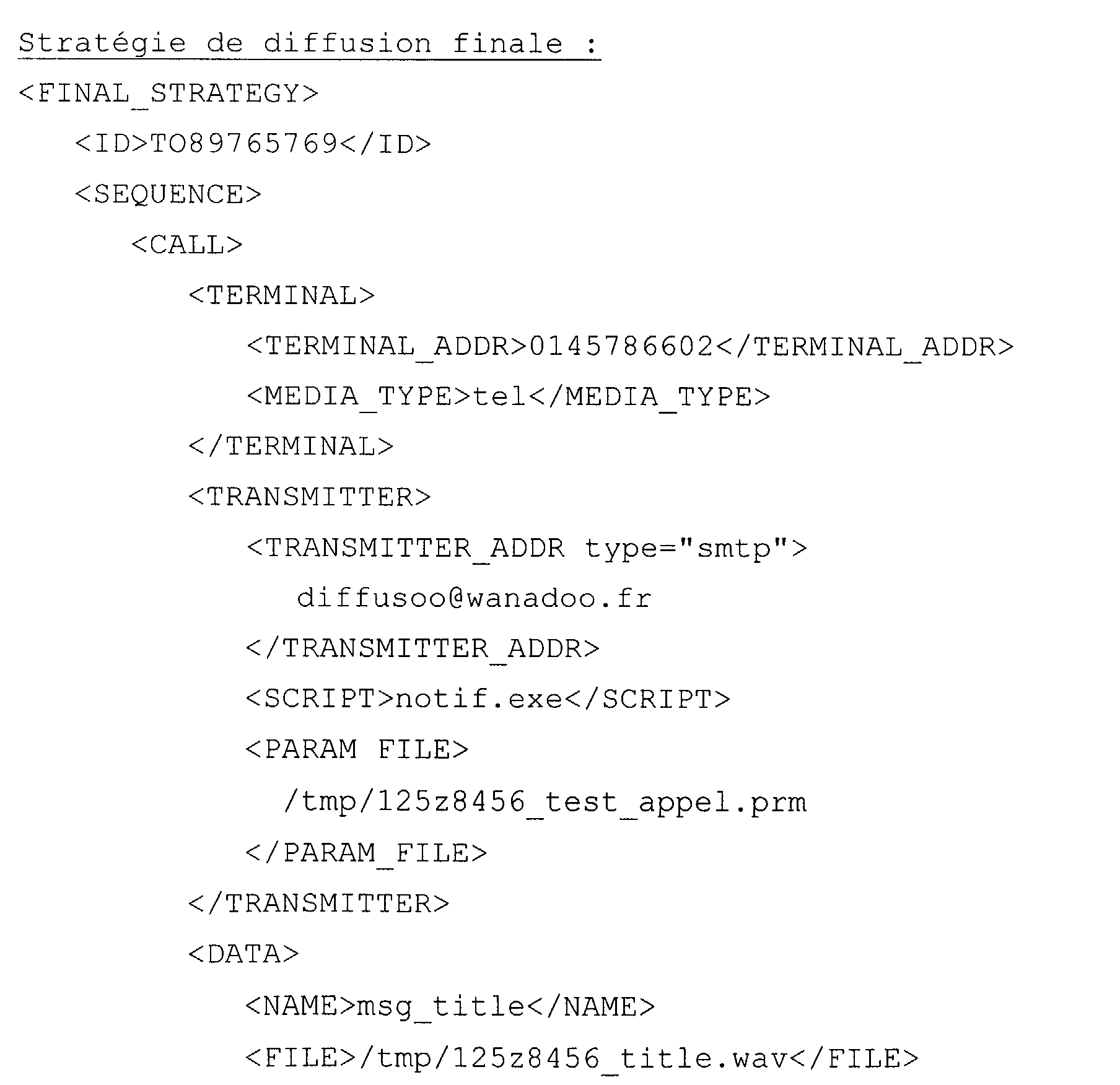
- the ESD delivery strategy development module receives a REX sender request transmitted by one of the SSA application service servers in an XML compatible format and produces an RMD multicast request representative of a final delivery strategy, under form of an XML page.
- Elements to be broadcast constituting the final strategy to be used are located at least partly in XML files separate from the REX sender request and are partly referenced in the REX request.
- the ESD module To establish an RMD multicast request to transmit distributed to TD terminals one or more recipients identified explicitly or implicitly in the REX request respectively through compatible DF diffusers with data, the ESD module essentially cooperates with two information memories MI1 and MI2, a tool CF format converter software and four modules strategy MS1 to MS4, as shown in Figure 3.
- Information extracted from memories MI1 and MI2 information, the MI3 software tool and four strategy modules MS1 to MS4 per module are presented according to an achievement preferred in the form of XML pages processed by the module ESD development.
- the format can also be a type defined by the name and / or the extension of the data to be broadcast and indicated by a ⁇ NAME> tag. Metacharacters? and * can be used. For example, the file toto.rtf is the data with name "toto” and format " * .rtf".
- the "transf” attribute is a reference to the converter tool defined elsewhere, via a ⁇ TRANSF> tag.
- the use of a format converter is decided at the level of the content strategy module MS1.
- one of the pre-stored strategies is applied by default.
- the sender from the terminal calling TEX or the application service manager from the SSA server can modify only one information of an already existing strategy in the explicitly redefining in the REX request.
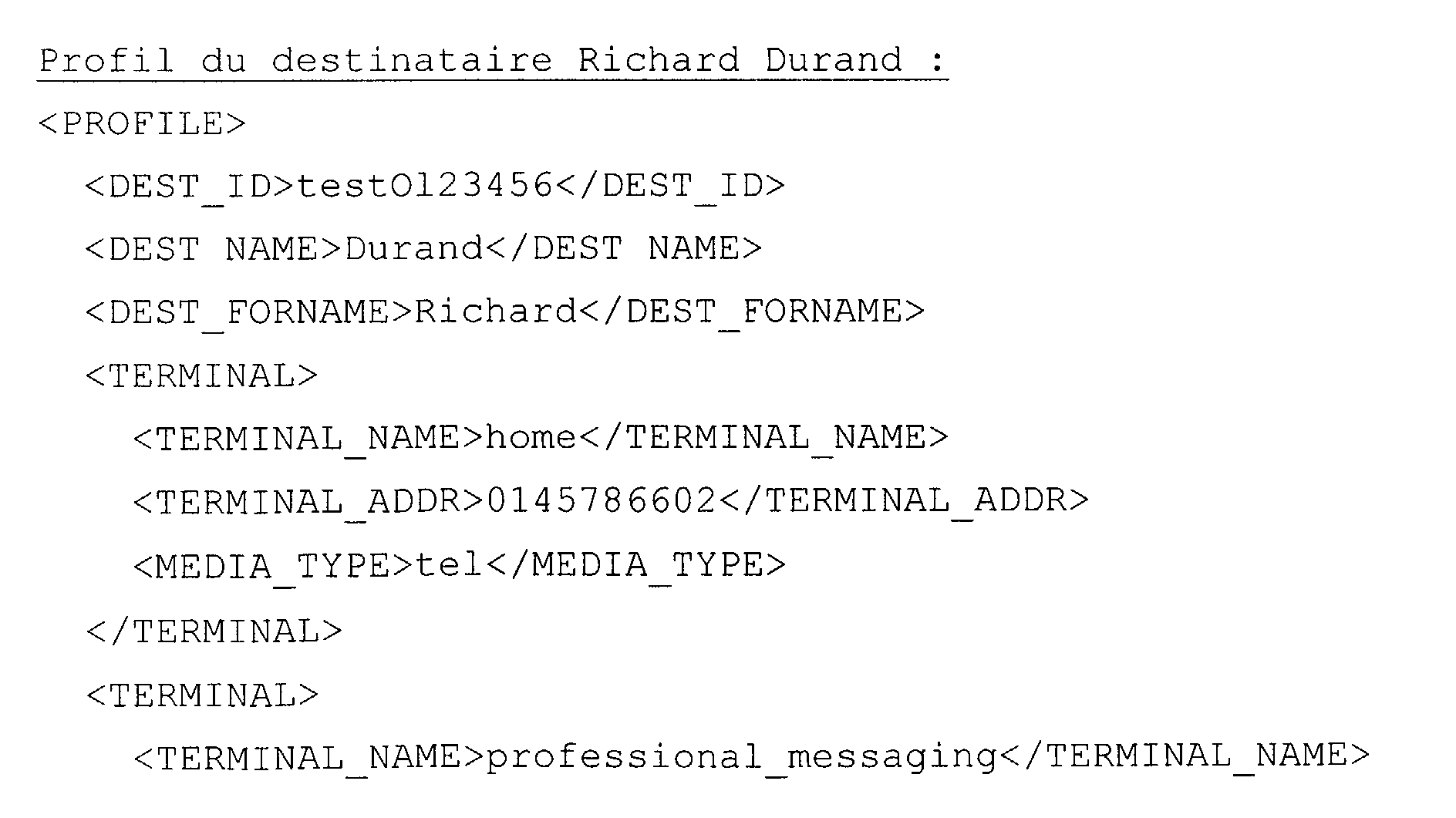
- the memory MI1 contains profiles of several recipients grouping together each of the terminal characteristics of a respective recipient.
- the profile of a recipient associates with the identifier ID of the recipient the list of ITD identifiers of the TD terminals that the recipient has, with for each of them its address ATD and its type TYTD.
- the characteristics of the profile are accessible and modifiable by the recipient.
- An application service can define the terminals to which the recipient wants to broadcast in the RMD multicast request. According to another variant, the application service can simply refer to the recipient, the profile having been previously saved in the memory MI1 via a specific request.
- the REX request refers to the ILD identifier of a predefined list of recipients, by means of a ⁇ PROFILE_LIST> tag including a name as the ILD identifier: ⁇ tag NAME>, or contains the exhaustive list of recipients.
- a list of owned terminal identifiers by a recipient is predefined by the recipient and pre-stored in MIl memory. other terminal identifiers can be added to the list, but will only be usable if they are defined in the recipient's profile and in the access strategy and call strategy MS2 and MS3, see the result strategy module of MS4 broadcast.
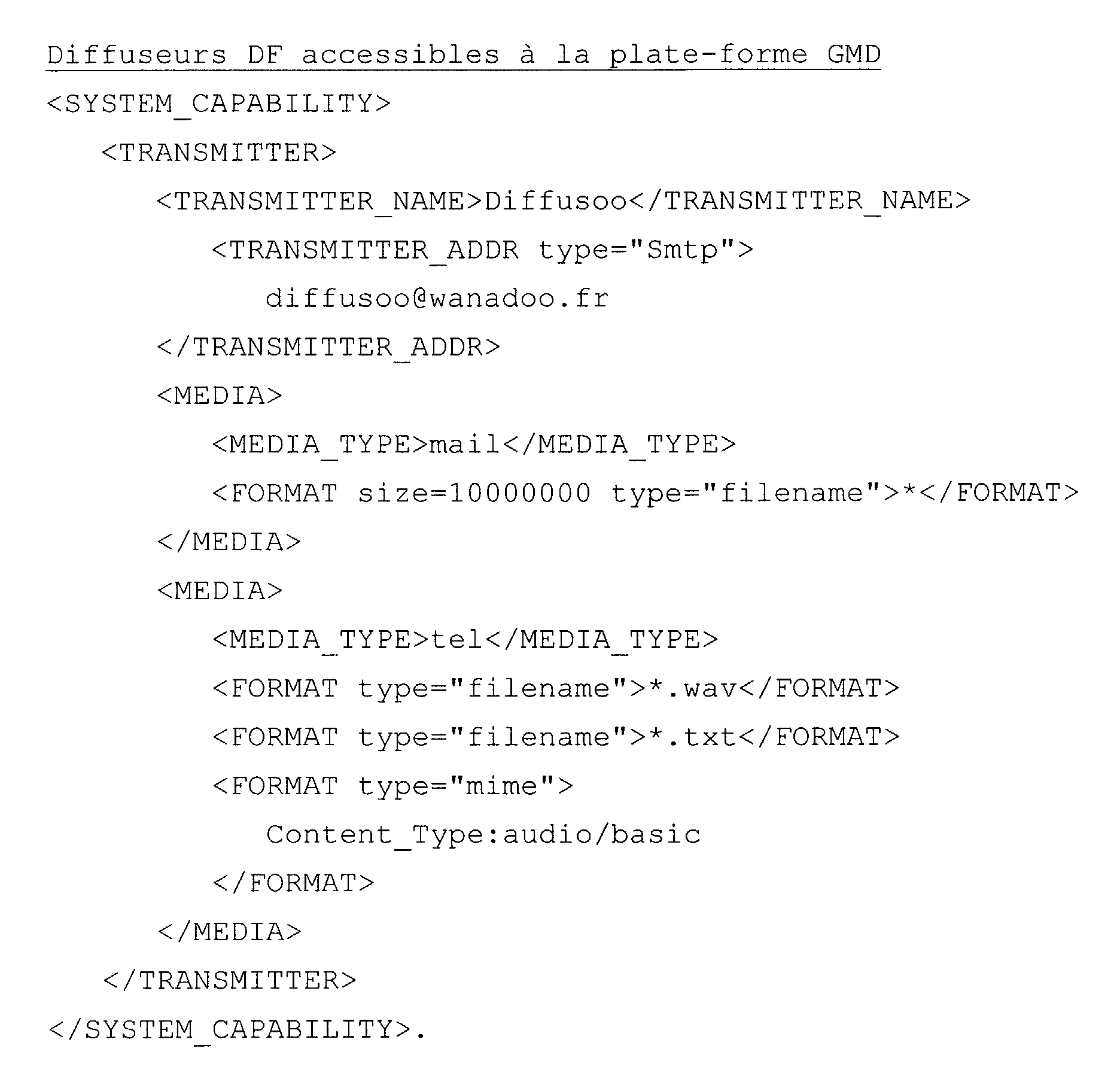
- the memory of characteristics of broadcasters MI2 contains characteristics and parameters of the broadcasters DF which are accessible to the platform (SYSTEM) manager of multicast GMD, and in particular of the characteristics of media supported by the available broadcasters DF.
- a broadcaster supports one or more media, and more than one broadcaster supports one or more common media.
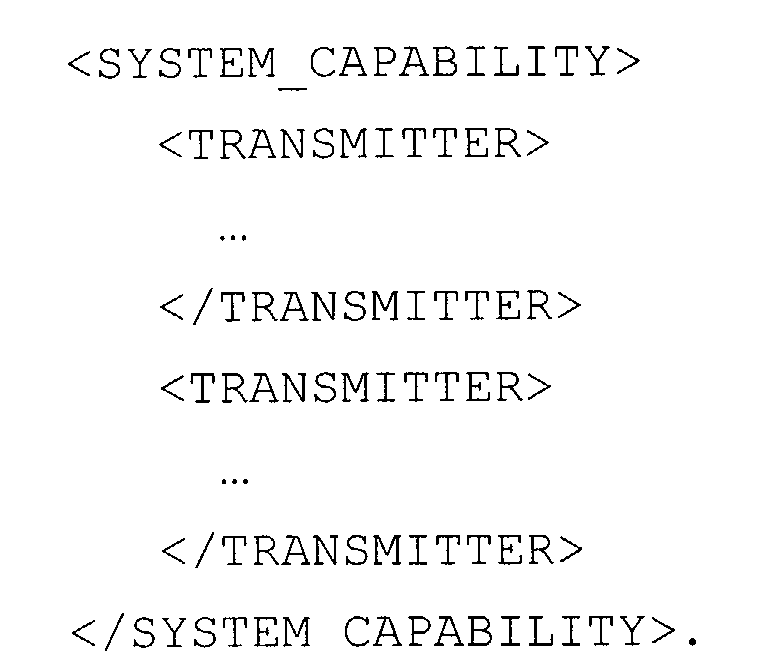
- the MI2 diffusers memory is identified by a ⁇ SYSTEM_CAPABILITY> tag. It includes the list of available broadcasters, with their intrinsic characteristics and parameters defined below in relation to a ⁇ TRANSMITTER> tag.
- the address ⁇ TRANSMITTER_ADDR> includes a standard attribute specifying the access protocol to the broadcaster, which is for example the "smtp" protocol (Simple Mail Transport Protocol), or "http" (HyperText Transfer Protocol).
- the broadcasters' parameters file is downloaded into the MI2 memory of the GMD multicast manager platform.
- the file is used to transmit to a DF broadcaster or to the script activated during the broadcast, depending on the embodiment of the broadcaster, a set of PDF parameters relating to the operation of the broadcaster for this broadcast, to the management of interactions with the recipient (s), or any other specific feature related to the application service.
- PDF settings for broadcasters are similar to DATA data to broadcast, but are intended for DF broadcasters and not for TD terminals of recipients.
- the parameters have no format.
- the CF software tool contains features of format converters available for the platform GMD.
- a format converter is external to the strategy development module and modifies the format of a data item to be broadcast.
- Each converter is encapsulated in a specific software module which dialogues with the ESD strategy development module through a specific interface.
- the call mechanism is based on an HTTP request containing in parameter information necessary for the functioning of the converter.
- the result of the transformation is returned to the flow of elements processed by the ESD module.
- the input and output formats are defined in the same way as the data format ( ⁇ FORMAT> tag), except for the attributes "size” and "transf”, which are not useful here.
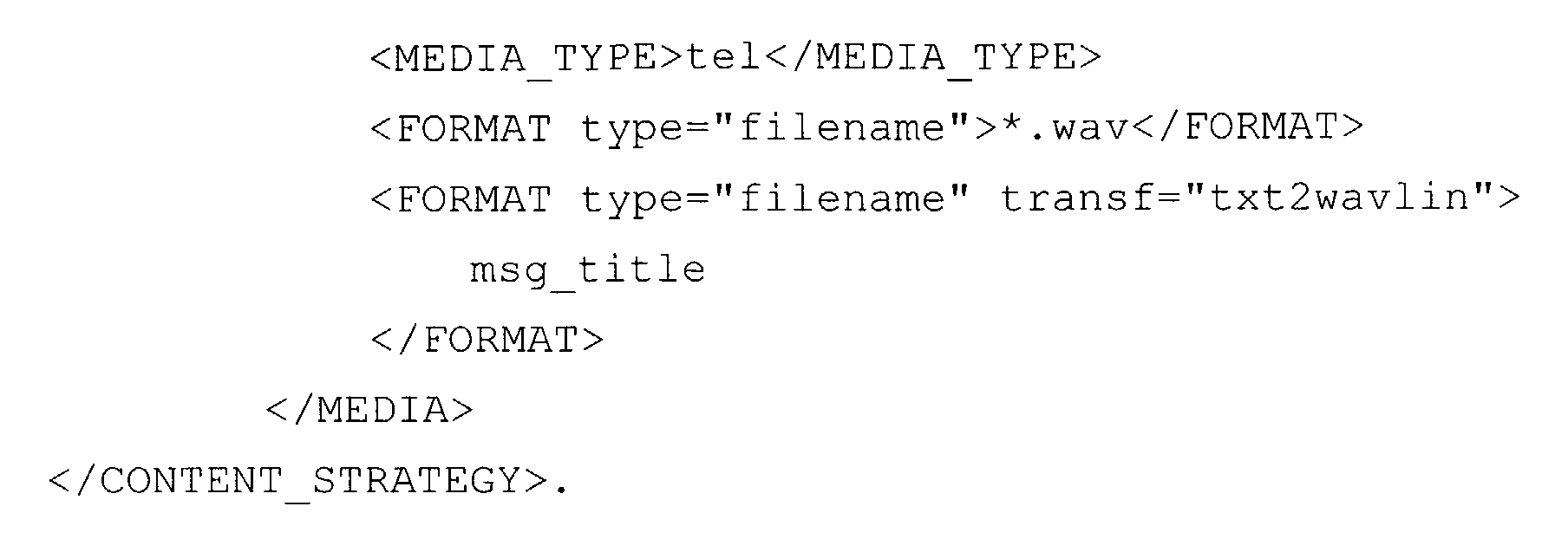
- the content strategy module MS1 contains a content strategy read by the ESD development module and indicating the type or types of media usable for the data received DATA in the REX sender request according to the analysis the format of the data received in order to essentially determine the elements of the RMD multicast request to be broadcast and the format conversions to be carried out.
- the RMD request specifies several elements to broadcast of different natures.
- the ESD module selects in the content strategy the elements compatible with the terminal and the media that will be used to call a recipient of the data. These elements are converted into a format appropriate to the TD media and terminals used.
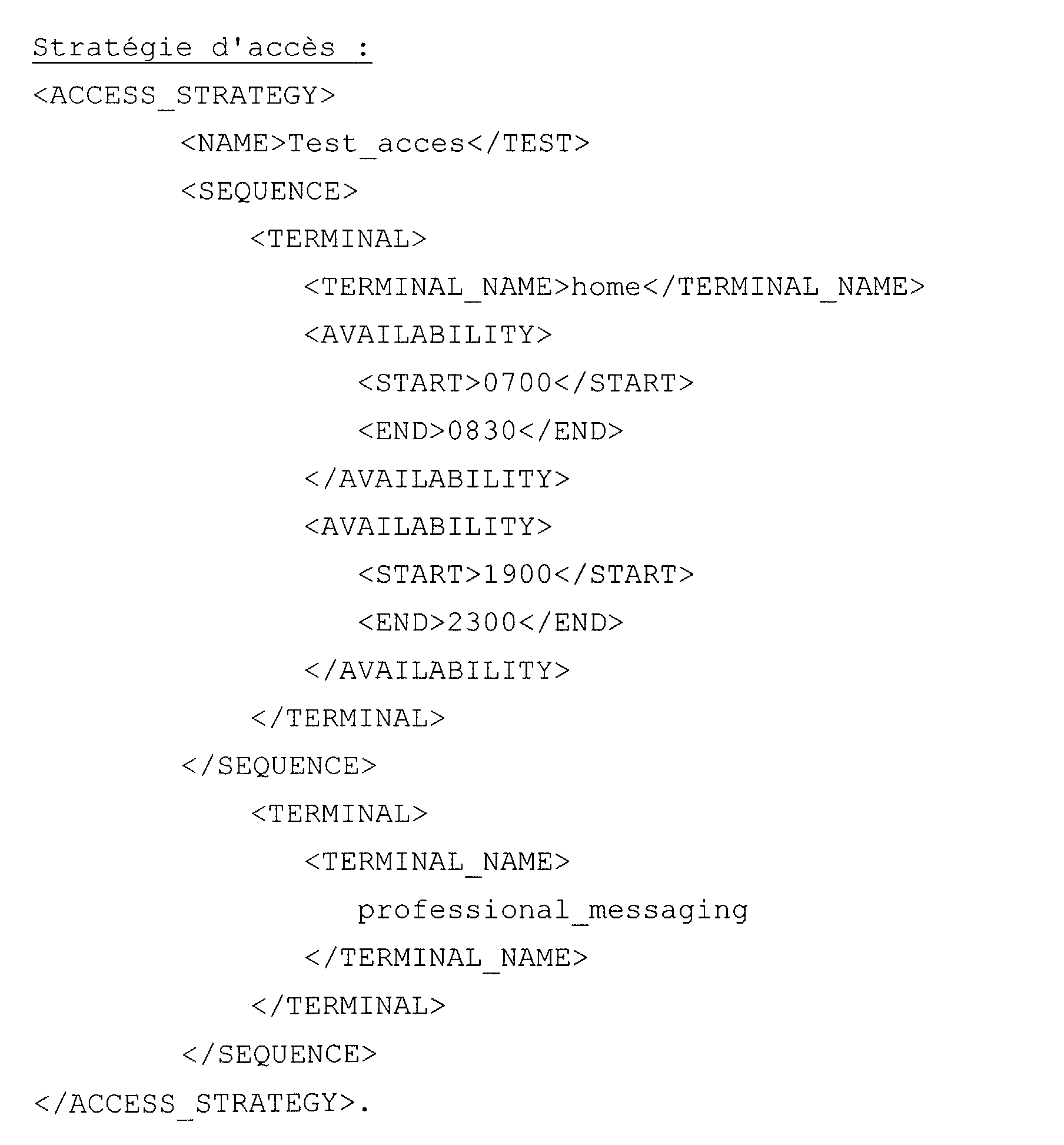
- the access strategy module MS2 contains a respective access strategy for each pair composed of a recipient identifier ID possibly designated via a list identifier ILD and of DATA data to be broadcast to the identified recipient.
- the access strategy designates to the ESD module the ITD identifiers of the terminals to be used for the dissemination of the data, as well as the sequence temporally ordering the calls of the terminals.
- Each recipient has access to the access policies of their terminals in the MS2 module to modify them.
- a personal access strategy exists for a recipient identified in a REX request, it is used primarily by the ESD module; in the case otherwise, the ESD module uses a default policy pre-registered in the MS2 module, for example a "urgent" strategy. Saving a strategy default access involves registering a list respective terminals by default for the recipient.
- ITD identifiers of new terminals not included in the above list are added when defining an access strategy. To be used, the identifiers of these terminals must necessarily also be incorporated into the call strategy and the recipient profile.
- the call strategy module MS3 contains call strategies respectively for recipient and data pairs.
- An appeal strategy determines call characteristics for each of the various terminals TD designated by its ITD identifier in a strategy access for each data received in the REX request.
- the call characteristics of a designated terminal, determined by the calling strategy are for example the IDF identifier of a DF diffuser and having a type TYDF media compatible with the TYTD media type of the designated terminal and therefore of the TYME media type for the DATA data to broadcast to this terminal, a number and a frequency of terminal call attempts, one command execution of remote scripts in the broadcaster, availability time slots, etc.
- the call strategy selects the broadcaster to activate for each designated terminal.
- the parameters or attributes applicable to the designated terminal are function media used to call it. Media applicable to each terminal are described in the profile of the recipient.
- the result strategy module MS4 contains a so-called result strategy mechanism which specifies the aggregation and processing of the results of the multicast by the GMD multicast manager platform.
- This information is the subject of a report transmitted by the platform manager of GMD multicast to application service server SSA client having transmitted the REX request, or by others channels to one or more recipients designated in the REX request, at the end of broadcast, i.e. at the end of broadcast period or when all recipients have been called or as calls from recipients.
- the result can be transmitted to recipients for which there is no profile in the memory MI1, for example the application service server having requested the preparation of the RMD multicast request.
- the fields to be completed under the ⁇ PROFILE> tag are those relating to the address and type of media of each of the designated terminals of a recipient rather than relating to the name and first name of the recipient.
- a so-called global ISTR strategy which includes the various aforementioned strategies of content, access, calling, and result and which is identified by an XML tag ⁇ STRATEGY>:
- the final dissemination strategy comes from the processing of the elements presented in the content, access and appeal strategies.
- the final broadcasting strategy preferably appears as it is in the RMD multicast request and is written in module MS4.
- the method of the invention comprises steps E0 to E9 shown in FIG. 4 to construct a final broadcasting strategy to be incorporated into an RMD multicast request, or in a way analogous to an outcome strategy.
- the GMD multicast manager platform checks the sender's access rights before build the final broadcast strategy and then saves DATA data as XML files, step E0.
- step E1 the module for developing the ESD dissemination strategy extracted from the REX request recipient IDs, or the ILD identifier of a recipient list, so to look for the matching identifiers ID in MI1 memory.
- the ESD module recovers MS1 memory recipient profiles identified by ID identifiers.
- each recipient's profile contains the characteristics of the recipient's TD terminals such as that their ITD identifiers, their ATD addresses, their TYTD media types and their availability ranges.
- the ESD module then retrieves the identifiers existing ISC associated content strategies respectively to the data received DATA and included in the REX request, in step E2.
- the ESD module reads in the module MS1 the type or types of TYME media which are determined in correspondence with ISC identifiers and which will be used respectively for the data to broadcast DATA.
- Step E2 also makes it possible to apply the format conversions if applicable.
- the ESD module compares the types of TYTD media for recipient terminals to media types TYMD for the data received intended respectively for recipients, at step E3. Only identifiers ITD of terminals having at least one type of media TYTD compatible, for example identical to the media type TYME for a given are selected to receive this given. Identifiers of incompatible terminals with data to broadcast for each recipient are rejected.
- step E4 the ESD module searches in the MI2 diffusers memory the IDF identifiers of diffusers with a compatible TYDF media type with a TYME media type for a given.
- the ESD module associates with this data the identifiers of the broadcasters compatible potentials, as previously ITD identifiers of compatible terminals.
- each data are associated the IDF identifiers of compatible broadcasters and characteristics of these such as in particular their ADF addresses, TYDF types of access media and diffuser parameter objects or files as well as transformations to apply.
- the ESD module extracts access strategy and strategy identifiers ISAC and ISAP calls in the REX request, if they exist. If the ISAC and ISAP identifiers are absent in the REX request, the ESD module searches for these identifiers in correspondence with the ID identifiers of recipients identified in step E1, in the modules MS2 and MS3; otherwise, the ESD module applies strategies default access and call, typically by default "Normal".
- step E5 for each recipient couple identified and each DATA data to be broadcast to this recipient, the ESD module designates the identifiers ITD of the terminals to be called according to the access strategy identified ISAC among those selected in step E3 for the given to broadcast.
- the characteristics of the terminals selected such as TYTD media type and range availability read in step E1, are respectively compared to media type and accessibility range of the recipient according to the ISAC access strategy identified in the MS2 module so that the data is not broadcast to a compatible compatible terminal only during common areas at availability beach and beach Accessibility.
- the access strategy contains for the data to broadcast a call sequence to be introduced in the multicast request to successively call the designated terminals of the recipient from the means of associated diffusion respectively.
- the ESD module associates with the ITD identifier of each TD designated terminal of the recipient, the IDF identifier of a DF broadcaster having a type of TYDF media compatible with the type of TYTD media of the terminal, and reads the characteristics of the associated broadcaster, such as scripts and / or parameters in MI2 memory.
- the module ESD plans the designated terminal call procedures by the associated broadcaster, in particular the number of call attempts and their frequency or waiting time between two attempts, and the call periods of the terminal from the temporal intersection between the validity period of the call strategy and the temporal intersection of the availability ranges and accessibility ranges determined in step previous E5. Previous features included in the call strategy will be introduced in the RMD multicast request.
- the ESD module aggregates the information from the previous steps E4, E5 and E6. In particular, it determines the designated terminals of each recipient who are to be called to receive a data intended for the recipient and therefore the terminals compatible by type of media TYME for the data, and the broadcasters associated with the designated terminals. The module ESD also plans call attempts from terminals for each associated broadcaster.
- step E8 format conversions are read via the CF software tool by the ESD module to update suitable formats respectively the DATA data to broadcast, when format conversion is required in the identified content strategy. Diffusers ultimately retained and the rules to be applied being known, conversions can then be made for broadcasting.
- the ESD module develops a final strategy file in XML format according to elements from the previous steps.
- An interface protocol adaptation (figure 2) in the platform GMD splits RMD multicast request into various requests directed respectively to DF broadcasters and each containing the call sequences of the terminals respective designated to receive data via the associated diffuser.
- the module MS4 stores this information for future use as we receive the broadcast results transmitted by broadcasters.
- the XML pages of the essential objects handled and of applicable policy rules are defined below following a REX request issued by an SSA server.
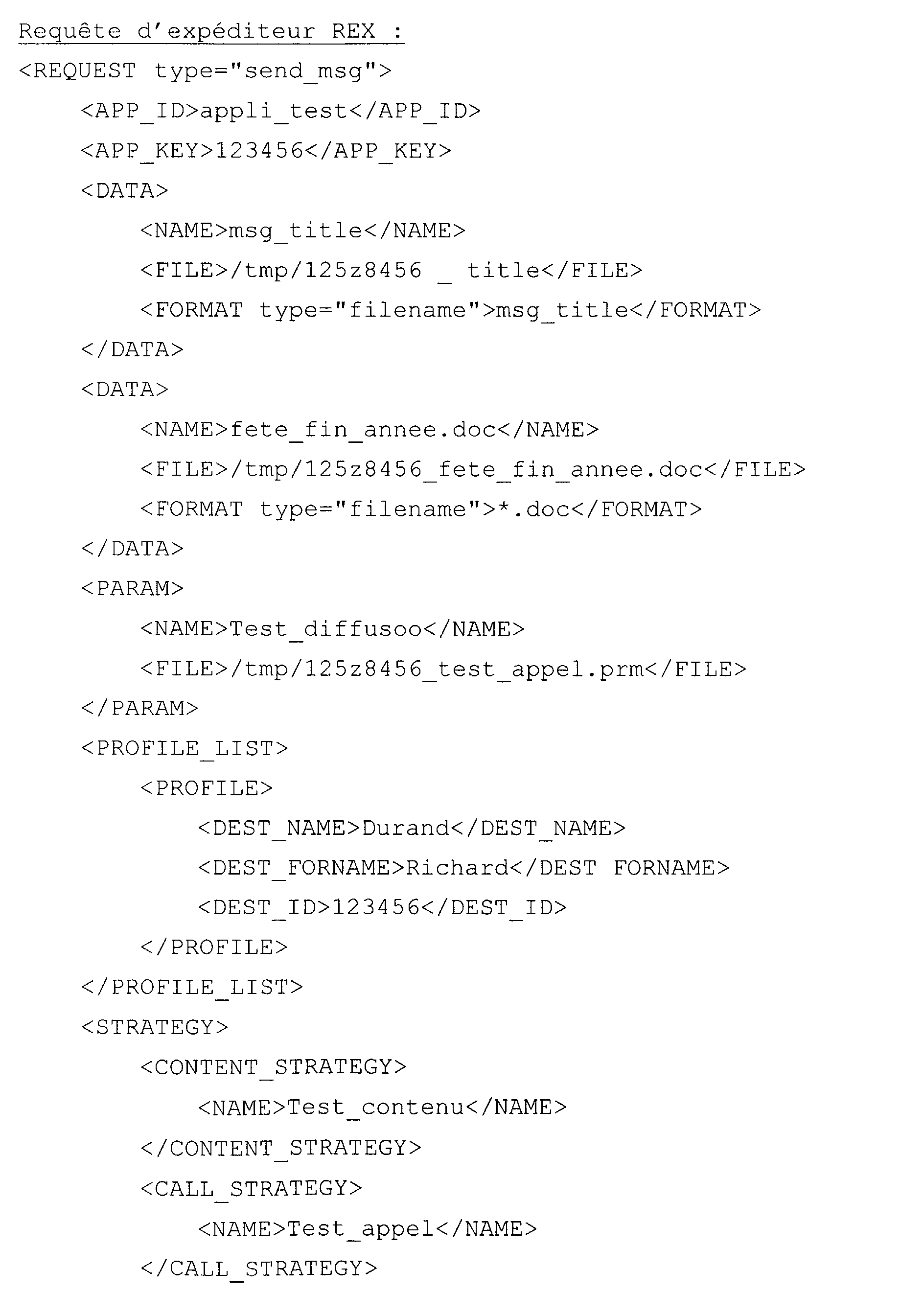
- the sender requests the sending of a DATA data document "fete_fin_annee.doc" to a friend Richard Durand. This friend is equipped with professional written messaging and a telephone at his home.
- the sender wishes that the document be saved in the professional written messaging of the recipient friend, and that a voice message indicating the subject of the document reach the telephone of the domicile of the recipient friend; it is considered that if the recipient friend is not at home, his personal voicemail will take care of recording the message.
- the XML pages used by the ESD strategy development module according to this example are as follows.
Landscapes
- Engineering & Computer Science (AREA)
- Computer Networks & Wireless Communication (AREA)
- Signal Processing (AREA)
- Mobile Radio Communication Systems (AREA)
- Data Exchanges In Wide-Area Networks (AREA)
- Communication Control (AREA)
- Telephonic Communication Services (AREA)
Abstract
Description
- détermination pour la donnée de types de média à travers lesquels la donnée est à transmettre aux terminaux du destinataire,
- sélection des identificateurs des terminaux ayant des types de média à travers lesquels les terminaux de destinataire sont susceptibles de recevoir la donnée et qui sont compatibles avec l'un des types de média pour la donnée,
- sélection dans une deuxième mémoire des identificateurs et de caractéristiques de moyens de diffusion ayant chacun un type de média compatible avec au moins l'un des types de média pour la donnée,
- association de l'identificateur de chacun des terminaux sélectionnés à l'identificateur d'un moyen de diffusion sélectionné ayant un type de média compatible avec celui du terminal, et
- établissement d'une requête de multidiffusion comprenant au moins une séquence d'appel pour appeler les terminaux sélectionnés du destinataire respectivement depuis les moyens de diffusion associés, la séquence d'appel contenant les caractéristiques de chaque terminal sélectionné à appeler, les caractéristiques du moyen de diffusion associé à chaque terminal sélectionné et la donnée à diffuser.
- la figure 1 est un bloc-diagramme d'un système de multidiffusion de données selon l'invention ;
- la figure 2 est un bloc-diagramme schématique d'un serveur gestionnaire de multidiffusion selon l'invention
- la figure 3 est un bloc-diagramme de module logiciel dans le serveur gestionnaire de multidiffusion propres à élaborer une stratégie de diffusion ; et
- la figure 4 est un algorithme d'étapes principales d'un procédé pour diffuser des données vers des terminaux de destinataire mis en oeuvre dans le serveur gestionnaire de multidiffusion.
- le format proprement dit qui est le contenu de la balise <FORMAT> ;
- un attribut "type" qui est un complément au format précisant s'il s'agit d'un type MIME (Multipurpose Internet Mail Extensions) ou non ;
- un attribut "size" qui est une taille maximale en octets pouvant être prise en compte dans le format ;
- un attribut "transf" qui est une éventuelle règle de transformation à appliquer.
- mime : tout type MIME ;
- filename : tout type de donnée identifiée par son nom et/ou son extension.

- donnée DATA à diffuser,
- destinataire, et liste de destinataires,
- terminal de destinataire TD,
- diffuseur DF,
- paramètres des diffuseurs,
- média (canal de transmission),
- convertisseur de format,
- plate-forme gestionnaire multidiffusion GMD.
- stratégie de contenu,
- stratégie d'accès,
- stratégie d'appel,
- stratégie de résultat de diffusion.
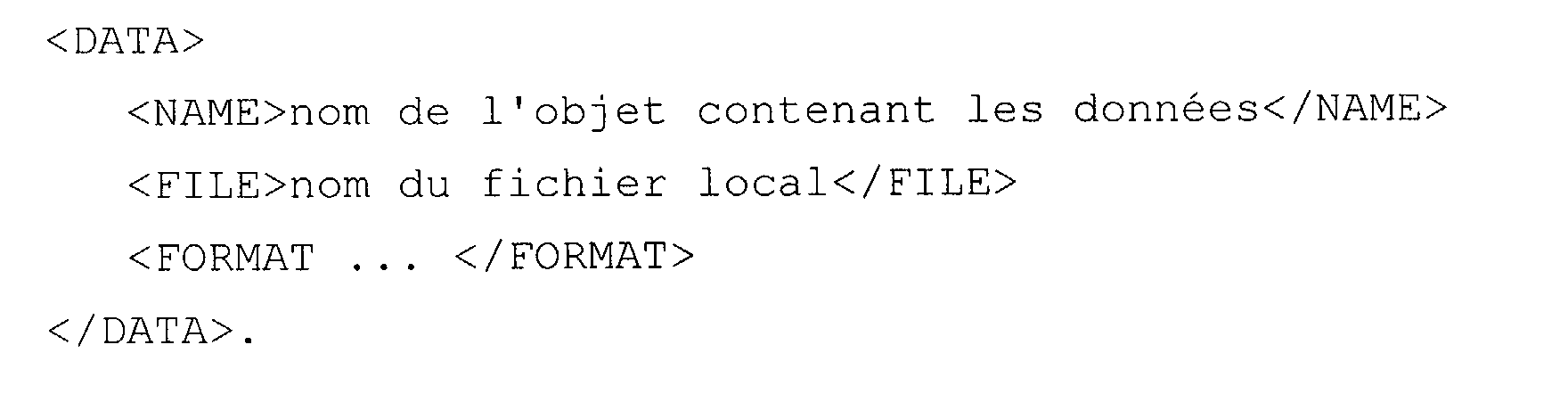
- leur nom : balise <NAME> ;
- le nom du fichier local contenant les données : balise <FILE> ;
- son format: balise <FORMAT>.
- un identificateur unique ID : balise <DEST_ID> ;
- un nom : balise <DEST NAME> ;
- un prénom : balise <DEST_FORNAME> ;
- la liste des identificateurs ITD des terminaux TD
: balise <TERMINAL>, éventuellement avec des plages
horaires de disponibilité définies ci-après par la balise
<AVAILABILITY>.


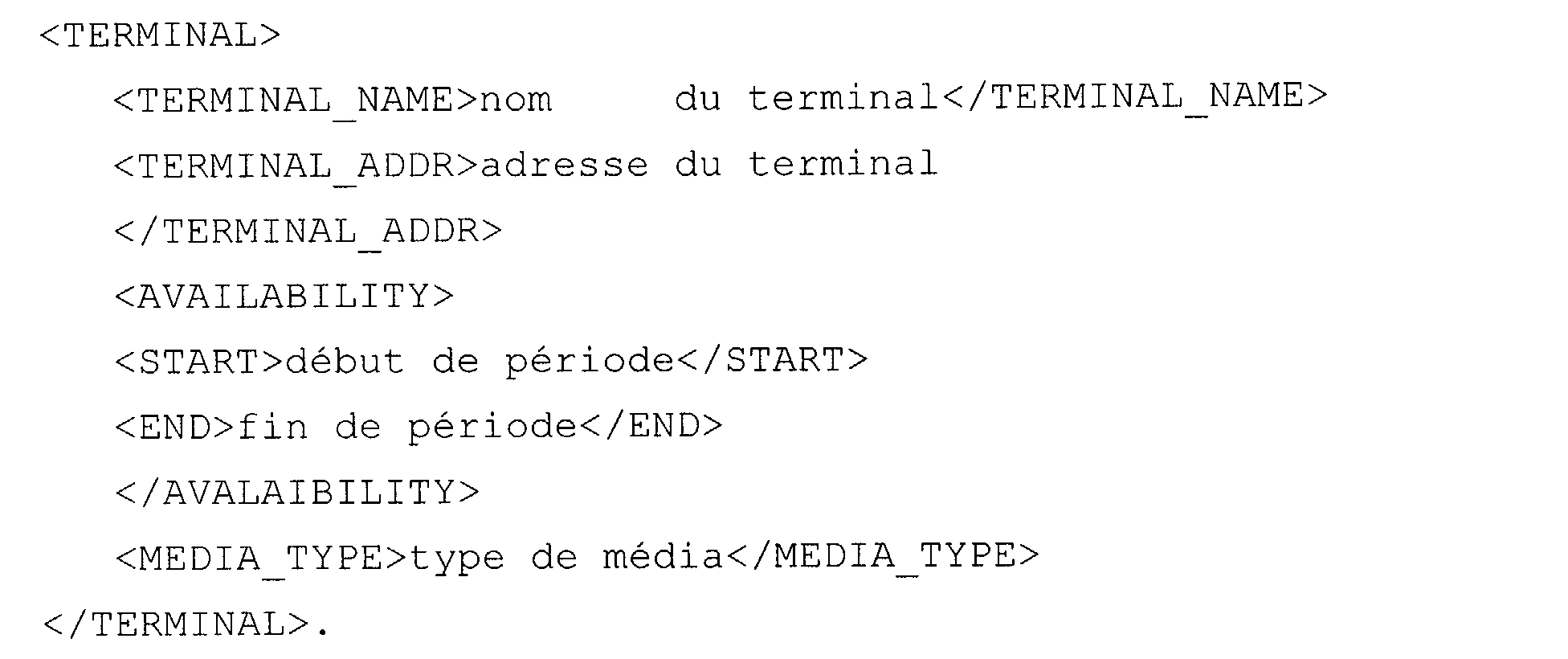
- son nom en tant qu'identificateur de terminal ITD : balise <TERMINAL_NAME> ;
- son adresse ATD : balise <TERMINAL_ADDR> ;
- sa ou ses plages horaires de disponibilité : balises <AVAILABILITY>, exprimées en heure et minute au format hhmm ;
- les types de média TYTD permettant d'accéder au terminal, définis par la balise précitée <MEDIA_TYPE>.
- son type TYDF: balise <MEDIA_TYPE> ;
- les types d'information que le média est capable de gérer : balises <FORMAT> définies ci-dessus.
- tel : téléphone fixe ou mobile ;
- sms : messages courts ;
- fax : télécopie ;
- mail : messagerie écrite ;
- voicemail : messagerie vocale ;
- web : site web (serveur http).

- le nom du diffuseur en tant qu'identificateur IDF : balise <TRANSMITTER_NAME> ;
- l'adresse ADF du diffuseur : balise <TRANSMITTER_ADDR> ;
- la liste des médias TYDF que le diffuseur est capable de traiter : balises <MEDIA> définies ci-dessus ;
- un ou des scripts activés par la plate-forme gestionnaire de multidiffusion GMD et exécutés dans le diffuseur : balise <SCRIPT> ;
- le ou les objets contenant les paramètres passés au diffuseur lors de la demande de diffusion : balise <PARAM> ; ou
- un ou des fichiers locaux contenus dans un espace-mémoire de la plate-forme GMD et contenant les paramètres passés au diffuseur lors de la demande de diffusion : balise <PARAM_FILE>.

- leur nom : balise <NAME> ;
- le nom du fichier local contenant les paramètres : balise <PARAM_FILE>.

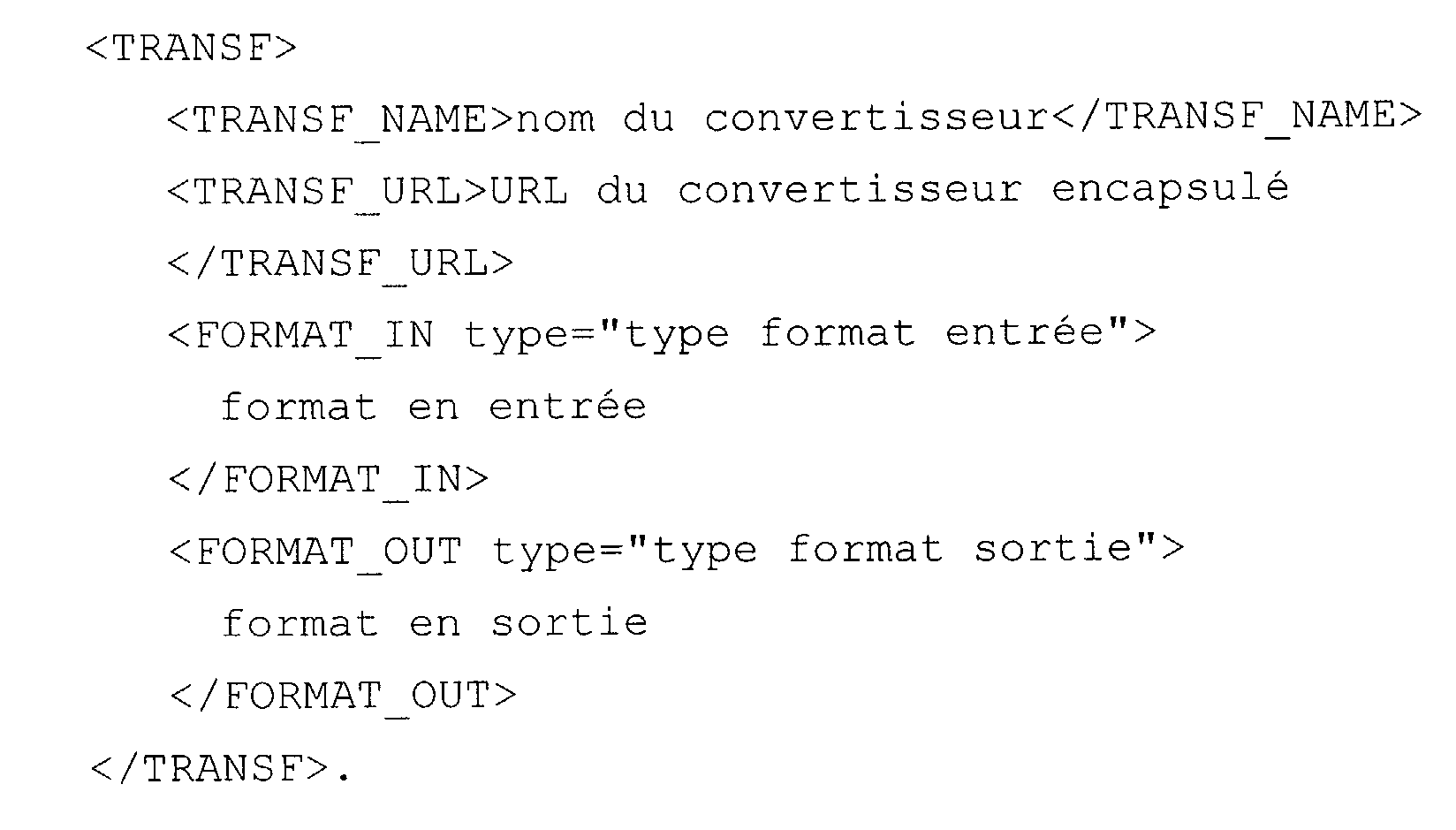
- son nom : balise <TRANSF NAME> ;
- son adresse : balise <TRANSF_URL> ; l'adresse URL (Uniform Resource Locator) contient d'éventuels paramètres à passer au module logiciel de conversion ;
- ses formats en entrée : balises <FORMAT_IN> ;
- son format en sortie : balise <FORMAT_OUT>.
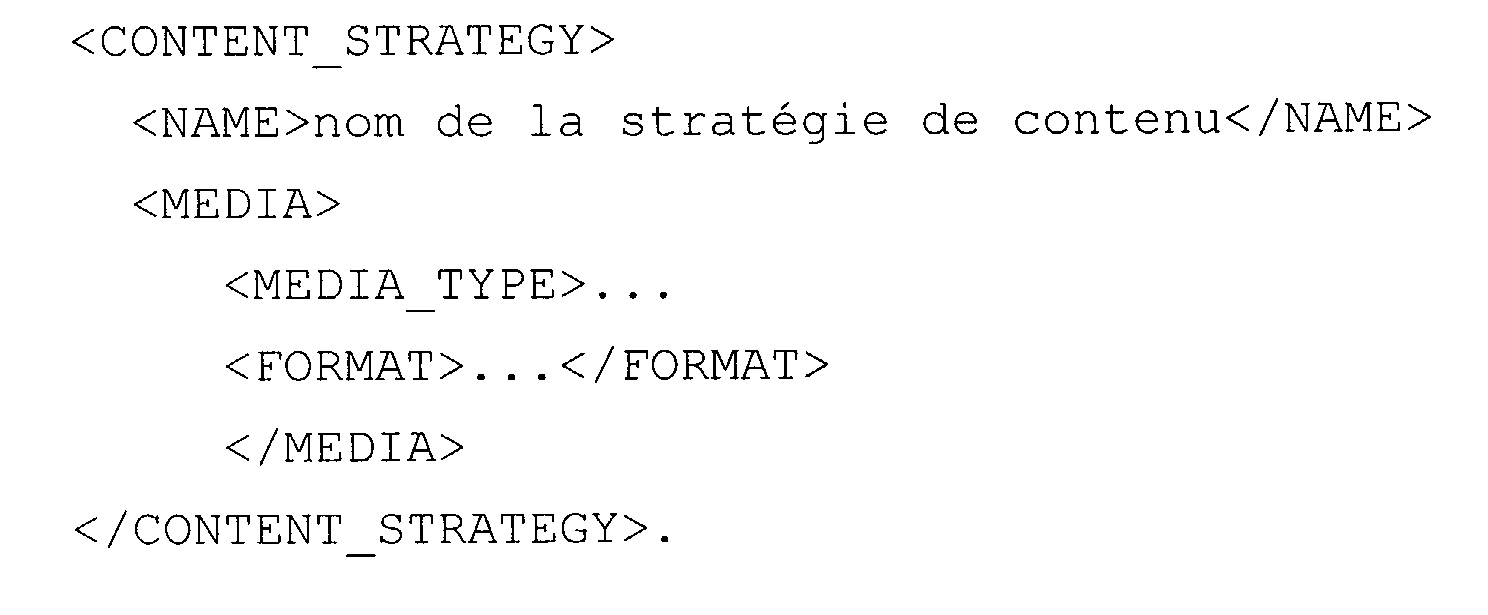
- un nom en tant qu'identificateur ISC : balise <NAME> ;
- une liste des médias traités et particulièrement des
types de média TYME : balises <MEDIA>, avec pour chacun
d'eux les formats de données gérés et les conversions de
format éventuelles.
- un nom en tant qu'identificateur ISAC : balise <NAME> ;
- l'identificateur ID du destinataire à qui elle s'applique : balise <DEST_ID> ;
- une suite de séquences d'appel définies par une balise <SEQUENCE> pour les ensembles de terminaux désignés des destinataires à appeler vers lesquels des données sont à transmettre respectivement ; toutes les séquences sont activées simultanément ; une séquence pour un destinataire est terminée lorsque l'un des terminaux spécifiés du destinataire a répondu à l'appel, ou lorsque toutes les tentatives d'appel de tous les terminaux de la séquence ont échoué ;
- pour chaque séquence, la liste des terminaux
désignés à appeler successivement depuis les diffuseurs
respectivement associés aux terminaux, définie par des
balises <TERMINAL>, et pour chaque terminal les plages
horaires de disponibilité (balise <AVAILABILITY>) à
comparer à des plages d'accessibilité lues dans le profil
du destinataire dans la mémoire MI1, et éventuellement
les types de média TYTD qui sont utilisables par les
terminaux de la séquence et qui peuvent être par défaut
tous les types disponibles.

- un nom en tant qu'identificateur ISAP : balise <NAME> ;
- des objets de paramétrage des diffuseurs : balises <PARAM>, avec leurs noms et le fichier local contenant les paramètres ;
- une période de validité de la diffusion et/ou de la stratégie : balises <CALL_PERIOD> et <START>, <END> ; les dates sont exprimées soit en relatif par rapport à la date de réception de la requête (+h.mn), soit en absolu (année, mois, jour, heure, minute : aaaammjjhhmm) ;
- une liste de procédures d'appel pour chaque terminal : balises <TERMINAL_CALL> ;
- le terminal désigné concerné : balise <TERMINAL>, avec le type de média utilisé ;
- le diffuseur associé utilisé : balise <TRANSMITTER> ;
- le nombre de tentatives d'appel du terminal : balise <TRY> ;
- le temps d'attente entre deux tentatives d'appel
successives : balise <WAIT> ; ce temps est exprimé en
h.mn.


- un état du traitement de la requête de multidiffusion RMD par chaque diffuseur DF associé à un terminal désigné d'un destinataire identifié, précisant si le diffuseur a été appelé par la plate-forme GMD ; les valeurs possibles sont : "en attente", "en cours", "terminé" ;
- un état de la diffusion indiquant si un terminal désigné du destinataire a été appelé par le diffuseur associé et par conséquent si une donnée a été diffusée par le diffuseur au terminal désigné ; les valeurs possibles sont : "en attente", "non diffusé", "diffusé" ; l'état "non diffusé" est considéré comme un échec et conduit à la poursuite de la séquence d'appel par un appel du terminal désigné suivant dans la procédure d'appel du destinataire ; l'état "diffusé" est considéré comme la réussite de la diffusion de données à un terminal appelé du destinataire ayant par exemple retransmis un acquittement au diffuseur et provoque l'arrêt de la séquence ;
- une cause de la non-diffusion, dans le cas où l'état de la diffusion est "non diffusé" ; cette valeur est seulement stockée dans la module MS4.
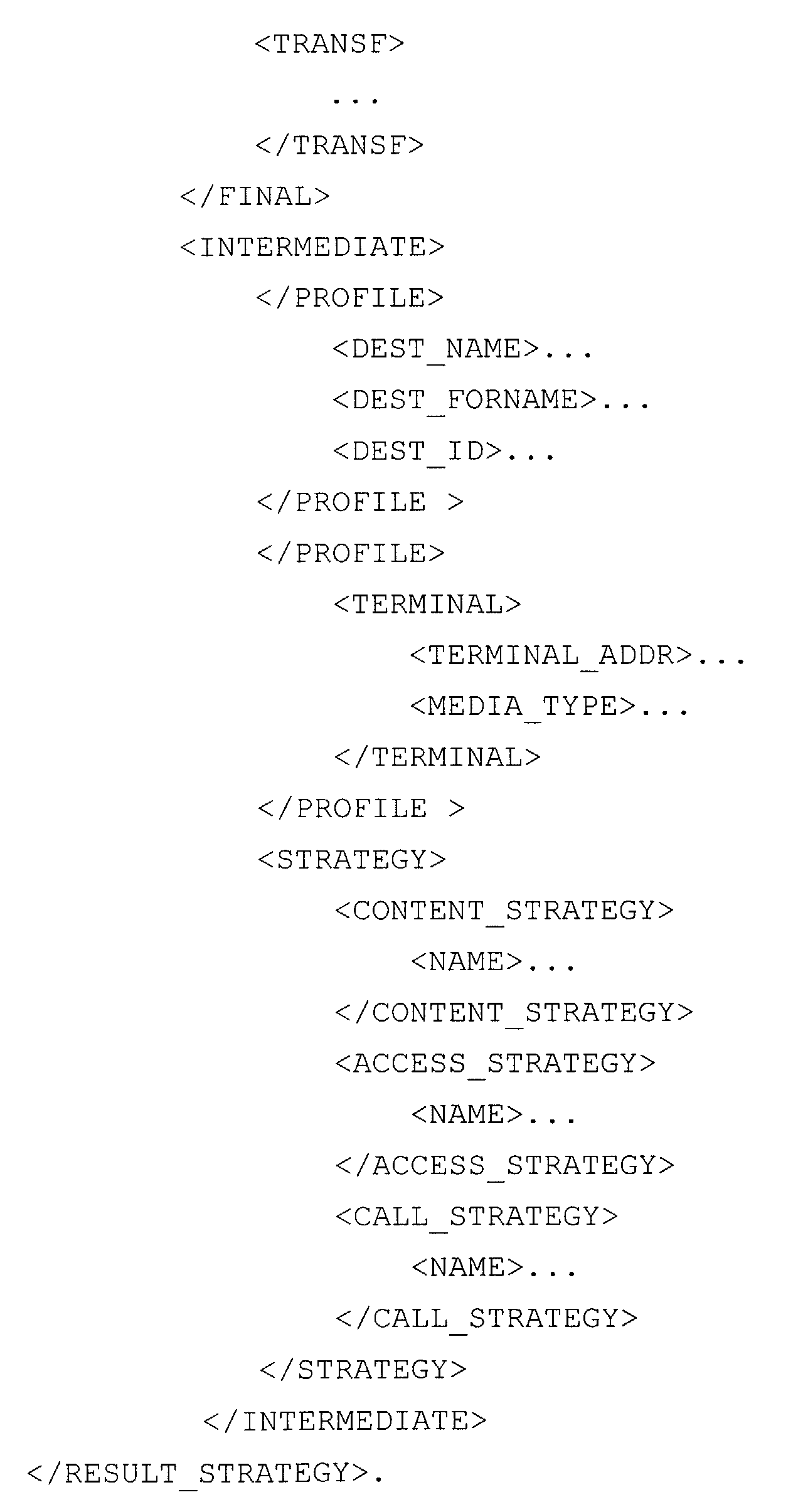
- un nom : balise <NAME> ;
- des informations relatives à un mode d'envoi pour un bilan final de la diffusion : balise <FINAL>, avec un attribut "level" indiquant le niveau de détail souhaité. Deux niveaux de détails synthétique et détaillé sont possibles : "synthetic" et "detailed" ;
- des informations relatives à un mode d'envoi pour des résultats intermédiaires au fur et à mesure des appels des destinataires désignés : balise <INTERMEDIATE> ;
- la liste des destinataires à qui doivent être transmis les résultats : balise <PROFILE_LIST>,
- ou bien la suite des destinataires : balises <PROFILE>,
- la stratégie à appliquer pour cet envoi : balise <STRATEGY>, dans ce cas la notion de stratégie de résultat n'étant plus applicable,
- ou bien les différentes stratégies de contenu, d'accès et d'appel,
- les éventuels convertisseurs nécessaires : balises <TRANSF>.


- un identificateur unique : balise <ID> ;
- une suite de séquences d'appel à exécuter pour les destinataires désignés dans la requête reçue REX : balises <SEQUENCE>, avec pour chacune d'entr'elles la liste des appels des terminaux du destinataire respectif à réaliser : balises <CALL> ;
- les caractéristiques de chaque terminal désigné à appeler : balise <TERMINAL>, et en outre le type de média adéquat TYTD,
- les caractéristiques du diffuseur DF à utiliser pour transmettre les données au terminal désigné à appeler : balise <TRANSMITTER>, et le cas échéant le script à activer dans le diffuseur et le fichier de paramètres du diffuseur à utiliser,
- la donnée DATA à diffuser, convertie le cas échéant au format adéquat : balise <DATA>,
- des informations d'horodatage incluant la date et
l'heure de chaque tentative d'appel : balise <TIME>.








Claims (14)
- Procédé pour diffuser une donnée (DATA) vers des terminaux (TD) d'un destinataire à travers des moyens de diffusion (DF) en réponse à une requête d'expéditeur (REX) contenant la donnée et un identificateur (ID) du destinataire, des identificateurs (ITD) et des caractéristiques de terminaux du destinataire étant recherchés (E1) en correspondance avec l'identificateur de destinataire (ID) dans une première mémoire (MI1), caractérisé par les étapes suivantes :détermination (E2) pour la donnée de types de média (TYME) à travers lesquels la donnée est à transmettre aux terminaux (TD) du destinataire,sélection (E3) des identificateurs des terminaux ayant des types de média (TYTD) à travers lesquels les terminaux de destinataire sont susceptibles de recevoir la donnée et qui sont compatibles avec l'un des types de média (TYME) pour la donnée (DATA),sélection (E4) dans une deuxième mémoire (MI2) des identificateurs (IDF) et de caractéristiques de moyens de diffusion (DF) ayant chacun un type de média (TYDF) compatible avec au moins l'un des types de média (TYME) pour la donnée (DATA),association (E7) de l'identificateur (ITD) de chacun des terminaux sélectionnés (TD) à l'identificateur (IDF) d'un moyen de diffusion sélectionné (DF) ayant un type de média (TYDF) compatible avec celui (TYTD) du terminal, etétablissement (E9) d'une requête de multidiffusion (RMD) comprenant au moins une séquence d'appel pour appeler les terminaux sélectionnés du destinataire respectivement depuis les moyens de diffusion associés, la séquence d'appel contenant les caractéristiques de chaque terminal sélectionné à appeler, les caractéristiques du moyen de diffusion associé à chaque terminal sélectionné et la donnée à diffuser.
- Procédé conforme à la revendication 1, selon lequel les types de média (TYME) pour la donnée sont déterminés selon une stratégie de contenu (ISC) identifiée dans la requête d'expéditeur (REX).
- Procédé conforme à la revendication 1 ou 2, comprenant une désignation (E5) d'identificateurs sélectionnés (ITD) de terminaux selon une stratégie d'accès (ISAC) identifiée dans la requête d'expédition (REX) ou par défaut pour le destinataire et la donnée.
- Procédé conforme à la revendication 3, selon lequel les caractéristiques d'un terminal dont l'identificateur (ITD) est désigné contient une plage de disponibilité qui est comparée à une plage d'accessibilité du destinataire selon la stratégie d'accès identifiée afin que la donnée ne soit diffusée au terminal que pendant des parties communes aux plages.
- Procédé conforme à la revendication 3 ou 4, selon lequel la stratégie d'accès (ISAC) contient la séquence d'appel à introduire dans la requête de multidiffusion (RMD) pour appeler successivement les terminaux désignés du destinataire depuis les moyens de diffusion associés respectivement.
- Procédé conforme à l'une quelconque des revendications 3 à 5, selon lequel l'association (E6) de l'identificateur (ITD) d'un terminal désigné à l'identificateur (IDF) d'un moyen de diffusion (DF) ayant un type de média (TYDF) compatible avec celui (TYTD) du terminal désigné est déterminée par une stratégie d'appel (ISAP) identifiée dans la requête d'expéditeur (REX) ou par défaut pour le destinataire et la donnée.
- Procédé conforme à la revendication 6, selon lequel la stratégie d'appel (ISAP) comprend un nombre et une fréquence de tentatives d'appel de chaque terminal désigné et des périodes d'appel de chaque terminal, à introduire dans la requête de multidiffusion (RMD).
- Procédé conforme à l'une quelconque des revendications 1 à 7, comprenant une conversion de format (E8) de la donnée avant l'établissement de la requête de multidiffusion (RMD).
- Procédé conforme à l'une quelconque des revendications 1 à 8, selon lequel la donnée est diffusée vers plusieurs destinataires ayant chacun des terminaux respectifs, la requête d'expéditeur (REX) contient en outre des identificateurs (ID) des destinataires ou l'identificateur d'une liste des destinataires identifiables dans la première mémoire (MI1), et la requête de multidiffusion (RMD) contient en outre plusieurs séquences d'appel de terminaux sélectionnés respectivement pour les destinataires.
- Procédé conforme à la revendication 9, selon lequel plusieurs données sont diffusées respectivement vers les destinataires, la séquence d'appel pour un destinataire dans la requête de multidiffusion (RMD) contenant en outre la donnée à diffuser vers les terminaux sélectionnés du destinataire.
- Procédé conforme à l'une quelconque des revendications 1 à 10, utilisant le langage de programmation XML.
- Procédé conforme à l'une quelconque des revendications 1 à 11, mis en oeuvre dans une plate-forme spécifique (GMD) contenant les première et deuxième mémoires (MI1, MI2) et reliée par un réseau de paquets (RP) à des serveurs de service applicatif (SSA) émettant des requêtes d'expéditeurs (REX) et aux moyens de diffusion (DF).
- Procédé conforme à l'une quelconque des revendications 1 à 12, selon lequel la plate-forme (GMD) reçoit un résultat de diffusion depuis chaque moyen de diffusion (DF) associé à un terminal sélectionné (TD) pour indiquer si le moyen de diffusion a été appelé par la plate-forme et si une donnée a été diffusée par le moyen de diffusion vers le terminal sélectionné.
- Procédé conforme à l'une quelconque des revendications 1 à 13, comprenant un traitement de résultats de diffusion transmis par les moyens de diffusion (DF) à la plate-forme (GMD) selon une stratégie de résultat.
Applications Claiming Priority (2)
| Application Number | Priority Date | Filing Date | Title |
|---|---|---|---|
| FR0206456 | 2002-05-27 | ||
| FR0206456A FR2840144A1 (fr) | 2002-05-27 | 2002-05-27 | Strategie de diffusion de donnees vers des terminaux de destinataires |
Publications (2)
| Publication Number | Publication Date |
|---|---|
| EP1367786A1 true EP1367786A1 (fr) | 2003-12-03 |
| EP1367786B1 EP1367786B1 (fr) | 2006-04-05 |
Family
ID=29415122
Family Applications (1)
| Application Number | Title | Priority Date | Filing Date |
|---|---|---|---|
| EP03291048A Expired - Lifetime EP1367786B1 (fr) | 2002-05-27 | 2003-04-30 | Procédé et dispositif de diffusion de données vers des terminaux différents |
Country Status (5)
| Country | Link |
|---|---|
| EP (1) | EP1367786B1 (fr) |
| AT (1) | ATE322785T1 (fr) |
| DE (1) | DE60304391T2 (fr) |
| ES (1) | ES2259131T3 (fr) |
| FR (1) | FR2840144A1 (fr) |
Cited By (1)
| Publication number | Priority date | Publication date | Assignee | Title |
|---|---|---|---|---|
| US11625751B2 (en) * | 2020-05-26 | 2023-04-11 | Twilio Inc. | Message-transmittal strategy optimization |
Families Citing this family (1)
| Publication number | Priority date | Publication date | Assignee | Title |
|---|---|---|---|---|
| FR2887388B1 (fr) * | 2005-06-16 | 2007-09-21 | France Telecom | Preparation de strategie de diffusion de message depuis un terminal dans une plate-forme |
Citations (3)
| Publication number | Priority date | Publication date | Assignee | Title |
|---|---|---|---|---|
| US5872926A (en) * | 1996-05-31 | 1999-02-16 | Adaptive Micro Systems, Inc. | Integrated message system |
| WO2001058172A2 (fr) * | 2000-02-07 | 2001-08-09 | Eddie Aronovich | Serveur et procede d'acheminement de communication |
| GB2366032A (en) * | 2000-02-24 | 2002-02-27 | Ibm | Method and apparatus for providing a scalable pervasive notification service |
-
2002
- 2002-05-27 FR FR0206456A patent/FR2840144A1/fr active Pending
-
2003
- 2003-04-30 EP EP03291048A patent/EP1367786B1/fr not_active Expired - Lifetime
- 2003-04-30 DE DE60304391T patent/DE60304391T2/de not_active Expired - Lifetime
- 2003-04-30 ES ES03291048T patent/ES2259131T3/es not_active Expired - Lifetime
- 2003-04-30 AT AT03291048T patent/ATE322785T1/de not_active IP Right Cessation
Patent Citations (3)
| Publication number | Priority date | Publication date | Assignee | Title |
|---|---|---|---|---|
| US5872926A (en) * | 1996-05-31 | 1999-02-16 | Adaptive Micro Systems, Inc. | Integrated message system |
| WO2001058172A2 (fr) * | 2000-02-07 | 2001-08-09 | Eddie Aronovich | Serveur et procede d'acheminement de communication |
| GB2366032A (en) * | 2000-02-24 | 2002-02-27 | Ibm | Method and apparatus for providing a scalable pervasive notification service |
Cited By (2)
| Publication number | Priority date | Publication date | Assignee | Title |
|---|---|---|---|---|
| US11625751B2 (en) * | 2020-05-26 | 2023-04-11 | Twilio Inc. | Message-transmittal strategy optimization |
| US11720919B2 (en) | 2020-05-26 | 2023-08-08 | Twilio Inc. | Message-transmittal strategy optimization |
Also Published As
| Publication number | Publication date |
|---|---|
| FR2840144A1 (fr) | 2003-11-28 |
| ES2259131T3 (es) | 2006-09-16 |
| DE60304391D1 (de) | 2006-05-18 |
| ATE322785T1 (de) | 2006-04-15 |
| EP1367786B1 (fr) | 2006-04-05 |
| DE60304391T2 (de) | 2007-02-01 |
Similar Documents
| Publication | Publication Date | Title |
|---|---|---|
| US11445033B2 (en) | Viral engine for network deployment | |
| EP1406430B1 (fr) | Procédé de messagerie vocale instantanée et dispositif de mise en oeuvre d'un tel procédé | |
| US6779022B1 (en) | Server that obtains information from multiple sources, filters using client identities, and dispatches to both hardwired and wireless clients | |
| FR2841072A1 (fr) | Systeme de consultation et/ou mise a jour de serveurs dns et/ou d'annuaires ldap | |
| US10803470B2 (en) | Methods and devices for providing sponsored proactive searches for sponsored quality of service network connections | |
| US20080154723A1 (en) | Systems and methods for online advertising, sales, and information distribution | |
| US20020013155A1 (en) | Mobile communications device data sharing system and method | |
| JP5574554B2 (ja) | グローバルディレクトリサービスのためのシステム及び方法 | |
| EP1169842A1 (fr) | Messagerie anonyme au moyen de telephones mobiles | |
| US7328244B1 (en) | Electronic mail system | |
| US20080306974A1 (en) | Network service for user-controlled allocation of data items | |
| WO2013076420A1 (fr) | Procede de gestion de la mise en relation numerique | |
| EP1367786B1 (fr) | Procédé et dispositif de diffusion de données vers des terminaux différents | |
| EP2819352B1 (fr) | Dépôt et consultation de messages par des utilisateurs de réseaux sociaux | |
| US20060159242A1 (en) | Systems and methods for registration and retrieval of voice mail contact information | |
| FR2809901A1 (fr) | Procede de transmission d'un message entre deux ordinateurs relies et systemes de messagerie correspondant | |
| EP1894407B1 (fr) | Procede et dispositif de securite pour la gestion d'acces a des contenus multimedias | |
| CA2571845C (fr) | Systemes et procedes d'enregistrement et d'extraction d'informations de contact associees a un message vocal | |
| FR3134463A1 (fr) | Procédé de distribution de fichier entre systèmes 3GPP MCData interconnectés | |
| FR2883685A1 (fr) | Procede et systeme de partage d'attributs personnels, module de partage/d'insertion/de terminal, fournisseur d'acces internet, serveur proxy, fournisseur de services et programme d'ordinateur pour ce procede | |
| FR2871011A1 (fr) | Procede et systeme d'etablissement et de mise a jour d'une base de donnees, utilisation de cette base et terminal de telecommunication | |
| FR2897493A1 (fr) | Procede de diffusion de messages, support de donnees, plate-forme de diffusion et systeme de diffusion associes | |
| FR2860676A1 (fr) | Procede et systeme d'echange d'informations point a point par l'intermediaire d'un reseau de diffusion | |
| FR3007927A1 (fr) | Depot et consultation de messages par des utilisateurs de reseaux sociaux | |
| FR2887388A1 (fr) | Preparation de strategie de diffusion de message depuis un terminal dans une plate-forme |
Legal Events
| Date | Code | Title | Description |
|---|---|---|---|
| PUAI | Public reference made under article 153(3) epc to a published international application that has entered the european phase |
Free format text: ORIGINAL CODE: 0009012 |
|
| AK | Designated contracting states |
Kind code of ref document: A1 Designated state(s): AT BE BG CH CY CZ DE DK EE ES FI FR GB GR HU IE IT LI LU MC NL PT RO SE SI SK TR |
|
| AX | Request for extension of the european patent |
Extension state: AL LT LV MK |
|
| 17P | Request for examination filed |
Effective date: 20031103 |
|
| 17Q | First examination report despatched |
Effective date: 20040212 |
|
| AKX | Designation fees paid |
Designated state(s): AT BE BG CH CY CZ DE DK EE ES FI FR GB GR HU IE IT LI LU MC NL PT RO SE SI SK TR |
|
| RIC1 | Information provided on ipc code assigned before grant |
Ipc: 7H 04M 3/42 B Ipc: 7H 04M 3/533 B Ipc: 7H 04L 12/58 A |
|
| RTI1 | Title (correction) |
Free format text: METHOD AND DEVICE FOR DATA TRANSMISSION TOWARDS DIFFERENT TERMINALS |
|
| GRAP | Despatch of communication of intention to grant a patent |
Free format text: ORIGINAL CODE: EPIDOSNIGR1 |
|
| GRAS | Grant fee paid |
Free format text: ORIGINAL CODE: EPIDOSNIGR3 |
|
| GRAA | (expected) grant |
Free format text: ORIGINAL CODE: 0009210 |
|
| AK | Designated contracting states |
Kind code of ref document: B1 Designated state(s): AT BE BG CH CY CZ DE DK EE ES FI FR GB GR HU IE IT LI LU MC NL PT RO SE SI SK TR |
|
| PG25 | Lapsed in a contracting state [announced via postgrant information from national office to epo] |
Ref country code: CZ Free format text: LAPSE BECAUSE OF FAILURE TO SUBMIT A TRANSLATION OF THE DESCRIPTION OR TO PAY THE FEE WITHIN THE PRESCRIBED TIME-LIMIT Effective date: 20060405 Ref country code: SK Free format text: LAPSE BECAUSE OF FAILURE TO SUBMIT A TRANSLATION OF THE DESCRIPTION OR TO PAY THE FEE WITHIN THE PRESCRIBED TIME-LIMIT Effective date: 20060405 Ref country code: RO Free format text: LAPSE BECAUSE OF FAILURE TO SUBMIT A TRANSLATION OF THE DESCRIPTION OR TO PAY THE FEE WITHIN THE PRESCRIBED TIME-LIMIT Effective date: 20060405 Ref country code: NL Free format text: LAPSE BECAUSE OF FAILURE TO SUBMIT A TRANSLATION OF THE DESCRIPTION OR TO PAY THE FEE WITHIN THE PRESCRIBED TIME-LIMIT Effective date: 20060405 Ref country code: AT Free format text: LAPSE BECAUSE OF FAILURE TO SUBMIT A TRANSLATION OF THE DESCRIPTION OR TO PAY THE FEE WITHIN THE PRESCRIBED TIME-LIMIT Effective date: 20060405 Ref country code: SI Free format text: LAPSE BECAUSE OF FAILURE TO SUBMIT A TRANSLATION OF THE DESCRIPTION OR TO PAY THE FEE WITHIN THE PRESCRIBED TIME-LIMIT Effective date: 20060405 Ref country code: FI Free format text: LAPSE BECAUSE OF FAILURE TO SUBMIT A TRANSLATION OF THE DESCRIPTION OR TO PAY THE FEE WITHIN THE PRESCRIBED TIME-LIMIT Effective date: 20060405 Ref country code: IE Free format text: LAPSE BECAUSE OF FAILURE TO SUBMIT A TRANSLATION OF THE DESCRIPTION OR TO PAY THE FEE WITHIN THE PRESCRIBED TIME-LIMIT Effective date: 20060405 |
|
| REG | Reference to a national code |
Ref country code: GB Ref legal event code: FG4D Free format text: NOT ENGLISH |
|
| REG | Reference to a national code |
Ref country code: CH Ref legal event code: EP |
|
| PG25 | Lapsed in a contracting state [announced via postgrant information from national office to epo] |
Ref country code: MC Free format text: LAPSE BECAUSE OF NON-PAYMENT OF DUE FEES Effective date: 20060430 Ref country code: BE Free format text: LAPSE BECAUSE OF NON-PAYMENT OF DUE FEES Effective date: 20060430 |
|
| REG | Reference to a national code |
Ref country code: IE Ref legal event code: FG4D Free format text: LANGUAGE OF EP DOCUMENT: FRENCH |
|
| REF | Corresponds to: |
Ref document number: 60304391 Country of ref document: DE Date of ref document: 20060518 Kind code of ref document: P |
|
| PG25 | Lapsed in a contracting state [announced via postgrant information from national office to epo] |
Ref country code: SE Free format text: LAPSE BECAUSE OF FAILURE TO SUBMIT A TRANSLATION OF THE DESCRIPTION OR TO PAY THE FEE WITHIN THE PRESCRIBED TIME-LIMIT Effective date: 20060705 Ref country code: DK Free format text: LAPSE BECAUSE OF FAILURE TO SUBMIT A TRANSLATION OF THE DESCRIPTION OR TO PAY THE FEE WITHIN THE PRESCRIBED TIME-LIMIT Effective date: 20060705 |
|
| GBT | Gb: translation of ep patent filed (gb section 77(6)(a)/1977) |
Effective date: 20060629 |
|
| PG25 | Lapsed in a contracting state [announced via postgrant information from national office to epo] |
Ref country code: PT Free format text: LAPSE BECAUSE OF FAILURE TO SUBMIT A TRANSLATION OF THE DESCRIPTION OR TO PAY THE FEE WITHIN THE PRESCRIBED TIME-LIMIT Effective date: 20060905 |
|
| REG | Reference to a national code |
Ref country code: ES Ref legal event code: FG2A Ref document number: 2259131 Country of ref document: ES Kind code of ref document: T3 |
|
| NLV1 | Nl: lapsed or annulled due to failure to fulfill the requirements of art. 29p and 29m of the patents act | ||
| REG | Reference to a national code |
Ref country code: IE Ref legal event code: FD4D |
|
| PLBE | No opposition filed within time limit |
Free format text: ORIGINAL CODE: 0009261 |
|
| STAA | Information on the status of an ep patent application or granted ep patent |
Free format text: STATUS: NO OPPOSITION FILED WITHIN TIME LIMIT |
|
| 26N | No opposition filed |
Effective date: 20070108 |
|
| REG | Reference to a national code |
Ref country code: CH Ref legal event code: PL |
|
| BERE | Be: lapsed |
Owner name: FRANCE TELECOM Effective date: 20060430 |
|
| PG25 | Lapsed in a contracting state [announced via postgrant information from national office to epo] |
Ref country code: LI Free format text: LAPSE BECAUSE OF NON-PAYMENT OF DUE FEES Effective date: 20070430 Ref country code: CH Free format text: LAPSE BECAUSE OF NON-PAYMENT OF DUE FEES Effective date: 20070430 |
|
| PG25 | Lapsed in a contracting state [announced via postgrant information from national office to epo] |
Ref country code: GR Free format text: LAPSE BECAUSE OF FAILURE TO SUBMIT A TRANSLATION OF THE DESCRIPTION OR TO PAY THE FEE WITHIN THE PRESCRIBED TIME-LIMIT Effective date: 20060706 |
|
| PG25 | Lapsed in a contracting state [announced via postgrant information from national office to epo] |
Ref country code: EE Free format text: LAPSE BECAUSE OF FAILURE TO SUBMIT A TRANSLATION OF THE DESCRIPTION OR TO PAY THE FEE WITHIN THE PRESCRIBED TIME-LIMIT Effective date: 20060405 Ref country code: BG Free format text: LAPSE BECAUSE OF FAILURE TO SUBMIT A TRANSLATION OF THE DESCRIPTION OR TO PAY THE FEE WITHIN THE PRESCRIBED TIME-LIMIT Effective date: 20060705 |
|
| PG25 | Lapsed in a contracting state [announced via postgrant information from national office to epo] |
Ref country code: LU Free format text: LAPSE BECAUSE OF NON-PAYMENT OF DUE FEES Effective date: 20060430 Ref country code: TR Free format text: LAPSE BECAUSE OF FAILURE TO SUBMIT A TRANSLATION OF THE DESCRIPTION OR TO PAY THE FEE WITHIN THE PRESCRIBED TIME-LIMIT Effective date: 20060405 Ref country code: HU Free format text: LAPSE BECAUSE OF FAILURE TO SUBMIT A TRANSLATION OF THE DESCRIPTION OR TO PAY THE FEE WITHIN THE PRESCRIBED TIME-LIMIT Effective date: 20061006 |
|
| PG25 | Lapsed in a contracting state [announced via postgrant information from national office to epo] |
Ref country code: CY Free format text: LAPSE BECAUSE OF FAILURE TO SUBMIT A TRANSLATION OF THE DESCRIPTION OR TO PAY THE FEE WITHIN THE PRESCRIBED TIME-LIMIT Effective date: 20060405 |
|
| REG | Reference to a national code |
Ref country code: FR Ref legal event code: PLFP Year of fee payment: 13 |
|
| PGFP | Annual fee paid to national office [announced via postgrant information from national office to epo] |
Ref country code: FR Payment date: 20150319 Year of fee payment: 13 Ref country code: GB Payment date: 20150324 Year of fee payment: 13 |
|
| PGFP | Annual fee paid to national office [announced via postgrant information from national office to epo] |
Ref country code: ES Payment date: 20150408 Year of fee payment: 13 Ref country code: DE Payment date: 20150319 Year of fee payment: 13 |
|
| PGFP | Annual fee paid to national office [announced via postgrant information from national office to epo] |
Ref country code: IT Payment date: 20150325 Year of fee payment: 13 |
|
| REG | Reference to a national code |
Ref country code: DE Ref legal event code: R119 Ref document number: 60304391 Country of ref document: DE |
|
| GBPC | Gb: european patent ceased through non-payment of renewal fee |
Effective date: 20160430 |
|
| REG | Reference to a national code |
Ref country code: FR Ref legal event code: ST Effective date: 20161230 |
|
| PG25 | Lapsed in a contracting state [announced via postgrant information from national office to epo] |
Ref country code: DE Free format text: LAPSE BECAUSE OF NON-PAYMENT OF DUE FEES Effective date: 20161101 Ref country code: FR Free format text: LAPSE BECAUSE OF NON-PAYMENT OF DUE FEES Effective date: 20160502 Ref country code: GB Free format text: LAPSE BECAUSE OF NON-PAYMENT OF DUE FEES Effective date: 20160430 |
|
| PG25 | Lapsed in a contracting state [announced via postgrant information from national office to epo] |
Ref country code: IT Free format text: LAPSE BECAUSE OF NON-PAYMENT OF DUE FEES Effective date: 20160430 |
|
| PG25 | Lapsed in a contracting state [announced via postgrant information from national office to epo] |
Ref country code: ES Free format text: LAPSE BECAUSE OF NON-PAYMENT OF DUE FEES Effective date: 20160430 |
|
| REG | Reference to a national code |
Ref country code: ES Ref legal event code: FD2A Effective date: 20180626 |
|
| PG25 | Lapsed in a contracting state [announced via postgrant information from national office to epo] |
Ref country code: ES Free format text: LAPSE BECAUSE OF NON-PAYMENT OF DUE FEES Effective date: 20160501 |