TECHNICAL FIELD
The present invention relates to hair dye
compositions and hair bleach compositions which can
suppress hair damage during dyeing or bleaching, do not
remove the moisture from the hair, and provide excellent
feeling upon use.
BACKGROUND ART
Dyes contained in hair dye compositions include acid
dyes, basic dyes and oxidation dyes. In order to cause
effective penetration of these dyes into the hair, the pH
of the compositions should be adjusted to a highly acidic
or alkaline condition. The hair treated with such
compositions however loses moisture and becomes rough to
the touch, and moreover, it is known that split or broken
hair easily generates upon daily hair care such as
shampooing or styling. Hair bleach compositions which
decompose, by the action of an oxidizing agent contained
therein, melanin in the hair under an acidic condition,
thereby bleaching the hair, also cause a similar hair
damage and deterioration in the touch.
Although many hair dye compositions and bleach
compositions put on the market usually contain a silicone,
an animal or vegetable extract, or a conditioning polymer
for the purpose of lessening damage to the hair, they have
not yet exhibited sufficient effects.
DISCLOSURE OF THE INVENITON
An object of the present invention is therefore to
provide a hair dye composition or a hair bleach composition
capable of suppressing hair damage during dyeing or
bleaching, not stripping the hair of essential moisture,
and having excellent feeling upon use.
The present inventors have found that a marked
reduction in hair damage can be accomplished by
incorporating, in a hair dye composition or hair bleach
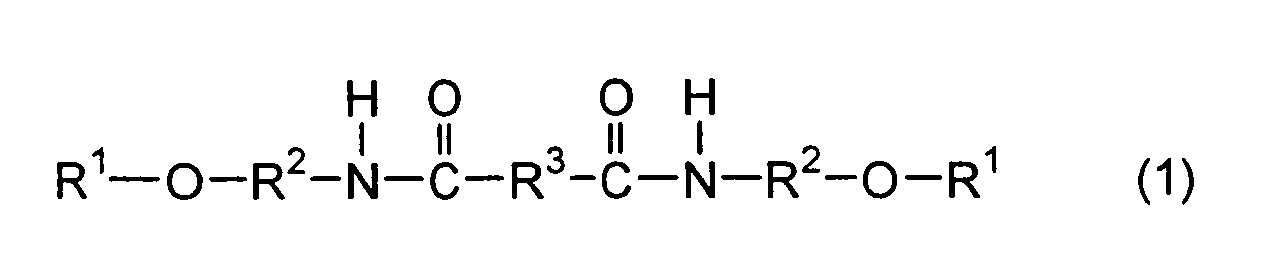
composition, a diamide compound represented by the
following formula (1):
wherein, R
1 represents a linear or branched C
1-12
hydrocarbon group which may be substituted by a hydroxy
and/or alkoxy group, R
2 represents a linear or branched
divalent C
1-5 hydrocarbon group, and R
3 represents a linear
or branched divalent C
1-22 hydrocarbon group.
In the present invention, there are thus provided a
hair dye composition comprising (A) a diamide compound
represented by the formula (1) and (B) a dye, and a hair
bleach composition comprising (A) a diamide compound
represented by the formula (1) and (C) an oxidizing agent.
BEST MODE FOR CARRYING OUT THE INVENTION
In the formula (1) representing the diamide compound
serving as Component (A) in the present invention,
preferred as R1 are linear or branched C1-12 alkyl groups
which may be substituted by 1 to 3 substituents selected
from a hydroxy group and C1-6 alkoxy groups. Of these, more
preferred are unsubstituted C1-12 alkyl groups, and C2-12
alkyl groups each substituted by one or two hydroxy groups,
by one C1-6 alkoxy group, or by one hydroxy group and one
C1-6 alkoxy group.
In the formula (1), preferred as R2 are linear or
branched C2-5, particularly C2-3 alkylene groups.
In the formula (1), preferred as R3 are linear or
branched divalent C2-22 hydrocarbon groups, among which
linear or branched C11-22 alkylene groups and alkenylene
groups having 1 to 4 double bonds are particularly
preferred.
Particularly preferred diamide compounds as Component
(A) include compounds having, as R
1, R
2 and R
3 in the
formula (1), the above-exemplified preferred groups in
combination. Specific examples of the particularly
preferred diamide compounds (1) are shown below:
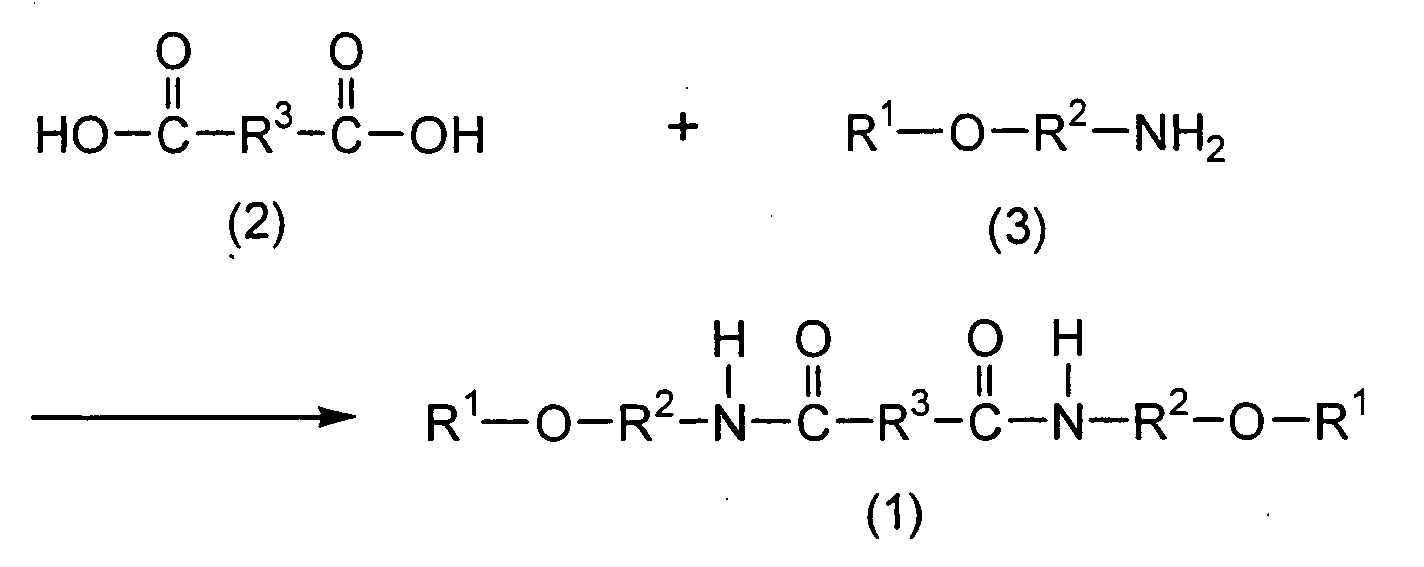
The diamide compounds (1) can be prepared by a known
amide synthesizing process. For example, the intended
diamide compound (1) can be prepared efficiently at a low
cost by condensing the corresponding dicarboxylic acid (2)
or reactive derivative thereof (ester, acid halide, acid
anhydride, or the like) with an amine (3) in accordance
with the following reaction scheme (International
Publication No. 00/61097 brochure):
As Component (A), two or more diamide compounds (1)
may be used in combination. From the viewpoints of
sufficiently suppressing hair damage and at the same time,
avoiding deterioration in feeling upon use, the content of
the diamide compound (1) is preferably from 0.01 to 30 wt.%,
more preferably from 0.1 to 20 wt.%, especially preferably
from 0.5 to 15 wt.% based on the composition just prior to
use.
Examples of the dye to be incorporated as Component
(B) in the hair dye composition of the present invention
include oxidative dye intermediates and direct dyes.
As the oxidative dye intermediates, known developers
and couplers ordinarily employed for oxidation type hair
dyes are usable. Examples of the developer include p-phenylenediamines
having one or several groups selected
from NH2-, NHR- and NR2- groups (wherein, R represents a C1-4
alkyl or hydroxyalkyl group) such as p-phenylenediamine,
p-toluylenediamine, N-methyl-p-phenylenediamine, N,N-dimethyl-p-phenylenediamine,
N,N-diethyl-2-methyl-p-phenylenediamine,
N-ethyl-N-(hydroxyethyl)-p-phenylenediamine,
chloro-p-phenylenediamine, 2-(2'-hydroxyethylamino)-5-aminotoluene,
N,N-bis-(2-hydroxyethyl)-p-phenylenediamine,
methoxy-p-phenylenediamine,
2,6-dichloro-p-phenylenediamine, 2-chloro-6-bromo-p-phenylenediamine,
2-chloro-6-methyl-p-phenylenediamine,
6-methoxy-3-methyl-p-phenylenediamine,
2,5-diaminoanisole, N-(2-hydroxypropyl)-p-phenylenediamine
and N-2-methoxyethyl-p-phenylenediamine; 2,5-diaminopyridine
derivatives; p-aminophenols such as p-aminophenol,
2-methyl-4-aminophenol, 3-methyl-4-aminophenol,
2-chloro-4-aminophenyl, 3-chloro-4-aminophenol, 2,6-dimethyl-4-aminophenol,
3,5-dimethyl-4-aminophenol, 2,3-dimethyl-4-aminophenol,
2,5-dimethyl-4-aminophenol, 2,4-diaminophenol
and 5-aminosalicylic acid; and o-aminophenols
and o-phenylenediamines.
Examples of the coupler include α-naphthol, o-cresol,
m-cresol, 2,6-dimethylphenol, 2,5-dimethylphenol, 3,4-dimethylphenol,
3,5-dimethylphenol, benzcatechin,
pyrogallol, 1,5-dihydroxynaphthalene, 1,7-dihydroxynaphthalene,
5-amino-2-methylphenol, 5-(2'-hydroxyethylamino)-4-methoxy-2-methylphenol,
hydroquinone,
2,4-diaminoanisole, m-toluylenediamine, 4-aminophenol,
resorcin, resorcin monomethyl ether, m-phenylenediamine, 1-phenyl-3-methyl-5-pyrazolone,
1-phenyl-3-amino-5-pyrazolone,
1-phenyl-3,5-diketopyrazolidine, 1-methyl-7-dimethylamino-4-hydroxy-3-quinolone,
m-aminophenol, 4-chlororesorcin, 2-methylresorcin,
2,4-diaminophenoxyethanol, 2,6-diaminopyridine,
3,5-diaminotrifluoromethylbenzene, 2,4-diaminofluorobenzene,
3,5-diaminofluorobenzene, 2,4-diamino-6-hydroxypyrimidine,
2,4,6-triaminopyrimidine, 2-amino-4,6-dihydroxypyrimidine,
4-amino-2,6-dihydroxypyrimidine
and 4,6-diamino-2-hydroxypyrimidine.
As each of the developer and coupler, two or more of
the above-exemplified substances may be used in combination.
Each of the developer and coupler is added preferably in an
amount of from 0.01 to 5 wt.%, especially preferably from
0.1 to 4 wt. % based on the whole composition having a
first part and a second part mixed therein.
As the direct dye, known acid dyes, basic dyes,
disperse dyes and reactive dyes usable for a hair dye can
be employed. Examples of the acid dye include Acid Red 27
(C.I. 16185), Acid Red 51 (C.I.45430), Acid Red 18 (C.I.
16255), Acid Red 92 (C.I. 45410), Acid Red 94 (C.I. 45440),
Acid Red 52 (C.I. 45100), Acid Yellow 23 (C.I. 19140), Food
Yellow 3 (C.I. 15985), Food Green 3 (C.I. 42053), Food Blue
2 (C.I. 42090), Acid Blue 74 (C.I. 73015), Pigment Red 57-1
(C.I. 15850), Acid Red 33 (C.I. 17200), Acid Red 87 (C.I.
45380), Acid Red 92 (C.I. 45410), Acid Orange 7 (C.I.
15510), Acid Red 95 (C.I. 45425), Acid Yellow 73 (C.I.
45350), Acid Yellow 3 (C.I. 47005), Acid Green 25 (C.I.
61570), Solvent Green 7 (C.I. 59040), Acid Green 5 (C.I.
42095), Acid Blue 5 (C.I. 42052), Acid Blue 9 (C.I. 42090),
Acid Orange 24 (C.I. 20170), Acid Violet 9 (C.I. 45190),
Food Red 6 (C.I. 16155), Acid Red 26 (C.I. 16150), Food Red
1 (C.I. 14700), Acid Red 88 (C.I. 15620), Acid Orange 20
(C.I. 14600), Acid Yellow 40 (C.I. 18950), Acid Yellow 1
(C.I. 10316), Acid Yellow 36 (C.I. 13065), Acid Yellow 11
(C.I. 18820), Acid Green 1 (C.I. 10020), Acid Green 3 (C.I.
42085), Acid Violet 43 (C.I. 60730), Acid Black 1 (C.I.
20470), Acid Black 52 (C.I. 15711), Acid Blue 1 (C.I.
42045), Acid Blue 3 (C.I. 42051), Acid Blue 62 (C.I. 62045),
Acid Brown 13 (C.I. 10410), Acid Green 50 (C.I. 44090),
Acid Orange 3 (C.I. 10385), Acid Orange 6 (C.I. 14270),
Acid Red 14 (C.I. 14720), Acid Red 35 (C.I. 18065), Acid
Red 73 (C.I. 27290), Acid Red 184 (C.I. 15685) and
Brilliant Black 1 (C.I. 28440).
Examples of the basic dye include Basic Blue 7 (C.I.
42595), Basic blue 16 (C.I. 12210), Basic Blue 22 (C.I.
61512), Basic Blue 26 (C.I. 44045), Basic Blue 99 (C.I.
56059), Basic Blue 117, Basic Violet 10 (C.I. 45170), Basic
Violet 14 (C.I. 42515), Basic Brown 16 (C.I. 12250), Basic
Brown 17 (C.I. 12251), Basic Red 2 (C.I. 50240), Basic Red
12 (C.I. 48070), Basic Red 22 (C.I. 11055), Basic Red 51,
Basic Red 76 (C.I. 12245), Basic Red 118 (C.I. 12251:1),
Basic Orange 31, Basic Yellow 28 (C.I. 48054), Basic Yellow
57 (C.I. 12719), Basic Yellow 87 and Basic Black 2 (C.I.
11825), basic dyes, as described in Japanese Patent
Publication No. Sho 58-2204 and Japanese Patent Application
Laid-Open No. Hei 9-118832, which contain, at the side
chain of the aromatic ring thereof, a quaternized nitrogen
atom, and basic dyes, as described in Japanese-Language
Laid-Open Publication (PCT) No. Hei 10-502946 and Japanese
Patent Applications Laid-Open Nos. Hei 10-182379 and Hei
11-349457.
Examples of the direct dyes other than acid dyes and
basic dyes include 2-amino-3-nitrophenol, 2-amino-4-nitrophenol,
2-amino-5-nitrophenol, 4-amino-3-nitrophenol,
2-amino-6-chloro-4-nitrophenol, 4-hydroxypropylamino-3-nitrophenol,
3-nitroparahydroxyethylaminophenol, 2-nitroparaphenylenediamine,
4-nitroorthophenylenediamine, 4-nitrometaphenylenediamine,
6-nitroorthotoluidine, 6-nitroparatoluidine,
hydroxyethyl-2-nitroparatoluidine,
N,N'-bis(2-hydroxyethyl)-2-nitroparaphenylenediamine, 2-chloro-5-nitro-N-hydroxyethylparaphenylenediamine,
2-nitro-5-glycerylmethylaniline,
3-methylamino-4-nitrophenoxyethanol,
N-ethyl-3-nitroPABA, picramic acid, 2-hydroxyethylpicramic
acid, 4-nitrophenylaminoethylurea,
Solvent Violet 13(C.I.60725), Solvent Yellow 44 (C.I.56200),
Disperse Red 17 (C.I.11210), Disperse Violet 1 (C.I.61100),
Disperse Violet 4 (C.I.61105), Disperse Blue 3 (C.I.61505),
Disperse Blue 7 (C.I.62500), HC Blue No.2, HC Blue No.8, HC
Orange No.1, HC Orange No.2, HC Red No.1, HC Red No.3, HC
Red No.7, HC Red No.8, HC Red No.10, HC Red No.11, HC Red
No.13, HC Red No.16, HC Violet No.2, HC Yellow No.2, HC
Yellow No.5, HC Yellow No.6, HC Yellow No.7, HC Yellow No.9,
and HC Yellow No.12.
As the direct dye, two or more of the above-exemplified
ones may be used in combination, and the total
amount thereof preferably falls within a range of from
0.001-5 wt.%, particularly preferably from 0.01-4 wt.%,
each based on the whole composition having the first and
second agents mixed therein. The direct dye may be used in
combination with the oxidative dye.
Examples of oxidizing agent serving as component (C)
in the present invention include hydrogen peroxide, urea
peroxide, bromates of an alkali metal and peracid salts of
an alkali metal (perbromates, persulfates, perborates,
etc.), with hydrogen peroxide being especially preferred.
From the viewpoints of sufficient hair bleaching or dyeing
effects and a reduction in stimulus to the scalp, the
amount of the oxidizing agent preferably falls within a
range of from 2 to 12 wt.%, in terms of hydrogen peroxide,
based on the whole composition having the first part and
second part mixed therein. The oxidizing agent may be
incorporated not only in the hair bleach composition but
also in the hair dye composition, particularly in the
second part of a two-part system hair dye composition.
To the hair dye composition or bleach composition of
the present invention, components ordinarily employed in
the field of cosmetics can be added further depending on
the using purpose. Examples of such optional components
include natural or synthetic high-molecular compounds,
fatty acids, oils and fats, hydrocarbons, higher alcohols,
monohydric or polyhydric alcohols, silicone derivatives,
nonionic surfactants, amine oxides, amino acid derivatives,
protein derivatives, antiseptics, metal sequestering agents,
antioxidants, stabilizers for hydrogen peroxide, vegetable
extracts, vitamins, colorants, pigments, ultraviolet
absorbers and pH regulators.
The hair dye composition or hair bleach composition
according to the present invention may be provided as one-part
system compositions using a direct dye, for example,
color shampoos, color rinses and hair manicures, or two- or
three-part system compositions such as oxidizing type hair
dye or hair bleach. Sometimes, they may be mixed at a
predetermined ratio upon use.
- Examples -
Examples 1 to 5, and Comparative Examples 1 and 2
Hair dye compositions as listed in Tables 1 to 3 were
prepared and "moisture loss" and "ratio of generated split
hair" after the hair was treated with each composition were
evaluated to study the effect of the invention.
• Evaluation method and criteria
(1) Prevention of moisture loss
A bundle (10 g) made of the hair of a Japanese female
was dyed with each composition in a predetermined manner,
followed by organoleptic evaluation by a panel of 10
experts to examine the moisture loss. Average evaluation
scores in accordance with the below-described criteria were
judged as A, B and C when the average scores were 2.4 or
greater, 1.6 to 2.3 and 1.0 to 1.5, respectively.
<Evaluation criteria>
There is no feel of moisture loss: 3
There is some feel of moisture loss: 2
There is a feel of moisture loss: 1
(2) Ratio of generated split hair
A 16-cm long hair bundle (about 0.1 g) made of 100
hairs of a Japanese female was prepared. It was treated
with each composition of the Examples and the Comparative
Examples by a predetermined method. Then, a brushing
stimulus was applied to the resulting hair bundle with a
rotating hairbrush driven by a motor at a rotation speed of
100 times/minute for 60 minutes. The number (D) of split
or cut hairs was then counted. The split hair-generation
ratio was determined from the following formula:
Split hair-generation ratio (%) = D ÷ 100 × 100 = D
• Hair Manicure (Examples 1 and 2, and Comparative Example
1)
A hair dye composition (hair manicure) was prepared
by adding, in portions, a solution of Component (1)
dissolved in the whole amount of Component (5) to a mixture
composed of Component (2) and Components (6) to (8),
wherein each component is shown in Table 1; stirring the
resulting mixture; adding to the mixture while stirring
another mixture which had been obtained by adding Component
(4) to Component (3); and then stirring the resulting
mixture for about one hour at room temperature.
To a tress for evaluation, the resulting composition
was applied at a hair:composition bath ratio (weight ratio)
of 1:1 to wet the tress with the composition. After the
tress was allowed to stand at room temperature for 25
minutes, it was rinsed to remove the composition, shampooed
once with a commercially available shampoo and then dried
with a dryer.
Evaluation results are shown in Table 1.
| | Example 1 | Example 2 | Comparative Example 1 |
| (1) Diamide compound (A) | 1.0 | 2.0 | - |
| (2) Acid Orange 7 | 0.5 | 0.5 | 0.5 |
| (3) Benzyl alcohol | 10.0 | 10.0 | 10.0 |
| (4) Xanthan gum | 1.5 | 1.5 | 1.5 |
| (5) Ethanol | 15.0 | 15.0 | 15.0 |
| (6) Sodium hydroxide | q.s. (pH 2.9) | q.s. (pH 2.9) | q.s. (pH 2.9) |
| (7) Lactic acid | 4.5 | 4.5 | 4.5 |
| (8) Water | Balance | Balance | Balance |
| Total | 100 wt.% | 100 wt.% | 100 wt.% |
| Evaluation | Split hair-generation ratio (%) | 20 | 12 | 27 |
| Prevention of moisture loss | A | A | B |
An aqueous phase was prepared by mixing Component
(14) with Components (2) to (4) and (10) to (12) and a
portion (5 wt.%) of Component (13), wherein each component
is shown in Table 2, and dissolving the components by
heating to 70°C and maintaining thereat. To the remaining
portion (2 wt.%) of Component (13) were added Components
(1) and (5) to (9) and the resulting oil phase was
uniformly dissolved by heating to 70°C. The oil phase was
gradually added to the aqueous phase. After stirring at
70°C for 20 minutes, the reaction mixture was cooled
gradually to room temperature, whereby the first part of
the two-part system permanent hair dye was prepared.
The second part of the two-part system permanent hair
dye having the composition as shown in Table 3 was prepared
separately.
A 1:1 (weight ratio) uniform mixture of each of
predetermined combinations of the first part and the second
part as shown in Table 4 was applied to a tress for
evaluation at a hair: composition bath ratio(weight ratio)
of 1:1 and the resulting tress was allowed to stand at room
temperature for 25 minutes. The tress was rinsed with
water to remove the hair dye, shampooed once with a
commercially available shampoo, and dried with a hair dryer.
Evaluation results are shown in Table 4.
| | First part A | First part B |
| (1) Diamide compound (B) | 2.0 | - |
| (2) p-Phenylenediamine | 2.0 | 2.0 |
| (3) o-Aminophenol | 1.0 | 1.0 |
| (4) m-Phenylenediamine | 0.2 | 0.2 |
| (5) Cetanol | 5.5 | 5.5 |
| (6) Polyoxyethylene (40) cetyl ether | 2.5 | 2.5 |
| (7) Polyoxyethylene (2) Cetyl ether | 3.0 | 3.0 |
| (8) Liquid paraffin | 0.4 | 0.4 |
| (9) Sodium sulfite | 0.3 | 0.3 |
| (10) Monoethanolamine | 2.5 | 2.5 |
| (11) Ammonium chloride | 0.5 | 0.5 |
| (12) Ammonia (28 wt.%) | q.s. (pH 9) | q.s. (pH 9) |
| (13) Propylene glycol | 7.0 | 7.0 |
| (14) Purified water | Balance | Balance |
| Total | 100 wt.% | 100 wt.% |
| | Second part A | Second part B |
| (1) Diamide compound (B) | 1.0 | - |
| (2) Hydrogen peroxide (35 wt.%) | 15.0 | 15.0 |
| (3) Cetanol | 5.0 | 5.0 |
| (4) Polyoxyethylene (20) cetyl ether | 4.5 | 4.5 |
| (5) Propylene glycol | 6.0 | 6.0 |
| (6) Liquid paraffin | 0.2 | 0.2 |
| (7) Phosphoric acid | q.s. (pH 3.5) | q.s. (pH 3.5) |
| (8) Purified water | Balance | Balance |
| Total | 100 wt.% | 100 wt.% |
| | Example 3 | Example 4 | Example 5 | Comparative Example 2 |
| Combination | First part | A | B | A | B |
| Second part | B | A | A | B |
Split hair-generation ratio (%)
Prevention of moisture loss | 29
A | 28
A | 22
A | 38
C |
The first part having the below-described composition
and the second part A as shown in Table 3 were mixed in
equal amounts and provided for use.
| First part | (wt.%) |
| Diamide compound (A) | 1.5 |
| p-Phenylenediamine | 2.0 |
| o-Aminophenol | 1.0 |
| m-Phenylenediamine | 0.5 |
| Cetanol | 5.5 |
| Polyoxyethylene (40) cetyl ether | 2.5 |
| Polyoxyethylene (2) cetyl ether | 3.0 |
| Liquid paraffin | 0.2 |
| Sodium sulfite | 0.3 |
| Monoethanolamine | 2.5 |
| Ammonia (28 wt.%) | Amount to adjust the pH to 9.0 |
| Propylene glycol | 5.0 |
| Benzyl alcohol | 3.0 |
| Amino-modified silicone emulsion ("SM8704C", product of Dow Corning Toray Silicone) | 0.5 |
| Keratin hydrolysate ("Promois WK-H" product of Seiwa Kasei) | 0.5 |
| Olive oil | 0.2 |
| Perfume | q.s. |
| Purified water | Balance |
| Total | 100.0 |
The first part and second part having the
compositions as described below were mixed in equal amounts
and provided for use.
| First part | (wt.%) |
| Diamide compound (C) | 1.0 |
| p-Phenylenediamine | 2.0 |
| o-Aminophenol | 1.0 |
| m-Phenylenediamine | 0.5 |
| Oleic acid | 4.0 |
| Cetanol | 0.5 |
| Oleyl alcohol | 1.0 |
| Polyoxyethylene (20) dodecyl ether | 8.0 |
| Polyoxyethylene (9) dodecyl ether | 6.0 |
| Polyoxyethylene (3) dodecyl ether | 6.0 |
| Propylene glycol | 8.0 |
| Ethanol | 12.0 |
| 2-Benzyloxyethanol | 4.0 |
| Monoethanolamine | 2.5 |
| Aqueous ammonia (28 wt.%) | Amount to adjust the pH to 9.0 |
| Anhydrous sodium sulfite | 0.3 |
| Ethylenediaminetetraacetic acid tetrasodium salt dihydrate | 0.1 |
| Polyether-modified silicone ("KF-6005", product of Shin'etsu Chemical) | 0.5 |
| Jojoba oil | 0.1 |
| Perfume | q.s. |
| Purified water | Balance |
| Total | 100.0 |
| Second part | (wt.%) |
| Diamide compound (C) | 1.0 |
| Hydrogen peroxide (35 wt.%) | 15.0 |
| Cetanol | 1.5 |
| Polyoxyethylene (20) cetyl ether | 0.8 |
| Polyoxyethylene (2) cetyl ether | 0.2 |
| Glycerin | 0.5 |
| Phosphoric acid | Amount to adjust the pH to 9.0 |
| Purified water | Balance |
| Total | 100.0 |
The first part and second part having the
compositions as shown below were mixed in equal amounts and
provided for use.
| First part | (wt.%) |
| Diamide compound (A) | 2.5 |
| Aqueous ammonia (28 wt.%) | 5.0 |
| Ammonium bicarbonate | Amount to adjust the pH to 9.0 |
| Oleic acid | 1.5 |
| Oleyl alcohol | 1.0 |
| Polyoxyethylene (20) cetyl ether | 8.0 |
| Polyoxyethylene (9) cetyl ether | 5.0 |
| Polyoxyethylene (3) cetyl ether | 5.0 |
| Ethanol | 8.0 |
| Propylene glycol | 8.0 |
| Amino-modified silicone emulsion ("SM8704C", product of Dow Corning Toray Silicone) | 0.5 |
| Cationized keratin hydrolysate ("Promois WK-Q"; product of Seiwa Kasei) | 0.2 |
| Perfume | q.s. |
| Purified water | Balance |
| Total | 100.0 |
| Second part | (wt.%) |
| Hydrogen peroxide (35 wt.%) | 15.0 |
| Polyoxyethylene (20) cetyl ether | 1.0 |
| Polyether-modified silicone ("KF-6005", product of Shin'etsu Chemical) | 0.5 |
| Phosphoric acid | Amount to adjust the pH to 3.2 |
| Purified water | Balance |
| Total | 100.0 |
A stock solution and a propellant each having the
below-described composition were filled at a stock
solution:propellant weight ratio of 85:15 in a
predetermined aerosol container.
| Stock solution | (wt.%) |
| Diamide compound (C) | 2.0 |
| Acid Orange 7 | 0.8 |
| 2-Benzyloxyethanol | 5.0 |
| Ethanol | 10.0 |
| 1,3-Butylene glycol | 5.0 |
| Xanthan gum | 1.2 |
| Sodium hydroxide | Amount to adjust |
| | the pH to 3.0 |
| Lactic acid | 4.5 |
| Polyether-modified silicone ("KF-6005", |
| product of Shin'etsu Chemical) | 0.5 |
| Perfume | q.s. |
| Purified water | Balance |
| Total | 100.0 |
| Propellant | (wt.%) |
| LPG (3.5 kg/cm2) | 85.0 |
| Dimethyl ether | 15.0 |
| Total | 100.0 |
Any one of the compositions obtained in Examples 6 to
9 caused markedly little damage to the hair and, at the
same time, did not impair moisture feeling of the hair.







 (B) a dye.
 (C) an oxidizing agent.