EP1366596B1 - Anordnung und Verfahren zum Quadrieren von langen Ganzzahlen - Google Patents
Anordnung und Verfahren zum Quadrieren von langen Ganzzahlen Download PDFInfo
- Publication number
- EP1366596B1 EP1366596B1 EP02719024A EP02719024A EP1366596B1 EP 1366596 B1 EP1366596 B1 EP 1366596B1 EP 02719024 A EP02719024 A EP 02719024A EP 02719024 A EP02719024 A EP 02719024A EP 1366596 B1 EP1366596 B1 EP 1366596B1
- Authority
- EP
- European Patent Office
- Prior art keywords
- squares
- integer values
- bit
- length
- difference
- Prior art date
- Legal status (The legal status is an assumption and is not a legal conclusion. Google has not performed a legal analysis and makes no representation as to the accuracy of the status listed.)
- Expired - Lifetime
Links
Images


Classifications
-
- G—PHYSICS
- G06—COMPUTING OR CALCULATING; COUNTING
- G06F—ELECTRIC DIGITAL DATA PROCESSING
- G06F7/00—Methods or arrangements for processing data by operating upon the order or content of the data handled
- G06F7/38—Methods or arrangements for performing computations using exclusively denominational number representation, e.g. using binary, ternary, decimal representation
- G06F7/48—Methods or arrangements for performing computations using exclusively denominational number representation, e.g. using binary, ternary, decimal representation using non-contact-making devices, e.g. tube, solid state device; using unspecified devices
- G06F7/52—Multiplying; Dividing
-
- G—PHYSICS
- G06—COMPUTING OR CALCULATING; COUNTING
- G06F—ELECTRIC DIGITAL DATA PROCESSING
- G06F7/00—Methods or arrangements for processing data by operating upon the order or content of the data handled
- G06F7/38—Methods or arrangements for performing computations using exclusively denominational number representation, e.g. using binary, ternary, decimal representation
- G06F7/48—Methods or arrangements for performing computations using exclusively denominational number representation, e.g. using binary, ternary, decimal representation using non-contact-making devices, e.g. tube, solid state device; using unspecified devices
- G06F7/544—Methods or arrangements for performing computations using exclusively denominational number representation, e.g. using binary, ternary, decimal representation using non-contact-making devices, e.g. tube, solid state device; using unspecified devices for evaluating functions by calculation
- G06F7/552—Powers or roots, e.g. Pythagorean sums
-
- G—PHYSICS
- G06—COMPUTING OR CALCULATING; COUNTING
- G06F—ELECTRIC DIGITAL DATA PROCESSING
- G06F7/00—Methods or arrangements for processing data by operating upon the order or content of the data handled
- G06F7/60—Methods or arrangements for performing computations using a digital non-denominational number representation, i.e. number representation without radix; Computing devices using combinations of denominational and non-denominational quantity representations, e.g. using difunction pulse trains, STEELE computers, phase computers
- G06F7/72—Methods or arrangements for performing computations using a digital non-denominational number representation, i.e. number representation without radix; Computing devices using combinations of denominational and non-denominational quantity representations, e.g. using difunction pulse trains, STEELE computers, phase computers using residue arithmetic
- G06F7/722—Modular multiplication
-
- H—ELECTRICITY
- H04—ELECTRIC COMMUNICATION TECHNIQUE
- H04L—TRANSMISSION OF DIGITAL INFORMATION, e.g. TELEGRAPHIC COMMUNICATION
- H04L9/00—Cryptographic mechanisms or cryptographic arrangements for secret or secure communications; Network security protocols
- H04L9/30—Public key, i.e. encryption algorithm being computationally infeasible to invert or user's encryption keys not requiring secrecy
- H04L9/3006—Public key, i.e. encryption algorithm being computationally infeasible to invert or user's encryption keys not requiring secrecy underlying computational problems or public-key parameters
- H04L9/302—Public key, i.e. encryption algorithm being computationally infeasible to invert or user's encryption keys not requiring secrecy underlying computational problems or public-key parameters involving the integer factorization problem, e.g. RSA or quadratic sieve [QS] schemes
-
- G—PHYSICS
- G06—COMPUTING OR CALCULATING; COUNTING
- G06F—ELECTRIC DIGITAL DATA PROCESSING
- G06F2207/00—Indexing scheme relating to methods or arrangements for processing data by operating upon the order or content of the data handled
- G06F2207/552—Indexing scheme relating to groups G06F7/552 - G06F7/5525
- G06F2207/5523—Calculates a power, e.g. the square, of a number or a function, e.g. polynomials
-
- G—PHYSICS
- G06—COMPUTING OR CALCULATING; COUNTING
- G06F—ELECTRIC DIGITAL DATA PROCESSING
- G06F2207/00—Indexing scheme relating to methods or arrangements for processing data by operating upon the order or content of the data handled
- G06F2207/72—Indexing scheme relating to groups G06F7/72 - G06F7/729
- G06F2207/7219—Countermeasures against side channel or fault attacks
- G06F2207/7223—Randomisation as countermeasure against side channel attacks
- G06F2207/7252—Randomisation as countermeasure against side channel attacks of operation order, e.g. starting to treat the exponent at a random place, or in a randomly chosen direction
-
- G—PHYSICS
- G06—COMPUTING OR CALCULATING; COUNTING
- G06F—ELECTRIC DIGITAL DATA PROCESSING
- G06F7/00—Methods or arrangements for processing data by operating upon the order or content of the data handled
- G06F7/60—Methods or arrangements for performing computations using a digital non-denominational number representation, i.e. number representation without radix; Computing devices using combinations of denominational and non-denominational quantity representations, e.g. using difunction pulse trains, STEELE computers, phase computers
- G06F7/72—Methods or arrangements for performing computations using a digital non-denominational number representation, i.e. number representation without radix; Computing devices using combinations of denominational and non-denominational quantity representations, e.g. using difunction pulse trains, STEELE computers, phase computers using residue arithmetic
- G06F7/723—Modular exponentiation
-
- H—ELECTRICITY
- H04—ELECTRIC COMMUNICATION TECHNIQUE
- H04L—TRANSMISSION OF DIGITAL INFORMATION, e.g. TELEGRAPHIC COMMUNICATION
- H04L2209/00—Additional information or applications relating to cryptographic mechanisms or cryptographic arrangements for secret or secure communication H04L9/00
- H04L2209/12—Details relating to cryptographic hardware or logic circuitry
- H04L2209/122—Hardware reduction or efficient architectures
Definitions
- the present invention relates generally to cryptographic accelerators to accelerate cryptographic computation and, more particularly, to a cryptographic accelerator employing recursive algorithms to accelerate multiplication and squaring operations.
- Encryption is the process of disguising intelligible information, called plaintext, to hide its substance from eavesdroppers. Encrypting plaintext produces unintelligible data called cipher text. Decryption is the process of converting ciphered text back to its original plaintext. Using encryption and decryption, two parties can send messages over an insecure channel without revealing the substance of the message to eavesdroppers.
- a cryptographic algorithm, or cipher is a mathematical function used in the encryption and decryption of data.
- a cryptographic algorithm typically works in combination with a key to encrypt and decrypt messages. The key, typically a large random number, controls the encryption of data by the cryptographic algorithm. The same plaintext encrypts to different ciphered text with different keys. In general, it is extremely difficult to recover the plaintext of a message without access to the key, even by an eavesdropper having full knowledge of the cryptographic algorithm.
- One commonly used type of cryptographic algorithm is a public key algorithm.
- Public key cryptographic algorithms are based on the identity:
- N X where N, the modulus, is the product of two secret prime numbers P 1 and P 2 , and Z is equal to M(P 1 -1) (P 2 -1)+1. The exponent Z is factored into the product of a private key K PRIV and a public key K PUB . Many key pairs can be found by choosing different values of M.
- the public key K PUB is published and may be used by another to send messages to the owner of the public key, which can only be deciphered by the recipient using the corresponding private key K PRIV .
- the RSA Algorithm enciphers blocks of bits at a time, which may be viewed as a binary number X.
- the binary number X must have an arithmetic value less than the encryption modulus N.
- Encryption is performed by raising X to the power of the public key K PUB and reducing it modulo N to produce encrypted ciphertext.
- the ciphertext may also be viewed as a binary number Y having an arithmetic value less than N. Decryption is performed by raising the binary number Y to the power of the private key K PRIV and reducing the result modulo N.
- Another use of public key algorithms is for signing messages to authenticate the sending party's identity.
- the sending party may sign a message by encrypting the message with his private key K PRIV .
- the receiving party can then use the sender's public key K PUB to decrypt the message. If the message is decrypted successfully, only the sending party in possession of the private key K PRIV could have sent that message.
- This process of authenticating the message by encryption using the sender's private key K PRIV is referred to as signing.
- each party to the communication possesses a public key used for encrypting messages and a private key for decrypting messages.
- the message is first signed using the sender's private key K PRIV1 and modulus N 1 and then encrypted using the recipient's public key K PUB2 and modulus N 2 .
- the recipient decrypts the message using the recipient's private key K PRIV2 and modulus N 2 to recover the signed message.
- the signed message is then decrypted using the sender's public key K PUB1 and modulus N 1 to obtain the original message. Since the sender is the only person possessing the private key K PRIV1 that can generate the signed message, the sender's identity is authenticated to the recipient.
- the Diffie-Hellman Algorithm is a key exchange algorithm that allows two parties to agree on a secret key over an insecure channel without divulging the secret key.
- the parties agree on two, non-secret prime numbers P 1 and P 2 .
- P 1 is typically a large prime number.
- the security of the system is based on the difficulty of factoring numbers the same size as P 1 .
- P 2 may be a one-digit prime number.
- Each party generates a large random number, denoted x and y, respectively. The parties then calculate derived numbers X and Y.
- the first party transmits X to the second party; the second party transmits Y to the first party.
- An eavesdropper cannot compute K with knowledge only of P 1 , P 2 , X and Y. Therefore, the value K, which was computed independently by the two parties using information exchanged over the insecure channel, may be used by the parties as the secret key for secure communications.
- the private key K PRIV typically has a length of approximately 2,048 bits.
- the message block and encryption modulus N are typically in the same order of wordlength.
- encryption or decryption with the private key K PRIV involves exponentiating a 2,048 bit message block with a 2,048 bit exponent and reducing the result modulo another 2,048 bit number.
- a number of algorithms have been devised to reduce the complexity of cryptographic calculations involving exponentiation or modulo reduction.
- One algorithm referred to herein as the Successive Squares Algorithm, is used to raise a first large number to the power of a second large number.
- a second algorithm referred to herein as the Modulo Reduction Algorithm, is used to reduce a first large number modulo a second large number.
- the Successive Squares Algorithm is used to raise a bitstring X to a large power Y.
- the bitstring X is the encrypted ciphertext
- the power Y is the decryption key
- the bitstring X is the plaintext message
- the power Y is the encryption key.
- the successive squares of the bitstring X are computed and used to multiply an accumulated value Z, depending on the value of a corresponding bit in the power Y.
- the accumulated value Z is initialized to a starting value of 1.
- the least significant bit in the power Y corresponds to the first power of X
- the second bit B 2 corresponds to the second power of X
- the third bit B 3 corresponds to the fourth power of X
- Each successive square, X 1 , X 2 ...X n is used to multiply the accumulated value Z, depending on the value of the corresponding bit B N in the power Y.
- the accumulated value Z is multiplied by a successive square when the corresponding bit B N in the power Y is 1.
- Successive squares corresponding to "0" bits in the power Y do not multiply the accumulated value Z.
- the Successive Squares Algorithm reduces the number of values that need to be multiplied from 2 2048 to the order of 2,048 where X and Y are 2,048 bits in length.
- the accumulated value Z has a wordlength in the order of 4,096 bits.
- this accumulated value Z is reduced by modulo reduction to a value in the order of 2,048 bits in length.
- the result of each squaring operation is reduced modulo the encryption modulus N of wordlength 2,048. This requires subtracting a large number of multiples of N until the value of the accumulated total Z is less than N.
- the number of multiples of N which have to be subtracted is in the order of 2 2048 or 10 600 which eliminates the possibility of successive subtraction.
- the Modulo Reduction Algorithm is used to reduce a first large number modulo a second large number.
- the approximate reciprocal of N is computed to 2,048 significant bits, ignoring leading zeros after the binary point.
- T Z ⁇ 1/ N , which is a single long multiplication of Z with the approximate reciprocal of N.
- the product of T ⁇ N is then subtracted from the accumulated value Z, which will reduce the accumulated value Z to within one or two times N of the required result.
- the recursions should preferably stop at some wordlength where multiplication is more efficiently performed in the conventional manner or by special purpose hardware.
- Such a stage exists because the effort of multiplication reduces as the square of N while the overhead of the K-O Multiplication Algorithm reduces only linearly, so that at some wordlength, conventional multiplication becomes preferable.
- the K-O Multiplication Algorithm has been used in software applications to perform long multiplication in public key cryptographic algorithms.
- Implementing the K-O Multiplication Algorithm in software suggests use of recursive programs.
- Recursion in this field refers to a program subroutine that is allowed to call itself, as opposed to simple iterations or loops.
- Recursion also includes the case of a first program calling a second program, which in turn calls the first program. In this case, no program calls itself but a compiler that supports recursion is necessary to give correct results when such recursive calls are used. Not all computer languages or implementations of computer programming languages support recursive subroutines.
- Recursively structured hardware circuits for performing calculations are also known. Examples of recursively structured hardware circuits are described in U.S. Patent No. 6,044,390 to Golnabi et al ; U.S. Patent No. 6,041,340 to Mintzer et al ; and in U.S. Patent No. 5,765,207 to Curran .
- VHDL computer programming-like language
- a computer programming-like language known as VHDL to describe logic circuits of a higher complexity as interconnections of logic circuits of a lower complexity, and so forth, until only primitive circuits are required that can be found in an existing library.
- This hierarchical description of circuits is then translated by the VHDL compiler into a flat interconnection of primitive library elements.
- Present day VHDL is an example of a language that does not support recursive calls; that is, no circuit block in the hierarchy can include in its description a circuit block which is an instance of itself.
- the present invention relates to a circuit and method for performing squaring operations on long integer values according to the independent claims.
- the long integer values which may represent secret data
- the random ordering of the reduced-length integer values results in a random transposition of the bits of the secret data rendering it difficult to reconstruct the secret data by observing the value sent to the co-processor.
- the present invention provides a circuit and method for efficiently performing arithmetic calculations involving long integer values including squaring, multiplication, addition, and modulo reduction.
- the circuit and method can be used to implement the RSA Algorithm and the Diffie-Hellman Key Exchange Algorithm, both of which require multiplication and squaring of long integers.
- the circuit comprises a squaring circuit that implements a modified version of the Karatsuba-Ofman (K-O) Multiplication Algorithm.
- K-O Karatsuba-Ofman
- the squaring circuit may also be efficiently used for implementing multiplication of two dissimilar values.
- the present invention eliminates the need for a separate multiplication circuit, thereby saving silicon chip area and reducing cost as compared with circuits comprising only a multiplier that is also used for squaring or compared with circuits having both a multiplier and a squarer.
- the squaring device of the present invention is based on the K-O Multiplication Algorithm.
- Equations 2 and 3 the values A1 and A2 represent the least significant half and most significant half respectively of a value A to be multiplied.
- the values B1 and B2 represent the least significant half and most significant half respectively of a second value B to be multiplied with A.
- Equation 2 the multiplication (A1+A2)(B1+B2) is a k+1 digit multiplication due to the possible overflow to one extra bit from the additions. If it is desired to avoid k+1 bit multiplications, the overflow bits may be handled separately, as will be described below. Equation 3 attempts to avoid k+1 digit multiplications by multiplying the differences (A1-A2) and (B1-B2). However, if either A2 is greater than A1 or B2 is greater than B1, one of the factors would be negative. To retain unsigned multiplication, A2-A1 should be used when A2 is greater than A1 and B2-B1 should be used when B2 is greater than B1. If one difference only is reversed, the product (A2-A1)(B1-B2) or (A1-A2)(B2-B1) should be added to (A1 ⁇ B1)+(A2 ⁇ B2) instead of subtracted, as will also be demonstrated below.
- Table 1 gives a program listing in FORTRAN for a recursive multiplier implemented in software.
- the line numbering in the program listing is for reference only.
- RECURM a subroutine called RECURM which accepts the arguments N, A, B, C, and S.
- Argument N specifies the wordlength of integer arrays A and B to be multiplied.
- Arguments A and B provide the starting addresses of two arrays that store the values A and B to be multiplied.
- Argument C provides the starting address of an array of length 2 N (+1 spare location) to receive the product of the multiplication.
- Argument S provides the starting address of a stack array to be used as a work space.
- a test is performed to see if the multiplication required involves only one word variables, which can be efficiently performed by machine hardware. If so, the values A and B to be multiplied, which are stored in integer arrays A and B, are passed in a function call to a multiplication routine denoted MUL16 to perform this short multiplication.
- the multiplication routine MUL16 performs unsigned integer multiplication between, in this example, 16-bit operands to form a 32-bit result.
- High level languages such as FORTRAN, PASCAL, or C, generally perform signed integer multiplication in their high level instructions, which must be circumvented to obtain unsigned multiplication. Table 2 below provides the program listing for an exemplary embodiment of the multiplication routine MUL16 which is included for completeness.
- the multiplication routine of Table 2 could be replaced by a native assembly code routine to perform unsigned multiplication using the machine's hardware directly.
- the K-O Multiplication Algorithm is used to reduce the length of the variables to N/2.
- the routine RECURM calls itself to multiply the least significant N/2 words A1 and B1 of values A and B to obtain A1 ⁇ B1, which represents the least significant N words of the product A ⁇ B.
- the result is stored in result array C.
- the routine RECURM calls itself again to multiply the most significant N/2 words A2 and B2 of values A and B (which start at element number 1+N/2 of integer arrays A and B) to obtain A2 ⁇ B2, which represents the most significant N/2 words of the product A ⁇ B.
- the result is stored in array element 1+N of the result array C.
- the program calls long integer addition routine LONGAD to perform the length N/2 additions A1+A2 and B1+B2 of Equation 2.
- the results are placed in the stack S.
- the result of the addition A1+A2 is placed in stack elements S(1)...S(N/2), with carry into elements S(1+N/2).
- the results of the addition B1+B2 are placed in stacked elements S(N/2+2) ... S(N+1), with carry into element S(N+2).
- stack elements S(1)...S(N/2) contain the value of A1+A2 less its overflow or carry bit
- ..S(N+1) contains the value of B1+B2 less its overflow or carry bit.
- the sums A1+A2 and B1+B2 minus the overflow or carry bits are multiplied by a third recursive call to the subroutine RECURM to obtain the product (A1+A2)(B1+B2) minus the contribution of the overflow/carry bits.
- the contributions of the carry bits, if any, are added in lines 80 and 85.
- Line 80 adds the absolute value of B1+B2 if the carry from the addition A1+A2 was set, and adds the absolute value of A1+A2 if the carry from the addition B1+B2 was set.
- the already-computed products A1-B1 and A2 ⁇ B2 are subtracted from the product (A1+A2)(B1+B2) according to Equation 2.
- the processed value, now (A1+A2)(B1+B2)-A1 ⁇ B1-A2 ⁇ B2 is added with a shift of k-bits or N/2 words to the value contained in the result array C to obtain the final 2N word product.
- the program precomputes some indices to simplify addressing. Use of local variables was thereby postponed until all recursive calls of the routine RECURM to itself were made. Otherwise, the values of the local variables would not be preserved through the recursive calls.
- the starting address S(2N+5) was passed to the routine LONGAD as the starting address of the stack array S.
- the address S(2N+5) addresses a place in the stack array beyond all the stack positions currently used to hold temporary results, so that the recursive call will not corrupt already-computed intermediate results whose use are later required.
- the address S(2N+5) is beyond the position in the stack array S that will be used to receive the product of the recursive call.
- Table 3 below is a program listing of a recursive multiplier implementing the form of the K-O Multiplication Algorithm shown in Equation 3.
- RECURM N,A,B,C,S 10 INTEGER*2 S(*), A(*), B(*), C(*), BORROW, LARGER 15 INTEGER *4 N 20 IF (N.EQ.1) THEN 25 CALL MUL16 (A(1), B(1), C) 30 ELSE 35 CALL RECURM (N/2,A,B,C,S) 40 CALL RECURM (N/2,A(1+N/2),B(1+N/2),C(1+N),S) 45 IF (LARGER (A,A(1+N/2), N/2))1,2,3 50 1 CALL LONGSB (A(1+N/2),N/2,A,N/2,
- the subroutine RECURM and its arguments are defined as previously described.
- the program performs a test to determine whether the multiplication can be performed in hardware by looking at the wordlength of the values A and B to be multiplied. If the values A and B have a wordlength of 1, the values to be multiplied are passed in a function call to the multiplication routine MUL16. If the values A and B have a wordlength greater than 1, the program makes recursive calls at lines 35 and 40 to compute A1 ⁇ B1 and A2 ⁇ B2, as previously described.
- the program RECURM calls itself to perform N/2 word multiplication between the least significant N/2 words A1 and B1 of values A and B to obtain the least significant N/2 words of the product A ⁇ B, which is stored in result array C.
- the program RECURM calls itself a second time to perform N/2 word multiplication between the most significant N/2 words A2 and B2 of values A and B to obtain the most significant N/2 words of the product A ⁇ B, which is stored in array element C(1+N) of the result array C.
- the relative values of A1 and A2 are compared by an integer function denoted as LARGER.
- the program jumps to label 3 (line 80) to compute the difference A1-A2.
- the program compares B1 and B2. If B1 and B2 are equal, execution jumps to label 2 (line 140). As previously described, the already-computed products A1 ⁇ B1 and A2 ⁇ B2 are added at line 140 and the result is then added to the result array C with a shift of N/2 words at line 145 to arrive at the final 2N word product.
- the program jumps to label 1 (line 50).
- the program computes the difference A2-A1.
- the program compares B1 and B2. If B1 and B2 are equal, execution jumps to label 2 (line 140).
- the already-computed products A1 ⁇ B1 and A2 ⁇ B2 are added. The result is then added to the result array C with a shift of N/2 words at line 145 to arrive at the final 2N word product.
- Table 4 below is a program listing for the function LARGER which is used in the routine of Table 3.
- A1 and A2 By comparing most significant words first, the result is, in the majority of cases, obtained with only a one-word comparison, which is much quicker than comparing A1 and A2 by performing a long subtraction followed by a long negation if the result was negative to obtain the absolute value of A1-A2. The same procedure is used to compare B1 and B2.
- the 16-bit values are cast into 32-bit form with a most significant word of zero, in order to compare unsigned values.
- This high-level language routine could be replaced by an assembly code routine to gain access to the machine's native unsigned integer comparison instructions.
- Equation 4 is one expression for an efficient recursive long integer squaring algorithm.
- Equations 4 and 5 A1 is the least significant part of A and A2 is the most significant part of A.
- the square (A1+A2) 2 is a k+1 squaring operation due to the possible overflow to one extra bit of the addition A1 +A2.
- the second version of the recursive long integer squaring algorithm attempts to avoid this problem by squaring the difference of A1 and A2.
- the subroutine RECSQR is defined with arguments N, A, ASQ, and S.
- the argument N is the wordlength of the value A to be squared.
- Argument A is the starting address of an array containing the value A to be squared.
- Argument ASQ is the starting address of an array to receive the result of the squaring operation.
- Argument S is the starting address of a stack to be used as a work space.
- the program performs a test to determine if the value A to be squared is a one-word value, in which case, the squaring operation can be performed conventionally in lines 30-50. If the value A to be squared is greater than one word, the program calls itself at line 60 and 65 to compute the squares A1 2 and A2 2 . In line 60, the program squares A1, which represents the least significant N/2 words of A and places the result in the result array ASQ. In line 65, the program squares A2, which represents the N/2 most significant words of A and places the result in array element ASQ (N+1) of the result array ASQ. At line 70, the sum A1+A2 is computed by the long addition routine LONGAD.
- the N/2 word result is placed in the stack S in elements S(1) to S(N/2), with a carry or overflow bit in S(1+N/2).
- a third recursive call is made to square the sum A1+A2, minus the overflow bit. If the overflow bit is detected to be set in line 105, the square is corrected in lines 110 and 115. In line 110, the sum A1+A2 is added to the most significant end of the square (A1+A2) 2 . At line 115, the absolute value of (A1+A2) is added to the most significant end of the square (A1+A2) 2 .
- the two already-computed squares A1 2 and A2 2 are then subtracted at lines 130 and 135, respectively, from the square (A1+A2) 2 .
- the result, represented by the expression (A1+A2) 2 -A1 2 -A2 2 is then added to the result array ASQ at line 140 with a shift of k-bits or N/2 words, thus completing the 2N word square.
- the subroutine RECSQR with arguments N, A, ASQ, and S is defined as previously described.
- the program performs a test to determine whether the value A to be squared is a one-word value. If so, the square is performed conventionally in lines 30-50. Otherwise, the program calls itself in lines 60 and 65 to compute, respectively, A1 2 and A2 2 .
- the program computes A1 2 and stores the result in the result array ASQ.
- the program computes A2 2 and stores the result in element ASQ (N+1) of the result array ASQ.
- the squares are then added at line 70 by calling the LONGAD routine and the sum A1 2 +A2 2 is placed in the stack S at S(1)... S(N) with a possible overflow or carry bit in S(N+1).
- the program jumps to label 3 (line 90) where the difference A1-A2 is computed. If instead, the function LARGER indicates that A2 is greater than A1, the program proceeds at label 1 (line 80) to compute the difference A2-A1. After computing the difference A1-A2 in line 90 or A2-A1 in line 80, the program execution continues at label (line 95) with a recursive call to itself to compute the square of the difference A1-A2 or A2-A1. At line 100, the square of the difference between A1 and A2 is subtracted from the sum of the squares A1 2 and A2 2 . This result is represented by the expression A1 2 +A2 2 -(A1-A2) 2 . This result is then added at line 105 to the result array ASQ with a left shift of N/2 words to complete the 2N word square.
- the stack address S(2 ⁇ N+N/2+3) is passed to the routine as the last argument to be used for work space. This address space is beyond the area of the stack used to hold the intermediate results, including the result of the third recursive call itself, which is placed in stack elements S(N+N/2+2)... S(2 ⁇ N+N/2+1).
- the overhead in computing indices is reduced when smart, optimizing compilers are used, which replace integer division or multiplication by 2 with shifts, and avoid computing the same value more than once in the same statement.
- This overhead is also of less significance at the stage of recursion where longer squares and adds or subtracts are being performed, but is of significance at the recursion stage where single word squares are performed.
- the software recursions are then used only for longer wordlengths.
- Table 7 is a modified version of the program shown in Table 6 implementing the second version of the recursive long integer squaring algorithm.
- Table 7 is a modified version of the program shown in Table 6 implementing the second version of the recursive long integer squaring algorithm.
- the wordlength test at line 25 is modified.
- the modified subroutine performs a test at line 25 to determine whether the wordlength of the value A being squared is less than or equal to the maximum wordlength that can be handled by the hardware.
- the maximum wordlength that can be handled by the hardware is eight words. If the wordlength of A is less than or equal to 8, the program calls a hardware routine denoted HARDWARE to perform squaring of the value A. Alternatively, an efficient assembly code routine for computing eight word squares could be called in line 30. Otherwise, if N is greater than the maximum wordlength that can be handled by the hardware, software recursion is performed as previously described. Lines 40-100 in the subroutine shown in Table 7 are identical to line 60-120 of the subroutine shown in Table 6.
- Table 8 is a program listing in FORTRAN for a subroutine denoted RECMUL that performs multiplication using the difference between two squares technique.
- the subroutine is defined at line 05 which accepts the arguments N, X, Y, Z, and STACK.
- Argument N specifies the wordlength of the values X and Y to be multiplied.
- Arguments X and Y give the starting addresses for two integer arrays that store the values X and Y.
- Argument Z provides the starting address of a 2N word array to receive the result of the multiplication.
- the argument STACK provides the starting address of a work space stack to store temporary results.
- the values X and Y are compared to determine which is larger. If the stored values are equal, the desired product is simply X 2 or Y 2 , which is computed by jumping to statement label 2 (line 75).
- the program calls the recursive square subroutine shown in Table 6 or 7 and returns the result at line 80.
- This shifting operation incorporates the overflow bit from X+Y but drops the least significant bit.
- the recursive squares routine of Tables 6 or 7 is then called at lines 50 and 55 to compute the squares of (X+Y)/2 and (X-Y)/2, respectively.
- the first square computed at line 50 is added to the result array Z.
- the second square computed at line 55 is placed in the array STACK.
- the second square is subtracted from the first square and the result is placed in the result array Z.
- a test is performed to determine whether the dropped least significant bit is "0". If X+Y and X-Y are both even, the dropped least significant bit is 0 and can, therefore, be forgotten. In this case, the result stored in array Z is returned at line 70. On the other hand, if X+Y and X-Y are both odd, the dropped least significant bit is "1". In this case, the difference of the squares computed in line 60 will be short of the desired product XY by the value of Y. Consequently, if it is determined at line 65 that the dropped least significant bit is a "1", Y must be added to complete the desired product.
- program execution jumps to statement label 3 (line 85).
- line 85 the sum X+Y is computed by the subroutine LONGAD and, at line 90, the difference Y-X is computed by the subroutine LONGSB.
- the sum X+Y is placed in stack elements S(1)...S(N) with a possible overflow bit in stack element S(N+1).
- the difference Y-X is placed in stack elements S(N+2)...S(2N+1).
- the entire array stack S(1)...S(2N+1) is then right shifted one bit by long right shift subroutine LSHFTR to form (X+Y)/2 and (Y-X)/2 which includes the overflow bit from X+Y but drops the least significant bit.
- the recursive squares routine of Table 6 or 7 is then called in lines 100 and 105 to form the squares of (X+Y)/2 and (Y-X)/2, respectively.
- the difference of the two squares is computed and then a test is performed at line 115 to determine whether the dropped least significant bit affects the final product. If the least significant bit is a "0", the least significant bit can be ignored. If, on the other hand, the least significant bit is a "1", the long integer addition subroutine LONGAD is called to add the value of X to the result array Z to obtain the final product.
- the subroutine in Table 8 is not recursive but calls the recursive squares subroutine of Table 6 or 7. Thus, variables local to RECMUL are not destroyed by the call to REQSQR. Moreover, the subroutine RECMUL executes only once with N equal to the whole variable length, so addressing overhead is insignificant. The efficiency of multiplication using the difference between two squares is, thus, almost entirely governed by the efficiency of the squaring routine RECSQR.
- FIG. 1 shows a circuit to perform long multiplications of lengths N words.
- Circuit 10 comprises a microprocessor 12 and co-processor 14 connected by a 16-bit bus 16.
- the co-processor 14 To perform multiplication of N word values, where N is greater than the maximum value n that can be multiplied by co-processor 14, the co-processor 14 must be invoked numerous times to perform the N word multiplication.
- the co-processor 14 is used to multiply an n word value A with another n word value B, the n words of A and the n words of B have to be output from the microprocessor 12 to the co-processor 14 and then the 2n word result has to be input to the microprocessor 12 from the co-processor 14.
- the bus is one 16-bit word wide, 4n bus transactions would be involved in each n word multiplication.
- the co-processor 14 would likely perform the multiplication in one cycle.
- the bus delay would be in the order of 4n cycles.
- the I/O interface would preferably be organized as a direct memory access (DMA) channel that takes place independently of microprocessor instruction execution so that the microprocessor 12 could process the previous multiplication while the next multiplication was being performed by the co-processor 14.
- DMA direct memory access
- the time to perform an n word multiplication using conventional techniques would, therefore, be (N/n) 2 ⁇ 4n cycles, assuming partial product accumulation could take place in microprocessor 12 in parallel with each n word multiplication.
- multiplication employing the K-O Multiplication Algorithm takes 81 ⁇ 4n cycles; reducing the effort by a factor more than "3".
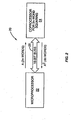
- Figure 2 illustrates a circuit 20 for squaring 2N word values.
- Circuit 20 comprises a microprocessor 22 and co-processor 24 connected by a bus 26.
- the co-processor 24 squares a 2n word value for similar cost and complexity of a multiplier that multiplies n word values.
- the transfer of the value to be squared from the microprocessor 22 to the co-processor 24 would take the same 2n bus cycles.
- the resulting value is longer, being approximately 4n words.
- one 2n word square requires 6n bus cycles.
- various methods may be used to conceal those values. For example, suppose that the co-processor 24 of Figure 2 implements the squaring routine of Table 7. Further suppose that the co-processor 24 is used to square a secret message string. The secret message string may be broken into its least significant half and its most significant half, which are then squared by recursive calls to the subroutine RECSQR. These values are then broken down into quarters, and so forth. However, there is no requirement to square the most significant half before the least significant half or vice versa. Therefore, it is possible to incorporate a random switch that will randomly choose, separately at each recursion, whether the most or least significant half is squared first.
- the order in which the fragments of the original message string are sent to the co-processor 24 will be unknown.
- a random transposition of the bits of the secret message string will have occurred, rendering it difficult to reconstruct the message string by observing the values sent to the co-processor 24.
- This difficulty is substantially increased if the third recursive call is also randomly ordered with the first two, which can be done at the expense of greater utilization of temporary stack space.
- the routine of Table 7 could be rewritten, in one implementation, to incorporate six different sequences of program steps, each with their own stack indexing, and corresponding to the six different orders in which the three recursive calls could be made.
- a random number from "1" to "6" would select one of the sequences for each recursion. Then, it would not be known whether data sent to the co-processor 24 was a message segment of A1 or A2 or a segment of
- the random ordering of the reduced length squares is preferably determined by an unpredictable, random noise generator. For example, a random signal can be generated by sampling and quantizing a random noise signal whenever a random bit or value is needed.
- the squaring co-processor 24 of Figure 2 may be constructed internally, using the recursive squaring algorithm of Table 7, for example, to express the 2n word square in terms of three n word squares which are added and subtracted as shown in Equation 5. These n word squares, in turn, may be expressed as three n/2 word squares, and so forth, until the wordlength is reached for which a hardware squaring circuit is more compact.
- VHDL Very High Level Design Language
- K-O Multiplication Algorithm can be described in recursive VHDL code such that a circuit block for performing n-by-n word multiplication can be described as interconnections between three circuit blocks that perform n/2 ⁇ n/2 word multiplications.
- recursive VHDL code can be used to describe a 2n word squaring circuit in terms of three interconnected n word squaring circuits, analogous to the program of Table 7.
- the wordlength is recursively reduced to a length for which a specific squaring circuit is more efficient than allowing the recursion to continue to an even shorter wordlength.
- the use of recursive VHDL can reduce the effort in describing a squaring circuit.
- Equation 7 is a recursive definition of an M-bit square in terms of an M-1 bit square, with the addition of an extra term to the M-1 bit square if B M -1 is equal to binary "1".
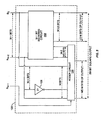
- FIG. 3 is a squaring circuit 100 implementing the recursive squaring algorithm of Equation 7.
- the recursive squaring circuit 100 comprises an M-1 bit squaring circuit 102, adder circuit 104, and inverter 106.
- Squaring circuit 100 receives an input of M-bits and generates an output of 2M-bits equal to the square of the M-bit input value.
- the least significant M-1 bits of the input are connected to the M-1 bit squaring circuit 102, which provides a 2M-2 bit output.
- the M least significant bits output from squaring circuit 102 become the least significant M output bits of the squaring circuit 100.
- the M-2 most significant bits output from the squaring circuit 102 are input to adder circuit 104.
- the other input to the adder circuit 104 is an M-bit value representing the term 2 M-2 +X M-1 which is equal to the term X M-1 with a "1" added to its most significant bit position B M-2 . If the most significant bit B M-2 is a binary "1”, then adding "1" will result in a binary "0" plus a carry bit, the carry bit being a "1" in the bit position B M . On the other hand, if B M-2 is a binary "0”, then adding "1” generates a "1” at the bit position B M-2 and a "0" carry. Thus, the top two bits of the M-bit term are given by B M-2 and its inverse, which is formed by inverter 106.
- Adder circuit 104 is enabled to add when the most significant bit B M-1 is a binary "1". Otherwise, adder circuit 104 merely outputs the M-2 bits from squaring circuit 102, extended to M-bits by two "0"s in the two most significant bit positions.
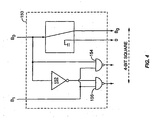
- a VHDL compiler is assumed to already contain definitions for adder circuit 104 and inverter 106. When faced with the need to fill in the details of the M-1 bit squaring circuit 102, however, a recursive VHDL compiler will use the definition of the M-bit squarer 100 with M reduced to M-1. Ultimately, a one bit squarer will be required with a two bit output. The two bit output comprises the input bit and "0". The recursion could stop at a higher level, for example, two bits in and four bits out by defining a suitable logic circuit. The two bit squarer does not need adder circuit 104, as the number of bits from the one bit squarer to be added is "0". The adder circuit 104 for the two bit squarer can be replaced with a two bit NAND gate to either pass B 0 and its inverse to the two most significant bits of the four bit output, or else output "0"s.
- the two bit squarer 150 comprises an inverter 152 and a pair of NOR gates 154 and 156.
- the designer can describe the additional logic needed to extend a circuit for operating on length N variables to a circuit for operating on length N+1 variables.
- the additional logic is comprised of standard library modules. Then, together with a suitable logic circuit design for a trivial N, such as "1" or "2", the recursive VHDL compiler does the bulk of the design work.
- C N C ⁇ N - 1 + 24 ⁇ N - 2 + 4 ⁇ N + 20 + 1
- Equation 8 C(N) is the number of gate inputs.
- FIG. 5 illustrates a recursive squaring circuit according to another embodiment of the present invention.
- the squaring circuit 200 of Figure 5 squares an M-bit input and provides a 2M-bit output.
- the squaring circuit 200 comprises three M/2 bit squarers 202, 204, and 206, a subtractor 208, and adders 212 and 214.
- the most significant M/2 bits, denoted A2, of the M-bit input A is squared in M/2 bit squarer 202, while the M/2 least significant bits, denoted A1, are squared in M/2 bit squarer 204.
- Each M/2 bit squarer 202 and 204 produces M-bits of output.
- the M/2 least significant bits of A1 2 are output as the M/2 least significant bits of the final square A 2 .
- Subtractor 208 computes the modulus difference
- the complement +1 may be performed by a carry propagator which has a complexity of about 0.4 adder cells per bit. Thus, the complexity of subtractor 208 is approximately 1.4M/2, which equals 0.7M adder cells. The complexity may be further reduced by employing the technique disclosed in U.S. Patent No. 5,251,164 by Dodson et al .
- M-bit adder 212 adds A1 2 , which is output by squarer 204, and A2 2 , which is output by squarer 202, to produce an M+1 bit result.
- the complexity of adder 212 is, thus, M adder cells.
- the modulus difference output from subtractor 208 is squared by M/2 bit squarer 206 to produce an M-bit square, which is either added to or subtracted from the output of M-bit adder 212.
- Adder/subtractor 210 is controlled by a sign output from subtractor 104. When the sign output by subtractor 208 is a plus, adder/subtractor 210 adds the two values. Conversely, when the sign output by subtractor 208 is a minus, adder/subtractor 210 subtracts the two values.
- the complexity required to successfully negate the M-bits from adder 212 is about 0.25 adder cells per bit, so the complexity of adder/subtractor 210 is approximately 1.25M adder cells.
- the M+1 bits output from adder/subtractor 210 are added to the 3M/2 bits comprised of the M/2 most significant bits of A1 2 and the M-bits of A2 2 output by squarer 202.
- This addition requires M+1 bits of full adder and M/2-1 bits of carry propagation.
- the final adder complexity is thus of the order (M+1)+0.4(M/2-1) full adder cells.
- the bitwise recursion gave a complexity of only 6 adder cells; therefore, the bitwise 4-bit squarer should be used as the starting point for higher order squarers.
- the squaring circuit 200 of Figure 5 has a complexity of 1726, which is a significant reduction on the 2354 adder cells required for bitwise squaring, and the advantage for the squaring circuit 200 as compared to a bitwise squarer improves as the number of bits increase. Based on these calculations, it appears advantageous to define a bitwise recursive 16-bit squarer, which is then employed in sets of three using recursion as disclosed herein to define squarers of longer wordlength. It may be realized from Figure 5 that the technique of recursive VHDL may also be used to describe an M-bit squarer in terms of standard library gates and three M/2-bit squarers.
- the program listing of Table 9 begins by defining the entity "M_BIT_SQUARER" to have I/O ports with M bits of input called XIN indexed 0 to M-1, and 2M bits of output called XOUT indexed 0 to 2M-1 (lines 5-25).
- M is declared to be generic, which means that it is an integer to be supplied later, when a specific "instantiation" of the circuit is invoked by a user of the circuit, for example, by a higher level block incorporating it as a component for a particular value of M.
- VHDL code then continues to describe one possible architecture for an M-bit squarer beginning at line 30.
- the particular architecture described is the bitwise recursive squarer shown in Figure 3 , so this architecture for "M_BIT_SQUARER" is called “BIT_REC_SQR.”
- VHDL allows multiple architectures to be defined for the same logical function, so "M_BIT_SQUARER” could have other, possibly non-recursively defined architectures to realize the circuit. In such case, the user has a choice which configuration to employ in a particular case. Recursively-designed circuits, such as that shown in Figures 3 and 5 , will be more efficient in many circumstances.
- the architecture definition of the M-bit squarer comprises the explicit definition of a 2-bit squarer shown in Figure 4 when it is detected that the value of the generic integer parameter M equals 2. This explicit definition is contained in lines 45-105 of Table 9.
- the 2-bit squarer employs two component types -- an inverter and a 2-input NAND gate.
- the definition of the 2-bit squarer uses one component of type INVERTER connected to two components of type NAND2. The interconnections are specified by which signal names appear in the respective input and output signal lists (argument lists) each time a component is called up.
- BLOCK1 is a block called “ENABLED_ADDER” of length M-2 bits, which is defined in lines 115-150.
- BLOCK2 is a block called “ENABLED_HALF_NADDER”, which logically is a half-adder with inverted sum output.
- BLOCK2 is defined in lines 155-165.
- BLOCK3 is a recursive instantiation of the M-bit adder itself for the generic value of M-1, which is defined in lines 170-190.
- Signal XSQ is used to label the output bits from the M-1 bit squarer.
- the subsequent FOR loop at line 225 connects M bits of the output bits from the M-1 bit squarer to the output bits XOUT.
- the other M-2 bits from the output of the M-1 bit squarer are connected internally to the M-2 bit adder.
- the use of "signals" labeled XSQ when a device calls itself recursively is another potential violation of current VHDL compilers, which cannot distinguish the signals labeled XSQ in the first recursion from signals labeled XSQ in the subsequent recursions. This problem can be fixed in later versions of VHDL compilers for handling recursion by considering "signals" to be created on a work space stack, analogous with the use of stacks in the above-described FORTRAN code.
- bitwise recursive squaring circuit of Figure 3 could, alternatively, be defined by non-recursive VHDL code. Instead of starting with an M-bit squarer and working backward, a VHDL definition could start with a 2-bit squarer and work upward using a "for" loop. Each "for" loop could successively add the additional circuitry to make a 3-bit squarer, a 4-bit squarer, and so forth.
- replacing a backwards recursion from M down to 2 with a forward loop starting at 2 and incrementing upward to M is only possible when the recursive definition of a circuit invokes only one instance of itself.
- the recursive definition of a circuit invokes more than two instances of itself, e.g., three instances needed by the K-O Multiplication Algorithm, then recursion cannot be described by a simple forward iteration.
- one implementation of the inventive design method described herein is to provide a pre-processor for processing recursive VHDL code as exemplified in Table 9 in order to replace it for a specific value of M, with expanded VHDL code containing explicit definitions of each instantiation of a recursively-used circuit block.
- the pre-processor can also resolve the problem of signal name confusion by automatically generating distinct signal names, such as XSQ1, XSQ2, XSQ3 ... and CARRY1, CARRY2, CARRY3 ... etc. for each successive instantiation of the recursively-used block needing its own, separate internal signals.
- the output VHDL code would be compatible with existing, non-recursive VHDL compilers, so could be incorporated in a VHDL circuit design needing a squarer or multiplier or other recursively-designed circuit for a specific value of a generic parameter, such as M in the above example.
- the circuit design would, until recursive compilers are available, comprise the following steps:
- Table 10 shows the definition of a 4-bit squarer generated from the recursive definition of an M-bit squarer.
- FOUR_BIT_SQUARER is 10 port(XIN:in BIT_VECTOR(0 to 3); 15 XOUT:out BIT_VECTOR(0 to 7)); 20 end FOUR_BIT_SQUARER; 25 architecture BIT_REC_SQR_FOUR of FOUR_BIT_SQUARER is 30 component ENABLED_ADDER 35 generic(N:INTEGER); 40 port(A:in BIT_VECTOR(0 to N-1); 45 B:in BIT_VECTOR(0 to N-1); 50 ENABLE:in BIT; 55 C:out BIT_VECTOR(0 to N-1); 60 CARRY:out BIT 65 end component 70 component ENABLED_HALF_NADDER 75 port(BM1,BM
- a pre-processor can be defined that translates recursive VHDL that cannot be compiled by conventional VHDL compilers into non-recursive code that can be used to enable logic circuit designers to avail themselves of the advantages of recursive VHDL in advance of recursive VHDL compilers.
- the use of recursive VHDL as described above can be used for many different types of logic circuits.
- the N-bit adder used in the above example can be defined recursively as an N-1 bit adder, plus an extra adder stage to extend it from N-1 to N-bits. This is an example which, however, can be performed alternatively using a "for" loop.
- the N-bit adder can be defined as a non-recursive VHDL block comprising an "even” type adder cell cascaded with a recursive VHDL block describing an (N-1) bit adder ending with an "odd” type cell.
- This block describes an "odd” cell cascaded with a 1-bit shorter adder ending in an "even” cell, and the adder ending in the even cell recursively calls the adder ending in the "odd” cell.
- the recursion may not be apparent to a standard VHDL compiler as no routine calls itself, but incorrect results are likely to occur unless a true recursive VHDL compiler, or a recursive VHDL pre-processor is used according to the present invention.
- the Kolatgola-Kumar adder may alternatively be defined as a 2N-bit adder comprising an odd/even cell pair cascaded with a (2N-2)-bit adder.
Landscapes
- Engineering & Computer Science (AREA)
- Physics & Mathematics (AREA)
- General Physics & Mathematics (AREA)
- Theoretical Computer Science (AREA)
- Computational Mathematics (AREA)
- Mathematical Analysis (AREA)
- Pure & Applied Mathematics (AREA)
- Mathematical Optimization (AREA)
- Computing Systems (AREA)
- General Engineering & Computer Science (AREA)
- Mathematical Physics (AREA)
- Computer Security & Cryptography (AREA)
- Computer Networks & Wireless Communication (AREA)
- Signal Processing (AREA)
- Complex Calculations (AREA)
- Design And Manufacture Of Integrated Circuits (AREA)
- Devices For Executing Special Programs (AREA)
- Dental Preparations (AREA)
- Escalators And Moving Walkways (AREA)
- Measurement Of Resistance Or Impedance (AREA)
- Paper (AREA)
- Maintenance And Management Of Digital Transmission (AREA)
Claims (16)
- Quadrierschaltung (20) mit:einem Hostprozessor (22), der angeordnet ist, das Quadrat eines langen Ganzzahlwertes (long integer) durch rekursives Verringern des Quadrates des langen Ganzzahlwertes zu einer Kombination von Quadraten von Ganzzahlwerten von verringerter Länge zu berechnen, wobei die Ganzzahlwerte von verringerter Länge eine vorbestimmte Länge aufweisen, wobei bei jedem Schritt der Rekursion der Hostprozessor Startganzzahlwerte zu einer Kombination von Quadraten von drei endenden Ganzzahlwerten einer halben Länge der Startganzzahlwerte verringert;einem Co-Prozessor (24), der mit dem Hostprozessor verbunden ist, um die Quadrate der Ganzzahlwerte von verringerter Länge zu berechnen;dadurch gekennzeichnet, dass
die Quadrierschaltung weiter eine oder mehrere Logikschaltungen (150) umfasst, die speziell angeordnet sind, Ganzzahlwerte einer vorbestimmten Hardwarelänge zu quadrieren; und dadurch, dass
der Coprozessor rekursiv mit speziell angepasster Hardware konstruiert ist und angeordnet ist, um weiter rekursiv die Quadrate der Ganzzahlwerte von verringerter Länge in eine Kombination von Quadraten von Ganzzahlwerten einer Hardwarelänge mit einer Länge zu verringern, die weniger als oder gleich zu der vorbestimmten Hardwarelänge ist, so dass die Ganzzahlwerte einer Hardwarelänge von der einen oder mehreren Hardwareschaltungen quadriert werden kann, wobei bei jedem Schritt der Rekursion der Coprozessor Startganzzahlwerte zu einer Kombination von Quadraten von drei endenden Ganzzahlwerten einer halben Länge der Startganzzahlwerte verringert. - Quadrierschaltung nach Anspruch 1, wobei die eine oder mehrere Hardwareschaltungen (150) eine getrennte Hardwarelogikschaltung für jeden Ganzzahlwert einer Hardwarelänge umfasst, der quadriert werden soll.
- Quadrierschaltung (200) nach Anspruch 1, wobei der Hostprozessor weiter das Produkt von zwei langen Ganzzahlwerten durch Berechnen der Differenz zwischen dem Quadrat der Summe der zwei langen Ganzzahlwerte und dem Quadrat der Differenz der zwei langen Ganzzahlwerten berechnet.
- Quadrierschaltung nach Anspruch 3, wobei der Hostprozessor die Summe der zwei langen Ganzzahlwerte und die Differenz der zwei langen Ganzzahlwerte durch zwei teilt, bevor die Quadrate der Summe und der Differenz berechnet werden.
- Quadrierschaltung nach Anspruch 4, wobei der Hostprozessor den kleineren Wert der zwei langen Ganzzahlwerte zu der Differenz der Quadrate addiert, um das Endprodukt zu bilden.
- Quadrierschaltung nach Anspruch 1, wobei der Hostprozessor weiter eine Potenz eines langen Ganzzahlwertes durch Berechnen aufeinander folgender Quadrate des langen Ganzzahlwertes und durch Berechnen des Produktes von Ausgewählten der aufeinander folgenden Quadrate entsprechend binären "1"-en in der Potenz berechnet.
- Quadrierschaltung nach Anspruch 6, wobei der Hostprozessor das Produkt der Ausgewählten der aufeinander folgenden Quadrate durch Berechen der Differenz zwischen den Quadraten der Summe und der Differenz der aufeinander folgenden Quadrate berechnet.
- Quadrierschaltung nach Anspruch 1, weiter mit einem zufälligen Ordnen jedes Satzes von drei endenden Ganzzahlwerten in zumindest einer Stufe der Rekursion.
- Verfahren zum Quadrieren eines langen Ganzzahlwertes mit:rekursivem Verringern des Quadrats des langen Ganzzahlwertes (long integer) in einem Hostprozessor (22) zu einer Kombination von Quadraten von Ganzzahlwerten von verringerter Länge, wobei die Ganzzahlwerte von verringerter Länge eine vorbestimmte Länge aufweisen, wobei bei jedem Schritt der Rekursion der Hostprozessor Startganzzahlwerte zu einer Kombination von Quadraten von drei endenden Ganzzahlwerten einer halben Länge der Startganzzahlwerte verringert;gekennzeichnet durch die Schritterekursivem Berechnen der Quadrate der Ganzzahlwerte von verringerter Länge in einem Coprozessor (24), der mit speziell angepasster Hardware konstruiert ist, wobei der Coprozessor mit dem Hostprozessor verbunden ist, durch weiter rekursives Verringern der Quadrate der verringerten Ganzzahlwerte in eine Kombination von Quadraten von Ganzzahlwerten einer Hardwarelänge mit einer Länge, die weniger als oder gleich zu der vorbestimmten Hardwarelänge ist, so dass die Ganzzahlwerte einer Hardwarelänge von der einen oder mehreren Hardwareschaltungen (150) quadriert werden können, die speziell angeordnet sind, um Ganzzahlwerte der vorbestimmten Hardwarelänge zu quadrieren, wobei bei jedem Schritt der Rekursion der Coprozessor Startganzzahlwerte zu einer Kombination von Quadraten von drei endenden Ganzzahlwerten einer halben Länge der Startganzzahlwerte verringert; undBerechnen der Quadrate der Ganzzahlwerte einer Hardwarelänge in der einen oder mehreren Hardwarelogikschaltungen.
- Verfahren nach Anspruch 9, wobei ein Berechnen des Quadrates der Ganzzahlwerte einer Hardwarelänge ein Berechnen der Quadrate der Hardwarelängenwerte in getrennten Hardwarelogikschaltungen (150) umfasst.
- Verfahren nach Anspruch 9, weiter mit Berechnen des Produkts von zwei langen Ganzzahlwerten in dem Hostprozessor (22) durch Berechnen der Differenz zwischen den Quadraten der Summe und der Differenz der zwei langen Ganzzahlwerte.
- Verfahren nach Anspruch 11, wobei ein Berechnen der Differenz zwischen den Quadraten der Summe und der Differenz der zwei langen Ganzzahlwerte ein Teilen der Summe und der Differenz der zwei langen Ganzzahlwerte durch zwei umfasst, vor einem Berechnen der Quadrate der Summe und der Differenz.
- Verfahren nach Anspruch 12, wobei ein Berechnen der Differenz zwischen den Quadraten der Summe und der Differenz der zwei langen Ganzzahlwerte weiter ein Addieren des kleineren der zwei langen Ganzzahlwerte zu der Differenz der Quadrate der Summe und der Differenz umfasst, um das Endprodukt zu bilden.
- Verfahren nach Anspruch 9, weiter mit einem Berechnen einer Potenz eines langen Ganzzahlwertes durch Berechnen aufeinander folgender Quadrate des langen Ganzzahlwertes und durch Berechnen des Produktes von Ausgewählten der aufeinander folgenden Quadrate entsprechend binären "1"-en in der Potenz.
- Verfahren nach Anspruch 14, wobei ein Berechnen des Produkts der Ausgewählten der aufeinander folgenden Quadrate entsprechend binären "1"-en in der Potenz ein Berechen der Differenz zwischen den Quadraten der Summe und der Differenz der aufeinander folgenden Quadrate umfasst.
- Verfahren nach Anspruch 9, weiter mit einem zufälligen Ordnen jedes Satzes von drei endenden Ganzzahlwerten in zumindest einer Stufe der Rekursion.
Priority Applications (2)
| Application Number | Priority Date | Filing Date | Title |
|---|---|---|---|
| EP07100115A EP1818811A3 (de) | 2001-03-06 | 2002-02-20 | Rekursiver VHDL-Compiler und Verfahren zum Design von logischen Schaltungen |
| EP07100110A EP1818810B1 (de) | 2001-03-06 | 2002-02-20 | Schaltkreis und Verfahren zur Vervielfältigung langer ganzzahliger Werte |
Applications Claiming Priority (3)
| Application Number | Priority Date | Filing Date | Title |
|---|---|---|---|
| US800145 | 2001-03-06 | ||
| US09/800,145 US7113593B2 (en) | 2001-03-06 | 2001-03-06 | Recursive cryptoaccelerator and recursive VHDL design of logic circuits |
| PCT/US2002/004951 WO2002071687A1 (en) | 2001-03-06 | 2002-02-20 | Recursive cryptoaccelerator and recursive vhdl design of logic circuits |
Related Child Applications (3)
| Application Number | Title | Priority Date | Filing Date |
|---|---|---|---|
| EP07100115A Division EP1818811A3 (de) | 2001-03-06 | 2002-02-20 | Rekursiver VHDL-Compiler und Verfahren zum Design von logischen Schaltungen |
| EP07100110A Addition EP1818810B1 (de) | 2001-03-06 | 2002-02-20 | Schaltkreis und Verfahren zur Vervielfältigung langer ganzzahliger Werte |
| EP07100110A Division EP1818810B1 (de) | 2001-03-06 | 2002-02-20 | Schaltkreis und Verfahren zur Vervielfältigung langer ganzzahliger Werte |
Publications (3)
| Publication Number | Publication Date |
|---|---|
| EP1366596A1 EP1366596A1 (de) | 2003-12-03 |
| EP1366596A4 EP1366596A4 (de) | 2006-05-03 |
| EP1366596B1 true EP1366596B1 (de) | 2008-08-13 |
Family
ID=25177603
Family Applications (3)
| Application Number | Title | Priority Date | Filing Date |
|---|---|---|---|
| EP02719024A Expired - Lifetime EP1366596B1 (de) | 2001-03-06 | 2002-02-20 | Anordnung und Verfahren zum Quadrieren von langen Ganzzahlen |
| EP07100115A Withdrawn EP1818811A3 (de) | 2001-03-06 | 2002-02-20 | Rekursiver VHDL-Compiler und Verfahren zum Design von logischen Schaltungen |
| EP07100110A Expired - Lifetime EP1818810B1 (de) | 2001-03-06 | 2002-02-20 | Schaltkreis und Verfahren zur Vervielfältigung langer ganzzahliger Werte |
Family Applications After (2)
| Application Number | Title | Priority Date | Filing Date |
|---|---|---|---|
| EP07100115A Withdrawn EP1818811A3 (de) | 2001-03-06 | 2002-02-20 | Rekursiver VHDL-Compiler und Verfahren zum Design von logischen Schaltungen |
| EP07100110A Expired - Lifetime EP1818810B1 (de) | 2001-03-06 | 2002-02-20 | Schaltkreis und Verfahren zur Vervielfältigung langer ganzzahliger Werte |
Country Status (5)
| Country | Link |
|---|---|
| US (1) | US7113593B2 (de) |
| EP (3) | EP1366596B1 (de) |
| AT (2) | ATE404913T1 (de) |
| DE (2) | DE60228207D1 (de) |
| WO (1) | WO2002071687A1 (de) |
Families Citing this family (9)
| Publication number | Priority date | Publication date | Assignee | Title |
|---|---|---|---|---|
| US8781110B2 (en) * | 2007-06-30 | 2014-07-15 | Intel Corporation | Unified system architecture for elliptic-curve cryptography |
| US8572406B2 (en) * | 2010-03-31 | 2013-10-29 | Inside Contactless | Integrated circuit protected against horizontal side channel analysis |
| EP2365659B1 (de) | 2010-03-01 | 2017-04-12 | Inside Secure | Testverfahren des Widerstands eines integrierten Schaltkreises gegenüber einem Seitenkanalangriff |
| FR2956933A1 (fr) * | 2010-03-01 | 2011-09-02 | Inside Contactless | Circuit integre protege contre une analyse par canal auxiliaire horizontale |
| CN103765493B (zh) * | 2011-09-06 | 2017-10-24 | 英特尔公司 | 数字平方计算机实现的方法和设备 |
| US9355068B2 (en) | 2012-06-29 | 2016-05-31 | Intel Corporation | Vector multiplication with operand base system conversion and re-conversion |
| US10095516B2 (en) | 2012-06-29 | 2018-10-09 | Intel Corporation | Vector multiplication with accumulation in large register space |
| EP4095826A4 (de) * | 2020-01-20 | 2023-10-25 | Nippon Telegraph And Telephone Corporation | Sichere rechnervorrichtung, sicheres berechnungsverfahren und programm |
| US11636176B2 (en) * | 2020-09-25 | 2023-04-25 | Apple Inc. | Interpolation method and apparatus for arithmetic functions |
Family Cites Families (7)
| Publication number | Priority date | Publication date | Assignee | Title |
|---|---|---|---|---|
| US4313174A (en) * | 1980-03-17 | 1982-01-26 | Rockwell International Corporation | ROM-Based parallel digital arithmetic device |
| US5765207A (en) * | 1993-06-22 | 1998-06-09 | International Business Machines Corporation | Recursive hardware state machine |
| US5963454A (en) * | 1996-09-25 | 1999-10-05 | Vlsi Technology, Inc. | Method and apparatus for efficiently implementing complex function blocks in integrated circuit designs |
| US5828590A (en) * | 1996-11-27 | 1998-10-27 | United Microelectronics Corp. | Multiplier based on a variable radix multiplier coding |
| FR2758195B1 (fr) * | 1997-01-09 | 1999-02-26 | Sgs Thomson Microelectronics | Coprocesseur d'arithmetique modulaire comprenant deux circuits de multiplication operant en parallele |
| US6289498B1 (en) * | 1998-02-20 | 2001-09-11 | Lsi Logic Corporation | VDHL/Verilog expertise and gate synthesis automation system |
| US6044390A (en) * | 1998-04-16 | 2000-03-28 | V L S I Technology, Inc. | Recursive lookahead-based 2n -bit serial multipliers over Galois Field GF (2m) |
-
2001
- 2001-03-06 US US09/800,145 patent/US7113593B2/en not_active Expired - Lifetime
-
2002
- 2002-02-20 EP EP02719024A patent/EP1366596B1/de not_active Expired - Lifetime
- 2002-02-20 EP EP07100115A patent/EP1818811A3/de not_active Withdrawn
- 2002-02-20 WO PCT/US2002/004951 patent/WO2002071687A1/en not_active Ceased
- 2002-02-20 DE DE60228207T patent/DE60228207D1/de not_active Expired - Lifetime
- 2002-02-20 AT AT02719024T patent/ATE404913T1/de not_active IP Right Cessation
- 2002-02-20 AT AT07100110T patent/ATE419578T1/de not_active IP Right Cessation
- 2002-02-20 EP EP07100110A patent/EP1818810B1/de not_active Expired - Lifetime
- 2002-02-20 DE DE60230690T patent/DE60230690D1/de not_active Expired - Lifetime
Also Published As
| Publication number | Publication date |
|---|---|
| EP1818811A3 (de) | 2008-01-02 |
| DE60230690D1 (de) | 2009-02-12 |
| EP1818811A2 (de) | 2007-08-15 |
| WO2002071687A1 (en) | 2002-09-12 |
| EP1818810A3 (de) | 2007-12-12 |
| ATE419578T1 (de) | 2009-01-15 |
| ATE404913T1 (de) | 2008-08-15 |
| EP1366596A1 (de) | 2003-12-03 |
| DE60228207D1 (de) | 2008-09-25 |
| EP1818810A2 (de) | 2007-08-15 |
| US7113593B2 (en) | 2006-09-26 |
| EP1818810B1 (de) | 2008-12-31 |
| EP1366596A4 (de) | 2006-05-03 |
| US20030016822A1 (en) | 2003-01-23 |
Similar Documents
| Publication | Publication Date | Title |
|---|---|---|
| EP0801345B1 (de) | Schaltung für Modulo-Multiplikations- und Exponentiationsarithmetik | |
| US6282290B1 (en) | High speed modular exponentiator | |
| US6182104B1 (en) | Circuit and method of modulo multiplication | |
| US6434585B2 (en) | Computationally efficient modular multiplication method and apparatus | |
| US4870681A (en) | Cryptographic method and cryptographic processor for carrying out the method | |
| US7320015B2 (en) | Circuit and method for performing multiple modulo mathematic operations | |
| CN109039640B (zh) | 一种基于rsa密码算法的加解密硬件系统及方法 | |
| US20120057695A1 (en) | Circuits for modular arithmetic based on the complementation of continued fractions | |
| JP2008293034A (ja) | タイミング攻撃を阻止する標準化されたモジュラべき乗を計算することにより復号メカニズムを実行する方法と装置 | |
| US7580966B2 (en) | Method and device for reducing the time required to perform a product, multiplication and modular exponentiation calculation using the Montgomery method | |
| EP1217512A2 (de) | Arithmetische Schaltung und arithmetisches Verfahren | |
| KR100442218B1 (ko) | 몽고메리의 알고리즘을 이용한 멱승 잉여 연산기 | |
| US7046800B1 (en) | Scalable methods and apparatus for Montgomery multiplication | |
| EP1366596B1 (de) | Anordnung und Verfahren zum Quadrieren von langen Ganzzahlen | |
| US7050579B1 (en) | Cryptographic methods and apparatus using word-wise montgomery multiplication | |
| US20240187206A1 (en) | Method and system for protecting cryptographic operations against side-channel attacks | |
| KR100508092B1 (ko) | 저전력 모듈로 곱셈을 수행하는 연산장치 | |
| KR100564599B1 (ko) | 역원 계산 회로, 역원계산 방법 및 상기 역원계산 방법을실행시키기 위한 프로그램을 기록한 컴퓨터로 읽을 수있는 기록매체 | |
| US7403965B2 (en) | Encryption/decryption system for calculating effective lower bits of a parameter for Montgomery modular multiplication | |
| Ko et al. | Montgomery multiplication in | |
| Safieh | Algorithms and Architectures for Cryptography and Source Coding in Non-Volatile Flash Memories | |
| Kuramoto et al. | Improved Constant-Time Modular Inversion | |
| KR20020071327A (ko) | 씨알티를 이용한 하이래딕스 알에스에이 모듈로 멱승 처리기 | |
| Põldre | Cryptoprocessor PLD001 | |
| Peng | High-speed implementation of the RSA cryptosystem |
Legal Events
| Date | Code | Title | Description |
|---|---|---|---|
| PUAI | Public reference made under article 153(3) epc to a published international application that has entered the european phase |
Free format text: ORIGINAL CODE: 0009012 |
|
| 17P | Request for examination filed |
Effective date: 20030917 |
|
| AK | Designated contracting states |
Kind code of ref document: A1 Designated state(s): AT BE CH CY DE DK ES FI FR GB GR IE IT LI LU MC NL PT SE TR |
|
| AX | Request for extension of the european patent |
Extension state: AL LT LV MK RO SI |
|
| RAP1 | Party data changed (applicant data changed or rights of an application transferred) |
Owner name: ERICSSON INC. |
|
| RIC1 | Information provided on ipc code assigned before grant |
Ipc: G06F 7/552 20060101ALI20060306BHEP Ipc: G06F 7/52 20060101AFI20060306BHEP |
|
| A4 | Supplementary search report drawn up and despatched |
Effective date: 20060322 |
|
| 17Q | First examination report despatched |
Effective date: 20060620 |
|
| 17Q | First examination report despatched |
Effective date: 20060620 |
|
| GRAP | Despatch of communication of intention to grant a patent |
Free format text: ORIGINAL CODE: EPIDOSNIGR1 |
|
| RTI1 | Title (correction) |
Free format text: CIRCUIT AND METHOD FOR SQUARING LONG INTEGERS |
|
| GRAS | Grant fee paid |
Free format text: ORIGINAL CODE: EPIDOSNIGR3 |
|
| GRAA | (expected) grant |
Free format text: ORIGINAL CODE: 0009210 |
|
| AK | Designated contracting states |
Kind code of ref document: B1 Designated state(s): AT BE CH CY DE DK ES FI FR GB GR IE IT LI LU MC NL PT SE TR |
|
| REG | Reference to a national code |
Ref country code: GB Ref legal event code: FG4D |
|
| REG | Reference to a national code |
Ref country code: CH Ref legal event code: EP |
|
| REG | Reference to a national code |
Ref country code: IE Ref legal event code: FG4D |
|
| REF | Corresponds to: |
Ref document number: 60228207 Country of ref document: DE Date of ref document: 20080925 Kind code of ref document: P |
|
| PG25 | Lapsed in a contracting state [announced via postgrant information from national office to epo] |
Ref country code: ES Free format text: LAPSE BECAUSE OF FAILURE TO SUBMIT A TRANSLATION OF THE DESCRIPTION OR TO PAY THE FEE WITHIN THE PRESCRIBED TIME-LIMIT Effective date: 20081124 Ref country code: NL Free format text: LAPSE BECAUSE OF FAILURE TO SUBMIT A TRANSLATION OF THE DESCRIPTION OR TO PAY THE FEE WITHIN THE PRESCRIBED TIME-LIMIT Effective date: 20080813 |
|
| PG25 | Lapsed in a contracting state [announced via postgrant information from national office to epo] |
Ref country code: AT Free format text: LAPSE BECAUSE OF FAILURE TO SUBMIT A TRANSLATION OF THE DESCRIPTION OR TO PAY THE FEE WITHIN THE PRESCRIBED TIME-LIMIT Effective date: 20080813 Ref country code: FI Free format text: LAPSE BECAUSE OF FAILURE TO SUBMIT A TRANSLATION OF THE DESCRIPTION OR TO PAY THE FEE WITHIN THE PRESCRIBED TIME-LIMIT Effective date: 20080813 |
|
| PG25 | Lapsed in a contracting state [announced via postgrant information from national office to epo] |
Ref country code: BE Free format text: LAPSE BECAUSE OF FAILURE TO SUBMIT A TRANSLATION OF THE DESCRIPTION OR TO PAY THE FEE WITHIN THE PRESCRIBED TIME-LIMIT Effective date: 20080813 |
|
| PG25 | Lapsed in a contracting state [announced via postgrant information from national office to epo] |
Ref country code: DK Free format text: LAPSE BECAUSE OF FAILURE TO SUBMIT A TRANSLATION OF THE DESCRIPTION OR TO PAY THE FEE WITHIN THE PRESCRIBED TIME-LIMIT Effective date: 20080813 |
|
| PG25 | Lapsed in a contracting state [announced via postgrant information from national office to epo] |
Ref country code: PT Free format text: LAPSE BECAUSE OF FAILURE TO SUBMIT A TRANSLATION OF THE DESCRIPTION OR TO PAY THE FEE WITHIN THE PRESCRIBED TIME-LIMIT Effective date: 20090113 |
|
| PLBE | No opposition filed within time limit |
Free format text: ORIGINAL CODE: 0009261 |
|
| STAA | Information on the status of an ep patent application or granted ep patent |
Free format text: STATUS: NO OPPOSITION FILED WITHIN TIME LIMIT |
|
| 26N | No opposition filed |
Effective date: 20090514 |
|
| PG25 | Lapsed in a contracting state [announced via postgrant information from national office to epo] |
Ref country code: MC Free format text: LAPSE BECAUSE OF NON-PAYMENT OF DUE FEES Effective date: 20090228 |
|
| REG | Reference to a national code |
Ref country code: CH Ref legal event code: PL |
|
| PG25 | Lapsed in a contracting state [announced via postgrant information from national office to epo] |
Ref country code: LI Free format text: LAPSE BECAUSE OF NON-PAYMENT OF DUE FEES Effective date: 20090228 Ref country code: CH Free format text: LAPSE BECAUSE OF NON-PAYMENT OF DUE FEES Effective date: 20090228 |
|
| REG | Reference to a national code |
Ref country code: IE Ref legal event code: MM4A |
|
| REG | Reference to a national code |
Ref country code: FR Ref legal event code: ST Effective date: 20091030 |
|
| PG25 | Lapsed in a contracting state [announced via postgrant information from national office to epo] |
Ref country code: IE Free format text: LAPSE BECAUSE OF NON-PAYMENT OF DUE FEES Effective date: 20090220 Ref country code: SE Free format text: LAPSE BECAUSE OF FAILURE TO SUBMIT A TRANSLATION OF THE DESCRIPTION OR TO PAY THE FEE WITHIN THE PRESCRIBED TIME-LIMIT Effective date: 20081113 |
|
| PG25 | Lapsed in a contracting state [announced via postgrant information from national office to epo] |
Ref country code: FR Free format text: LAPSE BECAUSE OF NON-PAYMENT OF DUE FEES Effective date: 20090302 |
|
| PG25 | Lapsed in a contracting state [announced via postgrant information from national office to epo] |
Ref country code: GR Free format text: LAPSE BECAUSE OF FAILURE TO SUBMIT A TRANSLATION OF THE DESCRIPTION OR TO PAY THE FEE WITHIN THE PRESCRIBED TIME-LIMIT Effective date: 20081114 |
|
| PG25 | Lapsed in a contracting state [announced via postgrant information from national office to epo] |
Ref country code: LU Free format text: LAPSE BECAUSE OF NON-PAYMENT OF DUE FEES Effective date: 20090220 |
|
| PG25 | Lapsed in a contracting state [announced via postgrant information from national office to epo] |
Ref country code: TR Free format text: LAPSE BECAUSE OF FAILURE TO SUBMIT A TRANSLATION OF THE DESCRIPTION OR TO PAY THE FEE WITHIN THE PRESCRIBED TIME-LIMIT Effective date: 20080813 |
|
| PG25 | Lapsed in a contracting state [announced via postgrant information from national office to epo] |
Ref country code: CY Free format text: LAPSE BECAUSE OF FAILURE TO SUBMIT A TRANSLATION OF THE DESCRIPTION OR TO PAY THE FEE WITHIN THE PRESCRIBED TIME-LIMIT Effective date: 20080813 |
|
| PGFP | Annual fee paid to national office [announced via postgrant information from national office to epo] |
Ref country code: FR Payment date: 20190111 Year of fee payment: 9 |
|
| PGFP | Annual fee paid to national office [announced via postgrant information from national office to epo] |
Ref country code: DE Payment date: 20210225 Year of fee payment: 20 Ref country code: GB Payment date: 20210225 Year of fee payment: 20 |
|
| PG25 | Lapsed in a contracting state [announced via postgrant information from national office to epo] |
Ref country code: IT Free format text: LAPSE BECAUSE OF NON-PAYMENT OF DUE FEES Effective date: 20200220 |
|
| REG | Reference to a national code |
Ref country code: DE Ref legal event code: R071 Ref document number: 60228207 Country of ref document: DE |
|
| REG | Reference to a national code |
Ref country code: GB Ref legal event code: PE20 Expiry date: 20220219 |
|
| PG25 | Lapsed in a contracting state [announced via postgrant information from national office to epo] |
Ref country code: GB Free format text: LAPSE BECAUSE OF EXPIRATION OF PROTECTION Effective date: 20220219 |