EP1366415B1 - Verfahren und vorrichtung für eine abschätzung der ausführungszeit eingebetteter software auf statistischer grundlage - Google Patents
Verfahren und vorrichtung für eine abschätzung der ausführungszeit eingebetteter software auf statistischer grundlage Download PDFInfo
- Publication number
- EP1366415B1 EP1366415B1 EP02725074A EP02725074A EP1366415B1 EP 1366415 B1 EP1366415 B1 EP 1366415B1 EP 02725074 A EP02725074 A EP 02725074A EP 02725074 A EP02725074 A EP 02725074A EP 1366415 B1 EP1366415 B1 EP 1366415B1
- Authority
- EP
- European Patent Office
- Prior art keywords
- software
- instructions
- predictor
- virtual
- estimated
- Prior art date
- Legal status (The legal status is an assumption and is not a legal conclusion. Google has not performed a legal analysis and makes no representation as to the accuracy of the status listed.)
- Expired - Lifetime
Links
Images
Classifications
-
- G—PHYSICS
- G06—COMPUTING OR CALCULATING; COUNTING
- G06F—ELECTRIC DIGITAL DATA PROCESSING
- G06F8/00—Arrangements for software engineering
-
- G—PHYSICS
- G06—COMPUTING OR CALCULATING; COUNTING
- G06F—ELECTRIC DIGITAL DATA PROCESSING
- G06F11/00—Error detection; Error correction; Monitoring
- G06F11/30—Monitoring
- G06F11/34—Recording or statistical evaluation of computer activity, e.g. of down time, of input/output operation ; Recording or statistical evaluation of user activity, e.g. usability assessment
- G06F11/3447—Performance evaluation by modeling
-
- G—PHYSICS
- G06—COMPUTING OR CALCULATING; COUNTING
- G06F—ELECTRIC DIGITAL DATA PROCESSING
- G06F11/00—Error detection; Error correction; Monitoring
- G06F11/30—Monitoring
- G06F11/34—Recording or statistical evaluation of computer activity, e.g. of down time, of input/output operation ; Recording or statistical evaluation of user activity, e.g. usability assessment
- G06F11/3457—Performance evaluation by simulation
-
- G—PHYSICS
- G06—COMPUTING OR CALCULATING; COUNTING
- G06F—ELECTRIC DIGITAL DATA PROCESSING
- G06F11/00—Error detection; Error correction; Monitoring
- G06F11/30—Monitoring
- G06F11/34—Recording or statistical evaluation of computer activity, e.g. of down time, of input/output operation ; Recording or statistical evaluation of user activity, e.g. usability assessment
- G06F11/3409—Recording or statistical evaluation of computer activity, e.g. of down time, of input/output operation ; Recording or statistical evaluation of user activity, e.g. usability assessment for performance assessment
- G06F11/3428—Benchmarking
-
- G—PHYSICS
- G06—COMPUTING OR CALCULATING; COUNTING
- G06F—ELECTRIC DIGITAL DATA PROCESSING
- G06F2201/00—Indexing scheme relating to error detection, to error correction, and to monitoring
- G06F2201/815—Virtual
-
- G—PHYSICS
- G06—COMPUTING OR CALCULATING; COUNTING
- G06F—ELECTRIC DIGITAL DATA PROCESSING
- G06F2201/00—Indexing scheme relating to error detection, to error correction, and to monitoring
- G06F2201/865—Monitoring of software
Definitions
- the present invention relates generally to software design.
- the invention is more particularly related to estimation of execution time of software.
- the invention is still more particularly related to the estimation of execution times of microprocessor based (embedded) software.
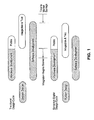
- Fig. 1 provides an example architecture for Hardware/Software Co-Verification. From Post-Partitioning Through Physical Prototype.
- the architecture supports hardware simulation and software development tools.
- VCC is a design tool developed by Cadence Design Systems for Virtual Component Co-Design.
- the VCC environment supports both Intellectual Property and Virtual Component based design flow where the architectural IPs are represented in terms of their performance models and are used to back-annotate the behavioral description of the design with timing information. To make sure that the HW-SW trade-offs are accurately explored it is key to provide accurate estimates of execution time of the behaviors that are mapped to SW implementations.
- the VCC SW estimation framework models both the target system (CPU instruction set, target compiler, etc.) and the structure of the software program at an abstraction level that makes the estimation time reasonable without losing too much accuracy.
- designers are still facing increased pressure to reduce design time, and, increased accuracy is also helpful in turnaround and product quality.
- a model of the target processor is derived in terms of a Virtual Processor Instruction Set by combining existing building blocks in a unique way:
- the similarity of real application code to be estimated to the existing set of benchmarks used to derive the processor model is determined by a 2-sample t-test. If this is the case, then the application code is optimized with the very same front-end optimizer and then a simulation model with annotated execution time is produced by the VCC compile-code generator/annotator.
- the present invention is embodied as a device for performing estimates of software execution times, comprising, a model of a target processor based on execution time of a set of at least one benchmark program, a correlating device configured to correlate a software program to be estimated to the set of at least one benchmark program, and an estimation device configured to apply the software program to be estimated to the model to determine an estimated execution time of the software.
- the present invention also includes a device for estimating execution times of software, comprising, modeling means for modeling a target processor, correlation means for correlating software to be estimated to a set of benchmark software programs that were used as a basis in said modeling means, and an estimation device configured to apply the correlated software to said modeling means to determine an estimated execution time of the software.
- the present invention includes a method of estimating the execution time of software, comprising the steps of, preparing a model of a target processor based on a set of benchmark programs, correlating the software to be estimated with the benchmark programs, and applying the correlated software to the model to determine an estimate of the execution time of the software.
- At least portions of both the device and method may be conveniently implemented on a general purpose computer, or networked computers, and the results may be displayed on an output device connected to any of the general purpose, networked computers, or transmitted to a remote device for output or display.
- at least portions of the present invention may be embodied as a set of executable, interpretable, or compilable instructions and may be stored on a computer readable media or in electronic signals transported in any medium (e.g., network packets, radio transmission, etc).
- SW software
- Software performance estimation can be generally categorized into two different approaches, source based approaches and object based approaches.
- a source-based approach uses compilation onto a virtual instruction set, and allows one to quickly obtain estimates without the need for a compiler for the target processor.
- An object-based approach translates the assembler generated by the target compiler to assembly level-functionally equivalent C. In both cases the code is annotated with timing and other execution related information (e. g., estimated memory accesses) and is used as a precise, yet fast, software simulation model.
- Document XP-000966204 (Bammi J. R. et. al.) discloses these two approaches.
- filtered information is passed between a cycle accurate ISS and a hardware simulator (e. g., by suppressing instruction and data fetch-related activity in the hardware simulator).
- a hardware simulator e. g., by suppressing instruction and data fetch-related activity in the hardware simulator.
- This approach is precise but slow and requires a detailed model of the hardware and software. Performance analysis can be done only after completing the design, when architectural choices are difficult to change.
- the control flow graph (CFG) of the compiled software description is annotated with information useful to derive a cycle-accurate performance model (e.g., considering pipeline and cache).
- the analysis is performed on the code generated for each basic block and information about the optimization performer by an actual compilation process is incorporated. It considers register allocation, instruction selection and scheduling, etc.
- An object code-based approach also uses this scheme.
- a trace of the program's execution on some sample data is used to drive the analysis.
- This approach is referred to as profiling and is often applied to extant software systems.
- Trace-driven schemes at the Register-Transfer (RT) level and using statistically-generated loads have also been proposed. In unmodified form, these methods require a very detailed model or an instance of a system similar to the one being designed. Here, estimates are to be available before such detail is available. To avoid this requirement, a trace-driven approach can be used.
- the execution of the functional model is the independent variable and execution delays are projected forward into the simulated future. Performance analysis can occur at the level of the system where a statistically relevant set of benchmarks are applied. Where this is too expensive it has been proposed that the analysis occur the level of sets of control flow paths, forgoing the precision and expense required to determine delay along an individual path.
- the approach of the present invention can be classified as a source-based approach, with no constraints on the SW (any arbitrary C code), with relatively low cost for the modeler, with relatively fast simulation speed, with dynamic (simulations are needed) and statistical analysis-based approach.
- the present invention provides a degree of reliability in the estimates which was missing in some of the above described approaches.
- the present invention also provides a semiautomatic way, via a predictor equation, to find and then assign a performance model to the kernel function therefore improving methods using linear equation sets to describe feasible program paths. Also the affinity of a new benchmark program to the existing set can be inferred, and the error of the estimation vs the control/computation ratio of the SW are estimated.
- the present invention does not necessarily provide the accuracy of an object-based or ISS based approach.
- the present invention provides an error in the estimates that has a degree of statistical confidence, and therefore the designer can make an assessment whether the estimates can be used to make tradeoff decisions or a more expensive technique such as object or ISS-based should be used.
- a dynamic source-based SW estimation technique is based on the idea of abstracting the actual machine instructions which would be executed by a SW task running on a target processor into a set of Virtual Instructions.
- Virtual Instructions are instructions classified within a generic family of microprocessor instructions (e.g., If statements, GOTO statements, Load from memory (LD), Store to Memory (STO), OP i - 32 bit operator on an integer, MUL i - Multiply Integer, etc.).
- Some of the instructions that fall into a generic family of microprocessor instructions map directly into machine instructions, and typically there are multiple different actual machine instructions that any specific generic family member can be mapped into (for example, different types of IF statements are mapped into different machine instructions), but the overall family of instructions are represented by a single type of virtual instruction (i.e., all different IF variants are represented by a single IF virtual instruction, all GOTO variants are represented by a single GOTO virtual instruction, etc.).
- Each basic block in the SW task is compiled into a count of the number of Virtual Instructions which would cover the execution of the block; during simulation the SW task is executed natively on a host workstation, but the number of Virtual Instructions which would be executed on the actual target processor is accumulated.
- the Virtual Instructions are a simplified view of a RISC instruction set, including LD (load from memory), LI (load immediate), ST (store), OP(i,c,s,l,f,d) (basic ALU operators for integer, char, short, long, float, double), etc.
- Pi can be determined in several ways:
- SW Estimation Techniques Estimation Approach Type Creation Effort Accuracy Speed Statistical VI (no constraints) Relaxed Source Code-Based Easy w/SW Benchmarks Medium 100+ Times Data Book VI Rigid Source Code-Based Easy w/SW Benchmarks Medium 100+ Times Tuned (VI) (constraints) Semi-Rigid Tuned Source Code-Based Easy w/SW Benchmarks Medium 100+ Times Kernel Function DSP Oriented Moderate w/Profiling Good To Very Good N/A Compiled-Code ISS Object-Based Moderate Very Good 50+ Times ISS.Integration ISS in the loop Very High Excellent 1
- Determining a basis for the software estimations can be performed in a number of different ways. Two prominent examples applied with varying degrees of success are the datasheet and calibration approaches.
- the datasheet approach draws the parameters Pi from a study of the published processor A datasheet and by analogy between the actual machine instruction set and the Virtual Instruction set. This has two main issues:
- the LD and ST instructions (load and store to memory) take a nominal 3 cycles.
- the processor has a three-stage pipeline, and depending on the compiler quality and the task, the processor may be able to perform other instructions while waiting on memory and not stall.
- intelligent compilation in most cases reduces the actual LD and ST effective cycle count to 1 or very near it. Using the original cycle count of 3 gives a very pessimistic estimator.
- SUB and RET subroutine calls and returns.
- Processor A will store to memory only the part of the register set actually in use, which can vary from 0 to 15 registers, on a call to a routine. Similarly on return, only the needed number of registers are recovered from memory.
- the actual number of registers typically used varies from task to task in a dynamic way and we cannot find a nominal or typical value without a statistical study of some kind.
- the present invention is an improvement of the technique including a reduction of the expected error ranges.
- the datasheet method is insufficiently dynamic and not tuned to particular SW task domains and thus cannot be expected to give a very good estimator for particular kinds of tasks.
- one can correct the load/store cycle counts there is no easy way to correct for subroutine call and return overheads; thus in general for large tasks with much hierarchical function call structure the technique will still be very conservative. This in fact has been our experience with VCC.
- the calibration approach is a different approach to deriving a processor basis file is to create a special calibration suite of programs which each attempted to stress some part of the virtual instruction set, and then to do a least squares fit of actual cycles for the set of tasks to the numbers of occurrences of the virtual instructions in each task. This was used to derive a basis file in which the parameters for each virtual instruction were based on experiential data from the calibration suite.
- the parameter for loads and stores was 0.1, for multiplies ranging from 2.6 to 149.3, (depending on operand type), for IF 1.6, etc.
- the present invention abandons prior ideas for creating a single predictor for all SW tasks. Instead, the present invention uses a statistical technique to derive a predictor for specific SW task domain, and then study the applicability of the predictor to other domains.
- the approach used is a stepwise multiple linear regression approach, along with basic multiple linear regression, and correlation analysis.
- the SW task domain is the set of 35 control oriented automotive benchmarks discussed earlier.
- the present inventors utilized a set of 6 control software tasks written in the Esterel programming language.
- the estimators derived from the 35 tasks were then applied to the control set to determine error.
- the results derived from the set of 35 give poor results on the control set of 6.
- the set of virtual instructions actually generated by the VCC annotator in the 35-sample set are 10: LD, LI, ST, OP i , MUL i , DIM, IF, GOTO, SUB and RET.
- the R 2 measure is a key one in regression. Essentially, it measures how much of the total variance in the dependent variable (in this case, Cycles) can be explained by the variance in the independent variables which are being regressed upon. So 36% of the variance in cycle count is explained by the variance of the LD virtual instruction.
- regression in general will give equations with intercepts. (i.e. a constant factor). These can be interpreted in several ways, one of which is the amount of setup required to run and stop a software task. However, another view is that it is just a constant which makes the regression fit better. It can be misleading to assume that regression parameters measure anything other than correlation. So the 4 for the LD parameter can be interpreted that each LD on average attracts 4 cycles of various instructions including itself; or it can be interpreted as an essentially meaningless, statistical phenomenon that can be used to predict cycles but has no inherent meaning.
- this equation is a pure statistical fit of the cycle count to the input variables without any regard for the parameters having an operative meaning related to cycles per instruction.
- the present inventors applied 2 of the regression equations (1) and (3) above to a sample set of 6 from some Esterel benchmarks. These performed poorly, overestimating the cycle counts by (for (1)) 23% to 60%, and for (3), 87% to 184%. In this sample set, we also had virtual instruction OPc appear and we used the parameter for ON where applicable (in (3)).
- SW tasks we need some characteristic of the SW tasks to compare, and one that is independent, for example of cycle count.
- One idea is that the ratio of the number of virtual IF instructions to the total cycle count is a measure of the control-dominance of a SW task. i.e. control dominated tasks will have a higher ratio than algorithmic or mathematically dominated ones. This is perhaps a tenuous argument, but it is difficult to come up with an unambiguous measure of control dominance for tasks.
- kernel function is a predictor for a heavily mathematical SW task in which the cycle count is dominated by statically predictable mathematical operations rather than dynamic control dominated branching. Due to the static nature of the computations (for example, loops with a priori known iteration sizes rather than based on dynamic iteration counts or convergence tests) kernel functions can be highly predictable and with very low error. The FFT examples clearly demonstrate this phenomenon.
- the kernel function is expressed in terms of an internal characteristic (the number of MUL d 's is equal to double multiplies) in the task, rather than an external characteristic (sample size, etc.). Either kind of kernel function is possible.
- the present invention provides a method to derive, using regression analysis, statistically based predictor equations for SW estimation, based on task samples from particular domains.
- the benchmarks discussed above were drawn from automotive engine control, other domains, including, but not limited to industrial control, wireless and wired communications, and multimedia may also be utilized. The more particular and bounded the application space, the greater amount accuracy will be possible.
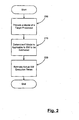
- a model of a target processor is prepared.
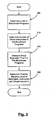
- Fig. 3 illustrates and example process for preparing the target processor model.
- a set of benchmark programs are determined.
- the benchmark programs are preferably drawn from a single domain and represent a wide range of program flows, instructions and overall program structure.
- a number of virtual instructions in each of the benchmark programs is determined (step 320).
- Step 330 a set of predictor equations and other data (error of estimation, cycles per virtual instruction, etc) are prepared. Step 330 may be performed by linear regression.
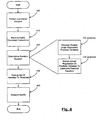
- Fig. 4 provides a flow chart illustrating example steps for performing linear regression according to the present invention.
- a correlation analysis is performed on the virtual instructions of the benchmark programs. Any highly correlated instructions are removed (step 410). Highly correlated instructions are instructions that have a highly predictable or a priori relationship between the frequency of occurrence of a first instruction and a second instruction.
- step 420 linear regression is performed to determine a predictor equation that allows prediction of a number of cycles that will be executed on a computer based on the frequency of occurrence of each instruction type (frequency of occurrence of family type instructions).
- Step 420 may be embodied, for example as steps 422, performing a stepwise linear regression to determine predictor variables, and 424, performing multiple linear regression on the predictor variables to derive the predictor equation.
- the set of predictor variables determined in step 420's linear regression are reduced to a predetermined threshold.
- a threshold that is, for example, an R 2 value
- the present inventors present inventors observed how the R 2 value declined with reduced independent variables, and have obtained good results with an R 2 threshold of .35.
- the predictor equation is applied to a 2nd set of benchmark programs to measure quality by determining an amount of error. Since a full set of information is available for the benchmark programs, the results of applying the predictor equation to the second set of benchmark programs provides an estimate of the execution time of the 2nd set of benchmark programs. The difference between the actual execution time and the estimated execution time gives a measure of quality of the predictor equation.
- the actual software that is to be estimated is evaluated to determine if it is applicable or can be estimated based on a model prepared using the benchmark programs used to develop the model of the target processor in step 200.
- the determination may be performed in any manner that provides an amount of correlation between the software to be estimated and the benchmark programs.
- the determination is made using a 2-sample t-test. If the 2-sample t-test is able to discriminate between the software to be estimated and the benchmark programs, then, the model produced using the benchmark program will likely provide inaccurate results. If the test cannot successfully discriminate, then the model will provide good estimation results.
- the benchmark programs each had a number of IF statements between 30 and 90 a total number of cycles between 100,000 and 200,000. And, if the number of IF statements in the SW to be estimated is approximately 1500 and a number of cycles totaling 9,000, then, the 2-sample t-test would be able to discriminate between the benchmarks and the SW to be estimated because they are not from the same or similar populations. However, if the number of IF statements in the SW to be estimated was 60 and the number of cycles is 125,000, then, the 2-sample t-test would not make a significant discrimination because the samples are from similar populations.
- the actual execution times of the software are estimated.
- the software to be estimated is, for example, run in a VCC to determine the frequency of virtual instructions which is then applied to the model or predictor equation (from step 200) to provide an execution time estimate.
- the resulting estimated run times provide the combined most accurate and least expensive estimated software execution times currently available.
- the present invention can be implemented as a process or method, including steps to: .
- the present invention may be conveniently implemented using a conventional general purpose or a specialized digital computer or microprocessor programmed according to the teachings of the present disclosure, as will be apparent to those skilled in the computer art.
- the present invention includes a computer program product which is a storage medium (media) having instructions stored thereon/in which can be used to control, or cause, a computer to perform any of the processes of the present invention.
- the storage medium can include, but is not limited to, any type of disk including floppy disks, mini disks (MD's), optical discs, DVD, CD-ROMS, micro-drive, and magneto-optical disks, ROMs, RAMs, EPROMs, EEPROMs, DRAMs, VRAMs, flash memory devices (including flash cards), magnetic or optical cards, nanosystems (including molecular memory ICs), RAID devices, remote data storage/archive/warehousing, or any type of media or device suitable for storing instructions and/or data.
- the present invention includes software for controlling both the hardware of the general purpose/specialized computer or microprocessor, and for enabling the computer or microprocessor to interact with a human user or other mechanism utilizing the results of the present invention.
- software may include, but is not limited to, device drivers, operating systems, and user applications.
- computer readable media further includes software for performing the present invention, as described above.
- the programming (software) of the general/specialized computer or microprocessor are software modules for implementing the teachings of the present invention, including, but not limited to, preparing models of processing devices, selecting a set of benchmark programs, determining virtual instructions, measuring actual execution times, correlating software to be estimated to the benchmark programs, removing highly correlated instructions, performing linear regression, deriving predictor equation(s), applying predictor equations to a second set of benchmarks to measure quality, and the display, storage, or communication of results according to the processes of the present invention.
Landscapes
- Engineering & Computer Science (AREA)
- Theoretical Computer Science (AREA)
- General Engineering & Computer Science (AREA)
- General Physics & Mathematics (AREA)
- Physics & Mathematics (AREA)
- Quality & Reliability (AREA)
- Computer Hardware Design (AREA)
- Life Sciences & Earth Sciences (AREA)
- Bioinformatics & Cheminformatics (AREA)
- Bioinformatics & Computational Biology (AREA)
- Evolutionary Biology (AREA)
- Software Systems (AREA)
- Debugging And Monitoring (AREA)
- Stored Programmes (AREA)
Claims (21)
- Verfahren zur Abschätzung der Ausführungszeit von Software, aufweisend die folgenden Schritte:a. Auswählen eines Satzes von Benchmark-Programmen aus demselben Software-Aufgabenfeld, wie die abzuschätzende Software;b. Erstellen eines Modells eines Ziel-Prozessors basierend auf dem Satz von Benchmark-Programmen (Schritt 200); durch
Bestimmen einer Frequenz von virtuellen Anweisungen in dem Satz von Benchmark-Programmen (Schritt 310);
Messen der realen Ausführungszeiten des Satzes von Benchmark-Programmen (Schritt 320); und durch
Bestimmen einer Vorhersage-Gleichung durch Korrelation der virtuellen Anweisungen mit den realen Ausführungszeiten (Schritt 330);c. Bestimmen der Höhe der Korrelation von der abzuschätzenden Software mit den Benchmark-Programmen, um zu entscheiden, ob für die abzuschätzende Software eine Vorhersage auf der Basis des Modells des Ziel-Prozessors getroffen werden kann (Schritt 210); undd. Abschätzen der Ausführungszeit von der abzuschätzenden Software durch Anwenden der Software auf das Modell des Ziel-Prozessors unter Verwendung der virtuellen Anweisungen der abzuschätzenden Software (Schritt 220); - Verfahren gemäß Anspruch 1, wobei besagtes Modell ein lineares Modell aufweist, das die Anweisungen mit der Ausführungszeit in Beziehung setzt.
- Verfahren gemäß Anspruch 1, wobei der Schritt der Bestimmung einer Vorhersage-Gleichung die nachfolgenden Schritte aufweist:Durchführen einer Korrelationsanalyse zwischen den virtuellen Anweisungen, die in den Benchmark-Programmen enthalten sind, um zu bestimmen, welche virtuellen Anweisungen mit anderen virtuellen Anweisungen hoch korreliert sind (Schritt 400);Entfernen von einem oder mehreren Elementen von jedem Satz von hoch korrelierten Anweisungen, bis eines der hoch korrelierten Elemente verbleibt, um einen eingeschränkten Satz virtueller Anweisungen zu erzeugen;Durchführen einer linearen Regressionsrechnung auf den eingeschränkten Satz von virtuellen Anweisungen, um daraus eine Vorhersage-Gleichung mit einem Satz von Vorhersage-Variablen abzuleiten (Schritt 420);Reduzieren des Satzes von Vorhersage-Variablen auf einen vordefinierten Grenzwert (Schritt 430); undAnwenden der Vorhersage-Gleichung mit den reduzierten Variablen auf einen zweiten Satz von Benchmark-Programmen zum Bestimmen einer Höhe des Fehlers in der Vorhersage-Gleichung mit reduzierten Variablen (Schritt 440).
- Verfahren gemäß Anspruch 3, wobei:besagter Schritt (320) des Bestimmens der realen Ausführungszeiten die Ermittlung einer Gesamtzykluszahl für jedes der Benchmark-Programme beinhaltet; undbesagter Schritt (420) des Durchführens der linearen Regression die Schritte aufweistAnwenden der schrittweisen multiplen linearen Regression auf den eingeschränkten Satz von virtuellen Anweisungen und auf die Gesamtzykluszahl, um einen statistisch signifikanten Satz von Vorhersage-Variablen zu bestimmen (Schritt 422), undAnwenden einer multiplen linearen Regression auf den Satz von Vorhersage-Variablen, um eine Vorhersagegleichung zu bestimmen (Schritt 424).
- Verfahren gemäß Anspruch 3, wobei besagter Schritt (430) des Reduzierens aufweist eine Reduzierung des Satzes von Vorhersage-Variablen bis eine Qualität der Vorhersage über die Benchmark-Programme einen vordefinierten Schwellwert erreicht.
- Verfahren gemäß Anspruch 5, wobei die besagte Qualität der Vorhersage über eine R2-Funktion gemessen wird, welche die Höhe der Varianz in einer Anzahl von Zyklen erfasst, die durch eine Varianz in den Vorhersage-Variablen erklärt wird, mit denen eine Regression durchgeführt wird.
- Verfahren gemäß Anspruch 6, wobei besagter Schwellwert ungefähr 0,35 als Ergebnis von besagter R2-Funktion beträgt.
- Verfahren gemäß Anspruch 1, wobei besagter Schritt (210) des Bestimmens der Höhe der Korrelation das Anwenden eines 2-sample t-Tests zwischen der abzuschätzenden Software und den Benchmark-Programmen aufweist.
- Verfahren gemäß Anspruch 1, wobei:Das Verfahren in einem Satz von Computer-Anweisungen verkörpert ist, welche auf einem von einem Computer lesbaren Medium gespeichert sind;wobei die Computer-Anweisungen wenn sie in einen Computer geladen werden den Computer veranlassen, die Schritte des besagten Verfahrens auszuführen.
- Verfahren gemäß Anspruch 4, wobei:Das Verfahren in einem Satz von Computer-Anweisungen verkörpert ist, welche auf einem von einem Computer lesbaren Medium gespeichert sind;wobei die Computer-Anweisungen wenn sie in einen Computer geladen werden den Computer veranlassen, die Schritte des besagten Verfahrens auszuführen.
- Verfahren gemäß Anspruch 8, wobei die Computer-Anweisungen übersetzte Computer-Anweisungen sind, welche als ein ausführbares Programm auf besagtem Computer-lesbaren Medium gespeichert sind.
- Computerprogramm aufweisend Computer-lesbare Anweisungen zur Ausführung der Schritte des Verfahrens gemäß einem der Ansprüche 1-11, wenn das Computerprogramm auf einem Computer ausgeführt wird.
- Vorrichtung zum Abschätzen von Ausführungszeiten von Software, aufweisend:a. Ein Modellierungsmittel zum Modellieren eines Ziel-Prozessors basierend auf einem Satz von Benchmark-Softwareprogrammen, die zu demselben Software-Aufgabenfeld gehören, wie die abzuschätzende Software; wobei besagtes Modellierungsmittel aufweist:Mittel zum Bestimmen einer Frequenz von virtuellen Anweisungen in den Benchmark-Programmen;Mittel zum Bestimmen der realen Ausführungszeiten der Benchmark-Programme; undMittel zum Bestimmen einer Vorhersagegleichung durch Korrelieren der virtuellen Anweisungen mit den realen Ausführungszeiten der Benchmark-Programme;b. ein Korrelationsmittel zum Bestimmen der Höhe der Korrelation zwischen der abzuschätzenden Software mit dem besagten Satz von Benchmark-Softwareprogrammen; undc. eine Abschätzvorrichtung, die in der Lage ist, die abzuschätzende Software auf das besagte Modellierungsmittel anzuwenden, um eine abgeschätzte Ausführungszeit der Software unter Anwendung virtueller Anweisungen der abzuschätzenden Software zu bestimmen.
- Vorrichtung gemäß Anspruch 13, wobei das Modellierungsmittel weiterhin aufweist Mittel das Bestimmen des Fehlers der Vorhersage und/oder der Zyklen pro virtueller Anweisung der Benchmark-Programme.
- Vorrichtung gemäß Anspruch 13, wobei besagtes Mittel für die Bestimmung beinhaltet:Mittel zum Ausführen einer Korrelationsanalyse auf den virtuellen Anweisungen; Mittel zum Entfernen hoch korrelierter Anweisungen;Mittel zum Ableiten einer Vorhersage-Gleichung basierend auf nicht-hoch korrelierten virtuellen Anweisungen und den realen Ausführungszeiten der Benchmark-Programme; undMittel zur Reduzierung eines Satzes von Variablen in der abgeleiteten Vorhersagegleichung bis zu einem vordefinierten Schwellwert.
- Vorrichtung gemäß Anspruch 15, wobei besagtes Mittel für die Bestimmung weiterhin aufweist:Mittel zum Anwenden der abgeleiteten Vorhersage-Gleichung auf einen zweiten Satz von Benchmark-Programmen, um eine Qualität der Abschätzungsfähigkeit der Vorhersage-Gleichung zu bestimmen.
- Vorrichtung gemäß Anspruch 15, wobei besagtes Mittel zum Ableiten einer Vorhersagegleichung ein lineares Regressions-Werkzeug umfasst, welches auf besagte virtuelle Anweisungen angewendet wird.
- Vorrichtung gemäß Anspruch 15, wobei besagtes Mittel zum Ableiten einer Vorhersagegleichung aufweist:Mittel zum Durchführen einer schrittweisen linearen Regression zum Bestimmen eines Satzes von Vorhersagevariablen; undMittel zum Durchführen einer linearen Regression auf besagte Vorhersagewerte, um besagte Vorhersage-Gleichung abzuleiten.
- Vorrichtung gemäß Anspruch 15, wobei besagter Schwellwert einen R2-Funktionswert aufweist, der eine Höhe der Varianz in einer Anzahl von Zyklen bestimmt, die erklärt wird durch eine Varianz in den Vorhersage-Variablen, mit denen eine Regression durchgeführt wird.
- Vorrichtung gemäß Anspruch 19, wobei besagter Schwellwert ungefähr 0,35 beträgt.
- Vorrichtung gemäß Anspruch 13, wobei besagtes Modell eines Ziel-Prozessors eine Vorhersage-Gleichung ist, die durch eine lineare Regression von nicht-hoch korrelierten virtuellen Anweisungen eines Satzes von Benchmark-Programmen und der Ausführungszeiten der Benchmark-Programme aufgebaut ist.
Applications Claiming Priority (3)
| Application Number | Priority Date | Filing Date | Title |
|---|---|---|---|
| US09/799,643 US7007270B2 (en) | 2001-03-05 | 2001-03-05 | Statistically based estimate of embedded software execution time |
| US799643 | 2001-03-05 | ||
| PCT/US2002/006620 WO2002071214A1 (en) | 2001-03-05 | 2002-03-05 | Method and apparatus for a statistically based estimate of embedded software execution time |
Publications (3)
| Publication Number | Publication Date |
|---|---|
| EP1366415A1 EP1366415A1 (de) | 2003-12-03 |
| EP1366415A4 EP1366415A4 (de) | 2008-07-09 |
| EP1366415B1 true EP1366415B1 (de) | 2011-07-20 |
Family
ID=25176407
Family Applications (1)
| Application Number | Title | Priority Date | Filing Date |
|---|---|---|---|
| EP02725074A Expired - Lifetime EP1366415B1 (de) | 2001-03-05 | 2002-03-05 | Verfahren und vorrichtung für eine abschätzung der ausführungszeit eingebetteter software auf statistischer grundlage |
Country Status (6)
| Country | Link |
|---|---|
| US (1) | US7007270B2 (de) |
| EP (1) | EP1366415B1 (de) |
| JP (2) | JP2004530193A (de) |
| KR (1) | KR100901663B1 (de) |
| AT (1) | ATE517385T1 (de) |
| WO (1) | WO2002071214A1 (de) |
Families Citing this family (89)
| Publication number | Priority date | Publication date | Assignee | Title |
|---|---|---|---|---|
| US6986128B2 (en) * | 2000-01-07 | 2006-01-10 | Sony Computer Entertainment Inc. | Multiple stage program recompiler and method |
| JP2003131902A (ja) * | 2001-10-24 | 2003-05-09 | Toshiba Corp | ソフトウェアデバッガ、システムレベルデバッガ、デバッグ方法、及びデバッグプログラム |
| EP1331565B1 (de) * | 2002-01-29 | 2018-09-12 | Texas Instruments France | Profilieren von Anwendungsausführung in Verbindung mit einer virtuellen Machine |
| JP2004021756A (ja) * | 2002-06-19 | 2004-01-22 | Hitachi Ltd | 情報システム性能の統計的予測方法 |
| US7228531B1 (en) * | 2003-02-03 | 2007-06-05 | Altera Corporation | Methods and apparatus for optimizing a processor core on a programmable chip |
| US20040199913A1 (en) * | 2003-04-07 | 2004-10-07 | Perrow Michael S. | Associative memory model for operating system management |
| US7739661B2 (en) * | 2003-05-14 | 2010-06-15 | Microsoft Corporation | Methods and systems for planning and tracking software reliability and availability |
| US7406686B2 (en) * | 2003-06-09 | 2008-07-29 | Sun Microsystems, Inc. | Systems and methods for software performance tuning |
| US20050021655A1 (en) * | 2003-06-09 | 2005-01-27 | Sun Microsystems, Inc. | System for efficiently acquiring and sharing runtime statistics |
| US20040250235A1 (en) * | 2003-06-09 | 2004-12-09 | Sun Microsystems, Inc. | Methods and apparatus for enhanced statistical performance |
| EP1494104B1 (de) * | 2003-06-26 | 2006-06-21 | St Microelectronics S.A. | Programmintegritätsprüfung mittels Statistiken |
| US7546598B2 (en) * | 2003-09-03 | 2009-06-09 | Sap Aktiengesellschaft | Measuring software system performance using benchmarks |
| US7496900B2 (en) * | 2004-02-12 | 2009-02-24 | International Business Machines Corporation | Method for automatic detection of build regressions |
| US8266595B2 (en) | 2004-02-12 | 2012-09-11 | International Business Machines Corporation | Removal of asynchronous events in complex application performance analysis |
| US7765539B1 (en) | 2004-05-19 | 2010-07-27 | Nintendo Co., Ltd. | System and method for trans-compiling video games |
| US7614037B2 (en) * | 2004-05-21 | 2009-11-03 | Microsoft Corporation | Method and system for graph analysis and synchronization |
| US7343592B2 (en) * | 2004-06-17 | 2008-03-11 | International Business Machines Corporation | Benchmark synthesis using workload statistics |
| US7493596B2 (en) * | 2004-06-30 | 2009-02-17 | International Business Machines Corporation | Method, system and program product for determining java software code plagiarism and infringement |
| US7647581B2 (en) * | 2004-06-30 | 2010-01-12 | International Business Machines Corporation | Evaluating java objects across different virtual machine vendors |
| US8271955B1 (en) | 2004-07-23 | 2012-09-18 | Green Hille Software, Inc. | Forward post-execution software debugger |
| US8015552B1 (en) | 2004-07-23 | 2011-09-06 | Green Hills Software, Inc. | Post-execution software debugger with coverage display |
| US7653899B1 (en) | 2004-07-23 | 2010-01-26 | Green Hills Software, Inc. | Post-execution software debugger with performance display |
| US8132159B1 (en) * | 2004-07-23 | 2012-03-06 | Green Hills Software, Inc. | Post-execution software debugger with event display |
| US8136096B1 (en) | 2004-07-23 | 2012-03-13 | Green Hills Software, Inc. | Backward post-execution software debugger |
| US20060020413A1 (en) * | 2004-07-26 | 2006-01-26 | Septon Daven W | Methods and apparatus for providing automated test equipment with a means to jump and return in a test program |
| US20060129990A1 (en) * | 2004-12-13 | 2006-06-15 | International Business Machines Corporation | System, method, and article of manufacture for determining execution counts associated with a software program of an embedded system |
| US7475387B2 (en) * | 2005-01-04 | 2009-01-06 | International Business Machines Corporation | Problem determination using system run-time behavior analysis |
| CN100590592C (zh) * | 2005-01-13 | 2010-02-17 | Nxp股份有限公司 | 处理器及其指令发布方法 |
| US7490269B2 (en) * | 2005-08-24 | 2009-02-10 | Microsoft Corporation | Noise accommodation in hardware and software testing |
| JP2007286671A (ja) * | 2006-04-12 | 2007-11-01 | Fujitsu Ltd | ソフトウェア/ハードウェア分割プログラム、および分割方法。 |
| US8578347B1 (en) * | 2006-12-28 | 2013-11-05 | The Mathworks, Inc. | Determining stack usage of generated code from a model |
| US20080235658A1 (en) * | 2007-03-21 | 2008-09-25 | Asaf Adi | Code generation for real-time event processing |
| US8667471B2 (en) * | 2007-03-30 | 2014-03-04 | Sap Ag | Method and system for customizing profiling sessions |
| US8522209B2 (en) * | 2007-03-30 | 2013-08-27 | Sap Ag | Method and system for integrating profiling and debugging |
| US8356286B2 (en) * | 2007-03-30 | 2013-01-15 | Sap Ag | Method and system for providing on-demand profiling infrastructure for profiling at virtual machines |
| US8336033B2 (en) * | 2007-03-30 | 2012-12-18 | Sap Ag | Method and system for generating a hierarchical tree representing stack traces |
| US8601469B2 (en) * | 2007-03-30 | 2013-12-03 | Sap Ag | Method and system for customizing allocation statistics |
| US8055606B2 (en) * | 2007-06-13 | 2011-11-08 | International Business Machines Corporation | Method and system for self-calibrating project estimation models for packaged software applications |
| US8006223B2 (en) * | 2007-06-13 | 2011-08-23 | International Business Machines Corporation | Method and system for estimating project plans for packaged software applications |
| US8032404B2 (en) | 2007-06-13 | 2011-10-04 | International Business Machines Corporation | Method and system for estimating financial benefits of packaged application service projects |
| US7971180B2 (en) * | 2007-06-13 | 2011-06-28 | International Business Machines Corporation | Method and system for evaluating multi-dimensional project plans for implementing packaged software applications |
| US20080313008A1 (en) * | 2007-06-13 | 2008-12-18 | International Business Machines Corporation | Method and system for model-driven approaches to generic project estimation models for packaged software applications |
| US20080312980A1 (en) * | 2007-06-13 | 2008-12-18 | International Business Machines Corporation | Method and system for staffing and cost estimation models aligned with multi-dimensional project plans for packaged software applications |
| US8117598B2 (en) * | 2007-09-27 | 2012-02-14 | Oracle America, Inc. | Method and apparatus to automatically identify specific code changes to probabilistically exclude from regression |
| US8020147B2 (en) * | 2007-10-12 | 2011-09-13 | Infosys Limited | Software package implementation sizing |
| US8881112B2 (en) * | 2007-12-19 | 2014-11-04 | International Business Machines Corporation | Quality measure tool for a composite application |
| US20110022551A1 (en) * | 2008-01-08 | 2011-01-27 | Mark Dixon | Methods and systems for generating software quality index |
| KR100943887B1 (ko) * | 2008-02-05 | 2010-02-24 | 재단법인서울대학교산학협력재단 | 핫스팟 메소드의 동적 컴파일을 위해 수행 시간을 추정하는방법 |
| US8448140B2 (en) * | 2008-07-02 | 2013-05-21 | Tokyo Institute Of Technology | Execution time estimation method and device |
| JP5326442B2 (ja) * | 2008-09-04 | 2013-10-30 | 富士通株式会社 | 統計量推定装置、統計量推定プログラム、統計量推定方法 |
| WO2011052147A1 (ja) * | 2009-10-30 | 2011-05-05 | 日本電気株式会社 | 評価モデル分析システム、評価モデル分析方法およびプログラム |
| JP2011100388A (ja) * | 2009-11-09 | 2011-05-19 | Fujitsu Ltd | トレース情報収集装置,トレース情報処理装置,およびトレース情報収集方法 |
| US8402471B2 (en) * | 2009-12-21 | 2013-03-19 | At&T Intellectual Property I, L.P. | Methods and apparatus to benchmark a computer system based on executing instructions using different numbers of threads |
| US20110153529A1 (en) * | 2009-12-23 | 2011-06-23 | Bracy Anne W | Method and apparatus to efficiently generate a processor architecture model |
| JP5412305B2 (ja) * | 2010-01-27 | 2014-02-12 | 株式会社日立アドバンストデジタル | モデルベースの性能予測システム |
| EP2477085B1 (de) * | 2011-01-13 | 2013-07-17 | Siemens Aktiengesellschaft | Verfahren und System zur Analyse eines zeitlichen Ablaufverhaltens eines Steuerungsprogramms einer Industriesteuerung |
| US20120185231A1 (en) * | 2011-01-19 | 2012-07-19 | National Tsing Hua University | Cycle-Count-Accurate (CCA) Processor Modeling for System-Level Simulation |
| JP4905597B1 (ja) * | 2011-03-15 | 2012-03-28 | オムロン株式会社 | コントローラサポート装置、その装置において実行されるためのコントローラサポートプログラム、およびそのプログラムを格納する記録媒体 |
| WO2012142069A2 (en) * | 2011-04-11 | 2012-10-18 | University Of Florida Research Foundation, Inc. | Elastic computing |
| EP2610773A1 (de) * | 2011-12-28 | 2013-07-03 | Siemens Aktiengesellschaft | Verfahren zum Herstellen einer Hardwareeinrichtung und Hardwareeinrichtung |
| US8881125B2 (en) * | 2012-06-11 | 2014-11-04 | International Business Machines Corporation | Indirect software performance analysis |
| US9483308B2 (en) | 2012-06-29 | 2016-11-01 | Intel Corporation | Performance of predicted actions |
| US8990143B2 (en) | 2012-06-29 | 2015-03-24 | Intel Corporation | Application-provided context for potential action prediction |
| US9063796B2 (en) | 2012-08-02 | 2015-06-23 | GM Global Technology Operations LLC | Method and apparatus for improving processing performance of a multi-core processor |
| US9471347B2 (en) | 2013-01-31 | 2016-10-18 | International Business Machines Corporation | Optimization of virtual machine sizing and consolidation |
| JP6163898B2 (ja) * | 2013-06-11 | 2017-07-19 | 富士通株式会社 | 計算装置、計算方法、および計算プログラム |
| RU2013143925A (ru) * | 2013-09-30 | 2015-04-10 | ИЭмСи КОРПОРЕЙШН | Система и способ прогнозирования эффективности памяти |
| US9262190B2 (en) * | 2013-11-19 | 2016-02-16 | Xerox Corporation | Method and system for managing virtual machines in distributed computing environment |
| US10133775B1 (en) * | 2014-03-19 | 2018-11-20 | Amazon Technologies, Inc. | Run time prediction for data queries |
| EP2927763B1 (de) * | 2014-04-04 | 2019-06-19 | Abb Ag | System und Verfahren für einen optimierten Betrieb von in Echtzeit eingebetteten Lösungen in industrieller Automatisierung |
| JP6333656B2 (ja) * | 2014-07-28 | 2018-05-30 | ファナック株式会社 | Ncプログラム修正後の加工時間を予測する加工時間予測装置 |
| JP6503774B2 (ja) * | 2015-02-17 | 2019-04-24 | 富士通株式会社 | プログラム実行解析方法、情報処理装置及びプログラム実行解析プログラム |
| US9804849B2 (en) * | 2015-10-20 | 2017-10-31 | International Business Machines Corporation | Space reduction in processor stressmark generation |
| JP6841667B2 (ja) * | 2017-01-13 | 2021-03-10 | 株式会社日立システムズ | ソフトウェア性能測定システム及びプログラム |
| US11023351B2 (en) | 2017-02-28 | 2021-06-01 | GM Global Technology Operations LLC | System and method of selecting a computational platform |
| US10372585B2 (en) * | 2017-11-07 | 2019-08-06 | Facebook, Inc. | Incident tracker |
| JP7091726B2 (ja) * | 2018-03-08 | 2022-06-28 | 富士通株式会社 | 情報処理装置,プログラム及び情報処理方法 |
| WO2019216404A1 (ja) * | 2018-05-10 | 2019-11-14 | パナソニックIpマネジメント株式会社 | ニューラルネットワーク構築装置、情報処理装置、ニューラルネットワーク構築方法及びプログラム |
| CN111324353B (zh) * | 2018-12-14 | 2022-09-13 | 中移(杭州)信息技术有限公司 | 一种持续集成任务的优化方法及装置 |
| CN109933748B (zh) * | 2019-03-21 | 2023-05-12 | 武汉轻工大学 | 椭球面方程的模型识别方法、装置、终端设备及可读存储介质 |
| US11537394B2 (en) * | 2019-03-27 | 2022-12-27 | F0Cal, Inc. | Systems and methods for analyzing computational architectures |
| KR102631545B1 (ko) * | 2019-05-17 | 2024-01-30 | 삼성에스디에스 주식회사 | 프로그램 분석 방법 및 그 시스템 |
| CN110888813A (zh) * | 2019-11-27 | 2020-03-17 | 泰康保险集团股份有限公司 | 项目排期管理方法、装置、设备及存储介质 |
| US11068592B1 (en) * | 2021-01-26 | 2021-07-20 | Malwarebytes Inc. | Lookahead signature-based malware detection |
| KR102341827B1 (ko) * | 2021-08-06 | 2021-12-21 | 주식회사 에너자이(ENERZAi) | 테스트 벤치 생성 방법, 테스트 벤치 생성 장치, 및 테스트 벤치 생성 시스템 |
| KR20230022387A (ko) * | 2021-08-06 | 2023-02-15 | 주식회사 에너자이(ENERZAi) | 테스트 벤치 생성 방법, 테스트 벤치 생성 장치, 및 테스트 벤치 생성 시스템 |
| US20230070393A1 (en) * | 2021-09-02 | 2023-03-09 | Huawei Technologies Co., Ltd. | Methods and devices for assessing generalizability of benchmarks |
| US12360748B1 (en) * | 2022-10-06 | 2025-07-15 | The Mathworks, Inc. | Systems and methods for performing worst-case execution time analysis of simulation models |
| CN116483482B (zh) * | 2023-05-19 | 2024-03-01 | 北京百度网讯科技有限公司 | 深度学习任务处理方法、系统、装置、设备及介质 |
Family Cites Families (25)
| Publication number | Priority date | Publication date | Assignee | Title |
|---|---|---|---|---|
| CH680455A5 (de) * | 1988-11-10 | 1992-08-31 | Benninger Ag Maschf | |
| US5270935A (en) | 1990-11-26 | 1993-12-14 | General Motors Corporation | Engine with prediction/estimation air flow determination |
| JPH07262055A (ja) * | 1994-03-17 | 1995-10-13 | Fujitsu Ltd | 計算機プログラムの処理時間予測方法およびその計算機 |
| US5590323A (en) | 1994-05-13 | 1996-12-31 | Lucent Technologies Inc. | Optimal parallel processor architecture for real time multitasking |
| US5696942A (en) | 1995-03-24 | 1997-12-09 | Sun Microsystems, Inc. | Cycle-based event-driven simulator for hardware designs |
| US5696943A (en) * | 1995-07-27 | 1997-12-09 | Advanced Micro Devices, Inc. | Method and apparatus for quick and reliable design modification on silicon |
| US6151618A (en) * | 1995-12-04 | 2000-11-21 | Microsoft Corporation | Safe general purpose virtual machine computing system |
| US5761477A (en) * | 1995-12-04 | 1998-06-02 | Microsoft Corporation | Methods for safe and efficient implementations of virtual machines |
| US5801975A (en) | 1996-12-02 | 1998-09-01 | Compaq Computer Corporation And Advanced Micro Devices, Inc. | Computer modified to perform inverse discrete cosine transform operations on a one-dimensional matrix of numbers within a minimal number of instruction cycles |
| US5790425A (en) * | 1997-02-19 | 1998-08-04 | Sun Microsystems, Inc. | Generic server benchmarking framework in a client-server environment |
| US5966537A (en) * | 1997-05-28 | 1999-10-12 | Sun Microsystems, Inc. | Method and apparatus for dynamically optimizing an executable computer program using input data |
| US20020138390A1 (en) * | 1997-10-14 | 2002-09-26 | R. Raymond May | Systems, methods and computer program products for subject-based addressing in an electronic trading system |
| US6026237A (en) * | 1997-11-03 | 2000-02-15 | International Business Machines Corporation | System and method for dynamic modification of class files |
| US6118940A (en) * | 1997-11-25 | 2000-09-12 | International Business Machines Corp. | Method and apparatus for benchmarking byte code sequences |
| US5809450A (en) | 1997-11-26 | 1998-09-15 | Digital Equipment Corporation | Method for estimating statistics of properties of instructions processed by a processor pipeline |
| US6662358B1 (en) * | 1997-12-12 | 2003-12-09 | International Business Machines Corporation | Minimizing profiling-related perturbation using periodic contextual information |
| US6732357B1 (en) * | 1997-12-12 | 2004-05-04 | International Business Machines Corporation | Determining and compensating for temporal overhead in trace record generation and processing |
| US6286046B1 (en) * | 1997-12-22 | 2001-09-04 | International Business Machines Corporation | Method of recording and measuring e-business sessions on the world wide web |
| US6189141B1 (en) * | 1998-05-04 | 2001-02-13 | Hewlett-Packard Company | Control path evaluating trace designator with dynamically adjustable thresholds for activation of tracing for high (hot) activity and low (cold) activity of flow control |
| US6381558B1 (en) * | 1998-12-18 | 2002-04-30 | International Business Machines Corporation | Alternative profiling methodology and tool for analyzing competitive benchmarks |
| US6507946B2 (en) * | 1999-06-11 | 2003-01-14 | International Business Machines Corporation | Process and system for Java virtual method invocation |
| US6463457B1 (en) * | 1999-08-26 | 2002-10-08 | Parabon Computation, Inc. | System and method for the establishment and the utilization of networked idle computational processing power |
| US6618737B2 (en) * | 2000-03-09 | 2003-09-09 | International Business Machines Corporation | Speculative caching of individual fields in a distributed object system |
| US6457023B1 (en) * | 2000-12-28 | 2002-09-24 | International Business Machines Corporation | Estimation of object lifetime using static analysis |
| US6609084B2 (en) * | 2001-08-10 | 2003-08-19 | Hewlett-Packard Development Company, Lp. | Data transfer performance measuring system and method |
-
2001
- 2001-03-05 US US09/799,643 patent/US7007270B2/en not_active Expired - Fee Related
-
2002
- 2002-03-05 EP EP02725074A patent/EP1366415B1/de not_active Expired - Lifetime
- 2002-03-05 KR KR1020037011654A patent/KR100901663B1/ko not_active Expired - Fee Related
- 2002-03-05 JP JP2002570070A patent/JP2004530193A/ja active Pending
- 2002-03-05 WO PCT/US2002/006620 patent/WO2002071214A1/en not_active Ceased
- 2002-03-05 AT AT02725074T patent/ATE517385T1/de not_active IP Right Cessation
-
2008
- 2008-09-18 JP JP2008239668A patent/JP2009076073A/ja active Pending
Also Published As
| Publication number | Publication date |
|---|---|
| JP2004530193A (ja) | 2004-09-30 |
| JP2009076073A (ja) | 2009-04-09 |
| KR100901663B1 (ko) | 2009-06-08 |
| EP1366415A1 (de) | 2003-12-03 |
| US20020166112A1 (en) | 2002-11-07 |
| ATE517385T1 (de) | 2011-08-15 |
| US7007270B2 (en) | 2006-02-28 |
| KR20040004549A (ko) | 2004-01-13 |
| EP1366415A4 (de) | 2008-07-09 |
| WO2002071214A1 (en) | 2002-09-12 |
Similar Documents
| Publication | Publication Date | Title |
|---|---|---|
| EP1366415B1 (de) | Verfahren und vorrichtung für eine abschätzung der ausführungszeit eingebetteter software auf statistischer grundlage | |
| Giusto et al. | Reliable estimation of execution time of embedded software | |
| Lim et al. | An accurate worst case timing analysis for RISC processors | |
| Yi et al. | A statistically rigorous approach for improving simulation methodology | |
| Hertz et al. | Mining hardware assertions with guidance from static analysis | |
| Saavedra et al. | Analysis of benchmark characteristics and benchmark performance prediction | |
| O'Neal et al. | HLSPredict: Cross platform performance prediction for FPGA high-level synthesis | |
| EP3391224B1 (de) | Verfahren und vorrichtung zur datengewinnung aus kernspuren | |
| US6807522B1 (en) | Methods for predicting instruction execution efficiency in a proposed computer system | |
| Posadas et al. | System-level performance analysis in SystemC | |
| Wilhelm et al. | Static timing analysis for hard real-time systems | |
| US7761272B1 (en) | Method and apparatus for processing a dataflow description of a digital processing system | |
| Tan et al. | High-level energy macromodeling of embedded software | |
| Oyamada et al. | Applying neural networks to performance estimation of embedded software | |
| Goli et al. | PREASC: Automatic portion resilience evaluation for approximating SystemC-Based designs using regression analysis techniques | |
| Kirovski et al. | Application-driven synthesis of core-based systems | |
| Schlickling et al. | Semi-automatic derivation of timing models for WCET analysis | |
| Wolf et al. | Execution cost interval refinement in static software analysis | |
| Uddin et al. | Collecting signatures to model latency tolerance in high-level simulations of microthreaded cores | |
| US7684971B1 (en) | Method and system for improving simulation performance | |
| US20040054515A1 (en) | Methods and systems for modeling the performance of a processor | |
| Plyaskin et al. | System-level software performance simulation considering out-of-order processor execution | |
| Hiser et al. | Fast, accurate design space exploration of embedded systems memory configurations | |
| Bjuréus et al. | Performance analysis with confidence intervals for embedded software processes | |
| CN112181757A (zh) | 一种基于模拟器的细粒度功耗估计方法 |
Legal Events
| Date | Code | Title | Description |
|---|---|---|---|
| PUAI | Public reference made under article 153(3) epc to a published international application that has entered the european phase |
Free format text: ORIGINAL CODE: 0009012 |
|
| 17P | Request for examination filed |
Effective date: 20030924 |
|
| AK | Designated contracting states |
Kind code of ref document: A1 Designated state(s): AT BE CH CY DE DK ES FI FR GB GR IE IT LI LU MC NL PT SE TR |
|
| AX | Request for extension of the european patent |
Extension state: AL LT LV MK RO SI |
|
| A4 | Supplementary search report drawn up and despatched |
Effective date: 20080606 |
|
| 17Q | First examination report despatched |
Effective date: 20081211 |
|
| GRAP | Despatch of communication of intention to grant a patent |
Free format text: ORIGINAL CODE: EPIDOSNIGR1 |
|
| GRAS | Grant fee paid |
Free format text: ORIGINAL CODE: EPIDOSNIGR3 |
|
| GRAA | (expected) grant |
Free format text: ORIGINAL CODE: 0009210 |
|
| AK | Designated contracting states |
Kind code of ref document: B1 Designated state(s): AT BE CH CY DE DK ES FI FR GB GR IE IT LI LU MC NL PT SE TR |
|
| REG | Reference to a national code |
Ref country code: GB Ref legal event code: FG4D |
|
| REG | Reference to a national code |
Ref country code: CH Ref legal event code: EP |
|
| REG | Reference to a national code |
Ref country code: DE Ref legal event code: R096 Ref document number: 60240550 Country of ref document: DE Effective date: 20110915 |
|
| REG | Reference to a national code |
Ref country code: NL Ref legal event code: VDEP Effective date: 20110720 |
|
| REG | Reference to a national code |
Ref country code: AT Ref legal event code: MK05 Ref document number: 517385 Country of ref document: AT Kind code of ref document: T Effective date: 20110720 |
|
| PG25 | Lapsed in a contracting state [announced via postgrant information from national office to epo] |
Ref country code: NL Free format text: LAPSE BECAUSE OF FAILURE TO SUBMIT A TRANSLATION OF THE DESCRIPTION OR TO PAY THE FEE WITHIN THE PRESCRIBED TIME-LIMIT Effective date: 20110720 Ref country code: SE Free format text: LAPSE BECAUSE OF FAILURE TO SUBMIT A TRANSLATION OF THE DESCRIPTION OR TO PAY THE FEE WITHIN THE PRESCRIBED TIME-LIMIT Effective date: 20110720 Ref country code: BE Free format text: LAPSE BECAUSE OF FAILURE TO SUBMIT A TRANSLATION OF THE DESCRIPTION OR TO PAY THE FEE WITHIN THE PRESCRIBED TIME-LIMIT Effective date: 20110720 Ref country code: FI Free format text: LAPSE BECAUSE OF FAILURE TO SUBMIT A TRANSLATION OF THE DESCRIPTION OR TO PAY THE FEE WITHIN THE PRESCRIBED TIME-LIMIT Effective date: 20110720 Ref country code: PT Free format text: LAPSE BECAUSE OF FAILURE TO SUBMIT A TRANSLATION OF THE DESCRIPTION OR TO PAY THE FEE WITHIN THE PRESCRIBED TIME-LIMIT Effective date: 20111121 |
|
| PG25 | Lapsed in a contracting state [announced via postgrant information from national office to epo] |
Ref country code: GR Free format text: LAPSE BECAUSE OF FAILURE TO SUBMIT A TRANSLATION OF THE DESCRIPTION OR TO PAY THE FEE WITHIN THE PRESCRIBED TIME-LIMIT Effective date: 20111021 Ref country code: CY Free format text: LAPSE BECAUSE OF FAILURE TO SUBMIT A TRANSLATION OF THE DESCRIPTION OR TO PAY THE FEE WITHIN THE PRESCRIBED TIME-LIMIT Effective date: 20110720 Ref country code: AT Free format text: LAPSE BECAUSE OF FAILURE TO SUBMIT A TRANSLATION OF THE DESCRIPTION OR TO PAY THE FEE WITHIN THE PRESCRIBED TIME-LIMIT Effective date: 20110720 |
|
| PLBE | No opposition filed within time limit |
Free format text: ORIGINAL CODE: 0009261 |
|
| STAA | Information on the status of an ep patent application or granted ep patent |
Free format text: STATUS: NO OPPOSITION FILED WITHIN TIME LIMIT |
|
| PG25 | Lapsed in a contracting state [announced via postgrant information from national office to epo] |
Ref country code: IT Free format text: LAPSE BECAUSE OF FAILURE TO SUBMIT A TRANSLATION OF THE DESCRIPTION OR TO PAY THE FEE WITHIN THE PRESCRIBED TIME-LIMIT Effective date: 20110720 |
|
| 26N | No opposition filed |
Effective date: 20120423 |
|
| PG25 | Lapsed in a contracting state [announced via postgrant information from national office to epo] |
Ref country code: DK Free format text: LAPSE BECAUSE OF FAILURE TO SUBMIT A TRANSLATION OF THE DESCRIPTION OR TO PAY THE FEE WITHIN THE PRESCRIBED TIME-LIMIT Effective date: 20110720 |
|
| REG | Reference to a national code |
Ref country code: DE Ref legal event code: R097 Ref document number: 60240550 Country of ref document: DE Effective date: 20120423 |
|
| PG25 | Lapsed in a contracting state [announced via postgrant information from national office to epo] |
Ref country code: MC Free format text: LAPSE BECAUSE OF NON-PAYMENT OF DUE FEES Effective date: 20120331 |
|
| REG | Reference to a national code |
Ref country code: CH Ref legal event code: PL |
|
| REG | Reference to a national code |
Ref country code: IE Ref legal event code: MM4A |
|
| PG25 | Lapsed in a contracting state [announced via postgrant information from national office to epo] |
Ref country code: LI Free format text: LAPSE BECAUSE OF NON-PAYMENT OF DUE FEES Effective date: 20120331 Ref country code: CH Free format text: LAPSE BECAUSE OF NON-PAYMENT OF DUE FEES Effective date: 20120331 Ref country code: IE Free format text: LAPSE BECAUSE OF NON-PAYMENT OF DUE FEES Effective date: 20120305 |
|
| PG25 | Lapsed in a contracting state [announced via postgrant information from national office to epo] |
Ref country code: ES Free format text: LAPSE BECAUSE OF FAILURE TO SUBMIT A TRANSLATION OF THE DESCRIPTION OR TO PAY THE FEE WITHIN THE PRESCRIBED TIME-LIMIT Effective date: 20111031 |
|
| PGFP | Annual fee paid to national office [announced via postgrant information from national office to epo] |
Ref country code: GB Payment date: 20130327 Year of fee payment: 12 Ref country code: FR Payment date: 20130405 Year of fee payment: 12 Ref country code: DE Payment date: 20130327 Year of fee payment: 12 |
|
| PG25 | Lapsed in a contracting state [announced via postgrant information from national office to epo] |
Ref country code: TR Free format text: LAPSE BECAUSE OF FAILURE TO SUBMIT A TRANSLATION OF THE DESCRIPTION OR TO PAY THE FEE WITHIN THE PRESCRIBED TIME-LIMIT Effective date: 20110720 |
|
| PG25 | Lapsed in a contracting state [announced via postgrant information from national office to epo] |
Ref country code: LU Free format text: LAPSE BECAUSE OF NON-PAYMENT OF DUE FEES Effective date: 20120305 |
|
| REG | Reference to a national code |
Ref country code: DE Ref legal event code: R119 Ref document number: 60240550 Country of ref document: DE |
|
| GBPC | Gb: european patent ceased through non-payment of renewal fee |
Effective date: 20140305 |
|
| REG | Reference to a national code |
Ref country code: FR Ref legal event code: ST Effective date: 20141128 |
|
| REG | Reference to a national code |
Ref country code: DE Ref legal event code: R119 Ref document number: 60240550 Country of ref document: DE Effective date: 20141001 |
|
| PG25 | Lapsed in a contracting state [announced via postgrant information from national office to epo] |
Ref country code: FR Free format text: LAPSE BECAUSE OF NON-PAYMENT OF DUE FEES Effective date: 20140331 Ref country code: GB Free format text: LAPSE BECAUSE OF NON-PAYMENT OF DUE FEES Effective date: 20140305 Ref country code: DE Free format text: LAPSE BECAUSE OF NON-PAYMENT OF DUE FEES Effective date: 20141001 |