EP1363978B1 - Ink for thermal ink jet printing with high performance at high ejection frequencies - Google Patents
Ink for thermal ink jet printing with high performance at high ejection frequencies Download PDFInfo
- Publication number
- EP1363978B1 EP1363978B1 EP01995806.5A EP01995806A EP1363978B1 EP 1363978 B1 EP1363978 B1 EP 1363978B1 EP 01995806 A EP01995806 A EP 01995806A EP 1363978 B1 EP1363978 B1 EP 1363978B1
- Authority
- EP
- European Patent Office
- Prior art keywords
- ink
- composition
- surface tension
- ink according
- humectant
- Prior art date
- Legal status (The legal status is an assumption and is not a legal conclusion. Google has not performed a legal analysis and makes no representation as to the accuracy of the status listed.)
- Expired - Lifetime
Links
- 238000007641 inkjet printing Methods 0.000 title claims description 17
- 239000000976 ink Substances 0.000 claims description 163
- 239000004094 surface-active agent Substances 0.000 claims description 50
- 239000000203 mixture Substances 0.000 claims description 39
- 230000008707 rearrangement Effects 0.000 claims description 29
- 239000003906 humectant Substances 0.000 claims description 19
- XLYOFNOQVPJJNP-UHFFFAOYSA-N water Substances O XLYOFNOQVPJJNP-UHFFFAOYSA-N 0.000 claims description 17
- 239000000975 dye Substances 0.000 claims description 16
- 230000003068 static effect Effects 0.000 claims description 13
- -1 Direct Yellow 86 Chemical compound 0.000 claims description 10
- 230000015572 biosynthetic process Effects 0.000 claims description 10
- 238000000034 method Methods 0.000 claims description 10
- 229930182478 glucoside Natural products 0.000 claims description 9
- 150000008131 glucosides Chemical class 0.000 claims description 9
- LFQSCWFLJHTTHZ-UHFFFAOYSA-N Ethanol Chemical compound CCO LFQSCWFLJHTTHZ-UHFFFAOYSA-N 0.000 claims description 8
- 150000001298 alcohols Chemical class 0.000 claims description 7
- 238000005259 measurement Methods 0.000 claims description 7
- 230000008569 process Effects 0.000 claims description 7
- 239000003139 biocide Substances 0.000 claims description 6
- 230000003115 biocidal effect Effects 0.000 claims description 4
- 101001028764 Arabidopsis thaliana Mitochondrial phosphate carrier protein 2, mitochondrial Proteins 0.000 claims description 3
- 150000002334 glycols Chemical class 0.000 claims description 3
- HNJBEVLQSNELDL-UHFFFAOYSA-N pyrrolidin-2-one Chemical compound O=C1CCCN1 HNJBEVLQSNELDL-UHFFFAOYSA-N 0.000 claims description 3
- USFZMSVCRYTOJT-UHFFFAOYSA-N Ammonium acetate Chemical class N.CC(O)=O USFZMSVCRYTOJT-UHFFFAOYSA-N 0.000 claims description 2
- SGHZXLIDFTYFHQ-UHFFFAOYSA-L Brilliant Blue Chemical compound [Na+].[Na+].C=1C=C(C(=C2C=CC(C=C2)=[N+](CC)CC=2C=C(C=CC=2)S([O-])(=O)=O)C=2C(=CC=CC=2)S([O-])(=O)=O)C=CC=1N(CC)CC1=CC=CC(S([O-])(=O)=O)=C1 SGHZXLIDFTYFHQ-UHFFFAOYSA-L 0.000 claims description 2
- 229910019142 PO4 Inorganic materials 0.000 claims description 2
- ZJCCRDAZUWHFQH-UHFFFAOYSA-N Trimethylolpropane Chemical compound CCC(CO)(CO)CO ZJCCRDAZUWHFQH-UHFFFAOYSA-N 0.000 claims description 2
- 235000019257 ammonium acetate Nutrition 0.000 claims description 2
- 150000001642 boronic acid derivatives Chemical class 0.000 claims description 2
- 235000012745 brilliant blue FCF Nutrition 0.000 claims description 2
- 239000004161 brilliant blue FCF Substances 0.000 claims description 2
- 235000019241 carbon black Nutrition 0.000 claims description 2
- 150000004649 carbonic acid derivatives Chemical class 0.000 claims description 2
- XDBZPHDFHYZHNG-UHFFFAOYSA-L disodium 3-[(5-chloro-2-phenoxyphenyl)diazenyl]-4-hydroxy-5-[(4-methylphenyl)sulfonylamino]naphthalene-2,7-disulfonate Chemical compound [Na+].[Na+].C1=CC(C)=CC=C1S(=O)(=O)NC(C1=C2O)=CC(S([O-])(=O)=O)=CC1=CC(S([O-])(=O)=O)=C2N=NC1=CC(Cl)=CC=C1OC1=CC=CC=C1 XDBZPHDFHYZHNG-UHFFFAOYSA-L 0.000 claims description 2
- SXQCTESRRZBPHJ-UHFFFAOYSA-M lissamine rhodamine Chemical compound [Na+].C=12C=CC(=[N+](CC)CC)C=C2OC2=CC(N(CC)CC)=CC=C2C=1C1=CC=C(S([O-])(=O)=O)C=C1S([O-])(=O)=O SXQCTESRRZBPHJ-UHFFFAOYSA-M 0.000 claims description 2
- 235000021317 phosphate Nutrition 0.000 claims description 2
- 150000003013 phosphoric acid derivatives Chemical class 0.000 claims description 2
- 235000011056 potassium acetate Nutrition 0.000 claims description 2
- 235000011091 sodium acetates Nutrition 0.000 claims description 2
- 235000012756 tartrazine Nutrition 0.000 claims description 2
- UJMBCXLDXJUMFB-GLCFPVLVSA-K tartrazine Chemical compound [Na+].[Na+].[Na+].[O-]C(=O)C1=NN(C=2C=CC(=CC=2)S([O-])(=O)=O)C(=O)C1\N=N\C1=CC=C(S([O-])(=O)=O)C=C1 UJMBCXLDXJUMFB-GLCFPVLVSA-K 0.000 claims description 2
- 239000004149 tartrazine Substances 0.000 claims description 2
- GWAKFAUFNNPZFE-UHFFFAOYSA-K trisodium 2-[4-[(2-amino-4-oxidophenyl)diazenyl]anilino]-5-[(1-amino-8-oxido-7-phenyldiazenyl-3,6-disulfonaphthalen-2-yl)diazenyl]benzenesulfonate Chemical compound NC1=C(C(=CC2=CC(=C(C(=C12)O)N=NC1=CC=CC=C1)S(=O)(=O)[O-])S(=O)(=O)[O-])N=NC1=CC(=C(C=C1)NC1=CC=C(C=C1)N=NC1=C(C=C(C=C1)O)N)S(=O)(=O)[O-].[Na+].[Na+].[Na+] GWAKFAUFNNPZFE-UHFFFAOYSA-K 0.000 claims description 2
- GUUULVAMQJLDSY-UHFFFAOYSA-N 4,5-dihydro-1,2-thiazole Chemical class C1CC=NS1 GUUULVAMQJLDSY-UHFFFAOYSA-N 0.000 claims 1
- VMHLLURERBWHNL-UHFFFAOYSA-M Sodium acetate Chemical class [Na+].CC([O-])=O VMHLLURERBWHNL-UHFFFAOYSA-M 0.000 claims 1
- UWJJYHHHVWZFEP-UHFFFAOYSA-N pentane-1,1-diol Chemical compound CCCCC(O)O UWJJYHHHVWZFEP-UHFFFAOYSA-N 0.000 claims 1
- SCVFZCLFOSHCOH-UHFFFAOYSA-M potassium acetate Chemical class [K+].CC([O-])=O SCVFZCLFOSHCOH-UHFFFAOYSA-M 0.000 claims 1
- 239000002904 solvent Substances 0.000 description 11
- 239000007788 liquid Substances 0.000 description 9
- 238000007639 printing Methods 0.000 description 9
- 238000005516 engineering process Methods 0.000 description 8
- 238000012360 testing method Methods 0.000 description 6
- 150000001875 compounds Chemical class 0.000 description 5
- 238000009472 formulation Methods 0.000 description 5
- 239000000693 micelle Substances 0.000 description 5
- LYCAIKOWRPUZTN-UHFFFAOYSA-N Ethylene glycol Chemical compound OCCO LYCAIKOWRPUZTN-UHFFFAOYSA-N 0.000 description 4
- 125000000217 alkyl group Chemical group 0.000 description 4
- 239000000047 product Substances 0.000 description 4
- 230000007480 spreading Effects 0.000 description 4
- 238000003892 spreading Methods 0.000 description 4
- 239000000126 substance Substances 0.000 description 4
- PEDCQBHIVMGVHV-UHFFFAOYSA-N Glycerine Chemical compound OCC(O)CO PEDCQBHIVMGVHV-UHFFFAOYSA-N 0.000 description 3
- DNIAPMSPPWPWGF-UHFFFAOYSA-N Propylene glycol Chemical compound CC(O)CO DNIAPMSPPWPWGF-UHFFFAOYSA-N 0.000 description 3
- 239000003086 colorant Substances 0.000 description 3
- MTHSVFCYNBDYFN-UHFFFAOYSA-N diethylene glycol Chemical compound OCCOCCO MTHSVFCYNBDYFN-UHFFFAOYSA-N 0.000 description 3
- 230000002209 hydrophobic effect Effects 0.000 description 3
- 238000003860 storage Methods 0.000 description 3
- NECRQCBKTGZNMH-UHFFFAOYSA-N 3,5-dimethylhex-1-yn-3-ol Chemical compound CC(C)CC(C)(O)C#C NECRQCBKTGZNMH-UHFFFAOYSA-N 0.000 description 2
- WQZGKKKJIJFFOK-GASJEMHNSA-N Glucose Natural products OC[C@H]1OC(O)[C@H](O)[C@@H](O)[C@@H]1O WQZGKKKJIJFFOK-GASJEMHNSA-N 0.000 description 2
- SECXISVLQFMRJM-UHFFFAOYSA-N N-Methylpyrrolidone Chemical compound CN1CCCC1=O SECXISVLQFMRJM-UHFFFAOYSA-N 0.000 description 2
- PXHVJJICTQNCMI-UHFFFAOYSA-N Nickel Chemical compound [Ni] PXHVJJICTQNCMI-UHFFFAOYSA-N 0.000 description 2
- 229920003171 Poly (ethylene oxide) Polymers 0.000 description 2
- LLEMOWNGBBNAJR-UHFFFAOYSA-N biphenyl-2-ol Chemical compound OC1=CC=CC=C1C1=CC=CC=C1 LLEMOWNGBBNAJR-UHFFFAOYSA-N 0.000 description 2
- 229960002836 biphenylol Drugs 0.000 description 2
- 239000013065 commercial product Substances 0.000 description 2
- 239000008367 deionised water Substances 0.000 description 2
- 229910021641 deionized water Inorganic materials 0.000 description 2
- 238000013461 design Methods 0.000 description 2
- 239000003599 detergent Substances 0.000 description 2
- 230000000694 effects Effects 0.000 description 2
- 230000007613 environmental effect Effects 0.000 description 2
- 125000001301 ethoxy group Chemical group [H]C([H])([H])C([H])([H])O* 0.000 description 2
- 238000001704 evaporation Methods 0.000 description 2
- 230000008020 evaporation Effects 0.000 description 2
- 239000008103 glucose Substances 0.000 description 2
- 239000000463 material Substances 0.000 description 2
- 230000005499 meniscus Effects 0.000 description 2
- 239000003960 organic solvent Substances 0.000 description 2
- 239000000049 pigment Substances 0.000 description 2
- 238000004513 sizing Methods 0.000 description 2
- VUWCWMOCWKCZTA-UHFFFAOYSA-N 1,2-thiazol-4-one Chemical class O=C1CSN=C1 VUWCWMOCWKCZTA-UHFFFAOYSA-N 0.000 description 1
- WDQFELCEOPFLCZ-UHFFFAOYSA-N 1-(2-hydroxyethyl)pyrrolidin-2-one Chemical compound OCCN1CCCC1=O WDQFELCEOPFLCZ-UHFFFAOYSA-N 0.000 description 1
- OAYXUHPQHDHDDZ-UHFFFAOYSA-N 2-(2-butoxyethoxy)ethanol Chemical compound CCCCOCCOCCO OAYXUHPQHDHDDZ-UHFFFAOYSA-N 0.000 description 1
- POAOYUHQDCAZBD-UHFFFAOYSA-N 2-butoxyethanol Chemical compound CCCCOCCO POAOYUHQDCAZBD-UHFFFAOYSA-N 0.000 description 1
- 241000640882 Condea Species 0.000 description 1
- KCXVZYZYPLLWCC-UHFFFAOYSA-N EDTA Chemical compound OC(=O)CN(CC(O)=O)CCN(CC(O)=O)CC(O)=O KCXVZYZYPLLWCC-UHFFFAOYSA-N 0.000 description 1
- IAYPIBMASNFSPL-UHFFFAOYSA-N Ethylene oxide Chemical group C1CO1 IAYPIBMASNFSPL-UHFFFAOYSA-N 0.000 description 1
- DGAQECJNVWCQMB-PUAWFVPOSA-M Ilexoside XXIX Chemical compound C[C@@H]1CC[C@@]2(CC[C@@]3(C(=CC[C@H]4[C@]3(CC[C@@H]5[C@@]4(CC[C@@H](C5(C)C)OS(=O)(=O)[O-])C)C)[C@@H]2[C@]1(C)O)C)C(=O)O[C@H]6[C@@H]([C@H]([C@@H]([C@H](O6)CO)O)O)O.[Na+] DGAQECJNVWCQMB-PUAWFVPOSA-M 0.000 description 1
- ZLMJMSJWJFRBEC-UHFFFAOYSA-N Potassium Chemical compound [K] ZLMJMSJWJFRBEC-UHFFFAOYSA-N 0.000 description 1
- ZUQAPLKKNAQJAU-UHFFFAOYSA-N acetylenediol Chemical compound OC#CO ZUQAPLKKNAQJAU-UHFFFAOYSA-N 0.000 description 1
- 239000013543 active substance Substances 0.000 description 1
- 239000000654 additive Substances 0.000 description 1
- 150000005215 alkyl ethers Chemical class 0.000 description 1
- 238000004458 analytical method Methods 0.000 description 1
- DMSMPAJRVJJAGA-UHFFFAOYSA-N benzo[d]isothiazol-3-one Chemical compound C1=CC=C2C(=O)NSC2=C1 DMSMPAJRVJJAGA-UHFFFAOYSA-N 0.000 description 1
- WQZGKKKJIJFFOK-VFUOTHLCSA-N beta-D-glucose Chemical compound OC[C@H]1O[C@@H](O)[C@H](O)[C@@H](O)[C@@H]1O WQZGKKKJIJFFOK-VFUOTHLCSA-N 0.000 description 1
- 239000012620 biological material Substances 0.000 description 1
- 230000000903 blocking effect Effects 0.000 description 1
- 238000009835 boiling Methods 0.000 description 1
- 230000008859 change Effects 0.000 description 1
- 238000012512 characterization method Methods 0.000 description 1
- 239000003795 chemical substances by application Substances 0.000 description 1
- 239000002537 cosmetic Substances 0.000 description 1
- 230000008021 deposition Effects 0.000 description 1
- 238000010586 diagram Methods 0.000 description 1
- 229940028356 diethylene glycol monobutyl ether Drugs 0.000 description 1
- 230000003467 diminishing effect Effects 0.000 description 1
- 239000002270 dispersing agent Substances 0.000 description 1
- 239000006185 dispersion Substances 0.000 description 1
- 239000003995 emulsifying agent Substances 0.000 description 1
- NBVXSUQYWXRMNV-UHFFFAOYSA-N fluoromethane Chemical compound FC NBVXSUQYWXRMNV-UHFFFAOYSA-N 0.000 description 1
- 235000013305 food Nutrition 0.000 description 1
- 235000012055 fruits and vegetables Nutrition 0.000 description 1
- 238000010438 heat treatment Methods 0.000 description 1
- 239000004009 herbicide Substances 0.000 description 1
- ACCCMOQWYVYDOT-UHFFFAOYSA-N hexane-1,1-diol Chemical compound CCCCCC(O)O ACCCMOQWYVYDOT-UHFFFAOYSA-N 0.000 description 1
- WGCNASOHLSPBMP-UHFFFAOYSA-N hydroxyacetaldehyde Natural products OCC=O WGCNASOHLSPBMP-UHFFFAOYSA-N 0.000 description 1
- 230000003993 interaction Effects 0.000 description 1
- 231100000053 low toxicity Toxicity 0.000 description 1
- 238000003754 machining Methods 0.000 description 1
- 238000004519 manufacturing process Methods 0.000 description 1
- 230000002906 microbiologic effect Effects 0.000 description 1
- 230000005012 migration Effects 0.000 description 1
- 238000013508 migration Methods 0.000 description 1
- 229910052759 nickel Inorganic materials 0.000 description 1
- 239000002736 nonionic surfactant Substances 0.000 description 1
- 230000003287 optical effect Effects 0.000 description 1
- JCGNDDUYTRNOFT-UHFFFAOYSA-N oxolane-2,4-dione Chemical compound O=C1COC(=O)C1 JCGNDDUYTRNOFT-UHFFFAOYSA-N 0.000 description 1
- 238000001139 pH measurement Methods 0.000 description 1
- 239000002245 particle Substances 0.000 description 1
- 230000035515 penetration Effects 0.000 description 1
- 239000000575 pesticide Substances 0.000 description 1
- 239000001042 pigment based ink Substances 0.000 description 1
- 229920003223 poly(pyromellitimide-1,4-diphenyl ether) Polymers 0.000 description 1
- 238000006116 polymerization reaction Methods 0.000 description 1
- 229910052700 potassium Inorganic materials 0.000 description 1
- 239000011591 potassium Substances 0.000 description 1
- 125000002572 propoxy group Chemical group [*]OC([H])([H])C(C([H])([H])[H])([H])[H] 0.000 description 1
- 238000011084 recovery Methods 0.000 description 1
- 230000001105 regulatory effect Effects 0.000 description 1
- 238000000926 separation method Methods 0.000 description 1
- 239000002453 shampoo Substances 0.000 description 1
- 229910052708 sodium Inorganic materials 0.000 description 1
- 239000011734 sodium Substances 0.000 description 1
- 239000000758 substrate Substances 0.000 description 1
- 238000003786 synthesis reaction Methods 0.000 description 1
- 238000007651 thermal printing Methods 0.000 description 1
- 231100000419 toxicity Toxicity 0.000 description 1
- 230000001988 toxicity Effects 0.000 description 1
- ZIBGPFATKBEMQZ-UHFFFAOYSA-N triethylene glycol Chemical compound OCCOCCOCCO ZIBGPFATKBEMQZ-UHFFFAOYSA-N 0.000 description 1
- 238000005406 washing Methods 0.000 description 1
Images


Classifications
-
- C—CHEMISTRY; METALLURGY
- C09—DYES; PAINTS; POLISHES; NATURAL RESINS; ADHESIVES; COMPOSITIONS NOT OTHERWISE PROVIDED FOR; APPLICATIONS OF MATERIALS NOT OTHERWISE PROVIDED FOR
- C09D—COATING COMPOSITIONS, e.g. PAINTS, VARNISHES OR LACQUERS; FILLING PASTES; CHEMICAL PAINT OR INK REMOVERS; INKS; CORRECTING FLUIDS; WOODSTAINS; PASTES OR SOLIDS FOR COLOURING OR PRINTING; USE OF MATERIALS THEREFOR
- C09D11/00—Inks
- C09D11/30—Inkjet printing inks
- C09D11/38—Inkjet printing inks characterised by non-macromolecular additives other than solvents, pigments or dyes
Definitions
- This invention relates to an ink for ink jet thermal printing: in this technology, an image is formed on a physical medium (for instance, paper) through the deposition of droplets of ink emitted by the nozzles of a printhead; in particular, the invention refers to the surface-active component of the ink.
- ink jet printing is based on the ejection of droplets of ink from a head; the different nature of the droplet ejection modes distinguishes thermal ink jet printers from piezoelectric type ones.
- Thermal ink jet printing technology is identified by the acronym TIJ - Thermal Ink Jet - and it is to this type that this invention relates.
- FIG. 1 Depicted in figure 1 is a section of an ejector assembly 55 of a thermal type ink jet head in which the following are indicated:
- the energy required for ejecting the ink droplet 51 is supplied by the resistor 27, which heats rapidly through the effect of a current resultant on a signal coming from a microprocessor.
- the heating creates the vapour bubble 65 which causes the expulsion of the ink droplet 51 through the nozzle 56.
- the meniscus 54 by breaking and forming again, regulates the correct formation and expulsion of the ink droplet 51, as is known to those skilled in the art.
- the printed images are formed by the ink dots that the ejected droplets form upon the physical medium, for example the paper.
- the quality of the images obtained with ink jet printing depends on a variety of factors, such as for instance the properties of the ink and of the substrate, which include the "spreading" and the penetration of the ink, the roughness of the paper, the water-fastness of the ink once printed, the mechanical design of the head, which includes the disposition of the ejection holes and the paper transport system, the droplet formation, which includes the ejection frequency, the speed and angle of impact of the droplet on the paper, and the printer specifications, which include, for example, resolution, presence or otherwise of "halftoning" and of "dot-on-dot” management, as is known to those skilled in the art.
- this invention relates to inks of this type.
- the essential components of the ink are the solvent and the dye, but the following are also found in the various formulations, by way of non-restrictive example:
- a surface-active agent is a substance which, when added in a certain quantity to a liquid system, considerably reduces its surface tension.
- the molecules of surface-active agents are amphoteric structures as they contain a hydrophilic part and a hydrophobic part and are characterized by a quantity known to those skilled in the art as HLB (Hydrophylic-Lipophylic Balance).
- FIG. 2 is a diagram of a water-based liquid system 70 comprising molecules 74a, 74b and 74c of a surface-active agent, each of which has a hydrophylic part 75 and a hydrophobic part 76.
- This liquid system 70 is contained in a vessel 20 and is in contact with the air 25 through an interface 61.
- the mass of the liquid, or “bulk” to those skilled in the art, is designated with the numeral 66.
- the surface-active agent is found in the system it is inserted in, such as for example the system 70, in the following ways:
- a system containing a surface-active agent such as any liquid system, is characterized by an equilibrium surface tension ( ⁇ stat ), measured under static conditions using the method known as "DuNuoy ring” or the “Wilhelmy plate” method. Under static conditions, the surface-active agent has sufficient time to migrate to the interface 61 and cause the system to reach its final surface tension value.
- a surface-active agent may be capable of migrating quickly to each new interface formed and effectively lowering the surface tension value (in this case, the behaviour under dynamic conditions is known as “fast rearrangement”), or may not be able to rearrange quickly enough to guarantee a migration of all the molecules available for lowering the surface tension, which accordingly remains higher (behaviour under dynamic conditions called “slow rearrangement”).
- DST Dynamic Surface Tension
- Maximum Bubble Pressure a method known as "Maximum Bubble Pressure” which, using a capillary through which air is blown into the liquid under analysis so as to form bubbles, measures surface tension in relation to the speed of formation of the bubbles.
- the surface-active agents present in the formulation of inks determine and stabilize the surface tension value. This parameter is used by head designers since, together with other factors such as the intrinsic viscosity of the ink, it conditions the geometrical sizing of the ejector assembly 55.
- Design of the hydraulics of the head comprises the sizing of the inlet channels 53, the chambers 57, the resistors 27 and the nozzles 56 depending on the product objectives established at the outset.
- the ejection frequency i.e. the frequency with which the droplets 51 are ejected through the nozzles 56, is limited by the speed at which the chambers 57 are filled by the ink.
- the limit frequency beyond which the ejector 55 is no longer able to guarantee a regular ejection and the droplet 51 assumes uncontrolled speed and volume is called "maximum working frequency”.
- the generic surface tension ⁇ of the ink also determines the interaction of the droplet 51 with the physical medium, generally a sheet of paper.
- the black inks used to compose characters in written texts have a surface-active agent content that lowers the surface tension of the medium to a value of between 40 and 45 mN/m, a value that allows limited "spreading" of the droplet, which thus results in a dot that has spread very little and has well-defined outlines.
- Colour inks on the other hand, generally used to form pictures, have a surface-active agent content that brings the final surface tension to a value preferably between 30 and 35 mN/m, so that there is greater spreading on the paper and consequently the final image is homogeneous without presenting areas of lesser coverage. Spreading is still however influenced by other factors, such as for instance composition of the paper.
- the surface-active agents used in inks for thermal ink jet printers are usually present in concentrations greater than or equal to their critical micellar concentration (cmc) in that system, to guarantee that the surface tension is maintained constant by the system above its cmc.
- cmc critical micellar concentration
- the micelles 63 permit a restoral of the steady conditions by releasing some molecules 74b from the micelles at the interface, or by absorbing an excess of molecules in the micelles 63.
- the surface-active agent present in the ink may be capable of rearranging quickly, that is to say of migrating quickly to each new interface that is formed, or may rearrange slowly and not lower the surface tension value in good time.
- ⁇ stat static surface tension value
- DST dynamic value
- the surface-active agents used in the formulations for thermal ink jet printing often have a dynamic behaviour that guarantees fast rearrangement of the molecules of surface-active agent at the interface in such a way that the ejected droplet that impacts on the paper has a surface tension as close as possible to its static value, as reported in US patent no. 5,650,543 .
- EP-A-0 449 606 discloses an ink jet ink composition comprising Fluorad FC-430 fluorocarbon surfactant. This surfactant is fulfils the requirements of a slow rearrangement type surfactant.
- US5972082 discloses an aqueous ink composition
- aqueous ink composition comprising a colorant, a humectant, a surfactant A and a surfactant B, wherein said aqueous ink composition has a surface tension ⁇ ⁇ 50 mN/m at a bubble frequency v ⁇ 1 Hz, and a surface tension ⁇ > 40 mN/m at a bubble frequency v > 5 Hz.
- Surfactant A is selected from the group consisting of a polyoxyethylene alkyl ether acetate of formula and surfactant B is nonionic surfactants having an ethylene oxide chain in the molecular structure thereof, for example, polyoxyethylene alkyl ether.
- Fast rearrangement implies a DST value close to the ⁇ stat value.
- This low surface tension value in operating conditions in turn implies a low capillary pressure P, according to the formula A.
- the low capillary pressure P in turn implies low speed filling of the nozzle 56, and consequently a limited maximum ejection frequency.
- the quality of the printed image also depends on regularity of the direction of the droplets ejected: if there are ink residues from previous ejections in and around the hole of the nozzle 56, this causes non-reproducible trajectories in the successive ejections, with resultant misalignment on the paper.
- an ink is produced for thermal ink jet printing containing a surface-active agent with a "slow rearrangement" type dynamic behaviour.
- Slow rearrangement implies a DST value greater than ⁇ stat .
- This high surface tension value under operating conditions in turn implies a high capillary pressure P, according to the formula A.
- the high capillary pressure P in turn implies high speed filling of the nozzle 56, and accordingly a high maximum ejection frequency.
- a high surface tension under dynamic head operating conditions allows the ejection hole to remain free of ink residues, as a result of the greater cohesion force between the molecules of the ink.
- the object of this invention is to produce an ink which, after the ejection of each droplet from the printhead, has a surface tension DST greater than ⁇ stat , so that the capillary pressure P is maximal.
- Another object is to increase the filling speed of the nozzle 56 as a result of the increased capillary pressure P.
- a further object is to maximize the droplet ejection frequency as a result of the increased nozzle filling speed.
- Another object is to increase printing speed.
- Yet another object is to keep the outlet hole free of ink droplet residues during the ejection.
- a further object is to maintain a correct wettability of the ink in respect of the paper.
- the inks for thermal ink jet printing generally but not exclusively contain the following compounds:
- the ink that this invention relates to comprises water, a humectant, a soluble dye and a surfactant characterized in that said surfactant is of the slow rearrangement type so as to provide a dynamic surface tension (DST) larger than a static surface tension ( ⁇ stat) of said ink so that the following conditions are met:
- DST dynamic surface tension
- ⁇ stat static surface tension
- inventive ink may be made, for example, of the following substances, according to the percentages listed by way of non-restrictive example:
- the humectant system is preferably a mix comprising a main humectant selected from the above-mentioned solvents, in a percentage ranging from 5% to 30% by weight and preferably between 10% and 20% by weight, and a secondary one, preferably butyl carbitol, in percentages ranging from 1% to 10% by weight and preferably between 1% and 5% by weight.
- the organic solvent is generally used in concentrations of between 1% and 30% by weight;
- These dyes are used preferably in percentages ranging from 0.1% to 10% by weight, preferably from 0.5% to 10% by weight;
- the ink is prepared according to the following process:
- Chemical/physical characterization of the inks is usually effected by measuring and recording the values for pH, static surface tension ⁇ stat , viscosity ⁇ , dynamic surface tension ⁇ , using the following instrumentation respectively:
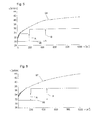
- Figure 3 depicts a graph 80 of Dynamic Surface Tension (DST) obtained by means of a maximum bubble pressure dynamic tensiometer for an ink for ink jet printing; the surface tension ⁇ is shown on the y-axis and is expressed in mN/m, the bubble formation frequency ⁇ is shown on the x-axis and is expressed in s -1 . The frequencies between 0 and 1000 s -1 are reported.
- DST Dynamic Surface Tension
- the graph 80 is relative to a colour ink for ink jet printers, according to the known art and designated "known ink” in the following, made of the components listed earlier and characterized by a surfactant system containing, for instance, a variable percentage of between 2% and 5% by weight of an acetylenediol ethoxylated (Surfynol 465 - Air Products).
- composition of the known ink is given below: Deionized water 69.9 % by weight 2-pyrrolidone 20 % by weight Diethylene glycol-monobutylether 3 % by weight Direct Blue 199 3 % by weight Surfynol 465 3 % by weight Preventol D6 0.1 % by weight EDTA 1 % by weight
- the static surface tension value ⁇ stat of the known ink is 32.5 mN/m and is identifiable in figure 3 with the level 82, corresponding to a bubble ejection frequency value ⁇ of zero.
- the pattern revealed by a generic DST graph may be of two types:
- the graph 80 of figure 3 depicts a fast dynamic rearrangement pattern.
- a first ink according to this invention is made of the compounds listed previously for the known ink, from which it differs solely in its surfactant system, the first ink possessing, as a non-restrictive example, a surfactant system consisting of a polyalkyl glucoside.
- Polyalkyl glucosides are non-ionic surface-active agents formed from a natural sugar, glucose, and alcohols, and are represented by the generic formula: where R represents a generic alkyl chain, and n is the degree of polymerization of the glucose; normally n is not greater than 1, on account of limits set by the type of synthesis of the polyalkyl glucoside.
- Polyalkyl glucosides have good detergent properties and, by virtue of their low toxicity, they are widely used today in a variety of applications where the ecological impact on users is fundamental. Thus they are used in the field of cosmetics, as industrial detergents in processes with low environmental impact, as washing agents for fruit and vegetables, in shampoos for children, as emulsifiers for food products and also as dispersing agents for pesticides and herbicides.
- the polyalkyl glucoside used in the invention is a polyalkyl glucoside with alkyl chain C8/14, such as Glucopon TM 650 EC (Cognis - Henkel), used in a percentage between 0.1% and 5% by weight and preferably between 0.1% and 3% by weight of active substance.
- Glucopon TM 650 EC Cognis - Henkel
- Figure 4 is a graph 90 showing the pattern of the DST in relation to the droplet ejection frequency ⁇ of the first ink, where the level 92 corresponds to the ⁇ stat value of the first ink.
- the dynamic behaviour of the first ink of the invention is of the slow rearrangement type since it does not satisfy the dynamic fast rearrangement conditions.
- a slow rearrangement pattern implies that, during dynamic conditions such as those when the head is operating, the ink has a surface tension higher than its static value and therefore that the capillary pressure which regulates the filling of the nozzle 56 allows a greater nozzle filling speed and therefore a higher droplet ejection frequency.
- use of the first ink according to this invention guarantees a gain in maximum ejection frequency of about 30% with respect to use of the known ink and allows the same printing quality to be obtained.
- the printing quality of the first ink and of the known ink are perfectly identical on a broad range of media, such as for example plain paper, films, photographic papers, and for different test images.
- the head functional checks confirm that the first ink is comparable to the known ink in the clogging tests as well, which check the degree of nozzle obstruction in heads under specific storage time and temperature conditions, and in the kogation tests, which check the status of the resistors in defined ranges of numbers of droplets ejected.
- a second ink according to this invention is made of the compounds listed above for the known ink, from which it differs solely in its surfactant system, the second ink having as its surfactant system an ethoxylated alcohol.
- the ethoxylated alcohol used in the invention is a primary ethoxylated alcohol having a alkyl chain C11 and 7 ethoxy units, such as the commercial product called Lialet TM 111/7 (Condea), used in a percentage between 0.1% and 5% by weight and preferably between 0.1% and 3% by weight.
- Lialet TM 111/7 Condea
- Figure 5 is graph 94 illustrating the pattern of the DST in relation to the droplet ejection frequency ⁇ of the second ink, where the level 95 corresponds to the ⁇ stat value of the second ink.
- the dynamic behaviour of the second ink according to this invention is also of the slow rearrangement type because it does not satisfy the dynamic fast rearrangement conditions.
- use of the second ink according to this invention guarantees a gain in maximum ejection frequency of about 15% with respect to use of the known ink, and allows the same printing quality to be obtained.
- the printing quality of the second ink and of the known ink are perfectly similar on a wide variety of media, such as for instance plain paper, films, photographic papers, and for different test images.
- a third ink according to this invention is made of the compounds listed above for the known ink, from which it differs solely in its surfactant system, the third ink having as its surfactant system an ethoxy-propoxylated alcohol, having preferably an alkyl chain C12/14 with 7 ethoxy units and 4.5 propoxy units, such as the commercial product called Softanol TM EP7045 (Ineos), preferably used in a percentage between 0.1% and 5% by weight and preferably between 0.1% and 3% by weight.
- Softanol TM EP7045 Intelligent Product
- Figure 6 is a graph 97 illustrating the pattern of the DST in relation to the droplet ejection frequency ⁇ of the third ink, where the level 98 corresponds to the ⁇ stat value of the third ink.
- the dynamic behaviour of the third ink according to this invention is also of the slow rearrangement type because it does not satisfy the dynamic fast rearrangement conditions.
- the use of the third ink according to this invention guarantees a gain in maximum ejection frequency of about 20% with respect to use of the known ink and allows the same printing quality to be obtained.
- the printing quality of the third ink and of the known ink are perfectly identical on a broad range of media, such as for instance plain paper, films, photographic papers, and for different test images.
- composition of an ink according to the invention preferably has the following properties:
- present invention relates also to a thermal ink jet printing process comprising the following steps:
Landscapes
- Chemical & Material Sciences (AREA)
- Life Sciences & Earth Sciences (AREA)
- Engineering & Computer Science (AREA)
- Materials Engineering (AREA)
- Wood Science & Technology (AREA)
- Organic Chemistry (AREA)
- Inks, Pencil-Leads, Or Crayons (AREA)
- Ink Jet Recording Methods And Recording Media Thereof (AREA)
- Particle Formation And Scattering Control In Inkjet Printers (AREA)
Applications Claiming Priority (3)
| Application Number | Priority Date | Filing Date | Title |
|---|---|---|---|
| IT2000TO001193A IT1320863B1 (it) | 2000-12-20 | 2000-12-20 | Inchiostro per stampa termica a getto d'inchiostro con elevateprestazioni ad alte frequenze di eiezione. |
| ITTO20001193 | 2000-12-20 | ||
| PCT/IT2001/000647 WO2002050198A1 (en) | 2000-12-20 | 2001-12-20 | Ink for thermal ink jet printing with high performance at high ejection frequencies |
Publications (2)
| Publication Number | Publication Date |
|---|---|
| EP1363978A1 EP1363978A1 (en) | 2003-11-26 |
| EP1363978B1 true EP1363978B1 (en) | 2015-09-09 |
Family
ID=11458313
Family Applications (1)
| Application Number | Title | Priority Date | Filing Date |
|---|---|---|---|
| EP01995806.5A Expired - Lifetime EP1363978B1 (en) | 2000-12-20 | 2001-12-20 | Ink for thermal ink jet printing with high performance at high ejection frequencies |
Country Status (5)
| Country | Link |
|---|---|
| US (2) | US6926766B2 (it) |
| EP (1) | EP1363978B1 (it) |
| AU (1) | AU2002226672A1 (it) |
| IT (1) | IT1320863B1 (it) |
| WO (1) | WO2002050198A1 (it) |
Families Citing this family (11)
| Publication number | Priority date | Publication date | Assignee | Title |
|---|---|---|---|---|
| IL159990A (en) * | 2004-01-21 | 2008-03-20 | Eyal Eliav | Method, device and system for embedding content across the surface of a beverage |
| US7300506B2 (en) * | 2005-03-17 | 2007-11-27 | Hewlett-Packard Development Company, L.P. | Ink formulations, print systems, and methods thereof |
| CN101316718B (zh) * | 2005-10-20 | 2014-01-01 | 株式会社理光 | 记录油墨、记录介质、油墨-介质组件、油墨记录物、喷墨记录方法、和喷墨记录设备 |
| IL178519A (en) * | 2006-10-15 | 2016-04-21 | Shlomo Magdassi | Edible paint preparation |
| US20110104461A1 (en) * | 2009-09-28 | 2011-05-05 | Owens Corning Intellectual Capital, Llc | Underlayment with slip-resistant surface |
| US20140015894A1 (en) * | 2012-07-13 | 2014-01-16 | Xerox Corporation | In-line aqueous coating solution for solid ink jet web printing |
| JP6323666B2 (ja) * | 2014-03-31 | 2018-05-16 | セイコーエプソン株式会社 | インクジェット記録方法 |
| US20170135921A1 (en) | 2015-11-17 | 2017-05-18 | Funai Electric Co., Ltd | Color ink set for cosmetic application |
| US10059854B2 (en) * | 2015-12-22 | 2018-08-28 | Troy Group, Inc. | Composition and method of making aqueous penetrating inkjet ink |
| CN112480748B (zh) * | 2020-12-21 | 2023-02-21 | 珠海天威新材料股份有限公司 | 一种适用于高频喷头快速喷墨打印的分散染料墨水 |
| GB202303310D0 (en) | 2023-03-07 | 2023-04-19 | Joulium Energy Ltd | Working fluid composition |
Family Cites Families (13)
| Publication number | Priority date | Publication date | Assignee | Title |
|---|---|---|---|---|
| JPS5274406A (en) * | 1975-12-05 | 1977-06-22 | Dainippon Toryo Kk | Ink for ink jet recording |
| JPH04211478A (ja) | 1990-03-27 | 1992-08-03 | Seiko Epson Corp | インクジェット記録方法およびインク組成物 |
| JP3176444B2 (ja) * | 1992-10-01 | 2001-06-18 | 株式会社リコー | 水性インク及びこれを用いた記録方法 |
| JP3247784B2 (ja) * | 1993-12-22 | 2002-01-21 | 株式会社リコー | 水性インク及びこれを用いた記録方法 |
| IT1266731B1 (it) * | 1994-06-28 | 1997-01-14 | Olivetti Canon Ind Spa | Inchiostro per stampa a getto d'inchiostro. |
| JP3049592B2 (ja) * | 1995-12-07 | 2000-06-05 | 富士ゼロックス株式会社 | インクジェット記録用インク及びインクジェット記録方法 |
| US5972082A (en) * | 1996-04-30 | 1999-10-26 | Ricoh Company, Ltd. | Aqueous ink composition and ink-jet printing method using the same |
| JP3827412B2 (ja) * | 1997-07-28 | 2006-09-27 | 三菱鉛筆株式会社 | インキ組成物 |
| US5935308A (en) * | 1998-07-31 | 1999-08-10 | Videojet Systems International, Inc. | Latent image jet inks |
| DE60013347T2 (de) * | 1999-04-06 | 2005-09-08 | Seiko Epson Corp. | Tintenzusammensetzung enthaltend einen Kupferkomplex-Farbstoff |
| US6500246B2 (en) * | 2001-01-05 | 2002-12-31 | Everlight Usa, Inc. | Ink-jet ink composition |
| US6592657B2 (en) * | 2001-02-12 | 2003-07-15 | Hewlett-Packard Development Company, L.P. | Additives for ink-jet inks |
| JP3903938B2 (ja) * | 2002-04-23 | 2007-04-11 | セイコーエプソン株式会社 | インク組成物、それを用いたインクジェット記録方法および記録物 |
-
2000
- 2000-12-20 IT IT2000TO001193A patent/IT1320863B1/it active
-
2001
- 2001-12-20 WO PCT/IT2001/000647 patent/WO2002050198A1/en not_active Ceased
- 2001-12-20 AU AU2002226672A patent/AU2002226672A1/en not_active Abandoned
- 2001-12-20 US US10/451,110 patent/US6926766B2/en not_active Expired - Lifetime
- 2001-12-20 EP EP01995806.5A patent/EP1363978B1/en not_active Expired - Lifetime
-
2005
- 2005-05-16 US US11/129,314 patent/US7160373B2/en not_active Expired - Fee Related
Also Published As
| Publication number | Publication date |
|---|---|
| US20050204954A1 (en) | 2005-09-22 |
| US20040046846A1 (en) | 2004-03-11 |
| WO2002050198A1 (en) | 2002-06-27 |
| US6926766B2 (en) | 2005-08-09 |
| ITTO20001193A1 (it) | 2002-06-20 |
| ITTO20001193A0 (it) | 2000-12-20 |
| AU2002226672A1 (en) | 2002-07-01 |
| US7160373B2 (en) | 2007-01-09 |
| EP1363978A1 (en) | 2003-11-26 |
| IT1320863B1 (it) | 2003-12-10 |
Similar Documents
| Publication | Publication Date | Title |
|---|---|---|
| US6332919B2 (en) | Ink, ink set, ink cartridge, recording unit, image recording apparatus and image recording method | |
| KR100518473B1 (ko) | 습윤제를함유하는잉크젯잉크및이를사용하여기재상에프린트하는방법 | |
| KR100552027B1 (ko) | 잉크, 잉크 카트리지, 기록 유닛, 잉크 제트 기록 방법 및 잉크 제트 기록 장치 | |
| US20080092772A1 (en) | Dye-Based Ink Compositions | |
| US5395434A (en) | Ink, ink-jet recording method, and ink-jet recording apparatus | |
| US5183502A (en) | Water based ink for ink-jet printing | |
| US7674329B2 (en) | Water-based ink set for ink-jet recording | |
| EP0823463B1 (en) | Ink compositions having superior decap and dry-time performance | |
| EP0624470B1 (en) | Ink jet recording method and apparatus | |
| EP3196262B1 (en) | Ink, ink cartridge, and image recording method | |
| US7449056B2 (en) | Ink-jet recording ink, recording method and recording apparatus | |
| US7160373B2 (en) | Ink for thermal ink jet printing with high performance at high ejection frequencies | |
| EP1794246B1 (en) | Dye-based ink | |
| WO2004106439A1 (ja) | 記録液及びこれを用いた記録方法 | |
| EP2771419B1 (en) | An ink composition | |
| US5843217A (en) | Ink for ink jet recording | |
| JP2001098200A (ja) | インクジェットインク組成物 | |
| KR20070001904A (ko) | 기록액, 액체 카트리지, 액체 토출 장치 및 액체 토출 방법 | |
| JP3541579B2 (ja) | インクジェット記録用インク | |
| EP3339382A1 (en) | Ink, ink cartridge, and ink jet recording method | |
| CA2312643C (en) | Ink, ink-jet recording method, and ink-jet recording apparatus | |
| JP3060320B2 (ja) | インク、これを用いたインクジェット記録方法及び機器 |
Legal Events
| Date | Code | Title | Description |
|---|---|---|---|
| PUAI | Public reference made under article 153(3) epc to a published international application that has entered the european phase |
Free format text: ORIGINAL CODE: 0009012 |
|
| 17P | Request for examination filed |
Effective date: 20030707 |
|
| AK | Designated contracting states |
Kind code of ref document: A1 Designated state(s): AT BE CH CY DE DK ES FI FR GB GR IE IT LI LU MC NL PT SE TR |
|
| AX | Request for extension of the european patent |
Extension state: AL LT LV MK RO SI |
|
| RIN1 | Information on inventor provided before grant (corrected) |
Inventor name: GINO, LUIGINA,OLIVETTI I-JET S.P.A. Inventor name: PISTAGNA, ALESSANDRA,OLIVETTI I-JET S.P.A. |
|
| 17Q | First examination report despatched |
Effective date: 20050329 |
|
| RAP1 | Party data changed (applicant data changed or rights of an application transferred) |
Owner name: TELECOM ITALIA S.P.A. |
|
| RAP1 | Party data changed (applicant data changed or rights of an application transferred) |
Owner name: OLIVETTI S.P.A. |
|
| RAP1 | Party data changed (applicant data changed or rights of an application transferred) |
Owner name: SICPA HOLDING SA |
|
| REG | Reference to a national code |
Ref country code: DE Ref legal event code: R079 Ref document number: 60149578 Country of ref document: DE Free format text: PREVIOUS MAIN CLASS: C09D0011000000 Ipc: C09D0011380000 |
|
| GRAP | Despatch of communication of intention to grant a patent |
Free format text: ORIGINAL CODE: EPIDOSNIGR1 |
|
| RIC1 | Information provided on ipc code assigned before grant |
Ipc: C09D 11/38 20140101AFI20150309BHEP |
|
| INTG | Intention to grant announced |
Effective date: 20150407 |
|
| RIN1 | Information on inventor provided before grant (corrected) |
Inventor name: GINO, LUIGINA, C/O OLIVETTI I-JET S.P.A. Inventor name: PISTAGNA, ALESSANDRA, C/O OLIVETTI I-JET S.P.A. |
|
| GRAS | Grant fee paid |
Free format text: ORIGINAL CODE: EPIDOSNIGR3 |
|
| GRAA | (expected) grant |
Free format text: ORIGINAL CODE: 0009210 |
|
| AK | Designated contracting states |
Kind code of ref document: B1 Designated state(s): AT BE CH CY DE DK ES FI FR GB GR IE IT LI LU MC NL PT SE TR |
|
| REG | Reference to a national code |
Ref country code: GB Ref legal event code: FG4D |
|
| REG | Reference to a national code |
Ref country code: AT Ref legal event code: REF Ref document number: 748120 Country of ref document: AT Kind code of ref document: T Effective date: 20150915 Ref country code: CH Ref legal event code: EP |
|
| REG | Reference to a national code |
Ref country code: IE Ref legal event code: FG4D |
|
| REG | Reference to a national code |
Ref country code: DE Ref legal event code: R096 Ref document number: 60149578 Country of ref document: DE |
|
| REG | Reference to a national code |
Ref country code: FR Ref legal event code: PLFP Year of fee payment: 15 |
|
| REG | Reference to a national code |
Ref country code: NL Ref legal event code: MP Effective date: 20150909 |
|
| PG25 | Lapsed in a contracting state [announced via postgrant information from national office to epo] |
Ref country code: FI Free format text: LAPSE BECAUSE OF FAILURE TO SUBMIT A TRANSLATION OF THE DESCRIPTION OR TO PAY THE FEE WITHIN THE PRESCRIBED TIME-LIMIT Effective date: 20150909 Ref country code: GR Free format text: LAPSE BECAUSE OF FAILURE TO SUBMIT A TRANSLATION OF THE DESCRIPTION OR TO PAY THE FEE WITHIN THE PRESCRIBED TIME-LIMIT Effective date: 20151210 |
|
| REG | Reference to a national code |
Ref country code: AT Ref legal event code: MK05 Ref document number: 748120 Country of ref document: AT Kind code of ref document: T Effective date: 20150909 |
|
| PG25 | Lapsed in a contracting state [announced via postgrant information from national office to epo] |
Ref country code: ES Free format text: LAPSE BECAUSE OF FAILURE TO SUBMIT A TRANSLATION OF THE DESCRIPTION OR TO PAY THE FEE WITHIN THE PRESCRIBED TIME-LIMIT Effective date: 20150909 Ref country code: SE Free format text: LAPSE BECAUSE OF FAILURE TO SUBMIT A TRANSLATION OF THE DESCRIPTION OR TO PAY THE FEE WITHIN THE PRESCRIBED TIME-LIMIT Effective date: 20150909 |
|
| PG25 | Lapsed in a contracting state [announced via postgrant information from national office to epo] |
Ref country code: NL Free format text: LAPSE BECAUSE OF FAILURE TO SUBMIT A TRANSLATION OF THE DESCRIPTION OR TO PAY THE FEE WITHIN THE PRESCRIBED TIME-LIMIT Effective date: 20150909 |
|
| PG25 | Lapsed in a contracting state [announced via postgrant information from national office to epo] |
Ref country code: PT Free format text: LAPSE BECAUSE OF FAILURE TO SUBMIT A TRANSLATION OF THE DESCRIPTION OR TO PAY THE FEE WITHIN THE PRESCRIBED TIME-LIMIT Effective date: 20160111 Ref country code: AT Free format text: LAPSE BECAUSE OF FAILURE TO SUBMIT A TRANSLATION OF THE DESCRIPTION OR TO PAY THE FEE WITHIN THE PRESCRIBED TIME-LIMIT Effective date: 20150909 Ref country code: BE Free format text: LAPSE BECAUSE OF NON-PAYMENT OF DUE FEES Effective date: 20151231 |
|
| REG | Reference to a national code |
Ref country code: DE Ref legal event code: R097 Ref document number: 60149578 Country of ref document: DE |
|
| PLBE | No opposition filed within time limit |
Free format text: ORIGINAL CODE: 0009261 |
|
| STAA | Information on the status of an ep patent application or granted ep patent |
Free format text: STATUS: NO OPPOSITION FILED WITHIN TIME LIMIT |
|
| PG25 | Lapsed in a contracting state [announced via postgrant information from national office to epo] |
Ref country code: LU Free format text: LAPSE BECAUSE OF FAILURE TO SUBMIT A TRANSLATION OF THE DESCRIPTION OR TO PAY THE FEE WITHIN THE PRESCRIBED TIME-LIMIT Effective date: 20151220 Ref country code: MC Free format text: LAPSE BECAUSE OF FAILURE TO SUBMIT A TRANSLATION OF THE DESCRIPTION OR TO PAY THE FEE WITHIN THE PRESCRIBED TIME-LIMIT Effective date: 20150909 |
|
| REG | Reference to a national code |
Ref country code: CH Ref legal event code: PL |
|
| 26N | No opposition filed |
Effective date: 20160610 |
|
| PG25 | Lapsed in a contracting state [announced via postgrant information from national office to epo] |
Ref country code: DK Free format text: LAPSE BECAUSE OF FAILURE TO SUBMIT A TRANSLATION OF THE DESCRIPTION OR TO PAY THE FEE WITHIN THE PRESCRIBED TIME-LIMIT Effective date: 20150909 |
|
| REG | Reference to a national code |
Ref country code: IE Ref legal event code: MM4A |
|
| PG25 | Lapsed in a contracting state [announced via postgrant information from national office to epo] |
Ref country code: LI Free format text: LAPSE BECAUSE OF NON-PAYMENT OF DUE FEES Effective date: 20151231 Ref country code: IE Free format text: LAPSE BECAUSE OF NON-PAYMENT OF DUE FEES Effective date: 20151220 Ref country code: CH Free format text: LAPSE BECAUSE OF NON-PAYMENT OF DUE FEES Effective date: 20151231 |
|
| REG | Reference to a national code |
Ref country code: FR Ref legal event code: PLFP Year of fee payment: 16 |
|
| PG25 | Lapsed in a contracting state [announced via postgrant information from national office to epo] |
Ref country code: BE Free format text: LAPSE BECAUSE OF FAILURE TO SUBMIT A TRANSLATION OF THE DESCRIPTION OR TO PAY THE FEE WITHIN THE PRESCRIBED TIME-LIMIT Effective date: 20150909 |
|
| PGFP | Annual fee paid to national office [announced via postgrant information from national office to epo] |
Ref country code: DE Payment date: 20161121 Year of fee payment: 16 Ref country code: GB Payment date: 20161128 Year of fee payment: 16 Ref country code: FR Payment date: 20161121 Year of fee payment: 16 |
|
| PGFP | Annual fee paid to national office [announced via postgrant information from national office to epo] |
Ref country code: IT Payment date: 20161125 Year of fee payment: 16 |
|
| PG25 | Lapsed in a contracting state [announced via postgrant information from national office to epo] |
Ref country code: CY Free format text: LAPSE BECAUSE OF FAILURE TO SUBMIT A TRANSLATION OF THE DESCRIPTION OR TO PAY THE FEE WITHIN THE PRESCRIBED TIME-LIMIT Effective date: 20150909 |
|
| PG25 | Lapsed in a contracting state [announced via postgrant information from national office to epo] |
Ref country code: TR Free format text: LAPSE BECAUSE OF FAILURE TO SUBMIT A TRANSLATION OF THE DESCRIPTION OR TO PAY THE FEE WITHIN THE PRESCRIBED TIME-LIMIT Effective date: 20150909 |
|
| REG | Reference to a national code |
Ref country code: DE Ref legal event code: R119 Ref document number: 60149578 Country of ref document: DE |
|
| GBPC | Gb: european patent ceased through non-payment of renewal fee |
Effective date: 20171220 |
|
| REG | Reference to a national code |
Ref country code: FR Ref legal event code: ST Effective date: 20180831 |
|
| PG25 | Lapsed in a contracting state [announced via postgrant information from national office to epo] |
Ref country code: FR Free format text: LAPSE BECAUSE OF NON-PAYMENT OF DUE FEES Effective date: 20180102 Ref country code: DE Free format text: LAPSE BECAUSE OF NON-PAYMENT OF DUE FEES Effective date: 20180703 Ref country code: IT Free format text: LAPSE BECAUSE OF NON-PAYMENT OF DUE FEES Effective date: 20171220 |
|
| PG25 | Lapsed in a contracting state [announced via postgrant information from national office to epo] |
Ref country code: GB Free format text: LAPSE BECAUSE OF NON-PAYMENT OF DUE FEES Effective date: 20171220 |